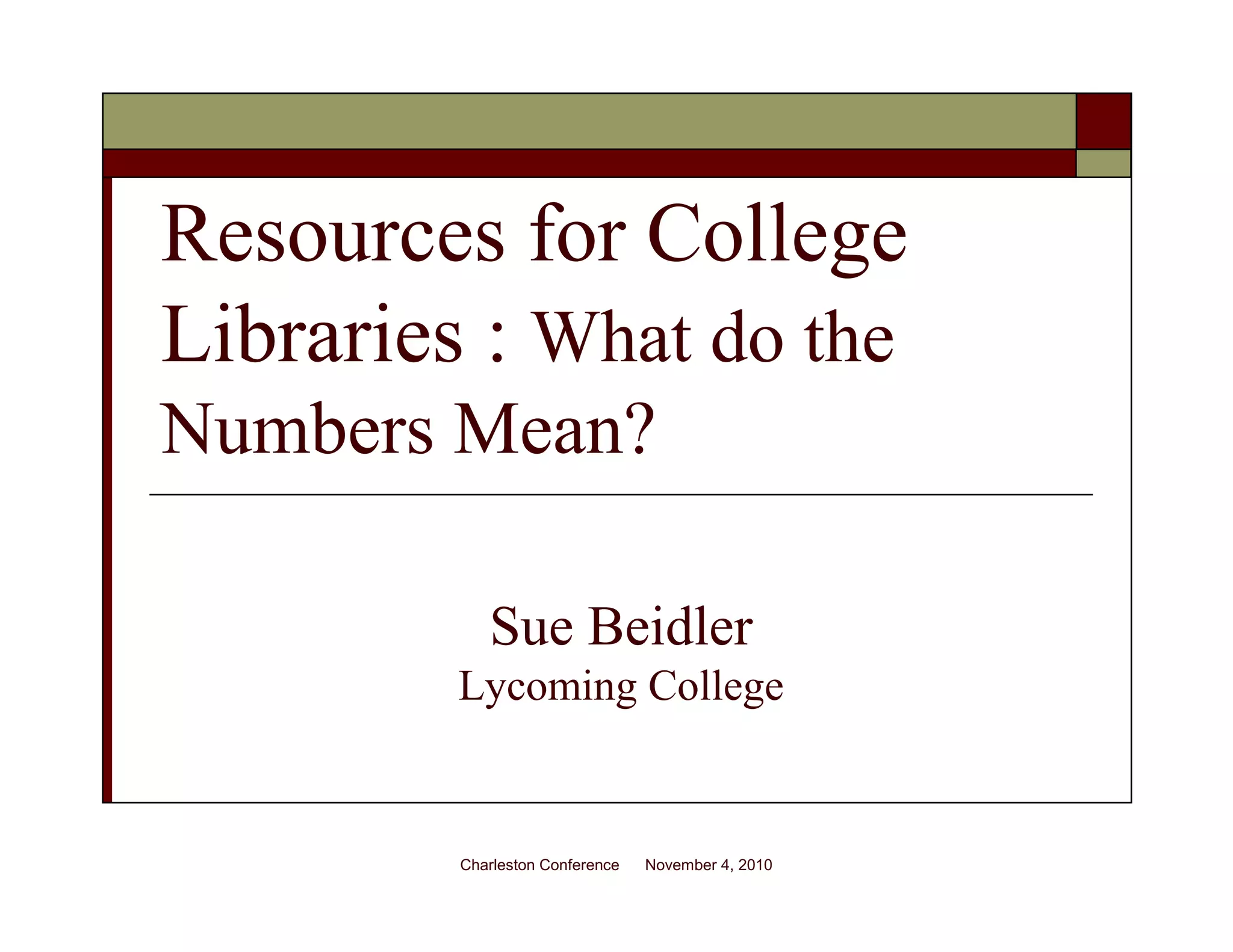
Resources for College
Libraries : What do the
Numbers Mean?
Sue Beidler
Lycoming College
Charleston Conference November 4, 2010
Agenda
Overview of Lycoming’s Environment
Overview of Resources for College Libraries
What is BBAS (/Bowker’s Book Analysis
System)?
How We Use RCLWeb
How We Use BBAS
Discussion
Charleston Conference November 4, 2010
Overview of Lycoming’s Environment
Lycoming College: private, 4-year, approx.1400
FTE
Traditional Liberal Arts
5 Librarians, 6 support staff
An active collaborative instruction program that
teaches the responsible use of research sources,
building the skills to find, evaluate, and integrate
information is a key aspect of our mission.
Charleston Conference November 4, 2010
Overview of Lycoming’s Environment
Local ILS: TLC’s Library•Solution 4.2
Collection of approx. 155,000 cataloged volumes
Annual monograph/standing order budget of
approximately $120K
2,300 new cataloged volumes added annually
Charleston Conference November 4, 2010
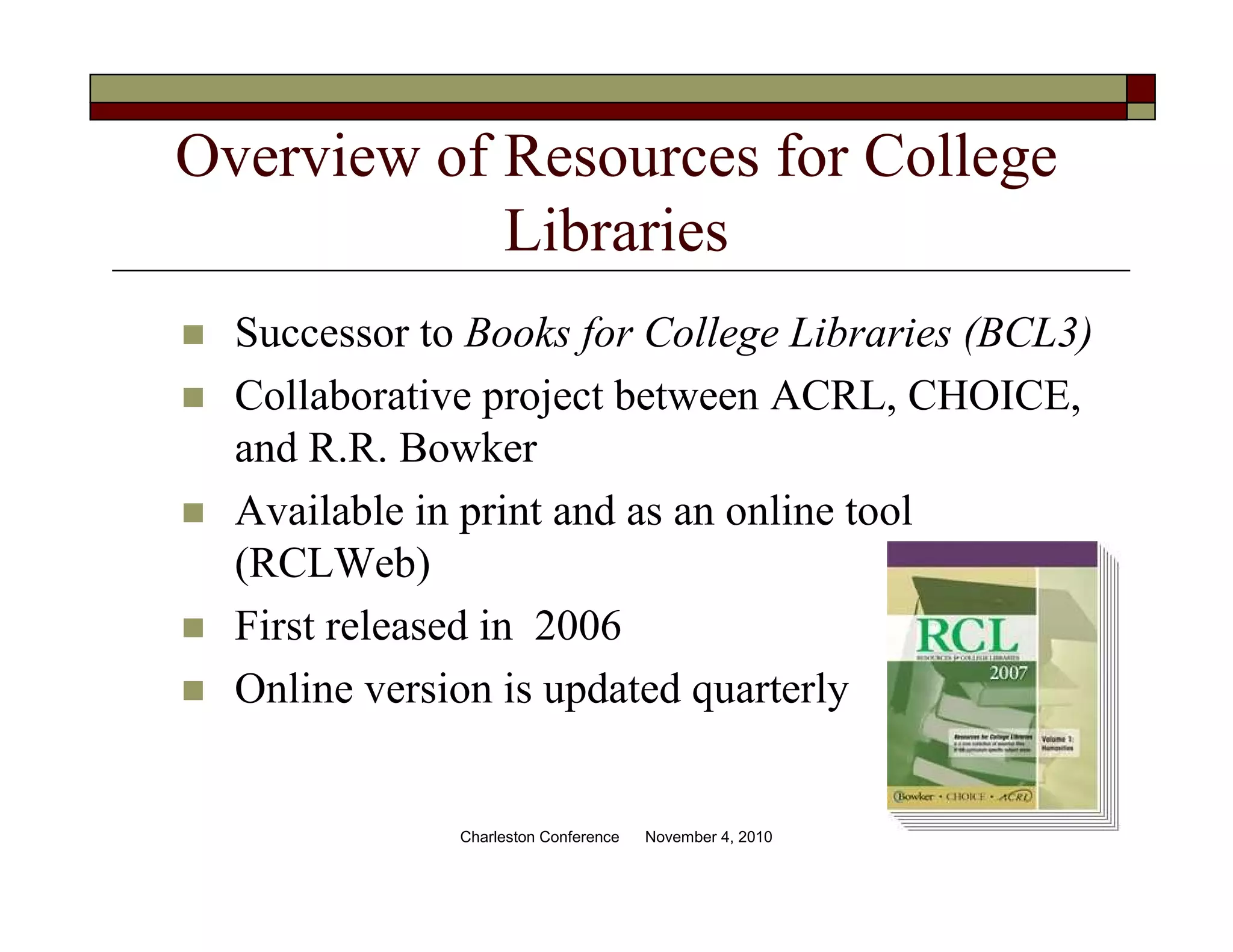
Overview of Resources for College
Libraries
Successor to Books for College Libraries (BCL3)
Collaborative project between ACRL, CHOICE,
and R.R. Bowker
Available in print and as an online tool
(RCLWeb)
First released in 2006
Online version is updated quarterly
Charleston Conference November 4, 2010
Overview of BBAS
(Bowker’s Book Analysis System)
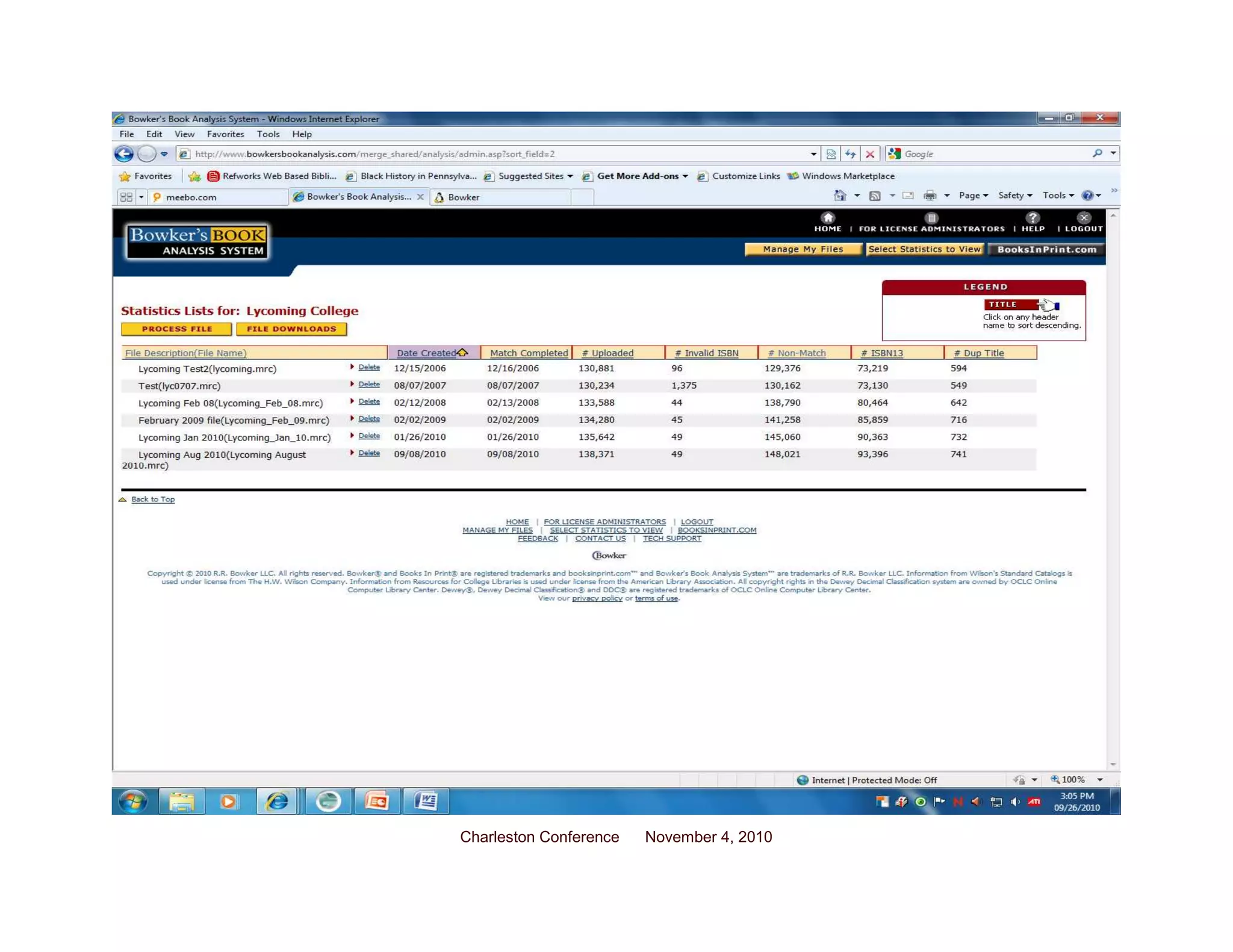
Electronically compares local collection to the
RCL database
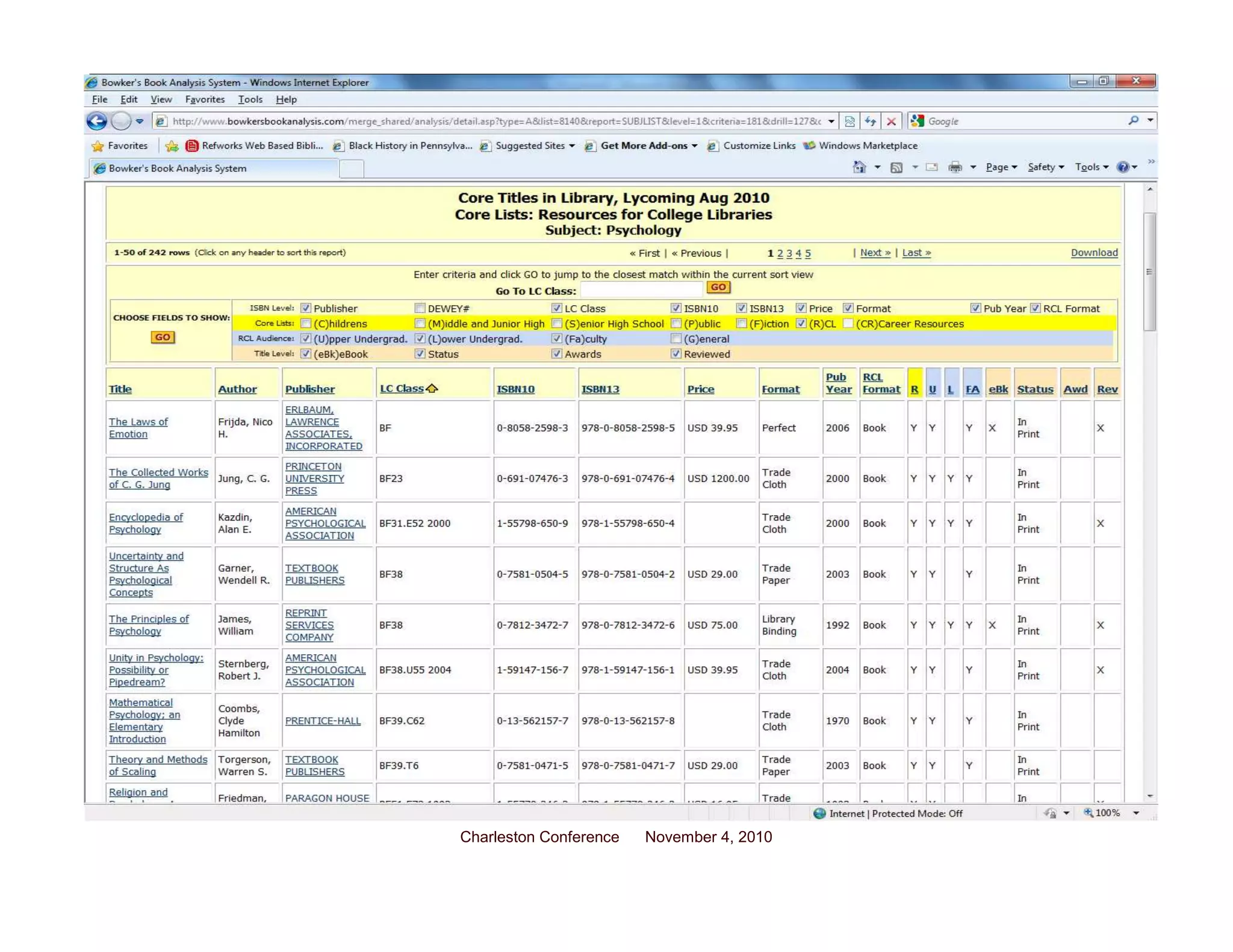
Provides array of reports that can be customized
Duplicate titles
Invalid ISBNs
Charleston Conference November 4, 2010
Overview of BBAS
(Bowker’s Book Analysis System)
Electronically compares local collection to the
RCL database
Provides array of reports that can be customized
Duplicate titles
Invalid ISBNs
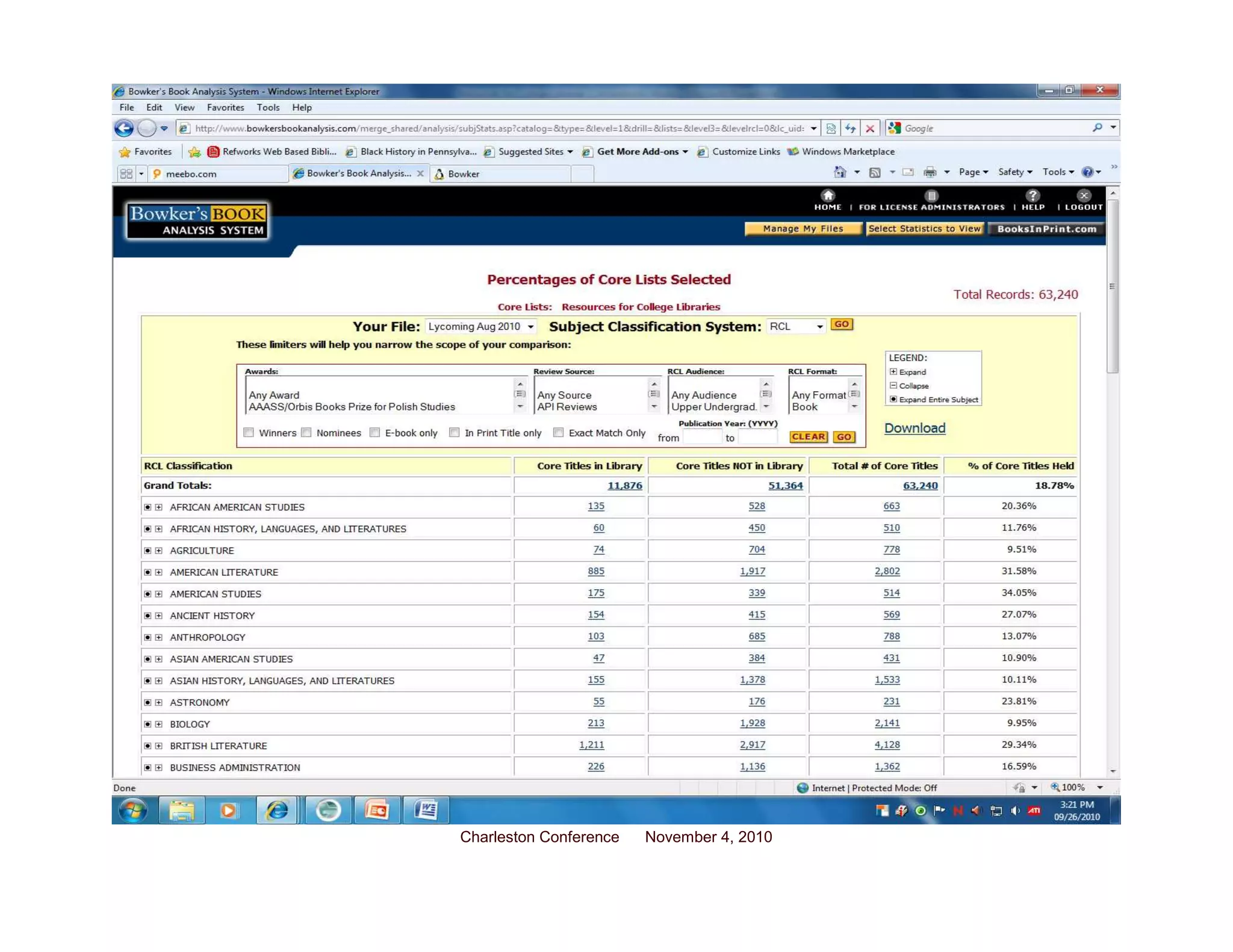
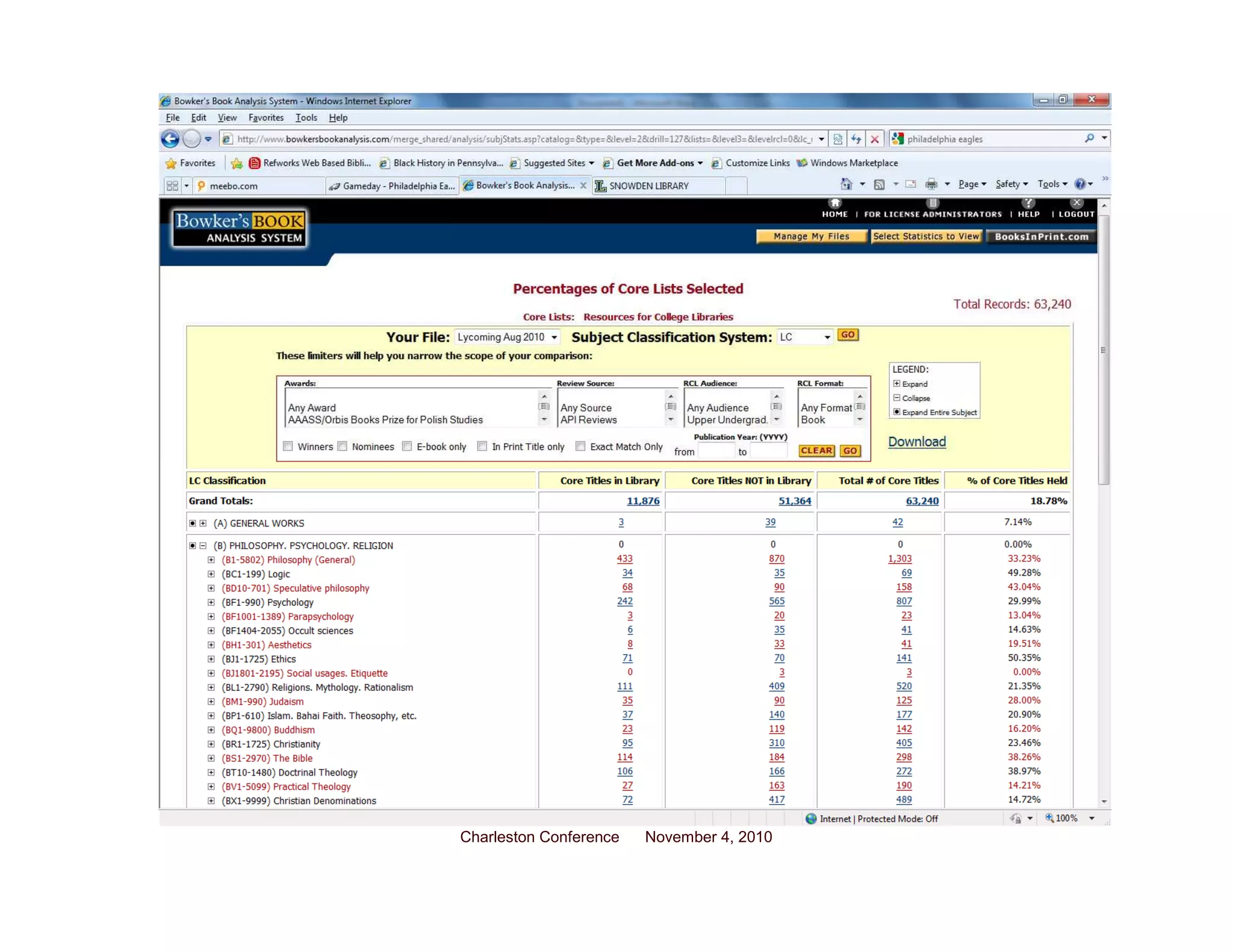
Statistical reports by RCL Subjects, LC Classification or
Core titles in library
Core titles NOT in library
Total # of core titles
% of core titles held
Charleston Conference November 4, 2010
Lycoming’s Uses for RCLWeb
Evaluating gift books for inclusion in our
collection
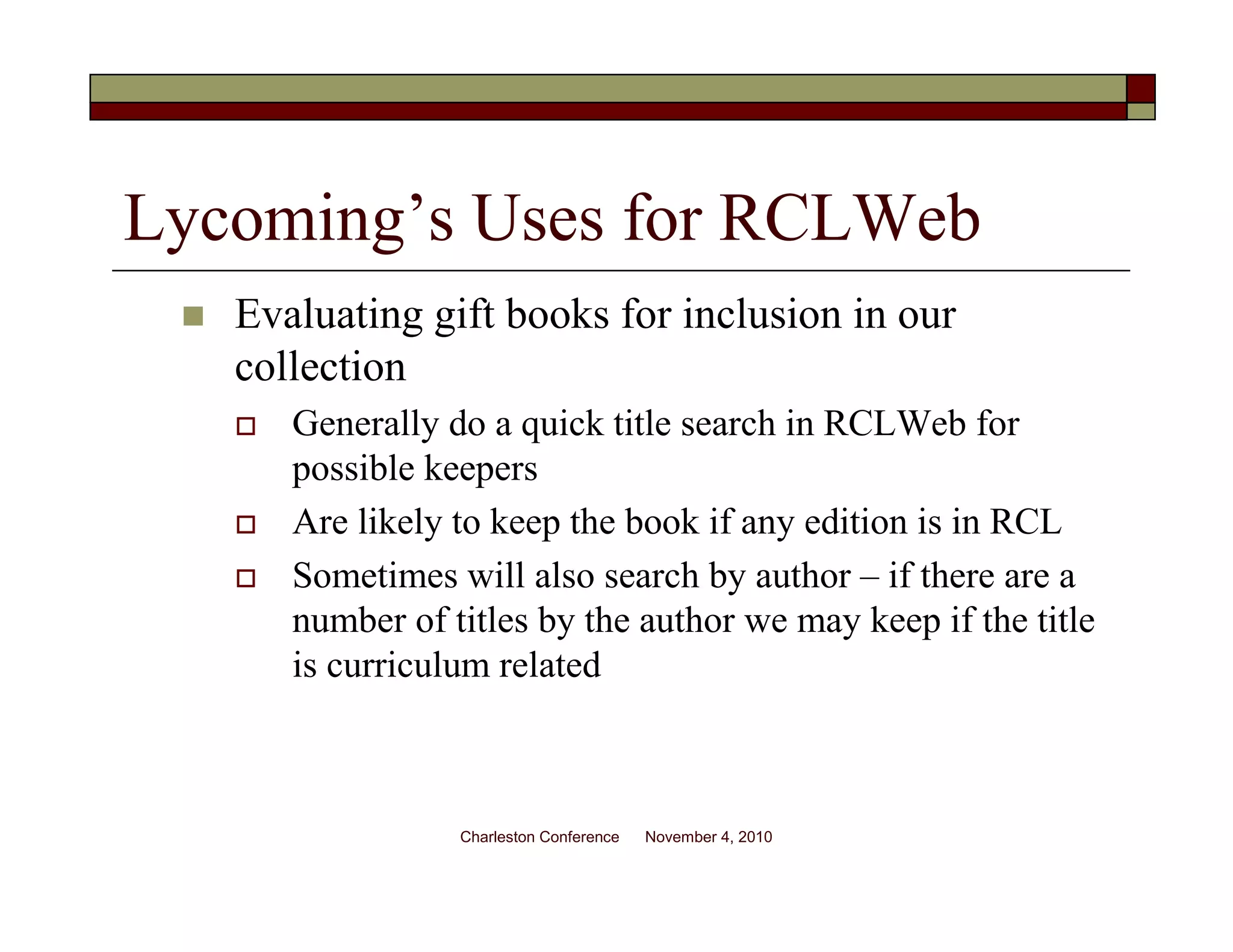
Generally do a quick title search in RCLWeb for
possible keepers
Are likely to keep the book if any edition is in RCL
Sometimes will also search by author – if there are a
number of titles by the author we may keep if the title
is curriculum related
Charleston Conference November 4, 2010
Lycoming’s Current Uses for RCL Book
Analysis results
Retrospective Collection Development –
Photography Project
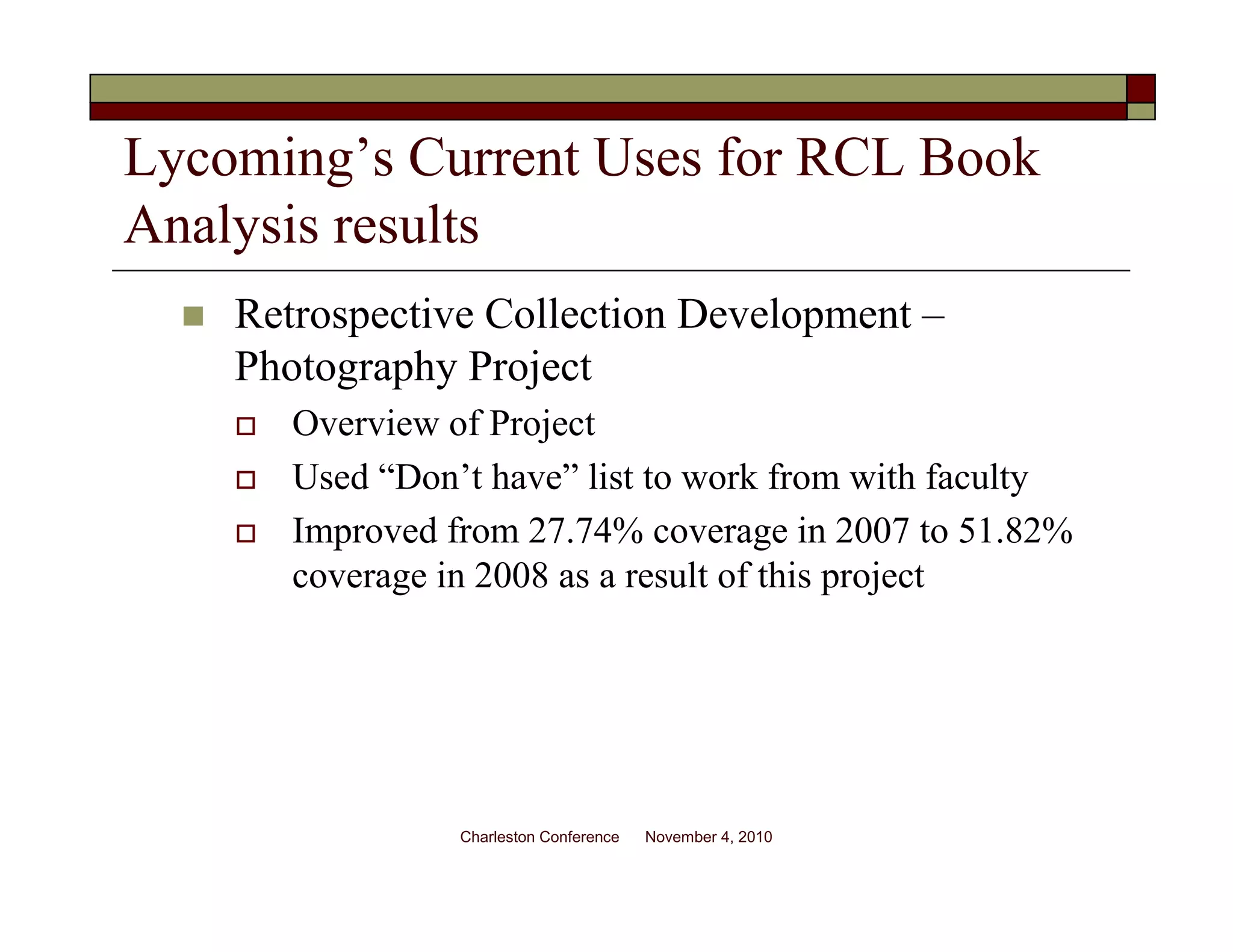
Overview of Project
Used “Don’t have” list to work from with faculty
Improved from 27.74% coverage in 2007 to 51.82%
coverage in 2008 as a result of this project
Charleston Conference November 4, 2010
Lycoming’s Current Uses for RCL Book
Analysis results
Weeding/De-selection decisions
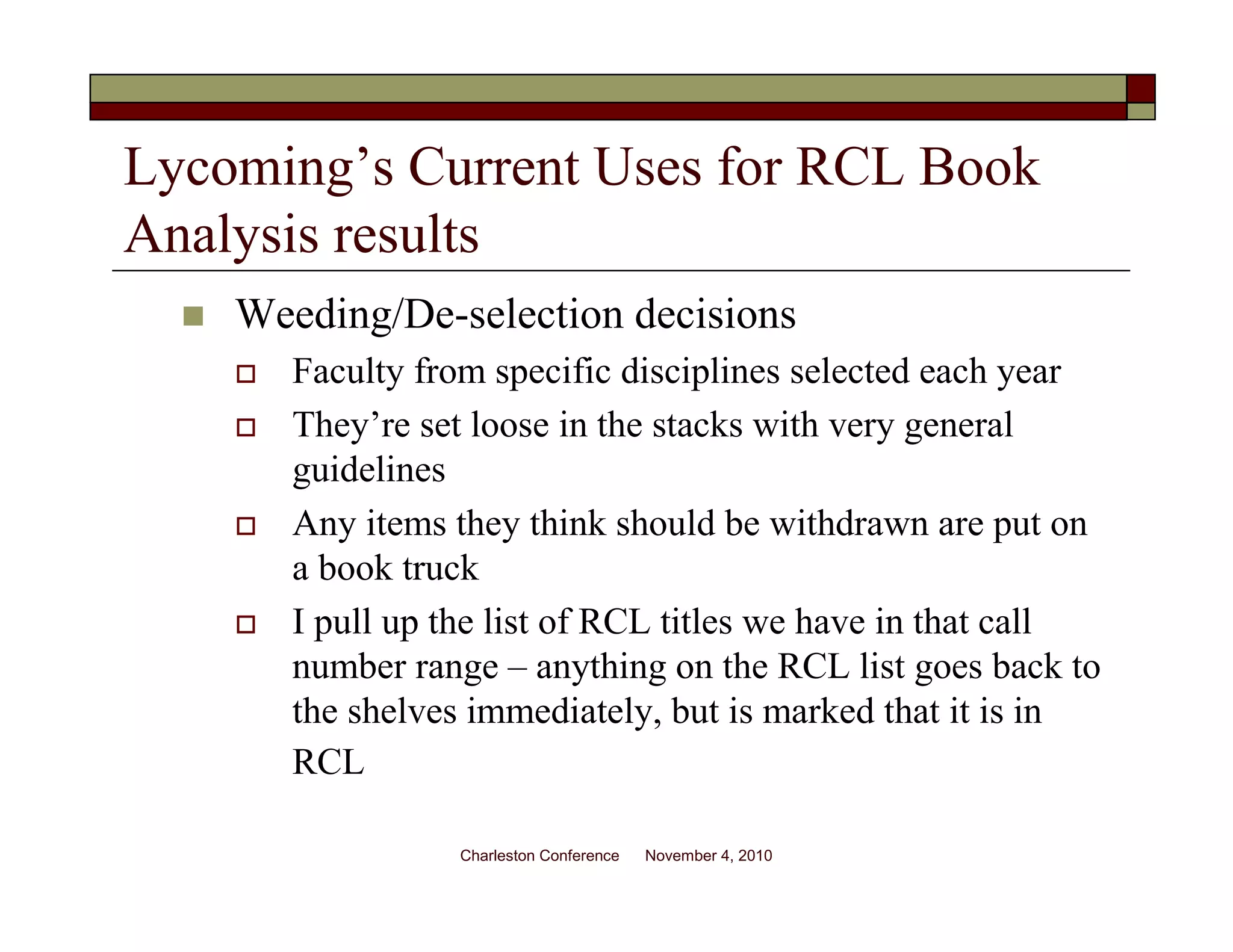
Faculty from specific disciplines selected each year
They’re set loose in the stacks with very general
guidelines
Any items they think should be withdrawn are put on
a book truck
I pull up the list of RCL titles we have in that call
number range – anything on the RCL list goes back to
the shelves immediately, but is marked that it is in
RCL
Charleston Conference November 4, 2010
Lycoming’s Current Uses for RCL Book
Analysis results
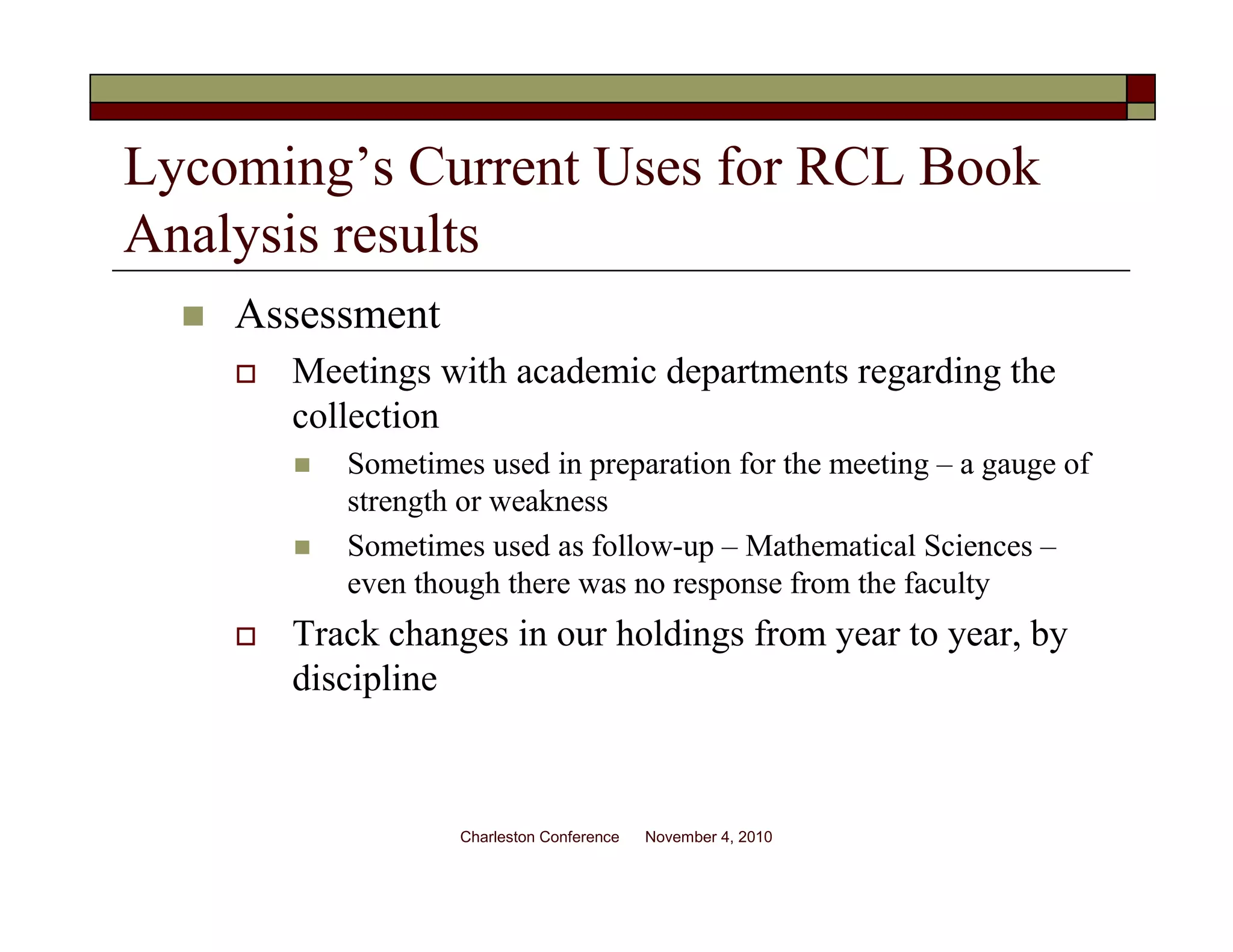
Assessment
Meetings with academic departments regarding the
collection
Sometimes used in preparation for the meeting – a gauge of
strength or weakness
Sometimes used as follow-up – Mathematical Sciences –
even though there was no response from the faculty
Track changes in our holdings from year to year, by
discipline
Charleston Conference November 4, 2010
Lycoming’s Current Uses for RCL Book
Analysis results
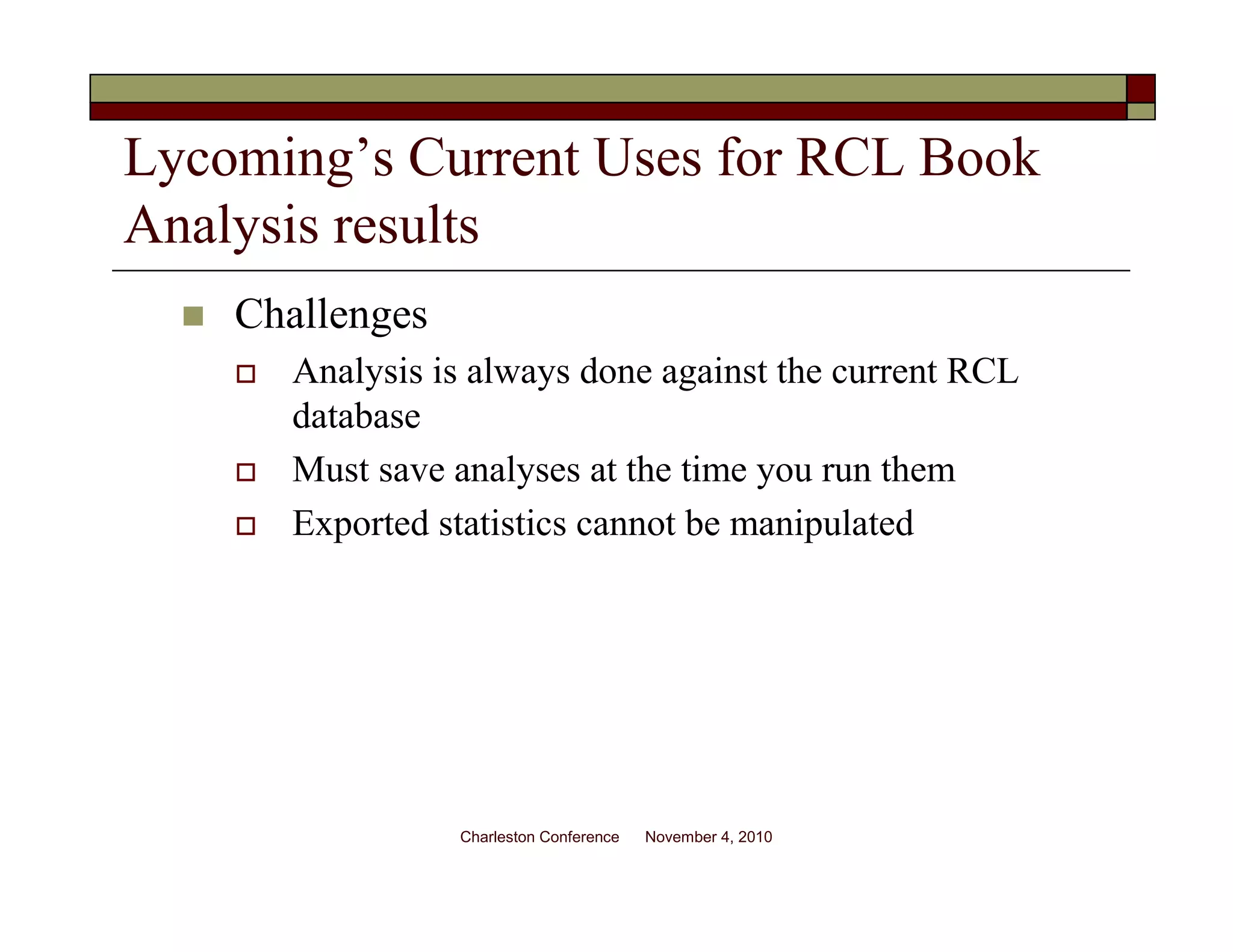
Challenges
Analysis is always done against the current RCL
database
Must save analyses at the time you run them
Exported statistics cannot be manipulated
Charleston Conference November 4, 2010
What do the numbers
mean?
Charleston Conference November 4, 2010
What can the analysis tell us?
RCLWeb
Book Analysis System
Charleston Conference November 4, 2010
How would/could we go about
developing comparisons with
similar size/type libraries?
Charleston Conference November 4, 2010
How might we determine
comparison libraries?
Charleston Conference November 4, 2010
Contact Information
Sue Beidler
Snowden Library
Lycoming College
700 College Place
Williamsport, PA 17701
570-321-4084
beidler@lycoming.edu
Charleston Conference November 4, 2010

Resources for college libraries what do the numbers mean

  • 1.
    Resources for College Libraries: What do the Numbers Mean? Sue Beidler Lycoming College Charleston Conference November 4, 2010
  • 2.
    Agenda Overview of Lycoming’sEnvironment Overview of Resources for College Libraries What is BBAS (/Bowker’s Book Analysis System)? How We Use RCLWeb How We Use BBAS Discussion Charleston Conference November 4, 2010
  • 3.
    Overview of Lycoming’sEnvironment Lycoming College: private, 4-year, approx.1400 FTE Traditional Liberal Arts 5 Librarians, 6 support staff An active collaborative instruction program that teaches the responsible use of research sources, building the skills to find, evaluate, and integrate information is a key aspect of our mission. Charleston Conference November 4, 2010
  • 4.
    Overview of Lycoming’sEnvironment Local ILS: TLC’s Library•Solution 4.2 Collection of approx. 155,000 cataloged volumes Annual monograph/standing order budget of approximately $120K 2,300 new cataloged volumes added annually Charleston Conference November 4, 2010
  • 5.
    Overview of Resourcesfor College Libraries Successor to Books for College Libraries (BCL3) Collaborative project between ACRL, CHOICE, and R.R. Bowker Available in print and as an online tool (RCLWeb) First released in 2006 Online version is updated quarterly Charleston Conference November 4, 2010
  • 6.
    Overview of BBAS (Bowker’sBook Analysis System) Electronically compares local collection to the RCL database Provides array of reports that can be customized Duplicate titles Invalid ISBNs Charleston Conference November 4, 2010
  • 7.
  • 8.
    Overview of BBAS (Bowker’sBook Analysis System) Electronically compares local collection to the RCL database Provides array of reports that can be customized Duplicate titles Invalid ISBNs Statistical reports by RCL Subjects, LC Classification or Core titles in library Core titles NOT in library Total # of core titles % of core titles held Charleston Conference November 4, 2010
  • 9.
  • 10.
    Lycoming’s Uses forRCLWeb Evaluating gift books for inclusion in our collection Generally do a quick title search in RCLWeb for possible keepers Are likely to keep the book if any edition is in RCL Sometimes will also search by author – if there are a number of titles by the author we may keep if the title is curriculum related Charleston Conference November 4, 2010
  • 11.
    Lycoming’s Current Usesfor RCL Book Analysis results Retrospective Collection Development – Photography Project Overview of Project Used “Don’t have” list to work from with faculty Improved from 27.74% coverage in 2007 to 51.82% coverage in 2008 as a result of this project Charleston Conference November 4, 2010
  • 12.
    Lycoming’s Current Usesfor RCL Book Analysis results Weeding/De-selection decisions Faculty from specific disciplines selected each year They’re set loose in the stacks with very general guidelines Any items they think should be withdrawn are put on a book truck I pull up the list of RCL titles we have in that call number range – anything on the RCL list goes back to the shelves immediately, but is marked that it is in RCL Charleston Conference November 4, 2010
  • 13.
  • 14.
  • 15.
    Lycoming’s Current Usesfor RCL Book Analysis results Assessment Meetings with academic departments regarding the collection Sometimes used in preparation for the meeting – a gauge of strength or weakness Sometimes used as follow-up – Mathematical Sciences – even though there was no response from the faculty Track changes in our holdings from year to year, by discipline Charleston Conference November 4, 2010
  • 16.
    Lycoming’s Current Usesfor RCL Book Analysis results Challenges Analysis is always done against the current RCL database Must save analyses at the time you run them Exported statistics cannot be manipulated Charleston Conference November 4, 2010
  • 17.
    What do thenumbers mean? Charleston Conference November 4, 2010
  • 18.
    What can theanalysis tell us? RCLWeb Book Analysis System Charleston Conference November 4, 2010
  • 19.
    How would/could wego about developing comparisons with similar size/type libraries? Charleston Conference November 4, 2010
  • 20.
    How might wedetermine comparison libraries? Charleston Conference November 4, 2010
  • 21.
    Contact Information Sue Beidler SnowdenLibrary Lycoming College 700 College Place Williamsport, PA 17701 570-321-4084 beidler@lycoming.edu Charleston Conference November 4, 2010