

AMITY UNIVERSITY HARYANA 
LAWS ON SECURITIES AND FINANCIAL MARKETS 
ASSIGNMENT 
ON THE TOPIC 
“MUTUAL FUNDS” 
SUBMITTED TO: 
Ms. Monika Yadav 
Faculty, Amity Law School 
SUBMITTED BY: 
Nikhil Kumar Tyagi 
Student LL.M (2014-15) 
Amity Law School
Table of Contents 
S.No. Particulars Page No. 
1. List of Abbreviations used 1 
2. Introduction 2 
3. Definition and meaning of Mutual Funds 2 
4. Historical Background 3 
5. Types of Mutual Funds 3 
6. Investment Plans of Mutual Funds 5 
7. Advantages and disadvantages of Mutual Funds 5 
8. Regulatory Framework 6 
9. Risk in Mutual Funds 9 
10. Growth of Mutual Funds in India (Conclusion) 10 
11. References 11
List of Abbreviations Used 1 
Abbreviations Full Forms 
AuM Asset under Management 
AMFI The Association of Mutual Funds in India 
GIC General Insurance Corporation 
LIC Life Insurance Corporation of India 
IDBI Industrial Development Bank of India 
IPO Initial Public Offer 
SEBI Securities Exchange Board of India 
RBI Reserve Bank of India 
UTI Unit Trust of India 
SBI State Bank of India 
PNB Punjab National Bank 
NSE National Stock Exchange 
ICSI The Institute of Company Secretaries of India 
CII Confederation of Indian Industry
2 
Introduction 
Mutual fund is the pool of the money, based on the trust who invests the savings of a number of 
investors who shares a common financial goal, like the capital appreciation and dividend earning. 
The money thus collect is then invested in capital market instruments such as shares, debenture, 
and foreign market. Investors invest money and get the units as per the unit value which we called 
as NAV (net assets value). 
India is undoubtedly emerging as the next big investment destination, riding on a high savings and 
investment rate, as compared to other Asian economies. Among many of the financial instruments 
mutual fund is one of the most attractive financial investment instrument that plays a vital role in 
the economy of a country. Mutual fund schemes provide new opportunities for investors. Mutual 
fund Industry was introduced in India 1963 with the formation of Unit Trust of India and since the 
1990’s when the mutual fund space opened up to the private sector, the industry has traversed a 
long path, adapting itself continuously, to the changes that have come along Mutual funds as an 
investment vehicle have gained immense popularity in the current scenario, which is clearly 
reflected in the robust growth levels of assets under management. Mutual funds are restructuring 
their business models to provide for increased efficiencies and investor satisfaction. The industry 
also faces a number of issues which are characterized by lack of investor awareness, low 
penetration levels, high dependence on corporate sector and spiraling cost of operations. 
In this assignment work we will look into the historical background, meaning, working, advantages, 
disadvantages, types and regulatory framework of Mutual Funds in India. 
1. Definition and Meaning of Mutual Funds 
As per the Regulation 2(q) of the SEBI (Mutual Funds) Regulations, 1996, “mutual fund” means a 
fund established in the form of a trust to raise monies through the sale of units to the public or a 
section of the public under one or more schemes for investing in securities including money market 
instruments or gold or gold related instruments or real estate assets. 
Provided that infrastructure debt fund schemes may raise monies through private placement of 
units, subject to conditions specified in the regulations. 
Mutual funds can be term as a company that pools money from many investors and invests the 
money in stocks, bonds, short-term money-market instruments, other securities or assets, or some 
combination of these investments. The combined holdings the mutual fund owns are known as its 
portfolio. Each share represents an investor's proportionate ownership of the fund's holdings and 
the income those holdings generate. The fund most often consists of a mixture of stocks, bonds, 
cash, and other securities, and is managed by a professional. Buying into a mutual fund is a simple 
way for people interested in investing to develop a diverse portfolio that is carefully watched over
3 
and tended to by a fund manager. A mutual fund is not an alternative investment option to stocks 
and bonds; rather it pools the money of several investors and invests this in stocks, bonds, money 
market instruments and other types of securities. The owner of a mutual fund unit gets a 
proportional share of the fund’s gains, losses, income and expenses Each Mutual fund has a specific 
stated objective. The fund’s objective is laid out in the fund's prospectus, which is the legal 
document that contains information about the fund, its history, its officers and its performance. 
Mutual Funds provide small investors with opportunities of investment in the capital market. Small 
investors generally do not have adequate time, knowledge, experience and resources for directly 
accessing the capital market and as such, they can rely on an investment intermediary who 
undertakes judicious investment decision and provide the consequential benefit of professional 
expertise. 
2. Historical Background 
The idea of pooling resources and spreading risk using closed-end investments soon took root in 
Great Britain and France, making its way to the United States in the 1890s. The Boston Personal 
Property Trust, formed in 1893, was the first closed-end fund in the U.S. The creation of the 
Massachusetts Investors' Trust in Boston, Massachusetts, heralded the arrival of the modern mutual 
fund in 1924. The fund went public in 1928, eventually spawning the mutual fund firm known today 
as MFS Investment Management. State Street Investors' Trust was the custodian of the 
Massachusetts Investors' Trust.(1) In India the mutual fund industry started in 1963 with the 
formation of UTI, at the initiative of the Government of India and RBI. UTI functioned under the 
Regulatory and administrative control of the RBI. In 1978 UTI was de-linked from the RBI and the 
IDBI took over the regulatory and administrative control in place of RBI. In 1987, non-UTI , public 
sector mutual funds were setup by LIC, GIC, SBI, PNB and other public sector enterprises. In 1993, 
private sector mutual funds were allowed by the Government of India. Kothari Pioneer (now 
merged with Franklin Templeton) was the first private sector mutual fund registered in July 1993. 
The number of mutual fund houses went on increasing, with many foreign mutual funds setting up 
funds in India and also the industry has witnessed several mergers and acquisitions . In February 
2003, following the repeal of the Unit Trust of India Act 1963 UTI was bifurcated into two separate 
entities.(2) 
3. Types of Mutual Funds 
Mutual Funds are classified in the following manner: 
(a) On the basis of Objectives 
Equity Funds/Growth Funds: Funds that invest in equity shares are called equity funds. They 
carry the principal objective of capital appreciation of the investment over the medium to 
long-term. They are best suited for investors who are seeking capital appreciation. 
(1) A Brief History Of The Mutual Fund, by James E. McWhinney 
(2) The Association of Mutual Fund in India.
4 
Diversified Funds: These funds invest in companies spread across sectors. These funds are 
generally meant for risk-averse investors who want a diversified portfolio across sectors. 
Sector Funds: These funds invest primarily in equity shares of companies in particular business 
sector or industry. These funds are targeted at investors who are bullish or fancy the prospects of 
a particular sector. 
Index Funds: These Funds invest in the same pattern as popular market indices like S&P CNX 
Nifty. The money collected from the investors is invested only in the stocks, which represent the 
index. 
Tax Saving Funds: These Funds offer tax benefits to investors under the Income Tax Act. 
Opportunities provided under this scheme are in the form of tax rebates under the Income Tax 
Act. 
Debt/Income Funds: These funds invest predominantly in high rated fixed income bearing 
instruments like bonds, debentures, government securities, commercial paper and other money 
market instruments. They are best suited for the medium to long term investors who are ready 
to take risk and seek capital preservation. 
Liquid Funds/Money Market Funds: These funds invest in highly liquid money market 
instruments. The period of investment could be as short as a day. They provide easy liquidity. 
They have emerged as an alternative for saving s and short-term fixed deposit accounts with 
comparatively higher returns. 
Gilt Funds: These funds invest in Central and state Government securities. Since they are 
government backed bonds they give a secured return and also ensure safety of the principal 
amount. 
Balanced Funds: These funds invest both in equity shares and fixed income bearing instruments 
(debt) in some proportion. They provide a steady return and return the volatility of the fund 
while providing some upside for capital appreciation. 
(b) On the basis of Flexibility 
Open-ended Funds: These funds do not have a fixed date of redemption. Generally, they are 
open for subscription and redemption throughout the year. Their prices are linked to the daily 
net asset value (NAV) which is calculated on a periodical basis. 
Close-ended Funds: As per the SEBI (Mutual Funds) Regulations, 1996 “close-ended scheme” 
“close-ended scheme” means any scheme of a mutual fund in which the period of maturity of the 
scheme is specified. These funds are open initially for entry during the IPO and thereafter closed
5 
for entry as well exit. These funds have a fixed date of redemption. One of the characteristics of 
the close-ended schemes is that they are generally traded at a discount to NAV; but the discount 
narrows as maturity nears. The units of these funds are listed on stock exchanges, are traded and 
the subscribers to the fund would be able to exit from the fund at any time through the 
secondary market. 
4. Investment Plans of Mutual Funds 
The term investment plans here refers to the services that the Mutual funds provide to investors 
offering different ways to invest or re-invest. 
(a) Growth Plan and Dividend Plan 
Under this plan a scheme wherein the return from investments are re-invested and very little 
income distributed, if any, are made. The investor thus only realizes capital appreciation on the 
investment. Under the dividend plan, income is distributed from time to time. This plan is ideal 
for those investors who require regular income. 
(b) Dividend Re-investment Plan 
Dividend plans of schemes carry an additional option for re-investment of income distributed. 
This is referred to as the dividend re-investment plan. Under this plan, dividends declared by a 
fund are re-invested in the scheme on behalf of the investors, thus increasing the number of 
units held by the investors. 
5. Advantages and Disadvantages of Mutual Funds 
Everything has got some advantages along with some disadvantages; same is true for mutual 
funds also. 
(a) Advantages 
Portfolio Diversification: Mutual Funds invest in a well-diversified portfolio of securities which 
enables investor to hold a diversified investment portfolio (whether the amount of investment is 
big or small). 
Professional Management: Fund manager undergoes through various research works and has 
better investment management skills which ensure higher returns to the investor than what he 
can manage on his own. 
Less Risk: Investors acquire a diversified portfolio of securities even with a small investment in a 
Mutual Fund. The risk in a diversified portfolio is lesser than investing in merely 2 or 3 securities. 
Low Transaction Costs: Due to the economies of scale (benefits of larger volumes), mutual funds 
pay lesser transaction costs. These benefits are passed on to the investors.
6 
Liquidity: An investor may not be able to sell some of the shares held by him very easily and 
quickly, whereas units of a mutual fund are far more liquid. 
Choice of Schemes: Mutual funds provide investors with various schemes with different 
investment objectives. Investors have the option of investing in a scheme having a correlation 
between its investment objectives and their own financial goals. These schemes further have 
different plans/options 
Transparency: Funds provide investors with updated information pertaining to the markets and 
the schemes. All material facts are disclosed to investors as required by the regulator. 
Flexibility: Investors also benefit from the convenience and flexibility offered by Mutual Funds. 
Investors can switch their holdings from a debt scheme to an equity scheme and vice-versa. 
Option of systematic (at regular intervals) investment and withdrawal is also offered to the 
investors in most open-end schemes. 
Safety: Mutual Fund industry is part of a well-regulated investment environment where the 
interests of the investors are protected by the regulator. All funds are registered with SEBI and 
complete transparency is forced. 
(b) Disadvantages 
Costs Control Not in the Hands of an Investor: Investor has to pay investment management fees 
and fund distribution costs as a percentage of the value of his investments (as long as he holds 
the units), irrespective of the performance of the fund 
No Customized Portfolios: The portfolio of securities in which a fund invests is a decision taken 
by the fund manager. Investors have no right to interfere in the decision making process of a 
fund manager, which some investors find as a constraint in achieving their financial objectives. 
Difficulty in Selecting a Suitable Fund Scheme: Many investors find it difficult to select one 
option from the plethora of funds/schemes/plans available. For this, they may have to take 
advice from financial planners in order to invest in the right fund to achieve their objectives. 
6. Regulatory Framework 
SEBI is the regulatory body for all the mutual funds in India. All the mutual funds must get 
registered with SEBI. 
SEBI formulated, SEBI (Mutual Funds) Regulations, 1996, which are amended from time to time 
to regulated the Indian mutual funds market. Chapter II of the regulations deals with the 
registration of mutual funds within which eligibility criteria is also given in regulation 7. Chapter 
III regulations deals with the constitution and management of mutual funds and operation of 
trustees, whereas chapter V of the said regulations deals with the schemes of mutual funds.
7 
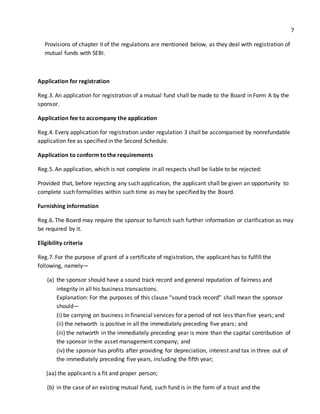
Provisions of chapter II of the regulations are mentioned below, as they deal with registration of 
mutual funds with SEBI. 
Application for registration 
Reg.3. An application for registration of a mutual fund shall be made to the Board in Form A by the 
sponsor. 
Application fee to accompany the application 
Reg.4. Every application for registration under regulation 3 shall be accompanied by nonrefundable 
application fee as specified in the Second Schedule. 
Application to conform to the requirements 
Reg.5. An application, which is not complete in all respects shall be liable to be rejected: 
Provided that, before rejecting any such application, the applicant shall be given an opportunity to 
complete such formalities within such time as may be specified by the Board. 
Furnishing information 
Reg.6. The Board may require the sponsor to furnish such further information or clarification as may 
be required by it. 
Eligibility criteria 
Reg.7. For the purpose of grant of a certificate of registration, the applicant has to fulfill the 
following, namely— 
(a) the sponsor should have a sound track record and general reputation of fairness and 
integrity in all his business transactions. 
Explanation: For the purposes of this clause “sound track record” shall mean the sponsor 
should— 
(i) be carrying on business in financial services for a period of not less than five years; and 
(ii) the networth is positive in all the immediately preceding five years ; and 
(iii) the networth in the immediately preceding year is more than the capital contribution of 
the sponsor in the asset management company; and 
(iv) the sponsor has profits after providing for depreciation, interest and tax in three out of 
the immediately preceding five years, including the fifth year; 
(aa) the applicant is a fit and proper person; 
(b) in the case of an existing mutual fund, such fund is in the form of a trust and the
8 
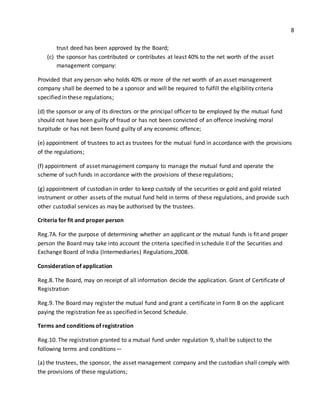
trust deed has been approved by the Board; 
(c) the sponsor has contributed or contributes at least 40% to the net worth of the asset 
management company: 
Provided that any person who holds 40% or more of the net worth of an asset management 
company shall be deemed to be a sponsor and will be required to fulfill the eligibility criteria 
specified in these regulations; 
(d) the sponsor or any of its directors or the principal officer to be employed by the mutual fund 
should not have been guilty of fraud or has not been convicted of an offence involving moral 
turpitude or has not been found guilty of any economic offence; 
(e) appointment of trustees to act as trustees for the mutual fund in accordance with the provisions 
of the regulations; 
(f) appointment of asset management company to manage the mutual fund and operate the 
scheme of such funds in accordance with the provisions of these regulations; 
(g) appointment of custodian in order to keep custody of the securities or gold and gold related 
instrument or other assets of the mutual fund held in terms of these regulations, and provide such 
other custodial services as may be authorised by the trustees. 
Criteria for fit and proper person 
Reg.7A. For the purpose of determining whether an applicant or the mutual funds is fit and proper 
person the Board may take into account the criteria specified in schedule II of the Securities and 
Exchange Board of India (Intermediaries) Regulations,2008. 
Consideration of application 
Reg.8. The Board, may on receipt of all information decide the application. Grant of Certificate of 
Registration 
Reg.9. The Board may register the mutual fund and grant a certificate in Form B on the applicant 
paying the registration fee as specified in Second Schedule. 
Terms and conditions of registration 
Reg.10. The registration granted to a mutual fund under regulation 9, shall be subject to the 
following terms and conditions— 
(a) the trustees, the sponsor, the asset management company and the custodian shall comply with 
the provisions of these regulations;
9 
(b) the mutual fund shall forthwith inform the Board, if any information or particulars previously 
submitted to the Board was misleading or false in any material respect; 
(c) the mutual fund shall forthwith inform the Board, of any material change in the information or 
particulars previously furnished, which have a bearing on the registration granted by it; 
(d) payment of fees as specified in the regulations and the Second Schedule. 
Rejection of application 
Reg.11. Where the sponsor does not satisfy the eligibility criteria mentioned in regulation 7, the 
Board may reject the application and inform the applicant of the same. Payment of 17[annual] 
service fee12. A mutual fund shall pay before the 15th April each year a service fee as specified in 
the Second Schedule for every financial year from the year following the year of registration: 
Provided that the Board may, on being satisfied with the reasons for the delay permit the mutual 
fund to pay the service fee at any time before the expiry of two months from the commencement of 
the financial year to which such fee relates. 
Failure to pay annual service fee 
Reg.13. The Board may not permit a mutual fund who has not paid service fee to launch any 
scheme. 
7. Risk in Mutual Funds 
Mutual Funds do not provide assured returns. Their returns are linked to their performance. They 
invest in shares, debentures, bonds etc. All these investments involve an element of risk. 
Market Risk: If the overall stock or bond market fall on account of overall economic factors, the 
value of the stock or bond holdings in the fund’s portfolio can drop, therefore impacting the fund 
performance. 
Non-Market Risk: Bad/negative news about an individual company can pull down its stock price, 
which can negatively affect fund holdings. The risk can be reduced by having a diversified 
portfolio that consists of a wide variety of stocks drawn from different industries. 
Interest rate Risk: Bond prices and interest rates move in opposite directions. When interest 
rates rise, bond prices fall and this decline in underlying securities affects the fund negatively. 
Credit Risk: Bonds are debts obligations. So when the funds invest in corporate bonds, they run 
risk of the corporate defaulting on their interest and principal payment, obligations and when 
that risk crystallizes, it leads to a fall in value of the bond causing the NAV of the fund to take a 
beating.
10 
8. Growth of Mutual Funds in India (Conclusion) 
Over half of the AuM of the global asset management industry is in areas other than traditional 
mutual funds. Mandated and alternative assets comprise almost 60% of the total industry AuM 
and the latter segment is growing rapidly. The asset management industry is growing to a stature 
comparable to banking and insurance. It is estimated that 17 to 20% of Indian market 
capitalisation is held by foreign funds. However, a remarkably small fraction of these funds are 
advised and managed by Indian asset managers. 
The growth in the mutual fund industry is by and large governed by the macroeconomic factors 
affecting the country. In the present day situation given the high inflation rates with a slowdown 
in the economic output of the nation, it is not surprising to see a slowdown in the rate of growth 
in the mutual fund industry as well. While the industry has grown significantly and there is much 
to be satisfied about, there are opportunities for improvement too. While the AuM has grown 
from approximately 470 billion INR as on 31 March 1993 to approximately 8,250 billion INR as on 
31 March 2014 (reflecting a CAGR of 14.6% over the last 21 years), the Sensex has grown from 
approximately 2280.52 as on 31 March 1993 to 22,386.27 as on 31 March 2014. Quite naturally, 
the growth of the Sensex and the AuM feed off one another and thus a portion of the AuM 
growth can be attributed to the growth of underlying stocks and indices. Mutual fund 
penetration in India is low as compared to global and peer benchmarks. The AuM to GDP ratio 
stands at 7 to 8% as compared to a global average of 37%. Even the SAAAME economy of Brazil, 
considered a peer emerging economy, is significantly ahead, with an AuM to GDP ratio of 45% 
(Source – AMFI, ICI FactBook 2013). Increasing mutual fund penetration will largely depend on 
increasing investor awareness at grass-roots level and providing access to financial services to the 
still largely unbanked population. Mutual Funds today need to stay focused on a few aspects in 
order to ensure that the industry meets its growth objectives. Along with SEBI, AMFI has a major 
role to play in Indian mutual fund industry. The followings points may be under taken by the SEBI 
and the Indian mutual fund industry together: 
• Reaching out to new consumers in rural areas 
• Conduct consumer education programs to develop markets 
• Creation of employment opportunities 
• Establish a sustainable business model Increase transparency for mutual fund houses, 
particularly at the retail level
11 
References 
 SEBI (Mutual Funds) Regulations, 1996 
 Growth of Mutual Funds in India, Acme Journal of Multidisciplinary Research, Vol.II issue 
IV, April 2014 
 Muralidhar Dunna, Asia Pacific Journal of Marketing and Management Review, Vol. 2, 
October 2012 
 Indian Mutual Fund Industry at a glance (Document), CII Mutual Fund Summit 2014 
 Study Module of ICSI Executive programme 
 Beginner’s module of NSE’s Certificate in Financial Markets 
 Websites referred: 
i) www.sebi.gov.in 
ii) www.nseindia.com 
iii) www.economicstimes.com 
iv) www.moneycontrol.com

Laws on Securities and Financial Market

  • 1.
    AMITY UNIVERSITY HARYANA LAWS ON SECURITIES AND FINANCIAL MARKETS ASSIGNMENT ON THE TOPIC “MUTUAL FUNDS” SUBMITTED TO: Ms. Monika Yadav Faculty, Amity Law School SUBMITTED BY: Nikhil Kumar Tyagi Student LL.M (2014-15) Amity Law School
  • 2.
    Table of Contents S.No. Particulars Page No. 1. List of Abbreviations used 1 2. Introduction 2 3. Definition and meaning of Mutual Funds 2 4. Historical Background 3 5. Types of Mutual Funds 3 6. Investment Plans of Mutual Funds 5 7. Advantages and disadvantages of Mutual Funds 5 8. Regulatory Framework 6 9. Risk in Mutual Funds 9 10. Growth of Mutual Funds in India (Conclusion) 10 11. References 11
  • 3.
    List of AbbreviationsUsed 1 Abbreviations Full Forms AuM Asset under Management AMFI The Association of Mutual Funds in India GIC General Insurance Corporation LIC Life Insurance Corporation of India IDBI Industrial Development Bank of India IPO Initial Public Offer SEBI Securities Exchange Board of India RBI Reserve Bank of India UTI Unit Trust of India SBI State Bank of India PNB Punjab National Bank NSE National Stock Exchange ICSI The Institute of Company Secretaries of India CII Confederation of Indian Industry
  • 4.
    2 Introduction Mutualfund is the pool of the money, based on the trust who invests the savings of a number of investors who shares a common financial goal, like the capital appreciation and dividend earning. The money thus collect is then invested in capital market instruments such as shares, debenture, and foreign market. Investors invest money and get the units as per the unit value which we called as NAV (net assets value). India is undoubtedly emerging as the next big investment destination, riding on a high savings and investment rate, as compared to other Asian economies. Among many of the financial instruments mutual fund is one of the most attractive financial investment instrument that plays a vital role in the economy of a country. Mutual fund schemes provide new opportunities for investors. Mutual fund Industry was introduced in India 1963 with the formation of Unit Trust of India and since the 1990’s when the mutual fund space opened up to the private sector, the industry has traversed a long path, adapting itself continuously, to the changes that have come along Mutual funds as an investment vehicle have gained immense popularity in the current scenario, which is clearly reflected in the robust growth levels of assets under management. Mutual funds are restructuring their business models to provide for increased efficiencies and investor satisfaction. The industry also faces a number of issues which are characterized by lack of investor awareness, low penetration levels, high dependence on corporate sector and spiraling cost of operations. In this assignment work we will look into the historical background, meaning, working, advantages, disadvantages, types and regulatory framework of Mutual Funds in India. 1. Definition and Meaning of Mutual Funds As per the Regulation 2(q) of the SEBI (Mutual Funds) Regulations, 1996, “mutual fund” means a fund established in the form of a trust to raise monies through the sale of units to the public or a section of the public under one or more schemes for investing in securities including money market instruments or gold or gold related instruments or real estate assets. Provided that infrastructure debt fund schemes may raise monies through private placement of units, subject to conditions specified in the regulations. Mutual funds can be term as a company that pools money from many investors and invests the money in stocks, bonds, short-term money-market instruments, other securities or assets, or some combination of these investments. The combined holdings the mutual fund owns are known as its portfolio. Each share represents an investor's proportionate ownership of the fund's holdings and the income those holdings generate. The fund most often consists of a mixture of stocks, bonds, cash, and other securities, and is managed by a professional. Buying into a mutual fund is a simple way for people interested in investing to develop a diverse portfolio that is carefully watched over
  • 5.
    3 and tendedto by a fund manager. A mutual fund is not an alternative investment option to stocks and bonds; rather it pools the money of several investors and invests this in stocks, bonds, money market instruments and other types of securities. The owner of a mutual fund unit gets a proportional share of the fund’s gains, losses, income and expenses Each Mutual fund has a specific stated objective. The fund’s objective is laid out in the fund's prospectus, which is the legal document that contains information about the fund, its history, its officers and its performance. Mutual Funds provide small investors with opportunities of investment in the capital market. Small investors generally do not have adequate time, knowledge, experience and resources for directly accessing the capital market and as such, they can rely on an investment intermediary who undertakes judicious investment decision and provide the consequential benefit of professional expertise. 2. Historical Background The idea of pooling resources and spreading risk using closed-end investments soon took root in Great Britain and France, making its way to the United States in the 1890s. The Boston Personal Property Trust, formed in 1893, was the first closed-end fund in the U.S. The creation of the Massachusetts Investors' Trust in Boston, Massachusetts, heralded the arrival of the modern mutual fund in 1924. The fund went public in 1928, eventually spawning the mutual fund firm known today as MFS Investment Management. State Street Investors' Trust was the custodian of the Massachusetts Investors' Trust.(1) In India the mutual fund industry started in 1963 with the formation of UTI, at the initiative of the Government of India and RBI. UTI functioned under the Regulatory and administrative control of the RBI. In 1978 UTI was de-linked from the RBI and the IDBI took over the regulatory and administrative control in place of RBI. In 1987, non-UTI , public sector mutual funds were setup by LIC, GIC, SBI, PNB and other public sector enterprises. In 1993, private sector mutual funds were allowed by the Government of India. Kothari Pioneer (now merged with Franklin Templeton) was the first private sector mutual fund registered in July 1993. The number of mutual fund houses went on increasing, with many foreign mutual funds setting up funds in India and also the industry has witnessed several mergers and acquisitions . In February 2003, following the repeal of the Unit Trust of India Act 1963 UTI was bifurcated into two separate entities.(2) 3. Types of Mutual Funds Mutual Funds are classified in the following manner: (a) On the basis of Objectives Equity Funds/Growth Funds: Funds that invest in equity shares are called equity funds. They carry the principal objective of capital appreciation of the investment over the medium to long-term. They are best suited for investors who are seeking capital appreciation. (1) A Brief History Of The Mutual Fund, by James E. McWhinney (2) The Association of Mutual Fund in India.
  • 6.
    4 Diversified Funds:These funds invest in companies spread across sectors. These funds are generally meant for risk-averse investors who want a diversified portfolio across sectors. Sector Funds: These funds invest primarily in equity shares of companies in particular business sector or industry. These funds are targeted at investors who are bullish or fancy the prospects of a particular sector. Index Funds: These Funds invest in the same pattern as popular market indices like S&P CNX Nifty. The money collected from the investors is invested only in the stocks, which represent the index. Tax Saving Funds: These Funds offer tax benefits to investors under the Income Tax Act. Opportunities provided under this scheme are in the form of tax rebates under the Income Tax Act. Debt/Income Funds: These funds invest predominantly in high rated fixed income bearing instruments like bonds, debentures, government securities, commercial paper and other money market instruments. They are best suited for the medium to long term investors who are ready to take risk and seek capital preservation. Liquid Funds/Money Market Funds: These funds invest in highly liquid money market instruments. The period of investment could be as short as a day. They provide easy liquidity. They have emerged as an alternative for saving s and short-term fixed deposit accounts with comparatively higher returns. Gilt Funds: These funds invest in Central and state Government securities. Since they are government backed bonds they give a secured return and also ensure safety of the principal amount. Balanced Funds: These funds invest both in equity shares and fixed income bearing instruments (debt) in some proportion. They provide a steady return and return the volatility of the fund while providing some upside for capital appreciation. (b) On the basis of Flexibility Open-ended Funds: These funds do not have a fixed date of redemption. Generally, they are open for subscription and redemption throughout the year. Their prices are linked to the daily net asset value (NAV) which is calculated on a periodical basis. Close-ended Funds: As per the SEBI (Mutual Funds) Regulations, 1996 “close-ended scheme” “close-ended scheme” means any scheme of a mutual fund in which the period of maturity of the scheme is specified. These funds are open initially for entry during the IPO and thereafter closed
  • 7.
    5 for entryas well exit. These funds have a fixed date of redemption. One of the characteristics of the close-ended schemes is that they are generally traded at a discount to NAV; but the discount narrows as maturity nears. The units of these funds are listed on stock exchanges, are traded and the subscribers to the fund would be able to exit from the fund at any time through the secondary market. 4. Investment Plans of Mutual Funds The term investment plans here refers to the services that the Mutual funds provide to investors offering different ways to invest or re-invest. (a) Growth Plan and Dividend Plan Under this plan a scheme wherein the return from investments are re-invested and very little income distributed, if any, are made. The investor thus only realizes capital appreciation on the investment. Under the dividend plan, income is distributed from time to time. This plan is ideal for those investors who require regular income. (b) Dividend Re-investment Plan Dividend plans of schemes carry an additional option for re-investment of income distributed. This is referred to as the dividend re-investment plan. Under this plan, dividends declared by a fund are re-invested in the scheme on behalf of the investors, thus increasing the number of units held by the investors. 5. Advantages and Disadvantages of Mutual Funds Everything has got some advantages along with some disadvantages; same is true for mutual funds also. (a) Advantages Portfolio Diversification: Mutual Funds invest in a well-diversified portfolio of securities which enables investor to hold a diversified investment portfolio (whether the amount of investment is big or small). Professional Management: Fund manager undergoes through various research works and has better investment management skills which ensure higher returns to the investor than what he can manage on his own. Less Risk: Investors acquire a diversified portfolio of securities even with a small investment in a Mutual Fund. The risk in a diversified portfolio is lesser than investing in merely 2 or 3 securities. Low Transaction Costs: Due to the economies of scale (benefits of larger volumes), mutual funds pay lesser transaction costs. These benefits are passed on to the investors.
  • 8.
    6 Liquidity: Aninvestor may not be able to sell some of the shares held by him very easily and quickly, whereas units of a mutual fund are far more liquid. Choice of Schemes: Mutual funds provide investors with various schemes with different investment objectives. Investors have the option of investing in a scheme having a correlation between its investment objectives and their own financial goals. These schemes further have different plans/options Transparency: Funds provide investors with updated information pertaining to the markets and the schemes. All material facts are disclosed to investors as required by the regulator. Flexibility: Investors also benefit from the convenience and flexibility offered by Mutual Funds. Investors can switch their holdings from a debt scheme to an equity scheme and vice-versa. Option of systematic (at regular intervals) investment and withdrawal is also offered to the investors in most open-end schemes. Safety: Mutual Fund industry is part of a well-regulated investment environment where the interests of the investors are protected by the regulator. All funds are registered with SEBI and complete transparency is forced. (b) Disadvantages Costs Control Not in the Hands of an Investor: Investor has to pay investment management fees and fund distribution costs as a percentage of the value of his investments (as long as he holds the units), irrespective of the performance of the fund No Customized Portfolios: The portfolio of securities in which a fund invests is a decision taken by the fund manager. Investors have no right to interfere in the decision making process of a fund manager, which some investors find as a constraint in achieving their financial objectives. Difficulty in Selecting a Suitable Fund Scheme: Many investors find it difficult to select one option from the plethora of funds/schemes/plans available. For this, they may have to take advice from financial planners in order to invest in the right fund to achieve their objectives. 6. Regulatory Framework SEBI is the regulatory body for all the mutual funds in India. All the mutual funds must get registered with SEBI. SEBI formulated, SEBI (Mutual Funds) Regulations, 1996, which are amended from time to time to regulated the Indian mutual funds market. Chapter II of the regulations deals with the registration of mutual funds within which eligibility criteria is also given in regulation 7. Chapter III regulations deals with the constitution and management of mutual funds and operation of trustees, whereas chapter V of the said regulations deals with the schemes of mutual funds.
  • 9.
    7 Provisions ofchapter II of the regulations are mentioned below, as they deal with registration of mutual funds with SEBI. Application for registration Reg.3. An application for registration of a mutual fund shall be made to the Board in Form A by the sponsor. Application fee to accompany the application Reg.4. Every application for registration under regulation 3 shall be accompanied by nonrefundable application fee as specified in the Second Schedule. Application to conform to the requirements Reg.5. An application, which is not complete in all respects shall be liable to be rejected: Provided that, before rejecting any such application, the applicant shall be given an opportunity to complete such formalities within such time as may be specified by the Board. Furnishing information Reg.6. The Board may require the sponsor to furnish such further information or clarification as may be required by it. Eligibility criteria Reg.7. For the purpose of grant of a certificate of registration, the applicant has to fulfill the following, namely— (a) the sponsor should have a sound track record and general reputation of fairness and integrity in all his business transactions. Explanation: For the purposes of this clause “sound track record” shall mean the sponsor should— (i) be carrying on business in financial services for a period of not less than five years; and (ii) the networth is positive in all the immediately preceding five years ; and (iii) the networth in the immediately preceding year is more than the capital contribution of the sponsor in the asset management company; and (iv) the sponsor has profits after providing for depreciation, interest and tax in three out of the immediately preceding five years, including the fifth year; (aa) the applicant is a fit and proper person; (b) in the case of an existing mutual fund, such fund is in the form of a trust and the
  • 10.
    8 trust deedhas been approved by the Board; (c) the sponsor has contributed or contributes at least 40% to the net worth of the asset management company: Provided that any person who holds 40% or more of the net worth of an asset management company shall be deemed to be a sponsor and will be required to fulfill the eligibility criteria specified in these regulations; (d) the sponsor or any of its directors or the principal officer to be employed by the mutual fund should not have been guilty of fraud or has not been convicted of an offence involving moral turpitude or has not been found guilty of any economic offence; (e) appointment of trustees to act as trustees for the mutual fund in accordance with the provisions of the regulations; (f) appointment of asset management company to manage the mutual fund and operate the scheme of such funds in accordance with the provisions of these regulations; (g) appointment of custodian in order to keep custody of the securities or gold and gold related instrument or other assets of the mutual fund held in terms of these regulations, and provide such other custodial services as may be authorised by the trustees. Criteria for fit and proper person Reg.7A. For the purpose of determining whether an applicant or the mutual funds is fit and proper person the Board may take into account the criteria specified in schedule II of the Securities and Exchange Board of India (Intermediaries) Regulations,2008. Consideration of application Reg.8. The Board, may on receipt of all information decide the application. Grant of Certificate of Registration Reg.9. The Board may register the mutual fund and grant a certificate in Form B on the applicant paying the registration fee as specified in Second Schedule. Terms and conditions of registration Reg.10. The registration granted to a mutual fund under regulation 9, shall be subject to the following terms and conditions— (a) the trustees, the sponsor, the asset management company and the custodian shall comply with the provisions of these regulations;
  • 11.
    9 (b) themutual fund shall forthwith inform the Board, if any information or particulars previously submitted to the Board was misleading or false in any material respect; (c) the mutual fund shall forthwith inform the Board, of any material change in the information or particulars previously furnished, which have a bearing on the registration granted by it; (d) payment of fees as specified in the regulations and the Second Schedule. Rejection of application Reg.11. Where the sponsor does not satisfy the eligibility criteria mentioned in regulation 7, the Board may reject the application and inform the applicant of the same. Payment of 17[annual] service fee12. A mutual fund shall pay before the 15th April each year a service fee as specified in the Second Schedule for every financial year from the year following the year of registration: Provided that the Board may, on being satisfied with the reasons for the delay permit the mutual fund to pay the service fee at any time before the expiry of two months from the commencement of the financial year to which such fee relates. Failure to pay annual service fee Reg.13. The Board may not permit a mutual fund who has not paid service fee to launch any scheme. 7. Risk in Mutual Funds Mutual Funds do not provide assured returns. Their returns are linked to their performance. They invest in shares, debentures, bonds etc. All these investments involve an element of risk. Market Risk: If the overall stock or bond market fall on account of overall economic factors, the value of the stock or bond holdings in the fund’s portfolio can drop, therefore impacting the fund performance. Non-Market Risk: Bad/negative news about an individual company can pull down its stock price, which can negatively affect fund holdings. The risk can be reduced by having a diversified portfolio that consists of a wide variety of stocks drawn from different industries. Interest rate Risk: Bond prices and interest rates move in opposite directions. When interest rates rise, bond prices fall and this decline in underlying securities affects the fund negatively. Credit Risk: Bonds are debts obligations. So when the funds invest in corporate bonds, they run risk of the corporate defaulting on their interest and principal payment, obligations and when that risk crystallizes, it leads to a fall in value of the bond causing the NAV of the fund to take a beating.
  • 12.
    10 8. Growthof Mutual Funds in India (Conclusion) Over half of the AuM of the global asset management industry is in areas other than traditional mutual funds. Mandated and alternative assets comprise almost 60% of the total industry AuM and the latter segment is growing rapidly. The asset management industry is growing to a stature comparable to banking and insurance. It is estimated that 17 to 20% of Indian market capitalisation is held by foreign funds. However, a remarkably small fraction of these funds are advised and managed by Indian asset managers. The growth in the mutual fund industry is by and large governed by the macroeconomic factors affecting the country. In the present day situation given the high inflation rates with a slowdown in the economic output of the nation, it is not surprising to see a slowdown in the rate of growth in the mutual fund industry as well. While the industry has grown significantly and there is much to be satisfied about, there are opportunities for improvement too. While the AuM has grown from approximately 470 billion INR as on 31 March 1993 to approximately 8,250 billion INR as on 31 March 2014 (reflecting a CAGR of 14.6% over the last 21 years), the Sensex has grown from approximately 2280.52 as on 31 March 1993 to 22,386.27 as on 31 March 2014. Quite naturally, the growth of the Sensex and the AuM feed off one another and thus a portion of the AuM growth can be attributed to the growth of underlying stocks and indices. Mutual fund penetration in India is low as compared to global and peer benchmarks. The AuM to GDP ratio stands at 7 to 8% as compared to a global average of 37%. Even the SAAAME economy of Brazil, considered a peer emerging economy, is significantly ahead, with an AuM to GDP ratio of 45% (Source – AMFI, ICI FactBook 2013). Increasing mutual fund penetration will largely depend on increasing investor awareness at grass-roots level and providing access to financial services to the still largely unbanked population. Mutual Funds today need to stay focused on a few aspects in order to ensure that the industry meets its growth objectives. Along with SEBI, AMFI has a major role to play in Indian mutual fund industry. The followings points may be under taken by the SEBI and the Indian mutual fund industry together: • Reaching out to new consumers in rural areas • Conduct consumer education programs to develop markets • Creation of employment opportunities • Establish a sustainable business model Increase transparency for mutual fund houses, particularly at the retail level
  • 13.
    11 References SEBI (Mutual Funds) Regulations, 1996  Growth of Mutual Funds in India, Acme Journal of Multidisciplinary Research, Vol.II issue IV, April 2014  Muralidhar Dunna, Asia Pacific Journal of Marketing and Management Review, Vol. 2, October 2012  Indian Mutual Fund Industry at a glance (Document), CII Mutual Fund Summit 2014  Study Module of ICSI Executive programme  Beginner’s module of NSE’s Certificate in Financial Markets  Websites referred: i) www.sebi.gov.in ii) www.nseindia.com iii) www.economicstimes.com iv) www.moneycontrol.com