ANTIMICROBIAL
RESISTANCE
AIMS
 To know the basic concepts of antibiotics, antimicrobials and antibiotic or antimicrobial resistance.
 To describe the intrinsic characteristics of bacteria to avoid antibiotics.
 To describe the principles of antibiotic therapy.
 To understand the mechanisms of action of the bacteria to avoid those antibiotics
 To describe the causes of antibiotic therapy failure.
 To analize the other facts related to Mechanisms of resistance, bacterial genetics, and how to prevent the
spread of MDROs
 To know other posible causes of antibiotic resistance and new therapies to avoid the resistance spreading
worldwide.
ANTIMICROBIALS
 Drugs that are able to eliminate infections. The most commons are the antibiotics who kill or inhibite bacteria
from growing.
 Antimicrobials is a wider term that includes all agents that act against microorganisms, namely bacteria, fungi,
fungi, viruses and protozoa.
ANTIBIOTICS
 Antibiotics disrupt essential structures or processes in bacteria. This in turn either kills the bacteria or stops
them from multiplying. Bacteria have in turn evolved many antibiotic resistance mechanisms to withstand the
actions of antibiotics.
 Bacteriostatics
 Bactericidals
HISTORY
 When antibiotics were first introduced in the 1900's, it was thought that we had won the war against
microorganisms. It was soon discovered however, that the microorganisms were capable of developing
resistance to any of the drugs that were used.
 The advent of antimicrobial resistance has added significantly to the impact of infectious diseases, in number
of infections, as well as added healthcare costs. Even though we have a very large number of antimicrobial
agents from which to choose for potential infection therapy, there is documented antimicrobial resistance to
all of these, and this resistance occurs shortly after a new drug is okayed for use. These concerns prompted the
WHO to launch a Global Action Plan on antimicrobial resistance in 2015
ANTIBIOTICS ACTIVITY INSIDE THE BACTERIA
 Antimicrobial agents can be divided into groups based on the mechanism of antimicrobial activity. The main
groups are:
 agents that inhibit cell wall synthesis.
 depolarize the cell membrane.
 inhibit protein synthesis.
 inhibit nuclei acid synthesis.
 inhibit metabolic pathways in bacteria.
ANTIBIOTICS MECHANISM OF RESISTANCE
 To stop the antibiotic from reaching out its target
 Antibiotic pumps
 Decrement of antibiotic permeability by the cell
membrane
 Destroying antibiotic by enzymes
 Modifying the receptor of the cell
 Modify or bypass the target of the cell
 Camouflage the target
 Express alternative proteins
 Reprogram target
https://www.reactgroup.org/toolbox/understand/antibiotic-resistance/resistance-mechanisms-in-bacteria/
Figure 1. Antibiotic resistance strategies in bacteria. Courtesy of E. Wistrand-Yuen.
RESISTANCE
 Natural
 Acquired
 Intrinsic
 Extrinsic
Some bacteria are naturally resistant to certain antibiotics. Imagine
for example an antibiotic that destroys the cell wall of the bacteria.
If a bacterium does not have a cell wall, the antibiotic will have no
effect. This phenomenon is called intrinsic resistance.
When a bacterium that was previously susceptible to an antibiotic
evolves resistance it is called acquired resistance.
MUTATIONS
 Mutations can result in antibiotic resistance in bacteria. Resistant bacteria survive antibiotic treatment and can
increase in numbers by natural selection.
 Mutations can appear after a cell division. There is always a risk of mutation after division.
 Mutations are random and can be located anywhere in the DNA. Mutations can also form due to external
factors like radiation or harmful chemicals.
NATURAL SELECTION
 It means that due to the mutations, certain
intrinsic characteristics of the bacteria appear for
certain environments, allowing them to grow
better than the rest.
GENETIC STRATEGIES TO ADAPTATION TO ANTIBIOTIC
ENVIRONMENT
 From an evolutionary perspective, bacteria use two major genetic strategies to adapt to the antibiotic “attack”,
 i) mutations in gene(s) often associated with the mechanism of action of the compound
 ii) acquisition of foreign DNA coding for resistance determinants through horizontal gene transfer (HGT).
HOW BACTERIA TRANSFER ANTIBIOTIC RESISTANCE?
 Recombination
 Conjugation bacterial gene exchange through a pilli
 Transduction phage mediated
 Transformation incorporation of naked DNA
https://www.ncbi.nlm.nih.gov/pmc/articles/PMC3985120/
ANTIBIOTICS AND BACTERIAL EVOLUTION
 Fluoroquinolone (FQ) resistance
 Mutations in DNA gyrase and Topoisomerase IV
 Efflux pump
 Protein Qnr
 resistance to β-lactams
 PBP
RESISTANCE SPREADING AND NOSOCOMIAL INFECTIONS
 Emergence of resistance among the most important bacterial pathogens is recognized as a major public health
threat affecting humans worldwide. Multidrug-resistant organisms have emerged not only in the hospital
environment but are now often identified in community settings, suggesting that reservoirs of antibiotic-
resistant bacteria are present outside the hospital.
 The marked increase in antimicrobial resistance among common bacterial pathogens is now threatening this
therapeutic accomplishment, jeopardizing the successful outcomes of critically ill patients. In fact, the World
Health Organization has named antibiotic resistance as one of the three most important public health threats
of the 21st century. https://www.ncbi.nlm.nih.gov/pmc/articles/PMC4888801/
CROSS-RESISTANCE.
 One resistance strategy bacteria use is to pump the antibiotic out of the cell. Sometimes such pumps can
recognize many different molecules, including different types of antibiotics. That is, the bacteria use a single
pump to pump out several different antibiotics.
https://www.reactgroup.org/toolbox/understand/antibiotic-resistance/multidrug-resistant-bacteria/
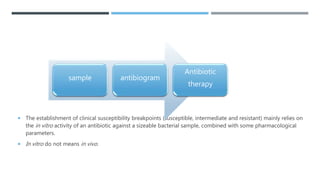
 The establishment of clinical susceptibility breakpoints (susceptible, intermediate and resistant) mainly relies on
the in vitro activity of an antibiotic against a sizeable bacterial sample, combined with some pharmacological
parameters.
 In vitro do not means in vivo.
sample antibiogram
Antibiotic
therapy
MULTIDRUG-RESISTANT BACTERIA
• Infections with multidrug-resistant bacteria are hard to treat since few or even no treatment options remain. In
some cases, health care providers must use antibiotics that are more toxic for the patient.
• Multidrug-resistance facilitates spread of antibiotic resistance. When multidrug-resistance plasmids are
transferred to other bacteria, these become resistant to many antibiotics at once. In environments where
bacteria are continuously exposed to antibiotics, like in hospitals or some large production animal farms,
multidrug-resistance may be favorable and therefore selected and spread further.
• Multidrug-resistance complicates efforts to reduce resistance. When many different antibiotics select for the
same resistant bacteria or plasmids, reducing use of one type of antibiotic is not enough to reduce resistance
to that antibiotic.
MULTIDRUG-RESISTANT MICROORGANISMS (MDROS)
 E. coli
 K. Pneumoniae
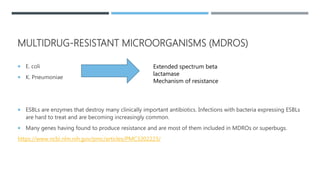
 ESBLs are enzymes that destroy many clinically important antibiotics. Infections with bacteria expressing ESBLs
are hard to treat and are becoming increasingly common.
 Many genes having found to produce resistance and are most of them included in MDROs or superbugs.
https://www.ncbi.nlm.nih.gov/pmc/articles/PMC3202223/
Extended spectrum beta
lactamase
Mechanism of resistance
HEALTHCARE ASSOCIATED INFECTIONS
 Nosocomial infections causes and epidemiological facts most be documented and microbiologically reported.
 Antibiotic Prescription Committee
 Nosocomial Infection Committee
 Emergence of new MDROs strains most be screened by CDC guidance.
MULTIDRUG RESISTANT BACTERIAS ISOLATED FROM NOSOCOMIAL
INFECTIONS AND SOMETIMES IN COMMUNITY
 MRSA
 VISA
 VRSA
 Acinetobacter baumannii
 E. coli O157H7
 K. pneumoniae
REFERENCES
 Reygaert WC. An overview of the antimicrobial resistance mechanisms of bacteria. AIMS Microbiol. 2018 Jun
26;4(3):482-501. doi: 10.3934/microbiol.2018.3.482. PMID: 31294229; PMCID: PMC6604941.
 https://www.reactgroup.org/toolbox/understand/antibiotic-resistance/resistance-mechanisms-in-bacteria/
 Munita JM, Arias CA. Mechanisms of Antibiotic Resistance. Microbiol Spectr. 2016
Apr;4(2):10.1128/microbiolspec.VMBF-0016-2015. doi: 10.1128/microbiolspec.VMBF-0016-2015. PMID: 27227291;
PMCID: PMC4888801.
 Kohanski MA, Dwyer DJ, Hayete B, Lawrence CA, Collins JJ. A common mechanism of cellular death induced by
bactericidal antibiotics. Cell. 2007 Sep 7;130(5):797-810. doi: 10.1016/j.cell.2007.06.049. PMID: 17803904.
 Wright GD. Bacterial resistance to antibiotics: enzymatic degradation and modification. Adv Drug Deliv Rev.
2005 Jul 29;57(10):1451-70. doi: 10.1016/j.addr.2005.04.002. PMID: 15950313.
 https://www.ncbi.nlm.nih.gov/pmc/articles/PMC3202223/

Antimicrobial resistance: Antibiotic resistance aproach.

  • 1.
  • 2.
    AIMS  To knowthe basic concepts of antibiotics, antimicrobials and antibiotic or antimicrobial resistance.  To describe the intrinsic characteristics of bacteria to avoid antibiotics.  To describe the principles of antibiotic therapy.  To understand the mechanisms of action of the bacteria to avoid those antibiotics  To describe the causes of antibiotic therapy failure.  To analize the other facts related to Mechanisms of resistance, bacterial genetics, and how to prevent the spread of MDROs  To know other posible causes of antibiotic resistance and new therapies to avoid the resistance spreading worldwide.
  • 3.
    ANTIMICROBIALS  Drugs thatare able to eliminate infections. The most commons are the antibiotics who kill or inhibite bacteria from growing.  Antimicrobials is a wider term that includes all agents that act against microorganisms, namely bacteria, fungi, fungi, viruses and protozoa.
  • 4.
    ANTIBIOTICS  Antibiotics disruptessential structures or processes in bacteria. This in turn either kills the bacteria or stops them from multiplying. Bacteria have in turn evolved many antibiotic resistance mechanisms to withstand the actions of antibiotics.  Bacteriostatics  Bactericidals
  • 5.
    HISTORY  When antibioticswere first introduced in the 1900's, it was thought that we had won the war against microorganisms. It was soon discovered however, that the microorganisms were capable of developing resistance to any of the drugs that were used.  The advent of antimicrobial resistance has added significantly to the impact of infectious diseases, in number of infections, as well as added healthcare costs. Even though we have a very large number of antimicrobial agents from which to choose for potential infection therapy, there is documented antimicrobial resistance to all of these, and this resistance occurs shortly after a new drug is okayed for use. These concerns prompted the WHO to launch a Global Action Plan on antimicrobial resistance in 2015
  • 6.
    ANTIBIOTICS ACTIVITY INSIDETHE BACTERIA  Antimicrobial agents can be divided into groups based on the mechanism of antimicrobial activity. The main groups are:  agents that inhibit cell wall synthesis.  depolarize the cell membrane.  inhibit protein synthesis.  inhibit nuclei acid synthesis.  inhibit metabolic pathways in bacteria.
  • 7.
    ANTIBIOTICS MECHANISM OFRESISTANCE  To stop the antibiotic from reaching out its target  Antibiotic pumps  Decrement of antibiotic permeability by the cell membrane  Destroying antibiotic by enzymes  Modifying the receptor of the cell  Modify or bypass the target of the cell  Camouflage the target  Express alternative proteins  Reprogram target https://www.reactgroup.org/toolbox/understand/antibiotic-resistance/resistance-mechanisms-in-bacteria/ Figure 1. Antibiotic resistance strategies in bacteria. Courtesy of E. Wistrand-Yuen.
  • 8.
    RESISTANCE  Natural  Acquired Intrinsic  Extrinsic Some bacteria are naturally resistant to certain antibiotics. Imagine for example an antibiotic that destroys the cell wall of the bacteria. If a bacterium does not have a cell wall, the antibiotic will have no effect. This phenomenon is called intrinsic resistance. When a bacterium that was previously susceptible to an antibiotic evolves resistance it is called acquired resistance.
  • 9.
    MUTATIONS  Mutations canresult in antibiotic resistance in bacteria. Resistant bacteria survive antibiotic treatment and can increase in numbers by natural selection.  Mutations can appear after a cell division. There is always a risk of mutation after division.  Mutations are random and can be located anywhere in the DNA. Mutations can also form due to external factors like radiation or harmful chemicals.
  • 10.
    NATURAL SELECTION  Itmeans that due to the mutations, certain intrinsic characteristics of the bacteria appear for certain environments, allowing them to grow better than the rest.
  • 11.
    GENETIC STRATEGIES TOADAPTATION TO ANTIBIOTIC ENVIRONMENT  From an evolutionary perspective, bacteria use two major genetic strategies to adapt to the antibiotic “attack”,  i) mutations in gene(s) often associated with the mechanism of action of the compound  ii) acquisition of foreign DNA coding for resistance determinants through horizontal gene transfer (HGT).
  • 12.
    HOW BACTERIA TRANSFERANTIBIOTIC RESISTANCE?  Recombination  Conjugation bacterial gene exchange through a pilli  Transduction phage mediated  Transformation incorporation of naked DNA https://www.ncbi.nlm.nih.gov/pmc/articles/PMC3985120/
  • 13.
    ANTIBIOTICS AND BACTERIALEVOLUTION  Fluoroquinolone (FQ) resistance  Mutations in DNA gyrase and Topoisomerase IV  Efflux pump  Protein Qnr  resistance to β-lactams  PBP
  • 14.
    RESISTANCE SPREADING ANDNOSOCOMIAL INFECTIONS  Emergence of resistance among the most important bacterial pathogens is recognized as a major public health threat affecting humans worldwide. Multidrug-resistant organisms have emerged not only in the hospital environment but are now often identified in community settings, suggesting that reservoirs of antibiotic- resistant bacteria are present outside the hospital.  The marked increase in antimicrobial resistance among common bacterial pathogens is now threatening this therapeutic accomplishment, jeopardizing the successful outcomes of critically ill patients. In fact, the World Health Organization has named antibiotic resistance as one of the three most important public health threats of the 21st century. https://www.ncbi.nlm.nih.gov/pmc/articles/PMC4888801/
  • 15.
    CROSS-RESISTANCE.  One resistancestrategy bacteria use is to pump the antibiotic out of the cell. Sometimes such pumps can recognize many different molecules, including different types of antibiotics. That is, the bacteria use a single pump to pump out several different antibiotics. https://www.reactgroup.org/toolbox/understand/antibiotic-resistance/multidrug-resistant-bacteria/
  • 16.
     The establishmentof clinical susceptibility breakpoints (susceptible, intermediate and resistant) mainly relies on the in vitro activity of an antibiotic against a sizeable bacterial sample, combined with some pharmacological parameters.  In vitro do not means in vivo. sample antibiogram Antibiotic therapy
  • 17.
    MULTIDRUG-RESISTANT BACTERIA • Infectionswith multidrug-resistant bacteria are hard to treat since few or even no treatment options remain. In some cases, health care providers must use antibiotics that are more toxic for the patient. • Multidrug-resistance facilitates spread of antibiotic resistance. When multidrug-resistance plasmids are transferred to other bacteria, these become resistant to many antibiotics at once. In environments where bacteria are continuously exposed to antibiotics, like in hospitals or some large production animal farms, multidrug-resistance may be favorable and therefore selected and spread further. • Multidrug-resistance complicates efforts to reduce resistance. When many different antibiotics select for the same resistant bacteria or plasmids, reducing use of one type of antibiotic is not enough to reduce resistance to that antibiotic.
  • 18.
    MULTIDRUG-RESISTANT MICROORGANISMS (MDROS) E. coli  K. Pneumoniae  ESBLs are enzymes that destroy many clinically important antibiotics. Infections with bacteria expressing ESBLs are hard to treat and are becoming increasingly common.  Many genes having found to produce resistance and are most of them included in MDROs or superbugs. https://www.ncbi.nlm.nih.gov/pmc/articles/PMC3202223/ Extended spectrum beta lactamase Mechanism of resistance
  • 19.
    HEALTHCARE ASSOCIATED INFECTIONS Nosocomial infections causes and epidemiological facts most be documented and microbiologically reported.  Antibiotic Prescription Committee  Nosocomial Infection Committee  Emergence of new MDROs strains most be screened by CDC guidance.
  • 20.
    MULTIDRUG RESISTANT BACTERIASISOLATED FROM NOSOCOMIAL INFECTIONS AND SOMETIMES IN COMMUNITY  MRSA  VISA  VRSA  Acinetobacter baumannii  E. coli O157H7  K. pneumoniae
  • 21.
    REFERENCES  Reygaert WC.An overview of the antimicrobial resistance mechanisms of bacteria. AIMS Microbiol. 2018 Jun 26;4(3):482-501. doi: 10.3934/microbiol.2018.3.482. PMID: 31294229; PMCID: PMC6604941.  https://www.reactgroup.org/toolbox/understand/antibiotic-resistance/resistance-mechanisms-in-bacteria/  Munita JM, Arias CA. Mechanisms of Antibiotic Resistance. Microbiol Spectr. 2016 Apr;4(2):10.1128/microbiolspec.VMBF-0016-2015. doi: 10.1128/microbiolspec.VMBF-0016-2015. PMID: 27227291; PMCID: PMC4888801.  Kohanski MA, Dwyer DJ, Hayete B, Lawrence CA, Collins JJ. A common mechanism of cellular death induced by bactericidal antibiotics. Cell. 2007 Sep 7;130(5):797-810. doi: 10.1016/j.cell.2007.06.049. PMID: 17803904.  Wright GD. Bacterial resistance to antibiotics: enzymatic degradation and modification. Adv Drug Deliv Rev. 2005 Jul 29;57(10):1451-70. doi: 10.1016/j.addr.2005.04.002. PMID: 15950313.  https://www.ncbi.nlm.nih.gov/pmc/articles/PMC3202223/

Editor's Notes

  • #12 As mentioned before, bacteria sharing the environment with these molecules harbor intrinsic genetic determinants of resistance and there is robust evidence suggesting that such “environmental resistome” is a prolific source for the acquisition of antibiotic resistance genes in clinically relevant bacteria. Furthermore, this genetic exchange has been implicated in the dissemination of resistance to many frequently used antibiotics.
  • #13 Genetic exchange plays a defining role in the evolution of many bacteria. Gene transfer among and within bacterial populations is mediated by the three mechanisms of conjugation, transduction and transformation [2]. These processes promote the acquisition of novel genetic elements from the ‘accessory gene pool’, the impact of which has been extensively studied in human and animal pathogens and commensals, where they are often associated with the emergence of new phenotypes [3]. Bacteria also frequently import genes, or fragments of them, in place of existing homologous genetic material in their genome, a process that was first identified by the observation of mosaic genes at loci encoding antigens or antibiotic resistance [4,5]. This phenomenon, called homologous recombination, is widespread throughout the genomes of many bacteria and is usually a consequence of RecA-mediated homology-dependent recombination.
  • #14 bacteria have evolved sophisticated mechanisms of drug resistance to avoid killing by antimicrobial molecules, a process that has likely occurred over millions of years of evolution. Of note, resistance to one antimicrobial class can usually be achieved through multiple biochemical pathways, and one bacterial cell may be capable of using a cadre of mechanisms of resistance to survive the effect of an antibiotic. fluoroquinolone (FQ) resistance can occur due to three different biochemical routes, all of which may coexist in the same bacteria at a given time (producing an additive effect and, often, increasing the levels of resistance), i) mutations in genes encoding the target site of FQs (DNA gyrase and topoisomerase IV), ii) over-expression of efflux pumps that extrude the drug from the cell, and iii) protection of the FQ target site by a protein designated Qnr