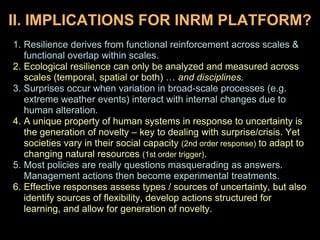
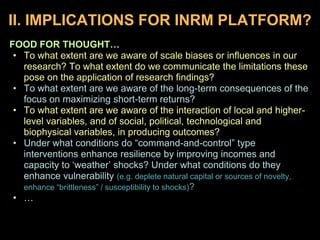
Resilience:Concepts & Implications for CG-Wide Research CollaborationPresented by L. German, D. Merrey and N. Johnson at the Workshop on Dealing with Drivers of Rapid Change in Africa: Integration of Lessons from Long-term Research on INRM, ILRI, Nairobi, June 12-13, 2008
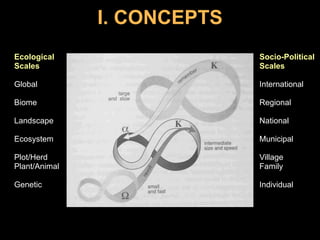
I. CONCEPTSEcologicalScalesGlobalBiomeLandscapeEcosystemPlot/HerdPlant/AnimalGeneticSocio-PoliticalScalesInternationalRegionalNationalMunicipalVillageFamilyIndividual
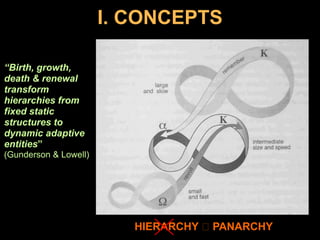
I. CONCEPTS“Birth, growth, death & renewal transform hierarchies from fixed static structures to dynamic adaptive entities” (Gunderson & Lowell)HIERARCHY  PANARCHY
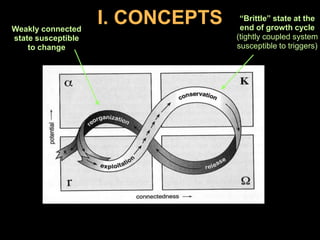
I. CONCEPTS“Brittle” state at theend of growth cycle(tightly coupled systemsusceptible to triggers)Weakly connected state susceptible to change
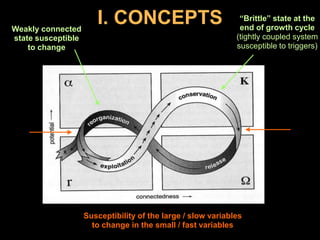
I. CONCEPTS“Brittle” state at theend of growth cycle(tightly coupled systemsusceptible to triggers)Weakly connected state susceptible to changeSusceptibility of the large / slow variables to change in the small / fast variables
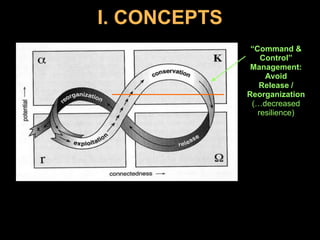
I. CONCEPTS“Command & Control”Management: AvoidRelease / Reorganization(…decreased resilience)
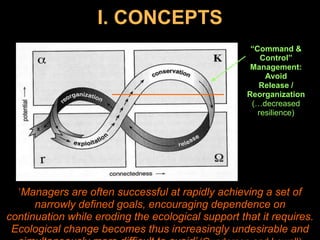
I. CONCEPTS“Command & Control”Management: AvoidRelease / Reorganization(…decreased resilience)‘Managers are often successful at rapidly achieving a set of narrowly defined goals, encouraging dependence on continuation while eroding the ecological support that it requires. Ecological change becomes thus increasingly undesirable and simultaneously more difficult to avoid’ (Gunderson and Lowell)
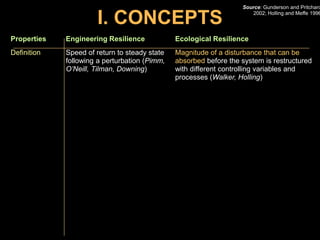
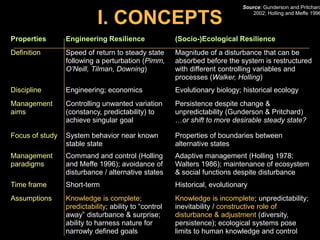
PropertiesEngineering ResilienceEcological ResilienceDefinitionSpeed of return to steady state following a perturbation (Pimm, O’Neill, Tilman, Downing)Magnitude of a disturbance that can be absorbed before the system is restructured with different controlling variables and processes (Walker, Holling)DisciplineEngineering; economicsEvolutionary biologyManagement aimsControlling unwanted variation (constancy, predictability) to achieve singular goalPersistence despite change & unpredictability (Gunderson & Pritchard) …or shift to more desirable steady state?Focus of studySystem behavior near known stable stateProperties of boundaries between alternative statesManagement paradigmsCommand and control (Holling and Meffe 1996); avoidance of alternative statesAdaptive management (Holling 1978; Walters 1986); maintenance of ecosystem function despite disturbanceTime frameShort-termHistorical, evolutionaryAssumptionsKnowledge is complete; predictability; ability to “control away” disturbance & surprise; ability to harness nature for narrowly defined goalsKnowledge is incomplete; unpredictability; inevitability / constructive role of disturbance & adjustment (diversity, persistence); ecological systems pose limits to human knowledge and controlSource: Gunderson and Pritchard 2002; Holling and Meffe 1996I. CONCEPTS
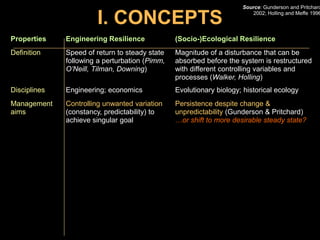
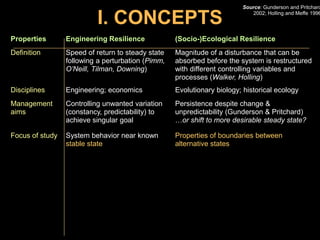
PropertiesEngineering Resilience(Socio-)Ecological ResilienceDefinitionSpeed of return to steady state following a perturbation (Pimm, O’Neill, Tilman, Downing)Magnitude of a disturbance that can be absorbed before the system is restructured with different controlling variables and processes (Walker, Holling)DisciplinesEngineering; economicsEvolutionary biology; historical ecologyManagement aimsControlling unwanted variation (constancy, predictability) to achieve singular goalPersistence despite change & unpredictability (Gunderson & Pritchard) …or shift to more desirable steady state?Focus of studySystem behavior near known stable stateProperties of boundaries between alternative statesManagement paradigmsCommand and control (Holling and Meffe 1996); avoidance of alternative statesAdaptive management (Holling 1978; Walters 1986); maintenance of ecosystem function despite disturbanceTime frameShort-termHistorical, evolutionaryAssumptionsKnowledge is complete; predictability; ability to “control away” disturbance & surprise; ability to harness nature for narrowly defined goalsKnowledge is incomplete; unpredictability; inevitability / constructive role of disturbance & adjustment (diversity, persistence); ecological systems pose limits to human knowledge and controlSource: Gunderson and Pritchard 2002; Holling and Meffe 1996I. CONCEPTS
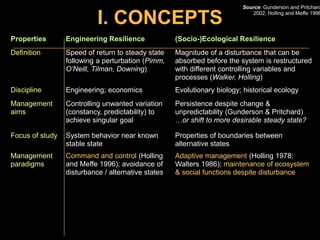
PropertiesEngineering Resilience(Socio-)Ecological ResilienceDefinitionSpeed of return to steady state following a perturbation (Pimm, O’Neill, Tilman, Downing)Magnitude of a disturbance that can be absorbed before the system is restructured with different controlling variables and processes (Walker, Holling)DisciplineEngineering; economicsEvolutionary biology; historical ecologyManagement aimsControlling unwanted variation (constancy, predictability) to achieve singular goalPersistence despite change & unpredictability (Gunderson & Pritchard) …or shift to more desirable steady state?Focus of studySystem behavior near known stable stateProperties of boundaries between alternative statesManagement paradigmsCommand and control (Holling and Meffe 1996); avoidance of disturbance / alternative statesAdaptive management (Holling 1978; Walters 1986); maintenance of ecosystem & social functions despite disturbanceTime frameShort-termHistorical, evolutionaryAssumptionsKnowledge is complete; predictability; ability to “control away” disturbance & surprise; ability to harness nature for narrowly defined goalsKnowledge is incomplete; unpredictability; inevitability / constructive role of disturbance & adjustment (diversity, persistence); ecological systems pose limits to human knowledge and controlSource: Gunderson and Pritchard 2002; Holling and Meffe 1996I. CONCEPTS
I. CONCEPTSWhat if the current state is undesirable? Is resilience an undesirable quality?Resilience  resisting changeResilient systems are those that retain essential (ecological, social) functions despite disturbance
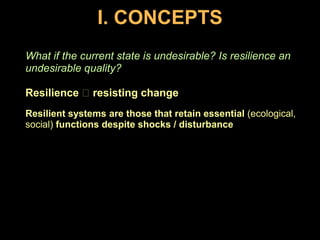
I. CONCEPTSWhat if the current state is undesirable? Is resilience an undesirable quality?Resilience  resisting changeResilient systems are those that retain essential (ecological, social) functions despite shocks / disturbance
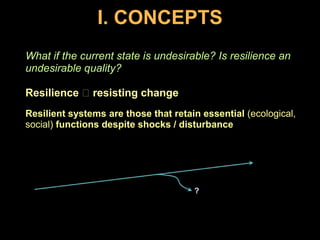
I. CONCEPTSWhat if the current state is undesirable? Is resilience an undesirable quality?Resilience  resisting changeResilient systems are those that retain essential (ecological, social) functions despite shocks / disturbance?
I. CONCEPTS“First-order resource” = a natural resource that is becoming scarcer relevant to population over time (or “First-Order Ecological Condition” ... ecological condition becoming increasingly undesirable).“Second-order resource” = set of potential 'adaptive behaviors' (rules, values, information, social capital) that enable a society to generate and implement solutions to difficult problems.(adapted from Turton and Ohlsson)
II. CASE STUDIESA. Rangeland ManagementEcological Context(Walker, 2002; Abel & Langston, 2001):Strong seasonal climate, inter-annual variability
Patchiness of productivity
Species composition (W, A, P, PU) controlled by extreme years (decline in W); grazing (species, intensity – P:PU)
Key ecosystem processes: competition; fuel accumulation; and their interaction with drivers (rainfall, fire, grazing)II. CASE STUDIESA. Rangeland ManagementEcological Context(Walker, 2002; Abel & Langston, 2001):Strong seasonal climate, inter-annual variability
Patchiness of productivity
Species composition(W, A, P, PU)controlled by extreme years(decline in W); grazing(species, intensity – P:PU)
Key ecosystem processes: competition; fuel accumulation; and their interaction with drivers (rainfall, fire, grazing)II. CASE STUDIESA. Rangeland ManagementEcological Context(Walker, 2002; Abel & Langston, 2001):Strong seasonal climate, inter-annual variability
Patchiness of productivity
Species composition(W, A, P, PU)controlled by extreme years(decline in W); grazing(species, intensity – P:PU)
Key ecosystem processes: competition; fuel accumulation; and their interaction with drivers (rainfall, fire, grazing)
Resilience = f (rainfall, grazing intensity, patchiness) + “2nd Order” variables (social resilience)“A resilient landscape for pastoralism is one that can retain or recover sufficient function to support fodder production, despite disturbance” (Abel & Langston, 2001)
II. CASE STUDIESA. Rangeland ManagementTraditional Pastoralist Systems (Markakis, 2004):Freedom of movement to chase pasture, water- Common property- Extensive social networks (e.g. marriage, trade)Mechanisms to buffer environmental extremes:- Reciprocal rights & obligations (survival, wealth redistribution)- Logic of accumulation (material, social capital) / trade > sale to hedge against risk- Coping to enhance survival despite loss
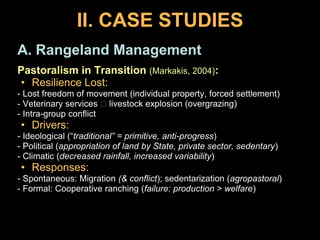
II. CASE STUDIESA. Rangeland ManagementPastoralism in Transition (Markakis, 2004):Resilience Lost:- Lost freedom of movement (individual property, forced settlement)- Veterinary services  livestock explosion (overgrazing)- Intra-group conflictDrivers:- Ideological (“traditional” = primitive, anti-progress)- Political (appropriation of land by State, private sector, sedentary)- Climatic (decreased rainfall, increased variability)Responses:- Spontaneous: Migration (& conflict); sedentarization (agropastoral)- Formal: Cooperative ranching (failure: production > welfare)
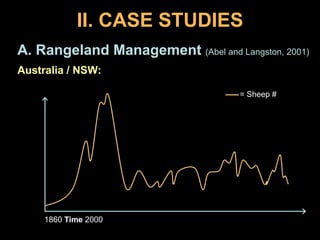
II. CASE STUDIESA. Rangeland Management (Abel and Langston, 2001)Australia / NSW:= Sheep #1860 Time 2000
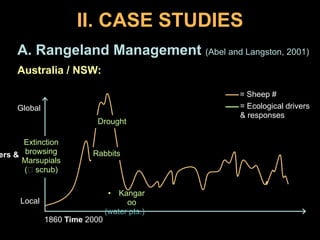
II. CASE STUDIESA. Rangeland Management (Abel and Langston, 2001)Australia / NSW:= Sheep #= Ecological drivers& responsesGlobalDroughtExtinctionbrowsingMarsupials( scrub)RabbitsScale of Drivers & ResponsesKangaroo(water pts.)Local1860 Time 2000
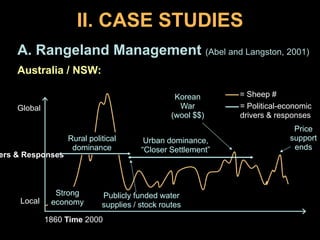
II. CASE STUDIESA. Rangeland Management (Abel and Langston, 2001)Australia / NSW:= Sheep #KoreanWar(wool $$)= Political-economicdrivers & responsesGlobalPricesupportendsRural political dominanceUrban dominance,“Closer Settlement”Scale of Drivers & ResponsesStrongeconomyPublicly funded water supplies / stock routesLocal1860 Time 2000
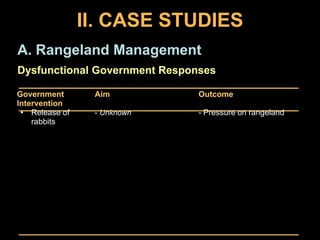
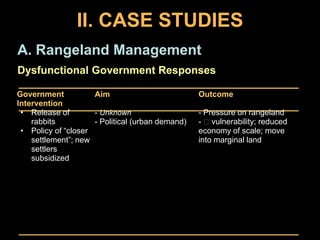
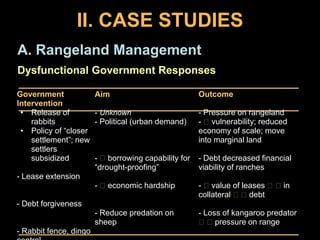
II. CASE STUDIESA. Rangeland ManagementDysfunctional Government ResponsesGovernmentInterventionRelease of rabbits
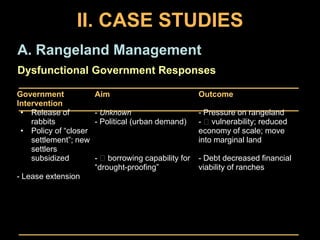
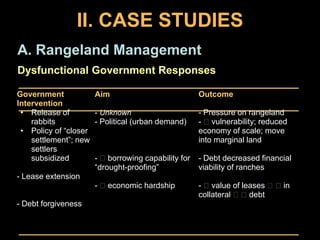
Policy of “closer settlement”; new settlers subsidized- Lease extension- Debt forgiveness- Rabbit fence, dingocontrolAim- Unknown- Political (urban demand)-  borrowing capability for “drought-proofing”-  economic hardship- Reduce predation onsheep Outcome- Pressure on rangeland -  vulnerability; reduced economy of scale; move into marginal land- Debt decreased financialviability of ranches-  value of leases   incollateral   debt- Loss of kangaroo predator   pressure on range
II. CASE STUDIESA. Rangeland ManagementDysfunctional Government ResponsesGovernmentInterventionRelease of rabbits
Policy of “closer settlement”; new settlers subsidized- Lease extension- Debt forgiveness- Rabbit fence, dingocontrolAim- Unknown- Political (urban demand)-  borrowing capability for “drought-proofing”-  economic hardship- Reduce predation onsheep Outcome- Pressure on rangeland -  vulnerability; reduced economy of scale; move into marginal land- Debt decreased financialviability of ranches-  value of leases   incollateral   debt- Loss of kangaroo predator   pressure on range
II. CASE STUDIESA. Rangeland ManagementDysfunctional Government ResponsesGovernmentInterventionRelease of rabbits
Policy of “closer settlement”; new settlers subsidized- Lease extension- Debt forgiveness- Rabbit fence, dingocontrolAim- Unknown- Political (urban demand)-  borrowing capability for “drought-proofing”-  economic hardship- Reduce predation onsheepOutcome- Pressure on rangeland -  vulnerability; reduced economy of scale; move into marginal land- Debt decreased financialviability of ranches-  value of leases   incollateral   debt- Loss of kangaroo predator   pressure on range
II. CASE STUDIESA. Rangeland ManagementDysfunctional Government ResponsesGovernmentInterventionRelease of rabbits
Policy of “closer settlement”; new settlers subsidized- Lease extension- Debt forgiveness- Rabbit fence, dingocontrolAim- Unknown- Political (urban demand)-  borrowing capability for “drought-proofing”-  economic hardship- Reduce predation onsheepOutcome- Pressure on rangeland -  vulnerability; reduced economy of scale; move into marginal land- Debt decreased financialviability of ranches-  value of leases incollateral  debt- Loss of kangaroo predator   pressure on range
II. CASE STUDIESA. Rangeland ManagementDysfunctional Government ResponsesGovernmentInterventionRelease of rabbits
Policy of “closer settlement”; new settlers subsidized- Lease extension- Debt forgiveness- Rabbit fence, dingocontrolAim- Unknown- Political (urban demand)-  borrowing capability for “drought-proofing”-  economic hardship- Reduce predation onsheep Outcome- Pressure on rangeland -  vulnerability; reduced economy of scale; move into marginal land- Debt decreased financialviability of ranches-  value of leases incollateral  debt- Loss of kangaroo predator  pressure on range
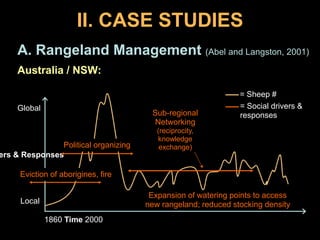
II. CASE STUDIESA. Rangeland Management (Abel and Langston, 2001)Australia / NSW:= Sheep #= Social drivers &responsesGlobalSub-regionalNetworking(reciprocity, knowledge exchange)Political organizingScale of Drivers & ResponsesEviction of aborigines, fireExpansion of watering points to accessnew rangeland; reduced stocking densityLocal1860 Time 2000
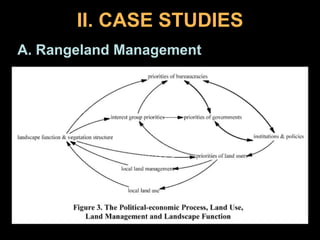
II. CASE STUDIESA. Rangeland Management
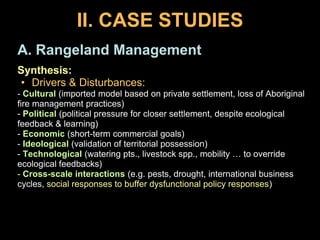
II. CASE STUDIESA. Rangeland ManagementSynthesis:Drivers & Disturbances:- Cultural(imported model based on private settlement, loss of Aboriginal fire management practices)- Political (political pressure for closer settlement, despite ecologicalfeedback & learning)- Economic (short-term commercial goals)- Ideological(validation of territorial possession)- Technological (watering pts., livestock spp., mobility … to override ecological feedbacks)- Cross-scale interactions (e.g. pests, drought, international businesscycles, social responses to buffer dysfunctional policy responses)
II. CASE STUDIESB. Cropping SystemsIndustrialized agriculture “seeks to remove dependency on the natural processes normally required for plant production” (Vaughan, 1998)Does this enhance or undermine resilience?
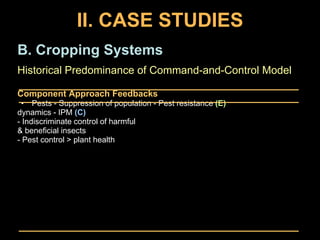
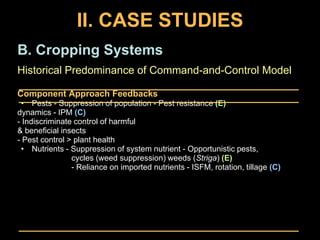
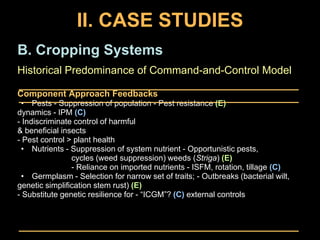
II. CASE STUDIESB. Cropping SystemsHistorical Predominance of Command-and-Control ModelComponent Approach FeedbacksPests - Suppression of population - Pest resistance (E)dynamics - IPM (C)- Indiscriminate control of harmful & beneficial insects- Pest control > plant healthNutrients - Suppression of system nutrient - Opportunistic pests,
cycles (weed suppression) weeds (Striga) (E)
- Reliance on imported nutrients - ISFM, rotation, tillage (C)
Germplasm - Selection for narrow set of traits; - Outbreaks (bacterial wilt,genetic simplification stem rust) (E)- Substitute genetic resilience for - “ICGM”? (C) external controls
II. CASE STUDIESB. Cropping SystemsHistorical Predominance of Command-and-Control ModelComponent Approach FeedbacksPests - Suppression of population - Pest resistance (E)dynamics - IPM (C)- Indiscriminate control of harmful & beneficial insects- Pest control > plant healthNutrients - Suppression of system nutrient - Opportunistic pests,
cycles (weed suppression) weeds (Striga) (E)
- Reliance on imported nutrients - ISFM, rotation, tillage (C)
Germplasm - Selection for narrow set of traits; - Outbreaks (bacterial wilt,genetic simplification stem rust) (E)- Substitute genetic resilience for - “ICGM”? (C) external controls
II. CASE STUDIESB. Cropping SystemsHistorical Predominance of Command-and-Control ModelComponent Approach FeedbacksPests - Suppression of population - Pest resistance (E)dynamics - IPM (C)- Indiscriminate control of harmful & beneficial insects- Pest control > plant healthNutrients - Suppression of system nutrient - Opportunistic pests,

Resilience: concepts & implications for CG-wide research collaboration

  • 1.
    Resilience:Concepts & Implicationsfor CG-Wide Research CollaborationPresented by L. German, D. Merrey and N. Johnson at the Workshop on Dealing with Drivers of Rapid Change in Africa: Integration of Lessons from Long-term Research on INRM, ILRI, Nairobi, June 12-13, 2008
  • 2.
  • 3.
    I. CONCEPTS“Birth, growth,death & renewal transform hierarchies from fixed static structures to dynamic adaptive entities” (Gunderson & Lowell)HIERARCHY  PANARCHY
  • 4.
    I. CONCEPTS“Brittle” stateat theend of growth cycle(tightly coupled systemsusceptible to triggers)Weakly connected state susceptible to change
  • 5.
    I. CONCEPTS“Brittle” stateat theend of growth cycle(tightly coupled systemsusceptible to triggers)Weakly connected state susceptible to changeSusceptibility of the large / slow variables to change in the small / fast variables
  • 6.
    I. CONCEPTS“Command &Control”Management: AvoidRelease / Reorganization(…decreased resilience)
  • 7.
    I. CONCEPTS“Command &Control”Management: AvoidRelease / Reorganization(…decreased resilience)‘Managers are often successful at rapidly achieving a set of narrowly defined goals, encouraging dependence on continuation while eroding the ecological support that it requires. Ecological change becomes thus increasingly undesirable and simultaneously more difficult to avoid’ (Gunderson and Lowell)
  • 8.
    PropertiesEngineering ResilienceEcological ResilienceDefinitionSpeedof return to steady state following a perturbation (Pimm, O’Neill, Tilman, Downing)Magnitude of a disturbance that can be absorbed before the system is restructured with different controlling variables and processes (Walker, Holling)DisciplineEngineering; economicsEvolutionary biologyManagement aimsControlling unwanted variation (constancy, predictability) to achieve singular goalPersistence despite change & unpredictability (Gunderson & Pritchard) …or shift to more desirable steady state?Focus of studySystem behavior near known stable stateProperties of boundaries between alternative statesManagement paradigmsCommand and control (Holling and Meffe 1996); avoidance of alternative statesAdaptive management (Holling 1978; Walters 1986); maintenance of ecosystem function despite disturbanceTime frameShort-termHistorical, evolutionaryAssumptionsKnowledge is complete; predictability; ability to “control away” disturbance & surprise; ability to harness nature for narrowly defined goalsKnowledge is incomplete; unpredictability; inevitability / constructive role of disturbance & adjustment (diversity, persistence); ecological systems pose limits to human knowledge and controlSource: Gunderson and Pritchard 2002; Holling and Meffe 1996I. CONCEPTS
  • 9.
    PropertiesEngineering Resilience(Socio-)Ecological ResilienceDefinitionSpeedof return to steady state following a perturbation (Pimm, O’Neill, Tilman, Downing)Magnitude of a disturbance that can be absorbed before the system is restructured with different controlling variables and processes (Walker, Holling)DisciplinesEngineering; economicsEvolutionary biology; historical ecologyManagement aimsControlling unwanted variation (constancy, predictability) to achieve singular goalPersistence despite change & unpredictability (Gunderson & Pritchard) …or shift to more desirable steady state?Focus of studySystem behavior near known stable stateProperties of boundaries between alternative statesManagement paradigmsCommand and control (Holling and Meffe 1996); avoidance of alternative statesAdaptive management (Holling 1978; Walters 1986); maintenance of ecosystem function despite disturbanceTime frameShort-termHistorical, evolutionaryAssumptionsKnowledge is complete; predictability; ability to “control away” disturbance & surprise; ability to harness nature for narrowly defined goalsKnowledge is incomplete; unpredictability; inevitability / constructive role of disturbance & adjustment (diversity, persistence); ecological systems pose limits to human knowledge and controlSource: Gunderson and Pritchard 2002; Holling and Meffe 1996I. CONCEPTS
  • 10.
    PropertiesEngineering Resilience(Socio-)Ecological ResilienceDefinitionSpeedof return to steady state following a perturbation (Pimm, O’Neill, Tilman, Downing)Magnitude of a disturbance that can be absorbed before the system is restructured with different controlling variables and processes (Walker, Holling)DisciplinesEngineering; economicsEvolutionary biology; historical ecologyManagement aimsControlling unwanted variation (constancy, predictability) to achieve singular goalPersistence despite change & unpredictability (Gunderson & Pritchard) …or shift to more desirable steady state?Focus of studySystem behavior near known stable stateProperties of boundaries between alternative statesManagement paradigmsCommand and control (Holling and Meffe 1996); avoidance of alternative statesAdaptive management (Holling 1978; Walters 1986); maintenance of ecosystem function despite disturbanceTime frameShort-termHistorical, evolutionaryAssumptionsKnowledge is complete; predictability; ability to “control away” disturbance & surprise; ability to harness nature for narrowly defined goalsKnowledge is incomplete; unpredictability; inevitability / constructive role of disturbance & adjustment (diversity, persistence); ecological systems pose limits to human knowledge and controlSource: Gunderson and Pritchard 2002; Holling and Meffe 1996I. CONCEPTS
  • 11.
    PropertiesEngineering Resilience(Socio-)Ecological ResilienceDefinitionSpeedof return to steady state following a perturbation (Pimm, O’Neill, Tilman, Downing)Magnitude of a disturbance that can be absorbed before the system is restructured with different controlling variables and processes (Walker, Holling)DisciplineEngineering; economicsEvolutionary biology; historical ecologyManagement aimsControlling unwanted variation (constancy, predictability) to achieve singular goalPersistence despite change & unpredictability (Gunderson & Pritchard) …or shift to more desirable steady state?Focus of studySystem behavior near known stable stateProperties of boundaries between alternative statesManagement paradigmsCommand and control (Holling and Meffe 1996); avoidance of disturbance / alternative statesAdaptive management (Holling 1978; Walters 1986); maintenance of ecosystem & social functions despite disturbanceTime frameShort-termHistorical, evolutionaryAssumptionsKnowledge is complete; predictability; ability to “control away” disturbance & surprise; ability to harness nature for narrowly defined goalsKnowledge is incomplete; unpredictability; inevitability / constructive role of disturbance & adjustment (diversity, persistence); ecological systems pose limits to human knowledge and controlSource: Gunderson and Pritchard 2002; Holling and Meffe 1996I. CONCEPTS
  • 12.
    PropertiesEngineering Resilience(Socio-)Ecological ResilienceDefinitionSpeedof return to steady state following a perturbation (Pimm, O’Neill, Tilman, Downing)Magnitude of a disturbance that can be absorbed before the system is restructured with different controlling variables and processes (Walker, Holling)DisciplineEngineering; economicsEvolutionary biology; historical ecologyManagement aimsControlling unwanted variation (constancy, predictability) to achieve singular goalPersistence despite change & unpredictability (Gunderson & Pritchard) …or shift to more desirable steady state?Focus of studySystem behavior near known stable stateProperties of boundaries between alternative statesManagement paradigmsCommand and control (Holling and Meffe 1996); avoidance of disturbance / alternative statesAdaptive management (Holling 1978; Walters 1986); maintenance of ecosystem & social functions despite disturbanceTime frameShort-termHistorical, evolutionaryAssumptionsKnowledge is complete; predictability; ability to “control away” disturbance & surprise; ability to harness nature for narrowly defined goalsKnowledge is incomplete; unpredictability; inevitability / constructive role of disturbance & adjustment (diversity, persistence); ecological systems pose limits to human knowledge and controlSource: Gunderson and Pritchard 2002; Holling and Meffe 1996I. CONCEPTS
  • 13.
    I. CONCEPTSWhat ifthe current state is undesirable? Is resilience an undesirable quality?Resilience  resisting changeResilient systems are those that retain essential (ecological, social) functions despite disturbance
  • 14.
    I. CONCEPTSWhat ifthe current state is undesirable? Is resilience an undesirable quality?Resilience  resisting changeResilient systems are those that retain essential (ecological, social) functions despite shocks / disturbance
  • 15.
    I. CONCEPTSWhat ifthe current state is undesirable? Is resilience an undesirable quality?Resilience  resisting changeResilient systems are those that retain essential (ecological, social) functions despite shocks / disturbance?
  • 16.
    I. CONCEPTS“First-order resource”= a natural resource that is becoming scarcer relevant to population over time (or “First-Order Ecological Condition” ... ecological condition becoming increasingly undesirable).“Second-order resource” = set of potential 'adaptive behaviors' (rules, values, information, social capital) that enable a society to generate and implement solutions to difficult problems.(adapted from Turton and Ohlsson)
  • 17.
    II. CASE STUDIESA.Rangeland ManagementEcological Context(Walker, 2002; Abel & Langston, 2001):Strong seasonal climate, inter-annual variability
  • 18.
  • 19.
    Species composition (W,A, P, PU) controlled by extreme years (decline in W); grazing (species, intensity – P:PU)
  • 20.
    Key ecosystem processes:competition; fuel accumulation; and their interaction with drivers (rainfall, fire, grazing)II. CASE STUDIESA. Rangeland ManagementEcological Context(Walker, 2002; Abel & Langston, 2001):Strong seasonal climate, inter-annual variability
  • 21.
  • 22.
    Species composition(W, A,P, PU)controlled by extreme years(decline in W); grazing(species, intensity – P:PU)
  • 23.
    Key ecosystem processes:competition; fuel accumulation; and their interaction with drivers (rainfall, fire, grazing)II. CASE STUDIESA. Rangeland ManagementEcological Context(Walker, 2002; Abel & Langston, 2001):Strong seasonal climate, inter-annual variability
  • 24.
  • 25.
    Species composition(W, A,P, PU)controlled by extreme years(decline in W); grazing(species, intensity – P:PU)
  • 26.
    Key ecosystem processes:competition; fuel accumulation; and their interaction with drivers (rainfall, fire, grazing)
  • 27.
    Resilience = f(rainfall, grazing intensity, patchiness) + “2nd Order” variables (social resilience)“A resilient landscape for pastoralism is one that can retain or recover sufficient function to support fodder production, despite disturbance” (Abel & Langston, 2001)
  • 28.
    II. CASE STUDIESA.Rangeland ManagementTraditional Pastoralist Systems (Markakis, 2004):Freedom of movement to chase pasture, water- Common property- Extensive social networks (e.g. marriage, trade)Mechanisms to buffer environmental extremes:- Reciprocal rights & obligations (survival, wealth redistribution)- Logic of accumulation (material, social capital) / trade > sale to hedge against risk- Coping to enhance survival despite loss
  • 29.
    II. CASE STUDIESA.Rangeland ManagementTraditional Pastoralist Systems (Markakis, 2004):Freedom of movement to chase pasture, water- Common property- Extensive social networks (e.g. marriage, trade)Mechanisms to buffer environmental extremes:- Reciprocal rights & obligations (survival, wealth redistribution)- Logic of accumulation (material, social capital) / trade > sale to hedge against risk- Coping to enhance survival despite loss
  • 30.
    II. CASE STUDIESA.Rangeland ManagementPastoralism in Transition (Markakis, 2004):Resilience Lost:- Lost freedom of movement (individual property, forced settlement)- Veterinary services  livestock explosion (overgrazing)- Intra-group conflictDrivers:- Ideological (“traditional” = primitive, anti-progress)- Political (appropriation of land by State, private sector, sedentary)- Climatic (decreased rainfall, increased variability)Responses:- Spontaneous: Migration (& conflict); sedentarization (agropastoral)- Formal: Cooperative ranching (failure: production > welfare)
  • 31.
    II. CASE STUDIESA.Rangeland ManagementPastoralism in Transition (Markakis, 2004):Resilience Lost:- Lost freedom of movement (individual property, forced settlement)- Veterinary services  livestock explosion (overgrazing)- Intra-group conflictDrivers:- Ideological (“traditional” = primitive, anti-progress)- Political (appropriation of land by State, private sector, sedentary)- Climatic (decreased rainfall, increased variability)Responses:- Spontaneous: Migration (& conflict); sedentarization (agropastoral)- Formal: Cooperative ranching (failure: production > welfare)
  • 32.
    II. CASE STUDIESA.Rangeland ManagementPastoralism in Transition (Markakis, 2004):Resilience Lost:- Lost freedom of movement (individual property, forced settlement)- Veterinary services  livestock explosion (overgrazing)- Intra-group conflictDrivers:- Ideological (“traditional” = primitive, anti-progress)- Political (appropriation of land by State, private sector, sedentary)- Climatic (decreased rainfall, increased variability)Responses:- Spontaneous: Migration (& conflict); sedentarization (agropastoral)- Formal: Cooperative ranching (failure: production > welfare)
  • 33.
    II. CASE STUDIESA.Rangeland Management (Abel and Langston, 2001)Australia / NSW:= Sheep #1860 Time 2000
  • 34.
    II. CASE STUDIESA.Rangeland Management (Abel and Langston, 2001)Australia / NSW:= Sheep #= Ecological drivers& responsesGlobalDroughtExtinctionbrowsingMarsupials( scrub)RabbitsScale of Drivers & ResponsesKangaroo(water pts.)Local1860 Time 2000
  • 35.
    II. CASE STUDIESA.Rangeland Management (Abel and Langston, 2001)Australia / NSW:= Sheep #KoreanWar(wool $$)= Political-economicdrivers & responsesGlobalPricesupportendsRural political dominanceUrban dominance,“Closer Settlement”Scale of Drivers & ResponsesStrongeconomyPublicly funded water supplies / stock routesLocal1860 Time 2000
  • 36.
    II. CASE STUDIESA.Rangeland ManagementDysfunctional Government ResponsesGovernmentInterventionRelease of rabbits
  • 37.
    Policy of “closersettlement”; new settlers subsidized- Lease extension- Debt forgiveness- Rabbit fence, dingocontrolAim- Unknown- Political (urban demand)-  borrowing capability for “drought-proofing”-  economic hardship- Reduce predation onsheep Outcome- Pressure on rangeland -  vulnerability; reduced economy of scale; move into marginal land- Debt decreased financialviability of ranches-  value of leases   incollateral   debt- Loss of kangaroo predator   pressure on range
  • 38.
    II. CASE STUDIESA.Rangeland ManagementDysfunctional Government ResponsesGovernmentInterventionRelease of rabbits
  • 39.
    Policy of “closersettlement”; new settlers subsidized- Lease extension- Debt forgiveness- Rabbit fence, dingocontrolAim- Unknown- Political (urban demand)-  borrowing capability for “drought-proofing”-  economic hardship- Reduce predation onsheep Outcome- Pressure on rangeland -  vulnerability; reduced economy of scale; move into marginal land- Debt decreased financialviability of ranches-  value of leases   incollateral   debt- Loss of kangaroo predator   pressure on range
  • 40.
    II. CASE STUDIESA.Rangeland ManagementDysfunctional Government ResponsesGovernmentInterventionRelease of rabbits
  • 41.
    Policy of “closersettlement”; new settlers subsidized- Lease extension- Debt forgiveness- Rabbit fence, dingocontrolAim- Unknown- Political (urban demand)-  borrowing capability for “drought-proofing”-  economic hardship- Reduce predation onsheepOutcome- Pressure on rangeland -  vulnerability; reduced economy of scale; move into marginal land- Debt decreased financialviability of ranches-  value of leases   incollateral   debt- Loss of kangaroo predator   pressure on range
  • 42.
    II. CASE STUDIESA.Rangeland ManagementDysfunctional Government ResponsesGovernmentInterventionRelease of rabbits
  • 43.
    Policy of “closersettlement”; new settlers subsidized- Lease extension- Debt forgiveness- Rabbit fence, dingocontrolAim- Unknown- Political (urban demand)-  borrowing capability for “drought-proofing”-  economic hardship- Reduce predation onsheepOutcome- Pressure on rangeland -  vulnerability; reduced economy of scale; move into marginal land- Debt decreased financialviability of ranches-  value of leases incollateral  debt- Loss of kangaroo predator   pressure on range
  • 44.
    II. CASE STUDIESA.Rangeland ManagementDysfunctional Government ResponsesGovernmentInterventionRelease of rabbits
  • 45.
    Policy of “closersettlement”; new settlers subsidized- Lease extension- Debt forgiveness- Rabbit fence, dingocontrolAim- Unknown- Political (urban demand)-  borrowing capability for “drought-proofing”-  economic hardship- Reduce predation onsheep Outcome- Pressure on rangeland -  vulnerability; reduced economy of scale; move into marginal land- Debt decreased financialviability of ranches-  value of leases incollateral  debt- Loss of kangaroo predator  pressure on range
  • 46.
    II. CASE STUDIESA.Rangeland Management (Abel and Langston, 2001)Australia / NSW:= Sheep #= Social drivers &responsesGlobalSub-regionalNetworking(reciprocity, knowledge exchange)Political organizingScale of Drivers & ResponsesEviction of aborigines, fireExpansion of watering points to accessnew rangeland; reduced stocking densityLocal1860 Time 2000
  • 47.
    II. CASE STUDIESA.Rangeland Management
  • 48.
    II. CASE STUDIESA.Rangeland ManagementSynthesis:Drivers & Disturbances:- Cultural(imported model based on private settlement, loss of Aboriginal fire management practices)- Political (political pressure for closer settlement, despite ecologicalfeedback & learning)- Economic (short-term commercial goals)- Ideological(validation of territorial possession)- Technological (watering pts., livestock spp., mobility … to override ecological feedbacks)- Cross-scale interactions (e.g. pests, drought, international businesscycles, social responses to buffer dysfunctional policy responses)
  • 49.
    II. CASE STUDIESB.Cropping SystemsIndustrialized agriculture “seeks to remove dependency on the natural processes normally required for plant production” (Vaughan, 1998)Does this enhance or undermine resilience?
  • 50.
    II. CASE STUDIESB.Cropping SystemsHistorical Predominance of Command-and-Control ModelComponent Approach FeedbacksPests - Suppression of population - Pest resistance (E)dynamics - IPM (C)- Indiscriminate control of harmful & beneficial insects- Pest control > plant healthNutrients - Suppression of system nutrient - Opportunistic pests,
  • 51.
    cycles (weed suppression)weeds (Striga) (E)
  • 52.
    - Reliance onimported nutrients - ISFM, rotation, tillage (C)
  • 53.
    Germplasm - Selectionfor narrow set of traits; - Outbreaks (bacterial wilt,genetic simplification stem rust) (E)- Substitute genetic resilience for - “ICGM”? (C) external controls
  • 54.
    II. CASE STUDIESB.Cropping SystemsHistorical Predominance of Command-and-Control ModelComponent Approach FeedbacksPests - Suppression of population - Pest resistance (E)dynamics - IPM (C)- Indiscriminate control of harmful & beneficial insects- Pest control > plant healthNutrients - Suppression of system nutrient - Opportunistic pests,
  • 55.
    cycles (weed suppression)weeds (Striga) (E)
  • 56.
    - Reliance onimported nutrients - ISFM, rotation, tillage (C)
  • 57.
    Germplasm - Selectionfor narrow set of traits; - Outbreaks (bacterial wilt,genetic simplification stem rust) (E)- Substitute genetic resilience for - “ICGM”? (C) external controls
  • 58.
    II. CASE STUDIESB.Cropping SystemsHistorical Predominance of Command-and-Control ModelComponent Approach FeedbacksPests - Suppression of population - Pest resistance (E)dynamics - IPM (C)- Indiscriminate control of harmful & beneficial insects- Pest control > plant healthNutrients - Suppression of system nutrient - Opportunistic pests,