Resilience Thinking: 
Preparing for the Unknown 
Nathan Albritton
Background 
• Earth is dynamic 
– Change is inevitable 
• Scientific inquiry has allowed us to 
better understand our world 
• However, there will always be surprises 
– The world is inherently unknowable 
2 
"The only true wisdom is in knowing you know nothing." 
"The fool doth think he is wise, but the 
wise man knows himself to be a fool." 
-William Shakespeare 
-Socrates 
“To know that you do not know is the 
best. To pretend to know when you do 
not know is a disease.” 
-Lao-Tzu
What is Resilience? 
• The ability of a system to perform its 
desired function after a shock 
• Equilibrium Resilience 
– Maintain steady-state 
• Engineering Resilience 
– Time for system to return to normal 
• Ecosystem Resilience 
– How much a system can be disturbed 
3 
Earth in Balance?
Are Stability and Balance Good Things? 
• Two key (and faulty) assumptions: 
– There is an ideal stable state or 
situation that we have to maintain 
– We know better than nature 
4 
Seawalls and Sand Loss 
(Pilkey et. al., 1996) 
(Star Wars)
History of Resilience Thinking 
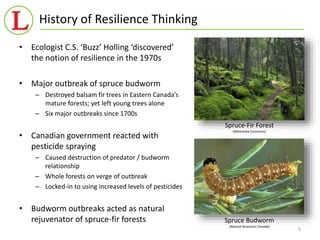
• Ecologist C.S. ‘Buzz’ Holling ‘discovered’ 
the notion of resilience in the 1970s 
• Major outbreak of spruce budworm 
– Destroyed balsam fir trees in Eastern Canada’s 
mature forests; yet left young trees alone 
– Six major outbreaks since 1700s 
• Canadian government reacted with 
pesticide spraying 
– Caused destruction of predator / budworm 
relationship 
– Whole forests on verge of outbreak 
– Locked-in to using increased levels of pesticides 
• Budworm outbreaks acted as natural 
rejuvenator of spruce-fir forests 
5 
Spruce-Fir Forest 
(Wikimedia Commons) 
Spruce Budworm 
(Natural Resources Canada)
Resilience Thinking 
• Resilience Thinking is based on two premises: 
– Humans and nature are part of a strongly couple and coevolving 
“social-ecological” system 
– Systems do not respond to change in a linear, predictable fashion 
6
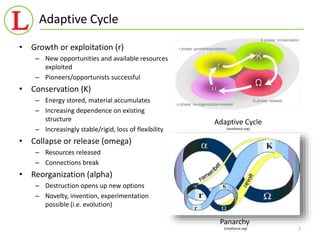
Adaptive Cycle 
• Growth or exploitation (r) 
– New opportunities and available resources 
exploited 
– Pioneers/opportunists successful 
• Conservation (K) 
– Energy stored, material accumulates 
– Increasing dependence on existing 
structure 
– Increasingly stable/rigid, loss of flexibility 
• Collapse or release (omega) 
– Resources released 
– Connections break 
• Reorganization (alpha) 
– Destruction opens up new options 
– Novelty, invention, experimentation 
possible (i.e. evolution) 
7 
Adaptive Cycle 
(resalliance.org) 
Panarchy 
(resalliance.org)
Panarchy 
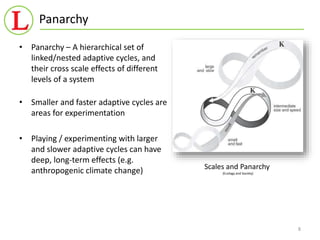
• Panarchy – A hierarchical set of 
linked/nested adaptive cycles, and 
their cross scale effects of different 
levels of a system 
• Smaller and faster adaptive cycles are 
areas for experimentation 
• Playing / experimenting with larger 
and slower adaptive cycles can have 
deep, long-term effects (e.g. 
anthropogenic climate change) 
8 
Scales and Panarchy 
(Ecology and Society)
Basins of Attraction 
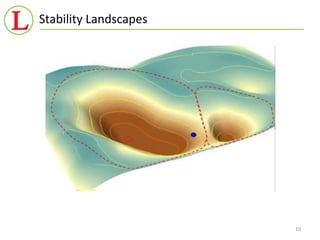
• Regions in which a system tends to 
remain 
• More than one basin of attraction 
for any given system 
• Focuses on regime shifts and 
tipping points, which can tip a 
system into another state which 
is difficult or impossible to recover 
from 
• “How much shock can a system absorb before it transforms into 
something fundamentally different?” (Folke, 2009) 
9 
Ball and Cup Heuristic of 
System Stability 
(Environmental Governance)
Stability Landscapes 
10
Stability Landscapes 
10
Dealing with Climate Change 
• Holocene has been a period of flourishing human civilization 
• Temperature unlikely to stay the same even if no anthropogenic effects 
• Impossible to predict future 
• However, we can learn, adapt, and evolve through experimentation in 
smaller, faster scales in the panarchy 
11 
Temperature Fluctuations over Human History 
(SeedMagazine.com)
Dealing with Climate Change (cont’d) 
12 
• Climate change is a potential large-scale 
source of change in many ecosystems 
– Great potential to change stability landscapes 
• Resilience Thinking can be used to help 
systems maintain essential functions - guided 
transition 
– Humans are part of nature, evolving along with it 
• Will require adaptive form of governance 
– Experimentation at local level 
– No ‘one-size fits all’ solutions 
– Increased participation; not just rely on “experts” 
– Increased information flow 
– Bolstered social networks / social capital
Key Take-Aways 
• Resilience Thinking is a form of systems thinking 
– Everything is connected 
• Resilience Thinking embraces uncertainty and accepts risk as inevitable 
• Resilience is not just about absorbing disturbance 
– Also about the capability to self-organize and the capacity to learn, adapt and 
transform 
• Resilience Thinking encourages a greater awareness of complex systems, 
their interacting parts, and the ability to cope with changes without the 
need to accurately predict what a change will bring 
• Embrace change, nothing is static 
– The key is not equilibrium but fluctuation and change 
– There is no sustainable optimal state, change will happen 
– Life is full of surprises; Embrace change and dance with it, no-one's in control 
11
Further Reading 
• Stockholm Resilience Centre (http://www.stockholmresilience.org/) 
• Resilience Alliance (http://www.resalliance.org/) 
• Ecology and Society (www.ecologyandsociety.org) 
12
References 
• Carpenter, SR, Folke, C., Scheffer, M., & Westley, F. (2009). Resilience: accounting for the noncomputable. 
Ecology & society, 14(1). Retrieved from http://su.diva-portal.org/smash/record.jsf?pid=diva2:432532 
• Carpenter, Steve, Walker, B., Anderies, J. M., & Abel, N. (2001). From Metaphor to Measurement: 
Resilience of What to What? Ecosystems, 4(8), 765–781. doi:10.1007/s10021-001-0045-9 
• Folke, C. (2009, December). How much disturbance can a system withstand ? With roots in ecology and 
complexity science , Resilience Thinking offers new ways to turn crises into catalysts for innovation . Seed 
Magazine.com, 40–42. 
• Holling, C. S. (1973). Resilience and Stability of Ecological Systems. Annual Review of Ecology and 
Systematics, 4, 1–23. Retrieved from http://www.jstor.org.ezproxy.hpu.edu/stable/info/2096802 
• Lin, B. B., & Petersen, B. (2013). Resilience , Regime Shifts , and Guided Transition under Climate Change : 
Examining the Practical Difficulties of Managing Continually Changing. Ecology and Society, 18(1). 
• Rockström, J., & Steffen, W. (2009). Planetary boundaries: exploring the safe operating space for humanity. 
Ecology and Society, 14(2). Retrieved from http://www.ecologyandsociety.org/vol14/iss2/art32/main.html 
• Walker, BH, Anderies, J., Kinzig, A., & Ryan, P. (2006). Exploring resilience in social-ecological systems 
through comparative studies and theory development: introduction to the special issue. Ecology and 
Society, 11(1). Retrieved from http://www.ibcperu.org/doc/isis/8587.pdf 
• Walker, Brian, & Holling, C. (2004). Resilience, Adaptability and Transformability in Social--ecological 
Systems. Ecology and Society, 9(2). Retrieved from http://profesores.usfq.edu.ec/fdelgado/Ecologia 
Humana/articulosdigitales/Walker.pdf

Resilience Thinking: Preparing for the Unknown

  • 1.
    Resilience Thinking: Preparingfor the Unknown Nathan Albritton
  • 2.
    Background • Earthis dynamic – Change is inevitable • Scientific inquiry has allowed us to better understand our world • However, there will always be surprises – The world is inherently unknowable 2 "The only true wisdom is in knowing you know nothing." "The fool doth think he is wise, but the wise man knows himself to be a fool." -William Shakespeare -Socrates “To know that you do not know is the best. To pretend to know when you do not know is a disease.” -Lao-Tzu
  • 3.
    What is Resilience? • The ability of a system to perform its desired function after a shock • Equilibrium Resilience – Maintain steady-state • Engineering Resilience – Time for system to return to normal • Ecosystem Resilience – How much a system can be disturbed 3 Earth in Balance?
  • 4.
    Are Stability andBalance Good Things? • Two key (and faulty) assumptions: – There is an ideal stable state or situation that we have to maintain – We know better than nature 4 Seawalls and Sand Loss (Pilkey et. al., 1996) (Star Wars)
  • 5.
    History of ResilienceThinking • Ecologist C.S. ‘Buzz’ Holling ‘discovered’ the notion of resilience in the 1970s • Major outbreak of spruce budworm – Destroyed balsam fir trees in Eastern Canada’s mature forests; yet left young trees alone – Six major outbreaks since 1700s • Canadian government reacted with pesticide spraying – Caused destruction of predator / budworm relationship – Whole forests on verge of outbreak – Locked-in to using increased levels of pesticides • Budworm outbreaks acted as natural rejuvenator of spruce-fir forests 5 Spruce-Fir Forest (Wikimedia Commons) Spruce Budworm (Natural Resources Canada)
  • 6.
    Resilience Thinking •Resilience Thinking is based on two premises: – Humans and nature are part of a strongly couple and coevolving “social-ecological” system – Systems do not respond to change in a linear, predictable fashion 6
  • 7.
    Adaptive Cycle •Growth or exploitation (r) – New opportunities and available resources exploited – Pioneers/opportunists successful • Conservation (K) – Energy stored, material accumulates – Increasing dependence on existing structure – Increasingly stable/rigid, loss of flexibility • Collapse or release (omega) – Resources released – Connections break • Reorganization (alpha) – Destruction opens up new options – Novelty, invention, experimentation possible (i.e. evolution) 7 Adaptive Cycle (resalliance.org) Panarchy (resalliance.org)
  • 8.
    Panarchy • Panarchy– A hierarchical set of linked/nested adaptive cycles, and their cross scale effects of different levels of a system • Smaller and faster adaptive cycles are areas for experimentation • Playing / experimenting with larger and slower adaptive cycles can have deep, long-term effects (e.g. anthropogenic climate change) 8 Scales and Panarchy (Ecology and Society)
  • 9.
    Basins of Attraction • Regions in which a system tends to remain • More than one basin of attraction for any given system • Focuses on regime shifts and tipping points, which can tip a system into another state which is difficult or impossible to recover from • “How much shock can a system absorb before it transforms into something fundamentally different?” (Folke, 2009) 9 Ball and Cup Heuristic of System Stability (Environmental Governance)
  • 10.
  • 11.
  • 12.
    Dealing with ClimateChange • Holocene has been a period of flourishing human civilization • Temperature unlikely to stay the same even if no anthropogenic effects • Impossible to predict future • However, we can learn, adapt, and evolve through experimentation in smaller, faster scales in the panarchy 11 Temperature Fluctuations over Human History (SeedMagazine.com)
  • 13.
    Dealing with ClimateChange (cont’d) 12 • Climate change is a potential large-scale source of change in many ecosystems – Great potential to change stability landscapes • Resilience Thinking can be used to help systems maintain essential functions - guided transition – Humans are part of nature, evolving along with it • Will require adaptive form of governance – Experimentation at local level – No ‘one-size fits all’ solutions – Increased participation; not just rely on “experts” – Increased information flow – Bolstered social networks / social capital
  • 14.
    Key Take-Aways •Resilience Thinking is a form of systems thinking – Everything is connected • Resilience Thinking embraces uncertainty and accepts risk as inevitable • Resilience is not just about absorbing disturbance – Also about the capability to self-organize and the capacity to learn, adapt and transform • Resilience Thinking encourages a greater awareness of complex systems, their interacting parts, and the ability to cope with changes without the need to accurately predict what a change will bring • Embrace change, nothing is static – The key is not equilibrium but fluctuation and change – There is no sustainable optimal state, change will happen – Life is full of surprises; Embrace change and dance with it, no-one's in control 11
  • 15.
    Further Reading •Stockholm Resilience Centre (http://www.stockholmresilience.org/) • Resilience Alliance (http://www.resalliance.org/) • Ecology and Society (www.ecologyandsociety.org) 12
  • 16.
    References • Carpenter,SR, Folke, C., Scheffer, M., & Westley, F. (2009). Resilience: accounting for the noncomputable. Ecology & society, 14(1). Retrieved from http://su.diva-portal.org/smash/record.jsf?pid=diva2:432532 • Carpenter, Steve, Walker, B., Anderies, J. M., & Abel, N. (2001). From Metaphor to Measurement: Resilience of What to What? Ecosystems, 4(8), 765–781. doi:10.1007/s10021-001-0045-9 • Folke, C. (2009, December). How much disturbance can a system withstand ? With roots in ecology and complexity science , Resilience Thinking offers new ways to turn crises into catalysts for innovation . Seed Magazine.com, 40–42. • Holling, C. S. (1973). Resilience and Stability of Ecological Systems. Annual Review of Ecology and Systematics, 4, 1–23. Retrieved from http://www.jstor.org.ezproxy.hpu.edu/stable/info/2096802 • Lin, B. B., & Petersen, B. (2013). Resilience , Regime Shifts , and Guided Transition under Climate Change : Examining the Practical Difficulties of Managing Continually Changing. Ecology and Society, 18(1). • Rockström, J., & Steffen, W. (2009). Planetary boundaries: exploring the safe operating space for humanity. Ecology and Society, 14(2). Retrieved from http://www.ecologyandsociety.org/vol14/iss2/art32/main.html • Walker, BH, Anderies, J., Kinzig, A., & Ryan, P. (2006). Exploring resilience in social-ecological systems through comparative studies and theory development: introduction to the special issue. Ecology and Society, 11(1). Retrieved from http://www.ibcperu.org/doc/isis/8587.pdf • Walker, Brian, & Holling, C. (2004). Resilience, Adaptability and Transformability in Social--ecological Systems. Ecology and Society, 9(2). Retrieved from http://profesores.usfq.edu.ec/fdelgado/Ecologia Humana/articulosdigitales/Walker.pdf

Editor's Notes

  • #9 Resilience at one scale does not necessarily mean resilience at all scales. http://www.ecologyandsociety.org/vol7/iss1/art14/figure2.gif
  • #10 “basins of attraction” – region in state space in which a system tends to remain Crossing a threshold may move a system into a new state, but identifying such thresholds is very difficult (Shcheffer et al. as cited in Lin & Petersen, 2013) “…social-ecological systems have a number of thresholds at different scales and in both the ecological and socioeconomic domains.” (BH Walker et al., 2006) “There is ample evidence from local to regional-scale ecosystems, such as lakes, forests, and coral reefs, that gradual changes in certain key control variables (e.g., biodiversity, harvesting, soil quality, freshwater flows, and nutrient cycles) can trigger an abrupt system state change when critical thresholds have been crossed” (Carpenter et al. 2001, Folke et al. 2004, Hughes et al. 2007, Scheffer 2009 as cited in Rockström & Steffen, 2009)
  • #11 “stability landscapes” – the different basins of attraction that a system may occupy and the boundaries that separate them http://www.resalliance.org/images/key_concepts/fig1a.jpg
  • #12 “stability landscapes” – the different basins of attraction that a system may occupy and the boundaries that separate them http://www.resalliance.org/images/key_concepts/fig1a.jpg
  • #13 Image source: Folke, C. (2009, December). How much disturbance can a system withstand ? With roots in ecology and complexity science, Resilience Thinking offers new ways to turn crises into catalysts for innovation . Seed Magazine.com, 40–42.
  • #14 Resilience is ultimately about adapting, it is evolution Image source: http://www.mrwallpaper.com/Viva-La-Evolution-wallpaper/ and http://www.bullishink.com/2012/04/30/poem-tango-at-midnight/
  • #16 Resilience Network – “…an ephemeral research group that produced four edited volumes, each of which explored different interdisciplinary connections.” Resilience Alliance – “The Resilience Alliance, an international consortium of 15 research groups that grew out of the Resilience Network. One specific objective of the group is to bring together ecologists, economists, political scientists, mathematicians, social scientists, and archaeologists to begin an interdisciplinary assessment of the ideas developed in previous works.”