Resilience thinking: Towards new
       conceptual models in
     Agricultural/Rural/Basin
         development….
          and modeling
        Andre F van Rooyen
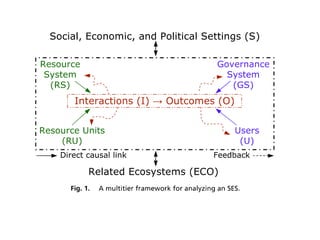
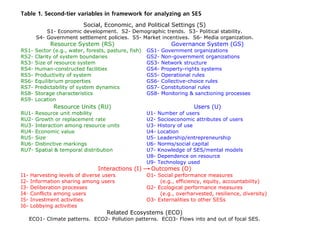
Complex systems Ostrom 2007
Three aspects of decomposability of complex
subsystems are important:
1. conceptual partitioning of variables into classes
   and subclasses.
2. is the existence of relatively separable
   subsystems that are independent of each other
   in the accomplishment of many functions and
   development but eventually affect each other’s
   performance.
3. that complex systems are greater than the sum
   of their parts.
What is resilience and why should we be
                    concerned?
The ability of a “system” (social-ecological or SES) to
recover from shock/perturbation;

3 defining characteristics:
1. The amount change a system can undergo and still
    retain the same controls on function and structure;
2. The degree to which a system is capable of self-
    organization and re-organization after shock/change
3. The degree to which the system can learn/share
    knowledge and adapt.
                                             Walker et al. 2002
Back to Plant Ecology 101
•   Sustainability
•   Succession models – Linear models
•   Equilibrium systems
•   Disequilibrium
•   Hollings and Walker
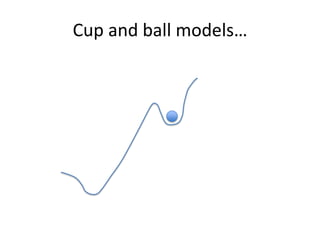
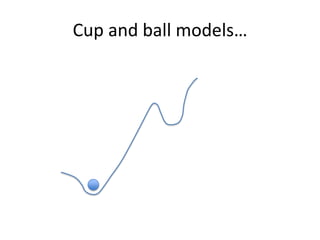
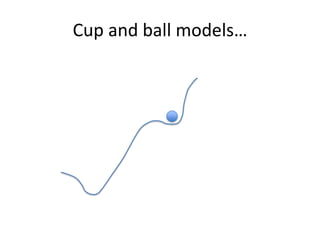
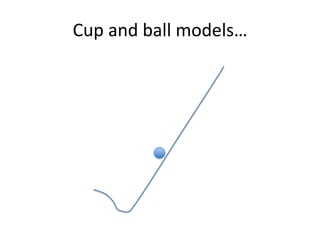
Cup and ball models…
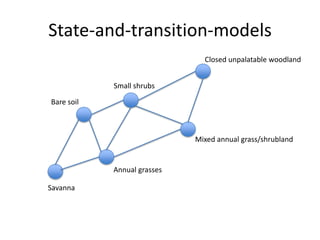
State-and-transition-models
                               Closed unpalatable woodland


            Small shrubs

Bare soil


                             Mixed annual grass/shrubland


            Annual grasses

Savanna
Transitions can be caused by:
• Grazing
   – Inefficient grazing systems – lack of infrastructure
   – Inappropriate water provision
   – Policy – open access systems
• Fire
• Frost

Obviously the opposite of these will normally have positive
impact!
Stable degraded states
• Some transitions are irreversible!
• Caused by changes in soil, chemistry, structure
• Plant spp composition changes and seed
  banks
• Long lived unpalatable spp.

Stable degraded states are often very resilient
I.e. its very difficult to get out of these states.
Now, apply the same thinking to the whole system
              socio-ecological systems (SES)

• How do the GD interact within the SES in your basin?
• What are the specific barriers preventing regime changes?
• What are the facilitating environments/conditions which
  could drive DES in you area forward?

Think in terms of:
• Technologies
• Policies
• Markets
• Incentives
• Environmental conditions/constraints/opportunities
Fig. 6. The current and possible future states in the western Australian wheatbelt and some of the key
thresholds.


                                                       Copyright © 2006 by the author(s). Published here under license by the Resilience Alliance.
soil salinity began to appear. By 2000, 16% of the   soil fertility, suchEtienne,acidification, 11(1): 20. [online] URL: Resilience and regime
                                                       Kinzig, A. P., P. Ryan, M. as H. Allison, T. Elmqvist, and B. H. Walker. 2006.
                                                       shifts: assessing cascading effects. Ecology and Society
                                                                                                                sodicity, and
land had become saline and was largely               erosion (National Land and Water Resources Audit
                                                       http://www.ecologyandsociety.org/vol11/iss1/art20/
Resilience management:
• To prevent the system from moving to
  undesired system configuration when shocked
  of challenged/disturbed
• To nurture and preserve the elements that
  enable the system to renew and reorganize
  itself following major chock or change
eco
                                                                      reg
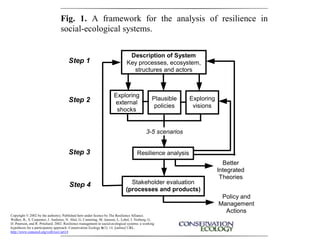
Fig. 1. A framework for the analysis of resilience in                 con
social-ecological systems.                                            tec
                                                                      all
                  Description of System                               Go
  Step 1         Key processes, ecosystem,
                   structures and actors                              par
                                                                      line
                                                                      reg
             Exploring
  Step 2     external
                           Plausible       Exploring                  cha
                            policies        visions
              shocks                                                  pre

                         3-5 scenarios                               · Wh
                                                                      act
  Step 3             Resilience analysis
                                                                      ser
                                                         Better
                                                       Integrated     var
                   Stakeholder evaluation
                                                        Theories      eco
  Step 4
                 (processes and products)                             the
                                                        Policy and
                                                       Management     "fa
                                                         Actions

                                                                     · Wh
                                                                      pol
Copyright © 2006 by the author(s). Published here under license by the Resilience Alliance.
Kinzig, A. P., P. Ryan, M. Etienne, H. Allison, T. Elmqvist, and B. H. Walker. 2006. Resilience and regime
shifts: assessing cascading effects. Ecology and Society 11(1): 20. [online] URL:
http://www.ecologyandsociety.org/vol11/iss1/art20/
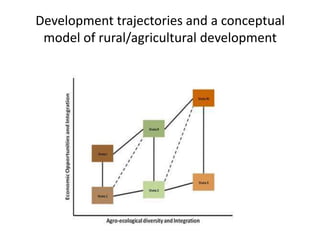
Development trajectories and a conceptual
 model of rural/agricultural development
• Berkes (2007 p.287) suggested: “the creation
  of platforms for dialogue and innovation,
  following a crisis, is key to the stimulation of
  learning to deal with uncertainties. It helps
  reorganize conceptual models and paradigms,
  based on a revised understanding of the
  conditions generating the crisis.”
Folke et al. (2003) defined four clusters of factors, that interact
across temporal and spatial scales which increase the resilience
of SES

•   Learning to live with change and uncertainty
•   Nurturing diversity in its various forms
•   Combining different types of knowledge for learning
•   Creating opportunity for self-organization and cross-scale
    linkages
Resilience Thinking (CPWF GD workshop, September 2011)

Resilience Thinking (CPWF GD workshop, September 2011)

  • 1.
    Resilience thinking: Towardsnew conceptual models in Agricultural/Rural/Basin development…. and modeling Andre F van Rooyen
  • 2.
    Complex systems Ostrom2007 Three aspects of decomposability of complex subsystems are important: 1. conceptual partitioning of variables into classes and subclasses. 2. is the existence of relatively separable subsystems that are independent of each other in the accomplishment of many functions and development but eventually affect each other’s performance. 3. that complex systems are greater than the sum of their parts.
  • 3.
    What is resilienceand why should we be concerned? The ability of a “system” (social-ecological or SES) to recover from shock/perturbation; 3 defining characteristics: 1. The amount change a system can undergo and still retain the same controls on function and structure; 2. The degree to which a system is capable of self- organization and re-organization after shock/change 3. The degree to which the system can learn/share knowledge and adapt. Walker et al. 2002
  • 5.
    Back to PlantEcology 101 • Sustainability • Succession models – Linear models • Equilibrium systems • Disequilibrium • Hollings and Walker
  • 6.
    Cup and ballmodels…
  • 7.
    Cup and ballmodels…
  • 8.
    Cup and ballmodels…
  • 9.
    Cup and ballmodels…
  • 10.
    State-and-transition-models Closed unpalatable woodland Small shrubs Bare soil Mixed annual grass/shrubland Annual grasses Savanna
  • 11.
    Transitions can becaused by: • Grazing – Inefficient grazing systems – lack of infrastructure – Inappropriate water provision – Policy – open access systems • Fire • Frost Obviously the opposite of these will normally have positive impact!
  • 12.
    Stable degraded states •Some transitions are irreversible! • Caused by changes in soil, chemistry, structure • Plant spp composition changes and seed banks • Long lived unpalatable spp. Stable degraded states are often very resilient I.e. its very difficult to get out of these states.
  • 13.
    Now, apply thesame thinking to the whole system socio-ecological systems (SES) • How do the GD interact within the SES in your basin? • What are the specific barriers preventing regime changes? • What are the facilitating environments/conditions which could drive DES in you area forward? Think in terms of: • Technologies • Policies • Markets • Incentives • Environmental conditions/constraints/opportunities
  • 14.
    Fig. 6. Thecurrent and possible future states in the western Australian wheatbelt and some of the key thresholds. Copyright © 2006 by the author(s). Published here under license by the Resilience Alliance. soil salinity began to appear. By 2000, 16% of the soil fertility, suchEtienne,acidification, 11(1): 20. [online] URL: Resilience and regime Kinzig, A. P., P. Ryan, M. as H. Allison, T. Elmqvist, and B. H. Walker. 2006. shifts: assessing cascading effects. Ecology and Society sodicity, and land had become saline and was largely erosion (National Land and Water Resources Audit http://www.ecologyandsociety.org/vol11/iss1/art20/
  • 15.
    Resilience management: • Toprevent the system from moving to undesired system configuration when shocked of challenged/disturbed • To nurture and preserve the elements that enable the system to renew and reorganize itself following major chock or change
  • 16.
    eco reg Fig. 1. A framework for the analysis of resilience in con social-ecological systems. tec all Description of System Go Step 1 Key processes, ecosystem, structures and actors par line reg Exploring Step 2 external Plausible Exploring cha policies visions shocks pre 3-5 scenarios · Wh act Step 3 Resilience analysis ser Better Integrated var Stakeholder evaluation Theories eco Step 4 (processes and products) the Policy and Management "fa Actions · Wh pol
  • 17.
    Copyright © 2006by the author(s). Published here under license by the Resilience Alliance. Kinzig, A. P., P. Ryan, M. Etienne, H. Allison, T. Elmqvist, and B. H. Walker. 2006. Resilience and regime shifts: assessing cascading effects. Ecology and Society 11(1): 20. [online] URL: http://www.ecologyandsociety.org/vol11/iss1/art20/
  • 18.
    Development trajectories anda conceptual model of rural/agricultural development
  • 19.
    • Berkes (2007p.287) suggested: “the creation of platforms for dialogue and innovation, following a crisis, is key to the stimulation of learning to deal with uncertainties. It helps reorganize conceptual models and paradigms, based on a revised understanding of the conditions generating the crisis.”
  • 20.
    Folke et al.(2003) defined four clusters of factors, that interact across temporal and spatial scales which increase the resilience of SES • Learning to live with change and uncertainty • Nurturing diversity in its various forms • Combining different types of knowledge for learning • Creating opportunity for self-organization and cross-scale linkages