Reservoir operation & scheduling
AITS,KADAPA. Dept of CE Page 1
CHAPTER 1
INTRODUCTION
1.1 GENERAL
Among the various components of a water resources systems, reservoirs are the most important.
A reservoir is created by constructing dam across a stream. The principal function of a reservoir
is regulation of natural stream flow by storing surplus water in the wet season and releasing the
stored water in a future dry season to supplement the reduction in river flow. In short, the
purpose of a reservoir is to equalize the natural stream flow and to change the temporal and
spatial availability of water. The water stored in a reservoir may be diverted to far away places
by means of pipes or canals resulting in spatial changes or it may be stored in the reservoir and
released later for beneficial uses giving rise to temporal changes.
Depending upon the magnitude of natural inflows and demands at a particular time, water is
either stored in the reservoir or supplied from the storage. As a result of storing water, a reservoir
provides head of water which can be used for generation of electric power. In case of flood
control projects, it provides empty space for storage of water thereby attenuating the hydrograph
peaks. A reservoir also provides pool for navigation to negotiate rapids, habitat for aqua life and
facilities for recreation and sports. It enhances scenic beauty, promotes afforestation and wild
life.
Once the structured facilities like dams, barrages, hydropower plants etc. come into being, the
benefits that could be reaped depend to a large extent upon how these facilities are managed. The
efficient use of water resources requires not only judicious design but also proper management
after construction. Reservoir operation forms a very important part of planning and management
of water resources system. Once a reservoir has been developed, detailed guidelines are to be
given to the operator which enable him to take appropriate management decisions.
The reservoirs are commonly built in India for conservation and flood control purposes. The
climate experienced in Indian subcontinent is of monsoon type in which most of the water is
received during the monsoon period from June to September. The conservation demands are best
served when the reservoir is as much full as possible at the end of the filling period. The flood
control purpose, on the other hand, requires empty storage space so that the incoming floods can
be absorbed and moderated to permissible limits. The two conflict between the two purposes in
terms of storage space requirements is resolved through proper operation of reservoirs.
A reservoir operation policy specifies the amount of water to be released from the storage at any
time depending upon the state of the reservoir, level of demands and any information about the
likely inflow in the reservoir. The operation problem for a single purpose reservoir is to decide
about the releases to be made from the reservoir so that the benefits for that purpose are
maximized. For a multipurpose reservoir, in addition to the above, it is also required to optimally
allocate the release among several purposes.
Reservoir operation & scheduling
AITS,KADAPA. Dept of CE Page 2
1.2 CHARACTERISTICS AND REQUIREMENTS OF VARIOUS WATER USES
The complexity of the reservoir operation problem depends upon the extent to which the various
intended purposes are compatible. If the purposes are relatively more compatible, comparatively
less effort is needed for coordination. The various purposes for which a reservoir is used and the
functional requirements for these purposes are as under:
a) Irrigation: The irrigation requirements are seasonal in nature and the variation largely depends
upon the cropping patterns in the command area. The irrigation demands are consumptive and
only a small fraction of the water supplied is available to the system as return flow. These
requirements have direct correlation with the rainfall in the command area. In general, the
demands will be minimum during the monsoon and maximum during winter and summer
months. The average annual demands remain more or less steady unless there is increase in the
command area or large variation in the cropping pattern from year to year. The safety against
drought depends upon the storage available in the reservoir and hence it is desirable to maintain
as much reserve water in storage as possible consistent with the current demands.
b) Hydroelectric power: The hydroelectric power demands usually vary seasonally and to a
lesser extent daily and hourly too. The degree of fluctuation depends upon the type of loads
being served, viz., industrial, municipal and agricultural. For example, in case of municipal
areas, the hydroelectric demands are maximum during the peak summer months. Further, during
the course of a day, two demand peaks are observed, one in the morning and another in the
evening. Hydroelectric power demand comes under non-consumptive use of water because after
passage through turbines, water can again be utilized for consumptive uses downstream. The
amount of power generated depends upon the volume of water and the effective head.
c) Municipal and industrial water supply: Generally, the water requirements for municipal and
industrial purposes are quite constant throughout the year, more so when compared with the
requirements for irrigation and hydroelectric power. The water requirements increase from year
to year due to growth and expansion. The seasonal demand peak is observed in summer. For the
purpose of design, a target value is assumed by making projections for population and industrial
growth. The supply system for such purposes is designed for very high level of reliability.
d) Flood control: Flood control reservoirs are designed to moderate the flood flows that enter the
reservoirs. The flood moderation is achieved by storing a fraction of inflows in the reservoir and
releasing the balance water. The degree of moderation or flood attenuation depends upon the
empty storage space available in the reservoir when the flood impinges it. Achievement of this
purpose requires the availability of empty storage space in the reservoir. As far as possible, the
releases from the storage are kept less than the safe capacity of downstream channel.
e) Navigation: Many times, storage reservoirs are designed to make a stretch of river issuing
from the reservoir navigable by maintaining sufficient flow depth in the stretch of river channel
used for navigation. The water requirements for navigation show a marked seasonal variation.
There is seldom any demand during the monsoon period when sufficient depth of flow may be
Reservoir operation & scheduling
AITS,KADAPA. Dept of CE Page 3
available in the channel. The demands are maximum in the dry season when large releases are
required to maintain required depth. The demand during any period also depends upon the type
and volume of traffic in the navigable waterways.
f) Recreation: The benefits from this aspect of reservoir are derived when the reservoir is used
for swimming, boating, fishing and other water sports and picnic. Usually the recreation benefits
are incidental to other uses of the reservoir and rarely a reservoir is operated for recreation
purposes. The recreation activities are best supported when the reservoir remains nearly full
during the recreation season. Large and rapid fluctuations in reservoir level are harmful to
recreational points of view as they can create marshy lands near the rim of reservoir.
1.3 TYPES OF RESERVOIRS
Depending upon purpose served, reservoirs are of following types
1.Storage/conservation reservoir
2.Flood control reservoir
3.Multipurpose reservoir
4.Distribution reservoir
1.STORAGE/CONSERVATION RESERVIOR
A storage or a conservation reservoir can retain
such excess supplies during periods of peak
flows, and can release them gradually during low
flows as and when the need arises.
Use of water supply directly from river/stream
 City water supply
 Irrigation water supply
 Hydroelectric project
It may fail to satisfy the consumers demands
during:
1).Extremely low flows
2).High flows
It may become difficult to carry out their
operations due to devastating floods.
Reservoir operation & scheduling
AITS,KADAPA. Dept of CE Page 4
2.FLOOD CONTROL RESERVOIR
A flood control reservoir, generally called a flood-mitigation reservoir, stores a portions of the
flood flows in such a way as to minimize the flood peaks at the areas to be protected
downstream.
The entire inflow entering the reservoir is discharged till the out flow reaches the safe capacity of
the channel downstream.
The inflow in excess of this rate is stored in the reservoir, which is then gradually released, so as
to recover the storage capacity for the next flood.
A flood control reservoir differs from a conservation reservoir only in its need for a large
sluiceway capacity to permit rapid drawdown before or after a flood.
Types of Flood control Reservoirs
There are two basic types of flood mitigation reservoirs;
(1).Storage reservoir
(2).Retarding reservoir
STORAGE RESERVOIR:
A reservoir having gates and valves installation at its spillways and its sluice outlets is known as
Storage Reservoir.
RETARDING RESERVOIR:
A reservoir with controlled and ungated outlets is known as a retarding basin or retarding
Reservoir.
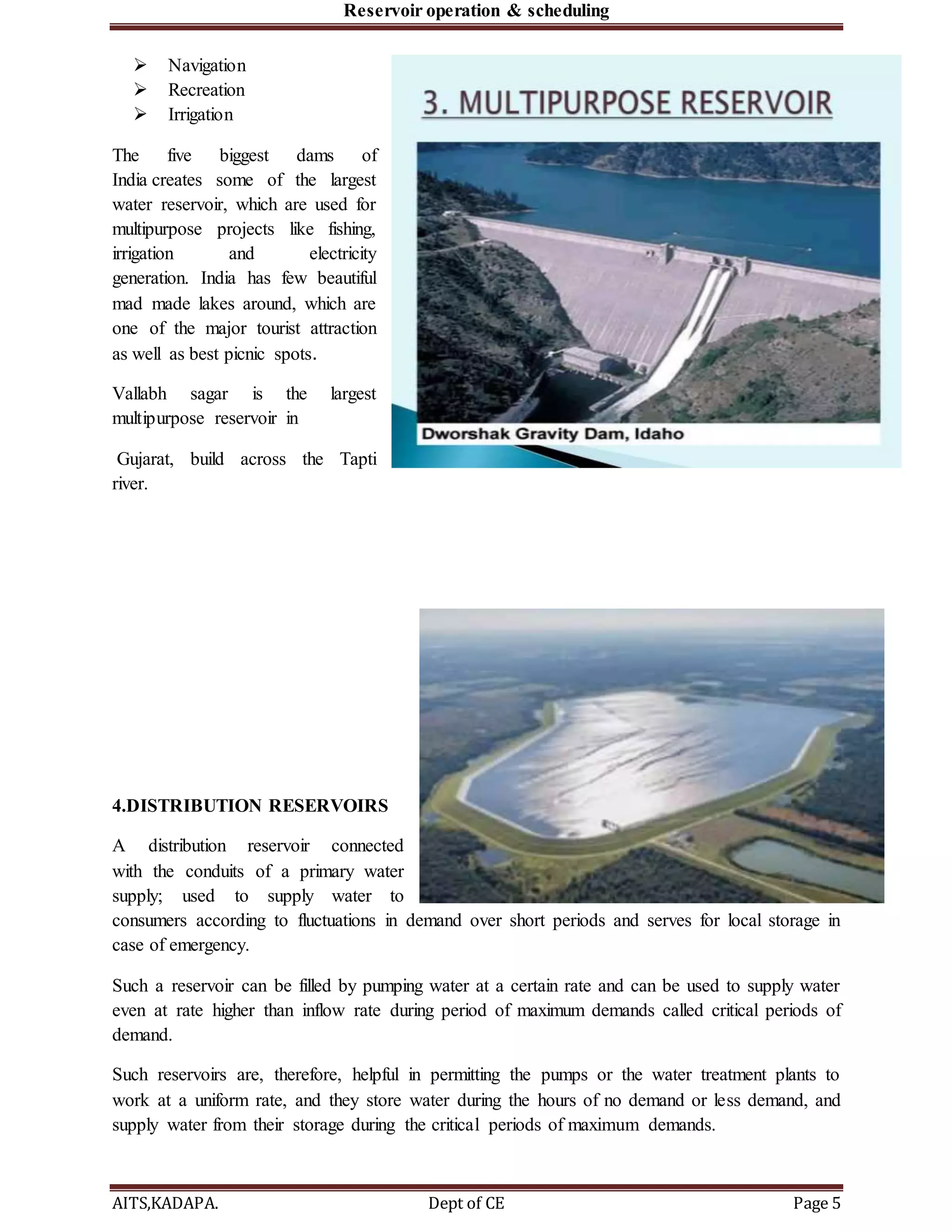
3.MULTIPURPOSE RESERVOIR
A reservoir planned and constructed to serve not only one purpose but various purpose together
is called Multipurpose reservoir.
A multipurpose reservoir is a man made lake which is managed for multiple purposes.
Multipurpose reservoirs may be managed to balance some or all of the following activities:
 Water supply
 Flood control
 Soil erosion
 Environmental management
 Hydroelectric power generation
Reservoir operation & scheduling
AITS,KADAPA. Dept of CE Page 5
 Navigation
 Recreation
 Irrigation
The five biggest dams of
India creates some of the largest
water reservoir, which are used for
multipurpose projects like fishing,
irrigation and electricity
generation. India has few beautiful
mad made lakes around, which are
one of the major tourist attraction
as well as best picnic spots.
Vallabh sagar is the largest
multipurpose reservoir in
Gujarat, build across the Tapti
river.
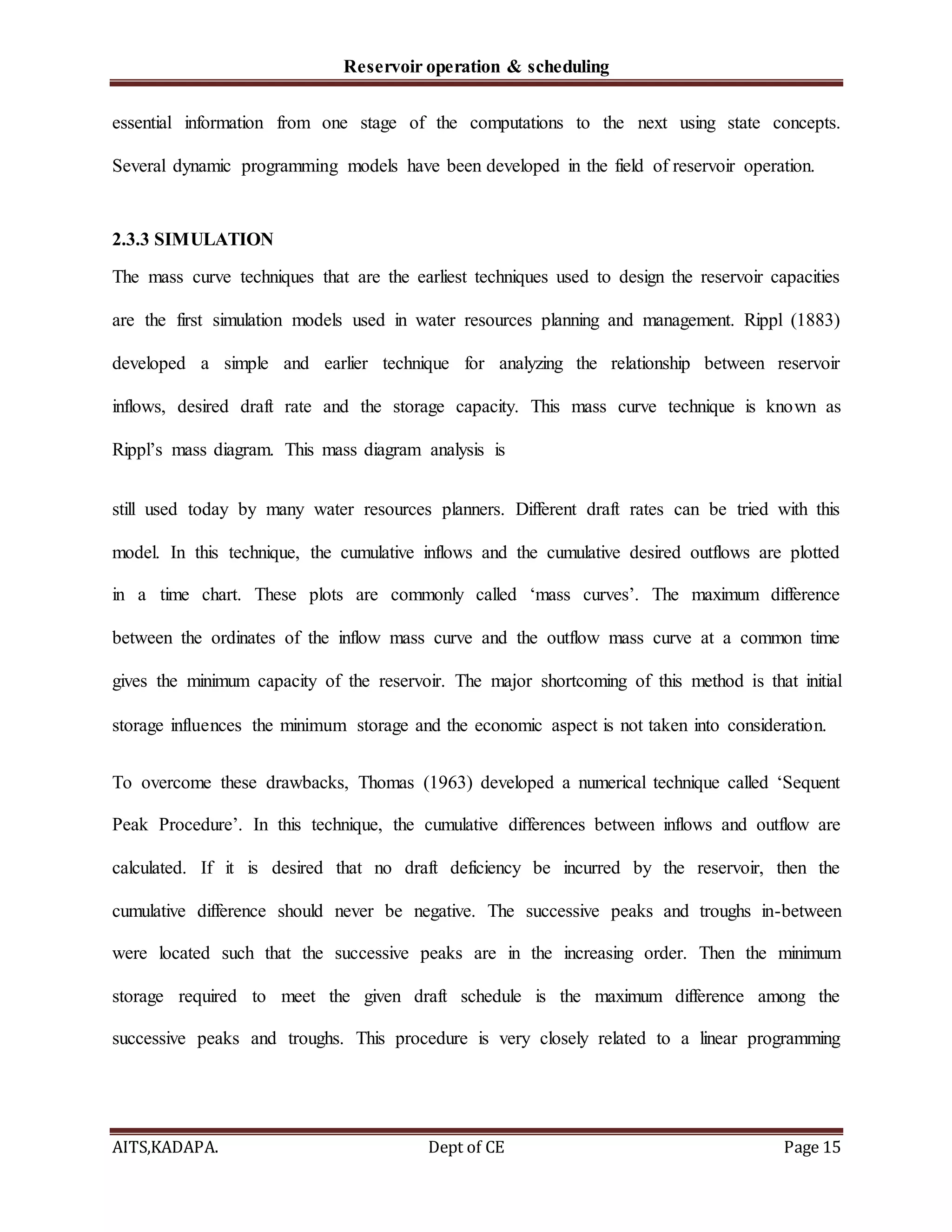
4.DISTRIBUTION RESERVOIRS
A distribution reservoir connected
with the conduits of a primary water
supply; used to supply water to
consumers according to fluctuations in demand over short periods and serves for local storage in
case of emergency.
Such a reservoir can be filled by pumping water at a certain rate and can be used to supply water
even at rate higher than inflow rate during period of maximum demands called critical periods of
demand.
Such reservoirs are, therefore, helpful in permitting the pumps or the water treatment plants to
work at a uniform rate, and they store water during the hours of no demand or less demand, and
supply water from their storage during the critical periods of maximum demands.
Reservoir operation & scheduling
AITS,KADAPA. Dept of CE Page 6
1.4 CONFLICTS IN RESERVOIR OPERATION
While operating a reservoir which serves more than one purpose, a number of conflicts arise
among demands of various purposes. The conflicts which arise in multipurpose reservoir
operation may be classified as:
a) Conflicts in space
These type of conflicts occur when a reservoir of limited storage is required to
satisfy divergent purposes, for example, water conservation and flood control. If the geological
and topographical features of the dam site and the funds available for the project permit, a dam
of sufficient height can be built and storage space can be clearly allocated for each purpose. In
case of reservoirs with seasonal storage, flood control space can be kept empty to moderate the
incoming floods and the conservation pool can be operated after the filling season to meet the
conservation demands. However, this essentially amounts to saying that a multipurpose reservoir
is a combination of several single purpose reservoirs.
b) Conflicts in time
The temporal conflicts in reservoir operation occur when the use pattern of water
varies with the purpose. The conflicts arise because release for one purpose does not agree with
the other purpose. For example, irrigation demands may show one pattern of variation depending
upon the crops, season and rainfall while the hydroelectric power demands may have a different
variation. In such situations, the aim of deriving an operating policy is to optimally resolve these
conflicts.
c) Conflicts in discharge
The conflicts in daily discharge are experienced for a reservoir which serve for
more than one purposes. In case of a reservoir serving for consumptive use and hydroelectric
power generation, the releases for the two purposes may vary considerably in the span of one
day. Many times a small conservation pool is created on the river downstream of the power
house which is used to damp the oscillations in the powerhouse releases.
Reservoir operation & scheduling
AITS,KADAPA. Dept of CE Page 7
CHAPTER 2
LITERATURE REVIEW
Since the 1960s water resources management policy and practice have shifted to a greater
reliance on improving water use efficiency. Water research teams in many countries have
conclusively demonstrated the value of adopting the modern tool of operations research or
systems analysis for assisting in the development, operation, planning and management of the
water resources project. However, these tools can only assist; they can not replace the water
resource decision making process. Furthermore, some studies indicate a gap between theories of
water resources models and the application of these models in the real world. There are many
analysis techniques and computer models available in the real world for developing quantitative
information for use in evaluating storage capacities, water allocation, and release policies. Yeh
(1985), Wurbs (1996) and McKinney (1999), in their state-of-the-art review, discuss different
Reservoir operation & scheduling
AITS,KADAPA. Dept of CE Page 8
optimization techniques that are used in water resources system analysis at the basin level and
reservoir operation.
2.1 IRRIGATION SCHEDULING
Good irrigation management is required for efficient and profitable use of water for irrigating
agricultural crops. Irrigation scheduling is dependent on design, maintenance and operation of
irrigation system and availability of water. A major part of any irrigation management program
is the decision-making process for determining irrigation dates and/or how much water should be
applied to the field for each irrigation turn. This decision-making process is referred to as
irrigation scheduling. Efficient scheduling of irrigation maximizes the production and prevents
under and/or over watering of the crop. Bras et al. (1981) and Rao et al. (1988) have studied the
problem of irrigation scheduling in case of limited seasonal water supply for a single-crop
situation. Bishop and Long (1983) developed a rotational schedule taking travel time into
account to improve equity. Pahalwan et.al. (1984) conducted field experiment during dry season
of 1981 and 1982 to determine the optimal irrigation schedule for summer groundnut in relation
to evaporative demand and crop water requirement at different growth stages. They have
suggested a combination approach for scheduling of irrigation to optimize the irrigation
management. Their combination approach considered the irrigation water to the cumulative pan
evaporation as well as the stage(s) susceptibility of groundnut to soil moisture deficits.
A number of researchers have addressed the problem of allocation of a limited water supply for
irrigation in a multi-crop environment (Rao et al., 1990; Sunantara and Ramirez, 1997; Paul et
al., 2000; Reca et al., 2001; Teixeira and Marino, 2002;Umamahesh and Raju, 2002; Gorantiwar
and Smout, 2003; Smout and Gorantiwar, 2005). Manny irrigation systems throughout the world
are operated by distributing water sequentially amongst a group of users, normally within a
tertiary unit. Such rotational irrigation is typical of small holdings within large irrigation systems
and has received considerable attention, particularly with regard to improving equity (Latif and
Reservoir operation & scheduling
AITS,KADAPA. Dept of CE Page 9
Sarwar, 1994). Wang et al. (1995) used integer programming to develop a schedule for a canal
whereby the duration of flow at an outlet could be specified by a user. Hill et al. (1996) presented
graphical calendars as a simplified means to provide irrigation scheduling to farmers in
developing-country settings.
Pawar et al. (1997) conducted field experiment to study the effect of scheduling of irrigation to
soybean cultivation during kharif season. Singh and Kandpal (1998) prepared an irrigation
schedule for rain fed cotton crop grown in Central India using the Irrigation Scheduling
Information System (IRSIS : Raes et al. 1988). The crop evapotranspiration (ETcrop), irrigation
dates and amounts were estimated using IRSIS. Reddy et al. (1999) showed that a time-block
model can be used to eliminate the hypothetical constraint of all outlets having equal discharge.
Nixon et al. (2001) examined the use of genetic algorithm optimization to identify water delivery
Reservoir operation & scheduling
AITS,KADAPA. Dept of CE Page 10
schedules for an open-channel irrigation system. They have maximized the number of orders that
are scheduled to be delivered at the requested time and minimizing variations in the channel flow
rate. Tonny et al. (2004) developed two different models to reflect different management options
at the tertiary level for the irrigation scheduling problem using an integer program solution.
Anwar et al. (2004) developed four models to reflect the different methods in which an irrigation
system at the tertiary unit level may be operated.
Using heuristic approach. Hague et al. (2004) developed an irrigation water delivery-scheduling
model to increase the irrigation efficiency for a large-scale rice irrigation project in Malaysia.
They focused on modeling irrigation water delivery schedules during the main season and off-
season of the rice-based project. Water balance approach is used in which rainfall was
considered as a stochastic variable. The computed irrigation schedules could save 19% and 11%
of irrigation water in the main season and off season, respectively when compared with the
traditional irrigation schedules. Srinivasa Prasad et al. (2006) developed a deterministic dynamic
programming model which maximizes the net annual benefit with optimal cropping pattern and
irrigation water allocation. Parhi et al. (2008) developed irrigation scheduling and the crop water
requirement for wheat crop in an irrigation command in semi-humid tropical region of Orissa,
India using water balance approach. The parameters viz., soil dryness coefficient, site specific
crop coefficient, daily rainfall etc. are considered in the irrigation schedule preparation. Jha and
Singh (2008) developed a methodology for developing optimal allocation of resources like land,
crop and water of Kosi irrigation system in Nepal. A multi-objective model for irrigation
development is presented with integrated use of surface and ground water resources.
2.2 WATER BALANCE AND CROP MANAGEMENT
The management of water resources in irrigation is a fundamental aspect for their sustainability.
The current situation of irrigation throughout the world is characterized by a decrease in
available water resources, especially in arid and semiarid zones. This trend, which will probably
Reservoir operation & scheduling
AITS,KADAPA. Dept of CE Page 11
become more aggravated in the future, is due to the reduction in available water (competition for
different users, environmental conditions, global change
etc.) and is also caused by progressive deterioration of water quality (various sources of
pollution). Since water prices are progressively increasing, it is necessary to analyze the factors
that affect water uses in order to improve water management for sustainable agriculture.
Worldwide, irrigated agriculture is responsible for more than 80% of water consumption in arid
and semiarid zones. Thus, the improvement of water management in agriculture should deal with
different aspects in a coordinated and integrated way. Among these aspects, Raman et al. (1992)
developed an expert system for drought management. A linear programming model was used to
generate optimal cropping pattern from past drought experience as also from synthetic drought
occurrences for Bhadra reservoir project, Andhra Pradesh, India.
Mohan (1994) enunciated the usage of fuzzy set theory and its application to water resource
allocation problem. He demonstrated the possible ways of identifying the membership function
and the suitability of fuzzy set approach in the decision making context with lesser data
availability. Prajamwong et al. (1997) developed a software package called Command Area
Decision Support Model (CADSM) to estimate crop water requirements and to study
management options for irrigated areas. Daily water and salt balances are simulated for
individual fields within command areas based on crop type and stage of development, field
characteristics, soil properties, possible ground water contribution, salinity level. The model can
also be applied on a daily time period to analyse short-term water management issues when daily
weather data are available Pereira and Allen (1999), Tarjuelo and de Juan (1999) highlighted
crop irrigation scheduling, farm irrigation system, available infrastructure for irrigation water
transport and distribution and administrative management. Knowing the high cost of expanding
net irrigated area, substantial improvements in irrigation management will be needed to enhance
water productivity (Biswas, 1999). Innovations in both the technological and policy dimension of
Reservoir operation & scheduling
AITS,KADAPA. Dept of CE Page 12
water resources management are needed to achieve desired improvements in irrigation practices
and water use decisions (Batcheor, 1999; Biswas, 2000; Kijne, 2001; Plusquellec, 2002; Schultz
and De Wrachien, 2002; Tanji and Keyes, 2002; Hamdy et al., 2003). Increasing the value of
output generated per unit of water will contribute to raising rural incomes and enhancing food
security in developing countries (Chaturvedi, 2000; Reidhead, 2001).
Mohan and Jothiproakash (2000) developed fuzzy system modeling for optimal crop planning
for an irrigation system to conjunctively utilize the irrigation water from the reservoir and ground
water acquifer. They have formulated a deterministic linear programming model and fuzzy linear
programming model for Sri Ram Sagar reservoir in Andhra Pradesh. On comparison, they found
that the fuzzy linear programming model has resulted in an optimal cropping pattern with
irrigation release and ground water pumpage, which can suit the field conditions. Jothiprakash
and Mohan (2001) developed a fuzzy linear programming model for deriving optimal cropping
pattern for an irrigation system under water deficit condition with conjunctive use of surface and
ground water and compared with Linear programming model. They have found that, from the
optimal results the fuzzy linear programming model has resulted in an optimal crop plan with a
degree of truthness of 0.64 taking into account the fuzziness in different variables. Irrigation will
play a critical role in achieving the rate of growth in agricultural production that is needed to
feed the world’s increasing population (Rosegrant and Cai, 2002).
English et al. (2002) suggested that the information regarding crop-water requirements and its
impact on the water management decision on crop yields, food security and net revenue had to
be well informed to the farmers. Farmers also need assistance regarding risk management and
the long-term impacts of irrigation practices on soil salinity and agricultural sustainability.
Dennis Wichelns’ (2004) described how public policies regarding water resources and
agricultural production can motivate farmers to consider scarcity values and off-farm impacts of
irrigation and drainage activities. Ortega et al. (2004) analyzed the effect of distribution
Reservoir operation & scheduling
AITS,KADAPA. Dept of CE Page 13
uniformity of sprinkler irrigation water (solid set system). The irrigation depths that maximize
the gross margin of four crops in a semiarid territory in order to determine the best strategy of
water use in sustainable agriculture. In many areas, improvements in water management will
generate higher levels of aggregate production, while also reducing some of the undesirable,
long-term consequences of inefficient irrigation, such as water logging and salimoenization.
Reservoir operation & scheduling
AITS,KADAPA. Dept of CE Page 14
2.3 TRADITIONAL OPTIMIZATION TECHNIQUES
2.3.1 LINEAR PROGRAMMING
The most important optimization techniques used in reservoir operation are linear and dynamic
programming. Linear programming is an operation research technique that has been widely used
in water resource planning and management. Its popularity is due to the following
considerations. Linear programming is applicable to a wide variety of problems; efficient
solution algorithms and computer software packages are available for applying the solution
algorithm. Various generalized optimization programs are commercially available for solving
linear equation with constraints.
2.3.2 DYNAMIC PROGRAMMING
Dynamic programming, developed by Bellman (1957) for dealing with sequential decision
processes, is not restricted by any requirement of linearity, convexity, or even continuity.
Nevertheless, it is restricted to specific forms of the objective function. Dynamic programming
theory and its applications in various fields are covered in depth in books by Cooper and Cooper
(1981), and Denardo (1982). Mays and Tung (1992), which describe the fundamentals of
dynamic programming for the perspective of water resources planning and management.
Unlike linear programming, for which many general-purpose software packages are available,
the availability of general dynamic programming codes is limited. Most dynamic programming
computer programs have been developed for specific applications. Dynamic programming is not
a precisely structured algorithm like linear programming, but rather a general approach to
solving optimization problems. Dynamic programming involves decomposing a complex
problem into a series of simple sub-problems which are solved sequentially, while transmitting
Reservoir operation & scheduling
AITS,KADAPA. Dept of CE Page 15
essential information from one stage of the computations to the next using state concepts.
Several dynamic programming models have been developed in the field of reservoir operation.
2.3.3 SIMULATION
The mass curve techniques that are the earliest techniques used to design the reservoir capacities
are the first simulation models used in water resources planning and management. Rippl (1883)
developed a simple and earlier technique for analyzing the relationship between reservoir
inflows, desired draft rate and the storage capacity. This mass curve technique is known as
Rippl’s mass diagram. This mass diagram analysis is
still used today by many water resources planners. Different draft rates can be tried with this
model. In this technique, the cumulative inflows and the cumulative desired outflows are plotted
in a time chart. These plots are commonly called ‘mass curves’. The maximum difference
between the ordinates of the inflow mass curve and the outflow mass curve at a common time
gives the minimum capacity of the reservoir. The major shortcoming of this method is that initial
storage influences the minimum storage and the economic aspect is not taken into consideration.
To overcome these drawbacks, Thomas (1963) developed a numerical technique called ‘Sequent
Peak Procedure’. In this technique, the cumulative differences between inflows and outflow are
calculated. If it is desired that no draft deficiency be incurred by the reservoir, then the
cumulative difference should never be negative. The successive peaks and troughs in-between
were located such that the successive peaks are in the increasing order. Then the minimum
storage required to meet the given draft schedule is the maximum difference among the
successive peaks and troughs. This procedure is very closely related to a linear programming
Reservoir operation & scheduling
AITS,KADAPA. Dept of CE Page 16
problem where the objective function is to find optimal capacity. Both the mass curve techniques
are applicable to deterministic hydrologic condition.
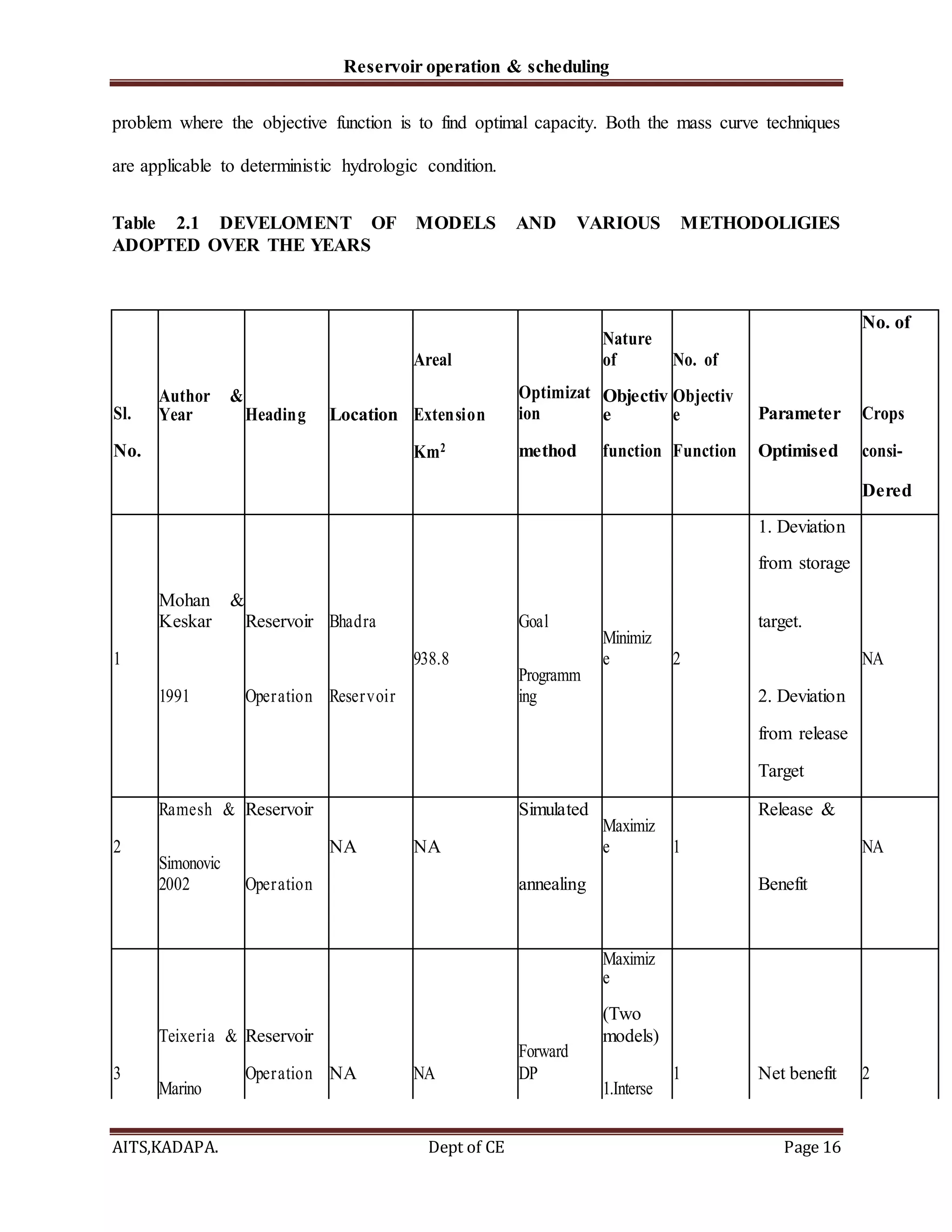
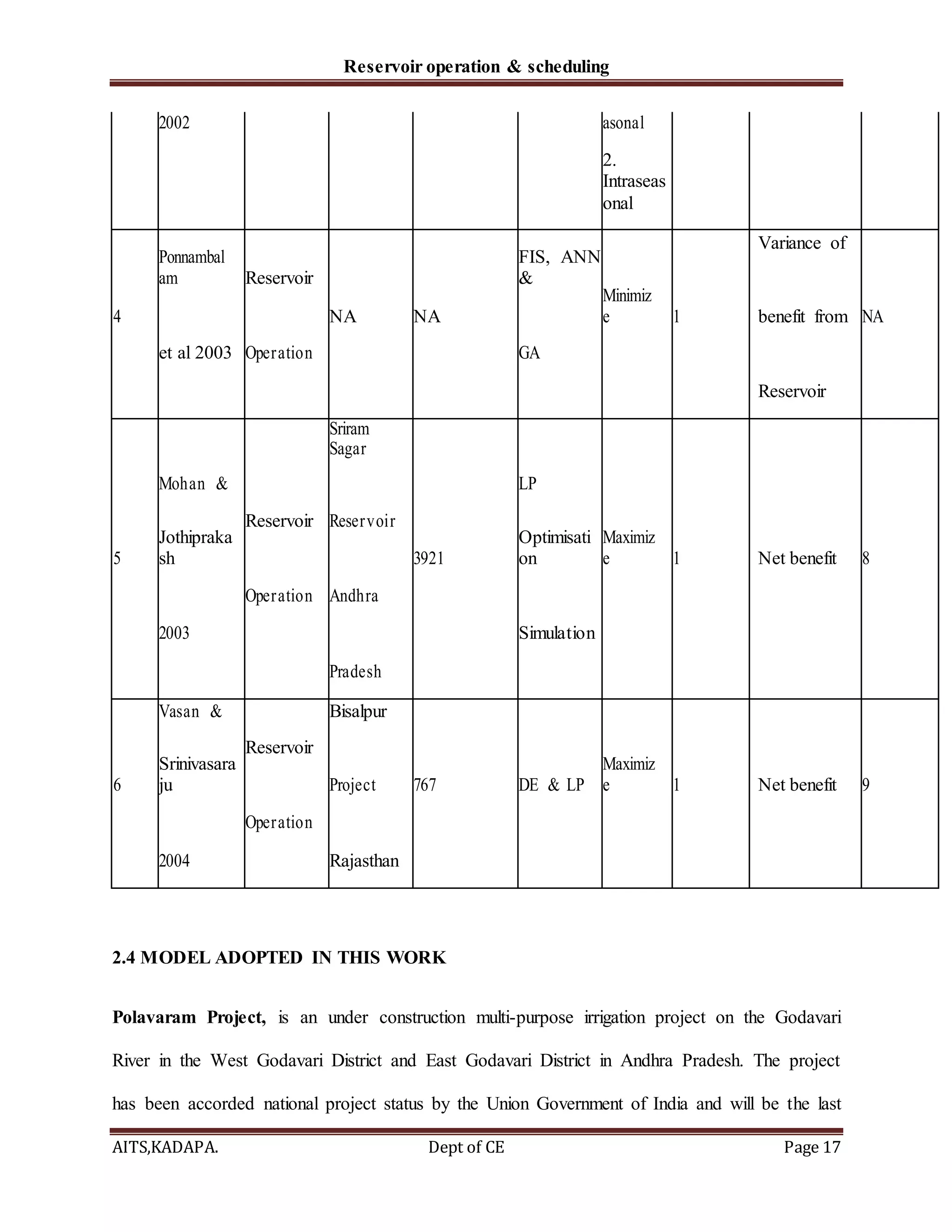
Table 2.1 DEVELOMENT OF MODELS AND VARIOUS METHODOLIGIES
ADOPTED OVER THE YEARS
Areal
Nature
of No. of
No. of
Sl.
Optimizat
ion Parameter Crops
Author &
Year Heading Location Extension
Objectiv
e
Objectiv
e
No. Km2 method function Function Optimised consi-
Dered
1. Deviation
from storage
1
Mohan &
Keskar Reservoir Bhadra
938.8
Goal
Minimiz
e 2
target.
NA
1991 Operation Reservoir
Programm
ing 2. Deviation
from release
Target
2
Ramesh & Reservoir
NA NA
Simulated
Maximiz
e 1
Release &
NA
Simonovic
2002 Operation annealing Benefit
Maximiz
e
3
Teixeria & Reservoir
NA NA
Forward
DP
(Two
models)
1 Net benefit 2
Marino
Operation
1.Interse
Reservoir operation & scheduling
AITS,KADAPA. Dept of CE Page 17
2002 asonal
2.
Intraseas
onal
Ponnambal
am Reservoir
FIS, ANN
&
Variance of
4 NA NA
Minimiz
e 1 benefit from NA
et al 2003 Operation GA
Reservoir
Mohan &
Sriram
Sagar
LP
Reservoir Reservoir
5
Jothipraka
sh 3921
Optimisati
on
Maximiz
e 1 Net benefit 8
Operation Andhra
2003 Simulation
Pradesh
Vasan &
Reservoir
Bisalpur
6
Srinivasara
ju Project 767 DE & LP
Maximiz
e 1 Net benefit 9
Operation
2004 Rajasthan
2.4 MODEL ADOPTED IN THIS WORK
Polavaram Project, is an under construction multi-purpose irrigation project on the Godavari
River in the West Godavari District and East Godavari District in Andhra Pradesh. The project
has been accorded national project status by the Union Government of India and will be the last
Reservoir operation & scheduling
AITS,KADAPA. Dept of CE Page 18
to be accorded to the status. Its reservoir spreads into parts of Chhattisgarh and Odisha states
also.
Polavaram Dam
Polavaram Right canal near Eluru
Location Polavaram, West Godavari
District, Andhra Pradesh, India
Coordinates
17°15′40″N81°39′23″ECoordinates:
17°15′40″N 81°39′23″E
Purpose Irrigation, power and transport
Status under construction
Construction began 2004
Opening date 2019.[1]
Operator(s) Andhra Pradesh Irrigation Department
Dam and spillways
Type of dam Concrete spill way (754 m), Non over
flow masonry dam (560 m) & Earth
dam (1600 m)
Reservoir operation & scheduling
AITS,KADAPA. Dept of CE Page 19
Impounds Godavari River
Height 39.28 m (129 ft) up to top of earth
dam above the lowest river bed.
Length 2,914 m (9,560 ft)
Spillway type Chute spillway
Spillway capacity 5,000,000 cusecs at 140 ft msl
Reservoir
Creates Polavaram Reservoir
Total capacity 194 tmcft at FRL 150 ft msl
Active capacity 175 tmcft (at 25.4 m msl crest level of
spillway)
Inactive capacity 19 tmcft (below 25.4 m msl)
Catchment area 307,800 km2
(118,800 sq mi)
Surface area 600 km2
(230 sq mi)
Maximum water depth 32.08 m at FRL 150 ft msl
Power Station
Operator(s) APGENCO
Turbines 12 × 80 MW Kaplan-type (left bank
side)
Installed capacity 960 MW (under construction)[2]
Reservoir operation & scheduling
AITS,KADAPA. Dept of CE Page 20
2.5 TECHNICAL DETAILS
The project reservoir has live storage 75.2 tmcft at canal's full supply level of 41.15 metres
(135 ft) MSL and gross storage 194 tmcft thereby enabling irrigation of 23,20,000 acre
(including stabilisation of existing irrigated lands) in Krishna, West Godavari, East
Godavari, Visakhapatnam, Vizianagaram and Srikakulam districts of Andhra Pradesh. The silt
free dead storage water of nearly 100 tmcft above the spillway crest level 24.5 metres (80 ft)
MSL, can also be used in downstream lift irrigation projects (Pattiseema lift, Tadipudi lift,
Chintalapudi lift, Thorrigedda lift, Pushkara lift, Purushothapatnam lift, Venkatanagaram
lift, Chagalnadu lift, etc.) and Dowleswaram Barrage during the summer months.Chintalapudi
lift / Jalleru project will supply water to irrigate most of the highlands in West Godavari and
Krishna districts including the existing command area under Nagarjunasagar left canal in AP
facilitating 40 tmcft saved Krishna river water for diversion to Rayalaseema from Srisailam
reservoir. Govt of AP announced the decision to construct Purushothapatnam lift irrigation
scheme to transfer water at the rate of 3,500 cusecs to Polavaram left bank canal and further
pumping at the rate of 1,400 cusecs to Yeleru reservoir for feeding Yeleru canal which is
supplying water to Vizag city. Uttarndhra Sujala Sravanthi lift irrigation scheme will also use the
Godavari water and a sanction of Rs 2,114 crore was made in 2017 for its first phase. All the
irrigated lands under these lift schemes can be supplied from Polavaram right and left canals by
gravity flow when Polavaram reservoir level is above the canal's full supply level of 41.15 m
MSL. However these lift stations are to be operated every year during the dry season to draw
water from the substantial dead storage available behind the flood gates of the Polavaram dam.
So these lift schemes are not for few years operation till the Polavaram dam is constructed but
for permanent operation regularly for at least four months in every year. Nearly 60 tmcft live
storage capacity available to Andhra Pradesh in Sileru river basin can also augment the water
availability additionally to the Polavaram project during the dry season.
The dam construction involves building of a 1.5 m thick concrete diaphragm wall up to depths
from 40 to 120 m below the river bed under the earth dam which is first of its kind in India. The
purpose of diaphragm wall is to secure the river bed stability for withstanding the water pressure
Reservoir operation & scheduling
AITS,KADAPA. Dept of CE Page 21
across the dam. The project would constitute an earth-cum-rock fill dam of 2,310 metres
(7,580 ft) length, spillway of 907 metres (2,976 ft) with 44 vents to enable discharge of
3,600,000 cu ft/s (100,000 m3/s) of water. The spillway is located on the right bank of the river
for which nearly 5.5 km long and 1.0 km wide approach and spill channels up to river bed level
is envisaged involving nearly 70 million cubic meters earth/rock excavation which is nearly
2/3rd of the project's total earth work. The maximum flood level at Polavaram is 28 metres
(92 ft) MSL and lowest water level is 10.9 metres (36 ft) MSL. Two cofferdams are planned, one
up to 41 metres (135 ft) MSL, to facilitate faster pace of work on earth-cum-rock fill dam to
complete the first phase of the project by June 2018. With coffer dams inclusion and the bed
level of the approach and discharge canals of the spillway increased to 17 metres (56 ft) MSL,
the spillway related rock excavation is reduced by 70% leading to substantial cost reduction in
the project's head works cost. Ultimately, the cofferdams would become peripheral portion of the
main earth-cum-rock fill dam. On the left side of the river, 12 water turbines, each having 80
megawatt capacity, were to be installed. The right canal connecting to Krishna River in the
upstream of Prakasam Barrage(173 kilometres (107 m) long) discharges 17,500 cu ft/s
(500 m3/s) at head works and left canal (182 kilometres (113 mi) long) discharges 17,500 cu ft/s
(500 m3/s) of water.
Indira Dummugudem lift irrigation scheme starting at 17°33′49″N 81°14′49″E is under
construction to supply irrigation water for 200,000 acres in Khammam, Krishna and West
Godavari districts drawing Godavari River water from the back waters of Polavaram reservoir.
This is a joint project between Andhra Pradesh and Telangana states. This project was shelved
and merged with another project by the Telangana state.
Reservoir operation & scheduling
AITS,KADAPA. Dept of CE Page 22
CHAPTER 3
OPERATING TECHNIQUE
3.1 STANDARD OPERATING POLICY
Standard operating policy is not an optimal operating policy. It is just an operating rule. Standard
operating policy is simple to meet the demand in a particular period to the best extent possible
without looking at other periods.
In this, we simply look at the water available in a particular time period. At the beginning of a
time period, which is typically St and Qt that is the Storage and Inflow. Generally, the inflow
occurs during the time period. But while deriving the Operating policy, Qt and St are known i.e.,
the Storage at the beginning of the time period plus Inflow during the time period. Now look at
the water available and compare it to the demand. If the total water available is more than the
demand, simply meet the complete demand; if the total water available is less than the demand,
empty the reservoir put all the water to meet the demand. So, which means meeting the demand to
the best extent possible from the available water is the standard operating policy. And, whenever the
water is excess, store the water. So, water the level in reservoir keeps on increasing until it hits the
capacity. Here, all the terms referring Storage relates to Live Storage only.
Once the Reservoir hits the capacity, anything beyond after meeting the demand will go as Spill.
And there is a period in which S plus Q is less than the demand that is total amount of water available
is less than the demand. That is the point where the Reservoir is always Empty. So, this is how the
Operating policy is derived.
Standard Operating policy in actual operation means simply looking at the Storage and Inflows
coming and make the release compared to the Demands. There is no optimization involved here.
Standard Operation policy is explained below with the help of following graph. S and Q is taken as
abscissa and Release as ordinate. S and Q represents Storage plus Inflow, this is the total water
available neglecting all the losses. This is for all the periods in the Year. Let D the Demand. Let us
say the water is some for Irrigation, water allocation, some is a rare or municipal and Industrial
allocation and so on. So, the Demands are known. So, as long as you are in the region, water
available is less than the demand if, make complete release; which means whatever is the available is
the release, which means a 45 degree line. So, this will be equal to S plus Q itself.
Reservoir operation & scheduling
AITS,KADAPA. Dept of CE Page 23
After making Release, the Reservoir will be empty in the phase OA. Because initially, there was dead
storage, there we got some inflows and then release of amount equal to S+Q will be made. Therefore,
the reservoir will be at the bottom. Therefore, the reservoir will be empty. If S+Q is greater than D,
water is as usually released in order to meet the Demand D, on the other hand the excess water stars
filling the Reservoir.
R
C
Filling Phase Reservoir spills
D A B
O D D+K S+Q
 Along OA : Release = Water available
 Along AB : Release = Demand
 Up to A : Reservoir is empty after release
 At B and beyond : Reservoir is full after release
 Along BC : Release = Demand + Excess water above capacity (Spill)
Hence the phase AB in the graph is denoted as Filling phase. When total water available i.e.,
S+Q is greater than D, the release R is equal to D. The Reservoir fills till S+Q (Total water
available) after meeting the D (Demand) is greater than the Storage capacity of the reservoir. So,
hence the reservoir fills up to D+K (Storage capacity), beyond the capacity it spills after meeting
the demand. The excess water goes as Spill. This is the Standard operating policy. Meet the
demand to the best extent possible, fill the reservoir whenever there is excess water and then spill
over the reservoir whenever the reservoir is full. In this regard, we are not looking at what likely
Reservoir operation & scheduling
AITS,KADAPA. Dept of CE Page 24
to be happen to the next time period; simply looking at the present time period. So, this is the
Standard Operating Policy.
 The release in any time period = S+Q or D whichever is less as long as availability
does not exceed D+K.
 Once the availability exceeds D+K, release = demand + excess availability over
capacity.
 Note that releases made as per SOP are not necessarily optimal releases.
 For highly stressed systems, SOP performs poor in terms of distributing deficits across
the periods in a year.
 The SOP is expressed as
Rt = Dt if St + Qt – Et ≥ Dt
= St + Qt - Et otherwise
Ot = (St + Qt - Et - Dt) - K if positive
= 0 otherwise
St+1 = St + Qt - Et - Rt - Ot
St+1 = K if Ot > 0
3.1.1 EXAMPLE
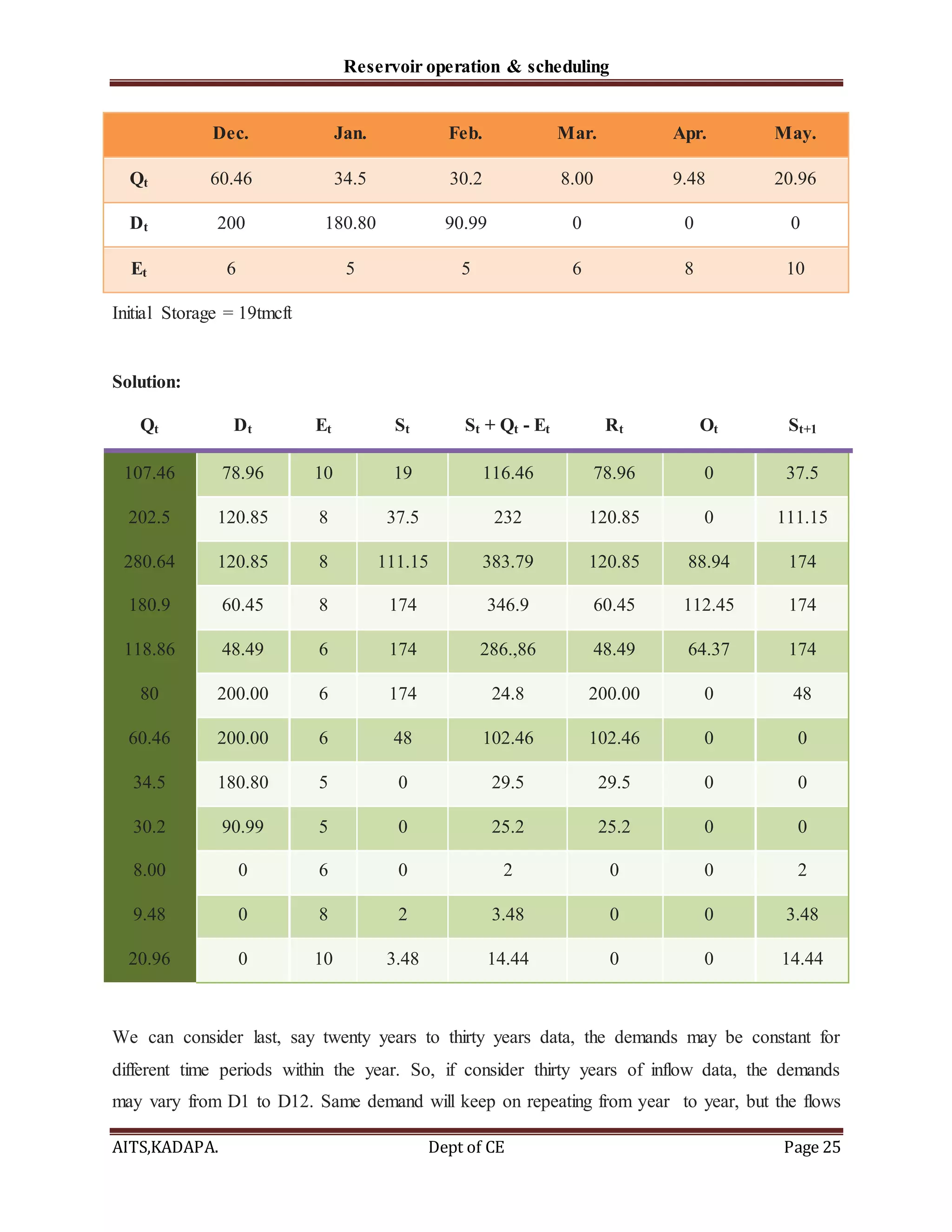
The monthly inflows (Qt) and demands (Dt) and evaporation (Et) in Mm3 for Polavaram reservoir
with a capacity of 194 tmcft are given below.
Jun. Jul. Aug. Sep. Oct Nov.
Qt 107.46 202.5 280.64 180.9 118.86 80.00
Dt 78.96 120.85 120.85 60.45 48.49 200.00
Et 10 8 8 8 6 6
St is the storage at the beginningof the period t
Qt is the inflow duringthe period t
Dt isthe demandduringthe period t
Et isthe evaporationlossduringthe period t
Rt isthe release duringthe period t
Ot is the spill (overflow) duringthe period t
Reservoir operation & scheduling
AITS,KADAPA. Dept of CE Page 25
Dec. Jan. Feb. Mar. Apr. May.
Qt 60.46 34.5 30.2 8.00 9.48 20.96
Dt 200 180.80 90.99 0 0 0
Et 6 5 5 6 8 10
Initial Storage = 19tmcft
Solution:
Qt Dt Et St St + Qt - Et Rt Ot St+1
107.46 78.96 10 19 116.46 78.96 0 37.5
202.5 120.85 8 37.5 232 120.85 0 111.15
280.64 120.85 8 111.15 383.79 120.85 88.94 174
180.9 60.45 8 174 346.9 60.45 112.45 174
118.86 48.49 6 174 286.,86 48.49 64.37 174
80 200.00 6 174 24.8 200.00 0 48
60.46 200.00 6 48 102.46 102.46 0 0
34.5 180.80 5 0 29.5 29.5 0 0
30.2 90.99 5 0 25.2 25.2 0 0
8.00 0 6 0 2 0 0 2
9.48 0 8 2 3.48 0 0 3.48
20.96 0 10 3.48 14.44 0 0 14.44
We can consider last, say twenty years to thirty years data, the demands may be constant for
different time periods within the year. So, if consider thirty years of inflow data, the demands
may vary from D1 to D12. Same demand will keep on repeating from year to year, but the flows
Reservoir operation & scheduling
AITS,KADAPA. Dept of CE Page 26
are different and can apply the standard operation in the way as shown above. Simulate the data
and check how the system performs under standard operation. The performance of the system
can be analyzed by looking at the release and how many times that the system is able to meet the
demand fully. But in the system, the demands are not met fully.
This is how simulation of reservoir operation is done under standard operation, an operating
policy. However, the Standard operating policy is not an optimal operating policy.
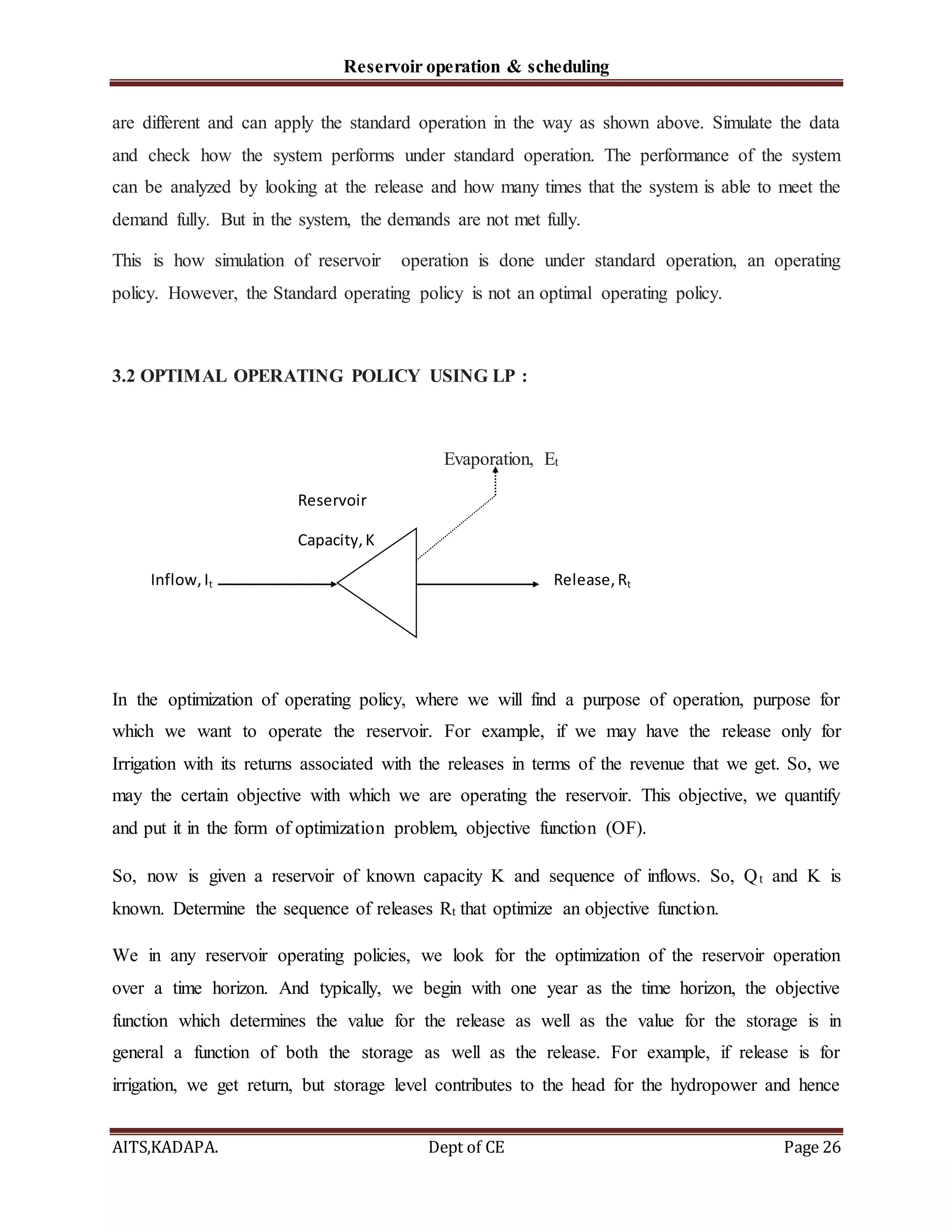
3.2 OPTIMAL OPERATING POLICY USING LP :
Evaporation, Et
Reservoir
Capacity,K
Inflow,It Release,Rt
In the optimization of operating policy, where we will find a purpose of operation, purpose for
which we want to operate the reservoir. For example, if we may have the release only for
Irrigation with its returns associated with the releases in terms of the revenue that we get. So, we
may the certain objective with which we are operating the reservoir. This objective, we quantify
and put it in the form of optimization problem, objective function (OF).
So, now is given a reservoir of known capacity K and sequence of inflows. So, Qt and K is
known. Determine the sequence of releases Rt that optimize an objective function.
We in any reservoir operating policies, we look for the optimization of the reservoir operation
over a time horizon. And typically, we begin with one year as the time horizon, the objective
function which determines the value for the release as well as the value for the storage is in
general a function of both the storage as well as the release. For example, if release is for
irrigation, we get return, but storage level contributes to the head for the hydropower and hence
Reservoir operation & scheduling
AITS,KADAPA. Dept of CE Page 27
the storage also has the certain values. Hence the objective function is a function of both the
release as well as the storage.
LP formulation :
Max ∑ Rt = R1 + R2 + R3 +…………..+ R12
This is the objective function.
For a certain time period, the demand pattern is known and the storage capacity is also known.
That is Dt and St is known.
Now Rt ≤ Dt ∀ t
In most cases, Rt is greater than Dt. But we look at the maximization of summation of Rt, if we
make Rt greater than or equal to Dt, the reservoir will be empty. Because for the maximization of
summation of Rt, Rt should be increased to the best extent possible.
St ≤ K ∀ t
Rt ≥ 0 ∀ t
St ≥ 0 ∀ t
St+1 = St + Qt – Et – Rt – Ot ∀ t
St+1 = S1 ∀ t
The storage at the end of the last time period must be equal to storage at the beginning of the
time period. These are constraints.
In this optimal optimization policy, the value of S1 is zero, we don’t put the starting value
here. By this, the sequence of storage at the beginning of time period one, beginning of time
period two and etc., and the associated release sequence can be decided the optimization
problem. This is the optimal reservoir operating policy.
 St ≤ K ∀ t …… restricts the release during a time period to the corresponding demand,
while the OF maximizes the sum of releases.
Reservoir operation & scheduling
AITS,KADAPA. Dept of CE Page 28
 Thus the model aims to make the release as close to the demand as possible over the time
period.
 St+1 = S1 ….. makes the end of year storage equal to beginning of next year’s storage,
steady state solution achieved.
 If the initial storage at the beginning of first time period is known, an additional
constraint S1 = S0 is included.
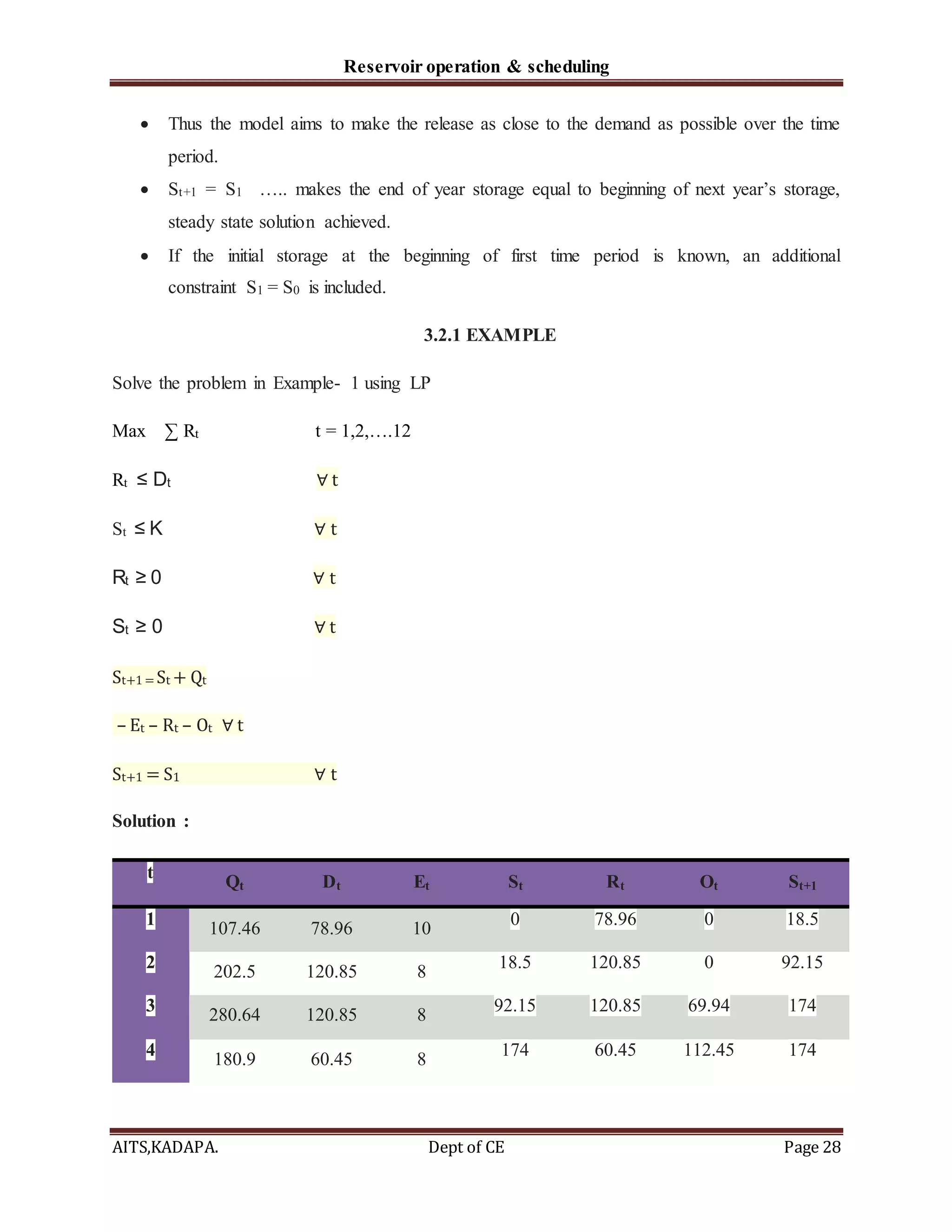
3.2.1 EXAMPLE
Solve the problem in Example- 1 using LP
Max ∑ Rt t = 1,2,….12
Rt ≤ Dt ∀ t
St ≤ K ∀ t
Rt ≥ 0 ∀ t
St ≥ 0 ∀ t
St+1 = St + Qt
– Et – Rt – Ot ∀ t
St+1 = S1 ∀ t
Solution :
t
Qt Dt Et St Rt Ot St+1
1
107.46 78.96 10
0 78.96 0 18.5
2
202.5 120.85 8
18.5 120.85 0 92.15
3
280.64 120.85 8
92.15 120.85 69.94 174
4
180.9 60.45 8
174 60.45 112.45 174
Reservoir operation & scheduling
AITS,KADAPA. Dept of CE Page 29
5
118.86 48.49 6
174 48.49 64.37 174
6
80 200.00 6
174 74 0 174
7
60.46 200.00 6
174 130 0 98.46
8
34.5 180.80 5
98.46 132.96 0 0
9
30.2 90.99 5
0 0 0 7.48
10
8.00 0 6
7.48 0 0 9.48
11
9.48 0 8
9.48 0 0 10.96
12
20.96 0 10
10.96 0 0 0
In this simple example, we get solution similar to SOP. If we start storage at 19tmcft, we get
identical results to SOP. In the optimization problem, we are simply looking at maximization of
R.
We communicate the policy to the operator, by in such to maintain storage levels at the end of
each month and make the releases accordingly, specified as in the optimization problem.
3.3 RULE CURVE FOR RESERVOIR OPERATION
Rule curve indicates the desired reservoir release or storage volume at a given time of a year.
The simulation analysis essentially requires an operation policy. Generally operation policies are
represented as rule curves. A rule curve is a graphical representation specifying ideal storage or
empty space to be maintained in a reservoir during different times of the year. Here the implicit
assumption is that a reservoir can best satisfy its purposes if the storage levels or empty spaces as
specified by the rule curve are maintained in the reservoir at the specified time. The amount of
water to be released from the reservoir will depend upon the inflows to the reservoir. The rule
curves are generally derived through operation studies using historic flows or generated flows
where a long term historic-record is not available. Often due to specific conditions like low
inflows, minimum requirements for demands etc. it is not possible to rigorously stick to the rule
curve with respect to storage levels
Reservoir operation & scheduling
AITS,KADAPA. Dept of CE Page 30
.
3.4 MULTIRESERVOIR SYSTEM
 Consider a three reservoir system.
 The system serves the purpose of water supply, flood control and hydro power
generation.
 Release for water supply is passed through powerhouse.
 Losses in powerhouse are negligible.
 Benefits from powerhouse are expressed as function of storage itself.
The catchment near the reservoir A contributes the inflow (Qt
1) and storage (St
1) in the reservoir
in the time period t. Similarly, reservoir B catchment accounts for the inflow (Qt
2) and storage
(St
2) in the reservoir in the time period t. The reservoir C not only receives the inflow from
reservoir A&B but also from its own catchment. Qt
3 is the inflow through the reservoir C. Let us
0 0
18.5
92.15
174 174 174 174
98.46
0
7.48 9.48 10.96
0
20
40
60
80
100
120
140
160
180
200
1 2 3 4 5 6 7 8 9 10 11 12 13
Storageattheendofeachmonth
Month
RULE CURVE FOR RESERVOIR
OPERATION
Series2
Series3
Series4
Series5
Reservoir operation & scheduling
AITS,KADAPA. Dept of CE Page 31
say Rt
1 is the release made at reservoir A, a part of it α1 Rt
1 reaches the reservoir C; where α1 is
the fraction released that joins the reservoir C. Similarly the release that we made at reservoir B,
St
1
α1 Rt
1
St
2 Qt
2
α α 2Rt
2
St
3
α 2Rt
2
Fig. Multi reservoir system
B
Catchment area A
A
A CatchmentareaB
IntermediateCatchment area
C
Reservoir operation & scheduling
AITS,KADAPA. Dept of CE Page 32
some part of it α 2Rt
2 joins the reservoir C. Now, we look this three reservoir system as a
integrated whole and formulate an optimization problem. We look for the simultaneous
operations in this integrated system; because all the reservoirs will have their own objectives. In
this case, the reservoir A& B are contributing to the reservoir C. Hence we look this system as an
integrated unit.
The system serves the purpose of water supply, flood control and hydro power generation at each
reservoir.
 B1t
i, B2t
i and B3t
i are the net benefits associated with unit release, unit flood freeboard and
unit storage for reservoir i in time period t.
 A portion of release from reservoir A and B flows to reservoir C.
 A minimum storage Fmax
i, needs to ensure flood control in flood season at the reservoir i.
 Maximum release at reservoir i is Rmax
i .
(where i represents the reservoir 1,2 &3).
Through this, we formulate optimization problem which decides the operating policies at each
reservoir system as a integrated whole. This three reservoir system can be globalised to ‘n’
number of reservoirs, because the principal remains the same.
K = Difference between Max water level to the bottom level of the reservoir
St = Difference between Normal water level to the bottom level of the reservoir
K-S t= Freeboard
Reservoir operation & scheduling
AITS,KADAPA. Dept of CE Page 33
 Assumption is
B1t
i = Bt
1
B2t
i = Bt
2 ∀ t
B3t
i = Bt
3
Where B1t
i
, B2t
i , B3t
i are the net unit benefits from the reservoir i.
Bt
1 is the release , Bt
2 is the flood control and Bt
3 is the storage at respective reservoirs.
LP FORMULATION :
Max ∑3
𝑖=1 ∑ 𝑇
𝑡=1 [Bt
1Rt
1 + Bt
2 (Kt - St
i) + Bt
3St
i]
St+1
i = St
i + Qt
i – Et
i - Rt
i - Ot
i , ∀ t ,i=1,2
St+1
i = St
i + Qt
i + α1 Rt
1 + α 2Rt
2 – Et
i - Rt
i - Ot
i , ∀ t ,i=3
St
i ≤ Kt
i
, i=1,2,3; ∀ t
Kt - St
i ≥ Fmax
i , i= 1,2,3; ∀ t € Flood season
Rt
i ≤ Rmax
i ∀ t
Rt
i ≥ 0 ; St
i ≥ 0 ∀ t
St+1
i = St
i
Where
o i refers to reservoir (i =1,2,3)
o t is time period (t = 1,2,3,……,12)
o Q is inflow
o K is reservoir capacity
o S is storage
o R is release
o O is overflow or spill
o St is the storage at the beginning of the time period t.
Reservoir operation & scheduling
AITS,KADAPA. Dept of CE Page 34
o St+1 is the storage at the end of the time period t.
3.4.1 EXAMPLE
Consider the data given in the table below for a three period, three reservoir system.
Inflows Fmin
Res
erv
oir
t =1 t =2 t =3 K t =1 t =2 t =3 Bt
1 Bt
2 Bt
3
1 25 10 15 10 3 2 7 50 10 25
2 10 30 15 15 2 3 4 60 10 30
3 20 12 15 20 2 3 5 70 10 35
Taking α1 = 0.2 and α2 = 0.3
Solution :
Reservoir A Reservoir B Reservoir C
t =1 t =2 t =3 t =1 t =2 t =3 t =1 t =2 t =3
St 0 8 3 2 12 11 0 17 15
Rt 17 15 18 0 31 24 6.4 26.3 40.8
K-St 10 2 7 13 3 4 20 3 5
Reservoir operation & scheduling
AITS,KADAPA. Dept of CE Page 35
4. CONCLUSIONS
The present research work is carried out on Polavaram project, is an under construction multi-
purpose irrigation project on the Godavari River in the West Godavari District and East Godavari
District in Andhra Pradesh. Our main aim is to maintain the storage levels in the reservoirs, a
quiet sufficient in all seasons of a Year. In this research work, by adopting Standard Operating
Policy we can meet the demands of all types in a particular period to the best extent possible
without looking at other periods.
By adopting Optimal Operating policy using Linear Programming, we are going to meet the
demands of all types to the best extent possible in all periods of time, even in less inflow rates
also; here, we maintain sufficient levels in reservoir and we supply the demand required.
Reservoir operation & scheduling
AITS,KADAPA. Dept of CE Page 36
5. REFERENCES
1. Water Resource systems :Modeling Techniques and Analysis, Prof. P.P. Mujumdar, IISc
Bangalore.
2. "AP govt sets 40-month deadline for Polavaram hydel project". Retrieved 7 May 2018.
3. "List of national projects," (PDF). Retrieved 17 March2016.
4. "Indirasagar (Polavaram) Project, Ministry of water resources, GoI". Retrieved 17
December 2013.
5. "Andhra Pradesh "Polavaram" Will Be The Last Project With National Project Status:
Nitin Gadkari". All India Times.
6. "Over 60,000 acres yet to be acquired for Polavaram". Retrieved 12 January 2018.
7. "Agitation against Polavaram, SANDRP" (PDF). Retrieved 7 May 2014.
8. "National status for Polavaram project demanded". The Hindu. 2010-05-19. ISSN 0971-
751X. Retrieved 2018-08-23.
9. "Polavaram Project Authority". Ministry of Water Resources, River Development and
Ganga Rejuvena.
10. IRIS: An interactive river system simulation program. (1990). User's Manual. Resources
Planning Assoc. Inc., NY.
11. Hall, W. A., and J. A. Dracup, Water Resources Systems Engineering, Tata McGraw Hill
Publishing Company, New Delhi
12. HEC-5: Simulation of flood control and conservation systems, (1982). User's Manual.
U.S.
13. Army Corps of Engineers, Hydrologic Engineering Center, Davis, California.
14. Jain, S.K., and Singh, V.P. (2003). Water Resources Systems Planning and Management,
Developments in Water Science # 51, Elsevier, The Netherlands.
15. McMahon, T. A., and R. G. Mein, Reservoir Capacity and Yield, Elsevier Book
Company,Sydney,Sigvaldason, O. T. (1976).
16. “A simulation model for operating a multipurpose multi reservoir system”, Water
Resources Research, 12(2), 263-278.
17. Wurbs, R.A., Modelling and Analysis of Reservoir System Operations, Prentice Hall.
Reservoir operation & scheduling
AITS,KADAPA. Dept of CE Page 37

1235456568 (1)

  • 1.
    Reservoir operation &scheduling AITS,KADAPA. Dept of CE Page 1 CHAPTER 1 INTRODUCTION 1.1 GENERAL Among the various components of a water resources systems, reservoirs are the most important. A reservoir is created by constructing dam across a stream. The principal function of a reservoir is regulation of natural stream flow by storing surplus water in the wet season and releasing the stored water in a future dry season to supplement the reduction in river flow. In short, the purpose of a reservoir is to equalize the natural stream flow and to change the temporal and spatial availability of water. The water stored in a reservoir may be diverted to far away places by means of pipes or canals resulting in spatial changes or it may be stored in the reservoir and released later for beneficial uses giving rise to temporal changes. Depending upon the magnitude of natural inflows and demands at a particular time, water is either stored in the reservoir or supplied from the storage. As a result of storing water, a reservoir provides head of water which can be used for generation of electric power. In case of flood control projects, it provides empty space for storage of water thereby attenuating the hydrograph peaks. A reservoir also provides pool for navigation to negotiate rapids, habitat for aqua life and facilities for recreation and sports. It enhances scenic beauty, promotes afforestation and wild life. Once the structured facilities like dams, barrages, hydropower plants etc. come into being, the benefits that could be reaped depend to a large extent upon how these facilities are managed. The efficient use of water resources requires not only judicious design but also proper management after construction. Reservoir operation forms a very important part of planning and management of water resources system. Once a reservoir has been developed, detailed guidelines are to be given to the operator which enable him to take appropriate management decisions. The reservoirs are commonly built in India for conservation and flood control purposes. The climate experienced in Indian subcontinent is of monsoon type in which most of the water is received during the monsoon period from June to September. The conservation demands are best served when the reservoir is as much full as possible at the end of the filling period. The flood control purpose, on the other hand, requires empty storage space so that the incoming floods can be absorbed and moderated to permissible limits. The two conflict between the two purposes in terms of storage space requirements is resolved through proper operation of reservoirs. A reservoir operation policy specifies the amount of water to be released from the storage at any time depending upon the state of the reservoir, level of demands and any information about the likely inflow in the reservoir. The operation problem for a single purpose reservoir is to decide about the releases to be made from the reservoir so that the benefits for that purpose are maximized. For a multipurpose reservoir, in addition to the above, it is also required to optimally allocate the release among several purposes.
  • 2.
    Reservoir operation &scheduling AITS,KADAPA. Dept of CE Page 2 1.2 CHARACTERISTICS AND REQUIREMENTS OF VARIOUS WATER USES The complexity of the reservoir operation problem depends upon the extent to which the various intended purposes are compatible. If the purposes are relatively more compatible, comparatively less effort is needed for coordination. The various purposes for which a reservoir is used and the functional requirements for these purposes are as under: a) Irrigation: The irrigation requirements are seasonal in nature and the variation largely depends upon the cropping patterns in the command area. The irrigation demands are consumptive and only a small fraction of the water supplied is available to the system as return flow. These requirements have direct correlation with the rainfall in the command area. In general, the demands will be minimum during the monsoon and maximum during winter and summer months. The average annual demands remain more or less steady unless there is increase in the command area or large variation in the cropping pattern from year to year. The safety against drought depends upon the storage available in the reservoir and hence it is desirable to maintain as much reserve water in storage as possible consistent with the current demands. b) Hydroelectric power: The hydroelectric power demands usually vary seasonally and to a lesser extent daily and hourly too. The degree of fluctuation depends upon the type of loads being served, viz., industrial, municipal and agricultural. For example, in case of municipal areas, the hydroelectric demands are maximum during the peak summer months. Further, during the course of a day, two demand peaks are observed, one in the morning and another in the evening. Hydroelectric power demand comes under non-consumptive use of water because after passage through turbines, water can again be utilized for consumptive uses downstream. The amount of power generated depends upon the volume of water and the effective head. c) Municipal and industrial water supply: Generally, the water requirements for municipal and industrial purposes are quite constant throughout the year, more so when compared with the requirements for irrigation and hydroelectric power. The water requirements increase from year to year due to growth and expansion. The seasonal demand peak is observed in summer. For the purpose of design, a target value is assumed by making projections for population and industrial growth. The supply system for such purposes is designed for very high level of reliability. d) Flood control: Flood control reservoirs are designed to moderate the flood flows that enter the reservoirs. The flood moderation is achieved by storing a fraction of inflows in the reservoir and releasing the balance water. The degree of moderation or flood attenuation depends upon the empty storage space available in the reservoir when the flood impinges it. Achievement of this purpose requires the availability of empty storage space in the reservoir. As far as possible, the releases from the storage are kept less than the safe capacity of downstream channel. e) Navigation: Many times, storage reservoirs are designed to make a stretch of river issuing from the reservoir navigable by maintaining sufficient flow depth in the stretch of river channel used for navigation. The water requirements for navigation show a marked seasonal variation. There is seldom any demand during the monsoon period when sufficient depth of flow may be
  • 3.
    Reservoir operation &scheduling AITS,KADAPA. Dept of CE Page 3 available in the channel. The demands are maximum in the dry season when large releases are required to maintain required depth. The demand during any period also depends upon the type and volume of traffic in the navigable waterways. f) Recreation: The benefits from this aspect of reservoir are derived when the reservoir is used for swimming, boating, fishing and other water sports and picnic. Usually the recreation benefits are incidental to other uses of the reservoir and rarely a reservoir is operated for recreation purposes. The recreation activities are best supported when the reservoir remains nearly full during the recreation season. Large and rapid fluctuations in reservoir level are harmful to recreational points of view as they can create marshy lands near the rim of reservoir. 1.3 TYPES OF RESERVOIRS Depending upon purpose served, reservoirs are of following types 1.Storage/conservation reservoir 2.Flood control reservoir 3.Multipurpose reservoir 4.Distribution reservoir 1.STORAGE/CONSERVATION RESERVIOR A storage or a conservation reservoir can retain such excess supplies during periods of peak flows, and can release them gradually during low flows as and when the need arises. Use of water supply directly from river/stream  City water supply  Irrigation water supply  Hydroelectric project It may fail to satisfy the consumers demands during: 1).Extremely low flows 2).High flows It may become difficult to carry out their operations due to devastating floods.
  • 4.
    Reservoir operation &scheduling AITS,KADAPA. Dept of CE Page 4 2.FLOOD CONTROL RESERVOIR A flood control reservoir, generally called a flood-mitigation reservoir, stores a portions of the flood flows in such a way as to minimize the flood peaks at the areas to be protected downstream. The entire inflow entering the reservoir is discharged till the out flow reaches the safe capacity of the channel downstream. The inflow in excess of this rate is stored in the reservoir, which is then gradually released, so as to recover the storage capacity for the next flood. A flood control reservoir differs from a conservation reservoir only in its need for a large sluiceway capacity to permit rapid drawdown before or after a flood. Types of Flood control Reservoirs There are two basic types of flood mitigation reservoirs; (1).Storage reservoir (2).Retarding reservoir STORAGE RESERVOIR: A reservoir having gates and valves installation at its spillways and its sluice outlets is known as Storage Reservoir. RETARDING RESERVOIR: A reservoir with controlled and ungated outlets is known as a retarding basin or retarding Reservoir. 3.MULTIPURPOSE RESERVOIR A reservoir planned and constructed to serve not only one purpose but various purpose together is called Multipurpose reservoir. A multipurpose reservoir is a man made lake which is managed for multiple purposes. Multipurpose reservoirs may be managed to balance some or all of the following activities:  Water supply  Flood control  Soil erosion  Environmental management  Hydroelectric power generation
  • 5.
    Reservoir operation &scheduling AITS,KADAPA. Dept of CE Page 5  Navigation  Recreation  Irrigation The five biggest dams of India creates some of the largest water reservoir, which are used for multipurpose projects like fishing, irrigation and electricity generation. India has few beautiful mad made lakes around, which are one of the major tourist attraction as well as best picnic spots. Vallabh sagar is the largest multipurpose reservoir in Gujarat, build across the Tapti river. 4.DISTRIBUTION RESERVOIRS A distribution reservoir connected with the conduits of a primary water supply; used to supply water to consumers according to fluctuations in demand over short periods and serves for local storage in case of emergency. Such a reservoir can be filled by pumping water at a certain rate and can be used to supply water even at rate higher than inflow rate during period of maximum demands called critical periods of demand. Such reservoirs are, therefore, helpful in permitting the pumps or the water treatment plants to work at a uniform rate, and they store water during the hours of no demand or less demand, and supply water from their storage during the critical periods of maximum demands.
  • 6.
    Reservoir operation &scheduling AITS,KADAPA. Dept of CE Page 6 1.4 CONFLICTS IN RESERVOIR OPERATION While operating a reservoir which serves more than one purpose, a number of conflicts arise among demands of various purposes. The conflicts which arise in multipurpose reservoir operation may be classified as: a) Conflicts in space These type of conflicts occur when a reservoir of limited storage is required to satisfy divergent purposes, for example, water conservation and flood control. If the geological and topographical features of the dam site and the funds available for the project permit, a dam of sufficient height can be built and storage space can be clearly allocated for each purpose. In case of reservoirs with seasonal storage, flood control space can be kept empty to moderate the incoming floods and the conservation pool can be operated after the filling season to meet the conservation demands. However, this essentially amounts to saying that a multipurpose reservoir is a combination of several single purpose reservoirs. b) Conflicts in time The temporal conflicts in reservoir operation occur when the use pattern of water varies with the purpose. The conflicts arise because release for one purpose does not agree with the other purpose. For example, irrigation demands may show one pattern of variation depending upon the crops, season and rainfall while the hydroelectric power demands may have a different variation. In such situations, the aim of deriving an operating policy is to optimally resolve these conflicts. c) Conflicts in discharge The conflicts in daily discharge are experienced for a reservoir which serve for more than one purposes. In case of a reservoir serving for consumptive use and hydroelectric power generation, the releases for the two purposes may vary considerably in the span of one day. Many times a small conservation pool is created on the river downstream of the power house which is used to damp the oscillations in the powerhouse releases.
  • 7.
    Reservoir operation &scheduling AITS,KADAPA. Dept of CE Page 7 CHAPTER 2 LITERATURE REVIEW Since the 1960s water resources management policy and practice have shifted to a greater reliance on improving water use efficiency. Water research teams in many countries have conclusively demonstrated the value of adopting the modern tool of operations research or systems analysis for assisting in the development, operation, planning and management of the water resources project. However, these tools can only assist; they can not replace the water resource decision making process. Furthermore, some studies indicate a gap between theories of water resources models and the application of these models in the real world. There are many analysis techniques and computer models available in the real world for developing quantitative information for use in evaluating storage capacities, water allocation, and release policies. Yeh (1985), Wurbs (1996) and McKinney (1999), in their state-of-the-art review, discuss different
  • 8.
    Reservoir operation &scheduling AITS,KADAPA. Dept of CE Page 8 optimization techniques that are used in water resources system analysis at the basin level and reservoir operation. 2.1 IRRIGATION SCHEDULING Good irrigation management is required for efficient and profitable use of water for irrigating agricultural crops. Irrigation scheduling is dependent on design, maintenance and operation of irrigation system and availability of water. A major part of any irrigation management program is the decision-making process for determining irrigation dates and/or how much water should be applied to the field for each irrigation turn. This decision-making process is referred to as irrigation scheduling. Efficient scheduling of irrigation maximizes the production and prevents under and/or over watering of the crop. Bras et al. (1981) and Rao et al. (1988) have studied the problem of irrigation scheduling in case of limited seasonal water supply for a single-crop situation. Bishop and Long (1983) developed a rotational schedule taking travel time into account to improve equity. Pahalwan et.al. (1984) conducted field experiment during dry season of 1981 and 1982 to determine the optimal irrigation schedule for summer groundnut in relation to evaporative demand and crop water requirement at different growth stages. They have suggested a combination approach for scheduling of irrigation to optimize the irrigation management. Their combination approach considered the irrigation water to the cumulative pan evaporation as well as the stage(s) susceptibility of groundnut to soil moisture deficits. A number of researchers have addressed the problem of allocation of a limited water supply for irrigation in a multi-crop environment (Rao et al., 1990; Sunantara and Ramirez, 1997; Paul et al., 2000; Reca et al., 2001; Teixeira and Marino, 2002;Umamahesh and Raju, 2002; Gorantiwar and Smout, 2003; Smout and Gorantiwar, 2005). Manny irrigation systems throughout the world are operated by distributing water sequentially amongst a group of users, normally within a tertiary unit. Such rotational irrigation is typical of small holdings within large irrigation systems and has received considerable attention, particularly with regard to improving equity (Latif and
  • 9.
    Reservoir operation &scheduling AITS,KADAPA. Dept of CE Page 9 Sarwar, 1994). Wang et al. (1995) used integer programming to develop a schedule for a canal whereby the duration of flow at an outlet could be specified by a user. Hill et al. (1996) presented graphical calendars as a simplified means to provide irrigation scheduling to farmers in developing-country settings. Pawar et al. (1997) conducted field experiment to study the effect of scheduling of irrigation to soybean cultivation during kharif season. Singh and Kandpal (1998) prepared an irrigation schedule for rain fed cotton crop grown in Central India using the Irrigation Scheduling Information System (IRSIS : Raes et al. 1988). The crop evapotranspiration (ETcrop), irrigation dates and amounts were estimated using IRSIS. Reddy et al. (1999) showed that a time-block model can be used to eliminate the hypothetical constraint of all outlets having equal discharge. Nixon et al. (2001) examined the use of genetic algorithm optimization to identify water delivery
  • 10.
    Reservoir operation &scheduling AITS,KADAPA. Dept of CE Page 10 schedules for an open-channel irrigation system. They have maximized the number of orders that are scheduled to be delivered at the requested time and minimizing variations in the channel flow rate. Tonny et al. (2004) developed two different models to reflect different management options at the tertiary level for the irrigation scheduling problem using an integer program solution. Anwar et al. (2004) developed four models to reflect the different methods in which an irrigation system at the tertiary unit level may be operated. Using heuristic approach. Hague et al. (2004) developed an irrigation water delivery-scheduling model to increase the irrigation efficiency for a large-scale rice irrigation project in Malaysia. They focused on modeling irrigation water delivery schedules during the main season and off- season of the rice-based project. Water balance approach is used in which rainfall was considered as a stochastic variable. The computed irrigation schedules could save 19% and 11% of irrigation water in the main season and off season, respectively when compared with the traditional irrigation schedules. Srinivasa Prasad et al. (2006) developed a deterministic dynamic programming model which maximizes the net annual benefit with optimal cropping pattern and irrigation water allocation. Parhi et al. (2008) developed irrigation scheduling and the crop water requirement for wheat crop in an irrigation command in semi-humid tropical region of Orissa, India using water balance approach. The parameters viz., soil dryness coefficient, site specific crop coefficient, daily rainfall etc. are considered in the irrigation schedule preparation. Jha and Singh (2008) developed a methodology for developing optimal allocation of resources like land, crop and water of Kosi irrigation system in Nepal. A multi-objective model for irrigation development is presented with integrated use of surface and ground water resources. 2.2 WATER BALANCE AND CROP MANAGEMENT The management of water resources in irrigation is a fundamental aspect for their sustainability. The current situation of irrigation throughout the world is characterized by a decrease in available water resources, especially in arid and semiarid zones. This trend, which will probably
  • 11.
    Reservoir operation &scheduling AITS,KADAPA. Dept of CE Page 11 become more aggravated in the future, is due to the reduction in available water (competition for different users, environmental conditions, global change etc.) and is also caused by progressive deterioration of water quality (various sources of pollution). Since water prices are progressively increasing, it is necessary to analyze the factors that affect water uses in order to improve water management for sustainable agriculture. Worldwide, irrigated agriculture is responsible for more than 80% of water consumption in arid and semiarid zones. Thus, the improvement of water management in agriculture should deal with different aspects in a coordinated and integrated way. Among these aspects, Raman et al. (1992) developed an expert system for drought management. A linear programming model was used to generate optimal cropping pattern from past drought experience as also from synthetic drought occurrences for Bhadra reservoir project, Andhra Pradesh, India. Mohan (1994) enunciated the usage of fuzzy set theory and its application to water resource allocation problem. He demonstrated the possible ways of identifying the membership function and the suitability of fuzzy set approach in the decision making context with lesser data availability. Prajamwong et al. (1997) developed a software package called Command Area Decision Support Model (CADSM) to estimate crop water requirements and to study management options for irrigated areas. Daily water and salt balances are simulated for individual fields within command areas based on crop type and stage of development, field characteristics, soil properties, possible ground water contribution, salinity level. The model can also be applied on a daily time period to analyse short-term water management issues when daily weather data are available Pereira and Allen (1999), Tarjuelo and de Juan (1999) highlighted crop irrigation scheduling, farm irrigation system, available infrastructure for irrigation water transport and distribution and administrative management. Knowing the high cost of expanding net irrigated area, substantial improvements in irrigation management will be needed to enhance water productivity (Biswas, 1999). Innovations in both the technological and policy dimension of
  • 12.
    Reservoir operation &scheduling AITS,KADAPA. Dept of CE Page 12 water resources management are needed to achieve desired improvements in irrigation practices and water use decisions (Batcheor, 1999; Biswas, 2000; Kijne, 2001; Plusquellec, 2002; Schultz and De Wrachien, 2002; Tanji and Keyes, 2002; Hamdy et al., 2003). Increasing the value of output generated per unit of water will contribute to raising rural incomes and enhancing food security in developing countries (Chaturvedi, 2000; Reidhead, 2001). Mohan and Jothiproakash (2000) developed fuzzy system modeling for optimal crop planning for an irrigation system to conjunctively utilize the irrigation water from the reservoir and ground water acquifer. They have formulated a deterministic linear programming model and fuzzy linear programming model for Sri Ram Sagar reservoir in Andhra Pradesh. On comparison, they found that the fuzzy linear programming model has resulted in an optimal cropping pattern with irrigation release and ground water pumpage, which can suit the field conditions. Jothiprakash and Mohan (2001) developed a fuzzy linear programming model for deriving optimal cropping pattern for an irrigation system under water deficit condition with conjunctive use of surface and ground water and compared with Linear programming model. They have found that, from the optimal results the fuzzy linear programming model has resulted in an optimal crop plan with a degree of truthness of 0.64 taking into account the fuzziness in different variables. Irrigation will play a critical role in achieving the rate of growth in agricultural production that is needed to feed the world’s increasing population (Rosegrant and Cai, 2002). English et al. (2002) suggested that the information regarding crop-water requirements and its impact on the water management decision on crop yields, food security and net revenue had to be well informed to the farmers. Farmers also need assistance regarding risk management and the long-term impacts of irrigation practices on soil salinity and agricultural sustainability. Dennis Wichelns’ (2004) described how public policies regarding water resources and agricultural production can motivate farmers to consider scarcity values and off-farm impacts of irrigation and drainage activities. Ortega et al. (2004) analyzed the effect of distribution
  • 13.
    Reservoir operation &scheduling AITS,KADAPA. Dept of CE Page 13 uniformity of sprinkler irrigation water (solid set system). The irrigation depths that maximize the gross margin of four crops in a semiarid territory in order to determine the best strategy of water use in sustainable agriculture. In many areas, improvements in water management will generate higher levels of aggregate production, while also reducing some of the undesirable, long-term consequences of inefficient irrigation, such as water logging and salimoenization.
  • 14.
    Reservoir operation &scheduling AITS,KADAPA. Dept of CE Page 14 2.3 TRADITIONAL OPTIMIZATION TECHNIQUES 2.3.1 LINEAR PROGRAMMING The most important optimization techniques used in reservoir operation are linear and dynamic programming. Linear programming is an operation research technique that has been widely used in water resource planning and management. Its popularity is due to the following considerations. Linear programming is applicable to a wide variety of problems; efficient solution algorithms and computer software packages are available for applying the solution algorithm. Various generalized optimization programs are commercially available for solving linear equation with constraints. 2.3.2 DYNAMIC PROGRAMMING Dynamic programming, developed by Bellman (1957) for dealing with sequential decision processes, is not restricted by any requirement of linearity, convexity, or even continuity. Nevertheless, it is restricted to specific forms of the objective function. Dynamic programming theory and its applications in various fields are covered in depth in books by Cooper and Cooper (1981), and Denardo (1982). Mays and Tung (1992), which describe the fundamentals of dynamic programming for the perspective of water resources planning and management. Unlike linear programming, for which many general-purpose software packages are available, the availability of general dynamic programming codes is limited. Most dynamic programming computer programs have been developed for specific applications. Dynamic programming is not a precisely structured algorithm like linear programming, but rather a general approach to solving optimization problems. Dynamic programming involves decomposing a complex problem into a series of simple sub-problems which are solved sequentially, while transmitting
  • 15.
    Reservoir operation &scheduling AITS,KADAPA. Dept of CE Page 15 essential information from one stage of the computations to the next using state concepts. Several dynamic programming models have been developed in the field of reservoir operation. 2.3.3 SIMULATION The mass curve techniques that are the earliest techniques used to design the reservoir capacities are the first simulation models used in water resources planning and management. Rippl (1883) developed a simple and earlier technique for analyzing the relationship between reservoir inflows, desired draft rate and the storage capacity. This mass curve technique is known as Rippl’s mass diagram. This mass diagram analysis is still used today by many water resources planners. Different draft rates can be tried with this model. In this technique, the cumulative inflows and the cumulative desired outflows are plotted in a time chart. These plots are commonly called ‘mass curves’. The maximum difference between the ordinates of the inflow mass curve and the outflow mass curve at a common time gives the minimum capacity of the reservoir. The major shortcoming of this method is that initial storage influences the minimum storage and the economic aspect is not taken into consideration. To overcome these drawbacks, Thomas (1963) developed a numerical technique called ‘Sequent Peak Procedure’. In this technique, the cumulative differences between inflows and outflow are calculated. If it is desired that no draft deficiency be incurred by the reservoir, then the cumulative difference should never be negative. The successive peaks and troughs in-between were located such that the successive peaks are in the increasing order. Then the minimum storage required to meet the given draft schedule is the maximum difference among the successive peaks and troughs. This procedure is very closely related to a linear programming
  • 16.
    Reservoir operation &scheduling AITS,KADAPA. Dept of CE Page 16 problem where the objective function is to find optimal capacity. Both the mass curve techniques are applicable to deterministic hydrologic condition. Table 2.1 DEVELOMENT OF MODELS AND VARIOUS METHODOLIGIES ADOPTED OVER THE YEARS Areal Nature of No. of No. of Sl. Optimizat ion Parameter Crops Author & Year Heading Location Extension Objectiv e Objectiv e No. Km2 method function Function Optimised consi- Dered 1. Deviation from storage 1 Mohan & Keskar Reservoir Bhadra 938.8 Goal Minimiz e 2 target. NA 1991 Operation Reservoir Programm ing 2. Deviation from release Target 2 Ramesh & Reservoir NA NA Simulated Maximiz e 1 Release & NA Simonovic 2002 Operation annealing Benefit Maximiz e 3 Teixeria & Reservoir NA NA Forward DP (Two models) 1 Net benefit 2 Marino Operation 1.Interse
  • 17.
    Reservoir operation &scheduling AITS,KADAPA. Dept of CE Page 17 2002 asonal 2. Intraseas onal Ponnambal am Reservoir FIS, ANN & Variance of 4 NA NA Minimiz e 1 benefit from NA et al 2003 Operation GA Reservoir Mohan & Sriram Sagar LP Reservoir Reservoir 5 Jothipraka sh 3921 Optimisati on Maximiz e 1 Net benefit 8 Operation Andhra 2003 Simulation Pradesh Vasan & Reservoir Bisalpur 6 Srinivasara ju Project 767 DE & LP Maximiz e 1 Net benefit 9 Operation 2004 Rajasthan 2.4 MODEL ADOPTED IN THIS WORK Polavaram Project, is an under construction multi-purpose irrigation project on the Godavari River in the West Godavari District and East Godavari District in Andhra Pradesh. The project has been accorded national project status by the Union Government of India and will be the last
  • 18.
    Reservoir operation &scheduling AITS,KADAPA. Dept of CE Page 18 to be accorded to the status. Its reservoir spreads into parts of Chhattisgarh and Odisha states also. Polavaram Dam Polavaram Right canal near Eluru Location Polavaram, West Godavari District, Andhra Pradesh, India Coordinates 17°15′40″N81°39′23″ECoordinates: 17°15′40″N 81°39′23″E Purpose Irrigation, power and transport Status under construction Construction began 2004 Opening date 2019.[1] Operator(s) Andhra Pradesh Irrigation Department Dam and spillways Type of dam Concrete spill way (754 m), Non over flow masonry dam (560 m) & Earth dam (1600 m)
  • 19.
    Reservoir operation &scheduling AITS,KADAPA. Dept of CE Page 19 Impounds Godavari River Height 39.28 m (129 ft) up to top of earth dam above the lowest river bed. Length 2,914 m (9,560 ft) Spillway type Chute spillway Spillway capacity 5,000,000 cusecs at 140 ft msl Reservoir Creates Polavaram Reservoir Total capacity 194 tmcft at FRL 150 ft msl Active capacity 175 tmcft (at 25.4 m msl crest level of spillway) Inactive capacity 19 tmcft (below 25.4 m msl) Catchment area 307,800 km2 (118,800 sq mi) Surface area 600 km2 (230 sq mi) Maximum water depth 32.08 m at FRL 150 ft msl Power Station Operator(s) APGENCO Turbines 12 × 80 MW Kaplan-type (left bank side) Installed capacity 960 MW (under construction)[2]
  • 20.
    Reservoir operation &scheduling AITS,KADAPA. Dept of CE Page 20 2.5 TECHNICAL DETAILS The project reservoir has live storage 75.2 tmcft at canal's full supply level of 41.15 metres (135 ft) MSL and gross storage 194 tmcft thereby enabling irrigation of 23,20,000 acre (including stabilisation of existing irrigated lands) in Krishna, West Godavari, East Godavari, Visakhapatnam, Vizianagaram and Srikakulam districts of Andhra Pradesh. The silt free dead storage water of nearly 100 tmcft above the spillway crest level 24.5 metres (80 ft) MSL, can also be used in downstream lift irrigation projects (Pattiseema lift, Tadipudi lift, Chintalapudi lift, Thorrigedda lift, Pushkara lift, Purushothapatnam lift, Venkatanagaram lift, Chagalnadu lift, etc.) and Dowleswaram Barrage during the summer months.Chintalapudi lift / Jalleru project will supply water to irrigate most of the highlands in West Godavari and Krishna districts including the existing command area under Nagarjunasagar left canal in AP facilitating 40 tmcft saved Krishna river water for diversion to Rayalaseema from Srisailam reservoir. Govt of AP announced the decision to construct Purushothapatnam lift irrigation scheme to transfer water at the rate of 3,500 cusecs to Polavaram left bank canal and further pumping at the rate of 1,400 cusecs to Yeleru reservoir for feeding Yeleru canal which is supplying water to Vizag city. Uttarndhra Sujala Sravanthi lift irrigation scheme will also use the Godavari water and a sanction of Rs 2,114 crore was made in 2017 for its first phase. All the irrigated lands under these lift schemes can be supplied from Polavaram right and left canals by gravity flow when Polavaram reservoir level is above the canal's full supply level of 41.15 m MSL. However these lift stations are to be operated every year during the dry season to draw water from the substantial dead storage available behind the flood gates of the Polavaram dam. So these lift schemes are not for few years operation till the Polavaram dam is constructed but for permanent operation regularly for at least four months in every year. Nearly 60 tmcft live storage capacity available to Andhra Pradesh in Sileru river basin can also augment the water availability additionally to the Polavaram project during the dry season. The dam construction involves building of a 1.5 m thick concrete diaphragm wall up to depths from 40 to 120 m below the river bed under the earth dam which is first of its kind in India. The purpose of diaphragm wall is to secure the river bed stability for withstanding the water pressure
  • 21.
    Reservoir operation &scheduling AITS,KADAPA. Dept of CE Page 21 across the dam. The project would constitute an earth-cum-rock fill dam of 2,310 metres (7,580 ft) length, spillway of 907 metres (2,976 ft) with 44 vents to enable discharge of 3,600,000 cu ft/s (100,000 m3/s) of water. The spillway is located on the right bank of the river for which nearly 5.5 km long and 1.0 km wide approach and spill channels up to river bed level is envisaged involving nearly 70 million cubic meters earth/rock excavation which is nearly 2/3rd of the project's total earth work. The maximum flood level at Polavaram is 28 metres (92 ft) MSL and lowest water level is 10.9 metres (36 ft) MSL. Two cofferdams are planned, one up to 41 metres (135 ft) MSL, to facilitate faster pace of work on earth-cum-rock fill dam to complete the first phase of the project by June 2018. With coffer dams inclusion and the bed level of the approach and discharge canals of the spillway increased to 17 metres (56 ft) MSL, the spillway related rock excavation is reduced by 70% leading to substantial cost reduction in the project's head works cost. Ultimately, the cofferdams would become peripheral portion of the main earth-cum-rock fill dam. On the left side of the river, 12 water turbines, each having 80 megawatt capacity, were to be installed. The right canal connecting to Krishna River in the upstream of Prakasam Barrage(173 kilometres (107 m) long) discharges 17,500 cu ft/s (500 m3/s) at head works and left canal (182 kilometres (113 mi) long) discharges 17,500 cu ft/s (500 m3/s) of water. Indira Dummugudem lift irrigation scheme starting at 17°33′49″N 81°14′49″E is under construction to supply irrigation water for 200,000 acres in Khammam, Krishna and West Godavari districts drawing Godavari River water from the back waters of Polavaram reservoir. This is a joint project between Andhra Pradesh and Telangana states. This project was shelved and merged with another project by the Telangana state.
  • 22.
    Reservoir operation &scheduling AITS,KADAPA. Dept of CE Page 22 CHAPTER 3 OPERATING TECHNIQUE 3.1 STANDARD OPERATING POLICY Standard operating policy is not an optimal operating policy. It is just an operating rule. Standard operating policy is simple to meet the demand in a particular period to the best extent possible without looking at other periods. In this, we simply look at the water available in a particular time period. At the beginning of a time period, which is typically St and Qt that is the Storage and Inflow. Generally, the inflow occurs during the time period. But while deriving the Operating policy, Qt and St are known i.e., the Storage at the beginning of the time period plus Inflow during the time period. Now look at the water available and compare it to the demand. If the total water available is more than the demand, simply meet the complete demand; if the total water available is less than the demand, empty the reservoir put all the water to meet the demand. So, which means meeting the demand to the best extent possible from the available water is the standard operating policy. And, whenever the water is excess, store the water. So, water the level in reservoir keeps on increasing until it hits the capacity. Here, all the terms referring Storage relates to Live Storage only. Once the Reservoir hits the capacity, anything beyond after meeting the demand will go as Spill. And there is a period in which S plus Q is less than the demand that is total amount of water available is less than the demand. That is the point where the Reservoir is always Empty. So, this is how the Operating policy is derived. Standard Operating policy in actual operation means simply looking at the Storage and Inflows coming and make the release compared to the Demands. There is no optimization involved here. Standard Operation policy is explained below with the help of following graph. S and Q is taken as abscissa and Release as ordinate. S and Q represents Storage plus Inflow, this is the total water available neglecting all the losses. This is for all the periods in the Year. Let D the Demand. Let us say the water is some for Irrigation, water allocation, some is a rare or municipal and Industrial allocation and so on. So, the Demands are known. So, as long as you are in the region, water available is less than the demand if, make complete release; which means whatever is the available is the release, which means a 45 degree line. So, this will be equal to S plus Q itself.
  • 23.
    Reservoir operation &scheduling AITS,KADAPA. Dept of CE Page 23 After making Release, the Reservoir will be empty in the phase OA. Because initially, there was dead storage, there we got some inflows and then release of amount equal to S+Q will be made. Therefore, the reservoir will be at the bottom. Therefore, the reservoir will be empty. If S+Q is greater than D, water is as usually released in order to meet the Demand D, on the other hand the excess water stars filling the Reservoir. R C Filling Phase Reservoir spills D A B O D D+K S+Q  Along OA : Release = Water available  Along AB : Release = Demand  Up to A : Reservoir is empty after release  At B and beyond : Reservoir is full after release  Along BC : Release = Demand + Excess water above capacity (Spill) Hence the phase AB in the graph is denoted as Filling phase. When total water available i.e., S+Q is greater than D, the release R is equal to D. The Reservoir fills till S+Q (Total water available) after meeting the D (Demand) is greater than the Storage capacity of the reservoir. So, hence the reservoir fills up to D+K (Storage capacity), beyond the capacity it spills after meeting the demand. The excess water goes as Spill. This is the Standard operating policy. Meet the demand to the best extent possible, fill the reservoir whenever there is excess water and then spill over the reservoir whenever the reservoir is full. In this regard, we are not looking at what likely
  • 24.
    Reservoir operation &scheduling AITS,KADAPA. Dept of CE Page 24 to be happen to the next time period; simply looking at the present time period. So, this is the Standard Operating Policy.  The release in any time period = S+Q or D whichever is less as long as availability does not exceed D+K.  Once the availability exceeds D+K, release = demand + excess availability over capacity.  Note that releases made as per SOP are not necessarily optimal releases.  For highly stressed systems, SOP performs poor in terms of distributing deficits across the periods in a year.  The SOP is expressed as Rt = Dt if St + Qt – Et ≥ Dt = St + Qt - Et otherwise Ot = (St + Qt - Et - Dt) - K if positive = 0 otherwise St+1 = St + Qt - Et - Rt - Ot St+1 = K if Ot > 0 3.1.1 EXAMPLE The monthly inflows (Qt) and demands (Dt) and evaporation (Et) in Mm3 for Polavaram reservoir with a capacity of 194 tmcft are given below. Jun. Jul. Aug. Sep. Oct Nov. Qt 107.46 202.5 280.64 180.9 118.86 80.00 Dt 78.96 120.85 120.85 60.45 48.49 200.00 Et 10 8 8 8 6 6 St is the storage at the beginningof the period t Qt is the inflow duringthe period t Dt isthe demandduringthe period t Et isthe evaporationlossduringthe period t Rt isthe release duringthe period t Ot is the spill (overflow) duringthe period t
  • 25.
    Reservoir operation &scheduling AITS,KADAPA. Dept of CE Page 25 Dec. Jan. Feb. Mar. Apr. May. Qt 60.46 34.5 30.2 8.00 9.48 20.96 Dt 200 180.80 90.99 0 0 0 Et 6 5 5 6 8 10 Initial Storage = 19tmcft Solution: Qt Dt Et St St + Qt - Et Rt Ot St+1 107.46 78.96 10 19 116.46 78.96 0 37.5 202.5 120.85 8 37.5 232 120.85 0 111.15 280.64 120.85 8 111.15 383.79 120.85 88.94 174 180.9 60.45 8 174 346.9 60.45 112.45 174 118.86 48.49 6 174 286.,86 48.49 64.37 174 80 200.00 6 174 24.8 200.00 0 48 60.46 200.00 6 48 102.46 102.46 0 0 34.5 180.80 5 0 29.5 29.5 0 0 30.2 90.99 5 0 25.2 25.2 0 0 8.00 0 6 0 2 0 0 2 9.48 0 8 2 3.48 0 0 3.48 20.96 0 10 3.48 14.44 0 0 14.44 We can consider last, say twenty years to thirty years data, the demands may be constant for different time periods within the year. So, if consider thirty years of inflow data, the demands may vary from D1 to D12. Same demand will keep on repeating from year to year, but the flows
  • 26.
    Reservoir operation &scheduling AITS,KADAPA. Dept of CE Page 26 are different and can apply the standard operation in the way as shown above. Simulate the data and check how the system performs under standard operation. The performance of the system can be analyzed by looking at the release and how many times that the system is able to meet the demand fully. But in the system, the demands are not met fully. This is how simulation of reservoir operation is done under standard operation, an operating policy. However, the Standard operating policy is not an optimal operating policy. 3.2 OPTIMAL OPERATING POLICY USING LP : Evaporation, Et Reservoir Capacity,K Inflow,It Release,Rt In the optimization of operating policy, where we will find a purpose of operation, purpose for which we want to operate the reservoir. For example, if we may have the release only for Irrigation with its returns associated with the releases in terms of the revenue that we get. So, we may the certain objective with which we are operating the reservoir. This objective, we quantify and put it in the form of optimization problem, objective function (OF). So, now is given a reservoir of known capacity K and sequence of inflows. So, Qt and K is known. Determine the sequence of releases Rt that optimize an objective function. We in any reservoir operating policies, we look for the optimization of the reservoir operation over a time horizon. And typically, we begin with one year as the time horizon, the objective function which determines the value for the release as well as the value for the storage is in general a function of both the storage as well as the release. For example, if release is for irrigation, we get return, but storage level contributes to the head for the hydropower and hence
  • 27.
    Reservoir operation &scheduling AITS,KADAPA. Dept of CE Page 27 the storage also has the certain values. Hence the objective function is a function of both the release as well as the storage. LP formulation : Max ∑ Rt = R1 + R2 + R3 +…………..+ R12 This is the objective function. For a certain time period, the demand pattern is known and the storage capacity is also known. That is Dt and St is known. Now Rt ≤ Dt ∀ t In most cases, Rt is greater than Dt. But we look at the maximization of summation of Rt, if we make Rt greater than or equal to Dt, the reservoir will be empty. Because for the maximization of summation of Rt, Rt should be increased to the best extent possible. St ≤ K ∀ t Rt ≥ 0 ∀ t St ≥ 0 ∀ t St+1 = St + Qt – Et – Rt – Ot ∀ t St+1 = S1 ∀ t The storage at the end of the last time period must be equal to storage at the beginning of the time period. These are constraints. In this optimal optimization policy, the value of S1 is zero, we don’t put the starting value here. By this, the sequence of storage at the beginning of time period one, beginning of time period two and etc., and the associated release sequence can be decided the optimization problem. This is the optimal reservoir operating policy.  St ≤ K ∀ t …… restricts the release during a time period to the corresponding demand, while the OF maximizes the sum of releases.
  • 28.
    Reservoir operation &scheduling AITS,KADAPA. Dept of CE Page 28  Thus the model aims to make the release as close to the demand as possible over the time period.  St+1 = S1 ….. makes the end of year storage equal to beginning of next year’s storage, steady state solution achieved.  If the initial storage at the beginning of first time period is known, an additional constraint S1 = S0 is included. 3.2.1 EXAMPLE Solve the problem in Example- 1 using LP Max ∑ Rt t = 1,2,….12 Rt ≤ Dt ∀ t St ≤ K ∀ t Rt ≥ 0 ∀ t St ≥ 0 ∀ t St+1 = St + Qt – Et – Rt – Ot ∀ t St+1 = S1 ∀ t Solution : t Qt Dt Et St Rt Ot St+1 1 107.46 78.96 10 0 78.96 0 18.5 2 202.5 120.85 8 18.5 120.85 0 92.15 3 280.64 120.85 8 92.15 120.85 69.94 174 4 180.9 60.45 8 174 60.45 112.45 174
  • 29.
    Reservoir operation &scheduling AITS,KADAPA. Dept of CE Page 29 5 118.86 48.49 6 174 48.49 64.37 174 6 80 200.00 6 174 74 0 174 7 60.46 200.00 6 174 130 0 98.46 8 34.5 180.80 5 98.46 132.96 0 0 9 30.2 90.99 5 0 0 0 7.48 10 8.00 0 6 7.48 0 0 9.48 11 9.48 0 8 9.48 0 0 10.96 12 20.96 0 10 10.96 0 0 0 In this simple example, we get solution similar to SOP. If we start storage at 19tmcft, we get identical results to SOP. In the optimization problem, we are simply looking at maximization of R. We communicate the policy to the operator, by in such to maintain storage levels at the end of each month and make the releases accordingly, specified as in the optimization problem. 3.3 RULE CURVE FOR RESERVOIR OPERATION Rule curve indicates the desired reservoir release or storage volume at a given time of a year. The simulation analysis essentially requires an operation policy. Generally operation policies are represented as rule curves. A rule curve is a graphical representation specifying ideal storage or empty space to be maintained in a reservoir during different times of the year. Here the implicit assumption is that a reservoir can best satisfy its purposes if the storage levels or empty spaces as specified by the rule curve are maintained in the reservoir at the specified time. The amount of water to be released from the reservoir will depend upon the inflows to the reservoir. The rule curves are generally derived through operation studies using historic flows or generated flows where a long term historic-record is not available. Often due to specific conditions like low inflows, minimum requirements for demands etc. it is not possible to rigorously stick to the rule curve with respect to storage levels
  • 30.
    Reservoir operation &scheduling AITS,KADAPA. Dept of CE Page 30 . 3.4 MULTIRESERVOIR SYSTEM  Consider a three reservoir system.  The system serves the purpose of water supply, flood control and hydro power generation.  Release for water supply is passed through powerhouse.  Losses in powerhouse are negligible.  Benefits from powerhouse are expressed as function of storage itself. The catchment near the reservoir A contributes the inflow (Qt 1) and storage (St 1) in the reservoir in the time period t. Similarly, reservoir B catchment accounts for the inflow (Qt 2) and storage (St 2) in the reservoir in the time period t. The reservoir C not only receives the inflow from reservoir A&B but also from its own catchment. Qt 3 is the inflow through the reservoir C. Let us 0 0 18.5 92.15 174 174 174 174 98.46 0 7.48 9.48 10.96 0 20 40 60 80 100 120 140 160 180 200 1 2 3 4 5 6 7 8 9 10 11 12 13 Storageattheendofeachmonth Month RULE CURVE FOR RESERVOIR OPERATION Series2 Series3 Series4 Series5
  • 31.
    Reservoir operation &scheduling AITS,KADAPA. Dept of CE Page 31 say Rt 1 is the release made at reservoir A, a part of it α1 Rt 1 reaches the reservoir C; where α1 is the fraction released that joins the reservoir C. Similarly the release that we made at reservoir B, St 1 α1 Rt 1 St 2 Qt 2 α α 2Rt 2 St 3 α 2Rt 2 Fig. Multi reservoir system B Catchment area A A A CatchmentareaB IntermediateCatchment area C
  • 32.
    Reservoir operation &scheduling AITS,KADAPA. Dept of CE Page 32 some part of it α 2Rt 2 joins the reservoir C. Now, we look this three reservoir system as a integrated whole and formulate an optimization problem. We look for the simultaneous operations in this integrated system; because all the reservoirs will have their own objectives. In this case, the reservoir A& B are contributing to the reservoir C. Hence we look this system as an integrated unit. The system serves the purpose of water supply, flood control and hydro power generation at each reservoir.  B1t i, B2t i and B3t i are the net benefits associated with unit release, unit flood freeboard and unit storage for reservoir i in time period t.  A portion of release from reservoir A and B flows to reservoir C.  A minimum storage Fmax i, needs to ensure flood control in flood season at the reservoir i.  Maximum release at reservoir i is Rmax i . (where i represents the reservoir 1,2 &3). Through this, we formulate optimization problem which decides the operating policies at each reservoir system as a integrated whole. This three reservoir system can be globalised to ‘n’ number of reservoirs, because the principal remains the same. K = Difference between Max water level to the bottom level of the reservoir St = Difference between Normal water level to the bottom level of the reservoir K-S t= Freeboard
  • 33.
    Reservoir operation &scheduling AITS,KADAPA. Dept of CE Page 33  Assumption is B1t i = Bt 1 B2t i = Bt 2 ∀ t B3t i = Bt 3 Where B1t i , B2t i , B3t i are the net unit benefits from the reservoir i. Bt 1 is the release , Bt 2 is the flood control and Bt 3 is the storage at respective reservoirs. LP FORMULATION : Max ∑3 𝑖=1 ∑ 𝑇 𝑡=1 [Bt 1Rt 1 + Bt 2 (Kt - St i) + Bt 3St i] St+1 i = St i + Qt i – Et i - Rt i - Ot i , ∀ t ,i=1,2 St+1 i = St i + Qt i + α1 Rt 1 + α 2Rt 2 – Et i - Rt i - Ot i , ∀ t ,i=3 St i ≤ Kt i , i=1,2,3; ∀ t Kt - St i ≥ Fmax i , i= 1,2,3; ∀ t € Flood season Rt i ≤ Rmax i ∀ t Rt i ≥ 0 ; St i ≥ 0 ∀ t St+1 i = St i Where o i refers to reservoir (i =1,2,3) o t is time period (t = 1,2,3,……,12) o Q is inflow o K is reservoir capacity o S is storage o R is release o O is overflow or spill o St is the storage at the beginning of the time period t.
  • 34.
    Reservoir operation &scheduling AITS,KADAPA. Dept of CE Page 34 o St+1 is the storage at the end of the time period t. 3.4.1 EXAMPLE Consider the data given in the table below for a three period, three reservoir system. Inflows Fmin Res erv oir t =1 t =2 t =3 K t =1 t =2 t =3 Bt 1 Bt 2 Bt 3 1 25 10 15 10 3 2 7 50 10 25 2 10 30 15 15 2 3 4 60 10 30 3 20 12 15 20 2 3 5 70 10 35 Taking α1 = 0.2 and α2 = 0.3 Solution : Reservoir A Reservoir B Reservoir C t =1 t =2 t =3 t =1 t =2 t =3 t =1 t =2 t =3 St 0 8 3 2 12 11 0 17 15 Rt 17 15 18 0 31 24 6.4 26.3 40.8 K-St 10 2 7 13 3 4 20 3 5
  • 35.
    Reservoir operation &scheduling AITS,KADAPA. Dept of CE Page 35 4. CONCLUSIONS The present research work is carried out on Polavaram project, is an under construction multi- purpose irrigation project on the Godavari River in the West Godavari District and East Godavari District in Andhra Pradesh. Our main aim is to maintain the storage levels in the reservoirs, a quiet sufficient in all seasons of a Year. In this research work, by adopting Standard Operating Policy we can meet the demands of all types in a particular period to the best extent possible without looking at other periods. By adopting Optimal Operating policy using Linear Programming, we are going to meet the demands of all types to the best extent possible in all periods of time, even in less inflow rates also; here, we maintain sufficient levels in reservoir and we supply the demand required.
  • 36.
    Reservoir operation &scheduling AITS,KADAPA. Dept of CE Page 36 5. REFERENCES 1. Water Resource systems :Modeling Techniques and Analysis, Prof. P.P. Mujumdar, IISc Bangalore. 2. "AP govt sets 40-month deadline for Polavaram hydel project". Retrieved 7 May 2018. 3. "List of national projects," (PDF). Retrieved 17 March2016. 4. "Indirasagar (Polavaram) Project, Ministry of water resources, GoI". Retrieved 17 December 2013. 5. "Andhra Pradesh "Polavaram" Will Be The Last Project With National Project Status: Nitin Gadkari". All India Times. 6. "Over 60,000 acres yet to be acquired for Polavaram". Retrieved 12 January 2018. 7. "Agitation against Polavaram, SANDRP" (PDF). Retrieved 7 May 2014. 8. "National status for Polavaram project demanded". The Hindu. 2010-05-19. ISSN 0971- 751X. Retrieved 2018-08-23. 9. "Polavaram Project Authority". Ministry of Water Resources, River Development and Ganga Rejuvena. 10. IRIS: An interactive river system simulation program. (1990). User's Manual. Resources Planning Assoc. Inc., NY. 11. Hall, W. A., and J. A. Dracup, Water Resources Systems Engineering, Tata McGraw Hill Publishing Company, New Delhi 12. HEC-5: Simulation of flood control and conservation systems, (1982). User's Manual. U.S. 13. Army Corps of Engineers, Hydrologic Engineering Center, Davis, California. 14. Jain, S.K., and Singh, V.P. (2003). Water Resources Systems Planning and Management, Developments in Water Science # 51, Elsevier, The Netherlands. 15. McMahon, T. A., and R. G. Mein, Reservoir Capacity and Yield, Elsevier Book Company,Sydney,Sigvaldason, O. T. (1976). 16. “A simulation model for operating a multipurpose multi reservoir system”, Water Resources Research, 12(2), 263-278. 17. Wurbs, R.A., Modelling and Analysis of Reservoir System Operations, Prentice Hall.
  • 37.
    Reservoir operation &scheduling AITS,KADAPA. Dept of CE Page 37