K. S. Sunder Raj, Power & Energy Systems Services
 Feedwater heaters for nuclear plants specified
and designed for full-load conditions with all
heaters in normal service
 Practice conforms to turbine manufacturer’s
philosophy of designing turbine
 Heaters may be removed from service
provided turbine stage loadings do not exceed
those under normal conditions
 Will depend upon specific piping arrangement
(extraction steam and condensate/feedwater)
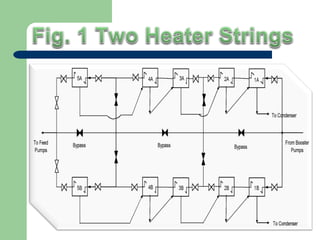
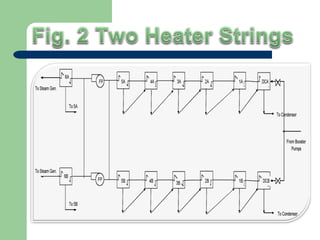
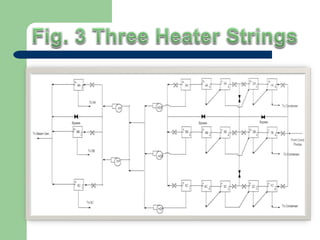
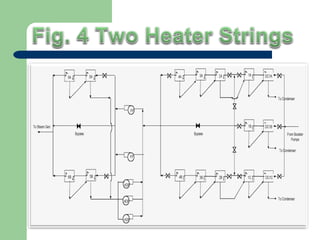
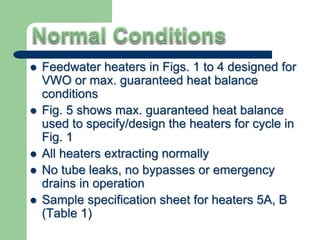
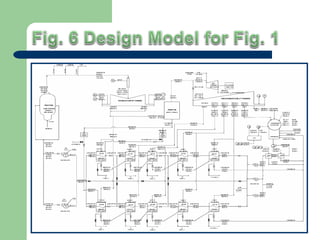
 Feedwater heaters in Figs. 1 to 4 designed for
VWO or max. guaranteed heat balance
conditions
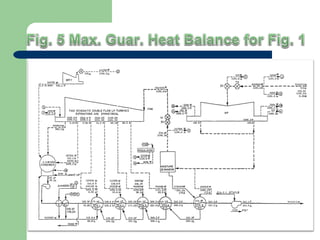
 Fig. 5 shows max. guaranteed heat balance
used to specify/design the heaters for cycle in
Fig. 1
 All heaters extracting normally
 No tube leaks, no bypasses or emergency
drains in operation
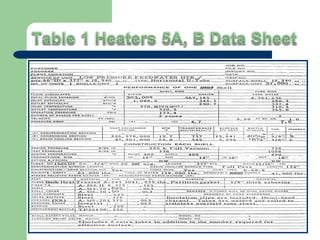
 Sample specification sheet for heaters 5A, B
(Table 1)
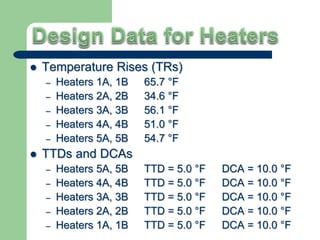
 Temperature Rises (TRs)
– Heaters 1A, 1B 65.7 °F
– Heaters 2A, 2B 34.6 °F
– Heaters 3A, 3B 56.1 °F
– Heaters 4A, 4B 51.0 °F
– Heaters 5A, 5B 54.7 °F
 TTDs and DCAs
– Heaters 5A, 5B TTD = 5.0 °F DCA = 10.0 °F
– Heaters 4A, 4B TTD = 5.0 °F DCA = 10.0 °F
– Heaters 3A, 3B TTD = 5.0 °F DCA = 10.0 °F
– Heaters 2A, 2B TTD = 5.0 °F DCA = 10.0 °F
– Heaters 1A, 1B TTD = 5.0 °F DCA = 10.0 °F
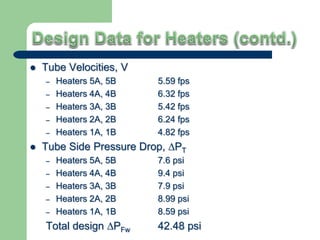
 Tube Velocities, V
– Heaters 5A, 5B 5.59 fps
– Heaters 4A, 4B 6.32 fps
– Heaters 3A, 3B 5.42 fps
– Heaters 2A, 2B 6.24 fps
– Heaters 1A, 1B 4.82 fps
 Tube Side Pressure Drop, ∆PT
– Heaters 5A, 5B 7.6 psi
– Heaters 4A, 4B 9.4 psi
– Heaters 3A, 3B 7.9 psi
– Heaters 2A, 2B 8.99 psi
– Heaters 1A, 1B 8.59 psi
Total design ∆PFw 42.48 psi
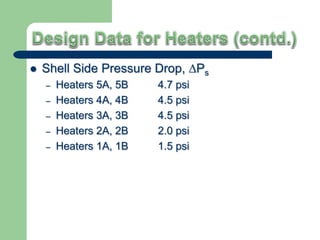
 Shell Side Pressure Drop, ∆Ps
– Heaters 5A, 5B 4.7 psi
– Heaters 4A, 4B 4.5 psi
– Heaters 3A, 3B 4.5 psi
– Heaters 2A, 2B 2.0 psi
– Heaters 1A, 1B 1.5 psi
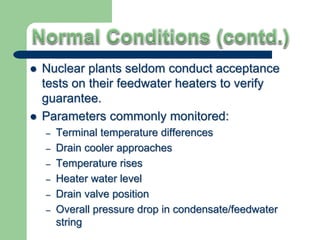
 Nuclear plants seldom conduct acceptance
tests on their feedwater heaters to verify
guarantee.
 Parameters commonly monitored:
– Terminal temperature differences
– Drain cooler approaches
– Temperature rises
– Heater water level
– Drain valve position
– Overall pressure drop in condensate/feedwater
string
 Permits predicting heater performance for
both normal and abnormal conditions
 Predicted/calculated values include:
– Heater shell pressures
– Extraction steam flows
– Feedwater/condensate flows
– Drain flows
– Inlet and outlet temperatures
 Predicted/calculated values include:
– Pressure drops
– Velocities
– Heat transferred in condensing and
subcooling zones
– Log mean temperature differences
– Heat transfer coefficients, etc.
 Predicted values may be compared to
plant data to confirm/validate tube leaks,
plugged tubes, etc.
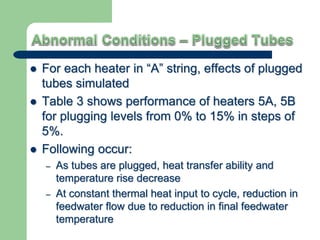
 For each heater in “A” string, effects of plugged
tubes simulated
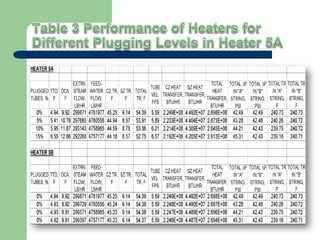
 Table 3 shows performance of heaters 5A, 5B
for plugging levels from 0% to 15% in steps of
5%.
 Following occur:
– As tubes are plugged, heat transfer ability and
temperature rise decrease
– At constant thermal heat input to cycle, reduction in
feedwater flow due to reduction in final feedwater
temperature
 Following occur:
– Effectiveness of heater 5A decreases and both TTD
and DCA increase
– For 10% plugged tubes, TTD increases by 1.0 F
and DCA by 1.7 F.
– Generator output decreases by about 0.2 Mwe.
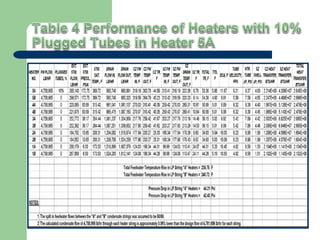
 Table 4 shows impact on all heaters when 10%
of tubes are plugged in heater 5A.
 Reduction of about 1.0 F in overall temperature
rise in “A” string
 Overall pressure drop in “A” string increases
 To summarize effects when tubes are plugged
in a heater:
– TR across the heater decreases.
– TTD and DCA increase.
– Effective surface available for heat transfer
decreases and heat transferred to feedwater also
decreases.
– Tube side velocity and pressure drop increase.
– Overall pressure drop in the heater string containing
the heater with the plugged tubes increases.
 To summarize effects when tubes are plugged in a
heater:
– Overall temperature rise of feedwater in heater string
containing heater with plugged tubes decreases.
– If heater is the highest-pressure heater in the cycle, final
feedwater temperature decreases resulting in a slight
reduction in total feedwater flow for a constant thermal heat
input to the cycle.
– If heater with plugged tubes is other than highest-pressure
heater, feedwater temperature entering downstream heater
decreases, causing that heater to extract more steam, albeit
inefficiently, with a higher TTD and DCA.
– The cycle output decreases.
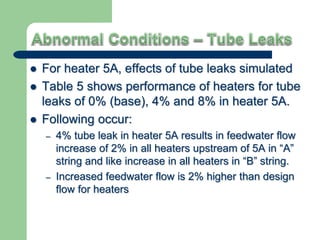
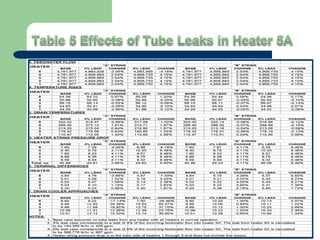
 For heater 5A, effects of tube leaks simulated
 Table 5 shows performance of heaters for tube
leaks of 0% (base), 4% and 8% in heater 5A.
 Following occur:
– 4% tube leak in heater 5A results in feedwater flow
increase of 2% in all heaters upstream of 5A in “A”
string and like increase in all heaters in “B” string.
– Increased feedwater flow is 2% higher than design
flow for heaters
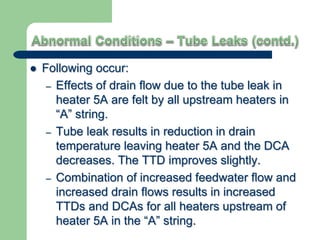
 Following occur:
– Effects of drain flow due to the tube leak in
heater 5A are felt by all upstream heaters in
“A” string.
– Tube leak results in reduction in drain
temperature leaving heater 5A and the DCA
decreases. The TTD improves slightly.
– Combination of increased feedwater flow and
increased drain flows results in increased
TTDs and DCAs for all heaters upstream of
heater 5A in the “A” string.
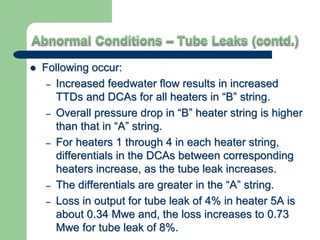
 Following occur:
– Increased feedwater flow results in increased
TTDs and DCAs for all heaters in “B” string.
– Overall pressure drop in “B” heater string is higher
than that in “A” string.
– For heaters 1 through 4 in each heater string,
differentials in the DCAs between corresponding
heaters increase, as the tube leak increases.
– The differentials are greater in the “A” string.
– Loss in output for tube leak of 4% in heater 5A is
about 0.34 Mwe and, the loss increases to 0.73
Mwe for tube leak of 8%.
 In summary, tube leak in a heater manifests
itself as follows:
– TTD and DCA of the heater with the
suspected tube leak will decrease.
– Feedwater flow to the heaters in all heater
strings will increase.
– Pressure drop in the heater strings will
increase.
– TTDs and DCAs in the heater string
upstream of the heater with the suspected
tube leaks will increase.
 In summary, tube leak in a heater manifests
itself as follows:
– TTDs and DCAs of heaters in the remaining
heater strings will increase.
– There will be a differential in drain
temperatures of corresponding heaters in the
heater strings.
– The differentials will increase as the tube
leak increases and will be greatest in the
string containing the heater with the
suspected tube leaks.
 Corrective action to be taken will depend upon
various factors such as:
– Location in the cycle of the heater with the
suspected leaks
– Magnitude and severity of the leaks
– The number of plugged tubes
– History of the heater, etc.
 Taking a heater out of service needs to be carefully
evaluated in terms of impact both on the turbine
stages and also upon the remaining heaters.
 Amount of load reduction necessary to keep
turbine stage loadings to below design depends
upon specific arrangement of extraction steam and
condensate/feedwater
 Guidelines provided by the turbine manufacturer
should be followed.
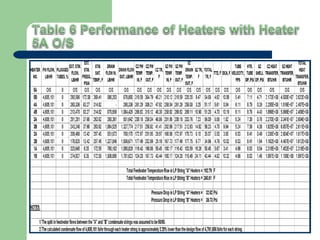
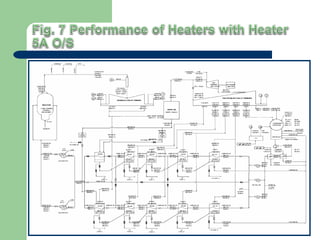
 Table 6 and Fig. 7 show results when heater 5A is
removed from service
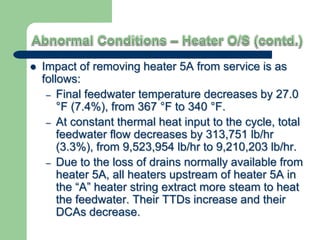
 Impact of removing heater 5A from service is as
follows:
– Final feedwater temperature decreases by 27.0
°F (7.4%), from 367 °F to 340 °F.
– At constant thermal heat input to the cycle, total
feedwater flow decreases by 313,751 lb/hr
(3.3%), from 9,523,954 lb/hr to 9,210,203 lb/hr.
– Due to the loss of drains normally available from
heater 5A, all heaters upstream of heater 5A in
the “A” heater string extract more steam to heat
the feedwater. Their TTDs increase and their
DCAs decrease.
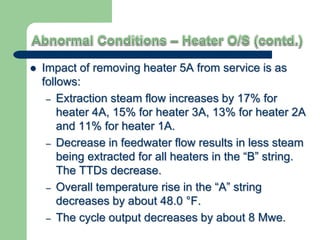
 Impact of removing heater 5A from service is as
follows:
– Extraction steam flow increases by 17% for
heater 4A, 15% for heater 3A, 13% for heater 2A
and 11% for heater 1A.
– Decrease in feedwater flow results in less steam
being extracted for all heaters in the “B” string.
The TTDs decrease.
– Overall temperature rise in the “A” string
decreases by about 48.0 °F.
– The cycle output decreases by about 8 Mwe.
 Extraneous flows refer to introduction of flows into a heater
that was not originally designed to receive these flows.
 For example, some plants have provisions in their design to
inject flows taken from the condensate/feedwater to
subcool the moisture separator and reheater drains to
prevent flashing.
 These additional flows increase the thermal and hydraulic
loading on the heaters and, long-term operation in this
mode, could lead to degradation in performance and affect
heater reliability.
 Extraneous flows may need to be isolated, at least
temporarily, if a heater is exhibiting symptoms of tube leaks
or other problems.
 With plant uprates becoming increasingly
common, feedwater heater heaters are being
subject to increased thermal and hydraulic
loadings.
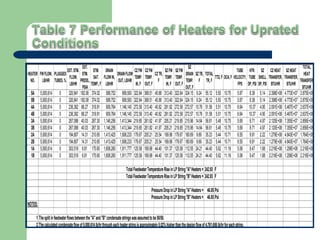
 For example, if the cycle shown in Fig. 1 is
uprated from the maximum guaranteed
condition, for which it was originally licensed, to
the valves-wide-open condition, the feedwater
flow increases by about 5%.
 Table 7 shows the impact on the performance
of the heaters.
HEATER
NO.
FWFLOW,
LB/HR
PLUGGED
TUBES,%
EXT.STM.
FLOW,
LB/HR
EXT.
STM.
PRESS.,
PSIA
STM.
SAT.
TEMP.,F
DRAIN
FLOWIN,
LB/HR
DRAINFLOW
OUT,LB/HR
CZFW
TEMP.
IN,F
CZFW
TEMP.
OUT,F
CZTR,
F
SZFW
TEMP.
IN,F
SZFW
TEMP.
OUT,F
SZ
DRAIN
TEMP.
OUT,F
SZTR,
F
TOTAL
TR,F
TTD,F DCA,F
TUBE
VELOCITY,
FPS
HTR.
TUBE
DP,PSI
SZ
SHELL
DP,PSI
CZHEAT
TRANSFER,
BTU/HR
SZHEAT
TRANSFER,
BTU/HR
TOTAL
HEAT
TRANSFER
BTU/HR
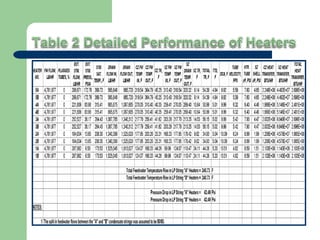
5A 5,000,614 0 320,841 182.08 374.02 588,752 909,593 322.64 368.51 45.88 313.40 322.64 324.15 9.24 55.12 5.50 10.75 5.87 8.38 5.14 2.398E+08 4.773E+07 2.875E+08
5B 5,000,614 0 320,841 182.08 374.02 588,752 909,593 322.64 368.51 45.88 313.40 322.64 324.15 9.24 55.12 5.50 10.75 5.87 8.38 5.14 2.398E+08 4.773E+07 2.875E+08
4A 5,000,614 0 236,382 88.27 318.91 909,764 1,146,145 272.58 313.40 40.82 261.82 272.58 272.57 10.76 51.58 5.51 10.75 6.64 10.37 4.95 2.091E+08 5.467E+07 2.637E+08
4B 5,000,614 0 236,382 88.27 318.91 909,764 1,146,145 272.58 313.40 40.82 261.82 272.58 272.57 10.76 51.58 5.51 10.75 6.64 10.37 4.95 2.091E+08 5.467E+07 2.637E+08
3A 5,000,614 0 267,088 40.03 267.30 1,146,256 1,413,344 219.85 261.82 41.97 205.21 219.85 215.96 14.64 56.61 5.48 10.75 5.69 8.71 4.97 2.120E+08 7.355E+07 2.856E+08
3B 5,000,614 0 267,088 40.03 267.30 1,146,256 1,413,344 219.85 261.82 41.97 205.21 219.85 215.96 14.64 56.61 5.48 10.75 5.69 8.71 4.97 2.120E+08 7.355E+07 2.856E+08
2A 5,000,614 0 194,807 14.31 210.65 1,413,425 1,608,233 179.67 205.21 25.54 169.98 179.67 180.69 9.69 35.23 5.44 10.71 6.55 9.91 2.22 1.279E+08 4.843E+07 1.764E+08
2B 5,000,614 0 194,807 14.31 210.65 1,413,425 1,608,233 179.67 205.21 25.54 169.98 179.67 180.69 9.69 35.23 5.44 10.71 6.55 9.91 2.22 1.279E+08 4.843E+07 1.764E+08
1A 5,000,614 0 303,518 6.81 175.60 1,608,260 1,911,777 125.58 169.98 44.40 101.37 125.58 112.55 24.21 44.40 5.62 11.18 5.06 9.47 1.68 2.216E+08 1.206E+08 2.216E+08
1B 5,000,614 0 303,518 6.81 175.60 1,608,260 1,911,777 125.58 169.98 44.40 101.37 125.58 112.55 24.21 44.40 5.62 11.18 5.06 9.47 1.68 2.216E+08 1.206E+08 2.216E+08
TotalFeedwaterTemperatureRiseinLPString"A"Heaters= 242.93 F
TotalFeedwaterTemperatureRiseinLPString"B"Heaters= 242.93 F
PressureDropinLPString"A"Heaters= 46.85 Psi
PressureDropinLPString"B"Heaters= 46.85 Psi
NOTES:
1 Thesplitinfeedwaterflowsbetweenthe"A"and"B"condensatestringswasassumedtobe50/50.
2 Thecalculatedcondensateflowof5,000,614lb/hrthrougheachheaterstringisapproximately5.02%higherthanthedesignflowof4,761,656lb/hrforeachstring.
 Effects of plant uprates on the original heaters
need to be considered carefully, especially if there
is no design margin.
 Besides the impact of the increased feedwater
flow, other factors that need to be considered
include the potential effects of plugged tubes, tube
leaks, heaters taken out of service and, extraneous
flows.
 Performance modeling tools can be invaluable in
evaluating all these effects as part of the uprate
studies and in specifying new or replacement
heaters, as necessary.
 Performance monitoring programs for feedwater
heaters coupled with performance modeling
could be invaluable in not only maintaining
optimum performance levels but also in
diagnosing potential or suspected problems with
the heaters and planning for appropriate
corrective action.
 The effects of plugged tubes, tube leaks, heaters
out of service, extraneous flows and plant
uprates can be predicted using performance
modeling tools and plant performance data can
help to confirm/validate predictions
 Besides monitoring the TTD, DCA, TR, heater
water level and, drain valve position for each
heater in each heater string, the differentials
between the TTD, DCA, TR and drain
temperature for corresponding heaters in
multiple heater strings should also be
monitored.
 If provisions exist, the overall pressure drop in
the heater string should also be monitored.

2003 ASME Power Conference Performance Evaluation of Feedwater Heaters for Nuclear Plants Under Normal and Abnormal Conditions Sunder Raj Presentation

  • 1.
    K. S. SunderRaj, Power & Energy Systems Services
  • 3.
     Feedwater heatersfor nuclear plants specified and designed for full-load conditions with all heaters in normal service  Practice conforms to turbine manufacturer’s philosophy of designing turbine  Heaters may be removed from service provided turbine stage loadings do not exceed those under normal conditions  Will depend upon specific piping arrangement (extraction steam and condensate/feedwater)
  • 9.
     Feedwater heatersin Figs. 1 to 4 designed for VWO or max. guaranteed heat balance conditions  Fig. 5 shows max. guaranteed heat balance used to specify/design the heaters for cycle in Fig. 1  All heaters extracting normally  No tube leaks, no bypasses or emergency drains in operation  Sample specification sheet for heaters 5A, B (Table 1)
  • 11.
     Temperature Rises(TRs) – Heaters 1A, 1B 65.7 °F – Heaters 2A, 2B 34.6 °F – Heaters 3A, 3B 56.1 °F – Heaters 4A, 4B 51.0 °F – Heaters 5A, 5B 54.7 °F  TTDs and DCAs – Heaters 5A, 5B TTD = 5.0 °F DCA = 10.0 °F – Heaters 4A, 4B TTD = 5.0 °F DCA = 10.0 °F – Heaters 3A, 3B TTD = 5.0 °F DCA = 10.0 °F – Heaters 2A, 2B TTD = 5.0 °F DCA = 10.0 °F – Heaters 1A, 1B TTD = 5.0 °F DCA = 10.0 °F
  • 12.
     Tube Velocities,V – Heaters 5A, 5B 5.59 fps – Heaters 4A, 4B 6.32 fps – Heaters 3A, 3B 5.42 fps – Heaters 2A, 2B 6.24 fps – Heaters 1A, 1B 4.82 fps  Tube Side Pressure Drop, ∆PT – Heaters 5A, 5B 7.6 psi – Heaters 4A, 4B 9.4 psi – Heaters 3A, 3B 7.9 psi – Heaters 2A, 2B 8.99 psi – Heaters 1A, 1B 8.59 psi Total design ∆PFw 42.48 psi
  • 13.
     Shell SidePressure Drop, ∆Ps – Heaters 5A, 5B 4.7 psi – Heaters 4A, 4B 4.5 psi – Heaters 3A, 3B 4.5 psi – Heaters 2A, 2B 2.0 psi – Heaters 1A, 1B 1.5 psi
  • 14.
     Nuclear plantsseldom conduct acceptance tests on their feedwater heaters to verify guarantee.  Parameters commonly monitored: – Terminal temperature differences – Drain cooler approaches – Temperature rises – Heater water level – Drain valve position – Overall pressure drop in condensate/feedwater string
  • 15.
     Permits predictingheater performance for both normal and abnormal conditions  Predicted/calculated values include: – Heater shell pressures – Extraction steam flows – Feedwater/condensate flows – Drain flows – Inlet and outlet temperatures
  • 16.
     Predicted/calculated valuesinclude: – Pressure drops – Velocities – Heat transferred in condensing and subcooling zones – Log mean temperature differences – Heat transfer coefficients, etc.  Predicted values may be compared to plant data to confirm/validate tube leaks, plugged tubes, etc.
  • 19.
     For eachheater in “A” string, effects of plugged tubes simulated  Table 3 shows performance of heaters 5A, 5B for plugging levels from 0% to 15% in steps of 5%.  Following occur: – As tubes are plugged, heat transfer ability and temperature rise decrease – At constant thermal heat input to cycle, reduction in feedwater flow due to reduction in final feedwater temperature
  • 21.
     Following occur: –Effectiveness of heater 5A decreases and both TTD and DCA increase – For 10% plugged tubes, TTD increases by 1.0 F and DCA by 1.7 F. – Generator output decreases by about 0.2 Mwe.  Table 4 shows impact on all heaters when 10% of tubes are plugged in heater 5A.  Reduction of about 1.0 F in overall temperature rise in “A” string  Overall pressure drop in “A” string increases
  • 23.
     To summarizeeffects when tubes are plugged in a heater: – TR across the heater decreases. – TTD and DCA increase. – Effective surface available for heat transfer decreases and heat transferred to feedwater also decreases. – Tube side velocity and pressure drop increase. – Overall pressure drop in the heater string containing the heater with the plugged tubes increases.
  • 24.
     To summarizeeffects when tubes are plugged in a heater: – Overall temperature rise of feedwater in heater string containing heater with plugged tubes decreases. – If heater is the highest-pressure heater in the cycle, final feedwater temperature decreases resulting in a slight reduction in total feedwater flow for a constant thermal heat input to the cycle. – If heater with plugged tubes is other than highest-pressure heater, feedwater temperature entering downstream heater decreases, causing that heater to extract more steam, albeit inefficiently, with a higher TTD and DCA. – The cycle output decreases.
  • 25.
     For heater5A, effects of tube leaks simulated  Table 5 shows performance of heaters for tube leaks of 0% (base), 4% and 8% in heater 5A.  Following occur: – 4% tube leak in heater 5A results in feedwater flow increase of 2% in all heaters upstream of 5A in “A” string and like increase in all heaters in “B” string. – Increased feedwater flow is 2% higher than design flow for heaters
  • 27.
     Following occur: –Effects of drain flow due to the tube leak in heater 5A are felt by all upstream heaters in “A” string. – Tube leak results in reduction in drain temperature leaving heater 5A and the DCA decreases. The TTD improves slightly. – Combination of increased feedwater flow and increased drain flows results in increased TTDs and DCAs for all heaters upstream of heater 5A in the “A” string.
  • 28.
     Following occur: –Increased feedwater flow results in increased TTDs and DCAs for all heaters in “B” string. – Overall pressure drop in “B” heater string is higher than that in “A” string. – For heaters 1 through 4 in each heater string, differentials in the DCAs between corresponding heaters increase, as the tube leak increases. – The differentials are greater in the “A” string. – Loss in output for tube leak of 4% in heater 5A is about 0.34 Mwe and, the loss increases to 0.73 Mwe for tube leak of 8%.
  • 29.
     In summary,tube leak in a heater manifests itself as follows: – TTD and DCA of the heater with the suspected tube leak will decrease. – Feedwater flow to the heaters in all heater strings will increase. – Pressure drop in the heater strings will increase. – TTDs and DCAs in the heater string upstream of the heater with the suspected tube leaks will increase.
  • 30.
     In summary,tube leak in a heater manifests itself as follows: – TTDs and DCAs of heaters in the remaining heater strings will increase. – There will be a differential in drain temperatures of corresponding heaters in the heater strings. – The differentials will increase as the tube leak increases and will be greatest in the string containing the heater with the suspected tube leaks.
  • 31.
     Corrective actionto be taken will depend upon various factors such as: – Location in the cycle of the heater with the suspected leaks – Magnitude and severity of the leaks – The number of plugged tubes – History of the heater, etc.
  • 32.
     Taking aheater out of service needs to be carefully evaluated in terms of impact both on the turbine stages and also upon the remaining heaters.  Amount of load reduction necessary to keep turbine stage loadings to below design depends upon specific arrangement of extraction steam and condensate/feedwater  Guidelines provided by the turbine manufacturer should be followed.  Table 6 and Fig. 7 show results when heater 5A is removed from service
  • 35.
     Impact ofremoving heater 5A from service is as follows: – Final feedwater temperature decreases by 27.0 °F (7.4%), from 367 °F to 340 °F. – At constant thermal heat input to the cycle, total feedwater flow decreases by 313,751 lb/hr (3.3%), from 9,523,954 lb/hr to 9,210,203 lb/hr. – Due to the loss of drains normally available from heater 5A, all heaters upstream of heater 5A in the “A” heater string extract more steam to heat the feedwater. Their TTDs increase and their DCAs decrease.
  • 36.
     Impact ofremoving heater 5A from service is as follows: – Extraction steam flow increases by 17% for heater 4A, 15% for heater 3A, 13% for heater 2A and 11% for heater 1A. – Decrease in feedwater flow results in less steam being extracted for all heaters in the “B” string. The TTDs decrease. – Overall temperature rise in the “A” string decreases by about 48.0 °F. – The cycle output decreases by about 8 Mwe.
  • 37.
     Extraneous flowsrefer to introduction of flows into a heater that was not originally designed to receive these flows.  For example, some plants have provisions in their design to inject flows taken from the condensate/feedwater to subcool the moisture separator and reheater drains to prevent flashing.  These additional flows increase the thermal and hydraulic loading on the heaters and, long-term operation in this mode, could lead to degradation in performance and affect heater reliability.  Extraneous flows may need to be isolated, at least temporarily, if a heater is exhibiting symptoms of tube leaks or other problems.
  • 38.
     With plantuprates becoming increasingly common, feedwater heater heaters are being subject to increased thermal and hydraulic loadings.  For example, if the cycle shown in Fig. 1 is uprated from the maximum guaranteed condition, for which it was originally licensed, to the valves-wide-open condition, the feedwater flow increases by about 5%.  Table 7 shows the impact on the performance of the heaters.
  • 39.
    HEATER NO. FWFLOW, LB/HR PLUGGED TUBES,% EXT.STM. FLOW, LB/HR EXT. STM. PRESS., PSIA STM. SAT. TEMP.,F DRAIN FLOWIN, LB/HR DRAINFLOW OUT,LB/HR CZFW TEMP. IN,F CZFW TEMP. OUT,F CZTR, F SZFW TEMP. IN,F SZFW TEMP. OUT,F SZ DRAIN TEMP. OUT,F SZTR, F TOTAL TR,F TTD,F DCA,F TUBE VELOCITY, FPS HTR. TUBE DP,PSI SZ SHELL DP,PSI CZHEAT TRANSFER, BTU/HR SZHEAT TRANSFER, BTU/HR TOTAL HEAT TRANSFER BTU/HR 5A 5,000,6140 320,841 182.08 374.02 588,752 909,593 322.64 368.51 45.88 313.40 322.64 324.15 9.24 55.12 5.50 10.75 5.87 8.38 5.14 2.398E+08 4.773E+07 2.875E+08 5B 5,000,614 0 320,841 182.08 374.02 588,752 909,593 322.64 368.51 45.88 313.40 322.64 324.15 9.24 55.12 5.50 10.75 5.87 8.38 5.14 2.398E+08 4.773E+07 2.875E+08 4A 5,000,614 0 236,382 88.27 318.91 909,764 1,146,145 272.58 313.40 40.82 261.82 272.58 272.57 10.76 51.58 5.51 10.75 6.64 10.37 4.95 2.091E+08 5.467E+07 2.637E+08 4B 5,000,614 0 236,382 88.27 318.91 909,764 1,146,145 272.58 313.40 40.82 261.82 272.58 272.57 10.76 51.58 5.51 10.75 6.64 10.37 4.95 2.091E+08 5.467E+07 2.637E+08 3A 5,000,614 0 267,088 40.03 267.30 1,146,256 1,413,344 219.85 261.82 41.97 205.21 219.85 215.96 14.64 56.61 5.48 10.75 5.69 8.71 4.97 2.120E+08 7.355E+07 2.856E+08 3B 5,000,614 0 267,088 40.03 267.30 1,146,256 1,413,344 219.85 261.82 41.97 205.21 219.85 215.96 14.64 56.61 5.48 10.75 5.69 8.71 4.97 2.120E+08 7.355E+07 2.856E+08 2A 5,000,614 0 194,807 14.31 210.65 1,413,425 1,608,233 179.67 205.21 25.54 169.98 179.67 180.69 9.69 35.23 5.44 10.71 6.55 9.91 2.22 1.279E+08 4.843E+07 1.764E+08 2B 5,000,614 0 194,807 14.31 210.65 1,413,425 1,608,233 179.67 205.21 25.54 169.98 179.67 180.69 9.69 35.23 5.44 10.71 6.55 9.91 2.22 1.279E+08 4.843E+07 1.764E+08 1A 5,000,614 0 303,518 6.81 175.60 1,608,260 1,911,777 125.58 169.98 44.40 101.37 125.58 112.55 24.21 44.40 5.62 11.18 5.06 9.47 1.68 2.216E+08 1.206E+08 2.216E+08 1B 5,000,614 0 303,518 6.81 175.60 1,608,260 1,911,777 125.58 169.98 44.40 101.37 125.58 112.55 24.21 44.40 5.62 11.18 5.06 9.47 1.68 2.216E+08 1.206E+08 2.216E+08 TotalFeedwaterTemperatureRiseinLPString"A"Heaters= 242.93 F TotalFeedwaterTemperatureRiseinLPString"B"Heaters= 242.93 F PressureDropinLPString"A"Heaters= 46.85 Psi PressureDropinLPString"B"Heaters= 46.85 Psi NOTES: 1 Thesplitinfeedwaterflowsbetweenthe"A"and"B"condensatestringswasassumedtobe50/50. 2 Thecalculatedcondensateflowof5,000,614lb/hrthrougheachheaterstringisapproximately5.02%higherthanthedesignflowof4,761,656lb/hrforeachstring.
  • 40.
     Effects ofplant uprates on the original heaters need to be considered carefully, especially if there is no design margin.  Besides the impact of the increased feedwater flow, other factors that need to be considered include the potential effects of plugged tubes, tube leaks, heaters taken out of service and, extraneous flows.  Performance modeling tools can be invaluable in evaluating all these effects as part of the uprate studies and in specifying new or replacement heaters, as necessary.
  • 41.
     Performance monitoringprograms for feedwater heaters coupled with performance modeling could be invaluable in not only maintaining optimum performance levels but also in diagnosing potential or suspected problems with the heaters and planning for appropriate corrective action.  The effects of plugged tubes, tube leaks, heaters out of service, extraneous flows and plant uprates can be predicted using performance modeling tools and plant performance data can help to confirm/validate predictions
  • 42.
     Besides monitoringthe TTD, DCA, TR, heater water level and, drain valve position for each heater in each heater string, the differentials between the TTD, DCA, TR and drain temperature for corresponding heaters in multiple heater strings should also be monitored.  If provisions exist, the overall pressure drop in the heater string should also be monitored.