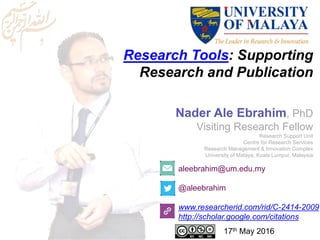
Research Tools: Supporting
Research and Publication
aleebrahim@um.edu.my
@aleebrahim
www.researcherid.com/rid/C-2414-2009
http://scholar.google.com/citations
Nader Ale Ebrahim, PhD
Visiting Research Fellow
Research Support Unit
Centre for Research Services
Research Management & Innovation Complex
University of Malaya, Kuala Lumpur, Malaysia
17th May 2016
Introduction to the “Research Tools”:
Supporting Research and Publication
Nader Ale Ebrahim, PhD
=====================================
Research Support Unit
Centre for Research Services
Research Management & Innovation Complex
University of Malaya, Kuala Lumpur, Malaysia
www.researcherid.com/rid/C-2414-2009
http://scholar.google.com/citations
Read more: Ale Ebrahim, N., Salehi, H., Embi, M. A., Habibi Tanha, F., Gholizadeh, H., Motahar, S. M., & Ordi, A. (2013). Effective
Strategies for Increasing Citation Frequency. International Education Studies, 6(11), 93-99. doi: 10.5539/ies.v6n11p93
All of my presentations are available online at:
https://figshare.com/authors/Nader_Ale_Ebrahim/100797
Link to this presentation: https://dx.doi.org/10.6084/m9.figshare.3381811.v1
Abstract
Abstract:
With the increasing use of information and communications technology
(ICT), researchers are able to use computer software tools to find,
organize, manipulate, analyze, and share relevant information.
However, there are hundreds of such tools to select from, for various
research-related uses. I have collected over 700 research tools that
can help researchers do their work efficiently. Research Tools consists
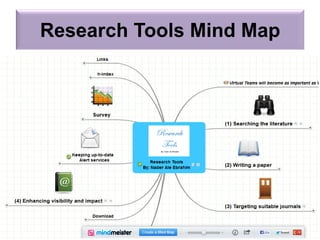
of a hierarchical set of nodes. It has four main nodes: (1) Searching the
literature, (2) Writing a paper, (3) Targeting suitable journals, and (4)
Enhancing visibility and impact. In this presentation, the four main
nodes are described.
Keywords:
H-index, Improve citations, Research tools, Bibliometrics, Literature
review, Research visibility
©2016-2017 Nader Ale Ebrahim
Problem statements
The search can be time consuming and sometimes tedious task. How
can make it easier? How do deal with situations such as:
– “I just join as a new postgraduate student and I am not sure how to do a
literature search”
– “I have been in research for some time now but I spend a lot of time to get the
articles I want”
– “I am sure I have downloaded the article but I am not able to find it”
– “I wanted to write a new paper, how can I manage the references in the shortest
possible time?”
– “I have many references, some of my old papers, and some of my current
research. Sometimes, they are so many that I can’t recall where I have kept
them in my folders!”
– ……..
– “I have written an article and I am not able to find a proper Journal”
– "I want to increase the citation of my papers, how do I do?"
©2016-2017 Nader Ale Ebrahim
Objectives
The seminar seeks to serve the following
objectives:
i. To help students who seek to reduce the search time by
expanding the knowledge of researchers to more effectively use
the "tools" that are available through the Net.
ii. To evaluate the types of literature that researchers will
encounter.
iii. To convert the information of the search for a written document.
iv. To help researchers learn how to search and analyze the right
journal to submit.
v. To promote their publication for further citation.
©2016-2017 Nader Ale Ebrahim
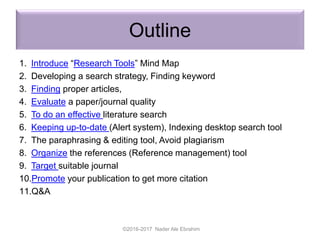
Outline
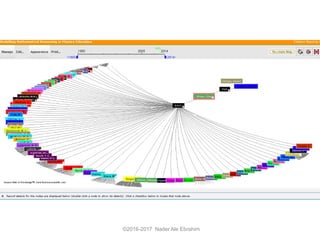
1. Introduce “Research Tools” Mind Map
2. Developing a search strategy, Finding keyword
3. Finding proper articles,
4. Evaluate a paper/journal quality
5. To do an effective literature search
6. Keeping up-to-date (Alert system), Indexing desktop search tool
7. The paraphrasing & editing tool, Avoid plagiarism
8. Organize the references (Reference management) tool
9. Target suitable journal
10.Promote your publication to get more citation
11.Q&A
©2016-2017 Nader Ale Ebrahim
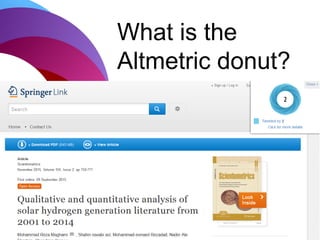
What is the
Altmetric donut?
©2016-2017 Nader Ale Ebrahim
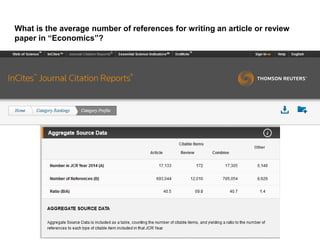
What is the average number of references for writing an article or review
paper in “Economics”?
Exercise
• Make a sentence including:
“the aim of study”
• Find a recent English thesis about:
“Virtual Teams”
©2016-2017 Nader Ale Ebrahim
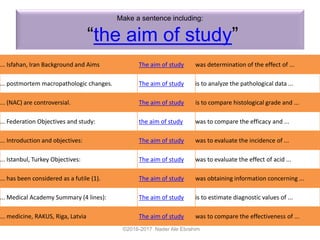
Make a sentence including:
“the aim of study”
... Isfahan, Iran Background and Aims The aim of study was determination of the effect of ...
... postmortem macropathologic changes. The aim of study is to analyze the pathological data ...
... (NAC) are controversial. The aim of study is to compare histological grade and ...
... Federation Objectives and study: the aim of study was to compare the efficacy and ...
... Introduction and objectives: The aim of study was to evaluate the incidence of ...
... Istanbul, Turkey Objectives: The aim of study was to evaluate the effect of acid ...
... has been considered as a futile (1). The aim of study was obtaining information concerning ...
... Medical Academy Summary (4 lines): The aim of study is to estimate diagnostic values of ...
... medicine, RAKUS, Riga, Latvia The aim of study was to compare the effectiveness of ...
©2016-2017 Nader Ale Ebrahim
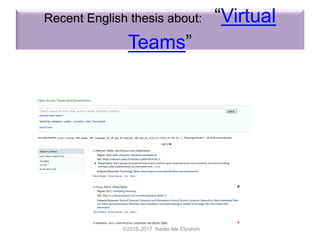
Recent English thesis about: “Virtual
Teams”
©2016-2017 Nader Ale Ebrahim
Research Tools Mind Map
©2016-2017 Nader Ale Ebrahim
Developing a search strategy,
Finding keyword
Keywords and Keywords Plus®
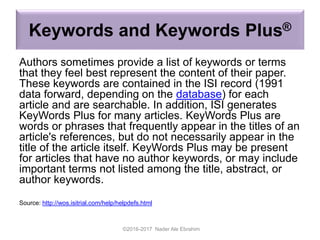
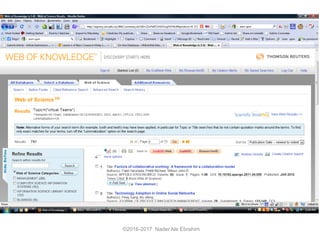
Authors sometimes provide a list of keywords or terms
that they feel best represent the content of their paper.
These keywords are contained in the ISI record (1991
data forward, depending on the database) for each
article and are searchable. In addition, ISI generates
KeyWords Plus for many articles. KeyWords Plus are
words or phrases that frequently appear in the titles of an
article's references, but do not necessarily appear in the
title of the article itself. KeyWords Plus may be present
for articles that have no author keywords, or may include
important terms not listed among the title, abstract, or
author keywords.
Source: http://wos.isitrial.com/help/helpdefs.html
©2016-2017 Nader Ale Ebrahim
Finding proper articles
&
Evaluate a paper/journal quality
&
To do an effective literature search
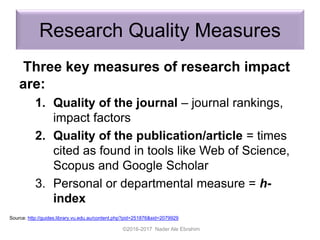
Research Quality Measures
Three key measures of research impact
are:
1. Quality of the journal – journal rankings,
impact factors
2. Quality of the publication/article = times
cited as found in tools like Web of Science,
Scopus and Google Scholar
3. Personal or departmental measure = h-
index
©2016-2017 Nader Ale Ebrahim
Source: http://guides.library.vu.edu.au/content.php?pid=251876&sid=2079929
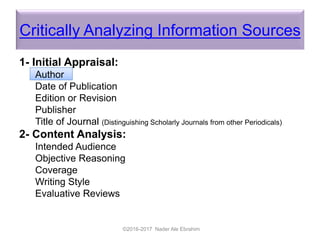
Critically Analyzing Information Sources
1- Initial Appraisal:
Author
Date of Publication
Edition or Revision
Publisher
Title of Journal (Distinguishing Scholarly Journals from other Periodicals)
2- Content Analysis:
Intended Audience
Objective Reasoning
Coverage
Writing Style
Evaluative Reviews
©2016-2017 Nader Ale Ebrahim
Paper/journal quality
• Another guide to paper/journal quality is
the general reputation of the association,
society, or organization publishing the
journal.
• Leading professional associations such as
American Psychological Association (APA)
or the Institute of Electrical and Electronics
Engineers (IEEE) publish a range of
journals that are highly regarded.
©2016-2017 Nader Ale Ebrahim
How to do an Effective
Literature Search?
Application Training Module Series I
by Customer Education Team
ts.training.asia@thomson.com
Stop Searching, Start Discovering
For More Info.
Keeping up-to-date (Alert system)
&
Indexing desktop search tool
Keeping up-to-date
Alert services are an effective
means of keeping track of the
latest research.
©2016-2017 Nader Ale Ebrahim
Keeping up-to-date
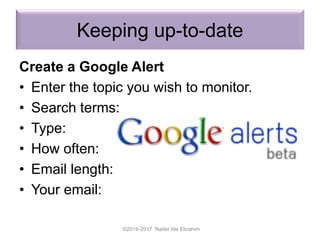
Create a Google Alert
• Enter the topic you wish to monitor.
• Search terms:
• Type:
• How often:
• Email length:
• Your email:
©2016-2017 Nader Ale Ebrahim
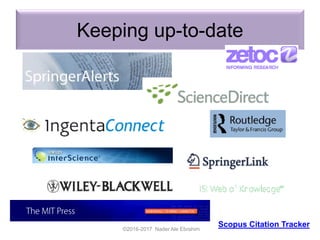
Keeping up-to-date
©2016-2017 Nader Ale Ebrahim
Scopus Citation Tracker
Conference Alerts
©2016-2017 Nader Ale Ebrahim
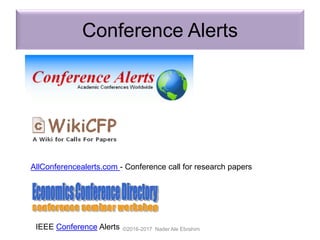
AllConferencealerts.com - Conference call for research papers
IEEE Conference Alerts
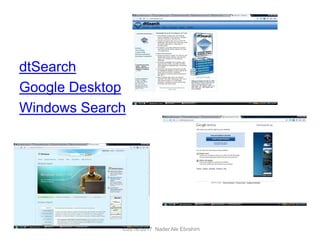
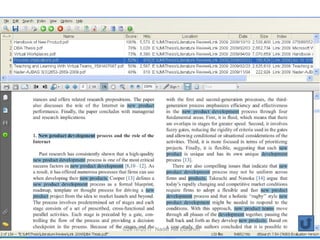
dtSearch
Google Desktop
Windows Search
©2016-2017 Nader Ale Ebrahim
The paraphrasing & editing tool,
&
Avoid plagiarism
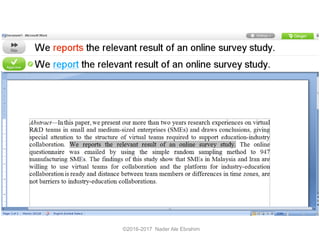
Paraphrasing
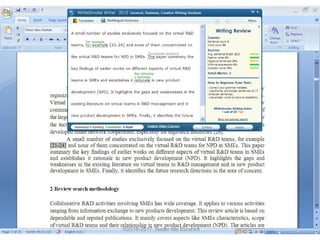
WhiteSmoke Writer
Ginger Proofreader
Microsoft Word
Google Docs
Office Live
Adobe Acrobat Professional
DropBox
©2016-2017 Nader Ale Ebrahim
How do I avoid plagiarism?
• only hand in your own and original work.
• indicate precisely and accurately when you have used information provided by
someone else, i.e. referencing must be done in accordance with a recognised
system.
• indicate whether you have downloaded information from the Internet.
• never use someone else’s electronic storage media, artwork, pictures or graphics as
if it were your own.
• never copy directly without crediting the source
• do not translate without crediting the source
• do not paraphrase someone else’s work without crediting the source
• do not piece together sections of the work of others into a new whole
• do not resubmit your own or other’s previously graded work
• do not commit collusion (unauthorised collaboration, presenting work as one’s own
independent work, when it has been produced in whole or in part in collusion with
other people)
• ghost-writing – you should not make use of ghost writers or professional agencies in
the production of your work or submit material which has been written on your behalf
©2016-2017 Nader Ale Ebrahim
10 Major source of plagiarism
1. Replication: Submitting a paper to multiple publications in an attempt to get it published
more than once
2. Duplication: Re-using work from one’s own previous studies and papers without attribution
3. Secondary Source: Using a secondary source, but only citing the primary sources
contained within the secondary one
4. Misleading Attribution: Removing an author’s name, despite significant contributions; an
inaccurate or insufficient list of authors who contributed to a manuscript
5. Invalid Source: Referencing either an incorrect or nonexistent source
6. Paraphrasing: Taking the words of another and using them alongside original text without
attribution
7. Repetitive Research: Repeating data or text from a similar study with a similar
methodology in a new study without proper attribution
8. Unethical Collaboration: Accidentally or intentionally use each other’s written work
without proper attribution; when people who are working together violate a code of conduct
9. Verbatim: copying of another’s words and works without providing proper attribution,
indentation or quotation marks
10. Complete: Taking a manuscript from another researcher and resubmitting it under one’s
own name
©2016-2017 Nader Ale Ebrahim
Source: .iThenticate (2013) SURVEY SUMMARY | Research Ethics: Decoding Plagiarism and Attribution in Research
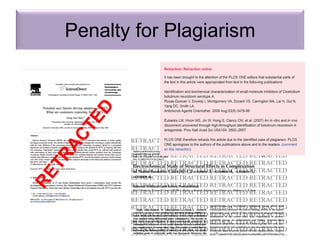
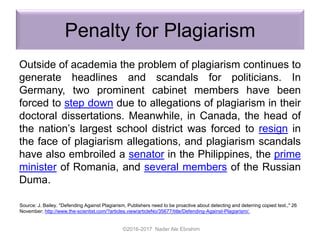
Penalty for Plagiarism
Outside of academia the problem of plagiarism continues to
generate headlines and scandals for politicians. In
Germany, two prominent cabinet members have been
forced to step down due to allegations of plagiarism in their
doctoral dissertations. Meanwhile, in Canada, the head of
the nation’s largest school district was forced to resign in
the face of plagiarism allegations, and plagiarism scandals
have also embroiled a senator in the Philippines, the prime
minister of Romania, and several members of the Russian
Duma.
©2016-2017 Nader Ale Ebrahim
Source: J. Bailey. "Defending Against Plagiarism, Publishers need to be proactive about detecting and deterring copied text.," 26
November; http://www.the-scientist.com/?articles.view/articleNo/35677/title/Defending-Against-Plagiarism/.
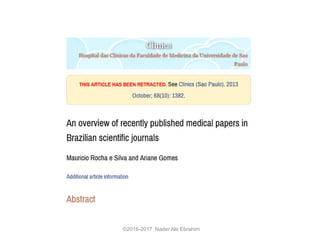
Penalty for Plagiarism
©2016-2017 Nader Ale Ebrahim
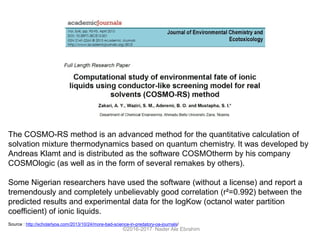
The COSMO-RS method is an advanced method for the quantitative calculation of
solvation mixture thermodynamics based on quantum chemistry. It was developed by
Andreas Klamt and is distributed as the software COSMOtherm by his company
COSMOlogic (as well as in the form of several remakes by others).
Some Nigerian researchers have used the software (without a license) and report a
tremendously and completely unbelievably good correlation (r²=0.992) between the
predicted results and experimental data for the logKow (octanol water partition
coefficient) of ionic liquids.
Source : http://scholarlyoa.com/2013/10/24/more-bad-science-in-predatory-oa-journals/
Organize the references (Reference
management) tool
EndNote
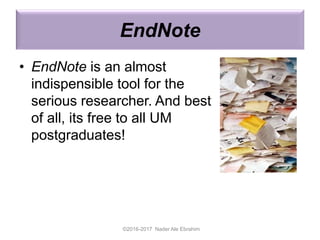
• EndNote is an almost
indispensible tool for the
serious researcher. And best
of all, its free to all UM
postgraduates!
©2016-2017 Nader Ale Ebrahim
Target suitable journal
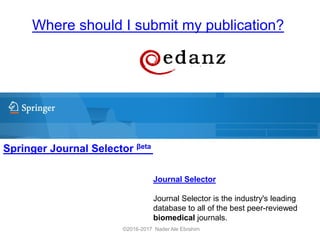
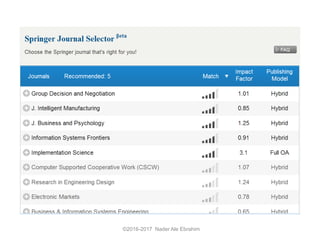
Where should I submit my publication?
Springer Journal Selector βeta
Journal Selector
Journal Selector is the industry's leading
database to all of the best peer-reviewed
biomedical journals.
©2016-2017 Nader Ale Ebrahim
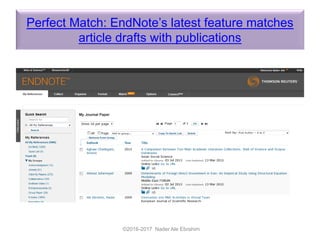
Perfect Match: EndNote’s latest feature matches
article drafts with publications
©2016-2017 Nader Ale Ebrahim
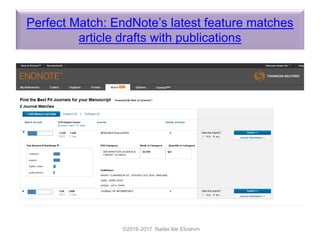
Perfect Match: EndNote’s latest feature matches
article drafts with publications
©2016-2017 Nader Ale Ebrahim
Promote your publication
Strategies for Enhancing the Impact of Research
Improving access and retrieval of your research
study is the surest way to enhance its impact.
Repetition, consistency, and an awareness of
the intended audience form the basis of most the
following strategies.
Preparing for Publication
Dissemination
Keeping Track of Your Research
©2016-2017 Nader Ale Ebrahim
Source: Washington University School of Medicine, St. Louis Missouri
Select a proper title
As an author, you can dramatically improve the
chances of your article being downloaded once
it’s online, before you even submit it!
There are three easy steps you can take to ensure
it enjoys high usage:
Choose a descriptive title
Use appropriate keywords
Write an informative abstract
Source: http://www.emeraldinsight.com/authors/guides/promote/optimize1.htm
©2016-2017 Nader Ale Ebrahim
Optimize Title/Abstract
Step 1: Construct a clear, descriptive title
In search engine terms, the title of your article is the
most interesting element. The search engine assumes
that the title contains all of the important words that
define the topic of the piece and thus weights words
appearing there most heavily.
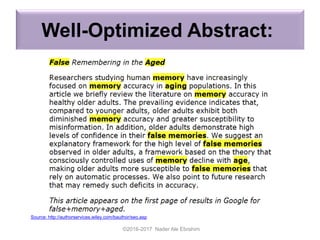
Step 2: Reiterate key phrases
The next most important field is the text of the abstract
itself. You should reiterate the key words or phrases from
the title within the abstract itself.
©2016-2017 Nader Ale Ebrahim
Source: http://authorservices.wiley.com/bauthor/seo.asp
Well-Optimized Abstract:
©2016-2017 Nader Ale Ebrahim
Source: http://authorservices.wiley.com/bauthor/seo.asp
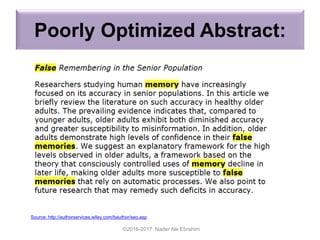
Poorly Optimized Abstract:
©2016-2017 Nader Ale Ebrahim
Source: http://authorservices.wiley.com/bauthor/seo.asp
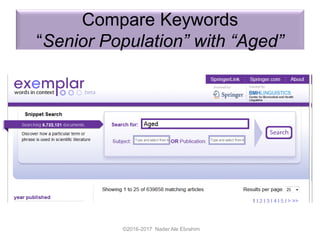
Compare Keywords
“Senior Population” with “Aged”
©2016-2017 Nader Ale Ebrahim
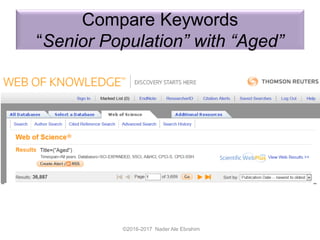
Compare Keywords
“Senior Population” with “Aged”
©2016-2017 Nader Ale Ebrahim
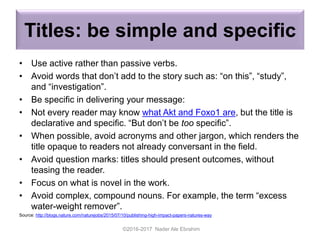
Titles: be simple and specific
• Use active rather than passive verbs.
• Avoid words that don’t add to the story such as: “on this”, “study”,
and “investigation”.
• Be specific in delivering your message:
• Not every reader may know what Akt and Foxo1 are, but the title is
declarative and specific. “But don’t be too specific”.
• When possible, avoid acronyms and other jargon, which renders the
title opaque to readers not already conversant in the field.
• Avoid question marks: titles should present outcomes, without
teasing the reader.
• Focus on what is novel in the work.
• Avoid complex, compound nouns. For example, the term “excess
water-weight remover”.
Source: http://blogs.nature.com/naturejobs/2015/07/10/publishing-high-impact-papers-natures-way
©2016-2017 Nader Ale Ebrahim
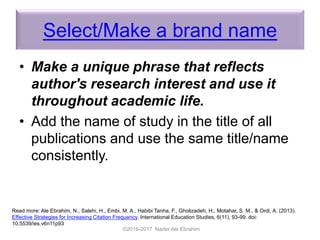
Select/Make a brand name
• Make a unique phrase that reflects
author's research interest and use it
throughout academic life.
• Add the name of study in the title of all
publications and use the same title/name
consistently.
©2016-2017 Nader Ale Ebrahim
Read more: Ale Ebrahim, N., Salehi, H., Embi, M. A., Habibi Tanha, F., Gholizadeh, H., Motahar, S. M., & Ordi, A. (2013).
Effective Strategies for Increasing Citation Frequency. International Education Studies, 6(11), 93-99. doi:
10.5539/ies.v6n11p93
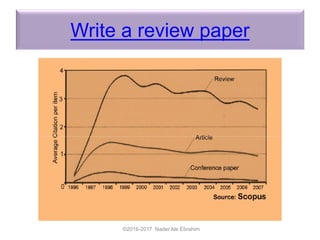
Write a review paper
©2016-2017 Nader Ale Ebrahim
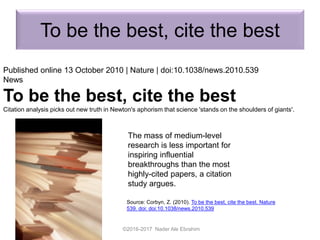
To be the best, cite the best
©2016-2017 Nader Ale Ebrahim
Published online 13 October 2010 | Nature | doi:10.1038/news.2010.539
News
To be the best, cite the best
Citation analysis picks out new truth in Newton's aphorism that science 'stands on the shoulders of giants'.
The mass of medium-level
research is less important for
inspiring influential
breakthroughs than the most
highly-cited papers, a citation
study argues.
Source: Corbyn, Z. (2010). To be the best, cite the best. Nature
539. doi: doi:10.1038/news.2010.539
Co-authorship internationally
• Citation analysis shows that papers
with international co-authors are cited
up to four times more often than
those without international co-
authors.
©2016-2017 Nader Ale Ebrahim
Source: http://www.bath.ac.uk/library/services/eprints/improve-citations.pdf
Publish your work in a journal with
the highest number of indexing
1. ABI/INFORM
2. Association of Business Schools' (ABI) Academic Journal Quality Guide (www.the-abs.org.uk)
3. Australian Business Deans' Council (ABDC) Journal Quality List
4. Australian Research Council ERA Ranked Journal List
5. Compendex
6. Computer Abstracts International Database
7. Current Contents / Engineering, Computing & Technology
8. Current Contents / Social & Behavioural Sciences
9. Emerald Management Reviews (EMR)
10. INSPEC Abstracts
11. International Abstracts in Operations Research
12. OR/MS Index and Annual Comprehensive Index
13. Science Citation Index
14. Social Science Citation Index
15. SCOPUS
16. Zentralblatt MATH
• Source: Journal of the Operational Research Society
©2016-2017 Nader Ale Ebrahim
Publish in an Open Access (OA)
journal
• One key request of researchers across the world
is unrestricted access to research publications.
Open access gives a worldwide audience larger
than that of any subscription-based journal and
thus increases the visibility and impact of
published works. It also enhances indexing,
retrieval power and eliminates the need for
permissions to reproduce and distribute content.
©2016-2017 Nader Ale Ebrahim
Publish in a journal with high
impact factor
• The most effective strategy to increase
citation rates is publishing in a journal with
higher impact factor (Vanclay 2013).
• Dhawan and Gupta (2005) studied 1101
papers and found that articles published in
high impact factor journals increase the
probability of getting cited.
©2016-2017 Nader Ale Ebrahim
Read more: Ale Ebrahim, N., Salehi, H., Embi, M. A., Habibi Tanha, F., Gholizadeh, H., Motahar, S. M., & Ordi, A. (2013).
Effective Strategies for Increasing Citation Frequency. International Education Studies, 6(11), 93-99. doi:
10.5539/ies.v6n11p93
Self-archive articles
• Free online availability increases a paper's
impact (Lawrence 2001);
• Freely accessible articles increase
citations by 50% or more (Harnad 2006).
• Gargouri et al. (2010) have made a strong
and a declarative link between self-
archiving and increased citation
performance.
©2016-2017 Nader Ale Ebrahim
Read more: Ale Ebrahim, N., Salehi, H., Embi, M. A., Habibi Tanha, F., Gholizadeh, H., Motahar, S. M., & Ordi, A. (2013).
Effective Strategies for Increasing Citation Frequency. International Education Studies, 6(11), 93-99. doi:
10.5539/ies.v6n11p93
Join academic social networking
• Increasing the availability of articles through social
networking sites broadens dissemination, increases use,
and enhances professional visibility.
• Academica is an online social reference tool that allows
reference sharing among academics and researchers.
Alternatively, researchers may use Citeulike to share
their interests in research publications (Wong 2008).
Academica, Citeulike, ResearchGate and Linkedin are
just a few examples of knowledge sharing tools to make
others aware of research articles that may be of
relevance to authors and hence get cited.
©2016-2017 Nader Ale Ebrahim
Read more: Ale Ebrahim, N., Salehi, H., Embi, M. A., Habibi Tanha, F., Gholizadeh, H., Motahar, S. M., & Ordi, A. (2013).
Effective Strategies for Increasing Citation Frequency. International Education Studies, 6(11), 93-99. doi:
10.5539/ies.v6n11p93
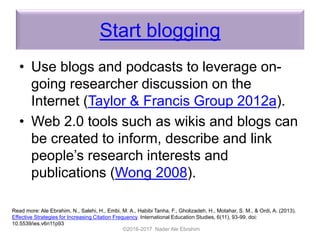
Start blogging
• Use blogs and podcasts to leverage on-
going researcher discussion on the
Internet (Taylor & Francis Group 2012a).
• Web 2.0 tools such as wikis and blogs can
be created to inform, describe and link
people’s research interests and
publications (Wong 2008).
©2016-2017 Nader Ale Ebrahim
Read more: Ale Ebrahim, N., Salehi, H., Embi, M. A., Habibi Tanha, F., Gholizadeh, H., Motahar, S. M., & Ordi, A. (2013).
Effective Strategies for Increasing Citation Frequency. International Education Studies, 6(11), 93-99. doi:
10.5539/ies.v6n11p93
©2016-2017 Nader Ale Ebrahim
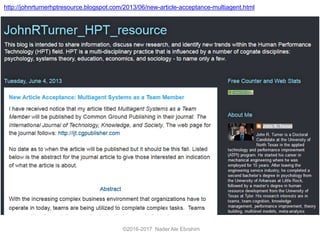
http://johnrturnerhptresource.blogspot.com/2013/06/new-article-acceptance-multiagent.html
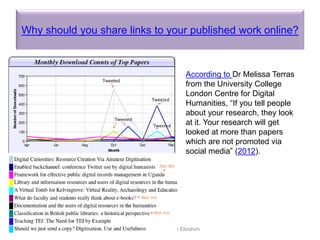
Why should you share links to your published work online?
©2016-2017 Nader Ale Ebrahim
According to Dr Melissa Terras
from the University College
London Centre for Digital
Humanities, “If you tell people
about your research, they look
at it. Your research will get
looked at more than papers
which are not promoted via
social media” (2012).
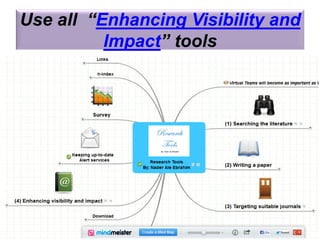
Use all “Enhancing Visibility and
Impact” tools
©2016-2017 Nader Ale Ebrahim
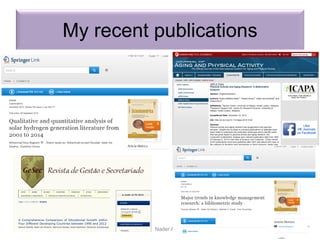
My recent publications
©2016-2017 Nader Ale Ebrahim
Questions?
E-mail: aleebrahim@um.edu.my
Twitter: @aleebrahim
www.researcherid.com/rid/C-2414-2009
http://scholar.google.com/citations
Nader Ale Ebrahim, PhD
=====================================
Research Support Unit
Centre for Research Services
Research Management & Innovation Complex
University of Malaya, Kuala Lumpur, Malaysia
www.researcherid.com/rid/C-2414-2009
http://scholar.google.com/citations
RESEARCH SUPPORT UNIT (RSU)
CENTRE FOR RESEARCH SERVICES
RESEARCH MANAGEMENT & INNOVATION COMPLEX (IPPP)
UNIVERSITY OF MALAYA
©2016-2017 Nader Ale Ebrahim
References
1. Akhavan, P., Ale Ebrahim, N., Fetrati, M. A., & Pezeshkan, A. (2016). Major trends in knowledge management research: a bibliometric study.
Scientometrics 1-16. doi:10.1007/s11192-016-1938-x
2. Shakiba, M., Ale Ebrahim, N., Danaee, M., Bakhtiyari, K., & Sundararajan, E. (2016). A Comprehensive Comparison of Educational Growth within Four
Different Developing Countries between 1990 and 2012. Revista de Gestão e Secretariado, 6(3), 152-174. doi:10.7769/gesec.v6i3.486
3. Müller, A. M., Ansari, P., Ale Ebrahim, N., & Khoo, S. (2015). Physical Activity and Aging Research: A Bibliometric Analysis. Journal Of Aging And
Physical Activity In Press. doi:10.1123/japa.2015-0188
4. Maghami, M., Navabi Asl, S., Rezadad, M. i., Ale Ebrahim, N., & Gomes, C. (2015). Qualitative and Quantitative Analysis of Solar hydrogen Generation
Literature From 2001 to 2014. Scientometrics 105(2), 759-771. : http://dx.doi.org/10.1007/s11192-015-1730-3
5. Ale Ebrahim, N. (2016). Microblogging for Enhancing the Research Accessibility. Retrieved from Research Support Unit, Centre for Research Services,
Institute of Research Management and Monitoring (IPPP)”, University of Malaya: https://dx.doi.org/10.6084/m9.figshare.3202093.v1
6. Ale Ebrahim, N. (2016). Establish your expertise with a science blog. Retrieved from Research Support Unit, Centre for Research Services, Institute of
Research Management and Monitoring (IPPP)”, University of Malaya: https://dx.doi.org/10.6084/m9.figshare.3185218.v1
7. Ale Ebrahim, N. (2016). Selecting a brand name for your research interest. Retrieved from Research Support Unit, Centre for Research Services,
Institute of Research Management and Monitoring (IPPP)”, University of Malaya: https://dx.doi.org/10.6084/m9.figshare.3153979.v1
8. Ale Ebrahim, N. (2016). New systems for measuring research impact. Retrieved from Research Support Unit, Centre for Research Services, Institute of
Research Management and Monitoring (IPPP)”, University of Malaya: https://dx.doi.org/10.6084/m9.figshare.3364240.v1
9. Ale Ebrahim, N. (2016). Optimize articles for search engine to improve research visibility. Retrieved from Research Support Unit, Centre for Research
Services, Institute of Research Management and Monitoring (IPPP)”, University of Malaya: https://dx.doi.org/10.6084/m9.figshare.3122038.v1
10. Ale Ebrahim, N. (2016). Maximizing Articles Citation Frequency. Retrieved from Research Support Unit, Centre for Research Services, Institute of
Research Management and Monitoring (IPPP)”, University of Malaya: https://dx.doi.org/10.6084/m9.figshare.1572226.v2
11. Martín-Martín, A., Orduna-Malea, E., Ayllón, J. M., & López-Cózar, E. D. (2016). The counting house, measuring those who count: Presence of
Bibliometrics, Scientometrics, Informetrics, Webometrics and Altmetrics in Google Scholar Citations, ResearcherID, ResearchGate, Mendeley, &
Twitter. EC3 Reseach Group: Evaluación de la Ciencia y de la Comunicación Científica Universidad de Granada and Universidad Politécnica de
Valencia (Spain), In Progress,. doi:10.13140/RG.2.1.4814.4402
12. Ale Ebrahim, N., Salehi, H., Embi, M. A., Habibi Tanha, F., Gholizadeh, H., Motahar, S. M., & Ordi, A. (2013). Effective Strategies for Increasing
Citation Frequency. International Education Studies, 6(11), 93-99. doi: 10.5539/ies.v6n11p93
13. J. Bailey. "Defending Against Plagiarism, Publishers need to be proactive about detecting and deterring copied text.," 26 November; http://www.the-
scientist.com/?articles.view/articleNo/35677/title/Defending-Against-Plagiarism/.
14. Corbyn, Z. (2010). To be the best, cite the best. Nature 539. doi: doi:10.1038/news.2010.539
15. Ale Ebrahim, N. (2013). Introduction to the Research Tools Mind Map. Research World, 10(4), 1-3. doi:10.5281/zenodo.7712©2016-2017 Nader Ale Ebrahim

Research Tools: Supporting Research and Publication

  • 1.
    Research Tools: Supporting Researchand Publication aleebrahim@um.edu.my @aleebrahim www.researcherid.com/rid/C-2414-2009 http://scholar.google.com/citations Nader Ale Ebrahim, PhD Visiting Research Fellow Research Support Unit Centre for Research Services Research Management & Innovation Complex University of Malaya, Kuala Lumpur, Malaysia 17th May 2016
  • 2.
    Introduction to the“Research Tools”: Supporting Research and Publication Nader Ale Ebrahim, PhD ===================================== Research Support Unit Centre for Research Services Research Management & Innovation Complex University of Malaya, Kuala Lumpur, Malaysia www.researcherid.com/rid/C-2414-2009 http://scholar.google.com/citations Read more: Ale Ebrahim, N., Salehi, H., Embi, M. A., Habibi Tanha, F., Gholizadeh, H., Motahar, S. M., & Ordi, A. (2013). Effective Strategies for Increasing Citation Frequency. International Education Studies, 6(11), 93-99. doi: 10.5539/ies.v6n11p93 All of my presentations are available online at: https://figshare.com/authors/Nader_Ale_Ebrahim/100797 Link to this presentation: https://dx.doi.org/10.6084/m9.figshare.3381811.v1
  • 3.
    Abstract Abstract: With the increasinguse of information and communications technology (ICT), researchers are able to use computer software tools to find, organize, manipulate, analyze, and share relevant information. However, there are hundreds of such tools to select from, for various research-related uses. I have collected over 700 research tools that can help researchers do their work efficiently. Research Tools consists of a hierarchical set of nodes. It has four main nodes: (1) Searching the literature, (2) Writing a paper, (3) Targeting suitable journals, and (4) Enhancing visibility and impact. In this presentation, the four main nodes are described. Keywords: H-index, Improve citations, Research tools, Bibliometrics, Literature review, Research visibility ©2016-2017 Nader Ale Ebrahim
  • 4.
    Problem statements The searchcan be time consuming and sometimes tedious task. How can make it easier? How do deal with situations such as: – “I just join as a new postgraduate student and I am not sure how to do a literature search” – “I have been in research for some time now but I spend a lot of time to get the articles I want” – “I am sure I have downloaded the article but I am not able to find it” – “I wanted to write a new paper, how can I manage the references in the shortest possible time?” – “I have many references, some of my old papers, and some of my current research. Sometimes, they are so many that I can’t recall where I have kept them in my folders!” – …….. – “I have written an article and I am not able to find a proper Journal” – "I want to increase the citation of my papers, how do I do?" ©2016-2017 Nader Ale Ebrahim
  • 5.
    Objectives The seminar seeksto serve the following objectives: i. To help students who seek to reduce the search time by expanding the knowledge of researchers to more effectively use the "tools" that are available through the Net. ii. To evaluate the types of literature that researchers will encounter. iii. To convert the information of the search for a written document. iv. To help researchers learn how to search and analyze the right journal to submit. v. To promote their publication for further citation. ©2016-2017 Nader Ale Ebrahim
  • 6.
    Outline 1. Introduce “ResearchTools” Mind Map 2. Developing a search strategy, Finding keyword 3. Finding proper articles, 4. Evaluate a paper/journal quality 5. To do an effective literature search 6. Keeping up-to-date (Alert system), Indexing desktop search tool 7. The paraphrasing & editing tool, Avoid plagiarism 8. Organize the references (Reference management) tool 9. Target suitable journal 10.Promote your publication to get more citation 11.Q&A ©2016-2017 Nader Ale Ebrahim
  • 7.
  • 8.
    ©2016-2017 Nader AleEbrahim What is the Altmetric donut?
  • 9.
    ©2016-2017 Nader AleEbrahim What is the average number of references for writing an article or review paper in “Economics”?
  • 10.
    Exercise • Make asentence including: “the aim of study” • Find a recent English thesis about: “Virtual Teams” ©2016-2017 Nader Ale Ebrahim
  • 11.
    Make a sentenceincluding: “the aim of study” ... Isfahan, Iran Background and Aims The aim of study was determination of the effect of ... ... postmortem macropathologic changes. The aim of study is to analyze the pathological data ... ... (NAC) are controversial. The aim of study is to compare histological grade and ... ... Federation Objectives and study: the aim of study was to compare the efficacy and ... ... Introduction and objectives: The aim of study was to evaluate the incidence of ... ... Istanbul, Turkey Objectives: The aim of study was to evaluate the effect of acid ... ... has been considered as a futile (1). The aim of study was obtaining information concerning ... ... Medical Academy Summary (4 lines): The aim of study is to estimate diagnostic values of ... ... medicine, RAKUS, Riga, Latvia The aim of study was to compare the effectiveness of ... ©2016-2017 Nader Ale Ebrahim
  • 12.
    Recent English thesisabout: “Virtual Teams” ©2016-2017 Nader Ale Ebrahim
  • 13.
    Research Tools MindMap ©2016-2017 Nader Ale Ebrahim
  • 14.
    Developing a searchstrategy, Finding keyword
  • 15.
    Keywords and KeywordsPlus® Authors sometimes provide a list of keywords or terms that they feel best represent the content of their paper. These keywords are contained in the ISI record (1991 data forward, depending on the database) for each article and are searchable. In addition, ISI generates KeyWords Plus for many articles. KeyWords Plus are words or phrases that frequently appear in the titles of an article's references, but do not necessarily appear in the title of the article itself. KeyWords Plus may be present for articles that have no author keywords, or may include important terms not listed among the title, abstract, or author keywords. Source: http://wos.isitrial.com/help/helpdefs.html ©2016-2017 Nader Ale Ebrahim
  • 16.
  • 17.
  • 18.
    Finding proper articles & Evaluatea paper/journal quality & To do an effective literature search
  • 19.
    Research Quality Measures Threekey measures of research impact are: 1. Quality of the journal – journal rankings, impact factors 2. Quality of the publication/article = times cited as found in tools like Web of Science, Scopus and Google Scholar 3. Personal or departmental measure = h- index ©2016-2017 Nader Ale Ebrahim Source: http://guides.library.vu.edu.au/content.php?pid=251876&sid=2079929
  • 20.
    Critically Analyzing InformationSources 1- Initial Appraisal: Author Date of Publication Edition or Revision Publisher Title of Journal (Distinguishing Scholarly Journals from other Periodicals) 2- Content Analysis: Intended Audience Objective Reasoning Coverage Writing Style Evaluative Reviews ©2016-2017 Nader Ale Ebrahim
  • 21.
  • 22.
  • 23.
    Paper/journal quality • Anotherguide to paper/journal quality is the general reputation of the association, society, or organization publishing the journal. • Leading professional associations such as American Psychological Association (APA) or the Institute of Electrical and Electronics Engineers (IEEE) publish a range of journals that are highly regarded. ©2016-2017 Nader Ale Ebrahim
  • 24.
    How to doan Effective Literature Search? Application Training Module Series I by Customer Education Team ts.training.asia@thomson.com Stop Searching, Start Discovering For More Info.
  • 25.
    Keeping up-to-date (Alertsystem) & Indexing desktop search tool
  • 26.
    Keeping up-to-date Alert servicesare an effective means of keeping track of the latest research. ©2016-2017 Nader Ale Ebrahim
  • 27.
    Keeping up-to-date Create aGoogle Alert • Enter the topic you wish to monitor. • Search terms: • Type: • How often: • Email length: • Your email: ©2016-2017 Nader Ale Ebrahim
  • 28.
    Keeping up-to-date ©2016-2017 NaderAle Ebrahim Scopus Citation Tracker
  • 29.
    Conference Alerts ©2016-2017 NaderAle Ebrahim AllConferencealerts.com - Conference call for research papers IEEE Conference Alerts
  • 30.
  • 31.
  • 32.
    The paraphrasing &editing tool, & Avoid plagiarism
  • 33.
  • 34.
    WhiteSmoke Writer Ginger Proofreader MicrosoftWord Google Docs Office Live Adobe Acrobat Professional DropBox ©2016-2017 Nader Ale Ebrahim
  • 35.
  • 36.
  • 37.
    How do Iavoid plagiarism? • only hand in your own and original work. • indicate precisely and accurately when you have used information provided by someone else, i.e. referencing must be done in accordance with a recognised system. • indicate whether you have downloaded information from the Internet. • never use someone else’s electronic storage media, artwork, pictures or graphics as if it were your own. • never copy directly without crediting the source • do not translate without crediting the source • do not paraphrase someone else’s work without crediting the source • do not piece together sections of the work of others into a new whole • do not resubmit your own or other’s previously graded work • do not commit collusion (unauthorised collaboration, presenting work as one’s own independent work, when it has been produced in whole or in part in collusion with other people) • ghost-writing – you should not make use of ghost writers or professional agencies in the production of your work or submit material which has been written on your behalf ©2016-2017 Nader Ale Ebrahim
  • 38.
    10 Major sourceof plagiarism 1. Replication: Submitting a paper to multiple publications in an attempt to get it published more than once 2. Duplication: Re-using work from one’s own previous studies and papers without attribution 3. Secondary Source: Using a secondary source, but only citing the primary sources contained within the secondary one 4. Misleading Attribution: Removing an author’s name, despite significant contributions; an inaccurate or insufficient list of authors who contributed to a manuscript 5. Invalid Source: Referencing either an incorrect or nonexistent source 6. Paraphrasing: Taking the words of another and using them alongside original text without attribution 7. Repetitive Research: Repeating data or text from a similar study with a similar methodology in a new study without proper attribution 8. Unethical Collaboration: Accidentally or intentionally use each other’s written work without proper attribution; when people who are working together violate a code of conduct 9. Verbatim: copying of another’s words and works without providing proper attribution, indentation or quotation marks 10. Complete: Taking a manuscript from another researcher and resubmitting it under one’s own name ©2016-2017 Nader Ale Ebrahim Source: .iThenticate (2013) SURVEY SUMMARY | Research Ethics: Decoding Plagiarism and Attribution in Research
  • 39.
    Penalty for Plagiarism Outsideof academia the problem of plagiarism continues to generate headlines and scandals for politicians. In Germany, two prominent cabinet members have been forced to step down due to allegations of plagiarism in their doctoral dissertations. Meanwhile, in Canada, the head of the nation’s largest school district was forced to resign in the face of plagiarism allegations, and plagiarism scandals have also embroiled a senator in the Philippines, the prime minister of Romania, and several members of the Russian Duma. ©2016-2017 Nader Ale Ebrahim Source: J. Bailey. "Defending Against Plagiarism, Publishers need to be proactive about detecting and deterring copied text.," 26 November; http://www.the-scientist.com/?articles.view/articleNo/35677/title/Defending-Against-Plagiarism/.
  • 40.
  • 41.
  • 42.
    ©2016-2017 Nader AleEbrahim The COSMO-RS method is an advanced method for the quantitative calculation of solvation mixture thermodynamics based on quantum chemistry. It was developed by Andreas Klamt and is distributed as the software COSMOtherm by his company COSMOlogic (as well as in the form of several remakes by others). Some Nigerian researchers have used the software (without a license) and report a tremendously and completely unbelievably good correlation (r²=0.992) between the predicted results and experimental data for the logKow (octanol water partition coefficient) of ionic liquids. Source : http://scholarlyoa.com/2013/10/24/more-bad-science-in-predatory-oa-journals/
  • 43.
    Organize the references(Reference management) tool
  • 44.
    EndNote • EndNote isan almost indispensible tool for the serious researcher. And best of all, its free to all UM postgraduates! ©2016-2017 Nader Ale Ebrahim
  • 45.
  • 46.
    Where should Isubmit my publication? Springer Journal Selector βeta Journal Selector Journal Selector is the industry's leading database to all of the best peer-reviewed biomedical journals. ©2016-2017 Nader Ale Ebrahim
  • 47.
  • 48.
    Perfect Match: EndNote’slatest feature matches article drafts with publications ©2016-2017 Nader Ale Ebrahim
  • 49.
    Perfect Match: EndNote’slatest feature matches article drafts with publications ©2016-2017 Nader Ale Ebrahim
  • 50.
  • 51.
    Strategies for Enhancingthe Impact of Research Improving access and retrieval of your research study is the surest way to enhance its impact. Repetition, consistency, and an awareness of the intended audience form the basis of most the following strategies. Preparing for Publication Dissemination Keeping Track of Your Research ©2016-2017 Nader Ale Ebrahim Source: Washington University School of Medicine, St. Louis Missouri
  • 52.
    Select a propertitle As an author, you can dramatically improve the chances of your article being downloaded once it’s online, before you even submit it! There are three easy steps you can take to ensure it enjoys high usage: Choose a descriptive title Use appropriate keywords Write an informative abstract Source: http://www.emeraldinsight.com/authors/guides/promote/optimize1.htm ©2016-2017 Nader Ale Ebrahim
  • 53.
    Optimize Title/Abstract Step 1:Construct a clear, descriptive title In search engine terms, the title of your article is the most interesting element. The search engine assumes that the title contains all of the important words that define the topic of the piece and thus weights words appearing there most heavily. Step 2: Reiterate key phrases The next most important field is the text of the abstract itself. You should reiterate the key words or phrases from the title within the abstract itself. ©2016-2017 Nader Ale Ebrahim Source: http://authorservices.wiley.com/bauthor/seo.asp
  • 54.
    Well-Optimized Abstract: ©2016-2017 NaderAle Ebrahim Source: http://authorservices.wiley.com/bauthor/seo.asp
  • 55.
    Poorly Optimized Abstract: ©2016-2017Nader Ale Ebrahim Source: http://authorservices.wiley.com/bauthor/seo.asp
  • 56.
    Compare Keywords “Senior Population”with “Aged” ©2016-2017 Nader Ale Ebrahim
  • 57.
    Compare Keywords “Senior Population”with “Aged” ©2016-2017 Nader Ale Ebrahim
  • 58.
    Titles: be simpleand specific • Use active rather than passive verbs. • Avoid words that don’t add to the story such as: “on this”, “study”, and “investigation”. • Be specific in delivering your message: • Not every reader may know what Akt and Foxo1 are, but the title is declarative and specific. “But don’t be too specific”. • When possible, avoid acronyms and other jargon, which renders the title opaque to readers not already conversant in the field. • Avoid question marks: titles should present outcomes, without teasing the reader. • Focus on what is novel in the work. • Avoid complex, compound nouns. For example, the term “excess water-weight remover”. Source: http://blogs.nature.com/naturejobs/2015/07/10/publishing-high-impact-papers-natures-way ©2016-2017 Nader Ale Ebrahim
  • 59.
    Select/Make a brandname • Make a unique phrase that reflects author's research interest and use it throughout academic life. • Add the name of study in the title of all publications and use the same title/name consistently. ©2016-2017 Nader Ale Ebrahim Read more: Ale Ebrahim, N., Salehi, H., Embi, M. A., Habibi Tanha, F., Gholizadeh, H., Motahar, S. M., & Ordi, A. (2013). Effective Strategies for Increasing Citation Frequency. International Education Studies, 6(11), 93-99. doi: 10.5539/ies.v6n11p93
  • 60.
    Write a reviewpaper ©2016-2017 Nader Ale Ebrahim
  • 61.
    To be thebest, cite the best ©2016-2017 Nader Ale Ebrahim Published online 13 October 2010 | Nature | doi:10.1038/news.2010.539 News To be the best, cite the best Citation analysis picks out new truth in Newton's aphorism that science 'stands on the shoulders of giants'. The mass of medium-level research is less important for inspiring influential breakthroughs than the most highly-cited papers, a citation study argues. Source: Corbyn, Z. (2010). To be the best, cite the best. Nature 539. doi: doi:10.1038/news.2010.539
  • 62.
    Co-authorship internationally • Citationanalysis shows that papers with international co-authors are cited up to four times more often than those without international co- authors. ©2016-2017 Nader Ale Ebrahim Source: http://www.bath.ac.uk/library/services/eprints/improve-citations.pdf
  • 63.
    Publish your workin a journal with the highest number of indexing 1. ABI/INFORM 2. Association of Business Schools' (ABI) Academic Journal Quality Guide (www.the-abs.org.uk) 3. Australian Business Deans' Council (ABDC) Journal Quality List 4. Australian Research Council ERA Ranked Journal List 5. Compendex 6. Computer Abstracts International Database 7. Current Contents / Engineering, Computing & Technology 8. Current Contents / Social & Behavioural Sciences 9. Emerald Management Reviews (EMR) 10. INSPEC Abstracts 11. International Abstracts in Operations Research 12. OR/MS Index and Annual Comprehensive Index 13. Science Citation Index 14. Social Science Citation Index 15. SCOPUS 16. Zentralblatt MATH • Source: Journal of the Operational Research Society ©2016-2017 Nader Ale Ebrahim
  • 64.
    Publish in anOpen Access (OA) journal • One key request of researchers across the world is unrestricted access to research publications. Open access gives a worldwide audience larger than that of any subscription-based journal and thus increases the visibility and impact of published works. It also enhances indexing, retrieval power and eliminates the need for permissions to reproduce and distribute content. ©2016-2017 Nader Ale Ebrahim
  • 65.
    Publish in ajournal with high impact factor • The most effective strategy to increase citation rates is publishing in a journal with higher impact factor (Vanclay 2013). • Dhawan and Gupta (2005) studied 1101 papers and found that articles published in high impact factor journals increase the probability of getting cited. ©2016-2017 Nader Ale Ebrahim Read more: Ale Ebrahim, N., Salehi, H., Embi, M. A., Habibi Tanha, F., Gholizadeh, H., Motahar, S. M., & Ordi, A. (2013). Effective Strategies for Increasing Citation Frequency. International Education Studies, 6(11), 93-99. doi: 10.5539/ies.v6n11p93
  • 66.
    Self-archive articles • Freeonline availability increases a paper's impact (Lawrence 2001); • Freely accessible articles increase citations by 50% or more (Harnad 2006). • Gargouri et al. (2010) have made a strong and a declarative link between self- archiving and increased citation performance. ©2016-2017 Nader Ale Ebrahim Read more: Ale Ebrahim, N., Salehi, H., Embi, M. A., Habibi Tanha, F., Gholizadeh, H., Motahar, S. M., & Ordi, A. (2013). Effective Strategies for Increasing Citation Frequency. International Education Studies, 6(11), 93-99. doi: 10.5539/ies.v6n11p93
  • 67.
    Join academic socialnetworking • Increasing the availability of articles through social networking sites broadens dissemination, increases use, and enhances professional visibility. • Academica is an online social reference tool that allows reference sharing among academics and researchers. Alternatively, researchers may use Citeulike to share their interests in research publications (Wong 2008). Academica, Citeulike, ResearchGate and Linkedin are just a few examples of knowledge sharing tools to make others aware of research articles that may be of relevance to authors and hence get cited. ©2016-2017 Nader Ale Ebrahim Read more: Ale Ebrahim, N., Salehi, H., Embi, M. A., Habibi Tanha, F., Gholizadeh, H., Motahar, S. M., & Ordi, A. (2013). Effective Strategies for Increasing Citation Frequency. International Education Studies, 6(11), 93-99. doi: 10.5539/ies.v6n11p93
  • 68.
    Start blogging • Useblogs and podcasts to leverage on- going researcher discussion on the Internet (Taylor & Francis Group 2012a). • Web 2.0 tools such as wikis and blogs can be created to inform, describe and link people’s research interests and publications (Wong 2008). ©2016-2017 Nader Ale Ebrahim Read more: Ale Ebrahim, N., Salehi, H., Embi, M. A., Habibi Tanha, F., Gholizadeh, H., Motahar, S. M., & Ordi, A. (2013). Effective Strategies for Increasing Citation Frequency. International Education Studies, 6(11), 93-99. doi: 10.5539/ies.v6n11p93
  • 69.
    ©2016-2017 Nader AleEbrahim http://johnrturnerhptresource.blogspot.com/2013/06/new-article-acceptance-multiagent.html
  • 70.
    Why should youshare links to your published work online? ©2016-2017 Nader Ale Ebrahim According to Dr Melissa Terras from the University College London Centre for Digital Humanities, “If you tell people about your research, they look at it. Your research will get looked at more than papers which are not promoted via social media” (2012).
  • 71.
    Use all “EnhancingVisibility and Impact” tools ©2016-2017 Nader Ale Ebrahim
  • 72.
  • 73.
    Questions? E-mail: aleebrahim@um.edu.my Twitter: @aleebrahim www.researcherid.com/rid/C-2414-2009 http://scholar.google.com/citations NaderAle Ebrahim, PhD ===================================== Research Support Unit Centre for Research Services Research Management & Innovation Complex University of Malaya, Kuala Lumpur, Malaysia www.researcherid.com/rid/C-2414-2009 http://scholar.google.com/citations RESEARCH SUPPORT UNIT (RSU) CENTRE FOR RESEARCH SERVICES RESEARCH MANAGEMENT & INNOVATION COMPLEX (IPPP) UNIVERSITY OF MALAYA ©2016-2017 Nader Ale Ebrahim
  • 74.
    References 1. Akhavan, P.,Ale Ebrahim, N., Fetrati, M. A., & Pezeshkan, A. (2016). Major trends in knowledge management research: a bibliometric study. Scientometrics 1-16. doi:10.1007/s11192-016-1938-x 2. Shakiba, M., Ale Ebrahim, N., Danaee, M., Bakhtiyari, K., & Sundararajan, E. (2016). A Comprehensive Comparison of Educational Growth within Four Different Developing Countries between 1990 and 2012. Revista de Gestão e Secretariado, 6(3), 152-174. doi:10.7769/gesec.v6i3.486 3. Müller, A. M., Ansari, P., Ale Ebrahim, N., & Khoo, S. (2015). Physical Activity and Aging Research: A Bibliometric Analysis. Journal Of Aging And Physical Activity In Press. doi:10.1123/japa.2015-0188 4. Maghami, M., Navabi Asl, S., Rezadad, M. i., Ale Ebrahim, N., & Gomes, C. (2015). Qualitative and Quantitative Analysis of Solar hydrogen Generation Literature From 2001 to 2014. Scientometrics 105(2), 759-771. : http://dx.doi.org/10.1007/s11192-015-1730-3 5. Ale Ebrahim, N. (2016). Microblogging for Enhancing the Research Accessibility. Retrieved from Research Support Unit, Centre for Research Services, Institute of Research Management and Monitoring (IPPP)”, University of Malaya: https://dx.doi.org/10.6084/m9.figshare.3202093.v1 6. Ale Ebrahim, N. (2016). Establish your expertise with a science blog. Retrieved from Research Support Unit, Centre for Research Services, Institute of Research Management and Monitoring (IPPP)”, University of Malaya: https://dx.doi.org/10.6084/m9.figshare.3185218.v1 7. Ale Ebrahim, N. (2016). Selecting a brand name for your research interest. Retrieved from Research Support Unit, Centre for Research Services, Institute of Research Management and Monitoring (IPPP)”, University of Malaya: https://dx.doi.org/10.6084/m9.figshare.3153979.v1 8. Ale Ebrahim, N. (2016). New systems for measuring research impact. Retrieved from Research Support Unit, Centre for Research Services, Institute of Research Management and Monitoring (IPPP)”, University of Malaya: https://dx.doi.org/10.6084/m9.figshare.3364240.v1 9. Ale Ebrahim, N. (2016). Optimize articles for search engine to improve research visibility. Retrieved from Research Support Unit, Centre for Research Services, Institute of Research Management and Monitoring (IPPP)”, University of Malaya: https://dx.doi.org/10.6084/m9.figshare.3122038.v1 10. Ale Ebrahim, N. (2016). Maximizing Articles Citation Frequency. Retrieved from Research Support Unit, Centre for Research Services, Institute of Research Management and Monitoring (IPPP)”, University of Malaya: https://dx.doi.org/10.6084/m9.figshare.1572226.v2 11. Martín-Martín, A., Orduna-Malea, E., Ayllón, J. M., & López-Cózar, E. D. (2016). The counting house, measuring those who count: Presence of Bibliometrics, Scientometrics, Informetrics, Webometrics and Altmetrics in Google Scholar Citations, ResearcherID, ResearchGate, Mendeley, & Twitter. EC3 Reseach Group: Evaluación de la Ciencia y de la Comunicación Científica Universidad de Granada and Universidad Politécnica de Valencia (Spain), In Progress,. doi:10.13140/RG.2.1.4814.4402 12. Ale Ebrahim, N., Salehi, H., Embi, M. A., Habibi Tanha, F., Gholizadeh, H., Motahar, S. M., & Ordi, A. (2013). Effective Strategies for Increasing Citation Frequency. International Education Studies, 6(11), 93-99. doi: 10.5539/ies.v6n11p93 13. J. Bailey. "Defending Against Plagiarism, Publishers need to be proactive about detecting and deterring copied text.," 26 November; http://www.the- scientist.com/?articles.view/articleNo/35677/title/Defending-Against-Plagiarism/. 14. Corbyn, Z. (2010). To be the best, cite the best. Nature 539. doi: doi:10.1038/news.2010.539 15. Ale Ebrahim, N. (2013). Introduction to the Research Tools Mind Map. Research World, 10(4), 1-3. doi:10.5281/zenodo.7712©2016-2017 Nader Ale Ebrahim