Introduction to the
“Research Tools” for
Research Methodology course
aleebrahim@um.edu.my
@aleebrahim
www.researcherid.com/rid/C-2414-2009
http://scholar.google.com/citations
Nader Ale Ebrahim, PhD
Visiting Research Fellow
Research Support Unit
Centre for Research Services
Research Management & Innovation Complex
University of Malaya, Kuala Lumpur, Malaysia
21th April 2016
Introduction to the “Research
Tools”
Nader Ale Ebrahim, PhD
=====================================
Research Support Unit
Centre for Research Services
Research Management & Innovation Complex
University of Malaya, Kuala Lumpur, Malaysia
www.researcherid.com/rid/C-2414-2009
http://scholar.google.com/citations
Read more: Ale Ebrahim, N., Salehi, H., Embi, M. A., Habibi Tanha, F., Gholizadeh, H., Motahar, S. M., & Ordi, A. (2013). Effective
Strategies for Increasing Citation Frequency. International Education Studies, 6(11), 93-99. doi: 10.5539/ies.v6n11p93
All of my presentations are available online at:
https://figshare.com/authors/Nader_Ale_Ebrahim/100797
Link to this presentation: https://dx.doi.org/10.6084/m9.figshare.3187673.v1
Abstract
Abstract: “Research Tools” can be defined as vehicles that broadly facilitate research and
related activities. “Research Tools” enable researchers to collect, organize, analyze, visualize
and publicized research outputs. Dr. Nader has collected over 800 tools that enable students
to follow the correct path in research and to ultimately produce high-quality research outputs
with more accuracy and efficiency. It is assembled as an interactive Web-based mind map,
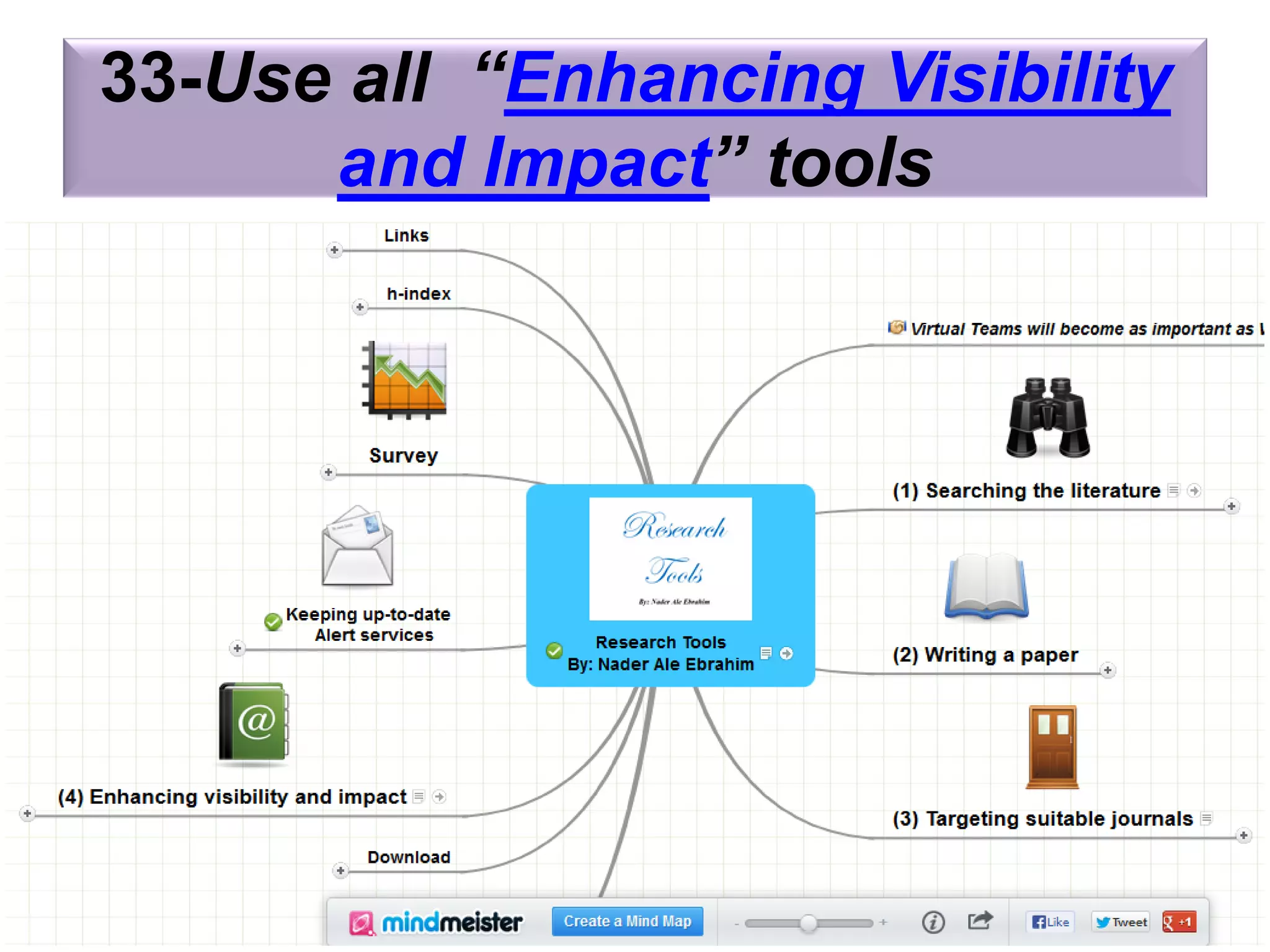
titled “Research Tools”, which is updated periodically. “Research Tools” consists of a
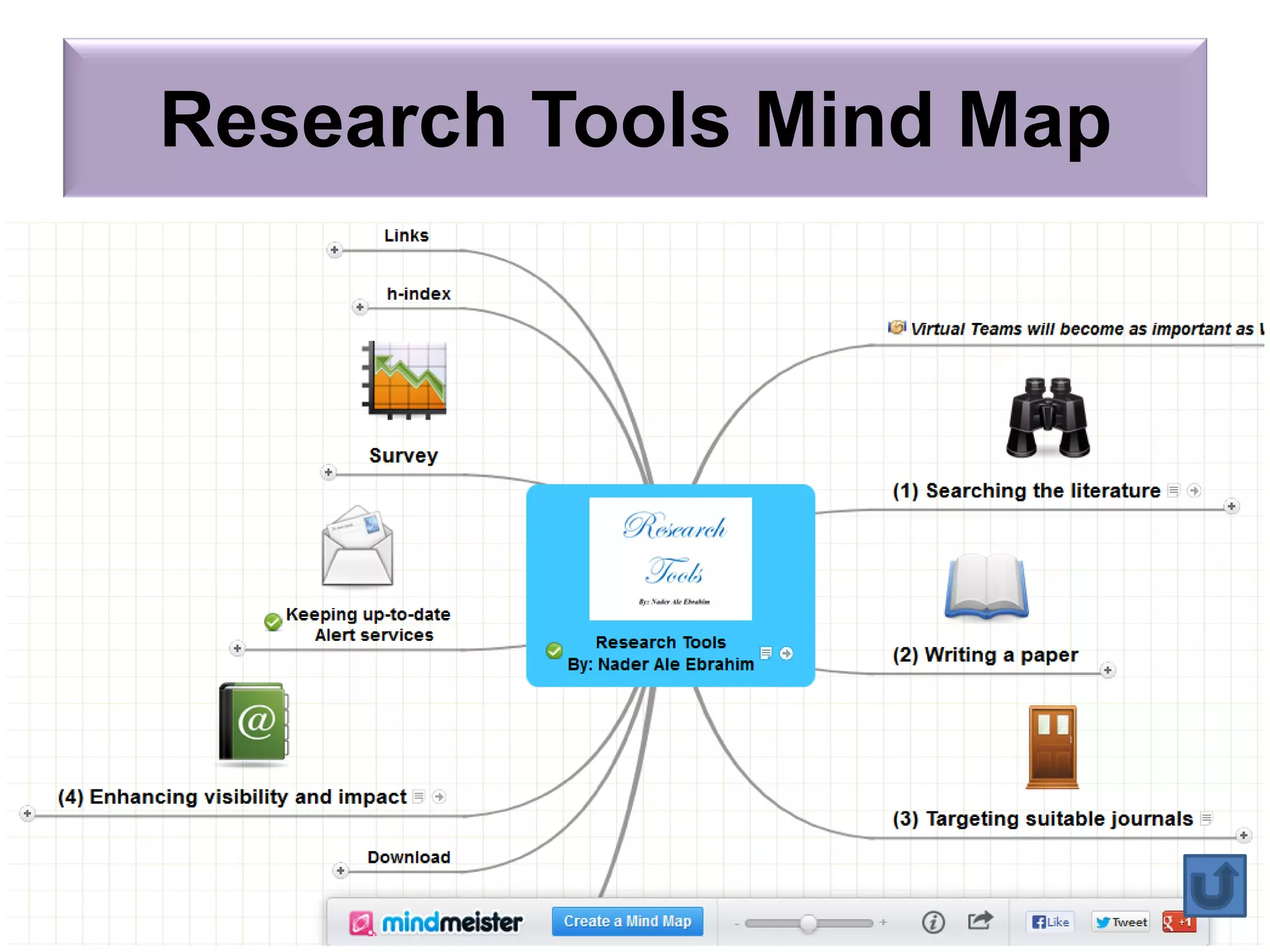
hierarchical set of nodes. It has four main nodes: (1) Searching the literature, (2) Writing a
paper, (3) Targeting suitable journals, and (4) Enhancing visibility and impact of the
research.
Keywords: H-index, Improve citations, Research tools, Bibliometrics, Literature
review Introduction to the “Research Tools” - @ Nader Ale
Ebrahim 2016
3
Problem statements
The search can be time consuming and sometimes tedious task. How
can make it easier? How do deal with situations such as:
– “I just join as a new postgraduate student and I am not sure how to do a
literature search”
– “I have been in research for some time now but I spend a lot of time to get the
articles I want”
– “I am sure I have downloaded the article but I am not able to find it”
– “I wanted to write a new paper, how can I manage the references in the shortest
possible time?”
– “I have many references, some of my old papers, and some of my current
research. Sometimes, they are so many that I can’t recall where I have kept
them in my folders!”
– ……..
– “I have written an article and I am not able to find a proper Journal”
– "I want to increase the citation of my papers, how do I do?"
Introduction to the “Research Tools” - @ Nader Ale
Ebrahim 2016
4
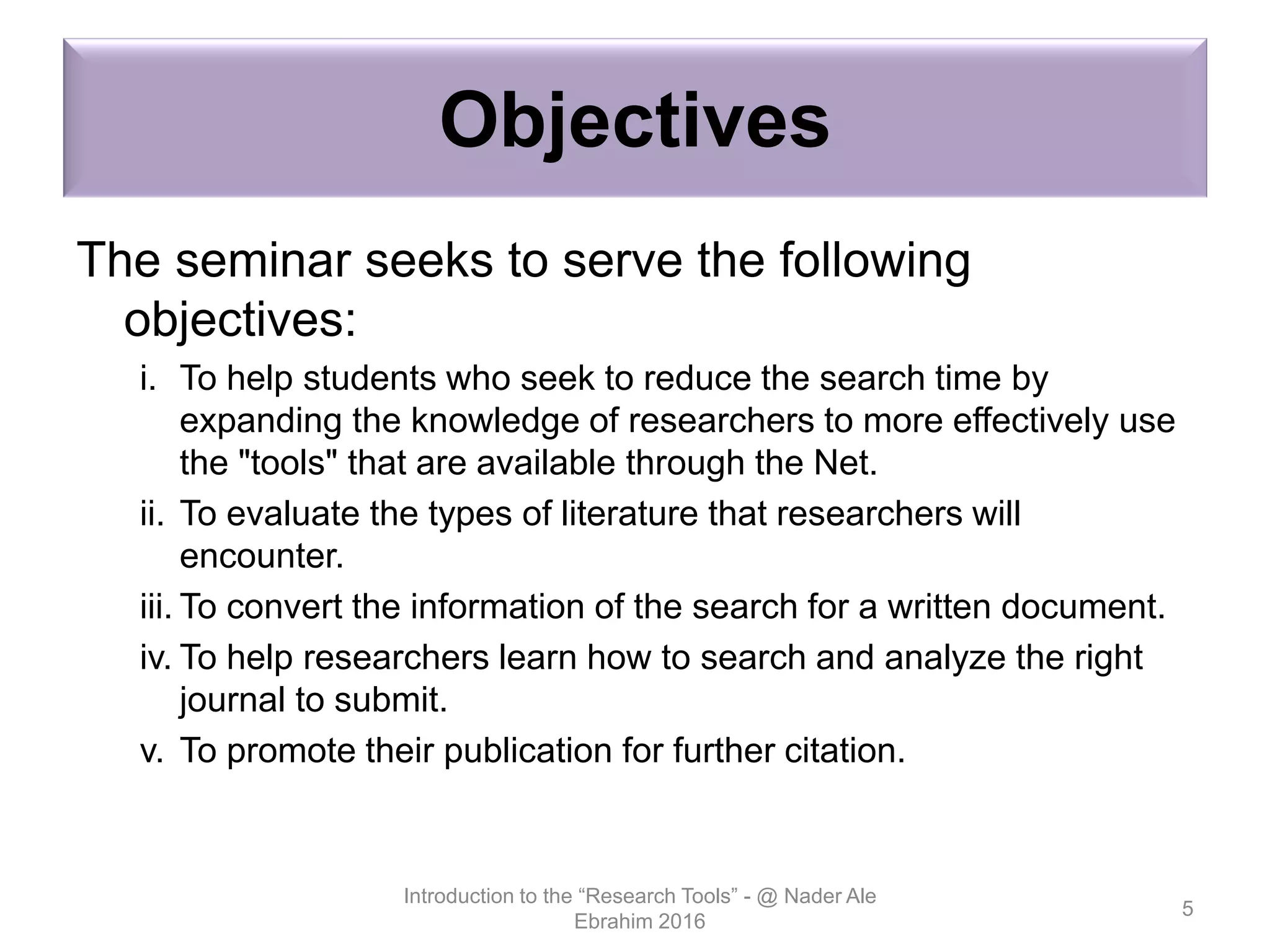
Objectives
The seminar seeks to serve the following
objectives:
i. To help students who seek to reduce the search time by
expanding the knowledge of researchers to more effectively use
the "tools" that are available through the Net.
ii. To evaluate the types of literature that researchers will
encounter.
iii. To convert the information of the search for a written document.
iv. To help researchers learn how to search and analyze the right
journal to submit.
v. To promote their publication for further citation.
Introduction to the “Research Tools” - @ Nader Ale
Ebrahim 2016
5
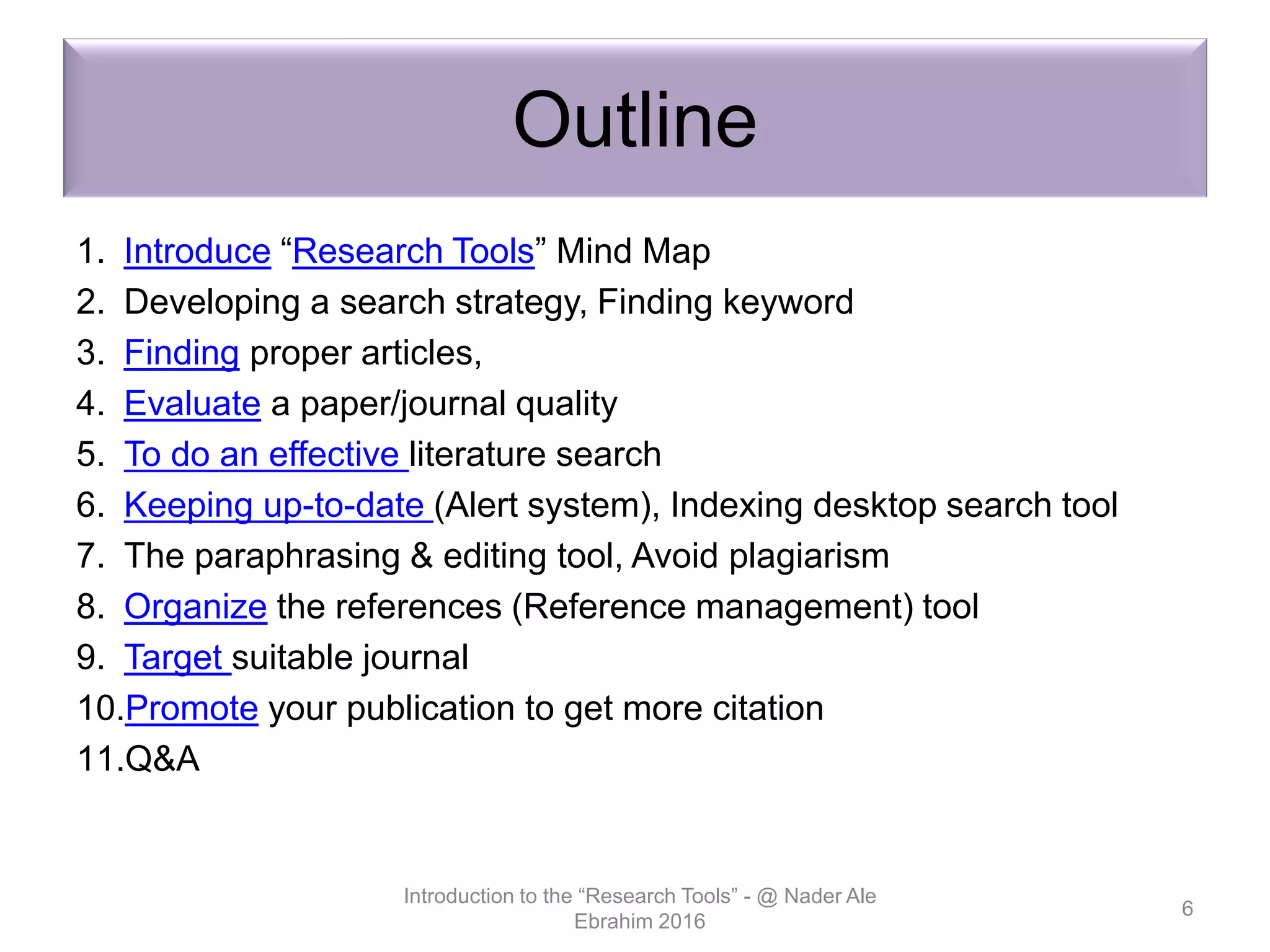
Outline
1. Introduce “Research Tools” Mind Map
2. Developing a search strategy, Finding keyword
3. Finding proper articles,
4. Evaluate a paper/journal quality
5. To do an effective literature search
6. Keeping up-to-date (Alert system), Indexing desktop search tool
7. The paraphrasing & editing tool, Avoid plagiarism
8. Organize the references (Reference management) tool
9. Target suitable journal
10.Promote your publication to get more citation
11.Q&A
Introduction to the “Research Tools” - @ Nader Ale
Ebrahim 2016
6
Introduction to the “Research Tools” - @ Nader Ale
Ebrahim 2016
7
Introduction to the “Research Tools” - @ Nader Ale
Ebrahim 2016
8
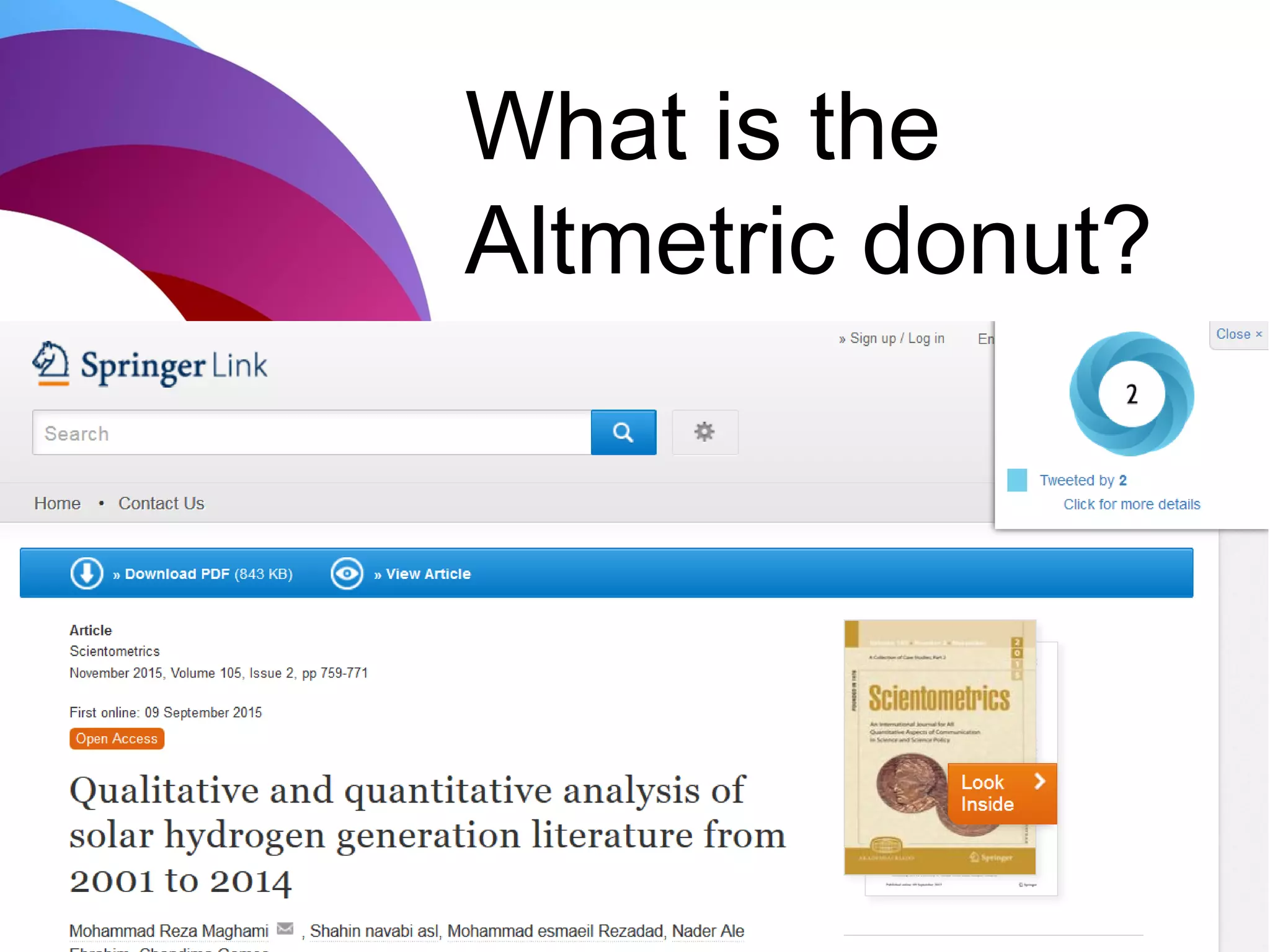
What is the
Altmetric donut?
Introduction to the “Research Tools” - @ Nader Ale
Ebrahim 2016
9
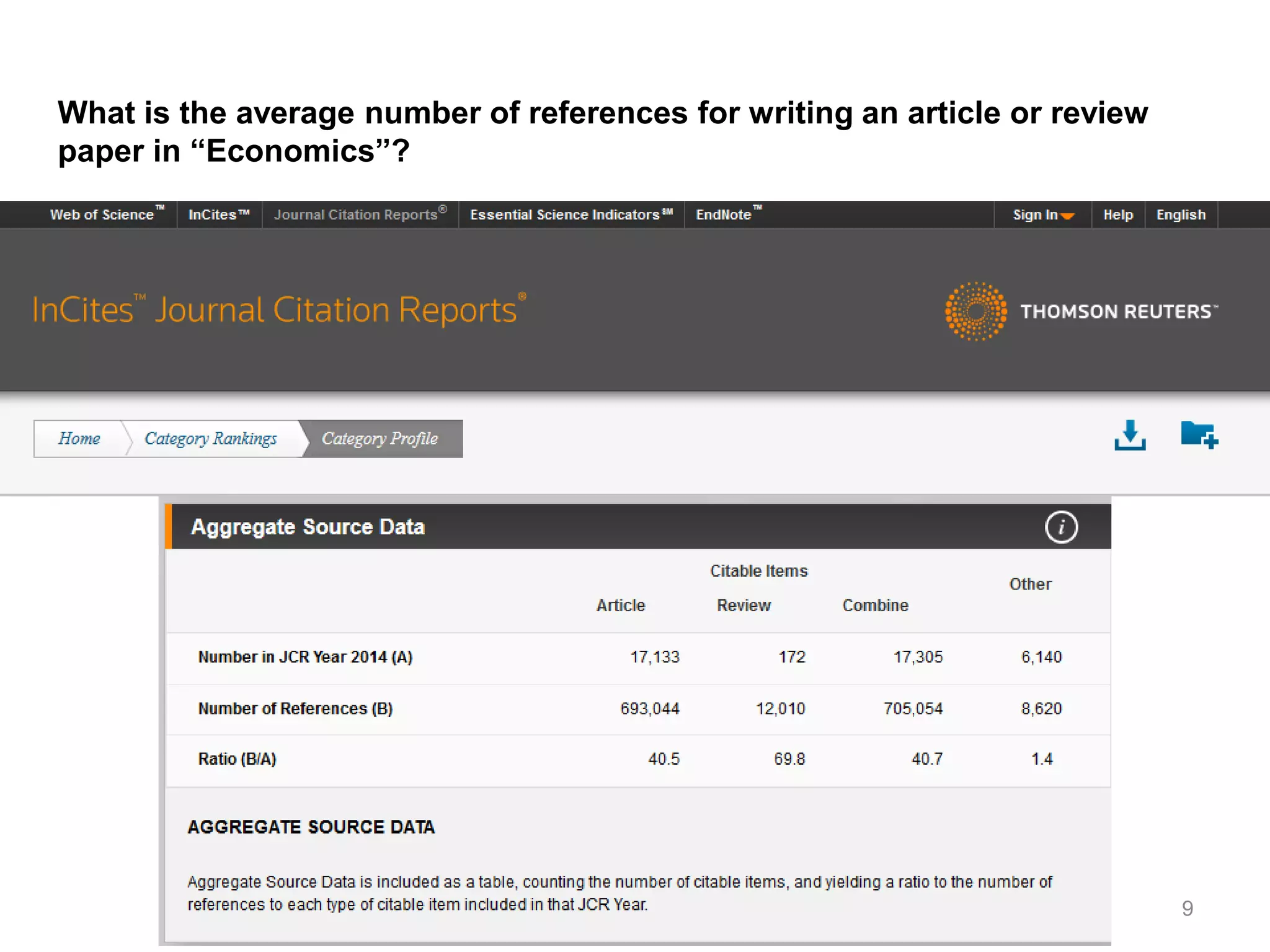
What is the average number of references for writing an article or review
paper in “Economics”?
Exercise
• Make a sentence including:
“the aim of study”
• Find a recent English thesis about:
“Virtual Teams”
Introduction to the “Research Tools” - @ Nader Ale
Ebrahim 2016
10
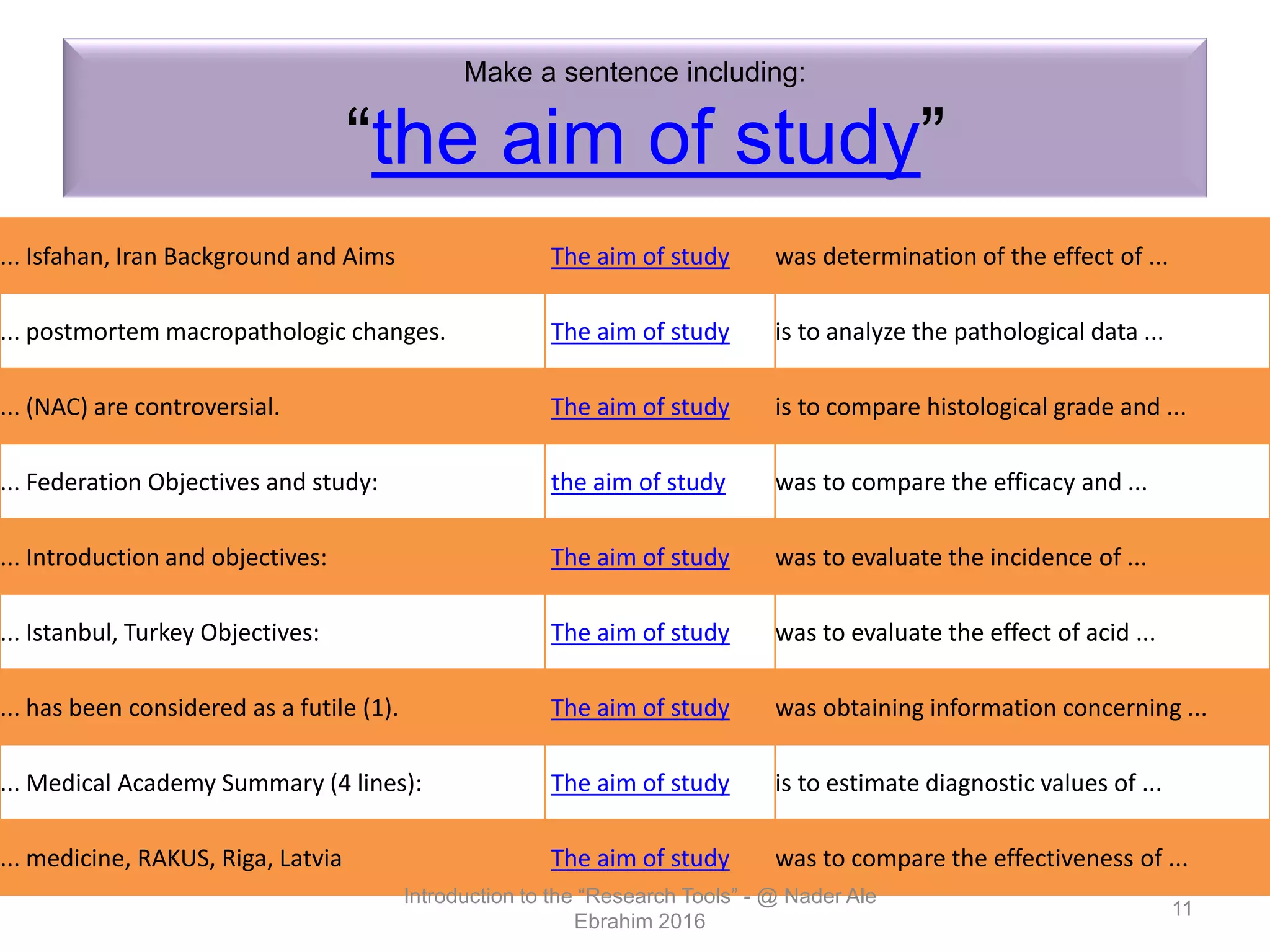
Make a sentence including:
“the aim of study”
... Isfahan, Iran Background and Aims The aim of study was determination of the effect of ...
... postmortem macropathologic changes. The aim of study is to analyze the pathological data ...
... (NAC) are controversial. The aim of study is to compare histological grade and ...
... Federation Objectives and study: the aim of study was to compare the efficacy and ...
... Introduction and objectives: The aim of study was to evaluate the incidence of ...
... Istanbul, Turkey Objectives: The aim of study was to evaluate the effect of acid ...
... has been considered as a futile (1). The aim of study was obtaining information concerning ...
... Medical Academy Summary (4 lines): The aim of study is to estimate diagnostic values of ...
... medicine, RAKUS, Riga, Latvia The aim of study was to compare the effectiveness of ...
Introduction to the “Research Tools” - @ Nader Ale
Ebrahim 2016
11
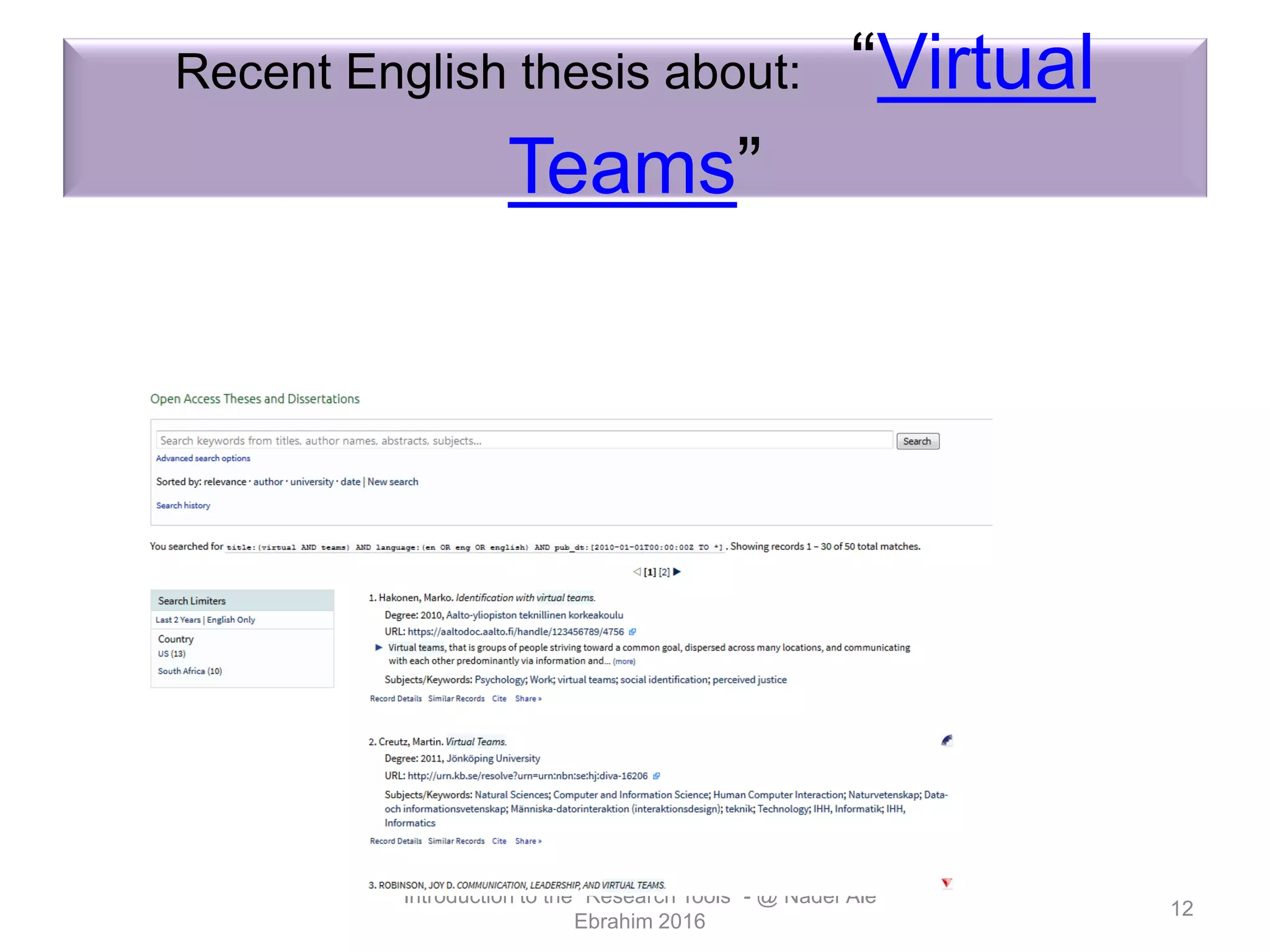
Recent English thesis about: “Virtual
Teams”
Introduction to the “Research Tools” - @ Nader Ale
Ebrahim 2016
12
Research Tools Mind Map
Introduction to the “Research Tools” - @ Nader Ale
Ebrahim 2016
13
Developing a search strategy,
Finding keyword
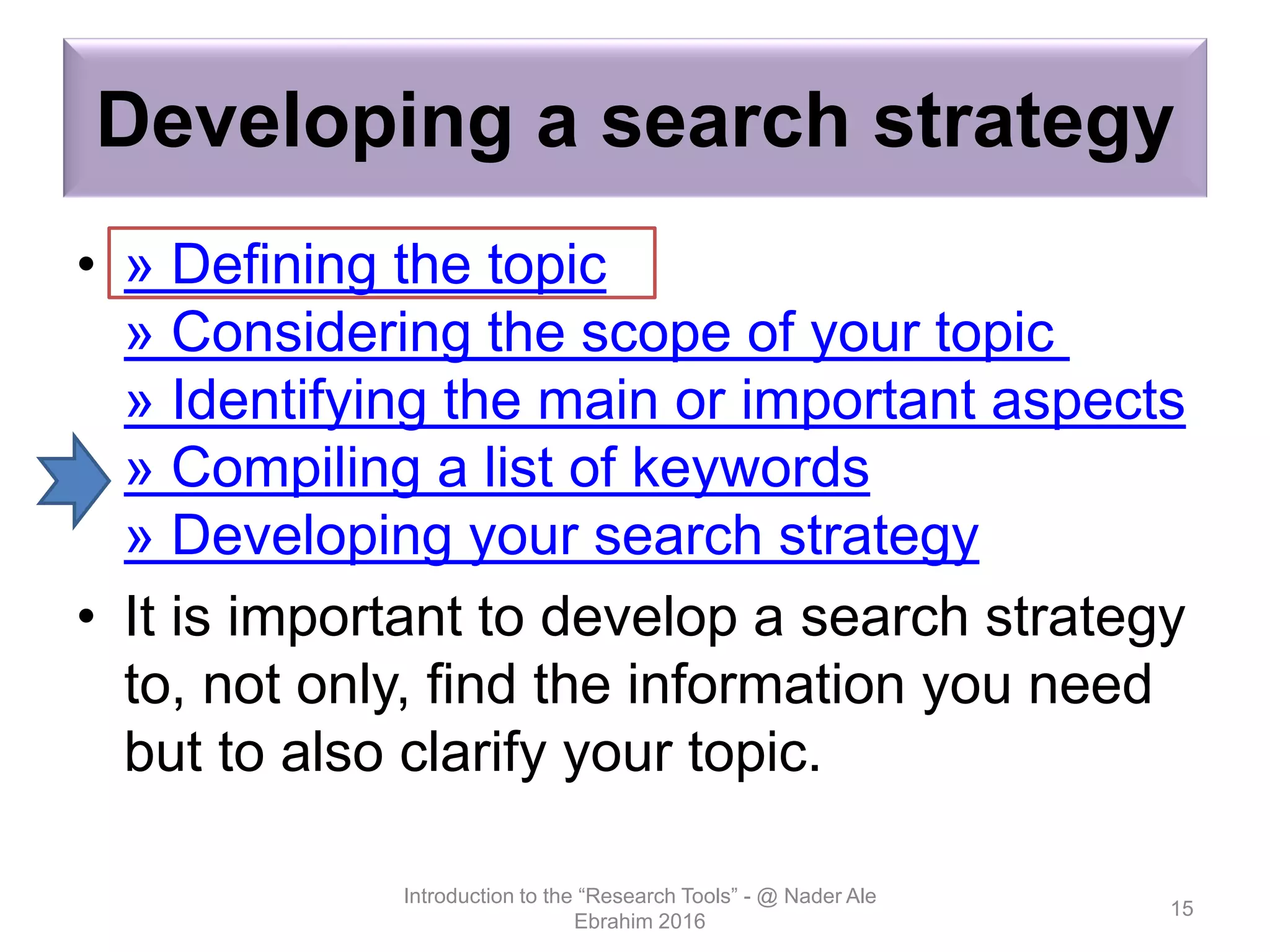
Developing a search strategy
• » Defining the topic
» Considering the scope of your topic
» Identifying the main or important aspects
» Compiling a list of keywords
» Developing your search strategy
• It is important to develop a search strategy
to, not only, find the information you need
but to also clarify your topic.
Introduction to the “Research Tools” - @ Nader Ale
Ebrahim 2016
15
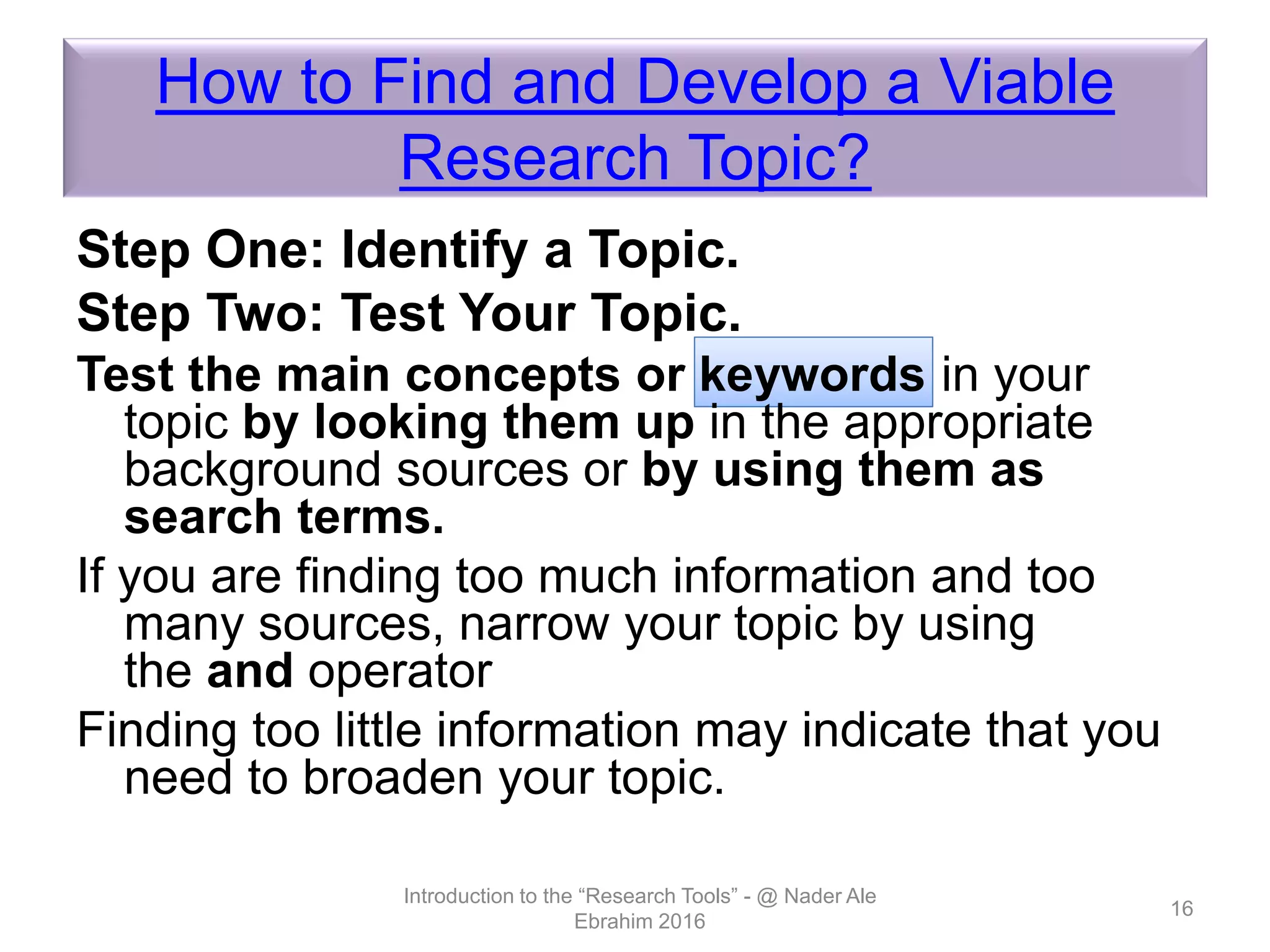
How to Find and Develop a Viable
Research Topic?
Step One: Identify a Topic.
Step Two: Test Your Topic.
Test the main concepts or keywords in your
topic by looking them up in the appropriate
background sources or by using them as
search terms.
If you are finding too much information and too
many sources, narrow your topic by using
the and operator
Finding too little information may indicate that you
need to broaden your topic.
Introduction to the “Research Tools” - @ Nader Ale
Ebrahim 2016
16
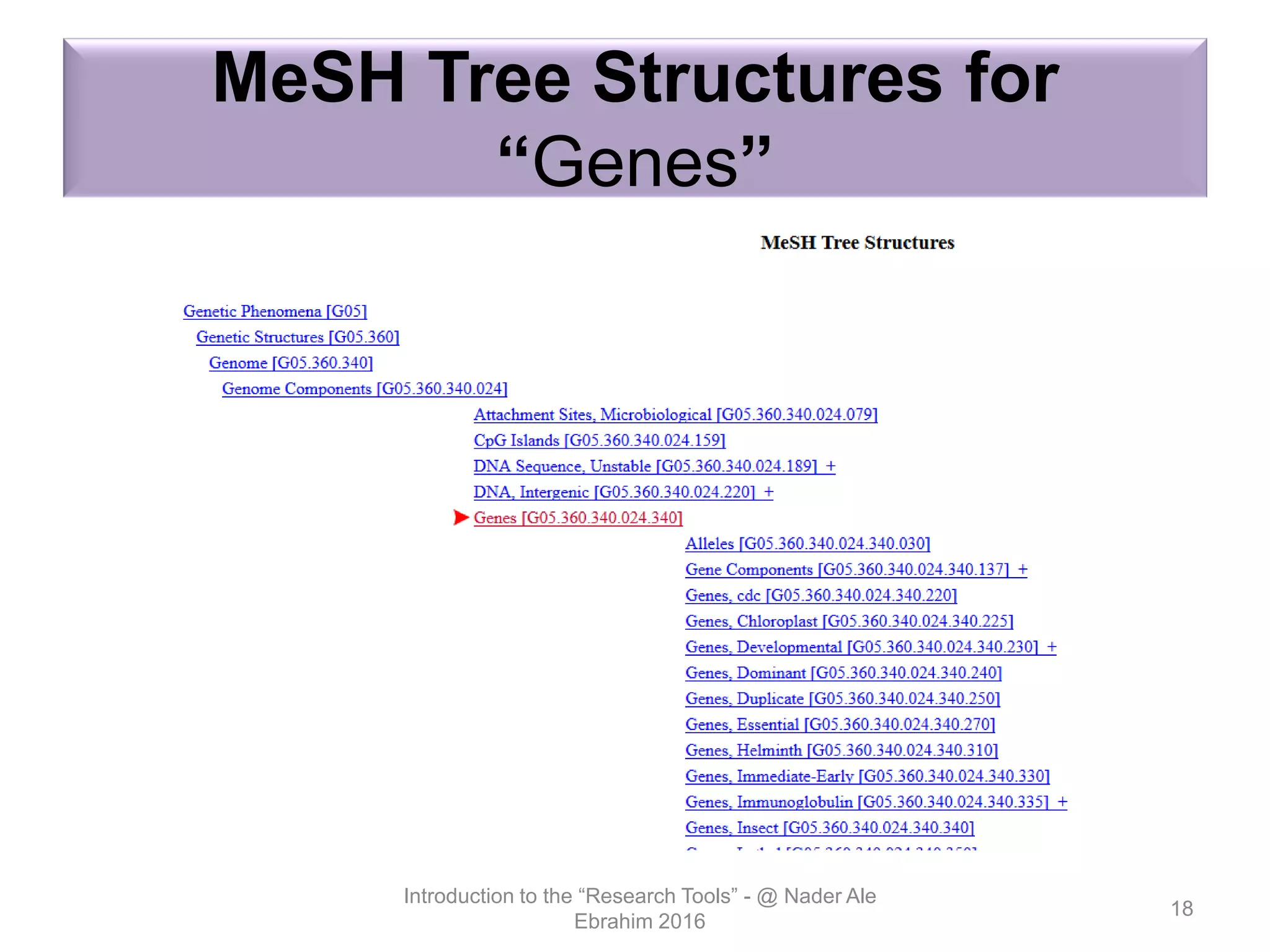
Keywords
Selecting keywords lead to get more
citation.
Introduction to the “Research Tools” - @ Nader Ale
Ebrahim 2016
17
MeSH (Medical Subject Headings)
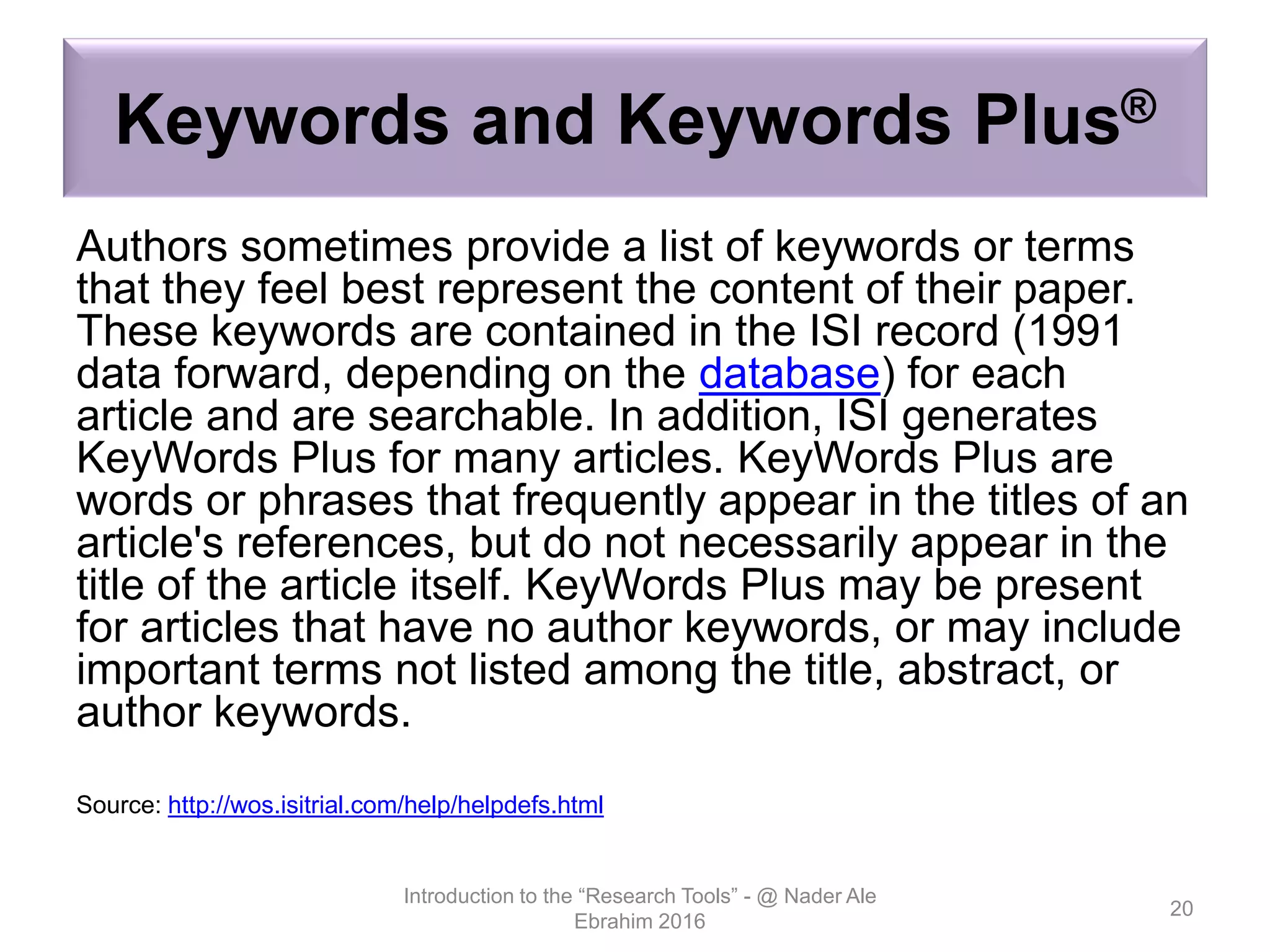
MeSH Tree Structures for
“Genes”
Introduction to the “Research Tools” - @ Nader Ale
Ebrahim 2016
18
MASTER KEYWORDS LIST
Introduction to the “Research Tools” - @ Nader Ale
Ebrahim 2016
19
Keywords and Keywords Plus®
Authors sometimes provide a list of keywords or terms
that they feel best represent the content of their paper.
These keywords are contained in the ISI record (1991
data forward, depending on the database) for each
article and are searchable. In addition, ISI generates
KeyWords Plus for many articles. KeyWords Plus are
words or phrases that frequently appear in the titles of an
article's references, but do not necessarily appear in the
title of the article itself. KeyWords Plus may be present
for articles that have no author keywords, or may include
important terms not listed among the title, abstract, or
author keywords.
Source: http://wos.isitrial.com/help/helpdefs.html
Introduction to the “Research Tools” - @ Nader Ale
Ebrahim 2016
20
KeyWords Plus
Hi there! This issue, we are going to explain how KeyWords Plus
broadens your search. KeyWords Plus is the result of our Thomson
Reuters editorial expertise in Science.
What our editors do is to review the titles of all references and
highlight additional relevant but overlooked keywords that were not
listed by the author or publisher. With KeyWords Plus, you can now
uncover more papers that may not have appeared in your search
due to changes in scientific keywords over time.
Thanks and keep your feedback and questions coming!
Smiles,
Lim Khee Hiang
Ph.D., Principal Consultant
Introduction to the “Research Tools” - @ Nader Ale
Ebrahim 2016
21
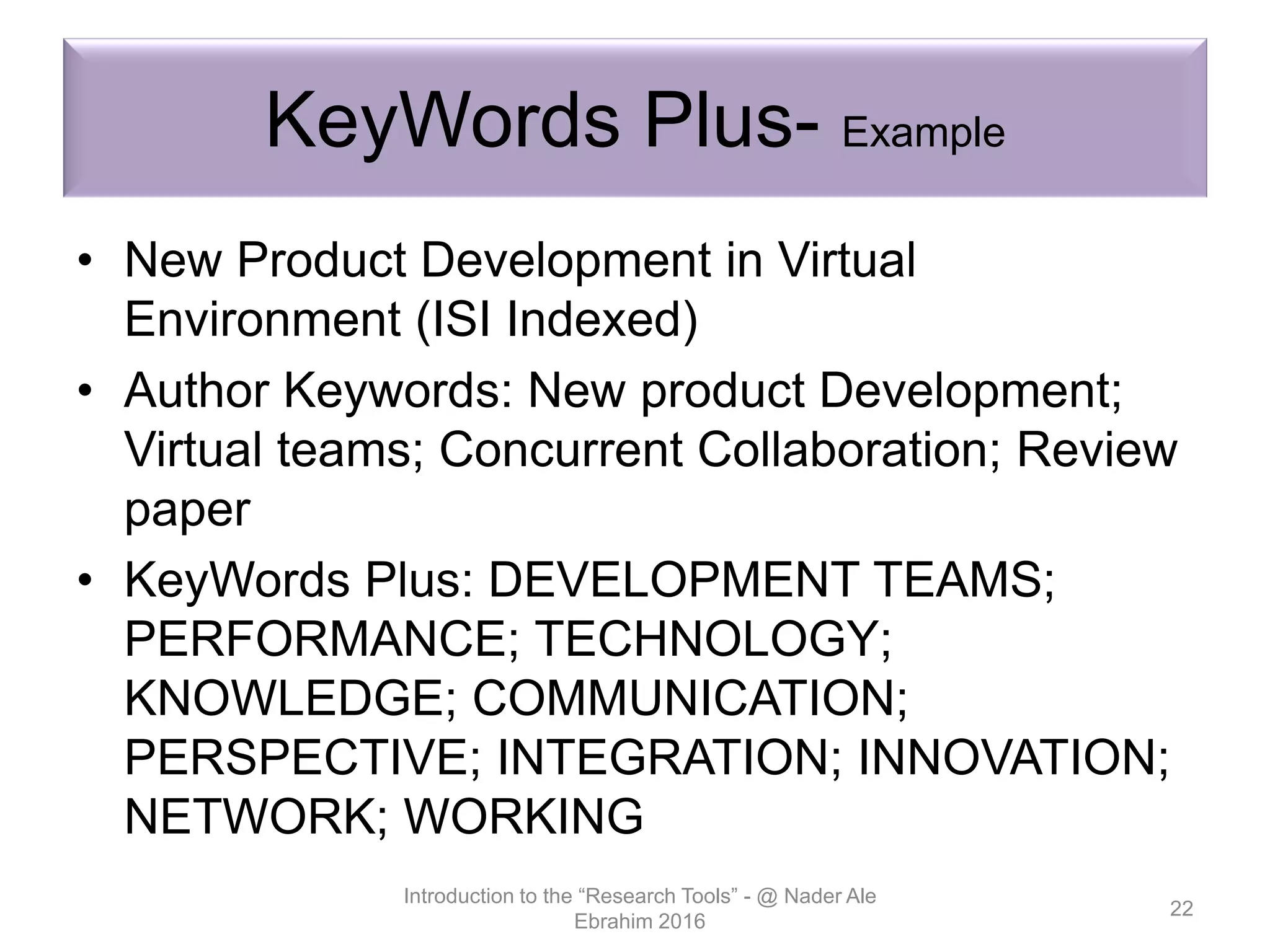
KeyWords Plus- Example
• New Product Development in Virtual
Environment (ISI Indexed)
• Author Keywords: New product Development;
Virtual teams; Concurrent Collaboration; Review
paper
• KeyWords Plus: DEVELOPMENT TEAMS;
PERFORMANCE; TECHNOLOGY;
KNOWLEDGE; COMMUNICATION;
PERSPECTIVE; INTEGRATION; INNOVATION;
NETWORK; WORKING
Introduction to the “Research Tools” - @ Nader Ale
Ebrahim 2016
22
Introduction to the “Research Tools” - @ Nader Ale
Ebrahim 2016
23
Introduction to the “Research Tools” - @ Nader Ale
Ebrahim 2016
24
Finding proper articles
&
Evaluate a paper/journal quality
&
To do an effective literature search
Research Quality Measures
Three key measures of research impact
are:
1. Quality of the journal – journal rankings,
impact factors
2. Quality of the publication/article = times
cited as found in tools like Web of Science,
Scopus and Google Scholar
3. Personal or departmental measure = h-
index
Introduction to the “Research Tools” - @ Nader Ale
Ebrahim 2016
26
Source: http://guides.library.vu.edu.au/content.php?pid=251876&sid=2079929
Critically Analyzing Information Sources
1- Initial Appraisal:
Author
Date of Publication
Edition or Revision
Publisher
Title of Journal (Distinguishing Scholarly Journals from other Periodicals)
2- Content Analysis:
Intended Audience
Objective Reasoning
Coverage
Writing Style
Evaluative Reviews
Introduction to the “Research Tools” - @ Nader Ale
Ebrahim 2016
27
h-index (Jorge E. Hirsch)
• A scientist has index h if h of [his/her]
Np papers have at least h citations each,
and the other (Np − h) papers have at most
h citations each.
Introduction to the “Research Tools” - @ Nader Ale
Ebrahim 2016
28
H-index from a plot of decreasing citations for numbered papers
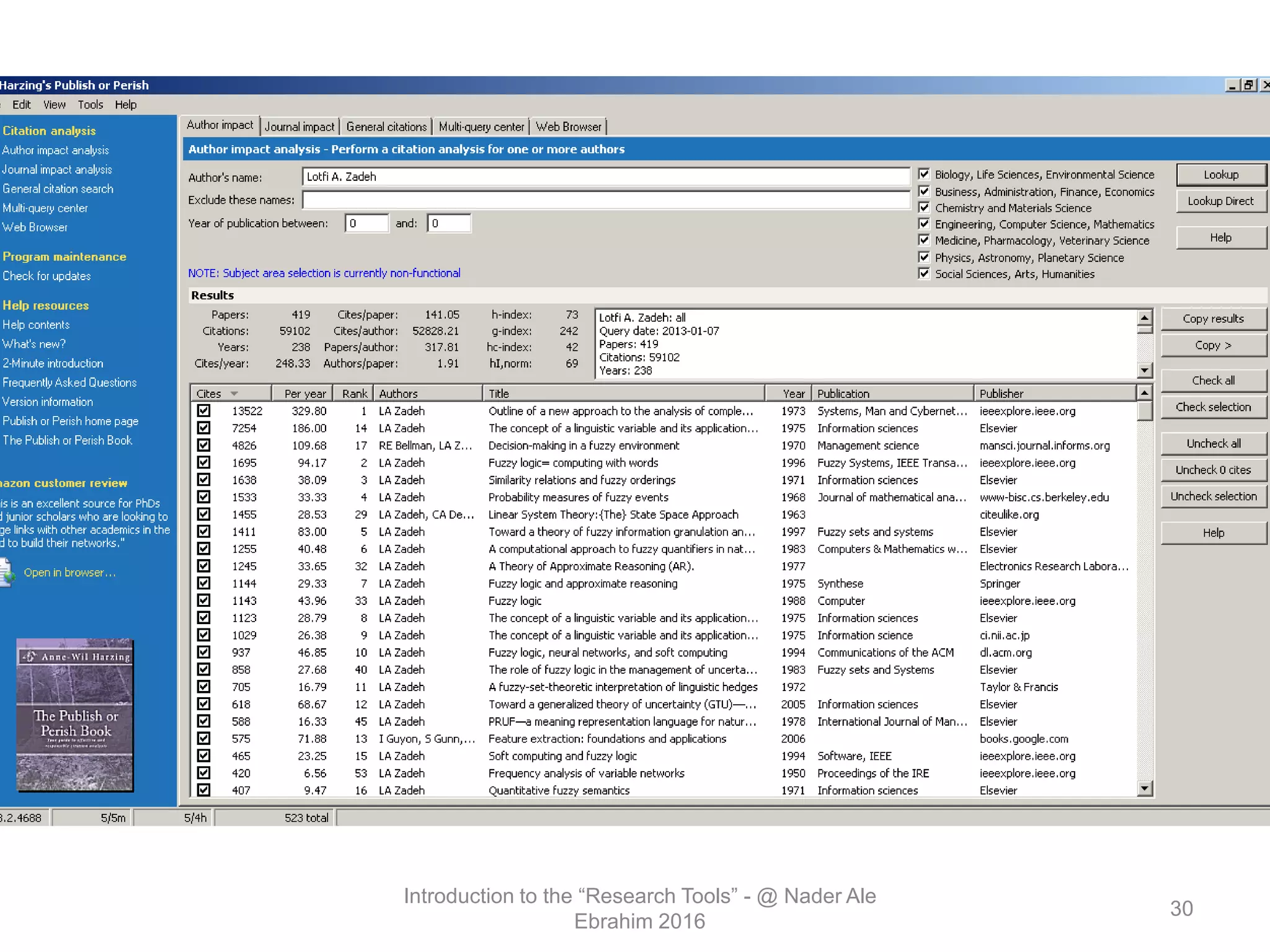
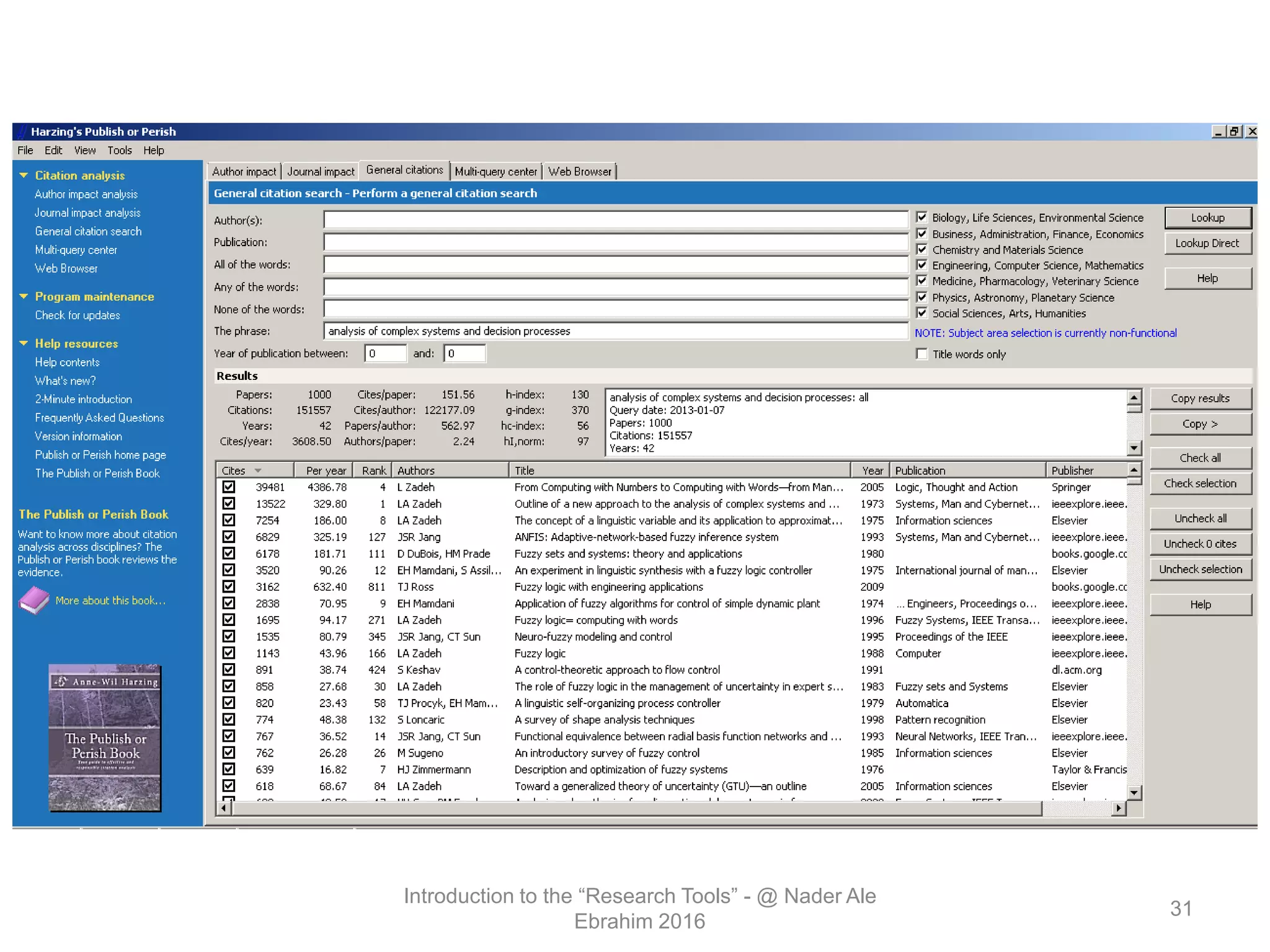
The Many and Variable Uses of Publish or Perish
(PoP)- By: Anne-Wil Harzing –” Your guide to effective and responsible citation analysis”
Academics that need to make their case for tenure or promotion will find PoP useful to
create reference groups and show their citation record to its best advantage. When
evaluating other academics, PoP can be used as a 5-minute preparation before
meeting someone you don’t know, to evaluate editorial board members or
prospective PhD supervisors, to write up tributes (or laudations) and eulogies, to
decide on publication awards and to pre-pare for a job interview. Deans and other
academic administrators will find PoP useful to evaluate tenure or promotion cases in
a fair and equitable way.
PoP can help you to do a quick literature review to identify the most cited articles
and/or scholars in a particular field. It can be used to identify whether any research
has been done in a particular area at all (useful for grant applications) or to evaluate
the development of the literature in a particular topic over time. Finally, PoP is very
well suited for doing bibliometric research on both authors and journals.
PoP can also be used to assist when you are uncertain which journal to submit it to.
You can use it to get ideas of the types of journals that publish articles on the topic
you are writing on and to compare a set of journals in terms of their citation impact.
Once you have decided on the target journal, it can also help you to double-check
that you haven’t missed any prior work from the journal in question.
Introduction to the “Research Tools” - @ Nader Ale
Ebrahim 2016
29
Introduction to the “Research Tools” - @ Nader Ale
Ebrahim 2016
30
Introduction to the “Research Tools” - @ Nader Ale
Ebrahim 2016
31
Source: Making Research Count: Analyzing Canadian Academic Publishing CulturesIntroduction to the “Research Tools” - @ Nader Ale
Ebrahim 2016
32
Introduction to the “Research Tools” - @ Nader Ale
Ebrahim 2016
33
Introduction to the “Research Tools” - @ Nader Ale
Ebrahim 2016
34
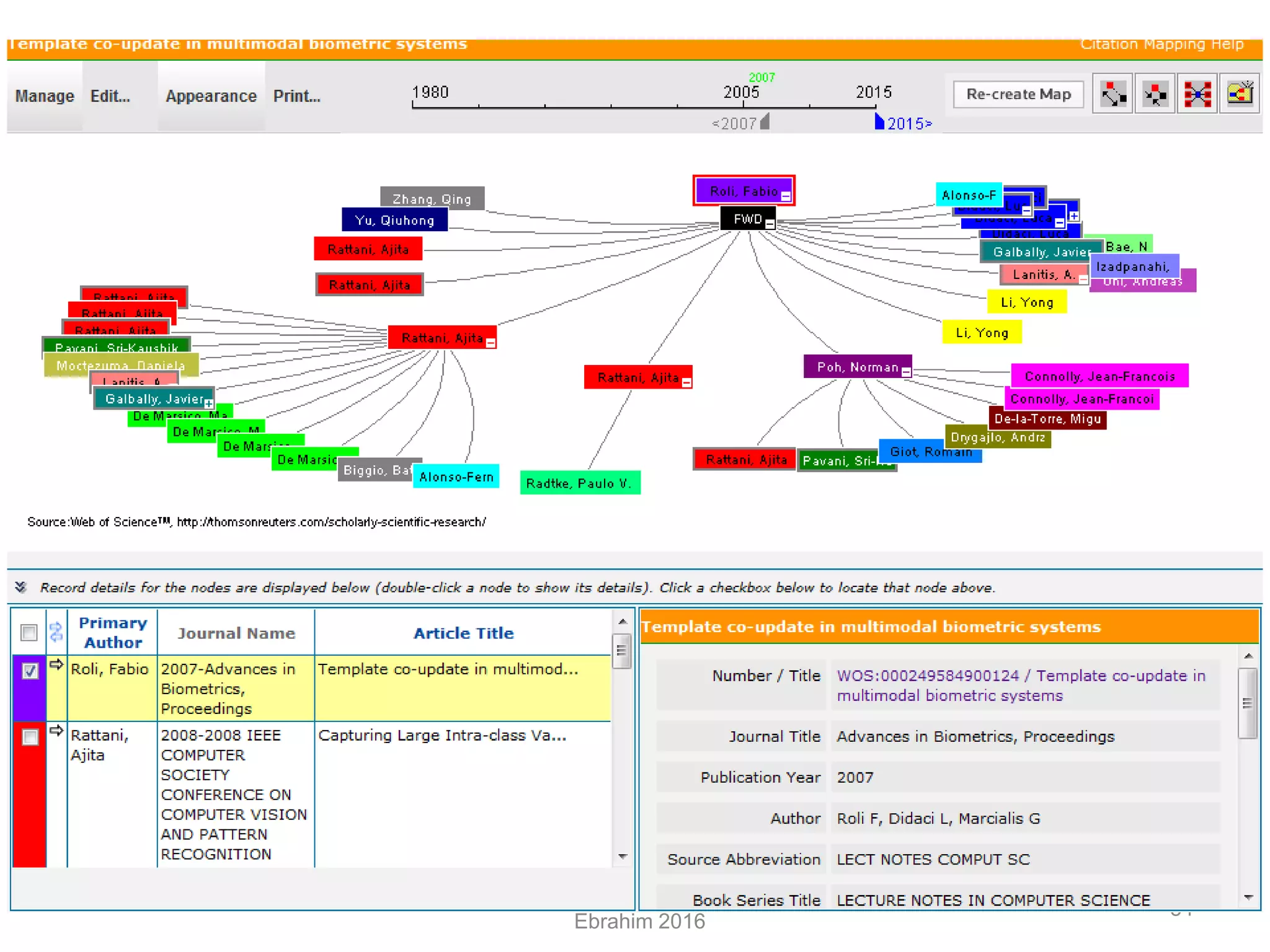
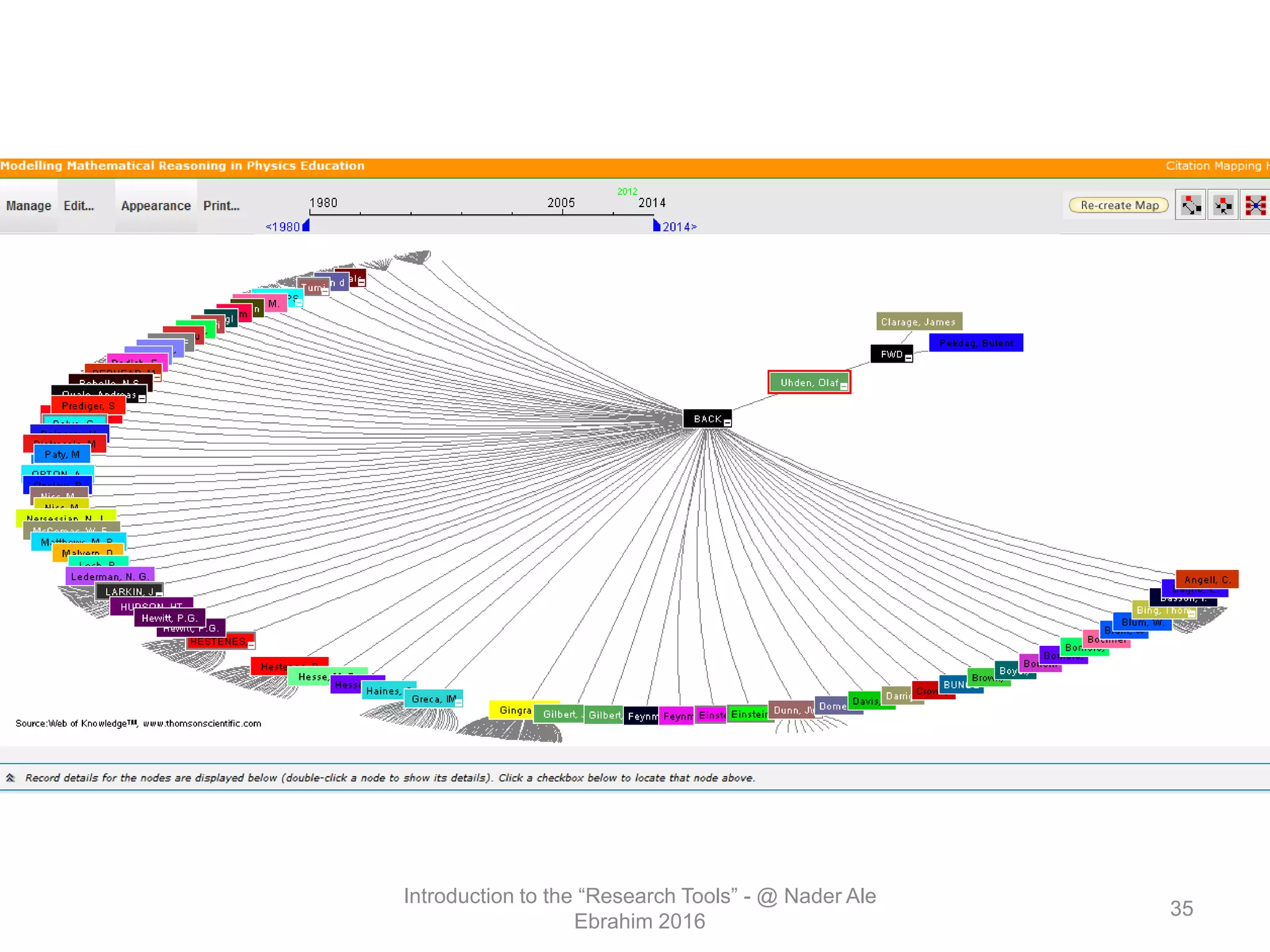
Introduction to the “Research Tools” - @ Nader Ale
Ebrahim 2016
35
Paper/journal quality
• Another guide to paper/journal quality is
the general reputation of the association,
society, or organization publishing the
journal.
• Leading professional associations such as
American Psychological Association (APA)
or the Institute of Electrical and Electronics
Engineers (IEEE) publish a range of
journals that are highly regarded.
Introduction to the “Research Tools” - @ Nader Ale
Ebrahim 2016
36
How to do an Effective
Literature Search?
Application Training Module Series I
by Customer Education Team
ts.training.asia@thomson.com
Stop Searching, Start Discovering
For More Info.
The Institute for Scientific Information (ISI)
• The Institute for Scientific Information (ISI) was founded by Eugene
Garfield in 1960. It was acquired by Thomson Scientific & Healthcare in
1992, became known as Thomson ISI and now is part of the Healthcare &
Science business of the multi-billion dollar Thomson Reuters Corporation.
• ISI offered bibliographic database services. Its speciality: citation indexing
and analysis, a field pioneered by Garfield. It maintains citation databases
covering thousands of academic journals, including a continuation of its long
time print-based indexing service the Science Citation Index (SCI), as well
as the Social Sciences Citation Index (SSCI), and the Arts and Humanities
Citation Index (AHCI). All of these are available via ISI's Web of Knowledge
database service.
Introduction to the “Research Tools” - @ Nader Ale
Ebrahim 2016
38
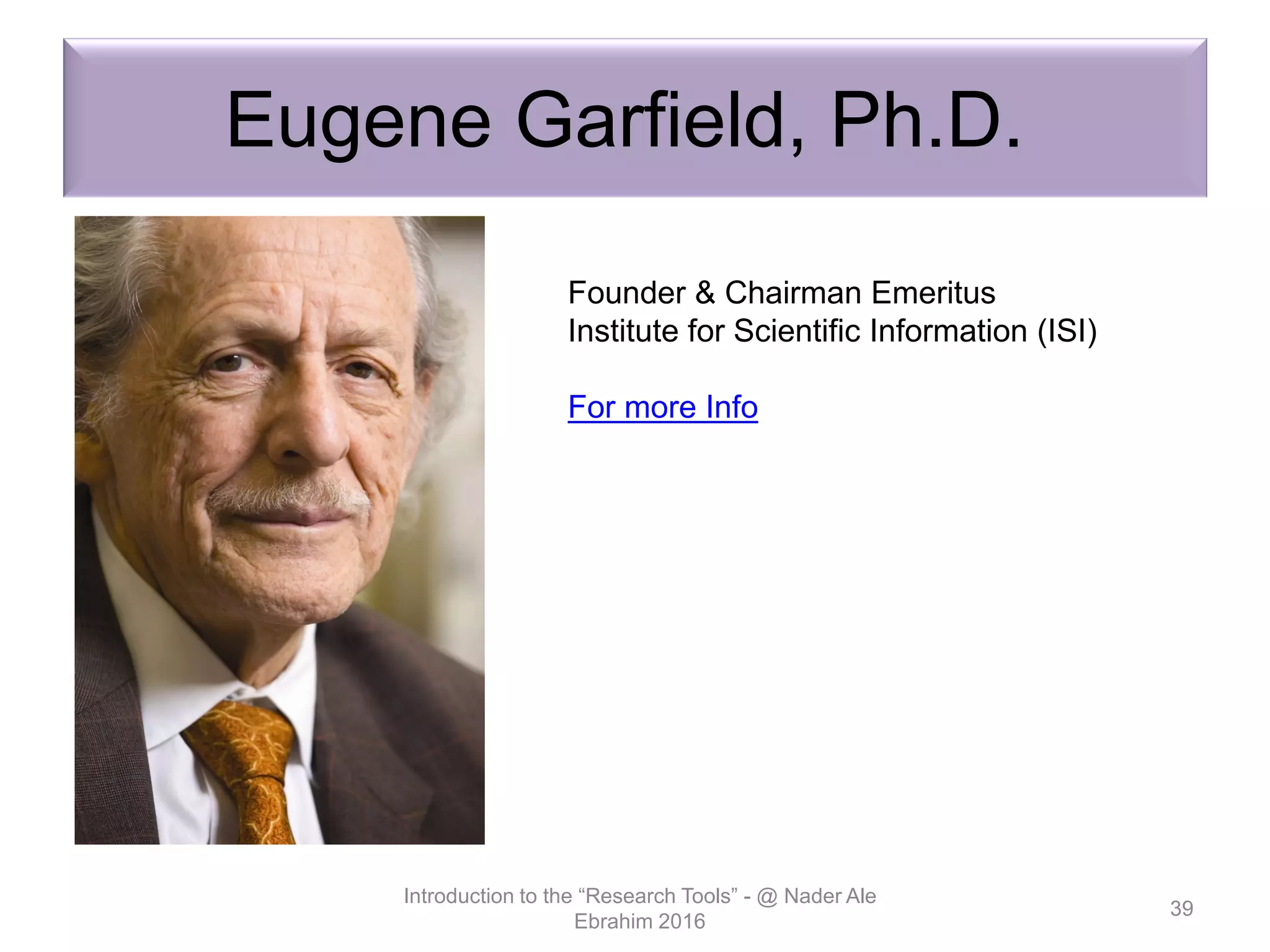
Eugene Garfield, Ph.D.
Introduction to the “Research Tools” - @ Nader Ale
Ebrahim 2016
39
Founder & Chairman Emeritus
Institute for Scientific Information (ISI)
For more Info
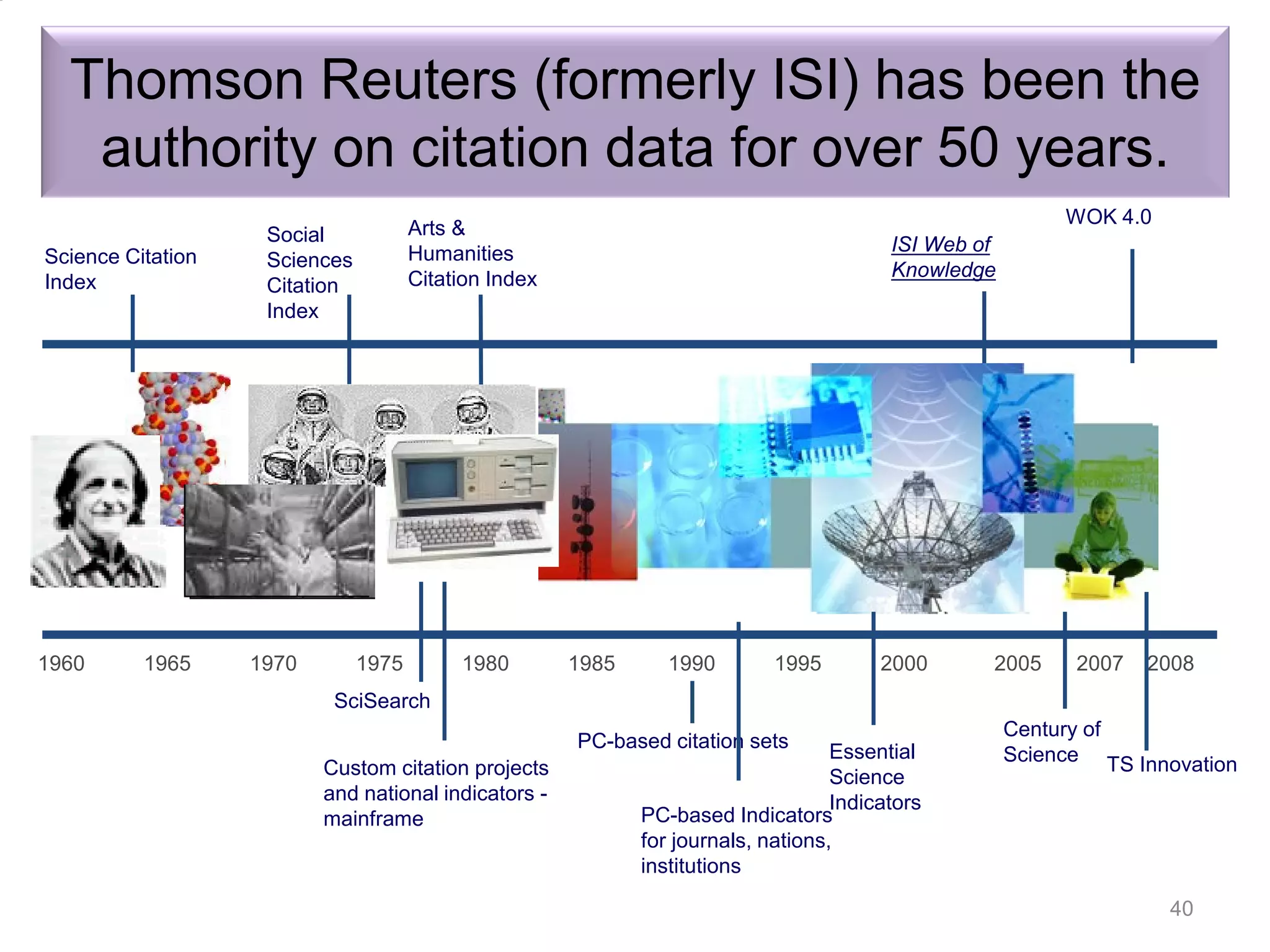
Science Citation
Index
Arts &
Humanities
Citation Index
WOK 4.0
Social
Sciences
Citation
Index
ISI Web of
Knowledge
1960 1965 1970 1975 1980 1985 1990 1995 2000 2005 2007 2008
SciSearch
Century of
Science TS Innovation
Essential
Science
Indicators
PC-based Indicators
for journals, nations,
institutions
PC-based citation sets
Custom citation projects
and national indicators -
mainframe
Thomson Reuters (formerly ISI) has been the
authority on citation data for over 50 years.
Introduction to the “Research Tools” - @ Nader Ale
Ebrahim 2016
40
The Institute for Scientific Information (ISI)
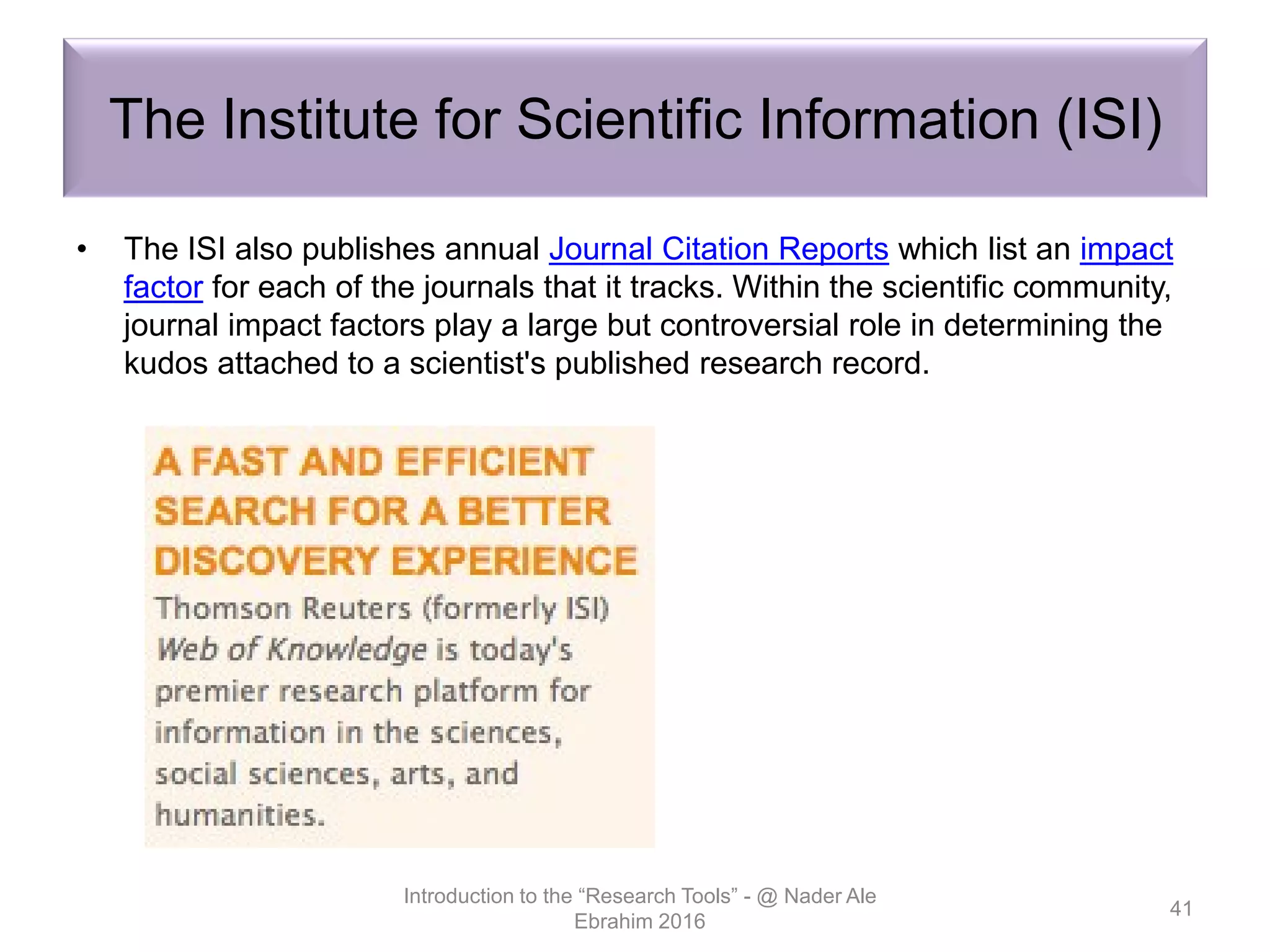
• The ISI also publishes annual Journal Citation Reports which list an impact
factor for each of the journals that it tracks. Within the scientific community,
journal impact factors play a large but controversial role in determining the
kudos attached to a scientist's published research record.
Introduction to the “Research Tools” - @ Nader Ale
Ebrahim 2016
41
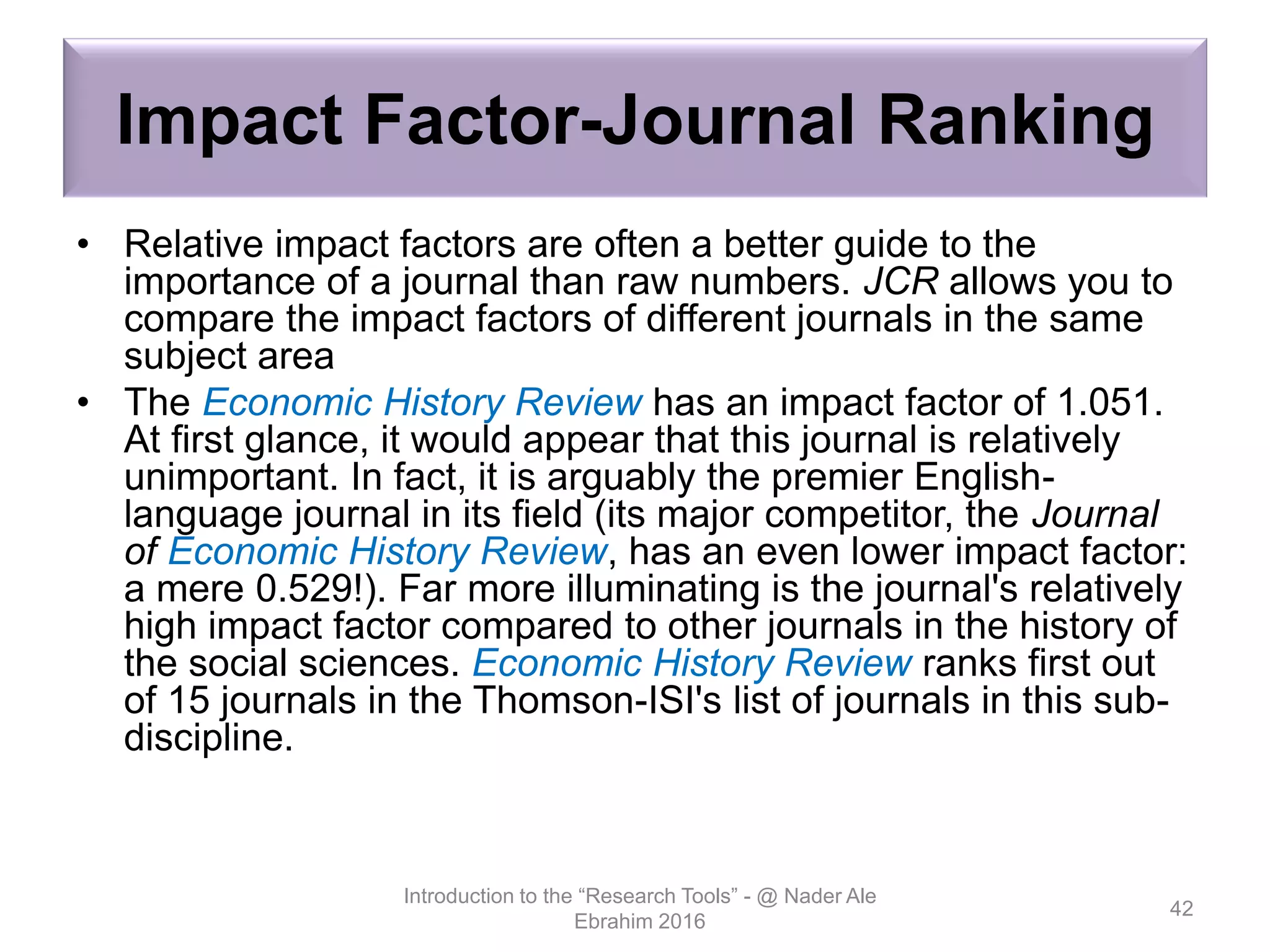
Impact Factor-Journal Ranking
• Relative impact factors are often a better guide to the
importance of a journal than raw numbers. JCR allows you to
compare the impact factors of different journals in the same
subject area
• The Economic History Review has an impact factor of 1.051.
At first glance, it would appear that this journal is relatively
unimportant. In fact, it is arguably the premier English-
language journal in its field (its major competitor, the Journal
of Economic History Review, has an even lower impact factor:
a mere 0.529!). Far more illuminating is the journal's relatively
high impact factor compared to other journals in the history of
the social sciences. Economic History Review ranks first out
of 15 journals in the Thomson-ISI's list of journals in this sub-
discipline.
Introduction to the “Research Tools” - @ Nader Ale
Ebrahim 2016
42
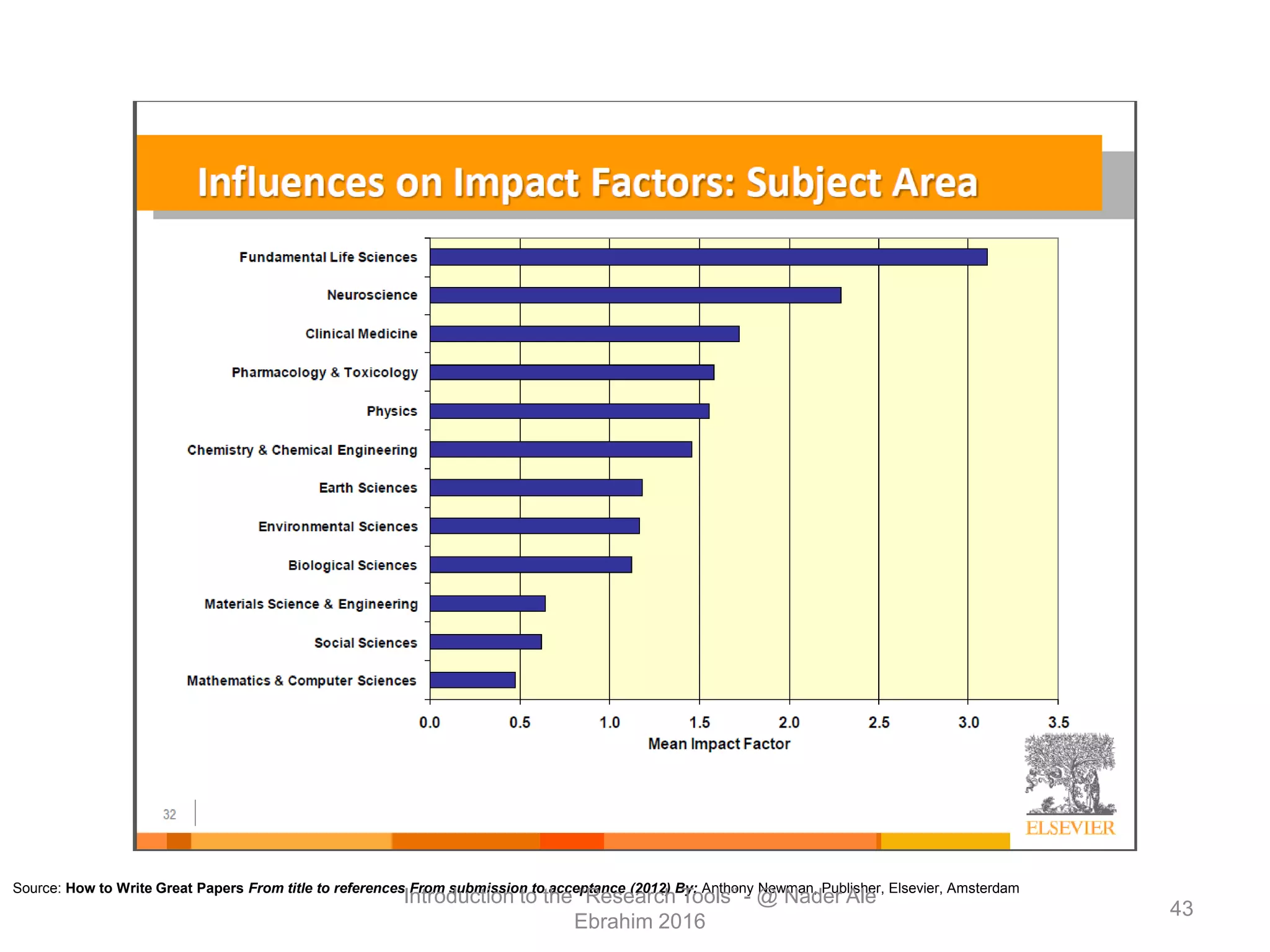
Source: How to Write Great Papers From title to references From submission to acceptance (2012) By: Anthony Newman, Publisher, Elsevier, Amsterdam
Introduction to the “Research Tools” - @ Nader Ale
Ebrahim 2016
43
Keeping up-to-date (Alert system)
&
Indexing desktop search tool
Keeping up-to-date
Alert services are an effective
means of keeping track of the
latest research.
Introduction to the “Research Tools” - @ Nader Ale
Ebrahim 2016
45
What is an alert service?
• Many journal databases and book publishers offer free alert
services. These are an effective means of keeping track of the
latest research.
• Alert services come in different forms. The most common
include:
– a search alert. This is a saved search which alerts you when a
book or article that matches your search terms is published.
– a TOC (Table of Contents) alert. Such an alert notifies you when
a new issue of a journal is published, and provides you with the
issue's table of contents.
– a citation alert. This advises you when a new article cites a
particular work.
– Most alert services are email-based. An increasing number are
now offered as an RSS feed. If you are just beginning, you might
like to try email alerts first. These are generally easier to create.
Introduction to the “Research Tools” - @ Nader Ale
Ebrahim 2016
46
Keeping up-to-date
Create a Google Alert
• Enter the topic you wish to monitor.
• Search terms:
• Type:
• How often:
• Email length:
• Your email:
Introduction to the “Research Tools” - @ Nader Ale
Ebrahim 2016
47
Keeping up-to-date
Introduction to the “Research Tools” - @ Nader Ale
Ebrahim 2016
48
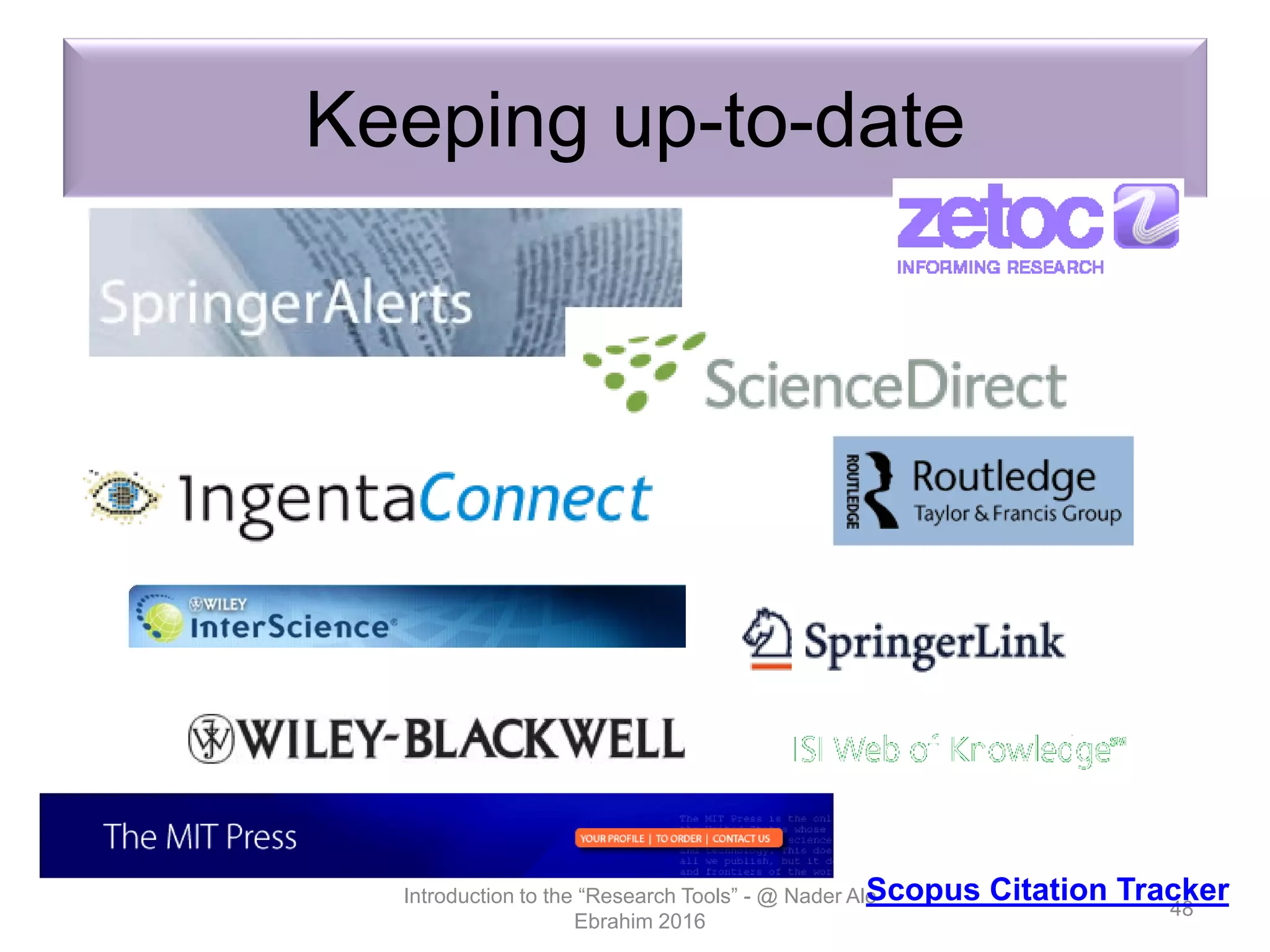
Scopus Citation Tracker
Conference Alerts
Introduction to the “Research Tools” - @ Nader Ale
Ebrahim 2016
49
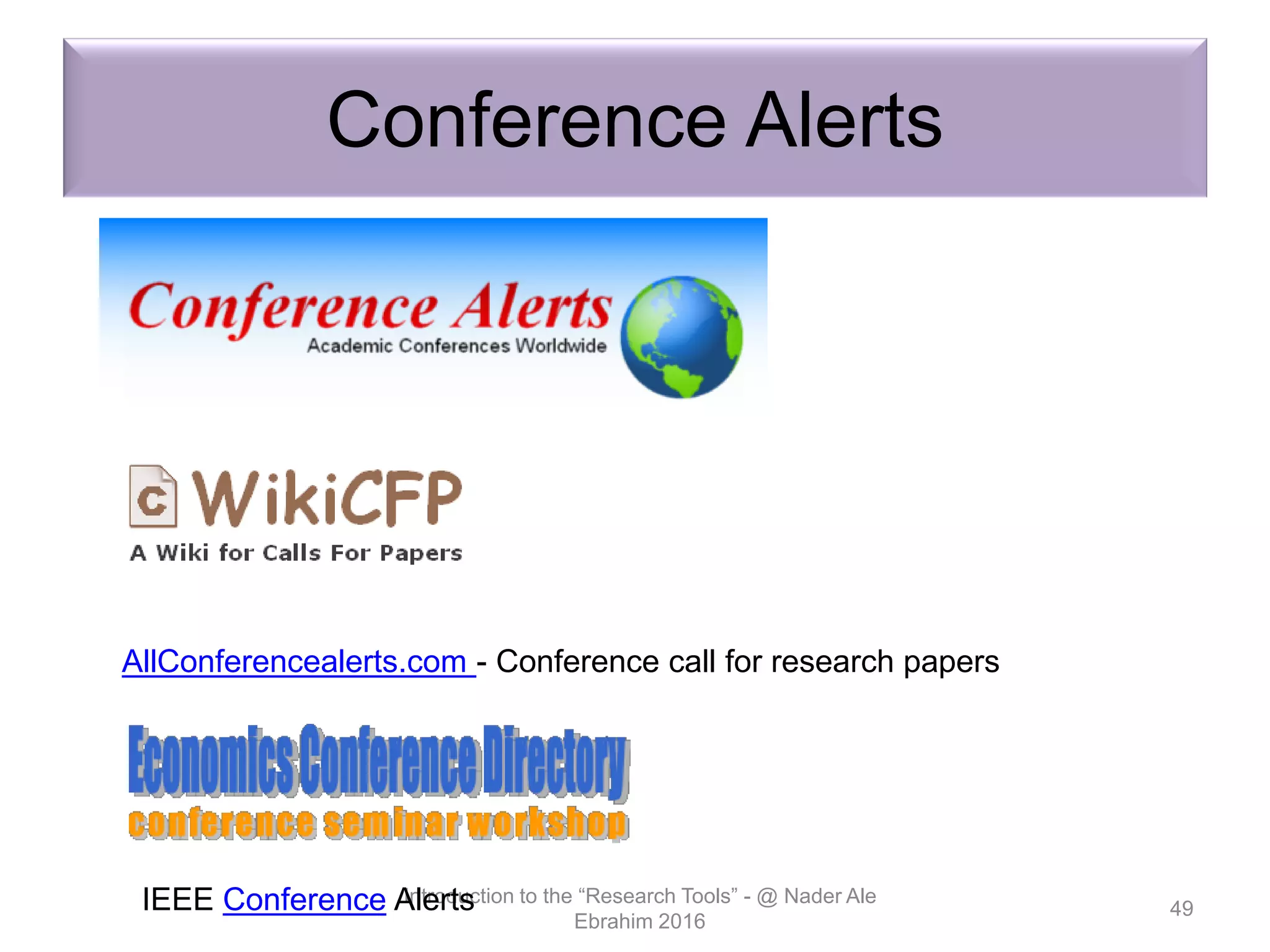
AllConferencealerts.com - Conference call for research papers
IEEE Conference Alerts
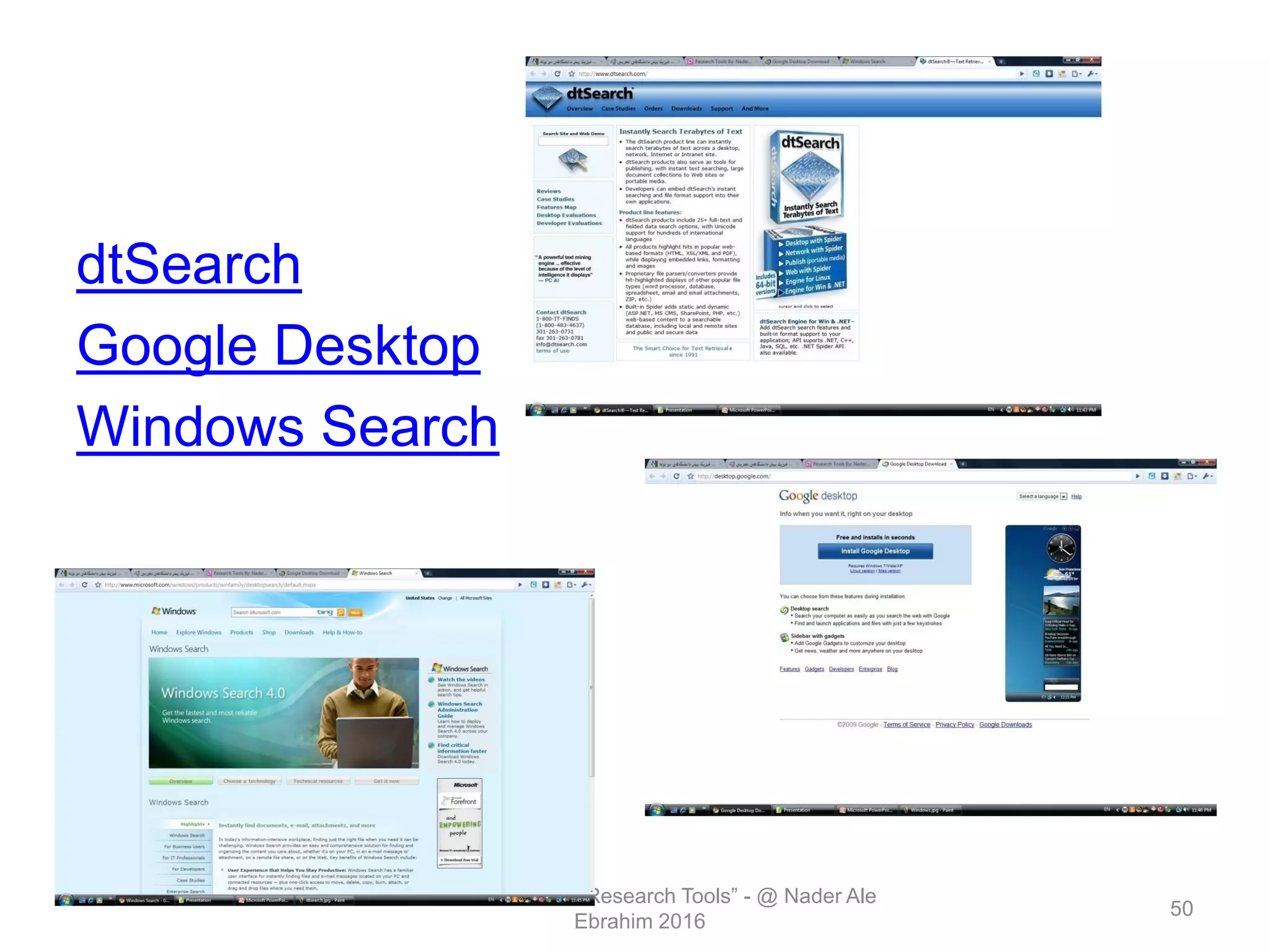
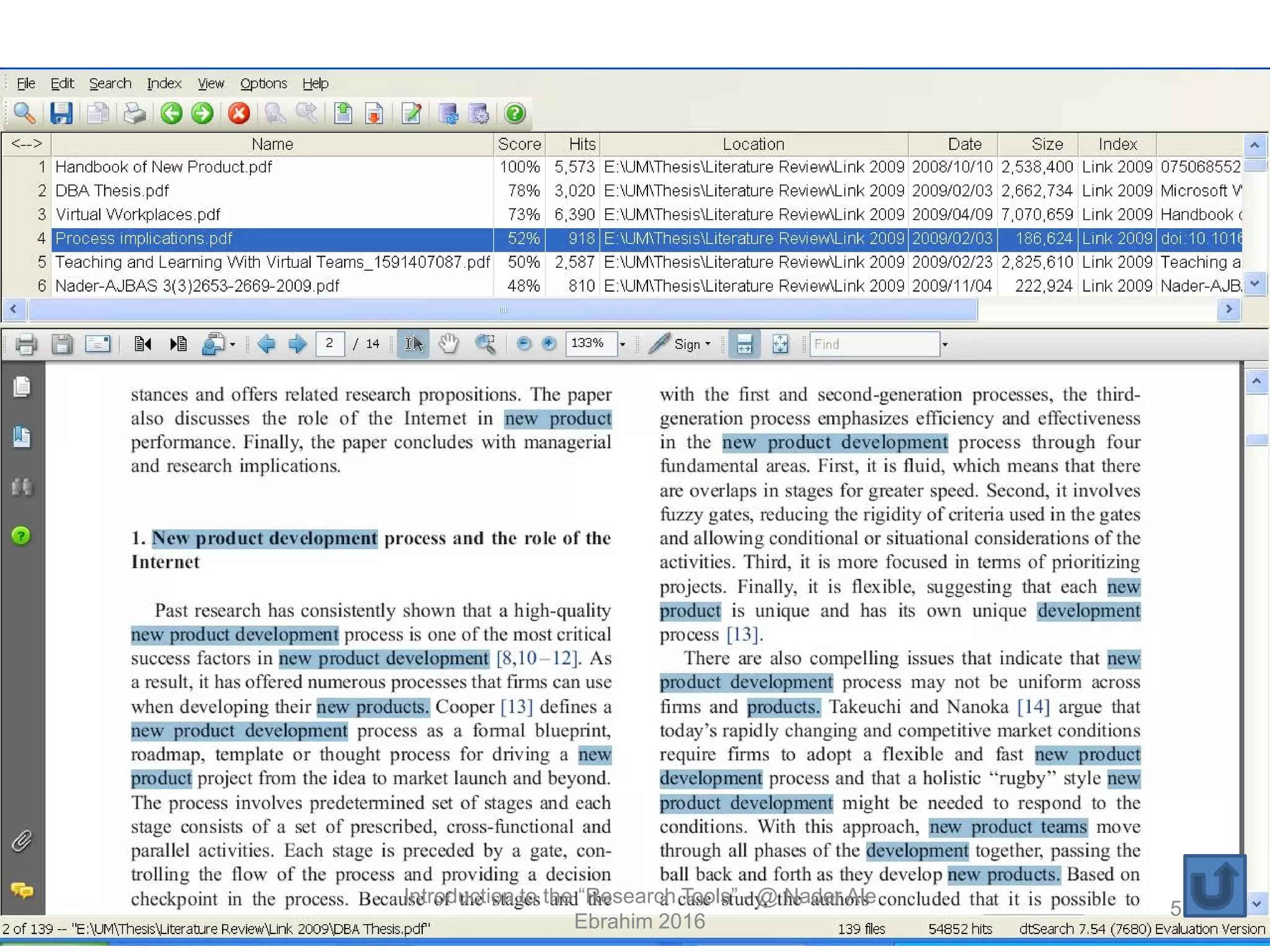
dtSearch
Google Desktop
Windows Search
Introduction to the “Research Tools” - @ Nader Ale
Ebrahim 2016
50
Introduction to the “Research Tools” - @ Nader Ale
Ebrahim 2016
51
The paraphrasing & editing tool,
&
Avoid plagiarism
Paraphrasing
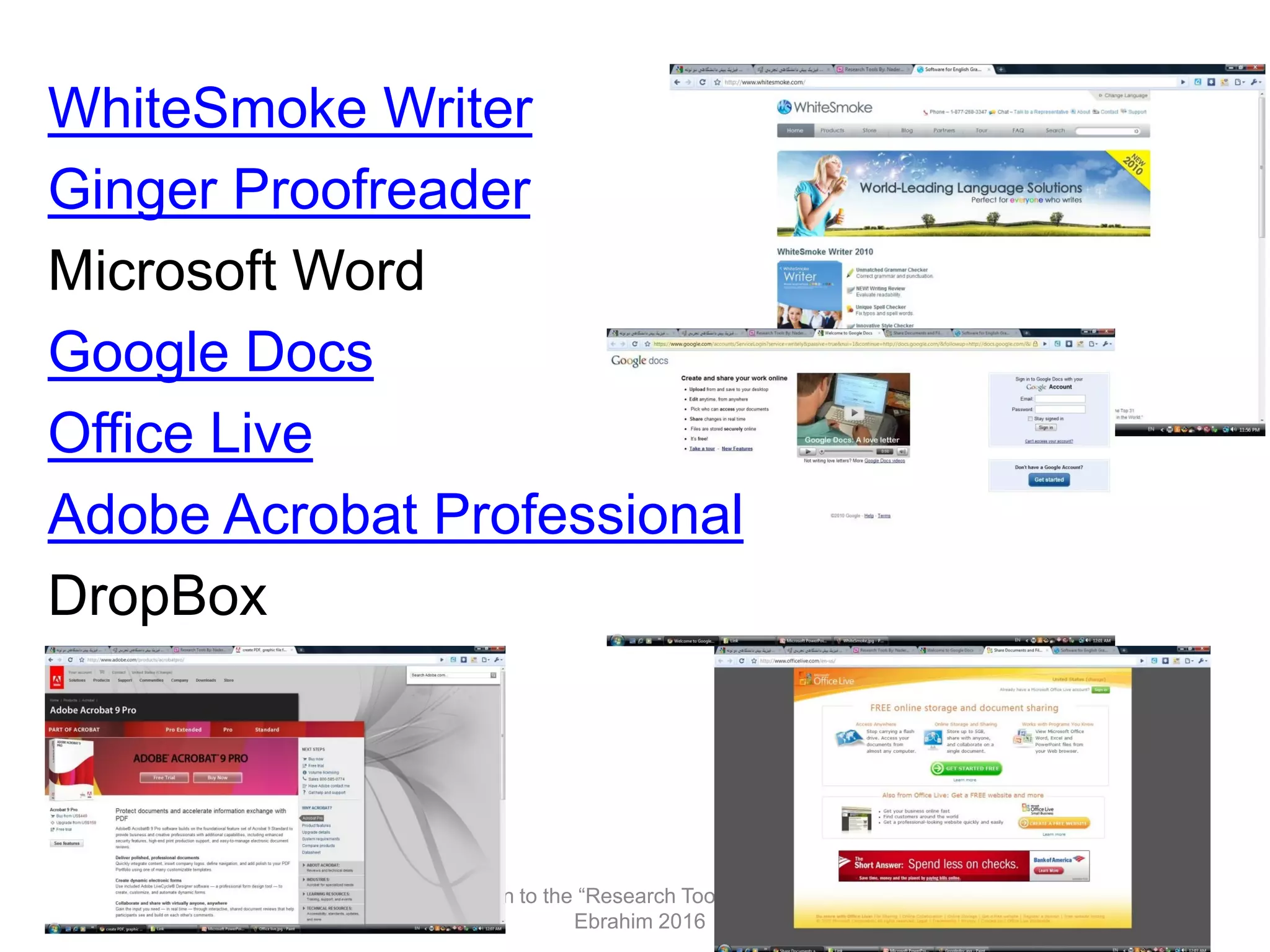
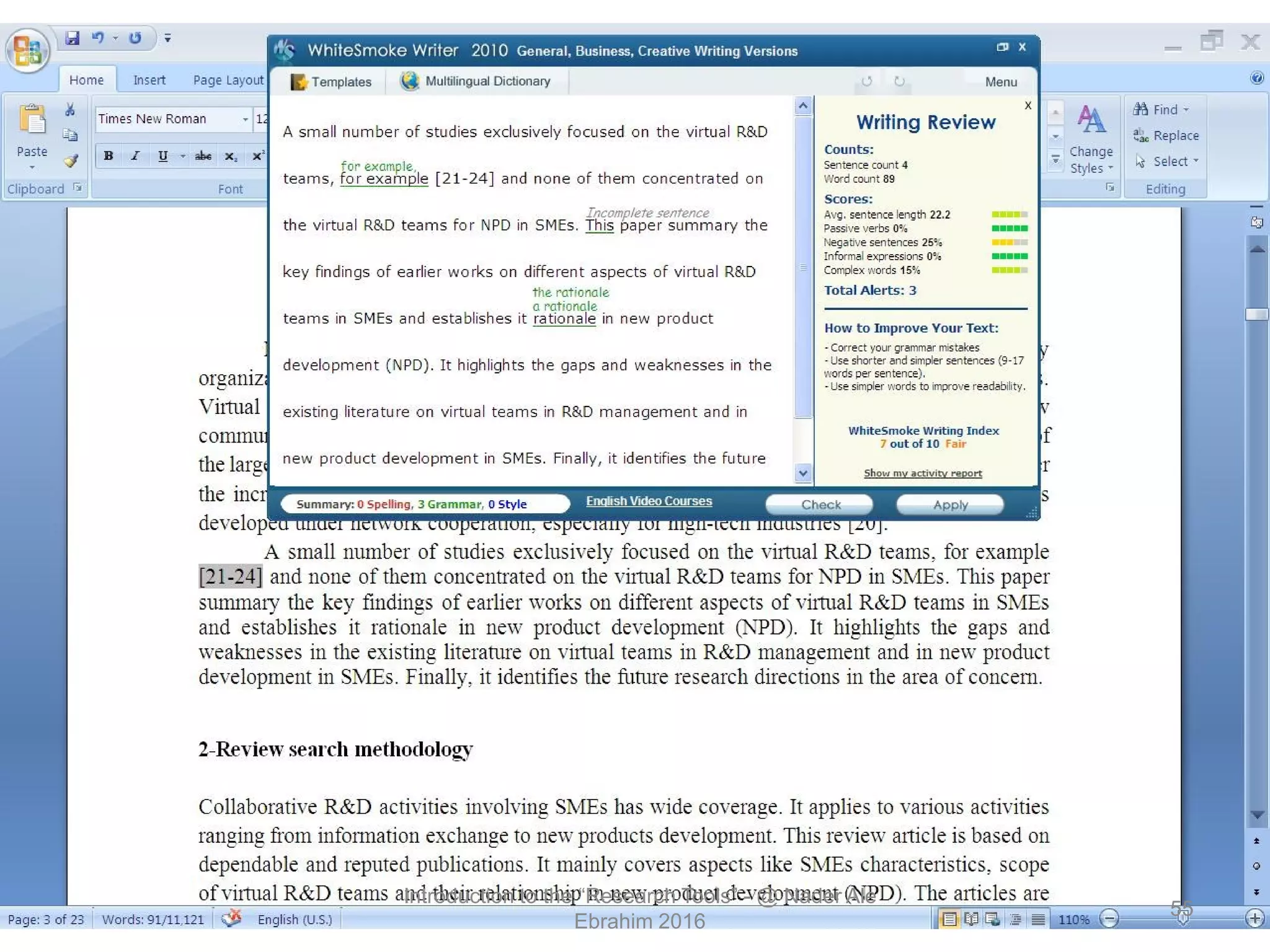
WhiteSmoke Writer
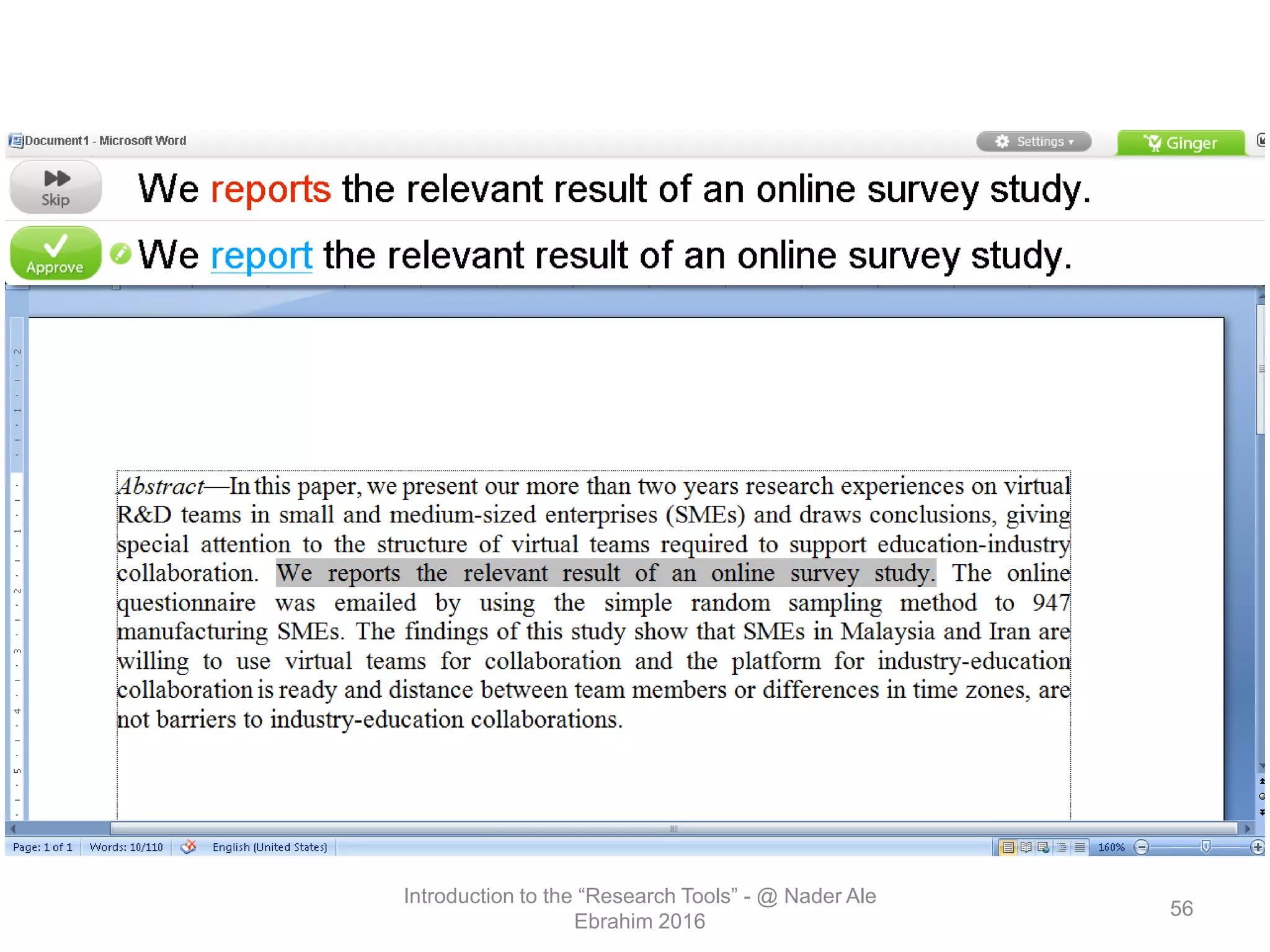
Ginger Proofreader
Microsoft Word
Google Docs
Office Live
Adobe Acrobat Professional
DropBox
Introduction to the “Research Tools” - @ Nader Ale
Ebrahim 2016
54
Introduction to the “Research Tools” - @ Nader Ale
Ebrahim 2016
55
Introduction to the “Research Tools” - @ Nader Ale
Ebrahim 2016
56
How do I avoid plagiarism?
• only hand in your own and original work.
• indicate precisely and accurately when you have used information provided by
someone else, i.e. referencing must be done in accordance with a recognised
system.
• indicate whether you have downloaded information from the Internet.
• never use someone else’s electronic storage media, artwork, pictures or graphics as
if it were your own.
• never copy directly without crediting the source
• do not translate without crediting the source
• do not paraphrase someone else’s work without crediting the source
• do not piece together sections of the work of others into a new whole
• do not resubmit your own or other’s previously graded work
• do not commit collusion (unauthorised collaboration, presenting work as one’s own
independent work, when it has been produced in whole or in part in collusion with
other people)
• ghost-writing – you should not make use of ghost writers or professional agencies in
the production of your work or submit material which has been written on your behalf
Introduction to the “Research Tools” - @ Nader Ale
Ebrahim 2016
57
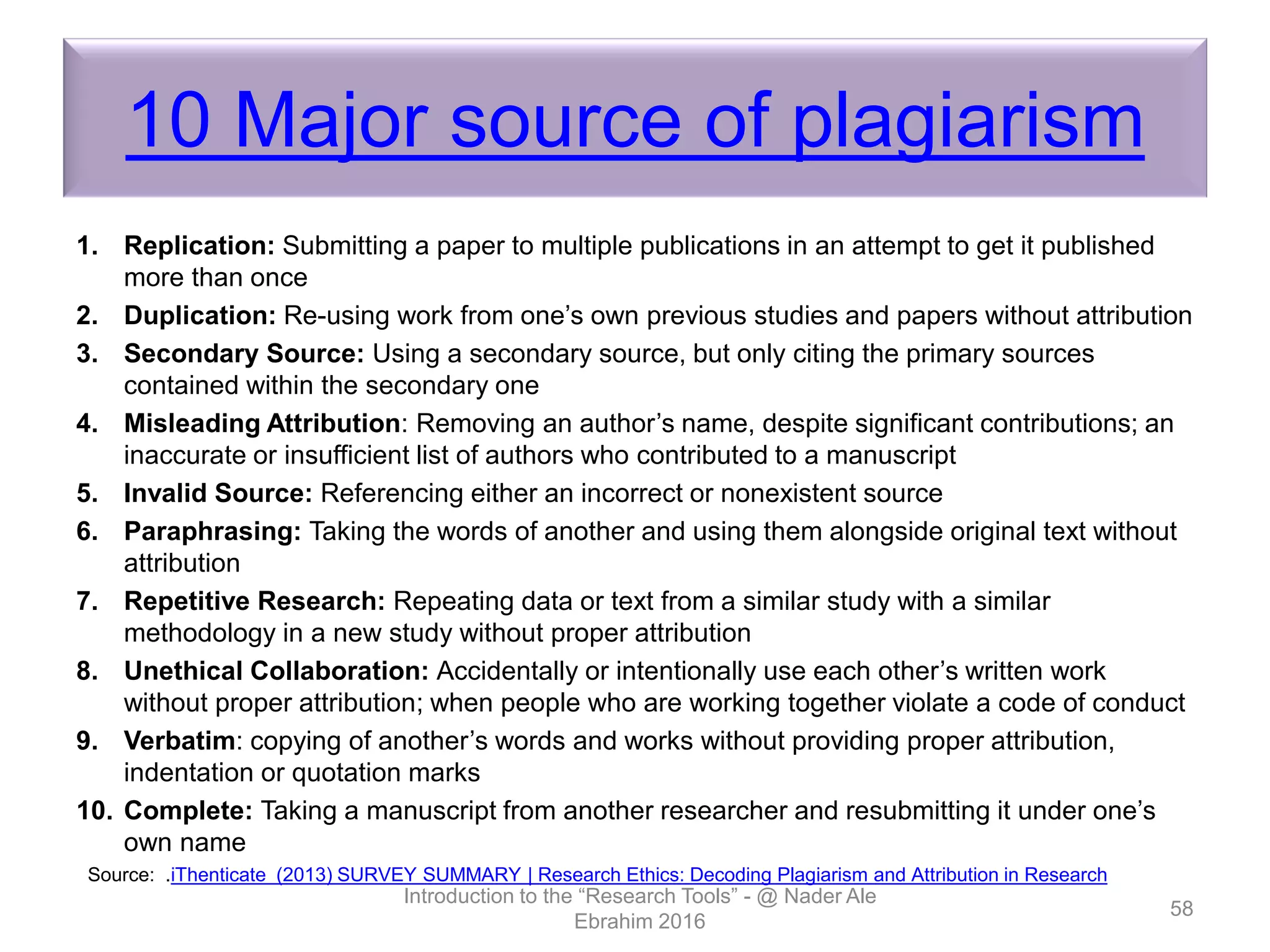
10 Major source of plagiarism
1. Replication: Submitting a paper to multiple publications in an attempt to get it published
more than once
2. Duplication: Re-using work from one’s own previous studies and papers without attribution
3. Secondary Source: Using a secondary source, but only citing the primary sources
contained within the secondary one
4. Misleading Attribution: Removing an author’s name, despite significant contributions; an
inaccurate or insufficient list of authors who contributed to a manuscript
5. Invalid Source: Referencing either an incorrect or nonexistent source
6. Paraphrasing: Taking the words of another and using them alongside original text without
attribution
7. Repetitive Research: Repeating data or text from a similar study with a similar
methodology in a new study without proper attribution
8. Unethical Collaboration: Accidentally or intentionally use each other’s written work
without proper attribution; when people who are working together violate a code of conduct
9. Verbatim: copying of another’s words and works without providing proper attribution,
indentation or quotation marks
10. Complete: Taking a manuscript from another researcher and resubmitting it under one’s
own name
Introduction to the “Research Tools” - @ Nader Ale
Ebrahim 2016
58
Source: .iThenticate (2013) SURVEY SUMMARY | Research Ethics: Decoding Plagiarism and Attribution in Research
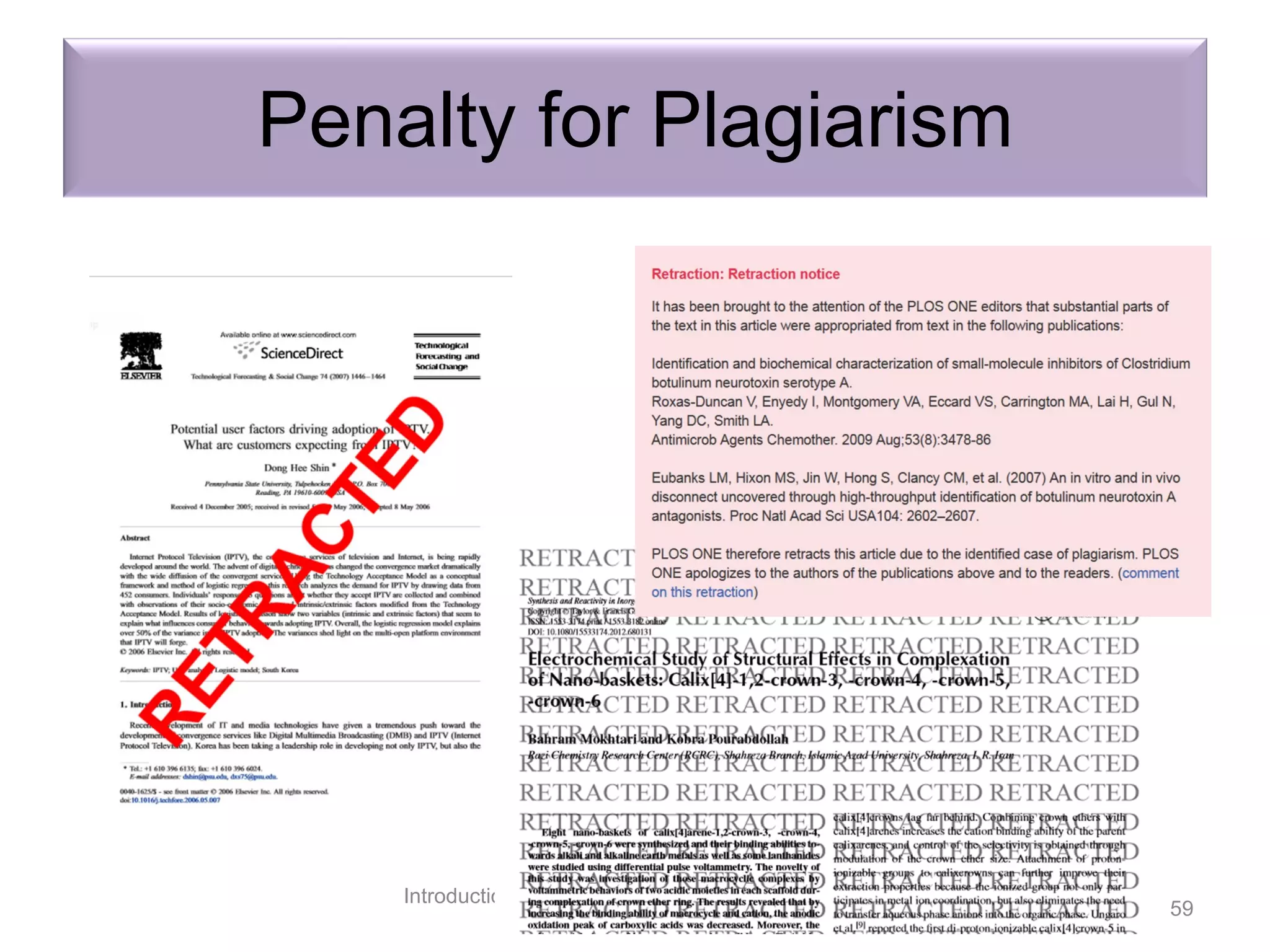
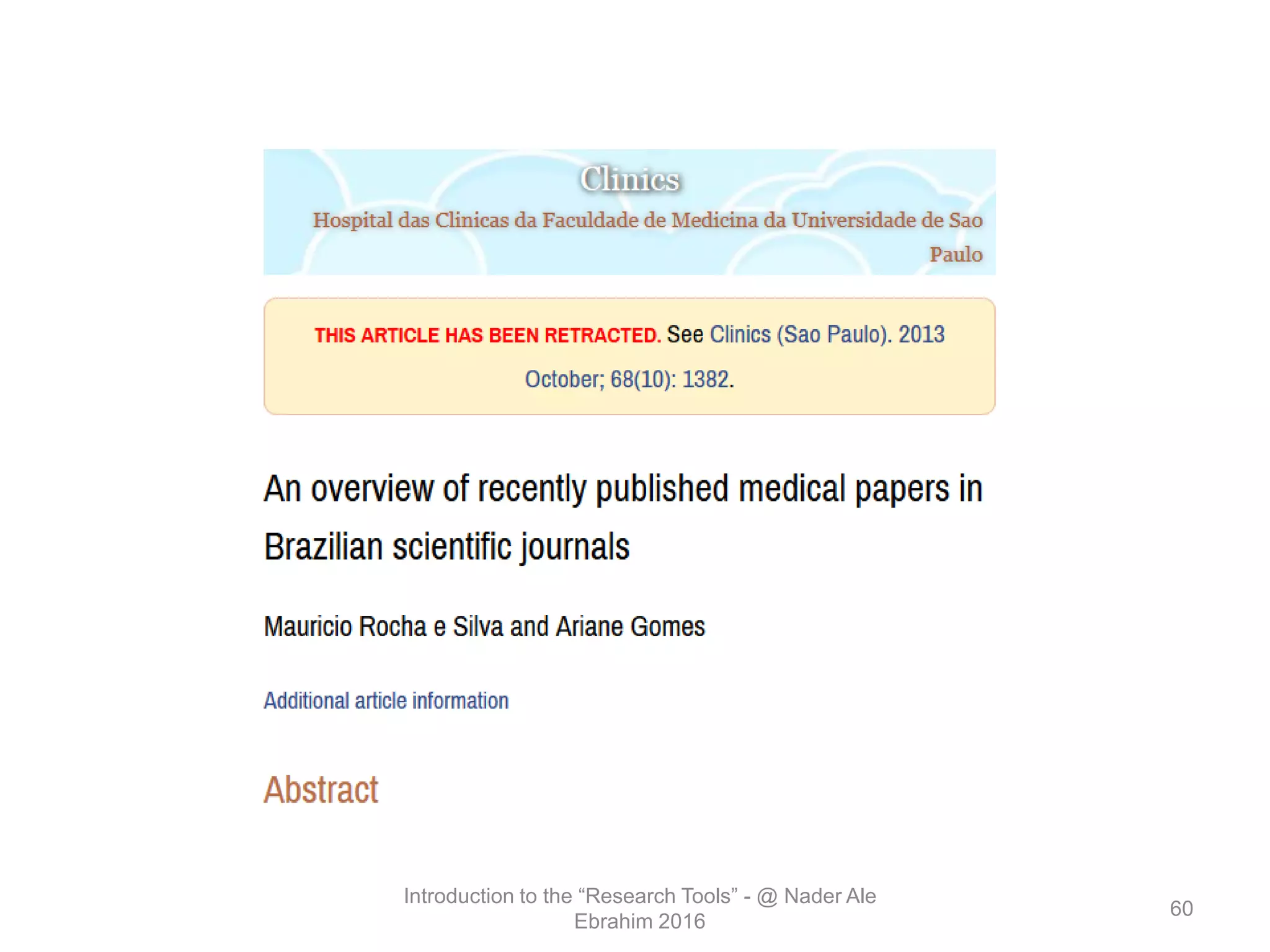
Penalty for Plagiarism
Introduction to the “Research Tools” - @ Nader Ale
Ebrahim 2016
59
Introduction to the “Research Tools” - @ Nader Ale
Ebrahim 2016
60
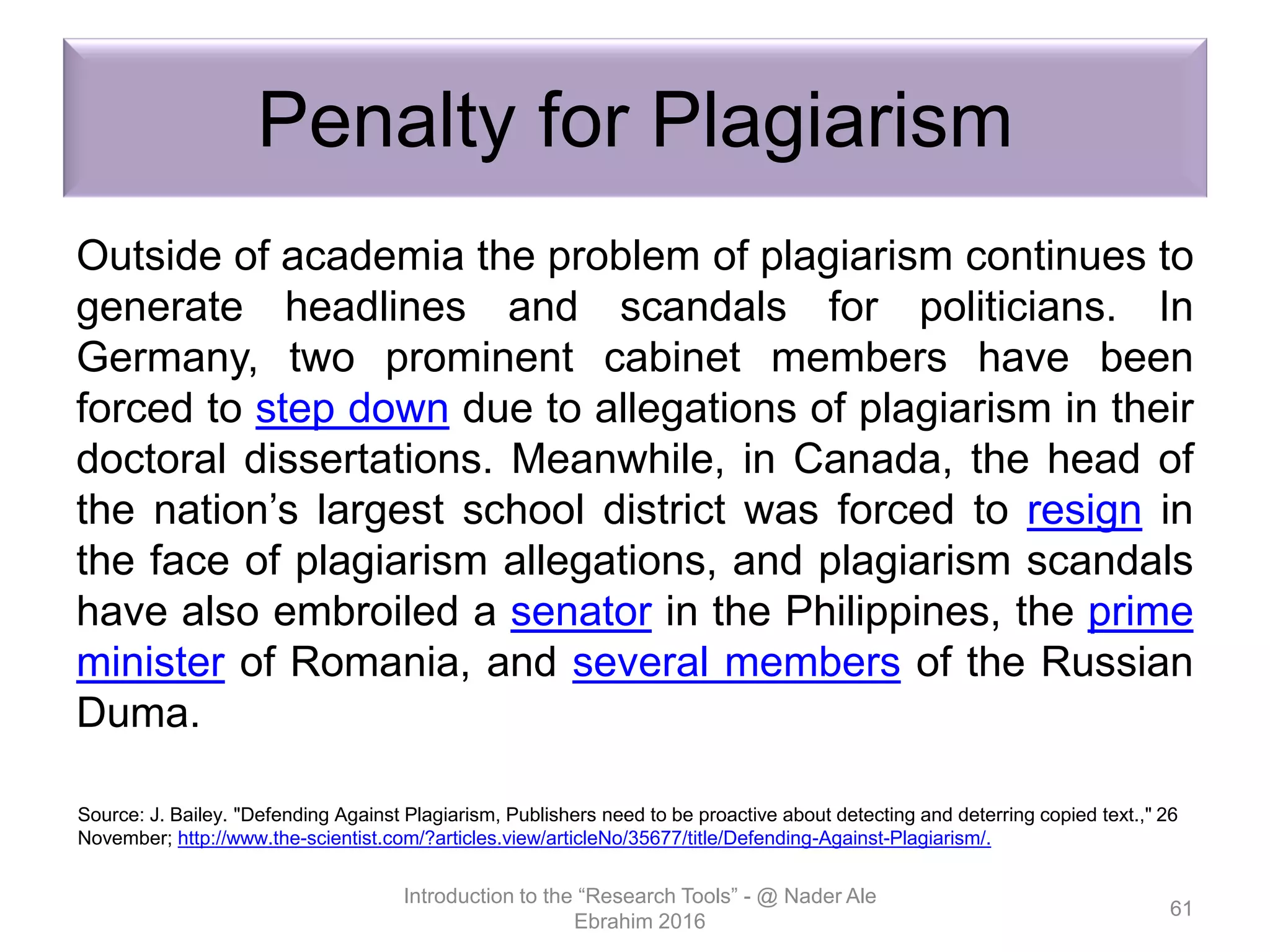
Penalty for Plagiarism
Outside of academia the problem of plagiarism continues to
generate headlines and scandals for politicians. In
Germany, two prominent cabinet members have been
forced to step down due to allegations of plagiarism in their
doctoral dissertations. Meanwhile, in Canada, the head of
the nation’s largest school district was forced to resign in
the face of plagiarism allegations, and plagiarism scandals
have also embroiled a senator in the Philippines, the prime
minister of Romania, and several members of the Russian
Duma.
Introduction to the “Research Tools” - @ Nader Ale
Ebrahim 2016
61
Source: J. Bailey. "Defending Against Plagiarism, Publishers need to be proactive about detecting and deterring copied text.," 26
November; http://www.the-scientist.com/?articles.view/articleNo/35677/title/Defending-Against-Plagiarism/.
Introduction to the “Research Tools” - @ Nader Ale
Ebrahim 2016
62
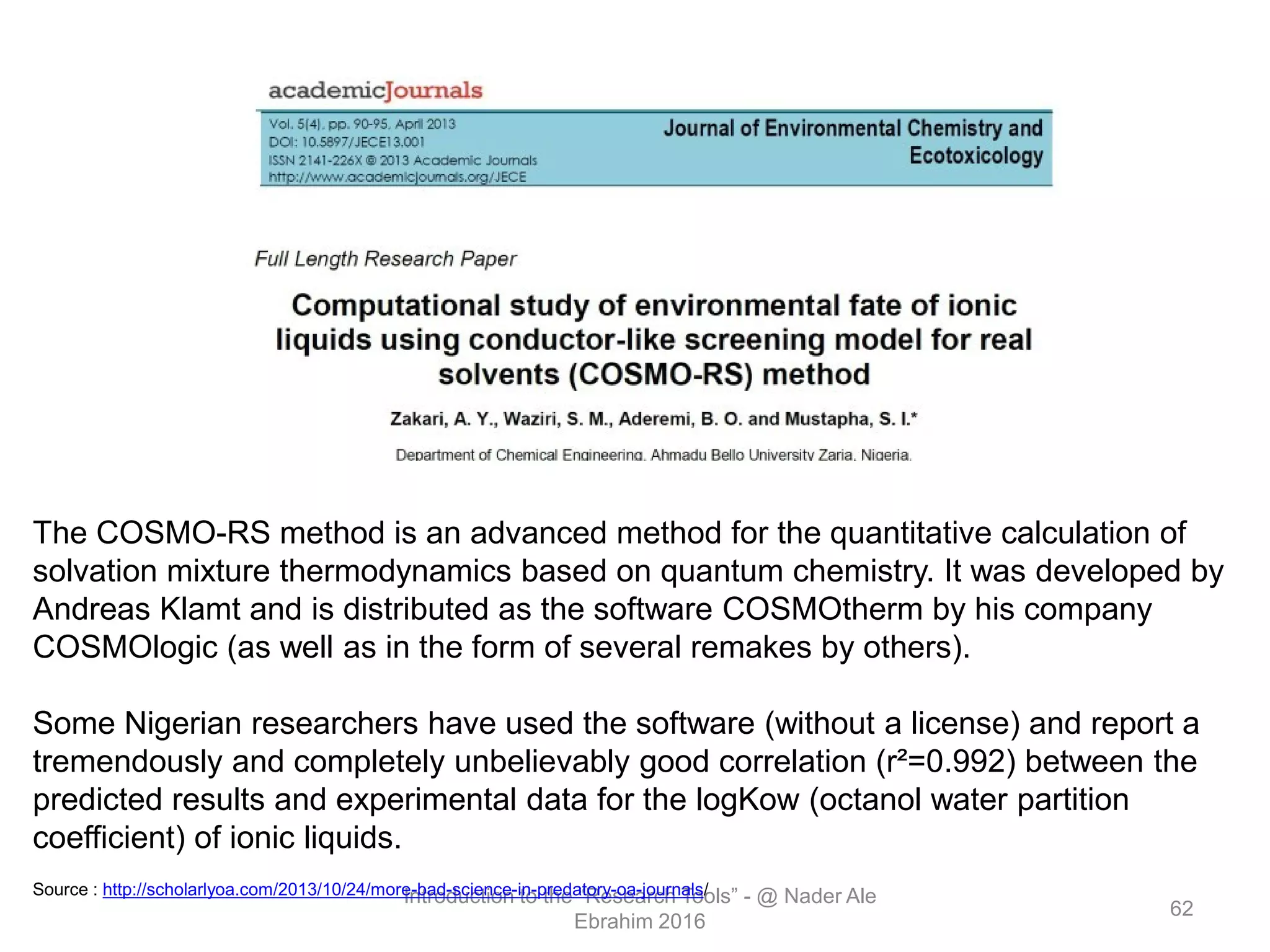
The COSMO-RS method is an advanced method for the quantitative calculation of
solvation mixture thermodynamics based on quantum chemistry. It was developed by
Andreas Klamt and is distributed as the software COSMOtherm by his company
COSMOlogic (as well as in the form of several remakes by others).
Some Nigerian researchers have used the software (without a license) and report a
tremendously and completely unbelievably good correlation (r²=0.992) between the
predicted results and experimental data for the logKow (octanol water partition
coefficient) of ionic liquids.
Source : http://scholarlyoa.com/2013/10/24/more-bad-science-in-predatory-oa-journals/
Introduction to the “Research Tools” - @ Nader Ale
Ebrahim 2016
63
Organize the references (Reference
management) tool
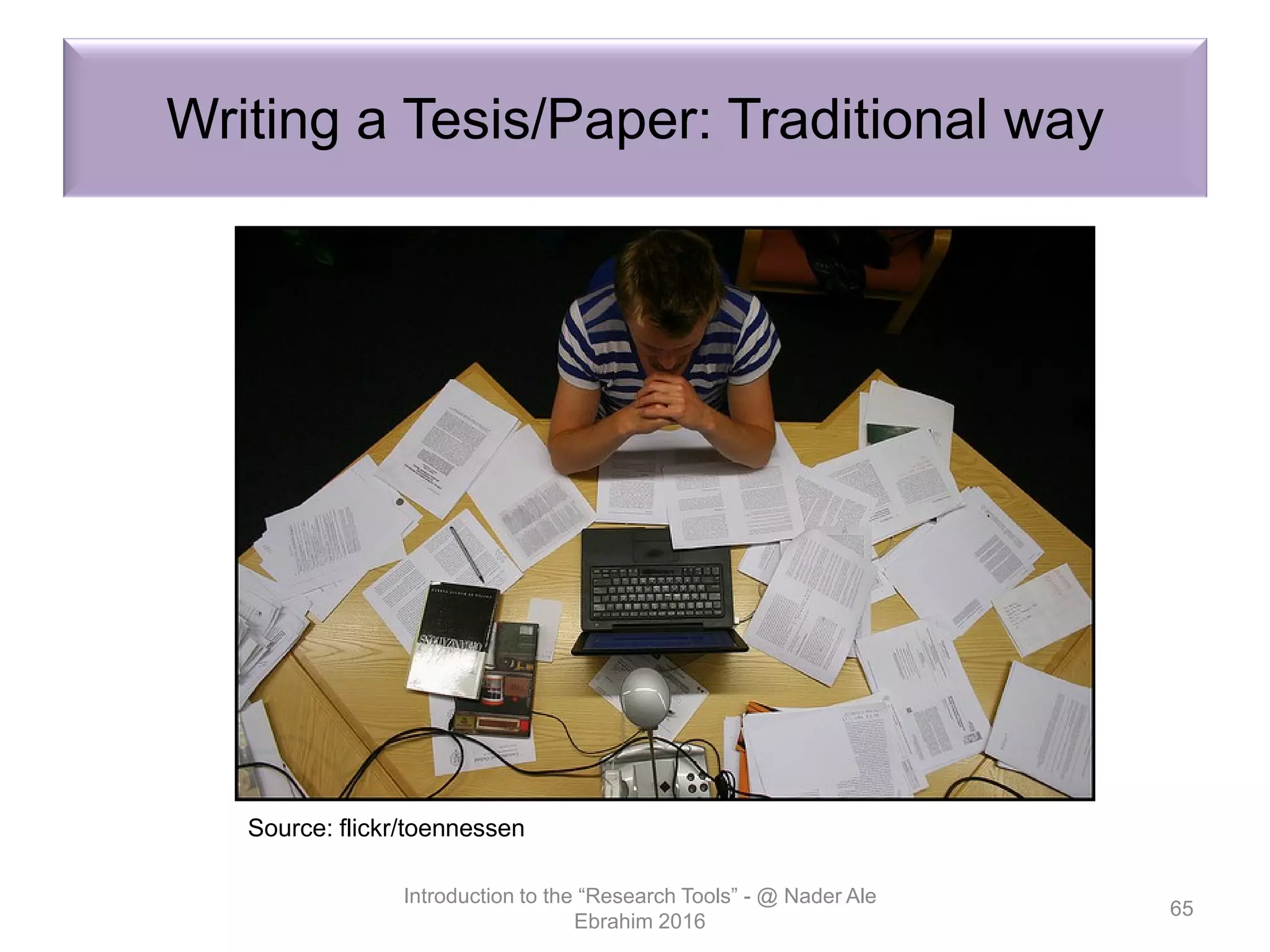
Writing a Tesis/Paper: Traditional way
Introduction to the “Research Tools” - @ Nader Ale
Ebrahim 2016
65
Source: flickr/toennessen
Introduction to the “Research Tools” - @ Nader Ale
Ebrahim 2016
66
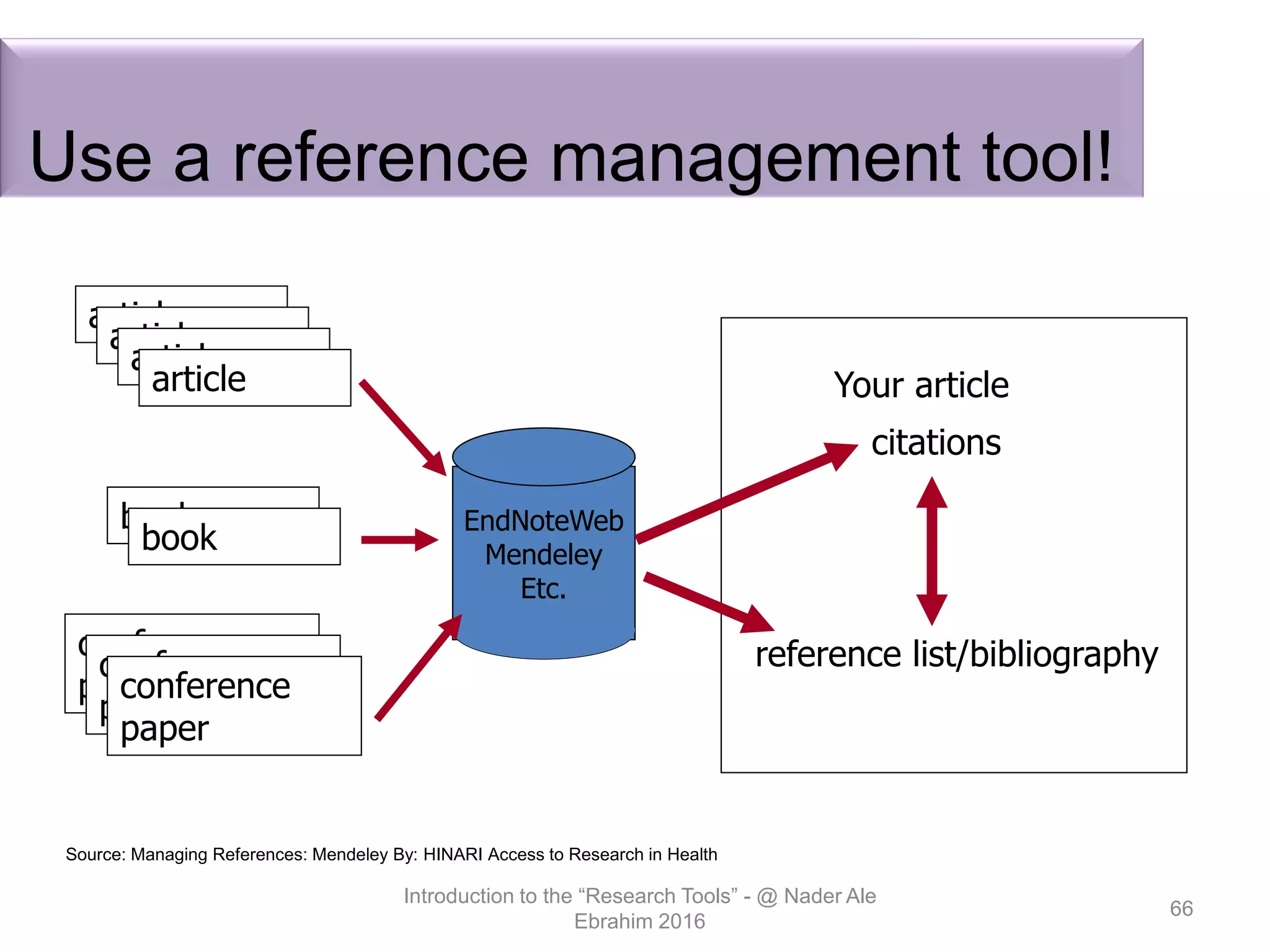
Use a reference management tool!
Your article
article
article
article
article
book
book
conference
paper
conference
paper
conference
paper
EndNoteWeb
Mendeley
Etc.
citations
reference list/bibliography
Source: Managing References: Mendeley By: HINARI Access to Research in Health
EndNote
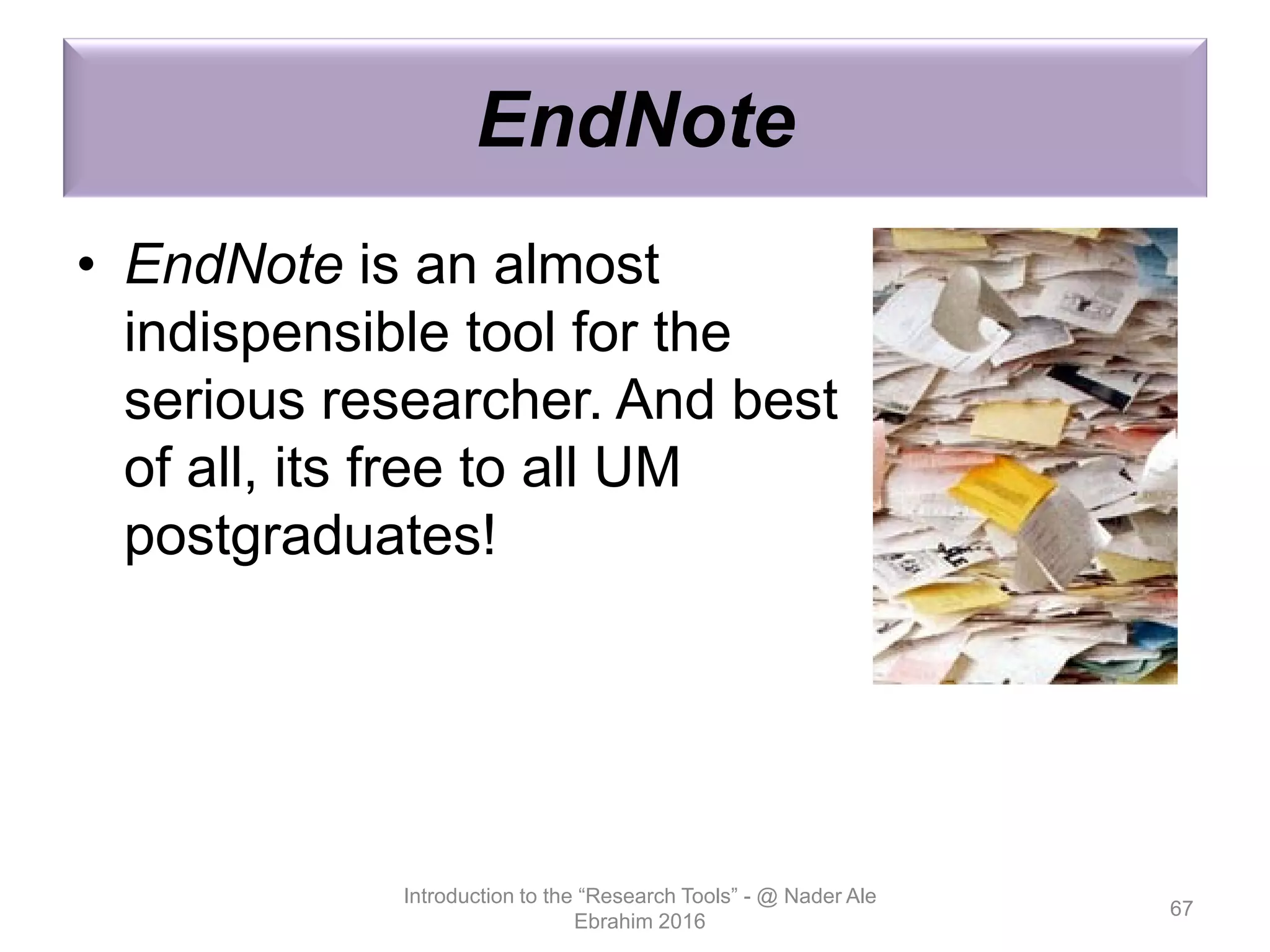
• EndNote is an almost
indispensible tool for the
serious researcher. And best
of all, its free to all UM
postgraduates!
Introduction to the “Research Tools” - @ Nader Ale
Ebrahim 2016
67
Why use EndNote?
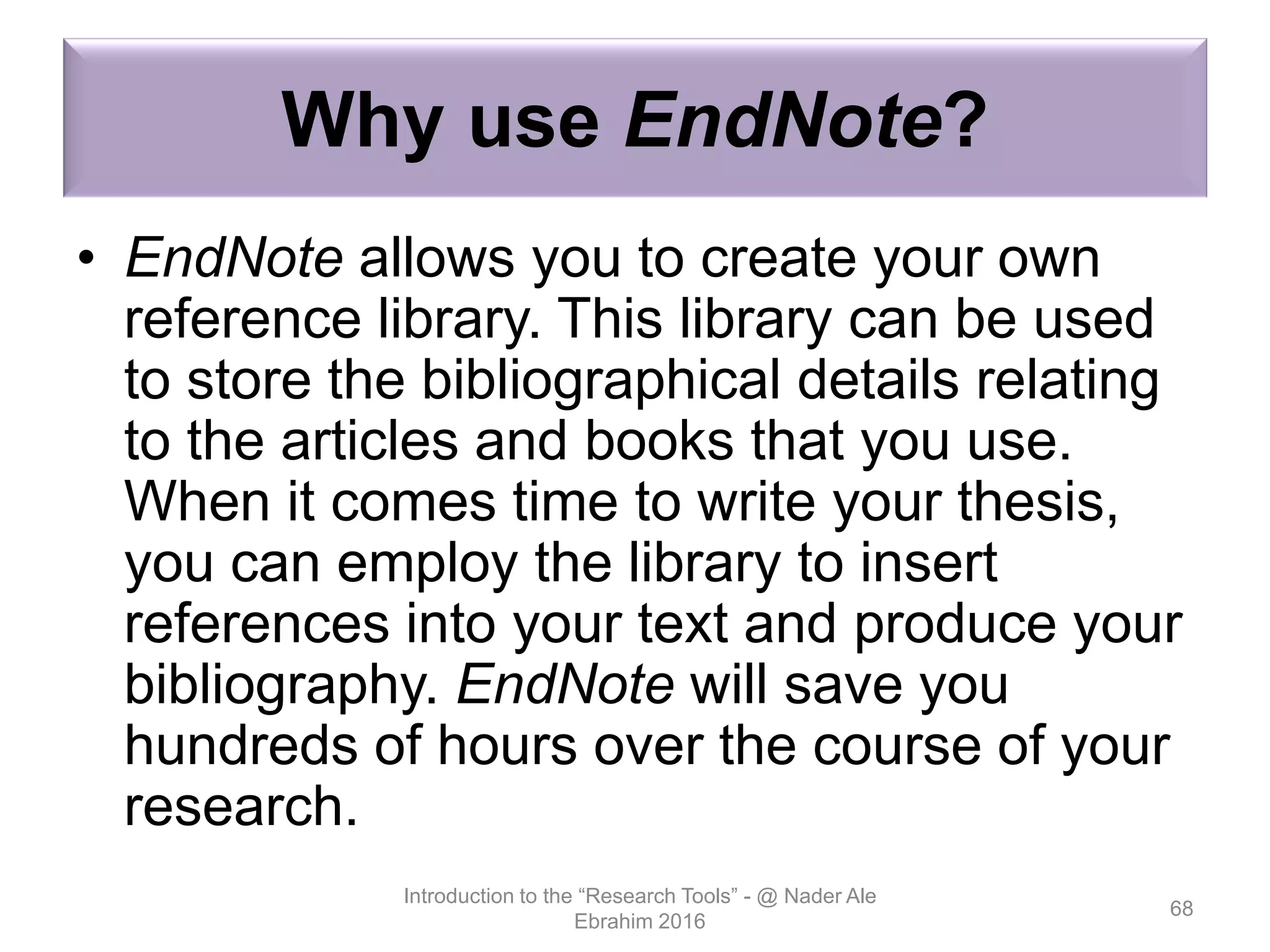
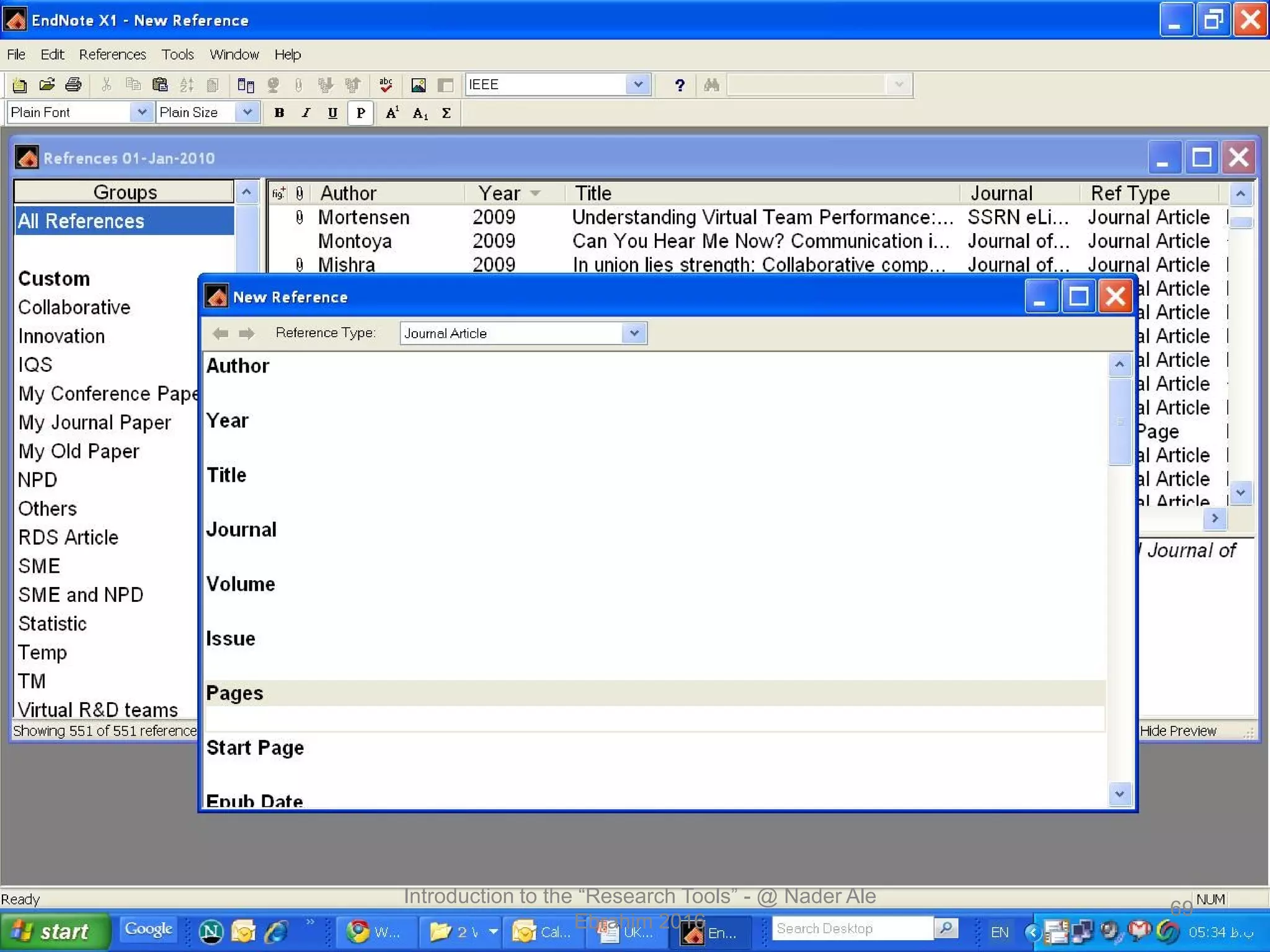
• EndNote allows you to create your own
reference library. This library can be used
to store the bibliographical details relating
to the articles and books that you use.
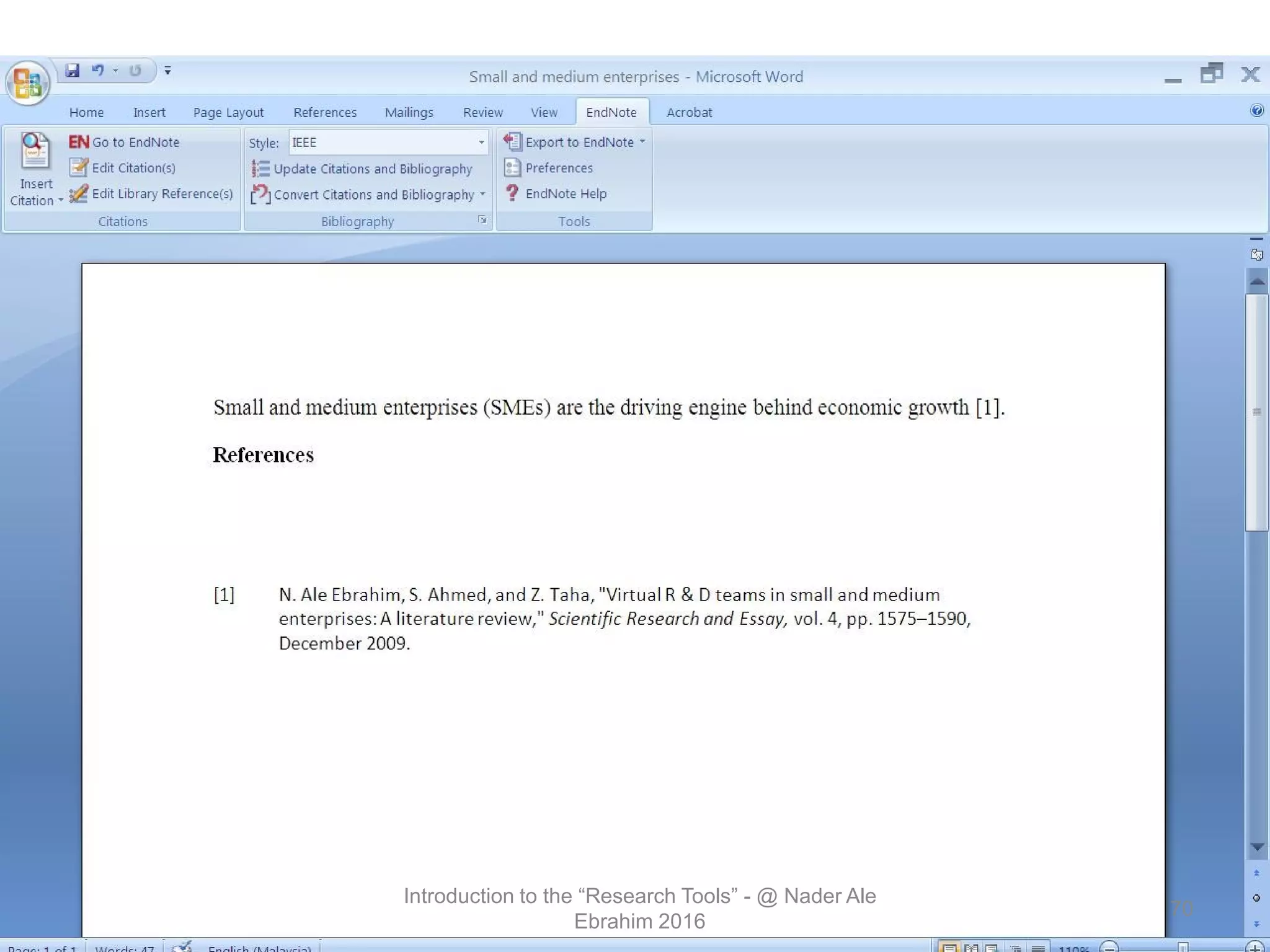
When it comes time to write your thesis,
you can employ the library to insert
references into your text and produce your
bibliography. EndNote will save you
hundreds of hours over the course of your
research.
Introduction to the “Research Tools” - @ Nader Ale
Ebrahim 2016
68
Introduction to the “Research Tools” - @ Nader Ale
Ebrahim 2016
69
Introduction to the “Research Tools” - @ Nader Ale
Ebrahim 2016
70
Target suitable journal
Open-Access Journals
Introduction to the “Research Tools” - @ Nader Ale
Ebrahim 2016
72
Image: iStockPhoto
Special Issues
Introduction to the “Research Tools” - @ Nader Ale
Ebrahim 2016
73
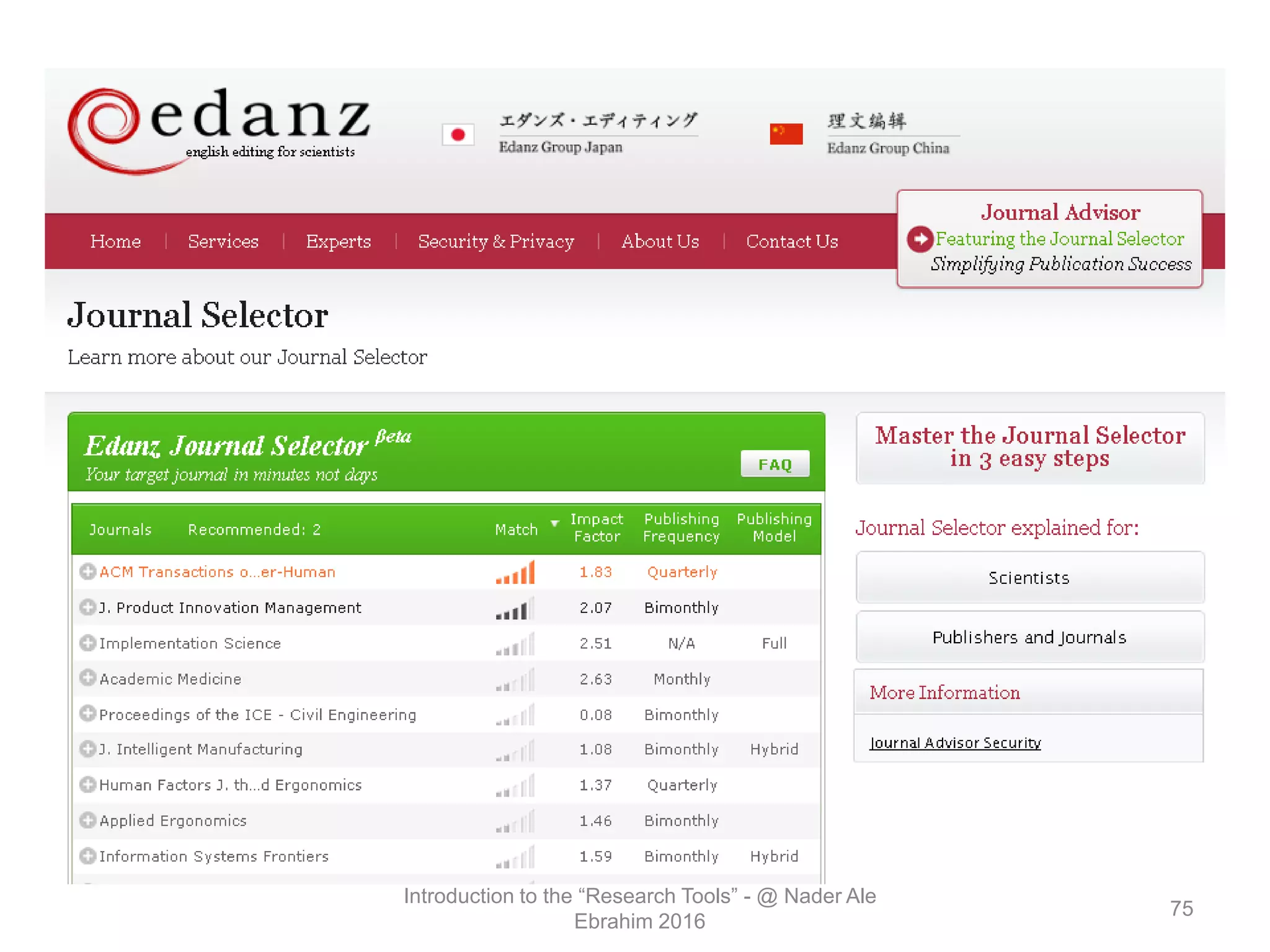
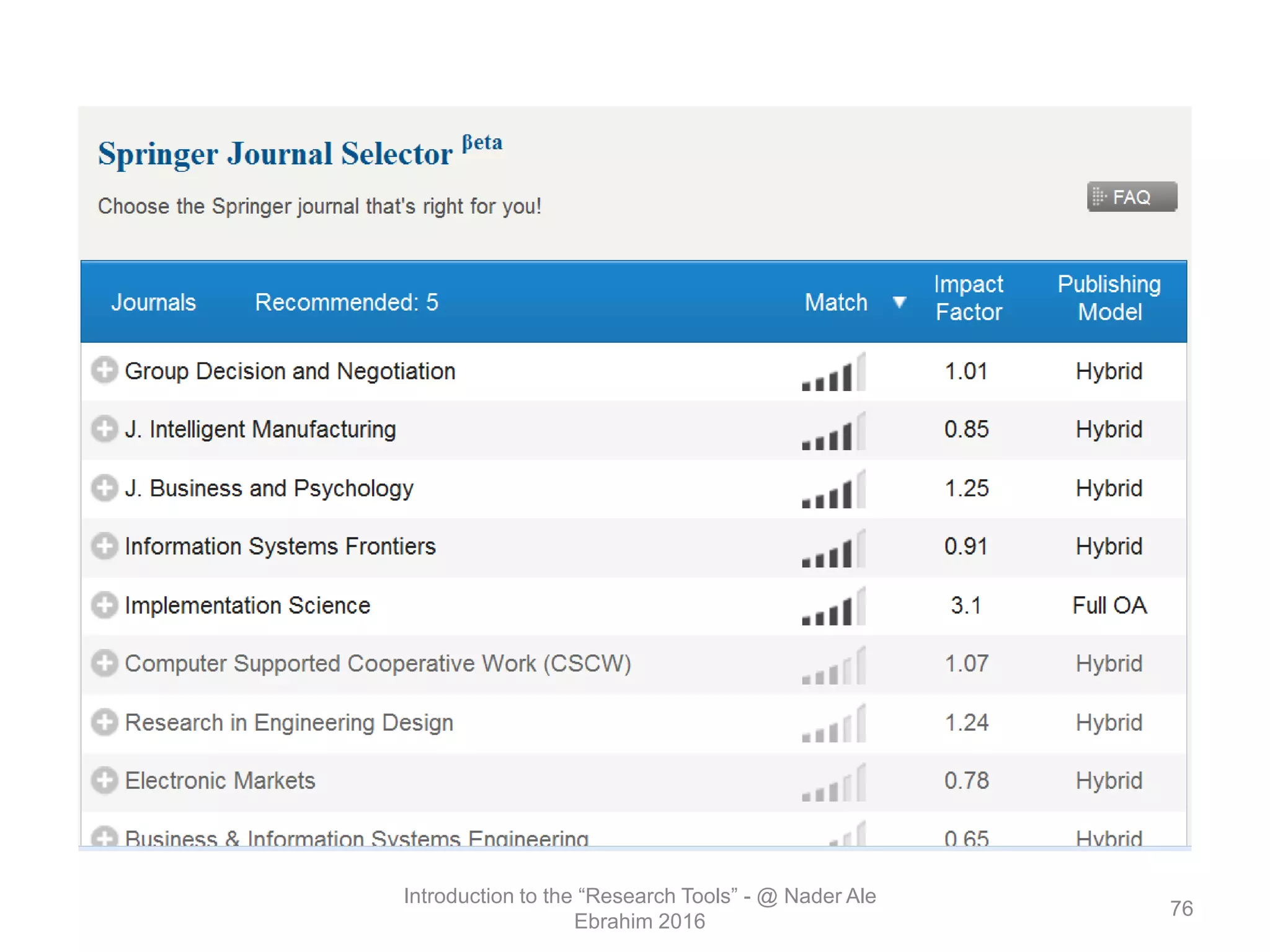
Where should I submit my publication?
Springer Journal Selector βeta
Journal Selector
Journal Selector is the industry's leading
database to all of the best peer-reviewed
biomedical journals.
Introduction to the “Research Tools” - @ Nader Ale
Ebrahim 2016
74
Introduction to the “Research Tools” - @ Nader Ale
Ebrahim 2016
75
Introduction to the “Research Tools” - @ Nader Ale
Ebrahim 2016
76
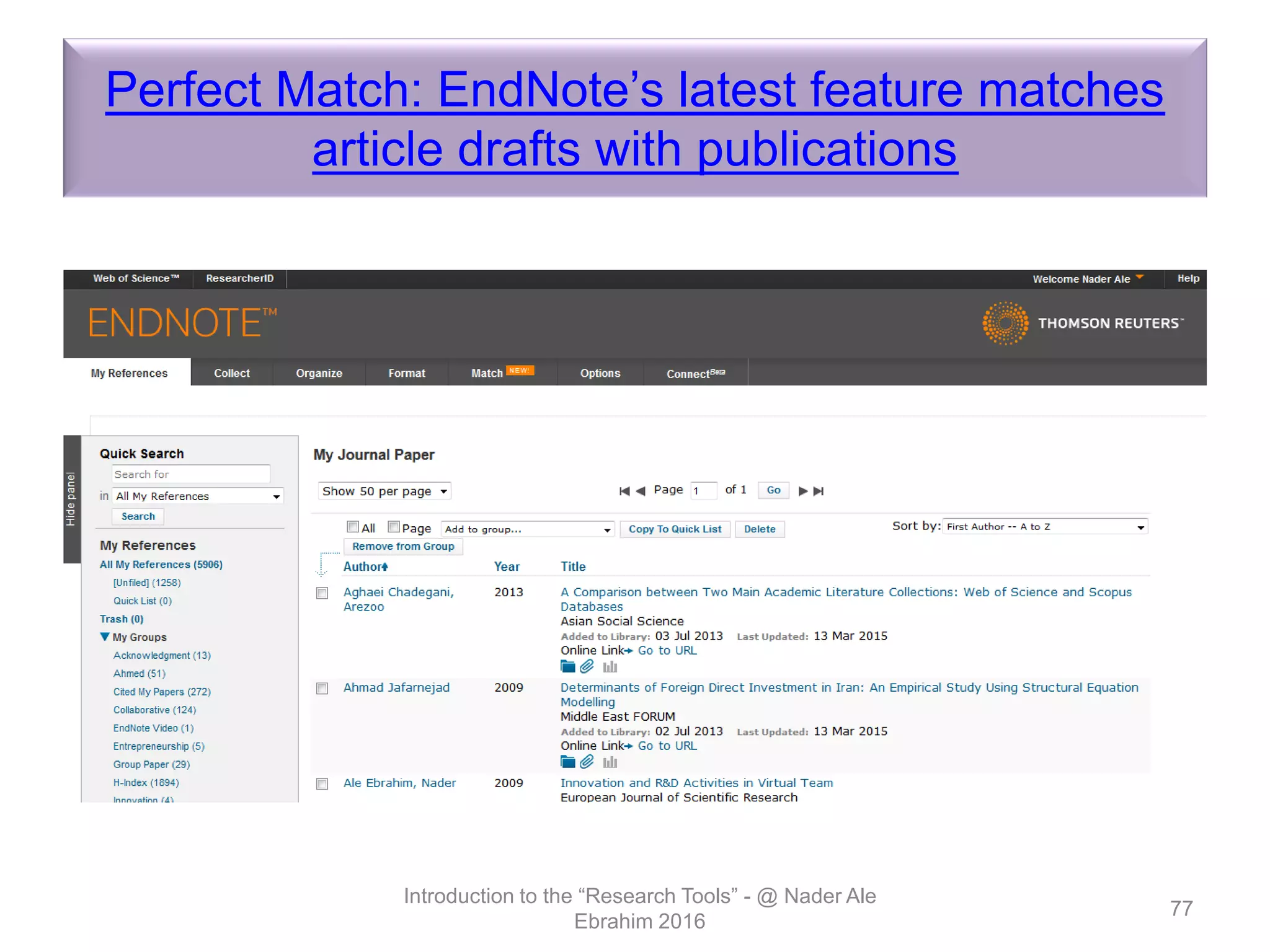
Perfect Match: EndNote’s latest feature matches
article drafts with publications
Introduction to the “Research Tools” - @ Nader Ale
Ebrahim 2016
77
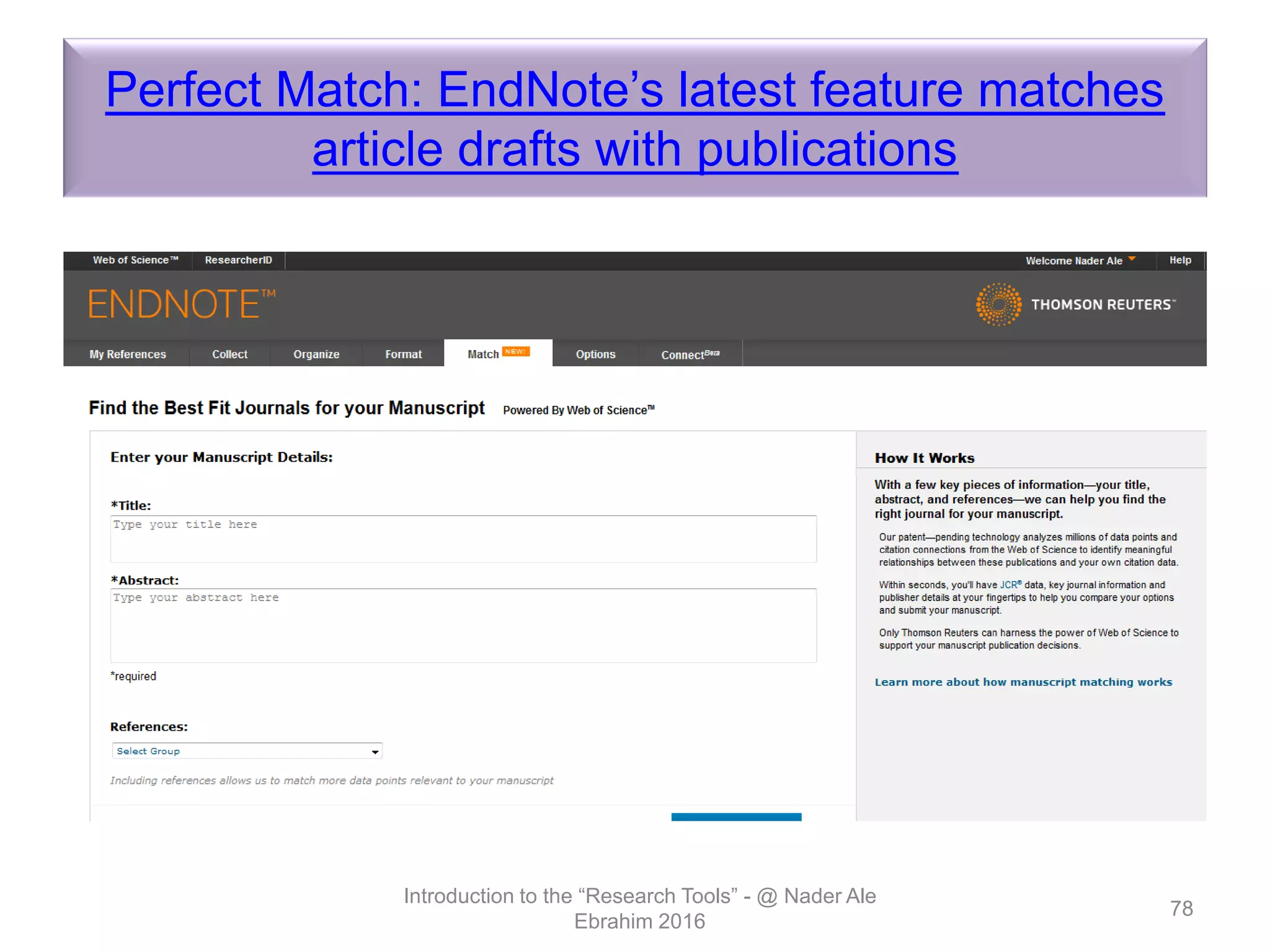
Perfect Match: EndNote’s latest feature matches
article drafts with publications
Introduction to the “Research Tools” - @ Nader Ale
Ebrahim 2016
78
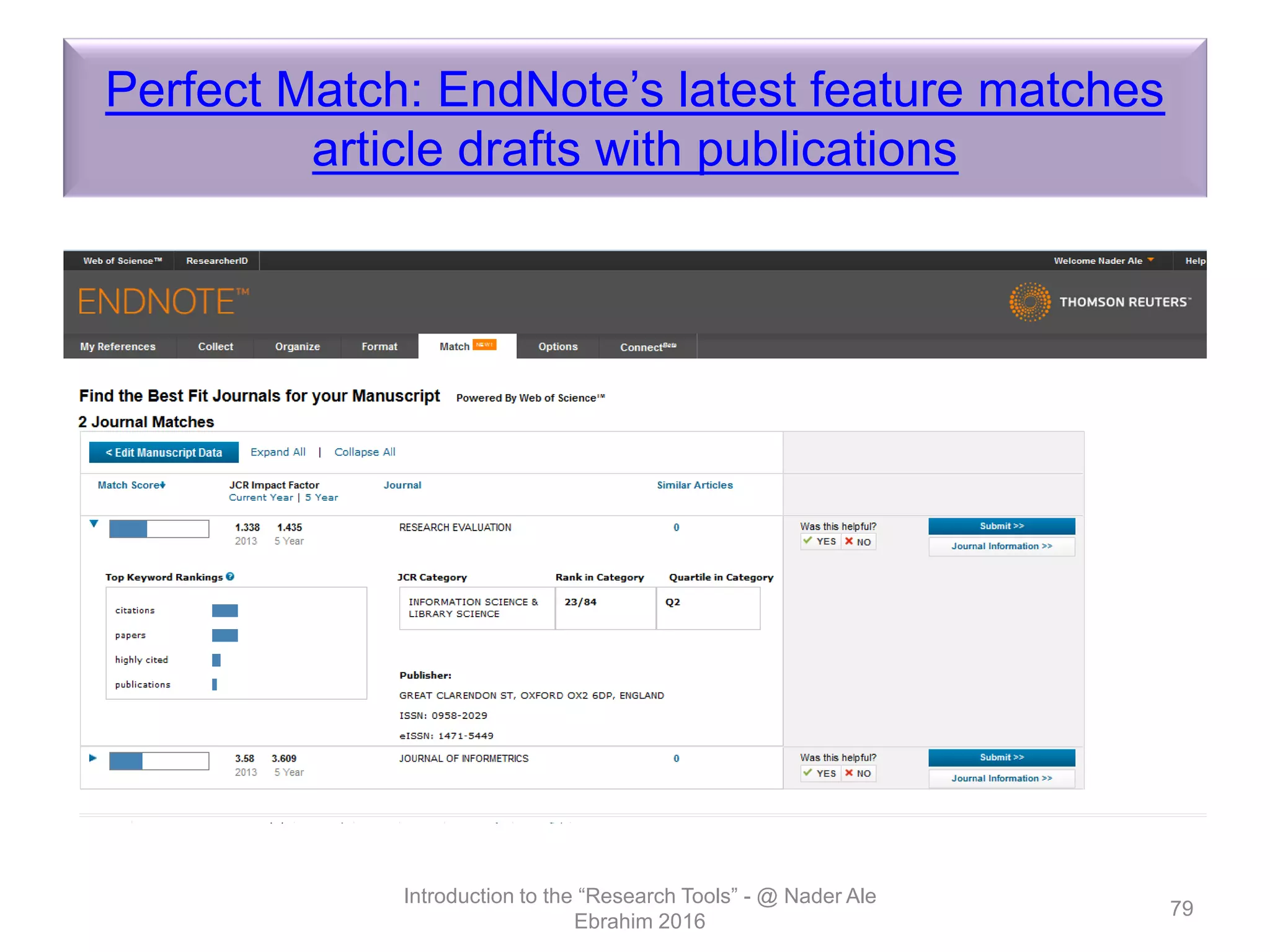
Perfect Match: EndNote’s latest feature matches
article drafts with publications
Introduction to the “Research Tools” - @ Nader Ale
Ebrahim 2016
79
Where should I submit my publication?
Introduction to the “Research Tools” - @ Nader Ale
Ebrahim 2016
80
Promote your publication
Strategies for Enhancing the Impact of Research
Improving access and retrieval of your research
study is the surest way to enhance its impact.
Repetition, consistency, and an awareness of
the intended audience form the basis of most the
following strategies.
Preparing for Publication
Dissemination
Keeping Track of Your Research
Introduction to the “Research Tools” - @ Nader Ale
Ebrahim 2016
82
Source: Washington University School of Medicine, St. Louis Missouri
1-Use a unique name consistently
throughout academic careers
The preferred form of an author's name is
first name and last name; this form
reduces the likelihood of mistaken identity.
Use the same name for publication
throughout your career; that is, do not
use initials on one manuscript and your full name
on another one. Determining whether Juanita A.
Smith is the same person as J. A. Smith, J.
Smith, or A. Smith can be difficult, particularly
when citations span several years.
Introduction to the “Research Tools” - @ Nader Ale
Ebrahim 2016
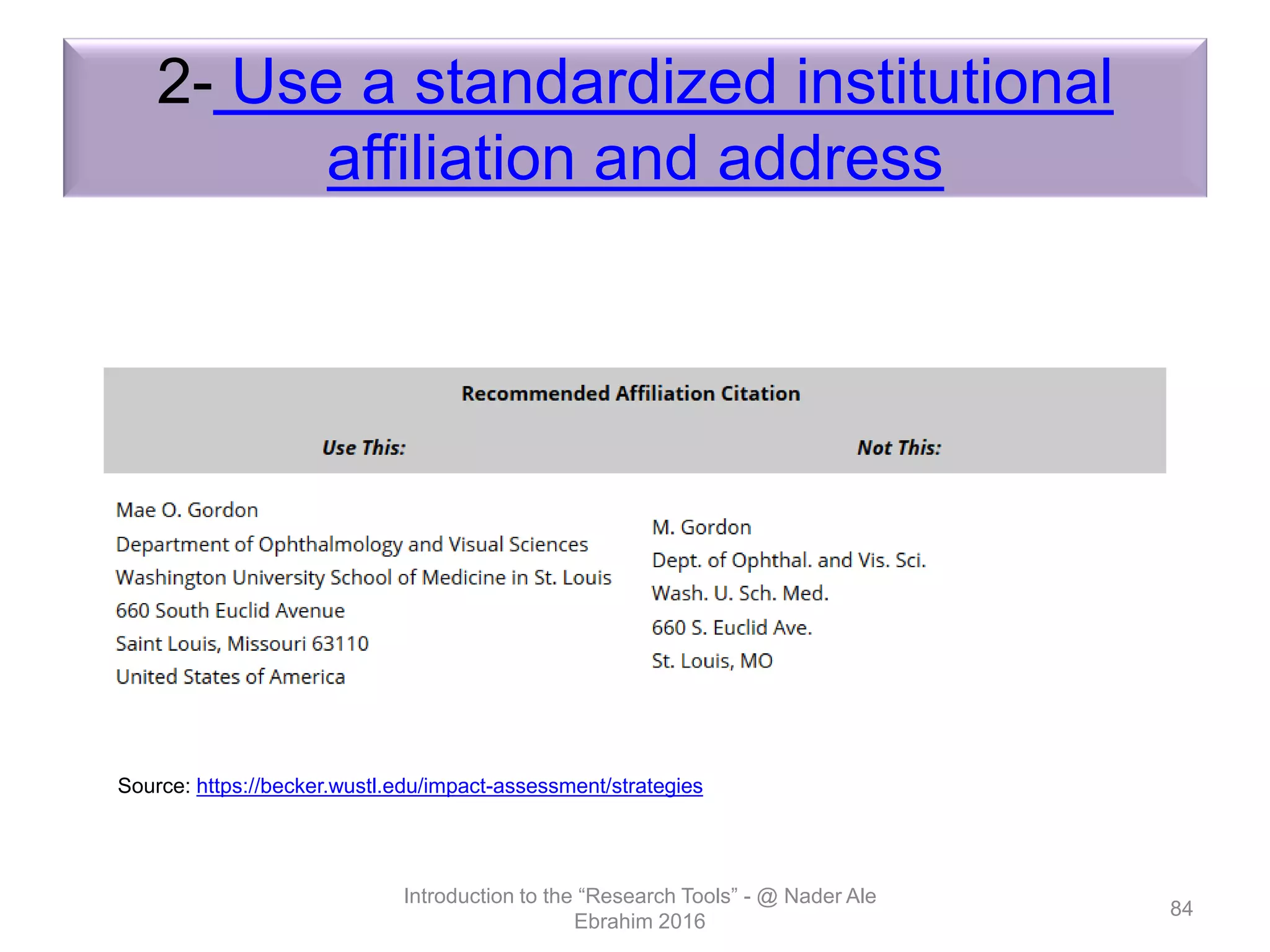
83
2- Use a standardized institutional
affiliation and address
Introduction to the “Research Tools” - @ Nader Ale
Ebrahim 2016
84
Source: https://becker.wustl.edu/impact-assessment/strategies
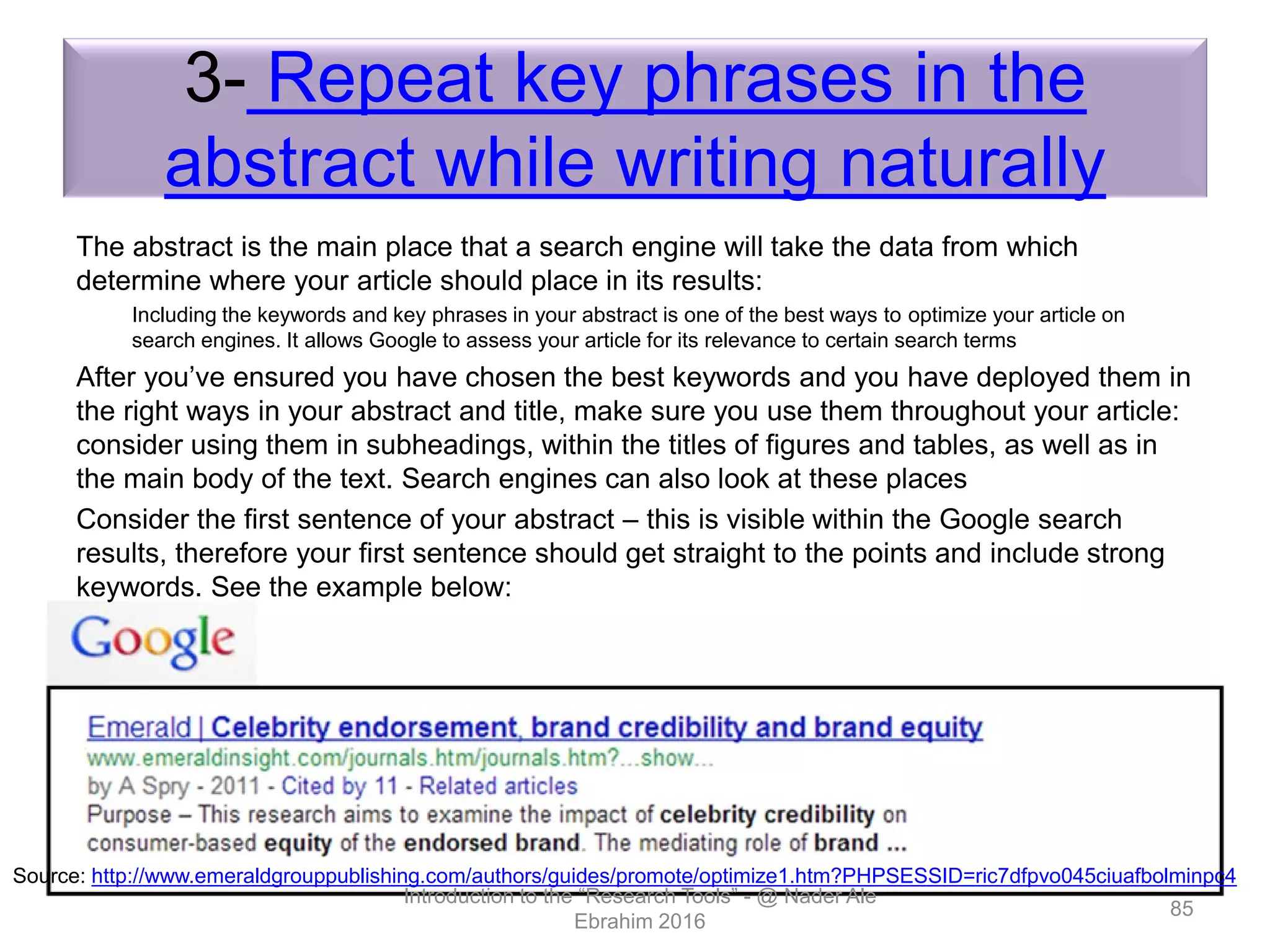
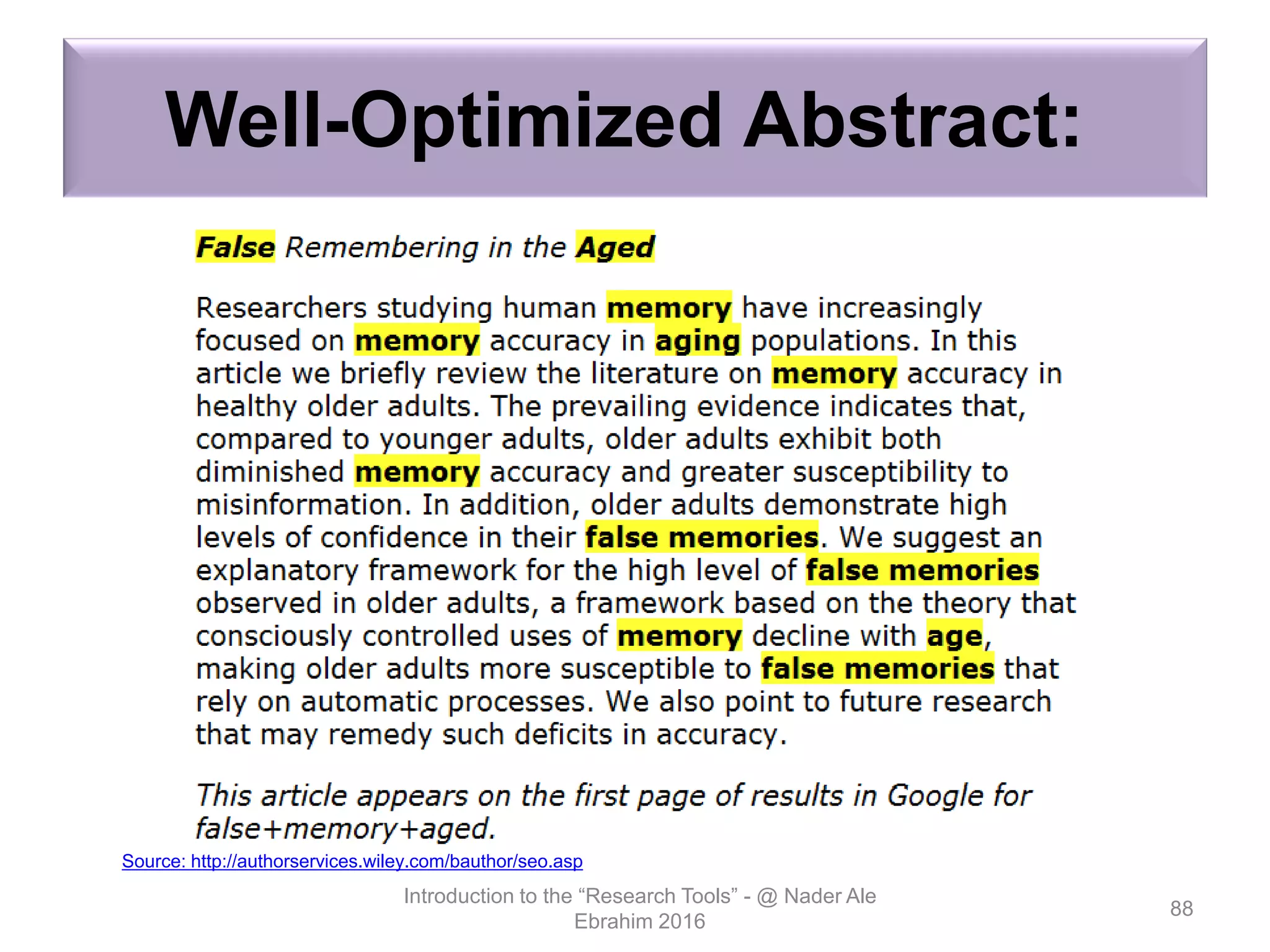
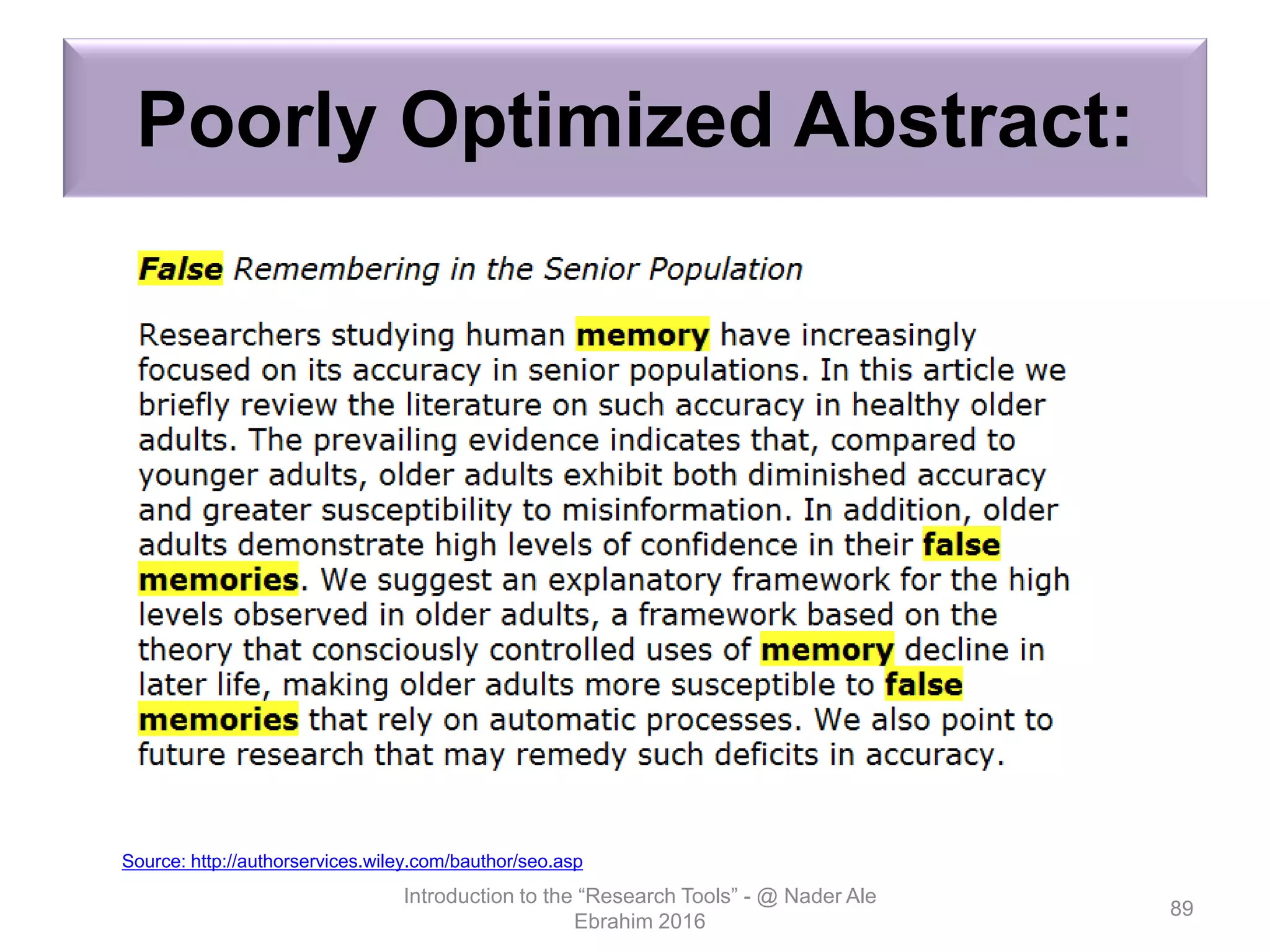
3- Repeat key phrases in the
abstract while writing naturally
The abstract is the main place that a search engine will take the data from which
determine where your article should place in its results:
Including the keywords and key phrases in your abstract is one of the best ways to optimize your article on
search engines. It allows Google to assess your article for its relevance to certain search terms
After you’ve ensured you have chosen the best keywords and you have deployed them in
the right ways in your abstract and title, make sure you use them throughout your article:
consider using them in subheadings, within the titles of figures and tables, as well as in
the main body of the text. Search engines can also look at these places
Consider the first sentence of your abstract – this is visible within the Google search
results, therefore your first sentence should get straight to the points and include strong
keywords. See the example below:
Introduction to the “Research Tools” - @ Nader Ale
Ebrahim 2016
85
Source: http://www.emeraldgrouppublishing.com/authors/guides/promote/optimize1.htm?PHPSESSID=ric7dfpvo045ciuafbolminpc4
4-Select a proper title
As an author, you can dramatically improve the
chances of your article being downloaded once
it’s online, before you even submit it!
There are three easy steps you can take to ensure
it enjoys high usage:
Choose a descriptive title
Use appropriate keywords
Write an informative abstract
Source: http://www.emeraldinsight.com/authors/guides/promote/optimize1.htm
Introduction to the “Research Tools” - @ Nader Ale
Ebrahim 2016
86
Optimize Title/Abstract
Step 1: Construct a clear, descriptive title
In search engine terms, the title of your article is the
most interesting element. The search engine assumes
that the title contains all of the important words that
define the topic of the piece and thus weights words
appearing there most heavily.
Step 2: Reiterate key phrases
The next most important field is the text of the abstract
itself. You should reiterate the key words or phrases from
the title within the abstract itself.
Introduction to the “Research Tools” - @ Nader Ale
Ebrahim 2016
87
Source: http://authorservices.wiley.com/bauthor/seo.asp
Well-Optimized Abstract:
Introduction to the “Research Tools” - @ Nader Ale
Ebrahim 2016
88
Source: http://authorservices.wiley.com/bauthor/seo.asp
Poorly Optimized Abstract:
Introduction to the “Research Tools” - @ Nader Ale
Ebrahim 2016
89
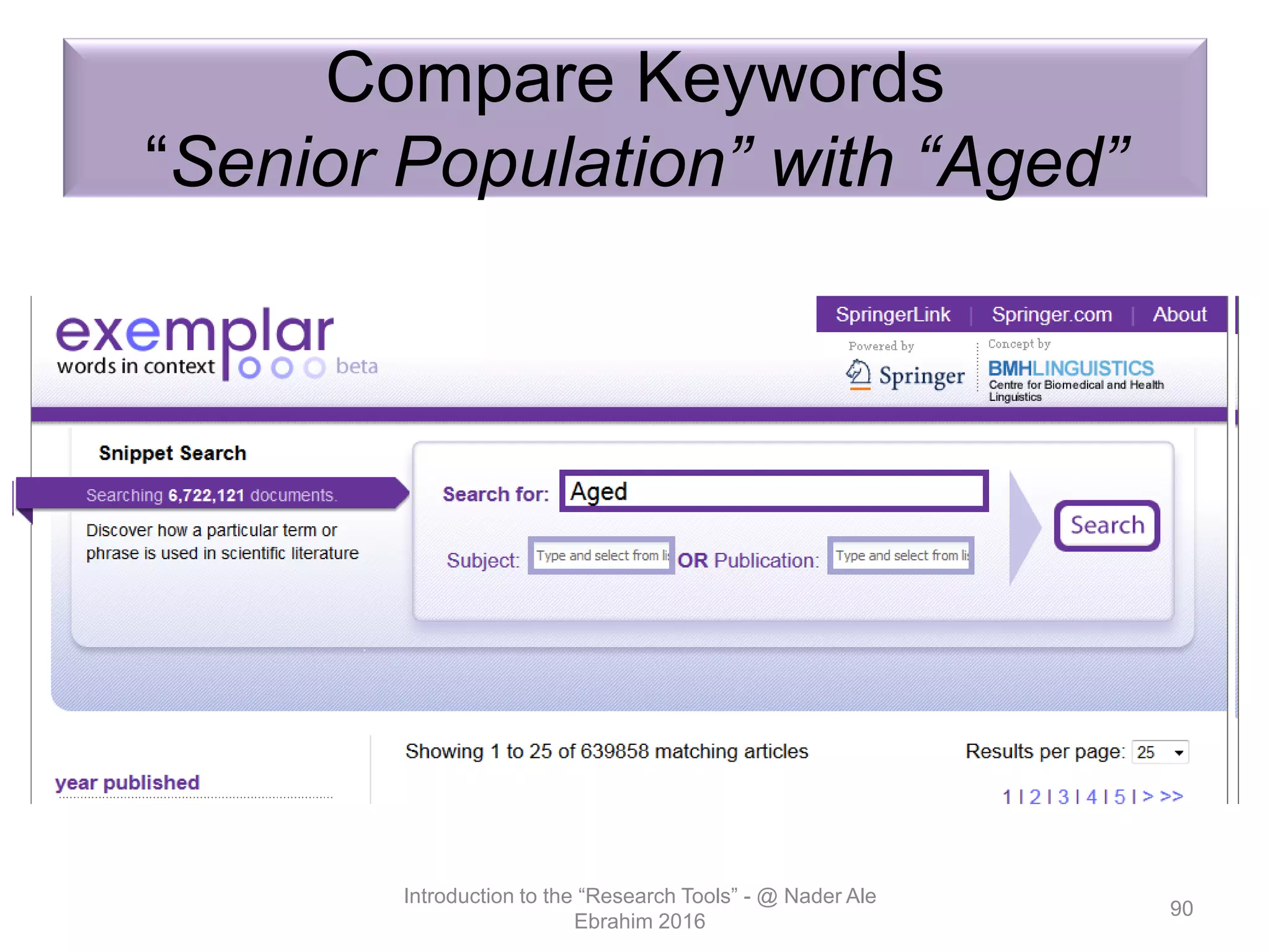
Source: http://authorservices.wiley.com/bauthor/seo.asp
Compare Keywords
“Senior Population” with “Aged”
Introduction to the “Research Tools” - @ Nader Ale
Ebrahim 2016
90
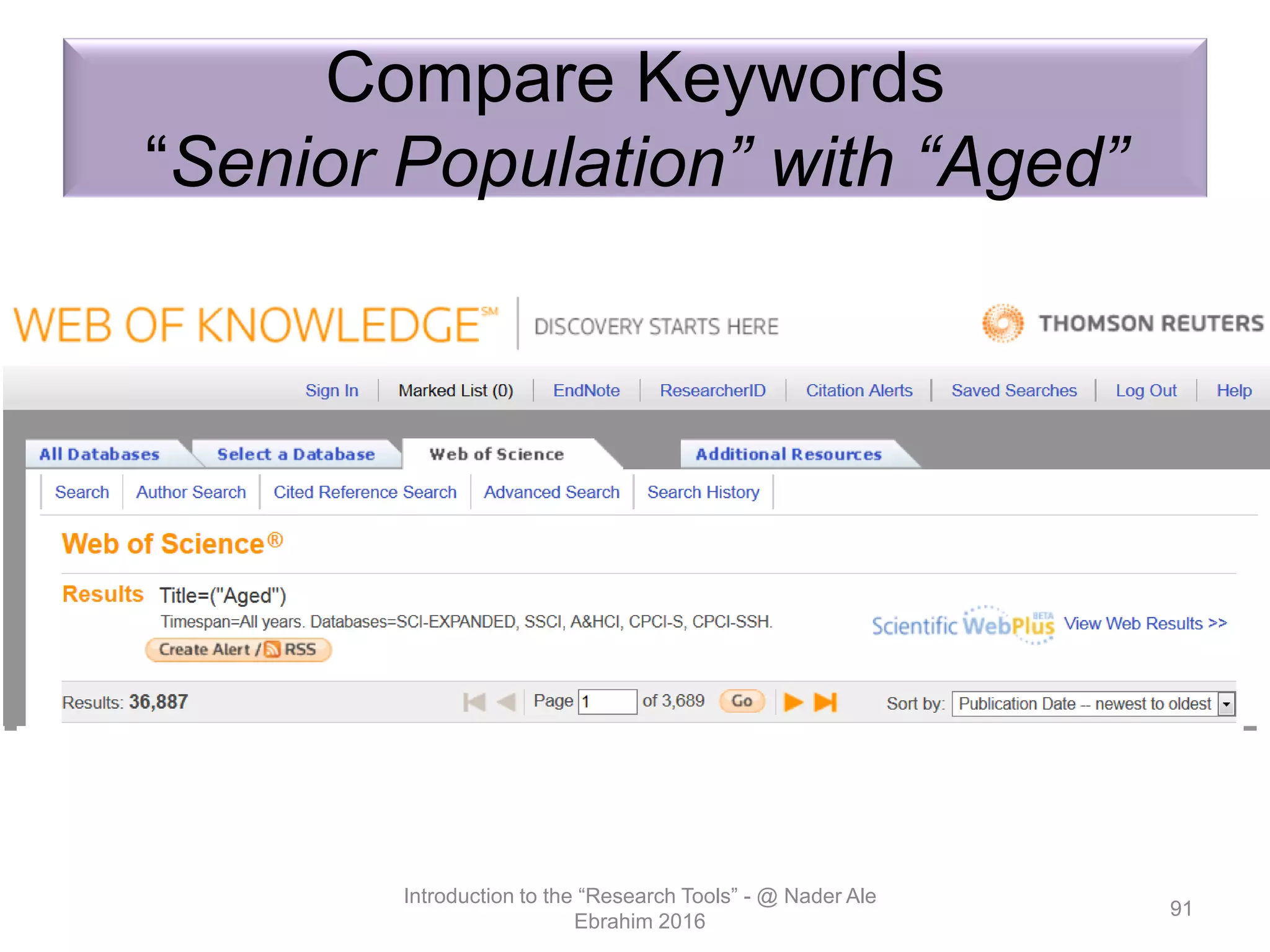
Compare Keywords
“Senior Population” with “Aged”
Introduction to the “Research Tools” - @ Nader Ale
Ebrahim 2016
91
Titles: be simple and specific
• Use active rather than passive verbs.
• Avoid words that don’t add to the story such as: “on this”, “study”,
and “investigation”.
• Be specific in delivering your message:
• Not every reader may know what Akt and Foxo1 are, but the title is
declarative and specific. “But don’t be too specific”.
• When possible, avoid acronyms and other jargon, which renders the
title opaque to readers not already conversant in the field.
• Avoid question marks: titles should present outcomes, without
teasing the reader.
• Focus on what is novel in the work.
• Avoid complex, compound nouns. For example, the term “excess
water-weight remover”.
Source: http://blogs.nature.com/naturejobs/2015/07/10/publishing-high-impact-papers-natures-way
Introduction to the “Research Tools” - @ Nader Ale
Ebrahim 2016
92
5-Select/Make a brand name
• Make a unique phrase that reflects
author's research interest and use it
throughout academic life.
• Add the name of study in the title of all
publications and use the same title/name
consistently.
Introduction to the “Research Tools” - @ Nader Ale
Ebrahim 2016
93
Read more: Ale Ebrahim, N., Salehi, H., Embi, M. A., Habibi Tanha, F., Gholizadeh, H., Motahar, S. M., & Ordi, A. (2013).
Effective Strategies for Increasing Citation Frequency. International Education Studies, 6(11), 93-99. doi:
10.5539/ies.v6n11p93
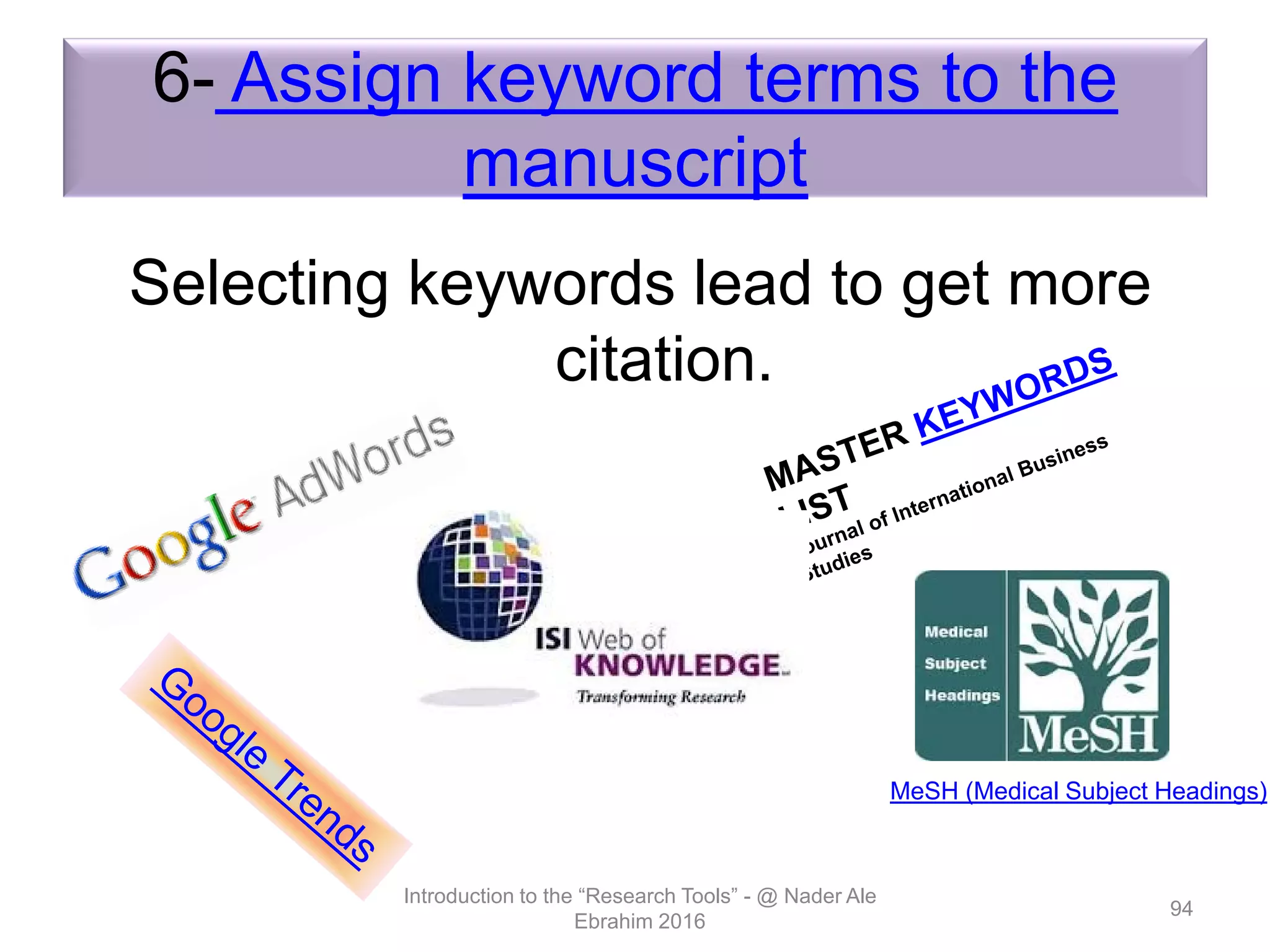
6- Assign keyword terms to the
manuscript
Selecting keywords lead to get more
citation.
Introduction to the “Research Tools” - @ Nader Ale
Ebrahim 2016
94
MeSH (Medical Subject Headings)
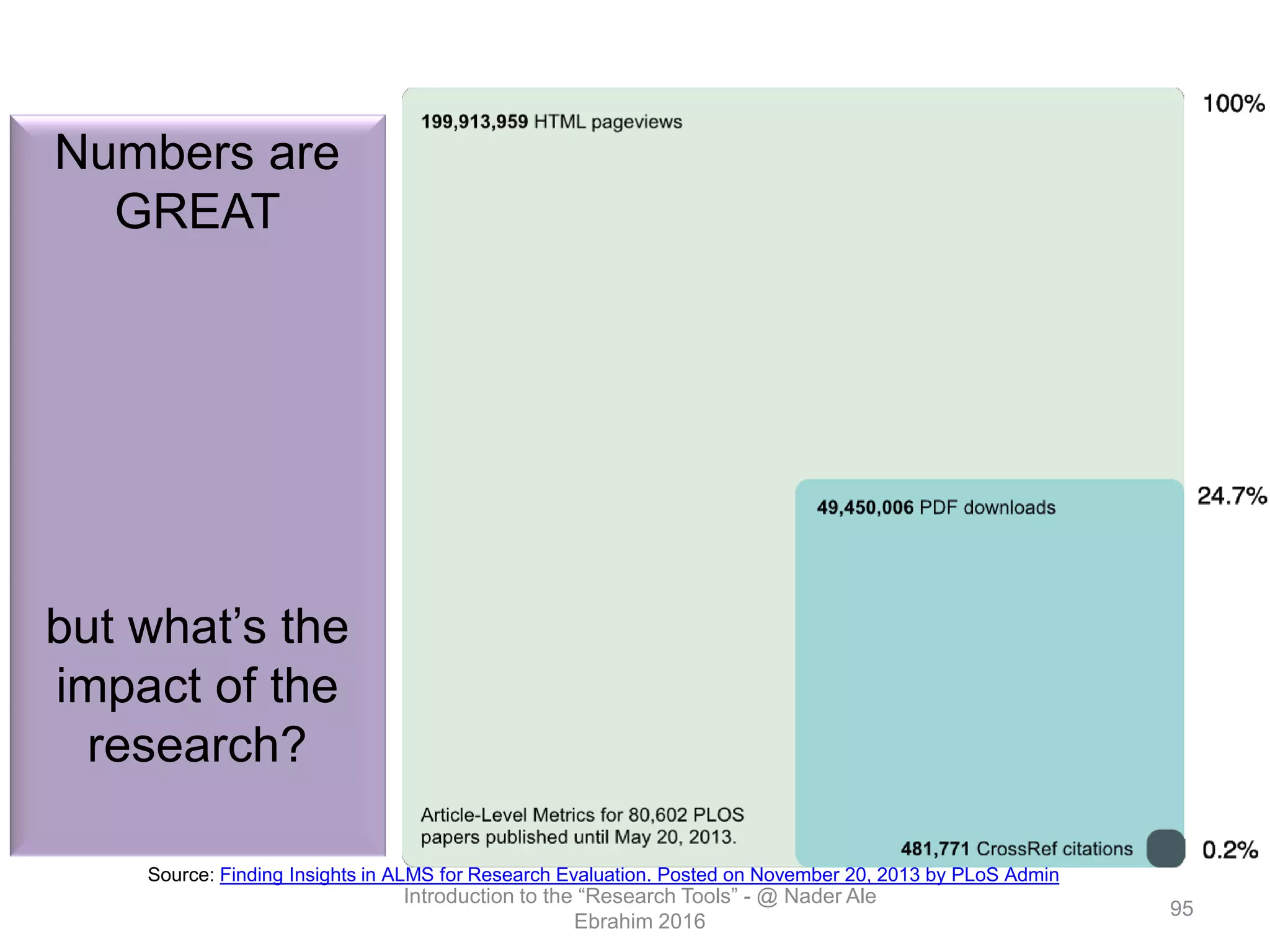
Numbers are
GREAT
but what’s the
impact of the
research?
Introduction to the “Research Tools” - @ Nader Ale
Ebrahim 2016
95
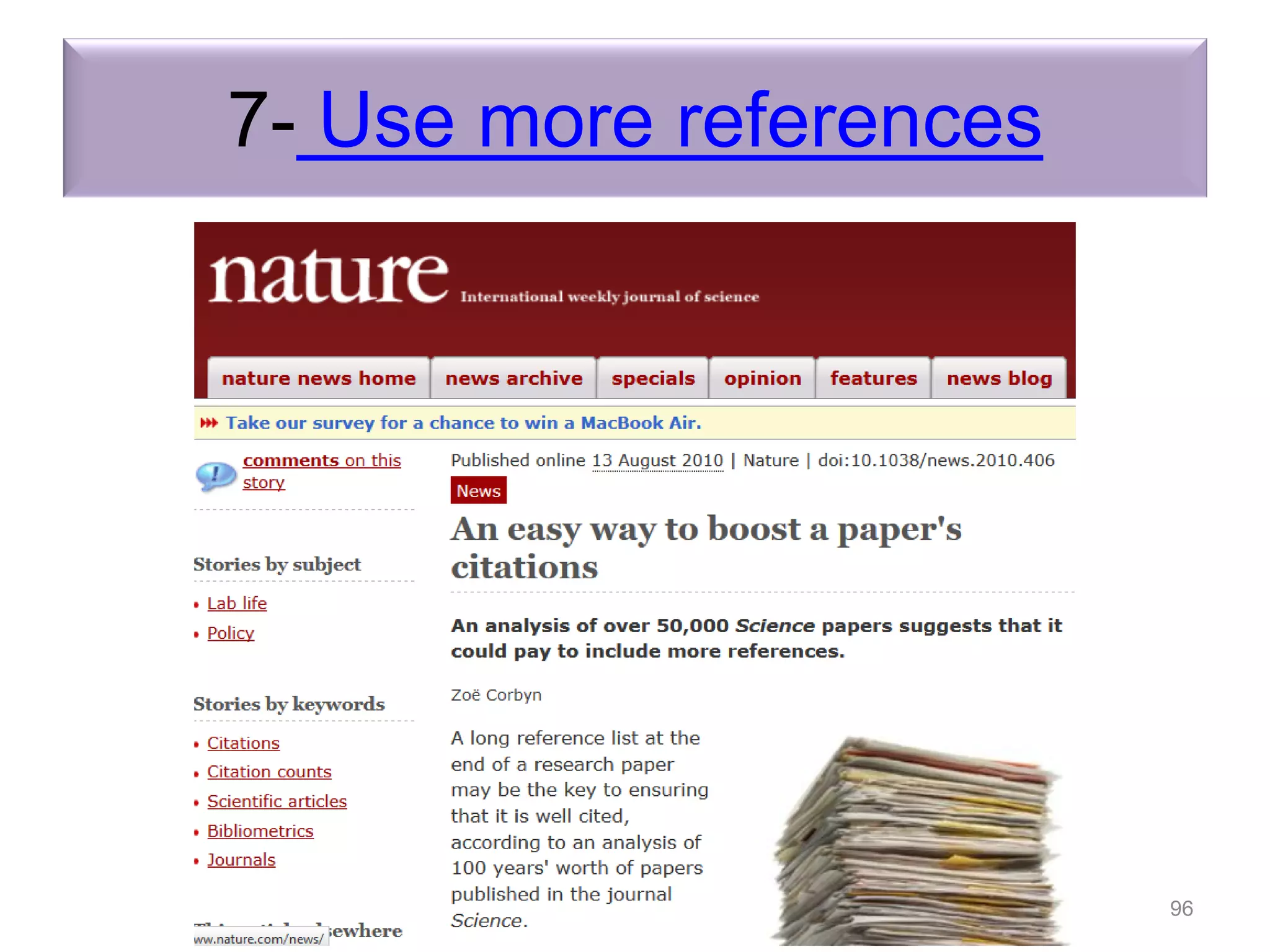
Source: Finding Insights in ALMS for Research Evaluation. Posted on November 20, 2013 by PLoS Admin
7- Use more references
Introduction to the “Research Tools” - @ Nader Ale
Ebrahim 2016
96
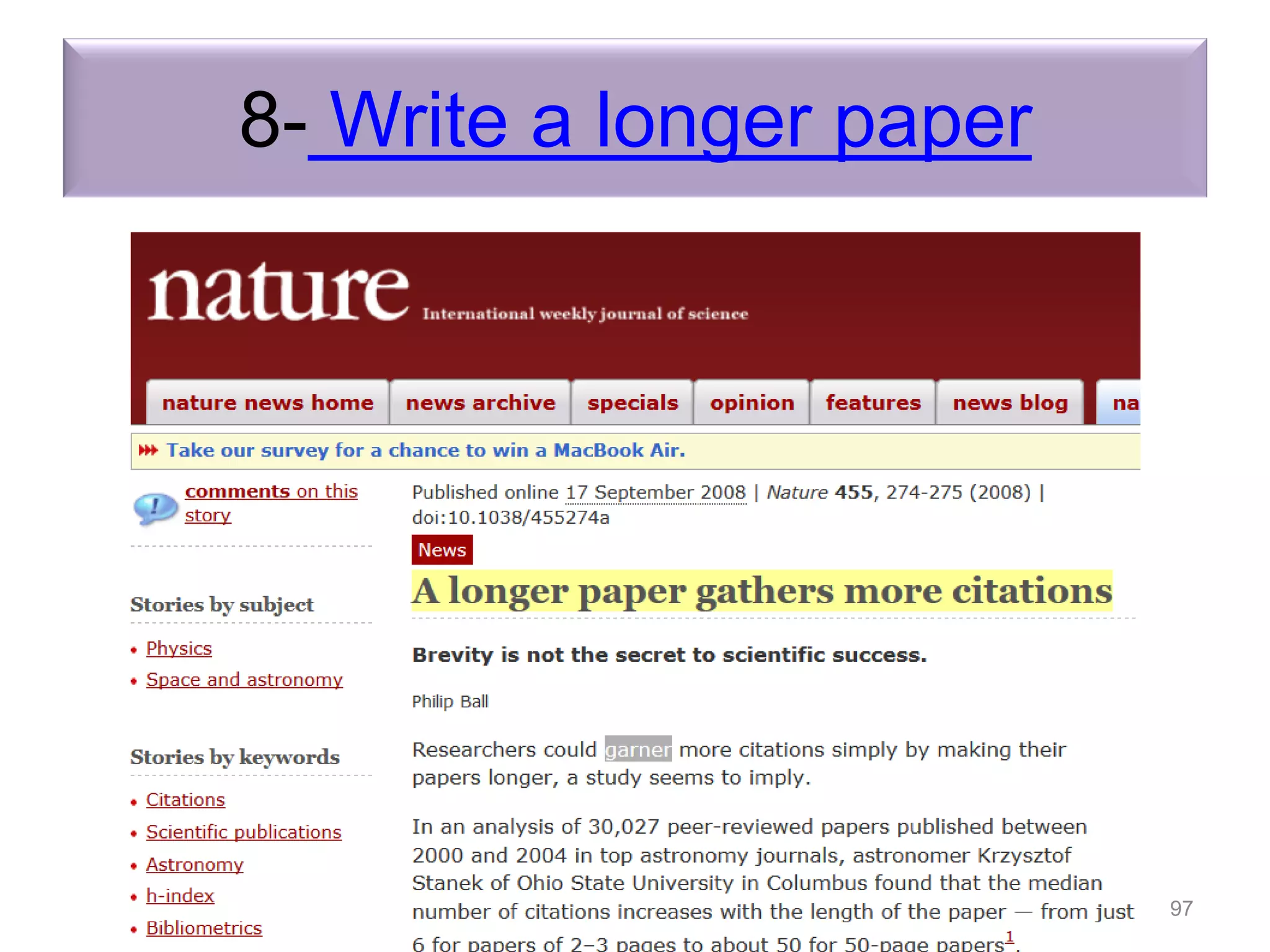
8- Write a longer paper
Introduction to the “Research Tools” - @ Nader Ale
Ebrahim 2016
97
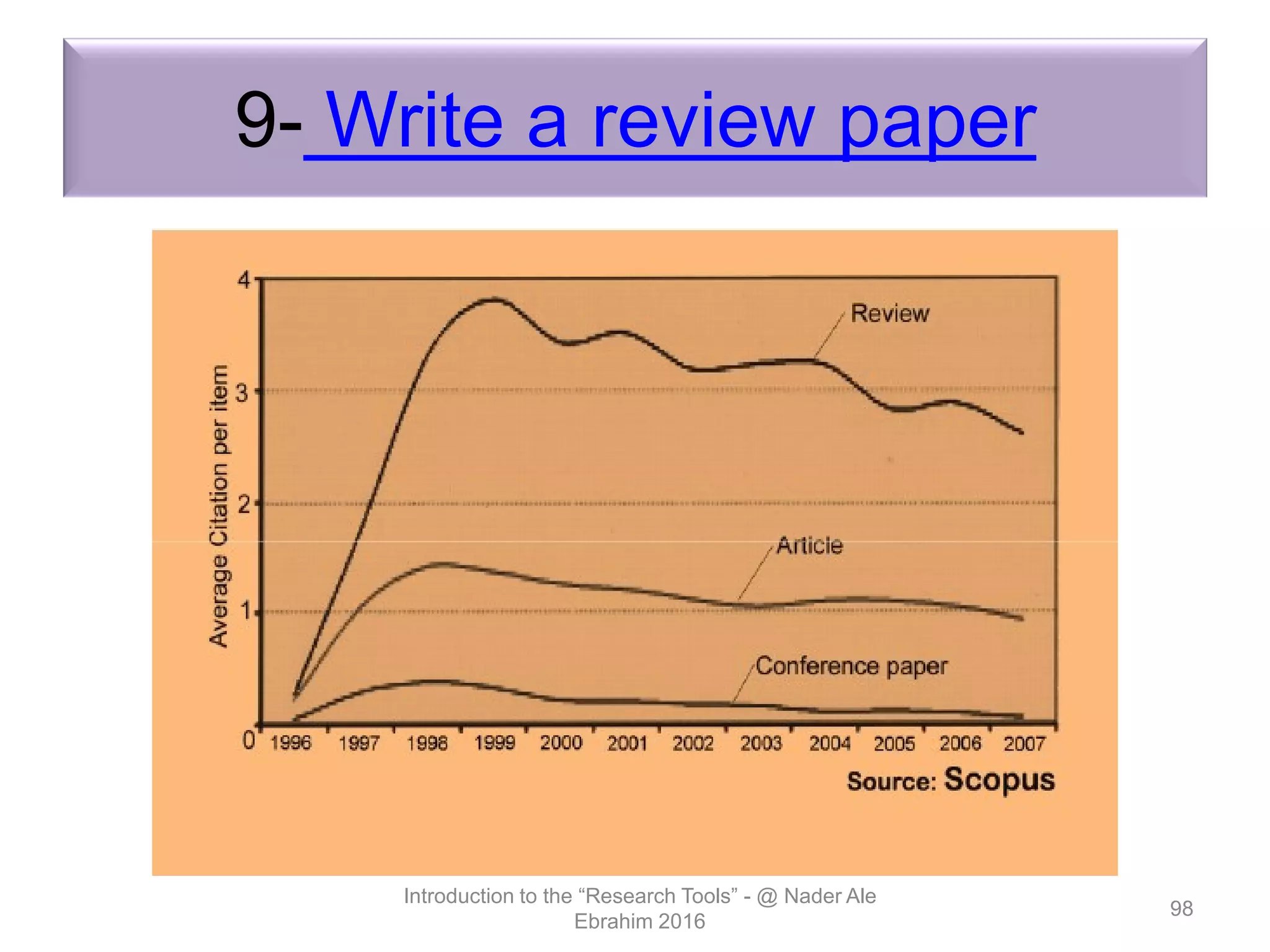
9- Write a review paper
Introduction to the “Research Tools” - @ Nader Ale
Ebrahim 2016
98
10-Present a working paper
Working papers are freely available before
and after the articles are published.
Researchers may upload their working
papers into open access repositories
including the personal websites or more
formal repositories such as arXiv and SSRN.
Introduction to the “Research Tools” - @ Nader Ale
Ebrahim 2016
99
Read more: Ale Ebrahim, N., Salehi, H., Embi, M. A., Habibi Tanha, F., Gholizadeh, H., Motahar, S. M., & Ordi, A. (2013).
Effective Strategies for Increasing Citation Frequency. International Education Studies, 6(11), 93-99. doi:
10.5539/ies.v6n11p93
11-To be the best, cite the best
Introduction to the “Research Tools” - @ Nader Ale
Ebrahim 2016
100
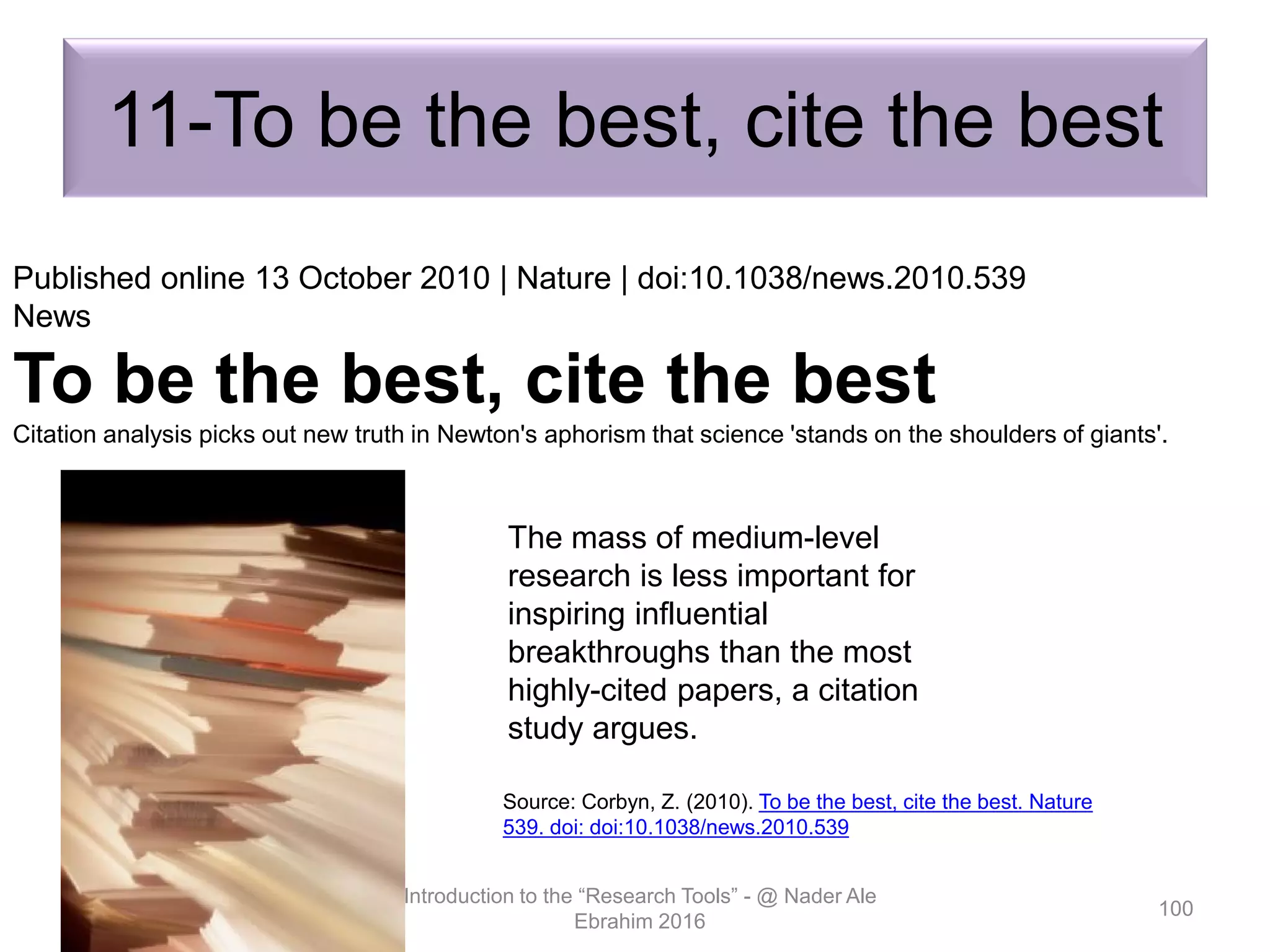
Published online 13 October 2010 | Nature | doi:10.1038/news.2010.539
News
To be the best, cite the best
Citation analysis picks out new truth in Newton's aphorism that science 'stands on the shoulders of giants'.
The mass of medium-level
research is less important for
inspiring influential
breakthroughs than the most
highly-cited papers, a citation
study argues.
Source: Corbyn, Z. (2010). To be the best, cite the best. Nature
539. doi: doi:10.1038/news.2010.539
12-Self Citation
“Self-citation refers to a paper being submitted to a specific
journal in which papers that have been published during
the previous 2 years in that same journal are cited in the
reference list. While self-citation of relevant papers is
legitimate, excessive self-citation can indicate a
manipulation.
Thomson Reuters resource known as Web of Science, the
company which now lists journal impact factors,
considers self-citation to be acceptable up to a rate of
20%, anything over that is considered suspect” (Diana
Epstein, 2007).
• Source: Diana Epstein, Impact factor manipulation, The Journal of the European Medical Writers
Association, Vol. 16, No. 3, 2007Introduction to the “Research Tools” - @ Nader Ale
Ebrahim 2016
101
13-Co-authorship internationally
• Citation analysis shows that papers
with international co-authors are cited
up to four times more often than
those without international co-
authors.
Introduction to the “Research Tools” - @ Nader Ale
Ebrahim 2016
102
Source: http://www.bath.ac.uk/library/services/eprints/improve-citations.pdf
14- Publish papers with a Nobel
laureates
• Some landmark papers of Nobel
laureates quite quickly give their
authors a sudden boost in citation
rate and this boost extends to the
author's earlier papers too, even if
they were in unrelated areas (Ball
2011).
Introduction to the “Research Tools” - @ Nader Ale
Ebrahim 2016
103
Read more: Ale Ebrahim, N., Salehi, H., Embi, M. A., Habibi Tanha, F., Gholizadeh, H., Motahar, S. M., & Ordi, A. (2013).
Effective Strategies for Increasing Citation Frequency. International Education Studies, 6(11), 93-99. doi:
10.5539/ies.v6n11p93
15-Publish your article in one of the journals
everyone in your discipline reads
• Choosing a journal that matches with
a researcher’s field of study is thus
very important because it makes it
more likely that the article receives
more citation. A journal which covers
a broad range of disciplines may be
the best.
Introduction to the “Research Tools” - @ Nader Ale
Ebrahim 2016
104
Read more: Ale Ebrahim, N., Salehi, H., Embi, M. A., Habibi Tanha, F., Gholizadeh, H., Motahar, S. M., & Ordi, A. (2013).
Effective Strategies for Increasing Citation Frequency. International Education Studies, 6(11), 93-99. doi:
10.5539/ies.v6n11p93
16-Publish your work in a journal
with the highest number of indexing
1. ABI/INFORM
2. Association of Business Schools' (ABI) Academic Journal Quality Guide (www.the-abs.org.uk)
3. Australian Business Deans' Council (ABDC) Journal Quality List
4. Australian Research Council ERA Ranked Journal List
5. Compendex
6. Computer Abstracts International Database
7. Current Contents / Engineering, Computing & Technology
8. Current Contents / Social & Behavioural Sciences
9. Emerald Management Reviews (EMR)
10. INSPEC Abstracts
11. International Abstracts in Operations Research
12. OR/MS Index and Annual Comprehensive Index
13. Science Citation Index
14. Social Science Citation Index
15. SCOPUS
16. Zentralblatt MATH
• Source: Journal of the Operational Research Society
Introduction to the “Research Tools” - @ Nader Ale
Ebrahim 2016
105
17- Publish in an Open Access
(OA) journal
• One key request of researchers across the world
is unrestricted access to research publications.
Open access gives a worldwide audience larger
than that of any subscription-based journal and
thus increases the visibility and impact of
published works. It also enhances indexing,
retrieval power and eliminates the need for
permissions to reproduce and distribute content.
Introduction to the “Research Tools” - @ Nader Ale
Ebrahim 2016
106
18-Publish in a journal with high
impact factor
• The most effective strategy to increase
citation rates is publishing in a journal with
higher impact factor (Vanclay 2013).
• Dhawan and Gupta (2005) studied 1101
papers and found that articles published in
high impact factor journals increase the
probability of getting cited.
Introduction to the “Research Tools” - @ Nader Ale
Ebrahim 2016
107
Read more: Ale Ebrahim, N., Salehi, H., Embi, M. A., Habibi Tanha, F., Gholizadeh, H., Motahar, S. M., & Ordi, A. (2013).
Effective Strategies for Increasing Citation Frequency. International Education Studies, 6(11), 93-99. doi:
10.5539/ies.v6n11p93
19-Team-authored articles get cited
more
• Wuchty et al. (2007) have used 19.9 million
papers over 50 years and demonstrated that
team-authored articles typically produce more
frequently cited research than individuals.
• A recent study by Cotropia and Petherbridge
(2013) in law review articles which were published
within two decades also demonstrated that team
research is on average more frequently cited than
individual research.
• Typically high cited articles are authored by a
large number of scientists (Aksnes 2003).
Introduction to the “Research Tools” - @ Nader Ale
Ebrahim 2016
108
20-Use a larger number of
“callouts”
• A “callout” is a phrase or sentence from the
paper that is displayed in a different font,
somewhere in the paper.
• Papers with a larger number of “callouts” be
likely to receive a higher number of citations
(Hamrick et al. 2010).
• Generally, callouts are inserted by the editorial
staff to call attention to potentially interesting
aspects of a paper (Hamrick et al. 2010).
Introduction to the “Research Tools” - @ Nader Ale
Ebrahim 2016
109
21- Publish across disciplines
• Publishing across disciplines has
been found to increase citation e.g.
chemistry, biological science and
physics (Ortega and Antell 2006).
Introduction to the “Research Tools” - @ Nader Ale
Ebrahim 2016
110
Read more: Ale Ebrahim, N., Salehi, H., Embi, M. A., Habibi Tanha, F., Gholizadeh, H., Motahar, S. M., & Ordi, A. (2013).
Effective Strategies for Increasing Citation Frequency. International Education Studies, 6(11), 93-99. doi:
10.5539/ies.v6n11p93
22- Publish tutorials papers
• Tutorial paper is “a paper that organizes
and introduces work in the field.
• A tutorial paper assumes its audience is
inexpert; it emphasizes the basic concepts
of the field and provides concrete
examples that embody these concepts
(ACM 2013)”.
• Tutorials papers tend to have a higher
number of citations (Hamrick et al. 2010).
Introduction to the “Research Tools” - @ Nader Ale
Ebrahim 2016
111
23-Self-archive articles
• Free online availability increases a paper's
impact (Lawrence 2001);
• Freely accessible articles increase
citations by 50% or more (Harnad 2006).
• Gargouri et al. (2010) have made a strong
and a declarative link between self-
archiving and increased citation
performance.
Introduction to the “Research Tools” - @ Nader Ale
Ebrahim 2016
112
Read more: Ale Ebrahim, N., Salehi, H., Embi, M. A., Habibi Tanha, F., Gholizadeh, H., Motahar, S. M., & Ordi, A. (2013).
Effective Strategies for Increasing Citation Frequency. International Education Studies, 6(11), 93-99. doi:
10.5539/ies.v6n11p93
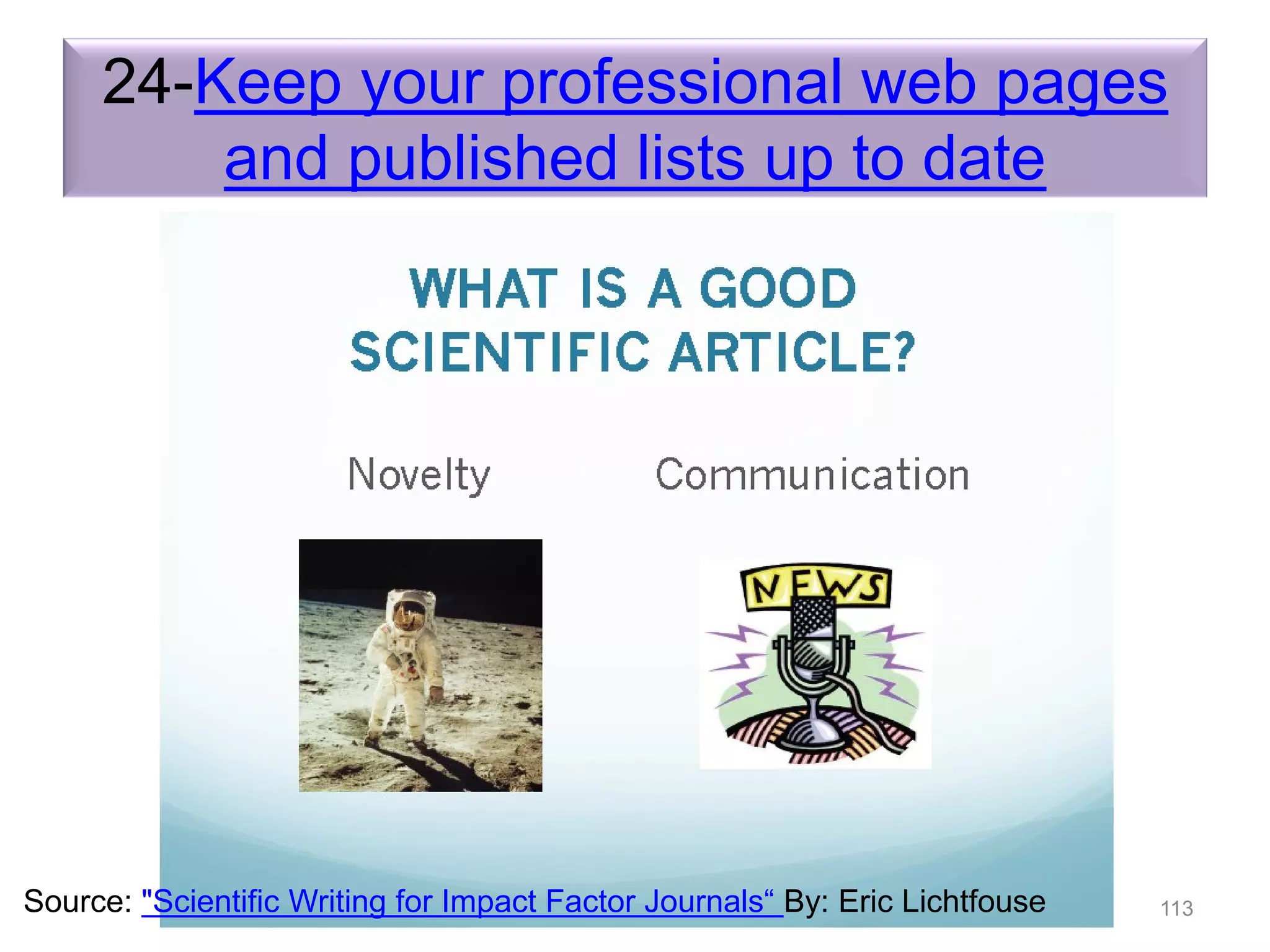
24-Keep your professional web pages
and published lists up to date
Introduction to the “Research Tools” - @ Nader Ale
Ebrahim 2016
113Source: "Scientific Writing for Impact Factor Journals“ By: Eric Lichtfouse
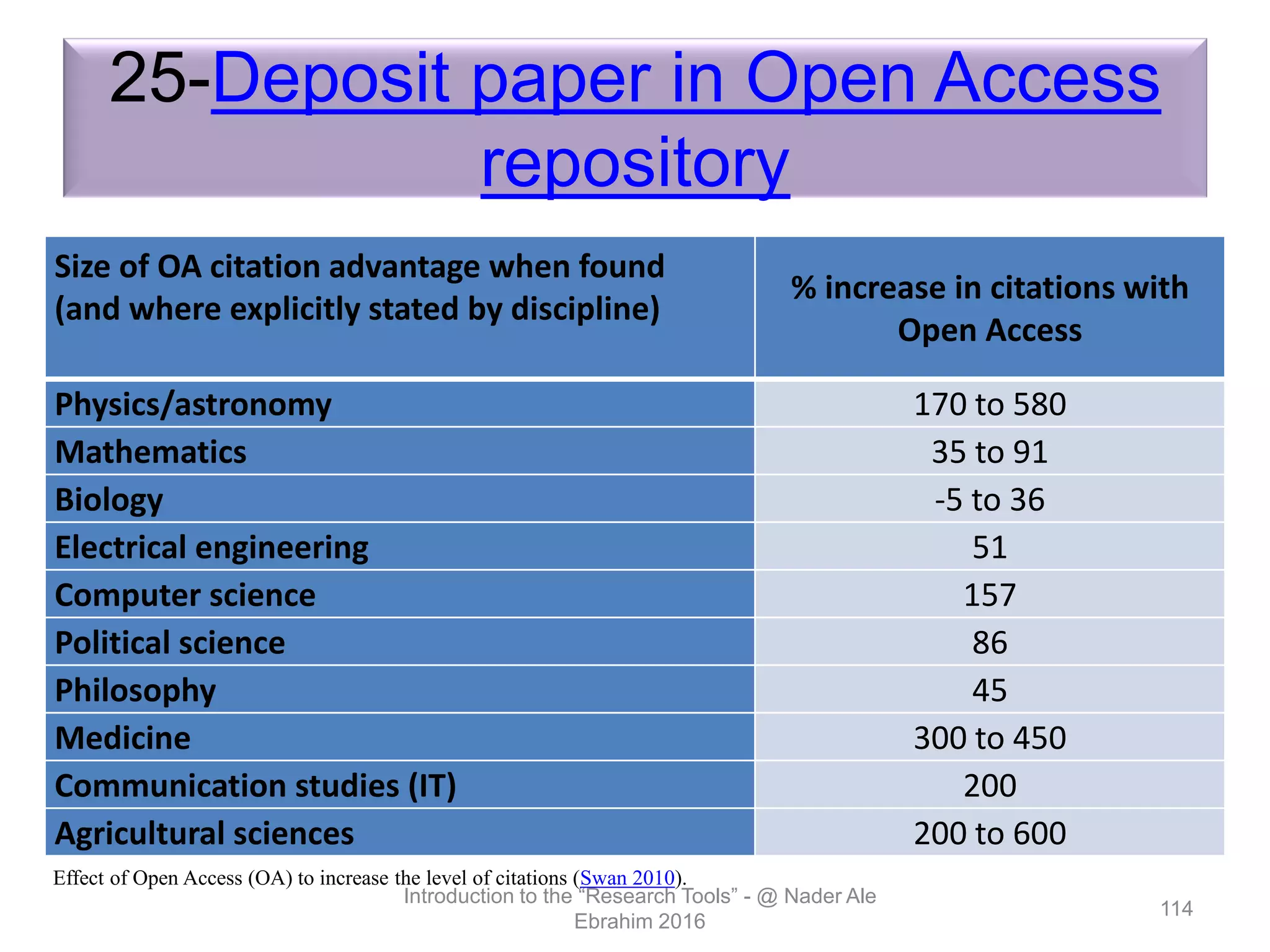
25-Deposit paper in Open Access
repository
Size of OA citation advantage when found
(and where explicitly stated by discipline)
% increase in citations with
Open Access
Physics/astronomy 170 to 580
Mathematics 35 to 91
Biology -5 to 36
Electrical engineering 51
Computer science 157
Political science 86
Philosophy 45
Medicine 300 to 450
Communication studies (IT) 200
Agricultural sciences 200 to 600
Introduction to the “Research Tools” - @ Nader Ale
Ebrahim 2016
114
Effect of Open Access (OA) to increase the level of citations (Swan 2010).
26-Join academic social networking
• Increasing the availability of articles through social
networking sites broadens dissemination, increases use,
and enhances professional visibility.
• Academica is an online social reference tool that allows
reference sharing among academics and researchers.
Alternatively, researchers may use Citeulike to share
their interests in research publications (Wong 2008).
Academica, Citeulike, ResearchGate and Linkedin are
just a few examples of knowledge sharing tools to make
others aware of research articles that may be of
relevance to authors and hence get cited.
Introduction to the “Research Tools” - @ Nader Ale
Ebrahim 2016
115
Read more: Ale Ebrahim, N., Salehi, H., Embi, M. A., Habibi Tanha, F., Gholizadeh, H., Motahar, S. M., & Ordi, A. (2013).
Effective Strategies for Increasing Citation Frequency. International Education Studies, 6(11), 93-99. doi:
10.5539/ies.v6n11p93
27-Start blogging
• Use blogs and podcasts to leverage on-
going researcher discussion on the
Internet (Taylor & Francis Group 2012a).
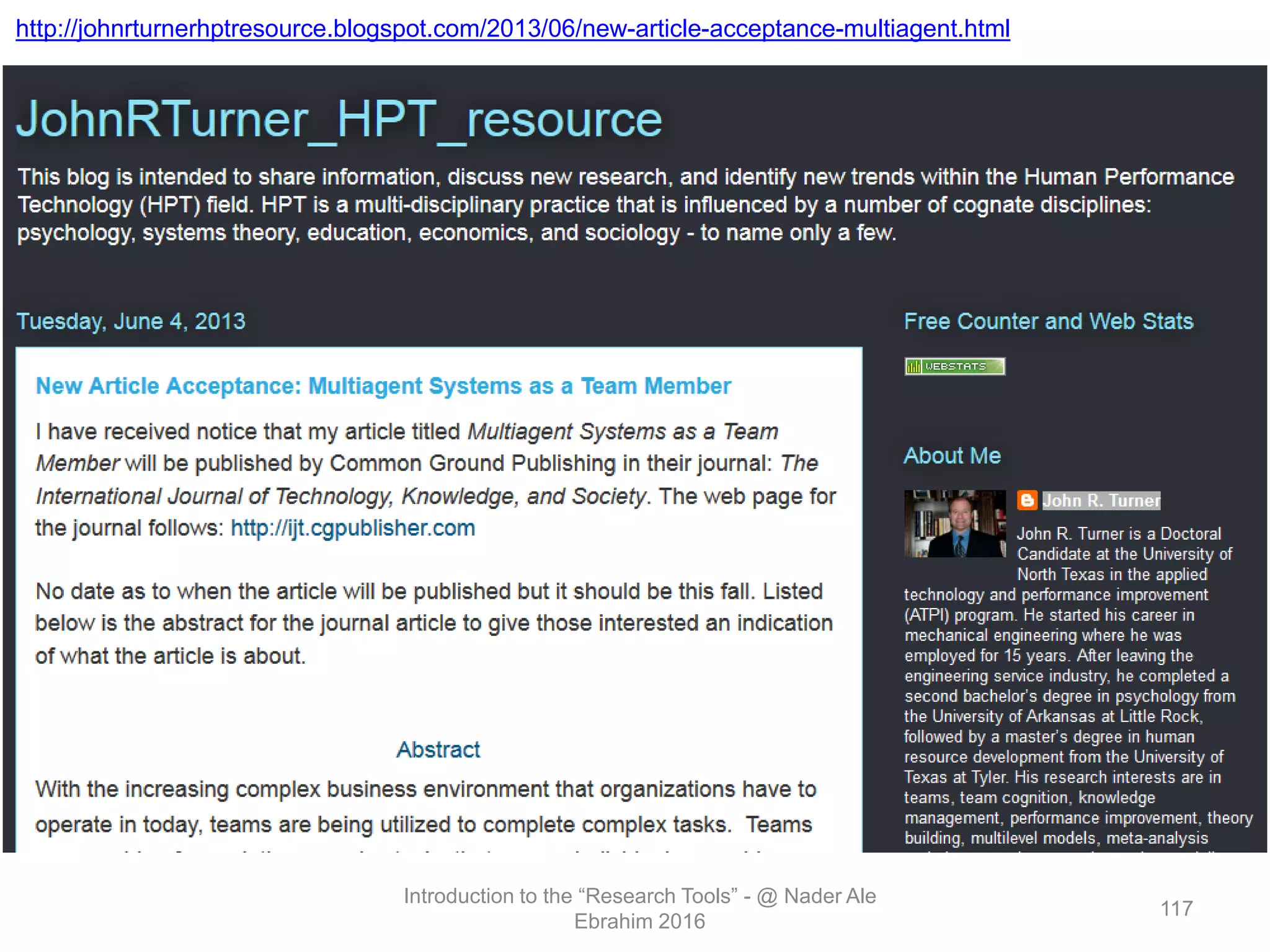
• Web 2.0 tools such as wikis and blogs can
be created to inform, describe and link
people’s research interests and
publications (Wong 2008).
Introduction to the “Research Tools” - @ Nader Ale
Ebrahim 2016
116
Read more: Ale Ebrahim, N., Salehi, H., Embi, M. A., Habibi Tanha, F., Gholizadeh, H., Motahar, S. M., & Ordi, A. (2013).
Effective Strategies for Increasing Citation Frequency. International Education Studies, 6(11), 93-99. doi:
10.5539/ies.v6n11p93
Introduction to the “Research Tools” - @ Nader Ale
Ebrahim 2016
117
http://johnrturnerhptresource.blogspot.com/2013/06/new-article-acceptance-multiagent.html
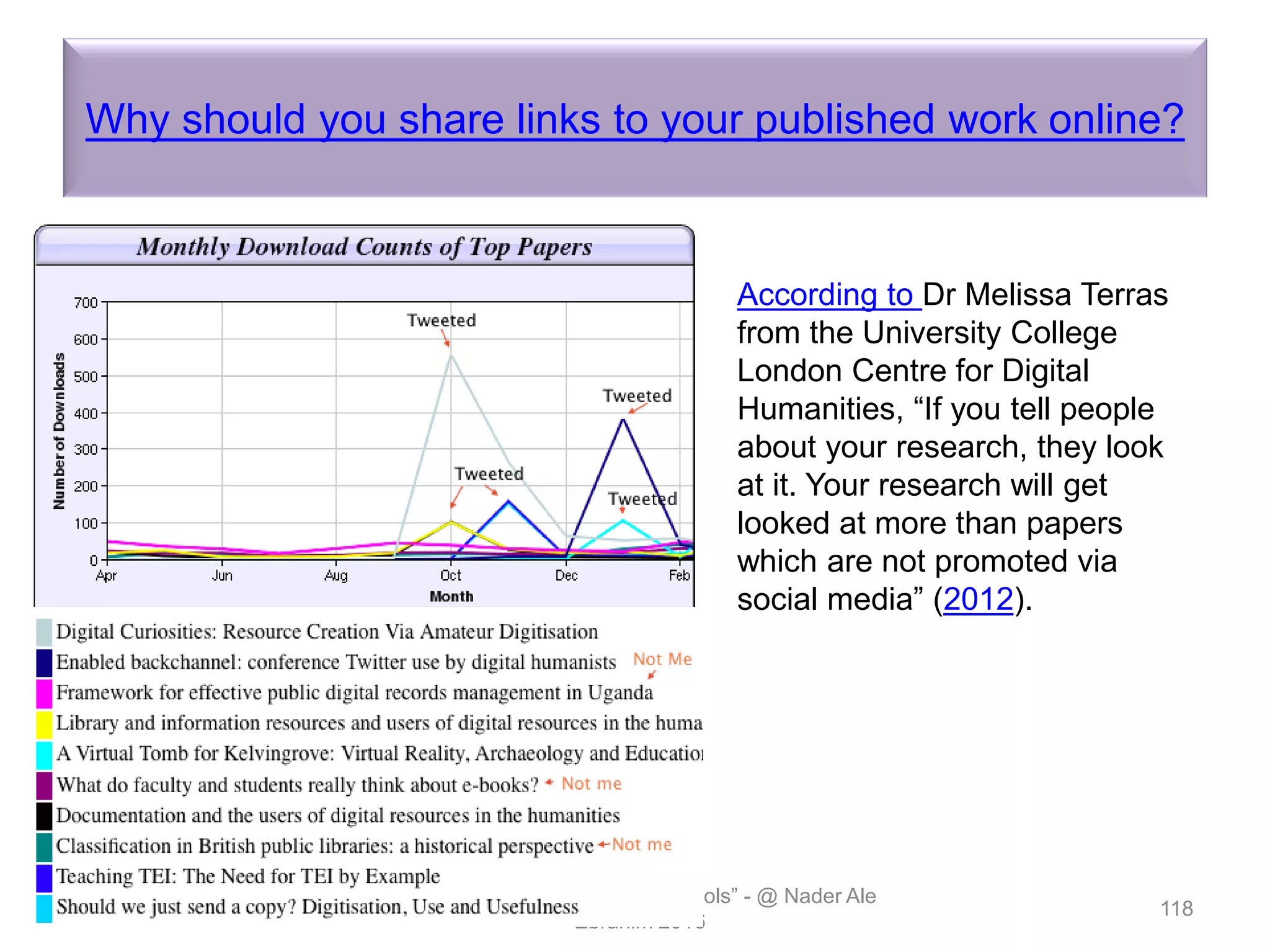
Why should you share links to your published work online?
Introduction to the “Research Tools” - @ Nader Ale
Ebrahim 2016
118
According to Dr Melissa Terras
from the University College
London Centre for Digital
Humanities, “If you tell people
about your research, they look
at it. Your research will get
looked at more than papers
which are not promoted via
social media” (2012).
28- Create an online CV
• Online CV makes a link between the
list of published papers and open
access versions of relevant articles
(Sahu 2005). Online CV increases
researchers’ output visibility to the
academic community.
Introduction to the “Research Tools” - @ Nader Ale
Ebrahim 2016
119
Read more: Ale Ebrahim, N., Salehi, H., Embi, M. A., Habibi Tanha, F., Gholizadeh, H., Motahar, S. M., & Ordi, A. (2013).
Effective Strategies for Increasing Citation Frequency. International Education Studies, 6(11), 93-99. doi:
10.5539/ies.v6n11p93
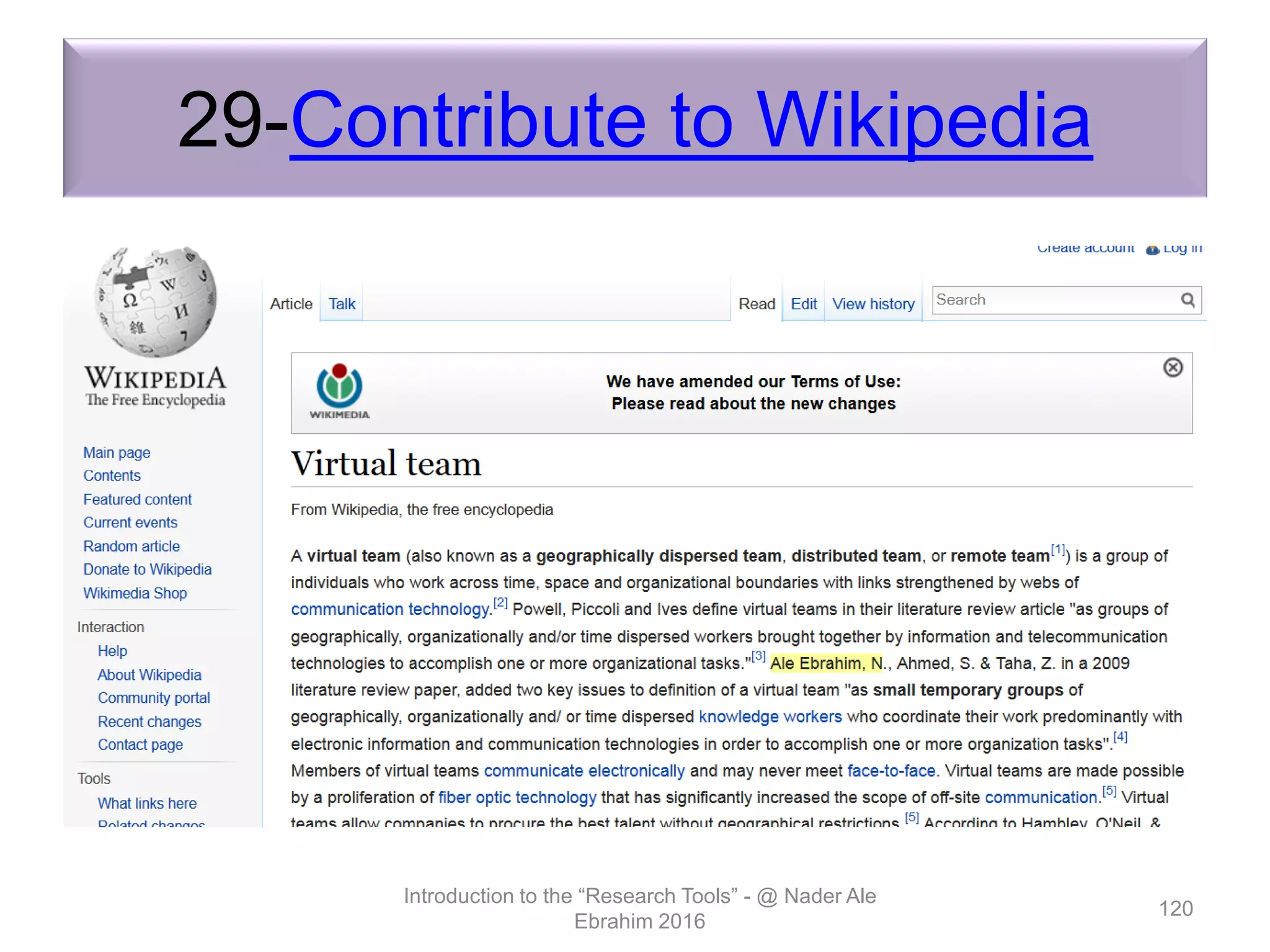
29-Contribute to Wikipedia
Introduction to the “Research Tools” - @ Nader Ale
Ebrahim 2016
120
30-Create a podcast describing the research project and
submit the podcast to YouTube or Vimeo
• Research is not just text and figures.
Create a podcast describing the research
project and submit the podcast to YouTube
or Vimeo (Sarli and Holmes 2011).
• Video is an increasingly important way for
researchers to communicate their results
(Sarli and Holmes 2011).
Introduction to the “Research Tools” - @ Nader Ale
Ebrahim 2016
121
Read more: Ale Ebrahim, N., Salehi, H., Embi, M. A., Habibi Tanha, F., Gholizadeh, H., Motahar, S. M., & Ordi, A. (2013).
Effective Strategies for Increasing Citation Frequency. International Education Studies, 6(11), 93-99. doi:
10.5539/ies.v6n11p93
31-link your latest published article
to your email signature
• A great way to spread researchers’ outputs
and get extra attention of email recipient is
to add a link to the latest publication. This
little section of contact information that
most people ignore, provides a good
platform for publication marketing.Example:
Nader Ale Ebrahim, PhD
==============================
Visiting Research Fellow
Research Support Unit
Centre of Research Services
Research Management & Innovation Complex
University of Malaya, Kuala Lumpur, Malaysia
www.researcherid.com/rid/C-2414-2009
http://ssrn.com/author=1379350
http://scholar.google.com/citations
http://works.bepress.com/aleebrahim/
Introduction to the “Research Tools” - @ Nader Ale
Ebrahim 2016
122
32-Make your research easy to
find, especially for online searchers
Search engines estimate the content's relevancy
and popularity as measured by links to the
content from other websites. Most search
engines attempt to identify the topic of the piece
of content. To do this, some search engines still
use metadata tags (invisible to the user) to
assess relevant content, but most now scan a
page for keyword phrases, giving extra weight
to phrases in headings and to repeated phrases.
Introduction to the “Research Tools” - @ Nader Ale
Ebrahim 2016
123
Source: http://authorservices.wiley.com/bauthor/seo.asp
33-Use all “Enhancing Visibility
and Impact” tools
Introduction to the “Research Tools” - @ Nader Ale
Ebrahim 2016
124
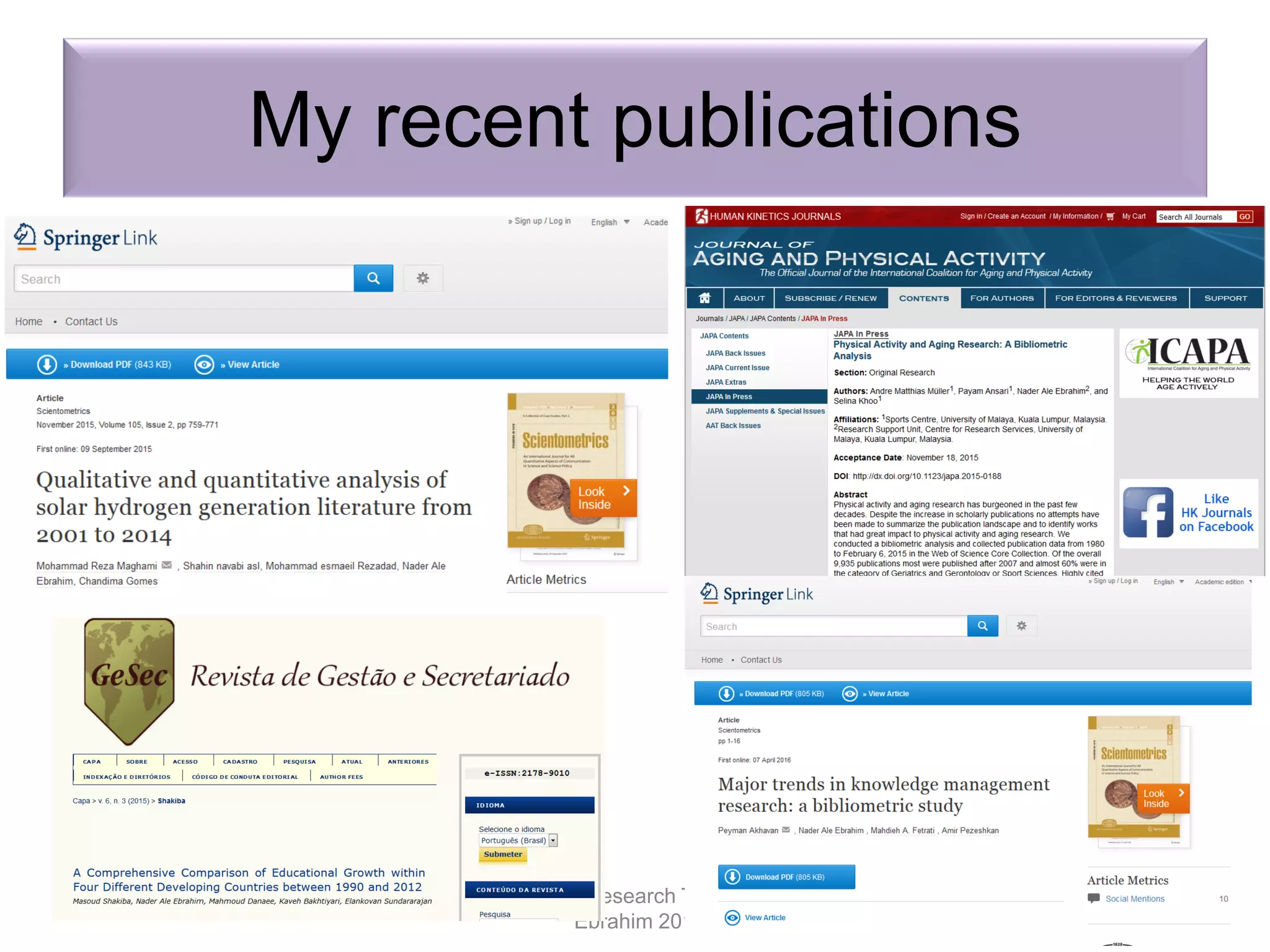
My recent publications
Introduction to the “Research Tools” - @ Nader Ale
Ebrahim 2016
125
Questions?
Introduction to the “Research Tools” - @ Nader Ale
Ebrahim 2016
126
E-mail: aleebrahim@um.edu.my
Twitter: @aleebrahim
www.researcherid.com/rid/C-2414-2009
http://scholar.google.com/citations
Nader Ale Ebrahim, PhD
=====================================
Research Support Unit
Centre for Research Services
Research Management & Innovation Complex
University of Malaya, Kuala Lumpur, Malaysia
www.researcherid.com/rid/C-2414-2009
http://scholar.google.com/citations
RESEARCH SUPPORT UNIT (RSU)
CENTRE FOR RESEARCH SERVICES
RESEARCH MANAGEMENT & INNOVATION COMPLEX (IPPP)
UNIVERSITY OF MALAYA
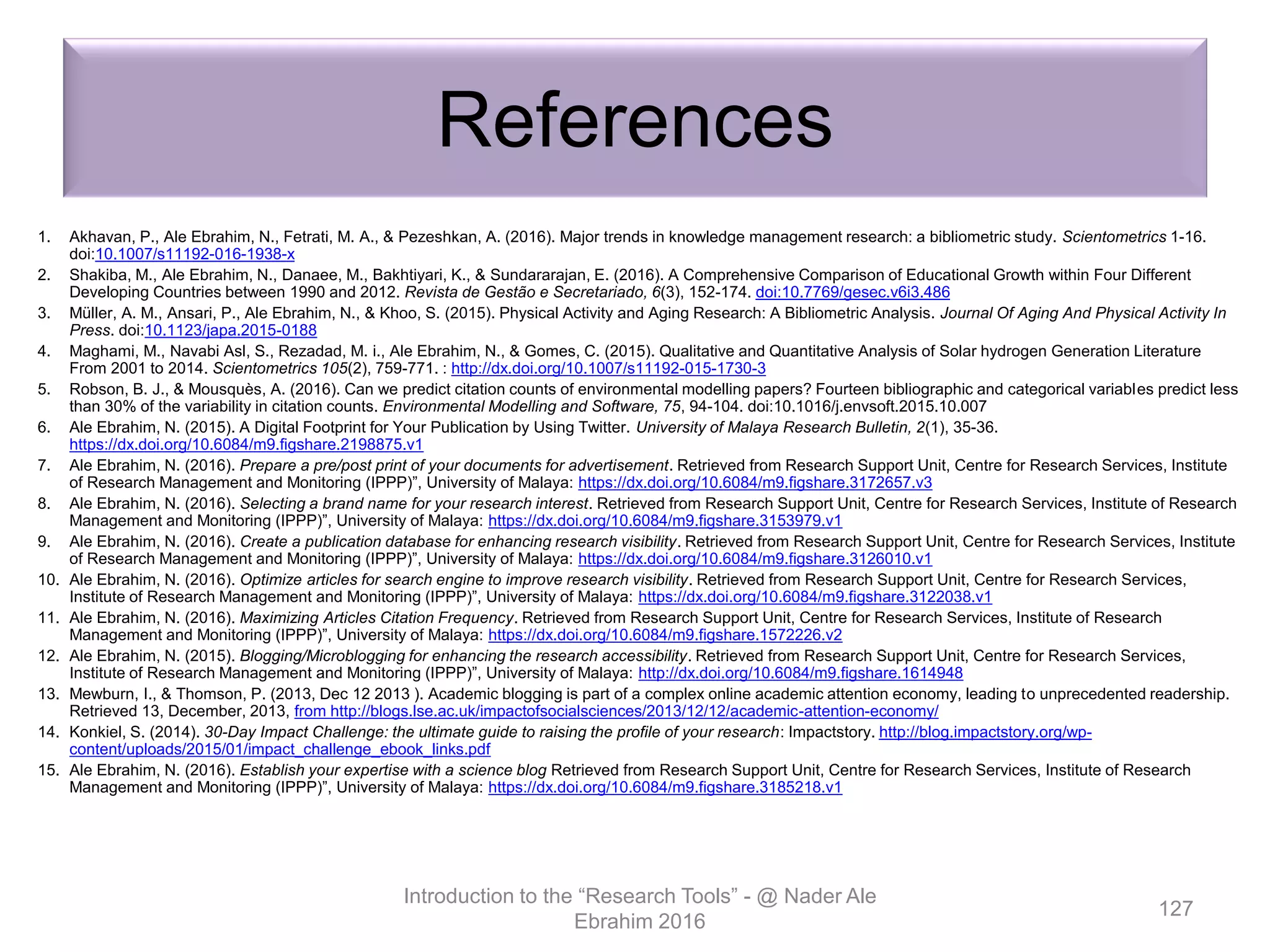
References
1. Akhavan, P., Ale Ebrahim, N., Fetrati, M. A., & Pezeshkan, A. (2016). Major trends in knowledge management research: a bibliometric study. Scientometrics 1-16.
doi:10.1007/s11192-016-1938-x
2. Shakiba, M., Ale Ebrahim, N., Danaee, M., Bakhtiyari, K., & Sundararajan, E. (2016). A Comprehensive Comparison of Educational Growth within Four Different
Developing Countries between 1990 and 2012. Revista de Gestão e Secretariado, 6(3), 152-174. doi:10.7769/gesec.v6i3.486
3. Müller, A. M., Ansari, P., Ale Ebrahim, N., & Khoo, S. (2015). Physical Activity and Aging Research: A Bibliometric Analysis. Journal Of Aging And Physical Activity In
Press. doi:10.1123/japa.2015-0188
4. Maghami, M., Navabi Asl, S., Rezadad, M. i., Ale Ebrahim, N., & Gomes, C. (2015). Qualitative and Quantitative Analysis of Solar hydrogen Generation Literature
From 2001 to 2014. Scientometrics 105(2), 759-771. : http://dx.doi.org/10.1007/s11192-015-1730-3
5. Robson, B. J., & Mousquès, A. (2016). Can we predict citation counts of environmental modelling papers? Fourteen bibliographic and categorical variables predict less
than 30% of the variability in citation counts. Environmental Modelling and Software, 75, 94-104. doi:10.1016/j.envsoft.2015.10.007
6. Ale Ebrahim, N. (2015). A Digital Footprint for Your Publication by Using Twitter. University of Malaya Research Bulletin, 2(1), 35-36.
https://dx.doi.org/10.6084/m9.figshare.2198875.v1
7. Ale Ebrahim, N. (2016). Prepare a pre/post print of your documents for advertisement. Retrieved from Research Support Unit, Centre for Research Services, Institute
of Research Management and Monitoring (IPPP)”, University of Malaya: https://dx.doi.org/10.6084/m9.figshare.3172657.v3
8. Ale Ebrahim, N. (2016). Selecting a brand name for your research interest. Retrieved from Research Support Unit, Centre for Research Services, Institute of Research
Management and Monitoring (IPPP)”, University of Malaya: https://dx.doi.org/10.6084/m9.figshare.3153979.v1
9. Ale Ebrahim, N. (2016). Create a publication database for enhancing research visibility. Retrieved from Research Support Unit, Centre for Research Services, Institute
of Research Management and Monitoring (IPPP)”, University of Malaya: https://dx.doi.org/10.6084/m9.figshare.3126010.v1
10. Ale Ebrahim, N. (2016). Optimize articles for search engine to improve research visibility. Retrieved from Research Support Unit, Centre for Research Services,
Institute of Research Management and Monitoring (IPPP)”, University of Malaya: https://dx.doi.org/10.6084/m9.figshare.3122038.v1
11. Ale Ebrahim, N. (2016). Maximizing Articles Citation Frequency. Retrieved from Research Support Unit, Centre for Research Services, Institute of Research
Management and Monitoring (IPPP)”, University of Malaya: https://dx.doi.org/10.6084/m9.figshare.1572226.v2
12. Ale Ebrahim, N. (2015). Blogging/Microblogging for enhancing the research accessibility. Retrieved from Research Support Unit, Centre for Research Services,
Institute of Research Management and Monitoring (IPPP)”, University of Malaya: http://dx.doi.org/10.6084/m9.figshare.1614948
13. Mewburn, I., & Thomson, P. (2013, Dec 12 2013 ). Academic blogging is part of a complex online academic attention economy, leading to unprecedented readership.
Retrieved 13, December, 2013, from http://blogs.lse.ac.uk/impactofsocialsciences/2013/12/12/academic-attention-economy/
14. Konkiel, S. (2014). 30-Day Impact Challenge: the ultimate guide to raising the profile of your research: Impactstory. http://blog.impactstory.org/wp-
content/uploads/2015/01/impact_challenge_ebook_links.pdf
15. Ale Ebrahim, N. (2016). Establish your expertise with a science blog Retrieved from Research Support Unit, Centre for Research Services, Institute of Research
Management and Monitoring (IPPP)”, University of Malaya: https://dx.doi.org/10.6084/m9.figshare.3185218.v1
Introduction to the “Research Tools” - @ Nader Ale
Ebrahim 2016
127

Introduction to the “Research Tools” for Research Methodology course

  • 1.
    Introduction to the “ResearchTools” for Research Methodology course aleebrahim@um.edu.my @aleebrahim www.researcherid.com/rid/C-2414-2009 http://scholar.google.com/citations Nader Ale Ebrahim, PhD Visiting Research Fellow Research Support Unit Centre for Research Services Research Management & Innovation Complex University of Malaya, Kuala Lumpur, Malaysia 21th April 2016
  • 2.
    Introduction to the“Research Tools” Nader Ale Ebrahim, PhD ===================================== Research Support Unit Centre for Research Services Research Management & Innovation Complex University of Malaya, Kuala Lumpur, Malaysia www.researcherid.com/rid/C-2414-2009 http://scholar.google.com/citations Read more: Ale Ebrahim, N., Salehi, H., Embi, M. A., Habibi Tanha, F., Gholizadeh, H., Motahar, S. M., & Ordi, A. (2013). Effective Strategies for Increasing Citation Frequency. International Education Studies, 6(11), 93-99. doi: 10.5539/ies.v6n11p93 All of my presentations are available online at: https://figshare.com/authors/Nader_Ale_Ebrahim/100797 Link to this presentation: https://dx.doi.org/10.6084/m9.figshare.3187673.v1
  • 3.
    Abstract Abstract: “Research Tools”can be defined as vehicles that broadly facilitate research and related activities. “Research Tools” enable researchers to collect, organize, analyze, visualize and publicized research outputs. Dr. Nader has collected over 800 tools that enable students to follow the correct path in research and to ultimately produce high-quality research outputs with more accuracy and efficiency. It is assembled as an interactive Web-based mind map, titled “Research Tools”, which is updated periodically. “Research Tools” consists of a hierarchical set of nodes. It has four main nodes: (1) Searching the literature, (2) Writing a paper, (3) Targeting suitable journals, and (4) Enhancing visibility and impact of the research. Keywords: H-index, Improve citations, Research tools, Bibliometrics, Literature review Introduction to the “Research Tools” - @ Nader Ale Ebrahim 2016 3
  • 4.
    Problem statements The searchcan be time consuming and sometimes tedious task. How can make it easier? How do deal with situations such as: – “I just join as a new postgraduate student and I am not sure how to do a literature search” – “I have been in research for some time now but I spend a lot of time to get the articles I want” – “I am sure I have downloaded the article but I am not able to find it” – “I wanted to write a new paper, how can I manage the references in the shortest possible time?” – “I have many references, some of my old papers, and some of my current research. Sometimes, they are so many that I can’t recall where I have kept them in my folders!” – …….. – “I have written an article and I am not able to find a proper Journal” – "I want to increase the citation of my papers, how do I do?" Introduction to the “Research Tools” - @ Nader Ale Ebrahim 2016 4
  • 5.
    Objectives The seminar seeksto serve the following objectives: i. To help students who seek to reduce the search time by expanding the knowledge of researchers to more effectively use the "tools" that are available through the Net. ii. To evaluate the types of literature that researchers will encounter. iii. To convert the information of the search for a written document. iv. To help researchers learn how to search and analyze the right journal to submit. v. To promote their publication for further citation. Introduction to the “Research Tools” - @ Nader Ale Ebrahim 2016 5
  • 6.
    Outline 1. Introduce “ResearchTools” Mind Map 2. Developing a search strategy, Finding keyword 3. Finding proper articles, 4. Evaluate a paper/journal quality 5. To do an effective literature search 6. Keeping up-to-date (Alert system), Indexing desktop search tool 7. The paraphrasing & editing tool, Avoid plagiarism 8. Organize the references (Reference management) tool 9. Target suitable journal 10.Promote your publication to get more citation 11.Q&A Introduction to the “Research Tools” - @ Nader Ale Ebrahim 2016 6
  • 7.
    Introduction to the“Research Tools” - @ Nader Ale Ebrahim 2016 7
  • 8.
    Introduction to the“Research Tools” - @ Nader Ale Ebrahim 2016 8 What is the Altmetric donut?
  • 9.
    Introduction to the“Research Tools” - @ Nader Ale Ebrahim 2016 9 What is the average number of references for writing an article or review paper in “Economics”?
  • 10.
    Exercise • Make asentence including: “the aim of study” • Find a recent English thesis about: “Virtual Teams” Introduction to the “Research Tools” - @ Nader Ale Ebrahim 2016 10
  • 11.
    Make a sentenceincluding: “the aim of study” ... Isfahan, Iran Background and Aims The aim of study was determination of the effect of ... ... postmortem macropathologic changes. The aim of study is to analyze the pathological data ... ... (NAC) are controversial. The aim of study is to compare histological grade and ... ... Federation Objectives and study: the aim of study was to compare the efficacy and ... ... Introduction and objectives: The aim of study was to evaluate the incidence of ... ... Istanbul, Turkey Objectives: The aim of study was to evaluate the effect of acid ... ... has been considered as a futile (1). The aim of study was obtaining information concerning ... ... Medical Academy Summary (4 lines): The aim of study is to estimate diagnostic values of ... ... medicine, RAKUS, Riga, Latvia The aim of study was to compare the effectiveness of ... Introduction to the “Research Tools” - @ Nader Ale Ebrahim 2016 11
  • 12.
    Recent English thesisabout: “Virtual Teams” Introduction to the “Research Tools” - @ Nader Ale Ebrahim 2016 12
  • 13.
    Research Tools MindMap Introduction to the “Research Tools” - @ Nader Ale Ebrahim 2016 13
  • 14.
    Developing a searchstrategy, Finding keyword
  • 15.
    Developing a searchstrategy • » Defining the topic » Considering the scope of your topic » Identifying the main or important aspects » Compiling a list of keywords » Developing your search strategy • It is important to develop a search strategy to, not only, find the information you need but to also clarify your topic. Introduction to the “Research Tools” - @ Nader Ale Ebrahim 2016 15
  • 16.
    How to Findand Develop a Viable Research Topic? Step One: Identify a Topic. Step Two: Test Your Topic. Test the main concepts or keywords in your topic by looking them up in the appropriate background sources or by using them as search terms. If you are finding too much information and too many sources, narrow your topic by using the and operator Finding too little information may indicate that you need to broaden your topic. Introduction to the “Research Tools” - @ Nader Ale Ebrahim 2016 16
  • 17.
    Keywords Selecting keywords leadto get more citation. Introduction to the “Research Tools” - @ Nader Ale Ebrahim 2016 17 MeSH (Medical Subject Headings)
  • 18.
    MeSH Tree Structuresfor “Genes” Introduction to the “Research Tools” - @ Nader Ale Ebrahim 2016 18
  • 19.
    MASTER KEYWORDS LIST Introductionto the “Research Tools” - @ Nader Ale Ebrahim 2016 19
  • 20.
    Keywords and KeywordsPlus® Authors sometimes provide a list of keywords or terms that they feel best represent the content of their paper. These keywords are contained in the ISI record (1991 data forward, depending on the database) for each article and are searchable. In addition, ISI generates KeyWords Plus for many articles. KeyWords Plus are words or phrases that frequently appear in the titles of an article's references, but do not necessarily appear in the title of the article itself. KeyWords Plus may be present for articles that have no author keywords, or may include important terms not listed among the title, abstract, or author keywords. Source: http://wos.isitrial.com/help/helpdefs.html Introduction to the “Research Tools” - @ Nader Ale Ebrahim 2016 20
  • 21.
    KeyWords Plus Hi there!This issue, we are going to explain how KeyWords Plus broadens your search. KeyWords Plus is the result of our Thomson Reuters editorial expertise in Science. What our editors do is to review the titles of all references and highlight additional relevant but overlooked keywords that were not listed by the author or publisher. With KeyWords Plus, you can now uncover more papers that may not have appeared in your search due to changes in scientific keywords over time. Thanks and keep your feedback and questions coming! Smiles, Lim Khee Hiang Ph.D., Principal Consultant Introduction to the “Research Tools” - @ Nader Ale Ebrahim 2016 21
  • 22.
    KeyWords Plus- Example •New Product Development in Virtual Environment (ISI Indexed) • Author Keywords: New product Development; Virtual teams; Concurrent Collaboration; Review paper • KeyWords Plus: DEVELOPMENT TEAMS; PERFORMANCE; TECHNOLOGY; KNOWLEDGE; COMMUNICATION; PERSPECTIVE; INTEGRATION; INNOVATION; NETWORK; WORKING Introduction to the “Research Tools” - @ Nader Ale Ebrahim 2016 22
  • 23.
    Introduction to the“Research Tools” - @ Nader Ale Ebrahim 2016 23
  • 24.
    Introduction to the“Research Tools” - @ Nader Ale Ebrahim 2016 24
  • 25.
    Finding proper articles & Evaluatea paper/journal quality & To do an effective literature search
  • 26.
    Research Quality Measures Threekey measures of research impact are: 1. Quality of the journal – journal rankings, impact factors 2. Quality of the publication/article = times cited as found in tools like Web of Science, Scopus and Google Scholar 3. Personal or departmental measure = h- index Introduction to the “Research Tools” - @ Nader Ale Ebrahim 2016 26 Source: http://guides.library.vu.edu.au/content.php?pid=251876&sid=2079929
  • 27.
    Critically Analyzing InformationSources 1- Initial Appraisal: Author Date of Publication Edition or Revision Publisher Title of Journal (Distinguishing Scholarly Journals from other Periodicals) 2- Content Analysis: Intended Audience Objective Reasoning Coverage Writing Style Evaluative Reviews Introduction to the “Research Tools” - @ Nader Ale Ebrahim 2016 27
  • 28.
    h-index (Jorge E.Hirsch) • A scientist has index h if h of [his/her] Np papers have at least h citations each, and the other (Np − h) papers have at most h citations each. Introduction to the “Research Tools” - @ Nader Ale Ebrahim 2016 28 H-index from a plot of decreasing citations for numbered papers
  • 29.
    The Many andVariable Uses of Publish or Perish (PoP)- By: Anne-Wil Harzing –” Your guide to effective and responsible citation analysis” Academics that need to make their case for tenure or promotion will find PoP useful to create reference groups and show their citation record to its best advantage. When evaluating other academics, PoP can be used as a 5-minute preparation before meeting someone you don’t know, to evaluate editorial board members or prospective PhD supervisors, to write up tributes (or laudations) and eulogies, to decide on publication awards and to pre-pare for a job interview. Deans and other academic administrators will find PoP useful to evaluate tenure or promotion cases in a fair and equitable way. PoP can help you to do a quick literature review to identify the most cited articles and/or scholars in a particular field. It can be used to identify whether any research has been done in a particular area at all (useful for grant applications) or to evaluate the development of the literature in a particular topic over time. Finally, PoP is very well suited for doing bibliometric research on both authors and journals. PoP can also be used to assist when you are uncertain which journal to submit it to. You can use it to get ideas of the types of journals that publish articles on the topic you are writing on and to compare a set of journals in terms of their citation impact. Once you have decided on the target journal, it can also help you to double-check that you haven’t missed any prior work from the journal in question. Introduction to the “Research Tools” - @ Nader Ale Ebrahim 2016 29
  • 30.
    Introduction to the“Research Tools” - @ Nader Ale Ebrahim 2016 30
  • 31.
    Introduction to the“Research Tools” - @ Nader Ale Ebrahim 2016 31
  • 32.
    Source: Making ResearchCount: Analyzing Canadian Academic Publishing CulturesIntroduction to the “Research Tools” - @ Nader Ale Ebrahim 2016 32
  • 33.
    Introduction to the“Research Tools” - @ Nader Ale Ebrahim 2016 33
  • 34.
    Introduction to the“Research Tools” - @ Nader Ale Ebrahim 2016 34
  • 35.
    Introduction to the“Research Tools” - @ Nader Ale Ebrahim 2016 35
  • 36.
    Paper/journal quality • Anotherguide to paper/journal quality is the general reputation of the association, society, or organization publishing the journal. • Leading professional associations such as American Psychological Association (APA) or the Institute of Electrical and Electronics Engineers (IEEE) publish a range of journals that are highly regarded. Introduction to the “Research Tools” - @ Nader Ale Ebrahim 2016 36
  • 37.
    How to doan Effective Literature Search? Application Training Module Series I by Customer Education Team ts.training.asia@thomson.com Stop Searching, Start Discovering For More Info.
  • 38.
    The Institute forScientific Information (ISI) • The Institute for Scientific Information (ISI) was founded by Eugene Garfield in 1960. It was acquired by Thomson Scientific & Healthcare in 1992, became known as Thomson ISI and now is part of the Healthcare & Science business of the multi-billion dollar Thomson Reuters Corporation. • ISI offered bibliographic database services. Its speciality: citation indexing and analysis, a field pioneered by Garfield. It maintains citation databases covering thousands of academic journals, including a continuation of its long time print-based indexing service the Science Citation Index (SCI), as well as the Social Sciences Citation Index (SSCI), and the Arts and Humanities Citation Index (AHCI). All of these are available via ISI's Web of Knowledge database service. Introduction to the “Research Tools” - @ Nader Ale Ebrahim 2016 38
  • 39.
    Eugene Garfield, Ph.D. Introductionto the “Research Tools” - @ Nader Ale Ebrahim 2016 39 Founder & Chairman Emeritus Institute for Scientific Information (ISI) For more Info
  • 40.
    Science Citation Index Arts & Humanities CitationIndex WOK 4.0 Social Sciences Citation Index ISI Web of Knowledge 1960 1965 1970 1975 1980 1985 1990 1995 2000 2005 2007 2008 SciSearch Century of Science TS Innovation Essential Science Indicators PC-based Indicators for journals, nations, institutions PC-based citation sets Custom citation projects and national indicators - mainframe Thomson Reuters (formerly ISI) has been the authority on citation data for over 50 years. Introduction to the “Research Tools” - @ Nader Ale Ebrahim 2016 40
  • 41.
    The Institute forScientific Information (ISI) • The ISI also publishes annual Journal Citation Reports which list an impact factor for each of the journals that it tracks. Within the scientific community, journal impact factors play a large but controversial role in determining the kudos attached to a scientist's published research record. Introduction to the “Research Tools” - @ Nader Ale Ebrahim 2016 41
  • 42.
    Impact Factor-Journal Ranking •Relative impact factors are often a better guide to the importance of a journal than raw numbers. JCR allows you to compare the impact factors of different journals in the same subject area • The Economic History Review has an impact factor of 1.051. At first glance, it would appear that this journal is relatively unimportant. In fact, it is arguably the premier English- language journal in its field (its major competitor, the Journal of Economic History Review, has an even lower impact factor: a mere 0.529!). Far more illuminating is the journal's relatively high impact factor compared to other journals in the history of the social sciences. Economic History Review ranks first out of 15 journals in the Thomson-ISI's list of journals in this sub- discipline. Introduction to the “Research Tools” - @ Nader Ale Ebrahim 2016 42
  • 43.
    Source: How toWrite Great Papers From title to references From submission to acceptance (2012) By: Anthony Newman, Publisher, Elsevier, Amsterdam Introduction to the “Research Tools” - @ Nader Ale Ebrahim 2016 43
  • 44.
    Keeping up-to-date (Alertsystem) & Indexing desktop search tool
  • 45.
    Keeping up-to-date Alert servicesare an effective means of keeping track of the latest research. Introduction to the “Research Tools” - @ Nader Ale Ebrahim 2016 45
  • 46.
    What is analert service? • Many journal databases and book publishers offer free alert services. These are an effective means of keeping track of the latest research. • Alert services come in different forms. The most common include: – a search alert. This is a saved search which alerts you when a book or article that matches your search terms is published. – a TOC (Table of Contents) alert. Such an alert notifies you when a new issue of a journal is published, and provides you with the issue's table of contents. – a citation alert. This advises you when a new article cites a particular work. – Most alert services are email-based. An increasing number are now offered as an RSS feed. If you are just beginning, you might like to try email alerts first. These are generally easier to create. Introduction to the “Research Tools” - @ Nader Ale Ebrahim 2016 46
  • 47.
    Keeping up-to-date Create aGoogle Alert • Enter the topic you wish to monitor. • Search terms: • Type: • How often: • Email length: • Your email: Introduction to the “Research Tools” - @ Nader Ale Ebrahim 2016 47
  • 48.
    Keeping up-to-date Introduction tothe “Research Tools” - @ Nader Ale Ebrahim 2016 48 Scopus Citation Tracker
  • 49.
    Conference Alerts Introduction tothe “Research Tools” - @ Nader Ale Ebrahim 2016 49 AllConferencealerts.com - Conference call for research papers IEEE Conference Alerts
  • 50.
    dtSearch Google Desktop Windows Search Introductionto the “Research Tools” - @ Nader Ale Ebrahim 2016 50
  • 51.
    Introduction to the“Research Tools” - @ Nader Ale Ebrahim 2016 51
  • 52.
    The paraphrasing &editing tool, & Avoid plagiarism
  • 53.
  • 54.
    WhiteSmoke Writer Ginger Proofreader MicrosoftWord Google Docs Office Live Adobe Acrobat Professional DropBox Introduction to the “Research Tools” - @ Nader Ale Ebrahim 2016 54
  • 55.
    Introduction to the“Research Tools” - @ Nader Ale Ebrahim 2016 55
  • 56.
    Introduction to the“Research Tools” - @ Nader Ale Ebrahim 2016 56
  • 57.
    How do Iavoid plagiarism? • only hand in your own and original work. • indicate precisely and accurately when you have used information provided by someone else, i.e. referencing must be done in accordance with a recognised system. • indicate whether you have downloaded information from the Internet. • never use someone else’s electronic storage media, artwork, pictures or graphics as if it were your own. • never copy directly without crediting the source • do not translate without crediting the source • do not paraphrase someone else’s work without crediting the source • do not piece together sections of the work of others into a new whole • do not resubmit your own or other’s previously graded work • do not commit collusion (unauthorised collaboration, presenting work as one’s own independent work, when it has been produced in whole or in part in collusion with other people) • ghost-writing – you should not make use of ghost writers or professional agencies in the production of your work or submit material which has been written on your behalf Introduction to the “Research Tools” - @ Nader Ale Ebrahim 2016 57
  • 58.
    10 Major sourceof plagiarism 1. Replication: Submitting a paper to multiple publications in an attempt to get it published more than once 2. Duplication: Re-using work from one’s own previous studies and papers without attribution 3. Secondary Source: Using a secondary source, but only citing the primary sources contained within the secondary one 4. Misleading Attribution: Removing an author’s name, despite significant contributions; an inaccurate or insufficient list of authors who contributed to a manuscript 5. Invalid Source: Referencing either an incorrect or nonexistent source 6. Paraphrasing: Taking the words of another and using them alongside original text without attribution 7. Repetitive Research: Repeating data or text from a similar study with a similar methodology in a new study without proper attribution 8. Unethical Collaboration: Accidentally or intentionally use each other’s written work without proper attribution; when people who are working together violate a code of conduct 9. Verbatim: copying of another’s words and works without providing proper attribution, indentation or quotation marks 10. Complete: Taking a manuscript from another researcher and resubmitting it under one’s own name Introduction to the “Research Tools” - @ Nader Ale Ebrahim 2016 58 Source: .iThenticate (2013) SURVEY SUMMARY | Research Ethics: Decoding Plagiarism and Attribution in Research
  • 59.
    Penalty for Plagiarism Introductionto the “Research Tools” - @ Nader Ale Ebrahim 2016 59
  • 60.
    Introduction to the“Research Tools” - @ Nader Ale Ebrahim 2016 60
  • 61.
    Penalty for Plagiarism Outsideof academia the problem of plagiarism continues to generate headlines and scandals for politicians. In Germany, two prominent cabinet members have been forced to step down due to allegations of plagiarism in their doctoral dissertations. Meanwhile, in Canada, the head of the nation’s largest school district was forced to resign in the face of plagiarism allegations, and plagiarism scandals have also embroiled a senator in the Philippines, the prime minister of Romania, and several members of the Russian Duma. Introduction to the “Research Tools” - @ Nader Ale Ebrahim 2016 61 Source: J. Bailey. "Defending Against Plagiarism, Publishers need to be proactive about detecting and deterring copied text.," 26 November; http://www.the-scientist.com/?articles.view/articleNo/35677/title/Defending-Against-Plagiarism/.
  • 62.
    Introduction to the“Research Tools” - @ Nader Ale Ebrahim 2016 62 The COSMO-RS method is an advanced method for the quantitative calculation of solvation mixture thermodynamics based on quantum chemistry. It was developed by Andreas Klamt and is distributed as the software COSMOtherm by his company COSMOlogic (as well as in the form of several remakes by others). Some Nigerian researchers have used the software (without a license) and report a tremendously and completely unbelievably good correlation (r²=0.992) between the predicted results and experimental data for the logKow (octanol water partition coefficient) of ionic liquids. Source : http://scholarlyoa.com/2013/10/24/more-bad-science-in-predatory-oa-journals/
  • 63.
    Introduction to the“Research Tools” - @ Nader Ale Ebrahim 2016 63
  • 64.
    Organize the references(Reference management) tool
  • 65.
    Writing a Tesis/Paper:Traditional way Introduction to the “Research Tools” - @ Nader Ale Ebrahim 2016 65 Source: flickr/toennessen
  • 66.
    Introduction to the“Research Tools” - @ Nader Ale Ebrahim 2016 66 Use a reference management tool! Your article article article article article book book conference paper conference paper conference paper EndNoteWeb Mendeley Etc. citations reference list/bibliography Source: Managing References: Mendeley By: HINARI Access to Research in Health
  • 67.
    EndNote • EndNote isan almost indispensible tool for the serious researcher. And best of all, its free to all UM postgraduates! Introduction to the “Research Tools” - @ Nader Ale Ebrahim 2016 67
  • 68.
    Why use EndNote? •EndNote allows you to create your own reference library. This library can be used to store the bibliographical details relating to the articles and books that you use. When it comes time to write your thesis, you can employ the library to insert references into your text and produce your bibliography. EndNote will save you hundreds of hours over the course of your research. Introduction to the “Research Tools” - @ Nader Ale Ebrahim 2016 68
  • 69.
    Introduction to the“Research Tools” - @ Nader Ale Ebrahim 2016 69
  • 70.
    Introduction to the“Research Tools” - @ Nader Ale Ebrahim 2016 70
  • 71.
  • 72.
    Open-Access Journals Introduction tothe “Research Tools” - @ Nader Ale Ebrahim 2016 72 Image: iStockPhoto
  • 73.
    Special Issues Introduction tothe “Research Tools” - @ Nader Ale Ebrahim 2016 73
  • 74.
    Where should Isubmit my publication? Springer Journal Selector βeta Journal Selector Journal Selector is the industry's leading database to all of the best peer-reviewed biomedical journals. Introduction to the “Research Tools” - @ Nader Ale Ebrahim 2016 74
  • 75.
    Introduction to the“Research Tools” - @ Nader Ale Ebrahim 2016 75
  • 76.
    Introduction to the“Research Tools” - @ Nader Ale Ebrahim 2016 76
  • 77.
    Perfect Match: EndNote’slatest feature matches article drafts with publications Introduction to the “Research Tools” - @ Nader Ale Ebrahim 2016 77
  • 78.
    Perfect Match: EndNote’slatest feature matches article drafts with publications Introduction to the “Research Tools” - @ Nader Ale Ebrahim 2016 78
  • 79.
    Perfect Match: EndNote’slatest feature matches article drafts with publications Introduction to the “Research Tools” - @ Nader Ale Ebrahim 2016 79
  • 80.
    Where should Isubmit my publication? Introduction to the “Research Tools” - @ Nader Ale Ebrahim 2016 80
  • 81.
  • 82.
    Strategies for Enhancingthe Impact of Research Improving access and retrieval of your research study is the surest way to enhance its impact. Repetition, consistency, and an awareness of the intended audience form the basis of most the following strategies. Preparing for Publication Dissemination Keeping Track of Your Research Introduction to the “Research Tools” - @ Nader Ale Ebrahim 2016 82 Source: Washington University School of Medicine, St. Louis Missouri
  • 83.
    1-Use a uniquename consistently throughout academic careers The preferred form of an author's name is first name and last name; this form reduces the likelihood of mistaken identity. Use the same name for publication throughout your career; that is, do not use initials on one manuscript and your full name on another one. Determining whether Juanita A. Smith is the same person as J. A. Smith, J. Smith, or A. Smith can be difficult, particularly when citations span several years. Introduction to the “Research Tools” - @ Nader Ale Ebrahim 2016 83
  • 84.
    2- Use astandardized institutional affiliation and address Introduction to the “Research Tools” - @ Nader Ale Ebrahim 2016 84 Source: https://becker.wustl.edu/impact-assessment/strategies
  • 85.
    3- Repeat keyphrases in the abstract while writing naturally The abstract is the main place that a search engine will take the data from which determine where your article should place in its results: Including the keywords and key phrases in your abstract is one of the best ways to optimize your article on search engines. It allows Google to assess your article for its relevance to certain search terms After you’ve ensured you have chosen the best keywords and you have deployed them in the right ways in your abstract and title, make sure you use them throughout your article: consider using them in subheadings, within the titles of figures and tables, as well as in the main body of the text. Search engines can also look at these places Consider the first sentence of your abstract – this is visible within the Google search results, therefore your first sentence should get straight to the points and include strong keywords. See the example below: Introduction to the “Research Tools” - @ Nader Ale Ebrahim 2016 85 Source: http://www.emeraldgrouppublishing.com/authors/guides/promote/optimize1.htm?PHPSESSID=ric7dfpvo045ciuafbolminpc4
  • 86.
    4-Select a propertitle As an author, you can dramatically improve the chances of your article being downloaded once it’s online, before you even submit it! There are three easy steps you can take to ensure it enjoys high usage: Choose a descriptive title Use appropriate keywords Write an informative abstract Source: http://www.emeraldinsight.com/authors/guides/promote/optimize1.htm Introduction to the “Research Tools” - @ Nader Ale Ebrahim 2016 86
  • 87.
    Optimize Title/Abstract Step 1:Construct a clear, descriptive title In search engine terms, the title of your article is the most interesting element. The search engine assumes that the title contains all of the important words that define the topic of the piece and thus weights words appearing there most heavily. Step 2: Reiterate key phrases The next most important field is the text of the abstract itself. You should reiterate the key words or phrases from the title within the abstract itself. Introduction to the “Research Tools” - @ Nader Ale Ebrahim 2016 87 Source: http://authorservices.wiley.com/bauthor/seo.asp
  • 88.
    Well-Optimized Abstract: Introduction tothe “Research Tools” - @ Nader Ale Ebrahim 2016 88 Source: http://authorservices.wiley.com/bauthor/seo.asp
  • 89.
    Poorly Optimized Abstract: Introductionto the “Research Tools” - @ Nader Ale Ebrahim 2016 89 Source: http://authorservices.wiley.com/bauthor/seo.asp
  • 90.
    Compare Keywords “Senior Population”with “Aged” Introduction to the “Research Tools” - @ Nader Ale Ebrahim 2016 90
  • 91.
    Compare Keywords “Senior Population”with “Aged” Introduction to the “Research Tools” - @ Nader Ale Ebrahim 2016 91
  • 92.
    Titles: be simpleand specific • Use active rather than passive verbs. • Avoid words that don’t add to the story such as: “on this”, “study”, and “investigation”. • Be specific in delivering your message: • Not every reader may know what Akt and Foxo1 are, but the title is declarative and specific. “But don’t be too specific”. • When possible, avoid acronyms and other jargon, which renders the title opaque to readers not already conversant in the field. • Avoid question marks: titles should present outcomes, without teasing the reader. • Focus on what is novel in the work. • Avoid complex, compound nouns. For example, the term “excess water-weight remover”. Source: http://blogs.nature.com/naturejobs/2015/07/10/publishing-high-impact-papers-natures-way Introduction to the “Research Tools” - @ Nader Ale Ebrahim 2016 92
  • 93.
    5-Select/Make a brandname • Make a unique phrase that reflects author's research interest and use it throughout academic life. • Add the name of study in the title of all publications and use the same title/name consistently. Introduction to the “Research Tools” - @ Nader Ale Ebrahim 2016 93 Read more: Ale Ebrahim, N., Salehi, H., Embi, M. A., Habibi Tanha, F., Gholizadeh, H., Motahar, S. M., & Ordi, A. (2013). Effective Strategies for Increasing Citation Frequency. International Education Studies, 6(11), 93-99. doi: 10.5539/ies.v6n11p93
  • 94.
    6- Assign keywordterms to the manuscript Selecting keywords lead to get more citation. Introduction to the “Research Tools” - @ Nader Ale Ebrahim 2016 94 MeSH (Medical Subject Headings)
  • 95.
    Numbers are GREAT but what’sthe impact of the research? Introduction to the “Research Tools” - @ Nader Ale Ebrahim 2016 95 Source: Finding Insights in ALMS for Research Evaluation. Posted on November 20, 2013 by PLoS Admin
  • 96.
    7- Use morereferences Introduction to the “Research Tools” - @ Nader Ale Ebrahim 2016 96
  • 97.
    8- Write alonger paper Introduction to the “Research Tools” - @ Nader Ale Ebrahim 2016 97
  • 98.
    9- Write areview paper Introduction to the “Research Tools” - @ Nader Ale Ebrahim 2016 98
  • 99.
    10-Present a workingpaper Working papers are freely available before and after the articles are published. Researchers may upload their working papers into open access repositories including the personal websites or more formal repositories such as arXiv and SSRN. Introduction to the “Research Tools” - @ Nader Ale Ebrahim 2016 99 Read more: Ale Ebrahim, N., Salehi, H., Embi, M. A., Habibi Tanha, F., Gholizadeh, H., Motahar, S. M., & Ordi, A. (2013). Effective Strategies for Increasing Citation Frequency. International Education Studies, 6(11), 93-99. doi: 10.5539/ies.v6n11p93
  • 100.
    11-To be thebest, cite the best Introduction to the “Research Tools” - @ Nader Ale Ebrahim 2016 100 Published online 13 October 2010 | Nature | doi:10.1038/news.2010.539 News To be the best, cite the best Citation analysis picks out new truth in Newton's aphorism that science 'stands on the shoulders of giants'. The mass of medium-level research is less important for inspiring influential breakthroughs than the most highly-cited papers, a citation study argues. Source: Corbyn, Z. (2010). To be the best, cite the best. Nature 539. doi: doi:10.1038/news.2010.539
  • 101.
    12-Self Citation “Self-citation refersto a paper being submitted to a specific journal in which papers that have been published during the previous 2 years in that same journal are cited in the reference list. While self-citation of relevant papers is legitimate, excessive self-citation can indicate a manipulation. Thomson Reuters resource known as Web of Science, the company which now lists journal impact factors, considers self-citation to be acceptable up to a rate of 20%, anything over that is considered suspect” (Diana Epstein, 2007). • Source: Diana Epstein, Impact factor manipulation, The Journal of the European Medical Writers Association, Vol. 16, No. 3, 2007Introduction to the “Research Tools” - @ Nader Ale Ebrahim 2016 101
  • 102.
    13-Co-authorship internationally • Citationanalysis shows that papers with international co-authors are cited up to four times more often than those without international co- authors. Introduction to the “Research Tools” - @ Nader Ale Ebrahim 2016 102 Source: http://www.bath.ac.uk/library/services/eprints/improve-citations.pdf
  • 103.
    14- Publish paperswith a Nobel laureates • Some landmark papers of Nobel laureates quite quickly give their authors a sudden boost in citation rate and this boost extends to the author's earlier papers too, even if they were in unrelated areas (Ball 2011). Introduction to the “Research Tools” - @ Nader Ale Ebrahim 2016 103 Read more: Ale Ebrahim, N., Salehi, H., Embi, M. A., Habibi Tanha, F., Gholizadeh, H., Motahar, S. M., & Ordi, A. (2013). Effective Strategies for Increasing Citation Frequency. International Education Studies, 6(11), 93-99. doi: 10.5539/ies.v6n11p93
  • 104.
    15-Publish your articlein one of the journals everyone in your discipline reads • Choosing a journal that matches with a researcher’s field of study is thus very important because it makes it more likely that the article receives more citation. A journal which covers a broad range of disciplines may be the best. Introduction to the “Research Tools” - @ Nader Ale Ebrahim 2016 104 Read more: Ale Ebrahim, N., Salehi, H., Embi, M. A., Habibi Tanha, F., Gholizadeh, H., Motahar, S. M., & Ordi, A. (2013). Effective Strategies for Increasing Citation Frequency. International Education Studies, 6(11), 93-99. doi: 10.5539/ies.v6n11p93
  • 105.
    16-Publish your workin a journal with the highest number of indexing 1. ABI/INFORM 2. Association of Business Schools' (ABI) Academic Journal Quality Guide (www.the-abs.org.uk) 3. Australian Business Deans' Council (ABDC) Journal Quality List 4. Australian Research Council ERA Ranked Journal List 5. Compendex 6. Computer Abstracts International Database 7. Current Contents / Engineering, Computing & Technology 8. Current Contents / Social & Behavioural Sciences 9. Emerald Management Reviews (EMR) 10. INSPEC Abstracts 11. International Abstracts in Operations Research 12. OR/MS Index and Annual Comprehensive Index 13. Science Citation Index 14. Social Science Citation Index 15. SCOPUS 16. Zentralblatt MATH • Source: Journal of the Operational Research Society Introduction to the “Research Tools” - @ Nader Ale Ebrahim 2016 105
  • 106.
    17- Publish inan Open Access (OA) journal • One key request of researchers across the world is unrestricted access to research publications. Open access gives a worldwide audience larger than that of any subscription-based journal and thus increases the visibility and impact of published works. It also enhances indexing, retrieval power and eliminates the need for permissions to reproduce and distribute content. Introduction to the “Research Tools” - @ Nader Ale Ebrahim 2016 106
  • 107.
    18-Publish in ajournal with high impact factor • The most effective strategy to increase citation rates is publishing in a journal with higher impact factor (Vanclay 2013). • Dhawan and Gupta (2005) studied 1101 papers and found that articles published in high impact factor journals increase the probability of getting cited. Introduction to the “Research Tools” - @ Nader Ale Ebrahim 2016 107 Read more: Ale Ebrahim, N., Salehi, H., Embi, M. A., Habibi Tanha, F., Gholizadeh, H., Motahar, S. M., & Ordi, A. (2013). Effective Strategies for Increasing Citation Frequency. International Education Studies, 6(11), 93-99. doi: 10.5539/ies.v6n11p93
  • 108.
    19-Team-authored articles getcited more • Wuchty et al. (2007) have used 19.9 million papers over 50 years and demonstrated that team-authored articles typically produce more frequently cited research than individuals. • A recent study by Cotropia and Petherbridge (2013) in law review articles which were published within two decades also demonstrated that team research is on average more frequently cited than individual research. • Typically high cited articles are authored by a large number of scientists (Aksnes 2003). Introduction to the “Research Tools” - @ Nader Ale Ebrahim 2016 108
  • 109.
    20-Use a largernumber of “callouts” • A “callout” is a phrase or sentence from the paper that is displayed in a different font, somewhere in the paper. • Papers with a larger number of “callouts” be likely to receive a higher number of citations (Hamrick et al. 2010). • Generally, callouts are inserted by the editorial staff to call attention to potentially interesting aspects of a paper (Hamrick et al. 2010). Introduction to the “Research Tools” - @ Nader Ale Ebrahim 2016 109
  • 110.
    21- Publish acrossdisciplines • Publishing across disciplines has been found to increase citation e.g. chemistry, biological science and physics (Ortega and Antell 2006). Introduction to the “Research Tools” - @ Nader Ale Ebrahim 2016 110 Read more: Ale Ebrahim, N., Salehi, H., Embi, M. A., Habibi Tanha, F., Gholizadeh, H., Motahar, S. M., & Ordi, A. (2013). Effective Strategies for Increasing Citation Frequency. International Education Studies, 6(11), 93-99. doi: 10.5539/ies.v6n11p93
  • 111.
    22- Publish tutorialspapers • Tutorial paper is “a paper that organizes and introduces work in the field. • A tutorial paper assumes its audience is inexpert; it emphasizes the basic concepts of the field and provides concrete examples that embody these concepts (ACM 2013)”. • Tutorials papers tend to have a higher number of citations (Hamrick et al. 2010). Introduction to the “Research Tools” - @ Nader Ale Ebrahim 2016 111
  • 112.
    23-Self-archive articles • Freeonline availability increases a paper's impact (Lawrence 2001); • Freely accessible articles increase citations by 50% or more (Harnad 2006). • Gargouri et al. (2010) have made a strong and a declarative link between self- archiving and increased citation performance. Introduction to the “Research Tools” - @ Nader Ale Ebrahim 2016 112 Read more: Ale Ebrahim, N., Salehi, H., Embi, M. A., Habibi Tanha, F., Gholizadeh, H., Motahar, S. M., & Ordi, A. (2013). Effective Strategies for Increasing Citation Frequency. International Education Studies, 6(11), 93-99. doi: 10.5539/ies.v6n11p93
  • 113.
    24-Keep your professionalweb pages and published lists up to date Introduction to the “Research Tools” - @ Nader Ale Ebrahim 2016 113Source: "Scientific Writing for Impact Factor Journals“ By: Eric Lichtfouse
  • 114.
    25-Deposit paper inOpen Access repository Size of OA citation advantage when found (and where explicitly stated by discipline) % increase in citations with Open Access Physics/astronomy 170 to 580 Mathematics 35 to 91 Biology -5 to 36 Electrical engineering 51 Computer science 157 Political science 86 Philosophy 45 Medicine 300 to 450 Communication studies (IT) 200 Agricultural sciences 200 to 600 Introduction to the “Research Tools” - @ Nader Ale Ebrahim 2016 114 Effect of Open Access (OA) to increase the level of citations (Swan 2010).
  • 115.
    26-Join academic socialnetworking • Increasing the availability of articles through social networking sites broadens dissemination, increases use, and enhances professional visibility. • Academica is an online social reference tool that allows reference sharing among academics and researchers. Alternatively, researchers may use Citeulike to share their interests in research publications (Wong 2008). Academica, Citeulike, ResearchGate and Linkedin are just a few examples of knowledge sharing tools to make others aware of research articles that may be of relevance to authors and hence get cited. Introduction to the “Research Tools” - @ Nader Ale Ebrahim 2016 115 Read more: Ale Ebrahim, N., Salehi, H., Embi, M. A., Habibi Tanha, F., Gholizadeh, H., Motahar, S. M., & Ordi, A. (2013). Effective Strategies for Increasing Citation Frequency. International Education Studies, 6(11), 93-99. doi: 10.5539/ies.v6n11p93
  • 116.
    27-Start blogging • Useblogs and podcasts to leverage on- going researcher discussion on the Internet (Taylor & Francis Group 2012a). • Web 2.0 tools such as wikis and blogs can be created to inform, describe and link people’s research interests and publications (Wong 2008). Introduction to the “Research Tools” - @ Nader Ale Ebrahim 2016 116 Read more: Ale Ebrahim, N., Salehi, H., Embi, M. A., Habibi Tanha, F., Gholizadeh, H., Motahar, S. M., & Ordi, A. (2013). Effective Strategies for Increasing Citation Frequency. International Education Studies, 6(11), 93-99. doi: 10.5539/ies.v6n11p93
  • 117.
    Introduction to the“Research Tools” - @ Nader Ale Ebrahim 2016 117 http://johnrturnerhptresource.blogspot.com/2013/06/new-article-acceptance-multiagent.html
  • 118.
    Why should youshare links to your published work online? Introduction to the “Research Tools” - @ Nader Ale Ebrahim 2016 118 According to Dr Melissa Terras from the University College London Centre for Digital Humanities, “If you tell people about your research, they look at it. Your research will get looked at more than papers which are not promoted via social media” (2012).
  • 119.
    28- Create anonline CV • Online CV makes a link between the list of published papers and open access versions of relevant articles (Sahu 2005). Online CV increases researchers’ output visibility to the academic community. Introduction to the “Research Tools” - @ Nader Ale Ebrahim 2016 119 Read more: Ale Ebrahim, N., Salehi, H., Embi, M. A., Habibi Tanha, F., Gholizadeh, H., Motahar, S. M., & Ordi, A. (2013). Effective Strategies for Increasing Citation Frequency. International Education Studies, 6(11), 93-99. doi: 10.5539/ies.v6n11p93
  • 120.
    29-Contribute to Wikipedia Introductionto the “Research Tools” - @ Nader Ale Ebrahim 2016 120
  • 121.
    30-Create a podcastdescribing the research project and submit the podcast to YouTube or Vimeo • Research is not just text and figures. Create a podcast describing the research project and submit the podcast to YouTube or Vimeo (Sarli and Holmes 2011). • Video is an increasingly important way for researchers to communicate their results (Sarli and Holmes 2011). Introduction to the “Research Tools” - @ Nader Ale Ebrahim 2016 121 Read more: Ale Ebrahim, N., Salehi, H., Embi, M. A., Habibi Tanha, F., Gholizadeh, H., Motahar, S. M., & Ordi, A. (2013). Effective Strategies for Increasing Citation Frequency. International Education Studies, 6(11), 93-99. doi: 10.5539/ies.v6n11p93
  • 122.
    31-link your latestpublished article to your email signature • A great way to spread researchers’ outputs and get extra attention of email recipient is to add a link to the latest publication. This little section of contact information that most people ignore, provides a good platform for publication marketing.Example: Nader Ale Ebrahim, PhD ============================== Visiting Research Fellow Research Support Unit Centre of Research Services Research Management & Innovation Complex University of Malaya, Kuala Lumpur, Malaysia www.researcherid.com/rid/C-2414-2009 http://ssrn.com/author=1379350 http://scholar.google.com/citations http://works.bepress.com/aleebrahim/ Introduction to the “Research Tools” - @ Nader Ale Ebrahim 2016 122
  • 123.
    32-Make your researcheasy to find, especially for online searchers Search engines estimate the content's relevancy and popularity as measured by links to the content from other websites. Most search engines attempt to identify the topic of the piece of content. To do this, some search engines still use metadata tags (invisible to the user) to assess relevant content, but most now scan a page for keyword phrases, giving extra weight to phrases in headings and to repeated phrases. Introduction to the “Research Tools” - @ Nader Ale Ebrahim 2016 123 Source: http://authorservices.wiley.com/bauthor/seo.asp
  • 124.
    33-Use all “EnhancingVisibility and Impact” tools Introduction to the “Research Tools” - @ Nader Ale Ebrahim 2016 124
  • 125.
    My recent publications Introductionto the “Research Tools” - @ Nader Ale Ebrahim 2016 125
  • 126.
    Questions? Introduction to the“Research Tools” - @ Nader Ale Ebrahim 2016 126 E-mail: aleebrahim@um.edu.my Twitter: @aleebrahim www.researcherid.com/rid/C-2414-2009 http://scholar.google.com/citations Nader Ale Ebrahim, PhD ===================================== Research Support Unit Centre for Research Services Research Management & Innovation Complex University of Malaya, Kuala Lumpur, Malaysia www.researcherid.com/rid/C-2414-2009 http://scholar.google.com/citations RESEARCH SUPPORT UNIT (RSU) CENTRE FOR RESEARCH SERVICES RESEARCH MANAGEMENT & INNOVATION COMPLEX (IPPP) UNIVERSITY OF MALAYA
  • 127.
    References 1. Akhavan, P.,Ale Ebrahim, N., Fetrati, M. A., & Pezeshkan, A. (2016). Major trends in knowledge management research: a bibliometric study. Scientometrics 1-16. doi:10.1007/s11192-016-1938-x 2. Shakiba, M., Ale Ebrahim, N., Danaee, M., Bakhtiyari, K., & Sundararajan, E. (2016). A Comprehensive Comparison of Educational Growth within Four Different Developing Countries between 1990 and 2012. Revista de Gestão e Secretariado, 6(3), 152-174. doi:10.7769/gesec.v6i3.486 3. Müller, A. M., Ansari, P., Ale Ebrahim, N., & Khoo, S. (2015). Physical Activity and Aging Research: A Bibliometric Analysis. Journal Of Aging And Physical Activity In Press. doi:10.1123/japa.2015-0188 4. Maghami, M., Navabi Asl, S., Rezadad, M. i., Ale Ebrahim, N., & Gomes, C. (2015). Qualitative and Quantitative Analysis of Solar hydrogen Generation Literature From 2001 to 2014. Scientometrics 105(2), 759-771. : http://dx.doi.org/10.1007/s11192-015-1730-3 5. Robson, B. J., & Mousquès, A. (2016). Can we predict citation counts of environmental modelling papers? Fourteen bibliographic and categorical variables predict less than 30% of the variability in citation counts. Environmental Modelling and Software, 75, 94-104. doi:10.1016/j.envsoft.2015.10.007 6. Ale Ebrahim, N. (2015). A Digital Footprint for Your Publication by Using Twitter. University of Malaya Research Bulletin, 2(1), 35-36. https://dx.doi.org/10.6084/m9.figshare.2198875.v1 7. Ale Ebrahim, N. (2016). Prepare a pre/post print of your documents for advertisement. Retrieved from Research Support Unit, Centre for Research Services, Institute of Research Management and Monitoring (IPPP)”, University of Malaya: https://dx.doi.org/10.6084/m9.figshare.3172657.v3 8. Ale Ebrahim, N. (2016). Selecting a brand name for your research interest. Retrieved from Research Support Unit, Centre for Research Services, Institute of Research Management and Monitoring (IPPP)”, University of Malaya: https://dx.doi.org/10.6084/m9.figshare.3153979.v1 9. Ale Ebrahim, N. (2016). Create a publication database for enhancing research visibility. Retrieved from Research Support Unit, Centre for Research Services, Institute of Research Management and Monitoring (IPPP)”, University of Malaya: https://dx.doi.org/10.6084/m9.figshare.3126010.v1 10. Ale Ebrahim, N. (2016). Optimize articles for search engine to improve research visibility. Retrieved from Research Support Unit, Centre for Research Services, Institute of Research Management and Monitoring (IPPP)”, University of Malaya: https://dx.doi.org/10.6084/m9.figshare.3122038.v1 11. Ale Ebrahim, N. (2016). Maximizing Articles Citation Frequency. Retrieved from Research Support Unit, Centre for Research Services, Institute of Research Management and Monitoring (IPPP)”, University of Malaya: https://dx.doi.org/10.6084/m9.figshare.1572226.v2 12. Ale Ebrahim, N. (2015). Blogging/Microblogging for enhancing the research accessibility. Retrieved from Research Support Unit, Centre for Research Services, Institute of Research Management and Monitoring (IPPP)”, University of Malaya: http://dx.doi.org/10.6084/m9.figshare.1614948 13. Mewburn, I., & Thomson, P. (2013, Dec 12 2013 ). Academic blogging is part of a complex online academic attention economy, leading to unprecedented readership. Retrieved 13, December, 2013, from http://blogs.lse.ac.uk/impactofsocialsciences/2013/12/12/academic-attention-economy/ 14. Konkiel, S. (2014). 30-Day Impact Challenge: the ultimate guide to raising the profile of your research: Impactstory. http://blog.impactstory.org/wp- content/uploads/2015/01/impact_challenge_ebook_links.pdf 15. Ale Ebrahim, N. (2016). Establish your expertise with a science blog Retrieved from Research Support Unit, Centre for Research Services, Institute of Research Management and Monitoring (IPPP)”, University of Malaya: https://dx.doi.org/10.6084/m9.figshare.3185218.v1 Introduction to the “Research Tools” - @ Nader Ale Ebrahim 2016 127