aleebrahim@um.edu.my
@aleebrahim
www.researcherid.com/rid/C-2414-2009
http://scholar.google.com/citations
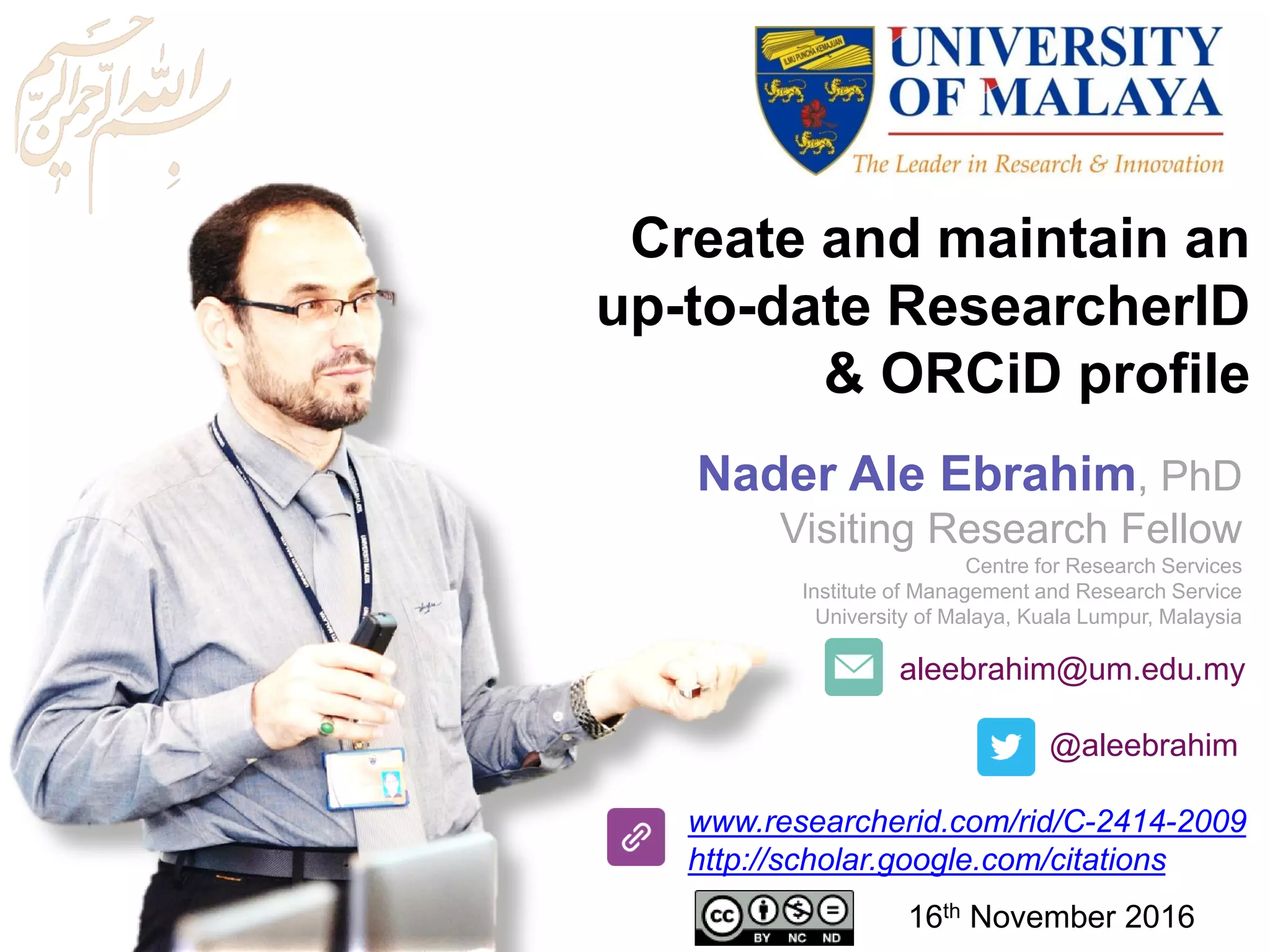
Create and maintain an
up-to-date ResearcherID
& ORCiD profile
Nader Ale Ebrahim, PhD
Visiting Research Fellow
Centre for Research Services
Institute of Management and Research Service
University of Malaya, Kuala Lumpur, Malaysia
16th November 2016
4th SERIES OF INTRODUCTORY WORKSHOP ON:
Strategies to Enhance Research
Visibility, Impact & Citations
Nader Ale Ebrahim, PhD
=====================================
Centre for Research Services
Institute of Management and Research Service
University of Malaya, Kuala Lumpur, Malaysia
www.researcherid.com/rid/C-2414-2009
http://scholar.google.com/citations
Read more: Ale Ebrahim, N., Salehi, H., Embi, M. A., Habibi Tanha, F., Gholizadeh, H., Motahar, S. M., & Ordi, A. (2013). Effective
Strategies for Increasing Citation Frequency. International Education Studies, 6(11), 93-99. doi: 10.5539/ies.v6n11p93
All of my presentations are available online at:
https://figshare.com/authors/Nader_Ale_Ebrahim/100797
Link to this presentation: https://dx.doi.org/10.6084/m9.figshare.4234619.v1 (New version)
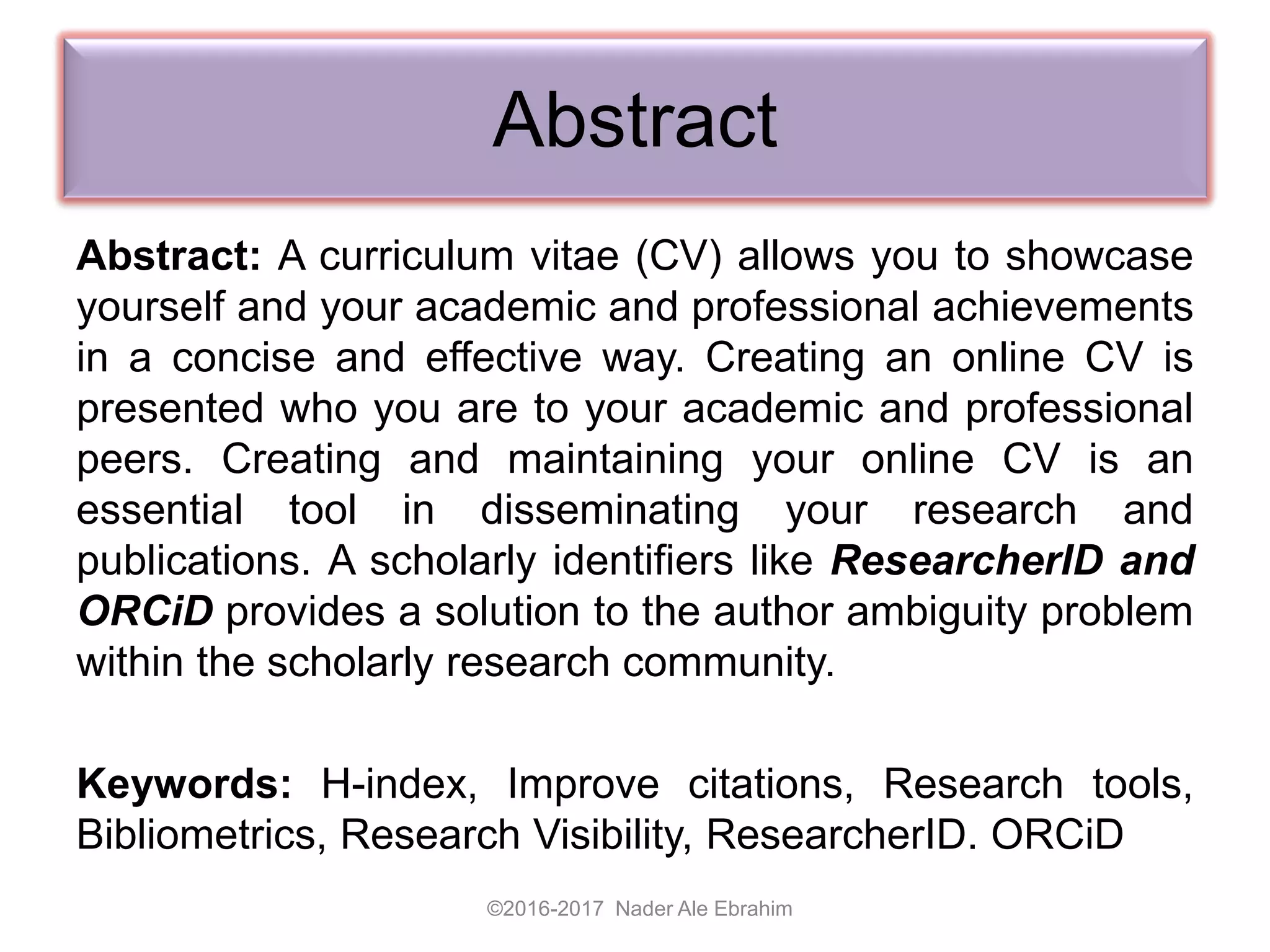
Abstract
Abstract: A curriculum vitae (CV) allows you to showcase
yourself and your academic and professional achievements
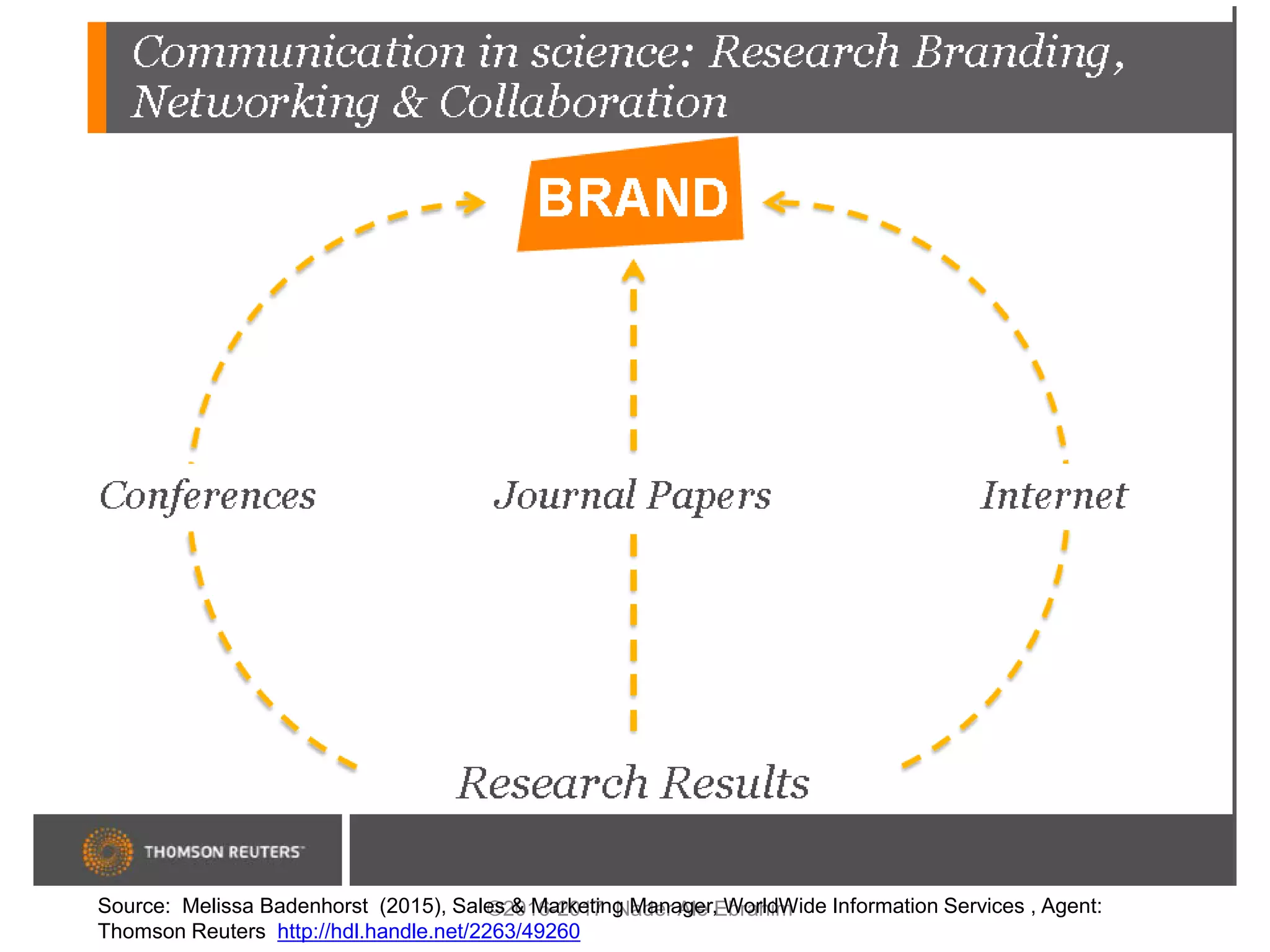
in a concise and effective way. Creating an online CV is
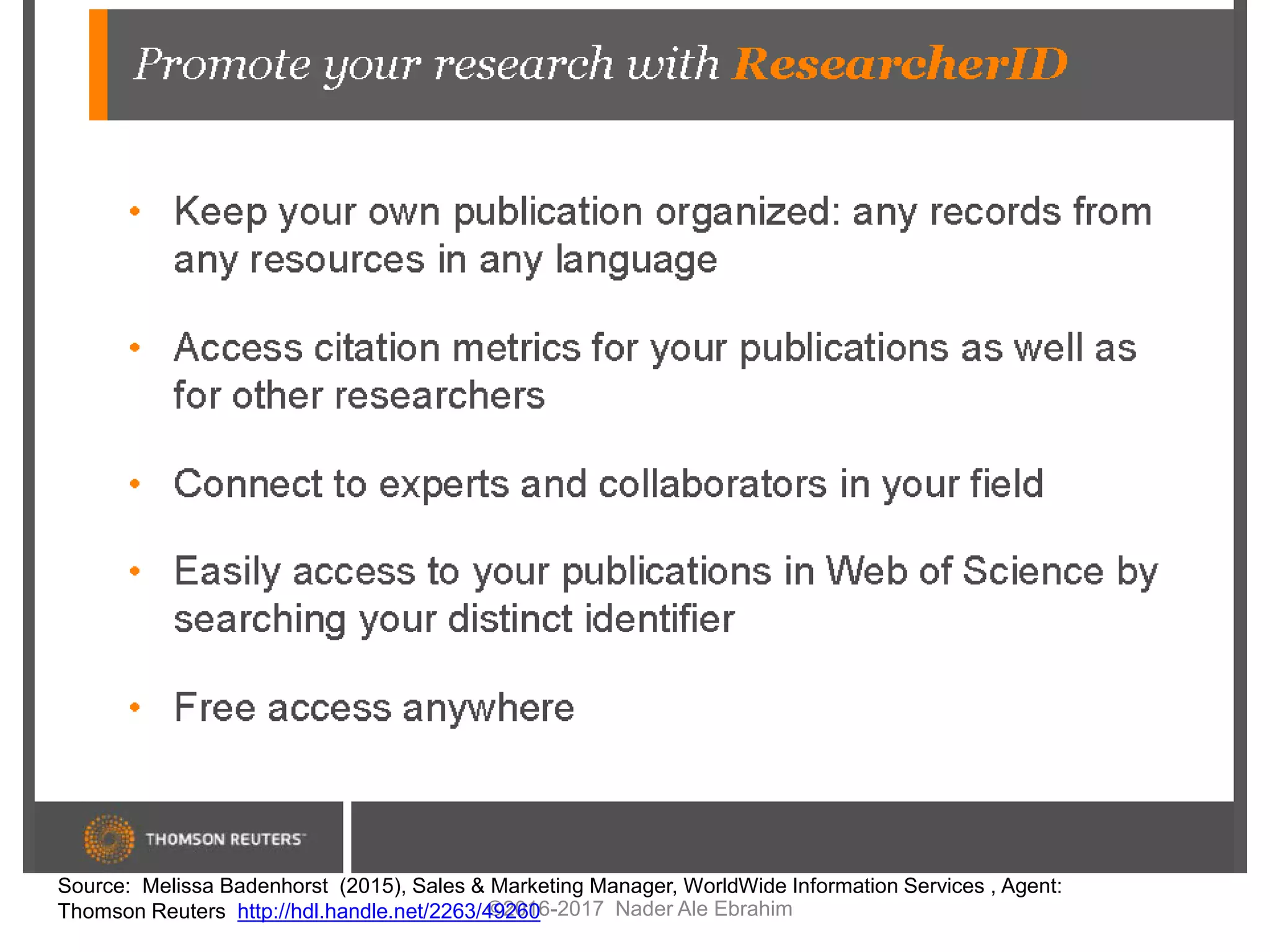
presented who you are to your academic and professional
peers. Creating and maintaining your online CV is an
essential tool in disseminating your research and
publications. A scholarly identifiers like ResearcherID and
ORCiD provides a solution to the author ambiguity problem
within the scholarly research community.
Keywords: H-index, Improve citations, Research tools,
Bibliometrics, Research Visibility, ResearcherID. ORCiD
©2016-2017 Nader Ale Ebrahim
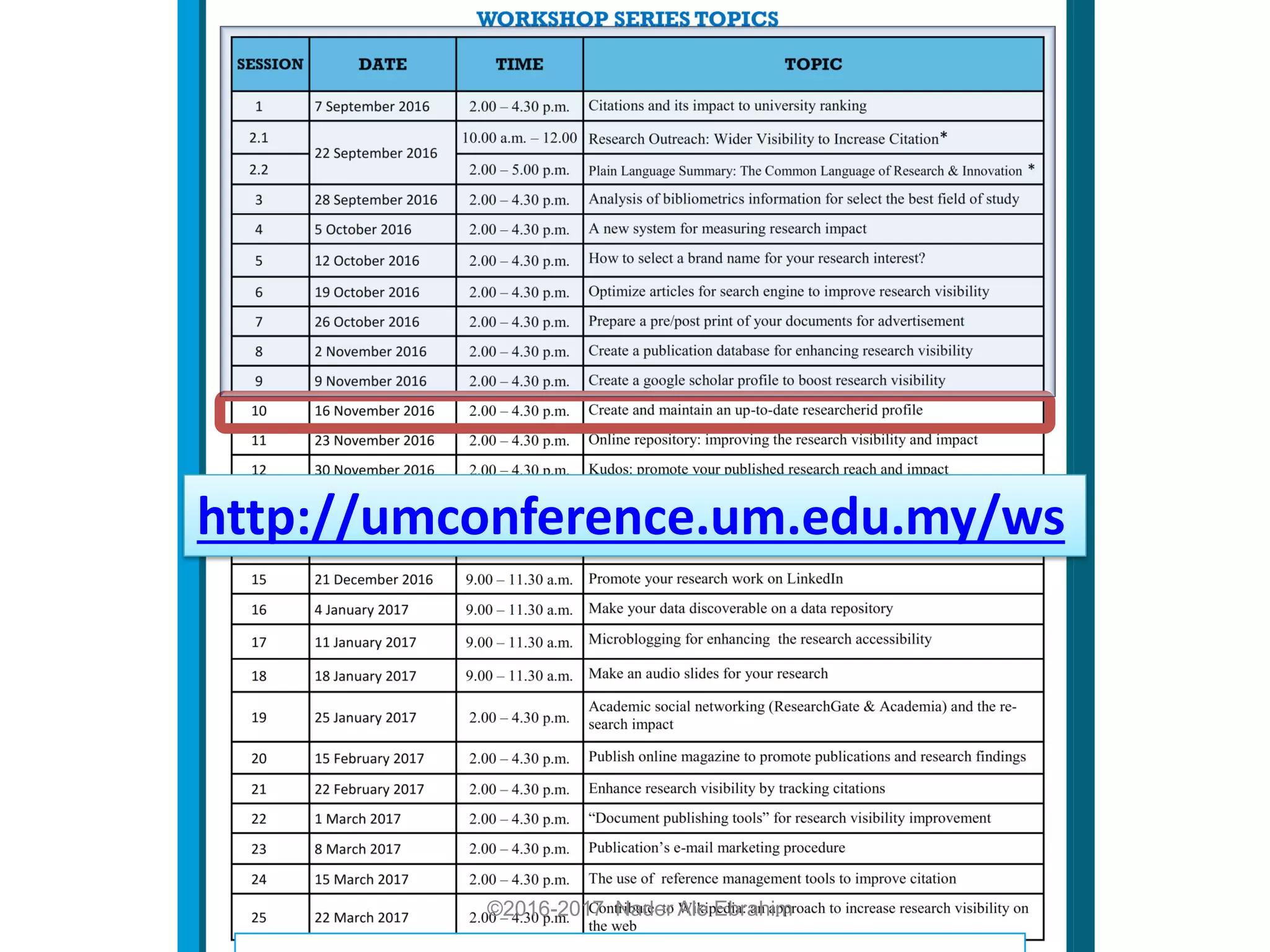
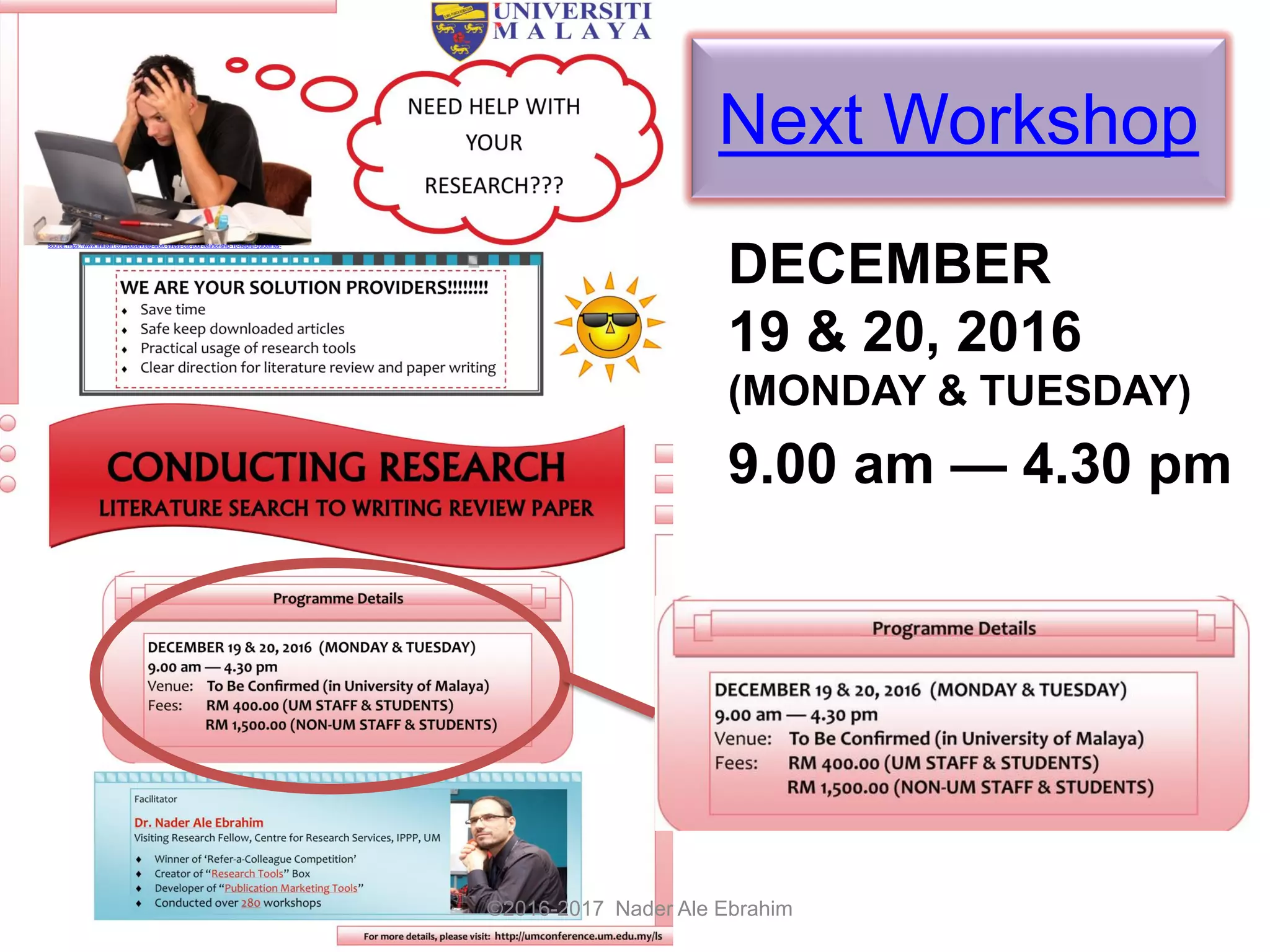
http://umconference.um.edu.my/ws
Next Workshop
DECEMBER
19 & 20, 2016
(MONDAY & TUESDAY)
9.00 am — 4.30 pm
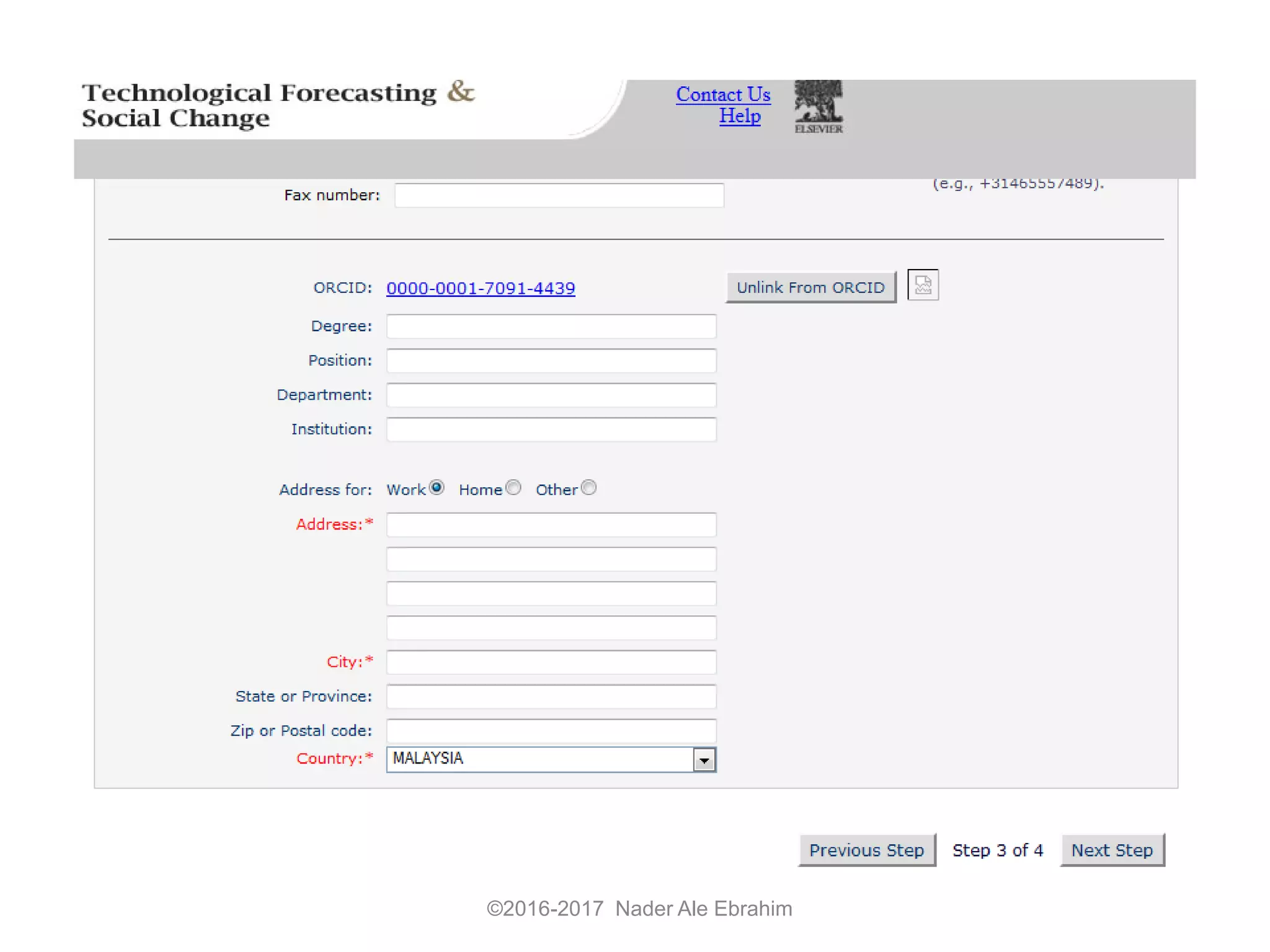
©2016-2017 Nader Ale Ebrahim
Source: https://www.linkedin.com/pulse/keep-work-stress-out-your-relationship-10-helpful-guidelines-
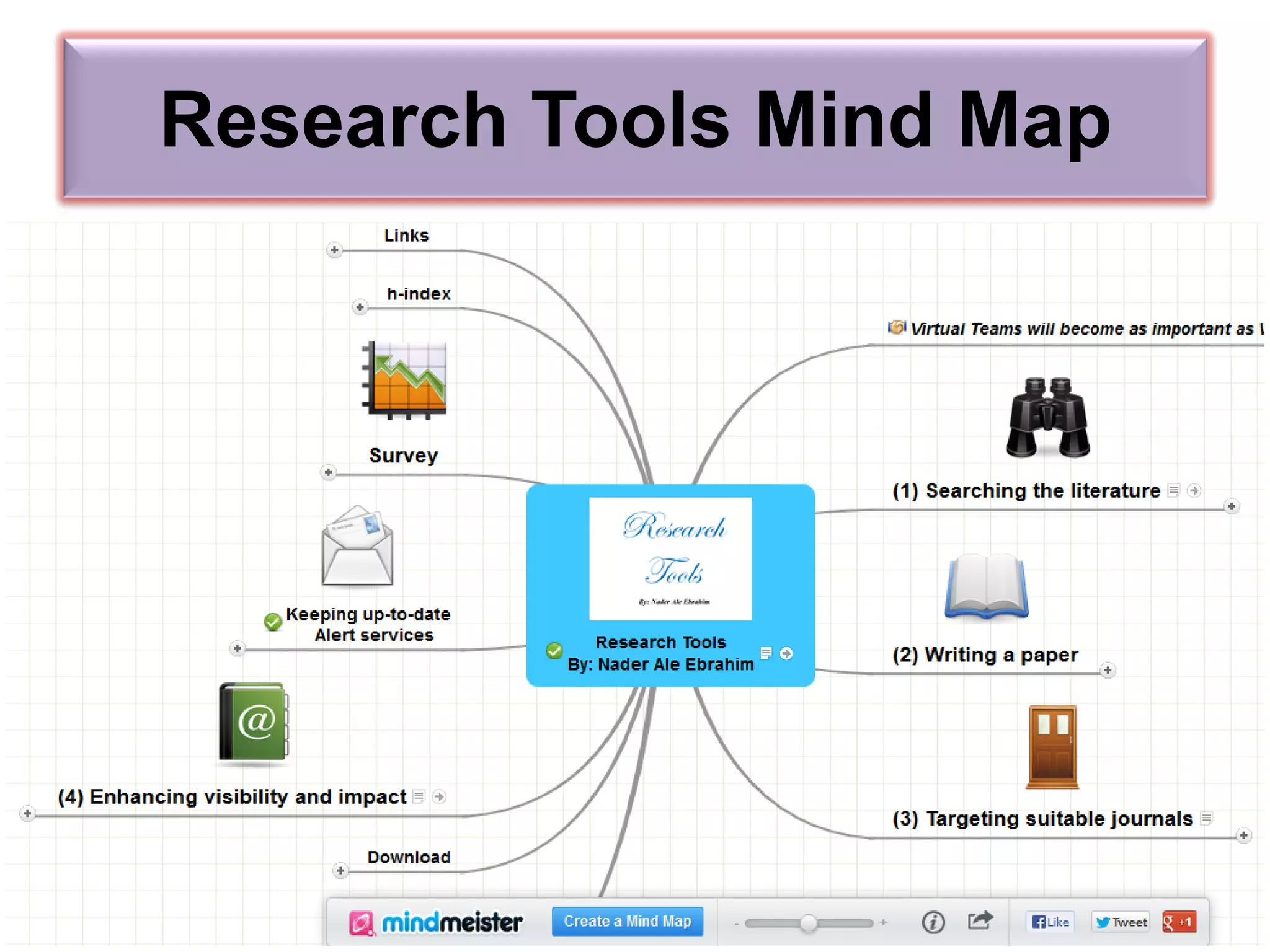
Research Tools Mind Map
©2016-2017 Nader Ale Ebrahim
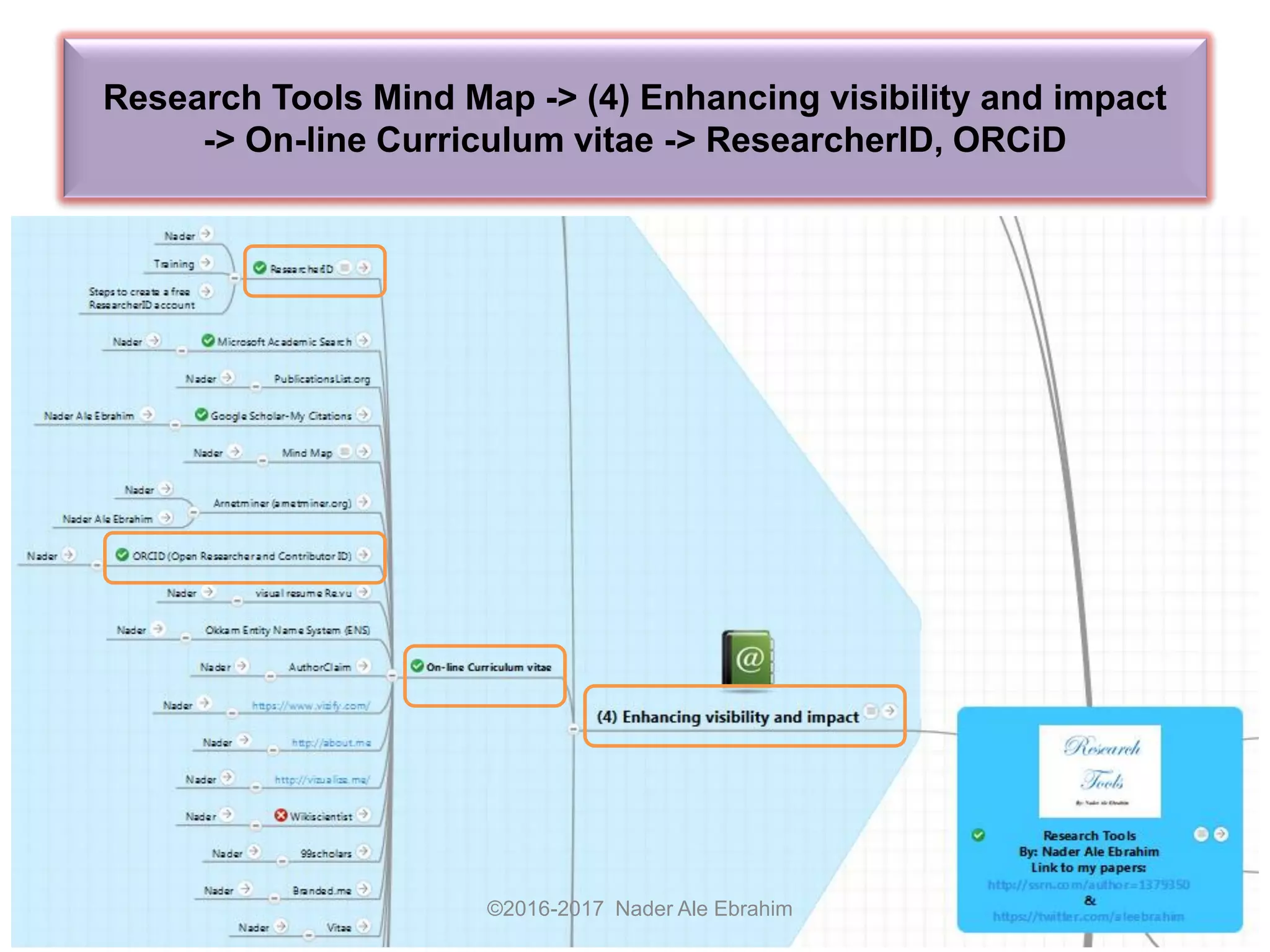
Research Tools Mind Map -> (4) Enhancing visibility and impact
-> On-line Curriculum vitae -> ResearcherID, ORCiD
©2016-2017 Nader Ale Ebrahim
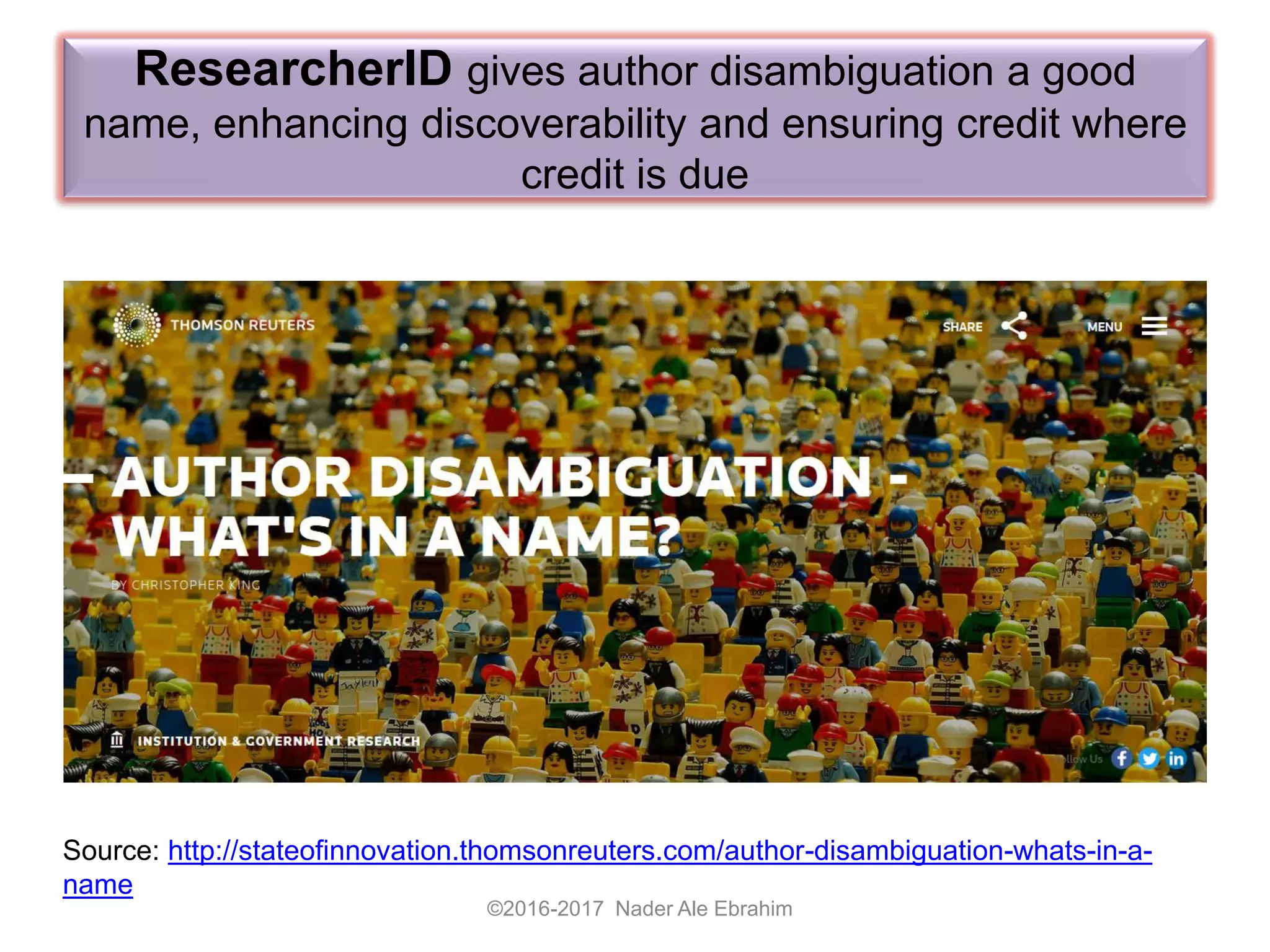
ResearcherID gives author disambiguation a good
name, enhancing discoverability and ensuring credit where
credit is due
©2016-2017 Nader Ale Ebrahim
Source: http://stateofinnovation.thomsonreuters.com/author-disambiguation-whats-in-a-
name
Adapted from : MIyairi, N. (2016). ORCID: Connecting research & researchers. Paper presented at the Asia Open Access Summit 2016, INTEKMA
Resort & Convention Centre, Shah Alam.
ORCID provides a
persistent digital
identifier that
distinguishes researchers
from each other
… and MORE
Benefits of e-visibility
• It is a powerful way for researchers to boost their professional profile
– online resume / cv (Bik & Goldstein: 2013)
• Take control of their research (Goodier & Czerniewicz: 2012)
• It helps researcher gain recognition in their discipline (Goodier &
Czerniewicz: 2012)
• It helps to improve research efficiency – disseminating their
research and making it discoverable and accessible (Bik &
Goldstein: 2013)
• It allows for citation tracking and improving your impact as a
researcher (Traditional and alternative) – citation counts, citation
analysis and accumulation of attention data which translates to
altmetrics
• It enhances professional networking of researchers – can make
contact with other researchers and collaborate – grow your networks
(Goodier & Czerniewicz: 2012)
• It allows for wider communication between scientists and general
public – “online outreach” if you may (Bik & Goldstein: 2013)
Source: Leslie Adriaanse (2015), “Increasing e-visibility”, Personal Librarian: CAES, Science Campus, University of South Africa
©2016-2017 Nader Ale Ebrahim
Research e-profiles
Essential elements necessary in a research
e-profile (Ward, Bejarano & Dudas: 2015):
1. Electronic representation of the
researcher online
2. Researcher/research online reputation
3. Researcher/research online
discoverability and accessibility
Source: Leslie Adriaanse (2015), “Increasing e-visibility”, Personal Librarian: CAES, Science Campus, University of South Africa
©2016-2017 Nader Ale Ebrahim
Why should I care about my online
presence?
• To make your research and teaching activities
known
• To increase the chance of publications getting cited
• To correct attribution, names and affiliations
• To make sure that a much as possible is counted in
research assessments
• To increase the chance of new contacts for research
cooperation
• To increase the chance of funding
• To serve society better
©2016-2017 Nader Ale Ebrahim
Source: http://libguides.library.uu.nl/profiles
Author Identification Systems
Author name disambiguation and the
association of scholarly works with the
correct author have long been a problem for
those wishing to develop a comprehensive
list of publications for individuals.
Source: A. B. Wagner, “Author Identification Systems,” Issues in Science and Technology Librarianship, 2009.
©2016-2017 Nader Ale Ebrahim
14
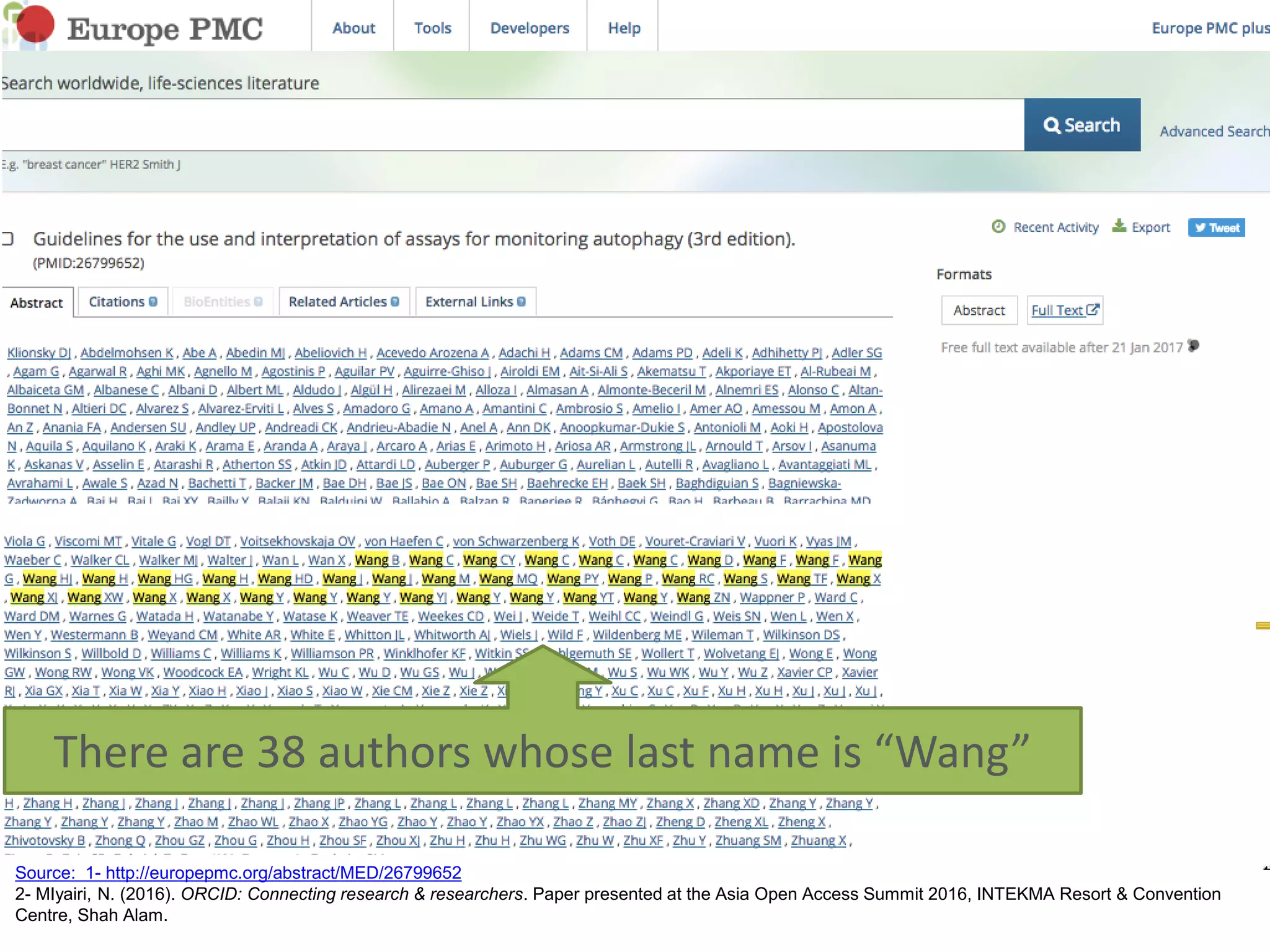
There are 38 authors whose last name is “Wang”
Source: 1- http://europepmc.org/abstract/MED/26799652
2- MIyairi, N. (2016). ORCID: Connecting research & researchers. Paper presented at the Asia Open Access Summit 2016, INTEKMA Resort & Convention
Centre, Shah Alam.
The Challenge at Hand
• Inconsistent name formats caused by the authors themselves or
editors
• Various transliteration systems, especially where different non-
Roman alphabet names result in the same transliterated Roman
alphabet name.
• Legal name changes
• Cultural variants in the position of surnames
• Compound or hyphenated names
• Highly similar names sometimes even doing similar work at the
same institution.
• The large number of common names, especially certain surnames in
many cultures.
Source: A. B. Wagner, “Author Identification Systems,” Issues in Science and Technology Librarianship, 2009.
©2016-2017 Nader Ale Ebrahim
• Build an online an accurate list of research
publications by uploading/importing the
research publication information from various
platforms/systems
• Automatically track times cited counts &
citation metrics, calculates H-Index
• Citation counts, metrics & H-index are current
and publically visible
• Visualization tools e.g. collaboration networks
Researcher/research online discoverability
and accessibility
Source: Leslie Adriaanse (2015), “Increasing e-visibility”, Personal Librarian: CAES, Science Campus, University of South Africa
©2016-2017 Nader Ale Ebrahim
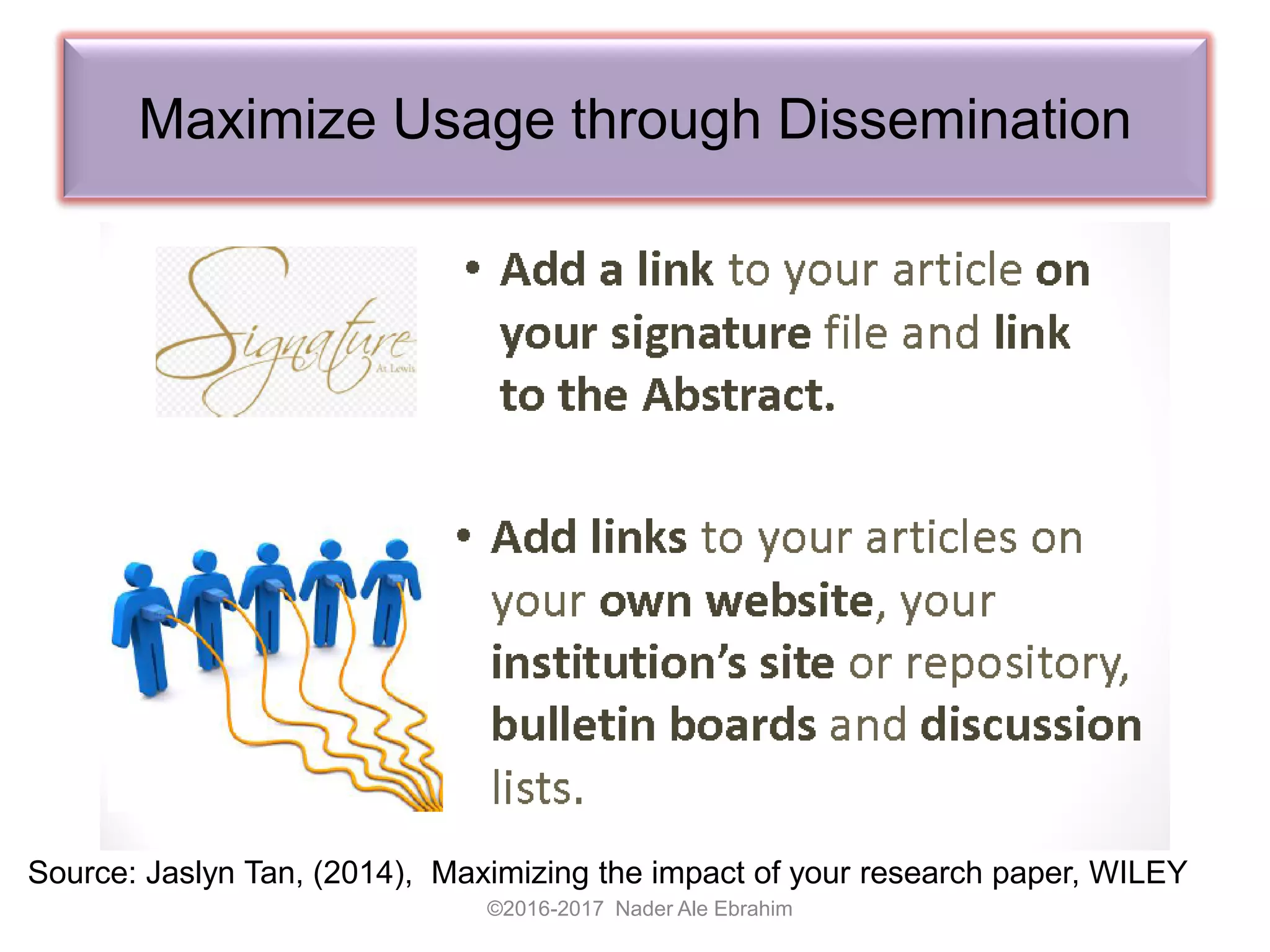
Maximize Usage through Dissemination
©2016-2017 Nader Ale Ebrahim
Source: Jaslyn Tan, (2014), Maximizing the impact of your research paper, WILEY
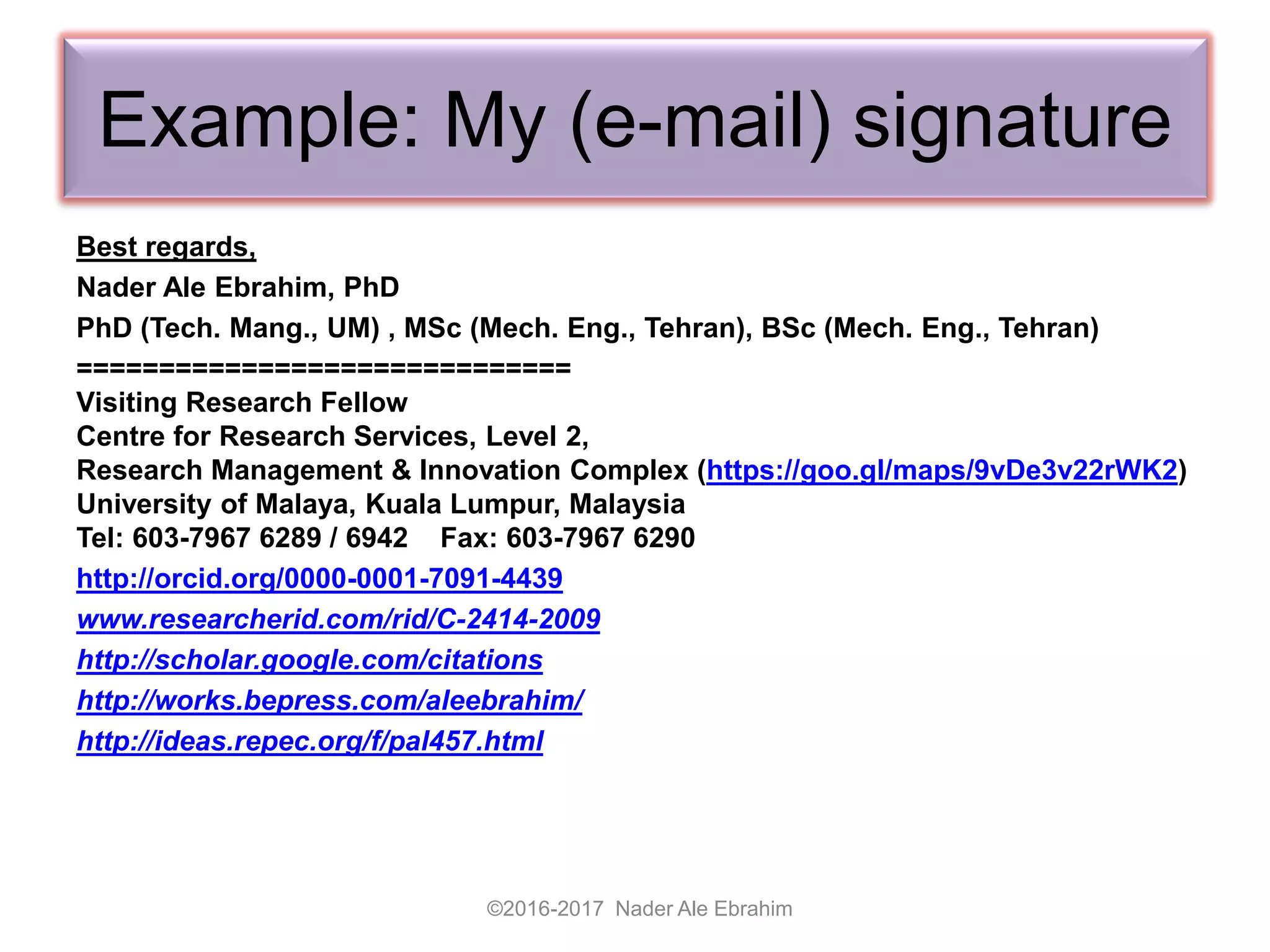
Example: My (e-mail) signature
Best regards,
Nader Ale Ebrahim, PhD
PhD (Tech. Mang., UM) , MSc (Mech. Eng., Tehran), BSc (Mech. Eng., Tehran)
==============================
Visiting Research Fellow
Centre for Research Services, Level 2,
Research Management & Innovation Complex (https://goo.gl/maps/9vDe3v22rWK2)
University of Malaya, Kuala Lumpur, Malaysia
Tel: 603-7967 6289 / 6942 Fax: 603-7967 6290
http://orcid.org/0000-0001-7091-4439
www.researcherid.com/rid/C-2414-2009
http://scholar.google.com/citations
http://works.bepress.com/aleebrahim/
http://ideas.repec.org/f/pal457.html
©2016-2017 Nader Ale Ebrahim
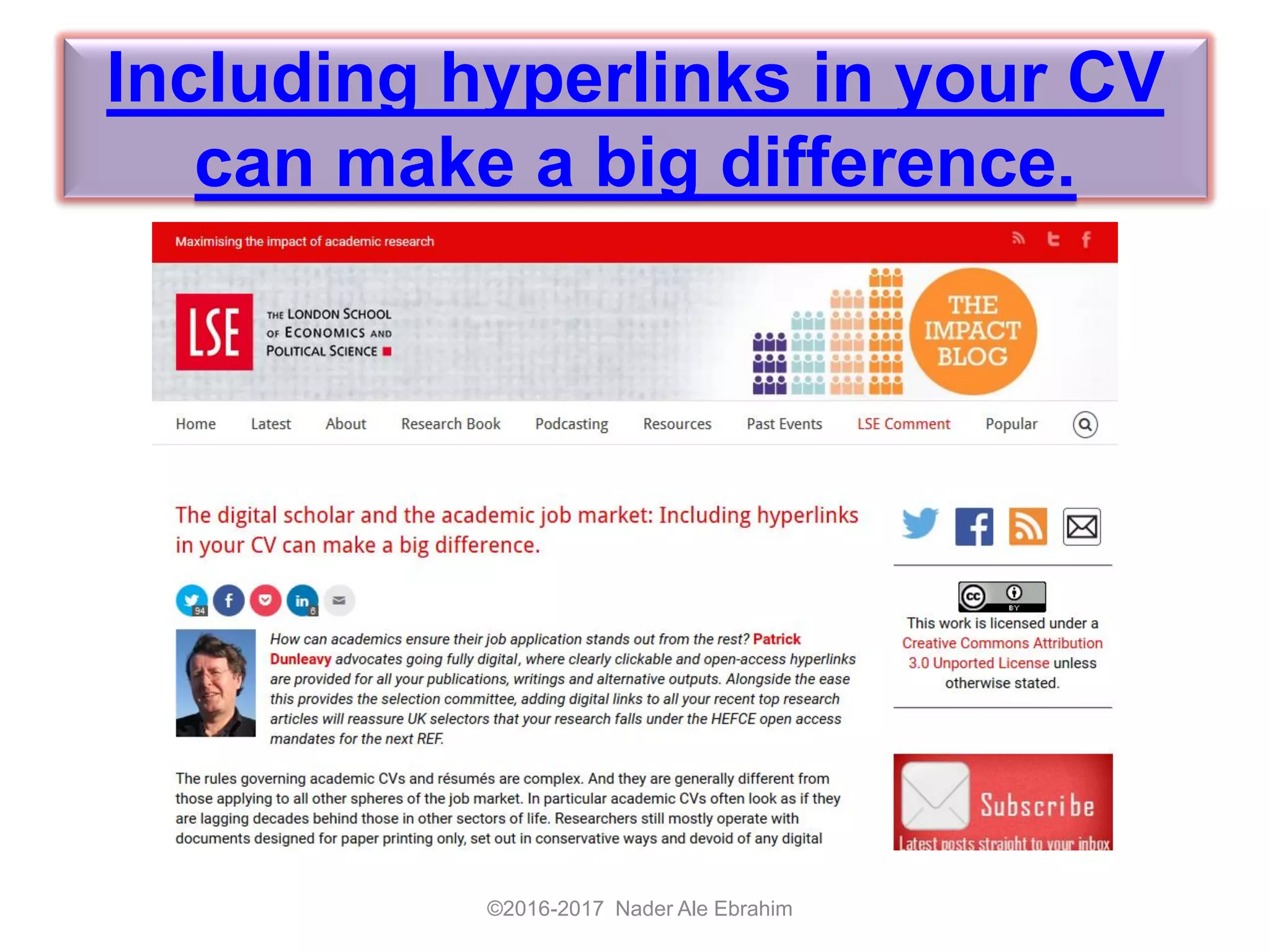
Including hyperlinks in your CV
can make a big difference.
©2016-2017 Nader Ale Ebrahim
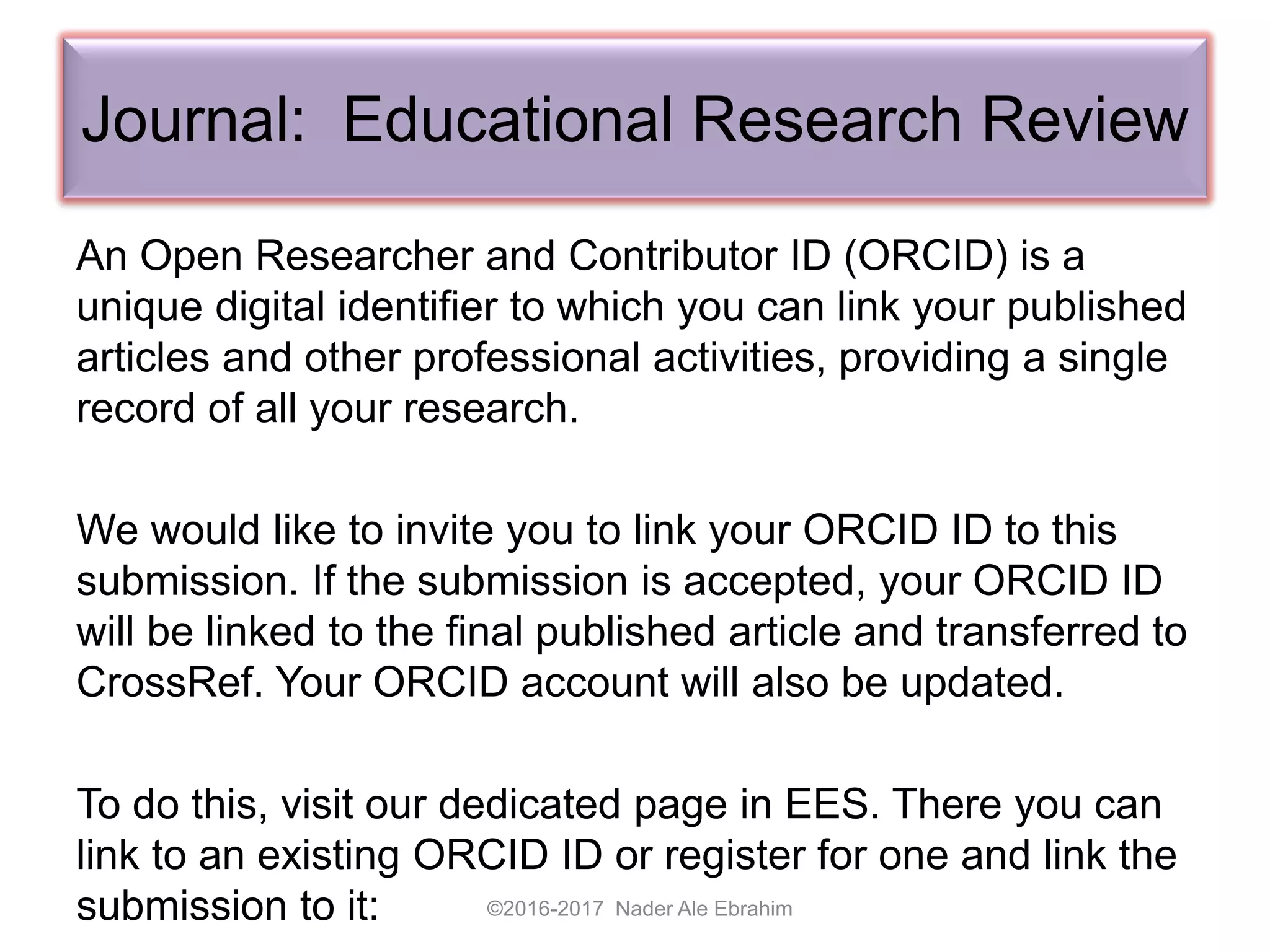
Journal: Educational Research Review
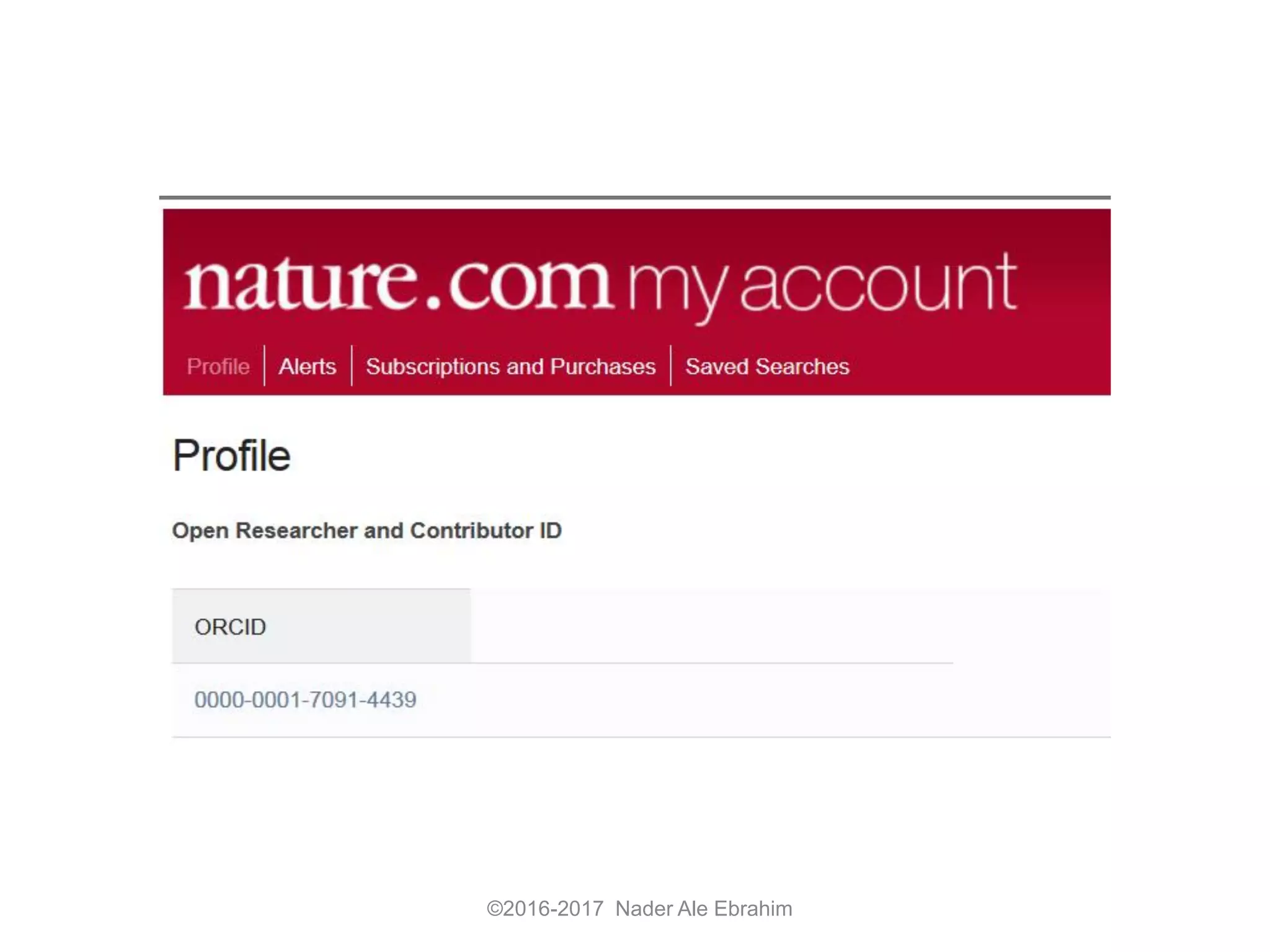
An Open Researcher and Contributor ID (ORCID) is a
unique digital identifier to which you can link your published
articles and other professional activities, providing a single
record of all your research.
We would like to invite you to link your ORCID ID to this
submission. If the submission is accepted, your ORCID ID
will be linked to the final published article and transferred to
CrossRef. Your ORCID account will also be updated.
To do this, visit our dedicated page in EES. There you can
link to an existing ORCID ID or register for one and link the
submission to it: ©2016-2017 Nader Ale Ebrahim
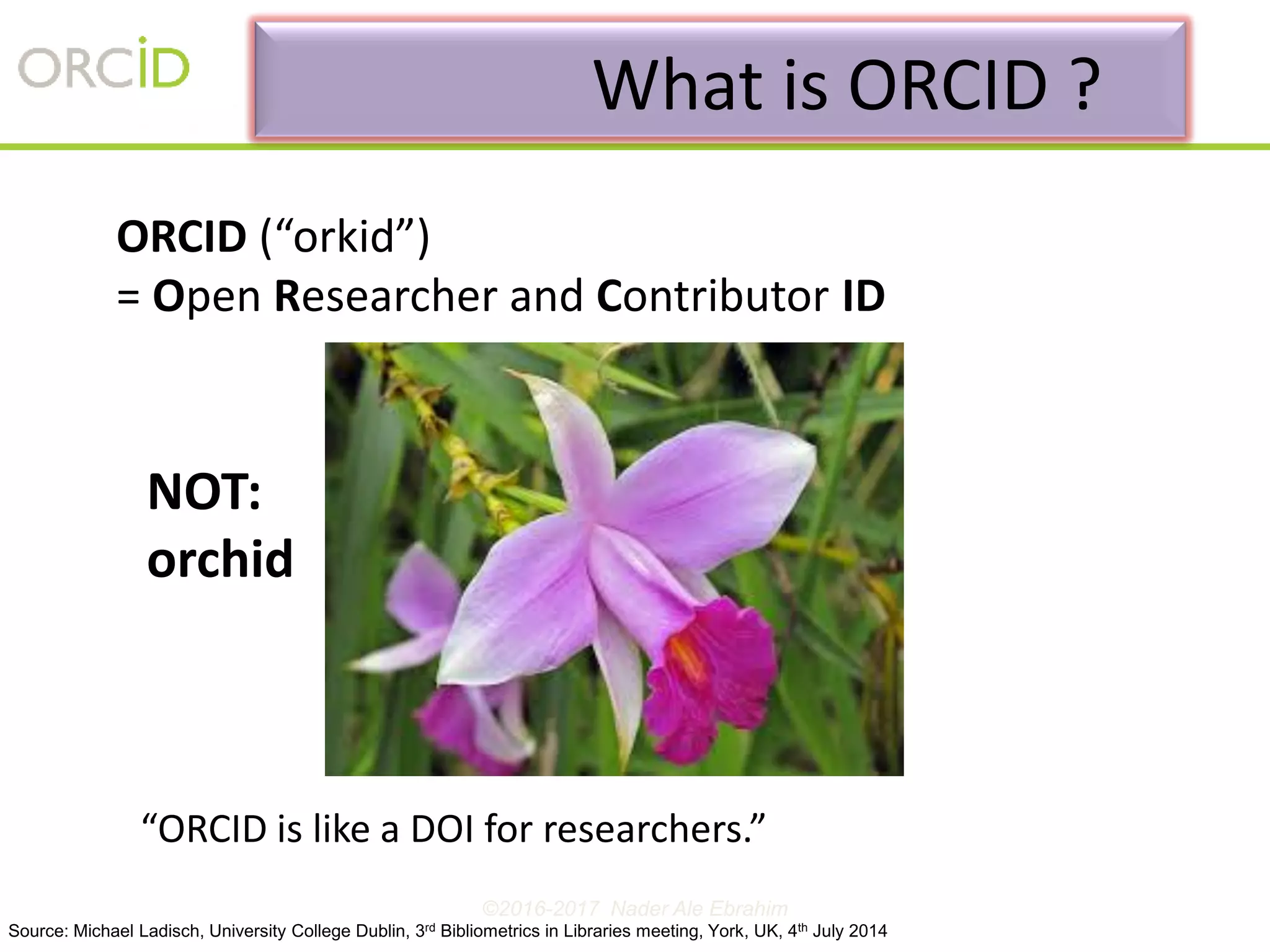
ORCID (“orkid”)
= Open Researcher and Contributor ID
“ORCID is like a DOI for researchers.”
NOT:
orchid
What is ORCID ?
Source: Michael Ladisch, University College Dublin, 3rd Bibliometrics in Libraries meeting, York, UK, 4th July 2014
©2016-2017 Nader Ale Ebrahim
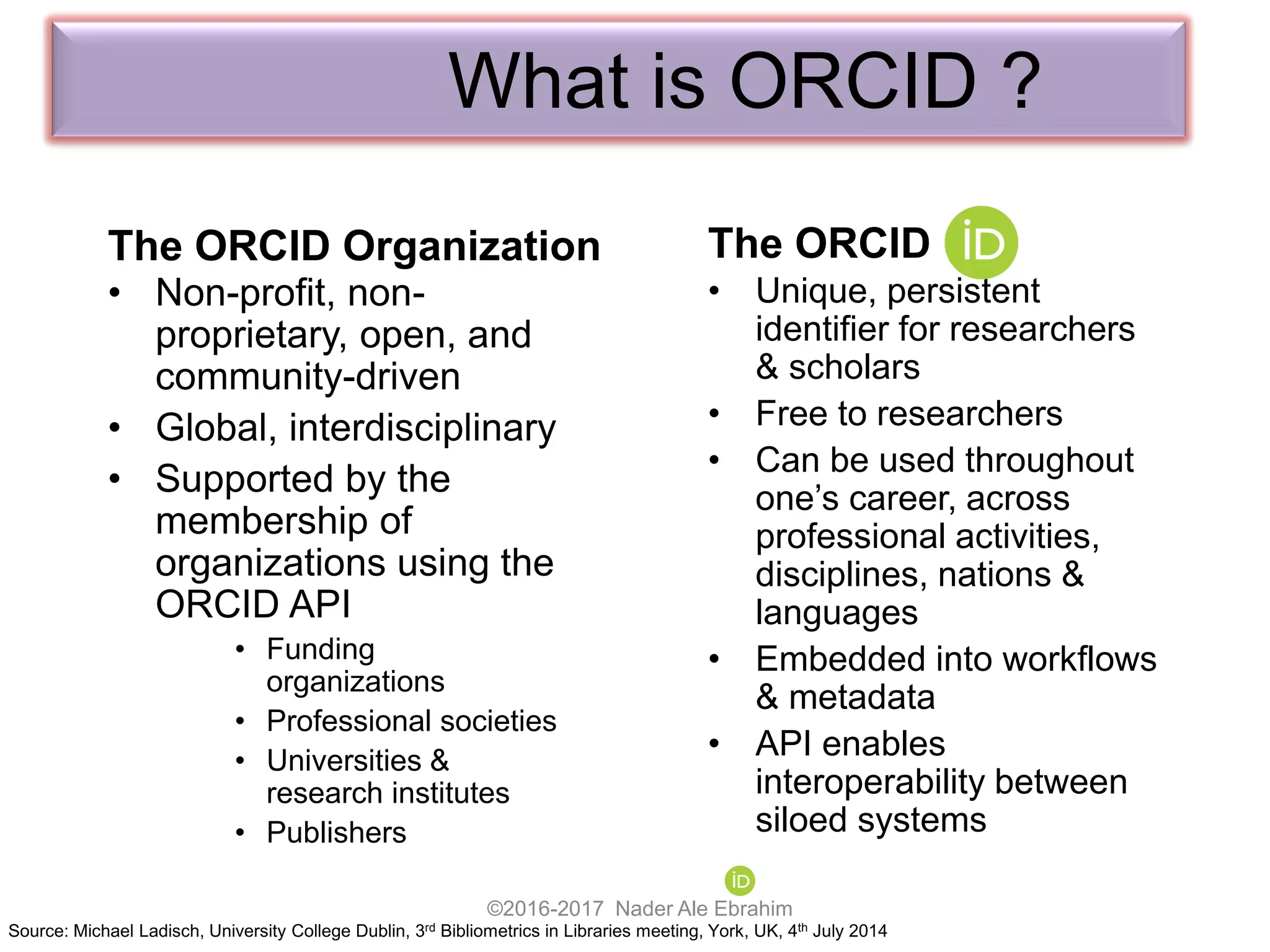
What is ORCID ?
The ORCID
• Unique, persistent
identifier for researchers
& scholars
• Free to researchers
• Can be used throughout
one’s career, across
professional activities,
disciplines, nations &
languages
• Embedded into workflows
& metadata
• API enables
interoperability between
siloed systems
The ORCID Organization
• Non-profit, non-
proprietary, open, and
community-driven
• Global, interdisciplinary
• Supported by the
membership of
organizations using the
ORCID API
• Funding
organizations
• Professional societies
• Universities &
research institutes
• Publishers
©2016-2017 Nader Ale Ebrahim
Source: Michael Ladisch, University College Dublin, 3rd Bibliometrics in Libraries meeting, York, UK, 4th July 2014
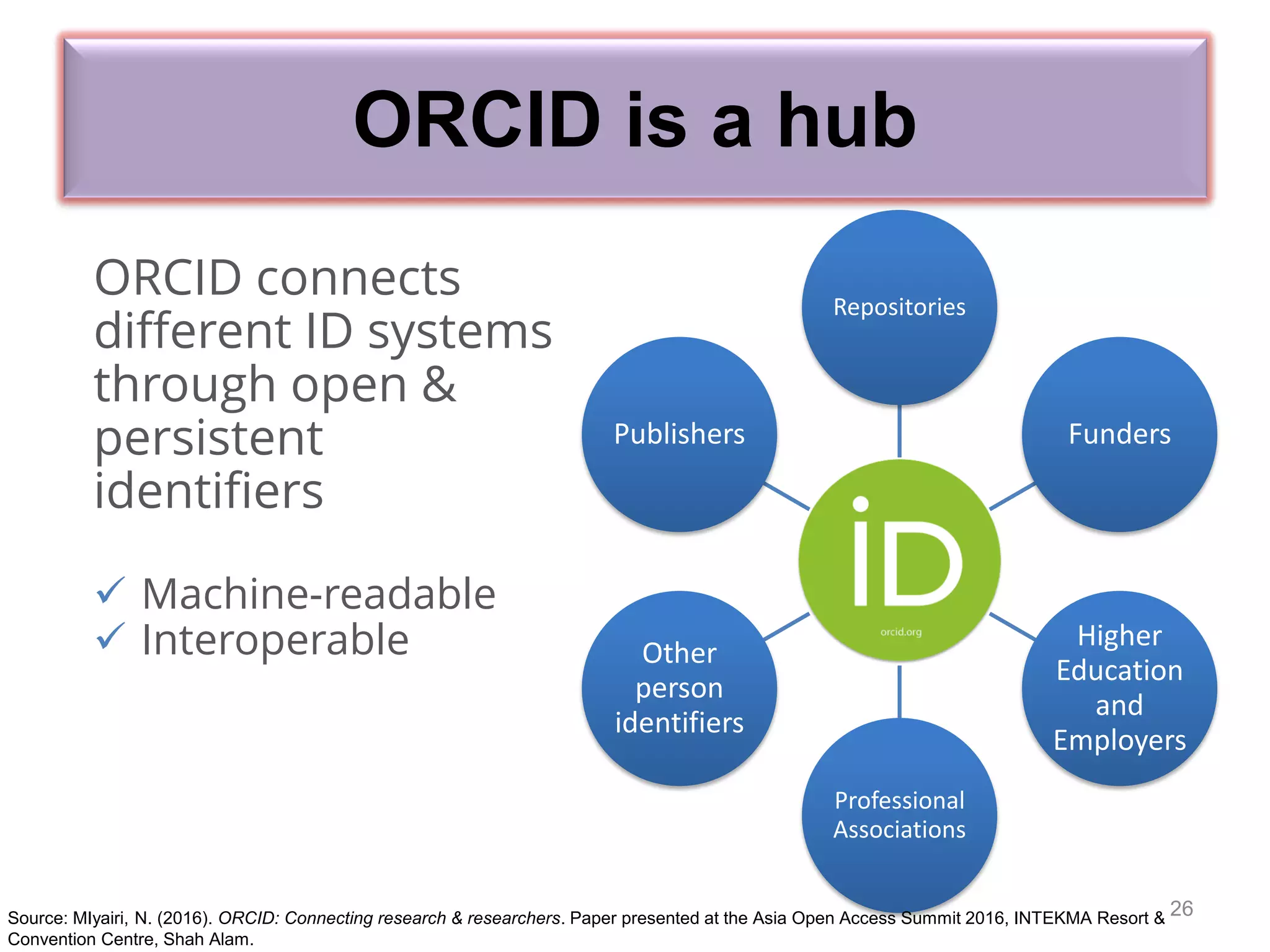
Repositories
Funders
Higher
Education
and
Employers
Professional
Associations
Other
person
identifiers
Publishers
26
DOI
ISBN
ORCID connects
different ID systems
through open &
persistent
identifiers
 Machine-readable
 Interoperable
ORCID is a hub
Source: MIyairi, N. (2016). ORCID: Connecting research & researchers. Paper presented at the Asia Open Access Summit 2016, INTEKMA Resort &
Convention Centre, Shah Alam.
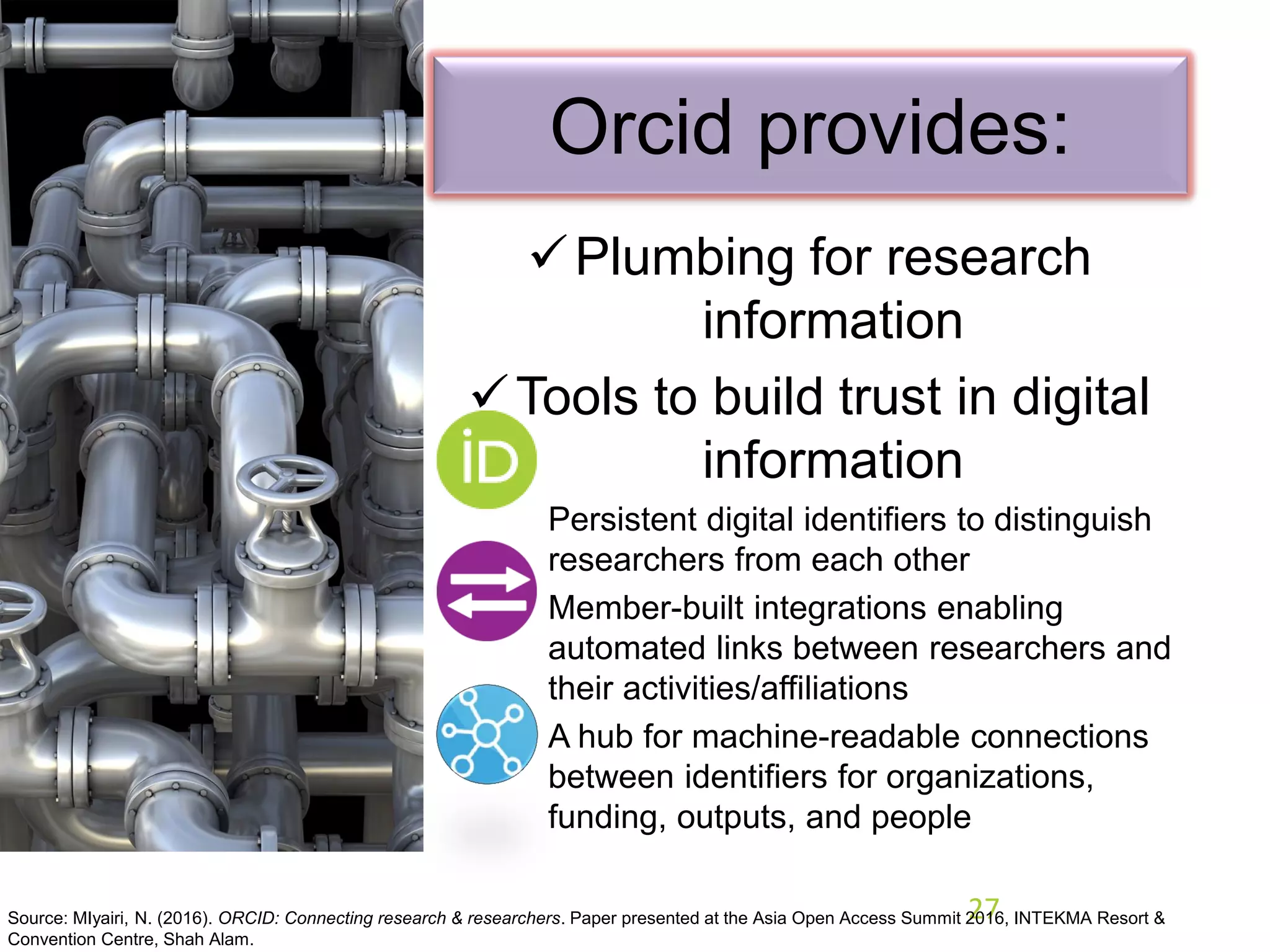
Orcid provides:
Plumbing for research
information
Tools to build trust in digital
information
Persistent digital identifiers to distinguish
researchers from each other
Member-built integrations enabling
automated links between researchers and
their activities/affiliations
A hub for machine-readable connections
between identifiers for organizations,
funding, outputs, and people
27Source: MIyairi, N. (2016). ORCID: Connecting research & researchers. Paper presented at the Asia Open Access Summit 2016, INTEKMA Resort &
Convention Centre, Shah Alam.
EBSCO Information Services joins
ORCID
IPSWICH, Mass. — October 22, 2013 — EBSCO
Information Services (EBSCO) announces it is now a
member of Open Researcher and Contributor ID (ORCID),
an open, non-profit, community-driven effort to create and
maintain a registry of unique and persistent researcher
identifiers. ORCID works with the community to embed
these identifiers in research workflows and systems to
connect researchers with their scholarly activities and
contributions.
©2016-2017 Nader Ale Ebrahim
Source: http://www.ebscohost.com/newsroom/stories/ebsco-information-services-joins-orcid
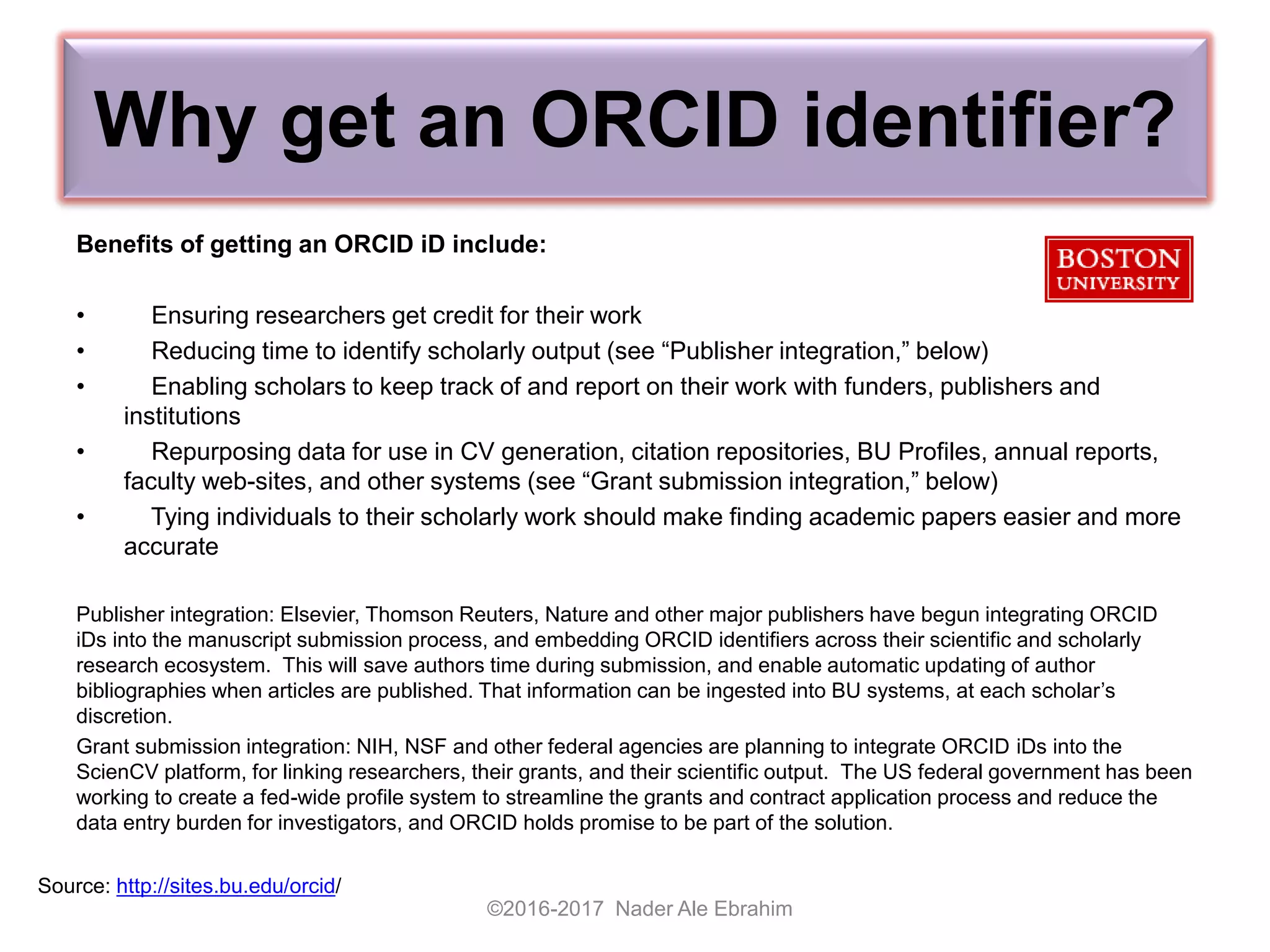
Why get an ORCID identifier?
Benefits of getting an ORCID iD include:
• Ensuring researchers get credit for their work
• Reducing time to identify scholarly output (see “Publisher integration,” below)
• Enabling scholars to keep track of and report on their work with funders, publishers and
institutions
• Repurposing data for use in CV generation, citation repositories, BU Profiles, annual reports,
faculty web-sites, and other systems (see “Grant submission integration,” below)
• Tying individuals to their scholarly work should make finding academic papers easier and more
accurate
Publisher integration: Elsevier, Thomson Reuters, Nature and other major publishers have begun integrating ORCID
iDs into the manuscript submission process, and embedding ORCID identifiers across their scientific and scholarly
research ecosystem. This will save authors time during submission, and enable automatic updating of author
bibliographies when articles are published. That information can be ingested into BU systems, at each scholar’s
discretion.
Grant submission integration: NIH, NSF and other federal agencies are planning to integrate ORCID iDs into the
ScienCV platform, for linking researchers, their grants, and their scientific output. The US federal government has been
working to create a fed-wide profile system to streamline the grants and contract application process and reduce the
data entry burden for investigators, and ORCID holds promise to be part of the solution.
©2016-2017 Nader Ale Ebrahim
Source: http://sites.bu.edu/orcid/
Build an online Curriculum Vitae
• Register with ResearcherID (Web of
Science) and ORCiD
See more at: http://libguides.library.curtin.edu.au/content.php?pid=417077&sid=3408994
ResearcherID – an older id system associated with the Web of Science (WOS).
Your ORCID and ResearcherID profiles can easily be linked. Citation counts for
publications in ResearchID are automatically updated from WOS.
ORCiD (Open Researcher and Contributor ID) – a new, broadly supported
researcher profile that creates a unique author identification number. By
creating an authoritative publication list associated with your ID number, you
can minimize confusion with other researchers with similar names.
See more at: http://library.buffalo.edu/scholarly/action/
©2016-2017 Nader Ale Ebrahim
Managing your research and
building your personal
brand with ResearcherID
Source: Melissa Badenhorst (2015), Sales & Marketing Manager, WorldWide Information Services , Agent: Thomson Reuters
http://hdl.handle.net/2263/49260
What is ResearcherID
• www.researcherid.com
• Online registry for creating a unique researcher ID number> helps in
disambiguation
• Build a publication list identifying your work
• Make your profile public or private
– Public profiles can be searched and viewed by others
• Generate citation metrics including: H-index
– Citation distribution per year
– Total Times Cited count
– Average Times Cited
Global research community where researchers connect Keep all your
publications in one place accessible anytime and anywhere on the web
©2016-2017 Nader Ale Ebrahim
Source: Melissa Badenhorst (2015), Sales & Marketing Manager, WorldWide Information Services , Agent:
Thomson Reuters http://hdl.handle.net/2263/49260
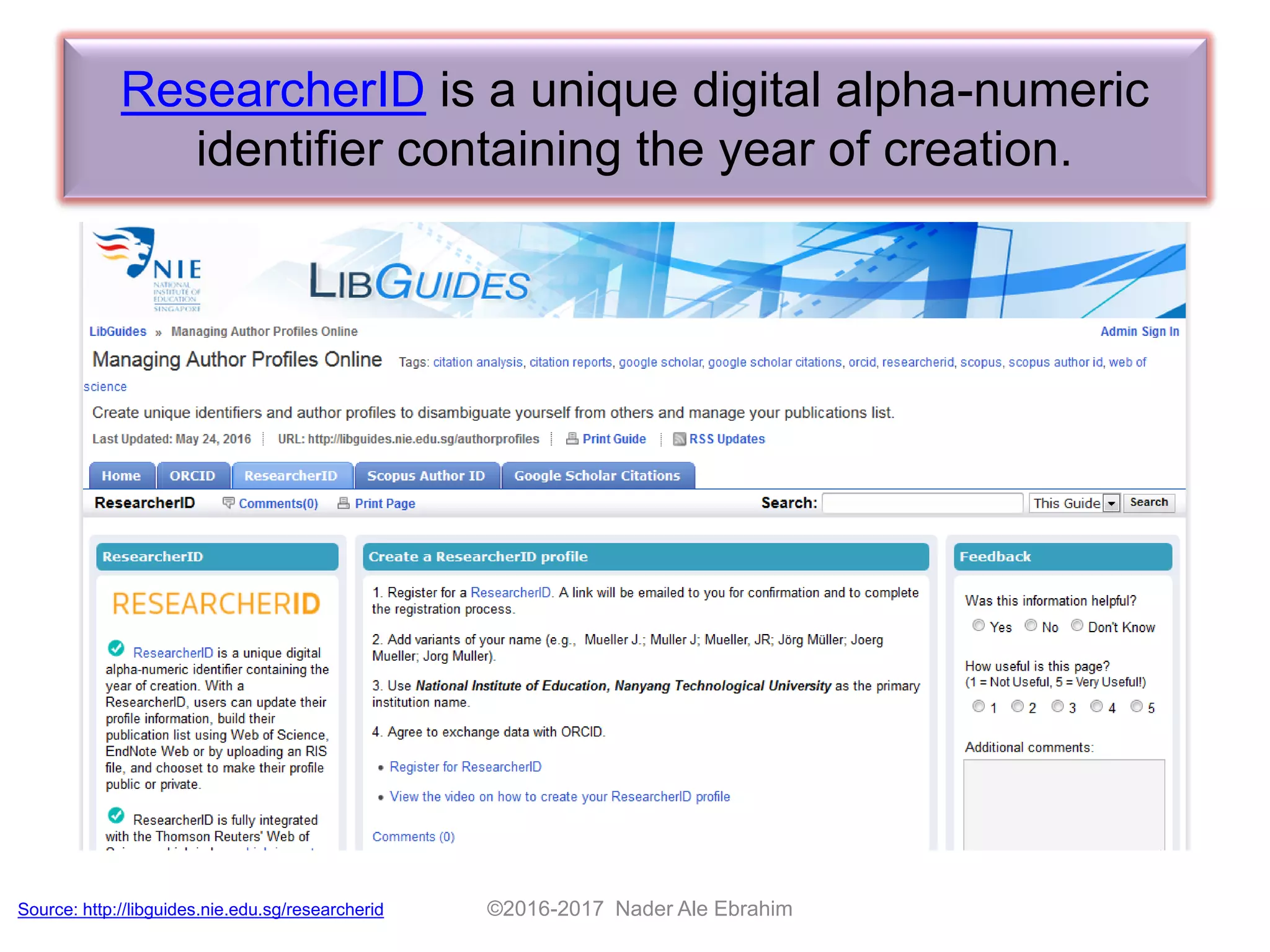
ResearcherID is a unique digital alpha-numeric
identifier containing the year of creation.
©2016-2017 Nader Ale EbrahimSource: http://libguides.nie.edu.sg/researcherid
©2016-2017 Nader Ale EbrahimSource: Melissa Badenhorst (2015), Sales & Marketing Manager, WorldWide Information Services , Agent:
Thomson Reuters http://hdl.handle.net/2263/49260
©2016-2017 Nader Ale Ebrahim
Source: Melissa Badenhorst (2015), Sales & Marketing Manager, WorldWide Information Services , Agent:
Thomson Reuters http://hdl.handle.net/2263/49260
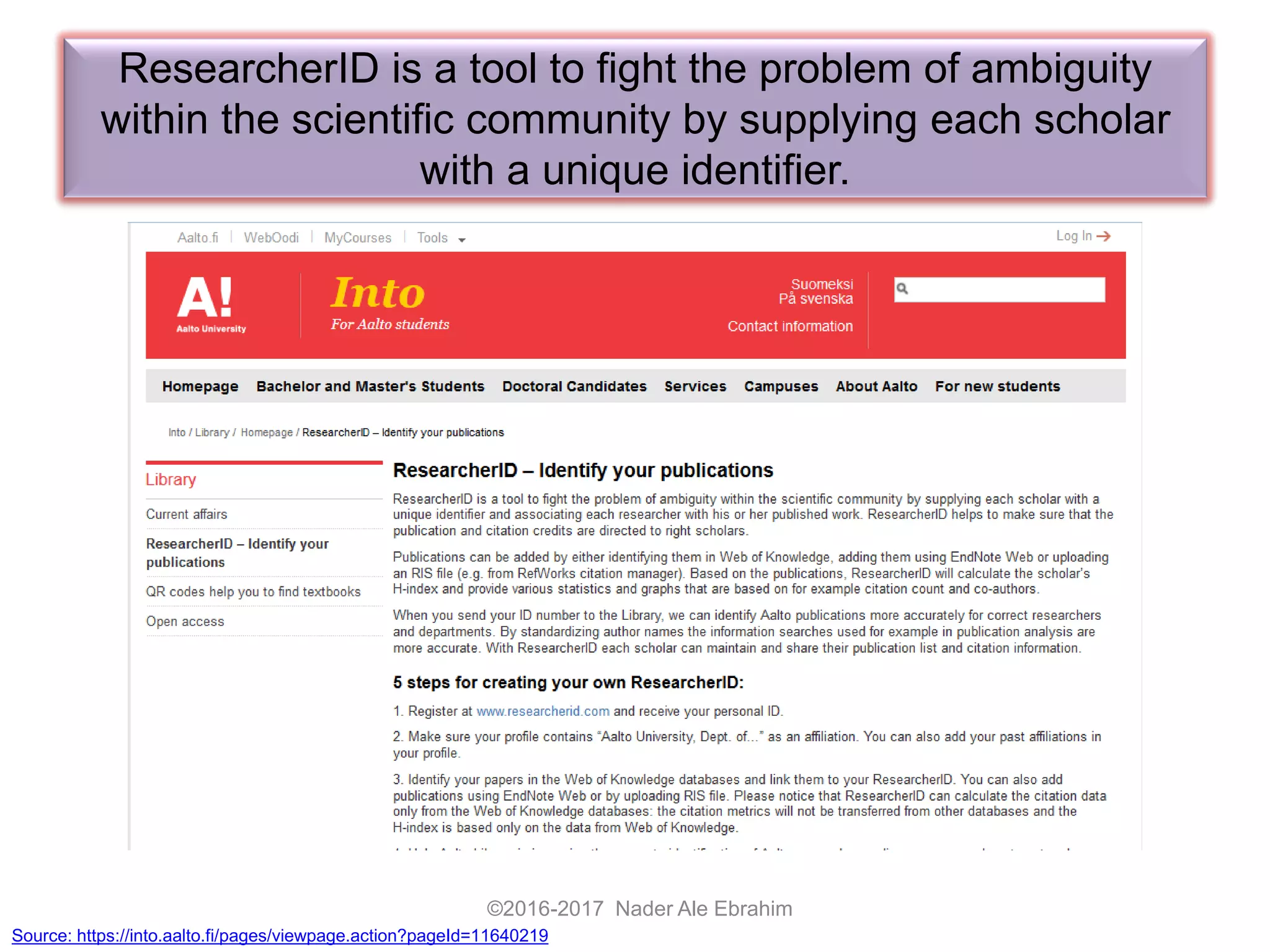
ResearcherID is a tool to fight the problem of ambiguity
within the scientific community by supplying each scholar
with a unique identifier.
©2016-2017 Nader Ale Ebrahim
Source: https://into.aalto.fi/pages/viewpage.action?pageId=11640219
©2016-2017 Nader Ale Ebrahim
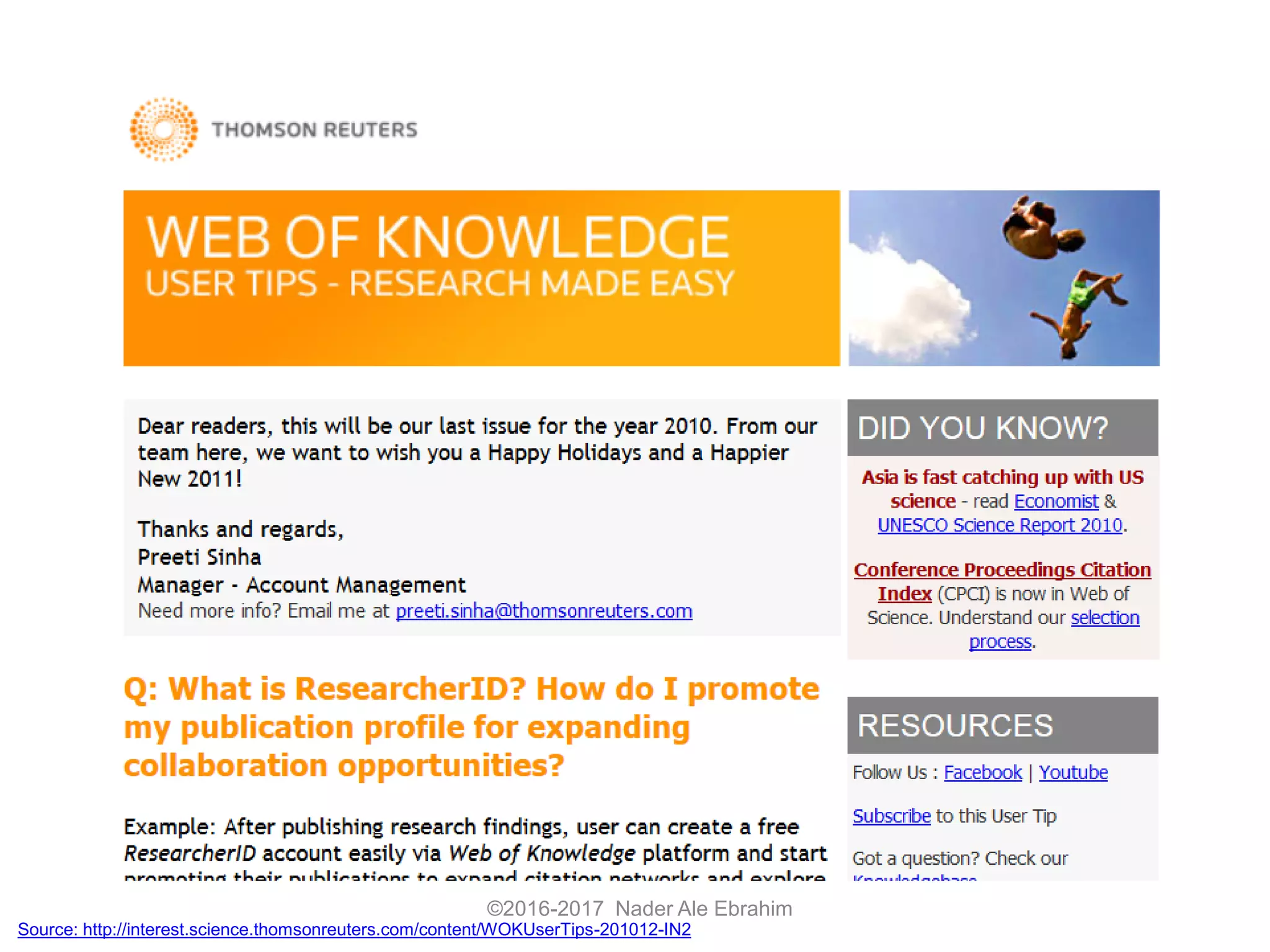
Source: http://interest.science.thomsonreuters.com/content/WOKUserTips-201012-IN2
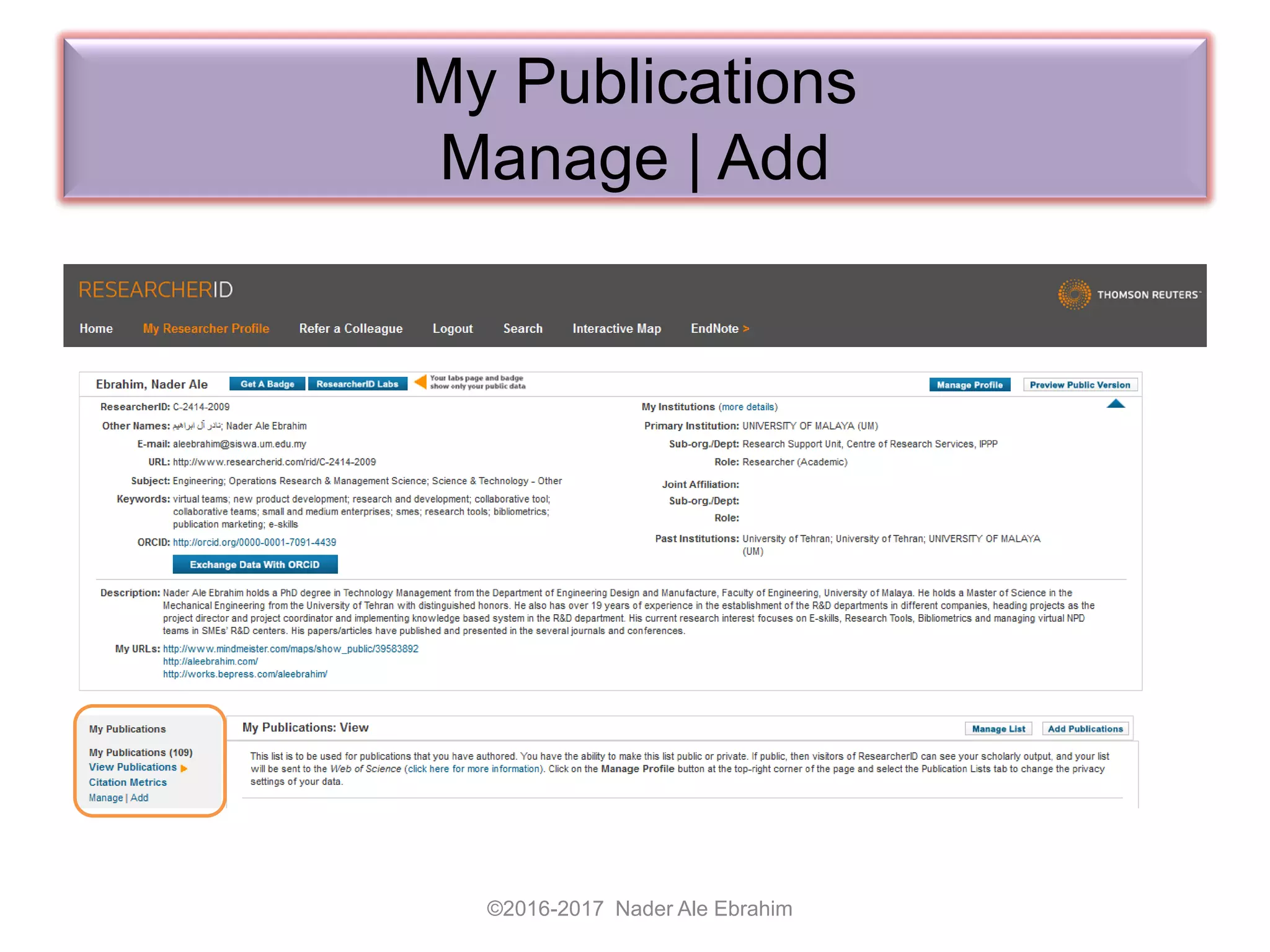
My Publications
Manage | Add
©2016-2017 Nader Ale Ebrahim
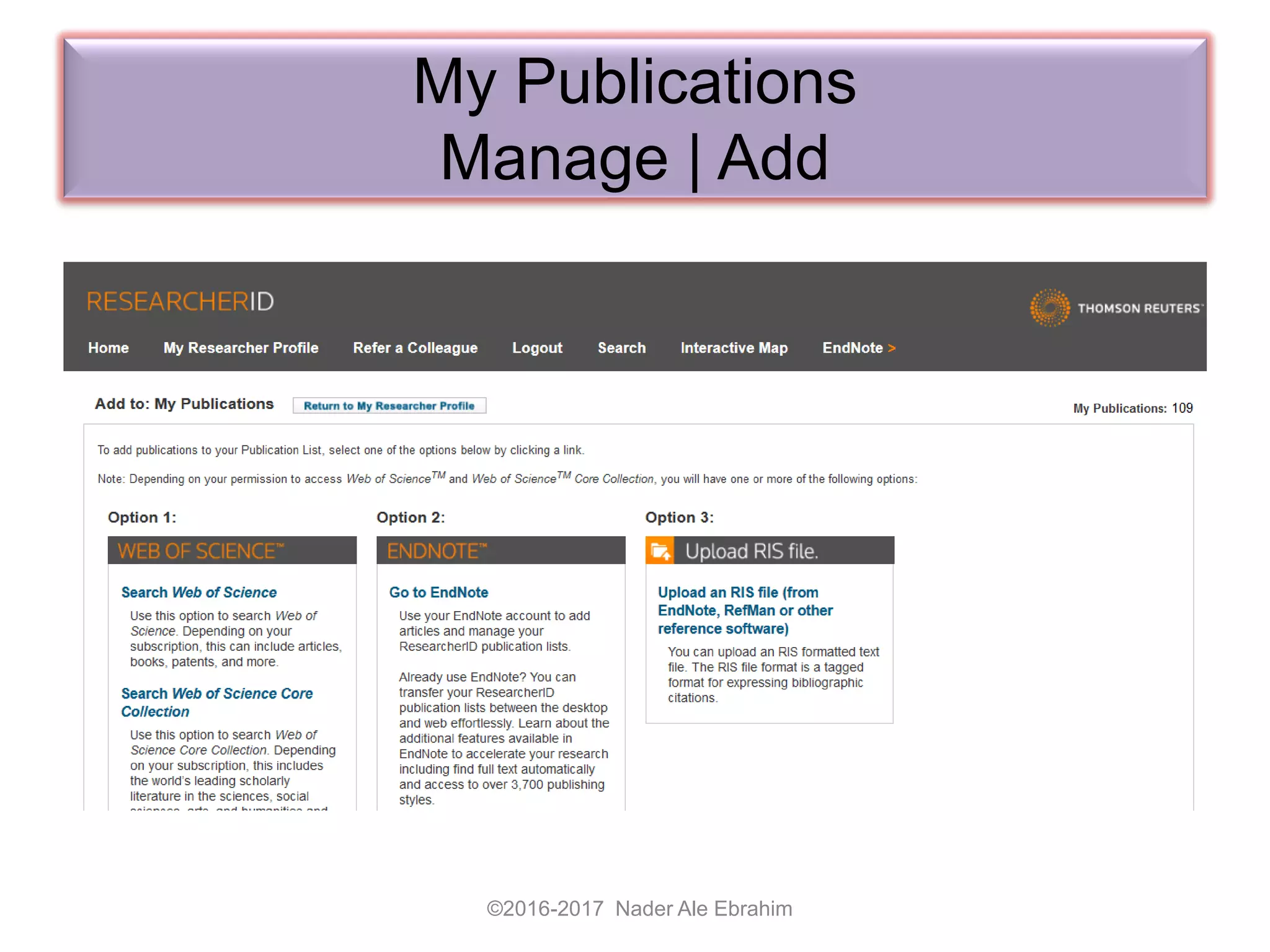
My Publications
Manage | Add
©2016-2017 Nader Ale Ebrahim
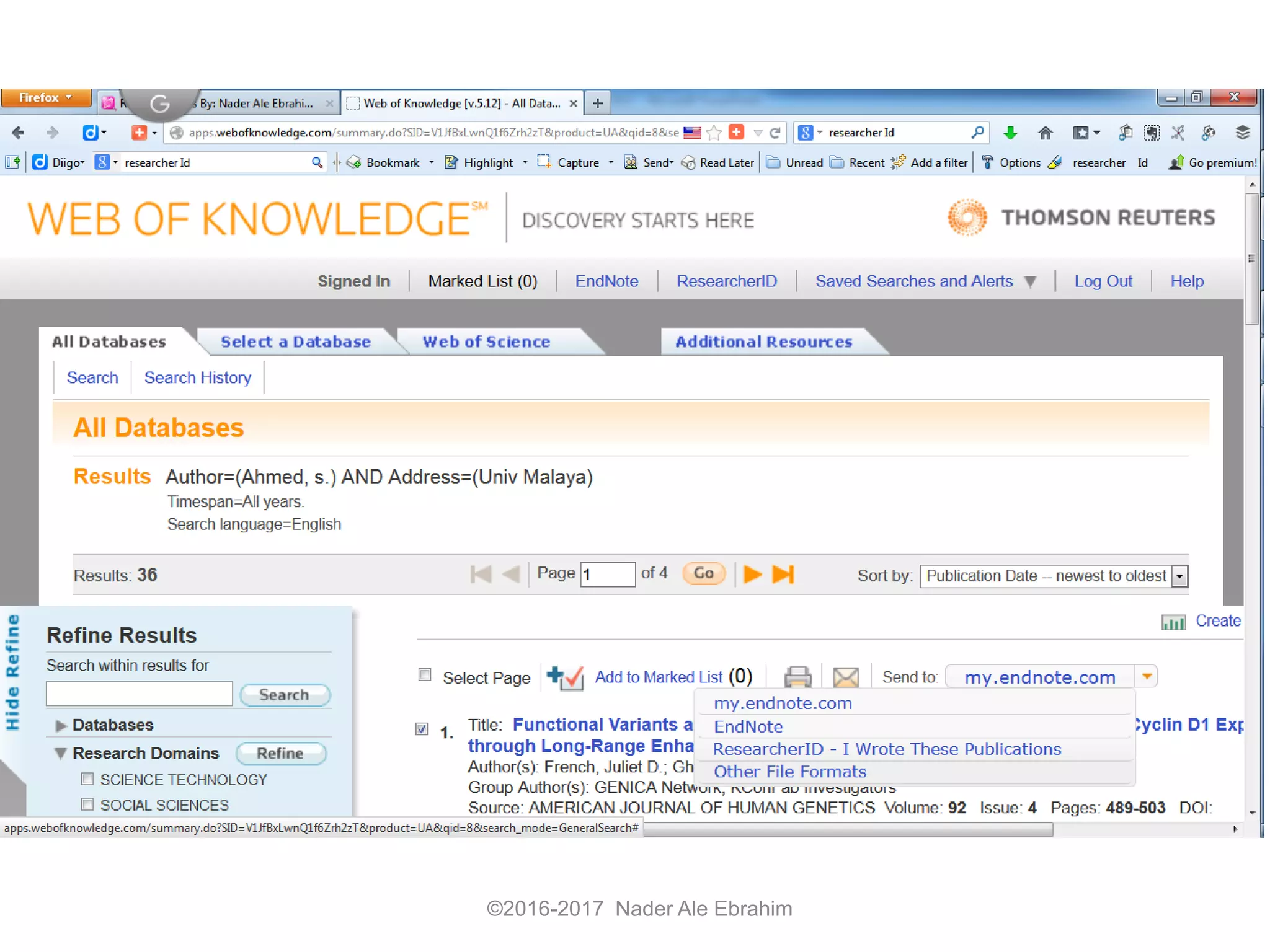
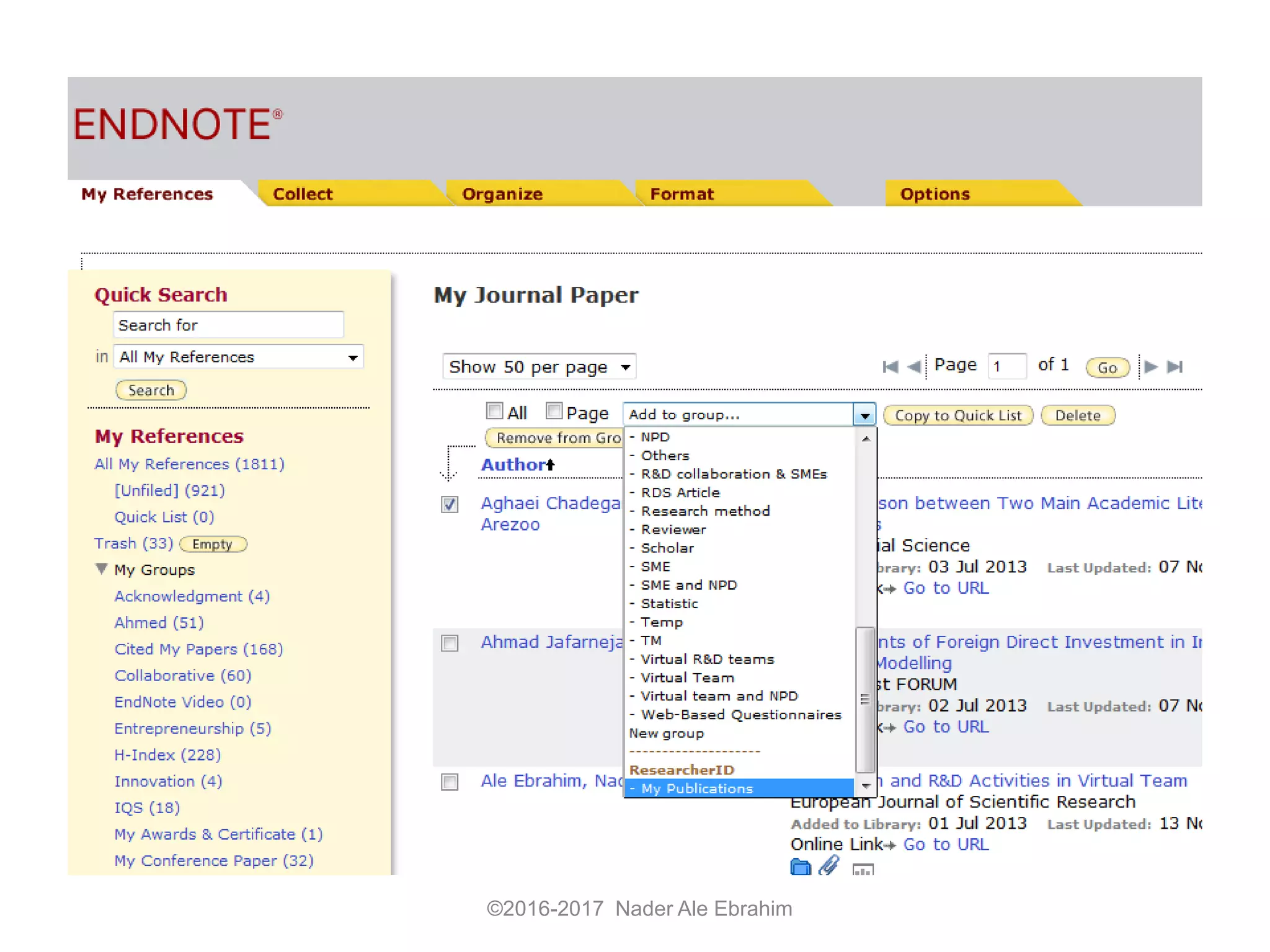
Step 1: Direct export
CREATING A ResearcherID PROFILE
©2016-2017 Nader Ale Ebrahim
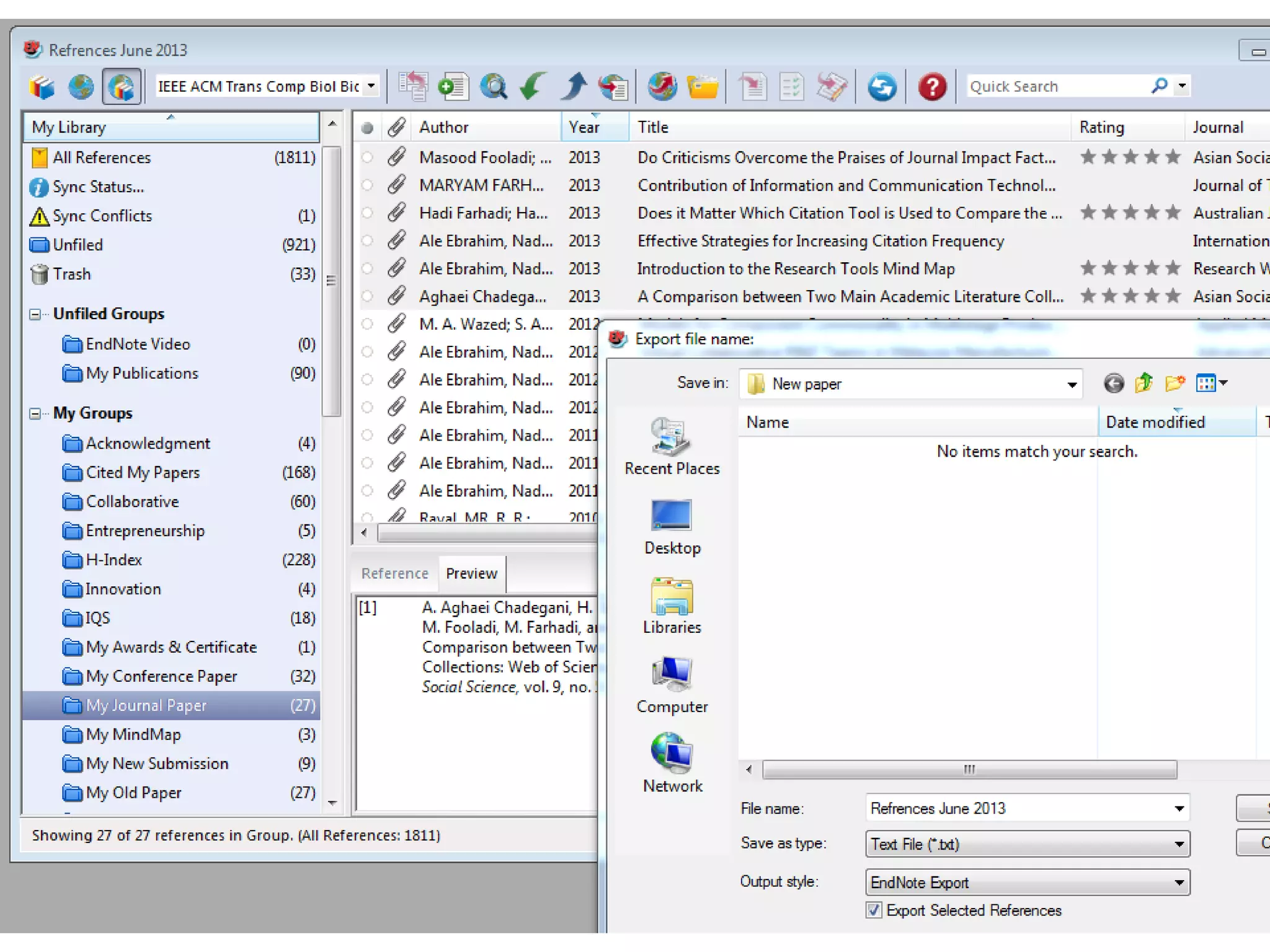
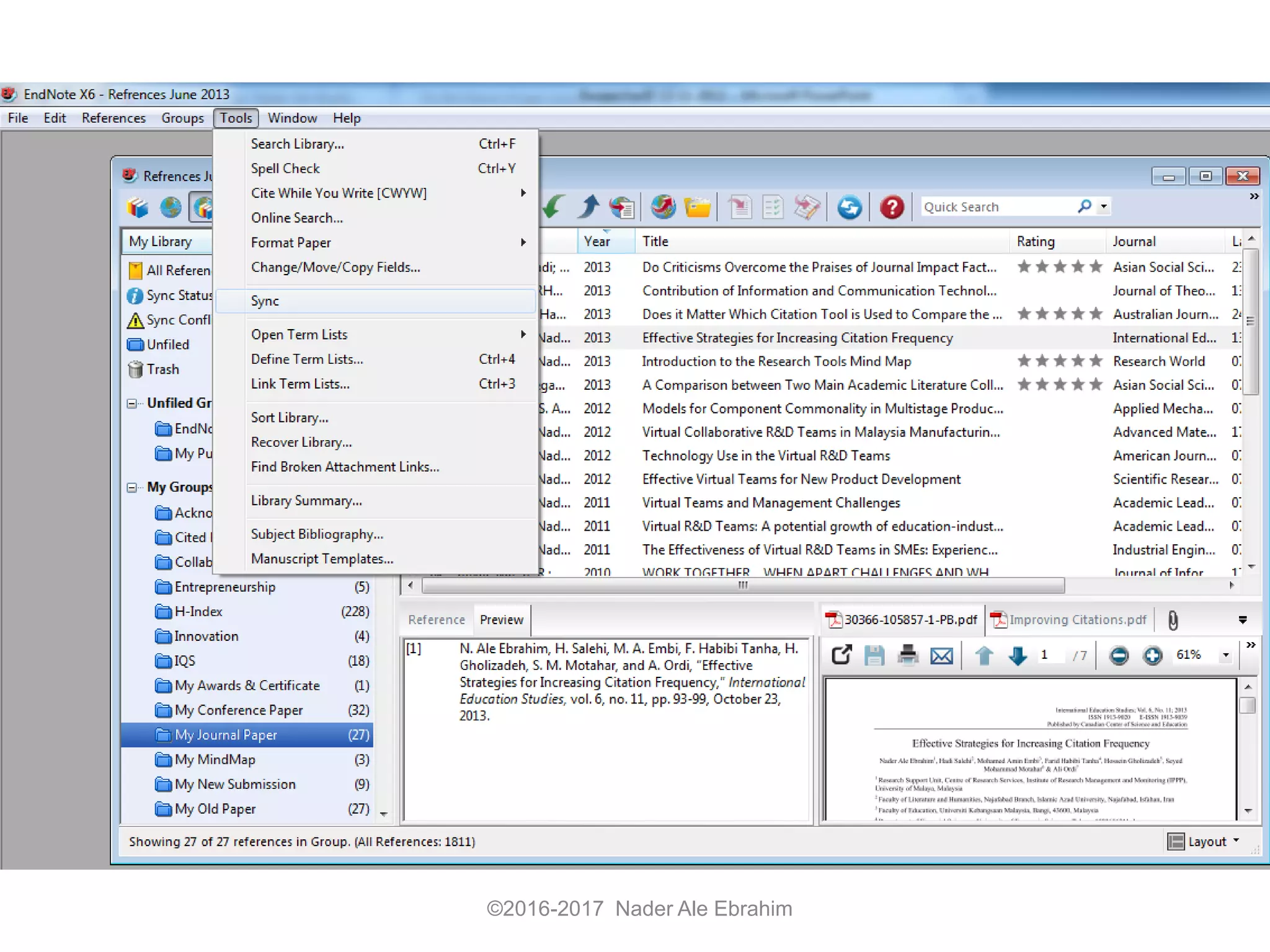
Step 2: Export data from
EndNote to EndNote Web
or
Sync the data
©2016-2017 Nader Ale Ebrahim
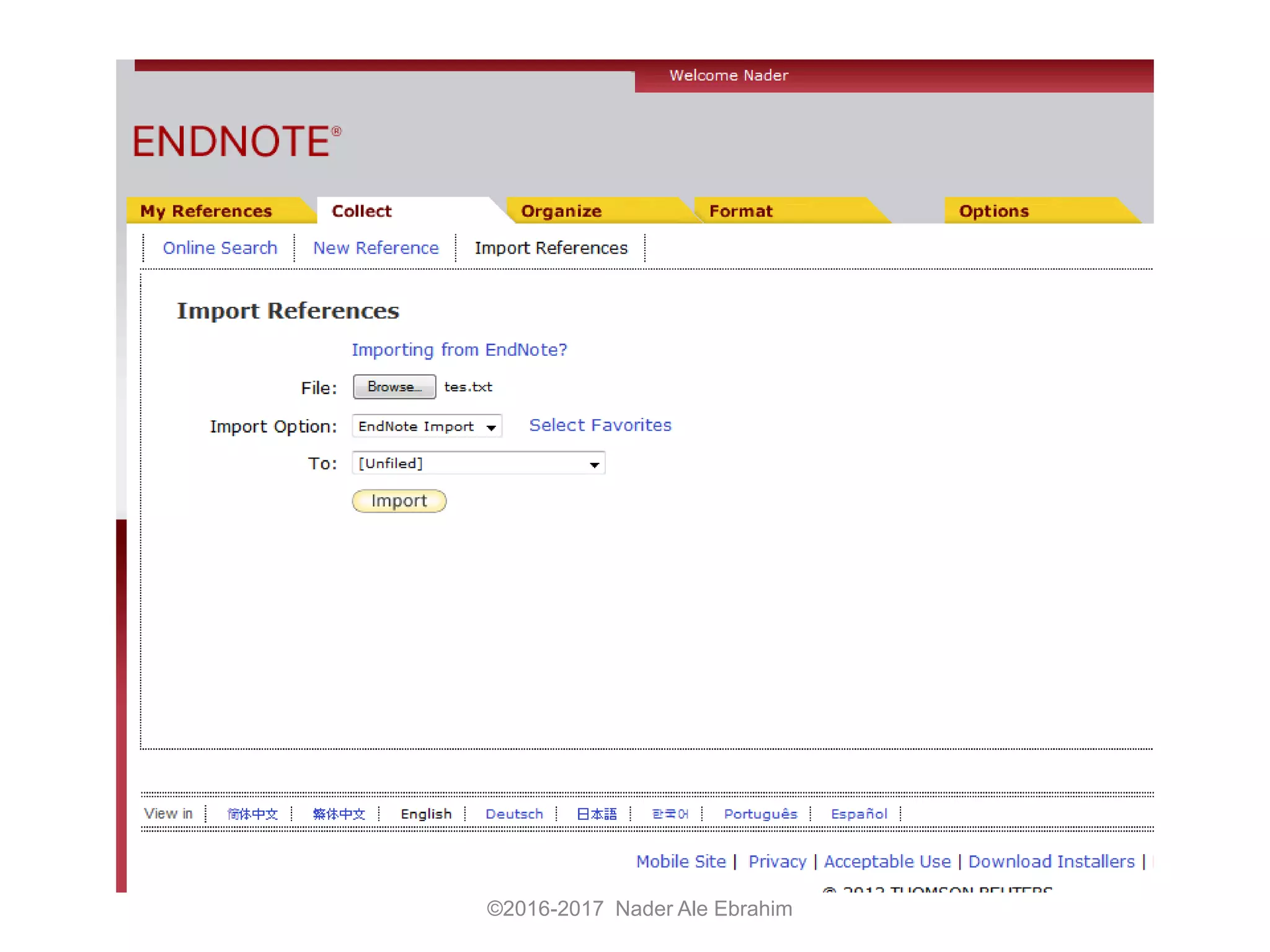
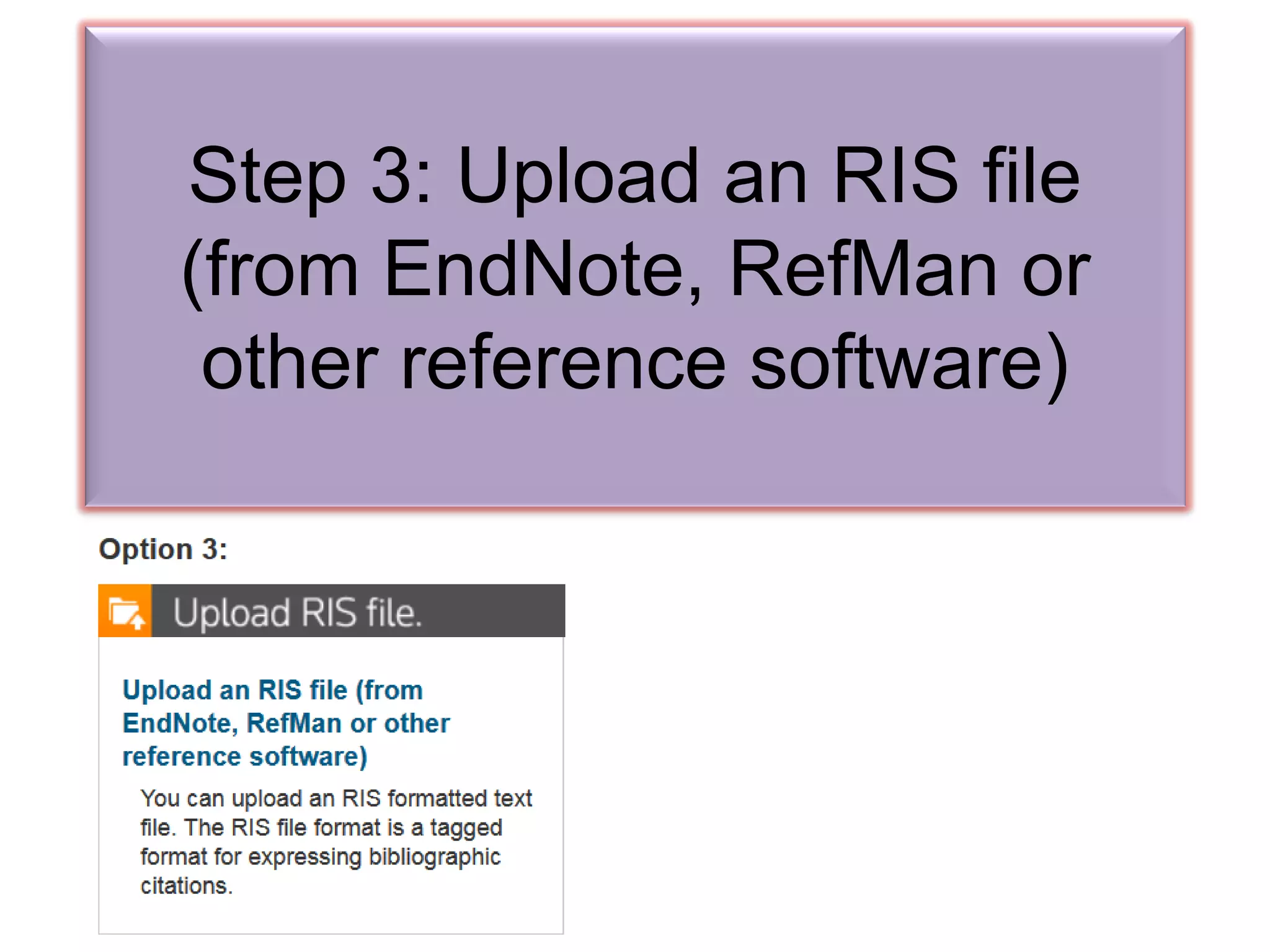
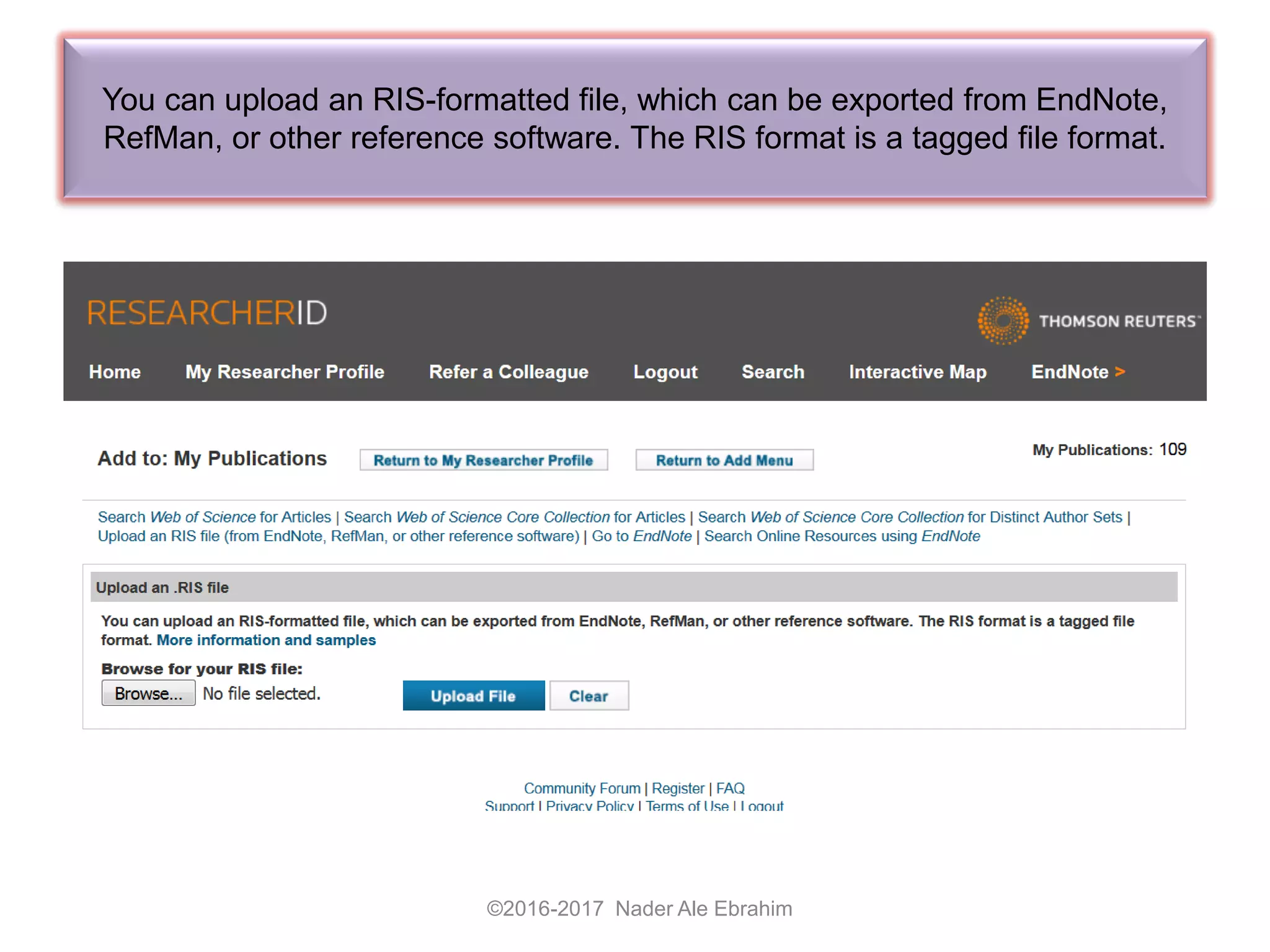
Step 3: Upload an RIS file
(from EndNote, RefMan or
other reference software)
You can upload an RIS-formatted file, which can be exported from EndNote,
RefMan, or other reference software. The RIS format is a tagged file format.
©2016-2017 Nader Ale Ebrahim
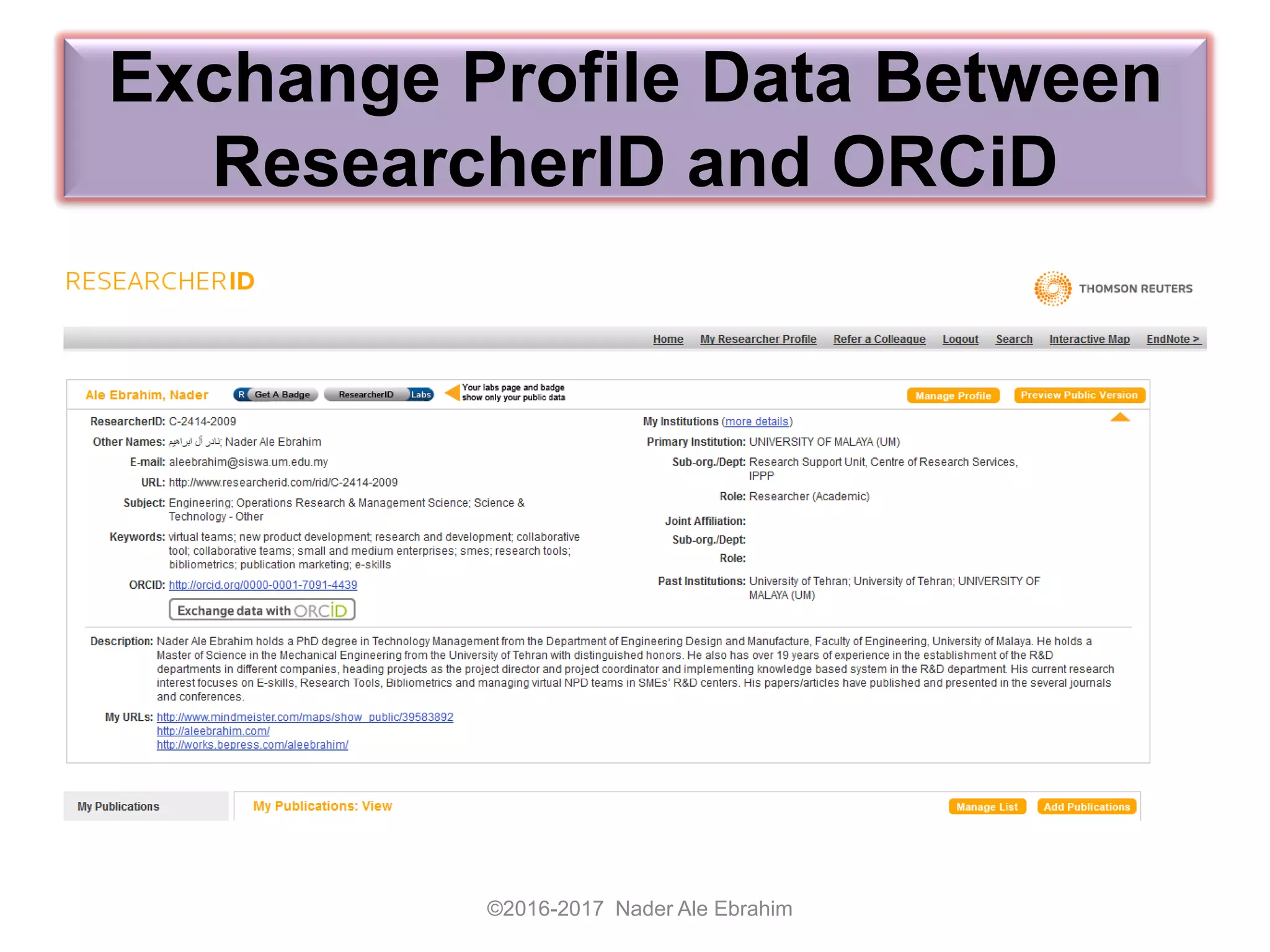
ORCiD Integration
Exchange Profile Data Between
ResearcherID and ORCiD
©2016-2017 Nader Ale Ebrahim
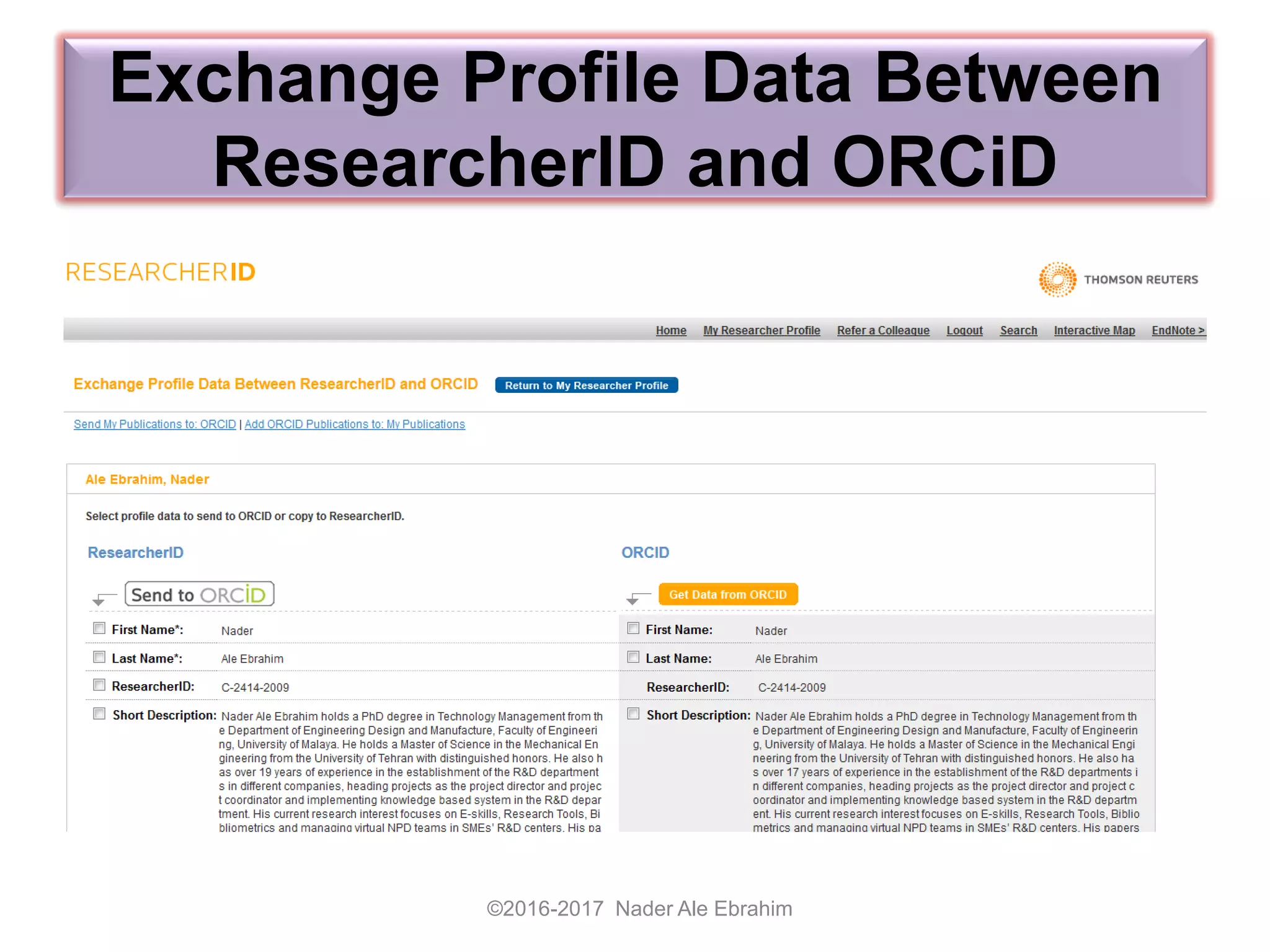
Exchange Profile Data Between
ResearcherID and ORCiD
©2016-2017 Nader Ale Ebrahim
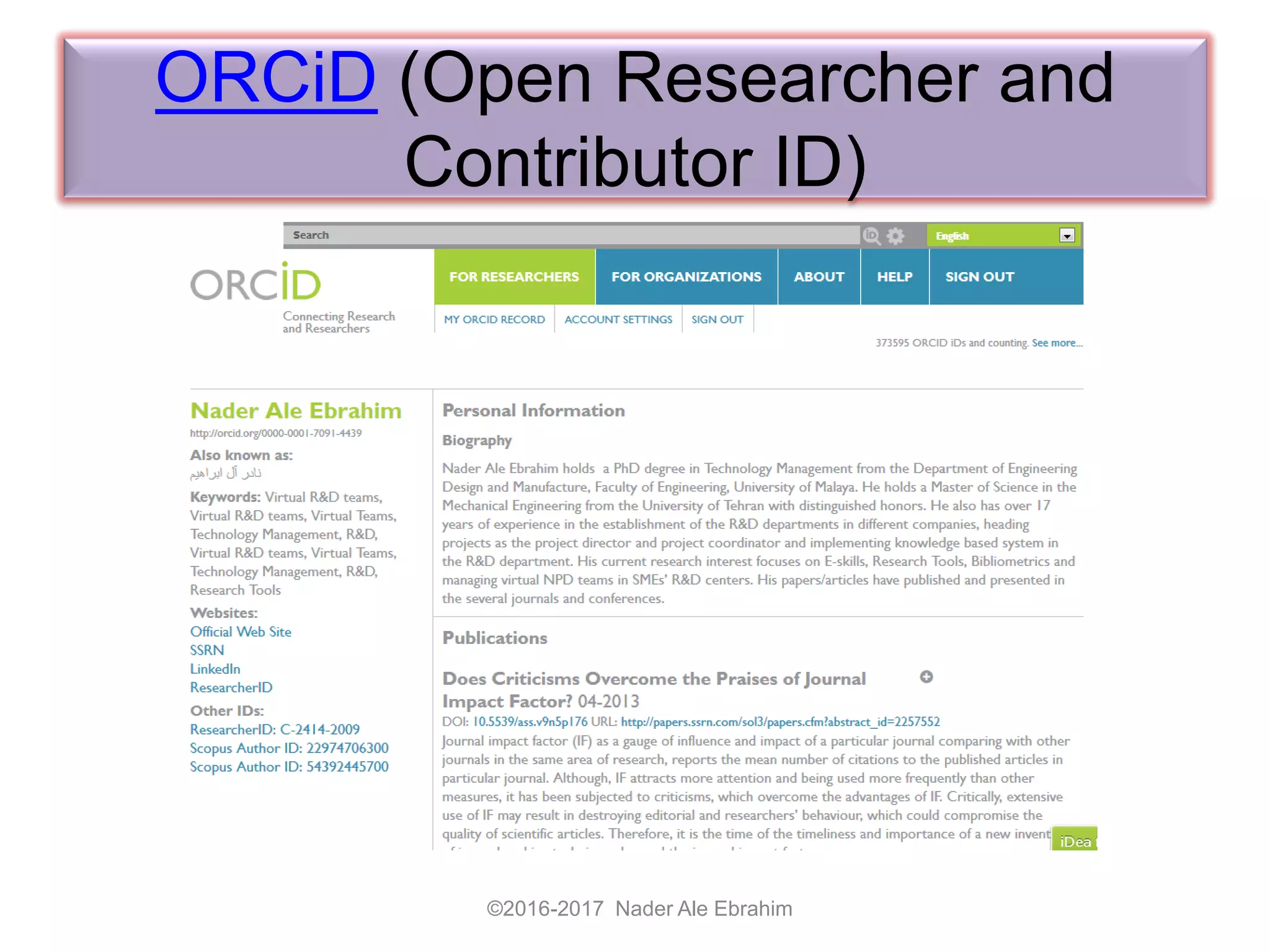
ORCiD (Open Researcher and
Contributor ID)
©2016-2017 Nader Ale Ebrahim
53
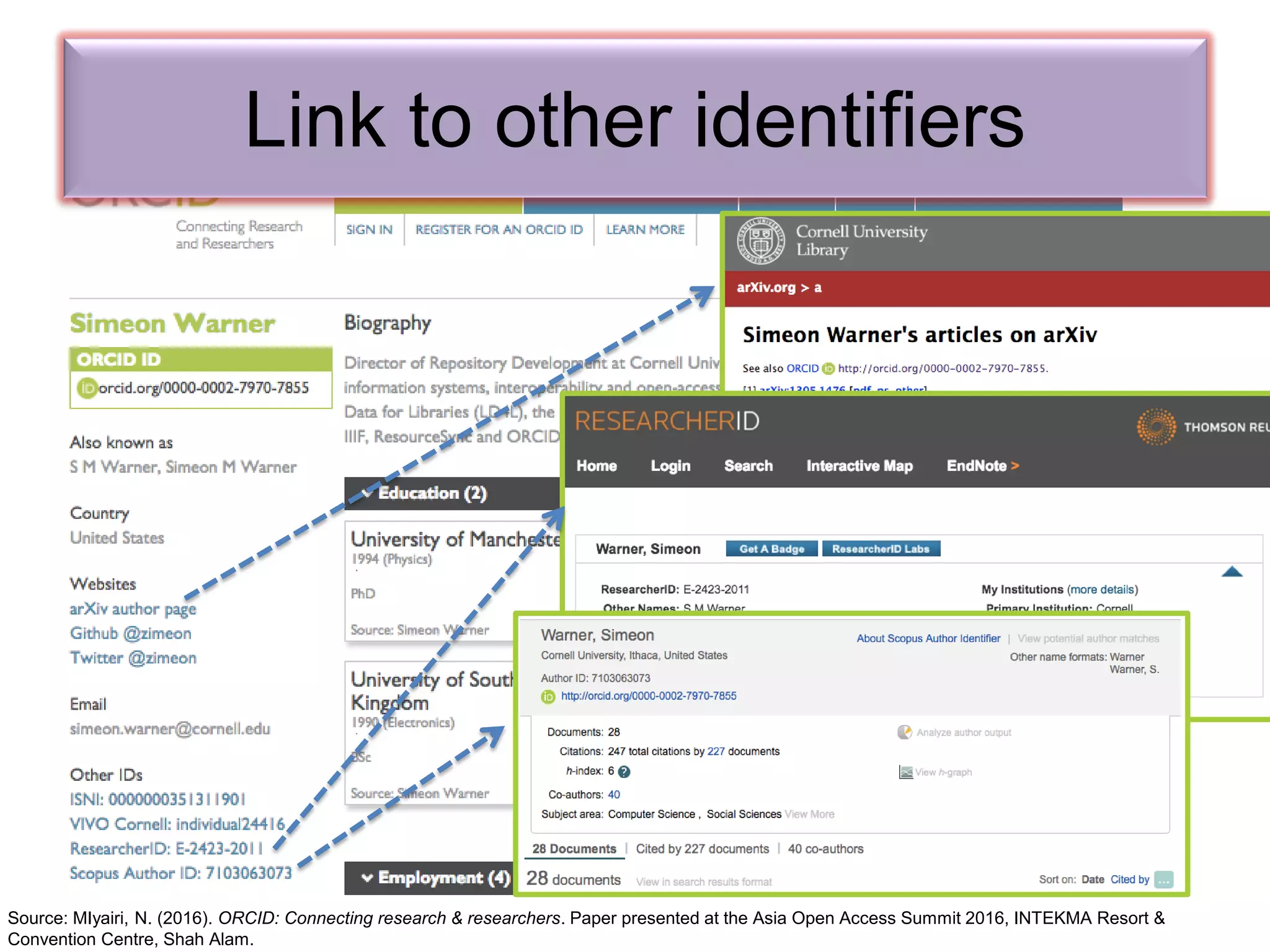
Link to other identifiers
Source: MIyairi, N. (2016). ORCID: Connecting research & researchers. Paper presented at the Asia Open Access Summit 2016, INTEKMA Resort &
Convention Centre, Shah Alam.
54
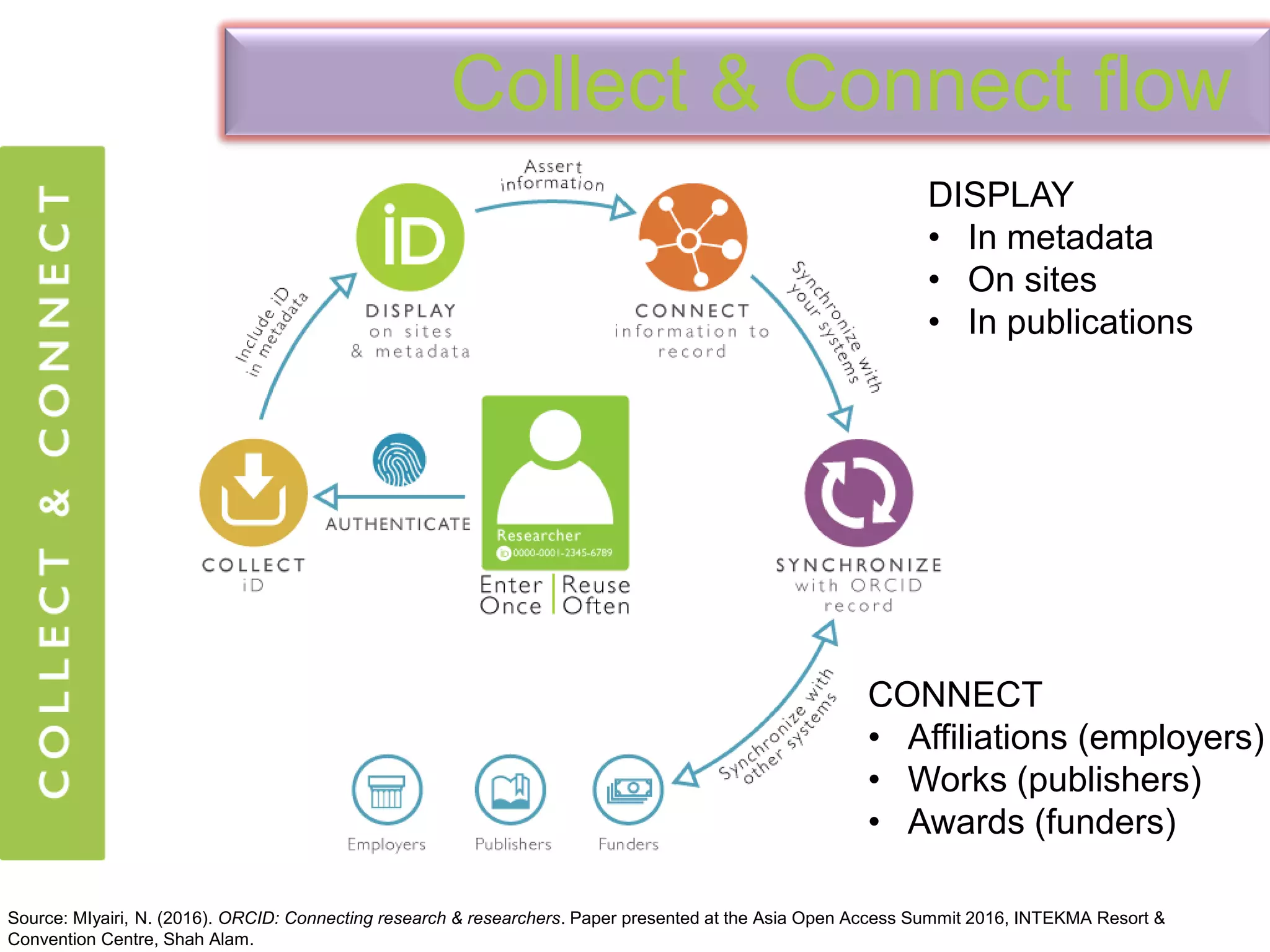
DISPLAY
• In metadata
• On sites
• In publications
CONNECT
• Affiliations (employers)
• Works (publishers)
• Awards (funders)
Collect & Connect flow
Source: MIyairi, N. (2016). ORCID: Connecting research & researchers. Paper presented at the Asia Open Access Summit 2016, INTEKMA Resort &
Convention Centre, Shah Alam.
My recent publications
©2016-2017 Nader Ale Ebrahim
Questions?
E-mail: aleebrahim@um.edu.my
Twitter: @aleebrahim
www.researcherid.com/rid/C-2414-2009
http://scholar.google.com/citations
Nader Ale Ebrahim, PhD
=====================================
Centre for Research Services
Institute of Management and Research Service
University of Malaya, Kuala Lumpur, Malaysia
www.researcherid.com/rid/C-2414-2009
http://scholar.google.com/citations
CENTRE FOR RESEARCH SERVICES
RESEARCH MANAGEMENT & INNOVATION COMPLEX (IPPP)
UNIVERSITY OF MALAYA
©2016-2017 Nader Ale Ebrahim
References
1. Ale Ebrahim, N., Salehi, H., Embi, M. A., Habibi Tanha, F., Gholizadeh, H., Motahar, S. M., & Ordi, A. (2013). Effective Strategies for Increasing Citation Frequency.
International Education Studies, 6(11), 93-99. doi: 10.5539/ies.v6n11p93
2. Martín-Martín, A., Orduna-Malea, E., Ayllón, J. M., & López-Cózar, E. D. (2016). The counting house, measuring those who count: Presence of Bibliometrics, Scientometrics,
Informetrics, Webometrics and Altmetrics in Google Scholar Citations, ResearcherID, ResearchGate, Mendeley, & Twitter. EC3 Reseach Group: Evaluación de la Ciencia y
de la Comunicación Científica Universidad de Granada and Universidad Politécnica de Valencia (Spain), In Progress,. doi:10.13140/RG.2.1.4814.4402
3. MIyairi, N. (2016). ORCID: Connecting research & researchers. Paper presented at the Asia Open Access Summit 2016, INTEKMA Resort & Convention Centre, Shah
Alam.
4. Leslie Adriaanse (2015), “Increasing e-visibility”, Personal Librarian: CAES, Science Campus, University of South Africa
5. A. B. Wagner, “Author Identification Systems,” Issues in Science and Technology Librarianship, 2009.
6. Jaslyn Tan, (2014), Maximizing the impact of your research paper, WILEY
7. Michael Ladisch, University College Dublin, 3rd Bibliometrics in Libraries meeting, York, UK, 4th July 2014
8. Melissa Badenhorst (2015), Sales & Marketing Manager, WorldWide Information Services , Agent: Thomson Reuters http://hdl.handle.net/2263/49260
My recent publications:
1. Akhavan, P., Ale Ebrahim, N., Fetrati, M. A., & Pezeshkan, A. (2016). Major trends in knowledge management research: a bibliometric study. Scientometrics 1-16.
doi:10.1007/s11192-016-1938-x
2. Nagaratnam, S., Ale Ebrahim, N., & Habibullah, M. S. (2016). A Bibliometric Analysis on "Fertility Rate" Research Trends. International Journal of Professional Business
Review, 1(1), 1-14. doi:10.5281/zenodo.58318
3. Shakiba, M., Ale Ebrahim, N., Danaee, M., Bakhtiyari, K., & Sundararajan, E. (2016). A Comprehensive Comparison of Educational Growth within Four Different Developing
Countries between 1990 and 2012. Revista de Gestão e Secretariado, 6(3), 152-174. doi:10.7769/gesec.v6i3.486
4. Müller, A. M., Ansari, P., Ale Ebrahim, N., & Khoo, S. (2015). Physical Activity and Aging Research: A Bibliometric Analysis. Journal Of Aging And Physical Activity In Press.
doi:10.1123/japa.2015-0188
5. Maghami, M., Navabi Asl, S., Rezadad, M. i., Ale Ebrahim, N., & Gomes, C. (2015). Qualitative and Quantitative Analysis of Solar hydrogen Generation Literature From 2001
to 2014. Scientometrics 105(2), 759-771. : http://dx.doi.org/10.1007/s11192-015-1730-3
6. Shakiba, M., Zavvari, A., Ale Ebrahim, N., & Singh, M. J. (2016). Evaluating the academic trend of RFID technology based on SCI and SSCI publications from 2001 to 2014.
Scientometrics First Online: 08 August 2016, 1-24. http://dx.doi.org/10.1007/s11192-016-2095-y
7. Farghadani, R., Haerian, B. S., Ale Ebrahim, N., & Muniandy, S. (2016). 35Year Research History of Cytotoxicity and Cancer: a Quantitative and Qualitative Analysis. Asian
Pac J Cancer Prev, 17(7), 3139-3145. doi:10.14456/apjcp.2016.66
8. AHMED, A., Mastura, A., GHAFAR, N. A., MUHAMMAD, M., & ALE EBRAHIM, N. (2016). Impact of Article Page Count and Number of Authors on Citations in Disability
Related Fields: A Systematic Review Article. Iranian Journal of Public Health, 45(9), 1118-1125. https://dx.doi.org/10.6084/m9.figshare.3979656.v1
©2016-2017 Nader Ale Ebrahim

Create and maintain an up-to-date ResearcherID & ORCID profile

  • 1.
    aleebrahim@um.edu.my @aleebrahim www.researcherid.com/rid/C-2414-2009 http://scholar.google.com/citations Create and maintainan up-to-date ResearcherID & ORCiD profile Nader Ale Ebrahim, PhD Visiting Research Fellow Centre for Research Services Institute of Management and Research Service University of Malaya, Kuala Lumpur, Malaysia 16th November 2016
  • 2.
    4th SERIES OFINTRODUCTORY WORKSHOP ON: Strategies to Enhance Research Visibility, Impact & Citations Nader Ale Ebrahim, PhD ===================================== Centre for Research Services Institute of Management and Research Service University of Malaya, Kuala Lumpur, Malaysia www.researcherid.com/rid/C-2414-2009 http://scholar.google.com/citations Read more: Ale Ebrahim, N., Salehi, H., Embi, M. A., Habibi Tanha, F., Gholizadeh, H., Motahar, S. M., & Ordi, A. (2013). Effective Strategies for Increasing Citation Frequency. International Education Studies, 6(11), 93-99. doi: 10.5539/ies.v6n11p93 All of my presentations are available online at: https://figshare.com/authors/Nader_Ale_Ebrahim/100797 Link to this presentation: https://dx.doi.org/10.6084/m9.figshare.4234619.v1 (New version)
  • 3.
    Abstract Abstract: A curriculumvitae (CV) allows you to showcase yourself and your academic and professional achievements in a concise and effective way. Creating an online CV is presented who you are to your academic and professional peers. Creating and maintaining your online CV is an essential tool in disseminating your research and publications. A scholarly identifiers like ResearcherID and ORCiD provides a solution to the author ambiguity problem within the scholarly research community. Keywords: H-index, Improve citations, Research tools, Bibliometrics, Research Visibility, ResearcherID. ORCiD ©2016-2017 Nader Ale Ebrahim
  • 4.
    ©2016-2017 Nader AleEbrahim http://umconference.um.edu.my/ws
  • 5.
    Next Workshop DECEMBER 19 &20, 2016 (MONDAY & TUESDAY) 9.00 am — 4.30 pm ©2016-2017 Nader Ale Ebrahim Source: https://www.linkedin.com/pulse/keep-work-stress-out-your-relationship-10-helpful-guidelines-
  • 6.
    Research Tools MindMap ©2016-2017 Nader Ale Ebrahim
  • 7.
    Research Tools MindMap -> (4) Enhancing visibility and impact -> On-line Curriculum vitae -> ResearcherID, ORCiD ©2016-2017 Nader Ale Ebrahim
  • 8.
    ResearcherID gives authordisambiguation a good name, enhancing discoverability and ensuring credit where credit is due ©2016-2017 Nader Ale Ebrahim Source: http://stateofinnovation.thomsonreuters.com/author-disambiguation-whats-in-a- name
  • 9.
    Adapted from :MIyairi, N. (2016). ORCID: Connecting research & researchers. Paper presented at the Asia Open Access Summit 2016, INTEKMA Resort & Convention Centre, Shah Alam. ORCID provides a persistent digital identifier that distinguishes researchers from each other … and MORE
  • 10.
    Benefits of e-visibility •It is a powerful way for researchers to boost their professional profile – online resume / cv (Bik & Goldstein: 2013) • Take control of their research (Goodier & Czerniewicz: 2012) • It helps researcher gain recognition in their discipline (Goodier & Czerniewicz: 2012) • It helps to improve research efficiency – disseminating their research and making it discoverable and accessible (Bik & Goldstein: 2013) • It allows for citation tracking and improving your impact as a researcher (Traditional and alternative) – citation counts, citation analysis and accumulation of attention data which translates to altmetrics • It enhances professional networking of researchers – can make contact with other researchers and collaborate – grow your networks (Goodier & Czerniewicz: 2012) • It allows for wider communication between scientists and general public – “online outreach” if you may (Bik & Goldstein: 2013) Source: Leslie Adriaanse (2015), “Increasing e-visibility”, Personal Librarian: CAES, Science Campus, University of South Africa ©2016-2017 Nader Ale Ebrahim
  • 11.
    Research e-profiles Essential elementsnecessary in a research e-profile (Ward, Bejarano & Dudas: 2015): 1. Electronic representation of the researcher online 2. Researcher/research online reputation 3. Researcher/research online discoverability and accessibility Source: Leslie Adriaanse (2015), “Increasing e-visibility”, Personal Librarian: CAES, Science Campus, University of South Africa ©2016-2017 Nader Ale Ebrahim
  • 12.
    Why should Icare about my online presence? • To make your research and teaching activities known • To increase the chance of publications getting cited • To correct attribution, names and affiliations • To make sure that a much as possible is counted in research assessments • To increase the chance of new contacts for research cooperation • To increase the chance of funding • To serve society better ©2016-2017 Nader Ale Ebrahim Source: http://libguides.library.uu.nl/profiles
  • 13.
    Author Identification Systems Authorname disambiguation and the association of scholarly works with the correct author have long been a problem for those wishing to develop a comprehensive list of publications for individuals. Source: A. B. Wagner, “Author Identification Systems,” Issues in Science and Technology Librarianship, 2009. ©2016-2017 Nader Ale Ebrahim
  • 14.
    14 There are 38authors whose last name is “Wang” Source: 1- http://europepmc.org/abstract/MED/26799652 2- MIyairi, N. (2016). ORCID: Connecting research & researchers. Paper presented at the Asia Open Access Summit 2016, INTEKMA Resort & Convention Centre, Shah Alam.
  • 15.
    The Challenge atHand • Inconsistent name formats caused by the authors themselves or editors • Various transliteration systems, especially where different non- Roman alphabet names result in the same transliterated Roman alphabet name. • Legal name changes • Cultural variants in the position of surnames • Compound or hyphenated names • Highly similar names sometimes even doing similar work at the same institution. • The large number of common names, especially certain surnames in many cultures. Source: A. B. Wagner, “Author Identification Systems,” Issues in Science and Technology Librarianship, 2009. ©2016-2017 Nader Ale Ebrahim
  • 16.
    • Build anonline an accurate list of research publications by uploading/importing the research publication information from various platforms/systems • Automatically track times cited counts & citation metrics, calculates H-Index • Citation counts, metrics & H-index are current and publically visible • Visualization tools e.g. collaboration networks Researcher/research online discoverability and accessibility Source: Leslie Adriaanse (2015), “Increasing e-visibility”, Personal Librarian: CAES, Science Campus, University of South Africa ©2016-2017 Nader Ale Ebrahim
  • 17.
    Maximize Usage throughDissemination ©2016-2017 Nader Ale Ebrahim Source: Jaslyn Tan, (2014), Maximizing the impact of your research paper, WILEY
  • 18.
    Example: My (e-mail)signature Best regards, Nader Ale Ebrahim, PhD PhD (Tech. Mang., UM) , MSc (Mech. Eng., Tehran), BSc (Mech. Eng., Tehran) ============================== Visiting Research Fellow Centre for Research Services, Level 2, Research Management & Innovation Complex (https://goo.gl/maps/9vDe3v22rWK2) University of Malaya, Kuala Lumpur, Malaysia Tel: 603-7967 6289 / 6942 Fax: 603-7967 6290 http://orcid.org/0000-0001-7091-4439 www.researcherid.com/rid/C-2414-2009 http://scholar.google.com/citations http://works.bepress.com/aleebrahim/ http://ideas.repec.org/f/pal457.html ©2016-2017 Nader Ale Ebrahim
  • 19.
    Including hyperlinks inyour CV can make a big difference. ©2016-2017 Nader Ale Ebrahim
  • 20.
  • 21.
  • 22.
  • 23.
    Journal: Educational ResearchReview An Open Researcher and Contributor ID (ORCID) is a unique digital identifier to which you can link your published articles and other professional activities, providing a single record of all your research. We would like to invite you to link your ORCID ID to this submission. If the submission is accepted, your ORCID ID will be linked to the final published article and transferred to CrossRef. Your ORCID account will also be updated. To do this, visit our dedicated page in EES. There you can link to an existing ORCID ID or register for one and link the submission to it: ©2016-2017 Nader Ale Ebrahim
  • 24.
    ORCID (“orkid”) = OpenResearcher and Contributor ID “ORCID is like a DOI for researchers.” NOT: orchid What is ORCID ? Source: Michael Ladisch, University College Dublin, 3rd Bibliometrics in Libraries meeting, York, UK, 4th July 2014 ©2016-2017 Nader Ale Ebrahim
  • 25.
    What is ORCID? The ORCID • Unique, persistent identifier for researchers & scholars • Free to researchers • Can be used throughout one’s career, across professional activities, disciplines, nations & languages • Embedded into workflows & metadata • API enables interoperability between siloed systems The ORCID Organization • Non-profit, non- proprietary, open, and community-driven • Global, interdisciplinary • Supported by the membership of organizations using the ORCID API • Funding organizations • Professional societies • Universities & research institutes • Publishers ©2016-2017 Nader Ale Ebrahim Source: Michael Ladisch, University College Dublin, 3rd Bibliometrics in Libraries meeting, York, UK, 4th July 2014
  • 26.
    Repositories Funders Higher Education and Employers Professional Associations Other person identifiers Publishers 26 DOI ISBN ORCID connects different IDsystems through open & persistent identifiers  Machine-readable  Interoperable ORCID is a hub Source: MIyairi, N. (2016). ORCID: Connecting research & researchers. Paper presented at the Asia Open Access Summit 2016, INTEKMA Resort & Convention Centre, Shah Alam.
  • 27.
    Orcid provides: Plumbing forresearch information Tools to build trust in digital information Persistent digital identifiers to distinguish researchers from each other Member-built integrations enabling automated links between researchers and their activities/affiliations A hub for machine-readable connections between identifiers for organizations, funding, outputs, and people 27Source: MIyairi, N. (2016). ORCID: Connecting research & researchers. Paper presented at the Asia Open Access Summit 2016, INTEKMA Resort & Convention Centre, Shah Alam.
  • 28.
    EBSCO Information Servicesjoins ORCID IPSWICH, Mass. — October 22, 2013 — EBSCO Information Services (EBSCO) announces it is now a member of Open Researcher and Contributor ID (ORCID), an open, non-profit, community-driven effort to create and maintain a registry of unique and persistent researcher identifiers. ORCID works with the community to embed these identifiers in research workflows and systems to connect researchers with their scholarly activities and contributions. ©2016-2017 Nader Ale Ebrahim Source: http://www.ebscohost.com/newsroom/stories/ebsco-information-services-joins-orcid
  • 29.
    Why get anORCID identifier? Benefits of getting an ORCID iD include: • Ensuring researchers get credit for their work • Reducing time to identify scholarly output (see “Publisher integration,” below) • Enabling scholars to keep track of and report on their work with funders, publishers and institutions • Repurposing data for use in CV generation, citation repositories, BU Profiles, annual reports, faculty web-sites, and other systems (see “Grant submission integration,” below) • Tying individuals to their scholarly work should make finding academic papers easier and more accurate Publisher integration: Elsevier, Thomson Reuters, Nature and other major publishers have begun integrating ORCID iDs into the manuscript submission process, and embedding ORCID identifiers across their scientific and scholarly research ecosystem. This will save authors time during submission, and enable automatic updating of author bibliographies when articles are published. That information can be ingested into BU systems, at each scholar’s discretion. Grant submission integration: NIH, NSF and other federal agencies are planning to integrate ORCID iDs into the ScienCV platform, for linking researchers, their grants, and their scientific output. The US federal government has been working to create a fed-wide profile system to streamline the grants and contract application process and reduce the data entry burden for investigators, and ORCID holds promise to be part of the solution. ©2016-2017 Nader Ale Ebrahim Source: http://sites.bu.edu/orcid/
  • 30.
    Build an onlineCurriculum Vitae • Register with ResearcherID (Web of Science) and ORCiD See more at: http://libguides.library.curtin.edu.au/content.php?pid=417077&sid=3408994 ResearcherID – an older id system associated with the Web of Science (WOS). Your ORCID and ResearcherID profiles can easily be linked. Citation counts for publications in ResearchID are automatically updated from WOS. ORCiD (Open Researcher and Contributor ID) – a new, broadly supported researcher profile that creates a unique author identification number. By creating an authoritative publication list associated with your ID number, you can minimize confusion with other researchers with similar names. See more at: http://library.buffalo.edu/scholarly/action/ ©2016-2017 Nader Ale Ebrahim
  • 31.
    Managing your researchand building your personal brand with ResearcherID Source: Melissa Badenhorst (2015), Sales & Marketing Manager, WorldWide Information Services , Agent: Thomson Reuters http://hdl.handle.net/2263/49260
  • 32.
    What is ResearcherID •www.researcherid.com • Online registry for creating a unique researcher ID number> helps in disambiguation • Build a publication list identifying your work • Make your profile public or private – Public profiles can be searched and viewed by others • Generate citation metrics including: H-index – Citation distribution per year – Total Times Cited count – Average Times Cited Global research community where researchers connect Keep all your publications in one place accessible anytime and anywhere on the web ©2016-2017 Nader Ale Ebrahim Source: Melissa Badenhorst (2015), Sales & Marketing Manager, WorldWide Information Services , Agent: Thomson Reuters http://hdl.handle.net/2263/49260
  • 33.
    ResearcherID is aunique digital alpha-numeric identifier containing the year of creation. ©2016-2017 Nader Ale EbrahimSource: http://libguides.nie.edu.sg/researcherid
  • 34.
    ©2016-2017 Nader AleEbrahimSource: Melissa Badenhorst (2015), Sales & Marketing Manager, WorldWide Information Services , Agent: Thomson Reuters http://hdl.handle.net/2263/49260
  • 35.
    ©2016-2017 Nader AleEbrahim Source: Melissa Badenhorst (2015), Sales & Marketing Manager, WorldWide Information Services , Agent: Thomson Reuters http://hdl.handle.net/2263/49260
  • 36.
    ResearcherID is atool to fight the problem of ambiguity within the scientific community by supplying each scholar with a unique identifier. ©2016-2017 Nader Ale Ebrahim Source: https://into.aalto.fi/pages/viewpage.action?pageId=11640219
  • 37.
    ©2016-2017 Nader AleEbrahim Source: http://interest.science.thomsonreuters.com/content/WOKUserTips-201012-IN2
  • 38.
    My Publications Manage |Add ©2016-2017 Nader Ale Ebrahim
  • 39.
    My Publications Manage |Add ©2016-2017 Nader Ale Ebrahim
  • 40.
    Step 1: Directexport CREATING A ResearcherID PROFILE
  • 41.
  • 42.
    Step 2: Exportdata from EndNote to EndNote Web or Sync the data
  • 43.
  • 44.
  • 45.
  • 46.
  • 47.
    Step 3: Uploadan RIS file (from EndNote, RefMan or other reference software)
  • 48.
    You can uploadan RIS-formatted file, which can be exported from EndNote, RefMan, or other reference software. The RIS format is a tagged file format. ©2016-2017 Nader Ale Ebrahim
  • 49.
  • 50.
    Exchange Profile DataBetween ResearcherID and ORCiD ©2016-2017 Nader Ale Ebrahim
  • 51.
    Exchange Profile DataBetween ResearcherID and ORCiD ©2016-2017 Nader Ale Ebrahim
  • 52.
    ORCiD (Open Researcherand Contributor ID) ©2016-2017 Nader Ale Ebrahim
  • 53.
    53 Link to otheridentifiers Source: MIyairi, N. (2016). ORCID: Connecting research & researchers. Paper presented at the Asia Open Access Summit 2016, INTEKMA Resort & Convention Centre, Shah Alam.
  • 54.
    54 DISPLAY • In metadata •On sites • In publications CONNECT • Affiliations (employers) • Works (publishers) • Awards (funders) Collect & Connect flow Source: MIyairi, N. (2016). ORCID: Connecting research & researchers. Paper presented at the Asia Open Access Summit 2016, INTEKMA Resort & Convention Centre, Shah Alam.
  • 55.
  • 56.
    Questions? E-mail: aleebrahim@um.edu.my Twitter: @aleebrahim www.researcherid.com/rid/C-2414-2009 http://scholar.google.com/citations NaderAle Ebrahim, PhD ===================================== Centre for Research Services Institute of Management and Research Service University of Malaya, Kuala Lumpur, Malaysia www.researcherid.com/rid/C-2414-2009 http://scholar.google.com/citations CENTRE FOR RESEARCH SERVICES RESEARCH MANAGEMENT & INNOVATION COMPLEX (IPPP) UNIVERSITY OF MALAYA ©2016-2017 Nader Ale Ebrahim
  • 57.
    References 1. Ale Ebrahim,N., Salehi, H., Embi, M. A., Habibi Tanha, F., Gholizadeh, H., Motahar, S. M., & Ordi, A. (2013). Effective Strategies for Increasing Citation Frequency. International Education Studies, 6(11), 93-99. doi: 10.5539/ies.v6n11p93 2. Martín-Martín, A., Orduna-Malea, E., Ayllón, J. M., & López-Cózar, E. D. (2016). The counting house, measuring those who count: Presence of Bibliometrics, Scientometrics, Informetrics, Webometrics and Altmetrics in Google Scholar Citations, ResearcherID, ResearchGate, Mendeley, & Twitter. EC3 Reseach Group: Evaluación de la Ciencia y de la Comunicación Científica Universidad de Granada and Universidad Politécnica de Valencia (Spain), In Progress,. doi:10.13140/RG.2.1.4814.4402 3. MIyairi, N. (2016). ORCID: Connecting research & researchers. Paper presented at the Asia Open Access Summit 2016, INTEKMA Resort & Convention Centre, Shah Alam. 4. Leslie Adriaanse (2015), “Increasing e-visibility”, Personal Librarian: CAES, Science Campus, University of South Africa 5. A. B. Wagner, “Author Identification Systems,” Issues in Science and Technology Librarianship, 2009. 6. Jaslyn Tan, (2014), Maximizing the impact of your research paper, WILEY 7. Michael Ladisch, University College Dublin, 3rd Bibliometrics in Libraries meeting, York, UK, 4th July 2014 8. Melissa Badenhorst (2015), Sales & Marketing Manager, WorldWide Information Services , Agent: Thomson Reuters http://hdl.handle.net/2263/49260 My recent publications: 1. Akhavan, P., Ale Ebrahim, N., Fetrati, M. A., & Pezeshkan, A. (2016). Major trends in knowledge management research: a bibliometric study. Scientometrics 1-16. doi:10.1007/s11192-016-1938-x 2. Nagaratnam, S., Ale Ebrahim, N., & Habibullah, M. S. (2016). A Bibliometric Analysis on "Fertility Rate" Research Trends. International Journal of Professional Business Review, 1(1), 1-14. doi:10.5281/zenodo.58318 3. Shakiba, M., Ale Ebrahim, N., Danaee, M., Bakhtiyari, K., & Sundararajan, E. (2016). A Comprehensive Comparison of Educational Growth within Four Different Developing Countries between 1990 and 2012. Revista de Gestão e Secretariado, 6(3), 152-174. doi:10.7769/gesec.v6i3.486 4. Müller, A. M., Ansari, P., Ale Ebrahim, N., & Khoo, S. (2015). Physical Activity and Aging Research: A Bibliometric Analysis. Journal Of Aging And Physical Activity In Press. doi:10.1123/japa.2015-0188 5. Maghami, M., Navabi Asl, S., Rezadad, M. i., Ale Ebrahim, N., & Gomes, C. (2015). Qualitative and Quantitative Analysis of Solar hydrogen Generation Literature From 2001 to 2014. Scientometrics 105(2), 759-771. : http://dx.doi.org/10.1007/s11192-015-1730-3 6. Shakiba, M., Zavvari, A., Ale Ebrahim, N., & Singh, M. J. (2016). Evaluating the academic trend of RFID technology based on SCI and SSCI publications from 2001 to 2014. Scientometrics First Online: 08 August 2016, 1-24. http://dx.doi.org/10.1007/s11192-016-2095-y 7. Farghadani, R., Haerian, B. S., Ale Ebrahim, N., & Muniandy, S. (2016). 35Year Research History of Cytotoxicity and Cancer: a Quantitative and Qualitative Analysis. Asian Pac J Cancer Prev, 17(7), 3139-3145. doi:10.14456/apjcp.2016.66 8. AHMED, A., Mastura, A., GHAFAR, N. A., MUHAMMAD, M., & ALE EBRAHIM, N. (2016). Impact of Article Page Count and Number of Authors on Citations in Disability Related Fields: A Systematic Review Article. Iranian Journal of Public Health, 45(9), 1118-1125. https://dx.doi.org/10.6084/m9.figshare.3979656.v1 ©2016-2017 Nader Ale Ebrahim