Promote your research
work on LinkedIn
aleebrahim@um.edu.my
@aleebrahim
www.researcherid.com/rid/C-2414-2009
http://scholar.google.com/citations
Nader Ale Ebrahim, PhD
Visiting Research Fellow
Research Support Unit
Centre for Research Services
Research Management & Innovation Complex
University of Malaya, Kuala Lumpur, Malaysia
25th May 2016
3rd SERIES OF INTRODUCTORY WORKSHOP ON:
Strategies to Enhance Research
Visibility, Impact & Citations
Nader Ale Ebrahim, PhD
=====================================
Research Support Unit
Centre for Research Services
Research Management & Innovation Complex
University of Malaya, Kuala Lumpur, Malaysia
www.researcherid.com/rid/C-2414-2009
http://scholar.google.com/citations
All of my presentations are available online at:
https://figshare.com/authors/Nader_Ale_Ebrahim/100797
Link to this presentation: https://dx.doi.org/10.6084/m9.figshare.3394906.v1
Read more:
1. Ale Ebrahim, N., Salehi, H., Embi, M. A., Habibi Tanha, F., Gholizadeh, H., Motahar, S. M., & Ordi, A. (2013). Effective
Strategies for Increasing Citation Frequency. International Education Studies, 6(11), 93-99. doi: 10.5539/ies.v6n11p93
2. Ale Ebrahim, Nader. "Optimize Your Article for Search Engine." University of Malaya Research Bulletin 2.1 (2014): 38-39.
Abstract
Abstract: Academic social networking allows you to connect with other
researchers in your field, share your publications and datasets, get
feedback on your non-peer-reviewed work, and to stay current with
news and events in your field of interest. It gives you another place to
establish your name and research and perhaps even collaborate with
others. The academic, social networking, making your work more
widely discoverable and easily available. LinkedIn (launched in 2003) is
currently the third most popular social network in terms of unique
monthly visitors, right behind Facebook and Twitter. The LinkedIn is
primarily centered around careers, and it enables users to connect and
share content with other professionals. In addition, it is an online CV
and as a place to share your publications.
Keywords: H-index, Improve citations, Research tools, Bibliometrics,
Research Visibility, Academic social network, LinkedIn
©2016-2017 Nader Ale Ebrahim
Source: http://connectedleidenresearcher.nl/articles/academic-social-media
Effective Strategies for Increasing Citation Frequency
Journal Reputation and Impact: publishing a paper in a journal based on disciplinary reputatation or with a high
impact factor is the most well known way of getting your paper cited. But there are many other things a scholar can do
to promote his or her work and make it easy for others to find.
Utilize Open Access Tools: Open Access journals tend to be cited more than non open access. Deposit your paper in
a repository such as Scholars Archive here on campus or a disciplinary repository. Share your detailed research data in
a repository.
Standarize Identifying Info: try to use the same name throughout your career as well as the name of your affiliated
insitution. Using common "official" names will allow for consistency and easy retrieval of your work by author or
affiliation.
Bring Colleagues on Board: team-authored articles are cited more frequently, as does publishing with international
authors. Working cross-or inter-disciplinarily helps as well.
Beef Up That Paper: use more references, publish a longer paper. Also papers which are published elsewhere after
having been rejected are cited more frequently.
Beyond Peer-Reviewed Original Research: Write a review paper. Present a working paper. Write and disseminate
web-based tutorials on your topic.
Search Optimization: use keywords in the abstract and assign them to the manuscript. Use descriptive titles that
utilize the obvious terms searchers would use to look for your topic, avoiding questions in the title. Select a journal that
is indexed in the key library databases for your field.
Market Yourself: create a key phrase that describes your research career and use it. Update your professional web
page and publication lists frequently. Link to your latest and greatest article in your professional email signature file.
Utliize Social Media: Use author profiles such as ResearcherID and ORCID. Contribute to Wikipedia, start a blog
and/or podcast, join academic social media sites.
From: Ebrahim, N.A., et al. (2013). Effective strategies for increasing citation frequency. International Education
Studies, 6(11), 93-99. doi:10.5539/ies.v6n11p93
©2016-2017 Nader Ale Ebrahim
Top 10 authors with the highest
profile view counts on ResearchGate
©2016-2017 Nader Ale Ebrahim
Source: Martín-Martín, A., Orduna-Malea, E., Ayllón, J. M., & López-Cózar, E. D. (2016). The counting house, measuring those who count: Presence of
Bibliometrics, Scientometrics, Informetrics, Webometrics and Altmetrics in Google Scholar Citations, ResearcherID, ResearchGate, Mendeley, & Twitter.
EC3 Reseach Group: Evaluación de la Ciencia y de la Comunicación Científica Universidad de Granada and Universidad Politécnica de Valencia (Spain), In
Progress,. doi:10.13140/RG.2.1.4814.4402
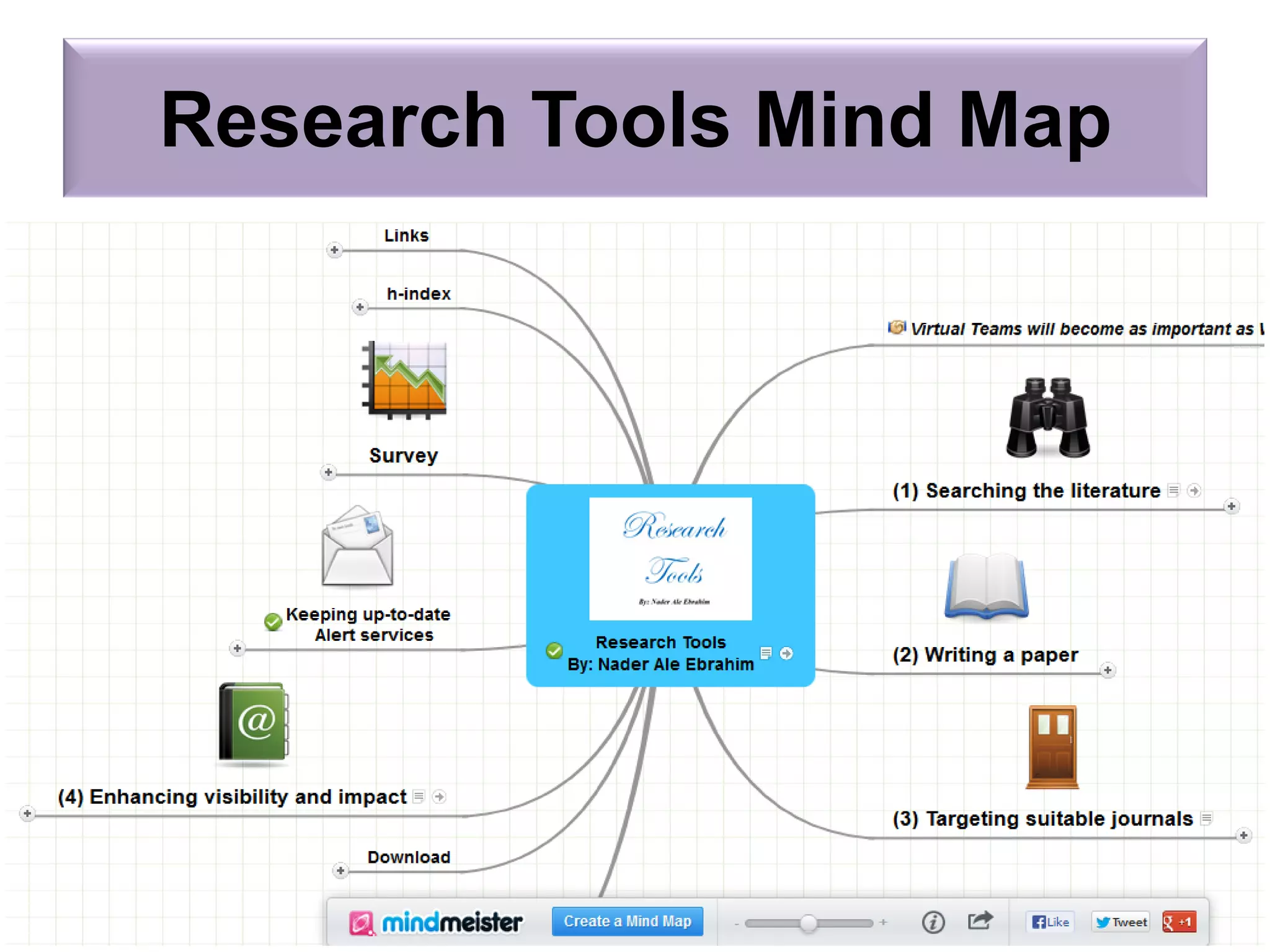
Research Tools Mind Map
©2016-2017 Nader Ale Ebrahim
Research Tools -> (4) Enhancing visibility and impact -
> NetWorking -> Scientific Social Network -> Linkedin
©2016-2017 Nader Ale Ebrahim
LinkedIn for researchers
• What is LinkedIn?
LinkedIn ( www.linkedin.com/ ) is a professional
networking site. It allows you to create a profile
that summarises your professional expertise and
accomplishments. It helps to set up connections
with other professionals, and the network grows
with time. The network consists of your
connections, your connections’ connections, and
the people they know, linking you to a vast
number of qualified professionals and experts.
©2016-2017 Nader Ale Ebrahim
Source: http://www.ucc.ie/en/media/support/careers/researchers/LinkedInforResearchers.pdf
Promoting your Research
©2016-2017 Nader Ale Ebrahim
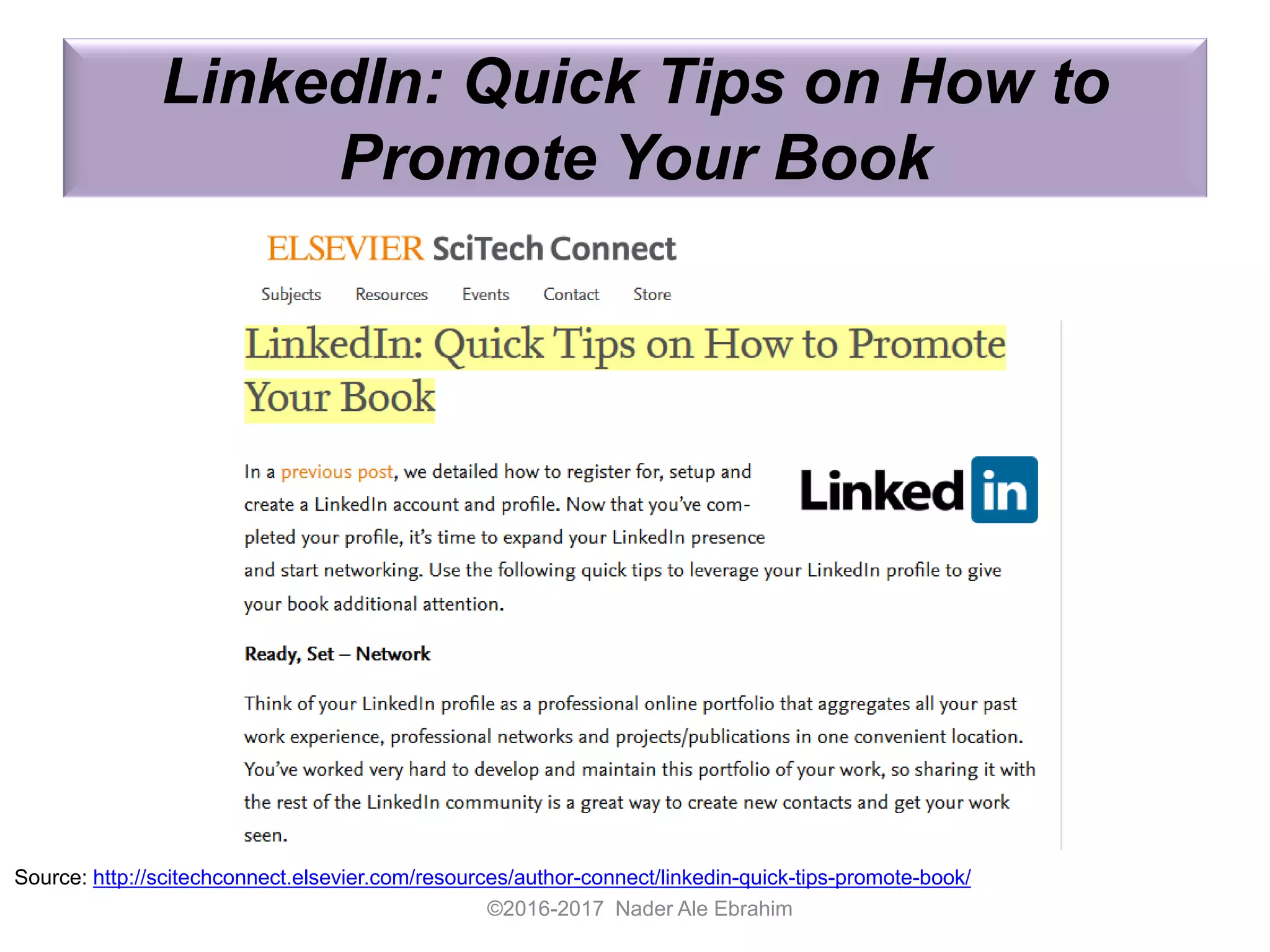
LinkedIn: Quick Tips on How to
Promote Your Book
©2016-2017 Nader Ale Ebrahim
Source: http://scitechconnect.elsevier.com/resources/author-connect/linkedin-quick-tips-promote-book/
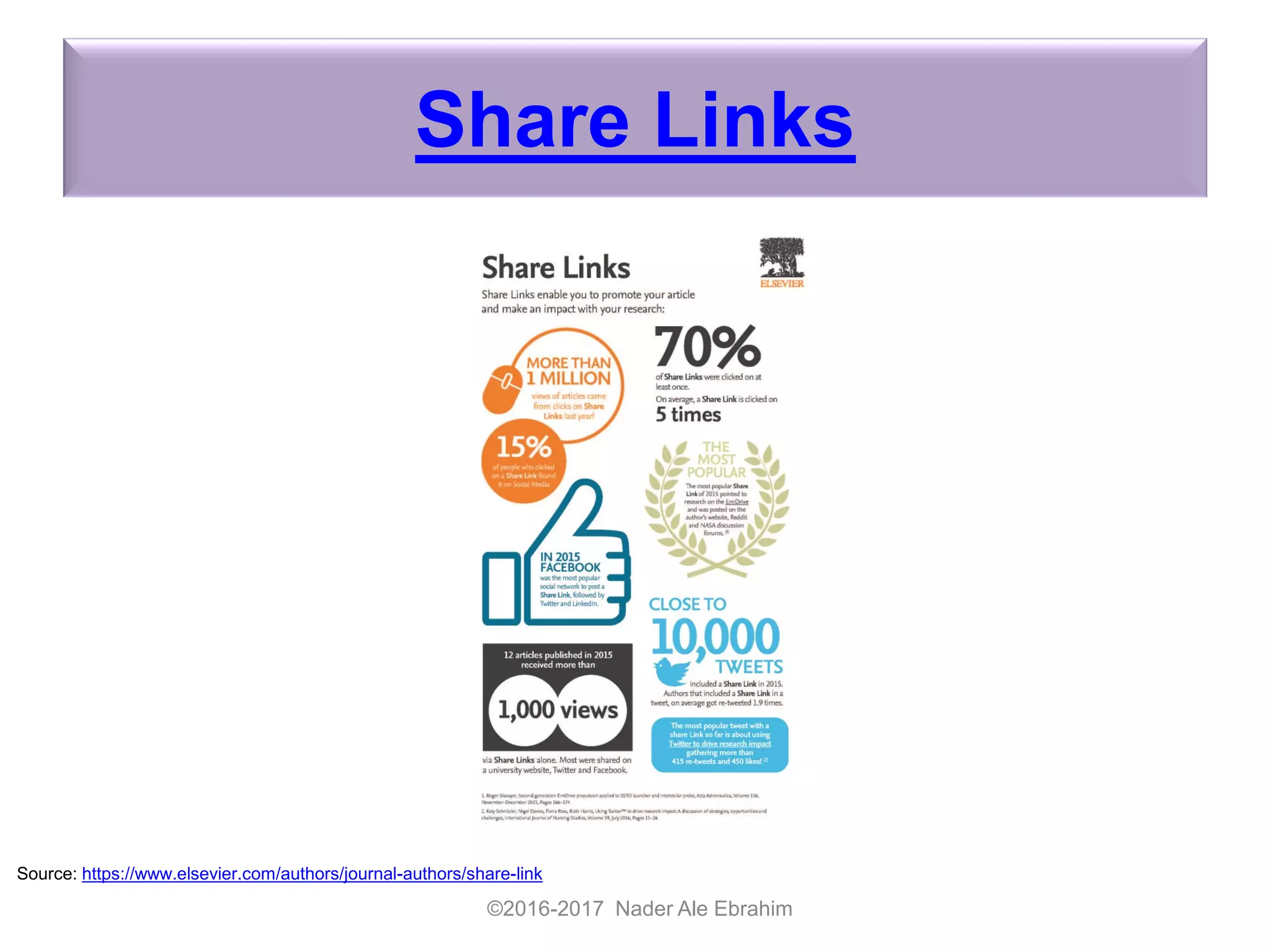
Share your research- Social Media, such as
Facebook, LinkedIn, Twitter
• Elsevier will send you a 'share link': a personal,
customized short link that you will receive after
final publication of your article. It provides 50
days free access to your newly-published article
on ScienceDirect to anyone clicking on the link.
We encourage you to share this link on social
media. After 50 days the share link will still work
but automatically revert to a link to your full text
article.
©2016-2017 Nader Ale Ebrahim
Source: https://www.elsevier.com/authors/journal-authors/submit-your-paper/sharing-and-promoting-your-article
Share Links
©2016-2017 Nader Ale Ebrahim
Source: https://www.elsevier.com/authors/journal-authors/share-link
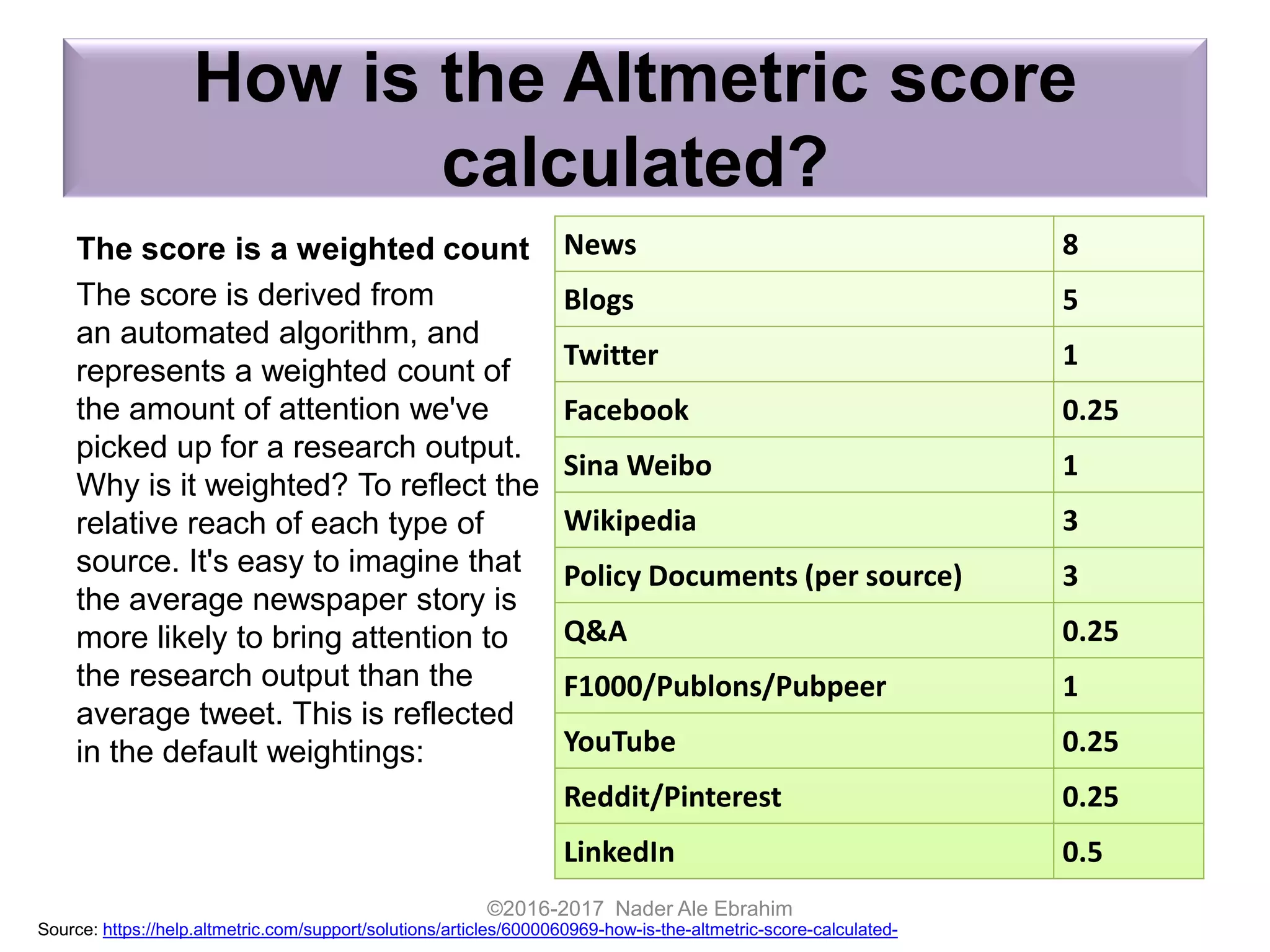
How is the Altmetric score
calculated?
The score is a weighted count
The score is derived from
an automated algorithm, and
represents a weighted count of
the amount of attention we've
picked up for a research output.
Why is it weighted? To reflect the
relative reach of each type of
source. It's easy to imagine that
the average newspaper story is
more likely to bring attention to
the research output than the
average tweet. This is reflected
in the default weightings:
©2016-2017 Nader Ale Ebrahim
News 8
Blogs 5
Twitter 1
Facebook 0.25
Sina Weibo 1
Wikipedia 3
Policy Documents (per source) 3
Q&A 0.25
F1000/Publons/Pubpeer 1
YouTube 0.25
Reddit/Pinterest 0.25
LinkedIn 0.5
Source: https://help.altmetric.com/support/solutions/articles/6000060969-how-is-the-altmetric-score-calculated-
Academic social networking sites
• Allow you to network with your peers and share your
research
• Some have the ability to ask and answer research
related questions, create groups or share references
• Often rank highly in Google and other search engines
• Can make your publications available to download
(where allowed within T&C of publication)
• Talk to colleagues and find out what they’re using
• Examples:
– Academia.edu; ResearchGate; Mendeley
©2016-2017 Nader Ale Ebrahim
Source: Gosling, C. (2013). Tips for improving citations 2nd Bibliometrics in Libraries Meeting: The Open University.
Academic Social Network
• Build your network – make sure you
have dynamic diverse networks
• Join networks such as LinkedIn,
ResearchGate or Academic.edu
See more at: http://libguides.library.curtin.edu.au/content.php?pid=417077&sid=3408994
©2016-2017 Nader Ale Ebrahim
Share your Posts on Other Social Media Outlets
©2016-2017 Nader Ale Ebrahim
Source: http://www.elsevier.com/__data/assets/pdf_file/0015/145050/ECR_Blogging_210912.pdf
After writing a blog post, share the posts via
other social media outlets to maximize the
outreach of your messages. Use LinkedIn,
Facebook, academic social networks like
Academia.edu, and others, to spread the
updates. You can connect Twitter with your
other social media profiles so that tweets are
posted on them as soon as you tweet.
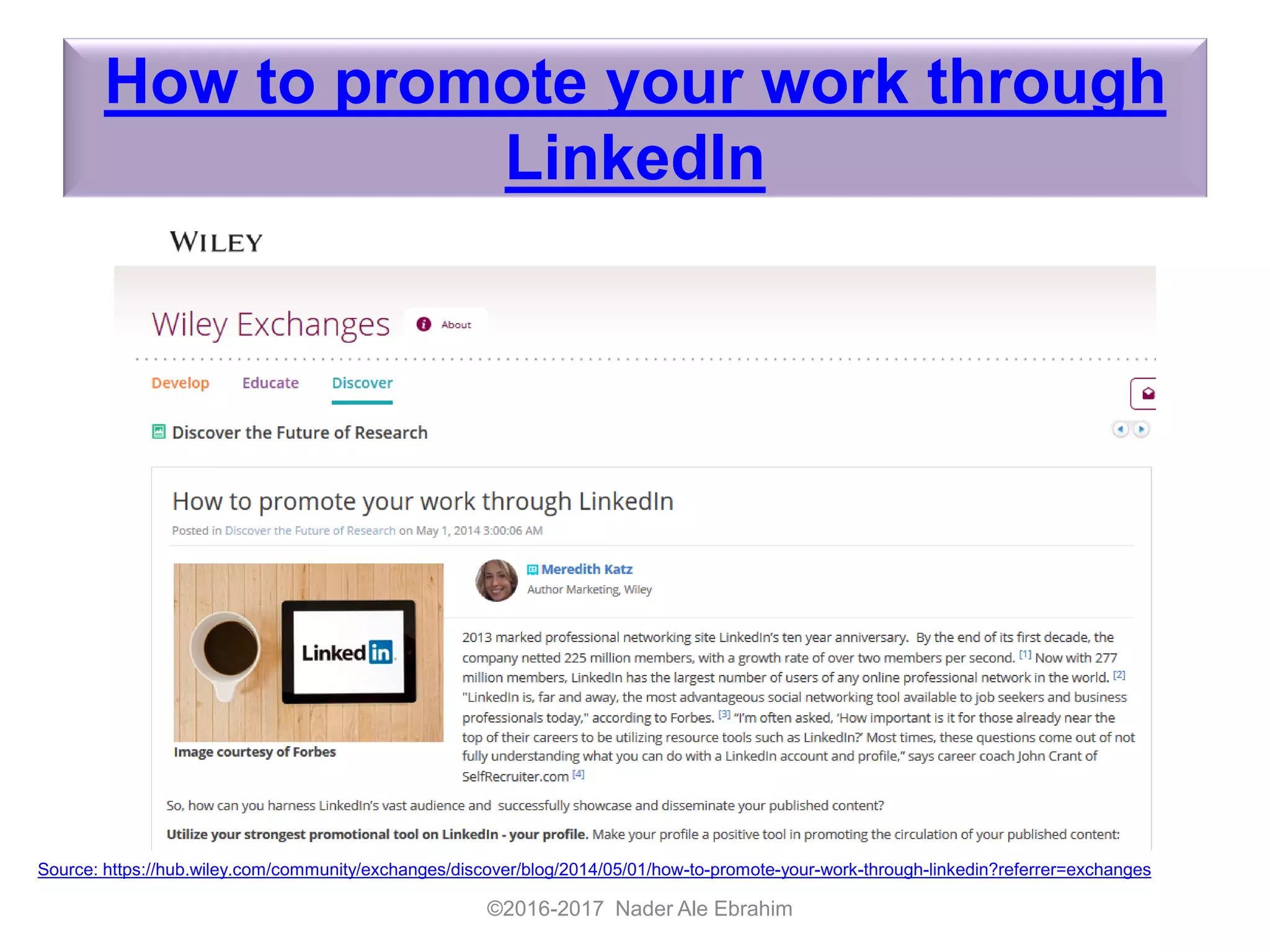
How to promote your work through
LinkedIn
©2016-2017 Nader Ale Ebrahim
Source: https://hub.wiley.com/community/exchanges/discover/blog/2014/05/01/how-to-promote-your-work-through-linkedin?referrer=exchanges
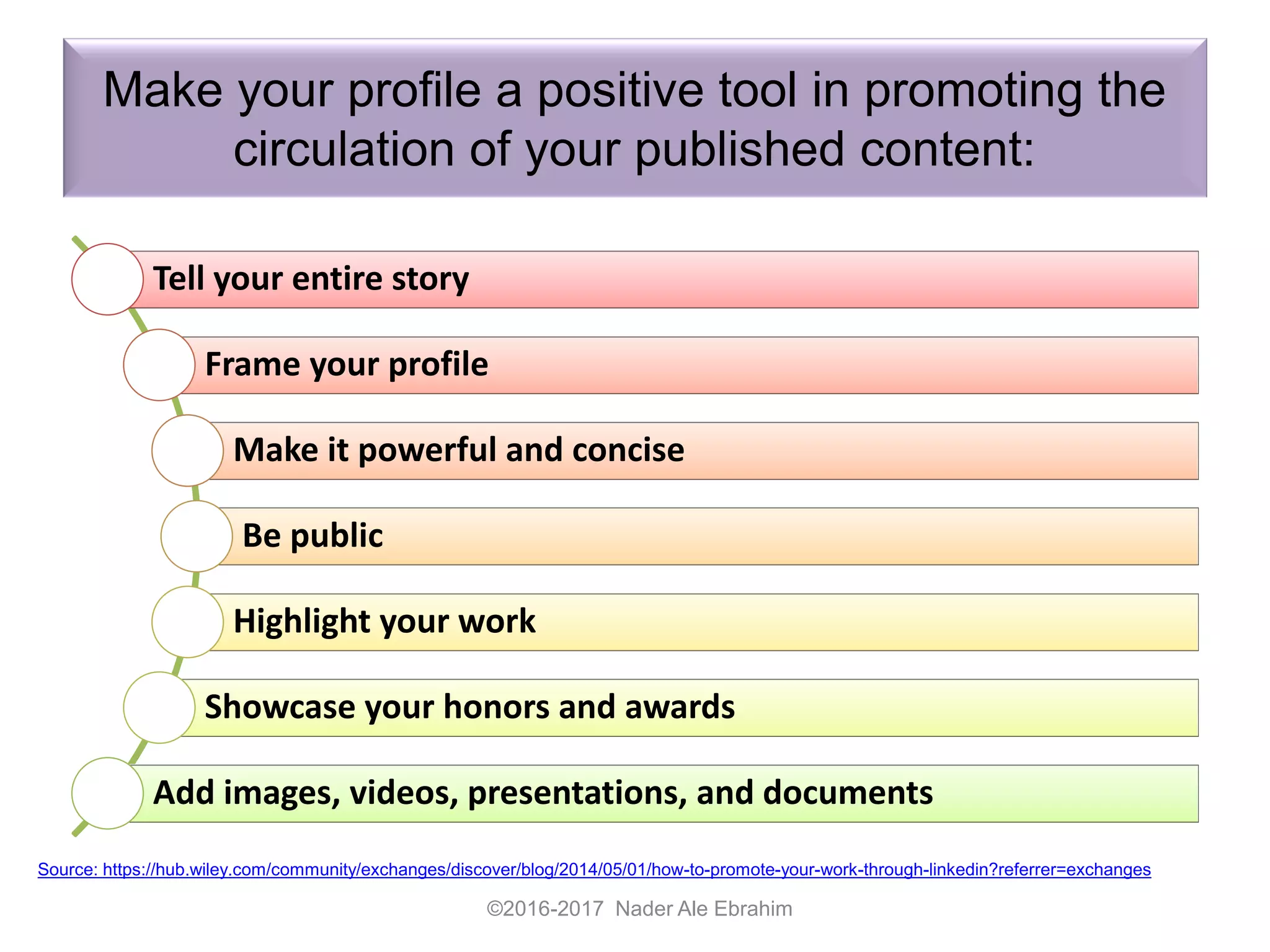
Make your profile a positive tool in promoting the
circulation of your published content:
©2016-2017 Nader Ale Ebrahim
Source: https://hub.wiley.com/community/exchanges/discover/blog/2014/05/01/how-to-promote-your-work-through-linkedin?referrer=exchanges
Tell your entire story
Frame your profile
Make it powerful and concise
Be public
Highlight your work
Showcase your honors and awards
Add images, videos, presentations, and documents
Edit Your profile
©2016-2017 Nader Ale Ebrahim
Add a link - Supported Providers
• Presentations and Documents:
– Prezi
– Scribd
– SlideShare
• Video Providers:
– TED
– Vimeo
– YouTube
– ……..
©2016-2017 Nader Ale Ebrahim
Build your following
©2016-2017 Nader Ale Ebrahim
Source: http://blog.getresponse.com/6-ways-promote-content-linkedin.html
• Let’s say you’ve just queued up a bunch of
awesome LinkedIn status updates. That’s
great. But who’s going to see them? Now
you need some connections. A lot of
connections.
• But you don’t want just any connections.
You want the people who are your ideal
readers – your ideal clients, or customers,
or peers.
Ready, Set – Network
• Think of your LinkedIn profile as a professional
online portfolio that aggregates all your past
work experience, professional networks and
projects/publications in one convenient location.
You’ve worked very hard to develop and
maintain this portfolio of your work, so sharing it
with the rest of the LinkedIn community is a
great way to create new contacts and get your
work seen.
©2016-2017 Nader Ale Ebrahim
Source: http://scitechconnect.elsevier.com/resources/author-connect/linkedin-quick-tips-promote-book/
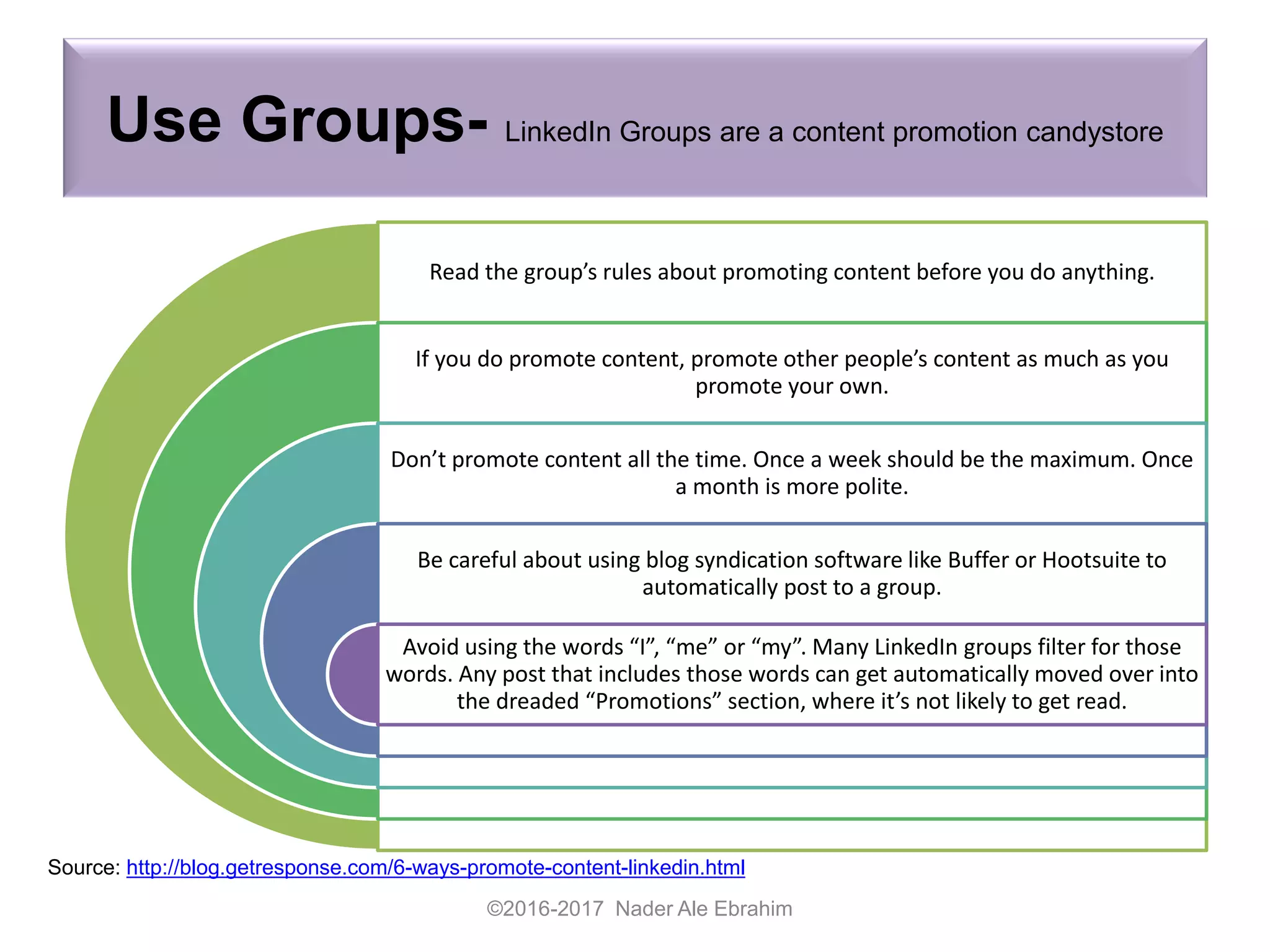
Use Groups- LinkedIn Groups are a content promotion candystore
Read the group’s rules about promoting content before you do anything.
If you do promote content, promote other people’s content as much as you
promote your own.
Don’t promote content all the time. Once a week should be the maximum. Once
a month is more polite.
Be careful about using blog syndication software like Buffer or Hootsuite to
automatically post to a group.
Avoid using the words “I”, “me” or “my”. Many LinkedIn groups filter for those
words. Any post that includes those words can get automatically moved over into
the dreaded “Promotions” section, where it’s not likely to get read.
©2016-2017 Nader Ale Ebrahim
Source: http://blog.getresponse.com/6-ways-promote-content-linkedin.html
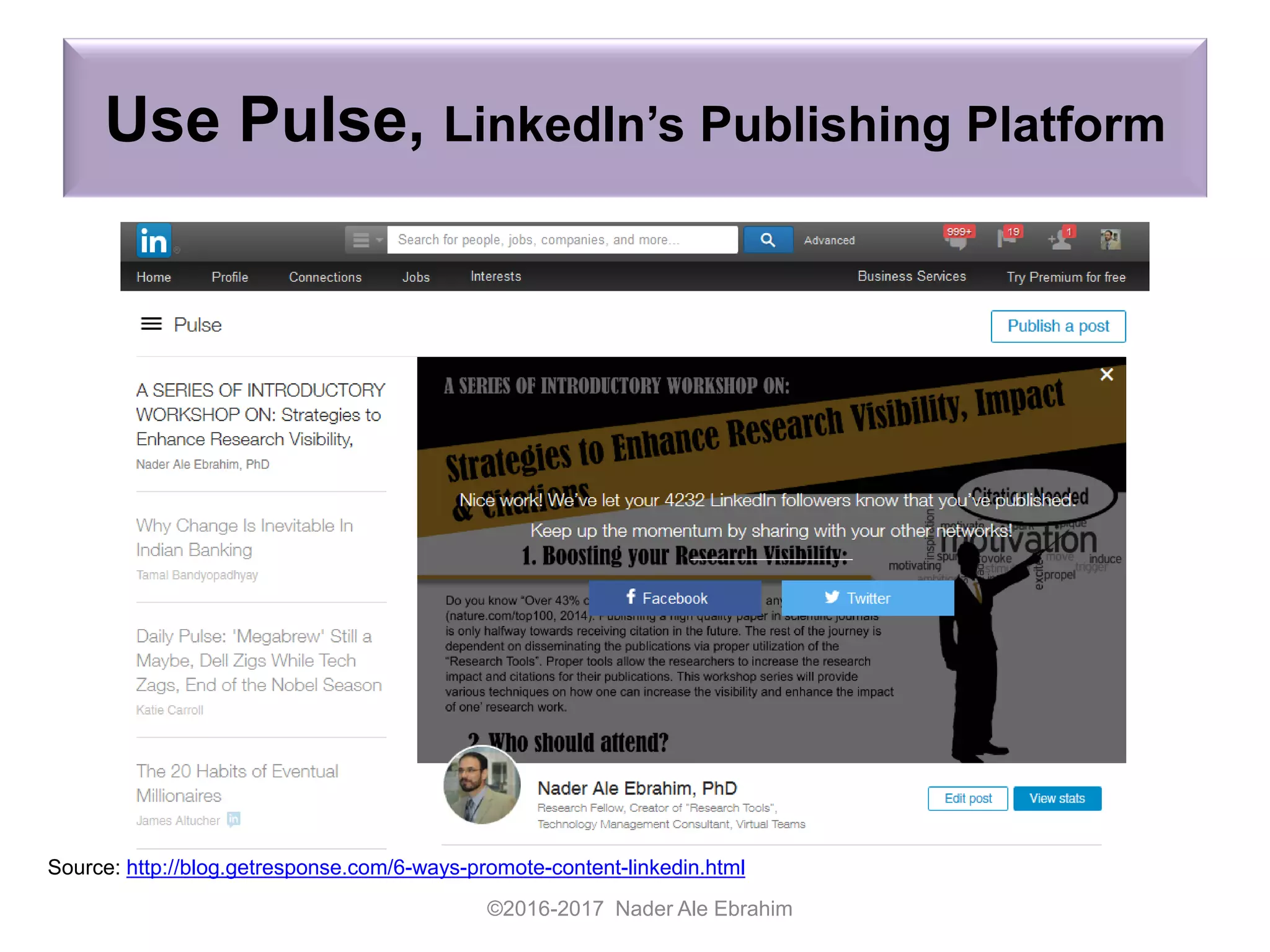
Use Pulse, LinkedIn’s Publishing Platform
©2016-2017 Nader Ale Ebrahim
Source: http://blog.getresponse.com/6-ways-promote-content-linkedin.html
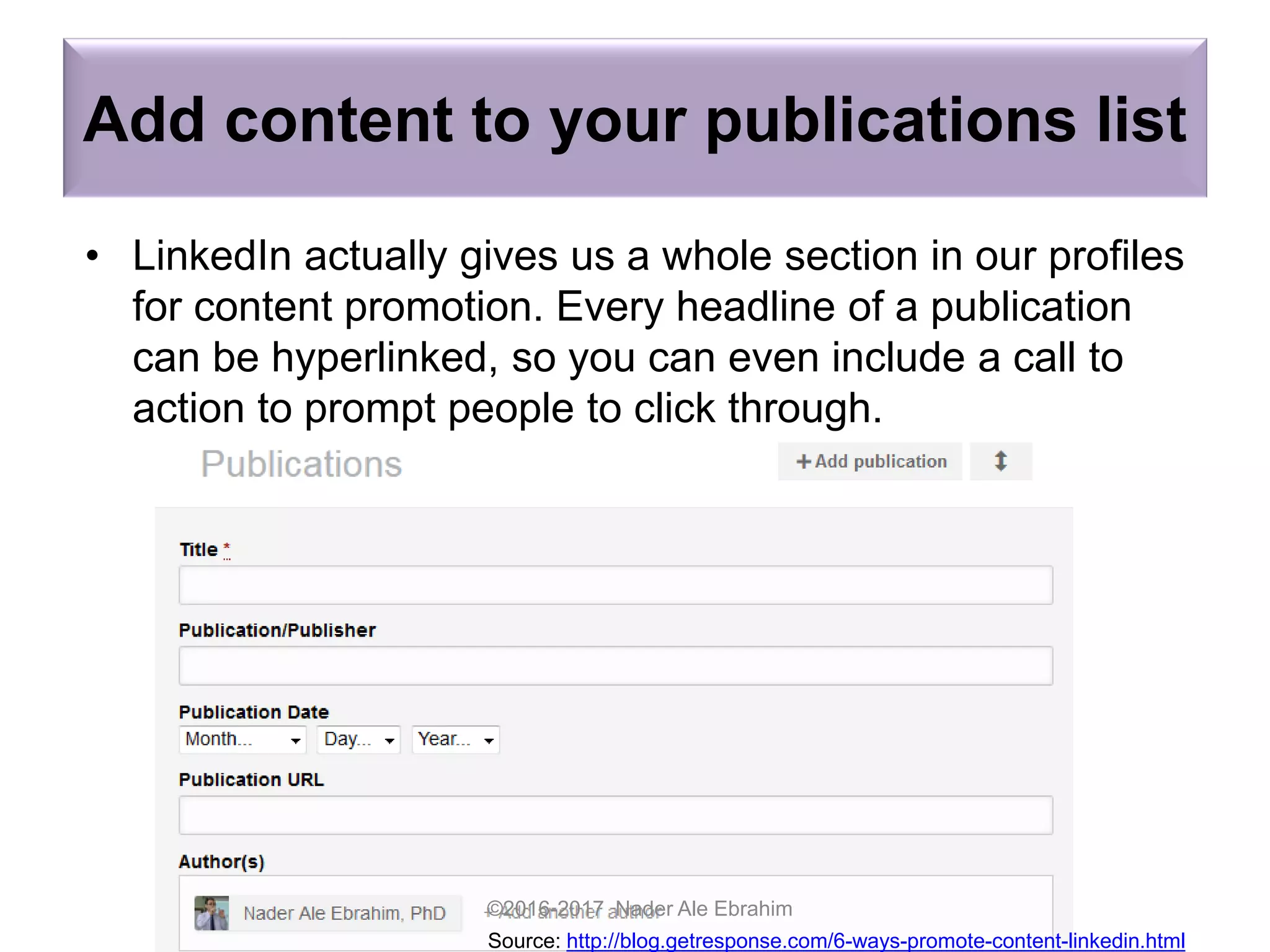
Add content to your publications list
©2016-2017 Nader Ale Ebrahim
Source: http://blog.getresponse.com/6-ways-promote-content-linkedin.html
• LinkedIn actually gives us a whole section in our profiles
for content promotion. Every headline of a publication
can be hyperlinked, so you can even include a call to
action to prompt people to click through.
Get endorsed for your skills
©2016-2017 Nader Ale Ebrahim
Source: http://blog.hubspot.com/blog/tabid/6307/bid/23454/The-Ultimate-Cheat-Sheet-for-Mastering-LinkedIn.asp
7 tips to supercharge your
academic LinkedIn profile
©2016-2017 Nader Ale Ebrahim
Source: http://blog.impactstory.org/7-tips-to-supercharge-your-academic-linkedin-profile/
My recent publications
©2016-2017 Nader Ale Ebrahim
Questions?
E-mail: aleebrahim@um.edu.my
Twitter: @aleebrahim
www.researcherid.com/rid/C-2414-2009
http://scholar.google.com/citations
Nader Ale Ebrahim, PhD
=====================================
Research Support Unit
Centre for Research Services
Research Management & Innovation Complex
University of Malaya, Kuala Lumpur, Malaysia
www.researcherid.com/rid/C-2414-2009
http://scholar.google.com/citations
RESEARCH SUPPORT UNIT (RSU)
CENTRE FOR RESEARCH SERVICES
RESEARCH MANAGEMENT & INNOVATION COMPLEX (IPPP)
UNIVERSITY OF MALAYA
©2016-2017 Nader Ale Ebrahim
References
1. Ale Ebrahim, N. (2016). New systems for measuring research impact. Retrieved from Research Support Unit, Centre for Research Services,
Institute of Research Management and Monitoring (IPPP)”, University of Malaya: https://dx.doi.org/10.6084/m9.figshare.3364240.v1
2. Ale Ebrahim, N. (2016). Establish your expertise with a science blog. Retrieved from Research Support Unit, Centre for Research Services,
Institute of Research Management and Monitoring (IPPP)”, University of Malaya: https://dx.doi.org/10.6084/m9.figshare.3185218.v1
3. Ale Ebrahim, N. (2016). Optimize articles for search engine to improve research visibility. Retrieved from Research Support Unit, Centre for
Research Services, Institute of Research Management and Monitoring (IPPP)”, University of Malaya:
https://dx.doi.org/10.6084/m9.figshare.3122038.v1
4. Ale Ebrahim, Nader. "Optimize Your Article for Search Engine." University of Malaya Research Bulletin 2.1 (2014): 38-39
5. Ale Ebrahim, N. (2016). Maximizing Articles Citation Frequency. Retrieved from Research Support Unit, Centre for Research Services, Institute
of Research Management and Monitoring (IPPP)”, University of Malaya: https://dx.doi.org/10.6084/m9.figshare.1572226.v2
6. Ale Ebrahim, N. (2016). Research Tools: Enhancing visibility and impact of the research. Retrieved from Computer Lab, Level 2, Institute of
Graduate Studies, University of Malaya, Kuala Lumpur, Malaysia: http://dx.doi.org/10.6084/m9.figshare.2794237
7. Ale Ebrahim, N. (2016). Research Tools and Citations. Retrieved from Computer Lab, Level 3, Block B.,APIUM, University of Malaya, Kuala
Lumpur, Malaysia: https://dx.doi.org/10.6084/m9.figshare.2274181.v2
8. Ebrahim, N.A., et al. (2013). Effective strategies for increasing citation frequency. International Education Studies, 6(11), 93-
99. doi:10.5539/ies.v6n11p93
9. Akhavan, P., Ale Ebrahim, N., Fetrati, M. A., & Pezeshkan, A. (2016). Major trends in knowledge management research: a bibliometric study.
Scientometrics 1-16. doi:10.1007/s11192-016-1938-x
10. Gosling, C. (2013). Tips for improving citations 2nd Bibliometrics in Libraries Meeting: The Open University
11. Shakiba, M., Ale Ebrahim, N., Danaee, M., Bakhtiyari, K., & Sundararajan, E. (2016). A Comprehensive Comparison of Educational Growth
within Four Different Developing Countries between 1990 and 2012. Revista de Gestão e Secretariado, 6(3), 152-174.
doi:10.7769/gesec.v6i3.486
12. Martín-Martín, A., Orduna-Malea, E., Ayllón, J. M., & López-Cózar, E. D. (2016). The counting house, measuring those who count: Presence of
Bibliometrics, Scientometrics, Informetrics, Webometrics and Altmetrics in Google Scholar Citations, ResearcherID, ResearchGate, Mendeley,
& Twitter. EC3 Reseach Group: Evaluación de la Ciencia y de la Comunicación Científica Universidad de Granada and Universidad
Politécnica de Valencia (Spain), In Progress,. doi:10.13140/RG.2.1.4814.4402
13. Müller, A. M., Ansari, P., Ale Ebrahim, N., & Khoo, S. (2015). Physical Activity and Aging Research: A Bibliometric Analysis. Journal Of Aging
And Physical Activity In Press. doi:10.1123/japa.2015-0188
14. Maghami, M., Navabi Asl, S., Rezadad, M. i., Ale Ebrahim, N., & Gomes, C. (2015). Qualitative and Quantitative Analysis of Solar hydrogen
Generation Literature From 2001 to 2014. Scientometrics 105(2), 759-771. : http://dx.doi.org/10.1007/s11192-015-1730-3
©2016-2017 Nader Ale Ebrahim

Promote your research work on LinkedIn

  • 1.
    Promote your research workon LinkedIn aleebrahim@um.edu.my @aleebrahim www.researcherid.com/rid/C-2414-2009 http://scholar.google.com/citations Nader Ale Ebrahim, PhD Visiting Research Fellow Research Support Unit Centre for Research Services Research Management & Innovation Complex University of Malaya, Kuala Lumpur, Malaysia 25th May 2016
  • 2.
    3rd SERIES OFINTRODUCTORY WORKSHOP ON: Strategies to Enhance Research Visibility, Impact & Citations Nader Ale Ebrahim, PhD ===================================== Research Support Unit Centre for Research Services Research Management & Innovation Complex University of Malaya, Kuala Lumpur, Malaysia www.researcherid.com/rid/C-2414-2009 http://scholar.google.com/citations All of my presentations are available online at: https://figshare.com/authors/Nader_Ale_Ebrahim/100797 Link to this presentation: https://dx.doi.org/10.6084/m9.figshare.3394906.v1 Read more: 1. Ale Ebrahim, N., Salehi, H., Embi, M. A., Habibi Tanha, F., Gholizadeh, H., Motahar, S. M., & Ordi, A. (2013). Effective Strategies for Increasing Citation Frequency. International Education Studies, 6(11), 93-99. doi: 10.5539/ies.v6n11p93 2. Ale Ebrahim, Nader. "Optimize Your Article for Search Engine." University of Malaya Research Bulletin 2.1 (2014): 38-39.
  • 3.
    Abstract Abstract: Academic socialnetworking allows you to connect with other researchers in your field, share your publications and datasets, get feedback on your non-peer-reviewed work, and to stay current with news and events in your field of interest. It gives you another place to establish your name and research and perhaps even collaborate with others. The academic, social networking, making your work more widely discoverable and easily available. LinkedIn (launched in 2003) is currently the third most popular social network in terms of unique monthly visitors, right behind Facebook and Twitter. The LinkedIn is primarily centered around careers, and it enables users to connect and share content with other professionals. In addition, it is an online CV and as a place to share your publications. Keywords: H-index, Improve citations, Research tools, Bibliometrics, Research Visibility, Academic social network, LinkedIn ©2016-2017 Nader Ale Ebrahim Source: http://connectedleidenresearcher.nl/articles/academic-social-media
  • 4.
    Effective Strategies forIncreasing Citation Frequency Journal Reputation and Impact: publishing a paper in a journal based on disciplinary reputatation or with a high impact factor is the most well known way of getting your paper cited. But there are many other things a scholar can do to promote his or her work and make it easy for others to find. Utilize Open Access Tools: Open Access journals tend to be cited more than non open access. Deposit your paper in a repository such as Scholars Archive here on campus or a disciplinary repository. Share your detailed research data in a repository. Standarize Identifying Info: try to use the same name throughout your career as well as the name of your affiliated insitution. Using common "official" names will allow for consistency and easy retrieval of your work by author or affiliation. Bring Colleagues on Board: team-authored articles are cited more frequently, as does publishing with international authors. Working cross-or inter-disciplinarily helps as well. Beef Up That Paper: use more references, publish a longer paper. Also papers which are published elsewhere after having been rejected are cited more frequently. Beyond Peer-Reviewed Original Research: Write a review paper. Present a working paper. Write and disseminate web-based tutorials on your topic. Search Optimization: use keywords in the abstract and assign them to the manuscript. Use descriptive titles that utilize the obvious terms searchers would use to look for your topic, avoiding questions in the title. Select a journal that is indexed in the key library databases for your field. Market Yourself: create a key phrase that describes your research career and use it. Update your professional web page and publication lists frequently. Link to your latest and greatest article in your professional email signature file. Utliize Social Media: Use author profiles such as ResearcherID and ORCID. Contribute to Wikipedia, start a blog and/or podcast, join academic social media sites. From: Ebrahim, N.A., et al. (2013). Effective strategies for increasing citation frequency. International Education Studies, 6(11), 93-99. doi:10.5539/ies.v6n11p93 ©2016-2017 Nader Ale Ebrahim
  • 5.
    Top 10 authorswith the highest profile view counts on ResearchGate ©2016-2017 Nader Ale Ebrahim Source: Martín-Martín, A., Orduna-Malea, E., Ayllón, J. M., & López-Cózar, E. D. (2016). The counting house, measuring those who count: Presence of Bibliometrics, Scientometrics, Informetrics, Webometrics and Altmetrics in Google Scholar Citations, ResearcherID, ResearchGate, Mendeley, & Twitter. EC3 Reseach Group: Evaluación de la Ciencia y de la Comunicación Científica Universidad de Granada and Universidad Politécnica de Valencia (Spain), In Progress,. doi:10.13140/RG.2.1.4814.4402
  • 6.
    Research Tools MindMap ©2016-2017 Nader Ale Ebrahim
  • 7.
    Research Tools ->(4) Enhancing visibility and impact - > NetWorking -> Scientific Social Network -> Linkedin ©2016-2017 Nader Ale Ebrahim
  • 8.
    LinkedIn for researchers •What is LinkedIn? LinkedIn ( www.linkedin.com/ ) is a professional networking site. It allows you to create a profile that summarises your professional expertise and accomplishments. It helps to set up connections with other professionals, and the network grows with time. The network consists of your connections, your connections’ connections, and the people they know, linking you to a vast number of qualified professionals and experts. ©2016-2017 Nader Ale Ebrahim Source: http://www.ucc.ie/en/media/support/careers/researchers/LinkedInforResearchers.pdf
  • 9.
  • 10.
    LinkedIn: Quick Tipson How to Promote Your Book ©2016-2017 Nader Ale Ebrahim Source: http://scitechconnect.elsevier.com/resources/author-connect/linkedin-quick-tips-promote-book/
  • 11.
    Share your research-Social Media, such as Facebook, LinkedIn, Twitter • Elsevier will send you a 'share link': a personal, customized short link that you will receive after final publication of your article. It provides 50 days free access to your newly-published article on ScienceDirect to anyone clicking on the link. We encourage you to share this link on social media. After 50 days the share link will still work but automatically revert to a link to your full text article. ©2016-2017 Nader Ale Ebrahim Source: https://www.elsevier.com/authors/journal-authors/submit-your-paper/sharing-and-promoting-your-article
  • 12.
    Share Links ©2016-2017 NaderAle Ebrahim Source: https://www.elsevier.com/authors/journal-authors/share-link
  • 13.
    How is theAltmetric score calculated? The score is a weighted count The score is derived from an automated algorithm, and represents a weighted count of the amount of attention we've picked up for a research output. Why is it weighted? To reflect the relative reach of each type of source. It's easy to imagine that the average newspaper story is more likely to bring attention to the research output than the average tweet. This is reflected in the default weightings: ©2016-2017 Nader Ale Ebrahim News 8 Blogs 5 Twitter 1 Facebook 0.25 Sina Weibo 1 Wikipedia 3 Policy Documents (per source) 3 Q&A 0.25 F1000/Publons/Pubpeer 1 YouTube 0.25 Reddit/Pinterest 0.25 LinkedIn 0.5 Source: https://help.altmetric.com/support/solutions/articles/6000060969-how-is-the-altmetric-score-calculated-
  • 14.
    Academic social networkingsites • Allow you to network with your peers and share your research • Some have the ability to ask and answer research related questions, create groups or share references • Often rank highly in Google and other search engines • Can make your publications available to download (where allowed within T&C of publication) • Talk to colleagues and find out what they’re using • Examples: – Academia.edu; ResearchGate; Mendeley ©2016-2017 Nader Ale Ebrahim Source: Gosling, C. (2013). Tips for improving citations 2nd Bibliometrics in Libraries Meeting: The Open University.
  • 15.
    Academic Social Network •Build your network – make sure you have dynamic diverse networks • Join networks such as LinkedIn, ResearchGate or Academic.edu See more at: http://libguides.library.curtin.edu.au/content.php?pid=417077&sid=3408994 ©2016-2017 Nader Ale Ebrahim
  • 16.
    Share your Postson Other Social Media Outlets ©2016-2017 Nader Ale Ebrahim Source: http://www.elsevier.com/__data/assets/pdf_file/0015/145050/ECR_Blogging_210912.pdf After writing a blog post, share the posts via other social media outlets to maximize the outreach of your messages. Use LinkedIn, Facebook, academic social networks like Academia.edu, and others, to spread the updates. You can connect Twitter with your other social media profiles so that tweets are posted on them as soon as you tweet.
  • 17.
    How to promoteyour work through LinkedIn ©2016-2017 Nader Ale Ebrahim Source: https://hub.wiley.com/community/exchanges/discover/blog/2014/05/01/how-to-promote-your-work-through-linkedin?referrer=exchanges
  • 18.
    Make your profilea positive tool in promoting the circulation of your published content: ©2016-2017 Nader Ale Ebrahim Source: https://hub.wiley.com/community/exchanges/discover/blog/2014/05/01/how-to-promote-your-work-through-linkedin?referrer=exchanges Tell your entire story Frame your profile Make it powerful and concise Be public Highlight your work Showcase your honors and awards Add images, videos, presentations, and documents
  • 19.
  • 20.
    Add a link- Supported Providers • Presentations and Documents: – Prezi – Scribd – SlideShare • Video Providers: – TED – Vimeo – YouTube – …….. ©2016-2017 Nader Ale Ebrahim
  • 21.
    Build your following ©2016-2017Nader Ale Ebrahim Source: http://blog.getresponse.com/6-ways-promote-content-linkedin.html • Let’s say you’ve just queued up a bunch of awesome LinkedIn status updates. That’s great. But who’s going to see them? Now you need some connections. A lot of connections. • But you don’t want just any connections. You want the people who are your ideal readers – your ideal clients, or customers, or peers.
  • 22.
    Ready, Set –Network • Think of your LinkedIn profile as a professional online portfolio that aggregates all your past work experience, professional networks and projects/publications in one convenient location. You’ve worked very hard to develop and maintain this portfolio of your work, so sharing it with the rest of the LinkedIn community is a great way to create new contacts and get your work seen. ©2016-2017 Nader Ale Ebrahim Source: http://scitechconnect.elsevier.com/resources/author-connect/linkedin-quick-tips-promote-book/
  • 23.
    Use Groups- LinkedInGroups are a content promotion candystore Read the group’s rules about promoting content before you do anything. If you do promote content, promote other people’s content as much as you promote your own. Don’t promote content all the time. Once a week should be the maximum. Once a month is more polite. Be careful about using blog syndication software like Buffer or Hootsuite to automatically post to a group. Avoid using the words “I”, “me” or “my”. Many LinkedIn groups filter for those words. Any post that includes those words can get automatically moved over into the dreaded “Promotions” section, where it’s not likely to get read. ©2016-2017 Nader Ale Ebrahim Source: http://blog.getresponse.com/6-ways-promote-content-linkedin.html
  • 24.
    Use Pulse, LinkedIn’sPublishing Platform ©2016-2017 Nader Ale Ebrahim Source: http://blog.getresponse.com/6-ways-promote-content-linkedin.html
  • 25.
    Add content toyour publications list ©2016-2017 Nader Ale Ebrahim Source: http://blog.getresponse.com/6-ways-promote-content-linkedin.html • LinkedIn actually gives us a whole section in our profiles for content promotion. Every headline of a publication can be hyperlinked, so you can even include a call to action to prompt people to click through.
  • 26.
    Get endorsed foryour skills ©2016-2017 Nader Ale Ebrahim Source: http://blog.hubspot.com/blog/tabid/6307/bid/23454/The-Ultimate-Cheat-Sheet-for-Mastering-LinkedIn.asp
  • 27.
    7 tips tosupercharge your academic LinkedIn profile ©2016-2017 Nader Ale Ebrahim Source: http://blog.impactstory.org/7-tips-to-supercharge-your-academic-linkedin-profile/
  • 28.
  • 29.
    Questions? E-mail: aleebrahim@um.edu.my Twitter: @aleebrahim www.researcherid.com/rid/C-2414-2009 http://scholar.google.com/citations NaderAle Ebrahim, PhD ===================================== Research Support Unit Centre for Research Services Research Management & Innovation Complex University of Malaya, Kuala Lumpur, Malaysia www.researcherid.com/rid/C-2414-2009 http://scholar.google.com/citations RESEARCH SUPPORT UNIT (RSU) CENTRE FOR RESEARCH SERVICES RESEARCH MANAGEMENT & INNOVATION COMPLEX (IPPP) UNIVERSITY OF MALAYA ©2016-2017 Nader Ale Ebrahim
  • 30.
    References 1. Ale Ebrahim,N. (2016). New systems for measuring research impact. Retrieved from Research Support Unit, Centre for Research Services, Institute of Research Management and Monitoring (IPPP)”, University of Malaya: https://dx.doi.org/10.6084/m9.figshare.3364240.v1 2. Ale Ebrahim, N. (2016). Establish your expertise with a science blog. Retrieved from Research Support Unit, Centre for Research Services, Institute of Research Management and Monitoring (IPPP)”, University of Malaya: https://dx.doi.org/10.6084/m9.figshare.3185218.v1 3. Ale Ebrahim, N. (2016). Optimize articles for search engine to improve research visibility. Retrieved from Research Support Unit, Centre for Research Services, Institute of Research Management and Monitoring (IPPP)”, University of Malaya: https://dx.doi.org/10.6084/m9.figshare.3122038.v1 4. Ale Ebrahim, Nader. "Optimize Your Article for Search Engine." University of Malaya Research Bulletin 2.1 (2014): 38-39 5. Ale Ebrahim, N. (2016). Maximizing Articles Citation Frequency. Retrieved from Research Support Unit, Centre for Research Services, Institute of Research Management and Monitoring (IPPP)”, University of Malaya: https://dx.doi.org/10.6084/m9.figshare.1572226.v2 6. Ale Ebrahim, N. (2016). Research Tools: Enhancing visibility and impact of the research. Retrieved from Computer Lab, Level 2, Institute of Graduate Studies, University of Malaya, Kuala Lumpur, Malaysia: http://dx.doi.org/10.6084/m9.figshare.2794237 7. Ale Ebrahim, N. (2016). Research Tools and Citations. Retrieved from Computer Lab, Level 3, Block B.,APIUM, University of Malaya, Kuala Lumpur, Malaysia: https://dx.doi.org/10.6084/m9.figshare.2274181.v2 8. Ebrahim, N.A., et al. (2013). Effective strategies for increasing citation frequency. International Education Studies, 6(11), 93- 99. doi:10.5539/ies.v6n11p93 9. Akhavan, P., Ale Ebrahim, N., Fetrati, M. A., & Pezeshkan, A. (2016). Major trends in knowledge management research: a bibliometric study. Scientometrics 1-16. doi:10.1007/s11192-016-1938-x 10. Gosling, C. (2013). Tips for improving citations 2nd Bibliometrics in Libraries Meeting: The Open University 11. Shakiba, M., Ale Ebrahim, N., Danaee, M., Bakhtiyari, K., & Sundararajan, E. (2016). A Comprehensive Comparison of Educational Growth within Four Different Developing Countries between 1990 and 2012. Revista de Gestão e Secretariado, 6(3), 152-174. doi:10.7769/gesec.v6i3.486 12. Martín-Martín, A., Orduna-Malea, E., Ayllón, J. M., & López-Cózar, E. D. (2016). The counting house, measuring those who count: Presence of Bibliometrics, Scientometrics, Informetrics, Webometrics and Altmetrics in Google Scholar Citations, ResearcherID, ResearchGate, Mendeley, & Twitter. EC3 Reseach Group: Evaluación de la Ciencia y de la Comunicación Científica Universidad de Granada and Universidad Politécnica de Valencia (Spain), In Progress,. doi:10.13140/RG.2.1.4814.4402 13. Müller, A. M., Ansari, P., Ale Ebrahim, N., & Khoo, S. (2015). Physical Activity and Aging Research: A Bibliometric Analysis. Journal Of Aging And Physical Activity In Press. doi:10.1123/japa.2015-0188 14. Maghami, M., Navabi Asl, S., Rezadad, M. i., Ale Ebrahim, N., & Gomes, C. (2015). Qualitative and Quantitative Analysis of Solar hydrogen Generation Literature From 2001 to 2014. Scientometrics 105(2), 759-771. : http://dx.doi.org/10.1007/s11192-015-1730-3 ©2016-2017 Nader Ale Ebrahim