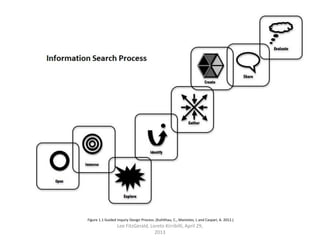
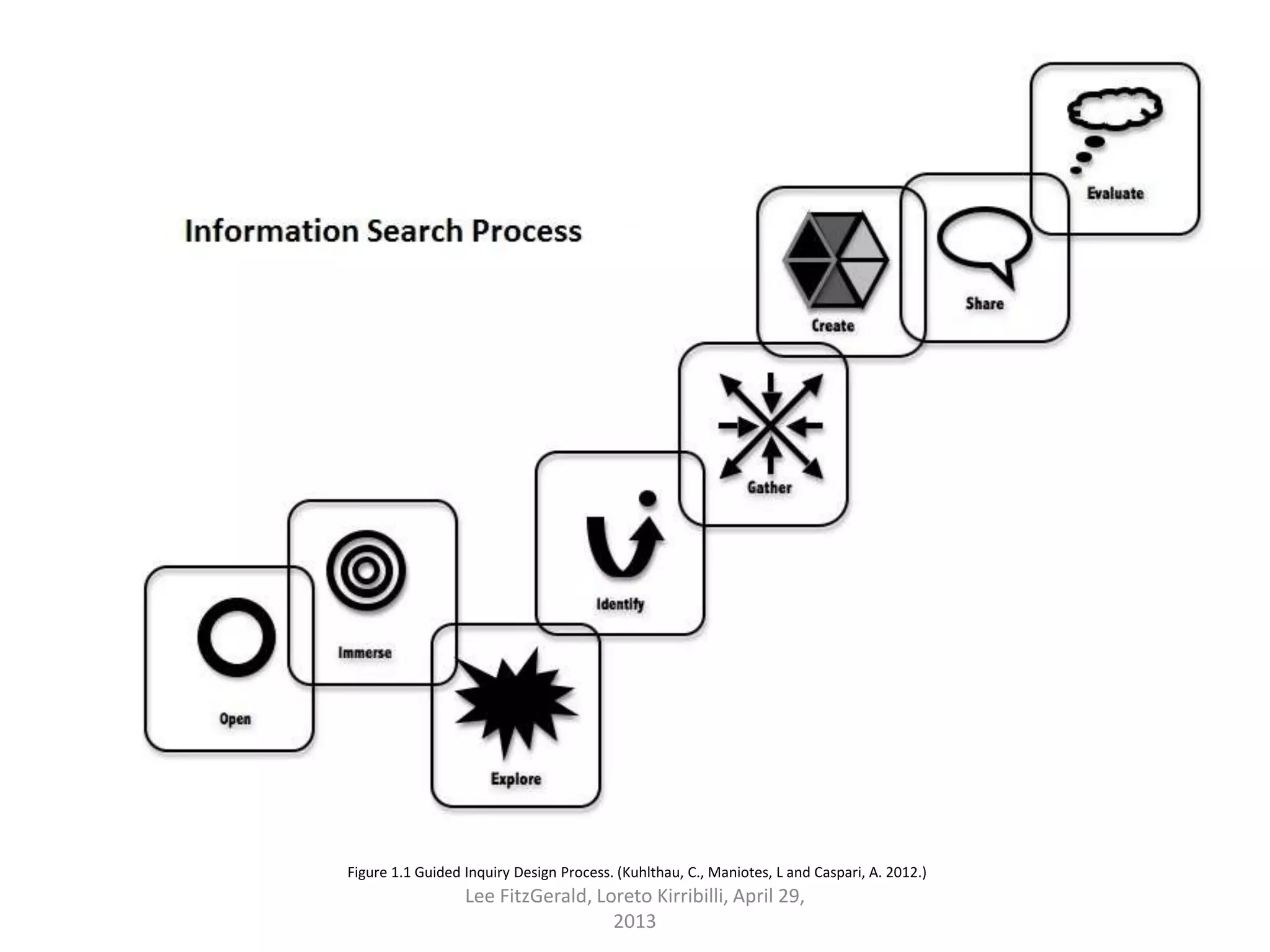
Figure 1.1 Guided Inquiry Design Process. (Kuhlthau, C., Maniotes, L and Caspari, A. 2012.)

Lee FitzGerald, Loreto Kirribilli, April 29,
2013
The Research River
 Starting a research task, you are at the
beginning of a journey, called The
Information Search Process
 This is a journey that you’ll repeat many
times in your life at school and work.

 It’s not a simple journey, and may be
likened to the progress a river makes from
its source to the sea.
Lee FitzGerald, Loreto Kirribilli, April 29, 2013
The research river: Open
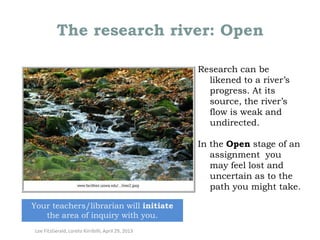
Research can be
likened to a river’s
progress. At its
source, the river’s
flow is weak and
undirected.
In the Open stage of an
assignment you
may feel lost and
uncertain as to the
path you might take.
Your teachers/librarian will initiate
the area of inquiry with you.
Lee FitzGerald, Loreto Kirribilli, April 29, 2013
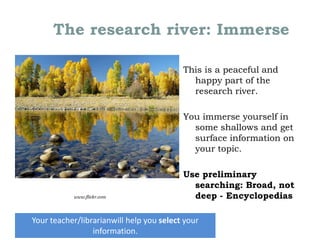
The research river: Immerse
This is a peaceful and
happy part of the
research river.

You immerse yourself in
some shallows and get
surface information on
your topic.

www.flickr.com

Use preliminary
searching: Broad, not
deep - Encyclopedias

Your teacher/librarianwill help you select your
Lee FitzGerald, Loreto Kirribilli, April 29, 2013
information.
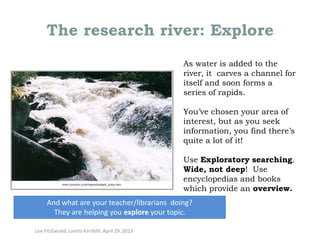
The research river: Explore
As water is added to the
river, it carves a channel for
itself and soon forms a
series of rapids.
You’ve chosen your area of
interest, but as you seek
information, you find there’s
quite a lot of it!
Use Exploratory searching.
Wide, not deep! Use
encyclopedias and books
which provide an overview.

And what are your teacher/librarians doing?
They are helping you explore your topic.
Lee FitzGerald, Loreto Kirribilli, April 29, 2013
The research river: Explore
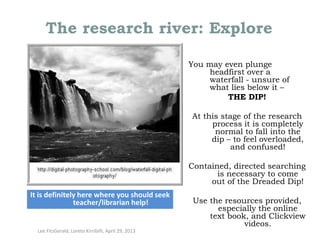
You may even plunge
headfirst over a
waterfall - unsure of
what lies below it –
THE DIP!
At this stage of the research
process it is completely
normal to fall into the
dip – to feel overloaded,
and confused!
Contained, directed searching
is necessary to come
out of the Dreaded Dip!
It is definitely here where you should seek
teacher/librarian help!

Lee FitzGerald, Loreto Kirribilli, April 29, 2013

Use the resources provided,
especially the online
text book, and Clickview
videos.
The research river: Identify
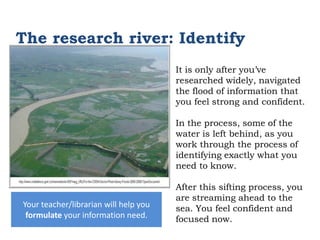
It is only after you’ve
researched widely, navigated
the flood of information that
you feel strong and confident.
In the process, some of the
water is left behind, as you
work through the process of
identifying exactly what you
need to know.

Your teacher/librarian will help you
formulate your information need.

After this sifting process, you
are streaming ahead to the
sea. You feel confident and
focused now.
The research river: Gather

http://www.pamsclipart.com/clipart_images/stick_girl_swimming_0515-1104-1203-1310.html

Your teacher/librarian will help you collect
only the Loreto Kirribilli, April 29, 2013
information you need.
Lee FitzGerald,

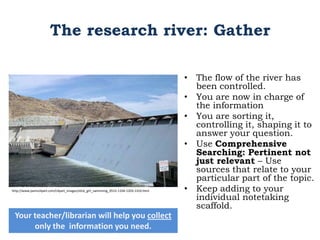
• The flow of the river has
been controlled.
• You are now in charge of
the information
• You are sorting it,
controlling it, shaping it to
answer your question.
• Use Comprehensive
Searching: Pertinent not
just relevant – Use
sources that relate to your
particular part of the topic.
• Keep adding to your
individual notetaking
scaffold.
The research river: Create and share
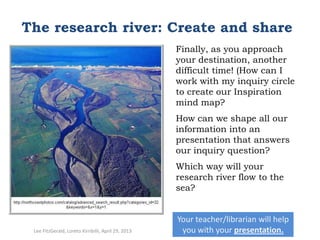
Finally, as you approach
your destination, another
difficult time! (How can I
work with my inquiry circle
to create our Inspiration
mind map?
How can we shape all our
information into an
presentation that answers
our inquiry question?
Which way will your
research river flow to the
sea?

Lee FitzGerald, Loreto Kirribilli, April 29, 2013

Your teacher/librarian will help
you with your presentation.
The research river: Create and share
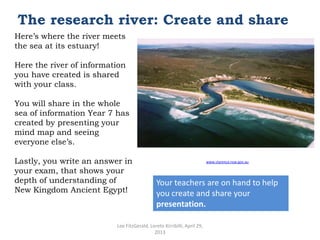
Here’s where the river meets
the sea at its estuary!
Here the river of information
you have created is shared
with your class.
You will share in the whole
sea of information Year 7 has
created by presenting your
mind map and seeing
everyone else’s.
Lastly, you write an answer in
your exam, that shows your
depth of understanding of
New Kingdom Ancient Egypt!

www.clarence.nsw.gov.au

Your teachers are on hand to help
you create and share your
presentation.

Lee FitzGerald, Loreto Kirribilli, April 29,
2013
The Research river: Evaluate
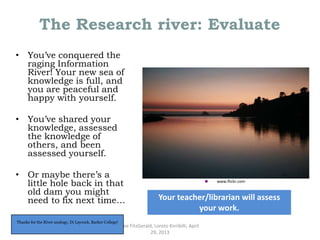
• You’ve conquered the
raging Information
River! Your new sea of
knowledge is full, and
you are peaceful and
happy with yourself.
• You’ve shared your
knowledge, assessed
the knowledge of
others, and been
assessed yourself.
• Or maybe there’s a
little hole back in that
old dam you might
need to fix next time…
Thanks for the River analogy, Di Laycock, Barker College!



www.flickr.com

Your teacher/librarian will assess
your work.

Lee FitzGerald, Loreto Kirribilli, April
29, 2013

Research river

  • 1.
    Figure 1.1 GuidedInquiry Design Process. (Kuhlthau, C., Maniotes, L and Caspari, A. 2012.) Lee FitzGerald, Loreto Kirribilli, April 29, 2013
  • 2.
    The Research River Starting a research task, you are at the beginning of a journey, called The Information Search Process  This is a journey that you’ll repeat many times in your life at school and work.  It’s not a simple journey, and may be likened to the progress a river makes from its source to the sea. Lee FitzGerald, Loreto Kirribilli, April 29, 2013
  • 3.
    The research river:Open Research can be likened to a river’s progress. At its source, the river’s flow is weak and undirected. In the Open stage of an assignment you may feel lost and uncertain as to the path you might take. Your teachers/librarian will initiate the area of inquiry with you. Lee FitzGerald, Loreto Kirribilli, April 29, 2013
  • 4.
    The research river:Immerse This is a peaceful and happy part of the research river. You immerse yourself in some shallows and get surface information on your topic. www.flickr.com Use preliminary searching: Broad, not deep - Encyclopedias Your teacher/librarianwill help you select your Lee FitzGerald, Loreto Kirribilli, April 29, 2013 information.
  • 5.
    The research river:Explore As water is added to the river, it carves a channel for itself and soon forms a series of rapids. You’ve chosen your area of interest, but as you seek information, you find there’s quite a lot of it! Use Exploratory searching. Wide, not deep! Use encyclopedias and books which provide an overview. And what are your teacher/librarians doing? They are helping you explore your topic. Lee FitzGerald, Loreto Kirribilli, April 29, 2013
  • 6.
    The research river:Explore You may even plunge headfirst over a waterfall - unsure of what lies below it – THE DIP! At this stage of the research process it is completely normal to fall into the dip – to feel overloaded, and confused! Contained, directed searching is necessary to come out of the Dreaded Dip! It is definitely here where you should seek teacher/librarian help! Lee FitzGerald, Loreto Kirribilli, April 29, 2013 Use the resources provided, especially the online text book, and Clickview videos.
  • 7.
    The research river:Identify It is only after you’ve researched widely, navigated the flood of information that you feel strong and confident. In the process, some of the water is left behind, as you work through the process of identifying exactly what you need to know. Your teacher/librarian will help you formulate your information need. After this sifting process, you are streaming ahead to the sea. You feel confident and focused now.
  • 8.
    The research river:Gather http://www.pamsclipart.com/clipart_images/stick_girl_swimming_0515-1104-1203-1310.html Your teacher/librarian will help you collect only the Loreto Kirribilli, April 29, 2013 information you need. Lee FitzGerald, • The flow of the river has been controlled. • You are now in charge of the information • You are sorting it, controlling it, shaping it to answer your question. • Use Comprehensive Searching: Pertinent not just relevant – Use sources that relate to your particular part of the topic. • Keep adding to your individual notetaking scaffold.
  • 9.
    The research river:Create and share Finally, as you approach your destination, another difficult time! (How can I work with my inquiry circle to create our Inspiration mind map? How can we shape all our information into an presentation that answers our inquiry question? Which way will your research river flow to the sea? Lee FitzGerald, Loreto Kirribilli, April 29, 2013 Your teacher/librarian will help you with your presentation.
  • 10.
    The research river:Create and share Here’s where the river meets the sea at its estuary! Here the river of information you have created is shared with your class. You will share in the whole sea of information Year 7 has created by presenting your mind map and seeing everyone else’s. Lastly, you write an answer in your exam, that shows your depth of understanding of New Kingdom Ancient Egypt! www.clarence.nsw.gov.au Your teachers are on hand to help you create and share your presentation. Lee FitzGerald, Loreto Kirribilli, April 29, 2013
  • 11.
    The Research river:Evaluate • You’ve conquered the raging Information River! Your new sea of knowledge is full, and you are peaceful and happy with yourself. • You’ve shared your knowledge, assessed the knowledge of others, and been assessed yourself. • Or maybe there’s a little hole back in that old dam you might need to fix next time… Thanks for the River analogy, Di Laycock, Barker College!  www.flickr.com Your teacher/librarian will assess your work. Lee FitzGerald, Loreto Kirribilli, April 29, 2013