Elements of PermaculturePlants & PeopleBen Kessler & Meredith Hartwell                                                                                              Laughing Crow Permaculture
2Analysis of ElementsList the Yields, Needs, and intrinsic characteristics of eachElement.Lists are made to try to supply (by some other Element inthe system) the Needs of any particular Element.Experiment on paper, connecting and combining Elementsto achieve no Pollution and minimize Work.Close the Loops!
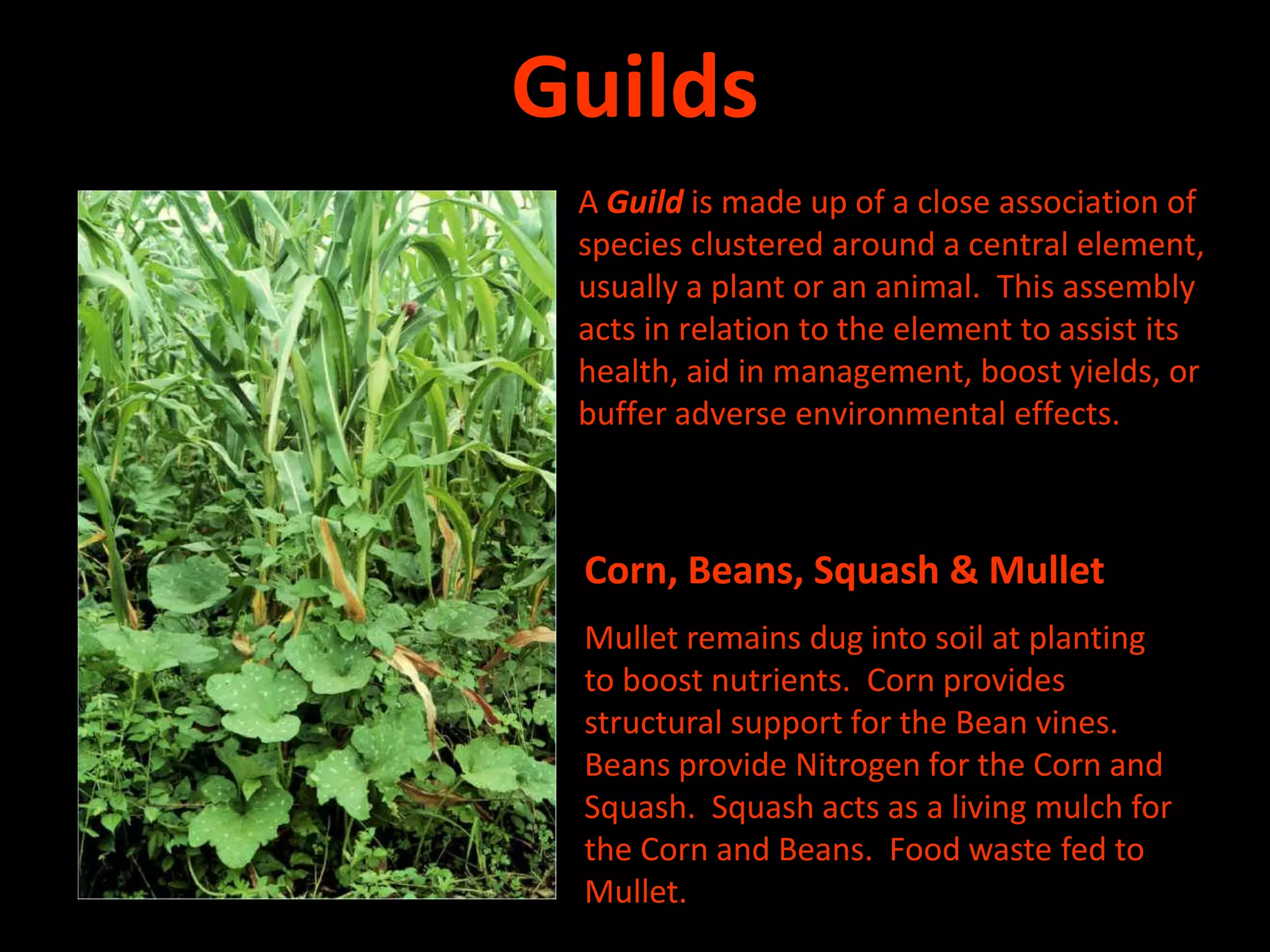
3Guilds	A Guild is made up of a close association of species clustered around a central element, usually a plant or an animal.  This assembly acts in relation to the element to assist its health, aid in management, boost yields, or buffer adverse environmental effects.Corn, Beans, Squash & MulletMullet remains dug into soil at planting to boost nutrients.  Corn provides structural support for the Bean vines.  Beans provide Nitrogen for the Corn and Squash.  Squash acts as a living mulch for the Corn and Beans.  Food waste fed to Mullet.
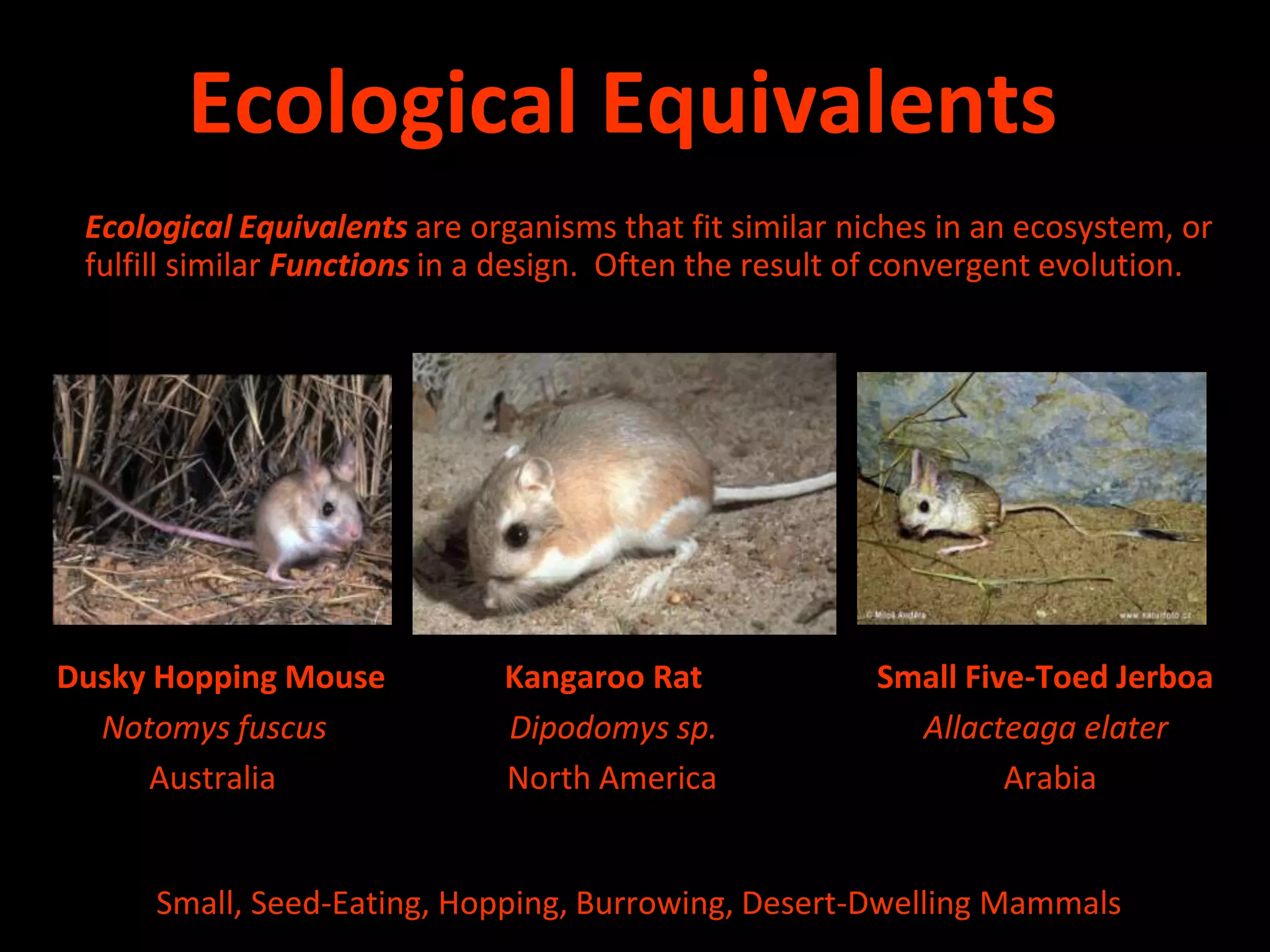
Ecological Equivalents	Ecological Equivalents are organisms that fit similar niches in an ecosystem, or fulfill similar Functions in a design.  Often the result of convergent evolution.Dusky Hopping Mouse               Kangaroo Rat                      Small Five-Toed JerboaNotomys fuscus                       Dipodomys sp.                          Allacteaga elater              Australia                             North America                                    Arabia Small, Seed-Eating, Hopping, Burrowing, Desert-Dwelling Mammals
5Environmental EquivalentsBisonPrairie ChickenTallgrass PrairieWater BuffaloCattle EgretSavannaCowChickenPasture
6Needs & YieldsTomato/Tomatl                                                                   Solanum lycopersicumNeedsYieldsFull Sunlight, Water, NPK, Micronutrients, Warm Soil, Protection from Herbivores, Mycorrhizal Partners, Slightly Acidic Soil pH, Well-drained Soil, Structural Support, LoveDelicious Fruit, Spatial Demarcation, Mulch,Dense Verdant Foliage,Pest Protection for Brassicas and Gooseberries, Companionship for Basil and Nettles, Compost
7Needs & Yields: The Permaculture ChickenIllustration credit: Bill MollisonWhat does each element need in order to live or be maintained?What products or services does it naturally provide?
8Needs, in a High Altitude GardenWhat’s different at 7,000 feet?  Short growing season  (90-110 days) & short day length,
Day/night temperature fluctuations ,
 Low soil organic matter & alkaline pH,
 Appropriate selection of vegetable and fruit varieties.
Ideally, link garden elements together so that the needs of one element  can be met by the outputs of another.8
9High Altitude Garden Needs: Temperature Regulation StrategiesGarden bed placement:
~ Evaluate sun/shade/wind sectors and create warmer or cooler microclimates depending on vegetable typeStructures & thermal mass:	~ Raised beds & black pots	~ Frost cloth & plastic “mulch”	~ Cold frames & hoop houses	~ Greenhouses9
Garden InputsSoil Amendments to raise pH, organic content & nutrient values:~ Compost, leaves, animal manures, organic fertilizers, earth worm castings, beneficial soil mycorrhizae, nitrogen fixing plants (green ‘manures’), straw or hay mulchesWater:	~ Capture on landscape, drip systems, water in evening10
Yields: Food!General guidelines for growing high elevation crops:~ Emphasize cool season veggies in your garden: Cole/cruciferous crops, greens of all kinds (from arugula to spinach to lettuces), root crops, certain grains (quinoa, millet, amaranth, spring wheat~ Select short-season & short day varieties: less than 90 days to fruition is ideal~ Start warm-season crops inside, esp. nightshades (tomatoes, peppers, eggplant, chilis) & plant them in a WARM microclimate~ Include mid-story native berry shrubs~ Plant late-blooming fruits (Best: apple trees with 800-1000 ‘chill hours’ before blooming; cherries, plums, grapes, & certain varieties of apricots & peaches)~ Companion plant fruits, veggies, flowers & trees wisely for beneficial relationships11
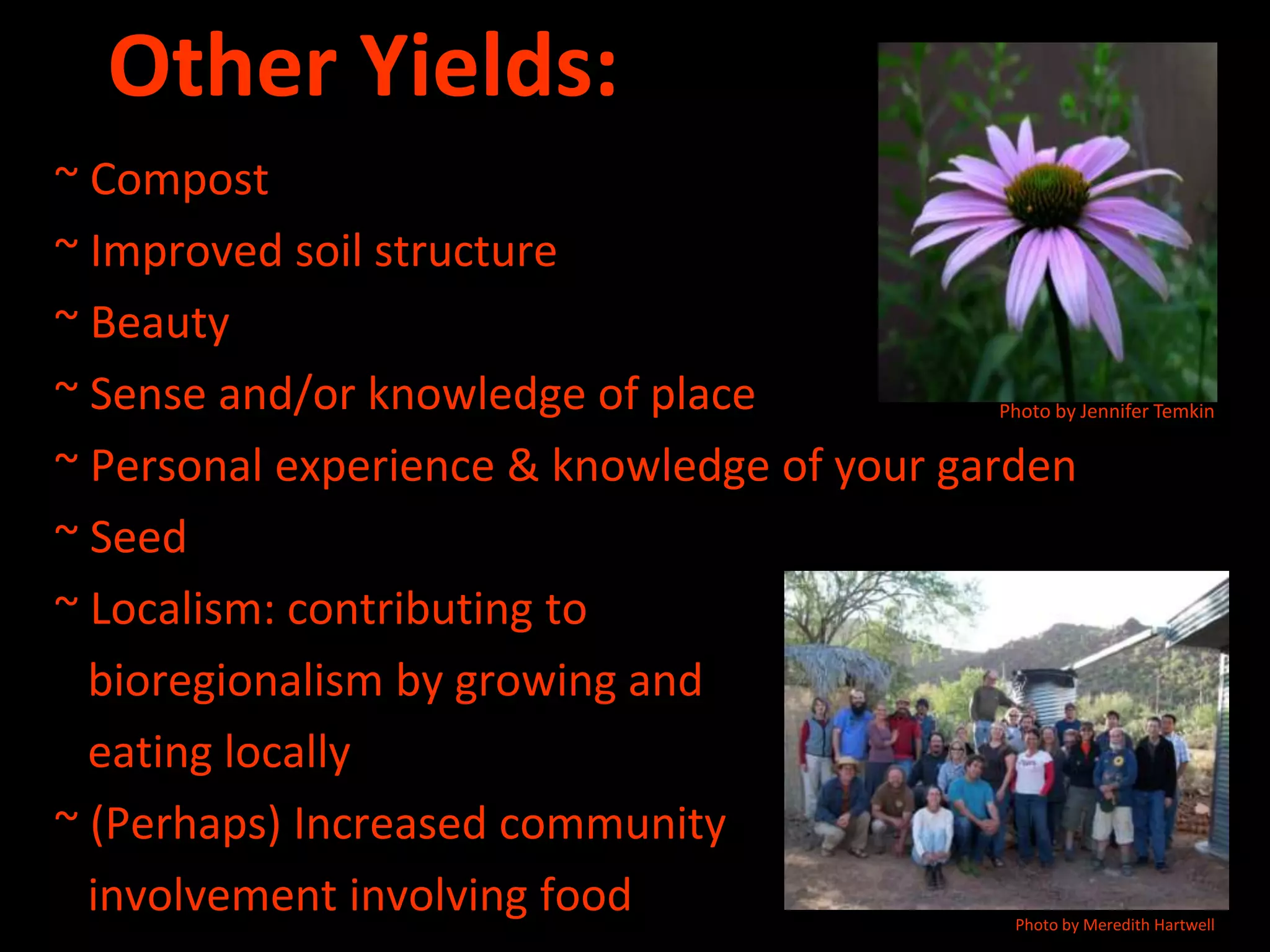
Other Yields:~ Compost~ Improved soil structure~ Beauty~ Sense and/or knowledge of place~ Personal experience & knowledge of your garden~ Seed~ Localism: contributing to   bioregionalism by growing and   eating locally~ (Perhaps) Increased community   involvement involving food12Photo by Jennifer TemkinPhoto by Meredith Hartwell
13GroundcoverLiving Mulch, Walking SurfaceHelianthusHelianthus sp.PussytoesAntennaria parvifloraWild SageArtemisia ludovicianaPhotos courtesy of Jennifer Temkin
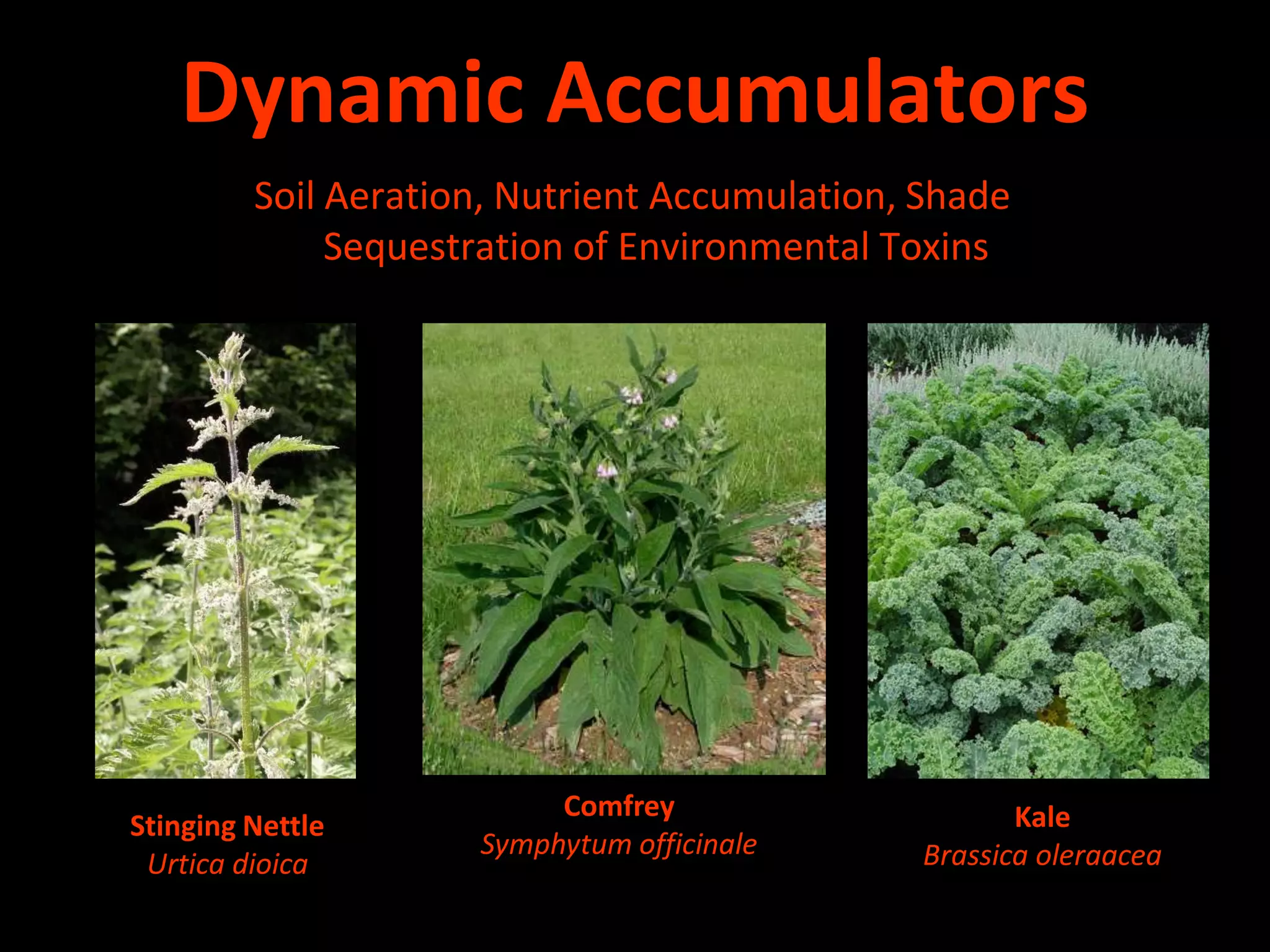
14Dynamic AccumulatorsSoil Aeration, Nutrient Accumulation, Shade               Sequestration of Environmental ToxinsComfrey     Symphytum officinaleKale Brassica oleraaceaStinging NettleUrtica dioica
15Nitrogen FixersNitrogen FixationRoot Nodules on Soybean (Glycine max) rootsAlder  Aldus sp.CloverTrifolium sp.LupinesLupinus sp.
16InsectariesPollinator Attraction, Aesthetic PrettificationPhoto by Jennifer TemkinCalendula    Calendula sp.Fennel Foeniculum vulgareBorage                         Borago sp.
17Cover CropsSoil Building, Animal Forage, Fallow CoverEspecially for the Southwest:Annual RyeOatsField PeasHairy VetchWinter WheatWinter RyeWildflower MixWestern WheatSideoats GramaSmooth BromeBuffalo GrassIndian Rice GrassEphram Crested WheatSanfoinCloversBorageBuckwheatFagopyrum esculentumBlue GramaBouteloua gracilis
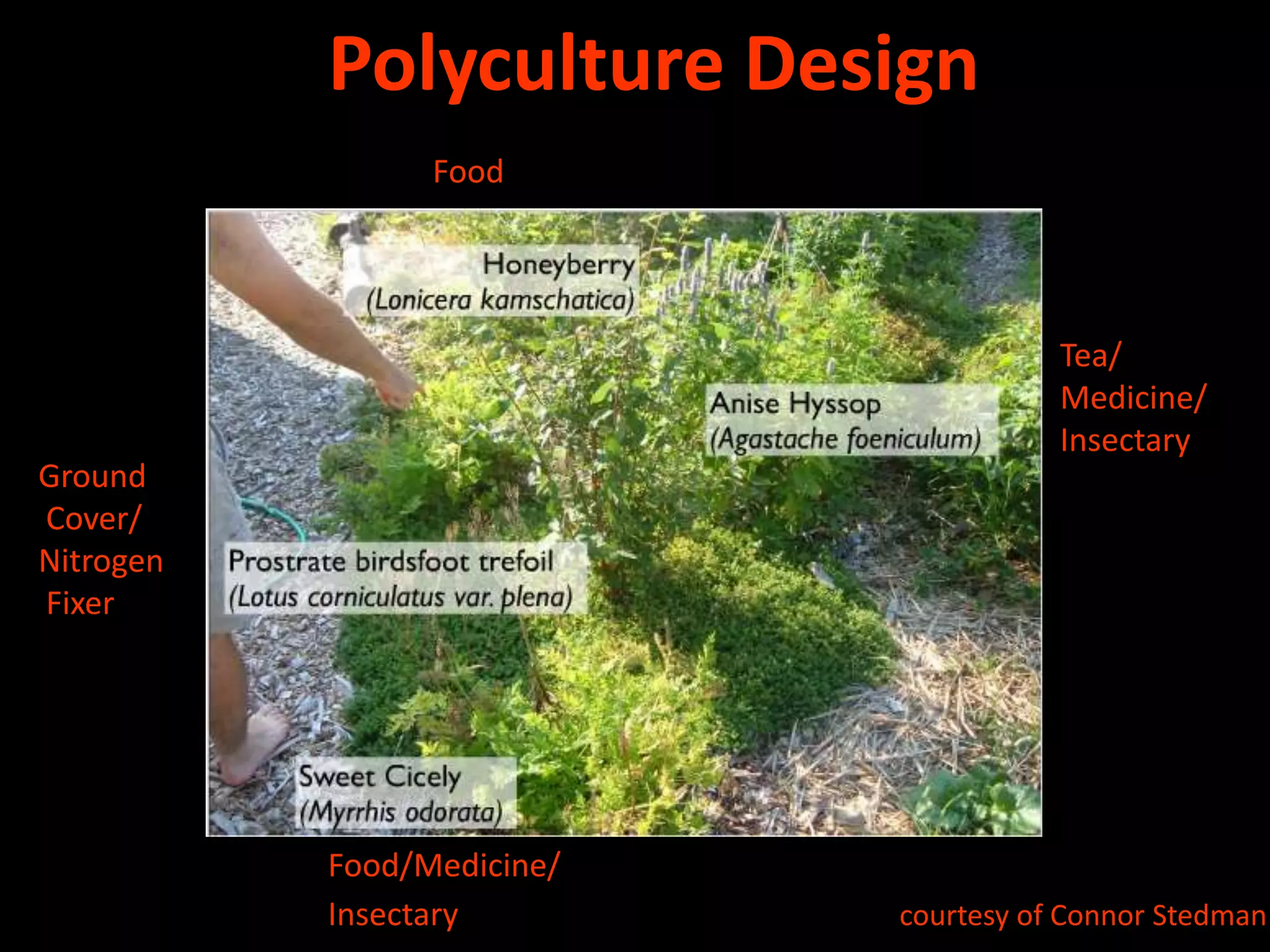
18Polyculture DesignFoodTea/Medicine/InsectaryGround Cover/Nitrogen FixerFood/Medicine/Insectarycourtesy of Connor Stedman
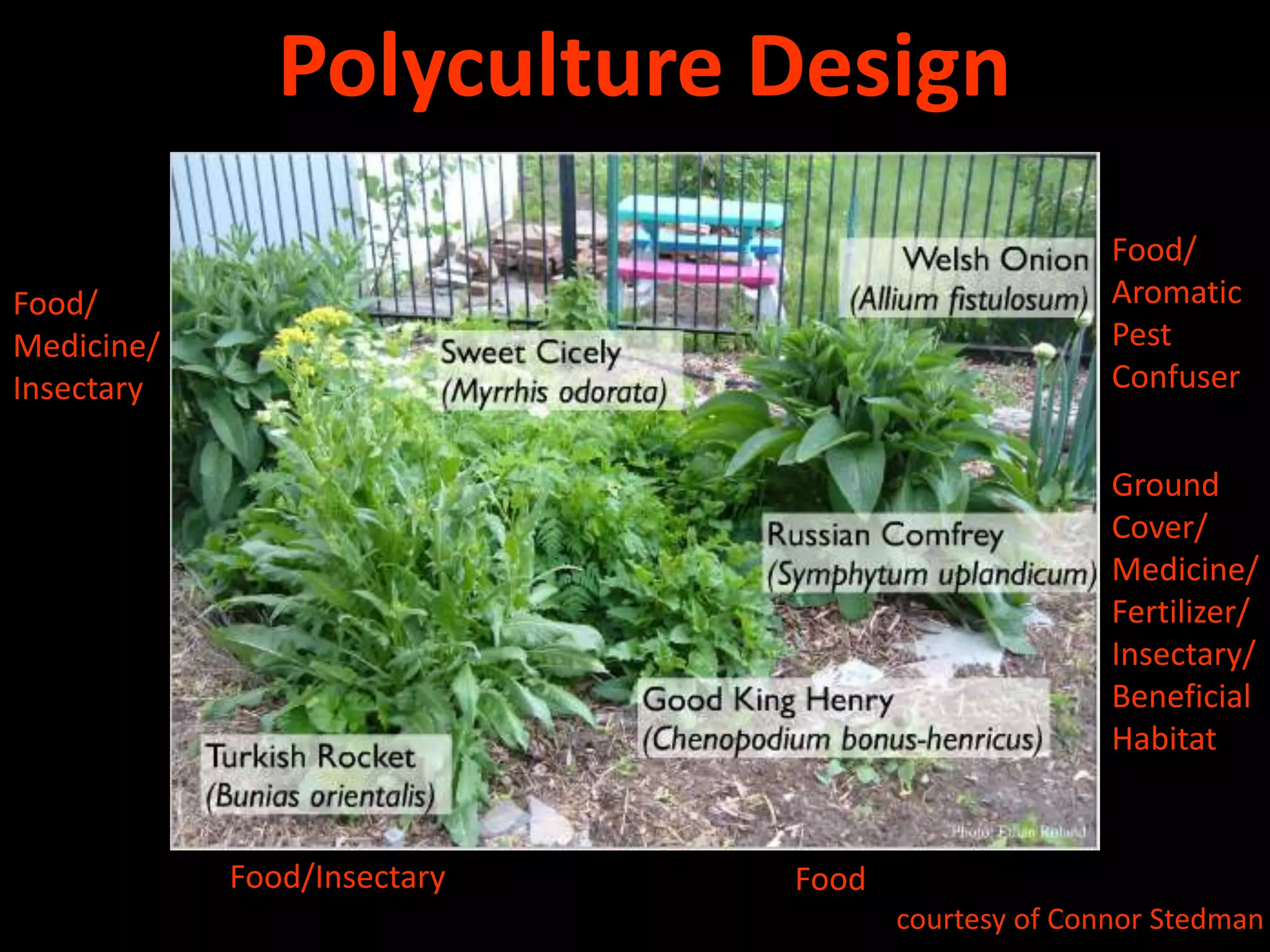
19Polyculture DesignFood/AromaticPest ConfuserFood/Medicine/InsectaryGroundCover/Medicine/Fertilizer/Insectary/BeneficialHabitatFood/InsectaryFood	              courtesy of Connor Stedman
20SSLUG & Bonito St. Gardens
21SSLUG 2010
22CSA Garden
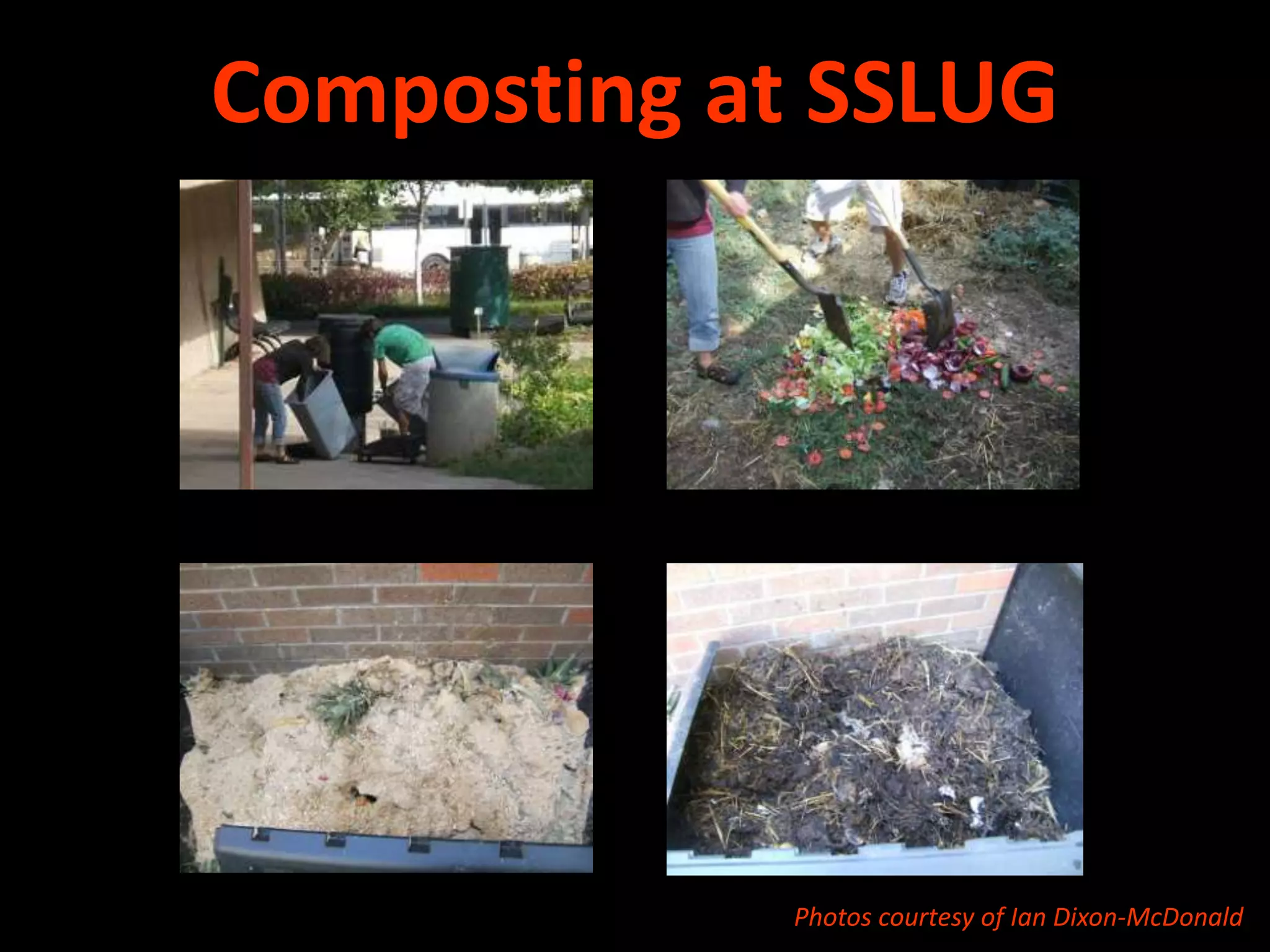
23Composting at SSLUGPhotos courtesy of Ian Dixon-McDonald
Accelerate SuccessionStack functions in time and spaceTo enable a cultivated system to evolve toward a long-term stable state, we can construct a system, carefully planning the succession of plants and animals so that we can receive short, medium, and long-term benefits.“Place is a verb.”                              – Jeanette ArmstrongIntroduction to Permaculture (2004)   Bill Mollison & Reny Mia Slay
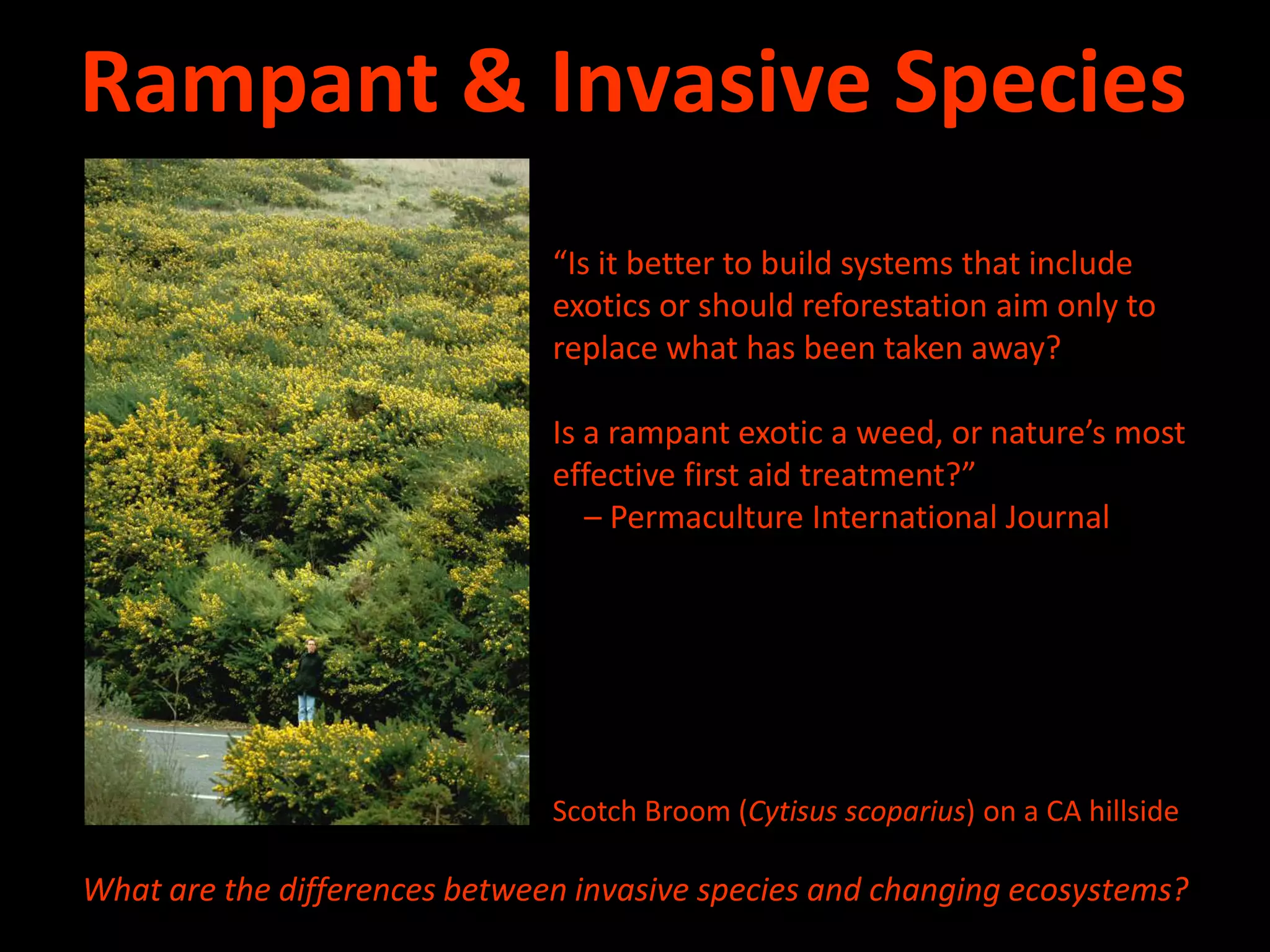
Rampant & Invasive Species“Is it better to build systems that include exotics or should reforestation aim only to replace what has been taken away?Is a rampant exotic a weed, or nature’s most effective first aid treatment?”     – Permaculture International JournalScotch Broom (Cytisus scoparius) on a CA hillsideWhat are the differences between invasive species and changing ecosystems?
Local RampantsSalt Cedar Tamarix sp.Benefits: Willow Flycatcher habitat, basketry material, erosion control, butterfly foodDetriments: Soil salinization, willow & cottonwood exclusion, flooding, water table drainingRussian Olive Eleagnus angustifoliaBenefits: Bird habitat & food, erosion control, N fixation, windbreak, mulch, shadeDetriments: Willow & cottonwood exclusion, meadow encroachment“All rampant or weedy and invasive plants are gonna be everywhere eventually-why not just speed things up?” – Bill Mollison
Appendices
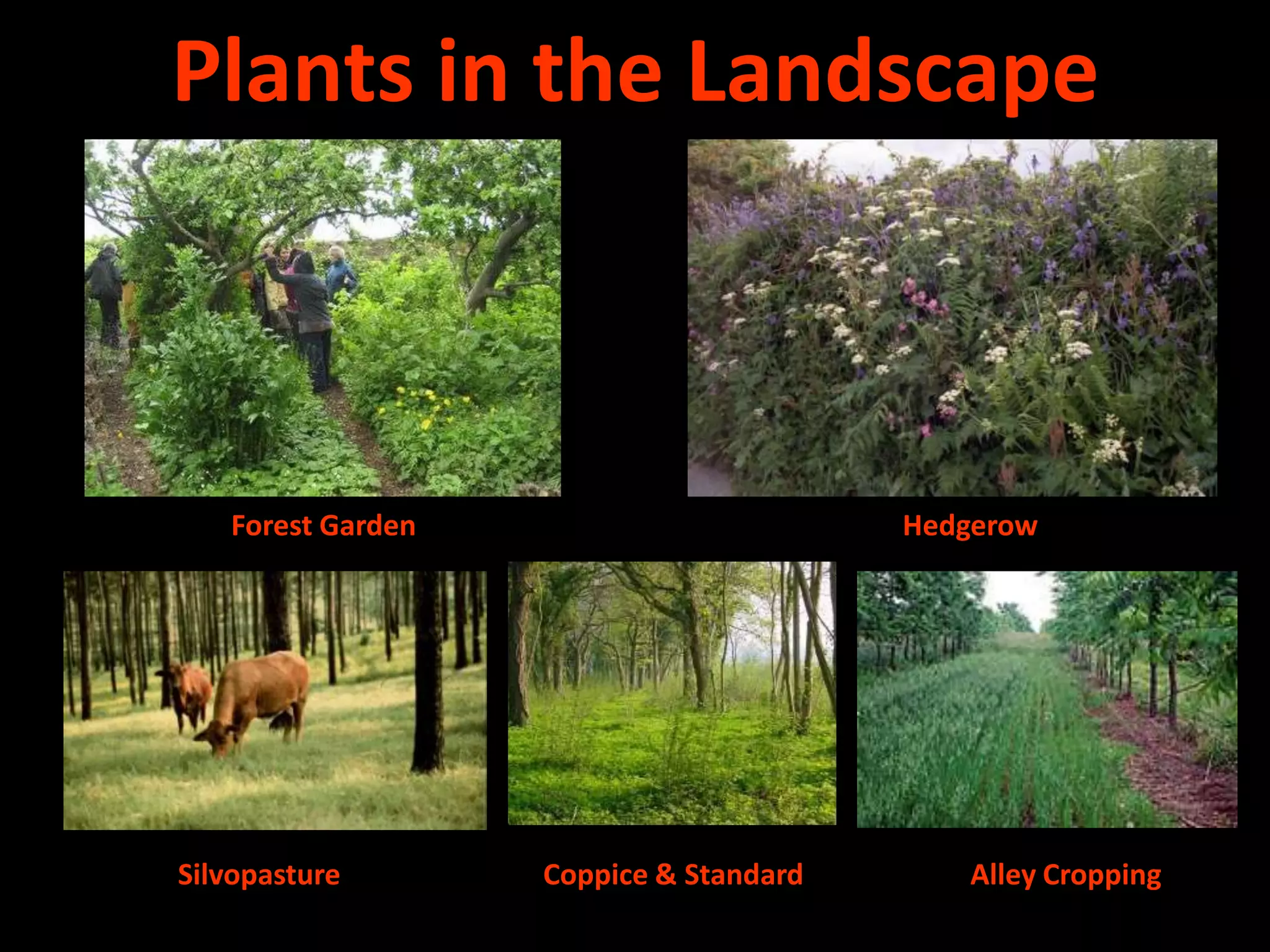
28Plants in the LandscapeForest Garden                                                                   Hedgerow Silvopasture                            Coppice & Standard                       Alley Cropping

EoP Plants & People-2

  • 1.
    Elements of PermaculturePlants& PeopleBen Kessler & Meredith Hartwell Laughing Crow Permaculture
  • 2.
    2Analysis of ElementsListthe Yields, Needs, and intrinsic characteristics of eachElement.Lists are made to try to supply (by some other Element inthe system) the Needs of any particular Element.Experiment on paper, connecting and combining Elementsto achieve no Pollution and minimize Work.Close the Loops!
  • 3.
    3Guilds A Guild ismade up of a close association of species clustered around a central element, usually a plant or an animal. This assembly acts in relation to the element to assist its health, aid in management, boost yields, or buffer adverse environmental effects.Corn, Beans, Squash & MulletMullet remains dug into soil at planting to boost nutrients. Corn provides structural support for the Bean vines. Beans provide Nitrogen for the Corn and Squash. Squash acts as a living mulch for the Corn and Beans. Food waste fed to Mullet.
  • 4.
    Ecological Equivalents Ecological Equivalentsare organisms that fit similar niches in an ecosystem, or fulfill similar Functions in a design. Often the result of convergent evolution.Dusky Hopping Mouse Kangaroo Rat Small Five-Toed JerboaNotomys fuscus Dipodomys sp. Allacteaga elater Australia North America Arabia Small, Seed-Eating, Hopping, Burrowing, Desert-Dwelling Mammals
  • 5.
    5Environmental EquivalentsBisonPrairie ChickenTallgrassPrairieWater BuffaloCattle EgretSavannaCowChickenPasture
  • 6.
    6Needs & YieldsTomato/Tomatl Solanum lycopersicumNeedsYieldsFull Sunlight, Water, NPK, Micronutrients, Warm Soil, Protection from Herbivores, Mycorrhizal Partners, Slightly Acidic Soil pH, Well-drained Soil, Structural Support, LoveDelicious Fruit, Spatial Demarcation, Mulch,Dense Verdant Foliage,Pest Protection for Brassicas and Gooseberries, Companionship for Basil and Nettles, Compost
  • 7.
    7Needs & Yields:The Permaculture ChickenIllustration credit: Bill MollisonWhat does each element need in order to live or be maintained?What products or services does it naturally provide?
  • 8.
    8Needs, in aHigh Altitude GardenWhat’s different at 7,000 feet? Short growing season (90-110 days) & short day length,
  • 9.
  • 10.
    Low soilorganic matter & alkaline pH,
  • 11.
    Appropriate selectionof vegetable and fruit varieties.
  • 12.
    Ideally, link gardenelements together so that the needs of one element can be met by the outputs of another.8
  • 13.
    9High Altitude GardenNeeds: Temperature Regulation StrategiesGarden bed placement:
  • 14.
    ~ Evaluate sun/shade/windsectors and create warmer or cooler microclimates depending on vegetable typeStructures & thermal mass: ~ Raised beds & black pots ~ Frost cloth & plastic “mulch” ~ Cold frames & hoop houses ~ Greenhouses9
  • 15.
    Garden InputsSoil Amendmentsto raise pH, organic content & nutrient values:~ Compost, leaves, animal manures, organic fertilizers, earth worm castings, beneficial soil mycorrhizae, nitrogen fixing plants (green ‘manures’), straw or hay mulchesWater: ~ Capture on landscape, drip systems, water in evening10
  • 16.
    Yields: Food!General guidelinesfor growing high elevation crops:~ Emphasize cool season veggies in your garden: Cole/cruciferous crops, greens of all kinds (from arugula to spinach to lettuces), root crops, certain grains (quinoa, millet, amaranth, spring wheat~ Select short-season & short day varieties: less than 90 days to fruition is ideal~ Start warm-season crops inside, esp. nightshades (tomatoes, peppers, eggplant, chilis) & plant them in a WARM microclimate~ Include mid-story native berry shrubs~ Plant late-blooming fruits (Best: apple trees with 800-1000 ‘chill hours’ before blooming; cherries, plums, grapes, & certain varieties of apricots & peaches)~ Companion plant fruits, veggies, flowers & trees wisely for beneficial relationships11
  • 17.
    Other Yields:~ Compost~Improved soil structure~ Beauty~ Sense and/or knowledge of place~ Personal experience & knowledge of your garden~ Seed~ Localism: contributing to bioregionalism by growing and eating locally~ (Perhaps) Increased community involvement involving food12Photo by Jennifer TemkinPhoto by Meredith Hartwell
  • 18.
    13GroundcoverLiving Mulch, WalkingSurfaceHelianthusHelianthus sp.PussytoesAntennaria parvifloraWild SageArtemisia ludovicianaPhotos courtesy of Jennifer Temkin
  • 19.
    14Dynamic AccumulatorsSoil Aeration,Nutrient Accumulation, Shade Sequestration of Environmental ToxinsComfrey Symphytum officinaleKale Brassica oleraaceaStinging NettleUrtica dioica
  • 20.
    15Nitrogen FixersNitrogen FixationRootNodules on Soybean (Glycine max) rootsAlder Aldus sp.CloverTrifolium sp.LupinesLupinus sp.
  • 21.
    16InsectariesPollinator Attraction, AestheticPrettificationPhoto by Jennifer TemkinCalendula Calendula sp.Fennel Foeniculum vulgareBorage Borago sp.
  • 22.
    17Cover CropsSoil Building,Animal Forage, Fallow CoverEspecially for the Southwest:Annual RyeOatsField PeasHairy VetchWinter WheatWinter RyeWildflower MixWestern WheatSideoats GramaSmooth BromeBuffalo GrassIndian Rice GrassEphram Crested WheatSanfoinCloversBorageBuckwheatFagopyrum esculentumBlue GramaBouteloua gracilis
  • 23.
    18Polyculture DesignFoodTea/Medicine/InsectaryGround Cover/NitrogenFixerFood/Medicine/Insectarycourtesy of Connor Stedman
  • 24.
  • 25.
    20SSLUG & BonitoSt. Gardens
  • 26.
  • 27.
  • 28.
    23Composting at SSLUGPhotoscourtesy of Ian Dixon-McDonald
  • 29.
    Accelerate SuccessionStack functionsin time and spaceTo enable a cultivated system to evolve toward a long-term stable state, we can construct a system, carefully planning the succession of plants and animals so that we can receive short, medium, and long-term benefits.“Place is a verb.” – Jeanette ArmstrongIntroduction to Permaculture (2004) Bill Mollison & Reny Mia Slay
  • 30.
    Rampant & InvasiveSpecies“Is it better to build systems that include exotics or should reforestation aim only to replace what has been taken away?Is a rampant exotic a weed, or nature’s most effective first aid treatment?” – Permaculture International JournalScotch Broom (Cytisus scoparius) on a CA hillsideWhat are the differences between invasive species and changing ecosystems?
  • 31.
    Local RampantsSalt CedarTamarix sp.Benefits: Willow Flycatcher habitat, basketry material, erosion control, butterfly foodDetriments: Soil salinization, willow & cottonwood exclusion, flooding, water table drainingRussian Olive Eleagnus angustifoliaBenefits: Bird habitat & food, erosion control, N fixation, windbreak, mulch, shadeDetriments: Willow & cottonwood exclusion, meadow encroachment“All rampant or weedy and invasive plants are gonna be everywhere eventually-why not just speed things up?” – Bill Mollison
  • 32.
  • 33.
    28Plants in theLandscapeForest Garden Hedgerow Silvopasture Coppice & Standard Alley Cropping
  • 34.
    29Plants in theLandscapeCompanion PlantingKeyhole Garden Intercropping Herb Spiral
  • 35.
    Integrated Pest Management“Mulchyour cat. It’s eating all the frogs and lizards that control insects.” – Bill MollisonIntegrated Pest Management is a crop management approach designed to address ecological dilemmas in agriculture.1. Acceptable pest levels2. Preventative cultural practices3. Monitoring4. Mechanical controls5. Biological controls6. Chemical controlsUSDA IPM Principles:http://www.epa.gov/pesticides/factsheets/ipm.htm“[Industrial pest management] is like pokin’ a gopher with a rope- you can’t do that!” – Gordon Tooley
  • 36.
    Convergent Evolution Ecological Equivalentsare organisms that fit similar niches in an ecosystem, or fulfill similar Functions in a design. Often the result of convergent evolution. Lesser HedghogTenrec European Hedgehog Short Beaked EchidnaEchinopstelfairiErinaceuseuropaeusTachyglossusaculeatusAdorable, inedible, insectivorous, little mammals
  • 37.
    32ResourcesHigh Altitude Gardeningwebsites: http://gardening.coloradohighaltitude.com/VegetableGardening/index.php
  • 38.
  • 39.
    Coconino County MasterGardener Association: http://coconinomgassociation.blogspot.com/
  • 40.
    Flagstaff Planting Guide,by Julie Lancaster: http://www.facebook.com/pages/for-anyone-who-grows-anything-in-Flagstaff-AZ/Flagstaff-Planting-Guide-Gardening-Community/332493936810?filter=3
  • 41.
    Gaia’s Garden, byToby Hemenway
  • 42.
  • 43.
    The Winter HarvestHandbook, by Eliot Coleman
  • 44.
    The New OrganicGrower, by Eliot Coleman
  • 45.
    Growing Food inthe Southwest Mountains, by Lisa Rayner
  • 46.
    J. Howard Garrett’sOrganic Manual, 2nd Edition
  • 47.
    Successful Small FoodGardens, by Louise Riotte
  • 48.
    Carrots Love Tomatoes,by Louise Riotte
  • 49.
    Start with theSoil, by Grace Gershuny
  • 50.
    A People’s Ecology,by Gregory Cajete32
  • 51.
    33Thanks toThe Internetforwords and picturesandJoanna Hale, Jennifer Temkin, DeJa Walker & Ian Dixon-McDonald for photographsContact Informationbkessler@gm.slc.edulaughingcrowpermaculture.wordpress.com