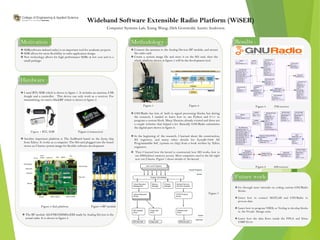
Wideband Software Extensible Radio Platform (WiSER)
Motivation : Methodology : Results :
! I used RTL SDR which is shown in figure 1. It includes an antenna, USB
dongle and a controller. This device can only work as a receiver. For
transmitting, we used a HackRF which is shown in figure 3.
Figure 1 RTL SDR Figure 2 transceiver
! Another important platform is The ZedBoard based on the Zynq chip
from Xilinx. It works as a computer. The SD card plugged into the board
stores an Ubuntu system image for flexible software development.
! SDR(software defined radio) is an important tool for academic projects.
! SDR allows for more flexibility in radio application design.
! New technology allows for high performance SDRs at low cost and in a
small package.
! The RF module AD-FMCOMMS3-EBZ made by Analog Devices is the
actual radio. It is shown in figure 4.
! Connect the antenna to the Analog Devices RF module, and mount
the radio card.
! Create a system image file and store it on the SD card, then the
whole platform shown in figure 5 will be the development tool.
! GNURadio has lots of built in signal processing blocks, but during
the research, I needed to learn how to use Python and C++ to
program a custom block. Many libraries already existed and there are
a couple websites that helped a lot. Basically GNURadio substitutes
the digital part shown in figure 6.
! In the beginning of the research, I learned about the construction,
IO, registers, and many other details for Zynq®-7000 All
Programmable SoC (system on chip) from a book written by Xilinx
engineers.
Future work:
Computer Systems Lab; Xiang Wang; Dirk Grunwald; Austin Anderson.
Hardware :
Figure 3 Zed platform Figure 4 RF module
Figure 5
!  Then I learned how the kernel is constructed, how IIO works, how to
use DMA(direct memory access). Most computers used in the lab right
now run Ubuntu. Figure 7 shows details of the kernel.
Figure 6 Figure 8 FM receiver
Figure 9 AM receiver
! Go through more tutorials on coding custom GNURadio
blocks.
! Learn how to connect MATLAB and GNURadio to
process data.
! Learn how to program VHDL or Verilog to develop blocks
in the Vivado Design suite.
! Learn how the data flows inside the FPGA and Ettus
USRP E310.
Figure 7

Research Poster

  • 1.
    Wideband Software ExtensibleRadio Platform (WiSER) Motivation : Methodology : Results : ! I used RTL SDR which is shown in figure 1. It includes an antenna, USB dongle and a controller. This device can only work as a receiver. For transmitting, we used a HackRF which is shown in figure 3. Figure 1 RTL SDR Figure 2 transceiver ! Another important platform is The ZedBoard based on the Zynq chip from Xilinx. It works as a computer. The SD card plugged into the board stores an Ubuntu system image for flexible software development. ! SDR(software defined radio) is an important tool for academic projects. ! SDR allows for more flexibility in radio application design. ! New technology allows for high performance SDRs at low cost and in a small package. ! The RF module AD-FMCOMMS3-EBZ made by Analog Devices is the actual radio. It is shown in figure 4. ! Connect the antenna to the Analog Devices RF module, and mount the radio card. ! Create a system image file and store it on the SD card, then the whole platform shown in figure 5 will be the development tool. ! GNURadio has lots of built in signal processing blocks, but during the research, I needed to learn how to use Python and C++ to program a custom block. Many libraries already existed and there are a couple websites that helped a lot. Basically GNURadio substitutes the digital part shown in figure 6. ! In the beginning of the research, I learned about the construction, IO, registers, and many other details for Zynq®-7000 All Programmable SoC (system on chip) from a book written by Xilinx engineers. Future work: Computer Systems Lab; Xiang Wang; Dirk Grunwald; Austin Anderson. Hardware : Figure 3 Zed platform Figure 4 RF module Figure 5 !  Then I learned how the kernel is constructed, how IIO works, how to use DMA(direct memory access). Most computers used in the lab right now run Ubuntu. Figure 7 shows details of the kernel. Figure 6 Figure 8 FM receiver Figure 9 AM receiver ! Go through more tutorials on coding custom GNURadio blocks. ! Learn how to connect MATLAB and GNURadio to process data. ! Learn how to program VHDL or Verilog to develop blocks in the Vivado Design suite. ! Learn how the data flows inside the FPGA and Ettus USRP E310. Figure 7