RESEARCH METHODOLOGY
II SEMESTER, MASTERS IN DIGITAL ARCHITECTURE,
IMPACT SCHOOL OF ARCHITECTURE
AR. SHIVANI SESHADRI
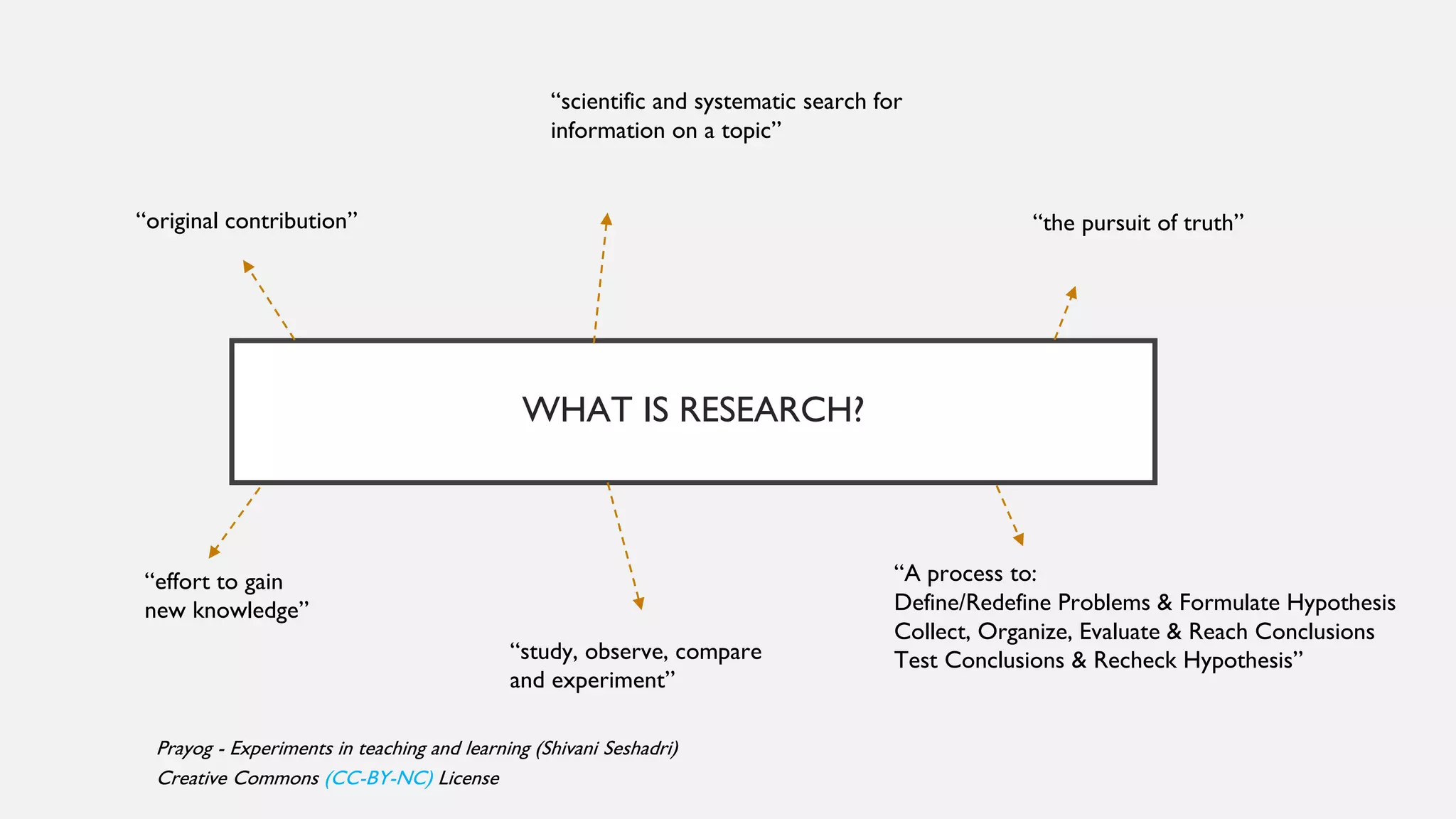
WHAT IS RESEARCH?
“original contribution”
“study, observe, compare
and experiment”
“the pursuit of truth”
“A process to:
Define/Redefine Problems & Formulate Hypothesis
Collect, Organize, Evaluate & Reach Conclusions
Test Conclusions & Recheck Hypothesis”
“effort to gain
new knowledge”
“scientific and systematic search for
information on a topic”
Prayog - Experiments in teaching and learning (Shivani Seshadri)
Creative Commons (CC-BY-NC) License
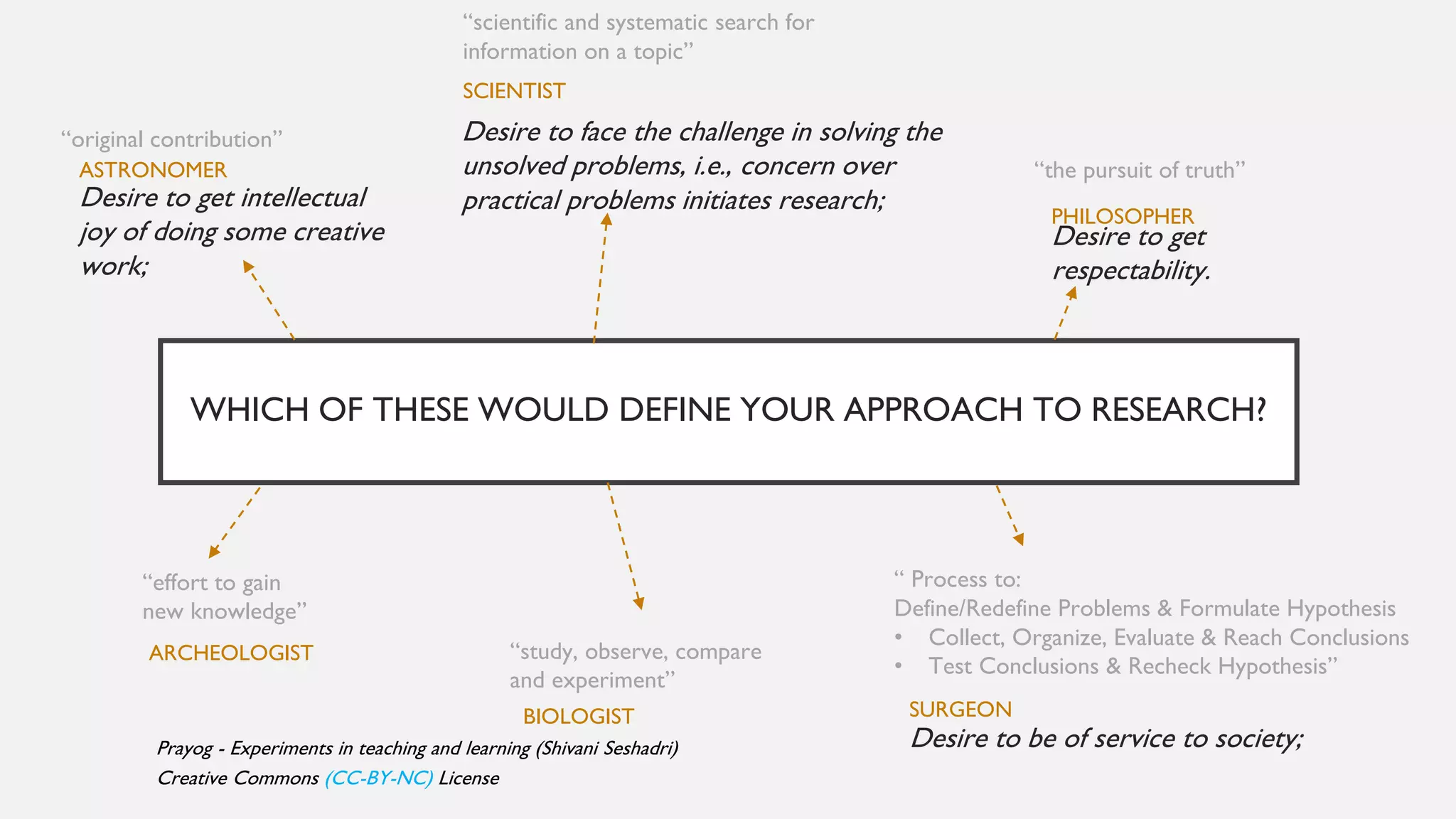
WHICH OF THESE WOULD DEFINE YOUR APPROACH TO RESEARCH?
“original contribution”
“study, observe, compare
and experiment”
“the pursuit of truth”
“ Process to:
Define/Redefine Problems & Formulate Hypothesis
• Collect, Organize, Evaluate & Reach Conclusions
• Test Conclusions & Recheck Hypothesis”
“effort to gain
new knowledge”
“scientific and systematic search for
information on a topic”
ASTRONOMER
ARCHEOLOGIST
SCIENTIST
PHILOSOPHER
BIOLOGIST SURGEON
Desire to be of service to society;
Desire to get intellectual
joy of doing some creative
work;
Desire to face the challenge in solving the
unsolved problems, i.e., concern over
practical problems initiates research;
Desire to get
respectability.
Prayog - Experiments in teaching and learning (Shivani Seshadri)
Creative Commons (CC-BY-NC) License
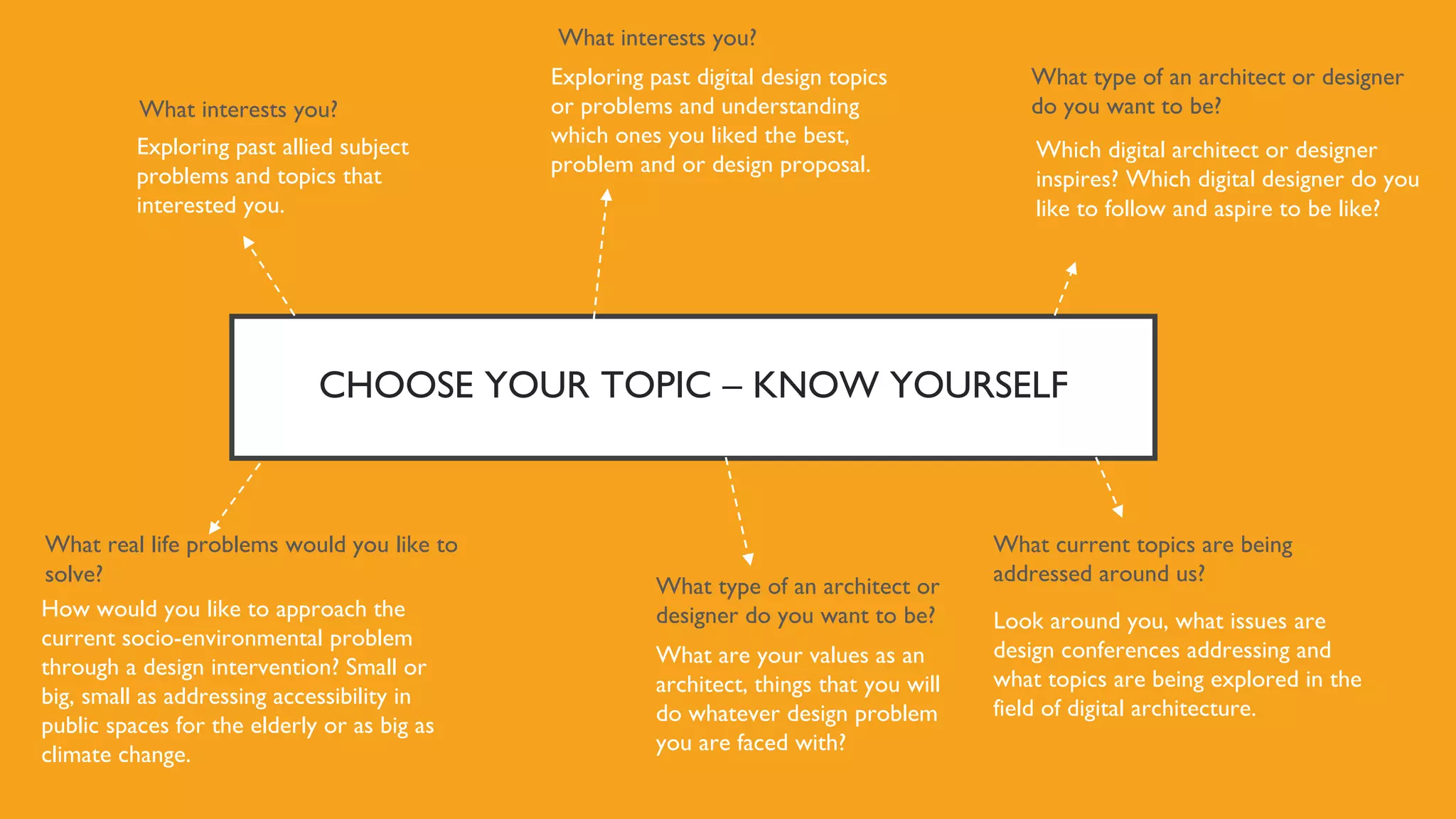
CHOOSE YOUR TOPIC – KNOW YOURSELF
Exploring past allied subject
problems and topics that
interested you.
What are your values as an
architect, things that you will
do whatever design problem
you are faced with?
Which digital architect or designer
inspires? Which digital designer do you
like to follow and aspire to be like?
What current topics are being
addressed around us?
What real life problems would you like to
solve?
Exploring past digital design topics
or problems and understanding
which ones you liked the best,
problem and or design proposal.
What interests you?
What type of an architect or designer
do you want to be?
How would you like to approach the
current socio-environmental problem
through a design intervention? Small or
big, small as addressing accessibility in
public spaces for the elderly or as big as
climate change.
What interests you?
What type of an architect or
designer do you want to be? Look around you, what issues are
design conferences addressing and
what topics are being explored in the
field of digital architecture.
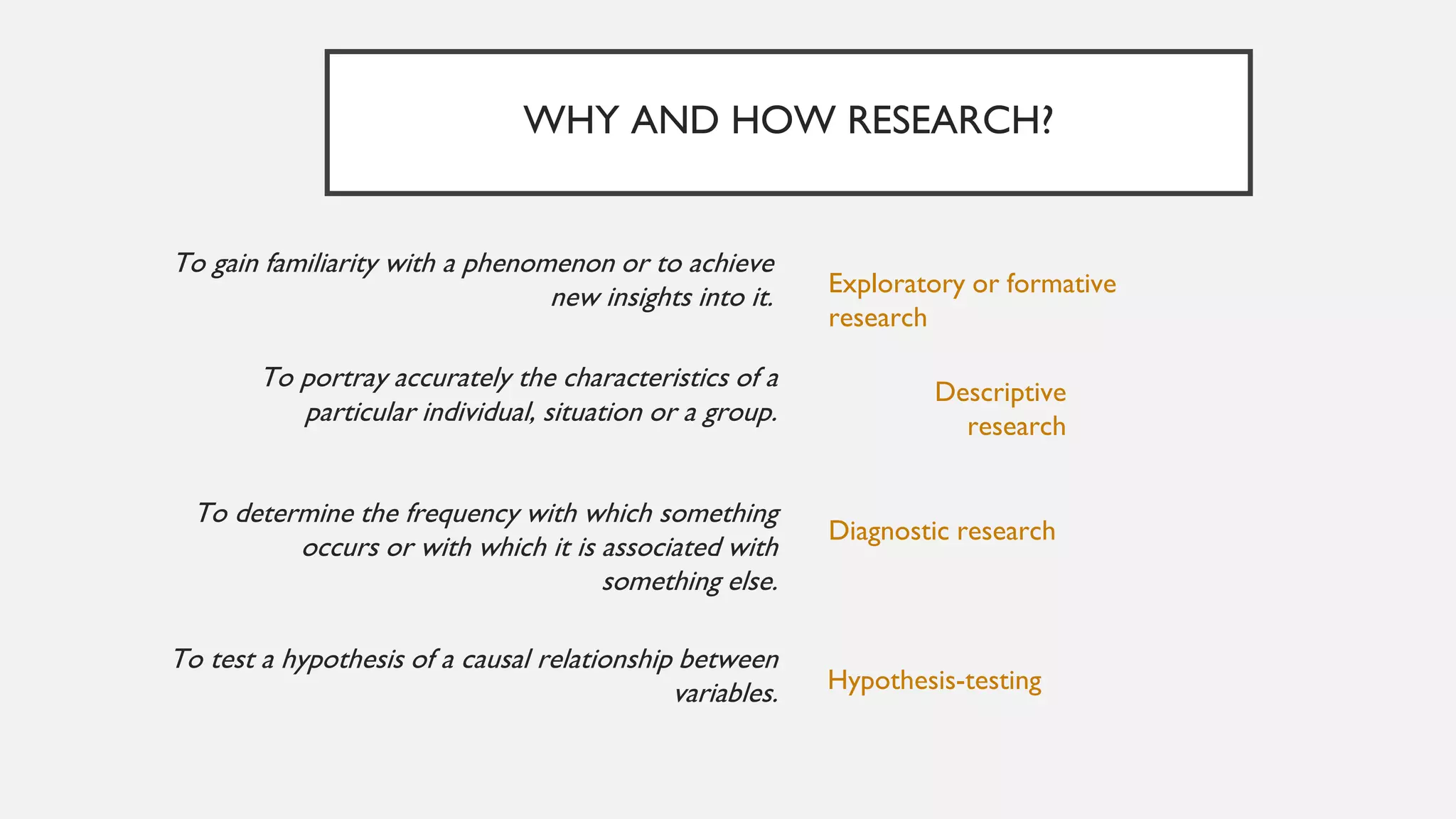
WHY AND HOW RESEARCH?
To gain familiarity with a phenomenon or to achieve
new insights into it. Exploratory or formative
research
Descriptive
research
Diagnostic research
Hypothesis-testing
To portray accurately the characteristics of a
particular individual, situation or a group.
To determine the frequency with which something
occurs or with which it is associated with
something else.
To test a hypothesis of a causal relationship between
variables.
CLASS 1 ENDS
TOPICS COVERED: WHAT IS RESEARCH? MOTIVATION AND
OBJECTIVES OF RESEARCH, IDENTIFYING YOUR RESEARCHER
PERSONA.
DEVELOPING A RESEARCH TOPIC
Arrive at a few research topics, get feedback from peers
and develop a viewpoint that is more informed.
Prayog - Experiments in teaching and learning (Shivani Seshadri)
Creative Commons (CC-BY-NC) License
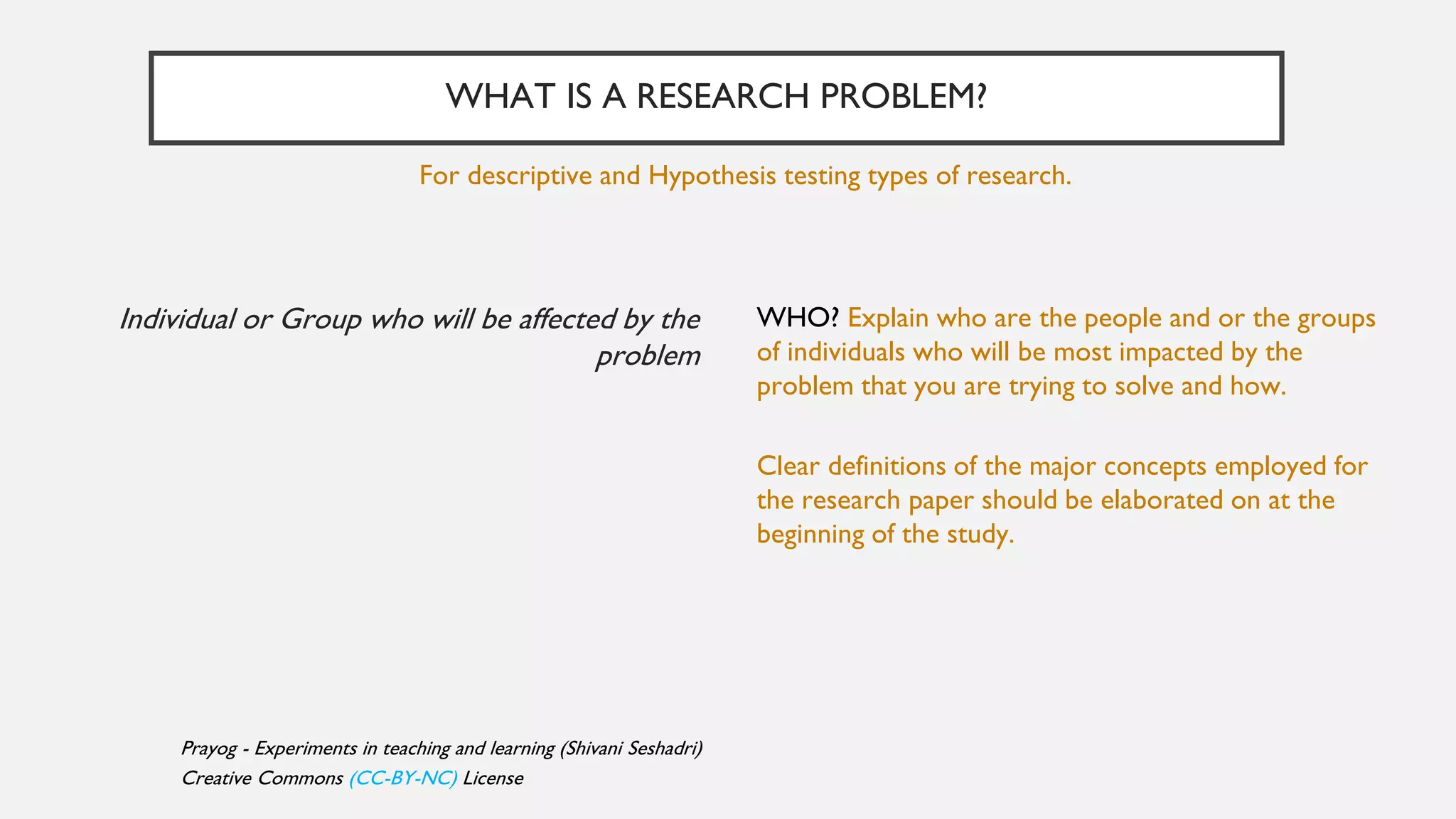
WHAT IS A RESEARCH PROBLEM?
Individual or Group who will be affected by the
problem
WHO? Explain who are the people and or the groups
of individuals who will be most impacted by the
problem that you are trying to solve and how.
Clear definitions of the major concepts employed for
the research paper should be elaborated on at the
beginning of the study.
For descriptive and Hypothesis testing types of research.
Prayog - Experiments in teaching and learning (Shivani Seshadri)
Creative Commons (CC-BY-NC) License
WHAT IS A RESEARCH PROBLEM?
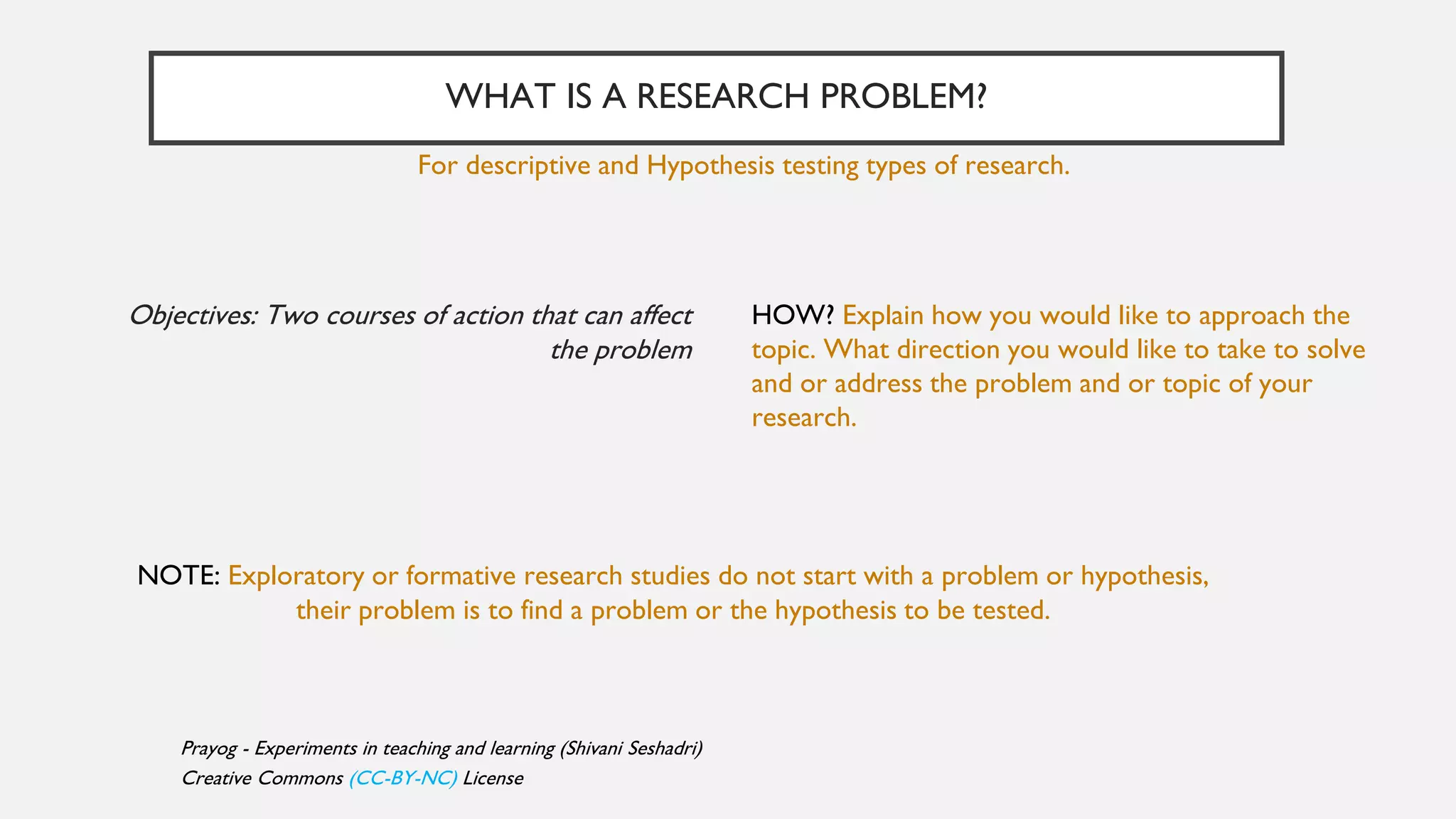
HOW? Explain how you would like to approach the
topic. What direction you would like to take to solve
and or address the problem and or topic of your
research.
Objectives: Two courses of action that can affect
the problem
For descriptive and Hypothesis testing types of research.
NOTE: Exploratory or formative research studies do not start with a problem or hypothesis,
their problem is to find a problem or the hypothesis to be tested.
Prayog - Experiments in teaching and learning (Shivani Seshadri)
Creative Commons (CC-BY-NC) License
WHAT IS A RESEARCH PROBLEM?
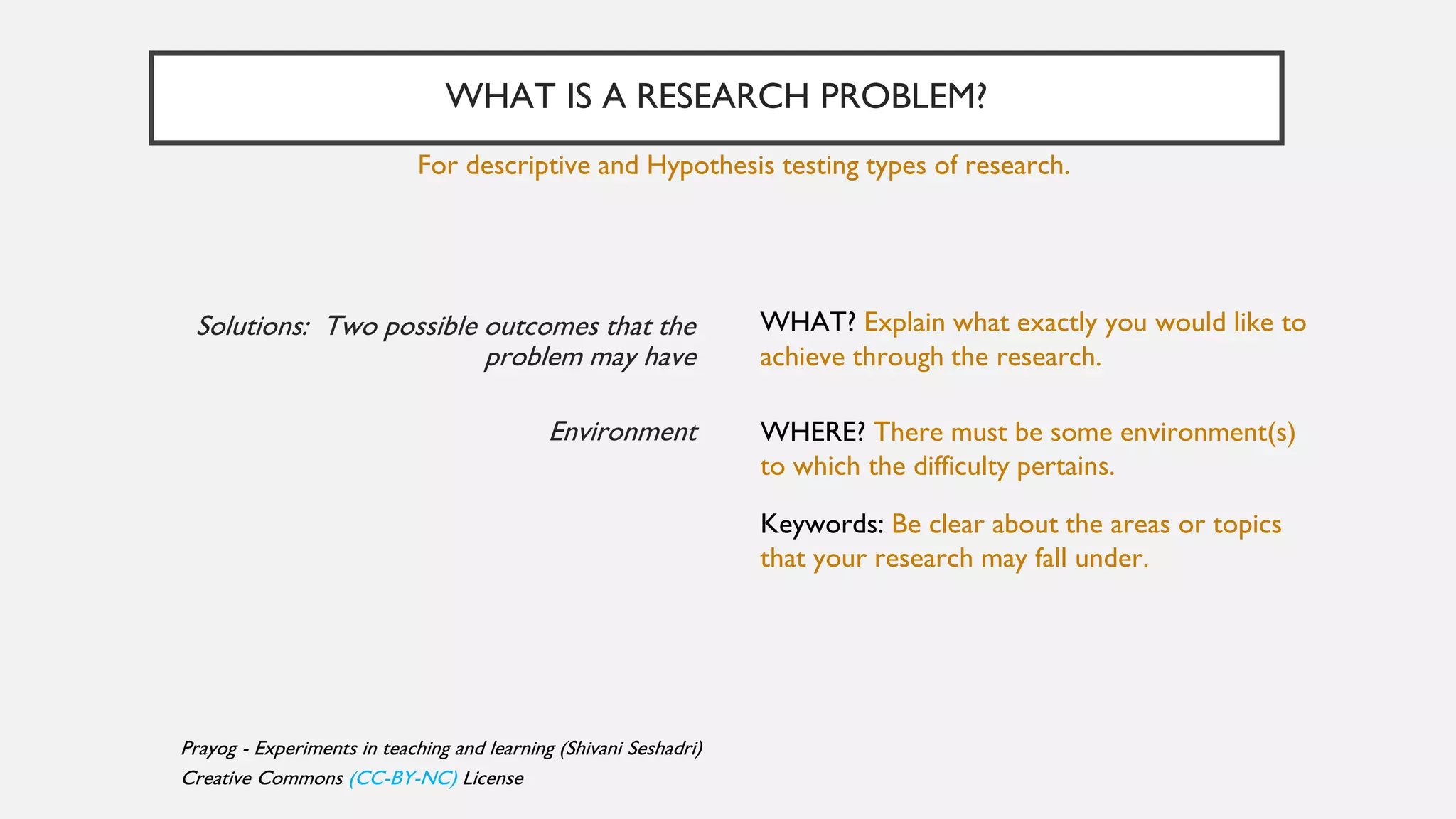
WHAT? Explain what exactly you would like to
achieve through the research.
Keywords: Be clear about the areas or topics
that your research may fall under.
Solutions: Two possible outcomes that the
problem may have
Environment
For descriptive and Hypothesis testing types of research.
WHERE? There must be some environment(s)
to which the difficulty pertains.
Prayog - Experiments in teaching and learning (Shivani Seshadri)
Creative Commons (CC-BY-NC) License
TYPES OF RESEARCH
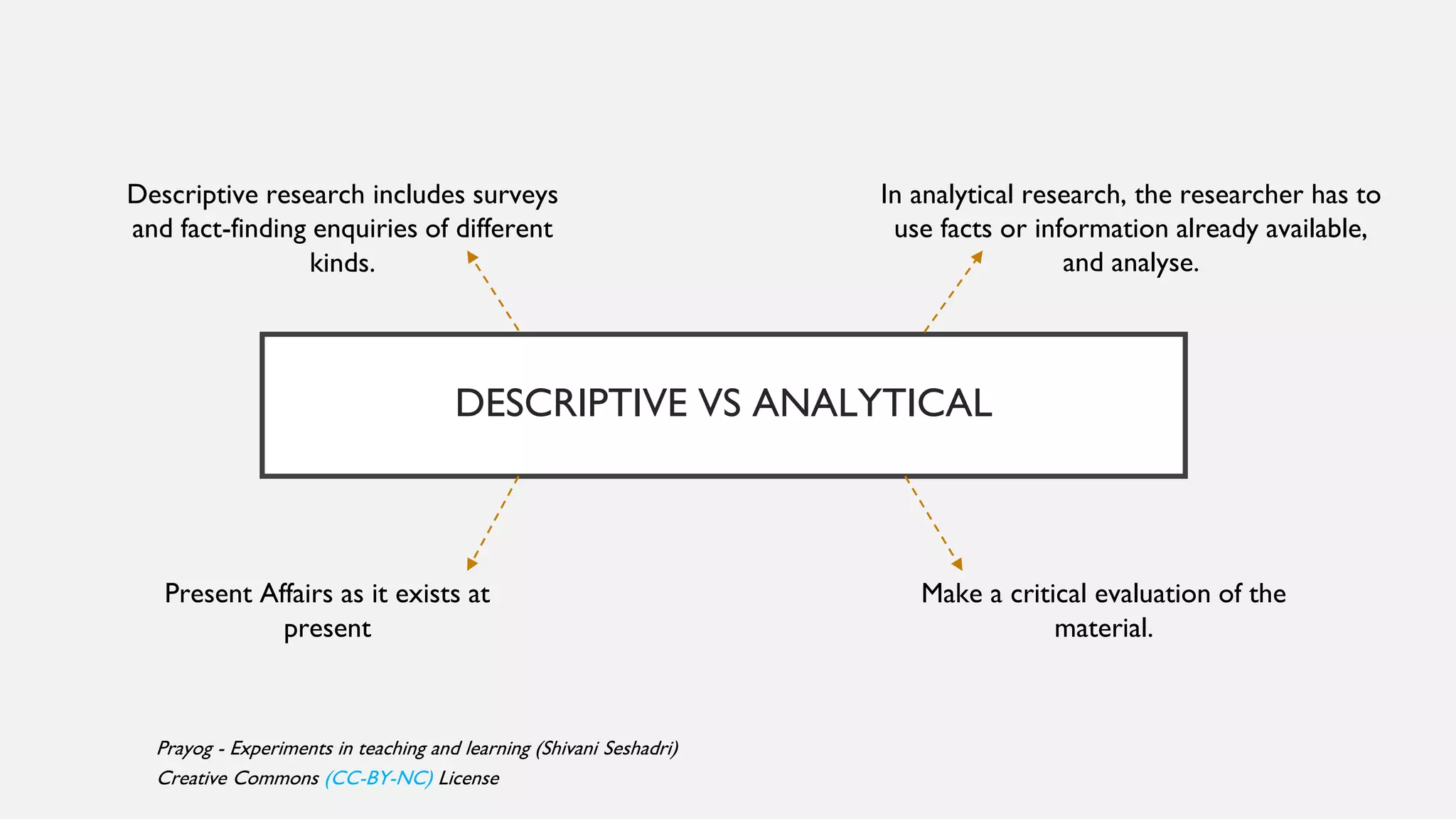
DESCRIPTIVE VS ANALYTICAL
Descriptive research includes surveys
and fact-finding enquiries of different
kinds.
Present Affairs as it exists at
present
In analytical research, the researcher has to
use facts or information already available,
and analyse.
Make a critical evaluation of the
material.
Prayog - Experiments in teaching and learning (Shivani Seshadri)
Creative Commons (CC-BY-NC) License
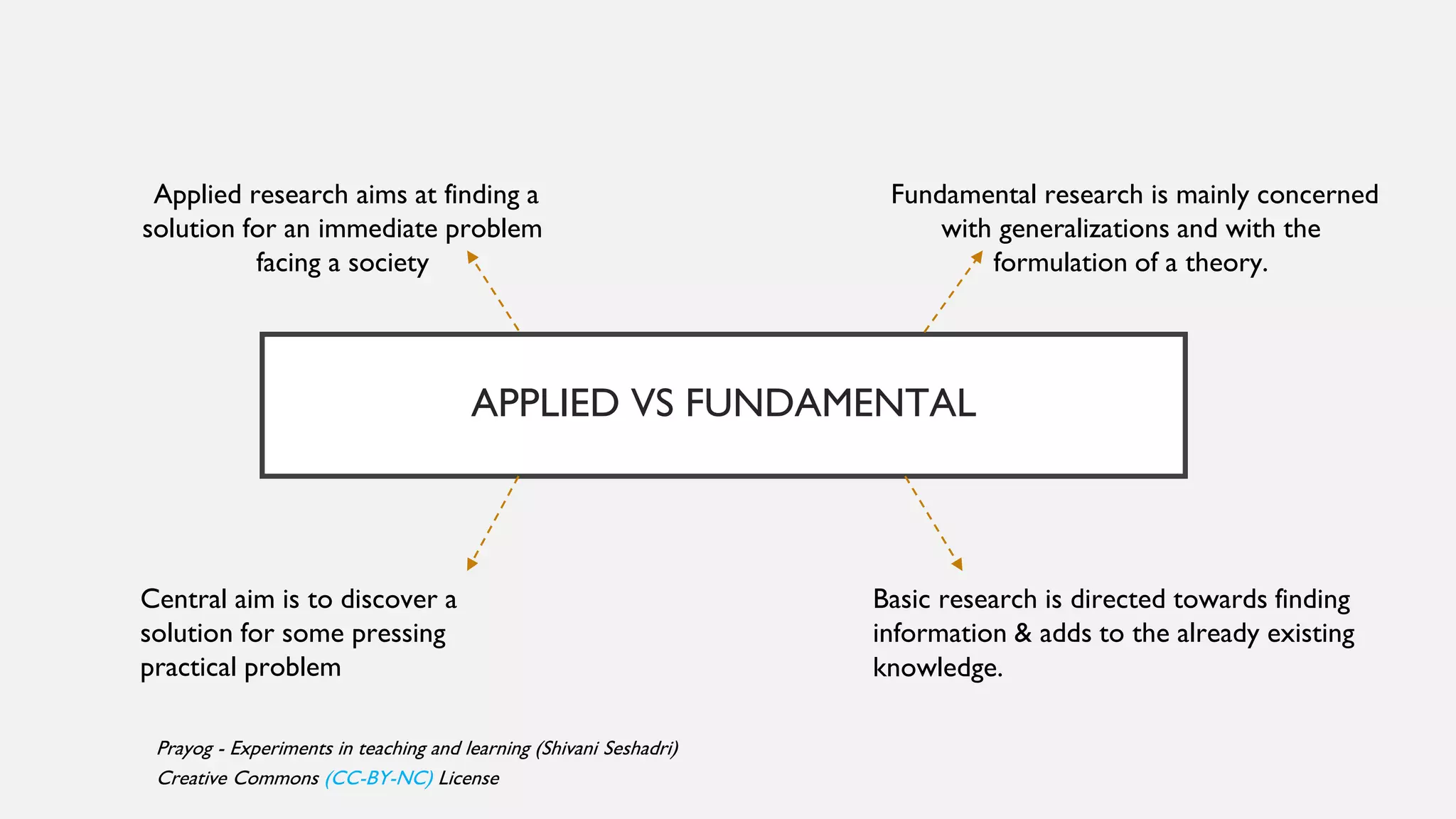
APPLIED VS FUNDAMENTAL
Applied research aims at finding a
solution for an immediate problem
facing a society
Fundamental research is mainly concerned
with generalizations and with the
formulation of a theory.
Central aim is to discover a
solution for some pressing
practical problem
Basic research is directed towards finding
information & adds to the already existing
knowledge.
Prayog - Experiments in teaching and learning (Shivani Seshadri)
Creative Commons (CC-BY-NC) License
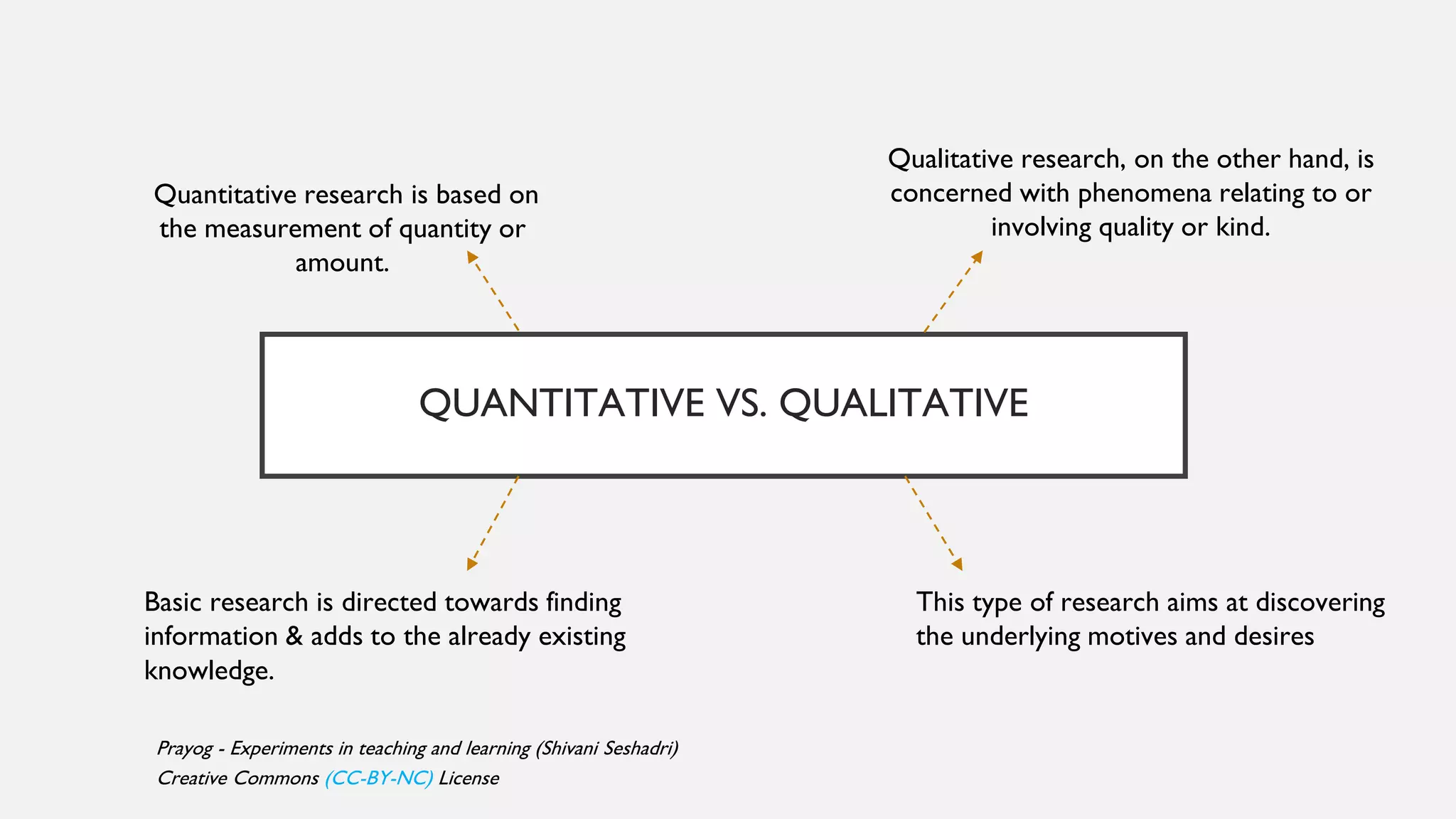
QUANTITATIVE VS. QUALITATIVE
Quantitative research is based on
the measurement of quantity or
amount.
Qualitative research, on the other hand, is
concerned with phenomena relating to or
involving quality or kind.
This type of research aims at discovering
the underlying motives and desires
Basic research is directed towards finding
information & adds to the already existing
knowledge.
Prayog - Experiments in teaching and learning (Shivani Seshadri)
Creative Commons (CC-BY-NC) License
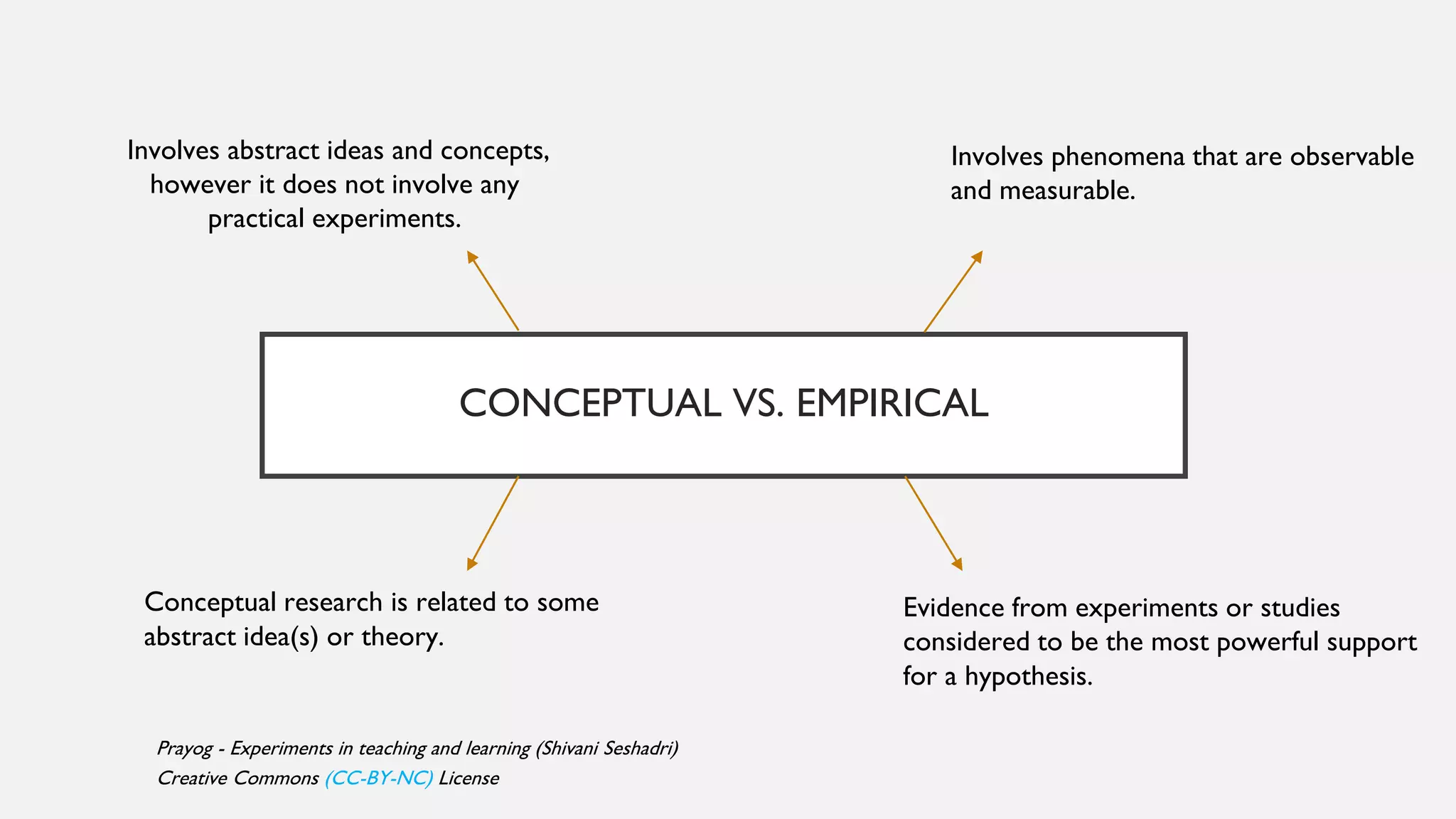
CONCEPTUAL VS. EMPIRICAL
Involves abstract ideas and concepts,
however it does not involve any
practical experiments.
Evidence from experiments or studies
considered to be the most powerful support
for a hypothesis.
Involves phenomena that are observable
and measurable.
Conceptual research is related to some
abstract idea(s) or theory.
Prayog - Experiments in teaching and learning (Shivani Seshadri)
Creative Commons (CC-BY-NC) License
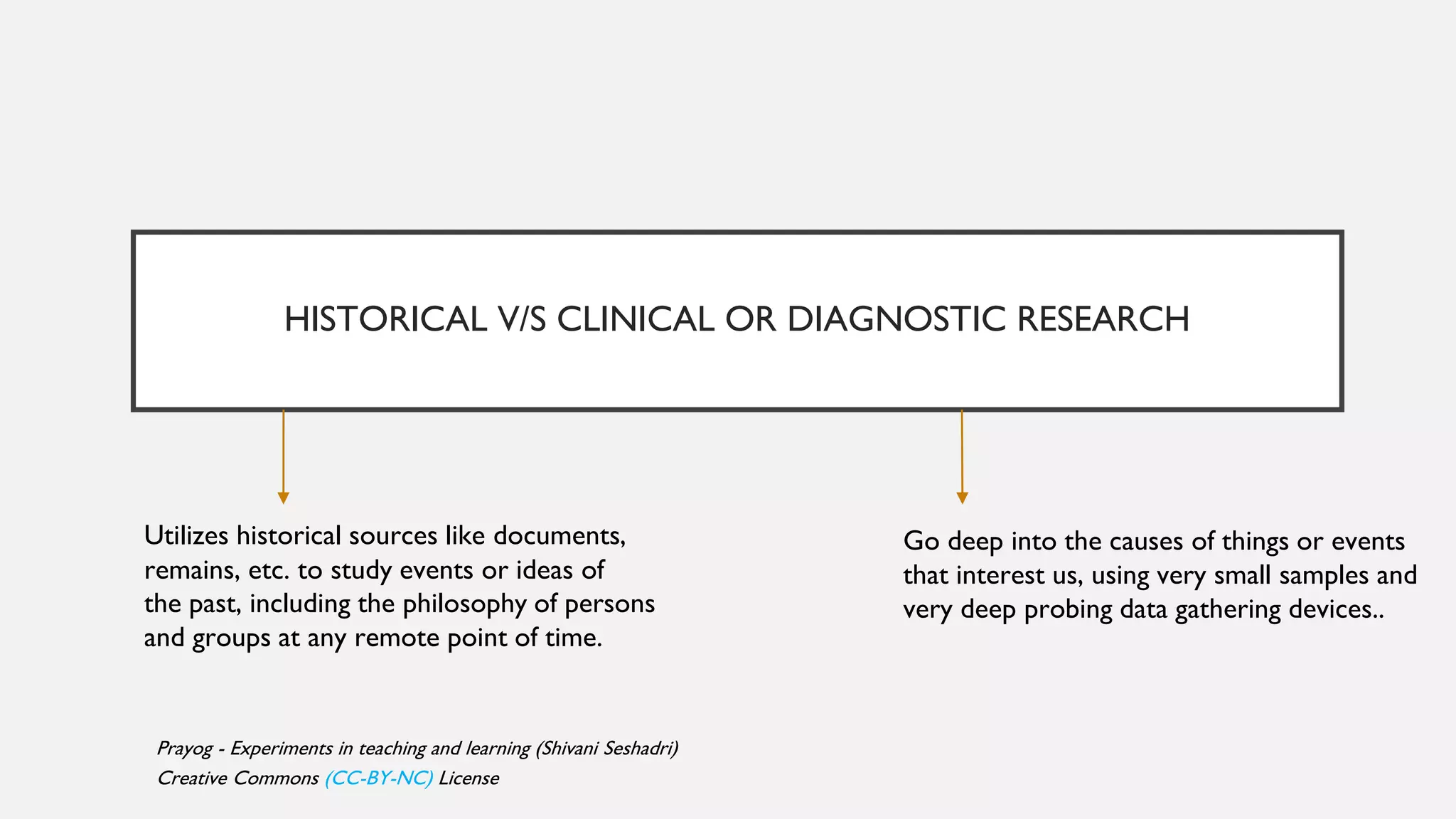
HISTORICAL V/S CLINICAL OR DIAGNOSTIC RESEARCH
Go deep into the causes of things or events
that interest us, using very small samples and
very deep probing data gathering devices..
Utilizes historical sources like documents,
remains, etc. to study events or ideas of
the past, including the philosophy of persons
and groups at any remote point of time.
Prayog - Experiments in teaching and learning (Shivani Seshadri)
Creative Commons (CC-BY-NC) License
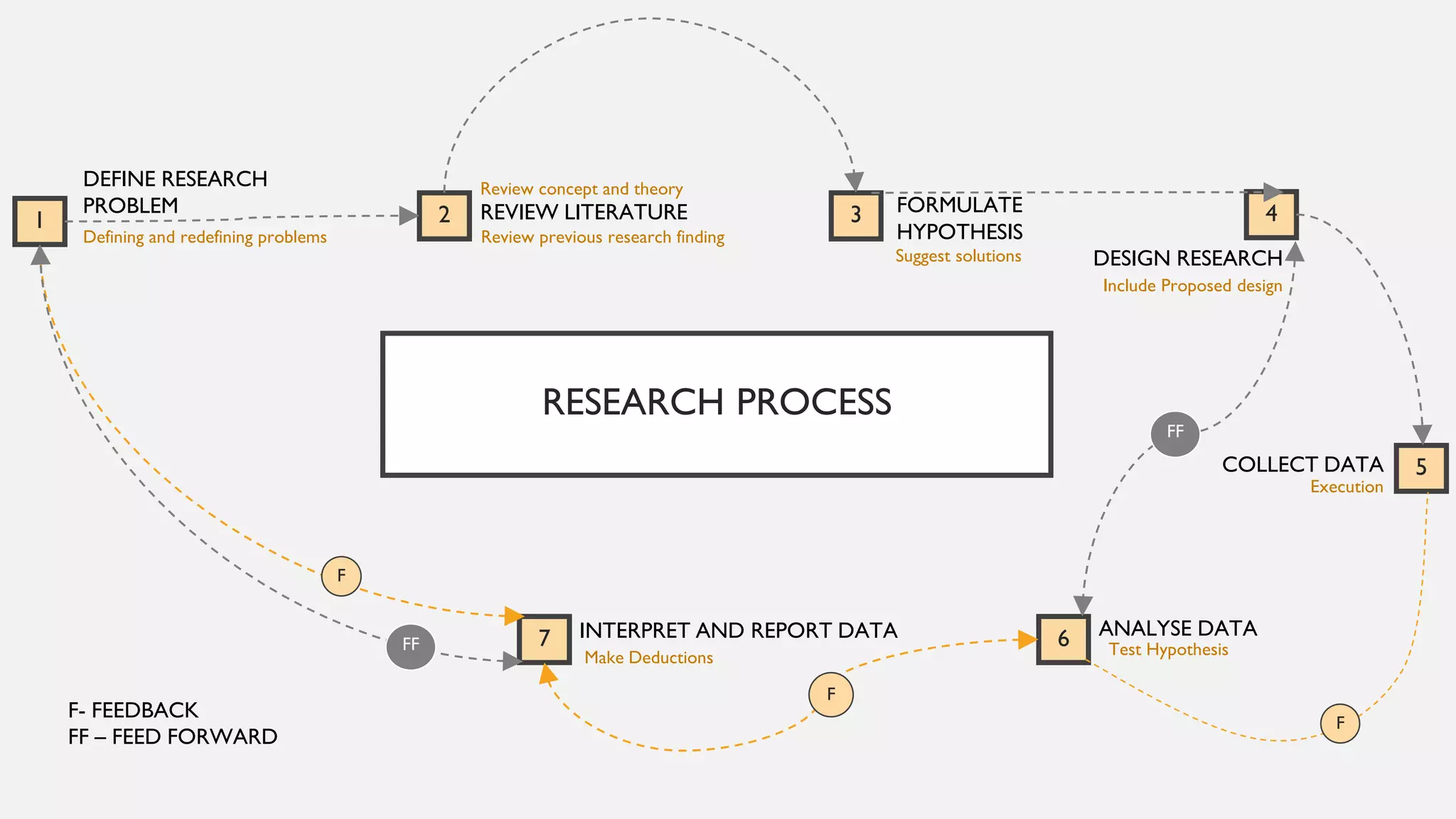
RESEARCH PROCESS
DEFINE RESEARCH
PROBLEM
COLLECT DATA
FORMULATE
HYPOTHESIS
ANALYSE DATA
DESIGN RESEARCH
Review concept and theory
1 2 REVIEW LITERATURE
Review previous research finding
3
INTERPRET AND REPORT DATA
4
5
6
F
Include Proposed design
Execution
Defining and redefining problems
Suggest solutions
7
F
F- FEEDBACK
FF – FEED FORWARD
F
Test HypothesisMake Deductions
FF
FF
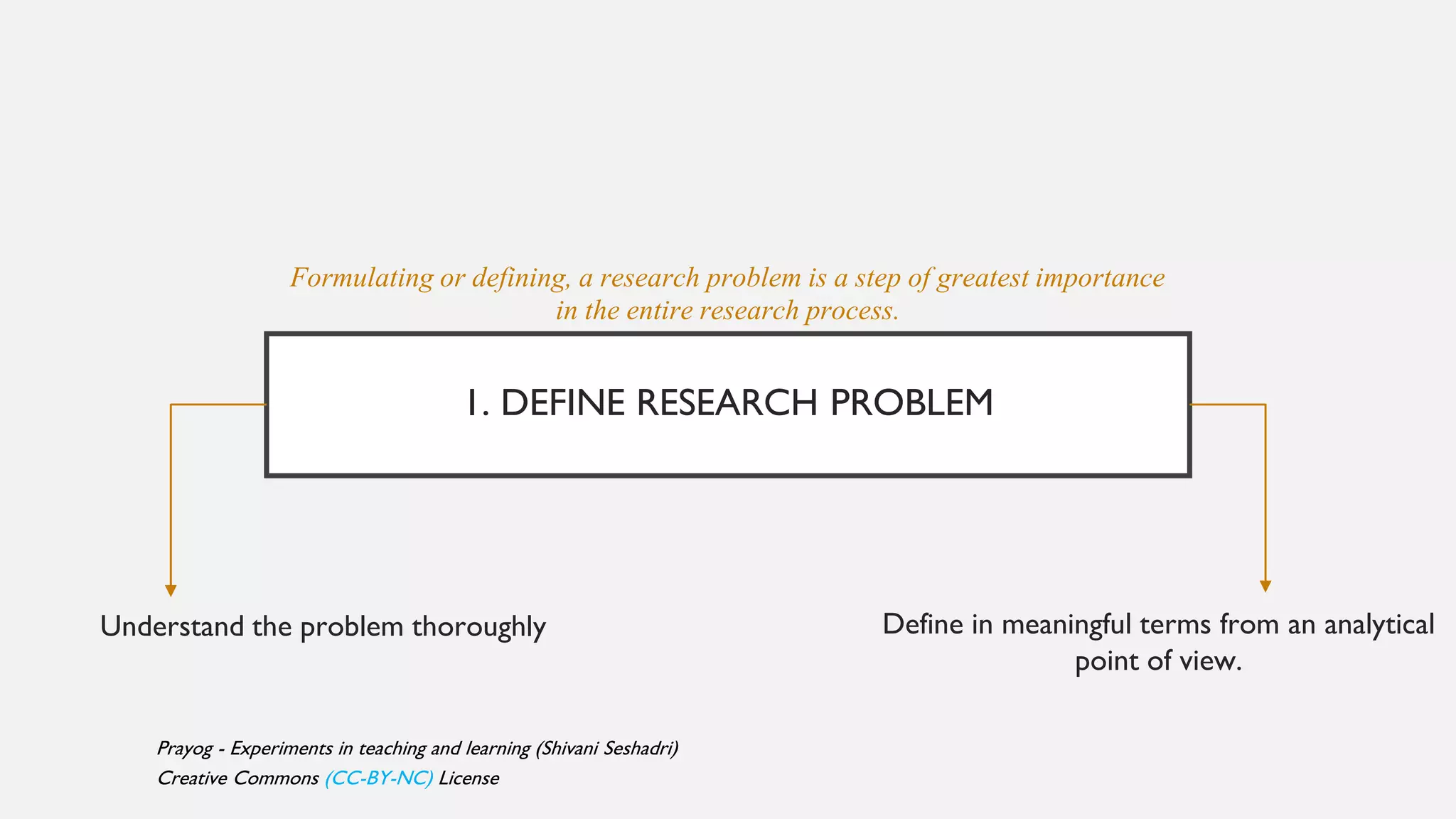
1. DEFINE RESEARCH PROBLEM
Understand the problem thoroughly
Formulating or defining, a research problem is a step of greatest importance
in the entire research process.
Define in meaningful terms from an analytical
point of view.
Prayog - Experiments in teaching and learning (Shivani Seshadri)
Creative Commons (CC-BY-NC) License
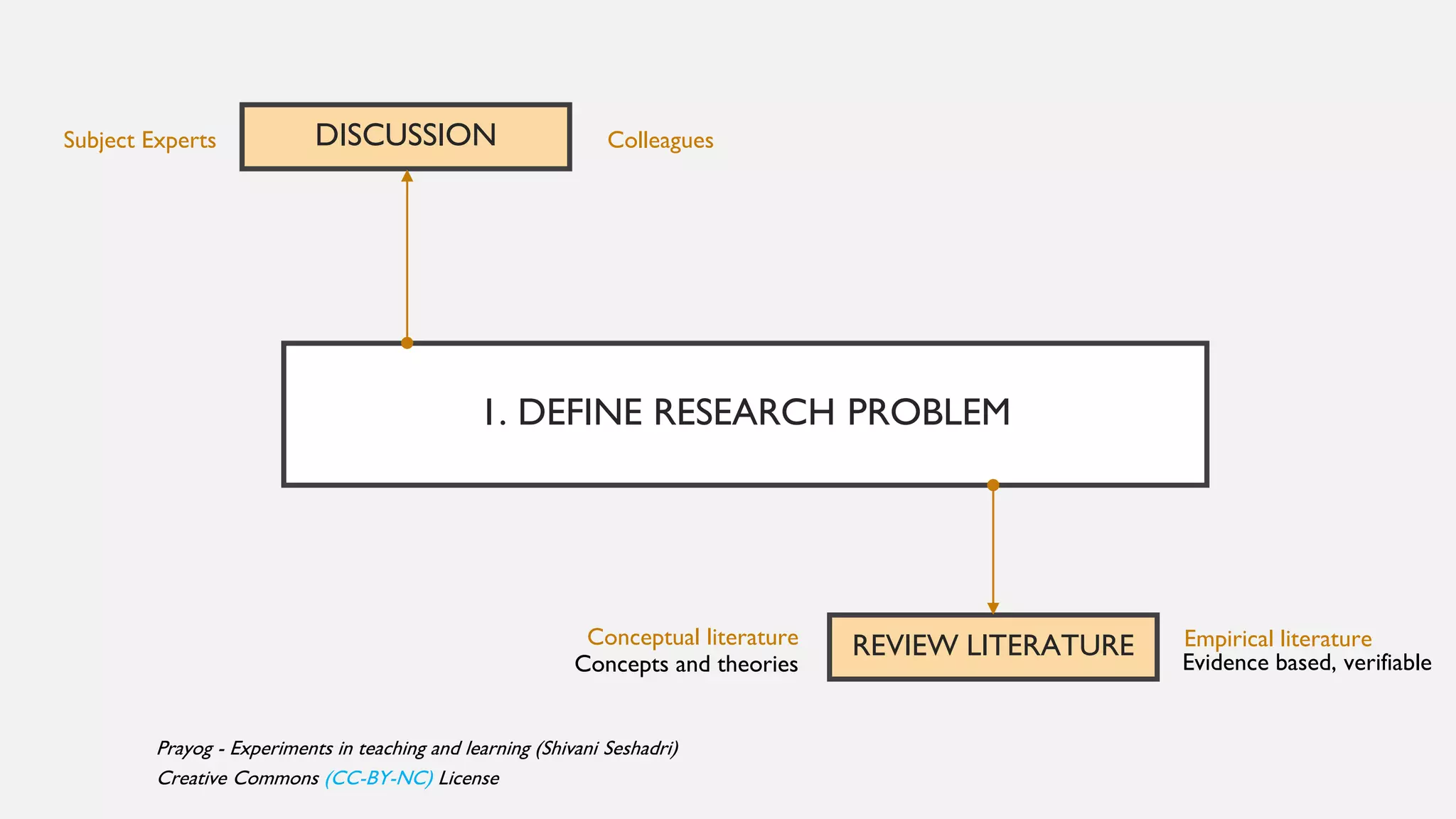
1. DEFINE RESEARCH PROBLEM
REVIEW LITERATUREConceptual literature
Concepts and theories
Empirical literature
Evidence based, verifiable
DISCUSSIONSubject Experts Colleagues
Prayog - Experiments in teaching and learning (Shivani Seshadri)
Creative Commons (CC-BY-NC) License
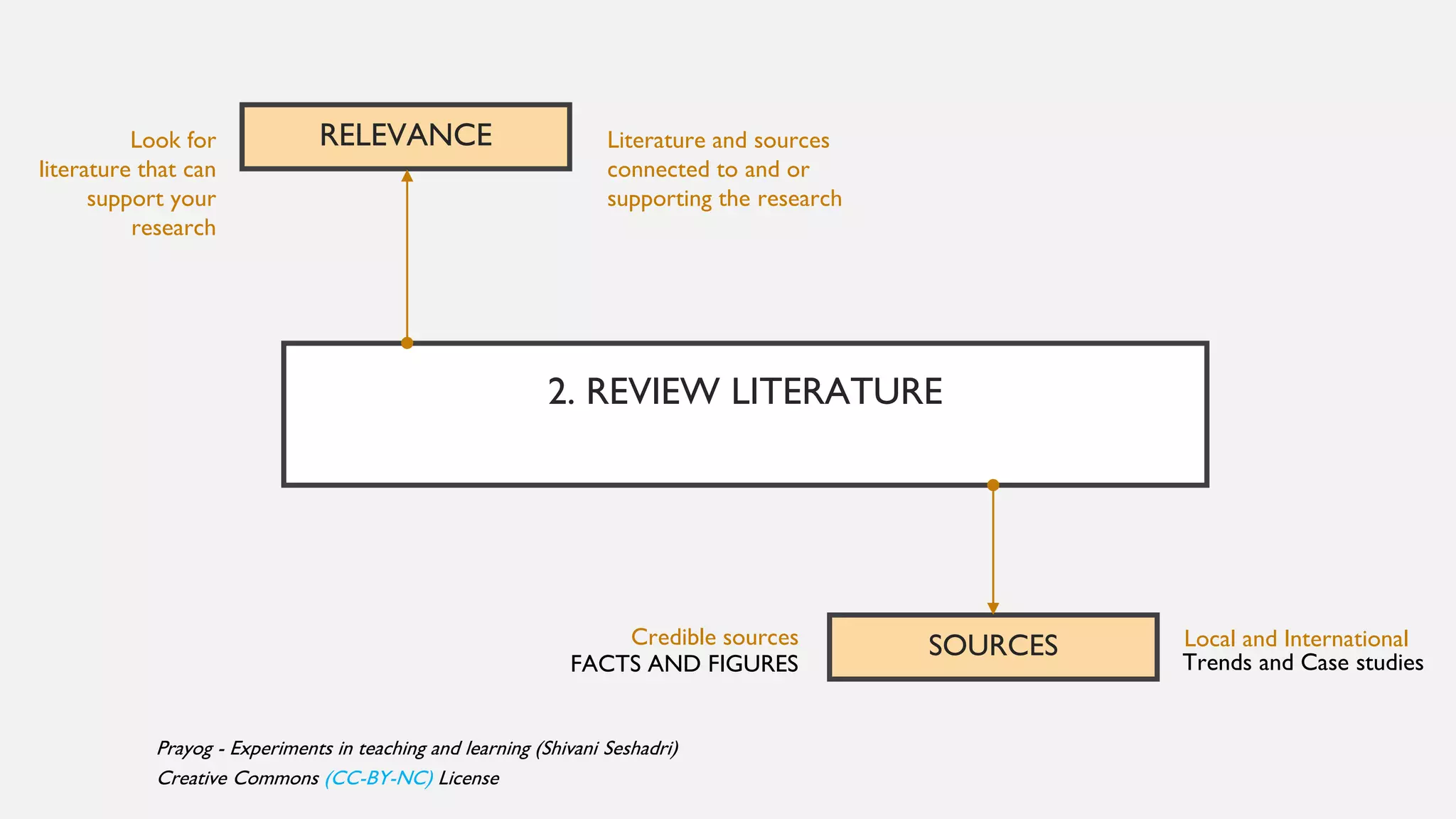
2. REVIEW LITERATURE
SOURCESCredible sources
FACTS AND FIGURES
Local and International
Trends and Case studies
RELEVANCELook for
literature that can
support your
research
Literature and sources
connected to and or
supporting the research
Prayog - Experiments in teaching and learning (Shivani Seshadri)
Creative Commons (CC-BY-NC) License
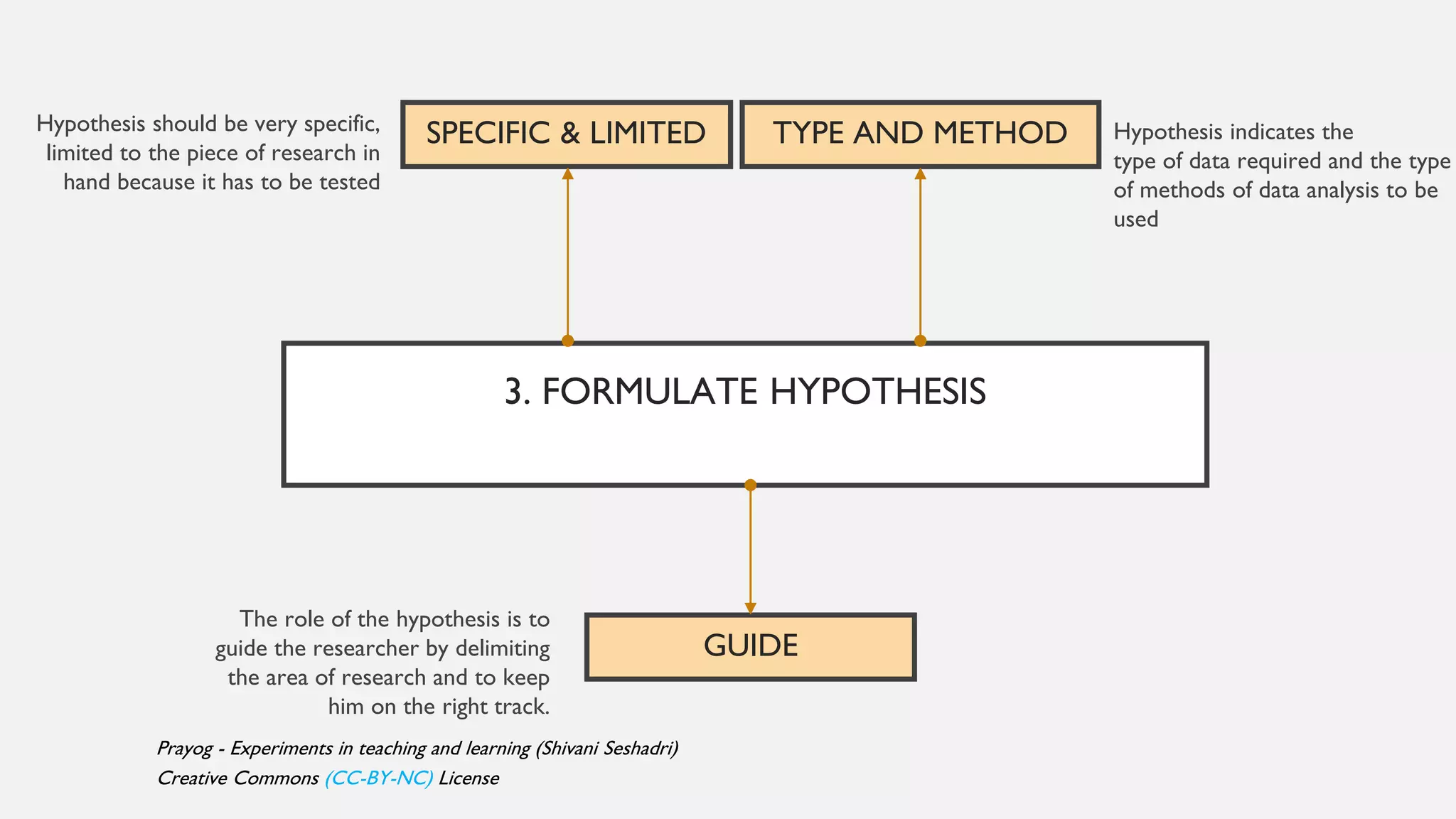
3. FORMULATE HYPOTHESIS
GUIDE
SPECIFIC & LIMITED
The role of the hypothesis is to
guide the researcher by delimiting
the area of research and to keep
him on the right track.
Hypothesis indicates the
type of data required and the type
of methods of data analysis to be
used
Hypothesis should be very specific,
limited to the piece of research in
hand because it has to be tested
TYPE AND METHOD
Prayog - Experiments in teaching and learning (Shivani Seshadri)
Creative Commons (CC-BY-NC) License
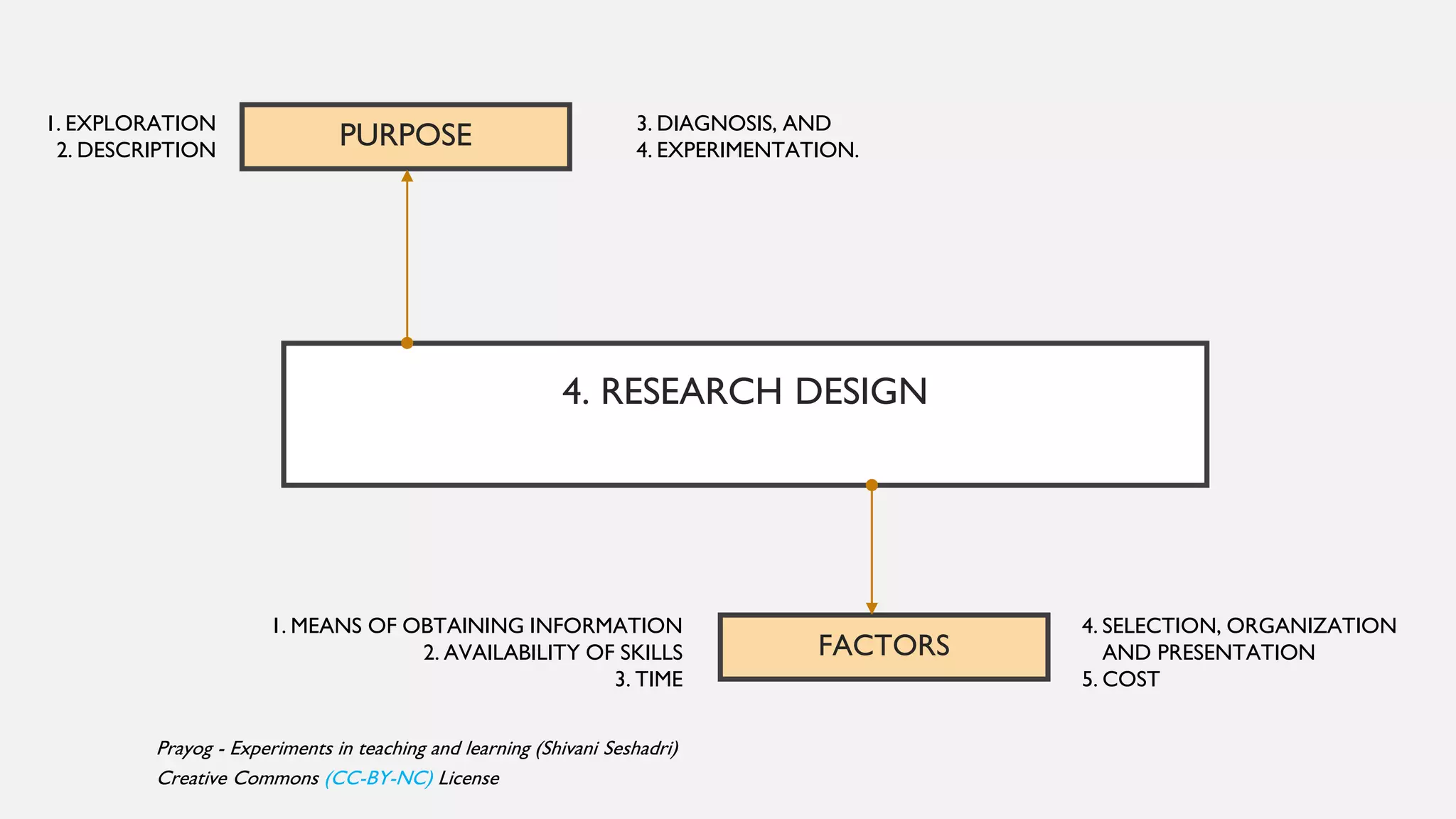
4. RESEARCH DESIGN
FACTORS
1. MEANS OF OBTAINING INFORMATION
2. AVAILABILITY OF SKILLS
3. TIME
4. SELECTION, ORGANIZATION
AND PRESENTATION
5. COST
PURPOSE1. EXPLORATION
2. DESCRIPTION
3. DIAGNOSIS, AND
4. EXPERIMENTATION.
Prayog - Experiments in teaching and learning (Shivani Seshadri)
Creative Commons (CC-BY-NC) License
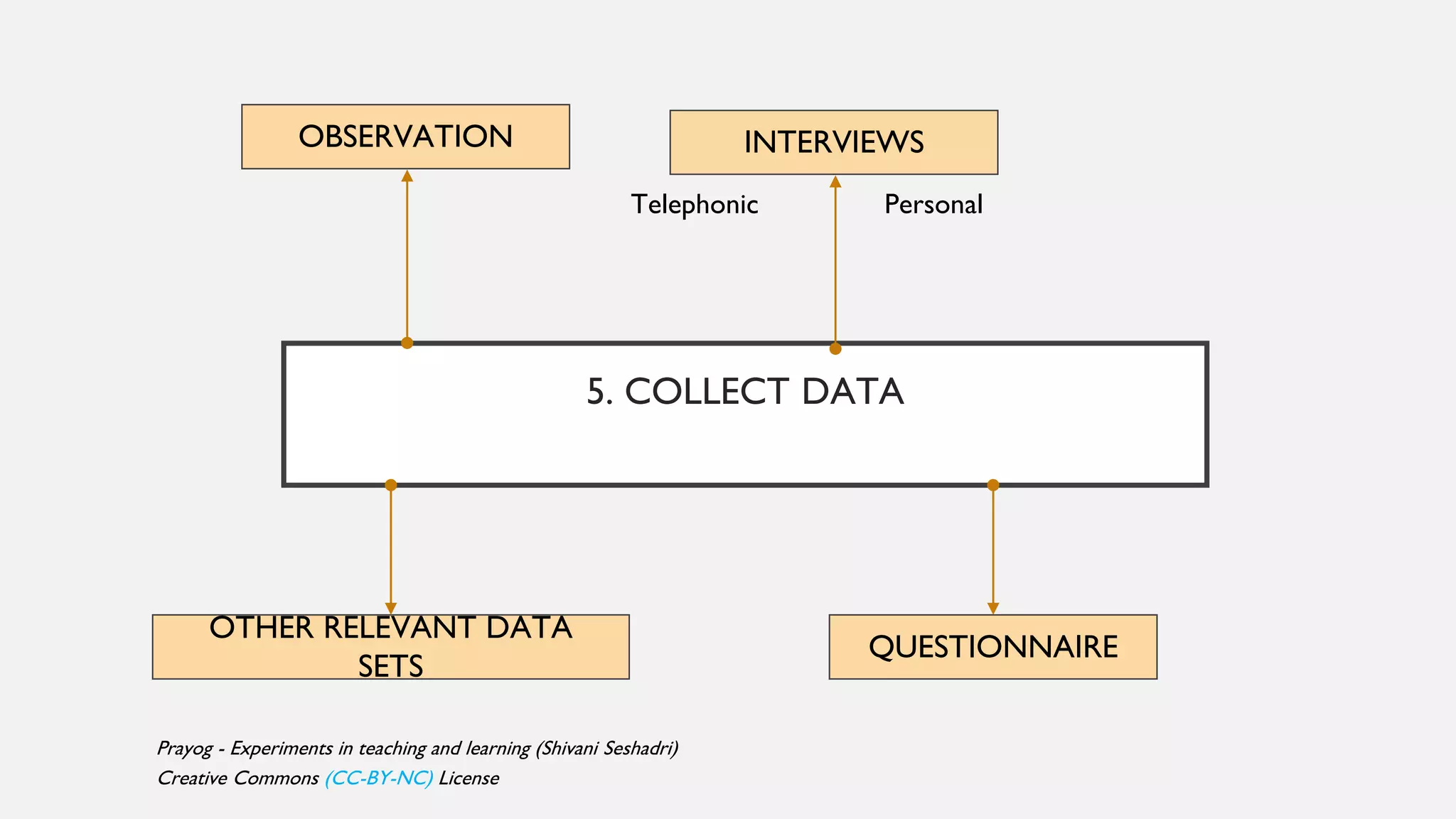
5. COLLECT DATA
QUESTIONNAIRE
OBSERVATION
Telephonic
INTERVIEWS
Personal
OTHER RELEVANT DATA
SETS
Prayog - Experiments in teaching and learning (Shivani Seshadri)
Creative Commons (CC-BY-NC) License
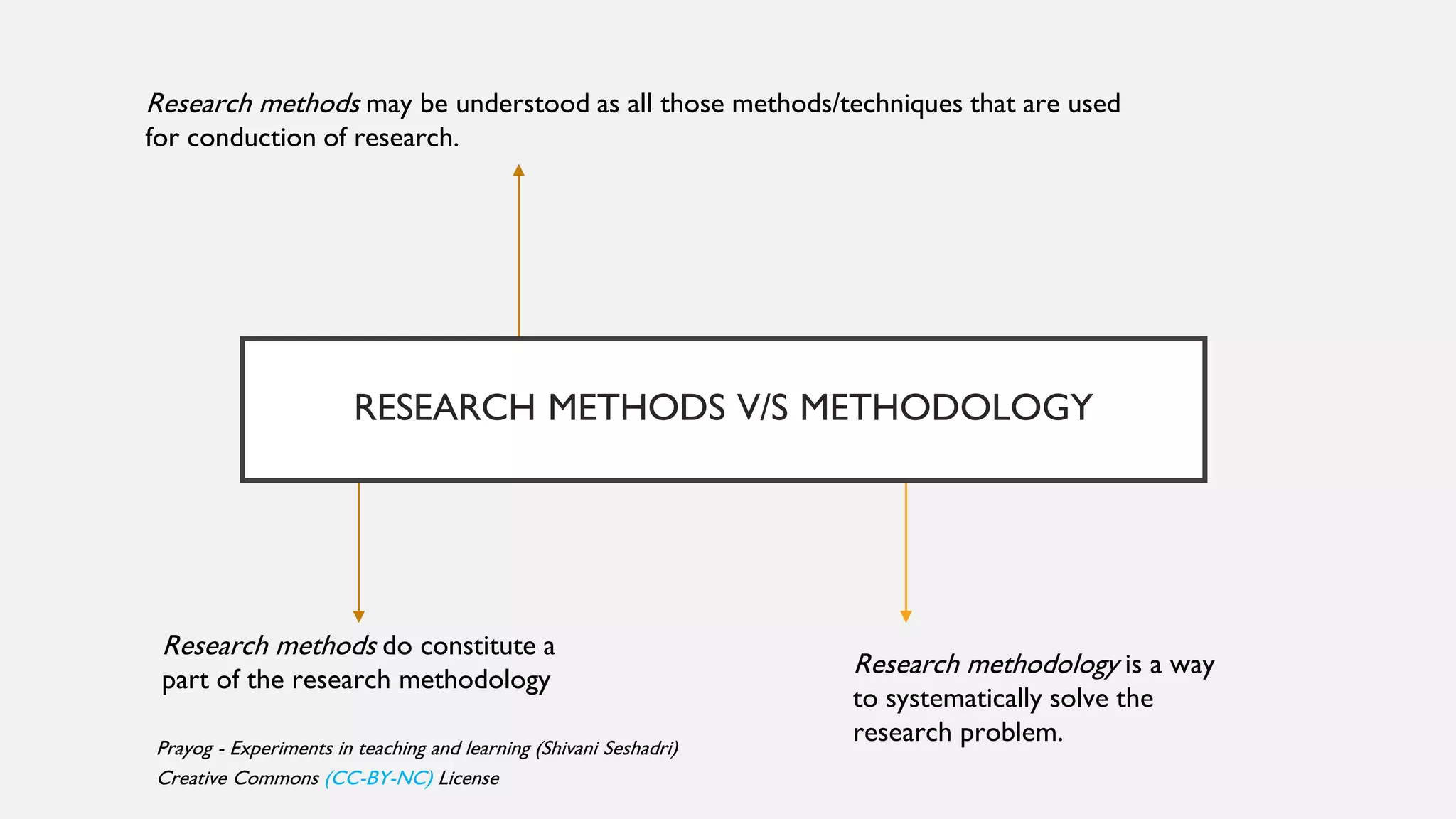
RESEARCH METHODS V/S METHODOLOGY
Research methodology is a way
to systematically solve the
research problem.
Research methods may be understood as all those methods/techniques that are used
for conduction of research.
Research methods do constitute a
part of the research methodology
Prayog - Experiments in teaching and learning (Shivani Seshadri)
Creative Commons (CC-BY-NC) License
CLASS I1 ENDS
TOPICS COVERED: WHAT IS THE RESEARCH
PROCESS? TYPES OF RESEARCH, FRAMING A
RESEARCH PROBLEM, THINKING DIFFERENTLY.

Research methodology Presentation

  • 1.
    RESEARCH METHODOLOGY II SEMESTER,MASTERS IN DIGITAL ARCHITECTURE, IMPACT SCHOOL OF ARCHITECTURE AR. SHIVANI SESHADRI
  • 2.
    WHAT IS RESEARCH? “originalcontribution” “study, observe, compare and experiment” “the pursuit of truth” “A process to: Define/Redefine Problems & Formulate Hypothesis Collect, Organize, Evaluate & Reach Conclusions Test Conclusions & Recheck Hypothesis” “effort to gain new knowledge” “scientific and systematic search for information on a topic” Prayog - Experiments in teaching and learning (Shivani Seshadri) Creative Commons (CC-BY-NC) License
  • 3.
    WHICH OF THESEWOULD DEFINE YOUR APPROACH TO RESEARCH? “original contribution” “study, observe, compare and experiment” “the pursuit of truth” “ Process to: Define/Redefine Problems & Formulate Hypothesis • Collect, Organize, Evaluate & Reach Conclusions • Test Conclusions & Recheck Hypothesis” “effort to gain new knowledge” “scientific and systematic search for information on a topic” ASTRONOMER ARCHEOLOGIST SCIENTIST PHILOSOPHER BIOLOGIST SURGEON Desire to be of service to society; Desire to get intellectual joy of doing some creative work; Desire to face the challenge in solving the unsolved problems, i.e., concern over practical problems initiates research; Desire to get respectability. Prayog - Experiments in teaching and learning (Shivani Seshadri) Creative Commons (CC-BY-NC) License
  • 4.
    CHOOSE YOUR TOPIC– KNOW YOURSELF Exploring past allied subject problems and topics that interested you. What are your values as an architect, things that you will do whatever design problem you are faced with? Which digital architect or designer inspires? Which digital designer do you like to follow and aspire to be like? What current topics are being addressed around us? What real life problems would you like to solve? Exploring past digital design topics or problems and understanding which ones you liked the best, problem and or design proposal. What interests you? What type of an architect or designer do you want to be? How would you like to approach the current socio-environmental problem through a design intervention? Small or big, small as addressing accessibility in public spaces for the elderly or as big as climate change. What interests you? What type of an architect or designer do you want to be? Look around you, what issues are design conferences addressing and what topics are being explored in the field of digital architecture.
  • 5.
    WHY AND HOWRESEARCH? To gain familiarity with a phenomenon or to achieve new insights into it. Exploratory or formative research Descriptive research Diagnostic research Hypothesis-testing To portray accurately the characteristics of a particular individual, situation or a group. To determine the frequency with which something occurs or with which it is associated with something else. To test a hypothesis of a causal relationship between variables.
  • 6.
    CLASS 1 ENDS TOPICSCOVERED: WHAT IS RESEARCH? MOTIVATION AND OBJECTIVES OF RESEARCH, IDENTIFYING YOUR RESEARCHER PERSONA.
  • 7.
    DEVELOPING A RESEARCHTOPIC Arrive at a few research topics, get feedback from peers and develop a viewpoint that is more informed. Prayog - Experiments in teaching and learning (Shivani Seshadri) Creative Commons (CC-BY-NC) License
  • 8.
    WHAT IS ARESEARCH PROBLEM? Individual or Group who will be affected by the problem WHO? Explain who are the people and or the groups of individuals who will be most impacted by the problem that you are trying to solve and how. Clear definitions of the major concepts employed for the research paper should be elaborated on at the beginning of the study. For descriptive and Hypothesis testing types of research. Prayog - Experiments in teaching and learning (Shivani Seshadri) Creative Commons (CC-BY-NC) License
  • 9.
    WHAT IS ARESEARCH PROBLEM? HOW? Explain how you would like to approach the topic. What direction you would like to take to solve and or address the problem and or topic of your research. Objectives: Two courses of action that can affect the problem For descriptive and Hypothesis testing types of research. NOTE: Exploratory or formative research studies do not start with a problem or hypothesis, their problem is to find a problem or the hypothesis to be tested. Prayog - Experiments in teaching and learning (Shivani Seshadri) Creative Commons (CC-BY-NC) License
  • 10.
    WHAT IS ARESEARCH PROBLEM? WHAT? Explain what exactly you would like to achieve through the research. Keywords: Be clear about the areas or topics that your research may fall under. Solutions: Two possible outcomes that the problem may have Environment For descriptive and Hypothesis testing types of research. WHERE? There must be some environment(s) to which the difficulty pertains. Prayog - Experiments in teaching and learning (Shivani Seshadri) Creative Commons (CC-BY-NC) License
  • 11.
  • 12.
    DESCRIPTIVE VS ANALYTICAL Descriptiveresearch includes surveys and fact-finding enquiries of different kinds. Present Affairs as it exists at present In analytical research, the researcher has to use facts or information already available, and analyse. Make a critical evaluation of the material. Prayog - Experiments in teaching and learning (Shivani Seshadri) Creative Commons (CC-BY-NC) License
  • 13.
    APPLIED VS FUNDAMENTAL Appliedresearch aims at finding a solution for an immediate problem facing a society Fundamental research is mainly concerned with generalizations and with the formulation of a theory. Central aim is to discover a solution for some pressing practical problem Basic research is directed towards finding information & adds to the already existing knowledge. Prayog - Experiments in teaching and learning (Shivani Seshadri) Creative Commons (CC-BY-NC) License
  • 14.
    QUANTITATIVE VS. QUALITATIVE Quantitativeresearch is based on the measurement of quantity or amount. Qualitative research, on the other hand, is concerned with phenomena relating to or involving quality or kind. This type of research aims at discovering the underlying motives and desires Basic research is directed towards finding information & adds to the already existing knowledge. Prayog - Experiments in teaching and learning (Shivani Seshadri) Creative Commons (CC-BY-NC) License
  • 15.
    CONCEPTUAL VS. EMPIRICAL Involvesabstract ideas and concepts, however it does not involve any practical experiments. Evidence from experiments or studies considered to be the most powerful support for a hypothesis. Involves phenomena that are observable and measurable. Conceptual research is related to some abstract idea(s) or theory. Prayog - Experiments in teaching and learning (Shivani Seshadri) Creative Commons (CC-BY-NC) License
  • 16.
    HISTORICAL V/S CLINICALOR DIAGNOSTIC RESEARCH Go deep into the causes of things or events that interest us, using very small samples and very deep probing data gathering devices.. Utilizes historical sources like documents, remains, etc. to study events or ideas of the past, including the philosophy of persons and groups at any remote point of time. Prayog - Experiments in teaching and learning (Shivani Seshadri) Creative Commons (CC-BY-NC) License
  • 17.
    RESEARCH PROCESS DEFINE RESEARCH PROBLEM COLLECTDATA FORMULATE HYPOTHESIS ANALYSE DATA DESIGN RESEARCH Review concept and theory 1 2 REVIEW LITERATURE Review previous research finding 3 INTERPRET AND REPORT DATA 4 5 6 F Include Proposed design Execution Defining and redefining problems Suggest solutions 7 F F- FEEDBACK FF – FEED FORWARD F Test HypothesisMake Deductions FF FF
  • 18.
    1. DEFINE RESEARCHPROBLEM Understand the problem thoroughly Formulating or defining, a research problem is a step of greatest importance in the entire research process. Define in meaningful terms from an analytical point of view. Prayog - Experiments in teaching and learning (Shivani Seshadri) Creative Commons (CC-BY-NC) License
  • 19.
    1. DEFINE RESEARCHPROBLEM REVIEW LITERATUREConceptual literature Concepts and theories Empirical literature Evidence based, verifiable DISCUSSIONSubject Experts Colleagues Prayog - Experiments in teaching and learning (Shivani Seshadri) Creative Commons (CC-BY-NC) License
  • 20.
    2. REVIEW LITERATURE SOURCESCrediblesources FACTS AND FIGURES Local and International Trends and Case studies RELEVANCELook for literature that can support your research Literature and sources connected to and or supporting the research Prayog - Experiments in teaching and learning (Shivani Seshadri) Creative Commons (CC-BY-NC) License
  • 21.
    3. FORMULATE HYPOTHESIS GUIDE SPECIFIC& LIMITED The role of the hypothesis is to guide the researcher by delimiting the area of research and to keep him on the right track. Hypothesis indicates the type of data required and the type of methods of data analysis to be used Hypothesis should be very specific, limited to the piece of research in hand because it has to be tested TYPE AND METHOD Prayog - Experiments in teaching and learning (Shivani Seshadri) Creative Commons (CC-BY-NC) License
  • 22.
    4. RESEARCH DESIGN FACTORS 1.MEANS OF OBTAINING INFORMATION 2. AVAILABILITY OF SKILLS 3. TIME 4. SELECTION, ORGANIZATION AND PRESENTATION 5. COST PURPOSE1. EXPLORATION 2. DESCRIPTION 3. DIAGNOSIS, AND 4. EXPERIMENTATION. Prayog - Experiments in teaching and learning (Shivani Seshadri) Creative Commons (CC-BY-NC) License
  • 23.
    5. COLLECT DATA QUESTIONNAIRE OBSERVATION Telephonic INTERVIEWS Personal OTHERRELEVANT DATA SETS Prayog - Experiments in teaching and learning (Shivani Seshadri) Creative Commons (CC-BY-NC) License
  • 24.
    RESEARCH METHODS V/SMETHODOLOGY Research methodology is a way to systematically solve the research problem. Research methods may be understood as all those methods/techniques that are used for conduction of research. Research methods do constitute a part of the research methodology Prayog - Experiments in teaching and learning (Shivani Seshadri) Creative Commons (CC-BY-NC) License
  • 25.
    CLASS I1 ENDS TOPICSCOVERED: WHAT IS THE RESEARCH PROCESS? TYPES OF RESEARCH, FRAMING A RESEARCH PROBLEM, THINKING DIFFERENTLY.