Research Methodology
• Classification # 1
• Exploratory
• Descriptive
• Causal/ Hypothesis Testing
• Classification # 2
• Basic
• Applied
• Classification # 3
• Qualitative
• Quantitative
Types of Research
Exploratory Research
• Exploratory research is conducted where the
problem is not clearly defined
• Market share is decreasing ???
Descriptive Research
• Descriptive research describes a single event
or characteristic or relates a few events or
variables through statistical analysis
• Bank officer describing the profile of
defaulters ???
Causal/ Hypothesis Testing Research
• Research is conducted to test the hypotheses
• Impact of motivation on job performance ???
6
Basic Research
• Basic Research aims to expand the frontiers of science and
knowledge by verifying or disproving the acceptability of a
given theory or attempting to discover more about a certain
concept (non-specificity)
 Mostly performed by academics
Example: How does motivation affect employee performance?
Applied Research
Applied Research focuses on a real-life problem or situation with
a view to helping reach a decision how to deal with it
(Specificity)
• Applied research is designed to solve practical problems of
the modern world, rather than to acquire knowledge for
knowledge's sake. One might say that the goal of the applied
scientist is to improve the human condition .
Example: Should a corporation adopt a paperless office
environment?
Qualitative and Quantitative Approaches
Quantitative Qualitative
Objective Subjective
Research questions: How many?
When? Where? Strength of
association?
Research questions: What? Why?
How
"Hard" science "Soft" science
Literature review must be done early
in study
Literature review may be done as
study progresses or afterwards
Test theory Develops theory
One reality: focus is concise and
narrow
Multiple realities: focus is complex and
broad
Facts are value-free and unbiased Facts are value-laden and biased
Reduction, control, precision Discovery, description, understanding,
shared interpretation
Measurable Interpretive
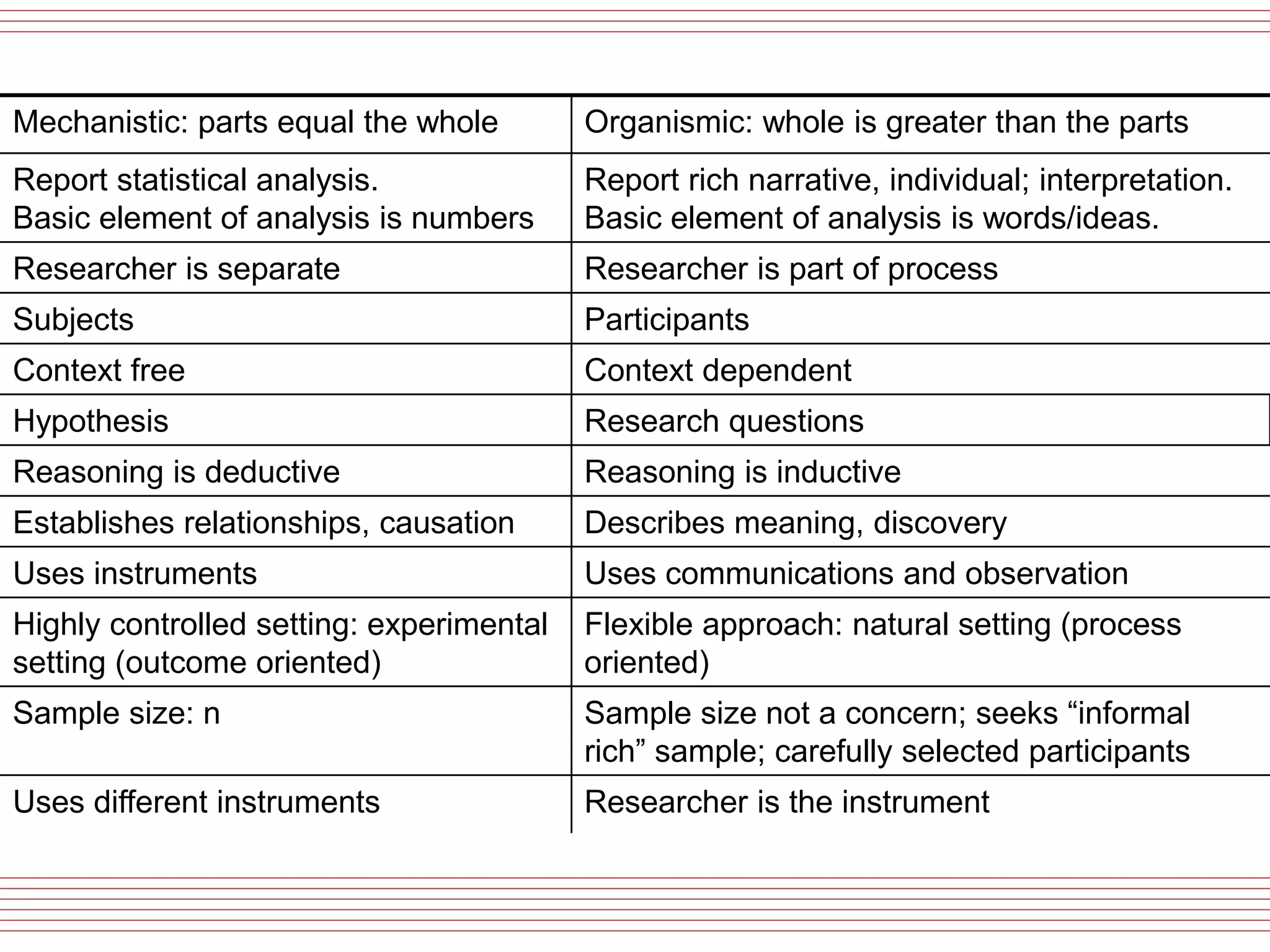
Mechanistic: parts equal the whole Organismic: whole is greater than the parts
Report statistical analysis.
Basic element of analysis is numbers
Report rich narrative, individual; interpretation.
Basic element of analysis is words/ideas.
Researcher is separate Researcher is part of process
Subjects Participants
Context free Context dependent
Hypothesis Research questions
Reasoning is deductive Reasoning is inductive
Establishes relationships, causation Describes meaning, discovery
Uses instruments Uses communications and observation
Highly controlled setting: experimental
setting (outcome oriented)
Flexible approach: natural setting (process
oriented)
Sample size: n Sample size not a concern; seeks “informal
rich” sample; carefully selected participants
Uses different instruments Researcher is the instrument
Phases of Research
1. Idea-generating phase
2. Problem-definition phase
3. Procedures-design phase
4. Observation phase
5. Data-analysis phase
6. Interpretation phase
7. Communication phase
Generating research ideas
Useful Techniques
Rational thinking Creative thinking
Searching the literature Scanning the media
Brainstorming Relevance Trees
Exploring past projects Discussion
Keeping an ideas notebook
Research Onion
Creswell’s 5 steps to
Conduct a Literature Review
• Step 1: Identify Key Terms or
“Descriptors”
• Extract key words from your title (remember,
you may decide to change the title later)
• Use some of the words other authors
reported in the literature
Step 1
• Use the “Thesaurus of ERIC Descriptors to
look for terms that match your topic: go to
www.eric.ed.gov and in “Search” select
“Descriptors (from Thesaurus)”
• Scan both electronic and library journals
from the past 10 years and look for key
terms in the articles
Step 2
• Locate Literature
• Use academic libraries, do not limit your
search to an electronic search of articles
• Use all sources: primary, and secondary
sources. A “primary source” is research
reported by the researcher that conducted
the study. A “secondary source” is research
that summarizes or reports findings that
come from primary sources
Step 2
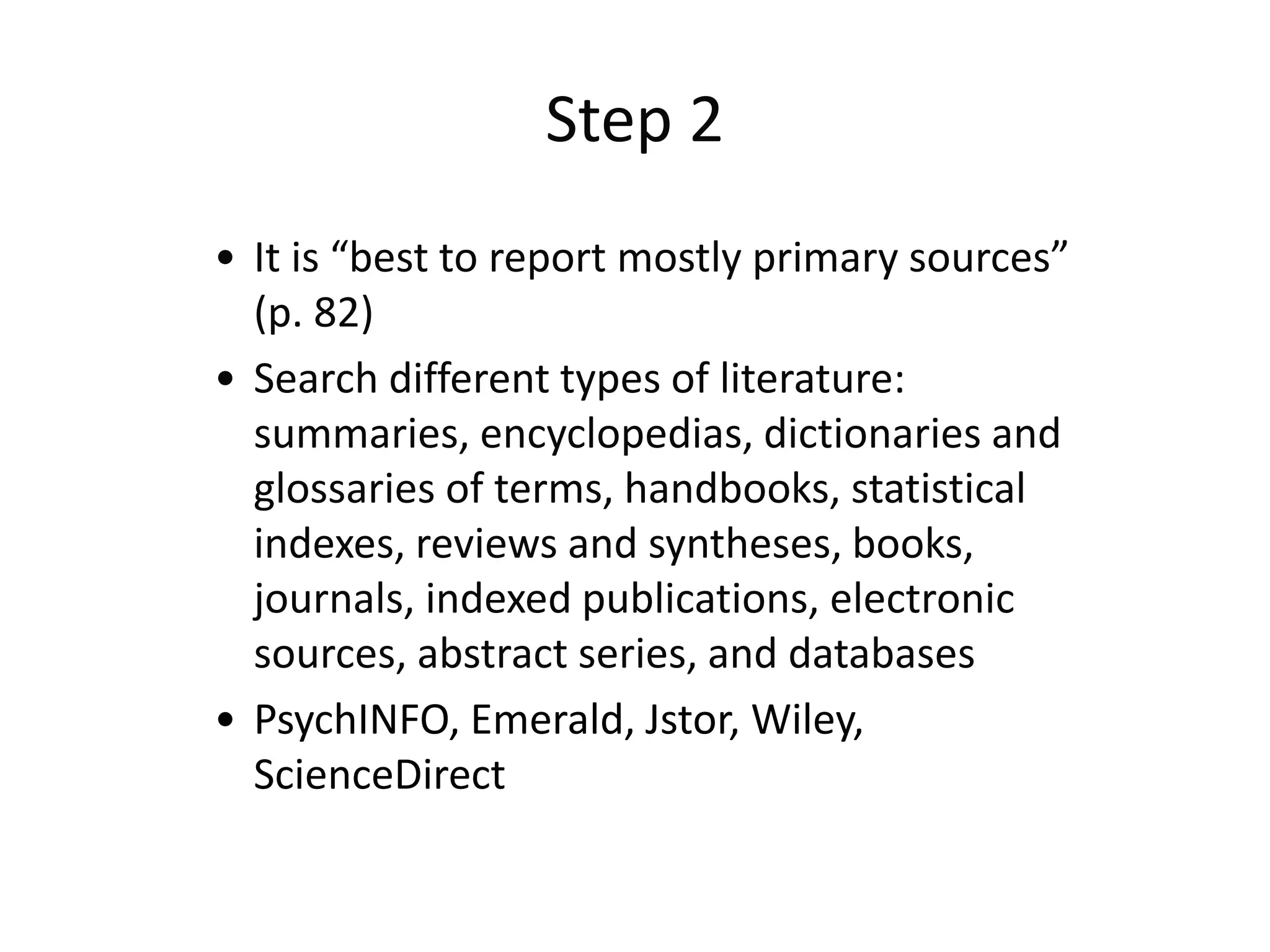
• It is “best to report mostly primary sources”
(p. 82)
• Search different types of literature:
summaries, encyclopedias, dictionaries and
glossaries of terms, handbooks, statistical
indexes, reviews and syntheses, books,
journals, indexed publications, electronic
sources, abstract series, and databases
• PsychINFO, Emerald, Jstor, Wiley,
ScienceDirect
Step 3
• Step 3: Critically Evaluate and Select Literature
• Rely on journal articles published in national
journals
• Prioritize your search: first look for refereed journal
articles, then, non-refereed articles, then books,
then conference papers, dissertations and theses
and then papers posted to websites
• Look for research articles and avoid as much as
possible “opinion” pieces
• Blend qualitative and quantitative research in your
review
Step 4
• Step 4: Organize the Literature
• Create a “file” or “abstract” system to keep track
of what you read. Each article you read should be
summarized in one page containing
Title (use APA to type the title so that you can later
copy-paste this into the References section of your
paper)
Source: journal article, book, glossary, etc.
Step 4
Research problem: one or two lines will suffice
Research Questions or Hypotheses
Data collection procedure (a description of sample
characteristics can be very handy as well)
Results or findings of the study
• Sort these abstracts into groups of related topics
or areas which can then become the different
sections of your review
Step 5
• Step 5: Write a Literature Review
• Types of Reviews:
Thematic Review: a theme is identified and studies
found under this theme are described. Major ideas and
findings are reported rather than details.
Study-by-study Review: a detailed summary of each
study under a broad theme is provided. Link summaries
(or abstracts) using transitional sentences. Must be
organized and flow coherently under various
subheadings. Avoid string quotations (i.e., lengthy
chunks of text directly quoted from a source)
Literature sources available
Sampling Design
Population, Element, Sampling Frame,
Sample and Subject
• Population (or target population)
• entire group of people, events or things of interest that
the researcher wishes to investigate
• Element
• a single member of the population
• Sampling Frame
• a listing of all the elements in the population from which
the sample is drawn
• Sample
• a subset of the population
• Subject
• a single member of the sample
Relationship between Population,
Sampling Frame and Sample
Relationship between Sample Statistics and
Population Parameters
Advantages of Sampling
• Less costs
– cheaper than studying whole population
• Less errors due to less fatigue
– better results
• Less time
– quicker
• Destruction of elements avoided
– eg bulbs
Normal Distibution in a Population
As the sample size n increases, the means of the
random samples taken from practically any
population approach a normal distribution with mean
μ and standard deviation 
Representativeness of Samples
• If the sample mean is much > than the
population mean μ then the sample would
overestimate the true population mean
• If the sample mean is much < than the
population mean μ then the sample would
underestimate the true population mean
• The more representative the sample is of the
population, the more generalisable are the
findings of the research.
Preparing a Sampling Design
Probability & Non-probability Sampling
• Probability Sampling
– the elements in the population have some known
chance or probability of being selected as sample
subjects
• Non-probability Sampling
– the elements do not have a known or predetermined
chance of being selected as subjects
Probability Sampling
• Simple random sampling
– every element in the population has a known and
equal chance of being selected as a subject
• Complex (or restricted) probability sampling
– procedures to ensure practical viable alternatives to
simple random sampling, at lower costs, and greater
statistical efficiency
Simple Random Sampling
• Is the most representative of the population for
most purposes
• Disadvantages are:
– Most cumbersome and tedious
– The entire listing of elements in population frequently
unavailable
– Very expensive
– Not the most efficient design
Complex Probability Sampling
• Systematic sampling
• Stratified random sampling
• Cluster sampling
• Area sampling
• Double sampling
Systematic Sampling
• Every nth element in the population starting
with a randomly chosen element
• Example:
– Want a sample of 35 households from a total of 260
houses. Could sample every 7th house starting from
a randomly chosen number from 1 to 10. If that
random number is 7, sample 35 houses starting with
7th house (14th house, 21st house, etc)
– Possible problem is that there could be systematic
bias. eg every 7th house could be a corner house,
with different characteristics of both house and
dwellers.
Stratified Random Sampling
• Comprises sampling from populations
segregated into a number of mutually exclusive
sub-populations or strata. Eg
– University students divided into juniors, seniors, etc
– Employees stratified into clerks, supervisors,
managers, etc
• Homogeneity within stratum and heterogeneity
between strata
• Statistical efficiency greater in stratified samples
• Sub-groups can be analysed
• Different methods of analysis can be used for
different sub-groups.
Stratified Random Sampling Example
Stratum Motivation Level
Clerks Low
Middle Managers Very high
Top Managers Medium
Combined X would not discrimate among
groups
• Stratified Sampling
– Proportionate sampling
– Disproportionate sampling
Proportionate & Disproportionate Stratified
Random Sampling
Cluster Sampling
• Take clusters or chunks of elements for study
– Eg, sample all students in MGMT 303 and MGMT
304 to study the characteristics of Management
Science majors
• Advantage of cluster sampling is lower costs
• Statistically it is less efficient than other
probability sampling procedures discussed so
far
Area Sampling:
• Cluster sampling confined to a particular area
– Eg, sampling residents of a particular locality,
county, etc
Double Sampling
• Collect preliminary data from a sample,
and choose a sub-sample of that sample
for more detailed investigation.
• Example:
– Conduct unstructured interviews with a
sample of 50.
– Repeat a structured interview with 30 from the
50 originally sampled.
Non-probability Sampling
• Convenience sampling
– Survey whoever is easily available
– Used for quick diagnosis of situations
• Simplest and cheapest
• Least reliable
• Purposive sampling
– Judgement sampling
– Snowball sampling
– Quota sampling
Judgement Sampling
• Involves the choice of subjects who are in
the best position to provide the information
required
• Experts’ opinions could be sought
– Eg, Doctors surveyed for cancer causes
Snowball Sampling
• Used when elements in population have specific
characteristics or knowledge, but are very
difficult to locate and contact.
• Initial sample group can be selected by
probability or non-probability methods, but new
subjects are selected based on information
provided by initial subjects.
– Eg, used to locate members of different stakeholder
groups regarding their opinions of a new public works
project.
Quota Sampling
• Quotas for numbers or proportion of
people to be sampled, established.
• Examples:
1) survey for research on dual career families:
50% working men and 50% working women
surveyed.
2) Women in management survey: 70%
women surveyed and 30% men surveyed.
1.Title
2.Introduction
3.Research objective
4.Justification
5.Research design
6.Research schedule
7.Approvals
8.Resources
9.Budget
10.Report preparation and distribution
Contents of the Research Proposal
1.Title page
2.Table of contents
3.Authorisation letter
4.Executive Summary (Synopsis or Abstract)
5.Introductory section
6.Method section
7.Analysis and Results (incl. tables, graphs, charts)
8.Discussion and Implications
9.Conclusions and Recommendations
10.Acknowledgements
11.References (or Bibliography)
12.Appendices
Contents of the Research Report
Research Methodology

Research Methodology

  • 1.
  • 2.
    • Classification #1 • Exploratory • Descriptive • Causal/ Hypothesis Testing • Classification # 2 • Basic • Applied • Classification # 3 • Qualitative • Quantitative Types of Research
  • 3.
    Exploratory Research • Exploratoryresearch is conducted where the problem is not clearly defined • Market share is decreasing ???
  • 4.
    Descriptive Research • Descriptiveresearch describes a single event or characteristic or relates a few events or variables through statistical analysis • Bank officer describing the profile of defaulters ???
  • 5.
    Causal/ Hypothesis TestingResearch • Research is conducted to test the hypotheses • Impact of motivation on job performance ???
  • 6.
    6 Basic Research • BasicResearch aims to expand the frontiers of science and knowledge by verifying or disproving the acceptability of a given theory or attempting to discover more about a certain concept (non-specificity)  Mostly performed by academics Example: How does motivation affect employee performance?
  • 7.
    Applied Research Applied Researchfocuses on a real-life problem or situation with a view to helping reach a decision how to deal with it (Specificity) • Applied research is designed to solve practical problems of the modern world, rather than to acquire knowledge for knowledge's sake. One might say that the goal of the applied scientist is to improve the human condition . Example: Should a corporation adopt a paperless office environment?
  • 8.
    Qualitative and QuantitativeApproaches Quantitative Qualitative Objective Subjective Research questions: How many? When? Where? Strength of association? Research questions: What? Why? How "Hard" science "Soft" science Literature review must be done early in study Literature review may be done as study progresses or afterwards Test theory Develops theory One reality: focus is concise and narrow Multiple realities: focus is complex and broad Facts are value-free and unbiased Facts are value-laden and biased Reduction, control, precision Discovery, description, understanding, shared interpretation Measurable Interpretive
  • 9.
    Mechanistic: parts equalthe whole Organismic: whole is greater than the parts Report statistical analysis. Basic element of analysis is numbers Report rich narrative, individual; interpretation. Basic element of analysis is words/ideas. Researcher is separate Researcher is part of process Subjects Participants Context free Context dependent Hypothesis Research questions Reasoning is deductive Reasoning is inductive Establishes relationships, causation Describes meaning, discovery Uses instruments Uses communications and observation Highly controlled setting: experimental setting (outcome oriented) Flexible approach: natural setting (process oriented) Sample size: n Sample size not a concern; seeks “informal rich” sample; carefully selected participants Uses different instruments Researcher is the instrument
  • 10.
    Phases of Research 1.Idea-generating phase 2. Problem-definition phase 3. Procedures-design phase 4. Observation phase 5. Data-analysis phase 6. Interpretation phase 7. Communication phase
  • 11.
    Generating research ideas UsefulTechniques Rational thinking Creative thinking Searching the literature Scanning the media Brainstorming Relevance Trees Exploring past projects Discussion Keeping an ideas notebook
  • 12.
  • 13.
    Creswell’s 5 stepsto Conduct a Literature Review • Step 1: Identify Key Terms or “Descriptors” • Extract key words from your title (remember, you may decide to change the title later) • Use some of the words other authors reported in the literature
  • 14.
    Step 1 • Usethe “Thesaurus of ERIC Descriptors to look for terms that match your topic: go to www.eric.ed.gov and in “Search” select “Descriptors (from Thesaurus)” • Scan both electronic and library journals from the past 10 years and look for key terms in the articles
  • 15.
    Step 2 • LocateLiterature • Use academic libraries, do not limit your search to an electronic search of articles • Use all sources: primary, and secondary sources. A “primary source” is research reported by the researcher that conducted the study. A “secondary source” is research that summarizes or reports findings that come from primary sources
  • 16.
    Step 2 • Itis “best to report mostly primary sources” (p. 82) • Search different types of literature: summaries, encyclopedias, dictionaries and glossaries of terms, handbooks, statistical indexes, reviews and syntheses, books, journals, indexed publications, electronic sources, abstract series, and databases • PsychINFO, Emerald, Jstor, Wiley, ScienceDirect
  • 17.
    Step 3 • Step3: Critically Evaluate and Select Literature • Rely on journal articles published in national journals • Prioritize your search: first look for refereed journal articles, then, non-refereed articles, then books, then conference papers, dissertations and theses and then papers posted to websites • Look for research articles and avoid as much as possible “opinion” pieces • Blend qualitative and quantitative research in your review
  • 18.
    Step 4 • Step4: Organize the Literature • Create a “file” or “abstract” system to keep track of what you read. Each article you read should be summarized in one page containing Title (use APA to type the title so that you can later copy-paste this into the References section of your paper) Source: journal article, book, glossary, etc.
  • 19.
    Step 4 Research problem:one or two lines will suffice Research Questions or Hypotheses Data collection procedure (a description of sample characteristics can be very handy as well) Results or findings of the study • Sort these abstracts into groups of related topics or areas which can then become the different sections of your review
  • 20.
    Step 5 • Step5: Write a Literature Review • Types of Reviews: Thematic Review: a theme is identified and studies found under this theme are described. Major ideas and findings are reported rather than details. Study-by-study Review: a detailed summary of each study under a broad theme is provided. Link summaries (or abstracts) using transitional sentences. Must be organized and flow coherently under various subheadings. Avoid string quotations (i.e., lengthy chunks of text directly quoted from a source)
  • 21.
  • 37.
  • 38.
    Population, Element, SamplingFrame, Sample and Subject • Population (or target population) • entire group of people, events or things of interest that the researcher wishes to investigate • Element • a single member of the population • Sampling Frame • a listing of all the elements in the population from which the sample is drawn • Sample • a subset of the population • Subject • a single member of the sample
  • 39.
  • 40.
    Relationship between SampleStatistics and Population Parameters
  • 41.
    Advantages of Sampling •Less costs – cheaper than studying whole population • Less errors due to less fatigue – better results • Less time – quicker • Destruction of elements avoided – eg bulbs
  • 42.
    Normal Distibution ina Population As the sample size n increases, the means of the random samples taken from practically any population approach a normal distribution with mean μ and standard deviation 
  • 43.
    Representativeness of Samples •If the sample mean is much > than the population mean μ then the sample would overestimate the true population mean • If the sample mean is much < than the population mean μ then the sample would underestimate the true population mean • The more representative the sample is of the population, the more generalisable are the findings of the research.
  • 44.
  • 45.
    Probability & Non-probabilitySampling • Probability Sampling – the elements in the population have some known chance or probability of being selected as sample subjects • Non-probability Sampling – the elements do not have a known or predetermined chance of being selected as subjects
  • 46.
    Probability Sampling • Simplerandom sampling – every element in the population has a known and equal chance of being selected as a subject • Complex (or restricted) probability sampling – procedures to ensure practical viable alternatives to simple random sampling, at lower costs, and greater statistical efficiency
  • 47.
    Simple Random Sampling •Is the most representative of the population for most purposes • Disadvantages are: – Most cumbersome and tedious – The entire listing of elements in population frequently unavailable – Very expensive – Not the most efficient design
  • 48.
    Complex Probability Sampling •Systematic sampling • Stratified random sampling • Cluster sampling • Area sampling • Double sampling
  • 49.
    Systematic Sampling • Everynth element in the population starting with a randomly chosen element • Example: – Want a sample of 35 households from a total of 260 houses. Could sample every 7th house starting from a randomly chosen number from 1 to 10. If that random number is 7, sample 35 houses starting with 7th house (14th house, 21st house, etc) – Possible problem is that there could be systematic bias. eg every 7th house could be a corner house, with different characteristics of both house and dwellers.
  • 50.
    Stratified Random Sampling •Comprises sampling from populations segregated into a number of mutually exclusive sub-populations or strata. Eg – University students divided into juniors, seniors, etc – Employees stratified into clerks, supervisors, managers, etc • Homogeneity within stratum and heterogeneity between strata • Statistical efficiency greater in stratified samples • Sub-groups can be analysed • Different methods of analysis can be used for different sub-groups.
  • 51.
    Stratified Random SamplingExample Stratum Motivation Level Clerks Low Middle Managers Very high Top Managers Medium Combined X would not discrimate among groups • Stratified Sampling – Proportionate sampling – Disproportionate sampling
  • 52.
    Proportionate & DisproportionateStratified Random Sampling
  • 53.
    Cluster Sampling • Takeclusters or chunks of elements for study – Eg, sample all students in MGMT 303 and MGMT 304 to study the characteristics of Management Science majors • Advantage of cluster sampling is lower costs • Statistically it is less efficient than other probability sampling procedures discussed so far Area Sampling: • Cluster sampling confined to a particular area – Eg, sampling residents of a particular locality, county, etc
  • 54.
    Double Sampling • Collectpreliminary data from a sample, and choose a sub-sample of that sample for more detailed investigation. • Example: – Conduct unstructured interviews with a sample of 50. – Repeat a structured interview with 30 from the 50 originally sampled.
  • 55.
    Non-probability Sampling • Conveniencesampling – Survey whoever is easily available – Used for quick diagnosis of situations • Simplest and cheapest • Least reliable • Purposive sampling – Judgement sampling – Snowball sampling – Quota sampling
  • 56.
    Judgement Sampling • Involvesthe choice of subjects who are in the best position to provide the information required • Experts’ opinions could be sought – Eg, Doctors surveyed for cancer causes
  • 57.
    Snowball Sampling • Usedwhen elements in population have specific characteristics or knowledge, but are very difficult to locate and contact. • Initial sample group can be selected by probability or non-probability methods, but new subjects are selected based on information provided by initial subjects. – Eg, used to locate members of different stakeholder groups regarding their opinions of a new public works project.
  • 58.
    Quota Sampling • Quotasfor numbers or proportion of people to be sampled, established. • Examples: 1) survey for research on dual career families: 50% working men and 50% working women surveyed. 2) Women in management survey: 70% women surveyed and 30% men surveyed.
  • 59.
    1.Title 2.Introduction 3.Research objective 4.Justification 5.Research design 6.Researchschedule 7.Approvals 8.Resources 9.Budget 10.Report preparation and distribution Contents of the Research Proposal
  • 60.
    1.Title page 2.Table ofcontents 3.Authorisation letter 4.Executive Summary (Synopsis or Abstract) 5.Introductory section 6.Method section 7.Analysis and Results (incl. tables, graphs, charts) 8.Discussion and Implications 9.Conclusions and Recommendations 10.Acknowledgements 11.References (or Bibliography) 12.Appendices Contents of the Research Report