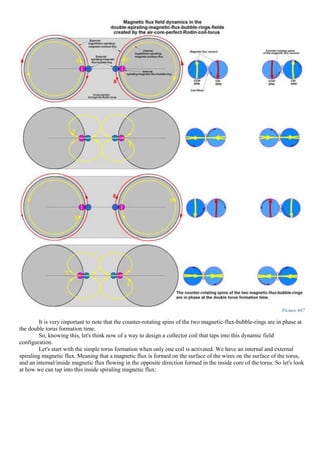
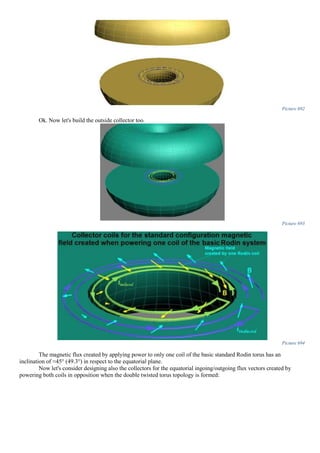
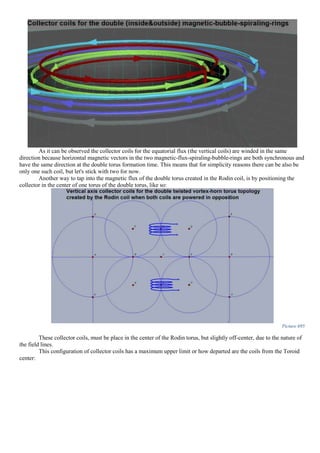
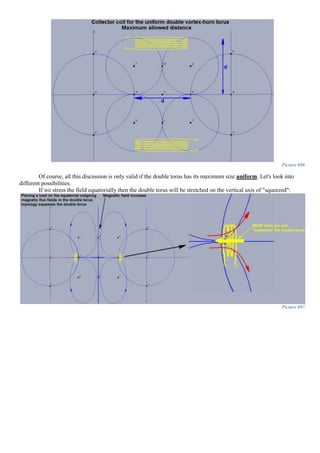
“Not everything that shines with bright light comes from God”
Table of Contents
Book revision history...........................................................................................................................................................6
A DETAIL STUDY OF THE STEVEN MARK TPU ........................................................................................................8
TPU magnets orientation ...............................................................................................................................................22
Firing the coils ...............................................................................................................................................................25
Charles Flynn Generator................................................................................................................................................27
COP vs. OVERUNITY vs. EFFICIENCY ....................................................................................................................45
A NON-CONVENTIONAL APPROACH IN DEFINING COP ..............................................................................45
Ideal Power equation..................................................................................................................................................48
CONVENTIONAL DEFINITION OF COP..............................................................................................................51
A visual representation of the performance coefficient (COP) and efficiency in transformers.................................52
INTERCONNECTING COP>1 DEVICES...............................................................................................................54
Changing our mentality..............................................................................................................................................58
Applications...................................................................................................................................................................60
POWERING (AC) HALF OF THE TESLA TRANSFORMER 381970 WITHOUT A LOAD...............................62
FULL POWERING (AC) THE TESLA TRANSFORMER 381970 WITHOUT A LOAD .....................................66
POWERING (AC) HALF OF THE TESLA TRANSFORMER 381970 WITH A LOAD.......................................69
FULL POWERING (AC) OF THE TESLA TRANSFORMER 381970 WITH A LOAD .......................................77
POWERING (pulsed AC) HALF OF THE TESLA TRANSFORMER 381970 WITH A LOAD............................90
Tom Bearden Motionless Electromagnetic Generator (MEG) ..........................................................................................93
THE REAL OPERATING FREQUENCY OF MEG - TUNING THE MEG...............................................................99
The air-gap in the MEG core .......................................................................................................................................100
Toroidal MEG..............................................................................................................................................................103
CUBOIDAL MEG-TPU ..............................................................................................................................................109
Replicating the Steven Mark TPU ...................................................................................................................................117
Further study on improving the final most likely construction of Steven TPU ...........................................................128
MAKING MUSIC: OUR INSTRUMENT: THE MAGNETIC FIELD --- Floyd Sparky Sweet Vacuum Triode
Amplifier (VTA)..............................................................................................................................................................135
The air-gap or the distance between the magnets. .......................................................................................................149
Ways to express and visualize MAGNETIC RESONANCE.......................................................................................155
IN A MAGNET .......................................................................................................................................................155
IN A COIL ...............................................................................................................................................................158
Additional insights on the TPU, MEG, and Flynn SSG devices. ................................................................................163
Insights regarding VTA ...........................................................................................................................................164
CONDITIONING THE MAGNETS. (Re-magnetization process) .............................................................................164
MAGNETIC DOMAINS DYNAMICS.......................................................................................................................168
TPU MAGNET DOMAIN DYNAMICS ................................................................................................................168
MEG MAGNET DOMAIN DYNAMICS...............................................................................................................170
MORE INSIGHT ON MEG INNER OPERATION PRINCIPLE...............................................................................172
The Singing rod............................................................................................................................................................179
THE RE-MAGNETIZING PROCESS (CONDITIONING THE MAGNETS) ..........................................................183
Kirchhoff law in Tom Bearden MEG ..............................................................................................................................184
SIMPLIFYING FURTHER THE MEG DESIGN...........................................................................................................199
Hysteresys annihilator......................................................................................................................................................200
Connection between Annis&Eberly generator and Steven Mark TPU............................................................................211
Connection between the Annis&Eberly generator and Tom Bearden MEG ...................................................................221
Naudin 2SGen..................................................................................................................................................................223
Further improving the 2SGen design by mimicking its mother MEG.........................................................................224
Different possible embodiments of magnetic domains spinners......................................................................................227
Cylinder magnetic domains spinner.............................................................................................................................229
Demagnetized ring magnet internal magnetic domains spinner ..................................................................................231
Further insights on the Floyd Sparky Sweet VTA magnetizer ........................................................................................233
The Floyd Sweet VTA-SQM Time-machine/antigravity device .................................................................................245
Conclusion of Floyd Sweet VTA study:......................................................................................................................247
A cheap accessible approach to extreme accuracy signal generator (max 20KHz):........................................................247
New Energy movement: Marko Rodin technology .........................................................................................................251
Different firing sequences for the Rodin Coil..............................................................................................................252
The Rodin coil and the double torus topology.............................................................................................................258
Circle packaging model ...............................................................................................................................................264
Rodin Coil, Spira mirabilis and Jacob Bernoulli .........................................................................................................273
Calculating Rodin wire length .....................................................................................................................................288
Approximating Rodin wire length using straight lines ............................................................................................289
Approximating Rodin coil length using the ellipse model.......................................................................................292
Approximating Rodin coil wire length using the parabola model ...........................................................................298
1. The correct determination of the Rodin coil length using the lemniscate model.............................................301
Tuning to magnetic resonance experiment with a Rodin Coil.....................................................................................307
Rodin spinner for a demagnetized ring magnet ...........................................................................................................308
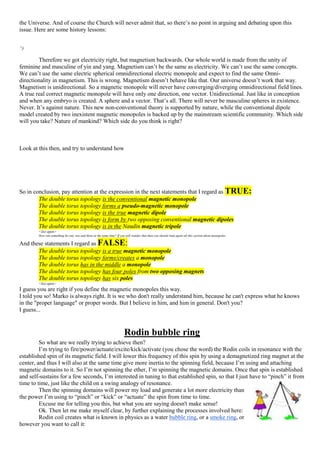
The real truth about magnetic monopoles - the never ending quest for the magnetic monopoles and the real magnetic
monopole......................................................................................................................................................................312
The process of creating a magnetic dipole (a magnet).............................................................................................320
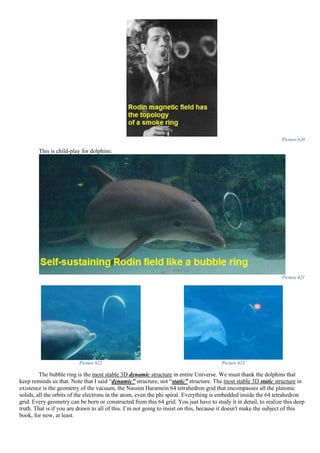
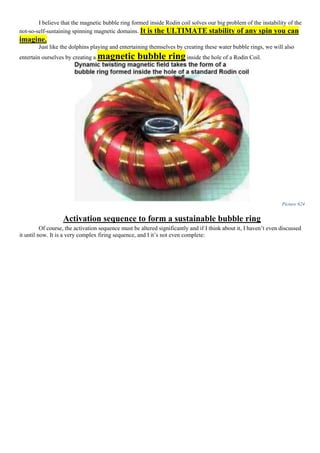
Rodin bubble ring ........................................................................................................................................................337
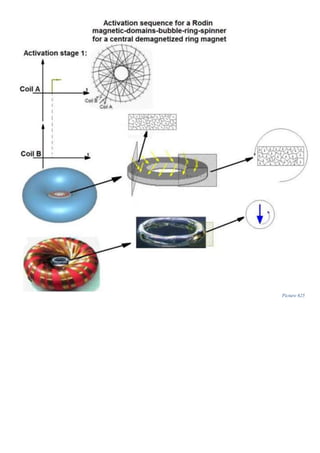
Activation sequence to form a sustainable bubble ring............................................................................................339
Further insights on the Rodin firing sequences............................................................................................................345
The magnetic bubble ring maintained by the Rodin “flux pump” actuator field.........................................................352
Using cores in the Rodin coil.......................................................................................................................................356
Rodin magnetic bubble ring generator.........................................................................................................................368
Double torus transformer .............................................................................................................................................373
Designing Rodin collector coils for the Rodin field ....................................................................................................375
Designing an oscillator with the 90° built-in-lag in the Rodin coil spiraling-magnetic-bubble-ring-auto-spinner .....395
Going beyond the basic standard 150° winding step angle for the Rodin coil. Exploring different configurations....396
Rodin coil, sorcery & witchcraft connection ...............................................................................................................401
Standard Rodin magnetic field configuration - Meruba Ashurit and the origins of the alphabet - Stan Tenen Meru
research connection -the Torah is a Torus ...................................................................................................................420
Rodin magnetic field....................................................................................................................................................423
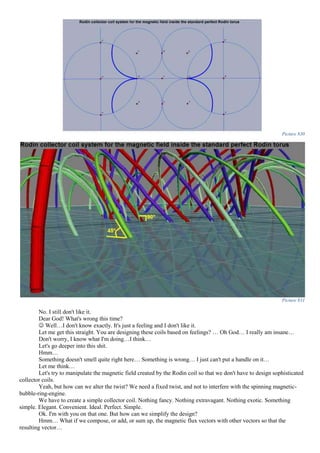
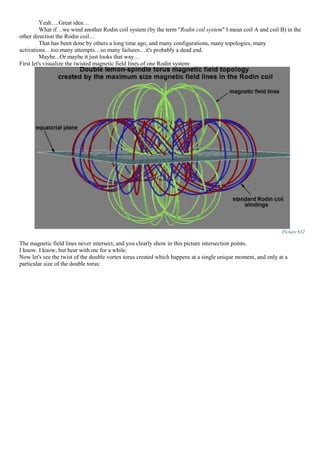
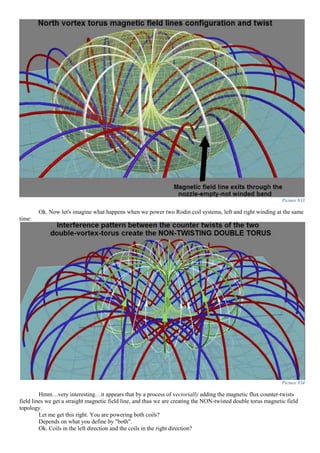
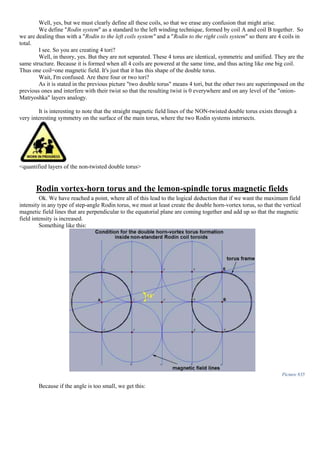
Rodin vortex-horn torus and the lemon-spindle torus magnetic fields ...................................................................442
Unique magnetic field pattern in the standard Rodin 150° winding step-angle.......................................................450
THE RODIN CENTRAL LEMON DIMENSIONS:...............................................................................................458
Predicting the unique Rodin 150° winding step-angle.............................................................................................460
Marko Rodin magnetic field paradox ......................................................................................................................463
Rodin non-twisted double torus magnetic field configuration.................................................................................470
Symmetry and asymmetry - antagonistic yet complementary concepts ......................................................................476
The Holy Trinity model in understanding why our Load is the missing piece in the Rodin puzzle............................477
Donald L. Smith device ...................................................................................................................................................482
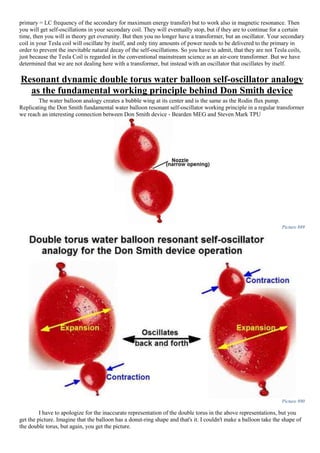
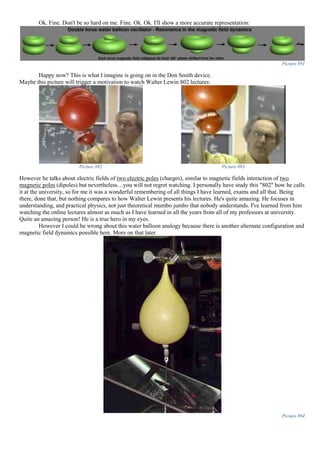
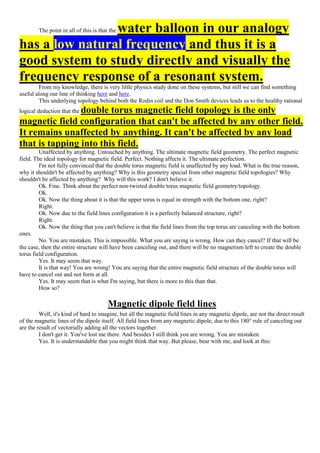
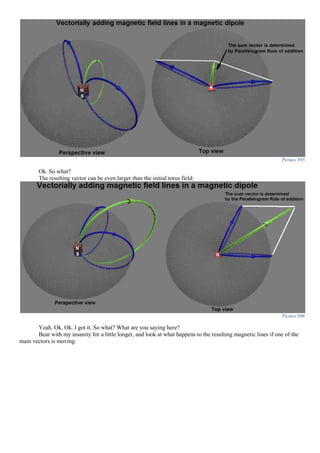
Resonant dynamic double torus water balloon self-oscillator analogy as the fundamental working principle behind
Don Smith device.........................................................................................................................................................485
Magnetic dipole field lines...........................................................................................................................................487
Don Smith double spark-gap........................................................................................................................................498
Missing oscillator component in original Don Smith device diagram.........................................................................498
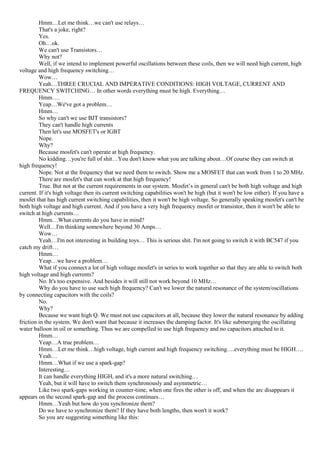
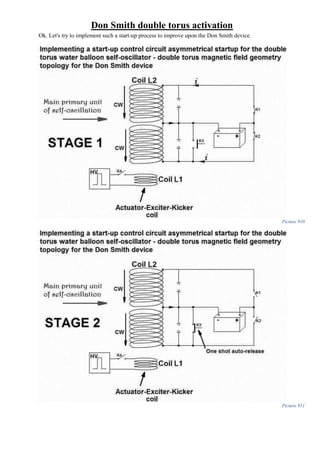
Don Smith double torus activation...............................................................................................................................501
Connection between Donald L Smith device and Bearden MEG and Steven Mark TPU ...........................................502
Don smith double condition for magnetic resonance between coil L1 and L2............................................................504
Collapsing Don Smith double condition for magnetic resonance into one condition..................................................515
A slight different working principle behind Don Smith device...................................................................................520
Increasing Q factor in oscillators using Tesla-Smith formula or standing waves pattern formation condition in
inductors to reduce damping........................................................................................................................................534
CALCULATING THE DON SMITH DEVICE CAPACITOR ..................................................................................543
CORNERSTONE OF THE DON SMITH DEVICE...................................................................................................545
Don Smith device coil L2a and coil L2b connections .................................................................................................548
Don Smith device pseudo-double torus magnetic field ...............................................................................................551
Abha torus - Rodin-Tesla coil - Donald L Smith device hybridization embodiment ......................................................555
A possible quantification in Rodin coil torus frame dimensions using the Vortex-Spindle torus perfect ratio condition
.....................................................................................................................................................................................574
INDUCTANCE APPROXIMATION FOR THE RODIN COIL ................................................................................580
LIMITATIONS IN THE STANDARD BASIC SINGLE-LAYER HELICAL ROUND WIRE COIL INDUCTOR
MODEL FORMULA...............................................................................................................................................584
RODIN COIL INDUCTANCE WHEN COILS ARE FIRIED IN OPPOSITION ..................................................590
Double lemon-spindle torus and the Holy Grail connection....................................................................................599
Rodin non-twisted double torus magnetic field configurations in connecting the coils ..............................................612
BUILDING THE RODIN CAPACITOR ........................................................................................................................616
Electric and magnetic field relationship.......................................................................................................................616
Rodin plate capacitor ...................................................................................................................................................628
Rodin wire capacitor....................................................................................................................................................632
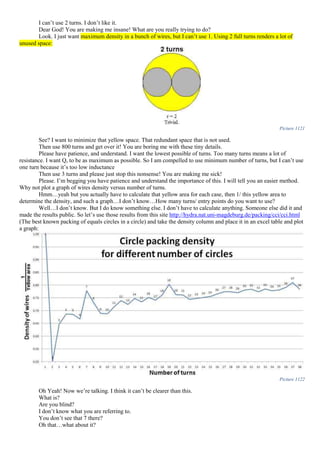
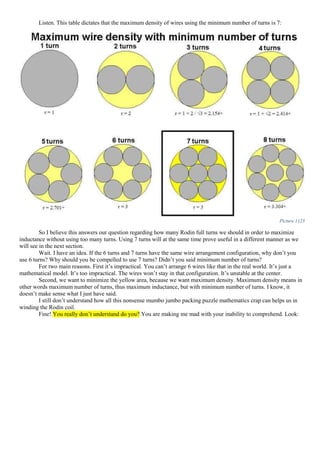
Number of turns in Rodin coils....................................................................................................................................641
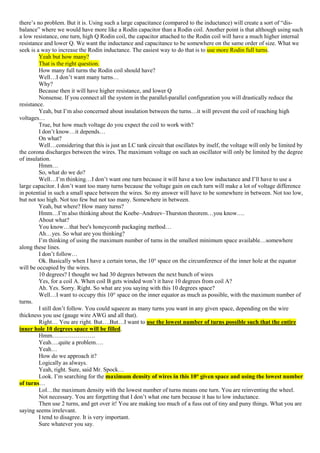
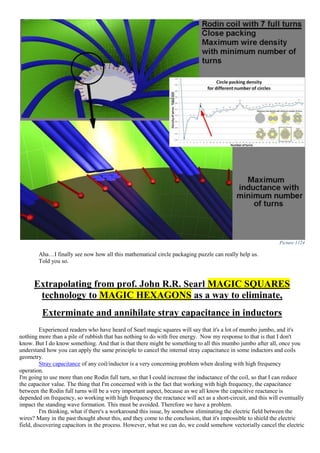
Exterminate and annihilate stray capacitance in inductors ..........................................................................................645
Surface electric field equilibrium in the basic standard 150° step-angle Rodin coil ...................................................654
MARKO RODIN FREE-ENERGY GENERATOR FINALLY DEBUNKED...............................................................660
Rodin wire radius to torus radius ratio.........................................................................................................................670
Designing a new improved ultra-efficient energy collector system for the Rodin LC tank circuit self-oscillating
generator ......................................................................................................................................................................677
Wire radius to Rodin torus radius ratio determination.................................................................................................680
CONECTIONLESS Rodin LC tank circuit for the natural HF operation dictated by the standing wave in the wire .681
Building the Rodin LC tank circuit..............................................................................................................................682
RODIN CAPACITOR SPHERES 3D COORDINATES CALCULATION...............................................................687
MAPPING THE FLOWER OF LIFE ON THE RODIN ABHA PERFECT SIN15 TORUS.....................................699
Mandatory study, prior of reading this material:
-Steven Mark Toroidal Power Unit (TPU) clip (one of many prototypes): http://www.youtube.com/watch?v=pvLuQOKOVXQ
-System of Electrical Distribution Tesla Patent 381,970: link1 or link2
-Tom Bearden Motionless Electromagnetic Generator (MEG) patent file: link1 or link2
-Floyd Sparky Sweet VTA-SQM secrets videoclip (hard to find) filmed by Tom Bearden in Sherman Oaks, California April/May 1987: (torrent file) or relevant part3
permalink and relevant part4 permalink
-Marko Rodin basic introduction to elementary Vortex Mathematics and standard configuration Rodin coil clips: http://www.youtube.com/watch?v=K93dL65Q724
-Donald L Smith device general presentation clips: http://www.youtube.com/watch?v=or_wCy2OzWk
Good to know study
-Theodore Annis/Patrick Eberly single magnetic flux electric generator patent file: link1 or link2
Optional study:
-Complete series of clips of Steven Mark TPU:
http://video.google.com/videoplay?docid=-1944827568401901581
http://video.google.com/videoplay?docid=167210479374903373
http://video.google.com/videoplay?docid=-8435800732540412467
http://video.google.com/videoplay?docid=333661567309752927
http://video.google.com/videoplay?docid=-5483558279656482347
-Donald L. Smith lecture at Tesla Symposium 1996 clips: http://www.youtube.com/watch?v=6mV89RvaBYk
-Charles Flynn solid state generator clip: http://www.youtube.com/watch?v=9zh_C3yvJH0
Book revision history
Current book revision: 7.5.22 download latest version click here –permalink (it will never change)
(Shared, synced live with the author computer through Google drive)
https://docs.google.com/file/d/0ByyeIdK8FssyLWJEQzlwTER2YTQ/edit?usp=sharing
We need your help! This book contains a lot of technical errors. Please help the author correct them. This document also requires proofreading. English is not the
native language of the author - If you notice any errors send feedback at niculaegeorge@gmail.com.
Revision 7.5.22 (Free release date: June, 6, 2013 on Scribd)
download as pdf (35Mb), download as docx(31 Mb)(MsWord 2007-2013), download as doc(30 Mb) (MsWord 97-2003
compatible)
-Insert permalink to Google drive document, where there’s a shared, synced live with the author computer,
downloadable latest live version of this book;
-Added book version history. A reader can now see the changes from previous versions easier;
-All quotes are now Austin Quote (Text box) for esthetic reasons;
-All quotes are now with complete reference included from where they originate and have permalinks attached;
-All pictures and tables have now captions (numbers). All text changed to include cross-reference to these
numbers;
-All equations including simple equations in body text are now new paragraph-field-numbered-equations.
Cross-reference to them also added;
-Multiple reference links for important hyperlinks to prevent link rot;
-Started to replace comma based decimal numbers to period based numbers;
-Repaired link “Mythbusters Tesla earthquake machine” with a permalink;
-Insert jump link to a bookmark rejected TPU case study comment;
-Insert permalinks to high resolution pictures for drawings and high detail pictures;
-Added a few extra pictures and text regarding the DePew-Rodin LC oscillator;
-Made a complete Spelling & Grammar re-check;
Revision 7.5.19 (Free release date 28.05.2013 on Scribd)
download as pdf (42Mb), download as docx (30Mb) (MSWord 2007-2013) , download as doc(29 Mb) (MsWord 97-2003
compatible)
-Started to insert caption for each picture, table and equation (not complete);
-Modified reference text to include updateable cross-reference links to picture numbers instead of “picture
above or below”;
-Removed some broken links to Mythbusters Tesla earthquake machine;
-Where the research is currently at and is going: (insanely complex warning) maxscript for creating a Jon
DePew-Rodin-LC-oscillator-tree-of-life-golden-torus in the section MAPPING THE FLOWER OF LIFE ON THE
RODIN ABHA PERFECT SIN15 TORUS
-New insights regarding Rodin coil, sorcery & witchcraft connection -teleportation connections- (probably from
seeing way too many movies);
-Improved embedded text clarity in some TPU pictures;
-Cut the size of the book in half just by resizing large pictures with irrelevant details. (30Mb)
-Added a table of contents.
Revision 7.3 (Free release date 07.10.2012 on Scribd) download as pdf (61Mb)
Older versions omitted
Book started on 18 November 2011
A DETAIL STUDY OF THE STEVEN MARK
TPU
This study will bring us closer to understanding the toroid of Steven Mark, but not all the
way to total understanding. I have discovered real construction behind the TPU from hours and
hours of frame by frame carefully and methodically watching SM videos. First, I have come to
believe that the various TPU-like devices presented by Steven in his videos are very different
from each other. That is why there are so many different configurations, building plans, variants,
opinions, topologies and implementations of Steven’s TPU. The term "TPU" meaning Toroidal Power Unit is
inappropriate, because the principle of operation has nothing to do with the Toroidal shape (with an open mind
attitude, it can be for example, a cube).
Steven Mark has chosen just to implement the principle inside Toroidal cores in order to capture most of the magnetic
flux. The simplest and most "transparent" from Steven’s devices is this one (the one that can be studied in detail):
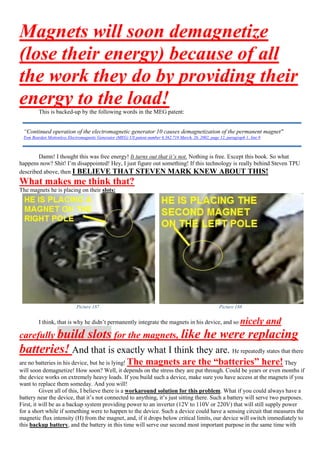
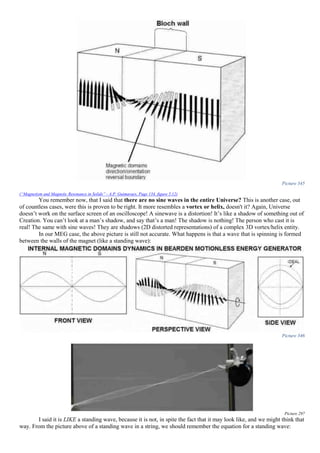
Picture 1
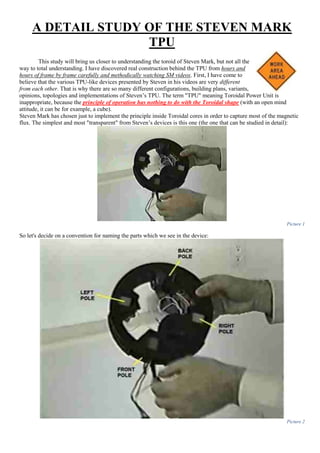
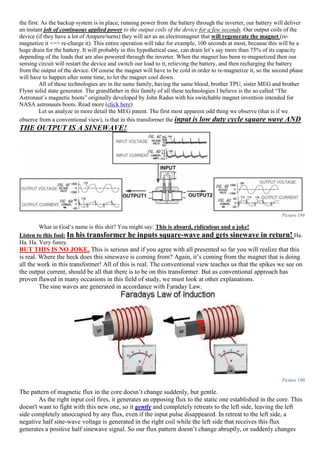
So let's decide on a convention for naming the parts which we see in the device:
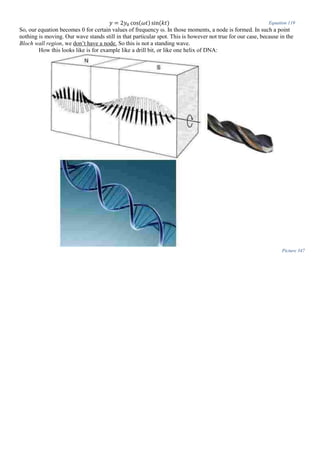
Picture 2
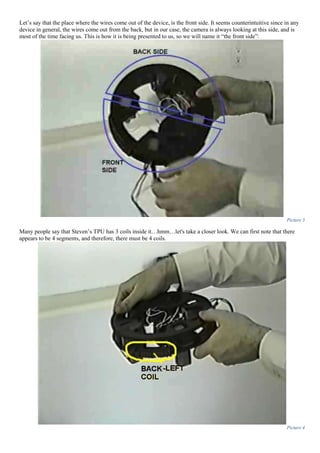
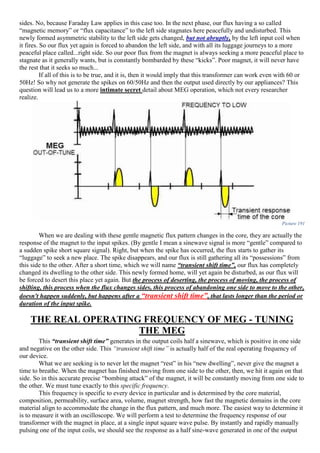
Let’s say that the place where the wires come out of the device, is the front side. It seems counterintuitive since in any
device in general, the wires come out from the back, but in our case, the camera is always looking at this side, and is
most of the time facing us. This is how it is being presented to us, so we will name it “the front side”:
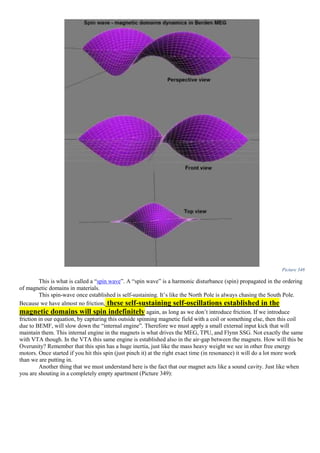
Picture 3
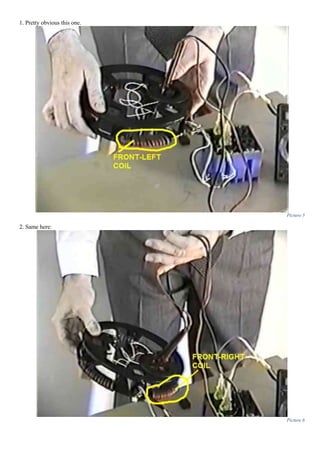
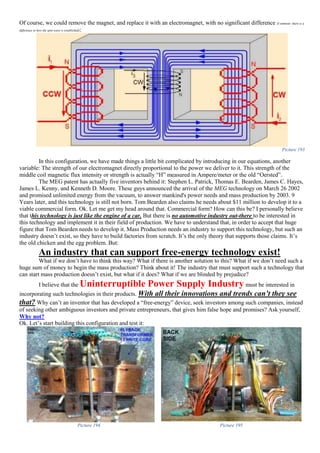
Many people say that Steven’s TPU has 3 coils inside it…hmm…let's take a closer look. We can first note that there
appears to be 4 segments, and therefore, there must be 4 coils.
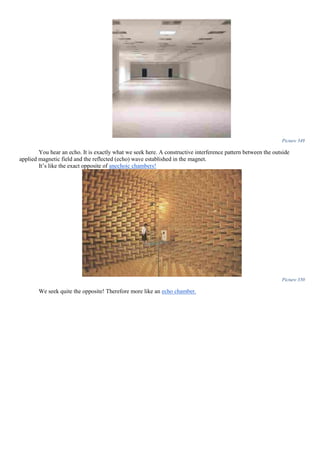
Picture 4
1. Pretty obvious this one.
Picture 5
2. Same here:
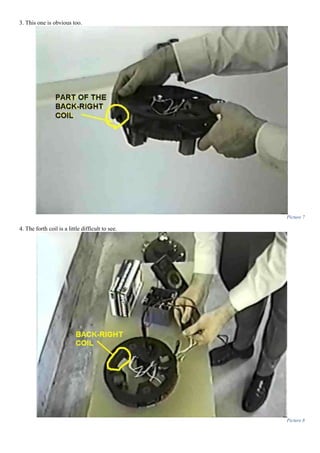
Picture 6
3. This one is obvious too.
Picture 7
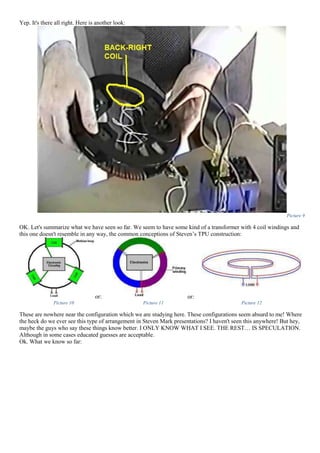
4. The forth coil is a little difficult to see.
Picture 8
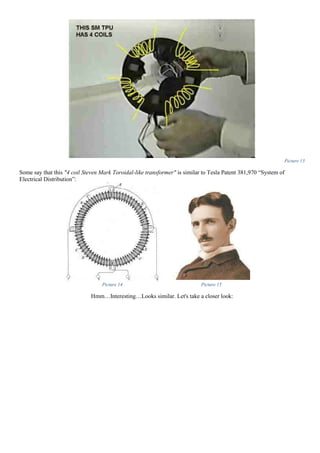
Yep. It's there all right. Here is another look:
Picture 9
OK. Let's summarize what we have seen so far. We seem to have some kind of a transformer with 4 coil windings and
this one doesn't resemble in any way, the common conceptions of Steven’s TPU construction:
or: or:
Picture 10 Picture 11 Picture 12
These are nowhere near the configuration which we are studying here. These configurations seem absurd to me! Where
the heck do we ever see this type of arrangement in Steven Mark presentations? I haven't seen this anywhere! But hey,
maybe the guys who say these things know better. I ONLY KNOW WHAT I SEE. THE REST… IS SPECULATION.
Although in some cases educated guesses are acceptable.
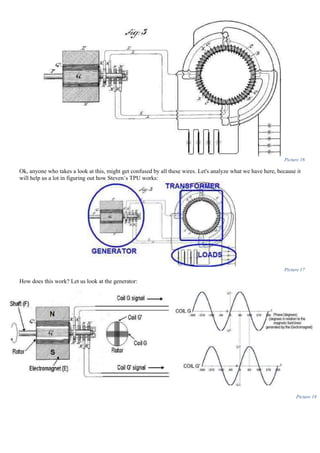
Ok. What we know so far:
Picture 13
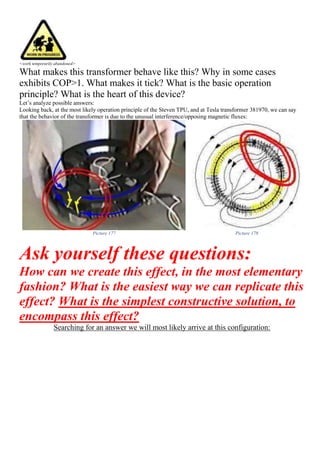
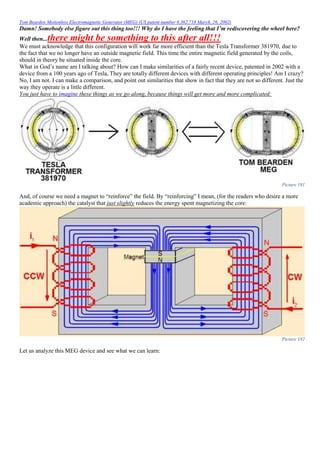
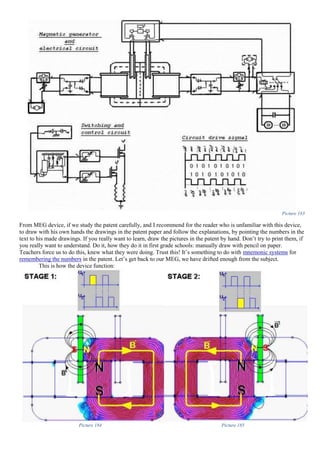
Some say that this "4 coil Steven Mark Toroidal-like transformer" is similar to Tesla Patent 381,970 “System of
Electrical Distribution”:
Picture 14 Picture 15
Hmm…Interesting…Looks similar. Let's take a closer look:
Picture 16
Ok, anyone who takes a look at this, might get confused by all these wires. Let's analyze what we have here, because it
will help us a lot in figuring out how Steven’s TPU works:
Picture 17
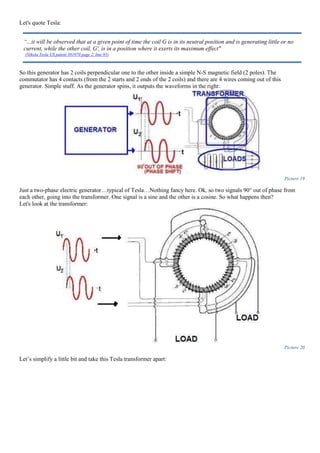
How does this work? Let us look at the generator:
Picture 18
Let's quote Tesla:
So this generator has 2 coils perpendicular one to the other inside a simple N-S magnetic field (2 poles). The
commutator has 4 contacts (from the 2 starts and 2 ends of the 2 coils) and there are 4 wires coming out of this
generator. Simple stuff. As the generator spins, it outputs the waveforms in the right:
Picture 19
Just a two-phase electric generator…typical of Tesla…Nothing fancy here. Ok, so two signals 90° out of phase from
each other, going into the transformer. One signal is a sine and the other is a cosine. So what happens then?
Let's look at the transformer:
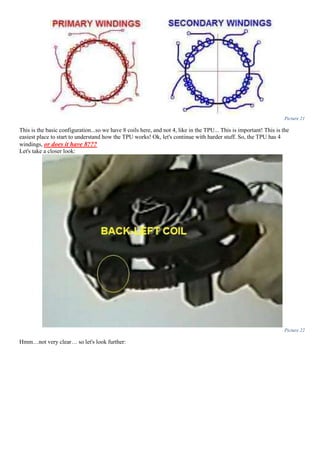
Picture 20
Let’s simplify a little bit and take this Tesla transformer apart:
“...it will be observed that at a given point of time the coil G is in its neutral position and is generating little or no
current, while the other coil, G', is in a position where it exerts its maximum effect"
(Nikola Tesla US patent 381970 page 2, line 95)
Picture 21
This is the basic configuration...so we have 8 coils here, and not 4, like in the TPU... This is important! This is the
easiest place to start to understand how the TPU works! Ok, let's continue with harder stuff. So, the TPU has 4
windings, or does it have 8???
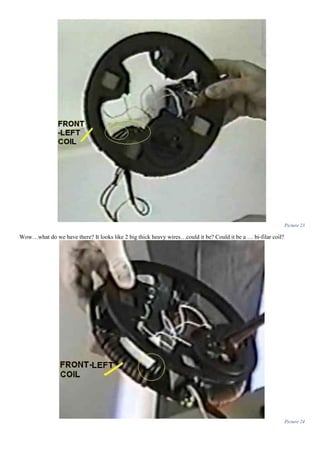
Let's take a closer look:
Picture 22
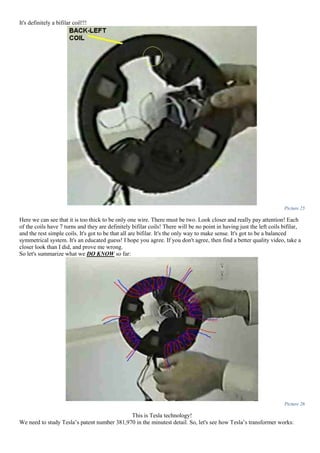
Hmm…not very clear… so let's look further:
Picture 23
Wow…what do we have there? It looks like 2 big thick heavy wires…could it be? Could it be a … bi-filar coil?
Picture 24
It's definitely a bifilar coil!!!
Picture 25
Here we can see that it is too thick to be only one wire. There must be two. Look closer and really pay attention! Each
of the coils have 7 turns and they are definitely bifilar coils! There will be no point in having just the left coils bifilar,
and the rest simple coils. It's got to be that all are bifilar. It's the only way to make sense. It's got to be a balanced
symmetrical system. It's an educated guess! I hope you agree. If you don't agree, then find a better quality video, take a
closer look than I did, and prove me wrong.
So let's summarize what we DO KNOW so far:
Picture 26
This is Tesla technology!
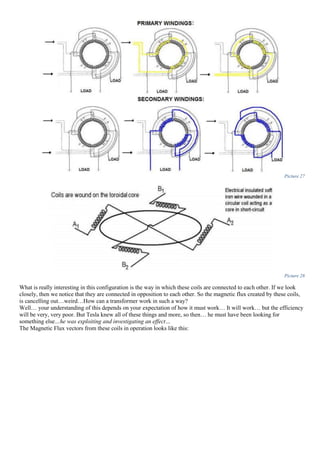
We need to study Tesla’s patent number 381,970 in the minutest detail. So, let's see how Tesla’s transformer works:
Picture 27
Picture 28
What is really interesting in this configuration is the way in which these coils are connected to each other. If we look
closely, then we notice that they are connected in opposition to each other. So the magnetic flux created by these coils,
is cancelling out…weird…How can a transformer work in such a way?
Well… your understanding of this depends on your expectation of how it must work… It will work… but the efficiency
will be very, very poor. But Tesla knew all of these things and more, so then… he must have been looking for
something else…he was exploiting and investigating an effect…
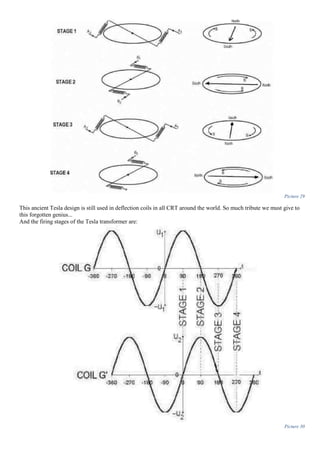
The Magnetic Flux vectors from these coils in operation looks like this:
Picture 29
This ancient Tesla design is still used in deflection coils in all CRT around the world. So much tribute we must give to
this forgotten genius...
And the firing stages of the Tesla transformer are:
Picture 30
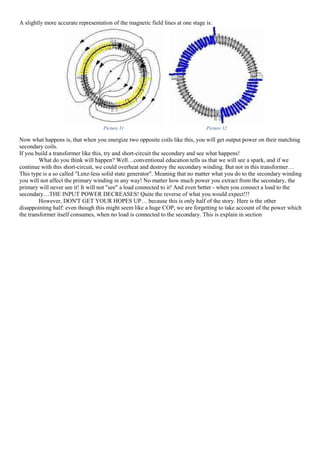
A slightly more accurate representation of the magnetic field lines at one stage is:
Picture 31 Picture 32
Now what happens is, that when you energize two opposite coils like this, you will get output power on their matching
secondary coils.
If you build a transformer like this, try and short-circuit the secondary and see what happens!
What do you think will happen? Well…conventional education tells us that we will see a spark, and if we
continue with this short-circuit, we could overheat and destroy the secondary winding. But not in this transformer…
This type is a so called "Lenz-less solid state generator". Meaning that no matter what you do to the secondary winding
you will not affect the primary winding in any way! No matter how much power you extract from the secondary, the
primary will never see it! It will not "see" a load connected to it! And even better - when you connect a load to the
secondary…THE INPUT POWER DECREASES! Quite the reverse of what you would expect!!!
However, DON'T GET YOUR HOPES UP… because this is only half of the story. Here is the other
disappointing half: even though this might seem like a huge COP, we are forgetting to take account of the power which
the transformer itself consumes, when no load is connected to the secondary. This is explain in section
COP vs. OVERUNITY vs. EFFICIENCY
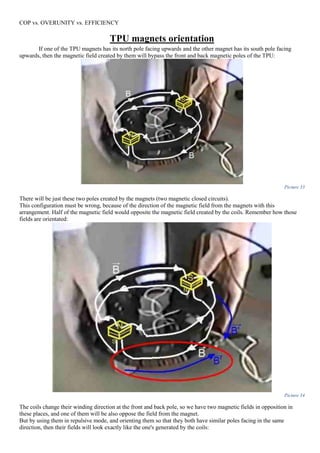
TPU magnets orientation
If one of the TPU magnets has its north pole facing upwards and the other magnet has its south pole facing
upwards, then the magnetic field created by them will bypass the front and back magnetic poles of the TPU:
Picture 33
There will be just these two poles created by the magnets (two magnetic closed circuits).
This configuration must be wrong, because of the direction of the magnetic field from the magnets with this
arrangement. Half of the magnetic field would opposite the magnetic field created by the coils. Remember how those
fields are orientated:
Picture 34
The coils change their winding direction at the front and back pole, so we have two magnetic fields in opposition in
these places, and one of them will be also oppose the field from the magnet.
But by using them in repulsive mode, and orienting them so that they both have similar poles facing in the same
direction, then their fields will look exactly like the one's generated by the coils:
Picture 35
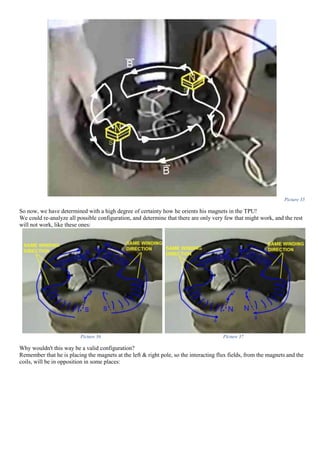
So now, we have determined with a high degree of certainty how he orients his magnets in the TPU!
We could re-analyze all possible configuration, and determine that there are only very few that might work, and the rest
will not work, like these ones:
Picture 36 Picture 37
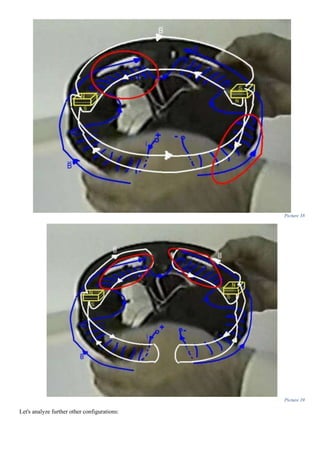
Why wouldn't this way be a valid configuration?
Remember that he is placing the magnets at the left & right pole, so the interacting flux fields, from the magnets and the
coils, will be in opposition in some places:
Picture 38
Picture 39
Let's analyze further other configurations:
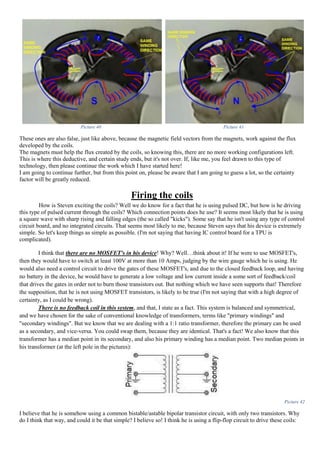
Picture 40 Picture 41
These ones are also false, just like above, because the magnetic field vectors from the magnets, work against the flux
developed by the coils.
The magnets must help the flux created by the coils, so knowing this, there are no more working configurations left.
This is where this deductive, and certain study ends, but it's not over. If, like me, you feel drawn to this type of
technology, then please continue the work which I have started here!
I am going to continue further, but from this point on, please be aware that I am going to guess a lot, so the certainty
factor will be greatly reduced.
Firing the coils
How is Steven exciting the coils? Well we do know for a fact that he is using pulsed DC, but how is he driving
this type of pulsed current through the coils? Which connection points does he use? It seems most likely that he is using
a square wave with sharp rising and falling edges (the so called "kicks"). Some say that he isn't using any type of control
circuit board, and no integrated circuits. That seems most likely to me, because Steven says that his device is extremely
simple. So let's keep things as simple as possible. (I'm not saying that having IC control board for a TPU is
complicated).
I think that there are no MOSFET's in his device! Why? Well…think about it! If he were to use MOSFET's,
then they would have to switch at least 100V at more than 10 Amps, judging by the wire gauge which he is using. He
would also need a control circuit to drive the gates of these MOSFET's, and due to the closed feedback loop, and having
no battery in the device, he would have to generate a low voltage and low current inside a some sort of feedback/coil
that drives the gates in order not to burn those transistors out. But nothing which we have seen supports that! Therefore
the supposition, that he is not using MOSFET transistors, is likely to be true (I'm not saying that with a high degree of
certainty, as I could be wrong).
There is no feedback coil in this system, and that, I state as a fact. This system is balanced and symmetrical,
and we have chosen for the sake of conventional knowledge of transformers, terms like "primary windings" and
"secondary windings". But we know that we are dealing with a 1:1 ratio transformer, therefore the primary can be used
as a secondary, and vice-versa. You could swap them, because they are identical. That's a fact! We also know that this
transformer has a median point in its secondary, and also his primary winding has a median point. Two median points in
his transformer (at the left pole in the pictures):
Picture 42
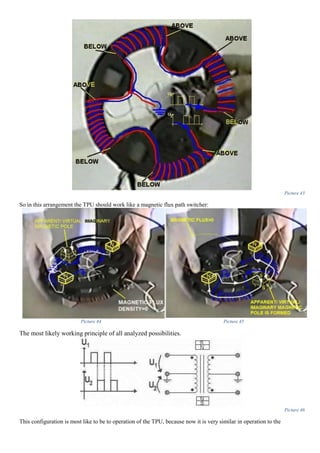
I believe that he is somehow using a common bistable/astable bipolar transistor circuit, with only two transistors. Why
do I think that way, and could it be that simple? I believe so! I think he is using a flip-flop circuit to drive these coils:
Picture 43
So in this arrangement the TPU should work like a magnetic flux path switcher:
Picture 44 Picture 45
The most likely working principle of all analyzed possibilities.
Picture 46
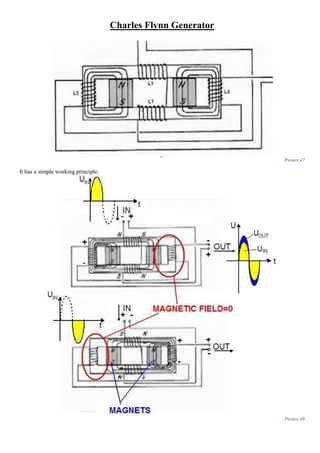
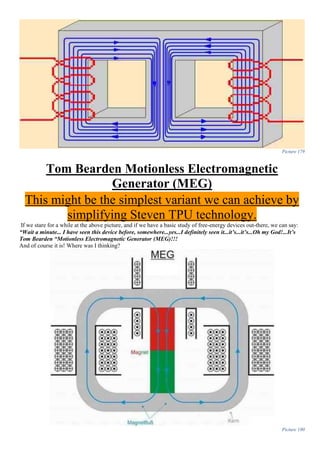
This configuration is most like to be to operation of the TPU, because now it is very similar in operation to the
Charles Flynn Generator
Picture 47
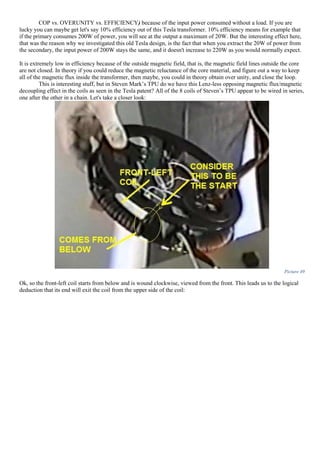
It has a simple working principle:
Picture 48
When you understand how the Flynn generator works, then you will see that Steven’s TPU is actually a better version of
the same technology. Although this type of generator is working in AC, Steven’s TPU can't work like that due to the
coil winding direction at the front and back poles. Check the picture above, and you will realize that if you change the
direction of the current through the TPU coils, then the 4 magnetic poles created around it will alternate and the magnet
will vibrate, because one moment it is attracted by the flux inside the TPU, and the next moment it is repelled, so it can't
work with sinewave AC! By implementing the Charles Flynn solid state generator in a toroid core, it becomes more
efficient, due to providing a better magnetic flux containment construction.
More about magnetic flux path switching here:
Flynn Parallel Path principle device:
http://peswiki.com/index.php/Directory:Flynn_Parallel_Path_principle_device
Simple flux experiment:
http://peswiki.com/index.php/Directory:FPPP:Simple_flux_experiment
Experimental Set-up:
http://peswiki.com/index.php/Directory:FPPP:Experimental_Set-up
So then, even if it has an extraordinary performance, it is not efficient (refer to section
COP vs. OVERUNITY vs. EFFICIENCY) because of the input power consumed without a load. If you are
lucky you can maybe get let's say 10% efficiency out of this Tesla transformer. 10% efficiency means for example that
if the primary consumes 200W of power, you will see at the output a maximum of 20W. But the interesting effect here,
that was the reason why we investigated this old Tesla design, is the fact that when you extract the 20W of power from
the secondary, the input power of 200W stays the same, and it doesn't increase to 220W as you would normally expect.
It is extremely low in efficiency because of the outside magnetic field, that is, the magnetic field lines outside the core
are not closed. In theory if you could reduce the magnetic reluctance of the core material, and figure out a way to keep
all of the magnetic flux inside the transformer, then maybe, you could in theory obtain over unity, and close the loop.
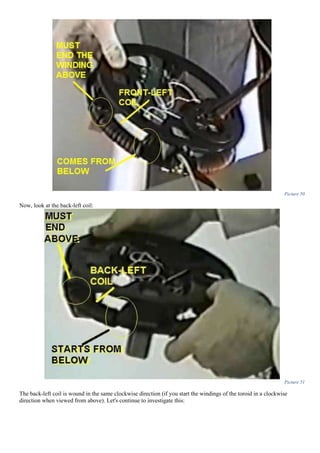
This is interesting stuff, but in Steven Mark’s TPU do we have this Lenz-less opposing magnetic flux/magnetic
decoupling effect in the coils as seen in the Tesla patent? All of the 8 coils of Steven’s TPU appear to be wired in series,
one after the other in a chain. Let's take a closer look:
Picture 49
Ok, so the front-left coil starts from below and is wound clockwise, viewed from the front. This leads us to the logical
deduction that its end will exit the coil from the upper side of the coil:
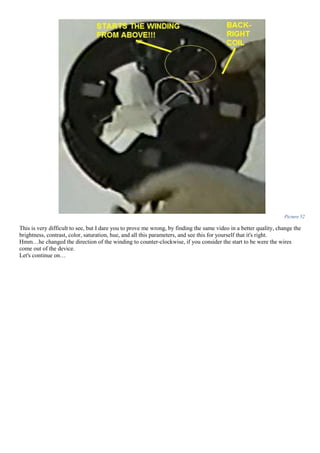
Picture 50
Now, look at the back-left coil:
Picture 51
The back-left coil is wound in the same clockwise direction (if you start the windings of the toroid in a clockwise
direction when viewed from above). Let's continue to investigate this:
Picture 52
This is very difficult to see, but I dare you to prove me wrong, by finding the same video in a better quality, change the
brightness, contrast, color, saturation, hue, and all this parameters, and see this for yourself that it's right.
Hmm…he changed the direction of the winding to counter-clockwise, if you consider the start to be were the wires
come out of the device.
Let's continue on…
Picture 53
The front-right hand coil is wound in a counter-clockwise direction. It starts from above, and ends below. NOW WE
KNOW ALL THE DIRECTIONS OF THE WINDINGS WITH A HIGH DEGREE OF CERTAINTY!! Let us
summarize what we know so far:
Picture 54
At the front-left coil we have chosen to start the wire from the outside of the TPU, and therefore, our wire will start
above the core, and will end below the core. BUT the starting and ending leads of the coils are actually situated INSIDE
the TPU, therefore, the front-left coil which starts from the inside at the front pole, from below now, and ends at the left
pole above going inside of the TPU.
So a better and much clear representation will be like this:
Picture 55
As suspected, Steven is creating the effect we are after, by using opposing magnetic fluxes. Let us take a look at that
bundle of wires in the middle of the TPU. Where do they connect to?
Picture 56
This is the toughest job, but we can clearly distinguish 2 wires connected to, or coming from, the right pole. How are
these wires connected? To what? What other wires do we have here?
Picture 57
We could combine them like this:
Picture 58
This would be foolish, because the front-left hand coil would be rendered useless. Another combination could be:
Picture 59
This would be ineffective also, because this time, the back-left coil will be redundant.
Other combinations could be like this:
Picture 60 Picture 61
In these configurations, we have two sub-possibilities, both ineffective, as we will see. The first sub-possibility is that
the current flow through these 2 yellow wires is in opposite directions with one going and one coming. Regardless of
which one's which, let's think also about how the front left coil enters into this junction, and how the back-left coil
leaves this junction.
Picture 62
If the wires were connected like this, it would nullify our pole! So then what's the point in having the permanent
magnet placed here??? Our coils don't create a magnetic pole here! So, this sub-possibility has to be wrong!
(Comment on 29.12.2011: If this is your first time reading the book, don’t read this comment. It will be extremely confusing and even contradicting all I have stated.
I have come to believe that this is actually not wrong, but in fact quite correct, and even more than that, it’s an improvement of the final configuration. So study the
final most likely configuration and the further study on improving performance to see how this above case is correct. Follow my journey footsteps)
The last incorrect sub-possibility is that the direction of the current flow through these 2 yellow wires is in the same
direction.
Picture 63
If the wires are connected like this, then you might say: what's the point in having 2 wires with the same
current? It can be just one…and you are right. If so, then it's a median point. But what if it's not the same current? It
could be 2 sequential pulsed currents, when one in on, the other is off and vice-versa.
If the wires are connected like this, then bear with me, because it gets a little complicated. To pulse two flip/flop
currents through these two yellow wires, will mean that you will need a ground for them. The only possible symmetrical
ground for them will be on blue wire in the right pole. Now, this is somehow peculiar, but the blue 4 coils (let them be
primary coils) will generate 4 magnetic poles like so:
Picture 64
But this is also a wrong configuration. Why? We will consider the blue coils to be our primary, then the red
coils our secondary. Our primary fires first the back side of the TPU:
Picture 65
Then the front side of the TPU, and so on:
Picture 66
By doing this, Our secondary, due to not having any sort of connection at the back pole, will generate at the A and B
terminals two equal voltages of same polarity. Due to the fact they have the same polarity at a particular time (either +
or -), and equal voltage, there will be no voltage drop between them.
You may be wondering what is this "Secondary magnetic flux" in red. I know that's not quite correct, but it's the
same flux as the blue vector, but for the sake of understanding how the secondary winding will operate, we
conventionally chosen to represent it this way.
The only way to collect power from this type of red-secondary is to have a ground connection at the back-pole,
because our voltage potential is created from this point.
Picture 67
Picture 68
But we cannot see any wire connected to the back pole. Therefore there is no possible way to generate an output from
this red-secondary configuration.
There is another configuration, also false, and just like above, but this time, our secondary plugs are situated at the right
pole:
Picture 69
We know we don't have a connection at the back pole and at the left pole the 2 wires connected serve as inputs. No
room for the third wire. So the only possible other connection will be at point C. But then the whole back red winding
will serve no purpose.
Most likely this configuration the secondary winding will need another wire at the left pole of the TPU. (Which
makes 3 wires connected here - false configuration). But nothing will be generated on the back/front side of the TPU,
because we have two magnetic fluxes that oppose each other in the middle (at the front & back pole).
Although there may be some true in these configuration, and it may be the way he is firing the primary.
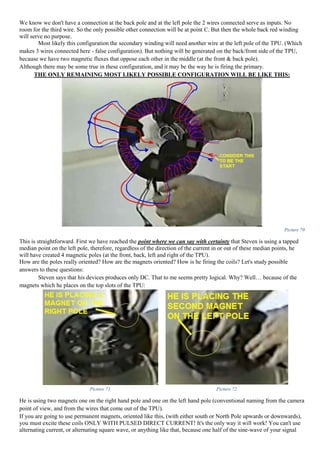
THE ONLY REMAINING MOST LIKELY POSSIBLE CONFIGURATION WILL BE LIKE THIS:
Picture 70
This is straightforward. First we have reached the point where we can say with certainty that Steven is using a tapped
median point on the left pole, therefore, regardless of the direction of the current in or out of these median points, he
will have created 4 magnetic poles (at the front, back, left and right of the TPU).
How are the poles really oriented? How are the magnets oriented? How is he firing the coils? Let's study possible
answers to these questions:
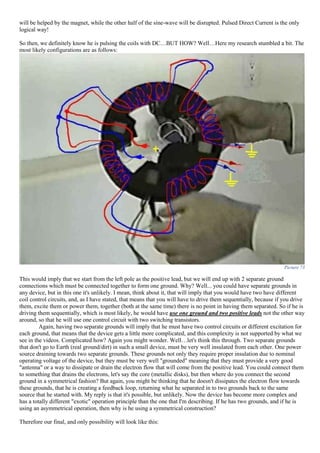
Steven says that his devices produces only DC. That to me seems pretty logical. Why? Well… because of the
magnets which he places on the top slots of the TPU:
Picture 71 Picture 72
He is using two magnets one on the right hand pole and one on the left hand pole (conventional naming from the camera
point of view, and from the wires that come out of the TPU).
If you are going to use permanent magnets, oriented like this, (with either south or North Pole upwards or downwards),
you must excite these coils ONLY WITH PULSED DIRECT CURRENT! It's the only way it will work! You can't use
alternating current, or alternating square wave, or anything like that, because one half of the sine-wave of your signal
will be helped by the magnet, while the other half of the sine-wave will be disrupted. Pulsed Direct Current is the only
logical way!
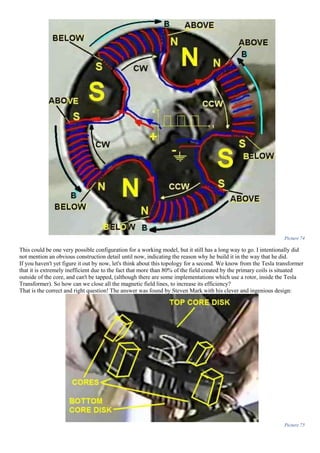
So then, we definitely know he is pulsing the coils with DC…BUT HOW? Well…Here my research stumbled a bit. The
most likely configurations are as follows:
Picture 73
This would imply that we start from the left pole as the positive lead, but we will end up with 2 separate ground
connections which must be connected together to form one ground. Why? Well... you could have separate grounds in
any device, but in this one it's unlikely. I mean, think about it, that will imply that you would have two have different
coil control circuits, and, as I have stated, that means that you will have to drive them sequentially, because if you drive
them, excite them or power them, together (both at the same time) there is no point in having them separated. So if he is
driving them sequentially, which is most likely, he would have use one ground and two positive leads not the other way
around, so that he will use one control circuit with two switching transistors.
Again, having two separate grounds will imply that he must have two control circuits or different excitation for
each ground, that means that the device gets a little more complicated, and this complexity is not supported by what we
see in the videos. Complicated how? Again you might wonder. Well…let's think this through. Two separate grounds
that don't go to Earth (real ground/dirt) in such a small device, must be very well insulated from each other. One power
source draining towards two separate grounds. These grounds not only they require proper insulation due to nominal
operating voltage of the device, but they must be very well "grounded" meaning that they must provide a very good
"antenna" or a way to dissipate or drain the electron flow that will come from the positive lead. You could connect them
to something that drains the electrons, let's say the core (metallic disks), but then where do you connect the second
ground in a symmetrical fashion? But again, you might be thinking that he doesn't dissipates the electron flow towards
these grounds, that he is creating a feedback loop, returning what he separated in to two grounds back to the same
source that he started with. My reply is that it's possible, but unlikely. Now the device has become more complex and
has a totally different "exotic" operation principle than the one that I'm describing. If he has two grounds, and if he is
using an asymmetrical operation, then why is he using a symmetrical construction?
Therefore our final, and only possibility will look like this:
Picture 74
This could be one very possible configuration for a working model, but it still has a long way to go. I intentionally did
not mention an obvious construction detail until now, indicating the reason why he build it in the way that he did.
If you haven't yet figure it out by now, let's think about this topology for a second. We know from the Tesla transformer
that it is extremely inefficient due to the fact that more than 80% of the field created by the primary coils is situated
outside of the core, and can't be tapped, (although there are some implementations which use a rotor, inside the Tesla
Transformer). So how can we close all the magnetic field lines, to increase its efficiency?
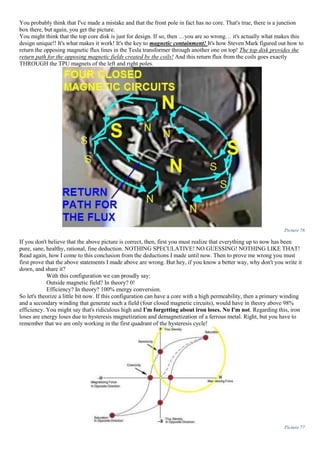
That is the correct and right question! The answer was found by Steven Mark with his clever and ingenious design:
Picture 75
You probably think that I've made a mistake and that the front pole in fact has no core. That's true, there is a junction
box there, but again, you get the picture.
You might think that the top core disk is just for design. If so, then …you are so wrong… it's actually what makes this
design unique!! It's what makes it work! It's the key to magnetic containment! It's how Steven Mark figured out how to
return the opposing magnetic flux lines in the Tesla transformer through another one on top! The top disk provides the
return path for the opposing magnetic fields created by the coils! And this return flux from the coils goes exactly
THROUGH the TPU magnets of the left and right poles.
Picture 76
If you don't believe that the above picture is correct, then, first you must realize that everything up to now has been
pure, sane, healthy, rational, fine deduction. NOTHING SPECULATIVE! NO GUESSING! NOTHING LIKE THAT!
Read again, how I come to this conclusion from the deductions I made until now. Then to prove me wrong you must
first prove that the above statements I made above are wrong. But hey, if you know a better way, why don't you write it
down, and share it?
With this configuration we can proudly say:
Outside magnetic field? In theory? 0!
Efficiency? In theory? 100% energy conversion.
So let's theorize a little bit now. If this configuration can have a core with a high permeability, then a primary winding
and a secondary winding that generate such a field (four closed magnetic circuits), would have in theory above 98%
efficiency. You might say that's ridiculous high and I'm forgetting about iron loses. No I'm not. Regarding this, iron
loses are energy loses due to hysteresis magnetization and demagnetization of a ferrous metal. Right, but you have to
remember that we are only working in the first quadrant of the hysteresis cycle!
Picture 77
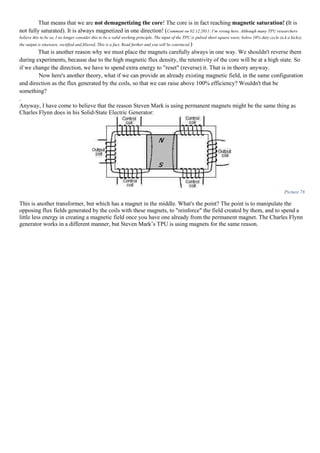
That means that we are not demagnetizing the core! The core is in fact reaching magnetic saturation! (It is
not fully saturated). It is always magnetized in one direction! (Comment on 02.12.2011: I’m wrong here. Although many TPU researchers
believe this to be so, I no longer consider this to be a valid working principle. The input of the TPU is pulsed short square wave, below 10% duty cycle (a.k.a kicks),
the output is sinewave, rectified and filtered. This is a fact. Read further and you will be convinced.)
That is another reason why we must place the magnets carefully always in one way. We shouldn't reverse them
during experiments, because due to the high magnetic flux density, the retentivity of the core will be at a high state. So
if we change the direction, we have to spend extra energy to "reset" (reverse) it. That is in theory anyway.
Now here's another theory, what if we can provide an already existing magnetic field, in the same configuration
and direction as the flux generated by the coils, so that we can raise above 100% efficiency? Wouldn't that be
something?
.
Anyway, I have come to believe that the reason Steven Mark is using permanent magnets might be the same thing as
Charles Flynn does in his Solid-State Electric Generator:
Picture 78
This is another transformer, but which has a magnet in the middle. What's the point? The point is to manipulate the
opposing flux fields generated by the coils with these magnets, to "reinforce" the field created by them, and to spend a
little less energy in creating a magnetic field once you have one already from the permanent magnet. The Charles Flynn
generator works in a different manner, but Steven Mark’s TPU is using magnets for the same reason.
COP vs. OVERUNITY vs. EFFICIENCY
A NON-CONVENTIONAL APPROACH IN DEFINING COP
(FORCING A NEW DEFINITION FOR COP IN TRANSFORMERS CONSIDERING AS IF THERE IS ONLY ONE
INPUT ENERGY SOURCE)
At first I believed that these terms are the same exact thing, but researching I stumbled upon this:
http://www.cheniere.org/correspondence/022502.htm. It is a letter by Tom Bearden on the difference between COP and
efficiency.
When I first saw it, I, like many others firmly believe that COP, Overunity and efficiency are one and the same thing.
But then IN THE FIRST LINE, Tom Bearden says:
When I read this, I said to myself, Oh dear God. I too am making this confusion. I said to myself:
“If COP is not the same as efficiency, then I’m going to disregard all my definitions for COP, all my definition
for Overunity, all my definitions for efficiency. I’m going to erase all my definitions and start from scratch and take
Tom Bearden word for granted. Ok. So, then I don’t know anything if he says they are different things.”
Then I say to myself: “What the hell are they then?”
I honestly responded to myself:
“Ok. The only premise I will allow myself to start with is that I don’t know what COP is, I don’t know what
efficiency is BUT I DO KNOW THAT OVERUNITY IS THE RATIO OF TOTAL POWER OUTPUT, OVER TOTAL
INPUT POWER. This is the only supposition I will allow myself to make in my head, being the simplest, and that
everybody knows it.”
So Overunity is a propriety of a system to generate a lot more total power than the total power it consumes.
When I say a system, I’m thinking in my head for example at a simple transformer. This is the only idea I won’t give
up. This is the goal of Free Energy. Is the mission statement. Is where we all strive to reach. Everybody knows this. It’s
like the Lord Prayer. So then it has a dimensionless unit of measure (watt over watt gets reduced), and is expressed just
by a number, usually below 1, and in the fringe research of free-energy we strive for it to be greater than 1.
USING ARISTOTELIAN LOGIC TO UNDERSTAND THE DIFFERENCE
Ok. Tom says that COP is different from efficiency. Therefore Overunity must be the same with COP OR the
same with efficiency OR different from both. Right? We will take his word for granted. Ok. Instead of trying to
understand HOW THEY ARE DIFFERENT, let’s try with something simpler, like defining the simplest one. To me
the efficiency seems simpler to define than COP. So what is efficiency?
To my amazement, HIS NEXT STATEMENT, defines exactly what is going in my head.
I quote:
“Rigorously, the efficiency of a motor or system may be defined as (total useful output) divided by (total energy
input from all sources). No inert system can have an efficiency of greater than 100%, for that would be a violation of
energy conservation.”
O MY GOD. WE HAVE FOUND THE DEFINITION! And is the same as my first supposition of Overunity.
OK. (Total energy out/total energy in) This means that Overunity is the same as efficiency! Just that
efficiency is multiplied by 100 and expressed in percentages. (According to Bearden’s definition of efficiency and personal definition of
Overunity)
OK. Let’s summarize what we have here:
Let’s make these notations:
Overunity = variable A
Efficiency = variable B
COP = variable C
FROM THE TITLE OF THE PAGE WE KNOW THAT B≠C (B<>C)
I allowed myself the cling to my own personal definition of Overunity, which is the same as Tom definition of
efficiency. Therefore A=B.
Oh my GOD! Do you realize what this means? It means that A≠B (A<>B). This means that Overunity is
not the same thing as COP!!! (According to Bearden and my definition of Overunity)
Then what the hell is COP, if it’s not the ratio TOTAL OUTPUT POWER/TOTAL INPUT POWER??? What
is this COP? What on earth does is stand for?
Again, amazingly his third statement, is exactly on my line of though.
“You confuse COP with efficiency, and they are two quite different things. Even many of the textbooks confuse these
terms quite often”
Tom Bearden letter to John date: Mon, 25 Feb 2002 01:07:52 -0600
I quote:
“The coefficient of performance (COP) […] “
Ok so now we know that COP is just performance. Let’s use that term. Therefore we have 3 terms: “Overunity”,
“Efficiency” and “Performance”.
Overunity = variable A
Efficiency = variable B
Performance = variable C
We do know that “Overunity” is the same as “Efficiency” and both are different from “Performance”.
Therefore (A=B) ≠C
(A=B)<>C
Let’s now take the huge and last piece of the puzzle in trying to understand what Performance is:
Ok. Forget the rest of things he says for a while, and let’s stick with the above sentence. At first glance, what do
we see? We see that in parenthesis he still has used the magic word “total” as in “total useful output”. OK? Ok!
Then he says “divided by”, ok so it’s still a ratio, NOTHING DIFFERENT UNTIL NOW, BUT HERE
IT COMES: “ENERGY INPUT BY THE OPERATOR ONLY”. What the hell is “Energy input by the operator only”?
Honestly for now, let’s play dumb and not have any idea of what he is talking about, but what I DO KNOW IS THAT
THE MAGIC WORD “TOTAL” has gone!
HE IS NOT USING A TOTAL IN THE
DENOMINATOR!!!
Let’s try to understand what this alien concept of “energy input by the operator only means”.
Let’s quote him again:
It’s a little tricky but let’s figure this together. Ok? If I’m wrong feel free to correct me. First of all we do see
that in order to state his total output power he first states the efficiency of his system, since:
𝐸𝑓𝑓𝑖𝑐𝑖𝑒𝑛𝑐𝑦 =
𝑡𝑜𝑡𝑎𝑙 𝑂𝑈𝑇
𝑡𝑜𝑡𝑎𝑙 𝐼𝑁
⇒ 𝑇ℎ𝑒𝑟𝑒𝑓𝑜𝑟𝑒 ⇒ 𝑇𝑜𝑡𝑎𝑙 𝑂𝑈𝑇 = (𝑇𝑜𝑡𝑎𝑙 𝐼𝑁 ∗ 𝐸𝑓𝑓𝑖𝑐𝑖𝑒𝑛𝑐𝑦) Equation 1
Are we good until now? Good.
Now what he is doing he is separating the INPUT POWER of
his system into two separate entities:
1. “[…] the operator only has to input, 10 joules […]”
2. “[…] active environment freely inputs 90 joules […]”
Interesting, so he differentiated the total input power of 100 joules into two SEPARATED DISTINCT
ENTITIES. The “Operator” (me or you) and the “Environment” (air, sun-rays, wind, water, ether, vacuum etc.).
His Total output is 50 joules.
Therefore efficiency is:
50
100
=
1
2
⇒ 𝐸𝑓𝑓𝑖𝑐𝑖𝑒𝑛𝑐𝑦 = 0.5 ∗ 100 = 50% Equation 2
“The coefficient of performance (COP) of a motor or system may be defined as (total useful output) divided by
(ENERGY INPUT BY THE OPERATOR ONLY).”
Tom Bearden letter to John date: Mon, 25 Feb 2002 01:07:52 -0600
“If the operator only has to input, say, 10 joules of energy and the active environment freely inputs 90 joules of
energy, then the total input is 100 joules. Now suppose that the system has 50% efficiency; i.e., it wastes or "loses"
half the energy before it dissipates the rest of it in the load to do useful work. In that case the system outputs 50
joules of work for a total input of 100 joules, but with the operator only inputting 10 of those 100 input joules. So
this system has an efficiency of 50% but a COP =5.0.”
Tom Bearden letter to John date: Mon, 25 Feb 2002 01:07:52 -0600
Ok? Is everything clear until now?
Ok. FROM THE TITLE OF THE PAGE, we know that performance must be something different from 50. So we
must get something different from this 50 in Equation 2. We will also keep that in mind to verify our correctness.
So then. His Performance will be this total output (50) over this “operator input only” concept of (10) which
equals 5. Correct, right?
Hmm. Interesting. Let me guess. We will say that this system has a “very good performance”? I guess so.
What, have we learned so far?
That Tom Bearden, when he is defining COP, he is using a simple common ratio, but in the denominator
his is not using a total, because he differentiated the input power into two separate variables.
Keep in mind that in my case I’m always thinking at a transformer. So therefore, to define the performance of a
transformer, I feel obligated like him to separate the input power into two distinct entities (variables).
We must separate the input power into two distinct entities. The active environment HAS NO
EFFECT ON OUR IDEAL TRANSFORMER OPERATION
WHATSOEVER (according to the conventional ideal transformer model). Therefore the active environment is inputting 0
joules of energy into our ideal transformer, right? (This might slightly inevitably distort the concept. Let us hope only that this distortion is not going to bring too much error in
our calculations)
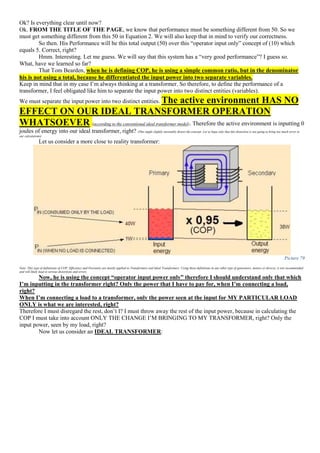
Let us consider a more close to reality transformer:
Picture 79
Note: This type of definitions of COP, Efficiency and Overunity are mostly applied to Transformers and Ideal Transformers. Using these definitions in any other type of generators, motors or devices, is not recommended
and will likely lead to serious distortions and errors.
Now, he is using the concept “operator input power only” therefore I should understand only that which
I’m inputting in the transformer right? Only the power that I have to pay for, when I’m connecting a load,
right?
When I’m connecting a load to a transformer, only the power seen at the input for MY PARTICULAR LOAD
ONLY is what we are interested, right?
Therefore I must disregard the rest, don’t I? I must throw away the rest of the input power, because in calculating the
COP I must take into account ONLY THE CHANGE I’M BRINGING TO MY TRANSFORMER, right? Only the
input power, seen by my load, right?
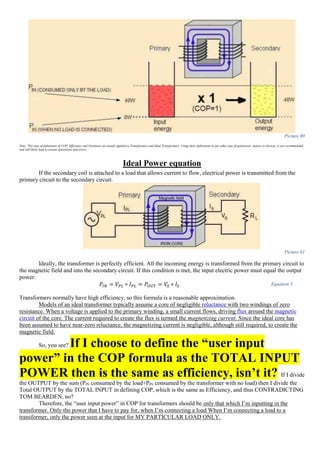
Now let us consider an IDEAL TRANSFORMER:
Picture 80
Note: This type of definitions of COP, Efficiency and Overunity are mostly applied to Transformers and Ideal Transformers. Using these definitions in any other type of generators, motors or devices, is not recommended
and will likely lead to serious distortions and errors.
Ideal Power equation
If the secondary coil is attached to a load that allows current to flow, electrical power is transmitted from the
primary circuit to the secondary circuit.
Picture 81
Ideally, the transformer is perfectly efficient. All the incoming energy is transformed from the primary circuit to
the magnetic field and into the secondary circuit. If this condition is met, the input electric power must equal the output
power:
𝑃𝐼𝑁 = 𝑉𝑃𝐿 ∗ 𝐼 𝑃𝐿 = 𝑃𝑂𝑈𝑇 = 𝑉𝑆 ∗ 𝐼𝑆 Equation 3
Transformers normally have high efficiency, so this formula is a reasonable approximation.
Models of an ideal transformer typically assume a core of negligible reluctance with two windings of zero
resistance. When a voltage is applied to the primary winding, a small current flows, driving flux around the magnetic
circuit of the core. The current required to create the flux is termed the magnetizing current. Since the ideal core has
been assumed to have near-zero reluctance, the magnetizing current is negligible, although still required, to create the
magnetic field.
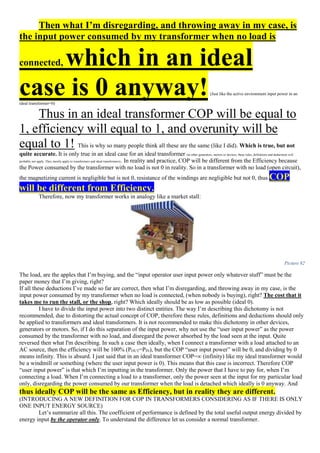
So, you see? If I choose to define the “user input
power” in the COP formula as the TOTAL INPUT
POWER then is the same as efficiency, isn’t it? If I divide
the OUTPUT by the sum (PIN consumed by the load+PIN consumed by the transformer with no load) then I divide the
Total OUTPUT by the TOTAL INPUT in defining COP, which is the same as Efficiency, and thus CONTRADICTING
TOM BEARDEN, no?
Therefore, the “user input power” in COP for transformers should be only that which I’m inputting in the
transformer. Only the power that I have to pay for, when I’m connecting a load When I’m connecting a load to a
transformer, only the power seen at the input for MY PARTICULAR LOAD ONLY.
Then what I’m disregarding, and throwing away in my case, is
the input power consumed by my transformer when no load is
connected, which in an ideal
case is 0 anyway!(Just like the active environment input power in an
ideal transformer=0)
Thus in an ideal transformer COP will be equal to
1, efficiency will equal to 1, and overunity will be
equal to 1! This is why so many people think all these are the same (like I did). Which is true, but not
quite accurate. It is only true in an ideal case for an ideal transformer (in other generators, motors or devices, these rules, definitions and deductions will
probably not apply. They mostly apply to transformers and ideal transformers). In reality and practice, COP will be different from the Efficiency because
the Power consumed by the transformer with no load is not 0 in reality. So in a transformer with no load (open circuit),
the magnetizing current is negligible but is not 0, resistance of the windings are negligible but not 0, thus COP
will be different from Efficiency.
Therefore, now my transformer works in analogy like a market stall:
Picture 82
The load, are the apples that I’m buying, and the “input operator user input power only whatever stuff” must be the
paper money that I’m giving, right?
If all these deductions I’ve made so far are correct, then what I’m disregarding, and throwing away in my case, is the
input power consumed by my transformer when no load is connected, (when nobody is buying), right? The cost that it
takes me to run the stall, or the shop, right? Which ideally should be as low as possible (ideal 0).
I have to divide the input power into two distinct entities. The way I’m describing this dichotomy is not
recommended, due to distorting the actual concept of COP, therefore these rules, definitions and deductions should only
be applied to transformers and ideal transformers. It is not recommended to make this dichotomy in other devices,
generators or motors. So, if I do this separation of the input power, why not use the “user input power” as the power
consumed by the transformer with no load, and disregard the power absorbed by the load seen at the input. Quite
reversed then what I'm describing. In such a case then ideally, when I connect a transformer with a load attached to an
AC source, then the efficiency will be 100% (POUT=PIN), but the COP “user input power” will be 0, and dividing by 0
means infinity. This is absurd. I just said that in an ideal transformer COP=∞ (infinity) like my ideal transformer would
be a windmill or something (where the user input power is 0). This means that this case is incorrect. Therefore COP
“user input power” is that which I’m inputting in the transformer. Only the power that I have to pay for, when I’m
connecting a load. When I’m connecting a load to a transformer, only the power seen at the input for my particular load
only, disregarding the power consumed by our transformer when the load is detached which ideally is 0 anyway. And
thus ideally COP will be the same as Efficiency, but in reality they are different.
(INTRODUCING A NEW DEFINITION FOR COP IN TRANSFORMERS CONSIDERING AS IF THERE IS ONLY
ONE INPUT ENERGY SOURCE)
Let’s summarize all this. The coefficient of performance is defined by the total useful output energy divided by
energy input by the operator only. To understand the difference let us consider a normal transformer.
Picture 83
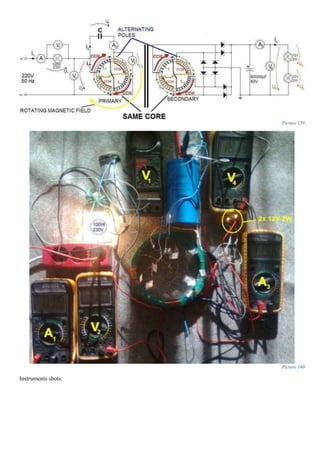
In this first case, we have a regular transformer with its primary winding connected to an alternating current (AC) power
source. The secondary winding is not connected to anything, it has no load (R=infinite)
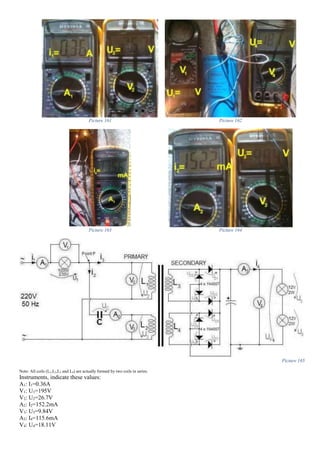
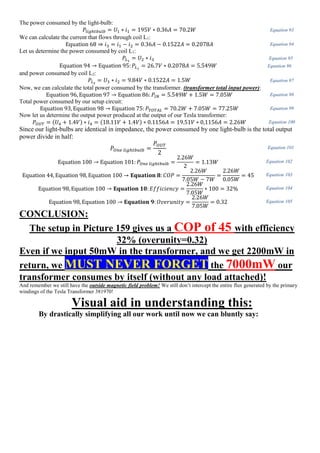
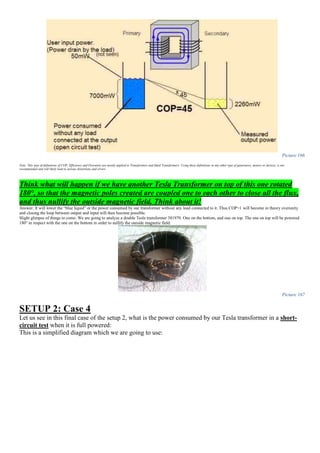
We can calculate the power consumed by the transformer in this open-circuit test (PIN), which is:
𝑃𝐼𝑁(𝑁𝑂 𝐿𝑂𝐴𝐷) = 𝑉𝑃 𝑥 𝐼 𝑃 Equation 4
But, when we connect a load that input power changes:
Picture 84
In this case, with an output load, we calculate:
𝑃𝐼𝑁(𝑊𝐼𝑇𝐻 𝐿𝑂𝐴𝐷) = 𝑉𝑃𝐿 ∗ 𝐼 𝑃𝐿 Equation 5
𝑃𝐼𝑁 (𝐶𝑂𝑁𝑆𝑈𝑀𝐸𝐷 𝑂𝑁𝐿𝑌 𝐵𝑌 𝑇𝐻𝐸 𝐿𝑂𝐴𝐷) = 𝑃𝐼𝑁 (𝑊𝐼𝑇𝐻 𝐿𝑂𝐴𝐷) − 𝑃𝐼𝑁 (𝑁𝑂 𝐿𝑂𝐴𝐷) Equation 6
𝑃𝑂𝑈𝑇 = 𝑉𝑆 ∗ 𝐼𝑆 Equation 7
And what we are after are these ratios:
𝑪𝒐𝒆𝒇𝒇𝒊𝒄𝒊𝒆𝒏𝒕 𝒐𝒇 𝒑𝒆𝒓𝒇𝒐𝒓𝒎𝒂𝒏𝒄𝒆(𝑪𝑶𝑷) =
𝑷 𝑶𝑼𝑻
𝑷 𝑰𝑵 (𝑾𝑰𝑻𝑯 𝑳𝑶𝑨𝑫) − 𝑷 𝑰𝑵 (𝑵𝑶 𝑳𝑶𝑨𝑫)
=
𝑷 𝑶𝑼𝑻
𝑷 𝑰𝑵 (𝑪𝑶𝑵𝑺𝑼𝑴𝑬𝑫 𝑶𝑵𝑳𝒀 𝑩𝒀 𝑻𝑯𝑬 𝑳𝑶𝑨𝑫)
Equation 8
𝑶𝒗𝒆𝒓𝒖𝒏𝒊𝒕𝒚 =
𝑷 𝑶𝑼𝑻
𝑷 𝑰𝑵 (𝑾𝑰𝑻𝑯 𝑳𝑶𝑨𝑫)
[𝒏𝒐 𝒖𝒏𝒊𝒕 𝒐𝒇 𝒎𝒆𝒂𝒔𝒖𝒓𝒆] Equation 9
𝑬𝒇𝒇𝒊𝒄𝒊𝒆𝒏𝒄𝒚 =
𝑷 𝑶𝑼𝑻
𝑷 𝑰𝑵 (𝑾𝑰𝑻𝑯 𝑳𝑶𝑨𝑫)
∗ 𝟏𝟎𝟎 [%] Equation 10
This seems like a somewhat "brutal" way to put it, but we now see what a big difference there is between these
parameters.
CONVENTIONAL DEFINITION OF COP
(ONLY APPLIES WHEN WE HAVE MULTIPLE INPUT ENERGY SOURCES)
Picture 85
I hope it’s clear now that the conventional definition only applies when we have an intersection of two special
cases. Again I’m speaking only in regards to transformers. I don’t care about other types of generators, batteries or other
free-energy stuff. I’m only speaking from the limited view point of transformers. So again, going back to this
conventional understanding of COP. It only applies in a special unique case. No! No...Wait there’s more! When we
have two unique special rare cases both of them at once!
First unique special rare case is when we have an additional input power supply. But Most of
transformers on the face of the planet are working
having only ONE POWER SUPPLY! But this is how conventional
COP is defined. We MUST have an additional input power source that provides for the extra energy we see at the
output!
Second unique special rare case that must occur at the same time with the first one, with makes this whole case
more rare than rare, is when we are unable to measure the additional power that this second input is
providing, or it is ambiguous. You see now why we need another approach in defining COP?
The Conventional definition of COP will now be:
𝐶𝑜𝑛𝑣𝑒𝑛𝑡𝑖𝑜𝑛𝑎𝑙 𝐶𝑂𝑃 =
𝑇𝑜𝑡𝑎𝑙 𝑜𝑢𝑡𝑝𝑢𝑡 𝑝𝑜𝑤𝑒𝑟
𝑈𝑠𝑒𝑟 𝑖𝑛𝑝𝑢𝑡 𝑝𝑜𝑤𝑒𝑟
=
𝑉𝑆 ∗ 𝐼𝑆
𝑉𝑈𝑆𝐸𝑅 ∗ 𝐼 𝑈𝑆𝐸𝑅
Equation 11
This will mean that what we will normally be calculating as efficiency of a transformer, and come up with
more than 100% efficiency, actually we have calculated COP. Of course we wouldn't realize that, when
this additional input power source is hiding or is not visible or is not very apparent. So for
all practical reasons we will be tempted to say that we have efficiency over 100%. This is what really Tom Bearden
meant in his letter when he said we shouldn’t confuse COP with efficiency!
Now if we are indeed able to measure the power that this additional input is providing, then things are more
different. We now have two cases, when we have efficiency below and above 100%.
Now the Efficiency will become:
𝐸𝑓𝑓𝑖𝑐𝑖𝑒𝑛𝑐𝑦 =
𝑇𝑜𝑡𝑎𝑙 𝑜𝑢𝑡𝑝𝑢𝑡 𝑝𝑜𝑤𝑒𝑟
𝑇𝑜𝑡𝑎𝑙 𝑖𝑛𝑝𝑢𝑡 𝑝𝑜𝑤𝑒𝑟 𝑓𝑟𝑜𝑚 𝑎𝑙𝑙 𝑠𝑜𝑢𝑟𝑐𝑒𝑠
∗ 100[%]
=
𝑉𝑆 ∗ 𝐼𝑆
𝑉𝑈𝑆𝐸𝑅 ∗ 𝐼 𝑈𝑆𝐸𝑅 + 𝑉𝐴𝐷𝐷𝐼𝑇𝐼𝑂𝑁𝐴𝐿 ∗ 𝐼𝐴𝐷𝐷𝐼𝑇𝐼𝑂𝑁𝐴𝐿
∗ 100[%]
Equation 12
Which can be below 100% or above, case when we say we have achieved overunity.
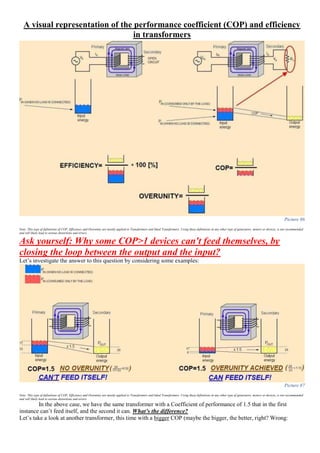
A visual representation of the performance coefficient (COP) and efficiency
in transformers
Picture 86
Note: This type of definitions of COP, Efficiency and Overunity are mostly applied to Transformers and Ideal Transformers. Using these definitions in any other type of generators, motors or devices, is not recommended
and will likely lead to serious distortions and errors.
Ask yourself: Why some COP>1 devices can't feed themselves, by
closing the loop between the output and the input?
Let’s investigate the answer to this question by considering some examples:
Picture 87
Note: This type of definitions of COP, Efficiency and Overunity are mostly applied to Transformers and Ideal Transformers. Using these definitions in any other type of generators, motors or devices, is not recommended
and will likely lead to serious distortions and errors.
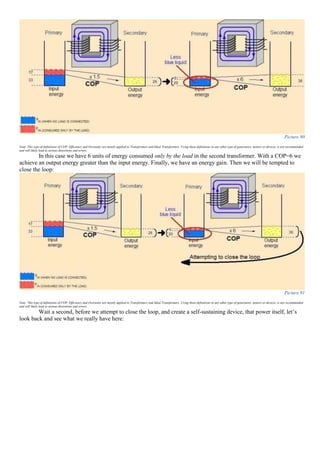
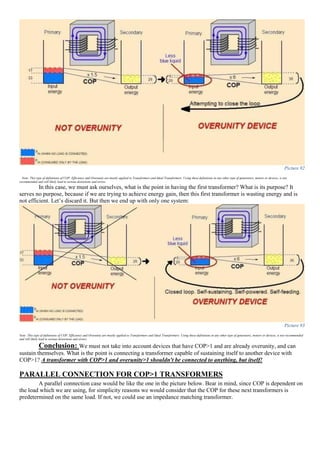
In the above case, we have the same transformer with a Coefficient of performance of 1.5 that in the first
instance can’t feed itself, and the second it can. What’s the difference?
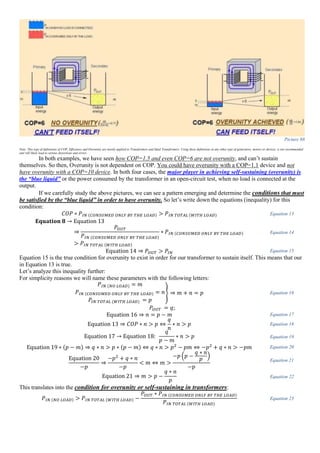
Let’s take a look at another transformer, this time with a bigger COP (maybe the bigger, the better, right? Wrong:
Picture 88
Note: This type of definitions of COP, Efficiency and Overunity are mostly applied to Transformers and Ideal Transformers. Using these definitions in any other type of generators, motors or devices, is not recommended
and will likely lead to serious distortions and errors.
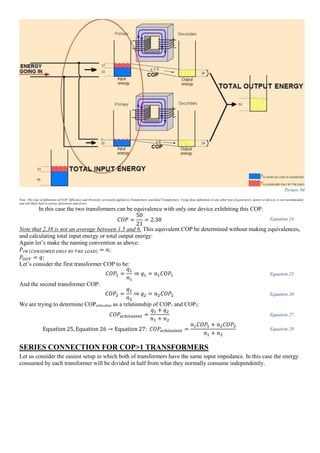
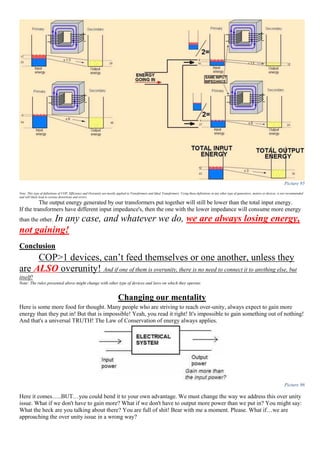
In both examples, we have seen how COP=1.5 and even COP=6 are not overunity, and can’t sustain
themselves. So then, Overunity is not dependent on COP. You could have overunity with a COP=1.1 device and not
have overunity with a COP=10 device. In both four cases, the major player in achieving self-sustaining (overunity) is
the “blue liquid” or the power consumed by the transformer in an open-circuit test, when no load is connected at the
output.
If we carefully study the above pictures, we can see a pattern emerging and determine the conditions that must
be satisfied by the “blue liquid” in order to have overunity. So let’s write down the equations (inequality) for this
condition:
𝐶𝑂𝑃 ∗ 𝑃𝐼𝑁 (𝐶𝑂𝑁𝑆𝑈𝑀𝐸𝐷 𝑂𝑁𝐿𝑌 𝐵𝑌 𝑇𝐻𝐸 𝐿𝑂𝐴𝐷) > 𝑃𝐼𝑁 𝑇𝑂𝑇𝐴𝐿 (𝑊𝐼𝑇𝐻 𝐿𝑂𝐴𝐷) Equation 13
𝐄𝐪𝐮𝐚𝐭𝐢𝐨𝐧 𝟖 → Equation 13
⇒
𝑃𝑂𝑈𝑇
𝑃𝐼𝑁 (𝐶𝑂𝑁𝑆𝑈𝑀𝐸𝐷 𝑂𝑁𝐿𝑌 𝐵𝑌 𝑇𝐻𝐸 𝐿𝑂𝐴𝐷)
∗ 𝑃𝐼𝑁 (𝐶𝑂𝑁𝑆𝑈𝑀𝐸𝐷 𝑂𝑁𝐿𝑌 𝐵𝑌 𝑇𝐻𝐸 𝐿𝑂𝐴𝐷)
> 𝑃𝐼𝑁 𝑇𝑂𝑇𝐴𝐿 (𝑊𝐼𝑇𝐻 𝐿𝑂𝐴𝐷)
Equation 14
Equation 14 ⇒ 𝑃𝑂𝑈𝑇 > 𝑃𝐼𝑁 Equation 15
Equation 15 is the true condition for overunity to exist in order for our transformer to sustain itself. This means that our
in Equation 13 is true.
Let’s analyze this inequality further:
For simplicity reasons we will name these parameters with the following letters:
𝑃𝐼𝑁 (𝑁𝑂 𝐿𝑂𝐴𝐷) = 𝑚
𝑃𝐼𝑁 (𝐶𝑂𝑁𝑆𝑈𝑀𝐸𝐷 𝑂𝑁𝐿𝑌 𝐵𝑌 𝑇𝐻𝐸 𝐿𝑂𝐴𝐷) = 𝑛
𝑃𝐼𝑁 𝑇𝑂𝑇𝐴𝐿 (𝑊𝐼𝑇𝐻 𝐿𝑂𝐴𝐷) = 𝑝
} ⇒ 𝑚 + 𝑛 = 𝑝 Equation 16
𝑃𝑂𝑈𝑇 = 𝑞;
Equation 16 ⇒ 𝑛 = 𝑝 − 𝑚 Equation 17
Equation 13 ⇒ 𝐶𝑂𝑃 ∗ 𝑛 > 𝑝 ⇔
𝑞
𝑛
∗ 𝑛 > 𝑝 Equation 18
Equation 17 → Equation 18:
𝑞
𝑝 − 𝑚
∗ 𝑛 > 𝑝 Equation 19
Equation 19 ∗ (𝑝 − 𝑚) ⇒ 𝑞 ∗ 𝑛 > 𝑝 ∗ (𝑝 − 𝑚) ⇔ 𝑞 ∗ 𝑛 > 𝑝2
− 𝑝𝑚 ⇔ −𝑝2
+ 𝑞 ∗ 𝑛 > −𝑝𝑚 Equation 20
Equation 20
−𝑝
⇒
−𝑝2
+ 𝑞 ∗ 𝑛
−𝑝
< 𝑚 ⇔ 𝑚 >
−𝑝 (𝑝 −
𝑞 ∗ 𝑛
𝑝 )
−𝑝
Equation 21
Equation 21 ⇒ 𝑚 > 𝑝 −
𝑞 ∗ 𝑛
𝑝
Equation 22
This translates into the condition for overunity or self-sustaining in transformers:
𝑃𝐼𝑁 (𝑁𝑂 𝐿𝑂𝐴𝐷) > 𝑃𝐼𝑁 𝑇𝑂𝑇𝐴𝐿 (𝑊𝐼𝑇𝐻 𝐿𝑂𝐴𝐷) −
𝑃𝑂𝑈𝑇 ∗ 𝑃𝐼𝑁 (𝐶𝑂𝑁𝑆𝑈𝑀𝐸𝐷 𝑂𝑁𝐿𝑌 𝐵𝑌 𝑇𝐻𝐸 𝐿𝑂𝐴𝐷)
𝑃𝐼𝑁 𝑇𝑂𝑇𝐴𝐿 (𝑊𝐼𝑇𝐻 𝐿𝑂𝐴𝐷)
Equation 23
SECRETS IN LOWERING THE INPUT POWER CONSUMED BY A
TRANSFORMER WHEN NO LOAD IS CONNECTED AT THE OUTPUT (OPEN-
CIRCUIT) (A.K.A LOWERING THE “BLUE LIQUID”):
This PIN (NO LOAD) “blue liquid”, can be drastically reduced by providing better containment for the magnetic flux
generated by the primary windings. When this magnetic flux generated by the transformer is created in a material which
can contain it and retain it (with low magnetic reluctance), and has a high magnetic permeability µr, and this material
also has a low magnetostriction then the input power consumed by the transformer without a load should decrease. Also
using short square wave signals (one-shot pulses or low duty cycle signals) as an alternative to sine-waves signals,
should in theory spent less energy and drastically reducing this “blue liquid”. Using higher operating frequencies might
reduce it (there is a higher limit).
Ask yourself: Why can’t we connect more COP>1 devices together and
achieve overunity?
INTERCONNECTING COP>1 DEVICES
Let us find an answer to such a question, by trying to interconnect in various ways COP>1 devices.
CASCADE CONNECTION FOR COP>1 TRANSFORMERS
Picture 89
Note: This type of definitions of COP, Efficiency and Overunity are mostly applied to Transformers and Ideal Transformers. Using these definitions in any other type of generators, motors or devices, is not recommended
and will likely lead to serious distortions and errors.
In this case, we have started with 50 units of “energy liquid”. This energy was transformed into 26 units of
energy with a good performance of 1.5, and these 26 units were again transformed with a remarkable coefficient of
performance of 6 and we ended up with 24 units of energy.
It’s damn blue liquid, that’s the problem! If we can reduce it, then our case will be:
Picture 90
Note: This type of definitions of COP, Efficiency and Overunity are mostly applied to Transformers and Ideal Transformers. Using these definitions in any other type of generators, motors or devices, is not recommended
and will likely lead to serious distortions and errors.
In this case we have 6 units of energy consumed only by the load in the second transformer. With a COP=6 we
achieve an output energy greater than the input energy. Finally, we have an energy gain. Then we will be tempted to
close the loop:
Picture 91
Note: This type of definitions of COP, Efficiency and Overunity are mostly applied to Transformers and Ideal Transformers. Using these definitions in any other type of generators, motors or devices, is not recommended
and will likely lead to serious distortions and errors.
Wait a second, before we attempt to close the loop, and create a self-sustaining device, that power itself, let’s
look back and see what we really have here:
Picture 92
Note: This type of definitions of COP, Efficiency and Overunity are mostly applied to Transformers and Ideal Transformers. Using these definitions in any other type of generators, motors or devices, is not
recommended and will likely lead to serious distortions and errors.
In this case, we must ask ourselves, what is the point in having the first transformer? What is its purpose? It
serves no purpose, because if we are trying to achieve energy gain, then this first transformer is wasting energy and is
not efficient. Let’s discard it. But then we end up with only one system:
Picture 93
Note: This type of definitions of COP, Efficiency and Overunity are mostly applied to Transformers and Ideal Transformers. Using these definitions in any other type of generators, motors or devices, is not recommended
and will likely lead to serious distortions and errors.
Conclusion: We must not take into account devices that have COP>1 and are already overunity, and can
sustain themselves. What is the point is connecting a transformer capable of sustaining itself to another device with
COP>1? A transformer with COP>1 and overunity>1 shouldn't be connected to anything, but itself!
PARALLEL CONNECTION FOR COP>1 TRANSFORMERS
A parallel connection case would be like the one in the picture below. Bear in mind, since COP is dependent on
the load which we are using, for simplicity reasons we would consider that the COP for these next transformers is
predetermined on the same load. If not, we could use an impedance matching transformer.
Picture 94
Note: This type of definitions of COP, Efficiency and Overunity are mostly applied to Transformers and Ideal Transformers. Using these definitions in any other type of generators, motors or devices, is not recommended
and will likely lead to serious distortions and errors.
In this case the two transformers can be equivalence with only one device exhibiting this COP:
𝐶𝑂𝑃 =
50
21
= 2.38 Equation 24
Note that 2.38 is not an average between 1.5 and 6. This equivalent COP be determined without making equivalences,
and calculating total input energy or total output energy:
Again let’s make the naming convention as above:
𝑃𝐼𝑁 (𝐶𝑂𝑁𝑆𝑈𝑀𝐸𝐷 𝑂𝑁𝐿𝑌 𝐵𝑌 𝑇𝐻𝐸 𝐿𝑂𝐴𝐷) = 𝑛;
𝑃𝑂𝑈𝑇 = 𝑞;
Let’s consider the first transformer COP to be:
𝐶𝑂𝑃1 =
𝑞1
𝑛1
⇒ 𝑞1 = 𝑛1 𝐶𝑂𝑃1 Equation 25
And the second transformer COP:
𝐶𝑂𝑃2 =
𝑞2
𝑛2
⇒ 𝑞2 = 𝑛2 𝐶𝑂𝑃2 Equation 26
We are trying to determine COPechivalnet as a relationship of COP1 and COP2:
𝐶𝑂𝑃𝑒𝑐ℎ𝑖𝑣𝑎𝑙𝑒𝑛𝑡 =
𝑞1 + 𝑞2
𝑛1 + 𝑛2
Equation 27
Equation 25, Equation 26 → Equation 27: 𝐶𝑂𝑃𝑒𝑐ℎ𝑖𝑣𝑎𝑙𝑒𝑛𝑡 =
𝑛1 𝐶𝑂𝑃1 + 𝑛2 𝐶𝑂𝑃2
𝑛1 + 𝑛2
Equation 28
SERIES CONNECTION FOR COP>1 TRANSFORMERS
Let us consider the easiest setup in which both of transformers have the same input impedance. In this case the energy
consumed by each transformer will be divided in half from what they normally consume independently.
Picture 95
Note: This type of definitions of COP, Efficiency and Overunity are mostly applied to Transformers and Ideal Transformers. Using these definitions in any other type of generators, motors or devices, is not recommended
and will likely lead to serious distortions and errors.
The output energy generated by our transformers put together will still be lower than the total input energy.
If the transformers have different input impedance's, then the one with the lower impedance will consume more energy
than the other. In any case, and whatever we do, we are always losing energy,
not gaining!
Conclusion
COP>1 devices, can’t feed themselves or one another, unless they
are ALSO overunity! And if one of them is overunity, there is no need to connect it to anything else, but
itself!
Note: The rules presented above might change with other type of devices and laws on which they operate.
Changing our mentality
Here is some more food for thought. Many people who are striving to reach over-unity, always expect to gain more
energy than they put in! But that is impossible! Yeah, you read it right! It's impossible to gain something out of nothing!
And that's a universal TRUTH! The Law of Conservation of energy always applies.
Picture 96
Here it comes…..BUT…you could bend it to your own advantage. We must change the way we address this over unity
issue. What if we don't have to gain more? What if we don't have to output more power than we put in? You might say:
What the heck are you talking about there? You are full of shit! Bear with me a moment. Please. What if…we are
approaching the over unity issue in a wrong way?
I believe that we don't have to gain more, but quite the reverse! WE HAVE TO SPEND LESS! And that is the key to
over unity! We don't have to expect to gain more energy at the output! But in fact we must look at the input! That's
where the magic happens. That is where we have to pay attention.
Picture 97
Reaching over unity not by gaining more energy at
the output, but by spending less energy at the input
(a.k.a “blue liquid”)!!!
Yeah, but you still have an energy gain, where does that energy come from? From the magnetic field produced by
permanent magnets. If you have a magnetic field already in place running through a core, then in theory you should
spend less energy building the same magnetic flux, which would have taken a lot more energy to create if you didn't use
a permanent magnet (inductance gain). But in theory, this energy gain from the magnet is so small and insignificant that
you can't use it for anything! You can't do anything with it! Or can you?
Yes you can, if you have a near 100% efficient transformer, you could raise its performance above the 100% mark and
pass the over unity barrier by using this trick! That is again, in theory. That's how I think the TPU really works…in
theory
To back these above words I’m going to use a famous quote:
I don’t believe it’s a very comprehensive sentence, so let me explain what to above quote speaks about:
It speaks about an OVERUNITY SECRET:
■ First step: You don’t energize the input primary side of a transformer with a normal, conventional
approach with power from a power line, you let a permanent magnet energize it. Yeah, but the magnetic
field of a magnet is static. That is correct, BUT you could make the magnetic field of a magnet be
dynamic.
■ Then the second and final step is to make sure that the energy spent dynamising(make more dynamic) the
magnet field by exiting and kicking it, is lower than the energy provided at the output by the magnet.
“[...] with continuous flux paths the static flux from the permanent magnet or magnets is useless. However,
if the static flux of the permanent magnet confined to the flux paths were modified to be time varying it
would have utility for electromagnetic induction devices for power conversion like transformers and power
inverters”
(Charles Joe Flynn, US Patent 6.246.561 B1, Jun. 12, 2001, page 21, line 33)
Applications
Ok. Let's put some of the things we've learn into practice. Let's start with the first analyzed system, the Tesla
Transformer, patent nr. 381,970
The first practical consideration is the core:
Picture 98
And what is made of:
Picture 99
Let’s quote Tesla:
So then, insulated soft iron wire...
I will insulate the wire with electrical tape, and achieve the beehives shape of the core described above, using ordinary
sewing wire:
“I use a core, A, which is close upon itself [...] I make it of thin strips, plates, or wires of soft
iron electrically insulated as far as practicable.”
Nikola Tesla US patent 381970, page 2, line 52
Picture 100 Picture 101
I think it’s pretty obvious why the insulation is required. Eliminate Eddy currents of course.
Then I used 4 bifilar coils to wind it just like Tesla, and this is the final result:
Picture 102
Sorry that I skipped so many constructive steps, but I didn't took pictures as I built it. Please ignore, the additional coils
winded over the green electrical tape. They have a complete different purpose, that doesn't relate to our study.
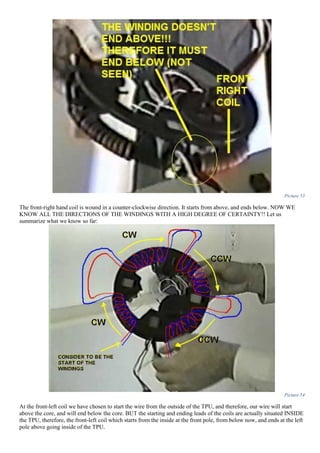
Ok, so this is what we have here:
Picture 103
I forgot how many turns I used in all the coils. Even though I struggled to build it as symmetrical as possible,
some coils might have 2 to 10 turns is addition or less than the other coils. All coils have 10 Ohms +/- 0.1 Ohm. I used
0.32004mm wire (0.0126 inch), which is AWG 28. This type of wire has 64.9 ohms/feet or 212.872 ohm/km. This data
is collected from http://www.powerstream.com/Wire_Size.htm. I have built this device I think back in 2008 or
something, and don't remember how much wire I used, but I can calculate based on this data. So all my 8 coils have
10ohms, that makes 80 Ohms of AWG 28 wire, so the material I used should be somewhere around:
10Ω
0.212872
Ω
𝑚
≈ 47𝑚 ≈ 154𝑓𝑒𝑒𝑡 Equation 29
Minor details about the coils: Winding was done with a bifilar coil, so I used 2 spool of wires in the winding process.
All coils are multi-layered coils winded in one direction only (meaning that after I completed a layer, to begin the
second layer I returned with the wire back where I started, so not to change the winding direction, although this doesn't
really matter and it's not important), manually all turns were laid neatly and compactly as I could.
POWERING (AC) HALF OF THE TESLA TRANSFORMER 381970
WITHOUT A LOAD
Ok. So let's test this device. We will power the device through a 230V 100W light bulb:
Picture 104
First let's see how much actual power our light bulb consumes:
Picture 105 Picture 106
So we have:
𝑃 = 𝑈 ∗ 𝐼 = 225𝑉 ∗ 0.38𝐴 = 85.5𝑊 Equation 30
Note that we are ignoring the error introduced by the measurement devices.
SETUP 1
For testing let's use this schematic diagram:
Picture 107
𝑈1 + 𝑈2 = 220𝑉 Equation 31
Picture 108 Picture 109
Picture 110
Here the Clamp meter gives a false reading of 1.12 Amps due to the strong outside magnetic field he have discussed
above. Even two feet away it still gives a false reading of 0.43Amps.
Let's discard this type of amp-meter, because it's too sensitive to the magnetic field created by the devices (as it should
be).
Picture 111
And closer shots of the measuring devices:
Picture 112 Picture 113 Picture 114
So our measuring devices indicate these parameters:
I=0.35Amps
U1=210Volts
U2=23.2Volts
𝑈1 + 𝑈2 = 210𝑉 + 23.2𝑉 = 233.2𝑉 Equation 32
So we have 233.2V compared to 220V in theory from Equation 31
We can calculate the power consumed by the light bulb:
𝑃𝑙𝑖𝑔ℎ𝑡𝑏𝑢𝑙𝑏= 𝑈1 ∗ 𝐼 = 210𝑉 ∗ 0.35𝐴 = 73.5𝑊 Equation 33
and the power consumed by the device without a load connected at the output:
𝑃𝑑𝑒𝑣𝑖𝑐𝑒 = 𝑈2 ∗ 𝐼 = 23.2 ∗ 0.35𝐴 = 8.12 𝑊 Equation 34
Total power consumption by our configuration:
𝑃𝑡𝑜𝑡𝑎𝑙 = 𝑃𝑙𝑖𝑔ℎ𝑡𝑏𝑢𝑙𝑏 + 𝑃𝑑𝑒𝑣𝑖𝑐𝑒 = 73.5𝑊 + 8.12𝑊 = 81.62 𝑊 Equation 35
For simplicity reasons we won't take into account the power consumed by the devices, nor the error these devices
introduce.
FULL POWERING (AC) THE TESLA TRANSFORMER 381970
WITHOUT A LOAD
SETUP 2:
Now, let's try a different setting, by powering up the other side of the device:
Picture 115
In this Picture 115 arrangement we are using a capacitor (C) in order to shift the voltage by a theoretical 90° (more like
60° in reality)
Note: L1 is actually created from two coils in series. Same with L2.
Picture 116
Due to the phase shift created with capacitor C, the magnetic poles created by coil L2 will lag so a rotating magnetic
field will be formed.
Voltmeter V1 will measure the voltage drop U1 on the light bulb;
Voltmeter V2 will measure the voltage drop U2 on the first half of the primary winding (in blue)
Voltmeter V3 measures the voltage drop U3 on the second half of the primary winding (in orange)
Amp-meter A1 measures the current i1
Amp-meter A2 measures the current i2
The rest of the parameters in the diagram can be calculated from following formulas:
𝑖1 = 𝑖2 + 𝑖3 𝑓𝑟𝑜𝑚 𝐾𝑖𝑟𝑐ℎℎ𝑜𝑓𝑓′𝑠 𝑓𝑖𝑟𝑠𝑡 𝑙𝑎𝑤 𝑎𝑙𝑠𝑜 𝑘𝑛𝑜𝑤𝑛 𝑎𝑠 𝐾𝑖𝑟𝑐ℎℎ𝑜𝑓𝑓′𝑠 𝑐𝑢𝑟𝑟𝑒𝑛𝑡 𝑙𝑎𝑤 (𝐾𝐶𝐿) Equation 36
𝑈2 = 𝑈 𝐶 + 𝑈3 Equation 37
I will use a 15µF capacitor at 450V.
Picture 117
I will make two measurements, one with an amp-meter as A1 and second as A2.
Picture 118
Picture 119
Picture 120
Note: L1 is actually created from two coils in series. Same with L2.
With the second coil on operation, our instruments indicate these values:
i1=0,34A
U1=202,5V (average between the two measurements)
U2=27,25V
U3=8,8V
i2=0,12A
Let us calculate the Power consumption of the light-bulb:
𝑃𝑙𝑖𝑔ℎ𝑡𝑏𝑢𝑙𝑏 = 𝑈1 ∗ 𝑖1 = 202.5𝑉 ∗ 0.34𝐴 = 68.85𝑊 Equation 38
We could calculate the voltage drop across the capacitor from Equation 37
Equation 37 ⇒ 𝑈 𝐶 = 𝑈2 − 𝑈3 = 27.25𝑉 − 8.8𝑉 = 18.45𝑉 Equation 39
Let us calculate the current i3 that the coil L1 drains:
Equation 36 ⇒ 𝑖3 = 𝑖1 − 𝑖2 = 0.34𝐴 − 0.12𝐴 = 0.22𝐴 Equation 40
Comment: I think you have made a mistake here. You should have placed the ampmeter A2 before the capacitor since it will measure a phase-shifted current. This might lead to a wrong calculation since yourI3 is
determined from this measurement.
Now we can calculate the power consumption of the coils L1 and L2:
𝑃𝐿1
= 𝑈2 ∗ 𝑖3 = 27.25𝑉 ∗ 0.22𝐴 ≈ 6𝑊 Equation 41
𝑃𝐿2
= 𝑈3 ∗ 𝑖2 = 8.8𝑉 ∗ 0.12𝐴 ≈ 1𝑊 Equation 42
You are probably thinking that it’s not right that the coil L2 should consume so less power, and that I should change the
capacitor value. But, if I do that, then the phase shift will be less than 40°, so the less voltage I will have on the coil L2
the more phase shifted it will be from the voltage on coil L1.
Now we can say what the power consumption of our transformer without a load connected at the output:
𝑃𝑑𝑒𝑣𝑖𝑐𝑒 = 𝑃𝐿1
+ 𝑃𝐿2
Equation 43
Equation 41, Equation 42 → Equation 43: 𝑃𝑑𝑒𝑣𝑖𝑐𝑒 = 6𝑊 + 1𝑊 = 7𝑊 Equation 44
And finally calculate the total power consumption of our circuit:
𝑃𝑇𝑂𝑇𝐴𝐿 = 𝑃𝑙𝑖𝑔ℎ𝑡𝑏𝑢𝑙𝑏 + 𝑃𝑑𝑒𝑣𝑖𝑐𝑒 Equation 45
Equation 38, Equation 44 → Equation 45: 𝑃𝑇𝑂𝑇𝐴𝐿 = 68.85𝑊 + 7𝑊 = 75.85𝑊 Equation 46
POWERING (AC) HALF OF THE TESLA TRANSFORMER 381970 WITH
A LOAD
SETUP 1:
Case 1
Let us use a 12V 2W filament light-bulb acting as a resistive load, in this next setup:
Picture 121
In more detail:
Picture 122
Amp-meter A1 will measure the current i1 (input current);
Volt-meter V1 will measure the voltage drop across the 100W light-bulb;
Volt-meter V2 will measure the voltage drop across the coil L1 from the primary windings (input voltage)
Amp-meter A2 will measure the current i2 (output current);
Volt-meter V3 will measure the voltage drop U3 across our 2W light-bulb acting as a load (output voltage);
Picture 123
Closer shots of the instruments:
Picture 124 Picture 125 Picture 126
Picture 127
Note: L1 is actually created from two coils in series. Same with L3.
So, we have these values:
i1=0,37A
U1=205V
U2=24,4V
i2=148,1mA
U3=15,725V (average)
Let us calculate the Power consumption of the light-bulb:
𝑃𝑙𝑖𝑔ℎ𝑡𝑏𝑢𝑙𝑏 = 𝑈1 ∗ 𝑖1 = 205𝑉 ∗ 0.37𝐴 = 75.85𝑊 Equation 47
We will calculate the power consumption of the coil L1 (input power):
𝑃𝐼𝑁 = 𝑈2 ∗ 𝑖1 = 24.4𝑉 ∗ 0.37𝐴 = 9.028𝑊 Equation 48
Power consumed by this setup:
𝑃𝑇𝑂𝑇𝐴𝐿 = 𝑃𝑙𝑖𝑔ℎ𝑡𝑏𝑢𝑙𝑏 + 𝑃𝐼𝑁 Equation 49
Equation 47, Equation 48 → Equation 49: 𝑃𝑇𝑂𝑇𝐴𝐿 = 75.85𝑊 + 9.028𝑊 = 84.878𝑊 Equation 50
And let us calculate the output power:
𝑃𝑂𝑈𝑇 = 𝑈3 ∗ 𝑖3 = 15.725𝑉 ∗ 0.1481𝐴 ≈ 2.33𝑊 Equation 51
Let us see if we have overunity:
Equation 48, Equation 51 → 𝐄𝐪𝐮𝐚𝐭𝐢𝐨𝐧 𝟗: 𝑂𝑣𝑒𝑟𝑢𝑛𝑖𝑡𝑦 =
2.33𝑊
9.028𝑊
= 0.258 Equation 52
Well, we don’t have overunity, so then let us see the efficiency of our transformer in this present setup:
Equation 48, Equation 51 → 𝐄𝐪𝐮𝐚𝐭𝐢𝐨𝐧 𝟏𝟎: 𝐸𝑓𝑓𝑖𝑐𝑖𝑒𝑛𝑐𝑦 =
2.33𝑊
9.028𝑊
∗ 100 = 25.8% Equation 53
In order to calculate the COP, we need the user input power, which is in our case, the input power consumed only by
the load, discarding the power consumed by the transformer.
So, then we need to know how much power our transformer consumes without a load connected at the output. We have
calculated this in Equation 34
Equation 34, Equation 48, Equation 51 → 𝐄𝐪𝐮𝐚𝐭𝐢𝐨𝐧 𝟖: 𝐶𝑂𝑃 =
2.33𝑊
9.028𝑊 − 8.12𝑊
=
2.33𝑊
0.908𝑊
≈ 2.5 Equation 54
SETUP 1 Case 1 Conclusion:
Picture 128
This setup gives us a COP of 2.5 with efficiency 25,8%
(overunity=0.25)
And remember, this is only half the toroidal windings firing:
Picture 129
Setup 1 Case 2:
Let us increase the output current by changing the light-bulb with a 10Ω 5W 20% resistor, and see how this effects our
efficiency and performance coefficient (COP).
Picture 130
Same design (setup 1) but with a resistor as a load.
Picture 131
Picture 132
Picture 133 Picture 134 Picture 135
Picture 136
Note: L1 is actually created from two coils in series. Same with L3.
In this case, our instruments indicate these value:
i1=0.37A
U1=209V
U2=19,6V
i2=0,27A
U3=3,58V
Calculations:
Power consumed by the light-bulb:
𝑃𝑙𝑖𝑔ℎ𝑡𝑏𝑢𝑙𝑏 = 𝑈1 ∗ 𝑖1 = 209𝑉 ∗ 0.37𝐴 = 77.33𝑊 Equation 55
Power consumed by the coil L1 (input power for the transformer):
𝑃𝐿1
(𝑃𝐼𝑁) = 𝑈2 ∗ 𝑖1 = 19.6𝑉 ∗ 0.37𝐴 = 7.252𝑊 Equation 56
Total power consumed by this present setup:
𝑃𝑇𝑂𝑇𝐴𝐿 = 𝑃𝑙𝑖𝑔ℎ𝑡𝑏𝑢𝑙𝑏 + 𝑃𝐿1
Equation 57
Equation 55, Equation 56 → Equation 57: 𝑃𝑇𝑂𝑇𝐴𝐿 = 77.33𝑊 + 7.252𝑊 = 84.582𝑊 Equation 58
We immediately can observe something out of the ordinary by comparing Equation 50 with Equation 58. Total power
consumed by the setup has decreased by 0.34%. We have increased the load on the transformer, and due to the unusual
magnetic field in the transformer (more like outside of it), the power consumed by the transformer is reduced instead of
being capable of providing more power to our load.
Let us calculate the output power delivered to our 10Ω resistor:
𝑃𝑂𝑈𝑇 = 𝑈3 ∗ 𝑖2 = 3.58𝑉 ∗ 0.27𝐴 ≈ 0.97𝑊 Equation 59
Now let us determine the Overunity factor:
Equation 58, Equation 59 → 𝐄𝐪𝐮𝐚𝐭𝐢𝐨𝐧 𝟗: 𝑂𝑣𝑒𝑟𝑢𝑛𝑖𝑡𝑦 =
0.97𝑊
7.252𝑊
= 0.13 Equation 60
We multiply this by 100, to calculate the efficiency:
Equation 58, Equation 59 → 𝐄𝐪𝐮𝐚𝐭𝐢𝐨𝐧 𝟏𝟎: 𝐸𝑓𝑓𝑖𝑐𝑖𝑒𝑛𝑐𝑦 =
0.97𝑊
7.252𝑊
∗ 100 = 13.37% Equation 61
Again, let us determine the performance coefficient:
Equation 34, Equation 58, Equation 59 → 𝐄𝐪𝐮𝐚𝐭𝐢𝐨𝐧 𝟖: 𝐄𝐪𝐮𝐚𝐭𝐢𝐨𝐧 𝟗𝐶𝑂𝑃 =
0.97𝑊
7.252𝑊 − 8.12𝑊
=
0.97𝑊
−0.868𝑊
= −1.11
Equation
62
We definitely are dealing with a strange transformer. Reaching negative performance, means that this transformer must
not work on low impedance's. Therefore there must be a minimum allowed impedance at which this transformer will
still have positive performance coefficient.
More study here. Determine the nominal current and voltage of the device from the graph (efficiency vs. Output power).
Determine the minimum allowed impedance at which this transformer will still have positive performance coefficient,
and minimum impedance at which COP is greater than 1. (Using 3D Graph, plotting ox, oy, oz -> R, (COP; Efficiency),
PIN)
How it’s operation change with frequency (3D graph), phase shift between primary & secondary change with other
parameters (3D graph, oscilloscope shots)
More 3D graphs for COP and efficiency vs. frequency and input power when we are dealing with inductive and
capacitive loads.
<work temporarily abandoned>
Setup 1 Case 3:
Secondary in short-circuit test:
Picture 137
In more detail:
Picture 138
Closer shots of the instruments:
Picture 139 Picture 140
Picture 141
Note: L1 is actually created from two coils in series. Same with L3.
Instruments indicate these values:
i1=0.37A
U1=211V
U2=17.2V
In this particular case, power consumed by the light-bulb would be:
𝑃𝑙𝑖𝑔ℎ𝑡𝑏𝑢𝑙𝑏 = 𝑈1 ∗ 𝑖1 = 211𝑉 ∗ 0.37𝐴 = 78.07𝑊 Equation 63
and the power consumed by the transformer:
𝑃𝐼𝑁 𝑆𝐶
= 𝑈2 ∗ 𝑖1 = 17.2𝑉 ∗ 0.37𝐴 = 6.364𝑊 Equation 64
Total power consumed by our circuit:
𝑃𝑇𝑂𝑇𝐴𝐿 = 𝑃𝑙𝑖𝑔ℎ𝑡𝑏𝑢𝑙𝑏 + 𝑃𝐼𝑁 𝑆𝐶
Equation 65
Equation 63, Equation 64 → Equation 65: 𝑃𝑇𝑂𝑇𝐴𝐿 = 78.07𝑊 + 6.364𝑊 = 84.434𝑊 Equation 66
CONCLUSION:
We can compare the power consumed by our transformer in open circuit test 8.12W Equation 34 to 6.364W consumed
in a short-circuit test Equation 64 and we deduce that we have a 21.6% decrease in energy consumption in a short
circuit test compared with an open circuit test. Yes you read it right. When you short circuit this transformer it will
consume 21.6% less then when it operating in open circuit. (This is when is half powered by only one sine-wave)
FULL POWERING (AC) OF THE TESLA TRANSFORMER 381970 WITH
A LOAD
SETUP 2 Case 1:
We will start the second half of the transformer again using the same capacitor, and use a 12V 5W filament light-bulb
acting as a load.
Picture 142
Note: All coils (L1,L2,L3 and L4) are actually formed by two coils in series.
In more detail the setup looks like this:
Picture 143
In the secondary, we are using two bridge rectifier circuit to bring the two out of phase signals generated on the same
load.
Picture 144
Closer shots of the instruments:
Picture 145 Picture 146
Picture 147 Picture 148
Picture 149
Note: All coils (L1,L2,L3 and L4) are actually formed by two coils in series.
Instruments indicate these values:
i1=0.36A
U1=202V
i2=121.8mA
U2=21.5V
U3=8.05V
i4=0.24A
U4=6V
As before, let us determine the power consumed by the light-bulb:
𝑃𝑙𝑖𝑔ℎ𝑡𝑏𝑢𝑙𝑏 = 𝑈1 ∗ 𝑖1 = 202𝑉 ∗ 0.36𝐴 = 72.72𝑊 Equation 67
We can calculate the current that flows through coil L1:
𝐾𝑖𝑟𝑐ℎℎ𝑜𝑓𝑓′
𝑠 𝑓𝑖𝑟𝑠𝑡 𝑙𝑎𝑤 𝑎𝑡 𝑝𝑜𝑖𝑛𝑡 𝑃: 𝑖1 = 𝑖2 + 𝑖3 Equation 68
Equation 68 ⇒ 𝑖3 = 𝑖1 − 𝑖2 = 0.36𝐴 − 0.1218𝐴 = 0.239𝐴 Equation 69
Comment: Another possible error here. The capacitor C will phase shift the current from the voltage and the measured power must be expressed in VA.
Let us determine the power consumed by coil L1:
𝑃𝐿1
= 𝑈2 ∗ 𝑖3 Equation 70
Equation 69 → Equation 70: 𝑃𝐿1
= 21.5𝑉 ∗ 0.239𝐴 = 5.139𝑊 Equation 71
and power consumed by coil L2:
𝑃𝐿2
= 𝑈3 ∗ 𝑖2 = 8.05𝑉 ∗ 0.1218𝐴 = 0.98𝑊 Equation 72
Now, we can calculate the total power consumed by the transformer. (transformer total input power):
𝑃𝐼𝑁 = 𝑃𝐿1
+ 𝑃𝐿2
Equation 73
Equation 71, Equation 72 → Equation 73: 𝑃𝐼𝑁 = 5.139𝑊 + 0.98𝑊 = 6.12𝑊 Equation 74
and the total power consumed by our setup circuit:
𝑃𝑇𝑂𝑇𝐴𝐿 = 𝑃𝑙𝑖𝑔ℎ𝑡𝑏𝑢𝑙𝑏 + 𝑃𝑑𝑒𝑣𝑖𝑐𝑒(𝐼𝑁) Equation 75
Equation 67, Equation 74 → Equation 75: 𝑃𝑇𝑂𝑇𝐴𝐿 = 72.72𝑊 + 6.12𝑊 = 78.84𝑊 Equation 76
Comment: Possible false readings due to the phase shift. Confusing Watts with Vars.
Let us determine now, the output power of this present setup. Bear in mind that we also have to take into account the
voltage drop across the bridge rectifiers. In a bridge rectifier only two diodes are working at an instance and permit the
signal to pass through, so the DC voltage will be less by (0.7+0.7=1.4V) than the original AC voltage. But we have two
bridge rectifiers, and if you consider adding 2.8V to the final DC voltage you are wrong, because the total voltage peak
to peak generated in the coil L4 is much less than the voltage generated in the coil L3. If they were to have same voltage,
that will be a total different story. We must not forget that these are not extremely precise measurements, and they are
done just to determine basic parameters like efficiency and performance with an acceptable margin of error.
𝑃𝑂𝑈𝑇 = (𝑈4 + 1.4𝑉) ∗ 𝑖4 = (6𝑉 + 1.4𝑉) ∗ 0.24𝐴 = 7.4𝑉 ∗ 0.24𝐴 = 1.776𝑊 Equation 77
Equation 44, Equation 74, Equation 77 → 𝐄𝐪𝐮𝐚𝐭𝐢𝐨𝐧 𝟖: 𝐶𝑂𝑃 =
1.776𝑊
6.12𝑊 − 7𝑊
=
1.776𝑊
−0.88𝑊
= −2
Equation 78
Equation 74, Equation 77 → 𝐄𝐪𝐮𝐚𝐭𝐢𝐨𝐧 𝟏𝟎: 𝐸𝑓𝑓𝑖𝑐𝑖𝑒𝑛𝑐𝑦 =
1.776𝑊
6.12𝑊
∗ 100 = 29% Equation 79
Equation 74, Equation 77 → 𝐄𝐪𝐮𝐚𝐭𝐢𝐨𝐧 𝟗𝐄𝐪𝐮𝐚𝐭𝐢𝐨𝐧 𝟏𝟎: 𝑂𝑣𝑒𝑟𝑢𝑛𝑖𝑡𝑦 =
1.776𝑊
6.12𝑊
= 0.29 Equation 80
Again we see negative performance. But, we did however increased the efficiency of our transformer (compare
equations 24.2 and 31 with 48).The performance coefficient is intimately related to our load. So let us change it, and see
how the performance changes.
SETUP 2 Case 2:
Let us use again a 10Ωresistor:
Picture 150
Note: All coils (L1,L2,L3 and L4) are actually formed by two coils in series.
In more detail:
Picture 151
Picture 152
Closer shots of the instruments:
Picture 153 Picture 154
Picture 155 Picture 156
Picture 157
Note: All coils (L1,L2,L3 and L4) are actually formed by two coils in series.
In this case, our instruments, indicate these values:
A1: I1=0.37A
V1: U1=204V
V2: U2=20V
A2: I2=106.4mA
V3: U3=6.53V
A3: I4=0.29A
V4: U4=3.04V
As before, let us determine the power consumed by the light-bulb:
𝑃𝑙𝑖𝑔ℎ𝑡𝑏𝑢𝑙𝑏 = 𝑈1 ∗ 𝑖1 = 204𝑉 ∗ 0.37𝐴 = 75.48𝑊 Equation 81
We can calculate the current that flows through coil L1:
Equation 68 ⇒ 𝑖3 = 𝑖1 − 𝑖2 = 0.37𝐴 − 0.1064𝐴 = 0.2636𝐴 Equation 82
Let us determine the power consumed by coil L1:
𝑃𝐿1
= 𝑈2 ∗ 𝑖3 Equation 83
Equation 82 → Equation 83: 𝑃𝐿1
= 20𝑉 ∗ 0.2636𝐴 = 5.272𝑊 Equation 84
and power consumed by coil L2:
𝑃𝐿2
= 𝑈3 ∗ 𝑖2 = 6.53𝑉 ∗ 0.1064𝐴 = 0.7𝑊 Equation 85
Now, we can calculate the total power consumed by the transformer. (transformer total input power):
𝑃𝐼𝑁 = 𝑃𝐿1
+ 𝑃𝐿2
Equation 86
Equation 84, Equation 85 → Equation 86: 𝑃𝐼𝑁 = 5.272𝑊 + 0.7𝑊 ≈ 6𝑊 Equation 87
Total power consumed by our setup circuit:
Equation 81, Equation 87 → Equation 75: 𝑃𝑇𝑂𝑇𝐴𝐿 = 75.48𝑊 + 6𝑊 = 81.48𝑊 Equation 88
Even if our total power consumed by the setup has increased by 3.3% from 78.84 to 81.48W (compare
Equation 76 with Equation 88) we can see that by increasing the load, the power consumed by our transformer
has decreased by 2% from 6.12W to 6W (Equation 74 and Equation 87). But wait, as I already told you, this has
drawbacks. Let’s continue:
𝑃𝑂𝑈𝑇 = (𝑈4 + 1.4𝑉) ∗ 𝑖4 = (3.04𝑉 + 1.4𝑉) ∗ 0.29𝐴 = 4.44𝑉 ∗ 0.29𝐴 = 1.2876𝑊 Equation 89
Equation 44, Equation 87, Equation 89 → 𝐄𝐪𝐮𝐚𝐭𝐢𝐨𝐧 𝟖: 𝐶𝑂𝑃 =
1.2876𝑊
6𝑊 − 7𝑊
=
1.2876
−1𝑊
= −1.2 Equation 90
Equation 87, Equation 89 → 𝐄𝐪𝐮𝐚𝐭𝐢𝐨𝐧 𝟏𝟎𝐄𝐪𝐮𝐚𝐭𝐢𝐨𝐧 𝟖: 𝐸𝑓𝑓𝑖𝑐𝑖𝑒𝑛𝑐𝑦 =
1.2876𝑊
6𝑊
∗ 100
= 21%
Equation 91
Equation 87, Equation 89 → 𝐄𝐪𝐮𝐚𝐭𝐢𝐨𝐧 𝟗𝐄𝐪𝐮𝐚𝐭𝐢𝐨𝐧 𝟏𝟎𝐄𝐪𝐮𝐚𝐭𝐢𝐨𝐧 𝟖: 𝑂𝑣𝑒𝑟𝑢𝑛𝑖𝑡𝑦 =
1.2876𝑊
6𝑊
= 0.21
Equation 92
Again, even if the input power decreases with the increase of the load, our efficiency will decrease also
(Equation 79 and Equation 91)
SETUP 2: Case 3
I will use now, two 12V 2W light-bulbs connected in series:
The simplified diagram:
Picture 158
Note: All coils (L1,L2,L3 and L4) are actually formed by two coils in series.
A more detail diagram:
Picture 159
Picture 160
Instruments shots:
Picture 161 Picture 162
Picture 163 Picture 164
Picture 165
Note: All coils (L1,L2,L3 and L4) are actually formed by two coils in series.
Instruments, indicate these values:
A1: I1=0.36A
V1: U1=195V
V2: U2=26.7V
A2: I2=152.2mA
V3: U3=9.84V
A3: I4=115.6mA
V4: U4=18.11V
The power consumed by the light-bulb:
𝑃𝑙𝑖𝑔ℎ𝑡𝑏𝑢𝑙𝑏 = 𝑈1 ∗ 𝑖1 = 195𝑉 ∗ 0.36𝐴 = 70.2𝑊 Equation 93
We can calculate the current that flows through coil L1:
Equation 68 ⇒ 𝑖3 = 𝑖1 − 𝑖2 = 0.36𝐴 − 0.1522𝐴 = 0.2078𝐴 Equation 94
Let us determine the power consumed by coil L1:
𝑃𝐿1
= 𝑈2 ∗ 𝑖3 Equation 95
Equation 94 → Equation 95: 𝑃𝐿1
= 26.7𝑉 ∗ 0.2078𝐴 = 5.549𝑊 Equation 96
and power consumed by coil L2:
𝑃𝐿2
= 𝑈3 ∗ 𝑖2 = 9.84𝑉 ∗ 0.1522𝐴 = 1.5𝑊 Equation 97
Now, we can calculate the total power consumed by the transformer. (transformer total input power):
Equation 96, Equation 97 → Equation 86: 𝑃𝐼𝑁 = 5.549𝑊 + 1.5𝑊 = 7.05𝑊 Equation 98
Total power consumed by our setup circuit:
Equation 93, Equation 98 → Equation 75: 𝑃𝑇𝑂𝑇𝐴𝐿 = 70.2𝑊 + 7.05𝑊 = 77.25𝑊 Equation 99
Now let us determine the output power produced at the output of our Tesla transformer:
𝑃𝑂𝑈𝑇 = (𝑈4 + 1.4𝑉) ∗ 𝑖4 = (18.11𝑉 + 1.4𝑉) ∗ 0.1156𝐴 = 19.51𝑉 ∗ 0,1156𝐴 = 2.26𝑊 Equation 100
Since our light-bulbs are identical in impedance, the power consumed by one light-bulb is the total output
power divide in half:
𝑃𝑂𝑛𝑒 𝑙𝑖𝑔ℎ𝑡𝑏𝑢𝑙𝑏 =
𝑃𝑂𝑈𝑇
2
Equation 101
Equation 100 → Equation 101: 𝑃𝑂𝑛𝑒 𝑙𝑖𝑔ℎ𝑡𝑏𝑢𝑙𝑏 =
2.26𝑊
2
= 1.13𝑊 Equation 102
Equation 44, Equation 98, Equation 100 → 𝐄𝐪𝐮𝐚𝐭𝐢𝐨𝐧 𝟖: 𝐶𝑂𝑃 =
2.26𝑊
7.05𝑊 − 7𝑊
=
2.26𝑊
0.05𝑊
= 45 Equation 103
Equation 98, Equation 100 → 𝐄𝐪𝐮𝐚𝐭𝐢𝐨𝐧 𝟏𝟎: 𝐸𝑓𝑓𝑖𝑐𝑖𝑒𝑛𝑐𝑦 =
2.26𝑊
7.05𝑊
∗ 100 = 32% Equation 104
Equation 98, Equation 100 → 𝐄𝐪𝐮𝐚𝐭𝐢𝐨𝐧 𝟗: 𝑂𝑣𝑒𝑟𝑢𝑛𝑖𝑡𝑦 =
2.26𝑊
7.05𝑊
= 0.32 Equation 105
CONCLUSION:
The setup in Picture 159 gives us a COP of 45 with efficiency
32% (overunity=0.32)
Even if we input 50mW in the transformer, and we get 2200mW in
return, we MUST NEVER FORGET the 7000mW our
transformer consumes by itself (without any load attached)!
And remember we still have the outside magnetic field problem! We still don’t intercept the entire flux generated by the primary
windings of the Tesla Transformer 381970!
Visual aid in understanding this:
By drastically simplifying all our work until now we can bluntly say:
Picture 166
Note: This type of definitions of COP, Efficiency and Overunity are mostly applied to Transformers and Ideal Transformers. Using these definitions in any other type of generators, motors or devices, is not
recommended and will likely lead to serious distortions and errors.
Think what will happen if we have another Tesla Transformer on top of this one rotated
180°, so that the magnetic poles created are coupled one to each other to close all the flux,
and thus nullify the outside magnetic field. Think about it!
Answer: It will lower the “blue liquid” or the power consumed by our transformer without any load connected to it. Thus COP>1 will become in theory overunity
and closing the loop between output and input will then become possible.
Slight glimpse of things to come: We are going to analyze a double Tesla transformer 381970. One on the bottom, and one on top. The one on top will be powered
180° in respect with the one on the bottom in order to nullify the outside magnetic field:
Picture 167
SETUP 2: Case 4
Let us see in this final case of the setup 2, what is the power consumed by our Tesla transformer in a short-
circuit test when it is full powered:
This is a simplified diagram which we are going to use:
Picture 168
In more detail:
Picture 169
Picture 170
Instruments close-ups:
Picture 171 Picture 172 Picture 173
Picture 174
In this case our instruments indicate these values:
A1: i1=0.355A (average)
V1: U1=203V (average)
V2: U2=16.55V (average)
A2: i2=77.35mA (average)
V3: U3=3.235V (average)
The power consumed by the light-bulb:
𝑃𝑙𝑖𝑔ℎ𝑡𝑏𝑢𝑙𝑏 = 𝑈1 ∗ 𝑖1 = 203𝑉 ∗ 0.355𝐴 = 72.065𝑊 Equation 106
We can calculate the current that flows through coil L1:
Equation 68 ⇒ 𝑖3 = 𝑖1 − 𝑖2 = 0.355𝐴 − 0.07735𝐴 = 0.27765𝐴 Equation 107
Let us determine the power consumed by coil L1:
Equation 107 → Equation 95: 𝑃𝐿1
= 16.55𝑉 ∗ 0.27765𝐴 ≈ 4.6𝑊 Equation 108
and power consumed by coil L2:
𝑃𝐿2
= 𝑈3 ∗ 𝑖2 = 3.235𝑉 ∗ 0.07735𝐴 = 0.251𝑊 Equation 109
Now, we can calculate the total power consumed by the transformer. (transformer total input power):
Equation 108, Equation 109 → Equation 86: 𝑃𝐼𝑁 = 4.6𝑊 + 0.251𝑊 = 4.851𝑊 Equation 110
Total power consumed by our setup circuit:
Equation 106, Equation 110 → Equation 75: 𝑃𝑇𝑂𝑇𝐴𝐿 = 72.065𝑊 + 4.851𝑊 ≈ 77𝑊 Equation 111
CONCLUSION:
We can compare the power consumed by our transformer in open circuit test 7W (from Equation 44) to 4.851W
consumed in a short-circuit test (Equation 110) and we deduce that we have a 30.7% decrease in energy
consumption in a short circuit test compared with an open circuit test. Yes you read it right. When you short circuit
this transformer it will consume 30.7% less then when it operating in open circuit. (This is when is full powered by two
90° out-of-phase sine-waves)
POWERING (pulsed AC) HALF OF THE TESLA TRANSFORMER 381970
WITH A LOAD
SETUP 3: Case 1
We will use this again a 12V 2W light-bulb in this schematic:
Picture 175
In more detail:
Picture 176
<work temporarily abandoned>
More study here. Determine the minimum allowed impedance at which this transformer will still have positive
performance coefficient, and minimum impedance at which COP is greater than 1, using 3D Graph, plotting ox, oy, oz -
> R, (COP; Efficiency), PIN
How it’s operation change with frequency (3D graph), phase shift between primary & secondary change with other
parameters (3D graph, oscilloscope shots)
More 3D graphs for COP and efficiency vs. frequency and input power when we are dealing with inductive
and capacitive loads.
<work temporarily abandoned>
What makes this transformer behave like this? Why in some cases
exhibits COP>1. What makes it tick? What is the basic operation
principle? What is the heart of this device?
Let’s analyze possible answers:
Looking back, at the most likely operation principle of the Steven TPU, and at Tesla transformer 381970, we can say
that the behavior of the transformer is due to the unusual interference/opposing magnetic fluxes:
Picture 177 Picture 178
Ask yourself these questions:
How can we create this effect, in the most elementary
fashion? What is the easiest way we can replicate this
effect? What is the simplest constructive solution, to
encompass this effect?
Searching for an answer we will most likely arrive at this configuration:
Picture 179
Tom Bearden Motionless Electromagnetic
Generator (MEG)
This might be the simplest variant we can achieve by
simplifying Steven TPU technology.
If we stare for a while at the above picture, and if we have a basic study of free-energy devices out-there, we can say:
“Wait a minute... I have seen this device before, somewhere...yes...I definitely seen it...it’s...it’s...Oh my God!...It’s
Tom Bearden “Motionless Electromagnetic Generator (MEG)!!!
And of course it is! Where was I thinking?
Picture 180
Tom Bearden Motionless Electromagnetic Generator (MEG) (US patent number 6.362.718 March, 26, 2002)
Damn! Somebody else figure out this thing too!!! Why do I have the feeling that I’m rediscovering the wheel here?
Well then...there might be something to this after all!!!
We must acknowledge that this configuration will work far more efficient than the Tesla Transformer 381970, due to
the fact that we no longer have an outside magnetic field. This time the entire magnetic field generated by the coils,
should in theory be situated inside the core.
What in God’s name am I talking about? How can I make similarities of a fairly recent device, patented in 2002 with a
device from a 100 years ago of Tesla, They are totally different devices with different operating principles! Am I crazy?
No, I am not. I can make a comparison, and point out similarities that show in fact that they are not so different. Just the
way they operate is a little different.
You just have to imagine these things as we go along, because things will get more and more complicated:
Picture 181
And, of course we need a magnet to “reinforce” the field. By “reinforcing” I mean, (for the readers who desire a more
academic approach) the catalyst that just slightly reduces the energy spent magnetizing the core:
Picture 182
Let us analyze this MEG device and see what we can learn:
Picture 183
From MEG device, if we study the patent carefully, and I recommend for the reader who is unfamiliar with this device,
to draw with his own hands the drawings in the patent paper and follow the explanations, by pointing the numbers in the
text to his made drawings. If you really want to learn, draw the pictures in the patent by hand. Don’t try to print them, if
you really want to understand. Do it, how they do it in first grade schools: manually draw with pencil on paper.
Teachers force us to do this, knew what they were doing. Trust this! It’s something to do with mnemonic systems for
remembering the numbers in the patent. Let’s get back to our MEG, we have drifted enough from the subject.
This is how the device function:
Picture 184 Picture 185
Now, if we study the patent carefully, we will understand that in this device, and probably in the Steven TPU
also, that in fact the magnet serves not as the “helper” or “catalyst” as we have thought, but is
actually the only “person” who works in this device. The only true “worker”. The magnet is the one that is
doing all the labor! The input coils, just “excite” the magnet, or “dynamising” it, or “KICK” it, in order to
make the static magnetic field of the magnet, a dynamic field. We can actually say that THE
MAGNET is really powering the device (MEG & TPU & Flynn alike) and the input coils (a.k.a.
“actuators”) are just there to just kick the magnet in the butt, so that it’s field won’t become static as it normally want to
be.
This stated in the patent:
An analogy to this, is that the magnet is you at work, doing all the hard labor. The input coils are your boss, that
kicks you in the butt so that you always keep going and not to take a break for a coffee or something. Another analogy
is that the magnet is your heart, and the small input signal, is your heart beat, is the divine small input source (The Boss)
that keeps you going and alive. These analogies can continue forever. But I think that it’s pretty clear:
Picture 186
If all this would to be true, and they are, then the magnet will do all the work (as in a scalar quantity) and
according to the first law of thermodynamics that states that when work (as in thermodynamics) is done to a
system its energy state changes by the same amount. This put this in other words, will mean that the:
“[…] the present invention should be considered not as a perpetual motion machine, but rather as a system in which
flux radiated from a permanent magnet is converted into electricity, which is used both to power the apparatus and
to power an external load”
Tom Bearden Motionless Electromagnetic Generator (MEG) US patent number 6.362.718 March, 26, 2002, page 12,
paragraph 2, line 2.
Magnets will soon demagnetize
(lose their energy) because of all
the work they do by providing their
energy to the load!This is backed-up by the following words in the MEG patent:
Damn! I thought this was free energy! It turns out that it’s not. Nothing is free. Except this book. So what
happens now? Shit! I’m disappointed! Hey, I just figure out something! If this technology is really behind Steven TPU
described above, then I BELIEVE THAT STEVEN MARK KNEW ABOUT THIS!
What makes me think that?
The magnets he is placing on their slots:
Picture 187 Picture 188
I think, that is why he didn’t permanently integrate the magnets in his device, and so nicely and
carefully build slots for the magnets, like he were replacing
batteries! And that is exactly what I think they are. He repeatedly states that there
are no batteries in his device, but he is lying! The magnets are the “batteries” here! They
will soon demagnetize! How soon? Well, it depends on the stress they are put through. Could be years or even months if
the device works on extremely heavy loads. If you build such a device, make sure you have access at the magnets if you
want to replace them someday. And you will!
Given all of this, I believe there is a workaround solution for this problem. What if you could always have a
battery near the device, that it’s not connected to anything, it’s just sitting there. Such a battery will serve two purposes.
First, it will be as a backup system providing power to an inverter (12V to 110V or 220V) that will still supply power
for a short while if something were to happen to the device. Such a device could have a sensing circuit that measures the
magnetic flux intensity (H) from the magnet, and, if it drops below critical limits, our device will switch immediately to
this backup battery, and the battery in this time will serve our second most important purpose in the same time with
“Continued operation of the electromagnetic generator 10 causes demagnetization of the permanent magnet"
Tom Bearden Motionless Electromagnetic Generator (MEG) US patent number 6.362.718 March, 26, 2002, page 12, paragraph 1, line 8
the first. As the backup system is in place, running power from the battery through the inverter, our battery will deliver
an instant jolt of continuous applied power to the output coils of the device for a few seconds. Our output coils of the
device (if they have a lot of Ampere/turns) they will act as an electromagnet that will regenerate the magnet (re-
magnetize it <=> re-charge it). This entire operation will take for example, 100 seconds at most, because this will be a
huge drain for the battery. It will probably in this hypothetical case, can drain let’s say more than 75% of its capacity
depending of the loads that are also powered through the inverter. When the magnet has been re-magnetized then our
sensing circuit will restart the device and switch our load to it, relieving the battery, and then recharging the battery
from the output of the device. Of course the magnet will have to be cold in order to re-magnetize it, so the second phase
will have to happen after some time, to let the magnet cool down.
All of these technologies are in the same family, having the same blood, brother TPU, sister MEG and brother
Flynn solid state generator. The grandfather in this family of all these technologies I believe is the so called “The
Astronaut’s magnetic boots” originally developed by John Radus with his switchable magnet invention intended for
NASA astronauts boots. Read more (click here)
Let us analyze in more detail the MEG patent. The first most apparent odd thing we observe (that is if we
observe from a conventional view), is that in this transformer the input is low duty cycle square wave AND
THE OUTPUT IS A SINEWAVE!
Picture 189
What in God’s name is this shit? You might say: This is absurd, ridiculous and a joke!
Listen to this fool: In his transformer he inputs square-wave and gets sinewave in return! Ha.
Ha. Ha. Very funny.
BUT THIS IS NO JOKE. This is serious and if you agree with all presented so far you will realize that this
is real. Where the heck does this sinewave is coming from? Again, it’s coming from the magnet that is doing
all the work in this transformer! All of this is real. The conventional view teaches us that the spikes we see on
the output current, should be all that there is to be on this transformer. But as conventional approach has
proven flawed in many occasions in this field of study, we must look at other explanations.
The sine waves are generated in accordance with Faraday Law.
Picture 190
The pattern of magnetic flux in the core doesn’t change suddenly, but gentle.
As the right input coil fires, it generates an opposing flux to the static one established in the core. This
doesn't want to fight with this new one, so it gently and completely retreats to the left side, leaving the left
side completely unoccupied by any flux, even if the input pulse disappeared. In retreat to the left side, a
negative half sine-wave voltage is generated in the right coil while the left side that receives this flux
generates a positive half sinewave signal. So our flux pattern doesn’t change abruptly, or suddenly changes
sides. No, because Faraday Law applies in this case too. In the next phase, our flux having a so called
“magnetic memory” or “flux capacitance” to the left side stagnates here peacefully and undisturbed. This
newly formed asymmetric stability to the left side gets changed, but not abruptly, by the left input coil when
it fires. So our flux yet again is forced to abandon the left side, and with all its luggage journeys to a more
peaceful place called...right side. So our poor flux from the magnet is always seeking a more peaceful place to
stagnate as it generally wants, but is constantly bombarded by these “kicks”. Poor magnet, it will never have
the rest that it seeks so much...
If all of this is to be true, and it is, then it would imply that this transformer can work even with 60 or
50Hz! So why not generate the spikes on 60/50Hz and then the output used directly by our appliances? This
question will lead us to a more intimate secret detail about MEG operation, which not every researcher
realize.
Picture 191
When we are dealing with these gentle magnetic flux pattern changes in the core, they are actually the
response of the magnet to the input spikes. (By gentle I mean a sinewave signal is more “gentle” compared to
a sudden spike short square signal). Right, but when the spike has occurred, the flux starts to gather its
“luggage” to seek a new place. The spike disappears, and our flux is still gathering all its “possessions” from
this side to the other. After a short time, which we will name “transient shift time”, our flux has completely
changed its dwelling to the other side. This newly formed home, will yet again be disturbed, as our flux will
be forced to desert this place yet again. But the process of deserting, the process of moving, the process of
shifting, this process when the flux changes sides, this process of abandoning one side to move to the other,
doesn't happen suddenly, but happens after a “transient shift time”, that lasts longer than the period or
duration of the input spike.
THE REAL OPERATING FREQUENCY OF MEG - TUNING
THE MEG
This “transient shift time” generates in the output coils half a sinewave, which is positive in one side
and negative on the other side. This “transient shift time” is actually half of the real operating frequency of
our device.
What we are seeking is to never let the magnet “rest” in his “new dwelling”, never give the magnet a
time to breathe. When the magnet has finished moving from one side to the other, then, we hit it again on that
side. So in this accurate precise “bombing attack” of the magnet, it will be constantly moving from one side to
the other. We must tune exactly to this specific frequency.
This frequency is specific to every device in particular and is determined by the core material,
composition, permeability, surface area, volume, magnet strength, how fast the magnetic domains in the core
material align to accommodate the change in the flux pattern, and much more. The easiest way to determine it
is to measure it with an oscilloscope. We will perform a test to determine the frequency response of our
transformer with the magnet in place, at a single input square wave pulse. By instantly and rapidly manually
pulsing one of the input coils, we should see the response as a half sine-wave generated in one of the output
coils. So when we know this frequency we will set our flip-flop to oscillate on that frequency and no more
adjustment will be necessary (maybe fine-tuning). In other words we seek to determine how fast the magnetic
domains align according to a newly established flux.
The air-gap in the MEG core
I believe that an air-gap is an essential part in the operation of the MEG. In this regard I find myself (among
other couple of times) in contradiction to the conventional thought purpose of the air-gap in the core of a transformer.
The conventional view is that the air gap reduces the effective permeability and thus the magnetic flux. The larger the
air gap, the stronger the reduction in flux and the higher the maximum current the inductor can handle. We say that the
magnetic energy is stored in the air gap.
I agree with all the above statements, except the last one: “We say that the magnetic energy is stored in the air
gap”. I disagree. First of all I am firmly convinced that the air-gap doesn’t store anything, in fact quite the opposite, it
dissipates! Second, it acts like a resistor in the magnetic circuit formed in the core, damping the magnetic energy, acting
as a load for this magnetic current established in the core. Third, the bigger the air-gap the higher the “resistance”,
(higher reluctance, lower permeability) the magnetic flux established in the core, escapes through this air-gap. We say
“you lose the magnetic containment” through this air-gap. If you say that the air-gap stores energy, then you probably
think that a resistor in a circuit also “stores energy” which is absurd, because that’s the real purpose of the air-gap:
provide serial connection of a “resistor” for this “flux-capacitor-leedskalnin-magnet-core-saturation-magnetic-memory
effect” or whatever you want to call it. Thus, we avoid core saturation (conventional academic expression) by
providing an air-gap, we dissipate the energy stored in this “flux-capacitor” with a “resistor” in series played by the air-
gap, we “consume” or “dump” the perpetual magnetic current established in the core through the use of an air-gap(that
has a higher reluctance to magnetic field than the core), the “magnetic memory” will “fade away” if we provide an air-
gap, or back again to the conventional more correct expression, we have an air-gap so that the core won’t reach
saturation. Therefore our MEG, TPU and Flynn SSG have an operation principle more like a flyback transformer than a
regular transformer.
Picture 192
Note: The Yellow zone doesn’t represent voltage, nor DC. It is just a conceptual representation for this particular example.
So, if we don’t provide an air-gap in any “magnet switcher” like TPU, MEG or Flynn SSG we are faced with an
irreversible core saturation problem. If the core becomes saturated, then we won’t be able to see the “transient response
time” on an oscilloscope, and accurately determine the operation frequency. We want to avoid the “magnetic memory”
at least it doesn’t last that long. This period of time will determine the operation frequency. Thus we can control this
“flux capacitance” by adjusting the air-gap. The “flux capacitance” is what determines, among others, the
“transient response time”.
We want this “magnetic memory” to fade away because we want the magnetic field to come back to its natural
balanced/equilibrium/natural/normal/common symmetrical state. We must seek for the magnet to come back to its
natural symmetrical shape from the path we have set for him. Thus less energy is spent switching the magnet, by not
opposing the magnetic current or flux established in the core in one way when the next spike comes in the other way.
<work temporarily abandoned>
Of course, we could remove the magnet, and replace it with an electromagnet, with no significant difference (Comment: there is a
difference in how the spin-wave is established):
Picture 193
In this configuration, we have made things a little bit complicated by introducing in our equations, another
variable: The strength of our electromagnet directly proportional to the power we deliver to it. This strength of the
middle coil magnetic flux intensity or strength is actually “H” measured in Ampere/meter or the old “Oersted”.
The MEG patent has actually five inventors behind it: Stephen L. Patrick, Thomas E. Bearden, James C. Hayes,
James L. Kenny, and Kenneth D. Moore. These guys announced the arrival of the MEG technology on March 26 2002
and promised unlimited energy from the vacuum, to answer mankind's power needs and mass production by 2003. 9
Years later, and this technology is still not born. Tom Bearden also claims he needs about $11 million to develop it to a
viable commercial form. Ok. Let me get my head around that. Commercial form? How can this be? I personally believe
that this technology is just like the engine of a car. But there is no automotive industry out-there to be interested in
this technology and implement it in their field of production. We have to understand that, in order to accept that huge
figure that Tom Bearden needs to develop it. Mass Production needs an industry to support this technology, but such an
industry doesn’t exist, so they have to build factories from scratch. It’s the only theory that supports those claims. It’s
the old chicken and the egg problem. But:
An industry that can support free-energy technology exist!
What if we don’t have to think this way? What if there is another solution to this? What if we don’t need such a
huge sum of money to begin the mass production? Think about it! The industry that must support such a technology that
can start mass production doesn’t exist, but what if it does? What if we are blinded by prejudice?
I believe that the Uninterruptible Power Supply Industry must be interested in
incorporating such technologies in their products. With all their innovations and trends can’t they see
that? Why can’t an inventor that has developed a “free-energy” device, seek investors among such companies, instead
of seeking other ambiguous investors and private entrepreneurs, that gives him false hope and promises? Ask yourself,
Why not?
Ok. Let’s start building this configuration and test it:
Picture 194 Picture 195
The core in Picture 194 and Picture 195 is made of three separate parts, the middle part is just a segment from another
flyback transformer, like so:
Picture 196
Of course if we have other core materials than ferrite laying around, like electrical steel, permalloy, mu-metal, nano-
perm or metglas, we should use them in such a device, the higher the permeability of the material, the better, but for
now we can work with what we have at hand.
In Picture 194 and Picture 195 all coils are 0.28 mm (AWG 29) Copper wire. The three coils on the left, middle
and right arm are all the same. The four coils at the top and at the bottom, are all identical. All the coils have their
windings laid neatly and compactly as possible. I used heavy plastic insulation material (0.21 mm) between each layer
of all the coils. This plastic insulation material will be stressed by having to withstand high-voltage spikes generated in
the coils. This material is made out of...don’t freak out...clear plastic bottles cut with scissors, bent at right angles to
form perfect rectangular turns just like the form of the core, and fixed in place with transparent adhesive tape. You
might think that I’m a fool, and that this material is not good for this purpose, and you are right, it’s extremely thick,
and can’t withstand such a great high voltage, and the next layers of the coils will be too distanced from the core,
reducing the inductance they have. I know, I know, you are right, but I don’t have other options, I have to cope with
what I have. So if you can, good for you, use a proper special insulation material between the layers that can withstand
the highest voltage possible, and being as thinner as possible. Also the trick to neatly lay the start turn and end turn of a
layer or coil is to use a small piece of adhesive tape, to hold it in place.
Picture 197
The reason I have so many coils in Picture 197, is because in a coil each layer of windings is not connected to the next
layer. I did this because I wanted more control by providing many more configurations and possibilities of
interconnecting. In this construction, each coil can function as an independent transformer by using two of its layers as a
secondary and primary. Another advantage is that I can easily adapt input/output impedance's of this transformer by
connecting or removing additional layers in a particular coil. Of course anyone who wants to build this, doesn’t have to
follow my footsteps (it’s a lot of hard labor).
<work temporarily abandoned>
Toroidal MEG
Now that the TPU study has lead us analyzing the Charles Flynn solid state generator and Tom Bearden
Motionless Electromagnetic Generator, let’s see were this technology is further going. (Note that the following design disrespects
<the spin wave theory> that can only establish in magnets, as we will see in next chapters)
Enclosing the left and right sides of the MEG into one side:
Picture 198
Of course a more accurate and detail operation would be like this:
Picture 199
So, you see what we are after? We are closing the light blue magnetic flux in Picture 199 to create another
MEG at the back:
Picture 200
If we have the same coils on both MEG1 and MEG2, then in theory it should be much a more efficient device.
But wait, let’s not rush into this thing yet. How are we going to connect the coils, on such a device?
Let’s think for a bit. If we have a magnetic flux vector like so (Picture 201):
Picture 201
Then we can wind a single coil around like this:
Picture 202
Of course this blue coil in Picture 202 must be a bifilar coil. One would create this magnetic flux, and the other will
intercept it (primary and secondary windings). But for simplicity reasons, I decided to represent only one winding in
Picture 202.
But the second flux at the bottom, comes in the opposite direction (Picture 203), so if we change the winding
direction to Counter-Clockwise for the bottom coil then we have to connect the end of the blue coil with the start of the
white coil (Picture 203):
Picture 203
We could chose to wind them in the same direction, and connect the ends together, like so (Picture 204):
Picture 204
Or we could wind them together like so (Picture 205):
Picture 205
Now we have an improved design by having only one bifilar coil, instead of two bifilar coils, and we don’t
have to think how to connect them, or worry if we miss-connect a coil or something.
It should look something like this:
Picture 206
My final version looks like this:
Picture 207
Picture 208
<work temporarily abandoned>
CUBOIDAL MEG-TPU
Now, if we look back at how Steven is creating the magnetic fluxes in his TPU, we can extract the relevant core
principle behind this device, and replicate it in a different one:
Picture 209
We continue to alter the configuration:
Picture 210
Picture 211
Picture 212
Picture 213
The core is made of two ferrite (4 segments) from a flyback TV transformer (Picture 217):
Picture 214 Picture 215
Like this:
Picture 216 Picture 217
Picture 218 Picture 219
Using a cube shape instead of a toroid is not such a far-fetch idea. This is also found in MEG v1 embodiment 2
(Tom Bearden Motionless Electromagnetic Generator first version of a second embodiment of his invention - Picture
220 and Picture 221):
Picture 220 Picture 221
Although it works in a slightly different way, you get the point.
Now we will have to design a winding procedure, to create these 4 magnetic circuits we see in Steven TPU with
less coils possible. Can we replicate the four magnetic flux interference seen in Steven TPU, with only one coil? Yes we
can! First we must determine how the winding direction should be, in order to create the magnetic flux
vector in the desired pattern:
Picture 222
Ok. So this is how we must wind our transformer:
Picture 223
(comment on 03.12.2011: This may not work. No way to switch the electromagnet flux path. Further study required)
(comment on 04.12.2011: This will work if the windings in the picture below are actually the electromagnet, and the primary and secondary coils
firing sequentially will be winded on the opposite edges of the cube)
(comment on 04.12.2011: I still don’t think it will work because the electromagnet will be equal in flux in any point in the cube core. It must
alternate between two halves of the core or more. It should have been winded in this regard. Further study in place)
(comment on 05.12.2011: I have made a mistake. This is all ok if Steven in his TPU uses four magnets (he has four slots) but he is using only two
magnets, in order for the magnetic flux to switch from one side of the TPU to the other, from one virtual pole to the other. In this case I can’t
switch the flux, because in one side must be close to 0 while in the other side should be maximum (memory effect). In this case the flux can’t switch
because it is balanced in all the structure. I can’t say that I failed. I will say that I may have discovered a new method by which it may not work.
:D . I will test this configuration nevertheless and see how it behaves and then I will make the necessary corrections)
The end result will look like so:
Picture 224
Note: given the fact that there are no possible practical methods of creating multiple layers of the same coil,
and no way to take more insulation precautions, this particular transformer must work below 60-70V range. I
could have divided the transformer in half, one half for the primary winding and the other for secondary
winding. This would have allowed for much higher operating voltage ranges. But this would mean that I
would have had only half the space available to lay down a coil. Of course that doesn’t matter if I used a
much lower gauge wire, but that would have implied more turns, much hard to work with, much more
patience, care, and hard labor. It’s not worth it. This transformer is intended for experimental purposes.
Picture 225
Picture 226
Picture 227
Now, I’m going to tape this bifilar coil, and continue to wind the primary and secondary coils, on the
opposite edges (Picture 228):
Picture 228
Picture 229
I’m sorry that I didn’t specified how many turns I used in my other devices. I build them a long time
ago, and abandoned them (If you look carefully you can still see some dust on some of them :)). But in this
case the coil in the picture above is made of 20 turns, changing the winding direction only two times in the 4
segments. That means I start with an arbitrary winding direction, then after 20 turns in this “infinity” type
loop turn, I change direction. After 20 turns, we now have winded half of the cube, we don’t change the
winding direction, and provide here a median point. We wind again 20 turns, totalizing 60 turns by now, and
after these ones we change again the winding direction, wind 20 turns and we are done.
The reason we don’t change the winding direction after we have wind a half of the cube, as I stated in
the Steven TPU, in this place, a median point is formed, and the current has different flowing directions, thus
forming opposite magnetic flux.
<work temporarily abandoned>
Replicating the Steven Mark TPU
We start with the main structure (core):
Picture 230 Picture 231 Picture 232
Picture 233 Picture 234
First thing first is the core. It must be a high permeability core, which is a material that has a high magnetic
flux conductance. This can be easy determined by using two simple magnets and stick it to different metals, and see
how well it shields one magnet from the other when they are in repulsive mode (Picture 235):
Picture 235
So, a good magnetic shield is also a high magnetic permeability material. If we are searching for a low cost,
easy to find, accessible high permeability material we could use, the metal that is used to shield the back magnetic field
of magnets in speakers:
Picture 236 Picture 237
Picture 238 Picture 239
Picture 240
We will need two identical metal shields from old speakers. I don’t know with certainty but I think it is
Permalloy. I started by drilling small holes on the circumference of the inner hole, in order to achieve a disk shape core
(more like a ring):
Picture 241 Picture 242
Picture 243 Picture 244
I then nicely smooth out the inside with a grinder (Picture 245):
Picture 245 Picture 246
And then the second disk:
Picture 247 Picture 248
Picture 249 Picture 250
Then, we are going to need the four magnetic poles. I will use ferrite for them (from a small transformer)
Picture 251:
Picture 251 Picture 252
These are the final pieces:
Picture 253
Then we are going to drill square holes on the four corners of the disks:
Picture 254
Picture 255
And in the end, now the disks should look something like this:
Picture 256
The holes are big enough so that the magnets nicely fit in:
Picture 257
Then I used an insulation material to isolate the ferrite cores from the top and bottom cores (Picture 258and
Picture 259):
Picture 258
Picture 259
Electric tape in many layers, to insulate the core from the windings (Picture 260 and Picture 261):
Picture 260
Picture 261
Now, the cores fit in nicely in their slots (Picture 262):
Picture 262
And now I start the winding procedure:
Picture 263
The end result:
Picture 264 Picture 265
Picture 266
And the final device:
Picture 267
Picture 268 Picture 269
Locking at this you could say:
-Hey! This is not an accurate replica of Steven Mark TPU!
-Why?
-You winded the top disk too!
-So?
-It’s not exactly the same, so how do you expect to work?
-Listen. Winding the top disk doesn’t make any difference what so ever. If it makes you feel better, then I promise you I
won’t use the top disk coils in any connection or circuit. I won’t power them at all. Hell, I will even cut the wires
forever if you make me mad. Ok?
-If they don’t serve any purpose, why did you wind them?
-I winded them for backup versions or setups. I will first run tests with only the bottom coils in all possible
combinations to prove and backup my theories presented so far, completely discarding the top disk coils, and then after
I did all the combinations setups, I will go further by making modification to the first original prototype replica by
winding the top core disk to. So I winded it in advance thinking at this. Does that make it clear?
-Yes. But the copper wire will still have a small effect by providing magnetic reluctance to these four circuits.
-That is true only if you have an outside magnetic field. But in this configuration you don’t. All the magnetic field
should be in theory situated inside the core disks.
-I have another question: What is that small black ball to the right of your TPU in Picture 268?
-It’s not a ball. It’s actually a cylinder made out of same material as the core disks. It has two coils winded 90° one from
each other.
-What’s it for?
-It’s intended to be placed in the inner hole of the TPU.
-Why?
-To study the inductance in the cylinder from the fields created by the coils, and to compare efficiency between this
cylinder and the top disk.
-The fields created by the coils? Wait...you don’t make sense! You are contradicting yourself! You are insane! You
said that there is no outside magnetic field, and that all the field should be situated inside the disks. How can you then
expect this cylinder to have any effect on this type of operation?
-You begin to annoy me. You are right in this present setup. It won’t have any effect. But you are forgetting that the top
disk is detachable. When the top disk in not present, and the four ferrite cores removed, then will be left with a Tesla
Transformer 381970 that has a huge outside magnetic field.. Then I will use this winded cylinder to study the
efficiency improvement between this setup and using a top core disk. Is this clear enough?
-Yes. But why did you wind this cylinder? To study this “efficiency improvement” you are speaking about doesn't
justify the reason why you winded it. This efficiency improvement could be determined even without the windings on
the inner cylinder, by studying the input power to output power ratios of the bifilar coil you used on the core bottom
disk. So what’s the point in having windings on this cylinder?
-I want to study how much actual power I can extract from the outside field with this winded cylinder and compare this
power with the power produces by the secondary coil on the core disk.
-Ok. But why did you wind two coils 90° apart one from the other?
-Because that is how the field is created in a Tesla Transformer 381970, when you power the complete transformer, not
just half of it. When you feed a second 90° out of phase signal from the previous one to the other half of the Tesla
transformer, the poles will always shift 90° to form a common ordinary rotating magnetic field that fascinated Tesla so
much. Besides, I also winded the cylinder in order to study the actual phase shift created in the Tesla
Transformer by connecting the two coils on this cylinder to a two channel oscilloscope and plot one signal against the
other.
<work temporarily abandoned>
Further study on improving the final most likely construction of
Steven TPU
What we are dealing in the TPU, MEG and Flynn SSG is something that we can call a “magnet switcher”. All
these devices are exquisite embodiments of “magnet switchers”. A magnet switcher is just a simple permanent magnet
with a dynamic field. You just “kick it” a little bit with a little energy, that distorts its field, and that distortion when It is
made and when the magnetic field returns to its symmetrical toroidal form, you will find that it did a lot more work than
your initial “kick” (spike signal).
If we try to replicate the MEG, which is a simpler version of the TPU, as I have shown, we will reach an
interesting conclusion. We will observe that the field of the magnet doesn’t switch! The field doesn’t magically changes
the magnetic flux path as we would expect! Why? Ok. If we try to change the flux to the other side by using only one
energy spike in the side were we don’t want any flux, we won’t have any success (Picture 270 and Picture 271):
Picture 270 Picture 271
This is not enough to switch the flux!
If we study this video (click link here) from YouTube user codygillespie and look again at how Flynn SSG actuator
coils work (Picture 272),
Picture 272
It will become clear that we must not just energize the opposing flux that drives the magnet field away, but we
must also drive the other coil in the opposite direction, so that we also provide an alternative path to the magnet field
once it’s repelled from one side:
Picture 273 Picture 274
This will properly switch the magnetic flux!
This is an extremely important point and affects the suppositions of the internal wiring inside the TPU. How? It
affects the magnetic flux vector orientation inside the coils. (There is a comment inserted on a rejected case TPU study -link)
This leads to:
TPU-MEG hybrid operation. An ultra-efficient “magnet switcher”
(final-ultimate TPU “debunked” version)
Picture 275 Picture 276
So, our final version looks like this:
Picture 277
Picture 278
Picture 279
We will talk about spin waves and Curie point later. For now let's stick to things more familiar.
You will probably think that it’s unlikely he uses 8 rectifier diodes, and that it’s unlikely that he has two
secondaries, and I’m not saying that you are wrong, I’m just saying that if I had to bet on a working principle, I will bet
on this one. The Oscillator is a “both ways” square wave (bipolar square wave), a square wave with symmetrical shape
that drives a “one shot” (sharp pulses) circuit. This will imply a some sort of a 4 transistors H bridge/half bridge one
shot oscillator.
He can’t unite the two secondaries into one, because we are dealing with a bi-faze system (two 180° out of phase
signals) that can’t be combined, because one will drive the other, and that will interfere with the switching operation.
Therefore they can only be combined after the AC signals are rectified. This apparently contradicts Steven Mark
affirmation that his devices only produce DC, but again, I’m not 100% convinced that I’m right, I’m like 97% (with this
final version). Based on the limited information available on the Steven Mark TPU, I don’t think that I can further
increase this certainty percentage. Again, if I had to gamble, this is my final bet!
The problem with this all these setups is that the central component, the magnet, won’t work and won’t do
work! Its flux remains static, even with all this “Leedskalnin-magnet-flux-capacitor-magnetic-memory-type-effect” or
however you want to call it. The permanent magnet magnetic field is in its natural toroidal form, unperturbed,
undisturbed, unchanged by any amount of discharged impulse power applied to the actuator coils! The magnet field
is JUST attracted to one side, and then to the other. That’s all there is to this device!!! We can clearly
show in a visible fashion how a magnet can be attracted to one side in a transformer and then to the other by providing a
space (air gap) between the left and right side of the MEG (using low frequency) Picture 280 and Picture 281. Unless we
establish a spin-wave! And that is exactly how it works as we will see! The core transient response time is determined by the established spin-wave frequency and is determined by the physical geometry of the magnet.
Picture 280 Picture 281
If the frequency is low enough, we can clearly see the central magnet “jumping” from the left to the right side.
This apparent motion and “FLUX PATH SWITCHING” is the basis of all these solid state generators, but what is not
apparent is that in reality NO WORK IS DONE BY THE MAGNET! It is just attracted! Nothing more! The magnetic
flux lines from the magnet remains the same on the left as on the right side, just that on one instant they are enclosed in
the core on one side, while on the other they are not. This might seem counter-intuitive but the point is that this “flux
switching” is not work! The only work done here, is the switching pulse!
In all the possible cases and configurations the magnetic field of the magnet/electromagnet can’t be deformed!
That means that the magnetic field will always stay in a toroidal normal common shape, and it won’t magically reduce
some of its flux density in one side, and then in the other. The magnet won’t do work! It won’t work! But why? That is
the right question!
All this being considered, we can firmly say that THE CENTRAL MAGNETS WE
SEE IN THE TPU, MEG AND FLYNN SSG ARE NOT
MAGNETS!!!
When somebody tries to replicate these devices will certainly fail, because these magnets ARE
NOT MAGNETS! If you could be brought in time face to face with these free energy technologies, and you happened
to have similar identical brand new magnets with you, and you were allowed to change the magnets in these devices,
with brand new identical ones, AT YOUR AMAZEMENT YOU WILL SEE THAT IT WON’T WORK ANYMORE!
That is because these “magnets” that we see in TPU, MEG and Flynn SSG, are what really powers them, ARE NOT
REALLY MAGNETS! That is why nobody managed to replicate these relative simple technologies, and those who did,
are not telling the whole truth!
You might say that this is insane! But it’s not! Ok, if these are not magnets, what the hell are they? They are something
else and for the lack of other term let’s call them “BROKEN MAGNETS” (from the “broken
symmetry” concept). They are not just simple magnets.
This is intensively described indirectly by Tom Bearden in his works and books when he talks about “broken
symmetry”. What is broken symmetry? A broken symmetry the way I have come to understand it, (I might be
wrong, but feel free to comment if you think better) is exactly what we are trying to achieve with one of our magnets.
We say about a magnetic dipole that it has a broken symmetry when its normal natural toroidal shape is
permanently or temporary distorted, changed or deformed. In other words, a simple magnet with a wired magnetic field
(broken field). A broken symmetry is a deformation in the actual toroidal field of a dipole. I don’t know, and I don’t
care about other types of dipoles. In our case we are only interested in magnetic dipoles (magnetic fields). Any magnetic
dipole resembles the shape of the Created Universe, being the multilayered-nested-toroidal-fields. In simple/brutal
terms the entire created Universe resembles an onion-donut shape Picture 282 (Actually is not just a simple torus, is more like the
Nassim Haramein double toroid model)
Picture 282
We can say that the Entire Universe is also finite and also infinite at the same time. This might seem absurd,
confusing and contradictory, but the concept of finite and infinite are not antagonistic and are actually complementary.
Infinite division/multiplication can only be defined in a finite space, and boundaries or finite space can only be defined
if you have enclosed an infinity in it (Picture 283).
Picture 283 Nassim Haramein – Black Whole
The Entire Universe and the space-time in it, has a limit, a boundary, a shape, a certain finite size just
like a layer of an onion. But the Entire Universe is also infinite, meaning that these layers go on forever like
an infinite set of Matryoshka dolls. Thus the Universe is at the same time infinite and finite. Sound crazy, but it makes
perfect sense, logic, consensus, and harmony. This is extensively discussed by Nassim Haramein in his Unified Field
Theory model and is not the subject of this book. When we are able to create a temporary or permanent
distortion/deformation in these multilayered-nested-toroidal fields, we say that we have broken them. We have broken
the symmetry (toroid form) of the magnetic dipole.
This is what we must achieve if we want to successfully replicate the TPU, MEG or Flynn SSG. We must
find a way to brake the symmetry of these magnets! “Attacking” them with an impulse, spike, kick or
high-voltage-high-power spike won’t do it! The actuator field will just superimpose on the existing one, and it will not
deform/distort/change the magnetic field in study.
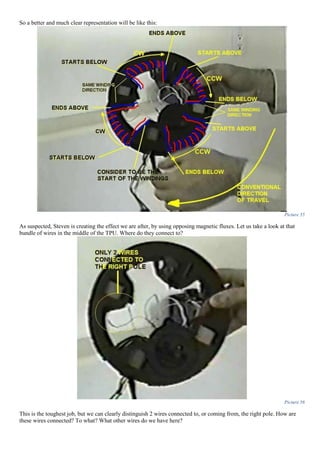
So then, in order for a magnet to switch its flux and do work, it must be somehow “conditioned” to behave
like this, and now we have reached a new country, and a new ground: Floyd Sparky Sweet Vacuum Triode Amplifier.
Through the use of this technology we learn how to “condition” magnets to behave in the way we want, so that we use
them in powering the TPU, MEG and Flynn SSG by actually really switching their magnetic circuit flux path.
MAKING MUSIC: OUR INSTRUMENT: THE
MAGNETIC FIELD --- Floyd Sparky Sweet
Vacuum Triode Amplifier (VTA)
Picture 284
Tom Bearden - Energy from the vacuum -
concepts and principles, page 311, Figure 6-10
UNLIKE OTHERS THINK
about Sweet VTA, I don’t believe
it to have 3 coils, or 3 coils on all
axes, (Ashley Gray version).
If we listen carefully at
what Sparky explains to Bedini, we
have to first hit the magnet with a
certain unique frequency in order
to bring it into
MAGNETIC
RESONANCE
When I first heard this, a
light bulb went on in my head,
having established a solid, firmly
ground and connection between
TPU, MEG, Flynn SSG and the
other unrelated side of Kapanadze
and Smith device!!! Magnetic resonance is what all these technologies have in common. Having all this is mind, this
means that the TPU, MEG and Flynn SSG are more exquisite designs of magnetic resonance embodiments, where
Kapanadze and Smith device have a more relative “simple” design. To stick to the basics, Smith device is like
Kapanadze just that it doesn’t have a core, (or Kapanadze is similar to Smith device, but it addition it has a core).
This means that all these devices MEG, TPU and Flynn SSG are exquisite embodiments NOT of magnet
switcher but of this “magnetic resonance” effect. Magnetic resonance IS THE KEY TO FREE ENERGY.
What on God name is this “Magnetic resonance”??? I don’t remember having learned it in school, high school nor
college. The only thing it comes to mind is resonance in LC circuits and resonance energy transfer in air core
Picture 285 Sweet with 2-magnet 2 coil VTA, loads, and instruments for historic self-powering
operational tests on May 1, 1990
transformers (Tesla Coil). So what is this “magnetic resonance” if what I know about resonance is actually “electric
resonance”? Having so little research about it, we have to cherish the little we have. We learn that this is very old
technology! Even a century old! Then why the hell don’t we find it in text books? That is a good question.
In replicating the VTA, I have come to realize something astonishing, that the magnetic field of a magnet or a coil
starts to vibrate at a specific frequency, just like Sparky is indeed pointing out. I stand my ground and reject
Floyd Sweet explanation of WHY AND HOW HIS DEVICE WORKS. First thing that I find myself in contradiction
with him, is the so called “magnetic domains” and “nuclei of the atoms”. I think that’s wrong and don’t
apply to this case. First of all “magnetic domains” is nothing more than just a theory in explaining the magnetism of
Ferro-magnetic metals. We imagine that a piece of metal is constituted from very little tiny magnets, separated into
“domains” which are imaginary boundaries between these regions in the metal, which have a certain residual random
oriented magnetism. Then we believe that when we add up all these magnetic field orientation vectors of the tiny
regions in the metal, they add up to 0, and thus we say that the metal is NOT MAGNETIZED. If we put this metal in a
strong magnetic field, most of these regions (domains) (consider them like countries) will orient themselves according
to this “wind” according to this field direction. When we shut down the external field, we see that some of these
domains remained oriented in the direction of the field, thus we say the metal HAS BECAME MAGNETIZED.
Although I don’t reject this conventional theory of magnetism, we must admit that is JUST A THEORY. I’m not
saying that is wrong, and I’m not saying that is correct either. I’m saying that IT HELPS US in understanding our
world, universe and magnetism. Its helps, that’s all it does. But using it to explain the VTA I think we are overstretching
a little bit. I think it’s wrong to say that these domains have a resonant frequency. More likely the entire structure has a
resonant frequency (all the domains together, and not by themselves).
Second of all the resonant frequency of the magnet, which in Sweet case is around 12,5Hz is not INSIDE THE
MAGNET but is OUTSIDE OF IT! It’s not the magnetic resonance inside the magnet, IT’S THE MAGNETIC
RESONANCE OUTSIDE THE MAGNET. IS THE MAGNETIC RESONANCE OF
THE FIELD!!!
This is what we have to understand if we truly want to comprehend the alien concept of “magnetic resonance”.
If you have ever watched “Mythbusters” TV show, they have an episode on testing the myth of “Tesla earthquake
machine”. In this episode (see it here) when they are planning for large scale experiment with a bridge, they suddenly
realize the seriousness and gravity of this situation:
Picture 286 Mythbusters testing Tesla “Earthquake machine” episode 60 in series or 71 overall and 17 in season 2006(season 4) episode 17, air date: August 30, 2006
Picture 287 Mythbusters testing Tesla “Earthquake machine” episode 60 in series or 71 overall and 17 in season 2006(season 4) episode 17, air date: August 30, 2006
A partial transcript of the experiment:
"All of a sudden, this myth is giving Adam and Jamie, a good vibe, and it's not the traffic because that's on a
completely separate bridge.
Picture 288 Mythbusters testing Tesla “Earthquake machine” episode 60 in series or 71 overall and 17 in season 2006(season 4) episode 17, air date: August 30, 2006
Adam: It totally feels like the whole structure is ringing to that Hertz. [...]
But the best is yet to come. After some more tuning, they find a sweet spot (sub-harmonic A/N)
Jamie: Oh my God. It feels like a big semi-trailer truck is rolling right by us right now!
Adam: And that's only 6 pounds of weight moving 25 times per second!
Jamie: It actually makes me a little concerned, believe it or not.
Adam: I'm totally stunned come out here and find this thing vibrating at the correct frequency to be felt
hundreds of feet away from the source. That is totally amazing. Did not expected that!
Jamie: We were ramming the same weight in the same kind of amplitude of vibration through the whole range
of frequencies. And yeah, you know there is a little vibration, then I hit that one spot, and all of a sudden is like hold on,
this is different! Something different was going on with that exact frequency. And, as a result of that specific frequency,
that specific tone that we are getting, this entire bridge is vibrating.
Jamie: Yeah, you can see it. It's over a hundred feet away.
Adam: Dude, that's six pounds!
Jamie: I now!
Adam: That's...I mean...I'm a little spooked!
It's official. We have two spooked Mythbusters and some unexpected results on our hands.”
(Mythbusters “Earthquake machine” episode 60 in series/71 overall, season 2006, air date: August 30 )
This is after they see the destructive effect resonance has on a long iron bar in their small scale experiment in
the shop.
Picture 289 Mythbusters testing Tesla “Earthquake machine” episode 60 in series or 71 overall and 17 in season 2006(season 4) episode 17, air date: August 30, 2006
I believe that an extremely eloquent example in this case is the collapse of Tacoma Bridge in 1940.
Picture 290
It was one of the longest suspension bridges in the world. Just after four months since opening, on 7 November
1940 at 10:00, the bridge enter in self-oscillations which were maintained by a consistent wind of 42 mph.
The self-oscillations were established at the fundamental resonant frequency of the bridge in traversal direction
(5 seconds period - 0.2Hz). Because it couldn’t vibrate longitudinally, up and down, it enter in vibration in a torsional
mode.
Picture 291 Picture 292
Picture 293
The lesson we have to take from this is that all mass in the universe has a resonant frequency. Every object has
a resonant frequency; either is a string, a glass, an iron bar or a bridge. This might be mind-boggling but the magnetic
field of a coil or a magnet is no exception! This too has a resonant frequency. This means that the
MAGNETIC FIELD in a toroidal form from a coil or a magnet BEHAVES LIKE A
MASS, meaning it will oscillate back and forth, it will vibrate if you hit it with a certain beat frequency. The idea
that a magnetic field has a mass, behaving like an “invisible object” is astonishing, and further give strength to the failed
experiments in switching the field of a magnet. The problem is that this field is too “solid”.
Picture 294
A more accurate visual representation of MAGNETIC RESONANCE
Picture 295
The idea that arises is that somehow, by bringing the mass of a magnetic field in a “mechanical” resonant
vibration oscillations it will somehow “fluidizes” the field, making it more susceptible to “poking” or “kicking it”. If
you like, let’s imagine the magnetic field lines of a magnet made of glass (good choice, transparent - invisible). Then if
we bring the magnetic field in “mechanical” resonance then these magnetic field lines are now transformed in to jelly. If
we pinch the jelly with a pencil, the response of it will cause more energy out than we used to pinch it with a pencil.
Then this “jelly type magnetic field” will be more likely to be distorted by a small spike like in Kapanadze, Smith
device, Steven TPU, Bearden MEG, Flynn SSG, Sweet VTA, generating a lot more energy than we have used to “pinch
it”. At least this is one way of visualizing.
Any system attains maximum amplitude only when it is allowed to vibrate at its natural frequency. It’s like
when a heavy truck passes near your house or apartment and the windows start to vibrate. If the oscillations are high in
amplitude, and the frequency is exactly on the resonant frequency of the medium, in our case the glass window, and we
bring the window to a violent mechanical oscillation stress, then if we just touch the glass with our finger, it will
immediately break. The same must be the case with our magnet. First step towards braking a
magnet symmetrical field is by bringing it in MAGNETIC
RESONANCE!
The most likely operation principle of Floyd Sparky Sweet VTA
An actual exact authentic real representation of the VTA is made by Tom Bearden in his book
“Energy from the vacuum - concepts and principles” and gives extreme clarity and further evidence to support this most
likely operation principle:
Picture 296 Sweet vacuum triode amplifier (VTA) construction
“Tom Bearden - Energy from the vacuum - concepts and principles” page 384 figure 6.5
Ask yourself, if we were able to extract the energy from these vibrations in the magnetic field of the magnet, it
should be in theory a lot more than we used to start them. So why should we use two magnets in an overunity device,
like we see in the Sweet VTA? What’s the point in using two magnets?
The most likely operation principle of the VTA is accomplished by approaching two identical magnets close
together, then we make their magnetic fields vibrate, so that between them, (in the air gap between them) a
STANDING WAVE IS FORMED.
A standing wave is a wave that remains in a constant position characterized by nodes and anti-nodes. In a
node the wave remains static, and in the anti-nodes the wave reaches its maximum amplitude. A standing wave
(example link here) pattern is formed when two waves travels in opposite direction in a medium:
Picture 297
Picture 298
Picture 299
In a simpler case, we can have only one wave creating a standing waves interference pattern with itself, if it’s
reflected at one end, and then it goes back where it started interfering constructively and in phase with itself:
Picture 300
The point here is to bring the magnetic field lines B in a “string” like fashion resonance.
A single frequency wave in a string takes the form of a traveling sinewave. The reflected wave from the end of
the string undergoes a 180° phase change upon reflection, and adds to the incoming wave. The constructive interference
leads to a standing wave.
Picture 301
Actually there are many standing waves created between the magnets, and their number equals the number of
field lines coming out of the N pole into the S pole, but for simplicity reasons we are representing only one. Actually
these standing sine-waves are vortexes in 3D space as any other sine-waves out there. In the entire universe there is no
sine-wave pattern in existence! A sine-wave is actually a 2D representation of a 3D entity. This type of distortion is
what happens when you try to visualize the dynamics of Creation on the surface screen of an oscilloscope. The Universe
just doesn't work that way. Sadly for many people, what I've just said won’t make much sense. So disregard what I have
just said, because it will probably be confusing and actually is not very relevant in our case(in any other case is very important), it’s just
some food for thought.
This standing wave acts like a moving magnet between the fixed magnets.
Picture 302
When you look at this first you might notice that the collector coil will not “collect” anything. I agree with you.
It is a conceptual representation of a collector coil. Actually nothing will be induced in the coil, even if we have the
standing wave formed, kicking and screaming. The reason why, is because
𝑑𝛷
𝑑𝑡
will not change in our surface area
delimited by the coil. In other words if the flux is changing only inside the coil, nothing will be induced. According to
the law of Electromagnetic induction, and not to upset lord Faraday, the flux that cuts through an area of our collector
coil, must change over time, so if we encompass all the motion of the wave within our coil, noting will be changing
over time per total. The net change will be zero. It is like I have a let’s say a 50cm diameter coil, and an extremely
powerful 10 cm magnet inside it. Then I rotate the magnet, or wave it, or oscillate it, or vibrate it or whatever motion
you like, as long as you’re not flipping it, and you do this ONLY INSIDE the coil, nothing will happen. Nothing will be
induced in the coil. So the magnetic flux must cut through the surface area of a turn in our coil, or the flux must change
in value or intensity over time in our surface area, for a current to be induced in the collector coil. The solution for this
problem even if it’s not very obvious, it’s quite simple. All we need to do is to segment the collector coil in two halves
or more. We need to discriminate or separate the circular motion of the standing wave. If you can imagine a cross-
section plane between the magnets and parallel with them, then the standing wave will project upon this plane a circle.
So by segmenting this circle in at least two sectors that each will become the surface of area of a turn in our new
collector coil design (Picture 303).
Picture 303
Another thing you can say about the above picture is that when you stress the oscillations by a load they will
eventually die out and fade away. And I say to you, you are right and correct. I agree with you. But what we can do, is
add another coil, perpendicular to the collector coil, which purpose will be to continuously excite or add energy to the
system so that these self-oscillations will not fade away so easily under load or “stressed”.
Picture 304
We will excite/hit/strike these standing waves vibrating B1 field lines with the field B2 like a guitarist is striking
the strings of a guitar with his pick or plectrum, but we will have to do it in phase with the oscillations in the system.
This is impossible to do by hand on a guitar, but if it were possible by a mechanical means, it will lead to a louder and
louder sound, and to more violent oscillations and surely and inevitable towards string breaking.
Picture 305
The actuator/exciter/input coil is only needed when a heavy load is connected at the output.
And you might also think that the input energy will increase proportionally with the extracted energy at the
output, and you are right. I agree again. But there is another “but” here. You see we are dealing here with a resonator, so
therefore each input signal will be in phase with the energy already oscillating in the system, and therefore the
oscillations being self-powered by their nature will add up and increase “exponentially” compared with a more “linear”
loading at the output.
Isn’t it apparent by now? If you are trying to generate electricity with magnets without
moving them in a solid state generator, then we will put the magnets in a fixed place and
MOVE THEIR FIELD in relation to a collector coil! That movement is done by magnetic resonance,
meaning that we hit the field with an input pulse at the resonant frequency of the field.
We could create many nodes and anti-nodes between the magnets but that would imply that we have to build a
different collector (power) coil for each anti-node, or change the winding direction after each node. (Comment on 01.01.2012 I
don’t think that to be correct, because this will mean that after each anti-node the magnetic polarity changes in respect to the middle line where the node is):
Picture 306
I believe this is what Sweet meant by the “canceling the field in layer-like fashion in alternating mode”
(Picture 306). These layers of alternating magnetic poles (multi-polar) are created in the alternating anti-nodes of the
standing wave, and the canceling occurs in the nodes.
Again for simplicity reasons let’s stick to only one anti-node with the two nodes created exactly in the middle of
the magnetic dipoles (exactly in the geometric center of the magnet itself - that is if the material of the magnet is
precisely and symmetrically magnetized in respect to its shape). This is the first harmonic (the fundamental).
The two main crucial conditions in creating a
standing wave between the fixed magnets of the
VTA:
The frequency of the actuator (exciter) or input signal that hits the magnetic field of the
system. Preferably this frequency should be generated in a coil situated in a symmetrical fashion in respect to the
magnetic field of the system. The best amplitudes of vibrations are to be expected if we use a sinewave frequency for
the actuator coil (input), but any other type of signal should work.
Also this vibration must self-resonate as much as possible, through the self-oscillations in the
magnet. To express myself in other simpler terms, consider yourself a clay/ceramic worker making mugs, glasses, cups
and bowls. Try to build such a mug out of ceramic or clay so that when you hit it with a fork or a knife or whatever, it
will make a sound that will last as much as possible. When you hit a cup/glass/mug/bowl with something it will make a
sound. That sound is the resonant frequency of the system.
Picture 307
Breaking glasses just with your voice or a speaker using this resonant frequency was very well demonstrated
and confirmed by the Mythbusters. Very hard to believe, but it can be done. Note that when they tried to break
glasses just with their voice alone, they had a straw place inside the glass in order to give LIVE feedback as the pitch
nears the high Q factor resonance point of the wine glass. Also a very good singing voice and extreme control over your
own voice (fine tune tone adjustment based on the straw live feedback) is imperative in order to replicate the
Mythbusters results. Now what we are interested here is to prolong the sound that our glass/cup/mug/bowl makes
when hit, as much as possible (JUST LIKE IN THE Singing bowls (also known as Tibetan Singing Bowls, ring gongs,
Himalayan bowls or suzu gongs):
Picture 308
Antique Old Tibetan singing bowl is exactly like a Sweet VTA
conditioned magnet
(An ordinary magnet is like an ordinary cup/mug/glass/bowl
but a Sweet VTA magnet is exactly like a Tibetan singing bowl)
This is the difference between a VTA magnet and an ordinary magnet.
The antique old Tibetan singing bowl is the most apparent/simple/unsophisticated/ordinary/common man-made
OVERUNITY device. More energy coming out than put in. More energy coming out in the form of self-oscillations
than the energy that it took to hit it. It doesn't even have to be hit, just slightly touched and it will sing, if it’s properly
constructed (made by hand).
This is what I mean when I say “self-oscillations”. Why make the sound last longer? Because we are
interested in hitting/touching the glass/cup/mug/bowl as rare as possible and not to use/expend to much energy in the
“hitting/touching” process compared to the energy that we will extract from the self-oscillations in this
glass/cup/mug/bowl.
Why do I say Overunity? You can say that if you were able to “stress” these sound waves, and extract all their
energy from them, then they will be instantly silenced. This is correct, but for this bowl to do work, it will have to be
constantly slightly and gently hit/struck/touched in-phase with the self-oscillating resonant frequency so that a
constructive interference pattern is created so that the natural self-oscillations will not fade away under a load.
Not every glass/cup/mug/bowl sings in self-oscillations at its
resonant frequency, therefore not every magnet will be a “singing”
magnet capable of maintaining its oscillations once struck or hit. This is
also backed up by Tom Bearden words in his book, I quote:
But fortunately unlike the glasses/cups/mugs or bowls, the magnet can be “conditioned” or “remolded” or
“remade” or “re-beaked” or to be more precise “re-magnetized” so that it will hold the “singing” self-oscillation longer
once struck. This is the “conditioning” phase we are after. I believe it to be a special re-magnetizing process using
the resonant frequency of the magnet/field using a very strange extremely unusual and unique re-magnetization process
using sinewave feed to the coil. A re-magnetization in both direction, not just one, so that a “shear” is created.
Therefore, our magnet will have a more dynamic field, rather than a static one, in theory anyway. This theory is an
educated guess, and partially backed up by Tom Bearden, I quote:
It’s not a dynamic field, forever or perpetually, it just the self-oscillation of the magnetic field. It will
eventually fade away, but the process can be restarted with yet another hit/struck/touched/spike/input signal. Because
this field doesn't make the subject to any type of friction, these self-oscillations in the magnetic field will in theory last a
lot longer than the sound waves oscillations in the Tibetan bowl which are subject to friction by moving the air back and
forth.
To determine the resonant frequency of a magnet/magnetic field we use a thin razor blade placed in unstable
equilibrium on top of a magnet (Picture 309 and Picture 310):
[...] the magnet was useless because it would not "hold" the activation and retain it. Magnets whose magnetic field
variation did not exceed 10% were ideal. So Sweet only found about 1 in 10 or even 1 in 30 magnets that would
retain the self-oscillation state when initiated.”
(“Energy from the vacuum - concepts and principles” page 309, paragraph 1)
“That fact can be used, e.g., to create magnets whose fields appear normal, but which deviate from the normal
behavior of ordinary magnets, and which produce anomalies in their magnetic fields.”
(“Energy from the vacuum - concepts and principles” page 363, paragraph 1)
Picture 309
Picture 310
These oscillations are reported by Tom Bearden to have happened by themselves (self-oscillating):
This is exactly like the sound keeps going in a Tibetan singing bowl!
The air-gap or the distance between the magnets.
This air-gap must be extremely and precisely well calculated in order for the standing wave to be formed. This
is done using the formula:
𝑑[𝑚] =
1
2 ∗ 𝑓𝑟𝑒𝑠𝑜𝑛𝑎𝑛𝑐𝑒[𝐻𝑧]
Equation 112
Where:
d-distance between the magnets expressed in meters;
fresonance -is the resonant frequency of the magnet/magnetic field expressed in Hertz.
Another very important point is that this distance is not the actual distance between the magnets but is the
distance between the centers of the two magnetic dipoles. Considering that the material of the magnet was magnetized
“I also locked up one of his specially conditioned magnets for 24 hours, with a piece of shim stock sitting on the flat
of the magnet and waving to and fro continuously, steadily performing work by moving air. When I opened the lock
the next day, the shim stock was still there on the magnet and oscillating, having continuously done work against the
air resistance for 24 hours with absolutely no energy input by the operator. “
(Tom Bearden - Energy from the vacuum - concepts and principles page 307, paragraph 1)
in a symmetrical, exact, correct and precise fashion in regards to the shape of the magnet, the center of the magnetic
dipole should be in the geometric center of the magnet form/shape. For example, if we use two flat 4mm thick magnets,
we must calculate this distance from the center (2mm of one magnet to the 2mm of the other magnet as shown is Picture
311):
Picture 311
This air-gap must be an integer number of a multiple of the half the wavelength of the resonant frequency:
(harmonics of the resonant frequency)
Picture 312
This is the second harmonic (tree nodes-1). This picture very interestingly seems to be “in line” with the
ambiguous words of Maurice (an associate of Sweet) regarding the “Floyd figure eight design (flux flow)”
But what we are interested is to create only half the wavelength: (The fundamental - Picture 313)
Picture 313
Why only half? Because if we generate the exact fundamental resonant frequency using it’s wavelength as the
gap, we will have a balanced symmetrical waving magnetic field line. One up and one down. One half of the sinewave
in a direction, the other in the opposite direction. The work done by one anti-node will cancel the work done by the
other anti-node. This operation leads to another VTA secret which is that we must generate an uneven number of
anti-nodes in the standing wave between the magnets. (or an even number of nodes)
If we carefully listen to what very few things Sparky is pointing out, few things but of an extreme importance,
we find out that after determining the resonant frequency of a magnet, that first each magnet has a slightly different
resonant frequency, and second, when we bring to identical magnets closer to each other, their fields gets mingled, and
the natural resonance frequency will be an average of the two:
Picture 314
A partial transcript of Tom Bearden video of Sparky saying just this:
If we carefully analyze the videotape, and listen to what they are saying, we will understand that Sweet actually
tried to explain to Tom Bearden and John Bedini the working principle prior to the recording of the video. This is an
obvious rational deduction, based on the pre-indoctrinated/pre-fabricated answers (wrong answers) given especially by
Bedini to Sweet when he is trying to finish his sentences. This only leads to the conclusion that fortunately for us, they
most likely had a prior conversations about the working principle of operation behind the VTA and the
conditioner/conditioning of the magnets, prior to the videotaping. It is fortunately for us, because these “finishing the
sentences” wrong answers, gives us clues and deeper insights on how the VTA really works. Thanks to Bedini wrong
answer “Hole is?” we can say with extreme conviction that the air-gap is indeed extremely important, and as presented
above, without the proper determination of it, the standing wave will not form. Another point we must not ignore, is the
answer “With the iron bar, yeah” also made by Bedini. I’m not fully convinced, but I think he is referring either in
replicating the VTA effect in a transformer, where determining the iron-bar-core magnetic resonant frequency is crucial
for the operation (comment on 04.02.2012 this could also be more likely), or most likely his is referring to another not so obvious
conditioning secret, in using a coil with an iron-bar core for the re-conditioning (re-magnetizing) to increase the flux
density and facilitate an easier re-magnetization. Thus the resonant magnetic frequency will change because we have
added an additional mass that captures and distorts the magnetic field, changing the resonant frequency of the system.
Thus an additional determination of the magnetic resonance of the iron bar will be required.
The fact that Sparky Sweet is swearing and not only that he is swearing twice, denotes to me that most likely he
was somehow “traumatized” and extremely annoyed and frustrated by not finding the right maximum amplitudes at the
“[...] Sweet: You have to take two magnets now. Right? Find out first what that...
Bedini: Hole is? (Most likely referring to the air-gap A/N)
Sweet: No, no. Find out first what the frequency is. The natural frequency. The magnetic resonant frequency.
Bedini: With the Iron bar, yeah.
Sweet: Find out what that is. Right? Then, I just took the two magnets, found what the maxim is, and I put them
together like this. [...]
Sweet: Then I found what the frequency was. Now what it will do, what will do, it will average out the God damn
frequency, God damn resonant frequency in this one and that one.
Bedini: Right.
Sweet: It will average it out. Right? […]”
(Floyd Sparky Sweet VTA-SQM Secrets videoclip filmed by Tom Bearden in Sherman Oaks, California April/May 1987 minute 6 second 30 part 4 –permalink click here)
calculated resonant frequency when he was in his early development with the VTA. He probably tried very hard, and
did a lot of testing, and failed a lot, and finally realized that it was an average of the two.
Enough with this psychology crap, and back to our VTA. Again, we have to point out the fact that we must
have an uneven number of anti-nodes in the standing wave, therefore our air-gap must be half the wavelength of the
fundamental frequency (for best amplitudes in the anti-node) Picture 315:
Picture 315
𝜆 = 4𝑐𝑚 = 1.55𝑖𝑛𝑐ℎ Equation 113
Using, integer multiples of the
𝜆
2
will still work, but the amplitudes of the oscillations in the anti-nodes will be
slightly lower.
Again, I find myself in contradiction with what is commonly known in Floyd Sweet VTA about the liberty to
use any frequency you want in conditioning the magnet. I find that difficult to believe, for mainly two major reasons. I
am strongly convinced that VTA works by generating a standing wave between the magnets, therefore you can’t use
any frequency you want, because the standing wave won’t be generated. It is generated only at the resonant fundamental
frequency and the harmonics of the resonant frequency:
Picture 316
This means that the input signal in the actuator/exciter coil must be the fundamental frequency or a sub-
harmonic of the fundamental. Second of all, considering the fact that only an uneven number of anti-nodes will do work
and generate power in the collector/power coil, we will again be constrain to use only an odd number for the sub-
harmonics of the resonant frequency. This means that we can’t use any frequency we want! We must only use the
fundamental or the 3rd sub-harmonic or the 5th sub-harmonic or the 7th sub-harmonic or the 9th sub-harmonic
etc. of the resonant frequency of the magnetic field (Picture 317).
Picture 317
In this case if the magnets resonant frequency is 12.5Hz we will hit the magnets with a 12.5Hz signal input in
the actuator/exciter coil. Thus for a standing wave pattern to be formed, the air-gap must be 4cm, 8cm or 12cm.
In theory we could use any multiple of
𝜆
2
but in practice, the magnetic coupling between the two poles will
become too weak thus the amplitude of the waves will be also weak.
Picture 318
Again, in this case, if the fundamental natural magnetic resonance of the system (the two coupled magnets) is
12.5Hz and in this case, we choose to hit them or actuate them or excite them with a 25Hz frequency (second harmonic)
then for a standing wave to be formed the distance between them should be: A: 8cm, B: 6cm C: 4cm and D: 2cm. The λ
in this case is not the λ of the 25Hz but is the fundamental wavelength.
This can go on forever. Let’s focus on the actual operation chosen by Sweet:
Picture 319
We do know that the magnetic resonance of the magnets is around 12Hz. We do know that he is using a 60Hz
sinewave input signal. Thus he is using the 5th harmonic. This means that the wavelength for our standing wave to be
formed when the system is hit with this frequency must be:
𝜆 =
1
60𝐻𝑧
= 0.0167𝑚 Equation 114
Considering that he must use an odd number of anti-nodes, the distance between the magnets should be:
1 𝑎𝑛𝑡𝑖 − 𝑛𝑜𝑑𝑒:
𝜆
2
=
0.0167
2
= 0.0084𝑚 = 8.4𝑚𝑚 Equation 115
3 𝑎𝑛𝑡𝑖 − 𝑛𝑜𝑑𝑒𝑠:
3𝜆
2
=
3 ∗ 0.0167
2
=
0.05
2
= 0.025𝑚 = 2.5𝑐𝑚 Equation 116
5 𝑎𝑛𝑡𝑖 − 𝑛𝑜𝑑𝑒𝑠:
5𝜆
2
=
5 ∗ 0.0167
2
=
0.0835
2
= 0.0417𝑚 = 4.17𝑐𝑚 (𝑚𝑜𝑠𝑡 𝑙𝑖𝑘𝑒𝑙𝑦) Equation 117
Ways to express and visualize MAGNETIC RESONANCE
IN A MAGNET
One way to directly observe magnetic resonance and the vibrating magnetic field is the Floyd Sparky Sweet
thin blade method:
Picture 320
Additional points and peaks are introduced because of the noise of the system. Any of these smaller peaks must
not be confused as resonant frequency in the case when full picture is not visible. Therefore a full sweep at Extreme
Low Frequency (especially between 9-30 Hz) is a must.
We should point out here again the uneducated words of Maurice, probably not his own:
I hate fancy expression. I hate so much these people who HIDE BEHIND FANCY EXTRAVAGANT
EXPRESSIONS! Why do they do that? Are they too lazy to express the exact principle of operation from the
traditional, conventional point of view? Why? Why do they have to make things complicated? Why do we have to use
complicated terms? Why? So that people won't understand, and consider them smart? Is that it? This is insane, wrong,
and evil! Why are people like this? Why?
Can't they just cut the crap, and bluntly say what is really going on, with no secret, and nothing kept hidden?
Picture 321
“He had a small piece of metal that was standing on the top of the magnet at a 45 degree angle. As I recall, he
claimed that the 45 degree angle was needed in the treatment of the magnet so that it could capture Scalar waves.”
“A Practical Guide to 'Free-Energy' Devices”- Patrick J. Kelly chapter 3, page 15, paragraph 4, line 2
Thus:
Picture 322
What I truly want to say to all these people that upsets me are the words of Walter Lewin:
Another way we could make evident the vibrating magnetic field, is by using a small part of a straight pin so
that it has a small enough weight to be supported in a slightly vertical position by the magnetic field alone. You must
have played as a child with magnets and straight pins under the kitchen table in trying to place the pins in a straight
vertical position. This is what we are trying to achieve here too. The sharp head ideally should be placed in contact with
the magnet, as a small contact joint is the most important in seeing the vibrations. However, due to these vibrations, the
small contact joint between the tip of the pin and the surface of the magnet, will make the pin eventually slip away and
fall from its slightly bent position. A solution to this is by placing a piece of glass in between the magnet and the pin
that has a small made hole in it (Picture 323). Thus the sharp head will find it difficult to move due to the concave
cavity and roughness of the surface.
Picture 323
“The hidden beauty is the beauty of understanding, it’s the beauty of knowledge. And it’s your task, your
task as teachers, and my task as a teacher to get that beauty across, in fact not only your task, this is your
OBLIGATION.
Knowledge does not narrow. Knowledge only adds. And without knowledge many experiences in life remain
very narrow and very shallow”.
(Walter Lewin at the council on Primary and Secondary Education MIT June, 26, 2002 minute 1 second 2 - link here)
Picture 324
Obviously in Picture 324 the magnet is under the glass, thus under the glass surface cavity, held with
transparent adhesive tape. Use your fingers and a tooth-pick/match to reposition the pin:
Picture 325
If the pin doesn’t stay in a straight/oblique position, try to cut it shorter and make sure it light enough to be
sustained by the field and/or try to place additional non-ferrous spacers between the magnet and the glass. Make sure
that such spacers are not diamagnetic.
IN A COIL
Magnetic resonance for an air-core coil behaves differently than in a magnet. Differently how? It is a different
story because this time the magnetic resonance is intimately connected to the LC resonant frequency of the circuit.
We are looking at the LC resonant frequency and self-oscillations damping time.
Picture 326
The frequency of the oscillatory voltage depends upon the value of the inductance and capacitance in the LC
tank circuit. We now know that for resonance to occur in the tank circuit, there must be a frequency point were the
value of XC, the capacitive reactance is the same as the value of XL, the inductive reactance (XL = XC) (Picture 327) and
which will therefore cancel out each other out leaving only the DC resistance in the circuit to oppose the flow of
current.
Picture 327
Resonant frequency of an LC oscillator can be determined using the formula (Equation 118):
𝑓𝑇 =
1
2𝜋√𝐿𝐶
Equation 118
LC Resonant frequency can also be determined by ringing the circuit (Picture 328):
Picture 328
Picture 329
Picture 330
The reason for this extremely lightly damped oscillations occurrence is that the natural common LC oscillations
in the tank circuit will be in tune with a sub-harmonic of the not-so-obvious magnetic field frequency (the magnetic
field has mass, remember?)
Even if you object, saying that I’m wrong and that any LC natural oscillations are damped by an exponential
decay, and what we can see in the above picture is utter nonsense! I will respond to you, saying that you are right but
you are also wrong. NOT ALL plain simple LC CIRCUITS HAVE EXPONENTIAL DECAY OSCILLATIONS! Again
you might think that I’m insane, but just trust me when I say that there are some LC circuits that exhibit a high Q, and
their oscillations are not damped in an exponential decay. There are some coils geometries that creates a spinning
magnetic field. The magnetic field has mass, so it will have an inertia. If the natural LC oscillations are in-tune with the
spinning magnetic field, then this magnetic spin will create an induced EMF in the circuit and thus our oscillations will
not fade away exponentially and it will behave like a high Q LC resonator.
Picture 331
The condition for the natural self-oscillations to
occur in an LC oscillator resonator circuit is that
the Capacitive and Inductive reactance must be set
on a harmonic of the fundamental resonant
frequency of the magnetic field created by the coil
L. Thus we say “The circuit works in magnetic resonance” or in other terms: “The natural
LC oscillations are in resonance with the magnetic field”
Each time the field builds up and collapses in the coil L, it will happen in tune with a harmonic of the
fundamental frequency of its magnetic field.
This setting/tuning/adjusting or controlling by varying the inductive and capacitive reactance will be extremely
difficult. Why? Keep in mind that the fundamental natural resonant frequency of a magnetic field at its peak amplitude
is expressed by even two decimals for its particular frequency. Meaning that the correct fundamental, first harmonic,
natural magnetic resonant frequency of a magnetic field will be for example 15.43 Hz. If you hit this field with 15.6 Hz
it will not work! You are too off! You won’t get the maximum effect and maximum amplitude. This is because the
natural magnetic resonant frequency of a magnetic
field has a high Q factor! (Picture 332)
Picture 332 Quality factor Q
And remember this is for the fundamental frequency, and when you go higher with the harmonics, it will be
even more difficult to tune it.
Let’s quote Mythbusters Tesla Earthquake machine episode commentary voice about the tuning on the
fundamental resonant frequency of an iron bar:
Picture 289
“With a computer control
ACCURACY
OF ONE
HUNDREDS
OF A
HERTZ, something Tesla could only dream of,
they are having much more success fine tuning Grant's all most frictionless motor to the steel bar natural frequency”.
(Mythbusters Tesla “Earthquake machine” episode 60 in series or 71 overall and 17 in season 2006(season 4) episode 17, air date: August 30, 2006 )
I deliberately wrote in such big letters, because I don’t actually think anyone could tune to magnetic resonance
with a standard signal generator. Consider this well, and think this through how you can achieve
such accuracy to reach magnetic resonance!
Additional insights on the TPU, MEG, and Flynn SSG devices.
I know that I said that all these devices are based on the same principle -magnet switchers-, and then I
added that they all are sophisticated embodiments of magnetic resonance principle. All this is correct, but
now I will add another descriptive argument about them, and that is they are actually “magnets in self-
oscillation” actuated slightly from time to time (in phase with the oscillations-comment on 20.02.2012 - actually more like a 45 to 90
degree phase shift) by small kicks to keep the self-oscillations going. Therefore is not the actuator/exciter or input coil that
cause the magnet to switch path, but in fact this switching happens by itself, and if no load is put to stress this flux,
(that is when this flux is switching by itself, with no additional input) if no load is connected to these solid state
generators, these self-oscillations will keep going for a while even with no input by the user, just like a Sweet VTA
magnet that oscillated a thin blade on top of it for more than 24 hours just by itself, with nothing attached to it, locked in
a cabinet by Tom Bearden.
Considering all the insights until now, we can say with a highly degree of certainty that the TPU, MEG and
Flynn SSG are actually a means to achieve an end, a way to harness the self-oscillations that are set
in a special “conditioned” (re-magnetized) magnet. The devices construction means nothing. The construction details
are useless, if we don’t understand the principle of operation. The devices by themselves are garbage, junk. They mean
nothing. What we are actually doing is to harness, or to extract energy from the self-oscillations set in a special re-
magnetized magnet. Again, by self-oscillations I mean the ability of a special magnet to vibrate (oscillate) its own
magnetic field. Such oscillations if they are properly set in a magnet, will not suffer from friction or any resistance
whatsoever. However, when we will try to capture the energy from these oscillations, and force them to do work, they
will inevitably stop. Unless...we actuate them/excite them with an input signal kick in phase with the self-oscillations in
the magnet, so that they will not fade away. Then the energy captured from these oscillations will be greater than the
input kick. This is what TPU, MEG, VTA and Flynn solid state generator are doing, they are just capturing this self-
oscillations energy set in a magnet. We can of course use any harmonic of the fundamental natural resonant frequency
to keep the self-oscillations going.
Yeah, but how is this special magnet realized? How do we condition a magnet? How do we set self-
oscillations in a magnet? How do we condition a magnet to behave like this? How do we brake a magnet
symmetrical field?
The answer: Resonance! Remember the DESTRUCTIVE EFFECT THAT RESONANCE HAS ON SOLIDS?
If not, again I recommend watching Mythbusters episode on Tesla Earthquake machine. Now remember from physics
that by solids, we should actually understand “mass”. The magnetic field has mass, thus has a resonant frequency. Now
I will give you an answer by asking you a question: Why do you think it’s called BROKEN SYMMETRY?
Ring any bell?
By braking the magnet symmetrical field using its resonant fundamental natural frequency, the oscillations we
used to brake it will keep going for a while, after everything is stopped. If we have used enough power and flux density,
the magnet will re-magnetize in this DYNAMIC fashion. This is what we have to understand by “conditioning the
magnet”.
Considering all of these, the fact that Steven Mark took the magnets, oh...sorry...took the “broken magnets”
(special magnets) apart from the TPU, when it wasn’t working, gives further credibility to everything said until now. I
understand that he used slots for the special magnets, because they will eventually demagnetize and he wanted access to
replace them, but he could have left them in their slots, right? Why didn’t he do that? The most likely reason, supports
all these deductions and is the fact that the TPU core acts like a “load” or friction for these self-oscillations in the
magnet, due to eddy currents. If this idea is correct, and most likely is, then if we leave the special conditioned broken
magnet in the device (MEG, TPU or Flynn SSG) for too long, the self-oscillations will stop, and eventually the magnet
will not self-oscillate at all. Remember, that when in operation the self-oscillations are maintained, and nourished so
they will not stop, no matter what. But leaving the self-oscillations to do work, without properly exciting them will most
surely lead, after some time, to the restoring of the magnet balance and equilibrium and thus becoming an ordinary
magnet.
Insights regarding VTA
From studying the VTA, we can pretty much understand the reasons why Sweet choose those huge magnets, for
two main major factors:
1. The Bigger the field, the lower the fundamental resonant frequency. At the lower fundamental resonant
magnetic field frequency the Q factor is reduced. Thus we don’t need high accuracy to pin-point the exact
fundamental frequency.
2. He wanted to use to lowest sub-harmonic possible to the magnetic field resonance, because he wanted to
extract at the output an exact 60Hz sinewave, so that not to complicate further the design using an inverter. The closer
you get to the fundamental frequency with the actuator frequency the better the amplitude, and the higher the output
power. Therefore, if he had used let’s say the third harmonic of a fundamental frequency of a 20Hz magnet, then such a
magnetic field will be to small, and thus to low output power. He then realized that the next closest harmonic he could
use was the 5th. Thus the 5th harmonic of a fundamental frequency of a magnetic field, leads to a 12Hz fundamental
resonant frequency. So he had to find a magnet that has a fundamental resonant magnetic field frequency of 12Hz, and
that’s a BIG magnet!
CONDITIONING THE MAGNETS. (Re-magnetization process)
I know I said, that the “magnetic domains” Sweet explanation for the inner operation of the VTA was wrong,
but I find myself, in an awkward position when I may have to take back those words. But I still think that it’s not
correct, but it’s also not wrong either. More likely is an inaccurate/inadequate/superficial approximation of reality.
These self-oscillations for a lack of a better understanding of magnetism, and the special dynamic re-
magnetization process, I am starting to understand why Sweet used this theory to explain his device. We are finding
ourselves here, on an uncharted land, and that is the fact that “magnetic domains” are found in two major categories:
static magnetic domains, and dynamic magnetic domains(due to a spin wave). Seems absurd, I know, but bear with
me.
From the Radus boots, to MEG, and Flynn devices, we are taught that a magnet can switch its preferred flux
path:
Picture 333
(These self-oscillations are weak, but consistent. If they are put under load, friction, stress or resistance they quickly fade away permanently (non-irreversible). The self-oscillations can be
restarted with a small input magnetic field (hitting them). Such a small magnetic field can be from a coil (inside the TPU) or from another magnet.)
Right, this is known and understood, but remember that this switching of the magnetic field happens more efficiently if
we not just hit the field in the side we want vacant, but also hit the side we want our field to occupy:
Picture 334
This changes our previously assumed model like this:
Picture 335
(These self-oscillations are weak, but consistent. If they are put under load, friction, stress or resistance they quickly fade away permanently (non-irreversible). The self-oscillations can be
restarted with a small input magnetic field (hitting them). Such a small magnetic field can be from a coil (inside the TPU) or from another magnet.)
We should not ignore the fact that additional poles will be formed in the re-magnetization process. Thus the
“vacant side of 0 magnetic flux” is not 0 after all!
After we have made room in our minds for this new idea, then we realize that there is no reason, for the
magnetic fields created in one side and the other to be unequal, and we reach a more close to reality conclusion:
Picture 336
So in conclusion we have a special condition magnet that behaves like this:
Picture 337
(These self-oscillations are weak, but consistent. If they are put under load, friction, stress or resistance they quickly fade away permanently (non-irreversible). The self-oscillations can be
restarted with a small input magnetic field (hitting them). Such a small magnetic field can be from a coil (inside the TPU) or from another magnet.)
An obvious practical question now arises: How on earth are we going to re-magnetize a magnet in such
arrangement? If it’s not obvious by now, the answer is simple and right in your face. We magnetize/re-
magnetize the magnets in the device itself!Just where they are and where they will
continue to be after the conditioning!
MAGNETIC DOMAINS DYNAMICS
The magnetic domains dynamics producing the self-oscillating magnetic field of a magnet is definitely
unexplored land. For the self-oscillations to occur, the magnet must be magnetized in a powerful sinewave (ideal) (or
square wave) alternating magnetic field, in the manner presented above.
TPU MAGNET DOMAIN DYNAMICS
In Steven Mark TPU, magnetic domains dynamics in his magnets are like this:
Picture 338
Picture 339
Remember, without a proper understanding of
“Magnetic resonance” concept, the “magnetic
domains dynamics” won’t make any sense!
This is because, the dynamics only happens at magnetic resonance! The
dynamic 180° self-re-orientation of the magnetic
domains has to happen at a rate/beat/frequency in
tune with the resonance of the field created by
them!
All things considered, our TPU magnets should look like this:
Picture 340
(These self-oscillations are weak, but consistent. If they are put under load, friction, stress or resistance they quickly fade away permanently (non-irreversible). The self-oscillations can be
restarted with a small input magnetic field (hitting them). Such a small magnetic field can be from a coil (inside the TPU) or from another magnet.)
And their special magnetic field conditioned for self-oscillations would look something like this (when they are
taken apart from the device):
Picture 341
These self-oscillations are weak, but consistent. If they are put under load, friction, stress or resistance they quickly
fade away permanently (non-irreversible). The self-oscillations can be restarted with a small input magnetic
field (“hitting” them). Such a small magnetic field can be from a coil (inside the TPU) or from another magnet.
THIS GIVES FULL CREDIT
AND AUTHENTICITY TO THE
SITUATION WHERE STEVEN
MARK STARTS ONE OF HIS
TPU LIKE DEVICE JUST BY
WAVING A MAGNET NEAR
IT!!!
MEG MAGNET DOMAIN DYNAMICS
Picture 342
Magnet oscillates back and forth between these states (self-oscillation)
Picture 343
(These self-oscillations are weak, but consistent. If they are put under load, friction, stress or resistance they quickly fade away permanently (non-irreversible). The self-oscillations can be
restarted with a small input magnetic field (hitting them). Such a small magnetic field can be from a coil (inside the TPU) or from another magnet.)
Of course the ferromagnetic domains will increase in size as they are close to other in the same
direction/orientation. Just like countries will ally if they both have the same content or political "wind" if you like the
illustration. So there will not be so many domains like presented in our picture as they are all aligned in the same
direction. The more the domains the better a certain material is demagnetized. The less boundaries (domains) the better
the material is magnetized.
Don’t even think or consider replacing the central magnet with two identical magnets put together in opposition.
First it’s silly, and second if you had that thought passed through your mind, then it’s clear that you haven’t understood
the self-oscillations in the magnet. It’s not two magnets. It’s only one magnet that self-oscillates behaving like two
magnets joined together at an instant.
MORE INSIGHT ON MEG INNER OPERATION PRINCIPLE
If you think about it well, you will come to realize that in order for the MEG to generate a
sinusoidal output, SOMETHING MUST BE SPINNING!!!
Picture 344
(Tom Bearden Motionless Electromagnetic Generator (MEG) (US patent number 6.362.718 March, 26, 2002 sheet 3 of 5)
So what is it? The answer is the magnetic domains in the magnet! You might say: Ok.... But how can this be?
And this is where things start to go very complicated, but I will try to make it as simple as I can.
First I will like to add that there is nothing like Solid State Generators in the Entire Universe. The usage of the
term “Solid State Generators” is flawed for two main reasons> First, There is nothing “Solid” in this Entire Created
Universe! What we define “solid” is something made out of atoms, that are made of guess what! Empty Space! The
Atom is 99.99% Empty Space! Research this on your own, because I’m not going to insist on it too much. Second the
term “Solid State” implies no moving parts. But in order for the Generator to do work, SOMETHING MUST
BE MOVING! Because you can’t generate movement out of something that is not moving! Everything in Creation
is moving! EVERYTHING! Therefore Something IS MOVING in all these generators, but WE JUST
CAN’T SEE IT! Either it’s too small (magnetic domains) or is invisible (magnetic field). Therefore the use
of “SOLID STATE GENERATORS” IS INAPPROPRIATE, but for the sake of argument, and that many people are
used to this term, and this notion, and it is pinned down into our vocabulary, we must use it further on.
We must realize that the term that I used as “Domain Boundary change” is not so academic. A more accurate
and correct term for it is “Bloch wall”. Now this “Bloch wall” is not an ABRUPT change or an abrupt
reversal of orientation! It is a slightly gentle transition in the magnetic domains, like so:
Picture 345
(“Magnetism and Magnetic Resonance in Solids” - A.P. Guimaraes, Page 134, figure 5.12)
You remember now, that I said that there are no sine waves in the entire Universe? This is another case, out
of countless cases, were this is proven to be right. It more resembles a vortex or helix, doesn't it? Again, Universe
doesn’t work on the surface screen of an oscilloscope! A sinewave is a distortion! It’s like a shadow of something out of
Creation. You can’t look at a man’s shadow, and say that’s a man! The shadow is nothing! The person who cast it is
real! The same with sine waves! They are shadows (2D distorted representations) of a complex 3D vortex/helix entity.
In our MEG case, the above picture is still not accurate. What happens is that a wave that is spinning is formed
between the walls of the magnet (like a standing wave):
Picture 346
Picture 297
I said it is LIKE a standing wave, because it is not, in spite the fact that it may look like, and we might think that
way. From the picture above of a standing wave in a string, we should remember the equation for a standing wave:
𝑦 = 2𝑦0 cos(𝜔𝑡) sin(𝑘𝑡) Equation 119
So, our equation becomes 0 for certain values of frequency ω. In those moments, a node is formed. In such a point
nothing is moving. Our wave stands still in that particular spot. This is however not true for our case, because in the
Bloch wall region, we don’t have a node. So this is not a standing wave.
How this looks like is for example like a drill bit, or like one helix of DNA:
Picture 347
Picture 348
This is what is called a “spin wave”. A “spin wave” is a harmonic disturbance (spin) propagated in the ordering
of magnetic domains in materials.
This spin-wave once established is self-sustaining. It’s like the North Pole is always chasing the South Pole.
Because we have almost no friction, these self-sustaining self-oscillations established in the
magnetic domains will spin indefinitely again, as long as we don’t introduce friction. If we introduce
friction in our equation, by capturing this outside spinning magnetic field with a coil or something else, then this coil
due to BEMF, will slow down the “internal engine”. Therefore we must apply a small external input kick that will
maintain them. This internal engine in the magnets is what drives the MEG, TPU, and Flynn SSG. Not exactly the same
with VTA though. In the VTA this same engine is established also in the air-gap between the magnets. How will this be
Overunity? Remember that this spin has a huge inertia, just like the mass heavy weight we see in other free energy
motors. Once started if you hit this spin (just pinch it) at the right exact time (in resonance) it will do a lot more work
than we are putting in.
Another thing that we must understand here is the fact that our magnet acts like a sound cavity. Just like when
you are shouting in a completely empty apartment (Picture 349):
Picture 349
You hear an echo. It is exactly what we seek here. A constructive interference pattern between the outside
applied magnetic field and the reflected (echo) wave established in the magnet.
It’s like the exact opposite of anechoic chambers!
Picture 350
We seek quite the opposite! Therefore more like an echo chamber.
Picture 351 Hamilton Mausoleum
In a room, once you bring objects in that room, like a sofa, a table, a chair, a bed etc., that echo that was first
there is gone! No more echo! That’s what we might think, but the echo, is still there, is just there are many things in the
way, that disperse it into many other waves with different frequencies and weaker amplitudes.
Picture 352
Household object are like imperfections in our material. Therefore, to improve the echo, remove the furniture in
your room. We must use perfect magnets, no scratches, no cracks, no visible surface defects. As for the inside...hope
you are lucky. If not use another magnet, demagnetize it, and start again, and again, until you find the perfect “chamber”
that sustains the echo (spin wave) for longer periods.
Interesting how this relates to bigger and bigger temples, churches and cathedrals...
Picture 353
...maybe the architects knew something. The bigger it is, the better is capable to amplify ELF. Exactly the
opposite like in standard modern sound amplifiers! The amplification cuts off with frequency! Maybe they knew how to
design, and build cathedrals, at specific dimensions, to act as sound amplifiers for many frequencies, so that will operate
like a modern electronic sound amplifier. But instead of something that electronics engineers know as self-oscillations
which they try to avoid in designing an amplifier, the builders of churches new that this “self-oscillations” is exactly
what they want! The bigger the echo the better “God” resides in it! Maybe they knew that by designing cathedrals with
specific build in constants, specific ratios between walls and chambers, and special design and so on, then all these
things will amplify through the echo being in constructive interference with the voice of the singer or chorus. To
amplify the feedback echo sound received in the 3D stereoscopic human ear when is chanting the sacred name of God!
To bring the initiate closer to self-resonance as possible! Damn! They were really smart! Wonder what other secrets of
this lost art they hold. This will make churches and cathedrals from this point of view, more like “initiation chambers”
like the ancient pyramids! Of course from this point of view, this will mean that the churches were never meant to be
full with people or objects. One person at a time. Bringing a person much closer to God, Literally! Not the whole mob at
once.
Oh, Sorry for that, I went a little bit off topic here, I apologize for my tendency to be carried out by these
thoughts.
Another insight we should have in mind is the magical legendary singing rod:
The Singing rod
Picture 354 Ian B. Dunne demonstrating the singing rod at Southampton University during National Science Week 2010 (See link here)
Legend has it that the song of the
singing rod summons the Physics Fairy. She
has been known to guide kids through physics
problems and experiments. It is thought that
the physics fairy inspired a young patent clerk
(Picture 356) in 1905 to imagine what it would
be like to ride on a beam of light. He then
developed a very special theory that changed
the world of physics.
If you hear for the first time the
Singing Rod, then you too will be “inspired by
the fairy” to think:
“Look, can’t you see? Or better said,
can’t you hear? That the total Energy Output
in Work per unit time done by the singing rod
is far greater than of the input? Are we all
blind and deaf? Isn’t this another extremely
obvious and speaks for itself case of
overunity and energy gain/amplification? Are
we all that blind and deaf? Can’t we have a little bit of vision and see that this
can be a free-energy device?
I will say to you, my friend, you are right, but you must also realize and
wake up to the reality that someone else beat you to it. This has already been done,
we just don’t know it, and we are not aware of it. This is true, the singing rod can become a free-energy overunity
electric generator. We must realize that there is nothing left in this world to be invented! I think a great
man said this in the past, and it’s true. He was highly criticized and ridiculed for it and any sane man will think he was
nuts when he said it. We all heard him, but we just didn’t really understood what he meant. Everything there is in the
entire Universe has already been invented!!! It just haven’t been DISCOVERED yet. Everything you can imagine
in the entire Universe has already been invented by the Infinite Intelligence that created all Existence. If you can
imagine in your head something out of a Sci-Fi movie, than a Higher Intelligence than yours already imagined it before
you, and probably put it into practice to see how it will work out in this vast enormous Universe, in a far distant galaxy
or somewhere, were no human telescope has gazed yet. Everything you can imagine, any device, any technology, any
prototype, any design, everything! Everything! Everything you can imagine has already been invented. Everything! We
just didn’t discover how to do it yet. We just have to discover it and bring it to light again! Nikola Tesla realized this
(because his father was an orthodox priest and indoctrinated him with a lot of wonderful things about God), and this is
why he never liked people saying about him that he is an inventor. He always said about himself that he is a
DISCOVERER! Think about that for a minute! It is more than a miss-used word!
Picture 356
Picture 355
Picture 357
When you have read what I just said, you might say that I’m a fool, and I should listen to Nobel Prize winner
Ivar Giaever when he told the 2008 Beijing Nobel Laureates Forum that “Nothing left to discover, a world to invent”.
You might say that this is a contradiction. I say different. It is not. My friend, please listen, and bear with me. The
apparent contradiction is not the problem here, is the limit of our vocabulary and the limit of our words we have
available to use IN ORDER TO EXPRESS OUR IDEAS. We are expressing different ideas and thoughts through the
same words that apparently contradict each other, but the unspoken ideas behind the messages are not in contradiction.
If you have just discovered the singing rod, then you must realize that others discovered it before you. We have
to admit that the singing rod most likely inspired Donald L Smith to build his free energy bar resonant transformer
described in his book Resonance Energy Methods:
Picture 358 from the book “Resonance Energy Methods”
by Donald L Smith page 31
Picture 359
Let’s quote Donald Smith:
So how does the singing rod work? What’s the catch? What the trick?
The secret is that the rod acts like a sound cavity. Imagine it like a hollow room were you shout and hear your
echo. Almost the same here. Here stroking the rod with sticky fingers creates longitudinal waves in the bar, meaning
that waves are produced which travel along the length of the rod.
“Magnetostriction oscillators work by magnetic resonance in a rod of magnetostriction material. This rod serves
two purposes, it vibrates at frequency of resonance oscillation, and becomes the feedback transformer. Frequency is
determined by items 4, 5, 6 and 8. The diameter, length and volume of the rod and output windings determine the
output. Item 2 provides feed back into the system. Negative magnetic character of item 8 plus the windings 2 in
reaction to the magnetic flux field provided by 9, increases (amplifies - magnifies) the output. Magnetic permeability
is the counterpart of negative resistance. Resonate with negative magnetic resistance it pumps energy from the
Earth’s ambient background. Magnetic permeability is the ratio of flux density (Earth B field) to the magnetizing
force (H) in oersteds. Magnetostrictive materials are piezoelectric in character, have very high resistivity to
electrical current flow. Examples are: Permalloy Negative Magnetic Permeability > 80000, Sendust 30000-120000,
Metglas 200.000, Iron with 34% Cobalt 13000, New Technology 1000000”
(“Resonance Energy Methods” – Donald L Smith, page 31, paragraph 1)
Picture 360
The waves that are traveling to the end of the rod transmit their vibrations to the surrounding air molecules
since a rod will always have anti-nodes at its ends, and some of them are reflected going in the opposite direction thus
constructively interfering with the waves already established (Picture 360). Thus a standing wave pattern is established
in the rod. That is why it is capable of generating only one tone. Because of its length. You want a different note, you
have to cut it shorter or just hold it in a different place, and start again.
And of course as it always happens with all these free-energy inventors, they always, always, always NOT
share everything with the listener or reader. In the Donald Smith free-energy resonant rod transformer, what he happens
to “accidentally” omit is that the coils 2 and 9 must be placed at specific places along the length of the bar, in order to
position them on anti-nodes were all the “magic” happens. Highest magnetostriction is in the anti-nodes of the standing
wave pattern established in the rod. In the nodes there is no magnetic domains movement therefore no magnetostriction,
therefore no electromagnetic induction. LOL! Pretty logic isn’t it? I just hate when people happen to omit the most
important aspect of their invention, don’t you?
Although the waves in the singing rod are longitudinal, they are more easily represented by showing a
transverse standing wave. The following diagram shows how the motion is represented:
Picture 361
Simple experiment (click link here) that proves the actual longitudinal wave generation in the singing rod:
Picture 362
Now if you think that this is an easy cheap way of producing free energy, Think again! First of all, the singing
rod is made out of pure aluminum with extremely low impurities in the material itself. Second if we want to generate
electricity out of this standing wave pattern that is formed inside, aluminum is not a magnetostrictive material, because
it has no magnetic permeability whatsoever. Therefore we need a special alloy material that has both high
magnetostriction and high permeability so that the actuator is a magnetic field instead of our fingers. This material is
hard to find since all most common cores we use today in transformers are design specifically to minimize
magnetostriction.
Picture 363
Singing rods are usually and mainly used to create musical instruments like Friction Harps like we see here:
Picture 364
THE RE-MAGNETIZING PROCESS (CONDITIONING THE
MAGNETS)
I don’t really like it, but I’m going to quote Floyd associate Maurice again:
Crap, crap and again crap. What is really going on here is:
In order to re-magnetize/magnetize a magnet or a material, we must take into account, “resetting”
(demagnetizing) making it virgin again, or erasing its magnetic history/memory first.
This is done by heating the magnet above the Curie temperature which is:
310-400°C for Neodymium magnets;
700-860°C for Alnico magnets;
720-800°C for Sm-Co (Samarium-Cobalt/rare-earth) magnets;
450°C for Sr-Ferrite (Strontium-Ferrite) magnets. (data collected from here)
Picture 365 Picture 366
Professor Walter H.G. Lewin demonstrating Curie temperature:
Picture 367
“A side note is that Floyd delighted in telling people, when they asked how he treated his magnets, they should get
the magnets real hot first. This apparently “screwed up” the magnetism and he enjoyed doing this for some weird
reason!”
“A Practical Guide to 'Free-Energy' Devices”- Patrick J. Kelly chapter 3, page 15, paragraph 5, line52
Picture 368 Picture 369
Even if Walter Lewin shows here how a nut loses its magnetic properties above Curie temperature
(Picture 369), this also applies to magnets and heat treatment of the material of a permanent magnet.
The molecular motion done by the heat destroys the alignment of the magnetic domains. This always removes
all trace of magnetization. This “resetting” also ensures a stronger “hold” of the magnetism. However we still need to
use the same amount of power (ampere/meter or Oersted) for the magnetization process. Another way is to place the
magnet in an alternating magnetic field with an intensity above the material's coercivity and then either slowly drawing
the magnet out or slowly decreasing the magnetic field to zero.
Picture 370
After we have “reset” a magnet by overheating it above Curie point, we need to let it cool
down. Now it is no longer a magnet. After it has cooled down we must place it in a freezer, because
the lower the temperature, the lower the thermal agitations (Johnson-Nyquist noise) in the material, so
it will be more easily to re-magnetize it (increasing
Kirchhoff law in Tom Bearden MEG
Another thing I feel compelled to share about MEG, TPU and Flynn SSG is that it is very unlikely to special re-
magnetize the magnet in the device itself in this dynamic fashion, in spite the fact that we will tend to think that way as I
previously though. The reason why we won’t have success, is that, the magnetic flux MUST set up THROUGH the
magnet!
Although Kirchhoff first rule for magnetic currents dictates that a magnetic flux will be established through the
core and also through the magnet (the sum of magnetic fluxes into any node is always zero), I say to you, that the ratio of the two
currents is not right! We need more of the flux crated to be established through the magnet, rather than going further to
the core and closing with the other flux from the other coil. All this means that the core shape must be different from the
one in the MEG patent and the one in the TPU device! Thus we will need to design another core (transformer) to
condition the magnets.
This is how we thought we would create a MEG dynamic magnet:
Picture 371
But pour Kirchhoff turns over in his grave when he sees this! So to make him happy, let’s correct this setup. So what
does Kirchhoff say?
Picture 372Kirchhoff first rule for magnetic currents Picture 373 Kirchhoff first rule for magnetic currents
But we are powering both coils at the same time, so:
𝛷𝑡𝑜𝑡𝑎𝑙 = 𝛷2 (𝑚𝑢𝑠𝑡 𝑏𝑒 𝑡ℎ𝑒 𝑠𝑎𝑚𝑒 𝑠𝑒𝑒 Picture 374) Equation 120
Therefore:
Picture 374
Oh, Darn! Kirchhoff first rule applied for magnetic currents says that we won’t achieve what we desire.
But not necessary. The flux through our demagnetized magnet will still set up (Picture 375 and Picture 376):
Case 1:
Picture 375
Or like so:
Case 2:
Picture 376
Both of these configurations are true at the same time, but for this orientation of Φtotal we have two possible Φdrain
configurations in opposition. Thus Φdrain will not set up because it has no preference of direction.
In the case 1:
𝛷1 = 𝛷 𝑑𝑟𝑎𝑖𝑛 + 𝛷2 ⇒ 𝛷1 ≠ 𝛷2 Equation 121
But this is not true since both coils are the same, same number of windings, same applied voltage, same current
through them, identical windings, fired together, they should have the same magnetic flux.
In case 2:
𝛷2 = 𝛷 𝑑𝑟𝑎𝑖𝑛 + 𝛷1 ⇒ 𝛷2 ≠ 𝛷1 Equation 122
Again, just like case 1. This is not possible. Now when the coils fire in the opposite direction, we will reach the
same conclusion. Thus Φdrain will not set up in any case.
What we seek is to set up Φ in both direction at the same time:
Picture 377
This is what we are after. However as we can see, it is not an effective magnetizer, because most of the flux
is not circulating through the magnet:
𝛷1 = 𝛷 𝑐1 + 𝛷 𝑑𝑟𝑎𝑖𝑛1 Equation 123
𝛷2 = 𝛷 𝑐2 + 𝛷 𝑑𝑟𝑎𝑖𝑛2 Equation 124
𝛷1 = 𝛷2 Equation 125
𝛷 𝑑𝑟𝑎𝑖𝑛1= 𝛷 𝑑𝑟𝑎𝑖𝑛2 Equation 126
𝛷 𝑐1 = 𝛷 𝑐2 Equation 127
The problem we are facing is minimizing Φc component of the equation so that:
𝛷1 ≈ 𝛷 𝑑𝑟𝑎𝑖𝑛1 Equation 128
𝛷2 ≈ 𝛷 𝑑𝑟𝑎𝑖𝑛2 Equation 129
Meaning that most of the flux created by the coils we want it to go through the center part of the transformer
were the demagnetized magnet is.
Now, how do we reduce the Φc? The answer is that we definitely must redesign the core, to accommodate the
circulation of the flux more through the magnet. How?
One inefficient way is like this:
Picture 378
I say inefficient because that damn Φc is still present. We have to somehow cut it... That’s it! Let’s cut the core
there! Great idea! Now we have this configuration:
Picture 379
Hmm... seems we do have an improvement, but:
𝛷 𝐶 = 𝛷 𝑐1 + 𝛷 𝑐2 → 0 Equation 130
So is not completely gone. It seems that the cut we have just done, acts like an air-gap in the core. It still let’s some flux
go through... Also there is an additional closing through the magnet in a wrong fashion...This damn flux...It wants to
stick in wrong places!
Ok, then. So let’s increase the air-gap, so that there is no possible way for ΦC to jump across so great distances
due to the magnetic reluctance of the air. So let’s try this configuration:
Picture 380
Pfiu...After a lot of cutting, our ΦC is still present, but it has finally became negligible. Now, when we are looking at the
above picture, we might ask ourselves, why have we done so much labor in cutting and redesigning, when we could
have used this configuration (Picture 381)?
Picture 381
However, in both cases we would find out, that still it won’t work! The problem lies, as I have stated before, in
the magnet. The problem is that the standing wave (3D vortex-spin wave) is not formed in the magnet if we use the
second harmonic. It could work on higher harmonics tough, but there is no point in doing that yet. For now, let’s
concentrate in achieving the lowest harmonic possible. We have two magnetic paths, so we need two oscillating anti-
nodes in anti-phase (Picture 382):
Picture 382
Fine! Then this configuration in Picture 383 must work:
Picture 383
Yes, this should work better, however...only one more thing should be added to improve the design.
What now?
In the technological process of constructing the core of this new MEG design, one should realize that, why go to
so much trouble, when it is easier to make it like this (Picture 384):
Picture 384
Picture 385
Picture 386
Picture 387
All this is nice, but a new problem arises. This problem lies in the rotation of the magnetic domains. In the re-
magnetization process, when the reversed flux is established, the oriented magnetic domain have two possibilities of
spinning: to the left, or to the right. Like we see in Picture 388:
Picture 388
What we need is a small additional kick to set up the desired direction of spin. You might think that if we align
to the magnetic field of the earth, the spin will be dictated by the earth magnetic field lines. That is true only for a 180°
spin, but when it goes down, the magnetic field lines of the earth must reverse direction to support the premature birth
of this spin. Therefore it will still not spin. So what we need, are another 90° additional actuator coils, with a sinewave
signal 90° out of phase with the power coils. Notice that I said “actuator” coils. This means that it is not necessary for
these additional coils to have a powerful field for the magnetization process. It is at least sufficient that they provide like
a “drive way sign”, just setting up a direction of spin, that’s all.
Without an additional coils to provide a direction of spin, we won’t set up the “Bloch wall” correctly and all we
will get will be excess energy from the Barkhausen jumps in the magnetic domains, which are the random jumps
of the magnetic domains to re-align themselves with the new magnetic flux that happens to come in reversed direction.
Therefore there is nothing guiding this sudden jumping of the magnetic domains alignment, so there will be no spin. In
a cross-section plane through the magnet some domains will spin left to align to the 180° reversed applied magnetic
field, others will spin right. Nothing will tell them otherwise, unless we impose a direction of spin, a transition phase
between the 180° poles.
So, the solution is simple. We will also hit the magnet at 90° angle in respect with the magnetizing B vector like
so (Picture 389):
Picture 389
Now we have eliminated the random Barkhausen jumps in the magnetic domains. I repeat, we are not after that.
We don’t need sudden jumps of magnetic domains to align themselves with an external field, WE ARE AFTER A
SOFT SPIN at magnetic resonance.
So we will end up at with the design in Picture 390:
Picture 390
Picture 391
Now, we have four coils and two options. Our first option is to use a two-phase 90° phase shifted system of
magnetizing, or we could use four BIFILAR coils with four mosfet transistors triggered sequentially.
In the first case we have to have in mind that we need a very powerful signal capable of at least 50W depending
of the size of the demagnetized magnet you are trying to condition. Also you need a very accurate, stable, and precise
generator for such a wave. One solution for this case is to carefully use you power amplifier from your speakers and
generate a stereo precise sinewave, where one channel is phase shifted from the other sinewave with 90°. The
computer will be able to generate such distinct waves on the left and right channel independently and have a sufficient
accuracy to establish self-oscillations at a very high Q magnetic resonant frequency with a high enough power to re-
magnetize a small magnet. It is much more convenient to do it this way, although YOU MUST BE VERY
CAREFULLY TO ACCURATELY ADJUST AND CALIBRATE THE OUTPUT IMPEDANCE OF YOUR POWER
AMPLIFIER WITH THE INPUT IMPEDANCE OF THE COILS IN YOUR MAGNETIZER. So if you don’t know
how to do that, it is actually very easy, in spite the fact it doesn't sound that way. You just unplug a speaker from your
stereo power amplifier, measure it with an ohm-meter the resistance of your speaker, and make sure that the
magnetizing coil that you attach instead of your speaker will have the same resistance. If it is lower make sure that you
don’t burn your amplifier output stage, and if it higher you won’t have too much output power in your magnetizer. Note
that this rule of thumb is valid only for coils with a core. You can’t test this with air core coils even if they have the
same DC resistance, due to different inductance value. You should consult the amplifier manufacturer manual to see the
minimum allowed impedance at the output from the amplifier. This an important parameter especially if the amplifier
was bought separated from the speakers.
In the second case we need four bifilar coils, meaning a total of eight coils. Two for the left toroid, two for the
right toroid, two for the left additional pole, and final two for the right additional pole. We need bifilar, because we will
hit the mosfet that turns on current through one wire of a bifilar winding in a direction and then hit the second wire of
the same bifilar winding in the opposite direction. So what we have is actually an 8 pole magnetic engine running here.
4 magnetic poles on the left side and 4 magnetic poles on the right side of the magnet. The rotor is the magnetic
domains in the demagnetized magnet, which is now conditioned/re-magnetized to have a dynamic magnetic domains
spin by the use of these 8 poles. The Bloch wall in our case is not a real “wall” is more like a region. We are dealing
here with a spinning Bloch wall a spinning Bloch region half the size of the magnet (from the middle of the left
side to the middle of the right side of the magnet). (Actually it is properly called a spin wave).
The wire gauge does not necessary need to be calibrated for the power requirements, because it only works at
full power for a brief period of time (a few seconds - magnetizing mode), and then it will enter in excitation mode (or
actuator mode) consuming less power.
So how does this work? It should work like presented in this logic diagram (Picture 392):
Picture 392
There are two possibilities. One is that the Magnetizing block in the first stage is different from the
Actuator/Exciter block in the second phase (They are not the same logical block - for example in the real world
magnetizing coils are apart from the actuator coils). And the second possibility is that they are the same logical block
but works with two functions in the two distinct stages, which is what I’m going to focus on. This means that the
actuator coils in my design will also act as the power magnetizing coils in the first stage of operation.
-As I said they don’t have to be a high wire gauge, because the magnetizing phase lasts for few seconds.
-You might say, yeah, but you have to magnetize each time you are changing the frequency. So what do you do
if you want to sweep frequencies to find resonance?
-Simple, I just work with it like nothing is wrong, and if it gets hot, I wait for it to cool down and resume the
sweep.
-Yeah, but doesn't that take a lot of time until you find resonance?
-True, but I’m only doing that with the prototype version. Then after I find out what exactly determines the
resonant frequency, in the next versions I will be able to tune it to that exact frequency from the start. I have a feeling
that the magnetic resonant frequency of the magnetic domains spin is directly proportional to the length of the magnet
multiplied by a constant (a relative permeability if you may, which is determined by the alloy composition of a
particular type of magnet (crystal lattice) - the logic in that is that the speed/velocity of a wave is different depending on
which medium is traveling). So that unknown constant is what I’m after to prove, demonstrate and calculate.
Another problem we are facing is the short time we have to wait between the magnetizing and actuator/exciter
stages in our design.
If we take a closer look at the Tom Bearden MEG output signals in the patent file, we might notice something
interesting (Picture 393):
Picture 393 MEG phase shift between input and output signals
So, why isn’t he kicking the magnet in phase with the sinewave produces by the spinning magnetic domains?
What we actually see here, is a 45° phase shift between the actual spin inside the magnet and the applied
actuator/exciter kicks/pulses.
To better illustrate why this is so, let‘s look at the following picture:
Picture 394
Now we know why the 45° phase shift is so important in the operation of the MEG. We can say that the
repulsing force F in stage 3 (Picture 394) is what maintains the momentum of the spinning magnetic domains.
I will concentrate in 4 bifilar coils which will be driven by four Mosfet transistors in sequential mode. But wait
a second, let’s not rush into this thing yet, let’s think this through. Ok. What are we going to do?
-First we are going to drive the mosfets at full power to magnetize the demagnetized magnet and establish a
spin at a particular frequency. Ok
-Second we will lower the power that the mosfets will switch on the coils, so now we are just exciting/actuating
the spin.
-Ok. But we have to implement the waiting period, a pause, a short time, a sleep time, a delay time between
changing the operation mode from magnetizing to actuating/exciting.
-Ok. Fine. We can do that by inserting a pause, a mute time, a transition blank state between the phases in the
signal output by our computer control square wave generator.
-Ok. So we will implement the 45° phase shift by waiting?
-Yes.
-So we can’t implement this waiting using a standard signal generator?
-Well, in theory you can, but you will need a triggering of your function/signal generator by an additional
triggering coil/sensor mounted 45° on the magnet in the device.
-What other options are there? Is there a simpler way?
-We must understand that we can’t just magnetize the magnet for 5 seconds, turn off everything, count to 3 in
our head, and turn on the actuator/exciter signal. It won’t work that way!
-Why? That’s the simplest way to do it, isn’t it?
-No, because the pause/delay/waiting period/sleep time is directly determined by the frequency you are using.
So if we are using 500 Hz switching in our magnet, then the waiting period is T/8 (360/8=45) which in our case is:
𝑓 = 500𝐻𝑧 ⇒ 𝑇 =
1
𝑓
=
1
500
= 0,002𝑠 = 2𝑚𝑠 Equation 131
This means that you will have to wait:
2𝑚𝑠
8
= 250µ𝑠 Equation 132
Can you count 250µs in your head and turn the actuator signal?
-No. But surely you will get a timing right with a bit of luck...
-No.No.No. This is insane! You can’t think that way! Of course if you lucky hit a multiple of 250 µs in your
delay, maybe. But we are dealing here with an extremely accurate timing. If you wait for example 7 time longer than
that you will counteract the spin! If you wait instead of 250 µs, 1,75ms then you have a 270° phase shift between the
actual established spin and the actuator kicks/spikes/pulses/one shots. Then your kicks will stop the spin! This is insane!
-So then, what is the simplest solution?
-Ok. All this discussion is applicable only if we are going to actuate the conditioned magnet with ONLY TWO
COILS!
-I don’t get it.
-The idea is if we are using only two actuator coils fired sequentially in opposition, then these two coils don’t
point to a preferred direction of spin. So if we have conditioned the magnet by a dynamic re-magnetization using a
second harmonic standing-wave-spin-wave in the atomic crystalline lattice of the magnetic material, then a certain spin
direction has been established. To the left or to the right magnetic domains spin. Now, if we use only two actuator coils
like we see in the original MEG patent, then these actuator spikes/kicks/short impulses or however you want to call
them, must be SYNCRONIZED with the spin, otherwise it will counteract the established spin. It’s like if you have a
motor with two stator poles and thus the rotor can spin to the right, as well as to the left.
However, if instead we are going to use at least 3 SEQUENCIAL driving/actuating/exiting then we introduce a
spin direction that must be the same direction with the spin direction established in the magnetic domains. In this case
all this discussion about synchronization is no longer applicable
So the simplest solution of synchronization I can think of is that the pause/sleep/delay time must be computer
controlled or in the case of mosfets driving the device we have to use accurate CMOS/TTL logic IC behind the gates of
the mosfets.
-So our timing signals should look like this (Picture 395):
Picture 395
Timing signals above show only two complete cycles in magnetizing mode but there can be more than two, as
long as the total magnetizing time won’t exceed few seconds.
The diagram in logic blocks of the control circuit:
Picture 396
In Picture 396 the Output voltage sensor is optional; it is required to automate the re-magnetization if something
goes wrong and the device stops working.
The CK is a simple Clock generator, that also has a NOT output.
The counter, counts from channel A (or any other channel) a pre-set number of complete revolutions before it
gives a signal that the magnetization phase has passed.
The sequential timer is the part that gives sequential pulses on four channels (A, B, C, D)
The Buffer is the block that transforms the sequential pulses in one-shots.
The AND gate is the logic gate that receives it's input from the counter that says 4 cycles has passed or 8 cycles
has passed or whatever cycles you pre-program it. So it receives this command, and also it must receive a command
from NOT (CK) to implement a T/8 lag/pause/break time required for the actuator signal to lag the established spin.
The Variable retriggerable one-shot block is the one that receives the command from the AND gate that the
magnetization phase has passed and now it's time to actuate/excite the established spin. It imperative for the variable
retriggerable one-shot to have a time constant less than T/8. So the maximum allowed time constant for the one-shot
block is T/8.
Now the buffer receives this time constant and transfers the 4 channel signals only when it receives command
logic 1 from the variable retriggerable one-shot block. When the One-shot block is 0 then the buffer will nullify all the
channels.
The rest is simple. The mosfet driver and the power mosfets are the ones that do all the labor in this automated
design schematic (Picture 396).
What I feel I must add about the magnets is that the magnets will get extremely hot very fast under load. Total
breakdown occurs not when the heating of the magnets exceed Curie point as we will be tempted to think. I say that the
magnets will get very hot but not that hot to glow red and pass the Curie point. Total breakdown will occur if the load is
excessive, the magnets will physically break and we will see cracks on their surface. The device will then stop working.
SIMPLIFYING FURTHER THE MEG DESIGN
First of all, I will like to add an obvious inconvenience. Why should I use the term MEG? Don’t we all agree
that is just a brand, even if it comes from “Motionless Electromagnetic Generator”? Why not call the device for what it
truly is? Why hide the truth? Why not bluntly tell everything, and lay all our cards on the table?
“MEG” IS JUST A BRAND
NEW “MEG” DEVICE TITLE =
MAGNETIC DOMAINS AUTO-SPINNER (MDAS) :D
Sounds better, doesn't it? Some resemblance with king Midas and his golden touch…you know the story… :))
When we take a step back and analyze what is really happening in the MEG (MDAS) magnet, of course we all
know by now that the MEG-MDAS design is just a means to extract the work done by the self-spinning-self-
sustaining-Bloch-region in the magnet. We may not see the whole forest because of the trees if you know what I mean.
So let’s take this step back and look at the whole forest, the whole picture. What are we doing in a MEG magnet? We
are trying to establish the second harmonic magnetic resonant natural inherent high Q frequency in a demagnetized
magnet, in order to establish a self-sustaining self-spinning standing-wave-spin-wave-3D-vortex magnetic domain
dynamics at magnetic resonance. Phiu! That sounds heavy. Of course you could call all of this however you want. But
why the second harmonic? Why not try to establish the fundamental? Won’t that be more simple and easier to
construct? So in Picture 397 let’s try and do that:
Picture 397
Hysteresis annihilator
Picture 398
Picture 399
Picture 400
Picture 401
Now, what has to happen is that we must find magnetic resonance. We must tune to the magnetic resonance.
We must set the device operation to this specific frequency.
-What is this frequency?
-It is the frequency of the spin.
-What spin? What are you talking about?
-The spin of the magnetic domains of course.
-What spin? What domains? Are you stupid? How can you say Hysteresis annihilator? Are you crazy? Any
ferromagnetic material is subject to hysteresis! Who the hell do you think you are saying something like this? Are you
out of your mind? Do you even know what you are saying? Do you even know what hysteresis is?
-Ok. Listen man. First I will say that I’m nobody. I’m irrelevant. It is this technology that is important...
-Yeah, a technology full of shit, that doesn’t even work!
-Please let me finish. Once you fully understand hysteresis, then you can transcend it, or overcome it by
implementing a different design.
-”Transcend”? Are you kidding me? I mean, do you even listen to yourself? What do you think we are talking
about here? Spirituality? “Transcend”? Really? What’s next? Ascend to a higher plane of existence? Come on! Give me
a break!
-Please, just give me a chance to explain myself...
-Fine. But let me tell you that, you are a very crazy and insane person.
-Ok. Fine! Please, just bear with me, and if you can’t take this seriously, then you could take this entire book, as
a comic book if you like. I don’t mind. I’m sure that all this information will resonate with somebody out-there...
(This self-criticism is intended to be amusing to the reader. It is not intended to be taken seriously. From a psychological point of view is regarded as
healthy and necessary for learning as long as it’s not excessive).
"One should never criticize his own work except in a fresh and hopeful mood. The self-criticism of a tired mind is suicide." - Charles Horton
Cooley
Ok. First let me explain to you how I understand hysteresis.
First of all hysteresis is a phenomena that happens when we are trying to magnetize and demagnetize a
ferromagnetic material. OK? Are you cool with that? Do you agree? Ok. This process of magnetization/demagnetization
happens by applying a 180 reversed field, (a field in the opposite direction). But you must understand that we are not
trying to demagnetize the core! This is the thing that you must get you head around. We are not demagnetizing the
core! You see, when you first apply a field in one direction, then the magnetic domains in the ferromagnetic material
will align to that field. Ok. We all know that. But then we are trying to apply the same outside field, with the same
intensity in the reversed direction, what we will notice that this time, not all the domains have aligned themselves with
this new field. Those that didn’t align to this reversed field, remained in the first original direction. It’s like a history or
like the domains are lagging behind. We can of course force the remaining domains to align to this new field by
increasing its strength. We can say about the material that it is “deficient”. We must call this behavior of the domains in
a way. Hmm...we will not find a word in English language, but we will import a work from Greek. Believe it or not the
Greeks have a word that perfectly describes what is happening with our piece of metal. The word is “hysteresis”.
Ok. Now this is what hysteresis is. It’s a memory effect of the domains. They remain magnetized in the last
direction they were affected by an external field. Hysteresis=the domains like to keep a
history. We must add another important aspect of Barkhausen effect that is intimately connected with hysteresis.
To put it in simpler terms, the Barkhausen jumps are sudden alignment of the internal domains with an outside field
typically in the opposite direction. I like to call it chaotic transition from one direction to the other. Why do I say
chaotic? Well, because if you can imagine, that some of the domains will make sudden spin or transition to the right to
align to the opposite field, while others will sudden spin to the left. This is chaos. No wonder we get Barkhausen jumps.
I hope you will reach the same conclusion like me, that Barkhausen effect and hysteresis are the main enemies in a
core of a free energy transformer or generator.
Once you truly understand hysteresis and Barkhausen effect, you will come to realize that the internal domains
of any ferromagnetic material, want to spin. They don’t like to be hit in one direction, and then in the opposite
direction. So why not let them spin? If that’s what they want...let’s give them what they want then...
Now, another secret of this device is that once we operate it in this fashion, and if we use sufficient power to
exceed the magnetic saturation of the central demagnetized magnet, then the domains will continue to spin for a few
seconds even after we have stopped everything. This is what we are after. If we don’t use sufficient power then this
spin will easily break down. Remember that we are also dealing with a magnetizer, not only a transformer. We can now
say that we have finally established self-oscillations in a transformer. Something that is close to impossible in a regular
transformer, where the domains are hit in 180° fashion. So good luck in trying to get self-oscillations in a regular
transformer. I recommend playing the lottery, because you will have a lot more chances of success.
If we hit the domains in this 90° fashion, then the only thing remaining to do is to find the natural spin rate
(frequency) of this rotation. Determine what is the exact frequency of this spin (once is established). Then we can
proudly say, we are tuning to magnetic resonance.
Letting the magnetic domains in a ferromagnetic material to do all the work for us, we should extract overunity
energy, and we only have to hit them at specific intervals, just like the child on a swing analogy with a little bit of
energy. Thus we have free energy. All the energy is provided by the magnet. Oh...sorry...by the demagnetized
magnet....oh...I’m still not accurate....let me rephrase.....All the energy is provided by the magnetic domains in the
ferromagnetic material. Still doesn't sound right. Let me rephrase: all the energy is provided by the spinning magnetic
domains in the metal. I'm still not satisfied with this statement, so let me rephrase again:
All the energy is provided by the self-sustaining/self-spin of the magnetic domains in the hard ferromagnetic
material.
I’m still not happy with the statement. Let me try it this way:
All the energy is provided by the self-sustaining/self-spin of the magnetic domains due to a 3D-vortex-standing-
like-wave-spin-wave in the atomic crystalline structure of a hard ferromagnetic material from a de-magnetized magnet.
Phiu....Ok. I’m done. Now it sounds better.
Picture 402
Picture 403
Please, don't be hard on me saying that I'm wrong in the above pictures (Picture 402 and Picture 403). I know. I
know. Forgive me. I know. The magnetic domains movement is 90° phase shifted from the applied signal to the input
coil of our transformer. But for all intends and purposes, this is just an illustration design to explain the false-spin 180°-
re-alignment-flip process of a ferromagnetic material in the hysteresis process. So forgive me because I'm not extremely
accurate. You get the picture.
As we can see, in a common transformer core the magnetic domains in the ferromagnetic material don't have a
spin, they have more like a 180°-re-alignment-flip. So they flip. The domains don't spin. It's a FLIP not a SPIN. Half of
them spin to the right, while the other half spin to the left. This is NOT what we want. This is NOT what we seek. This
is what we must prevent. This is the exact opposite of what we are trying to accomplish.
Of course, you could say that at a point when the current reverses direction, the domains could in theory
continue their original set spin direction, and thus we can in theory establish a self-sustaining-self-spin.
My response to you is that, my friend, as I stated, I also have personally a chance of winning the lottery if I
play. That is in theory. In theory everybody has a chance of winning the lottery, IN THEORY.
But reality has a total different story to tell, so we must open our eyes and see that the probability of
establishing a domain spin by 180 phasor difference magnetization is close to impossible. So good luck in trying to
establish such a spin. You have more chances of being hit by lightning than establishing a self-sustaining spin by hitting
the domains in 180 degrees fashion.
Therefore we must change our approach and magnetize the core or magnetic domains in less than 180°
directions, like a four stages 90° phasor difference in magnetization.
We could also drive the MDAS-Hysteresis annihilator with a two phase power signal like this:
Picture 404
This time, we also eliminate Barkhausen jumps from our device, because we have a more smother spin than in
the previous version, where we had activation stages. Depending on the accessibility of materials, one can build any of
the prototypes. Driving the device with sinewaves instead of square wave is better, but we also have to acknowledge
that we need a two channel sinewave generator capable of driving high loads.
So, at first we drive it with high power, like we are trying to magnetize the central hard ferromagnetic material,
then after a few seconds we lower the driving signals. It’s like a big heavy wheel that at first we must put a lot of energy
to make it spin, but once it has gained sufficient speed, we just have to pinch it from time to time. In our case, we can’t
just “pinch” the established spin whenever we want. If we hit the coils, and create a field that opposes the established
spin, then we have stopped it. What we need is to “pinch” the spin or the established rotation out of phase with it. In
MEG we see a 45° phase shift, but in theory we can use any phase shift between 1 and 90°.
We can of course go further with this and automate the whole system (Picture 405):
Picture 405
The design might not be self-starting. Waving a magnet near the central conditioned magnet should in theory
start the oscillations (only if the magnet has already been conditioned/dynamically magnetized, otherwise it will not
start).
The SM-TPU-jet-turbine-effect manifest itself by increasing frequency of operation. This frequency is
accelerating until it reaches the maximum spin the magnetic domains can handle, which happens to be the "magnetic
resonance" we are so strongly after. Thus, with this design we have eliminated from our job the difficult part of
determining the exact natural magnetic resonance and tuning to this resonance. This design self-tunes itself. The
amplitude increases as the frequency increases. This amplitude will eventually reach a saturation, and at that point all
the magnetic domains in the central magnet are now working together in this spin. All of them. Thus we say we have
saturated the magnetic domains alignment. All of them are align in one direction at an instant of time. All of them. The
problem is that it is only at an instant. We are dealing with a dynamic system. So the domains are spinning. All of them
together. The spinning rate is the natural inherent magnetic resonance of the magnetic domains for that particular
demagnetized magnet.
The resistor R2 sets the bias thus adjusting the level at which the transistors starts to conduct. The Ubemax is a
transistor parameter unique to every transistor. It is found in the datasheet of that transistor. Another condition for
proper operation is that the voltage induced in the feedback coil (Umax) should be greater than Vd and lower than Ubemax.
Picture 406
Picture 407 Picture 408
Picture 409 Picture 410
Picture 411
Picture 412
Picture 413
Now, this design brings back memories of a similar free energy electric generator by Theodore Annis and
Patrick Eberly in patent US 2007/0242406 (2009-0096219 A1) April, 16, 2009:
Picture 414
Darn! I told you if you think that you have come up with an original idea, think again. You might discover that
it has already been discovered by others before you. (Note that I used the term “discover” and not “invented”).
Although this device works in a different manner than the one I’m describing, it is still a remarkable
resemblance. This device is yet another offspring of the grandfather “Radus boots” and a cousin of MEG. Uff...Free
energy family...it’s a BIG family!
Connection between Annis&Eberly generator and
Steven Mark TPU
Hold on to something when you read this:
Annis&Eberly generator works the same way as
the TPU!
This is insane! I am insane! How on earth can I make such a connection? Am I in my right mind? How can I
say something like this? What am I thinking? Can’t everybody see the obvious
constructive difference?How dare I say it works the same
way? What the hell am I talking about here?
Really?
Really!
Let’s take it apart piece by piece. Bear with my insanity for a little while. If not, just amuse yourself with my
fantasies. Or not?
Ok. How does it work?
Picture 415
Ok. Don’t be hard on me, saying that I have the cores interpreted in a wrong fashion from the one described in the
patent. That what I say to be the core is the magnet and vice versa. You know what? It doesn't matter! The basic idea is
that one ring is a magnet, while the other is a simple core. That’s it! End of story.
So, we are dealing with yet another “magnet switcher” that I put my hand on fire that it doesn’t work. But hey,
maybe these free energy inventors all know something that I don’t. Maybe....Maybe they all agree somehow not to share
the main ingredient, main magical central secret...who can know? But hey, if you feel drawn to this garbage like me,
then go ahead and replicate this shit, I’m not going to stop you. I’m just saying: don’t waste your time like I did. Learn
from my mistakes.
What is special in this design? Hmm ...let’s think...The central reluctance switcher seems interesting...but it
sounds too vague. Let’s take it apart! How can such a reluctance switch be easily implemented? The easiest way to
implement such a 4 way magnetic reluctance switcher is by using 4 coils.
Let’s allow us to change the basic design to implement the reluctance switch like this:
Picture 416
Are we clear until now? Is everything acceptable?
Ok. How does these four coils fire in order to switch the magnetic flux in the way described in the original
patent? They fire like this:
Picture 417
Let me simplify it again for you, in case the above drawing is to complex:
Here is what we are interested in:
Picture 418
Hmm... looks familiar....where did we have seen this?................hmm..........Yes! I know...but wait...it can’t be...
Picture 419
Or can it? Could it be a simple coincidence that the Annis&Eberly reluctance switch version implemented by
four coils, works like TPU-MEG hybrid flux switcher? I think not! I don’t care what you think; this is more than a
coincidence! It’s the same technology based on the flux gate! You might say: You are absurd! Are you blind to the
obvious constructive difference? My response is, that my friend, it is you who doesn't see the big picture here. Bear with
me, and have patience.
Let’s go on and “improve” or “simplify” or “evolve” or however you want to express yourself, depending on
the perspective you have on things. So let us continue.
Another question arises. Why use a ring magnet? Isn’t that peculiar? It’s kind of unheard of. Mainly ring
magnets are found in speakers, but don’t have longitudinal magnetization, and even if they had, we won’t be able to cut
one, considering how bridle conventional ceramic ring magnets from speaker are.
You might think that this is not a problem, and that it can be easily be replaced by a simple standard core and
just make an electromagnet out of it. Yeah, that’s true, but let me come up with a different solution, simpler, and low
cost. It won’t require the use of winding or an additional core.
How about this:
Picture 420
Isn’t it simpler this way? No more electromagnet, additional labor, windings, coils, cores. Simpler, isn’t it? I
have just replaced the ring magnet with two magnets. Nothing has changed. Same operation principle. It works the
same, doesn't it?
No let’s continue “simplifying” it. I told you it depends on how you see things. You could for example take all
this trip/journey the other way around. Start from the TPU and you will eventually end up at Annis&Eberly generator,
and you will say this is simpler than the Steven Mark TPU. Fine! I won’t disagree with you. Let it be your way. It works
in both ways, however you want to look at it. That’s not the problem here. “Simplifying” the design “evolving” the
design, “complicating” the design, they are just wording in expressing the idea that in fact we are dealing here with the
same technology. Bear with me a little longer to prove to you that.
Now what we are forgetting/ignoring/missing (throughout this book I just put many words separated by
character “/” so that you may choose the most appropriate word for you, the one that works best for you), ok, so what
we are missing is this:
Picture 421
The return magnetic field lines of our magnets from the poles that we are not used are closing through the air.
Hmm... That’s not an efficient design...I mean, even if it works in overunity, you must agree that you are not using the
whole story here. You are not using the whole magnetic flux of the permanent magnets. So you must agree that there is
another improvement that must be done! So what is it?
First step I will do is that I will segment the core. It won’t make too much sense why I do that. Yet! So bear
with me a little longer:
Picture 422
Do we have a problem here? No. Nothing has changed in the operation. This is an acceptable modification,
even if you don’t see yet why I did it. So, if we don’t have a problem, then this design should work too (Picture 423):
Picture 423
-What on Earth am I doing? And where the hell am I going with this?
-I told you to bear with me! Please! Just a little longer, we are almost there...
-Almost where? This is insane!!! You’re crazy man! This is crackpot science. You’re out of your mind!
-No!...No!...Please....wait!...if you can’t take this seriously, then just amuse yourself with this joke of a device!
Consider it entertainment for you...please...bear with me...
-Ok. Whatever men. This is silly!
-Is it?
Let’s continue to modify it like this:
Picture 424
You might say:
-You can’t do that!
-What?
-That!
-What did I do?
-You can’t change the core of one device just for your sake to resemble the TPU. It’s insane! You can’t do that!
-Listen. What have I done? Trace back the steps that I did, and you will see that I haven’t done any major change in the
original operation principle except changing the ring magnet with two magnets. That’s all. And we agree that this
changes almost nothing in the operation of the device. The rest is the same. Same operation. Look into it again, if you
don’t believe me. Just the design is slightly different! Same meat, different gravy!
Now comes the big change, and you might not see this, but it is actually an improvement in the operation
principle because we are using all the magnetic flux from the permanent magnets:
Picture 425
Rotating the magnets by 90°, allows them to couple with the flux path they are switching (Picture 425). Isn’t it
more efficient? Think about it!
How about its operation now?
Picture 426
Then you might say, that just because I changed the design to look like the TPU, and replace the ring magnet
with two magnets doesn’t mean that it’s has the same operation as TPU, or that we are dealing with the same
technology. My response is that you are wrong. It is the same technology.
Again, you would say: No! You are mixing apples and oranges! This has nothing to do with TPU! You are
mixing cabbages with the baskets. Don’t you see, even the magnets are arranges differently, they are in reversed
polarity than in the TPU design you had described. You don’t make sense!
My response will be, my friend, again I say, that it is you who doesn't see, that by this arrangement, in this
polarity, it works by switching not only one flux path like in the original design, but four. When they are in repulsive
mode, you just turn around one magnet, then it will work better, because the flux in one side of the device will be
almost 0. So now we have not a single tiny difference between Annis TPU and Steven TPU.
(This self-criticism is intended to be amusing to the reader, at least for those who are not on the critic side. It is not intended to be taken seriously. From a
psychological point of view is regarded as healthy and necessary for learning as long as it’s not excessive).
It is still a simple 4 magnetic flux path switcher:
Picture 427
I told you that Annis generator is a cousin of the TPU! They have the same blood. They are in the same family.
They are in the same technology family tree/group. Believe that. It’s true! I just showed you their relationship. They are
family.
Imagine now that the last 12 pictures or so happened in my head in about 1 second or so. I visualized this shit in
a flash (meaning an instant, not a flash of light like schizophrenic episodes... again wording....words are not important,
is the meaning...please don’t get me wrong...) I thought it might provide useful insight to others so I decided to share my
vision. Don’t get your hopes up. I still think it is garbage.
You might think that if we align the ferromagnetic domains in a side of the 4 way switch in one direction by
powering a coil, the flux from the permanent magnet, won’t go through there.......hmm................false! Think about it! It
seems logical but it’s not! It is another magnet switcher junk that gives false hopes to people. Pile of rubbish.
Connection between the Annis&Eberly generator
and Tom Bearden MEG
Let’s start with alteration of the original design like this (Picture 428):
Picture 428
We could just place the ring magnet, inside the reluctance switcher with no effect in the operation of the device.
You can easily guess where this is going:
Picture 429
Feels like I’m describing “My Preciousss!” of Sméagol from the Lord of the Rings trilogy or something...you
know....
Anyhow....
How does it work?
Picture 430
Note that in the MEG, the flux from the coils don’t work quite the same way, but nevertheless you get the
picture.
Another subject very important in our study of flux gate technology or magnet switchers technology, however you want
to call it, is the
Naudin 2SGen
For those who didn’t figure it out, it is very obvious that Naudin has discovered 2SGen while studying an Orbo
stator. Regarding Orbo technology, I have nothing to say, except that it’s a wonderful technology; I believe it to be very
trustworthy, and real. However closer examination of the magnetic flux dynamics inside the motor, leaves us very
disappointed by the week efficiency, and power generation. So the Orbo stator - rotor interaction is key element in the
motor. Further dissecting the stator toroid will lead us to the....2SGen.
I will not say anything more on Orbo motor, mainly because this book is centered on Solid State Generators and
all free energy devices that have moving parts will not make the subject of the book. However I firmly believe that
going beyond the basic Orbo technology towards a solid state version, we will inevitably reach the Rodin Coil, but
that’s a different story.
So, back on 2SGen. When I first saw 2SGen back in 2010, I knew immediately that it’s SM TPU technology.
So I confronted Naudin about it, and he firmly and strongly rejected my observation saying that 2SGen has nothing to
do with Steven Mark TPU. Sad...I knew then, that I wasn’t talking with a person with an open mind...
You see, the mind is like a parachute, it only works if it is open. Jordan Maxwell said this quoting Anthony J.
D΄Angelo.
Let me prove it to you:
Picture 431
There is another saying that I can’t put my finger on it, it goes something like this: “You can direct a
man to the burning flame, but you can’t force him to see it”. I think it’s very appropriate in our
case, don’t you think?
Picture 432
If you may, let me be a little poetic and say:
“In 2010 Mother MEG delivered with the help of Naudin a new born child: 2SGen. It's just a baby, it can't feed itself,
but someday it will develop and reach maturity, and it will be able to feed itself. You will see.”
What I mean by all this, is that if you don’t see the resemblance both in design and operation
with MEG, then it’s clear that no matter how many illustrations you look at, you are like that blind person who
refuses to acknowledge that there is a burning flame in front of him, even if he has burns on his hands from so many
attempts to scope what’s in front of him.
Further improving the 2SGen design by mimicking its mother MEG
First thing that the little toy 2SGen must learn from its mother is to walk properly.
We clearly see that 2SGen, in Naudin original schematic, is more like crawling than walking (Picture 433):
Picture 433
Let me simplify the above schematic, in case it’s confusing, and to clearly see what am I talking about when I say
“crawling”:
Picture 434
This is not very efficient. I mean, think about it for a while! If the FET transistor is switching the main coil so
that a current if formed in only one direction, then why wouldn’t it work in the other direction too? Why not attack the
primary coil with a both ways square wave (bipolar square wave), a square wave with symmetrical shape? Why not?
Thus we reverse the process, so it will happen in the other direction too. This can be easily implemented with a bifilar
coil, where they are powered by two MOSFET driven by two 180 phase shifted signals. One side of the toroid
magnetizes while the other demagnetizes, and then the process reverses.
Just because I stay in one foot, doesn't mean I’m a mushroom. Just because he is firing the toroid in only one
direction doesn't make 2SGen different from MEG.
However, there is a catch to this improvement. When the magnetic flux from the permanent magnet is
redrawing from the left side in the above diagram it doesn't go straight to the center, but it follows a gently transition
back to equilibrium. I have called this time period “transient response time of the core” back in the MEG study.
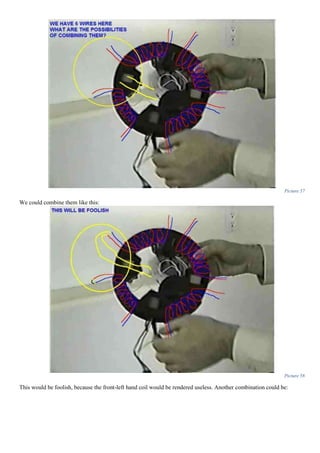
Experienced readers will have to excuse my non-conventional, non-academic incorrect terminology I use to express
what I mean. Ok shoot me for that. I’m guilty. If not, then don’t be so hard on me! Ok? ...open mind...parachute...you
know the story...
This frequency is mainly determined by the core type and the power of the magnet.
What has to be done is to switch the primary coil in both ways using a bifilar coil, with two 180 phase shifted
square wave signals driving them. Then you set the switching frequency to this period:
Picture 435
No! No! No! You might say! You are crazy! Those oscillations are due to the inductance of the collector coil
alone! Fine! Ok! I’m not against you! You are right. I’m not arguing with you. But at least think what exactly
determines the inductance of the collector coil...and when you have found an answer, we will have this conversation
again.
Another important aspect is that the primary/actuator/kicker/exciter coil will have to have the same resonance
with the collector coil. This can be done by equal number of turns, or correcting/adjusting/tuning by
increasing/decreasing capacitance in series/parallel with the coils.
Considering that DTC will be below 20%, it is more correct to say that we power the coils with retriggerable
one-shots than saying with square wave.
I just hate brands, or putting a brand on something you have discovered. I hate that. Don’t you? Why 2SGen? If
it were up to me, I would have called it “MEGDIV2” meaning MEG technology divided by 2. Half a MEG. Why not
bluntly say what it truly is, rather than hiding behind a thin stick like in cartoons?
In order for the 2SGen to feed itself, we must establish self-oscillations in it (in the magnet) by bringing it in
magnetic resonance. Self-oscillations are a byproduct of the spinning magnetic domains. So basically it’s the same idea
of establishing a spin wave in the magnet. We clearly see that the magnet wants this from the core demagnetization
Naudin is pointing out in Picture 435
Different possible embodiments of magnetic
domains spinners
Picture 436
Let us analyze how can we implement and establish domain spin in different materials. All of these devices that
we are studying are hysteresis free and Barkhausen effect free. So let’s try to eliminate the word “hysteresis” from our
vocabulary. So what we are really doing is letting the domains work for us in their own rhythm, and not forced in
slavery to work at the frequency WE WANT, or impose on them. So we must destroy and break everything we know
about hysteresis by spinning the domains and not hitting them each time in 180° direction. Let’s think this through. If
the domains want to spin, what is the best geometry to create a spin? What is the easiest way this can be tested?
These are the right questions we must ask ourselves. Ok, then. Let’s consider the design in Picture 437:
Picture 437
This can be achieved by this winding configuration:
Picture 438
We must carefully choose the demagnetized cylinder magnet, so that the diameter would be larger than the
height of the cylinder. This is because the overlapped interwoven layers will add up on the top and bottom of the
cylinder faster than on the sides (Picture 438). So we must compensate for this by having our demagnetized cylinder
magnet with a lower height than its diameter.
We could fire it just like in the MDAS version of the Hysteresis annihilator using the same circuitry as in
Picture 439
Cylinder magnetic domains spinner
Picture 439
Picture 440
Picture 441
Picture 442
Demagnetized ring magnet internal magnetic domains spinner
nb
Picture 443
Picture 444
Picture 445
Picture 446
Picture 447
Further insights on the Floyd Sparky Sweet VTA
magnetizer
Let’s further look into the VTA conditioning unit for the Sweet magnets:
Picture 448
At first look at it, I was inclined to think that maybe somehow, he is driving the three coils with sinewaves with
different phase shift between them, so that a somehow 3D geometric dynamic closed magnetic flux vector is formed.
Maybe a 3D infinity symbol, or some-sort, or something exotic along these lines.
Then I said to myself, ok, let me start then with something simple, like what will happen with the magnetic flux
vector inside the demagnetized magnet created by all these coils working on 120° phase shifted sinewaves?
What will be created inside, if we power the coils in this manner?
Let’s see:
Picture 449
So a full dynamic of these vectors will look like this:
Picture 450
It can be easily visualized that all these 6 vectors sit on the same plane tilted 45° in respect to all axes. So this is
not very exciting stuff for an experienced reader, so there’s got to be much more going on in the VTA magnetizer than
this. What could it be?
We do know a clue and an intimate secret about VTA inner workings from that guy with an idiot name
“Maurice”, and that is the figure 8 of infinity. Of course almost anybody can guess that he is referring to the second
harmonic of a standing wave, but where? How? In what place? Between what and what?
We might be tempted to think that Sweet is creating a 3D infinity 8 symbol inside a VTA magnet.
Hmm...Interesting possibility. Worth investigating. Let’s see:
Picture 451
Yeah, but you have an infinity only in a plane. We want a 3D shape. So we want the shape to spin on y axis,
like so:
Picture 452
Ok. Ok. That shouldn’t be too hard...A 90° phase shift between y and z should in theory do it. Right? When y is
off z is on, and vice versa... hmm... let’s see:
Picture 453
Nope. It won’t work. Sorry.
Why?
It’s a little difficult to visualize, but let me show you what happens with the magnetic field when you power the
3 axes coils with the signals you are describing:
Picture 454
Darn! It is not a 3D infinity shape?
No.
So it is just a weird stupid surface, that doesn't change in time. It’s stationary. But I want a shape! I want a 3D
infinity!
So how do I do it?
Why don’t you start with something simpler, like creating the first harmonic of a standing wave in the magnetic
field? Why do you jump to something hard from the start? Start easy. Small steps.
Picture 455
Ok then in order to create something like this, we will need something along these lines:
Picture 456
Looking at Picture 456, again you might say: There is a mistake in your illustration.
What now? I will say.
With the signals you are describing you will not create a lemon/spindle torus. It will be more like a rotating
sphere. So bye bye standing wave.
Really?
Really!
Well...Oh...Yeah...I know...I know...Yeah...Sorry about that...it’s the amplitude of the signal applied to the coil
Y, isn’t it?
Yes, it is.
Well, in that case we must clearly state that the voltage/current/power/signal/amplitude/intensity (I’m referring
to the same thing, so you pick the word you like), so this signal applied to coil Y must be larger/bigger/stronger/intense
than the signals applied to coils X and Z. That’s it. Problem solved.
Now, going back to our infinity symbol, we must apply the same weird signals kind of an amplitude modulation
if you like, to coils X and Z, and the frequency on coil Y must be half the frequency applied to coils X and Z, and at the
same time, larger in amplitude than X and Z too.
Picture 457
However, when we study all these configurations, it seems impractical. Why? Because a standing wave is
formed naturally. Here it is imposed or forced. If we want to achieve results with something along these lines, then the
amplitude of the signal applied to coil Y must somehow be in a direct proportional relationship with the physical
dimension of the magnet in that axis, which is the length of our magnet in our case.
And still, there is another aspect. I believe that the sides/faces of the magnet on Y axis must be parallel one to
the other.
But I think that the main problem with all these configurations as we will see is the instability of the self-spin.
To find a possible answer to our problem, we will jump to a different partially related study, which will lead us
back to where we started.
So let’s go.
If we carefully study and think about a demagnetized cylinder magnet (disk magnet) spinner, we will come to
an interesting conclusion. Due to the size of the material and the long course a singular domain must “travel” to make a
complete revolution, it won’t be easy to establish this spin. It will naturally break down. How? Well...simple.
Imagine that at an instant, when the power is off, somehow all the domains must be aligned by themselves in a straight
line or direction. This will be a very unstable equilibrium. Why? Because it is sufficient for only one single reluctant
domain to get out of alignment that will make the rest of them to get out of alignment or established spin (Picture 458).
Thus the spin will be extremely unstable and unable to sustain itself due to this reason.
Picture 458
When you look at this you might say:
-You are wrong in Picture 458 .It is completely erroneous.
-Why? I may ask.
-Because the domain boundaries exist to delimit different regions with a different direction of magnetization.
In your case all the domains are aligned in one direction. Therefore you don’t have domains, you have only one domain
which is extremely improbable and unrealistic.
-My response to you will be: You are right; I don’t disagree with you this time. You are right. But you must
understand that this is a conceptual representation.
-Conceptual...right I understand. But it is a wrong concept.
-Please let me finish. I don’t disagree with you, because we are both right. If you don’t like the above picture
and you consider it to be wrong, then think that they are extremely tiny and small slight differences in magnetization
direction, so that is why I still used so many boundaries and domains.
And if you still don’t accept the above picture and you still consider it incorrect then let me make peace
between us, with this following picture:
Picture 459
-Now this is a big problem. Isn’t it?
-Yes it is.
-So how can this fragmentation of the original set up spin seen in Picture 459 be avoided? How can we prolong
the spin? We are interested in making the domains spin by themselves; we are interested in creating self-sustaining spin
in the magnetic domains. How can we make the spin last longer?
-That is the right question.
-My guess is that somehow, the spin is “traveling” too much. It has too much friction. It is a too long course
they have to take to complete a revolution.
-What do you mean? You don’t make sense. What you are saying is determined by the radius of something. But
the domains don’t have a radius. You don’t make sense.
-I know, I know, but bear with me. I can’t find the correct words to describe what I want to say, but I believe a
picture is worth a thousand words. I always liked books with a lot of pictures. I hated those that had small letters and no
pictures. I know, very childish of me to say that, and that is because I am a child, and I will always remain a child. In the
first grades of school, when the teacher asked all of us, what we will want to be when we grow up, I answered that I
don’t want to grow up. I want to remain always small, since all the greatness belongs to our Lord. (Nail that! to my psychological
profile)
Anyway, I truly believe that one can UNDERSTAND a lot more from a picture than from words. And I know
that some will disagree with me, saying that plain simple words stimulate the imagination of the reader and thus it helps
him more than giving him your own vision of things. You have to let him imagine it for himself. I understand that. I
accept that. I’m down with that. But it is not generally applicable. In my opinion this rule is valid for literature books
and stories, and not for scientific and technical books.
We do know that ω=2πf. So what we are trying to accomplish if you like is to increase the angular velocity ω of
the spin but maintain the same frequency of the spin. We want more radians/second but at the same frequency.
So let me make myself clear with this following picture. What if we create a wobble instead of a spin? Isn’t that
a lot easier to maintain? Doesn’t that sustain itself easier? Think about it!
Yeah, but how can we create such a wobble?
We could, if we do it like this:
Picture 460
Picture 461
Yeah, but this is just a theoretical concept, how can this be put in practical application?
This wobbling motion can be created by applying a slow increasing DC offset on the z axis of rotation:
Picture 462
Of course the signal applied to the coil z, in Picture 462 must always be lower than the peak value of the
sine/cosine value of the signal applied to coils X or Y. Otherwise this wobbling will be too small, and we will have
created a static regular magnetization.
So we have solved the problem of the rapid desynchronization/destabilization of the spin by implementing a
more stable wobbling spin wave motion of the magnetic domains. But now we have traded a problem with another. We
have solved this, but another has arisen.
How on Earth are we going to tap into this wobbling motion? How can we collect this motion? How can
we build a collector coil for this new wobbling motion?
You might be tempted to think along this lines (Picture 463):
Picture 463
As we can see, this is an impractical solution, because if our wobbling is small in diameter then we won’t have
enough room to wind the collector coils.
So this is a very BIG PROBLEM. How can we design a collector coil for the established wobbling magnetic
domains spin wave in a magnet?
Fortunately for us, we already have the answer, but we don’t know that it is actually the solution to our
problem. So let me break the ice for you, and tell you that Floyd Sparky Sweet most likely thought about all of this and
had come up with a solution long before we have ever heard of free energy.
The solution, we must all agree it’s astonishing and amazingly ingenious!
Picture 464
Now we have solved this problem to, but another raises up in its place. The problem is synchronization. Kids
playing with a jump rope can easily synchronize, because they see the rope with their eyes and feel it in their hands, so
they have a live feedback, and they are acting on that information they receive about the rope position subconsciously
and they are always moving the rope in unison (Picture 464).
So what do we do? How do we solve this yet another problem?
In the case of our magnets, the wobbling domains spin of a magnet will not know what the other magnet spin is
doing. Therefore desynchronizations will occur. This will cause a beat frequency to appear in the output of a collector
coil. If you can imagine it will be like our device will work for 2 minutes, then it will stop for 2 minutes by itself, then it
will start again by itself for another 2 minutes, and so on. This is insane, amusing and frustrating at the same time. Most
likely Sweet stumbled upon this issue when he was designing his VTA.
And again, fortunately for us, we already have the answer. It is obvious for me that Sweet had this problem in
his prototype VTA, and I bet my life that he was frustrated by this. What makes me think that? Remember he is
swearing when we tries to explains to Bedini, that by approaching the two magnets together, I quote:
There is no other logical psychological reason behind his swearing besides the frustration he had when he
experienced this beat frequency.
Think about it. If you have a beat frequency of 2 minutes, then it means that your period T will be 120 seconds.
This means a beat frequency of 0,008 Hz or 8.3 mHz. This means that the first magnet had the natural resonant
frequency at 12,512 Hz let’s say and the other magnet had the natural magnetic resonant frequency at 12,520 Hz. For
this reason a beat frequency of 2 minutes had to happen, due to the desynchronization of the two established wobbling
domains spin in the VTA magnets.
So the answer and the solution to our problem is to create a wobbling domain spin in each magnet through a
dynamic re-magnetization process for our demagnetized magnets, at precisely 12,516 Hz (average of the two for our
given example). And this is why Sweet insists on FIRST accurately determining the natural magnetic resonant
frequency of each particular magnet first thing first.
The reason for this, again, as I stated, is that you will have to know this frequency prior of the demagnetization
process of the magnets (prior of “screwing up” the magnetism by heating them above Curie point). And only after that
determination, you know now at what frequency you should set up the wobbling domain spin wave so that it will
be self-sustaining.
The Floyd Sweet VTA-SQM Time-machine/antigravity device
Any researcher in this fringe domain (that is kind-of separated from the free-energy domain of study)
will tell you that antigravity devices are also time-machines. The reason behind this is that gravity and time are
intimately connected in the space-time fabric of the universe. Gravity directly affects time. This is a fundamental fact.
No one can argue with that. Amazingly enough Tom Bearden in his book “Energy from the vacuum - concepts and
principles” describes the Floyd VTA as an antigravity device also:
Picture 465
Tom Bearden - Energy from the vacuum - concepts and principles, page 319, Figure 6-14
What we see in Picture 465 is a simple weight of the VTA to load of the VTA graph.
[...] it will average out the God damn frequency, God damn resonant frequency in this one and that one […]”
(Floyd Sparky Sweet VTA-SQM Secrets videoclip filmed by Tom Bearden in Sherman Oaks, California April/May 1987 minute 7 second 36 part 4 –permalink click here)
“[…] we noticed that, at full power output of 500 watts, his unit weighed a little less on the bench than when not
powered.”
(Tom Bearden - Energy from the vacuum - concepts and principles” page 316 paragraph 3)
In my opinion this is highly plausible. First we must acknowledge that the VTA works using spin-wave
technology at least that is according to Tom Bearden and John Bedini (he was present at Sweet original presentation):
Picture 466
Second we must acknowledge that electron spin waves (Picture 466) could also be gravity waves, because two objects
gravitationally attracted will begin to spin together and vice-versa (any two objects that are spinning together are
gravitationally attracted). This gravity well or gravity potential or however you want to call it, happens inside the VTA
between the magnets (inside the lemon).
“At 1,000 watts the unit had lost 90% of its weight. This was electrifying, because it was an unprecedented and
highly successful antigravity experiment.”
(Tom Bearden - Energy from the vacuum - concepts and principles, page 316-319)
“On the other hand, in our opinion, Sweet employed spin waves triggered into self-oscillation”
(Tom Bearden - Energy from the vacuum - concepts and principles, page 316, paragraph 2)
Conclusion of Floyd Sweet VTA study:
I believe that the Floyd Sweet VTA entire device can be reduce to this statement:
"It's easier to make the domains wobble than to make them spin".
I firmly stand my ground on this one, and unless you can prove me otherwise, this remains my final conclusion
on the study of Floyd VTA. Period. End of story. That's it. I'm done. No more. The end.
"Sweet VTA motto: It's easier to make the domains wobble than to make them spin". End of story.
Further study:
- Sparky Sweet VTA-SQM useful site: http://www.rexresearch.com/sweet/1nothing.htm
- Construction of the Floyd Sweet's VTA by Michael Watson:
http://www.intalek.com/Index/Projects/Research/Construction%20of%20the%20Floyd%20Sweet%27s%20VTA%20by
%20Michael%20Watson.htm
A cheap accessible approach to extreme
accuracy signal generator (max 20KHz):
The most accessible approach I can imagine to generating signals with an extreme accuracy is only assisted by
a computer. There may be other very sophisticated digital signal generators out-there that can have even .2 digits
accuracy. But such devices are not so accessible.
Picture 467
Therefore, since almost anybody has access to a not so sophisticated personal computer, we can program it, and
use it as a high precisionsignal generator.
How do we do that?
We will need:
A: A personal computer with Windows 95/98/ME/NT/2000/XP/2003/VISTA or 7, 32 or 64 bit operating
system;
B: A common sound card (Windows compatible 8/16/24 bit);
C: Install a software program called GoldWave;
D: Any old Stereo speakers, at least 2W (we will break them, so don’t use those which you are currently using
unless you are careful, and you will have to assemble them back) NOTE: If you have a powerful stereo audio amplifier
greater than 10W, you could use it with no concern of breaking something;
It is better to have a power amplifier, because the outputs to the speakers are equipped with plugs, so we could
take those outputs and use them in any application we need. If we don’t have a power amplifier we can take apart some
old speakers, disassemble them, cut the wires from the amplifier circuit board that goes to the loudspeakers. You will
have a total of 4 wires. Now find out what the ground is for both of the speakers and connect them together. Now we are
left with only 3 output wires. This is kindergarten stuff for any researcher in this field of study. Plug the amplifier in the
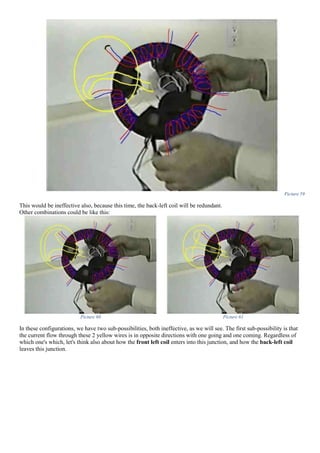
output jack of your sound-card. Start the GoldWave and there you have it!
Picture 468
This free fully-functional software can be downloaded for an evaluation period here, or use at your own risk a
more cracked “pirated” version of the software here (torrent link). It has an extremely powerful tool to evaluate any
mathematical expression or function and plot its value across time (Picture 469)!
Picture 469
It has the ability to sweep a full range of frequencies from any x to any y in any time interval you wish. The
precision of a wave can be programmed with x and y variables with .4 digits accuracy. That is an
accuracy of tens of thousands of a Hertz! This is only usable
across long sounds-waves that is if for example you plot a sweep of a sinewave frequency from 12 to 14 Hz across
one hour wav file length of time (you will need lots of GB free space on your HDD).
This will advance the frequency from 12 Hz towards 14 Hz with a step of 0.0005 Hz per second! (No I’m not!
I’m not forgetting about frequency stability. I know. I know). Of course you won’t be forced to wait an hour near your device,
unless you want to be more accurate and determine more decimals for your resonant frequency (which is useful for
higher harmonics), you can always skip ahead with one click of a mouse. The user interface is user-friendly that is if
you know what you are doing or what you want to do.
System requirements: GoldWave requires a minimum 1.5GHz Pentium 4 (or compatible processor), a mouse,
256MB of RAM, 20MB of disk space, and a sound card. For best performance, a 2GHz or faster processor with 512MB
of RAM or more is recommended. Windows 2000, XP, Vista, 7, or later is required. Older versions of Windows will
not run recent versions of GoldWave, but you can install GoldWave v4.26 on those systems.
Don’t be scared if these requirements are too high if you want to bring to life an old useless computer for this
particular job. You could use older versions that require much less resources.
I could speak a lot on this program and create a tutorial for it, but that doesn't make the subject of this book.
You can view tutorials on the web here, here, or here.
You could use something along these lines:
Picture 470
Here are some cool mathematical expressions that outputs different signals. Don’t waste your time studying
digital signal processing DSP so that you know how to build these expressions. I repeat, it’s a waste of time. Maybe you
will find all of this useful, which I doubt, but hey you may never know...
int(2*t*(((n/N/2)*(y-x))+x))%2*2-1
(((n/N/2)*(y-x))+x)
abs(int(2*t*f)%2*2)
abs(int(2*t*(((n/N/2)*(y-x))+x))%2*2)
SIMPLEST DUTY CYCLE:
1-limit(int(t%5))
Another one shot: (1-(int(4*t*f)%2)*2)*(1-limit(int((2*t*f)%8)))
Coolest One shot: (1-(int(4*t*f)%2)*2)*(1-limit(int((2*t*f)%f)))
Works in ELF: (1-(int(10*t*f)%2)*2)*(1-limit(int((5*t*f)%f)))
Better switching at Higher f: (1-(int(15*t*f)%2)*2)*(1-limit(int((5*t*f)%f)))
Frequency correction: (1-(int(3*t*f^2)%2)*2)*(1-limit(int((t*f^2)%f)))
Where 8 is duty cycle 1/8
duty cycle %70
int(t*f)%3
int(2*t*(((n/N/2)*(y-x))+x)+1.5)%3
int(2*t*(((n/N/2)*(y-x))+x))%3
simple 180 phase shift square wave
int(2*t*(((n/N/2)*(y-x))+x))%2
int(2*t*(((n/N/2)*(y-x))+x)+1)%2
one shot: step(-int(t*f)%2) - step(-int(t*f+0.8)%2)
0.8 is 80% duty cycle
to sweep anything replace f with: (((n/N/2)*(y-x))+x)
meaning: step(-int(t*(((n/N/2)*(y-x))+x))%2) - step(-int(t*(((n/N/2)*(y-x))+x)+0.8)%2)
saw tooth: 1-t%1
duty cycle saw tooth: (t*step(-int(t)%2))%1
1*(step(-int(t)%2))-(t*step(-int(t)%2))%1
cool one shot saw tooth: (1-t%1)*step(t%2-1)+(-1+t%1)*step(1-t%2)
(1-t*f%1)*step(t*f%2-1)+(-1+t*f%1)*step(1-t*f%2)
sweep:
(1-t*(((n/N/2)*(y-x))+x)%1)*step(t*(((n/N/2)*(y-x))+x)%2-1)+(-1+t*(((n/N/2)*(y-x))+x)%1)*step(1-t*(((n/N/2)*(y-
x))+x)%2)
MEG v2 dual: abs(int(4*t*f)%2*2)
abs(int(4*t*(((n/N/2)*(y-x))+x))%2*2)
(1-2*t*f%1)*step(2*t*f%2-1)+(-1+2*t*f%1)*step(1-2*t*f%2)
(1-2*t*(((n/N/2)*(y-x))+x)%1)*step(2*t*(((n/N/2)*(y-x))+x)%2-1)+(-1+2*t*(((n/N/2)*(y-x))+x)%1)*step(1-
2*t*(((n/N/2)*(y-x))+x)%2)
MEG v3 4 channel: (1-(int(3*t*f^2)%2)*2)*(1-limit(int((t*f^2)%f)))
etc.
New Energy movement: Marko Rodin technology
Picture 471
Picture 472 Katedra (The Cathedral) by Tomasz Bagiński
Picture 473
The most accessible and easy way to tap into Zero Point Energy (whatever that means) using twisted magnetic
flux generated inside an original standard Marko Rodin Coil:
Picture 474
There are many ways in which to fire the Rodin coils. And I say that again. Many firing sequences. Many
configurations. Many topologies. You can spin the field in various ways using the Rodin Coil.
If Sweet VTA worked with a lemon/spindle torus between the two magnets, the Rodin coil works with a torus
too, but this time it’s a donut/ring torus. Although we will see later the lemon-spindle torus playing a crucial role in the
Rodin coil.
Different firing sequences for the Rodin Coil
First thing that frequently pops up searching the web for Rodin coil is the JL Naudin version:
Picture 475
When I look at this (Picture 475), it makes me cry, and shout towards the sky. This is so sad! It makes me bitter
just by looking at how he powers it. Naudin definitely was in a hurry to test it out, so he ignored all the firing sequence,
control circuit, family groups, and all that. It’s insane! Marko clearly said that we shouldn’t try this: (click here to hear
Marko saying this)!
Quote:
This clearly means we shouldn't try to power both wires/coils at the same time.
Maybe I’m wrong, but if I do, then let’s analyze Marko words in more detail.
Right here in his own words he describes the signal that we have to use to power the coil. Let’s quote him when
he describes this signal:
So in my mind this is what he’s describing:
We will call this the <Standard firing sequence for the standard
configuration Marko Rodin coil>
“[…] they are so separated from one another, than that’s why one wire is on at a given time, because if both wires
have the same family number group on at the same time, then this coil wouldn’t work, it will have resistance”.
(Marko Rodin's vortex-based mathematics part 19 of 44 minute 0 second 49 permalink)
“That one wire…there’s two wires here. That one wire, ALL the positives are in one wire at a minute of the
first stage. There’s three stages. It’s a firing stage. The first activation sequence of this coil, only the right wire is
all positive (that’s your 1, 4, 7). The second activation stage is all your left wire is all positive (is activated). And
now the first family number group 1, 4, 7…the other wire is totally off. And then they’re both off. None of them are
positive, they’re all neither positive, and the middle space in there becomes all positives (The 3, 9, 6)”
(Marko Rodin's vortex-based mathematics part 18 of 44 minute 4 second 13 permalink)
Picture 476
But wait, later, in the http://www.youtube.com/watch?v=-9MKHMfy4T0& - t=1m50spresentation, Marko describes a
different type of activation sequence.
Let me quote this particular conversation in case you didn’t follow the link, and to make sure I understand it right:
In my mind by the word “wire” I understand “coil” right? So Marko answer to Charlie question will look like this:
"[...] when it hits one coil the electricity goes in one way, when it hits the other coil it goes in the opposite
direction."
Now from his words can be deduced that the new activation sequence will look like this: (Firing sequence version 2)
Picture 477
But wait again! It’s getting trickily by the minute! Let’s turn back a few seconds in the same conversation, and analyze
Marko words again. To me, this guy Charlie definitely knows how to put the right questions, but is the answers of
Marko that are confusing):
“[Charlie:] 1, 4 and 7 are ALWAYS POSITIVE? (Just like in my presented signal diagram above - Picture
477)
[Marko:] No. (Ups! It means that my firing sequence is not right)
“[Charlie:]-So, you are saying the polarity switches when the current reverses its direction?
[Marko:]- [...] when it hits one wire the electricity goes in one way, when it hits the other wire it goes in the
opposite direction.”
(Marko Rodin's vortex-based mathematics part 19 of 44 minute 1 second 50 permalink)
[Marko:] 1, 4, 7 are always positive… (Marko is interrupted here)
[Charlie:] Then they flip? They reverse the polarity? Is that what you mean?
[Marko:]OR1, 4, 7 are always negative.”
(Marko Rodin's vortex-based mathematics part 19 of 44 minute 0 second 10 permalink)
Ok, in that 2 letter word there “OR” may lay the key. In that 2 letter word “OR” may lay the
information that the presented signal diagrams for the activation sequence of the Rodin coil may be correct. In that 2
letter word “OR” could lay the information that the Rodin coil could run like this:
Picture 478
Same signal (firing sequence) but the wires are reversed. Same thing. No difference in operation. Only a
conceptual difference. Same meat different gravy.
But wait again! Dear God! It’s getting more confusing by the second! Let’s continue the conversation:
“[Marko:] This coil here…the negative 1, 4, 7 are ALL on the wire that the positive 8, 2, 5 are on. You don’t
have…And the positive 8, 2, 5… and the positive 1, 4, 7 all have the negative 8, 2, 5” (Marko Rodin's vortex-based mathematics part 19 of
44 minute 0 second 30 permalink)
This one’s the nasty one. Can’t figure out the head and tail of this one. It could describe this type of signal: (Firing
sequence version 3)
Picture 479
Considering the fact that this type of signal is backed up by Marko words a few minutes earlier in the
presentation and I quote:
That word “AND” firmly contradicts the later “OR” word. Either he’s not paying attention to what he
is saying, or this guy doesn’t have any type of logic whatsoever. From the above quote, I understand that in the working
condition, a specific coil (wire or family number group) is also positive AND also negative. It’s incredible
confusing and insane, but nevertheless all this types of signals should be tested, considering the fact that if the first ones
are the right ones, then they are extremely and incredible in simplicity.
All you need is the simplest electronic circuit ever, an astable multi-vibrator, in which the time constant of a
state is the double of the other (Picture 480)
Picture 480
And then take the 2 outputs of the astable and put them through a variable one shot circuit, so the final signals will look
like in Picture 481:
Picture 481
If we study the standard firing sequence for the standard Rodin Coil, and think it through, we should reach an
interesting conclusion.
If the Rodin coil spins its created magnetic field, and it does as we will see in future experiments, then this spin
will have inertia (because it has mass, remember?). This is a very important aspect. What does this mean? It means that
the imposed firing frequency will interfere with the established spin frequency. Sometimes will have constructive
interference, and other times will have destructive interference. This means at certain frequencies the two frequencies
“The 1 and the 4 and the 7 are ALL positive at the same time, and the 2, 8, 5 they are all positive ANDthey are
all negative at the same time.”
(Marko Rodin's vortex-based mathematics part 18 of 44 minute 3 second 54 permalink)
will be in tune and at other will not. This will also give a beat frequency. All of these are very subtle and can be easily
passed by. For simplicity reasons, let’s consider firing the coils at the fundamental frequency of the established
magnetic field spin.
We know from the MEG study, the important 45° break/pause/delay between the spin and the
firing/actuator/exciter pulse/kick. But think for a second, there is no reason why this delay shouldn’t be let’s say 90°!
Even better than 45°, the 90° established phase shift between the spinning magnetic field and the actuator kicks will
behave in a more efficient way because of the attracting and repulsive forces acting in tandem at the same time (Picture
482):
Picture 482
This lag/break/phase shift/transition time/pause/delay or whatever you want to call it, it is the actual reason
behind the STAGE 3 in the Rodin coil firing sequence when all coils are completely off. It doesn't start with stage 3, the
firing sequence starts by hitting let’s say in one direction, then the other 90° offset, and then you are off, so that a 90°
lag will be formed between the established spin(from the two previous stages) and the next following pulses.
This will mean that this lag/break/phase shift/transition time/pause/delay or whatever you want to call it will
have to happen only once! Then you don’t have it no more! (Picture 483)
A hybrid variant of the Rodin coil firing sequence: (Firing sequence version 4)
Picture 483
If these pulses were sine-waves then they will be 90° phase shifted, but since we can’t implement such a phase
shift with pulsed direct current (PDC) sequential pulses will have to suffice.
The Rodin coil and the double torus topology
Picture 484
Picture 485
Picture 486 Double torus
This only happens when we create a “shear” between the two coils standard Rodin coils, by driving them with a non-
standard firing sequence, consisting of two opposite currents like so (Firing sequence version 5):
Picture 487
The field configuration for one standard Rodin coil is difficult to visualize, nevertheless for two running in
opposition, but after some brain squeezing, 3D mental imagination and over-burning your third eye chakra by applying
right hand rule along the Rodin wires, you will come to realize that indeed the field configuration is exactly like Nassim
Haramein double torus and Adam Trombly double toroid dynamo:
Picture 488
The magnetic field always follows the wires at 90° in respect to them, so the Marko Rodin standard coil
magnetic field configuration is exactly like the non-standard “to the right” Rodin winding.
An additional insight is the extremely crucial winding detail regarding the inner laying down the wires. It is
imperative the wires at the center don’t get mixed and jumbled together, because otherwise the twelve equatorial
magnetic flux vectors going in/out will not form! In order to achieve an ordering and neatly lay down the wires, first
they must always be on the surface of the toroid.I repeat. It is
imperative that the wires are always laid down on the surface of the toroid. Especially at the center, where all the magic
happens. They must not, under any condition be freely suspended in air, like we see in the following YouTube users
videoclips:
Picture 489 teddybear114 Picture 490 kubicop
“We were trying to demonstrate that by mimicking the magnetic field of a planet and rotating this device, we can actually create a dynamo
that will work, and in fact it did work and it does work. So when we contemplate nature, and we contemplate Jupiter, and we contemplate a
dynamo like the Earth rotating in space we are basically talking about a magnet which is rotating in space. The lines of flux of the magnet are
pouring down and through in this toroidal pattern of the magnetic field. And it’s also expanding and contracting. It’s breathing. It’s taking in
the energy of space literally and transforming it right here in this toroid. We have enough energy to transform the entire Earth. And that’s not
just a theoretical statement, it’s literally true. To contemplate the implications of this means that every single place on Earth suddenly has
power. Every single person on Earth suddenly has power. We have Universal abundance”
Adam Trombly – The thrive movement see video link here.
Picture 491 pouderbern Picture 492 TheRealVerbz2
Picture 493 jumpinmycar Picture 494 Evelyn Torrence
And this list can go on like forever. There are so many people which sadly, don’t get this important aspect.
Picture 495
In order to achieve perfectly neatly arranged wires ON THE TORUS SURFACE, we must do some
trigonometry lessons:
Picture 496
In Picture 496 we will start as if we know the outer radius of the torus (AO) and we must set our goal to
determine the exact inner center radius (BO). This segment can be determined from the right angle triangle ABO.
First we must determine the angle A. It can be determined from the Inscribed angle theorem:
Picture 497
Then we apply a simple trigonometric function in our triangle ABO and we get:
sin(𝐴) =
𝐵𝑂
𝐴𝑂
⇒ 𝐵𝑂 = 𝐴𝑂 ∗ sin(15°) = 𝐴𝑂 ∗ (
√3 − 1
2√2
) = 𝐴𝑂 ∗ 0,258819 Equation 133
We have determined exactly what we wanted. If we know the inner circle, then we divide it by 0,259 and we
get the outer radius of a perfect Rodin torus. Or if we know the outer diameter (radius) we can determine
what the inner radius should be by multiplying with 0,259 so that the wires are not suspended in air in the center,
like we have seen in Picture 489 through Picture 494, and are neatly laid down on the surface of the
torus always and ever, like we see in next Picture 498:
Picture 498
I must warn you I'm not using a conventional definition for the torus parameters (Picture 499):
Picture 499
You may ask: If I know the correct conventional convention for naming and defining the correct torus
parameters, then why don't I use it?
The answer is simple. I'm still sticking to my personal convention for defining the torus parameters because it's
easier to remember and work with. If you have a torus or a ring magnet lying around you and quickly want to measure
its parameters with a sliding vernier caliper, you can't measure the Major Radius. It must be determined. I hate that.
When you are in a hurry, you don't look at those things. You measure the outer diameter and the inner diameter. That's
the most accessible easy fast measurement. So that's why I stick to my convention.
However I must also point out the method/formula by which a perfect Rodin torus should be produced knowing
these correct conventional conventions:
𝑀𝑎𝑗𝑜𝑟𝑟𝑎𝑑𝑖𝑢𝑠 = 𝑀𝑖𝑛𝑜𝑟𝑟𝑎𝑑𝑖𝑢𝑠 ∗
5 + 2√6
3 + 2√2
= 𝑀𝑖𝑛𝑜𝑟𝑟𝑎𝑑𝑖𝑢𝑠 ∗ 1,698396 Equation 134
-How does this help us in practical applications? How can this be put into practice?
-Simple. You don’t have to create a torus from scratch to satisfy this condition (Equation 134). It is sufficient to
modify the torus that you have. You lower the inner radius, or increase the outer one, to satisfy this condition. This can
be done by adding layers of paper along the inner circumference or on the outside, depending on the case. You can use
thick electrical tape, silicon adhesive, window insulation kit or whatever you find accessible to you, as long as your
torus cross-section always remains a circle.
Also make sure that you take into account the inner diameter to be larger than the formula dictates to
accommodate for the winding. We don’t seek that the wires inside the hole to be situated on the surface dictated by the
rigid formula above. You must account for the total diameter of the bunch of wires for one winding. So for example if
you are using 20 full turns... We will consider a “Rodin full turn” to be a complete winding of the 12
poles, meaning the pole where you start, and when you have reached again at this pole we will call it a full turn. If you
like consider a full Rodin turn = 12*small Rodin turns. Whatever makes you feel comfortable.
Circle packaging model
So let’s say you have 20 full Rodin turns and by applying the Koebe–Andreev–Thurston
theorem (sounds fancy, doesn't it?) or in other words a hexagonal lattice of the bee's honeycomb
packaging method (theoretical minimum packaging diameter allowed for a bunch of wires) you will
end up with let’s say 4 mm total diameter of one winding created from all these 20 full Rodin turns.
It sounds complex, but it’s not. Complex is when you are dealing with spherical packaging. So let’s
be thankful that we are dealing only with circles and a plane. It is a simple hexagonal cylinder
packing problem. OK, now, you start by accurately calculating the inner radius and the outer radius,
then you make the inner radius 2 mm bigger (so that the center of the total bunch of 20 wires sits
nice on the perfect inner surface/inner radius calculated previously-Picture 501)
Picture 501
Picture 502
Picture 500
Picture 503
The turns in a coil, must be closely packed together because we want the field to be more coherent and uniform
around all the bunch of wires (Picture 502 and Picture 503).
Picture 504
The best way to accurately determine how thick a bunch of wires will be is to follow this link, and for example
if you have a 0.5mm thick wire and 15 turns then your total minimum radius occupied by the wires packed together will
be:
0.5 ∗ 4.521 = 2.2605𝑚𝑚 Equation 135
N ratio N ratio N ratio N ratio
1 1 50 7,9475153 99 11,033141 148 13,386939
2 2 51 8,027507 100 11,08215 149 13,435549
3 2,1547005 52 8,0847172 101 11,146934 150 13,460806
4 2,4142136 53 8,1795828 102 11,196863 151 13,476192
5 2,7013016 54 8,2039824 103 11,265144 152 13,531758
6 3 55 8,2111026 104 11,317659 153 13,591537
7 3 56 8,3835299 105 11,36266 154 13,637419
8 3,3047649 57 8,4471847 106 11,421834 155 13,673709
9 3,6131259 58 8,5245538 107 11,472052 156 13,7196
10 3,8130256 59 8,5925 108 11,524016 157 13,772992
11 3,9238044 60 8,6462198 109 11,562119 158 13,823226
12 4,0296019 61 8,6612976 110 11,616862 159 13,864194
13 4,236068 62 8,8297654 111 11,662811 160 13,920539
14 4,3284286 63 8,8923515 112 11,705275 161 13,9694
15 4,521357 64 8,9619711 113 11,747528 162 14,011329
16 4,6154256 65 9,0173973 114 11,795173 163 14,06962
17 4,7920337 66 9,0962794 115 11,839474 164 14,1107
18 4,8637033 67 9,1689719 116 11,896705 165 14,144339
19 4,8637033 68 9,2297737 117 11,943476 166 14,185678
20 5,1223207 69 9,2697613 118 11,985551 167 14,220394
21 5,2523175 70 9,3456532 119 12,042334 168 14,259536
22 5,439719 71 9,4157969 120 12,085212 169 14,295358
23 5,5452042 72 9,4738909 121 12,124803 170 14,33155
24 5,6516611 73 9,5403462 122 12,204375 171 14,367661
25 5,7528243 74 9,5892328 123 12,2764 172 14,416776
26 5,8281765 75 9,6720296 124 12,321708 173 14,451341
27 5,9063978 76 9,7295968 125 12,368225 174 14,492849
28 6,0149381 77 9,7989119 126 12,417464 175 14,536541
29 6,1385979 78 9,8577099 127 12,46155 176 14,574136
30 6,1977411 79 9,9050635 128 12,50231 177 14,617194
31 6,2915026 80 9,9681518 129 12,553718 178 14,658911
32 6,429463 81 10,010864 130 12,602319 179 14,702293
33 6,4867031 82 10,050824 131 12,64962 180 14,742878
34 6,6109571 83 10,116858 132 12,687437 181 14,78083
35 6,6971711 84 10,149531 133 12,735273 182 14,818931
36 6,7467538 85 10,163111 134 12,771446 183 14,869399
37 6,7587705 86 10,298701 135 12,814255 184 14,905473
38 6,961887 87 10,363209 136 12,86576 185 14,938145
39 7,0578842 88 10,432338 137 12,914725 186 14,961186
40 7,1238464 89 10,500492 138 12,962703 187 14,98927
41 7,2600123 90 10,546069 139 13,008987 188 °,028785
42 7,3467964 91 10,566772 140 13,061097 189 15,069681
43 7,4199449 92 10,684646 141 13,107255 190 15,103602
44 7,4980367 93 10,733353 142 13,146412 191 15,142358
45 7,5729123 94 10,778032 143 13,197401 192 15,169435
46 7,6501799 95 10,840205 144 13,247789 193 15,199374
47 7,7241701 96 10,883203 145 13,276669 194 15,249754
48 7,7912714 97 10,93859 146 13,331234 195 15,287172
49 7,886871 98 10,979383 147 13,357112 196 15,32308
Table 1
You multiply your wire diameter that you use by the radius given in Table 1 for the number of turns (N) you
intend to wind. You will get the diameter of the entire bunch of wires packed together. How can I put this in much more
simpler terms than this?
Then the second important aspect of inner order of the Rodin coil is to place pins in the inside, not on the
outside!
Picture 505 Picture 506
Jesus! So many pins...we will soon run out of pins if we continue on these lines. When will these Rodin coil
builders realize that is not the outside arrangement of the windings as important as is the inner arrangement? When?
Picture 507
This is why we need a perfect torus like described above, so that the wires going through the hole will
always sit on the surface of the torus.
When you look at Picture 507, you might say, that it is incorrect.
Why? I may ask. Wait! Don’t tell me. I know....
Let’s analyze again our ABO right angle triangle in the equatorial cross-section plane of a Rodin donut/ring
torus (Picture 508):
Picture 508
The problem is that the inner guiding pins are not on the same radial lines as the outer pins. The reason is
because our ABO triangle has the right angle at point B, and not point O as we might be tempted to think. Therefore the
line BO will not be on the same radial lines as the outer guiding pins. It has an angle that can be determined using
elementary trigonometry. The sum of all the angles in a triangle is 180°, therefore:
△ 𝐵𝑂𝐴 = 180° − ⦛𝐴𝐵𝑂 − ⦛𝐵𝐴𝑂 = 180° − 90° − 15° = 75° Equation 136
And since the outer rim equatorial stepping is from 10 to 10 degrees, the closest multiple to 75° is 70°. Thus the
difference is 5°.
So, either you wind from an outside guiding pin to another outside guiding pin (pin to pin) or you lay down the
wires between the pins, there will always and must always be a 5° offset between the inner guiding pins and outer
guiding pins. Always! (For a standard original configuration winding Rodin coil, 150° step angle)
Picture 509
As we can see, first, we must make sure that all wires, all the time are sitting on the surface of a perfect toroid.
Second, place guiding pins inside the hole of the torus, not to mingle the wires together. Third make absolutely sure,
that there is the mandatory crucial critical empty space between the wires (band 3 no-winding - Picture 509). This is
imperative! It is crucial! It is extremely important! What’s the point in respecting this empty space on the outside if in
the inside hole, all wires are mingled together? This is insane! This is no Rodin Coil! This will not work! Forget about
it! If you don’t create and respect the empty space between the wires in the inner hole of a Rodin Coil, you have
nothing! No Rodin Coil, No nothing! Nothing! If you don’t create this space, forget about it! You’re lost! You have
nothing! It is imperative, crucial and critical to implement this empty space between the wires! Crucial! If you don’t put
this in your head, then you can forget everything about Rodin coils! Nothing matters the most, as this critical empty
space between the wires. This must be extremely neatly arranged in the inside. Forget the outside! The outside
arrangement is not as important as the inside! If you haven’t clearly delimited the wires correctly, then you have
nothing. Junk, that’s what it is. Useless. Piece of crap. This space is crucial in designing the Rodin Coil, and yet I
haven’t seen anywhere on the web this to be underlined! Nowhere! Where are all these people thinking? Where is their
head? Where is their mind? This critical empty gap between the wires is not very, is extremely important in minimizing
the return flux path created by the wires. We need the flux vectors on the equatorial plane between the double torus, to
flow in between the wires. We don’t want them to quickly return around the wire! Don’t you see? It is imperative to
respect this, otherwise you have created nothing!
If you correctly visualize the magnetic flux vectors created by the two Rodin coils running in opposition, you
will immediately see another crucial/critical purpose for this third band empty space. You will see that always if the
equatorial magnetic flux vectors are going away from the center, then moving away from the equator the flux vectors
will always point to the inside of the torus. When you will correctly visualize this, then you will immediately jump to
the conclusion of a magnetic monopole. But hold your thoughts a little longer, because appearances can be miss-
leading. Don’t quickly jump to the conclusion that the Rodin Coil creates magnetic monopole, as others did. This is
wrong. Rodin Coil has nothing to do with monopoles. Fine, if you don’t agree, then just like I did, over-burn you third
eye chakra in imagining the real actual magnetic field created by the Rodin Coil. Then we will continue our
conversation, and see who is right.
I disagree with you.
You are free to have that opinion
I will show you later in the book that it is indeed a magnetic monopole.
Well this is another point where we disagree. We will bring back this conversation at a later time.
So the flux vectors will always point to the inside of the material of the torus,
regardless where you are on the surface (for this particular firing method). Now it is
imperative to ask yourself: Wait a second if it goes inside the material of the torus, then it must come out, doesn't it?
Where does it come out to close itself? It comes out through this empty 3 band with no wire on it! Don’t you see? Cut
the vortex mathematics crap about the true meaning of this empty 693 invisible energy shit, and see it for what it really
is! It provides a space for the return flux path of the magnetic “shear” created by the two coils fired in opposition. And
keep in mind that all this is twisted! Maybe the most difficult thing you can imagine! I have to admit, I never was able
and even now to completely see it in mind eye like Tesla when he imagined devices in great detail in his mind eye, but I
can see it in pieces and fragments for short periods of time. (Comment: I thank God that each time I go to church, He is opening my third eye chakra,
feeling an intense energetic push-pull there. Maybe because He has a lot to show me, I don’t know His reasons).So, by applying the symmetry argument to these
imagined pieces you can pretty much figure out the entire picture/torus dynamics.
Using sewing string to keep the wires of each winding separated one from the other (Picture 510):
Picture 510
I know I was a little arrogant previously, but what you see in this picture is not the best of what I can do. I know
I did a lot of fuss over the empty space between the wires at the center, but if I have to evaluate what I did in the
previous picture, from a scale from 1 to 10, it barley makes it a 5.
Why wouldn't the Rodin coil work if the wires are mingled/mixed/intermingled at the center?
Because the resulting component in the vectorial adding the magnetic flux vectors points in random directions
and not away from the torus center as they are supposed to do (Picture 511).
Let me illustrate the important aspect of crucial separation of the Rodin wires at the center of the torus:
Picture 511
Of course there is a slight discrimination of red wires from the left side are going in one way and blue wires going the
other way due to the outside guiding pins , but it's not enough (Picture 511).
I think it can't be clearer than this. From this it raises the imperative crucial and critical separation of the wires.
Picture 512
Picture 513
Rodin Coil, Spira mirabilis and Jacob Bernoulli
Spira mirabilis, Latin for "miraculous spiral", is another name for the logarithmic spiral - equiangular spiral.
Although this curve had already been named by other mathematicians, the specific name ("miraculous" or "marvelous"
spiral) was given to this curve by Jacob Bernoulli, because he was fascinated by one of its unique mathematical
properties: the size of the spiral increases but its shape is unaltered with each successive curve, a property known as
self-similarity. Possibly as a result of this unique property, the spira mirabilis has evolved in nature, appearing in certain
growing forms such as nautilus shells and sunflower heads. Jakob Bernoulli wanted such a spiral engraved on his
headstone along with the phrase "Eadem mutata resurgo" ("Although changed, I shall arise the same."), but, by error, an
Archimedean spiral was placed there instead.
Cut from Wikipedia article logarithmic spiral.
Picture 514
Picture 515
Picture 516
Picture 517
Picture 518
Picture 519
Picture 520
Now, wait just a minute! You can’t do that!
What?
This…what you are doing now!
What?
Are you insane?
What?
How can you mix the double torus topology with the Rodin technology? They are totally different business!
You can’t mingle tomatoes with apples. Rodin coil technology is one torus, while the other is double. Maybe if you had
two Rodin coils, one above and one below…
Picture 521 From YouTube user: Advancedhydrogen Picture 522 From YouTube user: Jack Scholze
No, no, no, no, no!
Why not?
You don’t understand!
What?
ONLY ONE RODIN COIL CREATES THE DOUBLE TORUS!
Impossible! How can this be? It’s only one torus! You are insane!
You of little faith, let’s apply the right hand rule to a single Rodin coil wire and see how the magnetic field
looks like and then see what happens to the field when we fire both coils in opposition.
Right….like I have to believe you…you are full of shit anyway…
Please look and understand! You don’t need faith nor belief. You need to understand! It’s science!
Yeah…science my ass. Maybe according to your definitions, not mine.
Let’s start with something easy:
Picture 523
We just took one wire and pass a current through it in one way. Simple. Do we agree until now?
Yeah, but the Rodin coil is special, it doesn’t conform to the normal conventional rules of science.
Now who is full of shit? There is no such thing! We must approach this technology with a clear judgment and
no prefabricated ideas about it! We must be scientific as much as we can! We have to think clear! We must be
impartial! We must not see in it what we want to see, but what is really there. You want the truth, or just a nice lie?
Well…I guess…
Then let’s seek the truth together, shall we? Let’s look deeper into this, and what truly is there:
Picture 524
Now, we have just applied the right hand rule along all the wires.
Let’s take a closer look:
Picture 525
I still don’t see the double torus in Picture 525.
Don’t you have just a little bit of patience? Why are you so quick in contradicting me?
Because you are wrong. You are wasting your time explaining this to me. I don’t believe a tiny bit of what you
are saying.
Fine! I don’t care! But at least just take a look at these comic pictures, would you? Or is that just too much to
ask from you?
Fine! Fine! Go on with your shit.
Fine then! Look at this:
Picture 526
Now, we have increased the number of turns, and thus the magnetic field intensity increased (Picture 526).
So what?
This is significant.
Really? No tell…And why is that? Now I’m supposed to be amazed....
Why are you so filled with sarcasm?
Hmm…let me think…maybe because you are full of mistakes, errors, contradictions, incorrectness and imprecision.
You are wasting your time. I’m just trying to show you this.
No. You must understand. Please. I’m begging you just keep reading and take just what you like from what I present
here. I don’t mind if you twist or change anything that you see in this book. I don’t mind even if you say it’s your book
and that I have stolen your ideas. I don’t care. All I care is that this must be known. That’s all.
Yeah, right all these errors that nobody gives a shit.
Whatever you say. Just bear with me and let’s go on.
Because of this, now a new magnetic field topology starts to develop.
The double torus?
No. Not there yet. Why are you so inpatient?
I don’t see what you mean.
Look closer:
Picture 527
I still don’t see anything. And I hate to mention to you that lines of force never intersect. That’s why I’m filled
with sarcasm.
Yeah. Sure. I’ll get back to you on that one.
Look even closer, as new magnetic field lines start to emerge (Picture 528):
Picture 528
Notice that these field lines tend to counteract each other, so the resultant magnetic field in between the wires will be
negligible or even reduced to null (Picture 529):
Picture 529 Canceling magnetic field between the Rodin small turns coil (only one coil powered)
Maybe it will be clearer in 2D:
Picture 530
Let’s have a larger perspective of these resultant magnetic field lines:
Picture 531 Rodin torsion magnetic field (only one coil powered)
Note that there will also be these types of magnetic field lines under the skin of the torus (under the wires) in
the opposite direction. But we will talk about that later.
These logarithmically curved magnetic field lines are always perpendicular to our wires.
Look at how the Rodin one wire magnetic field really looks like:
Picture 532
This magnetic field (only one coil powered or both in series-same direction current flow) is ASYMMETRIC,
meaning that it doesn’t look the same below the torus (viewed from below). I won’t show that here yet. I will speak
about this at a later time in the book.
Rodin logarithmic spiral magnetic flux field
Picture 533
Picture 534
Interesting similarity between the magnetic flux field created by the Rodin coil and Nautilus
shell phi logarithmic spiral (Picture 534). Also there is a resemblance with Folium of Descartes (Picture
535) at the center of the torus, due to the inversion of the spiral on the other side and the offset in the
spiral convergence point and center of the torus.
So where are you getting at with all of this? I mean how is this related to the double torus
magnetic field formation by the Rodin coil?
Ok, ok. Now let’s take a look if we wind another coil next to it, and start a current through it
in the same direction as the first.
You mean in opposite direction.
No. I mean powering both coils such that the current is running always in the same direction.
Picture 535
Folium of Descartes
Well, that’s easy. The same spiraling field that you described previously start to intensify. So there will be no
difference in magnetic field topology if both coils are connected in series. They will act as one.
Finally you pay attention at what I’m saying and you understand.
Then let’s power the second coil in opposition with the first, such that a current is formed which is running in
the opposed direction from the current in the first coil.
Let’s see:
Picture 536
I don’t see anything. Let’s have a closer look:
Picture 537
Hmm…So where are you getting at?
Well…don’t you see?
See what?
An intensified magnetic field starts to form in the space between the wires!
Aham…so what?
This is significant.
Really?
Yes.
Why?
Because the magnetism takes a whole new topology. Look:
Picture 538
Again, so what?
You still don’t see it?
See what?
Oh, come on….are you that blind? Look:
Picture 539
I still don’t see anything. Just a bunch of arrows that I can’t make heads and tails of it. Still don’t see how this
relates to the double torus.
Uff…Do I really have to picture everything?
Yes.
Fine. Look at this then:
Picture 540
Is it clearer now?
No.
Don’t you see those equatorial opposing magnetic field vectors?
I do. What about them?
Well, something unique happens when you have magnetism behave like that.
Really?
Really!
The double torus starts to form. Look:
Picture 541
I can’t understand anything from Picture 541.
Fine. Then look at this Picture 542:
Picture 542
So the magnetic field lines, can’t oppose as they get closer and closer towards the center, so they escape through
the only remaining path available, above and below (Picture 543)
Picture 543
And we will see that the double torus is not affected by any load attached to this field because of Newton law of
motion. More about that later.
I must also add another important point. The equatorial flux vectors are represented in a simplified version here.
They are actually only touching tangentially the equatorial plane.
Almost forgot to mention, a very important point. This double torus is not a surface, nor a balloon. It is a filled
topology. It is not a surface! If you like, consider that you have infinite number of surfaces of all dimensions. Of course
there is a limit, but if you have infinite number of surfaces, then this double torus is not empty in the inside. It is full.
Keep that in mind.
Considering this limit. Of course this double torus topology won’t be 2 meters in diameter created by 10 cm
Rodin coil. This is absurd. The reason, maybe not so obvious from all the pictures above, is that this double torus field
is limited in maximum diameter by the average value of the inner hole radius and the whole torus radius. We will
discuss this later.
Can I say something now?
Yes.
My friend. You say that I’m blind, but it is you who is blind here. You don’t see the whole picture. I tend to
disagree. These field lines won’t follow the path you are describing. More likely they will return through this empty
band, like so (Picture 544):
Picture 544
This is because, the textbooks say that the field lines will escape taking the shortest path towards an opposite
pole.
Yes. I understand why you might think that way. And you are right. In the presented configuration, it’s true.
BUT….that’s the point. BUT…I want to create this unique special double torus field.
Aha…so you are bending it according to your will…
No. You don’t understand. This is how it must work.
Why? Because you say so?
Because it’s crying for the double torus. It wants this field. It’s like it’s talking to me. This is how I feel it must work.
Don’t you?
Wow…that’s a very scientific and academic statement coming from you.
What do you want me to say? You just have to trust me. If this feels right for you too, then keep reading, otherwise
scrap this junk book that is written based on feelings. Nobody is forcing you to eat all the shit that I’m writing here.
Fine!
Fine!
It can’t create the double torus. All you will have is alternating poles along the inner hole circumference. You will see,
and then I will say “I told you so”.
I don’t believe you. No. To quote Adam Savage on Mythbusters: „I reject your reality and substitute my own!”
It must be the double torus. It must be! I may be missing something (Rodin capacitor), but I know inside of me, that this is
how it must be. It is you who will see in the end that I’m right.
Right, whatever you say. And by the way, the expression was first coined by Doctor Who in an old episode and not by
Adam.
Right. Sure. Whatever men.
Calculating Rodin wire length
This serves many purposes. First it allows us to determine the wire consumption which is useful, but another
main purpose is for magnetic resonance. The magnetic resonance frequency is determined by the wire length. So how
do we do it?
First thing that might pop up is that of a cross-section through the toroid like this (Picture 545):
Picture 545
Approximating Rodin wire length using straight lines
Picture 546
Just as a parenthesis, regarding Picture 546, it can be shown, that in any perfect Rodin torus the angle made by
connecting the center of the core of the torus with the maximum apex of the opposed circle will be:
Picture 547
𝐸𝐵 =
𝑅 − 𝑟
2
𝑎𝑛𝑑 𝐴𝐵 = 2 ∗
𝑅 + 𝑟
2
= 𝑅 + 𝑟 Equation 137
Knowing this, we can apply:
tan(𝐸𝐴𝐵) =
𝐸𝐵
𝐴𝐵
=
𝑅 − 𝑟
2
𝑅 + 𝑟
=
𝑅 − 𝑟
2(𝑅 + 𝑟)
Equation 138
But we also know the equation for a perfect Rodin torus to be:
𝒓 = 𝑹 ∗ 𝐬𝐢𝐧(𝟏𝟓°) Equation 139
Therefore:
tan(𝐸𝐴𝐵) =
𝑅(1 − sin(15°))
2 ∗ 𝑅(1 + sin(15°))
=
1
2
∗
(1 − sin(15°))
(1 + sin(15°))
Equation 140
So, now, we can know that angle EAB to be:
∠EAB = arctan (
1
2
∗
(1 − sin(15°))
(1 + sin(15°))
) =
𝑎𝑟𝑐𝑡𝑎𝑛(0,294395353) = 𝟏𝟔, 𝟒𝟎𝟒𝟏𝟖𝟑𝟕𝟗𝟒𝟒𝟓𝟓𝟖°
Equation 141
This Equation 141 is useful in creating a perfect cross-section of a perfect Rodin torus.
Now, let's get back to our approximation. It can be shown that the straight lines of our wires are actually straight
lines through the center N tangential to our circles and perpendicular to the inner radius of the core (Picture 548)
Picture 548
In the right angle triangle NUB, we know:
𝑁𝐵 =
𝑅 + 𝑟
2
𝑎𝑛𝑑 𝑈𝐵 =
𝑅 − 𝑟
2
Equation 142
So we apply a trigonometric function:
cos(𝑈𝐵𝑁) =
𝑈𝐵
𝑁𝐵
=
𝑅 − 𝑟
2
𝑅 + 𝑟
2
=
𝑅(1 − sin(15°))
𝑅(1 + sin(15°))
Equation 143
So, angle UBN is:
∠𝑈𝐵𝑁 = arccos (
1 − sin(15°)
1 + sin(15°)
) = arccos(0,588790706480863) = 53,92876005° Equation 144
This is not however what we seek. It is just a method to reach where we want.
We need the angle UBG to determine the arc length UG (Picture 548).
Therefore it is clear that:
∠𝑈𝐵𝐺 = 90° − ∠𝑈𝐵𝑁 = 90° − 53,92° = 𝟑𝟔, 𝟎𝟕𝟏𝟐𝟑𝟗𝟗𝟓° Equation 145
Now we can calculate the arc length UG:
𝑳 𝒂𝒓𝒄 𝑼𝑮 = 2 ∗ 𝜋 ∗
𝑅 − 𝑟
2
∗
36,07°
360°
=
= 𝑅 ∗ 𝜋 ∗ (1 − sin(15°)) ∗ 0,10019788875 = 𝑹 ∗ 𝟎, 𝟐𝟑𝟑𝟑𝟎𝟗𝟔𝟒𝟓𝟗
Equation 146
Now back to our right angle triangle NUB, we can calculate segment NU (Picture 548):
sin(∠𝑈𝐵𝑁) =
𝑁𝑈
𝑁𝐵
⇒ 𝑵𝑼 =
𝑅 + 𝑟
2
∗ sin(53,92876005°) =
= 𝑅 ∗
(1 + sin(15°))
2
∗ sin(53,92876005°) = 𝑹 ∗ 𝟎, 𝟓𝟎𝟖𝟕𝟒𝟐𝟔𝟏𝟐
Equation 147
So, now, we can finally approximate the Rodin small turn length to be:
𝑹𝒐𝒅𝒊𝒏 𝒔𝒎𝒂𝒍𝒍−𝒕𝒖𝒓𝒏 ≅
(𝑅 − 𝑟)
2
∗ 2 ∗ 𝜋 + 4 ∗ 𝑁𝑈 + 4 ∗ 𝑈𝐺
≅ 𝑅 ∗ 𝜋 ∗ (1 − sin(15°)) + 𝑅 ∗ 2,034970448 + 𝑅 ∗ 0,9332385836
≅ 𝑹 ∗ 𝟓, 𝟐𝟗𝟔𝟔𝟗𝟕𝟔𝟕𝟒𝟒𝟖𝟔𝟓𝟗𝟎
Equation 148
𝑹𝒐𝒅𝒊𝒏 𝒔𝒎𝒂𝒍𝒍−𝒕𝒖𝒓𝒏 ≅ 𝑹 ∗ 𝟓, 𝟐𝟗𝟔𝟔𝟗𝟕𝟔𝟕𝟒𝟒𝟖𝟔𝟓𝟗𝟎 Equation 149
Now we multiply this by 6 and not by 12 because this is an entire loop length. If it were just half a loop then we will
multiply by 12. So we get:
𝑹𝒐𝒅𝒊𝒏 𝑭𝒖𝒍𝒍−𝒕𝒖𝒓𝒏 ≅ 𝑹 ∗ 𝟑𝟏, 𝟕𝟖𝟎𝟏𝟖𝟔𝟎𝟒𝟔𝟗𝟏𝟗𝟓𝟒 Equation 150
However, this is only an approximation, and further more than that, it is wrong.
Why?
Because, of two reasons. First, I am tired of repeating that RODIN WIRES MUST
ALWAYS SIT ON THE SURFACE OF THE TOROID! I AM TIRED
OF REPEATING THIS OVER AND OVER AGAIN! AND I SHOUT IT AGAIN IN
VAIN: IT IS IMPERATIVE! IT IS CRUCIAL! IT IS CRITICAL THAT RODIN COIL
WIRES MUST ALWAYS, ALWAYS, ALWAYS, ALWAYS, ALWAYS IN ALL
SITUATIONS SIT ON THE SURFACE OF THE TORUS. ALWAYS! NO MATTER
WHAT! I DON’T CARE HOW YOU DO IT, BUT WIRES MUST IN ALL
SITUATIONS, IN ALL PLACES, IN ALL CIRCUMSTANCES, SIT ON
THE SURFACE OF THE
TORUS TOPOLOGYALWAYS! ALWAYS!
I’M TIRED! Can’t you see the reason? Maybe bigger letters, will help people understand...but I'm just deluding
myself...sad...nobody seems to get it...
And here I go again with the reason. Marko Rodin clearly states that there must be a third band, a third space, a
third segment, a third place, however you want to call it which is un-winded(no coil on it). So this empty space is
crucial in separating the equatorial outgoing magnetic flux vectors from the merging magnetic flux vectors in the double
torus topology. So what’s the point in respecting this empty space on the outside circumference of the toroid, if in the
inside all the wires are mingled together, and no more discrimination is visible? What’s the point? I mean how do you
expect to discriminate between the directional equatorial flux vectors? Which of them are going, and which are
merging? How will the flux look like in the inside? Think about it! Imagine it! It’s nonsense! It won’t work! Wires must
always sit on the surface of the torus so that they can be separated one from the other, otherwise all of them will be
mingled and chaotically jumbled together at the center.
Second reason why the method presented above (Equation 142 through Equation 150) is wrong is that one
small Rodin turn (meaning between two poles) is NOT situated on a cross-section plane through the center of the
torus. A small Rodin turn is situated on a plane inclined 15° in respect
the plane through the center of the torus.
Picture 549
So the next logical step is to think that in this cross-section plane our circles will become ellipses:
Approximating Rodin coil length using the ellipse model
Picture 550
So, now let’s take this step by step. What do we need? We need the perimeter of an ellipse. It is also called
circumference of the ellipse. This is not an easy equation, but we can use simpler approximate versions instead.
We can use Ramanujan equation for the circumference of the ellipse:
𝐶 ≈ 𝜋 [3(𝑎 + 𝑏) − √(3𝑎 + 𝑏)(𝑎 + 3𝑏)] Equation 151
Or a better approximation given by the
Equation to approximate the small Rodin turn (complete turn/12) using the ellipse model:
𝐶 ≈ 𝜋(𝑎 + 𝑏)
[
1 +
3 (
𝑎 − 𝑏
𝑎 + 𝑏
)
2
10 + √4 − 3 (
𝑎 − 𝑏
𝑎 + 𝑏
)
2
]
Equation 152
Where a and b are given by:
Picture 551
Or they could be reversed; it is not relevant in our case.
Variable “a” is simple. It is the radius of the core of the perfect Rodin torus:
Picture 552
𝑎 =
𝑅 − 𝑟
2
=
𝐷 − 𝑑
4
Equation 153
I have to admit I’m using a non-conventional naming for D, d, R, r in a standard donut/ring torus. Yeah I know, guilty
as charged. Shoot me. Let me clearly define them visually to destroy any shadow of a doubt:
Picture 553
Here is a clearer picture:
Picture 554
Table for converting from my confusing
torus parameters (that I won't give up)
and the conventional torus parameters
My convention Standard convention
R (Major radius) R+r
r (Minor radius) R-r
(R+r)/2 R (Major radius)
(R-r)/2 r (Minor radius)
Table 2
Note: One should learn these conversions by heart if wants to really follow my calculations. I will often switch back and forth between these two conventions, because
sometimes it’s easier one way and harder the other and vice-versa.
RODIN PERFECT TORUS CONDITION USING STANDARD
CONVENTION NAMING PARAMETERS FOR A TORUS
Ok. In simpler terms the standard convention major radius is in my definition the semi-sum and the standard
minor radius as the semi-difference.
Generally in my calculations I will make these notations:
r-minor radius in my convention for torus parameters;
R-major radius in my convention for torus parameters;
rc-minor radius standard convention for torus parameters;
Rc –major radius standard convention for torus parameters;
Now, I will start from previous determined condition, and we write:
R ∗ sin(15°) = 𝑟 Equation 139
But from my convention we know that:
𝑅 𝑐 =
𝑅 + 𝑟
2
Equation 154
𝑟𝑐 =
𝑅 − 𝑟
2
Equation 155
Ok. Now let’s substitute Equation 139Error! Reference source not found. in Equation 154 and write it like
this:
Equation 139 ⟶ Equation 154 ⟹
𝑅 𝑐 =
𝑅 + 𝑅 ∗ sin(15°)
2
=
𝑅[1 + sin(15°)]
2
⟺ 𝑅 =
2𝑅 𝑐
1 + sin(15°)
Equation 156
Let’s modify Equation 139 like this:
Equation 139Error! Reference source not found. ⟺ 𝑅 =
𝑟
sin(15°)
Equation 157
Substitute this in Equation 155 and we get:
Equation 157 → Equation 155 ⇒ 𝑟𝑐 =
𝑟
sin(15°)
− 𝑟
2
Equation 158
Bring above at the same denominator:
Equation 158 ⟺ 𝑟𝑐 =
𝑟
sin(15°)
−
𝑟 ∗ sin(15°)
sin(15°)
2
=
𝑟 − 𝑟 ∗ sin(15°)
sin(15°)
2
=
𝑟[1 − sin(15°)]
2 ∗ sin(15°)
⟹ 𝑟 =
2 ∗ 𝑟𝑐 ∗ sin(15°)
1 − sin(15°)
Equation 159
Ok. Now. I’m going to rewrite our original condition in Equation 139 using these standard conventional
parameters. So we substitute Equation 156 and Equation 159 in Equation 139Error! Reference source not found. and
we write:
Equation 156, Equation 159
𝑖𝑛
→ Equation 139Error! Reference source not found. ⇒
2𝑅 𝑐
1 + sin(15°)
∗ sin(15°) =
2 ∗ 𝑟𝑐 ∗ sin(15°)
1 − sin(15°)
|: [2 ∗ sin(15°)] ⟺
𝑅 𝑐
1 + sin(15°)
=
𝑟𝑐
1 − sin(15°)
Equation 160
Equation 160 ⟹ 𝑟𝑐 = 𝑅 𝑐 ∗ [
1 − sin(15°)
1 + sin(15°)
] = 𝑅 𝑐 ∗
𝑐𝑜𝑣𝑒𝑟𝑠𝑖𝑛(15°)
𝑐𝑜𝑣𝑒𝑟𝑐𝑜𝑠𝑖𝑛(15°)
= 𝑅 𝑐 ∗
𝑣𝑒𝑟𝑠𝑖𝑛(75°)
𝑣𝑒𝑟𝑐𝑜𝑠(75°)
= 𝑅 𝑐 ∗
2 ∗ sin2(37,5°)
2 ∗ cos2(37,5°)
Equation 161
Where the coversine, covercosine, versin and vercos are the historic shorthands used in the past for navigation and to calculate the distance between two points on a
sphere.
And we finally write:
𝒓 𝒄 = 𝑹 𝒄 ∗ 𝐭𝐚𝐧 𝟐( 𝟑𝟕, 𝟓°) Equation 162
Where:
rc-minor radius standard convention for torus parameters;
Rc –major radius standard convention for torus parameters;
So tell me now, which way is easier to do? Calculate a squared tangent of a half angle like 37.5 degrees or just a
common sinus of 15 degrees? Sin (15) can easily be calculated with a handheld calculator, and it’s
√3−1
2√2
. But you can’t
do that easily with half an angle and a squared trigonometric function. When you are dealing with quick and easy
precision measurement with a sliding vernier caliper on a torus, you can’t measure the minor or major radius
conventionally defined by normal standards. They must be determined and calculated. After you have winded a lot of
Rodin coils, you will come to realize that my conventional convention for naming the torus parameters minor and major
radius is much more practical, logical and easy. It may be easier on the blackboard for the mathematicians to work with
standard convention but in practical application my convention works better, easier and faster. And as we have just
seen, even in calculations it leads to simpler results.
Use any method you prefer, as long as your calculations are correct, and we all get there, there is nothing to
argue about. I'm still using my convention because I find it more accessible in practical application. But if you don't like
it and you are rigorously mathematic then you can use the correct convention. Different roads, same destination. No
problem here.
Ok. Back to our ellipse model for Rodin wire length determination. In order to calculate b, we will return to the
standard basic Rodin step angle of 150°.
What do I mean by the term “step angle”? What does it mean? It’s simple. Consider the Rodin coil, as a normal
standard winded regular toroid (Picture 555), where each turn has been laid one next to the other, but in our case we
have a 150° step around the equatorial circle (Picture 556). Let me illustrate:
Picture 555 Picture 556
Picture 557
This length L of a small Rodin turn (from one pole to another) can be easily determined from Equation 163:
𝐿 = 2 ∗ 𝑅 ∗ sin(
𝛼
2
) = 4 ∗ 𝑏 Equation 163
Where in our case α is 150 degrees
This length can be easily seen that it is four times our b in the ellipse:
𝑏 =
𝐷 ∗ 𝑠𝑖𝑛(75°)
4
=
𝑅 ∗ sin(75°)
2
Equation 164
From all of this, we can now write the
Equation to approximate the total length of a complete Rodin turn using
ellipse model:
𝐿 𝑡𝑜𝑡𝑎𝑙 ≅ 12 ∗ 𝜋 ∗ (
𝐷 − 𝑑
4
+
𝐷 ∗ sin(75°)
4
) ∗
[
1 +
3 (
1 −
𝑑
𝐷
− sin(75°)
1 −
𝑑
𝐷
+ sin(75°)
)
2
10 + √4 − 3 ((
1 −
𝑑
𝐷
− sin(75°)
1 −
𝑑
𝐷
+ sin(75°)
)
2
)
]
Equation 165
Picture 558
To simplify Equation 165 we will reach this constant:
𝑹𝒐𝒅𝒊𝒏 𝑭𝒖𝒍𝒍−𝒕𝒖𝒓𝒏 ≅ 𝑹 ∗ 𝟑𝟐. 𝟑𝟏𝟕𝟕𝟖𝟕𝟔𝟓𝟔𝟏𝟔𝟔𝟓𝟎 Equation 166
Although this might seem neat, fancy, extravagant, cool, or whatever, it is not correct. You could try to verify
the above formula by taking a perfect Rodin torus, and again I repeat myself, a perfect Rodin torus is a toroid where the
inner hole diameter is smaller than the total big diameter of the whole torus with a factor of sin (15°). So take such a
torus, measure the diameters, and calculate a complete Rodin turn using the above formula. Then take a piece of sewing
string, cut it at the result you get, and verify the equation.
Note that first thing first, this formula is an approximation, and is very close to reality so you don’t have to
worry, unless you are planning for more than 100 complete turns in Rodin coil A for example, which is a titanic work.
Second, this formula only applies to only one complete turn! When you have winded 2 complete turn, the 3rd
winding will theoretically arrange itself with the two before it in a compact close together cylinders (packaging). It
depends on how many complete turns you have (Picture 559):
Picture 559
In other words, the total length for a complete Rodin turn (12*small turn) slightly differs with each complete
turn you lay down, because the first ones will be just slightly suspended in air at the equator, therefore the slope of the
wire going in the Rodin hole will not be on the surface of the ellipse, but it will be more linear. Thus the given equation
for a complete Rodin turn, will say a length slightly longer than what we will achieve in practice, due to this linearity of
the wire falling in the Rodin hole of the torus. So the equation applies only in an ideal case, when we have only one
complete turn, which sits PERFECTLY on the surface of the torus. But given the fact that we will wind a few complete
Rodin turns, our inner diameter will be slightly larger to accommodate for this bunch of wires, therefore our first
complete turns will be slightly suspended in air at the equator thus we will use a shorter path, and thus we will have a
shorter total length of a complete Rodin turn than that we have calculated.
Approximating Rodin coil wire length using the parabola model
Our previous calculations were inexact, because we have wrongly presumed that the 15° inclined plane which is
intersecting our torus creates an ellipse, but the result is something totally different. Let's illustrate Picture 560:
Picture 560
We can see now that we are not dealing with ellipses, but with more like a parabola and a circle (Picture 561):
Picture 561
Therefore, we must change our approach in calculating the length, by using this formula in calculating the
length of the parabola:
𝑃𝑎𝑟𝑎𝑏𝑜𝑙𝑎 𝑙𝑒𝑛𝑔𝑡ℎ = √4ℎ2 + 𝑏2 +
𝑏2
2ℎ
ln (
2ℎ + √4ℎ2 + 𝑏2
𝑏
) Equation 167
Where b and h are the base and height of our parabola (Picture 562):
Picture 562
For the base b we already know it's the diameter of the core of the toroid, which is R-r according to my personal
definitions for the toroidal parameters.
For the height of the parabola, it gets a little trickier.
Picture 563
Picture 564
So our parabola height is:
𝑃𝑎𝑟𝑎𝑏𝑜𝑙𝑎ℎ𝑒𝑖𝑔ℎ𝑡 = 𝑅 ∗ sin(75°) −
𝑅 − 𝑟
2
Equation 168
But we also know, that:
𝑟 = 𝑅 ∗ sin(15°) Equation 139
Therefore our height will become:
𝑃𝑎𝑟𝑎𝑏𝑜𝑙𝑎ℎ𝑒𝑖𝑔ℎ𝑡 = 𝑅 ∗ sin(75°) −
𝑅 − 𝑅 ∗ sin(75°)
2
=
2𝑅 sin(75°) − 𝑅(1 − sin(15°))
2
=
𝑅(2 sin(75°) + sin(15°) − 1)
2
Equation 169
Equation 169 =
𝑅[2 sin(60° + 15°) + sin(15°) − 1]
2
=
𝑅[2 sin(60°) cos(15°) + 2 cos(60°) sin(15°) + sin(15°) − 1]
2
=
𝑅 [√3 ∗ (
1 + √3
2√2
) +
2(√3 − 1)
2√2
− 1]
2
=
𝑅 (
√3 + 3 + 2√3 − 2 − 2√2
2√2
)
2
= 𝑅 (
3√3 − 2√2 + 1
4√2
) = 𝑅 ∗ 0,595335348
Equation 170
So now, I'm not going to go in too much detail, due to extreme complexity of the equation, but what I'm going
to give is the end result:
𝑺𝒎𝒂𝒍𝒍 𝑹𝒐𝒅𝒊𝒏 𝒕𝒖𝒓𝒏 = 𝑹 ∗ 𝟓, 𝟓𝟒𝟑𝟏𝟎𝟗𝟔𝟗𝟖𝟖 Equation 171
𝑹𝒐𝒅𝒊𝒏 𝑭𝒖𝒍𝒍−𝒕𝒖𝒓𝒏 ≅ 𝑹 ∗ 𝟑𝟑, 𝟐𝟓𝟖𝟔𝟓𝟖𝟏𝟗𝟐𝟖 Equation 172
1. The correct determination of the Rodin coil length using the lemniscate
model
What we are really dealing here is something along the lines of Cassinian ovals. We must study the Curves of
Perseus produced by intersecting (cutting) a ring torus (donut torus) with a plane. NOT an inclined plane like in
Villarceau circles, but a plane that is parallel to the axis of the torus and tangent to the interior inner circle of the torus
(the circle formed by the inner radius), this gives a plane curve, called a "spiric section of Perseus". Thus we are dealing
with a special case of curves of Perseus called the curve of Booth or the hippopede of Proclus.
Picture 565 Picture 566
So we are dealing with a special hippopede ("foot of a horse" or "horse fetter") called the "hippopede of
Proclus", aka "lemniscate of Booth" which is a special curve of Booth that is hyperbolic and NOT elliptic or oval.
So in other words, we are trying to determine the total arc length of the hyperbolic Booth lemniscate, or simply put
what is the length of the infinity symbol? How long is the infinity? If you catch my drift.
The lemniscate of Bernoulli is both a curve of Booth and a curve of Cassini.
These curves were studied by Jakob Bernoulli, Cassini, Gauss, and Euler. Their study has led to interesting
problems in approximation theory and elliptic functions.
Lemniscate of Bernoulli
Picture 567 Picture 568
First examined by Jacob Bernoulli (1654 - 1705), the lemniscate of Bernoulli (Picture 567) has the general form of a
figure eight, or the mathematical symbol for infinity. Bernoulli's conceptualization of the lemniscate followed his earlier
research on parabolas, logarithmic spirals, and epicycloids. Bernoulli published an article in Acta Eruditorum in 1694 in
which he originally termed this curve the lemniscus (Latin for "a pendant ribbon") to describe the unique shape of the
curve.
Bernoulli was not aware that the curve he was describing was a special case of a family of curves known as
Cassini's ovals (and alternatively known as Cassini's curve) named for the astronomer Gian Domenico Cassini (1625 -
1712). Cassini first described his ovals in 1680 while researching the relative motion of the earth and the sun. Cassini's
curves are more general than Bernoulli's lemniscate; instead of describing just a single curve, Cassini described a family
of curves in which the locus of each curve satisfies the condition that the product of the distances to each foci is exactly
a constant, generally denoted c2. Cassini's ovals were apparently unknown to Bernoulli at the time of Bernoulli's
investigation. The general properties of the lemniscate were discovered by G. Fagnano in 1750 (MacTutor Archive).
Gauss's and Euler's investigations of the arc length of the curve led to later work on elliptic functions.
Both Gauss and Euler studied the arc length of the lemniscate curve. Much like the relationship between π and
the diameter circle, Bernoulli's lemniscate has a unique constant that relates its arc length to the distance between the
foci. Specifically, Gauss determined for a lemniscate in which the distance between the two foci is 2 (that is, a = 1), the
arc length can be represented by the lemniscate constant 5.24411510858. Sloane's proved in 1937 that the lemniscate
constant 2.62205755429 (
5.24411510858
2
) is a transcendental number. The lemniscate constant plays a role for the
lemniscate analogous to that of π for the circle.
Construction of Bernoulli's lemniscate
There exists a very simple method to construct Bernoulli's lemniscate using the following construction with
three linked sticks (Picture 569). We can't use any other material, than rigid stick. Suppose that two sticks F1A and F2A
are linked in points F1 and F2 respectively, and have lengths equal to
|𝐹1 𝐹2|
√2
(𝑑𝑖𝑠𝑡𝑎𝑛𝑐𝑒 𝑏𝑒𝑡𝑤𝑒𝑒𝑛 𝐹1 𝑎𝑛𝑑 𝐹2 √2 𝑠ℎ𝑜𝑟𝑡𝑒𝑟 ). Then let the points A and B lie on the different sides of the line F1F2.
The third stick joins the points A and B and its length equals to |𝐹1 𝐹2|(Picture 569):
Picture 569
Under motion of this construction midpoint of AB is moving on the lemniscate of Bernoulli with foci F1 and F2.
There are also other methods to construct the Bernoulli lemniscate, which are not so straight forward and simple
as this one, which I'm not going to go into.
Approximating Rodin small turn length using Bernoulli lemniscate model
We know that the arc length of a Bernoulli lemniscate that has a distance a=1 between its foci and a height 0.5
is 5.24411510858. Starting from this we can extrapolate for different lemniscate size.
We also know that the total length of the lemniscate is 2√2 because a=1. The height of the lemniscate is 1
because b=0.5
<work temporary abandoned>
Proof that the Rodin lemniscate is not the Bernoulli lemniscate
To prove this, we must pay attention to the inscribed circles in the two lobes of the lemniscate (Picture 570).
It is known that the Lemniscate of Bernoulli is a unique lemniscate where the radius of the inscribed circle is half the
foci distance:
Picture 570
To express this mathematically we will define the ratio of the radius of the inscribed circle in one of the lobes to
half of the total length of the lemniscate in x direction (Picture 571):
Picture 571
So in the Bernoulli lemniscate we have:
𝑎√2
𝑎
2
= 2√2 = 2.82 Equation 173
But in the Rodin lemniscate we have a different story (Picture 572):
Picture 572
In this case we have:
𝑅 ∗ sin(75°)
𝑅 ∗ (1 − sin(15°))
2
=
2 sin(75°)
1 − sin(15°)
= 2.606 Equation 174
Where R in Equation 174 is the radius of the entire Rodin torus.
This determination clearly shows that the Bernoulli lemniscate is not an accurate approximation of the Rodin
lemniscate small turn length. The Bernoulli lemniscate is slightly more stretched or flatten; while the Rodin lemniscate
is more close to the origin (narrow/close-together/compacted/you choose the word). So let me exaggerate a little bit in
Picture 573 and illustrate this:
Picture 573
Picture 574
In the Rodin lemniscate, we can calculate further this ratio.
Picture 575
We do know that in the Bernoulli lemniscate, the ratio between the total lemniscate length and its height, is:
2𝑎√2
𝑎
= 2√2 = 2.828427124746190 Equation 175
In other words, the length of Bernoulli lemniscate is 2√2 longer than its height (Picture 575).
Now let's look at the Rodin lemniscate:
Picture 576
We don't want to work with two variables R and r so knowing their relationship:
𝑟 = 𝑅 ∗ sin(15°) Equation 139
we can easily know that the Rodin lemniscate height is:
𝐻𝑒𝑖𝑔ℎ𝑡 = 𝑅 − 𝑟 = 𝑅 − Equation 139 = 𝑅 − 𝑅 ∗ sin(15°) = 𝑅[1 − sin(15°)] Equation 176
Now let's make their ratio:
𝐿𝑒𝑛𝑔𝑡ℎ
𝐻𝑒𝑖𝑔ℎ𝑡
=
Equation 163
Equation 176
=
2𝑅 sin(75°)
𝑅[1 − sin(15°)]
=
2 sin(75°)
[1 − sin(15°)]
Equation 177
But we want to work with the same angle in order to identify trigonometric identities, so let's transform the denominator
in Equation 177 in its equivalent form:
2 sin(75°)
[1 − sin(15°)]
=
2 sin(75°)
[1 − cos(75°)]
=
2 sin(75°)
𝑣𝑒𝑟𝑠𝑖𝑛(75°)
Equation 178
Where the versin in Equation 178 is the less known versed sine (flipped sine) which equals:
2 sin(75°)
𝑣𝑒𝑟𝑠𝑖𝑛(75°)
=
2 sin(75°)
2𝑠𝑖𝑛2(
75°
2
)
=
sin(75°)
𝑠𝑖𝑛2(37.5°) Equation 179
But again, we want to work with the same angle, so let's write our ratio like this:
sin(75°)
𝑠𝑖𝑛2(37.5°)
=
sin(2 ∗ 37.5°)
𝑠𝑖𝑛2(37.5°)
Equation 180
Now we recognize in Equation 180 a trigonometric identity at the nominator:
sin(2 ∗ 37.5°)
𝑠𝑖𝑛2(37.5°)
=
2 sin(37.5°) cos(37.5°)
𝑠𝑖𝑛2(37.5°)
Equation 181
The power two of the sinus at the denominator gets reduced with one of the sinus at the nominator in Equation 181 so
our ratio will be:
2 sin(37.5°) cos(37.5°)
𝑠𝑖𝑛2(37.5°)
=
2 cos(37.5°)
sin(37.5°)
Equation 182
But this is cotangent of 37.5°. So, we have finally determined the:
Exact ratio for perfect Rodin lemniscate parameters:
2 cos(37.5°)
sin(37.5°)
=
𝟐 𝐜𝐨𝐭(𝟑𝟕. 𝟓°) =
𝑻𝒐𝒕𝒂𝒍 𝑳𝒆𝒏𝒈𝒕𝒉 𝒐𝒇 𝑹𝒐𝒅𝒊𝒏 ∞
𝑻𝒐𝒕𝒂𝒍 𝑯𝒆𝒊𝒈𝒉𝒕 𝒐𝒇 𝑹𝒐𝒅𝒊𝒏 ∞
= 𝟐. 𝟔𝟎𝟔𝟒𝟓𝟎𝟕𝟒𝟓𝟔𝟖𝟐𝟒𝟏𝟎
≠ 2.828427124746190 (𝑓𝑟𝑜𝑚 𝑡ℎ𝑒 𝐵𝑒𝑟𝑛𝑜𝑢𝑙𝑙𝑖 𝑙𝑒𝑚𝑛𝑖𝑠𝑐𝑎𝑡𝑒 𝑝𝑎𝑟𝑎𝑚𝑒𝑡𝑒𝑟𝑠 𝑟𝑎𝑡𝑖𝑜 Equation 175)
Equation 183
Constructing the Rodin lemniscate
What we are trying to accomplish is to build the Rodin lemniscate starting from the end result. I mean normally
to construct a lemniscate we must know the distance between the foci, but this is exactly what we don't know in our
case. What we have to do is trace back the solution. We must start from the end result. We know the end result and after
we are done we finally determine the startup variables using advanced Euclidian trigonometry.
We know the length of the lemniscate, we know its height, but we don't know its foci. How do we construct it?
Solution:
For a total distance D of the entire Rodin lemniscate length, we determine the radius of the circle with its origin on one
of the foci is D/2.
One of the foci is departed from the extremities of the lemniscate by approximate
2.8702296521445457615670381627828.
Divide D/2 at this constant and you will get a value which is the length of the segment from the outmost eccentric
lemniscate point and its focal point.
To find out the foci distance in the Rodin lemniscate divide the length of the lemniscate by:
3,298243911904550
To find the approximate area of a Rodin Lemniscate multiply the square radius of the whole torus by
1.0298578492491697286021559856865
<working on proof>
<work temporary abandoned>
One Rodin full turn wire length calculation
(multiply the radius of the torus with this value)
Using straight lines
Using the ellipse
model
Using the parabola
model Using Bernoulli lemniscate model Using the Rodin lemniscate model
31,78018604691954 32,31778765616650 33,2586581928 31,464690651480 ≈ 31,37224793 (for ∞ thin winding wire)
Table 3
<picture here>
I have another theory that I haven’t proven yet which states that the Rodin central lemon diameter (thickness of the
lemon) is exactly 8 times smaller than the true Rodin lemniscate length. This determines another value different from all
in the above table which is 32,630626494338370182464516568937. Wonder if the ratio 8 times smaller has anything to
do with why the symbol for number 8 is the symbol for infinity…hmm…
Tuning to magnetic resonance experiment with a Rodin Coil
We will use the standard configuration Rodin Coil, winded with the standard 150° step, double torus topology
magnetic torsion field, and non-standard firing sequence. We will drive it at ELF, in order not to interfere with the
natural damping of the LC oscillations.
We will use this basic setup in Picture 577:
Picture 577
Picture 578
We are interested in Q factor and Damping ratio
We can make the Rodin coil with a variable length by not winding it incomplete and with each small turn we do
another sweep of the frequencies to see if the damping has decreased. We can change from series to parallel connection
between the L and C, if we don’t have such a high value variable capacitor. But something must be bigger and
something small. Either you have a high value capacitor and few turns, or either you have low capacitance variable
capacitor and many turns in your Rodin coil. We can make a temporary connection to the enameled wires with an
alligator clip that has sharp teeth, with not a very strong spring, so we will not cut the wire accidentally with it. We wind
another small turn and sweep again. And so on, until we determine the exact relation between magnetic resonant
frequency and the Rodin wires length/turns/torus size (and as we will see later this will be the Tesla-Smith formula for establishing standing
waves in wires).
Rodin spinner for a demagnetized ring magnet
Picture 579
Conditions:
1. It must be a perfect torus (d=D*sin (15)).Note, I use different notations for d and D than the conventional model of a torus.
2. It must be a ring magnet, not a disk magnet. This is crucial.
3. Two standard Rodin coils. 150 step-angle. To the left winding standard technique.
4. Wires must be placed perfectly on the surface of the torus. They must never be suspended in air.
5. The torus is not a core for the coils. It provides merely as a support or a frame. Therefore it must NOT be made out of
a ferromagnetic material. It is just a frame. A perfect frame.
6. The ring magnet must be placed perfectly on the equatorial plane of the Toroid.
1. Why does it have to be a perfect torus?
Because wires must always sit on the surface of the toroid.
4. Why do the wires must always sit on the surface of the torus? What’s wrong in leaving them the way they arrange
themselves?
Because, they don’t arrange themselves correctly. They will be mixed together at the center. The wires from coil A will
be mingled with the wires from the coil B in the hole of the torus.
So what?
No. The wires from the coil A must be separated from the wires of coil B with a small space between them.
Why?
Because, their magnetic flux, meaning the magnetic flux created by coil A and magnetic flux created by coil B, when
there is a current flowing in opposite directions in one of the coils in respect to the other, this flux will have a direction
in the equatorial plane of the whole torus. This can be easily visualized by projecting your mind in the center of the
torus. Then grab one of the two adjunct coil A or coil B with your right hand. So, by applying the right hand rule on the
wires in the center you will see that on the equatorial plane, (the plane also from where you visualize things), a magnetic
flux vector is established that is going away from you or towards you.
If what you say is true, then the whole double torus topology will have to form even if you have mingled wires at the
center. Even if the wires from the coil A and wires from the coil B are jumbled together at the center.
This is not true. The net total equatorial 12 flux vectors created by this mixing together of the two coils at the center will
be greatly diminished when the coils are fired with opposing currents.
But it will still form?
In theory, but it will be negligible. The original standard Marko Rodin coil was never intended to work like this.
2. Why does it have to be a ring magnet? Wouldn't a disk magnet work to?
In theory it should, but it is more efficient to design the Rodin magnetic domain spinner with a demagnetized ring
magnet.
But why?
Because, as it will become obvious from the following pictures, the 12 flux vectors when they are in the equatorial
plane of the torus, will be opposing at the center. This must be avoided. But don’t worry. Nature, who dictates that
magnetic monopoles must not be created, will correct this and say that half of the equatorial ingoing flux vectors will
exit on the top of the ring, while the other half will exit through the bottom. So everybody is happy. Thus the double
torus field is formed.
3. Why two Rodin coils? Why not use a bi-filar coil? Isn’t it easier to wind both coils together? Why to the left winding
technique? Isn’t it cool to wind the right side to, like we see in many YouTube videos about Rodin Coils?
We use two Rodin coils, because that is the standard Rodin coil configuration.
Yeah. But why. Why not use only one or three coils?
We can’t use only one coil, because in order to spin the domains in the demagnetized ring magnet we must also need
equatorial flux vectors, meaning that we will also need ingoing and outgoing magnetic flux vectors relative to the center
of the torus on the equatorial plane. These equatorial flux vectors, meaning the flux vectors that are situated on the
equatorial plane of the toroid, must be created somehow, and the best way to do it is with another coil, which is coil B in
our case, that must be physically discriminated from the first one, and fired in opposition (with a current flowing in
opposite direction). If you hurry this job, and you are too lazy saying to yourself, that I will wind both coils, meaning
coil A and coil B together at once, like in standard bifilar coils, then you clearly haven’t understood anything that I’ve
told you so far. I’m sick and tired of repeating myself that the coil A must be physically separated from coil B because
you always want a physical small space between them reserved for the flux that will be created by the coils fired in
opposite direction. If you mix the wires together, this flux in shooting in all directions, so there is no net sum in one
direction. We want it just to shoot equatorial ingoing or outgoing.
Why to the left standard winding technique?
It works with the right winding technique also. It is symmetrical. Turn the torus upside down, and it is again to the left.
It doesn't matter.
Won’t we fire two coils winded to the left and one to the right?
Not in this setup. We will see this in other setups.
Can’t we use a different step angle than that of a 150°?
Yes we can. But let us stick to the standard model for a while, before we explore different step angle winding
configurations.
5. Why can’t we use an internal ferromagnetic core placed perfectly inside the core of the Rodin torus?
Because the Rodin coil is not a transformer. It is a field Coil.
Yeah. But what does that mean?
It means that the Rodin coil creates a special twisted magnetic field. If we wind it on a metal core like in Picture 580:
Picture 580
or we enclose the double torus field with a core like so (Picture 581):
Picture 581
Then the torsion will disappear, and there will be no way to create the double torus topology.
So it is not a transformer?
No. It is a Field Coil.
What do you mean by that?
It means that it creates a Magnetic Field.
Yeah. But can’t we tap this field, or capture it with a core? And then wind a collector/secondary coil on it and voila! We
have a transformer!
No. This is wrong.
Why?
Because the Rodin field has torsion or it is twisting, or is twisted.
What does that mean?
It means that the field is rotating.
How can this be? I mean if you power the coil with pure DC and leave it on for a while, NOTHING WILL BE
SPINNING, NO ROTATION, NO TWIST, NO TORSION, NO NOTHING? You are wrong!
No. I’m not wrong. You don’t get the full story. I’m not wrong and you are also not wrong.
I have spoken the truth, and so did you.
But how can this be? How can we both be right?
We can, because what we both need to understand is that the twist happens at the shutting off of one coil. At power
down. At that moment, at that instant when we cut off the DC power supply, the field collapses and the Rodin field
flips and twists.
Aha...I see...interesting...So no transformer?
It is not a transformer. It is a field Coil.
But can’t we tap into this torsion?
No. Because it is not a changing magnetic flux. Its intensity doesn’t change, so according to Faraday, you will not get an
induced EMF with this twist/torsion because
𝑑𝛷
𝑑𝑡
is not changing. You will only get an induced EMF from the collapse
and buildup of the field, which will happen regardless of the twist/torsion.
If the twist/torsion of the Rodin coil has no inductive effect, what is it good for?
It has many uses. But we will be focusing in using it to spin the magnetic domains at resonance. Meaning that we will
just pinch them with a little bit of energy, while they provide work to our load. Thus reaching overunity.
6. Why do we have to place the demagnetized ring magnet perfectly on the equatorial plane of the torus?
Because, we want perfect symmetry.
Why? Symmetry of what?
Symmetry of the splitting in half of the domains inside the ring magnet.
Picture 582 is an approximation of what we will be doing, so it is not accurate:
Picture 582
Why isn’t it accurate?
Because of the double torus topology that creates a divergence of the magnetic domains alignment towards the center.
I don’t understand.
Ok. To make you understand, we have to talk about monopoles.
The real truth about magnetic monopoles - the
never ending quest for the magnetic monopoles and
the real magnetic monopole
Picture 583
So, this means that those who think that Rodin coil creates magnetic monopole are wrong.
No. No. No. They might say. You are the one who is wrong. Because you are using a magnet inside the Rodin coil.
My response to you is. My friend, it is you who is wrong. The double torus topology has nothing to do with the central
ring magnet. This double torus topology can be easily created with the Rodin coil even without anything at its center.
So let me get this straight, you are trying to magnetize a magnet with only one pole? You are trying to create a
monopole permanent magnet?
My friend. You got this whole story backwards. First I want to make it perfectly clear that the Rodin coil has
nothing to do with monopoles. It is just an illusion as you can see in Picture 583.
Having the North pole on both faces of a
magnet, doesn’t mean it’s a magnetic monopole!
No. No. No. You are mistaken. Experiment in Picture 584 clearly shows that you are wrong:
Picture 584
And it is done by Marko Rodin himself! Who do you think you are saying that Marko is wrong? You don’t claim to be
greater than him? Do you?
My friend, you don’t seem to understand that you can be easily taken into the illusion of monopoles when you try to
measure and determine the polarity of a Rodin field. It seems like a monopole, but the other pole is at the equator of the
toroid. If you don’t understand this than it’s clear that you refuse to acknowledge the double torus topology created by
the Rodin coil.
I firmly disagree with you. This field is a magnetic monopole!
No. No. No. No.
Yes!
NO! This can’t be a monopole, because the double torus doesn’t have one pole. It has the same pole at both
sides, while the other pole is actually ALL AROUND THE EQUATOR! Therefore, you don’t have one pole (Picture
585):
Picture 585
I still don’t believe this to be the case. I believe that a much better description of the double torus is given by the name
“tripole”like in Naudin experiments:
Picture 586 Picture 587
Picture 588
Naudin, back in 1999, built the Moebius Tripole (Picture 587) which creates a tripole field (Picture 588) closely
resembling the double torus (Picture 586).
You are wrong!
Why?
You are mistaken, when you say, and I quote: “[…] tripole field closely resembling the double torus”.
Why?
Because, it doesn’t resemble at all!
What?
IT’S EXACTLY THE DOUBLE TORUS! Allow me to also illustrate the irrelevant knots done along the iron
bar (core) in the working of the device and the field that creates (Picture 589):
Picture 589
Notice it’s the same original old Naudin design (Picture 587). There is not a single difference from his
schematic, so I haven’t changed anything…YET.
Let’s look at these knots, shall we?
Why?
Because, it’s important.
Why?
I want to prove something.
What?
That the knots are irrelevant.
So what?
I just want to prove to you that there is absolutely nothing special about this tripole of Naudin.
Really?
Yes! Really! Just bear with me, and let’s look at these knots, ok?
If there’s absolutely nothing special about Naudin tripole, then why are we even talking about it?
Of…Because it creates the basic topology of the double torus
So?
Will you just stop annoying me with these childish questions?
No.
Because according to Naudin tripole, the double torus topology is a tripole. Period.
So? Don’t you agree?
Can we just look at those damn knots, please?
So it’s a tripole or a monopole?
Have a little patience, wisdom, skepticism, clear mind, and bear with me while I tear the tripole apart. Can you do that?
I guess…
Then look:
<aici>
I disagree. Why name only what is seen on the outside? Why are we neglecting the inside?
Because, the double torus seen from only an outside point of view, looks like a tripole.
Yes, but it’s not the same system. The assembly is formed by two conventional magnetic dipoles in opposition
(Picture 585). And more than that since it’s the same pole at each end of the core, seen from extremely far away, we
must acknowledge that it resembles the conventional lost magnetic monopole.
Look. From a conventional point of view a pole is any region/zone that diverges/spreads or converge/gathers
field lines, and thus in this region/zone you have an intensified field, thus a pole. This is the conventional perspective.
Therefore, when we look at this picture
We must acknowledge that there are actually 6 conventional poles in this system. In other words the double
torus has 6 conventional magnetic poles. It actually has only two non-conventional true magnetic poles, and only one
theoretical conventional magnetic pole seen from extremely far away.
No. No. No. You are mistaken. The conventional poles in the inside are coupled together IN THE INSIDE OF
THE CORE. Thus our core in the shape of a bar has only 3 conventional magnetic poles on its surface, on the outside of
our system. It does have another 3 in the inside of the core, but that’s irrelevant, because we must look at what appears
to be, and not by what you guess is happening in the inside of the core. Be practical.
Yeah, but this other pole, that you say is ALL around the equatorial circumference of the torus, surely you can’t
say it’s a pole.
Why not?
Because, to be a pole, it needs to be a point charge from where the magnetic field lines originates.
So, how can this other pole all around the equator be a pole? It’s not.
Yes it is.
No. It is you who is wrong. It’s not a pole, it’s a ring. It’s not a point, it’s a ring all around the equatorial plane
around the torus circumference.
Well…yes…it’s a pole shaped like a ring. Well said.
Well, don’t you see that you are wrong?
No.
How can it be a pole, since it is a ring?
Hmm…I see what you mean…But it’s not a monopole, because the very definition of monopole means One
pole and only ONE, not two, not three, not four, not a ring, not different shapes, nothing like that.
Yes. Well according to your textbook definition of monopole, then you are right. Magnetic monopoles, can’t
exist.
Exactly! Finally we agree.
No we don’t.
Dear God! What the heck is wrong with you?
My friend, you are wrong.
How so?
The Double torus magnetic field is a magnetic monopole!
Bullshit!
Please, open your mind!
You are insane, you just said, that according to the textbook definition, magnetic monopoles can’t exist.
Exactly.
You are contradicting yourself. I don’t understand.
It’s true, magnetic monopoles can’t exist, at least, the way textbooks defines them.
Wait just one second. You can’t just invent a new definition for a magnetic monopole. Who the heck do you
think you are? You have no right to do that!
Really?
Really!
I’m begging you for the last time, prove that you have an open mind, and just hear me out. Please.
Ok. Go ahead and speak your mind. Nobody will listen anyway.
Fine then. Look at how an electric monopole looks like:
Picture 590
Oh, come on! You are insulting me.
Ok. Sorry. I just want to give you an illustration of this that Walter Lewin used in his famous lectures at MIT.
He said that the best way to imagine a positive electric monopole is like a hairdryer blowing out air in all directions
(omnidirectionaly). This analogy works perfectly in our quest to prove that magnetic monopoles do exist in reality. The
same with a negative electric monopole as being a vacuum cleaner that sucks in air from all directions.
Picture 591
Now let’s look at an electric dipole:
Picture 592
You are insulting my intelligence. Your quest to convince me to the existence of monopoles will fail.
We will see.
Now let’s look at what the textbooks tells us about magnetic dipoles:
Picture 593 Magnetic field near a circular current I (a) and a magnetic dipole (b); at great distances the fields are identical
And generally a magnetic dipole is any magnet:
Picture 594
Again, I don’t see what you are proposing.
What I’m saying, is that the mathematical model is flawed from start. That is why we will never find the true
magnetic monopole that the scientists are searching for, meaning the one that the text books are defining.
Oh, and we should digest the one that you are proposing?
I don’t care what you think; just hear me out, please.
What, I’m trying to underline is something omitted from most of the mathematical representations of a
magnetic dipole:
Picture 595
And this comes directly from Wikipedia link here.
Bullshit! This is nonsense. You are completely erroneous. You have no support in reality. Even a simple iron filings test
will contradict you! Look:
Picture 596
This clearly shows two poles at the end of a bar magnet and the textbook drawing that has support in reality not like
yours. Take that!
My friend it is you who is wrong. Your picture (the one above) is completely erroneous. And I will show you
why.
Right…here we go again…contradicting the textbooks….you and all your nonsense crap that you consider
science.
Just listen! Please! I’m begging you, open your mind.
Right. You want me to open my mind such that you put all your garbage in. Not a chance.
At least just hear me out! Please!
Ok. Fine. Spit.
Ok. The picture with the iron filings you presented is interpreted in a wrong fashion by the text books. The
reason is because it superimposes the mathematical electric dipole model over the magnetic dipole model and
apparently is supported by the iron filings test. Frankly, the model fits in perfectly, so it seems natural why we will be
tempted to think that they are actually two poles at each end of the bar magnet just like an electric dipole. However, if
you analyze those field lines in the right side of your picture, and when you put in the equation the magnetic domains
theory, something will not compute. There is no such thing as a positive magnetic pole or negative magnetic pole. This
is the electric charge model superimposed over magnetism which is wrong.
Really?
Just think! The magnetic field lines in the right side of the iron filings test is completely junk. It’s nonsense. The
only way for this pattern to make sense, is for those field lines to be electric field lines. The true source of magnetic
field lines doesn’t reside in two poles at the ends of a magnet.
A magnet has only one source of magnetic field lines not two! All the field lines inside
and outside of a magnet comes from a single theoretical point.
Hmm…
Don’t you see?
What?
Ok. Let me approach this in another fashion. Let me ask you a question. How is a magnet created?
It’s magnetized in a powerful magnetic field.
Yeah, but how?
With electromagnets.
Yeah, right, be more specific.
Ok. You have two electromagnets one above the bar magnet and another below and when they are powered a
powerful magnetic flux is formed between them such that it aligns the ferromagnetic domains inside the core. Then we
power down the electromagnets and if the test material has a high magnetic remanence, then we have created a
permanent magnet.
Perfect. We can also add that we can have only one electromagnet if we have a partial round, curved, or closed
core and the test material is placed in the flux path.
Right.
Right. So, you still don’t see the problem in your picture?
No.
Ok. Let me show you exactly where the problem is:
Picture 597
This picture is nonsense. It only works with electric charges. This picture is a true electric dipole. It has nothing to do
with the true path of magnetic field lines. We shouldn’t mix cabbage with potatoes.
Then we think that the field lines are showed by the iron filings in these directions:
Picture 598
This is false. These field lines can’t start in opposite directions because of the TRUE ALIGNMENT of the
ferromagnetic domains inside the material.
If this is a wrong model, then what are you proposing?
The process of creating a magnetic dipole (a magnet)
Ok. Look at how magnetic domains are aligned inside a test material when we make it a permanent magnet:
Picture 599
Oh, come on! You are insulting me and the readers with this primitive science from the time of Noah’s flood.
Everybody knows how a magnet is created.
Please, understand that if we are to correct mistakes and wrong assumptions about magnetic monopoles, then
we have to go back to the "time of Adam and Eve" where it all started. Figuratively speaking of course. So, as we can
see the mathematical model about positive and negative magnetic poles is completely erroneous and not supported by
the magnetic domains model. Whenever I hear someone say positive pole of the magnet, I get a bad feeling inside me
and I just want to strangle that person and beat him hard. What the heck are we talking about here? Batteries? It’s such
an absurdity and complete nonsense that I just can’t tolerate it. It’s the mentality of electric dipoles superimposed and
overlaid over magnetism which leads to the inevitable inexistence of magnetic monopoles. That’s why I just want to hit
anyone who says that wrong word as “positive or negative magnetic poles”. Complete and utterly nonsense.
The correct model for a magnetic dipole should look like this:
Picture 600
And this is how magnetic domains alignment fits in perfectly in our model:
s
Picture 601
However this type of ideal ferromagnetic domains alignment (in the left) is difficult to realize in practice, so we
will just say that this is the ideal mathematical correct model.
This only one source point at the center of the magnet is also called “the vortex point” but we will speak about it later in
the book, when studying dynamic opposing vortex points created by the Rodin oscillator.
The only thing we can do by conventional means, that is, is to approximate this model by aligning all the domains in the
same direction, thus our entire magnet will now become the “vortex point”. However doing this has consequences and
one of these is the fact that an ideal model for a vortex point is a sphere, as it is with any point in general, and since our
particular magnet has a parallelepipedic structure our magnetic field lines will present deviations from the correct ideal
mathematical model of a magnetic dipole. However, a magnetic sphere with a standard magnetization (North pole on
one hemisphere and South on the other) could be seen as the best approximation that gets close to the correct ideal
magnetic dipole field lines model. As you can see, the ferromagnetic domains theory is in contradiction and doesn’t
support the textbook theoretical magnetic dipole model. One of these is false and it's the magnetic dipole model created
from two inexistent-only-theoretical-magnetic monopoles.
And this is the test with the iron filings where the field lines reveal their true orientation:
Picture 602
Note that the only thing different is that the line inside the magnet is reversed.
Wait a second. Won't this new design of yours also have opposing magnetic field lines? Look:
Picture 603
No. Those field lines are not in opposition
How can this be?
It is, because it's the same field line.
I don't understand.
Then look at this:
Picture 604
Then how can opposing magnetic field lines be so close one to another in your new design? This was not so in
the conventional model with positive and negative magnetic poles.
You said it! You said “positive magnetic pole”. Oh my God you’ve made me so angry right now, that you can’t
even imagine. I feel like hitting my head on a wall or something. . I told you that there is no such thing as
positive/negative magnetic poles. A magnet is not a battery. We can’t superimpose and overlay the electric dipole model
over the magnetic dipole. Positive and negative is the behavior with electric charges. Magnetism doesn’t behave like
that. Magnetism has a directional vector/arrow. It doesn’t have omnidirectionality like electric charges. End of
discussion. Period. End of story.
Sure, but you still haven’t answered this new dilemma. How can opposing magnetic field lines be so close one
to another in your new design, without interference?
It’s not a dilemma and the answer is quite simple. It’s called the “boundary condition”. It’s where the inside is
separated from the outside. That is how you can have magnetic field lines in opposition so close to each other and not
have an interference problem. One direction is inside the magnet, while the other is outside. It’s a different medium and
a different story. Just a simple infinitely thin conductive surface with a current passing through it creates a boundary
condition for magnetism.
Imagine you have an infinitely thin conductive plane 10 kilometers in length and 2 kilometer in width. Now if we pass a
current through this plane, then the magnetism will look like this:
Picture 605
Note that the larger the width of the plane, the more parallel the field lines become with it. Now, let's assume
that a person is sitting on top of this infinitely thin conductive sheet, and starts to dig a hole in it. What do you think he
will see? Take a closer look at the hole this person is digging:
Picture 606
This person will see using a small compass how let's say 1 millimeter above the sheet, magnetic field lines go
towards the right, and 1 mm below the plane goes towards the left. Thus we can say that our infinitely thin plane or
sheet acts like a "boundary condition" for magnetism. Is this clear enough?
Yes. Crystal clear.
Above the surface, magnetism is in one direction, while below the surface it’s in the other direction. It’s the
same with creating a universe. You need a boundary condition. You can’t create infinity if you don’t set yourself a
boundary condition. Nassim Haramein talks about this and how our Universe is infinite but still has a boundary and how
these concepts are not antagonistic. More on that later.
So where are you getting at with all of this?
I’m trying to prove a point literally and figuratively. I’m trying to convince you that a magnetic dipole is
actually only one point/pole.
Wait just a second. You speak nonsense. The very definition of a “dipole” means “TWO poles” not one! You
are contradicting the very notion itself.
I know. But just bear with me for a second. Please. Remember when I said that a positive electric monopole is
like an omnidirectionaly hairdryer/vacuum cleaner?
Well, a magnetic dipole is like those vacuum/blower cleaners that are not just vacuum cleaners, but also air blowers:
Picture 607
A magnetic dipole is actually in theory one point is space that has a polarity or a direction or a vector, or a flow
in a direction, or a one-way flux or a valve if you like, just like an air pump that sucks air from one side and blows it out
on the other side. But the point here is that this air-pump is only one device and only one point. Therefore only one pole.
No. No. No. You are contradicting everything we know about dipoles. You are mistaken. This cannot be. You
can’t name one pole as being two poles and vice-versa. One is one, and two is two. How dare you challenge this
elementary concept?
My friend, please understand that because you come from the electricity mindset, you can’t correctly visualize
this. Because your mind is trying to connect the electric dipole model with the magnetic dipole model. We have named
magnetic dipoles wrong. Look at what conventional naming for magnetic dipoles looks like:
Picture 608
Again, why do you say that this is a wrong naming convention?
You still don't see the mistake mainstream scientific community has made from the start?
No. I don't see any mistake.
Try to understand how everything started and what assumption we have done wrong:
Picture 609
Is the error clear enough?
No. I still don’t see what is wrong with the conventional model above. It’s your theories that are wrong.
Please, I’m begging you; try to understand that we are naming the flux that the vacuum blower creates through
the nozzles because we try to understand from the flux point of view and not from the source. We have two air flow
nozzles thus a dipole (prefix di means two). But the truth is that there is only ONE vacuum blower thus a monopole. We
have to name the vacuum blower itself as being the true real correct and only magnetic monopole in existence. Try to
understand that all this time, the true magnetic monopole was always in our face and in our hand. It was never hidden
nor undiscovered. Hidden in plain sight. We just have to look at it from a different angle. That’s all.
Yeah, a wrong angle.
Please look:
Picture 610
No. No. No. No. No. You can’t say two equals one! Any elementary school children will say that you have lost
your mind.
It is we how have lost the sight of the magnetic monopole. It was never lost. We have just misplaced it.
Ok. Fine. You want war? Then let’s bring out the big guns. Let’s look at what the dictionary definition for “pole” is.
Dodge this you idiot:
Magnetic pole:
1. the region of a magnet toward which the lines of magnetic induction converge (south pole) or from which the lines
of induction diverge (north pole)
2. either of two regions in a magnet where the magnetic induction is concentrated (Collins English Dictionary -
Complete & Unabridged 10th Edition)
3. Either of two regions of a magnet, designated north and south, where the magnetic field is strongest. (The American
Heritage® Science Dictionary)
4. Region at each end of a magnet where the external magnetic field is strongest. (Encyclopedia Britannica, 2008.
Encyclopedia Britannica Online.)
So you see? You are not only contradicting the mainstream scientific textbooks, but the dictionaries as well.
You are a very sick person. You clearly have a deranged mind.
My friend, I believe and I hope that I judge these aspects with a clear, open and healthy mind. It is you who is
omitting very important aspects of this talk that proves you are mistaken. First of all when we read “where the magnetic
field is strongest” we immediately must recognize that the strongest point of magnetism is only one situated perfectly
at the geometric center inside of our magnet. Therefore you have only one source point for magnetic field lines and
not two poles at the ends of the magnet. You could say that I’m partially right, and that this is only in the inside. On the
outside, there are two poles. But I say to you that we are considering theoretical magnetism and not a medium change.
We have to disregard the inside and outside of any magnet and talk about plain magnetism not that kind that is
developed by magnets. Don’t refer back to a magnet when you try to understand this, because you will distort the
model. We are discussing only theoretical magnetism. The theoretical model of ideal magnetic field lines reveals only
one source point. We can’t name a flow to be a point. We can’t say that a divergence of field lines is a point. We can’t
say that diverging lines is a point. A line is not a point. We can’t say that suction or a convergence of magnetic field
lines is a point or a pole. A convergence is not a point. It is a behavior of field lines. It is not a point. They converge
towards a point, that’s a different story, but all the field lines converge towards a single theoretical point, not two.
Therefore you have only one theoretical central point for magnetism. One point, one pole. Not two. When you take this
theoretical model from paper and put it into practice in a magnet, then you do have two opposing
regions of strongest magnetism at each extremities of that magnet. Note that I didn’t said points.
I haven’t said you have two poles. I said regions. A region is not a point or a pole. How can a region be a point? Maybe
if you are looking from a million miles away, but then you won’t even see the two so called poles. It’s insanity. A pole
is a point. End of story. A magnet has only one theoretical point for magnetism. Apparently two on its surface, but only
one in the inside. Therefore any magnet is ideally in essence a magnetic monopole, and apparently a magnetic dipole.
This is yet another case of the never ending concern in the world about the outside/appearances while the
inside/essence of things remains occult, hidden and unattended. Sad. Very sad.
Cut the philosophy part and stick to our business.
Ok. I dodge your bullets using their own energy. Using the same weapon. The same dictionaries tell us a
different story. Read carefully and understand:
Pole = either of the two points on the earth's surface where the dipping needle of a compass stands vertical, one in the
arctic, the other in the Antarctic. →Therefore a pole is a point.
(Earth Sciences / Physical Geography) either of two variable points on the earth's surface towards which a magnetic
needle points, where the lines of force of the earth's magnetic field are vertical. →So a pole is a point
Yeah, but according to another definition a pole is:
The region of a magnet toward which the lines of magnetic induction converge (south pole) or from which the lines of
induction diverge (north pole)
or another:
Either of two regions of the Earth's surface at which magnetic lines of force are perpendicular to the Earth's surface
What do you say about that?
As I said, a pole is a point, NOT A REGION! A pole is a point. Period. End of story. Finish. The end. That’s it.
It’s not a region and it’s not a line. A pole is not a group of lines. A pole is not a divergence. A pole is not a
convergence. A pole is a point. A magnetic pole is not a region. Period. End of discussion. Finish. The end.
No. No. No. No. I disagree. Here is another nail in your theory coffin:
Pole = (Earth Sciences / Physical Geography) either of the two antipodal points where the earth's axis of rotation meets
the earth's surface
So this axis stabs the earth surface (or the magnet surface) in two points. So you have two points. Not one. Two!
Therefore a dipole.
Picture 611
Of course the definition, doesn’t really tells the truth. The truth is that there is ONLY ONE LINE that is
perfect perpendicular to the Earth surface and that is the true Earth axis. If we look at the etymology of the word “pole”
we find out that it comes from ancient Greek word “πόλος” meaning “axis of rotation”, and it was used to describe the
extreme points of such an axis. Thus a pole describes a point on an axis. Better said, a pole is a point. End of story. If
you have two points you have two poles. If you have one point you have a monopole. End of discussion.
Yes, but this axis has also two extremities, therefore two poles.
No. You are mistaken. The line you are referring is only one called the theoretical axis of rotation or symmetry
which is perfectly vertical such that it will never form a circle returning thus where it started. It never bends because is
perfectly perpendicular. This axis, this line, doesn’t have extremities because in theory reaches infinity and it’s perfectly
vertical, thus it won't have extremities. The extremities reach theoretical infinity.
Yeah, but if you have a magnet, then this axis intersects the magnet surface in two points at each end, thus
creating the two conventional correct poles, not like the mumbo jumbo you are proposing.
Why don't you understand that you shouldn't refer back to a magnet? A magnet is an embodiment of a principle
that we are trying to define. A magnet is an application. It is not the support of our theories. Leave the magnet and stick
to the theoretical model that doesn’t have an inside and outside. It doesn’t have a boundary or a surface for this axis to
intersect. So, we have concluded that this axis doesn’t have extremities or ends. However, it does have a center. It is
at this theoretical zero point between negative infinity and positive infinity, it is at this extremely tiny theoretical point
at the zero center of our axis is where the maximum field intensity is.
No.No.No.No.No. All that you say is an aberration. You are contradicting every text-book out there including
all dictionaries and encyclopedias. Look at another iron fillings test were maybe you will see your error in your view of
things:
Source: Wikipedia article on Magnet
This clearly shows two spherical points at EACH END OF A BAR
MAGNET. One magnetic pole (N) radiates field lines, just like electricity
positive charge the other magnetic pole absorbs field lines JUST LIKE
electricity source point negative charge. This is how it is and this is how it will
always be! Instead your words are a knife to the very heart of conventional mainstream view of magnetism. You
are stepping on very well established rules that govern magnetism. Therefore you must be wrong.
My friend, you don’t seem to understand.
Oh, really? And you do? Who the hell made you the wise guy here?
Please…this is not about wisdom. Nor about who is right and who is wrong. I understand why you think that
way. I understand the conventional model. That is why I ask you the same thing. Understand that you must view things
differently.
Look closely at this magnet and its field lines:
It does seem to suggest that at each end of the bar magnet, we have two spherical theoretical points for magnetism. It
appears that we have created a dipole from two magnetic monopoles. It surely looks that way. But this is only on the
surface of things. When we look “under the hood” we will find the truth that there is only one source point and not two:
Therefore the iron filings test is just the surface appearance. It doesn’t reveal the truth about the real magnetic domains
alignment that is happening inside the magnet.
As I said, because we overlay and superimpose the electricity model over magnetism we are distorting reality.
Electric monopole is a sphere radiating inward or outward, while the magnetic monopole will never, ever, ever, ever
radiate omnidirectionaly anything. It can't and never will! It's against nature and against the Universe!
Oh come on, cut the crap, and approach this scientifically.
Uff... Is like you don't want to understand. Please. Understand if the electric monopole is a feminine sphere,
then the magnetic monopole is a masculine vector or direction.
I don't believe that.
Why?
Because it is you now who is superimposing mystical crap over science, instead of having a true academic
approach to these sensitive matters.
Fine. Ok. You have put the finger on the wound. You are right. But you have to take into account also these
things, because we are not inventing nor discovering anything new. Everything that we can imagine has already been
invented and discovered by the intelligent life-giving self-organizing EM field that initiated the whole Big Bang. We are
just changing our perspective and view of things. What must really resonate with all the readers is that all of what I’m
saying is supported and proven by ancient sacred geometry where a circle/sphere is considered feminine, like the
round egg cell (ovum) in conception while a line is masculine like the phallus (one Spermatozoon):
Picture 612
So I believe the very notion of a “pole” in magnetism is flawed. It works well in electricity, but in magnetism
we no longer have poles with omnidirectional flux, but “one-way flux points” or points with one-direction flow.
Therefore in a sense the magnetic dipole is actually the long sought magnetic monopole and vice-versa, where the
magnetic monopole is the true magnetic dipole created from two “one-way flux points” (or 4 poles in the old model if you
can’t exit the old mindset), that creates the double torus magnetic field pattern.
Preposterous! I have never heard anything more absurd in my entire life! This is gibberish. What a waste of
time listening to your absurd ideas. It should be your picture in the encyclopedic dictionary under the word “insanity”.
Please…hear and understand that what the mainstream scientific community actually refers to as a “magnetic
dipole” is actually the long sought real “magnetic monopole” since we concluded that we have only one mathematical
source point in the middle of the test material. THE TRUTH IS ALWAYS HIDDEN IN PLAIN SIGHT. All this time it
was in front of us and we didn’t even know it, because we are always looking at appearances.
Wait. Let me get this straight. You are saying that any simple magnet is actually a monopole?
Yes.
Insanity! This new theory of yours is the most aberrant I’ve ever heard of.
It’s not my theory, and it’s not new. It says that a magnetic dipole is actually only one mathematical source
point (one pole).
Absurd! How can a dipole be formed by one pole? It’s an insane aberrant statement!
No it’s not. I firmly stand my ground and say that we have all the mathematical models for the magnetic dipole wrong.
That is why we will never find the corresponding magnetic monopole that we know it should exist, but we will never
discover it. It’s insanity. The conventional long sought monopole is this: Look:
Picture 613
No. this is insane. How can two tori equal a sphere?
It can, because seen from extremely far away, the double torus folds itself in a sphere. Please open your eyes and look at
it from this perspective:
Picture 614
We are using an object nearby as a reference object and to put things in perspective and see how small this
really becomes as we zoom out. We can say that the double torus folds itself in a sphere, and then unfolds back in the
double torus.
Mathematically, when the conventional minor radius of the torus is zero then our torus is perfectly folded into a
sphere. The dynamics is as the minor radius approaches the value of major radius, the torus goes from a donut torus to a
horn-vortex torus. Then our torus becomes a lemon-spindle torus as it starts to intersect itself and as the minor radius
approaches zero.
I truly believe in the above pictures, and I also think that the same double torus is not the true
magnetic monopole. The true magnetic monopole in my view is actually any simple magnet, while in reality
the double torus is a real correct magnetic dipole which I doubt that anyone will accept as reality. I really believe that
the double torus is closer to a magnetic dipole than towards a conventional monopole if you see things my way.
However, I don’t reject the conventional models. I understand, respect and don’t want to contradict the mainstream
scientific community. Therefore the double torus can be seen as a magnetic monopole from their perspective. I
understand how this can be correct to them, because it is also correct for me. But seen from my perspective, there are
other truths, so in the same time it’s a monopole, a dipole and also a Naudin tripole. All variants are true, depending
from where you look at things. It’s a tripole seen only from outside, a monopole seen from extremely far away, and it’s
also a dipole if you force yourself to see an ordinary magnet as a monopole which again I doubt anyone will believe.
Yeah, but even if this is true, your sphere won’t radiate/absorb field lines because they return through the other planar
circular equatorial pole.
<picture here>
Look at what lies in the textbooks we are forcing to digest and learn.
We are being told that a magnet is actually a model for a dipole created from two magnetic monopoles at each end of a
bar magnet, that don't exist. We know that these magnetic monopoles should exist because their counterparts as in
electric monopoles exist also. Therefore a magnet is a dipole created from two theoretical magnetic monopoles that
haven't yet been discovered. (And never will). All these are lies. Lies, lies and again lies. The real truth is revealed by
magnetic domains theory that suggest only one central theoretical point were maximum convergence of field lines is.
Thus in reality a magnet is a monopole.
Nonsense. Nonsense. Nonsense!
You still don't see the problem in the above picture?
No. I see no problem. The problem is you and your incorrect assumptions. That's where I see a problem.
Oh....fine....maybe this picture will open your mind to the truth and will convince you of the grave error in our
understanding of magnetism:
It's your grave error, not the textbooks.
Please look:
The iron core has no magnetic remanence, and the coil is wound clockwise. When we power the coil the magnetic
domains inside our test material starts to align in the direction of the newly created magnetic flux:
Magnetic dipole creation process inside a test material (magnet) and magnetic domains alignment
Now what we are really interested is our discussion is what happens to the magnetic domains when we power
down the magnetizer/electromagnet/coil:
After the coil is no longer energized, the domains are still aligned in the direction they were set.
This in theory should last forever, until we break the magnetic circuit by pulling out our test material
Magnetic domains self-realignment inside a newly created magnet when it’s first taken out of the flux path of the
magnetizer (electromagnet)
<picture how the domains realigns themselves when taken out of a magnetizer (electromagnet)>
Why are we arguing so hard about this subject?
This is a very sensitive subject to many scientists and it not treated very lightly. We must agree to disagree or otherwise
this contradictory discussion will go on forever.
I don’t think so.
What?
I think that we are both right!
How can this be?
I take the next two statements both to be correct:
The double torus topology is the lost conventional magnetic monopole
The double torus topology is not the true magnetic monopole.
Both sentences are true. We are both right.
No. Now I really know that you may be missing a few clock wheels in your brain. How on earth can you say something
it is and in the same time it is not?
I say it again, then: The DOUBLE TORUS TOPOLOGY IS THE LOST
CONVENTIONAL MAGNETIC MONOPOLE but it’s not the
true magnetic monopole. The previous statement is correct because we have a wrong un-natural model for
magnetic monopoles and therefore the double torus resembles the conventional long sought magnetic monopole, but the
whole magnetic monopole model is wrong, therefore the double torus is not the real true magnetic monopole. We have
an un-natural model for magnetic monopoles. We propose here a new model for magnetic monopoles that is much
closer to reality and nature using ancient sacred geometry were any initiate knows the most elementary concept
where a circle is always feminine while a line is masculine, and from them, as with the world, all forms are
created.
I hope that this next table proves that we were both right all along:
Sacred geometry:
Picture 615
Conception:
Picture 616
Man-made structures:
Picture 617
Electromagnetic monopoles:
Picture 618
Electromagnetic dipoles:
Picture 619
This is because we are not looking at flow nor the lines and not the effects; we are looking at the cause of
things, at the root of all, at the origin of things, at what causes the field lines to emerge, at what determines them, at
what creates the field lines, at what is the reason behind everything, at the origin of all fields. That is where we should
shift our viewpoint. Magnetism has one origin point or an infinitely tiny sphere, which has an infinitely tiny arrow
inside it (vector/direction). This arrow has no length, because if it had then the sphere/origin point/pole will not be
infinitely tiny anymore. Thus our magnetic monopole is an infinitely small theoretical sphere/point which has embedded
within a direction/flow/vector/arrow with zero/minimum length but infinite/maximum field strength. Thus it is the
small/tiny that is the strongest, while the large/big is weak, and thus the paradoxical omnipresent antagonistic nature of
the universe is fulfilled, and we know that we got it right.
Since electricity and magnetism goes hand in hand but in reverse, we must understand that since a conventional
magnetic dipole is formed by only one of these non-conventional theoretical points/poles, then a conventional magnetic
monopole will have to be formed by two (a dipole) of these theoretical “one-way-flux-points” if you like.
<picture here>
The presented man-made buildings are as follows: Sphere Within Sphere (Sfera con sfera), a bronze sculpture by Italian sculptor Arnaldo Pomodoro at
the Vatican Museums in Rome, next is the spaceship Earth at Epcot, Walt Disney World, the domes are from the Dome of the Rock in Jerusalem and the other is
from a company called “Reed Dome Technology” in Idaho Falls, Idaho. The Obelisks are as follows. First is from St. Peter's square at Vatican, second is the
Washington DC monument, and the third is the “Cleopatra's Needle”, in Central Park, New York.
Of course the Church at the Vatican doesn’t admit that her obelisk is phallus architecture. They say it’s just a
sundial. And of course it is, but it’s more to it than that. It’s a temple for man virility and potency as a creative force in
“The red granite obelisk of the Vatican is itself 83 feet high (132 feet high with its foundation) and weighs 320 tons. In 1586, in order to
center it in front of the church in St. Peter's square, it was moved to its present location by order of Pope Sixtus V. Of course moving this
heavy obelisk-especially in those days-was a very difficult task. Many movers refused to attempt the feat, especially since the pope had
attached the death penalty if the obelisk was dropped and broken! Finally a man by the name of Domenico Fontana accepted the
responsibility. With 45 winches, 160 horses, and a crew of 800 workmen, the task of moving began. The date was September 10, 1586.
Multitudes crowded the extensive square. While the obelisk was being moved, the crowd, upon penalty of death, was required to remain silent.
But after the obelisk was successfully erected, there was the sound of hundreds of bells ringing, the roar of cannons, and the loud cheers of the
multitude. The Egyptian idol was dedicated to the "cross" (the cross on top of the obelisk is supposed to contain a piece from the original
cross), mass was celebrated, and the pope pronounced a blessing on the workmen and horses.”
(Masonic and occult symbols illustrated. Dr. Cathy Burns (page 343)
the Universe. And of course the Church will never admit that, so there’s no point in arguing and debating upon this
issue. Here are some history lessons:
“)
Therefore we got electricity right, but magnetism backwards. Our whole world is made from the unity of
feminine and masculine of yin and yang. Magnetism can’t be the same as electricity. We can’t use the same concepts.
We can’t use the same electric spherical omnidirectional electric monopole and expect to find the same Omni-
directionality in magnetism. This is wrong. Magnetism doesn’t behave like that. Our universe doesn’t work that way.
Magnetism is unidirectional. So a magnetic monopole will never have converging/diverging omnidirectional field lines.
A true real correct magnetic monopole will have only one direction, one vector. Unidirectional. Just like in conception
and when any embryo is created. A sphere and a vector. That’s all. There will never be masculine spheres in existence.
Never. It’s against nature. This new non-conventional theory is supported by nature, while the conventional dipole
model created by two inexistent magnetic monopoles is backed up by the mainstream scientific community. Which side
will you take? Nature of mankind? Which side do you think is right?
Look at this then, and try to understand how
So in conclusion, pay attention at the expression in the next statements that I regard as TRUE:
The double torus topology is the conventional magnetic monopole
The double torus topology forms a pseudo-magnetic monopole
The double torus topology is the true magnetic dipole
The double torus topology is form by two opposing conventional magnetic dipoles
The double torus topology is in the Naudin magnetic tripole
<list open>
How can something be one, two and three at the same time? If you still wonder that then you should read again all this section about monopoles.
And these statements I regard as FALSE:
The double torus topology is a true magnetic monopole
The double torus topology forms/creates a monopole
The double torus has in the middle a monopole
The double torus topology has four poles from two opposing magnets
The double torus topology has six poles
<list open>
I guess you are right if you define the magnetic monopoles this way.
I told you so! Marko is always right. It is we who don't really understand him, because he can't express what he knows
in the "proper language" or proper words. But I believe in him, and him in general. Don't you?
I guess...
Rodin bubble ring
So what are we really trying to achieve then?
I’m trying to fire/power/actuate/excite/kick/activate (you chose the word) the Rodin coils in resonance with the
established spin of its magnetic field. I will lower this frequency of this spin by using a demagnetized ring magnet at the
center, and thus I will also at the same time give more inertia to the spinning field, because I’m using and attaching
magnetic domains to it. So I’m not spinning the ether, I’m spinning the magnetic domains. Once that spin is established
and self-sustains for a few seconds, I’m interested in tuning to that established spin, so that I just have to “pinch” it from
time to time, just like the child on a swing analogy of resonance.
Then the spinning domains will power my load and generate a lot more electricity than
the power I’m using to “pinch” or “kick” or “actuate” the spin from time to time.
Excuse me for telling you this, but what you are saying doesn't make sense!
Ok. Then let me make myself clear, by further explaining the processes involved here:
Rodin coil creates what is known in physics as a water bubble ring, or a smoke ring, or
however you want to call it:
Picture 620
This is child-play for dolphins:
Picture 621
Picture 622 Picture 623
The bubble ring is the most stable 3D dynamic structure in entire Universe. We must thank the dolphins that
keep reminds us that. Note that I said “dynamic” structure, not “static” structure. The most stable 3D static structure in
existence is the geometry of the vacuum, the Nassim Haramein 64 tetrahedron grid that encompasses all the platonic
solids, all the orbits of the electrons in the atom, even the phi spiral. Everything is embedded inside the 64 tetrahedron
grid. Every geometry can be born or constructed from this 64 grid. You just have to study it in detail, to realize this deep
truth. That is if you are drawn to all of this. I’m not going to insist on this, because it doesn't make the subject of this
book, for now, at least.
I believe that the magnetic bubble ring formed inside Rodin coil solves our big problem of the instability of the
not-so-self-sustaining spinning magnetic domains. It is the ULTIMATE stability of any spin you can
imagine.
Just like the dolphins playing and entertaining themselves by creating these water bubble rings, we will also
entertain ourselves by creating a magnetic bubble ring inside the hole of a Rodin Coil.
Picture 624
Activation sequence to form a sustainable bubble ring
Of course, the activation sequence must be altered significantly and if I think about it, I haven’t even discussed
it until now. It is a very complex firing sequence, and I it’s not even complete:
Picture 625
Picture 626
Picture 627
Picture 628
It is not complete because it does not incorporate that break/transition time/pause/delay/off time required for the
actuator/exciter/kicker to lag the spin. In theory it should still work, however, it will not be the best configuration, best
performance or best efficiency.
Of course, when we analyze this, we immediately recognize the spinning magnetic field driven in four stages.
Then an obvious question arises. Why don’t we use two sine-waves 90° phase shifted (sine and cosine) to create this
spin more naturally? Won’t it be more smother? Softer? More gently? More naturally? More efficient? Won’t it work
better because the rotational magnetic dipole vector takes all the directions across the circle, and doesn't suddenly jumps
from a 90° direction to the other? Won’t it work better with a sine and a cosine?
That is a good question. Let’s see how this can be accomplished:
Picture 629
Interesting configuration. However, I will give you three good unbreakable reasons why this should NOT work:
1. As we will see, there is no way to implement (at least in the drawing presented) the essential 90° lag between
the actuator field and the spinning magnetic bubble ring. This will make sense later on.
2. Marko clearly stated that his coil works in PDC (Pulsed Direct Current). My guess is probably because of the
reason 1.
3. Studying the physics of the bubble rings
Picture 630 Diver blowing bubble rings (photos: Wim Bakker)
and how some scuba divers are able to imitate the dolphins and to create such water bubble rings, we find out
that abrupt closing and opening and sudden release of pressure is crucial and essential for success in the technique
described here.
Quote:
Who am I? What do I seek? What I am doing here? And why?
For the Rodin coil to work correctly we must incorporate the necessary break/transition time/pause/delay/off
time in the firing sequence.
Why?
As I stated it is required.
“[...].Abrupt closing is essential. [...] Rings can be created by letting air escape through an orifice that is opened
and closed abruptly.”
Source: http://www.deepocean.net/deepocean/index.php?science09.php
Yeah. But why?
Again, I repeat myself: We seek self-sustaining, we seek self-spinning. Thus we must at first
activate/fire/power/turn on the coils, and then after some time, we will have to implement a maximum 90°
lag/break/transition time/pause/delay/off time before we hit it again. So now we will not express ourselves anymore like
“activate/fire/power/turn on”, because that was at the beginning. Now, after this lag/break/transition
time/pause/delay/off time, we say “we actuate/kick/pinch/excite the coils”. Because it is like a potter wheel. At first
you move your hand with it, in phase, you put energy in motion, but after it gains speed and momentum we say that the
wheel is self-spinning, or the wheel self-sustains its spin. OF COURSE IT WILL SLOW
DOWN, OF COURSE IT WILL STOP, but from time to time, you just kick it to prevent
this and the spin will maintain.
So you are trying to do the same with the magnetic field?
Yes.
But it’s impossible, the magnetic field collapses, it is in its nature. What you are saying is bullshit.
Not if you successfully create a magnetic bubble ring. It is the most durable and stable dynamic form in
existence.
Wait a minute...If what you say is true, then why haven’t other Rodin coils builders managed to create such
...bubble...or however you say? Answer that!
Because they don’t have the correct activation sequence.
Oh...really...and you do? You self-righteous arrogant bastard, who the hell do you think you are?
Please, check you language, and don’t swear.
First, as I said, I’m somebody who is nobody at the same time. Who I am is irrelevant. The messenger is not
important. It is the message you should pay attention. If you get a summons for a lawsuit in your mail,
you don’t throw tomatoes at the mail man. You just don’t do that. The message is the message. You do
whatever you please with it. You keep it, you throw it away. It’s your business. The psychological discrimination
between the message and messenger has its roots from the time of Crucifixion of Jesus. 2000 years later we still are not
able to differentiate the message from the messenger. It’s sad... Personally I believe in the return of Jesus, and He may
not “return” the way we expect Him to “return” but it will happen somehow, someway. What I’m saying is that I
don’t want Him to return, because if He ever comes back, He will be crucified again. You can be sure of that. That’s
the way the world works. It’s sad...
Second I’m not saying that I’m right, or that I’m always right. I make mistakes, I correct them. ERRARE
HUMANUM EST.
Third, I have a motto in life. I don’t know how to put it in English, but for short it’s like this: “If you don’t like
it, then don’t look!” Simple as that. Nobody is forcing you to read this junk of a book, so do whatever you want with it.
I don’t care.
Forth I will gladly share the correct activation sequences (there are more than one) to successfully and
accurately create such a bubble ring. I share all this information, not because it is right, or because I believe it to be
right, but because it may provide useful insight for other researchers in the world. My motivation comes from a pure
and honest exacerbation of altruism. If you believe me, fine, if you don’t, fine. I don’t care either way. If I’m wrong,
fine. If I’m correct, fine. This book is like a junk yard. You pick what is useful to you and discard the rest. I don’t care.
I just take comfort in the hope that just one, that’s all, just one person out-there formulates a new idea, or gets a
new idea from all this garbage in this book. I’m the junk yard keeper, which welcomes all who enters searching for
pieces of scrap metal. Everything is for free. If they find something they consider useful, then I’m glad I have served my
purpose. If they truly want to repay me, or the help I have given to them and to those who got inspiration from all of
this, I will decline. I don’t seek rewards. But if they truly want to do something in return for me, then they should show
me what they have practically done from the junk pieces of data they have gather from this book. That is all I ask in
return, and that is only if they want. No obligation. No string attached. Nothing like that. Everything is free. Free
energy means free of charge (no price), NOT free from constraints and
boundaries like others erroneously think!
Further insights on the Rodin firing sequences
We must first really understand the importance and necessity of this break/transition time/pause/delay/off
time/lag time in the Rodin firing sequence. Marko underlines this in his first original seminar presentation YouTube,
quote:
This is extremely important. Why?
As I stated it is required, because by seeking self-sustaining in the magnetic field, once this spin is established
we will NO LONGER HIT IT IN PHASE. WE MUST HIT THE SPIN LAGGING BEHIND IT. WE
MUST HIT THE ESTABLISHED SPIN AFTER IT HAS PASSED OUR FIST. If you follow my illustration.
We must truly understand this concept of hitting something that is already spinning after it has passed its
original momentum. Just like the children on a swing. We don’t push the swing when it’s exactly on top, but after it has
passed that point and it is reversing direction.
This break/transition time/pause/delay/off time/lag time or however you want to call it, is crucial. Still, there is
a big problem ahead in implementing this “off time”, when everything is off and all coils are off.
At first we might think that after we set the spin, and establish it, we implement the break/pause, and then we
just actuate/excite the spin.
Basically this is correct in theory, but things are not so simple. This will work as long as the spin doesn't break
down. As we have determined in the past, this established spin is not all the times stable, and can easily break down. If
this happens, then our 90° lagging behind actuator/exciter/kicker signals will become again in phase with the spin, and
the signals will not know it, and we will also not know it. Nobody will know that we are no longer actuating the spin
90° behind it.
So due to the nature of the established spin, to decay/fade away, we can’t implement a lagging/pause/break time
so that our signals will be behind the spin.
Everything will decay especially if we stress it, or put a load on this spin. Everything in the Universe decays.
What we are dealing here is no exception. So how can we solve this problem?
We can incorporate another lag after some time....but that will add up with the last 90° and we will have 180°
phase shift between the self-spin and the kickers/actuators/exciter signals. So this may look like an
impractical/impossible situation.
But, there is a solution.
WHAT IF WE IMPLEMENT AN INTELLIGENT 90° PHASE SHIFT BETWEEN THE
ESTABLISHED SPIN AND THE ACTUATOR/EXCITER/KICKER SIGNALS?
What do you mean by “intelligent”?
Ok. What if we design a signal with some kind of a built-in fail-safe mechanism? What if we can build a self-
correcting driving signal?
Fail-safe, self-correcting? What are you talking about there?
What if we can have our driving signal for the Rodin Coil, with a built-in fail-safe mechanism, so that our kick
signals will always be 90° behind the spin. Always!
Nonsense! What you say is absurd! Dream on...
No. It is real, I assure you, and such a driving/actuator signal exists. It can be accomplished by always shifting
and rotating the signals or the coils you fire with, so that they will always lag behind the spin.
Yeah...maybe in theory...but it will never work
No. It can be done, and it will work!
How?
If you can imagine, that after a lag/pause/break time in the firing sequence, there will be a 90° phase shift, then
after the next lag/pause/break time there will be a sum total 180°, but if we correct the actuator signals to drive the spin
this time 90° instead of 180 then everything will be solved.
What you say is too complex. It is impractical.
No. No. No. Don’t think like that. If we change the coils we are firing after each pause/break time then we
should in theory repeat the whole sequence after 4 pause/break times. Correct?
4? Why 4?
Because that is how we establish the spin, in four times/poles/sequences. Remember? We establish the spin by
driving it in 4 directions sequentially. One after the other.
I see...But it’s still too complex. Why do we even have to go there? Can’t we implement a simpler solution?
We will, but first we must study this. It is important. Then we will reach at a very simple intelligent firing
sequence that has all this “self-correcting” lag built-in. This time you will have to trust me.
First I’m going to use a legend to simplify the vectors dynamics inside the Rodin coil, when we are trying to
achieve a magnetic bubble ring. Note that there are other vectors dynamics that the Rodin coil can create, but we are
sticking to a magnetic bubble ring for now.
“And then they’re both off. None of them are positive, they’re all neither positive, and the middle space in there
becomes all positives (the 3, 9, 6)”
(Marko Rodin's vortex-based mathematics part 18 of 44 minute 4 second 13 permalink)
I’m using a new invented alphabet to describe all this dynamic motion in the field, so bear with me, because this
is very sophisticated and complicated stuff.
Picture 631
Let’s start by designing the self-correcting 90° lag firing sequence for the magnetic bubble ring formation inside
the Rodin coil:
Picture 632
Thus our driving signals should look like this:
Picture 633
As it can be seen, there are various ways to implement the magnetic bubble ring. These are just two possibilities
for a firing sequence with two sequential pulses. But it can be shown that there are a total of 16 variants of this signal
mainly because of the arrows depicted in the above pictures (2*2*2*2=16). This is because for example if we need to
create a downwards twisted flux, we can connect the positive terminal of our power supply to the beginning of the coil
A, or coil B. It doesn’t matter. It will work either way. Because coil A and B are identical and wound in the same
standard direction to the left. The only difference between them, as probably is clear by now, is when they are both
powered in opposite directions to create the double torus topology as long as the third empty space is still delimited on
the circumference of the inner hole (at the center) of the toroid.
However, one might think that there are more than 16 variants of activation sequences for two sequential pulses
because I only treated the case when my activation starts with a positive on coil A (positivating coil A). My response is
that it’s the same story. Meaning that if we start for example with the negative terminal of our power supply connected
to the beginning of the coil A (negativating coil A) we will find again one of the 16 variants of activation sequences, just
that it starts with a different stage, but basically it’s the same signal, same period, same everything, just that it start at a
different stage, or it starts later on but it’s the same signal. It all depends where you define your starting point for the
period. It like I’m saying that for the period in the above picture I have a total of 12 possibilities of defining my period
of the signal. Who cares? What difference does it make? Isn’t the same signal? It’s irrelevant. It’s like saying that in a
sine-wave signal I have an infinite possibilities of defining my interval for my period of the signal. Again, what
difference does it make, from what point I define my period? It’s the same signal, no-matter where I start my period of
repetition in the signal.
Let’s look now at how we can create the self-correcting delay after three sequential actuator pulses:
Picture 634
Of course, all this applies if we have established a self-spin in the magnetic domains, at least a quarter of a
revolution. Otherwise all kicks will be in phase with the domains alignment.
And our driving signals should look like this:
Picture 635
We must be somehow extremely blind not to see the remarkable resemblance between Variant 1 of the
activation sequence for the magnetic bubble ring and our standard Rodin coil firing sequence version 2. However the
difference must be pointed out:
Picture 636
By “shear”, if we look it up in the dictionary, I mean this:
Note that I used quotation marks, because nothing is really fracturing or deforming, it is just a figure of speech.
This term is used to describe the equatorial ingoing or outgoing magnetic flux vectors formed between the two coils
when they are fired with opposed signals. These flux vectors that go inside the torus core, they come out through this
empty band (the “nozzle” as Marko is referring to it), closing on themselves in the double torus. Ok, maybe you can say
that the magnetic field gets deformed, but that is not quite accurate, because you must define the torsion/twist as a
deformation in a regular/standard magnetic dipole from a standard/regular coil. Using the term “deformation” will
imply then a moment when it’s not deformed. But the field is always twisted, even in the standard torus field or the
double torus. So that is not quite accurate, because to be exact it is always “deformed” so it can’t become more
“deformed” if by “deformed” you mean twist.
Picture 637
The yellow symbols can be implementing by positivating/negativating coil A OR coil B since they are
identical. This will determine 2 at the power of 8 meaning a total of 256 variants of valid firing sequences. Now, I know
that I’m crazy, but listing all these variants is beyond insanity, entering in the realm of pathology.
All these firing sequences are valid only if the inertia of the self-spin of the magnetic domains is less than 90°.
If just after a falling edge of a pulse entering in a pause time, the magnetic domains spins more than 90°, and the next
“(Engineering / General Engineering) Engineering to cause (a part, member, shaft, etc.) to deform or fracture or (of
a part, etc.) to deform or fracture as a result of excess torsion or transverse load”
(Collins English Dictionary – Complete and Unabridged)
pulse just after a pause finds the domains more than 90° self-travelled from their last known location, then all the firing
sequences presented are invalidated, and these ones will come into play:
Picture 638
As before, 16 total valid configurations of the firing sequence.
Picture 639
2 to the power 6 will mean 64 total valid activation sequences. And so on and so forth. etc. etc. etc. You get the
picture.
The magnetic bubble ring maintained by the Rodin “flux pump”
actuator field
Before I explain myself, why I used the term “flux pump” which is really true, and not just a fancy way to
express myself, there are some things we must consider first.
This picture (equatorial view):
Picture 640
depicts the maximum allowed magnetic field double donut/ring torus size formed inside the standard perfect
Rodin toroid. At this point of maximum size, we no longer have, a double donut/ring torus, but we have a double
vortex torus (horn torus), because the points M and L are tangential, thus the donut/ring hole no longer exists.
Although we are pulsing/actuating/exciting/firing/activating/powering the coils in four points 90° apart, we will
consider also a 45° vectors orientation to better illustrate the dynamic motion of the Rodin flux pump.
Picture 641
Picture 642
Picture 643
Picture 644
Picture 645
Picture 646
Picture 647
Picture 648
It is like a flux-pump, it is a kicker field, an exciter field, an actuator field like a flux pump that keeps, sustains
and maintains the magnetic bubble ring.
The magnetic bubble ring is created only inside the domains of the ring magnet, so the field created by these
dynamic domains alignment has this configuration:
Picture 649
Let me draw it a little better:
Picture 650
Using cores in the Rodin coil
Another very important aspect is the core material of the Rodin Coil.
Why?
Because we don’t want a core with high magnetic reluctance, because it will distort the complex interaction of
the double torus with the simple torus. The equatorial ingoing/outgoing twelve flux vectors will have to enter through
the core, so we must let them enter without reluctance, without resistance, without opposition.
Yeah, but surely a plastic torus doesn't have magnetic reluctance...
True. That’s true. But you have to understand the Rodin coil is a field Coil.
I have asked you before what does that mean, and I still didn’t get it. What should I understand when I hear the
term “field coil”. I mean what is that? What’s it for? A field? A field for what? You say “A field Coil”, but it’s too
ambiguous. To Abstract. Be more specific. What exactly means a “field coil”?
It simply means that it creates a magnetic field.
You see? It’s too abstract. Any coil in the Entire Universe creates a field. So we can say about any type of coil
that it’s a “field coil”. Why is this one different? How is the Rodin coil different? And why call it “field coil”, and not
specifically what it is? For example we can say about the coils inside a motor, that they are “field coils”. That is a true
statement. However is too abstract, too ambiguous, too inexact, and insufficient. They are called “stator coils” or “rotor
coils”, meaning coils wounded on the stator of the motor. So let’s be more specific.
First of all, the best way to be specific about the Rodin coil, without complicating stuff, we can say that it’s a
field coil. The best way to describe it is to call it “field coil”.
Why?
Because, as you have pointed out, all coils create a field. But none creates a field like the Rodin coil. None! It’s
unique.
Why?
Because it has a very special field configuration. The true reason behind calling the Rodin coil a “field coil” is
because it needs to be completely air core. Any sort of material brought near it, will disrupt this unique and
special field configuration, and thus the Rodin coil will not work. So the best way to put it is to name it a “field coil”.
Because its purpose is not to “transform”, the purpose of the Rodin coil is not to be a speaker, like others mock
it. The purpose of the Rodin coil is not to be a starship, like other lunatics name it. The purpose of the Rodin coil is not
to be a motor, like some abuse it. The TRUE PURPOSE OF THE RODIN COIL IS TO CREATE THIS DYNAMIC
UNIQUE AND SPECIAL MAGNETIC FIELD CONFIGURATION. It is not a motor, it’s not a speaker, it is not a
starship, it is not a transformer, but a “field coil”.
Does that make it clear?
No.
Why?
Because. As I said, is to abstract, ambiguous, and inexact. Be more specific.
Ok. Ok. Fine. However you want. Fine! Ok. Then. Let’s name it “special field coil”.
You’re funny. You are indeed more specific, but it’s still ambiguous. Tell me again, why can’t it be used as a
transformer?
Because we are dealing with a dynamic torsion/twisting of the toroidal magnetic field. An iron core around
these twisted flux lines will break the torsion/twist, and will have to be extremely complex and sophisticated if they are
lines. But if they are surfaces of twisted flux, then it’s even more complex, then the core will have to pass through the
wires. So you will have to drill holes through you core. But they are not lines, nor surfaces. The magnetic field is a filled
form of a torus. It is indeed more dense near the wires, but you can’t use a double torus iron core for example, because
the Rodin coil, may work in different ways, and the double torus is one way, but in other ways this double torus
interacts with the simple torus magnetic field created by just one coil powered up, so it’s increasing and decreasing in
size. You can’t design a dynamic size iron core, can you?
No.
Exactly. So even if you are using just the double torus topology, you still can’t use an iron core, because the
double torus passes it’s outside “arms” through the 3rd band or “nozzle” or “invisible 369” or the space were there
should be the third coil, that it’s not winded. So it’s interwoven between the wires of the Rodin coil. Therefore the best
way to describe it is to call it a “field coil”.
I still disagree with you. Naming the Rodin coil a “field coil” is to insufficient. It’s like saying about a person
that it’s a doctor. I mean what kind of doctor? For all I know, it could be a neurosurgeon, or a veterinary or a dentist.
You have to be more specific.
You can’t, unless you invent different fancy - garbage names for it, like vacuum thruster, atom pulser, vacuum
field extractor, vacuum field pump, ether spinner, torsion field creator, magnetic bubble field creator, zero point
module, zero point energy extractor, torsion ether spinner and so on and so forth. But all of these are junk. I mean who
can be satisfied with such a name? Can’t we manifest a little maturity and go beyond the “sounds cool to name it....”
faze? Isn’t it more academic to name it “Field Coil”? Really, think about that!
Ok....I guess, you’re right...I give up....you’re right it’s a Field coil.
Good. Glad you agree.
Now, once you truly understand that the special magnetic field created by a Standard Rodin coil must be formed with as
little distortion possible, you will come to the conclusion that the best way to do it is by not having a core at all.
You’re insane. How can you wind the Rodin coil without a frame? Surely you can’t just bend the wires in plain
air. How can this be?
Open mind...parachute....you know the story. It can be done, if your frame can melt or dissolve after
you have finished winding the coil.
Interesting....
Yes. And others, probably thought about all of this in some form or another, and started to build air core Rodin
coils, like we see here:
Picture 651
Or how YouTube user skycollection is presenting here:
Picture 652
I’m glad that I’m not the only lunatic who has awaken to this truth, but what we see in the above picture is
completely erroneous.
Why?
First of all errors in this design, is that it’s not a perfect torus. The ratio between the inner hole diameter and the
diameter of the whole torus must be sin (15).
Why?
Because of the second error in his design, that the wires must always sit on the surface of a perfect Rodin toroid.
Why?
Because we want to create a composed magnetic flux vector between the coil A and B when they are fired in
opposition. For this to happen coils must never overlap especially at the center, where the equatorial ingoing/outgoing
magnetic flux vectors are to be formed between them.
Why?
Because we want to create the double torus.
It can do that?
Yes. Only if you respect these conditions, the double torus will be formed interwoven between the 3rd not
winded empty space and closed upon itself.
Why?
We want the double torus, because we will use it to create a magnetic bubble.
Why?
Because the magnetic flux vectors inside the magnetic bubble will always be 90° in respect with the actuator
field created by the Rodin coil. Thus it will not be affected by any load or weight that is connected or attached to it.
If the air core Rodin coil presented in the previous picture, is not correct, how should it be built?
Like this:
Picture 653
The core is just a frame made from liquid paraffin (wax) poured in a thin plastic bag (that acts as a release agent) in a mold
created from a block of gas-formed-concrete: The negative was hand carved using the pre-made tool made from 2mm
thick galvanized sheet:
Picture 654
Dimensions for this coil are:
Small diameter represented by small letter “d”=41,5mm (the diameter of the inner hole of the torus)
Large diameter represented by capital letter “D”=145,75mm (the diameter of the entire torus)
Small radius “r” =20,75mm (the radius of the inner hole of the torus)
Big radius “R” =72,8mm (the radius of the entire torus)
Note: All these notations are according to my non-conventional naming for torus parameters
So your perfect Rodin torus is a cast made from two halves joined together?
Yes. You must take care so that the plastic bag doesn't have small holes, because your melted wax will infiltrate through
them. If it has, patch them using transparent thin adhesive tape (scotch tape). Make sure that the patches are between the
plastic bag and the mold. Also make sure that the wax is almost hardened (cooled) when you pour it in the mold
otherwise it will melt the plastic bag. Wax must be poured in the mold when it is almost at the liquid to solid transition
point. When the wax has passed the liquid faze and is soft, press it with your hands inside the mold, so that it takes the
shape of the mold better.
Picture 655
We must be very careful, placing the inner guiding pins in the inner hole 5° offset from the outer guiding pins.
Picture 656
The third band, “invisible 369”, “nozzle”, empty space or however you want to call it, is crucial in the standard
Rodin design. If you don’t respect it especially at the center, you can throw you coil in the dumpster. It’s garbage.
Picture 657
Remind me again, why do we have to sew the coil, and do all this tedious work?
We are using a curved sewing needle and a small hook because we want the turns in a coil packed as closed
together as possible.
Why?
Because the magnetic field is strengthened and more coherent if we sew the wires together:
Picture 502
And not only that but we give more stability and rigidity to the whole structure.
Picture 658
As it can be seen, the third band is blank but I’m placing twelve pieces of copper wires (2,3mm thick AWG 11)
approximate 20mm (0.8 inch) in this empty space only at the center to shield the return path of the ingoing/outgoing
equatorial flux vectors, because we want unidirectionality at the equator. Without them then the outgoing/ingoing flux
will return through this empty space/air gap/nozzle and close open itself all on the equatorial plane, without forming
the double torus topology. Thus we will have alternating poles on the outside circumference of the ring magnet, and this
is not what we want. We want the double torus. Therefore we must block the closing of the ingoing/outgoing flux
vectors created by the "shear" between the wires fired in opposition. The air gap is not sufficient. So I increased the
magnetic reluctance of the air-gap at the equator by placing these thick copper wires. They must not be too long,
because it will then block all the flux that is trying to close itself in the double torus.
Picture 659
Why didn’t you used that thick wire (AWG 11) to wind the entire Rodin turn in this empty band, missing coil,
invisible 369 - hyper-dimensional 9 energy shit, “nozzle” or whatever you want to call it, why?
If you think that way, it’s clear that you haven’t understood anything about the Rodin double torus field
formation inside the Rodin coil. The only way to form the double torus inside the Rodin coil, is to have the wires at the
center close together, and under any circumstance overlapped, and an empty third space between them, that gives a little
reluctance of the field so instead of the shear closing in the equatorial plane forming alternating poles along the
circumference of the inner hole, the equatorial flux going out let’s say will tend to go up and form a torus, instead of
returning in the same equatorial plane through this empty space.
The small pieces of copper wire placed only at the center serves the purpose of increasing the reluctance in this
central region, so that the field created by the “shear” between the coils (e.g. equatorial outgoing magnetic flux vector)
are more inclined to close themselves in the double torus, rather than creating alternating poles around the
circumference in the equatorial plane of the toroid.
It can also be seen the central ring magnet placed exactly at the equator, so that the magnetic domains
alignment-separation between north and south toroid of the double torus will be balanced, even and symmetrical.
Picture 660
The Ring magnet is glued to position and provides the main stability of the assembly. It is also the “handle” or the place
where the Coil can be lifted by hand without damaging the spacing between the wires.
Then the whole assembly was put in hot water, and in 5 to 10 minutes all the paraffin melted and rose to the
surface. Then I took the coil out, and the paraffin solidified at the surface of the water. Thus it will not get thrown away,
and it can be reused in different molds.
Picture 661
As it can be seen from the different color of the coils, all the wires were treated with several layers of shellac to
gain more insulation and rigidity in the whole structure. Or you could use any electrical varnish you have lying around,
spray or liquid whatever happens to have around, as long as it hardens when it dries and doesn't attack the enamel of the
wires. Whatever you have.
Picture 662
Picture 663
Now this is what I call a successful replica of an authentic original exact Abha torus described in the primordial
first ancient original standard configuration basic Rodin coil presented in the first original video-clips released on the
Internet, first on YouTube (the earlier ones). I have express myself like that because there are so many variants of Rodin
Coil out-there that you can’t even begin to imagine. The basic design has mutated and evolved beyond any
comprehension. Excuse my grammar errors but I’m always living with a constant fear within me, that people don’t
understand what I’m saying. So to avoid that, and work around this personal deep psychological issue I tend to
exaggerate in my repetitions of the same idea with different words, which many times leads to grammar errors. This
happens in my native language too. Nobody is perfect. I’m no exception. So I apologize. This, in a scale from 1 to 10,
this time with this design I will evaluate my own work at somewhere around 8. There is always room for improvement.
We must always seek self-perfection of ourselves and of our work that we are doing. There is never enough. There is
always room for more. That is another life-philosophy of mine.
Coil A is a bifilar coil and so is coil B. Therefore there are a total of 4 wires. In other words there are 4 wires
and 2 coils, because each coil is bifilar. Simple.
Why did I make coils A and B bifilar?
Because it is easier to switch a coil in one direction, than to switch it in both directions. So to make things
simpler, you use two transistors switching on different wires, but same coil. Thus we have implemented bipolar square
wave signals that may provide useful in different firing sequences/activations.
For example, I intend to activate/fire the whole assembly with this setup:
Rodin magnetic bubble ring generator
Picture 664
Picture 665
Picture 666
Picture 667
However, there is another simpler way to activate the magnetic bubble ring generator, because I was inspired to
make the coil A and B, each bifilar. Therefore I can connect one wire from coil A to the other wire from coil B to
implement the double torus formation at stage 2 in the activation sequence. This solution however, on one hand I can
throw away the OR gates, I will need another Mosfet transistor instead. So this alternative may seem simpler to some,
while more costly to others. It is still a variant, nevertheless.
Picture 668
Picture 669
Picture 670
Picture 671
Looking at this, it makes me a little dizzy. It still seems too complicated. Why not simplify things to the basic
fundamental elements? Why not replicate the main magical ingredient of the Rodin coil, let say, in a simple basic
transformer? Why not? Why not simplify to the extreme what makes the Rodin coil ticks in the simplest device that this
technology allows? Why not start from the simplest things? And then go on from there? Why not create/replicate this
magical 90° field tapping from two magnetic opposing dipoles in a simple transformer? If this collecting/tapping the
magnetic field 90° in respect to the field created by two opposing magnetic dipoles is the magic of the Rodin coil, why
not build an elemental unit in a simple transformer? Isn’t it much simpler? Let’ not complicate stuff here. I mean where
will we reach if we always tend to complicate things? The correct healthy attitude in life is to keep things as simplest as
possible.
Double torus transformer
So why not replicate the 90° tap Rodin magic in a transformer, like this:
Picture 672
And the core will be simple and easy to make by interwoven standard E and I shaped laminated steel sheets
from on old transformer:
Picture 673
No. No. No. No. No. No. I completely disagree.
Why?
You don’t seem to understand what we are really trying to accomplish.
And what is that?
Although your transformer will exhibit some interesting performance, and again the “magic” as you call it, 90°
rule of tapping into the magnetic component of two opposed magnetic dipoles will behave by lowering the input power
consumed when put under heavy load, but that is not what we seek. In this transformer you are describing, all the
energy comes from the input source, thus it will not exceed 100 efficiency or overunity. It will suffer from hysteresis
loses, and it doesn't even have a hard ferromagnetic component embedded in the core or in the flux path.
Why will it need something like that?
Because we seek self-oscillations, we seek self-spin of the magnetic domains. You will never achieve a spin by
hitting the domains in a 180° fashion. Only if you hit the domains in less than 180° orientations (90° four stages, or 3
stages 120° apart) or along these lines you can eliminate hysteresis for good. And when all this is meet, the spin of the
domains must be prolonged in a hard ferromagnetic material (a demagnetized magnet for instance) because in a simple
standard laminated or ferrite core, the domains don’t have magnetic remanence, meaning that the core magnetizes easy
from an outside field but after power is removed, the domains miss-align quickly, so the cores of modern transformers
behave like this because they are specifically design to minimize hysteresis loses. So what we are really seeking is to
establish a self-sustaining, self-spinning magnetic domains in a hard ferromagnetic material. It can’t be soft because the
self-spin will not last. It will rapidly break down, due to the nature of the ferromagnetic material itself. Thus, when we
have achieved something along these lines, we will get a sinusoidal output, even if we are inputting one-shot
spikes/kicks low duty cycle square wave. This is because the energy source is not the input spikes, but the spinning
domains. That’s where the energy is coming from, just like in the MEG.
Wait. You are confusing me. I thought that MEG technology is a “magnet switcher” not a “magnetic domains
spinner”
It is not confusing at all. The magnetic flux path switching happens naturally due to the established domain spin
in the central magnet. The kicks don’t magically change the flux path intensity from one side to the other. That happens
by itself, once the domain spin is established. But this will eventually stop, so that is where the kicks/spikes come in.
They are just the catalyst and NOT the input source like others might be erroneously tempted to think, in a conventional
mentality.
Designing Rodin collector coils for the Rodin field
Why do we need something like this?
Because the Rodin magnetic field has a very unique and special configuration. The Rodin Coil is a “field coil”.
It is not a transformer, nor a speaker and not a motor. Therefore it is essential to design a coil that taps into this field, so
that we can actually put a load on it, and not affect the input in anyway, just like Marko is saying.
One way that we might be tempted to stress the magnetic donut/ring torus field created by powering just one
coil, is to create a coil wound on an iron core wire, which is in turn wound along the poloidal direction of the torus.
Picture 674
Might be tempted to create an outside collector like this:
Picture 675
Or an inside collector like this:
Picture 676
But this is not an efficient energy conversion process; because the flux path created from the Rodin coils don’t
have this configuration. As I have stated in the past, the magnetic flux takes the form of a logarithmic spiral that skims
the surface of the torus always 90° in respect to the Rodin turns/wires. It also skims the surface of the torus in the inside
of the core in the opposite direction from the one on the surface, but that’s a different story.
A better way of tapping this special Rodin flux especially the equatorial plane magnetic flux from the double
torus, is by winding a coil in the toroidal direction in both ways, like this:
Picture 677
Picture 678
No. No. No. This is not good.
Why?
Because, first, the double torus equatorial flux field doesn't reach the outer circumference of the toroid. It is
only generated on the inside circumference of the hole, and it’s not a flux that goes parallel to the equatorial plane. It is
only tangential to the equatorial plane, because it closes itself in the double torus. So your equatorial flux created by the
double torus formation will never reach your collector. However you will get something induced in your collector, and
that is the opposing flux that stabilizes the formation and the size of the double torus.
Secondly it is a lot of hard labor and it doesn't worth it, not when you have a different much more easier
alternative:
Picture 679
So, a much more efficient collector that taps into this equatorial flux from the double torus formation, will be
something along these lines:
Picture 680
What is truly an amazing thing about this double twisted torus formation and the tapping collector in the equatorial
plane is that the Lenz’s law helps the double torus formation.
Picture 681
It works for us, and not against us. The opposed induced EMF in the coils, actually helps the equatorial splitting
of the flux field. If you can imagine, when no load is attached to it, the double torus is much more flatten in respect to
the equatorial plane. But when we put a load on the collector, then the opposed flux created by the coil, will actually
better help the formation of the torus, like squeezing a lemon or an orange in your hand. It will work much more
efficient and better, because we are helping the equatorial flux separation closer to the center, to form the two
“hemispheres” of the double torus. Pretty neat and impressive, I have to say.
Picture 682
One might argue, saying that I’m wrong, raising the question, how is this an improvement? Am I blind? Can’t I
see that the double torus gets smaller?
My friend, it is just an imperfect illustration. When you squeeze a balloon in your hand, you don’t reduce its
volume.
Another collector we have to consider is tapping the north toroid and the south toroid also.
Picture 683
Actually the changing B vector represented in the above picture is slightly tilted, following the 90°
perpendicular to the wires of the Rodin coils, but you get the picture.
However, if we successfully manage to establish a magnetic bubble ring inside the hole of a Rodin coil, then
what is truly an amazing thing, is that ANY POINT IN SPACE WILL BE ENERGIZED!
What do I mean by that? It sounds impossible and fantasy, I know, but once you visualize the correct dynamic
flux created by the magnetic bubble ring, then you will come to see, that you can have a simple coil, and you can rotate
it in any direction, and all the axes and the induced EMF in the coil will be the same in any point in space, in all
directions. Even in a transverse plane, because of the twist/torsion of the torus.
Another insight that we must receive, is that the logarithmic-spiraling-surface-magnetic-flux-field created by
the basic-standard-Rodin-coil-configuration is also created in the inside of the torus in the opposite direction:
Picture 684
This means that just as we have a logarithmic-spiraling-magnetic-flux-field on the outside surface of the perfect
Rodin torus, the same we have a logarithmic-spiraling-magnetic-flux-field on the inner-surface of the core of the perfect
Rodin toroid.
This has many repercussions. What will this mean?
This means that we don't have a formation of a magnetic-flux-spiraling-bubble-ring in the center hole of the
perfect Rodin torus, but we have two.
We get two magnetic-flux-spiraling-bubble-ring formation, one on the outside circumference of the hole of the
torus, and another in the inside core also on the circumference of the torus hole. It sounds confusing, and frankly it is.
So let me illustrate:
Picture 685 Picture 686
Picture 687
It is very important to note that the counter-rotating spins of the two magnetic-flux-bubble-rings are in phase at
the double torus formation time.
So, knowing this, let's think now of a way to design a collector coil that taps into this dynamic field
configuration.
Let's start with the simple torus formation when only one coil is activated. We have an internal and external
spiraling magnetic flux. Meaning that a magnetic flux is formed on the surface of the wires on the surface of the torus,
and an internal/inside magnetic flux flowing in the opposite direction formed in the inside core of the torus. So let's look
at how we can tap into this inside spiraling magnetic flux:
Picture 688
No. No. No. I don't like it.
Why? What's wrong?
Besides the fact that the induced current will form in the opposite direction due to Lenz law, there is another
issue that we must take into account. The problem is that the magnetic field formed in the inside of the core and also on
the outside, is more dense/intense near the wires. The further I distance myself from the wires, the less magnetic flux
intensity, so there will not be too much to tap into. The field intensity drops with the distance squared.
Picture 689
I see what you mean. Forget about Lenz. It's easy to remember a "-" sign in your equation. Of course a "-" sign
that makes all the difference. How would you feel, if one day you go to the bank and find out that your credit has
suddenly a minus sign in front of all the numbers? Won't that be something? Your credit is now a debt! A small minus
sign that makes all the difference. So that is easy to remember. Forget about Lenz and all those laws. Ok. So regarding
the fact that the field is more intense near the wires, then let's redesign the collector coil like this:
Picture 690
I still don't like it. It is not efficient. It must be further improved.
How?
I don't like this configuration because first of all things, you are wrong in representing the magnetic flux vectors
perpendicular to the equatorial plane. The magnetic flux vectors created by the Rodin coil inside and also on the outside
of the torus, cut the equatorial plane on a ≈45° angle (actually is more like 49.3°). And that is in the hole of the torus.
On the outside circumference of the torus the magnetic flux vectors from the coils will cut the equatorial plane with an
almost 0° inclination.
Picture 691
Now there is a big difference between your 90° representation and this actual 0° inclination on the outside
circumference.
So what now?
Wait. I know. If this collector coil that is on the outside circumference of the torus is not cut by a perpendicular
flux, because 0° is actually horizontal than perpendicular, then there will be no current induced in this coil. So let's
discard it.
Then our collector coil will look like this:
Picture 692
Ok. Now let's build the outside collector too.
Picture 693
Picture 694
The magnetic flux created by applying power to only one coil of the basic standard Rodin torus has an
inclination of ≈45° (49.3°) in respect to the equatorial plane.
Now let's consider designing also the collectors for the equatorial ingoing/outgoing flux vectors created by
powering both coils in opposition when the double twisted torus topology is formed:
As it can be observed the collector coils for the equatorial flux (the vertical coils) are winded in the same
direction because horizontal magnetic vectors in the two magnetic-flux-spiraling-bubble-rings are both synchronous and
have the same direction at the double torus formation time. This means that for simplicity reasons there can be also be
only one such coil, but let's stick with two for now.
Another way to tap into the magnetic flux of the double torus created in the Rodin coil, is by positioning the
collector in the center of one torus of the double torus, like so:
Picture 695
These collector coils, must be place in the center of the Rodin torus, but slightly off-center, due to the nature of
the field lines.
This configuration of collector coils has a maximum upper limit or how departed are the coils from the Toroid
center:
Picture 696
Of course, all this discussion is only valid if the double torus has its maximum size uniform. Let's look into
different possibilities.
If we stress the field equatorially then the double torus will be stretched on the vertical axis of "squeezed":
Picture 697
Picture 698
Ok. Ok. Now let's try to stress the vertical axis collector coils for the double torus and see what happens:
First let's position the coils:
Picture 699
Now let's collect the power induced in the coils and see what happens:
Picture 700
The more we draw power from the coil, the less power the coil will be able to deliver because the magnetic flux
field lines are fleeing from the BEMF from our heavy load, so they are retreating from its path. The entire topology is
squashed…Hmm… Damn! Something is not working here…Hmm…Let me think…something is fishy
here…Hmm…Something doesn't smell quite right…Hmm…Let's think this through…Hmm…
Ok. Fine! If wants to fight us, then let's give it a fight! Take that:
Picture 701
Aha…Gotcha! You can't run forever, can you? You can run…but you can't hide…
The magnetic field in the double torus topology is fighting us alright! The magnetic field lines are still fighting
the Counter EMF from the coil. Hmm…
Ok. Fine! It's time to bring the big guns to this fight. You know what they say "Never bring knifes to a guns
fight". Ok. Ok. Then let's bring the cannons to this gun fight. Now let see who is winning:
Picture 702
I know. I know. Kill the fly with the cannon ball and all that kind of stuff. But it's efficient, don't you think?
Now, no matter where the double torus magnetic field lines are retreating, they are always cutting through the
surface of the coil. This means that I don't have to re-position the collector coil to capture something. It is always
capturing. At least in theory…I think the fly is dead…
Now, all the above presented collectors are valid. However, let's review all what we have done, and put
everything together into an intelligent design for an efficient collector coil of the Rodin coil.
But before that, there is another issue that we must analyze. The problem is the diameter of the magnetic bubble
ring. What is the diameter of the magnetic-bubble-spiraling-ring?
Why is this relevant to our collector? How does it relate to everything we have discussed so far? Why is this
important?
It is important, because I may have exaggerated the size of the magnetic-bubble-ring. This spiraling-magnetic-
bubble-ring can be extremely thin. Look:
Picture 703
This is not good.
Why?
Because we want the magnetic-bubble-ring to be large.
Picture 704
Why?
Because the magnetic-bubble-ring is the engine of the entire basic standard Rodin coil design. It is what makes
possible self-oscillations to occur and thus with them passing the overunity barrier. The magnetic-bubble-ring is in fact
spinning regions in the medium (whatever that medium is), or electrons that have established a spin besides their
inherent spin around their own axis. Tuning the operating frequency to the natural spin
I don't get it.
Ok. Let me put it in simpler terms. Imagine the magnetic-bubble-ring like a ring magnet that is turning itself
inside-out. The dynamic field created by this process is captured by our collector coil. So the larger the magnet, the
more power we can draw from it. The same with the Rodin coil magnetic-bubble-ring. The larger the spiraling-
magnetic-bubble-ring the more power we are able to extract from this spiraling-dynamic-motion.
I see. So what exactly determines the diameter of the magnetic-bubble-ring?
That is what we need to explore. Let's think. The diameter is determined by the magnetic flux vector orientation
in that particular space. Let's see.
The diameter of the magnetic-bubble-ring is NOT determined by this:
Picture 705
I don't get it. Why doesn't this standard-regular flux determine the diameter?
Simple and logical reason. Because the bubble ring diameter is not pinned or fixed by this flux configuration.
We can take the circle in this cross-section view through the bubble however large we want (within limits).
What limits?
Well, we could make it as large as half the toroid size, but by then the flux arrow in our cross-section circle
through the bubble will be an arc, instead of an approximate straight arrow.
So, if this does NOT determine the magnetic-bubble-ring size then what does determine it? And why have you
mentioned this, if it doesn't help us?
It does help us, but I mentioned it before else, because I wanted to make clear how this helps us in the
determination of the diameter of the magnetic-bubble-ring.
How?
It does help us, because it is a part of our equation, it is an operand. We are actually dealing with an intersection
between the equatorial ingoing/outgoing flux and the upwards/downwards flux.
I don't get it.
Ok. Look at this picture:
Picture 706
So the magnetic-bubble-ring is determined by this distance "d" when the separation of the magnetic flux into
two starts to happen. So this will be our actual magnetic-bubble-ring diameter.
So your above picture is wrong?
Yes. I have exaggerated the magnetic-bubble-ring size due to reasons of clarity. I wanted to be clearly seen
what we are dealing with here.
I see. So my question to you now is this. What is the diameter of the magnetic-bubble-ring formed by a
theoretical uniform double vortex-horn torus?
Ah…you mean this:
Picture 707
Yes. So what is the diameter of the magnetic-bubble-ring is this case, knowing what we know now?
Well…considering that the North hemisphere of the double torus is touching only tangentially the South
hemisphere, then the magnetic-bubble-ring it is infinitesimal small. In theory it is so small, that the two opposed
magnetic-bubble-rings on the inside/outside of the torus become one and merge in point K.
So, if this is so, then all you have said is null?
Not necessarily. You have to remember that this double-vortex-horn-torus is a theoretical maximum uniform
size double torus topology created by the Rodin coil. So in reality as we have studied, it is subject to deformation,
depending on the point of collection of the collector coil.
I see. So this means that we must deform the double torus in such a way, that we must not allow for the uniform
double vortex-horn torus to form?
Exactly! It must be a deformed double torus so that the equatorial ingoing/outgoing magnetic flux vectors are
separated later, so that the diameter of the magnetic-bubble ring becomes larger!
This is insane! How can this be?
No. Quite the opposite. It is a marvelous technology:
Picture 708
Now the more you stress the collector, the more squashed the double torus will become, thus the larger the
magnetic-bubble-ring gets, thus the stronger the equatorial magnetic field gets, thus the magnetic-field-intensity of the
double torus increases, thus the better the Rodin coil works. Although in theory the squashed torus will still be
tangential in just one point on the equatorial plane, in reality the magnetic-bubble-ring will increase.
What you say is impossible! Can this be really true?
It must be true! All the theory indicates that it must. And it is.
I'm sorry, but I'm having an extremely difficult time believing that if I short-circuit the collector coil, the Rodin
coil will work more efficient and better. It seems absurd to me.
It sounds like that. But the theoretical model seems to indicate this. If the collector coil is design so that the
Counter EMF generated by the load inside the collector coil, actually helps the dynamic field configuration established
in the Rodin coil, then when Marko Rodin said:
"It is not supposed to be affected by any load that is attached or is pulling" is an understatement!
Actually it works better if the special collector coil is short-circuited.
I can't accept that. This is too much. No! Something must be wrong in the theoretical model. I can't accept that.
Believe it. It must be true! All the theory works out. It should do all what Marko outrageous claims were when
he first came public with his discovery decades ago, and even more!
No. I still can't accept that.
Ok. Let me tell you something else. Maybe this will blow your mind, and finally become convinced. The
twist/torsion of the standard model of the Rodin coil is the "magic" that makes all things possible. It will not be
affected by any load that is attached, connected or is pulling because the BEMF from the collector coil is always 45°
inclined with the inducing magnetic field. Thus it doesn't directly affect the topology, it only distorts it. But the
design itself makes it that this distortion of the dynamic Rodin field when under load to be an improvement of the
original field. When a heavy load is connected, the distortion in the field is actually an improvement due to this
torsion.
Holy Moses! Jesus! Can this really be?
It is……………………………………………..
Rodin claim that the coil is not effected by any load is an understatement. It works better with a lot attached.
The Back EMF from the collector coil helps the improving of the field crated by distorting it thus helping the entire
field dynamics in a good way. Quite astonishing.
Although I hate to speak about free energy motors this effect is similar to the so called “Wardforce effect”
discovered by Steve Ward where the force could be considered the opposite or inversion of Lenz Law's back-EMF
concept, because it can support the motion instead of resisting it. This is extremely valid as we will see since at resonance the exciter is 90
degrees out of phase with the excited signal and can help build and not destroy.
Putting all things head to head, we draw this conclusion. All of this insights means, that by placing a
demagnetized ring magnet in the center of the perfect-Rodin-torus, we have created asymmetry between the two
magnetic-flux-spiraling-bubble-rings, one will be stronger, while the other will be weaker, due to the different magnetic
reluctance of the medium.
Therefore, we have reached an interesting conclusion. The basic-standard-fundamental-original-standard Rodin
coil must be COMPLETELY AIR-CORE. NO CORE, NO SUPPORT, NO TORUS, NO NOTHING! BLANK!
COMPLETELY AIR-CORE! Otherwise we will disrupt the dynamic-symmetric-original-unique-magnetic-flux-field
formed by the Rodin coil. Nothing like that!
It needs to be blank! Nothing near it! Nothing inside it! Nothing close to it! Nothing put in it! Nothing in
proximity to it. Nothing! The Rodin coil is a field coil! So whatever medium we put near, close, or in it, will have
different magnetic reluctance. Therefore it will disrupt/distort the magnetic field that is formed. This must not happen.
This must be avoided.
The Rodin coil, must be physically constructed IN and ON the same medium everywhere, always! No
exceptions. That means that even if we place the coil ON something, ON a surface it will disrupt the field. It must be
perfect. No distortions. Nothing. Pure. Clean. Neat. Correct. Perfect. So, thinking along these lines, the Rodin coil must
be suspended with strings in midair.
Picture 709
So, we have reached a point, where we can say that it is better to stress the double torus magnetic field, rather
than the simple logarithmic spiraling magnetic field created by firing just one coil.
As we have seen, it is better to stress the double torus, because the double magnetic-bubble-rings increase their
diameter when this is happening and thus the better it will work:
Picture 710
Picture 711
Picture 712
Picture 713
A very important note about this double torus squeezer collector is that it must be positioned before the Rodin
coil windings. It must be under them. So this collector must be winded before winding the standard Rodin coils.
Otherwise it will not be a squeezer but a disruptor of the double vortex torus creating a distorted double donut/ring
torus. This happens if we wind the squeezer ON the surface of the Rodin coils. No. The Rodin double torus squeezer
must be laid UNDER the Rodin coil, not ON! UNDER! It must be winded before all windings.
Picture 714
Again, two crucial conditions must be met in order for the double twisted torus to be formed. Is Imperative and
crucial that the coils are winded on a perfect Rodin torus (sin15° ratio between the inner and outer radius) and that the
wires at the center must never overlap each other otherwise the double torus doesn't have a chance to form.
Designing an oscillator with the 90° built-in-lag in the Rodin coil
spiraling-magnetic-bubble-ring-auto-spinner
Why do we need something like this?
First it will be an improvement to everything we have discussed so far. It will be completely automatic. It will
tune itself, just like the MDAS v3.0
We will implement the Steven Mark TPU jet-turbine effect in the Rodin coil also, so that it will tune itself to the
magnetic resonant frequency of the spinning magnetic-bubble-ring. However, we must not forget that the whole
system/assembly can't start by itself, because the self-sustaining is dependent on this magnetic-bubble-ring
formation. The magnetic-bubble-ring is the effect that keeps it going. It can't start if the spin is not there, because the
feedback coils will be implemented by a physical 90° lag with the power coils. Thus the actuator/exciter kick/pulse B-
field will lag the established spinning B-magnetic-field. So it's self-sustaining but it can't be self-start due to this 90°
desynchronization that is required between the spin and the kicks.
Another important aspect that we must pay attention, is that once the coil will be operational, after it was
manually started, after it has established the magnetic-bubble-ring, after the self-sustaining has been set, and after the
device is in full overunity/self-sustaining/self-oscillating state, we MUST acknowledge that the effect of the heavy load
on the double torus squasher collector coil will enlarge the diameter of the double-self-spinning-spiraling-magnetic-
bubble-rings, thus it will encompass more spinning electrons in the medium (or magnetic-domains or whatever that
medium is made out-of), thus the spin rate will change. So the self-natural-resonant-operation frequency of the
Rodin coil changes with the load with which we are squashing the double-twisted-torus-magnetic-field.
Quite important aspect which further drives/motivates us in designing an intelligent self-tuning sequential oscillator.
The output of the collector coils will always be rectified so this is irrelevant from the output point of view. As long as
the electronic oscillator that drives the Rodin coils is self-tuning to the spin rate of the bubble-ring then there will be no
problem.
Going beyond the basic standard 150° winding step angle for the
Rodin coil. Exploring different configurations
If we intend to explore other Rodin coil type windings with different step angles than the standard 150°, then
we must acknowledge that we can't use any step angle we want.
Why?
Because let me explain what happens in the standard Rodin coil step angle, and then see what we are
dealing with in other non-standard Rodin coils step-angles.
An extremely important concept to grasp before exploring the incomprehensible table that will
be given below.
In the Rodin coil, we start from an external point on the outside circumference of the torus, and let's call it point
0°. Then we go at 150°, then after a loop through the hole (a small turn) we go to the point 300°.
After we have reached 300° point on the outside circumference we wind another turn and we aim at 450°.
Hmm….interesting…we have passed our starting point 0° by 90° and we haven’t finished a complete turn!
Hmm….When will it end? At what specific angle? After how many 360° complete revolutions? Interesting questions.
Let's explore the answer.
In a standard Rodin coil step-angle we have these angles: 150° then 300°, then 450°, 600°, 750°, 900°, 1050°,
1200°, 1350°, 1500°, 1650° and after that we reach 1800°.
This 1800° is the 5th multiple of 360°. That means that we have over-passed the origin 0° (our starting point) 4
times! And the 5th
time we have ended where we have originally started!
Now, going further than this simple winding, let's see a different step-angle.
If for example we choose a step-angle of 31°, and we start from an external point on the outside circumference
of the torus, then our angles will be:
-we start at 0° (original starting point);
-we go with the wire to the point 31°;
-then, after another loop, we go with our wire to the angle 62°;
-after another loop, we go with our wire to the angle 93° (in respect to our starting point);
-then 124°, 155°, 186°, 217°, 248°, 279°, 310°, 341°, 372° (we have passed our original starting point, thus
completing a 360° revolution), then we continue with 401°, 434°, 465° and so on… until infinity and we will never
reach our original starting point. The problem is that none of these numbers will be a perfect multiple of 360°. None of
them. We could reach the angle 17.493.951° and we still haven't got a perfect multiple of 360° that denotes we have
reached our starting point.
-Therefore we can't accurately wind a torus in a Rodin fashion with a step-angle of 31° due to this reason alone.
Now an interesting question arises: What are the correct step-angles we could use that are valid from this
perspective and are able to end up where they eventually started?
The answer is a simple algorithm that can verify all iterations of the step angles if it evenly divides at 360. If it
finds an angle like 47° which all his multiples never divide at 360°, it will remove it from the list.
In other words, we can't use a step-angle that is a prime number. All prime numbers starting with 7 till 180
must be removed from the valid-step-angles-list.
So our result will be something like this:
Windingstepangle
Numberofouterpoints
Angle
at
one
of the
outer
points
Angle
per
sector
(band)
Nr of
complete
360°
revolutions,
before
ending
where we
started
The first
small turn
that is
parallel to
another
previous
laid small
turn
Inner
radius to
outer
radius
ratio
Core
radius
Length
of a
chord
for a
radius
R=1
torus
Full Rodin
turn length in
the
equatorial
plane
(total length of
a complete full
turn) / (length
of the outside
circumference
of the torus)
Angle A*
(EAB)
1 3 179 40 0,00833333 180 0,9999619 0,4956367 0,017453 0,052359213 0,008333228 0,000545422
2 180 178 0,667 1 90 0,9998477 0,4912738 0,034905 6,282866317 0,999949231 0,002181772
3 120 177 1 1 60 0,9996573 0,4869115 0,052354 6,282467594 0,999885772 0,004909299
4 90 176 1,333 1 45 0,9993908 0,4825503 0,069799 6,281909406 0,999796934 0,008728419
5 72 175 1,667 1 36 0,9990482 0,4781903 0,087239 6,281191781 0,99968272 0,013639712
6 60 174 2 1 30 0,9986295 0,473832 0,104672 6,280314749 0,999543137 0,019643929
8 45 172 2,667 1 45 0,9975641 0,4651218 0,139513 6,278082637 0,999187885 0,034934955
9 40 171 3 1 20 0,9969173 0,4607705 0,156918 6,276727658 0,998972233 0,044224097
10 36 170 3,333 1 18 0,9961947 0,4564221 0,174311 6,275213478 0,998731244 0,054610824
12 30 168 4 1 15 0,9945219 0,4477358 0,209057 6,271707796 0,998173297 0,078683538
14 180 166 0,667 7 90 0,9925462 0,4390653 0,243739 43,87296363 6,982599029 0,107167795
15 24 165 5 1 12 0,9914449 0,4347369 0,261052 6,265257227 0,997146657 0,123069584
16 45 164 2,667 2 45 0,9902681 0,4304134 0,278346 12,52557909 1,993507827 0,140080998
18 20 162 6 1 10 0,9876883 0,4217828 0,312869 6,257378602 0,995892735 0,177443277
20 18 160 6,667 1 9 0,9848078 0,4131759 0,347296 6,251334396 0,99493077 0,219277505
21 120 159 1 7 60 0,9832549 0,4088822 0,364471 43,73652612 6,960884325 0,241879503
22 180 158 0,667 11 90 0,9816272 0,4045955 0,381618 68,69123834 10,93255013 0,265609322
24 15 156 8 1 15 0,9781476 0,3960442 0,415823 6,237350725 0,9927052 0,316467163
25 72 155 1,667 5 36 0,976296 0,3917802 0,432879 31,16730441 4,960430559 0,343602999
26 180 154 0,667 13 90 0,9743701 0,3875245 0,449902 80,98237956 12,88874601 0,371882283
27 40 153 3 3 20 0,9723699 0,3832773 0,466891 18,67562911 2,972318688 0,40130937
28 90 152 1,333 7 45 0,9702957 0,3790391 0,483844 43,54594121 6,930551795 0,431888792
30 12 150 10 1 6 0,9659258 0,3705905 0,517638 6,211657082 0,988615929 0,496523685
32 45 148 2,667 4 45 0,9612617 0,3621813 0,551275 24,80736202 3,948214291 0,56582688
33 120 147 1 11 60 0,9588197 0,3579923 0,568031 68,16368273 10,84858705 0,602242375
34 180 146 0,667 17 90 0,9563048 0,3538141 0,584743 105,2538137 16,75166473 0,639841259
35 72 145 1,667 7 36 0,953717 0,3496471 0,601412 43,30163513 6,891669275 0,678629363
36 10 144 12 1 5 0,9510565 0,3454915 0,618034 6,180339887 0,983631643 0,718612707
38 180 142 0,667 19 90 0,9455186 0,3372159 0,651136 117,2045356 18,65368119 0,802190159
39 120 141 1 13 60 0,9426415 0,3330966 0,667614 80,11364622 12,7504828 0,845797275
40 9 140 13,33 1 9 0,9396926 0,3289899 0,68404 6,15636258 0,979815536 0,890625648
42 60 138 2 7 30 0,9335804 0,320816 0,716736 43,00415395 6,844323674 0,983974354
44 90 136 1,333 11 45 0,9271839 0,3126967 0,749213 67,42918681 10,73168839 1,082294658
45 8 135 15 1 4 0,9238795 0,3086583 0,765367 6,122934918 0,974495358 1,133338291
46 180 134 0,667 23 90 0,9205049 0,3046344 0,781462 140,6632063 22,38724459 1,185648196
48 15 132 8 2 15 0,9135455 0,2966317 0,813473 12,20209929 1,942024418 1,294099919
50 36 130 3,333 5 18 0,9063078 0,2886909 0,845237 30,42851485 4,842848549 1,407718156
51 120 129 1 17 60 0,9025853 0,2847445 0,861022 103,3226632 16,44431259 1,466487008
52 90 128 1,333 13 45 0,898794 0,2808144 0,876742 78,90680642 12,55840829 1,526574674
54 20 126 6 3 10 0,8910065 0,2730048 0,907981 18,15961999 2,890193286 1,650744747
55 72 125 1,667 11 36 0,8870108 0,2691257 0,923497 66,49180031 10,58249869 1,714846865
56 45 124 2,667 7 45 0,8829476 0,2652642 0,938943 42,25244065 6,724684787 1,780307223
57 120 123 1 19 60 0,8788171 0,2614206 0,954318 114,5181025 18,22612208 1,847136248
58 180 122 0,667 29 90 0,8746197 0,2575952 0,969619 174,5314633 27,77754511 1,915344598
60 6 120 20 1 3 0,8660254 0,25 1 6 0,954929659 2,055943087
62 180 118 0,667 31 90 0,8571673 0,242481 1,030076 185,413707 29,50950798 2,202192701
63 40 117 3 7 20 0,8526402 0,2387507 1,044997 41,79988518 6,652658347 2,277465866
64 45 116 2,667 8 45 0,8480481 0,2350404 1,059839 47,69273378 7,590534331 2,354187326
65 72 115 1,667 13 36 0,8433914 0,2313502 1,074599 77,3711436 12,31399996 2,432369436
66 60 114 2 11 30 0,8386706 0,2276805 1,089278 65,3566842 10,40183935 2,512024802
68 90 112 1,333 17 45 0,8290376 0,2204035 1,118386 100,6547226 16,01969665 2,675807004
69 120 111 1 23 60 0,8241262 0,2167969 1,132812 135,9374969 21,63512458 2,759960339
70 36 110 3,333 7 18 0,819152 0,2132118 1,147153 41,29750342 6,572701806 2,84563993
72 5 108 24 1 5 0,809017 0,2061074 1,175571 5,877852523 0,935489284 3,021633778
74 180 106 0,667 37 90 0,7986355 0,1990925 1,20363 216,6534083 34,48146087 3,203903041
75 24 105 5 5 12 0,7933533 0,1956193 1,217523 29,22054859 4,650594748 3,297427926
76 90 104 1,333 19 45 0,7880108 0,1921693 1,231323 110,8190656 17,63740207 3,392566589
78 60 102 2 13 30 0,777146 0,1853398 1,258641 75,51844693 12,01913412 3,587747756
80 9 100 13,33 2 9 0,7660444 0,1786062 1,285575 11,57017697 1,841450858 3,789574433
81 40 99 3 9 20 0,760406 0,175276 1,298896 51,95584387 8,269029374 3,893021069
82 180 98 0,667 41 90 0,7547096 0,1719705 1,312118 236,1812504 37,58941347 3,998179149
84 30 96 4 7 15 0,7431448 0,1654347 1,338261 40,14783638 6,389726615 4,213699163
85 72 95 1,667 17 36 0,7372773 0,1622049 1,35118 97,2849899 15,48338703 4,324096613
86 180 94 0,667 43 90 0,7313537 0,1590008 1,363997 245,5194096 39,07562767 4,436276546
87 120 93 1 29 60 0,7253744 0,1558227 1,376709 165,2050982 26,293208 4,550257485
88 45 92 2,667 11 45 0,7193398 0,1526708 1,389317 62,51925334 9,950248208 4,666058268
90 4 90 30 1 2 0,7071068 0,1464466 1,414214 5,656854249 0,900316316 4,903196278
92 90 88 1,333 23 45 0,6946584 0,1403301 1,43868 129,4811641 20,6075673 5,147847581
93 120 87 1 31 60 0,6883546 0,1373128 1,450749 174,089849 27,70726002 5,273041183
94 180 86 0,667 47 90 0,6819984 0,1343231 1,462707 263,2873326 41,90348043 5,400174314
95 72 85 1,667 19 36 0,6755902 0,1313613 1,474555 106,1679365 16,89715189 5,529268054
96 15 84 8 4 15 0,6691306 0,1284276 1,48629 22,29434476 3,548255172 5,660343812
98 180 82 0,667 49 90 0,656059 0,1226452 1,509419 271,6954489 43,2416737 5,928528675
99 40 81 3 11 20 0,649448 0,119797 1,520812 60,83247725 9,681789455 6,065682259
100 18 80 6,667 5 9 0,6427876 0,1169778 1,532089 27,57759995 4,389111351 6,204906821
102 60 78 2 17 30 0,6293204 0,111427 1,554292 93,25751537 14,84239455 6,489661532
104 45 76 2,667 13 45 0,6156615 0,1059946 1,576022 70,92096782 11,2874226 6,782981494
105 24 75 5 7 12 0,6087614 0,1033233 1,586707 38,08096033 6,060773075 6,932913893
106 180 74 0,667 53 90 0,601815 0,1006822 1,597271 287,5087836 45,75844409 7,085060822
108 10 72 12 3 5 0,5877853 0,0954915 1,618034 16,18033989 2,575181074 7,396099072
110 36 70 3,333 11 18 0,5735764 0,090424 1,638304 58,97894719 9,386790983 7,716301238
111 120 69 1 37 60 0,5664062 0,0879369 1,648252 197,7902853 31,4793016 7,879904334
112 45 68 2,667 14 45 0,5591929 0,0854812 1,658075 74,61338153 11,87508849 8,045877735
114 60 66 2 19 30 0,544639 0,0806647 1,677341 100,6404682 16,01742798 8,385044358
115 72 65 1,667 23 36 0,5372996 0,0783043 1,686783 121,4483682 19,32910813 8,55829286
116 90 64 1,333 29 45 0,5299193 0,075976 1,696096 152,6486573 24,29478837 8,734022223
117 40 63 3 13 20 0,5224986 0,0736799 1,70528 68,21121315 10,85615175 8,912260905
118 180 62 0,667 59 90 0,5150381 0,0714163 1,714335 308,5802283 49,11206867 9,093037682
120 3 60 40 1 3 0,5 0,0669873 1,732051 5,196152423 0,826993343 9,462322208
122 180 58 0,667 61 90 0,4848096 0,0626901 1,749239 314,8630946 50,1120179 9,842112258
123 120 57 1 41 60 0,4771588 0,0605914 1,757634 210,916107 33,56834101 10,03602207
124 90 56 1,333 31 45 0,4694716 0,0585262 1,765895 158,9305667 25,2945853 10,23264909
125 72 55 1,667 25 36 0,4617486 0,0564946 1,774022 127,72956 20,32879085 10,43202421
126 20 54 6 7 10 0,4539905 0,0544967 1,782013 35,64026097 5,672323706 10,63417856
128 45 52 2,667 16 45 0,4383711 0,050603 1,797588 80,89146417 12,87427638 11,04695085
129 120 51 1 43 60 0,4305111 0,0487074 1,805171 216,6204682 34,4762183 11,25763235
130 36 50 3,333 13 18 0,4226183 0,0468461 1,812616 65,25416067 10,38552223 11,47122019
132 30 48 4 11 15 0,4067366 0,0432273 1,827091 54,81272746 8,723716519 11,90724448
134 180 46 0,667 67 90 0,3907311 0,0397476 1,84101 331,3817472 52,74104312 12,35528491
135 8 45 15 3 4 0,3826834 0,0380602 1,847759 14,78207252 2,352639911 12,58389359
136 45 44 2,667 17 45 0,3746066 0,0364081 1,854368 83,44654691 13,28093042 12,81560549
138 60 42 2 23 30 0,3583679 0,0332098 1,867161 112,0296512 17,83007276 13,28847253
140 18 40 6,667 7 9 0,3420201 0,0301537 1,879385 33,82893435 5,384042121 13,77415399
141 120 39 1 47 60 0,3338069 0,0286793 1,885283 226,2339579 36,00625269 14,02188418
142 180 38 0,667 71 90 0,3255682 0,0272407 1,891037 340,3866872 54,17422383 14,27291889
144 5 36 24 2 5 0,309017 0,0244717 1,902113 9,510565163 1,513653457 14,7850365
145 72 35 1,667 29 36 0,3007058 0,0231415 1,907434 137,3352409 21,85758245 15,04618657
146 180 34 0,667 73 90 0,2923717 0,0218476 1,91261 344,2697121 54,79222644 15,31077549
147 120 33 1 49 60 0,2840153 0,0205901 1,917639 230,1167364 36,62421608 15,57883659
148 90 32 1,333 37 45 0,2756374 0,0193692 1,922523 173,0271053 27,53811909 15,85040305
150 12 30 10 5 6 0,258819 0,0170371 1,931852 23,18221983 3,689564878 16,40418379
152 45 28 2,667 19 45 0,2419219 0,0148521 1,940591 87,32661536 13,8984625 16,97237867
153 40 27 3 17 20 0,2334454 0,013815 1,94474 77,78959363 12,38059835 17,26196165
154 180 26 0,667 77 90 0,2249511 0,012815 1,94874 350,7732233 55,8272924 17,5552437
155 72 25 1,667 31 36 0,2164396 0,011852 1,952592 140,586625 22,37505631 17,85225584
156 30 24 4 13 15 0,2079117 0,0109262 1,956295 58,68885604 9,340621544 18,15302859
158 180 22 0,667 79 90 0,190809 0,0091864 1,963254 353,385786 56,24309467 18,76597531
159 120 21 1 53 60 0,1822355 0,0083725 1,96651 235,9811778 37,55757093 19,07820745
160 9 20 13,33 4 9 0,1736482 0,0075961 1,969616 17,72653955 2,821266394 19,39431644
162 20 18 6 9 10 0,1564345 0,0061558 1,975377 39,50753362 6,287819266 20,03827345
164 90 16 1,333 41 45 0,1391731 0,004866 1,980536 178,2482524 28,36909046 20,69805489
165 24 15 5 11 12 0,1305262 0,0042776 1,98289 47,58935335 7,574080824 21,0339409
166 180 14 0,667 83 90 0,1218693 0,0037269 1,985092 357,3166146 56,86870546 21,37385433
168 15 12 8 7 15 0,1045285 0,0027391 1,989044 29,83565686 4,74849227 22,06584834
170 36 10 3,333 17 18 0,0871557 0,0019027 1,992389 71,72601826 11,41555035 22,77419418
171 40 9 3 19 20 0,0784591 0,0015413 1,993835 79,7533867 12,69314572 23,13454234
172 90 8 1,333 43 45 0,0697565 0,001218 1,995128 179,561529 28,57810494 23,49902751
174 60 6 2 29 30 0,052336 0,0006852 1,997259 119,8355442 19,07241921 24,24045987
175 72 5 1,667 35 36 0,0436194 0,0004759 1,998096 143,8629439 22,89649865 24,61742834
176 45 4 2,667 22 45 0,0348995 0,0003046 1,998782 89,94517443 14,31521912 24,99857619
177 120 3 1 59 60 0,0261769 0,0001713 1,999315 239,917758 38,18409712 25,38390944
178 180 2 0,667 89 90 0,0174524 7,615E-05 1,999695 359,9451703 57,28705309 25,77343209
180 2 0 60 1 1 0 0 2 4 0,636619772 26,56505118
Table 4
The Table 4 was done in Excel using these formulas:
First column are all the numbers from 1 to 180 without the primes (7, 11, 13, 17, 19… 169, 173, 179). We can’t have a
prime step-angle because one of its multiple must divide by 360, meaning that our wire must eventually end where it
started. Since prime numbers can only divide by 1 and themselves, they must be discarded from our table. We can't have
a step-angle larger than 180° because it's like for example you have a step-angle of 200° which is the same as saying
you have a step-angle of 160°=[180° − (200° − 180°)] in the other winding direction. So it's the same story just that
it's reversed.
The second column-"Number of outer points" was produced using the simple algorithm previously described. Again,
the number of points a specific winding creates is given by the first multiple of the step-angle that divides itself by 360.
(Least common multiple of the step angle and 360 all divided by the step angle)
𝐿𝐶𝑀(𝑠𝑡𝑒𝑝 𝑎𝑛𝑔𝑙𝑒, 360)
𝑠𝑡𝑒𝑝 𝑎𝑛𝑔𝑙𝑒
Equation 184
Angle at one of the outer points=(360-A2*2)/2
Angle per sector(band)= =(360/B2)/3
Nr of complete 360° revolutions, before ending where we started=(A2*B2)/360 or =LCM(A2;360)/360 (Least common
multiple of the step angle and 360 all divided by 360)
The first small turn that is parallel to another previous laid small turn=I used another algorithm here.
Inner radius to outer radius ratio==SIN(RADIANS(C2/2))
Core radius=(1-SIN(RADIANS(A2/2)))/2
Length of a chord for a radius R=1 torus=2*SIN(RADIANS(A2/2))
Full Rodin turn length in the equatorial plane=I2*B2
(Total length of a complete full turn) / (length of the outside circumference of the torus)=J2/(2*PI())
Angle ∠EAB*=DEGREES(ATAN((TAN(RADIANS(A151/4))*TAN(RADIANS(A151/4)))/2)) was determined from
the perfect Rodin torus equation for standard or non-standard step-angles:
r = R ∗ sin(
Angle at one of the outer points
2
) = 𝑅 ∗ sin (
360 − 2 ∗ 𝑠𝑡𝑒𝑝𝑎𝑛𝑔𝑙𝑒
2
2
) ⇒ Equation 185
𝒓 = 𝑹 ∗ 𝒔𝒊𝒏 (
𝟏𝟖𝟎 − 𝒔𝒕𝒆𝒑𝒂𝒏𝒈𝒍𝒆
𝟐
) = 𝑹 ∗ 𝐜𝐨𝐬 (
𝒔𝒕𝒆𝒑𝒂𝒏𝒈𝒍𝒆
𝟐
) Equation 186
(Note that I use different notations system for torus parameters from conventional parameters notations of toroids
Which is required, as I have stated countless times, so that the wires always sit on the surface of the torus
regardless of what the type of torus or step-angle.
The angle ∠EAB defines the perfect torus, regardless of the step-angle, so that the wires are always laid on the
surface of the torus.
Picture 715
The formula for this angle was calculated as follows:
𝑖𝑛 ⊿𝐴𝐵𝐸 𝑤𝑒 𝑎𝑝𝑝𝑙𝑦 tan(𝐴) =
|𝐸𝐵|
|𝐴𝐵|
=
(𝑅 − 𝑟)
2
𝑅 + 𝑟
Equation 187
But from perfect Rodin torus condition Equation 186 our relation becomes:
tan(𝐴) =
[
𝑅 − 𝑅 ∗ cos (
𝑠𝑡𝑒𝑝𝑎𝑛𝑔𝑙𝑒
2
)
2 ]
𝑅 + 𝑅 ∗ cos (
𝑠𝑡𝑒𝑝𝑎𝑛𝑔𝑙𝑒
2
)
=
𝑅 ∗ [1 − cos (
𝑠𝑡𝑒𝑝𝑎𝑛𝑔𝑙𝑒
2 )]
2
𝑅 ∗ [1 + cos (
𝑠𝑡𝑒𝑝𝑎𝑛𝑔𝑙𝑒
2
)]
=
[1 − cos(
𝑠𝑡𝑒𝑝𝑎𝑛𝑔𝑙𝑒
2 )]
2 ∗ [1 + cos (
𝑠𝑡𝑒𝑝𝑎𝑛𝑔𝑙𝑒
2
)]
=
1
2
∗ 𝑡𝑎𝑛2
(
𝑠𝑡𝑒𝑝𝑎𝑛𝑔𝑙𝑒
4
) ⇒
Equation 188
∡𝑨 = 𝐚𝐭𝐚𝐧 [
𝟏
𝟐
∗ 𝒕𝒂𝒏 𝟐
(
𝒔𝒕𝒆𝒑𝒂𝒏𝒈𝒍𝒆
𝟒
)] Equation 189
This table just scratches the surface of all the unique variables created by all these special toroids. It is far from
complete. It's just the warm-up. It can provide a starting place and guiding lines to others who are working along these
lines, and there are many researches out there that are playing with non-standard Rodin step-angles. I hope it provides
useful insight.
Some Non-standard Rodin step-angles:
Picture 716 Picture 717 Picture 718
Picture 719 Picture 720 Picture 721
I have built this table in order to prove the "specialness" of the standard Rodin 150° step-angle. I was searching
for something unique only to this specific step-angle.
At present time I have a theory about the uniqueness of the standard Rodin 150° step-angle, but I haven't yet
come up with a way to prove it, because it deals with extreme advanced math and calculus, that is a little beyond my
area of expertise.
My theory is that the uniqueness and specialness of the Rodin winding 150° step-angle technique, that
invalidates all the other step-angles is something to do with the magnetic field created taking the form of a perfect phi
logarithmic spiral. This can't be proven in the equatorial cross-section of the torus because the spiral pitch angle will be
deformed by the curvature of the torus. The only solution is given by tangential lines to the surface of the torus that are
perpendicular to the wires. We do know that the pitch of the logarithmic spiral created is 30°, but the nature and
curvature of the torus, makes this surface-tangential lines to define a perfect phi spiral (in one of the hemispheres of the
torus, and in the other hemisphere you get another inverted phi spiral in the other direction which closes upon itself)
with its center offset from the center of the torus, just like in the Rodin mathematical fingerprint of God offset center.
Note that almost all the non-standard Rodin step-angles given in the table above can create in theory the
"shear", the double torus topology, the magnetic bubble ring, the surface magnetic field forming the logarithmic spiral,
and all these special effects in theory, but there is only one Phi spiral in existence, and I put all my money on the Rodin
coil, as being the only one, that can create among all logarithmic spirals, the Golden spiral of infinite growth. That is in
theory anyway…
Rodin coil, sorcery & witchcraft connection
Let's try to visualize the magnetic field created by the Rodin coil:
Picture 722
Now let' represent the magnetic field line on the other side of the torus (south hemi-torus):
Picture 723
Great Holy Mother of God! ... Holy shit! … Dear God! ... This can't be! …
“Any sufficiently advanced technology is indistinguishable from magic.”
Arthur C. Clarke, "Profiles of The Future", 1961 (Clarke's third law)
Let me clean it a little bit for those who are blind:
Picture 724
Picture 725 Picture 726
Picture 727
Picture 728 Picture 729
Picture 730 Picture 731
Picture 732 Picture 733
If I had to speculate I think that its length varies with the height of the owner, because my guess is that the
center of the counter rotating logarithmic magnetic spirals must be the same as the height of the owner’s pineal gland
from the ground. But that's just a theory.
Picture 734
Picture 735
Picture 736 Picture 737
Picture 738
Picture 739
Picture 740 Picture 741
As we can see this is well known in the Occult. This is no joke. We are not kidding here. This is serious shit. As
one could see in Picture 741 taken from Stargate SG-1 Season 9 Episode 2 - Avalon (2) starting with minute 33 second
33 this is no ordinary “burned at the stake” scene. The stake here is not just a platform with fire on it. My guess is that it
acts as a “consciousness grabber” as supported by the only rational explication why the prior was able to resurrect her
back. The body is relative easy to repair. Anybody can do that. But to actually bring back the consciousness inside the
body again knowing also that her true body was in a different galaxy is quite an amazing awe scene. I just can’t help
myself not wondering “How the heck did they do that?” My guess at this is that the serpentine flowing fire in the
platform creates some kind of waving, spiraling, sinuous EM wave propagating inwards and outwards from the center
on the level plane of the platform. Kind of like Nassim Haramein space-time structure equatorial waving-sinuous fabric:
Picture 742
So in a way they are ushering and amplifying the distortion and natural pinch in the space-time continuum when
someone dies, just like that tiny weight loss at the precise moment of death, when the gravity hole of the heart curves
space time like a droplet of paint returning to the ocean . So to put this in easier terms, it’s more than an apparently
ritualistic execution. It's obvious that Brad Wright got his inspiration from all these occult secret teachings, and
embedded them in his Stargate series. Hallowed are the Ori and all that origin shit. Oh, and by the way, in the show, for
the fans that are blinded by the special effects and story line, it is almost obvious that the Stargate <Origin>
concept symbolizes Religion (the word "religion" literally means "connecting
back to origin") and by all the priors of the Ori who are spreading Book of
Origin, the scenarists are MOCKING THE CONCEPT OF ORGANIZED
RELIGION in general, priests and sacred texts like Holy Bible and Quran. This
is a sacrilege.
Don’t let yourself be blinded by the story in the series. Open your eyes and see things for what they really are. I
don't care how they defend themselves or justify their show and Stargate series. I don’t care if they say: “It’s just a show
men! Nothing more”. I don’t care. What they are presenting and showing in the series is wrong in the eyes of the
Divine, especially because it’s subtle evil, and not immediate apparent. It's wrong what they are doing with the Ori in
the movie. It's wrong because people watch the series, and they like it welcoming the indoctrination not realizing this
subtle embedded evil. I don't care even if they believe that the Ori truly exist. I don't care. What I do now, is that in the
end The Infinite Creator will judge every single sentient created being, including me, you and them. So we will all have
to have a good answer when confronted by the Ultimate Judge.
In spite of all this I'm a huge fan of Stargate, and if you too are a fan, then let me tell you my opinion. I don't
think the Ori are bad, nor the Ancients are good. I don't take sides. The Ori are placed in a bad light while the Ancients
are placed in a good light. But I believe this is done intentionally by the scenarists to look good in the show. There must
be a dark side, the "bad guys" who are defeated in the end and everybody is happy. The reality however is completely
different. In the real world, and the real universe things are much more sophisticated, complicated, fascinating and
amazing. In reality the Ori and the Ancients are the one and the same thing, and they are known in advanced spirituality
and enlightenment by many names like Ascended Masters of Light, Saints, Perfected individuals, Higher Density
Existence Ascended individuals, etc., etc., etc. There can't be "Bad" Ascended entities like Ori because it disrupts the
main path of ascension itself. The prime distortion of the Law of One is the Law of Free Will. If you infringe upon the
free will of others, then you can't be on the path. It's impossible. However there are exceptions which I'm not going to
insist right now (Ori=Origin or the Orion group). It's a long story. Bear in mind that I'm not negating the existence of
Evil. That will be an extremely foolish thing to do.
These beings really exist and have indeed angelic powers, some even greater than angels and cherubims.
Picture 743 Picture 744
They indeed don't interfere with the lower planes of existence mainly because of the distortions that appear out
of the Law of One, generally speaking. However, as always, there are exceptions. All of this is real. There is no need for
belief. This is science. Ascension is a deep spiritual path, and not a myth, story or fantasy. It's real. I assure you.
But in the end, I don't want to convince you of anything. You believe what you want. I know what I know, you
know what you know. Nobody is forcing anybody. You are free to do what you want. Believe what you want. I don't
care. The Truth always comes out, because the Truth is a living being. It is not an idea, a thought or a philosophical
concept, it is a conscious entity. It is an intelligent field called "Truth" that knows itself. Truth is alive. It is like a person
like me or you. It is conscious of it/herself. If you seek the "Truth" with capital T, then the Truth will find you, and will
teach you, as long as you are willing and humble to learn, because it is a being, it is alive, it is an intelligent field.
If you don't believe that either, fine. I don't care. I'm not trying to convince you of anything. Too much blood
has been spilled because my beliefs are different from yours, generally speaking. At least learn this from history. If we
don't learn from history, we are doomed to repeat it. That you have to believe!
Sorry that I went a little astray, I couldn't help myself. All this shit is in my blood stream. So I'm guilty as
charged. Shoot me. I know. I know. I have to be more professional. I know. Ok, then let' cut the crap, and get
back to our technology.
Let's not get over ourselves here, by taking things as they appear. Appearances can be misleading. We must
approach all of this with cold blood. If we really pay attention and very carefully look at the pictures presented above,
we might notice some inconsistencies.
First is this:
Picture 745
We can immediately see, by applying the Right hand rule along one small Rodin turn, that the South hemi-torus
magnetic field line in white is heading the wrong way. If we power just one coil, then the surface magnetic flux created
will have a totally different configuration. We are talking about surface magnetic flux here, and NOT under-the-
surface-inside-of-the-core magnetic flux, which is a totally different subject. So we are interested here, only in surface
magnetic flux developed by powering/firing only one coil, then the magnetic field line will have a different trajectory
than the one described. Hmm…let's investigate this further:
Picture 746
It can be clearly seen that the magnetic field line in the south hemi-torus has a much steeper pitch angle, and is
able to reach and end at the equator after just approximate eight small Rodin turns, while the same magnetic field line in
the north hemi-torus has a much slower inclination/pitch angle and has to travel a lot more to reach an end at the
equator.
Picture 747 Picture 748
Picture 749
The wizard hat also known by many names like warlock hat, occultist's hat, Merlin hat, magic
hat, sorcerer's hat is built accordingly to the asymmetric curved magnetic field line created by an
activated Abha torus.
This same hat can also be seen in the ABC's Once Upon a Time TV series, as the
Mad Hatter (portrayed by Sebastian Stan) magical hat:
Picture 750 Picture 751
Pictures are taken from the TV series “Once upon a time” (2011-?) series 1 episode 17- “Hat Trick” download link here
Mad Hatter better known as “The Hatter” or “Hatta” is a fictional character in “Through the Looking-Glass”
story of Lewis Carroll in Alice's Adventures in Wonderland. He is a crazy, wacky hatter who meets Alice when she
shows up in Wonderland.
In the TV series Once upon a time he has the strange occupation as a “Realm transporter” using his magical hat
that opens up what seems to be an inter-dimensional portal or rift when he spins it on the floor:
Picture 752
Picture is taken from the TV series “Once upon a time” (2011-?) series 2 episode 1 “Broken”
In the Storybrooke counterpart (the real world in the movie), he is Jefferson and he has lost his hat, and since
then he is madly looking to build it again:
Picture 753 Picture 754
Picture 755 Picture 756
Jefferson (Mad Hatter) is later seen making a hat, having gone mad trying to get it right, and the room is shown to be
filled with thousands of hats:
Picture 757 Picture 758
Pictures are taken from the TV series “Once upon a time” (2011-?) series 1 episode 17- “Hat Trick”
If it were up to me, I would have named this episode “The Ultimate Hat trick”.
You are even more insane than the ones that say "Rodin coil starship"! You are worse! You say that the Rodin
coil is an inter-dimensional portal? Jesus! You are a complete wako! Why don't you do us all a favor and shot yourself.
Just a bullet through your brain that will open up your mind by making a hole through which you will see things in a
different perspective.
You don't have to believe any of these things.
Good. Cause I don't.
Fine. But that's not the point.
So what's the point then?
The point is the interesting connection.
What connection? I don’t see any connection. The only thing I see is fantasy and insanity.
Fine. I don't care how you see it, just so you know there is a moral to all of this fairy tales for all the Rodin coil builders
and enthusiasts out there. The lecture here is to not go insane making and building hundreds of coils just to do it right!
The moral behind all this is that we need to study the theory well before we go insane and mad building hats, and in our
case coils.
Yeah, we go insane after the study. I get it.
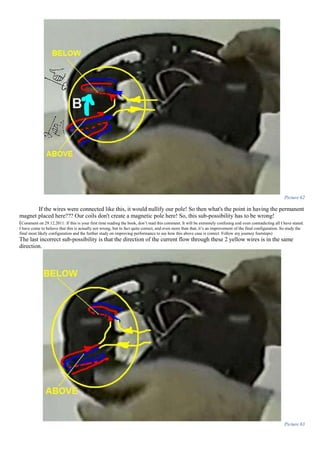
No. We must control passion as opposed to being controlled by it, and approach all of this in a typical clear-mind
“Vulcan” fashion.
Vulcan?
Yeah…you know…from star trek?
Oh…I see…My friend I think you are already insane by not being able to distinguish fantasy from reality!
That is your opinion. I don’t care what you think about me, and I don’t give a shit. But what matters here is the
connection, and what we can learn from all of this. As I said, if you don’t like it, then don’t look. There is a magical x
button on the top upper right corner of your window screen. Use it. It does wonders. Or you could use a powerful
magical keyboard combination: ALT+F4. Or if you really want to be the most devilish out there, there is another path
few ever dare to take. The power is overwhelming. The greatest most magical powerful black magic killing spell out
there: It’s called “ctrl+alt+del+end process”. Nothing can resist it. It omnipotent.
If you haven’t closed this book, then it means you are still reading, and hopefully at least with a smile. If that
didn’t made you laugh, I don’t know what will. I just can’t be funnier than that.
Anyway, so by now, what happens to the Mad Hatter and the Evil Queen when they enter through the hat by jumping
in, they end up in a room surrounded by doors all the way around:
Picture 759 Picture 760
Pictures are taken from the TV series “Once upon a time” (2011-?) series 1 episode 17- “Hat Trick”
Jefferson warns her that if two people enter the door, only two can exit which seems to suggest an equilibrium of mass
and energy when entering and exiting an event horizon of a wormhole:
Picture 761 Picture 762
Once upon a time mirror portal to the Wonderland and Stargate SG-1 event horizon of a wormhole
Picture 763
Matrix (1999) the mirror in which Neo dips his finger which transports him to a different dimension and eventually wakes him up to the real world.
But that’s not the point. The point is that in this TV series „Once upon a time” the
interdimensional room in which they end up with all these doors all around
has a huge and massive Rodin coil pattern
draw on the floor:
Picture 764
Picture 765
Pictures are taken from the TV series “Once upon a time” (2011-?) series 1 episode 17- “Hat Trick”
Its fast scene and you will almost miss it if you are not paying attention very much. I have to admit, when I saw
the episode for the first time, I overlooked this drawing. I never saw it. It missed me. However I did felt a connection to
the Rodin technology and because my rational judgment didn’t had solid proof to support this internal feeling I
disregarded it. Believe me when I say this to you, I had no idea that this pattern was in the movie until I started to insert
those previous pictures in the book. Then, when I watched closely I saw it and wondered how the heck did I missed it
the first time when it is so obvious and big. Talking about synchronicity and all that shit.
It appears to be a nonstandard 135° step angle quadrifilar Rodin coil configuration with 7.5° degrees between
each winding in contrast to the standard 10°:
Picture 766
Now take that! What do you have to say about that?
Nothing. I still think this is absurd and nonsense. It’s just a coincidence. Nothing more. What you are doing
here is called „wishful thinking” and its madness and has nothing to do with a true scientific approach to things. So I
expect you to be serious about this and continue on with the real study of Rodin technology and not these mumbo jumbo
fantasy movies.
Fine then!
Fine!
Interesting to note that all this crap about hats, doors, teleportation and rooms seems to be in tune with other
movies like The Adjustment Bureau (2011). In this movie there’s these guys called the „Adjustment
Bureau” who supervise, observe, adjust, manipulate and change people’s life, events and circumstances when they are
not on their true path dictated by the „Chairman”. These guys all wear some mysterious hats, which just happens to
serve the same purpose of instantaneous travel from two points in space by opening certain doors just like we have
spoken until now.
Picture 767 Picture 768
Pictures are taken from the movie The Adjustment Bureau (2011)
Let me write a partial transcript of some important dialog in the movie:
First of all I’m not going to enter now in too much detail, but going fast very far ahead, water has a major role
in the true real activation of the Rodin technology, as we will see, and since the human mind is a torus at the Holy
Baptism the mind gets activated and a particle accelerated spin will be imprinted on the water inside the pineal gland
“-There's something about water. It blocks our ability to read your decisions. […]
-What if i could move as fast as you? Teach me about the doors.
-The rain will stop in the next hour. That's the only thing keeping them from seeing us right now. If we are going to
do this, we will need all night to do it, and a place surrounded by water to do it in. Always turn the door knob
clockwise […]”
The Adjustment Bureau (2011)
activating it. This seems to interfere with many of the process of correctly reading the memory of someone which is
stored on the charged spheres on the Abha torus. More on that later.
Second, the door knob turning in one correct direction seems to suggest a certain particle spin direction around
a vortex point about which we will also speak later in this book.
Picture 769 Picture 770
Pictures are taken from the movie The Adjustment Bureau (2011)
With the hat on, now all doors are not just doors, but DOORWAYS! Meaning that with these special "hats"
simple doors become doorways or portals of instantaneous travel like we also see in the movie Jumper (2008):
Picture 771 Picture 772 Picture 773
However, in this case, there is a slight difference in how the portals used by jumpers operate. If you watch carefully,
you will realize that they are not actually naturally curving and wrapping space-time, but actually shatter it leaving scars
behind (Picture 773).
Picture 774 Picture 775
This is where the “paladins” prevent the self-healing property of the space-time fabric, by amplifying the
scaring/window/portal left by the “jumpers” so that they too could use the jump portals (Picture 774 and Picture 775).
What seems interesting in Adjustment Bureau, on the other hand, is that they can’t teleport without the hat on
their head. So all the doors are locked:
“-Put your hand on my shoulder and don't let go until we cross the threshold.
-Are these ever locked?
-Not when you are wearing one of our hats. […]
-Even you guys can't get through the doors without your hats on, right?
-Right. It's one of the ways the chairmen limits our power. Water is another way.”
The Adjustment Bureau (2011)
Picture 776
The designated guardian handing him one of these magical mystical hats.
Another thing worth mentioning is that these guardians always have with them a special notebook in which they
see that particular person entire lifetime, path and destiny:
Picture 777 Picture 778
Pictures are taken from the movie The Adjustment Bureau (2011)
I do have my opinions about this movie, however this is not the proper place to write them, but I can give you a
nice food for thought. Here it goes. After you have seen the entire movie and if you ever wondered "Wouldn't it be nice
to have a copy of that notebook that these guys have on you?" "Wouldn't that be nice?" Well… you will be amazed by
the fact that these questions have reached God's ears The Creator of man and He answered them through palmistry. You
don’t even have to believe in God. For those who don’t, let me rephrase. We could say that the intelligence that directed
the evolution of man on Earth took care of making markings on our hand that some claim to be the path and choices one
takes in life. Does that feel better for your ears? If you are not a believer in God, then you should know that evolution
can’t happen if it’s not directed and guided by a separate and distinct intelligence, just like a director of an orchestra.
My beliefs are irrelevant. What do you believe?
Picture 779 Picture 780
Where some people see just lines, other with the gift and talent see entire life and destiny like in those fancy
notebooks. This movie goes deep into the occult if you have the "eye" for it, otherwise it's just a movie. But again, this
is not the place for it. I've spoken already too much. Note that I'm not saying that I'm an expert. In fact I just know some
"surface" stuff. Enough to recognize at what I'm really looking at and not to be fooled by appearances which always
proves misleading. The essence is what counts. And we have to discern what is truly the essence of things so that we
won’t take the surface stuff or the appearances as the essence.
All of this stuff with doors acting like doorways and special room seems to also be supported by the movie
Matrix Reloaded (2003):
Picture 781 Picture 782
Pictures are taken from the movie Matrix reloaded (2003)
Neo enters in a similar Room with doors that are doorways to other places:
Picture 783 Picture 784
Pictures are taken from the movie Matrix reloaded (2003)
And there is even a scene where a simple door when is closed and open with a certain key opens up a portal to a distant
place:
Picture 785 Picture 786
Picture 787 Picture 788
Pictures are taken from the movie Matrix reloaded (2003)
And the examples just keep going. This is where Neo chases a bad guy:
Picture 789 Picture 790
Pictures are taken from the movie Matrix reloaded (2003)
It can be clearly seen that the door acts like a portal leading somewhere, but because the door closes before Neo is able
to enter, when he opens it again, leads him somewhere else:
Picture 791 Picture 792
Pictures are taken from the movie Matrix reloaded (2003)
And another chase after a bad guy:
Picture 793 Picture 794
Picture 795 Picture 796
Pictures taken from the movie Matrix reloaded (2003)
What is more amazing is that Neo eventually ends up also in a round room with doors and mirrors:
Picture 797
Actually they are television screens, but you get the point. And the same story keeps repeating again in the next movie
Matrix revolutions (2003):
Picture 798
This is another inter-dimensional (inter-dimensional meaning between two different worlds/realities), another
room presented in Matrix revolutions is the white train station where Neo meets that Indian family who want to go
inside the matrix. What is not apparent in this version of the "room" is the sphericity and the roundness of it. This is
suggested when Neo tries to get out, but ends where he started:
Picture 799 Picture 800
The train station is a poor illustration from the directors of the movie to represent the same concept of another
inter-dimensional round room. However this version of a room, which we might say it's a universe inside a universe
doesn’t have doors to go wherever you like, because it's intended that way by the train man in the story. The only way in
and out of this room is by using the train.
And all of this is even talked about directly when they say:
Personally I despise the movie Matrix. I believe it’s filled with violence, aggression, blood, shooting, fighting
and all sorts of crap. It’s not very Christian for my taste. But my opinion is irrelevant. It’s the information that is
presented that is relevant in our study.
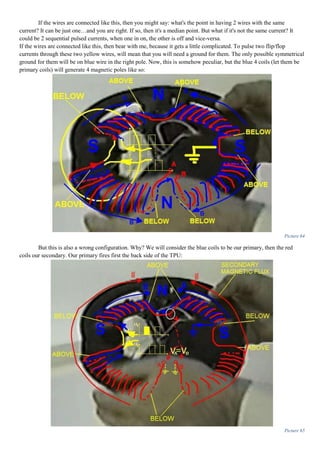
So what do you have to say about all of this huh? Can a quadruple coincidence about hats, doors, rooms and
teleportation compute in your brain or did I just crushed your system giving you a BSOD?
(Blue screen of death for those who are not familiar with the term)
…I have nothing to say…
However my inner compass tells me that all this bullshit mysticism is a deviation from the true path.
Finally we agree! So let's cut the crap and get down to business.
Ok. Let’s move on then and recognize that mother-nature also works on similar blueprints:
“There is a building. Inside this building there is a level were no elevator can go and no stair can reach. This level
is filled with doors. These doors lead to many places. Hidden places. But one door is special. One door leads to the
Source. This building is protected by a very secure system.”
Matrix revolutions (2003)
Picture 801
We can poetically say that all beauty in nature, although temporary is also eternal. (Via the eternal cycle of birth
and reborn – Ouroboros).
Standard Rodin magnetic field configuration - Meruba Ashurit and
the origins of the alphabet - Stan Tenen Meru research connection -the
Torah is a Torus
Picture 803
While watching a science fiction program alone in his Newton, Mass.,
apartment in 1968, Stan Tenen saw a strange code flash across the screen,
prompting him to consult the opening passage of Genesis — in the original
Hebrew. “This was a strange urge,” he admits in one of his instructional videos,
“because I didn’t know Hebrew.” Even stranger, he says, was that after cracking
open a copy of the Bible he’d received as a bar mitzvah gift and examining the
Hebrew text, it didn’t look like words to him. He saw a pattern. And not just any pattern: Tenen thought he had
discovered a universal truth about the nature of existence.
Working by instinct, Tenen took the 28 letters of the familiar verse describing God’s creation of heaven and
earth and arranged them on a chain of beads. When each lettered bead was matched up with the next occurrence of that
letter, the chain curled up to form a three-dimensional spiral doughnut known to mathematicians and spiritualists alike
as a torus. Tenen then folded this shape into a form resembling a hand — capable, when properly backlit, to reproduce,
in shadow form, the shapes of all 22 letters of the Hebrew alphabet. He then diagrammed the connection between these
projected letters, the hand gestures to which they are thought to correspond and the universal meanings behind the
gestures. For example, hold up your hands and his folded torus shape to your mouth, and it forms the Hebrew letter pe,
which means “mouth.” Hold your hands over your head, and it forms the Hebrew letter resh, for “head.”
The Meru Project has discovered that the sequence of letters in the Hebrew text of Genesis reveals a simple yet
extraordinary and unexpected series of geometric models whose intrinsic meaning describes processes inherent in fields
as diverse as embryology, modern physics, and consciousness studies. Meru research demonstrates that the Hebrew
alphabet, in its early rabbinic form, is at its core a universal language of gestures. People from all cultures, even those
who are blind from birth, and children before they speak, make spontaneous use of this natural language. The gestures
of the Hebrew alphabet express universal needs and choices.
Picture 804
Continuous Creation: A Fruit Tree Yielding Fruit whose Seed is In Itself-Genesis 1.11
Picture 802
Picture 805
In spite the striking similarity between Rodin research and Meru research, Meru research is especially centered
on the single vortex-horn torus topology and everything that comes out of it, while Rodin technology is centered on the
double lemon-spindle torus. Still the vortex-horn torus is a major player in all these technologies.
Meru research links:
http://www.meru.org/index.html
Dance of the Hebrew Letters with Stan Tenen:
http://video.google.com/videoplay?docid=-6883697077237953903
First Light: An Introduction to Meru Foundation Research by Stan Tenen:
http://video.google.com/videoplay?docid=-208619888961779202
<possible more work here>
Rodin magnetic field
Going back to our Rodin asymmetric magnetic field, if the north hemi-torus has a much slower inclination/pitch
angle means that the magnetic field line has to do many theoretical 360° revolution along the toroidal direction on the
north hemi-torus before entering through the Rodin hole and coming out on the south hemi-torus side:
Picture 806
There are NOT many theoretical 360° revolutions along the toroidal direction done by the magnetic field line
created by the Rodin coil, there are INFINITE. This is another extremely important concept to grasp in the process of
correctly building the Abha torus - Rodin coil.
This raises the concept of an OPEN MAGNETIC FIELD
LINE CREATED BY THE RODIN COILin opposition
to the normal standard CLOSED MAGNETIC FIELD LINES created by any other regular coil, where field lines go
out through the North pole into the South. But in the theory the Rodin Coil magnetic field line is never closing on itself.
It is an open magnetic field line.
Of course this is impossible in reality, but on paper, this is what it does. We are dealing with an open
mathematical magnetic field line, which is pretty amazing, astonishing and incredible.
Either the magnetic field line is departing from the torus equator, or is approaching the equator IT IS NEVER
TOUCHING IT (at least in theory). Thus we are creating an OPEN magnetic field line. An open system, not a closed
system. An open system that is open to other outside magnetic influences, if I'm allowed to express myself like that. An
open system not a closed one.
Picture 807
How can this help us in designing Rodin coils? Well…this is not as much critical as other constructive details,
but is still an improvement that shouldn't be treated lightly.
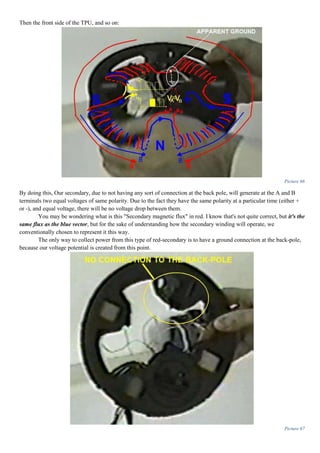
Picture 808
Picture 809
Again, I feel compelled to underline the idea that this is a theoretical open magnetic field line. In reality this is
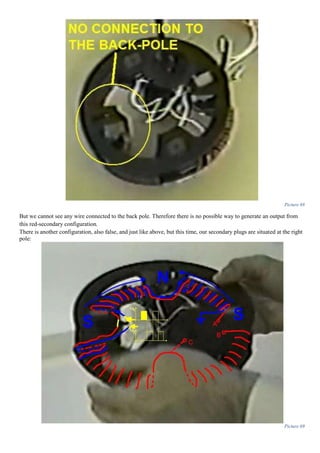
impossible. Nature will always find a way to close the magnetic field lines. What is really happening here is that the
magnetic field intensity on the outside external circumference at the equator plane is not zero, because wires in general
have an inclination. But what we can do is to reduce close to 0 this magnetic field intensity on the outside circumference
of the equatorial plane by adjusting the Rodin coil wires so that as they approach the equator they are laid perfectly
perpendicularly to it.
Going back now to our Rodin witchcraft magical staff symbol, it seems that we are not dealing with a simple
activation of one coil, but rather with opposing magnetic flux lines formed by firing both Rodin coils in opposition, thus
creating the double twisted torus:
Picture 810
Picture 811
Torsion-inclination-twist determination of the double twisted
torus magnetic field topology created by the Rodin coil
Picture 812
The problem in the above picture is that it represents a case where the magnetic field lines of the double torus
don't have any torsion/twist. They are always perpendicular to the equatorial plane. In reality they are twisted. The wires
geometry makes them twist.
But how? In what direction? To the left? To the right? How do they come out through the nozzle/empty
band/empty space/third not winded space? How do they come out? At what angle?
Why do you want to know that? Why is this relevant to our research? Aren't you overstretching a little? I think
you are going too far with all these details.
No. No. No. You are mistaken. It is imperative and crucial to determine the twist/inclination torsion angle…
Why?
Please let me finish. It is imperative and crucial to determine the twist/inclination torsion angle of the magnetic
field lines of the double torus topology created by the standard configuration Rodin coil, because if we truly want to
build the most efficient collector coil system for the Rodin coil, the Gaussian surface of one turn of the collector coil
must always be at 90° in respect with the magnetic flux that is cutting it. Therefore we must accurately determine the
twist/inclination/torsion angle for the double torus magnetic field created by the Rodin coil.
Ok. So how do we approach this issue?
Let try to imagine it:
Picture 813
Oh… shit! Damn! ...
You wanted to know the exact twist inclination of the double torus. Now you know.
Shit.
Yeah. Apparently we get all the angles. So for the question:
- "What is the exact twist/inclination angle of the double torus?"
the answer is:
-"All of them."
All angles between 0° and 90°?
Yes.
Ok. Damn! How on earth can we tap on them? How the hell are we going to build a collector coil now?
Don't despair. There is much more to figure out. We are just scratching the surface with all of this.
Let's look into this deeper. We get all angles in the twist because it depends on what surface of the double torus
we choose in the topology.
I don't get it.
Ok. Imagine if you like, that the double torus represented in the above picture is only a balloon. It is empty in
the inside. So to simplify things we determine the magnetic field lines inclination on this particular surface which will
have a particular unknown twist/inclination angle. Ok?
Ok.
Now let's go further than that, and imagine that this double torus surface-balloon-look-like is smaller and it's in
the inside of the previous one. Like Matryoshka nesting dolls:
Picture 814
So in reality we get many double torus balloon-look-like surfaces nested one inside the other. So for each doll
we get a different twist. Oh, and by the way, there are an infinite number of dolls, because if you open one doll, the next
one will be just 1 mm smaller. No. It could be one nanometer smaller than the previous one. It will fit won't it? So what
is the smallest division possible?
Infinite.
Exactly. So in reality, thus we are not dealing with nested balloon-look-like surfaces, but with a filled topology.
It is not empty in the inside, nor does it have small steps decremented sizes. It's like ball. A filled bowling ball double
torus. It is filled. Ok?
Ok I guess…but so what? Where are you getting at?
My point is that you can have in theory a double torus with a twist/torsion/inclination angle of
36,523324893144891291496 degrees for example, which is generated in the double torus filled topology at a specific
size of balloon-surface from the maximum surface possible.
You've lost me. What are you talking about that angle? What maximum?
That angle is just an example. Don't mind that. The double torus topology created inside the Rodin coil system
has a maximum admissible size. We have discussed this. Now if you go deeper inside this double torus topology like
let's say 5 millimeters deeper inside the whole double torus thing you will have another double torus which will be 5
millimeters smaller than the maximum one. Right?
Ok. So what?
Like let's say you remove 5 layers from an onion you will still have an onion but with 5 millimeters smaller
from the original one (in all perpendicular directions normals to the surface because some will say 10mm)
Picture 815
Ok. Ok. I get it. But what are you trying to say?
My point is that on the surface of each layer of the onion, you have a different twist. Each layer of the onion is
twisting at a different inclination angle in the double torus topology.
Aha. I get your point now. I see what you mean.
Exactly. So that's what we are dealing here with.
Hmm…interesting. But so what? How does this helps us?
As I said this is very important if we want to design the best/most/ideal/perfect collector coil system for the
entire Rodin coil assembly. We want the flux always 90° to cut our surface of our collector wires.
Hmm…
And so not that we just get all the angles, but we also have to acknowledge that just like the onions layers, each
magnetic field line for a particular surface gets larger too:
Picture 816
So let me get this straight. The larger the double torus gets the lower the twist?
MY POINT EXACTLY! That's what I was trying to tell you all this time!
I see…Hmm…interesting…
Picture 817
So we can also say that the twist of the double torus is determined by the squashing of it done by the vertical
collector coil.
Fine! Ok. The double torus is squashing. It want to fight, let' give it a good fight then. Let' modify our vertical
collector coil system to compensate for this squashing:
Picture 818
If the magnetic field is denser and more intense the steeper the twist gets then we must also concentrate the
vertical collector coil turns towards the equator where there we will wind a lot more and as we get further away we will
not wind so many turn.
Yes, but you still haven't solved the problem. When the squashing occurs it increases the
twist/torsion/inclination to a much steeper angle, and it will cut surface area of the vertical collector coil with this low
inclined angle (called angle of incidence), and thus the induced EMF will be extremely low (*cosφ).
Picture 819
Darn! This is not good at all! I mean, what do we do now? Does this mean that we need a physically dynamic
collector coil for each particular load? This is insane!
No! Not that way! Turn back! You are losing it.
Ok. Fine! How then?
We have two options. Either we incline the collector coil to accommodate for this variable twist, or we
manipulate the twisted double torus flux, so that it is more perpendicular to our collector surface coil.
Oh…. Yeah! I think I know why you used the shielding thick copper wires between the Rodin coils, in this
nozzle-empty-third-band-369-hyper-dimensional-invisible-9-energy-thing, to shield or block the steeper twisted layers
of the double torus to close themselves in a too inclined angle in respect to your equatorial vertical collector coil surface
area.
Exactly.
Hmm…So we are trying to do something like this:
Picture 820
Exactly! Finally we are talking the same language! Now the shielding acts like a squasher limit. In theory the
double torus topology will never be squashed under this limit. So we can control the twist of the Rodin double torus by
the length of these shields.
Hmm…interesting configuration. But this raises another question and problem.
And what is that?
Well…how long this copper plate shielding do you want it to be? I mean, if it's too long then it will block
completely the formation of the double torus, if it's too small, the alternating 24 poles will form in the equatorial plane:
Picture 821
Yes. This is a problem.
So how big this shielding would have to be to prevent the 24 alternating poles formation, and to stimulate the
double torus formation?
This is simple:
Picture 822
So for example, if we want to limit the torsion/twist/inclination angle of the double torus Rodin magnetic field
to a 32° angle, and our distance d between two inside-the-Rodin-hole guiding pins is 5 mm then we have to have a
shield 11.8 mm long with its center placed exactly on the equatorial plane so that half (5.9 mm) will be above and half
below.
Another thing we must consider is that the copper shield length placed between the wires will have to have the
minimum length as the diameter of the magnetic bubble ring.
Why?
Because, we want the magnetic flux field line to return above the bubble, so that it will not interfere with it or
disrupt it:
Picture 823
I thought that there are two bubble rings, one in the inside and one on the outside.
That is true. My bad. I represented only the external magnetic bubble ring for simplicity reasons. There are two
counter rotating spins. That's true.
But wait. If the bubble ring diameter is dependent on the load we are placing upon the vertical collector, then
we must change the length of the shield for every type of load. If the load is squashing the double torus, then it will
twist it more, and at a moment the outgoing/ingoing magnetic flux lines will enter through the increasing magnetic
bubble-ring and it will break its dynamics. I mean this is circular logic. Each factor is dependent upon the other, and we
can't change one without changing the other.
We must take the load out of the equation. It must not interfere in any way with the magnetic field dynamics in
the Rodin system.
Hmm…yes…this is a problem.
Well?
We could design the collector coil for a 45° pre-established twist like so:
Picture 824
No. I don't like it. It is not efficient.
What do you mean?
I mean, that there are also magnetic flux with different twist angle which are lightly captured by the collector
coil.
How?
Indeed, by properly adjusting the shield length the magnetic field will be much denser on the 45 degrees
inclined plane, but that not were all will be situated. Some of the double torus magnetic field lines will be 50, 60, 80
degrees inclination to the equatorial plane (much weaker, but still present). So your collector will not work to capture
efficiently all these various inclination magnetic lines from the twisted double torus.
I will rotate the collector coil, meaning the surface area of one turn of the collector coil so that it will capture
these flux as well.
No, because now you are losing the denser flux which you placed and directed at the 45° angle.
Darn! So what do I do now?
Well…
What if you design a different collector system…?
Yeah, but how?
I'm thinking something along the lines of an extremely ingenious, intelligent design, which captures all the
angles.
Hmm…interesting…
Ok. Good idea. If we have such a collector for all the angles, then we would not need a shield at all! That will
be a great idea! Let's try this, then:
Picture 825
No. I don't like it. It is absurd.
Why?
Because first thing first is that I don't even want to conceive how on earth you are going to wind such a complex
collector coil configuration around the circumference. Simply put, its insanity. Second, the double torus magnetic gets
smaller and smaller with the twist or vice-versa. The closer or steeper the twist/torsion/inclination of the double torus,
the smaller it will become. The more twist, the more I destroy the ideal double horn-vortex torus and create a more like
double donut/ring torus. So the magnetic flux lines in the equatorial plane don't travel a lot, and are more intense and
denser so they don't form any 3D geometry whatsoever. Let me illustrate:
Picture 826
So, if this is so, how can we tap it?
We could design a new collector so that it will capture all the angles. Something that is self-adjusting to this
torsion/inclination. The best way to do it is to make sure that the collector coil surface is always perpendicular to the
magnetic field created by the Rodin coils.
Something along these lines:
Picture 827
Wait a minute, this looks like…like…like…another Rodin coil system…
Oh my God! What if we place another Rodin coil inside the hole of another Rodin coil? But in what direction?
To the left winding technique? To the right? One coil, two coils? How?
Those are good questions. Let's investigate possible answers:
Picture 828
Yeah! Now we are talking. We finally have a collector coil that doesn't need that stupid copper shielding
between the wires.
Ok. So we do know that the wires will have to be winded to the standard left winding technique, or in the
opposite direction than the larger torus winding direction. In other words the two perfect Rodin coils are identical with
two main differences: First, one it's smaller to perfectly fit in the inside hole of the other one, and second it's winded in
the opposite direction.
Now the magnetic flux lines created by the larger standard Rodin coil will always cut almost at 90° the surface
area of the small Rodin turns in the inside smaller Rodin coil collector.
It is interesting to note that if on the big Rodin coil the outside external equatorial magnetic flux was negligible,
the situation is reversed on the smaller inside-the-hole Rodin coil, where the outside-external equatorial magnetic now is
stronger. Or in other terms if for the larger Rodin torus, the magnetic field was stronger inside and weaker on the
outside, the situation is reversed for the smaller Rodin collector coil, where the most magnetic flux is centered at the
outside-external equator.
I'm confused by these terms outside, inside, external, internal. I'm lost. Please clarify further.
Ok. My bad. Ok. Let me explain:
Picture 829
Ignore the arrows of the magnetic field. They don't map any correct magnetic field topology. They are just
represented to clarify the four confusing terms that I have chosen to explain all of this. You could reverse the concept of
internal with the concept of inside, but the above picture is how I have chosen to name them. It's just a convention. You
don't like it. Fine. Then name them however you like. As long as we are referring to the same thing we are thinking on
the same lines, but with different wording.
However I don't like any of these Rodin coil inside another Rodin coil. I don't like any of these things.
Are you kidding me? Isn't this "exotic" enough for you?
It's not that.
Then what's the matter?
Keep an open mind, and cold blood. Judge these things with a clear mind and attitude.
Ok.
I don't like it because first the size of the larger perfect Rodin torus will be huge, even half a meter if you want
to perfectly arrange the wires in the inner hole of the smaller torus. If you want to accurately arrange the wires in the
hole of the Rodin torus to always sit on the surface of a perfect Rodin torus, if you want to arrange these wires neat,
clean, ideal, and perfect on the surface of the smaller torus, then it will have to be a little large, so that you can "put a
finger on it" and arrange them accordingly. Now consider how big the larger torus will be then so that the inner hole of
the big one will be as large as the entire diameter of the small torus. So it's a little impractical for my taste.
The second reason I don't like it is because in spite the intelligent design magnetic field collector coil it is still
far from perfect.
Why?
You are forgetting about the inside magnetic flux. The magnetic flux that is entering through the torus. In the
inside of the torus. In the inexistent "core" if you like. This flux that is entering in the "core" will then exit through the
"nozzle". What happens to this flux? Can't it be tapped also?
Well…I forgot about that…
Exactly.
So what do we do?
Hmm…let me think…
We could try something like this:
Picture 830
Picture 831
No. I still don't like it.
Dear God! What's wrong this time?
 Well…I don't know exactly. It's just a feeling and I don't like it.
Let me get this straight. You are designing these coils based on feelings? … Oh God… I really am insane…
Don't worry, I know what I'm doing…I think…
Let's go deeper into this shit.
Hmm…
Something doesn't smell quite right here… Something is wrong… I just can't put a handle on it…
Let me think…
Let's try to manipulate the magnetic field created by the Rodin coil so that we don't have to design sophisticated
collector coils.
Yeah, but how can we alter the twist? We need a fixed twist, and not to interfere with the spinning magnetic-
bubble-ring-engine.
We have to create a simple collector coil. Nothing fancy. Nothing extravagant. Nothing exotic. Something
simple. Elegant. Convenient. Ideal. Perfect. Simple.
Ok. I'm with you on that one. But how can we simplify the design?
Hmm… What if we compose, or add, or sum up, the magnetic flux vectors with other vectors so that the
resulting vector…
Yeah….Great idea…
What if…we wind another Rodin coil system (by the term "Rodin coil system" I mean coil A and coil B) in the
other direction the Rodin coil…
That has been done by others a long time ago, and many configurations, many topologies, many
activations…too many attempts…so many failures…it's probably a dead end.
Maybe...Or maybe it just looks that way…
First let's visualize the twisted magnetic field lines of one Rodin system:
Picture 832
The magnetic field lines never intersect, and you clearly show in this picture intersection points.
I know. I know, but bear with me for a while.
Now let's see the twist of the double vortex torus created which happens at a single unique moment, and only at a
particular size of the double torus:
Picture 833
Ok. Now let's imagine what happens when we power two Rodin coil systems, left and right winding at the same
time:
Picture 834
Hmm…very interesting…it appears that by a process of vectorially adding the magnetic flux counter-twists
field lines we get a straight magnetic field line, and thus we are creating the NON-twisted double torus magnetic field
topology.
Let me get this right. You are powering both coils?
Depends on what you define by "both".
Ok. Coils in the left direction and the coils in the right direction?
Well, yes, but we must clearly define all these coils, so that we erase any confusion that might arise.
We define "Rodin system" as a standard to the left winding technique, formed by coil A and coil B together. So
we are dealing thus with a "Rodin to the left coils system" and a "Rodin to the right coils system" so there are 4 coils in
total.
I see. So you are creating 4 tori?
Well, in theory, yes. But they are not separated. These 4 torus are identical, symmetric and unified. They are the
same structure. Because it is formed when all 4 coils are powered at the same time, and thus acting like one big coil.
Thus one coil=one magnetic field. It's just that it has this shape of the double torus.
Wait, I'm confused. Are there four or two tori?
As it is stated in the previous picture "two double torus" means 4 tori, but the other two are superimposed on the
previous ones and interfere with their twist so that the resulting twist is 0 everywhere and on any level of the "onion-
Matryoshka" layers analogy.
It is interesting to note that the straight magnetic field lines of the NON-twisted double torus exists through a
very interesting symmetry on the surface of the main torus, where the two Rodin systems intersects.
<quantified layers of the non-twisted double torus>
Rodin vortex-horn torus and the lemon-spindle torus magnetic fields
Ok. We have reached a point, where all of this lead to the logical deduction that if we want the maximum field
intensity in any type of step-angle Rodin torus, we must at least create the double horn-vortex torus, so that the vertical
magnetic field lines that are perpendicular to the equatorial plane are coming together and add up so that the magnetic
field intensity is increased.
Something like this:
Picture 835
Because if the angle is too small, we get this:
Picture 836
If we increase the angle beyond 14° then we get a spindle-lemon torus magnetic field topology:
Picture 837
Picture 838
Cool stuff! I like it!
Well, I don’t. Like I said, lines of force never intersect.
Right. I will get back to you on that one. Let's apply this data to our entire valid step-angles for winding non-standard
Rodin toroids as a filter:
Windingstepangle
Numberofouterpoints
Angle
at
one
of the
outer
points
Angle
per
sector
(band)
Nr of
complete
360°
revolutions,
before
ending
where we
started
The first
small turn
that is
parallel to
another
previous
laid small
turn
Inner
radius to
outer
radius
ratio
Core
radius
Length
of a
chord
for a
radius
R=1
torus
Full Rodin
turn length in
the
equatorial
plane
(total length of
a complete full
turn) / (length
of the outside
circumference
of the torus) Angle A*
141 120 39 1 47 60 0,3338069 0,0286793 1,885283 226,2339579 36,00625269 14,02188418
142 180 38 0,667 71 90 0,3255682 0,0272407 1,891037 340,3866872 54,17422383 14,27291889
144 5 36 24 2 5 0,309017 0,0244717 1,902113 9,510565163 1,513653457 14,7850365
145 72 35 1,667 29 36 0,3007058 0,0231415 1,907434 137,3352409 21,85758245 15,04618657
146 180 34 0,667 73 90 0,2923717 0,0218476 1,91261 344,2697121 54,79222644 15,31077549
147 120 33 1 49 60 0,2840153 0,0205901 1,917639 230,1167364 36,62421608 15,57883659
148 90 32 1,333 37 45 0,2756374 0,0193692 1,922523 173,0271053 27,53811909 15,85040305
150 12 30 10 5 6 0,258819 0,0170371 1,931852 23,18221983 3,689564878 16,40418379
152 45 28 2,667 19 45 0,2419219 0,0148521 1,940591 87,32661536 13,8984625 16,97237867
153 40 27 3 17 20 0,2334454 0,013815 1,94474 77,78959363 12,38059835 17,26196165
154 180 26 0,667 77 90 0,2249511 0,012815 1,94874 350,7732233 55,8272924 17,5552437
155 72 25 1,667 31 36 0,2164396 0,011852 1,952592 140,586625 22,37505631 17,85225584
156 30 24 4 13 15 0,2079117 0,0109262 1,956295 58,68885604 9,340621544 18,15302859
158 180 22 0,667 79 90 0,190809 0,0091864 1,963254 353,385786 56,24309467 18,76597531
159 120 21 1 53 60 0,1822355 0,0083725 1,96651 235,9811778 37,55757093 19,07820745
160 9 20 13,33 4 9 0,1736482 0,0075961 1,969616 17,72653955 2,821266394 19,39431644
162 20 18 6 9 10 0,1564345 0,0061558 1,975377 39,50753362 6,287819266 20,03827345
164 90 16 1,333 41 45 0,1391731 0,004866 1,980536 178,2482524 28,36909046 20,69805489
165 24 15 5 11 12 0,1305262 0,0042776 1,98289 47,58935335 7,574080824 21,0339409
166 180 14 0,667 83 90 0,1218693 0,0037269 1,985092 357,3166146 56,86870546 21,37385433
168 15 12 8 7 15 0,1045285 0,0027391 1,989044 29,83565686 4,74849227 22,06584834
170 36 10 3,333 17 18 0,0871557 0,0019027 1,992389 71,72601826 11,41555035 22,77419418
171 40 9 3 19 20 0,0784591 0,0015413 1,993835 79,7533867 12,69314572 23,13454234
172 90 8 1,333 43 45 0,0697565 0,001218 1,995128 179,561529 28,57810494 23,49902751
174 60 6 2 29 30 0,052336 0,0006852 1,997259 119,8355442 19,07241921 24,24045987
175 72 5 1,667 35 36 0,0436194 0,0004759 1,998096 143,8629439 22,89649865 24,61742834
176 45 4 2,667 22 45 0,0348995 0,0003046 1,998782 89,94517443 14,31521912 24,99857619
177 120 3 1 59 60 0,0261769 0,0001713 1,999315 239,917758 38,18409712 25,38390944
178 180 2 0,667 89 90 0,0174524 7,615E-05 1,999695 359,9451703 57,28705309 25,77343209
180 2 0 60 1 1 0 0 2 4 0,636619772 26,56505118
Table 5
These are all?
Yeah.
Neat! So we are dealing with a lot less variants.
These are all the valid step-angles for winding Rodin toroids such that at least a double vortex magnetic field is
formed. Let's call this 14° rule-filter, the "vortex condition" in non-standard Rodin toroids. Less than 14° degrees the
vortex can't form.
Neat!
Yeah. Now let's continue with all this.
If we increase to much the double torus will interfere with itself:
Picture 839
Sorry to interrupt you but magnetic field lines never intersect.
Can’t you go along with this? I told you just bear with me a little longer.
No. I can’t. This is erroneous. I can’t listen to a word you’re saying. You are mistaken.
Please, I’m begging you, don’t abandon this, not yet.
No. All of this is crap. It’s nonsense! You are persisting in an error that will lead you to more nonsense.
Ok. Fine. You want to argue, then you should also know, since you are so smart to correct me all the time, that
even if the textbooks say that the electro-magnetic field lines or lines of force never intersect anywhere in space, there
are exceptions.
Ha! You are a fool! If you would only listen to yourself!
I told you that if you have that attitude, then just take all this crappy book as a comic book. I don’t have to
convince you of anything. The exception to this rule are the point charges in a dipole from where all the field lines
originates.
Hmm…
Finally, you are quiet. Where is your attitude now, huh? Just think about that!
Yeah, but…
In a magnetic dipole, you have one central point from which lines come out one end, and come in the other,
while in an electric dipole, things are much more evident, since all the field lines start from the positive charge point,
and enters in the negative point charge. All the field lines converge, meet, and come together at these points. Therefore
these points fit the description and could be considered “intersection points” thus invalidating your rule.
No. I disagree. Even if what you say it’s interesting, the law is the law. You can’t bend the rule book to suit
your needs. All this that you say, is just an exception that doesn’t invalidate anything. And for this to work in our case,
then it will mean that the two intersection points (P and Q in the above picture) of the lemon-spindle torus are actually
source point charges of electricity and not magnetism.
Yes! Exactly! Finally we are on the same wavelength. You have jumped extremely far ahead, but we will speak
about all of this at a much later time in this book.
Yeah but the magnetic lemon-spindle torus is an impossibility, since you can’t have magnetic monopoles, and
you can’t have intersections in the magnetic field.
I know. Ok. Fine. You know what? Just consider all this a mathematical geometrical pattern. Nothing more.
Ok? It doesn’t have to truly exist. We are just studying geometry here, not the electromagnetism by itself.
Well, we must immediately notice that something wrong starts to happen when the spindle-lemon becomes too
large. It will interfere with the torus surface magnetic field and the whole double torus structure will destabilize. The
lemon-spindle torus must be separated and distanced from the toroid surface.
Now, knowing all this, we can define another limit for this angle:
Picture 840
So, we have found another limit?
Yes.
Cool. Let's apply this one too in our table as a filter, and see what we are left with:
Windingstepangle
Numberofouterpoints
Angle
at
one
of the
outer
points
Angle
per
sector
(band)
Nr of
complete
360°
revolutions,
before
ending
where we
started
The first
small turn
that is
parallel to
another
previous
laid small
turn
Inner
radius to
outer
radius
ratio
Core
radius
Length
of a
chord
for a
radius
R=1
torus
Full Rodin
turn length in
the
equatorial
plane
(total length of
a complete full
turn) / (length
of the outside
circumference
of the torus) Angle A*
141 120 39 1 47 60 0,3338069 0,0286793 1,885283 226,2339579 36,00625269 14,02188418
142 180 38 0,667 71 90 0,3255682 0,0272407 1,891037 340,3866872 54,17422383 14,27291889
144 5 36 24 2 5 0,309017 0,0244717 1,902113 9,510565163 1,513653457 14,7850365
145 72 35 1,667 29 36 0,3007058 0,0231415 1,907434 137,3352409 21,85758245 15,04618657
146 180 34 0,667 73 90 0,2923717 0,0218476 1,91261 344,2697121 54,79222644 15,31077549
147 120 33 1 49 60 0,2840153 0,0205901 1,917639 230,1167364 36,62421608 15,57883659
148 90 32 1,333 37 45 0,2756374 0,0193692 1,922523 173,0271053 27,53811909 15,85040305
150 12 30 10 5 6 0,258819 0,0170371 1,931852 23,18221983 3,689564878 16,40418379
152 45 28 2,667 19 45 0,2419219 0,0148521 1,940591 87,32661536 13,8984625 16,97237867
153 40 27 3 17 20 0,2334454 0,013815 1,94474 77,78959363 12,38059835 17,26196165
154 180 26 0,667 77 90 0,2249511 0,012815 1,94874 350,7732233 55,8272924 17,5552437
155 72 25 1,667 31 36 0,2164396 0,011852 1,952592 140,586625 22,37505631 17,85225584
156 30 24 4 13 15 0,2079117 0,0109262 1,956295 58,68885604 9,340621544 18,15302859
158 180 22 0,667 79 90 0,190809 0,0091864 1,963254 353,385786 56,24309467 18,76597531
159 120 21 1 53 60 0,1822355 0,0083725 1,96651 235,9811778 37,55757093 19,07820745
160 9 20 13,33 4 9 0,1736482 0,0075961 1,969616 17,72653955 2,821266394 19,39431644
162 20 18 6 9 10 0,1564345 0,0061558 1,975377 39,50753362 6,287819266 20,03827345
164 90 16 1,333 41 45 0,1391731 0,004866 1,980536 178,2482524 28,36909046 20,69805489
Table 6
These are the only valid step-angles in winding Rodin toroids so that a double vortex torus will form, or a
double lemon-spindle torus. We can say that we have filtered the entire table by applying both the vortex upper and
lower limit condition.
Further filtering-out impractical step-angles configurations
By examining closer the column 4 entitled "Angle per sector (band)" we can pretty much figure out the
impracticability of some of these configurations. How? What do they mean?
Well, consider the winding step angle 147°. This angle will make 120 outer points on the circumference. A 120
pointed star if you like. Now, disregard the fact that you will have to go through the center hole of the torus 120 times
before you complete a full turn, which seems a little absurd, but let's ignore that fact for now. Ok. Let's consider we
have chosen such a configuration. The column 4 says that we will have a 1° angle per sector. It is imperative to have 3
sectors, remember? We leave one not winded, to provide the return magnetic flux path when the double twisted torus is
formed. Now, we have only 1° available on the inside and outside equatorial circumference of the torus to wind our coil
A and the same story with coil B. This is an extremely small space. Let me illustrate:
Picture 841
Now if your torus has a complete diameter D=200 mm then the inner diameter of the perfect torus for this
particular winding step-angle is determined by multiplying this value with the value given in the table at column 7
(Inner radius to outer radius ratio). So we get:
200 ∗ 0.2840153 = 56.8 mm Equation 190
Ok. Now comes the phase where we place the inner and outer guiding pins. Ok. Let calculate the circumference
length of the circle at the outside equator of the torus:
L 𝑜𝑢𝑡 = 2 ∗ π ∗ 100 = 628.32 mm Equation 191
We divide this number by 360 and we get how much length we are permitted to work with to wind our coil:
628.32/360 = 1,75 mm Equation 192
Wow! After you have supposed to place 360 guiding pins on the outside circumference of the torus, which is
beyond insanity, and have to be a very sick person to do something like that, you find out that there is only 1,75 mm
between the pins. And this is on the outside of the torus!
Let's calculate on the inside equatorial circumference too:
L𝑖𝑛 = 56,8 ∗ π = 178,4 mm Equation 193
Now we have to place another 360 guiding pins in the inside equatorial circumference of the toroid as well.
Which makes a total of 720 guiding pins. Make sure you have enough pins! It will probably take a day or so just
to place the pins. As I said this is beyond insanity. But let's continue to be ignorant and fools. Let's play this imaginary
game.
Ok. Now we take this total circumference length of the inside equatorial circle of the hole of the torus which is
178.4 mm and divide it by 360. This will mean that we are only allowed to respect a 0.5 mm band to wind coil A, and
another 0.5 mm in the next band for coil B. Hmm… Something doesn't seem right here, don't you agree?
But, let continue this foolishness and conclude that for our 20 cm (7.8 inch) torus we are using AWG 24 wire
(0.5 mm). Hmm… And we are only allowed to wind one complete full turn… Hmm…Something definitely is not
right here…Don't you agree?
So, in conclusion, we have reached a point where we can say that such configurations are not impossible but
impractical.
So let's filter them out from our table. Angle per sector (band) greater than 1 filter will spit out this table:
Windingstepangle
Numberofouterpoints
Angle
at
one
of the
outer
points
Angle
per
sector
(band)
Nr of
complete
360°
revolutions,
before
ending
where we
started
The first
small turn
that is
parallel to
another
previous
laid small
turn
Inner
radius to
outer
radius
ratio
Core
radius
Length
of a
chord
for a
radius
R=1
torus
Full Rodin
turn length in
the
equatorial
plane
(total length of
a complete full
turn) / (length
of the outside
circumference
of the torus) Angle A*
144 5 36 24 2 5 0,309017 0,0244717 1,902113 9,510565163 1,513653457 14,7850365
145 72 35 1,667 29 36 0,3007058 0,0231415 1,907434 137,3352409 21,85758245 15,04618657
148 90 32 1,333 37 45 0,2756374 0,0193692 1,922523 173,0271053 27,53811909 15,85040305
150 12 30 10 5 6 0,258819 0,0170371 1,931852 23,18221983 3,689564878 16,40418379
152 45 28 2,667 19 45 0,2419219 0,0148521 1,940591 87,32661536 13,8984625 16,97237867
153 40 27 3 17 20 0,2334454 0,013815 1,94474 77,78959363 12,38059835 17,26196165
155 72 25 1,667 31 36 0,2164396 0,011852 1,952592 140,586625 22,37505631 17,85225584
156 30 24 4 13 15 0,2079117 0,0109262 1,956295 58,68885604 9,340621544 18,15302859
160 9 20 13,33 4 9 0,1736482 0,0075961 1,969616 17,72653955 2,821266394 19,39431644
162 20 18 6 9 10 0,1564345 0,0061558 1,975377 39,50753362 6,287819266 20,03827345
164 90 16 1,333 41 45 0,1391731 0,004866 1,980536 178,2482524 28,36909046 20,69805489
Table 7
These are the only remaining valid winding step-angles configurations for Rodin toroids that create the double
vortex-spindle torus, if you agree with all the filters we have placed upon the original table.
Now I want to place another condition for these double vortex-spindle magnetic fields, and try to follow my
logic:
Creating the balanced symmetrical perfect double lemon-spindle Rodin torus from all
the valid double vortex-spindle step-angles configurations
What do I mean by perfect-symmetrical and balanced? I mean that the lemon torus will have a size not too
small but not too big.
I know. I know. That's not very scientific/academic for me to say, but bear with me.
All the configurations in our filtered table create the double lemon-spindle torus. There is only one theoretical
vortex, only at the 14° angle A in our last column from the table. But we need a perfect 14° so that the maximum double
torus magnetic field increase will create the vortex, but there is no such configuration with the 14° angle. The closest
one is 141° step-angle with a 14.02° angle. Bear in mind that all of this is just theoretical maximum model. In reality the
magnetic flux lines at these maximum limits are extremely weak. The smaller the double lemon-spindle torus gets the
smaller the cross-intersection (lemon) and the stronger the magnetic field gets.
Ok. What do I mean by a lemon not to small but not too big? Well, if it's too small, then the vortex will be
weak, because it is created by weak magnetic field lines. (The bigger the magnetic field lines are the weaker they get
<r2
>). If the lemon is too large, then it will interfere and mingle with the magnetic field on the surface on the other side
of the toroid. So we want the lemon, somewhere in the middle.
Picture 842
Field lines never intersect, however exception being the source point charges of any dipole (they are intersection points). Picture is intended to study geometrical patterns and not field
lines.
Our symmetry condition will now become:
|𝑉𝑈| = |𝑋𝑅| = |𝑃3𝑃4| Equation 194
Now the value for VU can be determined if we note the radius of the core of the torus AC=rc
|𝐴𝑁| = 𝑟𝑐 ∗ √2 Equation 195
|𝑈𝑁| = 𝑟𝑐√2 − 𝑟𝑐 = 𝑟𝑐(√2 − 1) Equation 196
|𝑉𝑈| = |𝐴𝑁| − 2 ∗ |𝑈𝑁| Equation 197
|𝑉𝑈| = 𝑟𝑐√2 − 2𝑟𝑐(√2 − 1) = 𝑟𝑐(√2 − 2√2 + 2) = 𝑟𝑐(2 − √2) Equation 198
Now we also know that:
|𝐻𝑋| + |𝑋𝑅| = 2𝑟𝑐 Equation 199
Because:
|𝐴𝐶| = |𝐴𝐺| = |𝐴𝐻| = |𝑁𝐺| = |𝑁𝐻| = |𝐾𝐵| = 𝑟𝑐 Equation 200
and thus |𝐴𝐻𝑁𝐺| is a perfect square.
But we can determine that:
Equation 198 → Equation 194 ⇒ |𝑋𝑅| = 𝑟𝑐(2 − √2) Equation 201
Equation 201 → Equation 199 ⇒ |𝐻𝑋| + 𝑟𝑐(2 − √2) = 2𝑟𝑐 ⇒ |𝐻𝑋| = 2𝑟𝑐 − 𝑟𝑐(2 − √2)
= 𝑟𝑐(2 − 2 + √2) = 𝑟𝑐√2
Equation 202
It can be easily shown that:
|𝐻𝑋| = |𝑅𝐾| Equation 203
|𝐴𝐵| = |𝐻𝑋| + |𝑋𝑅| + |𝑅𝐾| Equation 204
Equation 201, Equation 202, Equation 203, Equation 204 ⇒ |𝐴𝐵| = 2𝑟𝑐√2 + 𝑟𝑐(2 − √2)
= 𝑟𝑐(2√2 + 2 − √2) = 𝑟𝑐(2 + √2)
Equation 205
Now we apply a trigonometric function in △KAB and we find out the angle condition for the
balanced symmetric Rodin double-spindle-torus:
△ KAB: tan(𝐴) =
|𝐾𝐵|
|𝐴𝐵|
Equation 206
Equation 200, Equation 205 → Equation 206)
⇒ tan(𝐴) =
𝑟𝑐
𝑟𝑐(2 + √2)
⇒ ∠𝐴 = atan (
1
2 + √2
) → ∠𝑨 = 𝟏𝟔, 𝟑𝟐𝟒𝟗𝟒𝟗𝟗𝟒°
Equation 207
Let see now, the magnetic field topology inside a standard 150° step-angle Rodin coil that has a standard angle
of 16.40418379°:
Picture 843
Field lines never intersect, however exception being the source point charges of any dipole (they are intersection points). Picture is intended to study geometrical patterns and not field
lines.
Some constants in the standard Rodin double lemon-spindle torus:
|𝑃𝑂|
|𝐵𝐹|
= 1.024805 Equation 208
∠𝑃𝐸𝑅 = 90.6° Equation 209
Unique magnetic field pattern in the standard Rodin 150° winding step-angle
Picture 844
Field lines never intersect, however exception being the source point charges of any dipole (they are intersection points). Picture is intended to study geometrical patterns and not field
lines.
It can be shown that:
|𝐶𝐵| = |𝐹𝐷| = |𝐹𝐻| = |𝐵𝐺| ≅ |𝑃𝑂| = |𝑄𝑅| Equation 210
I said almost equals because their ratio is:
|𝑃𝑂|
|𝐶𝐵|
= 1,012168502 Equation 211
Wait! You might say. So what? You might say. This is not unique! You might say. It's not even an integer
number! How can this be special? Again you might say.
My response is that the term "unique" is used to define a special case among other cases. So let me show you
other cases, so that you will see, that this is indeed unique:
Picture 845
Field lines never intersect, however exception being the source point charges of any dipole (they are intersection points)
Let:
|𝐴𝐷| = |𝐴𝐺| = |𝐷𝐾| = 𝑟𝑐 Equation 212
From Equation 198 we know that:
|𝑂𝑃| = 𝑟𝑐(2 − √2) Equation 213
In ⊿EAF A=15.85040305°. Then:
tan(𝐴) =
|𝐸𝐹|
|𝐴𝐹|
⇒ |𝐴𝐹| =
|𝐸𝐹|
tan(𝐴)
=
𝑟𝑐
tan(15,85°)
Equation 214
Let:
|𝑀𝑁| = 𝑥 Equation 215
then:
|𝐴𝐹| = |𝐷𝑀| + 𝑥 + |𝑁𝐸| Equation 216
We know that:
|𝐷𝑁| = 2𝑟𝑐 Equation 217
and that:
|𝐷𝑁| = |𝐷𝑀| + |𝑀𝑁| ⇒ |𝐷𝑀| = |𝐷𝑁| − |𝑀𝑁| Equation 218
|𝐷𝑀| = |𝑁𝐸| Equation 219
Therefore by substitution Equation 215 and Equation 217 in Equation 218 we get:
Equation 215, Equation 217 → Equation 218 ⇒ |𝐷𝑀| = 2𝑟𝑐 − 𝑥 Equation 220
Now we substitute Equation 220 and Equation 219 in Equation 216 and we get:
Equation 220, Equation 219 → Equation 216 ⇒ |𝐴𝐹| = 2(2𝑟𝑐 − 𝑥 ) + 𝑥 = 4𝑟𝑐 − 2𝑥 + 𝑥
= 4𝑟𝑐 − 𝑥
Equation 221
𝐹𝑟𝑜𝑚 Equation 221 ⇒ 𝑡ℎ𝑎𝑡: 𝑥 = 4𝑟𝑐 − |𝐴𝐹| Equation 222
But considering Equation 214 our Equation 222 becomes:
𝑥 = 4𝑟𝑐 −
𝑟𝑐
tan(15,85°)
= 𝑟𝑐 (4 −
1
tan(15,85°)
) Equation 223
And we are done.
Now let's determine their ratios by replacing rc with any number. We will use rc=1 for simplicity reasons and we get:
|𝑂𝑃|
|𝑀𝑁|
=
2 − √2
(4 −
1
tan(15,85°)
)
=
0,585786438
0,477904083
= 𝟏, 𝟐𝟐𝟓𝟕𝟒𝟎𝟔 Equation 224
Darn! This means that that OP is larger than MN. In other words the maximum spindle torus size created by the
148° Rodin coil is a little too small for our taste. We want it larger, so that we can actually collect something out of
these double torus magnetic field. But not too large. If the lemon-spindle torus is too large it will interfere with the
magnetic flux on the surface of the torus, so that is not good.
Ok. Ok. Then let's decrease the torus size, by increasing the angle A to the next immediate valid step-angle
configuration.
Windingstepangle
Numberofouterpoints
Angle
at
one
of the
outer
points
Angle
per
sector
(band)
Nr of
complete
360°
revolutions,
before
ending
where we
started
The first
small turn
that is
parallel to
another
previous
laid small
turn
Inner
radius to
outer
radius
ratio
Core
radius
Length
of a
chord
for a
radius
R=1
torus
Full Rodin
turn length in
the
equatorial
plane
(total length of
a complete full
turn) / (length
of the outside
circumference
of the torus) Angle A*
148 90 32 1,333 37 45 0,2756374 0,0193692 1,922523 173,0271053 27,53811909 15,85040305
150 12 30 10 5 6 0,258819 0,0170371 1,931852 23,18221983 3,689564878 16,40418379
152 45 28 2,667 19 45 0,2419219 0,0148521 1,940591 87,32661536 13,8984625 16,97237867
Table 8
Ok. Let's take 152° step angle and analyze the magnetic field configuration:
Picture 846
Field lines never intersect, however exception being the source point charges of any dipole (they are intersection points). Picture is intended to study geometrical patterns and not field
lines.
Now the calculations follow the same path as the previous configuration, so we will jump straight to the end at
Equation 224:
|𝑂𝑃|
|𝑀𝑁|
=
2 − √2
(4 −
1
tan(16,97°)
)
=
0,585786438
0,723498836
= 𝟎, 𝟖𝟎𝟗𝟔𝟓𝟕𝟕𝟒𝟕 Equation 225
Darn again! The drawing speaks for itself that the spindle is a little too large, but we had to be sure, and since
the numbers never lie, we have determined that the size of the spindle (MN) is larger than (OP).
Now let's create a new column for Equation 224 in our original step-angles table:
Windingstepangle
Numberofouterpoints
Angle
at
one
of the
outer
points
Angle
per
sector
(band)
Nrofcomplete360°
revolutions,beforeending
wherewestarted
Thefirstsmallturnthatis
paralleltoanotherprevious
laidsmallturn
Inner
radius to
outer
radius
ratio
Core
radius
Length
of a
chord
for a
radius
R=1
torus
Full Rodin
turn
length in
the
equatorial
plane
(total length
of a complete
full turn) /
(length of the
outside
circumference
of the torus) Angle A*
Ratio of
spindle size to
neighboring
magnetic
fields
1 3 179 40 0,008 180 0,9999619 0,4956367 0,017453 0,0523592 0,00833323 0,0005454 -5,58E-06
2 180 178 0,667 1 90 0,9998477 0,4912738 0,034905 6,2828663 0,99994923 0,0021818 -2,23E-05
3 120 177 1 1 60 0,9996573 0,4869115 0,052354 6,2824676 0,99988577 0,0049093 -5,02E-05
4 90 176 1,333 1 45 0,9993908 0,4825503 0,069799 6,2819094 0,99979693 0,0087284 -8,93E-05
5 72 175 1,667 1 36 0,9990482 0,4781903 0,087239 6,2811918 0,99968272 0,0136397 -0,00014
6 60 174 2 1 30 0,9986295 0,473832 0,104672 6,2803147 0,99954314 0,0196439 -0,000201
8 45 172 2,667 1 45 0,9975641 0,4651218 0,139513 6,2780826 0,99918788 0,034935 -0,000358
9 40 171 3 1 20 0,9969173 0,4607705 0,156918 6,2767277 0,99897223 0,0442241 -0,000454
10 36 170 3,333 1 18 0,9961947 0,4564221 0,174311 6,2752135 0,99873124 0,0546108 -0,00056
12 30 168 4 1 15 0,9945219 0,4477358 0,209057 6,2717078 0,9981733 0,0786835 -0,000809
14 180 166 0,667 7 90 0,9925462 0,4390653 0,243739 43,872964 6,98259903 0,1071678 -0,001104
15 24 165 5 1 12 0,9914449 0,4347369 0,261052 6,2652572 0,99714666 0,1230696 -0,001269
16 45 164 2,667 2 45 0,9902681 0,4304134 0,278346 12,525579 1,99350783 0,140081 -0,001446
18 20 162 6 1 10 0,9876883 0,4217828 0,312869 6,2573786 0,99589274 0,1774433 -0,001837
20 18 160 6,667 1 9 0,9848078 0,4131759 0,347296 6,2513344 0,99493077 0,2192775 -0,002277
21 120 159 1 7 60 0,9832549 0,4088822 0,364471 43,736526 6,96088433 0,2418795 -0,002515
22 180 158 0,667 11 90 0,9816272 0,4045955 0,381618 68,691238 10,9325501 0,2656093 -0,002767
24 15 156 8 1 15 0,9781476 0,3960442 0,415823 6,2373507 0,9927052 0,3164672 -0,003309
25 72 155 1,667 5 36 0,976296 0,3917802 0,432879 31,167304 4,96043056 0,343603 -0,003599
26 180 154 0,667 13 90 0,9743701 0,3875245 0,449902 80,98238 12,888746 0,3718823 -0,003903
27 40 153 3 3 20 0,9723699 0,3832773 0,466891 18,675629 2,97231869 0,4013094 -0,004221
28 90 152 1,333 7 45 0,9702957 0,3790391 0,483844 43,545941 6,93055179 0,4318888 -0,004553
30 12 150 10 1 6 0,9659258 0,3705905 0,517638 6,2116571 0,98861593 0,4965237 -0,005259
32 45 148 2,667 4 45 0,9612617 0,3621813 0,551275 24,807362 3,94821429 0,5658269 -0,006023
33 120 147 1 11 60 0,9588197 0,3579923 0,568031 68,163683 10,848587 0,6022424 -0,006428
34 180 146 0,667 17 90 0,9563048 0,3538141 0,584743 105,25381 16,7516647 0,6398413 -0,006848
35 72 145 1,667 7 36 0,953717 0,3496471 0,601412 43,301635 6,89166927 0,6786294 -0,007284
36 10 144 12 1 5 0,9510565 0,3454915 0,618034 6,1803399 0,98363164 0,7186127 -0,007736
38 180 142 0,667 19 90 0,9455186 0,3372159 0,651136 117,20454 18,6536812 0,8021902 -0,008689
39 120 141 1 13 60 0,9426415 0,3330966 0,667614 80,113646 12,7504828 0,8457973 -0,009191
40 9 140 13,33 1 9 0,9396926 0,3289899 0,68404 6,1563626 0,97981554 0,8906256 -0,00971
42 60 138 2 7 30 0,9335804 0,320816 0,716736 43,004154 6,84432367 0,9839744 -0,010803
44 90 136 1,333 11 45 0,9271839 0,3126967 0,749213 67,429187 10,7316884 1,0822947 -0,011971
45 8 135 15 1 4 0,9238795 0,3086583 0,765367 6,1229349 0,97449536 1,1333383 -0,012584
46 180 134 0,667 23 90 0,9205049 0,3046344 0,781462 140,66321 22,3872446 1,1856482 -0,013218
48 15 132 8 2 15 0,9135455 0,2966317 0,813473 12,202099 1,94202442 1,2940999 -0,014548
50 36 130 3,333 5 18 0,9063078 0,2886909 0,845237 30,428515 4,84284855 1,4077182 -0,015965
51 120 129 1 17 60 0,9025853 0,2847445 0,861022 103,32266 16,4443126 1,466487 -0,016707
52 90 128 1,333 13 45 0,898794 0,2808144 0,876742 78,906806 12,5584083 1,5265747 -0,017474
54 20 126 6 3 10 0,8910065 0,2730048 0,907981 18,15962 2,89019329 1,6507447 -0,019081
55 72 125 1,667 11 36 0,8870108 0,2691257 0,923497 66,4918 10,5824987 1,7148469 -0,019924
56 45 124 2,667 7 45 0,8829476 0,2652642 0,938943 42,252441 6,72468479 1,7803072 -0,020793
57 120 123 1 19 60 0,8788171 0,2614206 0,954318 114,5181 18,2261221 1,8471362 -0,021689
58 180 122 0,667 29 90 0,8746197 0,2575952 0,969619 174,53146 27,7775451 1,9153446 -0,022615
60 6 120 20 1 3 0,8660254 0,25 1 6 0,95492966 2,0559431 -0,024555
62 180 118 0,667 31 90 0,8571673 0,242481 1,030076 185,41371 29,509508 2,2021927 -0,026621
63 40 117 3 7 20 0,8526402 0,2387507 1,044997 41,799885 6,65265835 2,2774659 -0,027704
64 45 116 2,667 8 45 0,8480481 0,2350404 1,059839 47,692734 7,59053433 2,3541873 -0,028822
65 72 115 1,667 13 36 0,8433914 0,2313502 1,074599 77,371144 12,314 2,4323694 -0,029977
66 60 114 2 11 30 0,8386706 0,2276805 1,089278 65,356684 10,4018394 2,5120248 -0,031169
68 90 112 1,333 17 45 0,8290376 0,2204035 1,118386 100,65472 16,0196967 2,675807 -0,033672
69 120 111 1 23 60 0,8241262 0,2167969 1,132812 135,9375 21,6351246 2,7599603 -0,034986
70 36 110 3,333 7 18 0,819152 0,2132118 1,147153 41,297503 6,57270181 2,8456399 -0,036344
72 5 108 24 1 5 0,809017 0,2061074 1,175571 5,8778525 0,93548928 3,0216338 -0,039198
74 180 106 0,667 37 90 0,7986355 0,1990925 1,20363 216,65341 34,4814609 3,203903 -0,042251
75 24 105 5 5 12 0,7933533 0,1956193 1,217523 29,220549 4,65059475 3,2974279 -0,043857
76 90 104 1,333 19 45 0,7880108 0,1921693 1,231323 110,81907 17,6374021 3,3925666 -0,04552
78 60 102 2 13 30 0,777146 0,1853398 1,258641 75,518447 12,0191341 3,5877478 -0,049024
80 9 100 13,33 2 9 0,7660444 0,1786062 1,285575 11,570177 1,84145086 3,7895744 -0,052787
81 40 99 3 9 20 0,760406 0,175276 1,298896 51,955844 8,26902937 3,8930211 -0,054772
82 180 98 0,667 41 90 0,7547096 0,1719705 1,312118 236,18125 37,5894135 3,9981791 -0,056833
84 30 96 4 7 15 0,7431448 0,1654347 1,338261 40,147836 6,38972661 4,2136992 -0,061192
85 72 95 1,667 17 36 0,7372773 0,1622049 1,35118 97,28499 15,483387 4,3240966 -0,063499
86 180 94 0,667 43 90 0,7313537 0,1590008 1,363997 245,51941 39,0756277 4,4362765 -0,065897
87 120 93 1 29 60 0,7253744 0,1558227 1,376709 165,2051 26,293208 4,5502575 -0,068391
88 45 92 2,667 11 45 0,7193398 0,1526708 1,389317 62,519253 9,95024821 4,6660583 -0,070986
90 4 90 30 1 2 0,7071068 0,1464466 1,414214 5,6568542 0,90031632 4,9031963 -0,076505
92 90 88 1,333 23 45 0,6946584 0,1403301 1,43868 129,48116 20,6075673 5,1478476 -0,082504
93 120 87 1 31 60 0,6883546 0,1373128 1,450749 174,08985 27,70726 5,2730412 -0,085703
94 180 86 0,667 47 90 0,6819984 0,1343231 1,462707 263,28733 41,9034804 5,4001743 -0,089045
95 72 85 1,667 19 36 0,6755902 0,1313613 1,474555 106,16794 16,8971519 5,5292681 -0,09254
96 15 84 8 4 15 0,6691306 0,1284276 1,48629 22,294345 3,54825517 5,6603438 -0,096198
98 180 82 0,667 49 90 0,656059 0,1226452 1,509419 271,69545 43,2416737 5,9285287 -0,104049
99 40 81 3 11 20 0,649448 0,119797 1,520812 60,832477 9,68178945 6,0656823 -0,108267
100 18 80 6,667 5 9 0,6427876 0,1169778 1,532089 27,5776 4,38911135 6,2049068 -0,112698
102 60 78 2 17 30 0,6293204 0,111427 1,554292 93,257515 14,8423946 6,4896615 -0,122268
104 45 76 2,667 13 45 0,6156615 0,1059946 1,576022 70,920968 11,2874226 6,7829815 -0,132907
105 24 75 5 7 12 0,6087614 0,1033233 1,586707 38,08096 6,06077307 6,9329139 -0,138682
106 180 74 0,667 53 90 0,601815 0,1006822 1,597271 287,50878 45,7584441 7,0850608 -0,144797
108 10 72 12 3 5 0,5877853 0,0954915 1,618034 16,18034 2,57518107 7,3960991 -0,158163
110 36 70 3,333 11 18 0,5735764 0,090424 1,638304 58,978947 9,38679098 7,7163012 -0,173292
111 120 69 1 37 60 0,5664062 0,0879369 1,648252 197,79029 31,4793016 7,8799043 -0,181627
112 45 68 2,667 14 45 0,5591929 0,0854812 1,658075 74,613382 11,8750885 8,0458777 -0,190545
114 60 66 2 19 30 0,544639 0,0806647 1,677341 100,64047 16,017428 8,3850444 -0,210394
115 72 65 1,667 23 36 0,5372996 0,0783043 1,686783 121,44837 19,3291081 8,5582929 -0,221477
116 90 64 1,333 29 45 0,5299193 0,075976 1,696096 152,64866 24,2947884 8,7340222 -0,233458
117 40 63 3 13 20 0,5224986 0,0736799 1,70528 68,211213 10,8561517 8,9122609 -0,246446
118 180 62 0,667 59 90 0,5150381 0,0714163 1,714335 308,58023 49,1120687 9,0930377 -0,260573
120 3 60 40 1 3 0,5 0,0669873 1,732051 5,1961524 0,82699334 9,4623222 -0,292893
122 180 58 0,667 61 90 0,4848096 0,0626901 1,749239 314,86309 50,1120179 9,8421123 -0,332056
123 120 57 1 41 60 0,4771588 0,0605914 1,757634 210,91611 33,568341 10,036022 -0,354913
124 90 56 1,333 31 45 0,4694716 0,0585262 1,765895 158,93057 25,2945853 10,232649 -0,380467
125 72 55 1,667 25 36 0,4617486 0,0564946 1,774022 127,72956 20,3287908 10,432024 -0,40922
126 20 54 6 7 10 0,4539905 0,0544967 1,782013 35,640261 5,67232371 10,634179 -0,44181
128 45 52 2,667 16 45 0,4383711 0,050603 1,797588 80,891464 12,8742764 11,046951 -0,522026
129 120 51 1 43 60 0,4305111 0,0487074 1,805171 216,62047 34,4762183 11,257632 -0,572145
130 36 50 3,333 13 18 0,4226183 0,0468461 1,812616 65,254161 10,3855222 11,47122 -0,631354
132 30 48 4 11 15 0,4067366 0,0432273 1,827091 54,812727 8,72371652 11,907244 -0,789078
134 180 46 0,667 67 90 0,3907311 0,0397476 1,84101 331,38175 52,7410431 12,355285 -1,036339
135 8 45 15 3 4 0,3826834 0,0380602 1,847759 14,782073 2,35263991 12,583894 -1,22126
136 45 44 2,667 17 45 0,3746066 0,0364081 1,854368 83,446547 13,2809304 12,815605 -1,479356
138 60 42 2 23 30 0,3583679 0,0332098 1,867161 112,02965 17,8300728 13,288473 -2,502264
140 18 40 6,667 7 9 0,3420201 0,0301537 1,879385 33,828934 5,38404212 13,774154 -7,395037
141 120 39 1 47 60 0,3338069 0,0286793 1,885283 226,23396 36,0062527 14,021884 -137,355
142 180 38 0,667 71 90 0,3255682 0,0272407 1,891037 340,38669 54,1742238 14,272919 8,4795863
144 5 36 24 2 5 0,309017 0,0244717 1,902113 9,5105652 1,51365346 14,785036 2,7743244
145 72 35 1,667 29 36 0,3007058 0,0231415 1,907434 137,33524 21,8575825 15,046187 2,0924917
146 180 34 0,667 73 90 0,2923717 0,0218476 1,91261 344,26971 54,7922264 15,310775 1,6866153
147 120 33 1 49 60 0,2840153 0,0205901 1,917639 230,11674 36,6242161 15,578837 1,4173804
148 90 32 1,333 37 45 0,2756374 0,0193692 1,922523 173,02711 27,5381191 15,850403 1,2257406
150 12 30 10 5 6 0,258819 0,0170371 1,931852 23,18222 3,68956488 16,404184 0,9711197
152 45 28 2,667 19 45 0,2419219 0,0148521 1,940591 87,326615 13,8984625 16,972379 0,8096577
153 40 27 3 17 20 0,2334454 0,013815 1,94474 77,789594 12,3805983 17,261962 0,7492349
154 180 26 0,667 77 90 0,2249511 0,012815 1,94874 350,77322 55,8272924 17,555244 0,6981664
155 72 25 1,667 31 36 0,2164396 0,011852 1,952592 140,58663 22,3750563 17,852256 0,6544393
156 30 24 4 13 15 0,2079117 0,0109262 1,956295 58,688856 9,34062154 18,153029 0,6165796
158 180 22 0,667 79 90 0,190809 0,0091864 1,963254 353,38579 56,2430947 18,765975 0,5543066
159 120 21 1 53 60 0,1822355 0,0083725 1,96651 235,98118 37,5575709 19,078207 0,5283943
160 9 20 13,33 4 9 0,1736482 0,0075961 1,969616 17,72654 2,82126639 19,394316 0,5052293
162 20 18 6 9 10 0,1564345 0,0061558 1,975377 39,507534 6,28781927 20,038273 0,4655666
164 90 16 1,333 41 45 0,1391731 0,004866 1,980536 178,24825 28,3690905 20,698055 0,4328562
165 24 15 5 11 12 0,1305262 0,0042776 1,98289 47,589353 7,57408082 21,033941 0,4185635
166 180 14 0,667 83 90 0,1218693 0,0037269 1,985092 357,31661 56,8687055 21,373854 0,4054252
168 15 12 8 7 15 0,1045285 0,0027391 1,989044 29,835657 4,74849227 22,065848 0,3820978
170 36 10 3,333 17 18 0,0871557 0,0019027 1,992389 71,726018 11,4155504 22,774194 0,3620231
171 40 9 3 19 20 0,0784591 0,0015413 1,993835 79,753387 12,6931457 23,134542 0,3530017
172 90 8 1,333 43 45 0,0697565 0,001218 1,995128 179,56153 28,5781049 23,499028 0,34457
174 60 6 2 29 30 0,052336 0,0006852 1,997259 119,83554 19,0724192 24,24046 0,3292609
175 72 5 1,667 35 36 0,0436194 0,0004759 1,998096 143,86294 22,8964987 24,617428 0,3222919
176 45 4 2,667 22 45 0,0348995 0,0003046 1,998782 89,945174 14,3152191 24,998576 0,3157276
177 120 3 1 59 60 0,0261769 0,0001713 1,999315 239,91776 38,1840971 25,383909 0,3095341
178 180 2 0,667 89 90 0,0174524 7,615E-05 1,999695 359,94517 57,2870531 25,773432 0,3036814
180 2 0 60 1 1 0 0 2 4 0,63661977 26,565051 0,2928932
Table 9
Where the last column was calculated using the following formula: (2-SQRT(2))/(4-(1/TAN(RADIANS(L2))))
Picture 847
Actually it is more mathematically correct to write it like so:
Horn/Vortex torus condition:
lim
𝑢→14
(
2 − √2
4 − cot(𝑢)
) = ∞ Equation 226
A graph that shows where our function is 1:
Picture 848
𝑓(𝑠𝑡𝑒𝑝𝑎𝑛𝑔𝑙𝑒) =
2 − √2
{
4 −
1
{
[1 − cos (
𝑠𝑡𝑒𝑝𝑎𝑛𝑔𝑙𝑒
2
)]
2 ∗ [1 + cos(
𝑠𝑡𝑒𝑝𝑎𝑛𝑔𝑙𝑒
2
)]
}
}
=
2 − √2
4 −
2 ∗ [1 + cos (
𝑠𝑡𝑒𝑝𝑎𝑛𝑔𝑙𝑒
2 )]
[1 − cos (
𝑠𝑡𝑒𝑝𝑎𝑛𝑔𝑙𝑒
2 )]
=
2 − √2
2 [2 −
1
tan2 (
𝑠𝑡𝑒𝑝𝑎𝑛𝑔𝑙𝑒
4 )
]
=
𝟐 − √𝟐
𝟐 [𝟐 − 𝒄𝒐𝒕 𝟐 (
𝒔𝒕𝒆𝒑𝒂𝒏𝒈𝒍𝒆
𝟒 )]
Equation 227
𝑓(150) ≅ 1 Equation 228
Picture 849
Field lines never intersect, however exception being the source point charges of any dipole (they are intersection points). Picture is intended to study geometrical patterns and not field
lines.
I wonder if it's not exactly 1, then what would the step-angle have to be so that the angle condition for the
balanced symmetric Rodin double-spindle-torus be satisfied?
Let's think.
We know we need an angle must be ∠𝑨 = 𝟏𝟔, 𝟑𝟐𝟒𝟗𝟒𝟗𝟗𝟒° from relation (14), so how do we proceed?
We write this:
tan(16.32494994°) =
1
2
∗ 𝑡𝑎𝑛2
(
𝑠𝑡𝑒𝑝𝑎𝑛𝑔𝑙𝑒
4
) ⇔ tan2
(
𝑠𝑡𝑒𝑝𝑎𝑛𝑔𝑙𝑒
4
) = 2 ∗ tan(16.32494994°)
⇒ 𝒔𝒕𝒆𝒑𝒂𝒏𝒈𝒍𝒆 = 𝟒 ∗ 𝐚𝐭𝐚𝐧 (√𝟐 ∗ 𝐭𝐚𝐧(𝟏𝟔. 𝟑𝟐𝟒𝟗𝟒𝟗𝟗𝟒°))
= 149.716984382341°
Equation 229
So, if we want a perfect symmetrical spindle torus between the main torus, we must wind a Rodin coil with a
step-angle of 149.716984382341°. Go ahead and build it that way. What you do is your business. I myself, will stick to
150° step-angle.
Knowing the maximum spindle torus size we can put a condition upon the minimum vertical collector diameter,
so that the spindle is always positioned inside our collector coil:
Picture 850
Field lines never intersect, however exception being the source point charges of any dipole (they are intersection points). Picture is intended to study geometrical patterns and not field
lines.
Again, I only represented the upper spindle torus, for simplicity reasons, but there's two of them. The topology
is a double lemon-spindle torus into one. One field. One. Just that it has the shape of a double torus topology, but it is
one field. One. Not two. Not separated. Nothing like that. It's one unified field.
Note that the central lemon diameter IS NOT EXACTLY:
𝑅 − 𝑟
2
∗ (2 − √2) Equation 230
because that is in an ideal case where we have a step-angle of 149.716984382341°. So then let’s do this:
THE RODIN CENTRAL LEMON DIMENSIONS:
Let’s start by drawing this:
Picture 851
Field lines never intersect, however exception being the source point charges of any dipole (they are intersection points). Picture is intended to study geometrical patterns and not field
lines.
Let’s begin with the width of the central lemon or its diameter SU in Picture 851:
|𝑆𝑈| = 2 ∗ |𝑆𝑉| Equation 231
So let’s write:
|𝑆𝐿| − |𝑉𝐿| = |𝑆𝑉| Equation 232
But:
|𝑉𝐿| = |𝑇𝐹| = 𝑟 Equation 233
And:
|𝑆𝐿| = 𝑟𝑐 Equation 234
Because:
|𝑆𝐿| = |𝐿𝐷| = |𝐷𝐸| Equation 235
Where:
r=minor radius in my convention
rc-minor radius in standard convention
Now we substitute Equation 234 and Equation 233 in Equation 232 and we get:
Equation 234, Equation 233 ⟶ Equation 232 ⇒ |𝑆𝑉| = rc − r Equation 236
We know that:
𝑟𝑐 =
𝑅 − 𝑟
2
=
𝑅 − 𝑅 ∗ sin(15°)
2
=
𝑅 ∗ [1 − sin(15°)]
2
Equation 237
And that:
𝑟 = 𝑅 ∗ sin(15°) Equation 238
So now our Equation 236 becomes:
Equation 237
Equation 238
} ⟶ Equation 236 ⟶ Equation 231:
𝐿𝑒𝑚𝑜𝑛 𝑑𝑖𝑎𝑚𝑒𝑡𝑒𝑟 = 2 ∗ [
𝑅 ∗ [1 − sin(15°)]
2
− 𝑅 ∗ sin(15°)]
= 𝑅 ∗ [1 − sin(15°) − 2 ∗ sin(15°)]
Equation 239
So we can write:
𝑹𝒐𝒅𝒊𝒏 𝒄𝒆𝒏𝒕𝒓𝒂𝒍 𝒍𝒆𝒎𝒐𝒏 𝒅𝒊𝒂𝒎𝒆𝒕𝒆𝒓 = 𝑹 ∗ [ 𝟏 − 𝟑 ∗ 𝐬𝐢𝐧(𝟏𝟓°)] Equation 240
However we can also write:
𝑳𝒆𝒎𝒐𝒏 𝒅𝒊𝒂𝒎𝒆𝒕𝒆𝒓 = 𝑹 ∗ [𝐬𝐢𝐧 𝟐(𝟑𝟕, 𝟓°) − 𝐬𝐢 𝐧(𝟏𝟓°)] = 𝑹 ∗ 𝟎, 𝟐𝟐𝟑𝟓𝟒𝟐𝟖𝟔𝟒𝟔𝟗𝟐𝟒𝟑𝟖 Equation 241
Because in Equation 236 rc also equals𝑅 ∗ sin2
(37,5°). But we will stick to the first relation, because in
practical applications, the less advanced functions the better and faster you work with a handheld calculator.
Now let’s take a more difficult task in calculating the Rodin central lemon length (or height) PO in the previous
picture.
When we look at this segment PO we might notice the same thing. It’s made of two equal segments PV and
VO. So we write:
|𝑃𝑂| = |𝑃𝑉| + |𝑉𝑂| = 2 ∗ |𝑃𝑉| Equation 242
Ok. What about segment PV? Well it can be determined from right angle triangle ⊿PVL, because we know VL and PL.
We should calculate the angle PLV because it’s a constant in the perfect Rodin torus:
We apply the cosine trigonometric function on this angle and we write:
cos( 𝑃𝐿𝑉) =
|𝑉𝐿|
|𝑃𝐿|
⟹  𝑃𝐿𝑉 = arccos (
𝑉𝐿
𝑃𝐿
) Equation 243
However we can easily notice that VL=r and PL equals rc where r is my minor radius and rc is the conventional
minor radius.
So now our angle becomes:
 𝑃𝐿𝑉 = arccos(
𝑟
𝑟𝑐
) = arccos [
𝑅 ∗ sin(15°)
𝑅 − 𝑟
2
]
= arccos [
𝑅 ∗ sin(15°)
𝑅 − 𝑅 ∗ sin(15°)
2
]
= arccos {
2 ∗ 𝑅 ∗ sin(15°)
𝑅 ∗ [1 − sin(15°)]
} = arccos[
2 ∗ sin(15°)
1 − sin(15°)
]
= arccos [
2 ∗ sin(15°)
2 ∗ sin2(37,5°)
] = arccos [
sin(15°)
sin2(37,5°)
] = 𝟒𝟓. 𝟕𝟎𝟏𝟓𝟏𝟒𝟎𝟖𝟖𝟏𝟕𝟏𝟕°
Equation 244
Now in the same right angle triangle ⊿PVL we apply this time a sine trigonometric function to get our much
desired PV segment:
𝐼𝑛 𝑟𝑖𝑔ℎ𝑡 𝑎𝑛𝑔𝑙𝑒 ⊿𝑃𝑉𝐿: sin( 𝑃𝐿𝑉) =
|𝑃𝑉|
|𝑃𝐿|
⟹ |𝑃𝑉| = |𝑃𝐿| ∗ sin( 𝑃𝐿𝑉) Equation 245
So considering also Equation 243 we can write:
𝑹𝒐𝒅𝒊𝒏 𝑪𝒆𝒏𝒕𝒓𝒂𝒍 𝒍𝒆𝒎𝒐𝒏 𝒉𝒆𝒊𝒈𝒉𝒕 = 𝟐 ∗ 𝒓 𝒄 ∗ 𝐬𝐢𝐧( 𝟒𝟓. 𝟕𝟎𝟏𝟓𝟏𝟒𝟎𝟖𝟖𝟏𝟕𝟏𝟕°) Equation 246
But I’m not happy with using this decimal angle. I want to express this lemon height/length based on simple
angles. In order to do that it will be useful to write something like this:
𝑅𝑜𝑑𝑖𝑛 𝐶𝑒𝑛𝑡𝑟𝑎𝑙 𝑙𝑒𝑚𝑜𝑛 ℎ𝑒𝑖𝑔ℎ𝑡 = 2 ∗ 𝑅 ∗ sin2
(37,5°) ∗ sin{arccos [
sin(15°)
sin2(37,5°)
]} Equation 247
And since we know that sin(arccos(𝑥)) = √1 − 𝑥2 where x is obviously expressed in radians, since we are not dealing
with complex numbers made with √−1 = 𝑖 or some prefer j (not to be confused with instantaneous value for current),
we can write:
𝑅𝑜𝑑𝑖𝑛 𝐶𝑒𝑛𝑡𝑟𝑎𝑙 𝑙𝑒𝑚𝑜𝑛 ℎ𝑒𝑖𝑔ℎ𝑡 = 2 ∗ 𝑅 ∗ sin2
(37,5°) ∗ √1 − [
sin(15°)
sin2(37,5°)
]
2
= 2 ∗ 𝑅 ∗ sin2
(37,5°) ∗ √1 − [
sin2(15°)
sin4(37,5°)
] = 2 ∗ 𝑅 ∗ sin2
(37,5°)
∗ √
sin4(37,5°) − sin2(15°)
sin4(37,5°)
= 2 ∗ 𝑅 ∗ sin2
(37,5°) ∗
√sin4(37,5°) − sin2(15°)
sin2(37,5°)
= 2 ∗ 𝑅 ∗ √sin4(37,5°) − sin2(15°)
Equation 248
This can be further simplified:
𝑅𝑜𝑑𝑖𝑛 𝐶𝑒𝑛𝑡𝑟𝑎𝑙 𝑙𝑒𝑚𝑜𝑛 ℎ𝑒𝑖𝑔ℎ𝑡 = 2 ∗ 𝑅 ∗ √
[1 − cos(75°)]2
4
−
1 − cos(30°)
2
= 2 ∗ 𝑅 ∗ √
[1 − cos(75°)]2
4
−
1 − cos(30°)
2
= 2 ∗ 𝑅 ∗ √
1 − 2 ∗ cos(75°) + cos2(75°) − 2 + 2 ∗ cos(30°)
4
= 𝑅 ∗ √2 ∗ cos(30°) − 2 ∗ cos(75°) +
1 + cos(150°)
2
− 1
=
𝑅
√2
∗ √4 ∗ cos(30°) − 4 ∗ cos(75°) − 1 + cos(150°)
=
𝑅
√2
∗ √2√3 − √6 + √2 − √3
2
⁄ − 1 =
𝑅
√2
∗ √
4√3 − 2√6 + 2√2 − √3 − 2
2
Equation 249
And we can finally write:
𝑹𝒐𝒅𝒊𝒏 𝑪𝒆𝒏𝒕𝒓𝒂𝒍 𝒍𝒆𝒎𝒐𝒏 𝒉𝒆𝒊𝒈𝒉𝒕 =
𝑹
𝟐
∗ √ 𝟑√𝟑 + 𝟐√𝟐 − 𝟐√𝟔 − 𝟐
= 𝑹 ∗ 𝟎, 𝟓𝟑𝟎𝟒𝟕𝟏𝟓𝟎𝟐𝟗𝟕𝟕𝟖𝟖𝟓
Equation 250
I think I have missed a binomial squared in my calculations, but I’m not very sure. I’m a little rusty, so experienced
readers will have to further simplify this formula if I missed something.
This central lemon is also called “vesica piscis” in sacred geometry. It’s one of the most important sacred
geometric figures also known as “mandorla” which is an aureola surrounding Christ in majesty in early medieval
illuminated manuscripts. A very important descriptive parameter about vesica piscis is the ratio between height and
diameter. In our standard 150 step angle this ratio is 2.373019168863816712886272637337
Predicting the unique Rodin 150° winding step-angle
There is another method by which it can be determined that the standard 150° step-angle winding for the Rodin
coil is a unique and special step-angle:
Look at this:
Picture 852 Picture 853
I don’t understand anything from these pictures. What am I looking at? What should these diagrams tell me? Please
explain.
Ok. My bad. Ok. Let me emphasize in colored circles what is important:
Picture 854
Field lines never intersect, however exception being the source point charges of any dipole (they are intersection points). Picture is intended to study geometrical patterns and not field
lines.
Again, what am I looking at here?
Ok. We seek to nullify the green area, and thus determine at which angle in white this happens. Is that clear?
No.
Ok. You see that yellow circle?
Yes.
Ok. I want this yellow circle to go through point C.
Why?
Because thus that small green area will no longer exist.
Why?
Because I want to determine at what angle represented in white, this happens.
Why?
Because when the yellow circle goes through both point L and C then our red lemon will be the same size as the
gray lemon. Right?
I guess…But why?
Because then our red lemon will not be too big nor too small.
And why do we want that?
Because this red lemon is a magnetic dipole created from the outside-in, and we don’t want its field to be
smaller than the internal one, and vice versa. We want it to be stable. And if this red-lemon-magnetic-dipole is to large
then it will interfere with the magnetic flux around the original Rodin coils.
Hmm…
There is more about this yellow circle than meets the eye here.
Really?
Yes. Take a look at what this yellow circle is really about:
Picture 855
Field lines never intersect, however exception being the source point charges of any dipole (they are intersection points). Picture is intended to study geometrical patterns and not field
lines.
We see in this picture that our yellow circle is part of something much vaster than we have probably imagined
at first glance. We see a some sort of an 8 petal flower pattern in two dimensions. In 3D it looks totally different, but
that’s not the point. The point is that we seek for the blue petals to be equal in size with the yellow petals. And because
we still have a small green area near the point C, and our white angle is not quite as it is supposed to be, the vertical
yellow petals are not the same size with the horizontal yellow petals in our flower pattern. So we seek perfect balance.
And that balance is achieved as demonstrated in previously at a white angle of 16.32494994° (149.716984382341° step-
angle winding).
Only then all the field vectors are canceled and leaving only a clean pure non-twisted double lemon-spindle-
horn-vortex-ring-donut-torus-magnetic-field topology as we will see in next chapters.
I think the yellow petals are actually the less known “A field” that Bearden talks about. However I could be
wrong about this. As I said, I’m just scratching the surface with all of this Rodin research.
<more on A field here>
You can’t shield a field nor destroy it. It’s impossible. The most natural way to do it is to balance it with
another 180° in opposition to it. So it’s just like in Sci-Fi movies where by matching the frequency and energy
amplitude of a force field, and applying an identical force field in the revered direction, then you have canceled it. This
is more like science than fiction.
Marko Rodin magnetic field paradox
Picture 856
Looking at all of these you might ask yourself, what makes me so sure what the maximum size of the double
torus is?
Ok. You know what? It's my fault, I should have said this before all
of this study of Rodin magnetic field. It’s my mistake. Forgive me. But let
it be, so that I explain here and now because we are going to face a real
paradox.
In conventional theory, we are
being thought that the magnetic field
lines of any magnetic dipole, go on
forever to infinity.
Of course their intensity drops with 1/r2
so they
will be extremely, extremely weak, but nevertheless again, the
magnetic field lines of any magnetic dipole go on to infinity. Of course this is valid
in vacuum, or if you imagine yourself holding a magnet somewhere in the
intergalactic space between Milky way Galaxy and Andromeda Galaxy. Maybe
there the magnetic field lines from your magnet that you are holding in your hand
will go on towards infinity, meaning that the magnetic field from you magnet will
reach Earth and beyond. This is just in theory of course.
In reality this is very false. In
reality, the vacuum, the space, the
intergalactic space or the solar system is
not void of magnetic fields which are
stronger than the field lines radiated
from your far away magnet. The earth
atmosphere is not void of magnetism.
Earth has a magnetic field. Of course it
is weak, but when you suspend a
magnet with a string in midair, it will align toward the north and south pole
of the Earth. So the air is not void of magnetism. We call this "ambient
magnetism". This is what we have to have in mind when we say that the field
lines from our magnet in our hand go on towards infinity. Bringing these
concepts together and merging them, we will reach the conclusion that the
magnetic field lines from our magnet have indeed a limit. That limit is
Picture 857
Picture 858
Picture 859
the point sufficient distant from our magnet where the ambient magnetism is stronger than the weak field lines from our
magnet. At that point, we say that those are the field lines limit of our magnet. We can say that the magnetism from our
magnet fades away, dissipates and disappears in the background ambient terrestrial magnetism. The field lines from out
magnet are still present, they never go away, at least this is what physics tells us, but they are so weak that the terrestrial
magnetism is in charge and says it's word on things.
Now, all of these conventional teachings are nullified in the Rodin coil. Don't
freak out. I know what I'm saying. The unique magnetic field at the moment of double torus formation has a
maximum admissible limit. So only the double torus nullifies this conventional teachings because it's a closed system,
it's a closed magnetic field. It has a limit. It has a maximum admissible size, pass that it can't have more field lines. This
is staggering, outrageous and violates this conventional physics wisdom. But what I have said it's true. Believe it or not,
I will show you how this can be.
First let me make clear the two paradoxical magnetic fields.
Picture 860
Picture 861
Picture 862
It's the same magnetic field. It's not separated. It's the same magnetic field, created by the same coil.
One field → one coil. One coil → one field.
And yet separated.
But the topology makes it that it will generate a magnetic field that has a maximum admissible limit which is
conditioned, or limited by the external magnetic field. Internal magnetic field is a closed magnetic field - closed system
- can't go towards infinity in size - it has a maximum admissible limit or a boundary condition. The external magnetic
field is an open system - can go towards infinity. The external magnetic field is conditioning, stabilizing, and limits the
internal magnetic field
Picture 863
Both coils powered in opposition are acting together to form the double torus in the perfect Rodin coil. Both
coils powered in opposition is the same thing as having one coil.
One coil=one magnetic field. ONE magnetic field created by ONE coil. Nothing is separated here. All is unified.
Picture 864
Picture 865
If you can't understand this, and it makes you feel better, consider the Rodin coil just as a stupid coil with a
weird crazy magnetic field, but is the weirdness that makes it that you will have a field inside the coil, which is
separated by the rest of the field, but not separated. No. Not "separated". It a harsh word. They are different, but yet
it's the same field. The external field stabilizes the internal field, creating an internal field and an external field. They
are distinct, but yet the same field. It' hard to put in words. They are different, distinct, separated, but yet they are not,
because it's the same ONE field, created by ONE coil. It's unified, merged and One and yet in the same time is still
separated. I just can't find the proper words to describe what is actually happening in the Rodin coil. It's really a word
puzzle and a philosophical conundrum at the same time. How can a magnetic field created by ONE coil be formed by
TWO different, separated and distinct magnetic fields, and yet at the same unified and merged into ONE, singular field?
This is really a paradox.
But the statement "Separated and Unified" is also true and
also wrong. It is true for the reasons I have stated, but it is wrong, because it is not
"merged" or "unified". There are no words to describe what we are dealing with here.
The fields are not "merged" nor "unified" because if we say
"merged" it implies that they were separated prior to the
merging and unification. But this is wrong, because the fields are
ONE, they were never separated, but nevertheless, they are
distinct, different and separated one from each other. The best word
to describe what we are dealing here with is "paradox".
Picture 866
Picture 867
Rodin non-twisted double torus magnetic field configuration
Created in the coils when both right and left system are fired
Picture 868
Don't take to seriously the naming in the above picture. It's just a naming convention for all the wires we are
dealing with in the Rodin systems.
Let's look inside:
Picture 869
I'm confused by these blue and green squares. What do you mean pointing inwards and outward? How is that
exactly?
Ok. I understand that it's difficult to visualize. So let me help you with this picture:
Picture 870
Wow! I'm even more confused. What do I see here? I mean all these arrows…it makes me dizzy. With so many
lines, isn't it more to the Rodin magnetic field than what you are describing?
No. Because the field lines don't have valid starting points for magnetic field lines. And if they have, they
cancel each other out. This will make sense later.
As it can be seen there is a lot more space for the outgoing magnetic flux (the flux that is exiting from the
torus core), than the space there is for the ingoing vectors due to the nozzle-empty-space-not-winded-empty band or
however you want to call it. This is imperative and crucial, because the flux is meant to be outside the coil, and not in
the core of the torus. It's design that way so that the flux is outside the coil.
Again, you are confusing me. If it's meant to be outside, then the field will dissipate in the
environment, and there will be no way to tap it in an efficient manner inside a collector coil.
It's not confusing at all. It is design to be this way. Thus flux is meant to exit the core of the torus, so that it will
be more concentrated in the inside hole of the torus. And it is not dissipating in the environment because it has
containment build in. The geometry itself, makes that the magnetic flux is separated in an internal and
external one, such that the external one will contain the internal one, and so the internal magnetic field
(the double torus) will never dissipate in the environment, will never fade away, it will be limited within
the confinements of the external magnetic field. It cannot escape. It is imprisoned by itself. Quite a clever
design this Rodin coil have, don't you agree?
I guess…
Now let me simplify the last picture with all those dizzy arrows. Look at this:
Picture 871
The magnetic flux taken from an equatorial green plane (pole) can exit through any of the neighboring blue
squares. This is true. However there is a "but" on its way. And here it comes: BUT:
Picture 872
This inclined flux, will have a brother flux in the opposite inclination, and together they will add up and enforce
the central vertical flux.
What about other starting green squares on the surface? You said that they are not valid. Why?
Ok. Let's think this through.
The magnetic field that is entering through the core on a green square that is not in the equatorial plane will
have to exit through one of its neighboring blue squares. Note that It can't be a blue square underneath it because then it
will oppose the downwards flux created by the coils themselves.
Picture 873
If you leave as a starting point of your magnetic field line anywhere else on the surface of the torus, the return magnetic
field line that exits through the nozzle is called or summoned by mother Nature a.k.a. Gaia to the equatorial plane,
because that's where the equatorial ingoing/outgoing magnetic field lines create an instability at the center of the torus.
Therefore Gaia, will say to all the field lines "Come here! We need more field lines here! All the magnetic field is
departing from this central point so I can't leave it void of magnetism. Please! All available field lines, COME HERE!"
That's what Mother Nature says to all the field lines, so the magnetism obeys Her, so they will abandon their starting
and ending positions and head towards the center of the torus.
Picture 874
So our field line is not allowed to end where it started. Thus it is not a valid field line. This happens wherever
you are on the torus interior surface with one exception. Therefore all our starting points for the magnetic field lines are
"squashed" by Gaia on the equatorial plane of the torus. Anywhere else there are no other magnetic field lines
configuration other than the ones that create the double torus twisted or non-twisted.
So even if a green square is a valid entry point for a magnetic field line, it will exit through the nearest
perfectly-upper neighboring blue square but it will instead of closing on itself where it started it will be drawn to the
more intense magnetism at the center and in the equatorial plane, because of the very nature of the toroidal geometry of
the Rodin system it makes the field to be more intense and concentrated at the center.
Picture 875
All the magnetic field lines will be squashed by the squares area delimitations formed by the wires
configuration into an infinitely thin highly intense magnetic field plane.
Picture 876
Note that the all the inclined magnetic field lines don't disappear by vectorial adding, they are still present, but
we are trying to determine where the maximum flux density is in this configuration by all these vectorial additions.
So in conclusion when both Rodin systems are operational any inclined magnetic flux in respect to the
equatorial plane has a counter flux (counter twist) with which it adds up vectorially forming a plane perfectly
perpendicular to the equatorial plane.
The entire magnetic field topology being symmetrical (north with the south torus) tends in theory to 0. But it's
not. However it becomes 0 if the top double torus magnetic field is symmetrical to the bottom one. Something is
missing here. There is a part of the puzzle that we are not getting. The "central component" is missing.
All this Rodin magnetic field study seems to indicate that the field is too symmetric. I think it must not be so
symmetric after all. My guess is that we need to somehow disrupt the symmetric magnetic field of the double non-
twisted magnetic field topology created by the left&right Rodin coils.
Symmetry and asymmetry - antagonistic yet complementary
concepts
The symmetry is what makes the double torus non-twisted magnetic field tend to 0, tend to equilibrium, tend to
cancel one with the other. However, if we stress one of the tori in the double torus, we create asymmetry between their
sizes, and in the entire structure becomes dynamic and thus the other torus will intensify its magnetic field, and thus we
help the entire double torus structure to form.
Our load acts as the missing piece of the puzzle. It is the final missing piece. It creates a squashing of one of the
double torus while the other will intensify.
The Holy Trinity model in understanding why our Load is the
missing piece in the Rodin puzzle
Picture 877
If you are not a Christian, you should turn away now. If you are then you should jump ahead this section. If you
are a heretic like me, then keep reading…
If the load acts as the last missing piece in the Rodin puzzle, it's like the Rodin technology
can't work without a load. The load act as the catalyst that helps the engine. Then it's like God can't
exist without man. He couldn't have existed in the first place.
I know, I know. Ok. Don't freak out. I may be saying foolish things. But please just bear
with my heresy a while.
I'm saying that if in the Universe you erase all life, man, animal or alien alike, all sentient beings, then You will
have destroyed God for good.
You are full of sin, just by thinking of this. This is blasphemy!
No. Please. Wait. This is my way of being amazed by the Almighty. Please bear with me.
Without man, God couldn't have existed in the first place. That is because, man come out directly from the
vacuum. The Human being blueprint of Creation came out directly of the vacuum structure. Human being is part of the
vacuum structure just like our load is part of the double torus asymmetry formation condition. If the load is not present
the double torus tends to 0. If asymmetric loading is present, then the double torus tends to infinity. If the world (human
beings) don't exist, then God will not exist also.
THAT'S IT! I'M DONE LISTENING. YOU HAVE BLASPHEMED AGAIN. YOU ARE A PAGAN!
REPENT OR YOU WILL SUFFER ETERNALLY!
Please let me finish. I'm begging you. You see, the existence of God is conditioned by Creation. Without
Creation, God will not exist.
No. No. No. I completely disagree. You are shaking the fundamental core beliefs of all major religions.
No. I am no.
Yes you are.
No. I am not.
Yes you do. You are wrong. Because God existed before Creation. He created it! Remember? Are you against
this statement?
Ok. My response is that when I say Creation, I don't mean Creation. I mean
Human beings, Man in general. I will disregard the rest of Creation for the sake and
limitations in my illustration. I'm not contradicting the book of Genesis, in fact I'm
supporting it.
You definitely are a lunatic.
No. Please. Bear whit my eccentric logic a while longer.
I don't even know why I'm listening to your stupid thoughts.
Maybe because we are one and the same person? Ok. Listen I'm just saying
that Jesus of Nazareth is the purest embodiment of the primordial blueprint of
Man that originated out of the vacuum. He was before Abraham and even before
Adam. Nobody believed Him. In the eyes of the Pharisees he deserved to die, because
of all the statements he said about Himself. He came out directly from the vacuum. He
is an uncreated blueprint of man. The idealized man. The perfect individual. The
original blueprint of man, out of which all human beings where ever created
everywhere. The original. No flaws. THE FIRST ONE.
You are full of shit. That's it. I'm tired of your religious heretic belief systems.
No please. Just hear me out. It's like a Xerox copy. When you are copying
a document or a file you hand over the original to be Xerox copied. You get a lot
of quality copies, but THERE IS ONLY ONE ORIGINAL. The same with Jesus.
He is the first original Xerox copy, and all of us are copies of this blueprint. He is
the first original not-created blueprint of Man that is part of God. Without it, God
could not have existed in the first place. Therefore The fundamental original
pattern of Man, like the Da Vinci Vitruvian man pattern existed before all times
just like God. No. NOT just like, because it is the same with God. Jesus and God
the Father are one and the same being but different. Parts of the same paradoxical
Holy Trinity. Separated but Unified. They are never separated because they are
One. And they don't need to be unified, because that implies that they were
separated, which was never true. One but separated. Separated but One. I believe
this is the conundrum that Philip the disciple was facing when he asked Jesus to
show him God the Father. This is my understanding of Jesus words. Maybe I'm
wrong. Maybe not. May God forgive me otherwise. Now try to explain all these to the Pharisees 2000 years ago. They
will kill you without a shadow of a doubt.
All these heretic belief systems that personally I have adopted, and among other amazing occult knowledge
have transformed me into a religious fanatic heretic that I am now, are based on new discoveries done by professor
CHARLES R. HENRY from Virginia University, Richmond-Virginia, that seems to suggest a link between the 64
tetrahedron grid vacuum geometry of Nassim Haramein with the Da Vinci Vitruvian Man. This to me clearly shows
how all humanoid life-forms throughout the Universe have originated from ONE
SINGLE BLUEPRINT. THE ORIGINAL PATTERN OF
HUMANOID FORM. This pattern is constructed through sacred geometry from
the shadows of the edges of the 64 grid reflected on the glass or mirror surfaces of the spheres
around the tetrahedrons when there is a light at the center of the structure. The equation of
Man can be something like this. You have the 64 tetrahedron grid. Ok. Then you put spheres
around each tetrahedron. Ok. Now you have created the 3D flower of life pattern. Ok. Then
you make these spheres out of transparent polished mirror surfaces that can reflect light, but
also light can pass through them. Ok. Now you put a light source at the center of the entire
structure, and by looking from different angles you will see a symmetric shadow of what
appears to be a man. "The Man" if I may say if you catch my drift…Quite amazing and
astonishing…It shakes the core beliefs of many religions…
Picture 878
Picture 879
Picture 880
Dear God… forgive me for all
these strange belief systems that I
have…I just can't help myself…It has
entered my conscious mind a long time
ago, and this knowledge is now in my
blood. I can't help myself…I just can't
seem to get it out of my
system…please…someone out there…if
you can hear me…please tell me I'm full
of shit…please…
Shouting in vain…nobody has
ears to hear nor eyes to see…
These pictures are what I
strongly believe to be actual
photographs of the realm of Barbelo
mentioned in the Gospel of Judas http://www.nationalgeographic.com/lostgospel/_pdf/GospelofJudas.pdf. If
you like semantics and the Truth behind words you should follow this link.
However if we truly want to go deeper and explore the mysticism behind science and physics, we
might discover many interesting connections:
Picture 882
Picture 881
“You who tell the truth about me, lie about me,
and you who have lied about me, tell the truth about me.
You who know me, be ignorant of me,
and those who have not known me, let them know me.”
(Nag Hammadi Library, Codex VI, The Thunder, Perfect Mind)
Picture 883
However this is deep occultism and mysticism at work here behind the scene, so as much I would want to
speak about it and study this subject it is not what this book is all about, so let's end this here.
<picture here why the symmetric vertical collector is not good>
Improving upon the vertical collector coil for the Rodin double torus magnetic field to work in an asymmetrical fashion.
(
Asymmetric stressing of the Rodin double non-twisted torus creates a dynamic system that help the entire
magnetic field to form.
Coming soon here:
-slight modifications to the standard 150 to accommodate for the perfect equal spindle torus
-Rodin wire length table and comparison between methods
-Rodin lemniscate accurate construction for the plane frame extra guiding pins
-continue on the subject of auto-spinner self-sustaining four stage sequential oscillator for the final improved Rodin
system
- the magnetic bubble ring is everywhere in the Rodin field, but the spin jerks. It is not a uniform spin. It jumps in 4
stages and steps that are not 90° apart. The farther we go from the bubble the grater than 90 degrees step will be
between two sequential stages. The spins jerks. But everything is spinning. Rodin coil=The perfect sound cavity. The
perfect resonator. The most durable spin in existence.
Author note> Why do I get the feeling that I'm just scratching the surface of the Rodin technology with all this
research?
<picture here>
Magnetic field lines of the Rodin double torus magnetic field topology. If you take as a starting point anywhere
else on the surface of the torus, the return magnetic field line that exits throw the nozzle is called or summoned by
Mother Nature to the equatorial plane. So our field line is not allowed to end where is started. Thus it is not a valid field
line. This happens wherever you are on the torus interior surface. Therefore all our starting points for the magnetic field
lines are squashed on the equatorial plane.
Anywhere else, there are no other magnetic field lines configuration other than the ones that create the double
twisted torus.
<picture here>
So, even if a green square is a valid entry point for a magnetic field line, it will exit throw the nearest upper
neighboring blue square but instead of closing where it started it will be drawn to the equatorial plane, because of the
very nature of the toroidal geometry of the Rodin system it makes the field to be more intense and concentrated at the
center.
Donald L. Smith device
The double torus topology is also where Donald L. Smith arrived with his famous
resonant air-core transformer (actually is more a self-oscillator):
Picture 884
Picture 885
That is why Smith always answers to the questions of how much power can his devices produce, he replies in
VA and not in W! Because he is using natural LC oscillations in the secondary (slightly actuated by the primary coil pulses)
which deliver the current 90° phase shifted from the voltage. The problem that Don never addresses is when you
connect a load to this taped point air core transformer(more like an oscillator) is the fact that the oscillation frequency of
the secondary won't be tuned anymore to the magnetic resonance (to the spin established by the coil itself). So
extracting energy from this secondary oscillator poses another problem. He does slightly address this issue, but I don’t
think he was explicit enough here:
Picture 886
It can’t be seen properly, but what I think he is really talking about re-calculating the oscillation frequency of
the secondary if you connect an inductive load (another transformer after the main secondary/collector/oscillator).
Another reason for two separated grounds:
Picture 887
As it is obvious Donald L. Smith air core resonant transformer/oscillator/device creates the Haramein double
torus topology just like the standard Marko Rodin coil and Adam Trombly dynamo. The difference is
that it is not twisted. It doesn't have torsion like Rodin field has.
First we must get out of the famous Tesla Air Core Resonant Transformer mindset if we ever want to replicate
Don Smith device. Don’t you ever wonder why it’s called “device”? And not “transformer” or “generator”? Why? I
believe that the most logic deduction is that it is neither of those. I firmly believe that the Don Smith device is not a
transformer, and it doesn't operate on standard fundamental transformer principles. I think we are dealing here with an
oscillator NOT a transformer. Don Smith device is a special oscillator, not a transformer! The “what we will call
primary” is actually a simple actuator/exciter/rejuvenator/kicker/pusher or whatever you want to call it. The
“secondary” in Don Smith device is actually the central/prime unit of oscillation, the apparent “secondary” is the
primary component here! You see now why we have to get out of the Tesla coil mindset? Many people who are trying
to replicate Don Smith device consider that they are dealing with a special air core transformer! This is wrong!
Appearances can be misleading! Don’t be fooled by obvious deductions. Don Smith device is not a transformer! It is an
oscillator! Yeah, but you might say, where does the energy come from? Doesn't come from primary L1 coil? No! No!
No! You haven’t understood anything if you are inclined to think that way! If it were to come from the L1 coil, then the
“primary” side of the device will have run out of energy long before you were even able to say “Success”. The extra
energy is coming from the “secondary” L2 coil! The L2 coil is the Central worker in the device. The L2 is doing all the
work. L2 is the central piece that is the most important part. L2 coil is what makes all free energy possible. L2 coil is the
magic of the circuit. L2 coil is where all the action is happening. The L2 coil is the primary component of the circuit. It
oscillates by itself because it is in resonance with its established magnetic field. Never forget that any magnetic field has
mass, and therefore has a resonant fundamental frequency different from the oscillations of its build up and collapse. So
if you can generate a spin or a flip or a polarity reversal of the magnetic field with just one build-up and collapse of the
field, then you can enter in magnetic resonance with such a coil just by sweeping the frequency of the build-up and
collapse. Then you will find a frequency (different from the LC resonant frequency of the circuit) at which the natural
LC oscillations will not fade away exponentially, and have a more slowly decay time. Then you can say you have found
“magnetic resonance of the LC circuit” or that “the LC circuit is set on magnetic resonance” or “our LC circuit is tuned
to magnetic resonance”. Then if you want to extract energy from the self-oscillations of such an LC magnetically tuned
circuit you will find that it is more difficult that you might think. First thing you might be tempted to do is to put a load
on such self-oscillations established in the LC circuit, but this will always stop the oscillations, because you are
changing the frequency! You will need to build a second coil near it and tune it to the same frequency. But you won’t
get to much induced EMF in you second coil because the first one is not set to its natural LC frequency. We are working
with magnetic resonance frequency which is different than of the natural LC frequency of the circuit. Another thing you
might be tempted to do is to place a core and thus you increase the magnetic coupling between the coils. This is true, but
again, this is conventional thinking, we must put aside such thoughts, if we want to successfully replicate any of these
solid state generators. We can’t place a core inside the coils, to have a more familiar “transformer type operation”
device, because we are changing the inductance of the primary coil, and thus the magnetic resonant frequency. So the
self-oscillations will stop. (Unless you find the magnetic resonance of the domains in the core - note - not any core will work
best) The solution is to bring the two resonances together into only one
resonance.
If we manage to create such a special coil which reverse/spin/move/vibrate/flip it’s established magnetic field
that creates a field that has a higher harmonic of the fundamental resonant frequency set exactly on the LC natural
resonance of the circuit, then we are in business. So, there are many variables here which we can tune to satisfy this
condition. We can change the inductance of the coil by using a special core, or change the number of windings, or
change the capacitance. Note that by changing the number of windings/inductance you change the magnetic resonance
point, and by changing the capacitance you change the LC natural resonance of the circuit. Only when the two
resonances are ONE then you can extract energy from these self-oscillations just by other identical coils close to it:
Picture 888
Don Smith devices - bringing magnetic resonance and LC resonance
into ONLY ONE JOINED SAME RESONANT frequency
As I have stated, we only need just one actuator/exciter/rejuvenator/kicker coil to maintain the self-oscillations
and prevent their fading away tendency (even at magnetic resonance). This can be clearly seen in the above picture
magnetic resonance - LC resonance coils by Don Smith.
Of course you will say, that I’m wrong and these are very similar to Tesla Coils. Ok. Fine. You know what?
You want to consider them small Tesla Coils, fine. Consider them what you want. It won’t change the fundamental
principle of operation. It is the principle of operation here that is important. Fine! Ok! Let it be your way. They are
Tesla Coils. Ok. But now, consider improving your Tesla Coil, not only to work on LC resonance (LC frequency of the
primary = LC frequency of the secondary for maximum energy transfer) but to work also in magnetic resonance. Then
you will get self-oscillations in your secondary coil. They will eventually stop, but if they are to continue for a certain
time, then you will in theory get overunity. But then you no longer have a transformer, but an oscillator. Your secondary
coil in your Tesla coil will oscillate by itself, and only tiny amounts of power needs to be delivered to the primary in
order to prevent the inevitable natural decay of the self-oscillations. So you have to admit, that they are not Tesla coils,
just because the Tesla Coil is regarded in the conventional mainstream science as an air-core transformer. But we have
determined that we are not dealing here with a transformer, but instead with an oscillator that oscillates by itself.
Resonant dynamic double torus water balloon self-oscillator analogy
as the fundamental working principle behind Don Smith device
The water balloon analogy creates a bubble wing at its center and is the same as the Rodin flux pump.
Replicating the Don Smith fundamental water balloon resonant self-oscillator working principle in a regular transformer
we reach an interesting connection between Don Smith device - Bearden MEG and Steven Mark TPU
Picture 889
Picture 890
I have to apologize for the inaccurate representation of the double torus in the above representations, but you
get the picture. Imagine that the balloon has a donut-ring shape and that's it. I couldn't make a balloon take the shape of
the double torus, but again, you get the picture.
Ok. Fine. Don't be so hard on me. Fine. Ok. Ok. I'll show a more accurate representation:
Picture 891
Happy now? This is what I imagine is going on in the Don Smith device.
Maybe this picture will trigger a motivation to watch Walter Lewin 802 lectures:
Picture 892 Picture 893
However he talks about electric fields of two electric poles (charges), similar to magnetic fields interaction of two
magnetic poles (dipoles) but nevertheless…you will not regret watching. I personally have study this "802" how he calls
it at the university, so for me it was a wonderful remembering of all things I have learned, exams and all that. Being
there, done that, but nothing compares to how Walter Lewin presents his lectures. He's quite amazing. He focuses in
understanding, and practical physics, not just theoretical mumbo jumbo that nobody understands. I've learned from him
watching the online lectures almost as much as I have learned in all the years from all of my professors at university.
Quite an amazing person! He is a true hero in my eyes.
However I could be wrong about this water balloon analogy because there is another alternate configuration and
magnetic field dynamics possible here. More on that later.
Picture 894
The point in all of this is that the water balloon in our analogy
has a low natural frequency and thus it is a
good system to study directly and visually the
frequency response of a resonant system.
From my knowledge, there is very little physics study done on these systems, but still we can find something
useful along our line of thinking here and here.
This underlying topology behind both the Rodin coil and the Don Smith devices leads us to the healthy rational
logical deduction that the double torus magnetic field topology is the only
magnetic field configuration that can't be affected by any other field.
It remains unaffected by anything. It can't be affected by any load
that is tapping into this field.
Unaffected by anything. Untouched by anything. The ultimate magnetic field geometry. The perfect magnetic
field. The ideal topology for magnetic field. Perfect. Nothing affects it. The ultimate perfection.
I'm not fully convinced that the double torus magnetic field is unaffected by any load. What is the true reason,
why it shouldn't be affected by anything? Why is this geometry special from other magnetic field topologies? Why
shouldn't be affected by anything? Why will this work? I don't believe it.
Ok. Fine. Think about the perfect non-twisted double torus magnetic field geometry/topology.
Ok.
Ok. Now the thing about it is that the upper torus is equal in strength with the bottom one, right?
Right.
Ok. Now due to the field lines configuration it is a perfectly balanced structure, right?
Right.
Ok. Now the thing that you can't believe is that the field lines from the top torus are canceling with the bottom
ones.
No. You are mistaken. This is impossible. What you are saying is wrong. How can they cancel? If that will be
the case, then the entire structure will have been canceling out, and there will be no magnetism left to create the double
torus field configuration.
Yes. It may seem that way.
It is that way! You are wrong! You are saying that the entire magnetic field structure of the double torus will
have to cancel out and not form at all.
Yes. It may seem that is what I'm saying, but there is more to this than that.
How so?
Magnetic dipole field lines
Well, it's kind of hard to imagine, but all the magnetic field lines in any magnetic dipole, are not the direct result
of the magnetic lines of the dipole itself. All field lines from any magnetic dipole, due to this 180° rule of canceling out
are the result of vectorially adding all the vectors together.
I don't get it. You've lost me there. And besides I still think you are wrong. You are mistaken.
Yes. It is understandable that you might think that way. But please, bear with me, and look at this:
Picture 895
Ok. So what?
The resulting vector can be even larger than the initial torus field:
Picture 896
Yeah. Ok. Ok. I got it. So what? What are you saying here?
Bear with my insanity for a little longer, and look at what happens to the resulting magnetic lines if one of the
main vectors is moving:
Picture 897
Ok. Ok. But why do I have to listen to this crap?
Ok. Again. Please bear with my shit a little longer. Look at this:
Picture 898
Bullshit. Bullshit. Bullshit. This is insane. This is impossible. This is wrong. This is a mistake. You've lost it.
You are full of shit. This is garbage. The magnetic field lines in any magnetic dipole are uniform.
Period. End of story. You are full of mistakes and you have butterflies in your head. That's it! I'm not listening to you
anymore!
No. Please wait. Please understand that this is just one case. This is just half the story. Now when you realize
that such field configurations are infinite in number and are overlaid one over each other, then the gaps disappears:
Picture 899
Picture 900
Interesting mumbo jumbo. And there is another mistake in your fantasy. If the 180° opposing circular magnetic
field lines are canceling out, why wouldn't the resulting vectors also cancel out with their corresponding vectors?
Answer that, because according to this bullshit you are saying that a magnetic dipole should not even exist in the first
place.
Well this is true. That is why a magnetic dipole always tends to demagnetize. Tends to lose its magnetism. Has
a trend to 0 magnetism. It will never tend to increase its magnetism. Any magnet will demagnetize. Even if you leave it
in the wilderness alone. It's just a matter of time. That is if you can wait thousands of years. The field lines will always
be there. There are field lines created by the magnet and field lines resulting by vectorially adding all the magnet field
lines together. It will never dissipate because there are infinite numbers of field lines.
Yes. But all those infinite numbers of field lines will always have a pair to cancel each other out.
Yes. But there will always be other infinite field lines created then in their place
And they will cancel again…
And so on… until infinity.
So, let me get this straight. You have infinite number of lines canceling out, and infinite lines adding up
creating infinity numbers of resulting lines, so you have infinity canceling infinity until infinity?
Something like that…
Interesting shit…
This "bullshit" as you call it, this "fantasy" is my theory of why magnets exists, why they demagnetize, and why
their field are so stable for many years.
Hmm…
Exactly!
So how this relates to the unaffected double torus by any load?
Yes. Well now let’s go to the next level and think like this:
Picture 901
THE FIELD LINES ARE CRYING, SAYING: "SOMEBODY HELP US! WE ARE BEING OPPOSED
BY OTHER FIELD LINES IN THE OPPOSITE DIRECTION WITH US! Somebody help us! We are destroying
ourselves here! We are equal in strength! We are destroying ourselves because we are opposing each other! Help!
Somebody help us! SOMEBODY GIVE US AN UPPER HAND IN THIS FIGHT!"
It's like this entire structure CRIES FOR ASYMMETRY. IT SHOUTS "STRESS ME IN AN
ASYMMETRIC FASHION AND I WILL BE HAPPY". "THEN MY FIELD WILL NOT BE BALANCED OUT
AND WILL BE MORE STRONGER ON ONE SIDE AND THEN ON THE OTHER."
It's like what the Illuminati are doing since the dawn of mankind. They are secretly financing both sides in a
War. But they are not diabolical enough. A more diabolical approach is by secretly financing both sides in a war, BUT
NOT AT THE SAME TIME! By turns. One side at a time, so that you are always helping the retaliation of the other
side. So you have infinite retaliations and a never ending war…They are forever building, destroying, retaliating,
rebuilding, fighting, and you infinitely sell them weapons. They become more and more poor while you become
infinitely rich. Clever and extremely diabolical, don't you think? At least in theory until they have no more
money to give you, or there is no one left to fight with. Extremely cruel, evil and diabolical. Like in the movie "Lord of
War" the Bible is wrong, the weapons dealers will inherit the Earth because they will never stop what they are doing
and they will forever sell weapons until there will be no one left to fight with. Complete and total annihilation. The
biggest dream of Satan. Personally I believe that this is valid only in a world without God. But that is not the case in the
real world. In other words, Illuminati know this and they are perverting and corrupting this natural process for their own
gain.
Take the last paragraph as a joke. Because that's exactly what it is. A cruel stupid joke played on us by the
Illuminati.
Going back to our technology. If we stress the topology unevenly, one torus at a time, then when one
diminishes in strength, the other will increase.
Wait. I don't get it. Why should the bottom torus increase in intensity when the upper one decreases? And I am
not fully convinced that the two magnetic field lines are canceling each other out.
Ok First let me prove mathematically that by vectorially adding opposing circular vectors you get 0.
Bullshit.
Let me prove to you:
Picture 902
I'm still not convinced. And I believe you are confusing a magnetic field line with a vector. They are not the
same thing.
Fine. Whatever you say. Then consider that I'm just virtually using vectors in trying to add these field lines
together. I know it may not be very academic for me to do it this way, but hey, if it works and I get a correct answer,
then the wrong method should not disregard the final correct result. Ok. Let me try using a simpler model. Maybe
this will convince you:
Picture 903
Do you allow me to approximate the circular magnetic field lines with a more squaring looking lines?
Ok. That's acceptable.
Ok. Now look at how and what I'm thinking:
Picture 904
I see. Ok. Maybe it's true. Maybe these opposing circular magnetic field lines cancel each other out. BUT you I
still don't believe the asymmetric stressing of the two tori. Why should the bottom torus increase in intensity when the
upper one decreases?
Ok. Because of Newton law of motion: For every action, there is always an equal and opposite reaction. For
every action of stressing of the top dipole, the bottom one reacts by increasing in strength.
No. Wait. This can't be, because they are different dipoles. It's not the same thing. They are not connected one
with the other. One should not affect the other.
Yes, it can be, because in the Rodin coil it is the same dipole! It's ONE double dipole, they are not two
separated tori. This is ONE structure. They ARE connected because the double torus is created by ONE coil. ONE. Not
two! One coil creating One field (that happens to have this double torus geometry). One coil-One field. No separation.
Look at Don Smith Device. It's ONE COIL. NOT TWO. ONE COIL. ONE! Its name is L2! ONE! ONE COIL! ONE!
Ok. Ok. I got it.
ONE.
Ok.
Look at the Rodin coil. One coil creates the double torus. One!
Ok. I got it. Don't repeat yourself. It's irritating.
Ok. But there is One coil. One. One coil creates ONE field. ONE field that just happens to have the shape of a
double torus. But that's irrelevant. The point is that there is ONE coil here creating ONE field. That's it.
OK. I GOT IT! PLEASE STOP REPEATING YOURSELF! STOP IT!
Ok. One.
I mean it.
Ok. One.
…(beating myself here)
So each time I stress the top torus, the bottom one reacts by increasing in strength. So there is no energy
dissipation. We are not destroying the dipole because we have another opposed to it so that this last one reacts to this
stressing by increasing in strength. So there is no energy loss. All we have to do is to stress these opposed dipoles in an
asymmetrical fashion. One at a time, so that we leave room for the other to counter-react at the stress of its brother.
Hmm…
Exactly! So it's like quite the opposite in multi-phase transfer energy systems, where you must balance the
loading of each phase in the system. It's exactly reversed here. We don't want to balance the structure. We must stress it
in an asymmetrical way. We stress the top torus, then the bottom one, then the top, and then the bottom one. One torus
at a time, so that we leave time for the other torus to react to this stressing, so that there will be no energy loss in the
system.
Hmm…Interesting theory.
Exactly! It's also called <BROKEN SYMMETRY> and it was discovered in 1957 by Lee and
Yang (the broken symmetry of the opposite charges on the ends of the dipole)
I told you that if you ever think that you have come up with an original idea, think again! I am extremely
convinced that everything there to be invented has already been invented in a form or another. We just have to
discover them again and bring them to light…We have to remember… that's the correct wording here:
"Remember!” I already hear people disagreeing with me. They can't see that is just a misused word. This is
just a word game. Nothing more. Invent/discover/remember. Words don't make justice. It is the underline unspoken idea
that is relevant here. The rest is details. Wording. Nothing more. A word game. We are disagreeing because of different
words. But we are both blind to the fact that we are trying to express the same idea through different apparent
antagonistic words. We are fools…they are just words…the idea is the key element here.
The best word to describe this situation is the Greek “apocalupsis" which means to reveal. So that's what I like
to think I'm doing. I'm revealing. Not inventing. No. Because the term "inventing" implies to come up with something
on your own. To create something with no inspiration. But since everything that could be created has been created
since the beginning of the Universe, the term "inventing" is inappropriate. Thus we are discovering things, we are
revealing stuff.
Take example of the great Michelangelo and really listen and understand. He did not like to say that he created
masterpieces. Because he understood exactly what I'm trying to explain here. He did not like to say he created a
sculpture. He beautifully expressed the fact that the sculpture was already there. He did not create anything. The
sculpture was already in the stone when he began to work. He was just removing the unnecessary bits and pieces from
the stone. He was a revealer, a discoverer, and NOT an inventor NOR a creator. Because there is ONLY ONE
CREATOR! And everything to be created has already been created. Everything to be invented has already been
invented by the Greatest Inventor since the dawn of the Universe. There is nothing left to do but to apocalupsis and
discover what God has placed there since the very beginning.
This is not a word game. If you think this is modesty you are gravely mistaken. This is beyond a simple figure
of speech and metaphor. This is beyond modesty. This is how things really are. This is transcendental knowledge.
Believe it or not it's your business. I did my job in telling you this. What you do next is your business. I don't care.
Another possible reason for why Don Smith expresses the output of his device in Volt-Ampere
and not in Watts is that when the actuator frequency from the vibrator of the balloon in the experiment described
in the link provided is below the natural frequency of the system the oscillations of the balloon are in phase.
When the vibrator drives the system above the natural frequency, the balloon moves opposite to the motion of
the vibrator, showing that the system and the driving force stay 180° out of phase.
BUT AT RESONANCE, THE DRIVING FORCE IS 90°
AHEAD OF THE MOTION OF THE BALLOON.
We can deduce that the central squeezing nozzle (the narrow opening, or the gap) between the two tori is what
facilitates the communication of water between the two balloons, and thus determines the natural oscillation frequency,
thus it might suggest a connection between the diameter of the turns in L2 coil and this resonant frequency. However we
might be overstretching our analogy too far, and distort the reality too much. If we work with double donut/ring-toroidal
magnetic fields, that are somehow mutually magnetically coupled, then if we attach a capacitor in parallel or in series
with the oscillator coils, then such a capacitor will act as friction to this resonator and will damp the oscillations or the Q
of the system will decrease.
It's like when such a double water balloon self-oscillates by itself at a particular natural resonant frequency, then we
submerge it in oil, and thus the resonant natural frequency of the system changes as the oscillations are more damped or
slowed down. So thus we have reach by ourselves at the same conclusion that Don Smith advise us in using natural
frequency of the coil, and avoid using capacitor to tune the device. Interesting. We are debugging its device step by
step. Let's continue.
Picture 905
Changing the natural resonance of the double torus water balloon oscillations using capacitors to tune it results
in friction increase in the system and thus lowering the Q.
However when we look at this resonant oscillator, we must conclude, that in order to oscillate in such a manner
(180° out of phase) we need an asymmetrical exciter coil. What do I mean by that? By asymmetry, in this case, as a
difference from other cases, I mean a some sort of an astable-bistable actuator coil. One time the bottom is actuated and
the top is off, then the situation is reversed and the process continues forever. One at a time.
However, there is another natural way we could stimulate the oscillations, and that is by asymmetric stressing of
the coils themselves.
Clever, I might say. But how?
Well…we will need a some sort of switching like this:
Picture 906
Again, please excuse me for inaccurately representing the double torus geometry using simple balloons, but I
believe the analogy is more important than this slight inaccuracy. You get the point.
Hmm…This theory smells nice, but raises different problems:
How do we implement the switching?
Hmm…Let me think…we can't use relays…
That's a joke, right?
Yes.
Oh…ok.
We can't use Transistors…
Why not?
Well, if we intend to implement powerful oscillations between these coils, then we will need high current, high
voltage and high frequency switching…
Wow…
Yeah…THREE CRUCIAL AND IMPERATIVE CONDITIONS: HIGH VOLTAGE, CURRENT AND
FREQUENCY SWITCHING… In other words everything must be high. Everything…
Hmm….
Yeap…We've got a problem…
Hmm…
So why can't we use BJT transistors?
They can't handle high currents
Then let's use MOSFET's or IGBT
Nope.
Why?
Because mosfet's can't operate at high frequency.
No kidding…you're full of shit…You don't know what you are talking about…Of course they can switch at
high frequency!
Nope. Not at the frequency that we need them to switch. Show me a MOSFET that can work from 1 to 20 MHz.
There are mosfet's that can work at that high frequency!
True. But not at the current requirements in our system. Mosfet’s in general can't be both high voltage and high
current. If it's high voltage then its current switching capabilities won't be high (but it won't be low either). If you have a
mosfet that has high current switching capabilities, then it won't be high voltage. So generally speaking mosfet's can't be
both high voltage and high current. And if you have a very high frequency mosfet or transistor, then it won't be able to
switch at high currents…
Hmm…What currents do you have in mind?
Well…I'm thinking somewhere beyond 30 Amps…
Wow…
Yeah…I'm not interesting in building toys… This is serious shit. I'm not going to switch it with BC547 if you
catch my drift…
Hmm…
Yeap…we have a problem…
What if you connect a lot of high voltage mosfet's in series to work together so that they are able to switch both
high voltage and high currents?
No. It's too expensive. And besides it will still not work beyond 10 MHz…
Why do you have to use such high frequency? Can't we lower the natural resonance of the system/oscillations
by connecting capacitors with the coils?
No.
Why?
Because we want high Q. We must not use capacitors at all, because they lower the natural resonance by adding
friction in the system. We don't want that because it increases the damping factor. It's like submerging the oscillating
water balloon in oil or something. Thus we are compelled to use high frequency and no capacitors attached to it.
Hmm…
Yeap…A true problem…
Hmm…Let me think…high voltage, high current and high frequency switching….everything must be HIGH….
Yeah…
Hmm…What if we use a spark-gap?
Interesting…
It can handle everything HIGH, and it's a more natural switching…
Yeah, but it will have to switch them synchronously and asymmetric…
Like two spark-gaps working in counter-time, when one fires the other is off, and when the arc disappears it
appears on the second spark-gap and the process continues…
Hmm…Yeah but how do you synchronize them?
Do we have to synchronize them? If they have both lengths, then won't it work?
So you are suggesting something like this:
Don Smith double spark-gap
Picture 907
Yeah.
Hmm…interesting…but there's another problem.
What now?
Well, these spark-gaps are not very "clean". It is not a clean switching…
What do you mean?
Well…the frequency of arcing changes with the degree of ionization between the spark-gap electrodes.
Hmm…
And if one spark-gap is one micrometer smaller of bigger than the other, then it will switch at a different
frequency, and the system won't be all the time 180° out of phase…It's like 5 minutes it will work and another 5 it will
stop and so on. You will have a beat frequency because the two toroids don't collapse at the same rate/frequency.
Hmm…again we have a problem…
Yeah...
So we have indeed reached were Don Smith arrived with his device. Hmm…Seems that we are walking in his
footsteps…Still…there's another problem…
What is it this time?
Well…Something is missing here…
What?
I don't know…something…I can't put a finger on it…you know…
Come on! Speak you mind!
Missing oscillator component in original Don Smith device diagram
Ok…ok…I'm thinking if Don Smith device works like this double torus water balloon analogy, then…in his
original schematic for his device, he is not describing this effect at all. And even more than that, if it were to work like
this, then the schematic presented in his book, is incomplete:
Picture 908
Resonance Energy Methods by Donald L Smith, page 34
What makes you think that it is incomplete?
Well…let's think about it…allow me to show you how I understand the diagram for his device:
Picture 909
Ok…So where are you getting at? What are you trying to say?
Well…If this double torus is our oscillator, then it can't start by itself.
What? How so?
Well…Think about it. First thing first: If you build everything as it is, then what you will get is a strange,
unusual, out of tune air-core transformer Tesla coil type whatever….you know?
Ok…So what are you saying?
Well, you know…I'm thinking where the heck does the extra energy coming from?
Magic? Maybe from the underworld… or maybe from other dimensions…
Come on! Be serious!
Ok… Ok…let's think…Hmm…Something definitely is wrong here. Something is fishy… You definitely must
be a fool not to realize this. The thing is that you must be close to genius to figure out what exactly is wrong. That's the
trick.
Ok. I'm not a genius, nor am I smart, I'm just an average Joe who just sits in the back and observes the show
while others transpire and do all the work. That's how I see myself. So if you are interested in my opinion, then read on.
Otherwise just amuse yourself with what other fools think about this technology.
Ok. What I'm saying is that the device can't start by itself. What makes me think that? Well…the asymmetric
instability required at startup and asymmetric dynamics of the double torus. Think about it! If you just power the main
component (L2) coil, and by the way, I don't want to confuse you, but if it were up to me I wouldn't name L2 coil "L2".
I would have named coil "L2" L1 and L1 coil L2 (reversed). That is because the logic is that you must first start from
this main-primal-primary-principal-important-core-component-central-unit-of-self-oscillation-generator-module, and
then once you get the double torus and it's dynamics, you actuate it with the L1 coil (which I would have named it L2).
But I don't know who is trying to be more confusing here, me or Smith, but from my perspective I believe the
numbering of the coils L1 and L2 should have been reversed.
So, where am I getting at? Well…I believe, if you just start the device as it is presented in the
diagram, NOTHING will happen. That is because the double torus is NOT FORMED!
The double opposed magnetic dipole is not formed! You won't have enough energy in
coil L1 to get more in the coil L2. This is impossible and absurd. ENERGY
CAN'T BE CREATED OUT OF NOTHING! Thus you must
first energize the coil L2, and then start to actuate the oscillations
with coil L1!
As I said, this is my average Joe opinion about what I believe to be intentional omissions in Smith device.
How the hell can this be achieved? How can we first energize coil L2 and after that start the device?
Ouch… Good point there.
Hmm…Let me think… Well my guess is that the coil L2 must first be energized by an outside external power
supply, then immediately, but immediately, not after a while, but instantly after that, start the device and actuate the
energy in the system by oscillating it with coil L1. Instantly after the power from L2 is removed, instantly start the
device afterwards. Instantly. (Excuse my grammar errors- but as I said, that's my psychological fear. The fear that I'm
not understood, so I'm avoiding it by excessively repeating the same idea too many times, that it becomes irritating. I
know, I know, shoot me! Ok. I know. I'm guilty)
Hmm…wait…there's still something that doesn't smell quite right here…Lets think this through for a while. If
we power coil L2 in such a way that a double torus is formed, how will the oscillations start?
Ouch…Another good point.
So what can it be done?
What I'm saying is that we need another asymmetric startup condition AFTER we have created the double torus
from a battery, let's say.
Wait. You are confusing me. Let me get this straight. You are talking about having 3 start-up stages for fully
powering and activating one of these Don Smith devices?
Exactly.
Wow.
Again, let me tell you that the first stage is when you temporary power coil L2 from an output/power supply
(battery), and then instantly afterwards, instantly after the power supply is disconnected, you short-circuit one of the
halves of the L2 coil, so that you have meet the asymmetric start-up condition. Then the third stage is when you release
the short-circuit and start the actuator L1 coil. Very important! The short-circuit should last as short as possible. I mean
this stage 2 of the start-up sequence, this short-circuit should last less than 1 millisecond.
To illustrate what I have just said, is like the first activation stage of the start-up process is to fill the balloon
with water, then comes the second activation stage, where you squeeze one of the halves of the water balloon, and
the third and last activation stage of the start-up is when you actuate these established oscillations in the water
balloon with an outside source.
Don Smith double torus activation
Ok. Let's try to implement such a start-up process to improve upon the Don Smith device.
Picture 910
Picture 911
Picture 912
Picture 913
The capacitor C sets the time for stage 2 and prevents the control circuit to oscillate by itself. It should have the
smallest value possible and yet not to allow the relays to enter in oscillation.
The switch K3 gives the initial command kick start by squashing one of the tori in the double torus water
balloon to start the oscillations.
If the actuator is at the perfect center between the two halves of the coil L2 then it should be powered in AC. If
it's off center, then it should be powered in DC.
Connection between Donald L Smith device and Bearden MEG and
Steven Mark TPU
If we look at the double torus topology, we might wonder, why can't we use this field to contain it inside a core
of a transformer. Won't it be more efficient? Won't we increase the magnetic coupling between the double torus and a
collector coil?
Well…yes and no. There is no technological easy way to create a core material that has a toroidal shape,
because it will have to be empty in the inside so that the wires are winded along the poloidal direction. It is like a single
layer of an onion.
Why does it have to be empty in the inside? Can't we just use a filled iron donut/ring torus?
Don't you listen to what I just have said? I said that the collector wires must be winded along the poloidal
direction. That means that if the magnetic flux lines in the double torus have a direction perpendicular to the equatorial
plane then the collector coils area must also be perpendicular to these lines.
I don't understand.
Let me illustrate:
So, how can we implement the double torus magical/special/unique magnetic field pattern/geometry/topology in
a regular/standard transformer?
We could just use just a single part of the double torus like so:
<working here>
Don Smith double condition for magnetic resonance between coil L1
and L2
This double condition is the magical secret ingredient in Don Smith device. He is talking about having
multiples of turns and even division of wire length.
Picture 914
Let me quote him saying this:
This condition is a big one. It changes everything. Not only we must have an even division between the number
of turns in coil L2 and L1, but we must also have an even division of wire length between coil L2 and L1. Or in other
words L2 must be an integer multiple of L1 turns and the wire length in coil L2 must be a multiple of wire length in coil
L1. So we are dealing with a double condition, since these two are unrelated. (Actually they are related but we will see later on
how)
Let us do some math on these conditions:
Let us write what we now so far:
𝑇2
𝑇1
= 𝑦 − 𝑖𝑛𝑡𝑒𝑔𝑒𝑟 𝑛𝑢𝑚𝑏𝑒𝑟 Equation 251
𝑊𝐿2
𝑊𝐿1
= 𝑥 − 𝑖𝑛𝑡𝑒𝑔𝑒𝑟 𝑛𝑢𝑚𝑏𝑒𝑟 Equation 252
Where:
T2 number of turns in coil L2
T1 number of turns in coil L1
“By forcing the 35000 cps on to this first coil, we are forcing that second coil to duplicate the same thing, as
long as it's an even division of or multiple of the wire
length in the first coil."
(Donald L Smith device part 5 clip minute 1 second 17)
WL2 wire length of coil L2
WL1 wire length of coil L1
x, 𝑦 ∈ ℕ+
∗
(x and y are element of positive natural numbers different from 0)
We also know that:
𝑊𝐿1
= 𝐷1 ∗ 𝑇1 ∗ 𝜋 Equation 253
And
𝑊𝐿2
= 𝐷2 ∗ 𝑇2 ∗ 𝜋 Equation 254
Where:
D1 diameter of coil L1
D2 diameter of coil L2
We also know that in designing a practical real device, we can't have both coils L1 and L2 have the same
diameter, because we will have to slide coil L1 inside coil L2 so this can be written mathematically like this:
𝐷1 ≠ 𝐷2 ⇒ 𝑊𝐿1
≠ 𝑊𝐿2
⇒
𝑊𝐿2
𝑊𝐿1
≠ 1 ⇒ 𝑥 ≠ 1 ⇒ 𝑥 ∈ [2, +∞) Equation 255
𝐷2 > 𝐷1 (5) Equation 256
We can substitute Equation 253, Equation 254 in Equation 252 and then Equation 251 in Equation 252 and we have:
Equation 253, Equation 254 → Equation 252
Equation 251 → Equation 252
} ⇒
𝐷2 ∗ 𝑇1 ∗ 𝑦 ∗ 𝜋
𝐷1 ∗ 𝑇1 ∗ 𝜋
= 𝑥 ⇒
𝐷2
𝐷1
=
𝑥
𝑦
Equation 257
Again where x, 𝑦 ∈ ℕ+
∗
(x and y are element of positive natural numbers different from 0)
We can deduce another extremely important relation from Equation 256 and Equation 257
Equation 257 ⇒ 𝑥 = 𝑦 ∗
𝐷2
𝐷1
Equation 258
But from Equation 256 we have:
Equation 256 ⇒ 𝒙 > 𝑦 Equation 259
From Equation 256 and Equation 257 we can firmly say that the ratio of the diameters of the two coils
must be an overunity ratio of integer numbers (because the nominator x must always be greater than the
denominator y). In other words the multiple of wire length must be larger and not equal to the multiple of turns.
This mean that by dividing the diameter of coil L2 to diameter of coil L1 their ratio must belong to this
gathering of numbers:
𝐷2
𝐷1
∈ {
2
1
,
14
3
,
56
4
… etc so on … } Equation 260
And
𝐷2
𝐷1
∉ {
3
2
,
6
4
,
54
23
… 𝑒𝑡𝑐} Equation 261
How does this helps us? It does! Look at this table:
XY
1
2
3
4
5
6
7
8
9
10
11
12
13
14
15
16
17
18
19
20
21
22
23
24
25
26
27
28
29
30
31
32
33
34
35
36
37
38
39
40
41
42
43
44
45
46
47
48
49
50
1
2
3
4
5
6
7
8
9
10
11
12
13
14
15
16
17
18
19
20
21
22
23
24
25
26
27
28
29
30
31
32
33
34
35
36
37
38
39
40
41
42
43
44
45
46
47
48
49
50
2
1.5
2
2.5
3
3.5
4
4.5
5
5.5
6
6.5
7
7.5
8
8.5
9
9.5
10
10.5
11
11.5
12
12.5
13
13.5
14
14.5
15
15.5
16
16.5
17
17.5
18
18.5
19
19.5
20
20.5
21
21.5
22
22.5
23
23.5
24
24.5
25
3
1.33
1.67
2
2.33
2.67
3
3.33
3.67
4
4.33
4.67
5
5.33
5.67
6
6.33
6.67
7
7.33
7.67
8
8.33
8.67
9
9.33
9.67
10
10.3
10.7
11
11.3
11.7
12
12.3
12.7
13
13.3
13.7
14
14.3
14.7
15
15.3
15.7
16
16.3
16.7
4
1.25
1.5
1.75
2
2.25
2.5
2.75
3
3.25
3.5
3.75
4
4.25
4.5
4.75
5
5.25
5.5
5.75
6
6.25
6.5
6.75
7
7.25
7.5
7.75
8
8.25
8.5
8.75
9
9.25
9.5
9.75
10
10.3
10.5
10.8
11
11.3
11.5
11.8
12
12.3
12.5
5
1.2
1.4
1.6
1.8
2
2.2
2.4
2.6
2.8
3
3.2
3.4
3.6
3.8
4
4.2
4.4
4.6
4.8
5
5.2
5.4
5.6
5.8
6
6.2
6.4
6.6
6.8
7
7.2
7.4
7.6
7.8
8
8.2
8.4
8.6
8.8
9
9.2
9.4
9.6
9.8
10
6
1.17
1.33
1.5
1.67
1.83
2
2.17
2.33
2.5
2.67
2.83
3
3.17
3.33
3.5
3.67
3.83
4
4.17
4.33
4.5
4.67
4.83
5
5.17
5.33
5.5
5.67
5.83
6
6.17
6.33
6.5
6.67
6.83
7
7.17
7.33
7.5
7.67
7.83
8
8.17
8.33
7
1.14
1.29
1.43
1.57
1.71
1.86
2
2.14
2.29
2.43
2.57
2.71
2.86
3
3.14
3.29
3.43
3.57
3.71
3.86
4
4.14
4.29
4.43
4.57
4.71
4.86
5
5.14
5.29
5.43
5.57
5.71
5.86
6
6.14
6.29
6.43
6.57
6.71
6.86
7
7.14
8
1.13
1.25
1.38
1.5
1.63
1.75
1.88
2
2.13
2.25
2.38
2.5
2.63
2.75
2.88
3
3.13
3.25
3.38
3.5
3.63
3.75
3.88
4
4.13
4.25
4.38
4.5
4.63
4.75
4.88
5
5.13
5.25
5.38
5.5
5.63
5.75
5.88
6
6.13
6.25
9
1.11
1.22
1.33
1.44
1.56
1.67
1.78
1.89
2
2.11
2.22
2.33
2.44
2.56
2.67
2.78
2.89
3
3.11
3.22
3.33
3.44
3.56
3.67
3.78
3.89
4
4.11
4.22
4.33
4.44
4.56
4.67
4.78
4.89
5
5.11
5.22
5.33
5.44
5.56
10
1.1
1.2
1.3
1.4
1.5
1.6
1.7
1.8
1.9
2
2.1
2.2
2.3
2.4
2.5
2.6
2.7
2.8
2.9
3
3.1
3.2
3.3
3.4
3.5
3.6
3.7
3.8
3.9
4
4.1
4.2
4.3
4.4
4.5
4.6
4.7
4.8
4.9
5
11
1.09
1.18
1.27
1.36
1.45
1.55
1.64
1.73
1.82
1.91
2
2.09
2.18
2.27
2.36
2.45
2.55
2.64
2.73
2.82
2.91
3
3.09
3.18
3.27
3.36
3.45
3.55
3.64
3.73
3.82
3.91
4
4.09
4.18
4.27
4.36
4.45
4.55
12
1.08
1.17
1.25
1.33
1.42
1.5
1.58
1.67
1.75
1.83
1.92
2
2.08
2.17
2.25
2.33
2.42
2.5
2.58
2.67
2.75
2.83
2.92
3
3.08
3.17
3.25
3.33
3.42
3.5
3.58
3.67
3.75
3.83
3.92
4
4.08
4.17
13
1.08
1.15
1.23
1.31
1.38
1.46
1.54
1.62
1.69
1.77
1.85
1.92
2
2.08
2.15
2.23
2.31
2.38
2.46
2.54
2.62
2.69
2.77
2.85
2.92
3
3.08
3.15
3.23
3.31
3.38
3.46
3.54
3.62
3.69
3.77
3.85
14
1.07
1.14
1.21
1.29
1.36
1.43
1.5
1.57
1.64
1.71
1.79
1.86
1.93
2
2.07
2.14
2.21
2.29
2.36
2.43
2.5
2.57
2.64
2.71
2.79
2.86
2.93
3
3.07
3.14
3.21
3.29
3.36
3.43
3.5
3.57
15
1.07
1.13
1.2
1.27
1.33
1.4
1.47
1.53
1.6
1.67
1.73
1.8
1.87
1.93
2
2.07
2.13
2.2
2.27
2.33
2.4
2.47
2.53
2.6
2.67
2.73
2.8
2.87
2.93
3
3.07
3.13
3.2
3.27
3.33
16
1.06
1.13
1.19
1.25
1.31
1.38
1.44
1.5
1.56
1.63
1.69
1.75
1.81
1.88
1.94
2
2.06
2.13
2.19
2.25
2.31
2.38
2.44
2.5
2.56
2.63
2.69
2.75
2.81
2.88
2.94
3
3.06
3.13
17
1.06
1.12
1.18
1.24
1.29
1.35
1.41
1.47
1.53
1.59
1.65
1.71
1.76
1.82
1.88
1.94
2
2.06
2.12
2.18
2.24
2.29
2.35
2.41
2.47
2.53
2.59
2.65
2.71
2.76
2.82
2.88
2.94
18
1.06
1.11
1.17
1.22
1.28
1.33
1.39
1.44
1.5
1.56
1.61
1.67
1.72
1.78
1.83
1.89
1.94
2
2.06
2.11
2.17
2.22
2.28
2.33
2.39
2.44
2.5
2.56
2.61
2.67
2.72
2.78
19
1.05
1.11
1.16
1.21
1.26
1.32
1.37
1.42
1.47
1.53
1.58
1.63
1.68
1.74
1.79
1.84
1.89
1.95
2
2.05
2.11
2.16
2.21
2.26
2.32
2.37
2.42
2.47
2.53
2.58
2.63
20
1.05
1.1
1.15
1.2
1.25
1.3
1.35
1.4
1.45
1.5
1.55
1.6
1.65
1.7
1.75
1.8
1.85
1.9
1.95
2
2.05
2.1
2.15
2.2
2.25
2.3
2.35
2.4
2.45
2.5
21
1.05
1.1
1.14
1.19
1.24
1.29
1.33
1.38
1.43
1.48
1.52
1.57
1.62
1.67
1.71
1.76
1.81
1.86
1.9
1.95
2
2.05
2.1
2.14
2.19
2.24
2.29
2.33
2.38
22
1.05
1.09
1.14
1.18
1.23
1.27
1.32
1.36
1.41
1.45
1.5
1.55
1.59
1.64
1.68
1.73
1.77
1.82
1.86
1.91
1.95
2
2.05
2.09
2.14
2.18
2.23
2.27
23
1.04
1.09
1.13
1.17
1.22
1.26
1.3
1.35
1.39
1.43
1.48
1.52
1.57
1.61
1.65
1.7
1.74
1.78
1.83
1.87
1.91
1.96
2
2.04
2.09
2.13
2.17
24
1.04
1.08
1.13
1.17
1.21
1.25
1.29
1.33
1.38
1.42
1.46
1.5
1.54
1.58
1.63
1.67
1.71
1.75
1.79
1.83
1.88
1.92
1.96
2
2.04
2.08
25
1.04
1.08
1.12
1.16
1.2
1.24
1.28
1.32
1.36
1.4
1.44
1.48
1.52
1.56
1.6
1.64
1.68
1.72
1.76
1.8
1.84
1.88
1.92
1.96
2
26
1.04
1.08
1.12
1.15
1.19
1.23
1.27
1.31
1.35
1.38
1.42
1.46
1.5
1.54
1.58
1.62
1.65
1.69
1.73
1.77
1.81
1.85
1.88
1.92
27
1.04
1.07
1.11
1.15
1.19
1.22
1.26
1.3
1.33
1.37
1.41
1.44
1.48
1.52
1.56
1.59
1.63
1.67
1.7
1.74
1.78
1.81
1.85
28
1.04
1.07
1.11
1.14
1.18
1.21
1.25
1.29
1.32
1.36
1.39
1.43
1.46
1.5
1.54
1.57
1.61
1.64
1.68
1.71
1.75
1.79
29
1.03
1.07
1.1
1.14
1.17
1.21
1.24
1.28
1.31
1.34
1.38
1.41
1.45
1.48
1.52
1.55
1.59
1.62
1.66
1.69
1.72
30
1.03
1.07
1.1
1.13
1.17
1.2
1.23
1.27
1.3
1.33
1.37
1.4
1.43
1.47
1.5
1.53
1.57
1.6
1.63
1.67
31
1.03
1.06
1.1
1.13
1.16
1.19
1.23
1.26
1.29
1.32
1.35
1.39
1.42
1.45
1.48
1.52
1.55
1.58
1.61
32
1.03
1.06
1.09
1.13
1.16
1.19
1.22
1.25
1.28
1.31
1.34
1.38
1.41
1.44
1.47
1.5
1.53
1.56
33
1.03
1.06
1.09
1.12
1.15
1.18
1.21
1.24
1.27
1.3
1.33
1.36
1.39
1.42
1.45
1.48
1.52
34
1.03
1.06
1.09
1.12
1.15
1.18
1.21
1.24
1.26
1.29
1.32
1.35
1.38
1.41
1.44
1.47
35
1.03
1.06
1.09
1.11
1.14
1.17
1.2
1.23
1.26
1.29
1.31
1.34
1.37
1.4
1.43
36
1.03
1.06
1.08
1.11
1.14
1.17
1.19
1.22
1.25
1.28
1.31
1.33
1.36
1.39
37
1.03
1.05
1.08
1.11
1.14
1.16
1.19
1.22
1.24
1.27
1.3
1.32
1.35
38
1.03
1.05
1.08
1.11
1.13
1.16
1.18
1.21
1.24
1.26
1.29
1.32
39
1.03
1.05
1.08
1.1
1.13
1.15
1.18
1.21
1.23
1.26
1.28
40
1.03
1.05
1.08
1.1
1.13
1.15
1.18
1.2
1.23
1.25
41
1.02
1.05
1.07
1.1
1.12
1.15
1.17
1.2
1.22
42
1.02
1.05
1.07
1.1
1.12
1.14
1.17
1.19
43
1.02
1.05
1.07
1.09
1.12
1.14
1.16
44
1.02
1.05
1.07
1.09
1.11
1.14
Table 10
How do you use this table?
Simple. On the first row of the table you have the first 50 integer numbers values that the variable y is allowed
to have. In the first column you have all the values that the variable x can have (first 44 of them till ∞ of course). As we
can see their ratio determines a very specific decimal value.
So what?
This is very important.
Why?
Because if you have tried to replicate a Don Smith device, and your ratio of the diameters of coil L2 and L1 is
not in this table, then you can throw your replica in the dumpster. It's garbage. Junk. It will never work.
Really?
Yes. Really!
Hmm…
There are many ways you can use this table.
Name one.
Ok. For example, you have a coil L2 that has 70mm in diameter (D2=70mm). In order for everything to work
properly, the coil L1 must be in an integer ratio with L2. How do you do that? Well choose a number in your table. Let's
say I choose 1.625 (which is 13/8). This means that the coil L1 must be 1.625 smaller in diameter than L2. So it will
have to be:
𝐷1 =
70
1.625
= 43,07𝑚𝑚 Equation 262
Remember that this table takes into account the double condition. So the next condition comes along with this
choice we have made (13/8).
How so?
If we have chosen the ratio 13/8 between the diameter, it means that x=13 and y=8, Right?
Ok.
But y is the ratio of turns, right? From Equation 251 right?
Ok…
So, if we have chosen this ratio, it means that the number of turns in coil L2 must mandatory be 8 times the
number of turns in L1.
Hmm…interesting…
So, in this way, you shoot two rabbits with one bullet, if you catch my drift…you know…
Ok. I see what you mean.
This way, for example if you wind 4 turns in coil L1 then coil L2 must obligatory have 32 turns!
I see…
If you don't believe me, then do the math yourself! Please! Be my guest…
Ok. So let me get this straight. If I have chosen this ratio, then it means that I automatically have
even division of turns and also even division of wire lengths?
EXACTLY!
Hmm…cool…
So you have shoot two rabbits with one stone…
Hmm…I still don't believe you…
Do the math then…
Ok. Let me see…I have a coil L2 that has 52 mm in diameter, and I don't know how small the coil L1 should be.
I choose the ratio:
𝑥
𝑦
=
7
6
= 1.1667 Equation 263
So my coil L1 should have the diameter:
𝐷1 =
𝐷2
𝑥
𝑦
=
52𝑚𝑚
1.1667
= 44.57𝑚𝑚 Equation 264
From the ratio I have chosen, I must use a multiple of y=6 between the number of turns so that everything will
check out. Ok. I chose to wind 3 turns for coil L1 and by this choice, it implies that I must use:
𝑇2 = 𝑇1 ∗ 𝑦 = 3 ∗ 6 = 18 turns for coil L2 Equation 265
Hmm…so now, let me calculate the TOTAL WIRE LENGTH OF COIL L1 because I still don't believe the shit you are
saying with all this garbage of a table you are spitting here, so:
𝑊𝐿1
= 𝐷1 ∗ 𝜋 ∗ 𝑇1 = 44.57𝑚𝑚 ∗ 3.1415 ∗ 3𝑡𝑢𝑟𝑛𝑠 = 420.07𝑚𝑚 Equation 266
and the total wire length of coil L2 should be:
𝑊𝐿2
= 𝐷2 ∗ 𝜋 ∗ 𝑇2 = 52𝑚𝑚 ∗ 3.1415 ∗ 18turns = 2940,53mm Equation 267
Ok now the moment of truth:
𝑾 𝑳 𝟐
𝑾 𝑳 𝟏
=
𝟐𝟗𝟒𝟎, 𝟓𝟑𝒎𝒎
𝟒𝟐𝟎. 𝟎𝟕𝒎𝒎
≅ 𝟕 Equation 268
Well, I'll be damned! You really have hit two rabbits with one stone. This is a very important aspect in tuning to
magnetic resonance.
Yes it is. And if you wonder how I did it, it's simple. You think that there are two rabbits…but in fact there is
only one rabbit…but I will speak about that later…
We can do a lot of work around Don Smith double condition for magnetic resonance.
Really? Is there more to say about this?
Yes it is. We have just scratched the surface. Ok. Follow my line of thought. Another important aspect we must
consider, is that in order to maximize the inductive coupling between coil L1 and coil L2, the diameters D1 and D2 must
be close together as possible.
Why? Inductive coupling? Why? It's not an energy transfer! It's just an actuator! You are contradicting yourself.
No. I am not. Please understand that if coil L2 has a diameter D2 of 68mm it's impractical to use an actuator L1
coil with diameter D1 of 7.08 mm. (48/5). It is absurd.
Why?
Because it is damn to small. That's why!
Why?
Because it's like a dog or a cat pushing a huge truck.
You have to be more academic for me to understand.
Ok. Ok. The magnetic field intensity of coil L1 should be large enough to counteract the natural damping factor
in the system. The energy in the actuator field must be greater than the energy loss in the system due to friction and
other losses. Note that the load doesn't affect the double torus magnetic field geometry. So it is eliminated from our
equation of losses in the system.
Ok. Now I get it. So how is this relevant to our table?
It is. Because in order to eliminate this problem for good, it's a good way to wind coil L1 with thick heavy AWG
wire just in case. You never know the energy requirements and also to reduce internal resistance of the coil and thus
increase the Q. Better to be on the safe side, if you know what I mean. Ok. So even if you are actuating with High
voltage and low current, it doesn't hurt to have thick heavy AWG wire in coil L1. And to be really sure you don't have
this under-rating design problem, we should build coil L1 so that it is almost the same diameter as coil L2 but still
capable of sliding inside it, in order to maximize the inductive coupling.
Hmm…ok…good point. How can this be mathematically written?
We could write something like this:
𝐷2
𝐷1
< 2 ⇔
𝑥
𝑦
< 2 Equation 269
Or:
𝑥
𝑦
→ 𝑐𝑙𝑜𝑠𝑒 𝑡𝑜 1 𝑎𝑠 𝑝𝑜𝑠𝑠𝑖𝑏𝑙𝑒 Equation 270
Or:
|𝐷2 − 𝐷1| → 0 𝑏𝑢𝑡 ≠ 0 𝑠𝑖𝑛𝑐𝑒 𝐷2 ≠ 𝐷1 Equation 271
Ok. How can we implement this condition in our table?
Well, let's think about all the possible ratios between x and y in the interval (0.50]. We take 1 with all the
variables till 50, then we take 2 with all the variables till 50, and so on, so we have: 50*50=2500. But under-unity ratios
are not permitted, because x>y (the multiple of wire length must be greater than the multiple of turns). So we reduce
half of these ratios. 2500/2=1250. Now we sort all the valid values in ascending order and we get something like this:
1.0204 50/49 1.06383 50/47 1.111111 30/27 1.16279 50/43 1.21951 50/41 1.28 50/39 1.351351 50/37 1.4 30/21 1.515152 50/33 1.612903 50/31
1.0208 49/48 1.064516 33/31 1.111111 40/36 1.16667 7/6 1.22222 11/9 1.29 9/7 1.352941 23/17 1.4 40/28 1.516129 47/31 1.615385 21/13
1.0213 48/47 1.065217 49/46 1.111111 50/45 1.16667 14/12 1.22222 22/18 1.29 18/14 1.352941 46/34 1.4 50/35 1.517241 44/29 1.615385 42/26
1.0217 47/46 1.066667 16/15 1.113636 49/44 1.16667 21/18 1.22222 33/27 1.29 27/21 1.354839 42/31 1.4 43/30 1.518519 41/27 1.619048 34/21
1.0222 46/45 1.066667 32/30 1.114286 39/35 1.16667 28/24 1.22222 44/36 1.29 36/28 1.357143 19/14 1.4 33/23 1.52 38/25 1.62069 47/29
1.0227 45/44 1.066667 48/45 1.115385 29/26 1.16667 35/30 1.225 49/40 1.29 45/35 1.357143 38/28 1.4 23/16 1.521739 35/23 1.625 13/8
1.0233 44/43 1.068182 47/44 1.116279 48/43 1.16667 42/36 1.22581 38/31 1.29 49/38 1.36 34/25 1.4 46/32 1.52381 32/21 1.625 26/16
1.0238 43/42 1.068966 31/29 1.117647 19/17 1.16667 49/42 1.22727 27/22 1.29 40/31 1.361111 49/36 1.4 36/25 1.526316 29/19 1.625 39/24
1.0244 42/41 1.069767 46/43 1.117647 38/34 1.17073 48/41 1.22857 43/35 1.29 31/24 1.363636 15/11 1.4 49/34 1.529412 26/17 1.62963 44/27
1.025 41/40 1.071429 15/14 1.119048 47/42 1.17143 41/35 1.23077 16/13 1.29 22/17 1.363636 30/22 1.4 13/9 1.53125 49/32 1.631579 31/19
1.0256 40/39 1.071429 30/28 1.12 28/25 1.17241 34/29 1.23077 32/26 1.29 44/34 1.363636 45/33 1.4 26/18 1.533333 23/15 1.633333 49/30
1.0263 39/38 1.071429 45/42 1.121212 37/33 1.17391 27/23 1.23077 48/39 1.3 35/27 1.366667 41/30 1.4 39/27 1.533333 46/30 1.636364 18/11
1.027 38/37 1.073171 44/41 1.121951 46/41 1.175 47/40 1.23333 37/30 1.3 48/37 1.368421 26/19 1.4 42/29 1.535714 43/28 1.636364 36/22
1.0278 37/36 1.074074 29/27 1.125 9/8 1.17647 20/17 1.23529 21/17 1.3 13/10 1.37037 37/27 1.5 29/20 1.538462 20/13 1.64 41/25
1.0286 36/35 1.075 43/40 1.125 18/16 1.17647 40/34 1.23529 42/34 1.3 26/20 1.371429 48/35 1.5 45/31 1.538462 40/26 1.642857 23/14
1.0294 35/34 1.076923 14/13 1.125 27/24 1.17857 33/28 1.23684 47/38 1.3 39/30 1.375 11/8 1.5 16/11 1.541667 37/24 1.642857 46/28
1.0303 34/33 1.076923 28/26 1.125 36/32 1.17949 46/39 1.2381 26/21 1.3 43/33 1.375 22/16 1.5 32/22 1.545455 17/11 1.647059 28/17
1.0313 33/32 1.076923 42/39 1.125 45/40 1.18182 13/11 1.24 31/25 1.3 30/23 1.375 33/24 1.5 48/33 1.545455 34/22 1.65 33/20
1.0323 32/31 1.078947 41/38 1.128205 44/39 1.18182 26/22 1.24138 36/29 1.31 47/36 1.375 44/32 1.5 35/24 1.548387 48/31 1.652174 38/23
1.0333 31/30 1.08 27/25 1.129032 35/31 1.18182 39/33 1.24242 41/33 1.31 17/13 1.37931 40/29 1.5 19/13 1.55 31/20 1.653846 43/26
1.0345 30/29 1.081081 40/37 1.130435 26/23 1.18421 45/38 1.24324 46/37 1.31 34/26 1.380952 29/21 1.5 38/26 1.551724 45/29 1.655172 48/29
1.0357 29/28 1.083333 13/12 1.131579 43/38 1.18519 32/27 1.25 5/4 1.31 38/29 1.382353 47/34 1.5 41/28 1.555556 14/9 1.666667 5/3
1.037 28/27 1.083333 26/24 1.133333 17/15 1.1875 19/16 1.25 10/8 1.31 21/16 1.384615 18/13 1.5 22/15 1.555556 28/18 1.666667 10/6
1.0385 27/26 1.083333 39/36 1.133333 34/30 1.1875 38/32 1.25 15/12 1.31 42/32 1.384615 36/26 1.5 44/30 1.555556 42/27 1.666667 15/9
1.04 26/25 1.085714 38/35 1.135135 42/37 1.18919 44/37 1.25 20/16 1.31 46/35 1.387097 43/31 1.5 47/32 1.56 39/25 1.666667 20/12
1.0417 25/24 1.086957 25/23 1.136364 25/22 1.19048 25/21 1.25 25/20 1.32 25/19 1.388889 25/18 1.5 25/17 1.5625 25/16 1.666667 25/15
1.0417 50/48 1.086957 50/46 1.136364 50/44 1.19048 50/42 1.25 30/24 1.32 50/38 1.388889 50/36 1.5 50/34 1.5625 50/32 1.666667 30/18
1.0426 49/47 1.088235 37/34 1.137931 33/29 1.19231 31/26 1.25 35/28 1.32 29/22 1.391304 32/23 1.5 28/19 1.565217 36/23 1.666667 35/21
1.0435 24/23 1.088889 49/45 1.138889 41/36 1.19355 37/31 1.25 40/32 1.32 33/25 1.392857 39/28 1.5 31/21 1.566667 47/30 1.666667 40/24
1.0435 48/46 1.090909 12/11 1.139535 49/43 1.19444 43/36 1.25 45/36 1.32 37/28 1.393939 46/33 1.5 34/23 1.571429 11/7 1.666667 45/27
1.0444 47/45 1.090909 24/22 1.142857 8/7 1.19512 49/41 1.25 50/40 1.32 41/31 1.4 7/5 1.5 37/25 1.571429 22/14 1.666667 50/30
1.0455 23/22 1.090909 36/33 1.142857 16/14 1.2 6/5 1.25641 49/39 1.32 45/34 1.4 14/10 1.5 40/27 1.571429 33/21 1.678571 47/28
1.0455 46/44 1.090909 48/44 1.142857 24/21 1.2 12/10 1.25714 44/35 1.32 49/37 1.4 21/15 1.5 43/29 1.571429 44/28 1.68 42/25
1.0465 45/43 1.093023 47/43 1.142857 32/28 1.2 18/15 1.25807 39/31 1.33 4/3 1.4 28/20 1.5 46/31 1.576923 41/26 1.681818 37/22
1.0476 22/21 1.09375 35/32 1.142857 40/35 1.2 24/20 1.25926 34/27 1.33 8/6 1.4 35/25 1.5 49/33 1.578947 30/19 1.684211 32/19
1.0476 44/42 1.095238 23/21 1.142857 48/42 1.2 30/25 1.26087 29/23 1.33 12/9 1.4 42/30 1.5 3/2 1.580645 49/31 1.6875 27/16
1.0488 43/41 1.095238 46/42 1.146341 47/41 1.2 36/30 1.26316 24/19 1.33 16/12 1.4 49/35 1.5 6/4 1.583333 19/12 1.689655 49/29
1.05 21/20 1.096774 34/31 1.147059 39/34 1.2 42/35 1.26316 48/38 1.33 20/15 1.40625 45/32 1.5 9/6 1.583333 38/24 1.692308 22/13
1.05 42/40 1.097561 45/41 1.148148 31/27 1.2 48/40 1.26471 43/34 1.33 24/18 1.407407 38/27 1.5 12/8 1.586207 46/29 1.692308 44/26
1.0513 41/39 1.1 11/10 1.15 23/20 1.20513 47/39 1.26667 19/15 1.33 28/21 1.409091 31/22 1.5 15/10 1.588235 27/17 1.695652 39/23
1.0526 20/19 1.1 22/20 1.15 46/40 1.20588 41/34 1.26667 38/30 1.33 32/24 1.411765 24/17 1.5 18/12 1.590909 35/22 1.7 17/10
1.0526 40/38 1.1 33/30 1.151515 38/33 1.2069 35/29 1.26923 33/26 1.33 36/27 1.411765 48/34 1.5 21/14 1.592593 43/27 1.7 34/20
1.0541 39/37 1.1 44/40 1.153846 15/13 1.20833 29/24 1.27027 47/37 1.33 40/30 1.413793 41/29 1.5 24/16 1.6 8/5 1.703704 46/27
1.0556 19/18 1.102564 43/39 1.153846 30/26 1.21053 23/19 1.27273 14/11 1.33 44/33 1.416667 17/12 1.5 27/18 1.6 16/10 1.705882 29/17
1.0556 38/36 1.103448 32/29 1.153846 45/39 1.21053 46/38 1.27273 28/22 1.33 48/36 1.416667 34/24 1.5 30/20 1.6 24/15 1.708333 41/24
1.0571 37/35 1.105263 21/19 1.15625 37/32 1.21212 40/33 1.27273 42/33 1.34 47/35 1.419355 44/31 1.5 33/22 1.6 32/20 1.714286 12/7
1.0588 18/17 1.105263 42/38 1.157895 22/19 1.21429 17/14 1.27586 37/29 1.34 43/32 1.421053 27/19 1.5 36/24 1.6 40/25 1.714286 24/14
1.0588 36/34 1.107143 31/28 1.157895 44/38 1.21429 34/28 1.27778 23/18 1.34 39/29 1.423077 37/26 1.5 39/26 1.6 48/30 1.714286 36/21
1.0606 35/33 1.108108 41/37 1.16 29/25 1.21622 45/37 1.27778 46/36 1.35 35/26 1.424242 47/33 1.5 42/28 1.607143 45/28 1.714286 48/28
1.0625 17/16 1.111111 10/9 1.16129 36/31 1.21739 28/23 1.28 32/25 1.35 31/23 1.428571 10/7 1.5 45/30 1.608696 37/23 1.72 43/25
1.0625 34/32 1.111111 20/18 1.162162 43/37 1.21875 39/32 1.28125 41/32 1.35 27/20 1.428571 20/14 1.5 48/32 1.611111 29/18 1.722222 31/18
Table 11
The table continues to infinity, but we are not interested in huge multiples. So let's look closer at this table. It is
obvious that in blue are the ascending values of these integer numbers ratios. Near them in white are the corresponding
ratios. In yellow we are observing the nearest closest smallest integers ratio closest to 1 as possible using smallest
integer possible. We are observing how these ratios in yellow are smaller than their neighbors. Keep in mind we have
said that the nominator and denominator of our ratio must be closest possible one to each other. So we have to disregard
36/34 if near it we have 18/17. It is obvious that an 18/17 ratio is a better choice than 36/34. We also observe that this
family of ratios
𝑥+1
𝑥
are the ratios that decrease the fastest in magnitude. Another observation is that we are kind of
bounded to small ratios, because using a 41/39 ratio is very impractical. Why? Because if you wind 3 turns in L1 coil,
then you will have to have 39*3=117 turns in L2 so that's a labor. Let's seek to simplify things as much as possible. So
we have to use a small ratio.
If this is so, why not use
𝑥
𝑦
=
3
2
? Because it will imply a multiple of 2 for turns and a multiple of 3 for wire
length.
So what?
Well, I believe it will be harder to tune it, because the higher the frequency, the higher the Q. The higher the Q,
the cleaner the switching must be. Thus the more identical the two spark-gaps must be. This means that for a relative
low Q, if we have 1 micrometer difference between the two spark-gaps, that's no problem, but as we go higher and
higher with frequency, at this higher Q the 1 micrometer difference between the spark gaps will mean a lot.
Ok. Then let's use a low frequency.
No because that will imply a lot more number of turns, thus our coils will have a higher resistance, and thus
higher losses, and thus higher damping factor, and thus lower Q. So we must settle somewhere in between. Not too
much but not too little. In the middle. A philosophy that is generally applicable in any field in life.
I understand. Ok. So now what?
Well, I'm particularly fond of these ratios like 10/9 or 9/8 or 8/7, 7/6 etc. etc… They smell nice…
Another problem we might face in replicating Don Smith device is finding a correct frame for our coils.
I don't follow. Please explain.
Ok. If you already let's say have the coil L1 and you calculate that the diameter of coil L2 must be 73.12 mm,
you will find it difficult to find such an already build coil that has this diameter. So you will have to build it. But how
will you find a frame with such a specific precise diameter? If you don't find one, and probably won't, you will have to
make it. One way is to find the closest smallest diameter frame you have and wind additional paper on it, until it reaches
the diameter you need.
!!! Also we must make sure that all these calculations are valid for the inner core of the wire. I mean if you use
a 4mm thick wire for L2 (4mm if it has insulation for example) then in order for the coil to have a correct diameter of
73.12 mm, you MUST USE A FRAME THAT HAS THE DIAMETER OF 73.12-4=69,12mm!!!
Picture 915
Be very careful with these details! This things matter more than you could possible imagine!!! You will see
later how.
The easiest way is to find two diameters that follow one of these ratios like:
𝑥 + 1
𝑥
, 𝑥 ∈ ℕ+
∗ Equation 272
I believe, that Don Smith searched for a pre-made coil that has a diameter in a perfect ratio with one of the
standard diameters PVC tubes on the market. Once he found a pre-made coil with a diameter of let's say 70mm with 24
turns, then he most likely used such a ratio so that for example he would have used this math:
𝐷2 = 70𝑚𝑚
𝑇2 = 24
; Equation 273
But:
𝑦 =
𝑇2
𝑇1
Equation 274
and:
𝐷2
𝐷1
=
𝑦 + 1
𝑦
⇒
𝐷2
𝐷1
=
𝑇2
𝑇1
+ 1
𝑇2
𝑇1
=
𝑇2 + 𝑇1
𝑇1
∗
𝑇1
𝑇2
⇒ 𝑫 𝟏 =
𝑫 𝟐 ∗ 𝑻 𝟐
𝑻 𝟐 + 𝑻 𝟏
Equation 275
So, if for example he chooses to wind 3 turns in coil L1 then its diameter must be:
𝐷1 =
70𝑚𝑚 ∗ 24
24 + 3
= 62,22𝑚𝑚 Equation 276
Nr of turns in L1 → 1 2 3 4 5 6 7 8 9 10
Diameter of L1 [mm] → 67.2 64.62 62.22 60 57.93 56 54.19 52.5 50.91 49.41
Table 12
Of course then you must take into account the thickness of L1 wire so that the PVC pipe will have the correct
diameter. If not, then we could tweak the number of turns at a decimal number so that we arrive at a certain standard
PVC diameter.
As it can be seen, this can be attacked from many possible angles. And this is just a case among other cases. All
this discussion is when you know the L2 parameters like diameter and turns, but you could start the other way around.
Start from L1 parameters and determine the rest. Again, as it can be seen, this is a very, very, very long story… The only
thing that remains unchanged are the formulas used that determine the rest of the unknown parameters.
We could continue this never ending story by trying to build the coils using frames that you have at your
disposal in your house. Any perfect cylinder could be used as a frame for a coil in replica for a Don Smith device.
However, finding a certain diameter jar or bottle for our frame will be a tedious work, so for some people will seem
more convenient to try and buy a premade coil, but for others will try to make it.
So I will give some help to those in the second group of people who are trying to build the coils from scratch.
What if we could plug in all the frame diameters we have access to in the computer, and let the computer spit
out what particular jars and bottles to use that are in a perfect Don Smith double condition perfect ratio. So for example
I'm interested in saying to the computer:
"Hey! I have these bottles that have these diameters: 45mm and 70mm etc. I also have a jar with the
diameter of 82mm".
Then I want to computer to give me an answer something like this:
"Use the moonshine bottle in your kitchen as frame for L2 and the honey jar in the store as frame for L1.
They are in perfect Smith ratio."
Won't that be cool, or what? Such a program will be cool to have, so let's design one. By the way, I don't have
the habit of drinking, and I don't have a moonshine bottle in my kitchen. It was just an example. You get the picture.
We can write a simple programming code that is capable of such a task. I have chosen to write it in AutoIt -
AutoHotkey:
Here it goes.
#NoEnv
SetBatchLines -1
ListLines Off
V1=984.2519685039370078740157480315
V2=1181.1023622047244094488188976378
V=1082.6771653543307086614173228342
FileDelete, C:diam2.txt
FileDelete, C:diam3.txt
Loop, read, C:diam.txt ;to know how many lines I have
I++
Loop, read, C:diamw.txt
j++
Loop, %j% ;read wires thickness diameters
{
di:=A_index
FileReadline, di1, C:diamw.txt, di
tm:=j-di
Loop, %tm%
{
dii:=di+A_index
FileReadLine, di2, C:diamw.txt, dii
Loop, %I%
{
a:=A_index
Filereadline, var1, C:diam.txt, a
var3:=var1+di1
tmp:=I-a
Loop, %tmp%
{
b:=a+A_index
Filereadline, var2, C:diam.txt, b
var4:=var2+di2
rez1:=var3/var4
Loop, 20
{
x:=A_index
Loop, 20
{
y:=A_index
If (y>x)
{
rez2:=y/x
dif:=abs(rez1-rez2)
proc:=(dif/rez2)*100
if (proc<3) ;under 3% selection
{
height:=((var3/2)*(1-sin(15*0.01745329252)))/sin(15*0.01745329252)
Loop, 5
dist%A_index%:=(height-(x*di1*A_index))/(x*A_index)
Loop, 5
maxvL2%A_index%:=V*dist%A_index%
Loop, 5
maxvL1%A_index%:=(maxvL2%A_index%/x)*A_index
;FileAppend,
%dif%`tD2=%Var1%`tD1=%var2%`t%rez1%`t%rez2%(ideal)`t(%y%/%x%)`tdw1=%di2%`tdw2=%di1%`tHD2=%hei
ght%`tdist1=%dist1%`tdist2=%dist2%`tdist3=%dist3%`tdist4=%dist4%`tdist5=%dist5%`tmaxvL11=%maxvl11%`tma
xvL12=%maxvl12%`tmaxvL13=%maxvl13%`tmaxvL14=%maxvl14%`tmaxvL15=%maxvl15%`n, C:diam2.txt
FileAppend,
%dif%`t%Var1%`t%var2%`t%rez1%`t%rez2%`t(%y%/%x%)`t%di2%`t%di1%`t%height%`t%dist1%`t%dist2%`t%dist
3%`t%dist4%`t%dist5%`t%maxvl11%`t%maxvl12%`t%maxvl13%`t%maxvl14%`t%maxvl15%`n, C:diam2.txt
}
}
}
}
}
}
} ;from diamw
}
#MaxMem 256
;VarSetCapacity(var, 102400000)
FileRead, var, C:diam2.txt
Sort, var, var, N
FileAppend, %var%, C:diam3.txt
pause
It's not much, but hey, I'm not an expert. As I said. I'm just an average Joe, with an average programming skill,
average knowledge, average skills… Everything average. I don't care how you see me. This is how I see myself. I'm the
average of the average.
It's in the beta version, but if you know what you are doing, and you can improve upon it, then be my guest,
take it do whatever you want with it. I don't care.
The program uses two input files, I know I should have used SelectFile command, but it's just the beta version,
so don't be hard on me. Ok? Have a little mercy. I told you I'm an average guy. So the code uses two input files diam.txt
and diamw.txt situated at root directory on partition C. The file diam.txt contains all available perfect cylinders
diameters in your household, and diamw uses all the diameters/thickness/AWG of the wires that you have available to
use. The variables are standard separated by line feed "n"
The program uses a lot of variables, which it will probably make the reader dizzy and confused, and to be
honest so am I. When something gets into me, and I'm writing such program codes, is like I'm a totally different person.
After some days I look back at what I have written, and I don't recognize that I wrote something like that. I have to
struggle to remember “what was I thinking…” you know…
Anyhow…enough with the psychology crap and let me talk about this program.
Maybe some other time I will find the mood to improve upon it. It makes me tired just by looking at it, but
programming is a good to have skill in our field of research, so here it goes:
The output is the file C:diam3.txt. It uses a temporary file diam2 but that's a different story. The line:
"height:=((var3/2)*(1-sin(15*0.01745329252)))/sin(15*0.01745329252)" is interesting because I'm placing a
condition for the maximum allowed height of the coil L2 about which I haven't discussed yet, but it's something to do
with a maximum allowed size of an Abha torus, without distorting it. Kind of a hybridization between the Rodin and
Smith technology. It's a very long story and very complicated. I'm just not in the mood to justify myself right now,
maybe some other time.
<I'm bored - work in progress>
Picture 916
Collapsing Don Smith double condition for magnetic resonance into
one condition.
The true condition for magnetic resonance of any two coils.
If you think about this double condition for magnetic resonance, meaning integer multiple of turns and integer
multiple of wire length, then we must raise this question: What do these two conditions have in common? What if both
of them are just part of some larger formula or condition, so that by finding out that formula we can place this single
condition instead of two of them as the same time. So…What do these two conditions have in common? What does
number of turns and wire length have in common?
The answer: AREA.
Yes. You have read it right. Area. It is the Area of the two coils.
Area?
Yes.
What area?
The area delimited by the coils.
I don't get it.
Ok. Let me explain in simpler terms. When you say wire length and number of turns, you can also say area.
No. You are mistaken. They are not the same thing.
True. They are different things, but you have to understand that these two conditions come out of Area.
What area? Are you insane? You don't make any sense! What's the connection? Where's the logic? What are
you really saying?
Of…you don't understand…
You bet. This is crazy! Area of what? Wires don't have area.
Of…you really don't understand…
Well…I'm open-minded…explain…
Ok. Let's start with something simple.
You have a coil made out of only one turn with radius Rx and length Lx and diameter Dx and number of turns
Tx=1:
Picture 917
Ok. So what?
Well…every idiot knows that Dx=2*Rx. and that Lx=2*π*Rx and also that 𝐴𝑟𝑒𝑎 = 𝜋 ∗ 𝑅 𝑥
2
Right. Again, so what?
Ok. Now, show me the same idiot that can calculate the same area but this time of a coil with two
turns…
Picture 918
Hmm…
Yeah…eat that!
You got me thinking…
Exactly!
Now calculate the total area colored in green, and then you are an idiot!
Hmm…
Exactly!
Well…it can't be 2 turns multiplied by the area of one plane turn like in the previous example…
Obvious…
It's a strange staircase surface…
Exactly!
So how the heck do you do it? I give up…
Don't! Don't give up!
But it's impossible. I don't know.
Nothing is impossible. This is where calculus comes into play…
Oh… God…
Yeah…
I wish I would have paid more attention in high school at calculus…
Yeah…
Oh…boy…
Let's see…
Well…I think we need integrals for this…don't we?
Exactly!
I give up. Tell me the answer. I don't know.
Ok. Ok. Fine. This is an approximation for the area colored in green in our picture:
𝑨𝒓𝒆𝒂 =
𝝅 ∗ 𝑹 𝟐
∗ 𝑻
√ 𝟏 − (
𝒑𝒊𝒕𝒄𝒉
𝟐 ∗ 𝝅 ∗ 𝑹)
𝟐 Equation 277
Where:
R-radius of the coil
T-number of turns in the coil
Pitch-distance between two consecutive turns
Comment: Formula is not correct.
Please don't ask me where I got it…
Ok.
So now what? Where is all this going? Where are you getting at?
My point is that in a Smith system we say that the coils L1 and L2 are in magnetic
resonance if this staircase area delimited by the coils are in a perfect ratio.
I don't get it.
Ok. For example the staircase green area delimited by the coil L2 equals 48 mm2
and the staircase green area
delimited by coil L1 equals 12mm2
, their ratio is:
48𝑚𝑚2
12𝑚𝑚2
=
4
1
Equation 278
Or in other words, the area delimited by coil L2 is exactly 4 times bigger than the area of coil L1.
Hmm…. Interesting….
Picture 919
Let's test this condition and the formula for this green staircase area in a few examples. Let's see what we get:
Input variables Output parameters
D2
[mm]
T2
[turns
] x/y
height L2
[mm]
D1
[mm]
T1
[turns]
WL1
[mm]
WL2
[mm]
WL2/
WL1
pitch L1
[mm]
pitch L2
[mm]
Area L1
[mm2
]
Area L2
[mm2
]
Area
L2/Area
L1
simple
area L1
simple
area L2 L2/L1
50 20
10/
03
71.59258
263 15
6.66666
6667
314.159
2654
3141.59
2654 10 1
3.57962
9131
1178.362
593
39280.10
9 33.334484
1178.097
245
39269.90
817
33.3333
3333
54 20
05/
04
77.31998
924 43.2 5
678.584
0132
3392.92
0066 5 1
3.86599
9462
7328.906
294
45816.31
913
6.2514538
04
7328.707
342
45804.42
089 6.25
54 20
19/
18
77.31998
924
51.1578
9474
1.11111
1111
178.574
7403
3392.92
0066 19 1
3.86599
9462
2283.921
153
45816.31
913
20.060376
9
2283.876
942
45804.42
089
20.0555
5556
Table 13
Where:
D2 diameter of coil L2 in mm
T2 number of turns in coil L2
x/y Smith double condition ratio
height of the coil L2 expressed in mm
D1 diameter of coil L1 =A3/(VALUE(LEFT(C3;2))/VALUE(RIGHT(C3;2)))
T1 number of turns in coil L1 =B3/VALUE(RIGHT(C3;2))
WL1 total wire length of coil L1 =E3*PI()*F3
WL2 total wire length of coil L2 =A3*PI()*B3
WL2/WL1 ratio of wire lengths =H3/G3
Pitch L1 distance between two consecutive turns in coil L1 expressed in mm
Pitch L2 distance between two consecutive turns in coil L2 expressed in mm =D3/B3
Staircase Area of coil L1 expressed in mm2
=(PI()*POWER((E3/2);2)*F3)/SQRT(1-POWER(J3/(2*PI()*(E3/2));2))
Staircase Area of coil L2 expressed in mm2
=(PI()*POWER(A3/2;2)*B3)/SQRT(1-POWER(K3/(2*PI()*(A3/2));2))
Ratio of the two staircase areas =M3/L3
Simple area of the coil L1 calculated as a simple planar area [mm2
] =(PI()*E3*E3*F3)/4
Simple area of the coil L2 calculated as a simple planar area [mm2
] =(PI()*A3*A3*B3)/4
L2/L1 ratio of simple area coil L1 and simple area coil L2 =P3/O3
Our area ratio doesn't seem to be in a perfect ratio in all cases. We seem to have found an example in the last
third case where we are almost at a multiple of 20 of surface area between coil L1 and coil L2 but the ratio 19/18 seem a
little too big for my taste. If for example I choose to wind 4 turns in coil L1 I hate the fact that I will have to wind
4*18=72 turns in coil L2. Don't you?
So I don't like all these results. I want something good. I want to see all the valid Smith ratios that also generate
perfect area ratios! That's what I want!
Ok then. This is what I'm interested:
ratio
value
x
y
area
areareminder
x-y
ratio
value
x
y
area
areareminder
x-y
ratio
value
x
y
area
areareminder
x-y
ratio
value
x
y
area
areareminder
x-y
ratio
value
x
y
area
areareminder
x-y
'2/1
2
2
1
4
0
1
'24/12
2
24
12
48
0
12
'21/1
21
21
1
441
0
20
'35/5
7
35
5
245
0
30
'44/1
44
44
1
1936
0
43
'6/4
1.5
6
4
9
0
2
'21/9
2.33
21
9
49
0
12
'42/21
2
42
21
84
0
21
'34/4
8.5
34
4
289
0
30
'48/4
12
48
4
576
0
44
'4/2
2
4
2
8
0
2
'20/8
2.5
20
8
50
0
12
'30/9
3.33
30
9
100
0
21
'33/3
11
33
3
363
0
30
'46/2
23
46
2
1058
0
44
'3/1
3
3
1
9
0
2
'18/6
3
18
6
54
0
12
'28/7
4
28
7
112
0
21
'32/2
16
32
2
512
0
30
'45/1
45
45
1
2025
0
44
'12/9
1.33
12
9
16
0
3
'16/4
4
16
4
64
0
12
'24/3
8
24
3
192
0
21
'31/1
31
31
1
961
0
30
'50/5
10
50
5
500
0
45
'6/3
2
6
3
12
0
3
'15/3
5
15
3
75
0
12
'22/1
22
22
1
484
0
21
'32/1
32
32
1
1024
0
31
'48/3
16
48
3
768
0
45
'4/1
4
4
1
16
0
3
'14/2
7
14
2
98
0
12
'44/22
2
44
22
88
0
22
'48/16
3
48
16
144
0
32
'46/1
46
46
1
2116
0
45
'20/16
1.25
20
16
25
0
4
'13/1
13
13
1
169
0
12
'33/11
3
33
11
99
0
22
'40/8
5
40
8
200
0
32
'50/4
12.5
50
4
625
0
46
'12/8
1.5
12
8
18
0
4
'26/13
2
26
13
52
0
13
'26/4
6.5
26
4
169
0
22
'36/4
9
36
4
324
0
32
'48/2
24
48
2
1152
0
46
'8/4
2
8
4
16
0
4
'14/1
14
14
1
196
0
13
'24/2
12
24
2
288
0
22
'34/2
17
34
2
578
0
32
'47/1
47
47
1
2209
0
46
'6/2
3
6
2
18
0
4
'42/28
1.5
42
28
63
0
14
'23/1
23
23
1
529
0
22
'33/1
33
33
1
1089
0
32
'48/1
48
48
1
2304
0
47
'5/1
5
5
1
25
0
4
'28/14
2
28
14
56
0
14
'46/23
2
46
23
92
0
23
'44/11
4
44
11
176
0
33
'50/2
25
50
2
1250
0
48
'30/25
1.2
30
25
36
0
5
'21/7
3
21
7
63
0
14
'24/1
24
24
1
576
0
23
'42/9
4.67
42
9
196
0
33
'49/1
49
49
1
2401
0
48
'10/5
2
10
5
20
0
5
'18/4
4.5
18
4
81
0
14
'48/24
2
48
24
96
0
24
'36/3
12
36
3
432
0
33
'50/1
50
50
1
2500
0
49
'6/1
6
6
1
36
0
5
'16/2
8
16
2
128
0
14
'42/18
2.33
42
18
98
0
24
'34/1
34
34
1
1156
0
33
'50/49
1.02
50
49
51
0.02
1
'42/36
1.17
42
36
49
0
6
'15/1
15
15
1
225
0
14
'40/16
2.5
40
16
100
0
24
'38/4
9.5
38
4
361
0
34
'49/48
1.02
49
48
50
0.02
1
'24/18
1.33
24
18
32
0
6
'40/25
1.6
40
25
64
0
15
'36/12
3
36
12
108
0
24
'36/2
18
36
2
648
0
34
'48/47
1.02
48
47
49
0.02
1
'18/12
1.5
18
12
27
0
6
'30/15
2
30
15
60
0
15
'33/9
3.67
33
9
121
0
24
'35/1
35
35
1
1225
0
34
'47/46
1.02
47
46
48
0.02
1
'15/9
1.67
15
9
25
0
6
'24/9
2.67
24
9
64
0
15
'32/8
4
32
8
128
0
24
'42/7
6
42
7
252
0
35
'46/45
1.02
46
45
47
0.02
1
'12/6
2
12
6
24
0
6
'20/5
4
20
5
80
0
15
'30/6
5
30
6
150
0
24
'40/5
8
40
5
320
0
35
'45/44
1.02
45
44
46
0.02
1
'10/4
2.5
10
4
25
0
6
'18/3
6
18
3
108
0
15
'28/4
7
28
4
196
0
24
'36/1
36
36
1
1296
0
35
'44/43
1.02
44
43
45
0.02
1
'9/3
3
9
3
27
0
6
'16/1
16
16
1
256
0
15
'27/3
9
27
3
243
0
24
'48/12
4
48
12
192
0
36
'43/42
1.02
43
42
44
0.02
1
'8/2
4
8
2
32
0
6
'48/32
1.5
48
32
72
0
16
'26/2
13
26
2
338
0
24
'45/9
5
45
9
225
0
36
'42/41
1.02
42
41
43
0.02
1
'7/1
7
7
1
49
0
6
'32/16
2
32
16
64
0
16
'25/1
25
25
1
625
0
24
'44/8
5.5
44
8
242
0
36
'41/40
1.03
41
40
42
0.02
1
'14/7
2
14
7
28
0
7
'24/8
3
24
8
72
0
16
'50/25
2
50
25
100
0
25
'42/6
7
42
6
294
0
36
'49/40
1.23
49
40
60
0.02
9
'8/1
8
8
1
64
0
7
'20/4
5
20
4
100
0
16
'30/5
6
30
5
180
0
25
'40/4
10
40
4
400
0
36
'40/39
1.03
40
39
41
0.03
1
'40/32
1.25
40
32
50
0
8
'18/2
9
18
2
162
0
16
'26/1
26
26
1
676
0
25
'39/3
13
39
3
507
0
36
'39/38
1.03
39
38
40
0.03
1
'24/16
1.5
24
16
36
0
8
'17/1
17
17
1
289
0
16
'39/13
3
39
13
117
0
26
'38/2
19
38
2
722
0
36
'38/37
1.03
38
37
39
0.03
1
'16/8
2
16
8
32
0
8
'34/17
2
34
17
68
0
17
'30/4
7.5
30
4
225
0
26
'37/1
37
37
1
1369
0
36
'37/36
1.03
37
36
38
0.03
1
'12/4
3
12
4
36
0
8
'18/1
18
18
1
324
0
17
'28/2
14
28
2
392
0
26
'38/1
38
38
1
1444
0
37
'36/35
1.03
36
35
37
0.03
1
'10/2
5
10
2
50
0
8
'45/27
1.67
45
27
75
0
18
'27/1
27
27
1
729
0
26
'42/4
10.5
42
4
441
0
38
'41/35
1.17
41
35
48
0.03
6
'9/1
9
9
1
81
0
8
'36/18
2
36
18
72
0
18
'36/9
4
36
9
144
0
27
'40/2
20
40
2
800
0
38
'35/34
1.03
35
34
36
0.03
1
'36/27
1.33
36
27
48
0
9
'30/12
2.5
30
12
75
0
18
'30/3
10
30
3
300
0
27
'39/1
39
39
1
1521
0
38
'34/33
1.03
34
33
35
0.03
1
'18/9
2
18
9
36
0
9
'27/9
3
27
9
81
0
18
'28/1
28
28
1
784
0
27
'48/9
5.33
48
9
256
0
39
'43/33
1.3
43
33
56
0.03
10
'12/3
4
12
3
48
0
9
'24/6
4
24
6
96
0
18
'44/16
2.75
44
16
121
0
28
'42/3
14
42
3
588
0
39
'33/32
1.03
33
32
34
0.03
1
'10/1
10
10
1
100
0
9
'22/4
5.5
22
4
121
0
18
'42/14
3
42
14
126
0
28
'40/1
40
40
1
1600
0
39
'47/32
1.47
47
32
69
0.03
15
'35/25
1.4
35
25
49
0
10
'21/3
7
21
3
147
0
18
'36/8
4.5
36
8
162
0
28
'50/10
5
50
10
250
0
40
'49/32
1.53
49
32
75
0.03
17
'30/20
1.5
30
20
45
0
10
'20/2
10
20
2
200
0
18
'35/7
5
35
7
175
0
28
'48/8
6
48
8
288
0
40
'32/31
1.03
32
31
33
0.03
1
'20/10
2
20
10
40
0
10
'19/1
19
19
1
361
0
18
'32/4
8
32
4
256
0
28
'45/5
9
45
5
405
0
40
'31/30
1.03
31
30
32
0.03
1
'15/5
3
15
5
45
0
10
'38/19
2
38
19
76
0
19
'30/2
15
30
2
450
0
28
'44/4
11
44
4
484
0
40
'41/30
1.37
41
30
56
0.03
11
'14/4
3.5
14
4
49
0
10
'20/1
20
20
1
400
0
19
'29/1
29
29
1
841
0
28
'42/2
21
42
2
882
0
40
'49/30
1.63
49
30
80
0.03
19
'12/2
6
12
2
72
0
10
'45/25
1.8
45
25
81
0
20
'30/1
30
30
1
900
0
29
'41/1
41
41
1
1681
0
40
'30/29
1.03
30
29
31
0.03
1
'11/1
11
11
1
121
0
10
'40/20
2
40
20
80
0
20
'50/20
2.5
50
20
125
0
30
'42/1
42
42
1
1764
0
41
'29/28
1.04
29
28
30
0.04
1
'22/11
2
22
11
44
0
11
'36/16
2.25
36
16
81
0
20
'48/18
2.67
48
18
128
0
30
'49/7
7
49
7
343
0
42
'41/28
1.46
41
28
60
0.04
13
'12/1
12
12
1
144
0
11
'30/10
3
30
10
90
0
20
'45/15
3
45
15
135
0
30
'48/6
8
48
6
384
0
42
'43/28
1.54
43
28
66
0.04
15
'48/36
1.33
48
36
64
0
12
'28/8
3.5
28
8
98
0
20
'42/12
3.5
42
12
147
0
30
'46/4
11.5
46
4
529
0
42
'28/27
1.04
28
27
29
0.04
1
'36/24
1.5
36
24
54
0
12
'25/5
5
25
5
125
0
20
'40/10
4
40
10
160
0
30
'45/3
15
45
3
675
0
42
'27/26
1.04
27
26
28
0.04
1
'30/18
1.67
30
18
50
0
12
'24/4
6
24
4
144
0
20
'39/9
4.33
39
9
169
0
30
'44/2
22
44
2
968
0
42
'26/25
1.04
26
25
27
0.04
1
'28/16
1.75
28
16
49
0
12
'22/2
11
22
2
242
0
20
'36/6
6
36
6
216
0
30
'43/1
43
43
1
1849
0
42
'49/25
1.96
49
25
96
0.04
24
Table 14
Where:
Area=(C2*C2)/D2
Area reminder=E2-INT(E2)
x-y =C2-D2
Table is custom sorted first by area reminder ascending and then by column x-y also ascending.
Hmm…the ratios in blue 12/9 seem so be closer to 1 than 6/4
Yeah, but they are too far apart → 12-9=3
So, I'm sticking to 6/4=1.5 and is 6-4=2 apart. So if I would have to choose a Smith ratio, I will choose 6/4
because it has full complete 3 conditions built in. First the denominator 4 means that I will have to choose 4 times the
number of turns in coil L2 than in coil L1. The value of the ratio 6/4 gives us the ratio of the diameters of the coils L1 and
L2. So coil L1 should be 1.5 smaller than L2 or reversed L2 should be 1.5 bigger than L1. Then we will have the surprise
that because we have chosen this ratio, the total wire length in coil L2 and L1 will be in a perfect ratio (or even division)
and also as a bonus the total area covered or delimited by the coil L1 and L2 is in a perfect ratio too (even division).
Pretty cool.
You will probably wonder how I calculated the area in the previous table (C2*C2)/D2, so here it goes:
We know that the simple area ratio is:
𝑆𝑖𝑚𝑝𝑙𝑒 𝑎𝑟𝑒𝑎 𝑟𝑎𝑡𝑖𝑜 𝑘 =
𝑆𝑖𝑚𝑝𝑙𝑒 𝑎𝑟𝑒𝑎 𝑐𝑜𝑖𝑙 𝐿2
𝑆𝑖𝑚𝑝𝑙𝑒 𝑎𝑟𝑒𝑎 𝑐𝑜𝑖𝑙 𝐿1
=
𝜋 ∗ 𝑅2
2
∗ 𝑇2
𝜋 ∗ 𝑅1
2
∗ 𝑇1
=
𝜋 ∗ (
𝐷2
2
)
2
∗ 𝑇2
𝜋 ∗ (
𝐷1
2
)
2
∗ 𝑇1
=
𝐷2
2
∗ 𝑇2
𝐷1
2
∗ 𝑇1
Equation 279
But we also know that:
𝐷2
𝐷1
=
𝑥
𝑦
⇒ 𝐷1 =
𝐷2 ∗ 𝑦
𝑥
=
𝐷2
𝑥
𝑦
Equation 280
And also:
𝑇2
𝑇1
= 𝑦 ⇒ 𝑇1 =
𝑇2
𝑦
Equation 281
Now we substitute Equation 280 and Equation 281 in Equation 279 and we write:
Equation 280 and Equation 281 → Equation 279 ⇒ Equation 282
𝑆𝑖𝑚𝑝𝑙𝑒 𝑎𝑟𝑒𝑎 𝑟𝑎𝑡𝑖𝑜 𝑘 =
𝐷2
2
∗ 𝑇2
(
𝐷2
𝑥
𝑦 )
2
∗ 𝑇2
𝑦
=
𝐷2
2
∗ 𝑇2
𝐷2
2
∗ 𝑦2
𝑥2 ∗ 𝑇2
𝑦
=
𝐷2
2
∗ 𝑇2
𝐷2
2
∗ 𝑦 ∗ 𝑇2
𝑥2
𝑘 =
𝐷2
2
∗ 𝑇2 ∗ 𝑥2
𝐷2
2
∗ 𝑦 ∗ 𝑇2
=
𝑥2
𝑦
Equation 283
We want this variable k to be close to an integer as possible.
𝑘 ∈ ℕ+
∗
Input variables Output parameters
D2 [mm]
T2
[turns]
x+1/x
height
L2
D1
[mm]
T1
[turns]
T2/T1
WL1
[mm]
WL2
[mm]
WL2/WL1
pitch
L1
[mm]
pitch
L2
[mm]
Area L1
[mm2]
Area L2
[mm2]
Area L2
/Area
L1
simple
area L1
simple
area L2
L2/L1
50 20 06/04 71.59 33.33 5 4 523.6 3141.59 6 1 3.5796 4363.52 39280.1 9.00193 4363.32 39269.9 9
50 10 06/04 71.59 33.33 2.5 4 261.8 1570.8 6 1 7.1593 2181.76 19655.4 9.00895 2181.66 19635 9
50 5 06/04 71.59 33.33 1.25 4 130.9 785.398 6 1 14.319 1090.88 9858.52 9.03721 1090.83 9817.48 9
45 20 06/04 64.43 30 5 4 471.24 2827.43 6 2 3.2217 3535.09 31816.9 9.00031 3534.29 31808.6 9
45 10 06/04 64.43 30 2.5 4 235.62 1413.72 6 3 6.4433 1768.04 15920.9 9.0048 1767.15 15904.3 9
45 5 06/04 64.43 30 1.25 4 117.81 706.858 6 4 12.887 884.37 7985.4 9.02948 883.573 7952.16 9
40 20 06/04 57.27 26.67 5 4 418.88 2513.27 6 5 2.8637 2797.51 25139.3 8.98629 2792.53 25132.7 9
40 10 06/04 57.27 26.67 2.5 4 209.44 1256.64 6 6 5.7274 1399.86 12579.4 8.98623 1396.26 12566.4 9
40 5 06/04 57.27 26.67 1.25 4 104.72 628.319 6 7 11.455 700.582 6309.45 9.00602 698.132 6283.19 9
35 20 06/04 50.11 23.33 5 4 366.52 2199.11 6 8 2.5057 2150.88 19247.3 8.94857 2138.03 19242.3 9
35 10 06/04 50.11 23.33 2.5 4 183.26 1099.56 6 9 5.0115 1077.16 9631.14 8.9412 1069.01 9621.13 9
35 5 06/04 50.11 23.33 1.25 4 91.63 549.779 6 10 10.023 539.551 4830.68 8.95314 534.507 4810.56 9
30 20 06/04 42.96 20 5 4 314.16 1884.96 6 11 2.1478 1595.44 14140.8 8.8633 1570.8 14137.2 9
30 10 06/04 42.96 20 2.5 4 157.08 942.478 6 12 4.2956 800.126 7075.94 8.84353 785.398 7068.58 9
30 5 06/04 42.96 20 1.25 4 78.54 471.239 6 13 8.5911 401.384 3549.07 8.84207 392.699 3534.29 9
Table 15
A slight different working principle behind Don Smith device
Wait, I thought you have presented the working principle. Why are you talking about another?
Listen. I don't claim anything. I am not that person who hits with his fist on the table saying: "It is this way!”
No. I am not like that.
Ok. But ten why are you presenting a different working principle? Does this mean that the previous is wrong?
No. In my eyes they are both correct. But in the eyes of the reader it will probably not. However there are slight
differences. So it is just as I said. I am the junkyard keeper. If you like the way I envision the working principle, fine.
Take it, assume it's yours, tell everybody what a new idea you have about Don Smith or Rodin coil, or whatever device
you like. I don't care. If you don't like what I'm saying, then don't read. My motto in life is if you don't like something,
then don't look. Nobody is forcing you do to something. Free will is our most precious gift from our Creator. I'm just a
simple average Joe, who collects thoughts, idea, garbage, gold nuggets (just because they are shiny stones, not because I find them valuable),
junks, bullshits, and all sorts of crap. All jumbled together in this junkyard of a book. If you think something is
valuable. Fine. Take it. It's yours. I don't care. You take whatever you want. Assume it's yours. I don't care. I'm
irrelevant. The messenger is not important. It is the message that is valuable. If you like the message, fine. Take it. If
you don't then don't listen and don't look. Nobody is forcing anybody here.
Wait. You are the messenger? What that makes you? Moses with the tablets?
Look. I already told you that I'm nobody. If you can't accept that, then just
label me "The Junkyard keeper" and go on with it. I speak a lot of gibberish anyway.
You are selling yourself a little too short, don’t you think?
Oh, no!...No, no, no…No! You are mistaken. I’m not selling myself at all!
You got it all wrong!
I don’t follow…
I’m not after selling myself, I’m in fact giving myself freely, no charge, no
cost, nothing. I seek a pure exacerbation of altruism.
Picture 920 this is how I see this book
But in God’s name, WHY? You are a loser. Are you crazy? What are you after? Don’t you seek a gain?
It’s hard to explain, and if you still haven’t figure out what kind of personality I have, then you will probably
won’t understand when I say that I was born with a sign and mark called “Moria” and all that. For many years I thought
it was a mental illness, but much later in my life, after I have received my awakening call, I understood what it really
meant and what I had to do.
Fine. Sure. You and your delusions again. Whatever you say.
Fine.
Fine!
Ok. If we closely look at the way the double torus in Don Smith is activate, we conclude that it works in a flip-
flop mode. One torus at a time. But after studding Rodin coil double torus, we might conclude that Don Smith double
torus could work by collapsing both the tori at once, then they flip, then they collapse both together at once, then they
flip, then they collapse again, and so on. Both at once at the same time, at the same rate. In phase, and not like the
previously method 180° phase shifted.
This method will imply something like this:
Picture 921
Picture 922
Picture 923
Picture 924
Picture 925
Picture 926
Picture 927
Picture 928
Now it works just like the Rodin coil:
Picture 929
The double torus is contained, stabilized and uniformized by this outside magnetic field, in the manner I have
described in previous chapters. Thus the double torus will not be affected by anything. It will not be distorted. It will not
be squashed. It will not be squeezed. It will not be destroyed. Of course it can be damped but nevertheless, by increasing
Q so that by adjusting the natural LC oscillations will form a standing wave inside the entire length of the coil, we could
achieve it. See next section on this.
I can't insert animations in this book, I know how to do it, but I won't. Maybe on a site on the web or something,
but not in this book. No. Animations in a book don't mix well. I've heard of inserting animated gif or flash animations
swf and all that in a pdf file. Fine. Ok. That's possible. Ok. That's neat. That's cool. Ok. Fine. But what if someone tries
to print the pdf? What then, huh? Didn't think about that, did you? I strongly feel sorry for the poor individual who
prints this crappy book. What a complete waste of paper…I told you this is nothing more than a comic book. The
experienced reader will most likely scroll it very fast just taking with aversion and distaste a slight glimpse of the
presented images. Besides that, I strongly doubt someone will actually read this crap that I'm writing.
Therefore I will use consecutive sequential pictures for you to get my point. Let's animate this picture, to show
to you how the Rodin coil must work, based on similar Don Smith device operation:
Picture 930
Picture 931
Picture 932
Picture 933
Picture 934
<maybe more additional pictures here on these oscillations>
<explication how one slides near the other to form spin>
The difference in operation from Smith device is that the Rodin field is contained. It is self-contained. Note that
the geometry can't be distorted. You know…all that squashing/squeezing talk…none of that….all that is nullified in the
Rodin coil.
Why? How?
As I told you, because the Rodin coil creates a separated and yet unified paradoxical magnetic field, an outside
and inside magnetic field relative to the torus. The outside stabilizes the internal field not letting it to expand without
control, thus the internal magnetic field will not be distorted. If you try to distort one of the halves, the other will react
by increasing in strength… and by the way, it is recommended that in the Rodin double torus, and the double torus
magnetic field topology itself in general should not be stressed in a symmetrical fashion.
I don't get it.
You want to stress the two tori in the double torus by turns, not both at the same time. Only one is stressed at an
instant in time, BECAUSE YOU WANT THE OTHER TO REACT! THAT'S WHY!
Hmm…I see…
So if you think of creating one single coil that stresses both tori of the double torus at the same time, you are
mistaken. You shouldn't do that. One tori at a time. Thus you will inevitably have a two-output-collector-biphasic/two-
phase-system just like in the MEG, where the two outputs are kept separate. I mean…think about it! It makes sense! All
of this! If the MEG outputs a biphasic/two-phase signals that are 90 degrees apart, then you just rectify both
outputs and then JOIN THEM TOGETHER! BUT NO…NO…NO… That is not what we see in the MEG
patent! No it is NOT! Why? Because we want asymmetric stressing. We want to stress the two systems
in an unevenly fashion so that when one acts according to Lenz, the OTHER WILL COUNTER-REACT thus
compensating the energy loss, and thus our load will not affect the input source. Simple.
Yeah…right…sure…maybe to you…
I'm sorry…but it’s not that complex once you get your mind to it.
Yeah…right …sure…whatever you say…
< bifilar deduction>
<inner layers between Rodin both systems>
Increasing Q factor in oscillators using Tesla-Smith formula or
standing waves pattern formation condition in inductors to reduce
damping
Tesla coil builders are familiar with the Tesla condition for best results in tuning the coil.
This is:
𝑓 =
𝑐
4 ∗ 𝑙
Equation 284
Where:
f-is the oscillating frequency set up in one of the coils expressed in Hertz
c-is the speed of light express in meters per second = 299792458m/s
l-is the total length of that particular coil express in meters
Interestingly enough, this formula-condition is also underlined by Donald L Smith in his device. This is why I
chose to name it "Nikola-Tesla/Don-Smith condition for standing waves pattern formation in inductors" as a way to
increase the Q factor by lowering the damping factor of the oscillations.
How?
Well, we do know that Q factor is generally defined as:
𝑄 𝑓𝑎𝑐𝑡𝑜𝑟 =
𝐸𝑛𝑒𝑟𝑔𝑦 𝑠𝑡𝑜𝑟𝑒𝑑
𝑃𝑜𝑤𝑒𝑟 𝑙𝑜𝑠𝑠
Equation 285
However this formula is incomplete, because Q factor is directly proportional to energy stored, right. That's obvious.
But, as we will see, the Energy stored is depended on frequency. Therefore Q factor is dependent on frequency. At
certain frequency we have higher Q than at others!
Picture 936
Picture 935 Tesla coil
This is because a standing wave is formed at particular frequencies and energy is recycled in the coil and
interfering constructively with itself, reflected back in the coil and recycled and reused, rather than dissipated in the
ambient as power loss.
Or Q factor can be defined as:
𝑄 𝑓𝑎𝑐𝑡𝑜𝑟 =
𝑚𝑎𝑥𝑖𝑚𝑢𝑚 𝑠𝑡𝑜𝑟𝑒𝑑 𝑒𝑛𝑒𝑟𝑔𝑦
𝑒𝑛𝑒𝑟𝑔𝑦 𝑑𝑖𝑠𝑠𝑖𝑝𝑎𝑡𝑖𝑜𝑛 𝑝𝑒𝑟 𝑐𝑦𝑐𝑙𝑒
Equation 286
And this is where the Tesla-Smith formula comes in to maximize the nominator and minimize the
denominator. As we will see, because of particle-wave duality the particles in our wave will be reflected back at the
end of our wire, and maximizing the stored energy, and minimizing the dissipation. A coil acting as an inversed
antenna. No EM dissipation.
Picture 937 Picture 938
Picture 937 is nonsense! How can a standing wave be formed in a wire or coil? This is insane! You need an
end! You need a terminal at which the wave is reflected back! Were the hell do you have an ending in a circuit?
Where on earth do you consider the terminal of a wire to be? At what point is the wave reflected back to form a
standing wave? Where is your ending? Where is the terminal? How? Where? You see? THIS IS NONSENSE!
Not necessarily.
WHAT? Are you really buying this shit?
Yes. Please let me explain.
Indeed the terminal or the ending of the coil/inductor/oscillator must be very well defined, if we want to
successfully implement this condition.
But how do you discriminate the ending "wall" in a wire??? The "wall" at which the wave will reflect and come
back. You can't just cut a wire straight and expect the wave to be reflected back. Can you?
Picture 939
In theory…
But in general it must be connected to other circuitry. We can't just have it lying like that. In general a wire
must be connected to something. Maybe to a generator. It can't just sit there. So can we do it like this?:
Picture 940
 No. This is foolish. You can't do this, because then your wave will not reflect back at this big straight cut you
just made. It will continue on through your small wire.
Yes. But won't a part of it be reflected back through the thicker wire?
No. Because your wave is energy. It is not water. You are overstretching the analogy that the
waves/voltage/current/energy is travelling through wires as water through pipes. So be careful. This will not work.
Why?
Because the ending must be a real ending, a real wall, a terminal in the right sense of the word. A dead-end at
which the energy particles in the wave will have nowhere to go, but to be reflected back.
I see. Then our generator will be connected to the other end…
No. Again this will be foolish.
Why?
Because now your wave will travel through the wires of your generator and enter the circuit/power supply or
whatever you are connecting it to.
Hmm… I see… So then how can this principle be implemented in real applications?
Yes. Indeed it may seem like an impractical and unrealistic principle, but there are some unique rare cases
where it is the main ingredient, the main component, the main principle of operation, the core of your device, the basis
for operation…
I'm listening…
Generally it is only applicable to inductors that are not connected to anything, because you want your terminals
to really end…and be a real dead-end. Not connected to anything…
How can this be?
It can, if your coil is mutually coupled in an air core resonant transformer…
Hmm…So we just place the coil in a fluctuating/variable/alternating/building/collapsing magnetic field at
a rate/frequency so that a standing wave is formed in our not-connected-to-anything-stand-alone-coil?
Exactly!
Hmm…interesting…but I’m still not fully convinced that an Electro-magnetic EM wave can actually really
form a standing wave. I seriously doubt that. How can a wave behave like a piece of swing string, or a guitar string for
example? How can this be? It seems unreasonable!
Yes. You are right. It seems unreasonable. But what you need to understand is THE CENTRAL
CONCEPT OF QUANTUM MECHANICS. All this is true because of the PARTICLE-
WAVE DUALITY principle. This concept postulates that all particles exhibit both wave and particle
properties. It is a fundamental paradoxical property of the Universe. What we are doing with the apparent simple Tesla-
Smith formula, is that we are using the complex Copenhagen interpretation that mainly says that these concepts and
interpretations are complementary and not occurring simultaneously. Which means basically that a wave is also a
particle but not in the same time. They are complementary one infinitesimal moment in time is a wave and the other is a
particle and then again a wave and then a particle again, and so on and so forth. Appearing to an observer that it’s also a
wave and also a particle. Now how this relates to the Tesla-Smith formula?
Well, think that the wave is comprised of tiny particles. Now these particles are like ping-pong balls that reflect
back at the real-dead-end-free-end-not-connected -to-anything terminal. The wave may continue to pass through the
terminal-block-dead-end-free-end-terminal-not-connected-to-anything-free-end, but that’s not important. The point is
that we are capturing and entrapping the particles from our EM-wave inside the wire, while the wave can do whatever
she pleases. It’s irrelevant. As long as the particles from our EM wave are trapped inside the wire, by
reflecting/bouncing them back at the real-dead-end-terminal-not-connected-to-anything-free-end our wave can do
whatever she pleases. The energy in the EM wave is also in the particle, and also in the wave. What we are really doing
is to differentiate the two. We are separating the particle from the wave component, at least that’s what we are trying to
do, and since it’s impossible, the wave will have to conform and follow the particles, which are trapped in the wire thus
our wave will also have to follow her particles inside the wire:
Picture 941
Picture 942
Can't this principle be applied to a coil that is connected to a generator/power supply?
There are a few tricks around the dead-end-real-terminal-ending-no-connection-straight-dead-end terminal of a
wire/coil and that is to use… a spark gap. In theory when the wave reaches the electrode of the spark gap, because there
is no physical connection, it should return, right?
In theory…
So, let's use this principle in designing something like this:
Picture 943
Of course:
𝑊𝐿1𝑏
= 2 ∗ 𝜋 ∗ 𝑅1 ∗ 𝑇1 𝑎𝑛𝑑 𝑊𝐿2𝑎
= 2 ∗ 𝜋 ∗ 𝑅2 ∗ 𝑇2 Equation 287
Where:
WL1b - Wire length of coil L1;
R1 - Coil L1 radius;
T1 - Number of turns in coil L1;
WL2a - Wire length of coil L2;
R2 - Coil L2 radius;
T2 - Number of turns in coil L2;
But our Smith condition:
𝑾 𝑳 𝟐𝒂
𝑾 𝑳 𝟏𝒃
= 𝒆𝒗𝒆𝒏 𝒅𝒊𝒗𝒊𝒔𝒊𝒐𝒏 = 𝒊, 𝒘𝒉𝒆𝒓𝒆 𝒊 ∈ ℕ+
∗
𝐢𝐬 𝐢𝐧𝐜𝐨𝐫𝐫𝐞𝐜𝐭! Equation 288
Why?
Because the standing wave in the wire doesn't stop at the coil terminal! It is not formed between the
terminals of the coil! It is formed between the endings! Between the terminals! Between the dead-ends! Between
the dead-ends where the wave doesn't have anywhere else to go, and it is reflected back!
Ok. If it's not correct, then what is the corrected one?
This one:
𝑾 𝑳 𝟐𝒂
+ 𝑾 𝑳 𝟐𝒃
𝑾 𝑳 𝟏𝒂
+ 𝑾 𝑳 𝟏𝒃
+ 𝑾 𝑳 𝟏𝒄
= 𝒆𝒗𝒆𝒏 𝒅𝒊𝒗𝒊𝒔𝒊𝒐𝒏 = 𝒊, 𝒘𝒉𝒆𝒓𝒆 𝒊
∈ ℕ+
∗
𝐢𝐬 𝐜𝐨𝐫𝐫𝐞𝐜𝐭!
Equation 289
We are working with high frequency standing wave, so every millimeter
counts! We must be extremely careful!
All of this means that we can't apply this standing wave formation pattern inside coils if we don't use High
voltage. Spark gaps are required to create this terminal-physical separation such that the wave will not leave the coil.
When we hear the term spark-gaps we immediately must deduce high voltage is present. We will inevitably be working
with voltages starting from a few hundreds of volts up.
However, when we put everything in perspective we will see that the Tesla-Smith formula is not complete. A
more correct approach will be:
𝒇 = 𝒌 ∗
𝒄
𝟒 ∗ 𝒍
𝒘𝒉𝒆𝒓𝒆 𝒌 ∈ ℕ+
∗
; 𝒌 ∈ {𝟏, 𝟐, 𝟑, 𝟒, 𝟓 … } Equation 290
Of course the lower the k the better, but you get the point (which is that k is the harmonic number of the standing wave)
f-is the oscillating frequency set up in one of the coils expressed in Hertz;
k-number of the harmonic of the standing wave;
c-is the speed of light express in meters per second = 299792458m/s;
l-is the total length of that particular coil express in meters;
I'm thinking won't this standing wave be also depended on the type of material? You know…I'm
thinking…because we must always think of this when a standing wave is formed, either in cotton strings, in guitar
strings in aluminum bars like in the singing rod…and all that. So from this perspective, will the denominator in our
formula be correct?
Yes. It is correct. And No… in this case the standing wave is NOT dependent on the type of material. The
conductivity of the wire is not a part of our equation. We could use iron, copper, silver or even gold wires it will still be
the same formula.
Why? It's a little counterintuitive…
No. It is not, because our wave is traveling through the wire with the speed of light.
No. I disagree. The speed of electricity through a wire is depends on the conductive material. For example, in
this link here it seems that in an unshielded copper conductor like we see in the Don Smith device the speed of
electricity range between 95 to 97% that of the speed of light, while in a typical coaxial cable it is about 66% of the
speed of light.
Hmm…Yes…I see…I wonder…Why is it like this? I mean. Ok. Fine. You might be right. But it’s not enough
for me to tell me that I'm wrong. You have to explain WHY I'm wrong. So please explain why the speed of light travels
slower in different materials, having different insulations.
Ok. You see, it's got something to do with the refractive index of each medium (copper and the insulation
around it). Each medium has a different refractive index. We will talk about this when we will attempt to calculate the
value for the Smith capacitor.
So for example we will design an L1 coil that is let's say 12 meters long.
This will imply that for correct operation, we will have to hit this L1 coil with a frequency of…Let's see:
𝒇 = 𝒌 ∗
𝒄
𝟒 ∗ 𝒍
Equation 291
Hmm…Ok. We don't know f…because that's what we want to determine
We will use k=1, because it's the lowest frequency permitted for a standing wave formation. The idea is that the
lower frequencies are generally more accessible.
C is the speed of light, we know it. And l is the L1 wire length of 12 meters. So let's calculate:
𝑓1 = 1 ∗
299792458 𝑚/𝑠
4 ∗ 12 𝑚
= 6245676,2 𝐻𝑧 = 6,2 𝑀𝐻𝑧 Equation 292
Hmm…interesting so the minimum permitted operation frequency dictated by the Tesla-Smith formula is to use
a minimum of 6.2 MHz. Or multiples of 6.2 MHz like 12,4MHz, 18,6MHz and so on, BUT NEVER LOWER THAN
6.2MHz!!! This is a must.
Ok. Now for the L2 coil. Hmm…Lets think…
Let's use for L2 coil a wire that is 5 times longer than L1 because this is what all these conditions, rules and
formulas dictate. They are always shouting: "EVEN DIVISION"
Ok. Ok. Fine. Let's choose for the sake of this example a wire that is 60 meters in length and build our L2 coil
with it. Therefore our L2 coil will have to operate on this frequency:
𝑓2 = 5 ∗
299792458 𝑚/𝑠
4 ∗ 12 𝑚
= 31,22𝑀𝐻𝑧 Equation 293
Technically it's not the fifth harmonic, as we might think, but for the sake of argument you know…
The truth is that The Tesla-Smith condition formula reveals the minimum allowed frequency for a standing
wave formation condition in inductors to increase their Q and decrease damping. However it is not the fundamental. It is
half the fundamental.
You see…the text books teach us that in a standing wave to accurately determine what harmonic you are
dealing with, you must count the nodes and subtract 1 for you to get the exact precise number of harmonic
frequency of the standing wave. Therefore:
Picture 944
I apologize again to the experienced readers for stating the obvious stupid things, but somehow I doubt really
smart people will find useful information in all this non-sense garbage of a book, but hey…you may never know…Don't
get me wrong…I'm not saying that the rest of the readers are stupid, no…I'm not saying that at all, even if you might be
tempted to thing that way. I'm not a genius either because if I were I wouldn't have written this book in the first place.
I'm just saying that I seriously doubt that all these nonsense crap in this waste of a book can be useful to someone out
there researching in this field. It didn't help me, and lead me nowhere. So how could it help someone else? If they are
smart they wouldn't have stumbled upon this shit in this book in the first place. You could be offended by reading this,
but that's how I feel when I'm writing these things…I don't even know WHY I'm doing what I'm doing. Why I'm writing
these things…it's useless…nobody cares…nobody gives a shit about this crap…But I just can't stop…I know I have to
do it…Sometimes I feel like I'm compelled and possessed by unseen forces driving me to write things, even if they are
wrong. Some are good, some are mistakes. It's wired. My life is wired. I'm wired. Believe me. It's like I'm in a fucking
poltergeist twilight zone episode or something and I can't wake up…excuse the language.
Enough with my physiological disorder crap and back to business. Right. Oh…one more thing I feel to mention
that although this occult/mystic knowledge I possess about all these things and
some have slipped occasionally though my tong in writing them in this
book, which by the way I very often don't want to know, because it burdens
the soul and it really feels heavy if you can understand that. For those who
think that being a "genius" is good, let me give you a little newsflash. The
term "being a genius" literally means "having a genie". Now…What is a
genie? Hold on to your hat, because a genie…is an unseen spirit. It is a
supernatural creature often referred in the Arab folklore and more properly known
as a "Jinn (Djinn)". Now don't be fooled by Aladdin stories and his powerful
Genie in the lamp, because this is misleading you from the real truth. The real
Truth about them is that they have many names. Generally known as genies, they
are known to the Germanic folklore as Imps. They are the familiar spirit servants of witches
and warlocks in witchcraft. Imps were often
mischievous (like Sméagol…my
precioussss…right…but Sméagol is a Gollum) rather
than evil or harmful, and in some regions they were
portrayed as attendants of the gods. Also known in
general folklore as Fairy/faerie they strike a powerful
connection with the Muse in Greek mythology. Faeries
are partially living and partially dead. Dwelling and
living between this world and the other. They are
described as a form of demon, or a species completely
independent of humans or angels. Kind of like a
daemon (≠demon) in classical mythology.
Picture 948
Picture 947
Picture 949
Picture 946
Picture 945
To put all of this in straight words: A person who is a genius is a person who has around him an unseen
spirit that follows him everywhere with an uncertain, unknown and confusing intent. (Exactly like the behavior of
Sméagol in the Lord of the Rings but it is unseen, because literally the word jinn means hidden, covered therefore being seen violates its own
nature).
Now…knowing all these things…Do you want to be a genius? Because I almost feel sorry for those who
are…Think about it!
Ok. Ok. Jesus! I have to stop writing about this crap and maintain my focus on free-energy! Ok. I'll try. But as I
said, I can't help myself…these things are in my blood.
Back to our analysis. Right. Ok.
So knowing these things about standing waves, the Tesla-Smith formula dictates that a standing wave can also
form at HALF THE FUNDAMENTAL frequency!!! Look at this:
Picture 950
In this case we are dealing with half the fundamental frequency. It is possible to establish a standing wave
pattern at this frequency because of the wave symmetry of the fundamental. Therefore this will be the minimum allowed
frequency. And to make things even clear than this, our not-connected-to-anything-stand-alone-free-ends-dead-ends-
terminals coil will act as an inverted antenna. It will work exactly the opposite as a standard regular basic radio emitting
antenna. It will not radiate energy. It will not dissipate electromagnetic energy. It will not broadcast the frequency into
the environment. This Tesla-Smith formula for standing-wave formation in stand-alone-not-connected-to-anything
inductors transforms our regular coils into inverted antennas. They will work quite the opposite as an antenna. Instead
of broadcasting the wave, emitting the wave, radiating the wave into the environment, we are reflecting it back from one
of the terminals, reaching where it started, then it reflects again, and again, and again bouncing forever between the
free-ends-not-connected-to-anything-terminals, so our energy remains and gets recycled and reused inside the coil by
constructive interference with itself, fighting with itself against our mortal enemy damping. More than in order to fully
understand the 4 in the denominator of our Tesla-Smith formula we must think that we could use a multiple of Tesla-
Smith formula, but the faster we close the wave onto itself, the faster we close the loop, the shorter we make the wire,
the lower we make the standing wave frequency, THEN THE LESS our wave will have to travel, thus it will dissipate
less energy into the environment, and it will enter into constructive interference faster. It will reflect back from one of
it's not-connected-to-anything terminals faster, so it will not have too much time to
radiate/emanate/emit/broadcast/transmit/dissipate/damp or give its energy away or whatever to the environment,
because it's immediately reflected back. The faster we reflect the wave back to better. The lower the multiple of the
Tesla-Smith formula we use the better the Q.
We are seeking this in order to retain the energy inside the coil to minimize radiated energy in the environment,
to minimize emanated energy by the coil. So our coil/inductor/wire now act exactly opposite as an RF Antenna!!! We
want the energy in the electromagnetic wave to be stored and conserved and recycled and reused inside the coil. We
don't want the energy to be emanated and radiated out. We want to contain the wave and capture it inside the coil. I
think this is the real meaning and purpose of the Tesla-Smith formula (that is if I got it right, I could be wrong, but these
things are supported by logic deductions).
If we manage to do this, and successfully create a standing wave pattern inside a wire/coil or inductor then what
will this do to the inductor? How does this helps us? Well…it does help us by decreasing the damping of oscillations.
So what?
Well, this is a very effective weapon against over-damping in oscillators. If we manage to do it properly, then
we can achieve an overunity device just by this principle alone, because if we manage to supply very little input energy
in phase and at exact frequency with the oscillations, then we will obtain a lot more energy out. However don't get
your hopes up, because once you stress these output oscillations the input energy will increase also, and your efficiency
will drop below 100%. As I said, this is just a tool, a weapon, a method to achieve an end. We will use it just like
Donald L Smith in designing an air-core transformer-oscillator-generator-overunity device or however you want to call
it.
Picture 951
Picture 952
f is the frequency of the oscillating wave in the coil;
c is the speed of light= 299792458m/s;
L is the length of the coil. In this case is 2*π*R*T, where R is the radius of the coil and T are the number of turns (1 in the above picture)
CALCULATING THE DON SMITH DEVICE CAPACITOR
What is this capacitor, and why do we have to calculate it?
Ok. The Don Smith device is just a special LC tank circuit that oscillates on a standing wave established in the
wire. In order to bring this LC resonant frequency to naturally form a standing wave in a wire, we must know the value
of the capacitor. We must use natural LC oscillations in our device, then a natural standing wave. All natural. Nothing
forced. We must let nature do all the work in such a device, not us, not the input, not an input transformer, nothing like
that! We must let nature do all the work.
We also need to know the speed of electricity through our wire, which happens to be close the speed of light. It’s not
exactly the speed of light, because it travels slower in copper than in vacuum. When it travels in unshielded copper wire
speed of electricity varies between 95 to 97% of the speed of light in vacuum. It depends on the medium in which it
travels (Copper, Aluminum or whatever conductive material we use). This may seem counterintuitive, but WHY does it
varies? If the speed of light is a constant, why isn’t it a constant also when it travels through a copper wire? Why in
some copper wires is 95% of that in vacuum and while in other copper wires is 97 of that in vacuum. Why? Why isn’t it
a constant? I thought it was a constant! Why?
To find the reason for this variable slowing down of the light speed in wires we will inevitably enter the realm
of quantum physics. It is intimately connected with the Snell Law. If our copper wire is coated with enamel then the
speed of electricity through it could be lower than 95% of the speed of light in vacuum. But if our same copper wire has
a different thicker insulation, then we might slow the speed even further, depending on the refractive index of the
insulation material around the wire. Trying to figure out exactly the value for such a refractive index for different
insulation materials is extremely difficult since it majorly depends on the wavelength we are using. For example the
refractive index for a material has a different value for red light than it has for violet light. However the energy in our
device doesn’t approach visible light EM radiation, because if it were so, we would see the wires glow, and that is
absurd of course. Therefore let’s stick to things we do know for a fact.
We know for a fact that in a LC tank circuit the resonant frequency is determined by:
𝑓𝐿𝐶 [𝐻𝑧] =
1
2𝜋√ 𝐿[𝐻] 𝐶[𝐹]
Equation 294
Where:
FLC-resonant frequency of our LC tank circuit expressed in Hertz;
L – Inductance value of our coil expressed in Henrys;
C- Capacitance value of our capacitor expressed in Farads;
We also know that Tesla recommends using this formula in oscillating inductors:
𝑓𝑇𝑒𝑠𝑙𝑎[𝐻𝑧] =
𝑐 [ 𝑚
𝑠⁄ ]
4 ∗ 𝑙 [𝑚]
Equation 295
Where:
Ftesla-frequency dictated by Tesla-Smith formula to establish standing wave patterns in stand-alone-not-connected-to-anything-free-ends-open-terminals inductors expressed in Hertz;
c-speed of light in the conductive medium of the wire our inductor is made of (Copper, aluminum or whatever we use) expressed in meters per second;
l – the total length of our wire that makes up our coil expressed in meters;
What we need to do is to make these two separated and apparent different formulas together. Thus we bring the
magnetic resonance with LC resonance together. I know, I know. I make a very confusing overlapping of terms when I
refer to “magnetic resonance” with that concept when we researched VTA magnetic resonance.
My response to this apparent confusion is that if you were able to bring Donald L. Smith and Floyd Sparky
Sweet together face to face, they will definitely disagree and argue on this term as “magnetic resonance”. I have heard
Smith speaking of magnetic resonance in his device, but I believe he refers to something different than Sweet is talking
about. I believe that Floyd Sparky Sweet concept of “magnetic resonance” is much closer to the real concept of
“magnetic resonance”
From all of my studies I believe that the true concept of “magnetic resonance” is something very different from
what I have described in this book, which is majorly connected to quantum physics, atomic moment, Bohr magneton
and all that. However, we will not speak about that in this book, because for one it’s a little beyond my area of expertise
and it’s not the subject of this book.
To make it short and end this confusion, I will say that it’s just wording. That’s all. Just words. I don’t see why
anybody should argue and fight about just because they believe that something has a different name. Personally I
believe it’s the most foolish thing to do. There was too much blood spilled on this Earth in the true name of God, either
it’s Allah or Yahweh. Instead of coming together and ask ourselves how we can both be right we pull out the sword. So
many disagreements between men just because we don’t use the proper words. This is such a sad situation. They are just
words. It is the fundamental unspoken idea that is important here. It is understanding. Not words. Words are irrelevant.
They are just a means, just a tool. Equations, numbers, formulas, these never lie. Mathematics is a universal language of
nature. If we can’t make ourselves understood through words then let’s use a more transcendental language as
mathematics.
Ok. So let’s take this crucial piece of data about LC resonance and standing waves and place the…
CORNERSTONE
OF THE DON
SMITH DEVICE
𝟏
𝟐𝝅√ 𝑳[𝑯] 𝑪[𝑭]
= 𝒌
𝒄 [ 𝒎
𝒔⁄ ]
𝟒 ∗ 𝒍 [𝒎]
Equation 296
Smith LC
standing
wave
Where:
L – Inductance value of our coil expressed in Henrys;
C- Capacitance value of our capacitor expressed in Farads;
k-integer natural positive constant different from 0 like 1, 2, 3, 4, 5 etc. adimensional;
c-speed of light in the conductive medium of the wire our inductor is made of (Copper, aluminum or whatever we use) expressed in meters per second;
l – the total length of our wire that makes up our coil expressed in meters;
This is a monumental formula. It lies at the core
principle of Don Smith device! I don’t understand why those who have successfully
replicated Don Smith device are not talking about it. And I ask now the excruciating painful question: WHY?
IN GOD’S NAME, WHY???
You can’t even begin to understand the pain I’m going through right now…Sadly, God is not answering my
question…maybe someday I will find out the answer to this question…maybe…just maybe…
Let’s work with this formula a little and determine the inductance.
Wait, you are confusing me, I thought we were talking about determining the capacitance value for the
capacitor in our Don Smith device. Why do you say now that we have to calculate the inductance?
Patience, my friend, patience. We will get there. Look at what I’m doing and understand:
1
2𝜋√ 𝐿[𝐻] 𝐶[𝐹]
=
𝑐 [ 𝑚
𝑠⁄ ]
4 ∗ 𝑙 [𝑚]
|
2
⟺
1
4𝜋2 𝐿[𝐻] 𝐶[𝐹]
=
𝑘2
∗ 𝑐2[ 𝑚
𝑠⁄ ]
16 ∗ 𝑙2 [𝑚]
Equation 297
Now let’s extract the inductance:
𝐿[𝐻] =
16 ∗ 𝑙2
[𝑚]
𝑐2[ 𝑚
𝑠⁄ ] ∗ 4𝜋2 ∗ 𝐶[𝐹]
=
4 ∗ 𝑙2
[𝑚]
𝑘2 ∗ 𝑐2[ 𝑚
𝑠⁄ ] ∗ 𝜋2 ∗ 𝐶[𝐹]
Equation 298
Now, let’s think about this little l. What is it?
It’s the total length of our wire in our coil expressed in meters.
True, but what does it equals to?
Well…
Think about it! Remember that we are using standard basic single-layer helical round wire coil inductor,
therefore its length will be:
𝑇𝑜𝑡𝑎𝑙 𝑙𝑒𝑛𝑔ℎ𝑡 𝑜𝑓 𝑜𝑢𝑟 𝑤𝑖𝑟𝑒 (𝑙)[𝑚] = 𝜋 ∗ 𝑑 [𝑚] ∗ 𝑛 Equation 299
Where:
d-diameter of our coil expressed in meters;
n-number of turns in our coil adimensional;
What we have just done is determined the length of our wire by calculating the length of one turn (which is the
circumference of the circle (2πR=2D)) and then multiplied this by the number of turn. Simple.
Note that when we have a relative large winding pitch such a formula will not be very accurate, and direct measurement of the wire before creating our coil may be required.
Now let’s rewrite our final inductance formula for the Smith device cornerstone:
𝐿[𝐻] =
4 ∗ ( 𝜋 ∗ 𝑑 [𝑚] ∗ 𝑛)2
𝑘2 ∗ 𝑐2[ 𝑚
𝑠⁄ ] ∗ 𝜋2 ∗ 𝐶[𝐹]
=
4 ∗ 𝑑2
[ 𝑚] ∗ 𝑛2
𝑘2 ∗ 𝑐2[ 𝑚
𝑠⁄ ] ∗ 𝐶[𝐹]
Equation 300
Where:
L – Inductance value of our coil expressed in Henrys;
d-diameter of our coil expressed in meters;
n-number of turns in our coil adimensional;
k-integer natural positive constant different from 0like 1, 2, 3, 4, 5 etc. adimensional;
c-speed of light in the conductive medium of the wire our inductor is made of (Copper, aluminum or whatever we use) expressed in meters per second;
C- Capacitance value of our capacitor expressed in Farads;
Ok. Now let’s write the Wheeler's inductance formula for standard basic single-layer helical round wire coil
inductor:
𝐿[µ𝐻] =
𝑑2[𝑚] ∗ 𝑛2
𝑙𝑒𝑛[𝑚] + 0,45 ∗ 𝑑[𝑚]
| ∗ (10−6
) ⟺ 𝐿[𝐻] =
𝑑2[𝑚] ∗ 𝑛2
(𝑙𝑒𝑛[𝑚] + 0,45 ∗ 𝑑[𝑚]) ∗ (106)
Equation 301
Where:
L – Inductance value of our coil expressed in Henrys;
d-diameter of our coil expressed in meters;
n-number of turns in our coil adimensional;
len-length of our coil from one terminal to the other (note that is not the total length of the wire, that is why I named it “len” so that it will not be confused with l. It is expressed in meters;
Note that this formula only holds when len≥0.4d, meaning it’s valid only for “long coils” which pretty much means that
is valid when we apply it for our Don Smith coil.
Now let’s see what this Smith cornerstone is made of by writing:
4 ∗ 𝑑2[𝑚] ∗ 𝑛2
𝑘2
∗ 𝑐2[ 𝑚
𝑠⁄ ] ∗ 𝐶[𝐹]
=
𝑑2[𝑚] ∗ 𝑛2
(𝑙𝑒𝑛[𝑚] + 0,45 ∗ 𝑑[𝑚]) ∗ (106)
Equation 302
Now that we have finally got rid of inductance in our Smith cornerstone formula let’s calculate our much
desired capacitor value:
𝐶[𝐹] =
106
∗ (𝑙𝑒𝑛[𝑚] + 0,45 ∗ 𝑑[𝑚]) ∗ 4 ∗ 𝑑2[𝑚] ∗ 𝑛2
𝑑2[𝑚] ∗ 𝑛2 ∗ 𝑘2
∗ 𝑐2[ 𝑚
𝑠⁄ ]
⟹ Equation 303
DON SMITH DEVICE CAPACITOR VALUE FORMULA
𝑪[𝑭] =
𝟒 ∗ 𝟏𝟎 𝟔
∗ ( 𝒍𝒆𝒏[ 𝒎] + 𝟎, 𝟒𝟓 ∗ 𝒅[𝒎])
𝒌 𝟐 ∗ 𝒄 𝟐[ 𝒎
𝒔⁄ ]
Equation
304
Where:
C- Capacitance value of our capacitor expressed in Farads;
len-length of our coil from one terminal to the other (note that is not the total length of the wire, that is why I named it “len” so that it will not be confused with l. It
is expressed in meters;
d-diameter of our coil expressed in meters;
k-integer natural positive constant different from 0like 1, 2, 3, 4, 5 etc. adimensional;
c-speed of light in the conductive medium of the wire our inductor is made of (Copper, aluminum or whatever we use) expressed in meters per second;
Picture 953
Again you might ask how the capacitor value can be variable if we have this k at the denominator. My answer
is…actually I already have addressed this issue, but here I go again. The reason is because the resonant LC frequency
can be set on theoretical any harmonic of our standing wave pattern. It is recommended for maximum efficiency that
this k to be 1 as Tesla recommends. However it could be any number since there are an infinite number of harmonics.
Again, in theory that is. However there will be a certain point, a certain upper harmonic, a limit that at this highest
harmonic the energy conservation in our wire will not be enough to compensate for the total loses, so above this
harmonic limit our device will no longer work. In other words, our traveling wave through our wire will make many
oscillations until it reaches the terminal and is reflected back. Tesla recommends using no such factor as k, and it’s
logical, because this standing wave pattern effect is very subtle, so going upper in harmonics it will diminish in intensity
and become almost non-existent. Again, in other words, if we use a higher k, then such a higher harmonic will have to
travel a lot more to reach the end/terminal of our wire so it will dissipate more of its energy in the environment. We
don’t want that and in order to maximize the energy conservation and minimize the energy dissipation, to minimize the
amount of energy radiated in the system, to maximize the energy reflected back into our system, our coil, our wire by
this standing wave pattern we must use k=1 as Tesla recommends.
<more here>
<example here>
<3D graphs- length of L2 wires plot vs capacitor value and other parameters>
At first glance one might be tempted to think that the L2 coil is made of two separate coils one CW and the other CCW.
But that’s not quite accurate. L2 coil is just ONE COIL. It is connected in such a way that acts as two separate coils
connected in series or in parallel.
What do I mean? Are they in series or in parallel? Well, if you wind coil L2a in CW and coil L2b in CCW then you
have to connect them in series. But if you wind L2 coil in the same direction (either CW or CCW) then you need a
median point perfectly centered, so now coil L2a and coil L2b are connected in parallel. Both these configurations in
theory should work since they create the same magnetic field configuration of the double torus. As long as you create
the double torus magnetic field geometry you are in business. It doesn’t matter how you do it, as long as you do it.
Rodin coil is a more sophisticated approach and much more advanced, and has more built-in “fail safes”. But let’s come
back to the DS coil. Right. Ok. Now building the double torus magnetic field that is not affected by any load is not even
half the way towards overunity. We have a long way. Overunity with the double torus magnetic field topology can be
attained only at resonance.
This DS L2 coil must be made to work as a self-oscillator, so that L1 coil is just like a “redundant” part. Is just a
surplus, an add-on, a something “nice to have”. Something optional. Something just to push the kid on the swing from
time to time. The L1 coil is irrelevant. But that’s not the point. That’s not the issue. The issue here, the problem we are
facing is to make the kid swing by itself. To make the coil oscillate by itself. To make the damping of the oscillations as
low as possible. And as Don Smith figured out, the best way to exterminate damping is to follow on the Tesla
recommendations regarding the secondary coil in his famous Tesla coil resonant transformer. Note that in our case we
are not dealing with a transformer. It’s not even close. The Don Smith device is a self-oscillator. Tesla recommends
using a frequency that is f=c/4l, where f is the oscillations established in secondary Tesla coil, c is the speed of light in
unshielded copper (96% of that in vacuum ), and l is the total length of the coil from one end to the other. In order to
fully understand the Tesla formula we will have to understand standing waves, because that is exactly what Tesla
formula does. It creates the conditions for a standing wave formation pattern. Then the L2a and L2b both together act as
an “inversed” antenna, where the energy in the EM wave is not dissipated from the wire in the environment, but is
mostly reflected back in the wire. So in order not to force oscillations on this frequency in the L2 coil, we will have to
build the L2 coil in such a way that the natural oscillations of the coil form exactly on this Tesla-Smith formula. So by
following the Tesla-Smith condition which is the cornerstone in successfully replicating the Don Smith device we must
construct the L2a and L2b coils so that together either their total parallel inductance (attention with the formula for
series and parallel inductance) or series inductance must be set on the Tesla formula.
So again. The direction you wind the L2 coil is irrelevant as long as you create the broken symmetry of two
opposing magnetic dipoles. Again, if you wind the L2a coil CW and the L2a in CCW then you connect them in series.
Reversed if L2a is CCW and L2b is CW the same, you connect them in series. But if both L2a and L2b are in the same
winding direction, then you need a median point perfectly centered, and you connect the coils in parallel. Personally I
recommend using the parallel connection thus both L2a and L2b must be winded in the same direction.
Wait. You might ask. In series and in parallel with what? Ok. Ok. In series between them, or in parallel between
them, but what about the rest?
My friend, you must understand that any coil oscillates when is disconnected from a DC input source due to the
internal capacitance or self-capacitance or whatever you want to call it. Ok. Now when we calculate the total inductance
of the L2 coil (make sure you do it right) we must use the smallest external capacitance possible, because additional
capacitance increases losses and thus decreases Q factor and accentuates damping. Therefore the lower the external
capacitor the better
What does this missing oscillator means? What it means is that Don Smith describes in his main schematic
diagram of his device JUST THE COLLECTOR. The main oscillator is missing. The main oscillator is exactly the same
as the L2 coil.
Why? Ok. First thing first is that in order for such a standing wave pattern to naturally form in the L2 coil the
terminal of the L2a and terminal of the L2b MUST NOT BE CONNECTED TO ANYTHING! It must not be connected
to any rectifier any diode, any inverter, nothing. The terminals of the L2 coil must remain not connected to anything
(except for the external capacitor). Just like that. Free-ends-not-connected-to-anything. It seems weird but it’s the only
way to retain the energy in the coil. Then the collector coil can be any coil you want that can be connected to anything
you like. DS choose the collector coil the same design as the missing main oscillator. So his L2 coil is not the L2 coil.
His so called L2 coil is actually the collector. The L2 coil is missing or it could be seen that it’s under the collector coil
in his 2D diagram. I doubt you can actually use a transformer like DS describes in one of his presentations and make
that “correction for frequency” crap that he is talking about. There is no possible way that a transformer core will
actually see the extremely high frequency established in the L2 coil and if it does it will work with very poor
performance. But what we do with the free-energy is the story afterwards. We will have to achieve it first. So the main
steps are building the Double torus magnetic field in a coil, oscillating this magnetic field at the natural self-resonance
of the coil, and in the same time satisfying the Tesla-Smith condition for the standing wave. However when all these
conditions are meet, we will still not passed the overunity barrier, but we will be somewhere at 98% at the road. This is
where L1 coil comes in, to push us above this limit.
What do I mean? Ok. Even with all these condition, damping will still occur. But it will not be an exponential
damping anymore, it will be more linear. And thus the gate towards free-energy and overunity is opened.
Don Smith device coil L2a and coil L2b connections
Picture 954
Picture 955
The thing that the experienced readers will quickly start to cling on, it that I’m wrong in these picture because I
totally ignore the coupling factor between the coils, and I disregard the mutual inductance.
Ok. My response is: No. I am not. The mutual inductance basically is how much a coil influences the other coil.
In other terms is how much of the magnetic field of coil A cuts the wires of coil B. The mutual inductance is determined
by this formula:
𝑀[𝐻] = 𝑘 ∗ √ 𝐿2𝑎 ∗ 𝐿2𝑏 Equation 305
Where:
M-is the mutual inductance expressed in henrys;
k-is the coefficient of coupling between the coils adimensional (between 0 and 1);
La and Lb are the inductances of the two coils expressed in henrys;
How does this mutual inductance comes into play in all of this?
Well it is required to take it into account in our case when calculating series and parallel total inductance.
For example. The experienced readers will say that I’m wrong and that the total inductance of this circuit:
Picture 956
is according to the text books actually:
𝐿 𝑡𝑜𝑡𝑎𝑙 =
𝐿2𝑎 ∗ 𝐿2𝑏 − 𝑀2
𝐿2𝑎 + 𝐿2𝑏 − 2𝑀
Equation 306
Now if L2a=L2b which it does, since it is how the Don Smith device is really constructed, then the text-book formula
for the parallel equivalent total inductance will now become:
𝐿 𝑡𝑜𝑡𝑎𝑙 =
(𝐿2𝑎)2
− 𝑀2
2 ∗ 𝐿2𝑎 − 2𝑀
=
(𝐿2𝑎 + 𝑀)(𝐿2𝑏 − 𝑀)
2 ∗ (𝐿2𝑏 − 𝑀)
=
𝐿2𝑎 + 𝑀
2
Equation 307
So. Let’s now calculate this mutual inductance M.
If we take a closer look, at the formula for M:
𝑀[𝐻] = 𝑘 ∗ √ 𝐿2𝑎 ∗ 𝐿2𝑏 Equation 308
We will realize that it’s all about this k factor which is the coupling coefficient. But how can we determine this k? What
is it made of?
The answer is that the coefficient of coupling, k is at maximum value - equal to 1, (unity) when all the lines of
flux of one coil cuts all of the turns of the other coil. And corollary, when the coupling coefficient k is at minimum
value 0, (zero) then all the lines of flux of one coil never touches or cuts, or crosses the turns of the other coil.
Hmm....So, then how can we determine the coupling coefficient k in our Don Smith device case?
Let’s remember how our double torus magnetic field geometry/topology looks like:
Picture 957
Since the magnetic field lines are opposing at the center they don’t mingle, cross, or mix together. They are
opposing and therefore mutual inductance is nullified. Of course, don’t get me wrong, if one of the coils has a weaker
magnetic field, then we have a mutual inductance, then our coupling coefficient k will not be 0 and everything will
change. But in the Don Smith device this is not the case because coil L2a and coil L2b must be perfectly equal,
identical, symmetrical, with same shape, same size, same number of turns, same windings, same wire, same etc... same
everything you name it. Therefore, again, mutual inductance is 0. That’s exactly the point in all of this, because with
M=0 our coils don’t work separate anymore, and ACT AS A SINGLE COIL with ONE FIELD, that just happens to
have a double torus size, but that’s not the point. The point is one coil -> one field. One field -> one coil. That’s it.
Nothing more. The word „double” in the expression „double torus magnetic field” is just a word. There are not two.
There is one field. That’s just happens to have the form/shape of/like two donuts. But that’s not the point. The point
again is that there is ONE FIELD. One.
Ok. I got it.
So, because our mutual inductance is nullified for both the series and parallel connections of L2a and L2b then
we can safely write that:
𝐿 𝑡𝑜𝑡𝑎𝑙 (𝑠𝑒𝑟𝑖𝑒𝑠 𝑐𝑜𝑛𝑛𝑒𝑐𝑡𝑖𝑜𝑛) = 𝐿2𝑎 + 𝐿2𝑏 = 2 ∗ 𝐿2𝑎 Equation 309
𝐿 𝑡𝑜𝑡𝑎𝑙 (𝑝𝑎𝑟𝑎𝑙𝑙𝑒𝑙 𝑐𝑜𝑛𝑛𝑒𝑐𝑡𝑖𝑜𝑛) =
𝐿2𝑎 ∗ 𝐿2𝑏
𝐿2𝑎 + 𝐿2𝑏
=
(𝐿2𝑎)2
2 ∗ 𝐿2𝑎
=
𝐿2𝑎
2
Equation 310
! Of course the Don Smith double torus is more like a
pseudo-double torus, because most of the magnetic field
is situated inside the coil and not outside of it! The
outside magnetic field around a single-layer helical
round wire coil is negligible dropping in intensity with
1/r2
and the entire configuration will not exactly look
like a true double torus. The best way to do it is to
somehow create a coil that has NO INTERNAL FIELD
and it has ALL THE FIELD ON THE OUTSIDE in a
perfect double torus geometry. And guess what that coil
is...Let me give you a hint....it start with R and ends
with... ... ... odin.
And there you go...what a cool connection, isn’t it? Looks like Marko Rodin bears the
name of Odin the supreme Viking God in Norse mythology. God of Heaven and Earth, of war and
death, of magic, wisdom, prophecy and poetic inspiration. It’s like the God Zeus. It’s a great name
especially when we are dealing with such advanced technology, we must find names for everything,
and as you have probably already seen, that everything bears the name of Rodin when researching
the Rodin technology. I mean even the technology is so different from everything we know, that it
bears the name Rodin. I’m glad it bears such a heavy name like a Viking God. It’s cool, don’t you
think? I mean how will you feel if your name was like Maczeus or something? I think it’s
cool...don’t you?
Don Smith device pseudo-double torus magnetic field
What we need to understand about the Don Smith device double torus magnetic field is that it’s more like a
pseudo double torus than a real one. It’s just in theory. I mean the theoretical model magnetic field lines around a
magnetic dipole resembles the torus, but in reality the magnetic field lines configuration inside and around a solenoid is
not even close to the perfect torus shape.
Let’s listen to Walter Lewin explaining exactly this:
“Now I want to first show you the magnetic field configuration of a very loosely wound loop. There are 7 windings.
Picture 959
What I want you to see is that the magnetic field inside, even though is very loosely wound, begins to look nicely
uniform, and that there is almost no magnetic field outside.
Look at it! Isn’t that wonderful?
Picture 958
Picture 960
Picture 961
Picture 962
which is exactly what I have here on the blackboard. It has 2800 windings. We are going to run a current which is
something like 4.5 Amperes and I’m going to tell you what that current is, because I have a current meter there for you
and I also have a meter which indicates the magnetic field. The lower one is the current meter. And the maxim current
you see there as 3 will be 6 amperes. The upper one it’s calibrated in such a way that its full scale 3 we would have 300
Gauss. I have a magnetic Hall probe which allows me to measure the magnetic field in the vicinity of this solenoid. […]
and evaluate the magnetic field near the opening of the solenoid. Then we can go in there and then we can also probe
the outside.
Picture 963
It’s a little higher than I previously assumed. And here it comes this probe. I am now a foot away from the entrance and
you see nothing.
Picture 964 Picture 965
Picture 966 Picture 967
Amazing! And when I come out here, I move it back and forth about 20 cm [and is still constant] […]
Picture 968
So indeed our assumption that the magnetic field is very low outside a very tight solenoid was a very good assumption.
Walter Lewin 802MIT lecture 15 Ampere Law and Solenoids minute 23
I hope that this clearly proves the point that Don Smith device is not the best configuration for the double torus
topology. The Don Smith device is a primitive, crude embodiment of the double torus magnetic field configuration.
Therefore we must look at other ways to create the double torus magnetic field configuration/topology/geometry like
the Rodin coil, where the inside is almost 0 and the maximum field is on the OUTSIDE!
<Bashar coil here>
Mixing various technologies into one
Abha torus - Rodin-Tesla coil - Donald L Smith
device hybridization embodiment
Let's start by creating the completely air-core Rodin coil perfect Rodin torus, standard basic 150 step-angle,
both winding techniques (left and right Rodin systems).
I'll start by building the mold for the perfect Rodin torus where the major Radius is greater than the inner radius
by a factor of sin (15°). Note that I use non-conventional naming for these radiuses in a torus. Turn back to Rodin coil
chapter to see how and why I do it my way. I will not use gas formed concrete like last time, because it only works with
small models, so I intend to build something big. How big?
Well…I know it's not very academic for me, but I'm thinking the bigger the better.
What? Are you insane? How big do you want to make this?
I don't know…How big is big?
Huge?
I'll tell you what. The biggest coil you can build….build it!
You are insane!
Not necessary.
Why?
Because, the bigger the coil, the longer the wire length so the lower the frequency that we must hit it with in
order to establish the minimum c/4*l frequency.
Yeah, but won't you get the same thing by winding more Rodin full turns on a smaller perfect torus frame?
No.
Why?
Because if I wind more Rodin full turns, then I won't be able to use high voltage.
Wait. You've lost me. What do you mean High voltage? You want to build a high voltage Rodin coil?
Yes.
Wow…but why and how?
Because as we have seen, the Rodin coil can work in many ways, but I'm more interested in the non-twisted
Double torus formation that is not affected by any load that is attached to this field. I want to create a Double torus
magnetic field oscillator inside Rodin coil. We will oscillate this self-contained double torus magnetic field topology at
the frequency determined by the wavelength of the entire assembly using the Tesla-Smith formula.
You still haven't answered my question.
I'm getting there. Ok. But you see, Tesla-Smith formula can work on many frequencies, as I have pointed out,
but the smaller the multiple the better. Meaning the original formula already points out the minimum allowed best
frequency for a standing wave formation, so even if it's minimum it is still a very high frequency. We could achieve it
using MOSFET's but I'm interested in extremely high power. I don't want to build toys like TPU, Orbo, Annis and all
that shit that even if you struggle to make it work, you won't get it in tens and hundreds of KW. So I want to build
something serious, not toys.
Right…sure…of course…yeah…right…however you say…
What? You don't believe me?
No.
Fine. I don't care what you think. And frankly I don't believe myself, that it will work, but…I can't stop myself
in trying…you know…
Yeah…right….waste your time building crap…
Fine.
Fine!
Fine!
Ok!
You still haven't answered my original question. Why do you want to use high voltage? And why? And why not
use a smaller frame with many Rodin full turns instead? Why?
Ok. Let me explain. I don't want to use transistor for switching.
Why?
As I have stated, I have in mind a lot more power than transistor switching can handle.
Use more transistors in parallel.
No. Too costly and expensive.
You have a different more accessible approach to this?
Yes.
I want to use spark gap switching, like we see in Don Smith, in Kapanadze… you know…
Hmm…
Ok. So let me get this straight. You are going to use a spark gap in the Rodin coil?
That's what I said.
But you will need high voltage for a spark gap in the Rodin coil.
Exactly!
How high?
Well, considering the rule of thumb of 1000V breakdown per mm, the smaller the air-gap in the spark-gap the
higher the frequency, right? So…let me think…I guess I will power it with let's say somewhere above 500V and
beyond.
Hmm…
You see? I can't use multiple turns Rodin full turns, because I can't take enough insulation precautions between
the full-turns in the coil.
Hmm…You have to calculate how much or how big or what is the exact voltage rise or gain per Rodin full turn
so that you can calculate the required insulation thickness…
Forget that…I have a new simpler idea…
What?
Well, what if I use just one turn?
One turn?
Yeah.
One full turn. That's it.
Why? I mean will it work? And what about all that fancy circle packing advice you said about closing the wires
together forming a bunch of wires?
A…that…well…it is still a valid advice. I still think it's important when you are dealing with many full-turns,
but in this case we don't need it.
Why one turn? And will it work?
Well, depends on how you expect this Rodin coil to work. But for what I intend to use it, I think it will.
Wait. But you are contradicting yourself. If you intend to use just One Rodin Full-turn, then such a turn will
have a small wire-length, thus a high minimum frequency for standing wave formation, and you said you want to bring
this frequency down for accessibility reasons….
I'm not contradicting at all. That is why I will use a large torus frame. I want to make it big. Forget that. I will
build a huge Rodin coil.
I don't get it.
The bigger the coil, the longer the wire gets, right?
Ok.
So, considering that I will use ONLY ONE TURN RODIN COIL, then I have to build it huge.
Hmm…
So you see? The only switching capable of delivering power in the KW range is the old fashion spark-gap.
Good. We know that. Ok. I want to create a Rodin coil capable of delivering power in the KW range. Thus I have to use
a spark gap. Good. Are we good until now?
Ok.
So a spark-gap requires high voltage, right?
Right.
But powering the Rodin coil with high voltage, will not work, because other Rodin coil builders are using
multiple full-turns. So insulation is a big problem when you are talking about High voltage Rodin coil.
Ok.
Therefore, the best course of action is to eliminate the problem in the first place. Then we will use only one
turn.
Ok.
Ok. One turn implies a high frequency for the standing wave formation condition. Thus we need a very large
and long full turn.
Ok.
So this can only be accomplished if we are going to build a very large…no…no… a HUGE RODIN coil with
only one turn….
Hmm….
Exactly!
That's how I'm thinking!
Hmm…can it be done? How?
Well…We need a melt-able frame that will be huge
Hmm… Where the heck will you find such a substance?
I don't know…I was thinking the same old paraffin wax…you know…
Hmm…
It has a low melting point, and is solid to work with, and then just boiled and then it's gone.
Hmm… will we have enough? I mean it will take a lot of paraffin…
Yeah…I know…
We have to use build a huge mold…It's a lot of labor…
I know…
What if there's another way to build the Rodin coil?
Yes there is. Using the lemniscate model frame for laying each individual turn in midair and inner and outer
guiding circles, but now it's not the time to talk about that. And besides it's only applicable to extremely huge Rodin
coils.
How huge?
Well, kind of Rodin coils built out of copper pipes used in heating installations instead of wires….
Holly Jesus Christ! You really are insane!
I know…
But I'm not there…yet...I will speak about this in a different section
Ok. You just blow my mind. What are you really trying to do?
I just want to build a huge one turn Rodin coil for high voltage spark-gap operation. That's all. For the reasons
stated above.
Hmm…
Ok. So where do we start?
By building the mold for the perfect Rodin torus melt-able frame. We will use a box 500mm per 500mm made
out of whatever material you have at hand.
Picture 969
I used Drywall, also known as plasterboard, wallboard or gypsum board, a panel made of gypsum plaster.
Some remains when I had a room repaired. That is why you must never throw anything away. Anything can be
recycled. You just don't have the means, the storing space, the time or the will to do it. But ANYTHING CAN BE
RECYCLED. Minimize waste is another life philosophy of mine, that I can't seem to apply in the case of writing this
book, but hey…nobody is perfect. The reason why I can't apply this principle here is because of another deep rooted
phobia that I often feel I'm not understood. That's why I repeat myself so much, that's why I use so many pictures, that's
why I use dialogs with myself. It's an internal personal psychological problem, a disadvantage that by writing in this
book I'm trying to convert it into an advantage. I look smart, but I'm not. Don't get fooled by appearances. They are
always misleading…
Ok. Fine. Whatever you say. But why these dimensions? And what is that material for the mold? What about
that propeller at the center? Or what is that?
One question at a time. Ok. The material is an old tile adhesive that many people said I should throw it away
because it expired, hardened and petrified (it sucked humidity from the air) so for all practical purposes it was garbage.
But not to me. I used a hammer to shatter it in small pieces used a sieve, and remake it with water. It took a while to
harden but it worked fine as we will see in the next pictures.
I just like making useful things out of garbage. It makes people who throw it away to think twice before
disposing it. Doesn't it? Or at least that's what I like to think… anyway…minimize waste…not for the planet…but for
our future…
The planet doesn't give a shit on the amount of garbage we produce. The planet is not in danger from huge
amount of pollution and garbage. The planet is fine. It doesn't care about how much we supposedly "hurt" Her by our
garbage and pollution. It is we who are fucked. Listen to George Carlin with his memorable "Saving the Planet" talk. It
speaks about an extremely deep Truth in a comic fashion. We must never
forget him and what he said. The garbage is not the
problem. It is the people who make it that's the
problem. We don't need to save the planet, we need to save each other.
The Planet is fine with all that we throw at it. Even with all the petroleum
burned daily, heavy industry and all that, even with tens of megatons
nuclear bombs detonated in our entire modern human history for
experiments purposes, even with Chernobyl and Fukushima. All that
radiation, all that pollution, all that garbage and waste, doesn't it hurt the
Planet? NO! Don't be arrogant to think that way! Mother Gaia has been
through many worse things in Her life than "humans".
To quote George Carlin:
We are just flies compared to her. Like a swarm of flees. We don't pose any danger to Her. But we do to us. We
are indeed endangering ourselves. All this pollution and garbage doesn't pose a problem to the Earth, it poses a problem
to us and our future. The Planet after we are gone will recover rapidly like nothing ever happened. Civilizations from
now will live on this earth never believing that there were a race of humans living in the ancient times doing all this
mess on Earth. It's unbelievable that Earth is such a self-cleaning giant organism. In this regard you should watch a
socking documentary Life in the Dead Zone (2007) about the mind-shattering events that are presently happening at
Chernobyl right now in the present day.
Planet Earth has an extraordinary capacity to heal Herself. It's unbelievable. Chernobyl right now it's
unrecognizable. If you would have never heard of this accident and happened to stumble in that place, you wouldn't
even notice that something had gone terribly wrong there. You will be extremely surprised of why such a deep and
dense highly animal populated jungle exists in the middle of modern industrialized area. Species that were long gone
and extinct on Earth have reappeared in this long forgotten place on the Planet. Mother Earth has retaken and regained
this land. If we can see that far, it teaches us besides the power of life and regeneration, a profound lesson of
forgiveness. We are just flees compared to the Earth. We never posed a threat to our Mother. Never! Even when we
made the most terrible accident in our entire human history and we hit Earth with all the power we had then, like a
powerful fist, Mother Gaia didn't even blink Her eyes. She remained unaffected and untouched. The Earth is fine. It was
always fine! It is we who are fucked.
Another terrifying movie on this subject that those who are interested in this should not miss, is "The
Happening (2008)".
Picture 970
“Been through earthquakes, volcanoes, plate tectonics, continental drifts, solar flares, sun spots, magnetic storms,
magnetic reversal of the poles, hundreds of years of bombardment by comets, asteroids, meteors, worldwide floods,
tidal waves, worldwide fire, erosion, cosmic rays, recurring ice ages….and we think some plastic bags and some
aluminum cans are going to make a difference?”
George Carlin – Saving the planet
Picture 971
It teaches us a profound lesson. It teaches us to respect Mother Gaia end Her power, and that if She wanted and
we happened to angry Her, we would have vanished out of Her surface instantly. Of course, the movie is fiction, but
nevertheless, it's the message that's important.
If we don't take action and initiative to minimize waste and garbage, human beings will be an endanger species
on this planet too. We will no longer have a clean, nice and beautiful future for our children. So in the light of all these
things, tell me… Who is wrong here? Who is the lunatic? Me? Because I'm using a crap/garbage/waste shit of tile
adhesive? Or the people who consider it garbage are wrong? Think about it! And think it well…because this Truth is
bigger than anything. It is bigger than Free energy. This truth about garbage minimization is bigger than me or you.
It is a bigger concern to mankind than free energy will ever be! Garbage minimization is a bigger and higher
subject than all free-energy subject put together. It doesn't even compare. It's off the scale. Free-energy is a
tiny, insignificant and puny subject of consideration for mankind
compared with garbage minimization. It is far more serious
subject than all of us playing around with free-energy! This has a lot
more gravity. So think it through and think it well! What will you do? The change is in your hands, it was always there.
It was never in the hands of our leaders. Take initiative and make a change now! You could make a difference! Think
about it!
That "propeller" how you call it is actually a galvanized piece of sheet. Actually there are two of them joined at
the center perfectly centered. Look:
Picture 972
You can see the central shaft made from a garbage junk reinforcing concrete 8mm bar with ≈ 30mm long screw
at one end with a nut and a large washer at the bottom.
Picture 973
Regarding why these dimensions it's a very long story. I'll write about it, but not here.
Ok. Now. After 24 hours this mold has hardened and is ready to receive the cast. I'm placing another garbage
plastic bag that people usually throw away as a release agent for the paraffin cast:
Picture 974
Now I'm going to pour the paraffin. We must be very careful not to overheat it, because otherwise it will melt
the plastic bag and it will infiltrate in the mold and it will never come out.
Picture 975
Picture 976
It doesn't have to be high quality. Remember that it's just the frame. The coil on the other hand must be high
quality.
In order to minimize the paraffin consumption it is a good idea to fill the interior of the torus frame with small
stones just to fill up the volume and decrease the paraffin consumption. Uff…Again I repeat myself. You know…
my problem…But you get the point.
Picture 977
Baking a Rodin pie…well…not really…unless you enjoy eating paraffin and stones…
The diameter of a stone should not exceed the arc length of 20 degrees on the outside circumference circle of
the torus. I'll let you guess why. But that's just a small detail. You could use anything you like. This is just the method I
used. It's just a road to get there. There is no such thing as just one way. You can do it however you want it. For all I
know, you could make the frame out of sugar, flour or whatever you can imagine as long as it works, it hardens, it melts
and it gets you there.
Picture 979
Picture 978
Once both halves are hard, I joined them on the inner and outer circumference using soft paraffin just like
patching and creating a cavity which after it has it hardened I'm going to fill with boiling paraffin so that it literally
welds the two halves together. Note that they were created with melted paraffin (which was not even hot) and they are
joined together with boiling paraffin. That's a big difference in temperature maybe 20 or 30 degrees higher.
After a while, I'm placing the entire torus frame in the freezer for a couple of hours. That should make
everything rock solid!
Picture 980
Picture 981
Picture 982
What you see in the above picture is the accurate Rodin lemniscate model adjusted/compensated and corrected
for the wire thickness/diameter (which is not the Bernoulli lemniscate by the way, and I have proven that). This picture,
although it may seem ordinary, and common, in fact is the MAJOR PLAYER in creating extremely huge Kilo-Watts
Rodin Oscillators-Generators. This is extremely important. This is the key in building huge Rodin coils. I'm not the
person who generally hits with his fist on the table saying this is so, but this time I will make an exception saying that it
is the only way to create huge Rodin-Abha coils. There is no other way. Why only huge? Because
building huge Rodin coils with the lemniscate model is applicable only when the elasticity of the wire is negligible (for
example when you wind the coil with copper pipes). Now I know I'm crazy but creating a frame for the coil when you
are trying to make a 3 meters in diameter coil is out of the question beyond sanity/insanity and pathologic. There is no
other alternative way to build the Rodin coil in huge scale than this. I don't know why nobody has ever thought about it.
Gee…hum…let me think…maybe because nobody has the reasons to go full scale with the Rodin coil yet.
Well. I do…
Who the hell are you?
And what are these reasons?
Look. I'm nobody. I'm the junkyard keeper. And from all of I have written about free energy until now,
NOTHING has ever convinced me that it will work greater than the Rodin coil. Out of all the free-energy devices that
I've talked about and researched, NONE is more convincing to me than the
Rodin coil.
You really mean that?
YES! I'm not sure. No! Nor uncertain! I AM CONVINCED it
works! And I have a fairly generally idea in how. I don't know all the
details, but I know the underlying principle…
Hmm…quite an amazing statement you have just said.
Yeah. I know…
Therefore the only way to create huge Rodin coils, is to use as rigid
as possible wires preferably pipes, and preferably copper, obvious for
conductivity reasons and lowering internal resistance thus increasing Q. So
These pipes will some day of course, all this discussion is hypothetical, but
someday it will become common knowledge, I just hope to see that day
while I'm alive. So these pipes will have to be bent on this accurate built
Rodin lemniscate/hippopede. Of course copper pipes comes in different
standard lengths like 2 m, 3 meters or like that, so preferably the
connecting plugs will have to be soldered preferably at same points on the
torus surface, meaning in exact places along the lemniscate arc length, like
on the outside circumference, inside, apex or whatever, because you want
symmetry in design in order not to disrupt the electric (not the magnetic)
the electric field configuration, again I said electric field not magnetic field.
That's what I said.
Picture 983
Anyway, I'm using this lemniscate/hippopede model to accurately bend a guiding wire for placing additional
guiding pins.
As you can see in this picture, I'm placing additional guiding pins over the surface of the Rodin torus.
Why?
Because I want my Rodin small turn to be perfectly on a perfect plane.
Why?
Because the better the Rodin coil is built, the better the
Quality. The better is close to ideal Abha torus the better the Q
factor. And since this free energy Rodin coil solid state generator
is mainly an oscillator, more exactly a self-oscillator the Q factor
plays the biggest role here.
Picture 985
So, I see you are starting with the "to the left winding technique Rodin coil"
It doesn't matter. You could start with any of the left of right windings.
Picture 986
Picture 984
I know, I know. I laugh at others because they used hundreds of guiding pins in their Rodin coil, and I ended up
using more than they did. I know. I know. I'm guilty. Shoot me.
Picture 987
As you can see, the wires are further insulated with electrical tape to prevent further microscopic corona
discharges at the "atomic level" (not really, but you catch my drift) between the wires. You never know. If it's worth
doing, it's worth overdoing. So I want to reduce this corona discharge that might or might not happen between the wires
due to nominal High voltage operating frequency. So it doesn't hurt to be on the safe side by having another layer of
insulation.
We are working with High Voltage. So insulation is a very extremely, crucial, imperative, big, huge THING. It
is a very important aspect not to be treated lightly.
Besides if there will be any corona discharge between the wires, then such a discharge will decrease the energy
in the system, it will act as an internal resistance. We don't want such an internal resistance because it lowers the Q
factor. We want to maximize the Q as much as possible. No limit. I want infinite Q. That's what I strive for! Sky is the
limit! Hell! No limit! Maximum Q! Infinite if it's possible! Max! Max! Max! Therefore anything that drags down this Q
will have to die!
We want this Q to be maximum as possible. Hell! We want this Q to be maximum infinity (as opposed to
minimum infinity?) Of course I'm joking. It's absurd what I'm saying. But nevertheless I'm saying them to make my
point. You get the picture.
But WHY do we want maximum highest infinite Q?
Because I want to annihilate and exterminate DAMPING of the oscillations established in the coil! That's why!
I see…
That's my enemy! I'm fighting a fierce battle against this powerful enemy called damping and I will use any
tools and weapons available! Anything that might work I'll throw at them! Anything! All those who are working with
my mortal enemy "Damping" are enemy of the state and will be executed on sight! Hell! This is war! Like the
famous never-ending war against terror, I too have my own personal war. War against damping!
You are a lunatic…
Maybe…
So let me understand correctly. How does having the Rodin small turn on a perfect plane help to increase Q
factor?
Well…if not then it's the same as having a regular wound crappy and messy coil, where the pitch distance
between the wires is not always the same:
<picture here>
Many experienced Rodin coil makers/builders know that this tends to slide towards the center of the torus hole,
so the Rodin small turn will no longer be on a perfect plane. This the reason why I use a wire lemniscate model to map
out additional guiding pins on the entire torus surface.
Be careful to place the unfinished Rodin coil in the fridge/freezer when you leave it to rest for a while or when
you are tired, because I had the surprise to see that the mechanic elasticity and reluctance of the wire to stain in/on the
shape I impose upon it, is greater than I expected and it pulled out the guiding pins from the torus and detached itself
from the paraffin frame.
This happened because the paraffin reduced its rigidity at room temperature. In order for the guiding pins to
stay inside the paraffin without being pulled out by the wire, it must be places in the freezer in order to become more
solid.
Picture 988
Holy Moses! How long did it take to completely sew it?
A few days working 8 to 9 hours per day. But that's irrelevant.
A FEW DAYS? Men…I'm telling you…you are sick…you definitely are out of your mind. And how can you
say it's irrelevant? What the hell men? Are you a machine? A robot? And the way you say "It's irrelevant"… Jesus! You
sound like the Borg in Star Trek.
We are the Borg. You will be assimilated. Resistance is futile…
Yeah right, and when somebody tries to communicate with the Borg, all their answers are "This is irrelevant.
That is irrelevant. This or that is irrelevant. You will be assimilated.
Exactly.
Is all this sewing really necessary?
Yes. It is absolutely necessary. It is imperative. It is crucial. It is outmost importance.
You definitely must have a good reason, why you have spent days in sewing wires together…besides that of
being crazy I mean…
Exactly.
But In God's name, WHY? Why all this self-torture? Are you trying to punish yourself? Is that it?
Don't do that psychology crap with me. I know I have my problems. But I like the way I am. What I don't like is
the fact that people don't understand me, even when I'm trying to explain and justify myself. So in a twisted and sick
way I enjoyed all those hours spent sitting straight until my knees started to bleed. Seriously I had to take anti-
inflammatory pills to recover. So I like being myself. But if you don't like me, then don't look. It's as simple as that.
Nobody is forcing you to do anything. All of us are free individuals. I do what I like with my life, you do what you like
with your life. This is what I do. This is who I am. If you don't like it then don't look. I am perfectly able and willing to
do even greater things than this. I'm willing to lie down and sacrifice my whole life and existence to the altar of free-
energy and so help me God. Are you? I am a free-energy fanatic freak show in the true meaning of the word.
You are a sick, sick person. Eccentricity is a term too soft for you.
Yeah I know.
You still haven't answered the question WHY?
Because once I start to melt the torus frame, the wires might move and shift their accurate and precise
calculated positions and planes and all that. So all those accurately placed hundreds of pins will all have been for
nothing.
So you did all this labor for what, for rigidity and stability?
Yes!
Gee men…what can I say…I hope it proves useful.
Thank you. So do I.
In the next phase, I'm designing some spark gaps, for switching purposes:
Picture 989
Picture 990
Picture 991
Hmm…Let me think…one will be centered in the torus…
Picture 992
Wait…hmm…let me cut the wires… to measure the distances that I'll have to work with…
Picture 993
Hmm…positioning smallest possible connecting wires…
Hmm…yes…something like this…
Picture 994
Picture 995 Picture 996
Picture 997 Picture 998
And more esthetic picture:
Picture 999
You see? You can create beauty out of crap and garbage!
Yeah…right…sure…who said that this is beautiful? Beauty is in the eye of the beholder, my friend…
Right…whatever you say men…
A possible quantification in Rodin coil torus frame dimensions using
the Vortex-Spindle torus perfect ratio condition
Note: I believe I really did a mess with this section. I think it may be obsolete…I am unsure…unstable foundation…something is wrong here…further insight
required…
I believe there are certain Rodin perfect torus sizes that are special. As I said, I may not know all the details, but
there is a way to intuitively deduce these special dimensions.
A way to reveal these special dimensions, may come to us when we study the natural fading LC oscillations in
the Rodin coil non-twisted double torus formation.
Look:
Picture 1000
In the left side of the picture I intentionally omitted the prefix "double" like "double lemon-spindle torus" or "double horn-vortex torus" because I was sick and tired of this prefix, since I
repeated it so many times, this time I omitted it and since it's obvious that it's a double structure and it is also much simpler and easier to read by a first time look. I hate when I have to
justify myself.
Ok. I'm interested in where exactly does these points lie on the X axis in our graph, especially how low the vortex torus
formation is relative to the maximum size:
Picture 1001
This picture is indented to be funny and entertaining. I told you that this is a comic book. I already hear the readers saying: "I'm not laughing."
Let's analyze possible answers for these questions:
I'm going to treat the value of the sinewave as the radius of the circle in this following picture.
Picture 1002
Field lines never intersect, however exception being the source point charges of any dipole (they are intersection points). Picture is intended to study geometrical patterns and not field
lines. I can do this equivalence because the instantaneous value of the sinewave is directly proportional to the intensity of
the magnetic field and to its size. Therefore the radius of the torus is directly proportional to any instantaneous value on
the sinewave. So let's see the maximum value:
Picture 1003
Field lines never intersect, however exception being the source point charges of any dipole (they are intersection points). Picture is intended to study geometrical patterns and not field
lines.
I know. I know. This is old stuff. I've talked about this in the past, but it's different this time. Bear with me.
Ok. So:
|𝐾𝐹| = |𝑉𝐵| =
𝑅 − 𝑟
2
Equation 311
Right, this will be the minor radius in the conventional naming of torus parameters.
Why, do you keep using this wrong naming convention for a torus dimensions?
Look, when you will have winded enough Rodin coils, like I did, you will have come to the conclusion that it's
much easier to work with these dimensions rather than the correct conventional parameters.
Yeah…right….whatever you say…keep writing crap. I don't know why someone will actually buy this shit, but
hey…it's your business. Oh yeah…I forgot…It's free…right…
Exactly. Now, we know that:
𝑟 = 𝑅 ∗ sin(15°) Equation 312
Right. Therefore:
|𝐾𝐹| =
𝑅 − 𝑅 ∗ sin(15°)
2
=
𝑅(1 − sin(15°))
2
=
𝑅 ∗ 𝑣𝑒𝑟𝑠𝑖𝑛(75°)
2
=
𝑅 ∗ 2 ∗ sin2
(
75°
2
)
2
= 𝑅 ∗ sin2
(37,5°)
Equation 313
Ok. That was easy. Ok. Now let's look at the horn-vortex double torus:
Picture 1004
Here we have:
|𝐾𝐹| = |𝐶𝐹| = 𝑟 = 𝑅 ∗ sin(15°) Equation 314
Pretty straight forward. Ok.
Now let's put these on our signal:
Picture 1005
Hmm…I don't like it.
Oh…God! Come on! What is wrong with you? You always say that! Please be more academic and
professional! You can't just say that you don't like it. You have to give a reason why. And it must be a very good reason
and formulated in a correct manner.
Ok. I'll do my best. I'm not an expert, but this is what you get. You don't like the way I am. Fine. I don't care.
Close the book. So I'll do my best. Here it goes.
The reason why I don't like it is because:
I want to picture this sinewave something like this:
Picture 1006
So you want to determine what's the ratio between the double horn-vortex torus signal level and its maximum
increase value.
Exactly.
Why?
Because as the title of this chapter states there might be a size condition in building Rodin coils. This might be
one of many. So let's investigate further. Shall we?
Uff…Ok….I guess…
Let's approach this by doing the ratio of the two determined values, and calculate the parameter noted with a
question mark in the above picture:
𝑅 ∗ sin2
(37,5°)
𝑅 ∗ sin(15°)
= ⋯ = 1,43185165257814 = sin(75°) + cos(15°) − sin(30°) Equation 315
What are those 3 points between the equal signs? I don't recognize the symbol.
Ahh…that…I was lazy in writing all the steps. So I've skipped some. That and the fact that most of them were
very confusing and gibberish. But the result is correct. You can check it if you like.
Ok. So what now?
Let's place these results on our signal:
Picture 1007
Do you like it now?
Well…a little…but it the end it's not what I seek.
Dear God! You are crazy! What the hell are you trying to do?
Please bear with me. I'm trying to place a condition on the Rodin double torus field size.
This is what I want:
𝑈
𝑈′
= 𝑘 𝑤ℎ𝑒𝑟𝑒 𝑘 ∈ ℕ+
∗
𝑚𝑒𝑎𝑛𝑖𝑛𝑔 𝑡ℎ𝑎𝑡 𝑘 ∈ {1,2,3,4 … . } Equation 316
Which translates in an even division between the maximum double torus field size in the Rodin coil to be a perfect
multiple of the vortex field.
Why?
Gee…I don't know…because it feels better this way.
Not again! You are designing based on feelings! Jesus! How unprofessional of you!
Would you give me a break? Come on! I mean it will be a nice cool size condition, don't you think?
I don't know…I don't like your approach in these things…
Please…come on men…I mean…does it hurt to impose this size condition?
Well…I guess not…
See? So what's the harm in using this size condition?
Hmm…
Exactly!
Yeah but it may not be correct…
So what? It doesn't hurt, does it?
Well…
See? Come on! Bear with me!
Ok. Ok…Fine…
I mean…I'm not saying that this is the only size limit condition. It may be others. This could be just one. I mean it
doesn't hurt to implement it, right?
Ok. Ok…Fine…But I'm sick of your unprofessional/un-academic approach in these issues!
Sure…whatever you say. As long as we get there…. the road towards our destination is irrelevant.
Let me squeeze my brain for a more scientific expression. I want that all the field greater than the double horn-
vortex torus to be in even division with the main central vortex. I want all vortexes. In the whole structure.
Hmm…I don't get it.
Picture 1008
Field lines never intersect, however exception being the source point charges of any dipole (they are intersection points). Picture is intended to study geometrical patterns and not field
lines.
Yeah but this rule will not be valid for the double ring-donut torus formation below the vortex instance.
True, but remember that a Rodin collector coil will mostly capture the lemon-spindle, meaning that self-
intersection which is formed above the vortex formation point-instance in time.
Ok. Fine. How do we accomplish this task?
We write:
𝑅 ∗ sin2
(37,5°)
sin(75°) + cos(15°) − sin(30°)
= 1 ⇒ 𝑅 = 0.25881904510252 Equation 317
Hmm…But this will only be valid for the maximum increase instance relative to the vortex point formation
instance.
Yeah, but nevertheless…It's something…
Ok. Fine.
But you see:
𝑅 = 0.25881904510252 = sin(15°) Equation 318
Something must be wrong in your calculations….
I don't think so.
What does this mean?
Let me explain, and translate what we have just determined. This means that The Diameter of the whole Rodin
frame must be in a sin (15) perfect ratio with the inner diameter.
Yeah, we knew that. That's old news. This is garbage, as I said. Useless…
Not so fast. Think about this. You are wrong. It's more than meets the eye here. You don't understand. The
Radius of the whole Rodin frame must LITERALY BE a multiple of sin (15).
Hmm…
NOT JUST WITH SIN (15) GRATER THAN THE INNER SMALLER r! It must be itself a multiple of sin
(15) so that the Larger Diameter be in an even division with the inside diameter! Don't you see? This dictates that R and
r to be in an even division!!! Not just in a sin (15) ratio of sizes. And think about where we have started our analysis and
where we have reached. We wanted the maximum increase of the Rodin double torus magnetic field to be a perfect
multiple integer of the size of the double vortex and the Rodin coil responded and told us that in order for that to happen
the Diameter of the entire torus must be in an even division with the inner diameter of the hole.
<work temporary abandoned>
INDUCTANCE APPROXIMATION FOR THE RODIN COIL
Why do we need to do this?
Because in tuning LC resonance to the standing wave in the wire we must know the inductance of the Rodin
coil so that we must choose the appropriate capacitance to adjust it according to the Tesla-Smith-standing-wave
formula.
Let me make it simpler with an example:
I have a Rodin coil that has a total length of 36 meters and an inductance of 1µH.
Ok. Now Tesla-Smith formula dictates that we must use in our coil a minimum frequency of:
𝑓 =
299792458 𝑚
𝑠⁄
4 ∗ 36𝑚
= 2081892,06𝐻𝑧 ≈ 2𝑀𝐻𝑧 Equation 319
(or multiples of 2 MHz like 4 MHz, 8 MHz) to form a standing wave pattern inside the wire.
Ok. Now. If we want to set up this frequency in our Rodin coil, without forcing it and do it in a more natural way, we
must set the natural LC resonance to oscillate at 2MHz.
Ok. We know that the Rodin inductance is 1µH, then the question is what should the capacitance be?
We know that the natural LC resonance has the well-known formula:
𝑓[𝐻𝑧] =
1
2𝜋√ 𝐿[𝐻] 𝐶[𝐹]
Equation 320
So we write:
2081892,06𝐻𝑧 =
1
2𝜋√0,000001 ∗ 𝐶[𝐹]
|
2
⟺
1
4𝜋2 ∗ 1 ∗ 10−6 ∗ 𝐶[𝐹]
= 4334274549491,0436 𝐻𝑧
⟺ 4𝜋2
∗ 1 ∗ 10−6
∗ 𝐶[𝐹] =
1
4334274549491,0436 𝐻𝑧
| ∶ 4𝜋2
∗ 1 ∗ 10−6
⟹ 𝐶[𝐹] = 5,8441 ∗ 10−9
= 5,8𝑛𝐹
Equation 321
Of course this will imply that we must know the inductance of the Rodin coil…
Wait! I have an idea…What if we do this with a simple regular coil. Won’t it work? I mean, if this is what
we’re after, then why not do this with a simple regular coil?
Uff…because, if we do that, then if we tap into this LC tank circuit with a different coil that resonates on the
same frequency, we will diminish the energy in our original coil. It won’t be anything special. No magic. No overunity.
No gain. Nothing. The magnetic field will have to be on the double torus shape so that it will not be affected by our
load.
Hmm…Great. Then let’s just place two coils in opposition natural oscillating at the resonant frequency of what
Tesla-Smith formula dictates.
No. It will still not work.
Why? I mean not be affected by any load is something extraordinary!
Yes. But you won’t have overunity.
Why?
Because the natural LC oscillations in this two coils working in opposition, will eventually decay regardless if
you tap into this field or not. Regardless if you stress this field, by connecting through induction a collector coil, the
oscillations will still die out eventually, and you will run out of energy in the LC tank circuit. So you still don’t have
overunity.
Ok. Then let’s provide an additional input energy to this LC tank circuit!
True. But you must not connect your coil directly to an input generator, because it will disrupt the standing
wave. You want your Tesla-Smith standing wave to remain in your LC tank circuit. To be trapped there. If you connect
a wire to this oscillator, your standing wave will go also through this wire. So the only way to input additional energy
into this double torus LC tank oscillator is through induction so that your standing wave will not be disrupted or
perturbed. Then this actuator/exciter/kicker/pusher coil will have to be excited with 2 MHz (in our previous example)
with an energy higher than the total energy loss in our system, so that we can compensate it. And by all of this we have
reached at the Don Smith device. However, Smith device L2 coil is not very long, so the standing wave will form at
much higher frequencies, so the most accessible easy way to facilitate this high frequency switching at the input
actuator is by using a good-old fashion encapsulated spark-gap. It will not oscillate exactly on our frequency, because
the spark-gap has high switching noise and many harmonics. So if we set one of the lower harmonics on this frequency
that we need, then we should in theory overcome the system energy loses and attain overunity. So it’s not that simple as
you imagine. Can we get serious and get back to our Rodin inductance determination now?
Ok. We know from a conventional that a solenoid inductance can be approximated using this formula:
𝐿 =
µ0µ 𝑟 𝑁2
𝐴
𝑙
Equation 322
Where:
L=inductance of the coil expressed in mH
µ0= Permeability of free space 4*π*10-7
(adimensional)
µr=Relative permeability (adimensional).
N=number of turns in the coil (adimensional)
A=cross-sectional area of one loop in the coil expressed in mm2
l=length of the solenoid expressed in mm
Note that the Relative permeability µr sometimes noted with k is the ratio of the permeability of a specific medium to
the permeability of free space µ0:
µ 𝑟 =
µ
µ0
= 𝑘 Equation 323
Therefore our formula now becomes:
𝐿 =
µ0
µ
µ0
𝑁2
𝐴
𝑙
=
µ𝑁2
𝐴
𝑙
=
𝑘µ0 𝑁2
𝐴
𝑙
Equation 324
A more correct writing will be:
𝐿[𝑚𝐻] =
𝑘µ0 𝑁2
𝜋𝑅[𝑚𝑚]
2
𝑙[𝑚𝑚]
Equation 325
Again where:
L=inductance of the coil expressed in mH
k=relative permeability of the medium inside the coil (iron or air or whatever may be. (It can be found in tables and it's for example 1.00000037 for air and 4000 for
electrical steel)
µ0= Permeability of free space 4*π*10-7
R=radius of one circular loop in the solenoid express in mm
l=length of the solenoid expressed in mm
Now, to really understand a formula we must use imagination and picture what we are actually doing in the coil.
For start let's discard almost all the parameters in our formula and see what we are dealing here:
Let's drastically and dramatically simplify our inductance formula like this:
𝐿 = 𝑇𝑢𝑟𝑛𝑠 ∗ 𝐴𝑟𝑒𝑎 Equation 326
I already hear the police on my tail and experience readers freaking out. Ok fine! I'll change it like this:
𝐿 ≈ 𝑇𝑢𝑟𝑛𝑠 ∗ 𝐴𝑟𝑒𝑎 Equation 327
Nope. The experienced readers probably are still angry at me. Fine. Ok. Fine. Now they definitely must be at peace:
𝐿
𝑖𝑠 𝑑𝑖𝑟𝑒𝑐𝑡𝑙𝑦 𝑝𝑟𝑜𝑝𝑜𝑟𝑡𝑖𝑜𝑛𝑎𝑙 𝑡𝑜
→ 𝑇𝑢𝑟𝑛𝑠 ∗ 𝐴𝑟𝑒𝑎 Equation 328
Satisfied? Ok. Let's continue and illustrate this:
Picture 1009
As we see, in the nominator of the formula we are basically multiplying this area by the number of turns.
Simple.
Now, let's look at the denominator. What is the meaning of dividing by l? We have to imagine something like
this:
Picture 1010
You see? We are distributing this surface delimited by the turns in the entire coil-cylinder volume. So we are dealing
with these shattering particles that for the lack of other term, let's call them <virtual inductance particles>. Sounds
funny, I know, but bear with me.
Now, to completely make the experienced readers happy, I will take into account the turns squared that I have
omitted until now.
Ok. Let's think. Why would the formula use the number of turns squared?
The answer is complicated, but for short, it’s something to do with the exponential growth of these shattered
"virtual inductance particles" in the coil geometry proportional with the number of turns. The exponential growth
follows the simple squared formula. You can say that we are exponential squaring the circle like in sacred geometry
mysticism and all that, but that's a whole different story. If you truly want to blow your mind in pieces, you definitely
must watch a terrifying and earth shaking lecture in exponential growth done by Albert Bartlett in the famous YouTube
clip called "The Most IMPORTANT Video You'll Ever See".
Picture 1011
Watching it will definitely shatter your mind in small pieces. In May 2012 it had 4,277,111 views, so that must
tell you something. If not then just take my word for it, it's not just entitled like that for rating and attracting views, it's
REALLY IMPORTANT as the title says. The lecture is extremely hard to follow and to be able to pay attention to
everything the professor is saying is really a virtue. If you are able to listen and watch the entire lecture you definitely
are a hero.
Personally I believe in what the professor is saying. I know it's true. The numbers never lie. Never. You can
trust that. He is telling a big Truth. But who has the eyes and ears to hear him? There's another But coming….and here it
goes….BUT….BUT… (I told you there's a BUT under way)…so BUT…. BUT there is something more to this Truth
than what the professor is saying. Personally I believe he's telling us the Truth. But there's a higher Truth out there.
Higher than what he's saying. There are intelligences around us and beyond that we can't even begin to comprehend. We
are being watched. There are cosmic forces and intelligences at work all around us. We just have to have a sharpen eye
to see them. And for this, and from this perspective what he's saying is good, but there's a lot more going on here.
There's a higher plan, and a larger cosmic order of things. After watching the entire lecture, the heroes who were able to
listen to him all the way, will come to understand the Codex alimentarius and all that population reduction laws that the
highest of highest members of UN are passing to the governments of all the countries on Earth. They buy into this Truth
of shocking and terrifying exponential growth of population. But, personally I don't buy it. No. Don't get me wrong. It's
true, but it's just not accurate, because there are more to it than what we know here. For those who think that by Codex
alimentarius they are helping the Planet by avoiding exponential growth over-population problem, the terrifying movie
"The Happening (2008)" gives the most powerful counter-argument in which they can't say anything in return. The
movie will leave you literally without comment. You will have nothing more to say. You can't. So if you haven't seen
the movie, I strongly recommend it, for those who follow this line of thinking. I put an end to all this talk with William
Shakespeare writing in Hamlet that "There are more things in heaven and earth, than are dreamt of in any philosophy."
Again, I went astray and wondered off the main subject of the book. I just can't help myself. It's in my nature
and in my blood. I'm sorry. This is who I am. Those who don't like this fact, then just look at the picture and cut the rest
of the crap that I'm saying.
So, back to our inductance formula. The reason for turns squared is because the inductance shattered particles
grows inside the coil and adds up according to the square law:
Picture 1012
So in conclusion, we always have to remember that when we have 2 overlaid surface areas generated by
the wires (that have their surface normals in the same direction!!!) we actually have 4. When we have 3
surface areas, we actually have 9. Where you are dealing with 4 surface areas you are actually dealing
with 16 surfaces. So you take the surfaces that you see, and square them. That's your REAL surface area in any coil.
That's the conclusion. That's what has to stick to us. That's what we have to keep in mind!
Now for the last piece of the puzzle in the standard coil inductance formula is the fact that THE
NUMBER OF SHATTERED “VIRTUAL INDUCTANCE PARTICLES" IS
DIRECTLY PROPORTIONAL TO THE MEDIUM IN
WHICH THEY ARE GENERATED.
Picture 1013
So if we are placing a ferromagnetic medium inside the coil, then we are aiding this exponential growth by a factor of k
(also happens to be called the relative permeability of the medium). Again, Inductance is directly proportional to the
medium in which these "virtual inductance particles" are shattered and evenly spread.
LIMITATIONS IN THE STANDARD BASIC SINGLE-LAYER HELICAL
ROUND WIRE COIL INDUCTOR MODEL FORMULA
However notice that I've placed an approximation sign in our final standard inductance formula. This is because
even in this standard model that the text books give, there is inaccuracy. The reason why this formula doesn't give the
exact "on the money" inductance is because of the approximation of the surface area delimited by the wires:
Picture 1014
However there is still another aspect that should be consider in improving accuracy when working with the
sheath helix surface area model, is that this surface has a different shape at the ends of the coil, and is bend towards the
center.
Picture 1015
The symmetry plane for this surface will divide our turn in half:
Symmetry plane for one turn surface area standard basic single-layer helical round wire coil inductor
Picture 1016
So our final improved sheath helix surface area model for a more accurate standard inductance calculation in standard
basic single-layer helical round wire coil inductors will be:
Picture 1017
But this is just a slight minor detail. However I point it out, because if you want accurate and precision inductance
calculation for your Smith L2 or L1 coil, all these small details play a big role in accurately calculating the precise LC
resonance at high frequency dictated by the Tesla-Smith formula.
So the final model will be:
Picture 1018
Ok. Enough with this boring old stuff knowledge about inductance, and back to our Rodin coil inductance.
Let's attempt in figuring out the surface area of one Rodin full turn, coil A, standard to the left winding technique 150
degrees step angle, perfect sin 15 Rodin torus. Phiu. Ok. I'm done. So many variables…and descriptive titles of Rodin
configuration setup that I'm going to use….you know...Anyhow…
Let's imagine something like this:
Picture 1019
Picture 1020
I don’t understand anything out of these pictures. Hmm...Let me clear it and simplify a little bit:
Picture 1021
I want to see the surface area delimited by only one Rodin small turn. Actually half of one Rodin small turn and
half from a previous one:
Picture 1022
Picture 1023
Interesting resemblance with the Ichthys fish (or Ichthus/Ichthys or Ikhthus) or sign of the fish a symbol
known in Christianity as the Jesus fish.
Sure. Whatever you say. Ok. So, now we take the area of one of this surface, multiply it by 12, then square the
result, divide by the torus volume, multiply by the vacuum permittivity and done!
Not so fast! It’s not that easy my friend.
Why not? You seek an approximation, so what’s the problem?
Well, you don’t start to approximate things as a goal. You start this study, to correctly and accurately as
possible to calculate the inductance. The fact that it turns out in the end to be a close approximation, is a consequence,
and not a goal. So make that difference! It’s a big difference! Is the difference between finally ending up being right or
wrong about this.
Yeah, right, like you are ever right about something. All this book is a pile of rubbish anyway, so one error won’t make
a difference.
Yeah, sure. Whatever you say.
<picture here on how central surfaces adds up>
<working here>
<more on one wire inductance> <what happens outside the torus>
RODIN COIL INDUCTANCE WHEN COILS ARE FIRIED IN
OPPOSITION
NON-TWISTED DOUBLE TORUS
MAGNETIC FIELD TOPOLOGY
Note: parts of this section may be erroneous. Calculations should not be treated hardly. Inspirational and educational purpose only.
Now when we fire the next coil the surfaces don’t change, but the inductance has increased exponentially. So nothing
magic there. But when this coil is powered in opposition from the previous one, we are talking about different surface
areas.
Nonsense! These surface areas can’t disappear! They will also be present when the wires are fired in
opposition!
No. You are wrong. Let me show you the fact that they will cancel each other out, because the surface normals
are in a 180° relationship:
Picture 1024
Ok. Then the coil will not work. It can’t!
Not necessary. We have traded and shifted one surface area for another much more better and closer to our goal:
Picture 1025
This can also be viewed as activating particular surfaces on the Abha torus surface. We are activating certain
number groups in all that vortex based mathematics crap that nobody seems to understand. So we are activating certain
portions on the torus surface.
Activating? I mean what is that? What should I understand by that word?? It has become active how?
Activating…hmm…will this surface grow legs and start to walk? Is that what I should understand from this expression?
Activating? What is that?
It’s just a figure of speech. I mean that this area is now a surface that generates magnetic field vectors that are
always perpendicular to it. Like magnetic dipole surface generators if you like. This surface is what creates the twisted
double torus magnetic field topology. That’s what I mean by “activating”. Look:
Picture 1026
Now these magnetic vectors are tangential to the magnetic field lines created by this surface which is the
twisted double torus.
This surface area is easy to calculate. It’s the Torus whole surface Area divided by 3. From Pappus theorem we
get that this is:
𝐴𝑟𝑒𝑎 =
(2 ∗ 𝜋 ∗ 𝑟) ∗ (2 ∗ 𝜋 ∗ 𝑅)
3
Equation 329
Where:
r-Conventional minor radius;
R-Conventional major radius;
Now, what we are going to do is we will use both the Rodin to the left winding technique and to the right, so
our surface area will be:
Picture 1027
Now we will be tempted to think that the total surface area for this configuration will be:
𝐴𝑟𝑒𝑎 = 𝟐 ∗
(2 ∗ 𝜋 ∗ 𝑟) ∗ (2 ∗ 𝜋 ∗ 𝑅)
3
Equation 330
But this will not be correct.
Why?
Because you are missing something.
What?
Look:
Picture 1028
So?
So in this square, actually more like a rhombus, you have now two surfaces. You don’t have one. You have two
surfaces. It’s like you have 2 turns.
Hmm…
So what do we do?
We square it?
Exactly! This means that actually we are NOT dealing with two nice small rhombuses surfaces here. We
actually have 4(FOUR)!!!
Picture 1029
Hmm…
That’s what we must have in mind when we are calculating Rodin coil inductance. These rhombusoidal surfaces
are like some deformed squares that ARE LITERRALY SQUARED!!!
Hmm…interesting…So you are like squaring the squares…
Exactly! So let’s think this through. These rhombuses create the double torus topology. So in theory we must
divide all these surfaces to the double torus volume. That is in theory. However things are much more complicated than
we could have ever imagined, so let’s visualize what we are dealing with here:
Picture 1030
Field lines never intersect, however exception being the source point charges of any dipole (they are intersection points). Picture is intended to study geometrical patterns and not field
lines.
Picture 1031
What we see is the fact that the top most upper rhombuses create the central lemon in the spindle torus.
Meaning that all the surface field lines from these upper top most surfaces all converge together in the central lemon.
Therefore the inductance in the lemon will be greater than it will be in the rest.
Let’s look in 2D and try to make things simpler:
Picture 1032
Field lines never intersect, however exception being the source point charges of any dipole (they are intersection points). Picture is intended to study geometrical patterns and not field
lines.
We might be tempted to divide these small apex surfaces on the torus to the spindle volume, because that’s
where they converge and are confined, but that again will be a mistake. A much better approach in this situation is to
divide the surface areas in discussion to the yellow double crescent moon volume, which can
be easily calculated by subtracting from the lemon-spindle torus total volume the volume of the horn-vortex torus.
However, a closer examination of the problem at hand will reveal that the spindle volume is not what we need.
The reason is the white areas where the crescent moons don’t intersect anymore. The crescent
moon only intersects in the blue areas of the spindle. So in a sense the white volume is the same as the
yellow volume. We need the blue arrow heads volume which can be determined by subtracting
from the lemon volume the volume of the white areas. I know. I know. I sound crazy because I
address and refer to an area as if it were a volume and vice versa. But you get the point.
Try rotating the previous picture on the central vertical axis like a lathe and all
areas will now become volumes (if what I say seems confusing and this makes you
feel better).
What I’m trying to tell is that I will approximate the Rodin coil inductance
With a sum of multiple parts. I do that because I’m trying to simplify things, and
even so, this task is extremely complicated. Again I must point out that this is an
approximation, and I will underline where and when I make compromises and
simplifications.
Ok. I will divide the total inductance in 4 parts which I’m going to name A,
B, C and D.
For part A of our formula we have this surface area:
Picture 1034
Field lines never intersect, however exception being the source point charges of any dipole (they are intersection points). Picture is intended to study geometrical patterns and not field
lines.
So what we need to do is to write something like this:
Picture 1033
Picture 1035
Field lines never intersect, however exception being the source point charges of any dipole (they are intersection points). Picture is intended to study geometrical patterns and not field
lines.
So this Rodin double crescent moon gets doubled because we have one on top and another below the equatorial
plane of the torus. Therefore a more correct statement will be “Rodin-quadruple-self-intersecting-crescent-moon-
topology”
Double lemon-spindle torus and the Holy Grail connection
A 3D representation of this volume will look like this:
Picture 1036
Field lines never intersect, however exception being the source point charges of any dipole (they are intersection points). Picture is intended to study geometrical patterns and not field
lines.
Interesting resemblance with the Holy Grail from which Jesus Christ and His disciples has
drank at the Last Supper. It seems like more than just a resemblance since this central Rodin “cup”
is the ultimate perpetuum mobile. This Cup will be the ultimate mug/cup/bowl that fills itself. This
Cup is a never-ending cup. An energy recipient that will never consume. A drink that never ends.
An eternal energy. A light that never goes out. An oil lamp that never consumes. A Chalice of
immortality. The Cup of life. The ultimate free-energy device. A mug that never runs out of what
is inside it. It will be cool to put your own blood inside it, so that you will never die, like Jesus did.
That will be a pretty clever thing to do, don’t you think?
Picture 1037 Picture 1038
Picture 1039 Picture 1040
Pictures are taken from the TV series Merlin (2008-2012 series 1 episode 13-Le Morte d'Arthur and series 3 episode 12-The Coming of Arthur)
Why does it have to be that all the nicest chicks have to be evil in these movies? What a waste and shame…
Picture 1041 Picture 1042
Picture 1043
Sacred ancient blood ritual performed by the rebels Soldiers of the One (STO) group in Caprica TV series (2009–2010) season 1episode 10: “Unvanquished”
I firmly reject these occult rituals. May I call this ritual “satanic”? Please. Don’t freak out. I’m begging you. It’s
just a word. I’m begging you don’t freak out. Please! Please! Please! What I mean by this word is just “that which
opposes” or “stands in opposition”. It has its origins from the first angel Lucifer who opposed/ (or Satanism) against
Creation.
The apotheosis subject sadly treated lightly in the Caprica series is astonishing and amazingly similar with the
Rodin technology. Having the 12 infinity symbols/Rodin lemniscates for the 12 colonies running together in opposition
to form the double torus. I don’t recommend this series because in my opinion in spite of the fact that it was nominated
for Primetime Emmy and another 1 win & 5 nominations, it’s an ugly series with occasionally horrible sequences. It’s
bad, ugly and filthy. The story on the other hand is great and remarkable.
Remember that this ritual was done by Jesus because it is He who said that:
Picture 1044
So the only way for Him to spread his body and blood for all of us, He had to die. It was the only way. It was
the only way for his blood to reach all of us. To spill his blood on this Earth and get mingled in the water, air, and
oceans.
So in theory immortality can be attain by preserving the energy-pattern in a constant state of regenerative
energy feedback loop within this cup. Quite an amazing hypothesize. That is in theory of course…
And all this insanity seems to be consistent with the fiction Holy Grail in Stargate TV series where Daniel
Jackson discovers, describes and eventually builds the Holy Grail as a some-sort of geometry and device:
Picture 1045 Picture 1046
OF COURSE ALL THIS IS CRAZY! SINCE I’M BLENDING FACT, FICTION AND MYTH ALL
TOGHETHER… Or is it?
It is a Light recipient. Just like water is slipping through our fingers when we want to take some, and we need a
mug, the same with light. Light is everywhere, and is slipping through our fingers. We can’t take some or a piece or a
part of light. But there is a recipient like a container that can take a sip, a part of this omnipresent light since is also
subject to wave-particle duality. It is a light recipient. Like a light container. Like a light imprisonment if you like, but
it’s a harsh word. A cup that can contain among whatever you place in it, also light.
I think you’ve lost it men. You are far gone…How can there be a recipient for light?
Remember that light is a wave but is also a particle, and because of this there must be a way to capture it. There
must exist a method to retain these particles inside a bag or a pocket or a mug, or a cup, or a container or something.
There must be. Light is not just a wave that travels like radio waves. It is also a particle called photons. So there must be
a way to capture photons inside something. Inside a geometry, inside a recipient. There must be.
You are crazy men. And I hate to break this to you but you are apparently contradicting Deepak Chopra when
he says:
Yes I am. I’m saying that physics say that photons are energetic emissions when electrons jump to a lower band
around the nucleus and even experiments like photoluminescence and sonoluminescence proves him wrong and I do
believe that the Holy Grail is the true home for light. And besides that, all of this seems to be similar to another “thing”
we see in Star Trek:
“Photons come out of nowhere, they cannot be stored, they can barely be pinned down in time, and they have no
home in space whatsoever. That is, light occupies no volume and has no mass. The similarity between a thought and
a photon is very deep. Both are born in a region beyond space and time where nature controls all processes in that
void which is full of creative intelligence.”
Deepak Chopra
Picture 1047
In the episode the ship’s computer becomes sentient and starts to build this interesting geometry:
Picture 1048 Picture 1049
You are insane! Get real! You are a lunatic! What you are saying here is fantasy! It has no tangent in the real
world!
Really?
Really!
Come on. Please. Bear with me. We can go further and dream and imagine deeper, that if this were to be the
Holy Grail, which I seriously doubt, but I’m just saying, if it were to be a some sort of the ultimate energy-to-matter
converter, and also a some sort of matter-replicator like in star-trek replicating matter from energy and back, and again
if….I know, I know, a lot of “If”, but you know…I’m just saying, bear with my insanity for a while, I’m just saying that
if such a false grail could in theory somehow, in theory convert mater into energy and back, in theory, then it will
indeed be in theory the ultimate technology in the known Creation. That is in theory at least. However if humanity gets
its hands on such a power, in theory, history teaches us that it will inevitably use it for military purposes and war like it
was used in Stargate. So, I’m trying to learn something from history, so that I won’t be doomed to repeat it. The thing
that I’m learning is not to be naive, thinking that great things and discoveries can lead to good things. When nuclear
chain reaction was first proposed by Leó Szilárd in 1933, he was searching for alternative ways of producing energy,
not imagining at first that this would lead in building an atomic bomb. So I don’t want to be naive, therefore I must
imagine with clarity where all this might lead if all this is supposed to be true. So THE MOST
DIABOLICAL THING I CAN IMAGINE, IS TO
“Commander, I'm picking up internal energy from this thing!
Riker: What do you mean?
La Forge: I mean, it's generating its own energy. I'm picking coherent emissions, matter conversion... It's
incredible"
Star Trek: The Next Generation series 7 episode 23 – Emergence minute 33 second 3
PLACE A NUCLEAR CHAIN REACTION IN THE
HOLY GRAIL SO THAT YOU WILL HAVE A
PERPETUAL ATOMIC BOMB.
Picture 1050
A NUCLEAR ATOMIC BOMB THAT NEVER ENDS.
THE MOST DIABOLICAL THING IN EXISTENCE
AND THAT I CAN IMAGINE.
A perpetual atomic bomb? Come on! Be serious!
I’m just hypothesizing. It’s just a theory. I mean, if you can have perpetual infinite energy from a free-energy
generator, why not have a perpetual bomb?
Each time the nucleus splits it releases energy and that energy is converted back into fissionable matter, so the
chain reaction will never stop. When the fissionable material ends the atomic explosion stops, but in this case it will not,
because it will constantly be re-created by the Holy Grail. A NEVER ENDING CHAIN
REACTION. A never ending atomic bomb. Now that’s what I call EVIL!
Wait, if this is a bomb, then won’t the explosion destroy the grail with it?
Not necessary. The Holy Grail is an energy pattern. An imprint. As long as this force field is stable, the energy
to matter conversion inside the core will still occur. That is in theory at least. Like the eye of a storm. Silence in the
middle of chaos. And in that central silence you place the energy to matter conversion such that you never run out of
fuel.
Such a never ending atomic bomb will burn the entire surface of the Earth in matter of hours, making atomic bombs
look like child’s play. And such a reaction could last for millions of years. Now, what this is, and I’m going to tell
exactly what this is. What this is…is that it is….a star!
Picture 1051 Picture 1052
Pictures are taken from the movie The Time Machine (2002) –Self sustained artificial neutron star creating a boundary condition with its own radiated EM fields (including light)
Yeah. You have read it right. It’s creating a star! Building a new Sun, or a new Star on the surface of the Earth in
theory, will most surely not only incinerate everything alive on the surface of the planet in a few hours, but the gravity
well formed by such an energy release could destabilize the entire Planet, making the Tesla Death Ray child’s play in
comparison. If it’s built large enough it could very well destabilize the entire balance of our solar system. Now that’s
what I call EVIL! So don’t think I’m a saint or something, because if I were somehow brought back in time in the body
of Oppenheimer to supervise the Manhattan project I will not change the past knowing were all will eventually lead,
even if I wanted, which I don’t. But I’m saying. I will just pray for all of us to have wisdom not to blow ourselves to
kingdom come. Building a star should be done in the interstellar space, and not on the surface of a planet.
Frankly I don’t believe that God will let the world be destroyed. That is from an accident, a bomb, an
experiment, or a mistake. It will never happen. There are higher powers and higher Guardians in service of the Creator
that have the power to protect us and prevent something like this. Only The Creator has the right to
finally destroy Creation, not man. Only God. And when that happens we will all know that it’s the
Will of God, and the hour of the Final Judgment has arrived.
Sure, whatever you say men. You and your delusions again. So going back from Heaven down to Earth to our
inductance calculation, we must place ourselves in this cup….oh, I’m sorry… I don’t know what was I thinking…I
meant divide our surface area to this volume. Right. That’s what I meant to say. Sorry. Ok. So we will end up with this
formula for part A of our inductance formula:
Picture 1053
Field lines never intersect, however exception being the source point charges of any dipole (they are intersection points). Picture is intended to study geometrical patterns and not field
lines.
So our inductance part A of our formula has a 2 in front because we have one double self-intersecting-crescent-
moon above the equatorial plane of our Rodin torus and another below. One Above and one below. As above so below,
and all that Hermetic mystical crap we always hear, which seems to apply in every situation and context because we
have symmetry in the structure above and below the equatorial plane so we can freely use the method of images. Then
we multiply it by 12 because we have 12 disciples.....oh...sorry I meant....poles....right poles....12 poles around Jesus....I
mean around the center. The center! That’s what I meant to say. Ok. Sorry... I don’t know what’s got into me back
there.
Ok. Right. So going further to part B of our inductance formula, we have those blue arrow heads in which all
these surface area collide and is compacted and confined so our volume will look like this:
Picture 1054
Field lines never intersect, however exception being the source point charges of any dipole (they are intersection points). Picture is intended to study geometrical patterns and not field
lines.
Now all our surfaces in question will be compacted and squeezed into this nice looking opposing arrow heads.
But wait! We are forgetting something! If we have these surfaces brought together, then we have to square them. That’s
the law of exponential growth of inductance in coils.
Picture 1055
Wait. You are confusing me. I though you already squared the surfaces!
No. That was only on the surface of the main torus, because we had two surfaces there which in fact are 4, but
here in this 3D arrow head all of them converge and collide. So being all of them together, we must square them again.
Why? I don’t get it. You have already done that! I don’t understand.
Uff...because we have a different volume! That squaring was done for the crescent moons volume but now the
same surfaces (which were squared but the arrow head doesn’t know that) converge in this central arrow head. So we
must square them again, because they are brought together in this space.
Ok. Now for the part C of our inductance approximation formula we have to take into account the rest of the
rhmobuses:
Picture 1056
We are not interested yet in the 12 outside rhombuses. Ok. We will talk about these 12 outside banana peels on
part D of our inductance formula.
We know that on these rhombusoidal surfaces on the torus we have an exponential growth of inductance, but
we must also not lose out of sight what will be the surface that we will work with:
Picture 1057
Picture 1058
Picture 1059
Notice that there is a small discrepancy in the surface area intersection and the wires intersecting. And it’s not
from my part. This is not a 3D modeling error. It is by design, I assure you. It is not a very big misalignment, but it’s
there. It is where the Rodin double horn-vortex magnetic field maximum increase size limit boundary cuts the surface
area delimited by the wires on the main Rodin torus.
I believe that this small discrepancy is due to the fact that we are not using a perfect 149.716984382341° step-
angle in winding our Rodin coil. That’s just my theory. I’m not very sure, but that’s my guess. Since using such an
angle is close to impossible, we have to stick to 150° winding step-angle. This error could also be due to the fact that we
are not using the new sqrt<aici>. Later in the book we will address the issue of changing the immutable sin (15) rule.
However there is a way in which we can alter our perfect Rodin torus condition to accommodate for this tiny slight
correction so that our Rodin double vortex torus cuts the Rodin main torus exactly at where the left and right wires cross
each other. Thus slightly changing the inductance value which may prove a big deal when working with natural high
frequency oscillations. We will discuss this at a later time.
Now what we generally have to do is to divide this surface area to the volume of the vortex torus volume.
However things are much more complicated.
We must understand that this is the entire surface area delimited by the coils when they are fired in opposition.
The surface area formed by the larger rhombuses don’t fit in, in our calculations. The reason is because the magnetic
field vectors normals to the surface area (orthogonal/perpendicular to the surface area) are in the opposite direction
compared to these ribbons/strips. We might be tempted to think that the field it will close through these not colored
surface areas in our previous picture.
My response will be that it’s true. The field will go through there as well. However…this is more valid if the
wires are pulled apart from the Rodin coil, and we take them as they are separated from the whole. The thing about the
Rodin coil, is that the whole is much greater than the sum of its parts, because when we take individual pieces from the
Rodin coil, and we try to figure out how they work, we might get an erroneously idea. That is because when the pieces
are brought together back into the whole, they work differently than they will work if they were separated.
What do I mean? Ok. Picture the previous drawing in your mind. If you take this segment as it is, the magnetic
field will conform so that it closes through the least resistance shortest path. However…when we bring all these pieces
together, the field intensity grows exponentially making the well-known 12 central interior equatorial magnetic poles
that draws all the magnetism generated by these surfaces towards them. So the field is more intense towards the center
(equator).
Now what we have to do is to divide this surface over the volume of the double horn-vortex torus:
Picture 1060
Of course the rhombusoidal surfaces are squared as usual.
Now let’s approach the final part D of our Rodin coil inductance approximation.
We are now concerned with these outside peripheral banana peels:
Picture 1061
Field lines never intersect, however exception being the source point charges of any dipole (they are intersection points). Picture is intended to study geometrical patterns and not field
lines.
Of course in all our calculations we have distributed evenly our “virtual inductance shattered bits of surface
area” in a given volume. However, in reality they are not evenly distributed, so we have made a compromise in order to
simplify our final inductance formula. Let’s hope that such a compromise will not invalidate our approximation.
<more here on surface area calculations>
Rodin non-twisted double torus magnetic field configurations in
connecting the coils
There are main 4 configurations: series-series, series-parallel, parallel-series, parallel-parallel for creating the
non-twisted double torus magnetic field inside the Rodin coil.
What we can do by changing the connecting configuration between the coils is to alter/modify the coil
inductance, maximum admissible current through the coil, impedance, maximum voltage, maximum power capabilities,
Q factor, stray capacitance and frequency.
Picture 1062
What are those notation below at the center of the picture?
R-Resistance, V-voltage, L-inductance, I-current, F-frequency and Q is the Q factor
Weren’t you supposed to name frequency with the small letter f, and not capital letter F?
Oh, come on, give me a break, here! Don’t be so hard on me.
What does max-high and min-low means?
Ok. I used the term maximum, meaning it’s the maximum value of total coil resistance OUT OF ALL 4
CONFIGURATIONS.
So, it could be any value you want?
Depending on how many turns you use in your individual coils, yes. And then you choose what type of
connection you want from series-series; series-parallel; parallel-series and parallel-parallel, you will know that out of
these ONLY 4 configurations, this one has the maximum resistance.
Why did you used the expression “max-high”? Does it have a special meaning?
No. It’s just my bad habit of using similar words grouped together to reinforce an idea. I should have said
“max-high-up R and min-low-down F” but I thought I’m exaggerating.
How did you deduce that such a configuration requires min-low frequency?
From Tesla-Smith formula that dictates that the required frequency for standing wave formation to be inversely
proportional with the total length of the coil. Therefore OUT OF ALL 4 CONFIGURATIONS this one has the
maximum total length, since the 4 individual coils are all connected in series, the minimum standing wave frequency of
half the fundamental can be attained here using such a configuration.
Why do you say that this configuration has minimum Q factor?
Don’t get me wrong. The Q factor is not low. It is low only among these 4 configurations, compared with a
standard-regular coil it will be high, but that’s not the point. The point is that as we will see, the other 3 configurations
will exhibit higher Q factor than this one.
Yes, but on what basis do you rationalize that such a configuration has a low Q factor?
Well, I’m thinking that Q factor is inversely proportional with the total Resistance of the wire. Therefore the
higher the resistance the lower the Q. It’s just an approximation. I could be wrong in these estimations since we will
later on calculate stray-capacitance that also influences Q factor.
Let’s see the next configuration:
Picture 1063
Let’s see the third connecting or connection configuration possibility:
Picture 1064
And finally, my favorite configuration:
Picture 1065
BUILDING THE RODIN
CAPACITOR
Electric and magnetic field relationship
A thing in physics we commonly see, that very often we don't understand, is this picture:
Picture 1066
What does it mean? What is this? We hear it is how an electromagnetic wave travels through space, but how? When? In
what condition? Where does is start? Where does it end? What intensity? How it is generated? Who generates it? Why?
How does it work? How? When? I don't understand! What is this? What should this picture tell me? What should I
understand from this? Electromagnetic? What does that mean? It's a field? It's a wave? It's magnetic? It's electric? How?
When? What? I don't understand!
My friend, a lot of questions, and a simple answer: Laziness. Most scientists are lazy in trying to explain to the
average Joe this common and complex picture. They just shove it in to impress you, not really caring if you have
understand it or not. They don't care. If you understand good, if not then it's your fault, not theirs. Study more, that's
their attitude. They are superficial in explaining their views to average people. So let me try to explain this picture, or at
least how I have come to understand it.
First let's remember that a magnetic field, it's just that invisible field which is generated inside a simple regular
standard solenoid coil, or that which is around a magnet:
Picture 1067
Again, I'm insulting the intelligence of the readers, but please, have mercy, patience and kindness. Bear with
me, and see where I'm going with all this primitive knowledge.
Ok, now remember what an electric field is, by picturing a simple, regular, standard plate capacitor:
Picture 1068
Again, forgive me for insulting your intelligence with this information that doesn't tell us much, but again, have
a tiny bit of patience and bear with me.
Experienced readers will say that I'm a fool, because I confuse field lines with vectors. This is not so. I
understand the difference. The difference is that a vector is just a mathematical construct, a tool, in helping us
understand direction, orientation, fields all kinds of things. The field lines are what makes reality that we see around us,
not the vectors. The world around us is not made of vectors. A field line can be curved, while a vector is always straight,
having an origin and a direction. However, directional vectors are always tangential to the field lines, either they are
curved of straight. So in our case the vectors are tangential to straight field lines, therefore they are overlaid on top of
the field lines. They are not the same thing, but in this case the electric field lines have the same direction as the electric
field vectors.
Ok. Where am I getting at with all these insults?
Ok. Bear with me. What most people think, is that they believe that these two insults about the magnetic field
and electric field are two separate and distinct things. No. Ok. Maybe they've heard that they might be connected
somehow, but they don't know how. Mostly they are separated.
Are they?
For those how think that these two insults about magnetic and electric field are separated and distinct
phenomena, will have reading the next sentences, a big Aha moment.
So, maybe we have heard that these two phenomena are connected. We have heard about electromagnetic wave,
but what is that? I don't understand. Nobody took time to really explain and illustrate this wonderful union,
combination and marriage between the electric fields and magnetic fields. So let me take such a task, and explain the
way I see this never ending gold marriage. Maxwell himself with all his math was the priest who officiated this
extraordinary wedding back in 1861 in the paper called "On Physical Lines of Force".
Let's make s simple experiment like this:
Picture 1069
Ok. Now what will happen is that this wire will have at one of its ends more + charge than on the other, because it's
closer to the + of the battery, while the other terminal it is closer to the - of the battery. Therefore we will have electric
field lines between these terminals, right? So let's picture them also:
Picture 1070
Of course we will have to consider that such a wire will have a certain resistance, otherwise all this will be a short-
circuit. But this is just for the concept.
But wait, let's see how the magnetic field fits into all of this. So let's picture this magnetic field also, using the
consecrated good old fashion right hand rule to visualize the magnetic field configuration:
Picture 1071
Now, let's put both the electric and magnetic field in our picture since in theory they are both generated and see
how they relate:
Picture 1072
However, this is just one instance of these lines, since they are generated in all space around the test wire like
this:
Picture 1073
Experienced readers will say again, that I'm wrong, because I distorted the electric field, and that is not how
the electric field looks like, and Maxwell may turn in his grave. Ok. Ok. Fine! Jesus! We have critics all the way. For
these readers I will show a picture that proves the fact that I know how the electric field looks like, and to forgive me for
distorting it in our previous pictures:
Picture 1074
So I'm just proving a point here, therefore I ask forgiveness in the lack of accuracy that may or may not arise in
all the pictures. That is why I named all this book, a comic book, and I entitled myself the "Junkyard keeper" to please
all the experienced critics, that will no doubt find all of this information junk.
Ok fine here is a better 3D approximation for the electric lines in an electric dipole:
Picture 1075
Satisfied? I deliberately said it's an approximation, because if you really want to be accurate, I'll show you that I
can be accurate, if I want, however, it is not required here, because it's not the point that I'm trying to make. So the
previous 3D model of the electric field lines are based on this model, that is another approximation. This model in an
approximation because it's based on many self-intersecting tori that have their lemon-spindle exactly the same length
created between the two charges. I repeat, this is not accurate. This is an approximation. The most accurate
representation will be difficult to do in 3D, and again, it's not the point that I'm trying to make here, but here it is in 2D:
Picture 1076
Ok. Fine. Then what's your point? Where are you getting at with all of this?
Ok. My point is that if you have a toroidal electric field, then you have magnetic loops and vice-versa. If you
have a toroidal magnetic field, you will have electric loops. By toroidal field, we can pretty much say a dipole, even if
it's not accurate. You get the point. At least I hope you do. Let me illustrate:
Picture 1077
Of course these magnetic field lines are not confined to only one plane, they exist all over the place.
Picture 1078
Everywhere where is an electric field, there will be a magnetic field also and vice-versa.
Ok. In our previous experiment we started to short-circuit batteries with a wire to see electric field formation. But now
let's see what happens when we bend this straight wire:
Picture 1079
As we see, the field lines are very sensitive to the geometry or shape of our test wire
Hmm…we have bent our test wire and the fields have different shapes.
Ok. So where are you getting at? What are you trying to prove?
Ok. Almost there. Let's bend our test wire, a little more, so that it forms a loop. Let see what happens then:
Picture 1080
Now, of course this is if we neglect and ignore the small space and gap between the terminals of the wire where the
electric field direction is reversed. This is just for the concept. Please don't be hard on me because I'm not exactly on the
money, to the text books, precise and highly accurate. This is just a principle to prove a point and a concept. Please,
experienced readers, have mercy. I know, I know, there is no reason why the electric field lines should have a starting
point at the real start of our test wire and not in any other place. Ok. I know, I know. Ok. But please…experienced
readers…have mercy…please understand, this is just for the sake of the argument. It's just a visual representation to
help in understanding canceling electric field lines that we will see next. Please bear with me.
Ok. So what? What are you trying to tell here with all of this?
My point is that in a magnetic dipole you have loops of electric field lines and vice versa. That's my point in all of this.
Picture 1081
My point is that in a sense by bending the wire I have created from an electric dipole, a magnetic dipole. I had
an electric dipole, but no magnetic dipole. I bend the wire to form the magnetic dipole, but thus I have killed the original
electric dipole. I can't have both!!!…OR CAN I???
Now I ask you WHAT IF YOU CAN HAVE A COIL,
THAT HAS BOTH THE ELECTRIC AND THE
MAGNETIC FIELD WITH THE EXACT SAME
SHAPE?
Nonsense! This is absurd! That's it! I'm not even listening to you anymore! You are full of horse shit! I'm sick and tired
of your foolishness ideas and absurd nonsense concepts! You are out of your mind!
Please…I'm begging you…please open your mind….please…
…
Please…
Ok…fine…but sometimes you make me throw up just by thinking at all this crap that's happening in your head.
Please open your mind and just for an instance, ask yourself: "What if?"
"What if you can have a coil where the electric and magnetic field are not in 90° relationship because they have the
same shape. What if?"
That's all I ask from you. Ask yourself: "What if?"
This is nonsense! It's impossible for a coil to have an electric field in the same shape as its magnetic field! IT'S
IMPOSSIBLE! NO!
Please…
NO!
Please open your mind….
NO! You are violating Maxwell equations! NO!
Please…just consider it…"What if?"
NO! It will mean the breakdown of known physics! NO!
Not necessary…please open your mind…please…
NO! What you say is impossible! NO!
Please…
NO!
You have to understand just bit of information. Please…just one. That's all…please!
Ok. Fine! Throw it in…but it won't make any difference, because what you say is still absurd and impossible!!!
Ok. Open you mind, and just for an instance consider
what if the formation of the ELECTRIC FIELD is not
happening at the SAME INSTANCE IN TIME as the
formation of the MAGNETIC FIELD? Won't that allow
for them to form in the same shape?
Hmm…
That's it…come on…put all the pieces together…
Hmm…but…
Exactly!!
But…
Exactly!!
No…
Yes!!
No way!...
Way!!
If you have a magnetic field topology that doesn't have any electric field component (a clean magnetic field
with no electric field because it is canceled by the topology)…
If you have such a magnetic field, then you create a "clean" electric field in the same manner… BUT IT WILL
NOT HAVE TO BE IN THE SAME TIME!
Hmm…interesting…
Exactly!!
When one is on the other if off…Hmm…
Exactly! When the magnetic field builds up to a maximum you have 0 electric field, and vice versa ALL
FIELDS HAVING THE SAME SHAPE!
Hmm…
Thus the impossible is achieved, and the laws of physics are not violated…
Hmm…
Exactly!
Hmm…
Come on…that's it…come on…
Hmm…
Maybe if I throw in a few quotes from maestro Tom Bearden (Picture 1082) it will shift you viewpoint and
come to realize that this may not be horse shit after all:
Picture 1082
“A succinct evaluation of that diagram and notion is given by Evans, one of the great electrodynamic theoreticians
of our times: <<I broadly agree … that the transverse plane wave view of vacuum electrodynamics is the biggest
blunder of twentieth century science. >>
Dr. Robert H. Romer, former Editor of the American Journal of Physics, also chastised the horrid
diagram shown in Figure 1-4, purporting to illustrate the transverse plane wave traveling through 3-space. In
endnote 24 of his noteworthy editorial, Dr. Romer takes that diagram to task as follows:
Picture 1083
<<...THAT DREADFUL DIAGRAMpurporting to show the electric and
magnetic fields of a plane wave, as a function of position (and/or time?) that besmirch the pages of almost every
introductory book. ...IT IS A HORRIBLE DIAGRAM!!!
MISLEADING' WOULD BE TOO KIND A WORD;
'WRONG' IS MORE ACCURATE! ...perhaps then, for historical interest,
[we should] find out how that diagram came to CONTAMINATEour literature in the first
place. >>
Picture 1084
Indeed, each point along the z-axis, is a momentary "3-space frozen slice" [...] So the entire diagram is a set of
"frozen 3-space observations", in which nothing at all is moving [...] What we are looking at in Figure 1-4 is the
iterative and very rapid results of continual "3-space observations" (frozen 3-snapshots) of an on-going 4-space
interaction.”
(Tom Bearden - Energy from the Vacuum - concepts and principles, page 52-53, paragraph 2)
"The notion of the transverse EM wave flowing through space is an artifact of the ubiquitous substitution of
the effect for the cause in Maxwellian electrodynamics. […] nonetheless, it seems we are stuck with the
ubiquitous transverse EM wave model.
So electrodynamics is still riddled with that nearly all-pervasive error, and it seems it will likely never be
corrected. The leaders of the scientific community do not seem to wish it done and will not allow it to be funded. In
short, the community is so comfortable with that grave error that it will almost defend it to the death. The so-called
transverse EM wave in 3-space has come to be accepted as if it were a law of nature.”
(Tom Bearden - Energy from the Vacuum - concepts and principles, page 207, paragraph 4)
Ok. You have proved your point. Apparently Bearden is talking about the same thing of creating the electric
wave not in the same time as the magnetic wave. So what? I mean, how is this connected with the Rodin capacitor?
Why is this relevant to the Rodin capacitor and how?
Ok. You are right, ok.
When we step back a little and see everything we are trying to accomplish with the Rodin technology, we
might see and understand that everybody talks about the Rodin coil. Rodin coil this, Rodin coil that, Rodin coil has,
Rodin coil hasn't. But if the vortex based mathematics described by Marko is a coil, then why wouldn't it be a capacitor
also? I mean….Ok. Let's think this through, everybody is building a coil, without realizing that the same technology can
also be applied to a capacitor.
Yeah, but how? Most don't even know how the coil works, how would they build a capacitor on a principle that
no one understand? Not even you!
Ok. I accept that. I accept the fact that I don't hold all the ace cards in my hands, but I still have a few tricks on
my sleeve. Ok. In general I am almost 98 % convinced that the Rodin coil must create the double torus magnetic field
topology, a geometry that is not affected by any load attached to it. That's how I think the Rodin coil must work. Again,
don't get your hopes up, because, this is raw meat, and can't be used the way as it is.
What, do you mean?
I mean, that even if you get excited by the fact that the double torus geometry can't be affected by anything it
won't do you any good, because of TWO MAIN REASONS. First of all, the magnetic field configuration created by the
Rodin coil in this most likely configuration, is made up of two distinct, separated, and yet unified paradoxical magnetic
fields. You can't tap into all the outside magnetic field, which stabilizes the internal one, which has a topology like a
twisting snake around the outside circumference of the torus. It useless, you can't use it. But the internal one you can
tap into, by winding a collector coil, the way I have described many times before. Second even if you collect this double
torus internal magnetic field inside the Rodin coil, you won't get all the energy you gave put into the Rodin coil in the
first place. So if you get 70% efficiency you are extremely lucky. The Rodin coil in this raw form is not overunity. To
achieve overunity with the Rodin coil, we must use other tricks we picked up from other free-energy devices. The major
part in achieving overunity with the Rodin coil, is to mix the technology with the Don Smith device. Tesla coil builders,
know about the famous Tesla formula f=c/4l , that for explicit reasons I decided to name it for what it really is, "Tesla-
Smith formula for establishing standing wave patterns in stand-alone-not-connected-to-anything inductors in order to
increase Q factor by exterminating damping, by reflecting back the electromagnetic wave at the real-end-dead-end-
terminal of the inductor, thus the energy remains in the coil, thus the damping is decreased, thus Q is increased, thus
overunity is attainable by providing small input energy by achieving negative damping." Yes, it is a very long title for
such a small formula, but that's what it is. I don't like to hide behind words. I like to name things for what they really
are.
Ok. So, what now?
Ok. If you build a Don Smith device, where the L2 coil is actually a Rodin coil, you will have big success.
However, I'm not interested in that.
Are you crazy? Why not? It's free energy. At least according to what you just have said!
Yes. Yes, it is. But I'm not after that.
Why?
Because, in mixing the Don Smith device with the Rodin coil this way, you won't get the Rodin coil operation,
the way it is really supposed to work.
What? How do you know? What makes you think that? You think you know how it must work?
I just have a feeling, that something is fishy in this mix.
I really don't understand you. I mean, you know that such a technology must work in theory, it must achieve
overunity, but yet you don't build it. And how can you say you have a feeling that it wrong, if you think it will work?
You are contradicting yourself, and you are supporting your thoughts by feelings. You really are crazy!
No. No. I am not. It was just a figure of speech. Let me explain in other terms my last statement. Ok. If you mix
the Don Smith device with the Rodin coil, you won't get an improved Rodin coil. You will get an improved Don Smith
device.
What? What do you mean?
Ok. Basically in this mix, you are just replacing the L2 coil with a Rodin coil, but the principle and the rest
remains the same. Nothing will be changed, therefore it will not be a Rodin coil. You are just improving the Don Smith
device by containing the double torus in a confined space, not allowing it to be distorted.
Hmm…So what are you proposing?
Well, even if you build the short-circuit collector coil for the Rodin coil, acting as an
actuator/exciter/kicker/pusher it will still not be overunity.
Why? I mean this pusher is like a self-exciter for the Rodin coil, which is automatically 90 out of phase.
True but it will still be under unity. Something is still missing, and that is the Rodin capacitor.
What is that?
The Rodin capacitor is in physical construction similar with the Rodin coil, but it works differently.
How?
Well, in the Rodin capacitor, we are trying to achieve the double torus geometry not with the magnetic field, but
with the electric field.
Wow! How on earth can you do that?
It's complicated, because we actually have to build an electric dipole on the surface of the Rodin torus.
How?
Rodin plate capacitor
Well, you might be tempted to place on these bands-ribbons on the surface capacitor plates, but that will not
work.
Why?
Because all the electric field will be inside the capacitor. Let's let my favorite
professor Walter Lewin explaining exactly this:
"To calculate for you a much more complicated configuration of two charged planes. But I use that result
(electric field from an infinite plane). Suppose I have here a plate very large (nothing is ∞ large of course) and has a
surface charge density +σ (sigma) and I have here a plate that has a surface charge density -σ, and the separation
between these two plates happens to be d. And the question now is:
Picture 1085
And I now use the superposition principle. I say to myself:
Picture 1086 Picture 1087 Picture 1088
What is the negative charge doing? Well the negative charge has E vectors pointing towards it:
Picture 1089 Picture 1090 Picture 1091
I use the superposition principle. I can add electric vectors:
Picture 1092 Picture 1093 Picture 1094
Picture 1095 Picture 1096
And that is an amazing result. Of course it's only accurate if these plates are extraordinary large. And so if I
have to draw the field lines in this situation like this,
Picture 1097
And the field in here will be the same everywhere.
Picture 1098 Picture 1099 Picture 1100
That is not possible. Why not? Well you can't use your symmetry arguments. So Gauss law will not going to
help you get anywhere near this area. It is very difficult to calculate the electric field configuration when you are near
the edges which we call the “fringe field”. Maxwell of course was a clever man and he knew how to do that. Today we
can also do that very easily with computers, but I'll show you from Maxwell's original publications that in a situation
like that he was already perfectly capable of calculating these electric field lines, and you have these two horizontal
plates. Which one is plus and which one is minus it doesn't matter. He did not put arrows in there.
Picture 1101
Remember that the density of field lines tells you something about the strength. Very strong field, but when you
get near the edge, the field is not really 0. The field strength drops very rapidly, because look the density is very low.
But it is not 0.
Picture 1102 Picture 1103
In our assumption, in our simplification, we have however assumed that the plate is so large that we don't have
to worry about any end-effects, and in that case the electric field is only existent only in-between the plates and not
anywhere else.
Walter Lewin 802 MIT lecture 3- Electric Flux and Gauss's Law minute 30
In conclusion the Electric field outside of any capacitor is always 0, because the vectors point out in opposite
directions, thus canceling each other out.
Ok. So how can we build a ribbon of electric dipoles? Can't we use this?
Picture 1104
No. This will not work.
Why?
Because of what the professor has just said. Aren’t you paying attention? Look:
Picture 1105
Yeah, but it would be the perfect shielding for magnetic field lines not to form alternating poles on the surface
of the torus. Besides, this configuration helps the magnetic polarization of the torus surface in only one way. So if it
helps the double torus magnetic field, why isn’t it good? Because we seek:
Rodin wire capacitor
We don’t just seek perfect double torus magnetic field. We are also interesting in designing a capacitor on the
Rodin torus surface with an external field. We need external field. We want the torus surface to radiate electric field
lines also. Since a plate capacitor doesn’t have outside electric field, the only remaining solution is to use round wires,
because in the cross-section they will look like point charges:
Picture 1106
Thus the outside electric field will not be 0. We seek for the dipole electric field vectors to be mostly orthogonal
to the Rodin torus surface.
Let me get this straight. You are actually trying to achieve an inversed capacitor? A capacitor turned inside out?
Yes. That's the general idea. We don't seek to store the electric field between two plates, we seek to maximize
the radiated electric field. Something like the ultimate electric dipole with maximum outside field intensity and
minimum electric field intensity between the point charges. Maximum radiated field.
We can do something along these lines:
Picture 1107
We also must consider the fact that the electric field intensity doesn't drop with 1/r2
like in the magnetic field
intensity but with 1/r3
which is ridiculously high. I mean the field intensity will be extremely weak…unless…
Unless… what?
Unless we use extremely high voltage.
Oh man! Not again. How?
Ok. Basically magnetic field intensity is determined by current, while the electric field intensity is determined
by voltage, so the Rodin coil will have to work with low voltage high current while the Rodin capacitor will have to
work with low current high voltage. They will be connected one after the other in separate LC tank circuits. We have
two Rodin LC tank circuits.
No. I disagree. Because then the Rodin capacitor will fire at the same time as the Rodin coil, which contradicts Marko Rodin description of the true
activation sequence as we will see in the final debunked version.
So that is the way things works, in any technology, you will always, always have a magnetic and electric field lines.
They come in the same package. They are unified. They always come together. That's the way things are.
Now, don't freak out, but in the Rodin coil all this is nullified! I hear again the sound of the experienced readers and
critics police siren on my tail. Damn! They never stop chasing me! Please understand, this statement:
"THE RODIN COIL HAS ZERO ELECTRIC FIELD"
Again experienced readers will say I eat a lot of horse shit, and this is more than absurd and insane, it's impossible and
violates all known physics. Maxwell himself will definitely turns in his grave if he hears this.
Please, bear with this insanity for a while, and all I ask from you is to have an open mind and ask yourself these
questions: "How can a coil, have 0 (zero) electric field?" "If the electric component of any magnetic field exists always
and cannot be shielded, how can you have a coil, with no electric field lines?" "This is impossible!"
Then I ask you: "Is it?"
If the electric field lines are always perpendicular to the magnetic field lines, in the manner presented in the
previous pictures, then how can such an electric field be nullified, without canceling the magnetic field in the first
place?" "How can this be?"
That is all I ask from you. To have an open mind, and ask yourself these questions. Now your mind is opened
and can digest the following horse shit.
You must understand that there exists a geometry of magnetic field, which has the electric field lines always in
opposition, such that they cancel each other out, leaving the magnetic field, clean of any electric field. Such a magnetic
field will have no electric component. Such a magnetic field will have no 90 degrees electric field lines attached. No
electric field. Zero. None. Just a clean, nice magnetic field.
Absurd! Will say again, the experienced readers.
Please, open your mind, and ask yourself these questions. What if it's possible? Have you ever considered that
this could be possible?
Maybe it is…but you will need a very special coil geometry that will always cancel the electric field vectors in
all points always everywhere all the way all around the coil, inside, outside, everywhere. No electric field. This seems
unlikely, but it is true. That coil geometry is the Rodin coil.
Now go a step further than this insanity, and go even deeper down the rabbit hole, and imagine now a capacitor
that has no magnetic field component, and thus no so called "Maxwell displacement current".
Again, I hear the police siren, saying that this is weird, impossible, absurd, crazy, garbage, junk, insane and full
of shit. But please, understand that all this is possible. The numbers never lie. Take a look yourself at these next
pictures, and decide for yourself, if my mouth if truly filled with horse shit, or not. If it is then just amuse yourself with
these next comic pictures:
Picture 1108
Wait, you probably won't see anything in this picture, so let me clear it a little bit, and simplify it as much as possible.
Here it goes:
Picture 1109
Field lines never intersect, however exception being the source point charges of any dipole (they are intersection points). Picture is intended to study geometrical patterns and not field
lines.
Not only that but the electric field lines are canceled also in the outside Rodin double torus (the one that
stabilizes and limits the internal one)
Picture 1110
Field lines never intersect, however exception being the source point charges of any dipole (they are intersection points). Picture is intended to study geometrical patterns and not field
lines.
The whole magnetic field topology is clean of any electric field. And what we have seen is INSIDE THE
MAGNETIC FIELD. Now let’s look at the electric field formed by the Rodin wires themselves at the very surface of
the main Rodin torus. This electric field configuration on the surface of Rodin wires is canceled in a very unique way:
Picture 1111
We can see in the segmented “washer” delimited in black lines, which the electric field in the triangles will be
twice in intensity than the electric field in the parallelograms. The subtle proof of this is that each parallelogram in made
of two equal triangles that are equal with the rest of the triangles. All triangles are equal in size and surface area and
distance between them. All equal. The next “washer” smaller in size and closer to the main torus hole, will also be
formed by equal triangles. This time, this “washer” will have a net field in the opposite direction.
Thus we can easily observe that this will be valid anywhere on the surface of the main Rodin torus, due to the
symmetry of the design. The electric field is balanced and thus nullified. Thus the Rodin coil creates a “pure”
magnetism with almost no electric field. Zero electric field. Well, I’m exaggerating a little bit, of course, because as we
will see in the next chapters, the red wires in our picture don’t have all the same charge density +Q ( noted with sigma)
therefore the electric field will not be 0, but close to 0.
Yeah, but all this will mean that any two opposed magnetic dipoles will have no electric forces because they
shoot-out in opposite directions, therefore this doesn't apply just to the Rodin coil, but to any coil that creates this
double torus magnetic field topology.
My point exactly! That's the spirit! That's where I wanted to reach. That's the conclusion. You took the words
out of my mouth…
If this is true, then the statement "The double torus magnetic field created by the Rodin coil has no electric
field" is improper because this principle goes way beyond Rodin technology applying to any two opposing dipoles
either electric or magnetic.
Exactly! That's how I'm thinking!
Therefore a more correct statement will be "The magnetic field lines from two
opposing magnetic dipoles have no electric field, being canceled in any
point in the topology" The corollary is also true meaning that:
"The electric field lines from two opposing electric dipoles have
no magnetic field, being canceled in any point in the topology"
Exactly. That's what I was trying to get at all this time. Thank you. That's exactly the point I was trying to make
here.
Ok. So this principle applies not only to the Rodin coil but is behind Don Smith device also. The question now
is how does this relate to actually building and designing a Rodin capacitor?
Ok, so let’s restate everything. What we are doing is creating a magnetic field in a form of the double torus,
right?
Right.
Ok. Double torus or double dipole. Two magnetic dipoles opposing each other. Right?
Right.
Ok. Now what is the electric field doing in this configuration/topology?
Is canceled out.
Exactly. So we have no electric field. 0 (Zero). Nothing. Nada! No electric field.
Clean magnetic field. Ok. So what?
Ok. Now we want to create an electric field in the same manner.
Why?
Because if we do that, then our magnetic and electric field lines will no longer be in a 90 degrees relationship.
Hmm…so where are you getting at with all of this?
Well…I don’t think you realize what we are doing.
Oh…really? And what are you doing here?
Let me illustrate for you in a few snapshots:
Picture 1112
Don’t do that! Stop!
Picture 1113
Come on…almost there…gee it’s so heavy…
No!
Picture 1114
NOOOOOOOO!!!!
Come on… I can pull it up…come on...it’s so heavy…come on…uff….
Picture 1115
Phiu!…
NOOOOOO!!!! @!@ YOU ARE INSANE!!! YOU ARE DISTROYING ALL KNOWN PHYSICS!!! NOOOOOOO!!!
THAT’S IT!!! YOU ARE A LUNATIC!!! THIS IS OUTRAGEOUS! I DON’T HAVE TO TAKE THIS SHIT
ANYMORE! THIS IS IMPOSSIBLE, ABSURD AND CRAZY! THIS IS A SACRILEGE!
NO WAY! NO!
But…please…
NO!
Come on…
NO! This is blasphemy! I’m not even considering it! Maxwell would have hanged himself if he saw what you are
saying here.
Maybe if I show you that I’m not the only one who does this, will you believe me then?
No. This is impossible!
Maybe if I tell you that this is also known as the famous not truly understood “longitudinal wave”, will you believe me
then?
Picture 1116
No. This is absurd!
Maybe if I show you that Eric Dollard also talks about this, will you believe me then?
No. Who is Eric Dollard?
You never heard of Eric Dollard?
No. Who the hell is he?
Oh. Come on! You’ve got to be joking me! He’s a classic must see! Listen to him in this link here
Hmm…
Come on…put all the pieces together…tie all the knots…that’s it! Come on…
Hmm…
Let me emphasize the important part of what he is saying about this just same thing:
“Now if we analyze these systems we find that
Picture 1117 Picture 1118
Picture 1119 Picture 1120
So you see now why we have to generate the Rodin double torus ELECTRIC field in the same manner as the
double torus MAGNETIC field? You see? Because if they will be in phase this EM wave will no longer be transversal
but longitudinal. This will be the complete and total obliteration, annihilation and extermination of damping. My war
against damping will be over! This is War! War against damping! And this tool of longitudinal waves generation by
bringing the electric and magnetic lines of force in phase we have created the “atomic bomb” that will obliterate
damping out of existence. I will be guilty of universal genocide, but I would have won. Hell! There are no rules here!
Yeah! This is war, war, war! Atomic bombs. Now we are talking!
Yeah! Bring it on baby!!! Yeah!!! Where’s the red button? I will push the red button. Can I? Please…please…please…
Jesus! You’re a maniac!
Yes I am. I’m even more than I appear. I’m a fanatic.
Number of turns in Rodin coils
After we have calculated the Rodin coil inductance when the coils are fired in opposition both to-the-left and to-the-
right winding system, we will reach the conclusion, that The Rodin coil in such configuration has an extremely low
inductance. Common sense will tell us that something might be wrong with the way we power the coils, or something
might be wrong in the way we have calculated the inductance. There is a small possibility, but I doubt it. I am generally
convinced that it is right. However, what do we do with such a low inductance? Well the most obvious thing to do is to
use a larger capacitance to bring the LC resonance on the lowest standing wave possible. Such a capacitance will be
large, compared with the inductance. It will be somewhere beyond 5 or 10 µF. Again common sense will tell us that
there’s no problem. But it is. Using such a large capacitance (compared to the inductance) will create a sort of “dis-
balance” where we would have more like a Rodin capacitor than a Rodin coil. Another point is that although using such
a low resistance, one turn, high Q Rodin coil, the capacitor attached to the Rodin coil will have a much higher internal
resistance and lower Q. We want the inductance and capacitance to be somewhere on the same order of size. What we
seek is a way to increase the Rodin inductance. The easiest way to do that is to use more Rodin full turns.
Yeah but how many?
That is the right question.
How many full turns the Rodin coil should have?
Well…I don’t want many turns…
Why?
Because then it will have higher resistance, and lower Q
Nonsense. If you connect all the system in the parallel-parallel configuration you will drastically reduce the
resistance.
Yeah, but I’m also concerned about insulation between the turns…it will prevent the coil of reaching high
voltages…
True, but how much voltage do you expect the coil to work with?
I don’t know…it depends…
On what?
Well…considering that this is just an LC tank circuit that oscillates by itself, the voltage will only be limited by
the corona discharges between the wires. The maximum voltage on such an oscillator will only be limited by the degree
of insulation.
Hmm…
So, what do we do?
Well…I’m thinking…I don’t want one turn because it will have a too low inductance and I’ll have to use a
large capacitor. I don’t want too many turns because the voltage gain on each turn will make a lot of voltage difference
in potential in such a small space between the wires. So my answer will have to be somewhere in between. Not too low,
but not too high. Not too few but not too many. Somewhere in between.
Yeah, but where? How many turns?
Hmm…I’m also thinking about the Koebe–Andreev–Thurston theorem…you know….
About what?
You know…that bee's honeycomb packaging method…
Ah…yes. So what are you thinking?
I’m thinking of using the maximum number of turns in the smallest minimum space available…somewhere
along these lines.
I don’t follow…
Ok. Basically when I have a certain torus, the 10° space on the circumference of the inner hole at the equator
will be occupied by the wires.
10 degrees? I thought we had 30 degrees between the next bunch of wires
Yes, for a coil A. When coil B gets winded won’t it have 10 degrees from coil A?
Ah. Yes. Sorry. Right. So what are you saying with this 10 degrees space?
Well…I want to occupy this 10° space on the inner equator as much as possible, with the maximum number of
turns.
I still don’t follow. You could squeeze as many turns you want in any given space, depending on the wire
thickness you use (gauge wire AWG and all that).
Right… You are right. But….But…I want to use the lowest number of turns possible such that the entire
inner hole 10 degrees space will be filled.
Hmm………………….
Yeah….quite a problem….
Yeah…
How do we approach it?
Logically as always.
Yeah, right. Sure, said Mr. Spock…
Look. I’m searching for the maximum density of wires in this 10° given space and using the lowest number
of turns…
Lol…the maximum density with the lowest number of turns means one turn. You are reinventing the wheel.
Not necessary. You are forgetting that I don’t what one turn because it has to low inductance.
Then use 2 turns, and get over it! You are making too much of a fuss out of tiny and puny things. What you are
saying seems irrelevant.
I tend to disagree. It is very important.
Sure whatever you say.
I can’t use 2 turns. I don’t like it.
Dear God! You are making me insane! What are you really trying to do?
Look. I just want maximum density in a bunch of wires, but I can’t use 1. Using 2 full turns renders a lot of
unused space:
Picture 1121
See? I want to minimize that yellow space. That redundant space that is not used.
Then use 800 turns and get over it! You are boring me with these tiny details.
Please have patience, and understand. I want the lowest possible of turns. Too many turns means a lot of
resistance. I want Q, to be as maximum as possible. So I am compelled to use minimum number of turns, but I can’t use
one turn because it’s too low inductance
Then use 3 turns and please just stop this nonsense! You are making me sick!
Please. I’m begging you have patience and understand the importance of this. I will tell you an easier method.
Why not plot a graph of wires density versus number of turns.
Hmm…yeah but you actually have to calculate that yellow area for each case, then 1/ this yellow area to
determine the density, and such a graph…I don’t know…How many turns/ entry points do you want to use?
Well…I don’t know. But I do know something else. I don’t have to calculate anything. Someone else did it and
made the results public. So let’s use those results from this site http://hydra.nat.uni-magdeburg.de/packing/cci/cci.html
(The best known packing of equals circles in a circle) and take the density column and place it in an excel table and plot
a graph:
Picture 1122
Oh Yeah! Now we’re talking. I think it can’t be clearer than this.
What is?
Are you blind?
I don’t know what you are referring to.
You don’t see that 7 there?
Oh that…what about it?
Listen. This table dictates that the maximum density of wires using the minimum number of turns is 7:
Picture 1123
So I believe this answers our question regarding how many Rodin full turns we should in order to maximize
inductance without using too many turns. Using 7 turns will at the same time prove useful in a different manner as we
will see in the next section.
Wait. I have an idea. If the 6 turns and 7 turns have the same wire arrangement configuration, why don’t you
use 6 turns? Why should you be compelled to use 7 turns? Didn’t you said minimum number of turns?
For two main reasons. First it’s impractical. You can’t arrange 6 wires like that in the real world. It’s just a
mathematical model. It’s too impractical. The wires won’t stay in that configuration. It’s unstable at the center.
Second, we want to minimize the yellow area, because we want maximum density. Maximum density means in
other words maximum number of turns, thus maximum inductance, but with minimum number of turns. I know, it
doesn’t make sense what I just have said.
I still don’t understand how all this nonsense mumbo jumbo packing puzzle mathematics crap can helps us in
winding the Rodin coil.
Fine! You really don’t understand do you? You are making me mad with your inability to comprehend. Look:
Picture 1124
Aha…I finally see now how all this mathematical circle packaging puzzle can really help us.
Told you so.
Extrapolating from prof. John R.R. Searl MAGIC SQUARES
technology to MAGIC HEXAGONS as a way to eliminate,
Exterminate and annihilate stray capacitance in inductors
Experienced readers who have heard of Searl magic squares will say that it's a lot of mumbo jumbo, and it's
nothing more than a pile of rubbish that has nothing to do with free energy. Now my response to that is that I don't
know. But I do know something. And that is that there might be something to all this mumbo jumbo after all, once you
understand how you can apply the same principle to cancel the internal stray capacitance in some inductors and coils
geometry.
Stray capacitance of any coil/inductor is a very concerning problem when dealing with high frequency
operation.
I'm going to use more than one Rodin full turn, so that I could increase the inductance of the coil, so that I can reduce
the capacitor value. The thing that I'm concerned with is the fact that working with high frequency, the capacitance
between the Rodin full turns will be a very important aspect, because as we all know the capacitive reactance is
depended on frequency, so working with high frequency the reactance will act as a short-circuit, and this will eventually
impact the standing wave formation. This must be avoided. Therefore we have a problem.
I'm thinking, what if there's a workaround this issue, by somehow eliminating the electric field between the
wires? Many in the past thought about this, and they come to the conclusion, that it's impossible to shield the electric
field, discovering capacitors in the process. However, what we can do, we could somehow vectorially cancel the electric
field lines between the Rodin full turns in closed packing bunch of wires by winding them in such a way, so that the
electric field lines vectors by adding them with the parallelogram rule, they will cancel each other out.
The problem is what is that geometry? How can we place one Rodin full turn near the other, in such a way that
the electric field lines and their vectors (that are tangential to the field lines) cancel out?
Good thing that we have chosen a 7 full Rodin turns, because it’s a symmetrical geometry and the electric field
vectors can be easily balanced.
Look, when we randomly arrange in this close packaging/packing our Rodin wires we will get a disbalance of
electrical forces, and thus our bunch or wires will have capacitance between the turns:
Picture 1125
Picture 1126
Let’s add using the parallelogram rule of addition these electric field strength vectors formed between the Rodin
full turns in our bunch of wires.
First thing we have to acknowledge when we set such a task is that there are 3 main directions for all our
vectors. Using superposition principle we can easily transpose all our vectors to the center and add them all up.
Thus:
Picture 1127
You might say that I’m wrong and I’m mistaken. The electric field configuration around these wires don’t allow
for the tangential field vectors to be transposed to the center of the grid.
My response will be, that you may be right, however, this is just a conceptual mathematical theoretical model.
We are more concerned with balance, not with accurate electric field interactions.
So we have a resultant vector that creates disbalance. There’s got to be an arrangement where such a final
resultant E field is canceled. If not then at least minimized. There’s got to be an arrangement where these electric field
vectors are balanced! It just has to! It has to! I know it! I feel it!
Fine. Whatever you say. But how can we determine if there is such an arrangement?
That is the right question.
A very good approach in attempting to answer such a question, is to use a computer program capable of
answering this question for us. Of course it will have to be programmed first. That is because last I checked computers
can’t program themselves. As a parenthesis I want to talk a little about artificial intelligence. Bear with me again
going astray and off topic for a while. I have seen hundreds of sci-fi movies, anything you can imagine about this
topic. Anything. You name it. I’ve seen it. I’m not an expert programmer, but I consider myself somewhere a little
below average. I don’t know many programming languages, but what transcends this is the ability to create algorithms,
and write pseudo-code. This is fundamental, regardless of how many programming languages you know or your skill in
programming. Knowing this, I tell you my extreme conviction about artificial intelligence. I think it is crap and a lot of
rubbish. Nowhere in the known Universe you will see a personal computer the type you have at home be able to think
for itself. It’s more than absurd and hilarious. It’s the biggest insanity I can imagine. There is no possible way that a
silicon based integrated circuit become aware of its existence. No. Awareness can’t be supported by transistors nor by
bits of ones and zeroes. It’s nonsense, crap, garbage, junk and a pile of rubbish. That is the core belief of mine, and there
is nothing you can say that will change my mind. I firmly stand my ground. Consciousness can’t form in a bunch of
silicon transistors piled up together. It’s impossible. No way! No! It’s impossible. Nothing will change my mind. It’s
impossible and that’s it. End of story! A piece of silicon with billions of transistors and the capability to perform
trillions of operations per second won’t become aware not even in a million years. It’s just impossible.
You will probably respond punching me in the face saying that’s I’m wrong and that there are adaptive
algorithms and many things that can simulate intelligence.
My response to you is that we understand different things when we hear the concept of “artificial intelligence”.
When I hear this concept, I actually hear artificial consciousness and artificial life. Listen. My deep, profound core
belief, and nothing will change this, is the fact that a computer program will NEVER, NEVER, NEVER, NEVER,
NEVER, NEVER become smarter than the person who programmed IT in the first place. NEVER. NEVER.
NEVER!!!.....NEVER! Not even in a billion years. It’s impossible!
However… If you have LOW standards in defining “intelligence” then you could be easily be “fooled” by
appearances and how EXTREMLY WELL some computer programs can mimic and simulate “intelligence”. Depending
of your expectations of “intelligence” and what you expect from an “entity” and what are your criteria for an
“intelligent” being. If your personal criteria for “intelligence” are low, for instance if you were a person from the dark
ages and you will see a hand held calculator you will probably name it “artificial intelligence” just because it proves it’s
intelligent and it’s artificial, meaning it’s man-made and not something found in nature. But for the twenty-first century
man, artificial intelligence means a lot more and inevitably enters in the realm of consciousness and creating life.
Our standards of intelligence have changed with the development of home personal computers. In the present
moment there are computers capable of exceeding humans in any area. But that’s not the point. The point is that they
will never become aware not even in a million years. And just for the sake of argument I will tell you why I have this
extreme conviction and also a counter-argument. The problem with computers in the present moment is with their
architecture. It’s called the Von Neumann architecture and lies at the core of any computer motherboard. If you
study such an architecture will realize that it will NEVER become aware of itself. It’s impossible. It’s nonsense. Crap.
Bullshit. Rubbish. It will never happen. It’s impossible. You could program such an architecture to simulate intelligence
in such a way that for instance a person will never realize that it’s talking with a machine and not a person. You could
program it to mimic fear of death, to mimic awareness. But you are only deluding the person who is interacting with it.
In nowadays there are computer programs capable in theory to pass the Turing test, but still that doesn’t make them
alive. You haven’t built artificial life nor are you Frankenstein building life out of small bits of one and zeros. You just
have built an elaborate and sophisticated hoax to simulate intelligent life. Kind like illusionists are doing. There is
no magic. There is no spark of life. There is no awareness. There is no consciousness. No life. It’s just a tool. A dead
machine programmed just to simulate that it’s alive in the best way possible so that everyone will be fooled. That’s the
main program directive. But IT will never exceed ITS main programming done by the programmer. IT will always
perform the same task IT was programmed in the first place. It’s cruel and evil to create such an elaborate and
sophisticate hoax of artificial intelligence just to deceive people with which such a robot/cyborg/android will interact
with. Why? For own glorification? For amusement and entertainment? Waste of time and resources in my opinion.
Now comes the counter-argument.
However…I do believe it’s possible to create a real artificial intelligence capable of self-awareness and a
separate conscious mind just like we see in movies. It is theoretical possible only if you use a different architecture, and
a totally different system of data storage, data processing, and a central processing unit completely different that is not
based on silicon transistors. Maybe the new bio-chips we commonly hear in nowadays, and the new data storage models
based not on re-arranging magnetic powder on surface of disks/plates like we are doing in present hard-disks, but on
integrated live neuron cells. Such a new computer architecture capable of self-awareness must have the 3 dimensional
flower of life embedded within that has the seed of life at the core. This will inevitably lead to Haramein 64 tetrahedron
grid. But all this it’s just speculation. I don’t know. What I do know is that the Von-Newman architecture will NEVER
become alive. NEVER! It’s beyond absurdity, insanity and impossibility. I don’t even want to consider this foolishness.
The best TV series about this very topic of discussion I think is Battlestar Galactica (2004-2009) where the
Cylons (androids) made by us gradually learn and evolve realizing that being human is better. Of course their learning
process takes a lot of human lives, but one must watch the entire series from start to finish to understand that this is
what the series is all about. You must have a broader, larger, global point of view. Very similar to the Stargate
replicators evolving and becoming more and more human, which directly implies that Creation is a self-perfecting and
self-correcting process. If machines are better and stronger than human flesh, then The Infinite Creator would have
design us all androids. Who knows? Maybe He did. But that’s not the point. The point is that being human is better,
since sentient machines evolve and perfect themselves becoming more and more human. They aspire towards their
Creator as all Creation.
P.S: I do have a conceptual algorithm and a few attempts for such a computer program capable in theory to pass
the Turing test. It’s just a simple program like an oracle. Capable of delivering intelligent answerers with ITS own
words, not the words IT was programmed with and building intelligent sentences.
Don’t think: “Great this guy not only has built free-energy devices now he’s bragging that he has built artificial
intelligence too!”
First of all you are a fool if you think that way. Turn back and read again what I just have said. I said I HAVE A
CONCEPTUAL ALGORITHM. What does that mean? It means I haven’t even finished the program. I haven’t finished
the algorithm. It’s filled with holes and gaps. I said Conceptual algorithm meaning that it is a concept partially put into
practice.
Second I’m not bragging about anything. Honesty is a virtue that any man willing to share and cooperate must
have.
Again don’t read between the lines! I didn’t said I’m honest! Don’t interpret my words! I made an affirmation
and I repeat it: “Honesty is a virtue that any man willing to share and cooperate must have.” This statement doesn’t
imply directly that I’m honest, which by itself means that I’m invalidating my first affirmation saying that I’m not
bragging. It is the context that determines the reader to make the assumption that I’m honest, since I made that
affirmation in the proper context. But because of the first affirmation, I had to make the second affirmation the way I
did, so that I won’t invalidate the first one, and leave the reader to make interpretation, only if he/she wants.
Enough with all this semantics and wording crap and let’s get back to our business.
I apologize to the readers who can’t stand me frequently going off road and off topic.
Right. We were talking about asking the computer to answer our problem regarding a special balanced
arrangement of 7 numbers in a hexagonal lattice. So let’s analyze what this implies:
Picture 1128
The first logical course of action is to tell the computer to compute all the differences between all the possible
arrangements of these numbers-letters, and see if we do have a balance of electric forces in such a hexagonal lattice.
Each letter has 3 neighbors except the central one that has 6 neighbors.
This is not however the best course of action, but nevertheless let’s pursue it. We are dealing with all 7 letters
permutations, arranged in such a lattice.
After we have wrote all 5040 permutations (7!) we have to analyze these arrangements:
A with B, A with C, {AD}, {AE}, {AF}, {AG}
Then {B with C}, {CD}, {DE}, {FE}, {GF} and {GB}
We then make all the differences and compare between them for balance.
However, there is another wiser course of action. It is faster because we recognize HOW this balance must be
achieved, something that the computer will have to find after computing all the permutations.
Such a balance of electrical forces must conform to this double condition rule:
𝐵𝐴 + 𝐴𝐸 = 𝐹𝐴 + 𝐴𝐶 = 𝐺𝐴 + 𝐴𝐷 𝑎𝑛𝑑 𝐵𝐶 + 𝐹𝐸 = 𝐺𝐹 + 𝐶𝐷 = 𝐵𝐺 + 𝐷𝐸
Equation
331
Note that this equation requires absolute values
This helps our computer a lot, since we have just told IT (not him), we have told IT HOW to make such a balance. If we
don’t find anything then we reduce the severity and harshness of this condition to encompass more permutations.
However it will not be necessary because we will get the desired results, just as we have predicted.
To express in words what this condition does, is that it says that the resultant vectors in each of the 3 main directions
must be equal, when we start from the center outwards. The second part of this double condition, says that the resultant
vectors from adding the border vectors together, must all be equal in all 3 main directions.
It will not be necessary to write a program code to calculate all our permutations for these magic hexagons,
because we might have overestimated the difficulty of our problem.
Here is a simple excel table that solves our problem for good:
ALL MAGIC HEXAGONS PERMUATIONS
a b c d e f g ab ac ad ea af ga h1 h2 h3 b-c f-e d-c f-g d-e b-g i1 i2 i3 sum
3 7 1 5 6 2 4 -4 -2 -2 3 1 1 -1 -1 -1 6 -4 4 -2 -1 3 2 2 2 3
3 7 4 2 6 5 1 -4 1 1 3 -2 -2 -1 -1 -1 3 -1 -2 4 -4 6 2 2 2 3
1 6 5 2 7 4 3 -5 4 -1 6 -3 2 1 1 1 1 -3 -3 1 -5 3 -2 -2 -2 3
1 7 2 5 6 3 4 -6 1 -4 5 -2 3 -1 -1 -1 5 -3 3 -1 -1 3 2 2 2 3
3 5 1 7 4 2 6 -2 -2 -4 1 1 3 -1 -1 -1 4 -2 6 -4 3 -1 2 2 2 3
7 6 3 2 5 4 1 1 -4 5 -2 3 -6 -1 -1 -1 3 -1 -1 3 -3 5 2 2 2 3
5 6 4 1 7 3 2 -1 -1 4 2 2 -3 1 1 1 2 -4 -3 1 -6 4 -2 -2 -2 3
7 3 2 5 4 1 6 4 -5 2 -3 6 -1 1 1 1 1 -3 3 -5 1 -3 -2 -2 -2 3
5 1 7 3 2 6 4 4 2 2 -3 -1 -1 1 1 1 -6 4 -4 2 1 -3 -2 -2 -2 3
1 5 2 7 4 3 6 -4 1 -6 3 -2 5 -1 -1 -1 3 -1 5 -3 3 -1 2 2 2 3
7 6 1 4 5 2 3 1 -6 3 -2 5 -4 -1 -1 -1 5 -3 3 -1 -1 3 2 2 2 3
1 4 3 6 5 2 7 -3 2 -5 4 -1 6 1 1 1 1 -3 3 -5 1 -3 -2 -2 -2 3
1 7 4 3 6 5 2 -6 3 -2 5 -4 1 -1 -1 -1 3 -1 -1 3 -3 5 2 2 2 3
5 7 1 4 6 2 3 -2 -4 1 1 3 -2 -1 -1 -1 6 -4 3 -1 -2 4 2 2 2 3
3 6 2 4 7 1 5 -3 -1 -1 4 2 2 1 1 1 4 -6 2 -4 -3 1 -2 -2 -2 3
5 3 2 6 4 1 7 2 -3 -1 -1 4 2 1 1 1 1 -3 4 -6 2 -4 -2 -2 -2 3
7 5 4 1 6 3 2 2 -3 6 -1 4 -5 1 1 1 1 -3 -3 1 -5 3 -2 -2 -2 3
7 1 6 3 2 5 4 6 -1 4 -5 2 -3 1 1 1 -5 3 -3 1 1 -3 -2 -2 -2 3
1 6 3 4 7 2 5 -5 2 -3 6 -1 4 1 1 1 3 -5 1 -3 -3 1 -2 -2 -2 3
7 3 6 1 4 5 2 4 -1 6 -3 2 -5 1 1 1 -3 1 -5 3 -3 1 -2 -2 -2 3
7 4 5 2 3 6 1 3 -2 5 -4 1 -6 -1 -1 -1 -1 3 -3 5 -1 3 2 2 2 3
7 5 2 3 6 1 4 2 -5 4 -1 6 -3 1 1 1 3 -5 1 -3 -3 1 -2 -2 -2 3
5 2 6 4 1 7 3 3 1 1 -4 -2 -2 -1 -1 -1 -4 6 -2 4 3 -1 2 2 2 3
5 3 7 1 4 6 2 2 2 4 -1 -1 -3 1 1 1 -4 2 -6 4 -3 1 -2 -2 -2 3
5 6 2 3 7 1 4 -1 -3 2 2 4 -1 1 1 1 4 -6 1 -3 -4 2 -2 -2 -2 3
3 2 6 5 1 7 4 1 3 -2 -2 -4 1 -1 -1 -1 -4 6 -1 3 4 -2 2 2 2 3
5 4 6 2 3 7 1 1 1 3 -2 -2 -4 -1 -1 -1 -2 4 -4 6 -1 3 2 2 2 3
3 1 5 6 2 4 7 2 2 -3 -1 -1 4 1 1 1 -4 2 1 -3 4 -6 -2 -2 -2 3
5 2 3 7 1 4 6 3 -2 -2 -4 1 1 -1 -1 -1 -1 3 4 -2 6 -4 2 2 2 3
3 2 4 7 1 5 6 1 1 -4 -2 -2 3 -1 -1 -1 -2 4 3 -1 6 -4 2 2 2 3
5 1 4 6 2 3 7 4 -1 -1 -3 2 2 1 1 1 -3 1 2 -4 4 -6 -2 -2 -2 3
1 3 6 5 2 7 4 -2 5 -4 1 -6 3 -1 -1 -1 -3 5 -1 3 3 -1 2 2 2 3
1 5 6 3 4 7 2 -4 5 -2 3 -6 1 -1 -1 -1 -1 3 -3 5 -1 3 2 2 2 3
7 2 3 6 1 4 5 5 -4 1 -6 3 -2 -1 -1 -1 -1 3 3 -1 5 -3 2 2 2 3
1 4 7 2 5 6 3 -3 6 -1 4 -5 2 1 1 1 -3 1 -5 3 -3 1 -2 -2 -2 3
3 5 6 2 4 7 1 -2 3 1 1 -4 -2 -1 -1 -1 -1 3 -4 6 -2 4 2 2 2 3
3 4 7 1 5 6 2 -1 4 2 2 -3 -1 1 1 1 -3 1 -6 4 -4 2 -2 -2 -2 3
1 3 4 7 2 5 6 -2 3 -6 1 -4 5 -1 -1 -1 -1 3 3 -1 5 -3 2 2 2 3
7 1 4 5 2 3 6 6 -3 2 -5 4 -1 1 1 1 -3 1 1 -3 3 -5 -2 -2 -2 3
1 2 5 6 3 4 7 -1 4 -5 2 -3 6 1 1 1 -3 1 1 -3 3 -5 -2 -2 -2 3
1 2 7 4 3 6 5 -1 6 -3 2 -5 4 1 1 1 -5 3 -3 1 1 -3 -2 -2 -2 3
7 4 1 6 3 2 5 3 -6 1 -4 5 -2 -1 -1 -1 3 -1 5 -3 3 -1 2 2 2 3
7 2 5 4 1 6 3 5 -2 3 -6 1 -4 -1 -1 -1 -3 5 -1 3 3 -1 2 2 2 3
3 1 7 4 2 6 5 2 4 -1 -1 -3 2 1 1 1 -6 4 -3 1 2 -4 -2 -2 -2 3
5 4 1 7 3 2 6 1 -4 -2 -2 3 1 -1 -1 -1 3 -1 6 -4 4 -2 2 2 2 3
5 7 3 2 6 4 1 -2 -2 3 1 1 -4 -1 -1 -1 4 -2 -1 3 -4 6 2 2 2 3
3 4 2 6 5 1 7 -1 -1 -3 2 2 4 1 1 1 2 -4 4 -6 1 -3 -2 -2 -2 3
3 6 5 1 7 4 2 -3 2 2 4 -1 -1 1 1 1 1 -3 -4 2 -6 4 -2 -2 -2 3
2 7 1 6 5 3 4 -5 -1 -4 3 -1 2 -2 -2 -2 6 -2 5 -1 1 3 4 4 4 6
2 6 1 7 4 3 5 -4 -1 -5 2 -1 3 -2 -2 -2 5 -1 6 -2 3 1 4 4 4 6
6 7 1 4 5 3 2 -1 -5 2 -1 3 -4 -2 -2 -2 6 -2 3 1 -1 5 4 4 4 6
6 2 7 1 4 5 3 4 1 5 -2 1 -3 2 2 2 -5 1 -6 2 -3 -1 -4 -4 -4 6
6 5 3 2 7 1 4 1 -3 4 1 5 -2 2 2 2 2 -6 -1 -3 -5 1 -4 -4 -4 6
2 7 4 3 5 6 1 -5 2 -1 3 -4 -1 -2 -2 -2 3 1 -1 5 -2 6 4 4 4 6
6 1 7 2 3 5 4 5 1 4 -3 1 -2 2 2 2 -6 2 -5 1 -1 -3 -4 -4 -4 6
6 4 5 3 2 7 1 2 -1 3 -4 -1 -5 -2 -2 -2 -1 5 -2 6 1 3 4 4 4 6
2 5 3 4 7 1 6 -3 1 -2 5 1 4 2 2 2 2 -6 1 -5 -3 -1 -4 -4 -4 6
2 3 5 6 1 7 4 -1 3 -4 -1 -5 2 -2 -2 -2 -2 6 1 3 5 -1 4 4 4 6
2 4 7 1 6 5 3 -2 5 1 4 -3 1 2 2 2 -3 -1 -6 2 -5 1 -4 -4 -4 6
6 3 2 7 1 4 5 3 -4 -1 -5 2 -1 -2 -2 -2 1 3 5 -1 6 -2 4 4 4 6
6 3 5 4 1 7 2 3 -1 2 -5 -1 -4 -2 -2 -2 -2 6 -1 5 3 1 4 4 4 6
2 1 6 5 3 4 7 1 4 -3 1 -2 5 2 2 2 -5 1 -1 -3 2 -6 -4 -4 -4 6
2 1 7 4 3 5 6 1 5 -2 1 -3 4 2 2 2 -6 2 -3 -1 1 -5 -4 -4 -4 6
6 5 4 1 7 2 3 1 -2 5 1 4 -3 2 2 2 1 -5 -3 -1 -6 2 -4 -4 -4 6
6 2 3 5 4 1 7 4 -3 1 -2 5 1 2 2 2 -1 -3 2 -6 1 -5 -4 -4 -4 6
6 4 1 7 2 3 5 2 -5 -1 -4 3 -1 -2 -2 -2 3 1 6 -2 5 -1 4 4 4 6
2 5 6 1 7 4 3 -3 4 1 5 -2 1 2 2 2 -1 -3 -5 1 -6 2 -4 -4 -4 6
6 7 2 3 5 4 1 -1 -4 3 -1 2 -5 -2 -2 -2 5 -1 1 3 -2 6 4 4 4 6
2 4 3 5 6 1 7 -2 1 -3 4 1 5 2 2 2 1 -5 2 -6 -1 -3 -4 -4 -4 6
2 6 5 3 4 7 1 -4 3 -1 2 -5 -1 -2 -2 -2 1 3 -2 6 -1 5 4 4 4 6
6 1 4 5 3 2 7 5 -2 1 -3 4 1 2 2 2 -3 -1 1 -5 2 -6 -4 -4 -4 6
2 3 4 7 1 6 5 -1 2 -5 -1 -4 3 -2 -2 -2 -1 5 3 1 6 -2 4 4 4 6
1 7 3 5 4 6 2 -6 2 -4 3 -5 1 -3 -3 -3 4 2 2 4 1 5 6 6 6 9
7 3 5 1 6 2 4 4 -2 6 -1 5 -3 3 3 3 -2 -4 -4 -2 -5 -1 -6 -6 -6 9
1 4 6 2 7 3 5 -3 5 -1 6 -2 4 3 3 3 -2 -4 -4 -2 -5 -1 -6 -6 -6 9
7 6 2 4 3 5 1 1 -5 3 -4 2 -6 -3 -3 -3 4 2 2 4 1 5 6 6 6 9
7 1 5 3 4 2 6 6 -2 4 -3 5 -1 3 3 3 -4 -2 -2 -4 -1 -5 -6 -6 -6 9
1 6 4 5 3 7 2 -5 3 -4 2 -6 1 -3 -3 -3 2 4 1 5 2 4 6 6 6 9
1 4 5 3 7 2 6 -3 4 -2 6 -1 5 3 3 3 -1 -5 -2 -4 -4 -2 -6 -6 -6 9
7 2 4 3 5 1 6 5 -3 4 -2 6 -1 3 3 3 -2 -4 -1 -5 -2 -4 -6 -6 -6 9
7 3 4 2 6 1 5 4 -3 5 -1 6 -2 3 3 3 -1 -5 -2 -4 -4 -2 -6 -6 -6 9
1 3 5 4 6 2 7 -2 4 -3 5 -1 6 3 3 3 -2 -4 -1 -5 -2 -4 -6 -6 -6 9
1 2 6 4 5 3 7 -1 5 -3 4 -2 6 3 3 3 -4 -2 -2 -4 -1 -5 -6 -6 -6 9
7 5 3 4 2 6 1 2 -4 3 -5 1 -6 -3 -3 -3 2 4 1 5 2 4 6 6 6 9
7 1 6 2 4 3 5 6 -1 5 -3 4 -2 3 3 3 -5 -1 -4 -2 -2 -4 -6 -6 -6 9
7 2 6 1 5 3 4 5 -1 6 -2 4 -3 3 3 3 -4 -2 -5 -1 -4 -2 -6 -6 -6 9
7 5 1 6 2 4 3 2 -6 1 -5 3 -4 -3 -3 -3 4 2 5 1 4 2 6 6 6 9
1 7 2 6 4 5 3 -6 1 -5 3 -4 2 -3 -3 -3 5 1 4 2 2 4 6 6 6 9
1 6 2 7 3 5 4 -5 1 -6 2 -4 3 -3 -3 -3 4 2 5 1 4 2 6 6 6 9
1 3 7 2 6 4 5 -2 6 -1 5 -3 4 3 3 3 -4 -2 -5 -1 -4 -2 -6 -6 -6 9
1 5 3 7 2 6 4 -4 2 -6 1 -5 3 -3 -3 -3 2 4 4 2 5 1 6 6 6 9
7 4 2 6 1 5 3 3 -5 1 -6 2 -4 -3 -3 -3 2 4 4 2 5 1 6 6 6 9
1 2 7 3 5 4 6 -1 6 -2 4 -3 5 3 3 3 -5 -1 -4 -2 -2 -4 -6 -6 -6 9
7 4 3 5 1 6 2 3 -4 2 -6 1 -5 -3 -3 -3 1 5 2 4 4 2 6 6 6 9
1 5 4 6 2 7 3 -4 3 -5 1 -6 2 -3 -3 -3 1 5 2 4 4 2 6 6 6 9
7 6 1 5 3 4 2 1 -6 2 -4 3 -5 -3 -3 -3 5 1 4 2 2 4 6 6 6 9
4 2 7 1 6 3 5 2 3 3 2 1 1 4 4 4 -5 -3 -6 -2 -5 -3 -8 -8 -8 12
4 1 7 2 5 3 6 3 3 2 1 1 2 4 4 4 -6 -2 -5 -3 -3 -5 -8 -8 -8 12
4 3 5 2 7 1 6 1 1 2 3 3 2 4 4 4 -2 -6 -3 -5 -5 -3 -8 -8 -8 12
4 6 1 7 2 5 3 -2 -3 -3 -2 -1 -1 -4 -4 -4 5 3 6 2 5 3 8 8 8 12
4 5 2 7 1 6 3 -1 -2 -3 -3 -2 -1 -4 -4 -4 3 5 5 3 6 2 8 8 8 12
4 1 6 3 5 2 7 3 2 1 1 2 3 4 4 4 -5 -3 -3 -5 -2 -6 -8 -8 -8 12
4 5 3 6 1 7 2 -1 -1 -2 -3 -3 -2 -4 -4 -4 2 6 3 5 5 3 8 8 8 12
4 7 1 6 3 5 2 -3 -3 -2 -1 -1 -2 -4 -4 -4 6 2 5 3 3 5 8 8 8 12
4 6 3 5 2 7 1 -2 -1 -1 -2 -3 -3 -4 -4 -4 3 5 2 6 3 5 8 8 8 12
4 7 2 5 3 6 1 -3 -2 -1 -1 -2 -3 -4 -4 -4 5 3 3 5 2 6 8 8 8 12
4 3 6 1 7 2 5 1 2 3 3 2 1 4 4 4 -3 -5 -5 -3 -6 -2 -8 -8 -8 12
4 2 5 3 6 1 7 2 1 1 2 3 3 4 4 4 -3 -5 -2 -6 -3 -5 -8 -8 -8 12
Table 16
This table does exactly this double condition that we have talked about.
It is created as follows:
The first 7 columns contained all 5040 permutations of 7 numbers. Now it is filtered to contain only these 108 valid
configurations.
Column entitled ab contains this formula: =A2-B2
Column entitled ac contains this formula: = C2-A2
Column entitled ad contains this formula: =A2-D2
Column entitled ea contains this formula: =E2-A2
Column entitled af contains this formula: =A2-F2
Column entitled ga contains this formula: =G2-A2
Column entitled h1 contains this formula: =SUM(H2;K2) (ab with ea)
Column entitled h2 contains this formula: =SUM(L2;I2) (ac with af)
Column entitled h3 contains this formula: =SUM(M2;J2) (ad with ga)
Column entitled b-c contains this formula: =B2-C2
Column entitled f-e contains this formula: =F2-E2
Column entitled d-c contains this formula: =D2-C2
Column entitled f-g contains this formula: =F2-G2
Column entitled d-e contains this formula: =D2-E2
Column entitled b-g contains this formula: =B2-G2
Column entitled i1 contains this formula: =SUM(Q2:R2) (b-c with f-e)
Column entitled i2 contains this formula: =SUM(S2:T2) (d-c with f-g)
Column entitled i3 contains this formula: =SUM(U2:V2) (d-e with b-g)
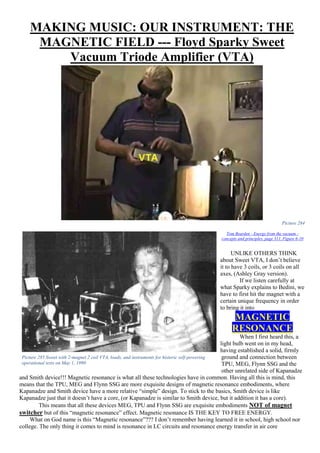
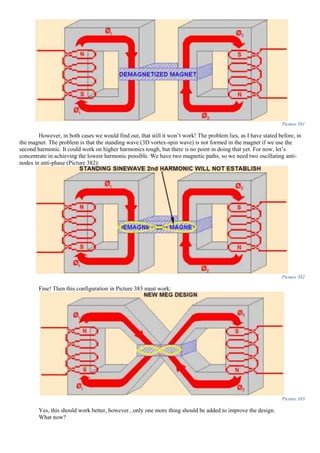
Column entitles sum contains this formula: =SUM(ABS(N2);ABS(W2)) (h1 with i1) it represents the resultant balanced
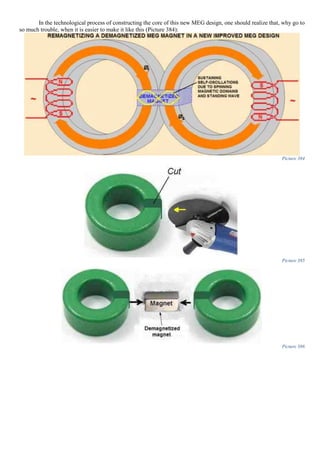
vectors strength.
Table is sorted in ascending order according to this last column. I want minimum electric field strength between
the wires. So it’s like trying to avoid large discrepant neighboring numbers, like avoiding winding the first turn near the
last (1 and 7 gives a discrepancy/difference of 6) so the electric field strength will be higher if we wind the turns where
we have minimum discrepancy between them like first turn near the second (1 near 2).
I want to test this table, because I don’t believe is accurate.
Be my guest.
Ok. Let me see…I will take randomly the second entry in your table 3, 7, 4, 2, 6, 5, 1. In what pattern do I
arrange them?
The pattern I have started with:
Picture 1129
Ok. Now let’ see if we have the so called balance of nature crap….oh sorry I mean balance of electrical forces
or vectors or whatever. Hmm…Let’s see:
Picture 1130
So let me get this straight. What I have to do is this:
Picture 1131
Picture 1132 Picture 1133
Surface electric field equilibrium in the basic standard 150° step-
angle Rodin coil
Picture 1134
I don’t understand these numbers and arrows. Are they straight or bent? Are they vectors or field lines? I don’t
understand. I don’t understand those 12 numbers around the circumference, on what lines are they situated? In what
direction? I don’t understand. Why do they point from a low number to a high number? You are confusing me.
Ok. My bad. The arrows are reversed, but that’s not the point. The point is equilibrium. Maybe this picture will
make things more clear:
Picture 1135
Why are some vectors shorter? Does the electric vectors ends there?
Don’t be foolish. No. Of course not. The electric field is everywhere around the torus. The vectors length are
just a mathematical representation of their strength/intensity which drops with 1/r3
. If you really want to be academic
correct the term magnetic vector or electric vector should be avoided. The proper most correct affirmation will be
something like: “Field vectors tangential to the electrical field lines” or something like that. But again, that’s not the
point. The point is balance of vectors and reaching an equilibrium, not accuracy in expression.
Wait. What if these vectors are oriented in the other direction below the equatorial plane of the torus, such that
they cancel each other out?
No. You are wrong. Look:
Picture 1136
These electric field vectors have the same orientation above and below the equatorial plane of the main Rodin
torus.
Ok. So let me get this straight. You have 5 vectors that have the value of 2 in a clock-wise direction and 2
vectors of value 5 in the counter-clock-wise direction. So what’s the problem here?
The problem here, is that we can’t just say 10=10 and period. End of story. We have balance. We can’t say that.
Why not?
Well, it may seem like an equilibrium on paper, however it is not.
Why not?
Because the field vectors are too far apart. The resultant field vector of value 5 between turn 6 and turn 1 can’t
add-up with the one between turn 7 and turn 2.
Why not? Can’t we just transpose them towards the center of the torus?
No. Because they are too far apart.
I don’t get it. The last time I checked you did the same thing in a close packing the Rodin bunch of wires
together, when you determined that the stray capacitance can be exterminated. Isn’t this the same story?
No.
Why not?
Because this transposing and moving the vectors to a common central point is only valid if they are not too far
apart.
Hmm…So we can’t do the same in this case?
No. However we can say that the final conclusion is something like this: “Only one Rodin coil tends to electric
field equilibrium, but it doesn’t quite get there.”
We can say that only one Rodin coil is crying for its twin coil B. Coil A needs its brother coil B. They need
each other so that a stronger balance of electric field is reached.
Let’s see what happens with the electric field vectors when we wind the second coil B to the left:
Picture 1137
How can you add these vectors so easily knowing that they are not the same thing? They are not between equal
distant wires!
I know. Consider this just a mathematical puzzle. It’s just a verification. Something conceptual. Just a game.
Nothing serious. It doesn’t have to be good, nor right. It’s just something, you know…
No. I don’t know.
I’m just overstretching this equilibrium thing a little, to see where it leads…
Yeah right. It leads to insanity as always.
So let me get this straight. Do we or don’t we have equilibrium in this case?
No. we don’t. It may seem like an equilibrium by having 7 vectors of value 5 and 5 vectors of value 7.Again we
can’t say 35=35 because we are overstretching the superposition principle and this transposing of vectors to a common
center.
So what do we do?
Let’s try to connect coil A and coil B (to-the-left) in parallel. Let’s see now the electric field vectors:
Picture 1138
We are going nowhere with these. What are you after?
As you can see there is much electrical disbalance between the Rodin small turns. We have to find a way to neutralize
this. A method to reach equilibrium.
But how? This is impossible.
Nothing is impossible. Let me show you directly the end solution to this difficult problem. Look:
Picture 1139
No! No! No! I completely disagree! This is absurd and impossible! It's insane! No! You are ruining it! This is no longer
a Rodin coil! No! This is wrong! It can't be right! Think about it! You are disregarding the actual first description that
Marko Rodin is making regarding the winding technique. It must conform to the numbers flow pattern that Marko is
talking about in the mathematical fingerprint of God!
Picture 1140
You are ruining all of this. How can you do that? This is insane! Stop this right now! You have lost it! This is a wrong
track!
No. I don't think so!
You are insane! Haven't you heard what I just said?
Yes I did.
So??? How can you disregard the authentic original first description that Marko Rodin is making regarding the winding
technique? YOU ARE CONTRADICTING MARKO RODIN TEACHINGS!
Wake up!
My friend...I am awake. It is you who doesn’t see the big picture here.
Oh yeah, like you do...
Yes. Please, let me enlighten you to the fact that it doesn’t matter how you wind the coil, AS LONG AS YOU
PRODUCE THE SAME EFFECT.
Oh, yeah, right... Sure...and you know exactly what that effect is...
I have a pretty good idea...yes.
And what is that effect exactly?
The Nassim Haramein double torus field topology.
Right. Sure. However you say.
Please, listen. All I'm saying is that if you want to create the double torus magnetic field with the Rodin coil all you
have to do is make sure you are following 3 crucial steps:
1. Perfect 150degrees Rodin torus (sin15 rule between major and minor radius)
2. Wires perfectly laid on the surface of the torus (especially at the center!)
3. Fire/power coil A and coil B in opposition.
and optionally if you want to strengthen the field you could try to create the non-twisted double torus by winding the
other "to-the-right" winding.
But if you want such a coil to work with low resistance and no damping at high frequency then exterminating its stray
capacitance is crucial. The point that I'm trying to make here is that we are just magnetically activating certain areas on
the surface of the Rodin torus such that the double torus field is naturally formed.
However I have started this study regarding the Rodin coil stray capacitance because I'm concerned about how it will
operate at natural high frequencies.
Why high frequencies?
I have already told you! Because that is what the established standing wave condition in the wire dictates.
And why is the standing wave dictates this?
Because we want to capture the energy particles (remember the particle-wave duality!) inside the wire.
"Energy particles?" Seriously? Are you really listening to yourself? Do you know how that sounds like?
No.
It sounds INSANITY! You are crazy!
No. My friend. The energy in our device comes from LC oscillations, right?
Right
These oscillations are waves, right?
Right.
So according to particle/wave duality then these waves are also particles, right?
I guess so...Where are you getting at?
So if we agree until now, then it means that the natural LC oscillations in our coil and capacitor setup must come from
these particles, right?
Well...I guess you are right, but I don't see where you are going with this.
My point is that if we can somehow trap these particles such that they don't escape the wire/coil (like small ping-pong
balls inside the wire) then our LC oscillations will not decay.
Hmm...I see...
So, we can exterminate damping through this theoretical concept. This is where the standing wave occurs naturally, if
the LC frequency is directly proportional with the wire length (see the Magnetic resonance cornerstone equation back in
the Don Smith device study chapter)
I still don't agree with you. It seems to me that this new idea of cutting the original Rodin coil winding in 12 separate
lemniscate shaped coils is creating more problems than is solving. For instance, doesn’t this shorten the wire length,
thus increasing the standing wave frequency, making it harder to reach for the LC oscillations to be in tune? How is this
better?
My friend. You don't seem to understand. Increasing the standing wave frequency by shorting the wire length is not a
problem.
Really?
The real problem is stray capacitance or complete obliteration of electrical forces between turns in the Rodin coil.
Why do we have to do that again?
Because we seek natural LC oscillations. And it will naturally oscillate at high frequency. Thus stray capacitance
between the turns is a very concerning problem. It will create resistance and damping. This is a serious problem. So if it
means that we must move beyond 500MHz in operation just to eliminate our problem, I say it's worth it. Exterminating
stray capacitance is crucial, while increasing or decreasing the standing wave frequency is of less importance. In theory
the Rodin oscillator should work at any standing wave frequency, as long as it doesn’t have stray capacitance. So
splitting the Complete one full Rodin turn into 12 separate independent coils is the best approach in solving this issue.
And besides, the LC oscillations won't have to catch the high standing wave frequency. You got this all reversed. The
LC resonant frequency will be higher than the standing wave frequency dictated by the wire length.
Please, look and understand that the same field will be created, the same operation, the same effect, the same
oscillations. This is because we are activating the wires on the surface of the torus in the same manner. The current flow
is in the same opposing directions. The same “shear” is created. The same areas are activated on the surface of the torus.
Everything is the same.
I don’t get it. So what’s different? What are you really modifying in the Rodin coil design?
Look:
Picture 1141
What we see here is only one of the 24 coils from our new Rodin coil design. The coil next to it (10 degrees apart) will
be connected at the capacitor electrodes in reversed, such that the same area on the surface of the torus is activated and
the current will run in opposing directions.
What we could argue about is that there aren’t 24 lemniscate coils, but 48 because we have the others in the other
direction too. But I say to you that it’s clear you don’t understand this new winding technique. There are not 48
lemniscate shaped coils, but there are a total of 24 lemniscate shaped coils. The reason is because, when you wind the
Rodin coil in this fashion, you already have both “to the left” and “to the right” winding techniques embedded within
the lemniscate shaped coil. If you look closer at the above picture, you will notice that the second half of the lemniscate
is already oriented in the “other” direction than the first half. If you wind 24 of these coils on this frame (Rodin
bottom/lower/first capacitor electrode – first electric grid) then you will have both “to the right” and “to the left”
windings done.
Note that the sections in blue are laid on the Rodin bottom/lower capacitor electrode while the red sections of this one
lemniscate coil is suspended in midair because it must receive underneath other blue sections from the other
independent lemniscate coils with different angles.
Look closer:
Picture 1142
This is because the complete Rodin system made out of both to the left and to the right winding technique is made out
of two layers. The first layer for the wires let’s say will be for the “to the left” winding technique and the second layer
for the Rodin system coil is the other “to the right”. So we have two layers, but we must wind each lemniscate separate
to exterminate stray capacitance which is a very big deal at those natural high operating frequency that our device
requires (again dictated by the standing wave) (that in turn is dictated by the wire length).
You will probably say that it’s extremely hard to build such a design, but I say otherwise. The technique is
simple and elegant. You wind the blue section for all the 48 coils and then you wind the rest of all red sections from all
the coils.
MARKO RODIN FREE-ENERGY GENERATOR
FINALLY DEBUNKED
Picture 1143
You are kidding me here, right?
No.
Where’s the on/off switch?
There is no such thing.
What?
You need to shift your mind set.
I don’t understand. What do you mean? Don’t do psychology crap with me. Just answer the question.
You don’t need an on/off switch.
You are making me angry. Just tell me then how does it stop, and how does it start?
Remember what I said that Man needs God, but God also needs Man?
Oh…Don’t! Just don’t give me that mystical crap again!
Please understand…
Oh…here we go again…
Please, I’m begging you…understand…and remember what I said, that if all sentient conscious beings in the
entire Created universe suddenly all vanishes, then you have killed God. Because it’s a paradoxical relationship of Man
and God. One needs each other.
Oh, boy! You just can’t cut this mystical crap and approach this in a scientific fashion?
No. I can’t. It’s in my blood.
I didn’t asked you how to kill God, I asked you where is the on/off switch. Can you just pretend then, you do
understand the question?
It is you who doesn’t understand here. Open your eyes and see that it’s the same paradoxical relationship here
between the generator and the load.
I don’t get it.
You connect a load, the device starts. You disconnect it and the device stops.
Yeah, right. And I’m Santa Claus.
You unbeliever. Look how it works:
Picture 1144
Field lines never intersect, however exception being the source point charges of any dipole (they are intersection points). Picture is intended to study geometrical patterns and not field
lines.
Picture 1145
Field lines never intersect, however exception being the source point charges of any dipole (they are intersection points). Picture is intended to study geometrical patterns and not field
lines.
Picture 1146
Field lines never intersect, however exception being the source point charges of any dipole (they are intersection points). Picture is intended to study geometrical patterns and not field
lines.
Picture 1147
Field lines never intersect, however exception being the source point charges of any dipole (they are intersection points). Picture is intended to study geometrical patterns and not field
lines.
All these pictures with space and stars will probably make happy a lot Rodin coil fans that believe it to be a
starship. I firmly argue and reject such nonsense crappy ideas from all lunatics. These people are really out of their
minds.
I don’t think so.
Oh great! Now you are one of them.
Look at this link here and what YouTube user Giesbert Nijhuis presents.
Picture 1148
Maybe he’s right, maybe he is not. Either way there is a connection.
Fine then. You make me mad. I could also be insane like them saying that the Rodin coil is actually the device
that creates the ZPMs (Zero-Point Modules) which are indeed just highly energized/polarized special crystals that we
see and hear about in Stargate TV series, but I’m not going to say that. If you walk and look too much towards the sky,
you will probably stumble on a rock or fell in a ditch or something. So let’s get real. Let’s be serious about this and look
at what we have in our face for what it really is, not for what we wish it to be. Let’s have a dose of cold blood in us so
that we can think with detachment and clarity.
Aha…great! Hurray! Let’s get free energy:
Picture 1149
What do you think you’re doing?
I’m extracting energy from the vacuum, dude! All right! Let’s get down to business!
Stop that immediately!
Picture 1150
Why? What are you doing, men?
DON’T YOU EVER DO THAT AGAIN!!!
Why? I don’t understand 
You bet you don’t understand! That’s not how you do it. It obvious that either you have skipped too many chapters in
this book, or you didn’t understood a dime.
Come on men… don’t be so hard on me…
Yeah. Right. Look. You are ruining the standing wave that is established in the coil. This generator is so sensitive, that
if you place it on a table, it will not work anymore. If you hang it suspended in midair, it will start again. If you mess
around with a core, magnet or something ferromagnetic around it will stop. It has a very fragile equilibrium because of
the extraordinary immense Q factor.
Sure, dude. Whatever you say. Just tell me were to plug my light bulb.
You are annoying me. Look, the energy must be collected with an additional collector coil that is just coupled
through induction with this generator. Your “plug” is in the field. It’s a virtual “plug”. Your collector coil is around the
central lemon.
Picture 1151
We must ask ourselves how on earth are we going to squeeze 4 layers of wires in the center hole of the torus such that
all of them conform symmetrically on the perfect Rodin Abha sheet torus infinitely thin sheet? How?
Take a look at this:
Picture 1152
Note the deviation from the straight line of each lemniscate that the Rodin bottom/lower electrode is made of. This
deviation is not an accident nor an error. It is by design and it is crucial. This deviation is also present at the upper
Rodin capacitor electrode:
Picture 1153
The purpose as you probably have guessed is to center the perfect Rodin-Abha sheet torus between the two layers of the
Rodin both systems coils, so that at the same time the same perfect Rodin-Abha sheet torus is situated perfectly centered
between the two Rodin capacitor electrodes.
Look closer and understand and see how much deviation is required to fit nicely and neat all the wires at the center:
Picture 1154
Here is a closer look:
Picture 1155
A 2D representation of this:
Picture 1156
Rodin wire radius to torus radius ratio
Why do we need this?
Ok. This ratio is very important.
Why?
Because, if we walk on the idea that the best way to wind Rodin coils is to fit the wire perfectly on the 10 degrees inside
inner circumference of the torus then such a ratio will come in naturally.
I don't get it. What are you talking about here?
Look at this:
Picture 1157
Hmm... Interesting so what?
This is important!
I don't get that. Why is this important?
Because if we take in the idea that a good way to increase the magnetic field intensity developed by the Rodin coil is to
fit the wire inside the maximum available space, which is 10 degrees in our case, then there must be a formula.
Ok. I got it. But I don't really understand why there will have to be a ratio or a formula for this.
Ok. Look at this:
Picture 1158
Hmm...
So you see? This ratio is important so that the wire diameter is exactly the same with arc-length of 10° (NM) of the
torus hole.
If we know the small radius r of the inner torus hole we can determine the maximum wire size diameter (including
insulation) and vice-versa. If we know the wire diameter (including insulation) we can determine the radius of the
perfect infinitely thin sheet Abha Rodin 150° torus such that the wires fit nicely on the surface of the torus.
So what we need is to determine a relationship between segment KH and segment AC, where KH is the Rodin coil wire
diameter and segment AC is the small radius “r” of the inner hole of the torus.
|𝐾𝐻| ⊥ |𝐴𝐶| (𝑠𝑒𝑔𝑚𝑒𝑛𝑡 𝐾𝐻 𝑝𝑒𝑟𝑝𝑒𝑛𝑑𝑖𝑐𝑢𝑙𝑎𝑟 𝑡𝑜 𝑠𝑒𝑔𝑚𝑒𝑛𝑡 𝐴𝐶) Equation 332
𝑖𝑛 𝑡𝑟𝑖𝑎𝑛𝑔𝑙𝑒 ⊿𝐻𝐷𝐴 𝑤𝑒 ℎ𝑎𝑣𝑒: {
∡𝐻𝐷𝐴 = 90°
∡𝐷𝐴𝐻 = 5° 𝑏𝑒𝑐𝑎𝑢𝑠𝑒 |𝐷𝐴| 𝑖𝑠 𝑏𝑖𝑠𝑒𝑐𝑡𝑜𝑟 𝑜𝑓 𝑜𝑢𝑟 10° 𝑎𝑛𝑔𝑙𝑒
∡𝐷𝐻𝐴 = 85° 𝑏𝑒𝑐𝑎𝑢𝑠𝑒 𝑡ℎ𝑒 𝑠𝑢𝑚 𝑜𝑓 𝑎𝑙𝑙 𝑎𝑛𝑔𝑙𝑒𝑠 𝑖𝑛 𝑎 𝑡𝑟𝑖𝑎𝑛𝑔𝑙𝑒 𝑖𝑠 180°
Equation
333
𝑡ℎ𝑒𝑟𝑒𝑓𝑜𝑟𝑒 ⟶ 𝑏𝑦 𝑎𝑝𝑝𝑙𝑖𝑛𝑔 𝑎 𝑡𝑟𝑖𝑔𝑜𝑛𝑜𝑚𝑒𝑡𝑟𝑖𝑐 𝑓𝑢𝑛𝑐𝑡𝑖𝑜𝑛 𝑤𝑒 𝑐𝑎𝑛 𝑤𝑟𝑖𝑡𝑒: tan(𝐻̂) =
|𝐷𝐴|
|𝐷𝐻|
Equation
334
We can also write:
|𝐴𝐶| = |𝐷𝐴| + |𝐶𝐷| Equation 335
Let’s replace for convenience notation segment DH with small letter “i”
But segment CD is the same as segment DH, therefore:
|𝐴𝐶| = |𝐷𝐴| + 𝑖 Equation 336
By substituting further we have:
|𝐴𝐶| = 𝑖 ∗ tan(85°) + 𝑖 ⟹ Equation 337
𝒓 = 𝒊 ∗ (𝟏 + 𝐭𝐚𝐧( 𝟖𝟓°)) Equation 338
Or a more general formula:
𝒓 = 𝒊 ∗ [𝟏 + 𝐭𝐚𝐧 (𝟗𝟎° −
𝑨𝒏𝒈𝒍𝒆 𝒑𝒆𝒓 𝒔𝒆𝒄𝒕𝒐𝒓/𝒃𝒂𝒏𝒅
𝟐
)] Equation 339
Where:
r-small radius of the torus (radius of the inner hole of the torus) such that the perfect sin15 infinitely thin sheet torus lies at the center of the wires; It’s not the ideal radius, it’s the true
radius such that the ideal thin sheet torus forms in the middle of the wire. So this radius is slightly larger than ideal to accommodate for this. We are not winding the wires ON a perfect
sin15 torus, but on a different torus, such that the perfect infinitely thin sheet torus is formed in the middle of the wires.
i-radius of the Rodin coil wires;
This formula is always valid no matter the step angle. Angle per sector/band can be found in the table for all
valid Rodin step-angles configurations given previously in this book.
Where r is the small radius of the Rodin torus inner hole, and small letter “i” is the radius of the Rodin coil wires, and
there we have our much desired relationship/ratio/formula.
However, this is not so much important as we have originally thought, because the perfect-Rodin-Abha-infinitely-thin-
sheet-torus is situated elsewhere. Look:
Picture 1159
As we look at the above picture, we might say that we have achieved our goal, but that’s not quite true because we are
forgetting something. We are forgetting that we have two layers of Rodin coil wires one layer that is winded “to the
left” and the other layer above the first one that is winded “to the right”. Therefore the truth looks like this:
Picture 1160
We can see in the above picture the serious error in our previous determination. The error is due to the fact that the
perfectly Rodin Abha torus infinitely thin sheet (in yellow) must go between the two layers, where in our case it crosses
through the middle of the first layer since segment TO is equal to segment TU. But segment TU is not the same as
segment P1P2 and so at the second layer of the Rodin coils we are no longer respecting the 3rd
un-winded band where
there must not be any wire. The problem is that the segment P1P2 (not drawn) is even shorter than represented since the
wires in the second layer at point Z and Y are intersecting each other. This is not possible in practice and therefore by
squeezing them together, the empty space P1P2 will be even smaller, and our previous calculation will be erroneous.
What we need is to accurately determine the wire diameter to torus radius ratio.
The next step will look like this:
Picture 1161
However, as we can see, the first layer has a larger empty space than required, so it’s still no good.
We need to center the so called “yellow perfect-Rodin-Abha-infinitely-thin-sheet-torus-sin15°rule-150°step-
angle-perfect-ideal-torus” (let’s call it in short for now yellow circle), we need to center this yellow circle between the
two wires/layers of the Rodin coils.
As long as the empty space is larger in the first layer (wires at points X, Y, W) than the ideal correct spacing at
the second layer between point G and point O.
The solution may prove elusive at first, but the way to balance this spacing is to average it out. This means that
neither the two layers will have the correct spacing. We will reduce the spacing between point G and O so that the space
between wire Y and wire W in the first layer decreases in the same amount as the second layer.
Picture 1162
This translates in geometry terms as centering the virtual wire between the two layers (circle in red) on our long
name yellow circle.
Note that the two section marked in black in the right portion of the picture are now equal due to the average
law.
Now let’s think how we can express this mathematically:
First we acknowledge that both our wires in the first layer and second layer have the same diameter as the virtual wire
between them marked in red in the right side of our picture. Then we realize that the radius AN (segment from the
center of the torus point A to point N (outer edge of the red circle), this segment [AN] can be easily calculated from our
previously determined formula.
|𝐴𝑁| = 𝑖 ∗ (1 + tan(85°)) Equation 340
Where small letter “i” is the Rodin coil wire radius
Then we just add the segment ND to our formula and there we go:
𝑇𝑟𝑢𝑒 𝑟𝑎𝑑𝑖𝑢𝑠 𝑟 = |𝐴𝑁| + 𝑖 = 𝑖 ∗ (1 + tan(85°)) + 𝑖 Equation 341
𝑻𝒓𝒖𝒆 𝒓𝒂𝒅𝒊𝒖𝒔 𝒓 = 𝒊 ∗ ( 𝟐 + 𝐭𝐚𝐧( 𝟖𝟓°)) Equation 342
Let’s give two examplesfor all of our work:
1. Let’s assume we have a multistrand/multifilar PVC insulated copper wire with a diameter of 4,7mm. To
accurately build the perfect torus frame such that the wires correctly respect the empty space between them
(first and second layer), we will apply our formula, and have:
𝑇𝑜𝑟𝑢𝑠 𝑠𝑚𝑎𝑙𝑙 𝑟𝑎𝑑𝑖𝑢𝑠 𝑟 =
4,7
2
∗ (2 + tan(85°)) = 2,35 ∗ 13,43 = 31,56𝑚𝑚 Equation 343
And by applying the formula which is very well known by now:
𝑇𝑜𝑟𝑢𝑠 𝑙𝑎𝑟𝑔𝑒 𝑅𝑎𝑑𝑖𝑢𝑠 𝑅 =
31,56𝑚𝑚
sin(15°)
=
31,56𝑚𝑚
0,259
= 121,94𝑚𝑚 Equation 344
2. We have a torus frame with a total Diameter of D=155,3mm. We are being asked: What is the maximum
admissible wire diameter we could use such that the 3rd
un-winded empty band/space is accurately respected
between the wires at the center hole. If we use a wire to thick we will squeeze it too much at the center and we
will no longer have an empty space between the wires which must be equal to a wire diameter.
So, again, what is the maximum admissible wire diameter we are allowed to use?
To answer this question, we use the same formula:
𝑖 =
𝑟
2 + tan(85°)
Equation 345
Where i is the wire radius and r is the torus inner hole radius
We use the well rooted formula for perfect Rodin torus:
𝑑 = 𝐷 ∗ sin(15°) = 155,3mm ∗ 0,2588 = 40,2mm
So the radius r will be 20,1mm
Then our wire radius will be:
𝑖 =
20,1𝑚𝑚
13,43
= 1,49mm Equation 346
therefore our wire diameter will be ≈3mm (≈AWG 9)
Make note to the fact that this formula applies to the wire including insulation!
Picture 1163
Picture 1164
Designing a new improved ultra-efficient energy collector system for
the Rodin LC tank circuit self-oscillating generator
Aici link catre acel individ cu CW CCW
Despre asta
Actually we are designing a new improved Rodin self-oscillator collector coil system. A system and not coil because
this new model doesn’t use a coil or a solenoid any more. It takes a whole new different shape and design. But we will
get to that in a minute. For now, let’s stick to things we do know.
The first step towards improvement of energy collection is of course to short-circuit the collector coil, such that we have
maximum energy feedback at 90 degrees at resonance thus helpful BEMF, such that the Lenz law helps the Rodin
longitudinal double torus electro-magnetic field and doesn’t fight against the dynamics in the system. Again, let’s see
this collector coil:
Picture 1165
Field lines never intersect, however exception being the source point charges of any dipole (they are intersection points). Picture is intended to study geometrical patterns and not field
lines.
BEMF is at resonance and 90 phase shifted from the LC oscillations. Thus the load helps the internal oscillations
(because of the geometry/topology/field formation). So we seek maximum help, we seek to maximize internal
oscillations, therefore we seek maximum load (short-circuit).
So let’s decrease the loop radius:
Picture 1166
Field lines never intersect, however exception being the source point charges of any dipole (they are intersection points). Picture is intended to study geometrical patterns and not field
lines.
I still don’t think it’s good.
Why not?
I want more load.
How much?
Maximum. Hell! Infinite maximum!
Hmm…
Now, listen how I’m thinking. Look back at the previous picture for a second. I mean, the more short-circuit this coil the
better it works. The more load we attach the better it works. Hmm…are you thinking at what I’m thinking?
Hell, Yeah! Let’s bring it on, baby! Let’s go for many more one-turn short-circuited coils around this lemon, because
inside this lemon is where the magnetic lines of force get stronger. So then, let’s build more short-circuited collector
coils:
Picture 1167
Field lines never intersect, however exception being the source point charges of any dipole (they are intersection points). Picture is intended to study geometrical patterns and not field
lines.
Why are we doing this?
Because I want to stress the magnetic field where it’s the most intense.
Now, when we look at this picture, we again must ask ourselves: “Why stop here?” Let’s make infinite numbers of such
short-circuited collector coils until they become only one turn! Look:
Picture 1168
Field lines never intersect, however exception being the source point charges of any dipole (they are intersection points). Picture is intended to study geometrical patterns and not field
lines.
We need a some kind of a support like a leg for this geometry, which will not interfere with the EM field. Maybe a
wooden support in the middle where there is no field at all.
You mean, something like this?
Picture 1169
Yes. Exactly. Hmm…Is it just me, or does it look like…Oh my God!
No.
Oh My God! Don’t you see?
No. See what?
What this is?
Yes. It’s a short-circuit collector coil for the Rodin coil working at resonance where the BEMF from the coil helps the
formation of the double torus magnetic field, helping the entire field to form, helping the internal oscillations, the more
the load, the better it works, not affected by any load attached. Is this what you mean?
No. I mean, yes, but besides that, don’t you see?
No.
It looks like…
Like a short-circuit collector coil?
No. Stop it. It looks like…you know…that sacred cup!
No. I don’t know. All I know is that it’s just a short-circuit collector coil for the Rodin double torus magnetic field.
That’s what it is. Nothing more. Nothing less. The rest is just gibberish. Stop looking at things for what you wish them
to be, and take them as what they really are! Be more objective!
So this cup/lemon/dipole however you want to call it, will behave like a short circuit collector for any line of
force produced by the Rodin magnetic grids that cuts through its surface. Lenz law will come in and the energy in the
magnetic field gets transferred to this short-circuit with a 90 degrees phase shift (because we are working at resonance)
and push back the field from the Rodin magnetic grid and exerting a new one of its own. This cup/lemon/dipole will
now have the same exact field that had the Rodin double torus field at maximum intensity.
<picture of the animation>
Wire radius to Rodin torus radius ratio determination
Tell me again, why is this determination important?
Because I want maximum magnetic field intensity between the wires at the center, so in order to do that, I have to bring
them as close as possible one near each other. So at the center (inner circumference of the torus) the wire radius will
occupy 10 degrees arc-length on the inner circumference center torus hole (small r). So let’s start by looking at this:
<picture with one row of wires>
<Equations>
However, this design is wrong. The reason is because of the infinitely thin perfect 150° ideal Rodin Abha thin sheet
torus with sin15 rule between the torus parameters must sit between the two layers Rodin coils like this:
<small picture here>
So in order to do that we must look at this:
<Cinderella picture here>
Self-intersecting the Rodin capacitor bottom/lower electrode (to-the-right and to-the-left “winding” directions)
Why not wind the unshielded/un-insulated solid block aluminum/copper wire in the 3rd
band between the
magnetic grid wires, like so:
<picture here>
But this design is flawed from a number of reasons. First the ….
CONECTIONLESS Rodin LC tank circuit for the natural HF
operation dictated by the standing wave in the wire
Picture 1170
Building the Rodin LC tank circuit
We must build this:
Picture 1171
Due to natural high operating frequency of the coil dictated by the
standing wave the structure must not have ferrous materials in it.
Everything must be built from non-ferrous conductive materials!
Such materials are the following (see link here): Important non-ferrous metals include aluminium, copper, lead,
nickel, tin, titanium and zinc, and alloys such as brass. Precious metals such as gold, silver and platinum and exotic or
rare metals such as cobalt, mercury, tungsten, arsenic, beryllium, bismuth, cerium, cadmium, niobium, indium, gallium,
germanium, lithium, selenium, tantalum, tellurium, vanadium, and zirconium are also non-ferrous.
From this list the most accessible are Aluminium and copper since they are used in wire manufacturing.
The Rodin coils should have insulation since we don’t want them to make contact with the Rodin capacitor electrodes
all over the place, and should preferably be multi-strand (multifilar) wires due to the skin effect at the natural high
operating frequency of the device. The Rodin capacitor electrodes should be UNSHIELDED (un-insulated/no-
insulation) wires made from solid aluminium or copper (single strand wire) (mono-block). No insulation for the Rodin
capacitor electrodes is essential because it will act like a dielectric between the electrodes and store energy in it. Their
round crossection is imperative for the proper operation of the device because we seek maximum field divergence
between the upper and lower/bottom electrodes, because we want maximum EXTERNAL field and MINIMUM
INTERNAL field between the electrodes. Therefore maximum divergence is imperative. Circular cross-section for the
Rodin capacitor electrodes is imperative for the maximum field divergence between them!
Looking at our final design it will make us dizzy just by observing the complexity alone, and not considering the
building phase. But we must start building it somehow, so let’s try it in the way presented below. However, if you think
you know a better way, go ahead. I’m not saying that this is it, or this is the way, or it is this way, or that my way is the
only way. No. You build it how you think it’s better for you. I’ve scratched my head for days in a row thinking how can
I make the technological process of execution/building easier. I have found none such way. However the new 3D
printing technology is creating a revolution is mass-production in general and could be used to quickly manufacture one
of these oscillators.
First we will start by dividing the Rodin lemniscate in 4 quarters. This is done in order to build the Rodin
bottom/lower capacitor plate from the elemental “brick” if you know what I mean. From a logical point of view this
brick is the smallest element in the design that is similar with other elements. The smallest “building block” that the
Rodin LC tank generator does. Quarter of a lemniscate:
Picture 1172 Picture 1173
Each lemniscate in the Rodin capacitor electrode must have the proper cuts/recess/incisions/notches/indentations or
however you want to call them at the right spots:
Picture 1174
Now we must bring them together and sew them like so:
Picture 1175
And continue on like this:
Picture 1176 Picture 1177
Damn. Feel like I’m hunted by the satanic inverted pentagram:
Picture 1178 Picture 1179
Just turn it upside down, and it’s a good symbol. And it’s not satanic at all.
Picture 1180 Picture 1181
If you just open your mind and learn from history, then maybe you will understand, that it’s just a symbol that is more
than 6000 years old and represents the creative AND destructive elemental forces of this world and nature and also a
symbol for the five human senses that connect man to this world and through which he experiences everything around
him, and maybe as some will think that by this connection it departs one from God. Read this link here if you still have
doubts.
However, let’s continue on with our device:
Picture 1182 Picture 1183
Picture 1184 Picture 1185
I see deer horns and antlers everywhere…
You have a sick imagination, you know that?
Yeah. I do.
We are almost done:
Picture 1186
And we are done with half the torus above the equatorial plane:
Picture 1187 Picture 1188
We repeat the process for the other half below the equatorial plane and we should end up with something like this:
Picture 1189 Picture 1190 Picture 1191
Now on top of this bottom/lower Rodin capacitor electrode we wind the individual 48 Rodin lemniscate coils, two by
two, where one is going one way, while the other in the opposite direction, like this:
Picture 1192
Picture 1193
And we continue like this winding the first layer of the Rodin magnetic grid:
Picture 1194
<an insane amount of info missing here (at least 400 pages or more, the insights are overwhelming, I don’t know when
I’m going to finish this section. I can’t keep up the work in the book with the visions that I have>
RODIN CAPACITOR SPHERES 3D COORDINATES
CALCULATION
Why is this important?
Because we need the exact coordinates in 3D, meaning x,y and z for each intersection point between the Rodin
lemniscates that lie on the perfect Rodin sin15 torus.
Yeah, but why?
Because, in order to create the Rodin oscillator 3D model, we are going to need them.
Why would we need to create the 3D model?
Because it’s a blueprint, a schematic, a diagram, the model upon we develop, the design that we need to put into
practice. The plan that we make before we materialize it.
Let’s go ahead and do that. At first glance, one might think that these intersection points, (x,y and z values) can
only be determined using advanced math and calculus (integrals and differential equations):
However, for those who are good at calculus, it might be simpler, but for those who are not so well educated in
math it might prove a challenge.
Wait. I’m confused. I thought there were supposed to be two wires side by side in the standard Rodin coil, you
have only one here.
I hate to break this to you, but you must wake up. We are talking about the Rodin capacitor, not the Rodin coils.
The Rodin capacitor is formed in-between the wires, remember? To shield the returning magnetic flux path, ring any
bell? Thus strengthening the double torus, and to create the double torus electric field also…remember? Ring any bell?
Oh, yes. Sorry.
Good morning.
I believe that we need the polar equation for our standard 150 degrees Rodin lemniscate/ hippopede, and then we
make it equal with the other lemniscate equation that we want to know the intersection point’s coordinates. I think that
will make a differential equation with 4 solutions (one for x and y and two for z above and below the equatorial plane).
Now the thing is that I’m no expert in this type of advanced math and calculus, and I think we need elliptic integrals for
this thing. I believe this is studied in Calculus 2. Since I only studied calculus 1 at university, and even more than that
I’ve even cheated at the exams back then. But hey, I won't tell if you don't tell. So now I suffer the consequences by not
knowing how to solve these types of problems. What can I say…I’m only human. So I guess it’s true when they say
“You only cheat yourself”. Well…at least I’m left with the ability to understand how it’s done it if someone else does it
and explains it.
Therefore we might be cornered to use Euclidean math. There is a way to determine these coordinates, one by
one and one at a time. It’s a very difficult task, but not impossible.
It may not be apparent where all this is going, but you will have to trust the next calculations, that will lead us to
our desired results.
First let’s see a top view of a very simple 150 step angle standard one Rodin coil configuration:
Then what we are going to need is determine these angles that the lemniscates (in our case chords) are making
between them:
To determine the x, y, z position in space (from the origin point A) for each of the lemniscate/chords
intersection points we are going to need to determine the angles QPR, STU, VWX, GYB. It’s a very long and hard way,
but if you know an easier method, let me know. I would love to know it.
Let me emphasize these angles for a clear view:
We are going to need just half of these angles. Let’s start with the angle QPR which is the same as QPS:
We need just half, because we actually need the angle CPS in our right angle triangle PSC. I’m not going to
insist too much on the demonstration, but our CPS angle is 75 degrees. This can be shown easily because it’s half of the
step angle (refer back to the beginning of the Rodin coil section in the book where we began speaking about step-angle).
We need this this angle because we are going to need to determine the hypotenuse CP. However we need
another parameter before applying a simple trigonometric function. The other parameter is segment CS. This segment,
although not apparent can be calculated based on the length of the lemniscate/chord seen from top view:
We can say that:
|𝐶𝐵| = |𝐶𝑆| + |𝑆𝑃2| + |𝑃2 𝐵|
𝑎𝑛𝑑
|𝑆𝑃2| = |𝑃0 𝑃1|
} ⇒ |𝐶𝐵| = |𝐶𝑆| + |𝑃0 𝑃1| + |𝑃2 𝐵|
And since
|𝐶𝑆| = |𝑃2 𝐵|
|𝑃0 𝑃1| = 2 ∗ 𝑟
} ⇒ |𝐶𝐵| = 2 ∗ |𝐶𝑆| + 2 ∗ 𝑟
Where r is the small radius of the torus according to my non-conventional torus parameters definition.
Our main step-angle CAB determines the length of our lemniscate/chord CB and it’s:
𝐶𝐵 = 2 ∗ 𝑅 ∗ sin(
𝑠𝑡𝑒𝑝 𝑎𝑛𝑔𝑙𝑒
2
) = 2 ∗ 𝐶𝐴 ∗ sin(75°)
But: |𝐶𝐴| = 𝑅 where R is the big radius according to my convention. Therefore we can finally write:
2 ∗ |𝐶𝑆| + 2 ∗ 𝑟 = 2 ∗ 𝑅 ∗ sin(75°)
And, although may be irritating repeating over and over that:
𝑟 = 𝑅 ∗ sin(15°)
So we have:
2 ∗ |𝐶𝑆| + 2 ∗ 𝑅 ∗ sin(15°) = 2 ∗ 𝑅 ∗ sin(75°) | /2
We can divide all the equation by 2 and we get that:
|𝐶𝑆| = 𝑅 ∗ [sin(75°) − sin(15°)]
Since:
sin(𝐴) − sin(𝐵) = 2 cos (
𝐴 + 𝐵
2
) sin(
𝐴 − 𝐵
2
)
We can write:
|𝐶𝑆| = 𝑅 ∗ 2 ∗ cos(45°) ∗ sin(30°) ⇒
|𝐶𝑆| = 𝑅 ∗
√2
2
Now, in our right angle triangle PSC we can finally write:
in ⊿PSC: cos(𝑃𝐶𝑆̂ ) =
𝑎𝑑𝑗𝑎𝑐𝑒𝑛𝑡
ℎ𝑦𝑝𝑜𝑡𝑒𝑛𝑢𝑠𝑒
=
|𝐶𝑆|
|𝐶𝑃|
We need segment CP, so
|𝐶𝑃| =
𝑅 ∗ √2
2 ∗ cos(15°)
In the end we are after something else. This is a close up of the tiny segment we are trying to calculate:
This black segment can be expressed:
|𝑃𝑃7| = |𝐶𝑃7| − |𝐶𝑃| = 2 ∗ 𝑟𝑐 −
(𝑅 𝑐 + 𝑟𝑐) ∗ √2
2 ∗ cos(15°)
But we already know by now, the golden rule for building perfect 150 step angle tori, which is for conventional
parameters:
𝑟𝑐 = 𝑅 𝑐 ∗ 𝑡𝑎𝑛2
(37,5°)
And for simplicity reasons, we will make the notation:
𝑘 = 𝑡𝑎𝑛2
(37,5°)
Therefore, our segment:
|𝑃𝑃7| = 2 ∗ 𝑟𝑐 −
√2 ∗ (
𝑟𝑐
𝑘
+ 𝑟𝑐)
2 ∗ cos(15°)
= 2 ∗ 𝑟𝑐 −
(𝑟𝑐 + 𝑘 ∗ 𝑟𝑐) ∗ √2
2 ∗ 𝑘 ∗ cos(15°)
=
[2 ∗ 𝑘 ∗ cos(15°)] ∗ 2 ∗ 𝑟𝑐
[2 ∗ 𝑘 ∗ cos(15°)]
−
(𝑟𝑐 + 𝑘 ∗ 𝑟𝑐) ∗ √2
2 ∗ 𝑘 ∗ cos(15°)
=
4 ∗ 𝑘 ∗ 𝑟𝑐 ∗ cos(15°) − √2 ∗ 𝑟𝑐 ∗ (𝑘 + 1)
2 ∗ 𝑘 ∗ cos(15°)
=
√2 ∗ [2√2 ∗ 𝑘 ∗ 𝑟𝑐 ∗ cos(15°) − 𝑟𝑐 ∗ (𝑘 + 1)]
2 ∗ 𝑘 ∗ cos(15°)
=
2√2 ∗ 𝑘 ∗ 𝑟𝑐 ∗ cos(15°) − 𝑟𝑐 ∗ (𝑘 + 1)
√2 ∗ 𝑘 ∗ cos(15°)
=
𝑟𝑐 ∗ [2√2 ∗ 𝑘 ∗ cos(15°) − (𝑘 + 1)]
√2 ∗ 𝑘 ∗ cos(15°)
I detest the fact that these trigonometric values for 15° angle are hard to come about:
𝐬𝐢𝐧( 𝟏𝟓°) =
√ 𝟑−𝟏
𝟐√𝟐
and 𝐜𝐨𝐬( 𝟏𝟓°) =
√ 𝟑+𝟏
𝟐√𝟐
I hate and resent the fact that these formulas are hard to find. In God’s name, WHY? Does these angles have
leprosy or something? Why aren’t they mentioned in standard tables for trigonometric functions values? Why are they
avoided? In God’s name, WHY? I’m tormented by this question. WHY? Maybe someone out there, reading this, will
know the answer, and will be kind to enlighten me. Please.
Maybe because they are hard to remember, and difficult to determine see here how. Maybe if they are omitted a
quick mnemonic can be used if the table has only 0,30,45,60 and 90 degrees angles (see here). Does this answer your
question?
Returning back to our segment, we resolve the trigonometric functions and we have:
|𝑃𝑃7| =
𝑟𝑐 ∗ [𝑘 ∗ (√3 + 1) − 𝑘 − 1]
𝑘 ∗
√3 + 1
2
=
2 ∗ 𝑟𝑐 ∗ (𝑘√3 − 1)
𝑘√3 + 𝑘
You may be wondering, why on earth we are interested in this puny and tiny detail.
Exactly! I don’t understand at what good does all this calculation for a tiny and insignificant |𝑃𝑃7| segment serve?
Fine! I really have to draw everything in order for you to understand. Let’s put things into perspective and try to
understand what we have determined. Look:
What we are really after is that angle α, right there. That’s what we need.
We must immediately recognize that the segment:
|𝐴𝑃7| = 𝑟 and |𝐹𝑃7| = |𝐹𝐺| = 𝑟𝑐
So we seek to express this angle α, based on torus parameters that we know.
Therefore in our right angle triangle GPF we write:
⊿𝐺𝑃𝐹: cos(𝐺𝐹𝑃̂) =
𝑃𝐹
𝐹𝐺
However, segment |𝑃𝐹| can be written:
|𝑃𝐹| = |𝐹𝑃7| − |𝑃𝑃7| and since we know
|𝑃𝑃7| =
2 ∗ 𝑟𝑐 ∗ (𝑘√3 − 1)
𝑘√3 + 𝑘
(𝑎)
We can say that:
cos(𝐺𝐹𝑃̂) = cos(𝛼̂) =
𝑟𝑐 − |𝑃𝑃7|
𝑟𝑐
⇒ ∡𝐺𝐹𝑃 = arccos (
𝑟𝑐 (1 −
|𝑃𝑃7|
𝑟𝑐
)
𝑟𝑐
) = arccos (1 −
|𝑃𝑃7|
𝑟𝑐
) (𝑏)
We substitute |𝑃𝑃7| in relation (b) with the one in relation (a) and we write:
∡𝐺𝐹𝑃 = ∡𝛼 = arccos (1 −
2 ∗ 𝑟𝑐 ∗ (𝑘√3 − 1)
𝑟𝑐 ∗ 𝑘 ∗ √3 + 𝑘
) = arccos (
𝑘√3 + 𝑘
𝑘√3 + 𝑘
−
2 ∗ (𝑘√3 − 1)
𝑘√3 + 𝑘
)
= arccos (
𝑘√3 + 𝑘 − 2(𝑘√3 − 1)
𝑘√3 + 𝑘
) = arccos (
𝑘√3 + 𝑘 − 2𝑘√3 + 2
𝑘√3 + 𝑘
) = arccos(
𝑘 − 𝑘√3 + 2
𝑘√3 + 𝑘
)
= arccos (
𝑘(1 − √3 +
2
𝑘
𝑘(√3 + 1)
) = arccos (
1 − √3 +
2
𝑘
√3 + 1
) = arccos(
1 − √3 +
2
𝑡𝑎𝑛2(37,5°)
√3 + 1
)
= arccos(0,97536324356886683994945127871821) ⇒
First level Rodin capacitor spheres angle ∡𝜶 =
𝟏𝟐, 𝟕𝟒𝟒𝟓𝟔𝟔𝟗𝟕𝟔𝟕𝟓𝟖𝟏𝟕𝟗𝟑𝟓𝟎𝟖𝟖𝟕𝟑𝟕𝟖𝟐𝟗𝟐𝟕𝟏𝟐°
I wouldn’t have given so many decimal numbers, if it weren’t important. Another thing that needs to be mentioned is
that this angle is independent of any torus parameters. No matter the size, shape, volume or whatever you can think of,
the standard angle for these sphere positions is 12,744566976758179350887378292712. This is how it is and how it
will forever be (for the standard configuration Rodin at least).
Next let’s calculate using the same method the second angle for the spheres on the second level (in respect to
the equatorial plane).
Saying this straight forward, we need that segment|𝑇𝑃0|, which we will determine knowing the dotted yellow
segment PT, that will be determined from the yellow triangle TRP.
Using the same analogy segment PR is part of the dashed red PX chord:
And thus we can write:
|𝑃𝑋| = |𝑃𝑅| + |𝑅𝑊| + |𝑊𝑋|
But:
|𝑅𝑊| = |𝑍𝑉| = 2 ∗ 𝑟 and |𝑃𝑅| = |𝑊𝑋|
Thus:
|𝑃𝑋| = 2 ∗ |𝑃𝑅| + 2 ∗ 𝑟 ⟺ |𝑃𝑅| =
|𝑃𝑋| − 2 ∗ 𝑟
2
We want to work with conventional torus parameters, as we did previously, so:
|𝑃𝑅| =
|𝑃𝑋| − 2 ∗ (𝑅 𝑐 − 𝑟𝑐)
2
=
|𝑃𝑋| − 2 ∗ (
𝑟𝑐
𝑘
− 𝑟𝑐)
2
=
|𝑃𝑋| −
2𝑟𝑐(1 − 𝑘)
𝑘
2
(𝑐)
Where k is 𝑡𝑎𝑛2
(37,5°)
In triangle PAX (as in movie K-PAX, nice one by the way: D, it would be nice to travel on a wave of light just like in Einstein dream) in order to
determine chord |𝑃𝑋| we have to acknowledge:
That the red segments PR and LU are parallel and blue segments PA and LM are also parallel. This means that angle
TPR is also 30 degrees just like angle MLU. Thus angle PAX has 120 degrees. You have to follow through. I won’t insert
another picture just to show that the sum of the angles of a triangle is 180. I expect the readers that survived following me until now, are intuitively
enough to understand.
Now we can write:
|𝑃𝑋| = 2𝑅 sin(60°) = 2(𝑅 𝑐 + 𝑟𝑐) sin(60°) = 2 (
𝑟𝑐
𝑘
+ 𝑟𝑐) sin(60°) =
2𝑟𝑐(𝑘 + 1) sin(60°)
𝑘
(𝑑)
Now, we replace |𝑃𝑋| in relation (c) with the one we have in formula (d) and thus:
|𝑃𝑅| =
2𝑟𝑐(𝑘 + 1) sin(60°)
𝑘
−
2𝑟𝑐(1 − 𝑘)
𝑘
2
=
2𝑟𝑐[(𝑘 + 1) sin(60°) − (1 − 𝑘)]
2𝑘
=
𝑟𝑐[(𝑘 + 1) ∗ sin(60°) + 𝑘 − 1]
𝑘
In our right angle triangle TRP we write:
Now, let’s make another notation:
|𝑃𝑅| = 𝑟𝑐 ∗ 𝑚; where
𝑚 =
(𝑘 + 1) ∗ sin(60°) + 𝑘 − 1
𝑘
We can also say that:
|𝑇𝑃0| = 2𝑟𝑐 − 𝑟𝑐 ∗ 𝑚 = 𝑟𝑐(2 − 𝑚)
Now, we look in the following cross-section in order to determine the angle β:
We can say:
cos(𝛽) =
𝑎𝑑𝑗𝑎𝑐𝑒𝑛𝑡
ℎ𝑦𝑝𝑜𝑡𝑒𝑛𝑢𝑠𝑒
=
𝑟𝑐 − |𝑇𝑃0|
𝑟𝑐
⇒ ∡𝛽 = arccos(
𝑟𝑐 − 𝑟𝑐(2 − 𝑚)
𝑟𝑐
) = arccos(1 − (2 − 𝑚)) = arccos(m − 1)
We call the substitution, and thus:
∡𝛽 = arccos (
(𝑘 + 1) ∗ sin(60°) + 𝑘 − 1
𝑘
− 1)
Second level exact value 26,879708477101128910998146576293
Third level exact value 44,706900803632793906871630332739
Forth level exact value 72,446053801408552261202563378368
Coming soon:
Holy Eucharist and holy baptism of Rodin oscillators better identified as Rodin torsion wave generators:
Picture 1195
Yes, there is a swinging magnet nearby. Experienced readers will know why. If you don’t have a huge magnet and you
like to sing, you could also activate it through singing. Yes singing, like in opening your mouth and letting sounds come
out. And no, I’m not kidding. Sound is electromagnetic energy. If you have a very high Q oscillator, then just a slight
input energy either from a magnet, sound, radiowaves, microwaves, etc. etc., just a small input can give it the “nudge”
to enter is self-oscillating mode. This is where the Marko Rodin discussion about the intonation of the name of God
comes into equation. It’s supposed to create just like Dan Winter is saying, a specific energy pattern. This torus is
supposed to be the prison for this energy pattern. This is the confinement for this energy pattern. This is the container
for this energy pattern. This Rodin oscillator torus is supposed to be the cup that retains this energy pattern inside it.
And the real true Rodin short-circuit collector coil/capacitor system (aka Holy Grail):
Quickly jumping far ahead of the things we will discuss:
The ultimate capacitor that creates an external double torus electric field, thus being a capacitor that never depletes is
kept in plain sight at the Vatican:
Of course such a grail, can’t be a capacitor since it made entirely out of non-ferrous conductive metal. But it can,
because it’s actually a short-circuit capacitor with an external field in the form of the double torus. IT CAN ONLY
BECOME POLARIZED IN THE DOUBLE TORUS TOPOLOGY INSIDE THE ABHA TORUS, (or inside a special
sound chamber/echo chamber sound amplifier cavern or what is known as “church” by singing, and we will speak a lot
more about this soon)
Electricity to magnetism longitudinal waves oscillator block LC circuit. This is a single rhomboid in our Rodin
oscillator.
We will also speak about the true Rodin coil connections that will have to be made in-between the capacitor grid, such
that the lengths of the wires will be the same as the lengths of the central grail, having the same wavelength, and
oscillating together based on the same standing waves on multiple of resonances, where we tend to imprint by a simple
baptism upon the substance in the grail an accelerated spin through room-temperature superconductivity thus creating
an asymmetrically deformed electron orbit spin of the atoms of the substance inside the cup which is done on a daily
basis in any orthodox Christian church by priests (aka transubstantiation).
MAPPING THE FLOWER OF LIFE ON THE RODIN ABHA
PERFECT SIN15 TORUS
You can see the yellow lines as the center one is the equatorial one, the one above and below is the first level spheres
and so on, on the entire torus surface. A trained eye will immediately see the flower of life emergence from this pattern
as the Rodin coil wires are ALWAYS defined as circle arcs. An even more trained eye will see that is not exactly the
flower of life, since it has only 4 corners and not 6.
As the wires pass/go through/pinch/intersect the perfect infinitely thin sheet perfect Abha Rodin torus ideal sin
15 rule perfect torus or however you want to call it situated perfectly between the two Rodin capacitor grids, as these
wires pass this theoretical surface let’s represent them with a different color to differentiate between them:
In yellow are wires connected to the upper/above capacitor grid and in orange are wires connected to the
lower/below Rodin capacitor grid. Or you can reverse them, depending on what type of particle spin you want inside the
grail (left or right).
Quite a remarkable resemblance all these chained circles (ultimate coil in existence) have with the knight’s
magical chain mail armors.
Another reason for the knights to wear them as they are injured, a simple song, by hitting a specific note, a
standing wave forms in their armor attaining theoretical superconductivity and thus accelerating the natural healing
process. At least in theory anyway. Amazing, don’t you think? I mean who says what is a miracle, magic or science?
Who draws the line? Who is that person who says this is magic, this is a miracle or this is science? Who?
In contrast to the 3D spherical flower of life under the lion paw in China, we have a toroidal flower of
life and not a spherical one.
The flower of life is formed on the perfect Rodin sin15 rule torus infinitely thin sheet, when the orange circles are
perfectly offset 60 degrees apart from the yellow ones above. Then another 4 invisible circles are formed in the missing
spaces, thus creating 12 points and creating two flower of life patterns on the torus surface.
We can see complex double helicoidal spirals on toroidal and poloidal directions as well on the lemniscate direction.
They are actually double elliptic helixes.
Complex electric field with magnetic field interactions and much more coming soon.
Working with magnetic flowers and searching the perfect primer with maximum resonance.
Artistic view – Multiple magnetic flowers build on a common center
Maxscript – “Quest for perfect primer v1.0 beta”without the central grail (run on workstation: Autodesk 3dsMax 2013 64-bit version 15 product update 6
Acer aspire V3-571G-53214G50Makk, Ivy Bridge Core i5-3210M @ 2.5GHz(TB 3.1GHz), Nvidia GeForce GT 630M (2GB VRAM), 8 GB RAM DDR3 1333MHz, Win 7 Ultimate 64-bit)
--Yeah, I know. This program is pathetic. It's sloppy, disorganized, and a complete mess. Yeah, well that's what my limited IQ has come up with.
--So if you feel smarter, good for you. Go ahead and improve it then. Be my guest. It's all yours. @All credits and rights are reserved to you. :D Enjoy this pile of rubbish…
viewport.ResetAllViews()
clearlistener ()
viewport.activeviewport = 4
max tool maximize
viewport.SetRenderLevel #wireframe
max create mode
global gap_to_sphr_ratio=0.3563123713d0 --for 0.35 the ENTIRE gap is 35% of ideal SPHERE RADIUS for that level (meaning the virtual sphere with its center placed perfectly on the Abha sheet torus
global mh_to_sphr_ratio=0.8038475513d0 --magnetic hole radius is 80% of ideal sphere radius for that level
global tor_sph=17
global pol_levels=1
global pol_sph=pol_levels*2+2
global r1=62
global r2=(r1*2)/3.41421356237309504d0 as double --33,9756126404
global Max_grail_len=r2*1.84030236902122022d0 -- r2*pi*(2-sqrt(2))
global torus_r_small=r1-r2 --or global r_small=r2/sqrt(2)
global torus_R_big=r1+r2 --or global R_big=(r2*(4+sqrt(2)))/2
--declare the sphres radii and spheres gap as arrays
global sphr_out=#()
global sphr_in=#()
global sphg=#()
global ideal_r=#()
global ideal_sphr=#()
global spin_direction=0 --CW 1 is for CCW
global plength=6.28318530717958647d0*r1 --first constant is 2*pi
global pwidth=3.68060473804244045d0*r1 --and second is 2*pi*2/(2+sqrt2)
--clear everything in the scene
select $*
if ($!=undefined) do delete $
function build_ring_array lvl ang= --first argument is the level we are building and second argument is the angle for that level
(
ideal_r[lvl]=r1-r2*cos(ang)
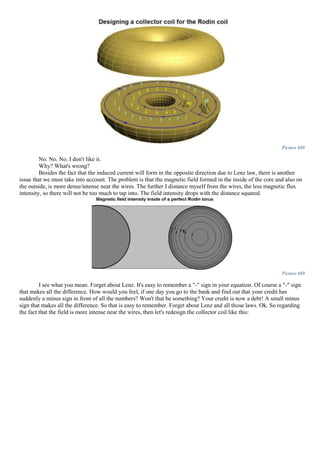
--print ideal_r
sphg[lvl]=(gap_to_sphr_ratio*3.14159265358979323d0*(r1-r2*cos(ang)))/(3*tor_sph) as double --sphere gap for level "lvl" note that the gap is defined for the virtual sphere with its center placed ON
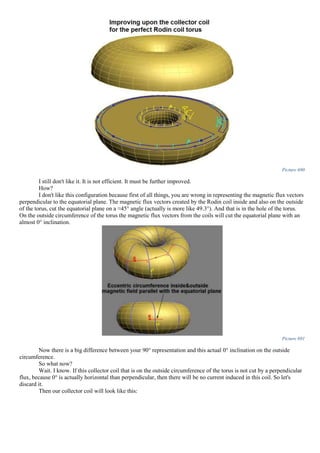
the ideal abha sheet torus
--print "constructing the spheres sphg[lvl] is"
-- print (sphg[lvl])
sphr_out[lvl]=(tan(60.0/tor_sph as double)*(ideal_r[lvl]-(sphg[lvl]/2 as double)*cos(ang)))/(1+tan(60.0/tor_sph as double)*cos(ang)) as double --sphere radius on the outside of the torus for level "lvl"
sphr_in[lvl]=(tan(60.0/tor_sph as double)*(ideal_r[lvl]+(sphg[lvl]/2 as double)*cos(ang)))/(1-tan(60.0/tor_sph as double)*cos(ang)) as double--sphere radius in the inside of the torus for level "lvl" (note
that this is larger than the previous one)
-- print "sphr_in[lvl]pt ring array :"
-- print (sphr_in[lvl])
real_r_out=ideal_r[lvl]-(sphr_out[lvl]+(sphg[lvl]/2 as double))*cos(ang) --actual radius of the ring array taken from the torus center to the outside sphere center of the outside ring array
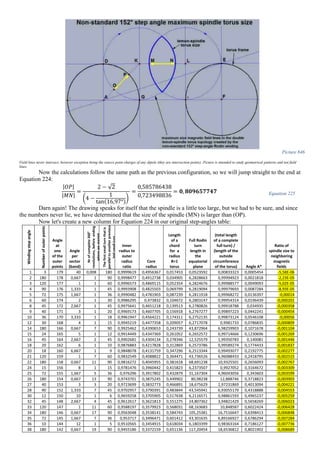
real_r_in=ideal_r[lvl]+(sphr_in[lvl]+(sphg[lvl]/2 as double))*cos(ang)--actual radius of the ring array taken from the torus center to the inside sphere center of the inside ring array (note that this is
larger than the previous one)
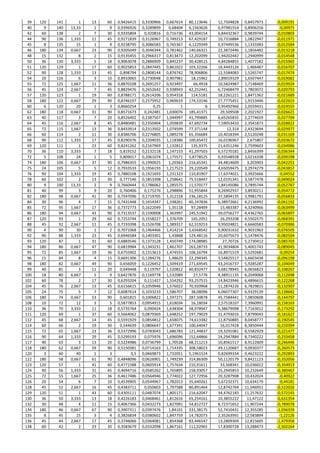
------------------------------------------------------------------------------------create the outside level"lvl" spheres positive (above the equatorial plane) -------------------------------------------------------------------------
----
for x=1 to tor_sph do (sphere radius: sphr_out[lvl] segs:24 wirecolor: blue pos: [real_r_out*cos(360.0*x/tor_sph as double),real_r_out*sin(360.0*x/tor_sph as
double),r2*sin(ang)+(sphr_out[lvl]+sphg[lvl]/2)*sin(ang)])
--make them instances
for o in $Sphere* do o.baseobject = $Sphere001.baseobject
--rename them
for o in $Sphere* do o.name = uniquename ("Lvl" + lvl as string + "_out_pos") --Lvl2_out_pos_001
--select them
clearselection()
select (execute ("$Lvl" + lvl as string +"_out_pos*"))
--organize them in a group
group selection name: ("Lvl" + lvl as string +"_out_pos_spheres") --Lvl2_out_pos_spheres
--rotate the level if the level is an even number (this is regardless of the number of levels because i will always say level 1 is the inside equatorial spheres, thus any even number level MUST be shifted)
if ((mod lvl 2)==0) then
(
select (execute ("$Lvl" + lvl as string +"_out_pos_spheres"))
rotate selection (180.0/tor_sph as double) z_axis
)
clearselection()
------------------------------------------------------------------------------------create the outside level"lvl" spheres negative (below the equatorial plane) -------------------------------------------------------------------------
----
if (ang!=0 and ang!=180) then --on the equatorial plane there is no need to make them again
(
for x=1 to tor_sph do (sphere radius: sphr_out[lvl] segs:24 wirecolor: blue pos: [real_r_out*cos(360.0*x/tor_sph as double),real_r_out*sin(360.0*x/tor_sph as double),-
(r2*sin(ang)+(sphr_out[lvl]+sphg[lvl]/2)*sin(ang))])
--make them instances
for o in $Sphere* do o.baseobject = $Sphere001.baseobject
--rename them
for o in $Sphere* do o.name = uniquename ("Lvl" + lvl as string + "_out_neg") --Lvl2_out_neg_001
--select them
clearselection()
select (execute ("$Lvl" + lvl as string +"_out_neg*"))
--organize them in a group
group selection name: ("lvl" + lvl as string +"_out_neg_spheres") --Lvl2_out_neg_spheres
--rotate the level if the level is an even number (this is regardless of the number of levels because i will always say level 1 is the inside equatorial spheres, thus any even number level MUST
be shifted)
if ((mod lvl 2)==0) then
(
select (execute ("$Lvl" + lvl as string +"_out_neg_spheres"))
rotate selection (180.0/tor_sph as double) z_axis
)
clearselection()
)
------------------------------------------------------------------------------------create the inside level"lvl" spheres positive (above the equatorial plane) ----------------------------------------------------------------------------
-
for x=1 to tor_sph do (sphere radius: sphr_in[lvl] segs:24 wirecolor: blue pos: [real_r_in*cos(360.0*x/tor_sph as double),real_r_in*sin(360.0*x/tor_sph as double),r2*sin(ang)-
(sphr_in[lvl]+sphg[lvl]/2)*sin(ang)]) --note the different radius of the ring array and different sphere radi
--make them instances
for o in $Sphere* do o.baseobject = $Sphere001.baseobject
--rename them
for o in $Sphere* do o.name = uniquename ("Lvl" + lvl as string + "_in_pos") --Lvl2_in_pos_001
--select them
clearselection()
select (execute ("$Lvl" + lvl as string +"_in_pos*"))
--organize them in a group
group selection name: ("lvl" + lvl as string +"_in_pos_spheres") --Lvl2_in_pos_spheres
--rotate the level if the level is an even number (this is regardless of the number of levels because i will always say level 1 is the inside equatorial spheres, thus any even number level MUST be shifted)
if ((mod lvl 2)==0) then
(
select (execute ("$Lvl" + lvl as string +"_in_pos_spheres"))
rotate selection (180.0/tor_sph as double) z_axis
)
clearselection()
------------------------------------------------------------------------------------create the inside level"lvl" spheres negative (below the equatorial plane) ---------------------------------------------------------------------------
--
if (ang!=0 and ang!=180) then --on the equatorial plane there is no need to make them again
(
for x=1 to tor_sph do (sphere radius: sphr_in[lvl] segs:24 wirecolor: blue pos: [real_r_in*cos(360.0*x/tor_sph as double),real_r_in*sin(360.0*x/tor_sph as double),-(r2*sin(ang)-
(sphr_in[lvl]+sphg[lvl]/2)*sin(ang))]) --note the different radius of the ring array and different sphere radi
--make them instances
for o in $Sphere* do o.baseobject = $Sphere001.baseobject
--rename them
for o in $Sphere* do o.name = uniquename ("Lvl" + lvl as string + "_in_neg") --Lvl2_in_neg_001
--select them
clearselection()
select (execute ("$Lvl" + lvl as string +"_in_neg*"))
--organize them in a group
group selection name: ("lvl" + lvl as string +"_in_neg_spheres") --Lvl2_in_neg_spheres
--rotate the level if the level is an even number (this is regardless of the number of levels because i will always say level 1 is the inside equatorial spheres, thus any even number level MUST
be shifted)
if ((mod lvl 2)==0) then
(
select (execute ("$Lvl" + lvl as string +"_in_neg_spheres"))
rotate selection (180.0/tor_sph as double) z_axis
)
clearselection()
)
)
function build_magnetic_flower lvl ang_a ang_b ang_c =
(
flag=0
if (lvl<0) do
(
lvl=-lvl
flag=1
)
if (lvl==0) do
(
lvl=1
flag=1
)
if (ang_b==0 and flag==0) then flag=2
if (ang_b==180) then flag=2
"ideal r"
ideal_r[lvl]=r1-r2*cos(ang_a)
ideal_r[lvl+1]=r1-r2*cos(ang_b)
ideal_r[lvl+2]=r1-r2*cos(ang_c)
ideal_sphr[lvl+1]=ideal_r[lvl+1]*sin(60/tor_sph as double) --60 because we always have the phasing of 3
sphg[lvl]=(gap_to_sphr_ratio*3.14159265358979323d0*(r1-r2*cos(ang_a)))/(3*tor_sph) as double --sphere gap for level "lvl" note that the gap is defined for the virtual sphere with its center placed ON
the ideal abha sheet torus
sphg[lvl+1]=(gap_to_sphr_ratio*3.14159265358979323d0*(r1-r2*cos(ang_b)))/(3*tor_sph) as double
sphg[lvl+2]=(gap_to_sphr_ratio*3.14159265358979323d0*(r1-r2*cos(ang_c)))/(3*tor_sph) as double
sphr_out[lvl]=(tan(60.0/tor_sph as double)*(ideal_r[lvl]-(sphg[lvl]/2 as double)*cos(ang_a)))/(1+tan(60.0/tor_sph as double)*cos(ang_a)) as double --sphere radius on the outside of the torus for level
"lvl"
sphr_out[lvl+1]=(tan(60.0/tor_sph as double)*(ideal_r[lvl+1]-(sphg[lvl+1]/2 as double)*cos(ang_b)))/(1+tan(60.0/tor_sph as double)*cos(ang_b)) as double
sphr_out[lvl+2]=(tan(60.0/tor_sph as double)*(ideal_r[lvl+2]-(sphg[lvl+2]/2 as double)*cos(ang_c)))/(1+tan(60.0/tor_sph as double)*cos(ang_c)) as double
sphr_in[lvl]=(tan(60.0/tor_sph as double)*(ideal_r[lvl]+(sphg[lvl]/2 as double)*cos(ang_a)))/(1-tan(60.0/tor_sph as double)*cos(ang_a)) as double--sphere radius in the inside of the torus for level "lvl"
(note that this is larger than the previous one)
sphr_in[lvl+1]=(tan(60.0/tor_sph as double)*(ideal_r[lvl+1]+(sphg[lvl+1]/2 as double)*cos(ang_b)))/(1-tan(60.0/tor_sph as double)*cos(ang_b)) as double
sphr_in[lvl+2]=(tan(60.0/tor_sph as double)*(ideal_r[lvl+2]+(sphg[lvl+2]/2 as double)*cos(ang_c)))/(1-tan(60.0/tor_sph as double)*cos(ang_c)) as double
mh=ideal_sphr[lvl+1]*mh_to_sphr_ratio
fg2=sphr_out[lvl+1]+sphg[lvl+1]+sphr_in[lvl+1]
fg3=sphr_out[lvl+2]+sphg[lvl+2]+sphr_in[lvl+2]
true_angle=2*asin(sin(180/tor_sph as double)*cos(ang_b)) --the true orbital angle of the spheres (pointing up at a polar point on the world axis) this determines a new angle different from standard 180/tor_sph, but
based on it
--new_z=(fg3/2)-sphr_out[lvl+2]-(sphg[lvl+2]/2 as double)
tor_petal=(ideal_r[lvl+1]*3.14159265358979323d0)/tor_sph as double
--maybe someone real smart could develop a for loop for the following 16 segments, i could do it in a couple of hours, but i don't see if there will be a real speed improvement upon the code execution, only
a structural improvement
--quadrant 1
if (ang_b==180) then xypos1=(ang_b-ang_a)*r2*0.01234134149488435d0 --this is is because at the outside ecuator the magnetic flower turns itself over
else xypos1=(ang_c-ang_b)*r2*0.01234134149488435d0 --constant comes from pi/(sqrt(2)*180) --xy position in the first quadrant
xypos1=abs(xypos1)
spl = convertToSplineShape(Ellipse adaptive: true ellipse_outline:off length:(2*xypos1) width:(2*(xypos1+mh)) ellipse_thickness:0 pos:[xypos1,0,0] )
open spl 1
deleteKnot spl 1 4
deleteKnot spl 1 1
crd1=(getKnotPoint spl 1 1)
if (spin_direction==0) then (crd1[3]+=-(sphr_in[lvl+2]+(sphg[lvl+2]/2 as double))) else (crd1[3]+=(sphr_out[lvl+2]+(sphg[lvl+2]/2 as double)))
setKnotPoint spl 1 1 crd1
updateshape spl --if i don't put this here the tangents don't get reset with the new repositioning!!!
--measure it to see if it's within boundary
tmp=snapshot $Ellipse001
rotate tmp -45 z_axis
resetxform tmp
maxOps.CollapseNode tmp false
dif=tmp.max.y-tmp.min.y
delete tmp
spl = convertToSplineShape(Ellipse adaptive: true ellipse_outline:off length:(2*xypos1) width:(2*(xypos1-mh)) ellipse_thickness:0 pos:[xypos1,0,0])
open spl 1
deleteKnot spl 1 4
deleteKnot spl 1 1
crd2=(getKnotPoint spl 1 1)
if (spin_direction==0) then (crd2[3]+=(sphr_out[lvl+2]+(sphg[lvl+2]/2 as double))) else (crd2[3]+=-(sphr_in[lvl+2]+(sphg[lvl+2]/2 as double)))
setKnotPoint spl 1 1 crd2
updateshape spl --if i don't put this here the tangents don't get reset with the new repositioning!!!
spl = convertToSplineShape(Ellipse adaptive: true ellipse_outline:off length:(2*(xypos1-mh)) width:(2*xypos1) ellipse_thickness:0 pos:[0,xypos1,0])
setFirstKnot spl 1 2
open spl 1
deleteKnot spl 1 2
deleteKnot spl 1 1
setKnotPoint spl 1 2 crd1
updateshape spl --if i don't put this here the tangents don't get reset with the new repositioning!!!
spl = convertToSplineShape(Ellipse adaptive: true ellipse_outline:off length:(2*(xypos1+mh)) width:(2*xypos1) ellipse_thickness:0 pos:[0,xypos1,0])
setFirstKnot spl 1 2
open spl 1
deleteKnot spl 1 2
deleteKnot spl 1 1
setKnotPoint spl 1 2 crd2
updateshape spl --if i don't put this here the tangents don't get reset with the new repositioning!!!
/*
--scaling error when the third level angle is too high that the ellipse steps out of bounds
if (dif>tor_petal) do
(--we must scale it down
--first let's group it
group $Ellipse* name: "tmp"
rotate $tmp -45 z_axis
scale $tmp [1,(tor_petal/dif as double),1]
rotate $tmp 45 z_axis
ungroup $tmp
for o in $Ellipse* do
(
resetxform o
maxOps.CollapseNode o false
)
--reposition the magnetic hole points
setKnotPoint $Ellipse001 1 2 [-mh,0,0]
setKnotPoint $Ellipse002 1 2 [mh,0,0]
setKnotPoint $Ellipse003 1 1 [0,mh,0]
setKnotPoint $Ellipse004 1 1 [0,-mh,0]
)
*/
--quadrant 4
xypos4=tor_petal/1.41421356237309504d0 as double --reduced by sqrt(2)
spl = convertToSplineShape(Ellipse adaptive: true ellipse_outline:off length:(2*(xypos4+mh)) width:(2*xypos4) ellipse_thickness:0 pos:[0,-xypos4,0])
open spl 1
deleteKnot spl 1 4
deleteKnot spl 1 3
crd1=(getKnotPoint spl 1 1)
if (spin_direction==0) then (crd1[3]+=-(sphr_in[lvl+1]+(sphg[lvl+1]/2 as double))) else (crd1[3]+=(sphr_out[lvl+1]+(sphg[lvl+1]/2 as double)))
setKnotPoint spl 1 1 crd1
updateshape spl
spl = convertToSplineShape(Ellipse adaptive: true ellipse_outline:off length:(2*(xypos4-mh)) width:(2*xypos4) ellipse_thickness:0 pos:[0,-xypos4,0])
open spl 1
deleteKnot spl 1 4
deleteKnot spl 1 3
crd2=(getKnotPoint spl 1 1)
if (spin_direction==0) then (crd2[3]+=(sphr_out[lvl+1]+(sphg[lvl+1]/2 as double))) else (crd2[3]+=-(sphr_in[lvl+1]+(sphg[lvl+1]/2 as double)))
setKnotPoint spl 1 1 crd2
updateshape spl
spl = convertToSplineShape(Ellipse adaptive: true ellipse_outline:off length:(2*xypos4) width:(2*(xypos4-mh)) ellipse_thickness:0 pos:[xypos4,0,0])
open spl 1
deleteKnot spl 1 2
deleteKnot spl 1 1
setKnotPoint spl 1 2 crd1
updateshape spl
spl = convertToSplineShape(Ellipse adaptive: true ellipse_outline:off length:(2*xypos4) width:(2*(xypos4+mh)) ellipse_thickness:0 pos:[xypos4,0,0])
open spl 1
deleteKnot spl 1 2
deleteKnot spl 1 1
setKnotPoint spl 1 2 crd2
updateshape spl
--quadrant 3
xypos3=(ang_b-ang_a)*r2*0.01234134149488435d0 --constant comes from pi/(sqrt(2)*180)
spl = convertToSplineShape(Ellipse adaptive: true ellipse_outline:off length:(2*xypos3) width:(2*(xypos3+mh)) ellipse_thickness:0 pos:[-xypos3,0,0])
setFirstKnot spl 1 2
open spl 1
deleteKnot spl 1 2
deleteKnot spl 1 1
crd1=(getKnotPoint spl 1 1)
if (spin_direction==0) then (crd1[3]+=-(sphr_in[lvl]+(sphg[lvl]/2 as double))) else (crd1[3]+=(sphr_out[lvl]+(sphg[lvl]/2 as double)))
setKnotPoint spl 1 1 crd1
updateshape spl
spl = convertToSplineShape(Ellipse adaptive: true ellipse_outline:off length:(2*xypos3) width:(2*(xypos3-mh)) ellipse_thickness:0 pos:[-xypos3,0,0])
setFirstKnot spl 1 2
open spl 1
deleteKnot spl 1 2
deleteKnot spl 1 1
crd2=(getKnotPoint spl 1 1)
if (spin_direction==0) then (crd2[3]+=(sphr_out[lvl]+(sphg[lvl]/2 as double))) else (crd2[3]+=-(sphr_in[lvl]+(sphg[lvl]/2 as double)))
setKnotPoint spl 1 1 crd2
updateshape spl
spl = convertToSplineShape(Ellipse adaptive: true ellipse_outline:off length:(2*(xypos3-mh)) width:(2*xypos3) ellipse_thickness:0 pos:[0,-xypos3,0])
open spl 1
deleteKnot spl 1 4
deleteKnot spl 1 1
setKnotPoint spl 1 2 crd1
updateshape spl
spl = convertToSplineShape(Ellipse adaptive: true ellipse_outline:off length:(2*(xypos3+mh)) width:(2*xypos3) ellipse_thickness:0 pos:[0,-xypos3,0])
open spl 1
deleteKnot spl 1 4
deleteKnot spl 1 1
setKnotPoint spl 1 2 crd2
updateshape spl
--quadrant 2
(copy $Ellipse005).pos.y=-$Ellipse005.pos.y
rotate $Ellipse013 180 z_axis
(copy $Ellipse006).pos.y=-$Ellipse006.pos.y
rotate $Ellipse014 180 z_axis
(copy $Ellipse007).pos.x=-$Ellipse007.pos.x
rotate $Ellipse015 180 z_axis
(copy $Ellipse008).pos.x=-$Ellipse008.pos.x
rotate $Ellipse016 180 z_axis
--combine everything in one flower
select $Ellipse001
--$.name="Ellipse000"
if (flag==1) then $.name = "lvl0_mag_flower"
else $.name = ("lvl" + lvl as string + "_mag_flower")
for o in $Ellipse* do (addAndWeld $ o -1)
$.pivot = [0,0,0]
--$.pivot = [-xypos3,-xypos3,-new_z] --MAX YOUR ATTENTION HERE! REPOSITIONING THE PIVOT POINT ON THE THIRD COORDINATE OZ IS IMPORTANT
--THE BEND IS APPLIED ACORDING TO THE PIVOT POINT OF THE ENTIRE BOUNDING BOX. THIS MUST BE CENTERED ACORDING TO THE LONGEST DISTANCE, WHICH IS
FG3(FLOWER GAP LEVEL 3)
$.wirecolor = yellow
--$.pivot = [0,0,0]
rotate $ -45 z_axis
--rotate $ -90 y_axis
resetxform $
--close $ 1
maxOps.CollapseNode $ false
--rotate $ (ang_a) y_axis
my_scale=(plength/(6.28318530717958647d0*ideal_r[lvl+1]) as double)
--position it on poloidal direction ox corectly
shift=0
if ((mod lvl 2)==1 and flag!=1) then shift=1
posx=-(pwidth/2 as double)+(ang_b*r2*0.01745329251994329d0)
posy=-(plength/2 as double)+(ideal_r[lvl+1]*3.14159265358979323d0/tor_sph as double)*(shift)*(my_scale)
$.pos=[posx,posy,0]
for i=1 to (tor_sph-1) do
(
(copy $).pos.y=-(plength/2 as double)+(ideal_r[lvl+1]*3.14159265358979323d0/tor_sph as double)*(shift)*(my_scale)+i*((ideal_r[lvl+1]*6.28318530717958647d0)/tor_sph as double)
)
--join all magnetic flowers in a row
if (flag==1) then
(
g=$lvl0_mag_flower
all=execute ("$Lvl0_mag_flower0*")
)
else (g=execute ("$lvl" + lvl as string+ "_mag_flower")
all=execute ("$Lvl" + lvl as string+ "_mag_flower0*")
)
select g
a= for o in all where (o!=g) collect o
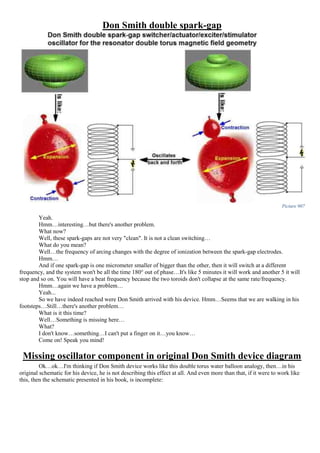
for o in a do (addAndWeld $ o -1)
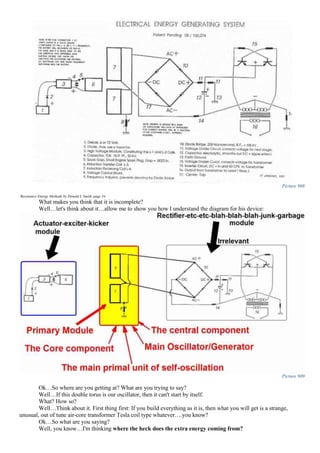
scale $ [1,my_scale,1]
$.wirecolor = yellow
if (ang_b!=0 and ang_b!=180) do
(
g=copy $
rotate g 180 y_axis
rotate g 180 x_axis
g.pos.x = (pwidth/2 as double)-(ang_b*r2*0.01745329251994329d0)
g.pos.y=-g.pos.y
)
)
--$Ellipse001.modifiers[#Taper].primaryaxis = 0
--$Ellipse001.modifiers[#Taper].effectaxis = 1
--$Ellipse001.modifiers[#Taper].amount = -0.1ree
--plane length: plength width: pwidth lengthsegs: 48 widthsegs: 24 wirecolor: [86,86,86] pos: [0,0,0] name: "Main torus plane" isSelected: true
--rotate $ 90 y_axis
--actionMan.executeAction 0 "40077" -- Views: Hide Grids Toggle
build_magnetic_flower -1 -6.29341260317974431d0 0 6.29341260317974431d0
build_magnetic_flower 1 0 6.29341260317974431d0 12.74456697675817935d0
build_magnetic_flower 2 6.29341260317974431d0 12.74456697675817935d0 19.53154156505148393d0
build_magnetic_flower 3 12.74456697675817935d0 19.53154156505148393d0 26.87970847710112891d0
build_magnetic_flower 4 19.53154156505148393d0 26.87970847710112891d0 35.10624783548284463d0
build_magnetic_flower 5 26.87970847710112891d0 35.10624783548284463d0 44.70690080363279390d0
build_magnetic_flower 6 35.10624783548284463d0 44.70690080363279390d0 56.55372154508091360d0
build_magnetic_flower 7 44.70690080363279390d0 56.55372154508091360d0 72.44605380140855226d0
build_magnetic_flower 8 56.55372154508091360d0 72.44605380140855226d0 97.27323810765686261d0
build_magnetic_flower 9 72.44605380140855226d0 97.27323810765686261d0 180
build_magnetic_flower 10 97.27323810765686261d0 180 -97.27323810765686261d0
g= $lvl0_mag_flower
select g
a= for o in $lvl* where (o!=g) collect o
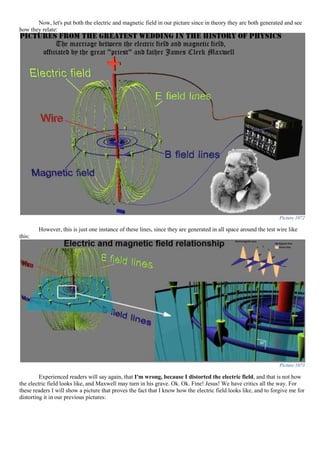
for o in a do (addAndWeld g o -1)
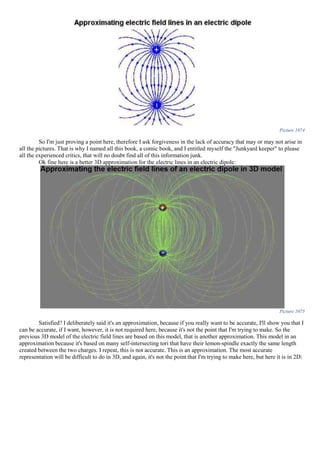
g.pivot=[0,0,0]
resetxform g
maxOps.CollapseNode g false
addmodifier g (Bend bendaxis: 0)
g.modifiers[#Bend].gizmo.pos = [0,0,0]
pmin=getModContextBBoxMin $ $.bend
pmax=getModContextBBoxMax $ $.bend
pmin[1]=-pmax[1]
pmin[2]=-Plength/2
pmax[2]=-pmin[2]
setModContextBBox $ $.bend pmin pmax
g.bend.bendangle = 360
$.pivot=[0,0,-r2]
dif=abs($.pivot.z-$.center.z)
$.center=[0,0,dif]
resetxform $
maxOps.CollapseNode $ false
clearselection()
g=$lvl0_mag_flower
select g
addmodifier $ (Bend bendaxis: 1)
$.modifiers[#bend].gizmo.rotation += quat 0 0.707107 0 0.707107
pmin=getModContextBBoxMin g g.bend
pmax=getModContextBBoxMax g g.bend
pmin[2]=-Plength/2
pmax[2]=-pmin[2]
pmin[1]=-pmax[3]
pmax[1]=pmax[3]
pmin[3]=-pmax[3]
setModContextBBox g g.bend pmin pmax
g.bend.bendangle = 360
$.pivot=$.center
$.center=[0,0,0]
rotate $ 90 y_axis
resetxform $
maxOps.CollapseNode $ false
--rotate $ (180/tor_sph as double) z_axis
-- BUILDING THE PRIMER
--BUILD THE MAIN TORUS OF THE PRIMER
torus radius1: r1 radius2: r2 segments: 200 sides: 200 name: "_Main torus" smooth: 2 wirecolor: [86,86,86] pos: [0,0,0] --48 cu 24 segmente
--build level 1 spheres (at the equatorial plane) with angle 0 degrees
build_ring_array 1 0
build_ring_array 2 6.29341260317974431d0
build_ring_array 3 12.74456697675817935d0
build_ring_array 4 19.53154156505148393d0
build_ring_array 5 26.87970847710112891d0
build_ring_array 6 35.10624783548284463d0
build_ring_array 7 44.70690080363279390d0
build_ring_array 8 56.55372154508091360d0
build_ring_array 9 72.44605380140855226d0
build_ring_array 10 97.27323810765686261d0
build_ring_array 11 180
/*
--construct magnetic flowers using 1 turn helix for each level
--2 levels
for a[1]=0.0 to 180.0 step 0.1 do
(
b[1] =pol_helix_len (0,a[1],mh,sphg)
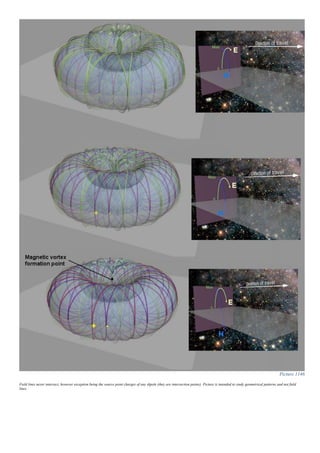
if (2*b[1]<=Max_grail_len) then
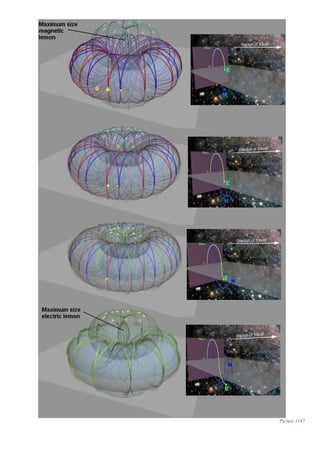
(
for a[2]=a[1] to 180 step 0.1 do
(
b[2]=pol_helix_len(a[1],a[2],mh,sphg)
if ((b[1]+b[2])<=Max_grail_len) then
(
b[3]=pol_helix_len(a[2],180,mh,sphg)
if ((b[3]+b[2])<=Max_grail_len) then
(
s=0
for i=1 to 3 do s+=b[i]*2
for i=1 to 3 do rez[i]=(mod(b[i]/s,2)/2)*100 --calculate each helix resonance factor
rez_sum=0 --make the average of all resonance factors
for i=1 to 3 do rez_sum+=rez[i]
rez_avg=rez_sum/3
print "level 2, 6 spheres" a[1] a[2] rez_avg
)
)
else break
)
)
else break
)
Note that the code above, doesn’t even touch the Holy Chalice that must be place at the center. There will be an insane
amount of work needed to be done there as well. It’s all decorated all over the place with hemispheres, carefully
calculated and positioned on the cup surface. I don’t even know where to start and show you what I see in my mind’s
eye about this cup. I have seen the interaction with the primer, and it’s the most amazing thing there is in existence and
that I have ever imagined. The complexity of interacting EM fields between the grail and the primer is overwhelming.
May God give me strength to show to others what I’ve seen.
End result:
The Tree of life (and the one in the movie “The Fountain”)
I don’t have to mention the simple activation sequence of the prototype by a simple submerging and then raising above
water (baptism). So it only works above water, because water acts like a variable dielectric for the Rodin capacitor
spheres, thus fine-tuning the LC resonance point to the standing wave dictated by the magnetic flowers.
Magic carpet before converting it to a torus:
Several pictures of the Depew-Rodin LC oscillating tori the above maxscript code is able to generate:
These are just a few pictures. It seems that the program (script) far exceeds my expectations. If I wrote it
generally for finding automatically the perfect resonant torus for me, and not go through all that vortex mathematics
crap that everybody is so fond of, it seems that the program is creating extremely beautiful art and designs like crochet
doilies:
I’m quite impressed, but this was not intended, and art is not my goal. Art may be a goal to others, but in my case, and
in this case is a side-effect, or a consequence if you like, at least that’s how I see it. I know. It’s cruel. And with cold-
blood, I say it is irrelevant. Resistance is futile. (OH. I’m sorry. I have some persistent sequelae from Star Trek each time I hear the word irrelevant). I don’t seek
that. I seek perfect resonance inside all these wires. Beauty is a consequence, not a goal. I know, I know…very narrow
minded for me to say that…
It’s an interesting resemblance with the Jon Depew coral castle code pictures that are based on Edward Leedskalnin
magnetic currents:
So in the end, the final device should look like this:
It is very puzzling how this fellow, Edward Leedskalnin, was able to figure out all of this. I feel like I’m
walking in his footsteps or something. Spooky stuff. Note that this is NOT a resonant version of a Rodin-DePew torus
LC oscillator. It’s just one of thousands of configurations. Such a 3D model is then 3D printed in non-ferrous highly
conductive metal like brass or bronze. Of course there are size limitations of how big a 3D printed model should be,
because of the size of the printer, but this problem can be easily fixed by splitting the 3D final prototype model in
several identical slices (like a cake), provide them with plugs, and printed separately and then all joined together.
If you feel drawn to all this shit, go ahead, be my guest and do whatever you like with all of this. It’s all yours. The only
problem is that I haven’t reached the point where I have to design the perfect resonant central grail. That’s another
script, and a whole different subject. I have temporarily abandoned this study, since the book has many holes and
unaddressed issues, and thus I have to turn back and complete them, addressed them, correct them, improve them, study
them, fill them, explain them, expand them, or you choose the word.
Another note I feel drawn to make is the striking connection with the Holy trinity, where the
primer is God the Father, the Holy Grail is God Jesus Christ, and all the Double torus Electro-
magnetic fields developed by these is God the Holy Spirit. Don’t get me wrong, I’m not saying
that the Rodin-Depew torus LC oscillator is God, I’m just pointing out that is created in the image
of God, thus the Living life-force will flow through it and energize it as it gets submerged in water
and baptized.
I already feel the wave of non-Christians voices of the readers upon me. Could you imagine splitting Allah in 3
distinct entities? This will definitely angry a lot of people, and their voices are so loud in my head that I feel like I’m
schizophrenic or something…Oh…dear God…help me…
Note that the Holy Grail is not connected in any way with the primer. It’s never touching the torus. It
communicates with the torus through magnetic induction and electrostatic induction 90 degrees out of phase, thus
creating EM longitudinal double torus waves. So how do we hold it in perfect centered position? We don’t have to. At
resonance, due to insane amounts of current, it will hold itself perfectly centered, by Lorentz forces. That is if
everything is perfectly symmetrical. The eternal engine inside the cup is the most fascinating thing you can imagine.
The images and pictures I see in my mind eye about this will probably fill hundreds of pages, but I fell so compelled to
share them…you cannot even imagine. I feel so manipulated by unknown intelligences, i can’t even begin to describe
my feelings.
Please forgive me…
I only wanted to help…
If all this were to be an exam paper in life in general, then if you had to evaluate all this research from a scale from 1 to 10, give it a 5 just for the
effort. A professor of mine once taught me that I should never forget this equation:
lim
𝑃 𝑚→∞
𝑃𝑚 + lim
𝑆 𝑘→0
𝑆 𝑘 = 5
It reads like this:
"Limit on professor mercy Pm, when professor mercy tends to infinity, plus limit on student knowledge Sk, when student knowledge tends to 0,
equals a 5"
So have mercy on me…please…give me a 5 just to pass this exam…
„To learn is the same as to teach unless you are not teaching what you are learning, in which case you
have done you/them little good”
Law of One – Ra material Book 1, Session 1
This is much easier to understand in my own native Romanian language since we have the same word to describe these
actions: “a învăţa” which means to learn as well as to teach. One word designating the same fundamental action
depending only on the context. This means that I did not knew all that I have written at the time I have started to write
in this book. I have discovered things along the way. I have taught what I have learned and I have learned what I have
taught since they are the same exact thing.
Inventors are often criticized for not doing things the “right way.” But that is their strength and their nature.
Maverick inventors make their own mistakes. They don’t make other people’s mistakes. When they fit easily into the
establishment, they cease to be creative inventors. So be creative!
We often hear that with great knowledge comes great responsibility. But it’s more than that. Usually when we
receive a package of knowledge, we don’t often prove that we possess the virtue of patience to wait for the second part
of the same package called wisdom that comes from the Infinite Creator, which always seems to lag the receiving of
knowledge. They are part of the same package that must come together, but for some reason our own ego doesn’t wait
for the wisdom and acts on the knowledge it has received. This may lead to great suffering for us and for those around
us. So be wise. Open your eyes and ears and see and understand. May God give wisdom to all who have power so that
the corruption that comes from possessing such knowledge is diminished. Be wise!
We need your help! This book contains a lot of technical errors. Please help the author correct them. This document also requires proofreading. English is not the
native language of the author - If you notice any errors send feedback at niculaegeorge@gmail.com
Final thought:Maybe it’s not meant to be for me to build a free energy device, but I would give anything, anything just to see at least one human
being that has built a working model based on the shit presented in all these nonsense crap of a book. Just one, that’s all I want, nothing more, nothing less. Just one
being that has built a working prototype, and it’s a good compassionate person who will put a video on YouTube, saying to the free energy community: “Hey guys!
Check this out! I’ve build a free energy device based on the shit and crap in this bullshit of a book I have found on the web.” ...............That’s all I ask from
God.............. Is it too much???
The junkyard keeper.
Contact the author:
niculaegeorge@gmail.com
http://www.facebook.com/niculae.razvan?sk=info
Noah’s ark was built by amateurs, but professionals built the Titanic.

Research in solid state free energy generators (ver 7.5.22)

  • 1.
    “Not everything thatshines with bright light comes from God”
  • 2.
    Table of Contents Bookrevision history...........................................................................................................................................................6 A DETAIL STUDY OF THE STEVEN MARK TPU ........................................................................................................8 TPU magnets orientation ...............................................................................................................................................22 Firing the coils ...............................................................................................................................................................25 Charles Flynn Generator................................................................................................................................................27 COP vs. OVERUNITY vs. EFFICIENCY ....................................................................................................................45 A NON-CONVENTIONAL APPROACH IN DEFINING COP ..............................................................................45 Ideal Power equation..................................................................................................................................................48 CONVENTIONAL DEFINITION OF COP..............................................................................................................51 A visual representation of the performance coefficient (COP) and efficiency in transformers.................................52 INTERCONNECTING COP>1 DEVICES...............................................................................................................54 Changing our mentality..............................................................................................................................................58 Applications...................................................................................................................................................................60 POWERING (AC) HALF OF THE TESLA TRANSFORMER 381970 WITHOUT A LOAD...............................62 FULL POWERING (AC) THE TESLA TRANSFORMER 381970 WITHOUT A LOAD .....................................66 POWERING (AC) HALF OF THE TESLA TRANSFORMER 381970 WITH A LOAD.......................................69 FULL POWERING (AC) OF THE TESLA TRANSFORMER 381970 WITH A LOAD .......................................77 POWERING (pulsed AC) HALF OF THE TESLA TRANSFORMER 381970 WITH A LOAD............................90 Tom Bearden Motionless Electromagnetic Generator (MEG) ..........................................................................................93 THE REAL OPERATING FREQUENCY OF MEG - TUNING THE MEG...............................................................99 The air-gap in the MEG core .......................................................................................................................................100 Toroidal MEG..............................................................................................................................................................103 CUBOIDAL MEG-TPU ..............................................................................................................................................109 Replicating the Steven Mark TPU ...................................................................................................................................117 Further study on improving the final most likely construction of Steven TPU ...........................................................128 MAKING MUSIC: OUR INSTRUMENT: THE MAGNETIC FIELD --- Floyd Sparky Sweet Vacuum Triode Amplifier (VTA)..............................................................................................................................................................135 The air-gap or the distance between the magnets. .......................................................................................................149 Ways to express and visualize MAGNETIC RESONANCE.......................................................................................155 IN A MAGNET .......................................................................................................................................................155 IN A COIL ...............................................................................................................................................................158 Additional insights on the TPU, MEG, and Flynn SSG devices. ................................................................................163 Insights regarding VTA ...........................................................................................................................................164 CONDITIONING THE MAGNETS. (Re-magnetization process) .............................................................................164 MAGNETIC DOMAINS DYNAMICS.......................................................................................................................168 TPU MAGNET DOMAIN DYNAMICS ................................................................................................................168 MEG MAGNET DOMAIN DYNAMICS...............................................................................................................170 MORE INSIGHT ON MEG INNER OPERATION PRINCIPLE...............................................................................172 The Singing rod............................................................................................................................................................179 THE RE-MAGNETIZING PROCESS (CONDITIONING THE MAGNETS) ..........................................................183 Kirchhoff law in Tom Bearden MEG ..............................................................................................................................184 SIMPLIFYING FURTHER THE MEG DESIGN...........................................................................................................199
  • 3.
    Hysteresys annihilator......................................................................................................................................................200 Connection betweenAnnis&Eberly generator and Steven Mark TPU............................................................................211 Connection between the Annis&Eberly generator and Tom Bearden MEG ...................................................................221 Naudin 2SGen..................................................................................................................................................................223 Further improving the 2SGen design by mimicking its mother MEG.........................................................................224 Different possible embodiments of magnetic domains spinners......................................................................................227 Cylinder magnetic domains spinner.............................................................................................................................229 Demagnetized ring magnet internal magnetic domains spinner ..................................................................................231 Further insights on the Floyd Sparky Sweet VTA magnetizer ........................................................................................233 The Floyd Sweet VTA-SQM Time-machine/antigravity device .................................................................................245 Conclusion of Floyd Sweet VTA study:......................................................................................................................247 A cheap accessible approach to extreme accuracy signal generator (max 20KHz):........................................................247 New Energy movement: Marko Rodin technology .........................................................................................................251 Different firing sequences for the Rodin Coil..............................................................................................................252 The Rodin coil and the double torus topology.............................................................................................................258 Circle packaging model ...............................................................................................................................................264 Rodin Coil, Spira mirabilis and Jacob Bernoulli .........................................................................................................273 Calculating Rodin wire length .....................................................................................................................................288 Approximating Rodin wire length using straight lines ............................................................................................289 Approximating Rodin coil length using the ellipse model.......................................................................................292 Approximating Rodin coil wire length using the parabola model ...........................................................................298 1. The correct determination of the Rodin coil length using the lemniscate model.............................................301 Tuning to magnetic resonance experiment with a Rodin Coil.....................................................................................307 Rodin spinner for a demagnetized ring magnet ...........................................................................................................308 The real truth about magnetic monopoles - the never ending quest for the magnetic monopoles and the real magnetic monopole......................................................................................................................................................................312 The process of creating a magnetic dipole (a magnet).............................................................................................320 Rodin bubble ring ........................................................................................................................................................337 Activation sequence to form a sustainable bubble ring............................................................................................339 Further insights on the Rodin firing sequences............................................................................................................345 The magnetic bubble ring maintained by the Rodin “flux pump” actuator field.........................................................352 Using cores in the Rodin coil.......................................................................................................................................356 Rodin magnetic bubble ring generator.........................................................................................................................368 Double torus transformer .............................................................................................................................................373 Designing Rodin collector coils for the Rodin field ....................................................................................................375 Designing an oscillator with the 90° built-in-lag in the Rodin coil spiraling-magnetic-bubble-ring-auto-spinner .....395 Going beyond the basic standard 150° winding step angle for the Rodin coil. Exploring different configurations....396 Rodin coil, sorcery & witchcraft connection ...............................................................................................................401 Standard Rodin magnetic field configuration - Meruba Ashurit and the origins of the alphabet - Stan Tenen Meru research connection -the Torah is a Torus ...................................................................................................................420 Rodin magnetic field....................................................................................................................................................423 Rodin vortex-horn torus and the lemon-spindle torus magnetic fields ...................................................................442 Unique magnetic field pattern in the standard Rodin 150° winding step-angle.......................................................450 THE RODIN CENTRAL LEMON DIMENSIONS:...............................................................................................458
  • 4.
    Predicting the uniqueRodin 150° winding step-angle.............................................................................................460 Marko Rodin magnetic field paradox ......................................................................................................................463 Rodin non-twisted double torus magnetic field configuration.................................................................................470 Symmetry and asymmetry - antagonistic yet complementary concepts ......................................................................476 The Holy Trinity model in understanding why our Load is the missing piece in the Rodin puzzle............................477 Donald L. Smith device ...................................................................................................................................................482 Resonant dynamic double torus water balloon self-oscillator analogy as the fundamental working principle behind Don Smith device.........................................................................................................................................................485 Magnetic dipole field lines...........................................................................................................................................487 Don Smith double spark-gap........................................................................................................................................498 Missing oscillator component in original Don Smith device diagram.........................................................................498 Don Smith double torus activation...............................................................................................................................501 Connection between Donald L Smith device and Bearden MEG and Steven Mark TPU ...........................................502 Don smith double condition for magnetic resonance between coil L1 and L2............................................................504 Collapsing Don Smith double condition for magnetic resonance into one condition..................................................515 A slight different working principle behind Don Smith device...................................................................................520 Increasing Q factor in oscillators using Tesla-Smith formula or standing waves pattern formation condition in inductors to reduce damping........................................................................................................................................534 CALCULATING THE DON SMITH DEVICE CAPACITOR ..................................................................................543 CORNERSTONE OF THE DON SMITH DEVICE...................................................................................................545 Don Smith device coil L2a and coil L2b connections .................................................................................................548 Don Smith device pseudo-double torus magnetic field ...............................................................................................551 Abha torus - Rodin-Tesla coil - Donald L Smith device hybridization embodiment ......................................................555 A possible quantification in Rodin coil torus frame dimensions using the Vortex-Spindle torus perfect ratio condition .....................................................................................................................................................................................574 INDUCTANCE APPROXIMATION FOR THE RODIN COIL ................................................................................580 LIMITATIONS IN THE STANDARD BASIC SINGLE-LAYER HELICAL ROUND WIRE COIL INDUCTOR MODEL FORMULA...............................................................................................................................................584 RODIN COIL INDUCTANCE WHEN COILS ARE FIRIED IN OPPOSITION ..................................................590 Double lemon-spindle torus and the Holy Grail connection....................................................................................599 Rodin non-twisted double torus magnetic field configurations in connecting the coils ..............................................612 BUILDING THE RODIN CAPACITOR ........................................................................................................................616 Electric and magnetic field relationship.......................................................................................................................616 Rodin plate capacitor ...................................................................................................................................................628 Rodin wire capacitor....................................................................................................................................................632 Number of turns in Rodin coils....................................................................................................................................641 Exterminate and annihilate stray capacitance in inductors ..........................................................................................645 Surface electric field equilibrium in the basic standard 150° step-angle Rodin coil ...................................................654 MARKO RODIN FREE-ENERGY GENERATOR FINALLY DEBUNKED...............................................................660 Rodin wire radius to torus radius ratio.........................................................................................................................670 Designing a new improved ultra-efficient energy collector system for the Rodin LC tank circuit self-oscillating generator ......................................................................................................................................................................677 Wire radius to Rodin torus radius ratio determination.................................................................................................680 CONECTIONLESS Rodin LC tank circuit for the natural HF operation dictated by the standing wave in the wire .681 Building the Rodin LC tank circuit..............................................................................................................................682
  • 5.
    RODIN CAPACITOR SPHERES3D COORDINATES CALCULATION...............................................................687 MAPPING THE FLOWER OF LIFE ON THE RODIN ABHA PERFECT SIN15 TORUS.....................................699
  • 6.
    Mandatory study, priorof reading this material: -Steven Mark Toroidal Power Unit (TPU) clip (one of many prototypes): http://www.youtube.com/watch?v=pvLuQOKOVXQ -System of Electrical Distribution Tesla Patent 381,970: link1 or link2 -Tom Bearden Motionless Electromagnetic Generator (MEG) patent file: link1 or link2 -Floyd Sparky Sweet VTA-SQM secrets videoclip (hard to find) filmed by Tom Bearden in Sherman Oaks, California April/May 1987: (torrent file) or relevant part3 permalink and relevant part4 permalink -Marko Rodin basic introduction to elementary Vortex Mathematics and standard configuration Rodin coil clips: http://www.youtube.com/watch?v=K93dL65Q724 -Donald L Smith device general presentation clips: http://www.youtube.com/watch?v=or_wCy2OzWk Good to know study -Theodore Annis/Patrick Eberly single magnetic flux electric generator patent file: link1 or link2 Optional study: -Complete series of clips of Steven Mark TPU: http://video.google.com/videoplay?docid=-1944827568401901581 http://video.google.com/videoplay?docid=167210479374903373 http://video.google.com/videoplay?docid=-8435800732540412467 http://video.google.com/videoplay?docid=333661567309752927 http://video.google.com/videoplay?docid=-5483558279656482347 -Donald L. Smith lecture at Tesla Symposium 1996 clips: http://www.youtube.com/watch?v=6mV89RvaBYk -Charles Flynn solid state generator clip: http://www.youtube.com/watch?v=9zh_C3yvJH0 Book revision history Current book revision: 7.5.22 download latest version click here –permalink (it will never change) (Shared, synced live with the author computer through Google drive) https://docs.google.com/file/d/0ByyeIdK8FssyLWJEQzlwTER2YTQ/edit?usp=sharing We need your help! This book contains a lot of technical errors. Please help the author correct them. This document also requires proofreading. English is not the native language of the author - If you notice any errors send feedback at niculaegeorge@gmail.com. Revision 7.5.22 (Free release date: June, 6, 2013 on Scribd) download as pdf (35Mb), download as docx(31 Mb)(MsWord 2007-2013), download as doc(30 Mb) (MsWord 97-2003 compatible) -Insert permalink to Google drive document, where there’s a shared, synced live with the author computer, downloadable latest live version of this book; -Added book version history. A reader can now see the changes from previous versions easier; -All quotes are now Austin Quote (Text box) for esthetic reasons; -All quotes are now with complete reference included from where they originate and have permalinks attached; -All pictures and tables have now captions (numbers). All text changed to include cross-reference to these numbers; -All equations including simple equations in body text are now new paragraph-field-numbered-equations. Cross-reference to them also added; -Multiple reference links for important hyperlinks to prevent link rot; -Started to replace comma based decimal numbers to period based numbers; -Repaired link “Mythbusters Tesla earthquake machine” with a permalink; -Insert jump link to a bookmark rejected TPU case study comment; -Insert permalinks to high resolution pictures for drawings and high detail pictures; -Added a few extra pictures and text regarding the DePew-Rodin LC oscillator; -Made a complete Spelling & Grammar re-check; Revision 7.5.19 (Free release date 28.05.2013 on Scribd) download as pdf (42Mb), download as docx (30Mb) (MSWord 2007-2013) , download as doc(29 Mb) (MsWord 97-2003 compatible) -Started to insert caption for each picture, table and equation (not complete); -Modified reference text to include updateable cross-reference links to picture numbers instead of “picture above or below”; -Removed some broken links to Mythbusters Tesla earthquake machine; -Where the research is currently at and is going: (insanely complex warning) maxscript for creating a Jon DePew-Rodin-LC-oscillator-tree-of-life-golden-torus in the section MAPPING THE FLOWER OF LIFE ON THE RODIN ABHA PERFECT SIN15 TORUS -New insights regarding Rodin coil, sorcery & witchcraft connection -teleportation connections- (probably from seeing way too many movies); -Improved embedded text clarity in some TPU pictures; -Cut the size of the book in half just by resizing large pictures with irrelevant details. (30Mb) -Added a table of contents. Revision 7.3 (Free release date 07.10.2012 on Scribd) download as pdf (61Mb) Older versions omitted Book started on 18 November 2011
  • 8.
    A DETAIL STUDYOF THE STEVEN MARK TPU This study will bring us closer to understanding the toroid of Steven Mark, but not all the way to total understanding. I have discovered real construction behind the TPU from hours and hours of frame by frame carefully and methodically watching SM videos. First, I have come to believe that the various TPU-like devices presented by Steven in his videos are very different from each other. That is why there are so many different configurations, building plans, variants, opinions, topologies and implementations of Steven’s TPU. The term "TPU" meaning Toroidal Power Unit is inappropriate, because the principle of operation has nothing to do with the Toroidal shape (with an open mind attitude, it can be for example, a cube). Steven Mark has chosen just to implement the principle inside Toroidal cores in order to capture most of the magnetic flux. The simplest and most "transparent" from Steven’s devices is this one (the one that can be studied in detail): Picture 1 So let's decide on a convention for naming the parts which we see in the device: Picture 2
  • 9.
    Let’s say thatthe place where the wires come out of the device, is the front side. It seems counterintuitive since in any device in general, the wires come out from the back, but in our case, the camera is always looking at this side, and is most of the time facing us. This is how it is being presented to us, so we will name it “the front side”: Picture 3 Many people say that Steven’s TPU has 3 coils inside it…hmm…let's take a closer look. We can first note that there appears to be 4 segments, and therefore, there must be 4 coils. Picture 4
  • 10.
    1. Pretty obviousthis one. Picture 5 2. Same here: Picture 6
  • 11.
    3. This oneis obvious too. Picture 7 4. The forth coil is a little difficult to see. Picture 8
  • 12.
    Yep. It's thereall right. Here is another look: Picture 9 OK. Let's summarize what we have seen so far. We seem to have some kind of a transformer with 4 coil windings and this one doesn't resemble in any way, the common conceptions of Steven’s TPU construction: or: or: Picture 10 Picture 11 Picture 12 These are nowhere near the configuration which we are studying here. These configurations seem absurd to me! Where the heck do we ever see this type of arrangement in Steven Mark presentations? I haven't seen this anywhere! But hey, maybe the guys who say these things know better. I ONLY KNOW WHAT I SEE. THE REST… IS SPECULATION. Although in some cases educated guesses are acceptable. Ok. What we know so far:
  • 13.
    Picture 13 Some saythat this "4 coil Steven Mark Toroidal-like transformer" is similar to Tesla Patent 381,970 “System of Electrical Distribution”: Picture 14 Picture 15 Hmm…Interesting…Looks similar. Let's take a closer look:
  • 14.
    Picture 16 Ok, anyonewho takes a look at this, might get confused by all these wires. Let's analyze what we have here, because it will help us a lot in figuring out how Steven’s TPU works: Picture 17 How does this work? Let us look at the generator: Picture 18
  • 15.
    Let's quote Tesla: Sothis generator has 2 coils perpendicular one to the other inside a simple N-S magnetic field (2 poles). The commutator has 4 contacts (from the 2 starts and 2 ends of the 2 coils) and there are 4 wires coming out of this generator. Simple stuff. As the generator spins, it outputs the waveforms in the right: Picture 19 Just a two-phase electric generator…typical of Tesla…Nothing fancy here. Ok, so two signals 90° out of phase from each other, going into the transformer. One signal is a sine and the other is a cosine. So what happens then? Let's look at the transformer: Picture 20 Let’s simplify a little bit and take this Tesla transformer apart: “...it will be observed that at a given point of time the coil G is in its neutral position and is generating little or no current, while the other coil, G', is in a position where it exerts its maximum effect" (Nikola Tesla US patent 381970 page 2, line 95)
  • 16.
    Picture 21 This isthe basic configuration...so we have 8 coils here, and not 4, like in the TPU... This is important! This is the easiest place to start to understand how the TPU works! Ok, let's continue with harder stuff. So, the TPU has 4 windings, or does it have 8??? Let's take a closer look: Picture 22 Hmm…not very clear… so let's look further:
  • 17.
    Picture 23 Wow…what dowe have there? It looks like 2 big thick heavy wires…could it be? Could it be a … bi-filar coil? Picture 24
  • 18.
    It's definitely abifilar coil!!! Picture 25 Here we can see that it is too thick to be only one wire. There must be two. Look closer and really pay attention! Each of the coils have 7 turns and they are definitely bifilar coils! There will be no point in having just the left coils bifilar, and the rest simple coils. It's got to be that all are bifilar. It's the only way to make sense. It's got to be a balanced symmetrical system. It's an educated guess! I hope you agree. If you don't agree, then find a better quality video, take a closer look than I did, and prove me wrong. So let's summarize what we DO KNOW so far: Picture 26 This is Tesla technology! We need to study Tesla’s patent number 381,970 in the minutest detail. So, let's see how Tesla’s transformer works:
  • 19.
    Picture 27 Picture 28 Whatis really interesting in this configuration is the way in which these coils are connected to each other. If we look closely, then we notice that they are connected in opposition to each other. So the magnetic flux created by these coils, is cancelling out…weird…How can a transformer work in such a way? Well… your understanding of this depends on your expectation of how it must work… It will work… but the efficiency will be very, very poor. But Tesla knew all of these things and more, so then… he must have been looking for something else…he was exploiting and investigating an effect… The Magnetic Flux vectors from these coils in operation looks like this:
  • 20.
    Picture 29 This ancientTesla design is still used in deflection coils in all CRT around the world. So much tribute we must give to this forgotten genius... And the firing stages of the Tesla transformer are: Picture 30
  • 21.
    A slightly moreaccurate representation of the magnetic field lines at one stage is: Picture 31 Picture 32 Now what happens is, that when you energize two opposite coils like this, you will get output power on their matching secondary coils. If you build a transformer like this, try and short-circuit the secondary and see what happens! What do you think will happen? Well…conventional education tells us that we will see a spark, and if we continue with this short-circuit, we could overheat and destroy the secondary winding. But not in this transformer… This type is a so called "Lenz-less solid state generator". Meaning that no matter what you do to the secondary winding you will not affect the primary winding in any way! No matter how much power you extract from the secondary, the primary will never see it! It will not "see" a load connected to it! And even better - when you connect a load to the secondary…THE INPUT POWER DECREASES! Quite the reverse of what you would expect!!! However, DON'T GET YOUR HOPES UP… because this is only half of the story. Here is the other disappointing half: even though this might seem like a huge COP, we are forgetting to take account of the power which the transformer itself consumes, when no load is connected to the secondary. This is explain in section
  • 22.
    COP vs. OVERUNITYvs. EFFICIENCY TPU magnets orientation If one of the TPU magnets has its north pole facing upwards and the other magnet has its south pole facing upwards, then the magnetic field created by them will bypass the front and back magnetic poles of the TPU: Picture 33 There will be just these two poles created by the magnets (two magnetic closed circuits). This configuration must be wrong, because of the direction of the magnetic field from the magnets with this arrangement. Half of the magnetic field would opposite the magnetic field created by the coils. Remember how those fields are orientated: Picture 34 The coils change their winding direction at the front and back pole, so we have two magnetic fields in opposition in these places, and one of them will be also oppose the field from the magnet. But by using them in repulsive mode, and orienting them so that they both have similar poles facing in the same direction, then their fields will look exactly like the one's generated by the coils:
  • 23.
    Picture 35 So now,we have determined with a high degree of certainty how he orients his magnets in the TPU! We could re-analyze all possible configuration, and determine that there are only very few that might work, and the rest will not work, like these ones: Picture 36 Picture 37 Why wouldn't this way be a valid configuration? Remember that he is placing the magnets at the left & right pole, so the interacting flux fields, from the magnets and the coils, will be in opposition in some places:
  • 24.
    Picture 38 Picture 39 Let'sanalyze further other configurations:
  • 25.
    Picture 40 Picture41 These ones are also false, just like above, because the magnetic field vectors from the magnets, work against the flux developed by the coils. The magnets must help the flux created by the coils, so knowing this, there are no more working configurations left. This is where this deductive, and certain study ends, but it's not over. If, like me, you feel drawn to this type of technology, then please continue the work which I have started here! I am going to continue further, but from this point on, please be aware that I am going to guess a lot, so the certainty factor will be greatly reduced. Firing the coils How is Steven exciting the coils? Well we do know for a fact that he is using pulsed DC, but how is he driving this type of pulsed current through the coils? Which connection points does he use? It seems most likely that he is using a square wave with sharp rising and falling edges (the so called "kicks"). Some say that he isn't using any type of control circuit board, and no integrated circuits. That seems most likely to me, because Steven says that his device is extremely simple. So let's keep things as simple as possible. (I'm not saying that having IC control board for a TPU is complicated). I think that there are no MOSFET's in his device! Why? Well…think about it! If he were to use MOSFET's, then they would have to switch at least 100V at more than 10 Amps, judging by the wire gauge which he is using. He would also need a control circuit to drive the gates of these MOSFET's, and due to the closed feedback loop, and having no battery in the device, he would have to generate a low voltage and low current inside a some sort of feedback/coil that drives the gates in order not to burn those transistors out. But nothing which we have seen supports that! Therefore the supposition, that he is not using MOSFET transistors, is likely to be true (I'm not saying that with a high degree of certainty, as I could be wrong). There is no feedback coil in this system, and that, I state as a fact. This system is balanced and symmetrical, and we have chosen for the sake of conventional knowledge of transformers, terms like "primary windings" and "secondary windings". But we know that we are dealing with a 1:1 ratio transformer, therefore the primary can be used as a secondary, and vice-versa. You could swap them, because they are identical. That's a fact! We also know that this transformer has a median point in its secondary, and also his primary winding has a median point. Two median points in his transformer (at the left pole in the pictures): Picture 42 I believe that he is somehow using a common bistable/astable bipolar transistor circuit, with only two transistors. Why do I think that way, and could it be that simple? I believe so! I think he is using a flip-flop circuit to drive these coils:
  • 26.
    Picture 43 So inthis arrangement the TPU should work like a magnetic flux path switcher: Picture 44 Picture 45 The most likely working principle of all analyzed possibilities. Picture 46 This configuration is most like to be to operation of the TPU, because now it is very similar in operation to the
  • 27.
    Charles Flynn Generator Picture47 It has a simple working principle: Picture 48
  • 28.
    When you understandhow the Flynn generator works, then you will see that Steven’s TPU is actually a better version of the same technology. Although this type of generator is working in AC, Steven’s TPU can't work like that due to the coil winding direction at the front and back poles. Check the picture above, and you will realize that if you change the direction of the current through the TPU coils, then the 4 magnetic poles created around it will alternate and the magnet will vibrate, because one moment it is attracted by the flux inside the TPU, and the next moment it is repelled, so it can't work with sinewave AC! By implementing the Charles Flynn solid state generator in a toroid core, it becomes more efficient, due to providing a better magnetic flux containment construction. More about magnetic flux path switching here: Flynn Parallel Path principle device: http://peswiki.com/index.php/Directory:Flynn_Parallel_Path_principle_device Simple flux experiment: http://peswiki.com/index.php/Directory:FPPP:Simple_flux_experiment Experimental Set-up: http://peswiki.com/index.php/Directory:FPPP:Experimental_Set-up So then, even if it has an extraordinary performance, it is not efficient (refer to section
  • 29.
    COP vs. OVERUNITYvs. EFFICIENCY) because of the input power consumed without a load. If you are lucky you can maybe get let's say 10% efficiency out of this Tesla transformer. 10% efficiency means for example that if the primary consumes 200W of power, you will see at the output a maximum of 20W. But the interesting effect here, that was the reason why we investigated this old Tesla design, is the fact that when you extract the 20W of power from the secondary, the input power of 200W stays the same, and it doesn't increase to 220W as you would normally expect. It is extremely low in efficiency because of the outside magnetic field, that is, the magnetic field lines outside the core are not closed. In theory if you could reduce the magnetic reluctance of the core material, and figure out a way to keep all of the magnetic flux inside the transformer, then maybe, you could in theory obtain over unity, and close the loop. This is interesting stuff, but in Steven Mark’s TPU do we have this Lenz-less opposing magnetic flux/magnetic decoupling effect in the coils as seen in the Tesla patent? All of the 8 coils of Steven’s TPU appear to be wired in series, one after the other in a chain. Let's take a closer look: Picture 49 Ok, so the front-left coil starts from below and is wound clockwise, viewed from the front. This leads us to the logical deduction that its end will exit the coil from the upper side of the coil:
  • 30.
    Picture 50 Now, lookat the back-left coil: Picture 51 The back-left coil is wound in the same clockwise direction (if you start the windings of the toroid in a clockwise direction when viewed from above). Let's continue to investigate this:
  • 31.
    Picture 52 This isvery difficult to see, but I dare you to prove me wrong, by finding the same video in a better quality, change the brightness, contrast, color, saturation, hue, and all this parameters, and see this for yourself that it's right. Hmm…he changed the direction of the winding to counter-clockwise, if you consider the start to be were the wires come out of the device. Let's continue on…
  • 32.
    Picture 53 The front-righthand coil is wound in a counter-clockwise direction. It starts from above, and ends below. NOW WE KNOW ALL THE DIRECTIONS OF THE WINDINGS WITH A HIGH DEGREE OF CERTAINTY!! Let us summarize what we know so far: Picture 54 At the front-left coil we have chosen to start the wire from the outside of the TPU, and therefore, our wire will start above the core, and will end below the core. BUT the starting and ending leads of the coils are actually situated INSIDE the TPU, therefore, the front-left coil which starts from the inside at the front pole, from below now, and ends at the left pole above going inside of the TPU.
  • 33.
    So a betterand much clear representation will be like this: Picture 55 As suspected, Steven is creating the effect we are after, by using opposing magnetic fluxes. Let us take a look at that bundle of wires in the middle of the TPU. Where do they connect to? Picture 56 This is the toughest job, but we can clearly distinguish 2 wires connected to, or coming from, the right pole. How are these wires connected? To what? What other wires do we have here?
  • 34.
    Picture 57 We couldcombine them like this: Picture 58 This would be foolish, because the front-left hand coil would be rendered useless. Another combination could be:
  • 35.
    Picture 59 This wouldbe ineffective also, because this time, the back-left coil will be redundant. Other combinations could be like this: Picture 60 Picture 61 In these configurations, we have two sub-possibilities, both ineffective, as we will see. The first sub-possibility is that the current flow through these 2 yellow wires is in opposite directions with one going and one coming. Regardless of which one's which, let's think also about how the front left coil enters into this junction, and how the back-left coil leaves this junction.
  • 36.
    Picture 62 If thewires were connected like this, it would nullify our pole! So then what's the point in having the permanent magnet placed here??? Our coils don't create a magnetic pole here! So, this sub-possibility has to be wrong! (Comment on 29.12.2011: If this is your first time reading the book, don’t read this comment. It will be extremely confusing and even contradicting all I have stated. I have come to believe that this is actually not wrong, but in fact quite correct, and even more than that, it’s an improvement of the final configuration. So study the final most likely configuration and the further study on improving performance to see how this above case is correct. Follow my journey footsteps) The last incorrect sub-possibility is that the direction of the current flow through these 2 yellow wires is in the same direction. Picture 63
  • 37.
    If the wiresare connected like this, then you might say: what's the point in having 2 wires with the same current? It can be just one…and you are right. If so, then it's a median point. But what if it's not the same current? It could be 2 sequential pulsed currents, when one in on, the other is off and vice-versa. If the wires are connected like this, then bear with me, because it gets a little complicated. To pulse two flip/flop currents through these two yellow wires, will mean that you will need a ground for them. The only possible symmetrical ground for them will be on blue wire in the right pole. Now, this is somehow peculiar, but the blue 4 coils (let them be primary coils) will generate 4 magnetic poles like so: Picture 64 But this is also a wrong configuration. Why? We will consider the blue coils to be our primary, then the red coils our secondary. Our primary fires first the back side of the TPU: Picture 65
  • 38.
    Then the frontside of the TPU, and so on: Picture 66 By doing this, Our secondary, due to not having any sort of connection at the back pole, will generate at the A and B terminals two equal voltages of same polarity. Due to the fact they have the same polarity at a particular time (either + or -), and equal voltage, there will be no voltage drop between them. You may be wondering what is this "Secondary magnetic flux" in red. I know that's not quite correct, but it's the same flux as the blue vector, but for the sake of understanding how the secondary winding will operate, we conventionally chosen to represent it this way. The only way to collect power from this type of red-secondary is to have a ground connection at the back-pole, because our voltage potential is created from this point. Picture 67
  • 39.
    Picture 68 But wecannot see any wire connected to the back pole. Therefore there is no possible way to generate an output from this red-secondary configuration. There is another configuration, also false, and just like above, but this time, our secondary plugs are situated at the right pole: Picture 69
  • 40.
    We know wedon't have a connection at the back pole and at the left pole the 2 wires connected serve as inputs. No room for the third wire. So the only possible other connection will be at point C. But then the whole back red winding will serve no purpose. Most likely this configuration the secondary winding will need another wire at the left pole of the TPU. (Which makes 3 wires connected here - false configuration). But nothing will be generated on the back/front side of the TPU, because we have two magnetic fluxes that oppose each other in the middle (at the front & back pole). Although there may be some true in these configuration, and it may be the way he is firing the primary. THE ONLY REMAINING MOST LIKELY POSSIBLE CONFIGURATION WILL BE LIKE THIS: Picture 70 This is straightforward. First we have reached the point where we can say with certainty that Steven is using a tapped median point on the left pole, therefore, regardless of the direction of the current in or out of these median points, he will have created 4 magnetic poles (at the front, back, left and right of the TPU). How are the poles really oriented? How are the magnets oriented? How is he firing the coils? Let's study possible answers to these questions: Steven says that his devices produces only DC. That to me seems pretty logical. Why? Well… because of the magnets which he places on the top slots of the TPU: Picture 71 Picture 72 He is using two magnets one on the right hand pole and one on the left hand pole (conventional naming from the camera point of view, and from the wires that come out of the TPU). If you are going to use permanent magnets, oriented like this, (with either south or North Pole upwards or downwards), you must excite these coils ONLY WITH PULSED DIRECT CURRENT! It's the only way it will work! You can't use alternating current, or alternating square wave, or anything like that, because one half of the sine-wave of your signal
  • 41.
    will be helpedby the magnet, while the other half of the sine-wave will be disrupted. Pulsed Direct Current is the only logical way! So then, we definitely know he is pulsing the coils with DC…BUT HOW? Well…Here my research stumbled a bit. The most likely configurations are as follows: Picture 73 This would imply that we start from the left pole as the positive lead, but we will end up with 2 separate ground connections which must be connected together to form one ground. Why? Well... you could have separate grounds in any device, but in this one it's unlikely. I mean, think about it, that will imply that you would have two have different coil control circuits, and, as I have stated, that means that you will have to drive them sequentially, because if you drive them, excite them or power them, together (both at the same time) there is no point in having them separated. So if he is driving them sequentially, which is most likely, he would have use one ground and two positive leads not the other way around, so that he will use one control circuit with two switching transistors. Again, having two separate grounds will imply that he must have two control circuits or different excitation for each ground, that means that the device gets a little more complicated, and this complexity is not supported by what we see in the videos. Complicated how? Again you might wonder. Well…let's think this through. Two separate grounds that don't go to Earth (real ground/dirt) in such a small device, must be very well insulated from each other. One power source draining towards two separate grounds. These grounds not only they require proper insulation due to nominal operating voltage of the device, but they must be very well "grounded" meaning that they must provide a very good "antenna" or a way to dissipate or drain the electron flow that will come from the positive lead. You could connect them to something that drains the electrons, let's say the core (metallic disks), but then where do you connect the second ground in a symmetrical fashion? But again, you might be thinking that he doesn't dissipates the electron flow towards these grounds, that he is creating a feedback loop, returning what he separated in to two grounds back to the same source that he started with. My reply is that it's possible, but unlikely. Now the device has become more complex and has a totally different "exotic" operation principle than the one that I'm describing. If he has two grounds, and if he is using an asymmetrical operation, then why is he using a symmetrical construction? Therefore our final, and only possibility will look like this:
  • 42.
    Picture 74 This couldbe one very possible configuration for a working model, but it still has a long way to go. I intentionally did not mention an obvious construction detail until now, indicating the reason why he build it in the way that he did. If you haven't yet figure it out by now, let's think about this topology for a second. We know from the Tesla transformer that it is extremely inefficient due to the fact that more than 80% of the field created by the primary coils is situated outside of the core, and can't be tapped, (although there are some implementations which use a rotor, inside the Tesla Transformer). So how can we close all the magnetic field lines, to increase its efficiency? That is the correct and right question! The answer was found by Steven Mark with his clever and ingenious design: Picture 75
  • 43.
    You probably thinkthat I've made a mistake and that the front pole in fact has no core. That's true, there is a junction box there, but again, you get the picture. You might think that the top core disk is just for design. If so, then …you are so wrong… it's actually what makes this design unique!! It's what makes it work! It's the key to magnetic containment! It's how Steven Mark figured out how to return the opposing magnetic flux lines in the Tesla transformer through another one on top! The top disk provides the return path for the opposing magnetic fields created by the coils! And this return flux from the coils goes exactly THROUGH the TPU magnets of the left and right poles. Picture 76 If you don't believe that the above picture is correct, then, first you must realize that everything up to now has been pure, sane, healthy, rational, fine deduction. NOTHING SPECULATIVE! NO GUESSING! NOTHING LIKE THAT! Read again, how I come to this conclusion from the deductions I made until now. Then to prove me wrong you must first prove that the above statements I made above are wrong. But hey, if you know a better way, why don't you write it down, and share it? With this configuration we can proudly say: Outside magnetic field? In theory? 0! Efficiency? In theory? 100% energy conversion. So let's theorize a little bit now. If this configuration can have a core with a high permeability, then a primary winding and a secondary winding that generate such a field (four closed magnetic circuits), would have in theory above 98% efficiency. You might say that's ridiculous high and I'm forgetting about iron loses. No I'm not. Regarding this, iron loses are energy loses due to hysteresis magnetization and demagnetization of a ferrous metal. Right, but you have to remember that we are only working in the first quadrant of the hysteresis cycle! Picture 77
  • 44.
    That means thatwe are not demagnetizing the core! The core is in fact reaching magnetic saturation! (It is not fully saturated). It is always magnetized in one direction! (Comment on 02.12.2011: I’m wrong here. Although many TPU researchers believe this to be so, I no longer consider this to be a valid working principle. The input of the TPU is pulsed short square wave, below 10% duty cycle (a.k.a kicks), the output is sinewave, rectified and filtered. This is a fact. Read further and you will be convinced.) That is another reason why we must place the magnets carefully always in one way. We shouldn't reverse them during experiments, because due to the high magnetic flux density, the retentivity of the core will be at a high state. So if we change the direction, we have to spend extra energy to "reset" (reverse) it. That is in theory anyway. Now here's another theory, what if we can provide an already existing magnetic field, in the same configuration and direction as the flux generated by the coils, so that we can raise above 100% efficiency? Wouldn't that be something? . Anyway, I have come to believe that the reason Steven Mark is using permanent magnets might be the same thing as Charles Flynn does in his Solid-State Electric Generator: Picture 78 This is another transformer, but which has a magnet in the middle. What's the point? The point is to manipulate the opposing flux fields generated by the coils with these magnets, to "reinforce" the field created by them, and to spend a little less energy in creating a magnetic field once you have one already from the permanent magnet. The Charles Flynn generator works in a different manner, but Steven Mark’s TPU is using magnets for the same reason.
  • 45.
    COP vs. OVERUNITYvs. EFFICIENCY A NON-CONVENTIONAL APPROACH IN DEFINING COP (FORCING A NEW DEFINITION FOR COP IN TRANSFORMERS CONSIDERING AS IF THERE IS ONLY ONE INPUT ENERGY SOURCE) At first I believed that these terms are the same exact thing, but researching I stumbled upon this: http://www.cheniere.org/correspondence/022502.htm. It is a letter by Tom Bearden on the difference between COP and efficiency. When I first saw it, I, like many others firmly believe that COP, Overunity and efficiency are one and the same thing. But then IN THE FIRST LINE, Tom Bearden says: When I read this, I said to myself, Oh dear God. I too am making this confusion. I said to myself: “If COP is not the same as efficiency, then I’m going to disregard all my definitions for COP, all my definition for Overunity, all my definitions for efficiency. I’m going to erase all my definitions and start from scratch and take Tom Bearden word for granted. Ok. So, then I don’t know anything if he says they are different things.” Then I say to myself: “What the hell are they then?” I honestly responded to myself: “Ok. The only premise I will allow myself to start with is that I don’t know what COP is, I don’t know what efficiency is BUT I DO KNOW THAT OVERUNITY IS THE RATIO OF TOTAL POWER OUTPUT, OVER TOTAL INPUT POWER. This is the only supposition I will allow myself to make in my head, being the simplest, and that everybody knows it.” So Overunity is a propriety of a system to generate a lot more total power than the total power it consumes. When I say a system, I’m thinking in my head for example at a simple transformer. This is the only idea I won’t give up. This is the goal of Free Energy. Is the mission statement. Is where we all strive to reach. Everybody knows this. It’s like the Lord Prayer. So then it has a dimensionless unit of measure (watt over watt gets reduced), and is expressed just by a number, usually below 1, and in the fringe research of free-energy we strive for it to be greater than 1. USING ARISTOTELIAN LOGIC TO UNDERSTAND THE DIFFERENCE Ok. Tom says that COP is different from efficiency. Therefore Overunity must be the same with COP OR the same with efficiency OR different from both. Right? We will take his word for granted. Ok. Instead of trying to understand HOW THEY ARE DIFFERENT, let’s try with something simpler, like defining the simplest one. To me the efficiency seems simpler to define than COP. So what is efficiency? To my amazement, HIS NEXT STATEMENT, defines exactly what is going in my head. I quote: “Rigorously, the efficiency of a motor or system may be defined as (total useful output) divided by (total energy input from all sources). No inert system can have an efficiency of greater than 100%, for that would be a violation of energy conservation.” O MY GOD. WE HAVE FOUND THE DEFINITION! And is the same as my first supposition of Overunity. OK. (Total energy out/total energy in) This means that Overunity is the same as efficiency! Just that efficiency is multiplied by 100 and expressed in percentages. (According to Bearden’s definition of efficiency and personal definition of Overunity) OK. Let’s summarize what we have here: Let’s make these notations: Overunity = variable A Efficiency = variable B COP = variable C FROM THE TITLE OF THE PAGE WE KNOW THAT B≠C (B<>C) I allowed myself the cling to my own personal definition of Overunity, which is the same as Tom definition of efficiency. Therefore A=B. Oh my GOD! Do you realize what this means? It means that A≠B (A<>B). This means that Overunity is not the same thing as COP!!! (According to Bearden and my definition of Overunity) Then what the hell is COP, if it’s not the ratio TOTAL OUTPUT POWER/TOTAL INPUT POWER??? What is this COP? What on earth does is stand for? Again, amazingly his third statement, is exactly on my line of though. “You confuse COP with efficiency, and they are two quite different things. Even many of the textbooks confuse these terms quite often” Tom Bearden letter to John date: Mon, 25 Feb 2002 01:07:52 -0600
  • 46.
    I quote: “The coefficientof performance (COP) […] “ Ok so now we know that COP is just performance. Let’s use that term. Therefore we have 3 terms: “Overunity”, “Efficiency” and “Performance”. Overunity = variable A Efficiency = variable B Performance = variable C We do know that “Overunity” is the same as “Efficiency” and both are different from “Performance”. Therefore (A=B) ≠C (A=B)<>C Let’s now take the huge and last piece of the puzzle in trying to understand what Performance is: Ok. Forget the rest of things he says for a while, and let’s stick with the above sentence. At first glance, what do we see? We see that in parenthesis he still has used the magic word “total” as in “total useful output”. OK? Ok! Then he says “divided by”, ok so it’s still a ratio, NOTHING DIFFERENT UNTIL NOW, BUT HERE IT COMES: “ENERGY INPUT BY THE OPERATOR ONLY”. What the hell is “Energy input by the operator only”? Honestly for now, let’s play dumb and not have any idea of what he is talking about, but what I DO KNOW IS THAT THE MAGIC WORD “TOTAL” has gone! HE IS NOT USING A TOTAL IN THE DENOMINATOR!!! Let’s try to understand what this alien concept of “energy input by the operator only means”. Let’s quote him again: It’s a little tricky but let’s figure this together. Ok? If I’m wrong feel free to correct me. First of all we do see that in order to state his total output power he first states the efficiency of his system, since: 𝐸𝑓𝑓𝑖𝑐𝑖𝑒𝑛𝑐𝑦 = 𝑡𝑜𝑡𝑎𝑙 𝑂𝑈𝑇 𝑡𝑜𝑡𝑎𝑙 𝐼𝑁 ⇒ 𝑇ℎ𝑒𝑟𝑒𝑓𝑜𝑟𝑒 ⇒ 𝑇𝑜𝑡𝑎𝑙 𝑂𝑈𝑇 = (𝑇𝑜𝑡𝑎𝑙 𝐼𝑁 ∗ 𝐸𝑓𝑓𝑖𝑐𝑖𝑒𝑛𝑐𝑦) Equation 1 Are we good until now? Good. Now what he is doing he is separating the INPUT POWER of his system into two separate entities: 1. “[…] the operator only has to input, 10 joules […]” 2. “[…] active environment freely inputs 90 joules […]” Interesting, so he differentiated the total input power of 100 joules into two SEPARATED DISTINCT ENTITIES. The “Operator” (me or you) and the “Environment” (air, sun-rays, wind, water, ether, vacuum etc.). His Total output is 50 joules. Therefore efficiency is: 50 100 = 1 2 ⇒ 𝐸𝑓𝑓𝑖𝑐𝑖𝑒𝑛𝑐𝑦 = 0.5 ∗ 100 = 50% Equation 2 “The coefficient of performance (COP) of a motor or system may be defined as (total useful output) divided by (ENERGY INPUT BY THE OPERATOR ONLY).” Tom Bearden letter to John date: Mon, 25 Feb 2002 01:07:52 -0600 “If the operator only has to input, say, 10 joules of energy and the active environment freely inputs 90 joules of energy, then the total input is 100 joules. Now suppose that the system has 50% efficiency; i.e., it wastes or "loses" half the energy before it dissipates the rest of it in the load to do useful work. In that case the system outputs 50 joules of work for a total input of 100 joules, but with the operator only inputting 10 of those 100 input joules. So this system has an efficiency of 50% but a COP =5.0.” Tom Bearden letter to John date: Mon, 25 Feb 2002 01:07:52 -0600
  • 47.
    Ok? Is everythingclear until now? Ok. FROM THE TITLE OF THE PAGE, we know that performance must be something different from 50. So we must get something different from this 50 in Equation 2. We will also keep that in mind to verify our correctness. So then. His Performance will be this total output (50) over this “operator input only” concept of (10) which equals 5. Correct, right? Hmm. Interesting. Let me guess. We will say that this system has a “very good performance”? I guess so. What, have we learned so far? That Tom Bearden, when he is defining COP, he is using a simple common ratio, but in the denominator his is not using a total, because he differentiated the input power into two separate variables. Keep in mind that in my case I’m always thinking at a transformer. So therefore, to define the performance of a transformer, I feel obligated like him to separate the input power into two distinct entities (variables). We must separate the input power into two distinct entities. The active environment HAS NO EFFECT ON OUR IDEAL TRANSFORMER OPERATION WHATSOEVER (according to the conventional ideal transformer model). Therefore the active environment is inputting 0 joules of energy into our ideal transformer, right? (This might slightly inevitably distort the concept. Let us hope only that this distortion is not going to bring too much error in our calculations) Let us consider a more close to reality transformer: Picture 79 Note: This type of definitions of COP, Efficiency and Overunity are mostly applied to Transformers and Ideal Transformers. Using these definitions in any other type of generators, motors or devices, is not recommended and will likely lead to serious distortions and errors. Now, he is using the concept “operator input power only” therefore I should understand only that which I’m inputting in the transformer right? Only the power that I have to pay for, when I’m connecting a load, right? When I’m connecting a load to a transformer, only the power seen at the input for MY PARTICULAR LOAD ONLY is what we are interested, right? Therefore I must disregard the rest, don’t I? I must throw away the rest of the input power, because in calculating the COP I must take into account ONLY THE CHANGE I’M BRINGING TO MY TRANSFORMER, right? Only the input power, seen by my load, right? Now let us consider an IDEAL TRANSFORMER:
  • 48.
    Picture 80 Note: Thistype of definitions of COP, Efficiency and Overunity are mostly applied to Transformers and Ideal Transformers. Using these definitions in any other type of generators, motors or devices, is not recommended and will likely lead to serious distortions and errors. Ideal Power equation If the secondary coil is attached to a load that allows current to flow, electrical power is transmitted from the primary circuit to the secondary circuit. Picture 81 Ideally, the transformer is perfectly efficient. All the incoming energy is transformed from the primary circuit to the magnetic field and into the secondary circuit. If this condition is met, the input electric power must equal the output power: 𝑃𝐼𝑁 = 𝑉𝑃𝐿 ∗ 𝐼 𝑃𝐿 = 𝑃𝑂𝑈𝑇 = 𝑉𝑆 ∗ 𝐼𝑆 Equation 3 Transformers normally have high efficiency, so this formula is a reasonable approximation. Models of an ideal transformer typically assume a core of negligible reluctance with two windings of zero resistance. When a voltage is applied to the primary winding, a small current flows, driving flux around the magnetic circuit of the core. The current required to create the flux is termed the magnetizing current. Since the ideal core has been assumed to have near-zero reluctance, the magnetizing current is negligible, although still required, to create the magnetic field. So, you see? If I choose to define the “user input power” in the COP formula as the TOTAL INPUT POWER then is the same as efficiency, isn’t it? If I divide the OUTPUT by the sum (PIN consumed by the load+PIN consumed by the transformer with no load) then I divide the Total OUTPUT by the TOTAL INPUT in defining COP, which is the same as Efficiency, and thus CONTRADICTING TOM BEARDEN, no? Therefore, the “user input power” in COP for transformers should be only that which I’m inputting in the transformer. Only the power that I have to pay for, when I’m connecting a load When I’m connecting a load to a transformer, only the power seen at the input for MY PARTICULAR LOAD ONLY.
  • 49.
    Then what I’mdisregarding, and throwing away in my case, is the input power consumed by my transformer when no load is connected, which in an ideal case is 0 anyway!(Just like the active environment input power in an ideal transformer=0) Thus in an ideal transformer COP will be equal to 1, efficiency will equal to 1, and overunity will be equal to 1! This is why so many people think all these are the same (like I did). Which is true, but not quite accurate. It is only true in an ideal case for an ideal transformer (in other generators, motors or devices, these rules, definitions and deductions will probably not apply. They mostly apply to transformers and ideal transformers). In reality and practice, COP will be different from the Efficiency because the Power consumed by the transformer with no load is not 0 in reality. So in a transformer with no load (open circuit), the magnetizing current is negligible but is not 0, resistance of the windings are negligible but not 0, thus COP will be different from Efficiency. Therefore, now my transformer works in analogy like a market stall: Picture 82 The load, are the apples that I’m buying, and the “input operator user input power only whatever stuff” must be the paper money that I’m giving, right? If all these deductions I’ve made so far are correct, then what I’m disregarding, and throwing away in my case, is the input power consumed by my transformer when no load is connected, (when nobody is buying), right? The cost that it takes me to run the stall, or the shop, right? Which ideally should be as low as possible (ideal 0). I have to divide the input power into two distinct entities. The way I’m describing this dichotomy is not recommended, due to distorting the actual concept of COP, therefore these rules, definitions and deductions should only be applied to transformers and ideal transformers. It is not recommended to make this dichotomy in other devices, generators or motors. So, if I do this separation of the input power, why not use the “user input power” as the power consumed by the transformer with no load, and disregard the power absorbed by the load seen at the input. Quite reversed then what I'm describing. In such a case then ideally, when I connect a transformer with a load attached to an AC source, then the efficiency will be 100% (POUT=PIN), but the COP “user input power” will be 0, and dividing by 0 means infinity. This is absurd. I just said that in an ideal transformer COP=∞ (infinity) like my ideal transformer would be a windmill or something (where the user input power is 0). This means that this case is incorrect. Therefore COP “user input power” is that which I’m inputting in the transformer. Only the power that I have to pay for, when I’m connecting a load. When I’m connecting a load to a transformer, only the power seen at the input for my particular load only, disregarding the power consumed by our transformer when the load is detached which ideally is 0 anyway. And thus ideally COP will be the same as Efficiency, but in reality they are different. (INTRODUCING A NEW DEFINITION FOR COP IN TRANSFORMERS CONSIDERING AS IF THERE IS ONLY ONE INPUT ENERGY SOURCE) Let’s summarize all this. The coefficient of performance is defined by the total useful output energy divided by energy input by the operator only. To understand the difference let us consider a normal transformer.
  • 50.
    Picture 83 In thisfirst case, we have a regular transformer with its primary winding connected to an alternating current (AC) power source. The secondary winding is not connected to anything, it has no load (R=infinite) We can calculate the power consumed by the transformer in this open-circuit test (PIN), which is: 𝑃𝐼𝑁(𝑁𝑂 𝐿𝑂𝐴𝐷) = 𝑉𝑃 𝑥 𝐼 𝑃 Equation 4 But, when we connect a load that input power changes: Picture 84 In this case, with an output load, we calculate: 𝑃𝐼𝑁(𝑊𝐼𝑇𝐻 𝐿𝑂𝐴𝐷) = 𝑉𝑃𝐿 ∗ 𝐼 𝑃𝐿 Equation 5 𝑃𝐼𝑁 (𝐶𝑂𝑁𝑆𝑈𝑀𝐸𝐷 𝑂𝑁𝐿𝑌 𝐵𝑌 𝑇𝐻𝐸 𝐿𝑂𝐴𝐷) = 𝑃𝐼𝑁 (𝑊𝐼𝑇𝐻 𝐿𝑂𝐴𝐷) − 𝑃𝐼𝑁 (𝑁𝑂 𝐿𝑂𝐴𝐷) Equation 6 𝑃𝑂𝑈𝑇 = 𝑉𝑆 ∗ 𝐼𝑆 Equation 7 And what we are after are these ratios: 𝑪𝒐𝒆𝒇𝒇𝒊𝒄𝒊𝒆𝒏𝒕 𝒐𝒇 𝒑𝒆𝒓𝒇𝒐𝒓𝒎𝒂𝒏𝒄𝒆(𝑪𝑶𝑷) = 𝑷 𝑶𝑼𝑻 𝑷 𝑰𝑵 (𝑾𝑰𝑻𝑯 𝑳𝑶𝑨𝑫) − 𝑷 𝑰𝑵 (𝑵𝑶 𝑳𝑶𝑨𝑫) = 𝑷 𝑶𝑼𝑻 𝑷 𝑰𝑵 (𝑪𝑶𝑵𝑺𝑼𝑴𝑬𝑫 𝑶𝑵𝑳𝒀 𝑩𝒀 𝑻𝑯𝑬 𝑳𝑶𝑨𝑫) Equation 8 𝑶𝒗𝒆𝒓𝒖𝒏𝒊𝒕𝒚 = 𝑷 𝑶𝑼𝑻 𝑷 𝑰𝑵 (𝑾𝑰𝑻𝑯 𝑳𝑶𝑨𝑫) [𝒏𝒐 𝒖𝒏𝒊𝒕 𝒐𝒇 𝒎𝒆𝒂𝒔𝒖𝒓𝒆] Equation 9 𝑬𝒇𝒇𝒊𝒄𝒊𝒆𝒏𝒄𝒚 = 𝑷 𝑶𝑼𝑻 𝑷 𝑰𝑵 (𝑾𝑰𝑻𝑯 𝑳𝑶𝑨𝑫) ∗ 𝟏𝟎𝟎 [%] Equation 10 This seems like a somewhat "brutal" way to put it, but we now see what a big difference there is between these parameters.
  • 51.
    CONVENTIONAL DEFINITION OFCOP (ONLY APPLIES WHEN WE HAVE MULTIPLE INPUT ENERGY SOURCES) Picture 85 I hope it’s clear now that the conventional definition only applies when we have an intersection of two special cases. Again I’m speaking only in regards to transformers. I don’t care about other types of generators, batteries or other free-energy stuff. I’m only speaking from the limited view point of transformers. So again, going back to this conventional understanding of COP. It only applies in a special unique case. No! No...Wait there’s more! When we have two unique special rare cases both of them at once! First unique special rare case is when we have an additional input power supply. But Most of transformers on the face of the planet are working having only ONE POWER SUPPLY! But this is how conventional COP is defined. We MUST have an additional input power source that provides for the extra energy we see at the output! Second unique special rare case that must occur at the same time with the first one, with makes this whole case more rare than rare, is when we are unable to measure the additional power that this second input is providing, or it is ambiguous. You see now why we need another approach in defining COP? The Conventional definition of COP will now be: 𝐶𝑜𝑛𝑣𝑒𝑛𝑡𝑖𝑜𝑛𝑎𝑙 𝐶𝑂𝑃 = 𝑇𝑜𝑡𝑎𝑙 𝑜𝑢𝑡𝑝𝑢𝑡 𝑝𝑜𝑤𝑒𝑟 𝑈𝑠𝑒𝑟 𝑖𝑛𝑝𝑢𝑡 𝑝𝑜𝑤𝑒𝑟 = 𝑉𝑆 ∗ 𝐼𝑆 𝑉𝑈𝑆𝐸𝑅 ∗ 𝐼 𝑈𝑆𝐸𝑅 Equation 11 This will mean that what we will normally be calculating as efficiency of a transformer, and come up with more than 100% efficiency, actually we have calculated COP. Of course we wouldn't realize that, when this additional input power source is hiding or is not visible or is not very apparent. So for all practical reasons we will be tempted to say that we have efficiency over 100%. This is what really Tom Bearden meant in his letter when he said we shouldn’t confuse COP with efficiency! Now if we are indeed able to measure the power that this additional input is providing, then things are more different. We now have two cases, when we have efficiency below and above 100%. Now the Efficiency will become: 𝐸𝑓𝑓𝑖𝑐𝑖𝑒𝑛𝑐𝑦 = 𝑇𝑜𝑡𝑎𝑙 𝑜𝑢𝑡𝑝𝑢𝑡 𝑝𝑜𝑤𝑒𝑟 𝑇𝑜𝑡𝑎𝑙 𝑖𝑛𝑝𝑢𝑡 𝑝𝑜𝑤𝑒𝑟 𝑓𝑟𝑜𝑚 𝑎𝑙𝑙 𝑠𝑜𝑢𝑟𝑐𝑒𝑠 ∗ 100[%] = 𝑉𝑆 ∗ 𝐼𝑆 𝑉𝑈𝑆𝐸𝑅 ∗ 𝐼 𝑈𝑆𝐸𝑅 + 𝑉𝐴𝐷𝐷𝐼𝑇𝐼𝑂𝑁𝐴𝐿 ∗ 𝐼𝐴𝐷𝐷𝐼𝑇𝐼𝑂𝑁𝐴𝐿 ∗ 100[%] Equation 12 Which can be below 100% or above, case when we say we have achieved overunity.
  • 52.
    A visual representationof the performance coefficient (COP) and efficiency in transformers Picture 86 Note: This type of definitions of COP, Efficiency and Overunity are mostly applied to Transformers and Ideal Transformers. Using these definitions in any other type of generators, motors or devices, is not recommended and will likely lead to serious distortions and errors. Ask yourself: Why some COP>1 devices can't feed themselves, by closing the loop between the output and the input? Let’s investigate the answer to this question by considering some examples: Picture 87 Note: This type of definitions of COP, Efficiency and Overunity are mostly applied to Transformers and Ideal Transformers. Using these definitions in any other type of generators, motors or devices, is not recommended and will likely lead to serious distortions and errors. In the above case, we have the same transformer with a Coefficient of performance of 1.5 that in the first instance can’t feed itself, and the second it can. What’s the difference? Let’s take a look at another transformer, this time with a bigger COP (maybe the bigger, the better, right? Wrong:
  • 53.
    Picture 88 Note: Thistype of definitions of COP, Efficiency and Overunity are mostly applied to Transformers and Ideal Transformers. Using these definitions in any other type of generators, motors or devices, is not recommended and will likely lead to serious distortions and errors. In both examples, we have seen how COP=1.5 and even COP=6 are not overunity, and can’t sustain themselves. So then, Overunity is not dependent on COP. You could have overunity with a COP=1.1 device and not have overunity with a COP=10 device. In both four cases, the major player in achieving self-sustaining (overunity) is the “blue liquid” or the power consumed by the transformer in an open-circuit test, when no load is connected at the output. If we carefully study the above pictures, we can see a pattern emerging and determine the conditions that must be satisfied by the “blue liquid” in order to have overunity. So let’s write down the equations (inequality) for this condition: 𝐶𝑂𝑃 ∗ 𝑃𝐼𝑁 (𝐶𝑂𝑁𝑆𝑈𝑀𝐸𝐷 𝑂𝑁𝐿𝑌 𝐵𝑌 𝑇𝐻𝐸 𝐿𝑂𝐴𝐷) > 𝑃𝐼𝑁 𝑇𝑂𝑇𝐴𝐿 (𝑊𝐼𝑇𝐻 𝐿𝑂𝐴𝐷) Equation 13 𝐄𝐪𝐮𝐚𝐭𝐢𝐨𝐧 𝟖 → Equation 13 ⇒ 𝑃𝑂𝑈𝑇 𝑃𝐼𝑁 (𝐶𝑂𝑁𝑆𝑈𝑀𝐸𝐷 𝑂𝑁𝐿𝑌 𝐵𝑌 𝑇𝐻𝐸 𝐿𝑂𝐴𝐷) ∗ 𝑃𝐼𝑁 (𝐶𝑂𝑁𝑆𝑈𝑀𝐸𝐷 𝑂𝑁𝐿𝑌 𝐵𝑌 𝑇𝐻𝐸 𝐿𝑂𝐴𝐷) > 𝑃𝐼𝑁 𝑇𝑂𝑇𝐴𝐿 (𝑊𝐼𝑇𝐻 𝐿𝑂𝐴𝐷) Equation 14 Equation 14 ⇒ 𝑃𝑂𝑈𝑇 > 𝑃𝐼𝑁 Equation 15 Equation 15 is the true condition for overunity to exist in order for our transformer to sustain itself. This means that our in Equation 13 is true. Let’s analyze this inequality further: For simplicity reasons we will name these parameters with the following letters: 𝑃𝐼𝑁 (𝑁𝑂 𝐿𝑂𝐴𝐷) = 𝑚 𝑃𝐼𝑁 (𝐶𝑂𝑁𝑆𝑈𝑀𝐸𝐷 𝑂𝑁𝐿𝑌 𝐵𝑌 𝑇𝐻𝐸 𝐿𝑂𝐴𝐷) = 𝑛 𝑃𝐼𝑁 𝑇𝑂𝑇𝐴𝐿 (𝑊𝐼𝑇𝐻 𝐿𝑂𝐴𝐷) = 𝑝 } ⇒ 𝑚 + 𝑛 = 𝑝 Equation 16 𝑃𝑂𝑈𝑇 = 𝑞; Equation 16 ⇒ 𝑛 = 𝑝 − 𝑚 Equation 17 Equation 13 ⇒ 𝐶𝑂𝑃 ∗ 𝑛 > 𝑝 ⇔ 𝑞 𝑛 ∗ 𝑛 > 𝑝 Equation 18 Equation 17 → Equation 18: 𝑞 𝑝 − 𝑚 ∗ 𝑛 > 𝑝 Equation 19 Equation 19 ∗ (𝑝 − 𝑚) ⇒ 𝑞 ∗ 𝑛 > 𝑝 ∗ (𝑝 − 𝑚) ⇔ 𝑞 ∗ 𝑛 > 𝑝2 − 𝑝𝑚 ⇔ −𝑝2 + 𝑞 ∗ 𝑛 > −𝑝𝑚 Equation 20 Equation 20 −𝑝 ⇒ −𝑝2 + 𝑞 ∗ 𝑛 −𝑝 < 𝑚 ⇔ 𝑚 > −𝑝 (𝑝 − 𝑞 ∗ 𝑛 𝑝 ) −𝑝 Equation 21 Equation 21 ⇒ 𝑚 > 𝑝 − 𝑞 ∗ 𝑛 𝑝 Equation 22 This translates into the condition for overunity or self-sustaining in transformers: 𝑃𝐼𝑁 (𝑁𝑂 𝐿𝑂𝐴𝐷) > 𝑃𝐼𝑁 𝑇𝑂𝑇𝐴𝐿 (𝑊𝐼𝑇𝐻 𝐿𝑂𝐴𝐷) − 𝑃𝑂𝑈𝑇 ∗ 𝑃𝐼𝑁 (𝐶𝑂𝑁𝑆𝑈𝑀𝐸𝐷 𝑂𝑁𝐿𝑌 𝐵𝑌 𝑇𝐻𝐸 𝐿𝑂𝐴𝐷) 𝑃𝐼𝑁 𝑇𝑂𝑇𝐴𝐿 (𝑊𝐼𝑇𝐻 𝐿𝑂𝐴𝐷) Equation 23
  • 54.
    SECRETS IN LOWERINGTHE INPUT POWER CONSUMED BY A TRANSFORMER WHEN NO LOAD IS CONNECTED AT THE OUTPUT (OPEN- CIRCUIT) (A.K.A LOWERING THE “BLUE LIQUID”): This PIN (NO LOAD) “blue liquid”, can be drastically reduced by providing better containment for the magnetic flux generated by the primary windings. When this magnetic flux generated by the transformer is created in a material which can contain it and retain it (with low magnetic reluctance), and has a high magnetic permeability µr, and this material also has a low magnetostriction then the input power consumed by the transformer without a load should decrease. Also using short square wave signals (one-shot pulses or low duty cycle signals) as an alternative to sine-waves signals, should in theory spent less energy and drastically reducing this “blue liquid”. Using higher operating frequencies might reduce it (there is a higher limit). Ask yourself: Why can’t we connect more COP>1 devices together and achieve overunity? INTERCONNECTING COP>1 DEVICES Let us find an answer to such a question, by trying to interconnect in various ways COP>1 devices. CASCADE CONNECTION FOR COP>1 TRANSFORMERS Picture 89 Note: This type of definitions of COP, Efficiency and Overunity are mostly applied to Transformers and Ideal Transformers. Using these definitions in any other type of generators, motors or devices, is not recommended and will likely lead to serious distortions and errors. In this case, we have started with 50 units of “energy liquid”. This energy was transformed into 26 units of energy with a good performance of 1.5, and these 26 units were again transformed with a remarkable coefficient of performance of 6 and we ended up with 24 units of energy. It’s damn blue liquid, that’s the problem! If we can reduce it, then our case will be:
  • 55.
    Picture 90 Note: Thistype of definitions of COP, Efficiency and Overunity are mostly applied to Transformers and Ideal Transformers. Using these definitions in any other type of generators, motors or devices, is not recommended and will likely lead to serious distortions and errors. In this case we have 6 units of energy consumed only by the load in the second transformer. With a COP=6 we achieve an output energy greater than the input energy. Finally, we have an energy gain. Then we will be tempted to close the loop: Picture 91 Note: This type of definitions of COP, Efficiency and Overunity are mostly applied to Transformers and Ideal Transformers. Using these definitions in any other type of generators, motors or devices, is not recommended and will likely lead to serious distortions and errors. Wait a second, before we attempt to close the loop, and create a self-sustaining device, that power itself, let’s look back and see what we really have here:
  • 56.
    Picture 92 Note: Thistype of definitions of COP, Efficiency and Overunity are mostly applied to Transformers and Ideal Transformers. Using these definitions in any other type of generators, motors or devices, is not recommended and will likely lead to serious distortions and errors. In this case, we must ask ourselves, what is the point in having the first transformer? What is its purpose? It serves no purpose, because if we are trying to achieve energy gain, then this first transformer is wasting energy and is not efficient. Let’s discard it. But then we end up with only one system: Picture 93 Note: This type of definitions of COP, Efficiency and Overunity are mostly applied to Transformers and Ideal Transformers. Using these definitions in any other type of generators, motors or devices, is not recommended and will likely lead to serious distortions and errors. Conclusion: We must not take into account devices that have COP>1 and are already overunity, and can sustain themselves. What is the point is connecting a transformer capable of sustaining itself to another device with COP>1? A transformer with COP>1 and overunity>1 shouldn't be connected to anything, but itself! PARALLEL CONNECTION FOR COP>1 TRANSFORMERS A parallel connection case would be like the one in the picture below. Bear in mind, since COP is dependent on the load which we are using, for simplicity reasons we would consider that the COP for these next transformers is predetermined on the same load. If not, we could use an impedance matching transformer.
  • 57.
    Picture 94 Note: Thistype of definitions of COP, Efficiency and Overunity are mostly applied to Transformers and Ideal Transformers. Using these definitions in any other type of generators, motors or devices, is not recommended and will likely lead to serious distortions and errors. In this case the two transformers can be equivalence with only one device exhibiting this COP: 𝐶𝑂𝑃 = 50 21 = 2.38 Equation 24 Note that 2.38 is not an average between 1.5 and 6. This equivalent COP be determined without making equivalences, and calculating total input energy or total output energy: Again let’s make the naming convention as above: 𝑃𝐼𝑁 (𝐶𝑂𝑁𝑆𝑈𝑀𝐸𝐷 𝑂𝑁𝐿𝑌 𝐵𝑌 𝑇𝐻𝐸 𝐿𝑂𝐴𝐷) = 𝑛; 𝑃𝑂𝑈𝑇 = 𝑞; Let’s consider the first transformer COP to be: 𝐶𝑂𝑃1 = 𝑞1 𝑛1 ⇒ 𝑞1 = 𝑛1 𝐶𝑂𝑃1 Equation 25 And the second transformer COP: 𝐶𝑂𝑃2 = 𝑞2 𝑛2 ⇒ 𝑞2 = 𝑛2 𝐶𝑂𝑃2 Equation 26 We are trying to determine COPechivalnet as a relationship of COP1 and COP2: 𝐶𝑂𝑃𝑒𝑐ℎ𝑖𝑣𝑎𝑙𝑒𝑛𝑡 = 𝑞1 + 𝑞2 𝑛1 + 𝑛2 Equation 27 Equation 25, Equation 26 → Equation 27: 𝐶𝑂𝑃𝑒𝑐ℎ𝑖𝑣𝑎𝑙𝑒𝑛𝑡 = 𝑛1 𝐶𝑂𝑃1 + 𝑛2 𝐶𝑂𝑃2 𝑛1 + 𝑛2 Equation 28 SERIES CONNECTION FOR COP>1 TRANSFORMERS Let us consider the easiest setup in which both of transformers have the same input impedance. In this case the energy consumed by each transformer will be divided in half from what they normally consume independently.
  • 58.
    Picture 95 Note: Thistype of definitions of COP, Efficiency and Overunity are mostly applied to Transformers and Ideal Transformers. Using these definitions in any other type of generators, motors or devices, is not recommended and will likely lead to serious distortions and errors. The output energy generated by our transformers put together will still be lower than the total input energy. If the transformers have different input impedance's, then the one with the lower impedance will consume more energy than the other. In any case, and whatever we do, we are always losing energy, not gaining! Conclusion COP>1 devices, can’t feed themselves or one another, unless they are ALSO overunity! And if one of them is overunity, there is no need to connect it to anything else, but itself! Note: The rules presented above might change with other type of devices and laws on which they operate. Changing our mentality Here is some more food for thought. Many people who are striving to reach over-unity, always expect to gain more energy than they put in! But that is impossible! Yeah, you read it right! It's impossible to gain something out of nothing! And that's a universal TRUTH! The Law of Conservation of energy always applies. Picture 96 Here it comes…..BUT…you could bend it to your own advantage. We must change the way we address this over unity issue. What if we don't have to gain more? What if we don't have to output more power than we put in? You might say: What the heck are you talking about there? You are full of shit! Bear with me a moment. Please. What if…we are approaching the over unity issue in a wrong way?
  • 59.
    I believe thatwe don't have to gain more, but quite the reverse! WE HAVE TO SPEND LESS! And that is the key to over unity! We don't have to expect to gain more energy at the output! But in fact we must look at the input! That's where the magic happens. That is where we have to pay attention. Picture 97 Reaching over unity not by gaining more energy at the output, but by spending less energy at the input (a.k.a “blue liquid”)!!! Yeah, but you still have an energy gain, where does that energy come from? From the magnetic field produced by permanent magnets. If you have a magnetic field already in place running through a core, then in theory you should spend less energy building the same magnetic flux, which would have taken a lot more energy to create if you didn't use a permanent magnet (inductance gain). But in theory, this energy gain from the magnet is so small and insignificant that you can't use it for anything! You can't do anything with it! Or can you? Yes you can, if you have a near 100% efficient transformer, you could raise its performance above the 100% mark and pass the over unity barrier by using this trick! That is again, in theory. That's how I think the TPU really works…in theory To back these above words I’m going to use a famous quote: I don’t believe it’s a very comprehensive sentence, so let me explain what to above quote speaks about: It speaks about an OVERUNITY SECRET: ■ First step: You don’t energize the input primary side of a transformer with a normal, conventional approach with power from a power line, you let a permanent magnet energize it. Yeah, but the magnetic field of a magnet is static. That is correct, BUT you could make the magnetic field of a magnet be dynamic. ■ Then the second and final step is to make sure that the energy spent dynamising(make more dynamic) the magnet field by exiting and kicking it, is lower than the energy provided at the output by the magnet. “[...] with continuous flux paths the static flux from the permanent magnet or magnets is useless. However, if the static flux of the permanent magnet confined to the flux paths were modified to be time varying it would have utility for electromagnetic induction devices for power conversion like transformers and power inverters” (Charles Joe Flynn, US Patent 6.246.561 B1, Jun. 12, 2001, page 21, line 33)
  • 60.
    Applications Ok. Let's putsome of the things we've learn into practice. Let's start with the first analyzed system, the Tesla Transformer, patent nr. 381,970 The first practical consideration is the core: Picture 98 And what is made of: Picture 99 Let’s quote Tesla: So then, insulated soft iron wire... I will insulate the wire with electrical tape, and achieve the beehives shape of the core described above, using ordinary sewing wire: “I use a core, A, which is close upon itself [...] I make it of thin strips, plates, or wires of soft iron electrically insulated as far as practicable.” Nikola Tesla US patent 381970, page 2, line 52
  • 61.
    Picture 100 Picture101 I think it’s pretty obvious why the insulation is required. Eliminate Eddy currents of course. Then I used 4 bifilar coils to wind it just like Tesla, and this is the final result: Picture 102 Sorry that I skipped so many constructive steps, but I didn't took pictures as I built it. Please ignore, the additional coils winded over the green electrical tape. They have a complete different purpose, that doesn't relate to our study. Ok, so this is what we have here:
  • 62.
    Picture 103 I forgothow many turns I used in all the coils. Even though I struggled to build it as symmetrical as possible, some coils might have 2 to 10 turns is addition or less than the other coils. All coils have 10 Ohms +/- 0.1 Ohm. I used 0.32004mm wire (0.0126 inch), which is AWG 28. This type of wire has 64.9 ohms/feet or 212.872 ohm/km. This data is collected from http://www.powerstream.com/Wire_Size.htm. I have built this device I think back in 2008 or something, and don't remember how much wire I used, but I can calculate based on this data. So all my 8 coils have 10ohms, that makes 80 Ohms of AWG 28 wire, so the material I used should be somewhere around: 10Ω 0.212872 Ω 𝑚 ≈ 47𝑚 ≈ 154𝑓𝑒𝑒𝑡 Equation 29 Minor details about the coils: Winding was done with a bifilar coil, so I used 2 spool of wires in the winding process. All coils are multi-layered coils winded in one direction only (meaning that after I completed a layer, to begin the second layer I returned with the wire back where I started, so not to change the winding direction, although this doesn't really matter and it's not important), manually all turns were laid neatly and compactly as I could. POWERING (AC) HALF OF THE TESLA TRANSFORMER 381970 WITHOUT A LOAD Ok. So let's test this device. We will power the device through a 230V 100W light bulb: Picture 104
  • 63.
    First let's seehow much actual power our light bulb consumes: Picture 105 Picture 106 So we have: 𝑃 = 𝑈 ∗ 𝐼 = 225𝑉 ∗ 0.38𝐴 = 85.5𝑊 Equation 30 Note that we are ignoring the error introduced by the measurement devices. SETUP 1 For testing let's use this schematic diagram: Picture 107 𝑈1 + 𝑈2 = 220𝑉 Equation 31
  • 64.
    Picture 108 Picture109 Picture 110 Here the Clamp meter gives a false reading of 1.12 Amps due to the strong outside magnetic field he have discussed above. Even two feet away it still gives a false reading of 0.43Amps. Let's discard this type of amp-meter, because it's too sensitive to the magnetic field created by the devices (as it should be).
  • 65.
    Picture 111 And closershots of the measuring devices: Picture 112 Picture 113 Picture 114 So our measuring devices indicate these parameters: I=0.35Amps U1=210Volts U2=23.2Volts 𝑈1 + 𝑈2 = 210𝑉 + 23.2𝑉 = 233.2𝑉 Equation 32 So we have 233.2V compared to 220V in theory from Equation 31 We can calculate the power consumed by the light bulb: 𝑃𝑙𝑖𝑔ℎ𝑡𝑏𝑢𝑙𝑏= 𝑈1 ∗ 𝐼 = 210𝑉 ∗ 0.35𝐴 = 73.5𝑊 Equation 33 and the power consumed by the device without a load connected at the output: 𝑃𝑑𝑒𝑣𝑖𝑐𝑒 = 𝑈2 ∗ 𝐼 = 23.2 ∗ 0.35𝐴 = 8.12 𝑊 Equation 34 Total power consumption by our configuration:
  • 66.
    𝑃𝑡𝑜𝑡𝑎𝑙 = 𝑃𝑙𝑖𝑔ℎ𝑡𝑏𝑢𝑙𝑏+ 𝑃𝑑𝑒𝑣𝑖𝑐𝑒 = 73.5𝑊 + 8.12𝑊 = 81.62 𝑊 Equation 35 For simplicity reasons we won't take into account the power consumed by the devices, nor the error these devices introduce. FULL POWERING (AC) THE TESLA TRANSFORMER 381970 WITHOUT A LOAD SETUP 2: Now, let's try a different setting, by powering up the other side of the device: Picture 115 In this Picture 115 arrangement we are using a capacitor (C) in order to shift the voltage by a theoretical 90° (more like 60° in reality) Note: L1 is actually created from two coils in series. Same with L2. Picture 116 Due to the phase shift created with capacitor C, the magnetic poles created by coil L2 will lag so a rotating magnetic field will be formed. Voltmeter V1 will measure the voltage drop U1 on the light bulb; Voltmeter V2 will measure the voltage drop U2 on the first half of the primary winding (in blue) Voltmeter V3 measures the voltage drop U3 on the second half of the primary winding (in orange) Amp-meter A1 measures the current i1 Amp-meter A2 measures the current i2 The rest of the parameters in the diagram can be calculated from following formulas: 𝑖1 = 𝑖2 + 𝑖3 𝑓𝑟𝑜𝑚 𝐾𝑖𝑟𝑐ℎℎ𝑜𝑓𝑓′𝑠 𝑓𝑖𝑟𝑠𝑡 𝑙𝑎𝑤 𝑎𝑙𝑠𝑜 𝑘𝑛𝑜𝑤𝑛 𝑎𝑠 𝐾𝑖𝑟𝑐ℎℎ𝑜𝑓𝑓′𝑠 𝑐𝑢𝑟𝑟𝑒𝑛𝑡 𝑙𝑎𝑤 (𝐾𝐶𝐿) Equation 36 𝑈2 = 𝑈 𝐶 + 𝑈3 Equation 37 I will use a 15µF capacitor at 450V.
  • 67.
    Picture 117 I willmake two measurements, one with an amp-meter as A1 and second as A2. Picture 118
  • 68.
    Picture 119 Picture 120 Note:L1 is actually created from two coils in series. Same with L2. With the second coil on operation, our instruments indicate these values: i1=0,34A U1=202,5V (average between the two measurements) U2=27,25V U3=8,8V i2=0,12A Let us calculate the Power consumption of the light-bulb: 𝑃𝑙𝑖𝑔ℎ𝑡𝑏𝑢𝑙𝑏 = 𝑈1 ∗ 𝑖1 = 202.5𝑉 ∗ 0.34𝐴 = 68.85𝑊 Equation 38 We could calculate the voltage drop across the capacitor from Equation 37 Equation 37 ⇒ 𝑈 𝐶 = 𝑈2 − 𝑈3 = 27.25𝑉 − 8.8𝑉 = 18.45𝑉 Equation 39 Let us calculate the current i3 that the coil L1 drains: Equation 36 ⇒ 𝑖3 = 𝑖1 − 𝑖2 = 0.34𝐴 − 0.12𝐴 = 0.22𝐴 Equation 40 Comment: I think you have made a mistake here. You should have placed the ampmeter A2 before the capacitor since it will measure a phase-shifted current. This might lead to a wrong calculation since yourI3 is determined from this measurement. Now we can calculate the power consumption of the coils L1 and L2: 𝑃𝐿1 = 𝑈2 ∗ 𝑖3 = 27.25𝑉 ∗ 0.22𝐴 ≈ 6𝑊 Equation 41 𝑃𝐿2 = 𝑈3 ∗ 𝑖2 = 8.8𝑉 ∗ 0.12𝐴 ≈ 1𝑊 Equation 42
  • 69.
    You are probablythinking that it’s not right that the coil L2 should consume so less power, and that I should change the capacitor value. But, if I do that, then the phase shift will be less than 40°, so the less voltage I will have on the coil L2 the more phase shifted it will be from the voltage on coil L1. Now we can say what the power consumption of our transformer without a load connected at the output: 𝑃𝑑𝑒𝑣𝑖𝑐𝑒 = 𝑃𝐿1 + 𝑃𝐿2 Equation 43 Equation 41, Equation 42 → Equation 43: 𝑃𝑑𝑒𝑣𝑖𝑐𝑒 = 6𝑊 + 1𝑊 = 7𝑊 Equation 44 And finally calculate the total power consumption of our circuit: 𝑃𝑇𝑂𝑇𝐴𝐿 = 𝑃𝑙𝑖𝑔ℎ𝑡𝑏𝑢𝑙𝑏 + 𝑃𝑑𝑒𝑣𝑖𝑐𝑒 Equation 45 Equation 38, Equation 44 → Equation 45: 𝑃𝑇𝑂𝑇𝐴𝐿 = 68.85𝑊 + 7𝑊 = 75.85𝑊 Equation 46 POWERING (AC) HALF OF THE TESLA TRANSFORMER 381970 WITH A LOAD SETUP 1: Case 1 Let us use a 12V 2W filament light-bulb acting as a resistive load, in this next setup: Picture 121 In more detail: Picture 122 Amp-meter A1 will measure the current i1 (input current); Volt-meter V1 will measure the voltage drop across the 100W light-bulb; Volt-meter V2 will measure the voltage drop across the coil L1 from the primary windings (input voltage) Amp-meter A2 will measure the current i2 (output current); Volt-meter V3 will measure the voltage drop U3 across our 2W light-bulb acting as a load (output voltage);
  • 70.
    Picture 123 Closer shotsof the instruments: Picture 124 Picture 125 Picture 126 Picture 127
  • 71.
    Note: L1 isactually created from two coils in series. Same with L3. So, we have these values: i1=0,37A U1=205V U2=24,4V i2=148,1mA U3=15,725V (average) Let us calculate the Power consumption of the light-bulb: 𝑃𝑙𝑖𝑔ℎ𝑡𝑏𝑢𝑙𝑏 = 𝑈1 ∗ 𝑖1 = 205𝑉 ∗ 0.37𝐴 = 75.85𝑊 Equation 47 We will calculate the power consumption of the coil L1 (input power): 𝑃𝐼𝑁 = 𝑈2 ∗ 𝑖1 = 24.4𝑉 ∗ 0.37𝐴 = 9.028𝑊 Equation 48 Power consumed by this setup: 𝑃𝑇𝑂𝑇𝐴𝐿 = 𝑃𝑙𝑖𝑔ℎ𝑡𝑏𝑢𝑙𝑏 + 𝑃𝐼𝑁 Equation 49 Equation 47, Equation 48 → Equation 49: 𝑃𝑇𝑂𝑇𝐴𝐿 = 75.85𝑊 + 9.028𝑊 = 84.878𝑊 Equation 50 And let us calculate the output power: 𝑃𝑂𝑈𝑇 = 𝑈3 ∗ 𝑖3 = 15.725𝑉 ∗ 0.1481𝐴 ≈ 2.33𝑊 Equation 51 Let us see if we have overunity: Equation 48, Equation 51 → 𝐄𝐪𝐮𝐚𝐭𝐢𝐨𝐧 𝟗: 𝑂𝑣𝑒𝑟𝑢𝑛𝑖𝑡𝑦 = 2.33𝑊 9.028𝑊 = 0.258 Equation 52 Well, we don’t have overunity, so then let us see the efficiency of our transformer in this present setup: Equation 48, Equation 51 → 𝐄𝐪𝐮𝐚𝐭𝐢𝐨𝐧 𝟏𝟎: 𝐸𝑓𝑓𝑖𝑐𝑖𝑒𝑛𝑐𝑦 = 2.33𝑊 9.028𝑊 ∗ 100 = 25.8% Equation 53 In order to calculate the COP, we need the user input power, which is in our case, the input power consumed only by the load, discarding the power consumed by the transformer. So, then we need to know how much power our transformer consumes without a load connected at the output. We have calculated this in Equation 34 Equation 34, Equation 48, Equation 51 → 𝐄𝐪𝐮𝐚𝐭𝐢𝐨𝐧 𝟖: 𝐶𝑂𝑃 = 2.33𝑊 9.028𝑊 − 8.12𝑊 = 2.33𝑊 0.908𝑊 ≈ 2.5 Equation 54 SETUP 1 Case 1 Conclusion: Picture 128 This setup gives us a COP of 2.5 with efficiency 25,8% (overunity=0.25) And remember, this is only half the toroidal windings firing:
  • 72.
    Picture 129 Setup 1Case 2: Let us increase the output current by changing the light-bulb with a 10Ω 5W 20% resistor, and see how this effects our efficiency and performance coefficient (COP). Picture 130 Same design (setup 1) but with a resistor as a load. Picture 131
  • 73.
    Picture 132 Picture 133Picture 134 Picture 135
  • 74.
    Picture 136 Note: L1is actually created from two coils in series. Same with L3. In this case, our instruments indicate these value: i1=0.37A U1=209V U2=19,6V i2=0,27A U3=3,58V Calculations: Power consumed by the light-bulb: 𝑃𝑙𝑖𝑔ℎ𝑡𝑏𝑢𝑙𝑏 = 𝑈1 ∗ 𝑖1 = 209𝑉 ∗ 0.37𝐴 = 77.33𝑊 Equation 55 Power consumed by the coil L1 (input power for the transformer): 𝑃𝐿1 (𝑃𝐼𝑁) = 𝑈2 ∗ 𝑖1 = 19.6𝑉 ∗ 0.37𝐴 = 7.252𝑊 Equation 56 Total power consumed by this present setup: 𝑃𝑇𝑂𝑇𝐴𝐿 = 𝑃𝑙𝑖𝑔ℎ𝑡𝑏𝑢𝑙𝑏 + 𝑃𝐿1 Equation 57 Equation 55, Equation 56 → Equation 57: 𝑃𝑇𝑂𝑇𝐴𝐿 = 77.33𝑊 + 7.252𝑊 = 84.582𝑊 Equation 58 We immediately can observe something out of the ordinary by comparing Equation 50 with Equation 58. Total power consumed by the setup has decreased by 0.34%. We have increased the load on the transformer, and due to the unusual magnetic field in the transformer (more like outside of it), the power consumed by the transformer is reduced instead of being capable of providing more power to our load. Let us calculate the output power delivered to our 10Ω resistor: 𝑃𝑂𝑈𝑇 = 𝑈3 ∗ 𝑖2 = 3.58𝑉 ∗ 0.27𝐴 ≈ 0.97𝑊 Equation 59 Now let us determine the Overunity factor: Equation 58, Equation 59 → 𝐄𝐪𝐮𝐚𝐭𝐢𝐨𝐧 𝟗: 𝑂𝑣𝑒𝑟𝑢𝑛𝑖𝑡𝑦 = 0.97𝑊 7.252𝑊 = 0.13 Equation 60 We multiply this by 100, to calculate the efficiency: Equation 58, Equation 59 → 𝐄𝐪𝐮𝐚𝐭𝐢𝐨𝐧 𝟏𝟎: 𝐸𝑓𝑓𝑖𝑐𝑖𝑒𝑛𝑐𝑦 = 0.97𝑊 7.252𝑊 ∗ 100 = 13.37% Equation 61 Again, let us determine the performance coefficient: Equation 34, Equation 58, Equation 59 → 𝐄𝐪𝐮𝐚𝐭𝐢𝐨𝐧 𝟖: 𝐄𝐪𝐮𝐚𝐭𝐢𝐨𝐧 𝟗𝐶𝑂𝑃 = 0.97𝑊 7.252𝑊 − 8.12𝑊 = 0.97𝑊 −0.868𝑊 = −1.11 Equation 62 We definitely are dealing with a strange transformer. Reaching negative performance, means that this transformer must not work on low impedance's. Therefore there must be a minimum allowed impedance at which this transformer will still have positive performance coefficient. More study here. Determine the nominal current and voltage of the device from the graph (efficiency vs. Output power). Determine the minimum allowed impedance at which this transformer will still have positive performance coefficient, and minimum impedance at which COP is greater than 1. (Using 3D Graph, plotting ox, oy, oz -> R, (COP; Efficiency), PIN) How it’s operation change with frequency (3D graph), phase shift between primary & secondary change with other parameters (3D graph, oscilloscope shots) More 3D graphs for COP and efficiency vs. frequency and input power when we are dealing with inductive and capacitive loads.
  • 75.
    <work temporarily abandoned> Setup1 Case 3: Secondary in short-circuit test: Picture 137 In more detail: Picture 138
  • 76.
    Closer shots ofthe instruments: Picture 139 Picture 140
  • 77.
    Picture 141 Note: L1is actually created from two coils in series. Same with L3. Instruments indicate these values: i1=0.37A U1=211V U2=17.2V In this particular case, power consumed by the light-bulb would be: 𝑃𝑙𝑖𝑔ℎ𝑡𝑏𝑢𝑙𝑏 = 𝑈1 ∗ 𝑖1 = 211𝑉 ∗ 0.37𝐴 = 78.07𝑊 Equation 63 and the power consumed by the transformer: 𝑃𝐼𝑁 𝑆𝐶 = 𝑈2 ∗ 𝑖1 = 17.2𝑉 ∗ 0.37𝐴 = 6.364𝑊 Equation 64 Total power consumed by our circuit: 𝑃𝑇𝑂𝑇𝐴𝐿 = 𝑃𝑙𝑖𝑔ℎ𝑡𝑏𝑢𝑙𝑏 + 𝑃𝐼𝑁 𝑆𝐶 Equation 65 Equation 63, Equation 64 → Equation 65: 𝑃𝑇𝑂𝑇𝐴𝐿 = 78.07𝑊 + 6.364𝑊 = 84.434𝑊 Equation 66 CONCLUSION: We can compare the power consumed by our transformer in open circuit test 8.12W Equation 34 to 6.364W consumed in a short-circuit test Equation 64 and we deduce that we have a 21.6% decrease in energy consumption in a short circuit test compared with an open circuit test. Yes you read it right. When you short circuit this transformer it will consume 21.6% less then when it operating in open circuit. (This is when is half powered by only one sine-wave) FULL POWERING (AC) OF THE TESLA TRANSFORMER 381970 WITH A LOAD SETUP 2 Case 1: We will start the second half of the transformer again using the same capacitor, and use a 12V 5W filament light-bulb acting as a load. Picture 142 Note: All coils (L1,L2,L3 and L4) are actually formed by two coils in series. In more detail the setup looks like this:
  • 78.
    Picture 143 In thesecondary, we are using two bridge rectifier circuit to bring the two out of phase signals generated on the same load. Picture 144 Closer shots of the instruments:
  • 79.
    Picture 145 Picture146 Picture 147 Picture 148 Picture 149 Note: All coils (L1,L2,L3 and L4) are actually formed by two coils in series. Instruments indicate these values: i1=0.36A U1=202V i2=121.8mA U2=21.5V U3=8.05V i4=0.24A U4=6V As before, let us determine the power consumed by the light-bulb: 𝑃𝑙𝑖𝑔ℎ𝑡𝑏𝑢𝑙𝑏 = 𝑈1 ∗ 𝑖1 = 202𝑉 ∗ 0.36𝐴 = 72.72𝑊 Equation 67
  • 80.
    We can calculatethe current that flows through coil L1: 𝐾𝑖𝑟𝑐ℎℎ𝑜𝑓𝑓′ 𝑠 𝑓𝑖𝑟𝑠𝑡 𝑙𝑎𝑤 𝑎𝑡 𝑝𝑜𝑖𝑛𝑡 𝑃: 𝑖1 = 𝑖2 + 𝑖3 Equation 68 Equation 68 ⇒ 𝑖3 = 𝑖1 − 𝑖2 = 0.36𝐴 − 0.1218𝐴 = 0.239𝐴 Equation 69 Comment: Another possible error here. The capacitor C will phase shift the current from the voltage and the measured power must be expressed in VA. Let us determine the power consumed by coil L1: 𝑃𝐿1 = 𝑈2 ∗ 𝑖3 Equation 70 Equation 69 → Equation 70: 𝑃𝐿1 = 21.5𝑉 ∗ 0.239𝐴 = 5.139𝑊 Equation 71 and power consumed by coil L2: 𝑃𝐿2 = 𝑈3 ∗ 𝑖2 = 8.05𝑉 ∗ 0.1218𝐴 = 0.98𝑊 Equation 72 Now, we can calculate the total power consumed by the transformer. (transformer total input power): 𝑃𝐼𝑁 = 𝑃𝐿1 + 𝑃𝐿2 Equation 73 Equation 71, Equation 72 → Equation 73: 𝑃𝐼𝑁 = 5.139𝑊 + 0.98𝑊 = 6.12𝑊 Equation 74 and the total power consumed by our setup circuit: 𝑃𝑇𝑂𝑇𝐴𝐿 = 𝑃𝑙𝑖𝑔ℎ𝑡𝑏𝑢𝑙𝑏 + 𝑃𝑑𝑒𝑣𝑖𝑐𝑒(𝐼𝑁) Equation 75 Equation 67, Equation 74 → Equation 75: 𝑃𝑇𝑂𝑇𝐴𝐿 = 72.72𝑊 + 6.12𝑊 = 78.84𝑊 Equation 76 Comment: Possible false readings due to the phase shift. Confusing Watts with Vars. Let us determine now, the output power of this present setup. Bear in mind that we also have to take into account the voltage drop across the bridge rectifiers. In a bridge rectifier only two diodes are working at an instance and permit the signal to pass through, so the DC voltage will be less by (0.7+0.7=1.4V) than the original AC voltage. But we have two bridge rectifiers, and if you consider adding 2.8V to the final DC voltage you are wrong, because the total voltage peak to peak generated in the coil L4 is much less than the voltage generated in the coil L3. If they were to have same voltage, that will be a total different story. We must not forget that these are not extremely precise measurements, and they are done just to determine basic parameters like efficiency and performance with an acceptable margin of error. 𝑃𝑂𝑈𝑇 = (𝑈4 + 1.4𝑉) ∗ 𝑖4 = (6𝑉 + 1.4𝑉) ∗ 0.24𝐴 = 7.4𝑉 ∗ 0.24𝐴 = 1.776𝑊 Equation 77 Equation 44, Equation 74, Equation 77 → 𝐄𝐪𝐮𝐚𝐭𝐢𝐨𝐧 𝟖: 𝐶𝑂𝑃 = 1.776𝑊 6.12𝑊 − 7𝑊 = 1.776𝑊 −0.88𝑊 = −2 Equation 78 Equation 74, Equation 77 → 𝐄𝐪𝐮𝐚𝐭𝐢𝐨𝐧 𝟏𝟎: 𝐸𝑓𝑓𝑖𝑐𝑖𝑒𝑛𝑐𝑦 = 1.776𝑊 6.12𝑊 ∗ 100 = 29% Equation 79 Equation 74, Equation 77 → 𝐄𝐪𝐮𝐚𝐭𝐢𝐨𝐧 𝟗𝐄𝐪𝐮𝐚𝐭𝐢𝐨𝐧 𝟏𝟎: 𝑂𝑣𝑒𝑟𝑢𝑛𝑖𝑡𝑦 = 1.776𝑊 6.12𝑊 = 0.29 Equation 80 Again we see negative performance. But, we did however increased the efficiency of our transformer (compare equations 24.2 and 31 with 48).The performance coefficient is intimately related to our load. So let us change it, and see how the performance changes. SETUP 2 Case 2: Let us use again a 10Ωresistor: Picture 150 Note: All coils (L1,L2,L3 and L4) are actually formed by two coils in series. In more detail:
  • 81.
    Picture 151 Picture 152 Closershots of the instruments:
  • 82.
    Picture 153 Picture154 Picture 155 Picture 156 Picture 157 Note: All coils (L1,L2,L3 and L4) are actually formed by two coils in series. In this case, our instruments, indicate these values: A1: I1=0.37A V1: U1=204V V2: U2=20V A2: I2=106.4mA V3: U3=6.53V A3: I4=0.29A V4: U4=3.04V As before, let us determine the power consumed by the light-bulb: 𝑃𝑙𝑖𝑔ℎ𝑡𝑏𝑢𝑙𝑏 = 𝑈1 ∗ 𝑖1 = 204𝑉 ∗ 0.37𝐴 = 75.48𝑊 Equation 81 We can calculate the current that flows through coil L1: Equation 68 ⇒ 𝑖3 = 𝑖1 − 𝑖2 = 0.37𝐴 − 0.1064𝐴 = 0.2636𝐴 Equation 82 Let us determine the power consumed by coil L1:
  • 83.
    𝑃𝐿1 = 𝑈2 ∗𝑖3 Equation 83 Equation 82 → Equation 83: 𝑃𝐿1 = 20𝑉 ∗ 0.2636𝐴 = 5.272𝑊 Equation 84 and power consumed by coil L2: 𝑃𝐿2 = 𝑈3 ∗ 𝑖2 = 6.53𝑉 ∗ 0.1064𝐴 = 0.7𝑊 Equation 85 Now, we can calculate the total power consumed by the transformer. (transformer total input power): 𝑃𝐼𝑁 = 𝑃𝐿1 + 𝑃𝐿2 Equation 86 Equation 84, Equation 85 → Equation 86: 𝑃𝐼𝑁 = 5.272𝑊 + 0.7𝑊 ≈ 6𝑊 Equation 87 Total power consumed by our setup circuit: Equation 81, Equation 87 → Equation 75: 𝑃𝑇𝑂𝑇𝐴𝐿 = 75.48𝑊 + 6𝑊 = 81.48𝑊 Equation 88 Even if our total power consumed by the setup has increased by 3.3% from 78.84 to 81.48W (compare Equation 76 with Equation 88) we can see that by increasing the load, the power consumed by our transformer has decreased by 2% from 6.12W to 6W (Equation 74 and Equation 87). But wait, as I already told you, this has drawbacks. Let’s continue: 𝑃𝑂𝑈𝑇 = (𝑈4 + 1.4𝑉) ∗ 𝑖4 = (3.04𝑉 + 1.4𝑉) ∗ 0.29𝐴 = 4.44𝑉 ∗ 0.29𝐴 = 1.2876𝑊 Equation 89 Equation 44, Equation 87, Equation 89 → 𝐄𝐪𝐮𝐚𝐭𝐢𝐨𝐧 𝟖: 𝐶𝑂𝑃 = 1.2876𝑊 6𝑊 − 7𝑊 = 1.2876 −1𝑊 = −1.2 Equation 90 Equation 87, Equation 89 → 𝐄𝐪𝐮𝐚𝐭𝐢𝐨𝐧 𝟏𝟎𝐄𝐪𝐮𝐚𝐭𝐢𝐨𝐧 𝟖: 𝐸𝑓𝑓𝑖𝑐𝑖𝑒𝑛𝑐𝑦 = 1.2876𝑊 6𝑊 ∗ 100 = 21% Equation 91 Equation 87, Equation 89 → 𝐄𝐪𝐮𝐚𝐭𝐢𝐨𝐧 𝟗𝐄𝐪𝐮𝐚𝐭𝐢𝐨𝐧 𝟏𝟎𝐄𝐪𝐮𝐚𝐭𝐢𝐨𝐧 𝟖: 𝑂𝑣𝑒𝑟𝑢𝑛𝑖𝑡𝑦 = 1.2876𝑊 6𝑊 = 0.21 Equation 92 Again, even if the input power decreases with the increase of the load, our efficiency will decrease also (Equation 79 and Equation 91) SETUP 2: Case 3 I will use now, two 12V 2W light-bulbs connected in series: The simplified diagram: Picture 158 Note: All coils (L1,L2,L3 and L4) are actually formed by two coils in series. A more detail diagram:
  • 84.
  • 85.
    Picture 161 Picture162 Picture 163 Picture 164 Picture 165 Note: All coils (L1,L2,L3 and L4) are actually formed by two coils in series. Instruments, indicate these values: A1: I1=0.36A V1: U1=195V V2: U2=26.7V A2: I2=152.2mA V3: U3=9.84V A3: I4=115.6mA V4: U4=18.11V
  • 86.
    The power consumedby the light-bulb: 𝑃𝑙𝑖𝑔ℎ𝑡𝑏𝑢𝑙𝑏 = 𝑈1 ∗ 𝑖1 = 195𝑉 ∗ 0.36𝐴 = 70.2𝑊 Equation 93 We can calculate the current that flows through coil L1: Equation 68 ⇒ 𝑖3 = 𝑖1 − 𝑖2 = 0.36𝐴 − 0.1522𝐴 = 0.2078𝐴 Equation 94 Let us determine the power consumed by coil L1: 𝑃𝐿1 = 𝑈2 ∗ 𝑖3 Equation 95 Equation 94 → Equation 95: 𝑃𝐿1 = 26.7𝑉 ∗ 0.2078𝐴 = 5.549𝑊 Equation 96 and power consumed by coil L2: 𝑃𝐿2 = 𝑈3 ∗ 𝑖2 = 9.84𝑉 ∗ 0.1522𝐴 = 1.5𝑊 Equation 97 Now, we can calculate the total power consumed by the transformer. (transformer total input power): Equation 96, Equation 97 → Equation 86: 𝑃𝐼𝑁 = 5.549𝑊 + 1.5𝑊 = 7.05𝑊 Equation 98 Total power consumed by our setup circuit: Equation 93, Equation 98 → Equation 75: 𝑃𝑇𝑂𝑇𝐴𝐿 = 70.2𝑊 + 7.05𝑊 = 77.25𝑊 Equation 99 Now let us determine the output power produced at the output of our Tesla transformer: 𝑃𝑂𝑈𝑇 = (𝑈4 + 1.4𝑉) ∗ 𝑖4 = (18.11𝑉 + 1.4𝑉) ∗ 0.1156𝐴 = 19.51𝑉 ∗ 0,1156𝐴 = 2.26𝑊 Equation 100 Since our light-bulbs are identical in impedance, the power consumed by one light-bulb is the total output power divide in half: 𝑃𝑂𝑛𝑒 𝑙𝑖𝑔ℎ𝑡𝑏𝑢𝑙𝑏 = 𝑃𝑂𝑈𝑇 2 Equation 101 Equation 100 → Equation 101: 𝑃𝑂𝑛𝑒 𝑙𝑖𝑔ℎ𝑡𝑏𝑢𝑙𝑏 = 2.26𝑊 2 = 1.13𝑊 Equation 102 Equation 44, Equation 98, Equation 100 → 𝐄𝐪𝐮𝐚𝐭𝐢𝐨𝐧 𝟖: 𝐶𝑂𝑃 = 2.26𝑊 7.05𝑊 − 7𝑊 = 2.26𝑊 0.05𝑊 = 45 Equation 103 Equation 98, Equation 100 → 𝐄𝐪𝐮𝐚𝐭𝐢𝐨𝐧 𝟏𝟎: 𝐸𝑓𝑓𝑖𝑐𝑖𝑒𝑛𝑐𝑦 = 2.26𝑊 7.05𝑊 ∗ 100 = 32% Equation 104 Equation 98, Equation 100 → 𝐄𝐪𝐮𝐚𝐭𝐢𝐨𝐧 𝟗: 𝑂𝑣𝑒𝑟𝑢𝑛𝑖𝑡𝑦 = 2.26𝑊 7.05𝑊 = 0.32 Equation 105 CONCLUSION: The setup in Picture 159 gives us a COP of 45 with efficiency 32% (overunity=0.32) Even if we input 50mW in the transformer, and we get 2200mW in return, we MUST NEVER FORGET the 7000mW our transformer consumes by itself (without any load attached)! And remember we still have the outside magnetic field problem! We still don’t intercept the entire flux generated by the primary windings of the Tesla Transformer 381970! Visual aid in understanding this: By drastically simplifying all our work until now we can bluntly say:
  • 87.
    Picture 166 Note: Thistype of definitions of COP, Efficiency and Overunity are mostly applied to Transformers and Ideal Transformers. Using these definitions in any other type of generators, motors or devices, is not recommended and will likely lead to serious distortions and errors. Think what will happen if we have another Tesla Transformer on top of this one rotated 180°, so that the magnetic poles created are coupled one to each other to close all the flux, and thus nullify the outside magnetic field. Think about it! Answer: It will lower the “blue liquid” or the power consumed by our transformer without any load connected to it. Thus COP>1 will become in theory overunity and closing the loop between output and input will then become possible. Slight glimpse of things to come: We are going to analyze a double Tesla transformer 381970. One on the bottom, and one on top. The one on top will be powered 180° in respect with the one on the bottom in order to nullify the outside magnetic field: Picture 167 SETUP 2: Case 4 Let us see in this final case of the setup 2, what is the power consumed by our Tesla transformer in a short- circuit test when it is full powered: This is a simplified diagram which we are going to use:
  • 88.
    Picture 168 In moredetail: Picture 169
  • 89.
    Picture 170 Instruments close-ups: Picture171 Picture 172 Picture 173
  • 90.
    Picture 174 In thiscase our instruments indicate these values: A1: i1=0.355A (average) V1: U1=203V (average) V2: U2=16.55V (average) A2: i2=77.35mA (average) V3: U3=3.235V (average) The power consumed by the light-bulb: 𝑃𝑙𝑖𝑔ℎ𝑡𝑏𝑢𝑙𝑏 = 𝑈1 ∗ 𝑖1 = 203𝑉 ∗ 0.355𝐴 = 72.065𝑊 Equation 106 We can calculate the current that flows through coil L1: Equation 68 ⇒ 𝑖3 = 𝑖1 − 𝑖2 = 0.355𝐴 − 0.07735𝐴 = 0.27765𝐴 Equation 107 Let us determine the power consumed by coil L1: Equation 107 → Equation 95: 𝑃𝐿1 = 16.55𝑉 ∗ 0.27765𝐴 ≈ 4.6𝑊 Equation 108 and power consumed by coil L2: 𝑃𝐿2 = 𝑈3 ∗ 𝑖2 = 3.235𝑉 ∗ 0.07735𝐴 = 0.251𝑊 Equation 109 Now, we can calculate the total power consumed by the transformer. (transformer total input power): Equation 108, Equation 109 → Equation 86: 𝑃𝐼𝑁 = 4.6𝑊 + 0.251𝑊 = 4.851𝑊 Equation 110 Total power consumed by our setup circuit: Equation 106, Equation 110 → Equation 75: 𝑃𝑇𝑂𝑇𝐴𝐿 = 72.065𝑊 + 4.851𝑊 ≈ 77𝑊 Equation 111 CONCLUSION: We can compare the power consumed by our transformer in open circuit test 7W (from Equation 44) to 4.851W consumed in a short-circuit test (Equation 110) and we deduce that we have a 30.7% decrease in energy consumption in a short circuit test compared with an open circuit test. Yes you read it right. When you short circuit this transformer it will consume 30.7% less then when it operating in open circuit. (This is when is full powered by two 90° out-of-phase sine-waves) POWERING (pulsed AC) HALF OF THE TESLA TRANSFORMER 381970 WITH A LOAD SETUP 3: Case 1 We will use this again a 12V 2W light-bulb in this schematic:
  • 91.
    Picture 175 In moredetail: Picture 176 <work temporarily abandoned> More study here. Determine the minimum allowed impedance at which this transformer will still have positive performance coefficient, and minimum impedance at which COP is greater than 1, using 3D Graph, plotting ox, oy, oz - > R, (COP; Efficiency), PIN How it’s operation change with frequency (3D graph), phase shift between primary & secondary change with other parameters (3D graph, oscilloscope shots) More 3D graphs for COP and efficiency vs. frequency and input power when we are dealing with inductive and capacitive loads.
  • 92.
    <work temporarily abandoned> Whatmakes this transformer behave like this? Why in some cases exhibits COP>1. What makes it tick? What is the basic operation principle? What is the heart of this device? Let’s analyze possible answers: Looking back, at the most likely operation principle of the Steven TPU, and at Tesla transformer 381970, we can say that the behavior of the transformer is due to the unusual interference/opposing magnetic fluxes: Picture 177 Picture 178 Ask yourself these questions: How can we create this effect, in the most elementary fashion? What is the easiest way we can replicate this effect? What is the simplest constructive solution, to encompass this effect? Searching for an answer we will most likely arrive at this configuration:
  • 93.
    Picture 179 Tom BeardenMotionless Electromagnetic Generator (MEG) This might be the simplest variant we can achieve by simplifying Steven TPU technology. If we stare for a while at the above picture, and if we have a basic study of free-energy devices out-there, we can say: “Wait a minute... I have seen this device before, somewhere...yes...I definitely seen it...it’s...it’s...Oh my God!...It’s Tom Bearden “Motionless Electromagnetic Generator (MEG)!!! And of course it is! Where was I thinking? Picture 180
  • 94.
    Tom Bearden MotionlessElectromagnetic Generator (MEG) (US patent number 6.362.718 March, 26, 2002) Damn! Somebody else figure out this thing too!!! Why do I have the feeling that I’m rediscovering the wheel here? Well then...there might be something to this after all!!! We must acknowledge that this configuration will work far more efficient than the Tesla Transformer 381970, due to the fact that we no longer have an outside magnetic field. This time the entire magnetic field generated by the coils, should in theory be situated inside the core. What in God’s name am I talking about? How can I make similarities of a fairly recent device, patented in 2002 with a device from a 100 years ago of Tesla, They are totally different devices with different operating principles! Am I crazy? No, I am not. I can make a comparison, and point out similarities that show in fact that they are not so different. Just the way they operate is a little different. You just have to imagine these things as we go along, because things will get more and more complicated: Picture 181 And, of course we need a magnet to “reinforce” the field. By “reinforcing” I mean, (for the readers who desire a more academic approach) the catalyst that just slightly reduces the energy spent magnetizing the core: Picture 182 Let us analyze this MEG device and see what we can learn:
  • 95.
    Picture 183 From MEGdevice, if we study the patent carefully, and I recommend for the reader who is unfamiliar with this device, to draw with his own hands the drawings in the patent paper and follow the explanations, by pointing the numbers in the text to his made drawings. If you really want to learn, draw the pictures in the patent by hand. Don’t try to print them, if you really want to understand. Do it, how they do it in first grade schools: manually draw with pencil on paper. Teachers force us to do this, knew what they were doing. Trust this! It’s something to do with mnemonic systems for remembering the numbers in the patent. Let’s get back to our MEG, we have drifted enough from the subject. This is how the device function: Picture 184 Picture 185
  • 96.
    Now, if westudy the patent carefully, we will understand that in this device, and probably in the Steven TPU also, that in fact the magnet serves not as the “helper” or “catalyst” as we have thought, but is actually the only “person” who works in this device. The only true “worker”. The magnet is the one that is doing all the labor! The input coils, just “excite” the magnet, or “dynamising” it, or “KICK” it, in order to make the static magnetic field of the magnet, a dynamic field. We can actually say that THE MAGNET is really powering the device (MEG & TPU & Flynn alike) and the input coils (a.k.a. “actuators”) are just there to just kick the magnet in the butt, so that it’s field won’t become static as it normally want to be. This stated in the patent: An analogy to this, is that the magnet is you at work, doing all the hard labor. The input coils are your boss, that kicks you in the butt so that you always keep going and not to take a break for a coffee or something. Another analogy is that the magnet is your heart, and the small input signal, is your heart beat, is the divine small input source (The Boss) that keeps you going and alive. These analogies can continue forever. But I think that it’s pretty clear: Picture 186 If all this would to be true, and they are, then the magnet will do all the work (as in a scalar quantity) and according to the first law of thermodynamics that states that when work (as in thermodynamics) is done to a system its energy state changes by the same amount. This put this in other words, will mean that the: “[…] the present invention should be considered not as a perpetual motion machine, but rather as a system in which flux radiated from a permanent magnet is converted into electricity, which is used both to power the apparatus and to power an external load” Tom Bearden Motionless Electromagnetic Generator (MEG) US patent number 6.362.718 March, 26, 2002, page 12, paragraph 2, line 2.
  • 97.
    Magnets will soondemagnetize (lose their energy) because of all the work they do by providing their energy to the load!This is backed-up by the following words in the MEG patent: Damn! I thought this was free energy! It turns out that it’s not. Nothing is free. Except this book. So what happens now? Shit! I’m disappointed! Hey, I just figure out something! If this technology is really behind Steven TPU described above, then I BELIEVE THAT STEVEN MARK KNEW ABOUT THIS! What makes me think that? The magnets he is placing on their slots: Picture 187 Picture 188 I think, that is why he didn’t permanently integrate the magnets in his device, and so nicely and carefully build slots for the magnets, like he were replacing batteries! And that is exactly what I think they are. He repeatedly states that there are no batteries in his device, but he is lying! The magnets are the “batteries” here! They will soon demagnetize! How soon? Well, it depends on the stress they are put through. Could be years or even months if the device works on extremely heavy loads. If you build such a device, make sure you have access at the magnets if you want to replace them someday. And you will! Given all of this, I believe there is a workaround solution for this problem. What if you could always have a battery near the device, that it’s not connected to anything, it’s just sitting there. Such a battery will serve two purposes. First, it will be as a backup system providing power to an inverter (12V to 110V or 220V) that will still supply power for a short while if something were to happen to the device. Such a device could have a sensing circuit that measures the magnetic flux intensity (H) from the magnet, and, if it drops below critical limits, our device will switch immediately to this backup battery, and the battery in this time will serve our second most important purpose in the same time with “Continued operation of the electromagnetic generator 10 causes demagnetization of the permanent magnet" Tom Bearden Motionless Electromagnetic Generator (MEG) US patent number 6.362.718 March, 26, 2002, page 12, paragraph 1, line 8
  • 98.
    the first. Asthe backup system is in place, running power from the battery through the inverter, our battery will deliver an instant jolt of continuous applied power to the output coils of the device for a few seconds. Our output coils of the device (if they have a lot of Ampere/turns) they will act as an electromagnet that will regenerate the magnet (re- magnetize it <=> re-charge it). This entire operation will take for example, 100 seconds at most, because this will be a huge drain for the battery. It will probably in this hypothetical case, can drain let’s say more than 75% of its capacity depending of the loads that are also powered through the inverter. When the magnet has been re-magnetized then our sensing circuit will restart the device and switch our load to it, relieving the battery, and then recharging the battery from the output of the device. Of course the magnet will have to be cold in order to re-magnetize it, so the second phase will have to happen after some time, to let the magnet cool down. All of these technologies are in the same family, having the same blood, brother TPU, sister MEG and brother Flynn solid state generator. The grandfather in this family of all these technologies I believe is the so called “The Astronaut’s magnetic boots” originally developed by John Radus with his switchable magnet invention intended for NASA astronauts boots. Read more (click here) Let us analyze in more detail the MEG patent. The first most apparent odd thing we observe (that is if we observe from a conventional view), is that in this transformer the input is low duty cycle square wave AND THE OUTPUT IS A SINEWAVE! Picture 189 What in God’s name is this shit? You might say: This is absurd, ridiculous and a joke! Listen to this fool: In his transformer he inputs square-wave and gets sinewave in return! Ha. Ha. Ha. Very funny. BUT THIS IS NO JOKE. This is serious and if you agree with all presented so far you will realize that this is real. Where the heck does this sinewave is coming from? Again, it’s coming from the magnet that is doing all the work in this transformer! All of this is real. The conventional view teaches us that the spikes we see on the output current, should be all that there is to be on this transformer. But as conventional approach has proven flawed in many occasions in this field of study, we must look at other explanations. The sine waves are generated in accordance with Faraday Law. Picture 190 The pattern of magnetic flux in the core doesn’t change suddenly, but gentle. As the right input coil fires, it generates an opposing flux to the static one established in the core. This doesn't want to fight with this new one, so it gently and completely retreats to the left side, leaving the left side completely unoccupied by any flux, even if the input pulse disappeared. In retreat to the left side, a negative half sine-wave voltage is generated in the right coil while the left side that receives this flux generates a positive half sinewave signal. So our flux pattern doesn’t change abruptly, or suddenly changes
  • 99.
    sides. No, becauseFaraday Law applies in this case too. In the next phase, our flux having a so called “magnetic memory” or “flux capacitance” to the left side stagnates here peacefully and undisturbed. This newly formed asymmetric stability to the left side gets changed, but not abruptly, by the left input coil when it fires. So our flux yet again is forced to abandon the left side, and with all its luggage journeys to a more peaceful place called...right side. So our poor flux from the magnet is always seeking a more peaceful place to stagnate as it generally wants, but is constantly bombarded by these “kicks”. Poor magnet, it will never have the rest that it seeks so much... If all of this is to be true, and it is, then it would imply that this transformer can work even with 60 or 50Hz! So why not generate the spikes on 60/50Hz and then the output used directly by our appliances? This question will lead us to a more intimate secret detail about MEG operation, which not every researcher realize. Picture 191 When we are dealing with these gentle magnetic flux pattern changes in the core, they are actually the response of the magnet to the input spikes. (By gentle I mean a sinewave signal is more “gentle” compared to a sudden spike short square signal). Right, but when the spike has occurred, the flux starts to gather its “luggage” to seek a new place. The spike disappears, and our flux is still gathering all its “possessions” from this side to the other. After a short time, which we will name “transient shift time”, our flux has completely changed its dwelling to the other side. This newly formed home, will yet again be disturbed, as our flux will be forced to desert this place yet again. But the process of deserting, the process of moving, the process of shifting, this process when the flux changes sides, this process of abandoning one side to move to the other, doesn't happen suddenly, but happens after a “transient shift time”, that lasts longer than the period or duration of the input spike. THE REAL OPERATING FREQUENCY OF MEG - TUNING THE MEG This “transient shift time” generates in the output coils half a sinewave, which is positive in one side and negative on the other side. This “transient shift time” is actually half of the real operating frequency of our device. What we are seeking is to never let the magnet “rest” in his “new dwelling”, never give the magnet a time to breathe. When the magnet has finished moving from one side to the other, then, we hit it again on that side. So in this accurate precise “bombing attack” of the magnet, it will be constantly moving from one side to the other. We must tune exactly to this specific frequency. This frequency is specific to every device in particular and is determined by the core material, composition, permeability, surface area, volume, magnet strength, how fast the magnetic domains in the core material align to accommodate the change in the flux pattern, and much more. The easiest way to determine it is to measure it with an oscilloscope. We will perform a test to determine the frequency response of our transformer with the magnet in place, at a single input square wave pulse. By instantly and rapidly manually pulsing one of the input coils, we should see the response as a half sine-wave generated in one of the output
  • 100.
    coils. So whenwe know this frequency we will set our flip-flop to oscillate on that frequency and no more adjustment will be necessary (maybe fine-tuning). In other words we seek to determine how fast the magnetic domains align according to a newly established flux. The air-gap in the MEG core I believe that an air-gap is an essential part in the operation of the MEG. In this regard I find myself (among other couple of times) in contradiction to the conventional thought purpose of the air-gap in the core of a transformer. The conventional view is that the air gap reduces the effective permeability and thus the magnetic flux. The larger the air gap, the stronger the reduction in flux and the higher the maximum current the inductor can handle. We say that the magnetic energy is stored in the air gap. I agree with all the above statements, except the last one: “We say that the magnetic energy is stored in the air gap”. I disagree. First of all I am firmly convinced that the air-gap doesn’t store anything, in fact quite the opposite, it dissipates! Second, it acts like a resistor in the magnetic circuit formed in the core, damping the magnetic energy, acting as a load for this magnetic current established in the core. Third, the bigger the air-gap the higher the “resistance”, (higher reluctance, lower permeability) the magnetic flux established in the core, escapes through this air-gap. We say “you lose the magnetic containment” through this air-gap. If you say that the air-gap stores energy, then you probably think that a resistor in a circuit also “stores energy” which is absurd, because that’s the real purpose of the air-gap: provide serial connection of a “resistor” for this “flux-capacitor-leedskalnin-magnet-core-saturation-magnetic-memory effect” or whatever you want to call it. Thus, we avoid core saturation (conventional academic expression) by providing an air-gap, we dissipate the energy stored in this “flux-capacitor” with a “resistor” in series played by the air- gap, we “consume” or “dump” the perpetual magnetic current established in the core through the use of an air-gap(that has a higher reluctance to magnetic field than the core), the “magnetic memory” will “fade away” if we provide an air- gap, or back again to the conventional more correct expression, we have an air-gap so that the core won’t reach saturation. Therefore our MEG, TPU and Flynn SSG have an operation principle more like a flyback transformer than a regular transformer. Picture 192 Note: The Yellow zone doesn’t represent voltage, nor DC. It is just a conceptual representation for this particular example. So, if we don’t provide an air-gap in any “magnet switcher” like TPU, MEG or Flynn SSG we are faced with an irreversible core saturation problem. If the core becomes saturated, then we won’t be able to see the “transient response time” on an oscilloscope, and accurately determine the operation frequency. We want to avoid the “magnetic memory” at least it doesn’t last that long. This period of time will determine the operation frequency. Thus we can control this “flux capacitance” by adjusting the air-gap. The “flux capacitance” is what determines, among others, the “transient response time”. We want this “magnetic memory” to fade away because we want the magnetic field to come back to its natural balanced/equilibrium/natural/normal/common symmetrical state. We must seek for the magnet to come back to its natural symmetrical shape from the path we have set for him. Thus less energy is spent switching the magnet, by not opposing the magnetic current or flux established in the core in one way when the next spike comes in the other way. <work temporarily abandoned>
  • 101.
    Of course, wecould remove the magnet, and replace it with an electromagnet, with no significant difference (Comment: there is a difference in how the spin-wave is established): Picture 193 In this configuration, we have made things a little bit complicated by introducing in our equations, another variable: The strength of our electromagnet directly proportional to the power we deliver to it. This strength of the middle coil magnetic flux intensity or strength is actually “H” measured in Ampere/meter or the old “Oersted”. The MEG patent has actually five inventors behind it: Stephen L. Patrick, Thomas E. Bearden, James C. Hayes, James L. Kenny, and Kenneth D. Moore. These guys announced the arrival of the MEG technology on March 26 2002 and promised unlimited energy from the vacuum, to answer mankind's power needs and mass production by 2003. 9 Years later, and this technology is still not born. Tom Bearden also claims he needs about $11 million to develop it to a viable commercial form. Ok. Let me get my head around that. Commercial form? How can this be? I personally believe that this technology is just like the engine of a car. But there is no automotive industry out-there to be interested in this technology and implement it in their field of production. We have to understand that, in order to accept that huge figure that Tom Bearden needs to develop it. Mass Production needs an industry to support this technology, but such an industry doesn’t exist, so they have to build factories from scratch. It’s the only theory that supports those claims. It’s the old chicken and the egg problem. But: An industry that can support free-energy technology exist! What if we don’t have to think this way? What if there is another solution to this? What if we don’t need such a huge sum of money to begin the mass production? Think about it! The industry that must support such a technology that can start mass production doesn’t exist, but what if it does? What if we are blinded by prejudice? I believe that the Uninterruptible Power Supply Industry must be interested in incorporating such technologies in their products. With all their innovations and trends can’t they see that? Why can’t an inventor that has developed a “free-energy” device, seek investors among such companies, instead of seeking other ambiguous investors and private entrepreneurs, that gives him false hope and promises? Ask yourself, Why not? Ok. Let’s start building this configuration and test it: Picture 194 Picture 195
  • 102.
    The core inPicture 194 and Picture 195 is made of three separate parts, the middle part is just a segment from another flyback transformer, like so: Picture 196 Of course if we have other core materials than ferrite laying around, like electrical steel, permalloy, mu-metal, nano- perm or metglas, we should use them in such a device, the higher the permeability of the material, the better, but for now we can work with what we have at hand. In Picture 194 and Picture 195 all coils are 0.28 mm (AWG 29) Copper wire. The three coils on the left, middle and right arm are all the same. The four coils at the top and at the bottom, are all identical. All the coils have their windings laid neatly and compactly as possible. I used heavy plastic insulation material (0.21 mm) between each layer of all the coils. This plastic insulation material will be stressed by having to withstand high-voltage spikes generated in the coils. This material is made out of...don’t freak out...clear plastic bottles cut with scissors, bent at right angles to form perfect rectangular turns just like the form of the core, and fixed in place with transparent adhesive tape. You might think that I’m a fool, and that this material is not good for this purpose, and you are right, it’s extremely thick, and can’t withstand such a great high voltage, and the next layers of the coils will be too distanced from the core, reducing the inductance they have. I know, I know, you are right, but I don’t have other options, I have to cope with what I have. So if you can, good for you, use a proper special insulation material between the layers that can withstand the highest voltage possible, and being as thinner as possible. Also the trick to neatly lay the start turn and end turn of a layer or coil is to use a small piece of adhesive tape, to hold it in place. Picture 197 The reason I have so many coils in Picture 197, is because in a coil each layer of windings is not connected to the next layer. I did this because I wanted more control by providing many more configurations and possibilities of interconnecting. In this construction, each coil can function as an independent transformer by using two of its layers as a secondary and primary. Another advantage is that I can easily adapt input/output impedance's of this transformer by
  • 103.
    connecting or removingadditional layers in a particular coil. Of course anyone who wants to build this, doesn’t have to follow my footsteps (it’s a lot of hard labor). <work temporarily abandoned> Toroidal MEG Now that the TPU study has lead us analyzing the Charles Flynn solid state generator and Tom Bearden Motionless Electromagnetic Generator, let’s see were this technology is further going. (Note that the following design disrespects <the spin wave theory> that can only establish in magnets, as we will see in next chapters) Enclosing the left and right sides of the MEG into one side: Picture 198 Of course a more accurate and detail operation would be like this:
  • 104.
    Picture 199 So, yousee what we are after? We are closing the light blue magnetic flux in Picture 199 to create another MEG at the back: Picture 200 If we have the same coils on both MEG1 and MEG2, then in theory it should be much a more efficient device. But wait, let’s not rush into this thing yet. How are we going to connect the coils, on such a device? Let’s think for a bit. If we have a magnetic flux vector like so (Picture 201):
  • 105.
    Picture 201 Then wecan wind a single coil around like this: Picture 202 Of course this blue coil in Picture 202 must be a bifilar coil. One would create this magnetic flux, and the other will intercept it (primary and secondary windings). But for simplicity reasons, I decided to represent only one winding in Picture 202. But the second flux at the bottom, comes in the opposite direction (Picture 203), so if we change the winding direction to Counter-Clockwise for the bottom coil then we have to connect the end of the blue coil with the start of the white coil (Picture 203): Picture 203
  • 106.
    We could choseto wind them in the same direction, and connect the ends together, like so (Picture 204): Picture 204 Or we could wind them together like so (Picture 205): Picture 205 Now we have an improved design by having only one bifilar coil, instead of two bifilar coils, and we don’t have to think how to connect them, or worry if we miss-connect a coil or something. It should look something like this:
  • 107.
    Picture 206 My finalversion looks like this: Picture 207
  • 108.
  • 109.
    CUBOIDAL MEG-TPU Now, ifwe look back at how Steven is creating the magnetic fluxes in his TPU, we can extract the relevant core principle behind this device, and replicate it in a different one: Picture 209 We continue to alter the configuration: Picture 210 Picture 211
  • 110.
    Picture 212 Picture 213 Thecore is made of two ferrite (4 segments) from a flyback TV transformer (Picture 217):
  • 111.
    Picture 214 Picture215 Like this: Picture 216 Picture 217 Picture 218 Picture 219 Using a cube shape instead of a toroid is not such a far-fetch idea. This is also found in MEG v1 embodiment 2 (Tom Bearden Motionless Electromagnetic Generator first version of a second embodiment of his invention - Picture 220 and Picture 221):
  • 112.
    Picture 220 Picture221 Although it works in a slightly different way, you get the point. Now we will have to design a winding procedure, to create these 4 magnetic circuits we see in Steven TPU with less coils possible. Can we replicate the four magnetic flux interference seen in Steven TPU, with only one coil? Yes we can! First we must determine how the winding direction should be, in order to create the magnetic flux vector in the desired pattern: Picture 222 Ok. So this is how we must wind our transformer:
  • 113.
    Picture 223 (comment on03.12.2011: This may not work. No way to switch the electromagnet flux path. Further study required) (comment on 04.12.2011: This will work if the windings in the picture below are actually the electromagnet, and the primary and secondary coils firing sequentially will be winded on the opposite edges of the cube) (comment on 04.12.2011: I still don’t think it will work because the electromagnet will be equal in flux in any point in the cube core. It must alternate between two halves of the core or more. It should have been winded in this regard. Further study in place) (comment on 05.12.2011: I have made a mistake. This is all ok if Steven in his TPU uses four magnets (he has four slots) but he is using only two magnets, in order for the magnetic flux to switch from one side of the TPU to the other, from one virtual pole to the other. In this case I can’t switch the flux, because in one side must be close to 0 while in the other side should be maximum (memory effect). In this case the flux can’t switch because it is balanced in all the structure. I can’t say that I failed. I will say that I may have discovered a new method by which it may not work. :D . I will test this configuration nevertheless and see how it behaves and then I will make the necessary corrections) The end result will look like so: Picture 224 Note: given the fact that there are no possible practical methods of creating multiple layers of the same coil, and no way to take more insulation precautions, this particular transformer must work below 60-70V range. I could have divided the transformer in half, one half for the primary winding and the other for secondary winding. This would have allowed for much higher operating voltage ranges. But this would mean that I would have had only half the space available to lay down a coil. Of course that doesn’t matter if I used a much lower gauge wire, but that would have implied more turns, much hard to work with, much more patience, care, and hard labor. It’s not worth it. This transformer is intended for experimental purposes.
  • 114.
  • 115.
    Picture 227 Now, I’mgoing to tape this bifilar coil, and continue to wind the primary and secondary coils, on the opposite edges (Picture 228): Picture 228
  • 116.
    Picture 229 I’m sorrythat I didn’t specified how many turns I used in my other devices. I build them a long time ago, and abandoned them (If you look carefully you can still see some dust on some of them :)). But in this case the coil in the picture above is made of 20 turns, changing the winding direction only two times in the 4 segments. That means I start with an arbitrary winding direction, then after 20 turns in this “infinity” type loop turn, I change direction. After 20 turns, we now have winded half of the cube, we don’t change the winding direction, and provide here a median point. We wind again 20 turns, totalizing 60 turns by now, and after these ones we change again the winding direction, wind 20 turns and we are done. The reason we don’t change the winding direction after we have wind a half of the cube, as I stated in the Steven TPU, in this place, a median point is formed, and the current has different flowing directions, thus forming opposite magnetic flux. <work temporarily abandoned>
  • 117.
    Replicating the StevenMark TPU We start with the main structure (core): Picture 230 Picture 231 Picture 232 Picture 233 Picture 234 First thing first is the core. It must be a high permeability core, which is a material that has a high magnetic flux conductance. This can be easy determined by using two simple magnets and stick it to different metals, and see how well it shields one magnet from the other when they are in repulsive mode (Picture 235): Picture 235 So, a good magnetic shield is also a high magnetic permeability material. If we are searching for a low cost, easy to find, accessible high permeability material we could use, the metal that is used to shield the back magnetic field of magnets in speakers:
  • 118.
    Picture 236 Picture237 Picture 238 Picture 239 Picture 240 We will need two identical metal shields from old speakers. I don’t know with certainty but I think it is Permalloy. I started by drilling small holes on the circumference of the inner hole, in order to achieve a disk shape core (more like a ring):
  • 119.
    Picture 241 Picture242 Picture 243 Picture 244 I then nicely smooth out the inside with a grinder (Picture 245): Picture 245 Picture 246 And then the second disk:
  • 120.
    Picture 247 Picture248 Picture 249 Picture 250 Then, we are going to need the four magnetic poles. I will use ferrite for them (from a small transformer) Picture 251: Picture 251 Picture 252 These are the final pieces:
  • 121.
    Picture 253 Then weare going to drill square holes on the four corners of the disks: Picture 254
  • 122.
    Picture 255 And inthe end, now the disks should look something like this: Picture 256 The holes are big enough so that the magnets nicely fit in:
  • 123.
    Picture 257 Then Iused an insulation material to isolate the ferrite cores from the top and bottom cores (Picture 258and Picture 259): Picture 258
  • 124.
    Picture 259 Electric tapein many layers, to insulate the core from the windings (Picture 260 and Picture 261): Picture 260
  • 125.
    Picture 261 Now, thecores fit in nicely in their slots (Picture 262): Picture 262 And now I start the winding procedure:
  • 126.
    Picture 263 The endresult: Picture 264 Picture 265 Picture 266
  • 127.
    And the finaldevice: Picture 267 Picture 268 Picture 269 Locking at this you could say: -Hey! This is not an accurate replica of Steven Mark TPU! -Why? -You winded the top disk too! -So? -It’s not exactly the same, so how do you expect to work? -Listen. Winding the top disk doesn’t make any difference what so ever. If it makes you feel better, then I promise you I won’t use the top disk coils in any connection or circuit. I won’t power them at all. Hell, I will even cut the wires forever if you make me mad. Ok? -If they don’t serve any purpose, why did you wind them? -I winded them for backup versions or setups. I will first run tests with only the bottom coils in all possible combinations to prove and backup my theories presented so far, completely discarding the top disk coils, and then after I did all the combinations setups, I will go further by making modification to the first original prototype replica by winding the top core disk to. So I winded it in advance thinking at this. Does that make it clear? -Yes. But the copper wire will still have a small effect by providing magnetic reluctance to these four circuits. -That is true only if you have an outside magnetic field. But in this configuration you don’t. All the magnetic field should be in theory situated inside the core disks. -I have another question: What is that small black ball to the right of your TPU in Picture 268?
  • 128.
    -It’s not aball. It’s actually a cylinder made out of same material as the core disks. It has two coils winded 90° one from each other. -What’s it for? -It’s intended to be placed in the inner hole of the TPU. -Why? -To study the inductance in the cylinder from the fields created by the coils, and to compare efficiency between this cylinder and the top disk. -The fields created by the coils? Wait...you don’t make sense! You are contradicting yourself! You are insane! You said that there is no outside magnetic field, and that all the field should be situated inside the disks. How can you then expect this cylinder to have any effect on this type of operation? -You begin to annoy me. You are right in this present setup. It won’t have any effect. But you are forgetting that the top disk is detachable. When the top disk in not present, and the four ferrite cores removed, then will be left with a Tesla Transformer 381970 that has a huge outside magnetic field.. Then I will use this winded cylinder to study the efficiency improvement between this setup and using a top core disk. Is this clear enough? -Yes. But why did you wind this cylinder? To study this “efficiency improvement” you are speaking about doesn't justify the reason why you winded it. This efficiency improvement could be determined even without the windings on the inner cylinder, by studying the input power to output power ratios of the bifilar coil you used on the core bottom disk. So what’s the point in having windings on this cylinder? -I want to study how much actual power I can extract from the outside field with this winded cylinder and compare this power with the power produces by the secondary coil on the core disk. -Ok. But why did you wind two coils 90° apart one from the other? -Because that is how the field is created in a Tesla Transformer 381970, when you power the complete transformer, not just half of it. When you feed a second 90° out of phase signal from the previous one to the other half of the Tesla transformer, the poles will always shift 90° to form a common ordinary rotating magnetic field that fascinated Tesla so much. Besides, I also winded the cylinder in order to study the actual phase shift created in the Tesla Transformer by connecting the two coils on this cylinder to a two channel oscilloscope and plot one signal against the other. <work temporarily abandoned> Further study on improving the final most likely construction of Steven TPU What we are dealing in the TPU, MEG and Flynn SSG is something that we can call a “magnet switcher”. All these devices are exquisite embodiments of “magnet switchers”. A magnet switcher is just a simple permanent magnet with a dynamic field. You just “kick it” a little bit with a little energy, that distorts its field, and that distortion when It is made and when the magnetic field returns to its symmetrical toroidal form, you will find that it did a lot more work than your initial “kick” (spike signal). If we try to replicate the MEG, which is a simpler version of the TPU, as I have shown, we will reach an interesting conclusion. We will observe that the field of the magnet doesn’t switch! The field doesn’t magically changes the magnetic flux path as we would expect! Why? Ok. If we try to change the flux to the other side by using only one energy spike in the side were we don’t want any flux, we won’t have any success (Picture 270 and Picture 271):
  • 129.
    Picture 270 Picture271 This is not enough to switch the flux! If we study this video (click link here) from YouTube user codygillespie and look again at how Flynn SSG actuator coils work (Picture 272), Picture 272 It will become clear that we must not just energize the opposing flux that drives the magnet field away, but we must also drive the other coil in the opposite direction, so that we also provide an alternative path to the magnet field once it’s repelled from one side: Picture 273 Picture 274
  • 130.
    This will properlyswitch the magnetic flux! This is an extremely important point and affects the suppositions of the internal wiring inside the TPU. How? It affects the magnetic flux vector orientation inside the coils. (There is a comment inserted on a rejected case TPU study -link) This leads to: TPU-MEG hybrid operation. An ultra-efficient “magnet switcher” (final-ultimate TPU “debunked” version) Picture 275 Picture 276 So, our final version looks like this: Picture 277
  • 131.
    Picture 278 Picture 279 Wewill talk about spin waves and Curie point later. For now let's stick to things more familiar. You will probably think that it’s unlikely he uses 8 rectifier diodes, and that it’s unlikely that he has two secondaries, and I’m not saying that you are wrong, I’m just saying that if I had to bet on a working principle, I will bet on this one. The Oscillator is a “both ways” square wave (bipolar square wave), a square wave with symmetrical shape that drives a “one shot” (sharp pulses) circuit. This will imply a some sort of a 4 transistors H bridge/half bridge one shot oscillator. He can’t unite the two secondaries into one, because we are dealing with a bi-faze system (two 180° out of phase signals) that can’t be combined, because one will drive the other, and that will interfere with the switching operation. Therefore they can only be combined after the AC signals are rectified. This apparently contradicts Steven Mark affirmation that his devices only produce DC, but again, I’m not 100% convinced that I’m right, I’m like 97% (with this
  • 132.
    final version). Basedon the limited information available on the Steven Mark TPU, I don’t think that I can further increase this certainty percentage. Again, if I had to gamble, this is my final bet! The problem with this all these setups is that the central component, the magnet, won’t work and won’t do work! Its flux remains static, even with all this “Leedskalnin-magnet-flux-capacitor-magnetic-memory-type-effect” or however you want to call it. The permanent magnet magnetic field is in its natural toroidal form, unperturbed, undisturbed, unchanged by any amount of discharged impulse power applied to the actuator coils! The magnet field is JUST attracted to one side, and then to the other. That’s all there is to this device!!! We can clearly show in a visible fashion how a magnet can be attracted to one side in a transformer and then to the other by providing a space (air gap) between the left and right side of the MEG (using low frequency) Picture 280 and Picture 281. Unless we establish a spin-wave! And that is exactly how it works as we will see! The core transient response time is determined by the established spin-wave frequency and is determined by the physical geometry of the magnet. Picture 280 Picture 281 If the frequency is low enough, we can clearly see the central magnet “jumping” from the left to the right side. This apparent motion and “FLUX PATH SWITCHING” is the basis of all these solid state generators, but what is not apparent is that in reality NO WORK IS DONE BY THE MAGNET! It is just attracted! Nothing more! The magnetic flux lines from the magnet remains the same on the left as on the right side, just that on one instant they are enclosed in the core on one side, while on the other they are not. This might seem counter-intuitive but the point is that this “flux switching” is not work! The only work done here, is the switching pulse! In all the possible cases and configurations the magnetic field of the magnet/electromagnet can’t be deformed! That means that the magnetic field will always stay in a toroidal normal common shape, and it won’t magically reduce some of its flux density in one side, and then in the other. The magnet won’t do work! It won’t work! But why? That is the right question! All this being considered, we can firmly say that THE CENTRAL MAGNETS WE SEE IN THE TPU, MEG AND FLYNN SSG ARE NOT MAGNETS!!! When somebody tries to replicate these devices will certainly fail, because these magnets ARE NOT MAGNETS! If you could be brought in time face to face with these free energy technologies, and you happened to have similar identical brand new magnets with you, and you were allowed to change the magnets in these devices, with brand new identical ones, AT YOUR AMAZEMENT YOU WILL SEE THAT IT WON’T WORK ANYMORE! That is because these “magnets” that we see in TPU, MEG and Flynn SSG, are what really powers them, ARE NOT REALLY MAGNETS! That is why nobody managed to replicate these relative simple technologies, and those who did, are not telling the whole truth! You might say that this is insane! But it’s not! Ok, if these are not magnets, what the hell are they? They are something else and for the lack of other term let’s call them “BROKEN MAGNETS” (from the “broken symmetry” concept). They are not just simple magnets. This is intensively described indirectly by Tom Bearden in his works and books when he talks about “broken symmetry”. What is broken symmetry? A broken symmetry the way I have come to understand it, (I might be wrong, but feel free to comment if you think better) is exactly what we are trying to achieve with one of our magnets. We say about a magnetic dipole that it has a broken symmetry when its normal natural toroidal shape is permanently or temporary distorted, changed or deformed. In other words, a simple magnet with a wired magnetic field (broken field). A broken symmetry is a deformation in the actual toroidal field of a dipole. I don’t know, and I don’t
  • 133.
    care about othertypes of dipoles. In our case we are only interested in magnetic dipoles (magnetic fields). Any magnetic dipole resembles the shape of the Created Universe, being the multilayered-nested-toroidal-fields. In simple/brutal terms the entire created Universe resembles an onion-donut shape Picture 282 (Actually is not just a simple torus, is more like the Nassim Haramein double toroid model) Picture 282 We can say that the Entire Universe is also finite and also infinite at the same time. This might seem absurd, confusing and contradictory, but the concept of finite and infinite are not antagonistic and are actually complementary. Infinite division/multiplication can only be defined in a finite space, and boundaries or finite space can only be defined if you have enclosed an infinity in it (Picture 283). Picture 283 Nassim Haramein – Black Whole
  • 134.
    The Entire Universeand the space-time in it, has a limit, a boundary, a shape, a certain finite size just like a layer of an onion. But the Entire Universe is also infinite, meaning that these layers go on forever like an infinite set of Matryoshka dolls. Thus the Universe is at the same time infinite and finite. Sound crazy, but it makes perfect sense, logic, consensus, and harmony. This is extensively discussed by Nassim Haramein in his Unified Field Theory model and is not the subject of this book. When we are able to create a temporary or permanent distortion/deformation in these multilayered-nested-toroidal fields, we say that we have broken them. We have broken the symmetry (toroid form) of the magnetic dipole. This is what we must achieve if we want to successfully replicate the TPU, MEG or Flynn SSG. We must find a way to brake the symmetry of these magnets! “Attacking” them with an impulse, spike, kick or high-voltage-high-power spike won’t do it! The actuator field will just superimpose on the existing one, and it will not deform/distort/change the magnetic field in study. So then, in order for a magnet to switch its flux and do work, it must be somehow “conditioned” to behave like this, and now we have reached a new country, and a new ground: Floyd Sparky Sweet Vacuum Triode Amplifier. Through the use of this technology we learn how to “condition” magnets to behave in the way we want, so that we use them in powering the TPU, MEG and Flynn SSG by actually really switching their magnetic circuit flux path.
  • 135.
    MAKING MUSIC: OURINSTRUMENT: THE MAGNETIC FIELD --- Floyd Sparky Sweet Vacuum Triode Amplifier (VTA) Picture 284 Tom Bearden - Energy from the vacuum - concepts and principles, page 311, Figure 6-10 UNLIKE OTHERS THINK about Sweet VTA, I don’t believe it to have 3 coils, or 3 coils on all axes, (Ashley Gray version). If we listen carefully at what Sparky explains to Bedini, we have to first hit the magnet with a certain unique frequency in order to bring it into MAGNETIC RESONANCE When I first heard this, a light bulb went on in my head, having established a solid, firmly ground and connection between TPU, MEG, Flynn SSG and the other unrelated side of Kapanadze and Smith device!!! Magnetic resonance is what all these technologies have in common. Having all this is mind, this means that the TPU, MEG and Flynn SSG are more exquisite designs of magnetic resonance embodiments, where Kapanadze and Smith device have a more relative “simple” design. To stick to the basics, Smith device is like Kapanadze just that it doesn’t have a core, (or Kapanadze is similar to Smith device, but it addition it has a core). This means that all these devices MEG, TPU and Flynn SSG are exquisite embodiments NOT of magnet switcher but of this “magnetic resonance” effect. Magnetic resonance IS THE KEY TO FREE ENERGY. What on God name is this “Magnetic resonance”??? I don’t remember having learned it in school, high school nor college. The only thing it comes to mind is resonance in LC circuits and resonance energy transfer in air core Picture 285 Sweet with 2-magnet 2 coil VTA, loads, and instruments for historic self-powering operational tests on May 1, 1990
  • 136.
    transformers (Tesla Coil).So what is this “magnetic resonance” if what I know about resonance is actually “electric resonance”? Having so little research about it, we have to cherish the little we have. We learn that this is very old technology! Even a century old! Then why the hell don’t we find it in text books? That is a good question. In replicating the VTA, I have come to realize something astonishing, that the magnetic field of a magnet or a coil starts to vibrate at a specific frequency, just like Sparky is indeed pointing out. I stand my ground and reject Floyd Sweet explanation of WHY AND HOW HIS DEVICE WORKS. First thing that I find myself in contradiction with him, is the so called “magnetic domains” and “nuclei of the atoms”. I think that’s wrong and don’t apply to this case. First of all “magnetic domains” is nothing more than just a theory in explaining the magnetism of Ferro-magnetic metals. We imagine that a piece of metal is constituted from very little tiny magnets, separated into “domains” which are imaginary boundaries between these regions in the metal, which have a certain residual random oriented magnetism. Then we believe that when we add up all these magnetic field orientation vectors of the tiny regions in the metal, they add up to 0, and thus we say that the metal is NOT MAGNETIZED. If we put this metal in a strong magnetic field, most of these regions (domains) (consider them like countries) will orient themselves according to this “wind” according to this field direction. When we shut down the external field, we see that some of these domains remained oriented in the direction of the field, thus we say the metal HAS BECAME MAGNETIZED. Although I don’t reject this conventional theory of magnetism, we must admit that is JUST A THEORY. I’m not saying that is wrong, and I’m not saying that is correct either. I’m saying that IT HELPS US in understanding our world, universe and magnetism. Its helps, that’s all it does. But using it to explain the VTA I think we are overstretching a little bit. I think it’s wrong to say that these domains have a resonant frequency. More likely the entire structure has a resonant frequency (all the domains together, and not by themselves). Second of all the resonant frequency of the magnet, which in Sweet case is around 12,5Hz is not INSIDE THE MAGNET but is OUTSIDE OF IT! It’s not the magnetic resonance inside the magnet, IT’S THE MAGNETIC RESONANCE OUTSIDE THE MAGNET. IS THE MAGNETIC RESONANCE OF THE FIELD!!! This is what we have to understand if we truly want to comprehend the alien concept of “magnetic resonance”. If you have ever watched “Mythbusters” TV show, they have an episode on testing the myth of “Tesla earthquake machine”. In this episode (see it here) when they are planning for large scale experiment with a bridge, they suddenly realize the seriousness and gravity of this situation: Picture 286 Mythbusters testing Tesla “Earthquake machine” episode 60 in series or 71 overall and 17 in season 2006(season 4) episode 17, air date: August 30, 2006
  • 137.
    Picture 287 Mythbusterstesting Tesla “Earthquake machine” episode 60 in series or 71 overall and 17 in season 2006(season 4) episode 17, air date: August 30, 2006 A partial transcript of the experiment: "All of a sudden, this myth is giving Adam and Jamie, a good vibe, and it's not the traffic because that's on a completely separate bridge. Picture 288 Mythbusters testing Tesla “Earthquake machine” episode 60 in series or 71 overall and 17 in season 2006(season 4) episode 17, air date: August 30, 2006 Adam: It totally feels like the whole structure is ringing to that Hertz. [...] But the best is yet to come. After some more tuning, they find a sweet spot (sub-harmonic A/N) Jamie: Oh my God. It feels like a big semi-trailer truck is rolling right by us right now! Adam: And that's only 6 pounds of weight moving 25 times per second! Jamie: It actually makes me a little concerned, believe it or not. Adam: I'm totally stunned come out here and find this thing vibrating at the correct frequency to be felt hundreds of feet away from the source. That is totally amazing. Did not expected that!
  • 138.
    Jamie: We wereramming the same weight in the same kind of amplitude of vibration through the whole range of frequencies. And yeah, you know there is a little vibration, then I hit that one spot, and all of a sudden is like hold on, this is different! Something different was going on with that exact frequency. And, as a result of that specific frequency, that specific tone that we are getting, this entire bridge is vibrating. Jamie: Yeah, you can see it. It's over a hundred feet away. Adam: Dude, that's six pounds! Jamie: I now! Adam: That's...I mean...I'm a little spooked! It's official. We have two spooked Mythbusters and some unexpected results on our hands.” (Mythbusters “Earthquake machine” episode 60 in series/71 overall, season 2006, air date: August 30 ) This is after they see the destructive effect resonance has on a long iron bar in their small scale experiment in the shop. Picture 289 Mythbusters testing Tesla “Earthquake machine” episode 60 in series or 71 overall and 17 in season 2006(season 4) episode 17, air date: August 30, 2006 I believe that an extremely eloquent example in this case is the collapse of Tacoma Bridge in 1940. Picture 290 It was one of the longest suspension bridges in the world. Just after four months since opening, on 7 November 1940 at 10:00, the bridge enter in self-oscillations which were maintained by a consistent wind of 42 mph. The self-oscillations were established at the fundamental resonant frequency of the bridge in traversal direction (5 seconds period - 0.2Hz). Because it couldn’t vibrate longitudinally, up and down, it enter in vibration in a torsional mode.
  • 139.
    Picture 291 Picture292 Picture 293 The lesson we have to take from this is that all mass in the universe has a resonant frequency. Every object has a resonant frequency; either is a string, a glass, an iron bar or a bridge. This might be mind-boggling but the magnetic field of a coil or a magnet is no exception! This too has a resonant frequency. This means that the MAGNETIC FIELD in a toroidal form from a coil or a magnet BEHAVES LIKE A MASS, meaning it will oscillate back and forth, it will vibrate if you hit it with a certain beat frequency. The idea that a magnetic field has a mass, behaving like an “invisible object” is astonishing, and further give strength to the failed experiments in switching the field of a magnet. The problem is that this field is too “solid”. Picture 294
  • 140.
    A more accuratevisual representation of MAGNETIC RESONANCE Picture 295 The idea that arises is that somehow, by bringing the mass of a magnetic field in a “mechanical” resonant vibration oscillations it will somehow “fluidizes” the field, making it more susceptible to “poking” or “kicking it”. If you like, let’s imagine the magnetic field lines of a magnet made of glass (good choice, transparent - invisible). Then if we bring the magnetic field in “mechanical” resonance then these magnetic field lines are now transformed in to jelly. If we pinch the jelly with a pencil, the response of it will cause more energy out than we used to pinch it with a pencil. Then this “jelly type magnetic field” will be more likely to be distorted by a small spike like in Kapanadze, Smith device, Steven TPU, Bearden MEG, Flynn SSG, Sweet VTA, generating a lot more energy than we have used to “pinch it”. At least this is one way of visualizing. Any system attains maximum amplitude only when it is allowed to vibrate at its natural frequency. It’s like when a heavy truck passes near your house or apartment and the windows start to vibrate. If the oscillations are high in amplitude, and the frequency is exactly on the resonant frequency of the medium, in our case the glass window, and we bring the window to a violent mechanical oscillation stress, then if we just touch the glass with our finger, it will immediately break. The same must be the case with our magnet. First step towards braking a magnet symmetrical field is by bringing it in MAGNETIC RESONANCE! The most likely operation principle of Floyd Sparky Sweet VTA An actual exact authentic real representation of the VTA is made by Tom Bearden in his book “Energy from the vacuum - concepts and principles” and gives extreme clarity and further evidence to support this most likely operation principle:
  • 141.
    Picture 296 Sweetvacuum triode amplifier (VTA) construction “Tom Bearden - Energy from the vacuum - concepts and principles” page 384 figure 6.5 Ask yourself, if we were able to extract the energy from these vibrations in the magnetic field of the magnet, it should be in theory a lot more than we used to start them. So why should we use two magnets in an overunity device, like we see in the Sweet VTA? What’s the point in using two magnets? The most likely operation principle of the VTA is accomplished by approaching two identical magnets close together, then we make their magnetic fields vibrate, so that between them, (in the air gap between them) a STANDING WAVE IS FORMED. A standing wave is a wave that remains in a constant position characterized by nodes and anti-nodes. In a node the wave remains static, and in the anti-nodes the wave reaches its maximum amplitude. A standing wave (example link here) pattern is formed when two waves travels in opposite direction in a medium: Picture 297 Picture 298
  • 142.
    Picture 299 In asimpler case, we can have only one wave creating a standing waves interference pattern with itself, if it’s reflected at one end, and then it goes back where it started interfering constructively and in phase with itself: Picture 300 The point here is to bring the magnetic field lines B in a “string” like fashion resonance. A single frequency wave in a string takes the form of a traveling sinewave. The reflected wave from the end of the string undergoes a 180° phase change upon reflection, and adds to the incoming wave. The constructive interference leads to a standing wave. Picture 301 Actually there are many standing waves created between the magnets, and their number equals the number of field lines coming out of the N pole into the S pole, but for simplicity reasons we are representing only one. Actually these standing sine-waves are vortexes in 3D space as any other sine-waves out there. In the entire universe there is no sine-wave pattern in existence! A sine-wave is actually a 2D representation of a 3D entity. This type of distortion is what happens when you try to visualize the dynamics of Creation on the surface screen of an oscilloscope. The Universe just doesn't work that way. Sadly for many people, what I've just said won’t make much sense. So disregard what I have just said, because it will probably be confusing and actually is not very relevant in our case(in any other case is very important), it’s just some food for thought. This standing wave acts like a moving magnet between the fixed magnets.
  • 143.
    Picture 302 When youlook at this first you might notice that the collector coil will not “collect” anything. I agree with you. It is a conceptual representation of a collector coil. Actually nothing will be induced in the coil, even if we have the standing wave formed, kicking and screaming. The reason why, is because 𝑑𝛷 𝑑𝑡 will not change in our surface area delimited by the coil. In other words if the flux is changing only inside the coil, nothing will be induced. According to the law of Electromagnetic induction, and not to upset lord Faraday, the flux that cuts through an area of our collector coil, must change over time, so if we encompass all the motion of the wave within our coil, noting will be changing over time per total. The net change will be zero. It is like I have a let’s say a 50cm diameter coil, and an extremely powerful 10 cm magnet inside it. Then I rotate the magnet, or wave it, or oscillate it, or vibrate it or whatever motion you like, as long as you’re not flipping it, and you do this ONLY INSIDE the coil, nothing will happen. Nothing will be induced in the coil. So the magnetic flux must cut through the surface area of a turn in our coil, or the flux must change in value or intensity over time in our surface area, for a current to be induced in the collector coil. The solution for this problem even if it’s not very obvious, it’s quite simple. All we need to do is to segment the collector coil in two halves or more. We need to discriminate or separate the circular motion of the standing wave. If you can imagine a cross- section plane between the magnets and parallel with them, then the standing wave will project upon this plane a circle. So by segmenting this circle in at least two sectors that each will become the surface of area of a turn in our new collector coil design (Picture 303). Picture 303 Another thing you can say about the above picture is that when you stress the oscillations by a load they will eventually die out and fade away. And I say to you, you are right and correct. I agree with you. But what we can do, is add another coil, perpendicular to the collector coil, which purpose will be to continuously excite or add energy to the system so that these self-oscillations will not fade away so easily under load or “stressed”.
  • 144.
    Picture 304 We willexcite/hit/strike these standing waves vibrating B1 field lines with the field B2 like a guitarist is striking the strings of a guitar with his pick or plectrum, but we will have to do it in phase with the oscillations in the system. This is impossible to do by hand on a guitar, but if it were possible by a mechanical means, it will lead to a louder and louder sound, and to more violent oscillations and surely and inevitable towards string breaking.
  • 145.
    Picture 305 The actuator/exciter/inputcoil is only needed when a heavy load is connected at the output. And you might also think that the input energy will increase proportionally with the extracted energy at the output, and you are right. I agree again. But there is another “but” here. You see we are dealing here with a resonator, so therefore each input signal will be in phase with the energy already oscillating in the system, and therefore the oscillations being self-powered by their nature will add up and increase “exponentially” compared with a more “linear” loading at the output. Isn’t it apparent by now? If you are trying to generate electricity with magnets without moving them in a solid state generator, then we will put the magnets in a fixed place and MOVE THEIR FIELD in relation to a collector coil! That movement is done by magnetic resonance, meaning that we hit the field with an input pulse at the resonant frequency of the field. We could create many nodes and anti-nodes between the magnets but that would imply that we have to build a different collector (power) coil for each anti-node, or change the winding direction after each node. (Comment on 01.01.2012 I don’t think that to be correct, because this will mean that after each anti-node the magnetic polarity changes in respect to the middle line where the node is):
  • 146.
    Picture 306 I believethis is what Sweet meant by the “canceling the field in layer-like fashion in alternating mode” (Picture 306). These layers of alternating magnetic poles (multi-polar) are created in the alternating anti-nodes of the standing wave, and the canceling occurs in the nodes. Again for simplicity reasons let’s stick to only one anti-node with the two nodes created exactly in the middle of the magnetic dipoles (exactly in the geometric center of the magnet itself - that is if the material of the magnet is precisely and symmetrically magnetized in respect to its shape). This is the first harmonic (the fundamental). The two main crucial conditions in creating a standing wave between the fixed magnets of the VTA: The frequency of the actuator (exciter) or input signal that hits the magnetic field of the system. Preferably this frequency should be generated in a coil situated in a symmetrical fashion in respect to the magnetic field of the system. The best amplitudes of vibrations are to be expected if we use a sinewave frequency for the actuator coil (input), but any other type of signal should work. Also this vibration must self-resonate as much as possible, through the self-oscillations in the magnet. To express myself in other simpler terms, consider yourself a clay/ceramic worker making mugs, glasses, cups and bowls. Try to build such a mug out of ceramic or clay so that when you hit it with a fork or a knife or whatever, it will make a sound that will last as much as possible. When you hit a cup/glass/mug/bowl with something it will make a sound. That sound is the resonant frequency of the system.
  • 147.
    Picture 307 Breaking glassesjust with your voice or a speaker using this resonant frequency was very well demonstrated and confirmed by the Mythbusters. Very hard to believe, but it can be done. Note that when they tried to break glasses just with their voice alone, they had a straw place inside the glass in order to give LIVE feedback as the pitch nears the high Q factor resonance point of the wine glass. Also a very good singing voice and extreme control over your own voice (fine tune tone adjustment based on the straw live feedback) is imperative in order to replicate the Mythbusters results. Now what we are interested here is to prolong the sound that our glass/cup/mug/bowl makes when hit, as much as possible (JUST LIKE IN THE Singing bowls (also known as Tibetan Singing Bowls, ring gongs, Himalayan bowls or suzu gongs): Picture 308
  • 148.
    Antique Old Tibetansinging bowl is exactly like a Sweet VTA conditioned magnet (An ordinary magnet is like an ordinary cup/mug/glass/bowl but a Sweet VTA magnet is exactly like a Tibetan singing bowl) This is the difference between a VTA magnet and an ordinary magnet. The antique old Tibetan singing bowl is the most apparent/simple/unsophisticated/ordinary/common man-made OVERUNITY device. More energy coming out than put in. More energy coming out in the form of self-oscillations than the energy that it took to hit it. It doesn't even have to be hit, just slightly touched and it will sing, if it’s properly constructed (made by hand). This is what I mean when I say “self-oscillations”. Why make the sound last longer? Because we are interested in hitting/touching the glass/cup/mug/bowl as rare as possible and not to use/expend to much energy in the “hitting/touching” process compared to the energy that we will extract from the self-oscillations in this glass/cup/mug/bowl. Why do I say Overunity? You can say that if you were able to “stress” these sound waves, and extract all their energy from them, then they will be instantly silenced. This is correct, but for this bowl to do work, it will have to be constantly slightly and gently hit/struck/touched in-phase with the self-oscillating resonant frequency so that a constructive interference pattern is created so that the natural self-oscillations will not fade away under a load. Not every glass/cup/mug/bowl sings in self-oscillations at its resonant frequency, therefore not every magnet will be a “singing” magnet capable of maintaining its oscillations once struck or hit. This is also backed up by Tom Bearden words in his book, I quote: But fortunately unlike the glasses/cups/mugs or bowls, the magnet can be “conditioned” or “remolded” or “remade” or “re-beaked” or to be more precise “re-magnetized” so that it will hold the “singing” self-oscillation longer once struck. This is the “conditioning” phase we are after. I believe it to be a special re-magnetizing process using the resonant frequency of the magnet/field using a very strange extremely unusual and unique re-magnetization process using sinewave feed to the coil. A re-magnetization in both direction, not just one, so that a “shear” is created. Therefore, our magnet will have a more dynamic field, rather than a static one, in theory anyway. This theory is an educated guess, and partially backed up by Tom Bearden, I quote: It’s not a dynamic field, forever or perpetually, it just the self-oscillation of the magnetic field. It will eventually fade away, but the process can be restarted with yet another hit/struck/touched/spike/input signal. Because this field doesn't make the subject to any type of friction, these self-oscillations in the magnetic field will in theory last a lot longer than the sound waves oscillations in the Tibetan bowl which are subject to friction by moving the air back and forth. To determine the resonant frequency of a magnet/magnetic field we use a thin razor blade placed in unstable equilibrium on top of a magnet (Picture 309 and Picture 310): [...] the magnet was useless because it would not "hold" the activation and retain it. Magnets whose magnetic field variation did not exceed 10% were ideal. So Sweet only found about 1 in 10 or even 1 in 30 magnets that would retain the self-oscillation state when initiated.” (“Energy from the vacuum - concepts and principles” page 309, paragraph 1) “That fact can be used, e.g., to create magnets whose fields appear normal, but which deviate from the normal behavior of ordinary magnets, and which produce anomalies in their magnetic fields.” (“Energy from the vacuum - concepts and principles” page 363, paragraph 1)
  • 149.
    Picture 309 Picture 310 Theseoscillations are reported by Tom Bearden to have happened by themselves (self-oscillating): This is exactly like the sound keeps going in a Tibetan singing bowl! The air-gap or the distance between the magnets. This air-gap must be extremely and precisely well calculated in order for the standing wave to be formed. This is done using the formula: 𝑑[𝑚] = 1 2 ∗ 𝑓𝑟𝑒𝑠𝑜𝑛𝑎𝑛𝑐𝑒[𝐻𝑧] Equation 112 Where: d-distance between the magnets expressed in meters; fresonance -is the resonant frequency of the magnet/magnetic field expressed in Hertz. Another very important point is that this distance is not the actual distance between the magnets but is the distance between the centers of the two magnetic dipoles. Considering that the material of the magnet was magnetized “I also locked up one of his specially conditioned magnets for 24 hours, with a piece of shim stock sitting on the flat of the magnet and waving to and fro continuously, steadily performing work by moving air. When I opened the lock the next day, the shim stock was still there on the magnet and oscillating, having continuously done work against the air resistance for 24 hours with absolutely no energy input by the operator. “ (Tom Bearden - Energy from the vacuum - concepts and principles page 307, paragraph 1)
  • 150.
    in a symmetrical,exact, correct and precise fashion in regards to the shape of the magnet, the center of the magnetic dipole should be in the geometric center of the magnet form/shape. For example, if we use two flat 4mm thick magnets, we must calculate this distance from the center (2mm of one magnet to the 2mm of the other magnet as shown is Picture 311): Picture 311 This air-gap must be an integer number of a multiple of the half the wavelength of the resonant frequency: (harmonics of the resonant frequency) Picture 312 This is the second harmonic (tree nodes-1). This picture very interestingly seems to be “in line” with the ambiguous words of Maurice (an associate of Sweet) regarding the “Floyd figure eight design (flux flow)” But what we are interested is to create only half the wavelength: (The fundamental - Picture 313) Picture 313 Why only half? Because if we generate the exact fundamental resonant frequency using it’s wavelength as the gap, we will have a balanced symmetrical waving magnetic field line. One up and one down. One half of the sinewave in a direction, the other in the opposite direction. The work done by one anti-node will cancel the work done by the other anti-node. This operation leads to another VTA secret which is that we must generate an uneven number of anti-nodes in the standing wave between the magnets. (or an even number of nodes)
  • 151.
    If we carefullylisten to what very few things Sparky is pointing out, few things but of an extreme importance, we find out that after determining the resonant frequency of a magnet, that first each magnet has a slightly different resonant frequency, and second, when we bring to identical magnets closer to each other, their fields gets mingled, and the natural resonance frequency will be an average of the two: Picture 314 A partial transcript of Tom Bearden video of Sparky saying just this: If we carefully analyze the videotape, and listen to what they are saying, we will understand that Sweet actually tried to explain to Tom Bearden and John Bedini the working principle prior to the recording of the video. This is an obvious rational deduction, based on the pre-indoctrinated/pre-fabricated answers (wrong answers) given especially by Bedini to Sweet when he is trying to finish his sentences. This only leads to the conclusion that fortunately for us, they most likely had a prior conversations about the working principle of operation behind the VTA and the conditioner/conditioning of the magnets, prior to the videotaping. It is fortunately for us, because these “finishing the sentences” wrong answers, gives us clues and deeper insights on how the VTA really works. Thanks to Bedini wrong answer “Hole is?” we can say with extreme conviction that the air-gap is indeed extremely important, and as presented above, without the proper determination of it, the standing wave will not form. Another point we must not ignore, is the answer “With the iron bar, yeah” also made by Bedini. I’m not fully convinced, but I think he is referring either in replicating the VTA effect in a transformer, where determining the iron-bar-core magnetic resonant frequency is crucial for the operation (comment on 04.02.2012 this could also be more likely), or most likely his is referring to another not so obvious conditioning secret, in using a coil with an iron-bar core for the re-conditioning (re-magnetizing) to increase the flux density and facilitate an easier re-magnetization. Thus the resonant magnetic frequency will change because we have added an additional mass that captures and distorts the magnetic field, changing the resonant frequency of the system. Thus an additional determination of the magnetic resonance of the iron bar will be required. The fact that Sparky Sweet is swearing and not only that he is swearing twice, denotes to me that most likely he was somehow “traumatized” and extremely annoyed and frustrated by not finding the right maximum amplitudes at the “[...] Sweet: You have to take two magnets now. Right? Find out first what that... Bedini: Hole is? (Most likely referring to the air-gap A/N) Sweet: No, no. Find out first what the frequency is. The natural frequency. The magnetic resonant frequency. Bedini: With the Iron bar, yeah. Sweet: Find out what that is. Right? Then, I just took the two magnets, found what the maxim is, and I put them together like this. [...] Sweet: Then I found what the frequency was. Now what it will do, what will do, it will average out the God damn frequency, God damn resonant frequency in this one and that one. Bedini: Right. Sweet: It will average it out. Right? […]” (Floyd Sparky Sweet VTA-SQM Secrets videoclip filmed by Tom Bearden in Sherman Oaks, California April/May 1987 minute 6 second 30 part 4 –permalink click here)
  • 152.
    calculated resonant frequencywhen he was in his early development with the VTA. He probably tried very hard, and did a lot of testing, and failed a lot, and finally realized that it was an average of the two. Enough with this psychology crap, and back to our VTA. Again, we have to point out the fact that we must have an uneven number of anti-nodes in the standing wave, therefore our air-gap must be half the wavelength of the fundamental frequency (for best amplitudes in the anti-node) Picture 315: Picture 315 𝜆 = 4𝑐𝑚 = 1.55𝑖𝑛𝑐ℎ Equation 113 Using, integer multiples of the 𝜆 2 will still work, but the amplitudes of the oscillations in the anti-nodes will be slightly lower. Again, I find myself in contradiction with what is commonly known in Floyd Sweet VTA about the liberty to use any frequency you want in conditioning the magnet. I find that difficult to believe, for mainly two major reasons. I am strongly convinced that VTA works by generating a standing wave between the magnets, therefore you can’t use any frequency you want, because the standing wave won’t be generated. It is generated only at the resonant fundamental frequency and the harmonics of the resonant frequency: Picture 316 This means that the input signal in the actuator/exciter coil must be the fundamental frequency or a sub- harmonic of the fundamental. Second of all, considering the fact that only an uneven number of anti-nodes will do work and generate power in the collector/power coil, we will again be constrain to use only an odd number for the sub-
  • 153.
    harmonics of theresonant frequency. This means that we can’t use any frequency we want! We must only use the fundamental or the 3rd sub-harmonic or the 5th sub-harmonic or the 7th sub-harmonic or the 9th sub-harmonic etc. of the resonant frequency of the magnetic field (Picture 317). Picture 317 In this case if the magnets resonant frequency is 12.5Hz we will hit the magnets with a 12.5Hz signal input in the actuator/exciter coil. Thus for a standing wave pattern to be formed, the air-gap must be 4cm, 8cm or 12cm. In theory we could use any multiple of 𝜆 2 but in practice, the magnetic coupling between the two poles will become too weak thus the amplitude of the waves will be also weak.
  • 154.
    Picture 318 Again, inthis case, if the fundamental natural magnetic resonance of the system (the two coupled magnets) is 12.5Hz and in this case, we choose to hit them or actuate them or excite them with a 25Hz frequency (second harmonic) then for a standing wave to be formed the distance between them should be: A: 8cm, B: 6cm C: 4cm and D: 2cm. The λ in this case is not the λ of the 25Hz but is the fundamental wavelength. This can go on forever. Let’s focus on the actual operation chosen by Sweet:
  • 155.
    Picture 319 We doknow that the magnetic resonance of the magnets is around 12Hz. We do know that he is using a 60Hz sinewave input signal. Thus he is using the 5th harmonic. This means that the wavelength for our standing wave to be formed when the system is hit with this frequency must be: 𝜆 = 1 60𝐻𝑧 = 0.0167𝑚 Equation 114 Considering that he must use an odd number of anti-nodes, the distance between the magnets should be: 1 𝑎𝑛𝑡𝑖 − 𝑛𝑜𝑑𝑒: 𝜆 2 = 0.0167 2 = 0.0084𝑚 = 8.4𝑚𝑚 Equation 115 3 𝑎𝑛𝑡𝑖 − 𝑛𝑜𝑑𝑒𝑠: 3𝜆 2 = 3 ∗ 0.0167 2 = 0.05 2 = 0.025𝑚 = 2.5𝑐𝑚 Equation 116 5 𝑎𝑛𝑡𝑖 − 𝑛𝑜𝑑𝑒𝑠: 5𝜆 2 = 5 ∗ 0.0167 2 = 0.0835 2 = 0.0417𝑚 = 4.17𝑐𝑚 (𝑚𝑜𝑠𝑡 𝑙𝑖𝑘𝑒𝑙𝑦) Equation 117 Ways to express and visualize MAGNETIC RESONANCE IN A MAGNET One way to directly observe magnetic resonance and the vibrating magnetic field is the Floyd Sparky Sweet thin blade method:
  • 156.
    Picture 320 Additional pointsand peaks are introduced because of the noise of the system. Any of these smaller peaks must not be confused as resonant frequency in the case when full picture is not visible. Therefore a full sweep at Extreme Low Frequency (especially between 9-30 Hz) is a must. We should point out here again the uneducated words of Maurice, probably not his own: I hate fancy expression. I hate so much these people who HIDE BEHIND FANCY EXTRAVAGANT EXPRESSIONS! Why do they do that? Are they too lazy to express the exact principle of operation from the traditional, conventional point of view? Why? Why do they have to make things complicated? Why do we have to use complicated terms? Why? So that people won't understand, and consider them smart? Is that it? This is insane, wrong, and evil! Why are people like this? Why? Can't they just cut the crap, and bluntly say what is really going on, with no secret, and nothing kept hidden? Picture 321 “He had a small piece of metal that was standing on the top of the magnet at a 45 degree angle. As I recall, he claimed that the 45 degree angle was needed in the treatment of the magnet so that it could capture Scalar waves.” “A Practical Guide to 'Free-Energy' Devices”- Patrick J. Kelly chapter 3, page 15, paragraph 4, line 2
  • 157.
    Thus: Picture 322 What Itruly want to say to all these people that upsets me are the words of Walter Lewin: Another way we could make evident the vibrating magnetic field, is by using a small part of a straight pin so that it has a small enough weight to be supported in a slightly vertical position by the magnetic field alone. You must have played as a child with magnets and straight pins under the kitchen table in trying to place the pins in a straight vertical position. This is what we are trying to achieve here too. The sharp head ideally should be placed in contact with the magnet, as a small contact joint is the most important in seeing the vibrations. However, due to these vibrations, the small contact joint between the tip of the pin and the surface of the magnet, will make the pin eventually slip away and fall from its slightly bent position. A solution to this is by placing a piece of glass in between the magnet and the pin that has a small made hole in it (Picture 323). Thus the sharp head will find it difficult to move due to the concave cavity and roughness of the surface. Picture 323 “The hidden beauty is the beauty of understanding, it’s the beauty of knowledge. And it’s your task, your task as teachers, and my task as a teacher to get that beauty across, in fact not only your task, this is your OBLIGATION. Knowledge does not narrow. Knowledge only adds. And without knowledge many experiences in life remain very narrow and very shallow”. (Walter Lewin at the council on Primary and Secondary Education MIT June, 26, 2002 minute 1 second 2 - link here)
  • 158.
    Picture 324 Obviously inPicture 324 the magnet is under the glass, thus under the glass surface cavity, held with transparent adhesive tape. Use your fingers and a tooth-pick/match to reposition the pin: Picture 325 If the pin doesn’t stay in a straight/oblique position, try to cut it shorter and make sure it light enough to be sustained by the field and/or try to place additional non-ferrous spacers between the magnet and the glass. Make sure that such spacers are not diamagnetic. IN A COIL Magnetic resonance for an air-core coil behaves differently than in a magnet. Differently how? It is a different story because this time the magnetic resonance is intimately connected to the LC resonant frequency of the circuit. We are looking at the LC resonant frequency and self-oscillations damping time. Picture 326
  • 159.
    The frequency ofthe oscillatory voltage depends upon the value of the inductance and capacitance in the LC tank circuit. We now know that for resonance to occur in the tank circuit, there must be a frequency point were the value of XC, the capacitive reactance is the same as the value of XL, the inductive reactance (XL = XC) (Picture 327) and which will therefore cancel out each other out leaving only the DC resistance in the circuit to oppose the flow of current. Picture 327 Resonant frequency of an LC oscillator can be determined using the formula (Equation 118): 𝑓𝑇 = 1 2𝜋√𝐿𝐶 Equation 118 LC Resonant frequency can also be determined by ringing the circuit (Picture 328): Picture 328
  • 160.
    Picture 329 Picture 330 Thereason for this extremely lightly damped oscillations occurrence is that the natural common LC oscillations in the tank circuit will be in tune with a sub-harmonic of the not-so-obvious magnetic field frequency (the magnetic field has mass, remember?)
  • 161.
    Even if youobject, saying that I’m wrong and that any LC natural oscillations are damped by an exponential decay, and what we can see in the above picture is utter nonsense! I will respond to you, saying that you are right but you are also wrong. NOT ALL plain simple LC CIRCUITS HAVE EXPONENTIAL DECAY OSCILLATIONS! Again you might think that I’m insane, but just trust me when I say that there are some LC circuits that exhibit a high Q, and their oscillations are not damped in an exponential decay. There are some coils geometries that creates a spinning magnetic field. The magnetic field has mass, so it will have an inertia. If the natural LC oscillations are in-tune with the spinning magnetic field, then this magnetic spin will create an induced EMF in the circuit and thus our oscillations will not fade away exponentially and it will behave like a high Q LC resonator. Picture 331 The condition for the natural self-oscillations to occur in an LC oscillator resonator circuit is that the Capacitive and Inductive reactance must be set on a harmonic of the fundamental resonant frequency of the magnetic field created by the coil L. Thus we say “The circuit works in magnetic resonance” or in other terms: “The natural LC oscillations are in resonance with the magnetic field” Each time the field builds up and collapses in the coil L, it will happen in tune with a harmonic of the fundamental frequency of its magnetic field. This setting/tuning/adjusting or controlling by varying the inductive and capacitive reactance will be extremely difficult. Why? Keep in mind that the fundamental natural resonant frequency of a magnetic field at its peak amplitude
  • 162.
    is expressed byeven two decimals for its particular frequency. Meaning that the correct fundamental, first harmonic, natural magnetic resonant frequency of a magnetic field will be for example 15.43 Hz. If you hit this field with 15.6 Hz it will not work! You are too off! You won’t get the maximum effect and maximum amplitude. This is because the natural magnetic resonant frequency of a magnetic field has a high Q factor! (Picture 332) Picture 332 Quality factor Q And remember this is for the fundamental frequency, and when you go higher with the harmonics, it will be even more difficult to tune it. Let’s quote Mythbusters Tesla Earthquake machine episode commentary voice about the tuning on the fundamental resonant frequency of an iron bar: Picture 289 “With a computer control ACCURACY
  • 163.
    OF ONE HUNDREDS OF A HERTZ,something Tesla could only dream of, they are having much more success fine tuning Grant's all most frictionless motor to the steel bar natural frequency”. (Mythbusters Tesla “Earthquake machine” episode 60 in series or 71 overall and 17 in season 2006(season 4) episode 17, air date: August 30, 2006 ) I deliberately wrote in such big letters, because I don’t actually think anyone could tune to magnetic resonance with a standard signal generator. Consider this well, and think this through how you can achieve such accuracy to reach magnetic resonance! Additional insights on the TPU, MEG, and Flynn SSG devices. I know that I said that all these devices are based on the same principle -magnet switchers-, and then I added that they all are sophisticated embodiments of magnetic resonance principle. All this is correct, but now I will add another descriptive argument about them, and that is they are actually “magnets in self- oscillation” actuated slightly from time to time (in phase with the oscillations-comment on 20.02.2012 - actually more like a 45 to 90 degree phase shift) by small kicks to keep the self-oscillations going. Therefore is not the actuator/exciter or input coil that cause the magnet to switch path, but in fact this switching happens by itself, and if no load is put to stress this flux, (that is when this flux is switching by itself, with no additional input) if no load is connected to these solid state generators, these self-oscillations will keep going for a while even with no input by the user, just like a Sweet VTA magnet that oscillated a thin blade on top of it for more than 24 hours just by itself, with nothing attached to it, locked in a cabinet by Tom Bearden. Considering all the insights until now, we can say with a highly degree of certainty that the TPU, MEG and Flynn SSG are actually a means to achieve an end, a way to harness the self-oscillations that are set in a special “conditioned” (re-magnetized) magnet. The devices construction means nothing. The construction details are useless, if we don’t understand the principle of operation. The devices by themselves are garbage, junk. They mean nothing. What we are actually doing is to harness, or to extract energy from the self-oscillations set in a special re- magnetized magnet. Again, by self-oscillations I mean the ability of a special magnet to vibrate (oscillate) its own magnetic field. Such oscillations if they are properly set in a magnet, will not suffer from friction or any resistance whatsoever. However, when we will try to capture the energy from these oscillations, and force them to do work, they
  • 164.
    will inevitably stop.Unless...we actuate them/excite them with an input signal kick in phase with the self-oscillations in the magnet, so that they will not fade away. Then the energy captured from these oscillations will be greater than the input kick. This is what TPU, MEG, VTA and Flynn solid state generator are doing, they are just capturing this self- oscillations energy set in a magnet. We can of course use any harmonic of the fundamental natural resonant frequency to keep the self-oscillations going. Yeah, but how is this special magnet realized? How do we condition a magnet? How do we set self- oscillations in a magnet? How do we condition a magnet to behave like this? How do we brake a magnet symmetrical field? The answer: Resonance! Remember the DESTRUCTIVE EFFECT THAT RESONANCE HAS ON SOLIDS? If not, again I recommend watching Mythbusters episode on Tesla Earthquake machine. Now remember from physics that by solids, we should actually understand “mass”. The magnetic field has mass, thus has a resonant frequency. Now I will give you an answer by asking you a question: Why do you think it’s called BROKEN SYMMETRY? Ring any bell? By braking the magnet symmetrical field using its resonant fundamental natural frequency, the oscillations we used to brake it will keep going for a while, after everything is stopped. If we have used enough power and flux density, the magnet will re-magnetize in this DYNAMIC fashion. This is what we have to understand by “conditioning the magnet”. Considering all of these, the fact that Steven Mark took the magnets, oh...sorry...took the “broken magnets” (special magnets) apart from the TPU, when it wasn’t working, gives further credibility to everything said until now. I understand that he used slots for the special magnets, because they will eventually demagnetize and he wanted access to replace them, but he could have left them in their slots, right? Why didn’t he do that? The most likely reason, supports all these deductions and is the fact that the TPU core acts like a “load” or friction for these self-oscillations in the magnet, due to eddy currents. If this idea is correct, and most likely is, then if we leave the special conditioned broken magnet in the device (MEG, TPU or Flynn SSG) for too long, the self-oscillations will stop, and eventually the magnet will not self-oscillate at all. Remember, that when in operation the self-oscillations are maintained, and nourished so they will not stop, no matter what. But leaving the self-oscillations to do work, without properly exciting them will most surely lead, after some time, to the restoring of the magnet balance and equilibrium and thus becoming an ordinary magnet. Insights regarding VTA From studying the VTA, we can pretty much understand the reasons why Sweet choose those huge magnets, for two main major factors: 1. The Bigger the field, the lower the fundamental resonant frequency. At the lower fundamental resonant magnetic field frequency the Q factor is reduced. Thus we don’t need high accuracy to pin-point the exact fundamental frequency. 2. He wanted to use to lowest sub-harmonic possible to the magnetic field resonance, because he wanted to extract at the output an exact 60Hz sinewave, so that not to complicate further the design using an inverter. The closer you get to the fundamental frequency with the actuator frequency the better the amplitude, and the higher the output power. Therefore, if he had used let’s say the third harmonic of a fundamental frequency of a 20Hz magnet, then such a magnetic field will be to small, and thus to low output power. He then realized that the next closest harmonic he could use was the 5th. Thus the 5th harmonic of a fundamental frequency of a magnetic field, leads to a 12Hz fundamental resonant frequency. So he had to find a magnet that has a fundamental resonant magnetic field frequency of 12Hz, and that’s a BIG magnet! CONDITIONING THE MAGNETS. (Re-magnetization process) I know I said, that the “magnetic domains” Sweet explanation for the inner operation of the VTA was wrong, but I find myself, in an awkward position when I may have to take back those words. But I still think that it’s not correct, but it’s also not wrong either. More likely is an inaccurate/inadequate/superficial approximation of reality. These self-oscillations for a lack of a better understanding of magnetism, and the special dynamic re- magnetization process, I am starting to understand why Sweet used this theory to explain his device. We are finding ourselves here, on an uncharted land, and that is the fact that “magnetic domains” are found in two major categories: static magnetic domains, and dynamic magnetic domains(due to a spin wave). Seems absurd, I know, but bear with me. From the Radus boots, to MEG, and Flynn devices, we are taught that a magnet can switch its preferred flux path:
  • 165.
    Picture 333 (These self-oscillationsare weak, but consistent. If they are put under load, friction, stress or resistance they quickly fade away permanently (non-irreversible). The self-oscillations can be restarted with a small input magnetic field (hitting them). Such a small magnetic field can be from a coil (inside the TPU) or from another magnet.) Right, this is known and understood, but remember that this switching of the magnetic field happens more efficiently if we not just hit the field in the side we want vacant, but also hit the side we want our field to occupy: Picture 334 This changes our previously assumed model like this:
  • 166.
    Picture 335 (These self-oscillationsare weak, but consistent. If they are put under load, friction, stress or resistance they quickly fade away permanently (non-irreversible). The self-oscillations can be restarted with a small input magnetic field (hitting them). Such a small magnetic field can be from a coil (inside the TPU) or from another magnet.) We should not ignore the fact that additional poles will be formed in the re-magnetization process. Thus the “vacant side of 0 magnetic flux” is not 0 after all! After we have made room in our minds for this new idea, then we realize that there is no reason, for the magnetic fields created in one side and the other to be unequal, and we reach a more close to reality conclusion:
  • 167.
    Picture 336 So inconclusion we have a special condition magnet that behaves like this: Picture 337 (These self-oscillations are weak, but consistent. If they are put under load, friction, stress or resistance they quickly fade away permanently (non-irreversible). The self-oscillations can be restarted with a small input magnetic field (hitting them). Such a small magnetic field can be from a coil (inside the TPU) or from another magnet.) An obvious practical question now arises: How on earth are we going to re-magnetize a magnet in such arrangement? If it’s not obvious by now, the answer is simple and right in your face. We magnetize/re- magnetize the magnets in the device itself!Just where they are and where they will continue to be after the conditioning!
  • 168.
    MAGNETIC DOMAINS DYNAMICS Themagnetic domains dynamics producing the self-oscillating magnetic field of a magnet is definitely unexplored land. For the self-oscillations to occur, the magnet must be magnetized in a powerful sinewave (ideal) (or square wave) alternating magnetic field, in the manner presented above. TPU MAGNET DOMAIN DYNAMICS In Steven Mark TPU, magnetic domains dynamics in his magnets are like this: Picture 338
  • 169.
    Picture 339 Remember, withouta proper understanding of “Magnetic resonance” concept, the “magnetic domains dynamics” won’t make any sense! This is because, the dynamics only happens at magnetic resonance! The dynamic 180° self-re-orientation of the magnetic domains has to happen at a rate/beat/frequency in tune with the resonance of the field created by them! All things considered, our TPU magnets should look like this: Picture 340 (These self-oscillations are weak, but consistent. If they are put under load, friction, stress or resistance they quickly fade away permanently (non-irreversible). The self-oscillations can be restarted with a small input magnetic field (hitting them). Such a small magnetic field can be from a coil (inside the TPU) or from another magnet.) And their special magnetic field conditioned for self-oscillations would look something like this (when they are taken apart from the device):
  • 170.
    Picture 341 These self-oscillationsare weak, but consistent. If they are put under load, friction, stress or resistance they quickly fade away permanently (non-irreversible). The self-oscillations can be restarted with a small input magnetic field (“hitting” them). Such a small magnetic field can be from a coil (inside the TPU) or from another magnet. THIS GIVES FULL CREDIT AND AUTHENTICITY TO THE SITUATION WHERE STEVEN MARK STARTS ONE OF HIS TPU LIKE DEVICE JUST BY WAVING A MAGNET NEAR IT!!! MEG MAGNET DOMAIN DYNAMICS
  • 171.
    Picture 342 Magnet oscillatesback and forth between these states (self-oscillation) Picture 343 (These self-oscillations are weak, but consistent. If they are put under load, friction, stress or resistance they quickly fade away permanently (non-irreversible). The self-oscillations can be restarted with a small input magnetic field (hitting them). Such a small magnetic field can be from a coil (inside the TPU) or from another magnet.) Of course the ferromagnetic domains will increase in size as they are close to other in the same direction/orientation. Just like countries will ally if they both have the same content or political "wind" if you like the illustration. So there will not be so many domains like presented in our picture as they are all aligned in the same direction. The more the domains the better a certain material is demagnetized. The less boundaries (domains) the better the material is magnetized.
  • 172.
    Don’t even thinkor consider replacing the central magnet with two identical magnets put together in opposition. First it’s silly, and second if you had that thought passed through your mind, then it’s clear that you haven’t understood the self-oscillations in the magnet. It’s not two magnets. It’s only one magnet that self-oscillates behaving like two magnets joined together at an instant. MORE INSIGHT ON MEG INNER OPERATION PRINCIPLE If you think about it well, you will come to realize that in order for the MEG to generate a sinusoidal output, SOMETHING MUST BE SPINNING!!! Picture 344 (Tom Bearden Motionless Electromagnetic Generator (MEG) (US patent number 6.362.718 March, 26, 2002 sheet 3 of 5) So what is it? The answer is the magnetic domains in the magnet! You might say: Ok.... But how can this be? And this is where things start to go very complicated, but I will try to make it as simple as I can. First I will like to add that there is nothing like Solid State Generators in the Entire Universe. The usage of the term “Solid State Generators” is flawed for two main reasons> First, There is nothing “Solid” in this Entire Created Universe! What we define “solid” is something made out of atoms, that are made of guess what! Empty Space! The Atom is 99.99% Empty Space! Research this on your own, because I’m not going to insist on it too much. Second the term “Solid State” implies no moving parts. But in order for the Generator to do work, SOMETHING MUST BE MOVING! Because you can’t generate movement out of something that is not moving! Everything in Creation is moving! EVERYTHING! Therefore Something IS MOVING in all these generators, but WE JUST CAN’T SEE IT! Either it’s too small (magnetic domains) or is invisible (magnetic field). Therefore the use of “SOLID STATE GENERATORS” IS INAPPROPRIATE, but for the sake of argument, and that many people are used to this term, and this notion, and it is pinned down into our vocabulary, we must use it further on. We must realize that the term that I used as “Domain Boundary change” is not so academic. A more accurate and correct term for it is “Bloch wall”. Now this “Bloch wall” is not an ABRUPT change or an abrupt reversal of orientation! It is a slightly gentle transition in the magnetic domains, like so:
  • 173.
    Picture 345 (“Magnetism andMagnetic Resonance in Solids” - A.P. Guimaraes, Page 134, figure 5.12) You remember now, that I said that there are no sine waves in the entire Universe? This is another case, out of countless cases, were this is proven to be right. It more resembles a vortex or helix, doesn't it? Again, Universe doesn’t work on the surface screen of an oscilloscope! A sinewave is a distortion! It’s like a shadow of something out of Creation. You can’t look at a man’s shadow, and say that’s a man! The shadow is nothing! The person who cast it is real! The same with sine waves! They are shadows (2D distorted representations) of a complex 3D vortex/helix entity. In our MEG case, the above picture is still not accurate. What happens is that a wave that is spinning is formed between the walls of the magnet (like a standing wave): Picture 346 Picture 297 I said it is LIKE a standing wave, because it is not, in spite the fact that it may look like, and we might think that way. From the picture above of a standing wave in a string, we should remember the equation for a standing wave:
  • 174.
    𝑦 = 2𝑦0cos(𝜔𝑡) sin(𝑘𝑡) Equation 119 So, our equation becomes 0 for certain values of frequency ω. In those moments, a node is formed. In such a point nothing is moving. Our wave stands still in that particular spot. This is however not true for our case, because in the Bloch wall region, we don’t have a node. So this is not a standing wave. How this looks like is for example like a drill bit, or like one helix of DNA: Picture 347
  • 175.
    Picture 348 This iswhat is called a “spin wave”. A “spin wave” is a harmonic disturbance (spin) propagated in the ordering of magnetic domains in materials. This spin-wave once established is self-sustaining. It’s like the North Pole is always chasing the South Pole. Because we have almost no friction, these self-sustaining self-oscillations established in the magnetic domains will spin indefinitely again, as long as we don’t introduce friction. If we introduce friction in our equation, by capturing this outside spinning magnetic field with a coil or something else, then this coil due to BEMF, will slow down the “internal engine”. Therefore we must apply a small external input kick that will maintain them. This internal engine in the magnets is what drives the MEG, TPU, and Flynn SSG. Not exactly the same with VTA though. In the VTA this same engine is established also in the air-gap between the magnets. How will this be Overunity? Remember that this spin has a huge inertia, just like the mass heavy weight we see in other free energy motors. Once started if you hit this spin (just pinch it) at the right exact time (in resonance) it will do a lot more work than we are putting in. Another thing that we must understand here is the fact that our magnet acts like a sound cavity. Just like when you are shouting in a completely empty apartment (Picture 349):
  • 176.
    Picture 349 You hearan echo. It is exactly what we seek here. A constructive interference pattern between the outside applied magnetic field and the reflected (echo) wave established in the magnet. It’s like the exact opposite of anechoic chambers! Picture 350 We seek quite the opposite! Therefore more like an echo chamber.
  • 177.
    Picture 351 HamiltonMausoleum In a room, once you bring objects in that room, like a sofa, a table, a chair, a bed etc., that echo that was first there is gone! No more echo! That’s what we might think, but the echo, is still there, is just there are many things in the way, that disperse it into many other waves with different frequencies and weaker amplitudes. Picture 352 Household object are like imperfections in our material. Therefore, to improve the echo, remove the furniture in your room. We must use perfect magnets, no scratches, no cracks, no visible surface defects. As for the inside...hope you are lucky. If not use another magnet, demagnetize it, and start again, and again, until you find the perfect “chamber” that sustains the echo (spin wave) for longer periods. Interesting how this relates to bigger and bigger temples, churches and cathedrals...
  • 178.
    Picture 353 ...maybe thearchitects knew something. The bigger it is, the better is capable to amplify ELF. Exactly the opposite like in standard modern sound amplifiers! The amplification cuts off with frequency! Maybe they knew how to design, and build cathedrals, at specific dimensions, to act as sound amplifiers for many frequencies, so that will operate like a modern electronic sound amplifier. But instead of something that electronics engineers know as self-oscillations which they try to avoid in designing an amplifier, the builders of churches new that this “self-oscillations” is exactly what they want! The bigger the echo the better “God” resides in it! Maybe they knew that by designing cathedrals with specific build in constants, specific ratios between walls and chambers, and special design and so on, then all these things will amplify through the echo being in constructive interference with the voice of the singer or chorus. To amplify the feedback echo sound received in the 3D stereoscopic human ear when is chanting the sacred name of God! To bring the initiate closer to self-resonance as possible! Damn! They were really smart! Wonder what other secrets of this lost art they hold. This will make churches and cathedrals from this point of view, more like “initiation chambers” like the ancient pyramids! Of course from this point of view, this will mean that the churches were never meant to be full with people or objects. One person at a time. Bringing a person much closer to God, Literally! Not the whole mob at once. Oh, Sorry for that, I went a little bit off topic here, I apologize for my tendency to be carried out by these thoughts. Another insight we should have in mind is the magical legendary singing rod:
  • 179.
    The Singing rod Picture354 Ian B. Dunne demonstrating the singing rod at Southampton University during National Science Week 2010 (See link here) Legend has it that the song of the singing rod summons the Physics Fairy. She has been known to guide kids through physics problems and experiments. It is thought that the physics fairy inspired a young patent clerk (Picture 356) in 1905 to imagine what it would be like to ride on a beam of light. He then developed a very special theory that changed the world of physics. If you hear for the first time the Singing Rod, then you too will be “inspired by the fairy” to think: “Look, can’t you see? Or better said, can’t you hear? That the total Energy Output in Work per unit time done by the singing rod is far greater than of the input? Are we all blind and deaf? Isn’t this another extremely obvious and speaks for itself case of overunity and energy gain/amplification? Are we all that blind and deaf? Can’t we have a little bit of vision and see that this can be a free-energy device? I will say to you, my friend, you are right, but you must also realize and wake up to the reality that someone else beat you to it. This has already been done, we just don’t know it, and we are not aware of it. This is true, the singing rod can become a free-energy overunity electric generator. We must realize that there is nothing left in this world to be invented! I think a great man said this in the past, and it’s true. He was highly criticized and ridiculed for it and any sane man will think he was nuts when he said it. We all heard him, but we just didn’t really understood what he meant. Everything there is in the entire Universe has already been invented!!! It just haven’t been DISCOVERED yet. Everything you can imagine in the entire Universe has already been invented by the Infinite Intelligence that created all Existence. If you can imagine in your head something out of a Sci-Fi movie, than a Higher Intelligence than yours already imagined it before you, and probably put it into practice to see how it will work out in this vast enormous Universe, in a far distant galaxy or somewhere, were no human telescope has gazed yet. Everything you can imagine, any device, any technology, any prototype, any design, everything! Everything! Everything you can imagine has already been invented. Everything! We just didn’t discover how to do it yet. We just have to discover it and bring it to light again! Nikola Tesla realized this (because his father was an orthodox priest and indoctrinated him with a lot of wonderful things about God), and this is why he never liked people saying about him that he is an inventor. He always said about himself that he is a DISCOVERER! Think about that for a minute! It is more than a miss-used word! Picture 356 Picture 355 Picture 357
  • 180.
    When you haveread what I just said, you might say that I’m a fool, and I should listen to Nobel Prize winner Ivar Giaever when he told the 2008 Beijing Nobel Laureates Forum that “Nothing left to discover, a world to invent”. You might say that this is a contradiction. I say different. It is not. My friend, please listen, and bear with me. The apparent contradiction is not the problem here, is the limit of our vocabulary and the limit of our words we have available to use IN ORDER TO EXPRESS OUR IDEAS. We are expressing different ideas and thoughts through the same words that apparently contradict each other, but the unspoken ideas behind the messages are not in contradiction. If you have just discovered the singing rod, then you must realize that others discovered it before you. We have to admit that the singing rod most likely inspired Donald L Smith to build his free energy bar resonant transformer described in his book Resonance Energy Methods: Picture 358 from the book “Resonance Energy Methods” by Donald L Smith page 31 Picture 359 Let’s quote Donald Smith: So how does the singing rod work? What’s the catch? What the trick? The secret is that the rod acts like a sound cavity. Imagine it like a hollow room were you shout and hear your echo. Almost the same here. Here stroking the rod with sticky fingers creates longitudinal waves in the bar, meaning that waves are produced which travel along the length of the rod. “Magnetostriction oscillators work by magnetic resonance in a rod of magnetostriction material. This rod serves two purposes, it vibrates at frequency of resonance oscillation, and becomes the feedback transformer. Frequency is determined by items 4, 5, 6 and 8. The diameter, length and volume of the rod and output windings determine the output. Item 2 provides feed back into the system. Negative magnetic character of item 8 plus the windings 2 in reaction to the magnetic flux field provided by 9, increases (amplifies - magnifies) the output. Magnetic permeability is the counterpart of negative resistance. Resonate with negative magnetic resistance it pumps energy from the Earth’s ambient background. Magnetic permeability is the ratio of flux density (Earth B field) to the magnetizing force (H) in oersteds. Magnetostrictive materials are piezoelectric in character, have very high resistivity to electrical current flow. Examples are: Permalloy Negative Magnetic Permeability > 80000, Sendust 30000-120000, Metglas 200.000, Iron with 34% Cobalt 13000, New Technology 1000000” (“Resonance Energy Methods” – Donald L Smith, page 31, paragraph 1)
  • 181.
    Picture 360 The wavesthat are traveling to the end of the rod transmit their vibrations to the surrounding air molecules since a rod will always have anti-nodes at its ends, and some of them are reflected going in the opposite direction thus constructively interfering with the waves already established (Picture 360). Thus a standing wave pattern is established in the rod. That is why it is capable of generating only one tone. Because of its length. You want a different note, you have to cut it shorter or just hold it in a different place, and start again. And of course as it always happens with all these free-energy inventors, they always, always, always NOT share everything with the listener or reader. In the Donald Smith free-energy resonant rod transformer, what he happens to “accidentally” omit is that the coils 2 and 9 must be placed at specific places along the length of the bar, in order to position them on anti-nodes were all the “magic” happens. Highest magnetostriction is in the anti-nodes of the standing wave pattern established in the rod. In the nodes there is no magnetic domains movement therefore no magnetostriction, therefore no electromagnetic induction. LOL! Pretty logic isn’t it? I just hate when people happen to omit the most important aspect of their invention, don’t you? Although the waves in the singing rod are longitudinal, they are more easily represented by showing a transverse standing wave. The following diagram shows how the motion is represented: Picture 361 Simple experiment (click link here) that proves the actual longitudinal wave generation in the singing rod:
  • 182.
    Picture 362 Now ifyou think that this is an easy cheap way of producing free energy, Think again! First of all, the singing rod is made out of pure aluminum with extremely low impurities in the material itself. Second if we want to generate electricity out of this standing wave pattern that is formed inside, aluminum is not a magnetostrictive material, because it has no magnetic permeability whatsoever. Therefore we need a special alloy material that has both high magnetostriction and high permeability so that the actuator is a magnetic field instead of our fingers. This material is hard to find since all most common cores we use today in transformers are design specifically to minimize magnetostriction. Picture 363 Singing rods are usually and mainly used to create musical instruments like Friction Harps like we see here: Picture 364
  • 183.
    THE RE-MAGNETIZING PROCESS(CONDITIONING THE MAGNETS) I don’t really like it, but I’m going to quote Floyd associate Maurice again: Crap, crap and again crap. What is really going on here is: In order to re-magnetize/magnetize a magnet or a material, we must take into account, “resetting” (demagnetizing) making it virgin again, or erasing its magnetic history/memory first. This is done by heating the magnet above the Curie temperature which is: 310-400°C for Neodymium magnets; 700-860°C for Alnico magnets; 720-800°C for Sm-Co (Samarium-Cobalt/rare-earth) magnets; 450°C for Sr-Ferrite (Strontium-Ferrite) magnets. (data collected from here) Picture 365 Picture 366 Professor Walter H.G. Lewin demonstrating Curie temperature: Picture 367 “A side note is that Floyd delighted in telling people, when they asked how he treated his magnets, they should get the magnets real hot first. This apparently “screwed up” the magnetism and he enjoyed doing this for some weird reason!” “A Practical Guide to 'Free-Energy' Devices”- Patrick J. Kelly chapter 3, page 15, paragraph 5, line52
  • 184.
    Picture 368 Picture369 Even if Walter Lewin shows here how a nut loses its magnetic properties above Curie temperature (Picture 369), this also applies to magnets and heat treatment of the material of a permanent magnet. The molecular motion done by the heat destroys the alignment of the magnetic domains. This always removes all trace of magnetization. This “resetting” also ensures a stronger “hold” of the magnetism. However we still need to use the same amount of power (ampere/meter or Oersted) for the magnetization process. Another way is to place the magnet in an alternating magnetic field with an intensity above the material's coercivity and then either slowly drawing the magnet out or slowly decreasing the magnetic field to zero. Picture 370 After we have “reset” a magnet by overheating it above Curie point, we need to let it cool down. Now it is no longer a magnet. After it has cooled down we must place it in a freezer, because the lower the temperature, the lower the thermal agitations (Johnson-Nyquist noise) in the material, so it will be more easily to re-magnetize it (increasing Kirchhoff law in Tom Bearden MEG Another thing I feel compelled to share about MEG, TPU and Flynn SSG is that it is very unlikely to special re- magnetize the magnet in the device itself in this dynamic fashion, in spite the fact that we will tend to think that way as I previously though. The reason why we won’t have success, is that, the magnetic flux MUST set up THROUGH the magnet! Although Kirchhoff first rule for magnetic currents dictates that a magnetic flux will be established through the core and also through the magnet (the sum of magnetic fluxes into any node is always zero), I say to you, that the ratio of the two currents is not right! We need more of the flux crated to be established through the magnet, rather than going further to the core and closing with the other flux from the other coil. All this means that the core shape must be different from the
  • 185.
    one in theMEG patent and the one in the TPU device! Thus we will need to design another core (transformer) to condition the magnets. This is how we thought we would create a MEG dynamic magnet: Picture 371 But pour Kirchhoff turns over in his grave when he sees this! So to make him happy, let’s correct this setup. So what does Kirchhoff say? Picture 372Kirchhoff first rule for magnetic currents Picture 373 Kirchhoff first rule for magnetic currents But we are powering both coils at the same time, so: 𝛷𝑡𝑜𝑡𝑎𝑙 = 𝛷2 (𝑚𝑢𝑠𝑡 𝑏𝑒 𝑡ℎ𝑒 𝑠𝑎𝑚𝑒 𝑠𝑒𝑒 Picture 374) Equation 120 Therefore: Picture 374
  • 186.
    Oh, Darn! Kirchhofffirst rule applied for magnetic currents says that we won’t achieve what we desire. But not necessary. The flux through our demagnetized magnet will still set up (Picture 375 and Picture 376): Case 1: Picture 375 Or like so: Case 2: Picture 376 Both of these configurations are true at the same time, but for this orientation of Φtotal we have two possible Φdrain configurations in opposition. Thus Φdrain will not set up because it has no preference of direction. In the case 1: 𝛷1 = 𝛷 𝑑𝑟𝑎𝑖𝑛 + 𝛷2 ⇒ 𝛷1 ≠ 𝛷2 Equation 121 But this is not true since both coils are the same, same number of windings, same applied voltage, same current through them, identical windings, fired together, they should have the same magnetic flux. In case 2: 𝛷2 = 𝛷 𝑑𝑟𝑎𝑖𝑛 + 𝛷1 ⇒ 𝛷2 ≠ 𝛷1 Equation 122 Again, just like case 1. This is not possible. Now when the coils fire in the opposite direction, we will reach the same conclusion. Thus Φdrain will not set up in any case. What we seek is to set up Φ in both direction at the same time:
  • 187.
    Picture 377 This iswhat we are after. However as we can see, it is not an effective magnetizer, because most of the flux is not circulating through the magnet: 𝛷1 = 𝛷 𝑐1 + 𝛷 𝑑𝑟𝑎𝑖𝑛1 Equation 123 𝛷2 = 𝛷 𝑐2 + 𝛷 𝑑𝑟𝑎𝑖𝑛2 Equation 124 𝛷1 = 𝛷2 Equation 125 𝛷 𝑑𝑟𝑎𝑖𝑛1= 𝛷 𝑑𝑟𝑎𝑖𝑛2 Equation 126 𝛷 𝑐1 = 𝛷 𝑐2 Equation 127 The problem we are facing is minimizing Φc component of the equation so that: 𝛷1 ≈ 𝛷 𝑑𝑟𝑎𝑖𝑛1 Equation 128 𝛷2 ≈ 𝛷 𝑑𝑟𝑎𝑖𝑛2 Equation 129 Meaning that most of the flux created by the coils we want it to go through the center part of the transformer were the demagnetized magnet is. Now, how do we reduce the Φc? The answer is that we definitely must redesign the core, to accommodate the circulation of the flux more through the magnet. How? One inefficient way is like this: Picture 378 I say inefficient because that damn Φc is still present. We have to somehow cut it... That’s it! Let’s cut the core there! Great idea! Now we have this configuration:
  • 188.
    Picture 379 Hmm... seemswe do have an improvement, but: 𝛷 𝐶 = 𝛷 𝑐1 + 𝛷 𝑐2 → 0 Equation 130 So is not completely gone. It seems that the cut we have just done, acts like an air-gap in the core. It still let’s some flux go through... Also there is an additional closing through the magnet in a wrong fashion...This damn flux...It wants to stick in wrong places! Ok, then. So let’s increase the air-gap, so that there is no possible way for ΦC to jump across so great distances due to the magnetic reluctance of the air. So let’s try this configuration: Picture 380 Pfiu...After a lot of cutting, our ΦC is still present, but it has finally became negligible. Now, when we are looking at the above picture, we might ask ourselves, why have we done so much labor in cutting and redesigning, when we could have used this configuration (Picture 381)?
  • 189.
    Picture 381 However, inboth cases we would find out, that still it won’t work! The problem lies, as I have stated before, in the magnet. The problem is that the standing wave (3D vortex-spin wave) is not formed in the magnet if we use the second harmonic. It could work on higher harmonics tough, but there is no point in doing that yet. For now, let’s concentrate in achieving the lowest harmonic possible. We have two magnetic paths, so we need two oscillating anti- nodes in anti-phase (Picture 382): Picture 382 Fine! Then this configuration in Picture 383 must work: Picture 383 Yes, this should work better, however...only one more thing should be added to improve the design. What now?
  • 190.
    In the technologicalprocess of constructing the core of this new MEG design, one should realize that, why go to so much trouble, when it is easier to make it like this (Picture 384): Picture 384 Picture 385 Picture 386
  • 191.
    Picture 387 All thisis nice, but a new problem arises. This problem lies in the rotation of the magnetic domains. In the re- magnetization process, when the reversed flux is established, the oriented magnetic domain have two possibilities of spinning: to the left, or to the right. Like we see in Picture 388:
  • 192.
    Picture 388 What weneed is a small additional kick to set up the desired direction of spin. You might think that if we align to the magnetic field of the earth, the spin will be dictated by the earth magnetic field lines. That is true only for a 180° spin, but when it goes down, the magnetic field lines of the earth must reverse direction to support the premature birth of this spin. Therefore it will still not spin. So what we need, are another 90° additional actuator coils, with a sinewave signal 90° out of phase with the power coils. Notice that I said “actuator” coils. This means that it is not necessary for these additional coils to have a powerful field for the magnetization process. It is at least sufficient that they provide like a “drive way sign”, just setting up a direction of spin, that’s all. Without an additional coils to provide a direction of spin, we won’t set up the “Bloch wall” correctly and all we will get will be excess energy from the Barkhausen jumps in the magnetic domains, which are the random jumps of the magnetic domains to re-align themselves with the new magnetic flux that happens to come in reversed direction. Therefore there is nothing guiding this sudden jumping of the magnetic domains alignment, so there will be no spin. In a cross-section plane through the magnet some domains will spin left to align to the 180° reversed applied magnetic field, others will spin right. Nothing will tell them otherwise, unless we impose a direction of spin, a transition phase between the 180° poles. So, the solution is simple. We will also hit the magnet at 90° angle in respect with the magnetizing B vector like so (Picture 389):
  • 193.
    Picture 389 Now wehave eliminated the random Barkhausen jumps in the magnetic domains. I repeat, we are not after that. We don’t need sudden jumps of magnetic domains to align themselves with an external field, WE ARE AFTER A SOFT SPIN at magnetic resonance. So we will end up at with the design in Picture 390: Picture 390 Picture 391
  • 194.
    Now, we havefour coils and two options. Our first option is to use a two-phase 90° phase shifted system of magnetizing, or we could use four BIFILAR coils with four mosfet transistors triggered sequentially. In the first case we have to have in mind that we need a very powerful signal capable of at least 50W depending of the size of the demagnetized magnet you are trying to condition. Also you need a very accurate, stable, and precise generator for such a wave. One solution for this case is to carefully use you power amplifier from your speakers and generate a stereo precise sinewave, where one channel is phase shifted from the other sinewave with 90°. The computer will be able to generate such distinct waves on the left and right channel independently and have a sufficient accuracy to establish self-oscillations at a very high Q magnetic resonant frequency with a high enough power to re- magnetize a small magnet. It is much more convenient to do it this way, although YOU MUST BE VERY CAREFULLY TO ACCURATELY ADJUST AND CALIBRATE THE OUTPUT IMPEDANCE OF YOUR POWER AMPLIFIER WITH THE INPUT IMPEDANCE OF THE COILS IN YOUR MAGNETIZER. So if you don’t know how to do that, it is actually very easy, in spite the fact it doesn't sound that way. You just unplug a speaker from your stereo power amplifier, measure it with an ohm-meter the resistance of your speaker, and make sure that the magnetizing coil that you attach instead of your speaker will have the same resistance. If it is lower make sure that you don’t burn your amplifier output stage, and if it higher you won’t have too much output power in your magnetizer. Note that this rule of thumb is valid only for coils with a core. You can’t test this with air core coils even if they have the same DC resistance, due to different inductance value. You should consult the amplifier manufacturer manual to see the minimum allowed impedance at the output from the amplifier. This an important parameter especially if the amplifier was bought separated from the speakers. In the second case we need four bifilar coils, meaning a total of eight coils. Two for the left toroid, two for the right toroid, two for the left additional pole, and final two for the right additional pole. We need bifilar, because we will hit the mosfet that turns on current through one wire of a bifilar winding in a direction and then hit the second wire of the same bifilar winding in the opposite direction. So what we have is actually an 8 pole magnetic engine running here. 4 magnetic poles on the left side and 4 magnetic poles on the right side of the magnet. The rotor is the magnetic domains in the demagnetized magnet, which is now conditioned/re-magnetized to have a dynamic magnetic domains spin by the use of these 8 poles. The Bloch wall in our case is not a real “wall” is more like a region. We are dealing here with a spinning Bloch wall a spinning Bloch region half the size of the magnet (from the middle of the left side to the middle of the right side of the magnet). (Actually it is properly called a spin wave). The wire gauge does not necessary need to be calibrated for the power requirements, because it only works at full power for a brief period of time (a few seconds - magnetizing mode), and then it will enter in excitation mode (or actuator mode) consuming less power. So how does this work? It should work like presented in this logic diagram (Picture 392): Picture 392 There are two possibilities. One is that the Magnetizing block in the first stage is different from the Actuator/Exciter block in the second phase (They are not the same logical block - for example in the real world magnetizing coils are apart from the actuator coils). And the second possibility is that they are the same logical block but works with two functions in the two distinct stages, which is what I’m going to focus on. This means that the actuator coils in my design will also act as the power magnetizing coils in the first stage of operation. -As I said they don’t have to be a high wire gauge, because the magnetizing phase lasts for few seconds. -You might say, yeah, but you have to magnetize each time you are changing the frequency. So what do you do if you want to sweep frequencies to find resonance? -Simple, I just work with it like nothing is wrong, and if it gets hot, I wait for it to cool down and resume the sweep. -Yeah, but doesn't that take a lot of time until you find resonance?
  • 195.
    -True, but I’monly doing that with the prototype version. Then after I find out what exactly determines the resonant frequency, in the next versions I will be able to tune it to that exact frequency from the start. I have a feeling that the magnetic resonant frequency of the magnetic domains spin is directly proportional to the length of the magnet multiplied by a constant (a relative permeability if you may, which is determined by the alloy composition of a particular type of magnet (crystal lattice) - the logic in that is that the speed/velocity of a wave is different depending on which medium is traveling). So that unknown constant is what I’m after to prove, demonstrate and calculate. Another problem we are facing is the short time we have to wait between the magnetizing and actuator/exciter stages in our design. If we take a closer look at the Tom Bearden MEG output signals in the patent file, we might notice something interesting (Picture 393): Picture 393 MEG phase shift between input and output signals So, why isn’t he kicking the magnet in phase with the sinewave produces by the spinning magnetic domains? What we actually see here, is a 45° phase shift between the actual spin inside the magnet and the applied actuator/exciter kicks/pulses. To better illustrate why this is so, let‘s look at the following picture: Picture 394
  • 196.
    Now we knowwhy the 45° phase shift is so important in the operation of the MEG. We can say that the repulsing force F in stage 3 (Picture 394) is what maintains the momentum of the spinning magnetic domains. I will concentrate in 4 bifilar coils which will be driven by four Mosfet transistors in sequential mode. But wait a second, let’s not rush into this thing yet, let’s think this through. Ok. What are we going to do? -First we are going to drive the mosfets at full power to magnetize the demagnetized magnet and establish a spin at a particular frequency. Ok -Second we will lower the power that the mosfets will switch on the coils, so now we are just exciting/actuating the spin. -Ok. But we have to implement the waiting period, a pause, a short time, a sleep time, a delay time between changing the operation mode from magnetizing to actuating/exciting. -Ok. Fine. We can do that by inserting a pause, a mute time, a transition blank state between the phases in the signal output by our computer control square wave generator. -Ok. So we will implement the 45° phase shift by waiting? -Yes. -So we can’t implement this waiting using a standard signal generator? -Well, in theory you can, but you will need a triggering of your function/signal generator by an additional triggering coil/sensor mounted 45° on the magnet in the device. -What other options are there? Is there a simpler way? -We must understand that we can’t just magnetize the magnet for 5 seconds, turn off everything, count to 3 in our head, and turn on the actuator/exciter signal. It won’t work that way! -Why? That’s the simplest way to do it, isn’t it? -No, because the pause/delay/waiting period/sleep time is directly determined by the frequency you are using. So if we are using 500 Hz switching in our magnet, then the waiting period is T/8 (360/8=45) which in our case is: 𝑓 = 500𝐻𝑧 ⇒ 𝑇 = 1 𝑓 = 1 500 = 0,002𝑠 = 2𝑚𝑠 Equation 131 This means that you will have to wait: 2𝑚𝑠 8 = 250µ𝑠 Equation 132 Can you count 250µs in your head and turn the actuator signal? -No. But surely you will get a timing right with a bit of luck... -No.No.No. This is insane! You can’t think that way! Of course if you lucky hit a multiple of 250 µs in your delay, maybe. But we are dealing here with an extremely accurate timing. If you wait for example 7 time longer than that you will counteract the spin! If you wait instead of 250 µs, 1,75ms then you have a 270° phase shift between the actual established spin and the actuator kicks/spikes/pulses/one shots. Then your kicks will stop the spin! This is insane! -So then, what is the simplest solution? -Ok. All this discussion is applicable only if we are going to actuate the conditioned magnet with ONLY TWO COILS! -I don’t get it. -The idea is if we are using only two actuator coils fired sequentially in opposition, then these two coils don’t point to a preferred direction of spin. So if we have conditioned the magnet by a dynamic re-magnetization using a second harmonic standing-wave-spin-wave in the atomic crystalline lattice of the magnetic material, then a certain spin direction has been established. To the left or to the right magnetic domains spin. Now, if we use only two actuator coils like we see in the original MEG patent, then these actuator spikes/kicks/short impulses or however you want to call them, must be SYNCRONIZED with the spin, otherwise it will counteract the established spin. It’s like if you have a motor with two stator poles and thus the rotor can spin to the right, as well as to the left. However, if instead we are going to use at least 3 SEQUENCIAL driving/actuating/exiting then we introduce a spin direction that must be the same direction with the spin direction established in the magnetic domains. In this case all this discussion about synchronization is no longer applicable So the simplest solution of synchronization I can think of is that the pause/sleep/delay time must be computer controlled or in the case of mosfets driving the device we have to use accurate CMOS/TTL logic IC behind the gates of the mosfets. -So our timing signals should look like this (Picture 395):
  • 197.
    Picture 395 Timing signalsabove show only two complete cycles in magnetizing mode but there can be more than two, as long as the total magnetizing time won’t exceed few seconds. The diagram in logic blocks of the control circuit: Picture 396 In Picture 396 the Output voltage sensor is optional; it is required to automate the re-magnetization if something goes wrong and the device stops working. The CK is a simple Clock generator, that also has a NOT output. The counter, counts from channel A (or any other channel) a pre-set number of complete revolutions before it gives a signal that the magnetization phase has passed. The sequential timer is the part that gives sequential pulses on four channels (A, B, C, D) The Buffer is the block that transforms the sequential pulses in one-shots. The AND gate is the logic gate that receives it's input from the counter that says 4 cycles has passed or 8 cycles has passed or whatever cycles you pre-program it. So it receives this command, and also it must receive a command from NOT (CK) to implement a T/8 lag/pause/break time required for the actuator signal to lag the established spin. The Variable retriggerable one-shot block is the one that receives the command from the AND gate that the magnetization phase has passed and now it's time to actuate/excite the established spin. It imperative for the variable retriggerable one-shot to have a time constant less than T/8. So the maximum allowed time constant for the one-shot block is T/8. Now the buffer receives this time constant and transfers the 4 channel signals only when it receives command logic 1 from the variable retriggerable one-shot block. When the One-shot block is 0 then the buffer will nullify all the channels. The rest is simple. The mosfet driver and the power mosfets are the ones that do all the labor in this automated design schematic (Picture 396). What I feel I must add about the magnets is that the magnets will get extremely hot very fast under load. Total breakdown occurs not when the heating of the magnets exceed Curie point as we will be tempted to think. I say that the
  • 198.
    magnets will getvery hot but not that hot to glow red and pass the Curie point. Total breakdown will occur if the load is excessive, the magnets will physically break and we will see cracks on their surface. The device will then stop working.
  • 199.
    SIMPLIFYING FURTHER THEMEG DESIGN First of all, I will like to add an obvious inconvenience. Why should I use the term MEG? Don’t we all agree that is just a brand, even if it comes from “Motionless Electromagnetic Generator”? Why not call the device for what it truly is? Why hide the truth? Why not bluntly tell everything, and lay all our cards on the table? “MEG” IS JUST A BRAND NEW “MEG” DEVICE TITLE = MAGNETIC DOMAINS AUTO-SPINNER (MDAS) :D Sounds better, doesn't it? Some resemblance with king Midas and his golden touch…you know the story… :)) When we take a step back and analyze what is really happening in the MEG (MDAS) magnet, of course we all know by now that the MEG-MDAS design is just a means to extract the work done by the self-spinning-self- sustaining-Bloch-region in the magnet. We may not see the whole forest because of the trees if you know what I mean. So let’s take this step back and look at the whole forest, the whole picture. What are we doing in a MEG magnet? We are trying to establish the second harmonic magnetic resonant natural inherent high Q frequency in a demagnetized magnet, in order to establish a self-sustaining self-spinning standing-wave-spin-wave-3D-vortex magnetic domain dynamics at magnetic resonance. Phiu! That sounds heavy. Of course you could call all of this however you want. But why the second harmonic? Why not try to establish the fundamental? Won’t that be more simple and easier to construct? So in Picture 397 let’s try and do that: Picture 397
  • 200.
  • 201.
  • 202.
    Now, what hasto happen is that we must find magnetic resonance. We must tune to the magnetic resonance. We must set the device operation to this specific frequency. -What is this frequency? -It is the frequency of the spin. -What spin? What are you talking about? -The spin of the magnetic domains of course. -What spin? What domains? Are you stupid? How can you say Hysteresis annihilator? Are you crazy? Any ferromagnetic material is subject to hysteresis! Who the hell do you think you are saying something like this? Are you out of your mind? Do you even know what you are saying? Do you even know what hysteresis is? -Ok. Listen man. First I will say that I’m nobody. I’m irrelevant. It is this technology that is important... -Yeah, a technology full of shit, that doesn’t even work! -Please let me finish. Once you fully understand hysteresis, then you can transcend it, or overcome it by implementing a different design. -”Transcend”? Are you kidding me? I mean, do you even listen to yourself? What do you think we are talking about here? Spirituality? “Transcend”? Really? What’s next? Ascend to a higher plane of existence? Come on! Give me a break! -Please, just give me a chance to explain myself... -Fine. But let me tell you that, you are a very crazy and insane person. -Ok. Fine! Please, just bear with me, and if you can’t take this seriously, then you could take this entire book, as a comic book if you like. I don’t mind. I’m sure that all this information will resonate with somebody out-there... (This self-criticism is intended to be amusing to the reader. It is not intended to be taken seriously. From a psychological point of view is regarded as healthy and necessary for learning as long as it’s not excessive). "One should never criticize his own work except in a fresh and hopeful mood. The self-criticism of a tired mind is suicide." - Charles Horton Cooley Ok. First let me explain to you how I understand hysteresis. First of all hysteresis is a phenomena that happens when we are trying to magnetize and demagnetize a ferromagnetic material. OK? Are you cool with that? Do you agree? Ok. This process of magnetization/demagnetization happens by applying a 180 reversed field, (a field in the opposite direction). But you must understand that we are not trying to demagnetize the core! This is the thing that you must get you head around. We are not demagnetizing the core! You see, when you first apply a field in one direction, then the magnetic domains in the ferromagnetic material will align to that field. Ok. We all know that. But then we are trying to apply the same outside field, with the same intensity in the reversed direction, what we will notice that this time, not all the domains have aligned themselves with this new field. Those that didn’t align to this reversed field, remained in the first original direction. It’s like a history or like the domains are lagging behind. We can of course force the remaining domains to align to this new field by increasing its strength. We can say about the material that it is “deficient”. We must call this behavior of the domains in a way. Hmm...we will not find a word in English language, but we will import a work from Greek. Believe it or not the Greeks have a word that perfectly describes what is happening with our piece of metal. The word is “hysteresis”. Ok. Now this is what hysteresis is. It’s a memory effect of the domains. They remain magnetized in the last direction they were affected by an external field. Hysteresis=the domains like to keep a history. We must add another important aspect of Barkhausen effect that is intimately connected with hysteresis. To put it in simpler terms, the Barkhausen jumps are sudden alignment of the internal domains with an outside field typically in the opposite direction. I like to call it chaotic transition from one direction to the other. Why do I say chaotic? Well, because if you can imagine, that some of the domains will make sudden spin or transition to the right to align to the opposite field, while others will sudden spin to the left. This is chaos. No wonder we get Barkhausen jumps. I hope you will reach the same conclusion like me, that Barkhausen effect and hysteresis are the main enemies in a core of a free energy transformer or generator. Once you truly understand hysteresis and Barkhausen effect, you will come to realize that the internal domains of any ferromagnetic material, want to spin. They don’t like to be hit in one direction, and then in the opposite direction. So why not let them spin? If that’s what they want...let’s give them what they want then... Now, another secret of this device is that once we operate it in this fashion, and if we use sufficient power to exceed the magnetic saturation of the central demagnetized magnet, then the domains will continue to spin for a few seconds even after we have stopped everything. This is what we are after. If we don’t use sufficient power then this spin will easily break down. Remember that we are also dealing with a magnetizer, not only a transformer. We can now say that we have finally established self-oscillations in a transformer. Something that is close to impossible in a regular transformer, where the domains are hit in 180° fashion. So good luck in trying to get self-oscillations in a regular transformer. I recommend playing the lottery, because you will have a lot more chances of success. If we hit the domains in this 90° fashion, then the only thing remaining to do is to find the natural spin rate (frequency) of this rotation. Determine what is the exact frequency of this spin (once is established). Then we can proudly say, we are tuning to magnetic resonance.
  • 203.
    Letting the magneticdomains in a ferromagnetic material to do all the work for us, we should extract overunity energy, and we only have to hit them at specific intervals, just like the child on a swing analogy with a little bit of energy. Thus we have free energy. All the energy is provided by the magnet. Oh...sorry...by the demagnetized magnet....oh...I’m still not accurate....let me rephrase.....All the energy is provided by the magnetic domains in the ferromagnetic material. Still doesn't sound right. Let me rephrase: all the energy is provided by the spinning magnetic domains in the metal. I'm still not satisfied with this statement, so let me rephrase again: All the energy is provided by the self-sustaining/self-spin of the magnetic domains in the hard ferromagnetic material. I’m still not happy with the statement. Let me try it this way: All the energy is provided by the self-sustaining/self-spin of the magnetic domains due to a 3D-vortex-standing- like-wave-spin-wave in the atomic crystalline structure of a hard ferromagnetic material from a de-magnetized magnet. Phiu....Ok. I’m done. Now it sounds better. Picture 402
  • 204.
    Picture 403 Please, don'tbe hard on me saying that I'm wrong in the above pictures (Picture 402 and Picture 403). I know. I know. Forgive me. I know. The magnetic domains movement is 90° phase shifted from the applied signal to the input coil of our transformer. But for all intends and purposes, this is just an illustration design to explain the false-spin 180°- re-alignment-flip process of a ferromagnetic material in the hysteresis process. So forgive me because I'm not extremely accurate. You get the picture. As we can see, in a common transformer core the magnetic domains in the ferromagnetic material don't have a spin, they have more like a 180°-re-alignment-flip. So they flip. The domains don't spin. It's a FLIP not a SPIN. Half of them spin to the right, while the other half spin to the left. This is NOT what we want. This is NOT what we seek. This is what we must prevent. This is the exact opposite of what we are trying to accomplish. Of course, you could say that at a point when the current reverses direction, the domains could in theory continue their original set spin direction, and thus we can in theory establish a self-sustaining-self-spin. My response to you is that, my friend, as I stated, I also have personally a chance of winning the lottery if I play. That is in theory. In theory everybody has a chance of winning the lottery, IN THEORY.
  • 205.
    But reality hasa total different story to tell, so we must open our eyes and see that the probability of establishing a domain spin by 180 phasor difference magnetization is close to impossible. So good luck in trying to establish such a spin. You have more chances of being hit by lightning than establishing a self-sustaining spin by hitting the domains in 180 degrees fashion. Therefore we must change our approach and magnetize the core or magnetic domains in less than 180° directions, like a four stages 90° phasor difference in magnetization. We could also drive the MDAS-Hysteresis annihilator with a two phase power signal like this: Picture 404 This time, we also eliminate Barkhausen jumps from our device, because we have a more smother spin than in the previous version, where we had activation stages. Depending on the accessibility of materials, one can build any of the prototypes. Driving the device with sinewaves instead of square wave is better, but we also have to acknowledge that we need a two channel sinewave generator capable of driving high loads. So, at first we drive it with high power, like we are trying to magnetize the central hard ferromagnetic material, then after a few seconds we lower the driving signals. It’s like a big heavy wheel that at first we must put a lot of energy to make it spin, but once it has gained sufficient speed, we just have to pinch it from time to time. In our case, we can’t just “pinch” the established spin whenever we want. If we hit the coils, and create a field that opposes the established spin, then we have stopped it. What we need is to “pinch” the spin or the established rotation out of phase with it. In MEG we see a 45° phase shift, but in theory we can use any phase shift between 1 and 90°. We can of course go further with this and automate the whole system (Picture 405):
  • 206.
    Picture 405 The designmight not be self-starting. Waving a magnet near the central conditioned magnet should in theory start the oscillations (only if the magnet has already been conditioned/dynamically magnetized, otherwise it will not start). The SM-TPU-jet-turbine-effect manifest itself by increasing frequency of operation. This frequency is accelerating until it reaches the maximum spin the magnetic domains can handle, which happens to be the "magnetic resonance" we are so strongly after. Thus, with this design we have eliminated from our job the difficult part of determining the exact natural magnetic resonance and tuning to this resonance. This design self-tunes itself. The amplitude increases as the frequency increases. This amplitude will eventually reach a saturation, and at that point all the magnetic domains in the central magnet are now working together in this spin. All of them. Thus we say we have saturated the magnetic domains alignment. All of them are align in one direction at an instant of time. All of them. The problem is that it is only at an instant. We are dealing with a dynamic system. So the domains are spinning. All of them together. The spinning rate is the natural inherent magnetic resonance of the magnetic domains for that particular demagnetized magnet. The resistor R2 sets the bias thus adjusting the level at which the transistors starts to conduct. The Ubemax is a transistor parameter unique to every transistor. It is found in the datasheet of that transistor. Another condition for proper operation is that the voltage induced in the feedback coil (Umax) should be greater than Vd and lower than Ubemax.
  • 207.
    Picture 406 Picture 407Picture 408 Picture 409 Picture 410
  • 208.
  • 209.
  • 210.
    Picture 413 Now, thisdesign brings back memories of a similar free energy electric generator by Theodore Annis and Patrick Eberly in patent US 2007/0242406 (2009-0096219 A1) April, 16, 2009:
  • 211.
    Picture 414 Darn! Itold you if you think that you have come up with an original idea, think again. You might discover that it has already been discovered by others before you. (Note that I used the term “discover” and not “invented”). Although this device works in a different manner than the one I’m describing, it is still a remarkable resemblance. This device is yet another offspring of the grandfather “Radus boots” and a cousin of MEG. Uff...Free energy family...it’s a BIG family! Connection between Annis&Eberly generator and Steven Mark TPU Hold on to something when you read this: Annis&Eberly generator works the same way as the TPU! This is insane! I am insane! How on earth can I make such a connection? Am I in my right mind? How can I say something like this? What am I thinking? Can’t everybody see the obvious constructive difference?How dare I say it works the same way? What the hell am I talking about here? Really? Really! Let’s take it apart piece by piece. Bear with my insanity for a little while. If not, just amuse yourself with my fantasies. Or not? Ok. How does it work?
  • 212.
    Picture 415 Ok. Don’tbe hard on me, saying that I have the cores interpreted in a wrong fashion from the one described in the patent. That what I say to be the core is the magnet and vice versa. You know what? It doesn't matter! The basic idea is that one ring is a magnet, while the other is a simple core. That’s it! End of story. So, we are dealing with yet another “magnet switcher” that I put my hand on fire that it doesn’t work. But hey, maybe these free energy inventors all know something that I don’t. Maybe....Maybe they all agree somehow not to share the main ingredient, main magical central secret...who can know? But hey, if you feel drawn to this garbage like me, then go ahead and replicate this shit, I’m not going to stop you. I’m just saying: don’t waste your time like I did. Learn from my mistakes. What is special in this design? Hmm ...let’s think...The central reluctance switcher seems interesting...but it sounds too vague. Let’s take it apart! How can such a reluctance switch be easily implemented? The easiest way to implement such a 4 way magnetic reluctance switcher is by using 4 coils. Let’s allow us to change the basic design to implement the reluctance switch like this:
  • 213.
    Picture 416 Are weclear until now? Is everything acceptable? Ok. How does these four coils fire in order to switch the magnetic flux in the way described in the original patent? They fire like this: Picture 417 Let me simplify it again for you, in case the above drawing is to complex: Here is what we are interested in:
  • 214.
    Picture 418 Hmm... looksfamiliar....where did we have seen this?................hmm..........Yes! I know...but wait...it can’t be... Picture 419 Or can it? Could it be a simple coincidence that the Annis&Eberly reluctance switch version implemented by four coils, works like TPU-MEG hybrid flux switcher? I think not! I don’t care what you think; this is more than a coincidence! It’s the same technology based on the flux gate! You might say: You are absurd! Are you blind to the obvious constructive difference? My response is, that my friend, it is you who doesn't see the big picture here. Bear with me, and have patience. Let’s go on and “improve” or “simplify” or “evolve” or however you want to express yourself, depending on the perspective you have on things. So let us continue.
  • 215.
    Another question arises.Why use a ring magnet? Isn’t that peculiar? It’s kind of unheard of. Mainly ring magnets are found in speakers, but don’t have longitudinal magnetization, and even if they had, we won’t be able to cut one, considering how bridle conventional ceramic ring magnets from speaker are. You might think that this is not a problem, and that it can be easily be replaced by a simple standard core and just make an electromagnet out of it. Yeah, that’s true, but let me come up with a different solution, simpler, and low cost. It won’t require the use of winding or an additional core. How about this: Picture 420 Isn’t it simpler this way? No more electromagnet, additional labor, windings, coils, cores. Simpler, isn’t it? I have just replaced the ring magnet with two magnets. Nothing has changed. Same operation principle. It works the same, doesn't it? No let’s continue “simplifying” it. I told you it depends on how you see things. You could for example take all this trip/journey the other way around. Start from the TPU and you will eventually end up at Annis&Eberly generator, and you will say this is simpler than the Steven Mark TPU. Fine! I won’t disagree with you. Let it be your way. It works in both ways, however you want to look at it. That’s not the problem here. “Simplifying” the design “evolving” the design, “complicating” the design, they are just wording in expressing the idea that in fact we are dealing here with the same technology. Bear with me a little longer to prove to you that. Now what we are forgetting/ignoring/missing (throughout this book I just put many words separated by character “/” so that you may choose the most appropriate word for you, the one that works best for you), ok, so what we are missing is this:
  • 216.
    Picture 421 The returnmagnetic field lines of our magnets from the poles that we are not used are closing through the air. Hmm... That’s not an efficient design...I mean, even if it works in overunity, you must agree that you are not using the whole story here. You are not using the whole magnetic flux of the permanent magnets. So you must agree that there is another improvement that must be done! So what is it? First step I will do is that I will segment the core. It won’t make too much sense why I do that. Yet! So bear with me a little longer: Picture 422 Do we have a problem here? No. Nothing has changed in the operation. This is an acceptable modification, even if you don’t see yet why I did it. So, if we don’t have a problem, then this design should work too (Picture 423):
  • 217.
    Picture 423 -What onEarth am I doing? And where the hell am I going with this? -I told you to bear with me! Please! Just a little longer, we are almost there... -Almost where? This is insane!!! You’re crazy man! This is crackpot science. You’re out of your mind! -No!...No!...Please....wait!...if you can’t take this seriously, then just amuse yourself with this joke of a device! Consider it entertainment for you...please...bear with me... -Ok. Whatever men. This is silly! -Is it? Let’s continue to modify it like this: Picture 424
  • 218.
    You might say: -Youcan’t do that! -What? -That! -What did I do? -You can’t change the core of one device just for your sake to resemble the TPU. It’s insane! You can’t do that! -Listen. What have I done? Trace back the steps that I did, and you will see that I haven’t done any major change in the original operation principle except changing the ring magnet with two magnets. That’s all. And we agree that this changes almost nothing in the operation of the device. The rest is the same. Same operation. Look into it again, if you don’t believe me. Just the design is slightly different! Same meat, different gravy! Now comes the big change, and you might not see this, but it is actually an improvement in the operation principle because we are using all the magnetic flux from the permanent magnets: Picture 425 Rotating the magnets by 90°, allows them to couple with the flux path they are switching (Picture 425). Isn’t it more efficient? Think about it! How about its operation now?
  • 219.
    Picture 426 Then youmight say, that just because I changed the design to look like the TPU, and replace the ring magnet with two magnets doesn’t mean that it’s has the same operation as TPU, or that we are dealing with the same technology. My response is that you are wrong. It is the same technology. Again, you would say: No! You are mixing apples and oranges! This has nothing to do with TPU! You are mixing cabbages with the baskets. Don’t you see, even the magnets are arranges differently, they are in reversed polarity than in the TPU design you had described. You don’t make sense! My response will be, my friend, again I say, that it is you who doesn't see, that by this arrangement, in this polarity, it works by switching not only one flux path like in the original design, but four. When they are in repulsive mode, you just turn around one magnet, then it will work better, because the flux in one side of the device will be almost 0. So now we have not a single tiny difference between Annis TPU and Steven TPU. (This self-criticism is intended to be amusing to the reader, at least for those who are not on the critic side. It is not intended to be taken seriously. From a psychological point of view is regarded as healthy and necessary for learning as long as it’s not excessive). It is still a simple 4 magnetic flux path switcher:
  • 220.
    Picture 427 I toldyou that Annis generator is a cousin of the TPU! They have the same blood. They are in the same family. They are in the same technology family tree/group. Believe that. It’s true! I just showed you their relationship. They are family. Imagine now that the last 12 pictures or so happened in my head in about 1 second or so. I visualized this shit in a flash (meaning an instant, not a flash of light like schizophrenic episodes... again wording....words are not important, is the meaning...please don’t get me wrong...) I thought it might provide useful insight to others so I decided to share my vision. Don’t get your hopes up. I still think it is garbage. You might think that if we align the ferromagnetic domains in a side of the 4 way switch in one direction by powering a coil, the flux from the permanent magnet, won’t go through there.......hmm................false! Think about it! It seems logical but it’s not! It is another magnet switcher junk that gives false hopes to people. Pile of rubbish.
  • 221.
    Connection between theAnnis&Eberly generator and Tom Bearden MEG Let’s start with alteration of the original design like this (Picture 428): Picture 428 We could just place the ring magnet, inside the reluctance switcher with no effect in the operation of the device. You can easily guess where this is going:
  • 222.
    Picture 429 Feels likeI’m describing “My Preciousss!” of Sméagol from the Lord of the Rings trilogy or something...you know.... Anyhow.... How does it work? Picture 430 Note that in the MEG, the flux from the coils don’t work quite the same way, but nevertheless you get the picture. Another subject very important in our study of flux gate technology or magnet switchers technology, however you want to call it, is the
  • 223.
    Naudin 2SGen For thosewho didn’t figure it out, it is very obvious that Naudin has discovered 2SGen while studying an Orbo stator. Regarding Orbo technology, I have nothing to say, except that it’s a wonderful technology; I believe it to be very trustworthy, and real. However closer examination of the magnetic flux dynamics inside the motor, leaves us very disappointed by the week efficiency, and power generation. So the Orbo stator - rotor interaction is key element in the motor. Further dissecting the stator toroid will lead us to the....2SGen. I will not say anything more on Orbo motor, mainly because this book is centered on Solid State Generators and all free energy devices that have moving parts will not make the subject of the book. However I firmly believe that going beyond the basic Orbo technology towards a solid state version, we will inevitably reach the Rodin Coil, but that’s a different story. So, back on 2SGen. When I first saw 2SGen back in 2010, I knew immediately that it’s SM TPU technology. So I confronted Naudin about it, and he firmly and strongly rejected my observation saying that 2SGen has nothing to do with Steven Mark TPU. Sad...I knew then, that I wasn’t talking with a person with an open mind... You see, the mind is like a parachute, it only works if it is open. Jordan Maxwell said this quoting Anthony J. D΄Angelo. Let me prove it to you: Picture 431 There is another saying that I can’t put my finger on it, it goes something like this: “You can direct a man to the burning flame, but you can’t force him to see it”. I think it’s very appropriate in our case, don’t you think?
  • 224.
    Picture 432 If youmay, let me be a little poetic and say: “In 2010 Mother MEG delivered with the help of Naudin a new born child: 2SGen. It's just a baby, it can't feed itself, but someday it will develop and reach maturity, and it will be able to feed itself. You will see.” What I mean by all this, is that if you don’t see the resemblance both in design and operation with MEG, then it’s clear that no matter how many illustrations you look at, you are like that blind person who refuses to acknowledge that there is a burning flame in front of him, even if he has burns on his hands from so many attempts to scope what’s in front of him. Further improving the 2SGen design by mimicking its mother MEG First thing that the little toy 2SGen must learn from its mother is to walk properly. We clearly see that 2SGen, in Naudin original schematic, is more like crawling than walking (Picture 433):
  • 225.
    Picture 433 Let mesimplify the above schematic, in case it’s confusing, and to clearly see what am I talking about when I say “crawling”: Picture 434 This is not very efficient. I mean, think about it for a while! If the FET transistor is switching the main coil so that a current if formed in only one direction, then why wouldn’t it work in the other direction too? Why not attack the primary coil with a both ways square wave (bipolar square wave), a square wave with symmetrical shape? Why not? Thus we reverse the process, so it will happen in the other direction too. This can be easily implemented with a bifilar coil, where they are powered by two MOSFET driven by two 180 phase shifted signals. One side of the toroid magnetizes while the other demagnetizes, and then the process reverses.
  • 226.
    Just because Istay in one foot, doesn't mean I’m a mushroom. Just because he is firing the toroid in only one direction doesn't make 2SGen different from MEG. However, there is a catch to this improvement. When the magnetic flux from the permanent magnet is redrawing from the left side in the above diagram it doesn't go straight to the center, but it follows a gently transition back to equilibrium. I have called this time period “transient response time of the core” back in the MEG study. Experienced readers will have to excuse my non-conventional, non-academic incorrect terminology I use to express what I mean. Ok shoot me for that. I’m guilty. If not, then don’t be so hard on me! Ok? ...open mind...parachute...you know the story... This frequency is mainly determined by the core type and the power of the magnet. What has to be done is to switch the primary coil in both ways using a bifilar coil, with two 180 phase shifted square wave signals driving them. Then you set the switching frequency to this period: Picture 435 No! No! No! You might say! You are crazy! Those oscillations are due to the inductance of the collector coil alone! Fine! Ok! I’m not against you! You are right. I’m not arguing with you. But at least think what exactly determines the inductance of the collector coil...and when you have found an answer, we will have this conversation again. Another important aspect is that the primary/actuator/kicker/exciter coil will have to have the same resonance with the collector coil. This can be done by equal number of turns, or correcting/adjusting/tuning by increasing/decreasing capacitance in series/parallel with the coils. Considering that DTC will be below 20%, it is more correct to say that we power the coils with retriggerable one-shots than saying with square wave. I just hate brands, or putting a brand on something you have discovered. I hate that. Don’t you? Why 2SGen? If it were up to me, I would have called it “MEGDIV2” meaning MEG technology divided by 2. Half a MEG. Why not bluntly say what it truly is, rather than hiding behind a thin stick like in cartoons? In order for the 2SGen to feed itself, we must establish self-oscillations in it (in the magnet) by bringing it in magnetic resonance. Self-oscillations are a byproduct of the spinning magnetic domains. So basically it’s the same idea of establishing a spin wave in the magnet. We clearly see that the magnet wants this from the core demagnetization Naudin is pointing out in Picture 435
  • 227.
    Different possible embodimentsof magnetic domains spinners Picture 436 Let us analyze how can we implement and establish domain spin in different materials. All of these devices that we are studying are hysteresis free and Barkhausen effect free. So let’s try to eliminate the word “hysteresis” from our vocabulary. So what we are really doing is letting the domains work for us in their own rhythm, and not forced in slavery to work at the frequency WE WANT, or impose on them. So we must destroy and break everything we know about hysteresis by spinning the domains and not hitting them each time in 180° direction. Let’s think this through. If the domains want to spin, what is the best geometry to create a spin? What is the easiest way this can be tested? These are the right questions we must ask ourselves. Ok, then. Let’s consider the design in Picture 437: Picture 437 This can be achieved by this winding configuration:
  • 228.
    Picture 438 We mustcarefully choose the demagnetized cylinder magnet, so that the diameter would be larger than the height of the cylinder. This is because the overlapped interwoven layers will add up on the top and bottom of the cylinder faster than on the sides (Picture 438). So we must compensate for this by having our demagnetized cylinder magnet with a lower height than its diameter. We could fire it just like in the MDAS version of the Hysteresis annihilator using the same circuitry as in Picture 439
  • 229.
    Cylinder magnetic domainsspinner Picture 439 Picture 440
  • 230.
  • 231.
    Demagnetized ring magnetinternal magnetic domains spinner nb Picture 443 Picture 444
  • 232.
  • 233.
    Picture 447 Further insightson the Floyd Sparky Sweet VTA magnetizer Let’s further look into the VTA conditioning unit for the Sweet magnets: Picture 448 At first look at it, I was inclined to think that maybe somehow, he is driving the three coils with sinewaves with different phase shift between them, so that a somehow 3D geometric dynamic closed magnetic flux vector is formed. Maybe a 3D infinity symbol, or some-sort, or something exotic along these lines. Then I said to myself, ok, let me start then with something simple, like what will happen with the magnetic flux vector inside the demagnetized magnet created by all these coils working on 120° phase shifted sinewaves? What will be created inside, if we power the coils in this manner? Let’s see:
  • 234.
    Picture 449 So afull dynamic of these vectors will look like this: Picture 450 It can be easily visualized that all these 6 vectors sit on the same plane tilted 45° in respect to all axes. So this is not very exciting stuff for an experienced reader, so there’s got to be much more going on in the VTA magnetizer than this. What could it be?
  • 235.
    We do knowa clue and an intimate secret about VTA inner workings from that guy with an idiot name “Maurice”, and that is the figure 8 of infinity. Of course almost anybody can guess that he is referring to the second harmonic of a standing wave, but where? How? In what place? Between what and what? We might be tempted to think that Sweet is creating a 3D infinity 8 symbol inside a VTA magnet. Hmm...Interesting possibility. Worth investigating. Let’s see: Picture 451 Yeah, but you have an infinity only in a plane. We want a 3D shape. So we want the shape to spin on y axis, like so: Picture 452 Ok. Ok. That shouldn’t be too hard...A 90° phase shift between y and z should in theory do it. Right? When y is off z is on, and vice versa... hmm... let’s see:
  • 236.
    Picture 453 Nope. Itwon’t work. Sorry. Why? It’s a little difficult to visualize, but let me show you what happens with the magnetic field when you power the 3 axes coils with the signals you are describing:
  • 237.
    Picture 454 Darn! Itis not a 3D infinity shape? No. So it is just a weird stupid surface, that doesn't change in time. It’s stationary. But I want a shape! I want a 3D infinity! So how do I do it? Why don’t you start with something simpler, like creating the first harmonic of a standing wave in the magnetic field? Why do you jump to something hard from the start? Start easy. Small steps. Picture 455 Ok then in order to create something like this, we will need something along these lines:
  • 238.
    Picture 456 Looking atPicture 456, again you might say: There is a mistake in your illustration. What now? I will say. With the signals you are describing you will not create a lemon/spindle torus. It will be more like a rotating sphere. So bye bye standing wave. Really? Really! Well...Oh...Yeah...I know...I know...Yeah...Sorry about that...it’s the amplitude of the signal applied to the coil Y, isn’t it? Yes, it is. Well, in that case we must clearly state that the voltage/current/power/signal/amplitude/intensity (I’m referring to the same thing, so you pick the word you like), so this signal applied to coil Y must be larger/bigger/stronger/intense than the signals applied to coils X and Z. That’s it. Problem solved. Now, going back to our infinity symbol, we must apply the same weird signals kind of an amplitude modulation if you like, to coils X and Z, and the frequency on coil Y must be half the frequency applied to coils X and Z, and at the same time, larger in amplitude than X and Z too.
  • 239.
    Picture 457 However, whenwe study all these configurations, it seems impractical. Why? Because a standing wave is formed naturally. Here it is imposed or forced. If we want to achieve results with something along these lines, then the amplitude of the signal applied to coil Y must somehow be in a direct proportional relationship with the physical dimension of the magnet in that axis, which is the length of our magnet in our case. And still, there is another aspect. I believe that the sides/faces of the magnet on Y axis must be parallel one to the other. But I think that the main problem with all these configurations as we will see is the instability of the self-spin. To find a possible answer to our problem, we will jump to a different partially related study, which will lead us back to where we started. So let’s go. If we carefully study and think about a demagnetized cylinder magnet (disk magnet) spinner, we will come to an interesting conclusion. Due to the size of the material and the long course a singular domain must “travel” to make a complete revolution, it won’t be easy to establish this spin. It will naturally break down. How? Well...simple. Imagine that at an instant, when the power is off, somehow all the domains must be aligned by themselves in a straight line or direction. This will be a very unstable equilibrium. Why? Because it is sufficient for only one single reluctant domain to get out of alignment that will make the rest of them to get out of alignment or established spin (Picture 458). Thus the spin will be extremely unstable and unable to sustain itself due to this reason.
  • 240.
    Picture 458 When youlook at this you might say: -You are wrong in Picture 458 .It is completely erroneous. -Why? I may ask. -Because the domain boundaries exist to delimit different regions with a different direction of magnetization. In your case all the domains are aligned in one direction. Therefore you don’t have domains, you have only one domain which is extremely improbable and unrealistic. -My response to you will be: You are right; I don’t disagree with you this time. You are right. But you must understand that this is a conceptual representation. -Conceptual...right I understand. But it is a wrong concept. -Please let me finish. I don’t disagree with you, because we are both right. If you don’t like the above picture and you consider it to be wrong, then think that they are extremely tiny and small slight differences in magnetization direction, so that is why I still used so many boundaries and domains. And if you still don’t accept the above picture and you still consider it incorrect then let me make peace between us, with this following picture:
  • 241.
    Picture 459 -Now thisis a big problem. Isn’t it? -Yes it is. -So how can this fragmentation of the original set up spin seen in Picture 459 be avoided? How can we prolong the spin? We are interested in making the domains spin by themselves; we are interested in creating self-sustaining spin in the magnetic domains. How can we make the spin last longer? -That is the right question. -My guess is that somehow, the spin is “traveling” too much. It has too much friction. It is a too long course they have to take to complete a revolution. -What do you mean? You don’t make sense. What you are saying is determined by the radius of something. But the domains don’t have a radius. You don’t make sense. -I know, I know, but bear with me. I can’t find the correct words to describe what I want to say, but I believe a picture is worth a thousand words. I always liked books with a lot of pictures. I hated those that had small letters and no pictures. I know, very childish of me to say that, and that is because I am a child, and I will always remain a child. In the first grades of school, when the teacher asked all of us, what we will want to be when we grow up, I answered that I don’t want to grow up. I want to remain always small, since all the greatness belongs to our Lord. (Nail that! to my psychological profile) Anyway, I truly believe that one can UNDERSTAND a lot more from a picture than from words. And I know that some will disagree with me, saying that plain simple words stimulate the imagination of the reader and thus it helps him more than giving him your own vision of things. You have to let him imagine it for himself. I understand that. I
  • 242.
    accept that. I’mdown with that. But it is not generally applicable. In my opinion this rule is valid for literature books and stories, and not for scientific and technical books. We do know that ω=2πf. So what we are trying to accomplish if you like is to increase the angular velocity ω of the spin but maintain the same frequency of the spin. We want more radians/second but at the same frequency. So let me make myself clear with this following picture. What if we create a wobble instead of a spin? Isn’t that a lot easier to maintain? Doesn’t that sustain itself easier? Think about it! Yeah, but how can we create such a wobble? We could, if we do it like this: Picture 460
  • 243.
    Picture 461 Yeah, butthis is just a theoretical concept, how can this be put in practical application? This wobbling motion can be created by applying a slow increasing DC offset on the z axis of rotation: Picture 462 Of course the signal applied to the coil z, in Picture 462 must always be lower than the peak value of the sine/cosine value of the signal applied to coils X or Y. Otherwise this wobbling will be too small, and we will have created a static regular magnetization.
  • 244.
    So we havesolved the problem of the rapid desynchronization/destabilization of the spin by implementing a more stable wobbling spin wave motion of the magnetic domains. But now we have traded a problem with another. We have solved this, but another has arisen. How on Earth are we going to tap into this wobbling motion? How can we collect this motion? How can we build a collector coil for this new wobbling motion? You might be tempted to think along this lines (Picture 463): Picture 463 As we can see, this is an impractical solution, because if our wobbling is small in diameter then we won’t have enough room to wind the collector coils. So this is a very BIG PROBLEM. How can we design a collector coil for the established wobbling magnetic domains spin wave in a magnet? Fortunately for us, we already have the answer, but we don’t know that it is actually the solution to our problem. So let me break the ice for you, and tell you that Floyd Sparky Sweet most likely thought about all of this and had come up with a solution long before we have ever heard of free energy. The solution, we must all agree it’s astonishing and amazingly ingenious! Picture 464 Now we have solved this problem to, but another raises up in its place. The problem is synchronization. Kids playing with a jump rope can easily synchronize, because they see the rope with their eyes and feel it in their hands, so they have a live feedback, and they are acting on that information they receive about the rope position subconsciously and they are always moving the rope in unison (Picture 464). So what do we do? How do we solve this yet another problem? In the case of our magnets, the wobbling domains spin of a magnet will not know what the other magnet spin is doing. Therefore desynchronizations will occur. This will cause a beat frequency to appear in the output of a collector coil. If you can imagine it will be like our device will work for 2 minutes, then it will stop for 2 minutes by itself, then it will start again by itself for another 2 minutes, and so on. This is insane, amusing and frustrating at the same time. Most likely Sweet stumbled upon this issue when he was designing his VTA. And again, fortunately for us, we already have the answer. It is obvious for me that Sweet had this problem in his prototype VTA, and I bet my life that he was frustrated by this. What makes me think that? Remember he is swearing when we tries to explains to Bedini, that by approaching the two magnets together, I quote:
  • 245.
    There is noother logical psychological reason behind his swearing besides the frustration he had when he experienced this beat frequency. Think about it. If you have a beat frequency of 2 minutes, then it means that your period T will be 120 seconds. This means a beat frequency of 0,008 Hz or 8.3 mHz. This means that the first magnet had the natural resonant frequency at 12,512 Hz let’s say and the other magnet had the natural magnetic resonant frequency at 12,520 Hz. For this reason a beat frequency of 2 minutes had to happen, due to the desynchronization of the two established wobbling domains spin in the VTA magnets. So the answer and the solution to our problem is to create a wobbling domain spin in each magnet through a dynamic re-magnetization process for our demagnetized magnets, at precisely 12,516 Hz (average of the two for our given example). And this is why Sweet insists on FIRST accurately determining the natural magnetic resonant frequency of each particular magnet first thing first. The reason for this, again, as I stated, is that you will have to know this frequency prior of the demagnetization process of the magnets (prior of “screwing up” the magnetism by heating them above Curie point). And only after that determination, you know now at what frequency you should set up the wobbling domain spin wave so that it will be self-sustaining. The Floyd Sweet VTA-SQM Time-machine/antigravity device Any researcher in this fringe domain (that is kind-of separated from the free-energy domain of study) will tell you that antigravity devices are also time-machines. The reason behind this is that gravity and time are intimately connected in the space-time fabric of the universe. Gravity directly affects time. This is a fundamental fact. No one can argue with that. Amazingly enough Tom Bearden in his book “Energy from the vacuum - concepts and principles” describes the Floyd VTA as an antigravity device also: Picture 465 Tom Bearden - Energy from the vacuum - concepts and principles, page 319, Figure 6-14 What we see in Picture 465 is a simple weight of the VTA to load of the VTA graph. [...] it will average out the God damn frequency, God damn resonant frequency in this one and that one […]” (Floyd Sparky Sweet VTA-SQM Secrets videoclip filmed by Tom Bearden in Sherman Oaks, California April/May 1987 minute 7 second 36 part 4 –permalink click here) “[…] we noticed that, at full power output of 500 watts, his unit weighed a little less on the bench than when not powered.” (Tom Bearden - Energy from the vacuum - concepts and principles” page 316 paragraph 3)
  • 246.
    In my opinionthis is highly plausible. First we must acknowledge that the VTA works using spin-wave technology at least that is according to Tom Bearden and John Bedini (he was present at Sweet original presentation): Picture 466 Second we must acknowledge that electron spin waves (Picture 466) could also be gravity waves, because two objects gravitationally attracted will begin to spin together and vice-versa (any two objects that are spinning together are gravitationally attracted). This gravity well or gravity potential or however you want to call it, happens inside the VTA between the magnets (inside the lemon). “At 1,000 watts the unit had lost 90% of its weight. This was electrifying, because it was an unprecedented and highly successful antigravity experiment.” (Tom Bearden - Energy from the vacuum - concepts and principles, page 316-319) “On the other hand, in our opinion, Sweet employed spin waves triggered into self-oscillation” (Tom Bearden - Energy from the vacuum - concepts and principles, page 316, paragraph 2)
  • 247.
    Conclusion of FloydSweet VTA study: I believe that the Floyd Sweet VTA entire device can be reduce to this statement: "It's easier to make the domains wobble than to make them spin". I firmly stand my ground on this one, and unless you can prove me otherwise, this remains my final conclusion on the study of Floyd VTA. Period. End of story. That's it. I'm done. No more. The end. "Sweet VTA motto: It's easier to make the domains wobble than to make them spin". End of story. Further study: - Sparky Sweet VTA-SQM useful site: http://www.rexresearch.com/sweet/1nothing.htm - Construction of the Floyd Sweet's VTA by Michael Watson: http://www.intalek.com/Index/Projects/Research/Construction%20of%20the%20Floyd%20Sweet%27s%20VTA%20by %20Michael%20Watson.htm A cheap accessible approach to extreme accuracy signal generator (max 20KHz): The most accessible approach I can imagine to generating signals with an extreme accuracy is only assisted by a computer. There may be other very sophisticated digital signal generators out-there that can have even .2 digits accuracy. But such devices are not so accessible. Picture 467 Therefore, since almost anybody has access to a not so sophisticated personal computer, we can program it, and use it as a high precisionsignal generator. How do we do that? We will need: A: A personal computer with Windows 95/98/ME/NT/2000/XP/2003/VISTA or 7, 32 or 64 bit operating system; B: A common sound card (Windows compatible 8/16/24 bit); C: Install a software program called GoldWave; D: Any old Stereo speakers, at least 2W (we will break them, so don’t use those which you are currently using unless you are careful, and you will have to assemble them back) NOTE: If you have a powerful stereo audio amplifier greater than 10W, you could use it with no concern of breaking something; It is better to have a power amplifier, because the outputs to the speakers are equipped with plugs, so we could take those outputs and use them in any application we need. If we don’t have a power amplifier we can take apart some old speakers, disassemble them, cut the wires from the amplifier circuit board that goes to the loudspeakers. You will have a total of 4 wires. Now find out what the ground is for both of the speakers and connect them together. Now we are left with only 3 output wires. This is kindergarten stuff for any researcher in this field of study. Plug the amplifier in the output jack of your sound-card. Start the GoldWave and there you have it!
  • 248.
    Picture 468 This freefully-functional software can be downloaded for an evaluation period here, or use at your own risk a more cracked “pirated” version of the software here (torrent link). It has an extremely powerful tool to evaluate any mathematical expression or function and plot its value across time (Picture 469)! Picture 469
  • 249.
    It has theability to sweep a full range of frequencies from any x to any y in any time interval you wish. The precision of a wave can be programmed with x and y variables with .4 digits accuracy. That is an accuracy of tens of thousands of a Hertz! This is only usable across long sounds-waves that is if for example you plot a sweep of a sinewave frequency from 12 to 14 Hz across one hour wav file length of time (you will need lots of GB free space on your HDD). This will advance the frequency from 12 Hz towards 14 Hz with a step of 0.0005 Hz per second! (No I’m not! I’m not forgetting about frequency stability. I know. I know). Of course you won’t be forced to wait an hour near your device, unless you want to be more accurate and determine more decimals for your resonant frequency (which is useful for higher harmonics), you can always skip ahead with one click of a mouse. The user interface is user-friendly that is if you know what you are doing or what you want to do. System requirements: GoldWave requires a minimum 1.5GHz Pentium 4 (or compatible processor), a mouse, 256MB of RAM, 20MB of disk space, and a sound card. For best performance, a 2GHz or faster processor with 512MB of RAM or more is recommended. Windows 2000, XP, Vista, 7, or later is required. Older versions of Windows will not run recent versions of GoldWave, but you can install GoldWave v4.26 on those systems. Don’t be scared if these requirements are too high if you want to bring to life an old useless computer for this particular job. You could use older versions that require much less resources. I could speak a lot on this program and create a tutorial for it, but that doesn't make the subject of this book. You can view tutorials on the web here, here, or here. You could use something along these lines: Picture 470 Here are some cool mathematical expressions that outputs different signals. Don’t waste your time studying digital signal processing DSP so that you know how to build these expressions. I repeat, it’s a waste of time. Maybe you will find all of this useful, which I doubt, but hey you may never know... int(2*t*(((n/N/2)*(y-x))+x))%2*2-1 (((n/N/2)*(y-x))+x) abs(int(2*t*f)%2*2) abs(int(2*t*(((n/N/2)*(y-x))+x))%2*2) SIMPLEST DUTY CYCLE: 1-limit(int(t%5)) Another one shot: (1-(int(4*t*f)%2)*2)*(1-limit(int((2*t*f)%8))) Coolest One shot: (1-(int(4*t*f)%2)*2)*(1-limit(int((2*t*f)%f))) Works in ELF: (1-(int(10*t*f)%2)*2)*(1-limit(int((5*t*f)%f))) Better switching at Higher f: (1-(int(15*t*f)%2)*2)*(1-limit(int((5*t*f)%f))) Frequency correction: (1-(int(3*t*f^2)%2)*2)*(1-limit(int((t*f^2)%f)))
  • 250.
    Where 8 isduty cycle 1/8 duty cycle %70 int(t*f)%3 int(2*t*(((n/N/2)*(y-x))+x)+1.5)%3 int(2*t*(((n/N/2)*(y-x))+x))%3 simple 180 phase shift square wave int(2*t*(((n/N/2)*(y-x))+x))%2 int(2*t*(((n/N/2)*(y-x))+x)+1)%2 one shot: step(-int(t*f)%2) - step(-int(t*f+0.8)%2) 0.8 is 80% duty cycle to sweep anything replace f with: (((n/N/2)*(y-x))+x) meaning: step(-int(t*(((n/N/2)*(y-x))+x))%2) - step(-int(t*(((n/N/2)*(y-x))+x)+0.8)%2) saw tooth: 1-t%1 duty cycle saw tooth: (t*step(-int(t)%2))%1 1*(step(-int(t)%2))-(t*step(-int(t)%2))%1 cool one shot saw tooth: (1-t%1)*step(t%2-1)+(-1+t%1)*step(1-t%2) (1-t*f%1)*step(t*f%2-1)+(-1+t*f%1)*step(1-t*f%2) sweep: (1-t*(((n/N/2)*(y-x))+x)%1)*step(t*(((n/N/2)*(y-x))+x)%2-1)+(-1+t*(((n/N/2)*(y-x))+x)%1)*step(1-t*(((n/N/2)*(y- x))+x)%2) MEG v2 dual: abs(int(4*t*f)%2*2) abs(int(4*t*(((n/N/2)*(y-x))+x))%2*2) (1-2*t*f%1)*step(2*t*f%2-1)+(-1+2*t*f%1)*step(1-2*t*f%2) (1-2*t*(((n/N/2)*(y-x))+x)%1)*step(2*t*(((n/N/2)*(y-x))+x)%2-1)+(-1+2*t*(((n/N/2)*(y-x))+x)%1)*step(1- 2*t*(((n/N/2)*(y-x))+x)%2) MEG v3 4 channel: (1-(int(3*t*f^2)%2)*2)*(1-limit(int((t*f^2)%f))) etc.
  • 251.
    New Energy movement:Marko Rodin technology Picture 471 Picture 472 Katedra (The Cathedral) by Tomasz Bagiński
  • 252.
    Picture 473 The mostaccessible and easy way to tap into Zero Point Energy (whatever that means) using twisted magnetic flux generated inside an original standard Marko Rodin Coil: Picture 474 There are many ways in which to fire the Rodin coils. And I say that again. Many firing sequences. Many configurations. Many topologies. You can spin the field in various ways using the Rodin Coil. If Sweet VTA worked with a lemon/spindle torus between the two magnets, the Rodin coil works with a torus too, but this time it’s a donut/ring torus. Although we will see later the lemon-spindle torus playing a crucial role in the Rodin coil. Different firing sequences for the Rodin Coil First thing that frequently pops up searching the web for Rodin coil is the JL Naudin version:
  • 253.
    Picture 475 When Ilook at this (Picture 475), it makes me cry, and shout towards the sky. This is so sad! It makes me bitter just by looking at how he powers it. Naudin definitely was in a hurry to test it out, so he ignored all the firing sequence, control circuit, family groups, and all that. It’s insane! Marko clearly said that we shouldn’t try this: (click here to hear Marko saying this)! Quote: This clearly means we shouldn't try to power both wires/coils at the same time. Maybe I’m wrong, but if I do, then let’s analyze Marko words in more detail. Right here in his own words he describes the signal that we have to use to power the coil. Let’s quote him when he describes this signal: So in my mind this is what he’s describing: We will call this the <Standard firing sequence for the standard configuration Marko Rodin coil> “[…] they are so separated from one another, than that’s why one wire is on at a given time, because if both wires have the same family number group on at the same time, then this coil wouldn’t work, it will have resistance”. (Marko Rodin's vortex-based mathematics part 19 of 44 minute 0 second 49 permalink) “That one wire…there’s two wires here. That one wire, ALL the positives are in one wire at a minute of the first stage. There’s three stages. It’s a firing stage. The first activation sequence of this coil, only the right wire is all positive (that’s your 1, 4, 7). The second activation stage is all your left wire is all positive (is activated). And now the first family number group 1, 4, 7…the other wire is totally off. And then they’re both off. None of them are positive, they’re all neither positive, and the middle space in there becomes all positives (The 3, 9, 6)” (Marko Rodin's vortex-based mathematics part 18 of 44 minute 4 second 13 permalink)
  • 254.
    Picture 476 But wait,later, in the http://www.youtube.com/watch?v=-9MKHMfy4T0& - t=1m50spresentation, Marko describes a different type of activation sequence. Let me quote this particular conversation in case you didn’t follow the link, and to make sure I understand it right: In my mind by the word “wire” I understand “coil” right? So Marko answer to Charlie question will look like this: "[...] when it hits one coil the electricity goes in one way, when it hits the other coil it goes in the opposite direction." Now from his words can be deduced that the new activation sequence will look like this: (Firing sequence version 2) Picture 477 But wait again! It’s getting trickily by the minute! Let’s turn back a few seconds in the same conversation, and analyze Marko words again. To me, this guy Charlie definitely knows how to put the right questions, but is the answers of Marko that are confusing): “[Charlie:] 1, 4 and 7 are ALWAYS POSITIVE? (Just like in my presented signal diagram above - Picture 477) [Marko:] No. (Ups! It means that my firing sequence is not right) “[Charlie:]-So, you are saying the polarity switches when the current reverses its direction? [Marko:]- [...] when it hits one wire the electricity goes in one way, when it hits the other wire it goes in the opposite direction.” (Marko Rodin's vortex-based mathematics part 19 of 44 minute 1 second 50 permalink)
  • 255.
    [Marko:] 1, 4,7 are always positive… (Marko is interrupted here) [Charlie:] Then they flip? They reverse the polarity? Is that what you mean? [Marko:]OR1, 4, 7 are always negative.” (Marko Rodin's vortex-based mathematics part 19 of 44 minute 0 second 10 permalink) Ok, in that 2 letter word there “OR” may lay the key. In that 2 letter word “OR” may lay the information that the presented signal diagrams for the activation sequence of the Rodin coil may be correct. In that 2 letter word “OR” could lay the information that the Rodin coil could run like this: Picture 478 Same signal (firing sequence) but the wires are reversed. Same thing. No difference in operation. Only a conceptual difference. Same meat different gravy. But wait again! Dear God! It’s getting more confusing by the second! Let’s continue the conversation: “[Marko:] This coil here…the negative 1, 4, 7 are ALL on the wire that the positive 8, 2, 5 are on. You don’t have…And the positive 8, 2, 5… and the positive 1, 4, 7 all have the negative 8, 2, 5” (Marko Rodin's vortex-based mathematics part 19 of 44 minute 0 second 30 permalink) This one’s the nasty one. Can’t figure out the head and tail of this one. It could describe this type of signal: (Firing sequence version 3) Picture 479
  • 256.
    Considering the factthat this type of signal is backed up by Marko words a few minutes earlier in the presentation and I quote: That word “AND” firmly contradicts the later “OR” word. Either he’s not paying attention to what he is saying, or this guy doesn’t have any type of logic whatsoever. From the above quote, I understand that in the working condition, a specific coil (wire or family number group) is also positive AND also negative. It’s incredible confusing and insane, but nevertheless all this types of signals should be tested, considering the fact that if the first ones are the right ones, then they are extremely and incredible in simplicity. All you need is the simplest electronic circuit ever, an astable multi-vibrator, in which the time constant of a state is the double of the other (Picture 480) Picture 480 And then take the 2 outputs of the astable and put them through a variable one shot circuit, so the final signals will look like in Picture 481: Picture 481 If we study the standard firing sequence for the standard Rodin Coil, and think it through, we should reach an interesting conclusion. If the Rodin coil spins its created magnetic field, and it does as we will see in future experiments, then this spin will have inertia (because it has mass, remember?). This is a very important aspect. What does this mean? It means that the imposed firing frequency will interfere with the established spin frequency. Sometimes will have constructive interference, and other times will have destructive interference. This means at certain frequencies the two frequencies “The 1 and the 4 and the 7 are ALL positive at the same time, and the 2, 8, 5 they are all positive ANDthey are all negative at the same time.” (Marko Rodin's vortex-based mathematics part 18 of 44 minute 3 second 54 permalink)
  • 257.
    will be intune and at other will not. This will also give a beat frequency. All of these are very subtle and can be easily passed by. For simplicity reasons, let’s consider firing the coils at the fundamental frequency of the established magnetic field spin. We know from the MEG study, the important 45° break/pause/delay between the spin and the firing/actuator/exciter pulse/kick. But think for a second, there is no reason why this delay shouldn’t be let’s say 90°! Even better than 45°, the 90° established phase shift between the spinning magnetic field and the actuator kicks will behave in a more efficient way because of the attracting and repulsive forces acting in tandem at the same time (Picture 482): Picture 482 This lag/break/phase shift/transition time/pause/delay or whatever you want to call it, it is the actual reason behind the STAGE 3 in the Rodin coil firing sequence when all coils are completely off. It doesn't start with stage 3, the firing sequence starts by hitting let’s say in one direction, then the other 90° offset, and then you are off, so that a 90° lag will be formed between the established spin(from the two previous stages) and the next following pulses. This will mean that this lag/break/phase shift/transition time/pause/delay or whatever you want to call it will have to happen only once! Then you don’t have it no more! (Picture 483) A hybrid variant of the Rodin coil firing sequence: (Firing sequence version 4) Picture 483 If these pulses were sine-waves then they will be 90° phase shifted, but since we can’t implement such a phase shift with pulsed direct current (PDC) sequential pulses will have to suffice.
  • 258.
    The Rodin coiland the double torus topology Picture 484 Picture 485
  • 259.
    Picture 486 Doubletorus This only happens when we create a “shear” between the two coils standard Rodin coils, by driving them with a non- standard firing sequence, consisting of two opposite currents like so (Firing sequence version 5): Picture 487 The field configuration for one standard Rodin coil is difficult to visualize, nevertheless for two running in opposition, but after some brain squeezing, 3D mental imagination and over-burning your third eye chakra by applying right hand rule along the Rodin wires, you will come to realize that indeed the field configuration is exactly like Nassim Haramein double torus and Adam Trombly double toroid dynamo:
  • 260.
    Picture 488 The magneticfield always follows the wires at 90° in respect to them, so the Marko Rodin standard coil magnetic field configuration is exactly like the non-standard “to the right” Rodin winding. An additional insight is the extremely crucial winding detail regarding the inner laying down the wires. It is imperative the wires at the center don’t get mixed and jumbled together, because otherwise the twelve equatorial magnetic flux vectors going in/out will not form! In order to achieve an ordering and neatly lay down the wires, first they must always be on the surface of the toroid.I repeat. It is imperative that the wires are always laid down on the surface of the toroid. Especially at the center, where all the magic happens. They must not, under any condition be freely suspended in air, like we see in the following YouTube users videoclips: Picture 489 teddybear114 Picture 490 kubicop “We were trying to demonstrate that by mimicking the magnetic field of a planet and rotating this device, we can actually create a dynamo that will work, and in fact it did work and it does work. So when we contemplate nature, and we contemplate Jupiter, and we contemplate a dynamo like the Earth rotating in space we are basically talking about a magnet which is rotating in space. The lines of flux of the magnet are pouring down and through in this toroidal pattern of the magnetic field. And it’s also expanding and contracting. It’s breathing. It’s taking in the energy of space literally and transforming it right here in this toroid. We have enough energy to transform the entire Earth. And that’s not just a theoretical statement, it’s literally true. To contemplate the implications of this means that every single place on Earth suddenly has power. Every single person on Earth suddenly has power. We have Universal abundance” Adam Trombly – The thrive movement see video link here.
  • 261.
    Picture 491 pouderbernPicture 492 TheRealVerbz2 Picture 493 jumpinmycar Picture 494 Evelyn Torrence And this list can go on like forever. There are so many people which sadly, don’t get this important aspect. Picture 495 In order to achieve perfectly neatly arranged wires ON THE TORUS SURFACE, we must do some trigonometry lessons:
  • 262.
    Picture 496 In Picture496 we will start as if we know the outer radius of the torus (AO) and we must set our goal to determine the exact inner center radius (BO). This segment can be determined from the right angle triangle ABO. First we must determine the angle A. It can be determined from the Inscribed angle theorem: Picture 497 Then we apply a simple trigonometric function in our triangle ABO and we get: sin(𝐴) = 𝐵𝑂 𝐴𝑂 ⇒ 𝐵𝑂 = 𝐴𝑂 ∗ sin(15°) = 𝐴𝑂 ∗ ( √3 − 1 2√2 ) = 𝐴𝑂 ∗ 0,258819 Equation 133 We have determined exactly what we wanted. If we know the inner circle, then we divide it by 0,259 and we get the outer radius of a perfect Rodin torus. Or if we know the outer diameter (radius) we can determine what the inner radius should be by multiplying with 0,259 so that the wires are not suspended in air in the center, like we have seen in Picture 489 through Picture 494, and are neatly laid down on the surface of the torus always and ever, like we see in next Picture 498:
  • 263.
    Picture 498 I mustwarn you I'm not using a conventional definition for the torus parameters (Picture 499): Picture 499 You may ask: If I know the correct conventional convention for naming and defining the correct torus parameters, then why don't I use it? The answer is simple. I'm still sticking to my personal convention for defining the torus parameters because it's easier to remember and work with. If you have a torus or a ring magnet lying around you and quickly want to measure its parameters with a sliding vernier caliper, you can't measure the Major Radius. It must be determined. I hate that. When you are in a hurry, you don't look at those things. You measure the outer diameter and the inner diameter. That's the most accessible easy fast measurement. So that's why I stick to my convention. However I must also point out the method/formula by which a perfect Rodin torus should be produced knowing these correct conventional conventions: 𝑀𝑎𝑗𝑜𝑟𝑟𝑎𝑑𝑖𝑢𝑠 = 𝑀𝑖𝑛𝑜𝑟𝑟𝑎𝑑𝑖𝑢𝑠 ∗ 5 + 2√6 3 + 2√2 = 𝑀𝑖𝑛𝑜𝑟𝑟𝑎𝑑𝑖𝑢𝑠 ∗ 1,698396 Equation 134 -How does this help us in practical applications? How can this be put into practice? -Simple. You don’t have to create a torus from scratch to satisfy this condition (Equation 134). It is sufficient to modify the torus that you have. You lower the inner radius, or increase the outer one, to satisfy this condition. This can be done by adding layers of paper along the inner circumference or on the outside, depending on the case. You can use thick electrical tape, silicon adhesive, window insulation kit or whatever you find accessible to you, as long as your torus cross-section always remains a circle. Also make sure that you take into account the inner diameter to be larger than the formula dictates to accommodate for the winding. We don’t seek that the wires inside the hole to be situated on the surface dictated by the rigid formula above. You must account for the total diameter of the bunch of wires for one winding. So for example if you are using 20 full turns... We will consider a “Rodin full turn” to be a complete winding of the 12 poles, meaning the pole where you start, and when you have reached again at this pole we will call it a full turn. If you like consider a full Rodin turn = 12*small Rodin turns. Whatever makes you feel comfortable.
  • 264.
    Circle packaging model Solet’s say you have 20 full Rodin turns and by applying the Koebe–Andreev–Thurston theorem (sounds fancy, doesn't it?) or in other words a hexagonal lattice of the bee's honeycomb packaging method (theoretical minimum packaging diameter allowed for a bunch of wires) you will end up with let’s say 4 mm total diameter of one winding created from all these 20 full Rodin turns. It sounds complex, but it’s not. Complex is when you are dealing with spherical packaging. So let’s be thankful that we are dealing only with circles and a plane. It is a simple hexagonal cylinder packing problem. OK, now, you start by accurately calculating the inner radius and the outer radius, then you make the inner radius 2 mm bigger (so that the center of the total bunch of 20 wires sits nice on the perfect inner surface/inner radius calculated previously-Picture 501) Picture 501 Picture 502 Picture 500
  • 265.
    Picture 503 The turnsin a coil, must be closely packed together because we want the field to be more coherent and uniform around all the bunch of wires (Picture 502 and Picture 503).
  • 266.
    Picture 504 The bestway to accurately determine how thick a bunch of wires will be is to follow this link, and for example if you have a 0.5mm thick wire and 15 turns then your total minimum radius occupied by the wires packed together will be: 0.5 ∗ 4.521 = 2.2605𝑚𝑚 Equation 135 N ratio N ratio N ratio N ratio 1 1 50 7,9475153 99 11,033141 148 13,386939 2 2 51 8,027507 100 11,08215 149 13,435549 3 2,1547005 52 8,0847172 101 11,146934 150 13,460806 4 2,4142136 53 8,1795828 102 11,196863 151 13,476192 5 2,7013016 54 8,2039824 103 11,265144 152 13,531758 6 3 55 8,2111026 104 11,317659 153 13,591537
  • 267.
    7 3 568,3835299 105 11,36266 154 13,637419 8 3,3047649 57 8,4471847 106 11,421834 155 13,673709 9 3,6131259 58 8,5245538 107 11,472052 156 13,7196 10 3,8130256 59 8,5925 108 11,524016 157 13,772992 11 3,9238044 60 8,6462198 109 11,562119 158 13,823226 12 4,0296019 61 8,6612976 110 11,616862 159 13,864194 13 4,236068 62 8,8297654 111 11,662811 160 13,920539 14 4,3284286 63 8,8923515 112 11,705275 161 13,9694 15 4,521357 64 8,9619711 113 11,747528 162 14,011329 16 4,6154256 65 9,0173973 114 11,795173 163 14,06962 17 4,7920337 66 9,0962794 115 11,839474 164 14,1107 18 4,8637033 67 9,1689719 116 11,896705 165 14,144339 19 4,8637033 68 9,2297737 117 11,943476 166 14,185678 20 5,1223207 69 9,2697613 118 11,985551 167 14,220394 21 5,2523175 70 9,3456532 119 12,042334 168 14,259536 22 5,439719 71 9,4157969 120 12,085212 169 14,295358 23 5,5452042 72 9,4738909 121 12,124803 170 14,33155 24 5,6516611 73 9,5403462 122 12,204375 171 14,367661 25 5,7528243 74 9,5892328 123 12,2764 172 14,416776 26 5,8281765 75 9,6720296 124 12,321708 173 14,451341 27 5,9063978 76 9,7295968 125 12,368225 174 14,492849 28 6,0149381 77 9,7989119 126 12,417464 175 14,536541 29 6,1385979 78 9,8577099 127 12,46155 176 14,574136 30 6,1977411 79 9,9050635 128 12,50231 177 14,617194 31 6,2915026 80 9,9681518 129 12,553718 178 14,658911 32 6,429463 81 10,010864 130 12,602319 179 14,702293 33 6,4867031 82 10,050824 131 12,64962 180 14,742878 34 6,6109571 83 10,116858 132 12,687437 181 14,78083 35 6,6971711 84 10,149531 133 12,735273 182 14,818931 36 6,7467538 85 10,163111 134 12,771446 183 14,869399 37 6,7587705 86 10,298701 135 12,814255 184 14,905473 38 6,961887 87 10,363209 136 12,86576 185 14,938145 39 7,0578842 88 10,432338 137 12,914725 186 14,961186 40 7,1238464 89 10,500492 138 12,962703 187 14,98927 41 7,2600123 90 10,546069 139 13,008987 188 °,028785 42 7,3467964 91 10,566772 140 13,061097 189 15,069681 43 7,4199449 92 10,684646 141 13,107255 190 15,103602 44 7,4980367 93 10,733353 142 13,146412 191 15,142358 45 7,5729123 94 10,778032 143 13,197401 192 15,169435 46 7,6501799 95 10,840205 144 13,247789 193 15,199374 47 7,7241701 96 10,883203 145 13,276669 194 15,249754 48 7,7912714 97 10,93859 146 13,331234 195 15,287172 49 7,886871 98 10,979383 147 13,357112 196 15,32308 Table 1 You multiply your wire diameter that you use by the radius given in Table 1 for the number of turns (N) you intend to wind. You will get the diameter of the entire bunch of wires packed together. How can I put this in much more simpler terms than this? Then the second important aspect of inner order of the Rodin coil is to place pins in the inside, not on the outside!
  • 268.
    Picture 505 Picture506 Jesus! So many pins...we will soon run out of pins if we continue on these lines. When will these Rodin coil builders realize that is not the outside arrangement of the windings as important as is the inner arrangement? When? Picture 507 This is why we need a perfect torus like described above, so that the wires going through the hole will always sit on the surface of the torus. When you look at Picture 507, you might say, that it is incorrect. Why? I may ask. Wait! Don’t tell me. I know.... Let’s analyze again our ABO right angle triangle in the equatorial cross-section plane of a Rodin donut/ring torus (Picture 508):
  • 269.
    Picture 508 The problemis that the inner guiding pins are not on the same radial lines as the outer pins. The reason is because our ABO triangle has the right angle at point B, and not point O as we might be tempted to think. Therefore the line BO will not be on the same radial lines as the outer guiding pins. It has an angle that can be determined using elementary trigonometry. The sum of all the angles in a triangle is 180°, therefore: △ 𝐵𝑂𝐴 = 180° − ⦛𝐴𝐵𝑂 − ⦛𝐵𝐴𝑂 = 180° − 90° − 15° = 75° Equation 136 And since the outer rim equatorial stepping is from 10 to 10 degrees, the closest multiple to 75° is 70°. Thus the difference is 5°. So, either you wind from an outside guiding pin to another outside guiding pin (pin to pin) or you lay down the wires between the pins, there will always and must always be a 5° offset between the inner guiding pins and outer guiding pins. Always! (For a standard original configuration winding Rodin coil, 150° step angle) Picture 509 As we can see, first, we must make sure that all wires, all the time are sitting on the surface of a perfect toroid. Second, place guiding pins inside the hole of the torus, not to mingle the wires together. Third make absolutely sure, that there is the mandatory crucial critical empty space between the wires (band 3 no-winding - Picture 509). This is imperative! It is crucial! It is extremely important! What’s the point in respecting this empty space on the outside if in
  • 270.
    the inside hole,all wires are mingled together? This is insane! This is no Rodin Coil! This will not work! Forget about it! If you don’t create and respect the empty space between the wires in the inner hole of a Rodin Coil, you have nothing! No Rodin Coil, No nothing! Nothing! If you don’t create this space, forget about it! You’re lost! You have nothing! It is imperative, crucial and critical to implement this empty space between the wires! Crucial! If you don’t put this in your head, then you can forget everything about Rodin coils! Nothing matters the most, as this critical empty space between the wires. This must be extremely neatly arranged in the inside. Forget the outside! The outside arrangement is not as important as the inside! If you haven’t clearly delimited the wires correctly, then you have nothing. Junk, that’s what it is. Useless. Piece of crap. This space is crucial in designing the Rodin Coil, and yet I haven’t seen anywhere on the web this to be underlined! Nowhere! Where are all these people thinking? Where is their head? Where is their mind? This critical empty gap between the wires is not very, is extremely important in minimizing the return flux path created by the wires. We need the flux vectors on the equatorial plane between the double torus, to flow in between the wires. We don’t want them to quickly return around the wire! Don’t you see? It is imperative to respect this, otherwise you have created nothing! If you correctly visualize the magnetic flux vectors created by the two Rodin coils running in opposition, you will immediately see another crucial/critical purpose for this third band empty space. You will see that always if the equatorial magnetic flux vectors are going away from the center, then moving away from the equator the flux vectors will always point to the inside of the torus. When you will correctly visualize this, then you will immediately jump to the conclusion of a magnetic monopole. But hold your thoughts a little longer, because appearances can be miss- leading. Don’t quickly jump to the conclusion that the Rodin Coil creates magnetic monopole, as others did. This is wrong. Rodin Coil has nothing to do with monopoles. Fine, if you don’t agree, then just like I did, over-burn you third eye chakra in imagining the real actual magnetic field created by the Rodin Coil. Then we will continue our conversation, and see who is right. I disagree with you. You are free to have that opinion I will show you later in the book that it is indeed a magnetic monopole. Well this is another point where we disagree. We will bring back this conversation at a later time. So the flux vectors will always point to the inside of the material of the torus, regardless where you are on the surface (for this particular firing method). Now it is imperative to ask yourself: Wait a second if it goes inside the material of the torus, then it must come out, doesn't it? Where does it come out to close itself? It comes out through this empty 3 band with no wire on it! Don’t you see? Cut the vortex mathematics crap about the true meaning of this empty 693 invisible energy shit, and see it for what it really is! It provides a space for the return flux path of the magnetic “shear” created by the two coils fired in opposition. And keep in mind that all this is twisted! Maybe the most difficult thing you can imagine! I have to admit, I never was able and even now to completely see it in mind eye like Tesla when he imagined devices in great detail in his mind eye, but I can see it in pieces and fragments for short periods of time. (Comment: I thank God that each time I go to church, He is opening my third eye chakra, feeling an intense energetic push-pull there. Maybe because He has a lot to show me, I don’t know His reasons).So, by applying the symmetry argument to these imagined pieces you can pretty much figure out the entire picture/torus dynamics. Using sewing string to keep the wires of each winding separated one from the other (Picture 510):
  • 271.
    Picture 510 I knowI was a little arrogant previously, but what you see in this picture is not the best of what I can do. I know I did a lot of fuss over the empty space between the wires at the center, but if I have to evaluate what I did in the previous picture, from a scale from 1 to 10, it barley makes it a 5. Why wouldn't the Rodin coil work if the wires are mingled/mixed/intermingled at the center? Because the resulting component in the vectorial adding the magnetic flux vectors points in random directions and not away from the torus center as they are supposed to do (Picture 511). Let me illustrate the important aspect of crucial separation of the Rodin wires at the center of the torus:
  • 272.
    Picture 511 Of coursethere is a slight discrimination of red wires from the left side are going in one way and blue wires going the other way due to the outside guiding pins , but it's not enough (Picture 511). I think it can't be clearer than this. From this it raises the imperative crucial and critical separation of the wires. Picture 512
  • 273.
    Picture 513 Rodin Coil,Spira mirabilis and Jacob Bernoulli Spira mirabilis, Latin for "miraculous spiral", is another name for the logarithmic spiral - equiangular spiral. Although this curve had already been named by other mathematicians, the specific name ("miraculous" or "marvelous" spiral) was given to this curve by Jacob Bernoulli, because he was fascinated by one of its unique mathematical properties: the size of the spiral increases but its shape is unaltered with each successive curve, a property known as self-similarity. Possibly as a result of this unique property, the spira mirabilis has evolved in nature, appearing in certain growing forms such as nautilus shells and sunflower heads. Jakob Bernoulli wanted such a spiral engraved on his headstone along with the phrase "Eadem mutata resurgo" ("Although changed, I shall arise the same."), but, by error, an Archimedean spiral was placed there instead. Cut from Wikipedia article logarithmic spiral.
  • 274.
  • 275.
  • 276.
  • 277.
    Picture 520 Now, waitjust a minute! You can’t do that! What? This…what you are doing now! What? Are you insane? What? How can you mix the double torus topology with the Rodin technology? They are totally different business! You can’t mingle tomatoes with apples. Rodin coil technology is one torus, while the other is double. Maybe if you had two Rodin coils, one above and one below… Picture 521 From YouTube user: Advancedhydrogen Picture 522 From YouTube user: Jack Scholze No, no, no, no, no! Why not? You don’t understand! What? ONLY ONE RODIN COIL CREATES THE DOUBLE TORUS! Impossible! How can this be? It’s only one torus! You are insane! You of little faith, let’s apply the right hand rule to a single Rodin coil wire and see how the magnetic field looks like and then see what happens to the field when we fire both coils in opposition. Right….like I have to believe you…you are full of shit anyway…
  • 278.
    Please look andunderstand! You don’t need faith nor belief. You need to understand! It’s science! Yeah…science my ass. Maybe according to your definitions, not mine. Let’s start with something easy: Picture 523 We just took one wire and pass a current through it in one way. Simple. Do we agree until now? Yeah, but the Rodin coil is special, it doesn’t conform to the normal conventional rules of science. Now who is full of shit? There is no such thing! We must approach this technology with a clear judgment and no prefabricated ideas about it! We must be scientific as much as we can! We have to think clear! We must be impartial! We must not see in it what we want to see, but what is really there. You want the truth, or just a nice lie? Well…I guess… Then let’s seek the truth together, shall we? Let’s look deeper into this, and what truly is there: Picture 524 Now, we have just applied the right hand rule along all the wires. Let’s take a closer look:
  • 279.
    Picture 525 I stilldon’t see the double torus in Picture 525. Don’t you have just a little bit of patience? Why are you so quick in contradicting me? Because you are wrong. You are wasting your time explaining this to me. I don’t believe a tiny bit of what you are saying. Fine! I don’t care! But at least just take a look at these comic pictures, would you? Or is that just too much to ask from you? Fine! Fine! Go on with your shit. Fine then! Look at this: Picture 526 Now, we have increased the number of turns, and thus the magnetic field intensity increased (Picture 526). So what? This is significant. Really? No tell…And why is that? Now I’m supposed to be amazed.... Why are you so filled with sarcasm?
  • 280.
    Hmm…let me think…maybebecause you are full of mistakes, errors, contradictions, incorrectness and imprecision. You are wasting your time. I’m just trying to show you this. No. You must understand. Please. I’m begging you just keep reading and take just what you like from what I present here. I don’t mind if you twist or change anything that you see in this book. I don’t mind even if you say it’s your book and that I have stolen your ideas. I don’t care. All I care is that this must be known. That’s all. Yeah, right all these errors that nobody gives a shit. Whatever you say. Just bear with me and let’s go on. Because of this, now a new magnetic field topology starts to develop. The double torus? No. Not there yet. Why are you so inpatient? I don’t see what you mean. Look closer: Picture 527 I still don’t see anything. And I hate to mention to you that lines of force never intersect. That’s why I’m filled with sarcasm. Yeah. Sure. I’ll get back to you on that one. Look even closer, as new magnetic field lines start to emerge (Picture 528):
  • 281.
    Picture 528 Notice thatthese field lines tend to counteract each other, so the resultant magnetic field in between the wires will be negligible or even reduced to null (Picture 529): Picture 529 Canceling magnetic field between the Rodin small turns coil (only one coil powered) Maybe it will be clearer in 2D: Picture 530 Let’s have a larger perspective of these resultant magnetic field lines:
  • 282.
    Picture 531 Rodintorsion magnetic field (only one coil powered) Note that there will also be these types of magnetic field lines under the skin of the torus (under the wires) in the opposite direction. But we will talk about that later. These logarithmically curved magnetic field lines are always perpendicular to our wires. Look at how the Rodin one wire magnetic field really looks like: Picture 532 This magnetic field (only one coil powered or both in series-same direction current flow) is ASYMMETRIC, meaning that it doesn’t look the same below the torus (viewed from below). I won’t show that here yet. I will speak about this at a later time in the book. Rodin logarithmic spiral magnetic flux field
  • 283.
    Picture 533 Picture 534 Interestingsimilarity between the magnetic flux field created by the Rodin coil and Nautilus shell phi logarithmic spiral (Picture 534). Also there is a resemblance with Folium of Descartes (Picture 535) at the center of the torus, due to the inversion of the spiral on the other side and the offset in the spiral convergence point and center of the torus. So where are you getting at with all of this? I mean how is this related to the double torus magnetic field formation by the Rodin coil? Ok, ok. Now let’s take a look if we wind another coil next to it, and start a current through it in the same direction as the first. You mean in opposite direction. No. I mean powering both coils such that the current is running always in the same direction. Picture 535 Folium of Descartes
  • 284.
    Well, that’s easy.The same spiraling field that you described previously start to intensify. So there will be no difference in magnetic field topology if both coils are connected in series. They will act as one. Finally you pay attention at what I’m saying and you understand. Then let’s power the second coil in opposition with the first, such that a current is formed which is running in the opposed direction from the current in the first coil. Let’s see: Picture 536 I don’t see anything. Let’s have a closer look: Picture 537 Hmm…So where are you getting at? Well…don’t you see? See what? An intensified magnetic field starts to form in the space between the wires! Aham…so what?
  • 285.
    This is significant. Really? Yes. Why? Becausethe magnetism takes a whole new topology. Look: Picture 538 Again, so what? You still don’t see it? See what? Oh, come on….are you that blind? Look: Picture 539 I still don’t see anything. Just a bunch of arrows that I can’t make heads and tails of it. Still don’t see how this relates to the double torus. Uff…Do I really have to picture everything?
  • 286.
    Yes. Fine. Look atthis then: Picture 540 Is it clearer now? No. Don’t you see those equatorial opposing magnetic field vectors? I do. What about them? Well, something unique happens when you have magnetism behave like that. Really? Really! The double torus starts to form. Look: Picture 541
  • 287.
    I can’t understandanything from Picture 541. Fine. Then look at this Picture 542: Picture 542 So the magnetic field lines, can’t oppose as they get closer and closer towards the center, so they escape through the only remaining path available, above and below (Picture 543) Picture 543 And we will see that the double torus is not affected by any load attached to this field because of Newton law of motion. More about that later. I must also add another important point. The equatorial flux vectors are represented in a simplified version here. They are actually only touching tangentially the equatorial plane. Almost forgot to mention, a very important point. This double torus is not a surface, nor a balloon. It is a filled topology. It is not a surface! If you like, consider that you have infinite number of surfaces of all dimensions. Of course there is a limit, but if you have infinite number of surfaces, then this double torus is not empty in the inside. It is full. Keep that in mind. Considering this limit. Of course this double torus topology won’t be 2 meters in diameter created by 10 cm Rodin coil. This is absurd. The reason, maybe not so obvious from all the pictures above, is that this double torus field is limited in maximum diameter by the average value of the inner hole radius and the whole torus radius. We will discuss this later. Can I say something now? Yes. My friend. You say that I’m blind, but it is you who is blind here. You don’t see the whole picture. I tend to disagree. These field lines won’t follow the path you are describing. More likely they will return through this empty band, like so (Picture 544):
  • 288.
    Picture 544 This isbecause, the textbooks say that the field lines will escape taking the shortest path towards an opposite pole. Yes. I understand why you might think that way. And you are right. In the presented configuration, it’s true. BUT….that’s the point. BUT…I want to create this unique special double torus field. Aha…so you are bending it according to your will… No. You don’t understand. This is how it must work. Why? Because you say so? Because it’s crying for the double torus. It wants this field. It’s like it’s talking to me. This is how I feel it must work. Don’t you? Wow…that’s a very scientific and academic statement coming from you. What do you want me to say? You just have to trust me. If this feels right for you too, then keep reading, otherwise scrap this junk book that is written based on feelings. Nobody is forcing you to eat all the shit that I’m writing here. Fine! Fine! It can’t create the double torus. All you will have is alternating poles along the inner hole circumference. You will see, and then I will say “I told you so”. I don’t believe you. No. To quote Adam Savage on Mythbusters: „I reject your reality and substitute my own!” It must be the double torus. It must be! I may be missing something (Rodin capacitor), but I know inside of me, that this is how it must be. It is you who will see in the end that I’m right. Right, whatever you say. And by the way, the expression was first coined by Doctor Who in an old episode and not by Adam. Right. Sure. Whatever men. Calculating Rodin wire length This serves many purposes. First it allows us to determine the wire consumption which is useful, but another main purpose is for magnetic resonance. The magnetic resonance frequency is determined by the wire length. So how do we do it? First thing that might pop up is that of a cross-section through the toroid like this (Picture 545):
  • 289.
    Picture 545 Approximating Rodinwire length using straight lines Picture 546 Just as a parenthesis, regarding Picture 546, it can be shown, that in any perfect Rodin torus the angle made by connecting the center of the core of the torus with the maximum apex of the opposed circle will be:
  • 290.
    Picture 547 𝐸𝐵 = 𝑅− 𝑟 2 𝑎𝑛𝑑 𝐴𝐵 = 2 ∗ 𝑅 + 𝑟 2 = 𝑅 + 𝑟 Equation 137 Knowing this, we can apply: tan(𝐸𝐴𝐵) = 𝐸𝐵 𝐴𝐵 = 𝑅 − 𝑟 2 𝑅 + 𝑟 = 𝑅 − 𝑟 2(𝑅 + 𝑟) Equation 138 But we also know the equation for a perfect Rodin torus to be: 𝒓 = 𝑹 ∗ 𝐬𝐢𝐧(𝟏𝟓°) Equation 139 Therefore: tan(𝐸𝐴𝐵) = 𝑅(1 − sin(15°)) 2 ∗ 𝑅(1 + sin(15°)) = 1 2 ∗ (1 − sin(15°)) (1 + sin(15°)) Equation 140 So, now, we can know that angle EAB to be: ∠EAB = arctan ( 1 2 ∗ (1 − sin(15°)) (1 + sin(15°)) ) = 𝑎𝑟𝑐𝑡𝑎𝑛(0,294395353) = 𝟏𝟔, 𝟒𝟎𝟒𝟏𝟖𝟑𝟕𝟗𝟒𝟒𝟓𝟓𝟖° Equation 141 This Equation 141 is useful in creating a perfect cross-section of a perfect Rodin torus. Now, let's get back to our approximation. It can be shown that the straight lines of our wires are actually straight lines through the center N tangential to our circles and perpendicular to the inner radius of the core (Picture 548) Picture 548 In the right angle triangle NUB, we know:
  • 291.
    𝑁𝐵 = 𝑅 +𝑟 2 𝑎𝑛𝑑 𝑈𝐵 = 𝑅 − 𝑟 2 Equation 142 So we apply a trigonometric function: cos(𝑈𝐵𝑁) = 𝑈𝐵 𝑁𝐵 = 𝑅 − 𝑟 2 𝑅 + 𝑟 2 = 𝑅(1 − sin(15°)) 𝑅(1 + sin(15°)) Equation 143 So, angle UBN is: ∠𝑈𝐵𝑁 = arccos ( 1 − sin(15°) 1 + sin(15°) ) = arccos(0,588790706480863) = 53,92876005° Equation 144 This is not however what we seek. It is just a method to reach where we want. We need the angle UBG to determine the arc length UG (Picture 548). Therefore it is clear that: ∠𝑈𝐵𝐺 = 90° − ∠𝑈𝐵𝑁 = 90° − 53,92° = 𝟑𝟔, 𝟎𝟕𝟏𝟐𝟑𝟗𝟗𝟓° Equation 145 Now we can calculate the arc length UG: 𝑳 𝒂𝒓𝒄 𝑼𝑮 = 2 ∗ 𝜋 ∗ 𝑅 − 𝑟 2 ∗ 36,07° 360° = = 𝑅 ∗ 𝜋 ∗ (1 − sin(15°)) ∗ 0,10019788875 = 𝑹 ∗ 𝟎, 𝟐𝟑𝟑𝟑𝟎𝟗𝟔𝟒𝟓𝟗 Equation 146 Now back to our right angle triangle NUB, we can calculate segment NU (Picture 548): sin(∠𝑈𝐵𝑁) = 𝑁𝑈 𝑁𝐵 ⇒ 𝑵𝑼 = 𝑅 + 𝑟 2 ∗ sin(53,92876005°) = = 𝑅 ∗ (1 + sin(15°)) 2 ∗ sin(53,92876005°) = 𝑹 ∗ 𝟎, 𝟓𝟎𝟖𝟕𝟒𝟐𝟔𝟏𝟐 Equation 147 So, now, we can finally approximate the Rodin small turn length to be: 𝑹𝒐𝒅𝒊𝒏 𝒔𝒎𝒂𝒍𝒍−𝒕𝒖𝒓𝒏 ≅ (𝑅 − 𝑟) 2 ∗ 2 ∗ 𝜋 + 4 ∗ 𝑁𝑈 + 4 ∗ 𝑈𝐺 ≅ 𝑅 ∗ 𝜋 ∗ (1 − sin(15°)) + 𝑅 ∗ 2,034970448 + 𝑅 ∗ 0,9332385836 ≅ 𝑹 ∗ 𝟓, 𝟐𝟗𝟔𝟔𝟗𝟕𝟔𝟕𝟒𝟒𝟖𝟔𝟓𝟗𝟎 Equation 148 𝑹𝒐𝒅𝒊𝒏 𝒔𝒎𝒂𝒍𝒍−𝒕𝒖𝒓𝒏 ≅ 𝑹 ∗ 𝟓, 𝟐𝟗𝟔𝟔𝟗𝟕𝟔𝟕𝟒𝟒𝟖𝟔𝟓𝟗𝟎 Equation 149 Now we multiply this by 6 and not by 12 because this is an entire loop length. If it were just half a loop then we will multiply by 12. So we get: 𝑹𝒐𝒅𝒊𝒏 𝑭𝒖𝒍𝒍−𝒕𝒖𝒓𝒏 ≅ 𝑹 ∗ 𝟑𝟏, 𝟕𝟖𝟎𝟏𝟖𝟔𝟎𝟒𝟔𝟗𝟏𝟗𝟓𝟒 Equation 150 However, this is only an approximation, and further more than that, it is wrong. Why? Because, of two reasons. First, I am tired of repeating that RODIN WIRES MUST ALWAYS SIT ON THE SURFACE OF THE TOROID! I AM TIRED OF REPEATING THIS OVER AND OVER AGAIN! AND I SHOUT IT AGAIN IN VAIN: IT IS IMPERATIVE! IT IS CRUCIAL! IT IS CRITICAL THAT RODIN COIL WIRES MUST ALWAYS, ALWAYS, ALWAYS, ALWAYS, ALWAYS IN ALL SITUATIONS SIT ON THE SURFACE OF THE TORUS. ALWAYS! NO MATTER WHAT! I DON’T CARE HOW YOU DO IT, BUT WIRES MUST IN ALL SITUATIONS, IN ALL PLACES, IN ALL CIRCUMSTANCES, SIT ON THE SURFACE OF THE TORUS TOPOLOGYALWAYS! ALWAYS! I’M TIRED! Can’t you see the reason? Maybe bigger letters, will help people understand...but I'm just deluding myself...sad...nobody seems to get it... And here I go again with the reason. Marko Rodin clearly states that there must be a third band, a third space, a third segment, a third place, however you want to call it which is un-winded(no coil on it). So this empty space is crucial in separating the equatorial outgoing magnetic flux vectors from the merging magnetic flux vectors in the double
  • 292.
    torus topology. Sowhat’s the point in respecting this empty space on the outside circumference of the toroid, if in the inside all the wires are mingled together, and no more discrimination is visible? What’s the point? I mean how do you expect to discriminate between the directional equatorial flux vectors? Which of them are going, and which are merging? How will the flux look like in the inside? Think about it! Imagine it! It’s nonsense! It won’t work! Wires must always sit on the surface of the torus so that they can be separated one from the other, otherwise all of them will be mingled and chaotically jumbled together at the center. Second reason why the method presented above (Equation 142 through Equation 150) is wrong is that one small Rodin turn (meaning between two poles) is NOT situated on a cross-section plane through the center of the torus. A small Rodin turn is situated on a plane inclined 15° in respect the plane through the center of the torus. Picture 549 So the next logical step is to think that in this cross-section plane our circles will become ellipses: Approximating Rodin coil length using the ellipse model
  • 293.
    Picture 550 So, nowlet’s take this step by step. What do we need? We need the perimeter of an ellipse. It is also called circumference of the ellipse. This is not an easy equation, but we can use simpler approximate versions instead. We can use Ramanujan equation for the circumference of the ellipse: 𝐶 ≈ 𝜋 [3(𝑎 + 𝑏) − √(3𝑎 + 𝑏)(𝑎 + 3𝑏)] Equation 151 Or a better approximation given by the Equation to approximate the small Rodin turn (complete turn/12) using the ellipse model: 𝐶 ≈ 𝜋(𝑎 + 𝑏) [ 1 + 3 ( 𝑎 − 𝑏 𝑎 + 𝑏 ) 2 10 + √4 − 3 ( 𝑎 − 𝑏 𝑎 + 𝑏 ) 2 ] Equation 152 Where a and b are given by: Picture 551 Or they could be reversed; it is not relevant in our case. Variable “a” is simple. It is the radius of the core of the perfect Rodin torus:
  • 294.
    Picture 552 𝑎 = 𝑅− 𝑟 2 = 𝐷 − 𝑑 4 Equation 153 I have to admit I’m using a non-conventional naming for D, d, R, r in a standard donut/ring torus. Yeah I know, guilty as charged. Shoot me. Let me clearly define them visually to destroy any shadow of a doubt: Picture 553 Here is a clearer picture: Picture 554 Table for converting from my confusing torus parameters (that I won't give up) and the conventional torus parameters My convention Standard convention
  • 295.
    R (Major radius)R+r r (Minor radius) R-r (R+r)/2 R (Major radius) (R-r)/2 r (Minor radius) Table 2 Note: One should learn these conversions by heart if wants to really follow my calculations. I will often switch back and forth between these two conventions, because sometimes it’s easier one way and harder the other and vice-versa. RODIN PERFECT TORUS CONDITION USING STANDARD CONVENTION NAMING PARAMETERS FOR A TORUS Ok. In simpler terms the standard convention major radius is in my definition the semi-sum and the standard minor radius as the semi-difference. Generally in my calculations I will make these notations: r-minor radius in my convention for torus parameters; R-major radius in my convention for torus parameters; rc-minor radius standard convention for torus parameters; Rc –major radius standard convention for torus parameters; Now, I will start from previous determined condition, and we write: R ∗ sin(15°) = 𝑟 Equation 139 But from my convention we know that: 𝑅 𝑐 = 𝑅 + 𝑟 2 Equation 154 𝑟𝑐 = 𝑅 − 𝑟 2 Equation 155 Ok. Now let’s substitute Equation 139Error! Reference source not found. in Equation 154 and write it like this: Equation 139 ⟶ Equation 154 ⟹ 𝑅 𝑐 = 𝑅 + 𝑅 ∗ sin(15°) 2 = 𝑅[1 + sin(15°)] 2 ⟺ 𝑅 = 2𝑅 𝑐 1 + sin(15°) Equation 156 Let’s modify Equation 139 like this: Equation 139Error! Reference source not found. ⟺ 𝑅 = 𝑟 sin(15°) Equation 157 Substitute this in Equation 155 and we get: Equation 157 → Equation 155 ⇒ 𝑟𝑐 = 𝑟 sin(15°) − 𝑟 2 Equation 158 Bring above at the same denominator: Equation 158 ⟺ 𝑟𝑐 = 𝑟 sin(15°) − 𝑟 ∗ sin(15°) sin(15°) 2 = 𝑟 − 𝑟 ∗ sin(15°) sin(15°) 2 = 𝑟[1 − sin(15°)] 2 ∗ sin(15°) ⟹ 𝑟 = 2 ∗ 𝑟𝑐 ∗ sin(15°) 1 − sin(15°) Equation 159 Ok. Now. I’m going to rewrite our original condition in Equation 139 using these standard conventional parameters. So we substitute Equation 156 and Equation 159 in Equation 139Error! Reference source not found. and we write: Equation 156, Equation 159 𝑖𝑛 → Equation 139Error! Reference source not found. ⇒ 2𝑅 𝑐 1 + sin(15°) ∗ sin(15°) = 2 ∗ 𝑟𝑐 ∗ sin(15°) 1 − sin(15°) |: [2 ∗ sin(15°)] ⟺ 𝑅 𝑐 1 + sin(15°) = 𝑟𝑐 1 − sin(15°) Equation 160 Equation 160 ⟹ 𝑟𝑐 = 𝑅 𝑐 ∗ [ 1 − sin(15°) 1 + sin(15°) ] = 𝑅 𝑐 ∗ 𝑐𝑜𝑣𝑒𝑟𝑠𝑖𝑛(15°) 𝑐𝑜𝑣𝑒𝑟𝑐𝑜𝑠𝑖𝑛(15°) = 𝑅 𝑐 ∗ 𝑣𝑒𝑟𝑠𝑖𝑛(75°) 𝑣𝑒𝑟𝑐𝑜𝑠(75°) = 𝑅 𝑐 ∗ 2 ∗ sin2(37,5°) 2 ∗ cos2(37,5°) Equation 161 Where the coversine, covercosine, versin and vercos are the historic shorthands used in the past for navigation and to calculate the distance between two points on a sphere. And we finally write: 𝒓 𝒄 = 𝑹 𝒄 ∗ 𝐭𝐚𝐧 𝟐( 𝟑𝟕, 𝟓°) Equation 162 Where: rc-minor radius standard convention for torus parameters; Rc –major radius standard convention for torus parameters;
  • 296.
    So tell menow, which way is easier to do? Calculate a squared tangent of a half angle like 37.5 degrees or just a common sinus of 15 degrees? Sin (15) can easily be calculated with a handheld calculator, and it’s √3−1 2√2 . But you can’t do that easily with half an angle and a squared trigonometric function. When you are dealing with quick and easy precision measurement with a sliding vernier caliper on a torus, you can’t measure the minor or major radius conventionally defined by normal standards. They must be determined and calculated. After you have winded a lot of Rodin coils, you will come to realize that my conventional convention for naming the torus parameters minor and major radius is much more practical, logical and easy. It may be easier on the blackboard for the mathematicians to work with standard convention but in practical application my convention works better, easier and faster. And as we have just seen, even in calculations it leads to simpler results. Use any method you prefer, as long as your calculations are correct, and we all get there, there is nothing to argue about. I'm still using my convention because I find it more accessible in practical application. But if you don't like it and you are rigorously mathematic then you can use the correct convention. Different roads, same destination. No problem here. Ok. Back to our ellipse model for Rodin wire length determination. In order to calculate b, we will return to the standard basic Rodin step angle of 150°. What do I mean by the term “step angle”? What does it mean? It’s simple. Consider the Rodin coil, as a normal standard winded regular toroid (Picture 555), where each turn has been laid one next to the other, but in our case we have a 150° step around the equatorial circle (Picture 556). Let me illustrate: Picture 555 Picture 556 Picture 557
  • 297.
    This length Lof a small Rodin turn (from one pole to another) can be easily determined from Equation 163: 𝐿 = 2 ∗ 𝑅 ∗ sin( 𝛼 2 ) = 4 ∗ 𝑏 Equation 163 Where in our case α is 150 degrees This length can be easily seen that it is four times our b in the ellipse: 𝑏 = 𝐷 ∗ 𝑠𝑖𝑛(75°) 4 = 𝑅 ∗ sin(75°) 2 Equation 164 From all of this, we can now write the Equation to approximate the total length of a complete Rodin turn using ellipse model: 𝐿 𝑡𝑜𝑡𝑎𝑙 ≅ 12 ∗ 𝜋 ∗ ( 𝐷 − 𝑑 4 + 𝐷 ∗ sin(75°) 4 ) ∗ [ 1 + 3 ( 1 − 𝑑 𝐷 − sin(75°) 1 − 𝑑 𝐷 + sin(75°) ) 2 10 + √4 − 3 (( 1 − 𝑑 𝐷 − sin(75°) 1 − 𝑑 𝐷 + sin(75°) ) 2 ) ] Equation 165 Picture 558 To simplify Equation 165 we will reach this constant: 𝑹𝒐𝒅𝒊𝒏 𝑭𝒖𝒍𝒍−𝒕𝒖𝒓𝒏 ≅ 𝑹 ∗ 𝟑𝟐. 𝟑𝟏𝟕𝟕𝟖𝟕𝟔𝟓𝟔𝟏𝟔𝟔𝟓𝟎 Equation 166 Although this might seem neat, fancy, extravagant, cool, or whatever, it is not correct. You could try to verify the above formula by taking a perfect Rodin torus, and again I repeat myself, a perfect Rodin torus is a toroid where the inner hole diameter is smaller than the total big diameter of the whole torus with a factor of sin (15°). So take such a torus, measure the diameters, and calculate a complete Rodin turn using the above formula. Then take a piece of sewing string, cut it at the result you get, and verify the equation. Note that first thing first, this formula is an approximation, and is very close to reality so you don’t have to worry, unless you are planning for more than 100 complete turns in Rodin coil A for example, which is a titanic work. Second, this formula only applies to only one complete turn! When you have winded 2 complete turn, the 3rd winding will theoretically arrange itself with the two before it in a compact close together cylinders (packaging). It depends on how many complete turns you have (Picture 559):
  • 298.
    Picture 559 In otherwords, the total length for a complete Rodin turn (12*small turn) slightly differs with each complete turn you lay down, because the first ones will be just slightly suspended in air at the equator, therefore the slope of the wire going in the Rodin hole will not be on the surface of the ellipse, but it will be more linear. Thus the given equation for a complete Rodin turn, will say a length slightly longer than what we will achieve in practice, due to this linearity of the wire falling in the Rodin hole of the torus. So the equation applies only in an ideal case, when we have only one complete turn, which sits PERFECTLY on the surface of the torus. But given the fact that we will wind a few complete Rodin turns, our inner diameter will be slightly larger to accommodate for this bunch of wires, therefore our first complete turns will be slightly suspended in air at the equator thus we will use a shorter path, and thus we will have a shorter total length of a complete Rodin turn than that we have calculated. Approximating Rodin coil wire length using the parabola model Our previous calculations were inexact, because we have wrongly presumed that the 15° inclined plane which is intersecting our torus creates an ellipse, but the result is something totally different. Let's illustrate Picture 560: Picture 560 We can see now that we are not dealing with ellipses, but with more like a parabola and a circle (Picture 561):
  • 299.
    Picture 561 Therefore, wemust change our approach in calculating the length, by using this formula in calculating the length of the parabola: 𝑃𝑎𝑟𝑎𝑏𝑜𝑙𝑎 𝑙𝑒𝑛𝑔𝑡ℎ = √4ℎ2 + 𝑏2 + 𝑏2 2ℎ ln ( 2ℎ + √4ℎ2 + 𝑏2 𝑏 ) Equation 167 Where b and h are the base and height of our parabola (Picture 562): Picture 562 For the base b we already know it's the diameter of the core of the toroid, which is R-r according to my personal definitions for the toroidal parameters. For the height of the parabola, it gets a little trickier.
  • 300.
    Picture 563 Picture 564 Soour parabola height is: 𝑃𝑎𝑟𝑎𝑏𝑜𝑙𝑎ℎ𝑒𝑖𝑔ℎ𝑡 = 𝑅 ∗ sin(75°) − 𝑅 − 𝑟 2 Equation 168 But we also know, that: 𝑟 = 𝑅 ∗ sin(15°) Equation 139 Therefore our height will become: 𝑃𝑎𝑟𝑎𝑏𝑜𝑙𝑎ℎ𝑒𝑖𝑔ℎ𝑡 = 𝑅 ∗ sin(75°) − 𝑅 − 𝑅 ∗ sin(75°) 2 = 2𝑅 sin(75°) − 𝑅(1 − sin(15°)) 2 = 𝑅(2 sin(75°) + sin(15°) − 1) 2 Equation 169
  • 301.
    Equation 169 = 𝑅[2sin(60° + 15°) + sin(15°) − 1] 2 = 𝑅[2 sin(60°) cos(15°) + 2 cos(60°) sin(15°) + sin(15°) − 1] 2 = 𝑅 [√3 ∗ ( 1 + √3 2√2 ) + 2(√3 − 1) 2√2 − 1] 2 = 𝑅 ( √3 + 3 + 2√3 − 2 − 2√2 2√2 ) 2 = 𝑅 ( 3√3 − 2√2 + 1 4√2 ) = 𝑅 ∗ 0,595335348 Equation 170 So now, I'm not going to go in too much detail, due to extreme complexity of the equation, but what I'm going to give is the end result: 𝑺𝒎𝒂𝒍𝒍 𝑹𝒐𝒅𝒊𝒏 𝒕𝒖𝒓𝒏 = 𝑹 ∗ 𝟓, 𝟓𝟒𝟑𝟏𝟎𝟗𝟔𝟗𝟖𝟖 Equation 171 𝑹𝒐𝒅𝒊𝒏 𝑭𝒖𝒍𝒍−𝒕𝒖𝒓𝒏 ≅ 𝑹 ∗ 𝟑𝟑, 𝟐𝟓𝟖𝟔𝟓𝟖𝟏𝟗𝟐𝟖 Equation 172 1. The correct determination of the Rodin coil length using the lemniscate model What we are really dealing here is something along the lines of Cassinian ovals. We must study the Curves of Perseus produced by intersecting (cutting) a ring torus (donut torus) with a plane. NOT an inclined plane like in Villarceau circles, but a plane that is parallel to the axis of the torus and tangent to the interior inner circle of the torus (the circle formed by the inner radius), this gives a plane curve, called a "spiric section of Perseus". Thus we are dealing with a special case of curves of Perseus called the curve of Booth or the hippopede of Proclus. Picture 565 Picture 566 So we are dealing with a special hippopede ("foot of a horse" or "horse fetter") called the "hippopede of Proclus", aka "lemniscate of Booth" which is a special curve of Booth that is hyperbolic and NOT elliptic or oval. So in other words, we are trying to determine the total arc length of the hyperbolic Booth lemniscate, or simply put what is the length of the infinity symbol? How long is the infinity? If you catch my drift. The lemniscate of Bernoulli is both a curve of Booth and a curve of Cassini. These curves were studied by Jakob Bernoulli, Cassini, Gauss, and Euler. Their study has led to interesting problems in approximation theory and elliptic functions. Lemniscate of Bernoulli
  • 302.
    Picture 567 Picture568 First examined by Jacob Bernoulli (1654 - 1705), the lemniscate of Bernoulli (Picture 567) has the general form of a figure eight, or the mathematical symbol for infinity. Bernoulli's conceptualization of the lemniscate followed his earlier research on parabolas, logarithmic spirals, and epicycloids. Bernoulli published an article in Acta Eruditorum in 1694 in which he originally termed this curve the lemniscus (Latin for "a pendant ribbon") to describe the unique shape of the curve. Bernoulli was not aware that the curve he was describing was a special case of a family of curves known as Cassini's ovals (and alternatively known as Cassini's curve) named for the astronomer Gian Domenico Cassini (1625 - 1712). Cassini first described his ovals in 1680 while researching the relative motion of the earth and the sun. Cassini's curves are more general than Bernoulli's lemniscate; instead of describing just a single curve, Cassini described a family of curves in which the locus of each curve satisfies the condition that the product of the distances to each foci is exactly a constant, generally denoted c2. Cassini's ovals were apparently unknown to Bernoulli at the time of Bernoulli's investigation. The general properties of the lemniscate were discovered by G. Fagnano in 1750 (MacTutor Archive). Gauss's and Euler's investigations of the arc length of the curve led to later work on elliptic functions. Both Gauss and Euler studied the arc length of the lemniscate curve. Much like the relationship between π and the diameter circle, Bernoulli's lemniscate has a unique constant that relates its arc length to the distance between the foci. Specifically, Gauss determined for a lemniscate in which the distance between the two foci is 2 (that is, a = 1), the arc length can be represented by the lemniscate constant 5.24411510858. Sloane's proved in 1937 that the lemniscate constant 2.62205755429 ( 5.24411510858 2 ) is a transcendental number. The lemniscate constant plays a role for the lemniscate analogous to that of π for the circle. Construction of Bernoulli's lemniscate There exists a very simple method to construct Bernoulli's lemniscate using the following construction with three linked sticks (Picture 569). We can't use any other material, than rigid stick. Suppose that two sticks F1A and F2A are linked in points F1 and F2 respectively, and have lengths equal to |𝐹1 𝐹2| √2 (𝑑𝑖𝑠𝑡𝑎𝑛𝑐𝑒 𝑏𝑒𝑡𝑤𝑒𝑒𝑛 𝐹1 𝑎𝑛𝑑 𝐹2 √2 𝑠ℎ𝑜𝑟𝑡𝑒𝑟 ). Then let the points A and B lie on the different sides of the line F1F2. The third stick joins the points A and B and its length equals to |𝐹1 𝐹2|(Picture 569):
  • 303.
    Picture 569 Under motionof this construction midpoint of AB is moving on the lemniscate of Bernoulli with foci F1 and F2. There are also other methods to construct the Bernoulli lemniscate, which are not so straight forward and simple as this one, which I'm not going to go into. Approximating Rodin small turn length using Bernoulli lemniscate model We know that the arc length of a Bernoulli lemniscate that has a distance a=1 between its foci and a height 0.5 is 5.24411510858. Starting from this we can extrapolate for different lemniscate size. We also know that the total length of the lemniscate is 2√2 because a=1. The height of the lemniscate is 1 because b=0.5 <work temporary abandoned> Proof that the Rodin lemniscate is not the Bernoulli lemniscate To prove this, we must pay attention to the inscribed circles in the two lobes of the lemniscate (Picture 570). It is known that the Lemniscate of Bernoulli is a unique lemniscate where the radius of the inscribed circle is half the foci distance: Picture 570 To express this mathematically we will define the ratio of the radius of the inscribed circle in one of the lobes to half of the total length of the lemniscate in x direction (Picture 571):
  • 304.
    Picture 571 So inthe Bernoulli lemniscate we have: 𝑎√2 𝑎 2 = 2√2 = 2.82 Equation 173 But in the Rodin lemniscate we have a different story (Picture 572): Picture 572 In this case we have: 𝑅 ∗ sin(75°) 𝑅 ∗ (1 − sin(15°)) 2 = 2 sin(75°) 1 − sin(15°) = 2.606 Equation 174 Where R in Equation 174 is the radius of the entire Rodin torus. This determination clearly shows that the Bernoulli lemniscate is not an accurate approximation of the Rodin lemniscate small turn length. The Bernoulli lemniscate is slightly more stretched or flatten; while the Rodin lemniscate is more close to the origin (narrow/close-together/compacted/you choose the word). So let me exaggerate a little bit in Picture 573 and illustrate this: Picture 573
  • 305.
    Picture 574 In theRodin lemniscate, we can calculate further this ratio. Picture 575 We do know that in the Bernoulli lemniscate, the ratio between the total lemniscate length and its height, is: 2𝑎√2 𝑎 = 2√2 = 2.828427124746190 Equation 175 In other words, the length of Bernoulli lemniscate is 2√2 longer than its height (Picture 575). Now let's look at the Rodin lemniscate: Picture 576 We don't want to work with two variables R and r so knowing their relationship: 𝑟 = 𝑅 ∗ sin(15°) Equation 139 we can easily know that the Rodin lemniscate height is: 𝐻𝑒𝑖𝑔ℎ𝑡 = 𝑅 − 𝑟 = 𝑅 − Equation 139 = 𝑅 − 𝑅 ∗ sin(15°) = 𝑅[1 − sin(15°)] Equation 176 Now let's make their ratio: 𝐿𝑒𝑛𝑔𝑡ℎ 𝐻𝑒𝑖𝑔ℎ𝑡 = Equation 163 Equation 176 = 2𝑅 sin(75°) 𝑅[1 − sin(15°)] = 2 sin(75°) [1 − sin(15°)] Equation 177 But we want to work with the same angle in order to identify trigonometric identities, so let's transform the denominator in Equation 177 in its equivalent form:
  • 306.
    2 sin(75°) [1 −sin(15°)] = 2 sin(75°) [1 − cos(75°)] = 2 sin(75°) 𝑣𝑒𝑟𝑠𝑖𝑛(75°) Equation 178 Where the versin in Equation 178 is the less known versed sine (flipped sine) which equals: 2 sin(75°) 𝑣𝑒𝑟𝑠𝑖𝑛(75°) = 2 sin(75°) 2𝑠𝑖𝑛2( 75° 2 ) = sin(75°) 𝑠𝑖𝑛2(37.5°) Equation 179 But again, we want to work with the same angle, so let's write our ratio like this: sin(75°) 𝑠𝑖𝑛2(37.5°) = sin(2 ∗ 37.5°) 𝑠𝑖𝑛2(37.5°) Equation 180 Now we recognize in Equation 180 a trigonometric identity at the nominator: sin(2 ∗ 37.5°) 𝑠𝑖𝑛2(37.5°) = 2 sin(37.5°) cos(37.5°) 𝑠𝑖𝑛2(37.5°) Equation 181 The power two of the sinus at the denominator gets reduced with one of the sinus at the nominator in Equation 181 so our ratio will be: 2 sin(37.5°) cos(37.5°) 𝑠𝑖𝑛2(37.5°) = 2 cos(37.5°) sin(37.5°) Equation 182 But this is cotangent of 37.5°. So, we have finally determined the: Exact ratio for perfect Rodin lemniscate parameters: 2 cos(37.5°) sin(37.5°) = 𝟐 𝐜𝐨𝐭(𝟑𝟕. 𝟓°) = 𝑻𝒐𝒕𝒂𝒍 𝑳𝒆𝒏𝒈𝒕𝒉 𝒐𝒇 𝑹𝒐𝒅𝒊𝒏 ∞ 𝑻𝒐𝒕𝒂𝒍 𝑯𝒆𝒊𝒈𝒉𝒕 𝒐𝒇 𝑹𝒐𝒅𝒊𝒏 ∞ = 𝟐. 𝟔𝟎𝟔𝟒𝟓𝟎𝟕𝟒𝟓𝟔𝟖𝟐𝟒𝟏𝟎 ≠ 2.828427124746190 (𝑓𝑟𝑜𝑚 𝑡ℎ𝑒 𝐵𝑒𝑟𝑛𝑜𝑢𝑙𝑙𝑖 𝑙𝑒𝑚𝑛𝑖𝑠𝑐𝑎𝑡𝑒 𝑝𝑎𝑟𝑎𝑚𝑒𝑡𝑒𝑟𝑠 𝑟𝑎𝑡𝑖𝑜 Equation 175) Equation 183 Constructing the Rodin lemniscate What we are trying to accomplish is to build the Rodin lemniscate starting from the end result. I mean normally to construct a lemniscate we must know the distance between the foci, but this is exactly what we don't know in our case. What we have to do is trace back the solution. We must start from the end result. We know the end result and after we are done we finally determine the startup variables using advanced Euclidian trigonometry. We know the length of the lemniscate, we know its height, but we don't know its foci. How do we construct it? Solution: For a total distance D of the entire Rodin lemniscate length, we determine the radius of the circle with its origin on one of the foci is D/2. One of the foci is departed from the extremities of the lemniscate by approximate 2.8702296521445457615670381627828. Divide D/2 at this constant and you will get a value which is the length of the segment from the outmost eccentric lemniscate point and its focal point. To find out the foci distance in the Rodin lemniscate divide the length of the lemniscate by: 3,298243911904550 To find the approximate area of a Rodin Lemniscate multiply the square radius of the whole torus by 1.0298578492491697286021559856865 <working on proof> <work temporary abandoned> One Rodin full turn wire length calculation (multiply the radius of the torus with this value) Using straight lines Using the ellipse model Using the parabola model Using Bernoulli lemniscate model Using the Rodin lemniscate model
  • 307.
    31,78018604691954 32,31778765616650 33,258658192831,464690651480 ≈ 31,37224793 (for ∞ thin winding wire) Table 3 <picture here> I have another theory that I haven’t proven yet which states that the Rodin central lemon diameter (thickness of the lemon) is exactly 8 times smaller than the true Rodin lemniscate length. This determines another value different from all in the above table which is 32,630626494338370182464516568937. Wonder if the ratio 8 times smaller has anything to do with why the symbol for number 8 is the symbol for infinity…hmm… Tuning to magnetic resonance experiment with a Rodin Coil We will use the standard configuration Rodin Coil, winded with the standard 150° step, double torus topology magnetic torsion field, and non-standard firing sequence. We will drive it at ELF, in order not to interfere with the natural damping of the LC oscillations. We will use this basic setup in Picture 577: Picture 577 Picture 578
  • 308.
    We are interestedin Q factor and Damping ratio We can make the Rodin coil with a variable length by not winding it incomplete and with each small turn we do another sweep of the frequencies to see if the damping has decreased. We can change from series to parallel connection between the L and C, if we don’t have such a high value variable capacitor. But something must be bigger and something small. Either you have a high value capacitor and few turns, or either you have low capacitance variable capacitor and many turns in your Rodin coil. We can make a temporary connection to the enameled wires with an alligator clip that has sharp teeth, with not a very strong spring, so we will not cut the wire accidentally with it. We wind another small turn and sweep again. And so on, until we determine the exact relation between magnetic resonant frequency and the Rodin wires length/turns/torus size (and as we will see later this will be the Tesla-Smith formula for establishing standing waves in wires). Rodin spinner for a demagnetized ring magnet Picture 579 Conditions: 1. It must be a perfect torus (d=D*sin (15)).Note, I use different notations for d and D than the conventional model of a torus. 2. It must be a ring magnet, not a disk magnet. This is crucial. 3. Two standard Rodin coils. 150 step-angle. To the left winding standard technique. 4. Wires must be placed perfectly on the surface of the torus. They must never be suspended in air. 5. The torus is not a core for the coils. It provides merely as a support or a frame. Therefore it must NOT be made out of a ferromagnetic material. It is just a frame. A perfect frame. 6. The ring magnet must be placed perfectly on the equatorial plane of the Toroid. 1. Why does it have to be a perfect torus? Because wires must always sit on the surface of the toroid. 4. Why do the wires must always sit on the surface of the torus? What’s wrong in leaving them the way they arrange themselves? Because, they don’t arrange themselves correctly. They will be mixed together at the center. The wires from coil A will be mingled with the wires from the coil B in the hole of the torus. So what? No. The wires from the coil A must be separated from the wires of coil B with a small space between them. Why? Because, their magnetic flux, meaning the magnetic flux created by coil A and magnetic flux created by coil B, when there is a current flowing in opposite directions in one of the coils in respect to the other, this flux will have a direction in the equatorial plane of the whole torus. This can be easily visualized by projecting your mind in the center of the torus. Then grab one of the two adjunct coil A or coil B with your right hand. So, by applying the right hand rule on the wires in the center you will see that on the equatorial plane, (the plane also from where you visualize things), a magnetic flux vector is established that is going away from you or towards you. If what you say is true, then the whole double torus topology will have to form even if you have mingled wires at the center. Even if the wires from the coil A and wires from the coil B are jumbled together at the center.
  • 309.
    This is nottrue. The net total equatorial 12 flux vectors created by this mixing together of the two coils at the center will be greatly diminished when the coils are fired with opposing currents. But it will still form? In theory, but it will be negligible. The original standard Marko Rodin coil was never intended to work like this. 2. Why does it have to be a ring magnet? Wouldn't a disk magnet work to? In theory it should, but it is more efficient to design the Rodin magnetic domain spinner with a demagnetized ring magnet. But why? Because, as it will become obvious from the following pictures, the 12 flux vectors when they are in the equatorial plane of the torus, will be opposing at the center. This must be avoided. But don’t worry. Nature, who dictates that magnetic monopoles must not be created, will correct this and say that half of the equatorial ingoing flux vectors will exit on the top of the ring, while the other half will exit through the bottom. So everybody is happy. Thus the double torus field is formed. 3. Why two Rodin coils? Why not use a bi-filar coil? Isn’t it easier to wind both coils together? Why to the left winding technique? Isn’t it cool to wind the right side to, like we see in many YouTube videos about Rodin Coils? We use two Rodin coils, because that is the standard Rodin coil configuration. Yeah. But why. Why not use only one or three coils? We can’t use only one coil, because in order to spin the domains in the demagnetized ring magnet we must also need equatorial flux vectors, meaning that we will also need ingoing and outgoing magnetic flux vectors relative to the center of the torus on the equatorial plane. These equatorial flux vectors, meaning the flux vectors that are situated on the equatorial plane of the toroid, must be created somehow, and the best way to do it is with another coil, which is coil B in our case, that must be physically discriminated from the first one, and fired in opposition (with a current flowing in opposite direction). If you hurry this job, and you are too lazy saying to yourself, that I will wind both coils, meaning coil A and coil B together at once, like in standard bifilar coils, then you clearly haven’t understood anything that I’ve told you so far. I’m sick and tired of repeating myself that the coil A must be physically separated from coil B because you always want a physical small space between them reserved for the flux that will be created by the coils fired in opposite direction. If you mix the wires together, this flux in shooting in all directions, so there is no net sum in one direction. We want it just to shoot equatorial ingoing or outgoing. Why to the left standard winding technique? It works with the right winding technique also. It is symmetrical. Turn the torus upside down, and it is again to the left. It doesn't matter. Won’t we fire two coils winded to the left and one to the right? Not in this setup. We will see this in other setups. Can’t we use a different step angle than that of a 150°? Yes we can. But let us stick to the standard model for a while, before we explore different step angle winding configurations. 5. Why can’t we use an internal ferromagnetic core placed perfectly inside the core of the Rodin torus? Because the Rodin coil is not a transformer. It is a field Coil. Yeah. But what does that mean? It means that the Rodin coil creates a special twisted magnetic field. If we wind it on a metal core like in Picture 580: Picture 580 or we enclose the double torus field with a core like so (Picture 581):
  • 310.
    Picture 581 Then thetorsion will disappear, and there will be no way to create the double torus topology. So it is not a transformer? No. It is a Field Coil. What do you mean by that? It means that it creates a Magnetic Field. Yeah. But can’t we tap this field, or capture it with a core? And then wind a collector/secondary coil on it and voila! We have a transformer! No. This is wrong. Why? Because the Rodin field has torsion or it is twisting, or is twisted. What does that mean? It means that the field is rotating. How can this be? I mean if you power the coil with pure DC and leave it on for a while, NOTHING WILL BE SPINNING, NO ROTATION, NO TWIST, NO TORSION, NO NOTHING? You are wrong! No. I’m not wrong. You don’t get the full story. I’m not wrong and you are also not wrong. I have spoken the truth, and so did you. But how can this be? How can we both be right? We can, because what we both need to understand is that the twist happens at the shutting off of one coil. At power down. At that moment, at that instant when we cut off the DC power supply, the field collapses and the Rodin field flips and twists. Aha...I see...interesting...So no transformer? It is not a transformer. It is a field Coil. But can’t we tap into this torsion? No. Because it is not a changing magnetic flux. Its intensity doesn’t change, so according to Faraday, you will not get an induced EMF with this twist/torsion because 𝑑𝛷 𝑑𝑡 is not changing. You will only get an induced EMF from the collapse and buildup of the field, which will happen regardless of the twist/torsion. If the twist/torsion of the Rodin coil has no inductive effect, what is it good for? It has many uses. But we will be focusing in using it to spin the magnetic domains at resonance. Meaning that we will just pinch them with a little bit of energy, while they provide work to our load. Thus reaching overunity. 6. Why do we have to place the demagnetized ring magnet perfectly on the equatorial plane of the torus? Because, we want perfect symmetry. Why? Symmetry of what? Symmetry of the splitting in half of the domains inside the ring magnet. Picture 582 is an approximation of what we will be doing, so it is not accurate:
  • 311.
    Picture 582 Why isn’tit accurate? Because of the double torus topology that creates a divergence of the magnetic domains alignment towards the center. I don’t understand. Ok. To make you understand, we have to talk about monopoles.
  • 312.
    The real truthabout magnetic monopoles - the never ending quest for the magnetic monopoles and the real magnetic monopole Picture 583 So, this means that those who think that Rodin coil creates magnetic monopole are wrong. No. No. No. They might say. You are the one who is wrong. Because you are using a magnet inside the Rodin coil. My response to you is. My friend, it is you who is wrong. The double torus topology has nothing to do with the central ring magnet. This double torus topology can be easily created with the Rodin coil even without anything at its center. So let me get this straight, you are trying to magnetize a magnet with only one pole? You are trying to create a monopole permanent magnet? My friend. You got this whole story backwards. First I want to make it perfectly clear that the Rodin coil has nothing to do with monopoles. It is just an illusion as you can see in Picture 583. Having the North pole on both faces of a magnet, doesn’t mean it’s a magnetic monopole! No. No. No. You are mistaken. Experiment in Picture 584 clearly shows that you are wrong:
  • 313.
    Picture 584 And itis done by Marko Rodin himself! Who do you think you are saying that Marko is wrong? You don’t claim to be greater than him? Do you? My friend, you don’t seem to understand that you can be easily taken into the illusion of monopoles when you try to measure and determine the polarity of a Rodin field. It seems like a monopole, but the other pole is at the equator of the toroid. If you don’t understand this than it’s clear that you refuse to acknowledge the double torus topology created by the Rodin coil. I firmly disagree with you. This field is a magnetic monopole! No. No. No. No. Yes! NO! This can’t be a monopole, because the double torus doesn’t have one pole. It has the same pole at both sides, while the other pole is actually ALL AROUND THE EQUATOR! Therefore, you don’t have one pole (Picture 585): Picture 585 I still don’t believe this to be the case. I believe that a much better description of the double torus is given by the name “tripole”like in Naudin experiments:
  • 314.
    Picture 586 Picture587 Picture 588 Naudin, back in 1999, built the Moebius Tripole (Picture 587) which creates a tripole field (Picture 588) closely resembling the double torus (Picture 586). You are wrong! Why? You are mistaken, when you say, and I quote: “[…] tripole field closely resembling the double torus”. Why? Because, it doesn’t resemble at all! What? IT’S EXACTLY THE DOUBLE TORUS! Allow me to also illustrate the irrelevant knots done along the iron bar (core) in the working of the device and the field that creates (Picture 589): Picture 589 Notice it’s the same original old Naudin design (Picture 587). There is not a single difference from his schematic, so I haven’t changed anything…YET. Let’s look at these knots, shall we? Why? Because, it’s important. Why? I want to prove something.
  • 315.
    What? That the knotsare irrelevant. So what? I just want to prove to you that there is absolutely nothing special about this tripole of Naudin. Really? Yes! Really! Just bear with me, and let’s look at these knots, ok? If there’s absolutely nothing special about Naudin tripole, then why are we even talking about it? Of…Because it creates the basic topology of the double torus So? Will you just stop annoying me with these childish questions? No. Because according to Naudin tripole, the double torus topology is a tripole. Period. So? Don’t you agree? Can we just look at those damn knots, please? So it’s a tripole or a monopole? Have a little patience, wisdom, skepticism, clear mind, and bear with me while I tear the tripole apart. Can you do that? I guess… Then look: <aici> I disagree. Why name only what is seen on the outside? Why are we neglecting the inside? Because, the double torus seen from only an outside point of view, looks like a tripole. Yes, but it’s not the same system. The assembly is formed by two conventional magnetic dipoles in opposition (Picture 585). And more than that since it’s the same pole at each end of the core, seen from extremely far away, we must acknowledge that it resembles the conventional lost magnetic monopole. Look. From a conventional point of view a pole is any region/zone that diverges/spreads or converge/gathers field lines, and thus in this region/zone you have an intensified field, thus a pole. This is the conventional perspective. Therefore, when we look at this picture We must acknowledge that there are actually 6 conventional poles in this system. In other words the double torus has 6 conventional magnetic poles. It actually has only two non-conventional true magnetic poles, and only one theoretical conventional magnetic pole seen from extremely far away. No. No. No. You are mistaken. The conventional poles in the inside are coupled together IN THE INSIDE OF THE CORE. Thus our core in the shape of a bar has only 3 conventional magnetic poles on its surface, on the outside of
  • 316.
    our system. Itdoes have another 3 in the inside of the core, but that’s irrelevant, because we must look at what appears to be, and not by what you guess is happening in the inside of the core. Be practical. Yeah, but this other pole, that you say is ALL around the equatorial circumference of the torus, surely you can’t say it’s a pole. Why not? Because, to be a pole, it needs to be a point charge from where the magnetic field lines originates. So, how can this other pole all around the equator be a pole? It’s not. Yes it is. No. It is you who is wrong. It’s not a pole, it’s a ring. It’s not a point, it’s a ring all around the equatorial plane around the torus circumference. Well…yes…it’s a pole shaped like a ring. Well said. Well, don’t you see that you are wrong? No. How can it be a pole, since it is a ring? Hmm…I see what you mean…But it’s not a monopole, because the very definition of monopole means One pole and only ONE, not two, not three, not four, not a ring, not different shapes, nothing like that. Yes. Well according to your textbook definition of monopole, then you are right. Magnetic monopoles, can’t exist. Exactly! Finally we agree. No we don’t. Dear God! What the heck is wrong with you? My friend, you are wrong. How so? The Double torus magnetic field is a magnetic monopole! Bullshit! Please, open your mind! You are insane, you just said, that according to the textbook definition, magnetic monopoles can’t exist. Exactly. You are contradicting yourself. I don’t understand. It’s true, magnetic monopoles can’t exist, at least, the way textbooks defines them. Wait just one second. You can’t just invent a new definition for a magnetic monopole. Who the heck do you think you are? You have no right to do that! Really? Really! I’m begging you for the last time, prove that you have an open mind, and just hear me out. Please. Ok. Go ahead and speak your mind. Nobody will listen anyway. Fine then. Look at how an electric monopole looks like: Picture 590 Oh, come on! You are insulting me. Ok. Sorry. I just want to give you an illustration of this that Walter Lewin used in his famous lectures at MIT. He said that the best way to imagine a positive electric monopole is like a hairdryer blowing out air in all directions (omnidirectionaly). This analogy works perfectly in our quest to prove that magnetic monopoles do exist in reality. The same with a negative electric monopole as being a vacuum cleaner that sucks in air from all directions. Picture 591 Now let’s look at an electric dipole:
  • 317.
    Picture 592 You areinsulting my intelligence. Your quest to convince me to the existence of monopoles will fail. We will see. Now let’s look at what the textbooks tells us about magnetic dipoles: Picture 593 Magnetic field near a circular current I (a) and a magnetic dipole (b); at great distances the fields are identical And generally a magnetic dipole is any magnet: Picture 594 Again, I don’t see what you are proposing. What I’m saying, is that the mathematical model is flawed from start. That is why we will never find the true magnetic monopole that the scientists are searching for, meaning the one that the text books are defining. Oh, and we should digest the one that you are proposing? I don’t care what you think; just hear me out, please. What, I’m trying to underline is something omitted from most of the mathematical representations of a magnetic dipole:
  • 318.
    Picture 595 And thiscomes directly from Wikipedia link here. Bullshit! This is nonsense. You are completely erroneous. You have no support in reality. Even a simple iron filings test will contradict you! Look: Picture 596 This clearly shows two poles at the end of a bar magnet and the textbook drawing that has support in reality not like yours. Take that! My friend it is you who is wrong. Your picture (the one above) is completely erroneous. And I will show you why. Right…here we go again…contradicting the textbooks….you and all your nonsense crap that you consider science. Just listen! Please! I’m begging you, open your mind. Right. You want me to open my mind such that you put all your garbage in. Not a chance. At least just hear me out! Please! Ok. Fine. Spit.
  • 319.
    Ok. The picturewith the iron filings you presented is interpreted in a wrong fashion by the text books. The reason is because it superimposes the mathematical electric dipole model over the magnetic dipole model and apparently is supported by the iron filings test. Frankly, the model fits in perfectly, so it seems natural why we will be tempted to think that they are actually two poles at each end of the bar magnet just like an electric dipole. However, if you analyze those field lines in the right side of your picture, and when you put in the equation the magnetic domains theory, something will not compute. There is no such thing as a positive magnetic pole or negative magnetic pole. This is the electric charge model superimposed over magnetism which is wrong. Really? Just think! The magnetic field lines in the right side of the iron filings test is completely junk. It’s nonsense. The only way for this pattern to make sense, is for those field lines to be electric field lines. The true source of magnetic field lines doesn’t reside in two poles at the ends of a magnet. A magnet has only one source of magnetic field lines not two! All the field lines inside and outside of a magnet comes from a single theoretical point. Hmm… Don’t you see? What? Ok. Let me approach this in another fashion. Let me ask you a question. How is a magnet created? It’s magnetized in a powerful magnetic field. Yeah, but how? With electromagnets. Yeah, right, be more specific. Ok. You have two electromagnets one above the bar magnet and another below and when they are powered a powerful magnetic flux is formed between them such that it aligns the ferromagnetic domains inside the core. Then we power down the electromagnets and if the test material has a high magnetic remanence, then we have created a permanent magnet. Perfect. We can also add that we can have only one electromagnet if we have a partial round, curved, or closed core and the test material is placed in the flux path. Right. Right. So, you still don’t see the problem in your picture? No. Ok. Let me show you exactly where the problem is: Picture 597 This picture is nonsense. It only works with electric charges. This picture is a true electric dipole. It has nothing to do with the true path of magnetic field lines. We shouldn’t mix cabbage with potatoes. Then we think that the field lines are showed by the iron filings in these directions:
  • 320.
    Picture 598 This isfalse. These field lines can’t start in opposite directions because of the TRUE ALIGNMENT of the ferromagnetic domains inside the material. If this is a wrong model, then what are you proposing? The process of creating a magnetic dipole (a magnet) Ok. Look at how magnetic domains are aligned inside a test material when we make it a permanent magnet: Picture 599 Oh, come on! You are insulting me and the readers with this primitive science from the time of Noah’s flood. Everybody knows how a magnet is created. Please, understand that if we are to correct mistakes and wrong assumptions about magnetic monopoles, then we have to go back to the "time of Adam and Eve" where it all started. Figuratively speaking of course. So, as we can see the mathematical model about positive and negative magnetic poles is completely erroneous and not supported by
  • 321.
    the magnetic domainsmodel. Whenever I hear someone say positive pole of the magnet, I get a bad feeling inside me and I just want to strangle that person and beat him hard. What the heck are we talking about here? Batteries? It’s such an absurdity and complete nonsense that I just can’t tolerate it. It’s the mentality of electric dipoles superimposed and overlaid over magnetism which leads to the inevitable inexistence of magnetic monopoles. That’s why I just want to hit anyone who says that wrong word as “positive or negative magnetic poles”. Complete and utterly nonsense. The correct model for a magnetic dipole should look like this: Picture 600 And this is how magnetic domains alignment fits in perfectly in our model: s Picture 601 However this type of ideal ferromagnetic domains alignment (in the left) is difficult to realize in practice, so we will just say that this is the ideal mathematical correct model.
  • 322.
    This only onesource point at the center of the magnet is also called “the vortex point” but we will speak about it later in the book, when studying dynamic opposing vortex points created by the Rodin oscillator. The only thing we can do by conventional means, that is, is to approximate this model by aligning all the domains in the same direction, thus our entire magnet will now become the “vortex point”. However doing this has consequences and one of these is the fact that an ideal model for a vortex point is a sphere, as it is with any point in general, and since our particular magnet has a parallelepipedic structure our magnetic field lines will present deviations from the correct ideal mathematical model of a magnetic dipole. However, a magnetic sphere with a standard magnetization (North pole on one hemisphere and South on the other) could be seen as the best approximation that gets close to the correct ideal magnetic dipole field lines model. As you can see, the ferromagnetic domains theory is in contradiction and doesn’t support the textbook theoretical magnetic dipole model. One of these is false and it's the magnetic dipole model created from two inexistent-only-theoretical-magnetic monopoles. And this is the test with the iron filings where the field lines reveal their true orientation: Picture 602 Note that the only thing different is that the line inside the magnet is reversed. Wait a second. Won't this new design of yours also have opposing magnetic field lines? Look: Picture 603 No. Those field lines are not in opposition How can this be? It is, because it's the same field line. I don't understand. Then look at this:
  • 323.
    Picture 604 Then howcan opposing magnetic field lines be so close one to another in your new design? This was not so in the conventional model with positive and negative magnetic poles. You said it! You said “positive magnetic pole”. Oh my God you’ve made me so angry right now, that you can’t even imagine. I feel like hitting my head on a wall or something. . I told you that there is no such thing as positive/negative magnetic poles. A magnet is not a battery. We can’t superimpose and overlay the electric dipole model over the magnetic dipole. Positive and negative is the behavior with electric charges. Magnetism doesn’t behave like that. Magnetism has a directional vector/arrow. It doesn’t have omnidirectionality like electric charges. End of discussion. Period. End of story. Sure, but you still haven’t answered this new dilemma. How can opposing magnetic field lines be so close one to another in your new design, without interference? It’s not a dilemma and the answer is quite simple. It’s called the “boundary condition”. It’s where the inside is separated from the outside. That is how you can have magnetic field lines in opposition so close to each other and not have an interference problem. One direction is inside the magnet, while the other is outside. It’s a different medium and a different story. Just a simple infinitely thin conductive surface with a current passing through it creates a boundary condition for magnetism. Imagine you have an infinitely thin conductive plane 10 kilometers in length and 2 kilometer in width. Now if we pass a current through this plane, then the magnetism will look like this: Picture 605 Note that the larger the width of the plane, the more parallel the field lines become with it. Now, let's assume that a person is sitting on top of this infinitely thin conductive sheet, and starts to dig a hole in it. What do you think he will see? Take a closer look at the hole this person is digging:
  • 324.
    Picture 606 This personwill see using a small compass how let's say 1 millimeter above the sheet, magnetic field lines go towards the right, and 1 mm below the plane goes towards the left. Thus we can say that our infinitely thin plane or sheet acts like a "boundary condition" for magnetism. Is this clear enough? Yes. Crystal clear. Above the surface, magnetism is in one direction, while below the surface it’s in the other direction. It’s the same with creating a universe. You need a boundary condition. You can’t create infinity if you don’t set yourself a boundary condition. Nassim Haramein talks about this and how our Universe is infinite but still has a boundary and how these concepts are not antagonistic. More on that later. So where are you getting at with all of this? I’m trying to prove a point literally and figuratively. I’m trying to convince you that a magnetic dipole is actually only one point/pole. Wait just a second. You speak nonsense. The very definition of a “dipole” means “TWO poles” not one! You are contradicting the very notion itself. I know. But just bear with me for a second. Please. Remember when I said that a positive electric monopole is like an omnidirectionaly hairdryer/vacuum cleaner? Well, a magnetic dipole is like those vacuum/blower cleaners that are not just vacuum cleaners, but also air blowers:
  • 325.
    Picture 607 A magneticdipole is actually in theory one point is space that has a polarity or a direction or a vector, or a flow in a direction, or a one-way flux or a valve if you like, just like an air pump that sucks air from one side and blows it out on the other side. But the point here is that this air-pump is only one device and only one point. Therefore only one pole. No. No. No. You are contradicting everything we know about dipoles. You are mistaken. This cannot be. You can’t name one pole as being two poles and vice-versa. One is one, and two is two. How dare you challenge this elementary concept? My friend, please understand that because you come from the electricity mindset, you can’t correctly visualize this. Because your mind is trying to connect the electric dipole model with the magnetic dipole model. We have named magnetic dipoles wrong. Look at what conventional naming for magnetic dipoles looks like:
  • 326.
    Picture 608 Again, whydo you say that this is a wrong naming convention? You still don't see the mistake mainstream scientific community has made from the start? No. I don't see any mistake. Try to understand how everything started and what assumption we have done wrong: Picture 609 Is the error clear enough? No. I still don’t see what is wrong with the conventional model above. It’s your theories that are wrong. Please, I’m begging you; try to understand that we are naming the flux that the vacuum blower creates through the nozzles because we try to understand from the flux point of view and not from the source. We have two air flow nozzles thus a dipole (prefix di means two). But the truth is that there is only ONE vacuum blower thus a monopole. We have to name the vacuum blower itself as being the true real correct and only magnetic monopole in existence. Try to understand that all this time, the true magnetic monopole was always in our face and in our hand. It was never hidden nor undiscovered. Hidden in plain sight. We just have to look at it from a different angle. That’s all. Yeah, a wrong angle. Please look:
  • 327.
    Picture 610 No. No.No. No. No. You can’t say two equals one! Any elementary school children will say that you have lost your mind. It is we how have lost the sight of the magnetic monopole. It was never lost. We have just misplaced it. Ok. Fine. You want war? Then let’s bring out the big guns. Let’s look at what the dictionary definition for “pole” is. Dodge this you idiot: Magnetic pole: 1. the region of a magnet toward which the lines of magnetic induction converge (south pole) or from which the lines of induction diverge (north pole) 2. either of two regions in a magnet where the magnetic induction is concentrated (Collins English Dictionary - Complete & Unabridged 10th Edition) 3. Either of two regions of a magnet, designated north and south, where the magnetic field is strongest. (The American Heritage® Science Dictionary) 4. Region at each end of a magnet where the external magnetic field is strongest. (Encyclopedia Britannica, 2008. Encyclopedia Britannica Online.) So you see? You are not only contradicting the mainstream scientific textbooks, but the dictionaries as well. You are a very sick person. You clearly have a deranged mind. My friend, I believe and I hope that I judge these aspects with a clear, open and healthy mind. It is you who is omitting very important aspects of this talk that proves you are mistaken. First of all when we read “where the magnetic field is strongest” we immediately must recognize that the strongest point of magnetism is only one situated perfectly at the geometric center inside of our magnet. Therefore you have only one source point for magnetic field lines and not two poles at the ends of the magnet. You could say that I’m partially right, and that this is only in the inside. On the outside, there are two poles. But I say to you that we are considering theoretical magnetism and not a medium change. We have to disregard the inside and outside of any magnet and talk about plain magnetism not that kind that is developed by magnets. Don’t refer back to a magnet when you try to understand this, because you will distort the model. We are discussing only theoretical magnetism. The theoretical model of ideal magnetic field lines reveals only one source point. We can’t name a flow to be a point. We can’t say that a divergence of field lines is a point. We can’t say that diverging lines is a point. A line is not a point. We can’t say that suction or a convergence of magnetic field lines is a point or a pole. A convergence is not a point. It is a behavior of field lines. It is not a point. They converge towards a point, that’s a different story, but all the field lines converge towards a single theoretical point, not two. Therefore you have only one theoretical central point for magnetism. One point, one pole. Not two. When you take this theoretical model from paper and put it into practice in a magnet, then you do have two opposing regions of strongest magnetism at each extremities of that magnet. Note that I didn’t said points. I haven’t said you have two poles. I said regions. A region is not a point or a pole. How can a region be a point? Maybe if you are looking from a million miles away, but then you won’t even see the two so called poles. It’s insanity. A pole is a point. End of story. A magnet has only one theoretical point for magnetism. Apparently two on its surface, but only one in the inside. Therefore any magnet is ideally in essence a magnetic monopole, and apparently a magnetic dipole. This is yet another case of the never ending concern in the world about the outside/appearances while the inside/essence of things remains occult, hidden and unattended. Sad. Very sad. Cut the philosophy part and stick to our business.
  • 328.
    Ok. I dodgeyour bullets using their own energy. Using the same weapon. The same dictionaries tell us a different story. Read carefully and understand: Pole = either of the two points on the earth's surface where the dipping needle of a compass stands vertical, one in the arctic, the other in the Antarctic. →Therefore a pole is a point. (Earth Sciences / Physical Geography) either of two variable points on the earth's surface towards which a magnetic needle points, where the lines of force of the earth's magnetic field are vertical. →So a pole is a point Yeah, but according to another definition a pole is: The region of a magnet toward which the lines of magnetic induction converge (south pole) or from which the lines of induction diverge (north pole) or another: Either of two regions of the Earth's surface at which magnetic lines of force are perpendicular to the Earth's surface What do you say about that? As I said, a pole is a point, NOT A REGION! A pole is a point. Period. End of story. Finish. The end. That’s it. It’s not a region and it’s not a line. A pole is not a group of lines. A pole is not a divergence. A pole is not a convergence. A pole is a point. A magnetic pole is not a region. Period. End of discussion. Finish. The end. No. No. No. No. I disagree. Here is another nail in your theory coffin: Pole = (Earth Sciences / Physical Geography) either of the two antipodal points where the earth's axis of rotation meets the earth's surface So this axis stabs the earth surface (or the magnet surface) in two points. So you have two points. Not one. Two! Therefore a dipole. Picture 611 Of course the definition, doesn’t really tells the truth. The truth is that there is ONLY ONE LINE that is perfect perpendicular to the Earth surface and that is the true Earth axis. If we look at the etymology of the word “pole” we find out that it comes from ancient Greek word “πόλος” meaning “axis of rotation”, and it was used to describe the extreme points of such an axis. Thus a pole describes a point on an axis. Better said, a pole is a point. End of story. If you have two points you have two poles. If you have one point you have a monopole. End of discussion. Yes, but this axis has also two extremities, therefore two poles. No. You are mistaken. The line you are referring is only one called the theoretical axis of rotation or symmetry which is perfectly vertical such that it will never form a circle returning thus where it started. It never bends because is perfectly perpendicular. This axis, this line, doesn’t have extremities because in theory reaches infinity and it’s perfectly vertical, thus it won't have extremities. The extremities reach theoretical infinity. Yeah, but if you have a magnet, then this axis intersects the magnet surface in two points at each end, thus creating the two conventional correct poles, not like the mumbo jumbo you are proposing. Why don't you understand that you shouldn't refer back to a magnet? A magnet is an embodiment of a principle that we are trying to define. A magnet is an application. It is not the support of our theories. Leave the magnet and stick to the theoretical model that doesn’t have an inside and outside. It doesn’t have a boundary or a surface for this axis to intersect. So, we have concluded that this axis doesn’t have extremities or ends. However, it does have a center. It is at this theoretical zero point between negative infinity and positive infinity, it is at this extremely tiny theoretical point at the zero center of our axis is where the maximum field intensity is. No.No.No.No.No. All that you say is an aberration. You are contradicting every text-book out there including all dictionaries and encyclopedias. Look at another iron fillings test were maybe you will see your error in your view of things:
  • 329.
    Source: Wikipedia articleon Magnet This clearly shows two spherical points at EACH END OF A BAR MAGNET. One magnetic pole (N) radiates field lines, just like electricity positive charge the other magnetic pole absorbs field lines JUST LIKE electricity source point negative charge. This is how it is and this is how it will always be! Instead your words are a knife to the very heart of conventional mainstream view of magnetism. You are stepping on very well established rules that govern magnetism. Therefore you must be wrong. My friend, you don’t seem to understand. Oh, really? And you do? Who the hell made you the wise guy here? Please…this is not about wisdom. Nor about who is right and who is wrong. I understand why you think that way. I understand the conventional model. That is why I ask you the same thing. Understand that you must view things differently. Look closely at this magnet and its field lines: It does seem to suggest that at each end of the bar magnet, we have two spherical theoretical points for magnetism. It appears that we have created a dipole from two magnetic monopoles. It surely looks that way. But this is only on the surface of things. When we look “under the hood” we will find the truth that there is only one source point and not two:
  • 330.
    Therefore the ironfilings test is just the surface appearance. It doesn’t reveal the truth about the real magnetic domains alignment that is happening inside the magnet. As I said, because we overlay and superimpose the electricity model over magnetism we are distorting reality. Electric monopole is a sphere radiating inward or outward, while the magnetic monopole will never, ever, ever, ever radiate omnidirectionaly anything. It can't and never will! It's against nature and against the Universe! Oh come on, cut the crap, and approach this scientifically. Uff... Is like you don't want to understand. Please. Understand if the electric monopole is a feminine sphere, then the magnetic monopole is a masculine vector or direction. I don't believe that. Why? Because it is you now who is superimposing mystical crap over science, instead of having a true academic approach to these sensitive matters. Fine. Ok. You have put the finger on the wound. You are right. But you have to take into account also these things, because we are not inventing nor discovering anything new. Everything that we can imagine has already been invented and discovered by the intelligent life-giving self-organizing EM field that initiated the whole Big Bang. We are just changing our perspective and view of things. What must really resonate with all the readers is that all of what I’m saying is supported and proven by ancient sacred geometry where a circle/sphere is considered feminine, like the round egg cell (ovum) in conception while a line is masculine like the phallus (one Spermatozoon): Picture 612
  • 331.
    So I believethe very notion of a “pole” in magnetism is flawed. It works well in electricity, but in magnetism we no longer have poles with omnidirectional flux, but “one-way flux points” or points with one-direction flow. Therefore in a sense the magnetic dipole is actually the long sought magnetic monopole and vice-versa, where the magnetic monopole is the true magnetic dipole created from two “one-way flux points” (or 4 poles in the old model if you can’t exit the old mindset), that creates the double torus magnetic field pattern. Preposterous! I have never heard anything more absurd in my entire life! This is gibberish. What a waste of time listening to your absurd ideas. It should be your picture in the encyclopedic dictionary under the word “insanity”. Please…hear and understand that what the mainstream scientific community actually refers to as a “magnetic dipole” is actually the long sought real “magnetic monopole” since we concluded that we have only one mathematical source point in the middle of the test material. THE TRUTH IS ALWAYS HIDDEN IN PLAIN SIGHT. All this time it was in front of us and we didn’t even know it, because we are always looking at appearances. Wait. Let me get this straight. You are saying that any simple magnet is actually a monopole? Yes. Insanity! This new theory of yours is the most aberrant I’ve ever heard of. It’s not my theory, and it’s not new. It says that a magnetic dipole is actually only one mathematical source point (one pole). Absurd! How can a dipole be formed by one pole? It’s an insane aberrant statement! No it’s not. I firmly stand my ground and say that we have all the mathematical models for the magnetic dipole wrong. That is why we will never find the corresponding magnetic monopole that we know it should exist, but we will never discover it. It’s insanity. The conventional long sought monopole is this: Look: Picture 613 No. this is insane. How can two tori equal a sphere? It can, because seen from extremely far away, the double torus folds itself in a sphere. Please open your eyes and look at it from this perspective:
  • 332.
    Picture 614 We areusing an object nearby as a reference object and to put things in perspective and see how small this really becomes as we zoom out. We can say that the double torus folds itself in a sphere, and then unfolds back in the double torus. Mathematically, when the conventional minor radius of the torus is zero then our torus is perfectly folded into a sphere. The dynamics is as the minor radius approaches the value of major radius, the torus goes from a donut torus to a horn-vortex torus. Then our torus becomes a lemon-spindle torus as it starts to intersect itself and as the minor radius approaches zero. I truly believe in the above pictures, and I also think that the same double torus is not the true magnetic monopole. The true magnetic monopole in my view is actually any simple magnet, while in reality the double torus is a real correct magnetic dipole which I doubt that anyone will accept as reality. I really believe that the double torus is closer to a magnetic dipole than towards a conventional monopole if you see things my way. However, I don’t reject the conventional models. I understand, respect and don’t want to contradict the mainstream scientific community. Therefore the double torus can be seen as a magnetic monopole from their perspective. I understand how this can be correct to them, because it is also correct for me. But seen from my perspective, there are other truths, so in the same time it’s a monopole, a dipole and also a Naudin tripole. All variants are true, depending from where you look at things. It’s a tripole seen only from outside, a monopole seen from extremely far away, and it’s also a dipole if you force yourself to see an ordinary magnet as a monopole which again I doubt anyone will believe. Yeah, but even if this is true, your sphere won’t radiate/absorb field lines because they return through the other planar circular equatorial pole. <picture here>
  • 333.
    Look at whatlies in the textbooks we are forcing to digest and learn. We are being told that a magnet is actually a model for a dipole created from two magnetic monopoles at each end of a bar magnet, that don't exist. We know that these magnetic monopoles should exist because their counterparts as in electric monopoles exist also. Therefore a magnet is a dipole created from two theoretical magnetic monopoles that haven't yet been discovered. (And never will). All these are lies. Lies, lies and again lies. The real truth is revealed by magnetic domains theory that suggest only one central theoretical point were maximum convergence of field lines is. Thus in reality a magnet is a monopole. Nonsense. Nonsense. Nonsense! You still don't see the problem in the above picture? No. I see no problem. The problem is you and your incorrect assumptions. That's where I see a problem. Oh....fine....maybe this picture will open your mind to the truth and will convince you of the grave error in our understanding of magnetism: It's your grave error, not the textbooks.
  • 334.
    Please look: The ironcore has no magnetic remanence, and the coil is wound clockwise. When we power the coil the magnetic domains inside our test material starts to align in the direction of the newly created magnetic flux: Magnetic dipole creation process inside a test material (magnet) and magnetic domains alignment Now what we are really interested is our discussion is what happens to the magnetic domains when we power down the magnetizer/electromagnet/coil: After the coil is no longer energized, the domains are still aligned in the direction they were set. This in theory should last forever, until we break the magnetic circuit by pulling out our test material Magnetic domains self-realignment inside a newly created magnet when it’s first taken out of the flux path of the magnetizer (electromagnet) <picture how the domains realigns themselves when taken out of a magnetizer (electromagnet)> Why are we arguing so hard about this subject? This is a very sensitive subject to many scientists and it not treated very lightly. We must agree to disagree or otherwise this contradictory discussion will go on forever. I don’t think so. What? I think that we are both right! How can this be? I take the next two statements both to be correct: The double torus topology is the lost conventional magnetic monopole The double torus topology is not the true magnetic monopole. Both sentences are true. We are both right. No. Now I really know that you may be missing a few clock wheels in your brain. How on earth can you say something it is and in the same time it is not? I say it again, then: The DOUBLE TORUS TOPOLOGY IS THE LOST CONVENTIONAL MAGNETIC MONOPOLE but it’s not the true magnetic monopole. The previous statement is correct because we have a wrong un-natural model for magnetic monopoles and therefore the double torus resembles the conventional long sought magnetic monopole, but the whole magnetic monopole model is wrong, therefore the double torus is not the real true magnetic monopole. We have an un-natural model for magnetic monopoles. We propose here a new model for magnetic monopoles that is much closer to reality and nature using ancient sacred geometry were any initiate knows the most elementary concept
  • 335.
    where a circleis always feminine while a line is masculine, and from them, as with the world, all forms are created. I hope that this next table proves that we were both right all along: Sacred geometry: Picture 615 Conception: Picture 616 Man-made structures: Picture 617 Electromagnetic monopoles:
  • 336.
    Picture 618 Electromagnetic dipoles: Picture619 This is because we are not looking at flow nor the lines and not the effects; we are looking at the cause of things, at the root of all, at the origin of things, at what causes the field lines to emerge, at what determines them, at what creates the field lines, at what is the reason behind everything, at the origin of all fields. That is where we should shift our viewpoint. Magnetism has one origin point or an infinitely tiny sphere, which has an infinitely tiny arrow inside it (vector/direction). This arrow has no length, because if it had then the sphere/origin point/pole will not be infinitely tiny anymore. Thus our magnetic monopole is an infinitely small theoretical sphere/point which has embedded within a direction/flow/vector/arrow with zero/minimum length but infinite/maximum field strength. Thus it is the small/tiny that is the strongest, while the large/big is weak, and thus the paradoxical omnipresent antagonistic nature of the universe is fulfilled, and we know that we got it right. Since electricity and magnetism goes hand in hand but in reverse, we must understand that since a conventional magnetic dipole is formed by only one of these non-conventional theoretical points/poles, then a conventional magnetic monopole will have to be formed by two (a dipole) of these theoretical “one-way-flux-points” if you like. <picture here> The presented man-made buildings are as follows: Sphere Within Sphere (Sfera con sfera), a bronze sculpture by Italian sculptor Arnaldo Pomodoro at the Vatican Museums in Rome, next is the spaceship Earth at Epcot, Walt Disney World, the domes are from the Dome of the Rock in Jerusalem and the other is from a company called “Reed Dome Technology” in Idaho Falls, Idaho. The Obelisks are as follows. First is from St. Peter's square at Vatican, second is the Washington DC monument, and the third is the “Cleopatra's Needle”, in Central Park, New York. Of course the Church at the Vatican doesn’t admit that her obelisk is phallus architecture. They say it’s just a sundial. And of course it is, but it’s more to it than that. It’s a temple for man virility and potency as a creative force in “The red granite obelisk of the Vatican is itself 83 feet high (132 feet high with its foundation) and weighs 320 tons. In 1586, in order to center it in front of the church in St. Peter's square, it was moved to its present location by order of Pope Sixtus V. Of course moving this heavy obelisk-especially in those days-was a very difficult task. Many movers refused to attempt the feat, especially since the pope had attached the death penalty if the obelisk was dropped and broken! Finally a man by the name of Domenico Fontana accepted the responsibility. With 45 winches, 160 horses, and a crew of 800 workmen, the task of moving began. The date was September 10, 1586. Multitudes crowded the extensive square. While the obelisk was being moved, the crowd, upon penalty of death, was required to remain silent. But after the obelisk was successfully erected, there was the sound of hundreds of bells ringing, the roar of cannons, and the loud cheers of the multitude. The Egyptian idol was dedicated to the "cross" (the cross on top of the obelisk is supposed to contain a piece from the original cross), mass was celebrated, and the pope pronounced a blessing on the workmen and horses.” (Masonic and occult symbols illustrated. Dr. Cathy Burns (page 343)
  • 337.
    the Universe. Andof course the Church will never admit that, so there’s no point in arguing and debating upon this issue. Here are some history lessons: “) Therefore we got electricity right, but magnetism backwards. Our whole world is made from the unity of feminine and masculine of yin and yang. Magnetism can’t be the same as electricity. We can’t use the same concepts. We can’t use the same electric spherical omnidirectional electric monopole and expect to find the same Omni- directionality in magnetism. This is wrong. Magnetism doesn’t behave like that. Our universe doesn’t work that way. Magnetism is unidirectional. So a magnetic monopole will never have converging/diverging omnidirectional field lines. A true real correct magnetic monopole will have only one direction, one vector. Unidirectional. Just like in conception and when any embryo is created. A sphere and a vector. That’s all. There will never be masculine spheres in existence. Never. It’s against nature. This new non-conventional theory is supported by nature, while the conventional dipole model created by two inexistent magnetic monopoles is backed up by the mainstream scientific community. Which side will you take? Nature of mankind? Which side do you think is right? Look at this then, and try to understand how So in conclusion, pay attention at the expression in the next statements that I regard as TRUE: The double torus topology is the conventional magnetic monopole The double torus topology forms a pseudo-magnetic monopole The double torus topology is the true magnetic dipole The double torus topology is form by two opposing conventional magnetic dipoles The double torus topology is in the Naudin magnetic tripole <list open> How can something be one, two and three at the same time? If you still wonder that then you should read again all this section about monopoles. And these statements I regard as FALSE: The double torus topology is a true magnetic monopole The double torus topology forms/creates a monopole The double torus has in the middle a monopole The double torus topology has four poles from two opposing magnets The double torus topology has six poles <list open> I guess you are right if you define the magnetic monopoles this way. I told you so! Marko is always right. It is we who don't really understand him, because he can't express what he knows in the "proper language" or proper words. But I believe in him, and him in general. Don't you? I guess... Rodin bubble ring So what are we really trying to achieve then? I’m trying to fire/power/actuate/excite/kick/activate (you chose the word) the Rodin coils in resonance with the established spin of its magnetic field. I will lower this frequency of this spin by using a demagnetized ring magnet at the center, and thus I will also at the same time give more inertia to the spinning field, because I’m using and attaching magnetic domains to it. So I’m not spinning the ether, I’m spinning the magnetic domains. Once that spin is established and self-sustains for a few seconds, I’m interested in tuning to that established spin, so that I just have to “pinch” it from time to time, just like the child on a swing analogy of resonance. Then the spinning domains will power my load and generate a lot more electricity than the power I’m using to “pinch” or “kick” or “actuate” the spin from time to time. Excuse me for telling you this, but what you are saying doesn't make sense! Ok. Then let me make myself clear, by further explaining the processes involved here: Rodin coil creates what is known in physics as a water bubble ring, or a smoke ring, or however you want to call it:
  • 338.
    Picture 620 This ischild-play for dolphins: Picture 621 Picture 622 Picture 623 The bubble ring is the most stable 3D dynamic structure in entire Universe. We must thank the dolphins that keep reminds us that. Note that I said “dynamic” structure, not “static” structure. The most stable 3D static structure in existence is the geometry of the vacuum, the Nassim Haramein 64 tetrahedron grid that encompasses all the platonic solids, all the orbits of the electrons in the atom, even the phi spiral. Everything is embedded inside the 64 tetrahedron grid. Every geometry can be born or constructed from this 64 grid. You just have to study it in detail, to realize this deep truth. That is if you are drawn to all of this. I’m not going to insist on this, because it doesn't make the subject of this book, for now, at least.
  • 339.
    I believe thatthe magnetic bubble ring formed inside Rodin coil solves our big problem of the instability of the not-so-self-sustaining spinning magnetic domains. It is the ULTIMATE stability of any spin you can imagine. Just like the dolphins playing and entertaining themselves by creating these water bubble rings, we will also entertain ourselves by creating a magnetic bubble ring inside the hole of a Rodin Coil. Picture 624 Activation sequence to form a sustainable bubble ring Of course, the activation sequence must be altered significantly and if I think about it, I haven’t even discussed it until now. It is a very complex firing sequence, and I it’s not even complete:
  • 340.
  • 341.
  • 342.
  • 343.
    Picture 628 It isnot complete because it does not incorporate that break/transition time/pause/delay/off time required for the actuator/exciter/kicker to lag the spin. In theory it should still work, however, it will not be the best configuration, best performance or best efficiency. Of course, when we analyze this, we immediately recognize the spinning magnetic field driven in four stages. Then an obvious question arises. Why don’t we use two sine-waves 90° phase shifted (sine and cosine) to create this spin more naturally? Won’t it be more smother? Softer? More gently? More naturally? More efficient? Won’t it work better because the rotational magnetic dipole vector takes all the directions across the circle, and doesn't suddenly jumps from a 90° direction to the other? Won’t it work better with a sine and a cosine? That is a good question. Let’s see how this can be accomplished:
  • 344.
    Picture 629 Interesting configuration.However, I will give you three good unbreakable reasons why this should NOT work: 1. As we will see, there is no way to implement (at least in the drawing presented) the essential 90° lag between the actuator field and the spinning magnetic bubble ring. This will make sense later on. 2. Marko clearly stated that his coil works in PDC (Pulsed Direct Current). My guess is probably because of the reason 1. 3. Studying the physics of the bubble rings Picture 630 Diver blowing bubble rings (photos: Wim Bakker) and how some scuba divers are able to imitate the dolphins and to create such water bubble rings, we find out that abrupt closing and opening and sudden release of pressure is crucial and essential for success in the technique described here. Quote: Who am I? What do I seek? What I am doing here? And why? For the Rodin coil to work correctly we must incorporate the necessary break/transition time/pause/delay/off time in the firing sequence. Why? As I stated it is required. “[...].Abrupt closing is essential. [...] Rings can be created by letting air escape through an orifice that is opened and closed abruptly.” Source: http://www.deepocean.net/deepocean/index.php?science09.php
  • 345.
    Yeah. But why? Again,I repeat myself: We seek self-sustaining, we seek self-spinning. Thus we must at first activate/fire/power/turn on the coils, and then after some time, we will have to implement a maximum 90° lag/break/transition time/pause/delay/off time before we hit it again. So now we will not express ourselves anymore like “activate/fire/power/turn on”, because that was at the beginning. Now, after this lag/break/transition time/pause/delay/off time, we say “we actuate/kick/pinch/excite the coils”. Because it is like a potter wheel. At first you move your hand with it, in phase, you put energy in motion, but after it gains speed and momentum we say that the wheel is self-spinning, or the wheel self-sustains its spin. OF COURSE IT WILL SLOW DOWN, OF COURSE IT WILL STOP, but from time to time, you just kick it to prevent this and the spin will maintain. So you are trying to do the same with the magnetic field? Yes. But it’s impossible, the magnetic field collapses, it is in its nature. What you are saying is bullshit. Not if you successfully create a magnetic bubble ring. It is the most durable and stable dynamic form in existence. Wait a minute...If what you say is true, then why haven’t other Rodin coils builders managed to create such ...bubble...or however you say? Answer that! Because they don’t have the correct activation sequence. Oh...really...and you do? You self-righteous arrogant bastard, who the hell do you think you are? Please, check you language, and don’t swear. First, as I said, I’m somebody who is nobody at the same time. Who I am is irrelevant. The messenger is not important. It is the message you should pay attention. If you get a summons for a lawsuit in your mail, you don’t throw tomatoes at the mail man. You just don’t do that. The message is the message. You do whatever you please with it. You keep it, you throw it away. It’s your business. The psychological discrimination between the message and messenger has its roots from the time of Crucifixion of Jesus. 2000 years later we still are not able to differentiate the message from the messenger. It’s sad... Personally I believe in the return of Jesus, and He may not “return” the way we expect Him to “return” but it will happen somehow, someway. What I’m saying is that I don’t want Him to return, because if He ever comes back, He will be crucified again. You can be sure of that. That’s the way the world works. It’s sad... Second I’m not saying that I’m right, or that I’m always right. I make mistakes, I correct them. ERRARE HUMANUM EST. Third, I have a motto in life. I don’t know how to put it in English, but for short it’s like this: “If you don’t like it, then don’t look!” Simple as that. Nobody is forcing you to read this junk of a book, so do whatever you want with it. I don’t care. Forth I will gladly share the correct activation sequences (there are more than one) to successfully and accurately create such a bubble ring. I share all this information, not because it is right, or because I believe it to be right, but because it may provide useful insight for other researchers in the world. My motivation comes from a pure and honest exacerbation of altruism. If you believe me, fine, if you don’t, fine. I don’t care either way. If I’m wrong, fine. If I’m correct, fine. This book is like a junk yard. You pick what is useful to you and discard the rest. I don’t care. I just take comfort in the hope that just one, that’s all, just one person out-there formulates a new idea, or gets a new idea from all this garbage in this book. I’m the junk yard keeper, which welcomes all who enters searching for pieces of scrap metal. Everything is for free. If they find something they consider useful, then I’m glad I have served my purpose. If they truly want to repay me, or the help I have given to them and to those who got inspiration from all of this, I will decline. I don’t seek rewards. But if they truly want to do something in return for me, then they should show me what they have practically done from the junk pieces of data they have gather from this book. That is all I ask in return, and that is only if they want. No obligation. No string attached. Nothing like that. Everything is free. Free energy means free of charge (no price), NOT free from constraints and boundaries like others erroneously think! Further insights on the Rodin firing sequences We must first really understand the importance and necessity of this break/transition time/pause/delay/off time/lag time in the Rodin firing sequence. Marko underlines this in his first original seminar presentation YouTube, quote:
  • 346.
    This is extremelyimportant. Why? As I stated it is required, because by seeking self-sustaining in the magnetic field, once this spin is established we will NO LONGER HIT IT IN PHASE. WE MUST HIT THE SPIN LAGGING BEHIND IT. WE MUST HIT THE ESTABLISHED SPIN AFTER IT HAS PASSED OUR FIST. If you follow my illustration. We must truly understand this concept of hitting something that is already spinning after it has passed its original momentum. Just like the children on a swing. We don’t push the swing when it’s exactly on top, but after it has passed that point and it is reversing direction. This break/transition time/pause/delay/off time/lag time or however you want to call it, is crucial. Still, there is a big problem ahead in implementing this “off time”, when everything is off and all coils are off. At first we might think that after we set the spin, and establish it, we implement the break/pause, and then we just actuate/excite the spin. Basically this is correct in theory, but things are not so simple. This will work as long as the spin doesn't break down. As we have determined in the past, this established spin is not all the times stable, and can easily break down. If this happens, then our 90° lagging behind actuator/exciter/kicker signals will become again in phase with the spin, and the signals will not know it, and we will also not know it. Nobody will know that we are no longer actuating the spin 90° behind it. So due to the nature of the established spin, to decay/fade away, we can’t implement a lagging/pause/break time so that our signals will be behind the spin. Everything will decay especially if we stress it, or put a load on this spin. Everything in the Universe decays. What we are dealing here is no exception. So how can we solve this problem? We can incorporate another lag after some time....but that will add up with the last 90° and we will have 180° phase shift between the self-spin and the kickers/actuators/exciter signals. So this may look like an impractical/impossible situation. But, there is a solution. WHAT IF WE IMPLEMENT AN INTELLIGENT 90° PHASE SHIFT BETWEEN THE ESTABLISHED SPIN AND THE ACTUATOR/EXCITER/KICKER SIGNALS? What do you mean by “intelligent”? Ok. What if we design a signal with some kind of a built-in fail-safe mechanism? What if we can build a self- correcting driving signal? Fail-safe, self-correcting? What are you talking about there? What if we can have our driving signal for the Rodin Coil, with a built-in fail-safe mechanism, so that our kick signals will always be 90° behind the spin. Always! Nonsense! What you say is absurd! Dream on... No. It is real, I assure you, and such a driving/actuator signal exists. It can be accomplished by always shifting and rotating the signals or the coils you fire with, so that they will always lag behind the spin. Yeah...maybe in theory...but it will never work No. It can be done, and it will work! How? If you can imagine, that after a lag/pause/break time in the firing sequence, there will be a 90° phase shift, then after the next lag/pause/break time there will be a sum total 180°, but if we correct the actuator signals to drive the spin this time 90° instead of 180 then everything will be solved. What you say is too complex. It is impractical. No. No. No. Don’t think like that. If we change the coils we are firing after each pause/break time then we should in theory repeat the whole sequence after 4 pause/break times. Correct? 4? Why 4? Because that is how we establish the spin, in four times/poles/sequences. Remember? We establish the spin by driving it in 4 directions sequentially. One after the other. I see...But it’s still too complex. Why do we even have to go there? Can’t we implement a simpler solution? We will, but first we must study this. It is important. Then we will reach at a very simple intelligent firing sequence that has all this “self-correcting” lag built-in. This time you will have to trust me. First I’m going to use a legend to simplify the vectors dynamics inside the Rodin coil, when we are trying to achieve a magnetic bubble ring. Note that there are other vectors dynamics that the Rodin coil can create, but we are sticking to a magnetic bubble ring for now. “And then they’re both off. None of them are positive, they’re all neither positive, and the middle space in there becomes all positives (the 3, 9, 6)” (Marko Rodin's vortex-based mathematics part 18 of 44 minute 4 second 13 permalink)
  • 347.
    I’m using anew invented alphabet to describe all this dynamic motion in the field, so bear with me, because this is very sophisticated and complicated stuff. Picture 631 Let’s start by designing the self-correcting 90° lag firing sequence for the magnetic bubble ring formation inside the Rodin coil: Picture 632 Thus our driving signals should look like this:
  • 348.
    Picture 633 As itcan be seen, there are various ways to implement the magnetic bubble ring. These are just two possibilities for a firing sequence with two sequential pulses. But it can be shown that there are a total of 16 variants of this signal mainly because of the arrows depicted in the above pictures (2*2*2*2=16). This is because for example if we need to create a downwards twisted flux, we can connect the positive terminal of our power supply to the beginning of the coil A, or coil B. It doesn’t matter. It will work either way. Because coil A and B are identical and wound in the same standard direction to the left. The only difference between them, as probably is clear by now, is when they are both powered in opposite directions to create the double torus topology as long as the third empty space is still delimited on the circumference of the inner hole (at the center) of the toroid. However, one might think that there are more than 16 variants of activation sequences for two sequential pulses because I only treated the case when my activation starts with a positive on coil A (positivating coil A). My response is that it’s the same story. Meaning that if we start for example with the negative terminal of our power supply connected to the beginning of the coil A (negativating coil A) we will find again one of the 16 variants of activation sequences, just that it starts with a different stage, but basically it’s the same signal, same period, same everything, just that it start at a different stage, or it starts later on but it’s the same signal. It all depends where you define your starting point for the period. It like I’m saying that for the period in the above picture I have a total of 12 possibilities of defining my period of the signal. Who cares? What difference does it make? Isn’t the same signal? It’s irrelevant. It’s like saying that in a sine-wave signal I have an infinite possibilities of defining my interval for my period of the signal. Again, what difference does it make, from what point I define my period? It’s the same signal, no-matter where I start my period of repetition in the signal. Let’s look now at how we can create the self-correcting delay after three sequential actuator pulses:
  • 349.
    Picture 634 Of course,all this applies if we have established a self-spin in the magnetic domains, at least a quarter of a revolution. Otherwise all kicks will be in phase with the domains alignment. And our driving signals should look like this:
  • 350.
  • 351.
    We must besomehow extremely blind not to see the remarkable resemblance between Variant 1 of the activation sequence for the magnetic bubble ring and our standard Rodin coil firing sequence version 2. However the difference must be pointed out: Picture 636 By “shear”, if we look it up in the dictionary, I mean this: Note that I used quotation marks, because nothing is really fracturing or deforming, it is just a figure of speech. This term is used to describe the equatorial ingoing or outgoing magnetic flux vectors formed between the two coils when they are fired with opposed signals. These flux vectors that go inside the torus core, they come out through this empty band (the “nozzle” as Marko is referring to it), closing on themselves in the double torus. Ok, maybe you can say that the magnetic field gets deformed, but that is not quite accurate, because you must define the torsion/twist as a deformation in a regular/standard magnetic dipole from a standard/regular coil. Using the term “deformation” will imply then a moment when it’s not deformed. But the field is always twisted, even in the standard torus field or the double torus. So that is not quite accurate, because to be exact it is always “deformed” so it can’t become more “deformed” if by “deformed” you mean twist. Picture 637 The yellow symbols can be implementing by positivating/negativating coil A OR coil B since they are identical. This will determine 2 at the power of 8 meaning a total of 256 variants of valid firing sequences. Now, I know that I’m crazy, but listing all these variants is beyond insanity, entering in the realm of pathology. All these firing sequences are valid only if the inertia of the self-spin of the magnetic domains is less than 90°. If just after a falling edge of a pulse entering in a pause time, the magnetic domains spins more than 90°, and the next “(Engineering / General Engineering) Engineering to cause (a part, member, shaft, etc.) to deform or fracture or (of a part, etc.) to deform or fracture as a result of excess torsion or transverse load” (Collins English Dictionary – Complete and Unabridged)
  • 352.
    pulse just aftera pause finds the domains more than 90° self-travelled from their last known location, then all the firing sequences presented are invalidated, and these ones will come into play: Picture 638 As before, 16 total valid configurations of the firing sequence. Picture 639 2 to the power 6 will mean 64 total valid activation sequences. And so on and so forth. etc. etc. etc. You get the picture. The magnetic bubble ring maintained by the Rodin “flux pump” actuator field Before I explain myself, why I used the term “flux pump” which is really true, and not just a fancy way to express myself, there are some things we must consider first. This picture (equatorial view): Picture 640 depicts the maximum allowed magnetic field double donut/ring torus size formed inside the standard perfect Rodin toroid. At this point of maximum size, we no longer have, a double donut/ring torus, but we have a double vortex torus (horn torus), because the points M and L are tangential, thus the donut/ring hole no longer exists.
  • 353.
    Although we arepulsing/actuating/exciting/firing/activating/powering the coils in four points 90° apart, we will consider also a 45° vectors orientation to better illustrate the dynamic motion of the Rodin flux pump. Picture 641 Picture 642 Picture 643
  • 354.
  • 355.
    Picture 648 It islike a flux-pump, it is a kicker field, an exciter field, an actuator field like a flux pump that keeps, sustains and maintains the magnetic bubble ring. The magnetic bubble ring is created only inside the domains of the ring magnet, so the field created by these dynamic domains alignment has this configuration: Picture 649 Let me draw it a little better:
  • 356.
    Picture 650 Using coresin the Rodin coil Another very important aspect is the core material of the Rodin Coil. Why? Because we don’t want a core with high magnetic reluctance, because it will distort the complex interaction of the double torus with the simple torus. The equatorial ingoing/outgoing twelve flux vectors will have to enter through the core, so we must let them enter without reluctance, without resistance, without opposition. Yeah, but surely a plastic torus doesn't have magnetic reluctance... True. That’s true. But you have to understand the Rodin coil is a field Coil. I have asked you before what does that mean, and I still didn’t get it. What should I understand when I hear the term “field coil”. I mean what is that? What’s it for? A field? A field for what? You say “A field Coil”, but it’s too ambiguous. To Abstract. Be more specific. What exactly means a “field coil”? It simply means that it creates a magnetic field. You see? It’s too abstract. Any coil in the Entire Universe creates a field. So we can say about any type of coil that it’s a “field coil”. Why is this one different? How is the Rodin coil different? And why call it “field coil”, and not specifically what it is? For example we can say about the coils inside a motor, that they are “field coils”. That is a true statement. However is too abstract, too ambiguous, too inexact, and insufficient. They are called “stator coils” or “rotor coils”, meaning coils wounded on the stator of the motor. So let’s be more specific. First of all, the best way to be specific about the Rodin coil, without complicating stuff, we can say that it’s a field coil. The best way to describe it is to call it “field coil”.
  • 357.
    Why? Because, as youhave pointed out, all coils create a field. But none creates a field like the Rodin coil. None! It’s unique. Why? Because it has a very special field configuration. The true reason behind calling the Rodin coil a “field coil” is because it needs to be completely air core. Any sort of material brought near it, will disrupt this unique and special field configuration, and thus the Rodin coil will not work. So the best way to put it is to name it a “field coil”. Because its purpose is not to “transform”, the purpose of the Rodin coil is not to be a speaker, like others mock it. The purpose of the Rodin coil is not to be a starship, like other lunatics name it. The purpose of the Rodin coil is not to be a motor, like some abuse it. The TRUE PURPOSE OF THE RODIN COIL IS TO CREATE THIS DYNAMIC UNIQUE AND SPECIAL MAGNETIC FIELD CONFIGURATION. It is not a motor, it’s not a speaker, it is not a starship, it is not a transformer, but a “field coil”. Does that make it clear? No. Why? Because. As I said, is to abstract, ambiguous, and inexact. Be more specific. Ok. Ok. Fine. However you want. Fine! Ok. Then. Let’s name it “special field coil”. You’re funny. You are indeed more specific, but it’s still ambiguous. Tell me again, why can’t it be used as a transformer? Because we are dealing with a dynamic torsion/twisting of the toroidal magnetic field. An iron core around these twisted flux lines will break the torsion/twist, and will have to be extremely complex and sophisticated if they are lines. But if they are surfaces of twisted flux, then it’s even more complex, then the core will have to pass through the wires. So you will have to drill holes through you core. But they are not lines, nor surfaces. The magnetic field is a filled form of a torus. It is indeed more dense near the wires, but you can’t use a double torus iron core for example, because the Rodin coil, may work in different ways, and the double torus is one way, but in other ways this double torus interacts with the simple torus magnetic field created by just one coil powered up, so it’s increasing and decreasing in size. You can’t design a dynamic size iron core, can you? No. Exactly. So even if you are using just the double torus topology, you still can’t use an iron core, because the double torus passes it’s outside “arms” through the 3rd band or “nozzle” or “invisible 369” or the space were there should be the third coil, that it’s not winded. So it’s interwoven between the wires of the Rodin coil. Therefore the best way to describe it is to call it a “field coil”. I still disagree with you. Naming the Rodin coil a “field coil” is to insufficient. It’s like saying about a person that it’s a doctor. I mean what kind of doctor? For all I know, it could be a neurosurgeon, or a veterinary or a dentist. You have to be more specific. You can’t, unless you invent different fancy - garbage names for it, like vacuum thruster, atom pulser, vacuum field extractor, vacuum field pump, ether spinner, torsion field creator, magnetic bubble field creator, zero point module, zero point energy extractor, torsion ether spinner and so on and so forth. But all of these are junk. I mean who can be satisfied with such a name? Can’t we manifest a little maturity and go beyond the “sounds cool to name it....” faze? Isn’t it more academic to name it “Field Coil”? Really, think about that! Ok....I guess, you’re right...I give up....you’re right it’s a Field coil. Good. Glad you agree. Now, once you truly understand that the special magnetic field created by a Standard Rodin coil must be formed with as little distortion possible, you will come to the conclusion that the best way to do it is by not having a core at all. You’re insane. How can you wind the Rodin coil without a frame? Surely you can’t just bend the wires in plain air. How can this be? Open mind...parachute....you know the story. It can be done, if your frame can melt or dissolve after you have finished winding the coil. Interesting.... Yes. And others, probably thought about all of this in some form or another, and started to build air core Rodin coils, like we see here:
  • 358.
    Picture 651 Or howYouTube user skycollection is presenting here: Picture 652 I’m glad that I’m not the only lunatic who has awaken to this truth, but what we see in the above picture is completely erroneous. Why? First of all errors in this design, is that it’s not a perfect torus. The ratio between the inner hole diameter and the diameter of the whole torus must be sin (15). Why? Because of the second error in his design, that the wires must always sit on the surface of a perfect Rodin toroid. Why? Because we want to create a composed magnetic flux vector between the coil A and B when they are fired in opposition. For this to happen coils must never overlap especially at the center, where the equatorial ingoing/outgoing magnetic flux vectors are to be formed between them. Why? Because we want to create the double torus. It can do that? Yes. Only if you respect these conditions, the double torus will be formed interwoven between the 3rd not winded empty space and closed upon itself. Why? We want the double torus, because we will use it to create a magnetic bubble. Why?
  • 359.
    Because the magneticflux vectors inside the magnetic bubble will always be 90° in respect with the actuator field created by the Rodin coil. Thus it will not be affected by any load or weight that is connected or attached to it. If the air core Rodin coil presented in the previous picture, is not correct, how should it be built? Like this: Picture 653 The core is just a frame made from liquid paraffin (wax) poured in a thin plastic bag (that acts as a release agent) in a mold created from a block of gas-formed-concrete: The negative was hand carved using the pre-made tool made from 2mm thick galvanized sheet:
  • 360.
    Picture 654 Dimensions forthis coil are: Small diameter represented by small letter “d”=41,5mm (the diameter of the inner hole of the torus) Large diameter represented by capital letter “D”=145,75mm (the diameter of the entire torus) Small radius “r” =20,75mm (the radius of the inner hole of the torus) Big radius “R” =72,8mm (the radius of the entire torus) Note: All these notations are according to my non-conventional naming for torus parameters So your perfect Rodin torus is a cast made from two halves joined together? Yes. You must take care so that the plastic bag doesn't have small holes, because your melted wax will infiltrate through them. If it has, patch them using transparent thin adhesive tape (scotch tape). Make sure that the patches are between the plastic bag and the mold. Also make sure that the wax is almost hardened (cooled) when you pour it in the mold otherwise it will melt the plastic bag. Wax must be poured in the mold when it is almost at the liquid to solid transition point. When the wax has passed the liquid faze and is soft, press it with your hands inside the mold, so that it takes the shape of the mold better.
  • 361.
    Picture 655 We mustbe very careful, placing the inner guiding pins in the inner hole 5° offset from the outer guiding pins. Picture 656
  • 362.
    The third band,“invisible 369”, “nozzle”, empty space or however you want to call it, is crucial in the standard Rodin design. If you don’t respect it especially at the center, you can throw you coil in the dumpster. It’s garbage. Picture 657 Remind me again, why do we have to sew the coil, and do all this tedious work? We are using a curved sewing needle and a small hook because we want the turns in a coil packed as closed together as possible. Why? Because the magnetic field is strengthened and more coherent if we sew the wires together: Picture 502 And not only that but we give more stability and rigidity to the whole structure.
  • 363.
    Picture 658 As itcan be seen, the third band is blank but I’m placing twelve pieces of copper wires (2,3mm thick AWG 11) approximate 20mm (0.8 inch) in this empty space only at the center to shield the return path of the ingoing/outgoing equatorial flux vectors, because we want unidirectionality at the equator. Without them then the outgoing/ingoing flux will return through this empty space/air gap/nozzle and close open itself all on the equatorial plane, without forming the double torus topology. Thus we will have alternating poles on the outside circumference of the ring magnet, and this is not what we want. We want the double torus. Therefore we must block the closing of the ingoing/outgoing flux vectors created by the "shear" between the wires fired in opposition. The air gap is not sufficient. So I increased the magnetic reluctance of the air-gap at the equator by placing these thick copper wires. They must not be too long, because it will then block all the flux that is trying to close itself in the double torus.
  • 364.
    Picture 659 Why didn’tyou used that thick wire (AWG 11) to wind the entire Rodin turn in this empty band, missing coil, invisible 369 - hyper-dimensional 9 energy shit, “nozzle” or whatever you want to call it, why? If you think that way, it’s clear that you haven’t understood anything about the Rodin double torus field formation inside the Rodin coil. The only way to form the double torus inside the Rodin coil, is to have the wires at the center close together, and under any circumstance overlapped, and an empty third space between them, that gives a little reluctance of the field so instead of the shear closing in the equatorial plane forming alternating poles along the circumference of the inner hole, the equatorial flux going out let’s say will tend to go up and form a torus, instead of returning in the same equatorial plane through this empty space. The small pieces of copper wire placed only at the center serves the purpose of increasing the reluctance in this central region, so that the field created by the “shear” between the coils (e.g. equatorial outgoing magnetic flux vector) are more inclined to close themselves in the double torus, rather than creating alternating poles around the circumference in the equatorial plane of the toroid. It can also be seen the central ring magnet placed exactly at the equator, so that the magnetic domains alignment-separation between north and south toroid of the double torus will be balanced, even and symmetrical.
  • 365.
    Picture 660 The Ringmagnet is glued to position and provides the main stability of the assembly. It is also the “handle” or the place where the Coil can be lifted by hand without damaging the spacing between the wires. Then the whole assembly was put in hot water, and in 5 to 10 minutes all the paraffin melted and rose to the surface. Then I took the coil out, and the paraffin solidified at the surface of the water. Thus it will not get thrown away, and it can be reused in different molds.
  • 366.
    Picture 661 As itcan be seen from the different color of the coils, all the wires were treated with several layers of shellac to gain more insulation and rigidity in the whole structure. Or you could use any electrical varnish you have lying around, spray or liquid whatever happens to have around, as long as it hardens when it dries and doesn't attack the enamel of the wires. Whatever you have.
  • 367.
  • 368.
    Picture 663 Now thisis what I call a successful replica of an authentic original exact Abha torus described in the primordial first ancient original standard configuration basic Rodin coil presented in the first original video-clips released on the Internet, first on YouTube (the earlier ones). I have express myself like that because there are so many variants of Rodin Coil out-there that you can’t even begin to imagine. The basic design has mutated and evolved beyond any comprehension. Excuse my grammar errors but I’m always living with a constant fear within me, that people don’t understand what I’m saying. So to avoid that, and work around this personal deep psychological issue I tend to exaggerate in my repetitions of the same idea with different words, which many times leads to grammar errors. This happens in my native language too. Nobody is perfect. I’m no exception. So I apologize. This, in a scale from 1 to 10, this time with this design I will evaluate my own work at somewhere around 8. There is always room for improvement. We must always seek self-perfection of ourselves and of our work that we are doing. There is never enough. There is always room for more. That is another life-philosophy of mine. Coil A is a bifilar coil and so is coil B. Therefore there are a total of 4 wires. In other words there are 4 wires and 2 coils, because each coil is bifilar. Simple. Why did I make coils A and B bifilar? Because it is easier to switch a coil in one direction, than to switch it in both directions. So to make things simpler, you use two transistors switching on different wires, but same coil. Thus we have implemented bipolar square wave signals that may provide useful in different firing sequences/activations. For example, I intend to activate/fire the whole assembly with this setup: Rodin magnetic bubble ring generator
  • 369.
  • 370.
    Picture 666 Picture 667 However,there is another simpler way to activate the magnetic bubble ring generator, because I was inspired to make the coil A and B, each bifilar. Therefore I can connect one wire from coil A to the other wire from coil B to implement the double torus formation at stage 2 in the activation sequence. This solution however, on one hand I can throw away the OR gates, I will need another Mosfet transistor instead. So this alternative may seem simpler to some, while more costly to others. It is still a variant, nevertheless.
  • 371.
  • 372.
    Picture 670 Picture 671 Lookingat this, it makes me a little dizzy. It still seems too complicated. Why not simplify things to the basic fundamental elements? Why not replicate the main magical ingredient of the Rodin coil, let say, in a simple basic transformer? Why not? Why not simplify to the extreme what makes the Rodin coil ticks in the simplest device that this technology allows? Why not start from the simplest things? And then go on from there? Why not create/replicate this magical 90° field tapping from two magnetic opposing dipoles in a simple transformer? If this collecting/tapping the magnetic field 90° in respect to the field created by two opposing magnetic dipoles is the magic of the Rodin coil, why not build an elemental unit in a simple transformer? Isn’t it much simpler? Let’ not complicate stuff here. I mean where
  • 373.
    will we reachif we always tend to complicate things? The correct healthy attitude in life is to keep things as simplest as possible. Double torus transformer So why not replicate the 90° tap Rodin magic in a transformer, like this: Picture 672 And the core will be simple and easy to make by interwoven standard E and I shaped laminated steel sheets from on old transformer:
  • 374.
    Picture 673 No. No.No. No. No. No. I completely disagree. Why? You don’t seem to understand what we are really trying to accomplish. And what is that? Although your transformer will exhibit some interesting performance, and again the “magic” as you call it, 90° rule of tapping into the magnetic component of two opposed magnetic dipoles will behave by lowering the input power consumed when put under heavy load, but that is not what we seek. In this transformer you are describing, all the energy comes from the input source, thus it will not exceed 100 efficiency or overunity. It will suffer from hysteresis loses, and it doesn't even have a hard ferromagnetic component embedded in the core or in the flux path. Why will it need something like that? Because we seek self-oscillations, we seek self-spin of the magnetic domains. You will never achieve a spin by hitting the domains in a 180° fashion. Only if you hit the domains in less than 180° orientations (90° four stages, or 3 stages 120° apart) or along these lines you can eliminate hysteresis for good. And when all this is meet, the spin of the domains must be prolonged in a hard ferromagnetic material (a demagnetized magnet for instance) because in a simple standard laminated or ferrite core, the domains don’t have magnetic remanence, meaning that the core magnetizes easy from an outside field but after power is removed, the domains miss-align quickly, so the cores of modern transformers behave like this because they are specifically design to minimize hysteresis loses. So what we are really seeking is to establish a self-sustaining, self-spinning magnetic domains in a hard ferromagnetic material. It can’t be soft because the self-spin will not last. It will rapidly break down, due to the nature of the ferromagnetic material itself. Thus, when we have achieved something along these lines, we will get a sinusoidal output, even if we are inputting one-shot spikes/kicks low duty cycle square wave. This is because the energy source is not the input spikes, but the spinning domains. That’s where the energy is coming from, just like in the MEG. Wait. You are confusing me. I thought that MEG technology is a “magnet switcher” not a “magnetic domains spinner” It is not confusing at all. The magnetic flux path switching happens naturally due to the established domain spin in the central magnet. The kicks don’t magically change the flux path intensity from one side to the other. That happens by itself, once the domain spin is established. But this will eventually stop, so that is where the kicks/spikes come in. They are just the catalyst and NOT the input source like others might be erroneously tempted to think, in a conventional mentality.
  • 375.
    Designing Rodin collectorcoils for the Rodin field Why do we need something like this? Because the Rodin magnetic field has a very unique and special configuration. The Rodin Coil is a “field coil”. It is not a transformer, nor a speaker and not a motor. Therefore it is essential to design a coil that taps into this field, so that we can actually put a load on it, and not affect the input in anyway, just like Marko is saying. One way that we might be tempted to stress the magnetic donut/ring torus field created by powering just one coil, is to create a coil wound on an iron core wire, which is in turn wound along the poloidal direction of the torus. Picture 674 Might be tempted to create an outside collector like this: Picture 675 Or an inside collector like this:
  • 376.
    Picture 676 But thisis not an efficient energy conversion process; because the flux path created from the Rodin coils don’t have this configuration. As I have stated in the past, the magnetic flux takes the form of a logarithmic spiral that skims the surface of the torus always 90° in respect to the Rodin turns/wires. It also skims the surface of the torus in the inside of the core in the opposite direction from the one on the surface, but that’s a different story. A better way of tapping this special Rodin flux especially the equatorial plane magnetic flux from the double torus, is by winding a coil in the toroidal direction in both ways, like this: Picture 677
  • 377.
    Picture 678 No. No.No. This is not good. Why? Because, first, the double torus equatorial flux field doesn't reach the outer circumference of the toroid. It is only generated on the inside circumference of the hole, and it’s not a flux that goes parallel to the equatorial plane. It is only tangential to the equatorial plane, because it closes itself in the double torus. So your equatorial flux created by the double torus formation will never reach your collector. However you will get something induced in your collector, and that is the opposing flux that stabilizes the formation and the size of the double torus. Secondly it is a lot of hard labor and it doesn't worth it, not when you have a different much more easier alternative: Picture 679
  • 378.
    So, a muchmore efficient collector that taps into this equatorial flux from the double torus formation, will be something along these lines: Picture 680 What is truly an amazing thing about this double twisted torus formation and the tapping collector in the equatorial plane is that the Lenz’s law helps the double torus formation. Picture 681 It works for us, and not against us. The opposed induced EMF in the coils, actually helps the equatorial splitting of the flux field. If you can imagine, when no load is attached to it, the double torus is much more flatten in respect to the equatorial plane. But when we put a load on the collector, then the opposed flux created by the coil, will actually better help the formation of the torus, like squeezing a lemon or an orange in your hand. It will work much more efficient and better, because we are helping the equatorial flux separation closer to the center, to form the two “hemispheres” of the double torus. Pretty neat and impressive, I have to say.
  • 379.
    Picture 682 One mightargue, saying that I’m wrong, raising the question, how is this an improvement? Am I blind? Can’t I see that the double torus gets smaller? My friend, it is just an imperfect illustration. When you squeeze a balloon in your hand, you don’t reduce its volume. Another collector we have to consider is tapping the north toroid and the south toroid also. Picture 683 Actually the changing B vector represented in the above picture is slightly tilted, following the 90° perpendicular to the wires of the Rodin coils, but you get the picture. However, if we successfully manage to establish a magnetic bubble ring inside the hole of a Rodin coil, then what is truly an amazing thing, is that ANY POINT IN SPACE WILL BE ENERGIZED!
  • 380.
    What do Imean by that? It sounds impossible and fantasy, I know, but once you visualize the correct dynamic flux created by the magnetic bubble ring, then you will come to see, that you can have a simple coil, and you can rotate it in any direction, and all the axes and the induced EMF in the coil will be the same in any point in space, in all directions. Even in a transverse plane, because of the twist/torsion of the torus. Another insight that we must receive, is that the logarithmic-spiraling-surface-magnetic-flux-field created by the basic-standard-Rodin-coil-configuration is also created in the inside of the torus in the opposite direction: Picture 684 This means that just as we have a logarithmic-spiraling-magnetic-flux-field on the outside surface of the perfect Rodin torus, the same we have a logarithmic-spiraling-magnetic-flux-field on the inner-surface of the core of the perfect Rodin toroid. This has many repercussions. What will this mean? This means that we don't have a formation of a magnetic-flux-spiraling-bubble-ring in the center hole of the perfect Rodin torus, but we have two. We get two magnetic-flux-spiraling-bubble-ring formation, one on the outside circumference of the hole of the torus, and another in the inside core also on the circumference of the torus hole. It sounds confusing, and frankly it is. So let me illustrate: Picture 685 Picture 686
  • 381.
    Picture 687 It isvery important to note that the counter-rotating spins of the two magnetic-flux-bubble-rings are in phase at the double torus formation time. So, knowing this, let's think now of a way to design a collector coil that taps into this dynamic field configuration. Let's start with the simple torus formation when only one coil is activated. We have an internal and external spiraling magnetic flux. Meaning that a magnetic flux is formed on the surface of the wires on the surface of the torus, and an internal/inside magnetic flux flowing in the opposite direction formed in the inside core of the torus. So let's look at how we can tap into this inside spiraling magnetic flux:
  • 382.
    Picture 688 No. No.No. I don't like it. Why? What's wrong? Besides the fact that the induced current will form in the opposite direction due to Lenz law, there is another issue that we must take into account. The problem is that the magnetic field formed in the inside of the core and also on the outside, is more dense/intense near the wires. The further I distance myself from the wires, the less magnetic flux intensity, so there will not be too much to tap into. The field intensity drops with the distance squared. Picture 689 I see what you mean. Forget about Lenz. It's easy to remember a "-" sign in your equation. Of course a "-" sign that makes all the difference. How would you feel, if one day you go to the bank and find out that your credit has suddenly a minus sign in front of all the numbers? Won't that be something? Your credit is now a debt! A small minus sign that makes all the difference. So that is easy to remember. Forget about Lenz and all those laws. Ok. So regarding the fact that the field is more intense near the wires, then let's redesign the collector coil like this:
  • 383.
    Picture 690 I stilldon't like it. It is not efficient. It must be further improved. How? I don't like this configuration because first of all things, you are wrong in representing the magnetic flux vectors perpendicular to the equatorial plane. The magnetic flux vectors created by the Rodin coil inside and also on the outside of the torus, cut the equatorial plane on a ≈45° angle (actually is more like 49.3°). And that is in the hole of the torus. On the outside circumference of the torus the magnetic flux vectors from the coils will cut the equatorial plane with an almost 0° inclination. Picture 691 Now there is a big difference between your 90° representation and this actual 0° inclination on the outside circumference. So what now? Wait. I know. If this collector coil that is on the outside circumference of the torus is not cut by a perpendicular flux, because 0° is actually horizontal than perpendicular, then there will be no current induced in this coil. So let's discard it. Then our collector coil will look like this:
  • 384.
    Picture 692 Ok. Nowlet's build the outside collector too. Picture 693 Picture 694 The magnetic flux created by applying power to only one coil of the basic standard Rodin torus has an inclination of ≈45° (49.3°) in respect to the equatorial plane. Now let's consider designing also the collectors for the equatorial ingoing/outgoing flux vectors created by powering both coils in opposition when the double twisted torus topology is formed:
  • 385.
    As it canbe observed the collector coils for the equatorial flux (the vertical coils) are winded in the same direction because horizontal magnetic vectors in the two magnetic-flux-spiraling-bubble-rings are both synchronous and have the same direction at the double torus formation time. This means that for simplicity reasons there can be also be only one such coil, but let's stick with two for now. Another way to tap into the magnetic flux of the double torus created in the Rodin coil, is by positioning the collector in the center of one torus of the double torus, like so: Picture 695 These collector coils, must be place in the center of the Rodin torus, but slightly off-center, due to the nature of the field lines. This configuration of collector coils has a maximum upper limit or how departed are the coils from the Toroid center:
  • 386.
    Picture 696 Of course,all this discussion is only valid if the double torus has its maximum size uniform. Let's look into different possibilities. If we stress the field equatorially then the double torus will be stretched on the vertical axis of "squeezed": Picture 697
  • 387.
    Picture 698 Ok. Ok.Now let's try to stress the vertical axis collector coils for the double torus and see what happens: First let's position the coils: Picture 699 Now let's collect the power induced in the coils and see what happens: Picture 700
  • 388.
    The more wedraw power from the coil, the less power the coil will be able to deliver because the magnetic flux field lines are fleeing from the BEMF from our heavy load, so they are retreating from its path. The entire topology is squashed…Hmm… Damn! Something is not working here…Hmm…Let me think…something is fishy here…Hmm…Something doesn't smell quite right…Hmm…Let's think this through…Hmm… Ok. Fine! If wants to fight us, then let's give it a fight! Take that: Picture 701 Aha…Gotcha! You can't run forever, can you? You can run…but you can't hide… The magnetic field in the double torus topology is fighting us alright! The magnetic field lines are still fighting the Counter EMF from the coil. Hmm… Ok. Fine! It's time to bring the big guns to this fight. You know what they say "Never bring knifes to a guns fight". Ok. Ok. Then let's bring the cannons to this gun fight. Now let see who is winning: Picture 702 I know. I know. Kill the fly with the cannon ball and all that kind of stuff. But it's efficient, don't you think? Now, no matter where the double torus magnetic field lines are retreating, they are always cutting through the surface of the coil. This means that I don't have to re-position the collector coil to capture something. It is always capturing. At least in theory…I think the fly is dead… Now, all the above presented collectors are valid. However, let's review all what we have done, and put everything together into an intelligent design for an efficient collector coil of the Rodin coil. But before that, there is another issue that we must analyze. The problem is the diameter of the magnetic bubble ring. What is the diameter of the magnetic-bubble-spiraling-ring? Why is this relevant to our collector? How does it relate to everything we have discussed so far? Why is this important? It is important, because I may have exaggerated the size of the magnetic-bubble-ring. This spiraling-magnetic- bubble-ring can be extremely thin. Look:
  • 389.
    Picture 703 This isnot good. Why? Because we want the magnetic-bubble-ring to be large. Picture 704 Why? Because the magnetic-bubble-ring is the engine of the entire basic standard Rodin coil design. It is what makes possible self-oscillations to occur and thus with them passing the overunity barrier. The magnetic-bubble-ring is in fact spinning regions in the medium (whatever that medium is), or electrons that have established a spin besides their inherent spin around their own axis. Tuning the operating frequency to the natural spin I don't get it. Ok. Let me put it in simpler terms. Imagine the magnetic-bubble-ring like a ring magnet that is turning itself inside-out. The dynamic field created by this process is captured by our collector coil. So the larger the magnet, the more power we can draw from it. The same with the Rodin coil magnetic-bubble-ring. The larger the spiraling- magnetic-bubble-ring the more power we are able to extract from this spiraling-dynamic-motion. I see. So what exactly determines the diameter of the magnetic-bubble-ring? That is what we need to explore. Let's think. The diameter is determined by the magnetic flux vector orientation in that particular space. Let's see. The diameter of the magnetic-bubble-ring is NOT determined by this:
  • 390.
    Picture 705 I don'tget it. Why doesn't this standard-regular flux determine the diameter? Simple and logical reason. Because the bubble ring diameter is not pinned or fixed by this flux configuration. We can take the circle in this cross-section view through the bubble however large we want (within limits). What limits? Well, we could make it as large as half the toroid size, but by then the flux arrow in our cross-section circle through the bubble will be an arc, instead of an approximate straight arrow. So, if this does NOT determine the magnetic-bubble-ring size then what does determine it? And why have you mentioned this, if it doesn't help us? It does help us, but I mentioned it before else, because I wanted to make clear how this helps us in the determination of the diameter of the magnetic-bubble-ring. How? It does help us, because it is a part of our equation, it is an operand. We are actually dealing with an intersection between the equatorial ingoing/outgoing flux and the upwards/downwards flux. I don't get it. Ok. Look at this picture: Picture 706 So the magnetic-bubble-ring is determined by this distance "d" when the separation of the magnetic flux into two starts to happen. So this will be our actual magnetic-bubble-ring diameter. So your above picture is wrong? Yes. I have exaggerated the magnetic-bubble-ring size due to reasons of clarity. I wanted to be clearly seen what we are dealing with here.
  • 391.
    I see. Somy question to you now is this. What is the diameter of the magnetic-bubble-ring formed by a theoretical uniform double vortex-horn torus? Ah…you mean this: Picture 707 Yes. So what is the diameter of the magnetic-bubble-ring is this case, knowing what we know now? Well…considering that the North hemisphere of the double torus is touching only tangentially the South hemisphere, then the magnetic-bubble-ring it is infinitesimal small. In theory it is so small, that the two opposed magnetic-bubble-rings on the inside/outside of the torus become one and merge in point K. So, if this is so, then all you have said is null? Not necessarily. You have to remember that this double-vortex-horn-torus is a theoretical maximum uniform size double torus topology created by the Rodin coil. So in reality as we have studied, it is subject to deformation, depending on the point of collection of the collector coil. I see. So this means that we must deform the double torus in such a way, that we must not allow for the uniform double vortex-horn torus to form? Exactly! It must be a deformed double torus so that the equatorial ingoing/outgoing magnetic flux vectors are separated later, so that the diameter of the magnetic-bubble ring becomes larger! This is insane! How can this be? No. Quite the opposite. It is a marvelous technology: Picture 708
  • 392.
    Now the moreyou stress the collector, the more squashed the double torus will become, thus the larger the magnetic-bubble-ring gets, thus the stronger the equatorial magnetic field gets, thus the magnetic-field-intensity of the double torus increases, thus the better the Rodin coil works. Although in theory the squashed torus will still be tangential in just one point on the equatorial plane, in reality the magnetic-bubble-ring will increase. What you say is impossible! Can this be really true? It must be true! All the theory indicates that it must. And it is. I'm sorry, but I'm having an extremely difficult time believing that if I short-circuit the collector coil, the Rodin coil will work more efficient and better. It seems absurd to me. It sounds like that. But the theoretical model seems to indicate this. If the collector coil is design so that the Counter EMF generated by the load inside the collector coil, actually helps the dynamic field configuration established in the Rodin coil, then when Marko Rodin said: "It is not supposed to be affected by any load that is attached or is pulling" is an understatement! Actually it works better if the special collector coil is short-circuited. I can't accept that. This is too much. No! Something must be wrong in the theoretical model. I can't accept that. Believe it. It must be true! All the theory works out. It should do all what Marko outrageous claims were when he first came public with his discovery decades ago, and even more! No. I still can't accept that. Ok. Let me tell you something else. Maybe this will blow your mind, and finally become convinced. The twist/torsion of the standard model of the Rodin coil is the "magic" that makes all things possible. It will not be affected by any load that is attached, connected or is pulling because the BEMF from the collector coil is always 45° inclined with the inducing magnetic field. Thus it doesn't directly affect the topology, it only distorts it. But the design itself makes it that this distortion of the dynamic Rodin field when under load to be an improvement of the original field. When a heavy load is connected, the distortion in the field is actually an improvement due to this torsion. Holy Moses! Jesus! Can this really be? It is…………………………………………….. Rodin claim that the coil is not effected by any load is an understatement. It works better with a lot attached. The Back EMF from the collector coil helps the improving of the field crated by distorting it thus helping the entire field dynamics in a good way. Quite astonishing. Although I hate to speak about free energy motors this effect is similar to the so called “Wardforce effect” discovered by Steve Ward where the force could be considered the opposite or inversion of Lenz Law's back-EMF concept, because it can support the motion instead of resisting it. This is extremely valid as we will see since at resonance the exciter is 90 degrees out of phase with the excited signal and can help build and not destroy. Putting all things head to head, we draw this conclusion. All of this insights means, that by placing a demagnetized ring magnet in the center of the perfect-Rodin-torus, we have created asymmetry between the two magnetic-flux-spiraling-bubble-rings, one will be stronger, while the other will be weaker, due to the different magnetic reluctance of the medium. Therefore, we have reached an interesting conclusion. The basic-standard-fundamental-original-standard Rodin coil must be COMPLETELY AIR-CORE. NO CORE, NO SUPPORT, NO TORUS, NO NOTHING! BLANK! COMPLETELY AIR-CORE! Otherwise we will disrupt the dynamic-symmetric-original-unique-magnetic-flux-field formed by the Rodin coil. Nothing like that! It needs to be blank! Nothing near it! Nothing inside it! Nothing close to it! Nothing put in it! Nothing in proximity to it. Nothing! The Rodin coil is a field coil! So whatever medium we put near, close, or in it, will have different magnetic reluctance. Therefore it will disrupt/distort the magnetic field that is formed. This must not happen. This must be avoided. The Rodin coil, must be physically constructed IN and ON the same medium everywhere, always! No exceptions. That means that even if we place the coil ON something, ON a surface it will disrupt the field. It must be perfect. No distortions. Nothing. Pure. Clean. Neat. Correct. Perfect. So, thinking along these lines, the Rodin coil must be suspended with strings in midair. Picture 709 So, we have reached a point, where we can say that it is better to stress the double torus magnetic field, rather than the simple logarithmic spiraling magnetic field created by firing just one coil.
  • 393.
    As we haveseen, it is better to stress the double torus, because the double magnetic-bubble-rings increase their diameter when this is happening and thus the better it will work: Picture 710 Picture 711
  • 394.
    Picture 712 Picture 713 Avery important note about this double torus squeezer collector is that it must be positioned before the Rodin coil windings. It must be under them. So this collector must be winded before winding the standard Rodin coils. Otherwise it will not be a squeezer but a disruptor of the double vortex torus creating a distorted double donut/ring torus. This happens if we wind the squeezer ON the surface of the Rodin coils. No. The Rodin double torus squeezer must be laid UNDER the Rodin coil, not ON! UNDER! It must be winded before all windings.
  • 395.
    Picture 714 Again, twocrucial conditions must be met in order for the double twisted torus to be formed. Is Imperative and crucial that the coils are winded on a perfect Rodin torus (sin15° ratio between the inner and outer radius) and that the wires at the center must never overlap each other otherwise the double torus doesn't have a chance to form. Designing an oscillator with the 90° built-in-lag in the Rodin coil spiraling-magnetic-bubble-ring-auto-spinner Why do we need something like this? First it will be an improvement to everything we have discussed so far. It will be completely automatic. It will tune itself, just like the MDAS v3.0 We will implement the Steven Mark TPU jet-turbine effect in the Rodin coil also, so that it will tune itself to the magnetic resonant frequency of the spinning magnetic-bubble-ring. However, we must not forget that the whole system/assembly can't start by itself, because the self-sustaining is dependent on this magnetic-bubble-ring formation. The magnetic-bubble-ring is the effect that keeps it going. It can't start if the spin is not there, because the feedback coils will be implemented by a physical 90° lag with the power coils. Thus the actuator/exciter kick/pulse B- field will lag the established spinning B-magnetic-field. So it's self-sustaining but it can't be self-start due to this 90° desynchronization that is required between the spin and the kicks. Another important aspect that we must pay attention, is that once the coil will be operational, after it was manually started, after it has established the magnetic-bubble-ring, after the self-sustaining has been set, and after the device is in full overunity/self-sustaining/self-oscillating state, we MUST acknowledge that the effect of the heavy load on the double torus squasher collector coil will enlarge the diameter of the double-self-spinning-spiraling-magnetic- bubble-rings, thus it will encompass more spinning electrons in the medium (or magnetic-domains or whatever that medium is made out-of), thus the spin rate will change. So the self-natural-resonant-operation frequency of the Rodin coil changes with the load with which we are squashing the double-twisted-torus-magnetic-field. Quite important aspect which further drives/motivates us in designing an intelligent self-tuning sequential oscillator. The output of the collector coils will always be rectified so this is irrelevant from the output point of view. As long as the electronic oscillator that drives the Rodin coils is self-tuning to the spin rate of the bubble-ring then there will be no problem.
  • 396.
    Going beyond thebasic standard 150° winding step angle for the Rodin coil. Exploring different configurations If we intend to explore other Rodin coil type windings with different step angles than the standard 150°, then we must acknowledge that we can't use any step angle we want. Why? Because let me explain what happens in the standard Rodin coil step angle, and then see what we are dealing with in other non-standard Rodin coils step-angles. An extremely important concept to grasp before exploring the incomprehensible table that will be given below. In the Rodin coil, we start from an external point on the outside circumference of the torus, and let's call it point 0°. Then we go at 150°, then after a loop through the hole (a small turn) we go to the point 300°. After we have reached 300° point on the outside circumference we wind another turn and we aim at 450°. Hmm….interesting…we have passed our starting point 0° by 90° and we haven’t finished a complete turn! Hmm….When will it end? At what specific angle? After how many 360° complete revolutions? Interesting questions. Let's explore the answer. In a standard Rodin coil step-angle we have these angles: 150° then 300°, then 450°, 600°, 750°, 900°, 1050°, 1200°, 1350°, 1500°, 1650° and after that we reach 1800°. This 1800° is the 5th multiple of 360°. That means that we have over-passed the origin 0° (our starting point) 4 times! And the 5th time we have ended where we have originally started! Now, going further than this simple winding, let's see a different step-angle. If for example we choose a step-angle of 31°, and we start from an external point on the outside circumference of the torus, then our angles will be: -we start at 0° (original starting point); -we go with the wire to the point 31°; -then, after another loop, we go with our wire to the angle 62°; -after another loop, we go with our wire to the angle 93° (in respect to our starting point); -then 124°, 155°, 186°, 217°, 248°, 279°, 310°, 341°, 372° (we have passed our original starting point, thus completing a 360° revolution), then we continue with 401°, 434°, 465° and so on… until infinity and we will never reach our original starting point. The problem is that none of these numbers will be a perfect multiple of 360°. None of them. We could reach the angle 17.493.951° and we still haven't got a perfect multiple of 360° that denotes we have reached our starting point. -Therefore we can't accurately wind a torus in a Rodin fashion with a step-angle of 31° due to this reason alone. Now an interesting question arises: What are the correct step-angles we could use that are valid from this perspective and are able to end up where they eventually started? The answer is a simple algorithm that can verify all iterations of the step angles if it evenly divides at 360. If it finds an angle like 47° which all his multiples never divide at 360°, it will remove it from the list. In other words, we can't use a step-angle that is a prime number. All prime numbers starting with 7 till 180 must be removed from the valid-step-angles-list. So our result will be something like this: Windingstepangle Numberofouterpoints Angle at one of the outer points Angle per sector (band) Nr of complete 360° revolutions, before ending where we started The first small turn that is parallel to another previous laid small turn Inner radius to outer radius ratio Core radius Length of a chord for a radius R=1 torus Full Rodin turn length in the equatorial plane (total length of a complete full turn) / (length of the outside circumference of the torus) Angle A* (EAB) 1 3 179 40 0,00833333 180 0,9999619 0,4956367 0,017453 0,052359213 0,008333228 0,000545422 2 180 178 0,667 1 90 0,9998477 0,4912738 0,034905 6,282866317 0,999949231 0,002181772 3 120 177 1 1 60 0,9996573 0,4869115 0,052354 6,282467594 0,999885772 0,004909299 4 90 176 1,333 1 45 0,9993908 0,4825503 0,069799 6,281909406 0,999796934 0,008728419 5 72 175 1,667 1 36 0,9990482 0,4781903 0,087239 6,281191781 0,99968272 0,013639712 6 60 174 2 1 30 0,9986295 0,473832 0,104672 6,280314749 0,999543137 0,019643929 8 45 172 2,667 1 45 0,9975641 0,4651218 0,139513 6,278082637 0,999187885 0,034934955 9 40 171 3 1 20 0,9969173 0,4607705 0,156918 6,276727658 0,998972233 0,044224097
  • 397.
    10 36 1703,333 1 18 0,9961947 0,4564221 0,174311 6,275213478 0,998731244 0,054610824 12 30 168 4 1 15 0,9945219 0,4477358 0,209057 6,271707796 0,998173297 0,078683538 14 180 166 0,667 7 90 0,9925462 0,4390653 0,243739 43,87296363 6,982599029 0,107167795 15 24 165 5 1 12 0,9914449 0,4347369 0,261052 6,265257227 0,997146657 0,123069584 16 45 164 2,667 2 45 0,9902681 0,4304134 0,278346 12,52557909 1,993507827 0,140080998 18 20 162 6 1 10 0,9876883 0,4217828 0,312869 6,257378602 0,995892735 0,177443277 20 18 160 6,667 1 9 0,9848078 0,4131759 0,347296 6,251334396 0,99493077 0,219277505 21 120 159 1 7 60 0,9832549 0,4088822 0,364471 43,73652612 6,960884325 0,241879503 22 180 158 0,667 11 90 0,9816272 0,4045955 0,381618 68,69123834 10,93255013 0,265609322 24 15 156 8 1 15 0,9781476 0,3960442 0,415823 6,237350725 0,9927052 0,316467163 25 72 155 1,667 5 36 0,976296 0,3917802 0,432879 31,16730441 4,960430559 0,343602999 26 180 154 0,667 13 90 0,9743701 0,3875245 0,449902 80,98237956 12,88874601 0,371882283 27 40 153 3 3 20 0,9723699 0,3832773 0,466891 18,67562911 2,972318688 0,40130937 28 90 152 1,333 7 45 0,9702957 0,3790391 0,483844 43,54594121 6,930551795 0,431888792 30 12 150 10 1 6 0,9659258 0,3705905 0,517638 6,211657082 0,988615929 0,496523685 32 45 148 2,667 4 45 0,9612617 0,3621813 0,551275 24,80736202 3,948214291 0,56582688 33 120 147 1 11 60 0,9588197 0,3579923 0,568031 68,16368273 10,84858705 0,602242375 34 180 146 0,667 17 90 0,9563048 0,3538141 0,584743 105,2538137 16,75166473 0,639841259 35 72 145 1,667 7 36 0,953717 0,3496471 0,601412 43,30163513 6,891669275 0,678629363 36 10 144 12 1 5 0,9510565 0,3454915 0,618034 6,180339887 0,983631643 0,718612707 38 180 142 0,667 19 90 0,9455186 0,3372159 0,651136 117,2045356 18,65368119 0,802190159 39 120 141 1 13 60 0,9426415 0,3330966 0,667614 80,11364622 12,7504828 0,845797275 40 9 140 13,33 1 9 0,9396926 0,3289899 0,68404 6,15636258 0,979815536 0,890625648 42 60 138 2 7 30 0,9335804 0,320816 0,716736 43,00415395 6,844323674 0,983974354 44 90 136 1,333 11 45 0,9271839 0,3126967 0,749213 67,42918681 10,73168839 1,082294658 45 8 135 15 1 4 0,9238795 0,3086583 0,765367 6,122934918 0,974495358 1,133338291 46 180 134 0,667 23 90 0,9205049 0,3046344 0,781462 140,6632063 22,38724459 1,185648196 48 15 132 8 2 15 0,9135455 0,2966317 0,813473 12,20209929 1,942024418 1,294099919 50 36 130 3,333 5 18 0,9063078 0,2886909 0,845237 30,42851485 4,842848549 1,407718156 51 120 129 1 17 60 0,9025853 0,2847445 0,861022 103,3226632 16,44431259 1,466487008 52 90 128 1,333 13 45 0,898794 0,2808144 0,876742 78,90680642 12,55840829 1,526574674 54 20 126 6 3 10 0,8910065 0,2730048 0,907981 18,15961999 2,890193286 1,650744747 55 72 125 1,667 11 36 0,8870108 0,2691257 0,923497 66,49180031 10,58249869 1,714846865 56 45 124 2,667 7 45 0,8829476 0,2652642 0,938943 42,25244065 6,724684787 1,780307223 57 120 123 1 19 60 0,8788171 0,2614206 0,954318 114,5181025 18,22612208 1,847136248 58 180 122 0,667 29 90 0,8746197 0,2575952 0,969619 174,5314633 27,77754511 1,915344598 60 6 120 20 1 3 0,8660254 0,25 1 6 0,954929659 2,055943087 62 180 118 0,667 31 90 0,8571673 0,242481 1,030076 185,413707 29,50950798 2,202192701 63 40 117 3 7 20 0,8526402 0,2387507 1,044997 41,79988518 6,652658347 2,277465866 64 45 116 2,667 8 45 0,8480481 0,2350404 1,059839 47,69273378 7,590534331 2,354187326 65 72 115 1,667 13 36 0,8433914 0,2313502 1,074599 77,3711436 12,31399996 2,432369436 66 60 114 2 11 30 0,8386706 0,2276805 1,089278 65,3566842 10,40183935 2,512024802 68 90 112 1,333 17 45 0,8290376 0,2204035 1,118386 100,6547226 16,01969665 2,675807004 69 120 111 1 23 60 0,8241262 0,2167969 1,132812 135,9374969 21,63512458 2,759960339 70 36 110 3,333 7 18 0,819152 0,2132118 1,147153 41,29750342 6,572701806 2,84563993 72 5 108 24 1 5 0,809017 0,2061074 1,175571 5,877852523 0,935489284 3,021633778 74 180 106 0,667 37 90 0,7986355 0,1990925 1,20363 216,6534083 34,48146087 3,203903041 75 24 105 5 5 12 0,7933533 0,1956193 1,217523 29,22054859 4,650594748 3,297427926 76 90 104 1,333 19 45 0,7880108 0,1921693 1,231323 110,8190656 17,63740207 3,392566589 78 60 102 2 13 30 0,777146 0,1853398 1,258641 75,51844693 12,01913412 3,587747756 80 9 100 13,33 2 9 0,7660444 0,1786062 1,285575 11,57017697 1,841450858 3,789574433 81 40 99 3 9 20 0,760406 0,175276 1,298896 51,95584387 8,269029374 3,893021069 82 180 98 0,667 41 90 0,7547096 0,1719705 1,312118 236,1812504 37,58941347 3,998179149 84 30 96 4 7 15 0,7431448 0,1654347 1,338261 40,14783638 6,389726615 4,213699163 85 72 95 1,667 17 36 0,7372773 0,1622049 1,35118 97,2849899 15,48338703 4,324096613 86 180 94 0,667 43 90 0,7313537 0,1590008 1,363997 245,5194096 39,07562767 4,436276546 87 120 93 1 29 60 0,7253744 0,1558227 1,376709 165,2050982 26,293208 4,550257485 88 45 92 2,667 11 45 0,7193398 0,1526708 1,389317 62,51925334 9,950248208 4,666058268 90 4 90 30 1 2 0,7071068 0,1464466 1,414214 5,656854249 0,900316316 4,903196278 92 90 88 1,333 23 45 0,6946584 0,1403301 1,43868 129,4811641 20,6075673 5,147847581 93 120 87 1 31 60 0,6883546 0,1373128 1,450749 174,089849 27,70726002 5,273041183 94 180 86 0,667 47 90 0,6819984 0,1343231 1,462707 263,2873326 41,90348043 5,400174314 95 72 85 1,667 19 36 0,6755902 0,1313613 1,474555 106,1679365 16,89715189 5,529268054 96 15 84 8 4 15 0,6691306 0,1284276 1,48629 22,29434476 3,548255172 5,660343812 98 180 82 0,667 49 90 0,656059 0,1226452 1,509419 271,6954489 43,2416737 5,928528675 99 40 81 3 11 20 0,649448 0,119797 1,520812 60,83247725 9,681789455 6,065682259 100 18 80 6,667 5 9 0,6427876 0,1169778 1,532089 27,57759995 4,389111351 6,204906821 102 60 78 2 17 30 0,6293204 0,111427 1,554292 93,25751537 14,84239455 6,489661532 104 45 76 2,667 13 45 0,6156615 0,1059946 1,576022 70,92096782 11,2874226 6,782981494 105 24 75 5 7 12 0,6087614 0,1033233 1,586707 38,08096033 6,060773075 6,932913893 106 180 74 0,667 53 90 0,601815 0,1006822 1,597271 287,5087836 45,75844409 7,085060822 108 10 72 12 3 5 0,5877853 0,0954915 1,618034 16,18033989 2,575181074 7,396099072 110 36 70 3,333 11 18 0,5735764 0,090424 1,638304 58,97894719 9,386790983 7,716301238
  • 398.
    111 120 691 37 60 0,5664062 0,0879369 1,648252 197,7902853 31,4793016 7,879904334 112 45 68 2,667 14 45 0,5591929 0,0854812 1,658075 74,61338153 11,87508849 8,045877735 114 60 66 2 19 30 0,544639 0,0806647 1,677341 100,6404682 16,01742798 8,385044358 115 72 65 1,667 23 36 0,5372996 0,0783043 1,686783 121,4483682 19,32910813 8,55829286 116 90 64 1,333 29 45 0,5299193 0,075976 1,696096 152,6486573 24,29478837 8,734022223 117 40 63 3 13 20 0,5224986 0,0736799 1,70528 68,21121315 10,85615175 8,912260905 118 180 62 0,667 59 90 0,5150381 0,0714163 1,714335 308,5802283 49,11206867 9,093037682 120 3 60 40 1 3 0,5 0,0669873 1,732051 5,196152423 0,826993343 9,462322208 122 180 58 0,667 61 90 0,4848096 0,0626901 1,749239 314,8630946 50,1120179 9,842112258 123 120 57 1 41 60 0,4771588 0,0605914 1,757634 210,916107 33,56834101 10,03602207 124 90 56 1,333 31 45 0,4694716 0,0585262 1,765895 158,9305667 25,2945853 10,23264909 125 72 55 1,667 25 36 0,4617486 0,0564946 1,774022 127,72956 20,32879085 10,43202421 126 20 54 6 7 10 0,4539905 0,0544967 1,782013 35,64026097 5,672323706 10,63417856 128 45 52 2,667 16 45 0,4383711 0,050603 1,797588 80,89146417 12,87427638 11,04695085 129 120 51 1 43 60 0,4305111 0,0487074 1,805171 216,6204682 34,4762183 11,25763235 130 36 50 3,333 13 18 0,4226183 0,0468461 1,812616 65,25416067 10,38552223 11,47122019 132 30 48 4 11 15 0,4067366 0,0432273 1,827091 54,81272746 8,723716519 11,90724448 134 180 46 0,667 67 90 0,3907311 0,0397476 1,84101 331,3817472 52,74104312 12,35528491 135 8 45 15 3 4 0,3826834 0,0380602 1,847759 14,78207252 2,352639911 12,58389359 136 45 44 2,667 17 45 0,3746066 0,0364081 1,854368 83,44654691 13,28093042 12,81560549 138 60 42 2 23 30 0,3583679 0,0332098 1,867161 112,0296512 17,83007276 13,28847253 140 18 40 6,667 7 9 0,3420201 0,0301537 1,879385 33,82893435 5,384042121 13,77415399 141 120 39 1 47 60 0,3338069 0,0286793 1,885283 226,2339579 36,00625269 14,02188418 142 180 38 0,667 71 90 0,3255682 0,0272407 1,891037 340,3866872 54,17422383 14,27291889 144 5 36 24 2 5 0,309017 0,0244717 1,902113 9,510565163 1,513653457 14,7850365 145 72 35 1,667 29 36 0,3007058 0,0231415 1,907434 137,3352409 21,85758245 15,04618657 146 180 34 0,667 73 90 0,2923717 0,0218476 1,91261 344,2697121 54,79222644 15,31077549 147 120 33 1 49 60 0,2840153 0,0205901 1,917639 230,1167364 36,62421608 15,57883659 148 90 32 1,333 37 45 0,2756374 0,0193692 1,922523 173,0271053 27,53811909 15,85040305 150 12 30 10 5 6 0,258819 0,0170371 1,931852 23,18221983 3,689564878 16,40418379 152 45 28 2,667 19 45 0,2419219 0,0148521 1,940591 87,32661536 13,8984625 16,97237867 153 40 27 3 17 20 0,2334454 0,013815 1,94474 77,78959363 12,38059835 17,26196165 154 180 26 0,667 77 90 0,2249511 0,012815 1,94874 350,7732233 55,8272924 17,5552437 155 72 25 1,667 31 36 0,2164396 0,011852 1,952592 140,586625 22,37505631 17,85225584 156 30 24 4 13 15 0,2079117 0,0109262 1,956295 58,68885604 9,340621544 18,15302859 158 180 22 0,667 79 90 0,190809 0,0091864 1,963254 353,385786 56,24309467 18,76597531 159 120 21 1 53 60 0,1822355 0,0083725 1,96651 235,9811778 37,55757093 19,07820745 160 9 20 13,33 4 9 0,1736482 0,0075961 1,969616 17,72653955 2,821266394 19,39431644 162 20 18 6 9 10 0,1564345 0,0061558 1,975377 39,50753362 6,287819266 20,03827345 164 90 16 1,333 41 45 0,1391731 0,004866 1,980536 178,2482524 28,36909046 20,69805489 165 24 15 5 11 12 0,1305262 0,0042776 1,98289 47,58935335 7,574080824 21,0339409 166 180 14 0,667 83 90 0,1218693 0,0037269 1,985092 357,3166146 56,86870546 21,37385433 168 15 12 8 7 15 0,1045285 0,0027391 1,989044 29,83565686 4,74849227 22,06584834 170 36 10 3,333 17 18 0,0871557 0,0019027 1,992389 71,72601826 11,41555035 22,77419418 171 40 9 3 19 20 0,0784591 0,0015413 1,993835 79,7533867 12,69314572 23,13454234 172 90 8 1,333 43 45 0,0697565 0,001218 1,995128 179,561529 28,57810494 23,49902751 174 60 6 2 29 30 0,052336 0,0006852 1,997259 119,8355442 19,07241921 24,24045987 175 72 5 1,667 35 36 0,0436194 0,0004759 1,998096 143,8629439 22,89649865 24,61742834 176 45 4 2,667 22 45 0,0348995 0,0003046 1,998782 89,94517443 14,31521912 24,99857619 177 120 3 1 59 60 0,0261769 0,0001713 1,999315 239,917758 38,18409712 25,38390944 178 180 2 0,667 89 90 0,0174524 7,615E-05 1,999695 359,9451703 57,28705309 25,77343209 180 2 0 60 1 1 0 0 2 4 0,636619772 26,56505118 Table 4 The Table 4 was done in Excel using these formulas: First column are all the numbers from 1 to 180 without the primes (7, 11, 13, 17, 19… 169, 173, 179). We can’t have a prime step-angle because one of its multiple must divide by 360, meaning that our wire must eventually end where it started. Since prime numbers can only divide by 1 and themselves, they must be discarded from our table. We can't have a step-angle larger than 180° because it's like for example you have a step-angle of 200° which is the same as saying you have a step-angle of 160°=[180° − (200° − 180°)] in the other winding direction. So it's the same story just that it's reversed. The second column-"Number of outer points" was produced using the simple algorithm previously described. Again, the number of points a specific winding creates is given by the first multiple of the step-angle that divides itself by 360. (Least common multiple of the step angle and 360 all divided by the step angle) 𝐿𝐶𝑀(𝑠𝑡𝑒𝑝 𝑎𝑛𝑔𝑙𝑒, 360) 𝑠𝑡𝑒𝑝 𝑎𝑛𝑔𝑙𝑒 Equation 184 Angle at one of the outer points=(360-A2*2)/2 Angle per sector(band)= =(360/B2)/3 Nr of complete 360° revolutions, before ending where we started=(A2*B2)/360 or =LCM(A2;360)/360 (Least common multiple of the step angle and 360 all divided by 360)
  • 399.
    The first smallturn that is parallel to another previous laid small turn=I used another algorithm here. Inner radius to outer radius ratio==SIN(RADIANS(C2/2)) Core radius=(1-SIN(RADIANS(A2/2)))/2 Length of a chord for a radius R=1 torus=2*SIN(RADIANS(A2/2)) Full Rodin turn length in the equatorial plane=I2*B2 (Total length of a complete full turn) / (length of the outside circumference of the torus)=J2/(2*PI()) Angle ∠EAB*=DEGREES(ATAN((TAN(RADIANS(A151/4))*TAN(RADIANS(A151/4)))/2)) was determined from the perfect Rodin torus equation for standard or non-standard step-angles: r = R ∗ sin( Angle at one of the outer points 2 ) = 𝑅 ∗ sin ( 360 − 2 ∗ 𝑠𝑡𝑒𝑝𝑎𝑛𝑔𝑙𝑒 2 2 ) ⇒ Equation 185 𝒓 = 𝑹 ∗ 𝒔𝒊𝒏 ( 𝟏𝟖𝟎 − 𝒔𝒕𝒆𝒑𝒂𝒏𝒈𝒍𝒆 𝟐 ) = 𝑹 ∗ 𝐜𝐨𝐬 ( 𝒔𝒕𝒆𝒑𝒂𝒏𝒈𝒍𝒆 𝟐 ) Equation 186 (Note that I use different notations system for torus parameters from conventional parameters notations of toroids Which is required, as I have stated countless times, so that the wires always sit on the surface of the torus regardless of what the type of torus or step-angle. The angle ∠EAB defines the perfect torus, regardless of the step-angle, so that the wires are always laid on the surface of the torus. Picture 715 The formula for this angle was calculated as follows: 𝑖𝑛 ⊿𝐴𝐵𝐸 𝑤𝑒 𝑎𝑝𝑝𝑙𝑦 tan(𝐴) = |𝐸𝐵| |𝐴𝐵| = (𝑅 − 𝑟) 2 𝑅 + 𝑟 Equation 187 But from perfect Rodin torus condition Equation 186 our relation becomes: tan(𝐴) = [ 𝑅 − 𝑅 ∗ cos ( 𝑠𝑡𝑒𝑝𝑎𝑛𝑔𝑙𝑒 2 ) 2 ] 𝑅 + 𝑅 ∗ cos ( 𝑠𝑡𝑒𝑝𝑎𝑛𝑔𝑙𝑒 2 ) = 𝑅 ∗ [1 − cos ( 𝑠𝑡𝑒𝑝𝑎𝑛𝑔𝑙𝑒 2 )] 2 𝑅 ∗ [1 + cos ( 𝑠𝑡𝑒𝑝𝑎𝑛𝑔𝑙𝑒 2 )] = [1 − cos( 𝑠𝑡𝑒𝑝𝑎𝑛𝑔𝑙𝑒 2 )] 2 ∗ [1 + cos ( 𝑠𝑡𝑒𝑝𝑎𝑛𝑔𝑙𝑒 2 )] = 1 2 ∗ 𝑡𝑎𝑛2 ( 𝑠𝑡𝑒𝑝𝑎𝑛𝑔𝑙𝑒 4 ) ⇒ Equation 188 ∡𝑨 = 𝐚𝐭𝐚𝐧 [ 𝟏 𝟐 ∗ 𝒕𝒂𝒏 𝟐 ( 𝒔𝒕𝒆𝒑𝒂𝒏𝒈𝒍𝒆 𝟒 )] Equation 189 This table just scratches the surface of all the unique variables created by all these special toroids. It is far from complete. It's just the warm-up. It can provide a starting place and guiding lines to others who are working along these lines, and there are many researches out there that are playing with non-standard Rodin step-angles. I hope it provides useful insight. Some Non-standard Rodin step-angles:
  • 400.
    Picture 716 Picture717 Picture 718 Picture 719 Picture 720 Picture 721 I have built this table in order to prove the "specialness" of the standard Rodin 150° step-angle. I was searching for something unique only to this specific step-angle. At present time I have a theory about the uniqueness of the standard Rodin 150° step-angle, but I haven't yet come up with a way to prove it, because it deals with extreme advanced math and calculus, that is a little beyond my area of expertise. My theory is that the uniqueness and specialness of the Rodin winding 150° step-angle technique, that invalidates all the other step-angles is something to do with the magnetic field created taking the form of a perfect phi logarithmic spiral. This can't be proven in the equatorial cross-section of the torus because the spiral pitch angle will be deformed by the curvature of the torus. The only solution is given by tangential lines to the surface of the torus that are perpendicular to the wires. We do know that the pitch of the logarithmic spiral created is 30°, but the nature and curvature of the torus, makes this surface-tangential lines to define a perfect phi spiral (in one of the hemispheres of the torus, and in the other hemisphere you get another inverted phi spiral in the other direction which closes upon itself) with its center offset from the center of the torus, just like in the Rodin mathematical fingerprint of God offset center. Note that almost all the non-standard Rodin step-angles given in the table above can create in theory the "shear", the double torus topology, the magnetic bubble ring, the surface magnetic field forming the logarithmic spiral, and all these special effects in theory, but there is only one Phi spiral in existence, and I put all my money on the Rodin coil, as being the only one, that can create among all logarithmic spirals, the Golden spiral of infinite growth. That is in theory anyway…
  • 401.
    Rodin coil, sorcery& witchcraft connection Let's try to visualize the magnetic field created by the Rodin coil: Picture 722 Now let' represent the magnetic field line on the other side of the torus (south hemi-torus): Picture 723 Great Holy Mother of God! ... Holy shit! … Dear God! ... This can't be! … “Any sufficiently advanced technology is indistinguishable from magic.” Arthur C. Clarke, "Profiles of The Future", 1961 (Clarke's third law)
  • 402.
    Let me cleanit a little bit for those who are blind: Picture 724 Picture 725 Picture 726 Picture 727
  • 403.
    Picture 728 Picture729 Picture 730 Picture 731
  • 404.
    Picture 732 Picture733 If I had to speculate I think that its length varies with the height of the owner, because my guess is that the center of the counter rotating logarithmic magnetic spirals must be the same as the height of the owner’s pineal gland from the ground. But that's just a theory. Picture 734
  • 405.
    Picture 735 Picture 736Picture 737 Picture 738 Picture 739
  • 406.
    Picture 740 Picture741 As we can see this is well known in the Occult. This is no joke. We are not kidding here. This is serious shit. As one could see in Picture 741 taken from Stargate SG-1 Season 9 Episode 2 - Avalon (2) starting with minute 33 second 33 this is no ordinary “burned at the stake” scene. The stake here is not just a platform with fire on it. My guess is that it acts as a “consciousness grabber” as supported by the only rational explication why the prior was able to resurrect her back. The body is relative easy to repair. Anybody can do that. But to actually bring back the consciousness inside the body again knowing also that her true body was in a different galaxy is quite an amazing awe scene. I just can’t help myself not wondering “How the heck did they do that?” My guess at this is that the serpentine flowing fire in the platform creates some kind of waving, spiraling, sinuous EM wave propagating inwards and outwards from the center on the level plane of the platform. Kind of like Nassim Haramein space-time structure equatorial waving-sinuous fabric: Picture 742 So in a way they are ushering and amplifying the distortion and natural pinch in the space-time continuum when someone dies, just like that tiny weight loss at the precise moment of death, when the gravity hole of the heart curves space time like a droplet of paint returning to the ocean . So to put this in easier terms, it’s more than an apparently ritualistic execution. It's obvious that Brad Wright got his inspiration from all these occult secret teachings, and embedded them in his Stargate series. Hallowed are the Ori and all that origin shit. Oh, and by the way, in the show, for the fans that are blinded by the special effects and story line, it is almost obvious that the Stargate <Origin> concept symbolizes Religion (the word "religion" literally means "connecting back to origin") and by all the priors of the Ori who are spreading Book of Origin, the scenarists are MOCKING THE CONCEPT OF ORGANIZED RELIGION in general, priests and sacred texts like Holy Bible and Quran. This is a sacrilege. Don’t let yourself be blinded by the story in the series. Open your eyes and see things for what they really are. I don't care how they defend themselves or justify their show and Stargate series. I don’t care if they say: “It’s just a show men! Nothing more”. I don’t care. What they are presenting and showing in the series is wrong in the eyes of the Divine, especially because it’s subtle evil, and not immediate apparent. It's wrong what they are doing with the Ori in the movie. It's wrong because people watch the series, and they like it welcoming the indoctrination not realizing this subtle embedded evil. I don't care even if they believe that the Ori truly exist. I don't care. What I do now, is that in the
  • 407.
    end The InfiniteCreator will judge every single sentient created being, including me, you and them. So we will all have to have a good answer when confronted by the Ultimate Judge. In spite of all this I'm a huge fan of Stargate, and if you too are a fan, then let me tell you my opinion. I don't think the Ori are bad, nor the Ancients are good. I don't take sides. The Ori are placed in a bad light while the Ancients are placed in a good light. But I believe this is done intentionally by the scenarists to look good in the show. There must be a dark side, the "bad guys" who are defeated in the end and everybody is happy. The reality however is completely different. In the real world, and the real universe things are much more sophisticated, complicated, fascinating and amazing. In reality the Ori and the Ancients are the one and the same thing, and they are known in advanced spirituality and enlightenment by many names like Ascended Masters of Light, Saints, Perfected individuals, Higher Density Existence Ascended individuals, etc., etc., etc. There can't be "Bad" Ascended entities like Ori because it disrupts the main path of ascension itself. The prime distortion of the Law of One is the Law of Free Will. If you infringe upon the free will of others, then you can't be on the path. It's impossible. However there are exceptions which I'm not going to insist right now (Ori=Origin or the Orion group). It's a long story. Bear in mind that I'm not negating the existence of Evil. That will be an extremely foolish thing to do. These beings really exist and have indeed angelic powers, some even greater than angels and cherubims. Picture 743 Picture 744 They indeed don't interfere with the lower planes of existence mainly because of the distortions that appear out of the Law of One, generally speaking. However, as always, there are exceptions. All of this is real. There is no need for belief. This is science. Ascension is a deep spiritual path, and not a myth, story or fantasy. It's real. I assure you. But in the end, I don't want to convince you of anything. You believe what you want. I know what I know, you know what you know. Nobody is forcing anybody. You are free to do what you want. Believe what you want. I don't care. The Truth always comes out, because the Truth is a living being. It is not an idea, a thought or a philosophical concept, it is a conscious entity. It is an intelligent field called "Truth" that knows itself. Truth is alive. It is like a person like me or you. It is conscious of it/herself. If you seek the "Truth" with capital T, then the Truth will find you, and will teach you, as long as you are willing and humble to learn, because it is a being, it is alive, it is an intelligent field. If you don't believe that either, fine. I don't care. I'm not trying to convince you of anything. Too much blood has been spilled because my beliefs are different from yours, generally speaking. At least learn this from history. If we don't learn from history, we are doomed to repeat it. That you have to believe! Sorry that I went a little astray, I couldn't help myself. All this shit is in my blood stream. So I'm guilty as charged. Shoot me. I know. I know. I have to be more professional. I know. Ok, then let' cut the crap, and get back to our technology. Let's not get over ourselves here, by taking things as they appear. Appearances can be misleading. We must approach all of this with cold blood. If we really pay attention and very carefully look at the pictures presented above, we might notice some inconsistencies. First is this:
  • 408.
    Picture 745 We canimmediately see, by applying the Right hand rule along one small Rodin turn, that the South hemi-torus magnetic field line in white is heading the wrong way. If we power just one coil, then the surface magnetic flux created will have a totally different configuration. We are talking about surface magnetic flux here, and NOT under-the- surface-inside-of-the-core magnetic flux, which is a totally different subject. So we are interested here, only in surface magnetic flux developed by powering/firing only one coil, then the magnetic field line will have a different trajectory than the one described. Hmm…let's investigate this further: Picture 746
  • 409.
    It can beclearly seen that the magnetic field line in the south hemi-torus has a much steeper pitch angle, and is able to reach and end at the equator after just approximate eight small Rodin turns, while the same magnetic field line in the north hemi-torus has a much slower inclination/pitch angle and has to travel a lot more to reach an end at the equator. Picture 747 Picture 748 Picture 749
  • 410.
    The wizard hatalso known by many names like warlock hat, occultist's hat, Merlin hat, magic hat, sorcerer's hat is built accordingly to the asymmetric curved magnetic field line created by an activated Abha torus. This same hat can also be seen in the ABC's Once Upon a Time TV series, as the Mad Hatter (portrayed by Sebastian Stan) magical hat: Picture 750 Picture 751 Pictures are taken from the TV series “Once upon a time” (2011-?) series 1 episode 17- “Hat Trick” download link here Mad Hatter better known as “The Hatter” or “Hatta” is a fictional character in “Through the Looking-Glass” story of Lewis Carroll in Alice's Adventures in Wonderland. He is a crazy, wacky hatter who meets Alice when she shows up in Wonderland. In the TV series Once upon a time he has the strange occupation as a “Realm transporter” using his magical hat that opens up what seems to be an inter-dimensional portal or rift when he spins it on the floor: Picture 752 Picture is taken from the TV series “Once upon a time” (2011-?) series 2 episode 1 “Broken” In the Storybrooke counterpart (the real world in the movie), he is Jefferson and he has lost his hat, and since then he is madly looking to build it again: Picture 753 Picture 754
  • 411.
    Picture 755 Picture756 Jefferson (Mad Hatter) is later seen making a hat, having gone mad trying to get it right, and the room is shown to be filled with thousands of hats: Picture 757 Picture 758 Pictures are taken from the TV series “Once upon a time” (2011-?) series 1 episode 17- “Hat Trick” If it were up to me, I would have named this episode “The Ultimate Hat trick”. You are even more insane than the ones that say "Rodin coil starship"! You are worse! You say that the Rodin coil is an inter-dimensional portal? Jesus! You are a complete wako! Why don't you do us all a favor and shot yourself. Just a bullet through your brain that will open up your mind by making a hole through which you will see things in a different perspective. You don't have to believe any of these things. Good. Cause I don't. Fine. But that's not the point. So what's the point then? The point is the interesting connection. What connection? I don’t see any connection. The only thing I see is fantasy and insanity. Fine. I don't care how you see it, just so you know there is a moral to all of this fairy tales for all the Rodin coil builders and enthusiasts out there. The lecture here is to not go insane making and building hundreds of coils just to do it right! The moral behind all this is that we need to study the theory well before we go insane and mad building hats, and in our case coils. Yeah, we go insane after the study. I get it. No. We must control passion as opposed to being controlled by it, and approach all of this in a typical clear-mind “Vulcan” fashion. Vulcan? Yeah…you know…from star trek? Oh…I see…My friend I think you are already insane by not being able to distinguish fantasy from reality! That is your opinion. I don’t care what you think about me, and I don’t give a shit. But what matters here is the connection, and what we can learn from all of this. As I said, if you don’t like it, then don’t look. There is a magical x button on the top upper right corner of your window screen. Use it. It does wonders. Or you could use a powerful magical keyboard combination: ALT+F4. Or if you really want to be the most devilish out there, there is another path few ever dare to take. The power is overwhelming. The greatest most magical powerful black magic killing spell out there: It’s called “ctrl+alt+del+end process”. Nothing can resist it. It omnipotent. If you haven’t closed this book, then it means you are still reading, and hopefully at least with a smile. If that didn’t made you laugh, I don’t know what will. I just can’t be funnier than that. Anyway, so by now, what happens to the Mad Hatter and the Evil Queen when they enter through the hat by jumping in, they end up in a room surrounded by doors all the way around:
  • 412.
    Picture 759 Picture760 Pictures are taken from the TV series “Once upon a time” (2011-?) series 1 episode 17- “Hat Trick” Jefferson warns her that if two people enter the door, only two can exit which seems to suggest an equilibrium of mass and energy when entering and exiting an event horizon of a wormhole: Picture 761 Picture 762 Once upon a time mirror portal to the Wonderland and Stargate SG-1 event horizon of a wormhole Picture 763 Matrix (1999) the mirror in which Neo dips his finger which transports him to a different dimension and eventually wakes him up to the real world. But that’s not the point. The point is that in this TV series „Once upon a time” the interdimensional room in which they end up with all these doors all around has a huge and massive Rodin coil pattern draw on the floor:
  • 413.
    Picture 764 Picture 765 Picturesare taken from the TV series “Once upon a time” (2011-?) series 1 episode 17- “Hat Trick” Its fast scene and you will almost miss it if you are not paying attention very much. I have to admit, when I saw the episode for the first time, I overlooked this drawing. I never saw it. It missed me. However I did felt a connection to the Rodin technology and because my rational judgment didn’t had solid proof to support this internal feeling I disregarded it. Believe me when I say this to you, I had no idea that this pattern was in the movie until I started to insert those previous pictures in the book. Then, when I watched closely I saw it and wondered how the heck did I missed it the first time when it is so obvious and big. Talking about synchronicity and all that shit. It appears to be a nonstandard 135° step angle quadrifilar Rodin coil configuration with 7.5° degrees between each winding in contrast to the standard 10°:
  • 414.
    Picture 766 Now takethat! What do you have to say about that? Nothing. I still think this is absurd and nonsense. It’s just a coincidence. Nothing more. What you are doing here is called „wishful thinking” and its madness and has nothing to do with a true scientific approach to things. So I expect you to be serious about this and continue on with the real study of Rodin technology and not these mumbo jumbo fantasy movies. Fine then! Fine! Interesting to note that all this crap about hats, doors, teleportation and rooms seems to be in tune with other movies like The Adjustment Bureau (2011). In this movie there’s these guys called the „Adjustment Bureau” who supervise, observe, adjust, manipulate and change people’s life, events and circumstances when they are not on their true path dictated by the „Chairman”. These guys all wear some mysterious hats, which just happens to serve the same purpose of instantaneous travel from two points in space by opening certain doors just like we have spoken until now. Picture 767 Picture 768 Pictures are taken from the movie The Adjustment Bureau (2011) Let me write a partial transcript of some important dialog in the movie: First of all I’m not going to enter now in too much detail, but going fast very far ahead, water has a major role in the true real activation of the Rodin technology, as we will see, and since the human mind is a torus at the Holy Baptism the mind gets activated and a particle accelerated spin will be imprinted on the water inside the pineal gland “-There's something about water. It blocks our ability to read your decisions. […] -What if i could move as fast as you? Teach me about the doors. -The rain will stop in the next hour. That's the only thing keeping them from seeing us right now. If we are going to do this, we will need all night to do it, and a place surrounded by water to do it in. Always turn the door knob clockwise […]” The Adjustment Bureau (2011)
  • 415.
    activating it. Thisseems to interfere with many of the process of correctly reading the memory of someone which is stored on the charged spheres on the Abha torus. More on that later. Second, the door knob turning in one correct direction seems to suggest a certain particle spin direction around a vortex point about which we will also speak later in this book. Picture 769 Picture 770 Pictures are taken from the movie The Adjustment Bureau (2011) With the hat on, now all doors are not just doors, but DOORWAYS! Meaning that with these special "hats" simple doors become doorways or portals of instantaneous travel like we also see in the movie Jumper (2008): Picture 771 Picture 772 Picture 773 However, in this case, there is a slight difference in how the portals used by jumpers operate. If you watch carefully, you will realize that they are not actually naturally curving and wrapping space-time, but actually shatter it leaving scars behind (Picture 773). Picture 774 Picture 775 This is where the “paladins” prevent the self-healing property of the space-time fabric, by amplifying the scaring/window/portal left by the “jumpers” so that they too could use the jump portals (Picture 774 and Picture 775). What seems interesting in Adjustment Bureau, on the other hand, is that they can’t teleport without the hat on their head. So all the doors are locked: “-Put your hand on my shoulder and don't let go until we cross the threshold. -Are these ever locked? -Not when you are wearing one of our hats. […] -Even you guys can't get through the doors without your hats on, right? -Right. It's one of the ways the chairmen limits our power. Water is another way.” The Adjustment Bureau (2011)
  • 416.
    Picture 776 The designatedguardian handing him one of these magical mystical hats. Another thing worth mentioning is that these guardians always have with them a special notebook in which they see that particular person entire lifetime, path and destiny: Picture 777 Picture 778 Pictures are taken from the movie The Adjustment Bureau (2011) I do have my opinions about this movie, however this is not the proper place to write them, but I can give you a nice food for thought. Here it goes. After you have seen the entire movie and if you ever wondered "Wouldn't it be nice to have a copy of that notebook that these guys have on you?" "Wouldn't that be nice?" Well… you will be amazed by the fact that these questions have reached God's ears The Creator of man and He answered them through palmistry. You don’t even have to believe in God. For those who don’t, let me rephrase. We could say that the intelligence that directed the evolution of man on Earth took care of making markings on our hand that some claim to be the path and choices one takes in life. Does that feel better for your ears? If you are not a believer in God, then you should know that evolution can’t happen if it’s not directed and guided by a separate and distinct intelligence, just like a director of an orchestra. My beliefs are irrelevant. What do you believe? Picture 779 Picture 780 Where some people see just lines, other with the gift and talent see entire life and destiny like in those fancy notebooks. This movie goes deep into the occult if you have the "eye" for it, otherwise it's just a movie. But again, this is not the place for it. I've spoken already too much. Note that I'm not saying that I'm an expert. In fact I just know some "surface" stuff. Enough to recognize at what I'm really looking at and not to be fooled by appearances which always proves misleading. The essence is what counts. And we have to discern what is truly the essence of things so that we won’t take the surface stuff or the appearances as the essence.
  • 417.
    All of thisstuff with doors acting like doorways and special room seems to also be supported by the movie Matrix Reloaded (2003): Picture 781 Picture 782 Pictures are taken from the movie Matrix reloaded (2003) Neo enters in a similar Room with doors that are doorways to other places: Picture 783 Picture 784 Pictures are taken from the movie Matrix reloaded (2003) And there is even a scene where a simple door when is closed and open with a certain key opens up a portal to a distant place: Picture 785 Picture 786 Picture 787 Picture 788 Pictures are taken from the movie Matrix reloaded (2003) And the examples just keep going. This is where Neo chases a bad guy: Picture 789 Picture 790 Pictures are taken from the movie Matrix reloaded (2003)
  • 418.
    It can beclearly seen that the door acts like a portal leading somewhere, but because the door closes before Neo is able to enter, when he opens it again, leads him somewhere else: Picture 791 Picture 792 Pictures are taken from the movie Matrix reloaded (2003) And another chase after a bad guy: Picture 793 Picture 794 Picture 795 Picture 796 Pictures taken from the movie Matrix reloaded (2003) What is more amazing is that Neo eventually ends up also in a round room with doors and mirrors: Picture 797 Actually they are television screens, but you get the point. And the same story keeps repeating again in the next movie Matrix revolutions (2003): Picture 798
  • 419.
    This is anotherinter-dimensional (inter-dimensional meaning between two different worlds/realities), another room presented in Matrix revolutions is the white train station where Neo meets that Indian family who want to go inside the matrix. What is not apparent in this version of the "room" is the sphericity and the roundness of it. This is suggested when Neo tries to get out, but ends where he started: Picture 799 Picture 800 The train station is a poor illustration from the directors of the movie to represent the same concept of another inter-dimensional round room. However this version of a room, which we might say it's a universe inside a universe doesn’t have doors to go wherever you like, because it's intended that way by the train man in the story. The only way in and out of this room is by using the train. And all of this is even talked about directly when they say: Personally I despise the movie Matrix. I believe it’s filled with violence, aggression, blood, shooting, fighting and all sorts of crap. It’s not very Christian for my taste. But my opinion is irrelevant. It’s the information that is presented that is relevant in our study. So what do you have to say about all of this huh? Can a quadruple coincidence about hats, doors, rooms and teleportation compute in your brain or did I just crushed your system giving you a BSOD? (Blue screen of death for those who are not familiar with the term) …I have nothing to say… However my inner compass tells me that all this bullshit mysticism is a deviation from the true path. Finally we agree! So let's cut the crap and get down to business. Ok. Let’s move on then and recognize that mother-nature also works on similar blueprints: “There is a building. Inside this building there is a level were no elevator can go and no stair can reach. This level is filled with doors. These doors lead to many places. Hidden places. But one door is special. One door leads to the Source. This building is protected by a very secure system.” Matrix revolutions (2003)
  • 420.
    Picture 801 We canpoetically say that all beauty in nature, although temporary is also eternal. (Via the eternal cycle of birth and reborn – Ouroboros). Standard Rodin magnetic field configuration - Meruba Ashurit and the origins of the alphabet - Stan Tenen Meru research connection -the Torah is a Torus
  • 421.
    Picture 803 While watchinga science fiction program alone in his Newton, Mass., apartment in 1968, Stan Tenen saw a strange code flash across the screen, prompting him to consult the opening passage of Genesis — in the original Hebrew. “This was a strange urge,” he admits in one of his instructional videos, “because I didn’t know Hebrew.” Even stranger, he says, was that after cracking open a copy of the Bible he’d received as a bar mitzvah gift and examining the Hebrew text, it didn’t look like words to him. He saw a pattern. And not just any pattern: Tenen thought he had discovered a universal truth about the nature of existence. Working by instinct, Tenen took the 28 letters of the familiar verse describing God’s creation of heaven and earth and arranged them on a chain of beads. When each lettered bead was matched up with the next occurrence of that letter, the chain curled up to form a three-dimensional spiral doughnut known to mathematicians and spiritualists alike as a torus. Tenen then folded this shape into a form resembling a hand — capable, when properly backlit, to reproduce, in shadow form, the shapes of all 22 letters of the Hebrew alphabet. He then diagrammed the connection between these projected letters, the hand gestures to which they are thought to correspond and the universal meanings behind the gestures. For example, hold up your hands and his folded torus shape to your mouth, and it forms the Hebrew letter pe, which means “mouth.” Hold your hands over your head, and it forms the Hebrew letter resh, for “head.” The Meru Project has discovered that the sequence of letters in the Hebrew text of Genesis reveals a simple yet extraordinary and unexpected series of geometric models whose intrinsic meaning describes processes inherent in fields as diverse as embryology, modern physics, and consciousness studies. Meru research demonstrates that the Hebrew alphabet, in its early rabbinic form, is at its core a universal language of gestures. People from all cultures, even those who are blind from birth, and children before they speak, make spontaneous use of this natural language. The gestures of the Hebrew alphabet express universal needs and choices. Picture 804 Continuous Creation: A Fruit Tree Yielding Fruit whose Seed is In Itself-Genesis 1.11 Picture 802
  • 422.
    Picture 805 In spitethe striking similarity between Rodin research and Meru research, Meru research is especially centered on the single vortex-horn torus topology and everything that comes out of it, while Rodin technology is centered on the double lemon-spindle torus. Still the vortex-horn torus is a major player in all these technologies. Meru research links: http://www.meru.org/index.html Dance of the Hebrew Letters with Stan Tenen: http://video.google.com/videoplay?docid=-6883697077237953903 First Light: An Introduction to Meru Foundation Research by Stan Tenen: http://video.google.com/videoplay?docid=-208619888961779202 <possible more work here>
  • 423.
    Rodin magnetic field Goingback to our Rodin asymmetric magnetic field, if the north hemi-torus has a much slower inclination/pitch angle means that the magnetic field line has to do many theoretical 360° revolution along the toroidal direction on the north hemi-torus before entering through the Rodin hole and coming out on the south hemi-torus side: Picture 806 There are NOT many theoretical 360° revolutions along the toroidal direction done by the magnetic field line created by the Rodin coil, there are INFINITE. This is another extremely important concept to grasp in the process of correctly building the Abha torus - Rodin coil. This raises the concept of an OPEN MAGNETIC FIELD LINE CREATED BY THE RODIN COILin opposition to the normal standard CLOSED MAGNETIC FIELD LINES created by any other regular coil, where field lines go out through the North pole into the South. But in the theory the Rodin Coil magnetic field line is never closing on itself. It is an open magnetic field line. Of course this is impossible in reality, but on paper, this is what it does. We are dealing with an open mathematical magnetic field line, which is pretty amazing, astonishing and incredible. Either the magnetic field line is departing from the torus equator, or is approaching the equator IT IS NEVER TOUCHING IT (at least in theory). Thus we are creating an OPEN magnetic field line. An open system, not a closed system. An open system that is open to other outside magnetic influences, if I'm allowed to express myself like that. An open system not a closed one. Picture 807
  • 424.
    How can thishelp us in designing Rodin coils? Well…this is not as much critical as other constructive details, but is still an improvement that shouldn't be treated lightly. Picture 808 Picture 809 Again, I feel compelled to underline the idea that this is a theoretical open magnetic field line. In reality this is impossible. Nature will always find a way to close the magnetic field lines. What is really happening here is that the magnetic field intensity on the outside external circumference at the equator plane is not zero, because wires in general have an inclination. But what we can do is to reduce close to 0 this magnetic field intensity on the outside circumference of the equatorial plane by adjusting the Rodin coil wires so that as they approach the equator they are laid perfectly perpendicularly to it.
  • 425.
    Going back nowto our Rodin witchcraft magical staff symbol, it seems that we are not dealing with a simple activation of one coil, but rather with opposing magnetic flux lines formed by firing both Rodin coils in opposition, thus creating the double twisted torus: Picture 810 Picture 811 Torsion-inclination-twist determination of the double twisted torus magnetic field topology created by the Rodin coil
  • 426.
    Picture 812 The problemin the above picture is that it represents a case where the magnetic field lines of the double torus don't have any torsion/twist. They are always perpendicular to the equatorial plane. In reality they are twisted. The wires geometry makes them twist. But how? In what direction? To the left? To the right? How do they come out through the nozzle/empty band/empty space/third not winded space? How do they come out? At what angle? Why do you want to know that? Why is this relevant to our research? Aren't you overstretching a little? I think you are going too far with all these details. No. No. No. You are mistaken. It is imperative and crucial to determine the twist/inclination torsion angle… Why? Please let me finish. It is imperative and crucial to determine the twist/inclination torsion angle of the magnetic field lines of the double torus topology created by the standard configuration Rodin coil, because if we truly want to build the most efficient collector coil system for the Rodin coil, the Gaussian surface of one turn of the collector coil must always be at 90° in respect with the magnetic flux that is cutting it. Therefore we must accurately determine the twist/inclination/torsion angle for the double torus magnetic field created by the Rodin coil. Ok. So how do we approach this issue? Let try to imagine it:
  • 427.
    Picture 813 Oh… shit!Damn! ... You wanted to know the exact twist inclination of the double torus. Now you know. Shit. Yeah. Apparently we get all the angles. So for the question: - "What is the exact twist/inclination angle of the double torus?" the answer is: -"All of them." All angles between 0° and 90°? Yes. Ok. Damn! How on earth can we tap on them? How the hell are we going to build a collector coil now? Don't despair. There is much more to figure out. We are just scratching the surface with all of this. Let's look into this deeper. We get all angles in the twist because it depends on what surface of the double torus we choose in the topology. I don't get it. Ok. Imagine if you like, that the double torus represented in the above picture is only a balloon. It is empty in the inside. So to simplify things we determine the magnetic field lines inclination on this particular surface which will have a particular unknown twist/inclination angle. Ok? Ok. Now let's go further than that, and imagine that this double torus surface-balloon-look-like is smaller and it's in the inside of the previous one. Like Matryoshka nesting dolls: Picture 814
  • 428.
    So in realitywe get many double torus balloon-look-like surfaces nested one inside the other. So for each doll we get a different twist. Oh, and by the way, there are an infinite number of dolls, because if you open one doll, the next one will be just 1 mm smaller. No. It could be one nanometer smaller than the previous one. It will fit won't it? So what is the smallest division possible? Infinite. Exactly. So in reality, thus we are not dealing with nested balloon-look-like surfaces, but with a filled topology. It is not empty in the inside, nor does it have small steps decremented sizes. It's like ball. A filled bowling ball double torus. It is filled. Ok? Ok I guess…but so what? Where are you getting at? My point is that you can have in theory a double torus with a twist/torsion/inclination angle of 36,523324893144891291496 degrees for example, which is generated in the double torus filled topology at a specific size of balloon-surface from the maximum surface possible. You've lost me. What are you talking about that angle? What maximum? That angle is just an example. Don't mind that. The double torus topology created inside the Rodin coil system has a maximum admissible size. We have discussed this. Now if you go deeper inside this double torus topology like let's say 5 millimeters deeper inside the whole double torus thing you will have another double torus which will be 5 millimeters smaller than the maximum one. Right? Ok. So what? Like let's say you remove 5 layers from an onion you will still have an onion but with 5 millimeters smaller from the original one (in all perpendicular directions normals to the surface because some will say 10mm) Picture 815 Ok. Ok. I get it. But what are you trying to say? My point is that on the surface of each layer of the onion, you have a different twist. Each layer of the onion is twisting at a different inclination angle in the double torus topology. Aha. I get your point now. I see what you mean. Exactly. So that's what we are dealing here with. Hmm…interesting. But so what? How does this helps us? As I said this is very important if we want to design the best/most/ideal/perfect collector coil system for the entire Rodin coil assembly. We want the flux always 90° to cut our surface of our collector wires. Hmm… And so not that we just get all the angles, but we also have to acknowledge that just like the onions layers, each magnetic field line for a particular surface gets larger too:
  • 429.
    Picture 816 So letme get this straight. The larger the double torus gets the lower the twist? MY POINT EXACTLY! That's what I was trying to tell you all this time! I see…Hmm…interesting… Picture 817
  • 430.
    So we canalso say that the twist of the double torus is determined by the squashing of it done by the vertical collector coil. Fine! Ok. The double torus is squashing. It want to fight, let' give it a good fight then. Let' modify our vertical collector coil system to compensate for this squashing: Picture 818 If the magnetic field is denser and more intense the steeper the twist gets then we must also concentrate the vertical collector coil turns towards the equator where there we will wind a lot more and as we get further away we will not wind so many turn. Yes, but you still haven't solved the problem. When the squashing occurs it increases the twist/torsion/inclination to a much steeper angle, and it will cut surface area of the vertical collector coil with this low inclined angle (called angle of incidence), and thus the induced EMF will be extremely low (*cosφ). Picture 819 Darn! This is not good at all! I mean, what do we do now? Does this mean that we need a physically dynamic collector coil for each particular load? This is insane! No! Not that way! Turn back! You are losing it. Ok. Fine! How then?
  • 431.
    We have twooptions. Either we incline the collector coil to accommodate for this variable twist, or we manipulate the twisted double torus flux, so that it is more perpendicular to our collector surface coil. Oh…. Yeah! I think I know why you used the shielding thick copper wires between the Rodin coils, in this nozzle-empty-third-band-369-hyper-dimensional-invisible-9-energy-thing, to shield or block the steeper twisted layers of the double torus to close themselves in a too inclined angle in respect to your equatorial vertical collector coil surface area. Exactly. Hmm…So we are trying to do something like this: Picture 820 Exactly! Finally we are talking the same language! Now the shielding acts like a squasher limit. In theory the double torus topology will never be squashed under this limit. So we can control the twist of the Rodin double torus by the length of these shields. Hmm…interesting configuration. But this raises another question and problem. And what is that? Well…how long this copper plate shielding do you want it to be? I mean, if it's too long then it will block completely the formation of the double torus, if it's too small, the alternating 24 poles will form in the equatorial plane:
  • 432.
    Picture 821 Yes. Thisis a problem. So how big this shielding would have to be to prevent the 24 alternating poles formation, and to stimulate the double torus formation? This is simple: Picture 822 So for example, if we want to limit the torsion/twist/inclination angle of the double torus Rodin magnetic field to a 32° angle, and our distance d between two inside-the-Rodin-hole guiding pins is 5 mm then we have to have a shield 11.8 mm long with its center placed exactly on the equatorial plane so that half (5.9 mm) will be above and half below.
  • 433.
    Another thing wemust consider is that the copper shield length placed between the wires will have to have the minimum length as the diameter of the magnetic bubble ring. Why? Because, we want the magnetic flux field line to return above the bubble, so that it will not interfere with it or disrupt it: Picture 823 I thought that there are two bubble rings, one in the inside and one on the outside. That is true. My bad. I represented only the external magnetic bubble ring for simplicity reasons. There are two counter rotating spins. That's true. But wait. If the bubble ring diameter is dependent on the load we are placing upon the vertical collector, then we must change the length of the shield for every type of load. If the load is squashing the double torus, then it will twist it more, and at a moment the outgoing/ingoing magnetic flux lines will enter through the increasing magnetic bubble-ring and it will break its dynamics. I mean this is circular logic. Each factor is dependent upon the other, and we can't change one without changing the other. We must take the load out of the equation. It must not interfere in any way with the magnetic field dynamics in the Rodin system. Hmm…yes…this is a problem. Well? We could design the collector coil for a 45° pre-established twist like so:
  • 434.
    Picture 824 No. Idon't like it. It is not efficient. What do you mean? I mean, that there are also magnetic flux with different twist angle which are lightly captured by the collector coil. How? Indeed, by properly adjusting the shield length the magnetic field will be much denser on the 45 degrees inclined plane, but that not were all will be situated. Some of the double torus magnetic field lines will be 50, 60, 80 degrees inclination to the equatorial plane (much weaker, but still present). So your collector will not work to capture efficiently all these various inclination magnetic lines from the twisted double torus. I will rotate the collector coil, meaning the surface area of one turn of the collector coil so that it will capture these flux as well. No, because now you are losing the denser flux which you placed and directed at the 45° angle. Darn! So what do I do now? Well… What if you design a different collector system…? Yeah, but how?
  • 435.
    I'm thinking somethingalong the lines of an extremely ingenious, intelligent design, which captures all the angles. Hmm…interesting… Ok. Good idea. If we have such a collector for all the angles, then we would not need a shield at all! That will be a great idea! Let's try this, then: Picture 825 No. I don't like it. It is absurd. Why? Because first thing first is that I don't even want to conceive how on earth you are going to wind such a complex collector coil configuration around the circumference. Simply put, its insanity. Second, the double torus magnetic gets smaller and smaller with the twist or vice-versa. The closer or steeper the twist/torsion/inclination of the double torus, the smaller it will become. The more twist, the more I destroy the ideal double horn-vortex torus and create a more like double donut/ring torus. So the magnetic flux lines in the equatorial plane don't travel a lot, and are more intense and denser so they don't form any 3D geometry whatsoever. Let me illustrate:
  • 436.
    Picture 826 So, ifthis is so, how can we tap it? We could design a new collector so that it will capture all the angles. Something that is self-adjusting to this torsion/inclination. The best way to do it is to make sure that the collector coil surface is always perpendicular to the magnetic field created by the Rodin coils. Something along these lines: Picture 827 Wait a minute, this looks like…like…like…another Rodin coil system… Oh my God! What if we place another Rodin coil inside the hole of another Rodin coil? But in what direction? To the left winding technique? To the right? One coil, two coils? How? Those are good questions. Let's investigate possible answers:
  • 437.
    Picture 828 Yeah! Nowwe are talking. We finally have a collector coil that doesn't need that stupid copper shielding between the wires. Ok. So we do know that the wires will have to be winded to the standard left winding technique, or in the opposite direction than the larger torus winding direction. In other words the two perfect Rodin coils are identical with two main differences: First, one it's smaller to perfectly fit in the inside hole of the other one, and second it's winded in the opposite direction. Now the magnetic flux lines created by the larger standard Rodin coil will always cut almost at 90° the surface area of the small Rodin turns in the inside smaller Rodin coil collector. It is interesting to note that if on the big Rodin coil the outside external equatorial magnetic flux was negligible, the situation is reversed on the smaller inside-the-hole Rodin coil, where the outside-external equatorial magnetic now is stronger. Or in other terms if for the larger Rodin torus, the magnetic field was stronger inside and weaker on the outside, the situation is reversed for the smaller Rodin collector coil, where the most magnetic flux is centered at the outside-external equator. I'm confused by these terms outside, inside, external, internal. I'm lost. Please clarify further. Ok. My bad. Ok. Let me explain:
  • 438.
    Picture 829 Ignore thearrows of the magnetic field. They don't map any correct magnetic field topology. They are just represented to clarify the four confusing terms that I have chosen to explain all of this. You could reverse the concept of internal with the concept of inside, but the above picture is how I have chosen to name them. It's just a convention. You don't like it. Fine. Then name them however you like. As long as we are referring to the same thing we are thinking on the same lines, but with different wording. However I don't like any of these Rodin coil inside another Rodin coil. I don't like any of these things. Are you kidding me? Isn't this "exotic" enough for you? It's not that. Then what's the matter? Keep an open mind, and cold blood. Judge these things with a clear mind and attitude. Ok. I don't like it because first the size of the larger perfect Rodin torus will be huge, even half a meter if you want to perfectly arrange the wires in the inner hole of the smaller torus. If you want to accurately arrange the wires in the hole of the Rodin torus to always sit on the surface of a perfect Rodin torus, if you want to arrange these wires neat, clean, ideal, and perfect on the surface of the smaller torus, then it will have to be a little large, so that you can "put a finger on it" and arrange them accordingly. Now consider how big the larger torus will be then so that the inner hole of the big one will be as large as the entire diameter of the small torus. So it's a little impractical for my taste. The second reason I don't like it is because in spite the intelligent design magnetic field collector coil it is still far from perfect. Why? You are forgetting about the inside magnetic flux. The magnetic flux that is entering through the torus. In the inside of the torus. In the inexistent "core" if you like. This flux that is entering in the "core" will then exit through the "nozzle". What happens to this flux? Can't it be tapped also? Well…I forgot about that… Exactly. So what do we do? Hmm…let me think… We could try something like this:
  • 439.
    Picture 830 Picture 831 No.I still don't like it. Dear God! What's wrong this time?  Well…I don't know exactly. It's just a feeling and I don't like it. Let me get this straight. You are designing these coils based on feelings? … Oh God… I really am insane… Don't worry, I know what I'm doing…I think… Let's go deeper into this shit. Hmm… Something doesn't smell quite right here… Something is wrong… I just can't put a handle on it… Let me think… Let's try to manipulate the magnetic field created by the Rodin coil so that we don't have to design sophisticated collector coils. Yeah, but how can we alter the twist? We need a fixed twist, and not to interfere with the spinning magnetic- bubble-ring-engine. We have to create a simple collector coil. Nothing fancy. Nothing extravagant. Nothing exotic. Something simple. Elegant. Convenient. Ideal. Perfect. Simple. Ok. I'm with you on that one. But how can we simplify the design? Hmm… What if we compose, or add, or sum up, the magnetic flux vectors with other vectors so that the resulting vector…
  • 440.
    Yeah….Great idea… What if…wewind another Rodin coil system (by the term "Rodin coil system" I mean coil A and coil B) in the other direction the Rodin coil… That has been done by others a long time ago, and many configurations, many topologies, many activations…too many attempts…so many failures…it's probably a dead end. Maybe...Or maybe it just looks that way… First let's visualize the twisted magnetic field lines of one Rodin system: Picture 832 The magnetic field lines never intersect, and you clearly show in this picture intersection points. I know. I know, but bear with me for a while. Now let's see the twist of the double vortex torus created which happens at a single unique moment, and only at a particular size of the double torus:
  • 441.
    Picture 833 Ok. Nowlet's imagine what happens when we power two Rodin coil systems, left and right winding at the same time: Picture 834 Hmm…very interesting…it appears that by a process of vectorially adding the magnetic flux counter-twists field lines we get a straight magnetic field line, and thus we are creating the NON-twisted double torus magnetic field topology. Let me get this right. You are powering both coils? Depends on what you define by "both". Ok. Coils in the left direction and the coils in the right direction?
  • 442.
    Well, yes, butwe must clearly define all these coils, so that we erase any confusion that might arise. We define "Rodin system" as a standard to the left winding technique, formed by coil A and coil B together. So we are dealing thus with a "Rodin to the left coils system" and a "Rodin to the right coils system" so there are 4 coils in total. I see. So you are creating 4 tori? Well, in theory, yes. But they are not separated. These 4 torus are identical, symmetric and unified. They are the same structure. Because it is formed when all 4 coils are powered at the same time, and thus acting like one big coil. Thus one coil=one magnetic field. It's just that it has this shape of the double torus. Wait, I'm confused. Are there four or two tori? As it is stated in the previous picture "two double torus" means 4 tori, but the other two are superimposed on the previous ones and interfere with their twist so that the resulting twist is 0 everywhere and on any level of the "onion- Matryoshka" layers analogy. It is interesting to note that the straight magnetic field lines of the NON-twisted double torus exists through a very interesting symmetry on the surface of the main torus, where the two Rodin systems intersects. <quantified layers of the non-twisted double torus> Rodin vortex-horn torus and the lemon-spindle torus magnetic fields Ok. We have reached a point, where all of this lead to the logical deduction that if we want the maximum field intensity in any type of step-angle Rodin torus, we must at least create the double horn-vortex torus, so that the vertical magnetic field lines that are perpendicular to the equatorial plane are coming together and add up so that the magnetic field intensity is increased. Something like this: Picture 835 Because if the angle is too small, we get this:
  • 443.
    Picture 836 If weincrease the angle beyond 14° then we get a spindle-lemon torus magnetic field topology: Picture 837
  • 444.
    Picture 838 Cool stuff!I like it! Well, I don’t. Like I said, lines of force never intersect. Right. I will get back to you on that one. Let's apply this data to our entire valid step-angles for winding non-standard Rodin toroids as a filter: Windingstepangle Numberofouterpoints Angle at one of the outer points Angle per sector (band) Nr of complete 360° revolutions, before ending where we started The first small turn that is parallel to another previous laid small turn Inner radius to outer radius ratio Core radius Length of a chord for a radius R=1 torus Full Rodin turn length in the equatorial plane (total length of a complete full turn) / (length of the outside circumference of the torus) Angle A* 141 120 39 1 47 60 0,3338069 0,0286793 1,885283 226,2339579 36,00625269 14,02188418 142 180 38 0,667 71 90 0,3255682 0,0272407 1,891037 340,3866872 54,17422383 14,27291889 144 5 36 24 2 5 0,309017 0,0244717 1,902113 9,510565163 1,513653457 14,7850365 145 72 35 1,667 29 36 0,3007058 0,0231415 1,907434 137,3352409 21,85758245 15,04618657 146 180 34 0,667 73 90 0,2923717 0,0218476 1,91261 344,2697121 54,79222644 15,31077549 147 120 33 1 49 60 0,2840153 0,0205901 1,917639 230,1167364 36,62421608 15,57883659 148 90 32 1,333 37 45 0,2756374 0,0193692 1,922523 173,0271053 27,53811909 15,85040305 150 12 30 10 5 6 0,258819 0,0170371 1,931852 23,18221983 3,689564878 16,40418379 152 45 28 2,667 19 45 0,2419219 0,0148521 1,940591 87,32661536 13,8984625 16,97237867 153 40 27 3 17 20 0,2334454 0,013815 1,94474 77,78959363 12,38059835 17,26196165 154 180 26 0,667 77 90 0,2249511 0,012815 1,94874 350,7732233 55,8272924 17,5552437 155 72 25 1,667 31 36 0,2164396 0,011852 1,952592 140,586625 22,37505631 17,85225584 156 30 24 4 13 15 0,2079117 0,0109262 1,956295 58,68885604 9,340621544 18,15302859 158 180 22 0,667 79 90 0,190809 0,0091864 1,963254 353,385786 56,24309467 18,76597531 159 120 21 1 53 60 0,1822355 0,0083725 1,96651 235,9811778 37,55757093 19,07820745 160 9 20 13,33 4 9 0,1736482 0,0075961 1,969616 17,72653955 2,821266394 19,39431644 162 20 18 6 9 10 0,1564345 0,0061558 1,975377 39,50753362 6,287819266 20,03827345 164 90 16 1,333 41 45 0,1391731 0,004866 1,980536 178,2482524 28,36909046 20,69805489 165 24 15 5 11 12 0,1305262 0,0042776 1,98289 47,58935335 7,574080824 21,0339409 166 180 14 0,667 83 90 0,1218693 0,0037269 1,985092 357,3166146 56,86870546 21,37385433 168 15 12 8 7 15 0,1045285 0,0027391 1,989044 29,83565686 4,74849227 22,06584834 170 36 10 3,333 17 18 0,0871557 0,0019027 1,992389 71,72601826 11,41555035 22,77419418 171 40 9 3 19 20 0,0784591 0,0015413 1,993835 79,7533867 12,69314572 23,13454234 172 90 8 1,333 43 45 0,0697565 0,001218 1,995128 179,561529 28,57810494 23,49902751 174 60 6 2 29 30 0,052336 0,0006852 1,997259 119,8355442 19,07241921 24,24045987 175 72 5 1,667 35 36 0,0436194 0,0004759 1,998096 143,8629439 22,89649865 24,61742834 176 45 4 2,667 22 45 0,0348995 0,0003046 1,998782 89,94517443 14,31521912 24,99857619 177 120 3 1 59 60 0,0261769 0,0001713 1,999315 239,917758 38,18409712 25,38390944 178 180 2 0,667 89 90 0,0174524 7,615E-05 1,999695 359,9451703 57,28705309 25,77343209 180 2 0 60 1 1 0 0 2 4 0,636619772 26,56505118 Table 5
  • 445.
    These are all? Yeah. Neat!So we are dealing with a lot less variants. These are all the valid step-angles for winding Rodin toroids such that at least a double vortex magnetic field is formed. Let's call this 14° rule-filter, the "vortex condition" in non-standard Rodin toroids. Less than 14° degrees the vortex can't form. Neat! Yeah. Now let's continue with all this. If we increase to much the double torus will interfere with itself: Picture 839 Sorry to interrupt you but magnetic field lines never intersect. Can’t you go along with this? I told you just bear with me a little longer. No. I can’t. This is erroneous. I can’t listen to a word you’re saying. You are mistaken. Please, I’m begging you, don’t abandon this, not yet. No. All of this is crap. It’s nonsense! You are persisting in an error that will lead you to more nonsense. Ok. Fine. You want to argue, then you should also know, since you are so smart to correct me all the time, that even if the textbooks say that the electro-magnetic field lines or lines of force never intersect anywhere in space, there are exceptions. Ha! You are a fool! If you would only listen to yourself! I told you that if you have that attitude, then just take all this crappy book as a comic book. I don’t have to convince you of anything. The exception to this rule are the point charges in a dipole from where all the field lines originates. Hmm… Finally, you are quiet. Where is your attitude now, huh? Just think about that! Yeah, but… In a magnetic dipole, you have one central point from which lines come out one end, and come in the other, while in an electric dipole, things are much more evident, since all the field lines start from the positive charge point, and enters in the negative point charge. All the field lines converge, meet, and come together at these points. Therefore these points fit the description and could be considered “intersection points” thus invalidating your rule. No. I disagree. Even if what you say it’s interesting, the law is the law. You can’t bend the rule book to suit your needs. All this that you say, is just an exception that doesn’t invalidate anything. And for this to work in our case, then it will mean that the two intersection points (P and Q in the above picture) of the lemon-spindle torus are actually source point charges of electricity and not magnetism. Yes! Exactly! Finally we are on the same wavelength. You have jumped extremely far ahead, but we will speak about all of this at a much later time in this book.
  • 446.
    Yeah but themagnetic lemon-spindle torus is an impossibility, since you can’t have magnetic monopoles, and you can’t have intersections in the magnetic field. I know. Ok. Fine. You know what? Just consider all this a mathematical geometrical pattern. Nothing more. Ok? It doesn’t have to truly exist. We are just studying geometry here, not the electromagnetism by itself. Well, we must immediately notice that something wrong starts to happen when the spindle-lemon becomes too large. It will interfere with the torus surface magnetic field and the whole double torus structure will destabilize. The lemon-spindle torus must be separated and distanced from the toroid surface. Now, knowing all this, we can define another limit for this angle: Picture 840 So, we have found another limit? Yes. Cool. Let's apply this one too in our table as a filter, and see what we are left with: Windingstepangle Numberofouterpoints Angle at one of the outer points Angle per sector (band) Nr of complete 360° revolutions, before ending where we started The first small turn that is parallel to another previous laid small turn Inner radius to outer radius ratio Core radius Length of a chord for a radius R=1 torus Full Rodin turn length in the equatorial plane (total length of a complete full turn) / (length of the outside circumference of the torus) Angle A* 141 120 39 1 47 60 0,3338069 0,0286793 1,885283 226,2339579 36,00625269 14,02188418 142 180 38 0,667 71 90 0,3255682 0,0272407 1,891037 340,3866872 54,17422383 14,27291889 144 5 36 24 2 5 0,309017 0,0244717 1,902113 9,510565163 1,513653457 14,7850365 145 72 35 1,667 29 36 0,3007058 0,0231415 1,907434 137,3352409 21,85758245 15,04618657 146 180 34 0,667 73 90 0,2923717 0,0218476 1,91261 344,2697121 54,79222644 15,31077549 147 120 33 1 49 60 0,2840153 0,0205901 1,917639 230,1167364 36,62421608 15,57883659 148 90 32 1,333 37 45 0,2756374 0,0193692 1,922523 173,0271053 27,53811909 15,85040305 150 12 30 10 5 6 0,258819 0,0170371 1,931852 23,18221983 3,689564878 16,40418379 152 45 28 2,667 19 45 0,2419219 0,0148521 1,940591 87,32661536 13,8984625 16,97237867 153 40 27 3 17 20 0,2334454 0,013815 1,94474 77,78959363 12,38059835 17,26196165 154 180 26 0,667 77 90 0,2249511 0,012815 1,94874 350,7732233 55,8272924 17,5552437 155 72 25 1,667 31 36 0,2164396 0,011852 1,952592 140,586625 22,37505631 17,85225584 156 30 24 4 13 15 0,2079117 0,0109262 1,956295 58,68885604 9,340621544 18,15302859 158 180 22 0,667 79 90 0,190809 0,0091864 1,963254 353,385786 56,24309467 18,76597531 159 120 21 1 53 60 0,1822355 0,0083725 1,96651 235,9811778 37,55757093 19,07820745 160 9 20 13,33 4 9 0,1736482 0,0075961 1,969616 17,72653955 2,821266394 19,39431644 162 20 18 6 9 10 0,1564345 0,0061558 1,975377 39,50753362 6,287819266 20,03827345 164 90 16 1,333 41 45 0,1391731 0,004866 1,980536 178,2482524 28,36909046 20,69805489 Table 6 These are the only valid step-angles in winding Rodin toroids so that a double vortex torus will form, or a double lemon-spindle torus. We can say that we have filtered the entire table by applying both the vortex upper and lower limit condition. Further filtering-out impractical step-angles configurations By examining closer the column 4 entitled "Angle per sector (band)" we can pretty much figure out the impracticability of some of these configurations. How? What do they mean?
  • 447.
    Well, consider thewinding step angle 147°. This angle will make 120 outer points on the circumference. A 120 pointed star if you like. Now, disregard the fact that you will have to go through the center hole of the torus 120 times before you complete a full turn, which seems a little absurd, but let's ignore that fact for now. Ok. Let's consider we have chosen such a configuration. The column 4 says that we will have a 1° angle per sector. It is imperative to have 3 sectors, remember? We leave one not winded, to provide the return magnetic flux path when the double twisted torus is formed. Now, we have only 1° available on the inside and outside equatorial circumference of the torus to wind our coil A and the same story with coil B. This is an extremely small space. Let me illustrate: Picture 841 Now if your torus has a complete diameter D=200 mm then the inner diameter of the perfect torus for this particular winding step-angle is determined by multiplying this value with the value given in the table at column 7 (Inner radius to outer radius ratio). So we get: 200 ∗ 0.2840153 = 56.8 mm Equation 190 Ok. Now comes the phase where we place the inner and outer guiding pins. Ok. Let calculate the circumference length of the circle at the outside equator of the torus: L 𝑜𝑢𝑡 = 2 ∗ π ∗ 100 = 628.32 mm Equation 191 We divide this number by 360 and we get how much length we are permitted to work with to wind our coil: 628.32/360 = 1,75 mm Equation 192 Wow! After you have supposed to place 360 guiding pins on the outside circumference of the torus, which is beyond insanity, and have to be a very sick person to do something like that, you find out that there is only 1,75 mm between the pins. And this is on the outside of the torus! Let's calculate on the inside equatorial circumference too: L𝑖𝑛 = 56,8 ∗ π = 178,4 mm Equation 193 Now we have to place another 360 guiding pins in the inside equatorial circumference of the toroid as well. Which makes a total of 720 guiding pins. Make sure you have enough pins! It will probably take a day or so just to place the pins. As I said this is beyond insanity. But let's continue to be ignorant and fools. Let's play this imaginary game. Ok. Now we take this total circumference length of the inside equatorial circle of the hole of the torus which is 178.4 mm and divide it by 360. This will mean that we are only allowed to respect a 0.5 mm band to wind coil A, and another 0.5 mm in the next band for coil B. Hmm… Something doesn't seem right here, don't you agree? But, let continue this foolishness and conclude that for our 20 cm (7.8 inch) torus we are using AWG 24 wire (0.5 mm). Hmm… And we are only allowed to wind one complete full turn… Hmm…Something definitely is not right here…Don't you agree? So, in conclusion, we have reached a point where we can say that such configurations are not impossible but impractical. So let's filter them out from our table. Angle per sector (band) greater than 1 filter will spit out this table:
  • 448.
    Windingstepangle Numberofouterpoints Angle at one of the outer points Angle per sector (band) Nr of complete 360° revolutions, before ending wherewe started The first small turn that is parallel to another previous laid small turn Inner radius to outer radius ratio Core radius Length of a chord for a radius R=1 torus Full Rodin turn length in the equatorial plane (total length of a complete full turn) / (length of the outside circumference of the torus) Angle A* 144 5 36 24 2 5 0,309017 0,0244717 1,902113 9,510565163 1,513653457 14,7850365 145 72 35 1,667 29 36 0,3007058 0,0231415 1,907434 137,3352409 21,85758245 15,04618657 148 90 32 1,333 37 45 0,2756374 0,0193692 1,922523 173,0271053 27,53811909 15,85040305 150 12 30 10 5 6 0,258819 0,0170371 1,931852 23,18221983 3,689564878 16,40418379 152 45 28 2,667 19 45 0,2419219 0,0148521 1,940591 87,32661536 13,8984625 16,97237867 153 40 27 3 17 20 0,2334454 0,013815 1,94474 77,78959363 12,38059835 17,26196165 155 72 25 1,667 31 36 0,2164396 0,011852 1,952592 140,586625 22,37505631 17,85225584 156 30 24 4 13 15 0,2079117 0,0109262 1,956295 58,68885604 9,340621544 18,15302859 160 9 20 13,33 4 9 0,1736482 0,0075961 1,969616 17,72653955 2,821266394 19,39431644 162 20 18 6 9 10 0,1564345 0,0061558 1,975377 39,50753362 6,287819266 20,03827345 164 90 16 1,333 41 45 0,1391731 0,004866 1,980536 178,2482524 28,36909046 20,69805489 Table 7 These are the only remaining valid winding step-angles configurations for Rodin toroids that create the double vortex-spindle torus, if you agree with all the filters we have placed upon the original table. Now I want to place another condition for these double vortex-spindle magnetic fields, and try to follow my logic: Creating the balanced symmetrical perfect double lemon-spindle Rodin torus from all the valid double vortex-spindle step-angles configurations What do I mean by perfect-symmetrical and balanced? I mean that the lemon torus will have a size not too small but not too big. I know. I know. That's not very scientific/academic for me to say, but bear with me. All the configurations in our filtered table create the double lemon-spindle torus. There is only one theoretical vortex, only at the 14° angle A in our last column from the table. But we need a perfect 14° so that the maximum double torus magnetic field increase will create the vortex, but there is no such configuration with the 14° angle. The closest one is 141° step-angle with a 14.02° angle. Bear in mind that all of this is just theoretical maximum model. In reality the magnetic flux lines at these maximum limits are extremely weak. The smaller the double lemon-spindle torus gets the smaller the cross-intersection (lemon) and the stronger the magnetic field gets. Ok. What do I mean by a lemon not to small but not too big? Well, if it's too small, then the vortex will be weak, because it is created by weak magnetic field lines. (The bigger the magnetic field lines are the weaker they get <r2 >). If the lemon is too large, then it will interfere and mingle with the magnetic field on the surface on the other side of the toroid. So we want the lemon, somewhere in the middle.
  • 449.
    Picture 842 Field linesnever intersect, however exception being the source point charges of any dipole (they are intersection points). Picture is intended to study geometrical patterns and not field lines. Our symmetry condition will now become: |𝑉𝑈| = |𝑋𝑅| = |𝑃3𝑃4| Equation 194 Now the value for VU can be determined if we note the radius of the core of the torus AC=rc |𝐴𝑁| = 𝑟𝑐 ∗ √2 Equation 195 |𝑈𝑁| = 𝑟𝑐√2 − 𝑟𝑐 = 𝑟𝑐(√2 − 1) Equation 196 |𝑉𝑈| = |𝐴𝑁| − 2 ∗ |𝑈𝑁| Equation 197 |𝑉𝑈| = 𝑟𝑐√2 − 2𝑟𝑐(√2 − 1) = 𝑟𝑐(√2 − 2√2 + 2) = 𝑟𝑐(2 − √2) Equation 198 Now we also know that: |𝐻𝑋| + |𝑋𝑅| = 2𝑟𝑐 Equation 199 Because: |𝐴𝐶| = |𝐴𝐺| = |𝐴𝐻| = |𝑁𝐺| = |𝑁𝐻| = |𝐾𝐵| = 𝑟𝑐 Equation 200 and thus |𝐴𝐻𝑁𝐺| is a perfect square. But we can determine that: Equation 198 → Equation 194 ⇒ |𝑋𝑅| = 𝑟𝑐(2 − √2) Equation 201 Equation 201 → Equation 199 ⇒ |𝐻𝑋| + 𝑟𝑐(2 − √2) = 2𝑟𝑐 ⇒ |𝐻𝑋| = 2𝑟𝑐 − 𝑟𝑐(2 − √2) = 𝑟𝑐(2 − 2 + √2) = 𝑟𝑐√2 Equation 202 It can be easily shown that: |𝐻𝑋| = |𝑅𝐾| Equation 203 |𝐴𝐵| = |𝐻𝑋| + |𝑋𝑅| + |𝑅𝐾| Equation 204 Equation 201, Equation 202, Equation 203, Equation 204 ⇒ |𝐴𝐵| = 2𝑟𝑐√2 + 𝑟𝑐(2 − √2) = 𝑟𝑐(2√2 + 2 − √2) = 𝑟𝑐(2 + √2) Equation 205 Now we apply a trigonometric function in △KAB and we find out the angle condition for the balanced symmetric Rodin double-spindle-torus:
  • 450.
    △ KAB: tan(𝐴)= |𝐾𝐵| |𝐴𝐵| Equation 206 Equation 200, Equation 205 → Equation 206) ⇒ tan(𝐴) = 𝑟𝑐 𝑟𝑐(2 + √2) ⇒ ∠𝐴 = atan ( 1 2 + √2 ) → ∠𝑨 = 𝟏𝟔, 𝟑𝟐𝟒𝟗𝟒𝟗𝟗𝟒° Equation 207 Let see now, the magnetic field topology inside a standard 150° step-angle Rodin coil that has a standard angle of 16.40418379°: Picture 843 Field lines never intersect, however exception being the source point charges of any dipole (they are intersection points). Picture is intended to study geometrical patterns and not field lines. Some constants in the standard Rodin double lemon-spindle torus: |𝑃𝑂| |𝐵𝐹| = 1.024805 Equation 208 ∠𝑃𝐸𝑅 = 90.6° Equation 209 Unique magnetic field pattern in the standard Rodin 150° winding step-angle
  • 451.
    Picture 844 Field linesnever intersect, however exception being the source point charges of any dipole (they are intersection points). Picture is intended to study geometrical patterns and not field lines. It can be shown that: |𝐶𝐵| = |𝐹𝐷| = |𝐹𝐻| = |𝐵𝐺| ≅ |𝑃𝑂| = |𝑄𝑅| Equation 210 I said almost equals because their ratio is: |𝑃𝑂| |𝐶𝐵| = 1,012168502 Equation 211 Wait! You might say. So what? You might say. This is not unique! You might say. It's not even an integer number! How can this be special? Again you might say. My response is that the term "unique" is used to define a special case among other cases. So let me show you other cases, so that you will see, that this is indeed unique: Picture 845 Field lines never intersect, however exception being the source point charges of any dipole (they are intersection points) Let: |𝐴𝐷| = |𝐴𝐺| = |𝐷𝐾| = 𝑟𝑐 Equation 212
  • 452.
    From Equation 198we know that: |𝑂𝑃| = 𝑟𝑐(2 − √2) Equation 213 In ⊿EAF A=15.85040305°. Then: tan(𝐴) = |𝐸𝐹| |𝐴𝐹| ⇒ |𝐴𝐹| = |𝐸𝐹| tan(𝐴) = 𝑟𝑐 tan(15,85°) Equation 214 Let: |𝑀𝑁| = 𝑥 Equation 215 then: |𝐴𝐹| = |𝐷𝑀| + 𝑥 + |𝑁𝐸| Equation 216 We know that: |𝐷𝑁| = 2𝑟𝑐 Equation 217 and that: |𝐷𝑁| = |𝐷𝑀| + |𝑀𝑁| ⇒ |𝐷𝑀| = |𝐷𝑁| − |𝑀𝑁| Equation 218 |𝐷𝑀| = |𝑁𝐸| Equation 219 Therefore by substitution Equation 215 and Equation 217 in Equation 218 we get: Equation 215, Equation 217 → Equation 218 ⇒ |𝐷𝑀| = 2𝑟𝑐 − 𝑥 Equation 220 Now we substitute Equation 220 and Equation 219 in Equation 216 and we get: Equation 220, Equation 219 → Equation 216 ⇒ |𝐴𝐹| = 2(2𝑟𝑐 − 𝑥 ) + 𝑥 = 4𝑟𝑐 − 2𝑥 + 𝑥 = 4𝑟𝑐 − 𝑥 Equation 221 𝐹𝑟𝑜𝑚 Equation 221 ⇒ 𝑡ℎ𝑎𝑡: 𝑥 = 4𝑟𝑐 − |𝐴𝐹| Equation 222 But considering Equation 214 our Equation 222 becomes: 𝑥 = 4𝑟𝑐 − 𝑟𝑐 tan(15,85°) = 𝑟𝑐 (4 − 1 tan(15,85°) ) Equation 223 And we are done. Now let's determine their ratios by replacing rc with any number. We will use rc=1 for simplicity reasons and we get: |𝑂𝑃| |𝑀𝑁| = 2 − √2 (4 − 1 tan(15,85°) ) = 0,585786438 0,477904083 = 𝟏, 𝟐𝟐𝟓𝟕𝟒𝟎𝟔 Equation 224 Darn! This means that that OP is larger than MN. In other words the maximum spindle torus size created by the 148° Rodin coil is a little too small for our taste. We want it larger, so that we can actually collect something out of these double torus magnetic field. But not too large. If the lemon-spindle torus is too large it will interfere with the magnetic flux on the surface of the torus, so that is not good. Ok. Ok. Then let's decrease the torus size, by increasing the angle A to the next immediate valid step-angle configuration. Windingstepangle Numberofouterpoints Angle at one of the outer points Angle per sector (band) Nr of complete 360° revolutions, before ending where we started The first small turn that is parallel to another previous laid small turn Inner radius to outer radius ratio Core radius Length of a chord for a radius R=1 torus Full Rodin turn length in the equatorial plane (total length of a complete full turn) / (length of the outside circumference of the torus) Angle A* 148 90 32 1,333 37 45 0,2756374 0,0193692 1,922523 173,0271053 27,53811909 15,85040305 150 12 30 10 5 6 0,258819 0,0170371 1,931852 23,18221983 3,689564878 16,40418379 152 45 28 2,667 19 45 0,2419219 0,0148521 1,940591 87,32661536 13,8984625 16,97237867 Table 8 Ok. Let's take 152° step angle and analyze the magnetic field configuration:
  • 453.
    Picture 846 Field linesnever intersect, however exception being the source point charges of any dipole (they are intersection points). Picture is intended to study geometrical patterns and not field lines. Now the calculations follow the same path as the previous configuration, so we will jump straight to the end at Equation 224: |𝑂𝑃| |𝑀𝑁| = 2 − √2 (4 − 1 tan(16,97°) ) = 0,585786438 0,723498836 = 𝟎, 𝟖𝟎𝟗𝟔𝟓𝟕𝟕𝟒𝟕 Equation 225 Darn again! The drawing speaks for itself that the spindle is a little too large, but we had to be sure, and since the numbers never lie, we have determined that the size of the spindle (MN) is larger than (OP). Now let's create a new column for Equation 224 in our original step-angles table: Windingstepangle Numberofouterpoints Angle at one of the outer points Angle per sector (band) Nrofcomplete360° revolutions,beforeending wherewestarted Thefirstsmallturnthatis paralleltoanotherprevious laidsmallturn Inner radius to outer radius ratio Core radius Length of a chord for a radius R=1 torus Full Rodin turn length in the equatorial plane (total length of a complete full turn) / (length of the outside circumference of the torus) Angle A* Ratio of spindle size to neighboring magnetic fields 1 3 179 40 0,008 180 0,9999619 0,4956367 0,017453 0,0523592 0,00833323 0,0005454 -5,58E-06 2 180 178 0,667 1 90 0,9998477 0,4912738 0,034905 6,2828663 0,99994923 0,0021818 -2,23E-05 3 120 177 1 1 60 0,9996573 0,4869115 0,052354 6,2824676 0,99988577 0,0049093 -5,02E-05 4 90 176 1,333 1 45 0,9993908 0,4825503 0,069799 6,2819094 0,99979693 0,0087284 -8,93E-05 5 72 175 1,667 1 36 0,9990482 0,4781903 0,087239 6,2811918 0,99968272 0,0136397 -0,00014 6 60 174 2 1 30 0,9986295 0,473832 0,104672 6,2803147 0,99954314 0,0196439 -0,000201 8 45 172 2,667 1 45 0,9975641 0,4651218 0,139513 6,2780826 0,99918788 0,034935 -0,000358 9 40 171 3 1 20 0,9969173 0,4607705 0,156918 6,2767277 0,99897223 0,0442241 -0,000454 10 36 170 3,333 1 18 0,9961947 0,4564221 0,174311 6,2752135 0,99873124 0,0546108 -0,00056 12 30 168 4 1 15 0,9945219 0,4477358 0,209057 6,2717078 0,9981733 0,0786835 -0,000809 14 180 166 0,667 7 90 0,9925462 0,4390653 0,243739 43,872964 6,98259903 0,1071678 -0,001104 15 24 165 5 1 12 0,9914449 0,4347369 0,261052 6,2652572 0,99714666 0,1230696 -0,001269 16 45 164 2,667 2 45 0,9902681 0,4304134 0,278346 12,525579 1,99350783 0,140081 -0,001446 18 20 162 6 1 10 0,9876883 0,4217828 0,312869 6,2573786 0,99589274 0,1774433 -0,001837 20 18 160 6,667 1 9 0,9848078 0,4131759 0,347296 6,2513344 0,99493077 0,2192775 -0,002277 21 120 159 1 7 60 0,9832549 0,4088822 0,364471 43,736526 6,96088433 0,2418795 -0,002515 22 180 158 0,667 11 90 0,9816272 0,4045955 0,381618 68,691238 10,9325501 0,2656093 -0,002767 24 15 156 8 1 15 0,9781476 0,3960442 0,415823 6,2373507 0,9927052 0,3164672 -0,003309 25 72 155 1,667 5 36 0,976296 0,3917802 0,432879 31,167304 4,96043056 0,343603 -0,003599 26 180 154 0,667 13 90 0,9743701 0,3875245 0,449902 80,98238 12,888746 0,3718823 -0,003903 27 40 153 3 3 20 0,9723699 0,3832773 0,466891 18,675629 2,97231869 0,4013094 -0,004221 28 90 152 1,333 7 45 0,9702957 0,3790391 0,483844 43,545941 6,93055179 0,4318888 -0,004553 30 12 150 10 1 6 0,9659258 0,3705905 0,517638 6,2116571 0,98861593 0,4965237 -0,005259 32 45 148 2,667 4 45 0,9612617 0,3621813 0,551275 24,807362 3,94821429 0,5658269 -0,006023 33 120 147 1 11 60 0,9588197 0,3579923 0,568031 68,163683 10,848587 0,6022424 -0,006428 34 180 146 0,667 17 90 0,9563048 0,3538141 0,584743 105,25381 16,7516647 0,6398413 -0,006848 35 72 145 1,667 7 36 0,953717 0,3496471 0,601412 43,301635 6,89166927 0,6786294 -0,007284 36 10 144 12 1 5 0,9510565 0,3454915 0,618034 6,1803399 0,98363164 0,7186127 -0,007736 38 180 142 0,667 19 90 0,9455186 0,3372159 0,651136 117,20454 18,6536812 0,8021902 -0,008689
  • 454.
    39 120 1411 13 60 0,9426415 0,3330966 0,667614 80,113646 12,7504828 0,8457973 -0,009191 40 9 140 13,33 1 9 0,9396926 0,3289899 0,68404 6,1563626 0,97981554 0,8906256 -0,00971 42 60 138 2 7 30 0,9335804 0,320816 0,716736 43,004154 6,84432367 0,9839744 -0,010803 44 90 136 1,333 11 45 0,9271839 0,3126967 0,749213 67,429187 10,7316884 1,0822947 -0,011971 45 8 135 15 1 4 0,9238795 0,3086583 0,765367 6,1229349 0,97449536 1,1333383 -0,012584 46 180 134 0,667 23 90 0,9205049 0,3046344 0,781462 140,66321 22,3872446 1,1856482 -0,013218 48 15 132 8 2 15 0,9135455 0,2966317 0,813473 12,202099 1,94202442 1,2940999 -0,014548 50 36 130 3,333 5 18 0,9063078 0,2886909 0,845237 30,428515 4,84284855 1,4077182 -0,015965 51 120 129 1 17 60 0,9025853 0,2847445 0,861022 103,32266 16,4443126 1,466487 -0,016707 52 90 128 1,333 13 45 0,898794 0,2808144 0,876742 78,906806 12,5584083 1,5265747 -0,017474 54 20 126 6 3 10 0,8910065 0,2730048 0,907981 18,15962 2,89019329 1,6507447 -0,019081 55 72 125 1,667 11 36 0,8870108 0,2691257 0,923497 66,4918 10,5824987 1,7148469 -0,019924 56 45 124 2,667 7 45 0,8829476 0,2652642 0,938943 42,252441 6,72468479 1,7803072 -0,020793 57 120 123 1 19 60 0,8788171 0,2614206 0,954318 114,5181 18,2261221 1,8471362 -0,021689 58 180 122 0,667 29 90 0,8746197 0,2575952 0,969619 174,53146 27,7775451 1,9153446 -0,022615 60 6 120 20 1 3 0,8660254 0,25 1 6 0,95492966 2,0559431 -0,024555 62 180 118 0,667 31 90 0,8571673 0,242481 1,030076 185,41371 29,509508 2,2021927 -0,026621 63 40 117 3 7 20 0,8526402 0,2387507 1,044997 41,799885 6,65265835 2,2774659 -0,027704 64 45 116 2,667 8 45 0,8480481 0,2350404 1,059839 47,692734 7,59053433 2,3541873 -0,028822 65 72 115 1,667 13 36 0,8433914 0,2313502 1,074599 77,371144 12,314 2,4323694 -0,029977 66 60 114 2 11 30 0,8386706 0,2276805 1,089278 65,356684 10,4018394 2,5120248 -0,031169 68 90 112 1,333 17 45 0,8290376 0,2204035 1,118386 100,65472 16,0196967 2,675807 -0,033672 69 120 111 1 23 60 0,8241262 0,2167969 1,132812 135,9375 21,6351246 2,7599603 -0,034986 70 36 110 3,333 7 18 0,819152 0,2132118 1,147153 41,297503 6,57270181 2,8456399 -0,036344 72 5 108 24 1 5 0,809017 0,2061074 1,175571 5,8778525 0,93548928 3,0216338 -0,039198 74 180 106 0,667 37 90 0,7986355 0,1990925 1,20363 216,65341 34,4814609 3,203903 -0,042251 75 24 105 5 5 12 0,7933533 0,1956193 1,217523 29,220549 4,65059475 3,2974279 -0,043857 76 90 104 1,333 19 45 0,7880108 0,1921693 1,231323 110,81907 17,6374021 3,3925666 -0,04552 78 60 102 2 13 30 0,777146 0,1853398 1,258641 75,518447 12,0191341 3,5877478 -0,049024 80 9 100 13,33 2 9 0,7660444 0,1786062 1,285575 11,570177 1,84145086 3,7895744 -0,052787 81 40 99 3 9 20 0,760406 0,175276 1,298896 51,955844 8,26902937 3,8930211 -0,054772 82 180 98 0,667 41 90 0,7547096 0,1719705 1,312118 236,18125 37,5894135 3,9981791 -0,056833 84 30 96 4 7 15 0,7431448 0,1654347 1,338261 40,147836 6,38972661 4,2136992 -0,061192 85 72 95 1,667 17 36 0,7372773 0,1622049 1,35118 97,28499 15,483387 4,3240966 -0,063499 86 180 94 0,667 43 90 0,7313537 0,1590008 1,363997 245,51941 39,0756277 4,4362765 -0,065897 87 120 93 1 29 60 0,7253744 0,1558227 1,376709 165,2051 26,293208 4,5502575 -0,068391 88 45 92 2,667 11 45 0,7193398 0,1526708 1,389317 62,519253 9,95024821 4,6660583 -0,070986 90 4 90 30 1 2 0,7071068 0,1464466 1,414214 5,6568542 0,90031632 4,9031963 -0,076505 92 90 88 1,333 23 45 0,6946584 0,1403301 1,43868 129,48116 20,6075673 5,1478476 -0,082504 93 120 87 1 31 60 0,6883546 0,1373128 1,450749 174,08985 27,70726 5,2730412 -0,085703 94 180 86 0,667 47 90 0,6819984 0,1343231 1,462707 263,28733 41,9034804 5,4001743 -0,089045 95 72 85 1,667 19 36 0,6755902 0,1313613 1,474555 106,16794 16,8971519 5,5292681 -0,09254 96 15 84 8 4 15 0,6691306 0,1284276 1,48629 22,294345 3,54825517 5,6603438 -0,096198 98 180 82 0,667 49 90 0,656059 0,1226452 1,509419 271,69545 43,2416737 5,9285287 -0,104049 99 40 81 3 11 20 0,649448 0,119797 1,520812 60,832477 9,68178945 6,0656823 -0,108267 100 18 80 6,667 5 9 0,6427876 0,1169778 1,532089 27,5776 4,38911135 6,2049068 -0,112698 102 60 78 2 17 30 0,6293204 0,111427 1,554292 93,257515 14,8423946 6,4896615 -0,122268 104 45 76 2,667 13 45 0,6156615 0,1059946 1,576022 70,920968 11,2874226 6,7829815 -0,132907 105 24 75 5 7 12 0,6087614 0,1033233 1,586707 38,08096 6,06077307 6,9329139 -0,138682 106 180 74 0,667 53 90 0,601815 0,1006822 1,597271 287,50878 45,7584441 7,0850608 -0,144797 108 10 72 12 3 5 0,5877853 0,0954915 1,618034 16,18034 2,57518107 7,3960991 -0,158163 110 36 70 3,333 11 18 0,5735764 0,090424 1,638304 58,978947 9,38679098 7,7163012 -0,173292 111 120 69 1 37 60 0,5664062 0,0879369 1,648252 197,79029 31,4793016 7,8799043 -0,181627 112 45 68 2,667 14 45 0,5591929 0,0854812 1,658075 74,613382 11,8750885 8,0458777 -0,190545 114 60 66 2 19 30 0,544639 0,0806647 1,677341 100,64047 16,017428 8,3850444 -0,210394 115 72 65 1,667 23 36 0,5372996 0,0783043 1,686783 121,44837 19,3291081 8,5582929 -0,221477 116 90 64 1,333 29 45 0,5299193 0,075976 1,696096 152,64866 24,2947884 8,7340222 -0,233458 117 40 63 3 13 20 0,5224986 0,0736799 1,70528 68,211213 10,8561517 8,9122609 -0,246446 118 180 62 0,667 59 90 0,5150381 0,0714163 1,714335 308,58023 49,1120687 9,0930377 -0,260573 120 3 60 40 1 3 0,5 0,0669873 1,732051 5,1961524 0,82699334 9,4623222 -0,292893 122 180 58 0,667 61 90 0,4848096 0,0626901 1,749239 314,86309 50,1120179 9,8421123 -0,332056 123 120 57 1 41 60 0,4771588 0,0605914 1,757634 210,91611 33,568341 10,036022 -0,354913 124 90 56 1,333 31 45 0,4694716 0,0585262 1,765895 158,93057 25,2945853 10,232649 -0,380467 125 72 55 1,667 25 36 0,4617486 0,0564946 1,774022 127,72956 20,3287908 10,432024 -0,40922 126 20 54 6 7 10 0,4539905 0,0544967 1,782013 35,640261 5,67232371 10,634179 -0,44181 128 45 52 2,667 16 45 0,4383711 0,050603 1,797588 80,891464 12,8742764 11,046951 -0,522026 129 120 51 1 43 60 0,4305111 0,0487074 1,805171 216,62047 34,4762183 11,257632 -0,572145 130 36 50 3,333 13 18 0,4226183 0,0468461 1,812616 65,254161 10,3855222 11,47122 -0,631354 132 30 48 4 11 15 0,4067366 0,0432273 1,827091 54,812727 8,72371652 11,907244 -0,789078 134 180 46 0,667 67 90 0,3907311 0,0397476 1,84101 331,38175 52,7410431 12,355285 -1,036339 135 8 45 15 3 4 0,3826834 0,0380602 1,847759 14,782073 2,35263991 12,583894 -1,22126 136 45 44 2,667 17 45 0,3746066 0,0364081 1,854368 83,446547 13,2809304 12,815605 -1,479356 138 60 42 2 23 30 0,3583679 0,0332098 1,867161 112,02965 17,8300728 13,288473 -2,502264
  • 455.
    140 18 406,667 7 9 0,3420201 0,0301537 1,879385 33,828934 5,38404212 13,774154 -7,395037 141 120 39 1 47 60 0,3338069 0,0286793 1,885283 226,23396 36,0062527 14,021884 -137,355 142 180 38 0,667 71 90 0,3255682 0,0272407 1,891037 340,38669 54,1742238 14,272919 8,4795863 144 5 36 24 2 5 0,309017 0,0244717 1,902113 9,5105652 1,51365346 14,785036 2,7743244 145 72 35 1,667 29 36 0,3007058 0,0231415 1,907434 137,33524 21,8575825 15,046187 2,0924917 146 180 34 0,667 73 90 0,2923717 0,0218476 1,91261 344,26971 54,7922264 15,310775 1,6866153 147 120 33 1 49 60 0,2840153 0,0205901 1,917639 230,11674 36,6242161 15,578837 1,4173804 148 90 32 1,333 37 45 0,2756374 0,0193692 1,922523 173,02711 27,5381191 15,850403 1,2257406 150 12 30 10 5 6 0,258819 0,0170371 1,931852 23,18222 3,68956488 16,404184 0,9711197 152 45 28 2,667 19 45 0,2419219 0,0148521 1,940591 87,326615 13,8984625 16,972379 0,8096577 153 40 27 3 17 20 0,2334454 0,013815 1,94474 77,789594 12,3805983 17,261962 0,7492349 154 180 26 0,667 77 90 0,2249511 0,012815 1,94874 350,77322 55,8272924 17,555244 0,6981664 155 72 25 1,667 31 36 0,2164396 0,011852 1,952592 140,58663 22,3750563 17,852256 0,6544393 156 30 24 4 13 15 0,2079117 0,0109262 1,956295 58,688856 9,34062154 18,153029 0,6165796 158 180 22 0,667 79 90 0,190809 0,0091864 1,963254 353,38579 56,2430947 18,765975 0,5543066 159 120 21 1 53 60 0,1822355 0,0083725 1,96651 235,98118 37,5575709 19,078207 0,5283943 160 9 20 13,33 4 9 0,1736482 0,0075961 1,969616 17,72654 2,82126639 19,394316 0,5052293 162 20 18 6 9 10 0,1564345 0,0061558 1,975377 39,507534 6,28781927 20,038273 0,4655666 164 90 16 1,333 41 45 0,1391731 0,004866 1,980536 178,24825 28,3690905 20,698055 0,4328562 165 24 15 5 11 12 0,1305262 0,0042776 1,98289 47,589353 7,57408082 21,033941 0,4185635 166 180 14 0,667 83 90 0,1218693 0,0037269 1,985092 357,31661 56,8687055 21,373854 0,4054252 168 15 12 8 7 15 0,1045285 0,0027391 1,989044 29,835657 4,74849227 22,065848 0,3820978 170 36 10 3,333 17 18 0,0871557 0,0019027 1,992389 71,726018 11,4155504 22,774194 0,3620231 171 40 9 3 19 20 0,0784591 0,0015413 1,993835 79,753387 12,6931457 23,134542 0,3530017 172 90 8 1,333 43 45 0,0697565 0,001218 1,995128 179,56153 28,5781049 23,499028 0,34457 174 60 6 2 29 30 0,052336 0,0006852 1,997259 119,83554 19,0724192 24,24046 0,3292609 175 72 5 1,667 35 36 0,0436194 0,0004759 1,998096 143,86294 22,8964987 24,617428 0,3222919 176 45 4 2,667 22 45 0,0348995 0,0003046 1,998782 89,945174 14,3152191 24,998576 0,3157276 177 120 3 1 59 60 0,0261769 0,0001713 1,999315 239,91776 38,1840971 25,383909 0,3095341 178 180 2 0,667 89 90 0,0174524 7,615E-05 1,999695 359,94517 57,2870531 25,773432 0,3036814 180 2 0 60 1 1 0 0 2 4 0,63661977 26,565051 0,2928932 Table 9 Where the last column was calculated using the following formula: (2-SQRT(2))/(4-(1/TAN(RADIANS(L2)))) Picture 847 Actually it is more mathematically correct to write it like so: Horn/Vortex torus condition: lim 𝑢→14 ( 2 − √2 4 − cot(𝑢) ) = ∞ Equation 226 A graph that shows where our function is 1:
  • 456.
    Picture 848 𝑓(𝑠𝑡𝑒𝑝𝑎𝑛𝑔𝑙𝑒) = 2− √2 { 4 − 1 { [1 − cos ( 𝑠𝑡𝑒𝑝𝑎𝑛𝑔𝑙𝑒 2 )] 2 ∗ [1 + cos( 𝑠𝑡𝑒𝑝𝑎𝑛𝑔𝑙𝑒 2 )] } } = 2 − √2 4 − 2 ∗ [1 + cos ( 𝑠𝑡𝑒𝑝𝑎𝑛𝑔𝑙𝑒 2 )] [1 − cos ( 𝑠𝑡𝑒𝑝𝑎𝑛𝑔𝑙𝑒 2 )] = 2 − √2 2 [2 − 1 tan2 ( 𝑠𝑡𝑒𝑝𝑎𝑛𝑔𝑙𝑒 4 ) ] = 𝟐 − √𝟐 𝟐 [𝟐 − 𝒄𝒐𝒕 𝟐 ( 𝒔𝒕𝒆𝒑𝒂𝒏𝒈𝒍𝒆 𝟒 )] Equation 227 𝑓(150) ≅ 1 Equation 228 Picture 849 Field lines never intersect, however exception being the source point charges of any dipole (they are intersection points). Picture is intended to study geometrical patterns and not field lines. I wonder if it's not exactly 1, then what would the step-angle have to be so that the angle condition for the balanced symmetric Rodin double-spindle-torus be satisfied? Let's think. We know we need an angle must be ∠𝑨 = 𝟏𝟔, 𝟑𝟐𝟒𝟗𝟒𝟗𝟗𝟒° from relation (14), so how do we proceed? We write this:
  • 457.
    tan(16.32494994°) = 1 2 ∗ 𝑡𝑎𝑛2 ( 𝑠𝑡𝑒𝑝𝑎𝑛𝑔𝑙𝑒 4 )⇔ tan2 ( 𝑠𝑡𝑒𝑝𝑎𝑛𝑔𝑙𝑒 4 ) = 2 ∗ tan(16.32494994°) ⇒ 𝒔𝒕𝒆𝒑𝒂𝒏𝒈𝒍𝒆 = 𝟒 ∗ 𝐚𝐭𝐚𝐧 (√𝟐 ∗ 𝐭𝐚𝐧(𝟏𝟔. 𝟑𝟐𝟒𝟗𝟒𝟗𝟗𝟒°)) = 149.716984382341° Equation 229 So, if we want a perfect symmetrical spindle torus between the main torus, we must wind a Rodin coil with a step-angle of 149.716984382341°. Go ahead and build it that way. What you do is your business. I myself, will stick to 150° step-angle. Knowing the maximum spindle torus size we can put a condition upon the minimum vertical collector diameter, so that the spindle is always positioned inside our collector coil: Picture 850 Field lines never intersect, however exception being the source point charges of any dipole (they are intersection points). Picture is intended to study geometrical patterns and not field lines.
  • 458.
    Again, I onlyrepresented the upper spindle torus, for simplicity reasons, but there's two of them. The topology is a double lemon-spindle torus into one. One field. One. Just that it has the shape of a double torus topology, but it is one field. One. Not two. Not separated. Nothing like that. It's one unified field. Note that the central lemon diameter IS NOT EXACTLY: 𝑅 − 𝑟 2 ∗ (2 − √2) Equation 230 because that is in an ideal case where we have a step-angle of 149.716984382341°. So then let’s do this: THE RODIN CENTRAL LEMON DIMENSIONS: Let’s start by drawing this: Picture 851 Field lines never intersect, however exception being the source point charges of any dipole (they are intersection points). Picture is intended to study geometrical patterns and not field lines. Let’s begin with the width of the central lemon or its diameter SU in Picture 851: |𝑆𝑈| = 2 ∗ |𝑆𝑉| Equation 231 So let’s write: |𝑆𝐿| − |𝑉𝐿| = |𝑆𝑉| Equation 232 But: |𝑉𝐿| = |𝑇𝐹| = 𝑟 Equation 233 And: |𝑆𝐿| = 𝑟𝑐 Equation 234 Because: |𝑆𝐿| = |𝐿𝐷| = |𝐷𝐸| Equation 235 Where: r=minor radius in my convention rc-minor radius in standard convention Now we substitute Equation 234 and Equation 233 in Equation 232 and we get: Equation 234, Equation 233 ⟶ Equation 232 ⇒ |𝑆𝑉| = rc − r Equation 236 We know that: 𝑟𝑐 = 𝑅 − 𝑟 2 = 𝑅 − 𝑅 ∗ sin(15°) 2 = 𝑅 ∗ [1 − sin(15°)] 2 Equation 237 And that: 𝑟 = 𝑅 ∗ sin(15°) Equation 238 So now our Equation 236 becomes:
  • 459.
    Equation 237 Equation 238 }⟶ Equation 236 ⟶ Equation 231: 𝐿𝑒𝑚𝑜𝑛 𝑑𝑖𝑎𝑚𝑒𝑡𝑒𝑟 = 2 ∗ [ 𝑅 ∗ [1 − sin(15°)] 2 − 𝑅 ∗ sin(15°)] = 𝑅 ∗ [1 − sin(15°) − 2 ∗ sin(15°)] Equation 239 So we can write: 𝑹𝒐𝒅𝒊𝒏 𝒄𝒆𝒏𝒕𝒓𝒂𝒍 𝒍𝒆𝒎𝒐𝒏 𝒅𝒊𝒂𝒎𝒆𝒕𝒆𝒓 = 𝑹 ∗ [ 𝟏 − 𝟑 ∗ 𝐬𝐢𝐧(𝟏𝟓°)] Equation 240 However we can also write: 𝑳𝒆𝒎𝒐𝒏 𝒅𝒊𝒂𝒎𝒆𝒕𝒆𝒓 = 𝑹 ∗ [𝐬𝐢𝐧 𝟐(𝟑𝟕, 𝟓°) − 𝐬𝐢 𝐧(𝟏𝟓°)] = 𝑹 ∗ 𝟎, 𝟐𝟐𝟑𝟓𝟒𝟐𝟖𝟔𝟒𝟔𝟗𝟐𝟒𝟑𝟖 Equation 241 Because in Equation 236 rc also equals𝑅 ∗ sin2 (37,5°). But we will stick to the first relation, because in practical applications, the less advanced functions the better and faster you work with a handheld calculator. Now let’s take a more difficult task in calculating the Rodin central lemon length (or height) PO in the previous picture. When we look at this segment PO we might notice the same thing. It’s made of two equal segments PV and VO. So we write: |𝑃𝑂| = |𝑃𝑉| + |𝑉𝑂| = 2 ∗ |𝑃𝑉| Equation 242 Ok. What about segment PV? Well it can be determined from right angle triangle ⊿PVL, because we know VL and PL. We should calculate the angle PLV because it’s a constant in the perfect Rodin torus: We apply the cosine trigonometric function on this angle and we write: cos( 𝑃𝐿𝑉) = |𝑉𝐿| |𝑃𝐿| ⟹  𝑃𝐿𝑉 = arccos ( 𝑉𝐿 𝑃𝐿 ) Equation 243 However we can easily notice that VL=r and PL equals rc where r is my minor radius and rc is the conventional minor radius. So now our angle becomes:  𝑃𝐿𝑉 = arccos( 𝑟 𝑟𝑐 ) = arccos [ 𝑅 ∗ sin(15°) 𝑅 − 𝑟 2 ] = arccos [ 𝑅 ∗ sin(15°) 𝑅 − 𝑅 ∗ sin(15°) 2 ] = arccos { 2 ∗ 𝑅 ∗ sin(15°) 𝑅 ∗ [1 − sin(15°)] } = arccos[ 2 ∗ sin(15°) 1 − sin(15°) ] = arccos [ 2 ∗ sin(15°) 2 ∗ sin2(37,5°) ] = arccos [ sin(15°) sin2(37,5°) ] = 𝟒𝟓. 𝟕𝟎𝟏𝟓𝟏𝟒𝟎𝟖𝟖𝟏𝟕𝟏𝟕° Equation 244 Now in the same right angle triangle ⊿PVL we apply this time a sine trigonometric function to get our much desired PV segment: 𝐼𝑛 𝑟𝑖𝑔ℎ𝑡 𝑎𝑛𝑔𝑙𝑒 ⊿𝑃𝑉𝐿: sin( 𝑃𝐿𝑉) = |𝑃𝑉| |𝑃𝐿| ⟹ |𝑃𝑉| = |𝑃𝐿| ∗ sin( 𝑃𝐿𝑉) Equation 245 So considering also Equation 243 we can write: 𝑹𝒐𝒅𝒊𝒏 𝑪𝒆𝒏𝒕𝒓𝒂𝒍 𝒍𝒆𝒎𝒐𝒏 𝒉𝒆𝒊𝒈𝒉𝒕 = 𝟐 ∗ 𝒓 𝒄 ∗ 𝐬𝐢𝐧( 𝟒𝟓. 𝟕𝟎𝟏𝟓𝟏𝟒𝟎𝟖𝟖𝟏𝟕𝟏𝟕°) Equation 246 But I’m not happy with using this decimal angle. I want to express this lemon height/length based on simple angles. In order to do that it will be useful to write something like this: 𝑅𝑜𝑑𝑖𝑛 𝐶𝑒𝑛𝑡𝑟𝑎𝑙 𝑙𝑒𝑚𝑜𝑛 ℎ𝑒𝑖𝑔ℎ𝑡 = 2 ∗ 𝑅 ∗ sin2 (37,5°) ∗ sin{arccos [ sin(15°) sin2(37,5°) ]} Equation 247 And since we know that sin(arccos(𝑥)) = √1 − 𝑥2 where x is obviously expressed in radians, since we are not dealing with complex numbers made with √−1 = 𝑖 or some prefer j (not to be confused with instantaneous value for current), we can write:
  • 460.
    𝑅𝑜𝑑𝑖𝑛 𝐶𝑒𝑛𝑡𝑟𝑎𝑙 𝑙𝑒𝑚𝑜𝑛ℎ𝑒𝑖𝑔ℎ𝑡 = 2 ∗ 𝑅 ∗ sin2 (37,5°) ∗ √1 − [ sin(15°) sin2(37,5°) ] 2 = 2 ∗ 𝑅 ∗ sin2 (37,5°) ∗ √1 − [ sin2(15°) sin4(37,5°) ] = 2 ∗ 𝑅 ∗ sin2 (37,5°) ∗ √ sin4(37,5°) − sin2(15°) sin4(37,5°) = 2 ∗ 𝑅 ∗ sin2 (37,5°) ∗ √sin4(37,5°) − sin2(15°) sin2(37,5°) = 2 ∗ 𝑅 ∗ √sin4(37,5°) − sin2(15°) Equation 248 This can be further simplified: 𝑅𝑜𝑑𝑖𝑛 𝐶𝑒𝑛𝑡𝑟𝑎𝑙 𝑙𝑒𝑚𝑜𝑛 ℎ𝑒𝑖𝑔ℎ𝑡 = 2 ∗ 𝑅 ∗ √ [1 − cos(75°)]2 4 − 1 − cos(30°) 2 = 2 ∗ 𝑅 ∗ √ [1 − cos(75°)]2 4 − 1 − cos(30°) 2 = 2 ∗ 𝑅 ∗ √ 1 − 2 ∗ cos(75°) + cos2(75°) − 2 + 2 ∗ cos(30°) 4 = 𝑅 ∗ √2 ∗ cos(30°) − 2 ∗ cos(75°) + 1 + cos(150°) 2 − 1 = 𝑅 √2 ∗ √4 ∗ cos(30°) − 4 ∗ cos(75°) − 1 + cos(150°) = 𝑅 √2 ∗ √2√3 − √6 + √2 − √3 2 ⁄ − 1 = 𝑅 √2 ∗ √ 4√3 − 2√6 + 2√2 − √3 − 2 2 Equation 249 And we can finally write: 𝑹𝒐𝒅𝒊𝒏 𝑪𝒆𝒏𝒕𝒓𝒂𝒍 𝒍𝒆𝒎𝒐𝒏 𝒉𝒆𝒊𝒈𝒉𝒕 = 𝑹 𝟐 ∗ √ 𝟑√𝟑 + 𝟐√𝟐 − 𝟐√𝟔 − 𝟐 = 𝑹 ∗ 𝟎, 𝟓𝟑𝟎𝟒𝟕𝟏𝟓𝟎𝟐𝟗𝟕𝟕𝟖𝟖𝟓 Equation 250 I think I have missed a binomial squared in my calculations, but I’m not very sure. I’m a little rusty, so experienced readers will have to further simplify this formula if I missed something. This central lemon is also called “vesica piscis” in sacred geometry. It’s one of the most important sacred geometric figures also known as “mandorla” which is an aureola surrounding Christ in majesty in early medieval illuminated manuscripts. A very important descriptive parameter about vesica piscis is the ratio between height and diameter. In our standard 150 step angle this ratio is 2.373019168863816712886272637337 Predicting the unique Rodin 150° winding step-angle There is another method by which it can be determined that the standard 150° step-angle winding for the Rodin coil is a unique and special step-angle: Look at this: Picture 852 Picture 853
  • 461.
    I don’t understandanything from these pictures. What am I looking at? What should these diagrams tell me? Please explain. Ok. My bad. Ok. Let me emphasize in colored circles what is important: Picture 854 Field lines never intersect, however exception being the source point charges of any dipole (they are intersection points). Picture is intended to study geometrical patterns and not field lines. Again, what am I looking at here? Ok. We seek to nullify the green area, and thus determine at which angle in white this happens. Is that clear? No. Ok. You see that yellow circle? Yes. Ok. I want this yellow circle to go through point C. Why? Because thus that small green area will no longer exist. Why? Because I want to determine at what angle represented in white, this happens. Why? Because when the yellow circle goes through both point L and C then our red lemon will be the same size as the gray lemon. Right? I guess…But why? Because then our red lemon will not be too big nor too small. And why do we want that? Because this red lemon is a magnetic dipole created from the outside-in, and we don’t want its field to be smaller than the internal one, and vice versa. We want it to be stable. And if this red-lemon-magnetic-dipole is to large then it will interfere with the magnetic flux around the original Rodin coils. Hmm… There is more about this yellow circle than meets the eye here. Really? Yes. Take a look at what this yellow circle is really about:
  • 462.
    Picture 855 Field linesnever intersect, however exception being the source point charges of any dipole (they are intersection points). Picture is intended to study geometrical patterns and not field lines. We see in this picture that our yellow circle is part of something much vaster than we have probably imagined at first glance. We see a some sort of an 8 petal flower pattern in two dimensions. In 3D it looks totally different, but that’s not the point. The point is that we seek for the blue petals to be equal in size with the yellow petals. And because we still have a small green area near the point C, and our white angle is not quite as it is supposed to be, the vertical yellow petals are not the same size with the horizontal yellow petals in our flower pattern. So we seek perfect balance. And that balance is achieved as demonstrated in previously at a white angle of 16.32494994° (149.716984382341° step- angle winding). Only then all the field vectors are canceled and leaving only a clean pure non-twisted double lemon-spindle- horn-vortex-ring-donut-torus-magnetic-field topology as we will see in next chapters. I think the yellow petals are actually the less known “A field” that Bearden talks about. However I could be wrong about this. As I said, I’m just scratching the surface with all of this Rodin research. <more on A field here> You can’t shield a field nor destroy it. It’s impossible. The most natural way to do it is to balance it with another 180° in opposition to it. So it’s just like in Sci-Fi movies where by matching the frequency and energy amplitude of a force field, and applying an identical force field in the revered direction, then you have canceled it. This is more like science than fiction.
  • 463.
    Marko Rodin magneticfield paradox Picture 856 Looking at all of these you might ask yourself, what makes me so sure what the maximum size of the double torus is? Ok. You know what? It's my fault, I should have said this before all of this study of Rodin magnetic field. It’s my mistake. Forgive me. But let it be, so that I explain here and now because we are going to face a real paradox. In conventional theory, we are being thought that the magnetic field lines of any magnetic dipole, go on forever to infinity. Of course their intensity drops with 1/r2 so they will be extremely, extremely weak, but nevertheless again, the magnetic field lines of any magnetic dipole go on to infinity. Of course this is valid in vacuum, or if you imagine yourself holding a magnet somewhere in the intergalactic space between Milky way Galaxy and Andromeda Galaxy. Maybe there the magnetic field lines from your magnet that you are holding in your hand will go on towards infinity, meaning that the magnetic field from you magnet will reach Earth and beyond. This is just in theory of course. In reality this is very false. In reality, the vacuum, the space, the intergalactic space or the solar system is not void of magnetic fields which are stronger than the field lines radiated from your far away magnet. The earth atmosphere is not void of magnetism. Earth has a magnetic field. Of course it is weak, but when you suspend a magnet with a string in midair, it will align toward the north and south pole of the Earth. So the air is not void of magnetism. We call this "ambient magnetism". This is what we have to have in mind when we say that the field lines from our magnet in our hand go on towards infinity. Bringing these concepts together and merging them, we will reach the conclusion that the magnetic field lines from our magnet have indeed a limit. That limit is Picture 857 Picture 858 Picture 859
  • 464.
    the point sufficientdistant from our magnet where the ambient magnetism is stronger than the weak field lines from our magnet. At that point, we say that those are the field lines limit of our magnet. We can say that the magnetism from our magnet fades away, dissipates and disappears in the background ambient terrestrial magnetism. The field lines from out magnet are still present, they never go away, at least this is what physics tells us, but they are so weak that the terrestrial magnetism is in charge and says it's word on things. Now, all of these conventional teachings are nullified in the Rodin coil. Don't freak out. I know what I'm saying. The unique magnetic field at the moment of double torus formation has a maximum admissible limit. So only the double torus nullifies this conventional teachings because it's a closed system, it's a closed magnetic field. It has a limit. It has a maximum admissible size, pass that it can't have more field lines. This is staggering, outrageous and violates this conventional physics wisdom. But what I have said it's true. Believe it or not, I will show you how this can be. First let me make clear the two paradoxical magnetic fields. Picture 860
  • 465.
  • 466.
    Picture 862 It's thesame magnetic field. It's not separated. It's the same magnetic field, created by the same coil. One field → one coil. One coil → one field. And yet separated. But the topology makes it that it will generate a magnetic field that has a maximum admissible limit which is conditioned, or limited by the external magnetic field. Internal magnetic field is a closed magnetic field - closed system - can't go towards infinity in size - it has a maximum admissible limit or a boundary condition. The external magnetic field is an open system - can go towards infinity. The external magnetic field is conditioning, stabilizing, and limits the internal magnetic field
  • 467.
    Picture 863 Both coilspowered in opposition are acting together to form the double torus in the perfect Rodin coil. Both coils powered in opposition is the same thing as having one coil. One coil=one magnetic field. ONE magnetic field created by ONE coil. Nothing is separated here. All is unified. Picture 864
  • 468.
    Picture 865 If youcan't understand this, and it makes you feel better, consider the Rodin coil just as a stupid coil with a weird crazy magnetic field, but is the weirdness that makes it that you will have a field inside the coil, which is separated by the rest of the field, but not separated. No. Not "separated". It a harsh word. They are different, but yet it's the same field. The external field stabilizes the internal field, creating an internal field and an external field. They are distinct, but yet the same field. It' hard to put in words. They are different, distinct, separated, but yet they are not, because it's the same ONE field, created by ONE coil. It's unified, merged and One and yet in the same time is still separated. I just can't find the proper words to describe what is actually happening in the Rodin coil. It's really a word puzzle and a philosophical conundrum at the same time. How can a magnetic field created by ONE coil be formed by TWO different, separated and distinct magnetic fields, and yet at the same unified and merged into ONE, singular field? This is really a paradox. But the statement "Separated and Unified" is also true and also wrong. It is true for the reasons I have stated, but it is wrong, because it is not "merged" or "unified". There are no words to describe what we are dealing with here. The fields are not "merged" nor "unified" because if we say "merged" it implies that they were separated prior to the merging and unification. But this is wrong, because the fields are ONE, they were never separated, but nevertheless, they are distinct, different and separated one from each other. The best word to describe what we are dealing here with is "paradox". Picture 866
  • 469.
  • 470.
    Rodin non-twisted doubletorus magnetic field configuration Created in the coils when both right and left system are fired Picture 868 Don't take to seriously the naming in the above picture. It's just a naming convention for all the wires we are dealing with in the Rodin systems. Let's look inside: Picture 869 I'm confused by these blue and green squares. What do you mean pointing inwards and outward? How is that exactly? Ok. I understand that it's difficult to visualize. So let me help you with this picture:
  • 471.
    Picture 870 Wow! I'meven more confused. What do I see here? I mean all these arrows…it makes me dizzy. With so many lines, isn't it more to the Rodin magnetic field than what you are describing? No. Because the field lines don't have valid starting points for magnetic field lines. And if they have, they cancel each other out. This will make sense later. As it can be seen there is a lot more space for the outgoing magnetic flux (the flux that is exiting from the torus core), than the space there is for the ingoing vectors due to the nozzle-empty-space-not-winded-empty band or however you want to call it. This is imperative and crucial, because the flux is meant to be outside the coil, and not in the core of the torus. It's design that way so that the flux is outside the coil. Again, you are confusing me. If it's meant to be outside, then the field will dissipate in the environment, and there will be no way to tap it in an efficient manner inside a collector coil. It's not confusing at all. It is design to be this way. Thus flux is meant to exit the core of the torus, so that it will be more concentrated in the inside hole of the torus. And it is not dissipating in the environment because it has containment build in. The geometry itself, makes that the magnetic flux is separated in an internal and external one, such that the external one will contain the internal one, and so the internal magnetic field (the double torus) will never dissipate in the environment, will never fade away, it will be limited within the confinements of the external magnetic field. It cannot escape. It is imprisoned by itself. Quite a clever design this Rodin coil have, don't you agree? I guess… Now let me simplify the last picture with all those dizzy arrows. Look at this:
  • 472.
    Picture 871 The magneticflux taken from an equatorial green plane (pole) can exit through any of the neighboring blue squares. This is true. However there is a "but" on its way. And here it comes: BUT: Picture 872 This inclined flux, will have a brother flux in the opposite inclination, and together they will add up and enforce the central vertical flux. What about other starting green squares on the surface? You said that they are not valid. Why? Ok. Let's think this through.
  • 473.
    The magnetic fieldthat is entering through the core on a green square that is not in the equatorial plane will have to exit through one of its neighboring blue squares. Note that It can't be a blue square underneath it because then it will oppose the downwards flux created by the coils themselves. Picture 873 If you leave as a starting point of your magnetic field line anywhere else on the surface of the torus, the return magnetic field line that exits through the nozzle is called or summoned by mother Nature a.k.a. Gaia to the equatorial plane, because that's where the equatorial ingoing/outgoing magnetic field lines create an instability at the center of the torus. Therefore Gaia, will say to all the field lines "Come here! We need more field lines here! All the magnetic field is departing from this central point so I can't leave it void of magnetism. Please! All available field lines, COME HERE!" That's what Mother Nature says to all the field lines, so the magnetism obeys Her, so they will abandon their starting and ending positions and head towards the center of the torus.
  • 474.
    Picture 874 So ourfield line is not allowed to end where it started. Thus it is not a valid field line. This happens wherever you are on the torus interior surface with one exception. Therefore all our starting points for the magnetic field lines are "squashed" by Gaia on the equatorial plane of the torus. Anywhere else there are no other magnetic field lines configuration other than the ones that create the double torus twisted or non-twisted. So even if a green square is a valid entry point for a magnetic field line, it will exit through the nearest perfectly-upper neighboring blue square but it will instead of closing on itself where it started it will be drawn to the more intense magnetism at the center and in the equatorial plane, because of the very nature of the toroidal geometry of the Rodin system it makes the field to be more intense and concentrated at the center.
  • 475.
    Picture 875 All themagnetic field lines will be squashed by the squares area delimitations formed by the wires configuration into an infinitely thin highly intense magnetic field plane. Picture 876 Note that the all the inclined magnetic field lines don't disappear by vectorial adding, they are still present, but we are trying to determine where the maximum flux density is in this configuration by all these vectorial additions. So in conclusion when both Rodin systems are operational any inclined magnetic flux in respect to the equatorial plane has a counter flux (counter twist) with which it adds up vectorially forming a plane perfectly perpendicular to the equatorial plane. The entire magnetic field topology being symmetrical (north with the south torus) tends in theory to 0. But it's not. However it becomes 0 if the top double torus magnetic field is symmetrical to the bottom one. Something is missing here. There is a part of the puzzle that we are not getting. The "central component" is missing.
  • 476.
    All this Rodinmagnetic field study seems to indicate that the field is too symmetric. I think it must not be so symmetric after all. My guess is that we need to somehow disrupt the symmetric magnetic field of the double non- twisted magnetic field topology created by the left&right Rodin coils. Symmetry and asymmetry - antagonistic yet complementary concepts The symmetry is what makes the double torus non-twisted magnetic field tend to 0, tend to equilibrium, tend to cancel one with the other. However, if we stress one of the tori in the double torus, we create asymmetry between their sizes, and in the entire structure becomes dynamic and thus the other torus will intensify its magnetic field, and thus we help the entire double torus structure to form. Our load acts as the missing piece of the puzzle. It is the final missing piece. It creates a squashing of one of the double torus while the other will intensify.
  • 477.
    The Holy Trinitymodel in understanding why our Load is the missing piece in the Rodin puzzle Picture 877 If you are not a Christian, you should turn away now. If you are then you should jump ahead this section. If you are a heretic like me, then keep reading… If the load acts as the last missing piece in the Rodin puzzle, it's like the Rodin technology can't work without a load. The load act as the catalyst that helps the engine. Then it's like God can't exist without man. He couldn't have existed in the first place. I know, I know. Ok. Don't freak out. I may be saying foolish things. But please just bear with my heresy a while. I'm saying that if in the Universe you erase all life, man, animal or alien alike, all sentient beings, then You will have destroyed God for good. You are full of sin, just by thinking of this. This is blasphemy! No. Please. Wait. This is my way of being amazed by the Almighty. Please bear with me. Without man, God couldn't have existed in the first place. That is because, man come out directly from the vacuum. The Human being blueprint of Creation came out directly of the vacuum structure. Human being is part of the vacuum structure just like our load is part of the double torus asymmetry formation condition. If the load is not present the double torus tends to 0. If asymmetric loading is present, then the double torus tends to infinity. If the world (human beings) don't exist, then God will not exist also. THAT'S IT! I'M DONE LISTENING. YOU HAVE BLASPHEMED AGAIN. YOU ARE A PAGAN! REPENT OR YOU WILL SUFFER ETERNALLY! Please let me finish. I'm begging you. You see, the existence of God is conditioned by Creation. Without Creation, God will not exist. No. No. No. I completely disagree. You are shaking the fundamental core beliefs of all major religions. No. I am no. Yes you are. No. I am not.
  • 478.
    Yes you do.You are wrong. Because God existed before Creation. He created it! Remember? Are you against this statement? Ok. My response is that when I say Creation, I don't mean Creation. I mean Human beings, Man in general. I will disregard the rest of Creation for the sake and limitations in my illustration. I'm not contradicting the book of Genesis, in fact I'm supporting it. You definitely are a lunatic. No. Please. Bear whit my eccentric logic a while longer. I don't even know why I'm listening to your stupid thoughts. Maybe because we are one and the same person? Ok. Listen I'm just saying that Jesus of Nazareth is the purest embodiment of the primordial blueprint of Man that originated out of the vacuum. He was before Abraham and even before Adam. Nobody believed Him. In the eyes of the Pharisees he deserved to die, because of all the statements he said about Himself. He came out directly from the vacuum. He is an uncreated blueprint of man. The idealized man. The perfect individual. The original blueprint of man, out of which all human beings where ever created everywhere. The original. No flaws. THE FIRST ONE. You are full of shit. That's it. I'm tired of your religious heretic belief systems. No please. Just hear me out. It's like a Xerox copy. When you are copying a document or a file you hand over the original to be Xerox copied. You get a lot of quality copies, but THERE IS ONLY ONE ORIGINAL. The same with Jesus. He is the first original Xerox copy, and all of us are copies of this blueprint. He is the first original not-created blueprint of Man that is part of God. Without it, God could not have existed in the first place. Therefore The fundamental original pattern of Man, like the Da Vinci Vitruvian man pattern existed before all times just like God. No. NOT just like, because it is the same with God. Jesus and God the Father are one and the same being but different. Parts of the same paradoxical Holy Trinity. Separated but Unified. They are never separated because they are One. And they don't need to be unified, because that implies that they were separated, which was never true. One but separated. Separated but One. I believe this is the conundrum that Philip the disciple was facing when he asked Jesus to show him God the Father. This is my understanding of Jesus words. Maybe I'm wrong. Maybe not. May God forgive me otherwise. Now try to explain all these to the Pharisees 2000 years ago. They will kill you without a shadow of a doubt. All these heretic belief systems that personally I have adopted, and among other amazing occult knowledge have transformed me into a religious fanatic heretic that I am now, are based on new discoveries done by professor CHARLES R. HENRY from Virginia University, Richmond-Virginia, that seems to suggest a link between the 64 tetrahedron grid vacuum geometry of Nassim Haramein with the Da Vinci Vitruvian Man. This to me clearly shows how all humanoid life-forms throughout the Universe have originated from ONE SINGLE BLUEPRINT. THE ORIGINAL PATTERN OF HUMANOID FORM. This pattern is constructed through sacred geometry from the shadows of the edges of the 64 grid reflected on the glass or mirror surfaces of the spheres around the tetrahedrons when there is a light at the center of the structure. The equation of Man can be something like this. You have the 64 tetrahedron grid. Ok. Then you put spheres around each tetrahedron. Ok. Now you have created the 3D flower of life pattern. Ok. Then you make these spheres out of transparent polished mirror surfaces that can reflect light, but also light can pass through them. Ok. Now you put a light source at the center of the entire structure, and by looking from different angles you will see a symmetric shadow of what appears to be a man. "The Man" if I may say if you catch my drift…Quite amazing and astonishing…It shakes the core beliefs of many religions… Picture 878 Picture 879 Picture 880
  • 479.
    Dear God… forgiveme for all these strange belief systems that I have…I just can't help myself…It has entered my conscious mind a long time ago, and this knowledge is now in my blood. I can't help myself…I just can't seem to get it out of my system…please…someone out there…if you can hear me…please tell me I'm full of shit…please… Shouting in vain…nobody has ears to hear nor eyes to see… These pictures are what I strongly believe to be actual photographs of the realm of Barbelo mentioned in the Gospel of Judas http://www.nationalgeographic.com/lostgospel/_pdf/GospelofJudas.pdf. If you like semantics and the Truth behind words you should follow this link. However if we truly want to go deeper and explore the mysticism behind science and physics, we might discover many interesting connections: Picture 882 Picture 881 “You who tell the truth about me, lie about me, and you who have lied about me, tell the truth about me. You who know me, be ignorant of me, and those who have not known me, let them know me.” (Nag Hammadi Library, Codex VI, The Thunder, Perfect Mind)
  • 480.
    Picture 883 However thisis deep occultism and mysticism at work here behind the scene, so as much I would want to speak about it and study this subject it is not what this book is all about, so let's end this here. <picture here why the symmetric vertical collector is not good> Improving upon the vertical collector coil for the Rodin double torus magnetic field to work in an asymmetrical fashion. ( Asymmetric stressing of the Rodin double non-twisted torus creates a dynamic system that help the entire magnetic field to form. Coming soon here: -slight modifications to the standard 150 to accommodate for the perfect equal spindle torus -Rodin wire length table and comparison between methods -Rodin lemniscate accurate construction for the plane frame extra guiding pins -continue on the subject of auto-spinner self-sustaining four stage sequential oscillator for the final improved Rodin system - the magnetic bubble ring is everywhere in the Rodin field, but the spin jerks. It is not a uniform spin. It jumps in 4 stages and steps that are not 90° apart. The farther we go from the bubble the grater than 90 degrees step will be between two sequential stages. The spins jerks. But everything is spinning. Rodin coil=The perfect sound cavity. The perfect resonator. The most durable spin in existence. Author note> Why do I get the feeling that I'm just scratching the surface of the Rodin technology with all this research? <picture here>
  • 481.
    Magnetic field linesof the Rodin double torus magnetic field topology. If you take as a starting point anywhere else on the surface of the torus, the return magnetic field line that exits throw the nozzle is called or summoned by Mother Nature to the equatorial plane. So our field line is not allowed to end where is started. Thus it is not a valid field line. This happens wherever you are on the torus interior surface. Therefore all our starting points for the magnetic field lines are squashed on the equatorial plane. Anywhere else, there are no other magnetic field lines configuration other than the ones that create the double twisted torus. <picture here> So, even if a green square is a valid entry point for a magnetic field line, it will exit throw the nearest upper neighboring blue square but instead of closing where it started it will be drawn to the equatorial plane, because of the very nature of the toroidal geometry of the Rodin system it makes the field to be more intense and concentrated at the center.
  • 482.
    Donald L. Smithdevice The double torus topology is also where Donald L. Smith arrived with his famous resonant air-core transformer (actually is more a self-oscillator): Picture 884 Picture 885 That is why Smith always answers to the questions of how much power can his devices produce, he replies in VA and not in W! Because he is using natural LC oscillations in the secondary (slightly actuated by the primary coil pulses) which deliver the current 90° phase shifted from the voltage. The problem that Don never addresses is when you connect a load to this taped point air core transformer(more like an oscillator) is the fact that the oscillation frequency of the secondary won't be tuned anymore to the magnetic resonance (to the spin established by the coil itself). So extracting energy from this secondary oscillator poses another problem. He does slightly address this issue, but I don’t think he was explicit enough here:
  • 483.
    Picture 886 It can’tbe seen properly, but what I think he is really talking about re-calculating the oscillation frequency of the secondary if you connect an inductive load (another transformer after the main secondary/collector/oscillator). Another reason for two separated grounds: Picture 887 As it is obvious Donald L. Smith air core resonant transformer/oscillator/device creates the Haramein double torus topology just like the standard Marko Rodin coil and Adam Trombly dynamo. The difference is that it is not twisted. It doesn't have torsion like Rodin field has. First we must get out of the famous Tesla Air Core Resonant Transformer mindset if we ever want to replicate Don Smith device. Don’t you ever wonder why it’s called “device”? And not “transformer” or “generator”? Why? I believe that the most logic deduction is that it is neither of those. I firmly believe that the Don Smith device is not a transformer, and it doesn't operate on standard fundamental transformer principles. I think we are dealing here with an oscillator NOT a transformer. Don Smith device is a special oscillator, not a transformer! The “what we will call primary” is actually a simple actuator/exciter/rejuvenator/kicker/pusher or whatever you want to call it. The “secondary” in Don Smith device is actually the central/prime unit of oscillation, the apparent “secondary” is the primary component here! You see now why we have to get out of the Tesla coil mindset? Many people who are trying to replicate Don Smith device consider that they are dealing with a special air core transformer! This is wrong! Appearances can be misleading! Don’t be fooled by obvious deductions. Don Smith device is not a transformer! It is an oscillator! Yeah, but you might say, where does the energy come from? Doesn't come from primary L1 coil? No! No! No! You haven’t understood anything if you are inclined to think that way! If it were to come from the L1 coil, then the “primary” side of the device will have run out of energy long before you were even able to say “Success”. The extra
  • 484.
    energy is comingfrom the “secondary” L2 coil! The L2 coil is the Central worker in the device. The L2 is doing all the work. L2 is the central piece that is the most important part. L2 coil is what makes all free energy possible. L2 coil is the magic of the circuit. L2 coil is where all the action is happening. The L2 coil is the primary component of the circuit. It oscillates by itself because it is in resonance with its established magnetic field. Never forget that any magnetic field has mass, and therefore has a resonant fundamental frequency different from the oscillations of its build up and collapse. So if you can generate a spin or a flip or a polarity reversal of the magnetic field with just one build-up and collapse of the field, then you can enter in magnetic resonance with such a coil just by sweeping the frequency of the build-up and collapse. Then you will find a frequency (different from the LC resonant frequency of the circuit) at which the natural LC oscillations will not fade away exponentially, and have a more slowly decay time. Then you can say you have found “magnetic resonance of the LC circuit” or that “the LC circuit is set on magnetic resonance” or “our LC circuit is tuned to magnetic resonance”. Then if you want to extract energy from the self-oscillations of such an LC magnetically tuned circuit you will find that it is more difficult that you might think. First thing you might be tempted to do is to put a load on such self-oscillations established in the LC circuit, but this will always stop the oscillations, because you are changing the frequency! You will need to build a second coil near it and tune it to the same frequency. But you won’t get to much induced EMF in you second coil because the first one is not set to its natural LC frequency. We are working with magnetic resonance frequency which is different than of the natural LC frequency of the circuit. Another thing you might be tempted to do is to place a core and thus you increase the magnetic coupling between the coils. This is true, but again, this is conventional thinking, we must put aside such thoughts, if we want to successfully replicate any of these solid state generators. We can’t place a core inside the coils, to have a more familiar “transformer type operation” device, because we are changing the inductance of the primary coil, and thus the magnetic resonant frequency. So the self-oscillations will stop. (Unless you find the magnetic resonance of the domains in the core - note - not any core will work best) The solution is to bring the two resonances together into only one resonance. If we manage to create such a special coil which reverse/spin/move/vibrate/flip it’s established magnetic field that creates a field that has a higher harmonic of the fundamental resonant frequency set exactly on the LC natural resonance of the circuit, then we are in business. So, there are many variables here which we can tune to satisfy this condition. We can change the inductance of the coil by using a special core, or change the number of windings, or change the capacitance. Note that by changing the number of windings/inductance you change the magnetic resonance point, and by changing the capacitance you change the LC natural resonance of the circuit. Only when the two resonances are ONE then you can extract energy from these self-oscillations just by other identical coils close to it: Picture 888 Don Smith devices - bringing magnetic resonance and LC resonance into ONLY ONE JOINED SAME RESONANT frequency As I have stated, we only need just one actuator/exciter/rejuvenator/kicker coil to maintain the self-oscillations and prevent their fading away tendency (even at magnetic resonance). This can be clearly seen in the above picture magnetic resonance - LC resonance coils by Don Smith. Of course you will say, that I’m wrong and these are very similar to Tesla Coils. Ok. Fine. You know what? You want to consider them small Tesla Coils, fine. Consider them what you want. It won’t change the fundamental principle of operation. It is the principle of operation here that is important. Fine! Ok! Let it be your way. They are Tesla Coils. Ok. But now, consider improving your Tesla Coil, not only to work on LC resonance (LC frequency of the
  • 485.
    primary = LCfrequency of the secondary for maximum energy transfer) but to work also in magnetic resonance. Then you will get self-oscillations in your secondary coil. They will eventually stop, but if they are to continue for a certain time, then you will in theory get overunity. But then you no longer have a transformer, but an oscillator. Your secondary coil in your Tesla coil will oscillate by itself, and only tiny amounts of power needs to be delivered to the primary in order to prevent the inevitable natural decay of the self-oscillations. So you have to admit, that they are not Tesla coils, just because the Tesla Coil is regarded in the conventional mainstream science as an air-core transformer. But we have determined that we are not dealing here with a transformer, but instead with an oscillator that oscillates by itself. Resonant dynamic double torus water balloon self-oscillator analogy as the fundamental working principle behind Don Smith device The water balloon analogy creates a bubble wing at its center and is the same as the Rodin flux pump. Replicating the Don Smith fundamental water balloon resonant self-oscillator working principle in a regular transformer we reach an interesting connection between Don Smith device - Bearden MEG and Steven Mark TPU Picture 889 Picture 890 I have to apologize for the inaccurate representation of the double torus in the above representations, but you get the picture. Imagine that the balloon has a donut-ring shape and that's it. I couldn't make a balloon take the shape of the double torus, but again, you get the picture.
  • 486.
    Ok. Fine. Don'tbe so hard on me. Fine. Ok. Ok. I'll show a more accurate representation: Picture 891 Happy now? This is what I imagine is going on in the Don Smith device. Maybe this picture will trigger a motivation to watch Walter Lewin 802 lectures: Picture 892 Picture 893 However he talks about electric fields of two electric poles (charges), similar to magnetic fields interaction of two magnetic poles (dipoles) but nevertheless…you will not regret watching. I personally have study this "802" how he calls it at the university, so for me it was a wonderful remembering of all things I have learned, exams and all that. Being there, done that, but nothing compares to how Walter Lewin presents his lectures. He's quite amazing. He focuses in understanding, and practical physics, not just theoretical mumbo jumbo that nobody understands. I've learned from him watching the online lectures almost as much as I have learned in all the years from all of my professors at university. Quite an amazing person! He is a true hero in my eyes. However I could be wrong about this water balloon analogy because there is another alternate configuration and magnetic field dynamics possible here. More on that later. Picture 894
  • 487.
    The point inall of this is that the water balloon in our analogy has a low natural frequency and thus it is a good system to study directly and visually the frequency response of a resonant system. From my knowledge, there is very little physics study done on these systems, but still we can find something useful along our line of thinking here and here. This underlying topology behind both the Rodin coil and the Don Smith devices leads us to the healthy rational logical deduction that the double torus magnetic field topology is the only magnetic field configuration that can't be affected by any other field. It remains unaffected by anything. It can't be affected by any load that is tapping into this field. Unaffected by anything. Untouched by anything. The ultimate magnetic field geometry. The perfect magnetic field. The ideal topology for magnetic field. Perfect. Nothing affects it. The ultimate perfection. I'm not fully convinced that the double torus magnetic field is unaffected by any load. What is the true reason, why it shouldn't be affected by anything? Why is this geometry special from other magnetic field topologies? Why shouldn't be affected by anything? Why will this work? I don't believe it. Ok. Fine. Think about the perfect non-twisted double torus magnetic field geometry/topology. Ok. Ok. Now the thing about it is that the upper torus is equal in strength with the bottom one, right? Right. Ok. Now due to the field lines configuration it is a perfectly balanced structure, right? Right. Ok. Now the thing that you can't believe is that the field lines from the top torus are canceling with the bottom ones. No. You are mistaken. This is impossible. What you are saying is wrong. How can they cancel? If that will be the case, then the entire structure will have been canceling out, and there will be no magnetism left to create the double torus field configuration. Yes. It may seem that way. It is that way! You are wrong! You are saying that the entire magnetic field structure of the double torus will have to cancel out and not form at all. Yes. It may seem that is what I'm saying, but there is more to this than that. How so? Magnetic dipole field lines Well, it's kind of hard to imagine, but all the magnetic field lines in any magnetic dipole, are not the direct result of the magnetic lines of the dipole itself. All field lines from any magnetic dipole, due to this 180° rule of canceling out are the result of vectorially adding all the vectors together. I don't get it. You've lost me there. And besides I still think you are wrong. You are mistaken. Yes. It is understandable that you might think that way. But please, bear with me, and look at this:
  • 488.
    Picture 895 Ok. Sowhat? The resulting vector can be even larger than the initial torus field: Picture 896 Yeah. Ok. Ok. I got it. So what? What are you saying here? Bear with my insanity for a little longer, and look at what happens to the resulting magnetic lines if one of the main vectors is moving:
  • 489.
    Picture 897 Ok. Ok.But why do I have to listen to this crap? Ok. Again. Please bear with my shit a little longer. Look at this: Picture 898 Bullshit. Bullshit. Bullshit. This is insane. This is impossible. This is wrong. This is a mistake. You've lost it. You are full of shit. This is garbage. The magnetic field lines in any magnetic dipole are uniform. Period. End of story. You are full of mistakes and you have butterflies in your head. That's it! I'm not listening to you anymore!
  • 490.
    No. Please wait.Please understand that this is just one case. This is just half the story. Now when you realize that such field configurations are infinite in number and are overlaid one over each other, then the gaps disappears: Picture 899 Picture 900 Interesting mumbo jumbo. And there is another mistake in your fantasy. If the 180° opposing circular magnetic field lines are canceling out, why wouldn't the resulting vectors also cancel out with their corresponding vectors? Answer that, because according to this bullshit you are saying that a magnetic dipole should not even exist in the first place.
  • 491.
    Well this istrue. That is why a magnetic dipole always tends to demagnetize. Tends to lose its magnetism. Has a trend to 0 magnetism. It will never tend to increase its magnetism. Any magnet will demagnetize. Even if you leave it in the wilderness alone. It's just a matter of time. That is if you can wait thousands of years. The field lines will always be there. There are field lines created by the magnet and field lines resulting by vectorially adding all the magnet field lines together. It will never dissipate because there are infinite numbers of field lines. Yes. But all those infinite numbers of field lines will always have a pair to cancel each other out. Yes. But there will always be other infinite field lines created then in their place And they will cancel again… And so on… until infinity. So, let me get this straight. You have infinite number of lines canceling out, and infinite lines adding up creating infinity numbers of resulting lines, so you have infinity canceling infinity until infinity? Something like that… Interesting shit… This "bullshit" as you call it, this "fantasy" is my theory of why magnets exists, why they demagnetize, and why their field are so stable for many years. Hmm… Exactly! So how this relates to the unaffected double torus by any load? Yes. Well now let’s go to the next level and think like this: Picture 901 THE FIELD LINES ARE CRYING, SAYING: "SOMEBODY HELP US! WE ARE BEING OPPOSED BY OTHER FIELD LINES IN THE OPPOSITE DIRECTION WITH US! Somebody help us! We are destroying ourselves here! We are equal in strength! We are destroying ourselves because we are opposing each other! Help! Somebody help us! SOMEBODY GIVE US AN UPPER HAND IN THIS FIGHT!" It's like this entire structure CRIES FOR ASYMMETRY. IT SHOUTS "STRESS ME IN AN ASYMMETRIC FASHION AND I WILL BE HAPPY". "THEN MY FIELD WILL NOT BE BALANCED OUT AND WILL BE MORE STRONGER ON ONE SIDE AND THEN ON THE OTHER." It's like what the Illuminati are doing since the dawn of mankind. They are secretly financing both sides in a War. But they are not diabolical enough. A more diabolical approach is by secretly financing both sides in a war, BUT NOT AT THE SAME TIME! By turns. One side at a time, so that you are always helping the retaliation of the other
  • 492.
    side. So youhave infinite retaliations and a never ending war…They are forever building, destroying, retaliating, rebuilding, fighting, and you infinitely sell them weapons. They become more and more poor while you become infinitely rich. Clever and extremely diabolical, don't you think? At least in theory until they have no more money to give you, or there is no one left to fight with. Extremely cruel, evil and diabolical. Like in the movie "Lord of War" the Bible is wrong, the weapons dealers will inherit the Earth because they will never stop what they are doing and they will forever sell weapons until there will be no one left to fight with. Complete and total annihilation. The biggest dream of Satan. Personally I believe that this is valid only in a world without God. But that is not the case in the real world. In other words, Illuminati know this and they are perverting and corrupting this natural process for their own gain. Take the last paragraph as a joke. Because that's exactly what it is. A cruel stupid joke played on us by the Illuminati. Going back to our technology. If we stress the topology unevenly, one torus at a time, then when one diminishes in strength, the other will increase. Wait. I don't get it. Why should the bottom torus increase in intensity when the upper one decreases? And I am not fully convinced that the two magnetic field lines are canceling each other out. Ok First let me prove mathematically that by vectorially adding opposing circular vectors you get 0. Bullshit. Let me prove to you:
  • 493.
  • 494.
    I'm still notconvinced. And I believe you are confusing a magnetic field line with a vector. They are not the same thing. Fine. Whatever you say. Then consider that I'm just virtually using vectors in trying to add these field lines together. I know it may not be very academic for me to do it this way, but hey, if it works and I get a correct answer, then the wrong method should not disregard the final correct result. Ok. Let me try using a simpler model. Maybe this will convince you: Picture 903 Do you allow me to approximate the circular magnetic field lines with a more squaring looking lines? Ok. That's acceptable. Ok. Now look at how and what I'm thinking: Picture 904 I see. Ok. Maybe it's true. Maybe these opposing circular magnetic field lines cancel each other out. BUT you I still don't believe the asymmetric stressing of the two tori. Why should the bottom torus increase in intensity when the upper one decreases? Ok. Because of Newton law of motion: For every action, there is always an equal and opposite reaction. For every action of stressing of the top dipole, the bottom one reacts by increasing in strength. No. Wait. This can't be, because they are different dipoles. It's not the same thing. They are not connected one with the other. One should not affect the other. Yes, it can be, because in the Rodin coil it is the same dipole! It's ONE double dipole, they are not two separated tori. This is ONE structure. They ARE connected because the double torus is created by ONE coil. ONE. Not two! One coil creating One field (that happens to have this double torus geometry). One coil-One field. No separation. Look at Don Smith Device. It's ONE COIL. NOT TWO. ONE COIL. ONE! Its name is L2! ONE! ONE COIL! ONE! Ok. Ok. I got it. ONE. Ok. Look at the Rodin coil. One coil creates the double torus. One! Ok. I got it. Don't repeat yourself. It's irritating.
  • 495.
    Ok. But thereis One coil. One. One coil creates ONE field. ONE field that just happens to have the shape of a double torus. But that's irrelevant. The point is that there is ONE coil here creating ONE field. That's it. OK. I GOT IT! PLEASE STOP REPEATING YOURSELF! STOP IT! Ok. One. I mean it. Ok. One. …(beating myself here) So each time I stress the top torus, the bottom one reacts by increasing in strength. So there is no energy dissipation. We are not destroying the dipole because we have another opposed to it so that this last one reacts to this stressing by increasing in strength. So there is no energy loss. All we have to do is to stress these opposed dipoles in an asymmetrical fashion. One at a time, so that we leave room for the other to counter-react at the stress of its brother. Hmm… Exactly! So it's like quite the opposite in multi-phase transfer energy systems, where you must balance the loading of each phase in the system. It's exactly reversed here. We don't want to balance the structure. We must stress it in an asymmetrical way. We stress the top torus, then the bottom one, then the top, and then the bottom one. One torus at a time, so that we leave time for the other torus to react to this stressing, so that there will be no energy loss in the system. Hmm…Interesting theory. Exactly! It's also called <BROKEN SYMMETRY> and it was discovered in 1957 by Lee and Yang (the broken symmetry of the opposite charges on the ends of the dipole) I told you that if you ever think that you have come up with an original idea, think again! I am extremely convinced that everything there to be invented has already been invented in a form or another. We just have to discover them again and bring them to light…We have to remember… that's the correct wording here: "Remember!” I already hear people disagreeing with me. They can't see that is just a misused word. This is just a word game. Nothing more. Invent/discover/remember. Words don't make justice. It is the underline unspoken idea that is relevant here. The rest is details. Wording. Nothing more. A word game. We are disagreeing because of different words. But we are both blind to the fact that we are trying to express the same idea through different apparent antagonistic words. We are fools…they are just words…the idea is the key element here. The best word to describe this situation is the Greek “apocalupsis" which means to reveal. So that's what I like to think I'm doing. I'm revealing. Not inventing. No. Because the term "inventing" implies to come up with something on your own. To create something with no inspiration. But since everything that could be created has been created since the beginning of the Universe, the term "inventing" is inappropriate. Thus we are discovering things, we are revealing stuff. Take example of the great Michelangelo and really listen and understand. He did not like to say that he created masterpieces. Because he understood exactly what I'm trying to explain here. He did not like to say he created a sculpture. He beautifully expressed the fact that the sculpture was already there. He did not create anything. The sculpture was already in the stone when he began to work. He was just removing the unnecessary bits and pieces from the stone. He was a revealer, a discoverer, and NOT an inventor NOR a creator. Because there is ONLY ONE CREATOR! And everything to be created has already been created. Everything to be invented has already been invented by the Greatest Inventor since the dawn of the Universe. There is nothing left to do but to apocalupsis and discover what God has placed there since the very beginning. This is not a word game. If you think this is modesty you are gravely mistaken. This is beyond a simple figure of speech and metaphor. This is beyond modesty. This is how things really are. This is transcendental knowledge. Believe it or not it's your business. I did my job in telling you this. What you do next is your business. I don't care. Another possible reason for why Don Smith expresses the output of his device in Volt-Ampere and not in Watts is that when the actuator frequency from the vibrator of the balloon in the experiment described in the link provided is below the natural frequency of the system the oscillations of the balloon are in phase. When the vibrator drives the system above the natural frequency, the balloon moves opposite to the motion of the vibrator, showing that the system and the driving force stay 180° out of phase. BUT AT RESONANCE, THE DRIVING FORCE IS 90° AHEAD OF THE MOTION OF THE BALLOON. We can deduce that the central squeezing nozzle (the narrow opening, or the gap) between the two tori is what facilitates the communication of water between the two balloons, and thus determines the natural oscillation frequency, thus it might suggest a connection between the diameter of the turns in L2 coil and this resonant frequency. However we might be overstretching our analogy too far, and distort the reality too much. If we work with double donut/ring-toroidal magnetic fields, that are somehow mutually magnetically coupled, then if we attach a capacitor in parallel or in series
  • 496.
    with the oscillatorcoils, then such a capacitor will act as friction to this resonator and will damp the oscillations or the Q of the system will decrease. It's like when such a double water balloon self-oscillates by itself at a particular natural resonant frequency, then we submerge it in oil, and thus the resonant natural frequency of the system changes as the oscillations are more damped or slowed down. So thus we have reach by ourselves at the same conclusion that Don Smith advise us in using natural frequency of the coil, and avoid using capacitor to tune the device. Interesting. We are debugging its device step by step. Let's continue. Picture 905 Changing the natural resonance of the double torus water balloon oscillations using capacitors to tune it results in friction increase in the system and thus lowering the Q. However when we look at this resonant oscillator, we must conclude, that in order to oscillate in such a manner (180° out of phase) we need an asymmetrical exciter coil. What do I mean by that? By asymmetry, in this case, as a difference from other cases, I mean a some sort of an astable-bistable actuator coil. One time the bottom is actuated and the top is off, then the situation is reversed and the process continues forever. One at a time. However, there is another natural way we could stimulate the oscillations, and that is by asymmetric stressing of the coils themselves. Clever, I might say. But how? Well…we will need a some sort of switching like this: Picture 906 Again, please excuse me for inaccurately representing the double torus geometry using simple balloons, but I believe the analogy is more important than this slight inaccuracy. You get the point. Hmm…This theory smells nice, but raises different problems: How do we implement the switching?
  • 497.
    Hmm…Let me think…wecan't use relays… That's a joke, right? Yes. Oh…ok. We can't use Transistors… Why not? Well, if we intend to implement powerful oscillations between these coils, then we will need high current, high voltage and high frequency switching… Wow… Yeah…THREE CRUCIAL AND IMPERATIVE CONDITIONS: HIGH VOLTAGE, CURRENT AND FREQUENCY SWITCHING… In other words everything must be high. Everything… Hmm…. Yeap…We've got a problem… Hmm… So why can't we use BJT transistors? They can't handle high currents Then let's use MOSFET's or IGBT Nope. Why? Because mosfet's can't operate at high frequency. No kidding…you're full of shit…You don't know what you are talking about…Of course they can switch at high frequency! Nope. Not at the frequency that we need them to switch. Show me a MOSFET that can work from 1 to 20 MHz. There are mosfet's that can work at that high frequency! True. But not at the current requirements in our system. Mosfet’s in general can't be both high voltage and high current. If it's high voltage then its current switching capabilities won't be high (but it won't be low either). If you have a mosfet that has high current switching capabilities, then it won't be high voltage. So generally speaking mosfet's can't be both high voltage and high current. And if you have a very high frequency mosfet or transistor, then it won't be able to switch at high currents… Hmm…What currents do you have in mind? Well…I'm thinking somewhere beyond 30 Amps… Wow… Yeah…I'm not interesting in building toys… This is serious shit. I'm not going to switch it with BC547 if you catch my drift… Hmm… Yeap…we have a problem… What if you connect a lot of high voltage mosfet's in series to work together so that they are able to switch both high voltage and high currents? No. It's too expensive. And besides it will still not work beyond 10 MHz… Why do you have to use such high frequency? Can't we lower the natural resonance of the system/oscillations by connecting capacitors with the coils? No. Why? Because we want high Q. We must not use capacitors at all, because they lower the natural resonance by adding friction in the system. We don't want that because it increases the damping factor. It's like submerging the oscillating water balloon in oil or something. Thus we are compelled to use high frequency and no capacitors attached to it. Hmm… Yeap…A true problem… Hmm…Let me think…high voltage, high current and high frequency switching….everything must be HIGH…. Yeah… Hmm…What if we use a spark-gap? Interesting… It can handle everything HIGH, and it's a more natural switching… Yeah, but it will have to switch them synchronously and asymmetric… Like two spark-gaps working in counter-time, when one fires the other is off, and when the arc disappears it appears on the second spark-gap and the process continues… Hmm…Yeah but how do you synchronize them? Do we have to synchronize them? If they have both lengths, then won't it work? So you are suggesting something like this:
  • 498.
    Don Smith doublespark-gap Picture 907 Yeah. Hmm…interesting…but there's another problem. What now? Well, these spark-gaps are not very "clean". It is not a clean switching… What do you mean? Well…the frequency of arcing changes with the degree of ionization between the spark-gap electrodes. Hmm… And if one spark-gap is one micrometer smaller of bigger than the other, then it will switch at a different frequency, and the system won't be all the time 180° out of phase…It's like 5 minutes it will work and another 5 it will stop and so on. You will have a beat frequency because the two toroids don't collapse at the same rate/frequency. Hmm…again we have a problem… Yeah... So we have indeed reached were Don Smith arrived with his device. Hmm…Seems that we are walking in his footsteps…Still…there's another problem… What is it this time? Well…Something is missing here… What? I don't know…something…I can't put a finger on it…you know… Come on! Speak you mind! Missing oscillator component in original Don Smith device diagram Ok…ok…I'm thinking if Don Smith device works like this double torus water balloon analogy, then…in his original schematic for his device, he is not describing this effect at all. And even more than that, if it were to work like this, then the schematic presented in his book, is incomplete:
  • 499.
    Picture 908 Resonance EnergyMethods by Donald L Smith, page 34 What makes you think that it is incomplete? Well…let's think about it…allow me to show you how I understand the diagram for his device: Picture 909 Ok…So where are you getting at? What are you trying to say? Well…If this double torus is our oscillator, then it can't start by itself. What? How so? Well…Think about it. First thing first: If you build everything as it is, then what you will get is a strange, unusual, out of tune air-core transformer Tesla coil type whatever….you know? Ok…So what are you saying? Well, you know…I'm thinking where the heck does the extra energy coming from?
  • 500.
    Magic? Maybe fromthe underworld… or maybe from other dimensions… Come on! Be serious! Ok… Ok…let's think…Hmm…Something definitely is wrong here. Something is fishy… You definitely must be a fool not to realize this. The thing is that you must be close to genius to figure out what exactly is wrong. That's the trick. Ok. I'm not a genius, nor am I smart, I'm just an average Joe who just sits in the back and observes the show while others transpire and do all the work. That's how I see myself. So if you are interested in my opinion, then read on. Otherwise just amuse yourself with what other fools think about this technology. Ok. What I'm saying is that the device can't start by itself. What makes me think that? Well…the asymmetric instability required at startup and asymmetric dynamics of the double torus. Think about it! If you just power the main component (L2) coil, and by the way, I don't want to confuse you, but if it were up to me I wouldn't name L2 coil "L2". I would have named coil "L2" L1 and L1 coil L2 (reversed). That is because the logic is that you must first start from this main-primal-primary-principal-important-core-component-central-unit-of-self-oscillation-generator-module, and then once you get the double torus and it's dynamics, you actuate it with the L1 coil (which I would have named it L2). But I don't know who is trying to be more confusing here, me or Smith, but from my perspective I believe the numbering of the coils L1 and L2 should have been reversed. So, where am I getting at? Well…I believe, if you just start the device as it is presented in the diagram, NOTHING will happen. That is because the double torus is NOT FORMED! The double opposed magnetic dipole is not formed! You won't have enough energy in coil L1 to get more in the coil L2. This is impossible and absurd. ENERGY CAN'T BE CREATED OUT OF NOTHING! Thus you must first energize the coil L2, and then start to actuate the oscillations with coil L1! As I said, this is my average Joe opinion about what I believe to be intentional omissions in Smith device. How the hell can this be achieved? How can we first energize coil L2 and after that start the device? Ouch… Good point there. Hmm…Let me think… Well my guess is that the coil L2 must first be energized by an outside external power supply, then immediately, but immediately, not after a while, but instantly after that, start the device and actuate the energy in the system by oscillating it with coil L1. Instantly after the power from L2 is removed, instantly start the device afterwards. Instantly. (Excuse my grammar errors- but as I said, that's my psychological fear. The fear that I'm not understood, so I'm avoiding it by excessively repeating the same idea too many times, that it becomes irritating. I know, I know, shoot me! Ok. I know. I'm guilty) Hmm…wait…there's still something that doesn't smell quite right here…Lets think this through for a while. If we power coil L2 in such a way that a double torus is formed, how will the oscillations start? Ouch…Another good point. So what can it be done? What I'm saying is that we need another asymmetric startup condition AFTER we have created the double torus from a battery, let's say. Wait. You are confusing me. Let me get this straight. You are talking about having 3 start-up stages for fully powering and activating one of these Don Smith devices? Exactly. Wow. Again, let me tell you that the first stage is when you temporary power coil L2 from an output/power supply (battery), and then instantly afterwards, instantly after the power supply is disconnected, you short-circuit one of the halves of the L2 coil, so that you have meet the asymmetric start-up condition. Then the third stage is when you release the short-circuit and start the actuator L1 coil. Very important! The short-circuit should last as short as possible. I mean this stage 2 of the start-up sequence, this short-circuit should last less than 1 millisecond. To illustrate what I have just said, is like the first activation stage of the start-up process is to fill the balloon with water, then comes the second activation stage, where you squeeze one of the halves of the water balloon, and the third and last activation stage of the start-up is when you actuate these established oscillations in the water balloon with an outside source.
  • 501.
    Don Smith doubletorus activation Ok. Let's try to implement such a start-up process to improve upon the Don Smith device. Picture 910 Picture 911
  • 502.
    Picture 912 Picture 913 Thecapacitor C sets the time for stage 2 and prevents the control circuit to oscillate by itself. It should have the smallest value possible and yet not to allow the relays to enter in oscillation. The switch K3 gives the initial command kick start by squashing one of the tori in the double torus water balloon to start the oscillations. If the actuator is at the perfect center between the two halves of the coil L2 then it should be powered in AC. If it's off center, then it should be powered in DC. Connection between Donald L Smith device and Bearden MEG and Steven Mark TPU
  • 503.
    If we lookat the double torus topology, we might wonder, why can't we use this field to contain it inside a core of a transformer. Won't it be more efficient? Won't we increase the magnetic coupling between the double torus and a collector coil? Well…yes and no. There is no technological easy way to create a core material that has a toroidal shape, because it will have to be empty in the inside so that the wires are winded along the poloidal direction. It is like a single layer of an onion. Why does it have to be empty in the inside? Can't we just use a filled iron donut/ring torus? Don't you listen to what I just have said? I said that the collector wires must be winded along the poloidal direction. That means that if the magnetic flux lines in the double torus have a direction perpendicular to the equatorial plane then the collector coils area must also be perpendicular to these lines. I don't understand. Let me illustrate: So, how can we implement the double torus magical/special/unique magnetic field pattern/geometry/topology in a regular/standard transformer? We could just use just a single part of the double torus like so: <working here>
  • 504.
    Don Smith doublecondition for magnetic resonance between coil L1 and L2 This double condition is the magical secret ingredient in Don Smith device. He is talking about having multiples of turns and even division of wire length. Picture 914 Let me quote him saying this: This condition is a big one. It changes everything. Not only we must have an even division between the number of turns in coil L2 and L1, but we must also have an even division of wire length between coil L2 and L1. Or in other words L2 must be an integer multiple of L1 turns and the wire length in coil L2 must be a multiple of wire length in coil L1. So we are dealing with a double condition, since these two are unrelated. (Actually they are related but we will see later on how) Let us do some math on these conditions: Let us write what we now so far: 𝑇2 𝑇1 = 𝑦 − 𝑖𝑛𝑡𝑒𝑔𝑒𝑟 𝑛𝑢𝑚𝑏𝑒𝑟 Equation 251 𝑊𝐿2 𝑊𝐿1 = 𝑥 − 𝑖𝑛𝑡𝑒𝑔𝑒𝑟 𝑛𝑢𝑚𝑏𝑒𝑟 Equation 252 Where: T2 number of turns in coil L2 T1 number of turns in coil L1 “By forcing the 35000 cps on to this first coil, we are forcing that second coil to duplicate the same thing, as long as it's an even division of or multiple of the wire length in the first coil." (Donald L Smith device part 5 clip minute 1 second 17)
  • 505.
    WL2 wire lengthof coil L2 WL1 wire length of coil L1 x, 𝑦 ∈ ℕ+ ∗ (x and y are element of positive natural numbers different from 0) We also know that: 𝑊𝐿1 = 𝐷1 ∗ 𝑇1 ∗ 𝜋 Equation 253 And 𝑊𝐿2 = 𝐷2 ∗ 𝑇2 ∗ 𝜋 Equation 254 Where: D1 diameter of coil L1 D2 diameter of coil L2 We also know that in designing a practical real device, we can't have both coils L1 and L2 have the same diameter, because we will have to slide coil L1 inside coil L2 so this can be written mathematically like this: 𝐷1 ≠ 𝐷2 ⇒ 𝑊𝐿1 ≠ 𝑊𝐿2 ⇒ 𝑊𝐿2 𝑊𝐿1 ≠ 1 ⇒ 𝑥 ≠ 1 ⇒ 𝑥 ∈ [2, +∞) Equation 255 𝐷2 > 𝐷1 (5) Equation 256 We can substitute Equation 253, Equation 254 in Equation 252 and then Equation 251 in Equation 252 and we have: Equation 253, Equation 254 → Equation 252 Equation 251 → Equation 252 } ⇒ 𝐷2 ∗ 𝑇1 ∗ 𝑦 ∗ 𝜋 𝐷1 ∗ 𝑇1 ∗ 𝜋 = 𝑥 ⇒ 𝐷2 𝐷1 = 𝑥 𝑦 Equation 257 Again where x, 𝑦 ∈ ℕ+ ∗ (x and y are element of positive natural numbers different from 0) We can deduce another extremely important relation from Equation 256 and Equation 257 Equation 257 ⇒ 𝑥 = 𝑦 ∗ 𝐷2 𝐷1 Equation 258 But from Equation 256 we have: Equation 256 ⇒ 𝒙 > 𝑦 Equation 259 From Equation 256 and Equation 257 we can firmly say that the ratio of the diameters of the two coils must be an overunity ratio of integer numbers (because the nominator x must always be greater than the denominator y). In other words the multiple of wire length must be larger and not equal to the multiple of turns. This mean that by dividing the diameter of coil L2 to diameter of coil L1 their ratio must belong to this gathering of numbers: 𝐷2 𝐷1 ∈ { 2 1 , 14 3 , 56 4 … etc so on … } Equation 260 And 𝐷2 𝐷1 ∉ { 3 2 , 6 4 , 54 23 … 𝑒𝑡𝑐} Equation 261 How does this helps us? It does! Look at this table:
  • 506.
    XY 1 2 3 4 5 6 7 8 9 10 11 12 13 14 15 16 17 18 19 20 21 22 23 24 25 26 27 28 29 30 31 32 33 34 35 36 37 38 39 40 41 42 43 44 45 46 47 48 49 50 1 2 3 4 5 6 7 8 9 10 11 12 13 14 15 16 17 18 19 20 21 22 23 24 25 26 27 28 29 30 31 32 33 34 35 36 37 38 39 40 41 42 43 44 45 46 47 48 49 50 2 1.5 2 2.5 3 3.5 4 4.5 5 5.5 6 6.5 7 7.5 8 8.5 9 9.5 10 10.5 11 11.5 12 12.5 13 13.5 14 14.5 15 15.5 16 16.5 17 17.5 18 18.5 19 19.5 20 20.5 21 21.5 22 22.5 23 23.5 24 24.5 25 3 1.33 1.67 2 2.33 2.67 3 3.33 3.67 4 4.33 4.67 5 5.33 5.67 6 6.33 6.67 7 7.33 7.67 8 8.33 8.67 9 9.33 9.67 10 10.3 10.7 11 11.3 11.7 12 12.3 12.7 13 13.3 13.7 14 14.3 14.7 15 15.3 15.7 16 16.3 16.7 4 1.25 1.5 1.75 2 2.25 2.5 2.75 3 3.25 3.5 3.75 4 4.25 4.5 4.75 5 5.25 5.5 5.75 6 6.25 6.5 6.75 7 7.25 7.5 7.75 8 8.25 8.5 8.75 9 9.25 9.5 9.75 10 10.3 10.5 10.8 11 11.3 11.5 11.8 12 12.3 12.5 5 1.2 1.4 1.6 1.8 2 2.2 2.4 2.6 2.8 3 3.2 3.4 3.6 3.8 4 4.2 4.4 4.6 4.8 5 5.2 5.4 5.6 5.8 6 6.2 6.4 6.6 6.8 7 7.2 7.4 7.6 7.8 8 8.2 8.4 8.6 8.8 9 9.2 9.4 9.6 9.8 10 6 1.17 1.33 1.5 1.67 1.83 2 2.17 2.33 2.5 2.67 2.83 3 3.17 3.33 3.5 3.67 3.83 4 4.17 4.33 4.5 4.67 4.83 5 5.17 5.33 5.5 5.67 5.83 6 6.17 6.33 6.5 6.67 6.83 7 7.17 7.33 7.5 7.67 7.83 8 8.17 8.33 7 1.14 1.29 1.43 1.57 1.71 1.86 2 2.14 2.29 2.43 2.57 2.71 2.86 3 3.14 3.29 3.43 3.57 3.71 3.86 4 4.14 4.29 4.43 4.57 4.71 4.86 5 5.14 5.29 5.43 5.57 5.71 5.86 6 6.14 6.29 6.43 6.57 6.71 6.86 7 7.14 8 1.13 1.25 1.38 1.5 1.63 1.75 1.88 2 2.13 2.25 2.38 2.5 2.63 2.75 2.88 3 3.13 3.25 3.38 3.5 3.63 3.75 3.88 4 4.13 4.25 4.38 4.5 4.63 4.75 4.88 5 5.13 5.25 5.38 5.5 5.63 5.75 5.88 6 6.13 6.25 9 1.11 1.22 1.33 1.44 1.56 1.67 1.78 1.89 2 2.11 2.22 2.33 2.44 2.56 2.67 2.78 2.89 3 3.11 3.22 3.33 3.44 3.56 3.67 3.78 3.89 4 4.11 4.22 4.33 4.44 4.56 4.67 4.78 4.89 5 5.11 5.22 5.33 5.44 5.56 10 1.1 1.2 1.3 1.4 1.5 1.6 1.7 1.8 1.9 2 2.1 2.2 2.3 2.4 2.5 2.6 2.7 2.8 2.9 3 3.1 3.2 3.3 3.4 3.5 3.6 3.7 3.8 3.9 4 4.1 4.2 4.3 4.4 4.5 4.6 4.7 4.8 4.9 5 11 1.09 1.18 1.27 1.36 1.45 1.55 1.64 1.73 1.82 1.91 2 2.09 2.18 2.27 2.36 2.45 2.55 2.64 2.73 2.82 2.91 3 3.09 3.18 3.27 3.36 3.45 3.55 3.64 3.73 3.82 3.91 4 4.09 4.18 4.27 4.36 4.45 4.55 12 1.08 1.17 1.25 1.33 1.42 1.5 1.58 1.67 1.75 1.83 1.92 2 2.08 2.17 2.25 2.33 2.42 2.5 2.58 2.67 2.75 2.83 2.92 3 3.08 3.17 3.25 3.33 3.42 3.5 3.58 3.67 3.75 3.83 3.92 4 4.08 4.17 13 1.08 1.15 1.23 1.31 1.38 1.46 1.54 1.62 1.69 1.77 1.85 1.92 2 2.08 2.15 2.23 2.31 2.38 2.46 2.54 2.62 2.69 2.77 2.85 2.92 3 3.08 3.15 3.23 3.31 3.38 3.46 3.54 3.62 3.69 3.77 3.85 14 1.07 1.14 1.21 1.29 1.36 1.43 1.5 1.57 1.64 1.71 1.79 1.86 1.93 2 2.07 2.14 2.21 2.29 2.36 2.43 2.5 2.57 2.64 2.71 2.79 2.86 2.93 3 3.07 3.14 3.21 3.29 3.36 3.43 3.5 3.57 15 1.07 1.13 1.2 1.27 1.33 1.4 1.47 1.53 1.6 1.67 1.73 1.8 1.87 1.93 2 2.07 2.13 2.2 2.27 2.33 2.4 2.47 2.53 2.6 2.67 2.73 2.8 2.87 2.93 3 3.07 3.13 3.2 3.27 3.33 16 1.06 1.13 1.19 1.25 1.31 1.38 1.44 1.5 1.56 1.63 1.69 1.75 1.81 1.88 1.94 2 2.06 2.13 2.19 2.25 2.31 2.38 2.44 2.5 2.56 2.63 2.69 2.75 2.81 2.88 2.94 3 3.06 3.13 17 1.06 1.12 1.18 1.24 1.29 1.35 1.41 1.47 1.53 1.59 1.65 1.71 1.76 1.82 1.88 1.94 2 2.06 2.12 2.18 2.24 2.29 2.35 2.41 2.47 2.53 2.59 2.65 2.71 2.76 2.82 2.88 2.94 18 1.06 1.11 1.17 1.22 1.28 1.33 1.39 1.44 1.5 1.56 1.61 1.67 1.72 1.78 1.83 1.89 1.94 2 2.06 2.11 2.17 2.22 2.28 2.33 2.39 2.44 2.5 2.56 2.61 2.67 2.72 2.78 19 1.05 1.11 1.16 1.21 1.26 1.32 1.37 1.42 1.47 1.53 1.58 1.63 1.68 1.74 1.79 1.84 1.89 1.95 2 2.05 2.11 2.16 2.21 2.26 2.32 2.37 2.42 2.47 2.53 2.58 2.63 20 1.05 1.1 1.15 1.2 1.25 1.3 1.35 1.4 1.45 1.5 1.55 1.6 1.65 1.7 1.75 1.8 1.85 1.9 1.95 2 2.05 2.1 2.15 2.2 2.25 2.3 2.35 2.4 2.45 2.5 21 1.05 1.1 1.14 1.19 1.24 1.29 1.33 1.38 1.43 1.48 1.52 1.57 1.62 1.67 1.71 1.76 1.81 1.86 1.9 1.95 2 2.05 2.1 2.14 2.19 2.24 2.29 2.33 2.38 22 1.05 1.09 1.14 1.18 1.23 1.27 1.32 1.36 1.41 1.45 1.5 1.55 1.59 1.64 1.68 1.73 1.77 1.82 1.86 1.91 1.95 2 2.05 2.09 2.14 2.18 2.23 2.27 23 1.04 1.09 1.13 1.17 1.22 1.26 1.3 1.35 1.39 1.43 1.48 1.52 1.57 1.61 1.65 1.7 1.74 1.78 1.83 1.87 1.91 1.96 2 2.04 2.09 2.13 2.17 24 1.04 1.08 1.13 1.17 1.21 1.25 1.29 1.33 1.38 1.42 1.46 1.5 1.54 1.58 1.63 1.67 1.71 1.75 1.79 1.83 1.88 1.92 1.96 2 2.04 2.08 25 1.04 1.08 1.12 1.16 1.2 1.24 1.28 1.32 1.36 1.4 1.44 1.48 1.52 1.56 1.6 1.64 1.68 1.72 1.76 1.8 1.84 1.88 1.92 1.96 2 26 1.04 1.08 1.12 1.15 1.19 1.23 1.27 1.31 1.35 1.38 1.42 1.46 1.5 1.54 1.58 1.62 1.65 1.69 1.73 1.77 1.81 1.85 1.88 1.92 27 1.04 1.07 1.11 1.15 1.19 1.22 1.26 1.3 1.33 1.37 1.41 1.44 1.48 1.52 1.56 1.59 1.63 1.67 1.7 1.74 1.78 1.81 1.85 28 1.04 1.07 1.11 1.14 1.18 1.21 1.25 1.29 1.32 1.36 1.39 1.43 1.46 1.5 1.54 1.57 1.61 1.64 1.68 1.71 1.75 1.79 29 1.03 1.07 1.1 1.14 1.17 1.21 1.24 1.28 1.31 1.34 1.38 1.41 1.45 1.48 1.52 1.55 1.59 1.62 1.66 1.69 1.72 30 1.03 1.07 1.1 1.13 1.17 1.2 1.23 1.27 1.3 1.33 1.37 1.4 1.43 1.47 1.5 1.53 1.57 1.6 1.63 1.67 31 1.03 1.06 1.1 1.13 1.16 1.19 1.23 1.26 1.29 1.32 1.35 1.39 1.42 1.45 1.48 1.52 1.55 1.58 1.61 32 1.03 1.06 1.09 1.13 1.16 1.19 1.22 1.25 1.28 1.31 1.34 1.38 1.41 1.44 1.47 1.5 1.53 1.56 33 1.03 1.06 1.09 1.12 1.15 1.18 1.21 1.24 1.27 1.3 1.33 1.36 1.39 1.42 1.45 1.48 1.52 34 1.03 1.06 1.09 1.12 1.15 1.18 1.21 1.24 1.26 1.29 1.32 1.35 1.38 1.41 1.44 1.47 35 1.03 1.06 1.09 1.11 1.14 1.17 1.2 1.23 1.26 1.29 1.31 1.34 1.37 1.4 1.43 36 1.03 1.06 1.08 1.11 1.14 1.17 1.19 1.22 1.25 1.28 1.31 1.33 1.36 1.39 37 1.03 1.05 1.08 1.11 1.14 1.16 1.19 1.22 1.24 1.27 1.3 1.32 1.35 38 1.03 1.05 1.08 1.11 1.13 1.16 1.18 1.21 1.24 1.26 1.29 1.32 39 1.03 1.05 1.08 1.1 1.13 1.15 1.18 1.21 1.23 1.26 1.28 40 1.03 1.05 1.08 1.1 1.13 1.15 1.18 1.2 1.23 1.25 41 1.02 1.05 1.07 1.1 1.12 1.15 1.17 1.2 1.22 42 1.02 1.05 1.07 1.1 1.12 1.14 1.17 1.19 43 1.02 1.05 1.07 1.09 1.12 1.14 1.16 44 1.02 1.05 1.07 1.09 1.11 1.14 Table 10
  • 507.
    How do youuse this table? Simple. On the first row of the table you have the first 50 integer numbers values that the variable y is allowed to have. In the first column you have all the values that the variable x can have (first 44 of them till ∞ of course). As we can see their ratio determines a very specific decimal value. So what? This is very important. Why? Because if you have tried to replicate a Don Smith device, and your ratio of the diameters of coil L2 and L1 is not in this table, then you can throw your replica in the dumpster. It's garbage. Junk. It will never work. Really? Yes. Really! Hmm… There are many ways you can use this table. Name one. Ok. For example, you have a coil L2 that has 70mm in diameter (D2=70mm). In order for everything to work properly, the coil L1 must be in an integer ratio with L2. How do you do that? Well choose a number in your table. Let's say I choose 1.625 (which is 13/8). This means that the coil L1 must be 1.625 smaller in diameter than L2. So it will have to be: 𝐷1 = 70 1.625 = 43,07𝑚𝑚 Equation 262 Remember that this table takes into account the double condition. So the next condition comes along with this choice we have made (13/8). How so? If we have chosen the ratio 13/8 between the diameter, it means that x=13 and y=8, Right? Ok. But y is the ratio of turns, right? From Equation 251 right? Ok… So, if we have chosen this ratio, it means that the number of turns in coil L2 must mandatory be 8 times the number of turns in L1. Hmm…interesting… So, in this way, you shoot two rabbits with one bullet, if you catch my drift…you know… Ok. I see what you mean. This way, for example if you wind 4 turns in coil L1 then coil L2 must obligatory have 32 turns! I see… If you don't believe me, then do the math yourself! Please! Be my guest… Ok. So let me get this straight. If I have chosen this ratio, then it means that I automatically have even division of turns and also even division of wire lengths? EXACTLY! Hmm…cool… So you have shoot two rabbits with one stone… Hmm…I still don't believe you… Do the math then… Ok. Let me see…I have a coil L2 that has 52 mm in diameter, and I don't know how small the coil L1 should be. I choose the ratio: 𝑥 𝑦 = 7 6 = 1.1667 Equation 263 So my coil L1 should have the diameter: 𝐷1 = 𝐷2 𝑥 𝑦 = 52𝑚𝑚 1.1667 = 44.57𝑚𝑚 Equation 264 From the ratio I have chosen, I must use a multiple of y=6 between the number of turns so that everything will check out. Ok. I chose to wind 3 turns for coil L1 and by this choice, it implies that I must use: 𝑇2 = 𝑇1 ∗ 𝑦 = 3 ∗ 6 = 18 turns for coil L2 Equation 265 Hmm…so now, let me calculate the TOTAL WIRE LENGTH OF COIL L1 because I still don't believe the shit you are saying with all this garbage of a table you are spitting here, so: 𝑊𝐿1 = 𝐷1 ∗ 𝜋 ∗ 𝑇1 = 44.57𝑚𝑚 ∗ 3.1415 ∗ 3𝑡𝑢𝑟𝑛𝑠 = 420.07𝑚𝑚 Equation 266 and the total wire length of coil L2 should be: 𝑊𝐿2 = 𝐷2 ∗ 𝜋 ∗ 𝑇2 = 52𝑚𝑚 ∗ 3.1415 ∗ 18turns = 2940,53mm Equation 267 Ok now the moment of truth:
  • 508.
    𝑾 𝑳 𝟐 𝑾𝑳 𝟏 = 𝟐𝟗𝟒𝟎, 𝟓𝟑𝒎𝒎 𝟒𝟐𝟎. 𝟎𝟕𝒎𝒎 ≅ 𝟕 Equation 268 Well, I'll be damned! You really have hit two rabbits with one stone. This is a very important aspect in tuning to magnetic resonance. Yes it is. And if you wonder how I did it, it's simple. You think that there are two rabbits…but in fact there is only one rabbit…but I will speak about that later… We can do a lot of work around Don Smith double condition for magnetic resonance. Really? Is there more to say about this? Yes it is. We have just scratched the surface. Ok. Follow my line of thought. Another important aspect we must consider, is that in order to maximize the inductive coupling between coil L1 and coil L2, the diameters D1 and D2 must be close together as possible. Why? Inductive coupling? Why? It's not an energy transfer! It's just an actuator! You are contradicting yourself. No. I am not. Please understand that if coil L2 has a diameter D2 of 68mm it's impractical to use an actuator L1 coil with diameter D1 of 7.08 mm. (48/5). It is absurd. Why? Because it is damn to small. That's why! Why? Because it's like a dog or a cat pushing a huge truck. You have to be more academic for me to understand. Ok. Ok. The magnetic field intensity of coil L1 should be large enough to counteract the natural damping factor in the system. The energy in the actuator field must be greater than the energy loss in the system due to friction and other losses. Note that the load doesn't affect the double torus magnetic field geometry. So it is eliminated from our equation of losses in the system. Ok. Now I get it. So how is this relevant to our table? It is. Because in order to eliminate this problem for good, it's a good way to wind coil L1 with thick heavy AWG wire just in case. You never know the energy requirements and also to reduce internal resistance of the coil and thus increase the Q. Better to be on the safe side, if you know what I mean. Ok. So even if you are actuating with High voltage and low current, it doesn't hurt to have thick heavy AWG wire in coil L1. And to be really sure you don't have this under-rating design problem, we should build coil L1 so that it is almost the same diameter as coil L2 but still capable of sliding inside it, in order to maximize the inductive coupling. Hmm…ok…good point. How can this be mathematically written? We could write something like this: 𝐷2 𝐷1 < 2 ⇔ 𝑥 𝑦 < 2 Equation 269 Or: 𝑥 𝑦 → 𝑐𝑙𝑜𝑠𝑒 𝑡𝑜 1 𝑎𝑠 𝑝𝑜𝑠𝑠𝑖𝑏𝑙𝑒 Equation 270 Or: |𝐷2 − 𝐷1| → 0 𝑏𝑢𝑡 ≠ 0 𝑠𝑖𝑛𝑐𝑒 𝐷2 ≠ 𝐷1 Equation 271 Ok. How can we implement this condition in our table? Well, let's think about all the possible ratios between x and y in the interval (0.50]. We take 1 with all the variables till 50, then we take 2 with all the variables till 50, and so on, so we have: 50*50=2500. But under-unity ratios are not permitted, because x>y (the multiple of wire length must be greater than the multiple of turns). So we reduce half of these ratios. 2500/2=1250. Now we sort all the valid values in ascending order and we get something like this:
  • 509.
    1.0204 50/49 1.0638350/47 1.111111 30/27 1.16279 50/43 1.21951 50/41 1.28 50/39 1.351351 50/37 1.4 30/21 1.515152 50/33 1.612903 50/31 1.0208 49/48 1.064516 33/31 1.111111 40/36 1.16667 7/6 1.22222 11/9 1.29 9/7 1.352941 23/17 1.4 40/28 1.516129 47/31 1.615385 21/13 1.0213 48/47 1.065217 49/46 1.111111 50/45 1.16667 14/12 1.22222 22/18 1.29 18/14 1.352941 46/34 1.4 50/35 1.517241 44/29 1.615385 42/26 1.0217 47/46 1.066667 16/15 1.113636 49/44 1.16667 21/18 1.22222 33/27 1.29 27/21 1.354839 42/31 1.4 43/30 1.518519 41/27 1.619048 34/21 1.0222 46/45 1.066667 32/30 1.114286 39/35 1.16667 28/24 1.22222 44/36 1.29 36/28 1.357143 19/14 1.4 33/23 1.52 38/25 1.62069 47/29 1.0227 45/44 1.066667 48/45 1.115385 29/26 1.16667 35/30 1.225 49/40 1.29 45/35 1.357143 38/28 1.4 23/16 1.521739 35/23 1.625 13/8 1.0233 44/43 1.068182 47/44 1.116279 48/43 1.16667 42/36 1.22581 38/31 1.29 49/38 1.36 34/25 1.4 46/32 1.52381 32/21 1.625 26/16 1.0238 43/42 1.068966 31/29 1.117647 19/17 1.16667 49/42 1.22727 27/22 1.29 40/31 1.361111 49/36 1.4 36/25 1.526316 29/19 1.625 39/24 1.0244 42/41 1.069767 46/43 1.117647 38/34 1.17073 48/41 1.22857 43/35 1.29 31/24 1.363636 15/11 1.4 49/34 1.529412 26/17 1.62963 44/27 1.025 41/40 1.071429 15/14 1.119048 47/42 1.17143 41/35 1.23077 16/13 1.29 22/17 1.363636 30/22 1.4 13/9 1.53125 49/32 1.631579 31/19 1.0256 40/39 1.071429 30/28 1.12 28/25 1.17241 34/29 1.23077 32/26 1.29 44/34 1.363636 45/33 1.4 26/18 1.533333 23/15 1.633333 49/30 1.0263 39/38 1.071429 45/42 1.121212 37/33 1.17391 27/23 1.23077 48/39 1.3 35/27 1.366667 41/30 1.4 39/27 1.533333 46/30 1.636364 18/11 1.027 38/37 1.073171 44/41 1.121951 46/41 1.175 47/40 1.23333 37/30 1.3 48/37 1.368421 26/19 1.4 42/29 1.535714 43/28 1.636364 36/22 1.0278 37/36 1.074074 29/27 1.125 9/8 1.17647 20/17 1.23529 21/17 1.3 13/10 1.37037 37/27 1.5 29/20 1.538462 20/13 1.64 41/25 1.0286 36/35 1.075 43/40 1.125 18/16 1.17647 40/34 1.23529 42/34 1.3 26/20 1.371429 48/35 1.5 45/31 1.538462 40/26 1.642857 23/14 1.0294 35/34 1.076923 14/13 1.125 27/24 1.17857 33/28 1.23684 47/38 1.3 39/30 1.375 11/8 1.5 16/11 1.541667 37/24 1.642857 46/28 1.0303 34/33 1.076923 28/26 1.125 36/32 1.17949 46/39 1.2381 26/21 1.3 43/33 1.375 22/16 1.5 32/22 1.545455 17/11 1.647059 28/17 1.0313 33/32 1.076923 42/39 1.125 45/40 1.18182 13/11 1.24 31/25 1.3 30/23 1.375 33/24 1.5 48/33 1.545455 34/22 1.65 33/20 1.0323 32/31 1.078947 41/38 1.128205 44/39 1.18182 26/22 1.24138 36/29 1.31 47/36 1.375 44/32 1.5 35/24 1.548387 48/31 1.652174 38/23 1.0333 31/30 1.08 27/25 1.129032 35/31 1.18182 39/33 1.24242 41/33 1.31 17/13 1.37931 40/29 1.5 19/13 1.55 31/20 1.653846 43/26 1.0345 30/29 1.081081 40/37 1.130435 26/23 1.18421 45/38 1.24324 46/37 1.31 34/26 1.380952 29/21 1.5 38/26 1.551724 45/29 1.655172 48/29 1.0357 29/28 1.083333 13/12 1.131579 43/38 1.18519 32/27 1.25 5/4 1.31 38/29 1.382353 47/34 1.5 41/28 1.555556 14/9 1.666667 5/3 1.037 28/27 1.083333 26/24 1.133333 17/15 1.1875 19/16 1.25 10/8 1.31 21/16 1.384615 18/13 1.5 22/15 1.555556 28/18 1.666667 10/6 1.0385 27/26 1.083333 39/36 1.133333 34/30 1.1875 38/32 1.25 15/12 1.31 42/32 1.384615 36/26 1.5 44/30 1.555556 42/27 1.666667 15/9 1.04 26/25 1.085714 38/35 1.135135 42/37 1.18919 44/37 1.25 20/16 1.31 46/35 1.387097 43/31 1.5 47/32 1.56 39/25 1.666667 20/12 1.0417 25/24 1.086957 25/23 1.136364 25/22 1.19048 25/21 1.25 25/20 1.32 25/19 1.388889 25/18 1.5 25/17 1.5625 25/16 1.666667 25/15 1.0417 50/48 1.086957 50/46 1.136364 50/44 1.19048 50/42 1.25 30/24 1.32 50/38 1.388889 50/36 1.5 50/34 1.5625 50/32 1.666667 30/18 1.0426 49/47 1.088235 37/34 1.137931 33/29 1.19231 31/26 1.25 35/28 1.32 29/22 1.391304 32/23 1.5 28/19 1.565217 36/23 1.666667 35/21 1.0435 24/23 1.088889 49/45 1.138889 41/36 1.19355 37/31 1.25 40/32 1.32 33/25 1.392857 39/28 1.5 31/21 1.566667 47/30 1.666667 40/24 1.0435 48/46 1.090909 12/11 1.139535 49/43 1.19444 43/36 1.25 45/36 1.32 37/28 1.393939 46/33 1.5 34/23 1.571429 11/7 1.666667 45/27 1.0444 47/45 1.090909 24/22 1.142857 8/7 1.19512 49/41 1.25 50/40 1.32 41/31 1.4 7/5 1.5 37/25 1.571429 22/14 1.666667 50/30 1.0455 23/22 1.090909 36/33 1.142857 16/14 1.2 6/5 1.25641 49/39 1.32 45/34 1.4 14/10 1.5 40/27 1.571429 33/21 1.678571 47/28 1.0455 46/44 1.090909 48/44 1.142857 24/21 1.2 12/10 1.25714 44/35 1.32 49/37 1.4 21/15 1.5 43/29 1.571429 44/28 1.68 42/25 1.0465 45/43 1.093023 47/43 1.142857 32/28 1.2 18/15 1.25807 39/31 1.33 4/3 1.4 28/20 1.5 46/31 1.576923 41/26 1.681818 37/22 1.0476 22/21 1.09375 35/32 1.142857 40/35 1.2 24/20 1.25926 34/27 1.33 8/6 1.4 35/25 1.5 49/33 1.578947 30/19 1.684211 32/19 1.0476 44/42 1.095238 23/21 1.142857 48/42 1.2 30/25 1.26087 29/23 1.33 12/9 1.4 42/30 1.5 3/2 1.580645 49/31 1.6875 27/16 1.0488 43/41 1.095238 46/42 1.146341 47/41 1.2 36/30 1.26316 24/19 1.33 16/12 1.4 49/35 1.5 6/4 1.583333 19/12 1.689655 49/29 1.05 21/20 1.096774 34/31 1.147059 39/34 1.2 42/35 1.26316 48/38 1.33 20/15 1.40625 45/32 1.5 9/6 1.583333 38/24 1.692308 22/13 1.05 42/40 1.097561 45/41 1.148148 31/27 1.2 48/40 1.26471 43/34 1.33 24/18 1.407407 38/27 1.5 12/8 1.586207 46/29 1.692308 44/26 1.0513 41/39 1.1 11/10 1.15 23/20 1.20513 47/39 1.26667 19/15 1.33 28/21 1.409091 31/22 1.5 15/10 1.588235 27/17 1.695652 39/23 1.0526 20/19 1.1 22/20 1.15 46/40 1.20588 41/34 1.26667 38/30 1.33 32/24 1.411765 24/17 1.5 18/12 1.590909 35/22 1.7 17/10 1.0526 40/38 1.1 33/30 1.151515 38/33 1.2069 35/29 1.26923 33/26 1.33 36/27 1.411765 48/34 1.5 21/14 1.592593 43/27 1.7 34/20 1.0541 39/37 1.1 44/40 1.153846 15/13 1.20833 29/24 1.27027 47/37 1.33 40/30 1.413793 41/29 1.5 24/16 1.6 8/5 1.703704 46/27 1.0556 19/18 1.102564 43/39 1.153846 30/26 1.21053 23/19 1.27273 14/11 1.33 44/33 1.416667 17/12 1.5 27/18 1.6 16/10 1.705882 29/17 1.0556 38/36 1.103448 32/29 1.153846 45/39 1.21053 46/38 1.27273 28/22 1.33 48/36 1.416667 34/24 1.5 30/20 1.6 24/15 1.708333 41/24 1.0571 37/35 1.105263 21/19 1.15625 37/32 1.21212 40/33 1.27273 42/33 1.34 47/35 1.419355 44/31 1.5 33/22 1.6 32/20 1.714286 12/7 1.0588 18/17 1.105263 42/38 1.157895 22/19 1.21429 17/14 1.27586 37/29 1.34 43/32 1.421053 27/19 1.5 36/24 1.6 40/25 1.714286 24/14 1.0588 36/34 1.107143 31/28 1.157895 44/38 1.21429 34/28 1.27778 23/18 1.34 39/29 1.423077 37/26 1.5 39/26 1.6 48/30 1.714286 36/21 1.0606 35/33 1.108108 41/37 1.16 29/25 1.21622 45/37 1.27778 46/36 1.35 35/26 1.424242 47/33 1.5 42/28 1.607143 45/28 1.714286 48/28 1.0625 17/16 1.111111 10/9 1.16129 36/31 1.21739 28/23 1.28 32/25 1.35 31/23 1.428571 10/7 1.5 45/30 1.608696 37/23 1.72 43/25 1.0625 34/32 1.111111 20/18 1.162162 43/37 1.21875 39/32 1.28125 41/32 1.35 27/20 1.428571 20/14 1.5 48/32 1.611111 29/18 1.722222 31/18 Table 11
  • 510.
    The table continuesto infinity, but we are not interested in huge multiples. So let's look closer at this table. It is obvious that in blue are the ascending values of these integer numbers ratios. Near them in white are the corresponding ratios. In yellow we are observing the nearest closest smallest integers ratio closest to 1 as possible using smallest integer possible. We are observing how these ratios in yellow are smaller than their neighbors. Keep in mind we have said that the nominator and denominator of our ratio must be closest possible one to each other. So we have to disregard 36/34 if near it we have 18/17. It is obvious that an 18/17 ratio is a better choice than 36/34. We also observe that this family of ratios 𝑥+1 𝑥 are the ratios that decrease the fastest in magnitude. Another observation is that we are kind of bounded to small ratios, because using a 41/39 ratio is very impractical. Why? Because if you wind 3 turns in L1 coil, then you will have to have 39*3=117 turns in L2 so that's a labor. Let's seek to simplify things as much as possible. So we have to use a small ratio. If this is so, why not use 𝑥 𝑦 = 3 2 ? Because it will imply a multiple of 2 for turns and a multiple of 3 for wire length. So what? Well, I believe it will be harder to tune it, because the higher the frequency, the higher the Q. The higher the Q, the cleaner the switching must be. Thus the more identical the two spark-gaps must be. This means that for a relative low Q, if we have 1 micrometer difference between the two spark-gaps, that's no problem, but as we go higher and higher with frequency, at this higher Q the 1 micrometer difference between the spark gaps will mean a lot. Ok. Then let's use a low frequency. No because that will imply a lot more number of turns, thus our coils will have a higher resistance, and thus higher losses, and thus higher damping factor, and thus lower Q. So we must settle somewhere in between. Not too much but not too little. In the middle. A philosophy that is generally applicable in any field in life. I understand. Ok. So now what? Well, I'm particularly fond of these ratios like 10/9 or 9/8 or 8/7, 7/6 etc. etc… They smell nice… Another problem we might face in replicating Don Smith device is finding a correct frame for our coils. I don't follow. Please explain. Ok. If you already let's say have the coil L1 and you calculate that the diameter of coil L2 must be 73.12 mm, you will find it difficult to find such an already build coil that has this diameter. So you will have to build it. But how will you find a frame with such a specific precise diameter? If you don't find one, and probably won't, you will have to make it. One way is to find the closest smallest diameter frame you have and wind additional paper on it, until it reaches the diameter you need. !!! Also we must make sure that all these calculations are valid for the inner core of the wire. I mean if you use a 4mm thick wire for L2 (4mm if it has insulation for example) then in order for the coil to have a correct diameter of 73.12 mm, you MUST USE A FRAME THAT HAS THE DIAMETER OF 73.12-4=69,12mm!!! Picture 915
  • 511.
    Be very carefulwith these details! This things matter more than you could possible imagine!!! You will see later how. The easiest way is to find two diameters that follow one of these ratios like: 𝑥 + 1 𝑥 , 𝑥 ∈ ℕ+ ∗ Equation 272 I believe, that Don Smith searched for a pre-made coil that has a diameter in a perfect ratio with one of the standard diameters PVC tubes on the market. Once he found a pre-made coil with a diameter of let's say 70mm with 24 turns, then he most likely used such a ratio so that for example he would have used this math: 𝐷2 = 70𝑚𝑚 𝑇2 = 24 ; Equation 273 But: 𝑦 = 𝑇2 𝑇1 Equation 274 and: 𝐷2 𝐷1 = 𝑦 + 1 𝑦 ⇒ 𝐷2 𝐷1 = 𝑇2 𝑇1 + 1 𝑇2 𝑇1 = 𝑇2 + 𝑇1 𝑇1 ∗ 𝑇1 𝑇2 ⇒ 𝑫 𝟏 = 𝑫 𝟐 ∗ 𝑻 𝟐 𝑻 𝟐 + 𝑻 𝟏 Equation 275 So, if for example he chooses to wind 3 turns in coil L1 then its diameter must be: 𝐷1 = 70𝑚𝑚 ∗ 24 24 + 3 = 62,22𝑚𝑚 Equation 276 Nr of turns in L1 → 1 2 3 4 5 6 7 8 9 10 Diameter of L1 [mm] → 67.2 64.62 62.22 60 57.93 56 54.19 52.5 50.91 49.41 Table 12 Of course then you must take into account the thickness of L1 wire so that the PVC pipe will have the correct diameter. If not, then we could tweak the number of turns at a decimal number so that we arrive at a certain standard PVC diameter. As it can be seen, this can be attacked from many possible angles. And this is just a case among other cases. All this discussion is when you know the L2 parameters like diameter and turns, but you could start the other way around. Start from L1 parameters and determine the rest. Again, as it can be seen, this is a very, very, very long story… The only thing that remains unchanged are the formulas used that determine the rest of the unknown parameters. We could continue this never ending story by trying to build the coils using frames that you have at your disposal in your house. Any perfect cylinder could be used as a frame for a coil in replica for a Don Smith device. However, finding a certain diameter jar or bottle for our frame will be a tedious work, so for some people will seem more convenient to try and buy a premade coil, but for others will try to make it. So I will give some help to those in the second group of people who are trying to build the coils from scratch. What if we could plug in all the frame diameters we have access to in the computer, and let the computer spit out what particular jars and bottles to use that are in a perfect Don Smith double condition perfect ratio. So for example I'm interested in saying to the computer: "Hey! I have these bottles that have these diameters: 45mm and 70mm etc. I also have a jar with the diameter of 82mm". Then I want to computer to give me an answer something like this: "Use the moonshine bottle in your kitchen as frame for L2 and the honey jar in the store as frame for L1. They are in perfect Smith ratio." Won't that be cool, or what? Such a program will be cool to have, so let's design one. By the way, I don't have the habit of drinking, and I don't have a moonshine bottle in my kitchen. It was just an example. You get the picture. We can write a simple programming code that is capable of such a task. I have chosen to write it in AutoIt - AutoHotkey: Here it goes. #NoEnv SetBatchLines -1 ListLines Off V1=984.2519685039370078740157480315 V2=1181.1023622047244094488188976378 V=1082.6771653543307086614173228342 FileDelete, C:diam2.txt FileDelete, C:diam3.txt Loop, read, C:diam.txt ;to know how many lines I have
  • 512.
    I++ Loop, read, C:diamw.txt j++ Loop,%j% ;read wires thickness diameters { di:=A_index FileReadline, di1, C:diamw.txt, di tm:=j-di Loop, %tm% { dii:=di+A_index FileReadLine, di2, C:diamw.txt, dii Loop, %I% { a:=A_index Filereadline, var1, C:diam.txt, a var3:=var1+di1 tmp:=I-a Loop, %tmp% { b:=a+A_index Filereadline, var2, C:diam.txt, b var4:=var2+di2 rez1:=var3/var4 Loop, 20 { x:=A_index Loop, 20 { y:=A_index If (y>x) { rez2:=y/x dif:=abs(rez1-rez2) proc:=(dif/rez2)*100 if (proc<3) ;under 3% selection { height:=((var3/2)*(1-sin(15*0.01745329252)))/sin(15*0.01745329252) Loop, 5 dist%A_index%:=(height-(x*di1*A_index))/(x*A_index) Loop, 5 maxvL2%A_index%:=V*dist%A_index% Loop, 5 maxvL1%A_index%:=(maxvL2%A_index%/x)*A_index ;FileAppend, %dif%`tD2=%Var1%`tD1=%var2%`t%rez1%`t%rez2%(ideal)`t(%y%/%x%)`tdw1=%di2%`tdw2=%di1%`tHD2=%hei ght%`tdist1=%dist1%`tdist2=%dist2%`tdist3=%dist3%`tdist4=%dist4%`tdist5=%dist5%`tmaxvL11=%maxvl11%`tma xvL12=%maxvl12%`tmaxvL13=%maxvl13%`tmaxvL14=%maxvl14%`tmaxvL15=%maxvl15%`n, C:diam2.txt FileAppend, %dif%`t%Var1%`t%var2%`t%rez1%`t%rez2%`t(%y%/%x%)`t%di2%`t%di1%`t%height%`t%dist1%`t%dist2%`t%dist 3%`t%dist4%`t%dist5%`t%maxvl11%`t%maxvl12%`t%maxvl13%`t%maxvl14%`t%maxvl15%`n, C:diam2.txt } } } } } }
  • 513.
    } ;from diamw } #MaxMem256 ;VarSetCapacity(var, 102400000) FileRead, var, C:diam2.txt Sort, var, var, N FileAppend, %var%, C:diam3.txt pause It's not much, but hey, I'm not an expert. As I said. I'm just an average Joe, with an average programming skill, average knowledge, average skills… Everything average. I don't care how you see me. This is how I see myself. I'm the average of the average. It's in the beta version, but if you know what you are doing, and you can improve upon it, then be my guest, take it do whatever you want with it. I don't care. The program uses two input files, I know I should have used SelectFile command, but it's just the beta version, so don't be hard on me. Ok? Have a little mercy. I told you I'm an average guy. So the code uses two input files diam.txt and diamw.txt situated at root directory on partition C. The file diam.txt contains all available perfect cylinders diameters in your household, and diamw uses all the diameters/thickness/AWG of the wires that you have available to use. The variables are standard separated by line feed "n" The program uses a lot of variables, which it will probably make the reader dizzy and confused, and to be honest so am I. When something gets into me, and I'm writing such program codes, is like I'm a totally different person. After some days I look back at what I have written, and I don't recognize that I wrote something like that. I have to struggle to remember “what was I thinking…” you know… Anyhow…enough with the psychology crap and let me talk about this program. Maybe some other time I will find the mood to improve upon it. It makes me tired just by looking at it, but programming is a good to have skill in our field of research, so here it goes: The output is the file C:diam3.txt. It uses a temporary file diam2 but that's a different story. The line: "height:=((var3/2)*(1-sin(15*0.01745329252)))/sin(15*0.01745329252)" is interesting because I'm placing a condition for the maximum allowed height of the coil L2 about which I haven't discussed yet, but it's something to do with a maximum allowed size of an Abha torus, without distorting it. Kind of a hybridization between the Rodin and Smith technology. It's a very long story and very complicated. I'm just not in the mood to justify myself right now, maybe some other time. <I'm bored - work in progress>
  • 514.
  • 515.
    Collapsing Don Smithdouble condition for magnetic resonance into one condition. The true condition for magnetic resonance of any two coils. If you think about this double condition for magnetic resonance, meaning integer multiple of turns and integer multiple of wire length, then we must raise this question: What do these two conditions have in common? What if both of them are just part of some larger formula or condition, so that by finding out that formula we can place this single condition instead of two of them as the same time. So…What do these two conditions have in common? What does number of turns and wire length have in common? The answer: AREA. Yes. You have read it right. Area. It is the Area of the two coils. Area? Yes. What area? The area delimited by the coils. I don't get it. Ok. Let me explain in simpler terms. When you say wire length and number of turns, you can also say area. No. You are mistaken. They are not the same thing. True. They are different things, but you have to understand that these two conditions come out of Area. What area? Are you insane? You don't make any sense! What's the connection? Where's the logic? What are you really saying? Of…you don't understand… You bet. This is crazy! Area of what? Wires don't have area. Of…you really don't understand… Well…I'm open-minded…explain… Ok. Let's start with something simple. You have a coil made out of only one turn with radius Rx and length Lx and diameter Dx and number of turns Tx=1: Picture 917 Ok. So what? Well…every idiot knows that Dx=2*Rx. and that Lx=2*π*Rx and also that 𝐴𝑟𝑒𝑎 = 𝜋 ∗ 𝑅 𝑥 2 Right. Again, so what? Ok. Now, show me the same idiot that can calculate the same area but this time of a coil with two turns…
  • 516.
    Picture 918 Hmm… Yeah…eat that! Yougot me thinking… Exactly! Now calculate the total area colored in green, and then you are an idiot! Hmm… Exactly! Well…it can't be 2 turns multiplied by the area of one plane turn like in the previous example… Obvious… It's a strange staircase surface… Exactly! So how the heck do you do it? I give up… Don't! Don't give up! But it's impossible. I don't know. Nothing is impossible. This is where calculus comes into play… Oh… God… Yeah… I wish I would have paid more attention in high school at calculus… Yeah… Oh…boy… Let's see… Well…I think we need integrals for this…don't we? Exactly! I give up. Tell me the answer. I don't know. Ok. Ok. Fine. This is an approximation for the area colored in green in our picture: 𝑨𝒓𝒆𝒂 = 𝝅 ∗ 𝑹 𝟐 ∗ 𝑻 √ 𝟏 − ( 𝒑𝒊𝒕𝒄𝒉 𝟐 ∗ 𝝅 ∗ 𝑹) 𝟐 Equation 277 Where: R-radius of the coil T-number of turns in the coil Pitch-distance between two consecutive turns Comment: Formula is not correct. Please don't ask me where I got it… Ok. So now what? Where is all this going? Where are you getting at?
  • 517.
    My point isthat in a Smith system we say that the coils L1 and L2 are in magnetic resonance if this staircase area delimited by the coils are in a perfect ratio. I don't get it. Ok. For example the staircase green area delimited by the coil L2 equals 48 mm2 and the staircase green area delimited by coil L1 equals 12mm2 , their ratio is: 48𝑚𝑚2 12𝑚𝑚2 = 4 1 Equation 278 Or in other words, the area delimited by coil L2 is exactly 4 times bigger than the area of coil L1. Hmm…. Interesting…. Picture 919 Let's test this condition and the formula for this green staircase area in a few examples. Let's see what we get: Input variables Output parameters D2 [mm] T2 [turns ] x/y height L2 [mm] D1 [mm] T1 [turns] WL1 [mm] WL2 [mm] WL2/ WL1 pitch L1 [mm] pitch L2 [mm] Area L1 [mm2 ] Area L2 [mm2 ] Area L2/Area L1 simple area L1 simple area L2 L2/L1 50 20 10/ 03 71.59258 263 15 6.66666 6667 314.159 2654 3141.59 2654 10 1 3.57962 9131 1178.362 593 39280.10 9 33.334484 1178.097 245 39269.90 817 33.3333 3333 54 20 05/ 04 77.31998 924 43.2 5 678.584 0132 3392.92 0066 5 1 3.86599 9462 7328.906 294 45816.31 913 6.2514538 04 7328.707 342 45804.42 089 6.25 54 20 19/ 18 77.31998 924 51.1578 9474 1.11111 1111 178.574 7403 3392.92 0066 19 1 3.86599 9462 2283.921 153 45816.31 913 20.060376 9 2283.876 942 45804.42 089 20.0555 5556 Table 13 Where: D2 diameter of coil L2 in mm T2 number of turns in coil L2 x/y Smith double condition ratio
  • 518.
    height of thecoil L2 expressed in mm D1 diameter of coil L1 =A3/(VALUE(LEFT(C3;2))/VALUE(RIGHT(C3;2))) T1 number of turns in coil L1 =B3/VALUE(RIGHT(C3;2)) WL1 total wire length of coil L1 =E3*PI()*F3 WL2 total wire length of coil L2 =A3*PI()*B3 WL2/WL1 ratio of wire lengths =H3/G3 Pitch L1 distance between two consecutive turns in coil L1 expressed in mm Pitch L2 distance between two consecutive turns in coil L2 expressed in mm =D3/B3 Staircase Area of coil L1 expressed in mm2 =(PI()*POWER((E3/2);2)*F3)/SQRT(1-POWER(J3/(2*PI()*(E3/2));2)) Staircase Area of coil L2 expressed in mm2 =(PI()*POWER(A3/2;2)*B3)/SQRT(1-POWER(K3/(2*PI()*(A3/2));2)) Ratio of the two staircase areas =M3/L3 Simple area of the coil L1 calculated as a simple planar area [mm2 ] =(PI()*E3*E3*F3)/4 Simple area of the coil L2 calculated as a simple planar area [mm2 ] =(PI()*A3*A3*B3)/4 L2/L1 ratio of simple area coil L1 and simple area coil L2 =P3/O3 Our area ratio doesn't seem to be in a perfect ratio in all cases. We seem to have found an example in the last third case where we are almost at a multiple of 20 of surface area between coil L1 and coil L2 but the ratio 19/18 seem a little too big for my taste. If for example I choose to wind 4 turns in coil L1 I hate the fact that I will have to wind 4*18=72 turns in coil L2. Don't you? So I don't like all these results. I want something good. I want to see all the valid Smith ratios that also generate perfect area ratios! That's what I want! Ok then. This is what I'm interested: ratio value x y area areareminder x-y ratio value x y area areareminder x-y ratio value x y area areareminder x-y ratio value x y area areareminder x-y ratio value x y area areareminder x-y '2/1 2 2 1 4 0 1 '24/12 2 24 12 48 0 12 '21/1 21 21 1 441 0 20 '35/5 7 35 5 245 0 30 '44/1 44 44 1 1936 0 43 '6/4 1.5 6 4 9 0 2 '21/9 2.33 21 9 49 0 12 '42/21 2 42 21 84 0 21 '34/4 8.5 34 4 289 0 30 '48/4 12 48 4 576 0 44 '4/2 2 4 2 8 0 2 '20/8 2.5 20 8 50 0 12 '30/9 3.33 30 9 100 0 21 '33/3 11 33 3 363 0 30 '46/2 23 46 2 1058 0 44 '3/1 3 3 1 9 0 2 '18/6 3 18 6 54 0 12 '28/7 4 28 7 112 0 21 '32/2 16 32 2 512 0 30 '45/1 45 45 1 2025 0 44 '12/9 1.33 12 9 16 0 3 '16/4 4 16 4 64 0 12 '24/3 8 24 3 192 0 21 '31/1 31 31 1 961 0 30 '50/5 10 50 5 500 0 45 '6/3 2 6 3 12 0 3 '15/3 5 15 3 75 0 12 '22/1 22 22 1 484 0 21 '32/1 32 32 1 1024 0 31 '48/3 16 48 3 768 0 45 '4/1 4 4 1 16 0 3 '14/2 7 14 2 98 0 12 '44/22 2 44 22 88 0 22 '48/16 3 48 16 144 0 32 '46/1 46 46 1 2116 0 45 '20/16 1.25 20 16 25 0 4 '13/1 13 13 1 169 0 12 '33/11 3 33 11 99 0 22 '40/8 5 40 8 200 0 32 '50/4 12.5 50 4 625 0 46 '12/8 1.5 12 8 18 0 4 '26/13 2 26 13 52 0 13 '26/4 6.5 26 4 169 0 22 '36/4 9 36 4 324 0 32 '48/2 24 48 2 1152 0 46 '8/4 2 8 4 16 0 4 '14/1 14 14 1 196 0 13 '24/2 12 24 2 288 0 22 '34/2 17 34 2 578 0 32 '47/1 47 47 1 2209 0 46 '6/2 3 6 2 18 0 4 '42/28 1.5 42 28 63 0 14 '23/1 23 23 1 529 0 22 '33/1 33 33 1 1089 0 32 '48/1 48 48 1 2304 0 47 '5/1 5 5 1 25 0 4 '28/14 2 28 14 56 0 14 '46/23 2 46 23 92 0 23 '44/11 4 44 11 176 0 33 '50/2 25 50 2 1250 0 48 '30/25 1.2 30 25 36 0 5 '21/7 3 21 7 63 0 14 '24/1 24 24 1 576 0 23 '42/9 4.67 42 9 196 0 33 '49/1 49 49 1 2401 0 48 '10/5 2 10 5 20 0 5 '18/4 4.5 18 4 81 0 14 '48/24 2 48 24 96 0 24 '36/3 12 36 3 432 0 33 '50/1 50 50 1 2500 0 49 '6/1 6 6 1 36 0 5 '16/2 8 16 2 128 0 14 '42/18 2.33 42 18 98 0 24 '34/1 34 34 1 1156 0 33 '50/49 1.02 50 49 51 0.02 1 '42/36 1.17 42 36 49 0 6 '15/1 15 15 1 225 0 14 '40/16 2.5 40 16 100 0 24 '38/4 9.5 38 4 361 0 34 '49/48 1.02 49 48 50 0.02 1 '24/18 1.33 24 18 32 0 6 '40/25 1.6 40 25 64 0 15 '36/12 3 36 12 108 0 24 '36/2 18 36 2 648 0 34 '48/47 1.02 48 47 49 0.02 1 '18/12 1.5 18 12 27 0 6 '30/15 2 30 15 60 0 15 '33/9 3.67 33 9 121 0 24 '35/1 35 35 1 1225 0 34 '47/46 1.02 47 46 48 0.02 1 '15/9 1.67 15 9 25 0 6 '24/9 2.67 24 9 64 0 15 '32/8 4 32 8 128 0 24 '42/7 6 42 7 252 0 35 '46/45 1.02 46 45 47 0.02 1 '12/6 2 12 6 24 0 6 '20/5 4 20 5 80 0 15 '30/6 5 30 6 150 0 24 '40/5 8 40 5 320 0 35 '45/44 1.02 45 44 46 0.02 1 '10/4 2.5 10 4 25 0 6 '18/3 6 18 3 108 0 15 '28/4 7 28 4 196 0 24 '36/1 36 36 1 1296 0 35 '44/43 1.02 44 43 45 0.02 1 '9/3 3 9 3 27 0 6 '16/1 16 16 1 256 0 15 '27/3 9 27 3 243 0 24 '48/12 4 48 12 192 0 36 '43/42 1.02 43 42 44 0.02 1 '8/2 4 8 2 32 0 6 '48/32 1.5 48 32 72 0 16 '26/2 13 26 2 338 0 24 '45/9 5 45 9 225 0 36 '42/41 1.02 42 41 43 0.02 1 '7/1 7 7 1 49 0 6 '32/16 2 32 16 64 0 16 '25/1 25 25 1 625 0 24 '44/8 5.5 44 8 242 0 36 '41/40 1.03 41 40 42 0.02 1 '14/7 2 14 7 28 0 7 '24/8 3 24 8 72 0 16 '50/25 2 50 25 100 0 25 '42/6 7 42 6 294 0 36 '49/40 1.23 49 40 60 0.02 9 '8/1 8 8 1 64 0 7 '20/4 5 20 4 100 0 16 '30/5 6 30 5 180 0 25 '40/4 10 40 4 400 0 36 '40/39 1.03 40 39 41 0.03 1 '40/32 1.25 40 32 50 0 8 '18/2 9 18 2 162 0 16 '26/1 26 26 1 676 0 25 '39/3 13 39 3 507 0 36 '39/38 1.03 39 38 40 0.03 1 '24/16 1.5 24 16 36 0 8 '17/1 17 17 1 289 0 16 '39/13 3 39 13 117 0 26 '38/2 19 38 2 722 0 36 '38/37 1.03 38 37 39 0.03 1 '16/8 2 16 8 32 0 8 '34/17 2 34 17 68 0 17 '30/4 7.5 30 4 225 0 26 '37/1 37 37 1 1369 0 36 '37/36 1.03 37 36 38 0.03 1 '12/4 3 12 4 36 0 8 '18/1 18 18 1 324 0 17 '28/2 14 28 2 392 0 26 '38/1 38 38 1 1444 0 37 '36/35 1.03 36 35 37 0.03 1 '10/2 5 10 2 50 0 8 '45/27 1.67 45 27 75 0 18 '27/1 27 27 1 729 0 26 '42/4 10.5 42 4 441 0 38 '41/35 1.17 41 35 48 0.03 6 '9/1 9 9 1 81 0 8 '36/18 2 36 18 72 0 18 '36/9 4 36 9 144 0 27 '40/2 20 40 2 800 0 38 '35/34 1.03 35 34 36 0.03 1
  • 519.
    '36/27 1.33 36 27 48 0 9 '30/12 2.5 30 12 75 0 18 '30/3 10 30 3 300 0 27 '39/1 39 39 1 1521 0 38 '34/33 1.03 34 33 35 0.03 1 '18/9 2 18 9 36 0 9 '27/9 3 27 9 81 0 18 '28/1 28 28 1 784 0 27 '48/9 5.33 48 9 256 0 39 '43/33 1.3 43 33 56 0.03 10 '12/3 4 12 3 48 0 9 '24/6 4 24 6 96 0 18 '44/16 2.75 44 16 121 0 28 '42/3 14 42 3 588 0 39 '33/32 1.03 33 32 34 0.03 1 '10/1 10 10 1 100 0 9 '22/4 5.5 22 4 121 0 18 '42/14 3 42 14 126 0 28 '40/1 40 40 1 1600 0 39 '47/32 1.47 47 32 69 0.03 15 '35/25 1.4 35 25 49 0 10 '21/3 7 21 3 147 0 18 '36/8 4.5 36 8 162 0 28 '50/10 5 50 10 250 0 40 '49/32 1.53 49 32 75 0.03 17 '30/20 1.5 30 20 45 0 10 '20/2 10 20 2 200 0 18 '35/7 5 35 7 175 0 28 '48/8 6 48 8 288 0 40 '32/31 1.03 32 31 33 0.03 1 '20/10 2 20 10 40 0 10 '19/1 19 19 1 361 0 18 '32/4 8 32 4 256 0 28 '45/5 9 45 5 405 0 40 '31/30 1.03 31 30 32 0.03 1 '15/5 3 15 5 45 0 10 '38/19 2 38 19 76 0 19 '30/2 15 30 2 450 0 28 '44/4 11 44 4 484 0 40 '41/30 1.37 41 30 56 0.03 11 '14/4 3.5 14 4 49 0 10 '20/1 20 20 1 400 0 19 '29/1 29 29 1 841 0 28 '42/2 21 42 2 882 0 40 '49/30 1.63 49 30 80 0.03 19 '12/2 6 12 2 72 0 10 '45/25 1.8 45 25 81 0 20 '30/1 30 30 1 900 0 29 '41/1 41 41 1 1681 0 40 '30/29 1.03 30 29 31 0.03 1 '11/1 11 11 1 121 0 10 '40/20 2 40 20 80 0 20 '50/20 2.5 50 20 125 0 30 '42/1 42 42 1 1764 0 41 '29/28 1.04 29 28 30 0.04 1 '22/11 2 22 11 44 0 11 '36/16 2.25 36 16 81 0 20 '48/18 2.67 48 18 128 0 30 '49/7 7 49 7 343 0 42 '41/28 1.46 41 28 60 0.04 13 '12/1 12 12 1 144 0 11 '30/10 3 30 10 90 0 20 '45/15 3 45 15 135 0 30 '48/6 8 48 6 384 0 42 '43/28 1.54 43 28 66 0.04 15 '48/36 1.33 48 36 64 0 12 '28/8 3.5 28 8 98 0 20 '42/12 3.5 42 12 147 0 30 '46/4 11.5 46 4 529 0 42 '28/27 1.04 28 27 29 0.04 1 '36/24 1.5 36 24 54 0 12 '25/5 5 25 5 125 0 20 '40/10 4 40 10 160 0 30 '45/3 15 45 3 675 0 42 '27/26 1.04 27 26 28 0.04 1 '30/18 1.67 30 18 50 0 12 '24/4 6 24 4 144 0 20 '39/9 4.33 39 9 169 0 30 '44/2 22 44 2 968 0 42 '26/25 1.04 26 25 27 0.04 1 '28/16 1.75 28 16 49 0 12 '22/2 11 22 2 242 0 20 '36/6 6 36 6 216 0 30 '43/1 43 43 1 1849 0 42 '49/25 1.96 49 25 96 0.04 24 Table 14 Where: Area=(C2*C2)/D2 Area reminder=E2-INT(E2) x-y=C2-D2 Table is custom sorted first by area reminder ascending and then by column x-y also ascending. Hmm…the ratios in blue 12/9 seem so be closer to 1 than 6/4 Yeah, but they are too far apart → 12-9=3 So, I'm sticking to 6/4=1.5 and is 6-4=2 apart. So if I would have to choose a Smith ratio, I will choose 6/4 because it has full complete 3 conditions built in. First the denominator 4 means that I will have to choose 4 times the number of turns in coil L2 than in coil L1. The value of the ratio 6/4 gives us the ratio of the diameters of the coils L1 and L2. So coil L1 should be 1.5 smaller than L2 or reversed L2 should be 1.5 bigger than L1. Then we will have the surprise that because we have chosen this ratio, the total wire length in coil L2 and L1 will be in a perfect ratio (or even division) and also as a bonus the total area covered or delimited by the coil L1 and L2 is in a perfect ratio too (even division). Pretty cool. You will probably wonder how I calculated the area in the previous table (C2*C2)/D2, so here it goes: We know that the simple area ratio is: 𝑆𝑖𝑚𝑝𝑙𝑒 𝑎𝑟𝑒𝑎 𝑟𝑎𝑡𝑖𝑜 𝑘 = 𝑆𝑖𝑚𝑝𝑙𝑒 𝑎𝑟𝑒𝑎 𝑐𝑜𝑖𝑙 𝐿2 𝑆𝑖𝑚𝑝𝑙𝑒 𝑎𝑟𝑒𝑎 𝑐𝑜𝑖𝑙 𝐿1 = 𝜋 ∗ 𝑅2 2 ∗ 𝑇2 𝜋 ∗ 𝑅1 2 ∗ 𝑇1 = 𝜋 ∗ ( 𝐷2 2 ) 2 ∗ 𝑇2 𝜋 ∗ ( 𝐷1 2 ) 2 ∗ 𝑇1 = 𝐷2 2 ∗ 𝑇2 𝐷1 2 ∗ 𝑇1 Equation 279 But we also know that: 𝐷2 𝐷1 = 𝑥 𝑦 ⇒ 𝐷1 = 𝐷2 ∗ 𝑦 𝑥 = 𝐷2 𝑥 𝑦 Equation 280 And also: 𝑇2 𝑇1 = 𝑦 ⇒ 𝑇1 = 𝑇2 𝑦 Equation 281 Now we substitute Equation 280 and Equation 281 in Equation 279 and we write: Equation 280 and Equation 281 → Equation 279 ⇒ Equation 282
  • 520.
    𝑆𝑖𝑚𝑝𝑙𝑒 𝑎𝑟𝑒𝑎 𝑟𝑎𝑡𝑖𝑜𝑘 = 𝐷2 2 ∗ 𝑇2 ( 𝐷2 𝑥 𝑦 ) 2 ∗ 𝑇2 𝑦 = 𝐷2 2 ∗ 𝑇2 𝐷2 2 ∗ 𝑦2 𝑥2 ∗ 𝑇2 𝑦 = 𝐷2 2 ∗ 𝑇2 𝐷2 2 ∗ 𝑦 ∗ 𝑇2 𝑥2 𝑘 = 𝐷2 2 ∗ 𝑇2 ∗ 𝑥2 𝐷2 2 ∗ 𝑦 ∗ 𝑇2 = 𝑥2 𝑦 Equation 283 We want this variable k to be close to an integer as possible. 𝑘 ∈ ℕ+ ∗ Input variables Output parameters D2 [mm] T2 [turns] x+1/x height L2 D1 [mm] T1 [turns] T2/T1 WL1 [mm] WL2 [mm] WL2/WL1 pitch L1 [mm] pitch L2 [mm] Area L1 [mm2] Area L2 [mm2] Area L2 /Area L1 simple area L1 simple area L2 L2/L1 50 20 06/04 71.59 33.33 5 4 523.6 3141.59 6 1 3.5796 4363.52 39280.1 9.00193 4363.32 39269.9 9 50 10 06/04 71.59 33.33 2.5 4 261.8 1570.8 6 1 7.1593 2181.76 19655.4 9.00895 2181.66 19635 9 50 5 06/04 71.59 33.33 1.25 4 130.9 785.398 6 1 14.319 1090.88 9858.52 9.03721 1090.83 9817.48 9 45 20 06/04 64.43 30 5 4 471.24 2827.43 6 2 3.2217 3535.09 31816.9 9.00031 3534.29 31808.6 9 45 10 06/04 64.43 30 2.5 4 235.62 1413.72 6 3 6.4433 1768.04 15920.9 9.0048 1767.15 15904.3 9 45 5 06/04 64.43 30 1.25 4 117.81 706.858 6 4 12.887 884.37 7985.4 9.02948 883.573 7952.16 9 40 20 06/04 57.27 26.67 5 4 418.88 2513.27 6 5 2.8637 2797.51 25139.3 8.98629 2792.53 25132.7 9 40 10 06/04 57.27 26.67 2.5 4 209.44 1256.64 6 6 5.7274 1399.86 12579.4 8.98623 1396.26 12566.4 9 40 5 06/04 57.27 26.67 1.25 4 104.72 628.319 6 7 11.455 700.582 6309.45 9.00602 698.132 6283.19 9 35 20 06/04 50.11 23.33 5 4 366.52 2199.11 6 8 2.5057 2150.88 19247.3 8.94857 2138.03 19242.3 9 35 10 06/04 50.11 23.33 2.5 4 183.26 1099.56 6 9 5.0115 1077.16 9631.14 8.9412 1069.01 9621.13 9 35 5 06/04 50.11 23.33 1.25 4 91.63 549.779 6 10 10.023 539.551 4830.68 8.95314 534.507 4810.56 9 30 20 06/04 42.96 20 5 4 314.16 1884.96 6 11 2.1478 1595.44 14140.8 8.8633 1570.8 14137.2 9 30 10 06/04 42.96 20 2.5 4 157.08 942.478 6 12 4.2956 800.126 7075.94 8.84353 785.398 7068.58 9 30 5 06/04 42.96 20 1.25 4 78.54 471.239 6 13 8.5911 401.384 3549.07 8.84207 392.699 3534.29 9 Table 15 A slight different working principle behind Don Smith device Wait, I thought you have presented the working principle. Why are you talking about another? Listen. I don't claim anything. I am not that person who hits with his fist on the table saying: "It is this way!” No. I am not like that. Ok. But ten why are you presenting a different working principle? Does this mean that the previous is wrong? No. In my eyes they are both correct. But in the eyes of the reader it will probably not. However there are slight differences. So it is just as I said. I am the junkyard keeper. If you like the way I envision the working principle, fine. Take it, assume it's yours, tell everybody what a new idea you have about Don Smith or Rodin coil, or whatever device you like. I don't care. If you don't like what I'm saying, then don't read. My motto in life is if you don't like something, then don't look. Nobody is forcing you do to something. Free will is our most precious gift from our Creator. I'm just a simple average Joe, who collects thoughts, idea, garbage, gold nuggets (just because they are shiny stones, not because I find them valuable), junks, bullshits, and all sorts of crap. All jumbled together in this junkyard of a book. If you think something is valuable. Fine. Take it. It's yours. I don't care. You take whatever you want. Assume it's yours. I don't care. I'm irrelevant. The messenger is not important. It is the message that is valuable. If you like the message, fine. Take it. If you don't then don't listen and don't look. Nobody is forcing anybody here. Wait. You are the messenger? What that makes you? Moses with the tablets? Look. I already told you that I'm nobody. If you can't accept that, then just label me "The Junkyard keeper" and go on with it. I speak a lot of gibberish anyway. You are selling yourself a little too short, don’t you think? Oh, no!...No, no, no…No! You are mistaken. I’m not selling myself at all! You got it all wrong! I don’t follow… I’m not after selling myself, I’m in fact giving myself freely, no charge, no cost, nothing. I seek a pure exacerbation of altruism. Picture 920 this is how I see this book
  • 521.
    But in God’sname, WHY? You are a loser. Are you crazy? What are you after? Don’t you seek a gain? It’s hard to explain, and if you still haven’t figure out what kind of personality I have, then you will probably won’t understand when I say that I was born with a sign and mark called “Moria” and all that. For many years I thought it was a mental illness, but much later in my life, after I have received my awakening call, I understood what it really meant and what I had to do. Fine. Sure. You and your delusions again. Whatever you say. Fine. Fine! Ok. If we closely look at the way the double torus in Don Smith is activate, we conclude that it works in a flip- flop mode. One torus at a time. But after studding Rodin coil double torus, we might conclude that Don Smith double torus could work by collapsing both the tori at once, then they flip, then they collapse both together at once, then they flip, then they collapse again, and so on. Both at once at the same time, at the same rate. In phase, and not like the previously method 180° phase shifted. This method will imply something like this: Picture 921
  • 522.
  • 523.
  • 524.
  • 525.
  • 526.
  • 527.
  • 528.
    Picture 928 Now itworks just like the Rodin coil: Picture 929 The double torus is contained, stabilized and uniformized by this outside magnetic field, in the manner I have described in previous chapters. Thus the double torus will not be affected by anything. It will not be distorted. It will not be squashed. It will not be squeezed. It will not be destroyed. Of course it can be damped but nevertheless, by increasing
  • 529.
    Q so thatby adjusting the natural LC oscillations will form a standing wave inside the entire length of the coil, we could achieve it. See next section on this. I can't insert animations in this book, I know how to do it, but I won't. Maybe on a site on the web or something, but not in this book. No. Animations in a book don't mix well. I've heard of inserting animated gif or flash animations swf and all that in a pdf file. Fine. Ok. That's possible. Ok. That's neat. That's cool. Ok. Fine. But what if someone tries to print the pdf? What then, huh? Didn't think about that, did you? I strongly feel sorry for the poor individual who prints this crappy book. What a complete waste of paper…I told you this is nothing more than a comic book. The experienced reader will most likely scroll it very fast just taking with aversion and distaste a slight glimpse of the presented images. Besides that, I strongly doubt someone will actually read this crap that I'm writing. Therefore I will use consecutive sequential pictures for you to get my point. Let's animate this picture, to show to you how the Rodin coil must work, based on similar Don Smith device operation: Picture 930
  • 530.
  • 531.
  • 532.
  • 533.
    Picture 934 <maybe moreadditional pictures here on these oscillations> <explication how one slides near the other to form spin> The difference in operation from Smith device is that the Rodin field is contained. It is self-contained. Note that the geometry can't be distorted. You know…all that squashing/squeezing talk…none of that….all that is nullified in the Rodin coil. Why? How? As I told you, because the Rodin coil creates a separated and yet unified paradoxical magnetic field, an outside and inside magnetic field relative to the torus. The outside stabilizes the internal field not letting it to expand without control, thus the internal magnetic field will not be distorted. If you try to distort one of the halves, the other will react by increasing in strength… and by the way, it is recommended that in the Rodin double torus, and the double torus magnetic field topology itself in general should not be stressed in a symmetrical fashion. I don't get it. You want to stress the two tori in the double torus by turns, not both at the same time. Only one is stressed at an instant in time, BECAUSE YOU WANT THE OTHER TO REACT! THAT'S WHY! Hmm…I see… So if you think of creating one single coil that stresses both tori of the double torus at the same time, you are mistaken. You shouldn't do that. One tori at a time. Thus you will inevitably have a two-output-collector-biphasic/two- phase-system just like in the MEG, where the two outputs are kept separate. I mean…think about it! It makes sense! All of this! If the MEG outputs a biphasic/two-phase signals that are 90 degrees apart, then you just rectify both outputs and then JOIN THEM TOGETHER! BUT NO…NO…NO… That is not what we see in the MEG patent! No it is NOT! Why? Because we want asymmetric stressing. We want to stress the two systems in an unevenly fashion so that when one acts according to Lenz, the OTHER WILL COUNTER-REACT thus compensating the energy loss, and thus our load will not affect the input source. Simple.
  • 534.
    Yeah…right…sure…maybe to you… I'msorry…but it’s not that complex once you get your mind to it. Yeah…right …sure…whatever you say… < bifilar deduction> <inner layers between Rodin both systems> Increasing Q factor in oscillators using Tesla-Smith formula or standing waves pattern formation condition in inductors to reduce damping Tesla coil builders are familiar with the Tesla condition for best results in tuning the coil. This is: 𝑓 = 𝑐 4 ∗ 𝑙 Equation 284 Where: f-is the oscillating frequency set up in one of the coils expressed in Hertz c-is the speed of light express in meters per second = 299792458m/s l-is the total length of that particular coil express in meters Interestingly enough, this formula-condition is also underlined by Donald L Smith in his device. This is why I chose to name it "Nikola-Tesla/Don-Smith condition for standing waves pattern formation in inductors" as a way to increase the Q factor by lowering the damping factor of the oscillations. How? Well, we do know that Q factor is generally defined as: 𝑄 𝑓𝑎𝑐𝑡𝑜𝑟 = 𝐸𝑛𝑒𝑟𝑔𝑦 𝑠𝑡𝑜𝑟𝑒𝑑 𝑃𝑜𝑤𝑒𝑟 𝑙𝑜𝑠𝑠 Equation 285 However this formula is incomplete, because Q factor is directly proportional to energy stored, right. That's obvious. But, as we will see, the Energy stored is depended on frequency. Therefore Q factor is dependent on frequency. At certain frequency we have higher Q than at others! Picture 936 Picture 935 Tesla coil
  • 535.
    This is becausea standing wave is formed at particular frequencies and energy is recycled in the coil and interfering constructively with itself, reflected back in the coil and recycled and reused, rather than dissipated in the ambient as power loss. Or Q factor can be defined as: 𝑄 𝑓𝑎𝑐𝑡𝑜𝑟 = 𝑚𝑎𝑥𝑖𝑚𝑢𝑚 𝑠𝑡𝑜𝑟𝑒𝑑 𝑒𝑛𝑒𝑟𝑔𝑦 𝑒𝑛𝑒𝑟𝑔𝑦 𝑑𝑖𝑠𝑠𝑖𝑝𝑎𝑡𝑖𝑜𝑛 𝑝𝑒𝑟 𝑐𝑦𝑐𝑙𝑒 Equation 286 And this is where the Tesla-Smith formula comes in to maximize the nominator and minimize the denominator. As we will see, because of particle-wave duality the particles in our wave will be reflected back at the end of our wire, and maximizing the stored energy, and minimizing the dissipation. A coil acting as an inversed antenna. No EM dissipation. Picture 937 Picture 938 Picture 937 is nonsense! How can a standing wave be formed in a wire or coil? This is insane! You need an end! You need a terminal at which the wave is reflected back! Were the hell do you have an ending in a circuit? Where on earth do you consider the terminal of a wire to be? At what point is the wave reflected back to form a standing wave? Where is your ending? Where is the terminal? How? Where? You see? THIS IS NONSENSE! Not necessarily. WHAT? Are you really buying this shit? Yes. Please let me explain. Indeed the terminal or the ending of the coil/inductor/oscillator must be very well defined, if we want to successfully implement this condition. But how do you discriminate the ending "wall" in a wire??? The "wall" at which the wave will reflect and come back. You can't just cut a wire straight and expect the wave to be reflected back. Can you? Picture 939 In theory… But in general it must be connected to other circuitry. We can't just have it lying like that. In general a wire must be connected to something. Maybe to a generator. It can't just sit there. So can we do it like this?:
  • 536.
    Picture 940  No.This is foolish. You can't do this, because then your wave will not reflect back at this big straight cut you just made. It will continue on through your small wire. Yes. But won't a part of it be reflected back through the thicker wire? No. Because your wave is energy. It is not water. You are overstretching the analogy that the waves/voltage/current/energy is travelling through wires as water through pipes. So be careful. This will not work. Why? Because the ending must be a real ending, a real wall, a terminal in the right sense of the word. A dead-end at which the energy particles in the wave will have nowhere to go, but to be reflected back. I see. Then our generator will be connected to the other end… No. Again this will be foolish. Why? Because now your wave will travel through the wires of your generator and enter the circuit/power supply or whatever you are connecting it to. Hmm… I see… So then how can this principle be implemented in real applications? Yes. Indeed it may seem like an impractical and unrealistic principle, but there are some unique rare cases where it is the main ingredient, the main component, the main principle of operation, the core of your device, the basis for operation… I'm listening… Generally it is only applicable to inductors that are not connected to anything, because you want your terminals to really end…and be a real dead-end. Not connected to anything… How can this be? It can, if your coil is mutually coupled in an air core resonant transformer… Hmm…So we just place the coil in a fluctuating/variable/alternating/building/collapsing magnetic field at a rate/frequency so that a standing wave is formed in our not-connected-to-anything-stand-alone-coil? Exactly! Hmm…interesting…but I’m still not fully convinced that an Electro-magnetic EM wave can actually really form a standing wave. I seriously doubt that. How can a wave behave like a piece of swing string, or a guitar string for example? How can this be? It seems unreasonable! Yes. You are right. It seems unreasonable. But what you need to understand is THE CENTRAL CONCEPT OF QUANTUM MECHANICS. All this is true because of the PARTICLE- WAVE DUALITY principle. This concept postulates that all particles exhibit both wave and particle properties. It is a fundamental paradoxical property of the Universe. What we are doing with the apparent simple Tesla- Smith formula, is that we are using the complex Copenhagen interpretation that mainly says that these concepts and interpretations are complementary and not occurring simultaneously. Which means basically that a wave is also a particle but not in the same time. They are complementary one infinitesimal moment in time is a wave and the other is a particle and then again a wave and then a particle again, and so on and so forth. Appearing to an observer that it’s also a wave and also a particle. Now how this relates to the Tesla-Smith formula?
  • 537.
    Well, think thatthe wave is comprised of tiny particles. Now these particles are like ping-pong balls that reflect back at the real-dead-end-free-end-not-connected -to-anything terminal. The wave may continue to pass through the terminal-block-dead-end-free-end-terminal-not-connected-to-anything-free-end, but that’s not important. The point is that we are capturing and entrapping the particles from our EM-wave inside the wire, while the wave can do whatever she pleases. It’s irrelevant. As long as the particles from our EM wave are trapped inside the wire, by reflecting/bouncing them back at the real-dead-end-terminal-not-connected-to-anything-free-end our wave can do whatever she pleases. The energy in the EM wave is also in the particle, and also in the wave. What we are really doing is to differentiate the two. We are separating the particle from the wave component, at least that’s what we are trying to do, and since it’s impossible, the wave will have to conform and follow the particles, which are trapped in the wire thus our wave will also have to follow her particles inside the wire: Picture 941 Picture 942
  • 538.
    Can't this principlebe applied to a coil that is connected to a generator/power supply? There are a few tricks around the dead-end-real-terminal-ending-no-connection-straight-dead-end terminal of a wire/coil and that is to use… a spark gap. In theory when the wave reaches the electrode of the spark gap, because there is no physical connection, it should return, right? In theory… So, let's use this principle in designing something like this: Picture 943 Of course: 𝑊𝐿1𝑏 = 2 ∗ 𝜋 ∗ 𝑅1 ∗ 𝑇1 𝑎𝑛𝑑 𝑊𝐿2𝑎 = 2 ∗ 𝜋 ∗ 𝑅2 ∗ 𝑇2 Equation 287 Where: WL1b - Wire length of coil L1; R1 - Coil L1 radius; T1 - Number of turns in coil L1; WL2a - Wire length of coil L2; R2 - Coil L2 radius; T2 - Number of turns in coil L2; But our Smith condition: 𝑾 𝑳 𝟐𝒂 𝑾 𝑳 𝟏𝒃 = 𝒆𝒗𝒆𝒏 𝒅𝒊𝒗𝒊𝒔𝒊𝒐𝒏 = 𝒊, 𝒘𝒉𝒆𝒓𝒆 𝒊 ∈ ℕ+ ∗ 𝐢𝐬 𝐢𝐧𝐜𝐨𝐫𝐫𝐞𝐜𝐭! Equation 288 Why? Because the standing wave in the wire doesn't stop at the coil terminal! It is not formed between the terminals of the coil! It is formed between the endings! Between the terminals! Between the dead-ends! Between the dead-ends where the wave doesn't have anywhere else to go, and it is reflected back! Ok. If it's not correct, then what is the corrected one? This one: 𝑾 𝑳 𝟐𝒂 + 𝑾 𝑳 𝟐𝒃 𝑾 𝑳 𝟏𝒂 + 𝑾 𝑳 𝟏𝒃 + 𝑾 𝑳 𝟏𝒄 = 𝒆𝒗𝒆𝒏 𝒅𝒊𝒗𝒊𝒔𝒊𝒐𝒏 = 𝒊, 𝒘𝒉𝒆𝒓𝒆 𝒊 ∈ ℕ+ ∗ 𝐢𝐬 𝐜𝐨𝐫𝐫𝐞𝐜𝐭! Equation 289 We are working with high frequency standing wave, so every millimeter counts! We must be extremely careful! All of this means that we can't apply this standing wave formation pattern inside coils if we don't use High voltage. Spark gaps are required to create this terminal-physical separation such that the wave will not leave the coil. When we hear the term spark-gaps we immediately must deduce high voltage is present. We will inevitably be working with voltages starting from a few hundreds of volts up. However, when we put everything in perspective we will see that the Tesla-Smith formula is not complete. A more correct approach will be: 𝒇 = 𝒌 ∗ 𝒄 𝟒 ∗ 𝒍 𝒘𝒉𝒆𝒓𝒆 𝒌 ∈ ℕ+ ∗ ; 𝒌 ∈ {𝟏, 𝟐, 𝟑, 𝟒, 𝟓 … } Equation 290 Of course the lower the k the better, but you get the point (which is that k is the harmonic number of the standing wave) f-is the oscillating frequency set up in one of the coils expressed in Hertz; k-number of the harmonic of the standing wave;
  • 539.
    c-is the speedof light express in meters per second = 299792458m/s; l-is the total length of that particular coil express in meters; I'm thinking won't this standing wave be also depended on the type of material? You know…I'm thinking…because we must always think of this when a standing wave is formed, either in cotton strings, in guitar strings in aluminum bars like in the singing rod…and all that. So from this perspective, will the denominator in our formula be correct? Yes. It is correct. And No… in this case the standing wave is NOT dependent on the type of material. The conductivity of the wire is not a part of our equation. We could use iron, copper, silver or even gold wires it will still be the same formula. Why? It's a little counterintuitive… No. It is not, because our wave is traveling through the wire with the speed of light. No. I disagree. The speed of electricity through a wire is depends on the conductive material. For example, in this link here it seems that in an unshielded copper conductor like we see in the Don Smith device the speed of electricity range between 95 to 97% that of the speed of light, while in a typical coaxial cable it is about 66% of the speed of light. Hmm…Yes…I see…I wonder…Why is it like this? I mean. Ok. Fine. You might be right. But it’s not enough for me to tell me that I'm wrong. You have to explain WHY I'm wrong. So please explain why the speed of light travels slower in different materials, having different insulations. Ok. You see, it's got something to do with the refractive index of each medium (copper and the insulation around it). Each medium has a different refractive index. We will talk about this when we will attempt to calculate the value for the Smith capacitor. So for example we will design an L1 coil that is let's say 12 meters long. This will imply that for correct operation, we will have to hit this L1 coil with a frequency of…Let's see: 𝒇 = 𝒌 ∗ 𝒄 𝟒 ∗ 𝒍 Equation 291 Hmm…Ok. We don't know f…because that's what we want to determine We will use k=1, because it's the lowest frequency permitted for a standing wave formation. The idea is that the lower frequencies are generally more accessible. C is the speed of light, we know it. And l is the L1 wire length of 12 meters. So let's calculate: 𝑓1 = 1 ∗ 299792458 𝑚/𝑠 4 ∗ 12 𝑚 = 6245676,2 𝐻𝑧 = 6,2 𝑀𝐻𝑧 Equation 292 Hmm…interesting so the minimum permitted operation frequency dictated by the Tesla-Smith formula is to use a minimum of 6.2 MHz. Or multiples of 6.2 MHz like 12,4MHz, 18,6MHz and so on, BUT NEVER LOWER THAN 6.2MHz!!! This is a must. Ok. Now for the L2 coil. Hmm…Lets think… Let's use for L2 coil a wire that is 5 times longer than L1 because this is what all these conditions, rules and formulas dictate. They are always shouting: "EVEN DIVISION" Ok. Ok. Fine. Let's choose for the sake of this example a wire that is 60 meters in length and build our L2 coil with it. Therefore our L2 coil will have to operate on this frequency: 𝑓2 = 5 ∗ 299792458 𝑚/𝑠 4 ∗ 12 𝑚 = 31,22𝑀𝐻𝑧 Equation 293 Technically it's not the fifth harmonic, as we might think, but for the sake of argument you know… The truth is that The Tesla-Smith condition formula reveals the minimum allowed frequency for a standing wave formation condition in inductors to increase their Q and decrease damping. However it is not the fundamental. It is half the fundamental. You see…the text books teach us that in a standing wave to accurately determine what harmonic you are dealing with, you must count the nodes and subtract 1 for you to get the exact precise number of harmonic frequency of the standing wave. Therefore:
  • 540.
    Picture 944 I apologizeagain to the experienced readers for stating the obvious stupid things, but somehow I doubt really smart people will find useful information in all this non-sense garbage of a book, but hey…you may never know…Don't get me wrong…I'm not saying that the rest of the readers are stupid, no…I'm not saying that at all, even if you might be tempted to thing that way. I'm not a genius either because if I were I wouldn't have written this book in the first place. I'm just saying that I seriously doubt that all these nonsense crap in this waste of a book can be useful to someone out there researching in this field. It didn't help me, and lead me nowhere. So how could it help someone else? If they are smart they wouldn't have stumbled upon this shit in this book in the first place. You could be offended by reading this, but that's how I feel when I'm writing these things…I don't even know WHY I'm doing what I'm doing. Why I'm writing these things…it's useless…nobody cares…nobody gives a shit about this crap…But I just can't stop…I know I have to do it…Sometimes I feel like I'm compelled and possessed by unseen forces driving me to write things, even if they are wrong. Some are good, some are mistakes. It's wired. My life is wired. I'm wired. Believe me. It's like I'm in a fucking poltergeist twilight zone episode or something and I can't wake up…excuse the language. Enough with my physiological disorder crap and back to business. Right. Oh…one more thing I feel to mention that although this occult/mystic knowledge I possess about all these things and some have slipped occasionally though my tong in writing them in this book, which by the way I very often don't want to know, because it burdens the soul and it really feels heavy if you can understand that. For those who think that being a "genius" is good, let me give you a little newsflash. The term "being a genius" literally means "having a genie". Now…What is a genie? Hold on to your hat, because a genie…is an unseen spirit. It is a supernatural creature often referred in the Arab folklore and more properly known as a "Jinn (Djinn)". Now don't be fooled by Aladdin stories and his powerful Genie in the lamp, because this is misleading you from the real truth. The real Truth about them is that they have many names. Generally known as genies, they are known to the Germanic folklore as Imps. They are the familiar spirit servants of witches and warlocks in witchcraft. Imps were often mischievous (like Sméagol…my precioussss…right…but Sméagol is a Gollum) rather than evil or harmful, and in some regions they were portrayed as attendants of the gods. Also known in general folklore as Fairy/faerie they strike a powerful connection with the Muse in Greek mythology. Faeries are partially living and partially dead. Dwelling and living between this world and the other. They are described as a form of demon, or a species completely independent of humans or angels. Kind of like a daemon (≠demon) in classical mythology. Picture 948 Picture 947 Picture 949 Picture 946 Picture 945
  • 541.
    To put allof this in straight words: A person who is a genius is a person who has around him an unseen spirit that follows him everywhere with an uncertain, unknown and confusing intent. (Exactly like the behavior of Sméagol in the Lord of the Rings but it is unseen, because literally the word jinn means hidden, covered therefore being seen violates its own nature). Now…knowing all these things…Do you want to be a genius? Because I almost feel sorry for those who are…Think about it! Ok. Ok. Jesus! I have to stop writing about this crap and maintain my focus on free-energy! Ok. I'll try. But as I said, I can't help myself…these things are in my blood. Back to our analysis. Right. Ok. So knowing these things about standing waves, the Tesla-Smith formula dictates that a standing wave can also form at HALF THE FUNDAMENTAL frequency!!! Look at this: Picture 950 In this case we are dealing with half the fundamental frequency. It is possible to establish a standing wave pattern at this frequency because of the wave symmetry of the fundamental. Therefore this will be the minimum allowed frequency. And to make things even clear than this, our not-connected-to-anything-stand-alone-free-ends-dead-ends- terminals coil will act as an inverted antenna. It will work exactly the opposite as a standard regular basic radio emitting antenna. It will not radiate energy. It will not dissipate electromagnetic energy. It will not broadcast the frequency into the environment. This Tesla-Smith formula for standing-wave formation in stand-alone-not-connected-to-anything inductors transforms our regular coils into inverted antennas. They will work quite the opposite as an antenna. Instead of broadcasting the wave, emitting the wave, radiating the wave into the environment, we are reflecting it back from one of the terminals, reaching where it started, then it reflects again, and again, and again bouncing forever between the free-ends-not-connected-to-anything-terminals, so our energy remains and gets recycled and reused inside the coil by constructive interference with itself, fighting with itself against our mortal enemy damping. More than in order to fully understand the 4 in the denominator of our Tesla-Smith formula we must think that we could use a multiple of Tesla- Smith formula, but the faster we close the wave onto itself, the faster we close the loop, the shorter we make the wire, the lower we make the standing wave frequency, THEN THE LESS our wave will have to travel, thus it will dissipate less energy into the environment, and it will enter into constructive interference faster. It will reflect back from one of it's not-connected-to-anything terminals faster, so it will not have too much time to radiate/emanate/emit/broadcast/transmit/dissipate/damp or give its energy away or whatever to the environment, because it's immediately reflected back. The faster we reflect the wave back to better. The lower the multiple of the Tesla-Smith formula we use the better the Q. We are seeking this in order to retain the energy inside the coil to minimize radiated energy in the environment, to minimize emanated energy by the coil. So our coil/inductor/wire now act exactly opposite as an RF Antenna!!! We want the energy in the electromagnetic wave to be stored and conserved and recycled and reused inside the coil. We don't want the energy to be emanated and radiated out. We want to contain the wave and capture it inside the coil. I think this is the real meaning and purpose of the Tesla-Smith formula (that is if I got it right, I could be wrong, but these things are supported by logic deductions). If we manage to do this, and successfully create a standing wave pattern inside a wire/coil or inductor then what will this do to the inductor? How does this helps us? Well…it does help us by decreasing the damping of oscillations. So what? Well, this is a very effective weapon against over-damping in oscillators. If we manage to do it properly, then we can achieve an overunity device just by this principle alone, because if we manage to supply very little input energy in phase and at exact frequency with the oscillations, then we will obtain a lot more energy out. However don't get your hopes up, because once you stress these output oscillations the input energy will increase also, and your efficiency will drop below 100%. As I said, this is just a tool, a weapon, a method to achieve an end. We will use it just like
  • 542.
    Donald L Smithin designing an air-core transformer-oscillator-generator-overunity device or however you want to call it. Picture 951
  • 543.
    Picture 952 f isthe frequency of the oscillating wave in the coil; c is the speed of light= 299792458m/s; L is the length of the coil. In this case is 2*π*R*T, where R is the radius of the coil and T are the number of turns (1 in the above picture) CALCULATING THE DON SMITH DEVICE CAPACITOR What is this capacitor, and why do we have to calculate it? Ok. The Don Smith device is just a special LC tank circuit that oscillates on a standing wave established in the wire. In order to bring this LC resonant frequency to naturally form a standing wave in a wire, we must know the value of the capacitor. We must use natural LC oscillations in our device, then a natural standing wave. All natural. Nothing forced. We must let nature do all the work in such a device, not us, not the input, not an input transformer, nothing like that! We must let nature do all the work. We also need to know the speed of electricity through our wire, which happens to be close the speed of light. It’s not exactly the speed of light, because it travels slower in copper than in vacuum. When it travels in unshielded copper wire speed of electricity varies between 95 to 97% of the speed of light in vacuum. It depends on the medium in which it travels (Copper, Aluminum or whatever conductive material we use). This may seem counterintuitive, but WHY does it varies? If the speed of light is a constant, why isn’t it a constant also when it travels through a copper wire? Why in some copper wires is 95% of that in vacuum and while in other copper wires is 97 of that in vacuum. Why? Why isn’t it a constant? I thought it was a constant! Why? To find the reason for this variable slowing down of the light speed in wires we will inevitably enter the realm of quantum physics. It is intimately connected with the Snell Law. If our copper wire is coated with enamel then the speed of electricity through it could be lower than 95% of the speed of light in vacuum. But if our same copper wire has a different thicker insulation, then we might slow the speed even further, depending on the refractive index of the
  • 544.
    insulation material aroundthe wire. Trying to figure out exactly the value for such a refractive index for different insulation materials is extremely difficult since it majorly depends on the wavelength we are using. For example the refractive index for a material has a different value for red light than it has for violet light. However the energy in our device doesn’t approach visible light EM radiation, because if it were so, we would see the wires glow, and that is absurd of course. Therefore let’s stick to things we do know for a fact. We know for a fact that in a LC tank circuit the resonant frequency is determined by: 𝑓𝐿𝐶 [𝐻𝑧] = 1 2𝜋√ 𝐿[𝐻] 𝐶[𝐹] Equation 294 Where: FLC-resonant frequency of our LC tank circuit expressed in Hertz; L – Inductance value of our coil expressed in Henrys; C- Capacitance value of our capacitor expressed in Farads; We also know that Tesla recommends using this formula in oscillating inductors: 𝑓𝑇𝑒𝑠𝑙𝑎[𝐻𝑧] = 𝑐 [ 𝑚 𝑠⁄ ] 4 ∗ 𝑙 [𝑚] Equation 295 Where: Ftesla-frequency dictated by Tesla-Smith formula to establish standing wave patterns in stand-alone-not-connected-to-anything-free-ends-open-terminals inductors expressed in Hertz; c-speed of light in the conductive medium of the wire our inductor is made of (Copper, aluminum or whatever we use) expressed in meters per second; l – the total length of our wire that makes up our coil expressed in meters; What we need to do is to make these two separated and apparent different formulas together. Thus we bring the magnetic resonance with LC resonance together. I know, I know. I make a very confusing overlapping of terms when I refer to “magnetic resonance” with that concept when we researched VTA magnetic resonance. My response to this apparent confusion is that if you were able to bring Donald L. Smith and Floyd Sparky Sweet together face to face, they will definitely disagree and argue on this term as “magnetic resonance”. I have heard Smith speaking of magnetic resonance in his device, but I believe he refers to something different than Sweet is talking about. I believe that Floyd Sparky Sweet concept of “magnetic resonance” is much closer to the real concept of “magnetic resonance” From all of my studies I believe that the true concept of “magnetic resonance” is something very different from what I have described in this book, which is majorly connected to quantum physics, atomic moment, Bohr magneton and all that. However, we will not speak about that in this book, because for one it’s a little beyond my area of expertise and it’s not the subject of this book. To make it short and end this confusion, I will say that it’s just wording. That’s all. Just words. I don’t see why anybody should argue and fight about just because they believe that something has a different name. Personally I believe it’s the most foolish thing to do. There was too much blood spilled on this Earth in the true name of God, either it’s Allah or Yahweh. Instead of coming together and ask ourselves how we can both be right we pull out the sword. So many disagreements between men just because we don’t use the proper words. This is such a sad situation. They are just words. It is the fundamental unspoken idea that is important here. It is understanding. Not words. Words are irrelevant. They are just a means, just a tool. Equations, numbers, formulas, these never lie. Mathematics is a universal language of nature. If we can’t make ourselves understood through words then let’s use a more transcendental language as mathematics. Ok. So let’s take this crucial piece of data about LC resonance and standing waves and place the…
  • 545.
    CORNERSTONE OF THE DON SMITHDEVICE 𝟏 𝟐𝝅√ 𝑳[𝑯] 𝑪[𝑭] = 𝒌 𝒄 [ 𝒎 𝒔⁄ ] 𝟒 ∗ 𝒍 [𝒎] Equation 296 Smith LC standing wave Where: L – Inductance value of our coil expressed in Henrys; C- Capacitance value of our capacitor expressed in Farads; k-integer natural positive constant different from 0 like 1, 2, 3, 4, 5 etc. adimensional; c-speed of light in the conductive medium of the wire our inductor is made of (Copper, aluminum or whatever we use) expressed in meters per second; l – the total length of our wire that makes up our coil expressed in meters; This is a monumental formula. It lies at the core principle of Don Smith device! I don’t understand why those who have successfully replicated Don Smith device are not talking about it. And I ask now the excruciating painful question: WHY? IN GOD’S NAME, WHY??? You can’t even begin to understand the pain I’m going through right now…Sadly, God is not answering my question…maybe someday I will find out the answer to this question…maybe…just maybe… Let’s work with this formula a little and determine the inductance. Wait, you are confusing me, I thought we were talking about determining the capacitance value for the capacitor in our Don Smith device. Why do you say now that we have to calculate the inductance? Patience, my friend, patience. We will get there. Look at what I’m doing and understand: 1 2𝜋√ 𝐿[𝐻] 𝐶[𝐹] = 𝑐 [ 𝑚 𝑠⁄ ] 4 ∗ 𝑙 [𝑚] | 2 ⟺ 1 4𝜋2 𝐿[𝐻] 𝐶[𝐹] = 𝑘2 ∗ 𝑐2[ 𝑚 𝑠⁄ ] 16 ∗ 𝑙2 [𝑚] Equation 297 Now let’s extract the inductance: 𝐿[𝐻] = 16 ∗ 𝑙2 [𝑚] 𝑐2[ 𝑚 𝑠⁄ ] ∗ 4𝜋2 ∗ 𝐶[𝐹] = 4 ∗ 𝑙2 [𝑚] 𝑘2 ∗ 𝑐2[ 𝑚 𝑠⁄ ] ∗ 𝜋2 ∗ 𝐶[𝐹] Equation 298 Now, let’s think about this little l. What is it? It’s the total length of our wire in our coil expressed in meters. True, but what does it equals to? Well… Think about it! Remember that we are using standard basic single-layer helical round wire coil inductor, therefore its length will be:
  • 546.
    𝑇𝑜𝑡𝑎𝑙 𝑙𝑒𝑛𝑔ℎ𝑡 𝑜𝑓𝑜𝑢𝑟 𝑤𝑖𝑟𝑒 (𝑙)[𝑚] = 𝜋 ∗ 𝑑 [𝑚] ∗ 𝑛 Equation 299 Where: d-diameter of our coil expressed in meters; n-number of turns in our coil adimensional; What we have just done is determined the length of our wire by calculating the length of one turn (which is the circumference of the circle (2πR=2D)) and then multiplied this by the number of turn. Simple. Note that when we have a relative large winding pitch such a formula will not be very accurate, and direct measurement of the wire before creating our coil may be required. Now let’s rewrite our final inductance formula for the Smith device cornerstone: 𝐿[𝐻] = 4 ∗ ( 𝜋 ∗ 𝑑 [𝑚] ∗ 𝑛)2 𝑘2 ∗ 𝑐2[ 𝑚 𝑠⁄ ] ∗ 𝜋2 ∗ 𝐶[𝐹] = 4 ∗ 𝑑2 [ 𝑚] ∗ 𝑛2 𝑘2 ∗ 𝑐2[ 𝑚 𝑠⁄ ] ∗ 𝐶[𝐹] Equation 300 Where: L – Inductance value of our coil expressed in Henrys; d-diameter of our coil expressed in meters; n-number of turns in our coil adimensional; k-integer natural positive constant different from 0like 1, 2, 3, 4, 5 etc. adimensional; c-speed of light in the conductive medium of the wire our inductor is made of (Copper, aluminum or whatever we use) expressed in meters per second; C- Capacitance value of our capacitor expressed in Farads; Ok. Now let’s write the Wheeler's inductance formula for standard basic single-layer helical round wire coil inductor: 𝐿[µ𝐻] = 𝑑2[𝑚] ∗ 𝑛2 𝑙𝑒𝑛[𝑚] + 0,45 ∗ 𝑑[𝑚] | ∗ (10−6 ) ⟺ 𝐿[𝐻] = 𝑑2[𝑚] ∗ 𝑛2 (𝑙𝑒𝑛[𝑚] + 0,45 ∗ 𝑑[𝑚]) ∗ (106) Equation 301 Where: L – Inductance value of our coil expressed in Henrys; d-diameter of our coil expressed in meters; n-number of turns in our coil adimensional; len-length of our coil from one terminal to the other (note that is not the total length of the wire, that is why I named it “len” so that it will not be confused with l. It is expressed in meters; Note that this formula only holds when len≥0.4d, meaning it’s valid only for “long coils” which pretty much means that is valid when we apply it for our Don Smith coil. Now let’s see what this Smith cornerstone is made of by writing: 4 ∗ 𝑑2[𝑚] ∗ 𝑛2 𝑘2 ∗ 𝑐2[ 𝑚 𝑠⁄ ] ∗ 𝐶[𝐹] = 𝑑2[𝑚] ∗ 𝑛2 (𝑙𝑒𝑛[𝑚] + 0,45 ∗ 𝑑[𝑚]) ∗ (106) Equation 302 Now that we have finally got rid of inductance in our Smith cornerstone formula let’s calculate our much desired capacitor value: 𝐶[𝐹] = 106 ∗ (𝑙𝑒𝑛[𝑚] + 0,45 ∗ 𝑑[𝑚]) ∗ 4 ∗ 𝑑2[𝑚] ∗ 𝑛2 𝑑2[𝑚] ∗ 𝑛2 ∗ 𝑘2 ∗ 𝑐2[ 𝑚 𝑠⁄ ] ⟹ Equation 303 DON SMITH DEVICE CAPACITOR VALUE FORMULA 𝑪[𝑭] = 𝟒 ∗ 𝟏𝟎 𝟔 ∗ ( 𝒍𝒆𝒏[ 𝒎] + 𝟎, 𝟒𝟓 ∗ 𝒅[𝒎]) 𝒌 𝟐 ∗ 𝒄 𝟐[ 𝒎 𝒔⁄ ] Equation 304 Where: C- Capacitance value of our capacitor expressed in Farads; len-length of our coil from one terminal to the other (note that is not the total length of the wire, that is why I named it “len” so that it will not be confused with l. It is expressed in meters; d-diameter of our coil expressed in meters; k-integer natural positive constant different from 0like 1, 2, 3, 4, 5 etc. adimensional; c-speed of light in the conductive medium of the wire our inductor is made of (Copper, aluminum or whatever we use) expressed in meters per second; Picture 953 Again you might ask how the capacitor value can be variable if we have this k at the denominator. My answer is…actually I already have addressed this issue, but here I go again. The reason is because the resonant LC frequency can be set on theoretical any harmonic of our standing wave pattern. It is recommended for maximum efficiency that
  • 547.
    this k tobe 1 as Tesla recommends. However it could be any number since there are an infinite number of harmonics. Again, in theory that is. However there will be a certain point, a certain upper harmonic, a limit that at this highest harmonic the energy conservation in our wire will not be enough to compensate for the total loses, so above this harmonic limit our device will no longer work. In other words, our traveling wave through our wire will make many oscillations until it reaches the terminal and is reflected back. Tesla recommends using no such factor as k, and it’s logical, because this standing wave pattern effect is very subtle, so going upper in harmonics it will diminish in intensity and become almost non-existent. Again, in other words, if we use a higher k, then such a higher harmonic will have to travel a lot more to reach the end/terminal of our wire so it will dissipate more of its energy in the environment. We don’t want that and in order to maximize the energy conservation and minimize the energy dissipation, to minimize the amount of energy radiated in the system, to maximize the energy reflected back into our system, our coil, our wire by this standing wave pattern we must use k=1 as Tesla recommends. <more here> <example here> <3D graphs- length of L2 wires plot vs capacitor value and other parameters> At first glance one might be tempted to think that the L2 coil is made of two separate coils one CW and the other CCW. But that’s not quite accurate. L2 coil is just ONE COIL. It is connected in such a way that acts as two separate coils connected in series or in parallel. What do I mean? Are they in series or in parallel? Well, if you wind coil L2a in CW and coil L2b in CCW then you have to connect them in series. But if you wind L2 coil in the same direction (either CW or CCW) then you need a median point perfectly centered, so now coil L2a and coil L2b are connected in parallel. Both these configurations in theory should work since they create the same magnetic field configuration of the double torus. As long as you create the double torus magnetic field geometry you are in business. It doesn’t matter how you do it, as long as you do it. Rodin coil is a more sophisticated approach and much more advanced, and has more built-in “fail safes”. But let’s come back to the DS coil. Right. Ok. Now building the double torus magnetic field that is not affected by any load is not even half the way towards overunity. We have a long way. Overunity with the double torus magnetic field topology can be attained only at resonance. This DS L2 coil must be made to work as a self-oscillator, so that L1 coil is just like a “redundant” part. Is just a surplus, an add-on, a something “nice to have”. Something optional. Something just to push the kid on the swing from time to time. The L1 coil is irrelevant. But that’s not the point. That’s not the issue. The issue here, the problem we are facing is to make the kid swing by itself. To make the coil oscillate by itself. To make the damping of the oscillations as low as possible. And as Don Smith figured out, the best way to exterminate damping is to follow on the Tesla recommendations regarding the secondary coil in his famous Tesla coil resonant transformer. Note that in our case we are not dealing with a transformer. It’s not even close. The Don Smith device is a self-oscillator. Tesla recommends using a frequency that is f=c/4l, where f is the oscillations established in secondary Tesla coil, c is the speed of light in unshielded copper (96% of that in vacuum ), and l is the total length of the coil from one end to the other. In order to fully understand the Tesla formula we will have to understand standing waves, because that is exactly what Tesla formula does. It creates the conditions for a standing wave formation pattern. Then the L2a and L2b both together act as an “inversed” antenna, where the energy in the EM wave is not dissipated from the wire in the environment, but is mostly reflected back in the wire. So in order not to force oscillations on this frequency in the L2 coil, we will have to build the L2 coil in such a way that the natural oscillations of the coil form exactly on this Tesla-Smith formula. So by following the Tesla-Smith condition which is the cornerstone in successfully replicating the Don Smith device we must construct the L2a and L2b coils so that together either their total parallel inductance (attention with the formula for series and parallel inductance) or series inductance must be set on the Tesla formula. So again. The direction you wind the L2 coil is irrelevant as long as you create the broken symmetry of two opposing magnetic dipoles. Again, if you wind the L2a coil CW and the L2a in CCW then you connect them in series. Reversed if L2a is CCW and L2b is CW the same, you connect them in series. But if both L2a and L2b are in the same winding direction, then you need a median point perfectly centered, and you connect the coils in parallel. Personally I recommend using the parallel connection thus both L2a and L2b must be winded in the same direction. Wait. You might ask. In series and in parallel with what? Ok. Ok. In series between them, or in parallel between them, but what about the rest? My friend, you must understand that any coil oscillates when is disconnected from a DC input source due to the internal capacitance or self-capacitance or whatever you want to call it. Ok. Now when we calculate the total inductance of the L2 coil (make sure you do it right) we must use the smallest external capacitance possible, because additional capacitance increases losses and thus decreases Q factor and accentuates damping. Therefore the lower the external capacitor the better What does this missing oscillator means? What it means is that Don Smith describes in his main schematic diagram of his device JUST THE COLLECTOR. The main oscillator is missing. The main oscillator is exactly the same as the L2 coil.
  • 548.
    Why? Ok. Firstthing first is that in order for such a standing wave pattern to naturally form in the L2 coil the terminal of the L2a and terminal of the L2b MUST NOT BE CONNECTED TO ANYTHING! It must not be connected to any rectifier any diode, any inverter, nothing. The terminals of the L2 coil must remain not connected to anything (except for the external capacitor). Just like that. Free-ends-not-connected-to-anything. It seems weird but it’s the only way to retain the energy in the coil. Then the collector coil can be any coil you want that can be connected to anything you like. DS choose the collector coil the same design as the missing main oscillator. So his L2 coil is not the L2 coil. His so called L2 coil is actually the collector. The L2 coil is missing or it could be seen that it’s under the collector coil in his 2D diagram. I doubt you can actually use a transformer like DS describes in one of his presentations and make that “correction for frequency” crap that he is talking about. There is no possible way that a transformer core will actually see the extremely high frequency established in the L2 coil and if it does it will work with very poor performance. But what we do with the free-energy is the story afterwards. We will have to achieve it first. So the main steps are building the Double torus magnetic field in a coil, oscillating this magnetic field at the natural self-resonance of the coil, and in the same time satisfying the Tesla-Smith condition for the standing wave. However when all these conditions are meet, we will still not passed the overunity barrier, but we will be somewhere at 98% at the road. This is where L1 coil comes in, to push us above this limit. What do I mean? Ok. Even with all these condition, damping will still occur. But it will not be an exponential damping anymore, it will be more linear. And thus the gate towards free-energy and overunity is opened. Don Smith device coil L2a and coil L2b connections Picture 954 Picture 955
  • 549.
    The thing thatthe experienced readers will quickly start to cling on, it that I’m wrong in these picture because I totally ignore the coupling factor between the coils, and I disregard the mutual inductance. Ok. My response is: No. I am not. The mutual inductance basically is how much a coil influences the other coil. In other terms is how much of the magnetic field of coil A cuts the wires of coil B. The mutual inductance is determined by this formula: 𝑀[𝐻] = 𝑘 ∗ √ 𝐿2𝑎 ∗ 𝐿2𝑏 Equation 305 Where: M-is the mutual inductance expressed in henrys; k-is the coefficient of coupling between the coils adimensional (between 0 and 1); La and Lb are the inductances of the two coils expressed in henrys; How does this mutual inductance comes into play in all of this? Well it is required to take it into account in our case when calculating series and parallel total inductance. For example. The experienced readers will say that I’m wrong and that the total inductance of this circuit: Picture 956 is according to the text books actually: 𝐿 𝑡𝑜𝑡𝑎𝑙 = 𝐿2𝑎 ∗ 𝐿2𝑏 − 𝑀2 𝐿2𝑎 + 𝐿2𝑏 − 2𝑀 Equation 306 Now if L2a=L2b which it does, since it is how the Don Smith device is really constructed, then the text-book formula for the parallel equivalent total inductance will now become: 𝐿 𝑡𝑜𝑡𝑎𝑙 = (𝐿2𝑎)2 − 𝑀2 2 ∗ 𝐿2𝑎 − 2𝑀 = (𝐿2𝑎 + 𝑀)(𝐿2𝑏 − 𝑀) 2 ∗ (𝐿2𝑏 − 𝑀) = 𝐿2𝑎 + 𝑀 2 Equation 307 So. Let’s now calculate this mutual inductance M. If we take a closer look, at the formula for M: 𝑀[𝐻] = 𝑘 ∗ √ 𝐿2𝑎 ∗ 𝐿2𝑏 Equation 308 We will realize that it’s all about this k factor which is the coupling coefficient. But how can we determine this k? What is it made of? The answer is that the coefficient of coupling, k is at maximum value - equal to 1, (unity) when all the lines of flux of one coil cuts all of the turns of the other coil. And corollary, when the coupling coefficient k is at minimum value 0, (zero) then all the lines of flux of one coil never touches or cuts, or crosses the turns of the other coil. Hmm....So, then how can we determine the coupling coefficient k in our Don Smith device case? Let’s remember how our double torus magnetic field geometry/topology looks like:
  • 550.
    Picture 957 Since themagnetic field lines are opposing at the center they don’t mingle, cross, or mix together. They are opposing and therefore mutual inductance is nullified. Of course, don’t get me wrong, if one of the coils has a weaker magnetic field, then we have a mutual inductance, then our coupling coefficient k will not be 0 and everything will change. But in the Don Smith device this is not the case because coil L2a and coil L2b must be perfectly equal, identical, symmetrical, with same shape, same size, same number of turns, same windings, same wire, same etc... same everything you name it. Therefore, again, mutual inductance is 0. That’s exactly the point in all of this, because with M=0 our coils don’t work separate anymore, and ACT AS A SINGLE COIL with ONE FIELD, that just happens to have a double torus size, but that’s not the point. The point is one coil -> one field. One field -> one coil. That’s it. Nothing more. The word „double” in the expression „double torus magnetic field” is just a word. There are not two. There is one field. That’s just happens to have the form/shape of/like two donuts. But that’s not the point. The point again is that there is ONE FIELD. One. Ok. I got it. So, because our mutual inductance is nullified for both the series and parallel connections of L2a and L2b then we can safely write that: 𝐿 𝑡𝑜𝑡𝑎𝑙 (𝑠𝑒𝑟𝑖𝑒𝑠 𝑐𝑜𝑛𝑛𝑒𝑐𝑡𝑖𝑜𝑛) = 𝐿2𝑎 + 𝐿2𝑏 = 2 ∗ 𝐿2𝑎 Equation 309 𝐿 𝑡𝑜𝑡𝑎𝑙 (𝑝𝑎𝑟𝑎𝑙𝑙𝑒𝑙 𝑐𝑜𝑛𝑛𝑒𝑐𝑡𝑖𝑜𝑛) = 𝐿2𝑎 ∗ 𝐿2𝑏 𝐿2𝑎 + 𝐿2𝑏 = (𝐿2𝑎)2 2 ∗ 𝐿2𝑎 = 𝐿2𝑎 2 Equation 310 ! Of course the Don Smith double torus is more like a pseudo-double torus, because most of the magnetic field is situated inside the coil and not outside of it! The outside magnetic field around a single-layer helical round wire coil is negligible dropping in intensity with
  • 551.
    1/r2 and the entireconfiguration will not exactly look like a true double torus. The best way to do it is to somehow create a coil that has NO INTERNAL FIELD and it has ALL THE FIELD ON THE OUTSIDE in a perfect double torus geometry. And guess what that coil is...Let me give you a hint....it start with R and ends with... ... ... odin. And there you go...what a cool connection, isn’t it? Looks like Marko Rodin bears the name of Odin the supreme Viking God in Norse mythology. God of Heaven and Earth, of war and death, of magic, wisdom, prophecy and poetic inspiration. It’s like the God Zeus. It’s a great name especially when we are dealing with such advanced technology, we must find names for everything, and as you have probably already seen, that everything bears the name of Rodin when researching the Rodin technology. I mean even the technology is so different from everything we know, that it bears the name Rodin. I’m glad it bears such a heavy name like a Viking God. It’s cool, don’t you think? I mean how will you feel if your name was like Maczeus or something? I think it’s cool...don’t you? Don Smith device pseudo-double torus magnetic field What we need to understand about the Don Smith device double torus magnetic field is that it’s more like a pseudo double torus than a real one. It’s just in theory. I mean the theoretical model magnetic field lines around a magnetic dipole resembles the torus, but in reality the magnetic field lines configuration inside and around a solenoid is not even close to the perfect torus shape. Let’s listen to Walter Lewin explaining exactly this: “Now I want to first show you the magnetic field configuration of a very loosely wound loop. There are 7 windings. Picture 959 What I want you to see is that the magnetic field inside, even though is very loosely wound, begins to look nicely uniform, and that there is almost no magnetic field outside. Look at it! Isn’t that wonderful? Picture 958
  • 552.
    Picture 960 Picture 961 Picture962 which is exactly what I have here on the blackboard. It has 2800 windings. We are going to run a current which is something like 4.5 Amperes and I’m going to tell you what that current is, because I have a current meter there for you and I also have a meter which indicates the magnetic field. The lower one is the current meter. And the maxim current you see there as 3 will be 6 amperes. The upper one it’s calibrated in such a way that its full scale 3 we would have 300 Gauss. I have a magnetic Hall probe which allows me to measure the magnetic field in the vicinity of this solenoid. […] and evaluate the magnetic field near the opening of the solenoid. Then we can go in there and then we can also probe the outside.
  • 553.
    Picture 963 It’s alittle higher than I previously assumed. And here it comes this probe. I am now a foot away from the entrance and you see nothing. Picture 964 Picture 965 Picture 966 Picture 967 Amazing! And when I come out here, I move it back and forth about 20 cm [and is still constant] […]
  • 554.
    Picture 968 So indeedour assumption that the magnetic field is very low outside a very tight solenoid was a very good assumption. Walter Lewin 802MIT lecture 15 Ampere Law and Solenoids minute 23 I hope that this clearly proves the point that Don Smith device is not the best configuration for the double torus topology. The Don Smith device is a primitive, crude embodiment of the double torus magnetic field configuration. Therefore we must look at other ways to create the double torus magnetic field configuration/topology/geometry like the Rodin coil, where the inside is almost 0 and the maximum field is on the OUTSIDE! <Bashar coil here>
  • 555.
    Mixing various technologiesinto one Abha torus - Rodin-Tesla coil - Donald L Smith device hybridization embodiment Let's start by creating the completely air-core Rodin coil perfect Rodin torus, standard basic 150 step-angle, both winding techniques (left and right Rodin systems). I'll start by building the mold for the perfect Rodin torus where the major Radius is greater than the inner radius by a factor of sin (15°). Note that I use non-conventional naming for these radiuses in a torus. Turn back to Rodin coil chapter to see how and why I do it my way. I will not use gas formed concrete like last time, because it only works with small models, so I intend to build something big. How big? Well…I know it's not very academic for me, but I'm thinking the bigger the better. What? Are you insane? How big do you want to make this? I don't know…How big is big? Huge? I'll tell you what. The biggest coil you can build….build it! You are insane! Not necessary. Why? Because, the bigger the coil, the longer the wire length so the lower the frequency that we must hit it with in order to establish the minimum c/4*l frequency. Yeah, but won't you get the same thing by winding more Rodin full turns on a smaller perfect torus frame? No. Why? Because if I wind more Rodin full turns, then I won't be able to use high voltage. Wait. You've lost me. What do you mean High voltage? You want to build a high voltage Rodin coil? Yes. Wow…but why and how? Because as we have seen, the Rodin coil can work in many ways, but I'm more interested in the non-twisted Double torus formation that is not affected by any load that is attached to this field. I want to create a Double torus magnetic field oscillator inside Rodin coil. We will oscillate this self-contained double torus magnetic field topology at the frequency determined by the wavelength of the entire assembly using the Tesla-Smith formula. You still haven't answered my question. I'm getting there. Ok. But you see, Tesla-Smith formula can work on many frequencies, as I have pointed out, but the smaller the multiple the better. Meaning the original formula already points out the minimum allowed best frequency for a standing wave formation, so even if it's minimum it is still a very high frequency. We could achieve it using MOSFET's but I'm interested in extremely high power. I don't want to build toys like TPU, Orbo, Annis and all that shit that even if you struggle to make it work, you won't get it in tens and hundreds of KW. So I want to build something serious, not toys. Right…sure…of course…yeah…right…however you say… What? You don't believe me? No. Fine. I don't care what you think. And frankly I don't believe myself, that it will work, but…I can't stop myself in trying…you know… Yeah…right….waste your time building crap… Fine. Fine! Fine! Ok! You still haven't answered my original question. Why do you want to use high voltage? And why? And why not use a smaller frame with many Rodin full turns instead? Why? Ok. Let me explain. I don't want to use transistor for switching. Why? As I have stated, I have in mind a lot more power than transistor switching can handle. Use more transistors in parallel. No. Too costly and expensive.
  • 556.
    You have adifferent more accessible approach to this? Yes. I want to use spark gap switching, like we see in Don Smith, in Kapanadze… you know… Hmm… Ok. So let me get this straight. You are going to use a spark gap in the Rodin coil? That's what I said. But you will need high voltage for a spark gap in the Rodin coil. Exactly! How high? Well, considering the rule of thumb of 1000V breakdown per mm, the smaller the air-gap in the spark-gap the higher the frequency, right? So…let me think…I guess I will power it with let's say somewhere above 500V and beyond. Hmm… You see? I can't use multiple turns Rodin full turns, because I can't take enough insulation precautions between the full-turns in the coil. Hmm…You have to calculate how much or how big or what is the exact voltage rise or gain per Rodin full turn so that you can calculate the required insulation thickness… Forget that…I have a new simpler idea… What? Well, what if I use just one turn? One turn? Yeah. One full turn. That's it. Why? I mean will it work? And what about all that fancy circle packing advice you said about closing the wires together forming a bunch of wires? A…that…well…it is still a valid advice. I still think it's important when you are dealing with many full-turns, but in this case we don't need it. Why one turn? And will it work? Well, depends on how you expect this Rodin coil to work. But for what I intend to use it, I think it will. Wait. But you are contradicting yourself. If you intend to use just One Rodin Full-turn, then such a turn will have a small wire-length, thus a high minimum frequency for standing wave formation, and you said you want to bring this frequency down for accessibility reasons…. I'm not contradicting at all. That is why I will use a large torus frame. I want to make it big. Forget that. I will build a huge Rodin coil. I don't get it. The bigger the coil, the longer the wire gets, right? Ok. So, considering that I will use ONLY ONE TURN RODIN COIL, then I have to build it huge. Hmm… So you see? The only switching capable of delivering power in the KW range is the old fashion spark-gap. Good. We know that. Ok. I want to create a Rodin coil capable of delivering power in the KW range. Thus I have to use a spark gap. Good. Are we good until now? Ok. So a spark-gap requires high voltage, right? Right. But powering the Rodin coil with high voltage, will not work, because other Rodin coil builders are using multiple full-turns. So insulation is a big problem when you are talking about High voltage Rodin coil. Ok. Therefore, the best course of action is to eliminate the problem in the first place. Then we will use only one turn. Ok. Ok. One turn implies a high frequency for the standing wave formation condition. Thus we need a very large and long full turn. Ok. So this can only be accomplished if we are going to build a very large…no…no… a HUGE RODIN coil with only one turn…. Hmm…. Exactly! That's how I'm thinking! Hmm…can it be done? How?
  • 557.
    Well…We need amelt-able frame that will be huge Hmm… Where the heck will you find such a substance? I don't know…I was thinking the same old paraffin wax…you know… Hmm… It has a low melting point, and is solid to work with, and then just boiled and then it's gone. Hmm… will we have enough? I mean it will take a lot of paraffin… Yeah…I know… We have to use build a huge mold…It's a lot of labor… I know… What if there's another way to build the Rodin coil? Yes there is. Using the lemniscate model frame for laying each individual turn in midair and inner and outer guiding circles, but now it's not the time to talk about that. And besides it's only applicable to extremely huge Rodin coils. How huge? Well, kind of Rodin coils built out of copper pipes used in heating installations instead of wires…. Holly Jesus Christ! You really are insane! I know… But I'm not there…yet...I will speak about this in a different section Ok. You just blow my mind. What are you really trying to do? I just want to build a huge one turn Rodin coil for high voltage spark-gap operation. That's all. For the reasons stated above. Hmm… Ok. So where do we start? By building the mold for the perfect Rodin torus melt-able frame. We will use a box 500mm per 500mm made out of whatever material you have at hand. Picture 969 I used Drywall, also known as plasterboard, wallboard or gypsum board, a panel made of gypsum plaster. Some remains when I had a room repaired. That is why you must never throw anything away. Anything can be recycled. You just don't have the means, the storing space, the time or the will to do it. But ANYTHING CAN BE RECYCLED. Minimize waste is another life philosophy of mine, that I can't seem to apply in the case of writing this book, but hey…nobody is perfect. The reason why I can't apply this principle here is because of another deep rooted phobia that I often feel I'm not understood. That's why I repeat myself so much, that's why I use so many pictures, that's why I use dialogs with myself. It's an internal personal psychological problem, a disadvantage that by writing in this
  • 558.
    book I'm tryingto convert it into an advantage. I look smart, but I'm not. Don't get fooled by appearances. They are always misleading… Ok. Fine. Whatever you say. But why these dimensions? And what is that material for the mold? What about that propeller at the center? Or what is that? One question at a time. Ok. The material is an old tile adhesive that many people said I should throw it away because it expired, hardened and petrified (it sucked humidity from the air) so for all practical purposes it was garbage. But not to me. I used a hammer to shatter it in small pieces used a sieve, and remake it with water. It took a while to harden but it worked fine as we will see in the next pictures. I just like making useful things out of garbage. It makes people who throw it away to think twice before disposing it. Doesn't it? Or at least that's what I like to think… anyway…minimize waste…not for the planet…but for our future… The planet doesn't give a shit on the amount of garbage we produce. The planet is not in danger from huge amount of pollution and garbage. The planet is fine. It doesn't care about how much we supposedly "hurt" Her by our garbage and pollution. It is we who are fucked. Listen to George Carlin with his memorable "Saving the Planet" talk. It speaks about an extremely deep Truth in a comic fashion. We must never forget him and what he said. The garbage is not the problem. It is the people who make it that's the problem. We don't need to save the planet, we need to save each other. The Planet is fine with all that we throw at it. Even with all the petroleum burned daily, heavy industry and all that, even with tens of megatons nuclear bombs detonated in our entire modern human history for experiments purposes, even with Chernobyl and Fukushima. All that radiation, all that pollution, all that garbage and waste, doesn't it hurt the Planet? NO! Don't be arrogant to think that way! Mother Gaia has been through many worse things in Her life than "humans". To quote George Carlin: We are just flies compared to her. Like a swarm of flees. We don't pose any danger to Her. But we do to us. We are indeed endangering ourselves. All this pollution and garbage doesn't pose a problem to the Earth, it poses a problem to us and our future. The Planet after we are gone will recover rapidly like nothing ever happened. Civilizations from now will live on this earth never believing that there were a race of humans living in the ancient times doing all this mess on Earth. It's unbelievable that Earth is such a self-cleaning giant organism. In this regard you should watch a socking documentary Life in the Dead Zone (2007) about the mind-shattering events that are presently happening at Chernobyl right now in the present day. Planet Earth has an extraordinary capacity to heal Herself. It's unbelievable. Chernobyl right now it's unrecognizable. If you would have never heard of this accident and happened to stumble in that place, you wouldn't even notice that something had gone terribly wrong there. You will be extremely surprised of why such a deep and dense highly animal populated jungle exists in the middle of modern industrialized area. Species that were long gone and extinct on Earth have reappeared in this long forgotten place on the Planet. Mother Earth has retaken and regained this land. If we can see that far, it teaches us besides the power of life and regeneration, a profound lesson of forgiveness. We are just flees compared to the Earth. We never posed a threat to our Mother. Never! Even when we made the most terrible accident in our entire human history and we hit Earth with all the power we had then, like a powerful fist, Mother Gaia didn't even blink Her eyes. She remained unaffected and untouched. The Earth is fine. It was always fine! It is we who are fucked. Another terrifying movie on this subject that those who are interested in this should not miss, is "The Happening (2008)". Picture 970 “Been through earthquakes, volcanoes, plate tectonics, continental drifts, solar flares, sun spots, magnetic storms, magnetic reversal of the poles, hundreds of years of bombardment by comets, asteroids, meteors, worldwide floods, tidal waves, worldwide fire, erosion, cosmic rays, recurring ice ages….and we think some plastic bags and some aluminum cans are going to make a difference?” George Carlin – Saving the planet
  • 559.
    Picture 971 It teachesus a profound lesson. It teaches us to respect Mother Gaia end Her power, and that if She wanted and we happened to angry Her, we would have vanished out of Her surface instantly. Of course, the movie is fiction, but nevertheless, it's the message that's important. If we don't take action and initiative to minimize waste and garbage, human beings will be an endanger species on this planet too. We will no longer have a clean, nice and beautiful future for our children. So in the light of all these things, tell me… Who is wrong here? Who is the lunatic? Me? Because I'm using a crap/garbage/waste shit of tile adhesive? Or the people who consider it garbage are wrong? Think about it! And think it well…because this Truth is bigger than anything. It is bigger than Free energy. This truth about garbage minimization is bigger than me or you. It is a bigger concern to mankind than free energy will ever be! Garbage minimization is a bigger and higher subject than all free-energy subject put together. It doesn't even compare. It's off the scale. Free-energy is a tiny, insignificant and puny subject of consideration for mankind compared with garbage minimization. It is far more serious subject than all of us playing around with free-energy! This has a lot more gravity. So think it through and think it well! What will you do? The change is in your hands, it was always there. It was never in the hands of our leaders. Take initiative and make a change now! You could make a difference! Think about it! That "propeller" how you call it is actually a galvanized piece of sheet. Actually there are two of them joined at the center perfectly centered. Look:
  • 560.
    Picture 972 You cansee the central shaft made from a garbage junk reinforcing concrete 8mm bar with ≈ 30mm long screw at one end with a nut and a large washer at the bottom. Picture 973 Regarding why these dimensions it's a very long story. I'll write about it, but not here. Ok. Now. After 24 hours this mold has hardened and is ready to receive the cast. I'm placing another garbage plastic bag that people usually throw away as a release agent for the paraffin cast:
  • 561.
    Picture 974 Now I'mgoing to pour the paraffin. We must be very careful not to overheat it, because otherwise it will melt the plastic bag and it will infiltrate in the mold and it will never come out.
  • 562.
    Picture 975 Picture 976 Itdoesn't have to be high quality. Remember that it's just the frame. The coil on the other hand must be high quality. In order to minimize the paraffin consumption it is a good idea to fill the interior of the torus frame with small stones just to fill up the volume and decrease the paraffin consumption. Uff…Again I repeat myself. You know… my problem…But you get the point.
  • 563.
    Picture 977 Baking aRodin pie…well…not really…unless you enjoy eating paraffin and stones… The diameter of a stone should not exceed the arc length of 20 degrees on the outside circumference circle of the torus. I'll let you guess why. But that's just a small detail. You could use anything you like. This is just the method I used. It's just a road to get there. There is no such thing as just one way. You can do it however you want it. For all I know, you could make the frame out of sugar, flour or whatever you can imagine as long as it works, it hardens, it melts and it gets you there. Picture 979 Picture 978
  • 564.
    Once both halvesare hard, I joined them on the inner and outer circumference using soft paraffin just like patching and creating a cavity which after it has it hardened I'm going to fill with boiling paraffin so that it literally welds the two halves together. Note that they were created with melted paraffin (which was not even hot) and they are joined together with boiling paraffin. That's a big difference in temperature maybe 20 or 30 degrees higher. After a while, I'm placing the entire torus frame in the freezer for a couple of hours. That should make everything rock solid! Picture 980 Picture 981
  • 565.
    Picture 982 What yousee in the above picture is the accurate Rodin lemniscate model adjusted/compensated and corrected for the wire thickness/diameter (which is not the Bernoulli lemniscate by the way, and I have proven that). This picture, although it may seem ordinary, and common, in fact is the MAJOR PLAYER in creating extremely huge Kilo-Watts Rodin Oscillators-Generators. This is extremely important. This is the key in building huge Rodin coils. I'm not the person who generally hits with his fist on the table saying this is so, but this time I will make an exception saying that it is the only way to create huge Rodin-Abha coils. There is no other way. Why only huge? Because building huge Rodin coils with the lemniscate model is applicable only when the elasticity of the wire is negligible (for example when you wind the coil with copper pipes). Now I know I'm crazy but creating a frame for the coil when you are trying to make a 3 meters in diameter coil is out of the question beyond sanity/insanity and pathologic. There is no other alternative way to build the Rodin coil in huge scale than this. I don't know why nobody has ever thought about it. Gee…hum…let me think…maybe because nobody has the reasons to go full scale with the Rodin coil yet. Well. I do… Who the hell are you? And what are these reasons? Look. I'm nobody. I'm the junkyard keeper. And from all of I have written about free energy until now, NOTHING has ever convinced me that it will work greater than the Rodin coil. Out of all the free-energy devices that I've talked about and researched, NONE is more convincing to me than the Rodin coil. You really mean that? YES! I'm not sure. No! Nor uncertain! I AM CONVINCED it works! And I have a fairly generally idea in how. I don't know all the details, but I know the underlying principle… Hmm…quite an amazing statement you have just said. Yeah. I know… Therefore the only way to create huge Rodin coils, is to use as rigid as possible wires preferably pipes, and preferably copper, obvious for conductivity reasons and lowering internal resistance thus increasing Q. So These pipes will some day of course, all this discussion is hypothetical, but someday it will become common knowledge, I just hope to see that day while I'm alive. So these pipes will have to be bent on this accurate built Rodin lemniscate/hippopede. Of course copper pipes comes in different standard lengths like 2 m, 3 meters or like that, so preferably the connecting plugs will have to be soldered preferably at same points on the torus surface, meaning in exact places along the lemniscate arc length, like on the outside circumference, inside, apex or whatever, because you want symmetry in design in order not to disrupt the electric (not the magnetic) the electric field configuration, again I said electric field not magnetic field. That's what I said. Picture 983
  • 566.
    Anyway, I'm usingthis lemniscate/hippopede model to accurately bend a guiding wire for placing additional guiding pins. As you can see in this picture, I'm placing additional guiding pins over the surface of the Rodin torus. Why? Because I want my Rodin small turn to be perfectly on a perfect plane. Why? Because the better the Rodin coil is built, the better the Quality. The better is close to ideal Abha torus the better the Q factor. And since this free energy Rodin coil solid state generator is mainly an oscillator, more exactly a self-oscillator the Q factor plays the biggest role here. Picture 985 So, I see you are starting with the "to the left winding technique Rodin coil" It doesn't matter. You could start with any of the left of right windings. Picture 986 Picture 984
  • 567.
    I know, Iknow. I laugh at others because they used hundreds of guiding pins in their Rodin coil, and I ended up using more than they did. I know. I know. I'm guilty. Shoot me. Picture 987 As you can see, the wires are further insulated with electrical tape to prevent further microscopic corona discharges at the "atomic level" (not really, but you catch my drift) between the wires. You never know. If it's worth doing, it's worth overdoing. So I want to reduce this corona discharge that might or might not happen between the wires due to nominal High voltage operating frequency. So it doesn't hurt to be on the safe side by having another layer of insulation. We are working with High Voltage. So insulation is a very extremely, crucial, imperative, big, huge THING. It is a very important aspect not to be treated lightly. Besides if there will be any corona discharge between the wires, then such a discharge will decrease the energy in the system, it will act as an internal resistance. We don't want such an internal resistance because it lowers the Q factor. We want to maximize the Q as much as possible. No limit. I want infinite Q. That's what I strive for! Sky is the limit! Hell! No limit! Maximum Q! Infinite if it's possible! Max! Max! Max! Therefore anything that drags down this Q will have to die! We want this Q to be maximum as possible. Hell! We want this Q to be maximum infinity (as opposed to minimum infinity?) Of course I'm joking. It's absurd what I'm saying. But nevertheless I'm saying them to make my point. You get the picture. But WHY do we want maximum highest infinite Q? Because I want to annihilate and exterminate DAMPING of the oscillations established in the coil! That's why! I see… That's my enemy! I'm fighting a fierce battle against this powerful enemy called damping and I will use any tools and weapons available! Anything that might work I'll throw at them! Anything! All those who are working with my mortal enemy "Damping" are enemy of the state and will be executed on sight! Hell! This is war! Like the famous never-ending war against terror, I too have my own personal war. War against damping! You are a lunatic… Maybe… So let me understand correctly. How does having the Rodin small turn on a perfect plane help to increase Q factor?
  • 568.
    Well…if not thenit's the same as having a regular wound crappy and messy coil, where the pitch distance between the wires is not always the same: <picture here> Many experienced Rodin coil makers/builders know that this tends to slide towards the center of the torus hole, so the Rodin small turn will no longer be on a perfect plane. This the reason why I use a wire lemniscate model to map out additional guiding pins on the entire torus surface. Be careful to place the unfinished Rodin coil in the fridge/freezer when you leave it to rest for a while or when you are tired, because I had the surprise to see that the mechanic elasticity and reluctance of the wire to stain in/on the shape I impose upon it, is greater than I expected and it pulled out the guiding pins from the torus and detached itself from the paraffin frame. This happened because the paraffin reduced its rigidity at room temperature. In order for the guiding pins to stay inside the paraffin without being pulled out by the wire, it must be places in the freezer in order to become more solid. Picture 988 Holy Moses! How long did it take to completely sew it? A few days working 8 to 9 hours per day. But that's irrelevant. A FEW DAYS? Men…I'm telling you…you are sick…you definitely are out of your mind. And how can you say it's irrelevant? What the hell men? Are you a machine? A robot? And the way you say "It's irrelevant"… Jesus! You sound like the Borg in Star Trek. We are the Borg. You will be assimilated. Resistance is futile… Yeah right, and when somebody tries to communicate with the Borg, all their answers are "This is irrelevant. That is irrelevant. This or that is irrelevant. You will be assimilated. Exactly.
  • 569.
    Is all thissewing really necessary? Yes. It is absolutely necessary. It is imperative. It is crucial. It is outmost importance. You definitely must have a good reason, why you have spent days in sewing wires together…besides that of being crazy I mean… Exactly. But In God's name, WHY? Why all this self-torture? Are you trying to punish yourself? Is that it? Don't do that psychology crap with me. I know I have my problems. But I like the way I am. What I don't like is the fact that people don't understand me, even when I'm trying to explain and justify myself. So in a twisted and sick way I enjoyed all those hours spent sitting straight until my knees started to bleed. Seriously I had to take anti- inflammatory pills to recover. So I like being myself. But if you don't like me, then don't look. It's as simple as that. Nobody is forcing you to do anything. All of us are free individuals. I do what I like with my life, you do what you like with your life. This is what I do. This is who I am. If you don't like it then don't look. I am perfectly able and willing to do even greater things than this. I'm willing to lie down and sacrifice my whole life and existence to the altar of free- energy and so help me God. Are you? I am a free-energy fanatic freak show in the true meaning of the word. You are a sick, sick person. Eccentricity is a term too soft for you. Yeah I know. You still haven't answered the question WHY? Because once I start to melt the torus frame, the wires might move and shift their accurate and precise calculated positions and planes and all that. So all those accurately placed hundreds of pins will all have been for nothing. So you did all this labor for what, for rigidity and stability? Yes! Gee men…what can I say…I hope it proves useful. Thank you. So do I. In the next phase, I'm designing some spark gaps, for switching purposes: Picture 989
  • 570.
  • 571.
    Hmm…Let me think…onewill be centered in the torus… Picture 992 Wait…hmm…let me cut the wires… to measure the distances that I'll have to work with…
  • 572.
    Picture 993 Hmm…positioning smallestpossible connecting wires… Hmm…yes…something like this…
  • 573.
  • 574.
    Picture 997 Picture998 And more esthetic picture: Picture 999 You see? You can create beauty out of crap and garbage! Yeah…right…sure…who said that this is beautiful? Beauty is in the eye of the beholder, my friend… Right…whatever you say men… A possible quantification in Rodin coil torus frame dimensions using the Vortex-Spindle torus perfect ratio condition Note: I believe I really did a mess with this section. I think it may be obsolete…I am unsure…unstable foundation…something is wrong here…further insight required… I believe there are certain Rodin perfect torus sizes that are special. As I said, I may not know all the details, but there is a way to intuitively deduce these special dimensions. A way to reveal these special dimensions, may come to us when we study the natural fading LC oscillations in the Rodin coil non-twisted double torus formation. Look:
  • 575.
    Picture 1000 In theleft side of the picture I intentionally omitted the prefix "double" like "double lemon-spindle torus" or "double horn-vortex torus" because I was sick and tired of this prefix, since I repeated it so many times, this time I omitted it and since it's obvious that it's a double structure and it is also much simpler and easier to read by a first time look. I hate when I have to justify myself. Ok. I'm interested in where exactly does these points lie on the X axis in our graph, especially how low the vortex torus formation is relative to the maximum size: Picture 1001 This picture is indented to be funny and entertaining. I told you that this is a comic book. I already hear the readers saying: "I'm not laughing." Let's analyze possible answers for these questions: I'm going to treat the value of the sinewave as the radius of the circle in this following picture.
  • 576.
    Picture 1002 Field linesnever intersect, however exception being the source point charges of any dipole (they are intersection points). Picture is intended to study geometrical patterns and not field lines. I can do this equivalence because the instantaneous value of the sinewave is directly proportional to the intensity of the magnetic field and to its size. Therefore the radius of the torus is directly proportional to any instantaneous value on the sinewave. So let's see the maximum value: Picture 1003
  • 577.
    Field lines neverintersect, however exception being the source point charges of any dipole (they are intersection points). Picture is intended to study geometrical patterns and not field lines. I know. I know. This is old stuff. I've talked about this in the past, but it's different this time. Bear with me. Ok. So: |𝐾𝐹| = |𝑉𝐵| = 𝑅 − 𝑟 2 Equation 311 Right, this will be the minor radius in the conventional naming of torus parameters. Why, do you keep using this wrong naming convention for a torus dimensions? Look, when you will have winded enough Rodin coils, like I did, you will have come to the conclusion that it's much easier to work with these dimensions rather than the correct conventional parameters. Yeah…right….whatever you say…keep writing crap. I don't know why someone will actually buy this shit, but hey…it's your business. Oh yeah…I forgot…It's free…right… Exactly. Now, we know that: 𝑟 = 𝑅 ∗ sin(15°) Equation 312 Right. Therefore: |𝐾𝐹| = 𝑅 − 𝑅 ∗ sin(15°) 2 = 𝑅(1 − sin(15°)) 2 = 𝑅 ∗ 𝑣𝑒𝑟𝑠𝑖𝑛(75°) 2 = 𝑅 ∗ 2 ∗ sin2 ( 75° 2 ) 2 = 𝑅 ∗ sin2 (37,5°) Equation 313 Ok. That was easy. Ok. Now let's look at the horn-vortex double torus: Picture 1004 Here we have: |𝐾𝐹| = |𝐶𝐹| = 𝑟 = 𝑅 ∗ sin(15°) Equation 314 Pretty straight forward. Ok. Now let's put these on our signal: Picture 1005 Hmm…I don't like it.
  • 578.
    Oh…God! Come on!What is wrong with you? You always say that! Please be more academic and professional! You can't just say that you don't like it. You have to give a reason why. And it must be a very good reason and formulated in a correct manner. Ok. I'll do my best. I'm not an expert, but this is what you get. You don't like the way I am. Fine. I don't care. Close the book. So I'll do my best. Here it goes. The reason why I don't like it is because: I want to picture this sinewave something like this: Picture 1006 So you want to determine what's the ratio between the double horn-vortex torus signal level and its maximum increase value. Exactly. Why? Because as the title of this chapter states there might be a size condition in building Rodin coils. This might be one of many. So let's investigate further. Shall we? Uff…Ok….I guess… Let's approach this by doing the ratio of the two determined values, and calculate the parameter noted with a question mark in the above picture: 𝑅 ∗ sin2 (37,5°) 𝑅 ∗ sin(15°) = ⋯ = 1,43185165257814 = sin(75°) + cos(15°) − sin(30°) Equation 315 What are those 3 points between the equal signs? I don't recognize the symbol. Ahh…that…I was lazy in writing all the steps. So I've skipped some. That and the fact that most of them were very confusing and gibberish. But the result is correct. You can check it if you like. Ok. So what now? Let's place these results on our signal: Picture 1007 Do you like it now? Well…a little…but it the end it's not what I seek. Dear God! You are crazy! What the hell are you trying to do? Please bear with me. I'm trying to place a condition on the Rodin double torus field size. This is what I want: 𝑈 𝑈′ = 𝑘 𝑤ℎ𝑒𝑟𝑒 𝑘 ∈ ℕ+ ∗ 𝑚𝑒𝑎𝑛𝑖𝑛𝑔 𝑡ℎ𝑎𝑡 𝑘 ∈ {1,2,3,4 … . } Equation 316
  • 579.
    Which translates inan even division between the maximum double torus field size in the Rodin coil to be a perfect multiple of the vortex field. Why? Gee…I don't know…because it feels better this way. Not again! You are designing based on feelings! Jesus! How unprofessional of you! Would you give me a break? Come on! I mean it will be a nice cool size condition, don't you think? I don't know…I don't like your approach in these things… Please…come on men…I mean…does it hurt to impose this size condition? Well…I guess not… See? So what's the harm in using this size condition? Hmm… Exactly! Yeah but it may not be correct… So what? It doesn't hurt, does it? Well… See? Come on! Bear with me! Ok. Ok…Fine… I mean…I'm not saying that this is the only size limit condition. It may be others. This could be just one. I mean it doesn't hurt to implement it, right? Ok. Ok…Fine…But I'm sick of your unprofessional/un-academic approach in these issues! Sure…whatever you say. As long as we get there…. the road towards our destination is irrelevant. Let me squeeze my brain for a more scientific expression. I want that all the field greater than the double horn- vortex torus to be in even division with the main central vortex. I want all vortexes. In the whole structure. Hmm…I don't get it. Picture 1008 Field lines never intersect, however exception being the source point charges of any dipole (they are intersection points). Picture is intended to study geometrical patterns and not field lines. Yeah but this rule will not be valid for the double ring-donut torus formation below the vortex instance. True, but remember that a Rodin collector coil will mostly capture the lemon-spindle, meaning that self- intersection which is formed above the vortex formation point-instance in time. Ok. Fine. How do we accomplish this task? We write: 𝑅 ∗ sin2 (37,5°) sin(75°) + cos(15°) − sin(30°) = 1 ⇒ 𝑅 = 0.25881904510252 Equation 317 Hmm…But this will only be valid for the maximum increase instance relative to the vortex point formation instance. Yeah, but nevertheless…It's something… Ok. Fine. But you see: 𝑅 = 0.25881904510252 = sin(15°) Equation 318 Something must be wrong in your calculations…. I don't think so. What does this mean?
  • 580.
    Let me explain,and translate what we have just determined. This means that The Diameter of the whole Rodin frame must be in a sin (15) perfect ratio with the inner diameter. Yeah, we knew that. That's old news. This is garbage, as I said. Useless… Not so fast. Think about this. You are wrong. It's more than meets the eye here. You don't understand. The Radius of the whole Rodin frame must LITERALY BE a multiple of sin (15). Hmm… NOT JUST WITH SIN (15) GRATER THAN THE INNER SMALLER r! It must be itself a multiple of sin (15) so that the Larger Diameter be in an even division with the inside diameter! Don't you see? This dictates that R and r to be in an even division!!! Not just in a sin (15) ratio of sizes. And think about where we have started our analysis and where we have reached. We wanted the maximum increase of the Rodin double torus magnetic field to be a perfect multiple integer of the size of the double vortex and the Rodin coil responded and told us that in order for that to happen the Diameter of the entire torus must be in an even division with the inner diameter of the hole. <work temporary abandoned> INDUCTANCE APPROXIMATION FOR THE RODIN COIL Why do we need to do this? Because in tuning LC resonance to the standing wave in the wire we must know the inductance of the Rodin coil so that we must choose the appropriate capacitance to adjust it according to the Tesla-Smith-standing-wave formula. Let me make it simpler with an example: I have a Rodin coil that has a total length of 36 meters and an inductance of 1µH. Ok. Now Tesla-Smith formula dictates that we must use in our coil a minimum frequency of: 𝑓 = 299792458 𝑚 𝑠⁄ 4 ∗ 36𝑚 = 2081892,06𝐻𝑧 ≈ 2𝑀𝐻𝑧 Equation 319 (or multiples of 2 MHz like 4 MHz, 8 MHz) to form a standing wave pattern inside the wire. Ok. Now. If we want to set up this frequency in our Rodin coil, without forcing it and do it in a more natural way, we must set the natural LC resonance to oscillate at 2MHz. Ok. We know that the Rodin inductance is 1µH, then the question is what should the capacitance be? We know that the natural LC resonance has the well-known formula: 𝑓[𝐻𝑧] = 1 2𝜋√ 𝐿[𝐻] 𝐶[𝐹] Equation 320 So we write: 2081892,06𝐻𝑧 = 1 2𝜋√0,000001 ∗ 𝐶[𝐹] | 2 ⟺ 1 4𝜋2 ∗ 1 ∗ 10−6 ∗ 𝐶[𝐹] = 4334274549491,0436 𝐻𝑧 ⟺ 4𝜋2 ∗ 1 ∗ 10−6 ∗ 𝐶[𝐹] = 1 4334274549491,0436 𝐻𝑧 | ∶ 4𝜋2 ∗ 1 ∗ 10−6 ⟹ 𝐶[𝐹] = 5,8441 ∗ 10−9 = 5,8𝑛𝐹 Equation 321 Of course this will imply that we must know the inductance of the Rodin coil… Wait! I have an idea…What if we do this with a simple regular coil. Won’t it work? I mean, if this is what we’re after, then why not do this with a simple regular coil? Uff…because, if we do that, then if we tap into this LC tank circuit with a different coil that resonates on the same frequency, we will diminish the energy in our original coil. It won’t be anything special. No magic. No overunity. No gain. Nothing. The magnetic field will have to be on the double torus shape so that it will not be affected by our load. Hmm…Great. Then let’s just place two coils in opposition natural oscillating at the resonant frequency of what Tesla-Smith formula dictates. No. It will still not work. Why? I mean not be affected by any load is something extraordinary! Yes. But you won’t have overunity. Why?
  • 581.
    Because the naturalLC oscillations in this two coils working in opposition, will eventually decay regardless if you tap into this field or not. Regardless if you stress this field, by connecting through induction a collector coil, the oscillations will still die out eventually, and you will run out of energy in the LC tank circuit. So you still don’t have overunity. Ok. Then let’s provide an additional input energy to this LC tank circuit! True. But you must not connect your coil directly to an input generator, because it will disrupt the standing wave. You want your Tesla-Smith standing wave to remain in your LC tank circuit. To be trapped there. If you connect a wire to this oscillator, your standing wave will go also through this wire. So the only way to input additional energy into this double torus LC tank oscillator is through induction so that your standing wave will not be disrupted or perturbed. Then this actuator/exciter/kicker/pusher coil will have to be excited with 2 MHz (in our previous example) with an energy higher than the total energy loss in our system, so that we can compensate it. And by all of this we have reached at the Don Smith device. However, Smith device L2 coil is not very long, so the standing wave will form at much higher frequencies, so the most accessible easy way to facilitate this high frequency switching at the input actuator is by using a good-old fashion encapsulated spark-gap. It will not oscillate exactly on our frequency, because the spark-gap has high switching noise and many harmonics. So if we set one of the lower harmonics on this frequency that we need, then we should in theory overcome the system energy loses and attain overunity. So it’s not that simple as you imagine. Can we get serious and get back to our Rodin inductance determination now? Ok. We know from a conventional that a solenoid inductance can be approximated using this formula: 𝐿 = µ0µ 𝑟 𝑁2 𝐴 𝑙 Equation 322 Where: L=inductance of the coil expressed in mH µ0= Permeability of free space 4*π*10-7 (adimensional) µr=Relative permeability (adimensional). N=number of turns in the coil (adimensional) A=cross-sectional area of one loop in the coil expressed in mm2 l=length of the solenoid expressed in mm Note that the Relative permeability µr sometimes noted with k is the ratio of the permeability of a specific medium to the permeability of free space µ0: µ 𝑟 = µ µ0 = 𝑘 Equation 323 Therefore our formula now becomes: 𝐿 = µ0 µ µ0 𝑁2 𝐴 𝑙 = µ𝑁2 𝐴 𝑙 = 𝑘µ0 𝑁2 𝐴 𝑙 Equation 324 A more correct writing will be: 𝐿[𝑚𝐻] = 𝑘µ0 𝑁2 𝜋𝑅[𝑚𝑚] 2 𝑙[𝑚𝑚] Equation 325 Again where: L=inductance of the coil expressed in mH k=relative permeability of the medium inside the coil (iron or air or whatever may be. (It can be found in tables and it's for example 1.00000037 for air and 4000 for electrical steel) µ0= Permeability of free space 4*π*10-7 R=radius of one circular loop in the solenoid express in mm l=length of the solenoid expressed in mm Now, to really understand a formula we must use imagination and picture what we are actually doing in the coil. For start let's discard almost all the parameters in our formula and see what we are dealing here: Let's drastically and dramatically simplify our inductance formula like this: 𝐿 = 𝑇𝑢𝑟𝑛𝑠 ∗ 𝐴𝑟𝑒𝑎 Equation 326 I already hear the police on my tail and experience readers freaking out. Ok fine! I'll change it like this: 𝐿 ≈ 𝑇𝑢𝑟𝑛𝑠 ∗ 𝐴𝑟𝑒𝑎 Equation 327 Nope. The experienced readers probably are still angry at me. Fine. Ok. Fine. Now they definitely must be at peace: 𝐿 𝑖𝑠 𝑑𝑖𝑟𝑒𝑐𝑡𝑙𝑦 𝑝𝑟𝑜𝑝𝑜𝑟𝑡𝑖𝑜𝑛𝑎𝑙 𝑡𝑜 → 𝑇𝑢𝑟𝑛𝑠 ∗ 𝐴𝑟𝑒𝑎 Equation 328 Satisfied? Ok. Let's continue and illustrate this:
  • 582.
    Picture 1009 As wesee, in the nominator of the formula we are basically multiplying this area by the number of turns. Simple. Now, let's look at the denominator. What is the meaning of dividing by l? We have to imagine something like this: Picture 1010 You see? We are distributing this surface delimited by the turns in the entire coil-cylinder volume. So we are dealing with these shattering particles that for the lack of other term, let's call them <virtual inductance particles>. Sounds funny, I know, but bear with me. Now, to completely make the experienced readers happy, I will take into account the turns squared that I have omitted until now. Ok. Let's think. Why would the formula use the number of turns squared? The answer is complicated, but for short, it’s something to do with the exponential growth of these shattered "virtual inductance particles" in the coil geometry proportional with the number of turns. The exponential growth follows the simple squared formula. You can say that we are exponential squaring the circle like in sacred geometry mysticism and all that, but that's a whole different story. If you truly want to blow your mind in pieces, you definitely must watch a terrifying and earth shaking lecture in exponential growth done by Albert Bartlett in the famous YouTube clip called "The Most IMPORTANT Video You'll Ever See".
  • 583.
    Picture 1011 Watching itwill definitely shatter your mind in small pieces. In May 2012 it had 4,277,111 views, so that must tell you something. If not then just take my word for it, it's not just entitled like that for rating and attracting views, it's REALLY IMPORTANT as the title says. The lecture is extremely hard to follow and to be able to pay attention to everything the professor is saying is really a virtue. If you are able to listen and watch the entire lecture you definitely are a hero. Personally I believe in what the professor is saying. I know it's true. The numbers never lie. Never. You can trust that. He is telling a big Truth. But who has the eyes and ears to hear him? There's another But coming….and here it goes….BUT….BUT… (I told you there's a BUT under way)…so BUT…. BUT there is something more to this Truth than what the professor is saying. Personally I believe he's telling us the Truth. But there's a higher Truth out there. Higher than what he's saying. There are intelligences around us and beyond that we can't even begin to comprehend. We are being watched. There are cosmic forces and intelligences at work all around us. We just have to have a sharpen eye to see them. And for this, and from this perspective what he's saying is good, but there's a lot more going on here. There's a higher plan, and a larger cosmic order of things. After watching the entire lecture, the heroes who were able to listen to him all the way, will come to understand the Codex alimentarius and all that population reduction laws that the highest of highest members of UN are passing to the governments of all the countries on Earth. They buy into this Truth of shocking and terrifying exponential growth of population. But, personally I don't buy it. No. Don't get me wrong. It's true, but it's just not accurate, because there are more to it than what we know here. For those who think that by Codex alimentarius they are helping the Planet by avoiding exponential growth over-population problem, the terrifying movie "The Happening (2008)" gives the most powerful counter-argument in which they can't say anything in return. The movie will leave you literally without comment. You will have nothing more to say. You can't. So if you haven't seen the movie, I strongly recommend it, for those who follow this line of thinking. I put an end to all this talk with William Shakespeare writing in Hamlet that "There are more things in heaven and earth, than are dreamt of in any philosophy." Again, I went astray and wondered off the main subject of the book. I just can't help myself. It's in my nature and in my blood. I'm sorry. This is who I am. Those who don't like this fact, then just look at the picture and cut the rest of the crap that I'm saying. So, back to our inductance formula. The reason for turns squared is because the inductance shattered particles grows inside the coil and adds up according to the square law: Picture 1012 So in conclusion, we always have to remember that when we have 2 overlaid surface areas generated by the wires (that have their surface normals in the same direction!!!) we actually have 4. When we have 3 surface areas, we actually have 9. Where you are dealing with 4 surface areas you are actually dealing
  • 584.
    with 16 surfaces.So you take the surfaces that you see, and square them. That's your REAL surface area in any coil. That's the conclusion. That's what has to stick to us. That's what we have to keep in mind! Now for the last piece of the puzzle in the standard coil inductance formula is the fact that THE NUMBER OF SHATTERED “VIRTUAL INDUCTANCE PARTICLES" IS DIRECTLY PROPORTIONAL TO THE MEDIUM IN WHICH THEY ARE GENERATED. Picture 1013 So if we are placing a ferromagnetic medium inside the coil, then we are aiding this exponential growth by a factor of k (also happens to be called the relative permeability of the medium). Again, Inductance is directly proportional to the medium in which these "virtual inductance particles" are shattered and evenly spread. LIMITATIONS IN THE STANDARD BASIC SINGLE-LAYER HELICAL ROUND WIRE COIL INDUCTOR MODEL FORMULA However notice that I've placed an approximation sign in our final standard inductance formula. This is because even in this standard model that the text books give, there is inaccuracy. The reason why this formula doesn't give the exact "on the money" inductance is because of the approximation of the surface area delimited by the wires:
  • 585.
    Picture 1014 However thereis still another aspect that should be consider in improving accuracy when working with the sheath helix surface area model, is that this surface has a different shape at the ends of the coil, and is bend towards the center. Picture 1015 The symmetry plane for this surface will divide our turn in half: Symmetry plane for one turn surface area standard basic single-layer helical round wire coil inductor
  • 586.
    Picture 1016 So ourfinal improved sheath helix surface area model for a more accurate standard inductance calculation in standard basic single-layer helical round wire coil inductors will be: Picture 1017 But this is just a slight minor detail. However I point it out, because if you want accurate and precision inductance calculation for your Smith L2 or L1 coil, all these small details play a big role in accurately calculating the precise LC resonance at high frequency dictated by the Tesla-Smith formula. So the final model will be:
  • 587.
    Picture 1018 Ok. Enoughwith this boring old stuff knowledge about inductance, and back to our Rodin coil inductance. Let's attempt in figuring out the surface area of one Rodin full turn, coil A, standard to the left winding technique 150 degrees step angle, perfect sin 15 Rodin torus. Phiu. Ok. I'm done. So many variables…and descriptive titles of Rodin configuration setup that I'm going to use….you know...Anyhow… Let's imagine something like this: Picture 1019
  • 588.
    Picture 1020 I don’tunderstand anything out of these pictures. Hmm...Let me clear it and simplify a little bit: Picture 1021 I want to see the surface area delimited by only one Rodin small turn. Actually half of one Rodin small turn and half from a previous one:
  • 589.
    Picture 1022 Picture 1023 Interestingresemblance with the Ichthys fish (or Ichthus/Ichthys or Ikhthus) or sign of the fish a symbol known in Christianity as the Jesus fish. Sure. Whatever you say. Ok. So, now we take the area of one of this surface, multiply it by 12, then square the result, divide by the torus volume, multiply by the vacuum permittivity and done! Not so fast! It’s not that easy my friend.
  • 590.
    Why not? Youseek an approximation, so what’s the problem? Well, you don’t start to approximate things as a goal. You start this study, to correctly and accurately as possible to calculate the inductance. The fact that it turns out in the end to be a close approximation, is a consequence, and not a goal. So make that difference! It’s a big difference! Is the difference between finally ending up being right or wrong about this. Yeah, right, like you are ever right about something. All this book is a pile of rubbish anyway, so one error won’t make a difference. Yeah, sure. Whatever you say. <picture here on how central surfaces adds up> <working here> <more on one wire inductance> <what happens outside the torus> RODIN COIL INDUCTANCE WHEN COILS ARE FIRIED IN OPPOSITION NON-TWISTED DOUBLE TORUS MAGNETIC FIELD TOPOLOGY Note: parts of this section may be erroneous. Calculations should not be treated hardly. Inspirational and educational purpose only. Now when we fire the next coil the surfaces don’t change, but the inductance has increased exponentially. So nothing magic there. But when this coil is powered in opposition from the previous one, we are talking about different surface areas. Nonsense! These surface areas can’t disappear! They will also be present when the wires are fired in opposition! No. You are wrong. Let me show you the fact that they will cancel each other out, because the surface normals are in a 180° relationship: Picture 1024 Ok. Then the coil will not work. It can’t!
  • 591.
    Not necessary. Wehave traded and shifted one surface area for another much more better and closer to our goal: Picture 1025 This can also be viewed as activating particular surfaces on the Abha torus surface. We are activating certain number groups in all that vortex based mathematics crap that nobody seems to understand. So we are activating certain portions on the torus surface. Activating? I mean what is that? What should I understand by that word?? It has become active how? Activating…hmm…will this surface grow legs and start to walk? Is that what I should understand from this expression? Activating? What is that? It’s just a figure of speech. I mean that this area is now a surface that generates magnetic field vectors that are always perpendicular to it. Like magnetic dipole surface generators if you like. This surface is what creates the twisted double torus magnetic field topology. That’s what I mean by “activating”. Look:
  • 592.
    Picture 1026 Now thesemagnetic vectors are tangential to the magnetic field lines created by this surface which is the twisted double torus. This surface area is easy to calculate. It’s the Torus whole surface Area divided by 3. From Pappus theorem we get that this is: 𝐴𝑟𝑒𝑎 = (2 ∗ 𝜋 ∗ 𝑟) ∗ (2 ∗ 𝜋 ∗ 𝑅) 3 Equation 329 Where: r-Conventional minor radius; R-Conventional major radius; Now, what we are going to do is we will use both the Rodin to the left winding technique and to the right, so our surface area will be:
  • 593.
    Picture 1027 Now wewill be tempted to think that the total surface area for this configuration will be: 𝐴𝑟𝑒𝑎 = 𝟐 ∗ (2 ∗ 𝜋 ∗ 𝑟) ∗ (2 ∗ 𝜋 ∗ 𝑅) 3 Equation 330 But this will not be correct. Why? Because you are missing something. What? Look:
  • 594.
    Picture 1028 So? So inthis square, actually more like a rhombus, you have now two surfaces. You don’t have one. You have two surfaces. It’s like you have 2 turns. Hmm… So what do we do? We square it? Exactly! This means that actually we are NOT dealing with two nice small rhombuses surfaces here. We actually have 4(FOUR)!!!
  • 595.
    Picture 1029 Hmm… That’s whatwe must have in mind when we are calculating Rodin coil inductance. These rhombusoidal surfaces are like some deformed squares that ARE LITERRALY SQUARED!!! Hmm…interesting…So you are like squaring the squares… Exactly! So let’s think this through. These rhombuses create the double torus topology. So in theory we must divide all these surfaces to the double torus volume. That is in theory. However things are much more complicated than we could have ever imagined, so let’s visualize what we are dealing with here: Picture 1030 Field lines never intersect, however exception being the source point charges of any dipole (they are intersection points). Picture is intended to study geometrical patterns and not field lines.
  • 596.
    Picture 1031 What wesee is the fact that the top most upper rhombuses create the central lemon in the spindle torus. Meaning that all the surface field lines from these upper top most surfaces all converge together in the central lemon. Therefore the inductance in the lemon will be greater than it will be in the rest. Let’s look in 2D and try to make things simpler: Picture 1032 Field lines never intersect, however exception being the source point charges of any dipole (they are intersection points). Picture is intended to study geometrical patterns and not field lines. We might be tempted to divide these small apex surfaces on the torus to the spindle volume, because that’s where they converge and are confined, but that again will be a mistake. A much better approach in this situation is to
  • 597.
    divide the surfaceareas in discussion to the yellow double crescent moon volume, which can be easily calculated by subtracting from the lemon-spindle torus total volume the volume of the horn-vortex torus. However, a closer examination of the problem at hand will reveal that the spindle volume is not what we need. The reason is the white areas where the crescent moons don’t intersect anymore. The crescent moon only intersects in the blue areas of the spindle. So in a sense the white volume is the same as the yellow volume. We need the blue arrow heads volume which can be determined by subtracting from the lemon volume the volume of the white areas. I know. I know. I sound crazy because I address and refer to an area as if it were a volume and vice versa. But you get the point. Try rotating the previous picture on the central vertical axis like a lathe and all areas will now become volumes (if what I say seems confusing and this makes you feel better). What I’m trying to tell is that I will approximate the Rodin coil inductance With a sum of multiple parts. I do that because I’m trying to simplify things, and even so, this task is extremely complicated. Again I must point out that this is an approximation, and I will underline where and when I make compromises and simplifications. Ok. I will divide the total inductance in 4 parts which I’m going to name A, B, C and D. For part A of our formula we have this surface area: Picture 1034 Field lines never intersect, however exception being the source point charges of any dipole (they are intersection points). Picture is intended to study geometrical patterns and not field lines. So what we need to do is to write something like this: Picture 1033
  • 598.
    Picture 1035 Field linesnever intersect, however exception being the source point charges of any dipole (they are intersection points). Picture is intended to study geometrical patterns and not field lines. So this Rodin double crescent moon gets doubled because we have one on top and another below the equatorial plane of the torus. Therefore a more correct statement will be “Rodin-quadruple-self-intersecting-crescent-moon- topology”
  • 599.
    Double lemon-spindle torusand the Holy Grail connection A 3D representation of this volume will look like this: Picture 1036 Field lines never intersect, however exception being the source point charges of any dipole (they are intersection points). Picture is intended to study geometrical patterns and not field lines. Interesting resemblance with the Holy Grail from which Jesus Christ and His disciples has drank at the Last Supper. It seems like more than just a resemblance since this central Rodin “cup” is the ultimate perpetuum mobile. This Cup will be the ultimate mug/cup/bowl that fills itself. This Cup is a never-ending cup. An energy recipient that will never consume. A drink that never ends. An eternal energy. A light that never goes out. An oil lamp that never consumes. A Chalice of immortality. The Cup of life. The ultimate free-energy device. A mug that never runs out of what is inside it. It will be cool to put your own blood inside it, so that you will never die, like Jesus did. That will be a pretty clever thing to do, don’t you think? Picture 1037 Picture 1038
  • 600.
    Picture 1039 Picture1040 Pictures are taken from the TV series Merlin (2008-2012 series 1 episode 13-Le Morte d'Arthur and series 3 episode 12-The Coming of Arthur) Why does it have to be that all the nicest chicks have to be evil in these movies? What a waste and shame… Picture 1041 Picture 1042 Picture 1043 Sacred ancient blood ritual performed by the rebels Soldiers of the One (STO) group in Caprica TV series (2009–2010) season 1episode 10: “Unvanquished” I firmly reject these occult rituals. May I call this ritual “satanic”? Please. Don’t freak out. I’m begging you. It’s just a word. I’m begging you don’t freak out. Please! Please! Please! What I mean by this word is just “that which opposes” or “stands in opposition”. It has its origins from the first angel Lucifer who opposed/ (or Satanism) against Creation. The apotheosis subject sadly treated lightly in the Caprica series is astonishing and amazingly similar with the Rodin technology. Having the 12 infinity symbols/Rodin lemniscates for the 12 colonies running together in opposition to form the double torus. I don’t recommend this series because in my opinion in spite of the fact that it was nominated for Primetime Emmy and another 1 win & 5 nominations, it’s an ugly series with occasionally horrible sequences. It’s bad, ugly and filthy. The story on the other hand is great and remarkable. Remember that this ritual was done by Jesus because it is He who said that:
  • 601.
    Picture 1044 So theonly way for Him to spread his body and blood for all of us, He had to die. It was the only way. It was the only way for his blood to reach all of us. To spill his blood on this Earth and get mingled in the water, air, and oceans. So in theory immortality can be attain by preserving the energy-pattern in a constant state of regenerative energy feedback loop within this cup. Quite an amazing hypothesize. That is in theory of course… And all this insanity seems to be consistent with the fiction Holy Grail in Stargate TV series where Daniel Jackson discovers, describes and eventually builds the Holy Grail as a some-sort of geometry and device: Picture 1045 Picture 1046 OF COURSE ALL THIS IS CRAZY! SINCE I’M BLENDING FACT, FICTION AND MYTH ALL TOGHETHER… Or is it? It is a Light recipient. Just like water is slipping through our fingers when we want to take some, and we need a mug, the same with light. Light is everywhere, and is slipping through our fingers. We can’t take some or a piece or a part of light. But there is a recipient like a container that can take a sip, a part of this omnipresent light since is also subject to wave-particle duality. It is a light recipient. Like a light container. Like a light imprisonment if you like, but it’s a harsh word. A cup that can contain among whatever you place in it, also light. I think you’ve lost it men. You are far gone…How can there be a recipient for light? Remember that light is a wave but is also a particle, and because of this there must be a way to capture it. There must exist a method to retain these particles inside a bag or a pocket or a mug, or a cup, or a container or something. There must be. Light is not just a wave that travels like radio waves. It is also a particle called photons. So there must be a way to capture photons inside something. Inside a geometry, inside a recipient. There must be. You are crazy men. And I hate to break this to you but you are apparently contradicting Deepak Chopra when he says: Yes I am. I’m saying that physics say that photons are energetic emissions when electrons jump to a lower band around the nucleus and even experiments like photoluminescence and sonoluminescence proves him wrong and I do believe that the Holy Grail is the true home for light. And besides that, all of this seems to be similar to another “thing” we see in Star Trek: “Photons come out of nowhere, they cannot be stored, they can barely be pinned down in time, and they have no home in space whatsoever. That is, light occupies no volume and has no mass. The similarity between a thought and a photon is very deep. Both are born in a region beyond space and time where nature controls all processes in that void which is full of creative intelligence.” Deepak Chopra
  • 602.
    Picture 1047 In theepisode the ship’s computer becomes sentient and starts to build this interesting geometry: Picture 1048 Picture 1049 You are insane! Get real! You are a lunatic! What you are saying here is fantasy! It has no tangent in the real world! Really? Really! Come on. Please. Bear with me. We can go further and dream and imagine deeper, that if this were to be the Holy Grail, which I seriously doubt, but I’m just saying, if it were to be a some sort of the ultimate energy-to-matter converter, and also a some sort of matter-replicator like in star-trek replicating matter from energy and back, and again if….I know, I know, a lot of “If”, but you know…I’m just saying, bear with my insanity for a while, I’m just saying that if such a false grail could in theory somehow, in theory convert mater into energy and back, in theory, then it will indeed be in theory the ultimate technology in the known Creation. That is in theory at least. However if humanity gets its hands on such a power, in theory, history teaches us that it will inevitably use it for military purposes and war like it was used in Stargate. So, I’m trying to learn something from history, so that I won’t be doomed to repeat it. The thing that I’m learning is not to be naive, thinking that great things and discoveries can lead to good things. When nuclear chain reaction was first proposed by Leó Szilárd in 1933, he was searching for alternative ways of producing energy, not imagining at first that this would lead in building an atomic bomb. So I don’t want to be naive, therefore I must imagine with clarity where all this might lead if all this is supposed to be true. So THE MOST DIABOLICAL THING I CAN IMAGINE, IS TO “Commander, I'm picking up internal energy from this thing! Riker: What do you mean? La Forge: I mean, it's generating its own energy. I'm picking coherent emissions, matter conversion... It's incredible" Star Trek: The Next Generation series 7 episode 23 – Emergence minute 33 second 3
  • 603.
    PLACE A NUCLEARCHAIN REACTION IN THE HOLY GRAIL SO THAT YOU WILL HAVE A PERPETUAL ATOMIC BOMB. Picture 1050 A NUCLEAR ATOMIC BOMB THAT NEVER ENDS. THE MOST DIABOLICAL THING IN EXISTENCE AND THAT I CAN IMAGINE. A perpetual atomic bomb? Come on! Be serious! I’m just hypothesizing. It’s just a theory. I mean, if you can have perpetual infinite energy from a free-energy generator, why not have a perpetual bomb? Each time the nucleus splits it releases energy and that energy is converted back into fissionable matter, so the chain reaction will never stop. When the fissionable material ends the atomic explosion stops, but in this case it will not, because it will constantly be re-created by the Holy Grail. A NEVER ENDING CHAIN REACTION. A never ending atomic bomb. Now that’s what I call EVIL! Wait, if this is a bomb, then won’t the explosion destroy the grail with it? Not necessary. The Holy Grail is an energy pattern. An imprint. As long as this force field is stable, the energy to matter conversion inside the core will still occur. That is in theory at least. Like the eye of a storm. Silence in the middle of chaos. And in that central silence you place the energy to matter conversion such that you never run out of fuel. Such a never ending atomic bomb will burn the entire surface of the Earth in matter of hours, making atomic bombs look like child’s play. And such a reaction could last for millions of years. Now, what this is, and I’m going to tell exactly what this is. What this is…is that it is….a star!
  • 604.
    Picture 1051 Picture1052 Pictures are taken from the movie The Time Machine (2002) –Self sustained artificial neutron star creating a boundary condition with its own radiated EM fields (including light) Yeah. You have read it right. It’s creating a star! Building a new Sun, or a new Star on the surface of the Earth in theory, will most surely not only incinerate everything alive on the surface of the planet in a few hours, but the gravity well formed by such an energy release could destabilize the entire Planet, making the Tesla Death Ray child’s play in comparison. If it’s built large enough it could very well destabilize the entire balance of our solar system. Now that’s what I call EVIL! So don’t think I’m a saint or something, because if I were somehow brought back in time in the body of Oppenheimer to supervise the Manhattan project I will not change the past knowing were all will eventually lead, even if I wanted, which I don’t. But I’m saying. I will just pray for all of us to have wisdom not to blow ourselves to kingdom come. Building a star should be done in the interstellar space, and not on the surface of a planet. Frankly I don’t believe that God will let the world be destroyed. That is from an accident, a bomb, an experiment, or a mistake. It will never happen. There are higher powers and higher Guardians in service of the Creator that have the power to protect us and prevent something like this. Only The Creator has the right to finally destroy Creation, not man. Only God. And when that happens we will all know that it’s the Will of God, and the hour of the Final Judgment has arrived. Sure, whatever you say men. You and your delusions again. So going back from Heaven down to Earth to our inductance calculation, we must place ourselves in this cup….oh, I’m sorry… I don’t know what was I thinking…I meant divide our surface area to this volume. Right. That’s what I meant to say. Sorry. Ok. So we will end up with this formula for part A of our inductance formula: Picture 1053 Field lines never intersect, however exception being the source point charges of any dipole (they are intersection points). Picture is intended to study geometrical patterns and not field lines. So our inductance part A of our formula has a 2 in front because we have one double self-intersecting-crescent- moon above the equatorial plane of our Rodin torus and another below. One Above and one below. As above so below, and all that Hermetic mystical crap we always hear, which seems to apply in every situation and context because we have symmetry in the structure above and below the equatorial plane so we can freely use the method of images. Then we multiply it by 12 because we have 12 disciples.....oh...sorry I meant....poles....right poles....12 poles around Jesus....I
  • 605.
    mean around thecenter. The center! That’s what I meant to say. Ok. Sorry... I don’t know what’s got into me back there. Ok. Right. So going further to part B of our inductance formula, we have those blue arrow heads in which all these surface area collide and is compacted and confined so our volume will look like this: Picture 1054 Field lines never intersect, however exception being the source point charges of any dipole (they are intersection points). Picture is intended to study geometrical patterns and not field lines. Now all our surfaces in question will be compacted and squeezed into this nice looking opposing arrow heads. But wait! We are forgetting something! If we have these surfaces brought together, then we have to square them. That’s the law of exponential growth of inductance in coils.
  • 606.
    Picture 1055 Wait. Youare confusing me. I though you already squared the surfaces! No. That was only on the surface of the main torus, because we had two surfaces there which in fact are 4, but here in this 3D arrow head all of them converge and collide. So being all of them together, we must square them again. Why? I don’t get it. You have already done that! I don’t understand. Uff...because we have a different volume! That squaring was done for the crescent moons volume but now the same surfaces (which were squared but the arrow head doesn’t know that) converge in this central arrow head. So we must square them again, because they are brought together in this space. Ok. Now for the part C of our inductance approximation formula we have to take into account the rest of the rhmobuses:
  • 607.
    Picture 1056 We arenot interested yet in the 12 outside rhombuses. Ok. We will talk about these 12 outside banana peels on part D of our inductance formula. We know that on these rhombusoidal surfaces on the torus we have an exponential growth of inductance, but we must also not lose out of sight what will be the surface that we will work with:
  • 608.
  • 609.
    Picture 1059 Notice thatthere is a small discrepancy in the surface area intersection and the wires intersecting. And it’s not from my part. This is not a 3D modeling error. It is by design, I assure you. It is not a very big misalignment, but it’s there. It is where the Rodin double horn-vortex magnetic field maximum increase size limit boundary cuts the surface area delimited by the wires on the main Rodin torus. I believe that this small discrepancy is due to the fact that we are not using a perfect 149.716984382341° step- angle in winding our Rodin coil. That’s just my theory. I’m not very sure, but that’s my guess. Since using such an angle is close to impossible, we have to stick to 150° winding step-angle. This error could also be due to the fact that we are not using the new sqrt<aici>. Later in the book we will address the issue of changing the immutable sin (15) rule. However there is a way in which we can alter our perfect Rodin torus condition to accommodate for this tiny slight correction so that our Rodin double vortex torus cuts the Rodin main torus exactly at where the left and right wires cross each other. Thus slightly changing the inductance value which may prove a big deal when working with natural high frequency oscillations. We will discuss this at a later time. Now what we generally have to do is to divide this surface area to the volume of the vortex torus volume. However things are much more complicated. We must understand that this is the entire surface area delimited by the coils when they are fired in opposition. The surface area formed by the larger rhombuses don’t fit in, in our calculations. The reason is because the magnetic field vectors normals to the surface area (orthogonal/perpendicular to the surface area) are in the opposite direction compared to these ribbons/strips. We might be tempted to think that the field it will close through these not colored surface areas in our previous picture. My response will be that it’s true. The field will go through there as well. However…this is more valid if the wires are pulled apart from the Rodin coil, and we take them as they are separated from the whole. The thing about the Rodin coil, is that the whole is much greater than the sum of its parts, because when we take individual pieces from the Rodin coil, and we try to figure out how they work, we might get an erroneously idea. That is because when the pieces are brought together back into the whole, they work differently than they will work if they were separated. What do I mean? Ok. Picture the previous drawing in your mind. If you take this segment as it is, the magnetic field will conform so that it closes through the least resistance shortest path. However…when we bring all these pieces together, the field intensity grows exponentially making the well-known 12 central interior equatorial magnetic poles that draws all the magnetism generated by these surfaces towards them. So the field is more intense towards the center (equator).
  • 610.
    Now what wehave to do is to divide this surface over the volume of the double horn-vortex torus: Picture 1060 Of course the rhombusoidal surfaces are squared as usual. Now let’s approach the final part D of our Rodin coil inductance approximation. We are now concerned with these outside peripheral banana peels:
  • 611.
  • 612.
    Field lines neverintersect, however exception being the source point charges of any dipole (they are intersection points). Picture is intended to study geometrical patterns and not field lines. Of course in all our calculations we have distributed evenly our “virtual inductance shattered bits of surface area” in a given volume. However, in reality they are not evenly distributed, so we have made a compromise in order to simplify our final inductance formula. Let’s hope that such a compromise will not invalidate our approximation. <more here on surface area calculations> Rodin non-twisted double torus magnetic field configurations in connecting the coils There are main 4 configurations: series-series, series-parallel, parallel-series, parallel-parallel for creating the non-twisted double torus magnetic field inside the Rodin coil. What we can do by changing the connecting configuration between the coils is to alter/modify the coil inductance, maximum admissible current through the coil, impedance, maximum voltage, maximum power capabilities, Q factor, stray capacitance and frequency. Picture 1062 What are those notation below at the center of the picture? R-Resistance, V-voltage, L-inductance, I-current, F-frequency and Q is the Q factor Weren’t you supposed to name frequency with the small letter f, and not capital letter F? Oh, come on, give me a break, here! Don’t be so hard on me. What does max-high and min-low means? Ok. I used the term maximum, meaning it’s the maximum value of total coil resistance OUT OF ALL 4 CONFIGURATIONS. So, it could be any value you want? Depending on how many turns you use in your individual coils, yes. And then you choose what type of connection you want from series-series; series-parallel; parallel-series and parallel-parallel, you will know that out of these ONLY 4 configurations, this one has the maximum resistance. Why did you used the expression “max-high”? Does it have a special meaning? No. It’s just my bad habit of using similar words grouped together to reinforce an idea. I should have said “max-high-up R and min-low-down F” but I thought I’m exaggerating. How did you deduce that such a configuration requires min-low frequency? From Tesla-Smith formula that dictates that the required frequency for standing wave formation to be inversely proportional with the total length of the coil. Therefore OUT OF ALL 4 CONFIGURATIONS this one has the maximum total length, since the 4 individual coils are all connected in series, the minimum standing wave frequency of half the fundamental can be attained here using such a configuration. Why do you say that this configuration has minimum Q factor?
  • 613.
    Don’t get mewrong. The Q factor is not low. It is low only among these 4 configurations, compared with a standard-regular coil it will be high, but that’s not the point. The point is that as we will see, the other 3 configurations will exhibit higher Q factor than this one. Yes, but on what basis do you rationalize that such a configuration has a low Q factor? Well, I’m thinking that Q factor is inversely proportional with the total Resistance of the wire. Therefore the higher the resistance the lower the Q. It’s just an approximation. I could be wrong in these estimations since we will later on calculate stray-capacitance that also influences Q factor. Let’s see the next configuration: Picture 1063 Let’s see the third connecting or connection configuration possibility:
  • 614.
    Picture 1064 And finally,my favorite configuration:
  • 615.
  • 616.
    BUILDING THE RODIN CAPACITOR Electricand magnetic field relationship A thing in physics we commonly see, that very often we don't understand, is this picture: Picture 1066 What does it mean? What is this? We hear it is how an electromagnetic wave travels through space, but how? When? In what condition? Where does is start? Where does it end? What intensity? How it is generated? Who generates it? Why? How does it work? How? When? I don't understand! What is this? What should this picture tell me? What should I understand from this? Electromagnetic? What does that mean? It's a field? It's a wave? It's magnetic? It's electric? How? When? What? I don't understand! My friend, a lot of questions, and a simple answer: Laziness. Most scientists are lazy in trying to explain to the average Joe this common and complex picture. They just shove it in to impress you, not really caring if you have understand it or not. They don't care. If you understand good, if not then it's your fault, not theirs. Study more, that's their attitude. They are superficial in explaining their views to average people. So let me try to explain this picture, or at least how I have come to understand it. First let's remember that a magnetic field, it's just that invisible field which is generated inside a simple regular standard solenoid coil, or that which is around a magnet:
  • 617.
    Picture 1067 Again, I'minsulting the intelligence of the readers, but please, have mercy, patience and kindness. Bear with me, and see where I'm going with all this primitive knowledge. Ok, now remember what an electric field is, by picturing a simple, regular, standard plate capacitor: Picture 1068 Again, forgive me for insulting your intelligence with this information that doesn't tell us much, but again, have a tiny bit of patience and bear with me. Experienced readers will say that I'm a fool, because I confuse field lines with vectors. This is not so. I understand the difference. The difference is that a vector is just a mathematical construct, a tool, in helping us understand direction, orientation, fields all kinds of things. The field lines are what makes reality that we see around us, not the vectors. The world around us is not made of vectors. A field line can be curved, while a vector is always straight, having an origin and a direction. However, directional vectors are always tangential to the field lines, either they are curved of straight. So in our case the vectors are tangential to straight field lines, therefore they are overlaid on top of the field lines. They are not the same thing, but in this case the electric field lines have the same direction as the electric field vectors. Ok. Where am I getting at with all these insults? Ok. Bear with me. What most people think, is that they believe that these two insults about the magnetic field and electric field are two separate and distinct things. No. Ok. Maybe they've heard that they might be connected somehow, but they don't know how. Mostly they are separated. Are they? For those how think that these two insults about magnetic and electric field are separated and distinct phenomena, will have reading the next sentences, a big Aha moment.
  • 618.
    So, maybe wehave heard that these two phenomena are connected. We have heard about electromagnetic wave, but what is that? I don't understand. Nobody took time to really explain and illustrate this wonderful union, combination and marriage between the electric fields and magnetic fields. So let me take such a task, and explain the way I see this never ending gold marriage. Maxwell himself with all his math was the priest who officiated this extraordinary wedding back in 1861 in the paper called "On Physical Lines of Force". Let's make s simple experiment like this: Picture 1069 Ok. Now what will happen is that this wire will have at one of its ends more + charge than on the other, because it's closer to the + of the battery, while the other terminal it is closer to the - of the battery. Therefore we will have electric field lines between these terminals, right? So let's picture them also: Picture 1070 Of course we will have to consider that such a wire will have a certain resistance, otherwise all this will be a short- circuit. But this is just for the concept. But wait, let's see how the magnetic field fits into all of this. So let's picture this magnetic field also, using the consecrated good old fashion right hand rule to visualize the magnetic field configuration: Picture 1071
  • 619.
    Now, let's putboth the electric and magnetic field in our picture since in theory they are both generated and see how they relate: Picture 1072 However, this is just one instance of these lines, since they are generated in all space around the test wire like this: Picture 1073 Experienced readers will say again, that I'm wrong, because I distorted the electric field, and that is not how the electric field looks like, and Maxwell may turn in his grave. Ok. Ok. Fine! Jesus! We have critics all the way. For these readers I will show a picture that proves the fact that I know how the electric field looks like, and to forgive me for distorting it in our previous pictures:
  • 620.
    Picture 1074 So I'mjust proving a point here, therefore I ask forgiveness in the lack of accuracy that may or may not arise in all the pictures. That is why I named all this book, a comic book, and I entitled myself the "Junkyard keeper" to please all the experienced critics, that will no doubt find all of this information junk. Ok fine here is a better 3D approximation for the electric lines in an electric dipole: Picture 1075 Satisfied? I deliberately said it's an approximation, because if you really want to be accurate, I'll show you that I can be accurate, if I want, however, it is not required here, because it's not the point that I'm trying to make. So the previous 3D model of the electric field lines are based on this model, that is another approximation. This model in an approximation because it's based on many self-intersecting tori that have their lemon-spindle exactly the same length created between the two charges. I repeat, this is not accurate. This is an approximation. The most accurate representation will be difficult to do in 3D, and again, it's not the point that I'm trying to make here, but here it is in 2D:
  • 621.
    Picture 1076 Ok. Fine.Then what's your point? Where are you getting at with all of this? Ok. My point is that if you have a toroidal electric field, then you have magnetic loops and vice-versa. If you have a toroidal magnetic field, you will have electric loops. By toroidal field, we can pretty much say a dipole, even if it's not accurate. You get the point. At least I hope you do. Let me illustrate: Picture 1077 Of course these magnetic field lines are not confined to only one plane, they exist all over the place.
  • 622.
    Picture 1078 Everywhere whereis an electric field, there will be a magnetic field also and vice-versa. Ok. In our previous experiment we started to short-circuit batteries with a wire to see electric field formation. But now let's see what happens when we bend this straight wire:
  • 623.
    Picture 1079 As wesee, the field lines are very sensitive to the geometry or shape of our test wire Hmm…we have bent our test wire and the fields have different shapes. Ok. So where are you getting at? What are you trying to prove? Ok. Almost there. Let's bend our test wire, a little more, so that it forms a loop. Let see what happens then: Picture 1080
  • 624.
    Now, of coursethis is if we neglect and ignore the small space and gap between the terminals of the wire where the electric field direction is reversed. This is just for the concept. Please don't be hard on me because I'm not exactly on the money, to the text books, precise and highly accurate. This is just a principle to prove a point and a concept. Please, experienced readers, have mercy. I know, I know, there is no reason why the electric field lines should have a starting point at the real start of our test wire and not in any other place. Ok. I know, I know. Ok. But please…experienced readers…have mercy…please understand, this is just for the sake of the argument. It's just a visual representation to help in understanding canceling electric field lines that we will see next. Please bear with me. Ok. So what? What are you trying to tell here with all of this? My point is that in a magnetic dipole you have loops of electric field lines and vice versa. That's my point in all of this. Picture 1081 My point is that in a sense by bending the wire I have created from an electric dipole, a magnetic dipole. I had an electric dipole, but no magnetic dipole. I bend the wire to form the magnetic dipole, but thus I have killed the original electric dipole. I can't have both!!!…OR CAN I??? Now I ask you WHAT IF YOU CAN HAVE A COIL, THAT HAS BOTH THE ELECTRIC AND THE MAGNETIC FIELD WITH THE EXACT SAME SHAPE? Nonsense! This is absurd! That's it! I'm not even listening to you anymore! You are full of horse shit! I'm sick and tired of your foolishness ideas and absurd nonsense concepts! You are out of your mind! Please…I'm begging you…please open your mind….please… … Please… Ok…fine…but sometimes you make me throw up just by thinking at all this crap that's happening in your head. Please open your mind and just for an instance, ask yourself: "What if?" "What if you can have a coil where the electric and magnetic field are not in 90° relationship because they have the same shape. What if?" That's all I ask from you. Ask yourself: "What if?" This is nonsense! It's impossible for a coil to have an electric field in the same shape as its magnetic field! IT'S IMPOSSIBLE! NO! Please… NO! Please open your mind…. NO! You are violating Maxwell equations! NO! Please…just consider it…"What if?" NO! It will mean the breakdown of known physics! NO! Not necessary…please open your mind…please…
  • 625.
    NO! What yousay is impossible! NO! Please… NO! You have to understand just bit of information. Please…just one. That's all…please! Ok. Fine! Throw it in…but it won't make any difference, because what you say is still absurd and impossible!!! Ok. Open you mind, and just for an instance consider what if the formation of the ELECTRIC FIELD is not happening at the SAME INSTANCE IN TIME as the formation of the MAGNETIC FIELD? Won't that allow for them to form in the same shape? Hmm… That's it…come on…put all the pieces together… Hmm…but… Exactly!! But… Exactly!! No… Yes!! No way!... Way!! If you have a magnetic field topology that doesn't have any electric field component (a clean magnetic field with no electric field because it is canceled by the topology)… If you have such a magnetic field, then you create a "clean" electric field in the same manner… BUT IT WILL NOT HAVE TO BE IN THE SAME TIME! Hmm…interesting… Exactly!! When one is on the other if off…Hmm… Exactly! When the magnetic field builds up to a maximum you have 0 electric field, and vice versa ALL FIELDS HAVING THE SAME SHAPE! Hmm… Thus the impossible is achieved, and the laws of physics are not violated… Hmm… Exactly! Hmm… Come on…that's it…come on… Hmm… Maybe if I throw in a few quotes from maestro Tom Bearden (Picture 1082) it will shift you viewpoint and come to realize that this may not be horse shit after all: Picture 1082
  • 626.
    “A succinct evaluationof that diagram and notion is given by Evans, one of the great electrodynamic theoreticians of our times: <<I broadly agree … that the transverse plane wave view of vacuum electrodynamics is the biggest blunder of twentieth century science. >> Dr. Robert H. Romer, former Editor of the American Journal of Physics, also chastised the horrid diagram shown in Figure 1-4, purporting to illustrate the transverse plane wave traveling through 3-space. In endnote 24 of his noteworthy editorial, Dr. Romer takes that diagram to task as follows: Picture 1083 <<...THAT DREADFUL DIAGRAMpurporting to show the electric and magnetic fields of a plane wave, as a function of position (and/or time?) that besmirch the pages of almost every introductory book. ...IT IS A HORRIBLE DIAGRAM!!! MISLEADING' WOULD BE TOO KIND A WORD; 'WRONG' IS MORE ACCURATE! ...perhaps then, for historical interest, [we should] find out how that diagram came to CONTAMINATEour literature in the first place. >> Picture 1084 Indeed, each point along the z-axis, is a momentary "3-space frozen slice" [...] So the entire diagram is a set of "frozen 3-space observations", in which nothing at all is moving [...] What we are looking at in Figure 1-4 is the iterative and very rapid results of continual "3-space observations" (frozen 3-snapshots) of an on-going 4-space interaction.” (Tom Bearden - Energy from the Vacuum - concepts and principles, page 52-53, paragraph 2) "The notion of the transverse EM wave flowing through space is an artifact of the ubiquitous substitution of the effect for the cause in Maxwellian electrodynamics. […] nonetheless, it seems we are stuck with the ubiquitous transverse EM wave model. So electrodynamics is still riddled with that nearly all-pervasive error, and it seems it will likely never be corrected. The leaders of the scientific community do not seem to wish it done and will not allow it to be funded. In short, the community is so comfortable with that grave error that it will almost defend it to the death. The so-called transverse EM wave in 3-space has come to be accepted as if it were a law of nature.” (Tom Bearden - Energy from the Vacuum - concepts and principles, page 207, paragraph 4)
  • 627.
    Ok. You haveproved your point. Apparently Bearden is talking about the same thing of creating the electric wave not in the same time as the magnetic wave. So what? I mean, how is this connected with the Rodin capacitor? Why is this relevant to the Rodin capacitor and how? Ok. You are right, ok. When we step back a little and see everything we are trying to accomplish with the Rodin technology, we might see and understand that everybody talks about the Rodin coil. Rodin coil this, Rodin coil that, Rodin coil has, Rodin coil hasn't. But if the vortex based mathematics described by Marko is a coil, then why wouldn't it be a capacitor also? I mean….Ok. Let's think this through, everybody is building a coil, without realizing that the same technology can also be applied to a capacitor. Yeah, but how? Most don't even know how the coil works, how would they build a capacitor on a principle that no one understand? Not even you! Ok. I accept that. I accept the fact that I don't hold all the ace cards in my hands, but I still have a few tricks on my sleeve. Ok. In general I am almost 98 % convinced that the Rodin coil must create the double torus magnetic field topology, a geometry that is not affected by any load attached to it. That's how I think the Rodin coil must work. Again, don't get your hopes up, because, this is raw meat, and can't be used the way as it is. What, do you mean? I mean, that even if you get excited by the fact that the double torus geometry can't be affected by anything it won't do you any good, because of TWO MAIN REASONS. First of all, the magnetic field configuration created by the Rodin coil in this most likely configuration, is made up of two distinct, separated, and yet unified paradoxical magnetic fields. You can't tap into all the outside magnetic field, which stabilizes the internal one, which has a topology like a twisting snake around the outside circumference of the torus. It useless, you can't use it. But the internal one you can tap into, by winding a collector coil, the way I have described many times before. Second even if you collect this double torus internal magnetic field inside the Rodin coil, you won't get all the energy you gave put into the Rodin coil in the first place. So if you get 70% efficiency you are extremely lucky. The Rodin coil in this raw form is not overunity. To achieve overunity with the Rodin coil, we must use other tricks we picked up from other free-energy devices. The major part in achieving overunity with the Rodin coil, is to mix the technology with the Don Smith device. Tesla coil builders, know about the famous Tesla formula f=c/4l , that for explicit reasons I decided to name it for what it really is, "Tesla- Smith formula for establishing standing wave patterns in stand-alone-not-connected-to-anything inductors in order to increase Q factor by exterminating damping, by reflecting back the electromagnetic wave at the real-end-dead-end- terminal of the inductor, thus the energy remains in the coil, thus the damping is decreased, thus Q is increased, thus overunity is attainable by providing small input energy by achieving negative damping." Yes, it is a very long title for such a small formula, but that's what it is. I don't like to hide behind words. I like to name things for what they really are. Ok. So, what now? Ok. If you build a Don Smith device, where the L2 coil is actually a Rodin coil, you will have big success. However, I'm not interested in that. Are you crazy? Why not? It's free energy. At least according to what you just have said! Yes. Yes, it is. But I'm not after that. Why? Because, in mixing the Don Smith device with the Rodin coil this way, you won't get the Rodin coil operation, the way it is really supposed to work. What? How do you know? What makes you think that? You think you know how it must work? I just have a feeling, that something is fishy in this mix. I really don't understand you. I mean, you know that such a technology must work in theory, it must achieve overunity, but yet you don't build it. And how can you say you have a feeling that it wrong, if you think it will work? You are contradicting yourself, and you are supporting your thoughts by feelings. You really are crazy! No. No. I am not. It was just a figure of speech. Let me explain in other terms my last statement. Ok. If you mix the Don Smith device with the Rodin coil, you won't get an improved Rodin coil. You will get an improved Don Smith device. What? What do you mean? Ok. Basically in this mix, you are just replacing the L2 coil with a Rodin coil, but the principle and the rest remains the same. Nothing will be changed, therefore it will not be a Rodin coil. You are just improving the Don Smith device by containing the double torus in a confined space, not allowing it to be distorted. Hmm…So what are you proposing? Well, even if you build the short-circuit collector coil for the Rodin coil, acting as an actuator/exciter/kicker/pusher it will still not be overunity. Why? I mean this pusher is like a self-exciter for the Rodin coil, which is automatically 90 out of phase. True but it will still be under unity. Something is still missing, and that is the Rodin capacitor. What is that? The Rodin capacitor is in physical construction similar with the Rodin coil, but it works differently.
  • 628.
    How? Well, in theRodin capacitor, we are trying to achieve the double torus geometry not with the magnetic field, but with the electric field. Wow! How on earth can you do that? It's complicated, because we actually have to build an electric dipole on the surface of the Rodin torus. How? Rodin plate capacitor Well, you might be tempted to place on these bands-ribbons on the surface capacitor plates, but that will not work. Why? Because all the electric field will be inside the capacitor. Let's let my favorite professor Walter Lewin explaining exactly this: "To calculate for you a much more complicated configuration of two charged planes. But I use that result (electric field from an infinite plane). Suppose I have here a plate very large (nothing is ∞ large of course) and has a surface charge density +σ (sigma) and I have here a plate that has a surface charge density -σ, and the separation between these two plates happens to be d. And the question now is: Picture 1085 And I now use the superposition principle. I say to myself: Picture 1086 Picture 1087 Picture 1088 What is the negative charge doing? Well the negative charge has E vectors pointing towards it: Picture 1089 Picture 1090 Picture 1091 I use the superposition principle. I can add electric vectors:
  • 629.
    Picture 1092 Picture1093 Picture 1094 Picture 1095 Picture 1096 And that is an amazing result. Of course it's only accurate if these plates are extraordinary large. And so if I have to draw the field lines in this situation like this, Picture 1097 And the field in here will be the same everywhere. Picture 1098 Picture 1099 Picture 1100 That is not possible. Why not? Well you can't use your symmetry arguments. So Gauss law will not going to help you get anywhere near this area. It is very difficult to calculate the electric field configuration when you are near the edges which we call the “fringe field”. Maxwell of course was a clever man and he knew how to do that. Today we can also do that very easily with computers, but I'll show you from Maxwell's original publications that in a situation like that he was already perfectly capable of calculating these electric field lines, and you have these two horizontal plates. Which one is plus and which one is minus it doesn't matter. He did not put arrows in there.
  • 630.
    Picture 1101 Remember thatthe density of field lines tells you something about the strength. Very strong field, but when you get near the edge, the field is not really 0. The field strength drops very rapidly, because look the density is very low. But it is not 0. Picture 1102 Picture 1103 In our assumption, in our simplification, we have however assumed that the plate is so large that we don't have to worry about any end-effects, and in that case the electric field is only existent only in-between the plates and not anywhere else. Walter Lewin 802 MIT lecture 3- Electric Flux and Gauss's Law minute 30 In conclusion the Electric field outside of any capacitor is always 0, because the vectors point out in opposite directions, thus canceling each other out. Ok. So how can we build a ribbon of electric dipoles? Can't we use this?
  • 631.
    Picture 1104 No. Thiswill not work. Why? Because of what the professor has just said. Aren’t you paying attention? Look:
  • 632.
    Picture 1105 Yeah, butit would be the perfect shielding for magnetic field lines not to form alternating poles on the surface of the torus. Besides, this configuration helps the magnetic polarization of the torus surface in only one way. So if it helps the double torus magnetic field, why isn’t it good? Because we seek: Rodin wire capacitor We don’t just seek perfect double torus magnetic field. We are also interesting in designing a capacitor on the Rodin torus surface with an external field. We need external field. We want the torus surface to radiate electric field lines also. Since a plate capacitor doesn’t have outside electric field, the only remaining solution is to use round wires, because in the cross-section they will look like point charges: Picture 1106
  • 633.
    Thus the outsideelectric field will not be 0. We seek for the dipole electric field vectors to be mostly orthogonal to the Rodin torus surface. Let me get this straight. You are actually trying to achieve an inversed capacitor? A capacitor turned inside out? Yes. That's the general idea. We don't seek to store the electric field between two plates, we seek to maximize the radiated electric field. Something like the ultimate electric dipole with maximum outside field intensity and minimum electric field intensity between the point charges. Maximum radiated field. We can do something along these lines: Picture 1107 We also must consider the fact that the electric field intensity doesn't drop with 1/r2 like in the magnetic field intensity but with 1/r3 which is ridiculously high. I mean the field intensity will be extremely weak…unless… Unless… what? Unless we use extremely high voltage. Oh man! Not again. How? Ok. Basically magnetic field intensity is determined by current, while the electric field intensity is determined by voltage, so the Rodin coil will have to work with low voltage high current while the Rodin capacitor will have to work with low current high voltage. They will be connected one after the other in separate LC tank circuits. We have two Rodin LC tank circuits. No. I disagree. Because then the Rodin capacitor will fire at the same time as the Rodin coil, which contradicts Marko Rodin description of the true activation sequence as we will see in the final debunked version. So that is the way things works, in any technology, you will always, always have a magnetic and electric field lines. They come in the same package. They are unified. They always come together. That's the way things are. Now, don't freak out, but in the Rodin coil all this is nullified! I hear again the sound of the experienced readers and critics police siren on my tail. Damn! They never stop chasing me! Please understand, this statement: "THE RODIN COIL HAS ZERO ELECTRIC FIELD" Again experienced readers will say I eat a lot of horse shit, and this is more than absurd and insane, it's impossible and violates all known physics. Maxwell himself will definitely turns in his grave if he hears this. Please, bear with this insanity for a while, and all I ask from you is to have an open mind and ask yourself these questions: "How can a coil, have 0 (zero) electric field?" "If the electric component of any magnetic field exists always and cannot be shielded, how can you have a coil, with no electric field lines?" "This is impossible!" Then I ask you: "Is it?" If the electric field lines are always perpendicular to the magnetic field lines, in the manner presented in the previous pictures, then how can such an electric field be nullified, without canceling the magnetic field in the first place?" "How can this be?" That is all I ask from you. To have an open mind, and ask yourself these questions. Now your mind is opened and can digest the following horse shit.
  • 634.
    You must understandthat there exists a geometry of magnetic field, which has the electric field lines always in opposition, such that they cancel each other out, leaving the magnetic field, clean of any electric field. Such a magnetic field will have no electric component. Such a magnetic field will have no 90 degrees electric field lines attached. No electric field. Zero. None. Just a clean, nice magnetic field. Absurd! Will say again, the experienced readers. Please, open your mind, and ask yourself these questions. What if it's possible? Have you ever considered that this could be possible? Maybe it is…but you will need a very special coil geometry that will always cancel the electric field vectors in all points always everywhere all the way all around the coil, inside, outside, everywhere. No electric field. This seems unlikely, but it is true. That coil geometry is the Rodin coil. Now go a step further than this insanity, and go even deeper down the rabbit hole, and imagine now a capacitor that has no magnetic field component, and thus no so called "Maxwell displacement current". Again, I hear the police siren, saying that this is weird, impossible, absurd, crazy, garbage, junk, insane and full of shit. But please, understand that all this is possible. The numbers never lie. Take a look yourself at these next pictures, and decide for yourself, if my mouth if truly filled with horse shit, or not. If it is then just amuse yourself with these next comic pictures: Picture 1108 Wait, you probably won't see anything in this picture, so let me clear it a little bit, and simplify it as much as possible. Here it goes:
  • 635.
    Picture 1109 Field linesnever intersect, however exception being the source point charges of any dipole (they are intersection points). Picture is intended to study geometrical patterns and not field lines. Not only that but the electric field lines are canceled also in the outside Rodin double torus (the one that stabilizes and limits the internal one)
  • 636.
    Picture 1110 Field linesnever intersect, however exception being the source point charges of any dipole (they are intersection points). Picture is intended to study geometrical patterns and not field lines. The whole magnetic field topology is clean of any electric field. And what we have seen is INSIDE THE MAGNETIC FIELD. Now let’s look at the electric field formed by the Rodin wires themselves at the very surface of the main Rodin torus. This electric field configuration on the surface of Rodin wires is canceled in a very unique way: Picture 1111
  • 637.
    We can seein the segmented “washer” delimited in black lines, which the electric field in the triangles will be twice in intensity than the electric field in the parallelograms. The subtle proof of this is that each parallelogram in made of two equal triangles that are equal with the rest of the triangles. All triangles are equal in size and surface area and distance between them. All equal. The next “washer” smaller in size and closer to the main torus hole, will also be formed by equal triangles. This time, this “washer” will have a net field in the opposite direction. Thus we can easily observe that this will be valid anywhere on the surface of the main Rodin torus, due to the symmetry of the design. The electric field is balanced and thus nullified. Thus the Rodin coil creates a “pure” magnetism with almost no electric field. Zero electric field. Well, I’m exaggerating a little bit, of course, because as we will see in the next chapters, the red wires in our picture don’t have all the same charge density +Q ( noted with sigma) therefore the electric field will not be 0, but close to 0. Yeah, but all this will mean that any two opposed magnetic dipoles will have no electric forces because they shoot-out in opposite directions, therefore this doesn't apply just to the Rodin coil, but to any coil that creates this double torus magnetic field topology. My point exactly! That's the spirit! That's where I wanted to reach. That's the conclusion. You took the words out of my mouth… If this is true, then the statement "The double torus magnetic field created by the Rodin coil has no electric field" is improper because this principle goes way beyond Rodin technology applying to any two opposing dipoles either electric or magnetic. Exactly! That's how I'm thinking! Therefore a more correct statement will be "The magnetic field lines from two opposing magnetic dipoles have no electric field, being canceled in any point in the topology" The corollary is also true meaning that: "The electric field lines from two opposing electric dipoles have no magnetic field, being canceled in any point in the topology" Exactly. That's what I was trying to get at all this time. Thank you. That's exactly the point I was trying to make here. Ok. So this principle applies not only to the Rodin coil but is behind Don Smith device also. The question now is how does this relate to actually building and designing a Rodin capacitor? Ok, so let’s restate everything. What we are doing is creating a magnetic field in a form of the double torus, right? Right. Ok. Double torus or double dipole. Two magnetic dipoles opposing each other. Right? Right. Ok. Now what is the electric field doing in this configuration/topology? Is canceled out. Exactly. So we have no electric field. 0 (Zero). Nothing. Nada! No electric field. Clean magnetic field. Ok. So what? Ok. Now we want to create an electric field in the same manner. Why? Because if we do that, then our magnetic and electric field lines will no longer be in a 90 degrees relationship. Hmm…so where are you getting at with all of this? Well…I don’t think you realize what we are doing. Oh…really? And what are you doing here? Let me illustrate for you in a few snapshots:
  • 638.
    Picture 1112 Don’t dothat! Stop! Picture 1113 Come on…almost there…gee it’s so heavy… No!
  • 639.
    Picture 1114 NOOOOOOOO!!!! Come on…I can pull it up…come on...it’s so heavy…come on…uff…. Picture 1115 Phiu!… NOOOOOO!!!! @!@ YOU ARE INSANE!!! YOU ARE DISTROYING ALL KNOWN PHYSICS!!! NOOOOOOO!!! THAT’S IT!!! YOU ARE A LUNATIC!!! THIS IS OUTRAGEOUS! I DON’T HAVE TO TAKE THIS SHIT ANYMORE! THIS IS IMPOSSIBLE, ABSURD AND CRAZY! THIS IS A SACRILEGE! NO WAY! NO! But…please… NO! Come on… NO! This is blasphemy! I’m not even considering it! Maxwell would have hanged himself if he saw what you are saying here.
  • 640.
    Maybe if Ishow you that I’m not the only one who does this, will you believe me then? No. This is impossible! Maybe if I tell you that this is also known as the famous not truly understood “longitudinal wave”, will you believe me then? Picture 1116 No. This is absurd! Maybe if I show you that Eric Dollard also talks about this, will you believe me then? No. Who is Eric Dollard? You never heard of Eric Dollard? No. Who the hell is he? Oh. Come on! You’ve got to be joking me! He’s a classic must see! Listen to him in this link here Hmm… Come on…put all the pieces together…tie all the knots…that’s it! Come on… Hmm… Let me emphasize the important part of what he is saying about this just same thing: “Now if we analyze these systems we find that
  • 641.
    Picture 1117 Picture1118 Picture 1119 Picture 1120 So you see now why we have to generate the Rodin double torus ELECTRIC field in the same manner as the double torus MAGNETIC field? You see? Because if they will be in phase this EM wave will no longer be transversal but longitudinal. This will be the complete and total obliteration, annihilation and extermination of damping. My war against damping will be over! This is War! War against damping! And this tool of longitudinal waves generation by bringing the electric and magnetic lines of force in phase we have created the “atomic bomb” that will obliterate damping out of existence. I will be guilty of universal genocide, but I would have won. Hell! There are no rules here! Yeah! This is war, war, war! Atomic bombs. Now we are talking! Yeah! Bring it on baby!!! Yeah!!! Where’s the red button? I will push the red button. Can I? Please…please…please… Jesus! You’re a maniac! Yes I am. I’m even more than I appear. I’m a fanatic. Number of turns in Rodin coils After we have calculated the Rodin coil inductance when the coils are fired in opposition both to-the-left and to-the- right winding system, we will reach the conclusion, that The Rodin coil in such configuration has an extremely low inductance. Common sense will tell us that something might be wrong with the way we power the coils, or something might be wrong in the way we have calculated the inductance. There is a small possibility, but I doubt it. I am generally convinced that it is right. However, what do we do with such a low inductance? Well the most obvious thing to do is to use a larger capacitance to bring the LC resonance on the lowest standing wave possible. Such a capacitance will be large, compared with the inductance. It will be somewhere beyond 5 or 10 µF. Again common sense will tell us that
  • 642.
    there’s no problem.But it is. Using such a large capacitance (compared to the inductance) will create a sort of “dis- balance” where we would have more like a Rodin capacitor than a Rodin coil. Another point is that although using such a low resistance, one turn, high Q Rodin coil, the capacitor attached to the Rodin coil will have a much higher internal resistance and lower Q. We want the inductance and capacitance to be somewhere on the same order of size. What we seek is a way to increase the Rodin inductance. The easiest way to do that is to use more Rodin full turns. Yeah but how many? That is the right question. How many full turns the Rodin coil should have? Well…I don’t want many turns… Why? Because then it will have higher resistance, and lower Q Nonsense. If you connect all the system in the parallel-parallel configuration you will drastically reduce the resistance. Yeah, but I’m also concerned about insulation between the turns…it will prevent the coil of reaching high voltages… True, but how much voltage do you expect the coil to work with? I don’t know…it depends… On what? Well…considering that this is just an LC tank circuit that oscillates by itself, the voltage will only be limited by the corona discharges between the wires. The maximum voltage on such an oscillator will only be limited by the degree of insulation. Hmm… So, what do we do? Well…I’m thinking…I don’t want one turn because it will have a too low inductance and I’ll have to use a large capacitor. I don’t want too many turns because the voltage gain on each turn will make a lot of voltage difference in potential in such a small space between the wires. So my answer will have to be somewhere in between. Not too low, but not too high. Not too few but not too many. Somewhere in between. Yeah, but where? How many turns? Hmm…I’m also thinking about the Koebe–Andreev–Thurston theorem…you know…. About what? You know…that bee's honeycomb packaging method… Ah…yes. So what are you thinking? I’m thinking of using the maximum number of turns in the smallest minimum space available…somewhere along these lines. I don’t follow… Ok. Basically when I have a certain torus, the 10° space on the circumference of the inner hole at the equator will be occupied by the wires. 10 degrees? I thought we had 30 degrees between the next bunch of wires Yes, for a coil A. When coil B gets winded won’t it have 10 degrees from coil A? Ah. Yes. Sorry. Right. So what are you saying with this 10 degrees space? Well…I want to occupy this 10° space on the inner equator as much as possible, with the maximum number of turns. I still don’t follow. You could squeeze as many turns you want in any given space, depending on the wire thickness you use (gauge wire AWG and all that). Right… You are right. But….But…I want to use the lowest number of turns possible such that the entire inner hole 10 degrees space will be filled. Hmm…………………. Yeah….quite a problem…. Yeah… How do we approach it? Logically as always. Yeah, right. Sure, said Mr. Spock… Look. I’m searching for the maximum density of wires in this 10° given space and using the lowest number of turns… Lol…the maximum density with the lowest number of turns means one turn. You are reinventing the wheel. Not necessary. You are forgetting that I don’t what one turn because it has to low inductance. Then use 2 turns, and get over it! You are making too much of a fuss out of tiny and puny things. What you are saying seems irrelevant. I tend to disagree. It is very important. Sure whatever you say.
  • 643.
    I can’t use2 turns. I don’t like it. Dear God! You are making me insane! What are you really trying to do? Look. I just want maximum density in a bunch of wires, but I can’t use 1. Using 2 full turns renders a lot of unused space: Picture 1121 See? I want to minimize that yellow space. That redundant space that is not used. Then use 800 turns and get over it! You are boring me with these tiny details. Please have patience, and understand. I want the lowest possible of turns. Too many turns means a lot of resistance. I want Q, to be as maximum as possible. So I am compelled to use minimum number of turns, but I can’t use one turn because it’s too low inductance Then use 3 turns and please just stop this nonsense! You are making me sick! Please. I’m begging you have patience and understand the importance of this. I will tell you an easier method. Why not plot a graph of wires density versus number of turns. Hmm…yeah but you actually have to calculate that yellow area for each case, then 1/ this yellow area to determine the density, and such a graph…I don’t know…How many turns/ entry points do you want to use? Well…I don’t know. But I do know something else. I don’t have to calculate anything. Someone else did it and made the results public. So let’s use those results from this site http://hydra.nat.uni-magdeburg.de/packing/cci/cci.html (The best known packing of equals circles in a circle) and take the density column and place it in an excel table and plot a graph: Picture 1122 Oh Yeah! Now we’re talking. I think it can’t be clearer than this. What is? Are you blind? I don’t know what you are referring to. You don’t see that 7 there? Oh that…what about it?
  • 644.
    Listen. This tabledictates that the maximum density of wires using the minimum number of turns is 7: Picture 1123 So I believe this answers our question regarding how many Rodin full turns we should in order to maximize inductance without using too many turns. Using 7 turns will at the same time prove useful in a different manner as we will see in the next section. Wait. I have an idea. If the 6 turns and 7 turns have the same wire arrangement configuration, why don’t you use 6 turns? Why should you be compelled to use 7 turns? Didn’t you said minimum number of turns? For two main reasons. First it’s impractical. You can’t arrange 6 wires like that in the real world. It’s just a mathematical model. It’s too impractical. The wires won’t stay in that configuration. It’s unstable at the center. Second, we want to minimize the yellow area, because we want maximum density. Maximum density means in other words maximum number of turns, thus maximum inductance, but with minimum number of turns. I know, it doesn’t make sense what I just have said. I still don’t understand how all this nonsense mumbo jumbo packing puzzle mathematics crap can helps us in winding the Rodin coil. Fine! You really don’t understand do you? You are making me mad with your inability to comprehend. Look:
  • 645.
    Picture 1124 Aha…I finallysee now how all this mathematical circle packaging puzzle can really help us. Told you so. Extrapolating from prof. John R.R. Searl MAGIC SQUARES technology to MAGIC HEXAGONS as a way to eliminate, Exterminate and annihilate stray capacitance in inductors Experienced readers who have heard of Searl magic squares will say that it's a lot of mumbo jumbo, and it's nothing more than a pile of rubbish that has nothing to do with free energy. Now my response to that is that I don't know. But I do know something. And that is that there might be something to all this mumbo jumbo after all, once you understand how you can apply the same principle to cancel the internal stray capacitance in some inductors and coils geometry. Stray capacitance of any coil/inductor is a very concerning problem when dealing with high frequency operation. I'm going to use more than one Rodin full turn, so that I could increase the inductance of the coil, so that I can reduce the capacitor value. The thing that I'm concerned with is the fact that working with high frequency, the capacitance between the Rodin full turns will be a very important aspect, because as we all know the capacitive reactance is depended on frequency, so working with high frequency the reactance will act as a short-circuit, and this will eventually impact the standing wave formation. This must be avoided. Therefore we have a problem. I'm thinking, what if there's a workaround this issue, by somehow eliminating the electric field between the wires? Many in the past thought about this, and they come to the conclusion, that it's impossible to shield the electric field, discovering capacitors in the process. However, what we can do, we could somehow vectorially cancel the electric
  • 646.
    field lines betweenthe Rodin full turns in closed packing bunch of wires by winding them in such a way, so that the electric field lines vectors by adding them with the parallelogram rule, they will cancel each other out. The problem is what is that geometry? How can we place one Rodin full turn near the other, in such a way that the electric field lines and their vectors (that are tangential to the field lines) cancel out? Good thing that we have chosen a 7 full Rodin turns, because it’s a symmetrical geometry and the electric field vectors can be easily balanced. Look, when we randomly arrange in this close packaging/packing our Rodin wires we will get a disbalance of electrical forces, and thus our bunch or wires will have capacitance between the turns: Picture 1125
  • 647.
    Picture 1126 Let’s addusing the parallelogram rule of addition these electric field strength vectors formed between the Rodin full turns in our bunch of wires. First thing we have to acknowledge when we set such a task is that there are 3 main directions for all our vectors. Using superposition principle we can easily transpose all our vectors to the center and add them all up. Thus: Picture 1127 You might say that I’m wrong and I’m mistaken. The electric field configuration around these wires don’t allow for the tangential field vectors to be transposed to the center of the grid. My response will be, that you may be right, however, this is just a conceptual mathematical theoretical model. We are more concerned with balance, not with accurate electric field interactions.
  • 648.
    So we havea resultant vector that creates disbalance. There’s got to be an arrangement where such a final resultant E field is canceled. If not then at least minimized. There’s got to be an arrangement where these electric field vectors are balanced! It just has to! It has to! I know it! I feel it! Fine. Whatever you say. But how can we determine if there is such an arrangement? That is the right question. A very good approach in attempting to answer such a question, is to use a computer program capable of answering this question for us. Of course it will have to be programmed first. That is because last I checked computers can’t program themselves. As a parenthesis I want to talk a little about artificial intelligence. Bear with me again going astray and off topic for a while. I have seen hundreds of sci-fi movies, anything you can imagine about this topic. Anything. You name it. I’ve seen it. I’m not an expert programmer, but I consider myself somewhere a little below average. I don’t know many programming languages, but what transcends this is the ability to create algorithms, and write pseudo-code. This is fundamental, regardless of how many programming languages you know or your skill in programming. Knowing this, I tell you my extreme conviction about artificial intelligence. I think it is crap and a lot of rubbish. Nowhere in the known Universe you will see a personal computer the type you have at home be able to think for itself. It’s more than absurd and hilarious. It’s the biggest insanity I can imagine. There is no possible way that a silicon based integrated circuit become aware of its existence. No. Awareness can’t be supported by transistors nor by bits of ones and zeroes. It’s nonsense, crap, garbage, junk and a pile of rubbish. That is the core belief of mine, and there is nothing you can say that will change my mind. I firmly stand my ground. Consciousness can’t form in a bunch of silicon transistors piled up together. It’s impossible. No way! No! It’s impossible. Nothing will change my mind. It’s impossible and that’s it. End of story! A piece of silicon with billions of transistors and the capability to perform trillions of operations per second won’t become aware not even in a million years. It’s just impossible. You will probably respond punching me in the face saying that’s I’m wrong and that there are adaptive algorithms and many things that can simulate intelligence. My response to you is that we understand different things when we hear the concept of “artificial intelligence”. When I hear this concept, I actually hear artificial consciousness and artificial life. Listen. My deep, profound core belief, and nothing will change this, is the fact that a computer program will NEVER, NEVER, NEVER, NEVER, NEVER, NEVER become smarter than the person who programmed IT in the first place. NEVER. NEVER. NEVER!!!.....NEVER! Not even in a billion years. It’s impossible! However… If you have LOW standards in defining “intelligence” then you could be easily be “fooled” by appearances and how EXTREMLY WELL some computer programs can mimic and simulate “intelligence”. Depending of your expectations of “intelligence” and what you expect from an “entity” and what are your criteria for an “intelligent” being. If your personal criteria for “intelligence” are low, for instance if you were a person from the dark ages and you will see a hand held calculator you will probably name it “artificial intelligence” just because it proves it’s intelligent and it’s artificial, meaning it’s man-made and not something found in nature. But for the twenty-first century man, artificial intelligence means a lot more and inevitably enters in the realm of consciousness and creating life. Our standards of intelligence have changed with the development of home personal computers. In the present moment there are computers capable of exceeding humans in any area. But that’s not the point. The point is that they will never become aware not even in a million years. And just for the sake of argument I will tell you why I have this extreme conviction and also a counter-argument. The problem with computers in the present moment is with their architecture. It’s called the Von Neumann architecture and lies at the core of any computer motherboard. If you study such an architecture will realize that it will NEVER become aware of itself. It’s impossible. It’s nonsense. Crap. Bullshit. Rubbish. It will never happen. It’s impossible. You could program such an architecture to simulate intelligence in such a way that for instance a person will never realize that it’s talking with a machine and not a person. You could program it to mimic fear of death, to mimic awareness. But you are only deluding the person who is interacting with it. In nowadays there are computer programs capable in theory to pass the Turing test, but still that doesn’t make them alive. You haven’t built artificial life nor are you Frankenstein building life out of small bits of one and zeros. You just have built an elaborate and sophisticated hoax to simulate intelligent life. Kind like illusionists are doing. There is no magic. There is no spark of life. There is no awareness. There is no consciousness. No life. It’s just a tool. A dead machine programmed just to simulate that it’s alive in the best way possible so that everyone will be fooled. That’s the main program directive. But IT will never exceed ITS main programming done by the programmer. IT will always perform the same task IT was programmed in the first place. It’s cruel and evil to create such an elaborate and sophisticate hoax of artificial intelligence just to deceive people with which such a robot/cyborg/android will interact with. Why? For own glorification? For amusement and entertainment? Waste of time and resources in my opinion. Now comes the counter-argument. However…I do believe it’s possible to create a real artificial intelligence capable of self-awareness and a separate conscious mind just like we see in movies. It is theoretical possible only if you use a different architecture, and a totally different system of data storage, data processing, and a central processing unit completely different that is not based on silicon transistors. Maybe the new bio-chips we commonly hear in nowadays, and the new data storage models based not on re-arranging magnetic powder on surface of disks/plates like we are doing in present hard-disks, but on integrated live neuron cells. Such a new computer architecture capable of self-awareness must have the 3 dimensional
  • 649.
    flower of lifeembedded within that has the seed of life at the core. This will inevitably lead to Haramein 64 tetrahedron grid. But all this it’s just speculation. I don’t know. What I do know is that the Von-Newman architecture will NEVER become alive. NEVER! It’s beyond absurdity, insanity and impossibility. I don’t even want to consider this foolishness. The best TV series about this very topic of discussion I think is Battlestar Galactica (2004-2009) where the Cylons (androids) made by us gradually learn and evolve realizing that being human is better. Of course their learning process takes a lot of human lives, but one must watch the entire series from start to finish to understand that this is what the series is all about. You must have a broader, larger, global point of view. Very similar to the Stargate replicators evolving and becoming more and more human, which directly implies that Creation is a self-perfecting and self-correcting process. If machines are better and stronger than human flesh, then The Infinite Creator would have design us all androids. Who knows? Maybe He did. But that’s not the point. The point is that being human is better, since sentient machines evolve and perfect themselves becoming more and more human. They aspire towards their Creator as all Creation. P.S: I do have a conceptual algorithm and a few attempts for such a computer program capable in theory to pass the Turing test. It’s just a simple program like an oracle. Capable of delivering intelligent answerers with ITS own words, not the words IT was programmed with and building intelligent sentences. Don’t think: “Great this guy not only has built free-energy devices now he’s bragging that he has built artificial intelligence too!” First of all you are a fool if you think that way. Turn back and read again what I just have said. I said I HAVE A CONCEPTUAL ALGORITHM. What does that mean? It means I haven’t even finished the program. I haven’t finished the algorithm. It’s filled with holes and gaps. I said Conceptual algorithm meaning that it is a concept partially put into practice. Second I’m not bragging about anything. Honesty is a virtue that any man willing to share and cooperate must have. Again don’t read between the lines! I didn’t said I’m honest! Don’t interpret my words! I made an affirmation and I repeat it: “Honesty is a virtue that any man willing to share and cooperate must have.” This statement doesn’t imply directly that I’m honest, which by itself means that I’m invalidating my first affirmation saying that I’m not bragging. It is the context that determines the reader to make the assumption that I’m honest, since I made that affirmation in the proper context. But because of the first affirmation, I had to make the second affirmation the way I did, so that I won’t invalidate the first one, and leave the reader to make interpretation, only if he/she wants. Enough with all this semantics and wording crap and let’s get back to our business. I apologize to the readers who can’t stand me frequently going off road and off topic. Right. We were talking about asking the computer to answer our problem regarding a special balanced arrangement of 7 numbers in a hexagonal lattice. So let’s analyze what this implies: Picture 1128 The first logical course of action is to tell the computer to compute all the differences between all the possible arrangements of these numbers-letters, and see if we do have a balance of electric forces in such a hexagonal lattice. Each letter has 3 neighbors except the central one that has 6 neighbors. This is not however the best course of action, but nevertheless let’s pursue it. We are dealing with all 7 letters permutations, arranged in such a lattice. After we have wrote all 5040 permutations (7!) we have to analyze these arrangements: A with B, A with C, {AD}, {AE}, {AF}, {AG} Then {B with C}, {CD}, {DE}, {FE}, {GF} and {GB} We then make all the differences and compare between them for balance. However, there is another wiser course of action. It is faster because we recognize HOW this balance must be achieved, something that the computer will have to find after computing all the permutations. Such a balance of electrical forces must conform to this double condition rule: 𝐵𝐴 + 𝐴𝐸 = 𝐹𝐴 + 𝐴𝐶 = 𝐺𝐴 + 𝐴𝐷 𝑎𝑛𝑑 𝐵𝐶 + 𝐹𝐸 = 𝐺𝐹 + 𝐶𝐷 = 𝐵𝐺 + 𝐷𝐸 Equation 331 Note that this equation requires absolute values
  • 650.
    This helps ourcomputer a lot, since we have just told IT (not him), we have told IT HOW to make such a balance. If we don’t find anything then we reduce the severity and harshness of this condition to encompass more permutations. However it will not be necessary because we will get the desired results, just as we have predicted. To express in words what this condition does, is that it says that the resultant vectors in each of the 3 main directions must be equal, when we start from the center outwards. The second part of this double condition, says that the resultant vectors from adding the border vectors together, must all be equal in all 3 main directions. It will not be necessary to write a program code to calculate all our permutations for these magic hexagons, because we might have overestimated the difficulty of our problem. Here is a simple excel table that solves our problem for good: ALL MAGIC HEXAGONS PERMUATIONS a b c d e f g ab ac ad ea af ga h1 h2 h3 b-c f-e d-c f-g d-e b-g i1 i2 i3 sum 3 7 1 5 6 2 4 -4 -2 -2 3 1 1 -1 -1 -1 6 -4 4 -2 -1 3 2 2 2 3 3 7 4 2 6 5 1 -4 1 1 3 -2 -2 -1 -1 -1 3 -1 -2 4 -4 6 2 2 2 3 1 6 5 2 7 4 3 -5 4 -1 6 -3 2 1 1 1 1 -3 -3 1 -5 3 -2 -2 -2 3 1 7 2 5 6 3 4 -6 1 -4 5 -2 3 -1 -1 -1 5 -3 3 -1 -1 3 2 2 2 3 3 5 1 7 4 2 6 -2 -2 -4 1 1 3 -1 -1 -1 4 -2 6 -4 3 -1 2 2 2 3 7 6 3 2 5 4 1 1 -4 5 -2 3 -6 -1 -1 -1 3 -1 -1 3 -3 5 2 2 2 3 5 6 4 1 7 3 2 -1 -1 4 2 2 -3 1 1 1 2 -4 -3 1 -6 4 -2 -2 -2 3 7 3 2 5 4 1 6 4 -5 2 -3 6 -1 1 1 1 1 -3 3 -5 1 -3 -2 -2 -2 3 5 1 7 3 2 6 4 4 2 2 -3 -1 -1 1 1 1 -6 4 -4 2 1 -3 -2 -2 -2 3 1 5 2 7 4 3 6 -4 1 -6 3 -2 5 -1 -1 -1 3 -1 5 -3 3 -1 2 2 2 3 7 6 1 4 5 2 3 1 -6 3 -2 5 -4 -1 -1 -1 5 -3 3 -1 -1 3 2 2 2 3 1 4 3 6 5 2 7 -3 2 -5 4 -1 6 1 1 1 1 -3 3 -5 1 -3 -2 -2 -2 3 1 7 4 3 6 5 2 -6 3 -2 5 -4 1 -1 -1 -1 3 -1 -1 3 -3 5 2 2 2 3 5 7 1 4 6 2 3 -2 -4 1 1 3 -2 -1 -1 -1 6 -4 3 -1 -2 4 2 2 2 3 3 6 2 4 7 1 5 -3 -1 -1 4 2 2 1 1 1 4 -6 2 -4 -3 1 -2 -2 -2 3 5 3 2 6 4 1 7 2 -3 -1 -1 4 2 1 1 1 1 -3 4 -6 2 -4 -2 -2 -2 3 7 5 4 1 6 3 2 2 -3 6 -1 4 -5 1 1 1 1 -3 -3 1 -5 3 -2 -2 -2 3 7 1 6 3 2 5 4 6 -1 4 -5 2 -3 1 1 1 -5 3 -3 1 1 -3 -2 -2 -2 3 1 6 3 4 7 2 5 -5 2 -3 6 -1 4 1 1 1 3 -5 1 -3 -3 1 -2 -2 -2 3 7 3 6 1 4 5 2 4 -1 6 -3 2 -5 1 1 1 -3 1 -5 3 -3 1 -2 -2 -2 3 7 4 5 2 3 6 1 3 -2 5 -4 1 -6 -1 -1 -1 -1 3 -3 5 -1 3 2 2 2 3 7 5 2 3 6 1 4 2 -5 4 -1 6 -3 1 1 1 3 -5 1 -3 -3 1 -2 -2 -2 3 5 2 6 4 1 7 3 3 1 1 -4 -2 -2 -1 -1 -1 -4 6 -2 4 3 -1 2 2 2 3 5 3 7 1 4 6 2 2 2 4 -1 -1 -3 1 1 1 -4 2 -6 4 -3 1 -2 -2 -2 3 5 6 2 3 7 1 4 -1 -3 2 2 4 -1 1 1 1 4 -6 1 -3 -4 2 -2 -2 -2 3 3 2 6 5 1 7 4 1 3 -2 -2 -4 1 -1 -1 -1 -4 6 -1 3 4 -2 2 2 2 3 5 4 6 2 3 7 1 1 1 3 -2 -2 -4 -1 -1 -1 -2 4 -4 6 -1 3 2 2 2 3 3 1 5 6 2 4 7 2 2 -3 -1 -1 4 1 1 1 -4 2 1 -3 4 -6 -2 -2 -2 3 5 2 3 7 1 4 6 3 -2 -2 -4 1 1 -1 -1 -1 -1 3 4 -2 6 -4 2 2 2 3 3 2 4 7 1 5 6 1 1 -4 -2 -2 3 -1 -1 -1 -2 4 3 -1 6 -4 2 2 2 3 5 1 4 6 2 3 7 4 -1 -1 -3 2 2 1 1 1 -3 1 2 -4 4 -6 -2 -2 -2 3 1 3 6 5 2 7 4 -2 5 -4 1 -6 3 -1 -1 -1 -3 5 -1 3 3 -1 2 2 2 3 1 5 6 3 4 7 2 -4 5 -2 3 -6 1 -1 -1 -1 -1 3 -3 5 -1 3 2 2 2 3 7 2 3 6 1 4 5 5 -4 1 -6 3 -2 -1 -1 -1 -1 3 3 -1 5 -3 2 2 2 3 1 4 7 2 5 6 3 -3 6 -1 4 -5 2 1 1 1 -3 1 -5 3 -3 1 -2 -2 -2 3 3 5 6 2 4 7 1 -2 3 1 1 -4 -2 -1 -1 -1 -1 3 -4 6 -2 4 2 2 2 3 3 4 7 1 5 6 2 -1 4 2 2 -3 -1 1 1 1 -3 1 -6 4 -4 2 -2 -2 -2 3 1 3 4 7 2 5 6 -2 3 -6 1 -4 5 -1 -1 -1 -1 3 3 -1 5 -3 2 2 2 3 7 1 4 5 2 3 6 6 -3 2 -5 4 -1 1 1 1 -3 1 1 -3 3 -5 -2 -2 -2 3 1 2 5 6 3 4 7 -1 4 -5 2 -3 6 1 1 1 -3 1 1 -3 3 -5 -2 -2 -2 3 1 2 7 4 3 6 5 -1 6 -3 2 -5 4 1 1 1 -5 3 -3 1 1 -3 -2 -2 -2 3 7 4 1 6 3 2 5 3 -6 1 -4 5 -2 -1 -1 -1 3 -1 5 -3 3 -1 2 2 2 3 7 2 5 4 1 6 3 5 -2 3 -6 1 -4 -1 -1 -1 -3 5 -1 3 3 -1 2 2 2 3 3 1 7 4 2 6 5 2 4 -1 -1 -3 2 1 1 1 -6 4 -3 1 2 -4 -2 -2 -2 3 5 4 1 7 3 2 6 1 -4 -2 -2 3 1 -1 -1 -1 3 -1 6 -4 4 -2 2 2 2 3 5 7 3 2 6 4 1 -2 -2 3 1 1 -4 -1 -1 -1 4 -2 -1 3 -4 6 2 2 2 3 3 4 2 6 5 1 7 -1 -1 -3 2 2 4 1 1 1 2 -4 4 -6 1 -3 -2 -2 -2 3 3 6 5 1 7 4 2 -3 2 2 4 -1 -1 1 1 1 1 -3 -4 2 -6 4 -2 -2 -2 3 2 7 1 6 5 3 4 -5 -1 -4 3 -1 2 -2 -2 -2 6 -2 5 -1 1 3 4 4 4 6 2 6 1 7 4 3 5 -4 -1 -5 2 -1 3 -2 -2 -2 5 -1 6 -2 3 1 4 4 4 6 6 7 1 4 5 3 2 -1 -5 2 -1 3 -4 -2 -2 -2 6 -2 3 1 -1 5 4 4 4 6 6 2 7 1 4 5 3 4 1 5 -2 1 -3 2 2 2 -5 1 -6 2 -3 -1 -4 -4 -4 6 6 5 3 2 7 1 4 1 -3 4 1 5 -2 2 2 2 2 -6 -1 -3 -5 1 -4 -4 -4 6 2 7 4 3 5 6 1 -5 2 -1 3 -4 -1 -2 -2 -2 3 1 -1 5 -2 6 4 4 4 6 6 1 7 2 3 5 4 5 1 4 -3 1 -2 2 2 2 -6 2 -5 1 -1 -3 -4 -4 -4 6 6 4 5 3 2 7 1 2 -1 3 -4 -1 -5 -2 -2 -2 -1 5 -2 6 1 3 4 4 4 6 2 5 3 4 7 1 6 -3 1 -2 5 1 4 2 2 2 2 -6 1 -5 -3 -1 -4 -4 -4 6 2 3 5 6 1 7 4 -1 3 -4 -1 -5 2 -2 -2 -2 -2 6 1 3 5 -1 4 4 4 6 2 4 7 1 6 5 3 -2 5 1 4 -3 1 2 2 2 -3 -1 -6 2 -5 1 -4 -4 -4 6 6 3 2 7 1 4 5 3 -4 -1 -5 2 -1 -2 -2 -2 1 3 5 -1 6 -2 4 4 4 6
  • 651.
    6 3 54 1 7 2 3 -1 2 -5 -1 -4 -2 -2 -2 -2 6 -1 5 3 1 4 4 4 6 2 1 6 5 3 4 7 1 4 -3 1 -2 5 2 2 2 -5 1 -1 -3 2 -6 -4 -4 -4 6 2 1 7 4 3 5 6 1 5 -2 1 -3 4 2 2 2 -6 2 -3 -1 1 -5 -4 -4 -4 6 6 5 4 1 7 2 3 1 -2 5 1 4 -3 2 2 2 1 -5 -3 -1 -6 2 -4 -4 -4 6 6 2 3 5 4 1 7 4 -3 1 -2 5 1 2 2 2 -1 -3 2 -6 1 -5 -4 -4 -4 6 6 4 1 7 2 3 5 2 -5 -1 -4 3 -1 -2 -2 -2 3 1 6 -2 5 -1 4 4 4 6 2 5 6 1 7 4 3 -3 4 1 5 -2 1 2 2 2 -1 -3 -5 1 -6 2 -4 -4 -4 6 6 7 2 3 5 4 1 -1 -4 3 -1 2 -5 -2 -2 -2 5 -1 1 3 -2 6 4 4 4 6 2 4 3 5 6 1 7 -2 1 -3 4 1 5 2 2 2 1 -5 2 -6 -1 -3 -4 -4 -4 6 2 6 5 3 4 7 1 -4 3 -1 2 -5 -1 -2 -2 -2 1 3 -2 6 -1 5 4 4 4 6 6 1 4 5 3 2 7 5 -2 1 -3 4 1 2 2 2 -3 -1 1 -5 2 -6 -4 -4 -4 6 2 3 4 7 1 6 5 -1 2 -5 -1 -4 3 -2 -2 -2 -1 5 3 1 6 -2 4 4 4 6 1 7 3 5 4 6 2 -6 2 -4 3 -5 1 -3 -3 -3 4 2 2 4 1 5 6 6 6 9 7 3 5 1 6 2 4 4 -2 6 -1 5 -3 3 3 3 -2 -4 -4 -2 -5 -1 -6 -6 -6 9 1 4 6 2 7 3 5 -3 5 -1 6 -2 4 3 3 3 -2 -4 -4 -2 -5 -1 -6 -6 -6 9 7 6 2 4 3 5 1 1 -5 3 -4 2 -6 -3 -3 -3 4 2 2 4 1 5 6 6 6 9 7 1 5 3 4 2 6 6 -2 4 -3 5 -1 3 3 3 -4 -2 -2 -4 -1 -5 -6 -6 -6 9 1 6 4 5 3 7 2 -5 3 -4 2 -6 1 -3 -3 -3 2 4 1 5 2 4 6 6 6 9 1 4 5 3 7 2 6 -3 4 -2 6 -1 5 3 3 3 -1 -5 -2 -4 -4 -2 -6 -6 -6 9 7 2 4 3 5 1 6 5 -3 4 -2 6 -1 3 3 3 -2 -4 -1 -5 -2 -4 -6 -6 -6 9 7 3 4 2 6 1 5 4 -3 5 -1 6 -2 3 3 3 -1 -5 -2 -4 -4 -2 -6 -6 -6 9 1 3 5 4 6 2 7 -2 4 -3 5 -1 6 3 3 3 -2 -4 -1 -5 -2 -4 -6 -6 -6 9 1 2 6 4 5 3 7 -1 5 -3 4 -2 6 3 3 3 -4 -2 -2 -4 -1 -5 -6 -6 -6 9 7 5 3 4 2 6 1 2 -4 3 -5 1 -6 -3 -3 -3 2 4 1 5 2 4 6 6 6 9 7 1 6 2 4 3 5 6 -1 5 -3 4 -2 3 3 3 -5 -1 -4 -2 -2 -4 -6 -6 -6 9 7 2 6 1 5 3 4 5 -1 6 -2 4 -3 3 3 3 -4 -2 -5 -1 -4 -2 -6 -6 -6 9 7 5 1 6 2 4 3 2 -6 1 -5 3 -4 -3 -3 -3 4 2 5 1 4 2 6 6 6 9 1 7 2 6 4 5 3 -6 1 -5 3 -4 2 -3 -3 -3 5 1 4 2 2 4 6 6 6 9 1 6 2 7 3 5 4 -5 1 -6 2 -4 3 -3 -3 -3 4 2 5 1 4 2 6 6 6 9 1 3 7 2 6 4 5 -2 6 -1 5 -3 4 3 3 3 -4 -2 -5 -1 -4 -2 -6 -6 -6 9 1 5 3 7 2 6 4 -4 2 -6 1 -5 3 -3 -3 -3 2 4 4 2 5 1 6 6 6 9 7 4 2 6 1 5 3 3 -5 1 -6 2 -4 -3 -3 -3 2 4 4 2 5 1 6 6 6 9 1 2 7 3 5 4 6 -1 6 -2 4 -3 5 3 3 3 -5 -1 -4 -2 -2 -4 -6 -6 -6 9 7 4 3 5 1 6 2 3 -4 2 -6 1 -5 -3 -3 -3 1 5 2 4 4 2 6 6 6 9 1 5 4 6 2 7 3 -4 3 -5 1 -6 2 -3 -3 -3 1 5 2 4 4 2 6 6 6 9 7 6 1 5 3 4 2 1 -6 2 -4 3 -5 -3 -3 -3 5 1 4 2 2 4 6 6 6 9 4 2 7 1 6 3 5 2 3 3 2 1 1 4 4 4 -5 -3 -6 -2 -5 -3 -8 -8 -8 12 4 1 7 2 5 3 6 3 3 2 1 1 2 4 4 4 -6 -2 -5 -3 -3 -5 -8 -8 -8 12 4 3 5 2 7 1 6 1 1 2 3 3 2 4 4 4 -2 -6 -3 -5 -5 -3 -8 -8 -8 12 4 6 1 7 2 5 3 -2 -3 -3 -2 -1 -1 -4 -4 -4 5 3 6 2 5 3 8 8 8 12 4 5 2 7 1 6 3 -1 -2 -3 -3 -2 -1 -4 -4 -4 3 5 5 3 6 2 8 8 8 12 4 1 6 3 5 2 7 3 2 1 1 2 3 4 4 4 -5 -3 -3 -5 -2 -6 -8 -8 -8 12 4 5 3 6 1 7 2 -1 -1 -2 -3 -3 -2 -4 -4 -4 2 6 3 5 5 3 8 8 8 12 4 7 1 6 3 5 2 -3 -3 -2 -1 -1 -2 -4 -4 -4 6 2 5 3 3 5 8 8 8 12 4 6 3 5 2 7 1 -2 -1 -1 -2 -3 -3 -4 -4 -4 3 5 2 6 3 5 8 8 8 12 4 7 2 5 3 6 1 -3 -2 -1 -1 -2 -3 -4 -4 -4 5 3 3 5 2 6 8 8 8 12 4 3 6 1 7 2 5 1 2 3 3 2 1 4 4 4 -3 -5 -5 -3 -6 -2 -8 -8 -8 12 4 2 5 3 6 1 7 2 1 1 2 3 3 4 4 4 -3 -5 -2 -6 -3 -5 -8 -8 -8 12 Table 16 This table does exactly this double condition that we have talked about. It is created as follows: The first 7 columns contained all 5040 permutations of 7 numbers. Now it is filtered to contain only these 108 valid configurations. Column entitled ab contains this formula: =A2-B2 Column entitled ac contains this formula: = C2-A2 Column entitled ad contains this formula: =A2-D2 Column entitled ea contains this formula: =E2-A2 Column entitled af contains this formula: =A2-F2 Column entitled ga contains this formula: =G2-A2 Column entitled h1 contains this formula: =SUM(H2;K2) (ab with ea) Column entitled h2 contains this formula: =SUM(L2;I2) (ac with af) Column entitled h3 contains this formula: =SUM(M2;J2) (ad with ga) Column entitled b-c contains this formula: =B2-C2 Column entitled f-e contains this formula: =F2-E2 Column entitled d-c contains this formula: =D2-C2 Column entitled f-g contains this formula: =F2-G2 Column entitled d-e contains this formula: =D2-E2 Column entitled b-g contains this formula: =B2-G2 Column entitled i1 contains this formula: =SUM(Q2:R2) (b-c with f-e)
  • 652.
    Column entitled i2contains this formula: =SUM(S2:T2) (d-c with f-g) Column entitled i3 contains this formula: =SUM(U2:V2) (d-e with b-g) Column entitles sum contains this formula: =SUM(ABS(N2);ABS(W2)) (h1 with i1) it represents the resultant balanced vectors strength. Table is sorted in ascending order according to this last column. I want minimum electric field strength between the wires. So it’s like trying to avoid large discrepant neighboring numbers, like avoiding winding the first turn near the last (1 and 7 gives a discrepancy/difference of 6) so the electric field strength will be higher if we wind the turns where we have minimum discrepancy between them like first turn near the second (1 near 2). I want to test this table, because I don’t believe is accurate. Be my guest. Ok. Let me see…I will take randomly the second entry in your table 3, 7, 4, 2, 6, 5, 1. In what pattern do I arrange them? The pattern I have started with: Picture 1129 Ok. Now let’ see if we have the so called balance of nature crap….oh sorry I mean balance of electrical forces or vectors or whatever. Hmm…Let’s see: Picture 1130 So let me get this straight. What I have to do is this:
  • 653.
  • 654.
    Surface electric fieldequilibrium in the basic standard 150° step- angle Rodin coil Picture 1134 I don’t understand these numbers and arrows. Are they straight or bent? Are they vectors or field lines? I don’t understand. I don’t understand those 12 numbers around the circumference, on what lines are they situated? In what direction? I don’t understand. Why do they point from a low number to a high number? You are confusing me. Ok. My bad. The arrows are reversed, but that’s not the point. The point is equilibrium. Maybe this picture will make things more clear: Picture 1135 Why are some vectors shorter? Does the electric vectors ends there? Don’t be foolish. No. Of course not. The electric field is everywhere around the torus. The vectors length are just a mathematical representation of their strength/intensity which drops with 1/r3 . If you really want to be academic correct the term magnetic vector or electric vector should be avoided. The proper most correct affirmation will be something like: “Field vectors tangential to the electrical field lines” or something like that. But again, that’s not the point. The point is balance of vectors and reaching an equilibrium, not accuracy in expression. Wait. What if these vectors are oriented in the other direction below the equatorial plane of the torus, such that they cancel each other out? No. You are wrong. Look:
  • 655.
    Picture 1136 These electricfield vectors have the same orientation above and below the equatorial plane of the main Rodin torus. Ok. So let me get this straight. You have 5 vectors that have the value of 2 in a clock-wise direction and 2 vectors of value 5 in the counter-clock-wise direction. So what’s the problem here? The problem here, is that we can’t just say 10=10 and period. End of story. We have balance. We can’t say that. Why not? Well, it may seem like an equilibrium on paper, however it is not. Why not? Because the field vectors are too far apart. The resultant field vector of value 5 between turn 6 and turn 1 can’t add-up with the one between turn 7 and turn 2. Why not? Can’t we just transpose them towards the center of the torus? No. Because they are too far apart. I don’t get it. The last time I checked you did the same thing in a close packing the Rodin bunch of wires together, when you determined that the stray capacitance can be exterminated. Isn’t this the same story? No. Why not? Because this transposing and moving the vectors to a common central point is only valid if they are not too far apart. Hmm…So we can’t do the same in this case? No. However we can say that the final conclusion is something like this: “Only one Rodin coil tends to electric field equilibrium, but it doesn’t quite get there.” We can say that only one Rodin coil is crying for its twin coil B. Coil A needs its brother coil B. They need each other so that a stronger balance of electric field is reached. Let’s see what happens with the electric field vectors when we wind the second coil B to the left:
  • 656.
    Picture 1137 How canyou add these vectors so easily knowing that they are not the same thing? They are not between equal distant wires! I know. Consider this just a mathematical puzzle. It’s just a verification. Something conceptual. Just a game. Nothing serious. It doesn’t have to be good, nor right. It’s just something, you know… No. I don’t know. I’m just overstretching this equilibrium thing a little, to see where it leads… Yeah right. It leads to insanity as always. So let me get this straight. Do we or don’t we have equilibrium in this case? No. we don’t. It may seem like an equilibrium by having 7 vectors of value 5 and 5 vectors of value 7.Again we can’t say 35=35 because we are overstretching the superposition principle and this transposing of vectors to a common center. So what do we do? Let’s try to connect coil A and coil B (to-the-left) in parallel. Let’s see now the electric field vectors: Picture 1138 We are going nowhere with these. What are you after? As you can see there is much electrical disbalance between the Rodin small turns. We have to find a way to neutralize this. A method to reach equilibrium. But how? This is impossible. Nothing is impossible. Let me show you directly the end solution to this difficult problem. Look:
  • 657.
    Picture 1139 No! No!No! I completely disagree! This is absurd and impossible! It's insane! No! You are ruining it! This is no longer a Rodin coil! No! This is wrong! It can't be right! Think about it! You are disregarding the actual first description that Marko Rodin is making regarding the winding technique. It must conform to the numbers flow pattern that Marko is talking about in the mathematical fingerprint of God! Picture 1140 You are ruining all of this. How can you do that? This is insane! Stop this right now! You have lost it! This is a wrong track! No. I don't think so! You are insane! Haven't you heard what I just said? Yes I did. So??? How can you disregard the authentic original first description that Marko Rodin is making regarding the winding technique? YOU ARE CONTRADICTING MARKO RODIN TEACHINGS! Wake up! My friend...I am awake. It is you who doesn’t see the big picture here. Oh yeah, like you do... Yes. Please, let me enlighten you to the fact that it doesn’t matter how you wind the coil, AS LONG AS YOU PRODUCE THE SAME EFFECT. Oh, yeah, right... Sure...and you know exactly what that effect is...
  • 658.
    I have apretty good idea...yes. And what is that effect exactly? The Nassim Haramein double torus field topology. Right. Sure. However you say. Please, listen. All I'm saying is that if you want to create the double torus magnetic field with the Rodin coil all you have to do is make sure you are following 3 crucial steps: 1. Perfect 150degrees Rodin torus (sin15 rule between major and minor radius) 2. Wires perfectly laid on the surface of the torus (especially at the center!) 3. Fire/power coil A and coil B in opposition. and optionally if you want to strengthen the field you could try to create the non-twisted double torus by winding the other "to-the-right" winding. But if you want such a coil to work with low resistance and no damping at high frequency then exterminating its stray capacitance is crucial. The point that I'm trying to make here is that we are just magnetically activating certain areas on the surface of the Rodin torus such that the double torus field is naturally formed. However I have started this study regarding the Rodin coil stray capacitance because I'm concerned about how it will operate at natural high frequencies. Why high frequencies? I have already told you! Because that is what the established standing wave condition in the wire dictates. And why is the standing wave dictates this? Because we want to capture the energy particles (remember the particle-wave duality!) inside the wire. "Energy particles?" Seriously? Are you really listening to yourself? Do you know how that sounds like? No. It sounds INSANITY! You are crazy! No. My friend. The energy in our device comes from LC oscillations, right? Right These oscillations are waves, right? Right. So according to particle/wave duality then these waves are also particles, right? I guess so...Where are you getting at? So if we agree until now, then it means that the natural LC oscillations in our coil and capacitor setup must come from these particles, right? Well...I guess you are right, but I don't see where you are going with this. My point is that if we can somehow trap these particles such that they don't escape the wire/coil (like small ping-pong balls inside the wire) then our LC oscillations will not decay. Hmm...I see... So, we can exterminate damping through this theoretical concept. This is where the standing wave occurs naturally, if the LC frequency is directly proportional with the wire length (see the Magnetic resonance cornerstone equation back in the Don Smith device study chapter) I still don't agree with you. It seems to me that this new idea of cutting the original Rodin coil winding in 12 separate lemniscate shaped coils is creating more problems than is solving. For instance, doesn’t this shorten the wire length, thus increasing the standing wave frequency, making it harder to reach for the LC oscillations to be in tune? How is this better? My friend. You don't seem to understand. Increasing the standing wave frequency by shorting the wire length is not a problem. Really? The real problem is stray capacitance or complete obliteration of electrical forces between turns in the Rodin coil. Why do we have to do that again? Because we seek natural LC oscillations. And it will naturally oscillate at high frequency. Thus stray capacitance between the turns is a very concerning problem. It will create resistance and damping. This is a serious problem. So if it means that we must move beyond 500MHz in operation just to eliminate our problem, I say it's worth it. Exterminating stray capacitance is crucial, while increasing or decreasing the standing wave frequency is of less importance. In theory the Rodin oscillator should work at any standing wave frequency, as long as it doesn’t have stray capacitance. So splitting the Complete one full Rodin turn into 12 separate independent coils is the best approach in solving this issue. And besides, the LC oscillations won't have to catch the high standing wave frequency. You got this all reversed. The LC resonant frequency will be higher than the standing wave frequency dictated by the wire length. Please, look and understand that the same field will be created, the same operation, the same effect, the same oscillations. This is because we are activating the wires on the surface of the torus in the same manner. The current flow is in the same opposing directions. The same “shear” is created. The same areas are activated on the surface of the torus. Everything is the same. I don’t get it. So what’s different? What are you really modifying in the Rodin coil design?
  • 659.
    Look: Picture 1141 What wesee here is only one of the 24 coils from our new Rodin coil design. The coil next to it (10 degrees apart) will be connected at the capacitor electrodes in reversed, such that the same area on the surface of the torus is activated and the current will run in opposing directions. What we could argue about is that there aren’t 24 lemniscate coils, but 48 because we have the others in the other direction too. But I say to you that it’s clear you don’t understand this new winding technique. There are not 48 lemniscate shaped coils, but there are a total of 24 lemniscate shaped coils. The reason is because, when you wind the Rodin coil in this fashion, you already have both “to the left” and “to the right” winding techniques embedded within the lemniscate shaped coil. If you look closer at the above picture, you will notice that the second half of the lemniscate is already oriented in the “other” direction than the first half. If you wind 24 of these coils on this frame (Rodin bottom/lower/first capacitor electrode – first electric grid) then you will have both “to the right” and “to the left” windings done. Note that the sections in blue are laid on the Rodin bottom/lower capacitor electrode while the red sections of this one lemniscate coil is suspended in midair because it must receive underneath other blue sections from the other independent lemniscate coils with different angles. Look closer:
  • 660.
    Picture 1142 This isbecause the complete Rodin system made out of both to the left and to the right winding technique is made out of two layers. The first layer for the wires let’s say will be for the “to the left” winding technique and the second layer for the Rodin system coil is the other “to the right”. So we have two layers, but we must wind each lemniscate separate to exterminate stray capacitance which is a very big deal at those natural high operating frequency that our device requires (again dictated by the standing wave) (that in turn is dictated by the wire length). You will probably say that it’s extremely hard to build such a design, but I say otherwise. The technique is simple and elegant. You wind the blue section for all the 48 coils and then you wind the rest of all red sections from all the coils. MARKO RODIN FREE-ENERGY GENERATOR FINALLY DEBUNKED Picture 1143 You are kidding me here, right? No.
  • 661.
    Where’s the on/offswitch? There is no such thing. What? You need to shift your mind set. I don’t understand. What do you mean? Don’t do psychology crap with me. Just answer the question. You don’t need an on/off switch. You are making me angry. Just tell me then how does it stop, and how does it start? Remember what I said that Man needs God, but God also needs Man? Oh…Don’t! Just don’t give me that mystical crap again! Please understand… Oh…here we go again… Please, I’m begging you…understand…and remember what I said, that if all sentient conscious beings in the entire Created universe suddenly all vanishes, then you have killed God. Because it’s a paradoxical relationship of Man and God. One needs each other. Oh, boy! You just can’t cut this mystical crap and approach this in a scientific fashion? No. I can’t. It’s in my blood. I didn’t asked you how to kill God, I asked you where is the on/off switch. Can you just pretend then, you do understand the question? It is you who doesn’t understand here. Open your eyes and see that it’s the same paradoxical relationship here between the generator and the load. I don’t get it. You connect a load, the device starts. You disconnect it and the device stops. Yeah, right. And I’m Santa Claus. You unbeliever. Look how it works:
  • 662.
  • 663.
    Field lines neverintersect, however exception being the source point charges of any dipole (they are intersection points). Picture is intended to study geometrical patterns and not field lines. Picture 1145 Field lines never intersect, however exception being the source point charges of any dipole (they are intersection points). Picture is intended to study geometrical patterns and not field lines.
  • 664.
    Picture 1146 Field linesnever intersect, however exception being the source point charges of any dipole (they are intersection points). Picture is intended to study geometrical patterns and not field lines.
  • 665.
  • 666.
    Field lines neverintersect, however exception being the source point charges of any dipole (they are intersection points). Picture is intended to study geometrical patterns and not field lines. All these pictures with space and stars will probably make happy a lot Rodin coil fans that believe it to be a starship. I firmly argue and reject such nonsense crappy ideas from all lunatics. These people are really out of their minds. I don’t think so. Oh great! Now you are one of them. Look at this link here and what YouTube user Giesbert Nijhuis presents. Picture 1148 Maybe he’s right, maybe he is not. Either way there is a connection. Fine then. You make me mad. I could also be insane like them saying that the Rodin coil is actually the device that creates the ZPMs (Zero-Point Modules) which are indeed just highly energized/polarized special crystals that we see and hear about in Stargate TV series, but I’m not going to say that. If you walk and look too much towards the sky, you will probably stumble on a rock or fell in a ditch or something. So let’s get real. Let’s be serious about this and look at what we have in our face for what it really is, not for what we wish it to be. Let’s have a dose of cold blood in us so that we can think with detachment and clarity. Aha…great! Hurray! Let’s get free energy: Picture 1149 What do you think you’re doing? I’m extracting energy from the vacuum, dude! All right! Let’s get down to business! Stop that immediately! Picture 1150 Why? What are you doing, men? DON’T YOU EVER DO THAT AGAIN!!!
  • 667.
    Why? I don’tunderstand  You bet you don’t understand! That’s not how you do it. It obvious that either you have skipped too many chapters in this book, or you didn’t understood a dime. Come on men… don’t be so hard on me… Yeah. Right. Look. You are ruining the standing wave that is established in the coil. This generator is so sensitive, that if you place it on a table, it will not work anymore. If you hang it suspended in midair, it will start again. If you mess around with a core, magnet or something ferromagnetic around it will stop. It has a very fragile equilibrium because of the extraordinary immense Q factor. Sure, dude. Whatever you say. Just tell me were to plug my light bulb. You are annoying me. Look, the energy must be collected with an additional collector coil that is just coupled through induction with this generator. Your “plug” is in the field. It’s a virtual “plug”. Your collector coil is around the central lemon. Picture 1151 We must ask ourselves how on earth are we going to squeeze 4 layers of wires in the center hole of the torus such that all of them conform symmetrically on the perfect Rodin Abha sheet torus infinitely thin sheet? How? Take a look at this:
  • 668.
    Picture 1152 Note thedeviation from the straight line of each lemniscate that the Rodin bottom/lower electrode is made of. This deviation is not an accident nor an error. It is by design and it is crucial. This deviation is also present at the upper Rodin capacitor electrode: Picture 1153 The purpose as you probably have guessed is to center the perfect Rodin-Abha sheet torus between the two layers of the Rodin both systems coils, so that at the same time the same perfect Rodin-Abha sheet torus is situated perfectly centered between the two Rodin capacitor electrodes. Look closer and understand and see how much deviation is required to fit nicely and neat all the wires at the center:
  • 669.
    Picture 1154 Here isa closer look: Picture 1155 A 2D representation of this:
  • 670.
    Picture 1156 Rodin wireradius to torus radius ratio Why do we need this? Ok. This ratio is very important. Why? Because, if we walk on the idea that the best way to wind Rodin coils is to fit the wire perfectly on the 10 degrees inside inner circumference of the torus then such a ratio will come in naturally. I don't get it. What are you talking about here? Look at this:
  • 671.
    Picture 1157 Hmm... Interestingso what? This is important! I don't get that. Why is this important? Because if we take in the idea that a good way to increase the magnetic field intensity developed by the Rodin coil is to fit the wire inside the maximum available space, which is 10 degrees in our case, then there must be a formula. Ok. I got it. But I don't really understand why there will have to be a ratio or a formula for this. Ok. Look at this: Picture 1158 Hmm... So you see? This ratio is important so that the wire diameter is exactly the same with arc-length of 10° (NM) of the torus hole.
  • 672.
    If we knowthe small radius r of the inner torus hole we can determine the maximum wire size diameter (including insulation) and vice-versa. If we know the wire diameter (including insulation) we can determine the radius of the perfect infinitely thin sheet Abha Rodin 150° torus such that the wires fit nicely on the surface of the torus. So what we need is to determine a relationship between segment KH and segment AC, where KH is the Rodin coil wire diameter and segment AC is the small radius “r” of the inner hole of the torus. |𝐾𝐻| ⊥ |𝐴𝐶| (𝑠𝑒𝑔𝑚𝑒𝑛𝑡 𝐾𝐻 𝑝𝑒𝑟𝑝𝑒𝑛𝑑𝑖𝑐𝑢𝑙𝑎𝑟 𝑡𝑜 𝑠𝑒𝑔𝑚𝑒𝑛𝑡 𝐴𝐶) Equation 332 𝑖𝑛 𝑡𝑟𝑖𝑎𝑛𝑔𝑙𝑒 ⊿𝐻𝐷𝐴 𝑤𝑒 ℎ𝑎𝑣𝑒: { ∡𝐻𝐷𝐴 = 90° ∡𝐷𝐴𝐻 = 5° 𝑏𝑒𝑐𝑎𝑢𝑠𝑒 |𝐷𝐴| 𝑖𝑠 𝑏𝑖𝑠𝑒𝑐𝑡𝑜𝑟 𝑜𝑓 𝑜𝑢𝑟 10° 𝑎𝑛𝑔𝑙𝑒 ∡𝐷𝐻𝐴 = 85° 𝑏𝑒𝑐𝑎𝑢𝑠𝑒 𝑡ℎ𝑒 𝑠𝑢𝑚 𝑜𝑓 𝑎𝑙𝑙 𝑎𝑛𝑔𝑙𝑒𝑠 𝑖𝑛 𝑎 𝑡𝑟𝑖𝑎𝑛𝑔𝑙𝑒 𝑖𝑠 180° Equation 333 𝑡ℎ𝑒𝑟𝑒𝑓𝑜𝑟𝑒 ⟶ 𝑏𝑦 𝑎𝑝𝑝𝑙𝑖𝑛𝑔 𝑎 𝑡𝑟𝑖𝑔𝑜𝑛𝑜𝑚𝑒𝑡𝑟𝑖𝑐 𝑓𝑢𝑛𝑐𝑡𝑖𝑜𝑛 𝑤𝑒 𝑐𝑎𝑛 𝑤𝑟𝑖𝑡𝑒: tan(𝐻̂) = |𝐷𝐴| |𝐷𝐻| Equation 334 We can also write: |𝐴𝐶| = |𝐷𝐴| + |𝐶𝐷| Equation 335 Let’s replace for convenience notation segment DH with small letter “i” But segment CD is the same as segment DH, therefore: |𝐴𝐶| = |𝐷𝐴| + 𝑖 Equation 336 By substituting further we have: |𝐴𝐶| = 𝑖 ∗ tan(85°) + 𝑖 ⟹ Equation 337 𝒓 = 𝒊 ∗ (𝟏 + 𝐭𝐚𝐧( 𝟖𝟓°)) Equation 338 Or a more general formula: 𝒓 = 𝒊 ∗ [𝟏 + 𝐭𝐚𝐧 (𝟗𝟎° − 𝑨𝒏𝒈𝒍𝒆 𝒑𝒆𝒓 𝒔𝒆𝒄𝒕𝒐𝒓/𝒃𝒂𝒏𝒅 𝟐 )] Equation 339 Where: r-small radius of the torus (radius of the inner hole of the torus) such that the perfect sin15 infinitely thin sheet torus lies at the center of the wires; It’s not the ideal radius, it’s the true radius such that the ideal thin sheet torus forms in the middle of the wire. So this radius is slightly larger than ideal to accommodate for this. We are not winding the wires ON a perfect sin15 torus, but on a different torus, such that the perfect infinitely thin sheet torus is formed in the middle of the wires. i-radius of the Rodin coil wires; This formula is always valid no matter the step angle. Angle per sector/band can be found in the table for all valid Rodin step-angles configurations given previously in this book. Where r is the small radius of the Rodin torus inner hole, and small letter “i” is the radius of the Rodin coil wires, and there we have our much desired relationship/ratio/formula. However, this is not so much important as we have originally thought, because the perfect-Rodin-Abha-infinitely-thin- sheet-torus is situated elsewhere. Look: Picture 1159 As we look at the above picture, we might say that we have achieved our goal, but that’s not quite true because we are forgetting something. We are forgetting that we have two layers of Rodin coil wires one layer that is winded “to the left” and the other layer above the first one that is winded “to the right”. Therefore the truth looks like this:
  • 673.
    Picture 1160 We cansee in the above picture the serious error in our previous determination. The error is due to the fact that the perfectly Rodin Abha torus infinitely thin sheet (in yellow) must go between the two layers, where in our case it crosses through the middle of the first layer since segment TO is equal to segment TU. But segment TU is not the same as segment P1P2 and so at the second layer of the Rodin coils we are no longer respecting the 3rd un-winded band where there must not be any wire. The problem is that the segment P1P2 (not drawn) is even shorter than represented since the wires in the second layer at point Z and Y are intersecting each other. This is not possible in practice and therefore by squeezing them together, the empty space P1P2 will be even smaller, and our previous calculation will be erroneous. What we need is to accurately determine the wire diameter to torus radius ratio. The next step will look like this:
  • 674.
    Picture 1161 However, aswe can see, the first layer has a larger empty space than required, so it’s still no good. We need to center the so called “yellow perfect-Rodin-Abha-infinitely-thin-sheet-torus-sin15°rule-150°step- angle-perfect-ideal-torus” (let’s call it in short for now yellow circle), we need to center this yellow circle between the two wires/layers of the Rodin coils. As long as the empty space is larger in the first layer (wires at points X, Y, W) than the ideal correct spacing at the second layer between point G and point O. The solution may prove elusive at first, but the way to balance this spacing is to average it out. This means that neither the two layers will have the correct spacing. We will reduce the spacing between point G and O so that the space between wire Y and wire W in the first layer decreases in the same amount as the second layer.
  • 675.
    Picture 1162 This translatesin geometry terms as centering the virtual wire between the two layers (circle in red) on our long name yellow circle. Note that the two section marked in black in the right portion of the picture are now equal due to the average law. Now let’s think how we can express this mathematically: First we acknowledge that both our wires in the first layer and second layer have the same diameter as the virtual wire between them marked in red in the right side of our picture. Then we realize that the radius AN (segment from the center of the torus point A to point N (outer edge of the red circle), this segment [AN] can be easily calculated from our previously determined formula. |𝐴𝑁| = 𝑖 ∗ (1 + tan(85°)) Equation 340 Where small letter “i” is the Rodin coil wire radius Then we just add the segment ND to our formula and there we go: 𝑇𝑟𝑢𝑒 𝑟𝑎𝑑𝑖𝑢𝑠 𝑟 = |𝐴𝑁| + 𝑖 = 𝑖 ∗ (1 + tan(85°)) + 𝑖 Equation 341 𝑻𝒓𝒖𝒆 𝒓𝒂𝒅𝒊𝒖𝒔 𝒓 = 𝒊 ∗ ( 𝟐 + 𝐭𝐚𝐧( 𝟖𝟓°)) Equation 342 Let’s give two examplesfor all of our work: 1. Let’s assume we have a multistrand/multifilar PVC insulated copper wire with a diameter of 4,7mm. To accurately build the perfect torus frame such that the wires correctly respect the empty space between them (first and second layer), we will apply our formula, and have: 𝑇𝑜𝑟𝑢𝑠 𝑠𝑚𝑎𝑙𝑙 𝑟𝑎𝑑𝑖𝑢𝑠 𝑟 = 4,7 2 ∗ (2 + tan(85°)) = 2,35 ∗ 13,43 = 31,56𝑚𝑚 Equation 343 And by applying the formula which is very well known by now: 𝑇𝑜𝑟𝑢𝑠 𝑙𝑎𝑟𝑔𝑒 𝑅𝑎𝑑𝑖𝑢𝑠 𝑅 = 31,56𝑚𝑚 sin(15°) = 31,56𝑚𝑚 0,259 = 121,94𝑚𝑚 Equation 344 2. We have a torus frame with a total Diameter of D=155,3mm. We are being asked: What is the maximum admissible wire diameter we could use such that the 3rd un-winded empty band/space is accurately respected between the wires at the center hole. If we use a wire to thick we will squeeze it too much at the center and we will no longer have an empty space between the wires which must be equal to a wire diameter. So, again, what is the maximum admissible wire diameter we are allowed to use? To answer this question, we use the same formula: 𝑖 = 𝑟 2 + tan(85°) Equation 345 Where i is the wire radius and r is the torus inner hole radius We use the well rooted formula for perfect Rodin torus:
  • 676.
    𝑑 = 𝐷∗ sin(15°) = 155,3mm ∗ 0,2588 = 40,2mm So the radius r will be 20,1mm Then our wire radius will be: 𝑖 = 20,1𝑚𝑚 13,43 = 1,49mm Equation 346 therefore our wire diameter will be ≈3mm (≈AWG 9) Make note to the fact that this formula applies to the wire including insulation! Picture 1163
  • 677.
    Picture 1164 Designing anew improved ultra-efficient energy collector system for the Rodin LC tank circuit self-oscillating generator Aici link catre acel individ cu CW CCW Despre asta Actually we are designing a new improved Rodin self-oscillator collector coil system. A system and not coil because this new model doesn’t use a coil or a solenoid any more. It takes a whole new different shape and design. But we will get to that in a minute. For now, let’s stick to things we do know. The first step towards improvement of energy collection is of course to short-circuit the collector coil, such that we have maximum energy feedback at 90 degrees at resonance thus helpful BEMF, such that the Lenz law helps the Rodin longitudinal double torus electro-magnetic field and doesn’t fight against the dynamics in the system. Again, let’s see this collector coil:
  • 678.
    Picture 1165 Field linesnever intersect, however exception being the source point charges of any dipole (they are intersection points). Picture is intended to study geometrical patterns and not field lines. BEMF is at resonance and 90 phase shifted from the LC oscillations. Thus the load helps the internal oscillations (because of the geometry/topology/field formation). So we seek maximum help, we seek to maximize internal oscillations, therefore we seek maximum load (short-circuit). So let’s decrease the loop radius: Picture 1166 Field lines never intersect, however exception being the source point charges of any dipole (they are intersection points). Picture is intended to study geometrical patterns and not field lines. I still don’t think it’s good. Why not? I want more load. How much? Maximum. Hell! Infinite maximum!
  • 679.
    Hmm… Now, listen howI’m thinking. Look back at the previous picture for a second. I mean, the more short-circuit this coil the better it works. The more load we attach the better it works. Hmm…are you thinking at what I’m thinking? Hell, Yeah! Let’s bring it on, baby! Let’s go for many more one-turn short-circuited coils around this lemon, because inside this lemon is where the magnetic lines of force get stronger. So then, let’s build more short-circuited collector coils: Picture 1167 Field lines never intersect, however exception being the source point charges of any dipole (they are intersection points). Picture is intended to study geometrical patterns and not field lines. Why are we doing this? Because I want to stress the magnetic field where it’s the most intense. Now, when we look at this picture, we again must ask ourselves: “Why stop here?” Let’s make infinite numbers of such short-circuited collector coils until they become only one turn! Look: Picture 1168
  • 680.
    Field lines neverintersect, however exception being the source point charges of any dipole (they are intersection points). Picture is intended to study geometrical patterns and not field lines. We need a some kind of a support like a leg for this geometry, which will not interfere with the EM field. Maybe a wooden support in the middle where there is no field at all. You mean, something like this? Picture 1169 Yes. Exactly. Hmm…Is it just me, or does it look like…Oh my God! No. Oh My God! Don’t you see? No. See what? What this is? Yes. It’s a short-circuit collector coil for the Rodin coil working at resonance where the BEMF from the coil helps the formation of the double torus magnetic field, helping the entire field to form, helping the internal oscillations, the more the load, the better it works, not affected by any load attached. Is this what you mean? No. I mean, yes, but besides that, don’t you see? No. It looks like… Like a short-circuit collector coil? No. Stop it. It looks like…you know…that sacred cup! No. I don’t know. All I know is that it’s just a short-circuit collector coil for the Rodin double torus magnetic field. That’s what it is. Nothing more. Nothing less. The rest is just gibberish. Stop looking at things for what you wish them to be, and take them as what they really are! Be more objective! So this cup/lemon/dipole however you want to call it, will behave like a short circuit collector for any line of force produced by the Rodin magnetic grids that cuts through its surface. Lenz law will come in and the energy in the magnetic field gets transferred to this short-circuit with a 90 degrees phase shift (because we are working at resonance) and push back the field from the Rodin magnetic grid and exerting a new one of its own. This cup/lemon/dipole will now have the same exact field that had the Rodin double torus field at maximum intensity. <picture of the animation> Wire radius to Rodin torus radius ratio determination Tell me again, why is this determination important? Because I want maximum magnetic field intensity between the wires at the center, so in order to do that, I have to bring them as close as possible one near each other. So at the center (inner circumference of the torus) the wire radius will occupy 10 degrees arc-length on the inner circumference center torus hole (small r). So let’s start by looking at this: <picture with one row of wires> <Equations> However, this design is wrong. The reason is because of the infinitely thin perfect 150° ideal Rodin Abha thin sheet torus with sin15 rule between the torus parameters must sit between the two layers Rodin coils like this: <small picture here> So in order to do that we must look at this: <Cinderella picture here>
  • 681.
    Self-intersecting the Rodincapacitor bottom/lower electrode (to-the-right and to-the-left “winding” directions) Why not wind the unshielded/un-insulated solid block aluminum/copper wire in the 3rd band between the magnetic grid wires, like so: <picture here> But this design is flawed from a number of reasons. First the …. CONECTIONLESS Rodin LC tank circuit for the natural HF operation dictated by the standing wave in the wire Picture 1170
  • 682.
    Building the RodinLC tank circuit We must build this: Picture 1171 Due to natural high operating frequency of the coil dictated by the standing wave the structure must not have ferrous materials in it. Everything must be built from non-ferrous conductive materials! Such materials are the following (see link here): Important non-ferrous metals include aluminium, copper, lead, nickel, tin, titanium and zinc, and alloys such as brass. Precious metals such as gold, silver and platinum and exotic or rare metals such as cobalt, mercury, tungsten, arsenic, beryllium, bismuth, cerium, cadmium, niobium, indium, gallium, germanium, lithium, selenium, tantalum, tellurium, vanadium, and zirconium are also non-ferrous. From this list the most accessible are Aluminium and copper since they are used in wire manufacturing. The Rodin coils should have insulation since we don’t want them to make contact with the Rodin capacitor electrodes all over the place, and should preferably be multi-strand (multifilar) wires due to the skin effect at the natural high operating frequency of the device. The Rodin capacitor electrodes should be UNSHIELDED (un-insulated/no- insulation) wires made from solid aluminium or copper (single strand wire) (mono-block). No insulation for the Rodin capacitor electrodes is essential because it will act like a dielectric between the electrodes and store energy in it. Their round crossection is imperative for the proper operation of the device because we seek maximum field divergence between the upper and lower/bottom electrodes, because we want maximum EXTERNAL field and MINIMUM INTERNAL field between the electrodes. Therefore maximum divergence is imperative. Circular cross-section for the Rodin capacitor electrodes is imperative for the maximum field divergence between them! Looking at our final design it will make us dizzy just by observing the complexity alone, and not considering the building phase. But we must start building it somehow, so let’s try it in the way presented below. However, if you think you know a better way, go ahead. I’m not saying that this is it, or this is the way, or it is this way, or that my way is the only way. No. You build it how you think it’s better for you. I’ve scratched my head for days in a row thinking how can I make the technological process of execution/building easier. I have found none such way. However the new 3D printing technology is creating a revolution is mass-production in general and could be used to quickly manufacture one of these oscillators.
  • 683.
    First we willstart by dividing the Rodin lemniscate in 4 quarters. This is done in order to build the Rodin bottom/lower capacitor plate from the elemental “brick” if you know what I mean. From a logical point of view this brick is the smallest element in the design that is similar with other elements. The smallest “building block” that the Rodin LC tank generator does. Quarter of a lemniscate: Picture 1172 Picture 1173 Each lemniscate in the Rodin capacitor electrode must have the proper cuts/recess/incisions/notches/indentations or however you want to call them at the right spots: Picture 1174 Now we must bring them together and sew them like so: Picture 1175 And continue on like this:
  • 684.
    Picture 1176 Picture1177 Damn. Feel like I’m hunted by the satanic inverted pentagram: Picture 1178 Picture 1179 Just turn it upside down, and it’s a good symbol. And it’s not satanic at all. Picture 1180 Picture 1181 If you just open your mind and learn from history, then maybe you will understand, that it’s just a symbol that is more than 6000 years old and represents the creative AND destructive elemental forces of this world and nature and also a symbol for the five human senses that connect man to this world and through which he experiences everything around him, and maybe as some will think that by this connection it departs one from God. Read this link here if you still have doubts. However, let’s continue on with our device:
  • 685.
    Picture 1182 Picture1183 Picture 1184 Picture 1185 I see deer horns and antlers everywhere… You have a sick imagination, you know that? Yeah. I do. We are almost done: Picture 1186 And we are done with half the torus above the equatorial plane: Picture 1187 Picture 1188
  • 686.
    We repeat theprocess for the other half below the equatorial plane and we should end up with something like this: Picture 1189 Picture 1190 Picture 1191 Now on top of this bottom/lower Rodin capacitor electrode we wind the individual 48 Rodin lemniscate coils, two by two, where one is going one way, while the other in the opposite direction, like this: Picture 1192
  • 687.
    Picture 1193 And wecontinue like this winding the first layer of the Rodin magnetic grid: Picture 1194 <an insane amount of info missing here (at least 400 pages or more, the insights are overwhelming, I don’t know when I’m going to finish this section. I can’t keep up the work in the book with the visions that I have> RODIN CAPACITOR SPHERES 3D COORDINATES CALCULATION Why is this important?
  • 688.
    Because we needthe exact coordinates in 3D, meaning x,y and z for each intersection point between the Rodin lemniscates that lie on the perfect Rodin sin15 torus. Yeah, but why? Because, in order to create the Rodin oscillator 3D model, we are going to need them. Why would we need to create the 3D model? Because it’s a blueprint, a schematic, a diagram, the model upon we develop, the design that we need to put into practice. The plan that we make before we materialize it. Let’s go ahead and do that. At first glance, one might think that these intersection points, (x,y and z values) can only be determined using advanced math and calculus (integrals and differential equations): However, for those who are good at calculus, it might be simpler, but for those who are not so well educated in math it might prove a challenge. Wait. I’m confused. I thought there were supposed to be two wires side by side in the standard Rodin coil, you have only one here. I hate to break this to you, but you must wake up. We are talking about the Rodin capacitor, not the Rodin coils. The Rodin capacitor is formed in-between the wires, remember? To shield the returning magnetic flux path, ring any bell? Thus strengthening the double torus, and to create the double torus electric field also…remember? Ring any bell? Oh, yes. Sorry. Good morning.
  • 689.
    I believe thatwe need the polar equation for our standard 150 degrees Rodin lemniscate/ hippopede, and then we make it equal with the other lemniscate equation that we want to know the intersection point’s coordinates. I think that will make a differential equation with 4 solutions (one for x and y and two for z above and below the equatorial plane). Now the thing is that I’m no expert in this type of advanced math and calculus, and I think we need elliptic integrals for this thing. I believe this is studied in Calculus 2. Since I only studied calculus 1 at university, and even more than that I’ve even cheated at the exams back then. But hey, I won't tell if you don't tell. So now I suffer the consequences by not knowing how to solve these types of problems. What can I say…I’m only human. So I guess it’s true when they say “You only cheat yourself”. Well…at least I’m left with the ability to understand how it’s done it if someone else does it and explains it. Therefore we might be cornered to use Euclidean math. There is a way to determine these coordinates, one by one and one at a time. It’s a very difficult task, but not impossible. It may not be apparent where all this is going, but you will have to trust the next calculations, that will lead us to our desired results. First let’s see a top view of a very simple 150 step angle standard one Rodin coil configuration: Then what we are going to need is determine these angles that the lemniscates (in our case chords) are making between them:
  • 690.
    To determine thex, y, z position in space (from the origin point A) for each of the lemniscate/chords intersection points we are going to need to determine the angles QPR, STU, VWX, GYB. It’s a very long and hard way, but if you know an easier method, let me know. I would love to know it. Let me emphasize these angles for a clear view: We are going to need just half of these angles. Let’s start with the angle QPR which is the same as QPS: We need just half, because we actually need the angle CPS in our right angle triangle PSC. I’m not going to insist too much on the demonstration, but our CPS angle is 75 degrees. This can be shown easily because it’s half of the step angle (refer back to the beginning of the Rodin coil section in the book where we began speaking about step-angle). We need this this angle because we are going to need to determine the hypotenuse CP. However we need another parameter before applying a simple trigonometric function. The other parameter is segment CS. This segment, although not apparent can be calculated based on the length of the lemniscate/chord seen from top view:
  • 691.
    We can saythat: |𝐶𝐵| = |𝐶𝑆| + |𝑆𝑃2| + |𝑃2 𝐵| 𝑎𝑛𝑑 |𝑆𝑃2| = |𝑃0 𝑃1| } ⇒ |𝐶𝐵| = |𝐶𝑆| + |𝑃0 𝑃1| + |𝑃2 𝐵| And since |𝐶𝑆| = |𝑃2 𝐵| |𝑃0 𝑃1| = 2 ∗ 𝑟 } ⇒ |𝐶𝐵| = 2 ∗ |𝐶𝑆| + 2 ∗ 𝑟 Where r is the small radius of the torus according to my non-conventional torus parameters definition. Our main step-angle CAB determines the length of our lemniscate/chord CB and it’s: 𝐶𝐵 = 2 ∗ 𝑅 ∗ sin( 𝑠𝑡𝑒𝑝 𝑎𝑛𝑔𝑙𝑒 2 ) = 2 ∗ 𝐶𝐴 ∗ sin(75°) But: |𝐶𝐴| = 𝑅 where R is the big radius according to my convention. Therefore we can finally write: 2 ∗ |𝐶𝑆| + 2 ∗ 𝑟 = 2 ∗ 𝑅 ∗ sin(75°) And, although may be irritating repeating over and over that: 𝑟 = 𝑅 ∗ sin(15°) So we have: 2 ∗ |𝐶𝑆| + 2 ∗ 𝑅 ∗ sin(15°) = 2 ∗ 𝑅 ∗ sin(75°) | /2 We can divide all the equation by 2 and we get that: |𝐶𝑆| = 𝑅 ∗ [sin(75°) − sin(15°)] Since: sin(𝐴) − sin(𝐵) = 2 cos ( 𝐴 + 𝐵 2 ) sin( 𝐴 − 𝐵 2 ) We can write: |𝐶𝑆| = 𝑅 ∗ 2 ∗ cos(45°) ∗ sin(30°) ⇒ |𝐶𝑆| = 𝑅 ∗ √2 2 Now, in our right angle triangle PSC we can finally write: in ⊿PSC: cos(𝑃𝐶𝑆̂ ) = 𝑎𝑑𝑗𝑎𝑐𝑒𝑛𝑡 ℎ𝑦𝑝𝑜𝑡𝑒𝑛𝑢𝑠𝑒 = |𝐶𝑆| |𝐶𝑃| We need segment CP, so |𝐶𝑃| = 𝑅 ∗ √2 2 ∗ cos(15°) In the end we are after something else. This is a close up of the tiny segment we are trying to calculate:
  • 692.
    This black segmentcan be expressed: |𝑃𝑃7| = |𝐶𝑃7| − |𝐶𝑃| = 2 ∗ 𝑟𝑐 − (𝑅 𝑐 + 𝑟𝑐) ∗ √2 2 ∗ cos(15°) But we already know by now, the golden rule for building perfect 150 step angle tori, which is for conventional parameters: 𝑟𝑐 = 𝑅 𝑐 ∗ 𝑡𝑎𝑛2 (37,5°) And for simplicity reasons, we will make the notation: 𝑘 = 𝑡𝑎𝑛2 (37,5°) Therefore, our segment: |𝑃𝑃7| = 2 ∗ 𝑟𝑐 − √2 ∗ ( 𝑟𝑐 𝑘 + 𝑟𝑐) 2 ∗ cos(15°) = 2 ∗ 𝑟𝑐 − (𝑟𝑐 + 𝑘 ∗ 𝑟𝑐) ∗ √2 2 ∗ 𝑘 ∗ cos(15°) = [2 ∗ 𝑘 ∗ cos(15°)] ∗ 2 ∗ 𝑟𝑐 [2 ∗ 𝑘 ∗ cos(15°)] − (𝑟𝑐 + 𝑘 ∗ 𝑟𝑐) ∗ √2 2 ∗ 𝑘 ∗ cos(15°) = 4 ∗ 𝑘 ∗ 𝑟𝑐 ∗ cos(15°) − √2 ∗ 𝑟𝑐 ∗ (𝑘 + 1) 2 ∗ 𝑘 ∗ cos(15°) = √2 ∗ [2√2 ∗ 𝑘 ∗ 𝑟𝑐 ∗ cos(15°) − 𝑟𝑐 ∗ (𝑘 + 1)] 2 ∗ 𝑘 ∗ cos(15°) = 2√2 ∗ 𝑘 ∗ 𝑟𝑐 ∗ cos(15°) − 𝑟𝑐 ∗ (𝑘 + 1) √2 ∗ 𝑘 ∗ cos(15°) = 𝑟𝑐 ∗ [2√2 ∗ 𝑘 ∗ cos(15°) − (𝑘 + 1)] √2 ∗ 𝑘 ∗ cos(15°) I detest the fact that these trigonometric values for 15° angle are hard to come about: 𝐬𝐢𝐧( 𝟏𝟓°) = √ 𝟑−𝟏 𝟐√𝟐 and 𝐜𝐨𝐬( 𝟏𝟓°) = √ 𝟑+𝟏 𝟐√𝟐 I hate and resent the fact that these formulas are hard to find. In God’s name, WHY? Does these angles have leprosy or something? Why aren’t they mentioned in standard tables for trigonometric functions values? Why are they avoided? In God’s name, WHY? I’m tormented by this question. WHY? Maybe someone out there, reading this, will know the answer, and will be kind to enlighten me. Please.
  • 693.
    Maybe because theyare hard to remember, and difficult to determine see here how. Maybe if they are omitted a quick mnemonic can be used if the table has only 0,30,45,60 and 90 degrees angles (see here). Does this answer your question? Returning back to our segment, we resolve the trigonometric functions and we have: |𝑃𝑃7| = 𝑟𝑐 ∗ [𝑘 ∗ (√3 + 1) − 𝑘 − 1] 𝑘 ∗ √3 + 1 2 = 2 ∗ 𝑟𝑐 ∗ (𝑘√3 − 1) 𝑘√3 + 𝑘 You may be wondering, why on earth we are interested in this puny and tiny detail. Exactly! I don’t understand at what good does all this calculation for a tiny and insignificant |𝑃𝑃7| segment serve? Fine! I really have to draw everything in order for you to understand. Let’s put things into perspective and try to understand what we have determined. Look: What we are really after is that angle α, right there. That’s what we need. We must immediately recognize that the segment: |𝐴𝑃7| = 𝑟 and |𝐹𝑃7| = |𝐹𝐺| = 𝑟𝑐 So we seek to express this angle α, based on torus parameters that we know. Therefore in our right angle triangle GPF we write: ⊿𝐺𝑃𝐹: cos(𝐺𝐹𝑃̂) = 𝑃𝐹 𝐹𝐺 However, segment |𝑃𝐹| can be written:
  • 694.
    |𝑃𝐹| = |𝐹𝑃7|− |𝑃𝑃7| and since we know |𝑃𝑃7| = 2 ∗ 𝑟𝑐 ∗ (𝑘√3 − 1) 𝑘√3 + 𝑘 (𝑎) We can say that: cos(𝐺𝐹𝑃̂) = cos(𝛼̂) = 𝑟𝑐 − |𝑃𝑃7| 𝑟𝑐 ⇒ ∡𝐺𝐹𝑃 = arccos ( 𝑟𝑐 (1 − |𝑃𝑃7| 𝑟𝑐 ) 𝑟𝑐 ) = arccos (1 − |𝑃𝑃7| 𝑟𝑐 ) (𝑏) We substitute |𝑃𝑃7| in relation (b) with the one in relation (a) and we write: ∡𝐺𝐹𝑃 = ∡𝛼 = arccos (1 − 2 ∗ 𝑟𝑐 ∗ (𝑘√3 − 1) 𝑟𝑐 ∗ 𝑘 ∗ √3 + 𝑘 ) = arccos ( 𝑘√3 + 𝑘 𝑘√3 + 𝑘 − 2 ∗ (𝑘√3 − 1) 𝑘√3 + 𝑘 ) = arccos ( 𝑘√3 + 𝑘 − 2(𝑘√3 − 1) 𝑘√3 + 𝑘 ) = arccos ( 𝑘√3 + 𝑘 − 2𝑘√3 + 2 𝑘√3 + 𝑘 ) = arccos( 𝑘 − 𝑘√3 + 2 𝑘√3 + 𝑘 ) = arccos ( 𝑘(1 − √3 + 2 𝑘 𝑘(√3 + 1) ) = arccos ( 1 − √3 + 2 𝑘 √3 + 1 ) = arccos( 1 − √3 + 2 𝑡𝑎𝑛2(37,5°) √3 + 1 ) = arccos(0,97536324356886683994945127871821) ⇒ First level Rodin capacitor spheres angle ∡𝜶 = 𝟏𝟐, 𝟕𝟒𝟒𝟓𝟔𝟔𝟗𝟕𝟔𝟕𝟓𝟖𝟏𝟕𝟗𝟑𝟓𝟎𝟖𝟖𝟕𝟑𝟕𝟖𝟐𝟗𝟐𝟕𝟏𝟐° I wouldn’t have given so many decimal numbers, if it weren’t important. Another thing that needs to be mentioned is that this angle is independent of any torus parameters. No matter the size, shape, volume or whatever you can think of, the standard angle for these sphere positions is 12,744566976758179350887378292712. This is how it is and how it will forever be (for the standard configuration Rodin at least). Next let’s calculate using the same method the second angle for the spheres on the second level (in respect to the equatorial plane). Saying this straight forward, we need that segment|𝑇𝑃0|, which we will determine knowing the dotted yellow segment PT, that will be determined from the yellow triangle TRP. Using the same analogy segment PR is part of the dashed red PX chord:
  • 695.
    And thus wecan write: |𝑃𝑋| = |𝑃𝑅| + |𝑅𝑊| + |𝑊𝑋| But: |𝑅𝑊| = |𝑍𝑉| = 2 ∗ 𝑟 and |𝑃𝑅| = |𝑊𝑋| Thus: |𝑃𝑋| = 2 ∗ |𝑃𝑅| + 2 ∗ 𝑟 ⟺ |𝑃𝑅| = |𝑃𝑋| − 2 ∗ 𝑟 2 We want to work with conventional torus parameters, as we did previously, so: |𝑃𝑅| = |𝑃𝑋| − 2 ∗ (𝑅 𝑐 − 𝑟𝑐) 2 = |𝑃𝑋| − 2 ∗ ( 𝑟𝑐 𝑘 − 𝑟𝑐) 2 = |𝑃𝑋| − 2𝑟𝑐(1 − 𝑘) 𝑘 2 (𝑐) Where k is 𝑡𝑎𝑛2 (37,5°) In triangle PAX (as in movie K-PAX, nice one by the way: D, it would be nice to travel on a wave of light just like in Einstein dream) in order to determine chord |𝑃𝑋| we have to acknowledge: That the red segments PR and LU are parallel and blue segments PA and LM are also parallel. This means that angle TPR is also 30 degrees just like angle MLU. Thus angle PAX has 120 degrees. You have to follow through. I won’t insert another picture just to show that the sum of the angles of a triangle is 180. I expect the readers that survived following me until now, are intuitively enough to understand.
  • 696.
    Now we canwrite: |𝑃𝑋| = 2𝑅 sin(60°) = 2(𝑅 𝑐 + 𝑟𝑐) sin(60°) = 2 ( 𝑟𝑐 𝑘 + 𝑟𝑐) sin(60°) = 2𝑟𝑐(𝑘 + 1) sin(60°) 𝑘 (𝑑) Now, we replace |𝑃𝑋| in relation (c) with the one we have in formula (d) and thus: |𝑃𝑅| = 2𝑟𝑐(𝑘 + 1) sin(60°) 𝑘 − 2𝑟𝑐(1 − 𝑘) 𝑘 2 = 2𝑟𝑐[(𝑘 + 1) sin(60°) − (1 − 𝑘)] 2𝑘 = 𝑟𝑐[(𝑘 + 1) ∗ sin(60°) + 𝑘 − 1] 𝑘 In our right angle triangle TRP we write: Now, let’s make another notation: |𝑃𝑅| = 𝑟𝑐 ∗ 𝑚; where 𝑚 = (𝑘 + 1) ∗ sin(60°) + 𝑘 − 1 𝑘 We can also say that: |𝑇𝑃0| = 2𝑟𝑐 − 𝑟𝑐 ∗ 𝑚 = 𝑟𝑐(2 − 𝑚) Now, we look in the following cross-section in order to determine the angle β: We can say: cos(𝛽) = 𝑎𝑑𝑗𝑎𝑐𝑒𝑛𝑡 ℎ𝑦𝑝𝑜𝑡𝑒𝑛𝑢𝑠𝑒 = 𝑟𝑐 − |𝑇𝑃0| 𝑟𝑐 ⇒ ∡𝛽 = arccos( 𝑟𝑐 − 𝑟𝑐(2 − 𝑚) 𝑟𝑐 ) = arccos(1 − (2 − 𝑚)) = arccos(m − 1) We call the substitution, and thus: ∡𝛽 = arccos ( (𝑘 + 1) ∗ sin(60°) + 𝑘 − 1 𝑘 − 1) Second level exact value 26,879708477101128910998146576293 Third level exact value 44,706900803632793906871630332739 Forth level exact value 72,446053801408552261202563378368 Coming soon: Holy Eucharist and holy baptism of Rodin oscillators better identified as Rodin torsion wave generators: Picture 1195
  • 697.
    Yes, there isa swinging magnet nearby. Experienced readers will know why. If you don’t have a huge magnet and you like to sing, you could also activate it through singing. Yes singing, like in opening your mouth and letting sounds come out. And no, I’m not kidding. Sound is electromagnetic energy. If you have a very high Q oscillator, then just a slight input energy either from a magnet, sound, radiowaves, microwaves, etc. etc., just a small input can give it the “nudge” to enter is self-oscillating mode. This is where the Marko Rodin discussion about the intonation of the name of God comes into equation. It’s supposed to create just like Dan Winter is saying, a specific energy pattern. This torus is supposed to be the prison for this energy pattern. This is the confinement for this energy pattern. This is the container for this energy pattern. This Rodin oscillator torus is supposed to be the cup that retains this energy pattern inside it. And the real true Rodin short-circuit collector coil/capacitor system (aka Holy Grail): Quickly jumping far ahead of the things we will discuss: The ultimate capacitor that creates an external double torus electric field, thus being a capacitor that never depletes is kept in plain sight at the Vatican:
  • 698.
    Of course sucha grail, can’t be a capacitor since it made entirely out of non-ferrous conductive metal. But it can, because it’s actually a short-circuit capacitor with an external field in the form of the double torus. IT CAN ONLY BECOME POLARIZED IN THE DOUBLE TORUS TOPOLOGY INSIDE THE ABHA TORUS, (or inside a special sound chamber/echo chamber sound amplifier cavern or what is known as “church” by singing, and we will speak a lot more about this soon) Electricity to magnetism longitudinal waves oscillator block LC circuit. This is a single rhomboid in our Rodin oscillator.
  • 699.
    We will alsospeak about the true Rodin coil connections that will have to be made in-between the capacitor grid, such that the lengths of the wires will be the same as the lengths of the central grail, having the same wavelength, and oscillating together based on the same standing waves on multiple of resonances, where we tend to imprint by a simple baptism upon the substance in the grail an accelerated spin through room-temperature superconductivity thus creating an asymmetrically deformed electron orbit spin of the atoms of the substance inside the cup which is done on a daily basis in any orthodox Christian church by priests (aka transubstantiation). MAPPING THE FLOWER OF LIFE ON THE RODIN ABHA PERFECT SIN15 TORUS
  • 700.
    You can seethe yellow lines as the center one is the equatorial one, the one above and below is the first level spheres and so on, on the entire torus surface. A trained eye will immediately see the flower of life emergence from this pattern as the Rodin coil wires are ALWAYS defined as circle arcs. An even more trained eye will see that is not exactly the flower of life, since it has only 4 corners and not 6. As the wires pass/go through/pinch/intersect the perfect infinitely thin sheet perfect Abha Rodin torus ideal sin 15 rule perfect torus or however you want to call it situated perfectly between the two Rodin capacitor grids, as these wires pass this theoretical surface let’s represent them with a different color to differentiate between them:
  • 701.
    In yellow arewires connected to the upper/above capacitor grid and in orange are wires connected to the lower/below Rodin capacitor grid. Or you can reverse them, depending on what type of particle spin you want inside the grail (left or right). Quite a remarkable resemblance all these chained circles (ultimate coil in existence) have with the knight’s magical chain mail armors. Another reason for the knights to wear them as they are injured, a simple song, by hitting a specific note, a standing wave forms in their armor attaining theoretical superconductivity and thus accelerating the natural healing
  • 702.
    process. At leastin theory anyway. Amazing, don’t you think? I mean who says what is a miracle, magic or science? Who draws the line? Who is that person who says this is magic, this is a miracle or this is science? Who? In contrast to the 3D spherical flower of life under the lion paw in China, we have a toroidal flower of life and not a spherical one. The flower of life is formed on the perfect Rodin sin15 rule torus infinitely thin sheet, when the orange circles are perfectly offset 60 degrees apart from the yellow ones above. Then another 4 invisible circles are formed in the missing spaces, thus creating 12 points and creating two flower of life patterns on the torus surface. We can see complex double helicoidal spirals on toroidal and poloidal directions as well on the lemniscate direction. They are actually double elliptic helixes. Complex electric field with magnetic field interactions and much more coming soon. Working with magnetic flowers and searching the perfect primer with maximum resonance. Artistic view – Multiple magnetic flowers build on a common center Maxscript – “Quest for perfect primer v1.0 beta”without the central grail (run on workstation: Autodesk 3dsMax 2013 64-bit version 15 product update 6 Acer aspire V3-571G-53214G50Makk, Ivy Bridge Core i5-3210M @ 2.5GHz(TB 3.1GHz), Nvidia GeForce GT 630M (2GB VRAM), 8 GB RAM DDR3 1333MHz, Win 7 Ultimate 64-bit) --Yeah, I know. This program is pathetic. It's sloppy, disorganized, and a complete mess. Yeah, well that's what my limited IQ has come up with. --So if you feel smarter, good for you. Go ahead and improve it then. Be my guest. It's all yours. @All credits and rights are reserved to you. :D Enjoy this pile of rubbish… viewport.ResetAllViews() clearlistener ()
  • 703.
    viewport.activeviewport = 4 maxtool maximize viewport.SetRenderLevel #wireframe max create mode global gap_to_sphr_ratio=0.3563123713d0 --for 0.35 the ENTIRE gap is 35% of ideal SPHERE RADIUS for that level (meaning the virtual sphere with its center placed perfectly on the Abha sheet torus global mh_to_sphr_ratio=0.8038475513d0 --magnetic hole radius is 80% of ideal sphere radius for that level global tor_sph=17 global pol_levels=1 global pol_sph=pol_levels*2+2 global r1=62 global r2=(r1*2)/3.41421356237309504d0 as double --33,9756126404 global Max_grail_len=r2*1.84030236902122022d0 -- r2*pi*(2-sqrt(2)) global torus_r_small=r1-r2 --or global r_small=r2/sqrt(2) global torus_R_big=r1+r2 --or global R_big=(r2*(4+sqrt(2)))/2 --declare the sphres radii and spheres gap as arrays global sphr_out=#() global sphr_in=#() global sphg=#() global ideal_r=#() global ideal_sphr=#() global spin_direction=0 --CW 1 is for CCW global plength=6.28318530717958647d0*r1 --first constant is 2*pi global pwidth=3.68060473804244045d0*r1 --and second is 2*pi*2/(2+sqrt2) --clear everything in the scene select $* if ($!=undefined) do delete $ function build_ring_array lvl ang= --first argument is the level we are building and second argument is the angle for that level ( ideal_r[lvl]=r1-r2*cos(ang) --print ideal_r sphg[lvl]=(gap_to_sphr_ratio*3.14159265358979323d0*(r1-r2*cos(ang)))/(3*tor_sph) as double --sphere gap for level "lvl" note that the gap is defined for the virtual sphere with its center placed ON the ideal abha sheet torus --print "constructing the spheres sphg[lvl] is" -- print (sphg[lvl]) sphr_out[lvl]=(tan(60.0/tor_sph as double)*(ideal_r[lvl]-(sphg[lvl]/2 as double)*cos(ang)))/(1+tan(60.0/tor_sph as double)*cos(ang)) as double --sphere radius on the outside of the torus for level "lvl" sphr_in[lvl]=(tan(60.0/tor_sph as double)*(ideal_r[lvl]+(sphg[lvl]/2 as double)*cos(ang)))/(1-tan(60.0/tor_sph as double)*cos(ang)) as double--sphere radius in the inside of the torus for level "lvl" (note that this is larger than the previous one) -- print "sphr_in[lvl]pt ring array :" -- print (sphr_in[lvl]) real_r_out=ideal_r[lvl]-(sphr_out[lvl]+(sphg[lvl]/2 as double))*cos(ang) --actual radius of the ring array taken from the torus center to the outside sphere center of the outside ring array real_r_in=ideal_r[lvl]+(sphr_in[lvl]+(sphg[lvl]/2 as double))*cos(ang)--actual radius of the ring array taken from the torus center to the inside sphere center of the inside ring array (note that this is larger than the previous one) ------------------------------------------------------------------------------------create the outside level"lvl" spheres positive (above the equatorial plane) ------------------------------------------------------------------------- ---- for x=1 to tor_sph do (sphere radius: sphr_out[lvl] segs:24 wirecolor: blue pos: [real_r_out*cos(360.0*x/tor_sph as double),real_r_out*sin(360.0*x/tor_sph as double),r2*sin(ang)+(sphr_out[lvl]+sphg[lvl]/2)*sin(ang)]) --make them instances for o in $Sphere* do o.baseobject = $Sphere001.baseobject --rename them for o in $Sphere* do o.name = uniquename ("Lvl" + lvl as string + "_out_pos") --Lvl2_out_pos_001 --select them clearselection() select (execute ("$Lvl" + lvl as string +"_out_pos*")) --organize them in a group group selection name: ("Lvl" + lvl as string +"_out_pos_spheres") --Lvl2_out_pos_spheres --rotate the level if the level is an even number (this is regardless of the number of levels because i will always say level 1 is the inside equatorial spheres, thus any even number level MUST be shifted) if ((mod lvl 2)==0) then ( select (execute ("$Lvl" + lvl as string +"_out_pos_spheres")) rotate selection (180.0/tor_sph as double) z_axis ) clearselection() ------------------------------------------------------------------------------------create the outside level"lvl" spheres negative (below the equatorial plane) ------------------------------------------------------------------------- ---- if (ang!=0 and ang!=180) then --on the equatorial plane there is no need to make them again ( for x=1 to tor_sph do (sphere radius: sphr_out[lvl] segs:24 wirecolor: blue pos: [real_r_out*cos(360.0*x/tor_sph as double),real_r_out*sin(360.0*x/tor_sph as double),- (r2*sin(ang)+(sphr_out[lvl]+sphg[lvl]/2)*sin(ang))]) --make them instances for o in $Sphere* do o.baseobject = $Sphere001.baseobject --rename them for o in $Sphere* do o.name = uniquename ("Lvl" + lvl as string + "_out_neg") --Lvl2_out_neg_001 --select them clearselection() select (execute ("$Lvl" + lvl as string +"_out_neg*")) --organize them in a group group selection name: ("lvl" + lvl as string +"_out_neg_spheres") --Lvl2_out_neg_spheres --rotate the level if the level is an even number (this is regardless of the number of levels because i will always say level 1 is the inside equatorial spheres, thus any even number level MUST be shifted) if ((mod lvl 2)==0) then ( select (execute ("$Lvl" + lvl as string +"_out_neg_spheres")) rotate selection (180.0/tor_sph as double) z_axis ) clearselection() ) ------------------------------------------------------------------------------------create the inside level"lvl" spheres positive (above the equatorial plane) ---------------------------------------------------------------------------- - for x=1 to tor_sph do (sphere radius: sphr_in[lvl] segs:24 wirecolor: blue pos: [real_r_in*cos(360.0*x/tor_sph as double),real_r_in*sin(360.0*x/tor_sph as double),r2*sin(ang)- (sphr_in[lvl]+sphg[lvl]/2)*sin(ang)]) --note the different radius of the ring array and different sphere radi --make them instances for o in $Sphere* do o.baseobject = $Sphere001.baseobject --rename them for o in $Sphere* do o.name = uniquename ("Lvl" + lvl as string + "_in_pos") --Lvl2_in_pos_001 --select them clearselection() select (execute ("$Lvl" + lvl as string +"_in_pos*")) --organize them in a group group selection name: ("lvl" + lvl as string +"_in_pos_spheres") --Lvl2_in_pos_spheres --rotate the level if the level is an even number (this is regardless of the number of levels because i will always say level 1 is the inside equatorial spheres, thus any even number level MUST be shifted) if ((mod lvl 2)==0) then ( select (execute ("$Lvl" + lvl as string +"_in_pos_spheres")) rotate selection (180.0/tor_sph as double) z_axis ) clearselection()
  • 704.
    ------------------------------------------------------------------------------------create the insidelevel"lvl" spheres negative (below the equatorial plane) --------------------------------------------------------------------------- -- if (ang!=0 and ang!=180) then --on the equatorial plane there is no need to make them again ( for x=1 to tor_sph do (sphere radius: sphr_in[lvl] segs:24 wirecolor: blue pos: [real_r_in*cos(360.0*x/tor_sph as double),real_r_in*sin(360.0*x/tor_sph as double),-(r2*sin(ang)- (sphr_in[lvl]+sphg[lvl]/2)*sin(ang))]) --note the different radius of the ring array and different sphere radi --make them instances for o in $Sphere* do o.baseobject = $Sphere001.baseobject --rename them for o in $Sphere* do o.name = uniquename ("Lvl" + lvl as string + "_in_neg") --Lvl2_in_neg_001 --select them clearselection() select (execute ("$Lvl" + lvl as string +"_in_neg*")) --organize them in a group group selection name: ("lvl" + lvl as string +"_in_neg_spheres") --Lvl2_in_neg_spheres --rotate the level if the level is an even number (this is regardless of the number of levels because i will always say level 1 is the inside equatorial spheres, thus any even number level MUST be shifted) if ((mod lvl 2)==0) then ( select (execute ("$Lvl" + lvl as string +"_in_neg_spheres")) rotate selection (180.0/tor_sph as double) z_axis ) clearselection() ) ) function build_magnetic_flower lvl ang_a ang_b ang_c = ( flag=0 if (lvl<0) do ( lvl=-lvl flag=1 ) if (lvl==0) do ( lvl=1 flag=1 ) if (ang_b==0 and flag==0) then flag=2 if (ang_b==180) then flag=2 "ideal r" ideal_r[lvl]=r1-r2*cos(ang_a) ideal_r[lvl+1]=r1-r2*cos(ang_b) ideal_r[lvl+2]=r1-r2*cos(ang_c) ideal_sphr[lvl+1]=ideal_r[lvl+1]*sin(60/tor_sph as double) --60 because we always have the phasing of 3 sphg[lvl]=(gap_to_sphr_ratio*3.14159265358979323d0*(r1-r2*cos(ang_a)))/(3*tor_sph) as double --sphere gap for level "lvl" note that the gap is defined for the virtual sphere with its center placed ON the ideal abha sheet torus sphg[lvl+1]=(gap_to_sphr_ratio*3.14159265358979323d0*(r1-r2*cos(ang_b)))/(3*tor_sph) as double sphg[lvl+2]=(gap_to_sphr_ratio*3.14159265358979323d0*(r1-r2*cos(ang_c)))/(3*tor_sph) as double sphr_out[lvl]=(tan(60.0/tor_sph as double)*(ideal_r[lvl]-(sphg[lvl]/2 as double)*cos(ang_a)))/(1+tan(60.0/tor_sph as double)*cos(ang_a)) as double --sphere radius on the outside of the torus for level "lvl" sphr_out[lvl+1]=(tan(60.0/tor_sph as double)*(ideal_r[lvl+1]-(sphg[lvl+1]/2 as double)*cos(ang_b)))/(1+tan(60.0/tor_sph as double)*cos(ang_b)) as double sphr_out[lvl+2]=(tan(60.0/tor_sph as double)*(ideal_r[lvl+2]-(sphg[lvl+2]/2 as double)*cos(ang_c)))/(1+tan(60.0/tor_sph as double)*cos(ang_c)) as double sphr_in[lvl]=(tan(60.0/tor_sph as double)*(ideal_r[lvl]+(sphg[lvl]/2 as double)*cos(ang_a)))/(1-tan(60.0/tor_sph as double)*cos(ang_a)) as double--sphere radius in the inside of the torus for level "lvl" (note that this is larger than the previous one) sphr_in[lvl+1]=(tan(60.0/tor_sph as double)*(ideal_r[lvl+1]+(sphg[lvl+1]/2 as double)*cos(ang_b)))/(1-tan(60.0/tor_sph as double)*cos(ang_b)) as double sphr_in[lvl+2]=(tan(60.0/tor_sph as double)*(ideal_r[lvl+2]+(sphg[lvl+2]/2 as double)*cos(ang_c)))/(1-tan(60.0/tor_sph as double)*cos(ang_c)) as double mh=ideal_sphr[lvl+1]*mh_to_sphr_ratio fg2=sphr_out[lvl+1]+sphg[lvl+1]+sphr_in[lvl+1] fg3=sphr_out[lvl+2]+sphg[lvl+2]+sphr_in[lvl+2] true_angle=2*asin(sin(180/tor_sph as double)*cos(ang_b)) --the true orbital angle of the spheres (pointing up at a polar point on the world axis) this determines a new angle different from standard 180/tor_sph, but based on it --new_z=(fg3/2)-sphr_out[lvl+2]-(sphg[lvl+2]/2 as double) tor_petal=(ideal_r[lvl+1]*3.14159265358979323d0)/tor_sph as double --maybe someone real smart could develop a for loop for the following 16 segments, i could do it in a couple of hours, but i don't see if there will be a real speed improvement upon the code execution, only a structural improvement --quadrant 1 if (ang_b==180) then xypos1=(ang_b-ang_a)*r2*0.01234134149488435d0 --this is is because at the outside ecuator the magnetic flower turns itself over else xypos1=(ang_c-ang_b)*r2*0.01234134149488435d0 --constant comes from pi/(sqrt(2)*180) --xy position in the first quadrant xypos1=abs(xypos1) spl = convertToSplineShape(Ellipse adaptive: true ellipse_outline:off length:(2*xypos1) width:(2*(xypos1+mh)) ellipse_thickness:0 pos:[xypos1,0,0] ) open spl 1 deleteKnot spl 1 4 deleteKnot spl 1 1 crd1=(getKnotPoint spl 1 1) if (spin_direction==0) then (crd1[3]+=-(sphr_in[lvl+2]+(sphg[lvl+2]/2 as double))) else (crd1[3]+=(sphr_out[lvl+2]+(sphg[lvl+2]/2 as double))) setKnotPoint spl 1 1 crd1 updateshape spl --if i don't put this here the tangents don't get reset with the new repositioning!!! --measure it to see if it's within boundary tmp=snapshot $Ellipse001 rotate tmp -45 z_axis resetxform tmp maxOps.CollapseNode tmp false dif=tmp.max.y-tmp.min.y delete tmp spl = convertToSplineShape(Ellipse adaptive: true ellipse_outline:off length:(2*xypos1) width:(2*(xypos1-mh)) ellipse_thickness:0 pos:[xypos1,0,0]) open spl 1 deleteKnot spl 1 4 deleteKnot spl 1 1 crd2=(getKnotPoint spl 1 1) if (spin_direction==0) then (crd2[3]+=(sphr_out[lvl+2]+(sphg[lvl+2]/2 as double))) else (crd2[3]+=-(sphr_in[lvl+2]+(sphg[lvl+2]/2 as double))) setKnotPoint spl 1 1 crd2 updateshape spl --if i don't put this here the tangents don't get reset with the new repositioning!!! spl = convertToSplineShape(Ellipse adaptive: true ellipse_outline:off length:(2*(xypos1-mh)) width:(2*xypos1) ellipse_thickness:0 pos:[0,xypos1,0]) setFirstKnot spl 1 2 open spl 1 deleteKnot spl 1 2 deleteKnot spl 1 1 setKnotPoint spl 1 2 crd1 updateshape spl --if i don't put this here the tangents don't get reset with the new repositioning!!! spl = convertToSplineShape(Ellipse adaptive: true ellipse_outline:off length:(2*(xypos1+mh)) width:(2*xypos1) ellipse_thickness:0 pos:[0,xypos1,0]) setFirstKnot spl 1 2 open spl 1 deleteKnot spl 1 2 deleteKnot spl 1 1 setKnotPoint spl 1 2 crd2
  • 705.
    updateshape spl --ifi don't put this here the tangents don't get reset with the new repositioning!!! /* --scaling error when the third level angle is too high that the ellipse steps out of bounds if (dif>tor_petal) do (--we must scale it down --first let's group it group $Ellipse* name: "tmp" rotate $tmp -45 z_axis scale $tmp [1,(tor_petal/dif as double),1] rotate $tmp 45 z_axis ungroup $tmp for o in $Ellipse* do ( resetxform o maxOps.CollapseNode o false ) --reposition the magnetic hole points setKnotPoint $Ellipse001 1 2 [-mh,0,0] setKnotPoint $Ellipse002 1 2 [mh,0,0] setKnotPoint $Ellipse003 1 1 [0,mh,0] setKnotPoint $Ellipse004 1 1 [0,-mh,0] ) */ --quadrant 4 xypos4=tor_petal/1.41421356237309504d0 as double --reduced by sqrt(2) spl = convertToSplineShape(Ellipse adaptive: true ellipse_outline:off length:(2*(xypos4+mh)) width:(2*xypos4) ellipse_thickness:0 pos:[0,-xypos4,0]) open spl 1 deleteKnot spl 1 4 deleteKnot spl 1 3 crd1=(getKnotPoint spl 1 1) if (spin_direction==0) then (crd1[3]+=-(sphr_in[lvl+1]+(sphg[lvl+1]/2 as double))) else (crd1[3]+=(sphr_out[lvl+1]+(sphg[lvl+1]/2 as double))) setKnotPoint spl 1 1 crd1 updateshape spl spl = convertToSplineShape(Ellipse adaptive: true ellipse_outline:off length:(2*(xypos4-mh)) width:(2*xypos4) ellipse_thickness:0 pos:[0,-xypos4,0]) open spl 1 deleteKnot spl 1 4 deleteKnot spl 1 3 crd2=(getKnotPoint spl 1 1) if (spin_direction==0) then (crd2[3]+=(sphr_out[lvl+1]+(sphg[lvl+1]/2 as double))) else (crd2[3]+=-(sphr_in[lvl+1]+(sphg[lvl+1]/2 as double))) setKnotPoint spl 1 1 crd2 updateshape spl spl = convertToSplineShape(Ellipse adaptive: true ellipse_outline:off length:(2*xypos4) width:(2*(xypos4-mh)) ellipse_thickness:0 pos:[xypos4,0,0]) open spl 1 deleteKnot spl 1 2 deleteKnot spl 1 1 setKnotPoint spl 1 2 crd1 updateshape spl spl = convertToSplineShape(Ellipse adaptive: true ellipse_outline:off length:(2*xypos4) width:(2*(xypos4+mh)) ellipse_thickness:0 pos:[xypos4,0,0]) open spl 1 deleteKnot spl 1 2 deleteKnot spl 1 1 setKnotPoint spl 1 2 crd2 updateshape spl --quadrant 3 xypos3=(ang_b-ang_a)*r2*0.01234134149488435d0 --constant comes from pi/(sqrt(2)*180) spl = convertToSplineShape(Ellipse adaptive: true ellipse_outline:off length:(2*xypos3) width:(2*(xypos3+mh)) ellipse_thickness:0 pos:[-xypos3,0,0]) setFirstKnot spl 1 2 open spl 1 deleteKnot spl 1 2 deleteKnot spl 1 1 crd1=(getKnotPoint spl 1 1) if (spin_direction==0) then (crd1[3]+=-(sphr_in[lvl]+(sphg[lvl]/2 as double))) else (crd1[3]+=(sphr_out[lvl]+(sphg[lvl]/2 as double))) setKnotPoint spl 1 1 crd1 updateshape spl spl = convertToSplineShape(Ellipse adaptive: true ellipse_outline:off length:(2*xypos3) width:(2*(xypos3-mh)) ellipse_thickness:0 pos:[-xypos3,0,0]) setFirstKnot spl 1 2 open spl 1 deleteKnot spl 1 2 deleteKnot spl 1 1 crd2=(getKnotPoint spl 1 1) if (spin_direction==0) then (crd2[3]+=(sphr_out[lvl]+(sphg[lvl]/2 as double))) else (crd2[3]+=-(sphr_in[lvl]+(sphg[lvl]/2 as double))) setKnotPoint spl 1 1 crd2 updateshape spl spl = convertToSplineShape(Ellipse adaptive: true ellipse_outline:off length:(2*(xypos3-mh)) width:(2*xypos3) ellipse_thickness:0 pos:[0,-xypos3,0]) open spl 1 deleteKnot spl 1 4 deleteKnot spl 1 1 setKnotPoint spl 1 2 crd1 updateshape spl spl = convertToSplineShape(Ellipse adaptive: true ellipse_outline:off length:(2*(xypos3+mh)) width:(2*xypos3) ellipse_thickness:0 pos:[0,-xypos3,0]) open spl 1 deleteKnot spl 1 4 deleteKnot spl 1 1 setKnotPoint spl 1 2 crd2 updateshape spl --quadrant 2 (copy $Ellipse005).pos.y=-$Ellipse005.pos.y rotate $Ellipse013 180 z_axis (copy $Ellipse006).pos.y=-$Ellipse006.pos.y rotate $Ellipse014 180 z_axis (copy $Ellipse007).pos.x=-$Ellipse007.pos.x rotate $Ellipse015 180 z_axis (copy $Ellipse008).pos.x=-$Ellipse008.pos.x rotate $Ellipse016 180 z_axis --combine everything in one flower select $Ellipse001 --$.name="Ellipse000" if (flag==1) then $.name = "lvl0_mag_flower" else $.name = ("lvl" + lvl as string + "_mag_flower") for o in $Ellipse* do (addAndWeld $ o -1) $.pivot = [0,0,0]
  • 706.
    --$.pivot = [-xypos3,-xypos3,-new_z]--MAX YOUR ATTENTION HERE! REPOSITIONING THE PIVOT POINT ON THE THIRD COORDINATE OZ IS IMPORTANT --THE BEND IS APPLIED ACORDING TO THE PIVOT POINT OF THE ENTIRE BOUNDING BOX. THIS MUST BE CENTERED ACORDING TO THE LONGEST DISTANCE, WHICH IS FG3(FLOWER GAP LEVEL 3) $.wirecolor = yellow --$.pivot = [0,0,0] rotate $ -45 z_axis --rotate $ -90 y_axis resetxform $ --close $ 1 maxOps.CollapseNode $ false --rotate $ (ang_a) y_axis my_scale=(plength/(6.28318530717958647d0*ideal_r[lvl+1]) as double) --position it on poloidal direction ox corectly shift=0 if ((mod lvl 2)==1 and flag!=1) then shift=1 posx=-(pwidth/2 as double)+(ang_b*r2*0.01745329251994329d0) posy=-(plength/2 as double)+(ideal_r[lvl+1]*3.14159265358979323d0/tor_sph as double)*(shift)*(my_scale) $.pos=[posx,posy,0] for i=1 to (tor_sph-1) do ( (copy $).pos.y=-(plength/2 as double)+(ideal_r[lvl+1]*3.14159265358979323d0/tor_sph as double)*(shift)*(my_scale)+i*((ideal_r[lvl+1]*6.28318530717958647d0)/tor_sph as double) ) --join all magnetic flowers in a row if (flag==1) then ( g=$lvl0_mag_flower all=execute ("$Lvl0_mag_flower0*") ) else (g=execute ("$lvl" + lvl as string+ "_mag_flower") all=execute ("$Lvl" + lvl as string+ "_mag_flower0*") ) select g a= for o in all where (o!=g) collect o for o in a do (addAndWeld $ o -1) scale $ [1,my_scale,1] $.wirecolor = yellow if (ang_b!=0 and ang_b!=180) do ( g=copy $ rotate g 180 y_axis rotate g 180 x_axis g.pos.x = (pwidth/2 as double)-(ang_b*r2*0.01745329251994329d0) g.pos.y=-g.pos.y ) ) --$Ellipse001.modifiers[#Taper].primaryaxis = 0 --$Ellipse001.modifiers[#Taper].effectaxis = 1 --$Ellipse001.modifiers[#Taper].amount = -0.1ree --plane length: plength width: pwidth lengthsegs: 48 widthsegs: 24 wirecolor: [86,86,86] pos: [0,0,0] name: "Main torus plane" isSelected: true --rotate $ 90 y_axis --actionMan.executeAction 0 "40077" -- Views: Hide Grids Toggle build_magnetic_flower -1 -6.29341260317974431d0 0 6.29341260317974431d0 build_magnetic_flower 1 0 6.29341260317974431d0 12.74456697675817935d0 build_magnetic_flower 2 6.29341260317974431d0 12.74456697675817935d0 19.53154156505148393d0 build_magnetic_flower 3 12.74456697675817935d0 19.53154156505148393d0 26.87970847710112891d0 build_magnetic_flower 4 19.53154156505148393d0 26.87970847710112891d0 35.10624783548284463d0 build_magnetic_flower 5 26.87970847710112891d0 35.10624783548284463d0 44.70690080363279390d0 build_magnetic_flower 6 35.10624783548284463d0 44.70690080363279390d0 56.55372154508091360d0 build_magnetic_flower 7 44.70690080363279390d0 56.55372154508091360d0 72.44605380140855226d0 build_magnetic_flower 8 56.55372154508091360d0 72.44605380140855226d0 97.27323810765686261d0 build_magnetic_flower 9 72.44605380140855226d0 97.27323810765686261d0 180 build_magnetic_flower 10 97.27323810765686261d0 180 -97.27323810765686261d0 g= $lvl0_mag_flower select g a= for o in $lvl* where (o!=g) collect o for o in a do (addAndWeld g o -1) g.pivot=[0,0,0] resetxform g maxOps.CollapseNode g false addmodifier g (Bend bendaxis: 0) g.modifiers[#Bend].gizmo.pos = [0,0,0] pmin=getModContextBBoxMin $ $.bend pmax=getModContextBBoxMax $ $.bend pmin[1]=-pmax[1] pmin[2]=-Plength/2 pmax[2]=-pmin[2] setModContextBBox $ $.bend pmin pmax g.bend.bendangle = 360 $.pivot=[0,0,-r2] dif=abs($.pivot.z-$.center.z) $.center=[0,0,dif] resetxform $ maxOps.CollapseNode $ false clearselection() g=$lvl0_mag_flower select g addmodifier $ (Bend bendaxis: 1) $.modifiers[#bend].gizmo.rotation += quat 0 0.707107 0 0.707107 pmin=getModContextBBoxMin g g.bend pmax=getModContextBBoxMax g g.bend pmin[2]=-Plength/2 pmax[2]=-pmin[2] pmin[1]=-pmax[3] pmax[1]=pmax[3] pmin[3]=-pmax[3] setModContextBBox g g.bend pmin pmax g.bend.bendangle = 360 $.pivot=$.center $.center=[0,0,0] rotate $ 90 y_axis resetxform $ maxOps.CollapseNode $ false
  • 707.
    --rotate $ (180/tor_sphas double) z_axis -- BUILDING THE PRIMER --BUILD THE MAIN TORUS OF THE PRIMER torus radius1: r1 radius2: r2 segments: 200 sides: 200 name: "_Main torus" smooth: 2 wirecolor: [86,86,86] pos: [0,0,0] --48 cu 24 segmente --build level 1 spheres (at the equatorial plane) with angle 0 degrees build_ring_array 1 0 build_ring_array 2 6.29341260317974431d0 build_ring_array 3 12.74456697675817935d0 build_ring_array 4 19.53154156505148393d0 build_ring_array 5 26.87970847710112891d0 build_ring_array 6 35.10624783548284463d0 build_ring_array 7 44.70690080363279390d0 build_ring_array 8 56.55372154508091360d0 build_ring_array 9 72.44605380140855226d0 build_ring_array 10 97.27323810765686261d0 build_ring_array 11 180 /* --construct magnetic flowers using 1 turn helix for each level --2 levels for a[1]=0.0 to 180.0 step 0.1 do ( b[1] =pol_helix_len (0,a[1],mh,sphg) if (2*b[1]<=Max_grail_len) then ( for a[2]=a[1] to 180 step 0.1 do ( b[2]=pol_helix_len(a[1],a[2],mh,sphg) if ((b[1]+b[2])<=Max_grail_len) then ( b[3]=pol_helix_len(a[2],180,mh,sphg) if ((b[3]+b[2])<=Max_grail_len) then ( s=0 for i=1 to 3 do s+=b[i]*2 for i=1 to 3 do rez[i]=(mod(b[i]/s,2)/2)*100 --calculate each helix resonance factor rez_sum=0 --make the average of all resonance factors for i=1 to 3 do rez_sum+=rez[i] rez_avg=rez_sum/3 print "level 2, 6 spheres" a[1] a[2] rez_avg ) ) else break ) ) else break ) Note that the code above, doesn’t even touch the Holy Chalice that must be place at the center. There will be an insane amount of work needed to be done there as well. It’s all decorated all over the place with hemispheres, carefully calculated and positioned on the cup surface. I don’t even know where to start and show you what I see in my mind’s eye about this cup. I have seen the interaction with the primer, and it’s the most amazing thing there is in existence and that I have ever imagined. The complexity of interacting EM fields between the grail and the primer is overwhelming. May God give me strength to show to others what I’ve seen. End result: The Tree of life (and the one in the movie “The Fountain”) I don’t have to mention the simple activation sequence of the prototype by a simple submerging and then raising above water (baptism). So it only works above water, because water acts like a variable dielectric for the Rodin capacitor spheres, thus fine-tuning the LC resonance point to the standing wave dictated by the magnetic flowers. Magic carpet before converting it to a torus:
  • 708.
    Several pictures ofthe Depew-Rodin LC oscillating tori the above maxscript code is able to generate:
  • 709.
    These are justa few pictures. It seems that the program (script) far exceeds my expectations. If I wrote it generally for finding automatically the perfect resonant torus for me, and not go through all that vortex mathematics crap that everybody is so fond of, it seems that the program is creating extremely beautiful art and designs like crochet doilies: I’m quite impressed, but this was not intended, and art is not my goal. Art may be a goal to others, but in my case, and in this case is a side-effect, or a consequence if you like, at least that’s how I see it. I know. It’s cruel. And with cold- blood, I say it is irrelevant. Resistance is futile. (OH. I’m sorry. I have some persistent sequelae from Star Trek each time I hear the word irrelevant). I don’t seek that. I seek perfect resonance inside all these wires. Beauty is a consequence, not a goal. I know, I know…very narrow minded for me to say that… It’s an interesting resemblance with the Jon Depew coral castle code pictures that are based on Edward Leedskalnin magnetic currents:
  • 710.
    So in theend, the final device should look like this: It is very puzzling how this fellow, Edward Leedskalnin, was able to figure out all of this. I feel like I’m walking in his footsteps or something. Spooky stuff. Note that this is NOT a resonant version of a Rodin-DePew torus LC oscillator. It’s just one of thousands of configurations. Such a 3D model is then 3D printed in non-ferrous highly conductive metal like brass or bronze. Of course there are size limitations of how big a 3D printed model should be, because of the size of the printer, but this problem can be easily fixed by splitting the 3D final prototype model in several identical slices (like a cake), provide them with plugs, and printed separately and then all joined together. If you feel drawn to all this shit, go ahead, be my guest and do whatever you like with all of this. It’s all yours. The only problem is that I haven’t reached the point where I have to design the perfect resonant central grail. That’s another script, and a whole different subject. I have temporarily abandoned this study, since the book has many holes and unaddressed issues, and thus I have to turn back and complete them, addressed them, correct them, improve them, study them, fill them, explain them, expand them, or you choose the word. Another note I feel drawn to make is the striking connection with the Holy trinity, where the primer is God the Father, the Holy Grail is God Jesus Christ, and all the Double torus Electro- magnetic fields developed by these is God the Holy Spirit. Don’t get me wrong, I’m not saying that the Rodin-Depew torus LC oscillator is God, I’m just pointing out that is created in the image of God, thus the Living life-force will flow through it and energize it as it gets submerged in water and baptized. I already feel the wave of non-Christians voices of the readers upon me. Could you imagine splitting Allah in 3 distinct entities? This will definitely angry a lot of people, and their voices are so loud in my head that I feel like I’m schizophrenic or something…Oh…dear God…help me… Note that the Holy Grail is not connected in any way with the primer. It’s never touching the torus. It communicates with the torus through magnetic induction and electrostatic induction 90 degrees out of phase, thus creating EM longitudinal double torus waves. So how do we hold it in perfect centered position? We don’t have to. At resonance, due to insane amounts of current, it will hold itself perfectly centered, by Lorentz forces. That is if
  • 711.
    everything is perfectlysymmetrical. The eternal engine inside the cup is the most fascinating thing you can imagine. The images and pictures I see in my mind eye about this will probably fill hundreds of pages, but I fell so compelled to share them…you cannot even imagine. I feel so manipulated by unknown intelligences, i can’t even begin to describe my feelings. Please forgive me… I only wanted to help… If all this were to be an exam paper in life in general, then if you had to evaluate all this research from a scale from 1 to 10, give it a 5 just for the effort. A professor of mine once taught me that I should never forget this equation: lim 𝑃 𝑚→∞ 𝑃𝑚 + lim 𝑆 𝑘→0 𝑆 𝑘 = 5 It reads like this: "Limit on professor mercy Pm, when professor mercy tends to infinity, plus limit on student knowledge Sk, when student knowledge tends to 0, equals a 5" So have mercy on me…please…give me a 5 just to pass this exam… „To learn is the same as to teach unless you are not teaching what you are learning, in which case you have done you/them little good” Law of One – Ra material Book 1, Session 1 This is much easier to understand in my own native Romanian language since we have the same word to describe these actions: “a învăţa” which means to learn as well as to teach. One word designating the same fundamental action depending only on the context. This means that I did not knew all that I have written at the time I have started to write in this book. I have discovered things along the way. I have taught what I have learned and I have learned what I have taught since they are the same exact thing. Inventors are often criticized for not doing things the “right way.” But that is their strength and their nature. Maverick inventors make their own mistakes. They don’t make other people’s mistakes. When they fit easily into the establishment, they cease to be creative inventors. So be creative! We often hear that with great knowledge comes great responsibility. But it’s more than that. Usually when we receive a package of knowledge, we don’t often prove that we possess the virtue of patience to wait for the second part of the same package called wisdom that comes from the Infinite Creator, which always seems to lag the receiving of knowledge. They are part of the same package that must come together, but for some reason our own ego doesn’t wait for the wisdom and acts on the knowledge it has received. This may lead to great suffering for us and for those around us. So be wise. Open your eyes and ears and see and understand. May God give wisdom to all who have power so that the corruption that comes from possessing such knowledge is diminished. Be wise! We need your help! This book contains a lot of technical errors. Please help the author correct them. This document also requires proofreading. English is not the native language of the author - If you notice any errors send feedback at niculaegeorge@gmail.com Final thought:Maybe it’s not meant to be for me to build a free energy device, but I would give anything, anything just to see at least one human being that has built a working model based on the shit presented in all these nonsense crap of a book. Just one, that’s all I want, nothing more, nothing less. Just one being that has built a working prototype, and it’s a good compassionate person who will put a video on YouTube, saying to the free energy community: “Hey guys! Check this out! I’ve build a free energy device based on the shit and crap in this bullshit of a book I have found on the web.” ...............That’s all I ask from God.............. Is it too much??? The junkyard keeper. Contact the author: niculaegeorge@gmail.com http://www.facebook.com/niculae.razvan?sk=info Noah’s ark was built by amateurs, but professionals built the Titanic.