
• Process
• Products
About inquiry
• Defining a problem
• Stating an objective
• Formulating a hypothesis
A process
• The result can be accessed to the public
Undertaking
structured
investigation
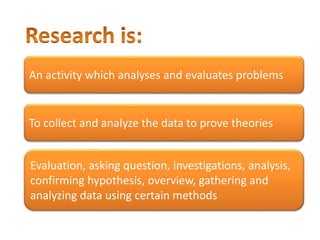
An activity which analyses and evaluates problems
To collect and analyze the data to prove theories
Evaluation, asking question, investigations, analysis,
confirming hypothesis, overview, gathering and
analyzing data using certain methods
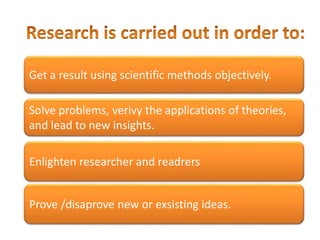
Get a result using scientific methods objectively.
Solve problems, verivy the applications of theories,
and lead to new insights.
Enlighten researcher and readrers
Prove /disaprove new or exsisting ideas.
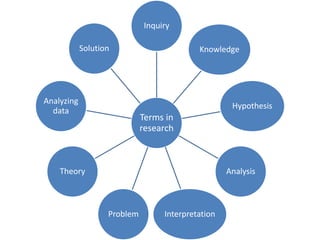
Terms in
research
Inquiry
Knowledge
Hypothesis
Analysis
InterpretationProblem
Theory
Analyzing
data
Solution
From the terms, research is
A process of formulating questions,
problems, or hypothesis; collecting data
relevant to problems; and analyzing the
data.
Research is
A systematic process of inquiry that
consists of three elements:
1. A question, problem, or hypothesis
2. Data
3. Analysis or interpretation of data
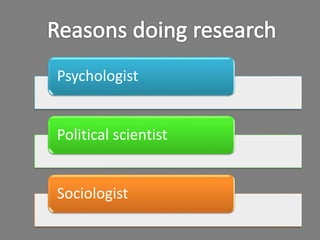
Psychologist
Political scientist
Sociologist
Theory Hypothesis Research Results
Research
process
• Number of researches approach in social
science
1.A social survey : asking the same question to
several persons
2.An observational research project : Watching
the behavior of the subject
3.An experiment with human subject :
controlling the effect of independent variable
to see what effect of dependent variable
Certain feature of the research
• The research must attempt to
show on variable is the
“cause” of another.
Research process is the method of design that
the researcher should follow
Conceive the research
• Theory tell us what to expect.
• The operational definition lead the researcher to make
hypothesis.
• Hypotheses is what the researcher examine.
• The researcher hypotheses can be true or not true by
the definition, so it is need revisions
• Method tell us how to go about our research.
• Pretest are useful to find out the result
• Instrument : interviews, questionnaires , videotape of
behavior and so on.
• Result show us what we have found
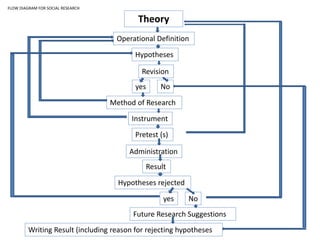
Theory
Hypotheses
Operational Definition
Revision
yes No
Method of Research
Pretest (s)
Instrument
Administration
Result
Hypotheses rejected
yes No
Future Research Suggestions
Writing Result (including reason for rejecting hypotheses
FLOW DIAGRAM FOR SOCIAL RESEARCH
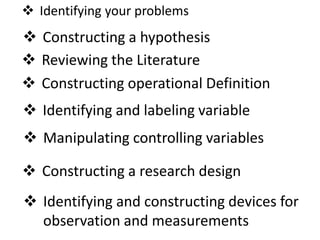
STEPS IN THE RESEARCH PROCESS
 Reviewing the Literature
 Constructing operational Definition
 Identifying and labeling variable
 Manipulating controlling variables
 Constructing a research design
 Identifying and constructing devices for
observation and measurements
 Constructing a hypothesis
 Identifying your problems
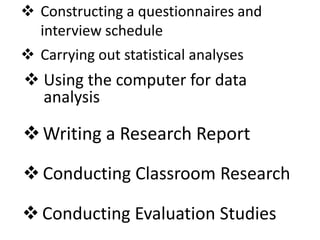
Writing a Research Report
 Conducting Evaluation Studies
 Conducting Classroom Research
 Using the computer for data
analysis
 Carrying out statistical analyses
 Constructing a questionnaires and
interview schedule
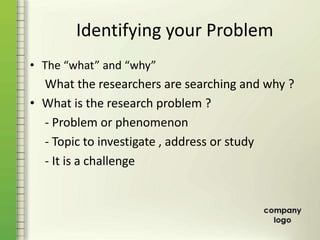
Identifying your Problem
• The “what” and “why”
What the researchers are searching and why ?
• What is the research problem ?
- Problem or phenomenon
- Topic to investigate , address or study
- It is a challenge
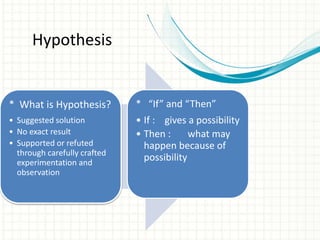
* What is Hypothesis?
• Suggested solution
• No exact result
• Supported or refuted
through carefully crafted
experimentation and
observation
* “If” and “Then”
• If : gives a possibility
• Then : what may
happen because of
possibility
Hypothesis
• Focuses on research question(s)
• Identifying, appraise, selected and
synthesize
Reviewing the literature
• Clarify
• Find modals
• Narrow your topic
• Consider whether your
sources are current
What should I do before I write
literature review?
Variables :
Variables is any entity that can be
changed
Identifying and labeling variable
Types of variables
dependent, independent, moderator,
control and intervening
• Dependent : output or effect
• Independent : input or cause
• Moderator : the moderation occurs when
the relationship between two variables
depends on the third variables
• Control /known also as consonant : remain
the same
• Intervening : used to explain the relationship
between observed variables
CONSTRUCTING OPERATIONAL DEFINITIONS
The process of converting variables from
an abstract or conceptual form to an
operational or concrete form
Manipulating and Controlling Variables
• Manipulating variable : it is the
item that is changed during the
experiment to obtain different
data
• Controlled Variable : is
always kept in the same condition
Constructing a Research Design
• It is the framework that has been
created to seek answers to research
question(s)
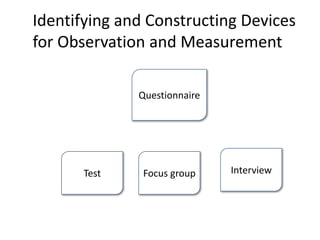
Test
Questionnaire
Identifying and Constructing Devices
for Observation and Measurement
InterviewFocus group
Constructing Questionnaire and
Interview Schedule
• Group of questions
• Close-ended questions
• Open-ended questions
• Combine of both
Interview
• Meeting with participants
• It include a minute question
• Participants’ trust
• Mange your time
Carrying Out Statistical Analyses
• The science of collecting, exploring and
presenting data
• Describes the nature of data
USING COMPUTER FOR DATA ANALYSIS
• The process of collecting your data via internet
and different websites
• Analysis your data in the form of typing
,drawing a diagram or tables
• Brief description of the research
• Involves several steps to present
the report in the form of thesis
or dissertation
Writing a Research Report
• Be objective
• Avoid technical language
• Use present tense and active voice
• Treat the data confidently
• Revise and rewrite
• Use visual aids
• Layout must be appropriated
• Avoid grammatical mistakes
• Report must present the logical analysis of
subject matter
• Be attractive in appearance, neat and clear
whether typing or printing
Guidelines
• Introduce yourself
• Minute paper can be used
• Be careful to the time
Conducting Classroom Interview
CONDUCTING EVALUATION STUDIES
• the process of judging the merit
or worth of something
• Let you discover whether and
how well objectives are being
fulfilled

Research english teaching chapter 1

  • 2.
    • Process • Products Aboutinquiry • Defining a problem • Stating an objective • Formulating a hypothesis A process • The result can be accessed to the public Undertaking structured investigation
  • 3.
    An activity whichanalyses and evaluates problems To collect and analyze the data to prove theories Evaluation, asking question, investigations, analysis, confirming hypothesis, overview, gathering and analyzing data using certain methods
  • 4.
    Get a resultusing scientific methods objectively. Solve problems, verivy the applications of theories, and lead to new insights. Enlighten researcher and readrers Prove /disaprove new or exsisting ideas.
  • 5.
  • 6.
    From the terms,research is A process of formulating questions, problems, or hypothesis; collecting data relevant to problems; and analyzing the data.
  • 7.
    Research is A systematicprocess of inquiry that consists of three elements: 1. A question, problem, or hypothesis 2. Data 3. Analysis or interpretation of data
  • 9.
  • 11.
  • 12.
    Research process • Number ofresearches approach in social science 1.A social survey : asking the same question to several persons 2.An observational research project : Watching the behavior of the subject 3.An experiment with human subject : controlling the effect of independent variable to see what effect of dependent variable
  • 13.
    Certain feature ofthe research • The research must attempt to show on variable is the “cause” of another.
  • 14.
    Research process isthe method of design that the researcher should follow Conceive the research • Theory tell us what to expect. • The operational definition lead the researcher to make hypothesis. • Hypotheses is what the researcher examine. • The researcher hypotheses can be true or not true by the definition, so it is need revisions • Method tell us how to go about our research. • Pretest are useful to find out the result • Instrument : interviews, questionnaires , videotape of behavior and so on. • Result show us what we have found
  • 15.
    Theory Hypotheses Operational Definition Revision yes No Methodof Research Pretest (s) Instrument Administration Result Hypotheses rejected yes No Future Research Suggestions Writing Result (including reason for rejecting hypotheses FLOW DIAGRAM FOR SOCIAL RESEARCH
  • 16.
    STEPS IN THERESEARCH PROCESS
  • 17.
     Reviewing theLiterature  Constructing operational Definition  Identifying and labeling variable  Manipulating controlling variables  Constructing a research design  Identifying and constructing devices for observation and measurements  Constructing a hypothesis  Identifying your problems
  • 18.
    Writing a ResearchReport  Conducting Evaluation Studies  Conducting Classroom Research  Using the computer for data analysis  Carrying out statistical analyses  Constructing a questionnaires and interview schedule
  • 19.
    Identifying your Problem •The “what” and “why” What the researchers are searching and why ? • What is the research problem ? - Problem or phenomenon - Topic to investigate , address or study - It is a challenge
  • 20.
    * What isHypothesis? • Suggested solution • No exact result • Supported or refuted through carefully crafted experimentation and observation * “If” and “Then” • If : gives a possibility • Then : what may happen because of possibility Hypothesis
  • 21.
    • Focuses onresearch question(s) • Identifying, appraise, selected and synthesize Reviewing the literature
  • 22.
    • Clarify • Findmodals • Narrow your topic • Consider whether your sources are current What should I do before I write literature review?
  • 23.
    Variables : Variables isany entity that can be changed Identifying and labeling variable
  • 24.
    Types of variables dependent,independent, moderator, control and intervening • Dependent : output or effect • Independent : input or cause • Moderator : the moderation occurs when the relationship between two variables depends on the third variables • Control /known also as consonant : remain the same • Intervening : used to explain the relationship between observed variables
  • 25.
    CONSTRUCTING OPERATIONAL DEFINITIONS Theprocess of converting variables from an abstract or conceptual form to an operational or concrete form
  • 26.
    Manipulating and ControllingVariables • Manipulating variable : it is the item that is changed during the experiment to obtain different data • Controlled Variable : is always kept in the same condition
  • 27.
    Constructing a ResearchDesign • It is the framework that has been created to seek answers to research question(s)
  • 28.
    Test Questionnaire Identifying and ConstructingDevices for Observation and Measurement InterviewFocus group
  • 29.
    Constructing Questionnaire and InterviewSchedule • Group of questions • Close-ended questions • Open-ended questions • Combine of both
  • 30.
    Interview • Meeting withparticipants • It include a minute question • Participants’ trust • Mange your time
  • 31.
    Carrying Out StatisticalAnalyses • The science of collecting, exploring and presenting data • Describes the nature of data
  • 32.
    USING COMPUTER FORDATA ANALYSIS • The process of collecting your data via internet and different websites • Analysis your data in the form of typing ,drawing a diagram or tables
  • 33.
    • Brief descriptionof the research • Involves several steps to present the report in the form of thesis or dissertation Writing a Research Report
  • 34.
    • Be objective •Avoid technical language • Use present tense and active voice • Treat the data confidently • Revise and rewrite • Use visual aids • Layout must be appropriated • Avoid grammatical mistakes • Report must present the logical analysis of subject matter • Be attractive in appearance, neat and clear whether typing or printing Guidelines
  • 35.
    • Introduce yourself •Minute paper can be used • Be careful to the time Conducting Classroom Interview
  • 36.
    CONDUCTING EVALUATION STUDIES •the process of judging the merit or worth of something • Let you discover whether and how well objectives are being fulfilled