UNIT – II
ELEMENTS OF RESEARCH
METHODOLOGY
ASST.PROF.RANJANI SHUKLA
STEPS IN RESEARCH
PROCESS -
IDENTIFICATION
1. Selection of the discipline:
The discipline or subject in which
one propose to do research may
be selected e.g. Economics,
Management, Technology,
Psychology etc. The selection of
discipline is easy. One can select
any subject, which one has studied
thoroughly, and which
has interested him most.
STEPS IN RESEARCH
PROCESS -
IDENTIFICATION
 A particular aspect of the
selected subject: The second
step is to select a particular
aspect of the selected subject.
For e.g. if the selected subject
is Economics, then one may
select Balance of payments,
Comparison of different
markets, performance of
industrial sector etc.
STEPS IN RESEARCH
PROCESS -
IDENTIFICATION
 Identifying two or more
specific topics in the
selected broad area: This is
the final step in identification of
problem. This requires a grasp
of the branch of the subject as a
whole and awareness of work
already done on it.
SELECTION AND FORMULATION OF RESEARCH PROBLEM
 Formulation or selection of research problem is one of the important step of
research process.
 A research problem is like the foundation of a building. The research problem
serves as the foundation of a research study. If the foundation
is well designed and strong you can expect the building to be also.
 The research problem serves as the foundation of a research.
SELECTION AND
FORMULATION OF
RESEARCH PROBLEM
 When selecting a research problem there are a number
of considerations to keep in mind which will help to
ensure that your study will be manageable and that you
remain motivated.
 These considerations are:
 Interest
 Magnitude
 Measurement of concepts
 Level of expertise
 Relevance
 Availability
 Ethical issues
SOURCES OF
RESEARCH
PROBLEM
The sources from which one may be able to identify
research problems or develop problem awareness are:
• Reading
• Academic experience
• Daily experience
• Exposure to field situations
• Consultations
• Brain Storming
• Research
• Intuition
CRITERIA OF
GOOD RESEARCH
PROBLEM
INTERNAL (PERSONAL) CRITERIA OR FACTORS
EXTERNAL CRITERIA OR FACTORS
CRITERIA OF GOOD RESEARCH PROBLEM
Internal Criteria
1. Researcher's interest
2. Researcher's competence
3. Researcher's own resources
CRITERIA OF GOOD
RESEARCH PROBLEM
External
factors
Researchability of the problem
Importance and urgency
Novelty or Originality
Feasibility
Facilities
Usefulness and social relevance
Research personnel
REVIEW OF LITERATURE
A literature review is an account of what has been already established or published
on a particular research topic by accredited scholars and researchers,
It is a comprehensive, in depth, systematic and critical review of selected literature
to find out how it can be useful to present study.
REVIEW OF LITERATURE
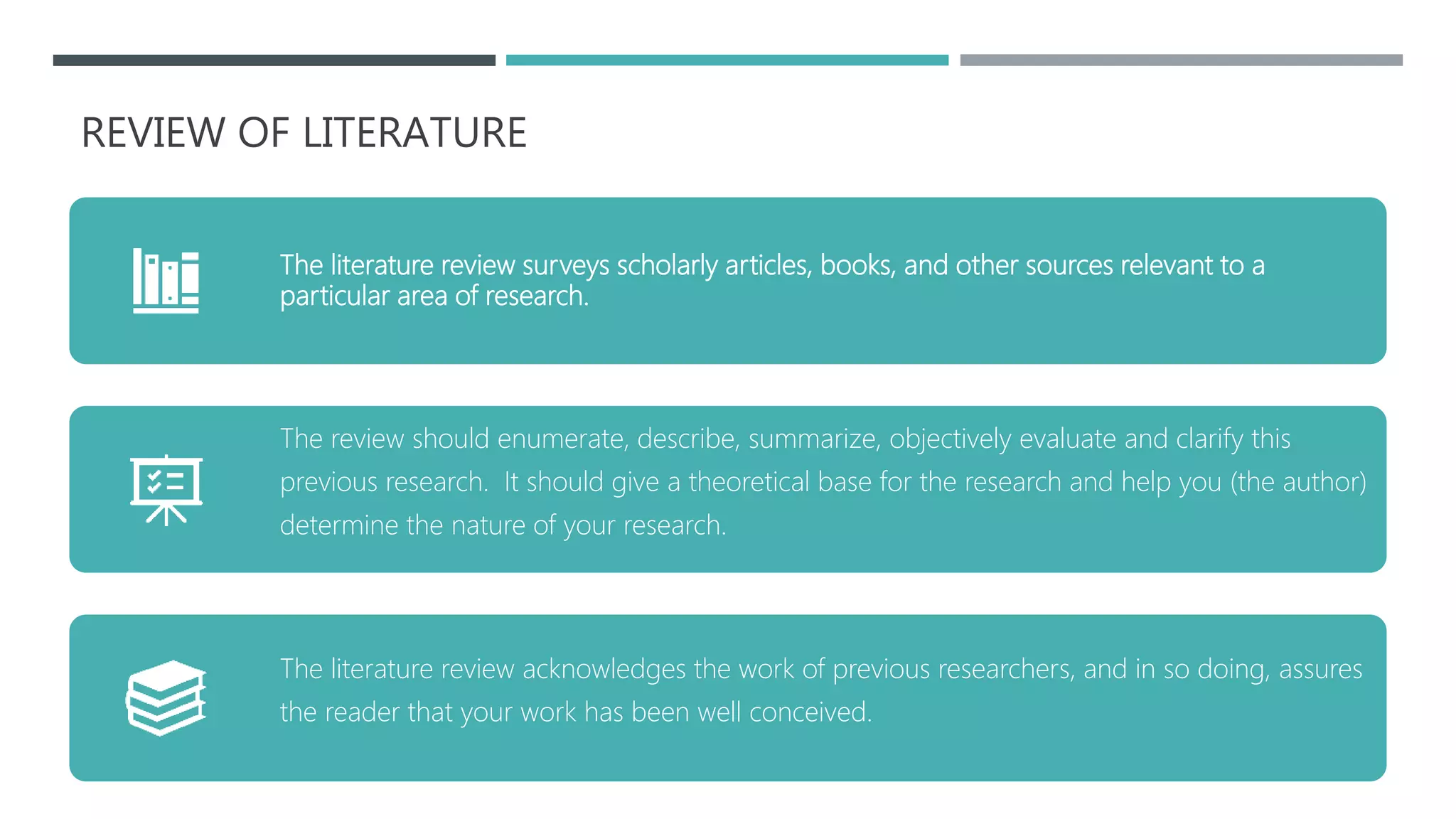
The literature review surveys scholarly articles, books, and other sources relevant to a
particular area of research.
The review should enumerate, describe, summarize, objectively evaluate and clarify this
previous research. It should give a theoretical base for the research and help you (the author)
determine the nature of your research.
The literature review acknowledges the work of previous researchers, and in so doing, assures
the reader that your work has been well conceived.
REVIEW OF LITERATURE​
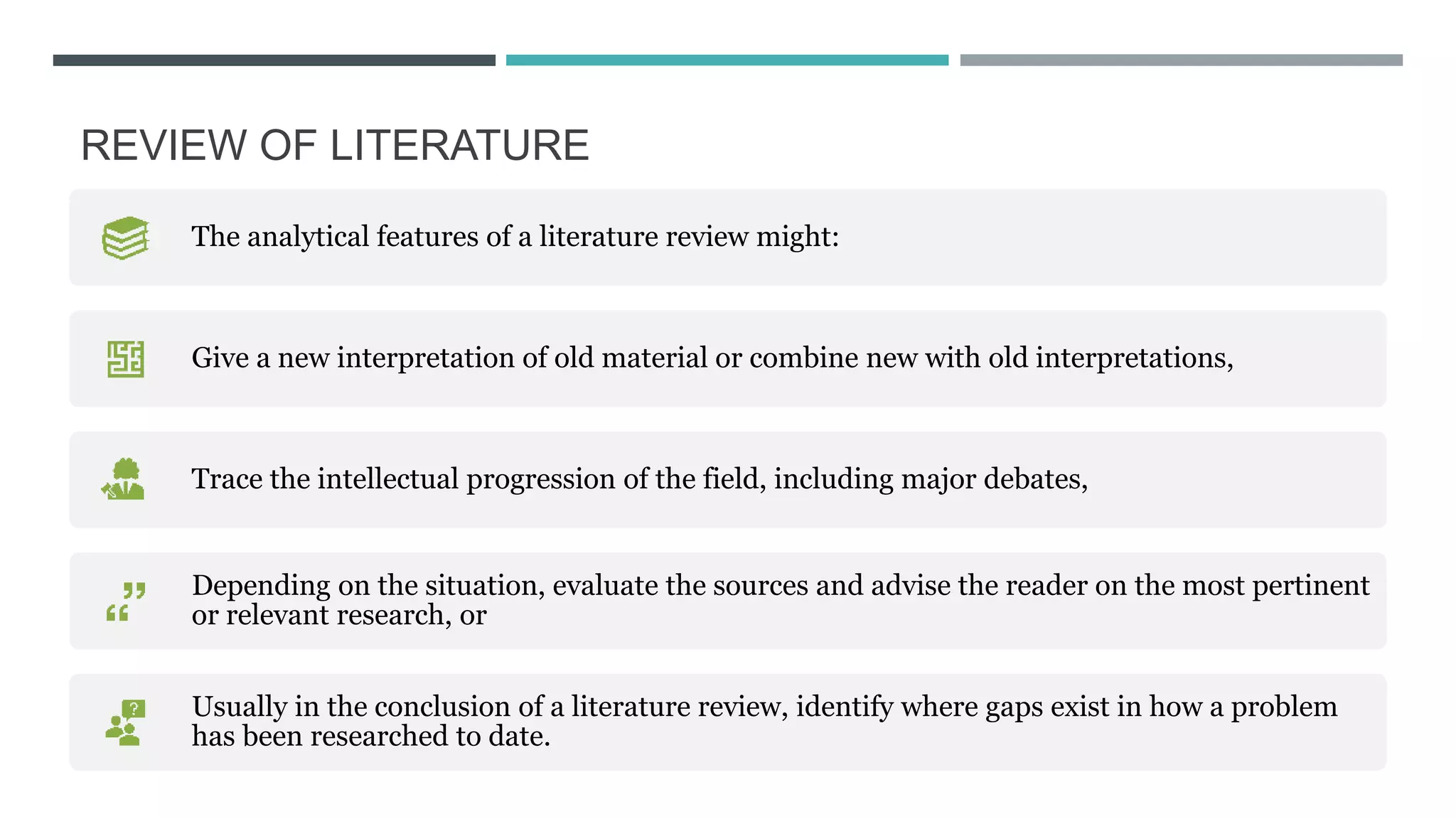
The analytical features of a literature review might:
Give a new interpretation of old material or combine new with old interpretations,
Trace the intellectual progression of the field, including major debates,
Depending on the situation, evaluate the sources and advise the reader on the most pertinent
or relevant research, or
Usually in the conclusion of a literature review, identify where gaps exist in how a problem
has been researched to date.
REVIEW OF LITERATURE
The purpose of a literature review is to:
Place each work in the context of its contribution to understanding the research problem being studied.
Describe the relationship of each work to the others under consideration.
Identify new ways to interpret prior research.
Reveal any gaps that exist in the literature.
Resolve conflicts amongst seemingly contradictory previous studies.
Identify areas of prior scholarship to prevent duplication of effort.
Point the way in fulfilling a need for additional research.
Locate your own research within the context of existing literature [very important].
FORMULATION
OF HYPOTHESIS
The hypothesis are tentative prepositions relating
to investigative questions.
We formulate them to be tested in our research.
They either describe the properties of variables or
show the relationships between them.
They aimed at answering the research questions.
FORMULATION
OF HYPOTHESIS
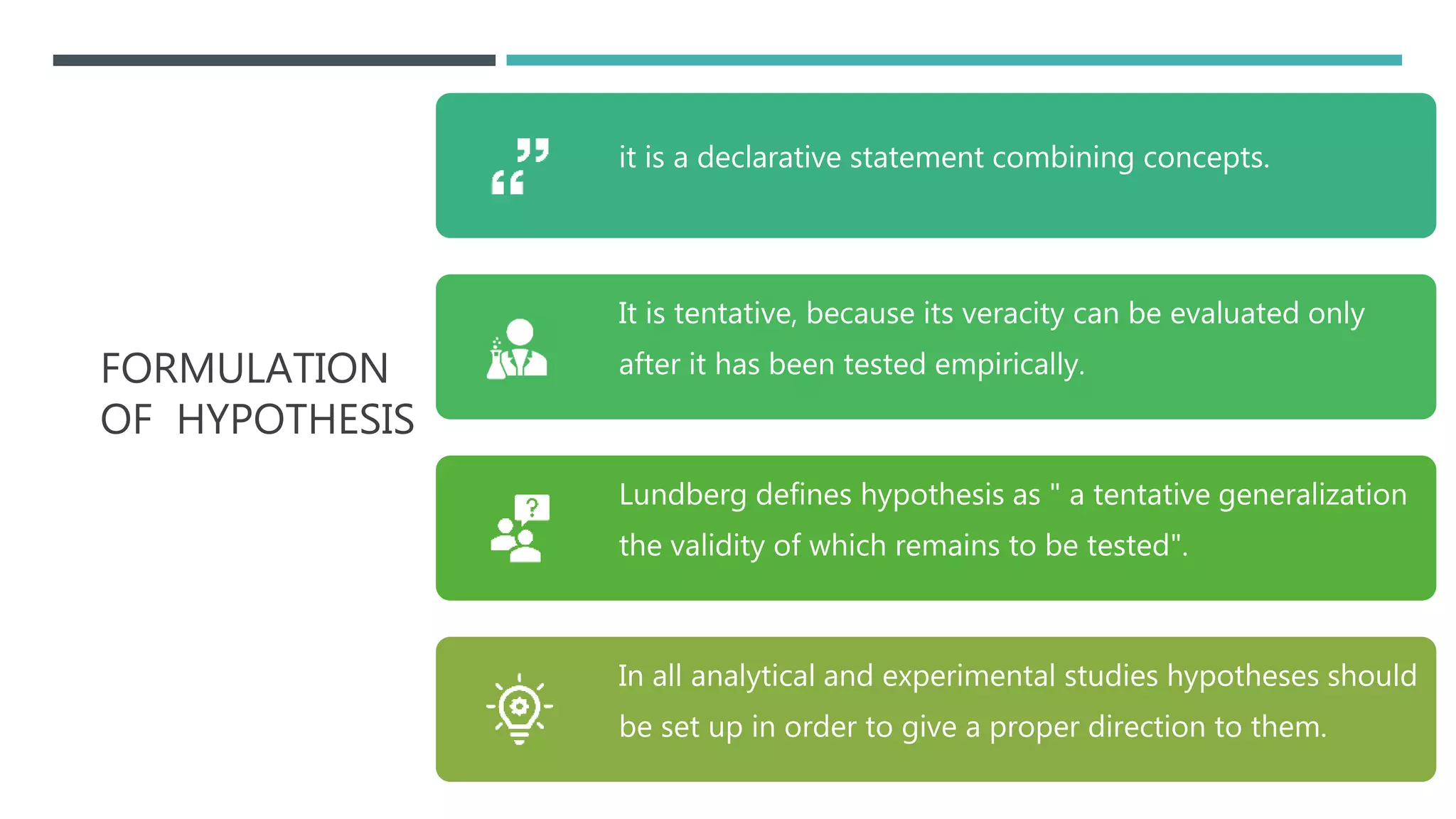
it is a declarative statement combining concepts.
It is tentative, because its veracity can be evaluated only
after it has been tested empirically.
Lundberg defines hypothesis as " a tentative generalization
the validity of which remains to be tested".
In all analytical and experimental studies hypotheses should
be set up in order to give a proper direction to them.
TYPES OF HYPOTHESES
On the basis
of functions
Descriptive
Hypotheses
Relational
Hypotheses
Another
approach
Working
Hypotheses
Null
Hypotheses
Statistical
Hypotheses
DESCRIPTIVE HYPOTHESES
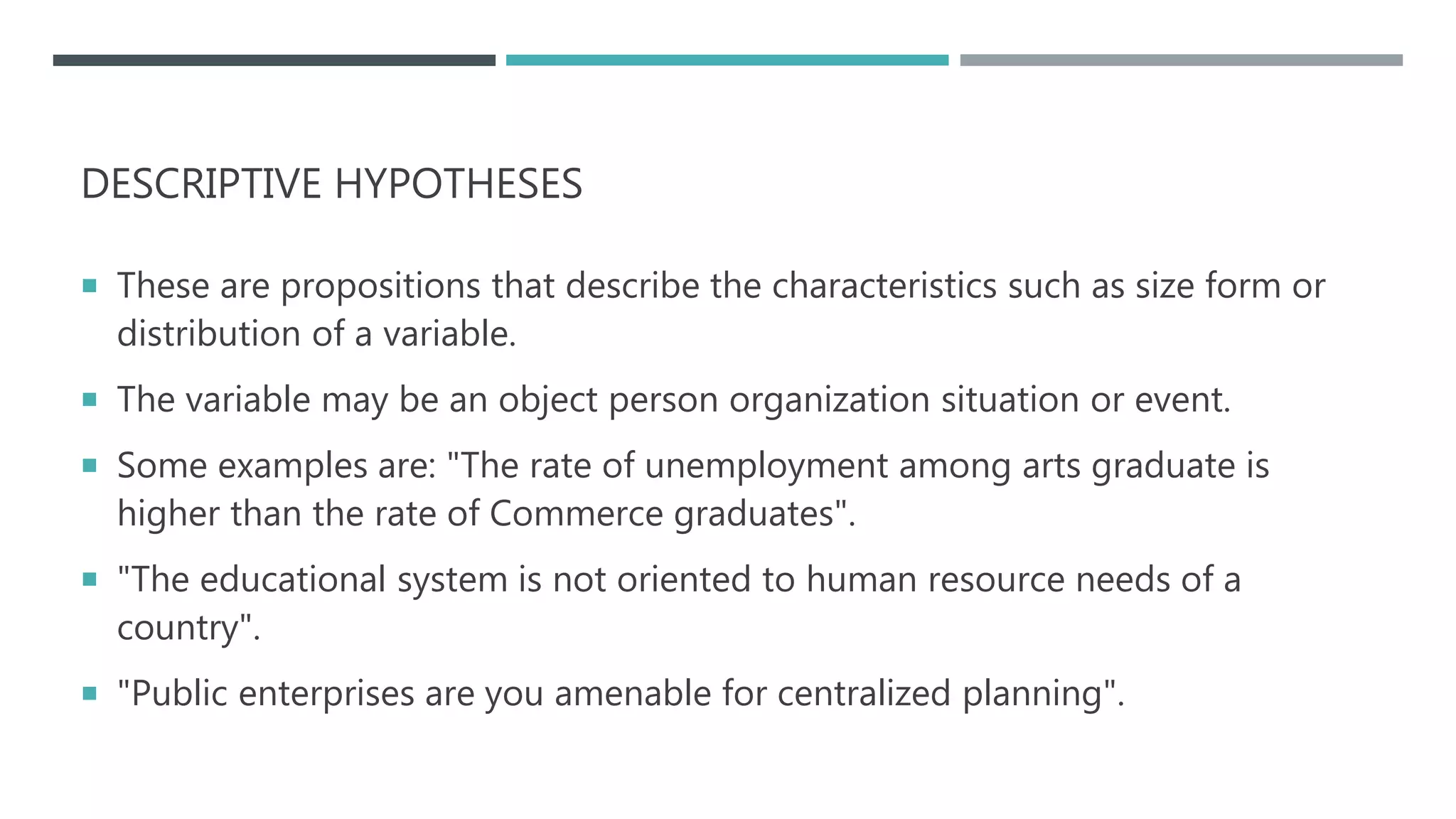
 These are propositions that describe the characteristics such as size form or
distribution of a variable.
 The variable may be an object person organization situation or event.
 Some examples are: "The rate of unemployment among arts graduate is
higher than the rate of Commerce graduates".
 "The educational system is not oriented to human resource needs of a
country".
 "Public enterprises are you amenable for centralized planning".
RELATIONAL HYPOTHESES
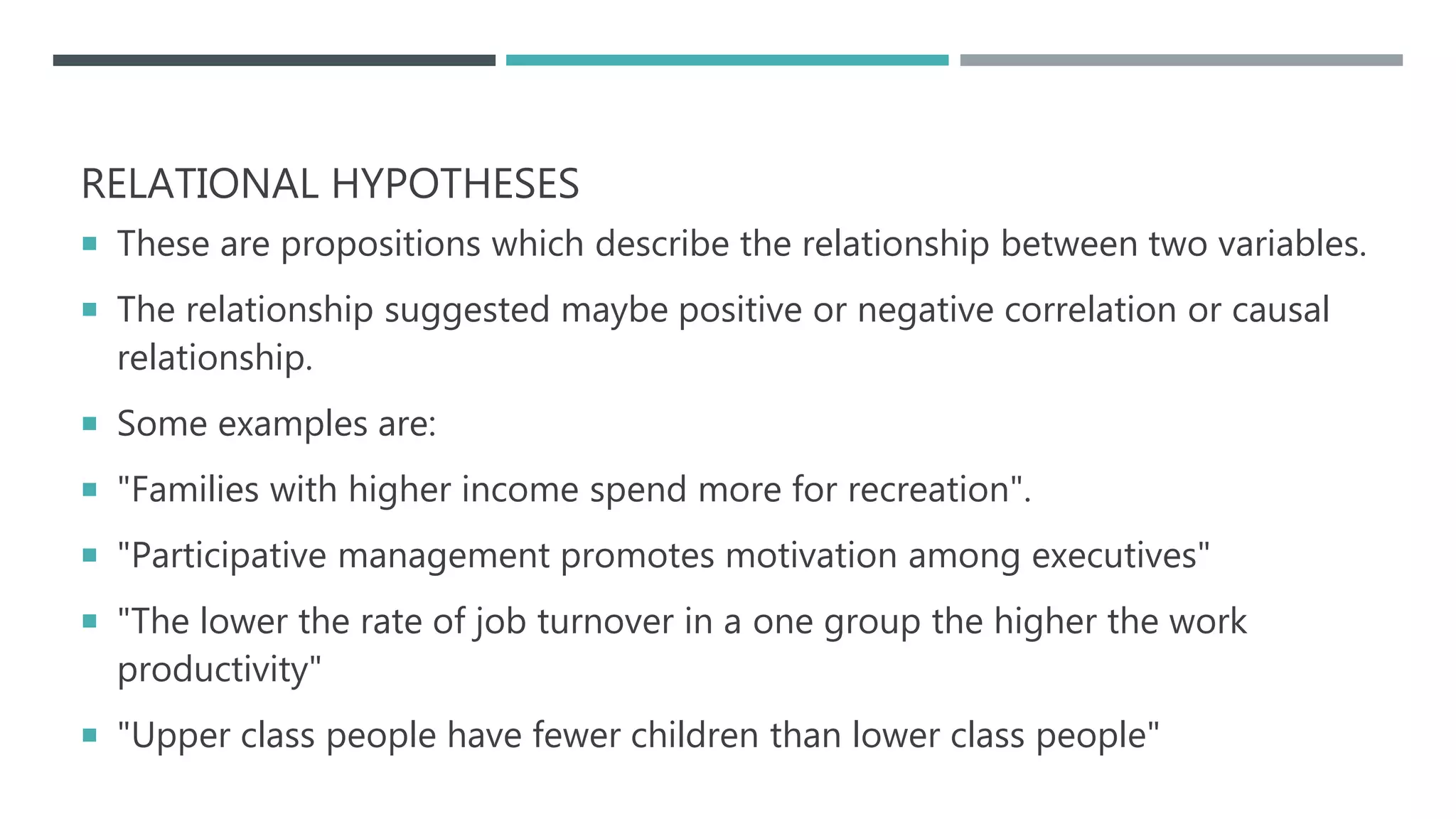
 These are propositions which describe the relationship between two variables.
 The relationship suggested maybe positive or negative correlation or causal
relationship.
 Some examples are:
 "Families with higher income spend more for recreation".
 "Participative management promotes motivation among executives"
 "The lower the rate of job turnover in a one group the higher the work
productivity"
 "Upper class people have fewer children than lower class people"
WORKING
HYPOTHESES
While planning the study of a problem,
hypotheses are formed. Initially they may
not be very specific.
In such cases, they are referred to
as "Working Hypotheses" which are subject
to modifications as investigation proceeds.
NULL
HYPOTHESES
These are hypothetical statements denying what are explicitly indicated in
working hypotheses.
They state that no difference exists between the parameter and the statistic
being compared to it.
Null hypotheses are formulated for testing statistical significance, since,
this form is a convenient approach to statistical analysis.
As the test would nullify the null hypotheses, they are so called.
STATISTICAL HYPOTHESES
 There are statements about a statistical population.
 These are derived from a sample.
 These are quantitative in nature in that they are numerically measurable for
example, "Group A is older than Group B".
 Statistical hypotheses may be hypotheses of difference or hypothesis of
association.
 The latter specify the relations between variables. This association is measured
by the coefficient of correlation, for example, if the coefficient of correlation
between bonus and productivity is + 1.0 then there is a perfect positive
relation between the bonus and productivity.
RESEARCH DESIGN OR PLAN
A research design is a logical and systematic plan prepared for directing a research study.
It specifies the objectives of the study the methodologies and techniques to be adopted for achieving
the objectives.
It constitutes the blueprint for the collection measurement and analysis of data.
It is the plan, structure and strategy of investigation conceived so as to obtain answers to the research
questions
RESEARCH DESIGN
OR PLAN
The research design is the program that guides the
investigator in the process of collecting, analyzing and
interpreting observations.
The plan is overall scheme or program of research.
It provides a systematic plan of procedure for the researcher
to follow.
ESSEANTIALS OF A GOOD RESEARCH DESIGN
It is a plan that specifies objectives of the study and the hypotheses to be tested.
An outline that specifies the sources and types of information relevant to the research questions.
It is a blueprint specifying the methods to be adopted for gathering any analyzing the data.
It is a scheme defining the domain of generalizability, I.e. Whether the obtained information can be
generalized to a larger population or to a different situations.
TYPES OF RESEARCH DESIGN
EXPLORATORY RESEARCH DESIGN, DESCRIPTIVE RESEARCH DESIGN,
AND
EXPERIMENTAL (OR CAUSAL)
RESEARCH DESIGN
EXPLORATORY RESEARCH DESIGN
This design is followed to discover ideas and insights to generate possible explanations.
It helps in exploring the problem or situation. It is, particularly, emphasized to break a broad vague
problem statement into smaller pieces or sub-problem statements that help forming specific
hypothesis.
The hypothesis is a conjectural (imaginary, speculative, or abstract) statement about the relationship
between two or more variables.
The exploratory research design is used to increase familiarity of the analyst with problem under
investigation.
EXPLORATORY
RESEARCH DESIGN
This design is
followed to realize
following purposes:
1. Clarifying concepts
and defining problem
2. Formulating
problem for more
precise investigation
3. Increasing
researcher’s familiarity
with problem
4. Developing
hypotheses
5. Establishing
priorities for further
investigation
DESCRIPTIVE
RESEARCH
DESIGN
Descriptive research design is typically concerned with describing problem and its
solution. It is more specific and purposive study.
Before rigorous attempts are made for descriptive study, the well-defined problem
must be on hand. Descriptive study rests on one or more hypotheses.
For example, “our brand is not much familiar,” “sales volume is stable,” etc. It is more
precise and specific. Unlike exploratory research, it is not flexible.
Descriptive research requires clear specification of who, why, what, when, where, and
how of the research. Descriptive design is directed to answer these problems.
CAUSAL OR
EXPERIMENTAL
RESEARCH
DESIGN
Causal research design deals with determining cause and effect relationship.
It is typically in form of experiment. In causal research design, attempt is made to
measure impact of manipulation on independent variables (like price, products,
advertising and selling efforts or marketing strategies in general) on dependent
variables (like sales volume, profits, and brand image and brand loyalty).
It has more practical value in resolving marketing problems. We can set and test
hypotheses by conducting experiments.
CAUSAL OR EXPERIMENTAL RESEARCH DESIGN
 Test marketing is the most suitable
example of experimental marketing in
which the independent variable like price,
product, promotional efforts, etc., are
manipulated (changed) to measure its
impact on the dependent variables, such as
sales, profits, brand loyalty, competitive
strengths product differentiation and so
on.
COLLECTION
AND ANALYSIS
OF DATA
COLLECTION AND ANALYSIS OF DATA
Primary
sources
Secondary
sources
SECONDARY SOURCES
 These are sources containing data which have been collected and compiled
for another purpose
 The secondary sources consists of readily available compedia and already
compiled statistical statements and reports whose data may be used by
researchers for their studies.
 For examples, census reports, annual reports and financial statements of
companies, statistical statements, reports of government departments, annual
reports on currency and finance published by Reserve Bank of India, statistical
statements relating to cooperatives and Regional Rural Banks published by
the NABARD, reports of National Sample Survey Organization, reports of
trade associations, publications of International Organizations such as UNO,
IMF, World Bank, ILO, WHO etc. Trade and Financial Journals, newspapers etc.
SECONDARY SOURCES
 Secondary sources consists of not only published records and
reports, but also unpublished records.
 The latter category includes various records and registers
maintained by firms and organizations, e.g. accounting and
financial records, personnel records, register of members, minutes
of meetings, inventory records etc.
PRIMARY SOURCES
But collecting primary data is costly and time consuming.
In this case the researcher can collect the required data precisely according to his research he
can collect them when he wants them and in the form he needs them.
Primary data are directly collected by the researchers from their original sources.
METHODS OF PRIMARY DATA COLLECTION
Observation Interviewing Mail survey
Experimentation Simulation
Projective
Techniques
INTERPRETATION AND REPORT WRITING
Data interpretation is the process of reviewing data through some predefined processes which will
help assign some meaning to the data and arrive at a relevant conclusion.
It involves taking the result of data analysis making inferences on the relation studied and using
them to conclude
Data analysis is the process of ordering, categorizing and summarizing data to obtain answers to
research questions. It is usually the 1st step taken towards data interpretation.
It is evident that the interpretation of data is very important and as such needs to be done properly
therefore researchers have identified some data interpretation methods to aid this process.
REPORT WRITING
 The purpose of the
written report is to
present the results of
your research, but
more importantly to
provide a persuasive
argument to reader of
what you have found.
USE OF WEB SEARCH IN RESEARCH PROCESS
 https://www.universalclass.com/articles/writing/research-skills/how-to-use-internet-search-engines-for-
research.htm
USE OF ADVANCED TECHNIQUES
 INFLIBNET
 GOOGLE SCHOLAR
 E – Shodhganga
 Researchgate
ANY
QUESTIONS?

Elements of research methodology

  • 1.
    UNIT – II ELEMENTSOF RESEARCH METHODOLOGY ASST.PROF.RANJANI SHUKLA
  • 2.
    STEPS IN RESEARCH PROCESS- IDENTIFICATION 1. Selection of the discipline: The discipline or subject in which one propose to do research may be selected e.g. Economics, Management, Technology, Psychology etc. The selection of discipline is easy. One can select any subject, which one has studied thoroughly, and which has interested him most.
  • 3.
    STEPS IN RESEARCH PROCESS- IDENTIFICATION  A particular aspect of the selected subject: The second step is to select a particular aspect of the selected subject. For e.g. if the selected subject is Economics, then one may select Balance of payments, Comparison of different markets, performance of industrial sector etc.
  • 4.
    STEPS IN RESEARCH PROCESS- IDENTIFICATION  Identifying two or more specific topics in the selected broad area: This is the final step in identification of problem. This requires a grasp of the branch of the subject as a whole and awareness of work already done on it.
  • 5.
    SELECTION AND FORMULATIONOF RESEARCH PROBLEM  Formulation or selection of research problem is one of the important step of research process.  A research problem is like the foundation of a building. The research problem serves as the foundation of a research study. If the foundation is well designed and strong you can expect the building to be also.  The research problem serves as the foundation of a research.
  • 6.
    SELECTION AND FORMULATION OF RESEARCHPROBLEM  When selecting a research problem there are a number of considerations to keep in mind which will help to ensure that your study will be manageable and that you remain motivated.  These considerations are:  Interest  Magnitude  Measurement of concepts  Level of expertise  Relevance  Availability  Ethical issues
  • 7.
    SOURCES OF RESEARCH PROBLEM The sourcesfrom which one may be able to identify research problems or develop problem awareness are: • Reading • Academic experience • Daily experience • Exposure to field situations • Consultations • Brain Storming • Research • Intuition
  • 8.
    CRITERIA OF GOOD RESEARCH PROBLEM INTERNAL(PERSONAL) CRITERIA OR FACTORS EXTERNAL CRITERIA OR FACTORS
  • 9.
    CRITERIA OF GOODRESEARCH PROBLEM Internal Criteria 1. Researcher's interest 2. Researcher's competence 3. Researcher's own resources
  • 10.
    CRITERIA OF GOOD RESEARCHPROBLEM External factors Researchability of the problem Importance and urgency Novelty or Originality Feasibility Facilities Usefulness and social relevance Research personnel
  • 11.
  • 12.
    REVIEW OF LITERATURE Aliterature review is an account of what has been already established or published on a particular research topic by accredited scholars and researchers, It is a comprehensive, in depth, systematic and critical review of selected literature to find out how it can be useful to present study.
  • 13.
    REVIEW OF LITERATURE Theliterature review surveys scholarly articles, books, and other sources relevant to a particular area of research. The review should enumerate, describe, summarize, objectively evaluate and clarify this previous research. It should give a theoretical base for the research and help you (the author) determine the nature of your research. The literature review acknowledges the work of previous researchers, and in so doing, assures the reader that your work has been well conceived.
  • 14.
    REVIEW OF LITERATURE​ Theanalytical features of a literature review might: Give a new interpretation of old material or combine new with old interpretations, Trace the intellectual progression of the field, including major debates, Depending on the situation, evaluate the sources and advise the reader on the most pertinent or relevant research, or Usually in the conclusion of a literature review, identify where gaps exist in how a problem has been researched to date.
  • 15.
    REVIEW OF LITERATURE Thepurpose of a literature review is to: Place each work in the context of its contribution to understanding the research problem being studied. Describe the relationship of each work to the others under consideration. Identify new ways to interpret prior research. Reveal any gaps that exist in the literature. Resolve conflicts amongst seemingly contradictory previous studies. Identify areas of prior scholarship to prevent duplication of effort. Point the way in fulfilling a need for additional research. Locate your own research within the context of existing literature [very important].
  • 17.
    FORMULATION OF HYPOTHESIS The hypothesisare tentative prepositions relating to investigative questions. We formulate them to be tested in our research. They either describe the properties of variables or show the relationships between them. They aimed at answering the research questions.
  • 18.
    FORMULATION OF HYPOTHESIS it isa declarative statement combining concepts. It is tentative, because its veracity can be evaluated only after it has been tested empirically. Lundberg defines hypothesis as " a tentative generalization the validity of which remains to be tested". In all analytical and experimental studies hypotheses should be set up in order to give a proper direction to them.
  • 19.
    TYPES OF HYPOTHESES Onthe basis of functions Descriptive Hypotheses Relational Hypotheses Another approach Working Hypotheses Null Hypotheses Statistical Hypotheses
  • 20.
    DESCRIPTIVE HYPOTHESES  Theseare propositions that describe the characteristics such as size form or distribution of a variable.  The variable may be an object person organization situation or event.  Some examples are: "The rate of unemployment among arts graduate is higher than the rate of Commerce graduates".  "The educational system is not oriented to human resource needs of a country".  "Public enterprises are you amenable for centralized planning".
  • 21.
    RELATIONAL HYPOTHESES  Theseare propositions which describe the relationship between two variables.  The relationship suggested maybe positive or negative correlation or causal relationship.  Some examples are:  "Families with higher income spend more for recreation".  "Participative management promotes motivation among executives"  "The lower the rate of job turnover in a one group the higher the work productivity"  "Upper class people have fewer children than lower class people"
  • 22.
    WORKING HYPOTHESES While planning thestudy of a problem, hypotheses are formed. Initially they may not be very specific. In such cases, they are referred to as "Working Hypotheses" which are subject to modifications as investigation proceeds.
  • 23.
    NULL HYPOTHESES These are hypotheticalstatements denying what are explicitly indicated in working hypotheses. They state that no difference exists between the parameter and the statistic being compared to it. Null hypotheses are formulated for testing statistical significance, since, this form is a convenient approach to statistical analysis. As the test would nullify the null hypotheses, they are so called.
  • 24.
    STATISTICAL HYPOTHESES  Thereare statements about a statistical population.  These are derived from a sample.  These are quantitative in nature in that they are numerically measurable for example, "Group A is older than Group B".  Statistical hypotheses may be hypotheses of difference or hypothesis of association.  The latter specify the relations between variables. This association is measured by the coefficient of correlation, for example, if the coefficient of correlation between bonus and productivity is + 1.0 then there is a perfect positive relation between the bonus and productivity.
  • 26.
    RESEARCH DESIGN ORPLAN A research design is a logical and systematic plan prepared for directing a research study. It specifies the objectives of the study the methodologies and techniques to be adopted for achieving the objectives. It constitutes the blueprint for the collection measurement and analysis of data. It is the plan, structure and strategy of investigation conceived so as to obtain answers to the research questions
  • 27.
    RESEARCH DESIGN OR PLAN Theresearch design is the program that guides the investigator in the process of collecting, analyzing and interpreting observations. The plan is overall scheme or program of research. It provides a systematic plan of procedure for the researcher to follow.
  • 28.
    ESSEANTIALS OF AGOOD RESEARCH DESIGN It is a plan that specifies objectives of the study and the hypotheses to be tested. An outline that specifies the sources and types of information relevant to the research questions. It is a blueprint specifying the methods to be adopted for gathering any analyzing the data. It is a scheme defining the domain of generalizability, I.e. Whether the obtained information can be generalized to a larger population or to a different situations.
  • 29.
    TYPES OF RESEARCHDESIGN EXPLORATORY RESEARCH DESIGN, DESCRIPTIVE RESEARCH DESIGN, AND EXPERIMENTAL (OR CAUSAL) RESEARCH DESIGN
  • 30.
    EXPLORATORY RESEARCH DESIGN Thisdesign is followed to discover ideas and insights to generate possible explanations. It helps in exploring the problem or situation. It is, particularly, emphasized to break a broad vague problem statement into smaller pieces or sub-problem statements that help forming specific hypothesis. The hypothesis is a conjectural (imaginary, speculative, or abstract) statement about the relationship between two or more variables. The exploratory research design is used to increase familiarity of the analyst with problem under investigation.
  • 31.
    EXPLORATORY RESEARCH DESIGN This designis followed to realize following purposes: 1. Clarifying concepts and defining problem 2. Formulating problem for more precise investigation 3. Increasing researcher’s familiarity with problem 4. Developing hypotheses 5. Establishing priorities for further investigation
  • 32.
    DESCRIPTIVE RESEARCH DESIGN Descriptive research designis typically concerned with describing problem and its solution. It is more specific and purposive study. Before rigorous attempts are made for descriptive study, the well-defined problem must be on hand. Descriptive study rests on one or more hypotheses. For example, “our brand is not much familiar,” “sales volume is stable,” etc. It is more precise and specific. Unlike exploratory research, it is not flexible. Descriptive research requires clear specification of who, why, what, when, where, and how of the research. Descriptive design is directed to answer these problems.
  • 33.
    CAUSAL OR EXPERIMENTAL RESEARCH DESIGN Causal researchdesign deals with determining cause and effect relationship. It is typically in form of experiment. In causal research design, attempt is made to measure impact of manipulation on independent variables (like price, products, advertising and selling efforts or marketing strategies in general) on dependent variables (like sales volume, profits, and brand image and brand loyalty). It has more practical value in resolving marketing problems. We can set and test hypotheses by conducting experiments.
  • 34.
    CAUSAL OR EXPERIMENTALRESEARCH DESIGN  Test marketing is the most suitable example of experimental marketing in which the independent variable like price, product, promotional efforts, etc., are manipulated (changed) to measure its impact on the dependent variables, such as sales, profits, brand loyalty, competitive strengths product differentiation and so on.
  • 35.
  • 36.
    COLLECTION AND ANALYSISOF DATA Primary sources Secondary sources
  • 37.
    SECONDARY SOURCES  Theseare sources containing data which have been collected and compiled for another purpose  The secondary sources consists of readily available compedia and already compiled statistical statements and reports whose data may be used by researchers for their studies.  For examples, census reports, annual reports and financial statements of companies, statistical statements, reports of government departments, annual reports on currency and finance published by Reserve Bank of India, statistical statements relating to cooperatives and Regional Rural Banks published by the NABARD, reports of National Sample Survey Organization, reports of trade associations, publications of International Organizations such as UNO, IMF, World Bank, ILO, WHO etc. Trade and Financial Journals, newspapers etc.
  • 38.
    SECONDARY SOURCES  Secondarysources consists of not only published records and reports, but also unpublished records.  The latter category includes various records and registers maintained by firms and organizations, e.g. accounting and financial records, personnel records, register of members, minutes of meetings, inventory records etc.
  • 39.
    PRIMARY SOURCES But collectingprimary data is costly and time consuming. In this case the researcher can collect the required data precisely according to his research he can collect them when he wants them and in the form he needs them. Primary data are directly collected by the researchers from their original sources.
  • 40.
    METHODS OF PRIMARYDATA COLLECTION Observation Interviewing Mail survey Experimentation Simulation Projective Techniques
  • 41.
    INTERPRETATION AND REPORTWRITING Data interpretation is the process of reviewing data through some predefined processes which will help assign some meaning to the data and arrive at a relevant conclusion. It involves taking the result of data analysis making inferences on the relation studied and using them to conclude Data analysis is the process of ordering, categorizing and summarizing data to obtain answers to research questions. It is usually the 1st step taken towards data interpretation. It is evident that the interpretation of data is very important and as such needs to be done properly therefore researchers have identified some data interpretation methods to aid this process.
  • 42.
    REPORT WRITING  Thepurpose of the written report is to present the results of your research, but more importantly to provide a persuasive argument to reader of what you have found.
  • 43.
    USE OF WEBSEARCH IN RESEARCH PROCESS  https://www.universalclass.com/articles/writing/research-skills/how-to-use-internet-search-engines-for- research.htm
  • 44.
    USE OF ADVANCEDTECHNIQUES  INFLIBNET  GOOGLE SCHOLAR  E – Shodhganga  Researchgate
  • 45.