Understanding Patents
-The Basic Approach
Sonia Nagvenkar
- Formulation Scientist II
Sonia Nagvenkar
What is a Patent ?
•A patent for an invention is a grant to an inventor of a
property right for a limited time by a Government, generally
acting through a Patent and Trademark Office.
•A patent gives its owner the right to EXCLUDE other
people from making, using or selling the claimed invention.
Sonia Nagvenkar
Types of patents
• Utility Patent- Issued for the invention of a new and useful process, machine,
manufacture, or composition of matter, or a new and useful improvement
thereof
"patents for invention"
• Design Patent- Issued for a new, original, and ornamental design embodied in
or applied to an article of manufacture.
• Plant Patent- Issued for a new and distinct, invented or discovered asexually
reproduced plant including cultivated sports, mutants, hybrids, and newly
found seedlings
Sonia Nagvenkar
Types of patent applications
1. Provisional patent application
- Establishes priority for subsequent filing, only on the information conatained in
the application.
- Does not have to have claims
- Does not get examined.
2. Regular U.S. / Non-provisional / Utility applications
3. Patent Cooperation Treaty (PCT) Applications
- Reserves rights to file in the U.S. And many foreign countries at a later time (30
months)
4. Foreign Applications:
- Must be filed in each country or region of interest.
- Often more expensive.
Sonia Nagvenkar
Prior Art
• Prior Art: Knowledge or information existing (publicaly available) at the
time of invention.
• Information available/dated before the filing date of application being
examined
sources:
Prior Art includes:
Presentations.
Publications
Databases in public domain
Websites
Theses (published online)
Patents
Sonia Nagvenkar
How to read a patent?
• Patent terminologies
• Patent claims and its types
• Patent Certifications
Sonia Nagvenkar
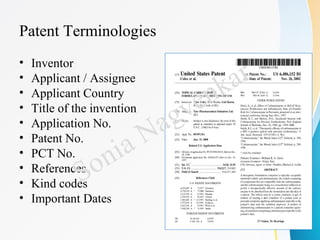
Patent Terminologies
• Inventor
• Applicant / Assignee
• Applicant Country
• Title of the invention
• Application No.
• Patent No.
• PCT No.
• References
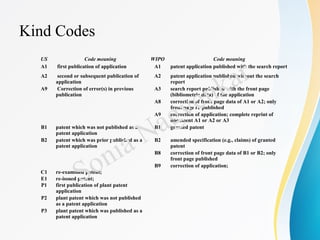
• Kind codes
• Important Dates
Sonia Nagvenkar
Kind Codes
US Code meaning WIPO Code meaning
A1 first publication of application A1 patent application published with the search report
A2 second or subsequent publication of
application
A2 patent application published without the search
report
A9 Correction of error(s) in previous
publication
A3 search report published with the front page
(bibliometric data) of the application
A8 correction of front page data of A1 or A2; only
front page re-published
A9 correction of application; complete reprint of
document A1 or A2 or A3
B1 patent which was not published as a
patent application
B1 granted patent
B2 patent which was prior published as a
patent application
B2 amended specification (e.g., claims) of granted
patent
B8 correction of front page data of B1 or B2; only
front page published
B9 correction of application;
C1 re-examined patent;
E1 re-issued patent;
P1 first publication of plant patent
application
P2 plant patent which was not published
as a patent application
P3 plant patent which was published as a
patent application
Sonia Nagvenkar
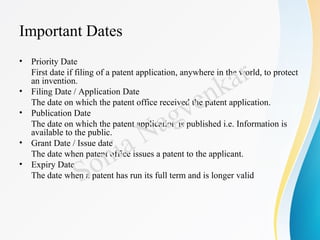
Important Dates
• Priority Date
First date if filing of a patent application, anywhere in the world, to protect
an invention.
• Filing Date / Application Date
The date on which the patent office received the patent application.
• Publication Date
The date on which the patent application is published i.e. Information is
available to the public.
• Grant Date / Issue date
The date when patent office issues a patent to the applicant.
• Expiry Date
The date when a patent has run its full term and is longer valid
Sonia Nagvenkar
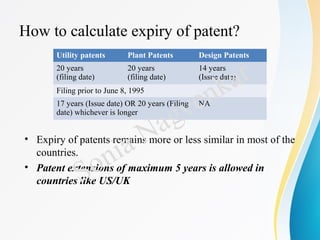
How to calculate expiry of patent?
Utility patents Plant Patents Design Patents
20 years
(filing date)
20 years
(filing date)
14 years
(Issue date)
Filing prior to June 8, 1995
17 years (Issue date) OR 20 years (Filing
date) whichever is longer
NA
• Expiry of patents remains more or less similar in most of the
countries.
• Patent extensions of maximum 5 years is allowed in
countries like US/UKSonia Nagvenkar
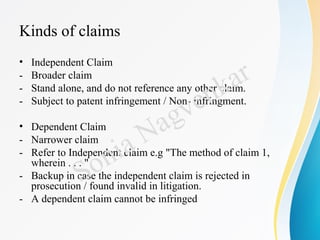
Kinds of claims
• Independent Claim
- Broader claim
- Stand alone, and do not reference any other claim.
- Subject to patent infringement / Non- infringment.
• Dependent Claim
- Narrower claim
- Refer to Independent claim e.g "The method of claim 1,
wherein . . . "
- Backup in case the independent claim is rejected in
prosecution / found invalid in litigation.
- A dependent claim cannot be infringed
Sonia Nagvenkar
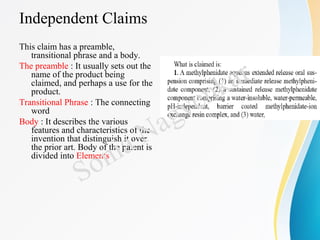
Independent Claims
This claim has a preamble,
transitional phrase and a body.
The preamble : It usually sets out the
name of the product being
claimed, and perhaps a use for the
product.
Transitional Phrase : The connecting
word
Body : It describes the various
features and characteristics of the
invention that distinguish it over
the prior art. Body of the patent is
divided into Elements
Sonia Nagvenkar
Patent Claims
• The extent of the protection conferred by a patent, or
the protection sought in a patent application.
• Heart of the patent application.
• The cause of patent infringements / patent litigations.
• Patent claims define the scope of an invention
• A product that has each and every element of an
issued claim infringes the patent.
• Types:
• Independent claims
• Dependent claims
Sonia Nagvenkar
What is infringement?
• The claim
– An apparatus, comprising: A, B, and C.
• The infringing product contains:
– A, B, and C
• Infringement
– A and B
• No infringement
– A, B, C, D and E
• Infringement
Sonia Nagvenkar
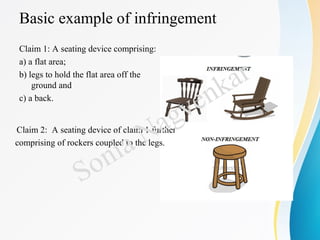
Basic example of infringement
Claim 1: A seating device comprising:
a) a flat area;
b) legs to hold the flat area off the
ground and
c) a back.
Claim 2: A seating device of claim 1 further
comprising of rockers coupled to the legs.
Sonia Nagvenkar
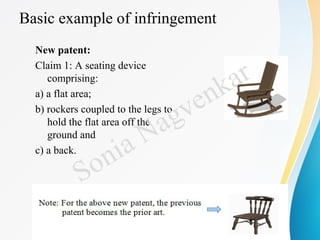
Basic example of infringement
New patent:
Claim 1: A seating device
comprising:
a) a flat area;
b) rockers coupled to the legs to
hold the flat area off the
ground and
c) a back.
Sonia Nagvenkar
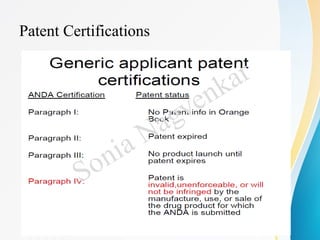
Patent Certifications
Sonia Nagvenkar
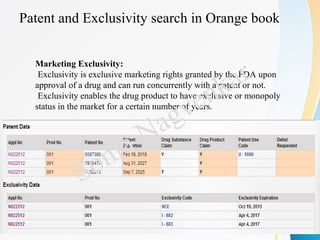
Patent and Exclusivity search in Orange book
Marketing Exclusivity:
Exclusivity is exclusive marketing rights granted by the FDA upon
approval of a drug and can run concurrently with a patent or not.
Exclusivity enables the drug product to have exclusive or monopoly
status in the market for a certain number of years.
Sonia Nagvenkar

Understanding patents

  • 1.
    Understanding Patents -The BasicApproach Sonia Nagvenkar - Formulation Scientist II Sonia Nagvenkar
  • 2.
    What is aPatent ? •A patent for an invention is a grant to an inventor of a property right for a limited time by a Government, generally acting through a Patent and Trademark Office. •A patent gives its owner the right to EXCLUDE other people from making, using or selling the claimed invention. Sonia Nagvenkar
  • 3.
    Types of patents •Utility Patent- Issued for the invention of a new and useful process, machine, manufacture, or composition of matter, or a new and useful improvement thereof "patents for invention" • Design Patent- Issued for a new, original, and ornamental design embodied in or applied to an article of manufacture. • Plant Patent- Issued for a new and distinct, invented or discovered asexually reproduced plant including cultivated sports, mutants, hybrids, and newly found seedlings Sonia Nagvenkar
  • 4.
    Types of patentapplications 1. Provisional patent application - Establishes priority for subsequent filing, only on the information conatained in the application. - Does not have to have claims - Does not get examined. 2. Regular U.S. / Non-provisional / Utility applications 3. Patent Cooperation Treaty (PCT) Applications - Reserves rights to file in the U.S. And many foreign countries at a later time (30 months) 4. Foreign Applications: - Must be filed in each country or region of interest. - Often more expensive. Sonia Nagvenkar
  • 5.
    Prior Art • PriorArt: Knowledge or information existing (publicaly available) at the time of invention. • Information available/dated before the filing date of application being examined sources: Prior Art includes: Presentations. Publications Databases in public domain Websites Theses (published online) Patents Sonia Nagvenkar
  • 6.
    How to reada patent? • Patent terminologies • Patent claims and its types • Patent Certifications Sonia Nagvenkar
  • 7.
    Patent Terminologies • Inventor •Applicant / Assignee • Applicant Country • Title of the invention • Application No. • Patent No. • PCT No. • References • Kind codes • Important Dates Sonia Nagvenkar
  • 8.
    Kind Codes US Codemeaning WIPO Code meaning A1 first publication of application A1 patent application published with the search report A2 second or subsequent publication of application A2 patent application published without the search report A9 Correction of error(s) in previous publication A3 search report published with the front page (bibliometric data) of the application A8 correction of front page data of A1 or A2; only front page re-published A9 correction of application; complete reprint of document A1 or A2 or A3 B1 patent which was not published as a patent application B1 granted patent B2 patent which was prior published as a patent application B2 amended specification (e.g., claims) of granted patent B8 correction of front page data of B1 or B2; only front page published B9 correction of application; C1 re-examined patent; E1 re-issued patent; P1 first publication of plant patent application P2 plant patent which was not published as a patent application P3 plant patent which was published as a patent application Sonia Nagvenkar
  • 9.
    Important Dates • PriorityDate First date if filing of a patent application, anywhere in the world, to protect an invention. • Filing Date / Application Date The date on which the patent office received the patent application. • Publication Date The date on which the patent application is published i.e. Information is available to the public. • Grant Date / Issue date The date when patent office issues a patent to the applicant. • Expiry Date The date when a patent has run its full term and is longer valid Sonia Nagvenkar
  • 10.
    How to calculateexpiry of patent? Utility patents Plant Patents Design Patents 20 years (filing date) 20 years (filing date) 14 years (Issue date) Filing prior to June 8, 1995 17 years (Issue date) OR 20 years (Filing date) whichever is longer NA • Expiry of patents remains more or less similar in most of the countries. • Patent extensions of maximum 5 years is allowed in countries like US/UKSonia Nagvenkar
  • 11.
    Kinds of claims •Independent Claim - Broader claim - Stand alone, and do not reference any other claim. - Subject to patent infringement / Non- infringment. • Dependent Claim - Narrower claim - Refer to Independent claim e.g "The method of claim 1, wherein . . . " - Backup in case the independent claim is rejected in prosecution / found invalid in litigation. - A dependent claim cannot be infringed Sonia Nagvenkar
  • 12.
    Independent Claims This claimhas a preamble, transitional phrase and a body. The preamble : It usually sets out the name of the product being claimed, and perhaps a use for the product. Transitional Phrase : The connecting word Body : It describes the various features and characteristics of the invention that distinguish it over the prior art. Body of the patent is divided into Elements Sonia Nagvenkar
  • 13.
    Patent Claims • Theextent of the protection conferred by a patent, or the protection sought in a patent application. • Heart of the patent application. • The cause of patent infringements / patent litigations. • Patent claims define the scope of an invention • A product that has each and every element of an issued claim infringes the patent. • Types: • Independent claims • Dependent claims Sonia Nagvenkar
  • 14.
    What is infringement? •The claim – An apparatus, comprising: A, B, and C. • The infringing product contains: – A, B, and C • Infringement – A and B • No infringement – A, B, C, D and E • Infringement Sonia Nagvenkar
  • 15.
    Basic example ofinfringement Claim 1: A seating device comprising: a) a flat area; b) legs to hold the flat area off the ground and c) a back. Claim 2: A seating device of claim 1 further comprising of rockers coupled to the legs. Sonia Nagvenkar
  • 16.
    Basic example ofinfringement New patent: Claim 1: A seating device comprising: a) a flat area; b) rockers coupled to the legs to hold the flat area off the ground and c) a back. Sonia Nagvenkar
  • 17.
  • 18.
    Patent and Exclusivitysearch in Orange book Marketing Exclusivity: Exclusivity is exclusive marketing rights granted by the FDA upon approval of a drug and can run concurrently with a patent or not. Exclusivity enables the drug product to have exclusive or monopoly status in the market for a certain number of years. Sonia Nagvenkar