The document discusses different aspects of the innovation process including invention, types of innovations, and phases of innovation. It defines invention as the creation of something new that is useful. There are three types of innovations - product, process, and service innovations. Product innovation involves changes to the product, process innovation improves production methods, and service innovation develops new ways to provide services. The innovation process has two phases - the design phase which is creative and flexible, and the implementation phase which plans and executes the innovation.
Introduction to innovation process and definitions of invention. Discusses what qualifies as an invention and what does not under the Patents Act, 1970.
Defines innovation, differences from invention, and outlines components and goals of innovation, including advantages and risks.
Discusses types of innovation including product, process, and service innovations, emphasizing the aspects of each type.
Explains product innovation, focusing on changes in product design and customer needs, with examples and elements of continuous improvement.
Describes process innovation, detailing methods to improve operational efficiency, production capacity, and value addition.
Defines service innovation, emphasizing its importance in various sectors, with a focus on technology's role in enhancing service.
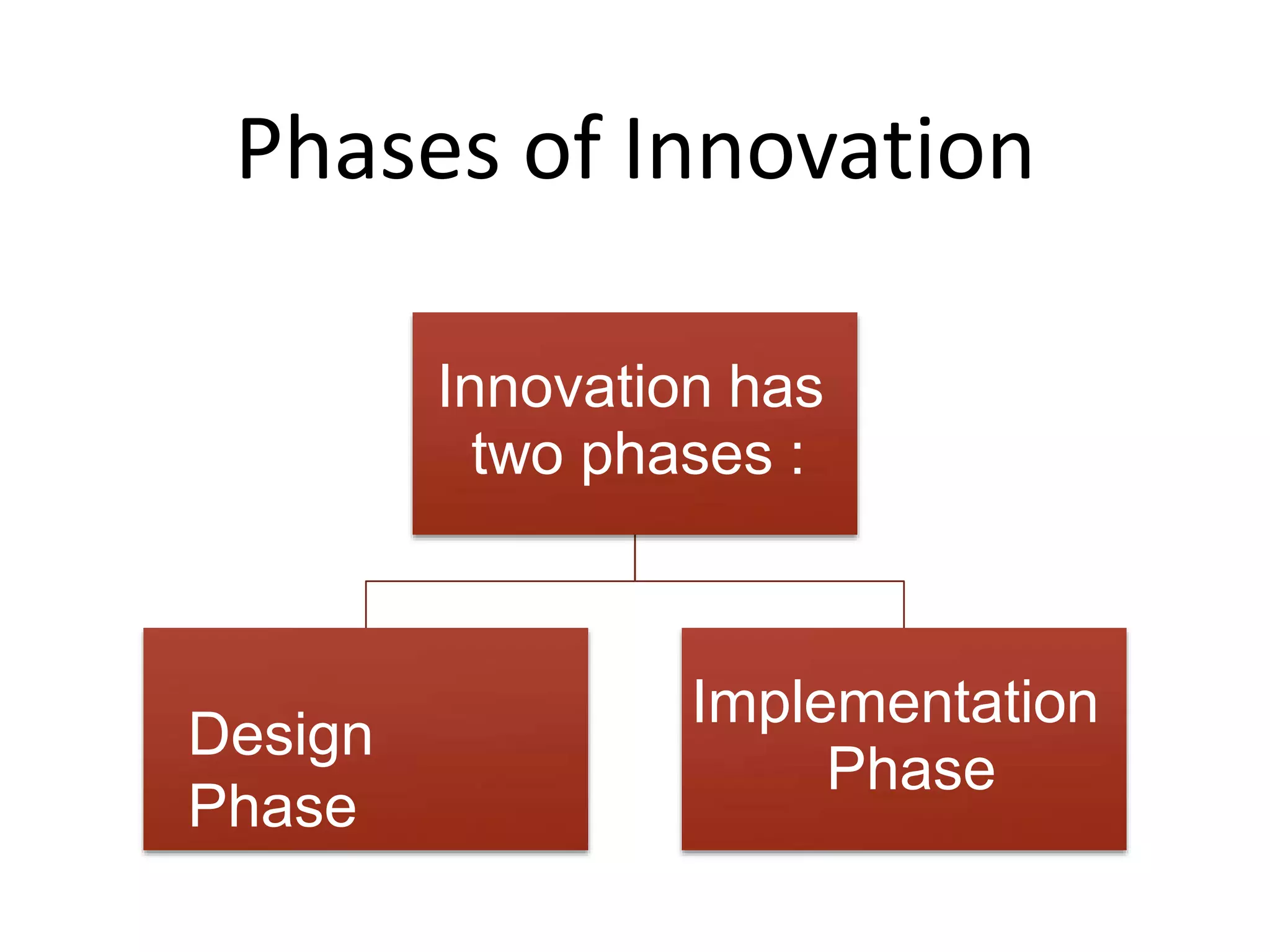
Describes the design and implementation phases of innovation, highlighting the management and planning involved in each phase.
Differentiates between radical and incremental innovation in terms of scope, management, and risk associated with each.
Wrap-up of the presentation, thanking the audience.
What is Invention?
Accordingto Oxford English Dictionary – Inventionmeans to
create or devise something new. Invention is also
regarded as devising of new ways of attaining given
ends.
Any Invention must satisfy following conditions :
• It results into something new,
• It involves some inventive (new) step
& It is useful.
3.
What is Invention?
Undersection 2(1)(j) of the Patents Act, 1970, an
invention means any new & useful :
• Art, process, method or manner of manufacture.
• Machine, apparatus or other article
• Substance produced by manufacture.
It also includes any new & useful improvement of any of
three things mentioned above.
4.
What are notInventions
Following are not regarded as inventions under the Patents
Act, 1970:
•
•
•
Mere discovery of an already existing principle.
Discovery of a scientific principle
An invention which is frivolous or which claims
anything contrary to well established natural laws.
Mere discovery of new property or new use of known
substance, process, machine or apparatus; unless it
results in a new product or employs at least one new
reactant
A substance obtained merely by mixing
•
•
5.
Contd ….
• Amere arrangement or re-arrangement or
duplication of known devices
A method of agriculture or horticulture
Any process for treatment of human beings, plants &
animals to render them free of diseases or to increase
their economic value or that of their products
An invention, use of which would be contrary to law,
morality or injurious to public health.
•
•
•
What is Innovation?
•According to Oxford EnglishDictionary – Innovation
means introduction of something new. Thus Innovation
can be defined as the introduction of a new product,
service or process into the market place.
• The National Innovation Initiative (NII) of USA defines
- innovation as the intersection of invention and
insight, leading to the creation of social and economic
value.
8.
Contd …
• ‘Innovationis celebration of creativity’, pronounced
Dr A.P.J. Abdul Kalam, the President of India at
Third Award Function of NIF (National Innovation
Foundation).
Many definitions of Innovation
To sum up…
Innovation = Invention + Commercial Exploitation
•
•
9.
Components of Innovation
ThreeComponents
• A hardware component –consisting of material or
physical aspects of innovation
• A software component –consisting of information
base that is needed to use the innovation
• An evaluation information component – that isuseful
for decisions related to the adoption of the
innovation.
These components form a system to make it user friendly
10.
Basics of Innovation
•Goals & reasons of Innovation
• Sources / ideas for innovation
• Advantages of Innovation
• Risks associated with innovation
Characteristics of innovation
Innovation is broader than R&D
Innovation brings changes in the organization
Innovation is different from KAIZEN
• Change inhow the product is noticed by the
consumers (change in physical structure).
• These changes include change in product design,
research and development, and new product
development (NPD).
• To meet customer needs and demands (why change? )
Product innovation
15.
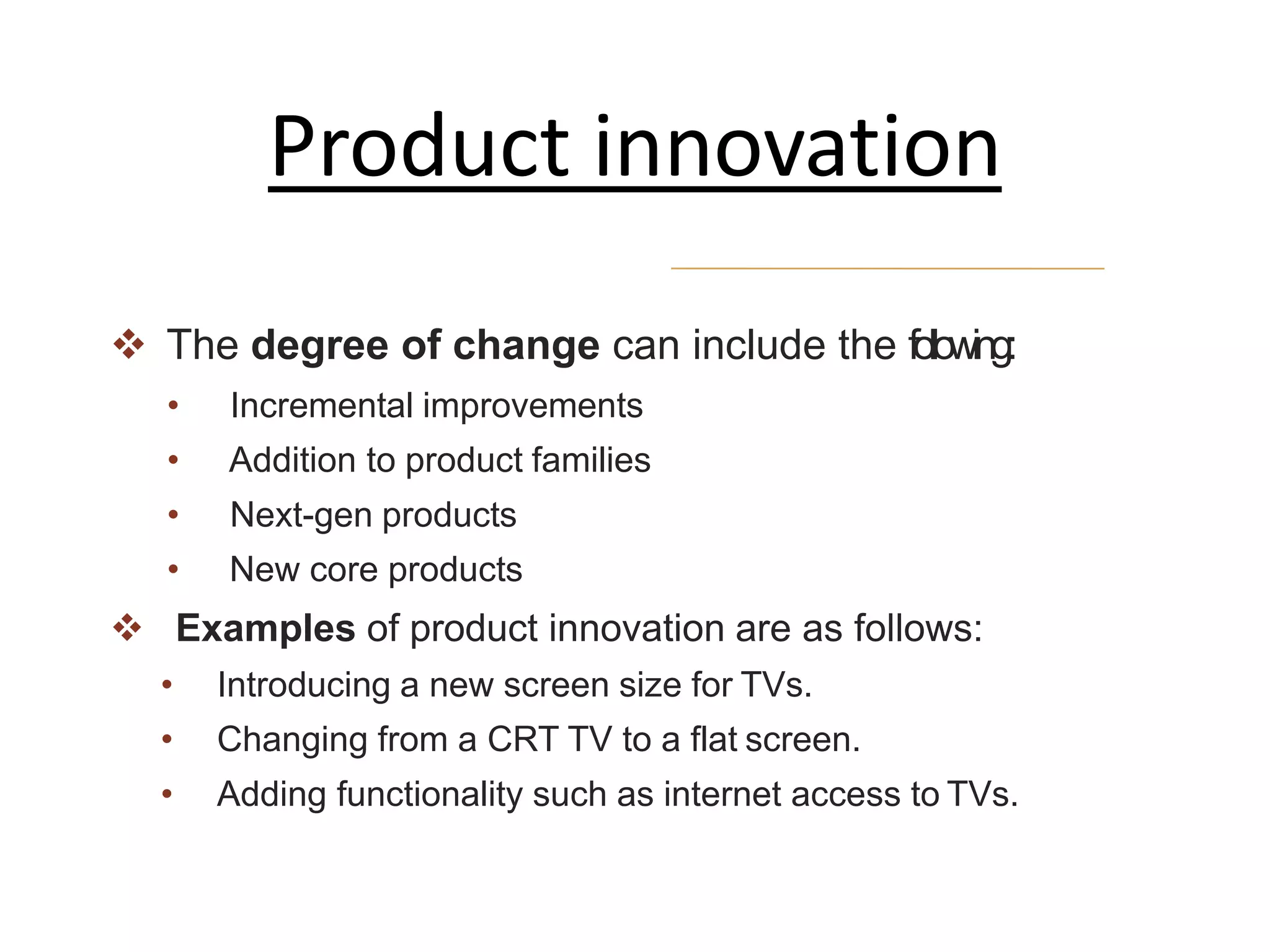
The degreeof change can include the following:
• Incremental improvements
• Addition to product families
• Next-gen products
• New core products
Examples of product innovation are as follows:
• Introducing a new screen size for TVs.
• Changing from a CRT TV to a flat screen.
• Adding functionality such as internet access to TVs.
Product innovation
16.
Continuous improvements,making the product more:
• efficient, effective
• useful or user friendly
• valuable to users
• integrated with other products, technologies, or
systems.
Product Innovation
17.
Process Innovation
• Itinvolves a new or significantly improved method for the
production or delivery of output that adds value to the
organization.
• The term “process” refer to an interrelated set of activities designed
to transform inputs into a specified output for benefits of customers.
• Processes relate to all operational activities by which valueis offered
to the end customer, such as acquisition of raw Material,
manufacturing logistics and after sales service.
18.
Make processes:
•simpler
• faster
• more accurate
• more reliable
• less expensive
Reducing unit costs by improving the production capacity
Process Innovation
Service Innovation
Servicesinvolves products (intangible) that form an extended part of
the product life cycle, from initial sales to end-of-life recycling and
disposal.
Service industries in areas such as finance, food , education,
transportation, health make up most organizations in any economy.
These organizations also need to innovate continuously so that they
can increase/improve the levels of service to their customers.
21.
New wayof providing service / a new service.
New information technology platforms, particularly the internet
have also added the scope of service innovation.The internet is a
valuable resource on which new service relationships between
organizations and their customers are being developed every day.
Technology + better service.
Service Innovation
The designphase is marked by much divergent thinking and
creativity, brainstorming, search for alternatives, etc. Research
studies suggest that the management of the design phase needs
to be marked by great administrative flexibility and these
types of innovation to achieve the necessary growth to
survive.
Design Phase
25.
It requiresa very different mode of management.
It involves putting the chosen innovation to work
Much planning needs to be done, careful coordination &
control, and evaluation of progress.
Implementation Phase
26.
Radical innovation- It is about making major changes
in something established. Focus is significant in relation
to expected changing in the system. A change can be
represent a radical innovation, when viewed at
technological level, but the impact may be only
incremental when viewed at an organization level.
Implementation Process Of
Innovation
27.
Incremental innovation:- It is less ambitious in its
scope and offers less potential for returns for the
organization, but consequently the associated risks are
much less. It consists of smaller endeavors, making
than easier to manage than their larger innovation.
Implementation process of
innovation














![Innovation[2]](https://cdn.slidesharecdn.com/ss_thumbnails/innovation2-161114161656-thumbnail.jpg?width=640&height=640&fit=bounds)


