Reputational Risk
  Cass-Capco 4th Annual Conference
               14th April 2011


Jenny Rayner              Abbey Consulting
The fragility of reputation
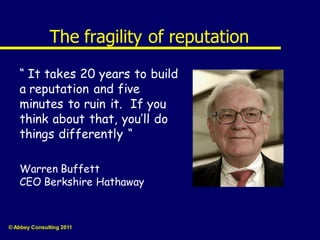
   “ It takes 20 years to build
   a reputation and five
   minutes to ruin it. If you
   think about that, you‟ll do
   things differently “

   Warren Buffett
   CEO Berkshire Hathaway


© Abbey Consulting 2011
Reputation
       “The beliefs or opinions that are
        generally held about someone or
        something

         A widespread belief that someone
         or something has a particular
         characteristic”

                          Compact Oxford English Dictionary
© Abbey Consulting 2011
Reputation – image or reality?
       “Image is reality. It is the result of your
        actions.

         If the image is false and our performance is
         good, it‟s our fault for being bad
         communicators. If the image is true and
         reflects our bad performance, it‟s our fault
         for being bad managers.

        Unless we know our image we can neither
        communicate nor manage.”
© Abbey Consulting 2011
                                       David Bernstein
So how is the financial services
          sector currently perceived?
                          Too many in financial services have thought
  The King Speech         “if it‟s possible to make money out of gullible or
                          unsuspecting customers, particularly institutional
                          customers, that is perfectly acceptable”

                          Good businesses “keep a clear vision of who their
                          customers are, and are run by people who don‟t
                          think they should simply maximise profits next
                          week.”

                          In the past 25 years banks have increasingly
                          “taken bets with other people‟s money”

                          “They didn‟t understand the nature of the risks
                          they were taking”
                          Mervyn King, Governor of the Bank of England
© Abbey Consulting 2011                                    March 2011
The 2008 financial crisis was
           avoidable and caused by:
    Dramatic breakdowns in corporate governance with too many
     firms acting recklessly and taking on too much risk
    Systemic breaches of accountability and ethics at all levels.
     Mortgage-holders took out loans they never intended to pay;
     lenders made loans they knew the borrowers could not afford
    Excessive borrowing and risk by households and Wall Street
    Policymakers who were ill-prepared for the crisis and lacked a
     “full understanding of the financial system they oversaw”
    Widespread failures in financial regulation, including the
     Federal Reserve‟s failure to stem the “tide of toxic
     mortgages”
                               US Financial Crisis Inquiry Commission
                                                         January 2011
© Abbey Consulting 2011
Risks to reputation

                                        Top five RBS bankers earn
                                               total of £20m


                                     Director leaked board secrets
                                     to tycoon, says Goldman chief

   Nearly 2000 customer
 complaints a day at Lloyds
© Abbey Consulting 2011
The World’s top 20 most
             reputable companies 2010
  1. Google (US)                               11. Microsoft (US)
  2. Sony (Japan)                              12. Johnson & Johnson
  3. The Walt Disney Company                       (US)
      (US)                                     13. Panasonic (Japan)
  4. BMW (Germany)                             14. Singapore Airlines
  5. Daimler/Mercedes-Benz                     15. Philips Electronics
      (Germany)                                    (Netherlands)
  6. Apple (US)                                16. L‟Oreal (France)
  7. Nokia (Finland)                           17. IBM (US)
  8. IKEA (Sweden)                             18. Hewlett-Packard (US)
  9. Volkswagen (Germany)                      19. Barilla (Italy)
  10. Intel (US)                               20. Nestle (Switzerland)
                                 Reputation Institute -
© Abbey Consulting 2011   Global Reputation Pulse Study 2010
“ Am I bovvered? “


    Do you care about your business‟s reputation?
    Or are you too big to fail?
© Abbey Consulting 2011
The tangible consequences
   “ While reputation is „intangible‟, damage to an
     institution‟s reputation (and the resulting loss
     of consumer trust and confidence) can have
     very tangible consequences – a stock price
     decline, a run on the bank, a ratings
     downgrade, an evaporation of available credit,
     regulatory investigations, shareholder
     litigation etc.”

         G Stansfield , Some thoughts on reputation and challenges for
        global financial institutions: The Geneva Papers, 2006
© Abbey Consulting 2011
The effect of stakeholder trust


                           2011 Edelman Trust Barometer
© Abbey Consulting 2011
The more you are distrusted the more
       your reputation may suffer


                          2011 Edelman Trust Barometer

© Abbey Consulting 2011
Fines – who cares?
       “The threat of fines from the FSA are seen
       as a footling expense, just another cost of
       doing business, no different from paying the
       quarterly phone bill. The embarrassment
       factor no longer counts for much, alas. There
       is not much shame in being on the receiving
       end of a fine. Only the size of the fine has
       come to matter. In some areas, this has
       proved laughably inadequate in producing
       better behaviour.”
                                      The Times, 7 July 2009
© Abbey Consulting 2011
Citigroup’s reputation was tarnished and
       their Japanese private bank closed
 As senior staff there
 had put

  “ short-term profits
  ahead of the bank‟s
  long-term reputation ”

 Charles Prince,
 Citigroup Chief Executive
 October 2004
                             but they survived!
© Abbey Consulting 2011
So should I be bothered?
                   The consequences


   UBS subpoenaed over alleged
   manipulation of inter-bank rate

© Abbey Consulting 2011
So should I be bothered?
                    What’s changed?
   Public anger: backcloth of public spending/job cuts
   Criticism of government policy: „soft‟ on banks
   Increased government scrutiny
   Creation of the Independent Commission on Banking
   Threat of increased regulation/structural reform
   The influence of social media
   Growing investor/rating agency interest
   Mandatory disclosure of “principal risks and
    uncertainties” in listed company annual reports
   Regulator wielding of reputational sanctions
© Abbey Consulting 2011
The impact of
                   reputational sanctions
      “We observe that the penalised firms‟ stock
      prices experience statistically significant
      abnormal losses of approximately nine times
      the fines and compensation paid.
      We interpret the fall in equity market value
      in excess of mandated payments as the
      firms‟ reputational loss”

 Regulatory Sanctions and Reputational Damage in Financial Markets
 J Armour, C Mayer, A Polo, University of Oxford (March 2011)
 Based on sample of the entire population of regulatory enforcement actions by
 the FSA and LSE against publicly-traded companies from 2001 – January 2011
© Abbey Consulting 2011
What makes a good reputation?
    When alignment is achieved
    between:

 An organisation‟s
  purpose, goals and values

 Its conduct and actions

 The expectations and
  experience of its stakeholders

© Abbey Consulting 2011
The reputation equation


                          Reputation =

                   experience – expectations

                                     Oonagh Mary Harpur


© Abbey Consulting 2011
Defining reputational risk

          Any action, event or circumstance

          that could adversely or beneficially

          impact an organisation‟s reputation

                                              Impact
                          Reputational Risk
© Abbey Consulting 2011
The key goals of reputation risk
          management strategy
   1.     Identify and minimise factors that could damage
          reputation (threats) and identify and exploit factors
          that could boost reputation (opportunities)
   2. Identify gaps between stakeholder experience and
      expectation and bridge them by:
      - improving business strategy/performance/behaviour
      and/or
      - influencing stakeholder beliefs and expectations so
        they are more closely aligned with reality and what
        the business can realistically deliver
   3. Ensure processes are in place to enable the business
      to respond and ride out the storm if an unforeseen
      crisis hits (crisis management contingency plan)
© Abbey Consulting 2011
A dual approach to managing
                    risks to reputation
       As reputation is based on perception, not
        necessarily reality, risks to both reality
       and perception must be actively managed


         Reputation must
           be built both:
            „inside-out‟               Reputation
          and „outside-in‟


© Abbey Consulting 2011
‘Inside out’
   Define a clear vision and values backed up by
    policies and procedures that guide behaviours
    and decision-making throughout the business
    and its supply chain
   Tell your stakeholders what you stand for,
    what your goals are and how you plan to achieve
    them – so they know what to expect
   Ensure the reality matches the vision - and can
    withstand scrutiny - so expectations are met

© Abbey Consulting 2011
Identify your
                    reputational ‘hotspots’
                      Financial    Corporate     Regulatory   Delivering   Workplace    Corporate    Communic-
                    Performance   Governance     compliance   customer     talent and   Responsib-     ations
                    & long-term   & leadership                 promise       culture       ility       & crisis
                     investment                                                                      management
                        value
      Employees


      Customers


      Suppliers


      Communities


      Investors


      Regulators


© Abbey Consulting 2011
Pinpoint potential vulnerabilities
        and zones of opportunity
    Spotting major „mismatches‟

   Strategy vs expectations
   Performance vs objectives
   True intentions vs „spin‟
   Real vs published risk exposures
   Compliance „in letter‟ vs „spirit‟
   Minimal disclosure vs transparency
   Product reality vs marketing claims   Mind the gap!
   „Easy-win‟ incentives vs stretching
    targets
© Abbey Consulting 2011
Promote an ethical culture
                            “The [banking industry] collectively owes
                            the real world an apology for what has
                            happened and it also owes the real world a
                            commitment to learn the lessons……[some
                            of those lessons are] about governance and
                            ethics and culture within the industry…

                            You can‟t do all this simply by setting rules
                            and regulations. You have to expect the
                            leadership…to nurture a real culture of
                            ethics and integrity and that‟s actually a
                            continuing priority, perhaps the greatest
                            priority of all as far as I am concerned for
                            the boards of banks.”
                          Stephen Green, Chairman, HSBC in a BBC interview
© Abbey Consulting 2011                                   7th October 2009
Make reputation risk management
       everybody’s business
  Executive directors
  Non-executive directors
  Management
  Public relations
  Internal auditors
  Risk and insurance
   managers
  All other employees …All must play their part
  Business partners    in moulding and upholding
                           corporate reputation
© Abbey Consulting 2011
„Outside-in‟
  Stay „in tune‟ with your
   stakeholders through
   dialogue and engagement

  Systematically track their
   evolving perceptions and
   expectations so strategy is
   recalibrated, gaps are
   minimised, emerging issues
   are spotted early and
   opportunities are exploited

© Abbey Consulting 2011
Develop a reputation risk barometer
                           Use independent objective
                            data to track stakeholder
                            perceptions and
                            expectations
                           Design KRIs (Key Risk
                            Indicators) to provide early
                            warning of emerging risks
                            and changing risk exposures


                             Developing Key Risk Indicators
                            to Strengthen Enterprise Risk
© Abbey Consulting 2011     Management, COSO, December 2010
Overcoming the barriers to successful
        reputation risk management
    Poor awareness of the true value of reputation as a
     key intangible asset – so not a key business focus
    Lack of understanding of sources of reputational
     risk – so don‟t identify and manage risks actively
    Lack of clarity on ownership – seen as PR issue
    Underestimating the impact of risks to reputation
     due focus on short-term impacts – leading to wrong
     risk priorities
    Neglecting reputation risk upsides – so not
     exploiting opportunities
    Not using stakeholder data to inform strategy
© Abbey Consulting 2011
The concept isn’t new


  “The way to gain a good
   reputation is to
   endeavour to be what
   you desire to appear “

                          Socrates, 469-399 BC


© Abbey Consulting 2011
But to succeed you may need to change
          – and do things differently
       “ Warning signs that a patient may not be
         suitable for cosmetic surgery include:
         expectations of an appearance enhanced
         beyond possibility; unrealistic expectations
         of lifestyle/career/relationship effects;
         an unwillingness to change the behaviour
         that led to the problem.”
                               Plastic surgery information service

            Is your organisation a suitable patient?
© Abbey Consulting 2011

Reputational Risk

  • 1.
    Reputational Risk Cass-Capco 4th Annual Conference 14th April 2011 Jenny Rayner Abbey Consulting
  • 2.
    The fragility ofreputation “ It takes 20 years to build a reputation and five minutes to ruin it. If you think about that, you‟ll do things differently “ Warren Buffett CEO Berkshire Hathaway © Abbey Consulting 2011
  • 3.
    Reputation “The beliefs or opinions that are generally held about someone or something A widespread belief that someone or something has a particular characteristic” Compact Oxford English Dictionary © Abbey Consulting 2011
  • 4.
    Reputation – imageor reality? “Image is reality. It is the result of your actions. If the image is false and our performance is good, it‟s our fault for being bad communicators. If the image is true and reflects our bad performance, it‟s our fault for being bad managers. Unless we know our image we can neither communicate nor manage.” © Abbey Consulting 2011 David Bernstein
  • 5.
    So how isthe financial services sector currently perceived? Too many in financial services have thought The King Speech “if it‟s possible to make money out of gullible or unsuspecting customers, particularly institutional customers, that is perfectly acceptable” Good businesses “keep a clear vision of who their customers are, and are run by people who don‟t think they should simply maximise profits next week.” In the past 25 years banks have increasingly “taken bets with other people‟s money” “They didn‟t understand the nature of the risks they were taking” Mervyn King, Governor of the Bank of England © Abbey Consulting 2011 March 2011
  • 6.
    The 2008 financialcrisis was avoidable and caused by:  Dramatic breakdowns in corporate governance with too many firms acting recklessly and taking on too much risk  Systemic breaches of accountability and ethics at all levels. Mortgage-holders took out loans they never intended to pay; lenders made loans they knew the borrowers could not afford  Excessive borrowing and risk by households and Wall Street  Policymakers who were ill-prepared for the crisis and lacked a “full understanding of the financial system they oversaw”  Widespread failures in financial regulation, including the Federal Reserve‟s failure to stem the “tide of toxic mortgages” US Financial Crisis Inquiry Commission January 2011 © Abbey Consulting 2011
  • 7.
    Risks to reputation Top five RBS bankers earn total of £20m Director leaked board secrets to tycoon, says Goldman chief Nearly 2000 customer complaints a day at Lloyds © Abbey Consulting 2011
  • 8.
    The World’s top20 most reputable companies 2010 1. Google (US) 11. Microsoft (US) 2. Sony (Japan) 12. Johnson & Johnson 3. The Walt Disney Company (US) (US) 13. Panasonic (Japan) 4. BMW (Germany) 14. Singapore Airlines 5. Daimler/Mercedes-Benz 15. Philips Electronics (Germany) (Netherlands) 6. Apple (US) 16. L‟Oreal (France) 7. Nokia (Finland) 17. IBM (US) 8. IKEA (Sweden) 18. Hewlett-Packard (US) 9. Volkswagen (Germany) 19. Barilla (Italy) 10. Intel (US) 20. Nestle (Switzerland) Reputation Institute - © Abbey Consulting 2011 Global Reputation Pulse Study 2010
  • 9.
    “ Am Ibovvered? “  Do you care about your business‟s reputation?  Or are you too big to fail? © Abbey Consulting 2011
  • 10.
    The tangible consequences “ While reputation is „intangible‟, damage to an institution‟s reputation (and the resulting loss of consumer trust and confidence) can have very tangible consequences – a stock price decline, a run on the bank, a ratings downgrade, an evaporation of available credit, regulatory investigations, shareholder litigation etc.” G Stansfield , Some thoughts on reputation and challenges for global financial institutions: The Geneva Papers, 2006 © Abbey Consulting 2011
  • 11.
    The effect ofstakeholder trust 2011 Edelman Trust Barometer © Abbey Consulting 2011
  • 12.
    The more youare distrusted the more your reputation may suffer 2011 Edelman Trust Barometer © Abbey Consulting 2011
  • 13.
    Fines – whocares? “The threat of fines from the FSA are seen as a footling expense, just another cost of doing business, no different from paying the quarterly phone bill. The embarrassment factor no longer counts for much, alas. There is not much shame in being on the receiving end of a fine. Only the size of the fine has come to matter. In some areas, this has proved laughably inadequate in producing better behaviour.” The Times, 7 July 2009 © Abbey Consulting 2011
  • 14.
    Citigroup’s reputation wastarnished and their Japanese private bank closed As senior staff there had put “ short-term profits ahead of the bank‟s long-term reputation ” Charles Prince, Citigroup Chief Executive October 2004 but they survived! © Abbey Consulting 2011
  • 15.
    So should Ibe bothered? The consequences UBS subpoenaed over alleged manipulation of inter-bank rate © Abbey Consulting 2011
  • 16.
    So should Ibe bothered? What’s changed?  Public anger: backcloth of public spending/job cuts  Criticism of government policy: „soft‟ on banks  Increased government scrutiny  Creation of the Independent Commission on Banking  Threat of increased regulation/structural reform  The influence of social media  Growing investor/rating agency interest  Mandatory disclosure of “principal risks and uncertainties” in listed company annual reports  Regulator wielding of reputational sanctions © Abbey Consulting 2011
  • 17.
    The impact of reputational sanctions “We observe that the penalised firms‟ stock prices experience statistically significant abnormal losses of approximately nine times the fines and compensation paid. We interpret the fall in equity market value in excess of mandated payments as the firms‟ reputational loss” Regulatory Sanctions and Reputational Damage in Financial Markets J Armour, C Mayer, A Polo, University of Oxford (March 2011) Based on sample of the entire population of regulatory enforcement actions by the FSA and LSE against publicly-traded companies from 2001 – January 2011 © Abbey Consulting 2011
  • 18.
    What makes agood reputation? When alignment is achieved between:  An organisation‟s purpose, goals and values  Its conduct and actions  The expectations and experience of its stakeholders © Abbey Consulting 2011
  • 19.
    The reputation equation Reputation = experience – expectations Oonagh Mary Harpur © Abbey Consulting 2011
  • 20.
    Defining reputational risk Any action, event or circumstance that could adversely or beneficially impact an organisation‟s reputation Impact Reputational Risk © Abbey Consulting 2011
  • 21.
    The key goalsof reputation risk management strategy 1. Identify and minimise factors that could damage reputation (threats) and identify and exploit factors that could boost reputation (opportunities) 2. Identify gaps between stakeholder experience and expectation and bridge them by: - improving business strategy/performance/behaviour and/or - influencing stakeholder beliefs and expectations so they are more closely aligned with reality and what the business can realistically deliver 3. Ensure processes are in place to enable the business to respond and ride out the storm if an unforeseen crisis hits (crisis management contingency plan) © Abbey Consulting 2011
  • 22.
    A dual approachto managing risks to reputation As reputation is based on perception, not necessarily reality, risks to both reality and perception must be actively managed Reputation must be built both: „inside-out‟ Reputation and „outside-in‟ © Abbey Consulting 2011
  • 23.
    ‘Inside out’  Define a clear vision and values backed up by policies and procedures that guide behaviours and decision-making throughout the business and its supply chain  Tell your stakeholders what you stand for, what your goals are and how you plan to achieve them – so they know what to expect  Ensure the reality matches the vision - and can withstand scrutiny - so expectations are met © Abbey Consulting 2011
  • 24.
    Identify your reputational ‘hotspots’ Financial Corporate Regulatory Delivering Workplace Corporate Communic- Performance Governance compliance customer talent and Responsib- ations & long-term & leadership promise culture ility & crisis investment management value Employees Customers Suppliers Communities Investors Regulators © Abbey Consulting 2011
  • 25.
    Pinpoint potential vulnerabilities and zones of opportunity Spotting major „mismatches‟  Strategy vs expectations  Performance vs objectives  True intentions vs „spin‟  Real vs published risk exposures  Compliance „in letter‟ vs „spirit‟  Minimal disclosure vs transparency  Product reality vs marketing claims Mind the gap!  „Easy-win‟ incentives vs stretching targets © Abbey Consulting 2011
  • 26.
    Promote an ethicalculture “The [banking industry] collectively owes the real world an apology for what has happened and it also owes the real world a commitment to learn the lessons……[some of those lessons are] about governance and ethics and culture within the industry… You can‟t do all this simply by setting rules and regulations. You have to expect the leadership…to nurture a real culture of ethics and integrity and that‟s actually a continuing priority, perhaps the greatest priority of all as far as I am concerned for the boards of banks.” Stephen Green, Chairman, HSBC in a BBC interview © Abbey Consulting 2011 7th October 2009
  • 27.
    Make reputation riskmanagement everybody’s business  Executive directors  Non-executive directors  Management  Public relations  Internal auditors  Risk and insurance managers  All other employees …All must play their part  Business partners in moulding and upholding corporate reputation © Abbey Consulting 2011
  • 28.
    „Outside-in‟  Stay„in tune‟ with your stakeholders through dialogue and engagement  Systematically track their evolving perceptions and expectations so strategy is recalibrated, gaps are minimised, emerging issues are spotted early and opportunities are exploited © Abbey Consulting 2011
  • 29.
    Develop a reputationrisk barometer  Use independent objective data to track stakeholder perceptions and expectations  Design KRIs (Key Risk Indicators) to provide early warning of emerging risks and changing risk exposures Developing Key Risk Indicators to Strengthen Enterprise Risk © Abbey Consulting 2011 Management, COSO, December 2010
  • 30.
    Overcoming the barriersto successful reputation risk management  Poor awareness of the true value of reputation as a key intangible asset – so not a key business focus  Lack of understanding of sources of reputational risk – so don‟t identify and manage risks actively  Lack of clarity on ownership – seen as PR issue  Underestimating the impact of risks to reputation due focus on short-term impacts – leading to wrong risk priorities  Neglecting reputation risk upsides – so not exploiting opportunities  Not using stakeholder data to inform strategy © Abbey Consulting 2011
  • 31.
    The concept isn’tnew “The way to gain a good reputation is to endeavour to be what you desire to appear “ Socrates, 469-399 BC © Abbey Consulting 2011
  • 32.
    But to succeedyou may need to change – and do things differently “ Warning signs that a patient may not be suitable for cosmetic surgery include: expectations of an appearance enhanced beyond possibility; unrealistic expectations of lifestyle/career/relationship effects; an unwillingness to change the behaviour that led to the problem.” Plastic surgery information service Is your organisation a suitable patient? © Abbey Consulting 2011