U.S. Equities Market Observations
Thomas Farley, IntercontinentalExchange
October 2013
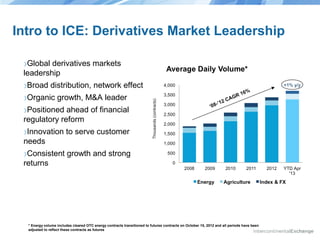
Intro to ICE: Derivatives Market Leadership
›Global derivatives markets
leadership

›Broad distribution, network effect
›Organic growth, M&A leader
›Positioned ahead of financial
regulatory reform

›Innovation to serve customer
needs

›Consistent growth and strong
returns

* Energy volume includes cleared OTC energy contracts transitioned to futures contracts on October 15, 2012 and all periods have been
adjusted to reflect these contracts as futures
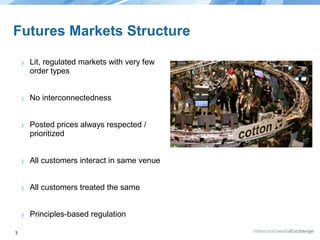
Futures Markets Structure
›
›

No interconnectedness

›

Posted prices always respected /
prioritized

›

All customers interact in same venue

›

All customers treated the same

›
3

Lit, regulated markets with very few
order types

Principles-based regulation
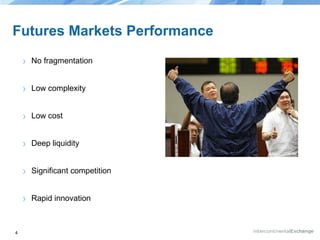
Futures Markets Performance
›
›

Low complexity

›

Low cost

›

Deep liquidity

›

Significant competition

›
4

No fragmentation

Rapid innovation
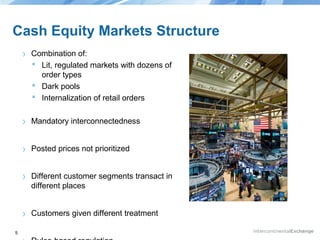
Cash Equity Markets Structure
›

›

Mandatory interconnectedness

›

Posted prices not prioritized

›

Different customer segments transact in
different places

›
5

Combination of:
 Lit, regulated markets with dozens of
order types
 Dark pools
 Internalization of retail orders

Customers given different treatment
Cash Equity Markets Performance
›
›

Highly complex, less transparent

›

Costly for most stakeholder groups

›

Most liquidity resides at NBBO and is
concentrated in top names

›

6

Highly fragmented

Customer dissatisfaction with status quo
Catalysts for Improving Market Structure
›

›

7

Regulators may choose to act
 New regulations
 Review reforms
 Rescind prior regulations
Market practitioners may choose to act
 Innovations
 New business practices
Regulators as a Catalyst
Many of Chair White’s Key Priorities are Encouraging
›

›

Improve the operational integrity of markets

›

8

Focus on the needs of:
 Issuers/public companies
 Investors that participate in the market
directly
 Investors that participate through
institutional investors

Preserve transparent trading models that
inspire confidence
Market Practitioners as a Catalyst
The Current Environment of Concern Makes Evolution Possible

›

›

9

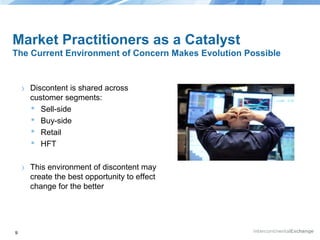
Discontent is shared across
customer segments:
 Sell-side
 Buy-side
 Retail
 HFT
This environment of discontent may
create the best opportunity to effect
change for the better
NYSE: A History of Leadership
›

›

Markets have undergone repeating
cycles of fragmentation and
consolidation

›

10

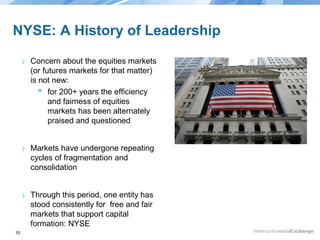
Concern about the equities markets
(or futures markets for that matter)
is not new:
 for 200+ years the efficiency
and fairness of equities
markets has been alternately
praised and questioned

Through this period, one entity has
stood consistently for free and fair
markets that support capital
formation: NYSE
ICE Track Record
Developing Customer-Focused Markets
›

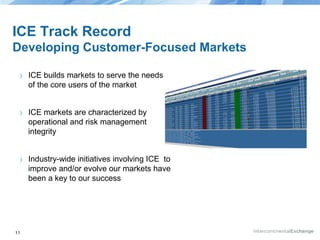
ICE builds markets to serve the needs
of the core users of the market

›

ICE markets are characterized by
operational and risk management
integrity

›

Industry-wide initiatives involving ICE to
improve and/or evolve our markets have
been a key to our success

11
Potential Areas of Focus
Post-Closing of ICE/NYSE Transaction
›
›

Reduce complexity & fragmentation of cash equities markets

›

Identify the root of fragmentation and re-aggregate liquidity

›

Increase transparency and fairness of practices among exchanges,
ATS/ECNs and broker-dealers

›
12

Increase respect for displayed prices and price discovery throughout
industry

Improve operational & risk controls at each venue and market-wide

›

Evolve towards fairer and simpler pricing models throughout industry
Summary
›
›

Opportunity exists to improve market dynamics for multiple stakeholder groups

›

Such improvement will rely on leadership from both market practitioners and
regulators

›

13

Equities markets have become more fragmented and complex over the past
two decades

ICE/NYSE combination brings together cash equities market leader with
customer-focused market operator
Questions

14
Extra Slides

15
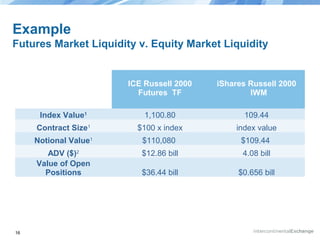
Example
Futures Market Liquidity v. Equity Market Liquidity

ICE Russell 2000
Futures TF
Index Value1

1,100.80

109.44

Contract Size1

$100 x index

index value

Notional Value1

$110,080

$109.44

ADV ($)2
Value of Open
Positions

16

iShares Russell 2000
IWM

$12.86 bill

4.08 bill

$36.44 bill

$0.656 bill

U.S. Equities Market Observations

  • 1.
    U.S. Equities MarketObservations Thomas Farley, IntercontinentalExchange October 2013
  • 2.
    Intro to ICE:Derivatives Market Leadership ›Global derivatives markets leadership ›Broad distribution, network effect ›Organic growth, M&A leader ›Positioned ahead of financial regulatory reform ›Innovation to serve customer needs ›Consistent growth and strong returns * Energy volume includes cleared OTC energy contracts transitioned to futures contracts on October 15, 2012 and all periods have been adjusted to reflect these contracts as futures
  • 3.
    Futures Markets Structure › › Nointerconnectedness › Posted prices always respected / prioritized › All customers interact in same venue › All customers treated the same › 3 Lit, regulated markets with very few order types Principles-based regulation
  • 4.
    Futures Markets Performance › › Lowcomplexity › Low cost › Deep liquidity › Significant competition › 4 No fragmentation Rapid innovation
  • 5.
    Cash Equity MarketsStructure › › Mandatory interconnectedness › Posted prices not prioritized › Different customer segments transact in different places › 5 Combination of:  Lit, regulated markets with dozens of order types  Dark pools  Internalization of retail orders Customers given different treatment
  • 6.
    Cash Equity MarketsPerformance › › Highly complex, less transparent › Costly for most stakeholder groups › Most liquidity resides at NBBO and is concentrated in top names › 6 Highly fragmented Customer dissatisfaction with status quo
  • 7.
    Catalysts for ImprovingMarket Structure › › 7 Regulators may choose to act  New regulations  Review reforms  Rescind prior regulations Market practitioners may choose to act  Innovations  New business practices
  • 8.
    Regulators as aCatalyst Many of Chair White’s Key Priorities are Encouraging › › Improve the operational integrity of markets › 8 Focus on the needs of:  Issuers/public companies  Investors that participate in the market directly  Investors that participate through institutional investors Preserve transparent trading models that inspire confidence
  • 9.
    Market Practitioners asa Catalyst The Current Environment of Concern Makes Evolution Possible › › 9 Discontent is shared across customer segments:  Sell-side  Buy-side  Retail  HFT This environment of discontent may create the best opportunity to effect change for the better
  • 10.
    NYSE: A Historyof Leadership › › Markets have undergone repeating cycles of fragmentation and consolidation › 10 Concern about the equities markets (or futures markets for that matter) is not new:  for 200+ years the efficiency and fairness of equities markets has been alternately praised and questioned Through this period, one entity has stood consistently for free and fair markets that support capital formation: NYSE
  • 11.
    ICE Track Record DevelopingCustomer-Focused Markets › ICE builds markets to serve the needs of the core users of the market › ICE markets are characterized by operational and risk management integrity › Industry-wide initiatives involving ICE to improve and/or evolve our markets have been a key to our success 11
  • 12.
    Potential Areas ofFocus Post-Closing of ICE/NYSE Transaction › › Reduce complexity & fragmentation of cash equities markets › Identify the root of fragmentation and re-aggregate liquidity › Increase transparency and fairness of practices among exchanges, ATS/ECNs and broker-dealers › 12 Increase respect for displayed prices and price discovery throughout industry Improve operational & risk controls at each venue and market-wide › Evolve towards fairer and simpler pricing models throughout industry
  • 13.
    Summary › › Opportunity exists toimprove market dynamics for multiple stakeholder groups › Such improvement will rely on leadership from both market practitioners and regulators › 13 Equities markets have become more fragmented and complex over the past two decades ICE/NYSE combination brings together cash equities market leader with customer-focused market operator
  • 14.
  • 15.
  • 16.
    Example Futures Market Liquidityv. Equity Market Liquidity ICE Russell 2000 Futures TF Index Value1 1,100.80 109.44 Contract Size1 $100 x index index value Notional Value1 $110,080 $109.44 ADV ($)2 Value of Open Positions 16 iShares Russell 2000 IWM $12.86 bill 4.08 bill $36.44 bill $0.656 bill

Editor's Notes

  • #4 Lit regulated markets with very few order types No interconnectedness Posted prices always respected / prioritized All customers interact in same venue (i.e. one venue not more toxic than the next) All customers treated the same Principles-based regulation
  • #5 No fragmentation Low complexity Low cost Deep liquidity Significant competition Rapid innovation High customer satisfaction
  • #6 Combination of: -Lit, regulated markets with dozens of order types -Dark pools -Dark retail pre-arranged trading Mandatory interconnectedness Posted prices not prioritized Different customer segments transact in different places Customers given different treatment Rules-based regulation
  • #7 Highly fragmented Highly complex High cost Low liquidity Low customer satisfaction
  • #8 Highly fragmented Highly complex High cost Low liquidity Low customer satisfaction
  • #9 That’s the bad news The good news is that new SEC Chair Mary Jo White has the right two goals Quote from her speech: The success or failure of capital formation in the equity markets depends on two key constituencies – investors and public companies. Without investors willing to accept the long-term risks and rewards of ownership in public companies, the equity markets cannot exist. This is equally true whether they participate in the markets directly or indirectly through institutional investors, like mutual or pension funds.
  • #10 Surprising lesson learned for me: everyone agrees and nobody is happy! Sell-side – commission compression and execution costs have reduced profitability Buy-side – complexity of markets has increased difficulty in executing large trades Retail – perception that markets are “rigged” has lead to reduced participation HFT – decreasing quality of flow on public markets has impacted profitability and willingness to participate
  • #11 The New York Stock Exchange will be a leader in achieving these two goals [insert points on history of NYSE and specific examples of commitment to MJ White’s 2 goals]
  • #12 ICE also has strong track record in developing market solutions and creating innovative tools to address market problems Examples: -Policing bad behavior - effective order / trade ratio policy; rigorous enforcement (WVR) -Circuit breakers that allow market to catch breath without shutting down trading (IPL) -Requiring appropriate risk controls: first exchange to require pre-trade credit checks
  • #13 Let me talk now about some specific areas where ICE and the New York Stock Exchange, as a combined company, can improve markets: Increase transparency market-wide -From order type descriptions to the routing history of orders to the various rebates and incentives of an order, market particpants deserve transparency Strengthen the operational & risk controls of markets Reduce the cost of complexity and fragmentation of markets for the key constituencies identified by Mary Jo White -speed…but at what cost? Develop the liquidity of the bottom 90% securities – not just differing tick sizes, but apply other solutions to aggregate liquidity Evolve to a pricing model industry-wide that is transparent and free of both conflicts of interest and negative incentives Increase respect for displayed prices – because solving the problem of decaying respect is core to improving markets
  • #14 Let me talk now about some specific areas where ICE and the New York Stock Exchange, as a combined company, can improve markets: Increase transparency market-wide -From order type descriptions to the routing history of orders to the various rebates and incentives of an order, market particpants deserve transparency Strengthen the operational & risk controls of markets Reduce the cost of complexity and fragmentation of markets for the key constituencies identified by Mary Jo White -speed…but at what cost? Develop the liquidity of the bottom 90% securities – not just differing tick sizes, but apply other solutions to aggregate liquidity Evolve to a pricing model industry-wide that is transparent and free of both conflicts of interest and negative incentives Increase respect for displayed prices – because solving the problem of decaying respect is core to improving markets
  • #16 ICE also has strong track record in developing market solutions and creating innovative tools to address market problems Examples: -Policing bad behavior - effective order / trade ratio policy; rigorous enforcement (WVR) -Circuit breakers that allow market to catch breath without shutting down trading (IPL) -Requiring appropriate risk controls: first exchange to require pre-trade credit checks
  • #17 Highlight that this is the 6th largest ETF contract.