
What does Industrialization
really mean for Banking
October 2013
Agenda



Driving forces for industrialization in banking



Transforming front and back office



Regulatory trend towards localization
(industrialization without globalization?)



Taking cost and complexity out of the value chain

2 - What does Industrialization really mean for Banking

Capco confidential - © Capco - October 2013
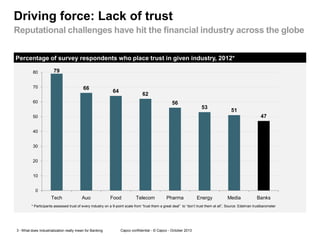
Driving force: Lack of trust
Reputational challenges have hit the financial industry across the globe
Percentage of survey respondents who place trust in given industry, 2012*
80

79

70

66

64

62

60

56

53

51
47

50
40
30
20
10
0

Tech

Auo

Food

Telecom

Pharma

Energy

Media

Banks

* Participants assessed trust of every industry on a 9-point scale from “trust them a great deal” to “don‟t trust them at all”, Source: Edelman trustbarometer

3 - What does Industrialization really mean for Banking

Capco confidential - © Capco - October 2013
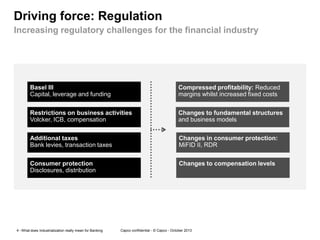
Driving force: Regulation
Increasing regulatory challenges for the financial industry

Basel III
Capital, leverage and funding

Compressed profitability: Reduced
margins whilst increased fixed costs

Restrictions on business activities
Volcker, ICB, compensation

Changes to fundamental structures
and business models

Additional taxes
Bank levies, transaction taxes

Changes in consumer protection:
MiFID II, RDR

Consumer protection
Disclosures, distribution

Changes to compensation levels

4 - What does Industrialization really mean for Banking

Capco confidential - © Capco - October 2013
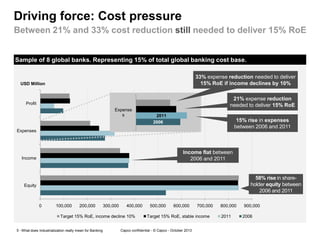
Driving force: Cost pressure
Between 21% and 33% cost reduction still needed to deliver 15% RoE

Sample of 8 global banks. Representing 15% of total global banking cost base.
33% expense reduction needed to deliver
15% RoE if income declines by 10%

USD Million

21% expense reduction
needed to deliver 15% RoE

Profit
Expense
s

2011
2006

15% rise in expenses
between 2006 and 2011

Expenses

Income flat between
2006 and 2011

Income

58% rise in shareholder equity between
2006 and 2011

Equity

0

100,000

200,000

300,000

400,000

Target 15% RoE, income decline 10%
5 - What does Industrialization really mean for Banking

500,000

600,000

700,000

Target 15% RoE, stable income

Capco confidential - © Capco - October 2013

800,000
2011

900,000
2006
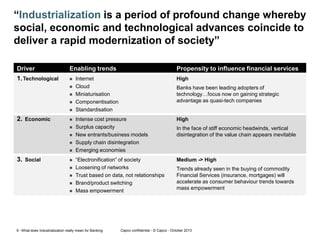
“Industrialization is a period of profound change whereby
social, economic and technological advances coincide to
deliver a rapid modernization of society”
Driver

Enabling trends

1. Technological







2. Economic








3. Social








Propensity to influence financial services

Internet
Cloud
Miniaturisation
Componentisation
Standardisation

High

Intense cost pressure
Surplus capacity
New entrants/business models
Supply chain disintegration
Emerging economies

High

“Electronification” of society
Loosening of networks
Trust based on data, not relationships
Brand/product switching
Mass empowerment

Medium -> High

6 - What does Industrialization really mean for Banking

Banks have been leading adopters of
technology…focus now on gaining strategic
advantage as quasi-tech companies

In the face of stiff economic headwinds, vertical
disintegration of the value chain appears inevitable

Trends already seen in the buying of commodity
Financial Services (insurance, mortgages) will
accelerate as consumer behaviour trends towards
mass empowerment

Capco confidential - © Capco - October 2013
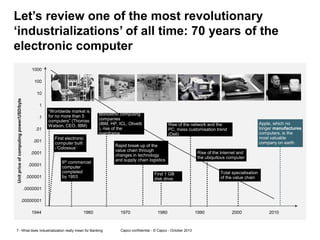
Let‟s review one of the most revolutionary
„industrializations‟ of all time: 70 years of the
electronic computer
1000
100

Unit price of computing power/USD/byte

10
1
.1
.01
.001

“Worldwide market is
for no more than 5
computers” (Thomas
Watson, CEO, IBM)

Monolithic computing
companies
(IBM, HP, ICL, Olivetti
), rise of the
mainframe

First electronic
computer built
-„Colossus‟

.0001
.00001
.000001

6th commercial
computer
completed
by 1953

Apple, which no
longer manufactures
computers, is the
most valuable
company on earth

Rise of the network and the
PC, mass customisation trend
(Dell)

Rapid break up of the
value chain through
changes in technology
and supply chain logistics

Rise of the Internet and
the ubiquitous computer

Total specialisation
of the value chain

First 1 GB
disk drive

.0000001
.00000001
1944

1960

7 - What does Industrialization really mean for Banking

1970

1980

Capco confidential - © Capco - October 2013

1990

2000

2010
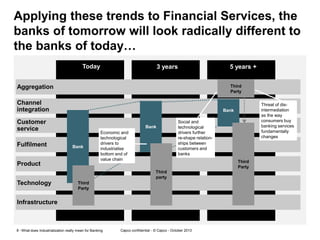
Applying these trends to Financial Services, the
banks of tomorrow will look radically different to
the banks of today…
Today

3 years

5 years +

Aggregation

Third
Party

Channel
integration
Customer
service
Fulfilment

Bank

Bank

Product

Economic and
technological
drivers to
industrialise
bottom end of
value chain

Social and
technological
drivers further
re-shape relationships between
customers and
banks
Third
Party

Third
party

Technology

Threat of disintermediation
as the way
consumers buy
banking services
fundamentally
changes

Bank

Third
Party

Infrastructure

8 - What does Industrialization really mean for Banking

Capco confidential - © Capco - October 2013
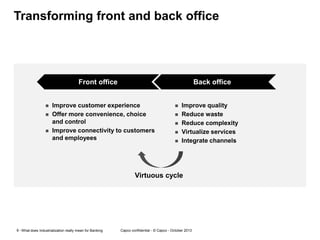
Transforming front and back office

Front office





Back office

Improve customer experience
Offer more convenience, choice
and control
Improve connectivity to customers
and employees







Improve quality
Reduce waste
Reduce complexity
Virtualize services
Integrate channels

Virtuous cycle

9 - What does Industrialization really mean for Banking

Capco confidential - © Capco - October 2013
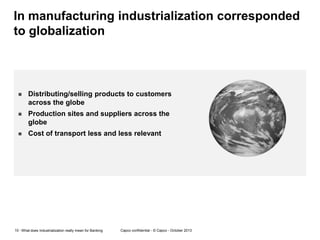
In manufacturing industrialization corresponded
to globalization



Distributing/selling products to customers
across the globe



Production sites and suppliers across the
globe



Cost of transport less and less relevant

10 - What does Industrialization really mean for Banking

Capco confidential - © Capco - October 2013
However in Banking regulation drives towards
localization


Home market regulators pressuring banks to curtail and / or ring-fence their external activities
either through explicit rules (e.g. ICB in the UK) or through the lens of resolution planning
(e.g. in Italy).



Home market regulators seeking to limit proprietary trading activity, or ring-fence this from
retail deposit-taking activity.



Host regulators in the key hubs limiting, and seeking greater transparency and control, over
risk-taking conducted overseas but booked into the hub (e.g. UK PRA).



Host regulators in the hubs and other markets pushing for increased capital and liquidity to
be held locally, as well as onerous (and at times unpredictable) governance requirements
(e.g. local risk appetite frameworks, local limit frameworks etc.).



Host regulators pushing for foreign bank branches to become subsidiaries, or treating them
as if they are subsidiaries, heightening the level of scrutiny and supervision.

Industrialization without globalization?
Impact on business model, legal entity structure, operating model?

11 - What does Industrialization really mean for Banking

Capco confidential - © Capco - October 2013
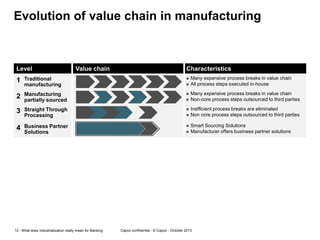
Evolution of value chain in manufacturing

Level

Value chain

Characteristics

1

Traditional
manufacturing



2

Manufacturing
partially sourced



3

Straight Through
Processing



4

Business Partner
Solutions



12 - What does Industrialization really mean for Banking









Many expensive process breaks in value chain
All process steps executed in-house
Many expensive process breaks in value chain
Non-core process steps outsourced to third parties

Inefficient process breaks are eliminated
Non core process steps outsourced to third parties
Smart Sourcing Solutions
Manufacturer offers business partner solutions

Capco confidential - © Capco - October 2013
Unit costs

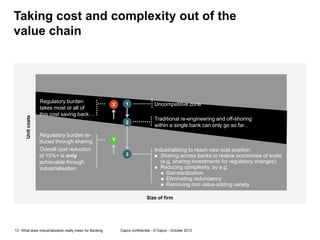
Taking cost and complexity out of the
value chain

Regulatory burden
takes most or all of
this cost saving back…

Regulatory burden reduced through sharing
Overall cost reduction
of 15%+ is only
achievable through
industrialisation

1

Uncompetitive zone

2

X

Traditional re-engineering and off-shoring
within a single bank can only go so far...

Y
3

Industrializing to reach new cost position:
 Sharing across banks to realize economies of scale
(e.g. sharing investments for regulatory changes)
 Reducing complexity, by e.g.
 Standardization
 Eliminating redundancy
 Removing non value-adding variety
Size of firm

13 - What does Industrialization really mean for Banking

Capco confidential - © Capco - October 2013
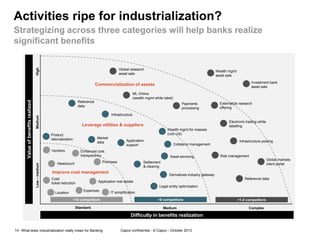
Activities ripe for industrialization?

High

Strategizing across three categories will help banks realize
significant benefits

Global research
asset sale

Wealth mgmt
asset sale
Investment bank
asset sale

Commercialization of assets

Reference
data

Payments
processing

Externalize research
offering

Medium

Infrastructure
Electronic trading white
labelling

Leverage utilities & suppliers
Wealth mgmt for masses
(non-US)

Product
rationalization

Market
data

Vendors

Low – medium

Value of benefits realized

ML Online
(wealth mgmt white label)

Application
support

Enhanced cost
transparency

Asset servicing

Premises

Headcount

Cost/
ticket reduction

Infrastructure pooling

Risk management
Global markets
client portal

Settlement
& clearing

Improve cost management

Location

Collateral management

Derivatives industry gateway
Reference data

Application real estate
Legal entity optimization
Expenses

>10 competitors
Standard

IT simplification
>5 competitors
Medium

Difficulty in benefits realization
14 - What does Industrialization really mean for Banking

Capco confidential - © Capco - October 2013

>1-2 competitors
Complex
What does Industrialization really mean for Banking

What does Industrialization really mean for Banking

  • 1.
    What does Industrialization reallymean for Banking October 2013
  • 2.
    Agenda  Driving forces forindustrialization in banking  Transforming front and back office  Regulatory trend towards localization (industrialization without globalization?)  Taking cost and complexity out of the value chain 2 - What does Industrialization really mean for Banking Capco confidential - © Capco - October 2013
  • 3.
    Driving force: Lackof trust Reputational challenges have hit the financial industry across the globe Percentage of survey respondents who place trust in given industry, 2012* 80 79 70 66 64 62 60 56 53 51 47 50 40 30 20 10 0 Tech Auo Food Telecom Pharma Energy Media Banks * Participants assessed trust of every industry on a 9-point scale from “trust them a great deal” to “don‟t trust them at all”, Source: Edelman trustbarometer 3 - What does Industrialization really mean for Banking Capco confidential - © Capco - October 2013
  • 4.
    Driving force: Regulation Increasingregulatory challenges for the financial industry Basel III Capital, leverage and funding Compressed profitability: Reduced margins whilst increased fixed costs Restrictions on business activities Volcker, ICB, compensation Changes to fundamental structures and business models Additional taxes Bank levies, transaction taxes Changes in consumer protection: MiFID II, RDR Consumer protection Disclosures, distribution Changes to compensation levels 4 - What does Industrialization really mean for Banking Capco confidential - © Capco - October 2013
  • 5.
    Driving force: Costpressure Between 21% and 33% cost reduction still needed to deliver 15% RoE Sample of 8 global banks. Representing 15% of total global banking cost base. 33% expense reduction needed to deliver 15% RoE if income declines by 10% USD Million 21% expense reduction needed to deliver 15% RoE Profit Expense s 2011 2006 15% rise in expenses between 2006 and 2011 Expenses Income flat between 2006 and 2011 Income 58% rise in shareholder equity between 2006 and 2011 Equity 0 100,000 200,000 300,000 400,000 Target 15% RoE, income decline 10% 5 - What does Industrialization really mean for Banking 500,000 600,000 700,000 Target 15% RoE, stable income Capco confidential - © Capco - October 2013 800,000 2011 900,000 2006
  • 6.
    “Industrialization is aperiod of profound change whereby social, economic and technological advances coincide to deliver a rapid modernization of society” Driver Enabling trends 1. Technological      2. Economic      3. Social      Propensity to influence financial services Internet Cloud Miniaturisation Componentisation Standardisation High Intense cost pressure Surplus capacity New entrants/business models Supply chain disintegration Emerging economies High “Electronification” of society Loosening of networks Trust based on data, not relationships Brand/product switching Mass empowerment Medium -> High 6 - What does Industrialization really mean for Banking Banks have been leading adopters of technology…focus now on gaining strategic advantage as quasi-tech companies In the face of stiff economic headwinds, vertical disintegration of the value chain appears inevitable Trends already seen in the buying of commodity Financial Services (insurance, mortgages) will accelerate as consumer behaviour trends towards mass empowerment Capco confidential - © Capco - October 2013
  • 7.
    Let‟s review oneof the most revolutionary „industrializations‟ of all time: 70 years of the electronic computer 1000 100 Unit price of computing power/USD/byte 10 1 .1 .01 .001 “Worldwide market is for no more than 5 computers” (Thomas Watson, CEO, IBM) Monolithic computing companies (IBM, HP, ICL, Olivetti ), rise of the mainframe First electronic computer built -„Colossus‟ .0001 .00001 .000001 6th commercial computer completed by 1953 Apple, which no longer manufactures computers, is the most valuable company on earth Rise of the network and the PC, mass customisation trend (Dell) Rapid break up of the value chain through changes in technology and supply chain logistics Rise of the Internet and the ubiquitous computer Total specialisation of the value chain First 1 GB disk drive .0000001 .00000001 1944 1960 7 - What does Industrialization really mean for Banking 1970 1980 Capco confidential - © Capco - October 2013 1990 2000 2010
  • 8.
    Applying these trendsto Financial Services, the banks of tomorrow will look radically different to the banks of today… Today 3 years 5 years + Aggregation Third Party Channel integration Customer service Fulfilment Bank Bank Product Economic and technological drivers to industrialise bottom end of value chain Social and technological drivers further re-shape relationships between customers and banks Third Party Third party Technology Threat of disintermediation as the way consumers buy banking services fundamentally changes Bank Third Party Infrastructure 8 - What does Industrialization really mean for Banking Capco confidential - © Capco - October 2013
  • 9.
    Transforming front andback office Front office    Back office Improve customer experience Offer more convenience, choice and control Improve connectivity to customers and employees      Improve quality Reduce waste Reduce complexity Virtualize services Integrate channels Virtuous cycle 9 - What does Industrialization really mean for Banking Capco confidential - © Capco - October 2013
  • 10.
    In manufacturing industrializationcorresponded to globalization  Distributing/selling products to customers across the globe  Production sites and suppliers across the globe  Cost of transport less and less relevant 10 - What does Industrialization really mean for Banking Capco confidential - © Capco - October 2013
  • 11.
    However in Bankingregulation drives towards localization  Home market regulators pressuring banks to curtail and / or ring-fence their external activities either through explicit rules (e.g. ICB in the UK) or through the lens of resolution planning (e.g. in Italy).  Home market regulators seeking to limit proprietary trading activity, or ring-fence this from retail deposit-taking activity.  Host regulators in the key hubs limiting, and seeking greater transparency and control, over risk-taking conducted overseas but booked into the hub (e.g. UK PRA).  Host regulators in the hubs and other markets pushing for increased capital and liquidity to be held locally, as well as onerous (and at times unpredictable) governance requirements (e.g. local risk appetite frameworks, local limit frameworks etc.).  Host regulators pushing for foreign bank branches to become subsidiaries, or treating them as if they are subsidiaries, heightening the level of scrutiny and supervision. Industrialization without globalization? Impact on business model, legal entity structure, operating model? 11 - What does Industrialization really mean for Banking Capco confidential - © Capco - October 2013
  • 12.
    Evolution of valuechain in manufacturing Level Value chain Characteristics 1 Traditional manufacturing  2 Manufacturing partially sourced  3 Straight Through Processing  4 Business Partner Solutions  12 - What does Industrialization really mean for Banking     Many expensive process breaks in value chain All process steps executed in-house Many expensive process breaks in value chain Non-core process steps outsourced to third parties Inefficient process breaks are eliminated Non core process steps outsourced to third parties Smart Sourcing Solutions Manufacturer offers business partner solutions Capco confidential - © Capco - October 2013
  • 13.
    Unit costs Taking costand complexity out of the value chain Regulatory burden takes most or all of this cost saving back… Regulatory burden reduced through sharing Overall cost reduction of 15%+ is only achievable through industrialisation 1 Uncompetitive zone 2 X Traditional re-engineering and off-shoring within a single bank can only go so far... Y 3 Industrializing to reach new cost position:  Sharing across banks to realize economies of scale (e.g. sharing investments for regulatory changes)  Reducing complexity, by e.g.  Standardization  Eliminating redundancy  Removing non value-adding variety Size of firm 13 - What does Industrialization really mean for Banking Capco confidential - © Capco - October 2013
  • 14.
    Activities ripe forindustrialization? High Strategizing across three categories will help banks realize significant benefits Global research asset sale Wealth mgmt asset sale Investment bank asset sale Commercialization of assets Reference data Payments processing Externalize research offering Medium Infrastructure Electronic trading white labelling Leverage utilities & suppliers Wealth mgmt for masses (non-US) Product rationalization Market data Vendors Low – medium Value of benefits realized ML Online (wealth mgmt white label) Application support Enhanced cost transparency Asset servicing Premises Headcount Cost/ ticket reduction Infrastructure pooling Risk management Global markets client portal Settlement & clearing Improve cost management Location Collateral management Derivatives industry gateway Reference data Application real estate Legal entity optimization Expenses >10 competitors Standard IT simplification >5 competitors Medium Difficulty in benefits realization 14 - What does Industrialization really mean for Banking Capco confidential - © Capco - October 2013 >1-2 competitors Complex