Portugal

  Living habitually?

From the First Republic
   to the Cold War
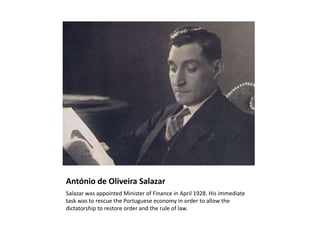
António de Oliveira Salazar
Salazar was appointed Minister of Finance in April 1928. His immediate
task was to rescue the Portuguese economy in order to allow the
dictatorship to restore order and the rule of law.
“People change little, and the
Portuguese not at all. I want
them to act habitually”
Salazar in an interview with António Ferro, Salazar: Portugal and her
leader, London: Faber & Faber
WHY SALAZAR?
• Technocrat
• Catholic
• Rural
• He had a plan
HOW DID IT GET TO THIS?
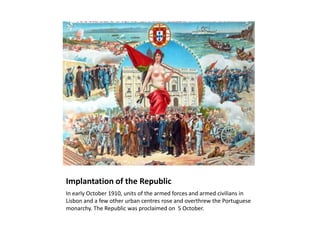
Implantation of the Republic
In early October 1910, units of the armed forces and armed civilians in
Lisbon and a few other urban centres rose and overthrew the Portuguese
monarchy. The Republic was proclaimed on 5 October.
The problem with the First
Republic, 1910-1926...

1.   Urban
2.   Intellectual
3.   Foreign
4.   Anti-clerical
5.   Legitimacy
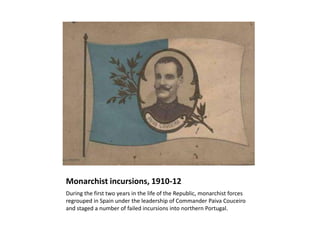
Monarchist incursions, 1910-12
During the first two years in the life of the Republic, monarchist forces
regrouped in Spain under the leadership of Commander Paiva Couceiro
and staged a number of failed incursions into northern Portugal.
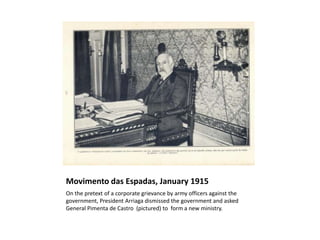
Movimento das Espadas, January 1915
On the pretext of a corporate grievance by army officers against the
government, President Arriaga dismissed the government and asked
General Pimenta de Castro (pictured) to form a new ministry.
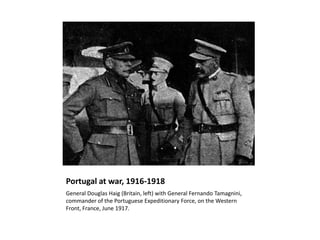
Portugal at war, 1916-1918
General Douglas Haig (Britain, left) with General Fernando Tamagnini,
commander of the Portuguese Expeditionary Force, on the Western
Front, France, June 1917.
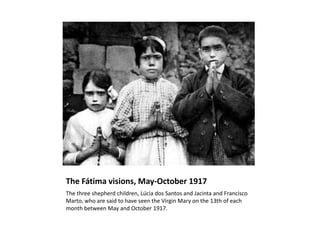
The Fátima visions, May-October 1917
The three shepherd children, Lúcia dos Santos and Jacinta and Francisco
Marto, who are said to have seen the Virgin Mary on the 13th of each
month between May and October 1917.
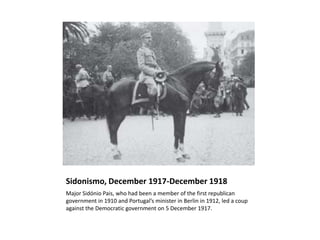
Sidonismo, December 1917-December 1918
Major Sidónio Pais, who had been a member of the first republican
government in 1910 and Portugal’s minister in Berlin in 1912, led a coup
against the Democratic government on 5 December 1917.
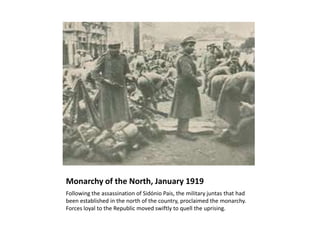
Monarchy of the North, January 1919
Following the assassination of Sidónio Pais, the military juntas that had
been established in the north of the country, proclaimed the monarchy.
Forces loyal to the Republic moved swiftly to quell the uprising.
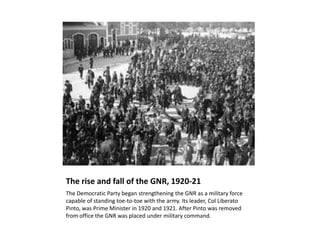
The rise and fall of the GNR, 1920-21
The Democratic Party began strengthening the GNR as a military force
capable of standing toe-to-toe with the army. Its leader, Col Liberato
Pinto, was Prime Minister in 1920 and 1921. After Pinto was removed
from office the GNR was placed under military command.
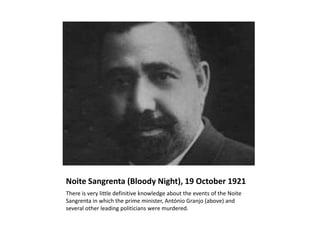
Noite Sangrenta (Bloody Night), 19 October 1921
There is very little definitive knowledge about the events of the Noite
Sangrenta in which the prime minister, António Granjo (above) and
several other leading politicians were murdered.
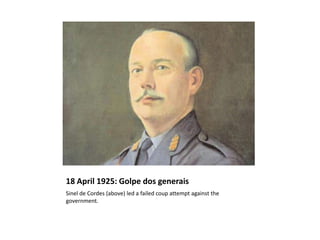
18 April 1925: Golpe dos generais
Sinel de Cordes (above) led a failed coup attempt against the
government.
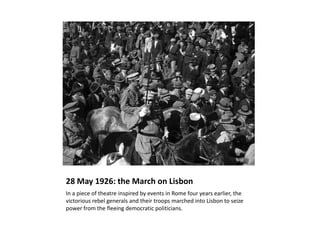
28 May 1926: the March on Lisbon
In a piece of theatre inspired by events in Rome four years earlier, the
victorious rebel generals and their troops marched into Lisbon to seize
power from the fleeing democratic politicians.
The end of the First Republic?

• Turbulent beginnings
• Conflict between urban and rural
• Conflict between Catholicism and laicism
• Conflict between urban middle class and
organised working class
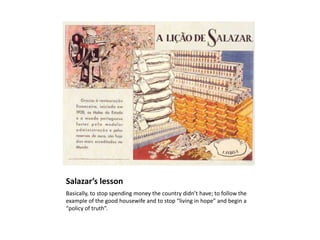
Salazar’s lesson
Basically, to stop spending money the country didn’t have; to follow the
example of the good housewife and to stop “living in hope” and begin a
“policy of truth”.
“I know quite well what I want and where I am
     going, but let it not be insisted that I shall
      reach the goal in a few months. For the
  rest, let the country study, let it object and let
  it discuss, but when the time comes for me to
        give orders I shall expect it to obey.”

               Salazar, 27 April 1927
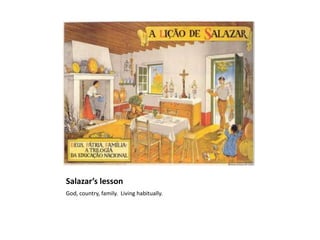
Salazar’s lesson
God, country, family. Living habitually.
The need for a new vision

1. Restore the nation’s finances
2. End the infatuation with
  materialism
3. Democracy = disorder
The new vision

• Rejected materialist fascist ideals
• Based on teachings of social Catholicism
• Papal encyclicals (Catholic corporatism):

    • Rerum Novarum (Leo XIII, 1891)
    • Quadragesimo Ano (Pius XI, 1931)
•
“During the long years which comprised the opening decades of the
present century, materialism — either in theory or in practice — had pre-
eminently made politics, science, inventions, education, individual and
collective life, subservient to the acquisition of wealth or to the
enjoyment of pleasures. If materialism has not been able to eradicate
entirely every influence that tends to develop the highest spiritual aims
in the individual, in the family, and in society, it is not because it has not
attempted to destroy those influences or to emphasise our physical
needs to the exclusion of all others. Experience has sadly shown us that
this has been the best way of inducing people to make demands with
which no ordinary government could comply; of promoting internal and
external strife; and of provoking upheavals of violence that have never
been surpassed, threatening to engulf mankind in a new barbarism.”

Salazar, 26 May 1934
“There will be no definite progress unless it is
accompanied by a revolution in the mental
and moral outlook of the Portuguese people
of the present day, and by a careful education
of our future generations”

Salazar
DOMESTIC DEALINGS
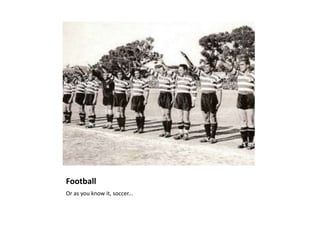
Football
Or as you know it, soccer...
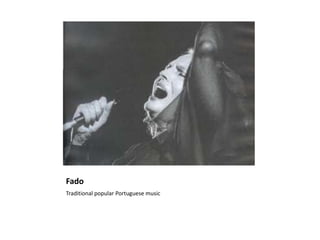
Fado
Traditional popular Portuguese music
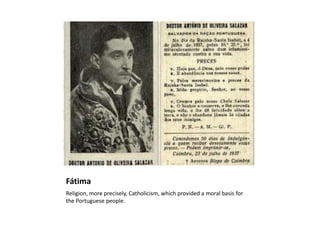
Fátima
Religion, more precisely, Catholicism, which provided a moral basis for
the Portuguese people.
DEALING WITH THE NEIGHBOURS
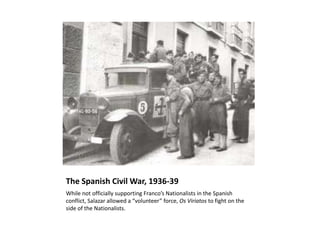
The Spanish Civil War, 1936-39
While not officially supporting Franco’s Nationalists in the Spanish
conflict, Salazar allowed a “volunteer” force, Os Viriatos to fight on the
side of the Nationalists.
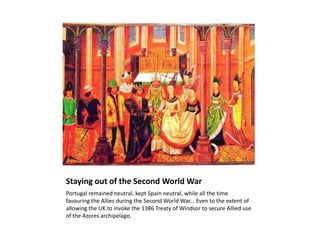
Staying out of the Second World War
Portugal remained neutral, kept Spain neutral, while all the time
favouring the Allies during the Second World War... Even to the extent of
allowing the UK to invoke the 1386 Treaty of Windsor to secure Allied use
of the Azores archipelago.
AFTER THE WAR
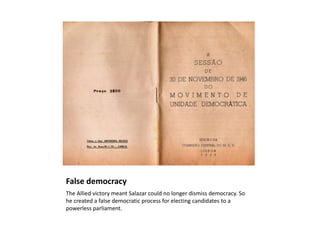
False democracy
The Allied victory meant Salazar could no longer dismiss democracy. So
he created a false democratic process for electing candidates to a
powerless parliament.
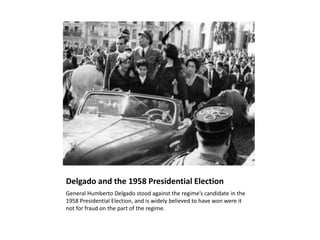
Delgado and the 1958 Presidential Election
General Humberto Delgado stood against the regime’s candidate in the
1958 Presidential Election, and is widely believed to have won were it
not for fraud on the part of the regime.
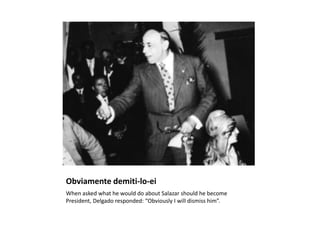
Obviamente demiti-lo-ei
When asked what he would do about Salazar should he become
President, Delgado responded: “Obviously I will dismiss him”.
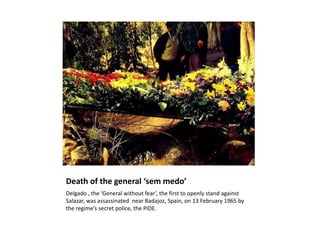
Death of the general ‘sem medo’
Delgado , the ‘General without fear’, the first to openly stand against
Salazar, was assassinated near Badajoz, Spain, on 13 February 1965 by
the regime’s secret police, the PIDE.
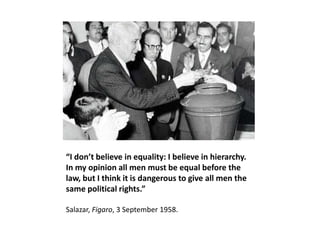
“I don’t believe in equality: I believe in hierarchy.
In my opinion all men must be equal before the
law, but I think it is dangerous to give all men the
same political rights.”

Salazar, Figaro, 3 September 1958.

Republican Portugal

  • 1.
    Portugal Livinghabitually? From the First Republic to the Cold War
  • 2.
    António de OliveiraSalazar Salazar was appointed Minister of Finance in April 1928. His immediate task was to rescue the Portuguese economy in order to allow the dictatorship to restore order and the rule of law.
  • 3.
    “People change little,and the Portuguese not at all. I want them to act habitually” Salazar in an interview with António Ferro, Salazar: Portugal and her leader, London: Faber & Faber
  • 4.
  • 5.
    • Technocrat • Catholic •Rural • He had a plan
  • 6.
    HOW DID ITGET TO THIS?
  • 7.
    Implantation of theRepublic In early October 1910, units of the armed forces and armed civilians in Lisbon and a few other urban centres rose and overthrew the Portuguese monarchy. The Republic was proclaimed on 5 October.
  • 8.
    The problem withthe First Republic, 1910-1926... 1. Urban 2. Intellectual 3. Foreign 4. Anti-clerical 5. Legitimacy
  • 9.
    Monarchist incursions, 1910-12 Duringthe first two years in the life of the Republic, monarchist forces regrouped in Spain under the leadership of Commander Paiva Couceiro and staged a number of failed incursions into northern Portugal.
  • 10.
    Movimento das Espadas,January 1915 On the pretext of a corporate grievance by army officers against the government, President Arriaga dismissed the government and asked General Pimenta de Castro (pictured) to form a new ministry.
  • 11.
    Portugal at war,1916-1918 General Douglas Haig (Britain, left) with General Fernando Tamagnini, commander of the Portuguese Expeditionary Force, on the Western Front, France, June 1917.
  • 12.
    The Fátima visions,May-October 1917 The three shepherd children, Lúcia dos Santos and Jacinta and Francisco Marto, who are said to have seen the Virgin Mary on the 13th of each month between May and October 1917.
  • 13.
    Sidonismo, December 1917-December1918 Major Sidónio Pais, who had been a member of the first republican government in 1910 and Portugal’s minister in Berlin in 1912, led a coup against the Democratic government on 5 December 1917.
  • 14.
    Monarchy of theNorth, January 1919 Following the assassination of Sidónio Pais, the military juntas that had been established in the north of the country, proclaimed the monarchy. Forces loyal to the Republic moved swiftly to quell the uprising.
  • 15.
    The rise andfall of the GNR, 1920-21 The Democratic Party began strengthening the GNR as a military force capable of standing toe-to-toe with the army. Its leader, Col Liberato Pinto, was Prime Minister in 1920 and 1921. After Pinto was removed from office the GNR was placed under military command.
  • 16.
    Noite Sangrenta (BloodyNight), 19 October 1921 There is very little definitive knowledge about the events of the Noite Sangrenta in which the prime minister, António Granjo (above) and several other leading politicians were murdered.
  • 17.
    18 April 1925:Golpe dos generais Sinel de Cordes (above) led a failed coup attempt against the government.
  • 18.
    28 May 1926:the March on Lisbon In a piece of theatre inspired by events in Rome four years earlier, the victorious rebel generals and their troops marched into Lisbon to seize power from the fleeing democratic politicians.
  • 19.
    The end ofthe First Republic? • Turbulent beginnings • Conflict between urban and rural • Conflict between Catholicism and laicism • Conflict between urban middle class and organised working class
  • 20.
    Salazar’s lesson Basically, tostop spending money the country didn’t have; to follow the example of the good housewife and to stop “living in hope” and begin a “policy of truth”.
  • 21.
    “I know quitewell what I want and where I am going, but let it not be insisted that I shall reach the goal in a few months. For the rest, let the country study, let it object and let it discuss, but when the time comes for me to give orders I shall expect it to obey.” Salazar, 27 April 1927
  • 22.
    Salazar’s lesson God, country,family. Living habitually.
  • 23.
    The need fora new vision 1. Restore the nation’s finances 2. End the infatuation with materialism 3. Democracy = disorder
  • 24.
    The new vision •Rejected materialist fascist ideals • Based on teachings of social Catholicism • Papal encyclicals (Catholic corporatism): • Rerum Novarum (Leo XIII, 1891) • Quadragesimo Ano (Pius XI, 1931) •
  • 25.
    “During the longyears which comprised the opening decades of the present century, materialism — either in theory or in practice — had pre- eminently made politics, science, inventions, education, individual and collective life, subservient to the acquisition of wealth or to the enjoyment of pleasures. If materialism has not been able to eradicate entirely every influence that tends to develop the highest spiritual aims in the individual, in the family, and in society, it is not because it has not attempted to destroy those influences or to emphasise our physical needs to the exclusion of all others. Experience has sadly shown us that this has been the best way of inducing people to make demands with which no ordinary government could comply; of promoting internal and external strife; and of provoking upheavals of violence that have never been surpassed, threatening to engulf mankind in a new barbarism.” Salazar, 26 May 1934
  • 26.
    “There will beno definite progress unless it is accompanied by a revolution in the mental and moral outlook of the Portuguese people of the present day, and by a careful education of our future generations” Salazar
  • 27.
  • 28.
    Football Or as youknow it, soccer...
  • 29.
  • 30.
    Fátima Religion, more precisely,Catholicism, which provided a moral basis for the Portuguese people.
  • 31.
    DEALING WITH THENEIGHBOURS
  • 32.
    The Spanish CivilWar, 1936-39 While not officially supporting Franco’s Nationalists in the Spanish conflict, Salazar allowed a “volunteer” force, Os Viriatos to fight on the side of the Nationalists.
  • 33.
    Staying out ofthe Second World War Portugal remained neutral, kept Spain neutral, while all the time favouring the Allies during the Second World War... Even to the extent of allowing the UK to invoke the 1386 Treaty of Windsor to secure Allied use of the Azores archipelago.
  • 34.
  • 35.
    False democracy The Alliedvictory meant Salazar could no longer dismiss democracy. So he created a false democratic process for electing candidates to a powerless parliament.
  • 36.
    Delgado and the1958 Presidential Election General Humberto Delgado stood against the regime’s candidate in the 1958 Presidential Election, and is widely believed to have won were it not for fraud on the part of the regime.
  • 37.
    Obviamente demiti-lo-ei When askedwhat he would do about Salazar should he become President, Delgado responded: “Obviously I will dismiss him”.
  • 38.
    Death of thegeneral ‘sem medo’ Delgado , the ‘General without fear’, the first to openly stand against Salazar, was assassinated near Badajoz, Spain, on 13 February 1965 by the regime’s secret police, the PIDE.
  • 39.
    “I don’t believein equality: I believe in hierarchy. In my opinion all men must be equal before the law, but I think it is dangerous to give all men the same political rights.” Salazar, Figaro, 3 September 1958.