Structure of Anther
Androecium is the male reproductive whorl consisting of individual members
is known as Stamen. Stamen consist of filamet, connective tissue and anther.
Anther consist of two anther lobes (diathecous) . Tetralocular called as
microsporangia, pollen sac, pollen chamber.
“ Microsporogenesis Formation of microspore take place inside the
microsporangia or pollen sac.
T.S of Anther shows following structure :
Anther wall – consist of four layers.
1. Epidermis – outermost, flattened cell. Protective in function.
2. Endothecium – Inbetween four pollen sac single layer of cells . Cells
consist of fibrous thickenings of callose. Fibrous thickenings and hygroscopic
nature of endothecium cells helps in the dehiscence of anther at maturity.
3. Middle layer – 1-3 layer of parenchyma cell. Cells are degenerate at
maturity .
4. Tapetum- innermost layer surrounding to the sporogenus tissue of
microsporangium. Cells are larger in size contain dense cytoplasm with one or
more diploid nuclei. It provide nutrition to sporogenus tissue and developing
microspore. It also contributes in the formation of sporopollenin a component
of pollen exine.
Structure of Pollen Grain
Microsporangium or Pollen sac
Microsporangium contain a compact mass of diploid sporogenous tissue. The cell of
these tissue undergoes mitosis and they directly function as microspore mother cell
(MMC). MMC (2n) undergoes meiosis to form four haploid microspore (n). These
microspore are present in the form of tetrahedral tetrads.
Microsporogenesis is the formation of microspore by the meiosis of diploid
microspore mother cell is called as microspogenesis.
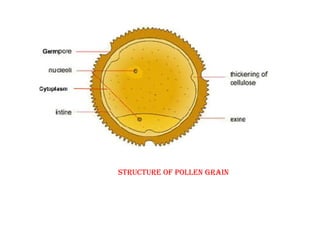
Structure of Pollen grain:
Unicellular, uninucleate , spherical or oval haploid in nature.
It was double layer wall called as Sporoderm.
Outer wall is Exine and inner wall Intine.
Exine is thick , highly resistant, spiny and smooth wall.
Exine consist of sporopollenin which provides resistsnce to polen grain from physical
and biological decomposition.
Exine wall is interrupted at one or more places, which look like small pores called as
germ pore.
Pollen grains are uniporate in monocots and triporate in dicots.
Intine is inner layer of pollen grain which is composed of cellulose and pectin. It
encloses protoplasm with single haploid nucleus.
Pollen Viability
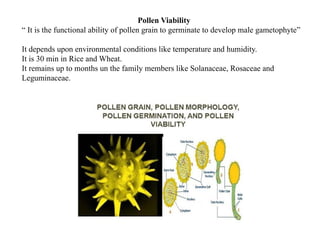
“ It is the functional ability of pollen grain to germinate to develop male gametophyte”
It depends upon environmental conditions like temperature and humidity.
It is 30 min in Rice and Wheat.
It remains up to months un the family members like Solanaceae, Rosaceae and
Leguminaceae.
Development of Male Gametophyte
Microspore or pollen grain is initial cell of male gametophyte.
Male gametophyte development take place within microspore.
It involves two mitotic division at two different places.
a) Before pollination in the pollen sac
b) After pollination on the stigma.
Protoplast division take place they form two unequal cell i.e. Generative and
vegetative cell.
Generative cell small, large nucleus, thin cytoplasm, lack reserve food.
Vegetative cell large, cytoplasm, nucleus, reserve food.
Generative cell is suspended in vegetative cell. Such two celled structure called as
young or partially developed male gametophyte. Also called as 3- celled pollen
grain.
After pollination 2 celled pollen grain is deposited on stigma surface comes in
contact with sugary substance and absorb.
Due to volume of cytoplasm increases and pressure create on intine.
Intine comes out through germ pore in form of a pollen tube.
Tube nucleus, cytoplasm, generative cell come into the pollen tube.
Generative cell divide by mitosis in pollen tube to form two haploid non motile
male gamete.
Thin pollen tube with two male gamete thin cytoplasm and a degenerating sterile
vegetative nucleus represents male gametophyte . It is highly reduced structure.
Structure of Anatropous ovule
Gynoecium is the female reproductive floral whorl having individual member called as
Carpels.
Carpel consist of stigma, style and ovary.
A single flower consist of one or many ovary.
Apocarpous : many and free carpels. Michelia
Syncarpous : many and fused carpels. Brinjal
Ovary consist of ovule may be single or many in number.
Uniovulate – single in number e.g. Paddy, Wheat, Mango
Multiovulate – many in number e.g. Tomato, lady finger.
An ovule is the integumented megasporangium of the seed bearing plant.
An ovule which has bent axis and downwardly directed opening called as micropyle
is termed as anatropous ovule.
It is most common type of ovule in angiosperm.
Megasporogenesis : “ It is the development of female gametophyte inside the ovule .”
Carpel consist of two parte like Stalk and Body.
Stalk: It is called as Funicle. It has vascular stand and supply nutrition to the body of
ovule. In anatropous ovule funicle remain attaches with the body . This part may
even persist in mature seed and is called as Raphe.
Body : Swollen part of the ovule is borne by the funicle. The funicle attach to the
basal part of the body of ovule at a point called as Hilum.
Nucellus : main central bulk of ovule. Consist of parenchyma cell , diploid in nature.
Chalaza : Basal part of nucellus from where integument develop. This end is called
as chalazal end.
Integuments: Protective covering of the nucellus , develops from chalazal end ,and
surround it except at the apical portion. Two integuments outer and inner. So the
ovule is bitegmic.
Micropyle : Integument leave a narrow opening at the terminal end of nucellus. It
is called as micropyle. This end of nucellus called as micropylar end.
Embryo sac: Mature ovule , nucellus shows the presence of an oval shaped, haploid
structure at micropylar end , this is called as embryo sac or female gametophyte.
It is 7 celled and 8 nucleated structure in which 3 celled egg apparatus at
micropylar end . It has medium egg cell (n) , 2 synergids. At the chalazal end 3
antipodal cells (n) present.
The large central cell with two haploid nuclei which fuse with each other at later
stage to form diploid secondary nucleus. Generally embryo sac in angiosperm is
Monosporic, Endosporic , 7 celled and 8 nucleated. It is called as polygonum
type.
Development of Female Gametophyte
A diploid hypodermal cell at the micropylar end of nucellus get differenciated to
form archesporium.
A single cell of archesporium directly functions as megaspore mother cell (MMC).
The diploid MMC undergoes meiosis to form a tetrad of haploid megaspores (n).
This process is known as megasporogenesis. Megaspore are generally arranged in
linear tetrad. Chalazal megaspore remains functional while remaining three are
degenerate gradually.
Functional megaspore is the first cell of female gametophyte. It undergoes
enlargement and develops into a female gametophyte. The haploid nucleus of
functional megaspore undergoes three successive free nuclear mitotic divisions.
First mitotic divisions results in formation of two nuclei.
Both nuclei undergo two successive divisions.
This results in formation of four nuclei at each pole and 8 nucleated structure is
formed.
one nucleus from each pole comes to the centre and they function as polar nuclei.
This is followed by cellular organization to form 3 celled egg apparatus at
micropylar end, three antipodals at chalazal end and two polar nuclei remain in the
centre.
Thus 8 nucleated , 7 celled female gametophyte is formed within the functional
megaspore, therefore the development is called as endosporic.
Only one megaspore takes part in the formation of embryo sac therefore it is called
as monosporic.
Pollination Its Types and Agencies
“ Pollination is defined as the transfer of pollen grains from anther to the stigma of
flower.”
The process was first discovered by Camerarius (1694).
Types of Pollination :
Self Pollination (Autogamy) and Cross Pollination ( Allogamy)
1. Self Pollination (Autogamy) : (auto – self gamos- marriage)
“ Transfer of pollen grain from anther to the stigma of same flower or a different
flowers produced on the same plant is called as self pollination” .
Autogamy - “ Transfer of pollen grains from anther to the stigma of same flower .
It occure in bisexual flowers only.” e.g. Pea
Geitonogamy – (Geiton – neighbours gamos – marriage)
“ Transfer of pollengrains from anther to the stigma of another flower produced
on the same plant.” e.g. Cucurbits ( Cucurbita maxima )
Self pollination seen in plants showing vegetative reproduction.
Advantages : It is sure method.
It is most economic method.
Least wastage of pollen grains.
Genetic stability maintained.
Disadvantages: No chance of forming improved variety like hybrids.
It occurs continuously for many generations then the progeny
becomes weaker and susceptible to diseases.
Continued self pollination may result in the formation of less no. of seeds per
fruit, less viability of seeds , less adaptability to climatic varation etc.
It dosent favour the variations and evolution process.
2. Cross Pollination : Allogamy (allos- different gamos- marriage)
“ It is the transfer of pollen grains from another of a flower to the stigma of
another flower produced on a different plant having sisimilar genetic make up.”
Two types .
Xenogamy – “ Transfer of pollen grains from anther of a flower to the stigma
of another flower produced on a different plant belonging to the same species.”
e.g. Papaya
Hybridization : “ Transfer of pollen grains from anther of a flower to the
stigma of another flower produced on a different plant belonging to a different
variety/subspecies/species is called hybridization ” .
E.g. Bet two species/variety
Advantages : Involves genetic recombinations and brings variations.
Undesirable characters can be eliminated and desirable characters
can be introduced in the offsprings.
Improved variety like hybrids can be produced.
It favours the process of evolution.
Disadvantages :
Depends on external carriers, therefore , failure chances are more.
Not an economical method because a lot of plant energy is wasted for
attraction of carriers.
Wastage of pollen grains.
Genetic recombinations , some desirable characters can get eliminated and
undersible ones may get introduced in the offsprings.
Genetic purity not maintained.
Agencies of Pollination
Abiotic agents : Non living, Wind, Water
Biotic agents : Living, Insects, Birds, Bats.
Anemophily : (Anemone – wind phily- loving)
“ Transfer of pollen grains through wind ”.
Wind pollinated plants called as anemophilous plant.
It is most primitive type and plant produce unisexual flower.
Adaptations: Flower small, inconspicuous without bright colour, nector,
fragrance.
Petals green or highly reduced.
Male flowers are many than female are situated at a higher level.
Stamens with long filaments , versatile and exposed anther.
Pollen grains are large number to compensate their wastage.
Pollen grains are smooth walled, pale yellow in colour, light weight.
Long style bears large feathery or hairy stigma to trap pollen grains.
e.g. Grasses, Maize, Jowar, Sugarcane, Palms, Wheat, Rye, Barley.
It is associated with symptoms of Hayfever among people those are sensitive to
pollens. It is caused by hypersensitivity to pollens.
Hydrophily : “ Transfer of pollen grains through the water .”
Adaptations : Flowers are unisexual, small and inconspicuous.
Flower without fragrance , right colour, nectar.
Pollen grains are unwettable i.e. coated with mucilage.
Specific gravity of pollen grain is controlled by the formation of one or
more starch grain in the pollen grain.
Stigma is long and sticky.
Hydrophily are two types :
a) Epihydrophily b) Hypohydrophily
a) Epihydrophily : Below the water surface. Pollen grains are needle like which lack
exine. they bear some specific gravity as that water , therefore they float below the
water surface. Pollen grain come in contact with stigma, coil around it and
germinate. E.g. Zostera , Ceratophyllum
b) Epihydrophily : Pollination occurs on the surface of water. It is more common
type.
Vallisneria is a dioecious plant. At the time of maturity male flower are detached
from male inflorescence and float on water. Female flower have a long coiled,
long pedicel with undergoes uncoiling at the time of maturity.
Male flowers surround the female flower and undergo anthesis due to which pollen
grains are deposited on the stigma of female flower.
Entomophily : (Entomon – insect)
“ Pollination through the agency of insects.”
The insects like moths, butterflies, beetles, flies, bees etc.
Bees are most common agents and nearby 75-80 percent.
Adaptations : Flowers are large and attractive .
Small flowers are produced in inflorescence.
Bright colour , pleasant ,fragrance, nector.
Pollen grains are spiny and rough exine.
Stigma Is sticky. e.g. Jasmine, Rose, Salvia, Cestrum
Special mechanism: Salvia – shows Lever mechanism.
Ornithophily – (Ornis – bird)
“ Pollination take place through the birds. ”
Adaptations: Large flower with thick , fleshy floral parts.
Corolla is tubular or funnel shaped.
Bright colour corolla like orange, red , yellow, blue.
Lack fragrance because poor sense of smell.
Large amount of sugary nector.
Pollen grains are sticky.
e.g Callistemon ( Bottle Brush), Bignonia, Butea, Bombax
The common pollinating birds are – Sunbirds, Hunning birds, Crow, Bulbul
Chiropterophily – (Chiropteron – Bat)
“ Pollination take place through Bats .”
Adaptations : Flowers are large, stout enough.
Plants are nocturnal.
Flower produce copious nector.
Large number of stamens to produce a considerable large quantity of
pollen grains.
e.g Anthocephallus, Adansonia, Bauhinia
Malacophily : ‘ Pollination take place through Snails”.
Outbreeding device
This mechanism that prevent self pollination.
To promote cross pollination and increase genetic diversity of plants.
1. Unisexuality : Plant bears male or female flowers.
As flowers are unisexual self pollination is not possible.
Plants are monoecious in Maize.
Plants are dioecious in Mulberry, Papaya.
2. Dichogamy : Anthers and stigma mature at different time to prevent self
pollination.
Protoandry – androecium mature early than gynoecium. e.g. Sunflower
Protogyny - gynoecium mature early than androecium. e.g. Gloriosa
3. Prepotency : Pollen grains of other flowers germinate rapidly over the stigma than the
pollen grains from the same flower. E.g. Apple
4. Heterostyle (Heteromorphy) : In Primula there are two or three forms of flowers in
which stigmas and anthers are placed at different level.
5. Herkogamy : In plants natural physical barrier is present between two sex organs and
avoid contact of pollen with stigma of same flower.
e.g. Calotropis pentangular stigma is positioned above the level of anther.
6. Self Incompatibility ( self sterility) : This is a genetic mechanism due to which the
germination of pollen on stigma of the same flower is inhibited.
e.g Tobacco. Thea
Pollen Pistil Interaction
It is the interaction of pollen grains with sporophytic tissue (stigma).
“ All the events from the deposition of pollen grains on stigma to the entry of pollen tube
in the ovule are called as pollen pistil interaction.”
Pistil has the ability to recognise and accept the right or compatible pollen of the same
species. Thus wrong type of pollen is discarded by pistil.
Compatibility and incompatibility of the pollen pistil is determined by promotion or
inhibition of pollen.
Compatible pollen grains absorbs water and nurtients from the surface of stigma,
germinates and produce pollen tube. Its growth through the style is determined by
specific chemical. It plays a important role in sexual reproduction and seed formation.
Pollen grains can also be induced to germinate in a synthetic medium.
Sucrose induces pollen germination and tube growth in vitro. Addition of Boric acid
faciliates and accelarates pollen germination.
Artificial hybridization : It is important in the crop improvement. Desired pollen grains
are hand pollinated and used for fertilization. This is accomplished through emasculation
and bagging procedure.