ReproductiveReproductive
SystemSystem
DisordersDisorders
Overview
• Male Infertility
• Benign Prostatic Hypertrophy
• Prostate Cancer
• Female Infertility
• Endometriosis
• Pelvic Inflammatory Disease
• Ovarian Cysts
• Cancer
– Breast
– Cervical
– Uterine
Male Infertility
• Can be solely male, solely female, or both
• Considered infertile after one year of unprotected
intercourse fails to produce a pregnancy
• Male problems include
– Changes is sperm or semen
– Hormonal abnormalities
• Pituitary disorders or testicular problems
– Physical obstruction of sperm passageways
• Congenital or scar tissue from injury
• Semen analysis
– Assess specific characteristics
• Number, motility, normality
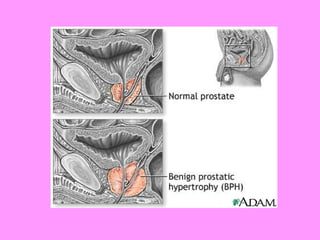
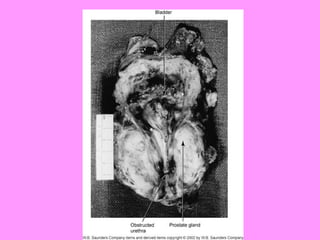
Benign Prostatic Hypertrophy
(BPH)—Pathophysiology
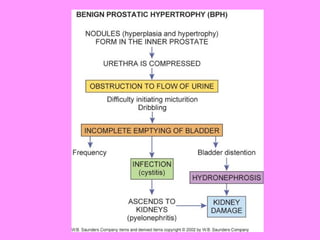
• Common in older men; varies from mild to severe
• Change is actually hyperplasia of prostate
– Nodules form around urethra
– Result of imbalance between estrogen and testosterone
• No connection w/ prostate cancer
• Rectal exams reveals enlarged gland
• Incomplete emptying of bladder leads to infections
• Continued obstruction leads to distended bladder, dilated
ureters, renal damage
– If significant, surgery required
BPH—Signs and Symptoms
• Initial signs
– Obstruction of urine flow
• Hesitancy, dribbling, decreased force of urine
stream
• Incomplete bladder emptying
– Frequency, nocturia, recurrent UTIs
BPH—Treatment
• Only small amount require intervention
– Surgery when obstruction severe
• Drugs (Flomax) used to promote blood
flow helpful when surgery not required
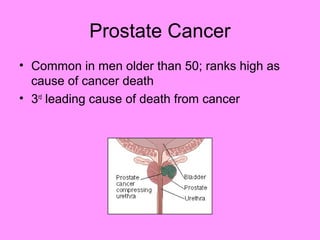
Prostate Cancer
• Common in men older than 50; ranks high as
cause of cancer death
• 3rd
leading cause of death from cancer
Prostate Cancer—Pathophysiology
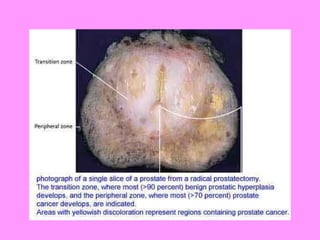
• Most are adenocarcinomas from tissue near surface of gland
– BPH arises from center of gland
– Many are androgen dependent
• Tumors vary in degree of cellular differentiation
– The more undifferentiated, the more aggressive and the faster they
grow and spread
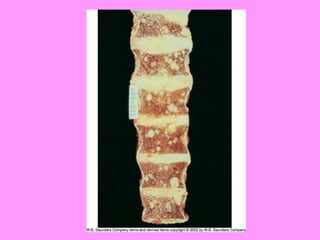
• Metastasis to bone occurs early
– Spine, pelvis, ribs, femur
• Cancer has typically spread before diagnosis
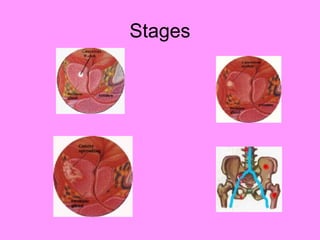
• Staging based on 4 categories:
– A  small, nonpalpable, encapsulated
– B  palpable confined to prostate
– C  extended beyond prostate
– D  presence of distant metastases
Stages
Prostate Cancer—Etiology
• Cause not determined
– Genetic, environmental, hormonal factors
• Common in North American and northern
Europe
• Incidence higher in black population than
white
– Genetic factor?
• Testosterone receptors found on cancer
cells
Prostate Cancer—Signs and
Symptoms
• Hard nodule in periphery of gland
– Detected by rectal exam
• No early urethral obstruction
– b/c of location
– As tumor develops, some obstruction occurs
• Hesitancy, decreased stream, urinary frequency,
bladder infection
Prostate Cancer—Diagnostic Tests
• 2 helpful serum markers
– Prostate-specfic Antigen (PSA)
• Useful screening tool for early detection
– Prostatic acid phosphatase
• elevated when metastatic cancer present
• Ultrasound and biopsy confirms
Prostate Cancer—Treatment
• Surgery and radiation
• Risk of impotence or incontinence
• When tumor androgen sensitive:
– orchiectomy (removal of testes) or
– Antitestosterone drug therapy
• 5 yr survival rate is 85-90%
Female Infertility
• Associated w/ hormonal imbalances
– Result from altered function of hypothalamus, anterior pituitary,
or ovaries
– Typically after long use of birth control pill
• Structural abnormalities
– Small or bicornuate uterus
• Obstruction of fallopian tubes
– Scar tissue or endometriosis
• Access of viable sperm
– Change in vaginal pH
• Due to infection or douches
– Excessively thick cervical mucus
– Development of antibodies in female to particular sperm
• Smoking by male or female
Female Infertility
• Broad range of tests avail
– General health status checked 1st
– Pelvic examinations, ultrasound, CT scans
check for structural abnormalities
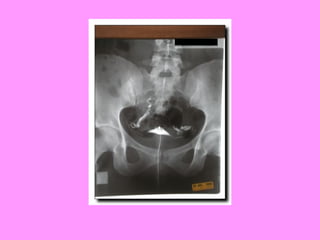
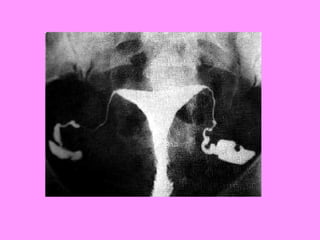
– Tubal insufflation (gas/pressure
measurement) or hysterosalpingogram (X-ray
w/ contrast material) used to check tubes
– Blood tests throughout cycle to check
hormone levels
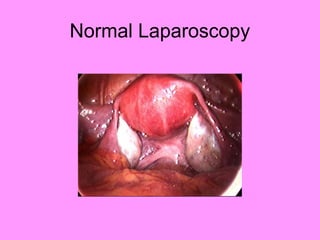
Normal Laparoscopy
Endometriosis
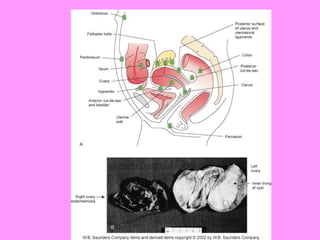
• Presence of endometrial tissue outside uterus
(ectopic)
– Found on ovaries, ligaments, colon, sometimes lungs
• Responds to cyclic hormonal variations
– Grows and secretes then degenerates, sheds and
bleeds
• What is the problem? (Where does it go?)
– Blood irritating to tissues = inflammation and pain
• Recurs w/ e/ cycle w/ eventual fibrous tissue
– Causes adhesions and obstruction
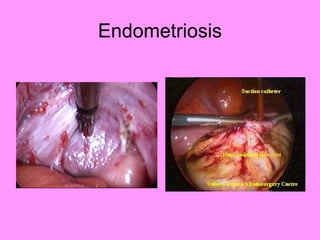
• Diagnosis confirmed w/ laparoscopy
Endometriosis
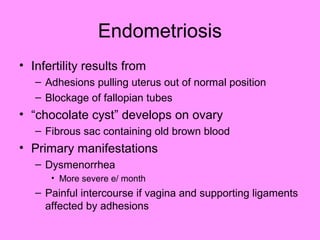
• Infertility results from
– Adhesions pulling uterus out of normal position
– Blockage of fallopian tubes
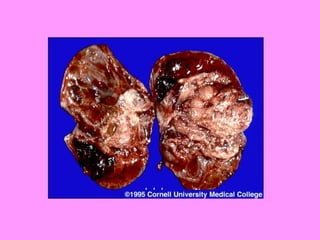
• “chocolate cyst” develops on ovary
– Fibrous sac containing old brown blood
• Primary manifestations
– Dysmenorrhea
• More severe e/ month
– Painful intercourse if vagina and supporting ligaments
affected by adhesions
Endometriosis
• Cause not established
– Migration of endometrial tissue up thru tubes to
peritoneal cavity during menstruation, development
from embryonic tissue at other sites, spread thru
blood or lymph, transplantation during surgery (C-
section) all possibilities
• Treatment
– Hormonal suppression of endometrial tissue
– Surgical removal of endometrial tissue
• Pregnancy and lactation delay further damage
and alleviate symptoms
Endometriosis
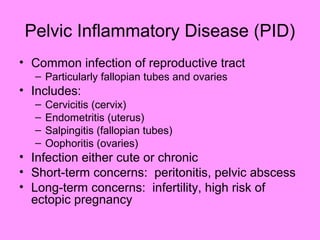
Pelvic Inflammatory Disease (PID)
• Common infection of reproductive tract
– Particularly fallopian tubes and ovaries
• Includes:
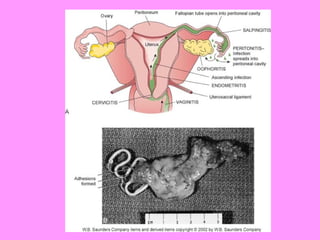
– Cervicitis (cervix)
– Endometritis (uterus)
– Salpingitis (fallopian tubes)
– Oophoritis (ovaries)
• Infection either cute or chronic
• Short-term concerns: peritonitis, pelvic abscess
• Long-term concerns: infertility, high risk of
ectopic pregnancy
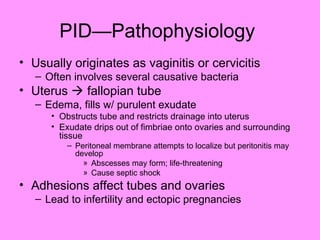
PID—Pathophysiology
• Usually originates as vaginitis or cervicitis
– Often involves several causative bacteria
• Uterus  fallopian tube
– Edema, fills w/ purulent exudate
• Obstructs tube and restricts drainage into uterus
• Exudate drips out of fimbriae onto ovaries and surrounding
tissue
– Peritoneal membrane attempts to localize but peritonitis may
develop
» Abscesses may form; life-threatening
» Cause septic shock
• Adhesions affect tubes and ovaries
– Lead to infertility and ectopic pregnancies
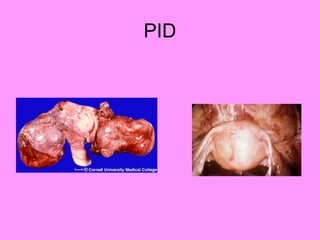
PID
PID—Etiology
• Arise from sexually transmitted diseases
– Gonorrhea
– Chlamydiosis
• Prior episodes of vaginitis or cervicitis precedes
development
• Infection acute during or after menses
– Endometrium more vulnerable
• Can also result from IUD or other contaminated
instrument
– Can perforate wall and lead to inflammation and
infection
PID—Signs and Symptoms
• Lower abdominal pain (1st
indication)
– Sudden and severe or gradually increasing in
intensity
• Tenderness during pelvic exams
• Purulent discharge at cervix
• Dysuria
• Fever and leukocytosis can occur
– Depends on causative organism
PID—Treatment
• Aggressive antibiotics
– Cefoxitin, doxycycline
• Recurrent infections common
– Sex partners should be treated as well
• Follow-up appt to ensure eradication
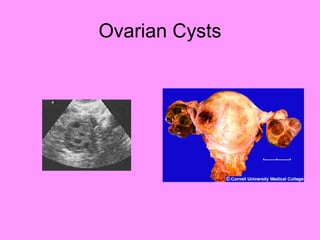
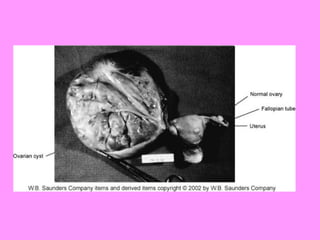
Benign Tumors: Ovarian Cysts
• Variety of types
– Follicular and corpus luteal cysts common
• Develop unilaterally in both ruptured and unruptured follicles
• Usually multiple fluid-filled sacs under serosa
that covers ovary
• May become large enough to cause discomfort,
urinary retention, or menstrual irreg
– Bleeding if ruptures
• Cause even more serious inflammation
– Risk of torsion of the ovary
• Ultrasound and laparoscopy to ID cyst
Ovarian Cysts
Malignant Tumors: Carcinoma of
the Breast—Pathophysiology
• Develop in upper outer quadrant of breast in ½
of the cases
• Central portion of the breast is also common
• Most tumors are unilateral
• Different types; majority arise from ductal
epithelium
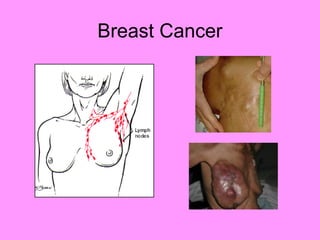
– Infiltrates surrounding tissue and adheres to skin
• Causes dimpling
• Tumor becomes fixed when adheres to muscle or fascia of
chest wall
Carcinoma of the Breast—
Pathophysiology
• Malignant cells spread at early state
– 1st
to close lymph nodes
• Axillary nodes
– In most cases, several nodes infected at time of diagnosis
• metastasizes quickly to lungs, brain, bone, liver
• Tumor cells graded on basis of degree of differentiation
or anaplasia
– Tumor then staged based on size of primary tumor, # lymph
nodes, presence of metastases
• Presence of estrogen and progesterone receptors
– Major factor in determining how to treat the pt’s cancer
Breast Cancer
Breast Cancer—Etiology
• Major cause of death in women
• Incidence continues to increase after age of 20
• Strong genetic predisposition
– identification of specific genes related to cancer
• Hormones also a factor
– Specifically exposure to high estrogen levels
• Long period of regular menstrual cycles (early menarche to
late menopause)
• No kids (nulliparily)
• Delay of 1st
pregnancy
– Role of exogenous estrogen (birth control pills,
supplements) still controversial
Breast Cancer—Signs and
Symptoms
• Initial sign is single, hard, painless nodule
– Mass is freely movable in early stage
• Becomes fixed
• Advanced signs
– Fixed nodule
– Dimpling of skin
– Discharge from nipple
– Change in breast contour
• Biopsy confirms diagnosis of malignancy
Breast Cancer—Treatment
• Surgery, radiation, chemo
• Surgery
– Lumpectomy
• Preferred; removal of tumor
– Mastectomy
• Sometimes necessary
– Some lymph nodes removed as well
• # removed depends on the spread of the tumor cells
– Impairs draining of lymph; swelling and stiffness of arm
common
• Chemo and radiation
– Useful for eradicating undetected micrometastases
Breast Cancer—Treatment
• If responsive to hormones, removal of hormone
stimulation
– Premenopausal women: ovaries removed
– Postmenopausal women: hormone-blocking agent
• Prognosis
– Relatively good if nodes not involved
– As # nodes increases, prognosis becomes more negative
– May recur years later
• Longer the period w/o recurrence, better the chances
• BSE if over 20 yrs.
• Mammography routine screening tool
– Detect lesions before they become palpable or if they are deep
in the breast tissue
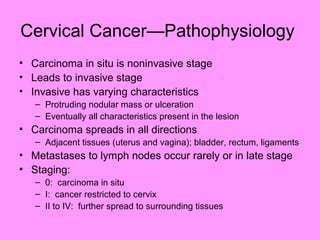
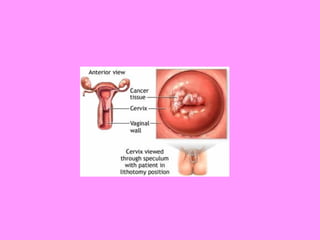
Carcinoma of the Cervix
• # deaths has decreased due to Pap smear
– Screening and early diagnosis while cancer in
situ
• However, # cases of carcinoma in situ has
increased in the US
– Avg age of in situ onset is 35
– Invasive carcinoma manifests at 45
– Age range dropping to younger women
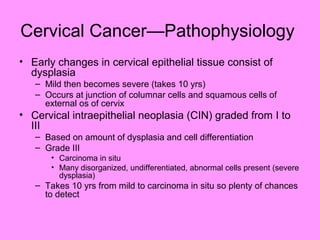
Cervical Cancer—Pathophysiology
• Early changes in cervical epithelial tissue consist of
dysplasia
– Mild then becomes severe (takes 10 yrs)
– Occurs at junction of columnar cells and squamous cells of
external os of cervix
• Cervical intraepithelial neoplasia (CIN) graded from I to
III
– Based on amount of dysplasia and cell differentiation
– Grade III
• Carcinoma in situ
• Many disorganized, undifferentiated, abnormal cells present (severe
dysplasia)
– Takes 10 yrs from mild to carcinoma in situ so plenty of chances
to detect
Cervical Cancer—Pathophysiology
• Carcinoma in situ is noninvasive stage
• Leads to invasive stage
• Invasive has varying characteristics
– Protruding nodular mass or ulceration
– Eventually all characteristics present in the lesion
• Carcinoma spreads in all directions
– Adjacent tissues (uterus and vagina); bladder, rectum, ligaments
• Metastases to lymph nodes occur rarely or in late stage
• Staging:
– 0: carcinoma in situ
– I: cancer restricted to cervix
– II to IV: further spread to surrounding tissues
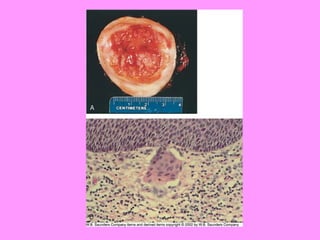
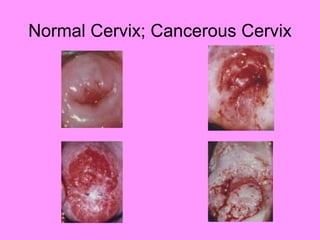
Normal Cervix; Cancerous Cervix
Cervical Cancer—Etiology
• Strongly linked to STDs
– Herpes simplex virus type 2 (HSV-2)
– Human papillomavirus (HPV)
• Virus exerts direct effects on host cell or may cause
antibody rxn
– Increased antibodies have been assoc w/ increasing dysplasia
• High risk factors
– Multiple sex partners
– Promiscuous partners
– Sexual intercourse in early teen years
– Pt history of STDs
• Environmental factors such as smoking can predispose
women
Cervical Cancer—Signs and
Symptoms
• Asymptomatic in early stage
– Can be detected by Pap test
• Invasive stage indicated by slight bleeding
or spotting
• Anemia and wt loss can accompany
Cervical Cancer—Treatment
• Biopsy to confirm diagnosis
• Surgery and radiation to treat
• 5 yr survival rate 100% if carcinoma still in
situ
– Prognosis for invasive depends on the extent
of the spread of cancer cells
Carcinoma of the Uterus
(Endometrial Carcinoma)
• Common cancer in women older than 40
– Majority 55-65 yrs old
• Simple screening not available for this
cancer
• Early indication is bleeding
– Significant sign in postmenopausal women
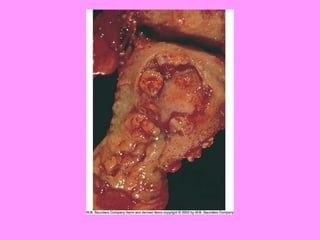
Uterine Cancer—Pathophysiology
• Majority are adenocarcinomas
– arise from glandular epithelium
• Malignant changes develop from endometrial
hyperplasia
– Excessive estrogen stimulation major factor for
hyperplasia
• Cancer is slow-growing
• May infiltrate uterine wall (thickened area) or
may spread out to endometrial cavity
– Eventually tumor mass fills interior of uterus
• Expands thru wall into surrounding structures
Uterine Cancer—Pathophysiology
• Graded from 1-3
– 1: indicate well-differentiated cells
– 3: poorly differentiated cells
• Staging
– Based on degree of localization
– I: tumors confined to body of uterus
– II: cancer limited to uterus and cervix
– III: cancer spread outside of uterus; still in true pelvis
– IV: tumor spread to lymph nodes and distant organs
Uterine Cancer—Etiology
• Higher risk if increased estrogen levels
– Assoc w/ exogenous estrogen
(postmenopausal women)
• Recommended dosage lowered
– Oral contraceptives
• Infertility
• Obesity, diabetes, hypertension increase
risk
Uterine Cancer—Signs and
Symptoms
• Painless vaginal bleeding or spotting is
key sign
– b/c cancer erodes surface tissues
• Pap smear not dependable for detection
• Direct aspiration of cells provides best
analysis
• Late signs of malignancy include palpable
mass, discomfort or pressure in lower
abdomen, bleeding following intercourse
Uterine Cancer—Treatment
• Surgery and radiation
• Prognosis relatively good
– 5 yr survival rate 90% if cancer well localized
at time of diagnosis
Thanks

Reproductive System Disorders

  • 1.
  • 2.
    Overview • Male Infertility •Benign Prostatic Hypertrophy • Prostate Cancer • Female Infertility • Endometriosis • Pelvic Inflammatory Disease • Ovarian Cysts • Cancer – Breast – Cervical – Uterine
  • 3.
    Male Infertility • Canbe solely male, solely female, or both • Considered infertile after one year of unprotected intercourse fails to produce a pregnancy • Male problems include – Changes is sperm or semen – Hormonal abnormalities • Pituitary disorders or testicular problems – Physical obstruction of sperm passageways • Congenital or scar tissue from injury • Semen analysis – Assess specific characteristics • Number, motility, normality
  • 4.
    Benign Prostatic Hypertrophy (BPH)—Pathophysiology •Common in older men; varies from mild to severe • Change is actually hyperplasia of prostate – Nodules form around urethra – Result of imbalance between estrogen and testosterone • No connection w/ prostate cancer • Rectal exams reveals enlarged gland • Incomplete emptying of bladder leads to infections • Continued obstruction leads to distended bladder, dilated ureters, renal damage – If significant, surgery required
  • 8.
    BPH—Signs and Symptoms •Initial signs – Obstruction of urine flow • Hesitancy, dribbling, decreased force of urine stream • Incomplete bladder emptying – Frequency, nocturia, recurrent UTIs
  • 9.
    BPH—Treatment • Only smallamount require intervention – Surgery when obstruction severe • Drugs (Flomax) used to promote blood flow helpful when surgery not required
  • 10.
    Prostate Cancer • Commonin men older than 50; ranks high as cause of cancer death • 3rd leading cause of death from cancer
  • 12.
    Prostate Cancer—Pathophysiology • Mostare adenocarcinomas from tissue near surface of gland – BPH arises from center of gland – Many are androgen dependent • Tumors vary in degree of cellular differentiation – The more undifferentiated, the more aggressive and the faster they grow and spread • Metastasis to bone occurs early – Spine, pelvis, ribs, femur • Cancer has typically spread before diagnosis • Staging based on 4 categories: – A  small, nonpalpable, encapsulated – B  palpable confined to prostate – C  extended beyond prostate – D  presence of distant metastases
  • 13.
  • 15.
    Prostate Cancer—Etiology • Causenot determined – Genetic, environmental, hormonal factors • Common in North American and northern Europe • Incidence higher in black population than white – Genetic factor? • Testosterone receptors found on cancer cells
  • 16.
    Prostate Cancer—Signs and Symptoms •Hard nodule in periphery of gland – Detected by rectal exam • No early urethral obstruction – b/c of location – As tumor develops, some obstruction occurs • Hesitancy, decreased stream, urinary frequency, bladder infection
  • 17.
    Prostate Cancer—Diagnostic Tests •2 helpful serum markers – Prostate-specfic Antigen (PSA) • Useful screening tool for early detection – Prostatic acid phosphatase • elevated when metastatic cancer present • Ultrasound and biopsy confirms
  • 18.
    Prostate Cancer—Treatment • Surgeryand radiation • Risk of impotence or incontinence • When tumor androgen sensitive: – orchiectomy (removal of testes) or – Antitestosterone drug therapy • 5 yr survival rate is 85-90%
  • 19.
    Female Infertility • Associatedw/ hormonal imbalances – Result from altered function of hypothalamus, anterior pituitary, or ovaries – Typically after long use of birth control pill • Structural abnormalities – Small or bicornuate uterus • Obstruction of fallopian tubes – Scar tissue or endometriosis • Access of viable sperm – Change in vaginal pH • Due to infection or douches – Excessively thick cervical mucus – Development of antibodies in female to particular sperm • Smoking by male or female
  • 20.
    Female Infertility • Broadrange of tests avail – General health status checked 1st – Pelvic examinations, ultrasound, CT scans check for structural abnormalities – Tubal insufflation (gas/pressure measurement) or hysterosalpingogram (X-ray w/ contrast material) used to check tubes – Blood tests throughout cycle to check hormone levels
  • 22.
  • 24.
    Endometriosis • Presence ofendometrial tissue outside uterus (ectopic) – Found on ovaries, ligaments, colon, sometimes lungs • Responds to cyclic hormonal variations – Grows and secretes then degenerates, sheds and bleeds • What is the problem? (Where does it go?) – Blood irritating to tissues = inflammation and pain • Recurs w/ e/ cycle w/ eventual fibrous tissue – Causes adhesions and obstruction • Diagnosis confirmed w/ laparoscopy
  • 25.
    Endometriosis • Infertility resultsfrom – Adhesions pulling uterus out of normal position – Blockage of fallopian tubes • “chocolate cyst” develops on ovary – Fibrous sac containing old brown blood • Primary manifestations – Dysmenorrhea • More severe e/ month – Painful intercourse if vagina and supporting ligaments affected by adhesions
  • 26.
    Endometriosis • Cause notestablished – Migration of endometrial tissue up thru tubes to peritoneal cavity during menstruation, development from embryonic tissue at other sites, spread thru blood or lymph, transplantation during surgery (C- section) all possibilities • Treatment – Hormonal suppression of endometrial tissue – Surgical removal of endometrial tissue • Pregnancy and lactation delay further damage and alleviate symptoms
  • 29.
  • 30.
    Pelvic Inflammatory Disease(PID) • Common infection of reproductive tract – Particularly fallopian tubes and ovaries • Includes: – Cervicitis (cervix) – Endometritis (uterus) – Salpingitis (fallopian tubes) – Oophoritis (ovaries) • Infection either cute or chronic • Short-term concerns: peritonitis, pelvic abscess • Long-term concerns: infertility, high risk of ectopic pregnancy
  • 31.
    PID—Pathophysiology • Usually originatesas vaginitis or cervicitis – Often involves several causative bacteria • Uterus  fallopian tube – Edema, fills w/ purulent exudate • Obstructs tube and restricts drainage into uterus • Exudate drips out of fimbriae onto ovaries and surrounding tissue – Peritoneal membrane attempts to localize but peritonitis may develop » Abscesses may form; life-threatening » Cause septic shock • Adhesions affect tubes and ovaries – Lead to infertility and ectopic pregnancies
  • 33.
  • 34.
    PID—Etiology • Arise fromsexually transmitted diseases – Gonorrhea – Chlamydiosis • Prior episodes of vaginitis or cervicitis precedes development • Infection acute during or after menses – Endometrium more vulnerable • Can also result from IUD or other contaminated instrument – Can perforate wall and lead to inflammation and infection
  • 35.
    PID—Signs and Symptoms •Lower abdominal pain (1st indication) – Sudden and severe or gradually increasing in intensity • Tenderness during pelvic exams • Purulent discharge at cervix • Dysuria • Fever and leukocytosis can occur – Depends on causative organism
  • 36.
    PID—Treatment • Aggressive antibiotics –Cefoxitin, doxycycline • Recurrent infections common – Sex partners should be treated as well • Follow-up appt to ensure eradication
  • 37.
    Benign Tumors: OvarianCysts • Variety of types – Follicular and corpus luteal cysts common • Develop unilaterally in both ruptured and unruptured follicles • Usually multiple fluid-filled sacs under serosa that covers ovary • May become large enough to cause discomfort, urinary retention, or menstrual irreg – Bleeding if ruptures • Cause even more serious inflammation – Risk of torsion of the ovary • Ultrasound and laparoscopy to ID cyst
  • 38.
  • 40.
    Malignant Tumors: Carcinomaof the Breast—Pathophysiology • Develop in upper outer quadrant of breast in ½ of the cases • Central portion of the breast is also common • Most tumors are unilateral • Different types; majority arise from ductal epithelium – Infiltrates surrounding tissue and adheres to skin • Causes dimpling • Tumor becomes fixed when adheres to muscle or fascia of chest wall
  • 41.
    Carcinoma of theBreast— Pathophysiology • Malignant cells spread at early state – 1st to close lymph nodes • Axillary nodes – In most cases, several nodes infected at time of diagnosis • metastasizes quickly to lungs, brain, bone, liver • Tumor cells graded on basis of degree of differentiation or anaplasia – Tumor then staged based on size of primary tumor, # lymph nodes, presence of metastases • Presence of estrogen and progesterone receptors – Major factor in determining how to treat the pt’s cancer
  • 42.
  • 43.
    Breast Cancer—Etiology • Majorcause of death in women • Incidence continues to increase after age of 20 • Strong genetic predisposition – identification of specific genes related to cancer • Hormones also a factor – Specifically exposure to high estrogen levels • Long period of regular menstrual cycles (early menarche to late menopause) • No kids (nulliparily) • Delay of 1st pregnancy – Role of exogenous estrogen (birth control pills, supplements) still controversial
  • 44.
    Breast Cancer—Signs and Symptoms •Initial sign is single, hard, painless nodule – Mass is freely movable in early stage • Becomes fixed • Advanced signs – Fixed nodule – Dimpling of skin – Discharge from nipple – Change in breast contour • Biopsy confirms diagnosis of malignancy
  • 45.
    Breast Cancer—Treatment • Surgery,radiation, chemo • Surgery – Lumpectomy • Preferred; removal of tumor – Mastectomy • Sometimes necessary – Some lymph nodes removed as well • # removed depends on the spread of the tumor cells – Impairs draining of lymph; swelling and stiffness of arm common • Chemo and radiation – Useful for eradicating undetected micrometastases
  • 46.
    Breast Cancer—Treatment • Ifresponsive to hormones, removal of hormone stimulation – Premenopausal women: ovaries removed – Postmenopausal women: hormone-blocking agent • Prognosis – Relatively good if nodes not involved – As # nodes increases, prognosis becomes more negative – May recur years later • Longer the period w/o recurrence, better the chances • BSE if over 20 yrs. • Mammography routine screening tool – Detect lesions before they become palpable or if they are deep in the breast tissue
  • 47.
    Carcinoma of theCervix • # deaths has decreased due to Pap smear – Screening and early diagnosis while cancer in situ • However, # cases of carcinoma in situ has increased in the US – Avg age of in situ onset is 35 – Invasive carcinoma manifests at 45 – Age range dropping to younger women
  • 48.
    Cervical Cancer—Pathophysiology • Earlychanges in cervical epithelial tissue consist of dysplasia – Mild then becomes severe (takes 10 yrs) – Occurs at junction of columnar cells and squamous cells of external os of cervix • Cervical intraepithelial neoplasia (CIN) graded from I to III – Based on amount of dysplasia and cell differentiation – Grade III • Carcinoma in situ • Many disorganized, undifferentiated, abnormal cells present (severe dysplasia) – Takes 10 yrs from mild to carcinoma in situ so plenty of chances to detect
  • 50.
    Cervical Cancer—Pathophysiology • Carcinomain situ is noninvasive stage • Leads to invasive stage • Invasive has varying characteristics – Protruding nodular mass or ulceration – Eventually all characteristics present in the lesion • Carcinoma spreads in all directions – Adjacent tissues (uterus and vagina); bladder, rectum, ligaments • Metastases to lymph nodes occur rarely or in late stage • Staging: – 0: carcinoma in situ – I: cancer restricted to cervix – II to IV: further spread to surrounding tissues
  • 52.
  • 53.
    Cervical Cancer—Etiology • Stronglylinked to STDs – Herpes simplex virus type 2 (HSV-2) – Human papillomavirus (HPV) • Virus exerts direct effects on host cell or may cause antibody rxn – Increased antibodies have been assoc w/ increasing dysplasia • High risk factors – Multiple sex partners – Promiscuous partners – Sexual intercourse in early teen years – Pt history of STDs • Environmental factors such as smoking can predispose women
  • 54.
    Cervical Cancer—Signs and Symptoms •Asymptomatic in early stage – Can be detected by Pap test • Invasive stage indicated by slight bleeding or spotting • Anemia and wt loss can accompany
  • 55.
    Cervical Cancer—Treatment • Biopsyto confirm diagnosis • Surgery and radiation to treat • 5 yr survival rate 100% if carcinoma still in situ – Prognosis for invasive depends on the extent of the spread of cancer cells
  • 56.
    Carcinoma of theUterus (Endometrial Carcinoma) • Common cancer in women older than 40 – Majority 55-65 yrs old • Simple screening not available for this cancer • Early indication is bleeding – Significant sign in postmenopausal women
  • 57.
    Uterine Cancer—Pathophysiology • Majorityare adenocarcinomas – arise from glandular epithelium • Malignant changes develop from endometrial hyperplasia – Excessive estrogen stimulation major factor for hyperplasia • Cancer is slow-growing • May infiltrate uterine wall (thickened area) or may spread out to endometrial cavity – Eventually tumor mass fills interior of uterus • Expands thru wall into surrounding structures
  • 58.
    Uterine Cancer—Pathophysiology • Gradedfrom 1-3 – 1: indicate well-differentiated cells – 3: poorly differentiated cells • Staging – Based on degree of localization – I: tumors confined to body of uterus – II: cancer limited to uterus and cervix – III: cancer spread outside of uterus; still in true pelvis – IV: tumor spread to lymph nodes and distant organs
  • 60.
    Uterine Cancer—Etiology • Higherrisk if increased estrogen levels – Assoc w/ exogenous estrogen (postmenopausal women) • Recommended dosage lowered – Oral contraceptives • Infertility • Obesity, diabetes, hypertension increase risk
  • 61.
    Uterine Cancer—Signs and Symptoms •Painless vaginal bleeding or spotting is key sign – b/c cancer erodes surface tissues • Pap smear not dependable for detection • Direct aspiration of cells provides best analysis • Late signs of malignancy include palpable mass, discomfort or pressure in lower abdomen, bleeding following intercourse
  • 62.
    Uterine Cancer—Treatment • Surgeryand radiation • Prognosis relatively good – 5 yr survival rate 90% if cancer well localized at time of diagnosis
  • 63.