Reproductive System
REPRODUCTIVE SYSTEM & YOGA
1
DeepakYoga
2
DeepakYoga
FEMALE REPRODUCTIVE SYSTEM
3
Female Reproductive system delivers
the ova to the region of fertilization.
The egg fertilization takes place in the
Fallopian tubes along with the sperm.
The implanting in the walls of the
uterus and initiating the stages of
pregnancy is the next step of fertilized
eggs.
It also creates female sex hormones to
maintain the reproductive cycle.
DeepakYoga
ANATOMY
4
The system is composed of a pair of
ovaries along with oviducts, vagina,
cervix, uterus, and the external
genitalia that are located in the
pelvic region. These parts along with
a pair of mammary glands that are
integrated both functionally and
structurally also support the process
of ovulation, fertilization, birth and
finally the child care.
DeepakYoga
5
DeepakYoga
Menstrual Cycle
6
All females, after reaching their
puberty produce mature egg cell every
month during a process called
the MENSTRUAL CYCLE. During this
period, an ovary releases a mature
egg. The egg travels to the uterus. If
the egg is not fertilized, the uterine
lining is shed and a new cycle begins.
DeepakYoga
MENSTRUATION
7
Factors including diet, exercise, stress and
weight gain or loss affects the menstrual
cycle. The cycle may be irregular at times,
especially during puberty. Except during
pregnancy, menstrual cycles occur every
month from the time of puberty up to the
age of 45 to 55.
Menopause: After the age of 55 ovaries
slows down their production of hormone
and release of mature eggs. Gradually, the
menstrual cycle stops, and the woman is
no longer able to become pregnant.
DeepakYoga
MENSTRUATION
8
1.Menstruation stage: 1 – 5 days
2.Proliferation stage: 6 – 14 days
3.Secretion stage: 15 – 28 days
Overall a menstrual cycle lasts for 28
(21-35) days. The entire process of the
menstrual cycle is controlled by the
endocrine system and the hormones
involved are FSH, LH (Pituitary gland),
estrogen, and progesterone. (Ovaries).
DeepakYoga
Menstrual variations
9
1.Normal cycle of average 28days, duration
2-7 days, cycle length decreases with age.
Bleeding at anytime apart from menstrual
period, any variation besides defined
limits is ABNORMAL
2. Acyclical, pre or post menopausal
bleeding, Pre-menstrual symptoms (PMS)
3. Average blood loss during cycle: 40-80cc
4. 90% of loss occurs during 1-3days
5. Menstrual flow: 50-75% is blood, rest is
fragments of endometrial tissue & mucus
DeepakYoga
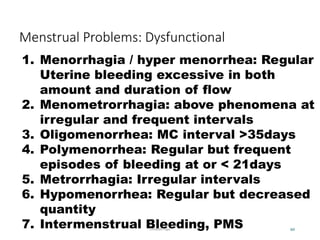
Menstrual Problems: Dysfunctional
10
1. Menorrhagia / hyper menorrhea: Regular
Uterine bleeding excessive in both
amount and duration of flow
2. Menometrorrhagia: above phenomena at
irregular and frequent intervals
3. Oligomenorrhea: MC interval >35days
4. Polymenorrhea: Regular but frequent
episodes of bleeding at or < 21days
5. Metrorrhagia: Irregular intervals
6. Hypomenorrhea: Regular but decreased
quantity
7. Intermenstrual Bleeding, PMS
DeepakYoga
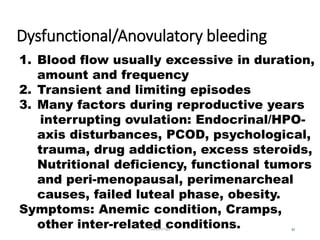
Dysfunctional/Anovulatory bleeding
11
1. Blood flow usually excessive in duration,
amount and frequency
2. Transient and limiting episodes
3. Many factors during reproductive years
interrupting ovulation: Endocrinal/HPO-
axis disturbances, PCOD, psychological,
trauma, drug addiction, excess steroids,
Nutritional deficiency, functional tumors
and peri-menopausal, perimenarcheal
causes, failed luteal phase, obesity.
Symptoms: Anemic condition, Cramps,
other inter-related conditions.
DeepakYoga
Women‘s disorders (cont)
12
Mainly during reproductive age:
1. Cervicitis, Vaginal / Cervical /
Uterine Polyps
2. Cervical / Endometrial Cancer,
U.Fibroids, Ovarian cysts / Tumors.
3. Vaginal/Vulvar injury, Dyspareunia,
Vaginitis, Vaginismus
DeepakYoga
Women‘s disorders (cont)
13
Post menopausal bleeding:
1. Intervals: up to one year after last
menses
2. Post coital bleeding due to Vaginal
infection, cancer and other
abnormalities
3. Vaginal bleeding due to start/stop of
oral contraceptives, Progesterone
withdrawal DeepakYoga
14
Infertility
It’s defined as the failure in couples of
not getting pregnant, despite having
carefully timed, unprotected sex for
one year. It is estimated around 15% of
all couples undergo infertility. The
reasons behind this infertility are-
In Females:
•Blocked oviducts, Endometriosis.
In Males:
•Low sperm count, sperm abnormalities
DeepakYoga
STATISTICS OF FEMALE HEALTH
1. PCOS 23-33%
2. Menstrual problems
Puberty 20-30%
Adults 40%
Middle age 30%
3. Fibroid 20-24%
4. By Sonography 70-80%
DeepakYoga 15
Treatment
16
1. Medicines to Control and stop bleeding,
Iron supplements, Transfusion if needed
2. Hormone Replacement Therapy (HRT), HT
3. Hysterectomy: Surgical removal of Uterus
4. Psychiatrist’s treatment
5. YOGA therapy, lifestyle change
DeepakYoga
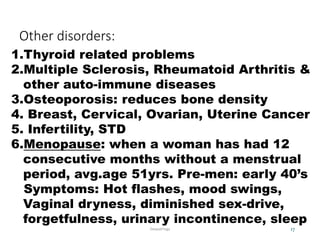
Other disorders:
17
1.Thyroid related problems
2.Multiple Sclerosis, Rheumatoid Arthritis &
other auto-immune diseases
3.Osteoporosis: reduces bone density
4. Breast, Cervical, Ovarian, Uterine Cancer
5. Infertility, STD
6.Menopause: when a woman has had 12
consecutive months without a menstrual
period, avg.age 51yrs. Pre-men: early 40’s
Symptoms: Hot flashes, mood swings,
Vaginal dryness, diminished sex-drive,
forgetfulness, urinary incontinence, sleep
DeepakYoga
Polycystic ovary syndrome
18
PCOD is a common hormonal
disorder that may be characterized
by CYSTS or FIBROIDS on the
ovaries, excess androgen, infrequent
or prolonged menstrual periods,
infrequent or lack of ovulation,
excess hair growth, acne or obesity,
insulin resistance.
Causes: Stress, anxiety, over-
ambitiousness, Irregular food-
sleeping habits. DeepakYoga
YOGIC REMEDIES
19
"An ounce of prevention is worth a pound of
cure"?
Yoga to improve female reproductive health.
Remedies: Live a meaningful healthy
life, be physically active, engage in
exercises like walking, climbing,
cycling, squatting & Diet awareness.
Yoga to increase intra-abdominal
compression
DeepakYoga
Yoga Practices
20
Bhadrasana, Hastapadasana, lifting legs
up, rotations, sit-ups, Yogamudra, Sumo-
pose, Suryanamaskar, Butterfly kriya,
Viparitkarni, Kapalbhati, Tadagimudra,
Uddiyana-Agnisar, Vajrasana. Balasana
(Mk), Gaumukhasana, Drona, Pavanmukt-
asana, Bhujangasana, Naukasana,
Dhanurasana, Savasana, Marjarasana,
Chakkichalan, Rolling ex., Pranayama, EQ
management, Mudras, Relaxing &
meditative practices
DeepakYoga
MALE REPRODUCTIVE SYSTEM
21
The male reproductive system is a
series of organs located outside of
the body and around the pelvic region
of a MALE that contribute towards the
reproduction process. The primary
direct function of the male
reproductive system is to provide the
male sperm for fertilization of the
ovum.
DeepakYoga
22
DeepakYoga
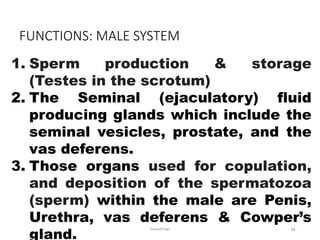
FUNCTIONS: MALE SYSTEM
23
1. Sperm production & storage
(Testes in the scrotum)
2. The Seminal (ejaculatory) fluid
producing glands which include the
seminal vesicles, prostate, and the
vas deferens.
3. Those organs used for copulation,
and deposition of the spermatozoa
(sperm) within the male are Penis,
Urethra, vas deferens & Cowper’s
gland.
DeepakYoga
FUNCTIONS
24
4. Major secondary sexual
characteristics includes: larger,
more muscular stature, deepened
voice, facial and body hair, broad
shoulders, and development of
an Adam's apple. An important
sexual hormone of males is
androgen, and particularly
Testosterone
DeepakYoga
25
DEEPAK BAGADIA: 9987045083
DeepakYoga

Reproductive System

  • 1.
  • 2.
    REPRODUCTIVE SYSTEM &YOGA 1 DeepakYoga
  • 3.
  • 4.
    FEMALE REPRODUCTIVE SYSTEM 3 FemaleReproductive system delivers the ova to the region of fertilization. The egg fertilization takes place in the Fallopian tubes along with the sperm. The implanting in the walls of the uterus and initiating the stages of pregnancy is the next step of fertilized eggs. It also creates female sex hormones to maintain the reproductive cycle. DeepakYoga
  • 5.
    ANATOMY 4 The system iscomposed of a pair of ovaries along with oviducts, vagina, cervix, uterus, and the external genitalia that are located in the pelvic region. These parts along with a pair of mammary glands that are integrated both functionally and structurally also support the process of ovulation, fertilization, birth and finally the child care. DeepakYoga
  • 6.
  • 7.
    Menstrual Cycle 6 All females,after reaching their puberty produce mature egg cell every month during a process called the MENSTRUAL CYCLE. During this period, an ovary releases a mature egg. The egg travels to the uterus. If the egg is not fertilized, the uterine lining is shed and a new cycle begins. DeepakYoga
  • 8.
    MENSTRUATION 7 Factors including diet,exercise, stress and weight gain or loss affects the menstrual cycle. The cycle may be irregular at times, especially during puberty. Except during pregnancy, menstrual cycles occur every month from the time of puberty up to the age of 45 to 55. Menopause: After the age of 55 ovaries slows down their production of hormone and release of mature eggs. Gradually, the menstrual cycle stops, and the woman is no longer able to become pregnant. DeepakYoga
  • 9.
    MENSTRUATION 8 1.Menstruation stage: 1– 5 days 2.Proliferation stage: 6 – 14 days 3.Secretion stage: 15 – 28 days Overall a menstrual cycle lasts for 28 (21-35) days. The entire process of the menstrual cycle is controlled by the endocrine system and the hormones involved are FSH, LH (Pituitary gland), estrogen, and progesterone. (Ovaries). DeepakYoga
  • 10.
    Menstrual variations 9 1.Normal cycleof average 28days, duration 2-7 days, cycle length decreases with age. Bleeding at anytime apart from menstrual period, any variation besides defined limits is ABNORMAL 2. Acyclical, pre or post menopausal bleeding, Pre-menstrual symptoms (PMS) 3. Average blood loss during cycle: 40-80cc 4. 90% of loss occurs during 1-3days 5. Menstrual flow: 50-75% is blood, rest is fragments of endometrial tissue & mucus DeepakYoga
  • 11.
    Menstrual Problems: Dysfunctional 10 1.Menorrhagia / hyper menorrhea: Regular Uterine bleeding excessive in both amount and duration of flow 2. Menometrorrhagia: above phenomena at irregular and frequent intervals 3. Oligomenorrhea: MC interval >35days 4. Polymenorrhea: Regular but frequent episodes of bleeding at or < 21days 5. Metrorrhagia: Irregular intervals 6. Hypomenorrhea: Regular but decreased quantity 7. Intermenstrual Bleeding, PMS DeepakYoga
  • 12.
    Dysfunctional/Anovulatory bleeding 11 1. Bloodflow usually excessive in duration, amount and frequency 2. Transient and limiting episodes 3. Many factors during reproductive years interrupting ovulation: Endocrinal/HPO- axis disturbances, PCOD, psychological, trauma, drug addiction, excess steroids, Nutritional deficiency, functional tumors and peri-menopausal, perimenarcheal causes, failed luteal phase, obesity. Symptoms: Anemic condition, Cramps, other inter-related conditions. DeepakYoga
  • 13.
    Women‘s disorders (cont) 12 Mainlyduring reproductive age: 1. Cervicitis, Vaginal / Cervical / Uterine Polyps 2. Cervical / Endometrial Cancer, U.Fibroids, Ovarian cysts / Tumors. 3. Vaginal/Vulvar injury, Dyspareunia, Vaginitis, Vaginismus DeepakYoga
  • 14.
    Women‘s disorders (cont) 13 Postmenopausal bleeding: 1. Intervals: up to one year after last menses 2. Post coital bleeding due to Vaginal infection, cancer and other abnormalities 3. Vaginal bleeding due to start/stop of oral contraceptives, Progesterone withdrawal DeepakYoga
  • 15.
    14 Infertility It’s defined asthe failure in couples of not getting pregnant, despite having carefully timed, unprotected sex for one year. It is estimated around 15% of all couples undergo infertility. The reasons behind this infertility are- In Females: •Blocked oviducts, Endometriosis. In Males: •Low sperm count, sperm abnormalities DeepakYoga
  • 16.
    STATISTICS OF FEMALEHEALTH 1. PCOS 23-33% 2. Menstrual problems Puberty 20-30% Adults 40% Middle age 30% 3. Fibroid 20-24% 4. By Sonography 70-80% DeepakYoga 15
  • 17.
    Treatment 16 1. Medicines toControl and stop bleeding, Iron supplements, Transfusion if needed 2. Hormone Replacement Therapy (HRT), HT 3. Hysterectomy: Surgical removal of Uterus 4. Psychiatrist’s treatment 5. YOGA therapy, lifestyle change DeepakYoga
  • 18.
    Other disorders: 17 1.Thyroid relatedproblems 2.Multiple Sclerosis, Rheumatoid Arthritis & other auto-immune diseases 3.Osteoporosis: reduces bone density 4. Breast, Cervical, Ovarian, Uterine Cancer 5. Infertility, STD 6.Menopause: when a woman has had 12 consecutive months without a menstrual period, avg.age 51yrs. Pre-men: early 40’s Symptoms: Hot flashes, mood swings, Vaginal dryness, diminished sex-drive, forgetfulness, urinary incontinence, sleep DeepakYoga
  • 19.
    Polycystic ovary syndrome 18 PCODis a common hormonal disorder that may be characterized by CYSTS or FIBROIDS on the ovaries, excess androgen, infrequent or prolonged menstrual periods, infrequent or lack of ovulation, excess hair growth, acne or obesity, insulin resistance. Causes: Stress, anxiety, over- ambitiousness, Irregular food- sleeping habits. DeepakYoga
  • 20.
    YOGIC REMEDIES 19 "An ounceof prevention is worth a pound of cure"? Yoga to improve female reproductive health. Remedies: Live a meaningful healthy life, be physically active, engage in exercises like walking, climbing, cycling, squatting & Diet awareness. Yoga to increase intra-abdominal compression DeepakYoga
  • 21.
    Yoga Practices 20 Bhadrasana, Hastapadasana,lifting legs up, rotations, sit-ups, Yogamudra, Sumo- pose, Suryanamaskar, Butterfly kriya, Viparitkarni, Kapalbhati, Tadagimudra, Uddiyana-Agnisar, Vajrasana. Balasana (Mk), Gaumukhasana, Drona, Pavanmukt- asana, Bhujangasana, Naukasana, Dhanurasana, Savasana, Marjarasana, Chakkichalan, Rolling ex., Pranayama, EQ management, Mudras, Relaxing & meditative practices DeepakYoga
  • 22.
    MALE REPRODUCTIVE SYSTEM 21 Themale reproductive system is a series of organs located outside of the body and around the pelvic region of a MALE that contribute towards the reproduction process. The primary direct function of the male reproductive system is to provide the male sperm for fertilization of the ovum. DeepakYoga
  • 23.
  • 24.
    FUNCTIONS: MALE SYSTEM 23 1.Sperm production & storage (Testes in the scrotum) 2. The Seminal (ejaculatory) fluid producing glands which include the seminal vesicles, prostate, and the vas deferens. 3. Those organs used for copulation, and deposition of the spermatozoa (sperm) within the male are Penis, Urethra, vas deferens & Cowper’s gland. DeepakYoga
  • 25.
    FUNCTIONS 24 4. Major secondarysexual characteristics includes: larger, more muscular stature, deepened voice, facial and body hair, broad shoulders, and development of an Adam's apple. An important sexual hormone of males is androgen, and particularly Testosterone DeepakYoga
  • 26.