By Holly
Morsley
REPRESENTATION IN
CHAINED TO THE RHYTHM
BY KATY PERRY
 The music video for the song 'Chained to the Rhythm' by Katy
Perry is a performance-narrative. This song was created in
response to the election of Donald Trump as President of The
United States and the music video is said to be a "metaphor
for the infinite distractions of modern life". Therefore every
aspect of representation, from gender to ethnicity, was
chosen carefully to convey this message.
INTRODUCTION
 The location for this video is a fictional
theme park called Oblivia, which is used
to represent modern society. Theme parks
are commonly associated with being fun
and happy, which could link to the song's
upbeat theme. However theme parks also
have elements of illusion to make it seem
perfect. Perry uses this location to
represent modern society as "an illusion"
that keeps all of us happy. She does this
by including rides and attractions such as
"The American Dream Drop" and "The
Greatest Ride in the Universe" that
represent marketing techniques used in
modern society. Overall, while this
location is presented as idealistic, it is
actually to highlight the dark nature of
the setting.
LOCATION
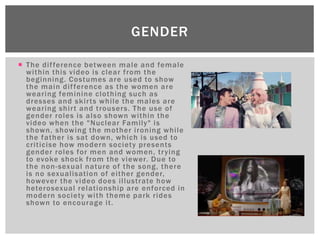
 The difference between male and female
within this video is clear from the
beginning. Costumes are used to show
the main difference as the women are
wearing feminine clothing such as
dresses and skirts while the males are
wearing shirt and trousers. The use of
gender roles is also shown within the
video when the "Nuclear Family" is
shown, showing the mother ironing while
the father is sat down, which is used to
criticise how modern society presents
gender roles for men and women, trying
to evoke shock from the viewer. Due to
the non-sexual nature of the song, there
is no sexualisation of either gender,
however the video does illustrate how
heterosexual relationship are enforced in
modern society with theme park rides
shown to encourage it.
GENDER
 The only age group that is predominantly represented is young
adults. This age group is represented as technologically
brainwashed. We see girls rather flamboyantly taking selfies in
the middle of the park, which shows them as being vain and
self obsessed. This links to ideas of millennials being self
absorbed thanks to modern technology. As there are no other
age groups within this video, one could argue that this shows
how modern society tends to focus more on the young. However
this may also be used to attract the music video to a younger
audience as Perry tends to aim her music towards a younger
demographic as they enjoy pop music more than older people.
AGE
 In terms of class, the middle class seems to be represented
more in this video. All of the characters in the video aren't
shown to be rich and powerful. Then again, they aren't shown
to be poor either, as everyone's costumes and body language
appear to be of a similar aesthetic and style. This could
reflect the demographic of Katy Perry, who normally aims her
music at the middle class majority.
CLASS
 While this video contains many different
ethnicities, the narrative of the video
shows them all as equal. Rather than
having each ethnicity comply to
stereotypes, everyone is acting in the same
manner, wearing similar clothing and
having similar general characteristics. This
is used to highlight how everyone, despite
cultural and ethnical difference, have
fallen into the same distractions set by the
same modern society. However during the
section featuring Skip Marley, he is
presented with common stereotypes of
Jamaican culture such as dreadlocks and a
thick accent. His costume, however,
remains in keep with the rest of the video's
aesthetic. The Jamaican culture is often to
be connotated with being free spirited and
relaxed, contrasting ideas in the lyrics of
the song which revolve around.
ETHNICITIES
The costumes in this video are used to
represent numerous areas. The
difference between men and women is
noticeable, with the women wearing
heavy make-up and traditionally
feminine clothing such as skirts and
dresses. The men are shown to be
wearing shirts and trousers as well,
representing how gender roles are used
in modern society.
The costumes have a style that revolves
around 50’s white culture, with girls
having hair in teased bobs and the men
having their hair slicked back with gel.
However the costumes also have a
futuristic element to it, which represents
how modern society is stuck with past
values despite our cultural development.
COSTUMES
The video shows various props that are important in the
narrative and that are important in representing the video’s
message. Throughout the park, in the background, we see many
people holding candy floss shaped like nuclear mushrooms,
which represents how society has sugar coated the use of
nuclear weapons. The use of modern technology such as the
tablet style devices represents the people as being self
absorbed.
PROPS
There is no product placement in this video as the video is
supposed to be a criticism of modern living and therefore
adding a product placement would be hypocritical of Perry.
PRODUCT PLACEMENT

Representation PP

  • 1.
    By Holly Morsley REPRESENTATION IN CHAINEDTO THE RHYTHM BY KATY PERRY
  • 2.
     The musicvideo for the song 'Chained to the Rhythm' by Katy Perry is a performance-narrative. This song was created in response to the election of Donald Trump as President of The United States and the music video is said to be a "metaphor for the infinite distractions of modern life". Therefore every aspect of representation, from gender to ethnicity, was chosen carefully to convey this message. INTRODUCTION
  • 3.
     The locationfor this video is a fictional theme park called Oblivia, which is used to represent modern society. Theme parks are commonly associated with being fun and happy, which could link to the song's upbeat theme. However theme parks also have elements of illusion to make it seem perfect. Perry uses this location to represent modern society as "an illusion" that keeps all of us happy. She does this by including rides and attractions such as "The American Dream Drop" and "The Greatest Ride in the Universe" that represent marketing techniques used in modern society. Overall, while this location is presented as idealistic, it is actually to highlight the dark nature of the setting. LOCATION
  • 4.
     The differencebetween male and female within this video is clear from the beginning. Costumes are used to show the main difference as the women are wearing feminine clothing such as dresses and skirts while the males are wearing shirt and trousers. The use of gender roles is also shown within the video when the "Nuclear Family" is shown, showing the mother ironing while the father is sat down, which is used to criticise how modern society presents gender roles for men and women, trying to evoke shock from the viewer. Due to the non-sexual nature of the song, there is no sexualisation of either gender, however the video does illustrate how heterosexual relationship are enforced in modern society with theme park rides shown to encourage it. GENDER
  • 5.
     The onlyage group that is predominantly represented is young adults. This age group is represented as technologically brainwashed. We see girls rather flamboyantly taking selfies in the middle of the park, which shows them as being vain and self obsessed. This links to ideas of millennials being self absorbed thanks to modern technology. As there are no other age groups within this video, one could argue that this shows how modern society tends to focus more on the young. However this may also be used to attract the music video to a younger audience as Perry tends to aim her music towards a younger demographic as they enjoy pop music more than older people. AGE
  • 6.
     In termsof class, the middle class seems to be represented more in this video. All of the characters in the video aren't shown to be rich and powerful. Then again, they aren't shown to be poor either, as everyone's costumes and body language appear to be of a similar aesthetic and style. This could reflect the demographic of Katy Perry, who normally aims her music at the middle class majority. CLASS
  • 7.
     While thisvideo contains many different ethnicities, the narrative of the video shows them all as equal. Rather than having each ethnicity comply to stereotypes, everyone is acting in the same manner, wearing similar clothing and having similar general characteristics. This is used to highlight how everyone, despite cultural and ethnical difference, have fallen into the same distractions set by the same modern society. However during the section featuring Skip Marley, he is presented with common stereotypes of Jamaican culture such as dreadlocks and a thick accent. His costume, however, remains in keep with the rest of the video's aesthetic. The Jamaican culture is often to be connotated with being free spirited and relaxed, contrasting ideas in the lyrics of the song which revolve around. ETHNICITIES
  • 8.
    The costumes inthis video are used to represent numerous areas. The difference between men and women is noticeable, with the women wearing heavy make-up and traditionally feminine clothing such as skirts and dresses. The men are shown to be wearing shirts and trousers as well, representing how gender roles are used in modern society. The costumes have a style that revolves around 50’s white culture, with girls having hair in teased bobs and the men having their hair slicked back with gel. However the costumes also have a futuristic element to it, which represents how modern society is stuck with past values despite our cultural development. COSTUMES
  • 9.
    The video showsvarious props that are important in the narrative and that are important in representing the video’s message. Throughout the park, in the background, we see many people holding candy floss shaped like nuclear mushrooms, which represents how society has sugar coated the use of nuclear weapons. The use of modern technology such as the tablet style devices represents the people as being self absorbed. PROPS
  • 10.
    There is noproduct placement in this video as the video is supposed to be a criticism of modern living and therefore adding a product placement would be hypocritical of Perry. PRODUCT PLACEMENT