G325 Critical Perspectives in
Media
Question 1b
Key Media Concepts
REPRESENTATION
Representation – How groups, individuals, institutions
or social changes are portrayed through the media;
how they are re - presented.
By definition, all media texts are re-presentations of
reality. This means that they are intentionally
composed, lit, written, framed, cropped, captioned,
branded, targeted and censored by their producers,
and that they are entirely artificial versions of the
reality we perceive around us.
.
We need the media to make sense of reality. Therefore
representation is a fluid, two-way process: producers
position a text somewhere in relation to reality and
audiences assess a text on its relationship to reality.
Extension/Restriction of Experience of Reality
By giving audiences information, media texts extend
experience of reality. However, because the producers
of the media text have selected the information we
receive, then our experience is restricted. The movie
producers telescope events and personalities to fit into
their parameters. i.e. Teaser trailers
Media representations - and the extent to which we
accept them - are a very political issue, as the influence
the media exerts has a major impact on the way we view
the world. By viewing media representations our
prejudices can be reinforced or shattered.
The study of representation is about decoding the
different layers of truth/fiction/whatever.
Richard Dyer 4 Questions:
1. Re-presentation – how media language is used to
represent the world to the audience.
2. Being representative of – the extent to which types
are used to represent social groups (stereotypes).
3. Who is responsible for the representation, how the
institution creating a media text influences
representation – contentious in representation of
gender as it is often the men doing the
representing.
4. What does the audience think is being represented
to them – different readings.
OR an easier way to remember it is:
What is being represented?
How is it being represented?
Who is responsible for the representation?
How can the representation be interpreted?
STEREOTYPES
Stereotyping is an important concept in terms of
representation.
Stereotypes act as a short hand by which we can more
easily understand a representation.
Stereotypes are assumptions that have reached some
form of consensus amongst a particular social group or
culture
Stereotypes can be misleading but people often assume
that stereotypes are automatically false. This is not
necessarily the case!!
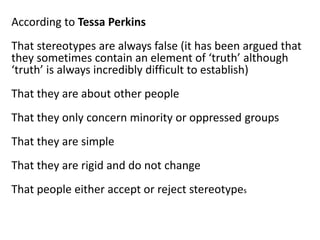
According to Tessa Perkins
That stereotypes are always false (it has been argued that
they sometimes contain an element of ‘truth’ although
‘truth’ is always incredibly difficult to establish)
That they are about other people
That they only concern minority or oppressed groups
That they are simple
That they are rigid and do not change
That people either accept or reject stereotypes
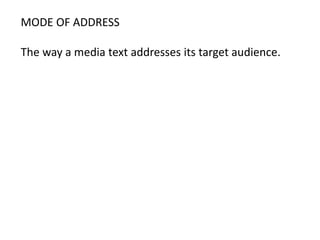
MODE OF ADDRESS
The way a media text addresses its target audience.

Representation a2

  • 1.
    G325 Critical Perspectivesin Media Question 1b Key Media Concepts REPRESENTATION
  • 2.
    Representation – Howgroups, individuals, institutions or social changes are portrayed through the media; how they are re - presented. By definition, all media texts are re-presentations of reality. This means that they are intentionally composed, lit, written, framed, cropped, captioned, branded, targeted and censored by their producers, and that they are entirely artificial versions of the reality we perceive around us. .
  • 3.
    We need themedia to make sense of reality. Therefore representation is a fluid, two-way process: producers position a text somewhere in relation to reality and audiences assess a text on its relationship to reality. Extension/Restriction of Experience of Reality By giving audiences information, media texts extend experience of reality. However, because the producers of the media text have selected the information we receive, then our experience is restricted. The movie producers telescope events and personalities to fit into their parameters. i.e. Teaser trailers
  • 4.
    Media representations -and the extent to which we accept them - are a very political issue, as the influence the media exerts has a major impact on the way we view the world. By viewing media representations our prejudices can be reinforced or shattered.
  • 5.
    The study ofrepresentation is about decoding the different layers of truth/fiction/whatever. Richard Dyer 4 Questions: 1. Re-presentation – how media language is used to represent the world to the audience. 2. Being representative of – the extent to which types are used to represent social groups (stereotypes). 3. Who is responsible for the representation, how the institution creating a media text influences representation – contentious in representation of gender as it is often the men doing the representing. 4. What does the audience think is being represented to them – different readings.
  • 6.
    OR an easierway to remember it is: What is being represented? How is it being represented? Who is responsible for the representation? How can the representation be interpreted?
  • 7.
    STEREOTYPES Stereotyping is animportant concept in terms of representation. Stereotypes act as a short hand by which we can more easily understand a representation. Stereotypes are assumptions that have reached some form of consensus amongst a particular social group or culture Stereotypes can be misleading but people often assume that stereotypes are automatically false. This is not necessarily the case!!
  • 8.
    According to TessaPerkins That stereotypes are always false (it has been argued that they sometimes contain an element of ‘truth’ although ‘truth’ is always incredibly difficult to establish) That they are about other people That they only concern minority or oppressed groups That they are simple That they are rigid and do not change That people either accept or reject stereotypes
  • 9.
    MODE OF ADDRESS Theway a media text addresses its target audience.