CHARACTERIZATION OF SHAPE MEMORY ALLOY (SMA)
AND DEVELOPMENT OF VIRTUAL CONTROL SYSTEM FOR
ACTIVE MONITORING OF SMA BASED SMART
STRUCTURES
Submitted by
KANDHAN S (16MD07)
Dissertation submitted in partial fulfillment of the requirements for the degree of
MASTER OF ENGINEERING
Branch: MECHANICAL ENGINEERING
Specialisation: ENGINEERING DESIGN
of Anna University, Chennai
MAY- 2018
DEPARTMENT OF MECHANICAL ENGINEERING
PSG COLLEGE OF TECHNOLOGY
(Autonomous Institution)
COIMBATORE – 641 004
Acknowledgement
i
ACKNOWLEDGEMENT
I wish to express my sincere thanks and indebtedness to various people who were a
source of encouragement and guidance at the time of building my project.
I wish to express my profound gratitude to our beloved Principal
Dr R.Rudramoorthy, PSG College of technology for providing an opportunity and necessary
facilities in carrying out this dissertation work.
I wish to convey my heartfelt thanks to Dr.P.R.Thyla, Head of the department,
Department of Mechanical Engineering, for their encouragement that they extended towards
this dissertation work.
I like to thank my guide Dr.M.Yuvaraja, Associate Professor, Department of
Mechanical Engineering, whose valuable guidance, everlasting enthusiasm and providing
freedom throughout the course, made it possible to complete this dissertation work.
I would like thank Mr.Jagadeesh Veeraragu, Research Fellow, Department of
Mechanical Engineering, whose support and guidance made me to do this dissertation work.
I also like to thank our program coordinator Dr.M.Yuvaraja, Associate Professor and
my tutor, Dr.M.Martin suresh babu, Associate Professor Department of Mechanical
Engineering, for their constant support and guidance that provided a moral encouragement
and played a vital role in completing our project.
I take immense pleasure in expressing my sincere heartfelt thanks to the lecturers of
Mechanical Engineering department, for their valuable guidance and suggestions at every
stage for the completion of this project.
Finally I would like to thank all lab assistants and student colleagues without whom
this dissertation work would not have been completed successfully.
Abstract
ii
ABSTRACT
The application of SMA (Shape Memory Alloy) as an actuator is widely spreading
and its versatile application is only possible if the characterizations under various operating
conditions are known. It is necessary for thermo-mechanical characterization of Ni-Ti SMA wire
that can be useful in designing a precisely controlled actuator. Vibration characteristics of smart
structure containing SMA wire in embedded form is not well established, since the Young’s
Modulus change of SMA with respect to actuation current is not explicitly known. In this study the
Young’s Modulus variation of SMA due the solid phase transformation from low temerature, low
stiffness martensite phase to high temperature, high stiffness austenite phase is established as
a fucntion of actuation current and utilized in virtual control system controlling the structural
stiffness of SMA embedded in GFRP smart structure. The results from experimental study shows
increases in natural frequency shift of 4.2% and significant amplitude reduction of 28 %.Control
of such system by active monitoring prevents the failure of dynamic structural elements.
Contents
iii
CONTENTS
CHAPTER PAGE NO.
ACKNOWLEDGMENT..……………………….………………………………………………………………….……….......i
ABSTRACT..…………………………..….…………….…………………………………………………………...….…………..ii
CONTENTS………………………….………..……………………………..….…………………………..………......iii
LISTOF FIGURES..…………..….….…………………………………………………………..….………………….……....vi
LIST OF TABLES.……………………..….…………….…………………………………..….……………………….….....viii
LIST OF ABBREVIATIONS…….…………………….……………………………………..….………………..…………ix
LIST OF SYMBOLS…..………………………………..….…………………………………………………………..………..x
1 INTRODUCTION……………………………………………..….………………………………………………..........1
1.1 Shape Memory Alloy 1
1.2 Phase Transformation 2
1.3 One way Shape Memory Effect 4
1.4 Two way Shape Memory Effect 4
1.5 Effect of Alloying 5
1.6 Application of Shape memory alloy 6
1.7 Summary 6
2 LITERATURE REVIEW……………………………………………..….……………….……………………………..7
2.1 Literature outcomes 10
3 PROBLEM DEFINITION AND METHODOLOGY…………..….………….…………………………..11
3.1 Problem definition 11
3.2 Objectives 11
3.3 Methodology 11
4 SELECTION OF SMA.………………………………………………………………...….…………………………..13
4.1 Types of SMA 13
4.2 Nitinol as Wires 14
4.3 Nitinol Wires as Actuator 15
4.4 Sourcing of Nitinol Wires 15
4.5 Summary 17
5 EXPERIMENTATION IN UTM....……………………….………………..….…………………………………..18
5.1 Introduction 18
5.2 Experiment Setup overview 18
5.3 ASTM F 2516 Standard Testing Method for NITINOL 19
5.4 Testing Procedure 21
Contents
iv
5.5 Selection of Gripper 21
5.6 Results of experimentation 23
5.7 Proposed Gripper Design 23
5.8 Summary 24
6 DESIGN AND FABRICATION OF INSULATED WIRE GRIPPER……………..........25
6.1 Introduction 25
6.2 Design of wire gripper 25
6.3 Design check of modeled wire gripper 26
6.4 Fabrication of wire gripper 29
6.5 Summary 30
7 EXPERIMENTATION TO EVALUVATE YOUNG’S MODULUS…………..………….31
7.1 Introduction 31
7.2 Experimentation on Nitinol wire 31
7.3 Results and discussion 32
7.4 Restoring force due to Shape memory effect 34
7.5 Tensile test for failure 35
7.6 Summary 3 5
8 EXPERIMENTAL ANALYSIS OF SMA EMBEDDED GFRP BEAM…………………36
8.1 Introduction 36
8.2 Fabrication of SMA embedded GFRP beam 36
8.3 Experimental analysis of SMA Embedded GFRP smart beam 37
8.4 Results and discussion 38
8.5 Mathematical model of SMA embedded GFRP beam 39
8.6 Results and discussion 40
8.7 Validation with experimental results 41
8.8 Significance of natural frequency shift 42
8.9 Summary 42
9 DEVELOPMENT OF VIRTUAL CONTROL SYSTEM…………………………………43
9.1 Introduction 43
9.2 Control over natural frequency of the system 43
9.3 Control over amplitude of the system 44
9.4 Summary 44
Contents
v
10 CONCLUSION …………………………………………………………………………45
10.1 Conclusion 45
10.2 Future work 45
BIBLIOGRAPHY………………………………………………………….46
LIST OF PUBICATIONS……………………..…………………………………………49
List of Figures
vi
LIST OF FIGURES
Figure No. Title Page No.
1.1 Phase transformation in 3D stress strain temperature 3
1.2 Lattice invariant shear accommodation 3
1.3 One way shape memory effect and Two way shape memory effect 5
1.4 Nickel-Titanium composition 5
3.1 Methodology 12
4.1 SMA Sheets and Wire Forms 13
4.2 NITINOL wires 14
4.3 Flow chart of SMA wire as an actuation source 15
5.1 Experimental setup 18
5.2 Loading rates corresponding to the different wire diameters 19
5.3 Typical Stress Strain Diagram of Superelastic Nitinol 20
5.4 ZWICK / ROEL 2.5 KN UTM 20
5.5 Gripper containing rubber pads 21
5.6 Steel jaws gripper 22
5.7 Griper containing Steel hook 22
5.8 Experimentation graph of Force vs Strain 23
5.9 Grippers used for testing copper wires 23
5.10 Redesigned Gripper 24
5.11 Exploded view of the Redesigned gripper 24
6.1 UTM collar pin arrangement 25
6.2 Drafted drawings of wire gripper using SOLIDWORKS 2015 26
6.3 Loading condition on gripper 26
6.4 Bending load conditions 27
6.5 Shear load conditions 27
List of Figures
vii
6.6 Pin bending load conditions 28
6.7 Fabrication of gripper 29
6.8 Final assembled gripper 29
6.9 Final assembled gripper in UTM 30
7.1 Experimentation on Nitinol wire 31
7.2 Stress and strain curve of Nitinol wire as a function of actuation current 32
7.3 Young’s modulus of Nitinol wire as a function of actuation current 33
7.4 Temperature of wire vs Actuation current 33
7.5 Experimental step up to test shape memory effect 34
7.6 Restoring force of Nitinol wire as a function of current 34
7.7 Stress strain graph of SMA wire at room temperature 35
8.1 Fabrication process of smart beam with embedded SMA wire 36
8.2 Fabrication materials 37
8.3 Dimensions GFRP beam containing SMA wire 37
8.4 GFRP beam containing SMA wire 37
8.5 Schematic diagram of experiential setup 38
8.6 Experiential set up to find natural frequency 38
8.7 Natural frequency of smart beam as a function of current 39
8.8 Theoretical natural frequency shift as function of actuation current 41
8.9 Validation of natural frequency shift as function of actuation current 41
8.10 Significance natural frequency shift 42
9.1 Virtual control over natural frequency system using LabVIEW 43
9.2 Virtual control over amplitude of system using LabVIEW 44
List of Tables
viii
LIST OF TABLES
TABLE NO. TITLE PAGE NUMBER
4.1 Material properties of NITINOL 14
4.2 Specification of NITINOL wires 17
5.1 Nitinol wire specifications for testing 19
6.1 Dimensions of insert pin and shaft collar 25
List of Abbreviations
ix
LIST OF ABBREVIATIONS
ABREVATIONS MEANINGS
SMA Shape Memory Alloy
Nitinol Nickel Titanium alloy
Ni-Ti Nickel Titanium alloy
M Martensite
A Austenite
Mf Martensite finish
Ms Martensite start
As Austenite start
Af Austenite finish
UTM Universal Testing Machine
ASTM American Society of Testing and Materials
ASTM ‘F’ Materials for Specific Applications
ASTM F 2516 Testing Standard for Nickel-Titanium Superelastic Materials
LPS Lower Plateau Strength
UPS Upper Plateau Strength
GFRP Glass Fiber Reinforced Polymer
SPECS Specifications
MS Mild Steel
LabVIEW Laboratory Virtual Instrument Engineering Workbench
DAQ Data Acquisition
List of Symbols
x
LIST OF SYMBOLS
SYMBOLS MEANINGS
f(n) Natural frequency of system
E(SMA) Young’s Modulus of SMA
E(GFRP) Young’s Modulus of GFRP
E(combined) Combined Young’s modulus of the smart beam (SMA wire embedded inside
GFRP)
V(f) Volume fraction of SMA to GFRP
T(GFRP) Temperature of GFRP beam
L Length of smart beam
m Mass of smart beam
Im Moment of inertia of Smart beam’s cross section
ω Forcing frequency in radians
ωn Natural frequency of system in radians
I Actuation current
A Ampere (measuring unit of current)
MPa Mega Pascal (measuring unit of stress)
N Newton (measuring unit of force)
Introduction Chapter 1
1
CHAPTER 1
INTRODUCTION
1.1 SHAPE MEMORY ALLOY
Shape memory alloys (SMAs) are family of smart materials. They have the ability to
change their shape depending on their transformation temperatures. SMA, in particular nickel–
titanium alloy (Nitinol), is a metallic alloy that exhibits shape memory effect. When it deforms
at low temperatures, it has the ability to return to its predetermined shape, if heated above its
transformation temperature. The returning to its predetermined shape is the result of
crystalline structure transformation from low temperature martensite (M) phase to high
temperature austenite (A) phase. These two phases have same chemical compositions except
dissimilarity in crystallographic structures. Hence, they show dissimilarities in their thermal,
mechanical and electrical properties [1]. The high-temperature austenitic phase is more rigid
and stronger as compared with low temperature martensite phase. The low-temperature
phase is also known as twinned martensite phase where each layer is separated by a twinning
boundary. This state is highly malleable and has very low elastic limit. When external stress
is applied at this state, the material changes into detwinned variant of martensite phase that
stores generated strain. The strain can be recovered by heating the material at higher
temperatures. During strain recovery, the alloy contracts and exhibits large force against
external resistance [3]. It finally transforms into austenite phase. The thermal hysteresis
represents material transformation characteristic, which provides four distinct transformation
temperatures. Ms and Mf represent the start and finish temperatures of martensite, while As
and Af are the start and finish temperatures of austenite. It changes its status with heating
current. The shape change in the material is observed by its elastic and plastic deformation
as well as thermal expansion and contraction.
a) Mf : Martensite finish, this is the lowest temperature, below all of the material has the
soft martensitic structure
b) Ms : Martensite start, an intermediate temperature, when the martensite phase starts
to appear in the prevalently austenitic phase
c) As : Austenite start, an intermediate temperature, when the austenite phase starts to
appear in the prevalently martensitic phase
d) Af : Austenite finish, this is the highest temperature, above which all of the material has
the hard martensitic structure. Super elastic SMA are designed to work over this
temperature, while the thermal-induced memory effect finishes at this temperature.
Introduction Chapter 1
2
Flexinol actuator wire is trade name for shape memory alloy actuator wires as shown
Made of nickel-titanium these small diameter wires contact (typically 2% to 5% of their length)
like muscle when electricity driven or heated. This ability to flex or shorten is a characteristic
of certain alloy, which dynamically change their internal structure at certain temperature.
The idea of reaching higher temperatures electrically came with the light bulb, but
instead of producing light, these alloys contract by several percent of their length when heated
and can then be easily stretched out again as they cool back to room temperature. Many tasks
currently accomplished with small motors or solenoids, wax actuators, piezo and bi-metals
can be improved with Flexinol actuator wires.
The two main types of shape-memory alloys are copper-aluminum-nickel, and nickel
titanium (Ni-Ti) alloys but SMAs can also be created by alloying zinc, copper, gold and iron.
Although iron-based and copper-based SMAs, such as Fe-Mn-Si, Cu-Zn-Al and Cu-Al-Ni, are
commercially available and cheaper than Ni-Ti, Ni-Ti based SMAs are preferable for most
applications due to their stability, practicability and superior thermo-mechanic performance.
SMAs can exist in two different phases, with three different crystal structures (i.e. twinned
martensite, de-twinned martensite and austenite) and six possible transformations.
Ni-Ti alloys change from austenite to martensite upon cooling; Mf is the temperature
at which the transition to martensite completes upon cooling. Accordingly, during heating as
and Af are the temperatures at which the transformation from martensite to austenite starts
and finishes. Repeated use of the shape-memory effect may lead to a shift of the characteristic
transformation temperatures (this effect is known as functional fatigue, as it is closely related
with a change of microstructural and functional properties of the material).The maximum
temperature at which SMAs can no longer be stress induced is called Md, where the SMAs
are permanently deformed.
The transition from the martensite phase to the austenite phase is only dependent on
temperature and stress, not time, as most phase changes are, as there is no diffusion involved.
Similarly, the austenite structure receives its name from steel alloys of a similar structure. It is
the reversible diffusion less transition between these two phases that results in special
properties. While martensite can be formed from austenite by rapidly cooling carbon-steel, this
process is not reversible, so steel does not have shape-memory properties.
1.2 PHASE TRANSFORMATIONS
In general, the shape memory event is based on the ability of the material to change
its crystal structure, in other words transforming from one crystal structure to another. In shape
memory alloys this transformation is usually referred to as martensite transformation.
Introduction Chapter 1
3
Fig. 1.1 Phase transformation in 3D stress strain temperature
When a material changes the phase the rearranging of atoms that takes place is
referred to as transformation as shown in Figure 1.1. In solids there are two known types of
transformation: Displacive and Diffusional In diffusional transformation the rearranging of
atoms occurs across long distances [8]. The new phase formed by diffusional transformation
is of different chemical composition than that of the parent phase. In contrast, a displacive
transformation occurs by the movement of atoms as a unit, with each atom contributing a small
portion of overall displacement. In a displacive transformation the bonds between that atoms
are not broken rather than arranged, thus leaving the parent phase chemical composition
matrix intact. Martensite transformation id shape memory alloys are of displacive type and
transformation takes place between Austenite also usually referred to as the parent phase and
Martensite.
The second step of the martensitic transformation depicts the accommodation process
required as a result of shape change as shown in Figure 1.2. This process of accommodation
is called lattice invariant shear can be accomplished in two ways: Slip and Twinning.
Fig. 1.2 Lattice invariant shear accommodation (b) slip (c) twinning
Introduction Chapter 1
4
Slipping does not preserve all the bonds between the unit atomic cells in martensite
making the transformation irreversible. On other hand, twinning is a reversible process that
allows the material to transform back to its parent shape. Since shape memory behavior is
reversible that accommodation mechanism takes place in them is twinning.
The mirroring plane on which twinning occurs is usually termed the twin boundary since
twin boundaries can be readily moved, the inclusion of an external shear stress can alter the
twinned martensite state of the matrix to reflect only one variant of twinning.
1.3 ONE WAY MEMORY EFFECT
When a shape-memory alloy is in its cold state (below As), the metal can be bent or
stretched and will hold those shapes until heated above the transition temperature. Upon
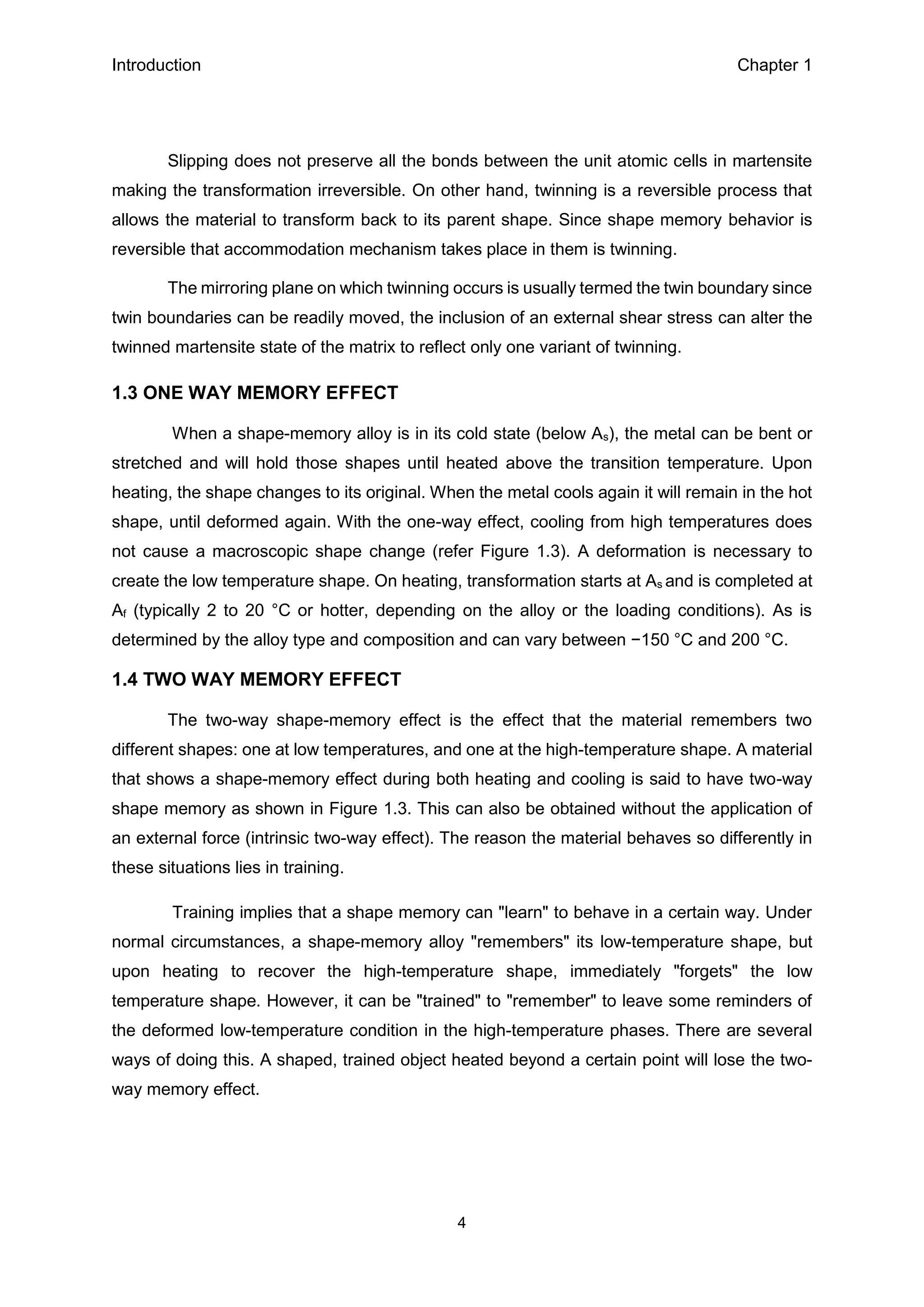
heating, the shape changes to its original. When the metal cools again it will remain in the hot
shape, until deformed again. With the one-way effect, cooling from high temperatures does
not cause a macroscopic shape change (refer Figure 1.3). A deformation is necessary to
create the low temperature shape. On heating, transformation starts at As and is completed at
Af (typically 2 to 20 °C or hotter, depending on the alloy or the loading conditions). As is
determined by the alloy type and composition and can vary between −150 °C and 200 °C.
1.4 TWO WAY MEMORY EFFECT
The two-way shape-memory effect is the effect that the material remembers two
different shapes: one at low temperatures, and one at the high-temperature shape. A material
that shows a shape-memory effect during both heating and cooling is said to have two-way
shape memory as shown in Figure 1.3. This can also be obtained without the application of
an external force (intrinsic two-way effect). The reason the material behaves so differently in
these situations lies in training.
Training implies that a shape memory can "learn" to behave in a certain way. Under
normal circumstances, a shape-memory alloy "remembers" its low-temperature shape, but
upon heating to recover the high-temperature shape, immediately "forgets" the low
temperature shape. However, it can be "trained" to "remember" to leave some reminders of
the deformed low-temperature condition in the high-temperature phases. There are several
ways of doing this. A shaped, trained object heated beyond a certain point will lose the two-
way memory effect.
Introduction Chapter 1
5
Fig. 1.3 One way shape memory effect and two way shape memory effect
1.5 EFFECT OF ALLOYING
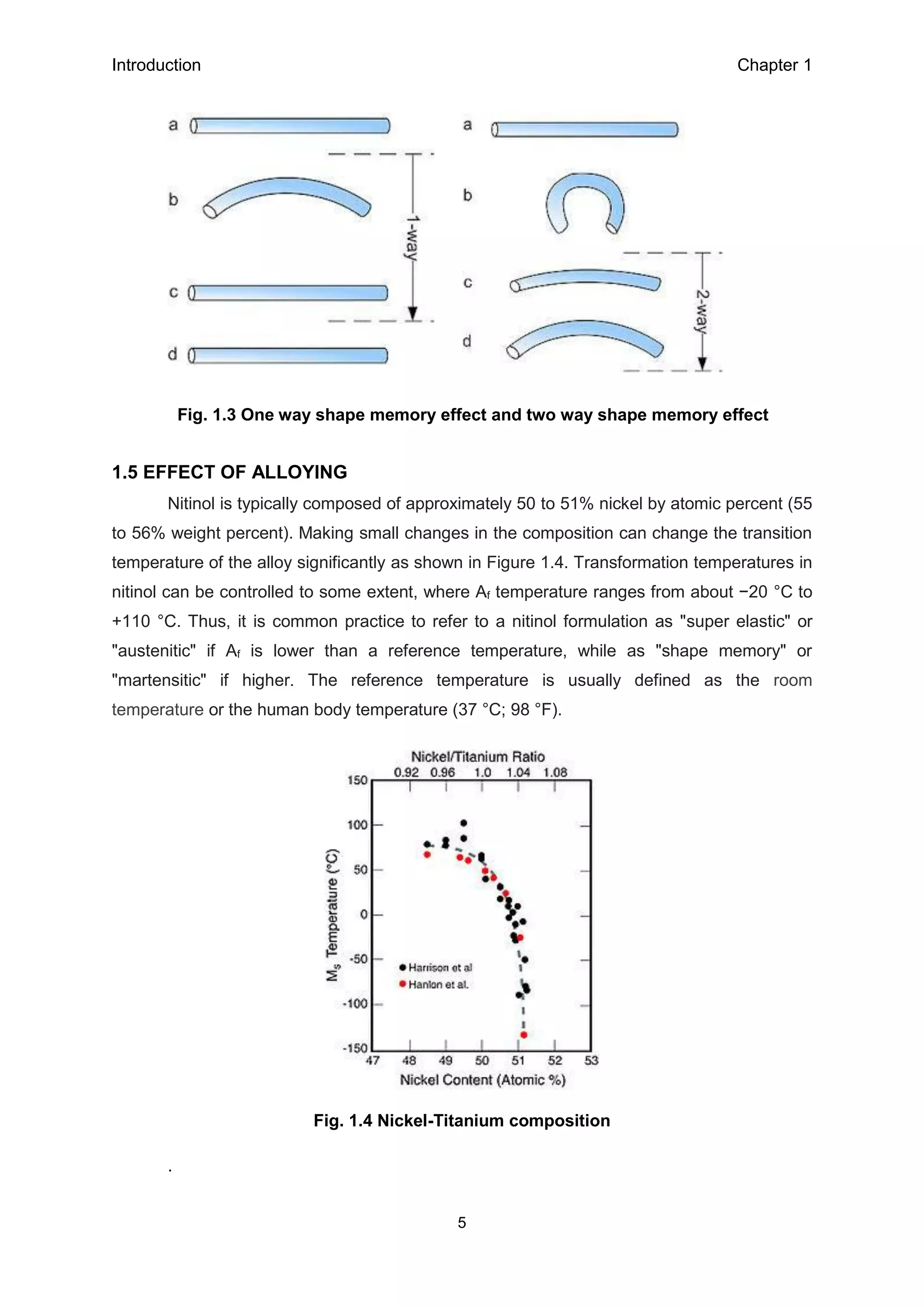
Nitinol is typically composed of approximately 50 to 51% nickel by atomic percent (55
to 56% weight percent). Making small changes in the composition can change the transition
temperature of the alloy significantly as shown in Figure 1.4. Transformation temperatures in
nitinol can be controlled to some extent, where Af temperature ranges from about −20 °C to
+110 °C. Thus, it is common practice to refer to a nitinol formulation as "super elastic" or
"austenitic" if Af is lower than a reference temperature, while as "shape memory" or
"martensitic" if higher. The reference temperature is usually defined as the room
temperature or the human body temperature (37 °C; 98 °F).
Fig. 1.4 Nickel-Titanium composition
.
Introduction Chapter 1
6
1.6 APPLICATION OF SHAPE MEMORY ALLOY
Shape memory alloys are a proven smart material with the capability to produce work
over large areas without producing residual strains. This allows the material to span many
depths of applications [7] in areas such as the mechanical, medical and aerospace fields. SMA
materials have been applied to stent operations in the medical field where its hysteretic
behavior fits the stress strain behavior of human bones and tendons while additionally
providing a resistance to radial forces. The minimum energy required for actuation of SMAs
along with the material’s ability to comply with composite materials has allowed it to thrive in
structural connections of space systems. SMAs are a prime candidate to replace bolts and
rivets in this application which can significantly degrade the properties of the structures.
Implementation of SMA materials in beam shaped structures has been confirmed to impact
the vibrational behavior of the structures both numerically and experimentally. The introduction
of the shape memory effect, whereby the shape memory alloy material acts as both a damper
and a means of variable stiffness is a novel technique for high cycle fatigue mitigation. The
impact SMAs have on the vibrational behavior of structures would greatly benefit systems
experiencing harmful flutter vibration.
1.7 Summary
Thus the inherent properties of SMA such as solid phase transformations from low
temperature, low stiffness martensite phase to high temperature, high stiffness austenite
phase, and application of SMA has been dealt in this chapter.
Literature review Chapter 2
7
CHAPTER 2
LITERATURE REVIEW
This chapter explains various existing works related applications of SMA and vibration
disturbances in smart structures along with control methodology.
H. N. Bhargaw et al [1] presented the thermo-electric behavior of shape memory alloy
(SMA) wire. When the wire was electrically heated above its transformation temperature by
current, a large mechanical force is exerted due to transformation in its phases. In order to make
use of SMA wire as an actuator, different parameters and their relationships were investigated.
These parameters are recoverable strain (displacement), temperature hysteresis and electrical
resistance variation under different stress levels. Optimum safe heating current was assessed
and phase transformation temperatures were estimated by heat transfer model.
Kin-tak Lau et al [2] presented the development of shape memory alloy (SMA) actuators,
in the forms of wire, thin film and stent have been found and increasingly in the fields of materials
science and smart structures and engineering. The increase in attraction for using these materials
is due to their many unique materials, mechanical, thermal and thermal-mechanical properties,
which in turn, evolve their subsequent shape memory, pseudo-elasticity and super-elasticity
properties. In this paper, a common type of SMA actuator, Nitinol wires, were embedded into
advanced composite structures to modulate the structural dynamic responses, in terms of natural
frequency and damping ratio by using its shape memory and pseudo-elastic properties.
Sia Nemat-Nasser et al [3] showed To characterize the thermomechanical response,
especially the superelastic behavior of NiTi shape-memory alloys (SMAs) at various temperatures
and strain rates, we have performed a series of both quasi-static and dynamic uniaxial
compression tests on cylindrical samples, repeated dynamic tests of the alloy produce smaller
changes in the shape of the superelastic loop and in the dissipated energy than do the quasi-
static cyclic tests; and the superelastic behavior of this material has stronger sensitivity to
temperature than to strain rate; at very high loading rates
Toshibumi Fukuta et al [4] Mechanical properties of shape memory alloy (hereinafter
referred to as SMA) bars were investigated for their structural use of buildings and two examples
Literature review Chapter 2
8
of SMA in super elasticity phase applied to structural elements are proposed. The static and
dynamic loading tests on SMA bars demonstrated that the stress strain curve for tensile stress is
completely different from that for compressive stress, irrespective of whether the load is static or
dynamic in nature. Super elasticity was clearly evident under tensile strain of up to around 5%,
but not under compressive strain, due to the presence of residual strain. The yield strength in
compression is almost two times of tension yielding under the strain rate tested.
Gupta. K et al [5] have discussed the use of nitinol [shape memory alloy (SMA)] wires in
the fiber-reinforced composite shaft, for the purpose of modifying shaft stiffness properties to
avoid such failures, is discussed. A setup has been developed to fabricate the composite shaft
(made of fiber glass and epoxy resin) embedded with pre-stressed SMA wires. Experiments have
been carried out on the shaft to estimate the changes in the natural frequency of the composite
shaft due to activation and deactivation of SMA wires. The comparison of the experimental results
with the established analytical results indicates feasibility of vibration control using the special
properties of SMA wires.
Yuvaraja. M et al [6] have presented the significance of shape memory alloy in vibration
control. They have developed a shape memory alloy spring based dynamic vibration absorber
with the help of microcontroller. The vibration was controlled for the range of frequencies from 21
Hz to 27 Hz in case of cantilever beam, which was used as a representation model. They have
demonstrated that multiple SMA springs can be used effectively to control vibration. They have
tested the performance of developed SMA based actively tuned dynamic vibration absorber in
piping application, and found out that the SMA is capable of controlling the amplitude of vibration
for varying excitation frequencies. The vibration in the pipeline was reduced by around 60 % using
SMA based adaptively tuned dynamic vibration absorber.
Jaronie et al [7] describes the attributes of SMAs that make them ideally suited to
actuators in various applications, and addresses their associated limitations to clarify the design
challenges faced by SMA developers. This work provides a timely review of recent SMA research
and commercial applications, with over 100 state-of-the-art patents; which are categorized against
relevant commercial domains and rated according to design objectives of relevance to these
domains (particularly automotive, aerospace, robotic and biomedical). Although this work
presents an extensive review of SMAs, other categories of SMMs are also discussed; including a
historical overview, summary of recent advances and new application opportunities.
Literature review Chapter 2
9
Schetky, L.M et al [8] investigates the torsional behavior of Ni-rich Ni50.3Ti29.7Hf20
high-temperature shape memory alloy tubes under pure torsion loading. Torque tubes with
varying geometry including outer diameter, wall thickness, and length were subjected to constant-
torque thermal cycling at stresses ranging from 0–500 MPa (0–175 N-m). It was found that the
wall thickness had a notable effect on the transformation temperatures where thick-walled tubes
transformed at lower temperatures when compared to the thin-walled form.
B.-S. Jung et al [9] investigates SMA wire embedded hybrid composite to have a larger
displacement than a SMA wire embedded single composite. The hybrid composite is designed
with a n-shape and it is comprised of three parts with different stiffness materials, GFRP with
higher stiffness at both ends and silicone rubber with lower stiffness in the middle to increase the
displacement range of the structure. The SMA wire embedded hybrid composite can be actuated
by applying an electric current through the embedded SMA wire. The fabricated composite was
mechanically fastened to prevent separation between the wire and the composite laminae
induced by temperature rise of the wire. The displacement of SMA wire embedded hybrid
composite was examined by measuring the radius of curvature.
Teroko Aoki et al [10] have investigated the characteristics of the damping produced by
the shape recovery force of the smart matrix composite made of epoxy resin with embedded fibers
of Ni-Ti SMA (Shape Memory Alloy) which are tested by vibration experiments using the cantilever
beam method. The characteristics are examined with calculated loss factors obtained by
measuring resonance frequencies and attenuation characteristics. Their study reveals that the
smart matrix composite in this research has characteristics of the damping material by shifting its
resonance frequencies.
Yuvaraja M et al [11] In this paper work Shape memory alloy and piezoelectric based
composites are presented for investigating the vibration characteristics. In former case, GFRP
beam modeled in cantilevered configuration with externally attached SMAs. In later case, GFRP
beam with surface bonded PZT patches are analysed for its vibration characteristics. The
experimental work is carried out for both cases in order to evaluate the vibration control of flexible
beam for first mode, also to find the effectiveness of the proposed actuators and verified
numerically. As a result the vibration characteristic of GFRP beam is more effective when SMA is
used as an actuator.
Literature review Chapter 2
10
Irschik, H. et al [12] This paper presents an investigation into design optimization of
actuator patterns for static shape control of composite plates with piezoelectric actuator patches.
An energy optimization based method for finding the optimal control voltages that can actuate a
structure shape close to the desired one within a given error is described. Moreover, a voltage
limitation for each actuator is also imposed to keep its control voltage within a practical range.
Finally, illustrative examples are given to demonstrate the effectiveness of the present equivalent
element and the design optimization scheme. Numerical results show that satisfactory static
shape control can be achieved even after a number of actuators are removed.
Hashemi S.M.T et al [13] has analyzed the dynamical behavior of simply supported and
clamped-free beams and observed the temperature increase causes an increment in stresses of
star and finish of transformation, as well as decrease in hysteresis level and presence of different
elastic modules at austenite and martensite phases, causes a change in system stiffness and
consequently variation in natural frequencies, which leads to an escape from resonance
conditions has been shown clearly.
Gangbing Songa et al [14] have given the design and experiment results of active
position control of shape memory alloy (SMA) wires actuated composite beam. The potential
applications of the experiment included the thermo-distortion compensation for precession space
structure, stem shape control for submarines, and flap shape control for aeronautical applications.
A new control approach including a feed forward action, a PD control action, and a robust
compensator has been developed.
2.1 Literature Outcomes
From the literature survey, vibrational problems in structural applications are one the major
factor to consider and it has a vast scope of development. In order to control this vibration, various
methods of vibration control were studied. Shape memory alloys in the form of actuator wire have
been used for active position control in various application but vibration characteristics of smart
structure containing SMA wire in embedded form is not well established, since the Young’s
modulus change of SMA with respect to actuation current is not explicitly known, there arises a
need to establish an analytical relation between Young’s modulus change and actuation current
which in turn seeks characterization of SMA.
Problem Definition And Methodology Chapter 3
11
CHAPTER 3
PROBLEM DEFINITION AND METHODOLOGY
3.1 PROBLEM DEFINITION
The application of SMA as an actuator is only possible if the characterizations under
various thermo-mechanical conditions are known.
Vibration characteristics of smart structure containing SMA wire in embedded form is
not well established, since the Young’s Modulus change of SMA with respect to actuation
current is not explicitly known, there arises a need to establish an analytical relation between
Young’s Modulus change and actuation current which in turn seeks characterization of SMA.
Thus the variation of Young’s Modulus from martensite state to austenite state is to be
established and this relation will be utilized in developing a virtual control system controlling
vibration characteristics of SMA embedded in GFRP smart structure.
3.2 OBJECTIVES
Literature survey is made to list out the problems faced in application of SMA, based
on problem definition objectives are framed.
a) To characterize SMA properties by establishing a valid empirical relations of
Young’s Modulus variation with respect to change in current.
b) To develop a virtual feedback control system for SMA embedded in GFRP smart
structure for vibration attenuation.
3.3 Methodology
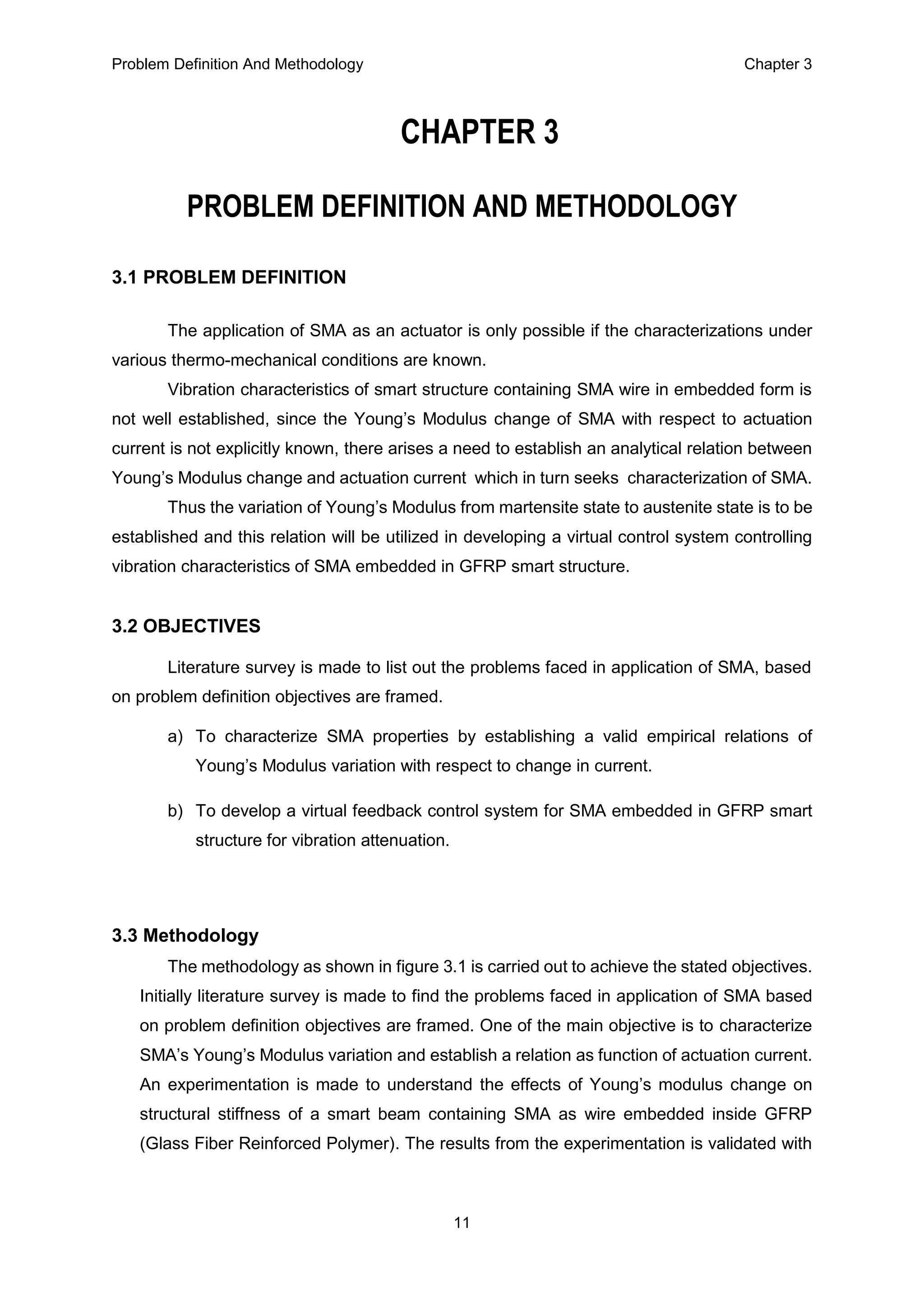
The methodology as shown in figure 3.1 is carried out to achieve the stated objectives.
Initially literature survey is made to find the problems faced in application of SMA based
on problem definition objectives are framed. One of the main objective is to characterize
SMA’s Young’s Modulus variation and establish a relation as function of actuation current.
An experimentation is made to understand the effects of Young’s modulus change on
structural stiffness of a smart beam containing SMA as wire embedded inside GFRP
(Glass Fiber Reinforced Polymer). The results from the experimentation is validated with
Problem Definition And Methodology Chapter 3
12
the results from mathematical model. this work is utilized in virtual control system
controlling the natural frequency of smart structure using LabVIEW software.
Fig. 3.1 Methodology
Literature survey
Selection of suitable SMA
Characterization of Nitinol properties
Experimentation in UTM
Establishing Young’s Modulus change as a function of actuation current
Experimental analysis of SMA
embedded GFRP beam
Natural frequency shift as a function
of actuation current
Mathematical model of SMA embedded
GFRP beam
Theoretical natural frequency shift as a
function of actuation current
Development of virtual
feedback control system
Vibration attenuation of
Smart blade Model
Validation
Selection of SMA Chapter 4
13
CHAPTER 4
SELECTION OF SMA
4.1 TYPES OF SMA
Shape Memory Alloys are mainly of two types copper-aluminium-nickel, and nickel-
titanium (NiTi) alloys but SMAs can also be created by alloying zinc, copper, gold and iron.
Although iron-based and copper-based SMAs, such as Fe-Mn-Si, Cu-Zn-Al and Cu-Al-Ni, are
commercially available and cheaper than NiTi, NiTi based SMAs are preferable for most
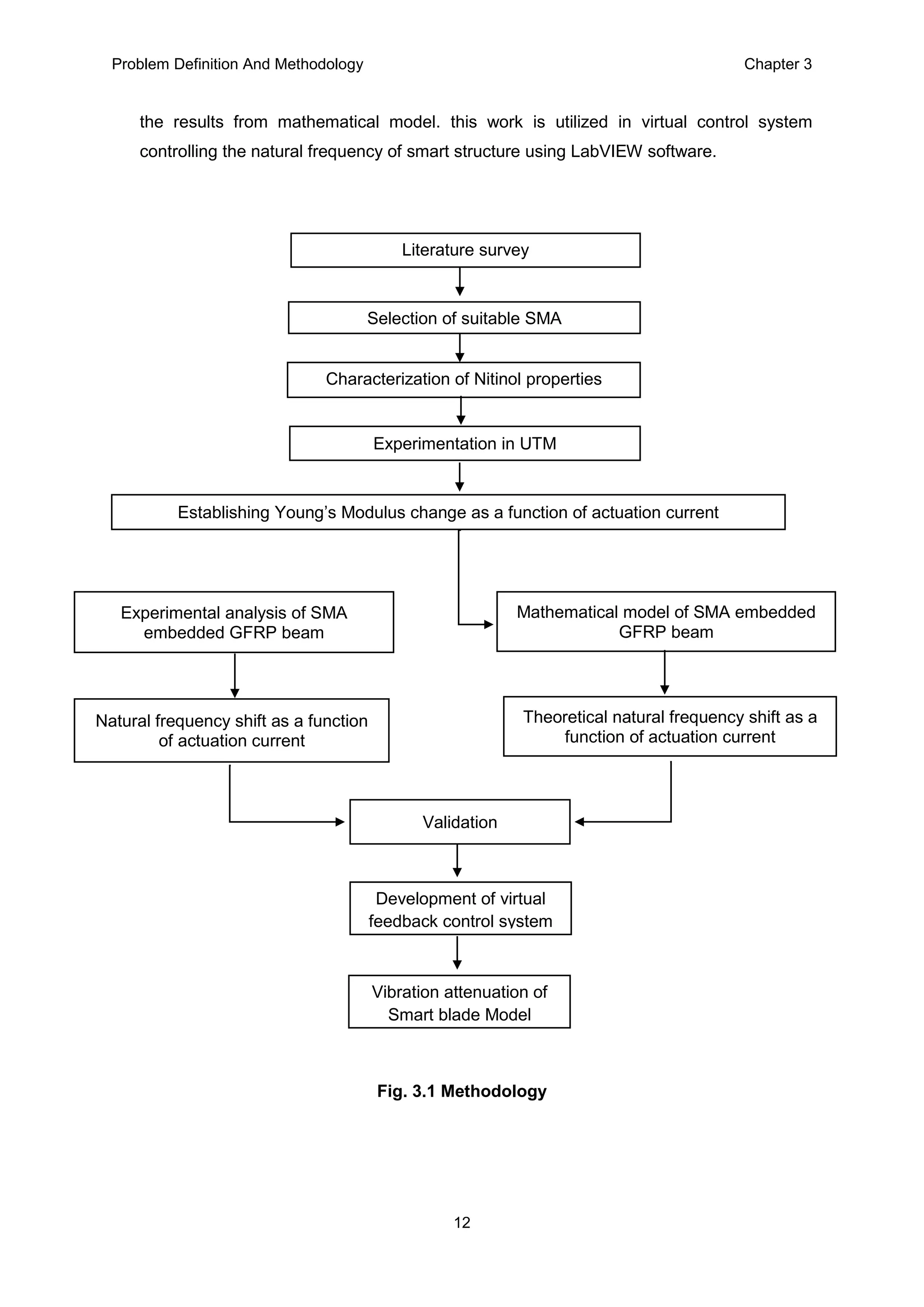
applications due to their stability, practicability (used in form of wires and plates as shown in
Figure 4.1 and superior thermo-mechanic performance. The copper-based and NiTi-based
shape-memory alloys are considered to be engineering materials. These compositions can be
manufactured to almost any shape and size.
Yield Strength of shape-memory alloys is lower than that of conventional steel, but
some compositions have a higher yield strength than plastic or aluminum. The yield stress for
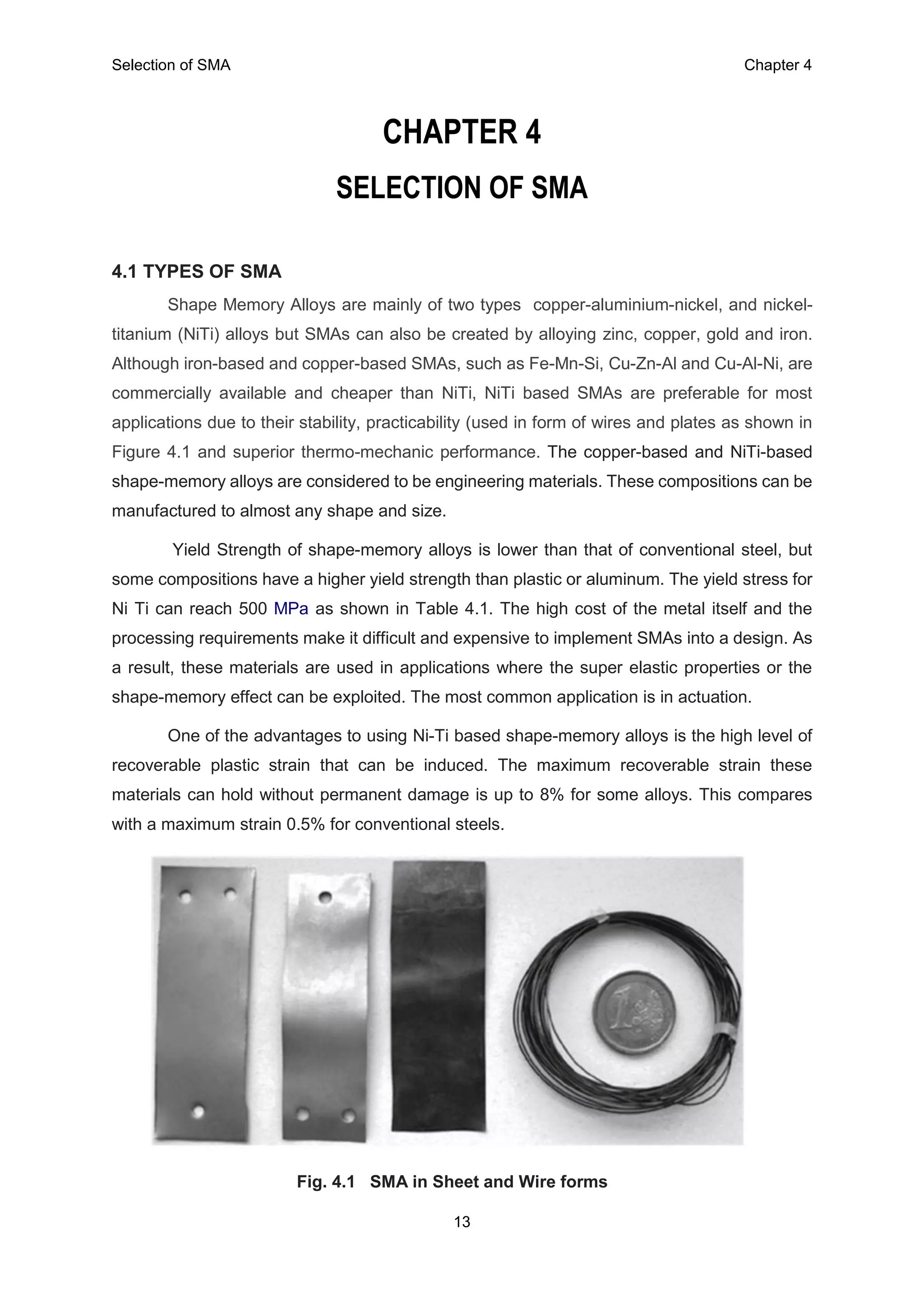
Ni Ti can reach 500 MPa as shown in Table 4.1. The high cost of the metal itself and the
processing requirements make it difficult and expensive to implement SMAs into a design. As
a result, these materials are used in applications where the super elastic properties or the
shape-memory effect can be exploited. The most common application is in actuation.
One of the advantages to using Ni-Ti based shape-memory alloys is the high level of
recoverable plastic strain that can be induced. The maximum recoverable strain these
materials can hold without permanent damage is up to 8% for some alloys. This compares
with a maximum strain 0.5% for conventional steels.
Fig. 4.1 SMA in Sheet and Wire forms
Selection of SMA Chapter 4
14
Table 4.1 Material properties of NITINOL
1 Density 6450 Kg/m3
2 Specific Heat 0.2 cal /g* ºC
3 Melting point 1300 °C
4 Thermal Conductivity 18 W/m·K
5 Thermal Expansion
Coefficient
Martensite 6.6×10⁻⁶
/ ºC
Austenite 11×10−6
/ ºC
6 Elastic Modules Martensite 20–50 GPa
Austenite 75–83 GPa
7 Yielding Strength Martensite 70–140 MPa
Austenite 195–895 MPa
8 Poisson Ratio 0.33
9 Electrical Resistivity Martensite 76×10−6
Ω·cm
Austenite 82×10−6
Ω·cm
4.2 NITINOL AS WIRES
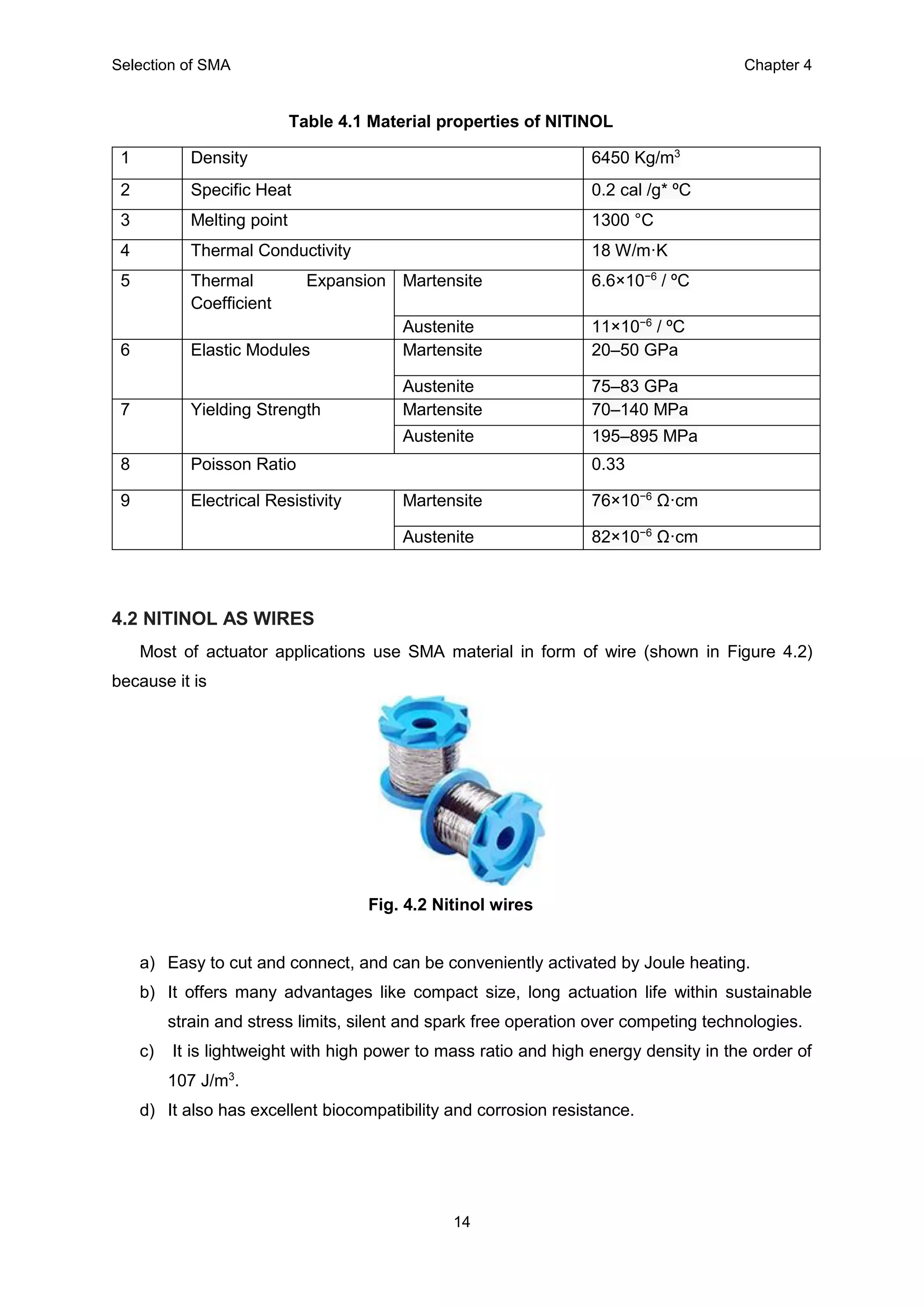
Most of actuator applications use SMA material in form of wire (shown in Figure 4.2)
because it is
Fig. 4.2 Nitinol wires
a) Easy to cut and connect, and can be conveniently activated by Joule heating.
b) It offers many advantages like compact size, long actuation life within sustainable
strain and stress limits, silent and spark free operation over competing technologies.
c) It is lightweight with high power to mass ratio and high energy density in the order of
107 J/m3
.
d) It also has excellent biocompatibility and corrosion resistance.
Selection of SMA Chapter 4
15
4.3 NI-TI WIRES AS ACTUATOR
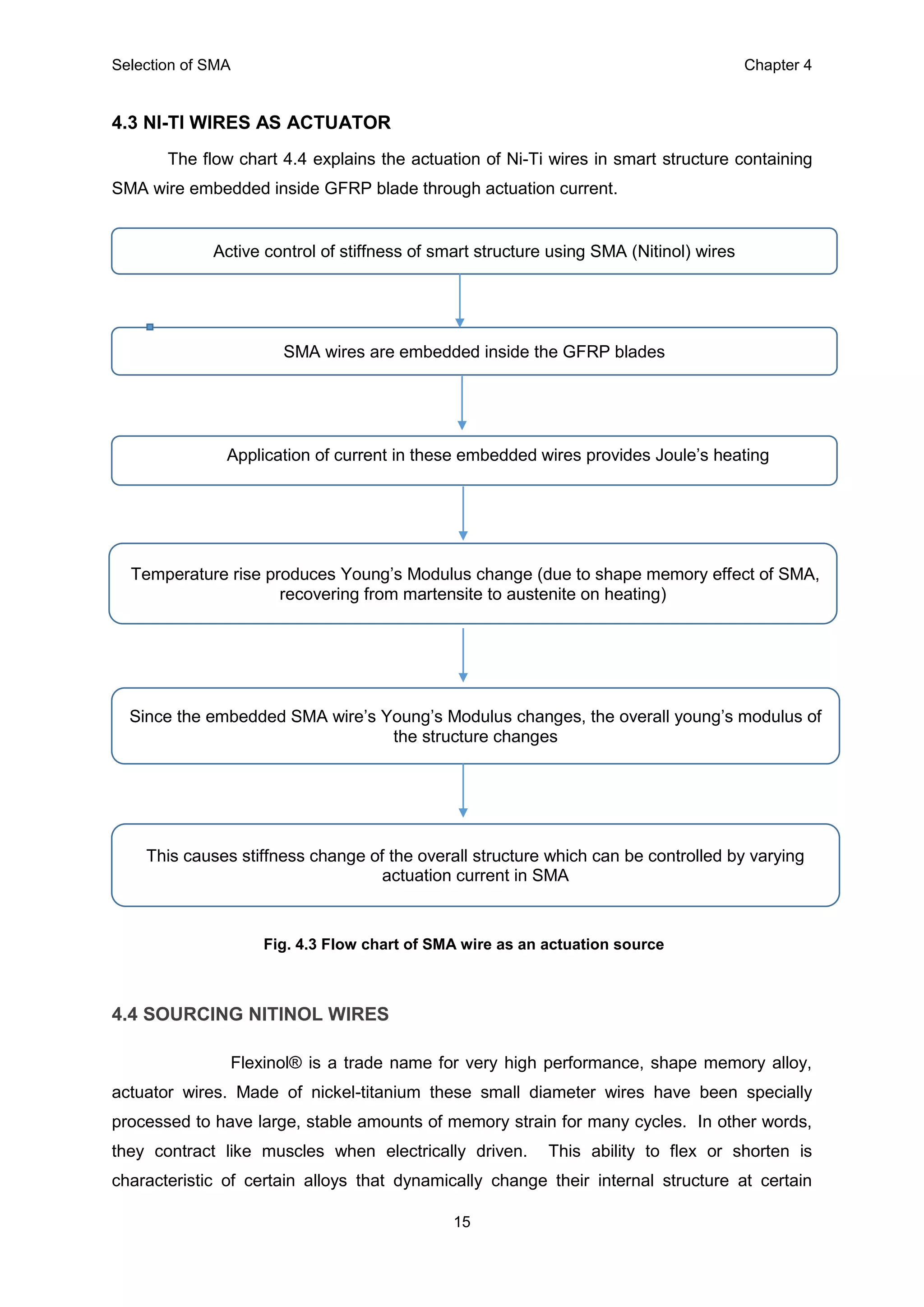
The flow chart 4.4 explains the actuation of Ni-Ti wires in smart structure containing
SMA wire embedded inside GFRP blade through actuation current.
• Method of Application of Heat input is in form of electric current and developing e
Fig. 4.3 Flow chart of SMA wire as an actuation source
4.4 SOURCING NITINOL WIRES
Flexinol® is a trade name for very high performance, shape memory alloy,
actuator wires. Made of nickel-titanium these small diameter wires have been specially
processed to have large, stable amounts of memory strain for many cycles. In other words,
they contract like muscles when electrically driven. This ability to flex or shorten is
characteristic of certain alloys that dynamically change their internal structure at certain
Active control of stiffness of smart structure using SMA (Nitinol) wires
SMA wires are embedded inside the GFRP blades
Application of current in these embedded wires provides Joule’s heating
(temperature rise)
Temperature rise produces Young’s Modulus change (due to shape memory effect of SMA,
recovering from martensite to austenite on heating)
Since the embedded SMA wire’s Young’s Modulus changes, the overall young’s modulus of
the structure changes
This causes stiffness change of the overall structure which can be controlled by varying
actuation current in SMA
Selection of SMA Chapter 4
16
temperatures. Flexinol® wires contract by several percent of their length when heated and
then easily elongate again by a relatively small load when the current is turned off and they
are allowed to cool
The function of the Flexinol® wire is based on the shape memory
phenomenon which occurs in certain alloys in the nickel-titanium family. When both nickel
and titanium atoms are present in the alloy in almost exactly a 50%/50% ratio, the material
forms a crystal structure which is capable of undergoing a change from one crystal form to
another (a martensitic transformation) at a temperature determined by the exact composition
of the alloy. In the crystal form that exists above the transformation temperature (the
austenite) the material is high strength and not easily deformed. It behaves mechanically
much like stainless steel. Below the transformation temperature, though, when the other
crystal form (the martensite) exists, the alloy can be deformed several percent by a very
uncommon deformation mechanism that can be reversed when the material is heated and
transforms. The low temperature crystal form of the alloy will undergo the reversible
deformation fairly easily, so the "memory" strain can be put into the material at rather low
stress levels
The resultant effect of the shape memory transformation of the Flexinol® wire
is that the wire can be stretched about 4-5% of its length below its transformation temperature
by a force of only 10,000 psi (69 MPa) or less. When heated through the transformation
temperature, the wire will shorten by the same 45% that it was stretched, and can exert
stresses of at least 25,000 psi (172 MPa) when it does so. The transformation temperature of
the NiTi alloys can be adjusted from over 212 °F (100°C) down to cryogenic temperatures, but
the temperature for the Flexinol® actuator wire has been chosen to be 140 – 230 °F (60 - 110
°C). This allows easy heating with modest electrical currents applied directly through the wire,
and quick cooling to below the transformation temperature as soon as the current is stopped.
Heating with electrical current is not required, but it is perhaps the most convenient and
frequently used form of heat
Flexinol® actuator wires' prime function is to contract in length and create force or
motion when it is heated. There are limits, of course, to how much force or contraction can be
obtained. The shape memory transformation has a natural limit in the NiTi system of about
8%. That is the amount of strain that can occur in the low temperature phase by the reversible
martensitic twinning which yields the memory effect. Deformation beyond this level causes
dislocation movement throughout the structure and then that deformation is not only non-
reversible but degrades the memory recovery as well. For materials expected to repeat the
Selection of SMA Chapter 4
17
memory strain for many cycles, it is best to utilize a cyclic memory strain of no more than 4-
5%, and that is what is recommended with Flexinol® actuator wire.
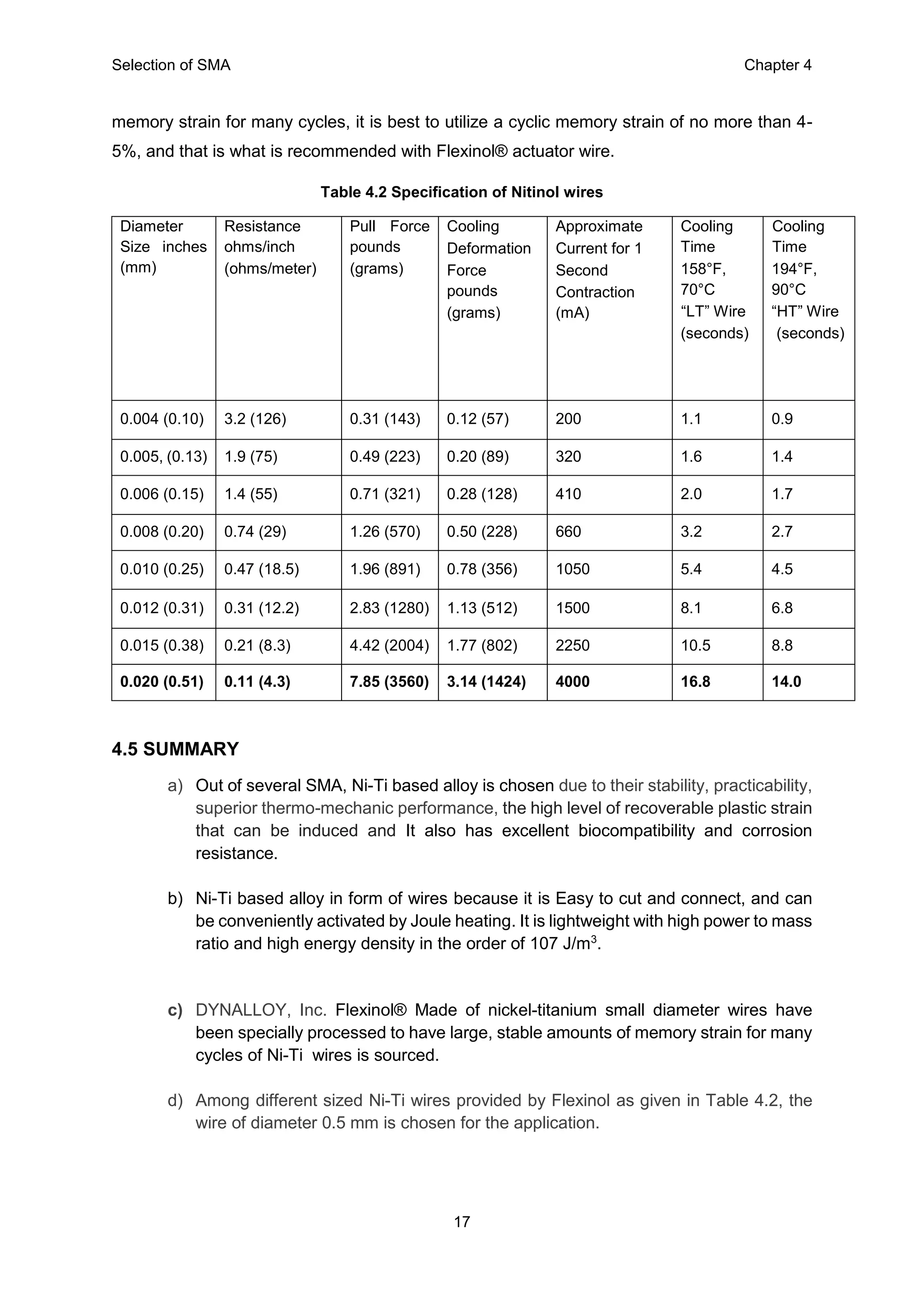
Table 4.2 Specification of Nitinol wires
Diameter
Size inches
(mm)
Resistance
ohms/inch
(ohms/meter)
Pull Force
pounds
(grams)
Cooling
Deformation
Force
pounds
(grams)
Approximate
Current for 1
Second
Contraction
(mA)
Cooling
Time
158°F,
70°C
“LT” Wire
(seconds)
Cooling
Time
194°F,
90°C
“HT” Wire
(seconds)
0.004 (0.10) 3.2 (126) 0.31 (143) 0.12 (57) 200 1.1 0.9
0.005, (0.13) 1.9 (75) 0.49 (223) 0.20 (89) 320 1.6 1.4
0.006 (0.15) 1.4 (55) 0.71 (321) 0.28 (128) 410 2.0 1.7
0.008 (0.20) 0.74 (29) 1.26 (570) 0.50 (228) 660 3.2 2.7
0.010 (0.25) 0.47 (18.5) 1.96 (891) 0.78 (356) 1050 5.4 4.5
0.012 (0.31) 0.31 (12.2) 2.83 (1280) 1.13 (512) 1500 8.1 6.8
0.015 (0.38) 0.21 (8.3) 4.42 (2004) 1.77 (802) 2250 10.5 8.8
0.020 (0.51) 0.11 (4.3) 7.85 (3560) 3.14 (1424) 4000 16.8 14.0
4.5 SUMMARY
a) Out of several SMA, Ni-Ti based alloy is chosen due to their stability, practicability,
superior thermo-mechanic performance, the high level of recoverable plastic strain
that can be induced and It also has excellent biocompatibility and corrosion
resistance.
b) Ni-Ti based alloy in form of wires because it is Easy to cut and connect, and can
be conveniently activated by Joule heating. It is lightweight with high power to mass
ratio and high energy density in the order of 107 J/m3
.
c) DYNALLOY, Inc. Flexinol® Made of nickel-titanium small diameter wires have
been specially processed to have large, stable amounts of memory strain for many
cycles of Ni-Ti wires is sourced.
d) Among different sized Ni-Ti wires provided by Flexinol as given in Table 4.2, the
wire of diameter 0.5 mm is chosen for the application.
Experimentation in UTM Ι Chapter 5
18
CHAPTER 5
EXPERIMENTATION IN UTM
5.1 INTRODUCTION
In order to understand the thermo-mechanical properties of nitinol, an experimental
study is made. The experimental setup consists of a UTM ZWICK / ROEL 2.5 KN, Nitinol (Ni-
Ti: 50.5-49.5%) test wire of 0.5 mm in diameter as given in Table 5.1 and power supply kit.
The wires used in this work are in the trade name of Flexinol was procured from Dynalloy
Inc.USA.
5.2 EXPERIMENTAL SETUP OVERVIEW
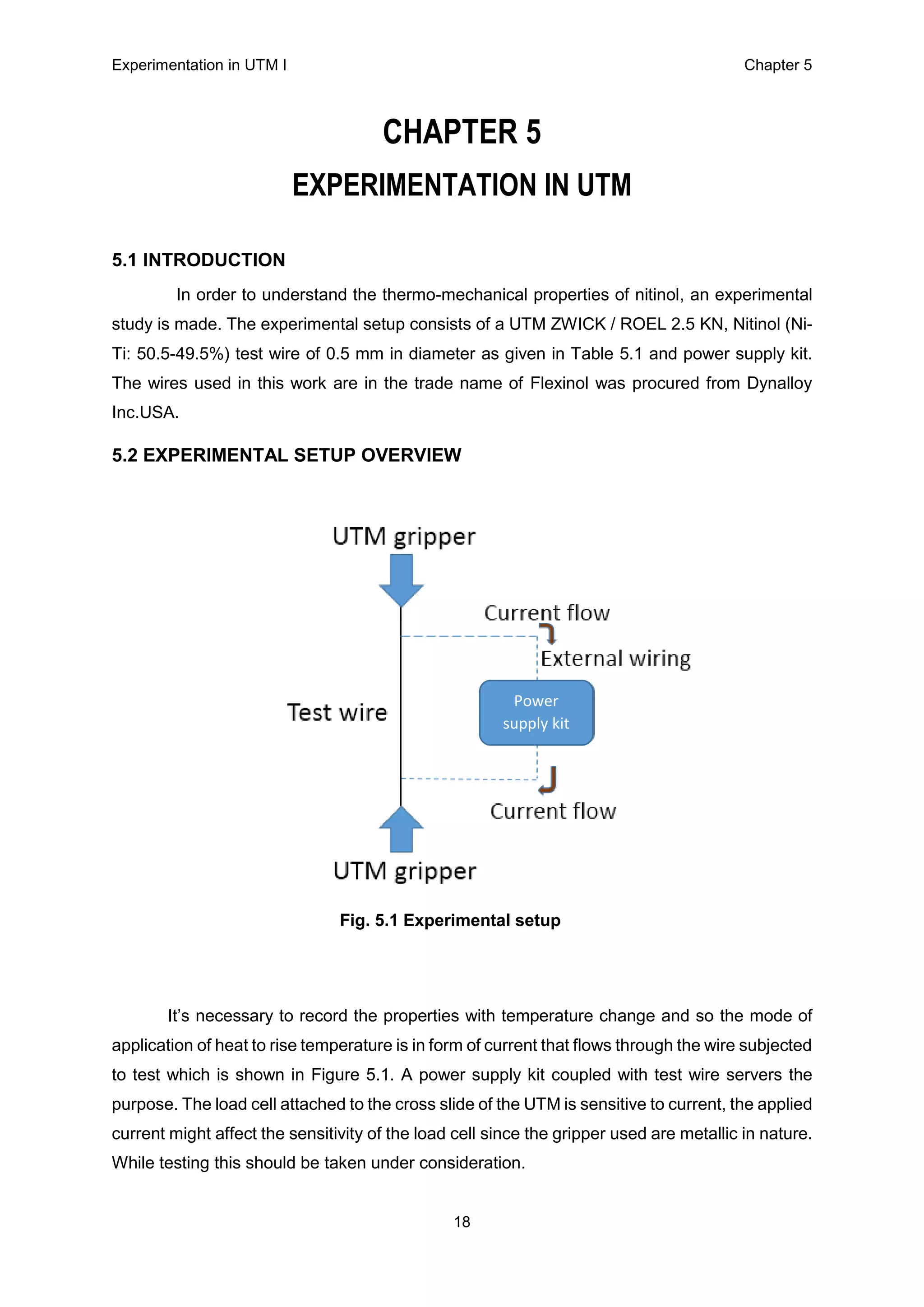
Fig. 5.1 Experimental setup
It’s necessary to record the properties with temperature change and so the mode of
application of heat to rise temperature is in form of current that flows through the wire subjected
to test which is shown in Figure 5.1. A power supply kit coupled with test wire servers the
purpose. The load cell attached to the cross slide of the UTM is sensitive to current, the applied
current might affect the sensitivity of the load cell since the gripper used are metallic in nature.
While testing this should be taken under consideration.
Power
supply kit
Experimentation in UTM Ι Chapter 5
19
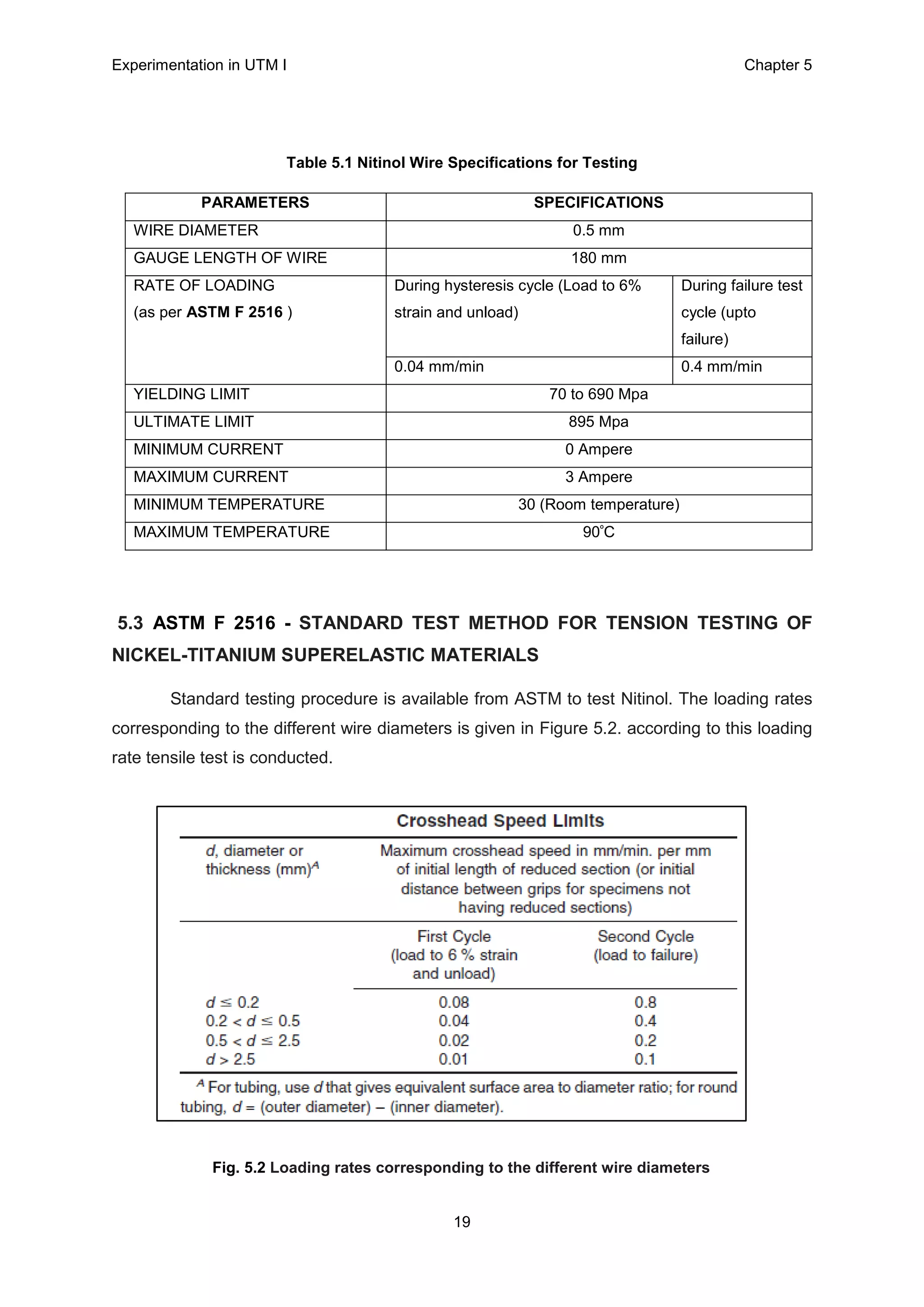
Table 5.1 Nitinol Wire Specifications for Testing
PARAMETERS SPECIFICATIONS
WIRE DIAMETER 0.5 mm
GAUGE LENGTH OF WIRE 180 mm
RATE OF LOADING
(as per ASTM F 2516 )
During hysteresis cycle (Load to 6%
strain and unload)
During failure test
cycle (upto
failure)
0.04 mm/min 0.4 mm/min
YIELDING LIMIT 70 to 690 Mpa
ULTIMATE LIMIT 895 Mpa
MINIMUM CURRENT 0 Ampere
MAXIMUM CURRENT 3 Ampere
MINIMUM TEMPERATURE 30 (Room temperature)
MAXIMUM TEMPERATURE 90ºC
5.3 ASTM F 2516 - STANDARD TEST METHOD FOR TENSION TESTING OF
NICKEL-TITANIUM SUPERELASTIC MATERIALS
Standard testing procedure is available from ASTM to test Nitinol. The loading rates
corresponding to the different wire diameters is given in Figure 5.2. according to this loading
rate tensile test is conducted.
Fig. 5.2 Loading rates corresponding to the different wire diameters
Experimentation in UTM Ι Chapter 5
20
Fig. 5.3 Typical Stress Strain diagram of superelastic Nitinol
a) Lower Plateau Strength (LPS)—the stress at 2.5 % strain during unloading of the
sample, after loading to 6 % strain as referred in Figure 5.3.
b) Residual Elongation, Elr[%]—the difference between the strain at a stress of 7.0 MPa
during unloading and the strain at a stress of 7.0 MPa during loading .
c) Uniform Elongation, Elu[%]—the elongation determined at the maximum force
sustained by the test piece just prior to necking, or fracture, or both.
d) Upper Plateau Strength (UPS)—the stress at 3 % strain during loading of the sample.
ZWICK / ROEL 2.5 KN is a German made Universal Testing Machine as shown in Figure
5.4 used of tensile test of the wire specimen.
Fig. 5.4 ZWICK / ROEL 2.5 KN UTM
Experimentation in UTM Ι Chapter 5
21
5.4 TESTING PROCEDURE
a) The Nitinol wire of 180 mm and diameter of 0.5 mm is taken as test
specimen.
b) The wire is held between grippers and the cross head is moved until the
wire is under tension
c) Inbuilt software for tensile testing for wire is used
d) The dimensions of wire is entered in the software
e) The loading rate as 10 mm/ min is entered.
f) Failure of test specimen occurred and Results of strain graph were
obtained. .
5.5 SELECTION OF GRIPPER
Since the PSGTECH COE INDUTECH is testing center for testing yarn threads the
griper available is only for yarn and specimen used for the test is of high strength metallic
wires, so below following grippers were used
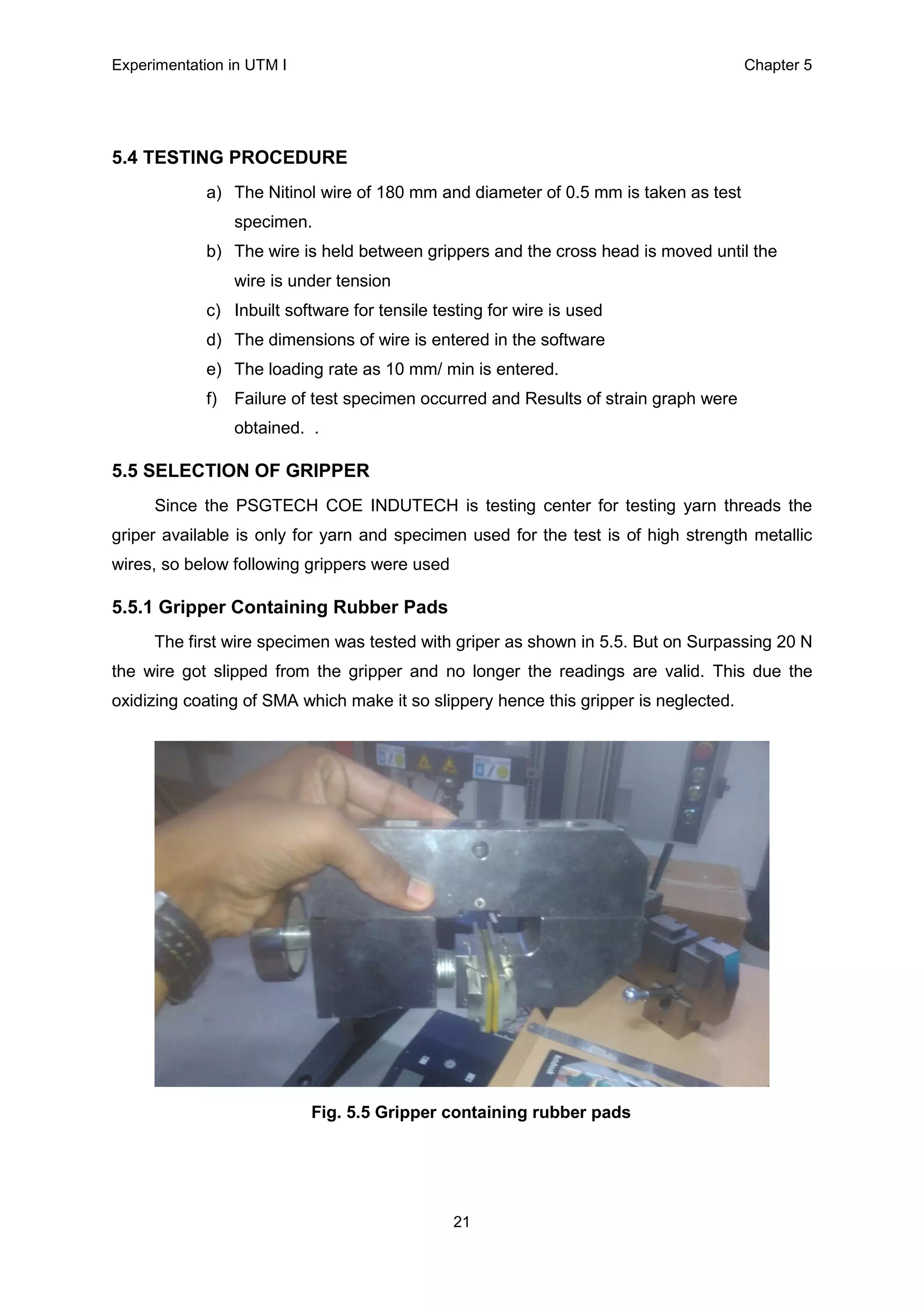
5.5.1 Gripper Containing Rubber Pads
The first wire specimen was tested with griper as shown in 5.5. But on Surpassing 20 N
the wire got slipped from the gripper and no longer the readings are valid. This due the
oxidizing coating of SMA which make it so slippery hence this gripper is neglected.
Fig. 5.5 Gripper containing rubber pads
Experimentation in UTM Ι Chapter 5
22
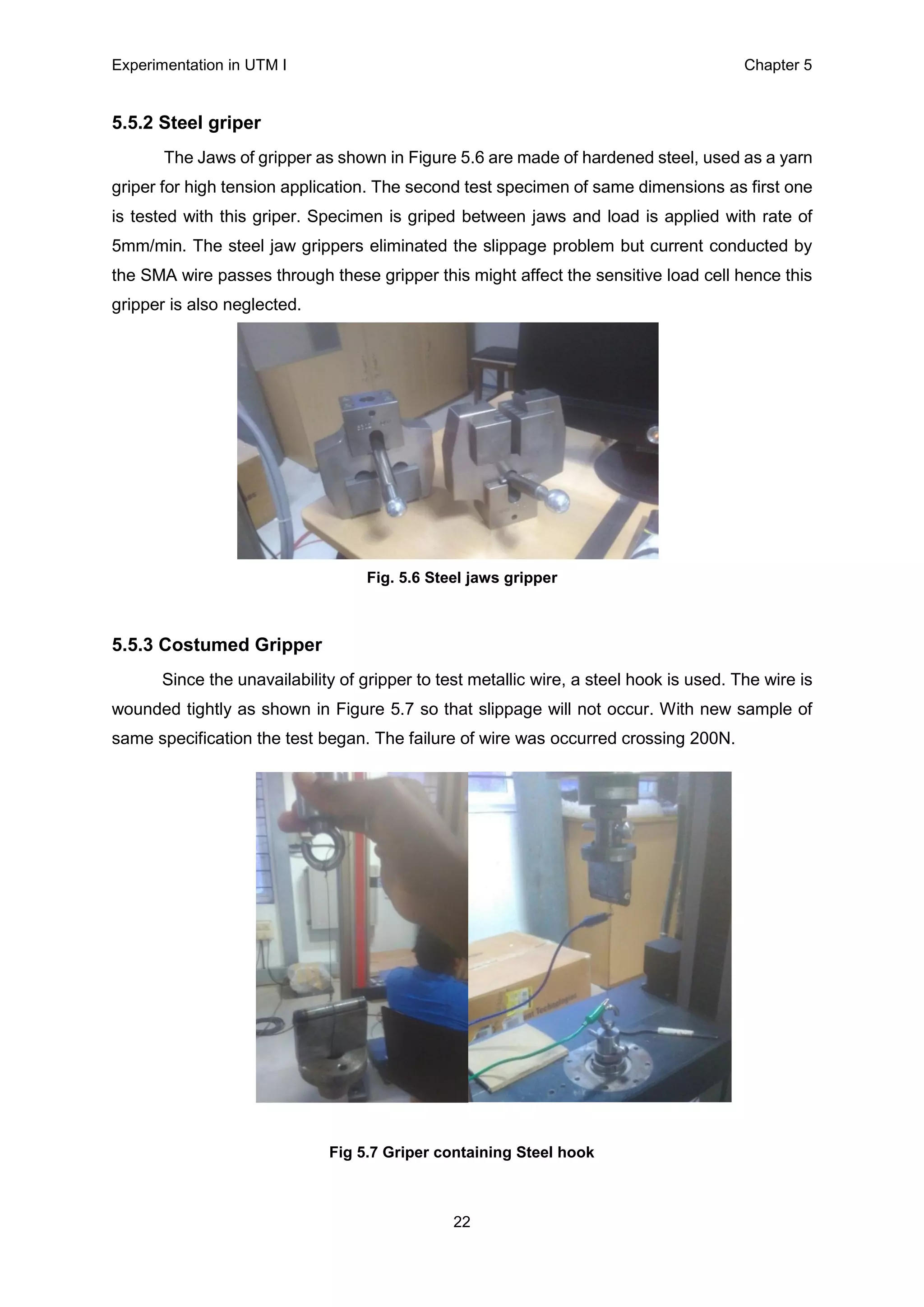
5.5.2 Steel griper
The Jaws of gripper as shown in Figure 5.6 are made of hardened steel, used as a yarn
griper for high tension application. The second test specimen of same dimensions as first one
is tested with this griper. Specimen is griped between jaws and load is applied with rate of
5mm/min. The steel jaw grippers eliminated the slippage problem but current conducted by
the SMA wire passes through these gripper this might affect the sensitive load cell hence this
gripper is also neglected.
Fig. 5.6 Steel jaws gripper
5.5.3 Costumed Gripper
Since the unavailability of gripper to test metallic wire, a steel hook is used. The wire is
wounded tightly as shown in Figure 5.7 so that slippage will not occur. With new sample of
same specification the test began. The failure of wire was occurred crossing 200N.
Fig 5.7 Griper containing Steel hook
Experimentation in UTM Ι Chapter 5
23
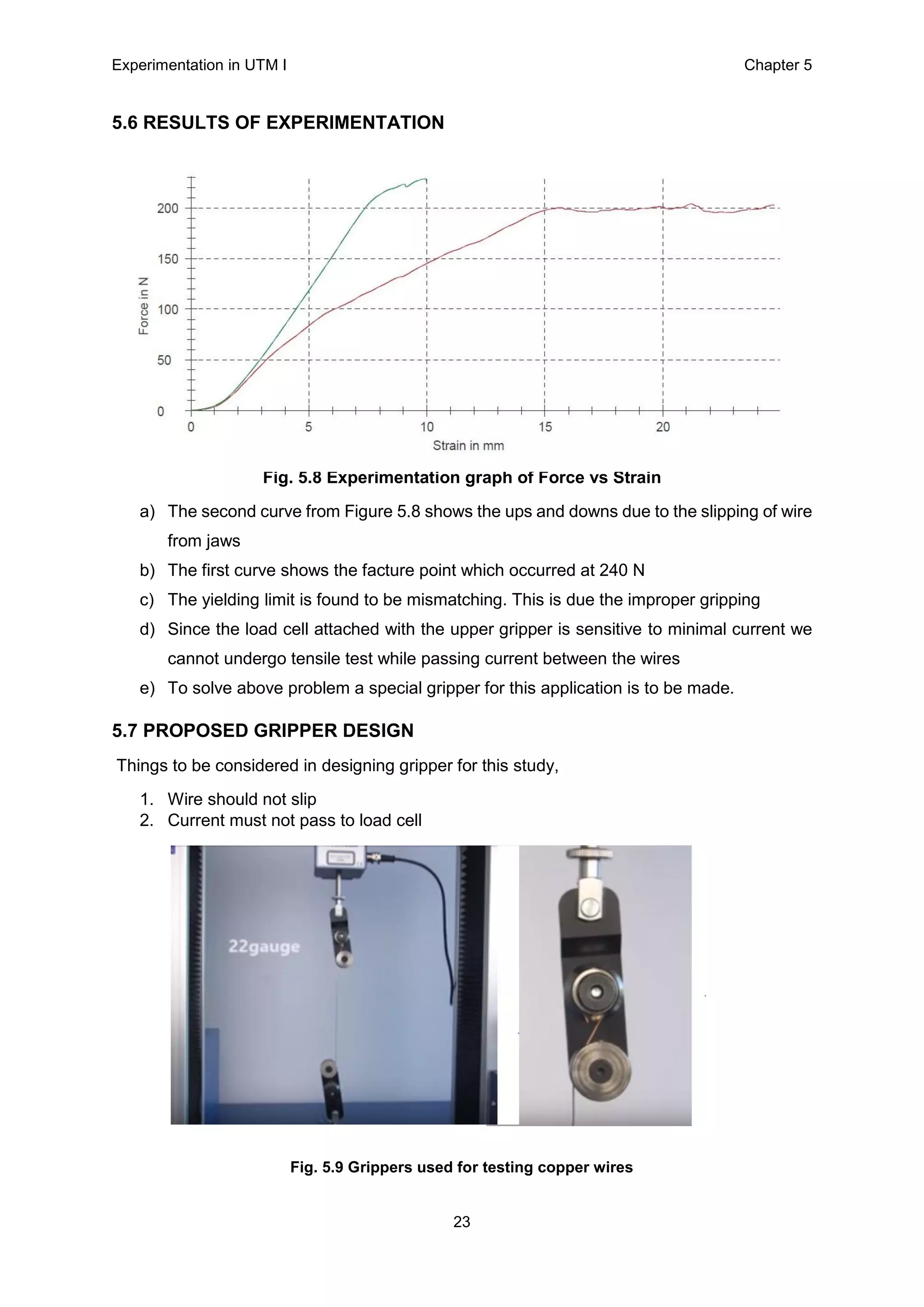
5.6 RESULTS OF EXPERIMENTATION
F
Fig. 5.8 Experimentation graph of Force vs Strain
a) The second curve from Figure 5.8 shows the ups and downs due to the slipping of wire
from jaws
b) The first curve shows the facture point which occurred at 240 N
c) The yielding limit is found to be mismatching. This is due the improper gripping
d) Since the load cell attached with the upper gripper is sensitive to minimal current we
cannot undergo tensile test while passing current between the wires
e) To solve above problem a special gripper for this application is to be made.
5.7 PROPOSED GRIPPER DESIGN
Things to be considered in designing gripper for this study,
1. Wire should not slip
2. Current must not pass to load cell
Fig. 5.9 Grippers used for testing copper wires
Experimentation in UTM Ι Chapter 5
24
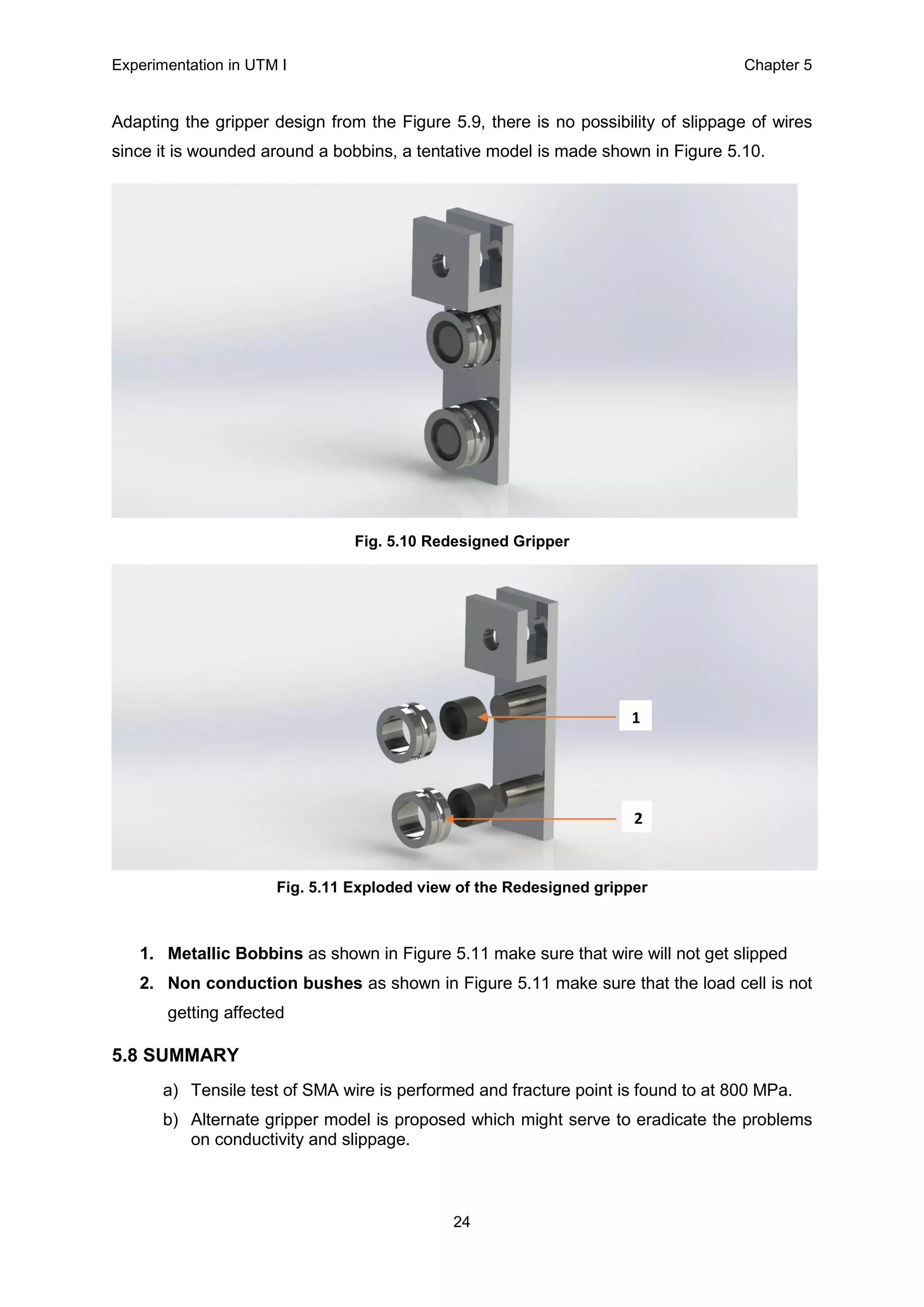
Adapting the gripper design from the Figure 5.9, there is no possibility of slippage of wires
since it is wounded around a bobbins, a tentative model is made shown in Figure 5.10.
Fig. 5.10 Redesigned Gripper
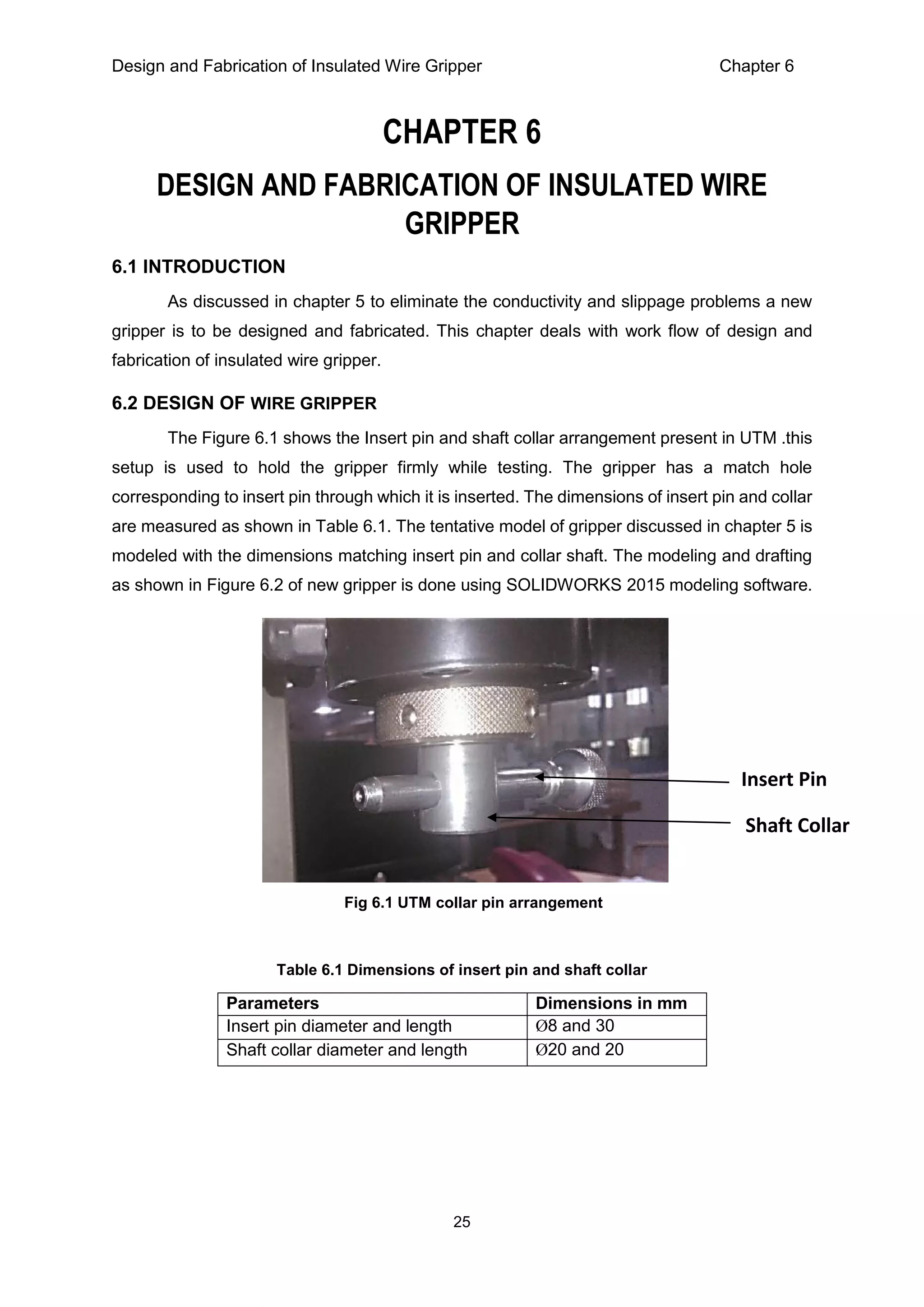
Fig. 5.11 Exploded view of the Redesigned gripper
1. Metallic Bobbins as shown in Figure 5.11 make sure that wire will not get slipped
2. Non conduction bushes as shown in Figure 5.11 make sure that the load cell is not
getting affected
5.8 SUMMARY
a) Tensile test of SMA wire is performed and fracture point is found to at 800 MPa.
b) Alternate gripper model is proposed which might serve to eradicate the problems
on conductivity and slippage.
1
2
Design and Fabrication of Insulated Wire Gripper Chapter 6
25
CHAPTER 6
DESIGN AND FABRICATION OF INSULATED WIRE
GRIPPER
6.1 INTRODUCTION
As discussed in chapter 5 to eliminate the conductivity and slippage problems a new
gripper is to be designed and fabricated. This chapter deals with work flow of design and
fabrication of insulated wire gripper.
6.2 DESIGN OF WIRE GRIPPER
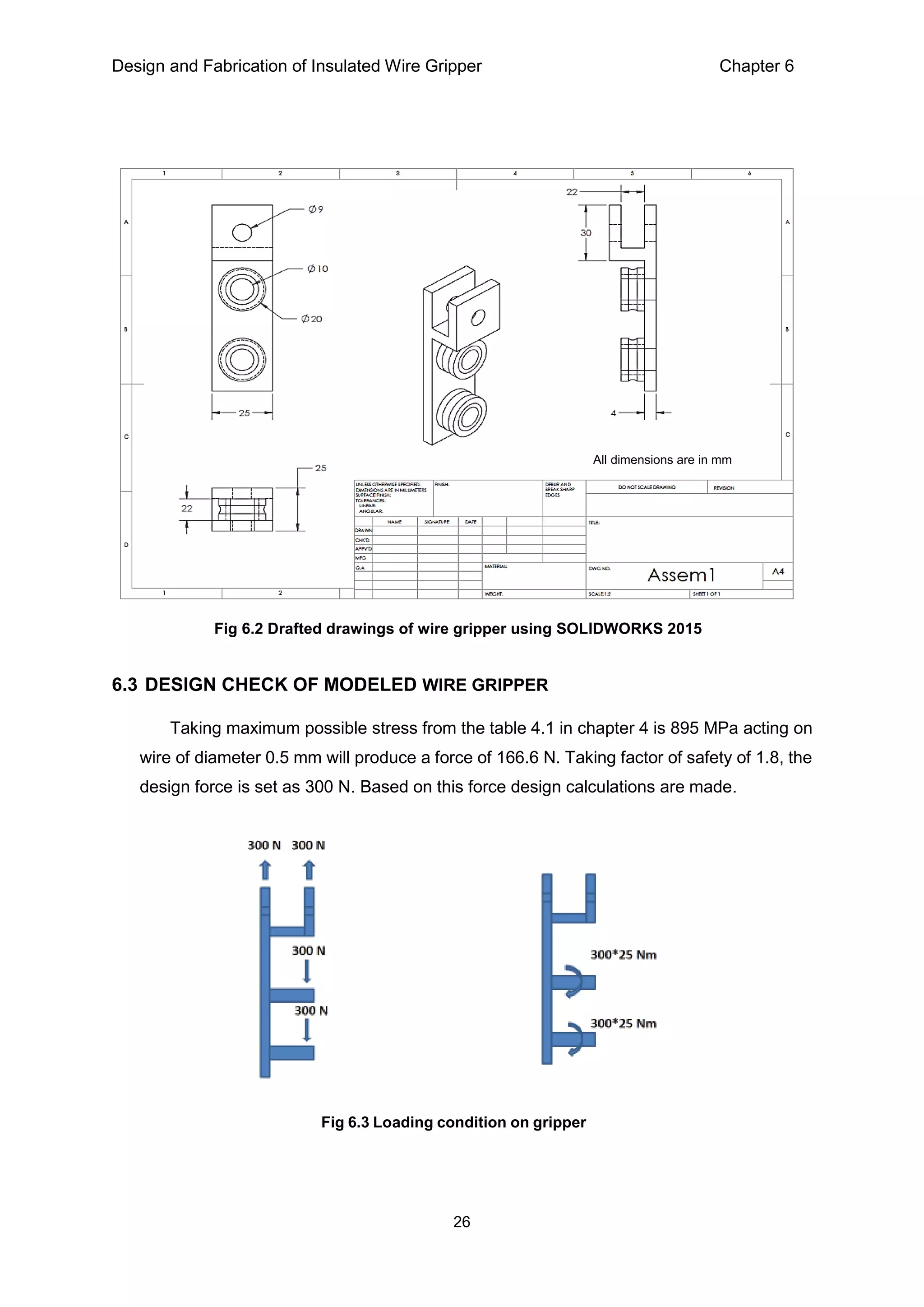
The Figure 6.1 shows the Insert pin and shaft collar arrangement present in UTM .this
setup is used to hold the gripper firmly while testing. The gripper has a match hole
corresponding to insert pin through which it is inserted. The dimensions of insert pin and collar
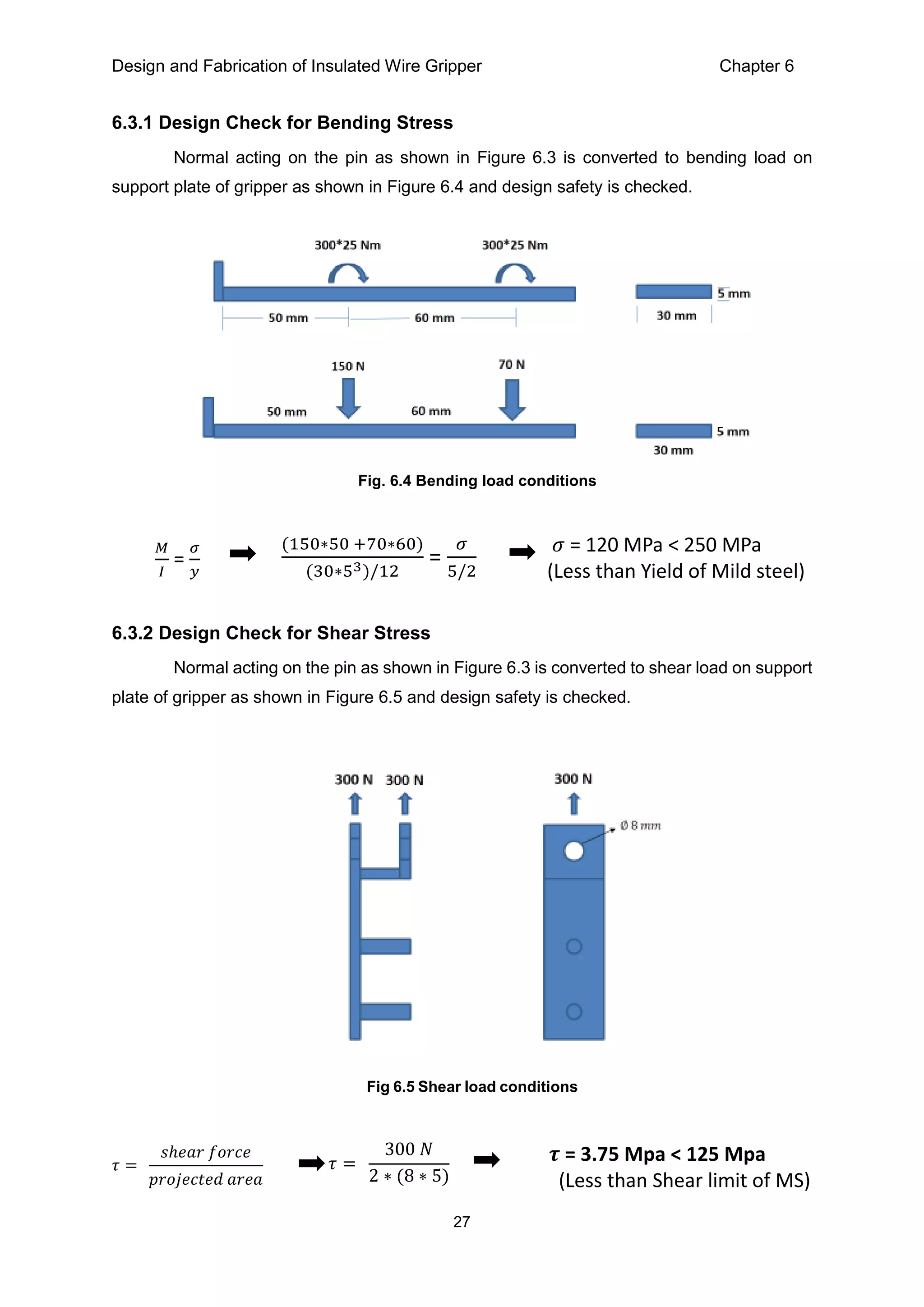
are measured as shown in Table 6.1. The tentative model of gripper discussed in chapter 5 is
modeled with the dimensions matching insert pin and collar shaft. The modeling and drafting
as shown in Figure 6.2 of new gripper is done using SOLIDWORKS 2015 modeling software.
Table 6.1 Dimensions of insert pin and shaft collar
Parameters Dimensions in mm
Insert pin diameter and length Ø8 and 30
Shaft collar diameter and length Ø20 and 20
Insert Pin
Shaft Collar
Fig 6.1 UTM collar pin arrangement
Design and Fabrication of Insulated Wire Gripper Chapter 6
26
6.3 DESIGN CHECK OF MODELED WIRE GRIPPER
Taking maximum possible stress from the table 4.1 in chapter 4 is 895 MPa acting on
wire of diameter 0.5 mm will produce a force of 166.6 N. Taking factor of safety of 1.8, the
design force is set as 300 N. Based on this force design calculations are made.
Fig 6.2 Drafted drawings of wire gripper using SOLIDWORKS 2015
Fig 6.3 Loading condition on gripper
All dimensions are in mm
Design and Fabrication of Insulated Wire Gripper Chapter 6
27
6.3.1 Design Check for Bending Stress
Normal acting on the pin as shown in Figure 6.3 is converted to bending load on
support plate of gripper as shown in Figure 6.4 and design safety is checked.
6.3.2 Design Check for Shear Stress
Normal acting on the pin as shown in Figure 6.3 is converted to shear load on support
plate of gripper as shown in Figure 6.5 and design safety is checked.
Fig. 6.4 Bending load conditions
𝑀
𝐼
=
𝜎
𝑦
(150∗50 +70∗60)
(30∗53)/12
=
𝜎
5/2
𝜎 = 120 MPa < 250 MPa
(Less than Yield of Mild steel)
Fig 6.5 Shear load conditions
𝜏 =
𝑠ℎ𝑒𝑎𝑟 𝑓𝑜𝑟𝑐𝑒
𝑝𝑟𝑜𝑗𝑒𝑐𝑡𝑒𝑑 𝑎𝑟𝑒𝑎
𝜏 =
300 𝑁
2 ∗ (8 ∗ 5)
𝝉 = 3.75 Mpa < 125 Mpa
(Less than Shear limit of MS)
Design and Fabrication of Insulated Wire Gripper Chapter 6
28
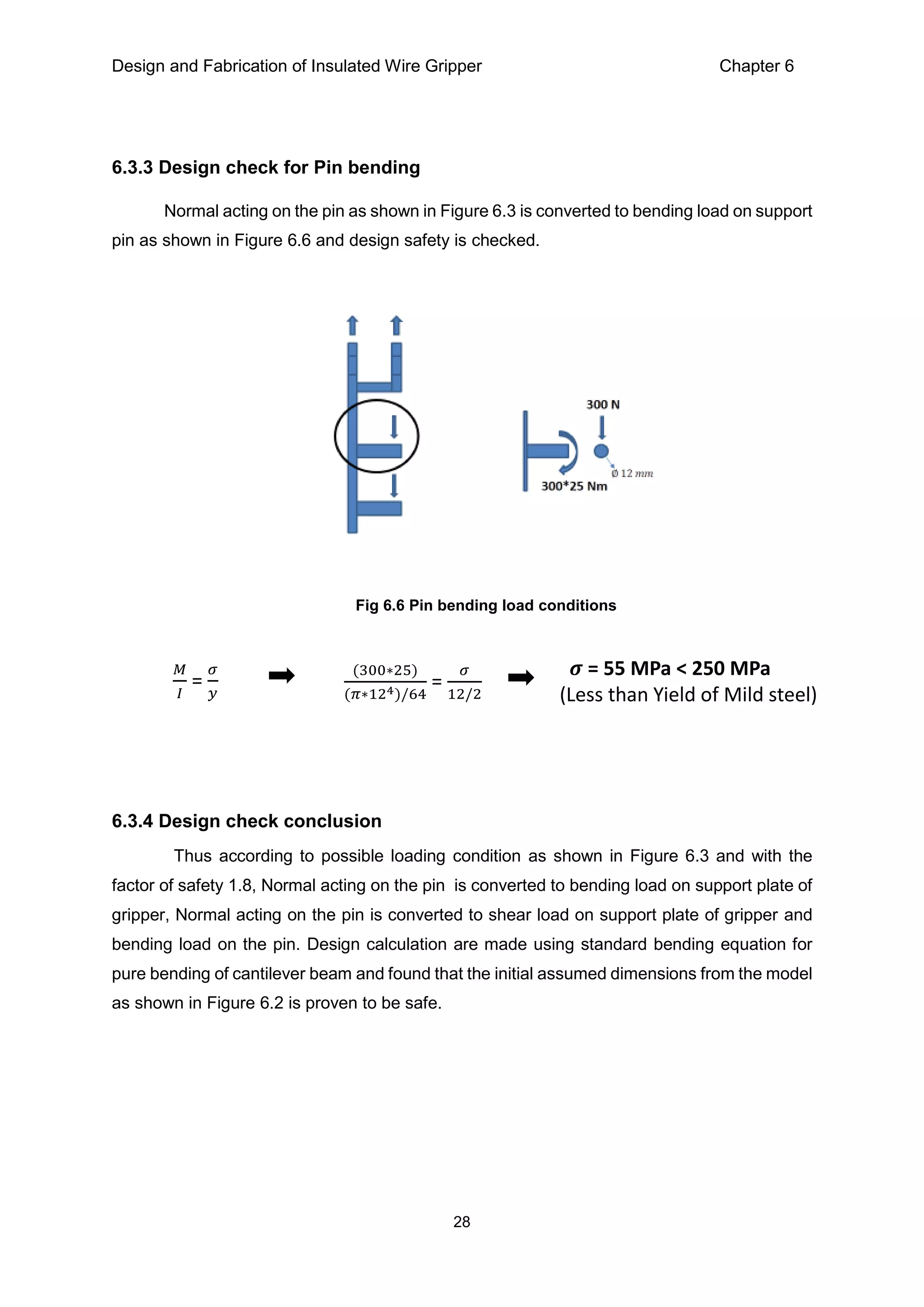
6.3.3 Design check for Pin bending
Normal acting on the pin as shown in Figure 6.3 is converted to bending load on support
pin as shown in Figure 6.6 and design safety is checked.
6.3.4 Design check conclusion
Thus according to possible loading condition as shown in Figure 6.3 and with the
factor of safety 1.8, Normal acting on the pin is converted to bending load on support plate of
gripper, Normal acting on the pin is converted to shear load on support plate of gripper and
bending load on the pin. Design calculation are made using standard bending equation for
pure bending of cantilever beam and found that the initial assumed dimensions from the model
as shown in Figure 6.2 is proven to be safe.
Fig 6.6 Pin bending load conditions
𝑀
𝐼
=
𝜎
𝑦
(300∗25)
(𝜋∗124)/64
=
𝜎
12/2
𝝈 = 55 MPa < 250 MPa
(Less than Yield of Mild steel)
Design and Fabrication of Insulated Wire Gripper Chapter 6
29
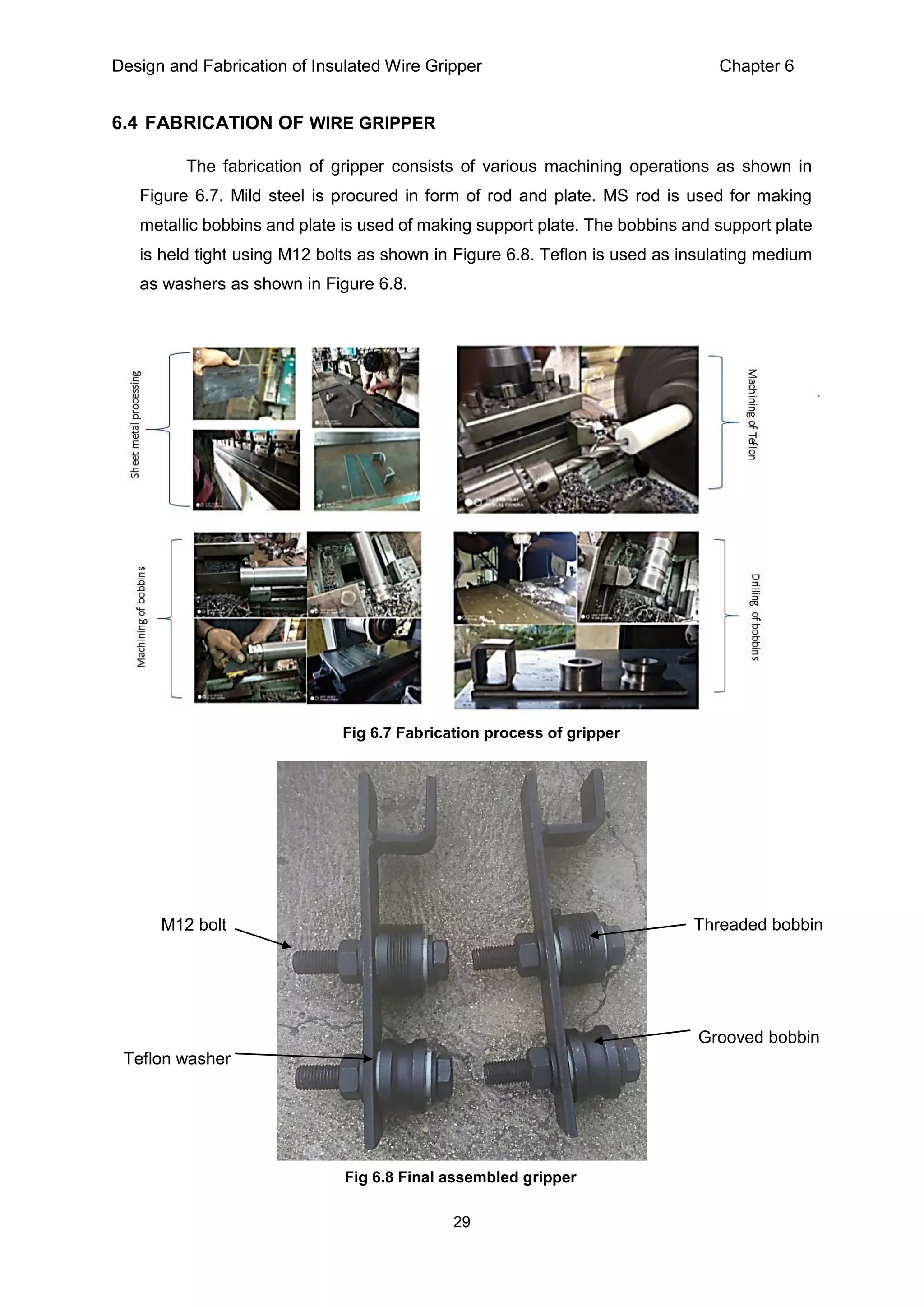
6.4 FABRICATION OF WIRE GRIPPER
The fabrication of gripper consists of various machining operations as shown in
Figure 6.7. Mild steel is procured in form of rod and plate. MS rod is used for making
metallic bobbins and plate is used of making support plate. The bobbins and support plate
is held tight using M12 bolts as shown in Figure 6.8. Teflon is used as insulating medium
as washers as shown in Figure 6.8.
Fig 6.7 Fabrication process of gripper
Threaded bobbin
Grooved bobbin
M12 bolt
Teflon washer
Fig 6.8 Final assembled gripper
Design and Fabrication of Insulated Wire Gripper Chapter 6
30
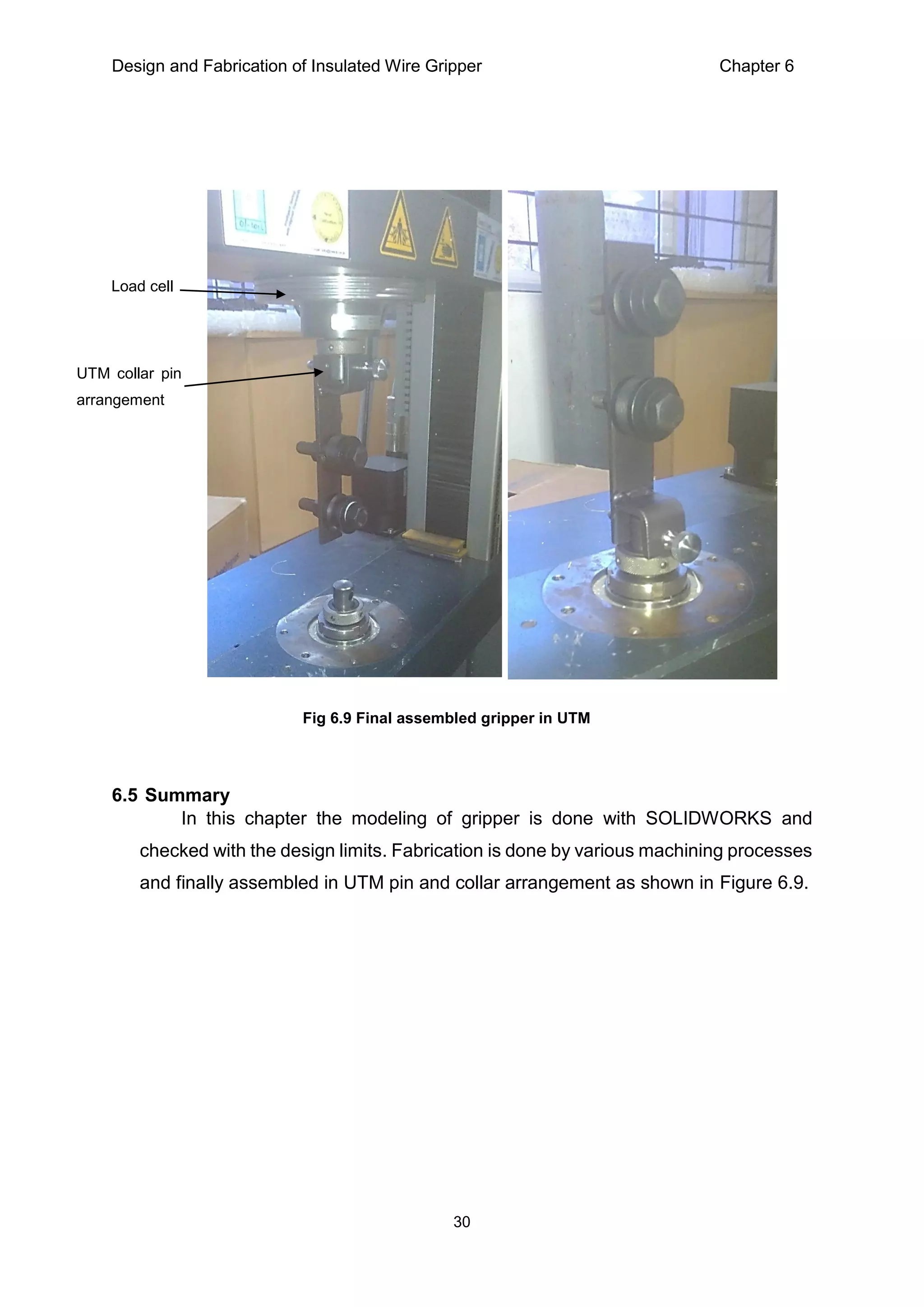
6.5 Summary
In this chapter the modeling of gripper is done with SOLIDWORKS and
checked with the design limits. Fabrication is done by various machining processes
and finally assembled in UTM pin and collar arrangement as shown in Figure 6.9.
Fig 6.9 Final assembled gripper in UTM
UTM collar pin
arrangement
Load cell
Experimentation in UTM ΙΙ Chapter 7
31
CHAPTER 7
EXPERIMENTATION TO EVALUVATE YOUNG’S
MODULUS
7.1 INTRODUCTION
As discussed in chapter 6, insulating wire gripper is made which eliminates slippage
and conductivity problems. In this chapter, using this gripper tensile tests are made and
corresponding results in Young’s Modulus change is observed.
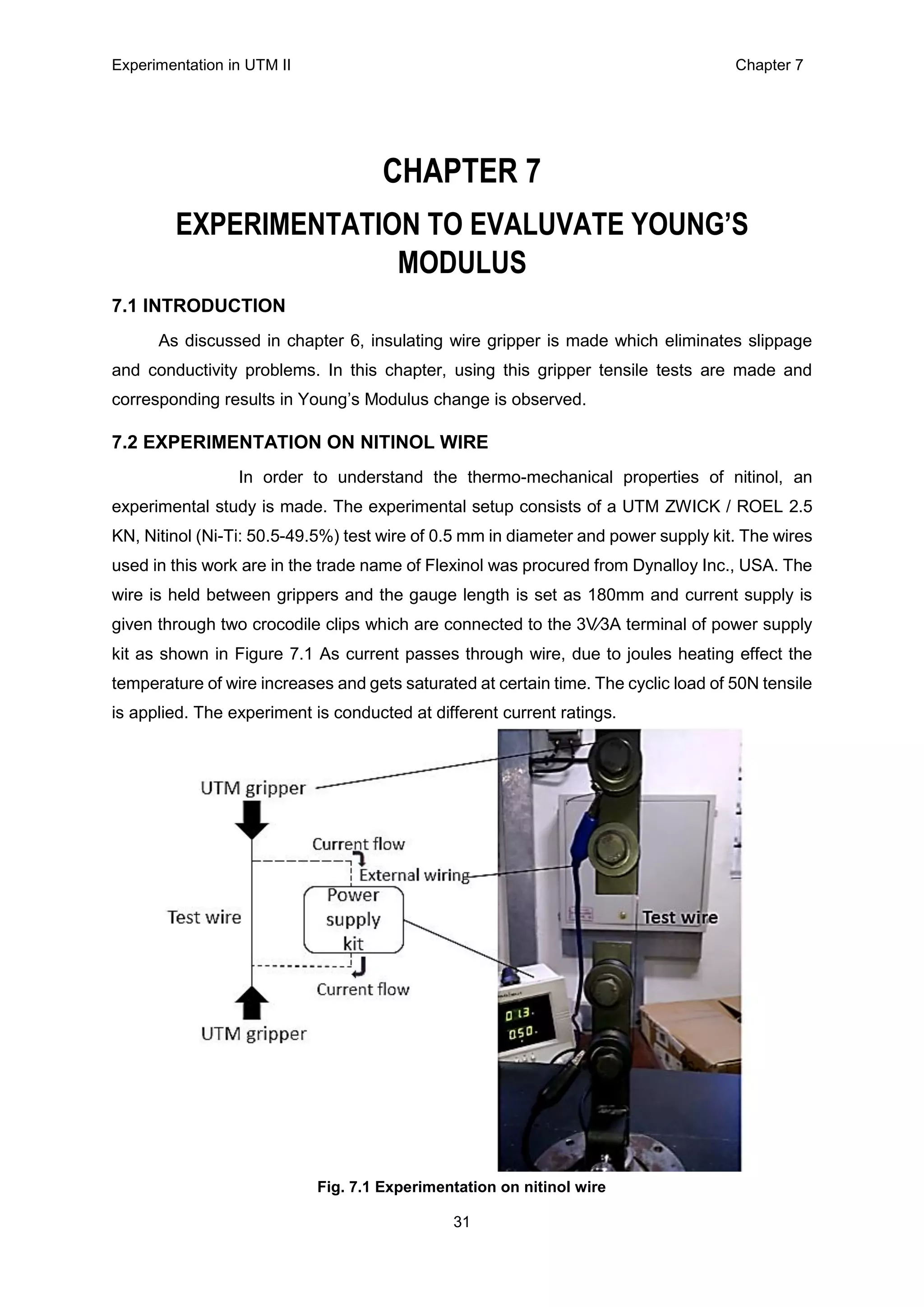
7.2 EXPERIMENTATION ON NITINOL WIRE
In order to understand the thermo-mechanical properties of nitinol, an
experimental study is made. The experimental setup consists of a UTM ZWICK / ROEL 2.5
KN, Nitinol (Ni-Ti: 50.5-49.5%) test wire of 0.5 mm in diameter and power supply kit. The wires
used in this work are in the trade name of Flexinol was procured from Dynalloy Inc., USA. The
wire is held between grippers and the gauge length is set as 180mm and current supply is
given through two crocodile clips which are connected to the 3V∕3A terminal of power supply
kit as shown in Figure 7.1 As current passes through wire, due to joules heating effect the
temperature of wire increases and gets saturated at certain time. The cyclic load of 50N tensile
is applied. The experiment is conducted at different current ratings.
Fig. 7.1 Experimentation on nitinol wire
Experimentation in UTM ΙΙ Chapter 7
32
7.3 RESULTS AND DISCUSSION
0
50
100
150
200
250
300
0 0.005 0.01 0.015 0.02 0.025 0.03
Stress,MPa
Strain
at 0 Aat 0.5 A
at 1 A
at 2.5 A
at 1.5 Aat 2 A
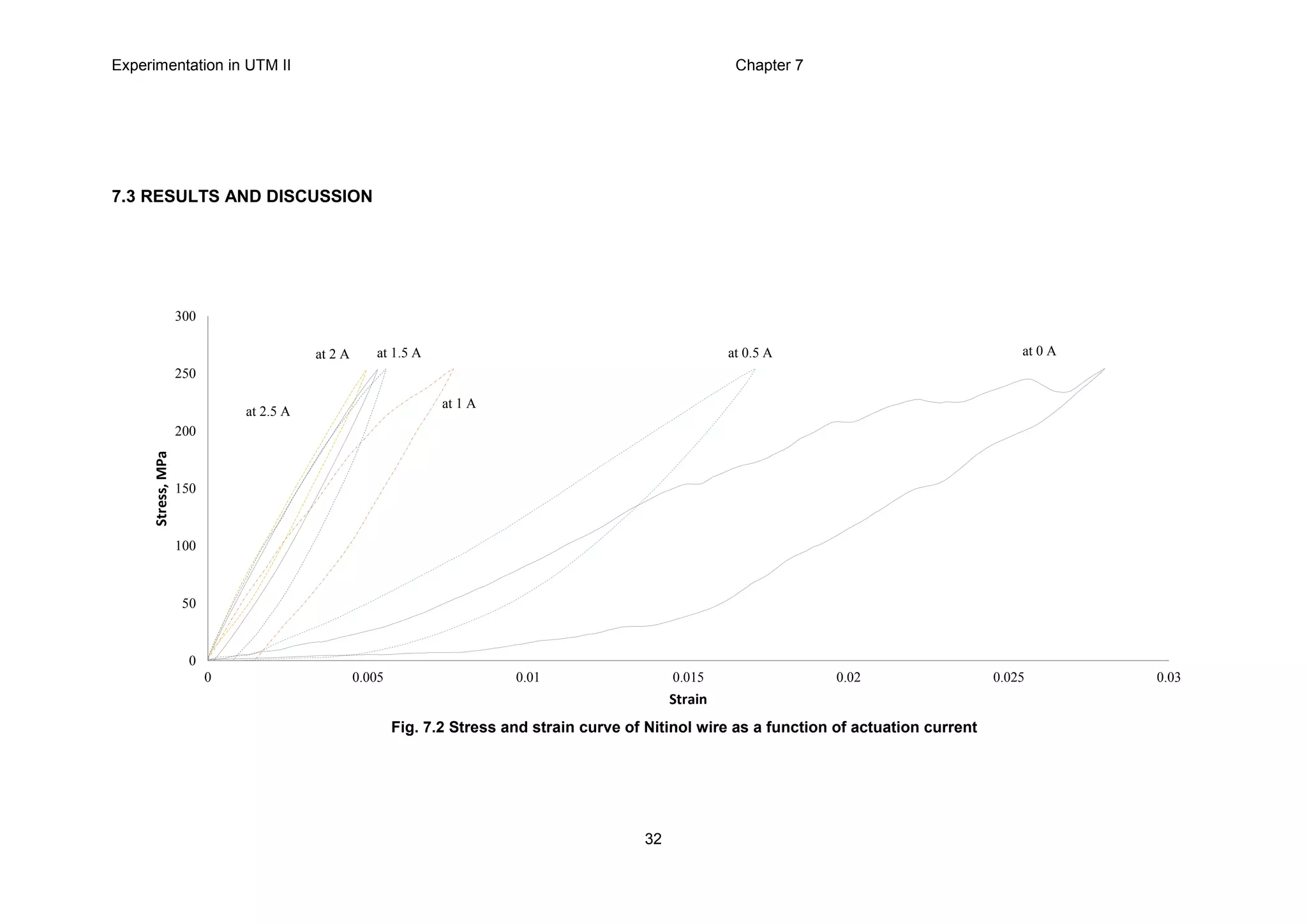
Fig. 7.2 Stress and strain curve of Nitinol wire as a function of actuation current
Experimentation in UTM ΙΙ Chapter 7
33
Infering the slopes of stress strain curves at various currents from the Figure 7.2, shift
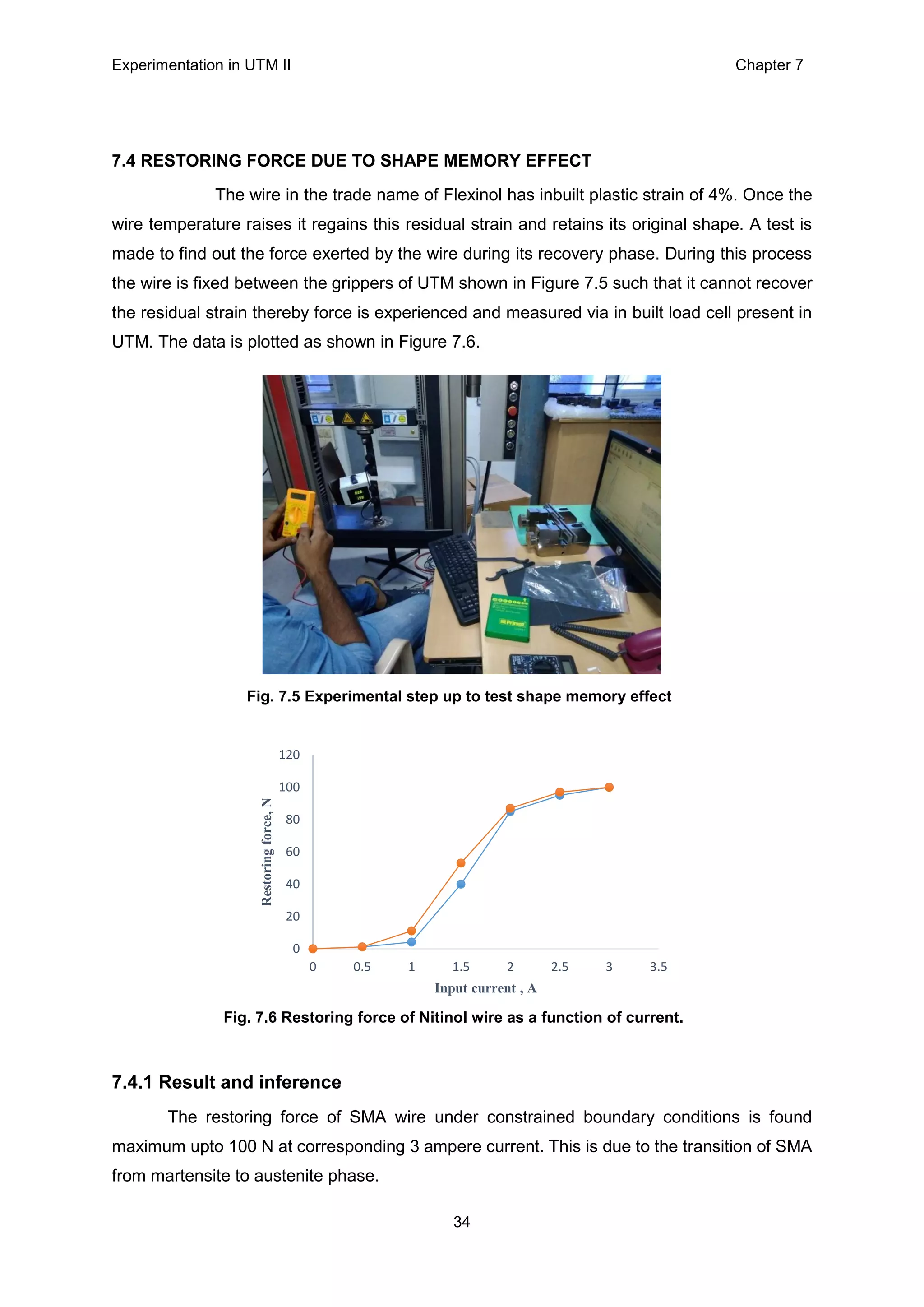
in youngs modulus is observed. As input current increases the temperature of wire as shown
in Figure 7.4 increases which incurs the solid phase transformation from low temerature, low
stiffness martinsite phase to high temperature, high stiffness austinite phase this causes the
youngs modulus change in wire. Taking loading line’s slope, youngs Modulus of wire at
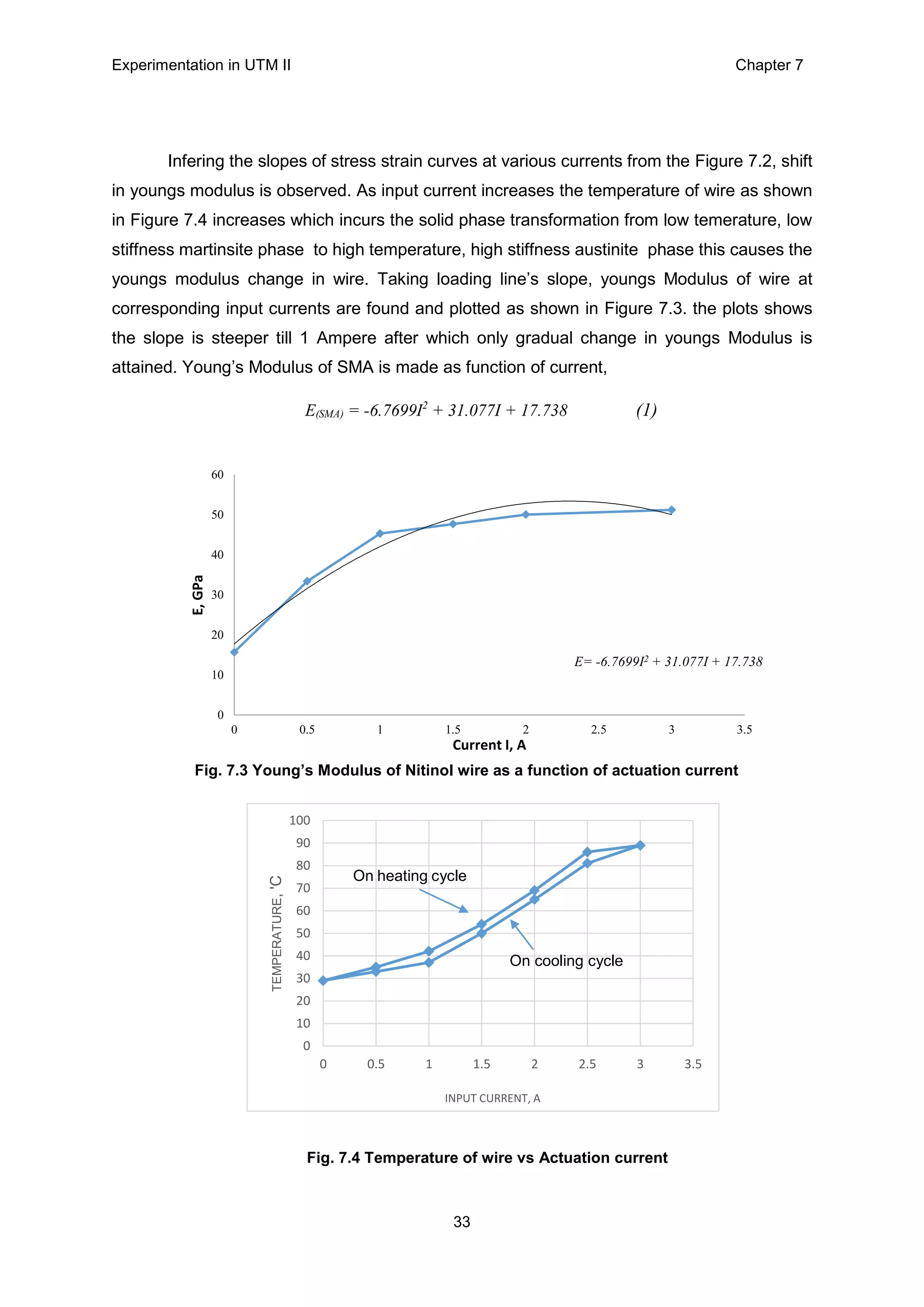
corresponding input currents are found and plotted as shown in Figure 7.3. the plots shows
the slope is steeper till 1 Ampere after which only gradual change in youngs Modulus is
attained. Young’s Modulus of SMA is made as function of current,
E(SMA) = -6.7699I2
+ 31.077I + 17.738 (1)
E= -6.7699I2 + 31.077I + 17.738
0
10
20
30
40
50
60
0 0.5 1 1.5 2 2.5 3 3.5
E,GPa
Current I, A
Fig. 7.3 Young’s Modulus of Nitinol wire as a function of actuation current
0
10
20
30
40
50
60
70
80
90
100
0 0.5 1 1.5 2 2.5 3 3.5
TEMPERATURE,'C
INPUT CURRENT, A
Fig. 7.4 Temperature of wire vs Actuation current
On heating cycle
On cooling cycle
Experimentation in UTM ΙΙ Chapter 7
34
7.4 RESTORING FORCE DUE TO SHAPE MEMORY EFFECT
The wire in the trade name of Flexinol has inbuilt plastic strain of 4%. Once the
wire temperature raises it regains this residual strain and retains its original shape. A test is
made to find out the force exerted by the wire during its recovery phase. During this process
the wire is fixed between the grippers of UTM shown in Figure 7.5 such that it cannot recover
the residual strain thereby force is experienced and measured via in built load cell present in
UTM. The data is plotted as shown in Figure 7.6.
7.4.1 Result and inference
The restoring force of SMA wire under constrained boundary conditions is found
maximum upto 100 N at corresponding 3 ampere current. This is due to the transition of SMA
from martensite to austenite phase.
0
20
40
60
80
100
120
0 0.5 1 1.5 2 2.5 3 3.5
Restoringforce,N
Input current , A
Fig. 7.5 Experimental step up to test shape memory effect
Fig. 7.6 Restoring force of Nitinol wire as a function of current.
Experimentation in UTM ΙΙ Chapter 7
35
7.5 TENSILE TEST FOR FAILURE
The facture test of SMA is performed in UTM ZWICK / ROEL 2.5 KN. The specimen
of diameter 0.5 mm and 180 mm as gauge length is used. The test is followed as per ASTM
F 2516 with loading rate of 0.4mm per minute
7.5.1 Result and inference
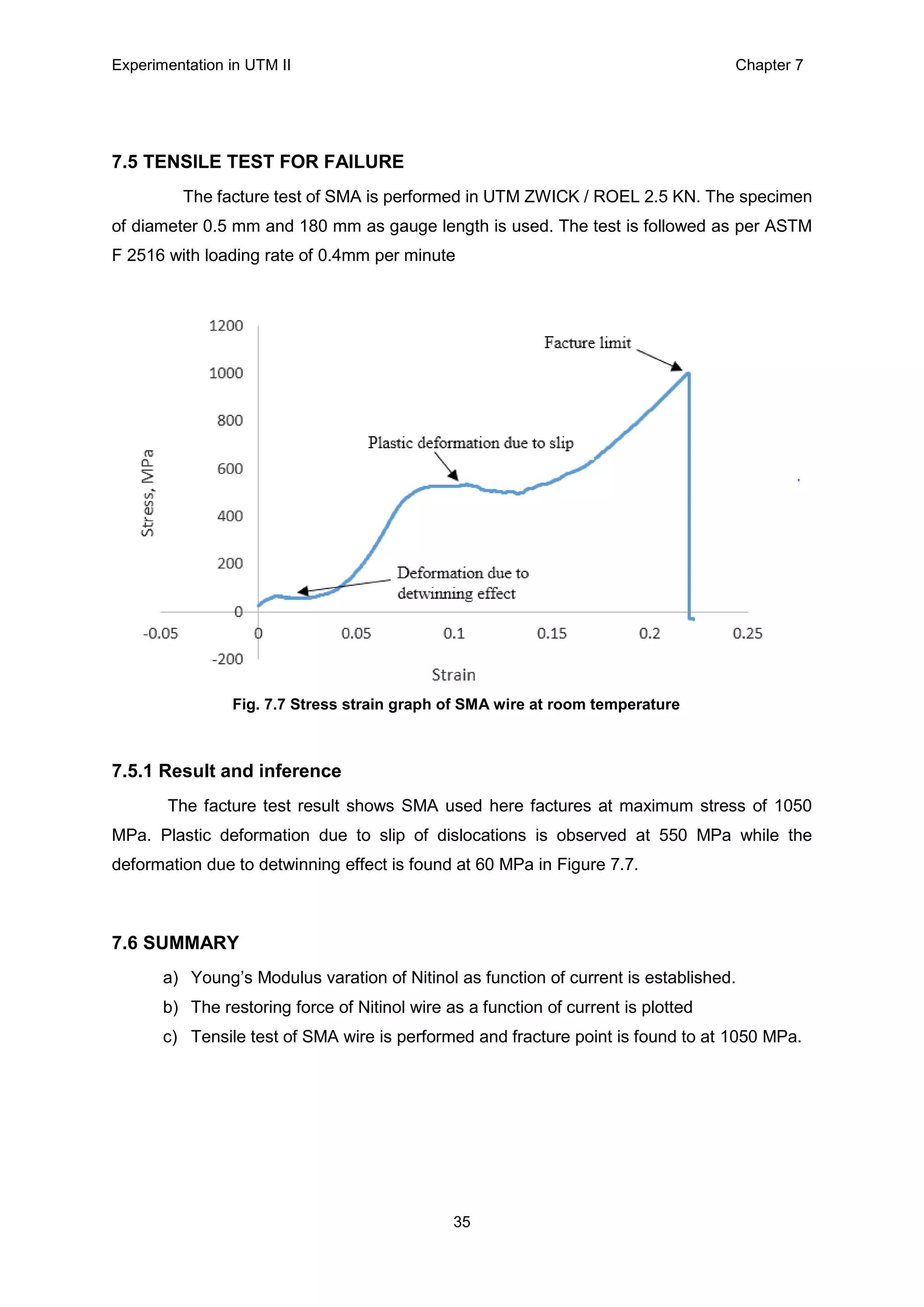
The facture test result shows SMA used here factures at maximum stress of 1050
MPa. Plastic deformation due to slip of dislocations is observed at 550 MPa while the
deformation due to detwinning effect is found at 60 MPa in Figure 7.7.
7.6 SUMMARY
a) Young’s Modulus varation of Nitinol as function of current is established.
b) The restoring force of Nitinol wire as a function of current is plotted
c) Tensile test of SMA wire is performed and fracture point is found to at 1050 MPa.
Fig. 7.7 Stress strain graph of SMA wire at room temperature
Experimental analysis of SMA Embedded GFRP beam Chapter 8
36
CHAPTER 8
EXPERIMENTAL ANALYSIS OF SMA EMBEDDED GFRP
BEAM
8.1 INTRODUCTION
In chapter 7 the variation in Young’s modulus of Nitinol as a function of current is
established, in this chapter an experimentation is made to understand the effects of variation
in Young’s modulus on structural stiffness of a smart beam containing SMA as wire embedded
inside GFRP (Glass Fiber Reinforced Polymer).
8.2 FABRICATION OF SMA EMBEDDED GFRP BEAM
The smart beam containing SMA wire embedded inside GFRP is fabricated using
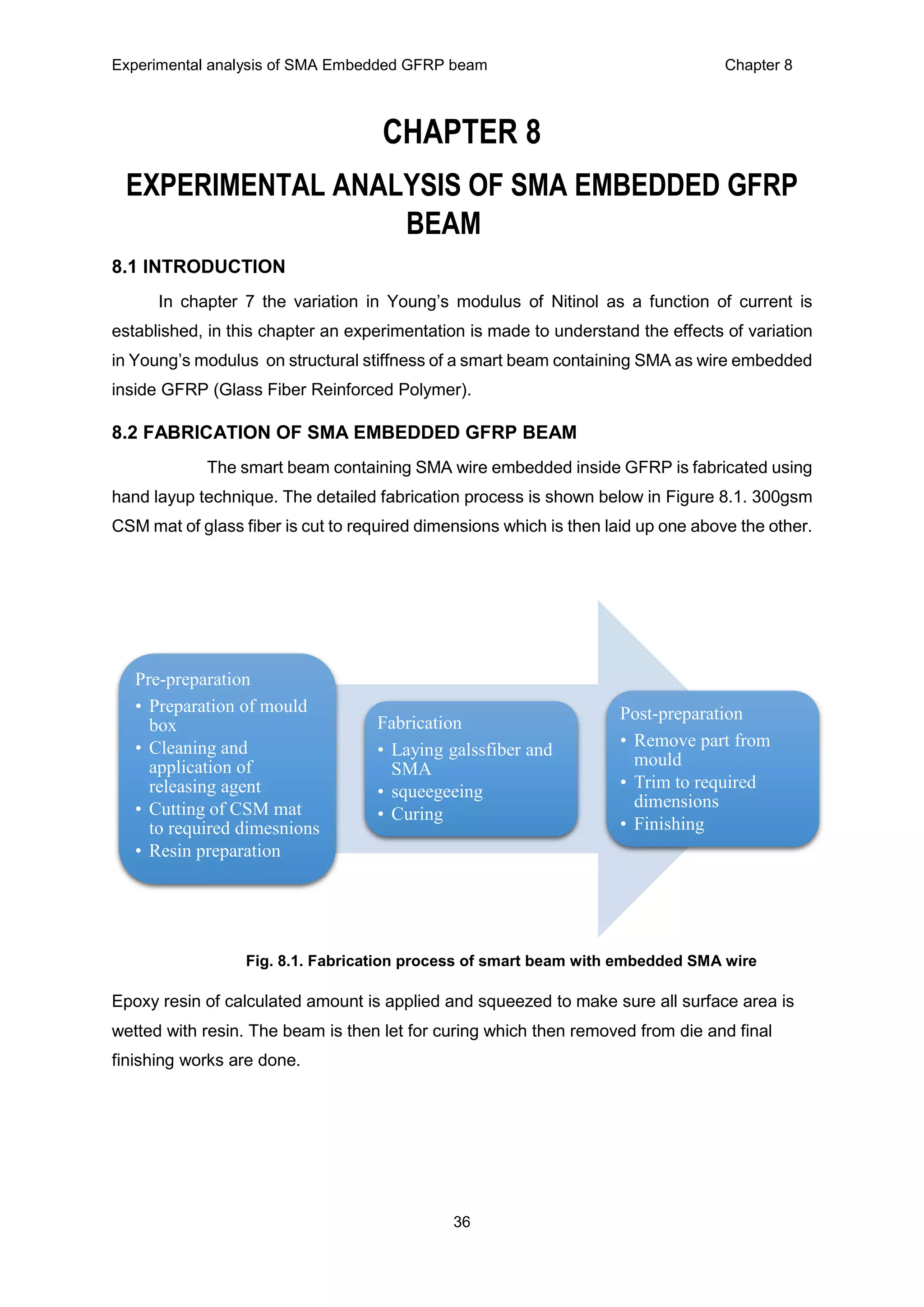
hand layup technique. The detailed fabrication process is shown below in Figure 8.1. 300gsm
CSM mat of glass fiber is cut to required dimensions which is then laid up one above the other.
Fig. 8.1. Fabrication process of smart beam with embedded SMA wire
Epoxy resin of calculated amount is applied and squeezed to make sure all surface area is
wetted with resin. The beam is then let for curing which then removed from die and final
finishing works are done.
Pre-preparation
• Preparation of mould
box
• Cleaning and
application of
releasing agent
• Cutting of CSM mat
to required dimesnions
• Resin preparation
Fabrication
• Laying galssfiber and
SMA
• squeegeeing
• Curing
Post-preparation
• Remove part from
mould
• Trim to required
dimensions
• Finishing
Experimental analysis of SMA Embedded GFRP beam Chapter 8
37
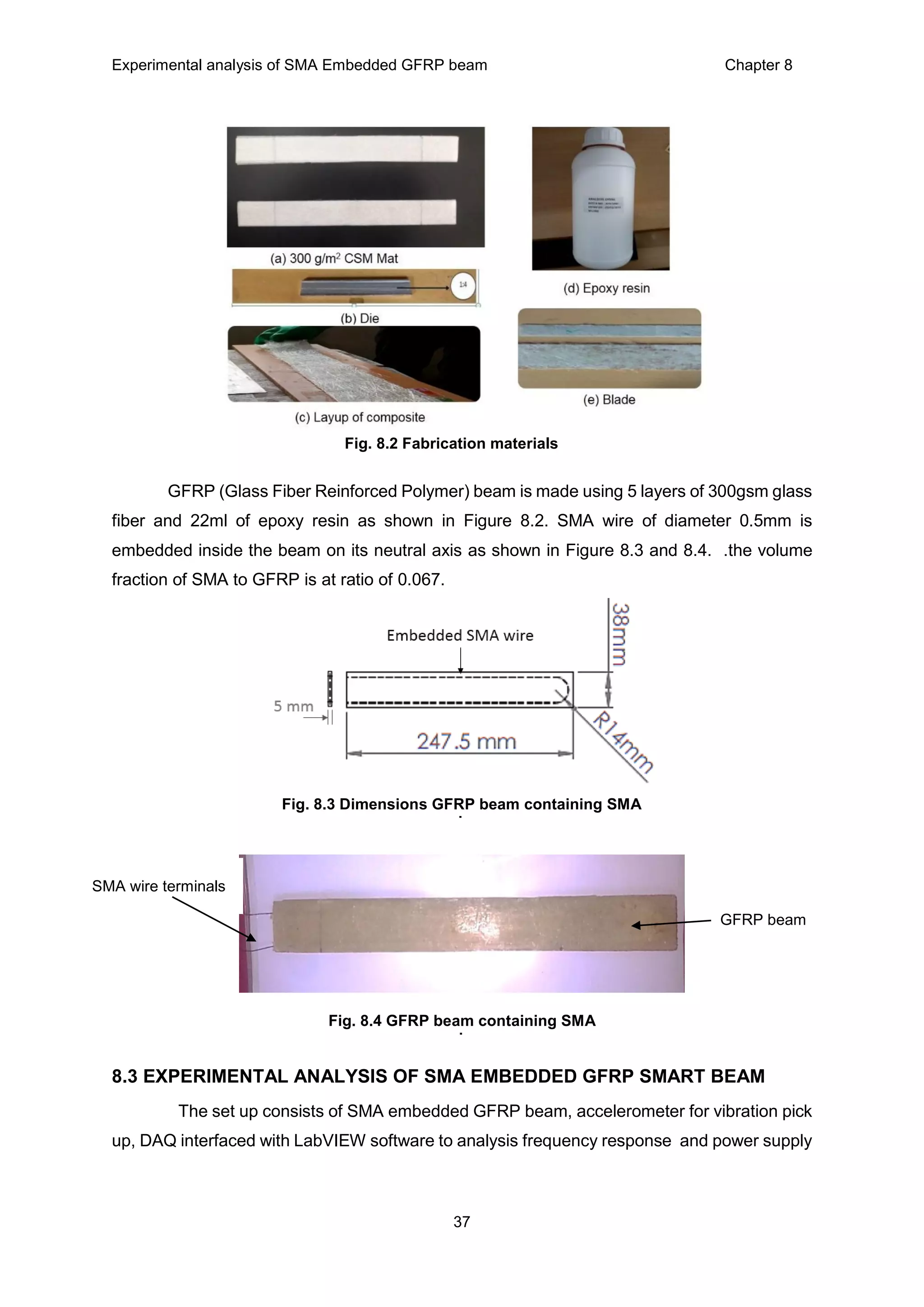
GFRP (Glass Fiber Reinforced Polymer) beam is made using 5 layers of 300gsm glass
fiber and 22ml of epoxy resin as shown in Figure 8.2. SMA wire of diameter 0.5mm is
embedded inside the beam on its neutral axis as shown in Figure 8.3 and 8.4. .the volume
fraction of SMA to GFRP is at ratio of 0.067.
8.3 EXPERIMENTAL ANALYSIS OF SMA EMBEDDED GFRP SMART BEAM
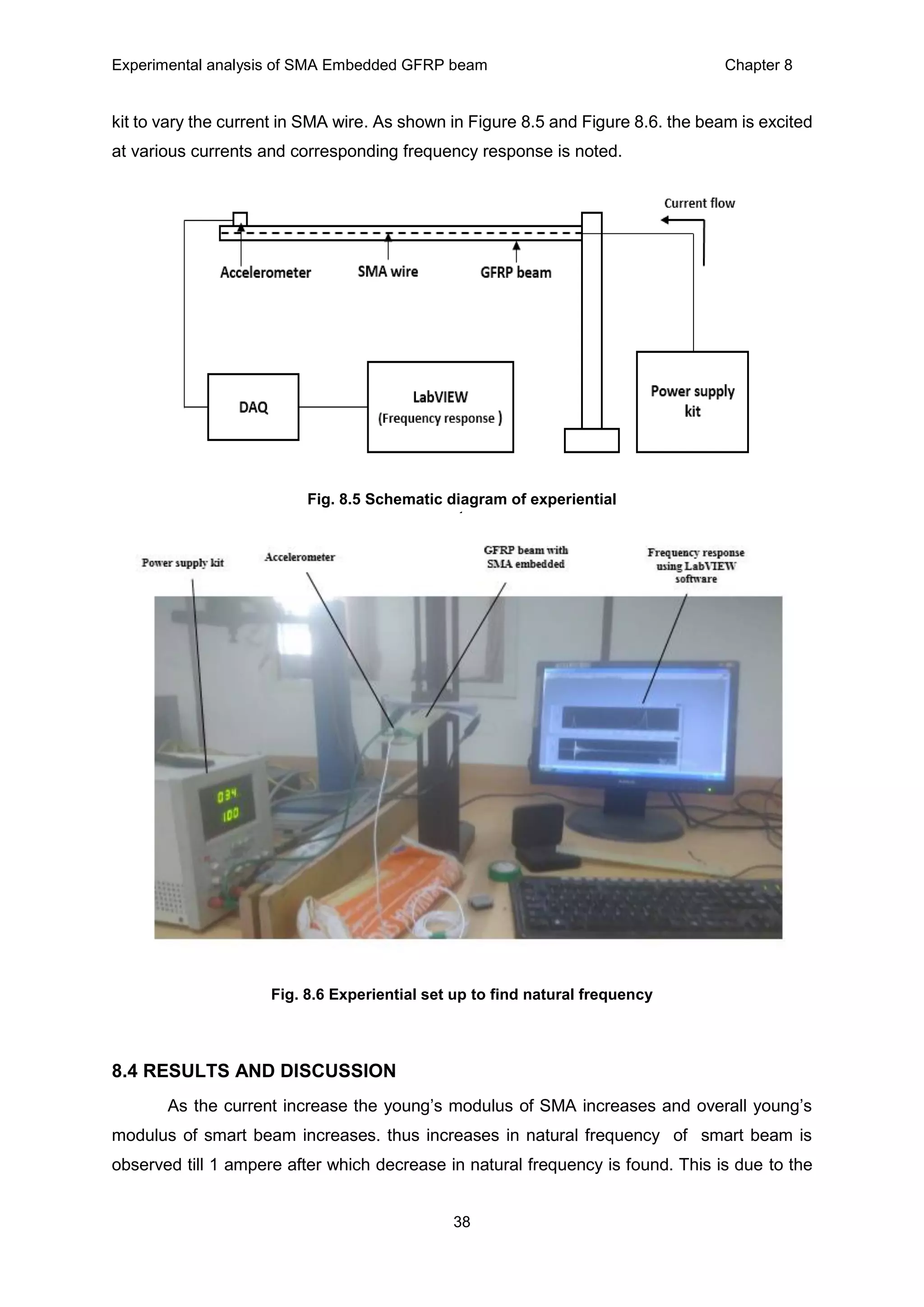
The set up consists of SMA embedded GFRP beam, accelerometer for vibration pick
up, DAQ interfaced with LabVIEW software to analysis frequency response and power supply
Fig. 8.3 Dimensions GFRP beam containing SMA
wire
High SMA wire terminals
GFRP beam
Fig. 8.4 GFRP beam containing SMA
wire
Fig. 8.2 Fabrication materials
Experimental analysis of SMA Embedded GFRP beam Chapter 8
38
kit to vary the current in SMA wire. As shown in Figure 8.5 and Figure 8.6. the beam is excited
at various currents and corresponding frequency response is noted.
8.4 RESULTS AND DISCUSSION
As the current increase the young’s modulus of SMA increases and overall young’s
modulus of smart beam increases. thus increases in natural frequency of smart beam is
observed till 1 ampere after which decrease in natural frequency is found. This is due to the
Fig. 8.5 Schematic diagram of experiential
setup
Fig. 8.6 Experiential set up to find natural frequency
Experimental analysis of SMA Embedded GFRP beam Chapter 8
39
reason that the overall young’s modulus of smart beam depends on both young’s modulus of
GFRP and young’s modulus of SMA.
From the prior experimental study of SMA in chapter 7 shows that as current increases the
young’s modulus of SMA increases due to its solid phase transformation. Once the current
exceeding 1 ampere the overall temperature of beam increases but young’s modulus of GFRP
decreases with increases in temperature. Thus stiffness of overall beam reduces and
decreases in natural frequency is observed in Figure 8.7.
8.6 MATHEMATICAL MODEL OF SMA EMBEDDED GFRP BEAM
In chapter 8 experimental analysis on natural frequency shift of SMA embedded GFRP
beam is presented. A mathematical model is developed to find theoretical natural frequency
shift and it is validated with experimental analysis.
The assumptions made to develop this mathematical model such as the beam is
considered to be cantilever beam subjected to pure bending, and the material properties of
SMA and GFRP is isotropic in nature. For a simple elastic beam problem with uniform
cross section the natural frequency is given by [9],
f(n) =
𝟏
𝟐𝝅
√
𝟑𝑬(𝒄𝒐𝒎𝒃𝒊𝒏𝒆𝒅)𝑰
𝑳 𝟑 𝒎
…………………………………………………………………………………………………………. (2)
Fig. 8.7 Natural frequency of smart beam as a function of current.
155
157
159
161
163
165
167
169
171
173
0 0.5 1 1.5 2 2.5 3
Frequency,Hz
Current, A
Experimental plot
Experimental analysis of SMA Embedded GFRP beam Chapter 8
40
The equivalent bending stiffness EI for smart beam with SMA wires, obtained according to the
classical composite-beam theory can be given as [10],
E(combined) = E(GFRP) (1- V(f)) + V(f) E(SMA)………………………………………………………………………....…………………………………….(3)
Where V(f) = volume of SMA / volume of GFRP
Substuting Equation (1) from chapter 7 in (3) the combined Young’s modulas is given as,
E(combined) = E(GFRP) (1- V(f)) + V(f)(-6.7699I2 + 31.077I + 17.738)……………………………………..…… (4)
Young’s Modulus change of GFRP as a function of temperature is shown in [13] is
incorperated as shown equation (5)
E(combined) = E(GFRP)( - 0.013 T(GFRP) + 1.8367) (1- V(f)) + V(f)(-6.7699I2 + 31.077I + 17.738)...................(5)
Where T(GFRP) = 4.9286 I2 – 5.0071 I + 30.964…………………………………………………………….. (6)
f(n) =
𝟏
𝟐𝝅
√
𝟑( − 𝟎.𝟏𝟑 𝑻(𝐺𝐹𝑅𝑃) + 𝟏𝟖.𝟑𝟔𝟕) (𝟏− 𝑽(𝒇)) + 𝑽(𝒇)(−𝟔.𝟕𝟔𝟗𝟗𝑰𝟐 + 𝟑𝟏.𝟎𝟕𝟕𝑰 + 𝟏𝟕.𝟕𝟑𝟖))𝑰𝒎
𝑳 𝟑 𝒎
………..………... (7)
Where, L, m, Im , vf corresponds to length of beam, mass of beam, moment of inertia of
beam, and volume fraction of SMA to GFRP respectively.
8.7 RESULTS AND DISCUSSION
As the current increase the young’s Modulus of SMA increases and overall young’s
Modulus of smart beam increases. thus increases in natural frequency of smart beam is
observed till 1 ampere after which decrease in natural frequency is found. This is due to the
reason that the overall young’s Modulus of smart beam depends on both young’s Modulus of
GFRP and young’s Modulus of SMA. From the prior experimental study of SMA in chapter 7
shows that as current increases the young’s Modulus of SMA increases due to its solid phase
transformation. Once the current exceeding 1 ampere the overall temperature of beam
increases but young’s Modulus of GFRP decreases with increases in temperature.as shown
in Figure 9.1
Experimental analysis of SMA Embedded GFRP beam Chapter 8
41
8.8 VALIDATION WITH EXPERIMENTAL RESULTS
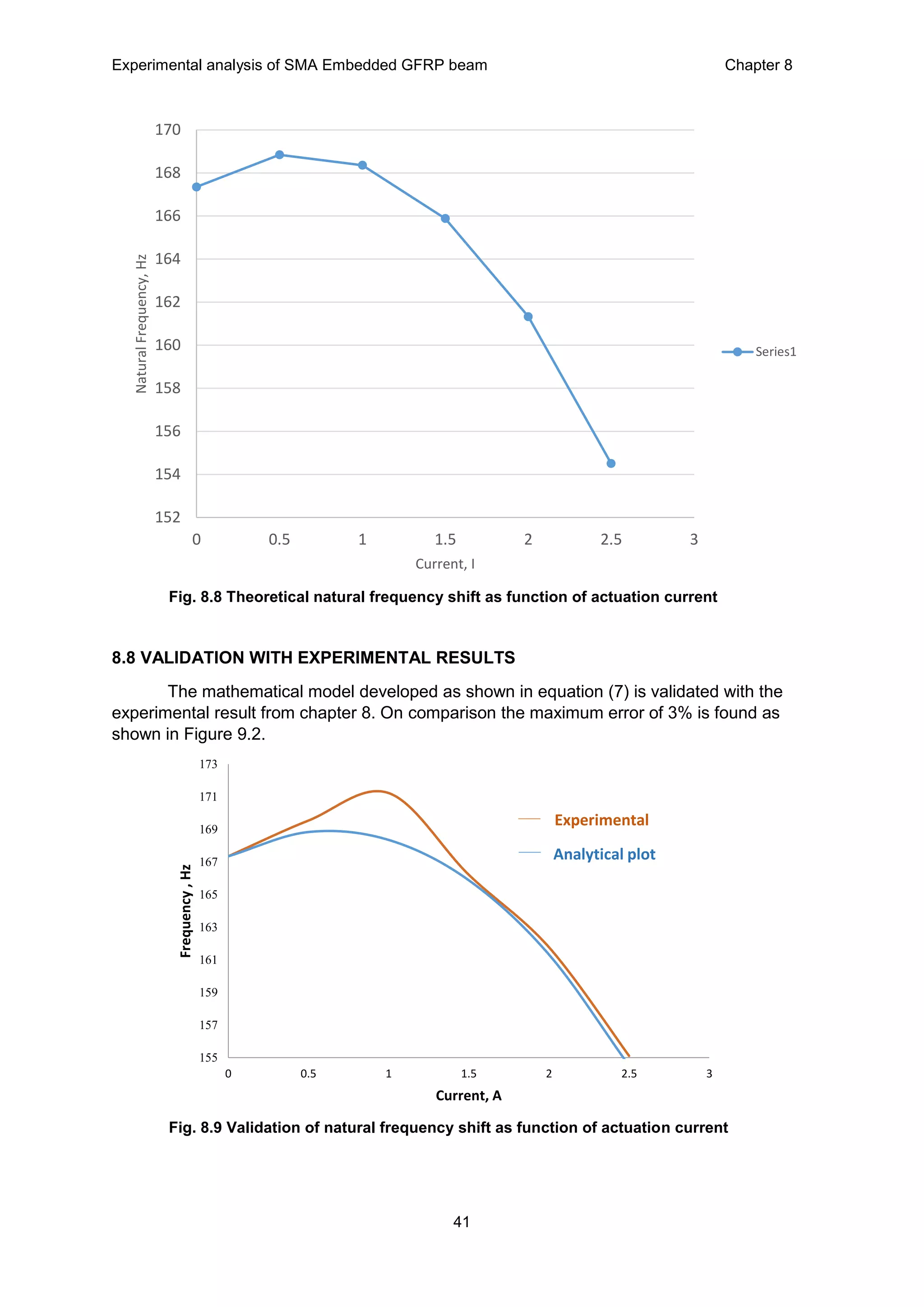
The mathematical model developed as shown in equation (7) is validated with the
experimental result from chapter 8. On comparison the maximum error of 3% is found as
shown in Figure 9.2.
152
154
156
158
160
162
164
166
168
170
0 0.5 1 1.5 2 2.5 3
NaturalFrequency,Hz
Current, I
Series1
155
157
159
161
163
165
167
169
171
173
0 0.5 1 1.5 2 2.5 3
Frequency,Hz
Current, A
Experimental
Analytical plot
Fig. 8.8 Theoretical natural frequency shift as function of actuation current
Fig. 8.9 Validation of natural frequency shift as function of actuation current
Experimental analysis of SMA Embedded GFRP beam Chapter 8
42
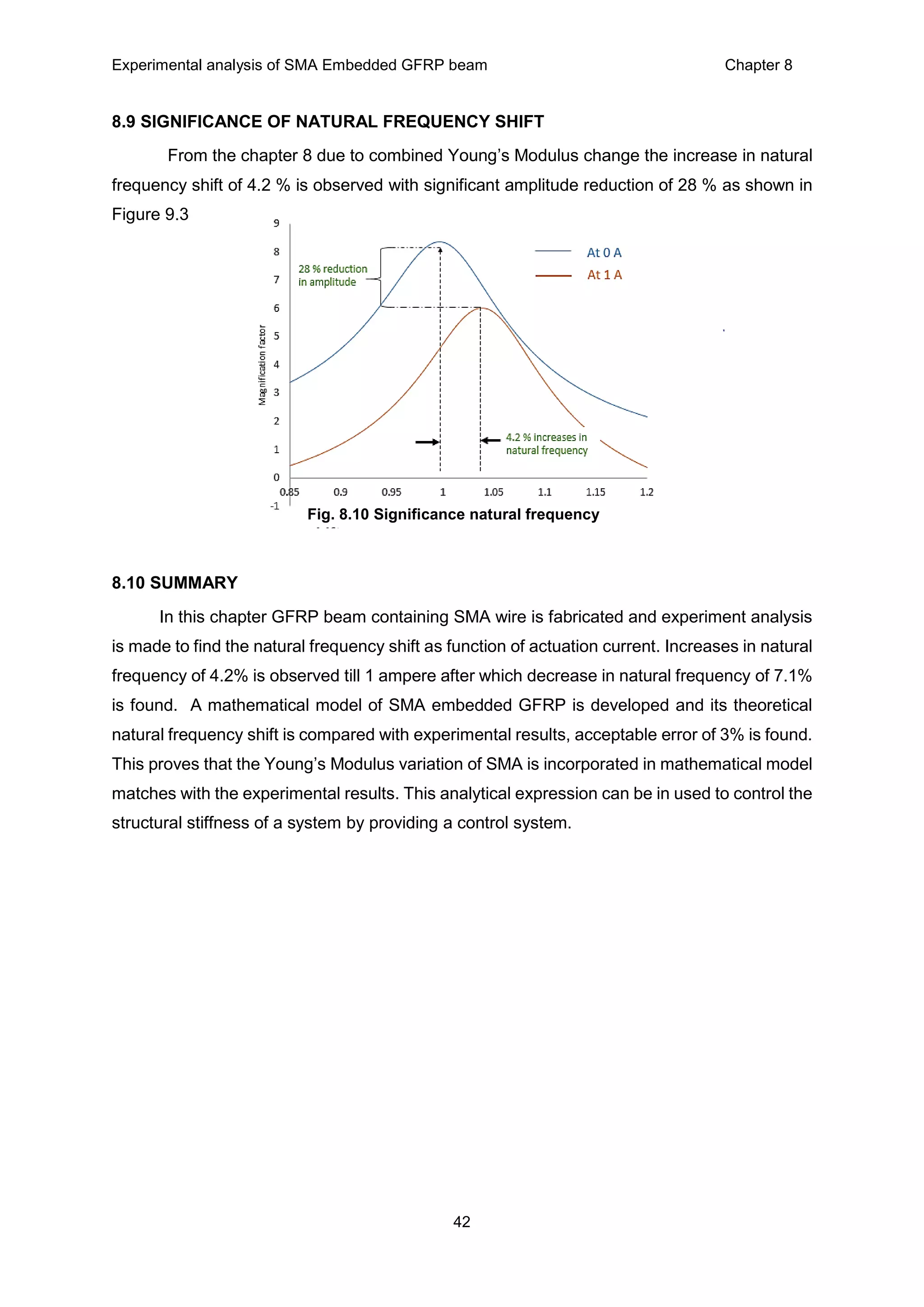
8.9 SIGNIFICANCE OF NATURAL FREQUENCY SHIFT
From the chapter 8 due to combined Young’s Modulus change the increase in natural
frequency shift of 4.2 % is observed with significant amplitude reduction of 28 % as shown in
Figure 9.3
8.10 SUMMARY
In this chapter GFRP beam containing SMA wire is fabricated and experiment analysis
is made to find the natural frequency shift as function of actuation current. Increases in natural
frequency of 4.2% is observed till 1 ampere after which decrease in natural frequency of 7.1%
is found. A mathematical model of SMA embedded GFRP is developed and its theoretical
natural frequency shift is compared with experimental results, acceptable error of 3% is found.
This proves that the Young’s Modulus variation of SMA is incorporated in mathematical model
matches with the experimental results. This analytical expression can be in used to control the
structural stiffness of a system by providing a control system.
Fig. 8.10 Significance natural frequency
shift
Development of Virtual Control System Chapter 9
43
CHAPTER 9
DEVELOPMENT OF VIRTUAL CONTROL SYSTEM
9.1 INTRODUCTION
In this chapter a virtual control system is made using LabVIEW software to control the
structural stiffness of a system containing SMA embedded inside GFRP beam. The control is
achieved by actuation of SMA by supplying required current. The control over natural
frequency of the system and control over amplitude of the system is shown in this chapter.
9.2 CONTROL OVER NATURAL FREQUENCY OF THE SYSTEM
From the chapter 8 the natural frequency of the GFRP beam containing SMA
increases as the young’s modulus of SMA increases and overall young’s modulus of smart
beam increases. thus increase in natural frequency of smart beam is can be controled by
actuation current upto 1 Ampere Due to temperarure incresce of the GFRP beam the natural
frequency decreases from 1 Ampere to 2.5 Ampere. Thus decrease in natural frequency of
smart beam also can be controled by actuation current.
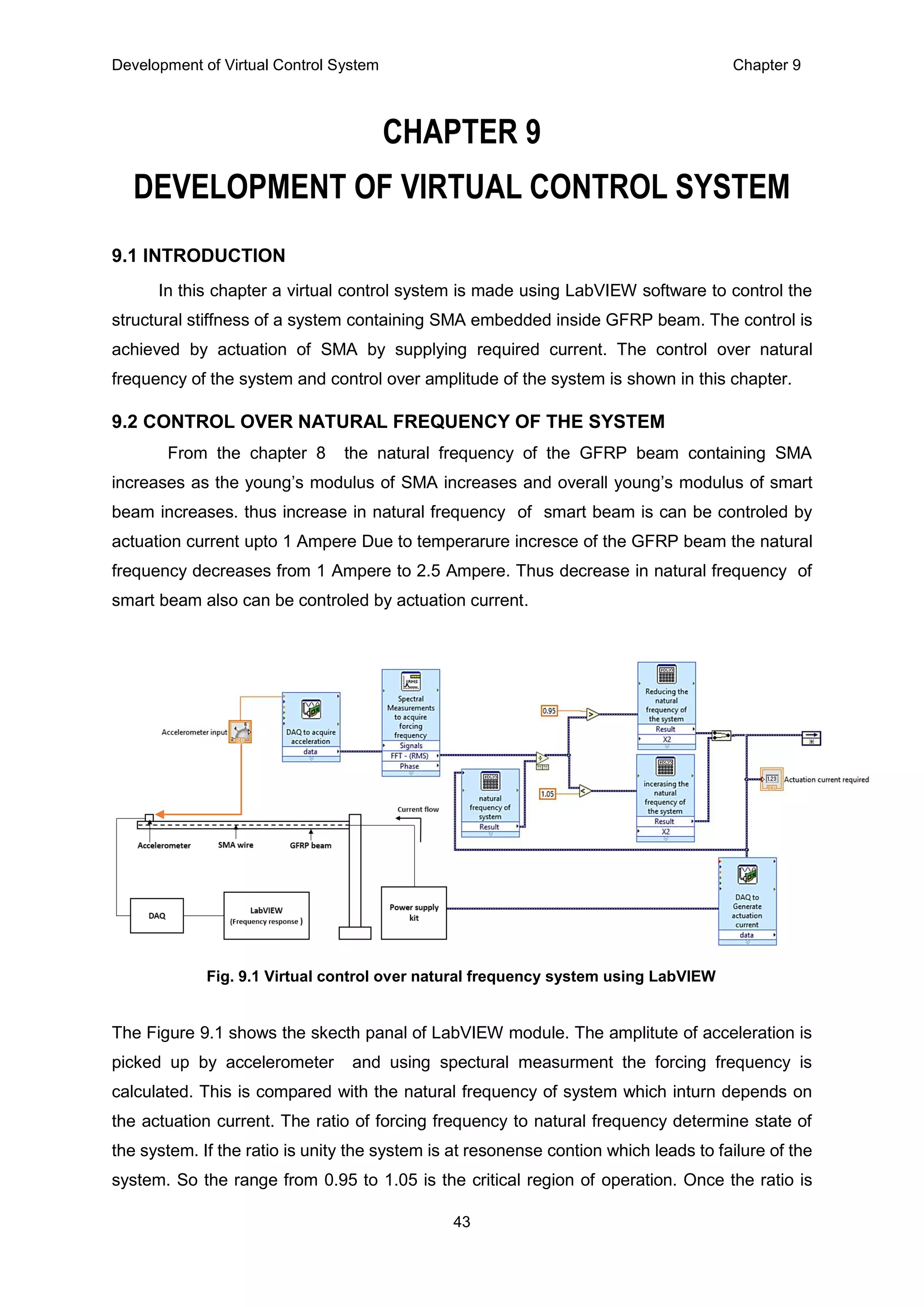
The Figure 9.1 shows the skecth panal of LabVIEW module. The amplitute of acceleration is
picked up by accelerometer and using spectural measurment the forcing frequency is
calculated. This is compared with the natural frequency of system which inturn depends on
the actuation current. The ratio of forcing frequency to natural frequency determine state of
the system. If the ratio is unity the system is at resonense contion which leads to failure of the
system. So the range from 0.95 to 1.05 is the critical region of operation. Once the ratio is
Fig. 9.1 Virtual control over natural frequency system using LabVIEW
Development of Virtual Control System Chapter 9
44
greater than 0.95 and lesser than 1.05 SMA is actuated to increses the natural frequency of
the system such that the forcing frequency is well away from the resonace condtion.
9.3 CONTROL OVER AMPLITUDE OF THE SYSTEM
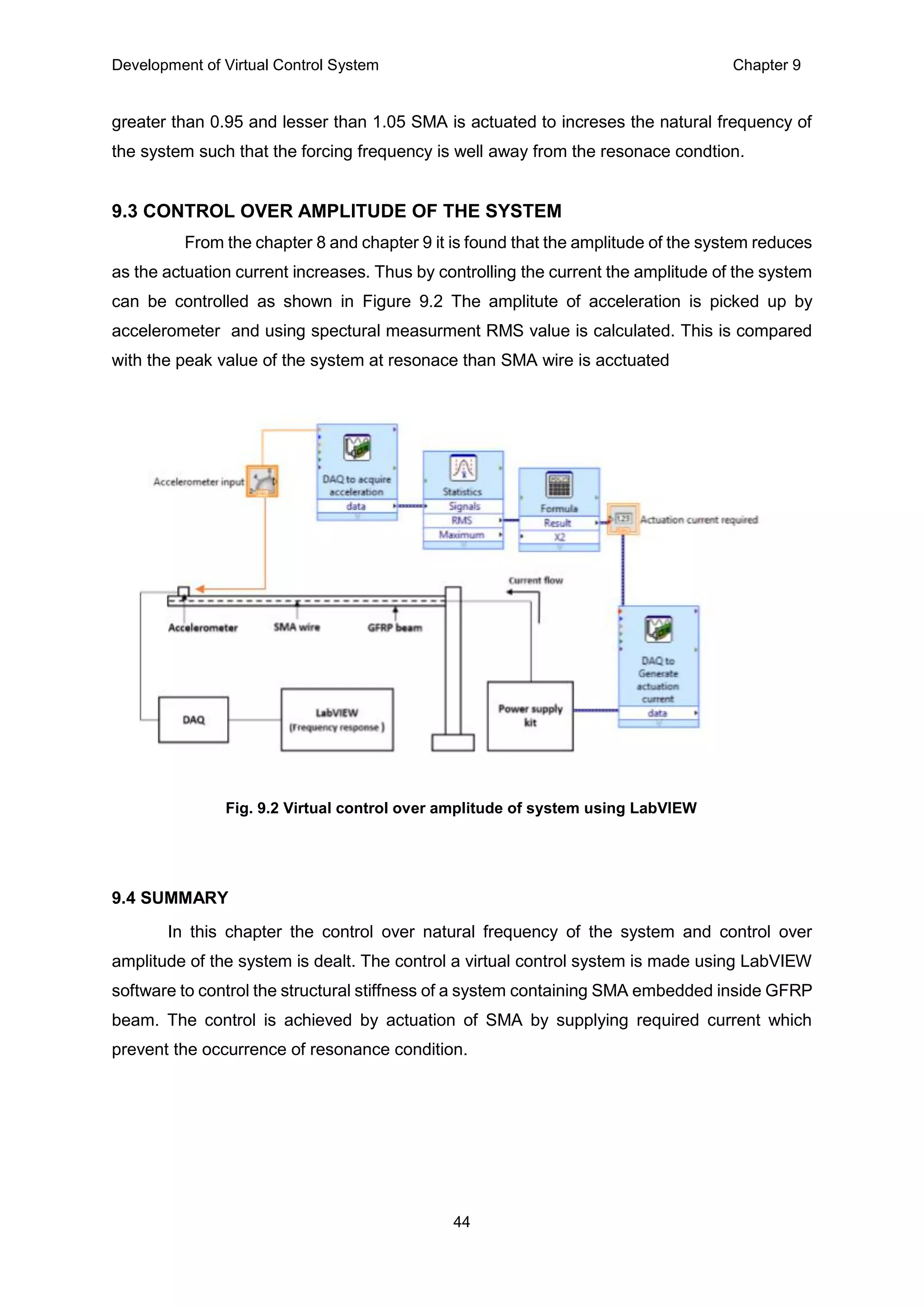
From the chapter 8 and chapter 9 it is found that the amplitude of the system reduces
as the actuation current increases. Thus by controlling the current the amplitude of the system
can be controlled as shown in Figure 9.2 The amplitute of acceleration is picked up by
accelerometer and using spectural measurment RMS value is calculated. This is compared
with the peak value of the system at resonace than SMA wire is acctuated
9.4 SUMMARY
In this chapter the control over natural frequency of the system and control over
amplitude of the system is dealt. The control a virtual control system is made using LabVIEW
software to control the structural stiffness of a system containing SMA embedded inside GFRP
beam. The control is achieved by actuation of SMA by supplying required current which
prevent the occurrence of resonance condition.
Fig. 9.2 Virtual control over amplitude of system using LabVIEW
Conclusion Chapter 10
45
CHAPTER 10
CONCLUSION
10.1 CONCLUSION
In this thesis the experimental analysis on SMA wire is performed using indigenously
made insulated wire gripper which eliminates the slippage and conductivity problems which
occurred in conventional UTM grippers. Young’s modulus variation of SMA due the solid
phase transformation from low temerature, low stiffness martensite phase to high
temperature, high stiffness austenite phase is established as a fucntion of actuation current.
an experimentation is made to understand the effects of Young’s modulus change on
structural stiffness of a smart beam containing SMA as wire embedded inside GFRP (Glass
Fiber Reinforced Polymer) and this work is utilized in virtual control system controlling the
natural frequency of smart structure using LabVIEW software. The results from experimental
study shows the increases in natural frequency shift of 4.2% and significant amplitude
reduction of 28 % is controlled. Control of such system by active monitoring prevents the
failure of dynamic structural elements.
10.2 FUTURE WORK
The future work of this thesis opens its way to analyze
a) Effects of density change of SMA due to phase change
b) Application of recovery force due to Shape memory effect
c) Development of real time control system for specific application
Bibliography
46
BIBLIOGRAPHY
1. H. N. Bhargaw, M. Ahmed, P. Sinha, September 2012, “Thermo-electric behaviour of
NiTi shape memory alloy”, Trans. Nonferrous Met. Soc. China 23(2013) 2329−2335.
2. Kin-tak Lau, January 2002, “Vibration characteristics of SMA composite beams with
different boundary conditions” Materials and Design 23 (2002) 741–749.
3. Sia Nemat-Nasser, Wei-Guo Guo, July 2005, “Superelastic and cyclic response of NiTi
SMA at various strain rates and temperatures”, Mechanics of Materials 38 (2006) 463–
474.
4. Toshibumi FUKUTA1, Masanori IIBA2, Yoshikazu KITAGAWA3, and Yuji SAKAI,
August 1-6, 2004, “Experimental Study On Stress-Strain Property Of Shape Memory
Alloy And Its Application To Self-Restoration Of Structural Members” 13th World
Conference on Earthquake Engineering Vancouver, B.C., Canada.
5. J.M. McNaney, V. Imbeni, Y. Jung b, Panayiotis Papadopoulos, R.O. Ritchie,
September 2002, “An experimental study of the superelastic effect in a shape-memory
Nitinol alloy under biaxial loading”, Mechanics of Materials 35 (2003) 969–986.
6. Costantino Menna, Ferdinando Auricchio, Domenico Asprone, “Applications of Shape
Memory Alloys in Structural Engineering”, ISBN 978-0-08-099920-3.
7. Peter R. Barrett, P.E., “Super Elastic Alloy Eyeglass Frame Design Using the ANSYS
Workbench Environment”.
8. ASTM F 2516 – 06 Standard Test Method for Tension Testing of Nickel-Titanium
Superelastic Materials.
9. Irschik, H.,2002. A Review on static and dynamic shape control of structures by
piezoelectric actuation,Engineering Sturctures 24, p 5-11.
10. Chen, S.H., Wang, Z.D., Liu, X. H.,1997, Active Vibration contol and suppression for
intelligent Sturctures, Journal of Sound and Vibration 20,p 167-77.
Bibliography
47
11. Yuvaraja M, Senthilkumar M Procedia Engineering 64 ( 2013 ) 571 – 581,Comparative
study on Vibration Characteristics of a Flexible GFRP Composite beam using SMA
and PZT Actuators
12. Yuvaraja.M and Senthilkumar.M, ”Smart Material(SMA)-Based Actively Tuned
Dynamic Vibration Absorber for Vibration Control in Real Time Application”, Journal of
Engineering and Technology, Vol 3, Issue 2, Jul-Dec 2013.
13. Gangbing Songa, Bthu Kelly, Bnj N. Agrawal, ” Active Position Control of a Shape
Memory Alloy Wire Actuated Composite Beam”, Dept. of Mechanical Engineering, The
university of Akron, Akron, Ohio 44325 b Aeronautics and Astronautics Dept., Naval
Postgraduate School, Monterey, CA 93943.
14. Williams, K., G. Chiu, and R. Bernhard. "Adaptive-passive absorbers using shape-
memory alloys." Journal of Sound and Vibration 249.5 (2002): 835-848.
15. Santos, Filipe Pimentel Amarante dos. "Vibration control with shape-memory alloys in
civil engineering structures." (2011).
16. Esuff Khan and Sivakumar.M.Sirinivasan, “A New Approach to the Design of Helical
Shape Memory Alloy Spring Actuators”, Smart Materials Research Volume 2011,
Article ID 167195, 5 pages.
17. [17]. S.M.T. Hashemi, S.E. Khadem, “Modelling and analysis of the vibration behaviour
of shape memory alloy beam”, I.E.I Communication Industry Co.
18. Trochu F, Qian YY, “Nonlinear finite element simulation of superelastic shape memory
alloy parts”, Comput Struct 1997; 62(5): 799-810.
Bibliography
48
19. Dolce, Mauro, Donatello Cardone, and Roberto Marnetto. "Implementation and testing
of passive control devices based on shape memory alloys." Earthquake Engineering
& Structural Dynamics 29.7 (2000): 945-968.
20. Amarante dos Santos, F. P., C. Cismaşiu, and J. Pamies Teixeira. "Semi‐active vibration
control device based on superelastic NiTi wires." Structural Control and Health
Monitoring 20.6 (2013): 890-902.

REPORT ON CHARACTERIZATION OF SHAPE MEMORY ALLOY FOR VIBRATION ATTENUATION IN SMART STRUCTURES

  • 1.
    CHARACTERIZATION OF SHAPEMEMORY ALLOY (SMA) AND DEVELOPMENT OF VIRTUAL CONTROL SYSTEM FOR ACTIVE MONITORING OF SMA BASED SMART STRUCTURES Submitted by KANDHAN S (16MD07) Dissertation submitted in partial fulfillment of the requirements for the degree of MASTER OF ENGINEERING Branch: MECHANICAL ENGINEERING Specialisation: ENGINEERING DESIGN of Anna University, Chennai MAY- 2018 DEPARTMENT OF MECHANICAL ENGINEERING PSG COLLEGE OF TECHNOLOGY (Autonomous Institution) COIMBATORE – 641 004
  • 2.
    Acknowledgement i ACKNOWLEDGEMENT I wish toexpress my sincere thanks and indebtedness to various people who were a source of encouragement and guidance at the time of building my project. I wish to express my profound gratitude to our beloved Principal Dr R.Rudramoorthy, PSG College of technology for providing an opportunity and necessary facilities in carrying out this dissertation work. I wish to convey my heartfelt thanks to Dr.P.R.Thyla, Head of the department, Department of Mechanical Engineering, for their encouragement that they extended towards this dissertation work. I like to thank my guide Dr.M.Yuvaraja, Associate Professor, Department of Mechanical Engineering, whose valuable guidance, everlasting enthusiasm and providing freedom throughout the course, made it possible to complete this dissertation work. I would like thank Mr.Jagadeesh Veeraragu, Research Fellow, Department of Mechanical Engineering, whose support and guidance made me to do this dissertation work. I also like to thank our program coordinator Dr.M.Yuvaraja, Associate Professor and my tutor, Dr.M.Martin suresh babu, Associate Professor Department of Mechanical Engineering, for their constant support and guidance that provided a moral encouragement and played a vital role in completing our project. I take immense pleasure in expressing my sincere heartfelt thanks to the lecturers of Mechanical Engineering department, for their valuable guidance and suggestions at every stage for the completion of this project. Finally I would like to thank all lab assistants and student colleagues without whom this dissertation work would not have been completed successfully.
  • 3.
    Abstract ii ABSTRACT The application ofSMA (Shape Memory Alloy) as an actuator is widely spreading and its versatile application is only possible if the characterizations under various operating conditions are known. It is necessary for thermo-mechanical characterization of Ni-Ti SMA wire that can be useful in designing a precisely controlled actuator. Vibration characteristics of smart structure containing SMA wire in embedded form is not well established, since the Young’s Modulus change of SMA with respect to actuation current is not explicitly known. In this study the Young’s Modulus variation of SMA due the solid phase transformation from low temerature, low stiffness martensite phase to high temperature, high stiffness austenite phase is established as a fucntion of actuation current and utilized in virtual control system controlling the structural stiffness of SMA embedded in GFRP smart structure. The results from experimental study shows increases in natural frequency shift of 4.2% and significant amplitude reduction of 28 %.Control of such system by active monitoring prevents the failure of dynamic structural elements.
  • 4.
    Contents iii CONTENTS CHAPTER PAGE NO. ACKNOWLEDGMENT..……………………….………………………………………………………………….……….......i ABSTRACT..…………………………..….…………….…………………………………………………………...….…………..ii CONTENTS………………………….………..……………………………..….…………………………..………......iii LISTOFFIGURES..…………..….….…………………………………………………………..….………………….……....vi LIST OF TABLES.……………………..….…………….…………………………………..….……………………….….....viii LIST OF ABBREVIATIONS…….…………………….……………………………………..….………………..…………ix LIST OF SYMBOLS…..………………………………..….…………………………………………………………..………..x 1 INTRODUCTION……………………………………………..….………………………………………………..........1 1.1 Shape Memory Alloy 1 1.2 Phase Transformation 2 1.3 One way Shape Memory Effect 4 1.4 Two way Shape Memory Effect 4 1.5 Effect of Alloying 5 1.6 Application of Shape memory alloy 6 1.7 Summary 6 2 LITERATURE REVIEW……………………………………………..….……………….……………………………..7 2.1 Literature outcomes 10 3 PROBLEM DEFINITION AND METHODOLOGY…………..….………….…………………………..11 3.1 Problem definition 11 3.2 Objectives 11 3.3 Methodology 11 4 SELECTION OF SMA.………………………………………………………………...….…………………………..13 4.1 Types of SMA 13 4.2 Nitinol as Wires 14 4.3 Nitinol Wires as Actuator 15 4.4 Sourcing of Nitinol Wires 15 4.5 Summary 17 5 EXPERIMENTATION IN UTM....……………………….………………..….…………………………………..18 5.1 Introduction 18 5.2 Experiment Setup overview 18 5.3 ASTM F 2516 Standard Testing Method for NITINOL 19 5.4 Testing Procedure 21
  • 5.
    Contents iv 5.5 Selection ofGripper 21 5.6 Results of experimentation 23 5.7 Proposed Gripper Design 23 5.8 Summary 24 6 DESIGN AND FABRICATION OF INSULATED WIRE GRIPPER……………..........25 6.1 Introduction 25 6.2 Design of wire gripper 25 6.3 Design check of modeled wire gripper 26 6.4 Fabrication of wire gripper 29 6.5 Summary 30 7 EXPERIMENTATION TO EVALUVATE YOUNG’S MODULUS…………..………….31 7.1 Introduction 31 7.2 Experimentation on Nitinol wire 31 7.3 Results and discussion 32 7.4 Restoring force due to Shape memory effect 34 7.5 Tensile test for failure 35 7.6 Summary 3 5 8 EXPERIMENTAL ANALYSIS OF SMA EMBEDDED GFRP BEAM…………………36 8.1 Introduction 36 8.2 Fabrication of SMA embedded GFRP beam 36 8.3 Experimental analysis of SMA Embedded GFRP smart beam 37 8.4 Results and discussion 38 8.5 Mathematical model of SMA embedded GFRP beam 39 8.6 Results and discussion 40 8.7 Validation with experimental results 41 8.8 Significance of natural frequency shift 42 8.9 Summary 42 9 DEVELOPMENT OF VIRTUAL CONTROL SYSTEM…………………………………43 9.1 Introduction 43 9.2 Control over natural frequency of the system 43 9.3 Control over amplitude of the system 44 9.4 Summary 44
  • 6.
    Contents v 10 CONCLUSION …………………………………………………………………………45 10.1Conclusion 45 10.2 Future work 45 BIBLIOGRAPHY………………………………………………………….46 LIST OF PUBICATIONS……………………..…………………………………………49
  • 7.
    List of Figures vi LISTOF FIGURES Figure No. Title Page No. 1.1 Phase transformation in 3D stress strain temperature 3 1.2 Lattice invariant shear accommodation 3 1.3 One way shape memory effect and Two way shape memory effect 5 1.4 Nickel-Titanium composition 5 3.1 Methodology 12 4.1 SMA Sheets and Wire Forms 13 4.2 NITINOL wires 14 4.3 Flow chart of SMA wire as an actuation source 15 5.1 Experimental setup 18 5.2 Loading rates corresponding to the different wire diameters 19 5.3 Typical Stress Strain Diagram of Superelastic Nitinol 20 5.4 ZWICK / ROEL 2.5 KN UTM 20 5.5 Gripper containing rubber pads 21 5.6 Steel jaws gripper 22 5.7 Griper containing Steel hook 22 5.8 Experimentation graph of Force vs Strain 23 5.9 Grippers used for testing copper wires 23 5.10 Redesigned Gripper 24 5.11 Exploded view of the Redesigned gripper 24 6.1 UTM collar pin arrangement 25 6.2 Drafted drawings of wire gripper using SOLIDWORKS 2015 26 6.3 Loading condition on gripper 26 6.4 Bending load conditions 27 6.5 Shear load conditions 27
  • 8.
    List of Figures vii 6.6Pin bending load conditions 28 6.7 Fabrication of gripper 29 6.8 Final assembled gripper 29 6.9 Final assembled gripper in UTM 30 7.1 Experimentation on Nitinol wire 31 7.2 Stress and strain curve of Nitinol wire as a function of actuation current 32 7.3 Young’s modulus of Nitinol wire as a function of actuation current 33 7.4 Temperature of wire vs Actuation current 33 7.5 Experimental step up to test shape memory effect 34 7.6 Restoring force of Nitinol wire as a function of current 34 7.7 Stress strain graph of SMA wire at room temperature 35 8.1 Fabrication process of smart beam with embedded SMA wire 36 8.2 Fabrication materials 37 8.3 Dimensions GFRP beam containing SMA wire 37 8.4 GFRP beam containing SMA wire 37 8.5 Schematic diagram of experiential setup 38 8.6 Experiential set up to find natural frequency 38 8.7 Natural frequency of smart beam as a function of current 39 8.8 Theoretical natural frequency shift as function of actuation current 41 8.9 Validation of natural frequency shift as function of actuation current 41 8.10 Significance natural frequency shift 42 9.1 Virtual control over natural frequency system using LabVIEW 43 9.2 Virtual control over amplitude of system using LabVIEW 44
  • 9.
    List of Tables viii LISTOF TABLES TABLE NO. TITLE PAGE NUMBER 4.1 Material properties of NITINOL 14 4.2 Specification of NITINOL wires 17 5.1 Nitinol wire specifications for testing 19 6.1 Dimensions of insert pin and shaft collar 25
  • 10.
    List of Abbreviations ix LISTOF ABBREVIATIONS ABREVATIONS MEANINGS SMA Shape Memory Alloy Nitinol Nickel Titanium alloy Ni-Ti Nickel Titanium alloy M Martensite A Austenite Mf Martensite finish Ms Martensite start As Austenite start Af Austenite finish UTM Universal Testing Machine ASTM American Society of Testing and Materials ASTM ‘F’ Materials for Specific Applications ASTM F 2516 Testing Standard for Nickel-Titanium Superelastic Materials LPS Lower Plateau Strength UPS Upper Plateau Strength GFRP Glass Fiber Reinforced Polymer SPECS Specifications MS Mild Steel LabVIEW Laboratory Virtual Instrument Engineering Workbench DAQ Data Acquisition
  • 11.
    List of Symbols x LISTOF SYMBOLS SYMBOLS MEANINGS f(n) Natural frequency of system E(SMA) Young’s Modulus of SMA E(GFRP) Young’s Modulus of GFRP E(combined) Combined Young’s modulus of the smart beam (SMA wire embedded inside GFRP) V(f) Volume fraction of SMA to GFRP T(GFRP) Temperature of GFRP beam L Length of smart beam m Mass of smart beam Im Moment of inertia of Smart beam’s cross section ω Forcing frequency in radians ωn Natural frequency of system in radians I Actuation current A Ampere (measuring unit of current) MPa Mega Pascal (measuring unit of stress) N Newton (measuring unit of force)
  • 12.
    Introduction Chapter 1 1 CHAPTER1 INTRODUCTION 1.1 SHAPE MEMORY ALLOY Shape memory alloys (SMAs) are family of smart materials. They have the ability to change their shape depending on their transformation temperatures. SMA, in particular nickel– titanium alloy (Nitinol), is a metallic alloy that exhibits shape memory effect. When it deforms at low temperatures, it has the ability to return to its predetermined shape, if heated above its transformation temperature. The returning to its predetermined shape is the result of crystalline structure transformation from low temperature martensite (M) phase to high temperature austenite (A) phase. These two phases have same chemical compositions except dissimilarity in crystallographic structures. Hence, they show dissimilarities in their thermal, mechanical and electrical properties [1]. The high-temperature austenitic phase is more rigid and stronger as compared with low temperature martensite phase. The low-temperature phase is also known as twinned martensite phase where each layer is separated by a twinning boundary. This state is highly malleable and has very low elastic limit. When external stress is applied at this state, the material changes into detwinned variant of martensite phase that stores generated strain. The strain can be recovered by heating the material at higher temperatures. During strain recovery, the alloy contracts and exhibits large force against external resistance [3]. It finally transforms into austenite phase. The thermal hysteresis represents material transformation characteristic, which provides four distinct transformation temperatures. Ms and Mf represent the start and finish temperatures of martensite, while As and Af are the start and finish temperatures of austenite. It changes its status with heating current. The shape change in the material is observed by its elastic and plastic deformation as well as thermal expansion and contraction. a) Mf : Martensite finish, this is the lowest temperature, below all of the material has the soft martensitic structure b) Ms : Martensite start, an intermediate temperature, when the martensite phase starts to appear in the prevalently austenitic phase c) As : Austenite start, an intermediate temperature, when the austenite phase starts to appear in the prevalently martensitic phase d) Af : Austenite finish, this is the highest temperature, above which all of the material has the hard martensitic structure. Super elastic SMA are designed to work over this temperature, while the thermal-induced memory effect finishes at this temperature.
  • 13.
    Introduction Chapter 1 2 Flexinolactuator wire is trade name for shape memory alloy actuator wires as shown Made of nickel-titanium these small diameter wires contact (typically 2% to 5% of their length) like muscle when electricity driven or heated. This ability to flex or shorten is a characteristic of certain alloy, which dynamically change their internal structure at certain temperature. The idea of reaching higher temperatures electrically came with the light bulb, but instead of producing light, these alloys contract by several percent of their length when heated and can then be easily stretched out again as they cool back to room temperature. Many tasks currently accomplished with small motors or solenoids, wax actuators, piezo and bi-metals can be improved with Flexinol actuator wires. The two main types of shape-memory alloys are copper-aluminum-nickel, and nickel titanium (Ni-Ti) alloys but SMAs can also be created by alloying zinc, copper, gold and iron. Although iron-based and copper-based SMAs, such as Fe-Mn-Si, Cu-Zn-Al and Cu-Al-Ni, are commercially available and cheaper than Ni-Ti, Ni-Ti based SMAs are preferable for most applications due to their stability, practicability and superior thermo-mechanic performance. SMAs can exist in two different phases, with three different crystal structures (i.e. twinned martensite, de-twinned martensite and austenite) and six possible transformations. Ni-Ti alloys change from austenite to martensite upon cooling; Mf is the temperature at which the transition to martensite completes upon cooling. Accordingly, during heating as and Af are the temperatures at which the transformation from martensite to austenite starts and finishes. Repeated use of the shape-memory effect may lead to a shift of the characteristic transformation temperatures (this effect is known as functional fatigue, as it is closely related with a change of microstructural and functional properties of the material).The maximum temperature at which SMAs can no longer be stress induced is called Md, where the SMAs are permanently deformed. The transition from the martensite phase to the austenite phase is only dependent on temperature and stress, not time, as most phase changes are, as there is no diffusion involved. Similarly, the austenite structure receives its name from steel alloys of a similar structure. It is the reversible diffusion less transition between these two phases that results in special properties. While martensite can be formed from austenite by rapidly cooling carbon-steel, this process is not reversible, so steel does not have shape-memory properties. 1.2 PHASE TRANSFORMATIONS In general, the shape memory event is based on the ability of the material to change its crystal structure, in other words transforming from one crystal structure to another. In shape memory alloys this transformation is usually referred to as martensite transformation.
  • 14.
    Introduction Chapter 1 3 Fig.1.1 Phase transformation in 3D stress strain temperature When a material changes the phase the rearranging of atoms that takes place is referred to as transformation as shown in Figure 1.1. In solids there are two known types of transformation: Displacive and Diffusional In diffusional transformation the rearranging of atoms occurs across long distances [8]. The new phase formed by diffusional transformation is of different chemical composition than that of the parent phase. In contrast, a displacive transformation occurs by the movement of atoms as a unit, with each atom contributing a small portion of overall displacement. In a displacive transformation the bonds between that atoms are not broken rather than arranged, thus leaving the parent phase chemical composition matrix intact. Martensite transformation id shape memory alloys are of displacive type and transformation takes place between Austenite also usually referred to as the parent phase and Martensite. The second step of the martensitic transformation depicts the accommodation process required as a result of shape change as shown in Figure 1.2. This process of accommodation is called lattice invariant shear can be accomplished in two ways: Slip and Twinning. Fig. 1.2 Lattice invariant shear accommodation (b) slip (c) twinning
  • 15.
    Introduction Chapter 1 4 Slippingdoes not preserve all the bonds between the unit atomic cells in martensite making the transformation irreversible. On other hand, twinning is a reversible process that allows the material to transform back to its parent shape. Since shape memory behavior is reversible that accommodation mechanism takes place in them is twinning. The mirroring plane on which twinning occurs is usually termed the twin boundary since twin boundaries can be readily moved, the inclusion of an external shear stress can alter the twinned martensite state of the matrix to reflect only one variant of twinning. 1.3 ONE WAY MEMORY EFFECT When a shape-memory alloy is in its cold state (below As), the metal can be bent or stretched and will hold those shapes until heated above the transition temperature. Upon heating, the shape changes to its original. When the metal cools again it will remain in the hot shape, until deformed again. With the one-way effect, cooling from high temperatures does not cause a macroscopic shape change (refer Figure 1.3). A deformation is necessary to create the low temperature shape. On heating, transformation starts at As and is completed at Af (typically 2 to 20 °C or hotter, depending on the alloy or the loading conditions). As is determined by the alloy type and composition and can vary between −150 °C and 200 °C. 1.4 TWO WAY MEMORY EFFECT The two-way shape-memory effect is the effect that the material remembers two different shapes: one at low temperatures, and one at the high-temperature shape. A material that shows a shape-memory effect during both heating and cooling is said to have two-way shape memory as shown in Figure 1.3. This can also be obtained without the application of an external force (intrinsic two-way effect). The reason the material behaves so differently in these situations lies in training. Training implies that a shape memory can "learn" to behave in a certain way. Under normal circumstances, a shape-memory alloy "remembers" its low-temperature shape, but upon heating to recover the high-temperature shape, immediately "forgets" the low temperature shape. However, it can be "trained" to "remember" to leave some reminders of the deformed low-temperature condition in the high-temperature phases. There are several ways of doing this. A shaped, trained object heated beyond a certain point will lose the two- way memory effect.
  • 16.
    Introduction Chapter 1 5 Fig.1.3 One way shape memory effect and two way shape memory effect 1.5 EFFECT OF ALLOYING Nitinol is typically composed of approximately 50 to 51% nickel by atomic percent (55 to 56% weight percent). Making small changes in the composition can change the transition temperature of the alloy significantly as shown in Figure 1.4. Transformation temperatures in nitinol can be controlled to some extent, where Af temperature ranges from about −20 °C to +110 °C. Thus, it is common practice to refer to a nitinol formulation as "super elastic" or "austenitic" if Af is lower than a reference temperature, while as "shape memory" or "martensitic" if higher. The reference temperature is usually defined as the room temperature or the human body temperature (37 °C; 98 °F). Fig. 1.4 Nickel-Titanium composition .
  • 17.
    Introduction Chapter 1 6 1.6APPLICATION OF SHAPE MEMORY ALLOY Shape memory alloys are a proven smart material with the capability to produce work over large areas without producing residual strains. This allows the material to span many depths of applications [7] in areas such as the mechanical, medical and aerospace fields. SMA materials have been applied to stent operations in the medical field where its hysteretic behavior fits the stress strain behavior of human bones and tendons while additionally providing a resistance to radial forces. The minimum energy required for actuation of SMAs along with the material’s ability to comply with composite materials has allowed it to thrive in structural connections of space systems. SMAs are a prime candidate to replace bolts and rivets in this application which can significantly degrade the properties of the structures. Implementation of SMA materials in beam shaped structures has been confirmed to impact the vibrational behavior of the structures both numerically and experimentally. The introduction of the shape memory effect, whereby the shape memory alloy material acts as both a damper and a means of variable stiffness is a novel technique for high cycle fatigue mitigation. The impact SMAs have on the vibrational behavior of structures would greatly benefit systems experiencing harmful flutter vibration. 1.7 Summary Thus the inherent properties of SMA such as solid phase transformations from low temperature, low stiffness martensite phase to high temperature, high stiffness austenite phase, and application of SMA has been dealt in this chapter.
  • 18.
    Literature review Chapter2 7 CHAPTER 2 LITERATURE REVIEW This chapter explains various existing works related applications of SMA and vibration disturbances in smart structures along with control methodology. H. N. Bhargaw et al [1] presented the thermo-electric behavior of shape memory alloy (SMA) wire. When the wire was electrically heated above its transformation temperature by current, a large mechanical force is exerted due to transformation in its phases. In order to make use of SMA wire as an actuator, different parameters and their relationships were investigated. These parameters are recoverable strain (displacement), temperature hysteresis and electrical resistance variation under different stress levels. Optimum safe heating current was assessed and phase transformation temperatures were estimated by heat transfer model. Kin-tak Lau et al [2] presented the development of shape memory alloy (SMA) actuators, in the forms of wire, thin film and stent have been found and increasingly in the fields of materials science and smart structures and engineering. The increase in attraction for using these materials is due to their many unique materials, mechanical, thermal and thermal-mechanical properties, which in turn, evolve their subsequent shape memory, pseudo-elasticity and super-elasticity properties. In this paper, a common type of SMA actuator, Nitinol wires, were embedded into advanced composite structures to modulate the structural dynamic responses, in terms of natural frequency and damping ratio by using its shape memory and pseudo-elastic properties. Sia Nemat-Nasser et al [3] showed To characterize the thermomechanical response, especially the superelastic behavior of NiTi shape-memory alloys (SMAs) at various temperatures and strain rates, we have performed a series of both quasi-static and dynamic uniaxial compression tests on cylindrical samples, repeated dynamic tests of the alloy produce smaller changes in the shape of the superelastic loop and in the dissipated energy than do the quasi- static cyclic tests; and the superelastic behavior of this material has stronger sensitivity to temperature than to strain rate; at very high loading rates Toshibumi Fukuta et al [4] Mechanical properties of shape memory alloy (hereinafter referred to as SMA) bars were investigated for their structural use of buildings and two examples
  • 19.
    Literature review Chapter2 8 of SMA in super elasticity phase applied to structural elements are proposed. The static and dynamic loading tests on SMA bars demonstrated that the stress strain curve for tensile stress is completely different from that for compressive stress, irrespective of whether the load is static or dynamic in nature. Super elasticity was clearly evident under tensile strain of up to around 5%, but not under compressive strain, due to the presence of residual strain. The yield strength in compression is almost two times of tension yielding under the strain rate tested. Gupta. K et al [5] have discussed the use of nitinol [shape memory alloy (SMA)] wires in the fiber-reinforced composite shaft, for the purpose of modifying shaft stiffness properties to avoid such failures, is discussed. A setup has been developed to fabricate the composite shaft (made of fiber glass and epoxy resin) embedded with pre-stressed SMA wires. Experiments have been carried out on the shaft to estimate the changes in the natural frequency of the composite shaft due to activation and deactivation of SMA wires. The comparison of the experimental results with the established analytical results indicates feasibility of vibration control using the special properties of SMA wires. Yuvaraja. M et al [6] have presented the significance of shape memory alloy in vibration control. They have developed a shape memory alloy spring based dynamic vibration absorber with the help of microcontroller. The vibration was controlled for the range of frequencies from 21 Hz to 27 Hz in case of cantilever beam, which was used as a representation model. They have demonstrated that multiple SMA springs can be used effectively to control vibration. They have tested the performance of developed SMA based actively tuned dynamic vibration absorber in piping application, and found out that the SMA is capable of controlling the amplitude of vibration for varying excitation frequencies. The vibration in the pipeline was reduced by around 60 % using SMA based adaptively tuned dynamic vibration absorber. Jaronie et al [7] describes the attributes of SMAs that make them ideally suited to actuators in various applications, and addresses their associated limitations to clarify the design challenges faced by SMA developers. This work provides a timely review of recent SMA research and commercial applications, with over 100 state-of-the-art patents; which are categorized against relevant commercial domains and rated according to design objectives of relevance to these domains (particularly automotive, aerospace, robotic and biomedical). Although this work presents an extensive review of SMAs, other categories of SMMs are also discussed; including a historical overview, summary of recent advances and new application opportunities.
  • 20.
    Literature review Chapter2 9 Schetky, L.M et al [8] investigates the torsional behavior of Ni-rich Ni50.3Ti29.7Hf20 high-temperature shape memory alloy tubes under pure torsion loading. Torque tubes with varying geometry including outer diameter, wall thickness, and length were subjected to constant- torque thermal cycling at stresses ranging from 0–500 MPa (0–175 N-m). It was found that the wall thickness had a notable effect on the transformation temperatures where thick-walled tubes transformed at lower temperatures when compared to the thin-walled form. B.-S. Jung et al [9] investigates SMA wire embedded hybrid composite to have a larger displacement than a SMA wire embedded single composite. The hybrid composite is designed with a n-shape and it is comprised of three parts with different stiffness materials, GFRP with higher stiffness at both ends and silicone rubber with lower stiffness in the middle to increase the displacement range of the structure. The SMA wire embedded hybrid composite can be actuated by applying an electric current through the embedded SMA wire. The fabricated composite was mechanically fastened to prevent separation between the wire and the composite laminae induced by temperature rise of the wire. The displacement of SMA wire embedded hybrid composite was examined by measuring the radius of curvature. Teroko Aoki et al [10] have investigated the characteristics of the damping produced by the shape recovery force of the smart matrix composite made of epoxy resin with embedded fibers of Ni-Ti SMA (Shape Memory Alloy) which are tested by vibration experiments using the cantilever beam method. The characteristics are examined with calculated loss factors obtained by measuring resonance frequencies and attenuation characteristics. Their study reveals that the smart matrix composite in this research has characteristics of the damping material by shifting its resonance frequencies. Yuvaraja M et al [11] In this paper work Shape memory alloy and piezoelectric based composites are presented for investigating the vibration characteristics. In former case, GFRP beam modeled in cantilevered configuration with externally attached SMAs. In later case, GFRP beam with surface bonded PZT patches are analysed for its vibration characteristics. The experimental work is carried out for both cases in order to evaluate the vibration control of flexible beam for first mode, also to find the effectiveness of the proposed actuators and verified numerically. As a result the vibration characteristic of GFRP beam is more effective when SMA is used as an actuator.
  • 21.
    Literature review Chapter2 10 Irschik, H. et al [12] This paper presents an investigation into design optimization of actuator patterns for static shape control of composite plates with piezoelectric actuator patches. An energy optimization based method for finding the optimal control voltages that can actuate a structure shape close to the desired one within a given error is described. Moreover, a voltage limitation for each actuator is also imposed to keep its control voltage within a practical range. Finally, illustrative examples are given to demonstrate the effectiveness of the present equivalent element and the design optimization scheme. Numerical results show that satisfactory static shape control can be achieved even after a number of actuators are removed. Hashemi S.M.T et al [13] has analyzed the dynamical behavior of simply supported and clamped-free beams and observed the temperature increase causes an increment in stresses of star and finish of transformation, as well as decrease in hysteresis level and presence of different elastic modules at austenite and martensite phases, causes a change in system stiffness and consequently variation in natural frequencies, which leads to an escape from resonance conditions has been shown clearly. Gangbing Songa et al [14] have given the design and experiment results of active position control of shape memory alloy (SMA) wires actuated composite beam. The potential applications of the experiment included the thermo-distortion compensation for precession space structure, stem shape control for submarines, and flap shape control for aeronautical applications. A new control approach including a feed forward action, a PD control action, and a robust compensator has been developed. 2.1 Literature Outcomes From the literature survey, vibrational problems in structural applications are one the major factor to consider and it has a vast scope of development. In order to control this vibration, various methods of vibration control were studied. Shape memory alloys in the form of actuator wire have been used for active position control in various application but vibration characteristics of smart structure containing SMA wire in embedded form is not well established, since the Young’s modulus change of SMA with respect to actuation current is not explicitly known, there arises a need to establish an analytical relation between Young’s modulus change and actuation current which in turn seeks characterization of SMA.
  • 22.
    Problem Definition AndMethodology Chapter 3 11 CHAPTER 3 PROBLEM DEFINITION AND METHODOLOGY 3.1 PROBLEM DEFINITION The application of SMA as an actuator is only possible if the characterizations under various thermo-mechanical conditions are known. Vibration characteristics of smart structure containing SMA wire in embedded form is not well established, since the Young’s Modulus change of SMA with respect to actuation current is not explicitly known, there arises a need to establish an analytical relation between Young’s Modulus change and actuation current which in turn seeks characterization of SMA. Thus the variation of Young’s Modulus from martensite state to austenite state is to be established and this relation will be utilized in developing a virtual control system controlling vibration characteristics of SMA embedded in GFRP smart structure. 3.2 OBJECTIVES Literature survey is made to list out the problems faced in application of SMA, based on problem definition objectives are framed. a) To characterize SMA properties by establishing a valid empirical relations of Young’s Modulus variation with respect to change in current. b) To develop a virtual feedback control system for SMA embedded in GFRP smart structure for vibration attenuation. 3.3 Methodology The methodology as shown in figure 3.1 is carried out to achieve the stated objectives. Initially literature survey is made to find the problems faced in application of SMA based on problem definition objectives are framed. One of the main objective is to characterize SMA’s Young’s Modulus variation and establish a relation as function of actuation current. An experimentation is made to understand the effects of Young’s modulus change on structural stiffness of a smart beam containing SMA as wire embedded inside GFRP (Glass Fiber Reinforced Polymer). The results from the experimentation is validated with
  • 23.
    Problem Definition AndMethodology Chapter 3 12 the results from mathematical model. this work is utilized in virtual control system controlling the natural frequency of smart structure using LabVIEW software. Fig. 3.1 Methodology Literature survey Selection of suitable SMA Characterization of Nitinol properties Experimentation in UTM Establishing Young’s Modulus change as a function of actuation current Experimental analysis of SMA embedded GFRP beam Natural frequency shift as a function of actuation current Mathematical model of SMA embedded GFRP beam Theoretical natural frequency shift as a function of actuation current Development of virtual feedback control system Vibration attenuation of Smart blade Model Validation
  • 24.
    Selection of SMAChapter 4 13 CHAPTER 4 SELECTION OF SMA 4.1 TYPES OF SMA Shape Memory Alloys are mainly of two types copper-aluminium-nickel, and nickel- titanium (NiTi) alloys but SMAs can also be created by alloying zinc, copper, gold and iron. Although iron-based and copper-based SMAs, such as Fe-Mn-Si, Cu-Zn-Al and Cu-Al-Ni, are commercially available and cheaper than NiTi, NiTi based SMAs are preferable for most applications due to their stability, practicability (used in form of wires and plates as shown in Figure 4.1 and superior thermo-mechanic performance. The copper-based and NiTi-based shape-memory alloys are considered to be engineering materials. These compositions can be manufactured to almost any shape and size. Yield Strength of shape-memory alloys is lower than that of conventional steel, but some compositions have a higher yield strength than plastic or aluminum. The yield stress for Ni Ti can reach 500 MPa as shown in Table 4.1. The high cost of the metal itself and the processing requirements make it difficult and expensive to implement SMAs into a design. As a result, these materials are used in applications where the super elastic properties or the shape-memory effect can be exploited. The most common application is in actuation. One of the advantages to using Ni-Ti based shape-memory alloys is the high level of recoverable plastic strain that can be induced. The maximum recoverable strain these materials can hold without permanent damage is up to 8% for some alloys. This compares with a maximum strain 0.5% for conventional steels. Fig. 4.1 SMA in Sheet and Wire forms
  • 25.
    Selection of SMAChapter 4 14 Table 4.1 Material properties of NITINOL 1 Density 6450 Kg/m3 2 Specific Heat 0.2 cal /g* ºC 3 Melting point 1300 °C 4 Thermal Conductivity 18 W/m·K 5 Thermal Expansion Coefficient Martensite 6.6×10⁻⁶ / ºC Austenite 11×10−6 / ºC 6 Elastic Modules Martensite 20–50 GPa Austenite 75–83 GPa 7 Yielding Strength Martensite 70–140 MPa Austenite 195–895 MPa 8 Poisson Ratio 0.33 9 Electrical Resistivity Martensite 76×10−6 Ω·cm Austenite 82×10−6 Ω·cm 4.2 NITINOL AS WIRES Most of actuator applications use SMA material in form of wire (shown in Figure 4.2) because it is Fig. 4.2 Nitinol wires a) Easy to cut and connect, and can be conveniently activated by Joule heating. b) It offers many advantages like compact size, long actuation life within sustainable strain and stress limits, silent and spark free operation over competing technologies. c) It is lightweight with high power to mass ratio and high energy density in the order of 107 J/m3 . d) It also has excellent biocompatibility and corrosion resistance.
  • 26.
    Selection of SMAChapter 4 15 4.3 NI-TI WIRES AS ACTUATOR The flow chart 4.4 explains the actuation of Ni-Ti wires in smart structure containing SMA wire embedded inside GFRP blade through actuation current. • Method of Application of Heat input is in form of electric current and developing e Fig. 4.3 Flow chart of SMA wire as an actuation source 4.4 SOURCING NITINOL WIRES Flexinol® is a trade name for very high performance, shape memory alloy, actuator wires. Made of nickel-titanium these small diameter wires have been specially processed to have large, stable amounts of memory strain for many cycles. In other words, they contract like muscles when electrically driven. This ability to flex or shorten is characteristic of certain alloys that dynamically change their internal structure at certain Active control of stiffness of smart structure using SMA (Nitinol) wires SMA wires are embedded inside the GFRP blades Application of current in these embedded wires provides Joule’s heating (temperature rise) Temperature rise produces Young’s Modulus change (due to shape memory effect of SMA, recovering from martensite to austenite on heating) Since the embedded SMA wire’s Young’s Modulus changes, the overall young’s modulus of the structure changes This causes stiffness change of the overall structure which can be controlled by varying actuation current in SMA
  • 27.
    Selection of SMAChapter 4 16 temperatures. Flexinol® wires contract by several percent of their length when heated and then easily elongate again by a relatively small load when the current is turned off and they are allowed to cool The function of the Flexinol® wire is based on the shape memory phenomenon which occurs in certain alloys in the nickel-titanium family. When both nickel and titanium atoms are present in the alloy in almost exactly a 50%/50% ratio, the material forms a crystal structure which is capable of undergoing a change from one crystal form to another (a martensitic transformation) at a temperature determined by the exact composition of the alloy. In the crystal form that exists above the transformation temperature (the austenite) the material is high strength and not easily deformed. It behaves mechanically much like stainless steel. Below the transformation temperature, though, when the other crystal form (the martensite) exists, the alloy can be deformed several percent by a very uncommon deformation mechanism that can be reversed when the material is heated and transforms. The low temperature crystal form of the alloy will undergo the reversible deformation fairly easily, so the "memory" strain can be put into the material at rather low stress levels The resultant effect of the shape memory transformation of the Flexinol® wire is that the wire can be stretched about 4-5% of its length below its transformation temperature by a force of only 10,000 psi (69 MPa) or less. When heated through the transformation temperature, the wire will shorten by the same 45% that it was stretched, and can exert stresses of at least 25,000 psi (172 MPa) when it does so. The transformation temperature of the NiTi alloys can be adjusted from over 212 °F (100°C) down to cryogenic temperatures, but the temperature for the Flexinol® actuator wire has been chosen to be 140 – 230 °F (60 - 110 °C). This allows easy heating with modest electrical currents applied directly through the wire, and quick cooling to below the transformation temperature as soon as the current is stopped. Heating with electrical current is not required, but it is perhaps the most convenient and frequently used form of heat Flexinol® actuator wires' prime function is to contract in length and create force or motion when it is heated. There are limits, of course, to how much force or contraction can be obtained. The shape memory transformation has a natural limit in the NiTi system of about 8%. That is the amount of strain that can occur in the low temperature phase by the reversible martensitic twinning which yields the memory effect. Deformation beyond this level causes dislocation movement throughout the structure and then that deformation is not only non- reversible but degrades the memory recovery as well. For materials expected to repeat the
  • 28.
    Selection of SMAChapter 4 17 memory strain for many cycles, it is best to utilize a cyclic memory strain of no more than 4- 5%, and that is what is recommended with Flexinol® actuator wire. Table 4.2 Specification of Nitinol wires Diameter Size inches (mm) Resistance ohms/inch (ohms/meter) Pull Force pounds (grams) Cooling Deformation Force pounds (grams) Approximate Current for 1 Second Contraction (mA) Cooling Time 158°F, 70°C “LT” Wire (seconds) Cooling Time 194°F, 90°C “HT” Wire (seconds) 0.004 (0.10) 3.2 (126) 0.31 (143) 0.12 (57) 200 1.1 0.9 0.005, (0.13) 1.9 (75) 0.49 (223) 0.20 (89) 320 1.6 1.4 0.006 (0.15) 1.4 (55) 0.71 (321) 0.28 (128) 410 2.0 1.7 0.008 (0.20) 0.74 (29) 1.26 (570) 0.50 (228) 660 3.2 2.7 0.010 (0.25) 0.47 (18.5) 1.96 (891) 0.78 (356) 1050 5.4 4.5 0.012 (0.31) 0.31 (12.2) 2.83 (1280) 1.13 (512) 1500 8.1 6.8 0.015 (0.38) 0.21 (8.3) 4.42 (2004) 1.77 (802) 2250 10.5 8.8 0.020 (0.51) 0.11 (4.3) 7.85 (3560) 3.14 (1424) 4000 16.8 14.0 4.5 SUMMARY a) Out of several SMA, Ni-Ti based alloy is chosen due to their stability, practicability, superior thermo-mechanic performance, the high level of recoverable plastic strain that can be induced and It also has excellent biocompatibility and corrosion resistance. b) Ni-Ti based alloy in form of wires because it is Easy to cut and connect, and can be conveniently activated by Joule heating. It is lightweight with high power to mass ratio and high energy density in the order of 107 J/m3 . c) DYNALLOY, Inc. Flexinol® Made of nickel-titanium small diameter wires have been specially processed to have large, stable amounts of memory strain for many cycles of Ni-Ti wires is sourced. d) Among different sized Ni-Ti wires provided by Flexinol as given in Table 4.2, the wire of diameter 0.5 mm is chosen for the application.
  • 29.
    Experimentation in UTMΙ Chapter 5 18 CHAPTER 5 EXPERIMENTATION IN UTM 5.1 INTRODUCTION In order to understand the thermo-mechanical properties of nitinol, an experimental study is made. The experimental setup consists of a UTM ZWICK / ROEL 2.5 KN, Nitinol (Ni- Ti: 50.5-49.5%) test wire of 0.5 mm in diameter as given in Table 5.1 and power supply kit. The wires used in this work are in the trade name of Flexinol was procured from Dynalloy Inc.USA. 5.2 EXPERIMENTAL SETUP OVERVIEW Fig. 5.1 Experimental setup It’s necessary to record the properties with temperature change and so the mode of application of heat to rise temperature is in form of current that flows through the wire subjected to test which is shown in Figure 5.1. A power supply kit coupled with test wire servers the purpose. The load cell attached to the cross slide of the UTM is sensitive to current, the applied current might affect the sensitivity of the load cell since the gripper used are metallic in nature. While testing this should be taken under consideration. Power supply kit
  • 30.
    Experimentation in UTMΙ Chapter 5 19 Table 5.1 Nitinol Wire Specifications for Testing PARAMETERS SPECIFICATIONS WIRE DIAMETER 0.5 mm GAUGE LENGTH OF WIRE 180 mm RATE OF LOADING (as per ASTM F 2516 ) During hysteresis cycle (Load to 6% strain and unload) During failure test cycle (upto failure) 0.04 mm/min 0.4 mm/min YIELDING LIMIT 70 to 690 Mpa ULTIMATE LIMIT 895 Mpa MINIMUM CURRENT 0 Ampere MAXIMUM CURRENT 3 Ampere MINIMUM TEMPERATURE 30 (Room temperature) MAXIMUM TEMPERATURE 90ºC 5.3 ASTM F 2516 - STANDARD TEST METHOD FOR TENSION TESTING OF NICKEL-TITANIUM SUPERELASTIC MATERIALS Standard testing procedure is available from ASTM to test Nitinol. The loading rates corresponding to the different wire diameters is given in Figure 5.2. according to this loading rate tensile test is conducted. Fig. 5.2 Loading rates corresponding to the different wire diameters
  • 31.
    Experimentation in UTMΙ Chapter 5 20 Fig. 5.3 Typical Stress Strain diagram of superelastic Nitinol a) Lower Plateau Strength (LPS)—the stress at 2.5 % strain during unloading of the sample, after loading to 6 % strain as referred in Figure 5.3. b) Residual Elongation, Elr[%]—the difference between the strain at a stress of 7.0 MPa during unloading and the strain at a stress of 7.0 MPa during loading . c) Uniform Elongation, Elu[%]—the elongation determined at the maximum force sustained by the test piece just prior to necking, or fracture, or both. d) Upper Plateau Strength (UPS)—the stress at 3 % strain during loading of the sample. ZWICK / ROEL 2.5 KN is a German made Universal Testing Machine as shown in Figure 5.4 used of tensile test of the wire specimen. Fig. 5.4 ZWICK / ROEL 2.5 KN UTM
  • 32.
    Experimentation in UTMΙ Chapter 5 21 5.4 TESTING PROCEDURE a) The Nitinol wire of 180 mm and diameter of 0.5 mm is taken as test specimen. b) The wire is held between grippers and the cross head is moved until the wire is under tension c) Inbuilt software for tensile testing for wire is used d) The dimensions of wire is entered in the software e) The loading rate as 10 mm/ min is entered. f) Failure of test specimen occurred and Results of strain graph were obtained. . 5.5 SELECTION OF GRIPPER Since the PSGTECH COE INDUTECH is testing center for testing yarn threads the griper available is only for yarn and specimen used for the test is of high strength metallic wires, so below following grippers were used 5.5.1 Gripper Containing Rubber Pads The first wire specimen was tested with griper as shown in 5.5. But on Surpassing 20 N the wire got slipped from the gripper and no longer the readings are valid. This due the oxidizing coating of SMA which make it so slippery hence this gripper is neglected. Fig. 5.5 Gripper containing rubber pads
  • 33.
    Experimentation in UTMΙ Chapter 5 22 5.5.2 Steel griper The Jaws of gripper as shown in Figure 5.6 are made of hardened steel, used as a yarn griper for high tension application. The second test specimen of same dimensions as first one is tested with this griper. Specimen is griped between jaws and load is applied with rate of 5mm/min. The steel jaw grippers eliminated the slippage problem but current conducted by the SMA wire passes through these gripper this might affect the sensitive load cell hence this gripper is also neglected. Fig. 5.6 Steel jaws gripper 5.5.3 Costumed Gripper Since the unavailability of gripper to test metallic wire, a steel hook is used. The wire is wounded tightly as shown in Figure 5.7 so that slippage will not occur. With new sample of same specification the test began. The failure of wire was occurred crossing 200N. Fig 5.7 Griper containing Steel hook
  • 34.
    Experimentation in UTMΙ Chapter 5 23 5.6 RESULTS OF EXPERIMENTATION F Fig. 5.8 Experimentation graph of Force vs Strain a) The second curve from Figure 5.8 shows the ups and downs due to the slipping of wire from jaws b) The first curve shows the facture point which occurred at 240 N c) The yielding limit is found to be mismatching. This is due the improper gripping d) Since the load cell attached with the upper gripper is sensitive to minimal current we cannot undergo tensile test while passing current between the wires e) To solve above problem a special gripper for this application is to be made. 5.7 PROPOSED GRIPPER DESIGN Things to be considered in designing gripper for this study, 1. Wire should not slip 2. Current must not pass to load cell Fig. 5.9 Grippers used for testing copper wires
  • 35.
    Experimentation in UTMΙ Chapter 5 24 Adapting the gripper design from the Figure 5.9, there is no possibility of slippage of wires since it is wounded around a bobbins, a tentative model is made shown in Figure 5.10. Fig. 5.10 Redesigned Gripper Fig. 5.11 Exploded view of the Redesigned gripper 1. Metallic Bobbins as shown in Figure 5.11 make sure that wire will not get slipped 2. Non conduction bushes as shown in Figure 5.11 make sure that the load cell is not getting affected 5.8 SUMMARY a) Tensile test of SMA wire is performed and fracture point is found to at 800 MPa. b) Alternate gripper model is proposed which might serve to eradicate the problems on conductivity and slippage. 1 2
  • 36.
    Design and Fabricationof Insulated Wire Gripper Chapter 6 25 CHAPTER 6 DESIGN AND FABRICATION OF INSULATED WIRE GRIPPER 6.1 INTRODUCTION As discussed in chapter 5 to eliminate the conductivity and slippage problems a new gripper is to be designed and fabricated. This chapter deals with work flow of design and fabrication of insulated wire gripper. 6.2 DESIGN OF WIRE GRIPPER The Figure 6.1 shows the Insert pin and shaft collar arrangement present in UTM .this setup is used to hold the gripper firmly while testing. The gripper has a match hole corresponding to insert pin through which it is inserted. The dimensions of insert pin and collar are measured as shown in Table 6.1. The tentative model of gripper discussed in chapter 5 is modeled with the dimensions matching insert pin and collar shaft. The modeling and drafting as shown in Figure 6.2 of new gripper is done using SOLIDWORKS 2015 modeling software. Table 6.1 Dimensions of insert pin and shaft collar Parameters Dimensions in mm Insert pin diameter and length Ø8 and 30 Shaft collar diameter and length Ø20 and 20 Insert Pin Shaft Collar Fig 6.1 UTM collar pin arrangement
  • 37.
    Design and Fabricationof Insulated Wire Gripper Chapter 6 26 6.3 DESIGN CHECK OF MODELED WIRE GRIPPER Taking maximum possible stress from the table 4.1 in chapter 4 is 895 MPa acting on wire of diameter 0.5 mm will produce a force of 166.6 N. Taking factor of safety of 1.8, the design force is set as 300 N. Based on this force design calculations are made. Fig 6.2 Drafted drawings of wire gripper using SOLIDWORKS 2015 Fig 6.3 Loading condition on gripper All dimensions are in mm
  • 38.
    Design and Fabricationof Insulated Wire Gripper Chapter 6 27 6.3.1 Design Check for Bending Stress Normal acting on the pin as shown in Figure 6.3 is converted to bending load on support plate of gripper as shown in Figure 6.4 and design safety is checked. 6.3.2 Design Check for Shear Stress Normal acting on the pin as shown in Figure 6.3 is converted to shear load on support plate of gripper as shown in Figure 6.5 and design safety is checked. Fig. 6.4 Bending load conditions 𝑀 𝐼 = 𝜎 𝑦 (150∗50 +70∗60) (30∗53)/12 = 𝜎 5/2 𝜎 = 120 MPa < 250 MPa (Less than Yield of Mild steel) Fig 6.5 Shear load conditions 𝜏 = 𝑠ℎ𝑒𝑎𝑟 𝑓𝑜𝑟𝑐𝑒 𝑝𝑟𝑜𝑗𝑒𝑐𝑡𝑒𝑑 𝑎𝑟𝑒𝑎 𝜏 = 300 𝑁 2 ∗ (8 ∗ 5) 𝝉 = 3.75 Mpa < 125 Mpa (Less than Shear limit of MS)
  • 39.
    Design and Fabricationof Insulated Wire Gripper Chapter 6 28 6.3.3 Design check for Pin bending Normal acting on the pin as shown in Figure 6.3 is converted to bending load on support pin as shown in Figure 6.6 and design safety is checked. 6.3.4 Design check conclusion Thus according to possible loading condition as shown in Figure 6.3 and with the factor of safety 1.8, Normal acting on the pin is converted to bending load on support plate of gripper, Normal acting on the pin is converted to shear load on support plate of gripper and bending load on the pin. Design calculation are made using standard bending equation for pure bending of cantilever beam and found that the initial assumed dimensions from the model as shown in Figure 6.2 is proven to be safe. Fig 6.6 Pin bending load conditions 𝑀 𝐼 = 𝜎 𝑦 (300∗25) (𝜋∗124)/64 = 𝜎 12/2 𝝈 = 55 MPa < 250 MPa (Less than Yield of Mild steel)
  • 40.
    Design and Fabricationof Insulated Wire Gripper Chapter 6 29 6.4 FABRICATION OF WIRE GRIPPER The fabrication of gripper consists of various machining operations as shown in Figure 6.7. Mild steel is procured in form of rod and plate. MS rod is used for making metallic bobbins and plate is used of making support plate. The bobbins and support plate is held tight using M12 bolts as shown in Figure 6.8. Teflon is used as insulating medium as washers as shown in Figure 6.8. Fig 6.7 Fabrication process of gripper Threaded bobbin Grooved bobbin M12 bolt Teflon washer Fig 6.8 Final assembled gripper
  • 41.
    Design and Fabricationof Insulated Wire Gripper Chapter 6 30 6.5 Summary In this chapter the modeling of gripper is done with SOLIDWORKS and checked with the design limits. Fabrication is done by various machining processes and finally assembled in UTM pin and collar arrangement as shown in Figure 6.9. Fig 6.9 Final assembled gripper in UTM UTM collar pin arrangement Load cell
  • 42.
    Experimentation in UTMΙΙ Chapter 7 31 CHAPTER 7 EXPERIMENTATION TO EVALUVATE YOUNG’S MODULUS 7.1 INTRODUCTION As discussed in chapter 6, insulating wire gripper is made which eliminates slippage and conductivity problems. In this chapter, using this gripper tensile tests are made and corresponding results in Young’s Modulus change is observed. 7.2 EXPERIMENTATION ON NITINOL WIRE In order to understand the thermo-mechanical properties of nitinol, an experimental study is made. The experimental setup consists of a UTM ZWICK / ROEL 2.5 KN, Nitinol (Ni-Ti: 50.5-49.5%) test wire of 0.5 mm in diameter and power supply kit. The wires used in this work are in the trade name of Flexinol was procured from Dynalloy Inc., USA. The wire is held between grippers and the gauge length is set as 180mm and current supply is given through two crocodile clips which are connected to the 3V∕3A terminal of power supply kit as shown in Figure 7.1 As current passes through wire, due to joules heating effect the temperature of wire increases and gets saturated at certain time. The cyclic load of 50N tensile is applied. The experiment is conducted at different current ratings. Fig. 7.1 Experimentation on nitinol wire
  • 43.
    Experimentation in UTMΙΙ Chapter 7 32 7.3 RESULTS AND DISCUSSION 0 50 100 150 200 250 300 0 0.005 0.01 0.015 0.02 0.025 0.03 Stress,MPa Strain at 0 Aat 0.5 A at 1 A at 2.5 A at 1.5 Aat 2 A Fig. 7.2 Stress and strain curve of Nitinol wire as a function of actuation current
  • 44.
    Experimentation in UTMΙΙ Chapter 7 33 Infering the slopes of stress strain curves at various currents from the Figure 7.2, shift in youngs modulus is observed. As input current increases the temperature of wire as shown in Figure 7.4 increases which incurs the solid phase transformation from low temerature, low stiffness martinsite phase to high temperature, high stiffness austinite phase this causes the youngs modulus change in wire. Taking loading line’s slope, youngs Modulus of wire at corresponding input currents are found and plotted as shown in Figure 7.3. the plots shows the slope is steeper till 1 Ampere after which only gradual change in youngs Modulus is attained. Young’s Modulus of SMA is made as function of current, E(SMA) = -6.7699I2 + 31.077I + 17.738 (1) E= -6.7699I2 + 31.077I + 17.738 0 10 20 30 40 50 60 0 0.5 1 1.5 2 2.5 3 3.5 E,GPa Current I, A Fig. 7.3 Young’s Modulus of Nitinol wire as a function of actuation current 0 10 20 30 40 50 60 70 80 90 100 0 0.5 1 1.5 2 2.5 3 3.5 TEMPERATURE,'C INPUT CURRENT, A Fig. 7.4 Temperature of wire vs Actuation current On heating cycle On cooling cycle
  • 45.
    Experimentation in UTMΙΙ Chapter 7 34 7.4 RESTORING FORCE DUE TO SHAPE MEMORY EFFECT The wire in the trade name of Flexinol has inbuilt plastic strain of 4%. Once the wire temperature raises it regains this residual strain and retains its original shape. A test is made to find out the force exerted by the wire during its recovery phase. During this process the wire is fixed between the grippers of UTM shown in Figure 7.5 such that it cannot recover the residual strain thereby force is experienced and measured via in built load cell present in UTM. The data is plotted as shown in Figure 7.6. 7.4.1 Result and inference The restoring force of SMA wire under constrained boundary conditions is found maximum upto 100 N at corresponding 3 ampere current. This is due to the transition of SMA from martensite to austenite phase. 0 20 40 60 80 100 120 0 0.5 1 1.5 2 2.5 3 3.5 Restoringforce,N Input current , A Fig. 7.5 Experimental step up to test shape memory effect Fig. 7.6 Restoring force of Nitinol wire as a function of current.
  • 46.
    Experimentation in UTMΙΙ Chapter 7 35 7.5 TENSILE TEST FOR FAILURE The facture test of SMA is performed in UTM ZWICK / ROEL 2.5 KN. The specimen of diameter 0.5 mm and 180 mm as gauge length is used. The test is followed as per ASTM F 2516 with loading rate of 0.4mm per minute 7.5.1 Result and inference The facture test result shows SMA used here factures at maximum stress of 1050 MPa. Plastic deformation due to slip of dislocations is observed at 550 MPa while the deformation due to detwinning effect is found at 60 MPa in Figure 7.7. 7.6 SUMMARY a) Young’s Modulus varation of Nitinol as function of current is established. b) The restoring force of Nitinol wire as a function of current is plotted c) Tensile test of SMA wire is performed and fracture point is found to at 1050 MPa. Fig. 7.7 Stress strain graph of SMA wire at room temperature
  • 47.
    Experimental analysis ofSMA Embedded GFRP beam Chapter 8 36 CHAPTER 8 EXPERIMENTAL ANALYSIS OF SMA EMBEDDED GFRP BEAM 8.1 INTRODUCTION In chapter 7 the variation in Young’s modulus of Nitinol as a function of current is established, in this chapter an experimentation is made to understand the effects of variation in Young’s modulus on structural stiffness of a smart beam containing SMA as wire embedded inside GFRP (Glass Fiber Reinforced Polymer). 8.2 FABRICATION OF SMA EMBEDDED GFRP BEAM The smart beam containing SMA wire embedded inside GFRP is fabricated using hand layup technique. The detailed fabrication process is shown below in Figure 8.1. 300gsm CSM mat of glass fiber is cut to required dimensions which is then laid up one above the other. Fig. 8.1. Fabrication process of smart beam with embedded SMA wire Epoxy resin of calculated amount is applied and squeezed to make sure all surface area is wetted with resin. The beam is then let for curing which then removed from die and final finishing works are done. Pre-preparation • Preparation of mould box • Cleaning and application of releasing agent • Cutting of CSM mat to required dimesnions • Resin preparation Fabrication • Laying galssfiber and SMA • squeegeeing • Curing Post-preparation • Remove part from mould • Trim to required dimensions • Finishing
  • 48.
    Experimental analysis ofSMA Embedded GFRP beam Chapter 8 37 GFRP (Glass Fiber Reinforced Polymer) beam is made using 5 layers of 300gsm glass fiber and 22ml of epoxy resin as shown in Figure 8.2. SMA wire of diameter 0.5mm is embedded inside the beam on its neutral axis as shown in Figure 8.3 and 8.4. .the volume fraction of SMA to GFRP is at ratio of 0.067. 8.3 EXPERIMENTAL ANALYSIS OF SMA EMBEDDED GFRP SMART BEAM The set up consists of SMA embedded GFRP beam, accelerometer for vibration pick up, DAQ interfaced with LabVIEW software to analysis frequency response and power supply Fig. 8.3 Dimensions GFRP beam containing SMA wire High SMA wire terminals GFRP beam Fig. 8.4 GFRP beam containing SMA wire Fig. 8.2 Fabrication materials
  • 49.
    Experimental analysis ofSMA Embedded GFRP beam Chapter 8 38 kit to vary the current in SMA wire. As shown in Figure 8.5 and Figure 8.6. the beam is excited at various currents and corresponding frequency response is noted. 8.4 RESULTS AND DISCUSSION As the current increase the young’s modulus of SMA increases and overall young’s modulus of smart beam increases. thus increases in natural frequency of smart beam is observed till 1 ampere after which decrease in natural frequency is found. This is due to the Fig. 8.5 Schematic diagram of experiential setup Fig. 8.6 Experiential set up to find natural frequency
  • 50.
    Experimental analysis ofSMA Embedded GFRP beam Chapter 8 39 reason that the overall young’s modulus of smart beam depends on both young’s modulus of GFRP and young’s modulus of SMA. From the prior experimental study of SMA in chapter 7 shows that as current increases the young’s modulus of SMA increases due to its solid phase transformation. Once the current exceeding 1 ampere the overall temperature of beam increases but young’s modulus of GFRP decreases with increases in temperature. Thus stiffness of overall beam reduces and decreases in natural frequency is observed in Figure 8.7. 8.6 MATHEMATICAL MODEL OF SMA EMBEDDED GFRP BEAM In chapter 8 experimental analysis on natural frequency shift of SMA embedded GFRP beam is presented. A mathematical model is developed to find theoretical natural frequency shift and it is validated with experimental analysis. The assumptions made to develop this mathematical model such as the beam is considered to be cantilever beam subjected to pure bending, and the material properties of SMA and GFRP is isotropic in nature. For a simple elastic beam problem with uniform cross section the natural frequency is given by [9], f(n) = 𝟏 𝟐𝝅 √ 𝟑𝑬(𝒄𝒐𝒎𝒃𝒊𝒏𝒆𝒅)𝑰 𝑳 𝟑 𝒎 …………………………………………………………………………………………………………. (2) Fig. 8.7 Natural frequency of smart beam as a function of current. 155 157 159 161 163 165 167 169 171 173 0 0.5 1 1.5 2 2.5 3 Frequency,Hz Current, A Experimental plot
  • 51.
    Experimental analysis ofSMA Embedded GFRP beam Chapter 8 40 The equivalent bending stiffness EI for smart beam with SMA wires, obtained according to the classical composite-beam theory can be given as [10], E(combined) = E(GFRP) (1- V(f)) + V(f) E(SMA)………………………………………………………………………....…………………………………….(3) Where V(f) = volume of SMA / volume of GFRP Substuting Equation (1) from chapter 7 in (3) the combined Young’s modulas is given as, E(combined) = E(GFRP) (1- V(f)) + V(f)(-6.7699I2 + 31.077I + 17.738)……………………………………..…… (4) Young’s Modulus change of GFRP as a function of temperature is shown in [13] is incorperated as shown equation (5) E(combined) = E(GFRP)( - 0.013 T(GFRP) + 1.8367) (1- V(f)) + V(f)(-6.7699I2 + 31.077I + 17.738)...................(5) Where T(GFRP) = 4.9286 I2 – 5.0071 I + 30.964…………………………………………………………….. (6) f(n) = 𝟏 𝟐𝝅 √ 𝟑( − 𝟎.𝟏𝟑 𝑻(𝐺𝐹𝑅𝑃) + 𝟏𝟖.𝟑𝟔𝟕) (𝟏− 𝑽(𝒇)) + 𝑽(𝒇)(−𝟔.𝟕𝟔𝟗𝟗𝑰𝟐 + 𝟑𝟏.𝟎𝟕𝟕𝑰 + 𝟏𝟕.𝟕𝟑𝟖))𝑰𝒎 𝑳 𝟑 𝒎 ………..………... (7) Where, L, m, Im , vf corresponds to length of beam, mass of beam, moment of inertia of beam, and volume fraction of SMA to GFRP respectively. 8.7 RESULTS AND DISCUSSION As the current increase the young’s Modulus of SMA increases and overall young’s Modulus of smart beam increases. thus increases in natural frequency of smart beam is observed till 1 ampere after which decrease in natural frequency is found. This is due to the reason that the overall young’s Modulus of smart beam depends on both young’s Modulus of GFRP and young’s Modulus of SMA. From the prior experimental study of SMA in chapter 7 shows that as current increases the young’s Modulus of SMA increases due to its solid phase transformation. Once the current exceeding 1 ampere the overall temperature of beam increases but young’s Modulus of GFRP decreases with increases in temperature.as shown in Figure 9.1
  • 52.
    Experimental analysis ofSMA Embedded GFRP beam Chapter 8 41 8.8 VALIDATION WITH EXPERIMENTAL RESULTS The mathematical model developed as shown in equation (7) is validated with the experimental result from chapter 8. On comparison the maximum error of 3% is found as shown in Figure 9.2. 152 154 156 158 160 162 164 166 168 170 0 0.5 1 1.5 2 2.5 3 NaturalFrequency,Hz Current, I Series1 155 157 159 161 163 165 167 169 171 173 0 0.5 1 1.5 2 2.5 3 Frequency,Hz Current, A Experimental Analytical plot Fig. 8.8 Theoretical natural frequency shift as function of actuation current Fig. 8.9 Validation of natural frequency shift as function of actuation current
  • 53.
    Experimental analysis ofSMA Embedded GFRP beam Chapter 8 42 8.9 SIGNIFICANCE OF NATURAL FREQUENCY SHIFT From the chapter 8 due to combined Young’s Modulus change the increase in natural frequency shift of 4.2 % is observed with significant amplitude reduction of 28 % as shown in Figure 9.3 8.10 SUMMARY In this chapter GFRP beam containing SMA wire is fabricated and experiment analysis is made to find the natural frequency shift as function of actuation current. Increases in natural frequency of 4.2% is observed till 1 ampere after which decrease in natural frequency of 7.1% is found. A mathematical model of SMA embedded GFRP is developed and its theoretical natural frequency shift is compared with experimental results, acceptable error of 3% is found. This proves that the Young’s Modulus variation of SMA is incorporated in mathematical model matches with the experimental results. This analytical expression can be in used to control the structural stiffness of a system by providing a control system. Fig. 8.10 Significance natural frequency shift
  • 54.
    Development of VirtualControl System Chapter 9 43 CHAPTER 9 DEVELOPMENT OF VIRTUAL CONTROL SYSTEM 9.1 INTRODUCTION In this chapter a virtual control system is made using LabVIEW software to control the structural stiffness of a system containing SMA embedded inside GFRP beam. The control is achieved by actuation of SMA by supplying required current. The control over natural frequency of the system and control over amplitude of the system is shown in this chapter. 9.2 CONTROL OVER NATURAL FREQUENCY OF THE SYSTEM From the chapter 8 the natural frequency of the GFRP beam containing SMA increases as the young’s modulus of SMA increases and overall young’s modulus of smart beam increases. thus increase in natural frequency of smart beam is can be controled by actuation current upto 1 Ampere Due to temperarure incresce of the GFRP beam the natural frequency decreases from 1 Ampere to 2.5 Ampere. Thus decrease in natural frequency of smart beam also can be controled by actuation current. The Figure 9.1 shows the skecth panal of LabVIEW module. The amplitute of acceleration is picked up by accelerometer and using spectural measurment the forcing frequency is calculated. This is compared with the natural frequency of system which inturn depends on the actuation current. The ratio of forcing frequency to natural frequency determine state of the system. If the ratio is unity the system is at resonense contion which leads to failure of the system. So the range from 0.95 to 1.05 is the critical region of operation. Once the ratio is Fig. 9.1 Virtual control over natural frequency system using LabVIEW
  • 55.
    Development of VirtualControl System Chapter 9 44 greater than 0.95 and lesser than 1.05 SMA is actuated to increses the natural frequency of the system such that the forcing frequency is well away from the resonace condtion. 9.3 CONTROL OVER AMPLITUDE OF THE SYSTEM From the chapter 8 and chapter 9 it is found that the amplitude of the system reduces as the actuation current increases. Thus by controlling the current the amplitude of the system can be controlled as shown in Figure 9.2 The amplitute of acceleration is picked up by accelerometer and using spectural measurment RMS value is calculated. This is compared with the peak value of the system at resonace than SMA wire is acctuated 9.4 SUMMARY In this chapter the control over natural frequency of the system and control over amplitude of the system is dealt. The control a virtual control system is made using LabVIEW software to control the structural stiffness of a system containing SMA embedded inside GFRP beam. The control is achieved by actuation of SMA by supplying required current which prevent the occurrence of resonance condition. Fig. 9.2 Virtual control over amplitude of system using LabVIEW
  • 56.
    Conclusion Chapter 10 45 CHAPTER10 CONCLUSION 10.1 CONCLUSION In this thesis the experimental analysis on SMA wire is performed using indigenously made insulated wire gripper which eliminates the slippage and conductivity problems which occurred in conventional UTM grippers. Young’s modulus variation of SMA due the solid phase transformation from low temerature, low stiffness martensite phase to high temperature, high stiffness austenite phase is established as a fucntion of actuation current. an experimentation is made to understand the effects of Young’s modulus change on structural stiffness of a smart beam containing SMA as wire embedded inside GFRP (Glass Fiber Reinforced Polymer) and this work is utilized in virtual control system controlling the natural frequency of smart structure using LabVIEW software. The results from experimental study shows the increases in natural frequency shift of 4.2% and significant amplitude reduction of 28 % is controlled. Control of such system by active monitoring prevents the failure of dynamic structural elements. 10.2 FUTURE WORK The future work of this thesis opens its way to analyze a) Effects of density change of SMA due to phase change b) Application of recovery force due to Shape memory effect c) Development of real time control system for specific application
  • 57.
    Bibliography 46 BIBLIOGRAPHY 1. H. N.Bhargaw, M. Ahmed, P. Sinha, September 2012, “Thermo-electric behaviour of NiTi shape memory alloy”, Trans. Nonferrous Met. Soc. China 23(2013) 2329−2335. 2. Kin-tak Lau, January 2002, “Vibration characteristics of SMA composite beams with different boundary conditions” Materials and Design 23 (2002) 741–749. 3. Sia Nemat-Nasser, Wei-Guo Guo, July 2005, “Superelastic and cyclic response of NiTi SMA at various strain rates and temperatures”, Mechanics of Materials 38 (2006) 463– 474. 4. Toshibumi FUKUTA1, Masanori IIBA2, Yoshikazu KITAGAWA3, and Yuji SAKAI, August 1-6, 2004, “Experimental Study On Stress-Strain Property Of Shape Memory Alloy And Its Application To Self-Restoration Of Structural Members” 13th World Conference on Earthquake Engineering Vancouver, B.C., Canada. 5. J.M. McNaney, V. Imbeni, Y. Jung b, Panayiotis Papadopoulos, R.O. Ritchie, September 2002, “An experimental study of the superelastic effect in a shape-memory Nitinol alloy under biaxial loading”, Mechanics of Materials 35 (2003) 969–986. 6. Costantino Menna, Ferdinando Auricchio, Domenico Asprone, “Applications of Shape Memory Alloys in Structural Engineering”, ISBN 978-0-08-099920-3. 7. Peter R. Barrett, P.E., “Super Elastic Alloy Eyeglass Frame Design Using the ANSYS Workbench Environment”. 8. ASTM F 2516 – 06 Standard Test Method for Tension Testing of Nickel-Titanium Superelastic Materials. 9. Irschik, H.,2002. A Review on static and dynamic shape control of structures by piezoelectric actuation,Engineering Sturctures 24, p 5-11. 10. Chen, S.H., Wang, Z.D., Liu, X. H.,1997, Active Vibration contol and suppression for intelligent Sturctures, Journal of Sound and Vibration 20,p 167-77.
  • 58.
    Bibliography 47 11. Yuvaraja M,Senthilkumar M Procedia Engineering 64 ( 2013 ) 571 – 581,Comparative study on Vibration Characteristics of a Flexible GFRP Composite beam using SMA and PZT Actuators 12. Yuvaraja.M and Senthilkumar.M, ”Smart Material(SMA)-Based Actively Tuned Dynamic Vibration Absorber for Vibration Control in Real Time Application”, Journal of Engineering and Technology, Vol 3, Issue 2, Jul-Dec 2013. 13. Gangbing Songa, Bthu Kelly, Bnj N. Agrawal, ” Active Position Control of a Shape Memory Alloy Wire Actuated Composite Beam”, Dept. of Mechanical Engineering, The university of Akron, Akron, Ohio 44325 b Aeronautics and Astronautics Dept., Naval Postgraduate School, Monterey, CA 93943. 14. Williams, K., G. Chiu, and R. Bernhard. "Adaptive-passive absorbers using shape- memory alloys." Journal of Sound and Vibration 249.5 (2002): 835-848. 15. Santos, Filipe Pimentel Amarante dos. "Vibration control with shape-memory alloys in civil engineering structures." (2011). 16. Esuff Khan and Sivakumar.M.Sirinivasan, “A New Approach to the Design of Helical Shape Memory Alloy Spring Actuators”, Smart Materials Research Volume 2011, Article ID 167195, 5 pages. 17. [17]. S.M.T. Hashemi, S.E. Khadem, “Modelling and analysis of the vibration behaviour of shape memory alloy beam”, I.E.I Communication Industry Co. 18. Trochu F, Qian YY, “Nonlinear finite element simulation of superelastic shape memory alloy parts”, Comput Struct 1997; 62(5): 799-810.
  • 59.
    Bibliography 48 19. Dolce, Mauro,Donatello Cardone, and Roberto Marnetto. "Implementation and testing of passive control devices based on shape memory alloys." Earthquake Engineering & Structural Dynamics 29.7 (2000): 945-968. 20. Amarante dos Santos, F. P., C. Cismaşiu, and J. Pamies Teixeira. "Semi‐active vibration control device based on superelastic NiTi wires." Structural Control and Health Monitoring 20.6 (2013): 890-902.