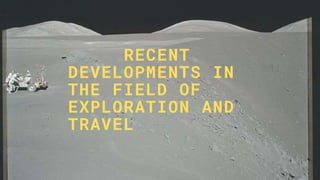
RECENT
DEVELOPMENTS IN
THE FIELD OF
EXPLORATION AND
TRAVEL
Space exploration is the use of astronomy and space technology to
explore outer space. While the study of space is carried out mainly
by astronomers with telescopes, its physical exploration though is
conducted both by unmanned robotic space probes and human
spaceflight.
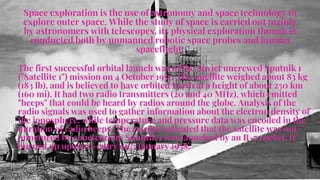
The first successful orbital launch was of the Soviet uncrewed Sputnik 1
("Satellite 1") mission on 4 October 1957. The satellite weighed about 83 kg
(183 lb), and is believed to have orbited Earth at a height of about 250 km
(160 mi). It had two radio transmitters (20 and 40 MHz), which emitted
"beeps" that could be heard by radios around the globe. Analysis of the
radio signals was used to gather information about the electron density of
the ionosphere, while temperature and pressure data was encoded in the
duration of radio beeps. The results indicated that the satellite was not
punctured by a meteoroid. Sputnik 1 was launched by an R-7 rocket. It
burned up upon re-entry on 3 January 1958.
The first artificial object to reach
another celestial body was Luna
2 reaching the Moon in 1959.[16]
The first soft landing on another
celestial body was performed by
Luna 9 landing on the Moon on
February 3, 1966. Luna 10 became
the first artificial satellite of the
Moon, entering Moon Orbit on
April 3, 1966.The first crewed
landing on another celestial body
was performed by Apollo 11 on
July 20, 1969, landing on the
Moon. There have been a total of
six spacecraft with humans
landing on the Moon starting
from 1969 to the last human
landing in 1972
The German V-2 was the first rocket to
travel into space, overcoming the
problems of thrust and material failure.
During the final days of World War II
this technology was obtained by both the
Americans and Soviets as were its
designers. The initial driving force for
further development of the technology
was a weapons race for intercontinental
ballistic missiles (ICBMs) to be used as
long-range carriers for fast nuclear
weapon delivery, but in 1961 when the
Soviet Union launched the first man into
space, the United States declared itself
to be in a "Space Race" with the Soviets.
Targets of Exploration
Starting in the mid-20th century
probes and then human mission
were sent into Earth orbit, and then
on to the Moon. Also, probes were
sent throughout the known Solar
system, and into Solar orbit.
Unmanned spacecraft have been sent
into orbit around Saturn, Jupiter,
Mars, Venus, and Mercury by the 21st
century, and the most distance active
spacecraft, Voyager 1 and 2 traveled
beyond 100 times the Earth-Sun
distance. The instruments were
enough though that it is thought they
have left the Sun's heliosphere, a sort
of bubble of particles made in the
Galaxy by the Sun's solar wind.
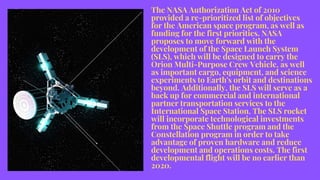
The NASA Authorization Act of 2010
provided a re-prioritized list of objectives
for the American space program, as well as
funding for the first priorities. NASA
proposes to move forward with the
development of the Space Launch System
(SLS), which will be designed to carry the
Orion Multi-Purpose Crew Vehicle, as well
as important cargo, equipment, and science
experiments to Earth's orbit and destinations
beyond. Additionally, the SLS will serve as a
back up for commercial and international
partner transportation services to the
International Space Station. The SLS rocket
will incorporate technological investments
from the Space Shuttle program and the
Constellation program in order to take
advantage of proven hardware and reduce
development and operations costs. The first
developmental flight will be no earlier than
2020.
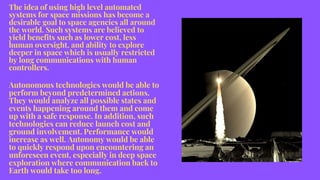
The idea of using high level automated
systems for space missions has become a
desirable goal to space agencies all around
the world. Such systems are believed to
yield benefits such as lower cost, less
human oversight, and ability to explore
deeper in space which is usually restricted
by long communications with human
controllers.
Autonomous technologies would be able to
perform beyond predetermined actions.
They would analyze all possible states and
events happening around them and come
up with a safe response. In addition, such
technologies can reduce launch cost and
ground involvement. Performance would
increase as well. Autonomy would be able
to quickly respond upon encountering an
unforeseen event, especially in deep space
exploration where communication back to
Earth would take too long.
It is also argued that space exploration would lead
to the extraction of resources on other planets and
especially asteroids, which contain billions of
dollars that worth of minerals and metals. Such
expeditions could generate a lot of revenue.In
addition, it has been argiued that space
exploration programs help inspire youth to study
in science and engineering.Space exploration also
gives scientists the ability to perform experiments
in other settings and expand humanity's
knowledge.
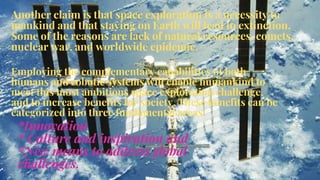
Another claim is that space exploration is a necessity to
mankind and that staying on Earth will lead to extinction.
Some of the reasons are lack of natural resources, comets,
nuclear war, and worldwide epidemic.
Employing the complementary capabilities of both
humans and robotic systems will enable humankind to
meet this most ambitious space exploration challenge,
and to increase benefits for society. These benefits can be
categorized into three fundamental areas:
*Innovation
* Culture and inspiration and
*New means to address global
challenges.
.There are numerous cases of societal benefits linked to
new knowledge and technology from space exploration.
Space exploration has contributed to many diverse
aspects of everyday life, from solar panels to
implantable heart monitors, from cancer therapy to
lightweight materials, and from water‐purification
systems to improved computing systems and to a global
search‐and‐rescue system . Achieving the ambitious
future exploration goals as outlined above will further
expand the economic relevance of space.
Innovation
Culture and Inspiration
Space exploration offers a unique and evolving
perspective on humanity's place in the Universe,
which is common to all. Every day, space
exploration missions fulfill people's curiosity,
producing fresh data about the solar system that
brings us closer to answering profound questions
that have been asked for millennia
New means to address global
challenges.
Partnerships and capabilities developed through
space exploration create new opportunities for
addressing global challenges. Space exploration is a
global endeavour contributing to trust and diplomacy
between nations. Enhanced global partnerships and
exploration capabilities may help advance
international preparedness for protecting the Earth
from catastrophic events such as some asteroid
strikes, advancing collaborative research on space
weather and protecting spacecraft by developing new
means for space debris removal.
To a great extent, the benefits from
space exploration are rooted in the
generation of new knowledge, which
is the first reward and which has
inherent value to humankind.
Technological knowledge, generated when
high‐performance space systems are
developed to address the extreme
challenges of space missions, yields many
innovations that benefit the public.
Scientific knowledge acquired from space
expands humankind's understanding of
nature and frequently unlocks creative and
useful Earth‐based applications for
society.
Some of the more direct benefits of space
exploration include an increase in the knowledge
that is out there about space and the discovery of
distant planets and galaxies, it also gives us insight
into the beginnings of our universe.
Space exploration alone has provided a
significant amount of knowledge that is
important for the education of people about
a basic understanding of our planet and the
universe.
Thanks for
watching!!😊😇
DSWD FIGHTERS
Angie Anne E. Alboroto
Jennyfer S. Aldava
Kristine F. Bazar
Sheniña P. Natingga
DSWD
FIGHTERS!!😊✊

DSWD FIGHTERS

  • 1.
    RECENT DEVELOPMENTS IN THE FIELDOF EXPLORATION AND TRAVEL
  • 2.
    Space exploration isthe use of astronomy and space technology to explore outer space. While the study of space is carried out mainly by astronomers with telescopes, its physical exploration though is conducted both by unmanned robotic space probes and human spaceflight. The first successful orbital launch was of the Soviet uncrewed Sputnik 1 ("Satellite 1") mission on 4 October 1957. The satellite weighed about 83 kg (183 lb), and is believed to have orbited Earth at a height of about 250 km (160 mi). It had two radio transmitters (20 and 40 MHz), which emitted "beeps" that could be heard by radios around the globe. Analysis of the radio signals was used to gather information about the electron density of the ionosphere, while temperature and pressure data was encoded in the duration of radio beeps. The results indicated that the satellite was not punctured by a meteoroid. Sputnik 1 was launched by an R-7 rocket. It burned up upon re-entry on 3 January 1958.
  • 3.
    The first artificialobject to reach another celestial body was Luna 2 reaching the Moon in 1959.[16] The first soft landing on another celestial body was performed by Luna 9 landing on the Moon on February 3, 1966. Luna 10 became the first artificial satellite of the Moon, entering Moon Orbit on April 3, 1966.The first crewed landing on another celestial body was performed by Apollo 11 on July 20, 1969, landing on the Moon. There have been a total of six spacecraft with humans landing on the Moon starting from 1969 to the last human landing in 1972
  • 4.
    The German V-2was the first rocket to travel into space, overcoming the problems of thrust and material failure. During the final days of World War II this technology was obtained by both the Americans and Soviets as were its designers. The initial driving force for further development of the technology was a weapons race for intercontinental ballistic missiles (ICBMs) to be used as long-range carriers for fast nuclear weapon delivery, but in 1961 when the Soviet Union launched the first man into space, the United States declared itself to be in a "Space Race" with the Soviets.
  • 5.
    Targets of Exploration Startingin the mid-20th century probes and then human mission were sent into Earth orbit, and then on to the Moon. Also, probes were sent throughout the known Solar system, and into Solar orbit. Unmanned spacecraft have been sent into orbit around Saturn, Jupiter, Mars, Venus, and Mercury by the 21st century, and the most distance active spacecraft, Voyager 1 and 2 traveled beyond 100 times the Earth-Sun distance. The instruments were enough though that it is thought they have left the Sun's heliosphere, a sort of bubble of particles made in the Galaxy by the Sun's solar wind.
  • 6.
    The NASA AuthorizationAct of 2010 provided a re-prioritized list of objectives for the American space program, as well as funding for the first priorities. NASA proposes to move forward with the development of the Space Launch System (SLS), which will be designed to carry the Orion Multi-Purpose Crew Vehicle, as well as important cargo, equipment, and science experiments to Earth's orbit and destinations beyond. Additionally, the SLS will serve as a back up for commercial and international partner transportation services to the International Space Station. The SLS rocket will incorporate technological investments from the Space Shuttle program and the Constellation program in order to take advantage of proven hardware and reduce development and operations costs. The first developmental flight will be no earlier than 2020.
  • 7.
    The idea ofusing high level automated systems for space missions has become a desirable goal to space agencies all around the world. Such systems are believed to yield benefits such as lower cost, less human oversight, and ability to explore deeper in space which is usually restricted by long communications with human controllers. Autonomous technologies would be able to perform beyond predetermined actions. They would analyze all possible states and events happening around them and come up with a safe response. In addition, such technologies can reduce launch cost and ground involvement. Performance would increase as well. Autonomy would be able to quickly respond upon encountering an unforeseen event, especially in deep space exploration where communication back to Earth would take too long.
  • 8.
    It is alsoargued that space exploration would lead to the extraction of resources on other planets and especially asteroids, which contain billions of dollars that worth of minerals and metals. Such expeditions could generate a lot of revenue.In addition, it has been argiued that space exploration programs help inspire youth to study in science and engineering.Space exploration also gives scientists the ability to perform experiments in other settings and expand humanity's knowledge.
  • 9.
    Another claim isthat space exploration is a necessity to mankind and that staying on Earth will lead to extinction. Some of the reasons are lack of natural resources, comets, nuclear war, and worldwide epidemic. Employing the complementary capabilities of both humans and robotic systems will enable humankind to meet this most ambitious space exploration challenge, and to increase benefits for society. These benefits can be categorized into three fundamental areas: *Innovation * Culture and inspiration and *New means to address global challenges.
  • 10.
    .There are numerouscases of societal benefits linked to new knowledge and technology from space exploration. Space exploration has contributed to many diverse aspects of everyday life, from solar panels to implantable heart monitors, from cancer therapy to lightweight materials, and from water‐purification systems to improved computing systems and to a global search‐and‐rescue system . Achieving the ambitious future exploration goals as outlined above will further expand the economic relevance of space. Innovation
  • 11.
    Culture and Inspiration Spaceexploration offers a unique and evolving perspective on humanity's place in the Universe, which is common to all. Every day, space exploration missions fulfill people's curiosity, producing fresh data about the solar system that brings us closer to answering profound questions that have been asked for millennia
  • 12.
    New means toaddress global challenges. Partnerships and capabilities developed through space exploration create new opportunities for addressing global challenges. Space exploration is a global endeavour contributing to trust and diplomacy between nations. Enhanced global partnerships and exploration capabilities may help advance international preparedness for protecting the Earth from catastrophic events such as some asteroid strikes, advancing collaborative research on space weather and protecting spacecraft by developing new means for space debris removal.
  • 13.
    To a greatextent, the benefits from space exploration are rooted in the generation of new knowledge, which is the first reward and which has inherent value to humankind.
  • 14.
    Technological knowledge, generatedwhen high‐performance space systems are developed to address the extreme challenges of space missions, yields many innovations that benefit the public. Scientific knowledge acquired from space expands humankind's understanding of nature and frequently unlocks creative and useful Earth‐based applications for society.
  • 15.
    Some of themore direct benefits of space exploration include an increase in the knowledge that is out there about space and the discovery of distant planets and galaxies, it also gives us insight into the beginnings of our universe. Space exploration alone has provided a significant amount of knowledge that is important for the education of people about a basic understanding of our planet and the universe.
  • 16.
  • 17.
    DSWD FIGHTERS Angie AnneE. Alboroto Jennyfer S. Aldava Kristine F. Bazar Sheniña P. Natingga
  • 18.

Editor's Notes