THEORIES OF LEVELAND STRUCTURE
OF INTEREST RATE
By Anupriya Panda
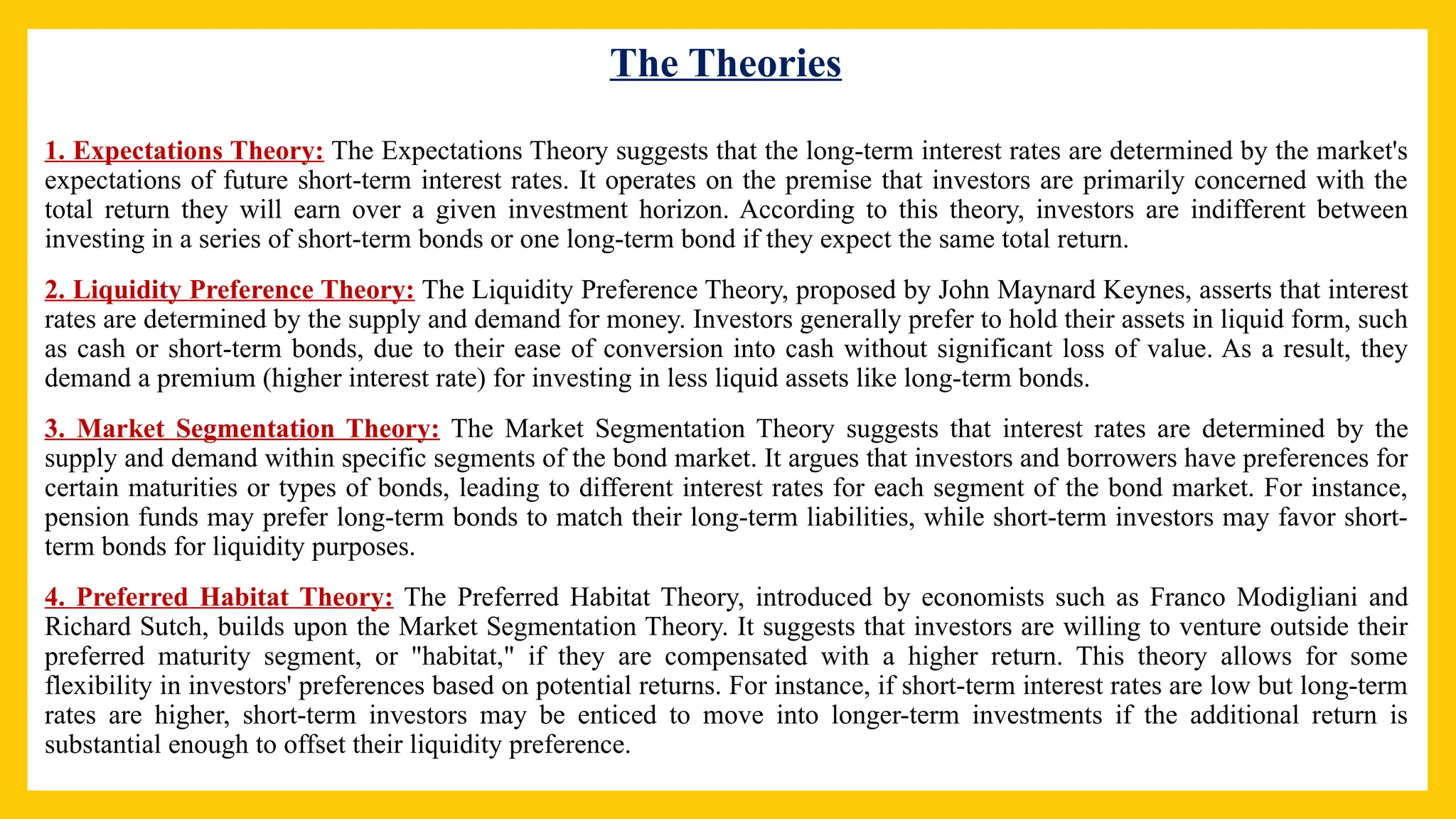
The Theories
1. Expectations Theory: The Expectations Theory suggests that the long-term interest rates are determined by the market's
expectations of future short-term interest rates. It operates on the premise that investors are primarily concerned with the
total return they will earn over a given investment horizon. According to this theory, investors are indifferent between
investing in a series of short-term bonds or one long-term bond if they expect the same total return.
2. Liquidity Preference Theory: The Liquidity Preference Theory, proposed by John Maynard Keynes, asserts that interest
rates are determined by the supply and demand for money. Investors generally prefer to hold their assets in liquid form, such
as cash or short-term bonds, due to their ease of conversion into cash without significant loss of value. As a result, they
demand a premium (higher interest rate) for investing in less liquid assets like long-term bonds.
3. Market Segmentation Theory: The Market Segmentation Theory suggests that interest rates are determined by the
supply and demand within specific segments of the bond market. It argues that investors and borrowers have preferences for
certain maturities or types of bonds, leading to different interest rates for each segment of the bond market. For instance,
pension funds may prefer long-term bonds to match their long-term liabilities, while short-term investors may favor short-
term bonds for liquidity purposes.
4. Preferred Habitat Theory: The Preferred Habitat Theory, introduced by economists such as Franco Modigliani and
Richard Sutch, builds upon the Market Segmentation Theory. It suggests that investors are willing to venture outside their
preferred maturity segment, or "habitat," if they are compensated with a higher return. This theory allows for some
flexibility in investors' preferences based on potential returns. For instance, if short-term interest rates are low but long-term
rates are higher, short-term investors may be enticed to move into longer-term investments if the additional return is
substantial enough to offset their liquidity preference.
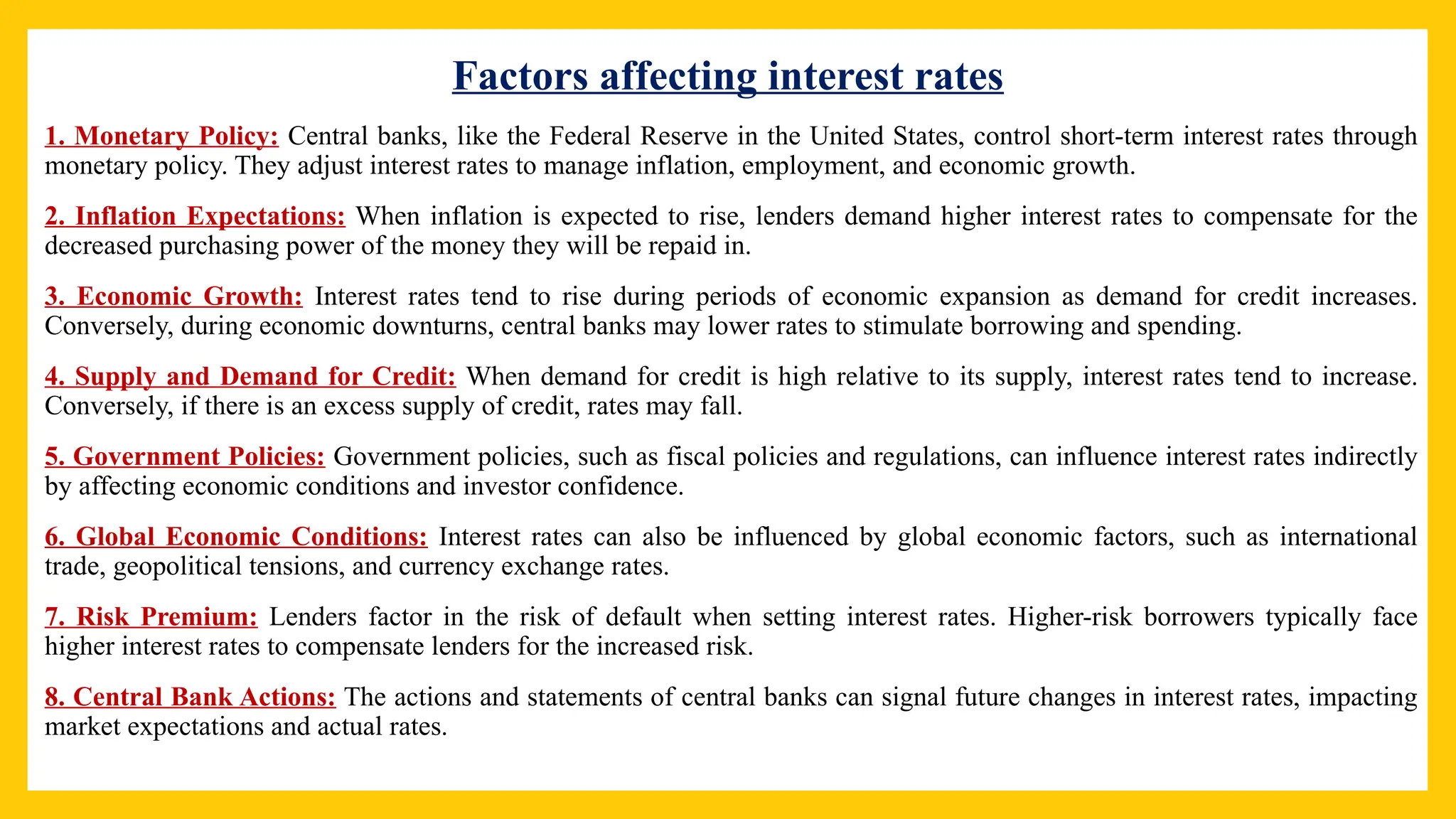
Factors affecting interest rates
1. Monetary Policy: Central banks, like the Federal Reserve in the United States, control short-term interest rates through
monetary policy. They adjust interest rates to manage inflation, employment, and economic growth.
2. Inflation Expectations: When inflation is expected to rise, lenders demand higher interest rates to compensate for the
decreased purchasing power of the money they will be repaid in.
3. Economic Growth: Interest rates tend to rise during periods of economic expansion as demand for credit increases.
Conversely, during economic downturns, central banks may lower rates to stimulate borrowing and spending.
4. Supply and Demand for Credit: When demand for credit is high relative to its supply, interest rates tend to increase.
Conversely, if there is an excess supply of credit, rates may fall.
5. Government Policies: Government policies, such as fiscal policies and regulations, can influence interest rates indirectly
by affecting economic conditions and investor confidence.
6. Global Economic Conditions: Interest rates can also be influenced by global economic factors, such as international
trade, geopolitical tensions, and currency exchange rates.
7. Risk Premium: Lenders factor in the risk of default when setting interest rates. Higher-risk borrowers typically face
higher interest rates to compensate lenders for the increased risk.
8. Central Bank Actions: The actions and statements of central banks can signal future changes in interest rates, impacting
market expectations and actual rates.
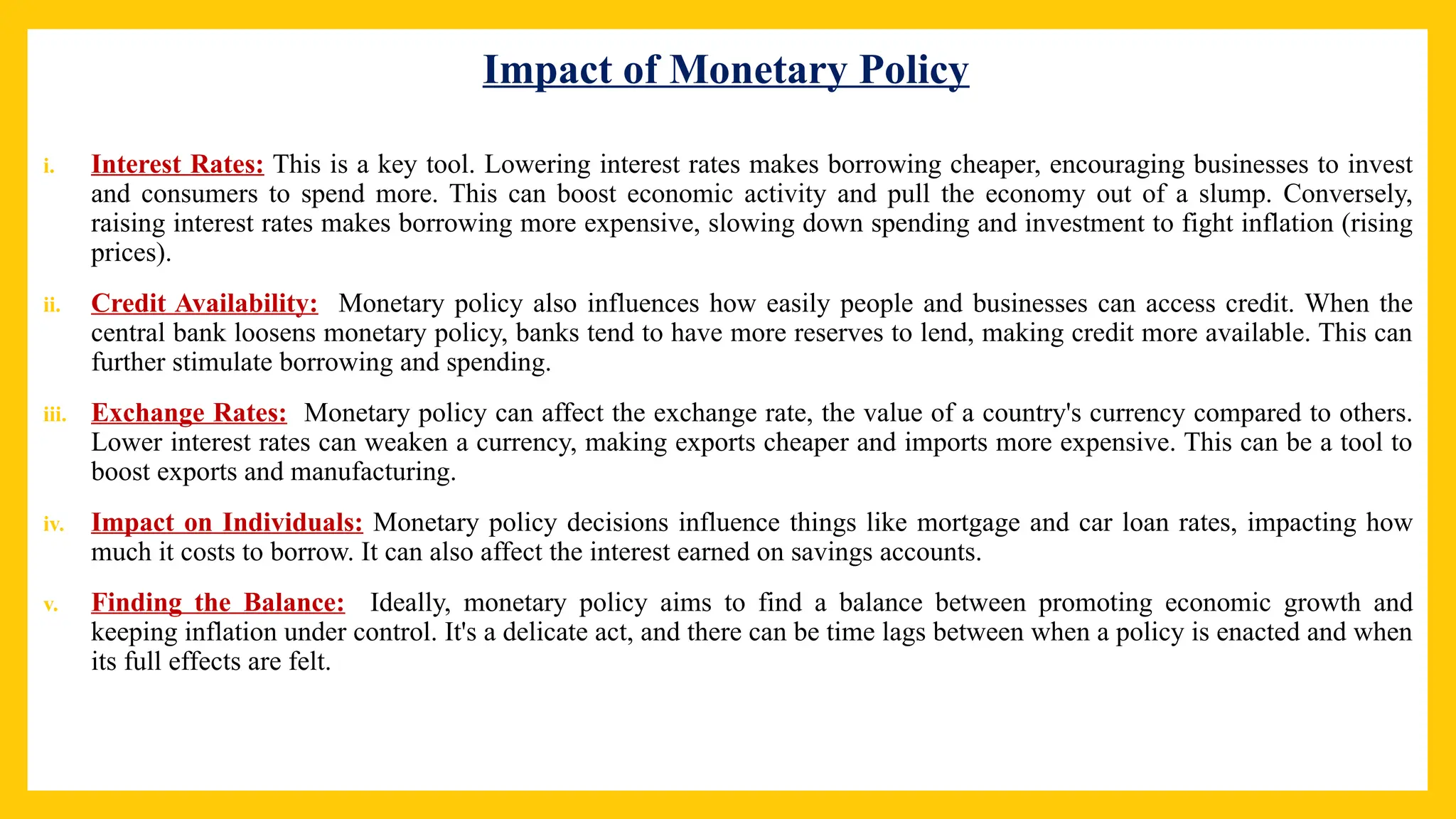
Impact of Monetary Policy
i. Interest Rates: This is a key tool. Lowering interest rates makes borrowing cheaper, encouraging businesses to invest
and consumers to spend more. This can boost economic activity and pull the economy out of a slump. Conversely,
raising interest rates makes borrowing more expensive, slowing down spending and investment to fight inflation (rising
prices).
ii. Credit Availability: Monetary policy also influences how easily people and businesses can access credit. When the
central bank loosens monetary policy, banks tend to have more reserves to lend, making credit more available. This can
further stimulate borrowing and spending.
iii. Exchange Rates: Monetary policy can affect the exchange rate, the value of a country's currency compared to others.
Lower interest rates can weaken a currency, making exports cheaper and imports more expensive. This can be a tool to
boost exports and manufacturing.
iv. Impact on Individuals: Monetary policy decisions influence things like mortgage and car loan rates, impacting how
much it costs to borrow. It can also affect the interest earned on savings accounts.
v. Finding the Balance: Ideally, monetary policy aims to find a balance between promoting economic growth and
keeping inflation under control. It's a delicate act, and there can be time lags between when a policy is enacted and when
its full effects are felt.
Theories of Level and Structure of Interest Rate.pptx

  • 1.
    THEORIES OF LEVELANDSTRUCTURE OF INTEREST RATE By Anupriya Panda
  • 2.
    The Theories 1. ExpectationsTheory: The Expectations Theory suggests that the long-term interest rates are determined by the market's expectations of future short-term interest rates. It operates on the premise that investors are primarily concerned with the total return they will earn over a given investment horizon. According to this theory, investors are indifferent between investing in a series of short-term bonds or one long-term bond if they expect the same total return. 2. Liquidity Preference Theory: The Liquidity Preference Theory, proposed by John Maynard Keynes, asserts that interest rates are determined by the supply and demand for money. Investors generally prefer to hold their assets in liquid form, such as cash or short-term bonds, due to their ease of conversion into cash without significant loss of value. As a result, they demand a premium (higher interest rate) for investing in less liquid assets like long-term bonds. 3. Market Segmentation Theory: The Market Segmentation Theory suggests that interest rates are determined by the supply and demand within specific segments of the bond market. It argues that investors and borrowers have preferences for certain maturities or types of bonds, leading to different interest rates for each segment of the bond market. For instance, pension funds may prefer long-term bonds to match their long-term liabilities, while short-term investors may favor short- term bonds for liquidity purposes. 4. Preferred Habitat Theory: The Preferred Habitat Theory, introduced by economists such as Franco Modigliani and Richard Sutch, builds upon the Market Segmentation Theory. It suggests that investors are willing to venture outside their preferred maturity segment, or "habitat," if they are compensated with a higher return. This theory allows for some flexibility in investors' preferences based on potential returns. For instance, if short-term interest rates are low but long-term rates are higher, short-term investors may be enticed to move into longer-term investments if the additional return is substantial enough to offset their liquidity preference.
  • 3.
    Factors affecting interestrates 1. Monetary Policy: Central banks, like the Federal Reserve in the United States, control short-term interest rates through monetary policy. They adjust interest rates to manage inflation, employment, and economic growth. 2. Inflation Expectations: When inflation is expected to rise, lenders demand higher interest rates to compensate for the decreased purchasing power of the money they will be repaid in. 3. Economic Growth: Interest rates tend to rise during periods of economic expansion as demand for credit increases. Conversely, during economic downturns, central banks may lower rates to stimulate borrowing and spending. 4. Supply and Demand for Credit: When demand for credit is high relative to its supply, interest rates tend to increase. Conversely, if there is an excess supply of credit, rates may fall. 5. Government Policies: Government policies, such as fiscal policies and regulations, can influence interest rates indirectly by affecting economic conditions and investor confidence. 6. Global Economic Conditions: Interest rates can also be influenced by global economic factors, such as international trade, geopolitical tensions, and currency exchange rates. 7. Risk Premium: Lenders factor in the risk of default when setting interest rates. Higher-risk borrowers typically face higher interest rates to compensate lenders for the increased risk. 8. Central Bank Actions: The actions and statements of central banks can signal future changes in interest rates, impacting market expectations and actual rates.
  • 4.
    Impact of MonetaryPolicy i. Interest Rates: This is a key tool. Lowering interest rates makes borrowing cheaper, encouraging businesses to invest and consumers to spend more. This can boost economic activity and pull the economy out of a slump. Conversely, raising interest rates makes borrowing more expensive, slowing down spending and investment to fight inflation (rising prices). ii. Credit Availability: Monetary policy also influences how easily people and businesses can access credit. When the central bank loosens monetary policy, banks tend to have more reserves to lend, making credit more available. This can further stimulate borrowing and spending. iii. Exchange Rates: Monetary policy can affect the exchange rate, the value of a country's currency compared to others. Lower interest rates can weaken a currency, making exports cheaper and imports more expensive. This can be a tool to boost exports and manufacturing. iv. Impact on Individuals: Monetary policy decisions influence things like mortgage and car loan rates, impacting how much it costs to borrow. It can also affect the interest earned on savings accounts. v. Finding the Balance: Ideally, monetary policy aims to find a balance between promoting economic growth and keeping inflation under control. It's a delicate act, and there can be time lags between when a policy is enacted and when its full effects are felt.