Reporter: Portes, Abbygail L.
Born in Russia
Immigrated to the US at age 6
Enlisted in the US army immediately after
completing his PhD
Co-founder of the Head Start program
-Designed to serve at-risk nursery
students to prepare them for school
Development is the result of the
relationships between people and their
environments.
Implications
Cannot evaluate a child’s development
only in the immediate environment.
Must also examine the interactions among
the larger environments that a child
develops in.
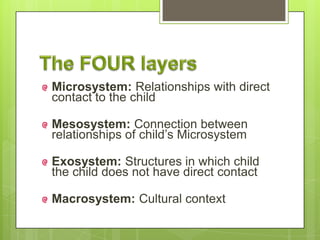
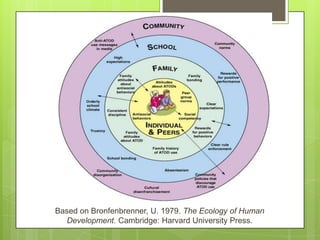
Microsystem: Relationships with direct
contact to the child
Mesosystem: Connection between
relationships of child’s Microsystem
Exosystem: Structures in which child
the child does not have direct contact
Macrosystem: Cultural context
Based on Bronfenbrenner, U. 1979. The Ecology of Human
Development. Cambridge: Harvard University Press.
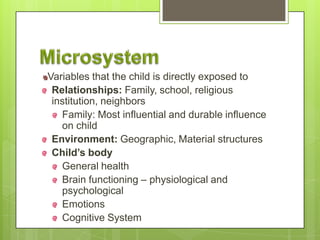
Variables that the child is directly exposed to
Relationships: Family, school, religious
institution, neighbors
Family: Most influential and durable influence
on child
Environment: Geographic, Material structures
Child’s body
General health
Brain functioning – physiological and
psychological
Emotions
Cognitive System
Most of the child’s behavior is learned in
the microsystem
The microsystem consists of bi-directional
influences
Parents actively shape the development
of the child
Children actively shape their
environment
Personal attributes influence
responses from other people
Children actively select and avoid
specific environments
Bi-directional relationships are the
foundation for a child’s cognitive and
emotional growth
Interconnections between the
microsystems.
Examples:
Interactions between the family and
teachers
Relationship between the child’s peers
and the family
Institutions of society that indirectly
affect a child’s development
Examples:
Parent’s workplace
Funding for education
These impact a child’s development
by influencing structures in the
microsystem
Cultural context
Provides the values, beliefs, customs, and
laws of the culture in which a child grows up
- Influences how parents, teachers, and
others raise a child
- May be conscious or unconscious
Influences the societal values, legislation,
and financial resources provided by a
society to help families function
Influences the interactions of all other layers
Properties of the four layers of
relationship
Each layer has an effect on a child’s
development
Each layer is complex
Conflict within any layer ripples
throughout other layers
As a child develops, interaction within
environments becomes more complex
Complexity is the result of the
maturation of a child’s physical and
cognitive structures
Strengths
Integrates multiple influences on child
development
Weaknesses
Does not provide detailed
mechanisms for development
Primary relationship must be intended to
last a lifetime
Teachers need to work to support the
primary child-adult relationship
Schools should create an environment
that welcomes and nurtures families
Education should foster societal attitudes
that value all work done on behalf of
children

Report child and adolsecent dev.

  • 1.
  • 2.
    Born in Russia Immigratedto the US at age 6 Enlisted in the US army immediately after completing his PhD Co-founder of the Head Start program -Designed to serve at-risk nursery students to prepare them for school
  • 3.
    Development is theresult of the relationships between people and their environments.
  • 4.
    Implications Cannot evaluate achild’s development only in the immediate environment. Must also examine the interactions among the larger environments that a child develops in.
  • 5.
    Microsystem: Relationships withdirect contact to the child Mesosystem: Connection between relationships of child’s Microsystem Exosystem: Structures in which child the child does not have direct contact Macrosystem: Cultural context
  • 6.
    Based on Bronfenbrenner,U. 1979. The Ecology of Human Development. Cambridge: Harvard University Press.
  • 7.
    Variables that thechild is directly exposed to Relationships: Family, school, religious institution, neighbors Family: Most influential and durable influence on child Environment: Geographic, Material structures Child’s body General health Brain functioning – physiological and psychological Emotions Cognitive System
  • 8.
    Most of thechild’s behavior is learned in the microsystem The microsystem consists of bi-directional influences Parents actively shape the development of the child Children actively shape their environment Personal attributes influence responses from other people Children actively select and avoid specific environments Bi-directional relationships are the foundation for a child’s cognitive and emotional growth
  • 9.
    Interconnections between the microsystems. Examples: Interactionsbetween the family and teachers Relationship between the child’s peers and the family
  • 10.
    Institutions of societythat indirectly affect a child’s development Examples: Parent’s workplace Funding for education These impact a child’s development by influencing structures in the microsystem
  • 11.
    Cultural context Provides thevalues, beliefs, customs, and laws of the culture in which a child grows up - Influences how parents, teachers, and others raise a child - May be conscious or unconscious Influences the societal values, legislation, and financial resources provided by a society to help families function Influences the interactions of all other layers
  • 12.
    Properties of thefour layers of relationship Each layer has an effect on a child’s development Each layer is complex Conflict within any layer ripples throughout other layers As a child develops, interaction within environments becomes more complex Complexity is the result of the maturation of a child’s physical and cognitive structures
  • 13.
    Strengths Integrates multiple influenceson child development Weaknesses Does not provide detailed mechanisms for development
  • 14.
    Primary relationship mustbe intended to last a lifetime Teachers need to work to support the primary child-adult relationship Schools should create an environment that welcomes and nurtures families Education should foster societal attitudes that value all work done on behalf of children