n

o vatio

n
s

In

SM

o

n

in

E

d u c at

i

Successful Charter Schools

u . s . d e pa r t m e n t o f e d u c at i o n
o f f i c e o f i n n o v at i o n a n d i m p r o v e m e n t
n

n
s

In

SM

o vatio

o

n

in

E

d u c at

i

Successful Charter Schools

u . s . d e pa r t m e n t o f e d u c at i o n
o f f i c e o f i n n o v at i o n a n d i m p r o v e m e n t
This report was produced under U.S. Department of Education Contract No. ED-01-CO-0012, Task Order D010,
with WestEd.
U.S. Department of Education
Rod Paige
Secretary
Office of Innovation and Improvement
Nina S. Rees
Deputy Under Secretary
Michael J. Petrilli
Associate Deputy Under Secretary for Innovation and Improvement
John Fiegel
Director, Parent Options and Information
June 2004

This report is in the public domain. Authorization to reproduce it in whole or in part is granted. While permission to
reprint this publication is not necessary, the citation should be: U.S. Department of Education, Office of Innovation and
Improvement, Innovations in Education: Successful Charter Schools, Washington, D.C., 2004.
To order copies of this report,
write to: ED Pubs, Education Publications Center, U.S. Department of Education, P.O. Box 1398, Jessup, MD 20794-1398;
or fax your request to: (301) 470-1244;
or e-mail your request to: edpubs@inet.ed.gov;
or call in your request toll-free: 1-877-433-7827 (1-877-4-ED-PUBS). If 877 service is not yet available in your
area, call 1-800-872-5327 (1-800-USA-LEARN). Those who use a telecommunications device for the deaf (TDD) or a
teletypewriter (TTY), should call 1-800-437-0833;
or order online at: www.edpubs.org/.
This report is also available on the Department’s Web site at: http://www.ed.gov/admins/comm/choice/charter.
On request, this publication is available in alternate formats, such as Braille, large print, or computer diskette. For more
information, please contact the Department’s Alternate Format Center at (202) 260-9895 or (202) 205-8113.
Contents
v

Introduction

1

Part I: Elements of Effective Charter Schools

5
5
6
6
13
14
16
19

Getting a Good Start
Leading With a Mission
Innovating Across the School Program
Promoting a Community of Continuous Learning
Partnering With Parents and the Community
Governing for Accountability
Implications

Part II: Charter School Profiles
The Arts and Technology Academy Public Charter School
BASIS School, Inc.
Community of Peace Academy
KIPP Academy Houston
Oglethorpe Charter School
Ralph A. Gates Elementary School
Roxbury Preparatory Charter School
The School of Arts and Sciences

21
23
27
31
35
39
43
47
51

Acknowledgments 55
Appendix A: Research Methodology 57
Appendix B: Resources 59
Notes

iii

61

Innovations in Education: Successful Charter Schools

Foreword
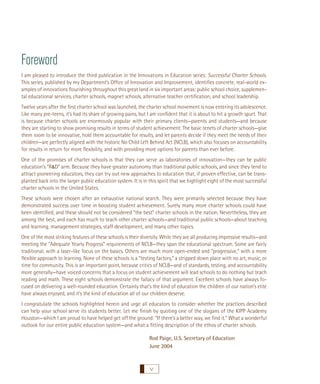
LIST OF FIGURES
Figure 1. Demographics of Profiled Charter Schools

2

Figure 2. Framework for Site Analysis

4

Figure 3. Mosaica and the Arts and Technology Academy

7

Figure 4. The School of Arts and Sciences Thematic Instruction Rubric

8

Figure 5. BASIS Course Requirements

9

Figure 6. KIPP Student Incentive System (Excerpt) 12
Figure 7. Community of Peace Parent Compact 15
Figure 8. Oglethorpe Parent Volunteer Options 16
Figure 9. Gates Adult Education Program 17
Figure 10. Roxbury Prep Annual Accountability Plan (Excerpts) 18

iv
Foreword
I am pleased to introduce the third publication in the Innovations in Education series: Successful Charter Schools.
This series, published by my Department’s Office of Innovation and Improvement, identifies concrete, real-world examples of innovations flourishing throughout this great land in six important areas: public school choice, supplemental educational services, charter schools, magnet schools, alternative teacher certification, and school leadership.
Twelve years after the first charter school was launched, the charter school movement is now entering its adolescence.
Like many pre-teens, it’s had its share of growing pains, but I am confident that it is about to hit a growth spurt. That
is because charter schools are enormously popular with their primary clients—parents and students—and because
they are starting to show promising results in terms of student achievement. The basic tenets of charter schools—give
them room to be innovative, hold them accountable for results, and let parents decide if they meet the needs of their
children—are perfectly aligned with the historic No Child Left Behind Act (NCLB), which also focuses on accountability
for results in return for more flexibility, and with providing more options for parents than ever before.
One of the promises of charter schools is that they can serve as laboratories of innovation—they can be public
education’s “R&D” arm. Because they have greater autonomy than traditional public schools, and since they tend to
attract pioneering educators, they can try out new approaches to education that, if proven effective, can be transplanted back into the larger public education system. It is in this spirit that we highlight eight of the most successful
charter schools in the United States.
These schools were chosen after an exhaustive national search. They were primarily selected because they have
demonstrated success over time in boosting student achievement. Surely many more charter schools could have
been identified, and these should not be considered “the best” charter schools in the nation. Nevertheless, they are
among the best, and each has much to teach other charter schools—and traditional public schools—about teaching
and learning, management strategies, staff development, and many other topics.
One of the most striking features of these schools is their diversity. While they are all producing impressive results—and
meeting the “Adequate Yearly Progress” requirements of NCLB—they span the educational spectrum. Some are fairly
traditional, with a laser-like focus on the basics. Others are much more open-ended and “progressive,” with a more
flexible approach to learning. None of these schools is a “testing factory,” a stripped down place with no art, music, or
time for community. This is an important point, because critics of NCLB—and of standards, testing, and accountability
more generally—have voiced concerns that a focus on student achievement will lead schools to do nothing but teach
reading and math. These eight schools demonstrate the fallacy of that argument. Excellent schools have always focused on delivering a well-rounded education. Certainly that’s the kind of education the children of our nation’s elite
have always enjoyed, and it’s the kind of education all of our children deserve.
I congratulate the schools highlighted herein and urge all educators to consider whether the practices described
can help your school serve its students better. Let me finish by quoting one of the slogans of the KIPP Academy
Houston—which I am proud to have helped get off the ground: “If there’s a better way, we find it.” What a wonderful
outlook for our entire public education system—and what a fitting description of the ethos of charter schools.
Rod Paige, U.S. Secretary of Education
June 2004

v
Introduction
The promise charter schools hold for public school innovation and reform lies in an unprecedented
combination of freedom and accountability. Underwritten with public funds but run independently,
charter schools are free from a range of state laws and district policies stipulating what and how they
teach, where they can spend their money, and who they can hire and fire. In return, they are held strictly
accountable for their academic and financial performance. To represent what such flexibility and accountability look like in practice, this guide provides a glimpse into the inner workings of eight American
charter schools whose freedom to experiment is raising the level of student learning.

By allowing citizens to start new public schools with
this kind of autonomy, making them available tuitionfree to any student, and holding them accountable for
results and family satisfaction, proponents hope that
this new mix of choice and accountability will not only
provide students stronger learning programs than local alternatives, but will also stimulate improvement
of the existing public education system. With charter
schools, it is accountability that makes freedom promising. No charter is permanent; it must be renewed—
or revoked—at regular intervals. Continued funding,
which is tied to student enrollment, also depends on

educational results. “Deliver a quality product,” as Finn
et al. put it, “or you won’t have students.”1
In this guide we take a look at what contributes to
a ”quality product” as well as how eight particular
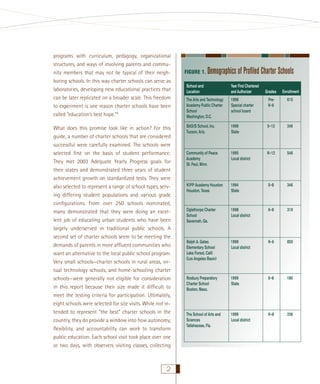
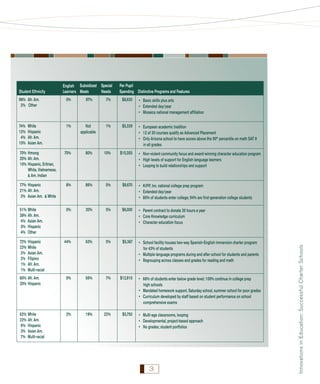
charter schools (see figure 1) help their students
achieve success.
The first charter school legislation was passed in Minnesota in 1991, and as of January 2004, there were
2,996 charter schools operating in the United States.2
Across 40 states and the District of Columbia, about
750,000 students take part in this form of public education under varying charter laws.3
Parents choose to enroll their children in charter schools,
usually entering a lottery for selection when schools are
oversubscribed. The schools are free to determine their
own governing structures, which include parents and
teachers as active members. In all these configurations,
autonomy gives charter schools the flexibility to allocate their budgets; hire staff; and create educational

1

Innovations in Education: Successful Charter Schools

Free to experiment how? To lengthen the school day,
mix grades, require dress codes, put teachers on their
school boards, double up instruction in core subject
areas like math or reading, make parents genuine partners in family-style school cultures, adopt any instructional practice that will help achieve their missions—
free, in short, to do whatever it takes to build the skills,
knowledge, and character traits their students need to
succeed in today’s world.
programs with curriculum, pedagogy, organizational
structures, and ways of involving parents and community members that may not be typical of their neighboring schools. In this way charter schools can serve as
laboratories, developing new educational practices that
can be later replicated on a broader scale. This freedom
to experiment is one reason charter schools have been
called “education’s best hope.”4
What does this promise look like in action? For this
guide, a number of charter schools that are considered
successful were carefully examined. The schools were
selected first on the basis of student performance:
They met 2003 Adequate Yearly Progress goals for
their states and demonstrated three years of student
achievement growth on standardized tests. They were
also selected to represent a range of school types, serving differing student populations and various grade
configurations. From over 250 schools nominated,
many demonstrated that they were doing an excellent job of educating urban students who have been
largely underserved in traditional public schools. A
second set of charter schools seem to be meeting the
demands of parents in more affluent communities who
want an alternative to the local public school program.
Very small schools—charter schools in rural areas, virtual technology schools, and home-schooling charter
schools—were generally not eligible for consideration
in this report because their size made it difficult to
meet the testing criteria for participation. Ultimately,
eight schools were selected for site visits. While not intended to represent “the best” charter schools in the
country, they do provide a window into how autonomy,
flexibility, and accountability can work to transform
public education. Each school visit took place over one
or two days, with observers visiting classes, collecting

2

FIGURE 1.

Demographics of Profiled Charter Schools

School and
Location

Year First Chartered
and Authorizer

Grades

Enrollment

The Arts and Technology
Academy Public Charter
School
Washington, D.C.

1998
Special charter
school board

PreK–6

615

BASIS School, Inc.
Tucson, Ariz.

1998
State

5–12

246

Community of Peace
Academy
St. Paul, Minn.

1995
Local district

K–12

546

KIPP Academy Houston
Houston, Texas

1994
State

5–8

346

Oglethorpe Charter
School
Savannah, Ga.

1998
Local district

6–8

319

Ralph A. Gates
Elementary School
Lake Forest, Calif.
(Los Angeles Basin)

1999
Local district

K–6

850

Roxbury Preparatory
Charter School
Boston, Mass.

1999
State

6–8

180

The School of Arts and
Sciences
Tallahassee, Fla.

1999
Local district

K–8

226
Student Ethnicity

English Subsidized Special
Needs
Learners Meals

Per Pupil
Spending Distinctive Programs and Features

0%

97%

7%

$8,650

• Basic skills plus arts
• Extended day/year
• Mosaica national management affiliation

1%

Not
applicable

1%

$5,339

• European academic tradition
• 12 of 30 courses qualify as Advanced Placement
• Only Arizona school to have scores above the 90th percentile on math SAT 9
in all grades

70% Hmong
20% Afr. Am.
10% Hispanic, Eritrian,
White, Vietnamese,
& Am. Indian

75%

80%

10%

$10,355

77% Hispanic
21% Afr. Am.
2% Asian Am. & White

8%

86%

5%

$8,670

• KIPP, Inc. national college prep program
• Extended day/year
• 85% of students enter college; 94% are first-generation college students

51% White
38% Afr. Am.
4% Asian Am.
3% Hispanic
4% Other

0%

20%

5%

$6,000

• Parent contract to donate 20 hours a year
• Core Knowledge curriculum
• Character education focus

72% Hispanic
22% White
2% Asian Am.
2% Filipino
1% Afr. Am.
1% Multi-racial

44%

63%

5%

$5,367

• School facility houses two-way Spanish-English immersion charter program
for 43% of students
• Multiple language programs during and after school for students and parents
• Regrouping across classes and grades for reading and math

80% Afr. Am.
20% Hispanic

0%

56%

7%

$12,910

• 66% of students enter below grade level; 100% continue in college prep
high schools
• Mandated homework support, Saturday school, summer school for poor grades
• Curriculum developed by staff based on student performance on school
comprehensive exams

62% White
22% Afr. Am.
6% Hispanic
3% Asian Am.
7% Multi-racial

2%

19%

22%

$5,750

74%
12%
4%
10%

White
Hispanic
Afr. Am.
Asian Am.

• Non-violent community focus and award-winning character education program
• High levels of support for English language learners
• Looping to build relationships and support

• Multi-age classrooms, looping
• Developmental, project-based approach
• No grades; student portfolios

3

Innovations in Education: Successful Charter Schools

98% Afr. Am.
2% Other
FIGURE 2.

artifacts that represented aspects of the school’s program, and interviewing parents, students, teachers,
board members, administrators, and district liaisons.
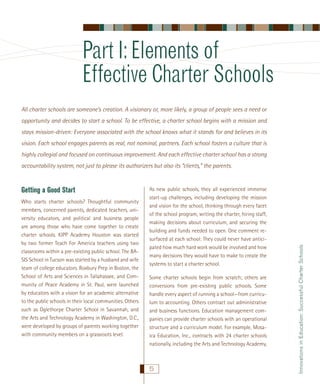
At each school, a set of questions guided the observations and interviews (see figure 2).

Framework for Site Analysis

I. Mission
›› Is the school’s mission clear, concise, and achievable?
›› Can the whole school community articulate the school’s

Among the eight schools represented in this guide, three
consider themselves middle schools, one is a comprehensive K-12 school, one is 5-12, another is K-8, and two are
elementary schools, one of which includes a preschool
program. Student enrollment ranges from 182 at a middle school to 850 at an elementary school. At three of
the schools, more than 80 percent of the students qualify
for subsidized meals; at three other schools, the percentage is about 20 or less. Three of the schools are chartered
by their state, four hold a charter from the local district,
and one is chartered by a special chartering authority.
The oldest of these schools has been in existence for 10
years; most are five or six years old. Programs vary from
college prep to project-based learning, from an arts emphasis to bilingual education. Several programs feature
non-violence or character education. Part II presents a
concrete portrait of each school, a snapshot seeking to
capture the particular ambience of the school culture, its
distinctive mission and instructional program, and how
it has gone about creating a learning community for its
particular school population.

mission, expectations of students and faculty, the

››

school’s educational program, and the school’s values?
In what ways does the school’s mission guide
educational practice and improvement over time?

II. School Operations and Educational Program
›› What is innovative about the school’s structure
and programs?
›› How does the school meet the needs of its
student population?

›› How is the school using data to influence the curriculum,
the instructional program, interventions for students, and

››

improvements in the program over time?
How has the school built organizational capacity,
including professional development for staff?

›› How has the school achieved and maintained
financial stability?
III. Stakeholders
›› How does the school ensure that all stakeholders have
shared expectations?

›› How does the school attract parents and respond to
their input?

›› What community partnerships contribute to the
school’s success?

As remarkably diverse as these schools are, they share
certain fundamental qualities, core features that seem
to be at the heart of the charter process. Part I of the
guide highlights those necessary elements of creating
an effective charter school.

IV. Chartering and Accountability
›› Why did the school go the chartering route?
›› What is the school’s relationship with the
chartering agency?

›› What is the school’s comprehensive accountability plan?
›› How do the conditions of chartering (flexibility,
accountability, and choice) influence the school’s
operations and its success?

4
Part I: Elements of
Effective Charter Schools
All charter schools are someone’s creation. A visionary or, more likely, a group of people sees a need or
opportunity and decides to start a school. To be effective, a charter school begins with a mission and
stays mission-driven: Everyone associated with the school knows what it stands for and believes in its
vision. Each school engages parents as real, not nominal, partners. Each school fosters a culture that is
highly collegial and focused on continuous improvement. And each effective charter school has a strong

Getting a Good Start
Who starts charter schools? Thoughtful community
members, concerned parents, dedicated teachers, university educators, and political and business people
are among those who have come together to create
charter schools. KIPP Academy Houston was started
by two former Teach For America teachers using two
classrooms within a pre-existing public school. The BASIS School in Tucson was started by a husband and wife
team of college educators. Roxbury Prep in Boston, the
School of Arts and Sciences in Tallahassee, and Community of Peace Academy in St. Paul, were launched
by educators with a vision for an academic alternative
to the public schools in their local communities. Others
such as Oglethorpe Charter School in Savannah, and
the Arts and Technology Academy in Washington, D.C.,
were developed by groups of parents working together
with community members on a grassroots level.

As new public schools, they all experienced immense
start-up challenges, including developing the mission
and vision for the school, thinking through every facet
of the school program, writing the charter, hiring staff,
making decisions about curriculum, and securing the
building and funds needed to open. One comment resurfaced at each school: They could never have anticipated how much hard work would be involved and how
many decisions they would have to make to create the
systems to start a charter school.
Some charter schools begin from scratch; others are
conversions from pre-existing public schools. Some
handle every aspect of running a school—from curriculum to accounting. Others contract out administrative
and business functions. Education management companies can provide charter schools with an operational
structure and a curriculum model. For example, Mosaica Education, Inc., contracts with 24 charter schools
nationally, including the Arts and Technology Academy,

5

Innovations in Education: Successful Charter Schools

accountability system, not just to please its authorizers but also its “clients,” the parents.
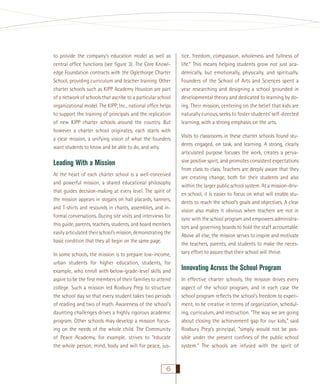
to provide the company’s education model as well as
central office functions (see figure 3). The Core Knowledge Foundation contracts with the Oglethorpe Charter
School, providing curriculum and teacher training. Other
charter schools such as KIPP Academy Houston are part
of a network of schools that ascribe to a particular school
organizational model. The KIPP, Inc., national office helps
to support the training of principals and the replication
of new KIPP charter schools around the country. But
however a charter school originates, each starts with
a clear mission, a unifying vision of what the founders
want students to know and be able to do, and why.

Leading With a Mission
At the heart of each charter school is a well-conceived
and powerful mission, a shared educational philosophy
that guides decision-making at every level. The spirit of
the mission appears in slogans on hall placards, banners,
and T-shirts and resounds in chants, assemblies, and informal conversations. During site visits and interviews for
this guide, parents, teachers, students, and board members
easily articulated their school’s mission, demonstrating the
basic condition that they all begin on the same page.
In some schools, the mission is to prepare low-income,
urban students for higher education, students, for
example, who enroll with below-grade-level skills and
aspire to be the first members of their families to attend
college. Such a mission led Roxbury Prep to structure
the school day so that every student takes two periods
of reading and two of math. Awareness of the school’s
daunting challenges drives a highly rigorous academic
program. Other schools may develop a mission focusing on the needs of the whole child. The Community
of Peace Academy, for example, strives to “educate
the whole person, mind, body and will for peace, jus-

6

tice, freedom, compassion, wholeness and fullness of
life.” This means helping students grow not just academically, but emotionally, physically, and spiritually.
Founders of the School of Arts and Sciences spent a
year researching and designing a school grounded in
developmental theory and dedicated to learning by doing. Their mission, centering on the belief that kids are
naturally curious, seeks to foster students’ self-directed
learning, with a strong emphasis on the arts.
Visits to classrooms in these charter schools found students engaged, on task, and learning. A strong, clearly
articulated purpose focuses the work, creates a pervasive positive spirit, and promotes consistent expectations
from class to class. Teachers are deeply aware that they
are creating change, both for their students and also
within the larger public school system. At a mission-driven school, it is easier to focus on what will enable students to reach the school’s goals and objectives. A clear
vision also makes it obvious when teachers are not in
sync with the school program and empowers administrators and governing boards to hold the staff accountable.
Above all else, the mission serves to inspire and motivate
the teachers, parents, and students to make the necessary effort to assure that their school will thrive.

Innovating Across the School Program
In effective charter schools, the mission drives every
aspect of the school program, and in each case the
school program reflects the school’s freedom to experiment, to be creative in terms of organization, scheduling, curriculum, and instruction. “The way we are going
about closing the achievement gap for our kids,” said
Roxbury Prep’s principal, “simply would not be possible under the present confines of the public school
system.” The schools are infused with the spirit of
FIGURE 3.

Mosaica and the Arts and Technology Academy

Not all charter schools want to start from scratch. One option for charter schools is to contract out services
such as accounting and other central office functions to “education management organizations.” In addition,
these management organizations can provide charter schools with an operational structure and curriculum
model. Such are the arrangements in place between the Arts and Technology Academy in the District of Columbia and Mosaica Education, Inc., which has relationships with 24 charter schools nationally.
The Arts and Technology Academy (ATA) operates as an LEA with a budget of just over $5,320,000 (2001–02).
The school pays Mosaica an annual fee of $610,000 to provide central office management functions and the
Mosaica Educational Model. Aspects of this model in place at ATA include the extended school day and calendar year, a commitment to student and teacher facility with technology, foreign language instruction beginning
in kindergarten, and Mosaica’s interdisciplinary Paragon “world ideas” social studies curriculum, which complements ATA’s and Mosaica’s focus on the arts. Direct Instruction in reading and mathematics are also a Mosaica
feature adopted by ATA. In addition to all that ATA has implemented from the Mosaica model, the school has
negotiated variations from the model as well. For example, when a new principal came to ATA, he asked the
school board to add the 100 Book Challenge to the school’s reading program, to balance the existing skills
focus with more literature. The board president and principal noted both a “healthy tension” between ATA and
its management company and the importance of a strong board for negotiations.
Mosaica Education’s Web site is http://www.mosaicaeducation.com/index.html.

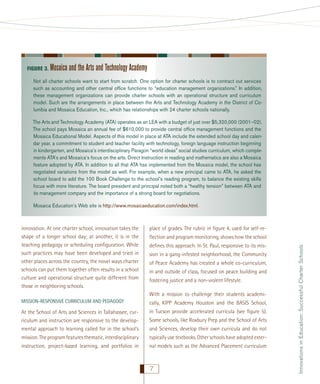
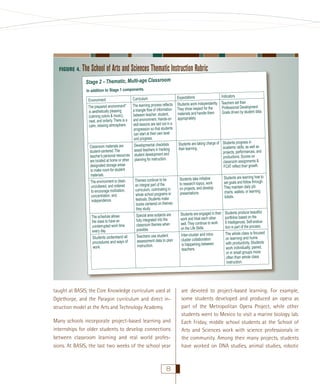
place of grades. The rubric in figure 4, used for self-reflection and program monitoring, shows how the school
defines this approach. In St. Paul, responsive to its mission in a gang-infested neighborhood, the Community
of Peace Academy has created a whole co-curriculum,
in and outside of class, focused on peace building and
fostering justice and a non-violent lifestyle.
With a mission to challenge their students academi-

MISSION-RESPONSIVE CURRICULUM AND PEDAGOGY

cally, KIPP Academy Houston and the BASIS School,

At the School of Arts and Sciences in Tallahassee, curriculum and instruction are responsive to the developmental approach to learning called for in the school’s

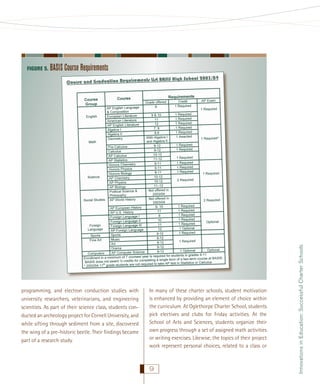
in Tucson provide accelerated curricula (see figure 5).

mission. The program features thematic, interdisciplinary

typically use textbooks. Other schools have adopted exter-

instruction, project-based learning, and portfolios in

nal models such as the Advanced Placement curriculum

Some schools, like Roxbury Prep and the School of Arts
and Sciences, develop their own curricula and do not

7

Innovations in Education: Successful Charter Schools

innovation. At one charter school, innovation takes the
shape of a longer school day; at another, it is in the
teaching pedagogy or scheduling configuration. While
such practices may have been developed and tried in
other places across the country, the novel ways charter
schools can put them together often results in a school
culture and operational structure quite different from
those in neighboring schools.
FIGURE 4.

The School of Arts and Sciences Thematic Instruction Rubric
Stage 2 – Thematic, Multi-age Classroom
In addition to Stage 1 components.

Indicators
Expectations
Curriculum
s set their
process reflects Students work independently. Teacher
The learning
Professional Development
of information They show respect for the
a triangle flow
Goals driven by student data.
materials and handle them
between teacher, student,
ment. Hands-on appropriately.
and environ
skill lessons are laid out in a
progression so that students
can start at their own level
and progress.
Students are taking charge of Students progress in
Developmental checklists
Classroom materials are
academic skills, as well as
their learning.
assist teachers in tracking
student-centered. The
projects, performances, and
student development and
teacher’s personal resources
productions. Scores on
planning for instruction.
are located at home or other
classroom assignments &
designated storage areas
FCAT reflect their growth.
to make room for student
materials.
Students are learning how to
Students take initiative
Themes continue to be
The environment is clean,
set goals and follow through.
to research topics, work
an integral part of the
uncluttered, and ordered
They maintain daily job
on projects, and develop
curriculum, culminating in
on,
to encourage motivati
charts, wallets, or learning
presentations.
whole school programs or
concentration, and
tickets.
festivals. Students make
independence.
books centered on themes
they study.
l
Students are engaged in their Students produce beautifu
Special area subjects are
e allows
The schedul
portfolios based on the
work and treat each other
fully integrated into the
to have an
the class
8 Intelligences. Self-evaluawell. They continue to work
classroom themes when
uninterrupted work time
tion is part of the process.
on the Life Skills.
possible.
day.
every
The whole class is focused
Inter-cluster and intraTeachers use student
Students understand all
on learning and hums
cluster collaboration
assessment data to plan
procedures and ways of
with productivity. Students
is happening between
instruction.
work.
work individually, paired,
teachers.
or in small groups more
often than whole class
instruction.

Environment
The prepared environment*
is aesthetically pleasing
(calming colors & music),
neat, and orderly. There is a
calm, relaxing atmosphere.

taught at BASIS, the Core Knowledge curriculum used at
Oglethorpe, and the Paragon curriculum and direct instruction model at the Arts and Technology Academy.
Many schools incorporate project-based learning and
internships for older students to develop connections
between classroom learning and real world professions. At BASIS, the last two weeks of the school year

8

are devoted to project-based learning. For example,
some students developed and produced an opera as
part of the Metropolitan Opera Project, while other
students went to Mexico to visit a marine biology lab.
Each Friday, middle school students at the School of
Arts and Sciences work with science professionals in
the community. Among their many projects, students
have worked on DNA studies, animal studies, robotic
BASIS Course Requirements

programming, and electron conduction studies with
university researchers, veterinarians, and engineering
scientists. As part of their science class, students conducted an archeology project for Cornell University, and
while sifting through sediment from a site, discovered
the wing of a pre-historic beetle. Their findings became
part of a research study.

In many of these charter schools, student motivation
is enhanced by providing an element of choice within
the curriculum. At Oglethorpe Charter School, students
pick electives and clubs for Friday activities. At the
School of Arts and Sciences, students organize their
own progress through a set of assigned math activities
or writing exercises. Likewise, the topics of their project
work represent personal choices, related to a class or

9

Innovations in Education: Successful Charter Schools

FIGURE 5.
school theme. At Community of Peace Academy, students using the Accelerated Reader program select the
books they will read in class based on their improvement and reading level. At the BASIS School, students
can choose to take a full menu of Advanced Placement
classes and graduate after 11th grade.
FLEXIBLE STRUCTURE AND OPERATIONS

In schools driven by a mission, structure should be at
the service of function. The flexibility afforded charter schools allows them to carry out their missions in
many different ways. Some schools use a traditional
model with 50-minute classes, while others use a
block schedule with 80- or 90-minute classes. Some
use a combination. The structure depends on what the
school is trying to accomplish—whether, for example,
to expose students to a full liberal arts curriculum or
to focus on particular areas or allow for extended projects. At the School of Arts and Sciences, a developmental approach is supported with multi-grade classrooms
and allowing students to progress on a developmental timetable. A lead teacher and an assistant teacher
work across three grade levels in each classroom.
Because many charter schools have an extremely ambitious mission, they provide a longer school day than
their local counterparts. At the Arts and Technology
Academy, children attend school one hour a day longer and 20 days more a year than the regular District of
Columbia schools. The added time can be calculated as
three extra years of schooling by the time children reach
high school. At KIPP Academy Houston, students are in
school from 7:25 in the morning until 5:00 in the afternoon, with Saturday school required twice each month.
Behind the scenes, administrators at these schools have
created program schedules to support teacher collabo-

10

ration. Shared meeting time for teams of teachers during the school day gives them the opportunity to plan,
develop curriculum, discuss student issues, and conference with families. Special Friday schedules at Roxbury
Prep allow teachers a weekly three-hour block for professional development. Afternoon teacher meetings are
a weekly feature at the BASIS School, as well.
RESPONSIVE STAFFING

Each charter school has the autonomy to hire staff that
fit its program. Gates, for example, hires teachers with
specialized certification to work with English language
learners. The school also hires a number of part-time
teachers to reduce group sizes during core academic instruction and created a position for a teacher leader to
oversee the school’s complex array of programs. BASIS
looks for teachers with strong academic backgrounds,
but not necessarily teaching credentials, to teach their
advanced courses. KIPP and Roxbury Prep look for young
teachers with lots of energy. Roxbury Prep plans its program in anticipation of frequent teacher turnover; other
schools, like Community of Peace, have stable faculties
that have evolved the school’s program over time.
One of the striking characteristics of these schools is their
ability to provide a high teacher to student ratio. At Community of Peace Academy, there is one teacher per 16
students in the kindergarten and first grade. Elementary
grades at the School of Arts and Sciences have two
teachers, a lead teacher and an associate teacher for each
multi-age classroom. Many of the schools have staff specialists, such as a school nurse, social worker, or counselor; high school or college placement director; parent
liaison-translator; special education resource specialist;
and librarian. Student needs and priorities determine the
staffing and resource allocation.
SUPPORTIVE SCHOOL ENVIRONMENT

Common to these charter schools is a sense that school
cares for each student as a family does for its children.
At the School of Arts and Sciences, teachers work with
the same students for two or more years in a row. This
“looping” gives teachers more time to develop strong relationships with students and families and to understand
and meet students’ educational needs. At Oglethorpe
Charter School, an individual “Personal Education Plan”
is developed for all students to help monitor their progress toward achieving subject area objectives. There is a
widely shared sense that students have specific needs
and may require different levels of support in their
learning. The focus at the School of Arts and Sciences on
individual learning needs has attracted many students
whose previous education experiences featured the
highly individualized approaches of home schooling.
Students in these relatively small schools are taught to
help and support one another. At KIPP Academy Houston, one of the school mantras posted in every classroom reads, “If a teammate needs help, we give. If we
need help, we ask. Work Hard. Be Nice. Team always
beats individual.” At Community of Peace Academy, students are trained to become “Peace Builders,” actively
working to create a non-violent community based on

trust and acceptance. Teachers make time for proactive
classroom discussions about character and responsibility, coaching students to make thoughtful, caring decisions. As one parent said, “Community of Peace works
because the teachers create a peaceful environment
where the children feel secure and comfortable to
learn. The teachers really care about the children.” The
tone in these charter schools is one of acceptance. For
example, students at the School of Arts and Sciences
are encouraged to express their creativity, knowing that
their individuality will be supported, not teased. Several
schools bring everyone together for Friday community
meetings, singing together, giving theatrical presentations, and recognizing student achievements and contributions to help create a positive tone schoolwide.
Even in neighborhoods known for rough public schools,
these charter schools are peaceful and safe, without violence or disruption among the students. Every school
has developed strong expectations for student behavior and systems to help students to do their best. Most
of these schools have a dress code or require uniforms.
The School of Arts and Sciences is a notable exception,
where students are free to wear blue hair and capes if
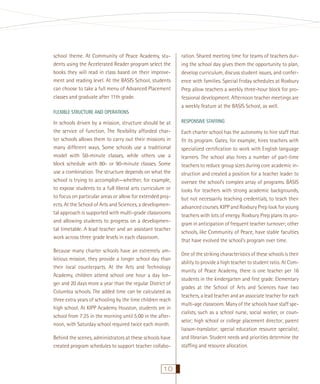
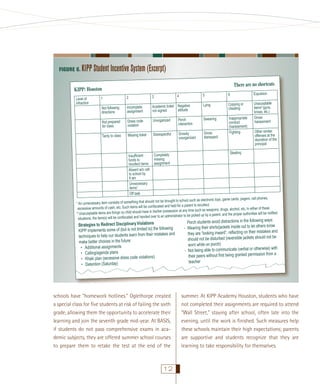
they please. Student incentive programs at KIPP Academy (see figure 6) and Roxbury Prep keep students
focused on being prepared for class and modeling excellent citizenship. At Oglethorpe, students must earn
the privilege of clubs and extracurricular activities by
keeping their grades up.
To be sure that no student “falls through the cracks,”
support for students extends from providing for their
social and emotional well-being to providing systems
for students who struggle academically. At Roxbury
Prep, if students are not doing well in an academic class,
or need help to master a concept, teachers will pull them
for a tutorial during gym or elective periods. Several

11

Innovations in Education: Successful Charter Schools

In all cases, school leaders and staff agree that teachers
need to buy into the program or find another home. At
the Arts and Technology Academy, for example, turnover was high after the first year with a new principal,
when the faculty came together around a vision and
expectations increased. Staff not enthusiastic about
the school’s new demands were encouraged to leave,
and 21 of the 41 teachers and instructional assistants
did so. The following year, turnover was much lower.
FIGURE 6.

KIPP Student Incentive System (Excerpt)
There are no shortcuts

KIPP: Houston
5

6

Expulsion

Lying

Copying or
cheating

Porch
interaction

Swearing

Grossly
unorganized

Gross
disrespect

Inappropriate
conduct
(harassment)
Fighting

Unacceptable
items² (guns,
knives, etc.)
Gross
harassment

4

1

2

3

Not following
directions

Incomplete
assignment

Academic ticket Negative
attitude
not signed

Not prepared
for class

Dress code
violation

Unorganized

Tardy to class

Level of
infraction

Missing ticket

Disrespectful

Completely
Insufficient
missing
funds to
recollect items assignment
Absent w/o call
to school by
8 am
Unnecessary
items¹
Off task

Other similar
offenses at the
discretion of the
principal

Stealing

cards, pagers, cell phones,
not be brought to school such as electronic toys, game
¹ An unnecessary item consists of something that should
t.
items will be confiscated and held for a parent to recollec
excessive amounts of cash, etc. Such
alcohol, etc. In either of these
in his/her possession at any time such as weapons, drugs,
² Unacceptable items are things no child should have
and the proper authorities will be notified.
over to an administrator to be picked up by a parent,
situations, the item(s) will be confiscated and handed

Strategies to Redirect Disciplinary Violations
g
KIPP implements some of (but is not limited to) the followin
our students learn from their mistakes and
techniques to help
make better choices in the future:
• Additional assignments
• Calling/agenda plans
• Khaki plan (excessive dress code violations)
• Detention (Saturday)

schools have “homework hotlines.” Oglethorpe created
a special class for five students at risk of failing the sixth
grade, allowing them the opportunity to accelerate their
learning and join the seventh grade mid-year. At BASIS,
if students do not pass comprehensive exams in academic subjects, they are offered summer school courses
to prepare them to retake the test at the end of the

12

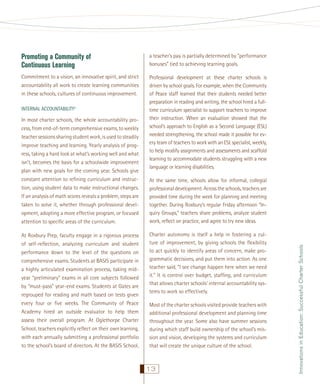
Porch students avoid distractions in the following ways:
know
- Wearing their shirts/jackets inside out to let others
g inward”, reflecting on their mistakes and
they are “lookin
be
should not be disturbed (reversible jackets should not
worn while on porch)
with
- Not being able to communicate (verbal or otherwise)
a
their peers without first being granted permission from
r
teache

summer. At KIPP Academy Houston, students who have
not completed their assignments are required to attend
“Wall Street,” staying after school, often late into the
evening, until the work is finished. Such measures help
these schools maintain their high expectations; parents
are supportive and students recognize that they are
learning to take responsibility for themselves.
Promoting a Community of
Continuous Learning

a teacher’s pay is partially determined by “performance
bonuses” tied to achieving learning goals.

Commitment to a vision, an innovative spirit, and strict
accountability all work to create learning communities
in these schools, cultures of continuous improvement.

Professional development at these charter schools is
driven by school goals. For example, when the Community
of Peace staff learned that their students needed better
preparation in reading and writing, the school hired a fulltime curriculum specialist to support teachers to improve
their instruction. When an evaluation showed that the
school’s approach to English as a Second Language (ESL)
needed strengthening, the school made it possible for every team of teachers to work with an ESL specialist, weekly,
to help modify assignments and assessments and scaffold
learning to accommodate students struggling with a new
language or learning disabilities.

In most charter schools, the whole accountability process, from end-of-term comprehensive exams, to weekly
teacher sessions sharing student work, is used to steadily
improve teaching and learning. Yearly analysis of progress, taking a hard look at what’s working well and what
isn’t, becomes the basis for a schoolwide improvement
plan with new goals for the coming year. Schools give
constant attention to refining curriculum and instruction, using student data to make instructional changes.
If an analysis of math scores reveals a problem, steps are
taken to solve it, whether through professional development, adopting a more effective program, or focused
attention to specific areas of the curriculum.
At Roxbury Prep, faculty engage in a rigorous process
of self-reflection, analyzing curriculum and student
performance down to the level of the questions on
comprehensive exams. Students at BASIS participate in
a highly articulated examination process, taking midyear “preliminary” exams in all core subjects followed
by “must-pass” year-end exams. Students at Gates are
regrouped for reading and math based on tests given
every four or five weeks. The Community of Peace
Academy hired an outside evaluator to help them
assess their overall program. At Oglethorpe Charter
School, teachers explicitly reflect on their own learning,
with each annually submitting a professional portfolio
to the school’s board of directors. At the BASIS School,

At the same time, schools allow for informal, collegial
professional development. Across the schools, teachers are
provided time during the week for planning and meeting
together. During Roxbury’s regular Friday afternoon “Inquiry Groups,” teachers share problems, analyze student
work, reflect on practice, and agree to try new ideas.
Charter autonomy is itself a help in fostering a culture of improvement, by giving schools the flexibility
to act quickly to identify areas of concern, make programmatic decisions, and put them into action. As one
teacher said, “I see change happen here when we need
it.” It is control over budget, staffing, and curriculum
that allows charter schools’ internal accountability systems to work so effectively.
Most of the charter schools visited provide teachers with
additional professional development and planning time
throughout the year. Some also have summer sessions
during which staff build ownership of the school’s mission and vision, developing the systems and curriculum
that will create the unique culture of the school.

13

Innovations in Education: Successful Charter Schools

INTERNAL ACCOUNTABILITY5
STAFF COMMITMENT

Charter schools attract teachers who strongly share
the school’s mission and are willing to go the extra
mile to achieve it. At Community of Peace Academy,
Principal Karen Rusthoven seeks adults who personally
live the philosophy of the school and understand the
importance of a healthy balance of the whole person,
mind, body, and will. Her teachers love the school so
much that many have served there for five years and
more, a long time in the universe of charter schools,
where most are themselves less than five years old.
Other schools have a harder time retaining teachers.
As dedicated as the young teachers are who come to
Roxbury Prep, the work load is grueling. Comparing it
to the intensity experienced by recent college graduates at high-powered management consulting firms,
the school’s co-directors recognize that their young
teachers, who “come early and stay late,” cannot be
expected to remain for years and years. To compensate for the expertise that leaves with each departing
teacher, the school has developed systems to retain
evolving curriculum knowledge, storing it in school
databases and passing it on from one teacher to the
next. The KIPP Academy mantra, “There are no shortcuts,” applies to staff as well as students. Teachers
work hard, long hours, starting their day at 7:00 and
teaching until 5:00; they are also on call in the evening
to field student and parent phone calls and to teach
Saturday school twice a month.
Teachers at charter schools are not in it for the money.
They are not earning overtime for their long days. Staff
compensation at these schools is usually the same as in
the local school districts. In some cases it is less.
In all of these schools, parents rave about the teachers’ commitment to the students, their availability and

14

openness for communication, and their dedication. The
challenge is how to support staff who are working so
hard to make a school successful. Many teachers say that
collegiality with their teammates, the partnership with
parents, the climate of support from administrators and
board members, and even the opportunity to serve on
their school board provide a boost in morale that makes
it possible to engage in such all-consuming work.

Partnering With Parents and the Community
At each of these schools, the culture forged around a
shared educational vision creates a strong sense of community. Parents choose to send their children, and students know why they are there. The schools tend to be
small, which itself allows an intimacy and face-to-face
recognition not possible in larger schools. But their family-like feel is intentional, part of the school design. As
one teacher explained, “We see the whole school as an
extended family.” Teachers reach out to create a connection between home and school environments. At Community of Peace Academy, teachers begin the school year
with home visits to meet the families and learn about
students’ home environments. Parents repeatedly commented that they appreciate how frequently teachers
communicate with families. Every teacher at KIPP Academy Houston is accessible by cell phone, taking calls until
8:30 at night from students and parents. The sense of
shared commitment by parents and staff is formalized
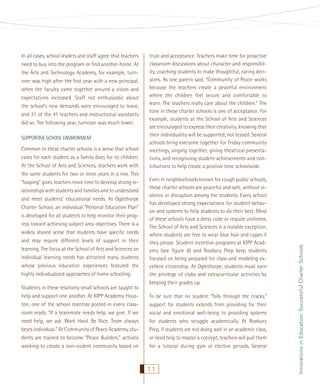
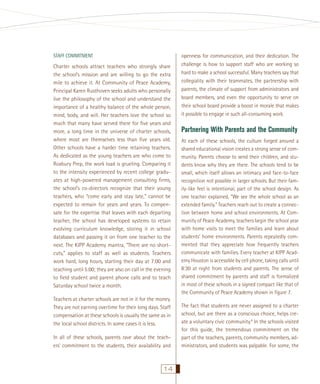
in most of these schools in a signed compact like that of
the Community of Peace Academy shown in figure 7.
The fact that students are never assigned to a charter
school, but are there as a conscious choice, helps create a voluntary civic community.6 In the schools visited
for this guide, the tremendous commitment on the
part of the teachers, parents, community members, administrators, and students was palpable. For some, the
FIGURE 7.

Community of Peace Parent Compact
COMMUNITY OF PEACE ACADEMY
HOME/SCHOOL COMPACT
2002-2003
The School Will
* Teach and model a non-violent lifestyle.
* Treat parents with care and respect.
* Provide a Family Handbook in English and Hmong. year.
* Visit the home of each parent in the fall of each school
* Return phone calls in a timely manner.
* Meet with parents upon request.
in August, November, and March.
* Conduct Parent/Mentor/Teacher/Student Conferences
Provide Parent/Mentor Nights at least semi-monthly.
*
.
* Provide a Home/School Liaison to assist parents/mentorse.
* Translate important information into the Hmong languag
and meetings.
* Provide child care and interpreters for conferences
ces as needed.
* Provide transportation to important meetings and conferen
* Provide a monthly calendar and newsletter for all parents.
The Parent/Mentor Will
* Teach and model a non-violent lifestyle.
* Treat school staff with care and respect.
ok and support the philosophy and policies therein.
* Read the Family Handbook and High School Handbo
that the child is in school and on time every day.
* See
phone numbers, and addresses for the parent/mentor at all
* See that the school has accurate emergency numbers,

times.
ed conferences and meetings concerning their child, or
* Attend Parent/Mentor Registration Night and all schedul
to the meeting if not able to attend.
call the school prior
s and conferences in a timely manner.
* Return phone calls and answer requests for meeting
Return important school document s in a timely manner. volunteering, and attending school events.
*
Nights,
* Support the community as able by attending Parent
y
levels of children attending Community of Peace Academ
Names and grade

Date:
Date:
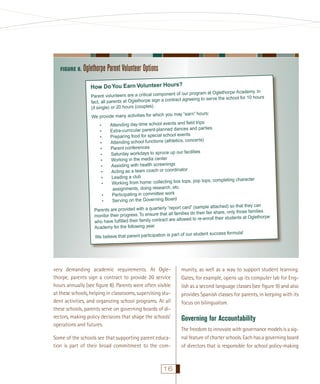
Date:

School Official:
Parent/Mentor:
Parent/Mentor:
BY SIGNING THIS FORM YOU BECOME AN

creation and development of their school community
has involved unexpected challenges, including political
conflicts, facility nightmares, and funding struggles,
to name a few. But with the generosity of community
partners, who have donated everything from office
space and auditorium facilities to new reading programs and a music teacher, who have served on the
schools’ boards and mobilized parents, these charter

Grade

Name

Grade

OF
OFFICIAL MEMBER OF THE COMMUNITY

schools have become part of the fiber of the local communities that they serve.
Parent involvement is widely recognized as a benefit to
children and schools, and these charter schools engage
parents as authentic partners at many different levels. Parents at Roxbury Prep, KIPP, and BASIS formally
agree to support their children through these schools’

15

Innovations in Education: Successful Charter Schools

Name
FIGURE 8.

Oglethorpe Parent Volunteer Options
How Do You Earn Volunteer Hours?

of our program at Oglethorpe Academy. In
Parent volunteers are a critical component
l for 10 hours
sign a contract agreeing to serve the schoo
fact, all parents at Oglethorpe
(if single) or 20 hours (couples).
may “earn” hours:
We provide many activities for which you
trips
Attending day-time school events and field
•
parties
Extra-curricular parent-planned dances and
•
for special school events
Preparing food
•
rts)
Attending school functions (athletics, conce
•
rences
Parent confe
•
ies
Saturday workdays to spruce up our facilit
•
in the media center
Working
•
Assisting with health screenings
•
Acting as a team coach or coordinator
•
Leading a club
•
tops, completing character
Working from home: collecting box tops, pop
•
research, etc.
assignments, doing
Participating in committee work
•
Serving on the Governing Board
•
rt card” (sample attached) so that they can
Parents are provided with a quarterly “repo
families
e that all families do their fair share, only those
monitor their progress. To ensur
to re-enroll their students at Oglethorpe
allowed
who have fulfilled their family contract are
Academy for the following year.
of our student success formula!
We believe that parent participation is part

very demanding academic requirements. At Oglethorpe, parents sign a contract to provide 20 service
hours annually (see figure 8). Parents were often visible
at these schools, helping in classrooms, supervising student activities, and organizing school programs. At all
these schools, parents serve on governing boards of directors, making policy decisions that shape the schools’
operations and futures.
Some of the schools see that supporting parent education is part of their broad commitment to the com-

16

munity, as well as a way to support student learning.
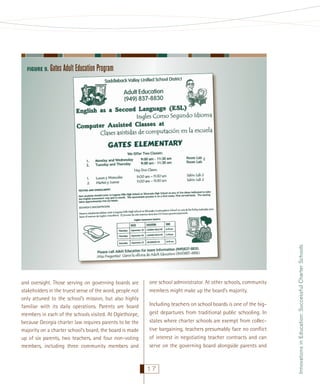
Gates, for example, opens up its computer lab for English as a second language classes (see figure 9) and also
provides Spanish classes for parents, in keeping with its
focus on bilingualism.

Governing for Accountability
The freedom to innovate with governance models is a signal feature of charter schools. Each has a governing board
of directors that is responsible for school policy-making
Gates Adult Education Program

and oversight. Those serving on governing boards are
stakeholders in the truest sense of the word, people not
only attuned to the school’s mission, but also highly
familiar with its daily operations. Parents are board
members in each of the schools visited. At Oglethorpe,
because Georgia charter law requires parents to be the
majority on a charter school’s board, the board is made
up of six parents, two teachers, and four non-voting
members, including three community members and

one school administrator. At other schools, community
members might make up the board’s majority.
Including teachers on school boards is one of the biggest departures from traditional public schooling. In
states where charter schools are exempt from collective bargaining, teachers presumably face no conflict
of interest in negotiating teacher contracts and can
serve on the governing board alongside parents and

17

Innovations in Education: Successful Charter Schools

FIGURE 9.
FIGURE 10.

Roxbury Prep Annual Accountability Plan (Excerpts)

Academic Program (Note: Once the MCAS is expanded to include Math and English Language Arts exams for all
middle school grades (6–8), RPC may no longer use the Stanford 9 for external accountability purposes.)
Goal # 1: Students at RPC will be able to effectively comprehend and analyze literature and non-fiction texts.
Measures:
• Over 90% of RPC students who have attended RPC from September of the 6th grade through May of the 7th grade will
pass the 7th Grade MCAS English Language Arts exam.
• RPC students who have attended RPC from September of the 6th grade through May of the 8th grade will at the end of
the 8th grade year improve their entering Stanford 9 Reading Comprehension scores by an average of 3 NCE points.

Organizational Viability
Goal # 6: RPC enrollment and attendance reflect parental demand and commitment.
Measures:
•

Applications to enroll in grade 6 will exceed the number of available spaces by at least 25%.

•

Annual school attendance rates will be 93% or higher.

Faithfulness to Charter
Goal #9: RPC students are prepared to enter, succeed in, and graduate from college.
Measures:
• Over 30% of graduating RPC 8TH grade students will enroll in college preparatory high schools in which over

80% of graduates matriculate to college.

community members. The advantages of teacher
membership on school boards include deepening
teachers’ ownership of the school’s vision, giving them
a greater stake in policy and organizational decisions,
and helping to ensure that a board’s solutions fit the
identified problems.
Annually, charter schools are expected to evaluate their
school program, quality of teaching, and student outcome measures in light of the mission and goals defined

18

in the charter document. All charter schools publish
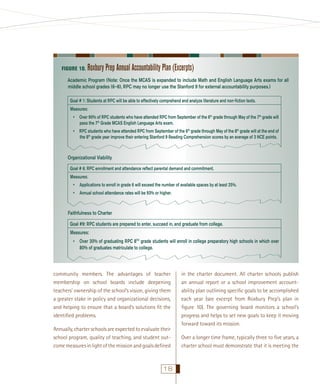
an annual report or a school improvement accountability plan outlining specific goals to be accomplished
each year (see excerpt from Roxbury Prep’s plan in
figure 10). The governing board monitors a school’s
progress and helps to set new goals to keep it moving
forward toward its mission.
Over a longer time frame, typically three to five years, a
charter school must demonstrate that it is meeting the
Yet another dimension of charter school accountability has to do with family satisfaction. Charter school
practices are open. Information is shared and available.
All parents and community members can see how students are doing on a regular basis. Thus a school that is
not delivering is likely to lose its customers: Parents will
no longer choose to send their children there. It is this
openness of the charter process, the high visibility of
the quality of performance, which may be the strictest
accountability measure of all. As one principal put it,
“The conditions of chartering, if anything, lead us to be
more self-analytical and critical, holding ourselves to a
higher standard than most schools.”
Again, the natal twin of charter accountability is freedom to act. Success “hinges on academic achievement
and other performance indicators, not on regulatory compliance or standardized procedures.”7 Charter
school boards do not have to convince districtwide
majorities or unwilling superintendents that their
approaches are right. A Roxbury Prep board member
remarked that as a charter school, “We have the flexibility to turn on a dime.” If board members see a need,
they can follow up. Freed from the constraints of bureaucracy, when a decision is made, implementation
is immediate.
The charter schools in this guide measure success in
a number of ways. All have made continuous aca-

demic gains and are proud to have done so. All have
attendance rates at 95 percent or more. Waiting lists to
get into these successful schools provide new meaning
to “winning the lottery.”
In other ways, what constitutes success at a given
school varies with its mission. The Community of Peace
Academy in St. Paul, Minn., can point to its designation as an exemplary character education school. KIPP
Academy Houston can take satisfaction in the 85 percent of its students who enroll in college. Parents at
the School of Arts and Sciences in Tallahassee, Fla., find
that the school succeeds in welcoming all students,
however unique or whatever color they may have dyed
their hair. The school profiles in the next section provide additional measures of success at each school.

Implications
Taken as a group, successful charter schools clearly illustrate two things: (1) key elements that enable success, such as mission-driven programming, are shared
by all of them, and (2) the forms those elements take
vary widely from one school to another.
One theory of charter schooling is that freedom from
regulation will stimulate innovation and experimentation. This is not to say that each charter school, even
each successful charter school, is entirely original
or ground-breaking. But as illustrated by the eight
schools in this guide, each reflects the particular vision of its founding educators and community members—whether for classical education, schooling infused with character education, approaches aligned
with research on learning and instruction, or programs
that have been designed by educational management
organizations, for example. What does make each of

19

Innovations in Education: Successful Charter Schools

terms contracted in its charter. The authorizer, whether
district, state, or another entity, is responsible for monitoring whether the school has in fact lived up to the
promise of its charter. If a school fails to meet ongoing
criteria for success—ranging from financial management to student performance—its charter can be denied renewal or revoked.
These eight schools were selected in part because
they have increased their scores on state assessments over a three-year period and made “Adequate Yearly Progress” this past year. They have
improved over time. It’s not that they found a
magic solution so much as they became organizations mobilized to achieve their goals. Other
schools can do that, too.

these schools unique is the combination of ideas that
have been brought together, made the centerpiece of
each school’s educational approach, and then assessed
to make sure the approach works in practice to accomplish the intended goals.
Success comes not only from the ideas themselves but
also from the focused and energized school culture
that thrives in a mission-driven school. School communities become internally accountable—dedicated to
working together to accomplish their shared goals, adjusting their approach based on results, and responding
flexibly and quickly when needed.

››

Implications for charter school educators.
Charter school educators may gain some confirmation and encouragement from these schools.
Only eight schools could be included in this guide,
but each represents a whole class of other, similar
schools. Charter schools around the country are
experimenting with new ideas, mobilizing communities, and meeting the learning needs of children and families. This guide may help support
their cause.

››

Implications for other school leaders. Within
this guide, school leaders will find ideas that can
be applied in any public school. Many of the specific practices in these schools can be put in place
anywhere. Perhaps more importantly, the core organizational features, such as vision and internal
accountability, are also transferable. The concept
of internal accountability, for example, was first
identified in research on public schools that were
restructuring.8 As a stimulus to all educators, the
guide provides concrete visions of what is possible.
Readers might ask themselves, “How can I replicate
these conditions and practices in my setting?”
Schools looking to meet the accountability requirements of NCLB should especially take note.

20

If local constraints set up what seem to be insurmountable barriers, educators and community
members may want to consider chartering as a
route to pursuing their vision more fully. The local
district or another authorizing agency may provide support. (The resources section of this guide
identifies additional sources of support.)

››

Implications for district or state administrators.
For those charged with the task of creating the
institutional supports schools need to succeed,
the key question to ask is, “How can we get more
schools like the ones in this guide?” District and
state administrators may see here the opportunity to “reinvent public education” in meaningful
ways.9 Districts, like some mentioned here, can see
chartering as one way to encourage innovation
and better meet the needs of children and families. States may reexamine chartering policies in
light of their understanding of the school conditions that promote success.

The first part of this guide has laid out what appear to be
the cross-cutting design elements of successful charter
schools. Brief illustrations of how these elements take
shape in the eight featured schools demonstrate that
they can be accomplished in a variety of ways. In the
following part of the guide, snapshots of each of the
schools are intended to help readers envision full charter
school programs—eight different ways, just for starters.
Part II:
Charter School Profiles
The Arts and Technology Academy Public Charter School
BASIS School, Inc.
Community of Peace Academy
KIPP Academy Houston
Oglethorpe Charter School
Ralph A. Gates Elementary School
Roxbury Preparatory Charter School

21

Innovations in Education: Successful Charter Schools

The School of Arts and Sciences
22
The Arts and Technology Academy Public Charter School
Washington, D.C.

Year First Chartered
and Authorizer
1998
Special charter school board

Grades

Enrollment

English
Learners

Subsidized
Meals

Special
Needs

Per Pupil
Spending

Pre-K–6

615

0%

97%

7%

$8,650

When low enrollment led the District of Columbia
Public Schools to close Richardson Elementary, local
parents and community members stepped in to create a new school in the empty building. The Arts and
Technology Academy Public Charter School (ATA) was
chartered in 1998—“A true, homegrown, grassroots effort,” says a member of the chartering board. In a tough
Washington neighborhood characterized by public
housing and family incomes well below federal poverty
levels, some of these parents had a different vision for
their children.
For its 615 students—98 percent African American
and 97 percent low-income—the pre-K–6 ATA has designed a program to meet their needs and their parents’
dreams. According to the school’s annual report, the
curricular mixture of the basics and the arts seeks to
“propel” students beyond their “economically depressed
community.” The arts are seen as the foundation for
building children’s academic prowess as well as a way
to “connect them to the great artists and leaders who
were nurtured within their community.” By design, the
school program reflects for children the strengths of
their heritage and creates many ways for them to express themselves and to excel.

Program and Operations
To meet its high expectations, ATA runs an extended,
seven-and-a-half-hour school day, and an extended
school year of 200 days, about 20 days longer than at
neighboring schools. The basics in reading and math
are taught through the scripted approach of direct
instruction. On the other hand, a multicultural social

studies curriculum invites students to explore the history of ideas. Everyone learns Spanish. Students and
their teachers have easy access to current technology.
After-school tutoring and homework assistance are
provided for students who need it. Student clubs and
extracurricular activities reinforce the focus on arts and
academics. And student performances fill the auditorium with proud parents throughout the year. Teachers
liken the school to “an oasis in the community.”
To keep focused on the children’s possibilities, the faculty and staff of ATA have created a list of belief statements that begins, “We can teach every student,” and
concludes, “Given knowledge and opportunity, students
can shape their futures.” To safeguard those futures, a
culture of achievement has taken hold at ATA. While
standardized test scores indicate that ATA students still
have a lot of ground to make up, students are proud to
have good grades. “I got 28 As and 8 Bs,” a sixth-grader
reports with satisfaction.
Principal Anthony Jackson is a large part of the ATA
story. Jackson came to ATA in 2000, two years after it
opened, at a time when the school was floundering,
children were not succeeding, and complaints were
high. After three years, all signs are positive. “This is
an example of how a school can turn around,” says
a member of the District of Columbia Public School
Charter Board. “When I get discouraged, I point to it.”
The leadership that Jackson brings to the school begins
with his attitude about the school’s place in the community. On a tour of the school, he stops to point out
a window in the rear of the building that looks onto

23

Innovations in Education: Successful Charter Schools

Location
the neighboring public housing developments. There
used to be a cage on this window, he reports, to keep
out the vandals. On all the windows, in fact. “Cages,”
he says, “signify surrender,” and against the advice of
many, he took a chance and had them removed. At the
same time, Jackson is not willing to take chances with

In a tough Washington neighborhood characterized
by public housing and family incomes well below
federal poverty levels, some of these parents had
a different vision for their children.
his students. Walking a boy home who was being suspended, Jackson experienced the open-air drug market
outside the student’s apartment, reversed course—boy
in tow—to deal with him instead within the walls of
the school. Otherwise, he says, “I was just turning him
over to them.”
Academically, Jackson is equally protective. “I get kids
to come read to me all the time. I see that child who
struggled … he’s reading with confidence, with inflection, and he understands what the heck he’s reading. I
think we’re doing a pretty good job,” he allows. A selfdescribed “data nut,” who enjoys the challenge of disaggregating data to see what it can reveal, Jackson also
recognizes the limitations of test scores. He never loses
sight of his students’ broad academic needs and the
role of the arts in their education. “It’s our responsibility,” he says, “to make sure that schools remain—even
in an age of accountability—kid friendly. If at the end
of the day children have passed every SAT 9 test that’s
placed in front of them, but they have no sense of
beauty, what have we created?”
Beyond the core curriculum of reading, writing, mathematics, science, and social studies, students all learn basic
communicative and performing arts, often demonstrating them through technology-based activities. The arts
and technology program encompasses the disciplines of
the visual arts; speech; drama; dance; music, including

24

singing, playing instruments, and composing; journalism, and video production. As a teacher points out, the
school’s mission and belief statements are “based on the
fundamental understanding that kids learn in different
ways. ATA gives them many ways to learn.”
The director of special education notes that the arts
program is also very effective for the 7 percent of the
students who have special needs. The parent of a special needs student calls ATA “a blessing” for her son.
“All of the teachers and staff, everybody makes him feel
comfortable and loved. The kids are comfortable with
him. He’s excited about his homework and about the
things he’s asked to do. He gets lots of stimulation.”
The school’s strong emphasis on teaching values and
respect is key to the treatment this child has received
at ATA and to the school’s overall discipline approach.
Teachers may not yell at students or punish children by
isolating them in any way. Jackson counsels teachers
to get to know students instead of resorting to overly
strict practices. “You can’t discipline strangers,” he cautions. “You have to build trust first.”
The school also benefits from having a dean of students,
who serves as a “behavior interventionist.” In a school
founded on the arts, it is only fitting that one kind of
intervention is music therapy. Picture a small group of
boys singing a song called “Cooperation” as the music
therapist strums a guitar. No one notes the irony of the
cooperation in evidence.
Finally, the condition of the school’s physical plant is
not incidental to the atmosphere of confidence and
pride that permeates ATA. One of the board of directors’ first actions was to repair the run-down building.
When ATA opened, the new school was in ship shape,
but it was sterile. Two years later the hallways were still
barren and no student work was on the walls, lest students tear it down or deface it. When Jackson arrived,
he encouraged wary teachers to paper the walls with
colorful student work. To their delight, they found that
Continuous Learning
To improve instruction in all areas, faculty and administrative staff meet four times each year to review assessment outcomes and to develop responsive
strategies. They use outcomes from curriculum-based
assessments to identify students with low skill levels
who are tracked for consideration of special education
referral and/or learning enrichment, such as tutoring
or homework assistance. SAT 9 outcomes are used to
identify areas that are posing a challenge for students,
and the curriculum is modified accordingly. Jackson
also looks at data such as attendance, referrals to the
office, and numbers in after-school tutorial programs,
all with the purpose of planning improvements.
The school devotes at least 15 days each year to professional development in the areas of standards, best practices, test-taking strategies, and classroom management. Teachers meet with the assistant principal weekly
to discuss classroom practices. In addition, the assistant
principal completes weekly classroom observations and
coaches teachers. Program coordinators for grades preK–2, grades 3–6, and arts and technology also regularly
coach teachers. This structure and support are credited
with teachers’ high performance. Proud of what ATA
teachers have accomplished, the school board president
notes that they are not inherently “better” teachers than
those in the rest of the District of Columbia but that
they have responded to the environment in the school.
The leadership team believes it has created a culture
where it is “okay to ask questions.” Likewise, teachers at
ATA feel they are “allowed to grow.”
The principal, one teacher says, “is a leader who demands the best. It makes all the difference because you
want to do well for somebody like that.”

Parents and Partners
Although ATA was first envisioned by parents and has
two parents on the school board, parent involvement
outside of a small core group is very limited. Most parents
are single mothers and have themselves had few educa-

Students are proud to have good grades.
“I got 28 As and 8 Bs,” a sixth-grader
reports with satisfaction.
tional opportunities, which teachers report limits participation in their children’s academic life. The school board
and school staff are eager to increase parents’ role in the
school. GED classes, job training, and job placement that
could be offered through the school’s Parent Resource
Center are seen as important services that could also
strengthen parent participation in the school.
ATA has many relationships with community groups such
as local churches and cultural organizations, including
the Library of Congress, but no key partnerships.

Governance and Accountability
The Arts and Technology Academy Public Charter
School was chartered by the District of Columbia Public
Charter School Board in 1998 as a nonprofit corporation and local education agency (LEA). It has an annual budget of about $5,320,000, receiving funding of
about $6,550 per student, plus some extra dollars for
weighted categories, such as pre-school, and federal
entitlements amounting to about $475,000.
ATA has a business relationship with Mosaica Education, Inc., which operates 24 charter school programs
nationally. The school pays Mosaica $610,000 annually to provide a “central office” function. The company
also provides the school’s Direct Instruction reading
and mathematics curricula and the Paragon social
studies curriculum.

25

Innovations in Education: Successful Charter Schools

students respected each other’s contributions. Says one
proud teacher, “If children are going to be here for eight
hours, they should have a stimulating, beautiful, safe
environment—and our building is all of those things.”
The school is governed by a nine-member board,
which meets monthly. Recently the board used taxexempt bonds to purchase the school building, which
it had been renting. Monthly payments dropped from
$33,000 to $13,000. These savings have contributed to
the school’s $600,000 bank balance.

“The principal is a leader who demands the best.
It makes all the difference because you want
to do well for somebody like that.”

››

››
››
››

While the school cannot operate without sound fiscal
management, success is measured by student test scores,
the scope of the curriculum, attendance, disciplinary referrals, staff retention, and parent satisfaction:

››

Since 2000, when Jackson took over as principal,
students’ SAT 9 scores have moved steadily up. In
reading performance, 59 percent of the students
were reading at or above grade level in 2003,
compared with 35 percent in 2000. In math performance, half of the students were at or above
grade level, compared with 20 percent in 2000.

26

››

Many educators are baffled by ATA’s ability to emphasize the arts as well as raise test scores. With
the trend toward an increasingly narrow curriculum, Jackson is used to the question, “How do you
guys do it?”
Daily average attendance is 95 percent.
Behavioral referrals dropped from 43 to 24 in
three years.
After Jackson’s first year in the school, faculty
turnover was high. Staff not enthusiastic about
the school’s demands were encouraged to leave,
and 21 of the 41 teachers and instructional assistants did. The following year staff turnover was
low, with departures down to seven.
Parent satisfaction is measured by the school’s
waiting list, the overflow audiences for student
performances, and parents’ pleas that the school
extend its program into middle school.
BASIS School, Inc.
Tucson, Ariz.

Year First Chartered
and Authorizer
1998
State

Grades

Enrollment

English
Learners

Subsidized
Meals

Special
Needs

Per Pupil
Spending

5–12

246

1%

Not
applicable

1%

$5,339

In the midst of a national focus on educational performance and accountability, BASIS School, Inc. achieves
both through its priorities of hard work and academic
achievement. The school’s mission is to provide a rigorous academic background to prepare students for college, with an emphasis on a classical liberal arts education based on European education practices. Struggling
students receive extra academic support until they can
meet the school’s performance standards, and teachers
are hired not on the basis of certification but according
to their level of expertise. Of the 19 faculty members, 10
have a master’s degree, and two have doctorate degrees,
all in the subjects they are teaching. BASIS parents, who
maintain an active community dialogue, adhere strongly
to the school’s mission. Says one parent, “The workload
is hard, but it brings a sense of satisfaction and prepares
children for the real world.” Students too appreciate their
school culture, reporting that the school’s small size and
emphasis on enabling every student to succeed makes it
feel like “an extended family.”
Housed in a converted one-story structure in Tucson, Ariz., the BASIS School is open to children of any
background or ability, including those who qualify for
special education. The school serves a student population that is 74 percent white, 12 percent Hispanic,
10 percent Asian American, and 4 percent African
American. The 246 students in grades 5–12 must take a
placement exam before enrolling. Students who place
below their desired grade level are offered such options
as remedial work in summer school, a retake of the
placement exam after home preparation, or enrollment
in a lower grade. Consistent with the school’s liberal
arts focus, students in all grade levels take courses in

language, literature, history, art, philosophy, mathematics, and science, in a curriculum that is aligned with
the Arizona State Standards and also exceeds those requirements in many areas. Sports and fine arts courses
are offered to all students, and middle school students
take physical education. After some pressure from parents, after-school sports, band, and other courses and
activities were added.
The BASIS School is the brainchild of a husband and
wife team, both economists, who founded the school
to combine their idea of the best from European and
American educational traditions. The European tradition, they feel, provides academic rigor, while the
American tradition promotes creativity, problem solving, free expression, and a sense of community. Chartered in 1998, the BASIS School proved so successful
that in 2001 its founders opened a second campus,
BASIS Scottsdale, in Scottsdale, Ariz.

Program and Operations
The mission of the BASIS School drives every aspect of
its daily operations. School leaders are guided by a selfdescribed “bias toward traditional teaching.” They strive
“to avoid educational fads and empty slogans and to
put substance above form.” Faculty, parents, and students fully understand that the students are expected
to work hard at courses that are more rigorous than
most of those at similar grade levels in local schools.
All students begin taking algebra in the seventh grade
and move on to calculus in high school. Sixth-graders study Latin to prepare for learning scientific terms
and romance languages, seventh-graders take public

27

Innovations in Education: Successful Charter Schools

Location
speaking, and eighth-graders take economics. High
school courses are based on the Advanced Placement
(AP) curriculum, with 12 out of 30 courses qualifying
as AP, and the course load is designed such that by the
end of the 11th grade all students have enough credits
to graduate. In their senior year, if they choose to stay,
they may engage in higher-level coursework.

The BASIS School is the brainchild of a
husband and wife team who founded the school
to combine their idea of the best from European
and American educational traditions.
An integral part of the school’s program is its system
of yearly comprehensive exams, which every student
must pass in the core subjects of English, mathematics, science, and social studies in order to be promoted to the next grade. In January, students take a
“preliminary exam” in each subject, which serves as
an accountability measure for students, a test-development tool for faculty, and a formative evaluation
for teachers, parents, and administrators to make decisions about tutoring and other support options for
the students. If students do not score higher than
60 percent on an exam, they are not promoted unless
they successfully retake the exam before the start of the
next school year. All members of the school community
express satisfaction that the school allows no exceptions to these promotion policies. The faculty feel that
students learn to take responsibility for their education.
When students occasionally leave the school because
of the heavy workload, they often come back, reporting
that they were “bored” in other schools or felt lost in
the larger, less personalized school environments.
Along with its rigorous curriculum and high performance standards, the BASIS School offers a number of
supports for students that are designed not only to enable them to reach high academic standards, but also to
foster a sense of accomplishment and satisfaction. Fifth
grade, called “6 prep,” may include some students who

28

are sixth-graders but not yet ready to engage in the
full sixth-grade program. Students in need of academic
help have access to tutoring both during the school
day and after school and can enroll in four weeks of
summer school. Teachers are required to hold afterschool office hours twice a week—one day for student
help and one day for parent-teacher conferences. Because the school is small, students may keep the same
teachers over several years, and the teachers as a result
understand students’ unique strengths and weaknesses
and can target help as needed. In addition to this kind
of support from teachers, students also report feeling
supported by their peers. One student notes that BASIS
students “feel like brothers and sisters.” In a school
culture where “It is ‘cool’ to be on the honor roll, and
even cooler to be on the high honor roll,” the array of
student support networks is intended to help students
“find enjoyment in academic achievement.”
During the last two weeks of the school year, after
the comprehensive exams, students engage in project-based learning. Examples include developing and
putting on an opera as part of the Metropolitan Opera
Project and traveling to Mexico for a marine biology
project. These last two weeks serve as an opportunity
to put into practice skills that students have developed
over the course of the school year.

Continuous Learning
Implicit in the school’s high performance standards
is an emphasis on improving teaching and learning.
Student progress is assessed regularly, with six grading
periods over the course of the year and a final, cumulative grade. Student achievement and improvement
are acknowledged via frequent honors assemblies. Students receive a gold or silver balloon for achieving “distinguished” or “regular” honor roll, and students who
have improved their cumulative average by 2 percentage points or more are honored and also awarded a
balloon. A limited number of non-academic awards are
given out by teachers who wish to recognize students
The BASIS School also devotes significant time and resources to improving teacher practice. At least once a
semester, and twice or more for new teachers, the school
director makes unscheduled observations of each teacher
in his or her classroom. Observations are also conducted
by peers, and in each case an evaluation is discussed
with the observed teacher. Any problems are reported in
writing to both the teacher and school administrators.
Parents may also provide feedback on their children’s
teachers. “Hard measures,” such as test scores, and “soft
measures,” such as science fairs and math competitions,
are also considered in teachers’ evaluations.
Teachers meet one afternoon a week to share teaching
strategies and information about struggling students.
All teachers participate in professional development
workshops and trainings, including the College Board’s
Advanced Placement training, which the middle school
as well as the high school teachers attend. At the end of
every school year, all faculty and staff attend a two-day
retreat, where together they review the students’ performance on the comprehensive exams. Consistent with the
emphasis on continuous improvement, the next year’s
syllabi are developed based on their analysis of these results. In August, teachers spend two weeks before school
starts finalizing the syllabi and preparing for the year.
The school’s founders also structure creative financial
incentives into teacher compensation to encourage
teacher commitment and improvement. Faculty com-

pensation comprises a base salary and a “performance
bonus,” which can range from 6 to 14 percent of the
base salary. Performance bonuses are based on quantifiable goals determined at the beginning of the school
year. Teacher commitment is also rewarded through a
“wellness bonus.” Teachers start the year with five paid
sick days and are compensated at the end of the year
for any that remain.

Parents and Partners
The ethic of individual responsibility and clear communication about standards and goals is one to which
BASIS parents adhere strongly. Parent buy-in to the
school’s mission is deliberately sought, as the school
expects parents to participate actively in their chil-

High school courses are based
on the Advanced Placement
(AP) curriculum.
dren’s education. Before a student enrolls, at least one
parent must come for a school visit and interview with
the school director. Parents are informed of the school’s
strict, high expectations and are told that if a child is not
ready to work hard, or if parents are not willing to support their child to work hard, then the parents should
consider other educational options. At the beginning
of the school year, every student receives a Communication Journal, which serves as the primary means of
communication between teachers and parents. Teachers and parents use the journals to correspond, and
students use them to record daily homework, other
assignments, and important information. Parents also
frequently contact teachers by e-mail, often sending
group e-mails when the matter is of general concern.
In addition, parents engage in an active community
dialogue about the needs and goals of the school.
The parent-teacher organization, called BASIS
Boosters, operates independently from the school

29

Innovations in Education: Successful Charter Schools

who achieve highly in other areas. The balloons have
proven to be an effective inspiration to work hard, and
even high school boys report “loving” the balloons.
Students carry them throughout the school day, and
they are a visible symbol of improvement, pride, and
accomplishment. By continually recognizing student
achievement and improvement, the school aims to
strike “an appropriate balance between students feeling challenged by rigorous academics and the selfsatisfaction that flows from the school’s recognition
of excellence based on hard work.”
administration and so is not a typical parent-teacher
organization. The Boosters run a parent-created and
supported Web site addressing any and all aspects of
the school. The Web site includes an online calendar,
a message board for announcements and discussions,
links to resources and photos, and a teacher informa-

The BASIS School was selected by the AALE
for a pilot program to develop criteria
for charter school accreditation.
tion database. Recently, the Web site offered a poll to
ascertain whether the school should stock healthier
snacks in its vending machines. Says one school administrator, “The important thing is that it’s run by the
parents, not the administration.”

Governance and Accountability
Both BASIS schools, in Tucson and in Scottsdale, are
owned and operated by BASIS School, Inc., a 501(c)3
nonprofit organization. BASIS School, Inc. serves as the
contracting agent with the Arizona State Board for
Charter Schools and also appoints the school boards at
each school. At the BASIS School, Tucson, both school
founders currently sit on the board, as does the school
director. The remaining members are a local community
college professor, who has been repeatedly recognized
as a superior educator, an experienced University of California educator and philanthropist, a professor emeri-

30

tus at the University of Arizona, the school’s drama and
public speaking teacher, and a parent representative.
The BASIS School, Tucson, was selected by the American Academy for Liberal Education (AALE) for a pilot
program to develop criteria for charter school accreditation. (AALE is an accrediting agency for liberal
arts colleges and universities.) The academy’s main
criteria are high levels of academic achievement and
commitment to a liberal arts curriculum. Charter applicants are also assessed on factors including mission, teacher quality, assessment, financial management, organization and governance, student services,
special education, and facilities. Beginning this year,
the BASIS School will undergo annual reviews with
AALE to secure renewal of its accreditation. In addition, the school continues to be accountable to the
state of Arizona, which requires all charter school
students to take Arizona’s Instrument to Measure
Standards (AIMS) test and the Stanford 9 standardized achievement tests.
BASIS students consistently score well above the state
average on the AIMS test, and the BASIS School, Tucson,
was the only school in Arizona in 2003 whose students’
median scores were above the 90th percentile on the
Stanford 9 math test in all grades. While academics are
important, school leaders continue to emphasize that
“BASIS graduates should be not only well prepared for
college admission, but more importantly they should
be prepared to succeed in college and enter their adult
lives without losing their appreciation of learning.”
Community of Peace Academy
St. Paul, Minn.

Year First Chartered
and Authorizer
1995
Local district

Grades

Enrollment

English
Learners

Subsidized
Meals

Special
Needs

Per Pupil
Spending

K–12

546

75%

80%

10%

$10,355

In a community where gangs actively recruit adolescents into their ranks and teenagers sometimes marry
at age 14, according to Hmong custom, the Community of Peace Academy (CPA) has created a school
program and family-style community that empower
students to make thoughtful, non-violent life choices.
The school’s mission, to create a peaceful environment
in which each person is treated with unconditional
positive regard and acceptance, is heard in teachers’
conversations about curriculum, seen in student-fashioned hallway murals, and experienced through the
school’s PeaceBuilder awards. “Community of Peace
works,” says one parent, “because the teachers create a peaceful environment where the children feel
secure and comfortable to learn. The teachers really
care about the children.” Their focus on educating “the
whole person, mind, body and will for peace, justice,
freedom, compassion, wholeness and fullness of life,”
guides every aspect of the school, from hiring and
mentoring new teachers to disciplining students for
misbehavior, from maintaining small class size to relationship building.
Located on the east side of St. Paul, Minn., Community
of Peace Academy serves a high proportion of low-income and English language learners. With 546 students
in grades K-12, 70 percent are Hmong and 20 percent
are African American. The remaining 10 percent include
Hispanic, Eritrean, white, Vietnamese, and American
Indian students. The majority do not speak English at
home. The K-12 curriculum focuses on four core academic areas: reading/language arts, mathematics, science, and social studies. In addition, peace and ethics
instruction are infused at every grade level.

Community of Peace Academy was founded in 1995.
It began as an elementary school and added a grade a
year. As it became clear that the large local high schools
would not meet the individual needs of the school’s
students, the Community of Peace Academy decided to
extend its K-8 program. The staff has grown from under 20 members when the school opened to over 80 in
the fall of 2003. The still-developing high school now
enables families to enroll all of their children at one
school, where students will not fall through the cracks.

Program and Operations
The mission shapes the entire program structure. The
most striking and innovative feature, represented in
the school’s name, is its focus on fostering a non-violent lifestyle. Peace building and character education
are woven into every facet of the school. Each teacher
receives a two-week Responsive Classroom training so
that all are using the same system for guiding student
behavior and modeling positive discipline. This consistency from one classroom to the next is remarkable.
Students know exactly what is expected of their behavior and the result is a peaceful, intentional tone in
the classroom, which allows every student to engage
in learning. The K-8 PeaceBuilder Program, Project
Wisdom for grades 7-12, and the Ethics and Advisory
elective in the high school are all integral parts of the
school’s peace and ethics program. It becomes part of
the way teachers take time to teach the whole child,
not narrowly focusing on academics. In a sixth-grade
classroom, for example, a teacher identified a need
to help her students reflect on what it feels like to be
teased and why they tease others. By the end of this

31

Innovations in Education: Successful Charter Schools

Location
morning circle, students shared personal feelings and
set goals for the week, including a commitment not to
tease others. At this age, the focus is preventative, on
teaching students how to develop the skills to create a
safe classroom environment.

“The teachers create a peaceful environment
where the children feel secure and
comfortable to learn.”
To work with older students, the Hmong Gang Strike
Force coaches the high school faculty on signs that indicate gang involvement. Through this partnership, the
school is also trying to empower parents to take back
children from the gangs, which have a strong presence
in the community.
Real life issues are seized on as ways to build a nonviolent perspective. Last year, for example, two high
school students broke out into a fight in front of a
group of first-graders at breakfast. These were two new
students with violent backgrounds who had an unresolved conflict from the weekend. At Community of
Peace, consequences are functional and constructive
rather than punitive. So as a result of their fight, the
high school students were asked to develop a presentation for the first-graders, explaining their personal
reflections about the use of violence and what they
could have done differently. They talked about learning
how to solve problems without striking out. It proved
to be a powerful learning lesson for the teenagers, and
teachers reported that it had a huge impact on one of
the boys in particular. Teachers consider the school as a
family and help each other to work through issues that
arise, teaching students to learn from their mistakes
and supporting them in the process.
In a practice called “looping,” teachers work with the
same students for two years in a row. In the elementary
school, each teacher is supported by an ESL specialist, a classroom aide, and a shared special education

32

teacher. For grades seven and eight, teachers team by
math and science and by language arts and social studies; each teacher teaches the two subjects to the same
two groups of 24 students for a two-year cycle. This
looping, whether at the elementary grades or in junior
high school, provides continuity and allows teachers to
develop strong connections with students and families. Additionally, teachers feel that when they identify a critical student need, there is support to make
things happen quickly. As one teacher comments, “ I see
change happen here when we need it.”

Continuous Learning
Ongoing learning is evident on every level, from the
classroom to professional development. At the outset,
the school hired an outside evaluator to help them
stay focused on their mission and to strategize ongoing needs. The whole evaluation and accountability
process is used to steadily improve teaching and learning. The board members, teaching and support staff,
and administrators use student performance evaluation
measures to focus on continuous improvement. Data
collected each spring are analyzed by the evaluator
consultant, then presented to the staff of the school.
Working groups then review the data and work during
the school year and summer to develop strategies that
will help students to meet the desired outcomes of the
plan. For example, analysis of standardized testing data
revealed the need to develop a stronger reading program. So the school adopted Accelerated Reading K-12,
created a reading period every day for every student,
and lowered K-1 class size to 16 students. Through an
America Reads grant, they collaborated with the University of St. Thomas to provide an after-school Reading
Buddies program for second- and third-graders, pairing
these elementary students with university students for
reading support. The school also hired a full-time instructional facilitator to provide ongoing professional
development. The reading program is now considered
very strong. “My daughter would never pick up a book,”
reports one parent, “and now I can’t stop her from
The evaluation process also helped teachers see the
need for a more fully developed ESL program, a model
that was more inclusive, embedded, and tightly monitored. It is now one of the school’s most innovative
elements. Based on the belief that every CPA teacher
must be an ESL teacher, the school is partnering with
Hamline University, which provides in-service workshops, teacher observations, and conferencing with
teams to provide feedback on the ESL content and
learning objectives. Every two grades are matched with
an ESL teacher who provides support in the classroom
inclusion model and plans regularly with the classroom teachers. In the high school, two ESL teachers
provide classroom support as well as teaching two ESL
electives, one a tutorial for students who need additional help with their academic classes and a second
ESL class for students who continue to struggle with
English language acquisition.
Now every ESL student has an Individual Learning Plan.
Looking at a student’s standardized testing data, grades,
and school record, the ESL teacher creates two to three
learning goals for each student, indicating the level of
intervention needed and areas for teacher focus. Every
Monday, classroom teachers and ESL teachers plan strategies for their English learners, such as using more realia,
giving students more time to respond to a question, and
allowing students who are shy about participating more
time to share ideas in classroom discussions.

Parents and Partners
Embracing the belief that parents are the first educators of their children, the school works very hard to
reach out to the families of their students and keep
lines of communication open and clear. All families are
asked to sign a Home/School Compact and a Mentor
Contract, committing themselves to full participation
in the education of their child’s mind, body, and will

within an educational community fully committed to
peace and non-violence. Teachers start off the year
visiting students’ homes, connecting with families and
developing a deeper understanding of and empathy
for each child. This paves the way for ongoing com-

The school hired an outside evaluator
to help them stay focused on their
mission and to strategize ongoing needs.
munication throughout the school year, sharing goals
and expectations. A full-time parent liaison fluent in
Hmong arranges interpreters for home visits, meetings,
and conferences and translates all school information,
such as the Family Handbook and the monthly parent
newsletter, into the Hmong language. Transportation
and child care are provided for parents so they may attend school meetings, conferences, and events.
In addition to regular parent-teacher conferences, parent nights are held every other month throughout the
school year. Students in grades K-6 write a weekly letter home to update parents on their grades, homework,
and school learning.
Each year parents are invited to evaluate the school and
its programs through focus groups and surveys. It was
the parents’ idea to have the students wear simple uniforms—khaki pants and polo shirts—as a way to remove
barriers among students. Over nine years, teachers and
parents have worked closely together to develop the
school program. On the school’s board of directors, parents hold five of the 11 voting memberships and teachers hold the other six.

Governance and Accountability
In addition to the five parents and six teachers on the
school’s board of directors, four non-voting members
attend the board’s monthly meetings: the school’s executive director and principal, the business accountant

33

Innovations in Education: Successful Charter Schools

reading and her grades have gone up.” She attributes
this to the motivating schoolwide focus on reading.
and adviser, the high school assistant principal, and the
elementary school assistant principal. The board is responsible for implementing and overseeing the school’s
mission, budget, and policy. Every other year the board
engages in strategic planning.

Teachers start off the year visiting
students’ homes, connecting with families,
and developing a deeper understanding of and
empathy for each child.
Community of Peace Academy is chartered through the
local public school district of St. Paul, Minn. Granted
for three years at a time, the charter has been renewed
three times, based on the school’s successful focus on
its mission and student academic growth. CPA is accountable not only to the charter authorizer but also
to the parents and students it serves. Accountability
is also directly tied to teacher evaluation. This high
level of accountability, says founding principal Karen
Rusthoven, is at the heart of the school’s success.
Financially, the school is sound, although staff are paid
about 10 percent less than their district counterparts.
In 1998, through a nonprofit building company, the
Community of Peace Academy bought the building it
was renting and built an addition to better serve the
K–8 program. In 2002, by raising a community bond,
the school further renovated the building and constructed a new high school. In addition to per pupil
funding from the St. Paul district, the school uses a
combination of other funding sources to provide spe-

34

cial programs for students and teachers. For example,
school improvement funds support the instructional
facilitator, who provides ongoing professional development support for teachers. Title III funding supports an
ESL partnership with Hamline University. First-gradepreparedness funds provide the kindergarten with a
full-day program, and class-size-reduction funds allow
a maximum of 16 students in kindergarten and grade
1 classes.
In 2003, the Character Education Partnership in Washington, D.C., presented Community of Peace Academy
with the National School of Character Award, recognizing the school as one of 10 schools nationwide for
“exemplary work to encourage the ethical, social, and
academic development of its students through character education.” The school is also recognized by World
Citizens Incorporated as an international peace school.
Academically, the school is doing well by its low-income students. For example, 73 percent of the students
in grade 8 passed the 2003 Minnesota Basic Skills test
in math, compared with 72 percent statewide. Math
improvement among students in grades 5–8 ranked
the school among the top 20 in Minnesota. In reading,
with a majority of students whose home language is
not English, 65 percent passed the assessment.
Finally, as demonstrated by the school’s waiting list,
parents are actively choosing Community of Peace
Academy, drawn to the small size, the K-12 program,
the cultural acceptance, and the focus on peace and
non-violence.
KIPP Academy Houston
Houston, Texas

Year First Chartered
and Authorizer
1994
State

Grades

Enrollment

English
Learners

Subsidized
Meals

Special
Needs

Per Pupil
Spending

5–8

346

8%

86%

5%

$8,670

At KIPP Academy Houston, daily chants ring out through
the school: All of us will learn. Read, Baby, Read. Hallway banners proclaim The path to success is education.
Work Hard. Be Nice. Every teacher and school leader at
KIPP, which stands for Knowledge Is Power Program, is
on a mission to level the playing field for students who
live in neighborhoods troubled by illiteracy, drug abuse,
broken homes, gangs, and juvenile crime. KIPP’s mission
is to “help our students develop academic skills, intellectual habits and qualities of character necessary to succeed in high school, college and the competitive world
beyond.” Serving predominantly low-income, minority
students in grades 5–8, KIPP has forged an academic
culture of high expectations, charged with the conviction that every child will learn. The key to this topperforming school is its unrelenting focus on results:
teachers and administrators will do whatever it takes
to help students learn, which includes being on call via
cell phone for homework help at all hours. Everyone in
the school is expected to live by its credo: “There are no
shortcuts. Success is built through desire, discipline and
dedication. The path to success is education.”
KIPP Academy Houston is the flagship among the 31
KIPP schools now operating in the United States. It was
started in 1994 by two Teach For America teachers, Dave
Levin and Michael Feinberg, who recognized that to
bridge the academic achievement gap, students needed
more time and lots of hard work. Their first agenda was
to broaden the concept of a school day to one in which
every student worked hard academically from 7:25 in
the morning until 5:00 at night. Then, as current principal Elliott Witney explains, “We focus on the pieces
students are missing and work to catch them up and

prepare them for college. We want disciplined thinkers,
in a society where thinking doesn’t always get rewarded.
And a big key to success here is that we want our kids
to believe they have choices in life—that their future is
not determined by their past or their status in society or
their economic reality or their skin color or for whatever
reason—success is defined by the choices they make.”
When KIPP Academy began, it was a contract school
in the Houston district. The program was immediately
successful and co-founder Levin left at the behest of
the New York Public Schools to start a KIPP school
there. Meanwhile, Feinberg continued to run the Houston campus. By 1998, the district had moved the school
five times, so Feinberg applied for and received a charter from the state. In 2000, with a $7 million capital
campaign, KIPP Academy Houston moved to its present
37-acre campus and built a multipurpose space for the
new middle school.
Of KIPP Academy Houston’s 346 students, who are
chosen by lottery, 77 percent are Hispanic, 21 percent are African American, and the remaining 2 percent are Asian American and white; 8 percent of KIPP
students are English language learners; 5 percent
receive special education services; and 86 percent
qualify for subsidized meals.

Program and Operations
A standout feature at KIPP Houston is its academic work
ethic and how its chartered freedom is used to extend
student learning time. The school day is considerably
longer than most workdays and the schedule includes

35

Innovations in Education: Successful Charter Schools

Location
two mandatory Saturdays each month, plus summer
sessions. The school year begins in June with a threeweek kick-off and then school resumes six weeks later
in August for the rest of the school year. The summer component for incoming fifth-graders focuses
on creating the school culture—making sure students

Every teacher and school leader is on a mission
to level the playing field for students who live in
neighborhoods troubled by illiteracy, drug abuse,
broken homes, gangs, and juvenile crime.
understand the strict code of conduct and learn the
chants, songs, and systems that will carry them through
the school year. For the sixth-, seventh-, and eighthgraders, the focus is strictly academic.
Students travel as a class from one subject to the next,
working as a team in their 80-minute core classes: language arts, history, science, and math. They also take
45-minute classes, including physical education, art,
music, and Spanish. Students eat lunch with their entire grade in the cafeteria, as teachers conduct informal meetings. With 90 students per grade, there are
three sections of 30 students each. Teachers are able to
handle such large classes because the students are on
task and well behaved.
Consequences for misbehavior or not completing
homework are serious. Discipline is summed up in the
slogan, “If you can’t run with the big dogs, stay on the
Porch.” Students who misbehave are “put on the Porch”
and are prohibited from socially interacting with anyone except adults, are required to wear their uniform
shirts inside out, and must work their way off the
Porch through a combination of good behavior, community service, apologies, and goal-setting. Incomplete
homework sends students to “Wall Street,” the afterschool homework center, where they stay until they
finish, even if it takes until 8:30 at night. KIPP also uses
a schoolwide incentive program, a weekly “paycheck”

36

that rewards good citizenship and good deeds with
“KIPP dollars” to purchase items at the school store.
Paychecks can also be docked for bad behavior.
The academic focus at KIPP is on making sure that students “know what they need to know,” says founder
Mike Feinberg. “It is not a race,” he adds. This attention
to mastery and academic engagement is evident in a
visit to a fifth-grade English class. Students conduct
themselves in an academic discussion the way college
students might engage with a text. Not needing to
raise hands, but instead politely waiting to comment
on the contributions of the last person, students offer remarkably mature and thoughtful responses.
They hold the classwide discussion among themselves
rather than always addressing the teacher. Pointing to
particular examples in the book Night John by Gary
Paulsen, students support their ideas with evidence,
whether to make a point or to respectfully disagree.
The tone is supportive rather than competitive. After
20 minutes of student discussion, the teacher compliments his students and models the use of supporting
detail: “Your ideas are beautiful. I liked the way you
grabbed someone else’s idea and then extended it.” At
other points in the lesson, the focus was on grammar,
with students learning hand cues to figure out the
predicate and the nominative cases in a sentence. In
KIPP classrooms, whether students are learning grammar, discussing a novel, singing their math facts, or
chanting state capitals, the pace is fast and full of engaging instruction and learning.
KIPP does not track students; everyone takes the accelerated high school preparatory curriculum. The extra
hours devoted to instruction and academic learning
make it possible for all students to handle more rigorous academics. However, when students are new to
KIPP, there is often a steep learning curve as they fill in
the gaps and holes in their knowledge.
KIPP’s first priority in maintaining its demanding program has been to recruit and train outstanding teachers committed to raising achievement for underserved
kids. Most KIPP teachers are young and all work long
hours. “We hire stallions,” says Principal Witney, “give
them the race track, and let them run.”
Teachers from different grade levels are grouped in
teams of four by department. As a team they videotape each other conducting lessons, give feedback,
and help to develop a plan of action after viewing the
videotape. This is a powerful learning tool for teachers to develop their teaching. Once a month, students
have a half-day schedule and teachers convene for a
staff meeting and curriculum development. Learning
inquiry groups are another form of professional development at KIPP, one that is new enough to be considered a work in progress. Extra support is available to
beginning teachers. The school’s lead mentor teacher
observes new teachers two to three times each week,
writes comments, meets with them during their prep
periods to provide feedback, and helps with curriculum and lesson planning.
Student learning is assessed in multiple ways, including weekly progress reports to parents, six-week report
cards, student writing portfolios, unit tests, projects,
and standardized tests. KIPP also considers other measures as valuable indicators of student progress towards
achieving their mission, such as number of books read,
attendance, and high school and college placement.

Parents and Partners
Parent involvement starts from the first orientation
presentations. Entering students, their parents, and
their teachers all sign the KIPP Commitment to Excellence Form, their agreement emphasizing a culture of
shared expectations. These include making a commitment to the extended school hours, Saturday school
and summer school, the school dress code and con-

duct code, and homework. If parents need help managing their commitments, staff are ready to help. One
mother whose son consistently skipped his homework
explained to the principal that she could not control
the boy’s TV viewing. “Would it help for you to bring
in the TV?” Witney offered. “And she nearly fell out
of the chair. It’s sitting here on my floor until her son
earns it back.”

“We focus on the pieces students
are missing and work to catch them up
and prepare them for college.”
Parents are involved at KIPP in a myriad of ways: chaperoning end-of-the-year school trips such as visits to
boarding schools and high schools across the country,
supervising Saturday school, coaching sports, working
in the office, serving on the board of directors, supporting students to focus on getting their work done,
and providing transportation after school. One parent
works in the office and helps other parents to communicate with teachers and administrators in Spanish. Parents serve food in the cafeteria, supervise Wall
Street after school, and run fundraisers for the school.
Bus transportation is provided to and from school, but
parents often pick students up from the extended-day
homework center and activities. Surveys find that parents are enthusiastic about the KIPP program and confident that it is making a difference for their children.

Governance and Accountability
KIPP, Inc., holds the charter for KIPP Academy Houston as well as for three other schools in Texas. The 19member board of directors of KIPP, Inc., oversees the
principals of each Texas campus and makes sure each
campus adheres to the charter goals and Texas Education Code guidelines. The board also supports each
campus for additional fundraising and marketing and
holds each principal accountable for his or her school’s
academic and fiscal performance. Board members in-

37

Innovations in Education: Successful Charter Schools

Continuous Learning
clude CEOs, accountants, lawyers, educators, a doctor,
community volunteers, and one parent.
KIPP Academy Houston operates on an annual budget
of about $3 million. The school typically raises about
$500,000 a year beyond the $7,400 per pupil provided
by state and federal funding. Principal Witney points out
that this is about $2,200 per pupil less than in the Hous-

Everyone in the school is expected to live
by its credo: “There are no shortcuts.”
ton district. “Even with our fundraising,” he says, “we’re
streamlined. We don’t waste money on administrative
people. We have to pay for facilities, we have a program
for alumni, we pay for out-of-state field trips. And the
Saturday school teacher and I pick up the trash.”

38

KIPP Academy Houston measures its success with a
99 percent attendance rate, a waiting list larger than
its total enrollment, outstanding standardized test
scores, and eighth-grade students who have accepted
$13.5 million in high school scholarships over the past
five years. KIPP Academy Houston has been recognized
as a Texas Exemplary School every year since 1996, and,
in 2003, was recognized as a Blue Ribbon School by
the U.S. Department of Education. The New York Times,
Washington Post, Newsweek, Forbes, and other media
have lauded KIPP’s remarkable results, and KIPP is widely considered one of the most promising initiatives in
public education today. With the backing of the Pisces
Foundation, the KIPP national office trains future school
leaders to create KIPP schools across the country.
KIPP Academy Houston will soon embark on a $15 million capital campaign for facilities and an endowment
to expand their program so that a child can enter in
preschool and continue through high school.
Oglethorpe Charter School
Savannah, Ga.

Year First Chartered
and Authorizer
1998
Local district

Grades

Enrollment

English
Learners

Subsidized
Meals

Special
Needs

Per Pupil
Spending

6–8

319

0%

20%

5%

$6,000

In 1997, when Savannah parent Martha Nesbit first
pictured an alternative to the public middle schools
available to her children, it was as a member of the
district task force charged with researching ways to
improve the district’s lagging middle schools. But when
the district accepted almost none of the task force
recommendations, Nesbit approached a group of five
friends in her church and asked, “If I think about starting a school, would you be on board with that?”
From the beginning, the parents’ vision was for a school
that would provide character education as well as challenging academics. They wanted a school that had an
active role for parents, and they wanted student diversity. Yet the five friends were all white. To ensure that
the school’s student population would be representative of the district, where 57 percent of the students
are African American, they purposefully invited African
American parents to join them in shaping the school.
Because Georgia had no legislation allowing for a
charter school that was a start-up (rather than a district conversion of an existing school), parents faced
an unusual first step in securing their charter. They
became lobbyists, persuading state legislators to pass
the needed legislation. In addition to their trips to the
capital, “We did a letter writing campaign and we did
telephone calls. We probably made hundreds of calls,”
one parent estimates. The next step, securing the charter, was its own challenge. Knowing that they would
be encountering a skeptical district board, parents prepared carefully. The charter was narrowly approved, five
to four. Parents began preparations to open the school
eight months later.

“We had nothing,” one parent explains. “Somebody
let us use a back office room in their insurance business where we set up our fax machine and a phone.
We advertised for teachers in the newspaper and interviewed them in that office. They had no school to
look at, no equipment, facilities, nothing. We still had
to hire our principal and we had to have students.” The
district came up with an abandoned school that was
both smaller than parents had planned for and in terrible disrepair. They took it. They found a principal that
March, someone who would commute from her home
in South Carolina. And the same month, at the district’s
showcase of all its magnet programs, according to parents there was “a line out the door for people to apply
to come to our school.”
The building capacity allows Oglethorpe to enroll 330
students, and there is a waiting list for each grade. Next
year’s sixth-grade class has almost twice as many applicants as can be accommodated. Students are chosen by
lottery, and the efforts of the school’s founding parents
to reflect the diversity of the community in the school
population have been effective. About 38 percent of
Oglethorpe students are African American, 51 percent
are white, 4 percent are Asian American, 3 percent are
Hispanic, and 4 percent are multiracial. About 20 percent of students qualify for subsidized meals. Five percent are designated special education and participate
in the school’s inclusion program.

Program and Operations
Oglethorpe Charter School is an official Core Knowledge school, which means that at least 80 percent of

39

Innovations in Education: Successful Charter Schools

Location
the Core Knowledge curriculum is taught annually.
The Core Knowledge curriculum, developed by scholar
E.D. Hirsch, is designed to begin in the first grade, so
Oglethorpe teachers frequently have to scramble to fill
in their middle school students’ missing Core Knowledge background. Nonetheless, teachers and parents

From the beginning, parents’ vision was for a
school that would provide character education
as well as challenging academics. They wanted a
school that had an active role for parents,
and they wanted student diversity.
like the sense that students are learning what it takes
to be “a really educated person.” As one parent puts it,
“They are teaching things that everybody should know
in life, to be a participating member of society.” And
even though Oglethorpe does not focus on test preparation, an eighth-grade student reports, “We have
been hearing from students who have graduated that
they seem to be a lot more prepared for high school
than their friends who came from regular schools. Our
school is a lot more challenging, and so by the time
test time comes, we are very prepared and ready to
take the test. We always do well.”
All students at Oglethorpe are held to high academic
standards, and participation in sports and special interest clubs, instead of attendance in study halls, depends
on satisfactory grades. A Personal Education Plan (PEP)
is created for each student, with clear learning goals
related to a student’s progress meeting subject area objectives. The PEP also includes standardized test data, results of a multiple intelligences survey, study skills monitoring, student reflections and self-evaluations, teacher
comments, and portfolio work samples from each year.
Teachers at Oglethorpe work hard to meet students’
individual needs and all provide regular tutorials for
students during lunch and after school. Students
who need help get it. One student explains what feels

40

different about Oglethorpe: “I’ve been in schools where
they help you with some things, but teachers here stay
after school and stay over their work time to help you.
It is really small here, so all the teachers know all the
kids. And you feel a lot more, I guess, comfortable with
your teachers.”
Students entering the sixth grade can test into the
Advanced Instruction with Motivation (AIM) class. Students in the AIM class can earn five Carnegie units for
high school credit by passing a test at the end of the
course. The AIM class is self-contained and student diversity in the class is controlled to be proportional to
that in the school. Oglethorpe also has a teacher who
works with students identified for academic intervention in a special reading program and after school two
or three days a week between 2:30 and 5:30. Every
effort is made to help students succeed. Last year, for
example, a small group of students who failed their
grade-six standards were placed in an accelerated program and given support until December to catch up.
Three of the five students were able to move into the
seventh grade, while two continued in sixth grade.
The school operates on a block schedule with 90-minute classes and a special schedule on Fridays. Students
say they like the block schedule. They note, “You get
more done in class,” and “Because it doesn’t meet
each day, you have more time to get your homework
done, so it doesn’t feel overwhelming.” Classes average
22 students. The school day begins at 7:30 and ends
at 2:30, with tutorials from 2:30 to 3:20. On Fridays,
classes are shortened to allow for a one-hour block
that rotates among assemblies, clubs, and TLC (Titans
Love Character) advisory group.
TLC is the most explicit aspect of Oglethorpe’s focus
on character development and is organized into crossgrade groups of about 12 students each. Every month
a different “virtue”—such as integrity or service—is emphasized and students discuss what it means to them.
The school also has a tightly monitored dress code and
Continuous Learning
Oglethorpe is accredited through the Southern Association of Colleges and Schools, and in 2001 as part
of the SAC accreditation, the school conducted a selfstudy focusing on student improvement. The study revealed that teachers needed more training in the Core
Knowledge curriculum, which they now get. It also led
the school to set goals for improving student learning outcomes. In 2002, Oglethorpe implemented SRA’s
Direct Instruction Corrective Reading program for their
students who were reading below grade level—onethird of the student body. As part of this initiative,
some students’ parents agreed to become involved in
the parent reading partners program, reading stories
and completing vocabulary-building exercises together
with their children at home.
As a Georgia charter school, Oglethorpe Charter School
does not require teachers to be certified, but they must
demonstrate competence in their subject areas. One
teacher has a doctorate and one teacher came from
university teaching. Most have many years of teaching
experience. As a faculty they share common practices
and have formed teacher research study groups for
ongoing professional development. In addition to participating in weekly department meetings and monthly
professional development sessions, each teacher compiles a professional portfolio. Self-reflection is part of
teachers’ annual evaluation process. Teachers describe
feeling “respected as educators” and note that communication is very open at the school. Two teachers represent the faculty on the school’s board of directors.

Parents and Partners
As stipulated by Georgia charter law, a parent-majority
board governs Oglethorpe Charter School and monitors
its operations. Parents have the ultimate decision-making responsibility for the school.
While membership on the board rotates and only a few
parents serve at a time, all parents sign a contract to
provide service to the school. Parents are obligated for
20 hours a year (or 10 hours if a single parent). The
weekly school newsletter contains suggestions for
ways that parents can earn their service hours and
reminds them to do their part. For example, parents
can chaperone field trips, prepare food for events, lead

A Personal Education Plan (PEP) is created
for each student, with clear learning
goals related to a student’s progress
meeting subject area objectives.
clubs, help in the office, and serve on committees. They
can do weekend maintenance chores at the school, and
they can receive credit for attending school programs
such as the Math/Science Night and sporting events. If
parents do not fulfill the family contract (or request a
hardship exemption), their students are not allowed to
re-enroll the following year.
Communication with parents is frequent. Homework
assignments are posted on the school Web site. Every Wednesday, folders are sent home with the school
newsletter and classroom updates. Every quarter parents receive a mid-quarter report and a quarter-end
report card for their children. “The school tends to attract families who want to be involved in their kids’
education,” one parent observes.
Beyond its relationship with parents, Oglethorpe has
developed partnerships within the community. The
school uses a local church facility for assemblies, special events, and gym classes; and the music program

41

Innovations in Education: Successful Charter Schools

forbids students to bring personal electronics such as
music players or video games to school. Rap music is
excluded from the annual talent show. “It’s strict here,”
students agree. Yet the results are positive. Last year
only 44 detentions were given out for the entire year.
When students are off campus, “People can tell who the
Oglethorpe students are,” one teacher says, “because of
their good behavior.”
is operated in conjunction with a local university. The
after-school program is in partnership with a nearby
YMCA. In addition, Oglethorpe students participate in
community outreach, such as an annual beach cleanup,
diabetes walk, or food drive for homeless shelters. In
March, the whole school became reading partners for
students at a local elementary school.

Resources are tight. The Savannah-Chatham County
Public Schools provides the school facility and student
transportation. Per pupil funding averages about
$6,000. Last year expenses were $2,112,000, which included $80,000 raised through grants to cover the costs
of developing the reading program, paying a technology teacher, and buying laptops for the computer lab.
In June 2003, the school charter came up for renewal by
the Savannah school board. This time, in contrast to the
narrow vote in favor of the school’s initial charter, the
renewal passed unanimously. To even its toughest audience, Oglethorpe Charter School had proved its mettle.

The weekly school newsletter contains
suggestions for ways that parents can earn their
service hours and reminds them to do their part.

Accountability and Governance
The 11-person board of directors includes a parent
majority, community members, two teacher representatives, and, in a non-voting capacity, the school
administrators. Board members serve one- or two-year
terms. Facility needs are a constant headache. In addition to contending with the building’s generally poor
condition, the board has needed to add restrooms and
a new drainage system. The roof must be replaced. And
to accommodate an additional class at each grade, portable classrooms are the only possible solution. One has
already been added and another has been ordered.

42

Parents and the board are proud to have created
a school that reflects the diversity of the Savannah
community and that addresses student learning needs
ranging from special education to advanced academics. For the 94 students reading below grade level, enrollment in the school’s Corrective Reading program
is beginning to make a difference. Sixty-nine percent
of sixth-graders read at grade level; at seventh and
eighth grades, this rises to 78 and 79 percent. In writing, 98 percent of students met or exceeded the state
standards. Parent involvement, including the 44-hour
average that families contribute each year, sets a
model for the kind of character development that
parents and faculty agree is woven throughout everything that happens at the school.
Ralph A. Gates Elementary School
Lake Forest, Calif.

Year First Chartered
and Authorizer
1999
Local district

Grades

Enrollment

English
Learners

Subsidized
Meals

Special
Needs

Per Pupil
Spending

K–6

850

44%

63%

5%

$5,367

The most distinctive feature of Ralph A. Gates Elementary School is its two-way language immersion (Spanish/English) program. In 1998, a group of concerned
parents spearheaded the conversion of Gates from a
regular California elementary school to a charter school,
in large part to protect this program. The recent passage of Proposition 227 had all but eliminated bilingual
programs in the state, but parents, teachers, the community, and the school board in Saddleback Valley Unified School District were all committed to maintaining
the program that had been developed over the years at
Gates. A Gates parent, who later became school board
president, took the lead along with a resource teacher in
writing the charter application. They applied to become
a district-dependent charter, a type of charter under
California law that preserves the school district as the
management organization to deal with contracts, personnel policies, and so forth, but allows the school site
council control over instruction, staffing configurations,
and budgeting.
The multicultural, multilingual mission at Gates goes
beyond a particular program. The school’s goal is to educate each student as fully as possible, advancing the
life prospects of students who often come from families in which the parents did not complete high school.
A few years ago the principal and staff reviewed and
revised the school mission statement, taking a careful
look at their student population, which had an increasing number of English language learners and low-income students. They established a set of seven key “tenets” that guide how they interact as a staff and school
community. A sense of purpose and high expectations
pervades the school culture. The principal holds teach-

ers to these standards, and she is currently counseling
out one of the staff. Teachers agree with this approach.
As one explains, “Either you are part of our staff or you
need to find another staff that meets your vision and
your mission.”
The celebration of multicultural community is at the
heart of the school. The principal describes how the
large number of students from bi- and tri-racial families bolsters an attitude of acceptance for all students.
Kermes, an annual multicultural fair hosted by the parents and community with assistance from the staff,
is attended by 3,000 to 5,000 people—families from
across the Orange County area—in a literal celebration
of the multicultural community that Gates represents.
Of the school’s 850 students, 44 percent are English
language learners and 63 percent qualify for subsidized
meals. The students enrolled in the two-way immersion
program represent 43 percent of the school population,
while 57 percent of the students are in the regular program. In the school as a whole, providing the best possible education to these students and enhancing their
lives and those of their families is the purpose that
drives a caring and committed staff.

Program and Operations
Gates is a welcoming home for bilingual language
development for both children and adults. Students
are enrolled in either the two-way language immersion program or the regular program, which includes
English language development strategies. After school,
students—both English and Spanish speakers—can
extend their fluency through programs funded by a

43

Innovations in Education: Successful Charter Schools

Location
lish and computer literacy skills, the school responded.
Working with the district’s adult education department,
they combined Title I, Title III, and adult education funding to set up a parent education program. Now parents
go to school with their children, heading for one of the
school’s two computer labs, where they take ESL classes
that also build computer literacy. After school there are
classes for English-speaking parents who want to learn
Spanish and for Spanish-speaking parents who want to
become literate in their native language.

Gates School Tenets
We strive for high academic standards and
expectations for all students in an environment
that stimulates learning.
We promote students’ self-esteem with positive
reinforcement and build good character so each
student can be successful.

This array of programs has attracted highly qualified
staff members—all have specialized certification—who
are excited about teaching English learners and committed to helping their students succeed. Gates enrolls
more language learners and low-performing students
than any other school in the district, and support for
these students is high. Parents who share the staff’s
enthusiasm for language development have formed
the Advocates for Language Learning group. Members
of this group have become knowledgeable about the
international track record of two-way immersion programs, attend conferences, and actively contribute to
school planning.

We believe in programs that allow students to
progress academically through appropriately
leveled instruction.
We believe our parents should be equipped with
information and resources in order to support
their child’s learning.
We respect diversity and individual differences in
our students and staff.
We believe students should be provided with
opportunities to learn a second language.
We use available technology to help our students, parents, and staff prepare for the future.

Title III grant. This after-school foreign language
program includes Spanish as a second language classes
for the native English speakers and a Spanish literacy
program for Spanish speakers who are in the regular
program but want to extend their academic literacy in
their first language. French classes will be added to the
after-school foreign language program as it expands.
Parents can build their language skills, too. When a survey revealed that almost half the parents had not completed high school and that they wanted to learn Eng-

44

While the carefully designed language programs at
Gates provide a solid base, the staff attribute their students’ recent large increases in test scores to an additional factor—the dynamic model of flexibly regrouping students homogeneously for directed reading,
writing, and math instruction, which the school began
four years ago. Suspending the assumption of “one
teacher—one classroom,” they instituted a Joplin-plan
grouping arrangement in which students are regrouped
every four to five weeks into homogeneous skill groups.
Students in grades 4–6 are grouped across grades; students in grades 2 and 3 are grouped within their grade.
The regrouping has created an opportunity for teachers
in grades 2-6 to work together and collaborate, sharing
their knowledge of the children whose education they
share. For the children, the regrouping is a way to break
down stereotypes, meet individual needs, and give
everyone access to the same standards-based
curriculum. Every group works on the same standards,
but assignments vary in depth, and group sizes are
smaller for students who need more help. Special education students are included in these groups, for example, and the resource special education teacher is
part of the teaching team.

er regrouping would continue the following year. The
principal left it up to them, and that’s when regrouping
was instituted for math as well as language arts.

If a student needs extra assistance, the Gator Assistance Team steps in. This team of eight staff members
is trained in the Masonic model to assess the student’s
social, emotional, and economic needs. Teachers make
the referrals; the team sifts through them and makes
recommendations that are implemented. The student is
then monitored, and, if needed, the team can move the
child to special education testing. The school’s community liaison can also get involved as needed to facilitate
access to community counseling or health resources.

The teachers have developed rubrics for developmental progress that are used for student assessment, by
the students themselves to reflect on their progress, for
instructional planning, and in the regular reporting to
parents. Teachers also refer to monthly printouts from
standardized assessments to help them link their instruction to identified student needs.

Distinctive about the school culture is the “can-do” attitude. Teachers and staff will try whatever, provided it
has worked for someone else or has evidence to show
that it is a valid, promising program or approach. After trying and evaluating something new, staff decide
whether to continue it or not. For example, when regrouping was instituted, in 2000-01, the whole first half
of the year was dedicated just to getting the planning
down pat. Teachers finally got started, halfway through
the year, regrouping students for language arts. Initially,
there were a lot of naysayers and doubters, people who
were hesitant or even a little scared. What the principal
suggested to them is indicative of the spirit that has
served the school well: “We’re all jumping off the fence
and if we fall, I’ll fall first and I will be your pillow.” The
principal, who had been at the school only a year, felt
honored that the staff were willing to trust her, and after only two weeks, teachers realized that their experiment with regrouping was working. Even the loudest
naysayer was pleased to have been wrong. At the end
of the school year, teachers were eager to know wheth-

Parents and Partners
Parents are active contributors to the school, volunteering in classrooms and running supplementary activities. The annual Kermes multicultural celebration is
a highlight of the year, and draws participation from
businesses and families in the surrounding community
as well as from the school’s own population. The parent-run Multicultural Club, the Computer Club, Girl
Scouts and Boy Scouts, and Homework Club supplement the after-school programs.
Parents and teachers work together to bring in new
opportunities. In 2002, for example, the staff saw a
need to help students increase in resiliency, respect
for themselves and others, and responsibility for
their work. A team of parents and staff attended a
regional “Asset Building” workshop. They returned
with training for the rest of the staff and began the
integration of a character education program, focusing on teaching students how to build and practice
the traits of positive character. This year, resiliency
training is being extended to the assets classes the
school provides for parents.
The staff reciprocate parents’ involvement by going
out of their way to be accessible to those who want

45

Innovations in Education: Successful Charter Schools

Continuous Learning

Gates is a welcoming home for bilingual language
development for both children and adults.
to talk about their children’s progress. As the principal reports, “We are here whenever they can make it.
Before school, our teachers will come in at 8:00 in the
morning, 7:00 in the morning. They will stay until 6:00,
7:00 at night to meet with the parents whom they feel
they need to meet with.”

They instituted a Joplin-plan grouping arrangement
in which students are regrouped every four to
five weeks into homogeneous skill groups.
In addition, the school provides regular and frequent
communication to parents in both Spanish and English.
Specific information about student progress is provided
to parents monthly.

Governance and Accountability
The school site council, made up of six parents and six
staff members, sets and oversees the school program.
While taking advantage of district management services
and staff development offerings, Gates has autonomy to
allocate the school’s budget and determine staffing as
well as instructional programs. They can combine funding from different sources and use these funds flexibly
as they determine what best meets the school’s needs.
For example, while the district’s normal staffing pattern
would not include an assistant principal for a school of

46

this size, the council felt that additional oversight was
needed and allocated a position for a teacher on special assignment. They also hired a number of part-time
teachers who reduce group sizes during the regrouping for core academic subjects. While their annual plans
and budgets are submitted to Saddleback Valley Unified
School District as the authorizing agency, the district
board is highly supportive of Gates and routinely accepts their proposals. The charter came up for renewal
in 2003 and was quickly and unanimously approved.
Student scores provide positive evidence of the school’s
effectiveness. The 2000 Academic Performance Index
(API) was 689 and was targeted to be raised 6 points
for 2001. The reading regrouping empowered student
subgroups to make significant gains above the target
set by the state, raising the API by 32 points to 731.
In 2002-03, Gates staff restructured the mathematics
programs based on test data from 2001. This regrouping
allowed them to create smaller classes for struggling
students (as well as high achievers) so that they could
provide the mathematics curriculum at each group’s
instructional level. Additionally, the program has increased the redesignation rate for students to be classified “fluent English,” in both the two-way immersion
and regular programs. In recognition of the school’s
continued student achievement, Gates received the
California Distinguished Schools Award in 2002 and the
California Title I Achieving Schools Award in 2003.
Roxbury Preparatory Charter School
Location
Boston, Mass.

Year First Chartered
and Authorizer
1999
State

Grades

Enrollment

English
Learners

Subsidized
Meals

Special
Needs

Per Pupil
Spending

6–8

180

0%

56%

7%

$12,910

This urban middle school was founded in order to prepare its African American and Hispanic students to
enter, succeed in, and graduate from college. Located
in Boston’s tough Roxbury neighborhood, this charter
school is filling a gap in local students’ education choices. Unlike any other middle school in this impoverished
community, Roxbury Preparatory Charter School (RPC)
features an academic program designed specifically to
prepare students for college.

start-up, however, they realized that managing such
a comprehensive facility and providing all the options
that come with a high school program, such as sports,
was beyond their means. The board of trustees and administrators decided that, rather than launch the high
school program, they preferred to focus on developing
an outstanding college preparatory middle school for
students in grades 6-8. As John King says, “It was better
to focus on doing middle school well.”

The philosophy driving Roxbury Prep is that when curriculum is engaging and rigorous, when student character and community responsibility are emphasized,
and when the community network supports student
academic, social, and physical well-being, all students
can succeed in college preparatory programs, even the
66 percent of the school’s incoming students who are
reading one or more grade levels below the norm.

Roxbury Prep has 180 students: 72 sixth-graders,
58 seventh-graders and 50 eighth-graders this year.
Eighty percent of the students are African American
and 20 percent are Hispanic. Female students outnumber male students by 56 to 44 percent. Three-quarters
of the students come from the Boston neighborhoods
of Roxbury, Dorchester, and Mattapan.

The school was started in 1999 by a team of educators—John King; Evan Rudall; Roger Harris, then principal of the James P. Timilty School; and Keith Motley,
the vice chancellor of student affairs at the University
of Massachusetts, Boston—who recognized that Roxbury did not have any public schools dedicated to a
college preparatory program. With a charter from the
state of Massachusetts, they originally intended to create a school for grades 6–12. Amid the challenges of

Program and Operations
Roxbury Prep has developed many schoolwide structures
to create a common culture and work ethic for students.
The academic day runs from 7:45 to 3:15, followed by
mandatory enrichment classes, after-school clubs, and
a homework center. Each day begins with breakfast in
advisory groups and 25 minutes of Drop Everything And
Read (DEAR) time. Students take six academic classes of
50 minutes each plus physical education and computers twice a week. Each day students have two periods of
mathematics and two periods of reading/language arts;
the extra emphasis helps students make up ground as
needed and get ahead in these basics.
Fridays are structured differently, to allow for 1:30 p.m.
dismissal so that teachers can meet for professional

47

Innovations in Education: Successful Charter Schools

The key to Roxbury Prep’s success in bridging the
achievement gap is its relentless and systematic focus
on academic achievement. There is an urgency in the
school, an understanding that this is a life-changing
opportunity for students.
development. Saturdays find the school open and as
many as half the school’s 20 teachers and 20 to 30 students on hand.
Classroom practices promote continuity from one class
to the next. For example, each day teachers outline on
the blackboard a specific, measurable “Aim” for the day,
a “Do Now” activity, and homework. When students enter any classroom at Roxbury Prep, they move quickly
to their assigned seats and begin working silently on
the “Do Now” activity, a five-minute warm-up that gets
them settled and immediately focused on school work.

Each day students have two periods
of mathematics and two periods
of reading/language arts.
In a math procedures classroom, the “Mad Minute”
routine is used to check basic math facts, helping
students to develop speed and accuracy. The 24 sixthgraders are serious and focused on the work at hand.
The teacher does not want students having side conversations with their neighbors, instructing them, “You
have a question? You ask me.” The class is fast paced,
highly structured, and the tone disciplined.
Classes do not use textbooks, except for reference. The
teachers draw from a curriculum prepared by staff during the previous summer and aligned both to state and
Roxbury Prep standards. This curriculum, in turn, is refined using the plans developed in previous years.
In addition to a focus on basics, the school offers many
enrichment classes, including Spanish, art, sports, choir,
drama, computers, mock trial, and yearbook. Clubs include a history movie club, a science club, peer tutoring,
music, and the student newspaper.
Character development is also an explicit part of the
Roxbury Prep experience. It is woven into the daily interactions in the classrooms. As one teacher says, “Students are developing a sense of respect, how you speak

48

to someone, how to ask a question for help. It is part
of the daily learning.” Friday advisory meetings have
a specific character development focus at each grade:
the sixth grade focuses on responsibility and time management, the focus at seventh grade is community and
non-violence, and eighth-graders address leadership
and community. Additionally, every eighth-grader is
paired with a sixth-grade buddy, usually a student who
rides the same bus, to help create a supportive sense
of community across grades. Schoolwide community
meetings are another opportunity to reinforce school
values. The entire school comes together to share what
they are learning in their classes, see performances by
enrichment classes or clubs, and celebrate student academic achievement.
To ensure a safe, structured, and focused learning
environment, Roxbury enforces a strict code of conduct and discipline. All students wear blue shirts, navy
pants or khakis, and brown or black shoes and belts.
Boys wear ties. Students not in compliance are not
allowed to attend class and parents are asked to pick
them up or bring them appropriate clothing. Students
are required to be in line and silent in the halls when
passing from one class to the next. In class they are
expected to be focused and on task. Students are polite when they ask questions, raising their hands and
using a respectful tone.
Students may be given demerits for conduct violations
such as tardiness, school bus misbehavior, chewing
gum, talking in the hallways, disrupting class, arriving
unprepared, not completing homework on time, or disrespectful behavior. Three demerits lead to after-school
detentions, and multiple demerits result in extended
detentions on Friday afternoon or Saturday morning. Any student who is struggling academically may
be pulled out of enrichment or physical education
classes for tutoring. Students may also be required
to attend after-school tutoring, homework center,
Saturday school, and summer school to improve their
academic performance.
Multiple assessments guide Roxbury’s curriculum and
instruction. Comprehensive exams based on the school
curriculum guide ongoing adjustments to meet student
learning needs. Students all take a benchmark comprehensive exam at the beginning of the year. Comprehensive exams at the end of each trimester indicate
fine-grained academic progress aligned with the RPC
standards, state standards, and Stanford 9 standards,
when relevant. Teachers create extensive spreadsheets
to show each standard and knowledge area tested and
how each student performed on each question. Analyzing these results helps teachers see which students need
additional support in specific areas. Students receive
progress reports monthly and report cards each trimester.
Students take the Stanford 9 at the midyear and at the
end of the school year to monitor academic progress.
Each Friday, teachers engage in an afternoon of professional development. They devote one hour to gradelevel team meetings, one hour to inquiry groups, and a
half hour for a staff meeting. By collaborating to address
challenges that arise, teachers solidify their teams and
delve deeply into pedagogy, problem solving, and teaching issues. During inquiry group meetings, teachers share
their efforts and analyze student work in order to focus
their instruction. For example, one team of teachers saw
the need to focus on the use of evidence in writing. They
developed a shared vocabulary, rubrics, and a teaching
system across classes so that when students were writing paragraphs in one class, they would know to draw on
strategies they were learning in their other classes.
During the summer, staff are paid an additional stipend
to devote three weeks to planning and preparing curriculum for the school year. They develop Curriculum
Alignment Templates (CATs) that align with Roxbury
Prep standards, the Massachusetts standards, clear
and measurable benchmarks, learning activities, and
assessment for each unit. A school curriculum file is
maintained in binders and electronically, and teachers

are required to save all CATs, syllabi, assessments, and
course materials in hard copy and on the server. The
process is valuable for developing shared knowledge
among the staff and passing it on to new teachers, who
can review the CATs for the courses they are teaching
and build on those lesson plans and curriculum units.

Parents can expect to hear from their child’s
teacher adviser at least once every two weeks.

Parents and Partners
The school brings families into the school culture with
an orientation that presents the ways that Roxbury Prep
is different from traditional public schools. Families and
students sign the Family and School Contract at the beginning of the year, agreeing to make the school a safe
and orderly environment and to ensure that students
arrive at school and class on time, with homework completed. Parents also agree to participate in school activities, to communicate regularly with the teachers, and to
follow the guidelines of the school.
When the school first started, the codirectors believed
that all families needed to carry the responsibility for
making sure that students completed their homework,
but as it became clear that some students did not have
a quiet place to study or needed additional support
while working on homework, the school added more
support systems. With students having two or three
hours of homework every night, there is now a homework center, where teachers can provide academic help
and students have a quiet space to complete their
assignments. The homework center can be mandatory
for students who are not completing their work or are
falling behind and receiving poor grades.
Teachers work hard to keep communication lines open
with families. Classroom teachers send home weekly
syllabi for parents’ information and signature, and
parents are asked to check homework assignments
nightly. Regular parent-teacher conferences keep par-

49

Innovations in Education: Successful Charter Schools

Continuous Learning
ents informed about their child’s academic progress. In
addition, parents can expect to hear from their child’s
teacher adviser at least once every two weeks. Teachers
each serve as advisers for 12 students. They know these
students well, spending breakfast and lunch with them,

All Roxbury Prep graduates have gone on to high
schools with college preparatory missions.
the morning DEAR time, and the Friday character development advisories. Parents appreciate the Roxbury
teachers’ commitment. “They come early and stay late,”
says one. Another parent reports what a pleasure it is
that when teachers call, it is not always bad news. She
also notes that her daughter can call her teachers until
8:00 at night if she has a question.
The Family Involvement Committee organizes potluck
dinners and ongoing ways for families to be involved
with the school program. Two parent representatives
are on the school’s board of trustees and serve on
board committees.
In addition to several small community partnerships,
Roxbury Prep benefits from donors who provide the
school with about $350,000 annually in grant funding.

Governance and Accountability
Roxbury Prep operates on an annual budget of about
$2,350,000. The school receives state-funded tuition of
about $9,500 per student and other state and federal

50

monies for programs such as Title I and special education, but the average cost to educate a student is estimated at $13,000 per year. The difference represents a
healthy amount, and members of the board of trustees
are valued in part for their ability to help the school
raise funds. Of the 12 board members, 10 are Bostonarea community members and two are parents.
The school has two codirectors. John King oversees curriculum and development and teacher observation and
evaluation, and Josh Phillips is in charge of facilities,
operations, and fundraising. But as they explain in unison, “We make the major decisions together.”
Roxbury’s charter was renewed in February 2004.
Among the state’s predominantly African American
schools, Roxbury Prep students in 2002–03 had the
highest average scores on the Massachusetts Comprehensive Assessment System (MCAS) tests in sixthgrade math, eighth-grade math, and eighth-grade
science, and the second-highest average score on the
seventh-grade English test. Students averaged over 2.5
grade levels of progress on the Stanford 9. Of course,
the most important measure of success to the school’s
families and staff is students’ ability to continue on a
path toward college. All Roxbury Prep graduates have
gone on to high schools with college preparatory missions, and the school’s recent graduating class earned
over $400,000 in scholarships and financial aid toward
tuition in private high schools.
The School of Arts and Sciences
Tallahassee, Fla.

Year First Chartered
and Authorizer
1999
Local district

Grades

Enrollment

English
Learners

Subsidized
Meals

Special
Needs

Per Pupil
Spending

K–8

226

2%

19%

22%

$5,750

A visitor to this school sees little that is typical of a traditional classroom. Students in multi-age classrooms
range across three grades—K–2, 3–5, or 6–8. They are
seated collegially at round tables rather than in rows of
desks. They may be working on independent seatwork,
cooperative learning with a partner or small group, or
an interdisciplinary project. The goal sheets and checklists in students’ folders let them manage their learning
activities. The artifacts students select for their portfolios are an important measure of their achievement. Peer
mediation and a student court help maintain school
discipline, and all teachers and students are trained in
conflict resolution and mediation.
According to Principal Debo Powers, the vision for the
School of Arts and Sciences (SAS) emerged from a group
of educators and parents. The result is a school that
centers around beliefs that learning is natural—since
human beings are inherently curious—and that academics are only one component of education, best learned
through hands-on activities that tap into real interest
and through interdisciplinary approaches framed by
large themes. High among the qualities valued at SAS
are self-motivation, critical thinking, and creative expression. The school’s unique curriculum design and program structures dovetail to support its mission “to facilitate individual educational ownership and responsible
lifelong learners through interdisciplinary approaches to
arts and sciences in a safe and nurturing environment.”
SAS greeted its inaugural students in 1999, three years
after first seeking a charter from the Leon County
School District. Delays getting charter approval were
followed with a series of frustrations in finding a suit-

able facility. In what might have been the last straw,
just six weeks before the school was to open in August
1998, the school year had to be cancelled. Another
facility had fallen through. The principal and teachers
scrambled to find other positions for the year, a year
that they turned into an opportunity to think and plan
for yet another August. The continuing commitment
to open the school was remarkable. “When you think
about it,” Powers says, “it’s just amazing.”
The students who are drawn to SAS, teachers estimate, include about one-third who have been homeschooled, one-third who select SAS specifically for its
alternative pedagogy, and one-third who choose the
school because previous schools did not meet their
needs. Currently, SAS has a waiting list of 400 students
for the school’s 226 places. The student population is
62 percent white, 22 percent African American, and 9
percent Hispanic and Asian American; 22 percent qualify for special education services.

Program and Operations
SAS has three classrooms for each multi-age cluster—primary, intermediate, and middle school. Primary
and intermediate classes have a maximum of 25 students and each class has a credentialed teacher and
an associate teacher working as a team to facilitate
instruction in all academic subject areas. In the middle
school, classes rotate to different subject area teachers.
Students in all grades take music, drama, art, Spanish,
and physical education. Daily hands-on science is also
a feature at every level.

51

Innovations in Education: Successful Charter Schools

Location
Learning is driven by students’ curiosity and is focused
through a project-based interdisciplinary approach.
Arts, science, foreign language, reading, writing, and
mathematics are all integrated. For example, older
students learning about Asia spent six weeks preparing projects whose topics ranged from sushi to

Students stay with the same teacher
for a three-year period, so teachers really
get to know the individual students.
Genghis Khan to modern-day sweat shops in China.
Regardless of the topic, their teacher points out, “You
get speaking skills, you get writing skills, and you get
research skills.”
Instruction at all levels is highly individualized. In a K-2
classroom, where students are working in small groups
with math manipulatives, some are learning subtraction using beads, others are learning about number
place, while yet another group uses plastic coins to
learn addition. Every student has an individual folder,
indicating which activities he or she is ready to work
on. The two teachers and a parent volunteer circulate
around the room, working first with one child and then
on to the next, asking questions, assisting, and providing direct instruction and support when necessary.
Next door, students in another K-2 classroom work on
literacy projects. A small group sits reading a story with
one teacher, while another group works at a table with
a teacher creating books. A few students work independently on a word game, and it is not easy to tell age or
grade distinctions among students within the class.
Teachers find the multi-age classroom a powerful
factor for cooperative learning, with older students
naturally helping younger ones. Students are taught
to work together, support is provided as needed, and
no one is restricted from learning more by his or her
particular age or grade. The principal explains that the

52

younger students try to emulate the older students,
and it raises the standard of work for everyone. SAS
students are expected to work toward their personal
best and to respect everyone. “No put downs” is an operating principle of the school and contributes to the
self-confidence exhibited by students. “It’s very, like,
peaceful,” a middle school student reports. “I’ve never
seen a bully here.”
Students stay with the same teacher for a three-year
period, so teachers really get to know the individual
needs and learning styles of their students. In addition
to the continuity this provides, it contributes to the
secure learning environment the school strives for. As
one student says, “It’s really a priority to have respect
between the teachers and students. You don’t have to
be afraid of being embarrassed in front of the class or
having them get mad at you. You feel free to talk to
them.” Students appreciate the freedom they are given
to express themselves. For some this manifests in capes
and plumes, one enjoys a spot of blue hair.
Teachers describe the natural transition of students
who are new to the school and new to taking personal responsibility for their learning. “I don’t want to
tell them every move to make at every moment,” one
teacher explains, “so we do a lot of modeling. And we’re
constantly explaining our way of work. You just watch
them flounder for a little while, you know. Their first
projects aren’t like everybody else’s, but when they see
what everybody else has done, their next projects are.
You can just watch their growth.”

Continuous Learning
Each year the staff analyze students’ progress and
use what they find to develop the schoolwide improvement plan and to set annual goals, which are
published in the annual School Public Accountability Report. This process helps to keep teachers,
administrators, and parents focused on the mission
of the school, in both planning and implementation
Teachers do, however, use Florida Comprehensive Assessment Test (FCAT) scores to inform their practice.
In reading, teachers use Scholastic’s STAR reading inventory to get a baseline and then measure progress
using FCAT scores. In 2002, when FCAT math scores
were below the district average in grades 3–5, teachers developed school improvement objectives to focus
on math instruction. With a $10,000 grant, they engaged in professional development around multi-age
math methods. They adopted a hands-on approach
to math instruction for grades K-5. After the training,
when the new curriculum was implemented, thirdgrade FCAT math scores rose from 299 in 2002 to 335
in 2003, exceeding the state and the district averages,
and showing an increase of 32 percent. Seventh- and
eighth- grade FCAT math scores in 2003 were the highest in the district, and eighth-grade FCAT scores were
second in the state, behind a school that admits only
gifted students. This year FCAT math and reading scores
exceeded the district average at every grade.
In a school with no grades and no report cards,
students are very involved in evaluating their own
learning. Students select all the work in their portfolios, choosing the work that best demonstrates
progress towards academic goals and mastery of the
appropriate Sunshine State Standards, as well as the
work of which they are most proud. Students organize their portfolios on the basis of the multiple intelligences identified by scholar Howard Gardner.

Parents and Partners
At least twice a year parents meet with their child and
the child’s teachers to go over the child’s portfolio.
Typically, a student and his or her parents come in before the scheduled meeting with the teachers so that
the child has a chance to orient parents to the portfo-

lio. Then the teachers join them and the teachers talk
with the child and ask questions about various pieces
of work, with the parents observing. According to one
teacher, the process is very affirming: “The child is able
to tell, ‘This is me. It’s all about me.’ And it really is.”

In a school with no grades and no report
cards, students are very involved in
evaluating their own learning.
Parents like the fact that the school’s developmental
approach is grounded in the principles of how children
learn and that they can be highly involved in their
children’s education. For the many parents who homeschooled their children, enrolling them in SAS was the
first time they were willing to entrust their children to
a public school. Parents also express satisfaction that
there is not a lot of homework at SAS, so children have
time to develop artistic, theatrical, and musical interests. Almost half of SAS students participate in an after-school program that features specialty classes such
as yoga, puppetry, African dance, nature craft, chess,
track, moviemaking, and the like.
Six parents serve on the 13-member school board.
Other ways SAS parents are involved include personnel hiring, fundraising, acquiring furniture and supplies, providing transportation, maintaining the school
building, volunteering in classrooms, supervising on
the playground and on field trips, and organizing
teacher appreciation events.
Maintaining its early support from educators at nearby
Florida State University (FSU), SAS has relationships with
a number of programs there: the fine arts museum, the
science education department, the family and child services department, the National High Magnetic Field Laboratory, the music school, and the physics department
all contribute to the school. Science mentorships—at
FSU and local wildlife centers—have involved students in
scientific inquiry and the work of real scientists.

53

Innovations in Education: Successful Charter Schools

throughout the school year. Data from standardized
tests are part of the mix, even though teachers uniformly say, “We don’t teach to the tests.”
Governance and Accountability
Governance of the school is at several levels. The school
advisory council consists of three students, three teachers, three parents, and one board member. Their role is to
write the school improvement plan and to recommend
individuals for the school board. The 13 board members make a three-year commitment, with a third of the
members changing each year. Their role is to set policy,

Parents like the fact that the school’s
developmental approach is grounded
in the principles of how children learn.
oversee finances, and evaluate the principal. Each spring
the board engages in strategic planning. The school also
has a teacher leadership council, student government,
and PTSO. A management team includes the principal,
assistant principal/CFO, and the office staff.
SAS has a supportive, positive relationship with its charter authorizer, the local Leon County School District.
SAS is electronically connected to the district database
system and has access to district e-mail. The principal
attends district principals’ meetings, and SAS staff are
welcome to participate in district professional development opportunities. The district provides physical plant
consultation and inspections, and SAS pays the district
for food, transportation, and insurance services. The
school also pays the district 5 percent of its state and
federal funding.
The school operates on an annual budget of about
$1.3 million, which includes funding of about $5,000
per pupil. Finances are tight, and board members look

54

enviously at the half-cent sales tax revenue that other Leon County public schools receive. Yet when the
school’s state funding was cut by $60,000, instead of
economizing by leaving a position vacant when the
music teacher took maternity leave, parents raised the
money necessary to continue the music program.
Success is measured many ways at the School of Arts
and Sciences. Recent FCAT math and reading scores
exceeded the district average at every grade. Seventhand eighth-grade math scores were the highest in the
district, with the eighth-grade scores ranking second in
the state. Last year only one teacher left the school. Not
a single student was on a behavior contract. A teacher
laughingly recalls the complaints from members of
the Student Court. “They think everybody is too good.
They never have enough court time.” Another teacher
reflects on the compassion engendered in the students.
“When extremely low, low, low kids get up to do their
presentations, the audience is rapt. I mean these kids
cannot give them enough attention and support.”
For Principal Powers, the performance of SAS middle
school students at last year’s Model United Nations
Conference at FSU is emblematic. Two middle schools
were invited and all the other teams were from high
schools. “Well, they gave six awards, and our students
took three of them. Afterward, we were saying, ‘How
did our kids win against those high school students?
They’re obviously younger, they haven’t had as much
experience, they’re not any smarter. What is it?’ I think
it’s that they get to speak and perform in an environment where you’re not laughed at, ridiculed, put down,
made fun of, so they develop this kind of confidence.
They can get up there and they can put together their
ideas and communicate. That’s success to me.”
Acknowledgments
An external advisory panel provided feedback to refine the
study scope and prioritize issues to investigate. Members
included Mark Cannon, executive director, National Association of Charter School Authorizers; Jim Ford, National
Council of La Raza; Bryan Hassell, co-director, Public
Impact; Bruno Manno, senior associate, The Annie E. Casey
Foundation; Lisa Coldwell O’Brien, Coldwell Communications Group; Anna M. Varghese, director of external affairs,
The Center for Education Reform; and Jon Schroeder,
Education|Evolving.
Staff in the Department who provided input and reviewed
drafts include: Mike Petrilli, John Fiegel, Dean Kern, Cynthia
Dorfman, Stacy Kotzin, Brenda C. Compton-Turner, Meredith Miller, Carolyn Adams, Cathy Grimes-Miller, Christine
Wolfe, Karen Akins, Patricia Landis, John Gibbons, Deborah
Rudy, and Jacquelyn Zimmermann.
This guide was written and designed by WestEd. The project
is conducted in partnership with Edvance.
WestEd is a nonprofit research, development, and service
agency committed to improving learning at all stages of
life, both in school and out. WestEd has offices across the
United States and also serves as one of the nation’s 10
regional educational laboratories.
Edvance, a nonprofit organization created by the American
Productivity and Quality Center, is a resource for process
and performance improvement with a focus on benchmarking, knowledge management, performance measurement, and quality improvement initiatives in education.
The eight schools cooperating in the development of this
guide and the report from which it is drawn were generous with both their time and attention to this project. We
would like to thank the staff who were instrumental in
coordinating and participating in the site visits that inform
the report and this guide.

The Arts and Technology Academy
Public Charter School
53rd and Blaine Sts., NE
Washington, DC 20019
http://www.dcpubliccharter.com
Anthony Jackson
Principal

Ralph A. Gates Elementary School
23882 Landisview Ave.
Lake Forest, CA 92630
http://www.svusd.k12.ca.us/
schools/gates/
Orquidia Acosta
Principal

BASIS School, Inc.
3825 E. 2nd St.
Tucson, AZ 85716
Olga Block
Executive Director
Michael Block
Chairman
Carolyn McGarvey
Principal

Roxbury Preparatory Charter School
120 Fisher Avenue
Roxbury, MA 02120
http://www.roxburyprep.org
John King and Josh Phillips
Principals

Community of Peace
Academy
471 Magnolia Ave. E.
St. Paul, MN 55101
http://www.cpa.charter.k12.mn.us
Karen Rusthoven
Principal
KIPP Academy Houston
10711 KIPP Way
Houston, TX 77099
http://www.kipphouston.org
Elliot Witney
Principal
Oglethorpe Charter School
707 Stiles Avenue
Savannah, GA 31401
http://www.oglethorpeacademy.org
Susan Gingrich-Off
Principal

55

The School of Arts and Sciences
3208 Thomasville Road
Tallahassee, FL 32312
http://www.artsandsciences.leon.k12.fl.us
Debo Powers
Principal
WestEd
730 Harrison Street
San Francisco, CA 94107
http://www.wested.org
Glen Harvey
Chief Executive Officer
Nikola Filby
Associate Director,
Regional Laboratory Program
Edvance
123 Post Oak Lane, Floor 3
Houston, TX 77024
http://www.edvance.org
C. Jackson Grayson Jr.
Chief Executive Officer
Kristin Arnold
Project Director

Innovations in Education: Successful Charter Schools

The development of this guide was initiated and directed
by Nina S. Rees, deputy under secretary of the Office of
Innovation and Improvement at the U.S. Department of
Education. Sharon Horn was the project manager.
56
Appendix A:
Research Methodology
This guide is based on a descriptive study of eight charter schools selected for their exemplary achievement and for geographic and programmatic variety. While the schools are successful, the descriptive
methodology does not support causal claims about which factors, or combinations of factors, led to their
success. Nor does this guide constitute an endorsement of any specific commercial program or instructional practice. It does provide a portrait of what several successful schools look like and an analysis of
common elements across schools. A brief description of this project’s methodology follows.

An informal, nationwide recommendation process resulted in over 250 schools from 31 states being suggested
for consideration. Nominations came from the advisory
panel (see the acknowledgments section), state departments of education staff, charter school associations,
authorizers, charter school administrators, and parents.
Requests for nominations went out through key contacts
to these networks, as well as through the U.S. Charter
Schools Web site. Many schools nominated themselves.

Site Selection Criteria
The first and major criterion for site selection was
exemplary achievement. Following the advice of the
advisory panel, the emphasis was on improvement in
achievement, rather than absolute achievement level,
and on improvement trends across several years, so as
to identify schools that were reliably becoming stronger and more effective over time. More specifically, the
school had to have been established as a charter school
no later than fall 1999, and it had to have achievement

data for three consecutive years on the same measure,
in order to show gains from one year to the next in two
consecutive years. A final achievement criterion was
that the school had met its Adequate Yearly Progress
(AYP) target in the most recent year for which AYP had
been announced to schools, as of December 19, 2003.
To check achievement scores, the research staff looked
at published data on state Web sites, at the database
of achievement scores compiled by the Brown Center
on Education Policy at the Brookings Institution, and at
information supplied by schools. For some states, it was
impossible to find interpretable data. In other states, all
schools were too new to have enough achievement data
available. Unfortunately, very small schools were generally eliminated, because the scores for small sample
sizes are not reliable and therefore are not reported.
Twenty-nine schools had acceptable achievement data
and moved to the next phase of screening. Following
the advice of the advisory panel, information was collected through public data and brief interviews about
the grade levels served by the school, demographics

57

Innovations in Education: Successful Charter Schools

Nomination Process
of the population served, location, authorizer, and
educational program. The goal was to find a diverse
set of schools, encompassing both elementary and secondary levels, serving mostly low socioeconomic status
students but some serving the general population, having a range of authorizers, representing different ethnic
configurations, and having locations around the country. Final factors in screening, based on interview data,
were stable leadership, evidence of parent involvement
and parent satisfaction, and a positive relationship with
the authorizer.

Study Framework and Data Collection
A conceptual framework to guide the study was developed from an analysis of research on charter schools
and organizational effectiveness. Charter school experts,
recruited to serve on the advisory panel, provided feedback to refine this framework and prioritize issues to investigate. The resulting study scope guided all aspects of
the study (see figure 2 on page 4).
Collecting detailed descriptive information from project participants was key to understanding each school’s
vision and practices, the outcomes or impact achieved,
and lessons learned that others could benefit from.
Each school hosted a two-day site visit that included
interviews with site leaders, teachers, board members,
parents, and students as well as observations of classes
and school events. In addition, artifacts from the sites,
such as letters to parents, schedules, and training agendas, were collected to provide concrete examples of
school practices. Site visitors reviewed the information
from each site and developed a case report.
From the case reports, artifacts, and transcripts of interviews, the project team identified common elements
that contributed to success across the sites. This analysis

58

built on the research literature and study scope but also
reflected patterns in the data and significant features
that emerged in this study’s cross-case analysis.
This descriptive research process suggests promising
practices—ways to do things that others have found
helpful, lessons they have learned about what not to
do, and practical, “how-to” guidance. This is not the
kind of experimental research that can yield valid causal claims about what works. Readers should judge for
themselves the merits of these practices, based on their
understanding of why they should work, how they fit
the local context, and what happens when they actually try them. Also, readers should understand that
these descriptions do not constitute an endorsement
of specific practices or products.

Reports and Dissemination
Two products resulted from this research: a report of
the findings and this practitioner’s guide. The report
provides the detailed description of each site, sample
artifacts, an analysis of key findings across sites, and
key project documents. The practitioner’s guide is a
summary of the report intended for broad distribution
through conference presentations, as well as through
national associations and networks. The guide and
report are also accessible online at http://www.ed.gov/
admins/comm/choice/charter/.

Ultimately, readers of this guide will need to select,
adapt, and implement practices that meet their individual needs and contexts. Schools coming together in
learning communities may continue the study, using
the ideas and practices from these sites as a springboard for their own action research. In this way, a pool
of promising practices will grow, and schools can support each other in implementation and learning.
Appendix B: Resources

The Center for Education Reform provides up-to-date
reports on charter schools and choice activity around the
country. The Web site links to “fast facts” and resources
designed with parents in mind. A searchable database
identifies resources and schools in each state.
http://www.edreform.com
The Education Commission of the States includes
both charter schools and charter districts as issue topics on its Web site. An interesting recent development in
the charter movement is charter districts—in which all
or most of the schools are charter or contract schools.
The Nuts and Bolts of Charter Districts is a four-part
ECS series that looks at policy options for state leaders,
design issues faced by district leaders, funding issues,
and the new central office for charter districts.
http://www.ecs.org
Education|Evolving is a Minnesota organization working to help create and sustain an “Open Sector” in public
education—a “space” in public education for new schools
that are started from scratch by teachers, parents, community organizations, and multi-school networks. A
January 2004 report discusses how district leaders can
support the new-schools strategy.
http://educationevolving.org
The Thomas B. Fordham Foundation provides links to
major studies and to over 50 other organizations’ Web
sites in the areas of charter schools and choice.
http://www.edexcellence.net

The Charter School Leadership Council is a coalition of seven national organizations committed to advancing the charter school movement. In addition to
serving as a link to these organizations and to charter
policy information, the council’s Web site lists statelevel contacts for charter school information.
http://cslc.us/ncsw/teaching

The Charter School Experience is a good introductory
resource for people wanting to understand chartering.
Several national charter-supporting organizations joined
forces to produce this brochure, published in 2002 by
America’s Charter School Finance Corporation. The brochure is available online in English and Spanish.
http://www.charterfriends.org/Charter_School_
Experience.pdf
Charter Starters, a set of leadership training materials published by the Northwest Regional Educational
Laboratory, consists of five workbooks, a training guide,
and a profile of charter school leadership needs. Specific topics include start-up logistics, regulatory issues,
assessment and accountability, governance and management, and community relations.
http://www.nwrel.org/charter/publicat/charter_
workbook.html
The Office of Innovation and Improvement in
the U.S. Department of Education operates the Public Charter Schools Program, which supports the
planning, development, and initial implementation
of charter schools. Other grants target support for
charter school facilities.
http://www.ed.gov/programs/charter/index.html

59

Innovations in Education: Successful Charter Schools

The U.S. Charter Schools Web site provides a wide range
of information and links to resources to guide charter
schools in every phase of their development—from startup, to expansion, to renewal. The site includes a national
calendar of events and a community-exchange feature.
http://www.uscharterschools.org
60
Notes
See the National Charter School Directory, 9th Edition, as
reported on the Web site of the Center for Education Reform. Retrieved April 2004 from http://www.edreform.com.

2

Some states have stronger charter school laws than
others, creating more supportive conditions for charter
schools to launch and develop programs. See the Center
for Education Reform Web site at http://www.edreform.
com, “Charter School Laws Across the States: Ranking
and Scorecard, 8th Edition.” For discussion of how chartering has developed in different states, see especially

3

Hassel, B. (1999). The charter school challenge:
Avoiding the pitfalls, fulfilling the promise. Washington, D.C.: The Brookings Institution.
Vergari, S. (Ed.) (2002). The charter school landscape.
Pittsburgh, Penn.: University of Pittsburgh Press.
Wallis, C. (1994). “A class of their own,” Time, October
31, p. 53.

4

The concept of internal accountability is explored
by Paul Hill and colleagues. See chapter 3 in Hill, P.,
Lake, R., and Celio, M. (2002). Charter schools and accountability in public education. Washington, D.C.: The
Brookings Institution.

5

Discussions of building civic community and social
capital can be found in Finn et al., op. cit., chapter 10,
and by David Campbell in chapter 13 in Peterson, P. and
Campbell, D. (Eds). (2001). Charters, vouchers & public
education. Washington, D.C.: The Brookings Institution.

6

7

Finn et al., op. cit., p. 267.

Newmann, F., King, B., and Rigdon, M. (1997).
“Accountability and school performance: Implications
from restructuring schools,” Harvard Education Review,
vol. 67, no. 1, pp. 41-74.

8

Finn et al., op. cit., chapter 9 discusses four stages of
district response to charters and provides several examples of stages 3 and 4, competing to outdo charters
and accepting charters as a district asset and opportunity. According to the chapter by Finn et al. in Peterson
and Campbell, op. cit., charter districts—those in which
all schools are chartered—existed in California, Florida,
and Georgia as of 2001. The Education Commission of
the States now supports an initiative focused on charter districts. See appendix B for links to the Education
Commission of the States and materials targeted to
charter districts.

9

61

Innovations in Education: Successful Charter Schools

Finn, C., Manno, B., and Vanourek, G. (2000). Charter
schools in action. Princeton, N.J.: Princeton University
Press, p. 266.

1
Report
Report
Report

Report

  • 1.
    n o vatio n s In SM o n in E d uc at i Successful Charter Schools u . s . d e pa r t m e n t o f e d u c at i o n o f f i c e o f i n n o v at i o n a n d i m p r o v e m e n t
  • 3.
    n n s In SM o vatio o n in E d uc at i Successful Charter Schools u . s . d e pa r t m e n t o f e d u c at i o n o f f i c e o f i n n o v at i o n a n d i m p r o v e m e n t
  • 4.
    This report wasproduced under U.S. Department of Education Contract No. ED-01-CO-0012, Task Order D010, with WestEd. U.S. Department of Education Rod Paige Secretary Office of Innovation and Improvement Nina S. Rees Deputy Under Secretary Michael J. Petrilli Associate Deputy Under Secretary for Innovation and Improvement John Fiegel Director, Parent Options and Information June 2004 This report is in the public domain. Authorization to reproduce it in whole or in part is granted. While permission to reprint this publication is not necessary, the citation should be: U.S. Department of Education, Office of Innovation and Improvement, Innovations in Education: Successful Charter Schools, Washington, D.C., 2004. To order copies of this report, write to: ED Pubs, Education Publications Center, U.S. Department of Education, P.O. Box 1398, Jessup, MD 20794-1398; or fax your request to: (301) 470-1244; or e-mail your request to: edpubs@inet.ed.gov; or call in your request toll-free: 1-877-433-7827 (1-877-4-ED-PUBS). If 877 service is not yet available in your area, call 1-800-872-5327 (1-800-USA-LEARN). Those who use a telecommunications device for the deaf (TDD) or a teletypewriter (TTY), should call 1-800-437-0833; or order online at: www.edpubs.org/. This report is also available on the Department’s Web site at: http://www.ed.gov/admins/comm/choice/charter. On request, this publication is available in alternate formats, such as Braille, large print, or computer diskette. For more information, please contact the Department’s Alternate Format Center at (202) 260-9895 or (202) 205-8113.
  • 5.
    Contents v Introduction 1 Part I: Elementsof Effective Charter Schools 5 5 6 6 13 14 16 19 Getting a Good Start Leading With a Mission Innovating Across the School Program Promoting a Community of Continuous Learning Partnering With Parents and the Community Governing for Accountability Implications Part II: Charter School Profiles The Arts and Technology Academy Public Charter School BASIS School, Inc. Community of Peace Academy KIPP Academy Houston Oglethorpe Charter School Ralph A. Gates Elementary School Roxbury Preparatory Charter School The School of Arts and Sciences 21 23 27 31 35 39 43 47 51 Acknowledgments 55 Appendix A: Research Methodology 57 Appendix B: Resources 59 Notes iii 61 Innovations in Education: Successful Charter Schools Foreword
  • 6.
    LIST OF FIGURES Figure1. Demographics of Profiled Charter Schools 2 Figure 2. Framework for Site Analysis 4 Figure 3. Mosaica and the Arts and Technology Academy 7 Figure 4. The School of Arts and Sciences Thematic Instruction Rubric 8 Figure 5. BASIS Course Requirements 9 Figure 6. KIPP Student Incentive System (Excerpt) 12 Figure 7. Community of Peace Parent Compact 15 Figure 8. Oglethorpe Parent Volunteer Options 16 Figure 9. Gates Adult Education Program 17 Figure 10. Roxbury Prep Annual Accountability Plan (Excerpts) 18 iv
  • 7.
    Foreword I am pleasedto introduce the third publication in the Innovations in Education series: Successful Charter Schools. This series, published by my Department’s Office of Innovation and Improvement, identifies concrete, real-world examples of innovations flourishing throughout this great land in six important areas: public school choice, supplemental educational services, charter schools, magnet schools, alternative teacher certification, and school leadership. Twelve years after the first charter school was launched, the charter school movement is now entering its adolescence. Like many pre-teens, it’s had its share of growing pains, but I am confident that it is about to hit a growth spurt. That is because charter schools are enormously popular with their primary clients—parents and students—and because they are starting to show promising results in terms of student achievement. The basic tenets of charter schools—give them room to be innovative, hold them accountable for results, and let parents decide if they meet the needs of their children—are perfectly aligned with the historic No Child Left Behind Act (NCLB), which also focuses on accountability for results in return for more flexibility, and with providing more options for parents than ever before. One of the promises of charter schools is that they can serve as laboratories of innovation—they can be public education’s “R&D” arm. Because they have greater autonomy than traditional public schools, and since they tend to attract pioneering educators, they can try out new approaches to education that, if proven effective, can be transplanted back into the larger public education system. It is in this spirit that we highlight eight of the most successful charter schools in the United States. These schools were chosen after an exhaustive national search. They were primarily selected because they have demonstrated success over time in boosting student achievement. Surely many more charter schools could have been identified, and these should not be considered “the best” charter schools in the nation. Nevertheless, they are among the best, and each has much to teach other charter schools—and traditional public schools—about teaching and learning, management strategies, staff development, and many other topics. One of the most striking features of these schools is their diversity. While they are all producing impressive results—and meeting the “Adequate Yearly Progress” requirements of NCLB—they span the educational spectrum. Some are fairly traditional, with a laser-like focus on the basics. Others are much more open-ended and “progressive,” with a more flexible approach to learning. None of these schools is a “testing factory,” a stripped down place with no art, music, or time for community. This is an important point, because critics of NCLB—and of standards, testing, and accountability more generally—have voiced concerns that a focus on student achievement will lead schools to do nothing but teach reading and math. These eight schools demonstrate the fallacy of that argument. Excellent schools have always focused on delivering a well-rounded education. Certainly that’s the kind of education the children of our nation’s elite have always enjoyed, and it’s the kind of education all of our children deserve. I congratulate the schools highlighted herein and urge all educators to consider whether the practices described can help your school serve its students better. Let me finish by quoting one of the slogans of the KIPP Academy Houston—which I am proud to have helped get off the ground: “If there’s a better way, we find it.” What a wonderful outlook for our entire public education system—and what a fitting description of the ethos of charter schools. Rod Paige, U.S. Secretary of Education June 2004 v
  • 9.
    Introduction The promise charterschools hold for public school innovation and reform lies in an unprecedented combination of freedom and accountability. Underwritten with public funds but run independently, charter schools are free from a range of state laws and district policies stipulating what and how they teach, where they can spend their money, and who they can hire and fire. In return, they are held strictly accountable for their academic and financial performance. To represent what such flexibility and accountability look like in practice, this guide provides a glimpse into the inner workings of eight American charter schools whose freedom to experiment is raising the level of student learning. By allowing citizens to start new public schools with this kind of autonomy, making them available tuitionfree to any student, and holding them accountable for results and family satisfaction, proponents hope that this new mix of choice and accountability will not only provide students stronger learning programs than local alternatives, but will also stimulate improvement of the existing public education system. With charter schools, it is accountability that makes freedom promising. No charter is permanent; it must be renewed— or revoked—at regular intervals. Continued funding, which is tied to student enrollment, also depends on educational results. “Deliver a quality product,” as Finn et al. put it, “or you won’t have students.”1 In this guide we take a look at what contributes to a ”quality product” as well as how eight particular charter schools (see figure 1) help their students achieve success. The first charter school legislation was passed in Minnesota in 1991, and as of January 2004, there were 2,996 charter schools operating in the United States.2 Across 40 states and the District of Columbia, about 750,000 students take part in this form of public education under varying charter laws.3 Parents choose to enroll their children in charter schools, usually entering a lottery for selection when schools are oversubscribed. The schools are free to determine their own governing structures, which include parents and teachers as active members. In all these configurations, autonomy gives charter schools the flexibility to allocate their budgets; hire staff; and create educational 1 Innovations in Education: Successful Charter Schools Free to experiment how? To lengthen the school day, mix grades, require dress codes, put teachers on their school boards, double up instruction in core subject areas like math or reading, make parents genuine partners in family-style school cultures, adopt any instructional practice that will help achieve their missions— free, in short, to do whatever it takes to build the skills, knowledge, and character traits their students need to succeed in today’s world.
  • 10.
    programs with curriculum,pedagogy, organizational structures, and ways of involving parents and community members that may not be typical of their neighboring schools. In this way charter schools can serve as laboratories, developing new educational practices that can be later replicated on a broader scale. This freedom to experiment is one reason charter schools have been called “education’s best hope.”4 What does this promise look like in action? For this guide, a number of charter schools that are considered successful were carefully examined. The schools were selected first on the basis of student performance: They met 2003 Adequate Yearly Progress goals for their states and demonstrated three years of student achievement growth on standardized tests. They were also selected to represent a range of school types, serving differing student populations and various grade configurations. From over 250 schools nominated, many demonstrated that they were doing an excellent job of educating urban students who have been largely underserved in traditional public schools. A second set of charter schools seem to be meeting the demands of parents in more affluent communities who want an alternative to the local public school program. Very small schools—charter schools in rural areas, virtual technology schools, and home-schooling charter schools—were generally not eligible for consideration in this report because their size made it difficult to meet the testing criteria for participation. Ultimately, eight schools were selected for site visits. While not intended to represent “the best” charter schools in the country, they do provide a window into how autonomy, flexibility, and accountability can work to transform public education. Each school visit took place over one or two days, with observers visiting classes, collecting 2 FIGURE 1. Demographics of Profiled Charter Schools School and Location Year First Chartered and Authorizer Grades Enrollment The Arts and Technology Academy Public Charter School Washington, D.C. 1998 Special charter school board PreK–6 615 BASIS School, Inc. Tucson, Ariz. 1998 State 5–12 246 Community of Peace Academy St. Paul, Minn. 1995 Local district K–12 546 KIPP Academy Houston Houston, Texas 1994 State 5–8 346 Oglethorpe Charter School Savannah, Ga. 1998 Local district 6–8 319 Ralph A. Gates Elementary School Lake Forest, Calif. (Los Angeles Basin) 1999 Local district K–6 850 Roxbury Preparatory Charter School Boston, Mass. 1999 State 6–8 180 The School of Arts and Sciences Tallahassee, Fla. 1999 Local district K–8 226
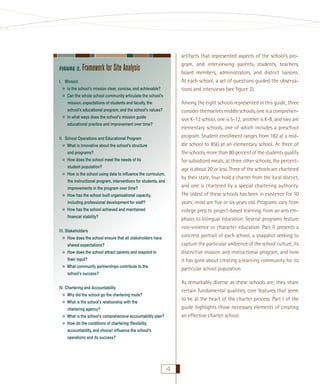
  • 11.
    Student Ethnicity English SubsidizedSpecial Needs Learners Meals Per Pupil Spending Distinctive Programs and Features 0% 97% 7% $8,650 • Basic skills plus arts • Extended day/year • Mosaica national management affiliation 1% Not applicable 1% $5,339 • European academic tradition • 12 of 30 courses qualify as Advanced Placement • Only Arizona school to have scores above the 90th percentile on math SAT 9 in all grades 70% Hmong 20% Afr. Am. 10% Hispanic, Eritrian, White, Vietnamese, & Am. Indian 75% 80% 10% $10,355 77% Hispanic 21% Afr. Am. 2% Asian Am. & White 8% 86% 5% $8,670 • KIPP, Inc. national college prep program • Extended day/year • 85% of students enter college; 94% are first-generation college students 51% White 38% Afr. Am. 4% Asian Am. 3% Hispanic 4% Other 0% 20% 5% $6,000 • Parent contract to donate 20 hours a year • Core Knowledge curriculum • Character education focus 72% Hispanic 22% White 2% Asian Am. 2% Filipino 1% Afr. Am. 1% Multi-racial 44% 63% 5% $5,367 • School facility houses two-way Spanish-English immersion charter program for 43% of students • Multiple language programs during and after school for students and parents • Regrouping across classes and grades for reading and math 80% Afr. Am. 20% Hispanic 0% 56% 7% $12,910 • 66% of students enter below grade level; 100% continue in college prep high schools • Mandated homework support, Saturday school, summer school for poor grades • Curriculum developed by staff based on student performance on school comprehensive exams 62% White 22% Afr. Am. 6% Hispanic 3% Asian Am. 7% Multi-racial 2% 19% 22% $5,750 74% 12% 4% 10% White Hispanic Afr. Am. Asian Am. • Non-violent community focus and award-winning character education program • High levels of support for English language learners • Looping to build relationships and support • Multi-age classrooms, looping • Developmental, project-based approach • No grades; student portfolios 3 Innovations in Education: Successful Charter Schools 98% Afr. Am. 2% Other
  • 12.
    FIGURE 2. artifacts thatrepresented aspects of the school’s program, and interviewing parents, students, teachers, board members, administrators, and district liaisons. At each school, a set of questions guided the observations and interviews (see figure 2). Framework for Site Analysis I. Mission ›› Is the school’s mission clear, concise, and achievable? ›› Can the whole school community articulate the school’s Among the eight schools represented in this guide, three consider themselves middle schools, one is a comprehensive K-12 school, one is 5-12, another is K-8, and two are elementary schools, one of which includes a preschool program. Student enrollment ranges from 182 at a middle school to 850 at an elementary school. At three of the schools, more than 80 percent of the students qualify for subsidized meals; at three other schools, the percentage is about 20 or less. Three of the schools are chartered by their state, four hold a charter from the local district, and one is chartered by a special chartering authority. The oldest of these schools has been in existence for 10 years; most are five or six years old. Programs vary from college prep to project-based learning, from an arts emphasis to bilingual education. Several programs feature non-violence or character education. Part II presents a concrete portrait of each school, a snapshot seeking to capture the particular ambience of the school culture, its distinctive mission and instructional program, and how it has gone about creating a learning community for its particular school population. mission, expectations of students and faculty, the ›› school’s educational program, and the school’s values? In what ways does the school’s mission guide educational practice and improvement over time? II. School Operations and Educational Program ›› What is innovative about the school’s structure and programs? ›› How does the school meet the needs of its student population? ›› How is the school using data to influence the curriculum, the instructional program, interventions for students, and ›› improvements in the program over time? How has the school built organizational capacity, including professional development for staff? ›› How has the school achieved and maintained financial stability? III. Stakeholders ›› How does the school ensure that all stakeholders have shared expectations? ›› How does the school attract parents and respond to their input? ›› What community partnerships contribute to the school’s success? As remarkably diverse as these schools are, they share certain fundamental qualities, core features that seem to be at the heart of the charter process. Part I of the guide highlights those necessary elements of creating an effective charter school. IV. Chartering and Accountability ›› Why did the school go the chartering route? ›› What is the school’s relationship with the chartering agency? ›› What is the school’s comprehensive accountability plan? ›› How do the conditions of chartering (flexibility, accountability, and choice) influence the school’s operations and its success? 4
  • 13.
    Part I: Elementsof Effective Charter Schools All charter schools are someone’s creation. A visionary or, more likely, a group of people sees a need or opportunity and decides to start a school. To be effective, a charter school begins with a mission and stays mission-driven: Everyone associated with the school knows what it stands for and believes in its vision. Each school engages parents as real, not nominal, partners. Each school fosters a culture that is highly collegial and focused on continuous improvement. And each effective charter school has a strong Getting a Good Start Who starts charter schools? Thoughtful community members, concerned parents, dedicated teachers, university educators, and political and business people are among those who have come together to create charter schools. KIPP Academy Houston was started by two former Teach For America teachers using two classrooms within a pre-existing public school. The BASIS School in Tucson was started by a husband and wife team of college educators. Roxbury Prep in Boston, the School of Arts and Sciences in Tallahassee, and Community of Peace Academy in St. Paul, were launched by educators with a vision for an academic alternative to the public schools in their local communities. Others such as Oglethorpe Charter School in Savannah, and the Arts and Technology Academy in Washington, D.C., were developed by groups of parents working together with community members on a grassroots level. As new public schools, they all experienced immense start-up challenges, including developing the mission and vision for the school, thinking through every facet of the school program, writing the charter, hiring staff, making decisions about curriculum, and securing the building and funds needed to open. One comment resurfaced at each school: They could never have anticipated how much hard work would be involved and how many decisions they would have to make to create the systems to start a charter school. Some charter schools begin from scratch; others are conversions from pre-existing public schools. Some handle every aspect of running a school—from curriculum to accounting. Others contract out administrative and business functions. Education management companies can provide charter schools with an operational structure and a curriculum model. For example, Mosaica Education, Inc., contracts with 24 charter schools nationally, including the Arts and Technology Academy, 5 Innovations in Education: Successful Charter Schools accountability system, not just to please its authorizers but also its “clients,” the parents.
  • 14.
    to provide thecompany’s education model as well as central office functions (see figure 3). The Core Knowledge Foundation contracts with the Oglethorpe Charter School, providing curriculum and teacher training. Other charter schools such as KIPP Academy Houston are part of a network of schools that ascribe to a particular school organizational model. The KIPP, Inc., national office helps to support the training of principals and the replication of new KIPP charter schools around the country. But however a charter school originates, each starts with a clear mission, a unifying vision of what the founders want students to know and be able to do, and why. Leading With a Mission At the heart of each charter school is a well-conceived and powerful mission, a shared educational philosophy that guides decision-making at every level. The spirit of the mission appears in slogans on hall placards, banners, and T-shirts and resounds in chants, assemblies, and informal conversations. During site visits and interviews for this guide, parents, teachers, students, and board members easily articulated their school’s mission, demonstrating the basic condition that they all begin on the same page. In some schools, the mission is to prepare low-income, urban students for higher education, students, for example, who enroll with below-grade-level skills and aspire to be the first members of their families to attend college. Such a mission led Roxbury Prep to structure the school day so that every student takes two periods of reading and two of math. Awareness of the school’s daunting challenges drives a highly rigorous academic program. Other schools may develop a mission focusing on the needs of the whole child. The Community of Peace Academy, for example, strives to “educate the whole person, mind, body and will for peace, jus- 6 tice, freedom, compassion, wholeness and fullness of life.” This means helping students grow not just academically, but emotionally, physically, and spiritually. Founders of the School of Arts and Sciences spent a year researching and designing a school grounded in developmental theory and dedicated to learning by doing. Their mission, centering on the belief that kids are naturally curious, seeks to foster students’ self-directed learning, with a strong emphasis on the arts. Visits to classrooms in these charter schools found students engaged, on task, and learning. A strong, clearly articulated purpose focuses the work, creates a pervasive positive spirit, and promotes consistent expectations from class to class. Teachers are deeply aware that they are creating change, both for their students and also within the larger public school system. At a mission-driven school, it is easier to focus on what will enable students to reach the school’s goals and objectives. A clear vision also makes it obvious when teachers are not in sync with the school program and empowers administrators and governing boards to hold the staff accountable. Above all else, the mission serves to inspire and motivate the teachers, parents, and students to make the necessary effort to assure that their school will thrive. Innovating Across the School Program In effective charter schools, the mission drives every aspect of the school program, and in each case the school program reflects the school’s freedom to experiment, to be creative in terms of organization, scheduling, curriculum, and instruction. “The way we are going about closing the achievement gap for our kids,” said Roxbury Prep’s principal, “simply would not be possible under the present confines of the public school system.” The schools are infused with the spirit of
  • 15.
    FIGURE 3. Mosaica andthe Arts and Technology Academy Not all charter schools want to start from scratch. One option for charter schools is to contract out services such as accounting and other central office functions to “education management organizations.” In addition, these management organizations can provide charter schools with an operational structure and curriculum model. Such are the arrangements in place between the Arts and Technology Academy in the District of Columbia and Mosaica Education, Inc., which has relationships with 24 charter schools nationally. The Arts and Technology Academy (ATA) operates as an LEA with a budget of just over $5,320,000 (2001–02). The school pays Mosaica an annual fee of $610,000 to provide central office management functions and the Mosaica Educational Model. Aspects of this model in place at ATA include the extended school day and calendar year, a commitment to student and teacher facility with technology, foreign language instruction beginning in kindergarten, and Mosaica’s interdisciplinary Paragon “world ideas” social studies curriculum, which complements ATA’s and Mosaica’s focus on the arts. Direct Instruction in reading and mathematics are also a Mosaica feature adopted by ATA. In addition to all that ATA has implemented from the Mosaica model, the school has negotiated variations from the model as well. For example, when a new principal came to ATA, he asked the school board to add the 100 Book Challenge to the school’s reading program, to balance the existing skills focus with more literature. The board president and principal noted both a “healthy tension” between ATA and its management company and the importance of a strong board for negotiations. Mosaica Education’s Web site is http://www.mosaicaeducation.com/index.html. place of grades. The rubric in figure 4, used for self-reflection and program monitoring, shows how the school defines this approach. In St. Paul, responsive to its mission in a gang-infested neighborhood, the Community of Peace Academy has created a whole co-curriculum, in and outside of class, focused on peace building and fostering justice and a non-violent lifestyle. With a mission to challenge their students academi- MISSION-RESPONSIVE CURRICULUM AND PEDAGOGY cally, KIPP Academy Houston and the BASIS School, At the School of Arts and Sciences in Tallahassee, curriculum and instruction are responsive to the developmental approach to learning called for in the school’s in Tucson provide accelerated curricula (see figure 5). mission. The program features thematic, interdisciplinary typically use textbooks. Other schools have adopted exter- instruction, project-based learning, and portfolios in nal models such as the Advanced Placement curriculum Some schools, like Roxbury Prep and the School of Arts and Sciences, develop their own curricula and do not 7 Innovations in Education: Successful Charter Schools innovation. At one charter school, innovation takes the shape of a longer school day; at another, it is in the teaching pedagogy or scheduling configuration. While such practices may have been developed and tried in other places across the country, the novel ways charter schools can put them together often results in a school culture and operational structure quite different from those in neighboring schools.
  • 16.
    FIGURE 4. The Schoolof Arts and Sciences Thematic Instruction Rubric Stage 2 – Thematic, Multi-age Classroom In addition to Stage 1 components. Indicators Expectations Curriculum s set their process reflects Students work independently. Teacher The learning Professional Development of information They show respect for the a triangle flow Goals driven by student data. materials and handle them between teacher, student, ment. Hands-on appropriately. and environ skill lessons are laid out in a progression so that students can start at their own level and progress. Students are taking charge of Students progress in Developmental checklists Classroom materials are academic skills, as well as their learning. assist teachers in tracking student-centered. The projects, performances, and student development and teacher’s personal resources productions. Scores on planning for instruction. are located at home or other classroom assignments & designated storage areas FCAT reflect their growth. to make room for student materials. Students are learning how to Students take initiative Themes continue to be The environment is clean, set goals and follow through. to research topics, work an integral part of the uncluttered, and ordered They maintain daily job on projects, and develop curriculum, culminating in on, to encourage motivati charts, wallets, or learning presentations. whole school programs or concentration, and tickets. festivals. Students make independence. books centered on themes they study. l Students are engaged in their Students produce beautifu Special area subjects are e allows The schedul portfolios based on the work and treat each other fully integrated into the to have an the class 8 Intelligences. Self-evaluawell. They continue to work classroom themes when uninterrupted work time tion is part of the process. on the Life Skills. possible. day. every The whole class is focused Inter-cluster and intraTeachers use student Students understand all on learning and hums cluster collaboration assessment data to plan procedures and ways of with productivity. Students is happening between instruction. work. work individually, paired, teachers. or in small groups more often than whole class instruction. Environment The prepared environment* is aesthetically pleasing (calming colors & music), neat, and orderly. There is a calm, relaxing atmosphere. taught at BASIS, the Core Knowledge curriculum used at Oglethorpe, and the Paragon curriculum and direct instruction model at the Arts and Technology Academy. Many schools incorporate project-based learning and internships for older students to develop connections between classroom learning and real world professions. At BASIS, the last two weeks of the school year 8 are devoted to project-based learning. For example, some students developed and produced an opera as part of the Metropolitan Opera Project, while other students went to Mexico to visit a marine biology lab. Each Friday, middle school students at the School of Arts and Sciences work with science professionals in the community. Among their many projects, students have worked on DNA studies, animal studies, robotic
  • 17.
    BASIS Course Requirements programming,and electron conduction studies with university researchers, veterinarians, and engineering scientists. As part of their science class, students conducted an archeology project for Cornell University, and while sifting through sediment from a site, discovered the wing of a pre-historic beetle. Their findings became part of a research study. In many of these charter schools, student motivation is enhanced by providing an element of choice within the curriculum. At Oglethorpe Charter School, students pick electives and clubs for Friday activities. At the School of Arts and Sciences, students organize their own progress through a set of assigned math activities or writing exercises. Likewise, the topics of their project work represent personal choices, related to a class or 9 Innovations in Education: Successful Charter Schools FIGURE 5.
  • 18.
    school theme. AtCommunity of Peace Academy, students using the Accelerated Reader program select the books they will read in class based on their improvement and reading level. At the BASIS School, students can choose to take a full menu of Advanced Placement classes and graduate after 11th grade. FLEXIBLE STRUCTURE AND OPERATIONS In schools driven by a mission, structure should be at the service of function. The flexibility afforded charter schools allows them to carry out their missions in many different ways. Some schools use a traditional model with 50-minute classes, while others use a block schedule with 80- or 90-minute classes. Some use a combination. The structure depends on what the school is trying to accomplish—whether, for example, to expose students to a full liberal arts curriculum or to focus on particular areas or allow for extended projects. At the School of Arts and Sciences, a developmental approach is supported with multi-grade classrooms and allowing students to progress on a developmental timetable. A lead teacher and an assistant teacher work across three grade levels in each classroom. Because many charter schools have an extremely ambitious mission, they provide a longer school day than their local counterparts. At the Arts and Technology Academy, children attend school one hour a day longer and 20 days more a year than the regular District of Columbia schools. The added time can be calculated as three extra years of schooling by the time children reach high school. At KIPP Academy Houston, students are in school from 7:25 in the morning until 5:00 in the afternoon, with Saturday school required twice each month. Behind the scenes, administrators at these schools have created program schedules to support teacher collabo- 10 ration. Shared meeting time for teams of teachers during the school day gives them the opportunity to plan, develop curriculum, discuss student issues, and conference with families. Special Friday schedules at Roxbury Prep allow teachers a weekly three-hour block for professional development. Afternoon teacher meetings are a weekly feature at the BASIS School, as well. RESPONSIVE STAFFING Each charter school has the autonomy to hire staff that fit its program. Gates, for example, hires teachers with specialized certification to work with English language learners. The school also hires a number of part-time teachers to reduce group sizes during core academic instruction and created a position for a teacher leader to oversee the school’s complex array of programs. BASIS looks for teachers with strong academic backgrounds, but not necessarily teaching credentials, to teach their advanced courses. KIPP and Roxbury Prep look for young teachers with lots of energy. Roxbury Prep plans its program in anticipation of frequent teacher turnover; other schools, like Community of Peace, have stable faculties that have evolved the school’s program over time. One of the striking characteristics of these schools is their ability to provide a high teacher to student ratio. At Community of Peace Academy, there is one teacher per 16 students in the kindergarten and first grade. Elementary grades at the School of Arts and Sciences have two teachers, a lead teacher and an associate teacher for each multi-age classroom. Many of the schools have staff specialists, such as a school nurse, social worker, or counselor; high school or college placement director; parent liaison-translator; special education resource specialist; and librarian. Student needs and priorities determine the staffing and resource allocation.
  • 19.
    SUPPORTIVE SCHOOL ENVIRONMENT Commonto these charter schools is a sense that school cares for each student as a family does for its children. At the School of Arts and Sciences, teachers work with the same students for two or more years in a row. This “looping” gives teachers more time to develop strong relationships with students and families and to understand and meet students’ educational needs. At Oglethorpe Charter School, an individual “Personal Education Plan” is developed for all students to help monitor their progress toward achieving subject area objectives. There is a widely shared sense that students have specific needs and may require different levels of support in their learning. The focus at the School of Arts and Sciences on individual learning needs has attracted many students whose previous education experiences featured the highly individualized approaches of home schooling. Students in these relatively small schools are taught to help and support one another. At KIPP Academy Houston, one of the school mantras posted in every classroom reads, “If a teammate needs help, we give. If we need help, we ask. Work Hard. Be Nice. Team always beats individual.” At Community of Peace Academy, students are trained to become “Peace Builders,” actively working to create a non-violent community based on trust and acceptance. Teachers make time for proactive classroom discussions about character and responsibility, coaching students to make thoughtful, caring decisions. As one parent said, “Community of Peace works because the teachers create a peaceful environment where the children feel secure and comfortable to learn. The teachers really care about the children.” The tone in these charter schools is one of acceptance. For example, students at the School of Arts and Sciences are encouraged to express their creativity, knowing that their individuality will be supported, not teased. Several schools bring everyone together for Friday community meetings, singing together, giving theatrical presentations, and recognizing student achievements and contributions to help create a positive tone schoolwide. Even in neighborhoods known for rough public schools, these charter schools are peaceful and safe, without violence or disruption among the students. Every school has developed strong expectations for student behavior and systems to help students to do their best. Most of these schools have a dress code or require uniforms. The School of Arts and Sciences is a notable exception, where students are free to wear blue hair and capes if they please. Student incentive programs at KIPP Academy (see figure 6) and Roxbury Prep keep students focused on being prepared for class and modeling excellent citizenship. At Oglethorpe, students must earn the privilege of clubs and extracurricular activities by keeping their grades up. To be sure that no student “falls through the cracks,” support for students extends from providing for their social and emotional well-being to providing systems for students who struggle academically. At Roxbury Prep, if students are not doing well in an academic class, or need help to master a concept, teachers will pull them for a tutorial during gym or elective periods. Several 11 Innovations in Education: Successful Charter Schools In all cases, school leaders and staff agree that teachers need to buy into the program or find another home. At the Arts and Technology Academy, for example, turnover was high after the first year with a new principal, when the faculty came together around a vision and expectations increased. Staff not enthusiastic about the school’s new demands were encouraged to leave, and 21 of the 41 teachers and instructional assistants did so. The following year, turnover was much lower.
  • 20.
    FIGURE 6. KIPP StudentIncentive System (Excerpt) There are no shortcuts KIPP: Houston 5 6 Expulsion Lying Copying or cheating Porch interaction Swearing Grossly unorganized Gross disrespect Inappropriate conduct (harassment) Fighting Unacceptable items² (guns, knives, etc.) Gross harassment 4 1 2 3 Not following directions Incomplete assignment Academic ticket Negative attitude not signed Not prepared for class Dress code violation Unorganized Tardy to class Level of infraction Missing ticket Disrespectful Completely Insufficient missing funds to recollect items assignment Absent w/o call to school by 8 am Unnecessary items¹ Off task Other similar offenses at the discretion of the principal Stealing cards, pagers, cell phones, not be brought to school such as electronic toys, game ¹ An unnecessary item consists of something that should t. items will be confiscated and held for a parent to recollec excessive amounts of cash, etc. Such alcohol, etc. In either of these in his/her possession at any time such as weapons, drugs, ² Unacceptable items are things no child should have and the proper authorities will be notified. over to an administrator to be picked up by a parent, situations, the item(s) will be confiscated and handed Strategies to Redirect Disciplinary Violations g KIPP implements some of (but is not limited to) the followin our students learn from their mistakes and techniques to help make better choices in the future: • Additional assignments • Calling/agenda plans • Khaki plan (excessive dress code violations) • Detention (Saturday) schools have “homework hotlines.” Oglethorpe created a special class for five students at risk of failing the sixth grade, allowing them the opportunity to accelerate their learning and join the seventh grade mid-year. At BASIS, if students do not pass comprehensive exams in academic subjects, they are offered summer school courses to prepare them to retake the test at the end of the 12 Porch students avoid distractions in the following ways: know - Wearing their shirts/jackets inside out to let others g inward”, reflecting on their mistakes and they are “lookin be should not be disturbed (reversible jackets should not worn while on porch) with - Not being able to communicate (verbal or otherwise) a their peers without first being granted permission from r teache summer. At KIPP Academy Houston, students who have not completed their assignments are required to attend “Wall Street,” staying after school, often late into the evening, until the work is finished. Such measures help these schools maintain their high expectations; parents are supportive and students recognize that they are learning to take responsibility for themselves.
  • 21.
    Promoting a Communityof Continuous Learning a teacher’s pay is partially determined by “performance bonuses” tied to achieving learning goals. Commitment to a vision, an innovative spirit, and strict accountability all work to create learning communities in these schools, cultures of continuous improvement. Professional development at these charter schools is driven by school goals. For example, when the Community of Peace staff learned that their students needed better preparation in reading and writing, the school hired a fulltime curriculum specialist to support teachers to improve their instruction. When an evaluation showed that the school’s approach to English as a Second Language (ESL) needed strengthening, the school made it possible for every team of teachers to work with an ESL specialist, weekly, to help modify assignments and assessments and scaffold learning to accommodate students struggling with a new language or learning disabilities. In most charter schools, the whole accountability process, from end-of-term comprehensive exams, to weekly teacher sessions sharing student work, is used to steadily improve teaching and learning. Yearly analysis of progress, taking a hard look at what’s working well and what isn’t, becomes the basis for a schoolwide improvement plan with new goals for the coming year. Schools give constant attention to refining curriculum and instruction, using student data to make instructional changes. If an analysis of math scores reveals a problem, steps are taken to solve it, whether through professional development, adopting a more effective program, or focused attention to specific areas of the curriculum. At Roxbury Prep, faculty engage in a rigorous process of self-reflection, analyzing curriculum and student performance down to the level of the questions on comprehensive exams. Students at BASIS participate in a highly articulated examination process, taking midyear “preliminary” exams in all core subjects followed by “must-pass” year-end exams. Students at Gates are regrouped for reading and math based on tests given every four or five weeks. The Community of Peace Academy hired an outside evaluator to help them assess their overall program. At Oglethorpe Charter School, teachers explicitly reflect on their own learning, with each annually submitting a professional portfolio to the school’s board of directors. At the BASIS School, At the same time, schools allow for informal, collegial professional development. Across the schools, teachers are provided time during the week for planning and meeting together. During Roxbury’s regular Friday afternoon “Inquiry Groups,” teachers share problems, analyze student work, reflect on practice, and agree to try new ideas. Charter autonomy is itself a help in fostering a culture of improvement, by giving schools the flexibility to act quickly to identify areas of concern, make programmatic decisions, and put them into action. As one teacher said, “I see change happen here when we need it.” It is control over budget, staffing, and curriculum that allows charter schools’ internal accountability systems to work so effectively. Most of the charter schools visited provide teachers with additional professional development and planning time throughout the year. Some also have summer sessions during which staff build ownership of the school’s mission and vision, developing the systems and curriculum that will create the unique culture of the school. 13 Innovations in Education: Successful Charter Schools INTERNAL ACCOUNTABILITY5
  • 22.
    STAFF COMMITMENT Charter schoolsattract teachers who strongly share the school’s mission and are willing to go the extra mile to achieve it. At Community of Peace Academy, Principal Karen Rusthoven seeks adults who personally live the philosophy of the school and understand the importance of a healthy balance of the whole person, mind, body, and will. Her teachers love the school so much that many have served there for five years and more, a long time in the universe of charter schools, where most are themselves less than five years old. Other schools have a harder time retaining teachers. As dedicated as the young teachers are who come to Roxbury Prep, the work load is grueling. Comparing it to the intensity experienced by recent college graduates at high-powered management consulting firms, the school’s co-directors recognize that their young teachers, who “come early and stay late,” cannot be expected to remain for years and years. To compensate for the expertise that leaves with each departing teacher, the school has developed systems to retain evolving curriculum knowledge, storing it in school databases and passing it on from one teacher to the next. The KIPP Academy mantra, “There are no shortcuts,” applies to staff as well as students. Teachers work hard, long hours, starting their day at 7:00 and teaching until 5:00; they are also on call in the evening to field student and parent phone calls and to teach Saturday school twice a month. Teachers at charter schools are not in it for the money. They are not earning overtime for their long days. Staff compensation at these schools is usually the same as in the local school districts. In some cases it is less. In all of these schools, parents rave about the teachers’ commitment to the students, their availability and 14 openness for communication, and their dedication. The challenge is how to support staff who are working so hard to make a school successful. Many teachers say that collegiality with their teammates, the partnership with parents, the climate of support from administrators and board members, and even the opportunity to serve on their school board provide a boost in morale that makes it possible to engage in such all-consuming work. Partnering With Parents and the Community At each of these schools, the culture forged around a shared educational vision creates a strong sense of community. Parents choose to send their children, and students know why they are there. The schools tend to be small, which itself allows an intimacy and face-to-face recognition not possible in larger schools. But their family-like feel is intentional, part of the school design. As one teacher explained, “We see the whole school as an extended family.” Teachers reach out to create a connection between home and school environments. At Community of Peace Academy, teachers begin the school year with home visits to meet the families and learn about students’ home environments. Parents repeatedly commented that they appreciate how frequently teachers communicate with families. Every teacher at KIPP Academy Houston is accessible by cell phone, taking calls until 8:30 at night from students and parents. The sense of shared commitment by parents and staff is formalized in most of these schools in a signed compact like that of the Community of Peace Academy shown in figure 7. The fact that students are never assigned to a charter school, but are there as a conscious choice, helps create a voluntary civic community.6 In the schools visited for this guide, the tremendous commitment on the part of the teachers, parents, community members, administrators, and students was palpable. For some, the
  • 23.
    FIGURE 7. Community ofPeace Parent Compact COMMUNITY OF PEACE ACADEMY HOME/SCHOOL COMPACT 2002-2003 The School Will * Teach and model a non-violent lifestyle. * Treat parents with care and respect. * Provide a Family Handbook in English and Hmong. year. * Visit the home of each parent in the fall of each school * Return phone calls in a timely manner. * Meet with parents upon request. in August, November, and March. * Conduct Parent/Mentor/Teacher/Student Conferences Provide Parent/Mentor Nights at least semi-monthly. * . * Provide a Home/School Liaison to assist parents/mentorse. * Translate important information into the Hmong languag and meetings. * Provide child care and interpreters for conferences ces as needed. * Provide transportation to important meetings and conferen * Provide a monthly calendar and newsletter for all parents. The Parent/Mentor Will * Teach and model a non-violent lifestyle. * Treat school staff with care and respect. ok and support the philosophy and policies therein. * Read the Family Handbook and High School Handbo that the child is in school and on time every day. * See phone numbers, and addresses for the parent/mentor at all * See that the school has accurate emergency numbers, times. ed conferences and meetings concerning their child, or * Attend Parent/Mentor Registration Night and all schedul to the meeting if not able to attend. call the school prior s and conferences in a timely manner. * Return phone calls and answer requests for meeting Return important school document s in a timely manner. volunteering, and attending school events. * Nights, * Support the community as able by attending Parent y levels of children attending Community of Peace Academ Names and grade Date: Date: Date: School Official: Parent/Mentor: Parent/Mentor: BY SIGNING THIS FORM YOU BECOME AN creation and development of their school community has involved unexpected challenges, including political conflicts, facility nightmares, and funding struggles, to name a few. But with the generosity of community partners, who have donated everything from office space and auditorium facilities to new reading programs and a music teacher, who have served on the schools’ boards and mobilized parents, these charter Grade Name Grade OF OFFICIAL MEMBER OF THE COMMUNITY schools have become part of the fiber of the local communities that they serve. Parent involvement is widely recognized as a benefit to children and schools, and these charter schools engage parents as authentic partners at many different levels. Parents at Roxbury Prep, KIPP, and BASIS formally agree to support their children through these schools’ 15 Innovations in Education: Successful Charter Schools Name
  • 24.
    FIGURE 8. Oglethorpe ParentVolunteer Options How Do You Earn Volunteer Hours? of our program at Oglethorpe Academy. In Parent volunteers are a critical component l for 10 hours sign a contract agreeing to serve the schoo fact, all parents at Oglethorpe (if single) or 20 hours (couples). may “earn” hours: We provide many activities for which you trips Attending day-time school events and field • parties Extra-curricular parent-planned dances and • for special school events Preparing food • rts) Attending school functions (athletics, conce • rences Parent confe • ies Saturday workdays to spruce up our facilit • in the media center Working • Assisting with health screenings • Acting as a team coach or coordinator • Leading a club • tops, completing character Working from home: collecting box tops, pop • research, etc. assignments, doing Participating in committee work • Serving on the Governing Board • rt card” (sample attached) so that they can Parents are provided with a quarterly “repo families e that all families do their fair share, only those monitor their progress. To ensur to re-enroll their students at Oglethorpe allowed who have fulfilled their family contract are Academy for the following year. of our student success formula! We believe that parent participation is part very demanding academic requirements. At Oglethorpe, parents sign a contract to provide 20 service hours annually (see figure 8). Parents were often visible at these schools, helping in classrooms, supervising student activities, and organizing school programs. At all these schools, parents serve on governing boards of directors, making policy decisions that shape the schools’ operations and futures. Some of the schools see that supporting parent education is part of their broad commitment to the com- 16 munity, as well as a way to support student learning. Gates, for example, opens up its computer lab for English as a second language classes (see figure 9) and also provides Spanish classes for parents, in keeping with its focus on bilingualism. Governing for Accountability The freedom to innovate with governance models is a signal feature of charter schools. Each has a governing board of directors that is responsible for school policy-making
  • 25.
    Gates Adult EducationProgram and oversight. Those serving on governing boards are stakeholders in the truest sense of the word, people not only attuned to the school’s mission, but also highly familiar with its daily operations. Parents are board members in each of the schools visited. At Oglethorpe, because Georgia charter law requires parents to be the majority on a charter school’s board, the board is made up of six parents, two teachers, and four non-voting members, including three community members and one school administrator. At other schools, community members might make up the board’s majority. Including teachers on school boards is one of the biggest departures from traditional public schooling. In states where charter schools are exempt from collective bargaining, teachers presumably face no conflict of interest in negotiating teacher contracts and can serve on the governing board alongside parents and 17 Innovations in Education: Successful Charter Schools FIGURE 9.
  • 26.
    FIGURE 10. Roxbury PrepAnnual Accountability Plan (Excerpts) Academic Program (Note: Once the MCAS is expanded to include Math and English Language Arts exams for all middle school grades (6–8), RPC may no longer use the Stanford 9 for external accountability purposes.) Goal # 1: Students at RPC will be able to effectively comprehend and analyze literature and non-fiction texts. Measures: • Over 90% of RPC students who have attended RPC from September of the 6th grade through May of the 7th grade will pass the 7th Grade MCAS English Language Arts exam. • RPC students who have attended RPC from September of the 6th grade through May of the 8th grade will at the end of the 8th grade year improve their entering Stanford 9 Reading Comprehension scores by an average of 3 NCE points. Organizational Viability Goal # 6: RPC enrollment and attendance reflect parental demand and commitment. Measures: • Applications to enroll in grade 6 will exceed the number of available spaces by at least 25%. • Annual school attendance rates will be 93% or higher. Faithfulness to Charter Goal #9: RPC students are prepared to enter, succeed in, and graduate from college. Measures: • Over 30% of graduating RPC 8TH grade students will enroll in college preparatory high schools in which over 80% of graduates matriculate to college. community members. The advantages of teacher membership on school boards include deepening teachers’ ownership of the school’s vision, giving them a greater stake in policy and organizational decisions, and helping to ensure that a board’s solutions fit the identified problems. Annually, charter schools are expected to evaluate their school program, quality of teaching, and student outcome measures in light of the mission and goals defined 18 in the charter document. All charter schools publish an annual report or a school improvement accountability plan outlining specific goals to be accomplished each year (see excerpt from Roxbury Prep’s plan in figure 10). The governing board monitors a school’s progress and helps to set new goals to keep it moving forward toward its mission. Over a longer time frame, typically three to five years, a charter school must demonstrate that it is meeting the
  • 27.
    Yet another dimensionof charter school accountability has to do with family satisfaction. Charter school practices are open. Information is shared and available. All parents and community members can see how students are doing on a regular basis. Thus a school that is not delivering is likely to lose its customers: Parents will no longer choose to send their children there. It is this openness of the charter process, the high visibility of the quality of performance, which may be the strictest accountability measure of all. As one principal put it, “The conditions of chartering, if anything, lead us to be more self-analytical and critical, holding ourselves to a higher standard than most schools.” Again, the natal twin of charter accountability is freedom to act. Success “hinges on academic achievement and other performance indicators, not on regulatory compliance or standardized procedures.”7 Charter school boards do not have to convince districtwide majorities or unwilling superintendents that their approaches are right. A Roxbury Prep board member remarked that as a charter school, “We have the flexibility to turn on a dime.” If board members see a need, they can follow up. Freed from the constraints of bureaucracy, when a decision is made, implementation is immediate. The charter schools in this guide measure success in a number of ways. All have made continuous aca- demic gains and are proud to have done so. All have attendance rates at 95 percent or more. Waiting lists to get into these successful schools provide new meaning to “winning the lottery.” In other ways, what constitutes success at a given school varies with its mission. The Community of Peace Academy in St. Paul, Minn., can point to its designation as an exemplary character education school. KIPP Academy Houston can take satisfaction in the 85 percent of its students who enroll in college. Parents at the School of Arts and Sciences in Tallahassee, Fla., find that the school succeeds in welcoming all students, however unique or whatever color they may have dyed their hair. The school profiles in the next section provide additional measures of success at each school. Implications Taken as a group, successful charter schools clearly illustrate two things: (1) key elements that enable success, such as mission-driven programming, are shared by all of them, and (2) the forms those elements take vary widely from one school to another. One theory of charter schooling is that freedom from regulation will stimulate innovation and experimentation. This is not to say that each charter school, even each successful charter school, is entirely original or ground-breaking. But as illustrated by the eight schools in this guide, each reflects the particular vision of its founding educators and community members—whether for classical education, schooling infused with character education, approaches aligned with research on learning and instruction, or programs that have been designed by educational management organizations, for example. What does make each of 19 Innovations in Education: Successful Charter Schools terms contracted in its charter. The authorizer, whether district, state, or another entity, is responsible for monitoring whether the school has in fact lived up to the promise of its charter. If a school fails to meet ongoing criteria for success—ranging from financial management to student performance—its charter can be denied renewal or revoked.
  • 28.
    These eight schoolswere selected in part because they have increased their scores on state assessments over a three-year period and made “Adequate Yearly Progress” this past year. They have improved over time. It’s not that they found a magic solution so much as they became organizations mobilized to achieve their goals. Other schools can do that, too. these schools unique is the combination of ideas that have been brought together, made the centerpiece of each school’s educational approach, and then assessed to make sure the approach works in practice to accomplish the intended goals. Success comes not only from the ideas themselves but also from the focused and energized school culture that thrives in a mission-driven school. School communities become internally accountable—dedicated to working together to accomplish their shared goals, adjusting their approach based on results, and responding flexibly and quickly when needed. ›› Implications for charter school educators. Charter school educators may gain some confirmation and encouragement from these schools. Only eight schools could be included in this guide, but each represents a whole class of other, similar schools. Charter schools around the country are experimenting with new ideas, mobilizing communities, and meeting the learning needs of children and families. This guide may help support their cause. ›› Implications for other school leaders. Within this guide, school leaders will find ideas that can be applied in any public school. Many of the specific practices in these schools can be put in place anywhere. Perhaps more importantly, the core organizational features, such as vision and internal accountability, are also transferable. The concept of internal accountability, for example, was first identified in research on public schools that were restructuring.8 As a stimulus to all educators, the guide provides concrete visions of what is possible. Readers might ask themselves, “How can I replicate these conditions and practices in my setting?” Schools looking to meet the accountability requirements of NCLB should especially take note. 20 If local constraints set up what seem to be insurmountable barriers, educators and community members may want to consider chartering as a route to pursuing their vision more fully. The local district or another authorizing agency may provide support. (The resources section of this guide identifies additional sources of support.) ›› Implications for district or state administrators. For those charged with the task of creating the institutional supports schools need to succeed, the key question to ask is, “How can we get more schools like the ones in this guide?” District and state administrators may see here the opportunity to “reinvent public education” in meaningful ways.9 Districts, like some mentioned here, can see chartering as one way to encourage innovation and better meet the needs of children and families. States may reexamine chartering policies in light of their understanding of the school conditions that promote success. The first part of this guide has laid out what appear to be the cross-cutting design elements of successful charter schools. Brief illustrations of how these elements take shape in the eight featured schools demonstrate that they can be accomplished in a variety of ways. In the following part of the guide, snapshots of each of the schools are intended to help readers envision full charter school programs—eight different ways, just for starters.
  • 29.
    Part II: Charter SchoolProfiles The Arts and Technology Academy Public Charter School BASIS School, Inc. Community of Peace Academy KIPP Academy Houston Oglethorpe Charter School Ralph A. Gates Elementary School Roxbury Preparatory Charter School 21 Innovations in Education: Successful Charter Schools The School of Arts and Sciences
  • 30.
  • 31.
    The Arts andTechnology Academy Public Charter School Washington, D.C. Year First Chartered and Authorizer 1998 Special charter school board Grades Enrollment English Learners Subsidized Meals Special Needs Per Pupil Spending Pre-K–6 615 0% 97% 7% $8,650 When low enrollment led the District of Columbia Public Schools to close Richardson Elementary, local parents and community members stepped in to create a new school in the empty building. The Arts and Technology Academy Public Charter School (ATA) was chartered in 1998—“A true, homegrown, grassroots effort,” says a member of the chartering board. In a tough Washington neighborhood characterized by public housing and family incomes well below federal poverty levels, some of these parents had a different vision for their children. For its 615 students—98 percent African American and 97 percent low-income—the pre-K–6 ATA has designed a program to meet their needs and their parents’ dreams. According to the school’s annual report, the curricular mixture of the basics and the arts seeks to “propel” students beyond their “economically depressed community.” The arts are seen as the foundation for building children’s academic prowess as well as a way to “connect them to the great artists and leaders who were nurtured within their community.” By design, the school program reflects for children the strengths of their heritage and creates many ways for them to express themselves and to excel. Program and Operations To meet its high expectations, ATA runs an extended, seven-and-a-half-hour school day, and an extended school year of 200 days, about 20 days longer than at neighboring schools. The basics in reading and math are taught through the scripted approach of direct instruction. On the other hand, a multicultural social studies curriculum invites students to explore the history of ideas. Everyone learns Spanish. Students and their teachers have easy access to current technology. After-school tutoring and homework assistance are provided for students who need it. Student clubs and extracurricular activities reinforce the focus on arts and academics. And student performances fill the auditorium with proud parents throughout the year. Teachers liken the school to “an oasis in the community.” To keep focused on the children’s possibilities, the faculty and staff of ATA have created a list of belief statements that begins, “We can teach every student,” and concludes, “Given knowledge and opportunity, students can shape their futures.” To safeguard those futures, a culture of achievement has taken hold at ATA. While standardized test scores indicate that ATA students still have a lot of ground to make up, students are proud to have good grades. “I got 28 As and 8 Bs,” a sixth-grader reports with satisfaction. Principal Anthony Jackson is a large part of the ATA story. Jackson came to ATA in 2000, two years after it opened, at a time when the school was floundering, children were not succeeding, and complaints were high. After three years, all signs are positive. “This is an example of how a school can turn around,” says a member of the District of Columbia Public School Charter Board. “When I get discouraged, I point to it.” The leadership that Jackson brings to the school begins with his attitude about the school’s place in the community. On a tour of the school, he stops to point out a window in the rear of the building that looks onto 23 Innovations in Education: Successful Charter Schools Location
  • 32.
    the neighboring publichousing developments. There used to be a cage on this window, he reports, to keep out the vandals. On all the windows, in fact. “Cages,” he says, “signify surrender,” and against the advice of many, he took a chance and had them removed. At the same time, Jackson is not willing to take chances with In a tough Washington neighborhood characterized by public housing and family incomes well below federal poverty levels, some of these parents had a different vision for their children. his students. Walking a boy home who was being suspended, Jackson experienced the open-air drug market outside the student’s apartment, reversed course—boy in tow—to deal with him instead within the walls of the school. Otherwise, he says, “I was just turning him over to them.” Academically, Jackson is equally protective. “I get kids to come read to me all the time. I see that child who struggled … he’s reading with confidence, with inflection, and he understands what the heck he’s reading. I think we’re doing a pretty good job,” he allows. A selfdescribed “data nut,” who enjoys the challenge of disaggregating data to see what it can reveal, Jackson also recognizes the limitations of test scores. He never loses sight of his students’ broad academic needs and the role of the arts in their education. “It’s our responsibility,” he says, “to make sure that schools remain—even in an age of accountability—kid friendly. If at the end of the day children have passed every SAT 9 test that’s placed in front of them, but they have no sense of beauty, what have we created?” Beyond the core curriculum of reading, writing, mathematics, science, and social studies, students all learn basic communicative and performing arts, often demonstrating them through technology-based activities. The arts and technology program encompasses the disciplines of the visual arts; speech; drama; dance; music, including 24 singing, playing instruments, and composing; journalism, and video production. As a teacher points out, the school’s mission and belief statements are “based on the fundamental understanding that kids learn in different ways. ATA gives them many ways to learn.” The director of special education notes that the arts program is also very effective for the 7 percent of the students who have special needs. The parent of a special needs student calls ATA “a blessing” for her son. “All of the teachers and staff, everybody makes him feel comfortable and loved. The kids are comfortable with him. He’s excited about his homework and about the things he’s asked to do. He gets lots of stimulation.” The school’s strong emphasis on teaching values and respect is key to the treatment this child has received at ATA and to the school’s overall discipline approach. Teachers may not yell at students or punish children by isolating them in any way. Jackson counsels teachers to get to know students instead of resorting to overly strict practices. “You can’t discipline strangers,” he cautions. “You have to build trust first.” The school also benefits from having a dean of students, who serves as a “behavior interventionist.” In a school founded on the arts, it is only fitting that one kind of intervention is music therapy. Picture a small group of boys singing a song called “Cooperation” as the music therapist strums a guitar. No one notes the irony of the cooperation in evidence. Finally, the condition of the school’s physical plant is not incidental to the atmosphere of confidence and pride that permeates ATA. One of the board of directors’ first actions was to repair the run-down building. When ATA opened, the new school was in ship shape, but it was sterile. Two years later the hallways were still barren and no student work was on the walls, lest students tear it down or deface it. When Jackson arrived, he encouraged wary teachers to paper the walls with colorful student work. To their delight, they found that
  • 33.
    Continuous Learning To improveinstruction in all areas, faculty and administrative staff meet four times each year to review assessment outcomes and to develop responsive strategies. They use outcomes from curriculum-based assessments to identify students with low skill levels who are tracked for consideration of special education referral and/or learning enrichment, such as tutoring or homework assistance. SAT 9 outcomes are used to identify areas that are posing a challenge for students, and the curriculum is modified accordingly. Jackson also looks at data such as attendance, referrals to the office, and numbers in after-school tutorial programs, all with the purpose of planning improvements. The school devotes at least 15 days each year to professional development in the areas of standards, best practices, test-taking strategies, and classroom management. Teachers meet with the assistant principal weekly to discuss classroom practices. In addition, the assistant principal completes weekly classroom observations and coaches teachers. Program coordinators for grades preK–2, grades 3–6, and arts and technology also regularly coach teachers. This structure and support are credited with teachers’ high performance. Proud of what ATA teachers have accomplished, the school board president notes that they are not inherently “better” teachers than those in the rest of the District of Columbia but that they have responded to the environment in the school. The leadership team believes it has created a culture where it is “okay to ask questions.” Likewise, teachers at ATA feel they are “allowed to grow.” The principal, one teacher says, “is a leader who demands the best. It makes all the difference because you want to do well for somebody like that.” Parents and Partners Although ATA was first envisioned by parents and has two parents on the school board, parent involvement outside of a small core group is very limited. Most parents are single mothers and have themselves had few educa- Students are proud to have good grades. “I got 28 As and 8 Bs,” a sixth-grader reports with satisfaction. tional opportunities, which teachers report limits participation in their children’s academic life. The school board and school staff are eager to increase parents’ role in the school. GED classes, job training, and job placement that could be offered through the school’s Parent Resource Center are seen as important services that could also strengthen parent participation in the school. ATA has many relationships with community groups such as local churches and cultural organizations, including the Library of Congress, but no key partnerships. Governance and Accountability The Arts and Technology Academy Public Charter School was chartered by the District of Columbia Public Charter School Board in 1998 as a nonprofit corporation and local education agency (LEA). It has an annual budget of about $5,320,000, receiving funding of about $6,550 per student, plus some extra dollars for weighted categories, such as pre-school, and federal entitlements amounting to about $475,000. ATA has a business relationship with Mosaica Education, Inc., which operates 24 charter school programs nationally. The school pays Mosaica $610,000 annually to provide a “central office” function. The company also provides the school’s Direct Instruction reading and mathematics curricula and the Paragon social studies curriculum. 25 Innovations in Education: Successful Charter Schools students respected each other’s contributions. Says one proud teacher, “If children are going to be here for eight hours, they should have a stimulating, beautiful, safe environment—and our building is all of those things.”
  • 34.
    The school isgoverned by a nine-member board, which meets monthly. Recently the board used taxexempt bonds to purchase the school building, which it had been renting. Monthly payments dropped from $33,000 to $13,000. These savings have contributed to the school’s $600,000 bank balance. “The principal is a leader who demands the best. It makes all the difference because you want to do well for somebody like that.” ›› ›› ›› ›› While the school cannot operate without sound fiscal management, success is measured by student test scores, the scope of the curriculum, attendance, disciplinary referrals, staff retention, and parent satisfaction: ›› Since 2000, when Jackson took over as principal, students’ SAT 9 scores have moved steadily up. In reading performance, 59 percent of the students were reading at or above grade level in 2003, compared with 35 percent in 2000. In math performance, half of the students were at or above grade level, compared with 20 percent in 2000. 26 ›› Many educators are baffled by ATA’s ability to emphasize the arts as well as raise test scores. With the trend toward an increasingly narrow curriculum, Jackson is used to the question, “How do you guys do it?” Daily average attendance is 95 percent. Behavioral referrals dropped from 43 to 24 in three years. After Jackson’s first year in the school, faculty turnover was high. Staff not enthusiastic about the school’s demands were encouraged to leave, and 21 of the 41 teachers and instructional assistants did. The following year staff turnover was low, with departures down to seven. Parent satisfaction is measured by the school’s waiting list, the overflow audiences for student performances, and parents’ pleas that the school extend its program into middle school.
  • 35.
    BASIS School, Inc. Tucson,Ariz. Year First Chartered and Authorizer 1998 State Grades Enrollment English Learners Subsidized Meals Special Needs Per Pupil Spending 5–12 246 1% Not applicable 1% $5,339 In the midst of a national focus on educational performance and accountability, BASIS School, Inc. achieves both through its priorities of hard work and academic achievement. The school’s mission is to provide a rigorous academic background to prepare students for college, with an emphasis on a classical liberal arts education based on European education practices. Struggling students receive extra academic support until they can meet the school’s performance standards, and teachers are hired not on the basis of certification but according to their level of expertise. Of the 19 faculty members, 10 have a master’s degree, and two have doctorate degrees, all in the subjects they are teaching. BASIS parents, who maintain an active community dialogue, adhere strongly to the school’s mission. Says one parent, “The workload is hard, but it brings a sense of satisfaction and prepares children for the real world.” Students too appreciate their school culture, reporting that the school’s small size and emphasis on enabling every student to succeed makes it feel like “an extended family.” Housed in a converted one-story structure in Tucson, Ariz., the BASIS School is open to children of any background or ability, including those who qualify for special education. The school serves a student population that is 74 percent white, 12 percent Hispanic, 10 percent Asian American, and 4 percent African American. The 246 students in grades 5–12 must take a placement exam before enrolling. Students who place below their desired grade level are offered such options as remedial work in summer school, a retake of the placement exam after home preparation, or enrollment in a lower grade. Consistent with the school’s liberal arts focus, students in all grade levels take courses in language, literature, history, art, philosophy, mathematics, and science, in a curriculum that is aligned with the Arizona State Standards and also exceeds those requirements in many areas. Sports and fine arts courses are offered to all students, and middle school students take physical education. After some pressure from parents, after-school sports, band, and other courses and activities were added. The BASIS School is the brainchild of a husband and wife team, both economists, who founded the school to combine their idea of the best from European and American educational traditions. The European tradition, they feel, provides academic rigor, while the American tradition promotes creativity, problem solving, free expression, and a sense of community. Chartered in 1998, the BASIS School proved so successful that in 2001 its founders opened a second campus, BASIS Scottsdale, in Scottsdale, Ariz. Program and Operations The mission of the BASIS School drives every aspect of its daily operations. School leaders are guided by a selfdescribed “bias toward traditional teaching.” They strive “to avoid educational fads and empty slogans and to put substance above form.” Faculty, parents, and students fully understand that the students are expected to work hard at courses that are more rigorous than most of those at similar grade levels in local schools. All students begin taking algebra in the seventh grade and move on to calculus in high school. Sixth-graders study Latin to prepare for learning scientific terms and romance languages, seventh-graders take public 27 Innovations in Education: Successful Charter Schools Location
  • 36.
    speaking, and eighth-graderstake economics. High school courses are based on the Advanced Placement (AP) curriculum, with 12 out of 30 courses qualifying as AP, and the course load is designed such that by the end of the 11th grade all students have enough credits to graduate. In their senior year, if they choose to stay, they may engage in higher-level coursework. The BASIS School is the brainchild of a husband and wife team who founded the school to combine their idea of the best from European and American educational traditions. An integral part of the school’s program is its system of yearly comprehensive exams, which every student must pass in the core subjects of English, mathematics, science, and social studies in order to be promoted to the next grade. In January, students take a “preliminary exam” in each subject, which serves as an accountability measure for students, a test-development tool for faculty, and a formative evaluation for teachers, parents, and administrators to make decisions about tutoring and other support options for the students. If students do not score higher than 60 percent on an exam, they are not promoted unless they successfully retake the exam before the start of the next school year. All members of the school community express satisfaction that the school allows no exceptions to these promotion policies. The faculty feel that students learn to take responsibility for their education. When students occasionally leave the school because of the heavy workload, they often come back, reporting that they were “bored” in other schools or felt lost in the larger, less personalized school environments. Along with its rigorous curriculum and high performance standards, the BASIS School offers a number of supports for students that are designed not only to enable them to reach high academic standards, but also to foster a sense of accomplishment and satisfaction. Fifth grade, called “6 prep,” may include some students who 28 are sixth-graders but not yet ready to engage in the full sixth-grade program. Students in need of academic help have access to tutoring both during the school day and after school and can enroll in four weeks of summer school. Teachers are required to hold afterschool office hours twice a week—one day for student help and one day for parent-teacher conferences. Because the school is small, students may keep the same teachers over several years, and the teachers as a result understand students’ unique strengths and weaknesses and can target help as needed. In addition to this kind of support from teachers, students also report feeling supported by their peers. One student notes that BASIS students “feel like brothers and sisters.” In a school culture where “It is ‘cool’ to be on the honor roll, and even cooler to be on the high honor roll,” the array of student support networks is intended to help students “find enjoyment in academic achievement.” During the last two weeks of the school year, after the comprehensive exams, students engage in project-based learning. Examples include developing and putting on an opera as part of the Metropolitan Opera Project and traveling to Mexico for a marine biology project. These last two weeks serve as an opportunity to put into practice skills that students have developed over the course of the school year. Continuous Learning Implicit in the school’s high performance standards is an emphasis on improving teaching and learning. Student progress is assessed regularly, with six grading periods over the course of the year and a final, cumulative grade. Student achievement and improvement are acknowledged via frequent honors assemblies. Students receive a gold or silver balloon for achieving “distinguished” or “regular” honor roll, and students who have improved their cumulative average by 2 percentage points or more are honored and also awarded a balloon. A limited number of non-academic awards are given out by teachers who wish to recognize students
  • 37.
    The BASIS Schoolalso devotes significant time and resources to improving teacher practice. At least once a semester, and twice or more for new teachers, the school director makes unscheduled observations of each teacher in his or her classroom. Observations are also conducted by peers, and in each case an evaluation is discussed with the observed teacher. Any problems are reported in writing to both the teacher and school administrators. Parents may also provide feedback on their children’s teachers. “Hard measures,” such as test scores, and “soft measures,” such as science fairs and math competitions, are also considered in teachers’ evaluations. Teachers meet one afternoon a week to share teaching strategies and information about struggling students. All teachers participate in professional development workshops and trainings, including the College Board’s Advanced Placement training, which the middle school as well as the high school teachers attend. At the end of every school year, all faculty and staff attend a two-day retreat, where together they review the students’ performance on the comprehensive exams. Consistent with the emphasis on continuous improvement, the next year’s syllabi are developed based on their analysis of these results. In August, teachers spend two weeks before school starts finalizing the syllabi and preparing for the year. The school’s founders also structure creative financial incentives into teacher compensation to encourage teacher commitment and improvement. Faculty com- pensation comprises a base salary and a “performance bonus,” which can range from 6 to 14 percent of the base salary. Performance bonuses are based on quantifiable goals determined at the beginning of the school year. Teacher commitment is also rewarded through a “wellness bonus.” Teachers start the year with five paid sick days and are compensated at the end of the year for any that remain. Parents and Partners The ethic of individual responsibility and clear communication about standards and goals is one to which BASIS parents adhere strongly. Parent buy-in to the school’s mission is deliberately sought, as the school expects parents to participate actively in their chil- High school courses are based on the Advanced Placement (AP) curriculum. dren’s education. Before a student enrolls, at least one parent must come for a school visit and interview with the school director. Parents are informed of the school’s strict, high expectations and are told that if a child is not ready to work hard, or if parents are not willing to support their child to work hard, then the parents should consider other educational options. At the beginning of the school year, every student receives a Communication Journal, which serves as the primary means of communication between teachers and parents. Teachers and parents use the journals to correspond, and students use them to record daily homework, other assignments, and important information. Parents also frequently contact teachers by e-mail, often sending group e-mails when the matter is of general concern. In addition, parents engage in an active community dialogue about the needs and goals of the school. The parent-teacher organization, called BASIS Boosters, operates independently from the school 29 Innovations in Education: Successful Charter Schools who achieve highly in other areas. The balloons have proven to be an effective inspiration to work hard, and even high school boys report “loving” the balloons. Students carry them throughout the school day, and they are a visible symbol of improvement, pride, and accomplishment. By continually recognizing student achievement and improvement, the school aims to strike “an appropriate balance between students feeling challenged by rigorous academics and the selfsatisfaction that flows from the school’s recognition of excellence based on hard work.”
  • 38.
    administration and sois not a typical parent-teacher organization. The Boosters run a parent-created and supported Web site addressing any and all aspects of the school. The Web site includes an online calendar, a message board for announcements and discussions, links to resources and photos, and a teacher informa- The BASIS School was selected by the AALE for a pilot program to develop criteria for charter school accreditation. tion database. Recently, the Web site offered a poll to ascertain whether the school should stock healthier snacks in its vending machines. Says one school administrator, “The important thing is that it’s run by the parents, not the administration.” Governance and Accountability Both BASIS schools, in Tucson and in Scottsdale, are owned and operated by BASIS School, Inc., a 501(c)3 nonprofit organization. BASIS School, Inc. serves as the contracting agent with the Arizona State Board for Charter Schools and also appoints the school boards at each school. At the BASIS School, Tucson, both school founders currently sit on the board, as does the school director. The remaining members are a local community college professor, who has been repeatedly recognized as a superior educator, an experienced University of California educator and philanthropist, a professor emeri- 30 tus at the University of Arizona, the school’s drama and public speaking teacher, and a parent representative. The BASIS School, Tucson, was selected by the American Academy for Liberal Education (AALE) for a pilot program to develop criteria for charter school accreditation. (AALE is an accrediting agency for liberal arts colleges and universities.) The academy’s main criteria are high levels of academic achievement and commitment to a liberal arts curriculum. Charter applicants are also assessed on factors including mission, teacher quality, assessment, financial management, organization and governance, student services, special education, and facilities. Beginning this year, the BASIS School will undergo annual reviews with AALE to secure renewal of its accreditation. In addition, the school continues to be accountable to the state of Arizona, which requires all charter school students to take Arizona’s Instrument to Measure Standards (AIMS) test and the Stanford 9 standardized achievement tests. BASIS students consistently score well above the state average on the AIMS test, and the BASIS School, Tucson, was the only school in Arizona in 2003 whose students’ median scores were above the 90th percentile on the Stanford 9 math test in all grades. While academics are important, school leaders continue to emphasize that “BASIS graduates should be not only well prepared for college admission, but more importantly they should be prepared to succeed in college and enter their adult lives without losing their appreciation of learning.”
  • 39.
    Community of PeaceAcademy St. Paul, Minn. Year First Chartered and Authorizer 1995 Local district Grades Enrollment English Learners Subsidized Meals Special Needs Per Pupil Spending K–12 546 75% 80% 10% $10,355 In a community where gangs actively recruit adolescents into their ranks and teenagers sometimes marry at age 14, according to Hmong custom, the Community of Peace Academy (CPA) has created a school program and family-style community that empower students to make thoughtful, non-violent life choices. The school’s mission, to create a peaceful environment in which each person is treated with unconditional positive regard and acceptance, is heard in teachers’ conversations about curriculum, seen in student-fashioned hallway murals, and experienced through the school’s PeaceBuilder awards. “Community of Peace works,” says one parent, “because the teachers create a peaceful environment where the children feel secure and comfortable to learn. The teachers really care about the children.” Their focus on educating “the whole person, mind, body and will for peace, justice, freedom, compassion, wholeness and fullness of life,” guides every aspect of the school, from hiring and mentoring new teachers to disciplining students for misbehavior, from maintaining small class size to relationship building. Located on the east side of St. Paul, Minn., Community of Peace Academy serves a high proportion of low-income and English language learners. With 546 students in grades K-12, 70 percent are Hmong and 20 percent are African American. The remaining 10 percent include Hispanic, Eritrean, white, Vietnamese, and American Indian students. The majority do not speak English at home. The K-12 curriculum focuses on four core academic areas: reading/language arts, mathematics, science, and social studies. In addition, peace and ethics instruction are infused at every grade level. Community of Peace Academy was founded in 1995. It began as an elementary school and added a grade a year. As it became clear that the large local high schools would not meet the individual needs of the school’s students, the Community of Peace Academy decided to extend its K-8 program. The staff has grown from under 20 members when the school opened to over 80 in the fall of 2003. The still-developing high school now enables families to enroll all of their children at one school, where students will not fall through the cracks. Program and Operations The mission shapes the entire program structure. The most striking and innovative feature, represented in the school’s name, is its focus on fostering a non-violent lifestyle. Peace building and character education are woven into every facet of the school. Each teacher receives a two-week Responsive Classroom training so that all are using the same system for guiding student behavior and modeling positive discipline. This consistency from one classroom to the next is remarkable. Students know exactly what is expected of their behavior and the result is a peaceful, intentional tone in the classroom, which allows every student to engage in learning. The K-8 PeaceBuilder Program, Project Wisdom for grades 7-12, and the Ethics and Advisory elective in the high school are all integral parts of the school’s peace and ethics program. It becomes part of the way teachers take time to teach the whole child, not narrowly focusing on academics. In a sixth-grade classroom, for example, a teacher identified a need to help her students reflect on what it feels like to be teased and why they tease others. By the end of this 31 Innovations in Education: Successful Charter Schools Location
  • 40.
    morning circle, studentsshared personal feelings and set goals for the week, including a commitment not to tease others. At this age, the focus is preventative, on teaching students how to develop the skills to create a safe classroom environment. “The teachers create a peaceful environment where the children feel secure and comfortable to learn.” To work with older students, the Hmong Gang Strike Force coaches the high school faculty on signs that indicate gang involvement. Through this partnership, the school is also trying to empower parents to take back children from the gangs, which have a strong presence in the community. Real life issues are seized on as ways to build a nonviolent perspective. Last year, for example, two high school students broke out into a fight in front of a group of first-graders at breakfast. These were two new students with violent backgrounds who had an unresolved conflict from the weekend. At Community of Peace, consequences are functional and constructive rather than punitive. So as a result of their fight, the high school students were asked to develop a presentation for the first-graders, explaining their personal reflections about the use of violence and what they could have done differently. They talked about learning how to solve problems without striking out. It proved to be a powerful learning lesson for the teenagers, and teachers reported that it had a huge impact on one of the boys in particular. Teachers consider the school as a family and help each other to work through issues that arise, teaching students to learn from their mistakes and supporting them in the process. In a practice called “looping,” teachers work with the same students for two years in a row. In the elementary school, each teacher is supported by an ESL specialist, a classroom aide, and a shared special education 32 teacher. For grades seven and eight, teachers team by math and science and by language arts and social studies; each teacher teaches the two subjects to the same two groups of 24 students for a two-year cycle. This looping, whether at the elementary grades or in junior high school, provides continuity and allows teachers to develop strong connections with students and families. Additionally, teachers feel that when they identify a critical student need, there is support to make things happen quickly. As one teacher comments, “ I see change happen here when we need it.” Continuous Learning Ongoing learning is evident on every level, from the classroom to professional development. At the outset, the school hired an outside evaluator to help them stay focused on their mission and to strategize ongoing needs. The whole evaluation and accountability process is used to steadily improve teaching and learning. The board members, teaching and support staff, and administrators use student performance evaluation measures to focus on continuous improvement. Data collected each spring are analyzed by the evaluator consultant, then presented to the staff of the school. Working groups then review the data and work during the school year and summer to develop strategies that will help students to meet the desired outcomes of the plan. For example, analysis of standardized testing data revealed the need to develop a stronger reading program. So the school adopted Accelerated Reading K-12, created a reading period every day for every student, and lowered K-1 class size to 16 students. Through an America Reads grant, they collaborated with the University of St. Thomas to provide an after-school Reading Buddies program for second- and third-graders, pairing these elementary students with university students for reading support. The school also hired a full-time instructional facilitator to provide ongoing professional development. The reading program is now considered very strong. “My daughter would never pick up a book,” reports one parent, “and now I can’t stop her from
  • 41.
    The evaluation processalso helped teachers see the need for a more fully developed ESL program, a model that was more inclusive, embedded, and tightly monitored. It is now one of the school’s most innovative elements. Based on the belief that every CPA teacher must be an ESL teacher, the school is partnering with Hamline University, which provides in-service workshops, teacher observations, and conferencing with teams to provide feedback on the ESL content and learning objectives. Every two grades are matched with an ESL teacher who provides support in the classroom inclusion model and plans regularly with the classroom teachers. In the high school, two ESL teachers provide classroom support as well as teaching two ESL electives, one a tutorial for students who need additional help with their academic classes and a second ESL class for students who continue to struggle with English language acquisition. Now every ESL student has an Individual Learning Plan. Looking at a student’s standardized testing data, grades, and school record, the ESL teacher creates two to three learning goals for each student, indicating the level of intervention needed and areas for teacher focus. Every Monday, classroom teachers and ESL teachers plan strategies for their English learners, such as using more realia, giving students more time to respond to a question, and allowing students who are shy about participating more time to share ideas in classroom discussions. Parents and Partners Embracing the belief that parents are the first educators of their children, the school works very hard to reach out to the families of their students and keep lines of communication open and clear. All families are asked to sign a Home/School Compact and a Mentor Contract, committing themselves to full participation in the education of their child’s mind, body, and will within an educational community fully committed to peace and non-violence. Teachers start off the year visiting students’ homes, connecting with families and developing a deeper understanding of and empathy for each child. This paves the way for ongoing com- The school hired an outside evaluator to help them stay focused on their mission and to strategize ongoing needs. munication throughout the school year, sharing goals and expectations. A full-time parent liaison fluent in Hmong arranges interpreters for home visits, meetings, and conferences and translates all school information, such as the Family Handbook and the monthly parent newsletter, into the Hmong language. Transportation and child care are provided for parents so they may attend school meetings, conferences, and events. In addition to regular parent-teacher conferences, parent nights are held every other month throughout the school year. Students in grades K-6 write a weekly letter home to update parents on their grades, homework, and school learning. Each year parents are invited to evaluate the school and its programs through focus groups and surveys. It was the parents’ idea to have the students wear simple uniforms—khaki pants and polo shirts—as a way to remove barriers among students. Over nine years, teachers and parents have worked closely together to develop the school program. On the school’s board of directors, parents hold five of the 11 voting memberships and teachers hold the other six. Governance and Accountability In addition to the five parents and six teachers on the school’s board of directors, four non-voting members attend the board’s monthly meetings: the school’s executive director and principal, the business accountant 33 Innovations in Education: Successful Charter Schools reading and her grades have gone up.” She attributes this to the motivating schoolwide focus on reading.
  • 42.
    and adviser, thehigh school assistant principal, and the elementary school assistant principal. The board is responsible for implementing and overseeing the school’s mission, budget, and policy. Every other year the board engages in strategic planning. Teachers start off the year visiting students’ homes, connecting with families, and developing a deeper understanding of and empathy for each child. Community of Peace Academy is chartered through the local public school district of St. Paul, Minn. Granted for three years at a time, the charter has been renewed three times, based on the school’s successful focus on its mission and student academic growth. CPA is accountable not only to the charter authorizer but also to the parents and students it serves. Accountability is also directly tied to teacher evaluation. This high level of accountability, says founding principal Karen Rusthoven, is at the heart of the school’s success. Financially, the school is sound, although staff are paid about 10 percent less than their district counterparts. In 1998, through a nonprofit building company, the Community of Peace Academy bought the building it was renting and built an addition to better serve the K–8 program. In 2002, by raising a community bond, the school further renovated the building and constructed a new high school. In addition to per pupil funding from the St. Paul district, the school uses a combination of other funding sources to provide spe- 34 cial programs for students and teachers. For example, school improvement funds support the instructional facilitator, who provides ongoing professional development support for teachers. Title III funding supports an ESL partnership with Hamline University. First-gradepreparedness funds provide the kindergarten with a full-day program, and class-size-reduction funds allow a maximum of 16 students in kindergarten and grade 1 classes. In 2003, the Character Education Partnership in Washington, D.C., presented Community of Peace Academy with the National School of Character Award, recognizing the school as one of 10 schools nationwide for “exemplary work to encourage the ethical, social, and academic development of its students through character education.” The school is also recognized by World Citizens Incorporated as an international peace school. Academically, the school is doing well by its low-income students. For example, 73 percent of the students in grade 8 passed the 2003 Minnesota Basic Skills test in math, compared with 72 percent statewide. Math improvement among students in grades 5–8 ranked the school among the top 20 in Minnesota. In reading, with a majority of students whose home language is not English, 65 percent passed the assessment. Finally, as demonstrated by the school’s waiting list, parents are actively choosing Community of Peace Academy, drawn to the small size, the K-12 program, the cultural acceptance, and the focus on peace and non-violence.
  • 43.
    KIPP Academy Houston Houston,Texas Year First Chartered and Authorizer 1994 State Grades Enrollment English Learners Subsidized Meals Special Needs Per Pupil Spending 5–8 346 8% 86% 5% $8,670 At KIPP Academy Houston, daily chants ring out through the school: All of us will learn. Read, Baby, Read. Hallway banners proclaim The path to success is education. Work Hard. Be Nice. Every teacher and school leader at KIPP, which stands for Knowledge Is Power Program, is on a mission to level the playing field for students who live in neighborhoods troubled by illiteracy, drug abuse, broken homes, gangs, and juvenile crime. KIPP’s mission is to “help our students develop academic skills, intellectual habits and qualities of character necessary to succeed in high school, college and the competitive world beyond.” Serving predominantly low-income, minority students in grades 5–8, KIPP has forged an academic culture of high expectations, charged with the conviction that every child will learn. The key to this topperforming school is its unrelenting focus on results: teachers and administrators will do whatever it takes to help students learn, which includes being on call via cell phone for homework help at all hours. Everyone in the school is expected to live by its credo: “There are no shortcuts. Success is built through desire, discipline and dedication. The path to success is education.” KIPP Academy Houston is the flagship among the 31 KIPP schools now operating in the United States. It was started in 1994 by two Teach For America teachers, Dave Levin and Michael Feinberg, who recognized that to bridge the academic achievement gap, students needed more time and lots of hard work. Their first agenda was to broaden the concept of a school day to one in which every student worked hard academically from 7:25 in the morning until 5:00 at night. Then, as current principal Elliott Witney explains, “We focus on the pieces students are missing and work to catch them up and prepare them for college. We want disciplined thinkers, in a society where thinking doesn’t always get rewarded. And a big key to success here is that we want our kids to believe they have choices in life—that their future is not determined by their past or their status in society or their economic reality or their skin color or for whatever reason—success is defined by the choices they make.” When KIPP Academy began, it was a contract school in the Houston district. The program was immediately successful and co-founder Levin left at the behest of the New York Public Schools to start a KIPP school there. Meanwhile, Feinberg continued to run the Houston campus. By 1998, the district had moved the school five times, so Feinberg applied for and received a charter from the state. In 2000, with a $7 million capital campaign, KIPP Academy Houston moved to its present 37-acre campus and built a multipurpose space for the new middle school. Of KIPP Academy Houston’s 346 students, who are chosen by lottery, 77 percent are Hispanic, 21 percent are African American, and the remaining 2 percent are Asian American and white; 8 percent of KIPP students are English language learners; 5 percent receive special education services; and 86 percent qualify for subsidized meals. Program and Operations A standout feature at KIPP Houston is its academic work ethic and how its chartered freedom is used to extend student learning time. The school day is considerably longer than most workdays and the schedule includes 35 Innovations in Education: Successful Charter Schools Location
  • 44.
    two mandatory Saturdayseach month, plus summer sessions. The school year begins in June with a threeweek kick-off and then school resumes six weeks later in August for the rest of the school year. The summer component for incoming fifth-graders focuses on creating the school culture—making sure students Every teacher and school leader is on a mission to level the playing field for students who live in neighborhoods troubled by illiteracy, drug abuse, broken homes, gangs, and juvenile crime. understand the strict code of conduct and learn the chants, songs, and systems that will carry them through the school year. For the sixth-, seventh-, and eighthgraders, the focus is strictly academic. Students travel as a class from one subject to the next, working as a team in their 80-minute core classes: language arts, history, science, and math. They also take 45-minute classes, including physical education, art, music, and Spanish. Students eat lunch with their entire grade in the cafeteria, as teachers conduct informal meetings. With 90 students per grade, there are three sections of 30 students each. Teachers are able to handle such large classes because the students are on task and well behaved. Consequences for misbehavior or not completing homework are serious. Discipline is summed up in the slogan, “If you can’t run with the big dogs, stay on the Porch.” Students who misbehave are “put on the Porch” and are prohibited from socially interacting with anyone except adults, are required to wear their uniform shirts inside out, and must work their way off the Porch through a combination of good behavior, community service, apologies, and goal-setting. Incomplete homework sends students to “Wall Street,” the afterschool homework center, where they stay until they finish, even if it takes until 8:30 at night. KIPP also uses a schoolwide incentive program, a weekly “paycheck” 36 that rewards good citizenship and good deeds with “KIPP dollars” to purchase items at the school store. Paychecks can also be docked for bad behavior. The academic focus at KIPP is on making sure that students “know what they need to know,” says founder Mike Feinberg. “It is not a race,” he adds. This attention to mastery and academic engagement is evident in a visit to a fifth-grade English class. Students conduct themselves in an academic discussion the way college students might engage with a text. Not needing to raise hands, but instead politely waiting to comment on the contributions of the last person, students offer remarkably mature and thoughtful responses. They hold the classwide discussion among themselves rather than always addressing the teacher. Pointing to particular examples in the book Night John by Gary Paulsen, students support their ideas with evidence, whether to make a point or to respectfully disagree. The tone is supportive rather than competitive. After 20 minutes of student discussion, the teacher compliments his students and models the use of supporting detail: “Your ideas are beautiful. I liked the way you grabbed someone else’s idea and then extended it.” At other points in the lesson, the focus was on grammar, with students learning hand cues to figure out the predicate and the nominative cases in a sentence. In KIPP classrooms, whether students are learning grammar, discussing a novel, singing their math facts, or chanting state capitals, the pace is fast and full of engaging instruction and learning. KIPP does not track students; everyone takes the accelerated high school preparatory curriculum. The extra hours devoted to instruction and academic learning make it possible for all students to handle more rigorous academics. However, when students are new to KIPP, there is often a steep learning curve as they fill in the gaps and holes in their knowledge.
  • 45.
    KIPP’s first priorityin maintaining its demanding program has been to recruit and train outstanding teachers committed to raising achievement for underserved kids. Most KIPP teachers are young and all work long hours. “We hire stallions,” says Principal Witney, “give them the race track, and let them run.” Teachers from different grade levels are grouped in teams of four by department. As a team they videotape each other conducting lessons, give feedback, and help to develop a plan of action after viewing the videotape. This is a powerful learning tool for teachers to develop their teaching. Once a month, students have a half-day schedule and teachers convene for a staff meeting and curriculum development. Learning inquiry groups are another form of professional development at KIPP, one that is new enough to be considered a work in progress. Extra support is available to beginning teachers. The school’s lead mentor teacher observes new teachers two to three times each week, writes comments, meets with them during their prep periods to provide feedback, and helps with curriculum and lesson planning. Student learning is assessed in multiple ways, including weekly progress reports to parents, six-week report cards, student writing portfolios, unit tests, projects, and standardized tests. KIPP also considers other measures as valuable indicators of student progress towards achieving their mission, such as number of books read, attendance, and high school and college placement. Parents and Partners Parent involvement starts from the first orientation presentations. Entering students, their parents, and their teachers all sign the KIPP Commitment to Excellence Form, their agreement emphasizing a culture of shared expectations. These include making a commitment to the extended school hours, Saturday school and summer school, the school dress code and con- duct code, and homework. If parents need help managing their commitments, staff are ready to help. One mother whose son consistently skipped his homework explained to the principal that she could not control the boy’s TV viewing. “Would it help for you to bring in the TV?” Witney offered. “And she nearly fell out of the chair. It’s sitting here on my floor until her son earns it back.” “We focus on the pieces students are missing and work to catch them up and prepare them for college.” Parents are involved at KIPP in a myriad of ways: chaperoning end-of-the-year school trips such as visits to boarding schools and high schools across the country, supervising Saturday school, coaching sports, working in the office, serving on the board of directors, supporting students to focus on getting their work done, and providing transportation after school. One parent works in the office and helps other parents to communicate with teachers and administrators in Spanish. Parents serve food in the cafeteria, supervise Wall Street after school, and run fundraisers for the school. Bus transportation is provided to and from school, but parents often pick students up from the extended-day homework center and activities. Surveys find that parents are enthusiastic about the KIPP program and confident that it is making a difference for their children. Governance and Accountability KIPP, Inc., holds the charter for KIPP Academy Houston as well as for three other schools in Texas. The 19member board of directors of KIPP, Inc., oversees the principals of each Texas campus and makes sure each campus adheres to the charter goals and Texas Education Code guidelines. The board also supports each campus for additional fundraising and marketing and holds each principal accountable for his or her school’s academic and fiscal performance. Board members in- 37 Innovations in Education: Successful Charter Schools Continuous Learning
  • 46.
    clude CEOs, accountants,lawyers, educators, a doctor, community volunteers, and one parent. KIPP Academy Houston operates on an annual budget of about $3 million. The school typically raises about $500,000 a year beyond the $7,400 per pupil provided by state and federal funding. Principal Witney points out that this is about $2,200 per pupil less than in the Hous- Everyone in the school is expected to live by its credo: “There are no shortcuts.” ton district. “Even with our fundraising,” he says, “we’re streamlined. We don’t waste money on administrative people. We have to pay for facilities, we have a program for alumni, we pay for out-of-state field trips. And the Saturday school teacher and I pick up the trash.” 38 KIPP Academy Houston measures its success with a 99 percent attendance rate, a waiting list larger than its total enrollment, outstanding standardized test scores, and eighth-grade students who have accepted $13.5 million in high school scholarships over the past five years. KIPP Academy Houston has been recognized as a Texas Exemplary School every year since 1996, and, in 2003, was recognized as a Blue Ribbon School by the U.S. Department of Education. The New York Times, Washington Post, Newsweek, Forbes, and other media have lauded KIPP’s remarkable results, and KIPP is widely considered one of the most promising initiatives in public education today. With the backing of the Pisces Foundation, the KIPP national office trains future school leaders to create KIPP schools across the country. KIPP Academy Houston will soon embark on a $15 million capital campaign for facilities and an endowment to expand their program so that a child can enter in preschool and continue through high school.
  • 47.
    Oglethorpe Charter School Savannah,Ga. Year First Chartered and Authorizer 1998 Local district Grades Enrollment English Learners Subsidized Meals Special Needs Per Pupil Spending 6–8 319 0% 20% 5% $6,000 In 1997, when Savannah parent Martha Nesbit first pictured an alternative to the public middle schools available to her children, it was as a member of the district task force charged with researching ways to improve the district’s lagging middle schools. But when the district accepted almost none of the task force recommendations, Nesbit approached a group of five friends in her church and asked, “If I think about starting a school, would you be on board with that?” From the beginning, the parents’ vision was for a school that would provide character education as well as challenging academics. They wanted a school that had an active role for parents, and they wanted student diversity. Yet the five friends were all white. To ensure that the school’s student population would be representative of the district, where 57 percent of the students are African American, they purposefully invited African American parents to join them in shaping the school. Because Georgia had no legislation allowing for a charter school that was a start-up (rather than a district conversion of an existing school), parents faced an unusual first step in securing their charter. They became lobbyists, persuading state legislators to pass the needed legislation. In addition to their trips to the capital, “We did a letter writing campaign and we did telephone calls. We probably made hundreds of calls,” one parent estimates. The next step, securing the charter, was its own challenge. Knowing that they would be encountering a skeptical district board, parents prepared carefully. The charter was narrowly approved, five to four. Parents began preparations to open the school eight months later. “We had nothing,” one parent explains. “Somebody let us use a back office room in their insurance business where we set up our fax machine and a phone. We advertised for teachers in the newspaper and interviewed them in that office. They had no school to look at, no equipment, facilities, nothing. We still had to hire our principal and we had to have students.” The district came up with an abandoned school that was both smaller than parents had planned for and in terrible disrepair. They took it. They found a principal that March, someone who would commute from her home in South Carolina. And the same month, at the district’s showcase of all its magnet programs, according to parents there was “a line out the door for people to apply to come to our school.” The building capacity allows Oglethorpe to enroll 330 students, and there is a waiting list for each grade. Next year’s sixth-grade class has almost twice as many applicants as can be accommodated. Students are chosen by lottery, and the efforts of the school’s founding parents to reflect the diversity of the community in the school population have been effective. About 38 percent of Oglethorpe students are African American, 51 percent are white, 4 percent are Asian American, 3 percent are Hispanic, and 4 percent are multiracial. About 20 percent of students qualify for subsidized meals. Five percent are designated special education and participate in the school’s inclusion program. Program and Operations Oglethorpe Charter School is an official Core Knowledge school, which means that at least 80 percent of 39 Innovations in Education: Successful Charter Schools Location
  • 48.
    the Core Knowledgecurriculum is taught annually. The Core Knowledge curriculum, developed by scholar E.D. Hirsch, is designed to begin in the first grade, so Oglethorpe teachers frequently have to scramble to fill in their middle school students’ missing Core Knowledge background. Nonetheless, teachers and parents From the beginning, parents’ vision was for a school that would provide character education as well as challenging academics. They wanted a school that had an active role for parents, and they wanted student diversity. like the sense that students are learning what it takes to be “a really educated person.” As one parent puts it, “They are teaching things that everybody should know in life, to be a participating member of society.” And even though Oglethorpe does not focus on test preparation, an eighth-grade student reports, “We have been hearing from students who have graduated that they seem to be a lot more prepared for high school than their friends who came from regular schools. Our school is a lot more challenging, and so by the time test time comes, we are very prepared and ready to take the test. We always do well.” All students at Oglethorpe are held to high academic standards, and participation in sports and special interest clubs, instead of attendance in study halls, depends on satisfactory grades. A Personal Education Plan (PEP) is created for each student, with clear learning goals related to a student’s progress meeting subject area objectives. The PEP also includes standardized test data, results of a multiple intelligences survey, study skills monitoring, student reflections and self-evaluations, teacher comments, and portfolio work samples from each year. Teachers at Oglethorpe work hard to meet students’ individual needs and all provide regular tutorials for students during lunch and after school. Students who need help get it. One student explains what feels 40 different about Oglethorpe: “I’ve been in schools where they help you with some things, but teachers here stay after school and stay over their work time to help you. It is really small here, so all the teachers know all the kids. And you feel a lot more, I guess, comfortable with your teachers.” Students entering the sixth grade can test into the Advanced Instruction with Motivation (AIM) class. Students in the AIM class can earn five Carnegie units for high school credit by passing a test at the end of the course. The AIM class is self-contained and student diversity in the class is controlled to be proportional to that in the school. Oglethorpe also has a teacher who works with students identified for academic intervention in a special reading program and after school two or three days a week between 2:30 and 5:30. Every effort is made to help students succeed. Last year, for example, a small group of students who failed their grade-six standards were placed in an accelerated program and given support until December to catch up. Three of the five students were able to move into the seventh grade, while two continued in sixth grade. The school operates on a block schedule with 90-minute classes and a special schedule on Fridays. Students say they like the block schedule. They note, “You get more done in class,” and “Because it doesn’t meet each day, you have more time to get your homework done, so it doesn’t feel overwhelming.” Classes average 22 students. The school day begins at 7:30 and ends at 2:30, with tutorials from 2:30 to 3:20. On Fridays, classes are shortened to allow for a one-hour block that rotates among assemblies, clubs, and TLC (Titans Love Character) advisory group. TLC is the most explicit aspect of Oglethorpe’s focus on character development and is organized into crossgrade groups of about 12 students each. Every month a different “virtue”—such as integrity or service—is emphasized and students discuss what it means to them. The school also has a tightly monitored dress code and
  • 49.
    Continuous Learning Oglethorpe isaccredited through the Southern Association of Colleges and Schools, and in 2001 as part of the SAC accreditation, the school conducted a selfstudy focusing on student improvement. The study revealed that teachers needed more training in the Core Knowledge curriculum, which they now get. It also led the school to set goals for improving student learning outcomes. In 2002, Oglethorpe implemented SRA’s Direct Instruction Corrective Reading program for their students who were reading below grade level—onethird of the student body. As part of this initiative, some students’ parents agreed to become involved in the parent reading partners program, reading stories and completing vocabulary-building exercises together with their children at home. As a Georgia charter school, Oglethorpe Charter School does not require teachers to be certified, but they must demonstrate competence in their subject areas. One teacher has a doctorate and one teacher came from university teaching. Most have many years of teaching experience. As a faculty they share common practices and have formed teacher research study groups for ongoing professional development. In addition to participating in weekly department meetings and monthly professional development sessions, each teacher compiles a professional portfolio. Self-reflection is part of teachers’ annual evaluation process. Teachers describe feeling “respected as educators” and note that communication is very open at the school. Two teachers represent the faculty on the school’s board of directors. Parents and Partners As stipulated by Georgia charter law, a parent-majority board governs Oglethorpe Charter School and monitors its operations. Parents have the ultimate decision-making responsibility for the school. While membership on the board rotates and only a few parents serve at a time, all parents sign a contract to provide service to the school. Parents are obligated for 20 hours a year (or 10 hours if a single parent). The weekly school newsletter contains suggestions for ways that parents can earn their service hours and reminds them to do their part. For example, parents can chaperone field trips, prepare food for events, lead A Personal Education Plan (PEP) is created for each student, with clear learning goals related to a student’s progress meeting subject area objectives. clubs, help in the office, and serve on committees. They can do weekend maintenance chores at the school, and they can receive credit for attending school programs such as the Math/Science Night and sporting events. If parents do not fulfill the family contract (or request a hardship exemption), their students are not allowed to re-enroll the following year. Communication with parents is frequent. Homework assignments are posted on the school Web site. Every Wednesday, folders are sent home with the school newsletter and classroom updates. Every quarter parents receive a mid-quarter report and a quarter-end report card for their children. “The school tends to attract families who want to be involved in their kids’ education,” one parent observes. Beyond its relationship with parents, Oglethorpe has developed partnerships within the community. The school uses a local church facility for assemblies, special events, and gym classes; and the music program 41 Innovations in Education: Successful Charter Schools forbids students to bring personal electronics such as music players or video games to school. Rap music is excluded from the annual talent show. “It’s strict here,” students agree. Yet the results are positive. Last year only 44 detentions were given out for the entire year. When students are off campus, “People can tell who the Oglethorpe students are,” one teacher says, “because of their good behavior.”
  • 50.
    is operated inconjunction with a local university. The after-school program is in partnership with a nearby YMCA. In addition, Oglethorpe students participate in community outreach, such as an annual beach cleanup, diabetes walk, or food drive for homeless shelters. In March, the whole school became reading partners for students at a local elementary school. Resources are tight. The Savannah-Chatham County Public Schools provides the school facility and student transportation. Per pupil funding averages about $6,000. Last year expenses were $2,112,000, which included $80,000 raised through grants to cover the costs of developing the reading program, paying a technology teacher, and buying laptops for the computer lab. In June 2003, the school charter came up for renewal by the Savannah school board. This time, in contrast to the narrow vote in favor of the school’s initial charter, the renewal passed unanimously. To even its toughest audience, Oglethorpe Charter School had proved its mettle. The weekly school newsletter contains suggestions for ways that parents can earn their service hours and reminds them to do their part. Accountability and Governance The 11-person board of directors includes a parent majority, community members, two teacher representatives, and, in a non-voting capacity, the school administrators. Board members serve one- or two-year terms. Facility needs are a constant headache. In addition to contending with the building’s generally poor condition, the board has needed to add restrooms and a new drainage system. The roof must be replaced. And to accommodate an additional class at each grade, portable classrooms are the only possible solution. One has already been added and another has been ordered. 42 Parents and the board are proud to have created a school that reflects the diversity of the Savannah community and that addresses student learning needs ranging from special education to advanced academics. For the 94 students reading below grade level, enrollment in the school’s Corrective Reading program is beginning to make a difference. Sixty-nine percent of sixth-graders read at grade level; at seventh and eighth grades, this rises to 78 and 79 percent. In writing, 98 percent of students met or exceeded the state standards. Parent involvement, including the 44-hour average that families contribute each year, sets a model for the kind of character development that parents and faculty agree is woven throughout everything that happens at the school.
  • 51.
    Ralph A. GatesElementary School Lake Forest, Calif. Year First Chartered and Authorizer 1999 Local district Grades Enrollment English Learners Subsidized Meals Special Needs Per Pupil Spending K–6 850 44% 63% 5% $5,367 The most distinctive feature of Ralph A. Gates Elementary School is its two-way language immersion (Spanish/English) program. In 1998, a group of concerned parents spearheaded the conversion of Gates from a regular California elementary school to a charter school, in large part to protect this program. The recent passage of Proposition 227 had all but eliminated bilingual programs in the state, but parents, teachers, the community, and the school board in Saddleback Valley Unified School District were all committed to maintaining the program that had been developed over the years at Gates. A Gates parent, who later became school board president, took the lead along with a resource teacher in writing the charter application. They applied to become a district-dependent charter, a type of charter under California law that preserves the school district as the management organization to deal with contracts, personnel policies, and so forth, but allows the school site council control over instruction, staffing configurations, and budgeting. The multicultural, multilingual mission at Gates goes beyond a particular program. The school’s goal is to educate each student as fully as possible, advancing the life prospects of students who often come from families in which the parents did not complete high school. A few years ago the principal and staff reviewed and revised the school mission statement, taking a careful look at their student population, which had an increasing number of English language learners and low-income students. They established a set of seven key “tenets” that guide how they interact as a staff and school community. A sense of purpose and high expectations pervades the school culture. The principal holds teach- ers to these standards, and she is currently counseling out one of the staff. Teachers agree with this approach. As one explains, “Either you are part of our staff or you need to find another staff that meets your vision and your mission.” The celebration of multicultural community is at the heart of the school. The principal describes how the large number of students from bi- and tri-racial families bolsters an attitude of acceptance for all students. Kermes, an annual multicultural fair hosted by the parents and community with assistance from the staff, is attended by 3,000 to 5,000 people—families from across the Orange County area—in a literal celebration of the multicultural community that Gates represents. Of the school’s 850 students, 44 percent are English language learners and 63 percent qualify for subsidized meals. The students enrolled in the two-way immersion program represent 43 percent of the school population, while 57 percent of the students are in the regular program. In the school as a whole, providing the best possible education to these students and enhancing their lives and those of their families is the purpose that drives a caring and committed staff. Program and Operations Gates is a welcoming home for bilingual language development for both children and adults. Students are enrolled in either the two-way language immersion program or the regular program, which includes English language development strategies. After school, students—both English and Spanish speakers—can extend their fluency through programs funded by a 43 Innovations in Education: Successful Charter Schools Location
  • 52.
    lish and computerliteracy skills, the school responded. Working with the district’s adult education department, they combined Title I, Title III, and adult education funding to set up a parent education program. Now parents go to school with their children, heading for one of the school’s two computer labs, where they take ESL classes that also build computer literacy. After school there are classes for English-speaking parents who want to learn Spanish and for Spanish-speaking parents who want to become literate in their native language. Gates School Tenets We strive for high academic standards and expectations for all students in an environment that stimulates learning. We promote students’ self-esteem with positive reinforcement and build good character so each student can be successful. This array of programs has attracted highly qualified staff members—all have specialized certification—who are excited about teaching English learners and committed to helping their students succeed. Gates enrolls more language learners and low-performing students than any other school in the district, and support for these students is high. Parents who share the staff’s enthusiasm for language development have formed the Advocates for Language Learning group. Members of this group have become knowledgeable about the international track record of two-way immersion programs, attend conferences, and actively contribute to school planning. We believe in programs that allow students to progress academically through appropriately leveled instruction. We believe our parents should be equipped with information and resources in order to support their child’s learning. We respect diversity and individual differences in our students and staff. We believe students should be provided with opportunities to learn a second language. We use available technology to help our students, parents, and staff prepare for the future. Title III grant. This after-school foreign language program includes Spanish as a second language classes for the native English speakers and a Spanish literacy program for Spanish speakers who are in the regular program but want to extend their academic literacy in their first language. French classes will be added to the after-school foreign language program as it expands. Parents can build their language skills, too. When a survey revealed that almost half the parents had not completed high school and that they wanted to learn Eng- 44 While the carefully designed language programs at Gates provide a solid base, the staff attribute their students’ recent large increases in test scores to an additional factor—the dynamic model of flexibly regrouping students homogeneously for directed reading, writing, and math instruction, which the school began four years ago. Suspending the assumption of “one teacher—one classroom,” they instituted a Joplin-plan grouping arrangement in which students are regrouped every four to five weeks into homogeneous skill groups. Students in grades 4–6 are grouped across grades; students in grades 2 and 3 are grouped within their grade. The regrouping has created an opportunity for teachers in grades 2-6 to work together and collaborate, sharing their knowledge of the children whose education they share. For the children, the regrouping is a way to break down stereotypes, meet individual needs, and give
  • 53.
    everyone access tothe same standards-based curriculum. Every group works on the same standards, but assignments vary in depth, and group sizes are smaller for students who need more help. Special education students are included in these groups, for example, and the resource special education teacher is part of the teaching team. er regrouping would continue the following year. The principal left it up to them, and that’s when regrouping was instituted for math as well as language arts. If a student needs extra assistance, the Gator Assistance Team steps in. This team of eight staff members is trained in the Masonic model to assess the student’s social, emotional, and economic needs. Teachers make the referrals; the team sifts through them and makes recommendations that are implemented. The student is then monitored, and, if needed, the team can move the child to special education testing. The school’s community liaison can also get involved as needed to facilitate access to community counseling or health resources. The teachers have developed rubrics for developmental progress that are used for student assessment, by the students themselves to reflect on their progress, for instructional planning, and in the regular reporting to parents. Teachers also refer to monthly printouts from standardized assessments to help them link their instruction to identified student needs. Distinctive about the school culture is the “can-do” attitude. Teachers and staff will try whatever, provided it has worked for someone else or has evidence to show that it is a valid, promising program or approach. After trying and evaluating something new, staff decide whether to continue it or not. For example, when regrouping was instituted, in 2000-01, the whole first half of the year was dedicated just to getting the planning down pat. Teachers finally got started, halfway through the year, regrouping students for language arts. Initially, there were a lot of naysayers and doubters, people who were hesitant or even a little scared. What the principal suggested to them is indicative of the spirit that has served the school well: “We’re all jumping off the fence and if we fall, I’ll fall first and I will be your pillow.” The principal, who had been at the school only a year, felt honored that the staff were willing to trust her, and after only two weeks, teachers realized that their experiment with regrouping was working. Even the loudest naysayer was pleased to have been wrong. At the end of the school year, teachers were eager to know wheth- Parents and Partners Parents are active contributors to the school, volunteering in classrooms and running supplementary activities. The annual Kermes multicultural celebration is a highlight of the year, and draws participation from businesses and families in the surrounding community as well as from the school’s own population. The parent-run Multicultural Club, the Computer Club, Girl Scouts and Boy Scouts, and Homework Club supplement the after-school programs. Parents and teachers work together to bring in new opportunities. In 2002, for example, the staff saw a need to help students increase in resiliency, respect for themselves and others, and responsibility for their work. A team of parents and staff attended a regional “Asset Building” workshop. They returned with training for the rest of the staff and began the integration of a character education program, focusing on teaching students how to build and practice the traits of positive character. This year, resiliency training is being extended to the assets classes the school provides for parents. The staff reciprocate parents’ involvement by going out of their way to be accessible to those who want 45 Innovations in Education: Successful Charter Schools Continuous Learning Gates is a welcoming home for bilingual language development for both children and adults.
  • 54.
    to talk abouttheir children’s progress. As the principal reports, “We are here whenever they can make it. Before school, our teachers will come in at 8:00 in the morning, 7:00 in the morning. They will stay until 6:00, 7:00 at night to meet with the parents whom they feel they need to meet with.” They instituted a Joplin-plan grouping arrangement in which students are regrouped every four to five weeks into homogeneous skill groups. In addition, the school provides regular and frequent communication to parents in both Spanish and English. Specific information about student progress is provided to parents monthly. Governance and Accountability The school site council, made up of six parents and six staff members, sets and oversees the school program. While taking advantage of district management services and staff development offerings, Gates has autonomy to allocate the school’s budget and determine staffing as well as instructional programs. They can combine funding from different sources and use these funds flexibly as they determine what best meets the school’s needs. For example, while the district’s normal staffing pattern would not include an assistant principal for a school of 46 this size, the council felt that additional oversight was needed and allocated a position for a teacher on special assignment. They also hired a number of part-time teachers who reduce group sizes during the regrouping for core academic subjects. While their annual plans and budgets are submitted to Saddleback Valley Unified School District as the authorizing agency, the district board is highly supportive of Gates and routinely accepts their proposals. The charter came up for renewal in 2003 and was quickly and unanimously approved. Student scores provide positive evidence of the school’s effectiveness. The 2000 Academic Performance Index (API) was 689 and was targeted to be raised 6 points for 2001. The reading regrouping empowered student subgroups to make significant gains above the target set by the state, raising the API by 32 points to 731. In 2002-03, Gates staff restructured the mathematics programs based on test data from 2001. This regrouping allowed them to create smaller classes for struggling students (as well as high achievers) so that they could provide the mathematics curriculum at each group’s instructional level. Additionally, the program has increased the redesignation rate for students to be classified “fluent English,” in both the two-way immersion and regular programs. In recognition of the school’s continued student achievement, Gates received the California Distinguished Schools Award in 2002 and the California Title I Achieving Schools Award in 2003.
  • 55.
    Roxbury Preparatory CharterSchool Location Boston, Mass. Year First Chartered and Authorizer 1999 State Grades Enrollment English Learners Subsidized Meals Special Needs Per Pupil Spending 6–8 180 0% 56% 7% $12,910 This urban middle school was founded in order to prepare its African American and Hispanic students to enter, succeed in, and graduate from college. Located in Boston’s tough Roxbury neighborhood, this charter school is filling a gap in local students’ education choices. Unlike any other middle school in this impoverished community, Roxbury Preparatory Charter School (RPC) features an academic program designed specifically to prepare students for college. start-up, however, they realized that managing such a comprehensive facility and providing all the options that come with a high school program, such as sports, was beyond their means. The board of trustees and administrators decided that, rather than launch the high school program, they preferred to focus on developing an outstanding college preparatory middle school for students in grades 6-8. As John King says, “It was better to focus on doing middle school well.” The philosophy driving Roxbury Prep is that when curriculum is engaging and rigorous, when student character and community responsibility are emphasized, and when the community network supports student academic, social, and physical well-being, all students can succeed in college preparatory programs, even the 66 percent of the school’s incoming students who are reading one or more grade levels below the norm. Roxbury Prep has 180 students: 72 sixth-graders, 58 seventh-graders and 50 eighth-graders this year. Eighty percent of the students are African American and 20 percent are Hispanic. Female students outnumber male students by 56 to 44 percent. Three-quarters of the students come from the Boston neighborhoods of Roxbury, Dorchester, and Mattapan. The school was started in 1999 by a team of educators—John King; Evan Rudall; Roger Harris, then principal of the James P. Timilty School; and Keith Motley, the vice chancellor of student affairs at the University of Massachusetts, Boston—who recognized that Roxbury did not have any public schools dedicated to a college preparatory program. With a charter from the state of Massachusetts, they originally intended to create a school for grades 6–12. Amid the challenges of Program and Operations Roxbury Prep has developed many schoolwide structures to create a common culture and work ethic for students. The academic day runs from 7:45 to 3:15, followed by mandatory enrichment classes, after-school clubs, and a homework center. Each day begins with breakfast in advisory groups and 25 minutes of Drop Everything And Read (DEAR) time. Students take six academic classes of 50 minutes each plus physical education and computers twice a week. Each day students have two periods of mathematics and two periods of reading/language arts; the extra emphasis helps students make up ground as needed and get ahead in these basics. Fridays are structured differently, to allow for 1:30 p.m. dismissal so that teachers can meet for professional 47 Innovations in Education: Successful Charter Schools The key to Roxbury Prep’s success in bridging the achievement gap is its relentless and systematic focus on academic achievement. There is an urgency in the school, an understanding that this is a life-changing opportunity for students.
  • 56.
    development. Saturdays findthe school open and as many as half the school’s 20 teachers and 20 to 30 students on hand. Classroom practices promote continuity from one class to the next. For example, each day teachers outline on the blackboard a specific, measurable “Aim” for the day, a “Do Now” activity, and homework. When students enter any classroom at Roxbury Prep, they move quickly to their assigned seats and begin working silently on the “Do Now” activity, a five-minute warm-up that gets them settled and immediately focused on school work. Each day students have two periods of mathematics and two periods of reading/language arts. In a math procedures classroom, the “Mad Minute” routine is used to check basic math facts, helping students to develop speed and accuracy. The 24 sixthgraders are serious and focused on the work at hand. The teacher does not want students having side conversations with their neighbors, instructing them, “You have a question? You ask me.” The class is fast paced, highly structured, and the tone disciplined. Classes do not use textbooks, except for reference. The teachers draw from a curriculum prepared by staff during the previous summer and aligned both to state and Roxbury Prep standards. This curriculum, in turn, is refined using the plans developed in previous years. In addition to a focus on basics, the school offers many enrichment classes, including Spanish, art, sports, choir, drama, computers, mock trial, and yearbook. Clubs include a history movie club, a science club, peer tutoring, music, and the student newspaper. Character development is also an explicit part of the Roxbury Prep experience. It is woven into the daily interactions in the classrooms. As one teacher says, “Students are developing a sense of respect, how you speak 48 to someone, how to ask a question for help. It is part of the daily learning.” Friday advisory meetings have a specific character development focus at each grade: the sixth grade focuses on responsibility and time management, the focus at seventh grade is community and non-violence, and eighth-graders address leadership and community. Additionally, every eighth-grader is paired with a sixth-grade buddy, usually a student who rides the same bus, to help create a supportive sense of community across grades. Schoolwide community meetings are another opportunity to reinforce school values. The entire school comes together to share what they are learning in their classes, see performances by enrichment classes or clubs, and celebrate student academic achievement. To ensure a safe, structured, and focused learning environment, Roxbury enforces a strict code of conduct and discipline. All students wear blue shirts, navy pants or khakis, and brown or black shoes and belts. Boys wear ties. Students not in compliance are not allowed to attend class and parents are asked to pick them up or bring them appropriate clothing. Students are required to be in line and silent in the halls when passing from one class to the next. In class they are expected to be focused and on task. Students are polite when they ask questions, raising their hands and using a respectful tone. Students may be given demerits for conduct violations such as tardiness, school bus misbehavior, chewing gum, talking in the hallways, disrupting class, arriving unprepared, not completing homework on time, or disrespectful behavior. Three demerits lead to after-school detentions, and multiple demerits result in extended detentions on Friday afternoon or Saturday morning. Any student who is struggling academically may be pulled out of enrichment or physical education classes for tutoring. Students may also be required to attend after-school tutoring, homework center, Saturday school, and summer school to improve their academic performance.
  • 57.
    Multiple assessments guideRoxbury’s curriculum and instruction. Comprehensive exams based on the school curriculum guide ongoing adjustments to meet student learning needs. Students all take a benchmark comprehensive exam at the beginning of the year. Comprehensive exams at the end of each trimester indicate fine-grained academic progress aligned with the RPC standards, state standards, and Stanford 9 standards, when relevant. Teachers create extensive spreadsheets to show each standard and knowledge area tested and how each student performed on each question. Analyzing these results helps teachers see which students need additional support in specific areas. Students receive progress reports monthly and report cards each trimester. Students take the Stanford 9 at the midyear and at the end of the school year to monitor academic progress. Each Friday, teachers engage in an afternoon of professional development. They devote one hour to gradelevel team meetings, one hour to inquiry groups, and a half hour for a staff meeting. By collaborating to address challenges that arise, teachers solidify their teams and delve deeply into pedagogy, problem solving, and teaching issues. During inquiry group meetings, teachers share their efforts and analyze student work in order to focus their instruction. For example, one team of teachers saw the need to focus on the use of evidence in writing. They developed a shared vocabulary, rubrics, and a teaching system across classes so that when students were writing paragraphs in one class, they would know to draw on strategies they were learning in their other classes. During the summer, staff are paid an additional stipend to devote three weeks to planning and preparing curriculum for the school year. They develop Curriculum Alignment Templates (CATs) that align with Roxbury Prep standards, the Massachusetts standards, clear and measurable benchmarks, learning activities, and assessment for each unit. A school curriculum file is maintained in binders and electronically, and teachers are required to save all CATs, syllabi, assessments, and course materials in hard copy and on the server. The process is valuable for developing shared knowledge among the staff and passing it on to new teachers, who can review the CATs for the courses they are teaching and build on those lesson plans and curriculum units. Parents can expect to hear from their child’s teacher adviser at least once every two weeks. Parents and Partners The school brings families into the school culture with an orientation that presents the ways that Roxbury Prep is different from traditional public schools. Families and students sign the Family and School Contract at the beginning of the year, agreeing to make the school a safe and orderly environment and to ensure that students arrive at school and class on time, with homework completed. Parents also agree to participate in school activities, to communicate regularly with the teachers, and to follow the guidelines of the school. When the school first started, the codirectors believed that all families needed to carry the responsibility for making sure that students completed their homework, but as it became clear that some students did not have a quiet place to study or needed additional support while working on homework, the school added more support systems. With students having two or three hours of homework every night, there is now a homework center, where teachers can provide academic help and students have a quiet space to complete their assignments. The homework center can be mandatory for students who are not completing their work or are falling behind and receiving poor grades. Teachers work hard to keep communication lines open with families. Classroom teachers send home weekly syllabi for parents’ information and signature, and parents are asked to check homework assignments nightly. Regular parent-teacher conferences keep par- 49 Innovations in Education: Successful Charter Schools Continuous Learning
  • 58.
    ents informed abouttheir child’s academic progress. In addition, parents can expect to hear from their child’s teacher adviser at least once every two weeks. Teachers each serve as advisers for 12 students. They know these students well, spending breakfast and lunch with them, All Roxbury Prep graduates have gone on to high schools with college preparatory missions. the morning DEAR time, and the Friday character development advisories. Parents appreciate the Roxbury teachers’ commitment. “They come early and stay late,” says one. Another parent reports what a pleasure it is that when teachers call, it is not always bad news. She also notes that her daughter can call her teachers until 8:00 at night if she has a question. The Family Involvement Committee organizes potluck dinners and ongoing ways for families to be involved with the school program. Two parent representatives are on the school’s board of trustees and serve on board committees. In addition to several small community partnerships, Roxbury Prep benefits from donors who provide the school with about $350,000 annually in grant funding. Governance and Accountability Roxbury Prep operates on an annual budget of about $2,350,000. The school receives state-funded tuition of about $9,500 per student and other state and federal 50 monies for programs such as Title I and special education, but the average cost to educate a student is estimated at $13,000 per year. The difference represents a healthy amount, and members of the board of trustees are valued in part for their ability to help the school raise funds. Of the 12 board members, 10 are Bostonarea community members and two are parents. The school has two codirectors. John King oversees curriculum and development and teacher observation and evaluation, and Josh Phillips is in charge of facilities, operations, and fundraising. But as they explain in unison, “We make the major decisions together.” Roxbury’s charter was renewed in February 2004. Among the state’s predominantly African American schools, Roxbury Prep students in 2002–03 had the highest average scores on the Massachusetts Comprehensive Assessment System (MCAS) tests in sixthgrade math, eighth-grade math, and eighth-grade science, and the second-highest average score on the seventh-grade English test. Students averaged over 2.5 grade levels of progress on the Stanford 9. Of course, the most important measure of success to the school’s families and staff is students’ ability to continue on a path toward college. All Roxbury Prep graduates have gone on to high schools with college preparatory missions, and the school’s recent graduating class earned over $400,000 in scholarships and financial aid toward tuition in private high schools.
  • 59.
    The School ofArts and Sciences Tallahassee, Fla. Year First Chartered and Authorizer 1999 Local district Grades Enrollment English Learners Subsidized Meals Special Needs Per Pupil Spending K–8 226 2% 19% 22% $5,750 A visitor to this school sees little that is typical of a traditional classroom. Students in multi-age classrooms range across three grades—K–2, 3–5, or 6–8. They are seated collegially at round tables rather than in rows of desks. They may be working on independent seatwork, cooperative learning with a partner or small group, or an interdisciplinary project. The goal sheets and checklists in students’ folders let them manage their learning activities. The artifacts students select for their portfolios are an important measure of their achievement. Peer mediation and a student court help maintain school discipline, and all teachers and students are trained in conflict resolution and mediation. According to Principal Debo Powers, the vision for the School of Arts and Sciences (SAS) emerged from a group of educators and parents. The result is a school that centers around beliefs that learning is natural—since human beings are inherently curious—and that academics are only one component of education, best learned through hands-on activities that tap into real interest and through interdisciplinary approaches framed by large themes. High among the qualities valued at SAS are self-motivation, critical thinking, and creative expression. The school’s unique curriculum design and program structures dovetail to support its mission “to facilitate individual educational ownership and responsible lifelong learners through interdisciplinary approaches to arts and sciences in a safe and nurturing environment.” SAS greeted its inaugural students in 1999, three years after first seeking a charter from the Leon County School District. Delays getting charter approval were followed with a series of frustrations in finding a suit- able facility. In what might have been the last straw, just six weeks before the school was to open in August 1998, the school year had to be cancelled. Another facility had fallen through. The principal and teachers scrambled to find other positions for the year, a year that they turned into an opportunity to think and plan for yet another August. The continuing commitment to open the school was remarkable. “When you think about it,” Powers says, “it’s just amazing.” The students who are drawn to SAS, teachers estimate, include about one-third who have been homeschooled, one-third who select SAS specifically for its alternative pedagogy, and one-third who choose the school because previous schools did not meet their needs. Currently, SAS has a waiting list of 400 students for the school’s 226 places. The student population is 62 percent white, 22 percent African American, and 9 percent Hispanic and Asian American; 22 percent qualify for special education services. Program and Operations SAS has three classrooms for each multi-age cluster—primary, intermediate, and middle school. Primary and intermediate classes have a maximum of 25 students and each class has a credentialed teacher and an associate teacher working as a team to facilitate instruction in all academic subject areas. In the middle school, classes rotate to different subject area teachers. Students in all grades take music, drama, art, Spanish, and physical education. Daily hands-on science is also a feature at every level. 51 Innovations in Education: Successful Charter Schools Location
  • 60.
    Learning is drivenby students’ curiosity and is focused through a project-based interdisciplinary approach. Arts, science, foreign language, reading, writing, and mathematics are all integrated. For example, older students learning about Asia spent six weeks preparing projects whose topics ranged from sushi to Students stay with the same teacher for a three-year period, so teachers really get to know the individual students. Genghis Khan to modern-day sweat shops in China. Regardless of the topic, their teacher points out, “You get speaking skills, you get writing skills, and you get research skills.” Instruction at all levels is highly individualized. In a K-2 classroom, where students are working in small groups with math manipulatives, some are learning subtraction using beads, others are learning about number place, while yet another group uses plastic coins to learn addition. Every student has an individual folder, indicating which activities he or she is ready to work on. The two teachers and a parent volunteer circulate around the room, working first with one child and then on to the next, asking questions, assisting, and providing direct instruction and support when necessary. Next door, students in another K-2 classroom work on literacy projects. A small group sits reading a story with one teacher, while another group works at a table with a teacher creating books. A few students work independently on a word game, and it is not easy to tell age or grade distinctions among students within the class. Teachers find the multi-age classroom a powerful factor for cooperative learning, with older students naturally helping younger ones. Students are taught to work together, support is provided as needed, and no one is restricted from learning more by his or her particular age or grade. The principal explains that the 52 younger students try to emulate the older students, and it raises the standard of work for everyone. SAS students are expected to work toward their personal best and to respect everyone. “No put downs” is an operating principle of the school and contributes to the self-confidence exhibited by students. “It’s very, like, peaceful,” a middle school student reports. “I’ve never seen a bully here.” Students stay with the same teacher for a three-year period, so teachers really get to know the individual needs and learning styles of their students. In addition to the continuity this provides, it contributes to the secure learning environment the school strives for. As one student says, “It’s really a priority to have respect between the teachers and students. You don’t have to be afraid of being embarrassed in front of the class or having them get mad at you. You feel free to talk to them.” Students appreciate the freedom they are given to express themselves. For some this manifests in capes and plumes, one enjoys a spot of blue hair. Teachers describe the natural transition of students who are new to the school and new to taking personal responsibility for their learning. “I don’t want to tell them every move to make at every moment,” one teacher explains, “so we do a lot of modeling. And we’re constantly explaining our way of work. You just watch them flounder for a little while, you know. Their first projects aren’t like everybody else’s, but when they see what everybody else has done, their next projects are. You can just watch their growth.” Continuous Learning Each year the staff analyze students’ progress and use what they find to develop the schoolwide improvement plan and to set annual goals, which are published in the annual School Public Accountability Report. This process helps to keep teachers, administrators, and parents focused on the mission of the school, in both planning and implementation
  • 61.
    Teachers do, however,use Florida Comprehensive Assessment Test (FCAT) scores to inform their practice. In reading, teachers use Scholastic’s STAR reading inventory to get a baseline and then measure progress using FCAT scores. In 2002, when FCAT math scores were below the district average in grades 3–5, teachers developed school improvement objectives to focus on math instruction. With a $10,000 grant, they engaged in professional development around multi-age math methods. They adopted a hands-on approach to math instruction for grades K-5. After the training, when the new curriculum was implemented, thirdgrade FCAT math scores rose from 299 in 2002 to 335 in 2003, exceeding the state and the district averages, and showing an increase of 32 percent. Seventh- and eighth- grade FCAT math scores in 2003 were the highest in the district, and eighth-grade FCAT scores were second in the state, behind a school that admits only gifted students. This year FCAT math and reading scores exceeded the district average at every grade. In a school with no grades and no report cards, students are very involved in evaluating their own learning. Students select all the work in their portfolios, choosing the work that best demonstrates progress towards academic goals and mastery of the appropriate Sunshine State Standards, as well as the work of which they are most proud. Students organize their portfolios on the basis of the multiple intelligences identified by scholar Howard Gardner. Parents and Partners At least twice a year parents meet with their child and the child’s teachers to go over the child’s portfolio. Typically, a student and his or her parents come in before the scheduled meeting with the teachers so that the child has a chance to orient parents to the portfo- lio. Then the teachers join them and the teachers talk with the child and ask questions about various pieces of work, with the parents observing. According to one teacher, the process is very affirming: “The child is able to tell, ‘This is me. It’s all about me.’ And it really is.” In a school with no grades and no report cards, students are very involved in evaluating their own learning. Parents like the fact that the school’s developmental approach is grounded in the principles of how children learn and that they can be highly involved in their children’s education. For the many parents who homeschooled their children, enrolling them in SAS was the first time they were willing to entrust their children to a public school. Parents also express satisfaction that there is not a lot of homework at SAS, so children have time to develop artistic, theatrical, and musical interests. Almost half of SAS students participate in an after-school program that features specialty classes such as yoga, puppetry, African dance, nature craft, chess, track, moviemaking, and the like. Six parents serve on the 13-member school board. Other ways SAS parents are involved include personnel hiring, fundraising, acquiring furniture and supplies, providing transportation, maintaining the school building, volunteering in classrooms, supervising on the playground and on field trips, and organizing teacher appreciation events. Maintaining its early support from educators at nearby Florida State University (FSU), SAS has relationships with a number of programs there: the fine arts museum, the science education department, the family and child services department, the National High Magnetic Field Laboratory, the music school, and the physics department all contribute to the school. Science mentorships—at FSU and local wildlife centers—have involved students in scientific inquiry and the work of real scientists. 53 Innovations in Education: Successful Charter Schools throughout the school year. Data from standardized tests are part of the mix, even though teachers uniformly say, “We don’t teach to the tests.”
  • 62.
    Governance and Accountability Governanceof the school is at several levels. The school advisory council consists of three students, three teachers, three parents, and one board member. Their role is to write the school improvement plan and to recommend individuals for the school board. The 13 board members make a three-year commitment, with a third of the members changing each year. Their role is to set policy, Parents like the fact that the school’s developmental approach is grounded in the principles of how children learn. oversee finances, and evaluate the principal. Each spring the board engages in strategic planning. The school also has a teacher leadership council, student government, and PTSO. A management team includes the principal, assistant principal/CFO, and the office staff. SAS has a supportive, positive relationship with its charter authorizer, the local Leon County School District. SAS is electronically connected to the district database system and has access to district e-mail. The principal attends district principals’ meetings, and SAS staff are welcome to participate in district professional development opportunities. The district provides physical plant consultation and inspections, and SAS pays the district for food, transportation, and insurance services. The school also pays the district 5 percent of its state and federal funding. The school operates on an annual budget of about $1.3 million, which includes funding of about $5,000 per pupil. Finances are tight, and board members look 54 enviously at the half-cent sales tax revenue that other Leon County public schools receive. Yet when the school’s state funding was cut by $60,000, instead of economizing by leaving a position vacant when the music teacher took maternity leave, parents raised the money necessary to continue the music program. Success is measured many ways at the School of Arts and Sciences. Recent FCAT math and reading scores exceeded the district average at every grade. Seventhand eighth-grade math scores were the highest in the district, with the eighth-grade scores ranking second in the state. Last year only one teacher left the school. Not a single student was on a behavior contract. A teacher laughingly recalls the complaints from members of the Student Court. “They think everybody is too good. They never have enough court time.” Another teacher reflects on the compassion engendered in the students. “When extremely low, low, low kids get up to do their presentations, the audience is rapt. I mean these kids cannot give them enough attention and support.” For Principal Powers, the performance of SAS middle school students at last year’s Model United Nations Conference at FSU is emblematic. Two middle schools were invited and all the other teams were from high schools. “Well, they gave six awards, and our students took three of them. Afterward, we were saying, ‘How did our kids win against those high school students? They’re obviously younger, they haven’t had as much experience, they’re not any smarter. What is it?’ I think it’s that they get to speak and perform in an environment where you’re not laughed at, ridiculed, put down, made fun of, so they develop this kind of confidence. They can get up there and they can put together their ideas and communicate. That’s success to me.”
  • 63.
    Acknowledgments An external advisorypanel provided feedback to refine the study scope and prioritize issues to investigate. Members included Mark Cannon, executive director, National Association of Charter School Authorizers; Jim Ford, National Council of La Raza; Bryan Hassell, co-director, Public Impact; Bruno Manno, senior associate, The Annie E. Casey Foundation; Lisa Coldwell O’Brien, Coldwell Communications Group; Anna M. Varghese, director of external affairs, The Center for Education Reform; and Jon Schroeder, Education|Evolving. Staff in the Department who provided input and reviewed drafts include: Mike Petrilli, John Fiegel, Dean Kern, Cynthia Dorfman, Stacy Kotzin, Brenda C. Compton-Turner, Meredith Miller, Carolyn Adams, Cathy Grimes-Miller, Christine Wolfe, Karen Akins, Patricia Landis, John Gibbons, Deborah Rudy, and Jacquelyn Zimmermann. This guide was written and designed by WestEd. The project is conducted in partnership with Edvance. WestEd is a nonprofit research, development, and service agency committed to improving learning at all stages of life, both in school and out. WestEd has offices across the United States and also serves as one of the nation’s 10 regional educational laboratories. Edvance, a nonprofit organization created by the American Productivity and Quality Center, is a resource for process and performance improvement with a focus on benchmarking, knowledge management, performance measurement, and quality improvement initiatives in education. The eight schools cooperating in the development of this guide and the report from which it is drawn were generous with both their time and attention to this project. We would like to thank the staff who were instrumental in coordinating and participating in the site visits that inform the report and this guide. The Arts and Technology Academy Public Charter School 53rd and Blaine Sts., NE Washington, DC 20019 http://www.dcpubliccharter.com Anthony Jackson Principal Ralph A. Gates Elementary School 23882 Landisview Ave. Lake Forest, CA 92630 http://www.svusd.k12.ca.us/ schools/gates/ Orquidia Acosta Principal BASIS School, Inc. 3825 E. 2nd St. Tucson, AZ 85716 Olga Block Executive Director Michael Block Chairman Carolyn McGarvey Principal Roxbury Preparatory Charter School 120 Fisher Avenue Roxbury, MA 02120 http://www.roxburyprep.org John King and Josh Phillips Principals Community of Peace Academy 471 Magnolia Ave. E. St. Paul, MN 55101 http://www.cpa.charter.k12.mn.us Karen Rusthoven Principal KIPP Academy Houston 10711 KIPP Way Houston, TX 77099 http://www.kipphouston.org Elliot Witney Principal Oglethorpe Charter School 707 Stiles Avenue Savannah, GA 31401 http://www.oglethorpeacademy.org Susan Gingrich-Off Principal 55 The School of Arts and Sciences 3208 Thomasville Road Tallahassee, FL 32312 http://www.artsandsciences.leon.k12.fl.us Debo Powers Principal WestEd 730 Harrison Street San Francisco, CA 94107 http://www.wested.org Glen Harvey Chief Executive Officer Nikola Filby Associate Director, Regional Laboratory Program Edvance 123 Post Oak Lane, Floor 3 Houston, TX 77024 http://www.edvance.org C. Jackson Grayson Jr. Chief Executive Officer Kristin Arnold Project Director Innovations in Education: Successful Charter Schools The development of this guide was initiated and directed by Nina S. Rees, deputy under secretary of the Office of Innovation and Improvement at the U.S. Department of Education. Sharon Horn was the project manager.
  • 64.
  • 65.
    Appendix A: Research Methodology Thisguide is based on a descriptive study of eight charter schools selected for their exemplary achievement and for geographic and programmatic variety. While the schools are successful, the descriptive methodology does not support causal claims about which factors, or combinations of factors, led to their success. Nor does this guide constitute an endorsement of any specific commercial program or instructional practice. It does provide a portrait of what several successful schools look like and an analysis of common elements across schools. A brief description of this project’s methodology follows. An informal, nationwide recommendation process resulted in over 250 schools from 31 states being suggested for consideration. Nominations came from the advisory panel (see the acknowledgments section), state departments of education staff, charter school associations, authorizers, charter school administrators, and parents. Requests for nominations went out through key contacts to these networks, as well as through the U.S. Charter Schools Web site. Many schools nominated themselves. Site Selection Criteria The first and major criterion for site selection was exemplary achievement. Following the advice of the advisory panel, the emphasis was on improvement in achievement, rather than absolute achievement level, and on improvement trends across several years, so as to identify schools that were reliably becoming stronger and more effective over time. More specifically, the school had to have been established as a charter school no later than fall 1999, and it had to have achievement data for three consecutive years on the same measure, in order to show gains from one year to the next in two consecutive years. A final achievement criterion was that the school had met its Adequate Yearly Progress (AYP) target in the most recent year for which AYP had been announced to schools, as of December 19, 2003. To check achievement scores, the research staff looked at published data on state Web sites, at the database of achievement scores compiled by the Brown Center on Education Policy at the Brookings Institution, and at information supplied by schools. For some states, it was impossible to find interpretable data. In other states, all schools were too new to have enough achievement data available. Unfortunately, very small schools were generally eliminated, because the scores for small sample sizes are not reliable and therefore are not reported. Twenty-nine schools had acceptable achievement data and moved to the next phase of screening. Following the advice of the advisory panel, information was collected through public data and brief interviews about the grade levels served by the school, demographics 57 Innovations in Education: Successful Charter Schools Nomination Process
  • 66.
    of the populationserved, location, authorizer, and educational program. The goal was to find a diverse set of schools, encompassing both elementary and secondary levels, serving mostly low socioeconomic status students but some serving the general population, having a range of authorizers, representing different ethnic configurations, and having locations around the country. Final factors in screening, based on interview data, were stable leadership, evidence of parent involvement and parent satisfaction, and a positive relationship with the authorizer. Study Framework and Data Collection A conceptual framework to guide the study was developed from an analysis of research on charter schools and organizational effectiveness. Charter school experts, recruited to serve on the advisory panel, provided feedback to refine this framework and prioritize issues to investigate. The resulting study scope guided all aspects of the study (see figure 2 on page 4). Collecting detailed descriptive information from project participants was key to understanding each school’s vision and practices, the outcomes or impact achieved, and lessons learned that others could benefit from. Each school hosted a two-day site visit that included interviews with site leaders, teachers, board members, parents, and students as well as observations of classes and school events. In addition, artifacts from the sites, such as letters to parents, schedules, and training agendas, were collected to provide concrete examples of school practices. Site visitors reviewed the information from each site and developed a case report. From the case reports, artifacts, and transcripts of interviews, the project team identified common elements that contributed to success across the sites. This analysis 58 built on the research literature and study scope but also reflected patterns in the data and significant features that emerged in this study’s cross-case analysis. This descriptive research process suggests promising practices—ways to do things that others have found helpful, lessons they have learned about what not to do, and practical, “how-to” guidance. This is not the kind of experimental research that can yield valid causal claims about what works. Readers should judge for themselves the merits of these practices, based on their understanding of why they should work, how they fit the local context, and what happens when they actually try them. Also, readers should understand that these descriptions do not constitute an endorsement of specific practices or products. Reports and Dissemination Two products resulted from this research: a report of the findings and this practitioner’s guide. The report provides the detailed description of each site, sample artifacts, an analysis of key findings across sites, and key project documents. The practitioner’s guide is a summary of the report intended for broad distribution through conference presentations, as well as through national associations and networks. The guide and report are also accessible online at http://www.ed.gov/ admins/comm/choice/charter/. Ultimately, readers of this guide will need to select, adapt, and implement practices that meet their individual needs and contexts. Schools coming together in learning communities may continue the study, using the ideas and practices from these sites as a springboard for their own action research. In this way, a pool of promising practices will grow, and schools can support each other in implementation and learning.
  • 67.
    Appendix B: Resources TheCenter for Education Reform provides up-to-date reports on charter schools and choice activity around the country. The Web site links to “fast facts” and resources designed with parents in mind. A searchable database identifies resources and schools in each state. http://www.edreform.com The Education Commission of the States includes both charter schools and charter districts as issue topics on its Web site. An interesting recent development in the charter movement is charter districts—in which all or most of the schools are charter or contract schools. The Nuts and Bolts of Charter Districts is a four-part ECS series that looks at policy options for state leaders, design issues faced by district leaders, funding issues, and the new central office for charter districts. http://www.ecs.org Education|Evolving is a Minnesota organization working to help create and sustain an “Open Sector” in public education—a “space” in public education for new schools that are started from scratch by teachers, parents, community organizations, and multi-school networks. A January 2004 report discusses how district leaders can support the new-schools strategy. http://educationevolving.org The Thomas B. Fordham Foundation provides links to major studies and to over 50 other organizations’ Web sites in the areas of charter schools and choice. http://www.edexcellence.net The Charter School Leadership Council is a coalition of seven national organizations committed to advancing the charter school movement. In addition to serving as a link to these organizations and to charter policy information, the council’s Web site lists statelevel contacts for charter school information. http://cslc.us/ncsw/teaching The Charter School Experience is a good introductory resource for people wanting to understand chartering. Several national charter-supporting organizations joined forces to produce this brochure, published in 2002 by America’s Charter School Finance Corporation. The brochure is available online in English and Spanish. http://www.charterfriends.org/Charter_School_ Experience.pdf Charter Starters, a set of leadership training materials published by the Northwest Regional Educational Laboratory, consists of five workbooks, a training guide, and a profile of charter school leadership needs. Specific topics include start-up logistics, regulatory issues, assessment and accountability, governance and management, and community relations. http://www.nwrel.org/charter/publicat/charter_ workbook.html The Office of Innovation and Improvement in the U.S. Department of Education operates the Public Charter Schools Program, which supports the planning, development, and initial implementation of charter schools. Other grants target support for charter school facilities. http://www.ed.gov/programs/charter/index.html 59 Innovations in Education: Successful Charter Schools The U.S. Charter Schools Web site provides a wide range of information and links to resources to guide charter schools in every phase of their development—from startup, to expansion, to renewal. The site includes a national calendar of events and a community-exchange feature. http://www.uscharterschools.org
  • 68.
  • 69.
    Notes See the NationalCharter School Directory, 9th Edition, as reported on the Web site of the Center for Education Reform. Retrieved April 2004 from http://www.edreform.com. 2 Some states have stronger charter school laws than others, creating more supportive conditions for charter schools to launch and develop programs. See the Center for Education Reform Web site at http://www.edreform. com, “Charter School Laws Across the States: Ranking and Scorecard, 8th Edition.” For discussion of how chartering has developed in different states, see especially 3 Hassel, B. (1999). The charter school challenge: Avoiding the pitfalls, fulfilling the promise. Washington, D.C.: The Brookings Institution. Vergari, S. (Ed.) (2002). The charter school landscape. Pittsburgh, Penn.: University of Pittsburgh Press. Wallis, C. (1994). “A class of their own,” Time, October 31, p. 53. 4 The concept of internal accountability is explored by Paul Hill and colleagues. See chapter 3 in Hill, P., Lake, R., and Celio, M. (2002). Charter schools and accountability in public education. Washington, D.C.: The Brookings Institution. 5 Discussions of building civic community and social capital can be found in Finn et al., op. cit., chapter 10, and by David Campbell in chapter 13 in Peterson, P. and Campbell, D. (Eds). (2001). Charters, vouchers & public education. Washington, D.C.: The Brookings Institution. 6 7 Finn et al., op. cit., p. 267. Newmann, F., King, B., and Rigdon, M. (1997). “Accountability and school performance: Implications from restructuring schools,” Harvard Education Review, vol. 67, no. 1, pp. 41-74. 8 Finn et al., op. cit., chapter 9 discusses four stages of district response to charters and provides several examples of stages 3 and 4, competing to outdo charters and accepting charters as a district asset and opportunity. According to the chapter by Finn et al. in Peterson and Campbell, op. cit., charter districts—those in which all schools are chartered—existed in California, Florida, and Georgia as of 2001. The Education Commission of the States now supports an initiative focused on charter districts. See appendix B for links to the Education Commission of the States and materials targeted to charter districts. 9 61 Innovations in Education: Successful Charter Schools Finn, C., Manno, B., and Vanourek, G. (2000). Charter schools in action. Princeton, N.J.: Princeton University Press, p. 266. 1