C H A P T E R 6 : C O N T E M P O R A RY T R E N D S
A N D I S S U E S I N E D U C AT I O N
G R O U P : C O L O R F U L J O Y
B Y: M O N I C A C L I F F O R D , K A T E LY N G R E B , PA I G E B U R S L E R , K A S E Y H E L M S , A N D TA S H I A N A J O Y N E R
I N T R O D U C T I O N
In chapter 6: Contemporary
Trends and Issues in
Education, goes over the
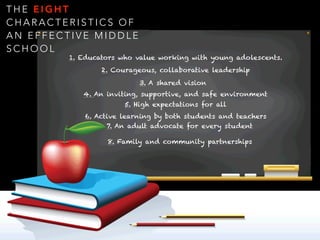
many “trends” in Education
today. Not only trends but the
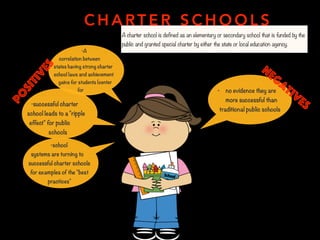
major issues. For instance, the
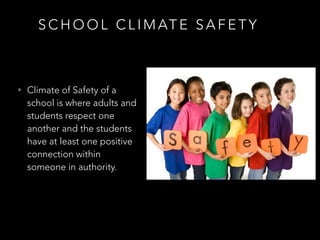
No Child Left Behind Act,
public charter schools,
approaches to teaching
special needs students, and
more. In this powerpoint you
will learn all about these
trends and issues, enjoy!
T H E N O C H I L D L E F T
B E H I N D A C T V S . T H E
1 9 6 5 E L E M E N TA RY A N D
S E C O N D A RY A C T.
• The No Child Left Behind Act is
different from the legislation it
originated from because it
emphasized increased funding for
less wealthy school districts and
higher achievement for financially
poor and minority students. It also
introduced new measures for
holding schools accountable for
students’ progress.This legislation
also set new rules for standardized
testing, requiring that students in
grade 3 through 8 be tested every
year in mathematics and reading.
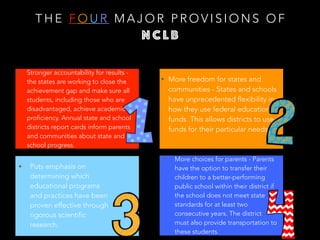
T H E F O U R M A J O R P R O V I S I O N S O F
N C L B
• More freedom for states and
communities - States and schools
have unprecedented flexibility in
how they use federal education
funds. This allows districts to use
funds for their particular needs.
• Stronger accountability for results -
the states are working to close the
achievement gap and make sure all
students, including those who are
disadvantaged, achieve academic
proficiency. Annual state and school
districts report cards inform parents
and communities about state and
school progress.
• More choices for parents - Parents
have the option to transfer their
children to a better-performing
public school within their district if
the school does not meet state
standards for at least two
consecutive years. The district
must also provide transportation to
these students.
• Puts emphasis on
determining which
educational programs
and practices have been
proven effective through
rigorous scientific
research.
Has NCLB
met its
goals?
• I believe that the No Child Left
Behind Act has met its goals
through using these four major
provisions. The goal of this act was
to close the achievement gap
between students in different
school districts and by making
standardized testing important in
our school systems they were able
to calculate and compare these
scores. I think without these
standardized test we would have
not been able to compare as easily
and with the results they can make
a plan to help the students in
many different ways from tutoring,
summer school, or even switching
schools.
M I D D L E
SC H O O L
CO N C E P T S
• In the beginning the dominant
school configuration was eight
years of primary school
followed by four years of
secondary school. In 1899, they
decided that secondary school
should begin in the seventh
grade and after another fifteen
to twenty years junior high
school (grades 7-9) emerged.
By the late 1960’s and early
1970’s various models were
being created to reorganize
the school district grades. By
the 1980’s many schools were
endorsing the new idea of
“middle school” which was
supposed to create an
educational experience more
appropriate for young
adolescents.
The
six
specific
problems
with
the
middle school
structure
• National school-
safety statistics
suggests that
physical conflict is
especially
problematic in
middle schools.
• Social norms
in middle
school may
foster
antisocial
behavior.
• Academic
progress
for middle
schools is
uneven
and
lackluster.
• Adequate state and
federal supports to
meet the new
standards set by the
NCLB legislation are
unavailable for
middle schools.
• Middle
schools do
not do
enough to
foster
parental
involvement.
• Many middle school
teachers do not have
certification in the
subject areas they
teach or specific
training in the
development of
young adolescents.
T H E E I G H T
C H A R A C T E R I S T I C S O F
A N E F F E C T I V E M I D D L E
S C H O O L
2. Courageous, collaborative leadership
3. A shared vision
4. An inviting, supportive, and safe environment
1. Educators who value working with young adolescents.
5. High expectations for all
6. Active learning by both students and teachers
7. An adult advocate for every student
8. Family and community partnerships
• The term due process is defined
as a formal process, such as a
legal or administrative proceeding
that follows established rules
designed to protect the rights of
the people involved.
process
due
General rights
Legal responsibilities
of
Teachers
The legal responsibilities that come with
being a teacher include that teachers
must take reasonable precautions to keep
their students safe. One important legal
requirement is that teachers report child
abuse and negligence when they believe
they have noticed it in their classroom.
The general rights that a teacher holds
include the freedom from discrimination,
academic freedom, freedom of expression,
and privacy rights.
and
Term
•successful charter
school leads to a "ripple
effect" for public
schools
•A
correlation between
states having strong charter
school laws and achievement
gains for students (center
for • no evidence they are
more successful than
traditional public schools
•school
systems are turning to
successful charter schools
for examples of the "best
practices" 
Negatives
Positives
A charter school is defined as an elementary or secondary school that is funded by the
public and granted special charter by either the state or local education agency. 
C H A RT E R S C H O O L S
S C H O O L C L I M AT E S A F E T Y
• Climate of Safety of a
school is where adults and
students respect one
another and the students
have at least one positive
connection within
someone in authority.
Guidelines for establishing a
safe school climate
• Assessing the schools
emotional climate.
• Creating connections
between adults and
students.
• Breaking the code of
silence.
• Involving everyone.
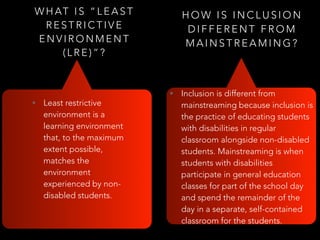
W H AT I S “ L E A S T
R E S T R I C T I V E
E N V I R O N M E N T
( L R E ) ” ?
• Least restrictive
environment is a
learning environment
that, to the maximum
extent possible,
matches the
environment
experienced by non-
disabled students.
H O W I S I N C L U S I O N
D I F F E R E N T F R O M
M A I N S T R E A M I N G ?
• Inclusion is different from
mainstreaming because inclusion is
the practice of educating students
with disabilities in regular
classroom alongside non-disabled
students. Mainstreaming is when
students with disabilities
participate in general education
classes for part of the school day
and spend the remainder of the
day in a separate, self-contained
classroom for the students.
What are your
feelings about
inclusion?
“I do not agree with Inclusion. Because a
disabled student should not be solely with
non-disabled student. I agree that disabled
students should be able to interact and
have some classes with non-disabled
students but disabled students need extra
time to have stuff be explained to them.”
S P E C I A L E D U C AT I O N
T H E P U R P O S E O F I N D I V I D U A L I Z E D
E D U C AT I O N P R O G R A M S
and
• Special education is the branch of
education that deals with services
for students with disabilities or other
special needs that cannot be met
through traditional means. IDEA
legislation mandates that in order for
each student to have a free and
appropriate public education, each
student with disabilities be provided
with a learning plan called IEP.
• Individualized education programs
are plans required for every
student covered by the Individuals
with Disabilities Education Act,
specifying instructional goals,
services to be provided, and
assessment techniques for
evaluating progress.
Who typically prepares the IEP?
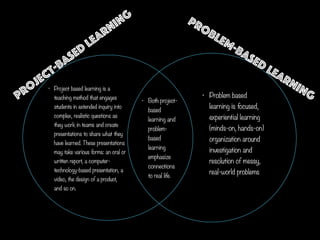
Project-based learning Problem-based learning• Project based learning is a
teaching method that engages
students in extended inquiry into
complex, realistic questions as
they work in teams and create
presentations to share what they
have learned. These presentations
may take various forms: an oral or
written report, a computer-
technology-based presentation, a
video, the design of a product,
and so on.
• Problem based
learning is focused,
experiential learning
(minds-on, hands-on)
organization around
investigation and
resolution of messy,
real-world problems
• Both project-
based
learning and
problem-
based
learning
emphasize
connections
to real life.
S T U D E N T A N D PA R E N T R I G H T S U N D E R T H E
FA M I LY E D U C AT I O N A L R I G H T S A N D P R I VA C Y A C T
• Allows students and their parents to
have access to the student’s records
kept by educational systems.
• States that parents of students in
attendance at a school have the right to
inspect and review the education
records of their children.
• The right to exercise some control over
the disclosure information from
educational records.
• The right to file a complaint with the
U.S. Department of Education if a school
or other educational agency fails to
comply with the act.
What is another name
for the Family
Educational Rights
and Privacy Act?
The Buckley
Amendment
Gifted
Students•Children who
show high
performance capability
in specific academic
fields or in areas such as
creativity and leadership,
and who require special
services by schools to
develop these
capabilities.
•A gifted child is
identified by a variety of
procedures.
Recommendations from
teachers, test scores, also
by the pace by which they
learn and the depth of
their understanding.
•Services provided for the
gifted include the IB
program and Advanced
courses (AP)
F I V E C H A R A C T E R I S T I C S O F G I F T E D S T U D E N T S
1.They learn new material in
much less time.
2.They tend to remember
what they have learned,
making reviews of previously
mastered concepts a painful
experience.
3.They perceive ideas and
concepts at more abstract
and complex level than do
their peers.
4. They become passionately
interested in specific topics
and have difficulty moving on
to other learning tasks.
5. They are able to operate on
many levels of concentration
simultaneously, so they can
monitor classroom activities
without paying direct or visual
attention to them.
C O N C L U S I O N
The issues as well as the trends mentioned in this
powerpoint make education what it is today.
Everything that was presented is still ongoing in
today’s world. From having gifted students, to
charter schools, to inclusion classrooms,even school
climate safety…what are your thoughts after
learning about these?
• http://www.clipartlord.com/category/structures-clip-art/buildings-clip-art/
school-building-clip-art/
• http://www.mycutegraphics.com/graphics/reading/girl-reading-book.html
• http://abcnews.go.com/topics/news/education/no-child-left-behind.htm?
mediatype=Image
• http://cliparts.co/number-6-clipart
• http://www.clipartpanda.com/categories/school-house-images
• http://www.clipartpanda.com/categories/crayons-clipart
• Koch, Janice. "Chapter 6." So You Want to Be a Teacher?: Teaching and
Learning in the 21st Century. Boston: Houghton Mifflin, 2009. N. pag. Print
Sources

Chapter 6

  • 1.
    C H AP T E R 6 : C O N T E M P O R A RY T R E N D S A N D I S S U E S I N E D U C AT I O N G R O U P : C O L O R F U L J O Y B Y: M O N I C A C L I F F O R D , K A T E LY N G R E B , PA I G E B U R S L E R , K A S E Y H E L M S , A N D TA S H I A N A J O Y N E R
  • 2.
    I N TR O D U C T I O N In chapter 6: Contemporary Trends and Issues in Education, goes over the many “trends” in Education today. Not only trends but the major issues. For instance, the No Child Left Behind Act, public charter schools, approaches to teaching special needs students, and more. In this powerpoint you will learn all about these trends and issues, enjoy!
  • 3.
    T H EN O C H I L D L E F T B E H I N D A C T V S . T H E 1 9 6 5 E L E M E N TA RY A N D S E C O N D A RY A C T. • The No Child Left Behind Act is different from the legislation it originated from because it emphasized increased funding for less wealthy school districts and higher achievement for financially poor and minority students. It also introduced new measures for holding schools accountable for students’ progress.This legislation also set new rules for standardized testing, requiring that students in grade 3 through 8 be tested every year in mathematics and reading.
  • 4.
    T H EF O U R M A J O R P R O V I S I O N S O F N C L B • More freedom for states and communities - States and schools have unprecedented flexibility in how they use federal education funds. This allows districts to use funds for their particular needs. • Stronger accountability for results - the states are working to close the achievement gap and make sure all students, including those who are disadvantaged, achieve academic proficiency. Annual state and school districts report cards inform parents and communities about state and school progress. • More choices for parents - Parents have the option to transfer their children to a better-performing public school within their district if the school does not meet state standards for at least two consecutive years. The district must also provide transportation to these students. • Puts emphasis on determining which educational programs and practices have been proven effective through rigorous scientific research.
  • 5.
    Has NCLB met its goals? •I believe that the No Child Left Behind Act has met its goals through using these four major provisions. The goal of this act was to close the achievement gap between students in different school districts and by making standardized testing important in our school systems they were able to calculate and compare these scores. I think without these standardized test we would have not been able to compare as easily and with the results they can make a plan to help the students in many different ways from tutoring, summer school, or even switching schools.
  • 6.
    M I DD L E SC H O O L CO N C E P T S • In the beginning the dominant school configuration was eight years of primary school followed by four years of secondary school. In 1899, they decided that secondary school should begin in the seventh grade and after another fifteen to twenty years junior high school (grades 7-9) emerged. By the late 1960’s and early 1970’s various models were being created to reorganize the school district grades. By the 1980’s many schools were endorsing the new idea of “middle school” which was supposed to create an educational experience more appropriate for young adolescents.
  • 7.
    The six specific problems with the middle school structure • Nationalschool- safety statistics suggests that physical conflict is especially problematic in middle schools. • Social norms in middle school may foster antisocial behavior. • Academic progress for middle schools is uneven and lackluster. • Adequate state and federal supports to meet the new standards set by the NCLB legislation are unavailable for middle schools. • Middle schools do not do enough to foster parental involvement. • Many middle school teachers do not have certification in the subject areas they teach or specific training in the development of young adolescents.
  • 8.
    T H EE I G H T C H A R A C T E R I S T I C S O F A N E F F E C T I V E M I D D L E S C H O O L 2. Courageous, collaborative leadership 3. A shared vision 4. An inviting, supportive, and safe environment 1. Educators who value working with young adolescents. 5. High expectations for all 6. Active learning by both students and teachers 7. An adult advocate for every student 8. Family and community partnerships
  • 9.
    • The termdue process is defined as a formal process, such as a legal or administrative proceeding that follows established rules designed to protect the rights of the people involved. process due General rights Legal responsibilities of Teachers The legal responsibilities that come with being a teacher include that teachers must take reasonable precautions to keep their students safe. One important legal requirement is that teachers report child abuse and negligence when they believe they have noticed it in their classroom. The general rights that a teacher holds include the freedom from discrimination, academic freedom, freedom of expression, and privacy rights. and Term
  • 10.
    •successful charter school leadsto a "ripple effect" for public schools •A correlation between states having strong charter school laws and achievement gains for students (center for • no evidence they are more successful than traditional public schools •school systems are turning to successful charter schools for examples of the "best practices"  Negatives Positives A charter school is defined as an elementary or secondary school that is funded by the public and granted special charter by either the state or local education agency.  C H A RT E R S C H O O L S
  • 11.
    S C HO O L C L I M AT E S A F E T Y • Climate of Safety of a school is where adults and students respect one another and the students have at least one positive connection within someone in authority.
  • 12.
    Guidelines for establishinga safe school climate • Assessing the schools emotional climate. • Creating connections between adults and students. • Breaking the code of silence. • Involving everyone.
  • 13.
    W H ATI S “ L E A S T R E S T R I C T I V E E N V I R O N M E N T ( L R E ) ” ? • Least restrictive environment is a learning environment that, to the maximum extent possible, matches the environment experienced by non- disabled students. H O W I S I N C L U S I O N D I F F E R E N T F R O M M A I N S T R E A M I N G ? • Inclusion is different from mainstreaming because inclusion is the practice of educating students with disabilities in regular classroom alongside non-disabled students. Mainstreaming is when students with disabilities participate in general education classes for part of the school day and spend the remainder of the day in a separate, self-contained classroom for the students.
  • 14.
    What are your feelingsabout inclusion? “I do not agree with Inclusion. Because a disabled student should not be solely with non-disabled student. I agree that disabled students should be able to interact and have some classes with non-disabled students but disabled students need extra time to have stuff be explained to them.”
  • 15.
    S P EC I A L E D U C AT I O N T H E P U R P O S E O F I N D I V I D U A L I Z E D E D U C AT I O N P R O G R A M S and • Special education is the branch of education that deals with services for students with disabilities or other special needs that cannot be met through traditional means. IDEA legislation mandates that in order for each student to have a free and appropriate public education, each student with disabilities be provided with a learning plan called IEP. • Individualized education programs are plans required for every student covered by the Individuals with Disabilities Education Act, specifying instructional goals, services to be provided, and assessment techniques for evaluating progress. Who typically prepares the IEP?
  • 16.
    Project-based learning Problem-basedlearning• Project based learning is a teaching method that engages students in extended inquiry into complex, realistic questions as they work in teams and create presentations to share what they have learned. These presentations may take various forms: an oral or written report, a computer- technology-based presentation, a video, the design of a product, and so on. • Problem based learning is focused, experiential learning (minds-on, hands-on) organization around investigation and resolution of messy, real-world problems • Both project- based learning and problem- based learning emphasize connections to real life.
  • 17.
    S T UD E N T A N D PA R E N T R I G H T S U N D E R T H E FA M I LY E D U C AT I O N A L R I G H T S A N D P R I VA C Y A C T • Allows students and their parents to have access to the student’s records kept by educational systems. • States that parents of students in attendance at a school have the right to inspect and review the education records of their children. • The right to exercise some control over the disclosure information from educational records. • The right to file a complaint with the U.S. Department of Education if a school or other educational agency fails to comply with the act.
  • 18.
    What is anothername for the Family Educational Rights and Privacy Act? The Buckley Amendment
  • 19.
    Gifted Students•Children who show high performancecapability in specific academic fields or in areas such as creativity and leadership, and who require special services by schools to develop these capabilities. •A gifted child is identified by a variety of procedures. Recommendations from teachers, test scores, also by the pace by which they learn and the depth of their understanding. •Services provided for the gifted include the IB program and Advanced courses (AP)
  • 20.
    F I VE C H A R A C T E R I S T I C S O F G I F T E D S T U D E N T S 1.They learn new material in much less time. 2.They tend to remember what they have learned, making reviews of previously mastered concepts a painful experience. 3.They perceive ideas and concepts at more abstract and complex level than do their peers. 4. They become passionately interested in specific topics and have difficulty moving on to other learning tasks. 5. They are able to operate on many levels of concentration simultaneously, so they can monitor classroom activities without paying direct or visual attention to them.
  • 21.
    C O NC L U S I O N The issues as well as the trends mentioned in this powerpoint make education what it is today. Everything that was presented is still ongoing in today’s world. From having gifted students, to charter schools, to inclusion classrooms,even school climate safety…what are your thoughts after learning about these?
  • 22.
    • http://www.clipartlord.com/category/structures-clip-art/buildings-clip-art/ school-building-clip-art/ • http://www.mycutegraphics.com/graphics/reading/girl-reading-book.html •http://abcnews.go.com/topics/news/education/no-child-left-behind.htm? mediatype=Image • http://cliparts.co/number-6-clipart • http://www.clipartpanda.com/categories/school-house-images • http://www.clipartpanda.com/categories/crayons-clipart • Koch, Janice. "Chapter 6." So You Want to Be a Teacher?: Teaching and Learning in the 21st Century. Boston: Houghton Mifflin, 2009. N. pag. Print Sources