The Hunt Institute
SUPPORTING STUDENTS THROUGH COVID-19
COVID-19 has disrupted society’s daily routines. As schools across the nation close, childcare services are suspended, and social
distancing becomes the new reality for the foreseeable future, our nation’s education system is being uprooted. Given these
unprecedented events many are wondering what they can do to support families and students that rely on the education system to
provide more than just learning.
The following are some of the major consequences of the COVID-19 pandemic that The Hunt Institute is tracking.
Food Security
Millions of students across the country rely on school for at least one meal a day – and in some cases receive three meals a day
from their school. With schools being shut down, it is imperative that we continue to support these families that rely on this service,
especially with many hourly employees’ jobs being cut back in response to the pandemic.
A number of barriers exist limiting the ease of access to food for students that need it, including:
•	 School eligibility is a concern; according to the U.S. Department of Agriculture, only schools and groups that usually serve meals
during the summer months are eligible for federal support to feed students during emergency closures. In areas where less
than half of children are economically disadvantaged, school systems will only be reimbursed for meals provided to children
in households that qualify for free or reduced-price lunch. Unfortunately, this may not be enough to meet the needs of all
students that need support. A full list of flexibilities that are available under U.S. Departmet of Agriculture programs can be
found here.
•	 For those who live in communities where support is offered, transportation to pick up provided meals is often a barrier,
especially in rural communities.
•	 Daily contact with students and families at meal pickup sites still provide opportunities for the spread of COVID-19. Some
families might be concerned that this will put them at risk of contracting the virus.
In many states, including North Carolina, state leaders have announced that strategies to distribute meals will be determined at the
local level, and schools across the state have moved to provide food for students in need. When approaching schools, community
partners should look to incorporate the following best practices:
•	 Schools have identified designated community pickup locations, such as community centers, apartment complexes, or school
bus stops, and are using school buses to transport meals to these locations. Additionally, some schools plan to deliver a limited
amount of meals door-to-door. Volunteers and community agencies could assist in staffing pick-up sites and delivering food.
•	 Schools have strategically approached scheduling pickup times for student meals. By providing multiple days’ worth of meals
in each bag and only allowing one adult or older student per family to pick up meals, districts are able to maintain suggested
observe social distancing norms.
•	 Restaurants in North and South Carolina have begun offering free meals to students while schools are closed.
•	 In addition to direct support for student meal initiatives, supporting local food banks through donation food drives can provide
another level of support to combat food scarcity.
Oportunities for Support
•	 Support coordination across school districts, community organizations, and local businesses are key to ensure students who
need access to food during school closures receive it. This can include:
•	 Increase the availability of meals at strategic community locations to overcome traveling barriers.
•	 Support local food banks that provide food for students in schools that aren’t eligible for federal funds.
•	 Help disseminate information about programs and other efforts to students and families.
The Hunt Institute
SUPPORTING STUDENTS THROUGH COVID-19
Access to High-Quality Instruction
With news of statewide school closures emerging quickly, teachers, parents, and students found themselves without the necessary
time to plan effective, high-quality learning opportunities for students while schools are closed. Teachers did not have time to
create and distribute packets of materials to take home.
While many suggest pivoting to virtual learning is the obvious solution, it neglects the fact that some students don’t have access to
the appropriate technology or internet at home and that many teachers are not trained to execute lessons in this manner. Schools
lack the infrastructure to make this transition and holding students accountable for their work is a challenge. For younger students
especially, online learning requires a degree of parental involvement to ensure that students stay on task. Further, online learning is
not equitable for students with disabilities that need additional support or differentiation to master skills and content.
Nationwide, schools and other organizations have sought innovative ways to approach increasing high-quality options for students
while schools are closed. Some approaches include:
•	 For schools and districts that have the technological capacity to ensure that every student has access to online materials,
districts must provide additional training and support for teachers and parents on how to use tools such as Zoom, Google
Classroom, and discussion boards.
•	 On Sunday, March 15, Mariah Morris, the 2019 Burroughs Wellcome Fund North Carolina Teacher of the Year, convened
more than 80 educators from across the state on Facebook Live to discuss how educators can respond during school closures.
Beginning on Monday, March 16, the North Carolina Teacher of the Year cohorts will begin rolling out instructional videos on
Morris’ YouTube channel. At 9 a.m. each day, an elementary lesson (grades K-5) will be posted, and then at 9:30 a.m. each day,
a secondary lesson (grades 6-12) will be posted. Teachers across the state are encouraged to submit similar videos to increase
the volume of resources available to students.
•	 A number of excellent resources already exist online. By aggregating such resources with an eye to content and grade level,
students and parents can be provided with a list of places they can go to find age appropriate lessons that can serve as stop
gap while schools are closed. This can also include tablet apps that provide academic support. A number of organizations have
started to compile lists; one good starting place is from Swing Education.
Additionally, schools and other organizations are attempting to help students secure the technology and internet access that they
need. Some efforts include:
•	 In Colorado, one school offered Chromebooks and paper copies of schoolwork for pick-up at the school for students to use
during the break. Schools often lack basic resources like copy paper and toner to produce weeks’ worth of assignments at a
large scale. By supporting schools in acquiring the necessary materials and the delivery of hard-copy materials, either directly
to student’s homes or to more other community locations, we can ensure that students don’t get left behind when schools are
closed.
•	 Organizations like the Kramden Institute give students laptops they can use at home through a donation- and volunteer-based
program.
•	 One barrier that persists for children and adults is whether they are accessing current and accurate information. By working
with companies like Charter Communications or Comcast an effective media campaign can be created so that those who are in
need of the internet at this time are able to access it within the programs that have been established. The same goes for those
who already have internet access, but struggle to pay their bills due to a lack of employment during this pandemic.
Opportunities for Support
•	 Compile resources for parents (both instructional and general coronavirus related support) and partner with organizations that
can provide access to materials through technology.
•	 Work with partners to help get the requisite hardware, such as laptops and tablets, into the hands of studets who otherwise
do not have access to them at home.
•	 Connect with organizations to spread verified information about low-cost or no-cost internet solutions for households.
The Hunt Institute
SUPPORTING STUDENTS THROUGH COVID-19
SUPPORTING
STUDENTS
THROUGH
COVID-19
Childcare
As childcare facilities and schools across the country close due to the COVID-19 pandemic, many families are struggling to find
childcare so they can continue to work. Medical professionals, service industry employees, and other essential staff are not able to
do their jobs remotely and must continue to report to work.
For these families the urgency to keep their children safe during this time is crucial because their normal routine has been severely
interrupted. H.R. 6201, from the U.S. House of Representatives, provides supplemental assistance to families and employers
who must take leave during this pandemic and affords them the ability to pay workers at a set rate, in some cases upwards of 70
percent of their salary. This applies not only to people who have become infected with the virus, but also their caretakers. This bill
is especially important for families whose childcare facility has closed because of coronavirus, as well as those who work at these
closed facilities. The next step is to get the bill approved in the Senate.
•	 Museums and Zoos across the country are offering remote learning opportunities, allowing for tours and lessons for students
at home over the next few weeks.
•	 The Los Angeles Unified School District (LAUSD) has partnered with local television stations to broadcast educational
programming to students while schools are closed. Additionally, LAUSD will receive training in using PBS Learning Media, a
national resource that offers additional content to support educational assignments alongside PBS programming.
•	 Education companies who specialize in virtual education opportunities like K12 and BrainPOP have offered their services
for free over the next month. Khan Academy, a nonprofit who already offers free online lessons and quizzes, created a page
aimed at helping new users get started if they are facing school closures
It will be critical to leverage teachers, local education organizations like museums and libraries, education companies that specialize
in virtual learning and local public television outlets to increase access to these high-quality education opportunities.
Opportunities for Support
•	 Work with states to provide support, as needed, to ensure that emergency/temporary child care programs being created for
emergency, service and medical employees are safe and appropriate.
•	 Advocate for the needs of the early childhood workforce, many of whom work at an hourly rate and without employer-
provided health care benefits.
•	 Support the creation of online resources designed for parents at home with young children.
Additional Resources
Many organizations have begun to compile valuable resources.
•	 PIE Network: Rapid Response Resources: COVID-19
•	 Chalkbeat: Latest Coverage
•	 US Department of Education: Information and Resources for Schools and School Personnel
•	 US Department of Education: Providing Supports to Students with Disabilities
•	 Starr Commonwealth: COVID-19, School Cancellation, and Trauma
•	 NCDHHS: Interim Guidance for Child Care Settings
•	 Common Sense Media: Resources for Parents to Prepare for Coronavirus School Closures
•	 We Are Teachers: Free Online Learning Resources for Teaching Your Students Virtually
The Hunt Institute
SUPPORTING STUDENTS THROUGH COVID-19
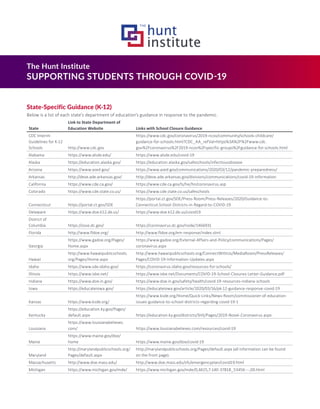
State-Specific Guidance (K-12)
Below is a list of each state's department of education's guidance in response to the pandemic.
State
Link to State Department of
Education Website Links with School Closure Guidance
CDC Interim
Guidelines for K-12
Schools http://www.cdc.gov
https://www.cdc.gov/coronavirus/2019-ncov/community/schools-childcare/
guidance-for-schools.html?CDC_AA_refVal=https%3A%2F%2Fwww.cdc.
gov%2Fcoronavirus%2F2019-ncov%2Fspecific-groups%2Fguidance-for-schools.html
Alabama https://www.alsde.edu/ https://www.alsde.edu/covid-19
Alaska https://education.alaska.gov/ https://education.alaska.gov/safeschools/infectiousdisease
Arizona https://www.azed.gov/ https://www.azed.gov/communications/2020/03/12/pandemic-preparedness/
Arkansas http://dese.ade.arkansas.gov/ http://dese.ade.arkansas.gov/divisions/communications/covid-19-information
California https://www.cde.ca.gov/ https://www.cde.ca.gov/ls/he/hn/coronavirus.asp
Colorado https://www.cde.state.co.us/ https://www.cde.state.co.us/safeschools
Connecticut https://portal.ct.gov/SDE
https://portal.ct.gov/SDE/Press-Room/Press-Releases/2020/Guidance-to-
Connecticut-School-Districts-in-Regard-to-COVID-19
Delaware https://www.doe.k12.de.us/ https://www.doe.k12.de.us/covid19
District of
Columbia https://osse.dc.gov/ https://coronavirus.dc.gov/node/1466931
Florida http://www.fldoe.org/ http://www.fldoe.org/em-response/index.stml
Georgia
https://www.gadoe.org/Pages/
Home.aspx
https://www.gadoe.org/External-Affairs-and-Policy/communications/Pages/
coronavirus.aspx
Hawaii
http://www.hawaiipublicschools.
org/Pages/Home.aspx
http://www.hawaiipublicschools.org/ConnectWithUs/MediaRoom/PressReleases/
Pages/COVID-19-Information-Updates.aspx
Idaho https://www.sde.idaho.gov/ https://coronavirus.idaho.gov/resources-for-schools/
Illinois https://www.isbe.net/ https://www.isbe.net/Documents/COVID-19-School-Closures-Letter-Guidance.pdf
Indiana https://www.doe.in.gov/ https://www.doe.in.gov/safety/health/covid-19-resources-indiana-schools
Iowa https://educateiowa.gov/ https://educateiowa.gov/article/2020/03/16/pk-12-guidance-response-covid-19
Kansas https://www.ksde.org/
https://www.ksde.org/Home/Quick-Links/News-Room/commissioner-of-education-
issues-guidance-to-school-districts-regarding-covid-19-1
Kentucky
https://education.ky.gov/Pages/
default.aspx https://education.ky.gov/districts/SHS/Pages/2019-Novel-Coronavirus.aspx
Louisiana
https://www.louisianabelieves.
com/ https://www.louisianabelieves.com/resources/covid-19
Maine
https://www.maine.gov/doe/
home https://www.maine.gov/doe/covid-19
Maryland
http://marylandpublicschools.org/
Pages/default.aspx
http://marylandpublicschools.org/Pages/default.aspx (all information can be found
on the front page).
Massachusetts http://www.doe.mass.edu/ http://www.doe.mass.edu/sfs/emergencyplan/covid19.html
Michigan https://www.michigan.gov/mde/ https://www.michigan.gov/mde/0,4615,7-140-37818_53456---,00.html
The Hunt Institute
SUPPORTING STUDENTS THROUGH COVID-19
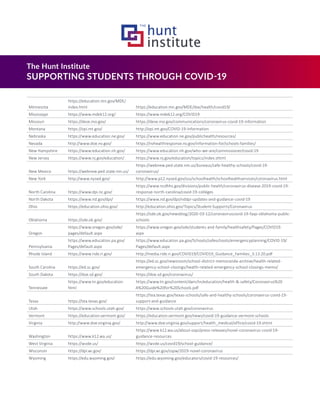
Minnesota
https://education.mn.gov/MDE/
index.html https://education.mn.gov/MDE/dse/health/covid19/
Mississippi https://www.mdek12.org/ https://www.mdek12.org/COVID19
Missouri https://dese.mo.gov/ https://dese.mo.gov/communications/coronavirus-covid-19-information
Montana https://opi.mt.gov/ http://opi.mt.gov/COVID-19-Information
Nebraska https://www.education.ne.gov/ https://www.education.ne.gov/publichealth/resources/
Nevada http://www.doe.nv.gov/ https://nvhealthresponse.nv.gov/information-for/schools-families/
New Hampshire https://www.education.nh.gov/ https://www.education.nh.gov/who-we-are/commissioner/covid-19
New Jersey https://www.nj.gov/education/ https://www.nj.gov/education/topics/index.shtml
New Mexico https://webnew.ped.state.nm.us/
https://webnew.ped.state.nm.us/bureaus/safe-healthy-schools/covid-19-
coronavirus/
New York http://www.nysed.gov/ http://www.p12.nysed.gov/sss/schoolhealth/schoolhealthservices/coronavirus.html
North Carolina https://www.dpi.nc.gov/
https://www.ncdhhs.gov/divisions/public-health/coronavirus-disease-2019-covid-19-
response-north-carolina/covid-19-colleges
North Dakota https://www.nd.gov/dpi/ https://www.nd.gov/dpi/nddpi-updates-and-guidance-covid-19
Ohio https://education.ohio.gov/ http://education.ohio.gov/Topics/Student-Supports/Coronavirus
Oklahoma https://sde.ok.gov/
https://sde.ok.gov/newsblog/2020-03-12/coronaviruscovid-19-faqs-oklahoma-public-
schools
Oregon
https://www.oregon.gov/ode/
pages/default.aspx
https://www.oregon.gov/ode/students-and-family/healthsafety/Pages/COVID19.
aspx
Pennsylvania
https://www.education.pa.gov/
Pages/default.aspx
https://www.education.pa.gov/Schools/safeschools/emergencyplanning/COVID-19/
Pages/default.aspx
Rhode Island https://www.ride.ri.gov/ http://media.ride.ri.gov/COVID19/COVID19_Guidance_Families_3.13.20.pdf
South Carolina https://ed.sc.gov/
https://ed.sc.gov/newsroom/school-district-memoranda-archive/health-related-
emergency-school-closings/health-related-emergency-school-closings-memo/
South Dakota https://doe.sd.gov/ https://doe.sd.gov/coronavirus/
Tennessee
https://www.tn.gov/education.
html
https://www.tn.gov/content/dam/tn/education/health-&-safety/Coronavirus%20
A%20Guide%20for%20Schools.pdf
Texas https://tea.texas.gov/
https://tea.texas.gov/texas-schools/safe-and-healthy-schools/coronavirus-covid-19-
support-and-guidance
Utah https://www.schools.utah.gov/ https://www.schools.utah.gov/coronavirus
Vermont https://education.vermont.gov/ https://education.vermont.gov/news/covid-19-guidance-vermont-schools
Virginia http://www.doe.virginia.gov/ http://www.doe.virginia.gov/support/health_medical/office/covid-19.shtml
Washington https://www.k12.wa.us/
https://www.k12.wa.us/about-ospi/press-releases/novel-coronavirus-covid-19-
guidance-resources
West Virginia https://wvde.us/ https://wvde.us/covid19/school-guidance/
Wisconsin https://dpi.wi.gov/ https://dpi.wi.gov/sspw/2019-novel-coronavirus
Wyoming https://edu.wyoming.gov/ https://edu.wyoming.gov/educators/covid-19-resources/
The Hunt Institute
SUPPORTING STUDENTS THROUGH COVID-19
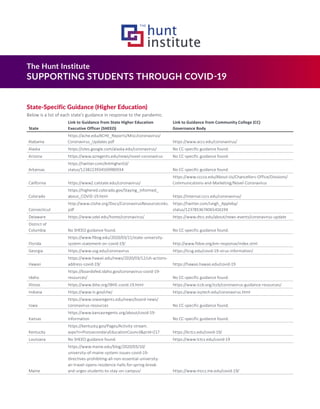
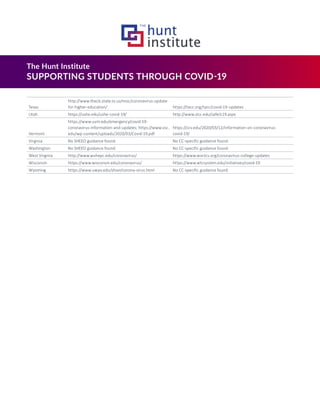
State-Specific Guidance (Higher Education)
Below is a list of each state's guidance in response to the pandemic.
State
Link to Guidance from State Higher Education
Executive Officer (SHEEO)
Link to Guidance from Community College (CC)
Governance Body
Alabama
https://ache.edu/ACHE_Reports/Misc/coronavirus/
Coronavirus_Updates.pdf https://www.accs.edu/coronavirus/
Alaska https://sites.google.com/alaska.edu/coronavirus/ No CC-specific guidance found.
Arizona https://www.azregents.edu/news/novel-coronavirus No CC-specific guidance found.
Arkansas
https://twitter.com/ArkHigherEd/
status/1238223934169980934 No CC-specific guidance found.
California https://www2.calstate.edu/coronavirus/
https://www.cccco.edu/About-Us/Chancellors-Office/Divisions/
Communications-and-Marketing/Novel-Coronavirus
Colorado
https://highered.colorado.gov/Staying_informed_
about_COVID-19.html https://internal.cccs.edu/coronavirus/
Connecticut
http://www.ctohe.org/Docs/CoronavirusResourceLinks.
pdf
https://twitter.com/Leigh_Appleby/
status/1237853674065416194
Delaware https://www.udel.edu/home/coronavirus/ https://www.dtcc.edu/about/news-events/coronavirus-update
District of
Columbia No SHEEO guidance found. No CC-specific guidance found.
Florida
https://www.flbog.edu/2020/03/11/state-university-
system-statement-on-covid-19/ http://www.fldoe.org/em-response/index.stml
Georgia https://www.usg.edu/coronavirus https://tcsg.edu/covid-19-virus-information/
Hawaii
https://www.hawaii.edu/news/2020/03/12/uh-actions-
address-covid-19/ https://hawaii.hawaii.edu/covid-19
Idaho
https://boardofed.idaho.gov/coronavirus-covid-19-
resources/ No CC-specific guidance found.
Illinois https://www.ibhe.org/IBHE-covid-19.html https://www.iccb.org/iccb/coronavirus-guidance-resources/
Indiana https://www.in.gov/che/ https://www.ivytech.edu/coronavirus.html
Iowa
https://www.iowaregents.edu/news/board-news/
coronavirus-resources No CC-specific guidance found.
Kansas
https://www.kansasregents.org/about/covid-19-
information No CC-specific guidance found.
Kentucky
https://kentucky.gov/Pages/Activity-stream.
aspx?n=PostsecondaryEducationCouncil&prId=217 https://kctcs.edu/covid-19/
Louisiana No SHEEO guidance found. https://www.lctcs.edu/covid-19
Maine
https://www.maine.edu/blog/2020/03/10/
university-of-maine-system-issues-covid-19-
directives-prohibiting-all-non-essential-university-
air-travel-opens-residence-halls-for-spring-break-
and-urges-students-to-stay-on-campus/ https://www.mccs.me.edu/covid-19/
The Hunt Institute
SUPPORTING STUDENTS THROUGH COVID-19
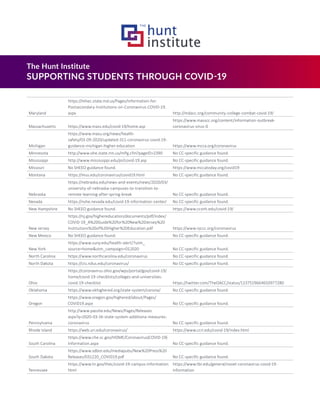
Maryland
https://mhec.state.md.us/Pages/Information-for-
Postsecondary-Institutions-on-Coronavirus-COVID-19.
aspx http://mdacc.org/community-college-combat-covid-19/
Massachusetts https://www.mass.edu/covid-19/home.asp
https://www.masscc.org/content/information-outbreak-
coronavirus-virus-0
Michigan
https://www.masu.org/news/health-
safety/03-09-2020/updated-311-coronavirus-covid-19-
guidance-michigan-higher-education https://www.mcca.org/coronavirus
Minnesota http://www.ohe.state.mn.us/mPg.cfm?pageID=2390 No CC-specific guidance found.
Mississippi http://www.mississippi.edu/pr/covid-19.asp No CC-specific guidance found.
Missouri No SHEEO guidance found. https://www.mccatoday.org/covid19
Montana https://mus.edu/coronavirus/covid19.html No CC-specific guidance found.
Nebraska
https://nebraska.edu/news-and-events/news/2020/03/
university-of-nebraska-campuses-to-transition-to-
remote-learning-after-spring-break No CC-specific guidance found.
Nevada https://nshe.nevada.edu/covid-19-information-center/ No CC-specific guidance found.
New Hampshire No SHEEO guidance found. https://www.ccsnh.edu/covid-19/
New Jersey
https://nj.gov/highereducation/documents/pdf/index/
COVID-19_A%20Guide%20for%20New%20Jersey%20
Institutions%20of%20Higher%20Education.pdf https://www.njccc.org/coronavirus
New Mexico No SHEEO guidance found. No CC-specific guidance found.
New York
https://www.suny.edu/health-alert/?utm_
source=home&utm_campaign=012020 No CC-specific guidance found.
North Carolina https://www.northcarolina.edu/coronavirus No CC-specific guidance found.
North Dakota https://cts.ndus.edu/coronavirus/ No CC-specific guidance found.
Ohio
https://coronavirus.ohio.gov/wps/portal/gov/covid-19/
home/covid-19-checklists/colleges-and-universities-
covid-19-checklist https://twitter.com/TheOACC/status/1237519664650977280
Oklahoma https://www.okhighered.org/state-system/corona/ No CC-specific guidance found.
Oregon
https://www.oregon.gov/highered/about/Pages/
COVID19.aspx No CC-specific guidance found.
Pennsylvania
http://www.passhe.edu/News/Pages/Releases.
aspx?q=2020-03-16-state-system-additiona-measures-
coronavirus No CC-specific guidance found.
Rhode Island https://web.uri.edu/coronavirus/ https://www.ccri.edu/covid-19/index.html
South Carolina
https://www.che.sc.gov/HOME/Coronavirus(COVID-19)
Information.aspx No CC-specific guidance found.
South Dakota
https://www.sdbor.edu/mediapubs/New%20Press%20
Releases/031220_COVID19.pdf No CC-specific guidance found.
Tennessee
https://www.tn.gov/thec/covid-19-campus-information.
html
https://www.tbr.edu/general/novel-coronavirus-covid-19-
information
The Hunt Institute
SUPPORTING STUDENTS THROUGH COVID-19
Texas
http://www.thecb.state.tx.us/misc/coronavirus-update-
for-higher-education/ https://tacc.org/tacc/covid-19-updates
Utah https://ushe.edu/ushe-covid-19/ http://www.slcc.edu/safe/c19.aspx
Vermont
https://www.uvm.edu/emergency/covid-19-
coronavirus-information-and-updates; https://www.vsc.
edu/wp-content/uploads/2020/03/Covid-19.pdf
https://ccv.edu/2020/03/12/information-on-coronavirus-
covid-19/
Virginia No SHEEO guidance found. No CC-specific guidance found.
Washington No SHEEO guidance found. No CC-specific guidance found.
West Virginia http://www.wvhepc.edu/coronavirus/ https://www.wvctcs.org/coronavirus-college-updates
Wisconsin https://www.wisconsin.edu/coronavirus/ https://www.wtcsystem.edu/initiatives/covid-19
Wyoming https://www.uwyo.edu/shser/corona-virus.html No CC-specific guidance found.

Hunt Institute

  • 1.
    The Hunt Institute SUPPORTINGSTUDENTS THROUGH COVID-19 COVID-19 has disrupted society’s daily routines. As schools across the nation close, childcare services are suspended, and social distancing becomes the new reality for the foreseeable future, our nation’s education system is being uprooted. Given these unprecedented events many are wondering what they can do to support families and students that rely on the education system to provide more than just learning. The following are some of the major consequences of the COVID-19 pandemic that The Hunt Institute is tracking. Food Security Millions of students across the country rely on school for at least one meal a day – and in some cases receive three meals a day from their school. With schools being shut down, it is imperative that we continue to support these families that rely on this service, especially with many hourly employees’ jobs being cut back in response to the pandemic. A number of barriers exist limiting the ease of access to food for students that need it, including: • School eligibility is a concern; according to the U.S. Department of Agriculture, only schools and groups that usually serve meals during the summer months are eligible for federal support to feed students during emergency closures. In areas where less than half of children are economically disadvantaged, school systems will only be reimbursed for meals provided to children in households that qualify for free or reduced-price lunch. Unfortunately, this may not be enough to meet the needs of all students that need support. A full list of flexibilities that are available under U.S. Departmet of Agriculture programs can be found here. • For those who live in communities where support is offered, transportation to pick up provided meals is often a barrier, especially in rural communities. • Daily contact with students and families at meal pickup sites still provide opportunities for the spread of COVID-19. Some families might be concerned that this will put them at risk of contracting the virus. In many states, including North Carolina, state leaders have announced that strategies to distribute meals will be determined at the local level, and schools across the state have moved to provide food for students in need. When approaching schools, community partners should look to incorporate the following best practices: • Schools have identified designated community pickup locations, such as community centers, apartment complexes, or school bus stops, and are using school buses to transport meals to these locations. Additionally, some schools plan to deliver a limited amount of meals door-to-door. Volunteers and community agencies could assist in staffing pick-up sites and delivering food. • Schools have strategically approached scheduling pickup times for student meals. By providing multiple days’ worth of meals in each bag and only allowing one adult or older student per family to pick up meals, districts are able to maintain suggested observe social distancing norms. • Restaurants in North and South Carolina have begun offering free meals to students while schools are closed. • In addition to direct support for student meal initiatives, supporting local food banks through donation food drives can provide another level of support to combat food scarcity. Oportunities for Support • Support coordination across school districts, community organizations, and local businesses are key to ensure students who need access to food during school closures receive it. This can include: • Increase the availability of meals at strategic community locations to overcome traveling barriers. • Support local food banks that provide food for students in schools that aren’t eligible for federal funds. • Help disseminate information about programs and other efforts to students and families.
  • 2.
    The Hunt Institute SUPPORTINGSTUDENTS THROUGH COVID-19 Access to High-Quality Instruction With news of statewide school closures emerging quickly, teachers, parents, and students found themselves without the necessary time to plan effective, high-quality learning opportunities for students while schools are closed. Teachers did not have time to create and distribute packets of materials to take home. While many suggest pivoting to virtual learning is the obvious solution, it neglects the fact that some students don’t have access to the appropriate technology or internet at home and that many teachers are not trained to execute lessons in this manner. Schools lack the infrastructure to make this transition and holding students accountable for their work is a challenge. For younger students especially, online learning requires a degree of parental involvement to ensure that students stay on task. Further, online learning is not equitable for students with disabilities that need additional support or differentiation to master skills and content. Nationwide, schools and other organizations have sought innovative ways to approach increasing high-quality options for students while schools are closed. Some approaches include: • For schools and districts that have the technological capacity to ensure that every student has access to online materials, districts must provide additional training and support for teachers and parents on how to use tools such as Zoom, Google Classroom, and discussion boards. • On Sunday, March 15, Mariah Morris, the 2019 Burroughs Wellcome Fund North Carolina Teacher of the Year, convened more than 80 educators from across the state on Facebook Live to discuss how educators can respond during school closures. Beginning on Monday, March 16, the North Carolina Teacher of the Year cohorts will begin rolling out instructional videos on Morris’ YouTube channel. At 9 a.m. each day, an elementary lesson (grades K-5) will be posted, and then at 9:30 a.m. each day, a secondary lesson (grades 6-12) will be posted. Teachers across the state are encouraged to submit similar videos to increase the volume of resources available to students. • A number of excellent resources already exist online. By aggregating such resources with an eye to content and grade level, students and parents can be provided with a list of places they can go to find age appropriate lessons that can serve as stop gap while schools are closed. This can also include tablet apps that provide academic support. A number of organizations have started to compile lists; one good starting place is from Swing Education. Additionally, schools and other organizations are attempting to help students secure the technology and internet access that they need. Some efforts include: • In Colorado, one school offered Chromebooks and paper copies of schoolwork for pick-up at the school for students to use during the break. Schools often lack basic resources like copy paper and toner to produce weeks’ worth of assignments at a large scale. By supporting schools in acquiring the necessary materials and the delivery of hard-copy materials, either directly to student’s homes or to more other community locations, we can ensure that students don’t get left behind when schools are closed. • Organizations like the Kramden Institute give students laptops they can use at home through a donation- and volunteer-based program. • One barrier that persists for children and adults is whether they are accessing current and accurate information. By working with companies like Charter Communications or Comcast an effective media campaign can be created so that those who are in need of the internet at this time are able to access it within the programs that have been established. The same goes for those who already have internet access, but struggle to pay their bills due to a lack of employment during this pandemic. Opportunities for Support • Compile resources for parents (both instructional and general coronavirus related support) and partner with organizations that can provide access to materials through technology. • Work with partners to help get the requisite hardware, such as laptops and tablets, into the hands of studets who otherwise do not have access to them at home. • Connect with organizations to spread verified information about low-cost or no-cost internet solutions for households.
  • 3.
    The Hunt Institute SUPPORTINGSTUDENTS THROUGH COVID-19 SUPPORTING STUDENTS THROUGH COVID-19 Childcare As childcare facilities and schools across the country close due to the COVID-19 pandemic, many families are struggling to find childcare so they can continue to work. Medical professionals, service industry employees, and other essential staff are not able to do their jobs remotely and must continue to report to work. For these families the urgency to keep their children safe during this time is crucial because their normal routine has been severely interrupted. H.R. 6201, from the U.S. House of Representatives, provides supplemental assistance to families and employers who must take leave during this pandemic and affords them the ability to pay workers at a set rate, in some cases upwards of 70 percent of their salary. This applies not only to people who have become infected with the virus, but also their caretakers. This bill is especially important for families whose childcare facility has closed because of coronavirus, as well as those who work at these closed facilities. The next step is to get the bill approved in the Senate. • Museums and Zoos across the country are offering remote learning opportunities, allowing for tours and lessons for students at home over the next few weeks. • The Los Angeles Unified School District (LAUSD) has partnered with local television stations to broadcast educational programming to students while schools are closed. Additionally, LAUSD will receive training in using PBS Learning Media, a national resource that offers additional content to support educational assignments alongside PBS programming. • Education companies who specialize in virtual education opportunities like K12 and BrainPOP have offered their services for free over the next month. Khan Academy, a nonprofit who already offers free online lessons and quizzes, created a page aimed at helping new users get started if they are facing school closures It will be critical to leverage teachers, local education organizations like museums and libraries, education companies that specialize in virtual learning and local public television outlets to increase access to these high-quality education opportunities. Opportunities for Support • Work with states to provide support, as needed, to ensure that emergency/temporary child care programs being created for emergency, service and medical employees are safe and appropriate. • Advocate for the needs of the early childhood workforce, many of whom work at an hourly rate and without employer- provided health care benefits. • Support the creation of online resources designed for parents at home with young children. Additional Resources Many organizations have begun to compile valuable resources. • PIE Network: Rapid Response Resources: COVID-19 • Chalkbeat: Latest Coverage • US Department of Education: Information and Resources for Schools and School Personnel • US Department of Education: Providing Supports to Students with Disabilities • Starr Commonwealth: COVID-19, School Cancellation, and Trauma • NCDHHS: Interim Guidance for Child Care Settings • Common Sense Media: Resources for Parents to Prepare for Coronavirus School Closures • We Are Teachers: Free Online Learning Resources for Teaching Your Students Virtually
  • 4.
    The Hunt Institute SUPPORTINGSTUDENTS THROUGH COVID-19 State-Specific Guidance (K-12) Below is a list of each state's department of education's guidance in response to the pandemic. State Link to State Department of Education Website Links with School Closure Guidance CDC Interim Guidelines for K-12 Schools http://www.cdc.gov https://www.cdc.gov/coronavirus/2019-ncov/community/schools-childcare/ guidance-for-schools.html?CDC_AA_refVal=https%3A%2F%2Fwww.cdc. gov%2Fcoronavirus%2F2019-ncov%2Fspecific-groups%2Fguidance-for-schools.html Alabama https://www.alsde.edu/ https://www.alsde.edu/covid-19 Alaska https://education.alaska.gov/ https://education.alaska.gov/safeschools/infectiousdisease Arizona https://www.azed.gov/ https://www.azed.gov/communications/2020/03/12/pandemic-preparedness/ Arkansas http://dese.ade.arkansas.gov/ http://dese.ade.arkansas.gov/divisions/communications/covid-19-information California https://www.cde.ca.gov/ https://www.cde.ca.gov/ls/he/hn/coronavirus.asp Colorado https://www.cde.state.co.us/ https://www.cde.state.co.us/safeschools Connecticut https://portal.ct.gov/SDE https://portal.ct.gov/SDE/Press-Room/Press-Releases/2020/Guidance-to- Connecticut-School-Districts-in-Regard-to-COVID-19 Delaware https://www.doe.k12.de.us/ https://www.doe.k12.de.us/covid19 District of Columbia https://osse.dc.gov/ https://coronavirus.dc.gov/node/1466931 Florida http://www.fldoe.org/ http://www.fldoe.org/em-response/index.stml Georgia https://www.gadoe.org/Pages/ Home.aspx https://www.gadoe.org/External-Affairs-and-Policy/communications/Pages/ coronavirus.aspx Hawaii http://www.hawaiipublicschools. org/Pages/Home.aspx http://www.hawaiipublicschools.org/ConnectWithUs/MediaRoom/PressReleases/ Pages/COVID-19-Information-Updates.aspx Idaho https://www.sde.idaho.gov/ https://coronavirus.idaho.gov/resources-for-schools/ Illinois https://www.isbe.net/ https://www.isbe.net/Documents/COVID-19-School-Closures-Letter-Guidance.pdf Indiana https://www.doe.in.gov/ https://www.doe.in.gov/safety/health/covid-19-resources-indiana-schools Iowa https://educateiowa.gov/ https://educateiowa.gov/article/2020/03/16/pk-12-guidance-response-covid-19 Kansas https://www.ksde.org/ https://www.ksde.org/Home/Quick-Links/News-Room/commissioner-of-education- issues-guidance-to-school-districts-regarding-covid-19-1 Kentucky https://education.ky.gov/Pages/ default.aspx https://education.ky.gov/districts/SHS/Pages/2019-Novel-Coronavirus.aspx Louisiana https://www.louisianabelieves. com/ https://www.louisianabelieves.com/resources/covid-19 Maine https://www.maine.gov/doe/ home https://www.maine.gov/doe/covid-19 Maryland http://marylandpublicschools.org/ Pages/default.aspx http://marylandpublicschools.org/Pages/default.aspx (all information can be found on the front page). Massachusetts http://www.doe.mass.edu/ http://www.doe.mass.edu/sfs/emergencyplan/covid19.html Michigan https://www.michigan.gov/mde/ https://www.michigan.gov/mde/0,4615,7-140-37818_53456---,00.html
  • 5.
    The Hunt Institute SUPPORTINGSTUDENTS THROUGH COVID-19 Minnesota https://education.mn.gov/MDE/ index.html https://education.mn.gov/MDE/dse/health/covid19/ Mississippi https://www.mdek12.org/ https://www.mdek12.org/COVID19 Missouri https://dese.mo.gov/ https://dese.mo.gov/communications/coronavirus-covid-19-information Montana https://opi.mt.gov/ http://opi.mt.gov/COVID-19-Information Nebraska https://www.education.ne.gov/ https://www.education.ne.gov/publichealth/resources/ Nevada http://www.doe.nv.gov/ https://nvhealthresponse.nv.gov/information-for/schools-families/ New Hampshire https://www.education.nh.gov/ https://www.education.nh.gov/who-we-are/commissioner/covid-19 New Jersey https://www.nj.gov/education/ https://www.nj.gov/education/topics/index.shtml New Mexico https://webnew.ped.state.nm.us/ https://webnew.ped.state.nm.us/bureaus/safe-healthy-schools/covid-19- coronavirus/ New York http://www.nysed.gov/ http://www.p12.nysed.gov/sss/schoolhealth/schoolhealthservices/coronavirus.html North Carolina https://www.dpi.nc.gov/ https://www.ncdhhs.gov/divisions/public-health/coronavirus-disease-2019-covid-19- response-north-carolina/covid-19-colleges North Dakota https://www.nd.gov/dpi/ https://www.nd.gov/dpi/nddpi-updates-and-guidance-covid-19 Ohio https://education.ohio.gov/ http://education.ohio.gov/Topics/Student-Supports/Coronavirus Oklahoma https://sde.ok.gov/ https://sde.ok.gov/newsblog/2020-03-12/coronaviruscovid-19-faqs-oklahoma-public- schools Oregon https://www.oregon.gov/ode/ pages/default.aspx https://www.oregon.gov/ode/students-and-family/healthsafety/Pages/COVID19. aspx Pennsylvania https://www.education.pa.gov/ Pages/default.aspx https://www.education.pa.gov/Schools/safeschools/emergencyplanning/COVID-19/ Pages/default.aspx Rhode Island https://www.ride.ri.gov/ http://media.ride.ri.gov/COVID19/COVID19_Guidance_Families_3.13.20.pdf South Carolina https://ed.sc.gov/ https://ed.sc.gov/newsroom/school-district-memoranda-archive/health-related- emergency-school-closings/health-related-emergency-school-closings-memo/ South Dakota https://doe.sd.gov/ https://doe.sd.gov/coronavirus/ Tennessee https://www.tn.gov/education. html https://www.tn.gov/content/dam/tn/education/health-&-safety/Coronavirus%20 A%20Guide%20for%20Schools.pdf Texas https://tea.texas.gov/ https://tea.texas.gov/texas-schools/safe-and-healthy-schools/coronavirus-covid-19- support-and-guidance Utah https://www.schools.utah.gov/ https://www.schools.utah.gov/coronavirus Vermont https://education.vermont.gov/ https://education.vermont.gov/news/covid-19-guidance-vermont-schools Virginia http://www.doe.virginia.gov/ http://www.doe.virginia.gov/support/health_medical/office/covid-19.shtml Washington https://www.k12.wa.us/ https://www.k12.wa.us/about-ospi/press-releases/novel-coronavirus-covid-19- guidance-resources West Virginia https://wvde.us/ https://wvde.us/covid19/school-guidance/ Wisconsin https://dpi.wi.gov/ https://dpi.wi.gov/sspw/2019-novel-coronavirus Wyoming https://edu.wyoming.gov/ https://edu.wyoming.gov/educators/covid-19-resources/
  • 6.
    The Hunt Institute SUPPORTINGSTUDENTS THROUGH COVID-19 State-Specific Guidance (Higher Education) Below is a list of each state's guidance in response to the pandemic. State Link to Guidance from State Higher Education Executive Officer (SHEEO) Link to Guidance from Community College (CC) Governance Body Alabama https://ache.edu/ACHE_Reports/Misc/coronavirus/ Coronavirus_Updates.pdf https://www.accs.edu/coronavirus/ Alaska https://sites.google.com/alaska.edu/coronavirus/ No CC-specific guidance found. Arizona https://www.azregents.edu/news/novel-coronavirus No CC-specific guidance found. Arkansas https://twitter.com/ArkHigherEd/ status/1238223934169980934 No CC-specific guidance found. California https://www2.calstate.edu/coronavirus/ https://www.cccco.edu/About-Us/Chancellors-Office/Divisions/ Communications-and-Marketing/Novel-Coronavirus Colorado https://highered.colorado.gov/Staying_informed_ about_COVID-19.html https://internal.cccs.edu/coronavirus/ Connecticut http://www.ctohe.org/Docs/CoronavirusResourceLinks. pdf https://twitter.com/Leigh_Appleby/ status/1237853674065416194 Delaware https://www.udel.edu/home/coronavirus/ https://www.dtcc.edu/about/news-events/coronavirus-update District of Columbia No SHEEO guidance found. No CC-specific guidance found. Florida https://www.flbog.edu/2020/03/11/state-university- system-statement-on-covid-19/ http://www.fldoe.org/em-response/index.stml Georgia https://www.usg.edu/coronavirus https://tcsg.edu/covid-19-virus-information/ Hawaii https://www.hawaii.edu/news/2020/03/12/uh-actions- address-covid-19/ https://hawaii.hawaii.edu/covid-19 Idaho https://boardofed.idaho.gov/coronavirus-covid-19- resources/ No CC-specific guidance found. Illinois https://www.ibhe.org/IBHE-covid-19.html https://www.iccb.org/iccb/coronavirus-guidance-resources/ Indiana https://www.in.gov/che/ https://www.ivytech.edu/coronavirus.html Iowa https://www.iowaregents.edu/news/board-news/ coronavirus-resources No CC-specific guidance found. Kansas https://www.kansasregents.org/about/covid-19- information No CC-specific guidance found. Kentucky https://kentucky.gov/Pages/Activity-stream. aspx?n=PostsecondaryEducationCouncil&prId=217 https://kctcs.edu/covid-19/ Louisiana No SHEEO guidance found. https://www.lctcs.edu/covid-19 Maine https://www.maine.edu/blog/2020/03/10/ university-of-maine-system-issues-covid-19- directives-prohibiting-all-non-essential-university- air-travel-opens-residence-halls-for-spring-break- and-urges-students-to-stay-on-campus/ https://www.mccs.me.edu/covid-19/
  • 7.
    The Hunt Institute SUPPORTINGSTUDENTS THROUGH COVID-19 Maryland https://mhec.state.md.us/Pages/Information-for- Postsecondary-Institutions-on-Coronavirus-COVID-19. aspx http://mdacc.org/community-college-combat-covid-19/ Massachusetts https://www.mass.edu/covid-19/home.asp https://www.masscc.org/content/information-outbreak- coronavirus-virus-0 Michigan https://www.masu.org/news/health- safety/03-09-2020/updated-311-coronavirus-covid-19- guidance-michigan-higher-education https://www.mcca.org/coronavirus Minnesota http://www.ohe.state.mn.us/mPg.cfm?pageID=2390 No CC-specific guidance found. Mississippi http://www.mississippi.edu/pr/covid-19.asp No CC-specific guidance found. Missouri No SHEEO guidance found. https://www.mccatoday.org/covid19 Montana https://mus.edu/coronavirus/covid19.html No CC-specific guidance found. Nebraska https://nebraska.edu/news-and-events/news/2020/03/ university-of-nebraska-campuses-to-transition-to- remote-learning-after-spring-break No CC-specific guidance found. Nevada https://nshe.nevada.edu/covid-19-information-center/ No CC-specific guidance found. New Hampshire No SHEEO guidance found. https://www.ccsnh.edu/covid-19/ New Jersey https://nj.gov/highereducation/documents/pdf/index/ COVID-19_A%20Guide%20for%20New%20Jersey%20 Institutions%20of%20Higher%20Education.pdf https://www.njccc.org/coronavirus New Mexico No SHEEO guidance found. No CC-specific guidance found. New York https://www.suny.edu/health-alert/?utm_ source=home&utm_campaign=012020 No CC-specific guidance found. North Carolina https://www.northcarolina.edu/coronavirus No CC-specific guidance found. North Dakota https://cts.ndus.edu/coronavirus/ No CC-specific guidance found. Ohio https://coronavirus.ohio.gov/wps/portal/gov/covid-19/ home/covid-19-checklists/colleges-and-universities- covid-19-checklist https://twitter.com/TheOACC/status/1237519664650977280 Oklahoma https://www.okhighered.org/state-system/corona/ No CC-specific guidance found. Oregon https://www.oregon.gov/highered/about/Pages/ COVID19.aspx No CC-specific guidance found. Pennsylvania http://www.passhe.edu/News/Pages/Releases. aspx?q=2020-03-16-state-system-additiona-measures- coronavirus No CC-specific guidance found. Rhode Island https://web.uri.edu/coronavirus/ https://www.ccri.edu/covid-19/index.html South Carolina https://www.che.sc.gov/HOME/Coronavirus(COVID-19) Information.aspx No CC-specific guidance found. South Dakota https://www.sdbor.edu/mediapubs/New%20Press%20 Releases/031220_COVID19.pdf No CC-specific guidance found. Tennessee https://www.tn.gov/thec/covid-19-campus-information. html https://www.tbr.edu/general/novel-coronavirus-covid-19- information
  • 8.
    The Hunt Institute SUPPORTINGSTUDENTS THROUGH COVID-19 Texas http://www.thecb.state.tx.us/misc/coronavirus-update- for-higher-education/ https://tacc.org/tacc/covid-19-updates Utah https://ushe.edu/ushe-covid-19/ http://www.slcc.edu/safe/c19.aspx Vermont https://www.uvm.edu/emergency/covid-19- coronavirus-information-and-updates; https://www.vsc. edu/wp-content/uploads/2020/03/Covid-19.pdf https://ccv.edu/2020/03/12/information-on-coronavirus- covid-19/ Virginia No SHEEO guidance found. No CC-specific guidance found. Washington No SHEEO guidance found. No CC-specific guidance found. West Virginia http://www.wvhepc.edu/coronavirus/ https://www.wvctcs.org/coronavirus-college-updates Wisconsin https://www.wisconsin.edu/coronavirus/ https://www.wtcsystem.edu/initiatives/covid-19 Wyoming https://www.uwyo.edu/shser/corona-virus.html No CC-specific guidance found.