• Cognizant 20-20 Insights


Replacing the Annual Budget
with Rolling Forecasts
   Executive Summary                                      Turning Rolling Forecasts into Reality
   Gone are the days when annual budgeting and            A rolling forecast is a process in which key
   planning steered the business, with only predict-      business drivers are forecast on a continual basis.
   able, minimal budgeting changes. With increasing       Its objective is to foresee the risks and opportu-
   competition and a changing economic environ-           nities presented by a dynamic business environ-
   ment, companies need a better way to predict the       ment, revisit strategy in the light of new business
   future. As a result, new forecasting techniques        scenarios and align resources/activities for com-
   have emerged to help anticipate changes and            petitive advantage at periodic frequencies. Rolling
   better inform strategic direction.                     forecasts are not simply periodic updates against
                                                          the annual budget and are not associated with a
   Traditional forecasts take a structured approach       specific financial year.
   to scoping uncertainties within a specified
   timeframe. Those predictions have a reasonable         A rolling forecast, also called continuous
   chance of being accurate. In today’s highly volatile   planning, is a leading planning technique that
   business environment, however, organizations           will help organizations find opportunities amid
   are forced to be dynamic in adapting to changes        persistent volatility and intense competition.
   to ensure their very survival. Companies that          However, there are many practical difficulties in
   don’t expect to encounter economic or political        converting the theory
   turbulence and operate via annual budgeting and        of rolling forecasts into A rolling forecast is
   forecasting exercises are finding it difficult to      reality. Organizations a process in which
   create plans and deliver results that meet expec-      that want to embrace
   tations, be they internal management objectives        rolling forecasts should
                                                                                    key business drivers
   or external performance goals set by financial         focus on the following are forecast on a
   and industry analysts.                                 key steps:                continual basis.
   In such an environment, chief financial officers       1. Move toward driver-based forecasting: A
   need reliable and relevant insights into risks and        common decision-making challenge is having
   opportunities. By embracing continuous planning           too many details to work with. Forecasting
   or rolling forecasts, companies can remain agile,         should focus on drivers that are relevant for
   focused and flexible in meeting internal and              analysis and decision-making. This will provide
   external performance expectations. This white             organization-wide alignment and control over
   paper discusses the essentials for making rolling         forecasting, as well as consistency in decision-
   forecasts a reality.                                      making.


   cognizant 20-20 insights | may 2011
2. Link forecast to strategic and operation              should cover in detail the knowledge sharing
                     decisions: A key objective of the rolling             and training programs required to adapt to
                     forecast is to revisit strategy and align             new processes and technology.
                     resources quickly and efficiently. Risks and          Finally, the policy should list the key metrics to
                     opportunities identified during a rolling             measure the success of change management
                     forecast should trigger “what-if” analyses            policy (e.g., communication effectiveness).
                     and scenario planning. From the strategy
                     postulated by scenario planning, resources        Data and Analytics Essentials for
                     for capital projects and operational expenses
                                                                       Rolling Forecasts
                     should be allocated and new performance
                     targets set as key performance indicators.        While changes in strategic thinking and the
                                                                       planning process are essential, equally important
             3. Ensure direct ownership and involve-                   is the focus on data to support the rolling forecast
                ment of budget owners in forecasting: A                initiative. Rolling forecasts should quickly analyze
                rolling forecast is primarily a reality check; it      current data (both internal and external) and
                               is not a process for adjusting          predict where the business is heading. The
             Risks and numbers to fill the gap and                     whole process of moving toward effective rolling
         opportunities meet a target. For this process                 forecasts, in a true sense, is more dependent
     identified during to be successful, budget owners
                               should be directly involved and
                                                                       on data, data-related processes and tradition-
                                                                       al forecasting techniques. Organizations that
    a rolling forecast provide unbiased data. Wider                    want to make the transition should consider the
should trigger “what- involvement will ensure that                     following:
      if” analyses and decision picture of the a more
                                         makers gain
                               accurate                  current       •   Focus on relevant data and data-related
   scenario planning. position and future outlook.                         processes: Rolling forecasts should focus on
                  4. Deploy appropriate tools and technologies:            a small set of metrics and drivers that are
                     Rolling forecasts work on multiple budget             essential for keeping track of changes in the
                     assumptions and iterations. Also, they are            environment. This should include external
                     largely dependent on timely integration,              market and demand information, along
                     analysis and interpretation of information            with internal business details. Since rolling
                     to ensure meaningful decision-making. It is           forecasts happen at smaller intervals and are
                     essential to implement robust technology that         expected to produce current and future state
                     supports driver-based forecast modeling and           views of business within a shorter period of
                     reacts to changes in key performance drivers.         time, it becomes mandatory to more quickly
                                                                           integrate and aggregate relevant data.
                  5. Design appropriate change management
                     policy: As a continuous planning practice,            >   For the forecasting to generate quality
                     rolling forecasts are radically different from            results, processes around data generation,
                     fixed forecasts, where projections are adjusted           consistency, maintenance and integration
                     to fill gaps. Moving to this new process will             should be well-supported by the organiza-
                     be a major cultural change for all levels of              tion’s data policies and technologies.
                     employees, from top management, through
                     budget managers. Many participants in the
                                                                       •   Apply proven statistical techniques and
                                                                           predictive models: The goal of forecasting is
                     process will need to jettison their monthly
                                                                           to be as accurate as possible. In the case of
                     budgeting and target negotiating mindset.
                                                                           business-demand forecasting, it is naive to
                     Organizations should create a solid change
                                                                           think that an accurate forecast is unnecessary.
                     management policy to embrace and drive
                                                                           On the contrary, the more accurate the fore-
                     process change.
                                                                           cast, the more profitability options there are
                     The change policy should primarily explain            to deploy allocated resources against.
                     the objective of the change, which is that the        >   Rather than relying only on historical data
                     rolling forecast initiative is a reality check            to understand what just happened, rolling
                     to explore profitability opportunities, not               forecasts apply real-time data to see what
                     the measurement of numbers. The policy                    is happening or is going to happen. Compa-
                     should also clearly explain the communica-                nies can anticipate the future by visualizing
                     tion routines and practices related to rolling            patterns found in historical and transaction-
                     forecast policies, such as review meetings. It            al data. Predictive models can be created


                                         cognizant 20-20 insights      2
for “scoring” data and simulating scenarios                             with the interdependent functional modules, such
       using statistical techniques to identify risks                          as sales, revenue, etc.
       and opportunities. This information will
                                                                               Operational cycles are aligned by periodic rolling
       become more useful in making meaningful
                                                                               forecasts and adaptive actions for changing
       decisions during the forecasting process.
                                                                               scenarios through an organized hierarchy flow.
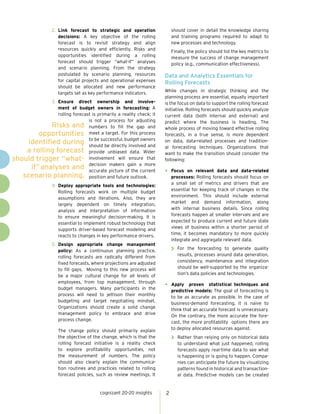
Cognizant’s Forecasting Offerings                                              The FAST steps for creating a rolling forecast
With 400-plus consultants and 700-plus                                         are as follows:
technology specialists, our dedicated Corporate                                1. Monitor performance areas
Performance Management (CPM) Practice has
                                                                                  All financial and non-financial metrics related
successfully executed more than 120 engage-
                                                                                  to the organization are identified and tracked.
ments for leading companies around the world.
                                                                                  These metrics include both internal and market
The practice is recognized for a robust and
                                                                                  metrics to help the business remain on top of
tested CPM methodology, with a complete set of
                                                                                  market changes and challenges.
blueprints for CPM implementation. Forecasting
solutions are among the key offerings of the CPM                               2. Forecast
Practice.                                                                         New assumptions and a new basis provided by
                                                                                  performance monitoring will trigger the fore-
Our CPM Practice can provide rapid scorecard-                                     casting process. A detailed risk opportunity
ing with lead/lag indicators from pre-defined                                     analysis will be made using the appropriate
industry-specific KPI repositories and scorecard                                  technique applicable for the industry.
templates. The practice partners with many of                                  3. Revisit strategy
our technology Centers of Excellence to extend
                                                                                  A “what-if” analysis and scenario planning are
best practices, reusability assurance processes
                                                                                  carried out to identify alternative strategies to
and knowledge management.
                                                                                  adapt to wider opportunities and risks.

FAST is our framework for a structured approach                                4. Align operations
to building a rolling forecast. It is an organized tool                           For the newly identified strategy, priorities
to help businesses achieve proper coordination                                    are redefined for the operative processes,
between the operation and strategy, facilitate the                                and adaptation measures and activities are
planning process and ensure a smooth handshake                                    proposed by operational managers.


Rolling Forecasts Made FAST

                Strategic Plans                          Strategy Formulation


                                      KPI & Target           Treasury &
                                                                                             Review
                                         Setting          Sensitivity Analysis


                                                          Strategic Funding


                                                          Financial Plans
                                                        Operating initiatives

                                                                                     O
                                                                                     P
                                                                                 M   E
                                                                                 A   R
                                                                                 R   A
                                                                       S         K   T
                                                                       A         E   I
                                                     Align Plan        L         T   O
                                                                       E         I   N
                                                                       S         N   S
                                                                                 G                                      O
                                                                                                                        P
                                            O                                                                           E
                                            P                                                                       M   R
                                            E                                                                       A   A
                                      M                                                                             R
                                      A
                                      R
                                            R
                                            A           Operations Plan                                         S   K
                                                                                                                        T
                                                                                                                        I
                                            T                                                                   A   E   O
                                  S   K                                                                             T
                                            I                                                                   L       N
                                  A   E
                                            O                                                         Monitor   E   I   S
                       Forecast   L   T
                                      I     N                                            O                      S   N
                                  E         S                                                                       G
                                  S   N                                                  P
                                      G                                          M       E
                                                                                 A       R
                                                                                 R       A
                                                                           S     K       T
                                                                           A     E       I
                                                                           L     T       O
                                                       Execute             E     I       N
                                                                           S     N       S
                                                                                 G


Figure 1


                           cognizant 20-20 insights                              3
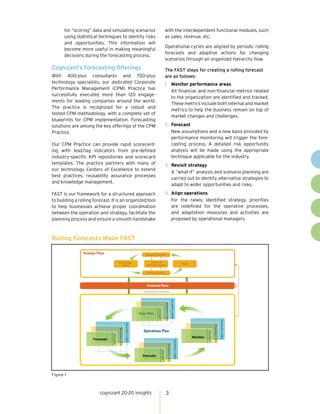
Among FAST’s benefits are the following:              Forecasting System: Model-
             •   Vertical integration of strategy with the         Building and Forecasting Phases
                 continuous planning/rolling forecast.

             •   Horizontal integration across different
                                                                                                           Past Data &
                 functions in forecasting.                                         Model
                                                                                Specification              Management
                                                                                                           Judgement
             •   Greater visibility and monitoring capabilities.

             •   Driver-based functional process outcomes con-                Model Estimation
                 solidated and integrated at corporate levels.

             •   Enhanced “what-if” analysis/simulation capa-           no      Is the Model
                                                                                 Adequate?
                 bilities, as projections are linked to drivers.
                                                                                                          Model Building
                                                                                                           Forecasting
             Application Evaluation for
                                                                          Forecast Generation
             Rolling Forecast
                                                                                                  New Observations
          Technology plays a vital role in the success of any
          rolling forecast initiative. Rolling forecast CPM              no        Is the
                                  applications should be                        Model Stable?

 Rolling forecast CPM able to create and manage
  applications should different scenarios to facil-                           Forecast Updating
                                  itate scenario planning,
be able to create and as well as integrate with
     manage different actual information for ana-                  Figure 2

scenarios to facilitate lyzing trends and extrapo-
                                  lating the future. These
   scenario planning. systems should have dif-
                                                                   •   Automated data input and different user
          ferent user interface options, as well.                      interface options.

             A CPM application for generating rolling forecasts    In our engagements, all rolling forecast applica-
             should be evaluated for specific business fit and     tions are evaluated using EVAL, our CPM Tool
             strategic features, such as:                          Evaluation Framework. EVAL is a systematic
                                                                   analytical hierarchy processing-based scoring
             •   Forecasting ability across months and years.      framework to evaluate tools based on a well-
                                                                   defined mathematical and analytical model. The
             •   Driver-based planning and scenario
                                                                   approach consists of two steps:
                 management.

             •   Integration of sales, revenue and cost rolling    •   Step 1: Feature Comparison: Compares a
                 forecasts.                                            detailed listing of the tools.

             •   Ability to integrate projected information and    •   Step 2: Proof of Concept (Optional): Focuses
                 compare it with the user-created forecast.            on finding the working behavior of the enlisted
                                                                       features.
             Technical features should include:
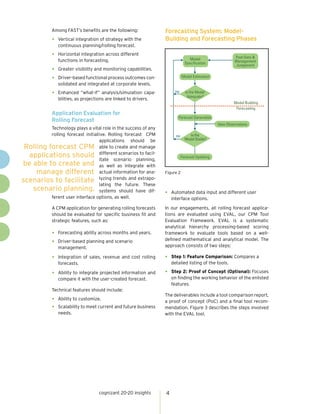
                                                                   The deliverables include a tool comparison report,
             •   Ability to customize.
                                                                   a proof of concept (PoC) and a final tool recom-
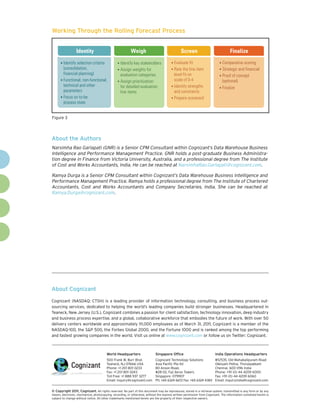
             •   Scalability to meet current and future business   mendation. Figure 3 describes the steps involved
                 needs.                                            with the EVAL tool.


                                     cognizant 20-20 insights      4
• Assign prioritization                                      (optional)
           technical and other              for detailed evaluation       • Identify strengths       • Finalize
           parameters                       line items                     and constraints
         • Focus on to-be                                                 • Prepare scorecard
           process state


Working Through the Rolling Forecast Process


                  Identity                                 Weigh                                 Screen                            Finalize

      • Identify selection criteria             • Identify key stakeholders              • Evaluate fit                    • Comparative scoring
        (consolidation,                         • Assign weights for                     • Rate the line item              • Strategic and financial
        financial planning)                       evaluation categories                    level fit on                    • Proof of concept
      • Functional, non-functional,             • Assign prioritization                    scale of 0-4                      (optional)
        technical and other                       for detailed evaluation                • Identify strengths              • Finalize
        parameters                                line items                               and constraints
      • Focus on to-be                                                                   • Prepare scorecard
        process state


Figure 3


About the Authors
Narsimha Rao Garlapati (GNR) is a Senior CPM Consultant within Cognizant’s Data Warehouse Business
Intelligence and Performance Management Practice. GNR holds a post-graduate Business Administra-
tion degree in Finance from Victoria University, Australia, and a professional degree from The Institute
of Cost and Works Accountants, India. He can be reached at NarsimhaRao.Garlapati@cognizant.com.

Ramya Durga is a Senior CPM Consultant within Cognizant’s Data Warehouse Business Intelligence and
Performance Management Practice. Ramya holds a professional degree from The Institute of Chartered
Accountants, Cost and Works Accountants and Company Secretaries, India. She can be reached at
Ramya.Durga@cognizant.com.


About Cognizant

Cognizant (NASDAQ: CTSH) is a leading provider of information technology, consulting, and business process out-
sourcing services, dedicated to helping the world’s leading companies build stronger businesses. Headquartered in
Teaneck, New Jersey (U.S.), Cognizant combines a passion for client satisfaction, technology innovation, deep industry
and business process expertise, and a global, collaborative workforce that embodies the future of work. With over 50
delivery centers worldwide and approximately 111,000 employees as of March 31, 2011, Cognizant is a member of the
NASDAQ-100, the S&P 500, the Forbes Global 2000, and the Fortune 1000 and is ranked among the top performing
and fastest growing companies in the world. Visit us online at www.cognizant.com or follow us on Twitter: Cognizant.


                                        World Headquarters                  Singapore Office                            India Operations Headquarters
                                        500 Frank W. Burr Blvd.             Cognizant Technology Solutions              #5/535, Old Mahabalipuram Road
                                        Teaneck, NJ 07666 USA               Asia Pacific Pte ltd                        Okkiyam Pettai, Thoraipakkam
                                        Phone: +1 201 801 0233              80 Anson Road,                              Chennai, 600 096 India
                                        Fax: +1 201 801 0243                #28-02, Fuji Xerox Towers                   Phone: +91 (0) 44 4209 6000
                                        Toll Free: +1 888 937 3277          Singapore -079907                           Fax: +91 (0) 44 4209 6060
                                        Email: inquiry@cognizant.com        Ph: +65 6324 6672 Fax: +65 6324 4383        Email: inquiryindia@cognizant.com


© Copyright 2011, Cognizant. All rights reserved. No part of this document may be reproduced, stored in a retrieval system, transmitted in any form or by any
means, electronic, mechanical, photocopying, recording, or otherwise, without the express written permission from Cognizant. The information contained herein is
subject to change without notice. All other trademarks mentioned herein are the property of their respective owners.

Replacing the-annual-budget-with-rolling-forecasts

  • 1.
    • Cognizant 20-20Insights Replacing the Annual Budget with Rolling Forecasts Executive Summary Turning Rolling Forecasts into Reality Gone are the days when annual budgeting and A rolling forecast is a process in which key planning steered the business, with only predict- business drivers are forecast on a continual basis. able, minimal budgeting changes. With increasing Its objective is to foresee the risks and opportu- competition and a changing economic environ- nities presented by a dynamic business environ- ment, companies need a better way to predict the ment, revisit strategy in the light of new business future. As a result, new forecasting techniques scenarios and align resources/activities for com- have emerged to help anticipate changes and petitive advantage at periodic frequencies. Rolling better inform strategic direction. forecasts are not simply periodic updates against the annual budget and are not associated with a Traditional forecasts take a structured approach specific financial year. to scoping uncertainties within a specified timeframe. Those predictions have a reasonable A rolling forecast, also called continuous chance of being accurate. In today’s highly volatile planning, is a leading planning technique that business environment, however, organizations will help organizations find opportunities amid are forced to be dynamic in adapting to changes persistent volatility and intense competition. to ensure their very survival. Companies that However, there are many practical difficulties in don’t expect to encounter economic or political converting the theory turbulence and operate via annual budgeting and of rolling forecasts into A rolling forecast is forecasting exercises are finding it difficult to reality. Organizations a process in which create plans and deliver results that meet expec- that want to embrace tations, be they internal management objectives rolling forecasts should key business drivers or external performance goals set by financial focus on the following are forecast on a and industry analysts. key steps: continual basis. In such an environment, chief financial officers 1. Move toward driver-based forecasting: A need reliable and relevant insights into risks and common decision-making challenge is having opportunities. By embracing continuous planning too many details to work with. Forecasting or rolling forecasts, companies can remain agile, should focus on drivers that are relevant for focused and flexible in meeting internal and analysis and decision-making. This will provide external performance expectations. This white organization-wide alignment and control over paper discusses the essentials for making rolling forecasting, as well as consistency in decision- forecasts a reality. making. cognizant 20-20 insights | may 2011
  • 2.
    2. Link forecastto strategic and operation should cover in detail the knowledge sharing decisions: A key objective of the rolling and training programs required to adapt to forecast is to revisit strategy and align new processes and technology. resources quickly and efficiently. Risks and Finally, the policy should list the key metrics to opportunities identified during a rolling measure the success of change management forecast should trigger “what-if” analyses policy (e.g., communication effectiveness). and scenario planning. From the strategy postulated by scenario planning, resources Data and Analytics Essentials for for capital projects and operational expenses Rolling Forecasts should be allocated and new performance targets set as key performance indicators. While changes in strategic thinking and the planning process are essential, equally important 3. Ensure direct ownership and involve- is the focus on data to support the rolling forecast ment of budget owners in forecasting: A initiative. Rolling forecasts should quickly analyze rolling forecast is primarily a reality check; it current data (both internal and external) and is not a process for adjusting predict where the business is heading. The Risks and numbers to fill the gap and whole process of moving toward effective rolling opportunities meet a target. For this process forecasts, in a true sense, is more dependent identified during to be successful, budget owners should be directly involved and on data, data-related processes and tradition- al forecasting techniques. Organizations that a rolling forecast provide unbiased data. Wider want to make the transition should consider the should trigger “what- involvement will ensure that following: if” analyses and decision picture of the a more makers gain accurate current • Focus on relevant data and data-related scenario planning. position and future outlook. processes: Rolling forecasts should focus on 4. Deploy appropriate tools and technologies: a small set of metrics and drivers that are Rolling forecasts work on multiple budget essential for keeping track of changes in the assumptions and iterations. Also, they are environment. This should include external largely dependent on timely integration, market and demand information, along analysis and interpretation of information with internal business details. Since rolling to ensure meaningful decision-making. It is forecasts happen at smaller intervals and are essential to implement robust technology that expected to produce current and future state supports driver-based forecast modeling and views of business within a shorter period of reacts to changes in key performance drivers. time, it becomes mandatory to more quickly integrate and aggregate relevant data. 5. Design appropriate change management policy: As a continuous planning practice, > For the forecasting to generate quality rolling forecasts are radically different from results, processes around data generation, fixed forecasts, where projections are adjusted consistency, maintenance and integration to fill gaps. Moving to this new process will should be well-supported by the organiza- be a major cultural change for all levels of tion’s data policies and technologies. employees, from top management, through budget managers. Many participants in the • Apply proven statistical techniques and predictive models: The goal of forecasting is process will need to jettison their monthly to be as accurate as possible. In the case of budgeting and target negotiating mindset. business-demand forecasting, it is naive to Organizations should create a solid change think that an accurate forecast is unnecessary. management policy to embrace and drive On the contrary, the more accurate the fore- process change. cast, the more profitability options there are The change policy should primarily explain to deploy allocated resources against. the objective of the change, which is that the > Rather than relying only on historical data rolling forecast initiative is a reality check to understand what just happened, rolling to explore profitability opportunities, not forecasts apply real-time data to see what the measurement of numbers. The policy is happening or is going to happen. Compa- should also clearly explain the communica- nies can anticipate the future by visualizing tion routines and practices related to rolling patterns found in historical and transaction- forecast policies, such as review meetings. It al data. Predictive models can be created cognizant 20-20 insights 2
  • 3.
    for “scoring” dataand simulating scenarios with the interdependent functional modules, such using statistical techniques to identify risks as sales, revenue, etc. and opportunities. This information will Operational cycles are aligned by periodic rolling become more useful in making meaningful forecasts and adaptive actions for changing decisions during the forecasting process. scenarios through an organized hierarchy flow. Cognizant’s Forecasting Offerings The FAST steps for creating a rolling forecast With 400-plus consultants and 700-plus are as follows: technology specialists, our dedicated Corporate 1. Monitor performance areas Performance Management (CPM) Practice has All financial and non-financial metrics related successfully executed more than 120 engage- to the organization are identified and tracked. ments for leading companies around the world. These metrics include both internal and market The practice is recognized for a robust and metrics to help the business remain on top of tested CPM methodology, with a complete set of market changes and challenges. blueprints for CPM implementation. Forecasting solutions are among the key offerings of the CPM 2. Forecast Practice. New assumptions and a new basis provided by performance monitoring will trigger the fore- Our CPM Practice can provide rapid scorecard- casting process. A detailed risk opportunity ing with lead/lag indicators from pre-defined analysis will be made using the appropriate industry-specific KPI repositories and scorecard technique applicable for the industry. templates. The practice partners with many of 3. Revisit strategy our technology Centers of Excellence to extend A “what-if” analysis and scenario planning are best practices, reusability assurance processes carried out to identify alternative strategies to and knowledge management. adapt to wider opportunities and risks. FAST is our framework for a structured approach 4. Align operations to building a rolling forecast. It is an organized tool For the newly identified strategy, priorities to help businesses achieve proper coordination are redefined for the operative processes, between the operation and strategy, facilitate the and adaptation measures and activities are planning process and ensure a smooth handshake proposed by operational managers. Rolling Forecasts Made FAST Strategic Plans Strategy Formulation KPI & Target Treasury & Review Setting Sensitivity Analysis Strategic Funding Financial Plans Operating initiatives O P M E A R R A S K T A E I Align Plan L T O E I N S N S G O P O E P M R E A A M R A R R A Operations Plan S K T I T A E O S K T I L N A E O Monitor E I S Forecast L T I N O S N E S G S N P G M E A R R A S K T A E I L T O Execute E I N S N S G Figure 1 cognizant 20-20 insights 3
  • 4.
    Among FAST’s benefitsare the following: Forecasting System: Model- • Vertical integration of strategy with the Building and Forecasting Phases continuous planning/rolling forecast. • Horizontal integration across different Past Data & functions in forecasting. Model Specification Management Judgement • Greater visibility and monitoring capabilities. • Driver-based functional process outcomes con- Model Estimation solidated and integrated at corporate levels. • Enhanced “what-if” analysis/simulation capa- no Is the Model Adequate? bilities, as projections are linked to drivers. Model Building Forecasting Application Evaluation for Forecast Generation Rolling Forecast New Observations Technology plays a vital role in the success of any rolling forecast initiative. Rolling forecast CPM no Is the applications should be Model Stable? Rolling forecast CPM able to create and manage applications should different scenarios to facil- Forecast Updating itate scenario planning, be able to create and as well as integrate with manage different actual information for ana- Figure 2 scenarios to facilitate lyzing trends and extrapo- lating the future. These scenario planning. systems should have dif- • Automated data input and different user ferent user interface options, as well. interface options. A CPM application for generating rolling forecasts In our engagements, all rolling forecast applica- should be evaluated for specific business fit and tions are evaluated using EVAL, our CPM Tool strategic features, such as: Evaluation Framework. EVAL is a systematic analytical hierarchy processing-based scoring • Forecasting ability across months and years. framework to evaluate tools based on a well- defined mathematical and analytical model. The • Driver-based planning and scenario approach consists of two steps: management. • Integration of sales, revenue and cost rolling • Step 1: Feature Comparison: Compares a forecasts. detailed listing of the tools. • Ability to integrate projected information and • Step 2: Proof of Concept (Optional): Focuses compare it with the user-created forecast. on finding the working behavior of the enlisted features. Technical features should include: The deliverables include a tool comparison report, • Ability to customize. a proof of concept (PoC) and a final tool recom- • Scalability to meet current and future business mendation. Figure 3 describes the steps involved needs. with the EVAL tool. cognizant 20-20 insights 4
  • 5.
    • Assign prioritization (optional) technical and other for detailed evaluation • Identify strengths • Finalize parameters line items and constraints • Focus on to-be • Prepare scorecard process state Working Through the Rolling Forecast Process Identity Weigh Screen Finalize • Identify selection criteria • Identify key stakeholders • Evaluate fit • Comparative scoring (consolidation, • Assign weights for • Rate the line item • Strategic and financial financial planning) evaluation categories level fit on • Proof of concept • Functional, non-functional, • Assign prioritization scale of 0-4 (optional) technical and other for detailed evaluation • Identify strengths • Finalize parameters line items and constraints • Focus on to-be • Prepare scorecard process state Figure 3 About the Authors Narsimha Rao Garlapati (GNR) is a Senior CPM Consultant within Cognizant’s Data Warehouse Business Intelligence and Performance Management Practice. GNR holds a post-graduate Business Administra- tion degree in Finance from Victoria University, Australia, and a professional degree from The Institute of Cost and Works Accountants, India. He can be reached at NarsimhaRao.Garlapati@cognizant.com. Ramya Durga is a Senior CPM Consultant within Cognizant’s Data Warehouse Business Intelligence and Performance Management Practice. Ramya holds a professional degree from The Institute of Chartered Accountants, Cost and Works Accountants and Company Secretaries, India. She can be reached at Ramya.Durga@cognizant.com. About Cognizant Cognizant (NASDAQ: CTSH) is a leading provider of information technology, consulting, and business process out- sourcing services, dedicated to helping the world’s leading companies build stronger businesses. Headquartered in Teaneck, New Jersey (U.S.), Cognizant combines a passion for client satisfaction, technology innovation, deep industry and business process expertise, and a global, collaborative workforce that embodies the future of work. With over 50 delivery centers worldwide and approximately 111,000 employees as of March 31, 2011, Cognizant is a member of the NASDAQ-100, the S&P 500, the Forbes Global 2000, and the Fortune 1000 and is ranked among the top performing and fastest growing companies in the world. Visit us online at www.cognizant.com or follow us on Twitter: Cognizant. World Headquarters Singapore Office India Operations Headquarters 500 Frank W. Burr Blvd. Cognizant Technology Solutions #5/535, Old Mahabalipuram Road Teaneck, NJ 07666 USA Asia Pacific Pte ltd Okkiyam Pettai, Thoraipakkam Phone: +1 201 801 0233 80 Anson Road, Chennai, 600 096 India Fax: +1 201 801 0243 #28-02, Fuji Xerox Towers Phone: +91 (0) 44 4209 6000 Toll Free: +1 888 937 3277 Singapore -079907 Fax: +91 (0) 44 4209 6060 Email: inquiry@cognizant.com Ph: +65 6324 6672 Fax: +65 6324 4383 Email: inquiryindia@cognizant.com © Copyright 2011, Cognizant. All rights reserved. No part of this document may be reproduced, stored in a retrieval system, transmitted in any form or by any means, electronic, mechanical, photocopying, recording, or otherwise, without the express written permission from Cognizant. The information contained herein is subject to change without notice. All other trademarks mentioned herein are the property of their respective owners.