Renewable and non-Renewable
Energy resources, Part I
Definition of Renewable and non-Renewable resources, types of different natural resources such
as Forest resources, Water resources, Energy resources Food resources, Land resources and
Mineral resources.
Prof. Orus llyas
Biodiversity and Environmental Studies
Department of Wildlife Sciences
Aligarh Muslim University
Energy and Natural Resources
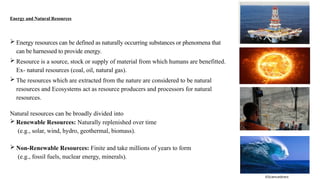
 Energy resources can be defined as naturally occurring substances or phenomena that
can be harnessed to provide energy.
 Resource is a source, stock or supply of material from which humans are benefitted.
Ex- natural resources (coal, oil, natural gas).
 The resources which are extracted from the nature are considered to be natural
resources and Ecosystems act as resource producers and processors for natural
resources.
Natural resources can be broadly divided into
 Renewable Resources: Naturally replenished over time
(e.g., solar, wind, hydro, geothermal, biomass).
 Non-Renewable Resources: Finite and take millions of years to form
(e.g., fossil fuels, nuclear energy, minerals).
©Sciencedirect
Renewable Resources
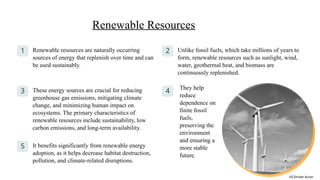
1 Renewable resources are naturally occurring
sources of energy that replenish over time and can
be used sustainably.
2 Unlike fossil fuels, which take millions of years to
form, renewable resources such as sunlight, wind,
water, geothermal heat, and biomass are
continuously replenished.
3 These energy sources are crucial for reducing
greenhouse gas emissions, mitigating climate
change, and minimizing human impact on
ecosystems. The primary characteristics of
renewable resources include sustainability, low
carbon emissions, and long-term availability.
4
They help
reduce
dependence on
finite fossil
fuels,
preserving the
environment
and ensuring a
more stable
future.
5 It benefits significantly from renewable energy
adoption, as it helps decrease habitat destruction,
pollution, and climate-related disruptions.
©Climate Acion
Types of Renewable Resources
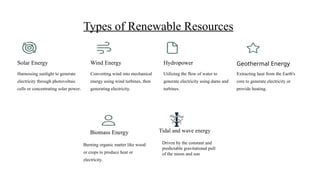
Solar Energy
Harnessing sunlight to generate
electricity through photovoltaic
cells or concentrating solar power.
Wind Energy
Converting wind into mechanical
energy using wind turbines, then
generating electricity.
Hydropower
Utilizing the flow of water to
generate electricity using dams and
turbines.
Geothermal Energy
Extracting heat from the Earth's
core to generate electricity or
provide heating.
Biomass Energy
Burning organic matter like wood
or crops to produce heat or
electricity.
Tidal and wave energy
Driven by the constant and
predictable gravitational pull
of the moon and sun
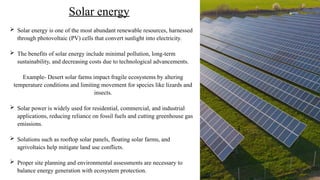
 Solar energy is one of the most abundant renewable resources, harnessed
through photovoltaic (PV) cells that convert sunlight into electricity.
 The benefits of solar energy include minimal pollution, long-term
sustainability, and decreasing costs due to technological advancements.
Example- Desert solar farms impact fragile ecosystems by altering
temperature conditions and limiting movement for species like lizards and
insects.
 Solar power is widely used for residential, commercial, and industrial
applications, reducing reliance on fossil fuels and cutting greenhouse gas
emissions.
 Solutions such as rooftop solar panels, floating solar farms, and
agrivoltaics help mitigate land use conflicts.
 Proper site planning and environmental assessments are necessary to
balance energy generation with ecosystem protection.
Solar energy
©National grid
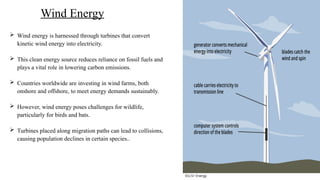
Wind Energy
 Wind energy is harnessed through turbines that convert
kinetic wind energy into electricity.
 This clean energy source reduces reliance on fossil fuels and
plays a vital role in lowering carbon emissions.
 Countries worldwide are investing in wind farms, both
onshore and offshore, to meet energy demands sustainably.
 However, wind energy poses challenges for wildlife,
particularly for birds and bats.
 Turbines placed along migration paths can lead to collisions,
causing population declines in certain species..
©U.S> Energy
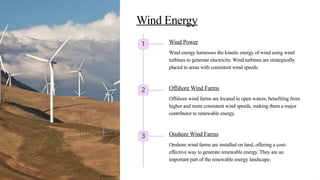
Wind Energy
1 Wind Power
Wind energy harnesses the kinetic energy of wind using wind
turbines to generate electricity. Wind turbines are strategically
placed in areas with consistent wind speeds.
2 Offshore Wind Farms
Offshore wind farms are located in open waters, benefiting from
higher and more consistent wind speeds, making them a major
contributor to renewable energy.
3 Onshore Wind Farms
Onshore wind farms are installed on land, offering a cost-
effective way to generate renewable energy. They are an
important part of the renewable energy landscape.
©Techpoin
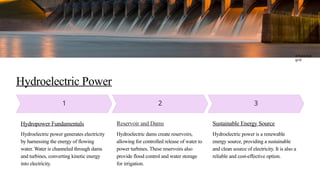
Hydroelectric Power
Hydropower Fundamentals
Hydroelectric power generates electricity
by harnessing the energy of flowing
water. Water is channeled through dams
and turbines, converting kinetic energy
into electricity.
Reservoir and Dams
Hydroelectric dams create reservoirs,
allowing for controlled release of water to
power turbines. These reservoirs also
provide flood control and water storage
for irrigation.
Sustainable Energy Source
Hydroelectric power is a renewable
energy source, providing a sustainable
and clean source of electricity. It is also a
reliable and cost-effective option.
©National
grid
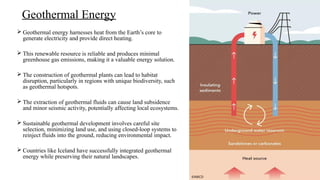
 Geothermal energy harnesses heat from the Earth’s core to
generate electricity and provide direct heating.
 This renewable resource is reliable and produces minimal
greenhouse gas emissions, making it a valuable energy solution.
 The construction of geothermal plants can lead to habitat
disruption, particularly in regions with unique biodiversity, such
as geothermal hotspots.
 The extraction of geothermal fluids can cause land subsidence
and minor seismic activity, potentially affecting local ecosystems.
 Sustainable geothermal development involves careful site
selection, minimizing land use, and using closed-loop systems to
reinject fluids into the ground, reducing environmental impact.
 Countries like Iceland have successfully integrated geothermal
energy while preserving their natural landscapes.
Geothermal Energy
©NRCD
Biomass & Biofuels
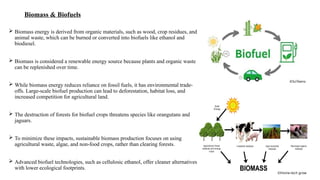
 Biomass energy is derived from organic materials, such as wood, crop residues, and
animal waste, which can be burned or converted into biofuels like ethanol and
biodiesel.
 Biomass is considered a renewable energy source because plants and organic waste
can be replenished over time.
 While biomass energy reduces reliance on fossil fuels, it has environmental trade-
offs. Large-scale biofuel production can lead to deforestation, habitat loss, and
increased competition for agricultural land.
 The destruction of forests for biofuel crops threatens species like orangutans and
jaguars.
 To minimize these impacts, sustainable biomass production focuses on using
agricultural waste, algae, and non-food crops, rather than clearing forests.
 Advanced biofuel technologies, such as cellulosic ethanol, offer cleaner alternatives
with lower ecological footprints.
©SciTeens
©Home-tech grow
Tidal & Wave Energy
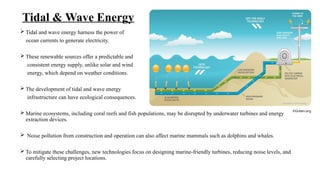
 Tidal and wave energy harness the power of
ocean currents to generate electricity.
 These renewable sources offer a predictable and
consistent energy supply, unlike solar and wind
energy, which depend on weather conditions.
 The development of tidal and wave energy
infrastructure can have ecological consequences.
 Marine ecosystems, including coral reefs and fish populations, may be disrupted by underwater turbines and energy
extraction devices.
 Noise pollution from construction and operation can also affect marine mammals such as dolphins and whales.
 To mitigate these challenges, new technologies focus on designing marine-friendly turbines, reducing noise levels, and
carefully selecting project locations.
©Green.org
Habitat Conservation through
Renewable Energy
 Renewable energy can support habitat conservation by reducing
deforestation, pollution, and climate-related ecosystem disruptions.
 Renewable projects can even enhance biodiversity through habitat
restoration and sustainable land use.
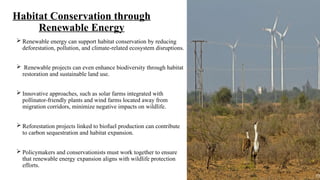
 Innovative approaches, such as solar farms integrated with
pollinator-friendly plants and wind farms located away from
migration corridors, minimize negative impacts on wildlife.
 Reforestation projects linked to biofuel production can contribute
to carbon sequestration and habitat expansion.
 Policymakers and conservationists must work together to ensure
that renewable energy expansion aligns with wildlife protection
efforts.
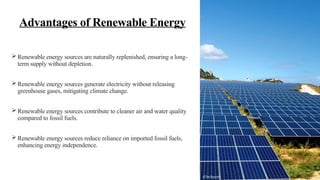
 Renewable energy sources are naturally replenished, ensuring a long-
term supply without depletion.
 Renewable energy sources generate electricity without releasing
greenhouse gases, mitigating climate change.
 Renewable energy sources contribute to cleaner air and water quality
compared to fossil fuels.
 Renewable energy sources reduce reliance on imported fossil fuels,
enhancing energy independence.
Advantages of Renewable Energy
©Techpoin
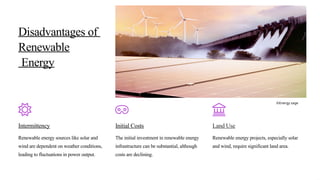
Disadvantages of
Renewable
Energy
Intermittency
Renewable energy sources like solar and
wind are dependent on weather conditions,
leading to fluctuations in power output.
Initial Costs
The initial investment in renewable energy
infrastructure can be substantial, although
costs are declining.
Land Use
Renewable energy projects, especially solar
and wind, require significant land area.
©Energy sage
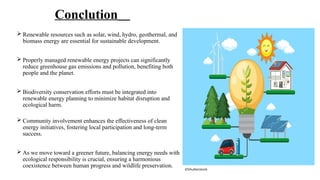
Conclution
 Renewable resources such as solar, wind, hydro, geothermal, and
biomass energy are essential for sustainable development.
 Properly managed renewable energy projects can significantly
reduce greenhouse gas emissions and pollution, benefiting both
people and the planet.
 Biodiversity conservation efforts must be integrated into
renewable energy planning to minimize habitat disruption and
ecological harm.
 Community involvement enhances the effectiveness of clean
energy initiatives, fostering local participation and long-term
success.
 As we move toward a greener future, balancing energy needs with
ecological responsibility is crucial, ensuring a harmonious
coexistence between human progress and wildlife preservation.
©Shutterstock
References
1. Ilyas, O. (n.d.). Biodiversity and Environmental Studies. Aligarh Muslim University, Department of
Wildlife Sciences.
2. U.S. Department of Energy. (n.d.). Renewable energy sources. Retrieved from https://www.energy.gov
3. International Renewable Energy Agency (IRENA). (n.d.). Renewable energy benefits. Retrieved from
https://www.irena.org
4. Smil, V. (2017). Examining energy transitions: A historical perspective. Energy Policy, 50(3), 1-10.
https://doi.org/xxxx
Thank you
To be continued……..

Renewable and non renewable energy resources.

  • 1.
    Renewable and non-Renewable Energyresources, Part I Definition of Renewable and non-Renewable resources, types of different natural resources such as Forest resources, Water resources, Energy resources Food resources, Land resources and Mineral resources. Prof. Orus llyas Biodiversity and Environmental Studies Department of Wildlife Sciences Aligarh Muslim University
  • 2.
    Energy and NaturalResources  Energy resources can be defined as naturally occurring substances or phenomena that can be harnessed to provide energy.  Resource is a source, stock or supply of material from which humans are benefitted. Ex- natural resources (coal, oil, natural gas).  The resources which are extracted from the nature are considered to be natural resources and Ecosystems act as resource producers and processors for natural resources. Natural resources can be broadly divided into  Renewable Resources: Naturally replenished over time (e.g., solar, wind, hydro, geothermal, biomass).  Non-Renewable Resources: Finite and take millions of years to form (e.g., fossil fuels, nuclear energy, minerals). ©Sciencedirect
  • 3.
    Renewable Resources 1 Renewableresources are naturally occurring sources of energy that replenish over time and can be used sustainably. 2 Unlike fossil fuels, which take millions of years to form, renewable resources such as sunlight, wind, water, geothermal heat, and biomass are continuously replenished. 3 These energy sources are crucial for reducing greenhouse gas emissions, mitigating climate change, and minimizing human impact on ecosystems. The primary characteristics of renewable resources include sustainability, low carbon emissions, and long-term availability. 4 They help reduce dependence on finite fossil fuels, preserving the environment and ensuring a more stable future. 5 It benefits significantly from renewable energy adoption, as it helps decrease habitat destruction, pollution, and climate-related disruptions. ©Climate Acion
  • 4.
    Types of RenewableResources Solar Energy Harnessing sunlight to generate electricity through photovoltaic cells or concentrating solar power. Wind Energy Converting wind into mechanical energy using wind turbines, then generating electricity. Hydropower Utilizing the flow of water to generate electricity using dams and turbines. Geothermal Energy Extracting heat from the Earth's core to generate electricity or provide heating. Biomass Energy Burning organic matter like wood or crops to produce heat or electricity. Tidal and wave energy Driven by the constant and predictable gravitational pull of the moon and sun
  • 5.
     Solar energyis one of the most abundant renewable resources, harnessed through photovoltaic (PV) cells that convert sunlight into electricity.  The benefits of solar energy include minimal pollution, long-term sustainability, and decreasing costs due to technological advancements. Example- Desert solar farms impact fragile ecosystems by altering temperature conditions and limiting movement for species like lizards and insects.  Solar power is widely used for residential, commercial, and industrial applications, reducing reliance on fossil fuels and cutting greenhouse gas emissions.  Solutions such as rooftop solar panels, floating solar farms, and agrivoltaics help mitigate land use conflicts.  Proper site planning and environmental assessments are necessary to balance energy generation with ecosystem protection. Solar energy ©National grid
  • 6.
    Wind Energy  Windenergy is harnessed through turbines that convert kinetic wind energy into electricity.  This clean energy source reduces reliance on fossil fuels and plays a vital role in lowering carbon emissions.  Countries worldwide are investing in wind farms, both onshore and offshore, to meet energy demands sustainably.  However, wind energy poses challenges for wildlife, particularly for birds and bats.  Turbines placed along migration paths can lead to collisions, causing population declines in certain species.. ©U.S> Energy
  • 7.
    Wind Energy 1 WindPower Wind energy harnesses the kinetic energy of wind using wind turbines to generate electricity. Wind turbines are strategically placed in areas with consistent wind speeds. 2 Offshore Wind Farms Offshore wind farms are located in open waters, benefiting from higher and more consistent wind speeds, making them a major contributor to renewable energy. 3 Onshore Wind Farms Onshore wind farms are installed on land, offering a cost- effective way to generate renewable energy. They are an important part of the renewable energy landscape. ©Techpoin
  • 8.
    Hydroelectric Power Hydropower Fundamentals Hydroelectricpower generates electricity by harnessing the energy of flowing water. Water is channeled through dams and turbines, converting kinetic energy into electricity. Reservoir and Dams Hydroelectric dams create reservoirs, allowing for controlled release of water to power turbines. These reservoirs also provide flood control and water storage for irrigation. Sustainable Energy Source Hydroelectric power is a renewable energy source, providing a sustainable and clean source of electricity. It is also a reliable and cost-effective option. ©National grid
  • 9.
     Geothermal energyharnesses heat from the Earth’s core to generate electricity and provide direct heating.  This renewable resource is reliable and produces minimal greenhouse gas emissions, making it a valuable energy solution.  The construction of geothermal plants can lead to habitat disruption, particularly in regions with unique biodiversity, such as geothermal hotspots.  The extraction of geothermal fluids can cause land subsidence and minor seismic activity, potentially affecting local ecosystems.  Sustainable geothermal development involves careful site selection, minimizing land use, and using closed-loop systems to reinject fluids into the ground, reducing environmental impact.  Countries like Iceland have successfully integrated geothermal energy while preserving their natural landscapes. Geothermal Energy ©NRCD
  • 10.
    Biomass & Biofuels Biomass energy is derived from organic materials, such as wood, crop residues, and animal waste, which can be burned or converted into biofuels like ethanol and biodiesel.  Biomass is considered a renewable energy source because plants and organic waste can be replenished over time.  While biomass energy reduces reliance on fossil fuels, it has environmental trade- offs. Large-scale biofuel production can lead to deforestation, habitat loss, and increased competition for agricultural land.  The destruction of forests for biofuel crops threatens species like orangutans and jaguars.  To minimize these impacts, sustainable biomass production focuses on using agricultural waste, algae, and non-food crops, rather than clearing forests.  Advanced biofuel technologies, such as cellulosic ethanol, offer cleaner alternatives with lower ecological footprints. ©SciTeens ©Home-tech grow
  • 11.
    Tidal & WaveEnergy  Tidal and wave energy harness the power of ocean currents to generate electricity.  These renewable sources offer a predictable and consistent energy supply, unlike solar and wind energy, which depend on weather conditions.  The development of tidal and wave energy infrastructure can have ecological consequences.  Marine ecosystems, including coral reefs and fish populations, may be disrupted by underwater turbines and energy extraction devices.  Noise pollution from construction and operation can also affect marine mammals such as dolphins and whales.  To mitigate these challenges, new technologies focus on designing marine-friendly turbines, reducing noise levels, and carefully selecting project locations. ©Green.org
  • 12.
    Habitat Conservation through RenewableEnergy  Renewable energy can support habitat conservation by reducing deforestation, pollution, and climate-related ecosystem disruptions.  Renewable projects can even enhance biodiversity through habitat restoration and sustainable land use.  Innovative approaches, such as solar farms integrated with pollinator-friendly plants and wind farms located away from migration corridors, minimize negative impacts on wildlife.  Reforestation projects linked to biofuel production can contribute to carbon sequestration and habitat expansion.  Policymakers and conservationists must work together to ensure that renewable energy expansion aligns with wildlife protection efforts.
  • 13.
     Renewable energysources are naturally replenished, ensuring a long- term supply without depletion.  Renewable energy sources generate electricity without releasing greenhouse gases, mitigating climate change.  Renewable energy sources contribute to cleaner air and water quality compared to fossil fuels.  Renewable energy sources reduce reliance on imported fossil fuels, enhancing energy independence. Advantages of Renewable Energy ©Techpoin
  • 14.
    Disadvantages of Renewable Energy Intermittency Renewable energysources like solar and wind are dependent on weather conditions, leading to fluctuations in power output. Initial Costs The initial investment in renewable energy infrastructure can be substantial, although costs are declining. Land Use Renewable energy projects, especially solar and wind, require significant land area. ©Energy sage
  • 15.
    Conclution  Renewable resourcessuch as solar, wind, hydro, geothermal, and biomass energy are essential for sustainable development.  Properly managed renewable energy projects can significantly reduce greenhouse gas emissions and pollution, benefiting both people and the planet.  Biodiversity conservation efforts must be integrated into renewable energy planning to minimize habitat disruption and ecological harm.  Community involvement enhances the effectiveness of clean energy initiatives, fostering local participation and long-term success.  As we move toward a greener future, balancing energy needs with ecological responsibility is crucial, ensuring a harmonious coexistence between human progress and wildlife preservation. ©Shutterstock
  • 16.
    References 1. Ilyas, O.(n.d.). Biodiversity and Environmental Studies. Aligarh Muslim University, Department of Wildlife Sciences. 2. U.S. Department of Energy. (n.d.). Renewable energy sources. Retrieved from https://www.energy.gov 3. International Renewable Energy Agency (IRENA). (n.d.). Renewable energy benefits. Retrieved from https://www.irena.org 4. Smil, V. (2017). Examining energy transitions: A historical perspective. Energy Policy, 50(3), 1-10. https://doi.org/xxxx
  • 17.
    Thank you To becontinued……..