Click to add Title
Rendering Engine
e-Infochips Institute of Training Research and Academics Limited
Prepared By:-
Dharita Chokshi
Outlines
Rendering Engines
Rendering Engines and Browsers
Architecture of Browser
Architecture of Rendering Engine
Anatomy of Webkit
Architecture of Webkit
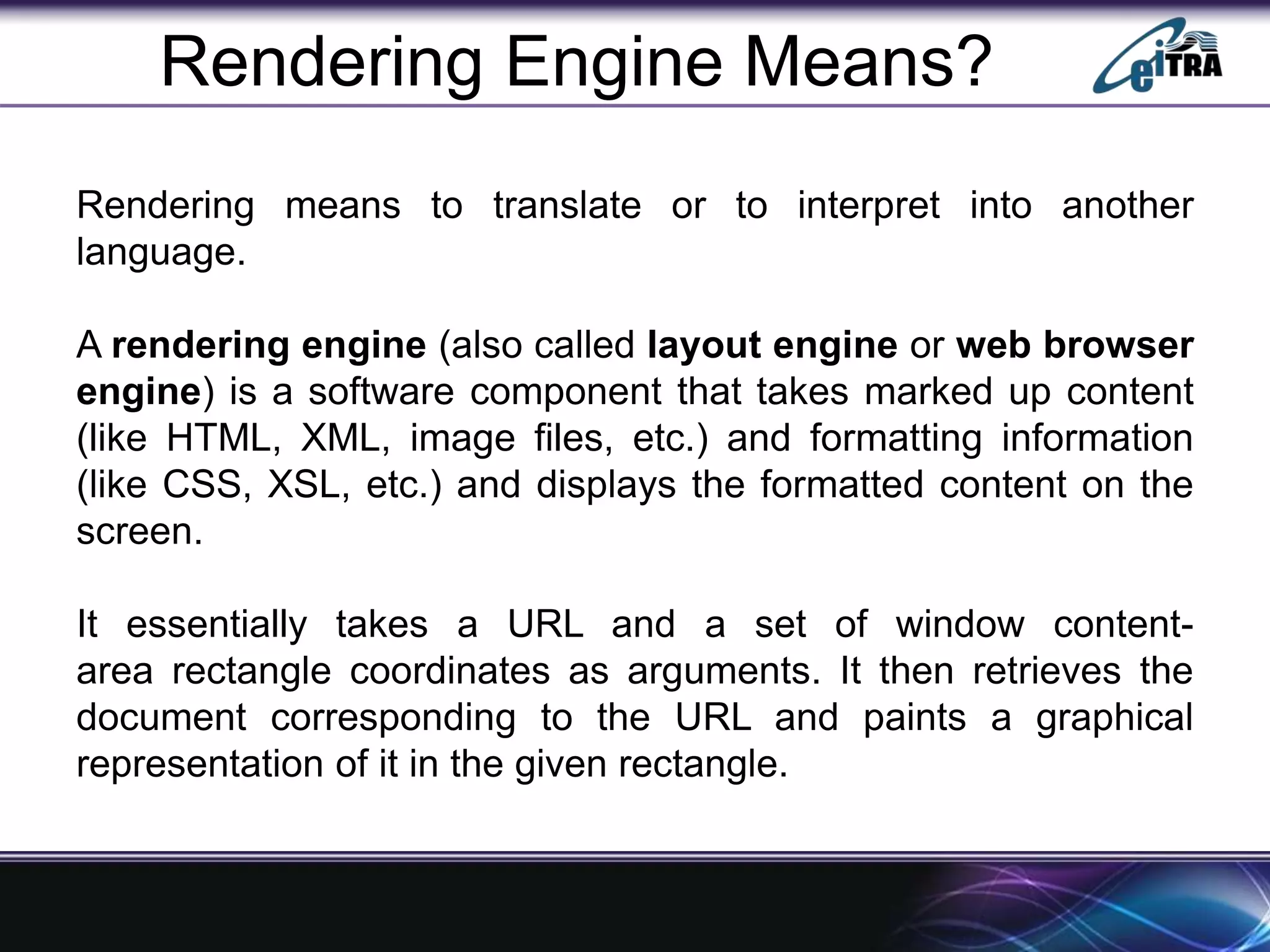
Rendering Engine Means?
Rendering means to translate or to interpret into another
language.
A rendering engine (also called layout engine or web browser
engine) is a software component that takes marked up content
(like HTML, XML, image files, etc.) and formatting information
(like CSS, XSL, etc.) and displays the formatted content on the
screen.
It essentially takes a URL and a set of window content-
area rectangle coordinates as arguments. It then retrieves the
document corresponding to the URL and paints a graphical
representation of it in the given rectangle.
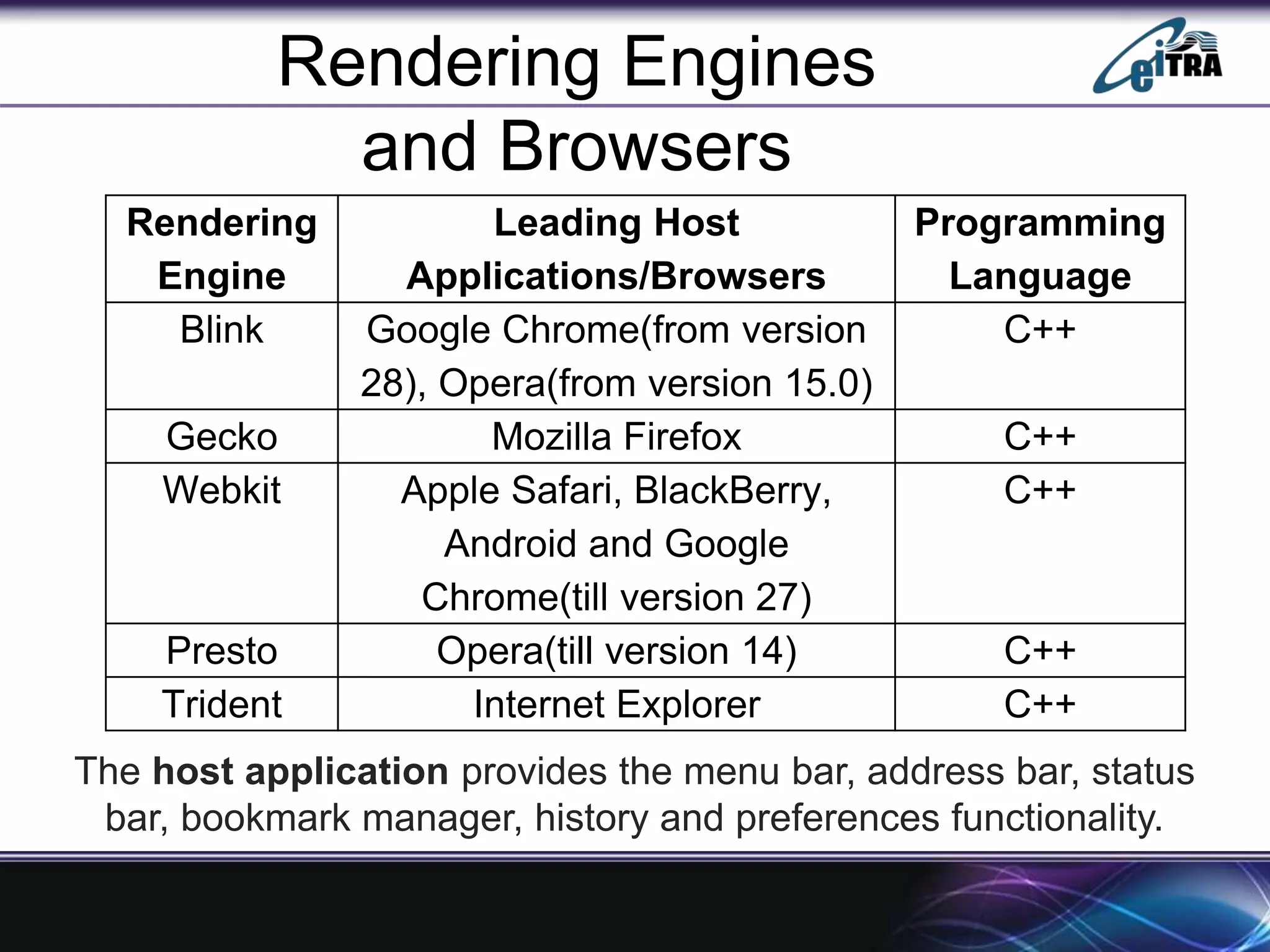
Rendering Engines
and Browsers
Rendering
Engine
Leading Host
Applications/Browsers
Programming
Language
Blink Google Chrome(from version
28), Opera(from version 15.0)
C++
Gecko Mozilla Firefox C++
Webkit Apple Safari, BlackBerry,
Android and Google
Chrome(till version 27)
C++
Presto Opera(till version 14) C++
Trident Internet Explorer C++
The host application provides the menu bar, address bar, status
bar, bookmark manager, history and preferences functionality.
5
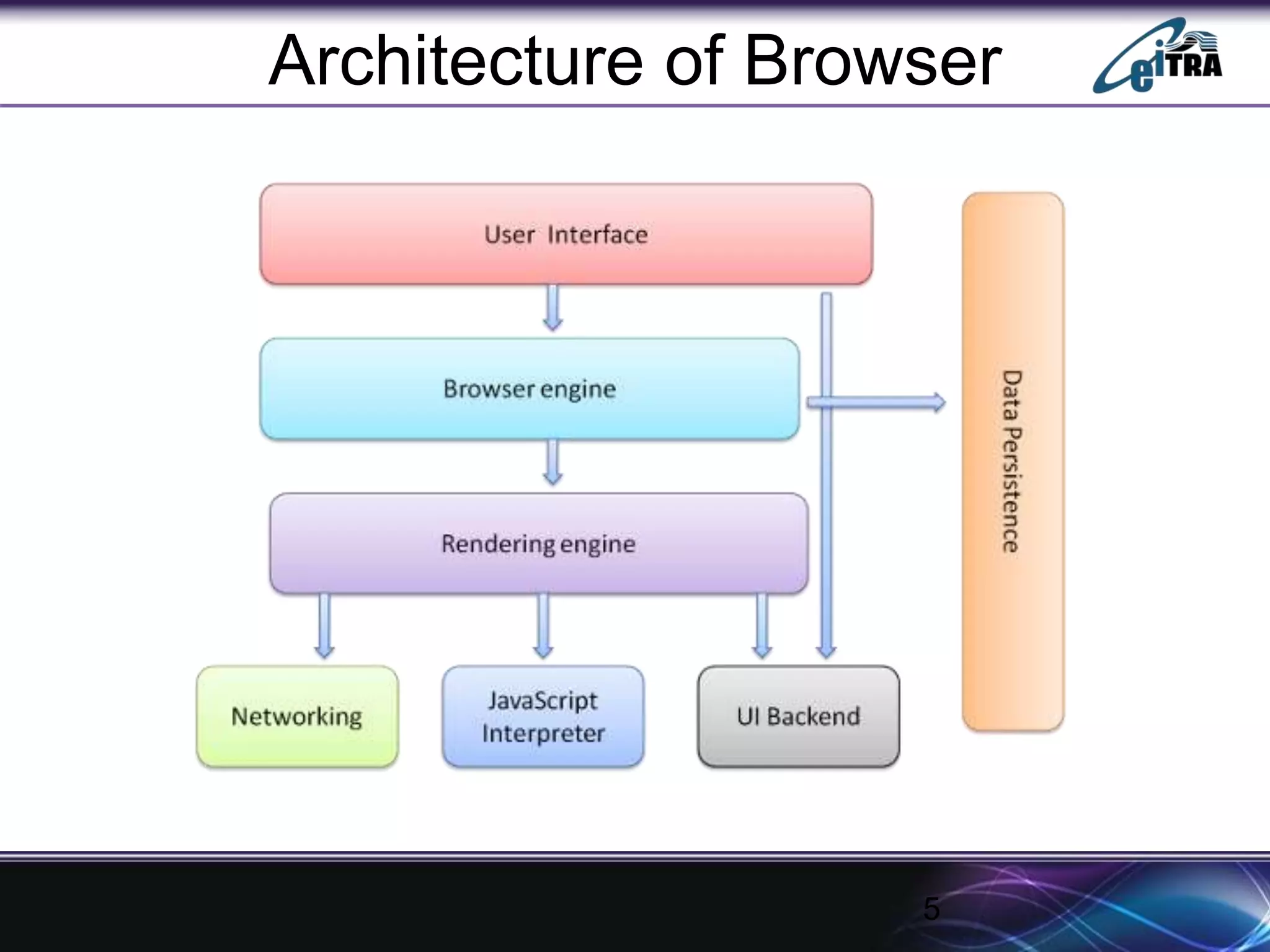
Architecture of Browser
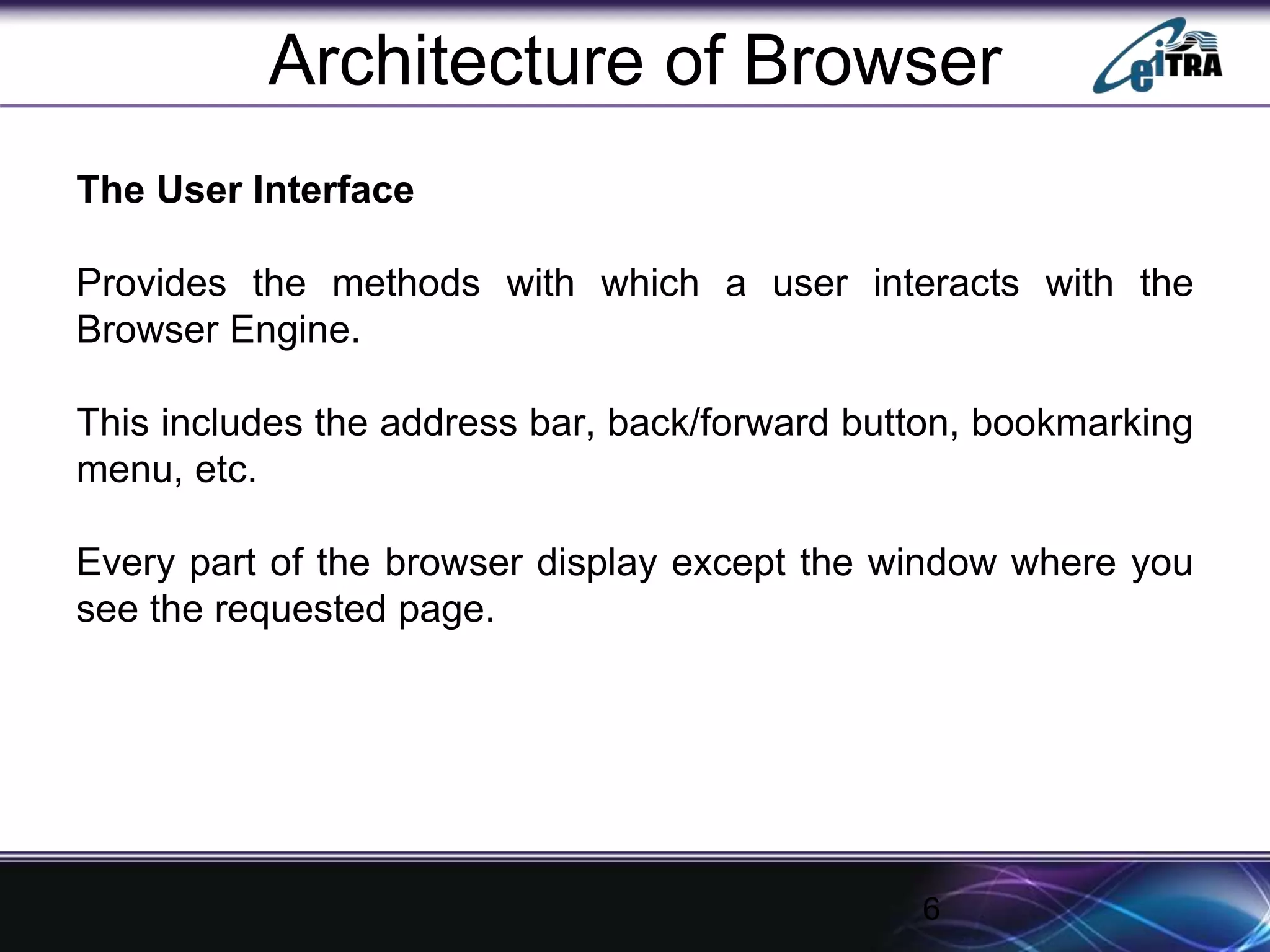
The User Interface
Provides the methods with which a user interacts with the
Browser Engine.
This includes the address bar, back/forward button, bookmarking
menu, etc.
Every part of the browser display except the window where you
see the requested page.
6
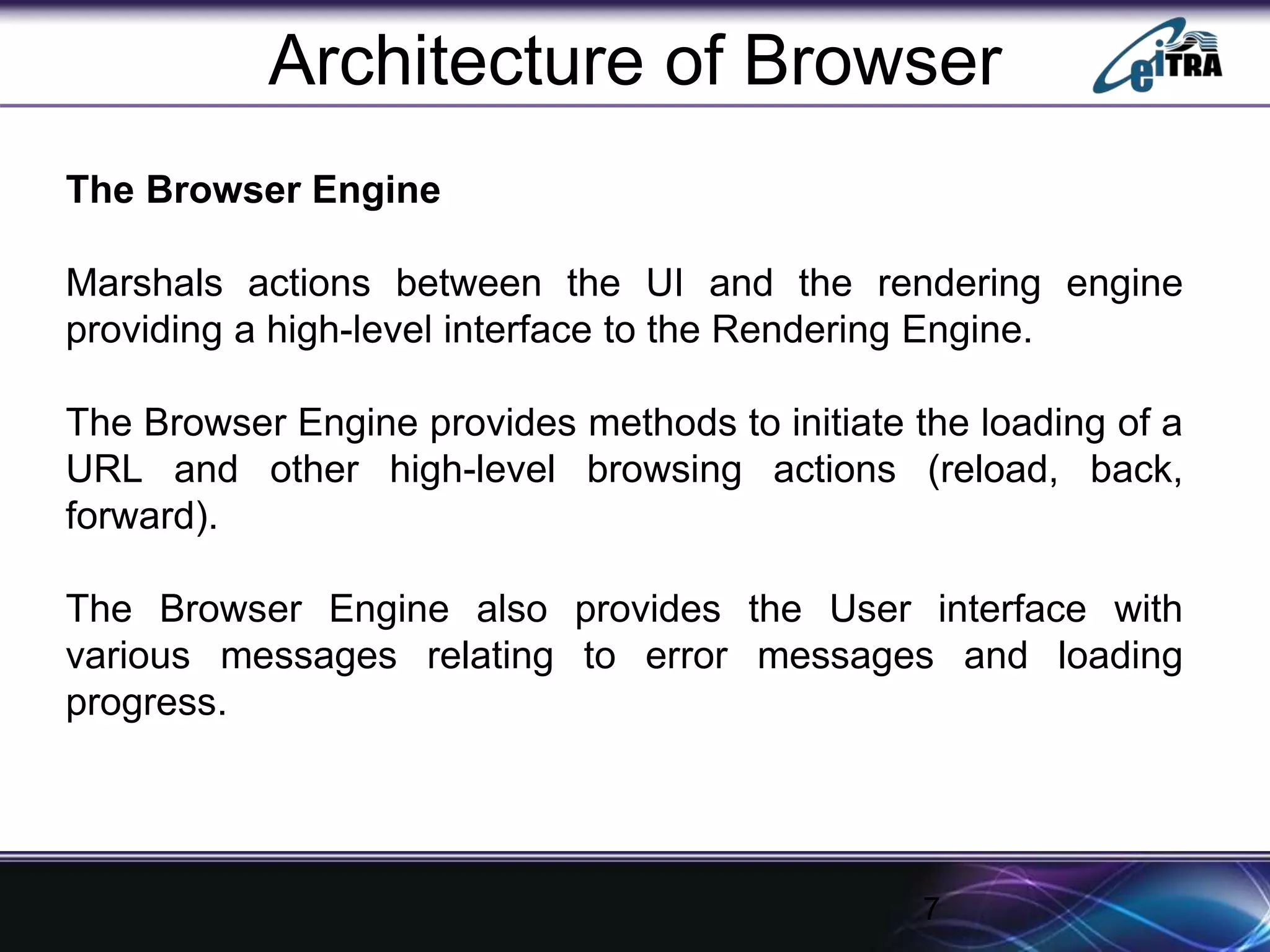
The Browser Engine
Marshals actions between the UI and the rendering engine
providing a high-level interface to the Rendering Engine.
The Browser Engine provides methods to initiate the loading of a
URL and other high-level browsing actions (reload, back,
forward).
The Browser Engine also provides the User interface with
various messages relating to error messages and loading
progress.
7
Architecture of Browser
The Rendering Engine
Produces the visual representation of a given URL. The
Rendering Engine interprets the HTML, XML, and JavaScript
that comprises a given URL and generates the layout that is
displayed in the User Interface.
The Networking
Provides functionality to handle retrieve URLs using the common
Internet protocols of HTTP and FTP. The Networking
components handles all aspects of Internet communication and
security, character set translations and MIME type resolution.
8
Architecture of Browser
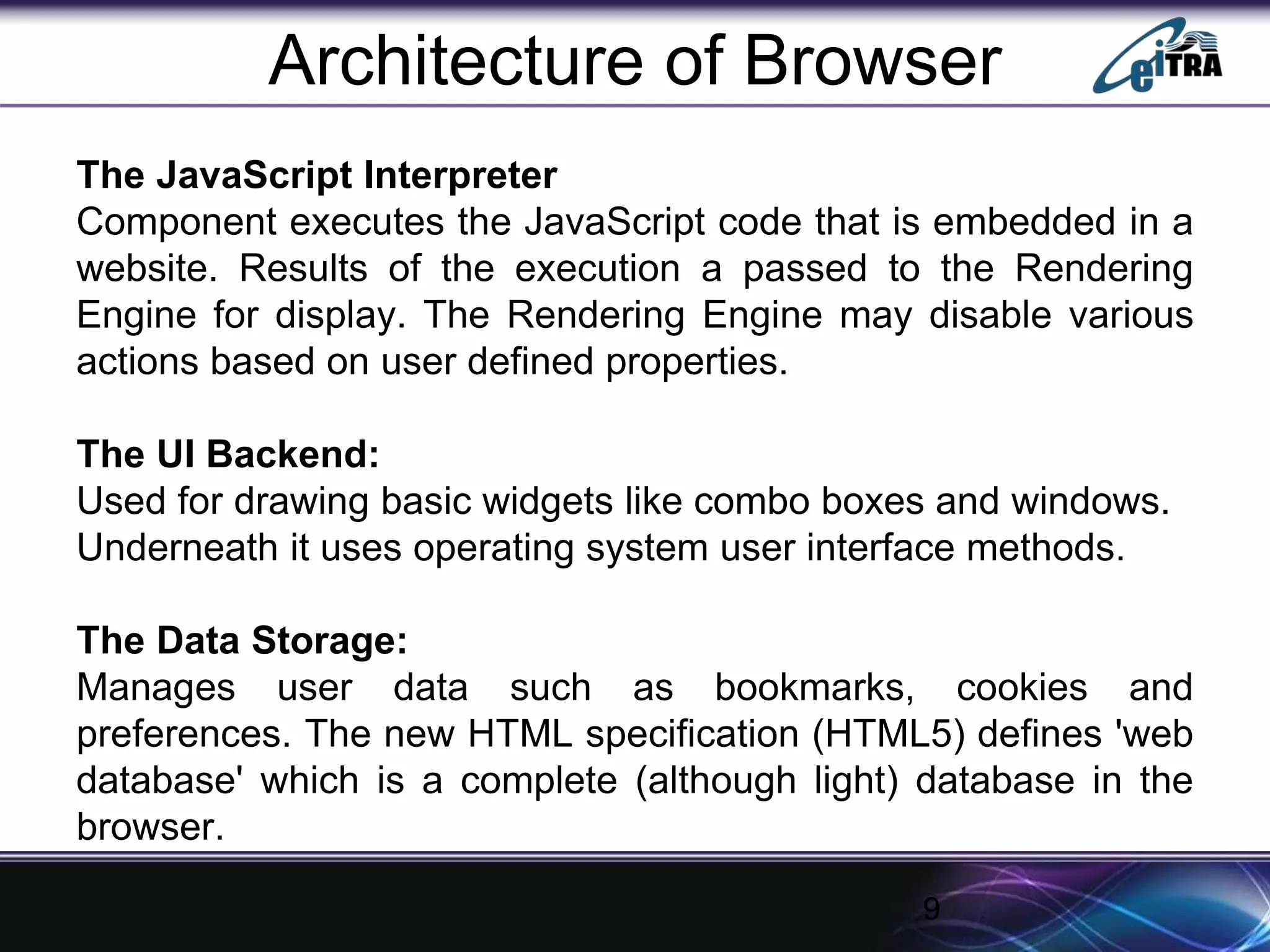
The JavaScript Interpreter
Component executes the JavaScript code that is embedded in a
website. Results of the execution a passed to the Rendering
Engine for display. The Rendering Engine may disable various
actions based on user defined properties.
The UI Backend:
Used for drawing basic widgets like combo boxes and windows.
Underneath it uses operating system user interface methods.
The Data Storage:
Manages user data such as bookmarks, cookies and
preferences. The new HTML specification (HTML5) defines 'web
database' which is a complete (although light) database in the
browser.
9
Architecture of Browser
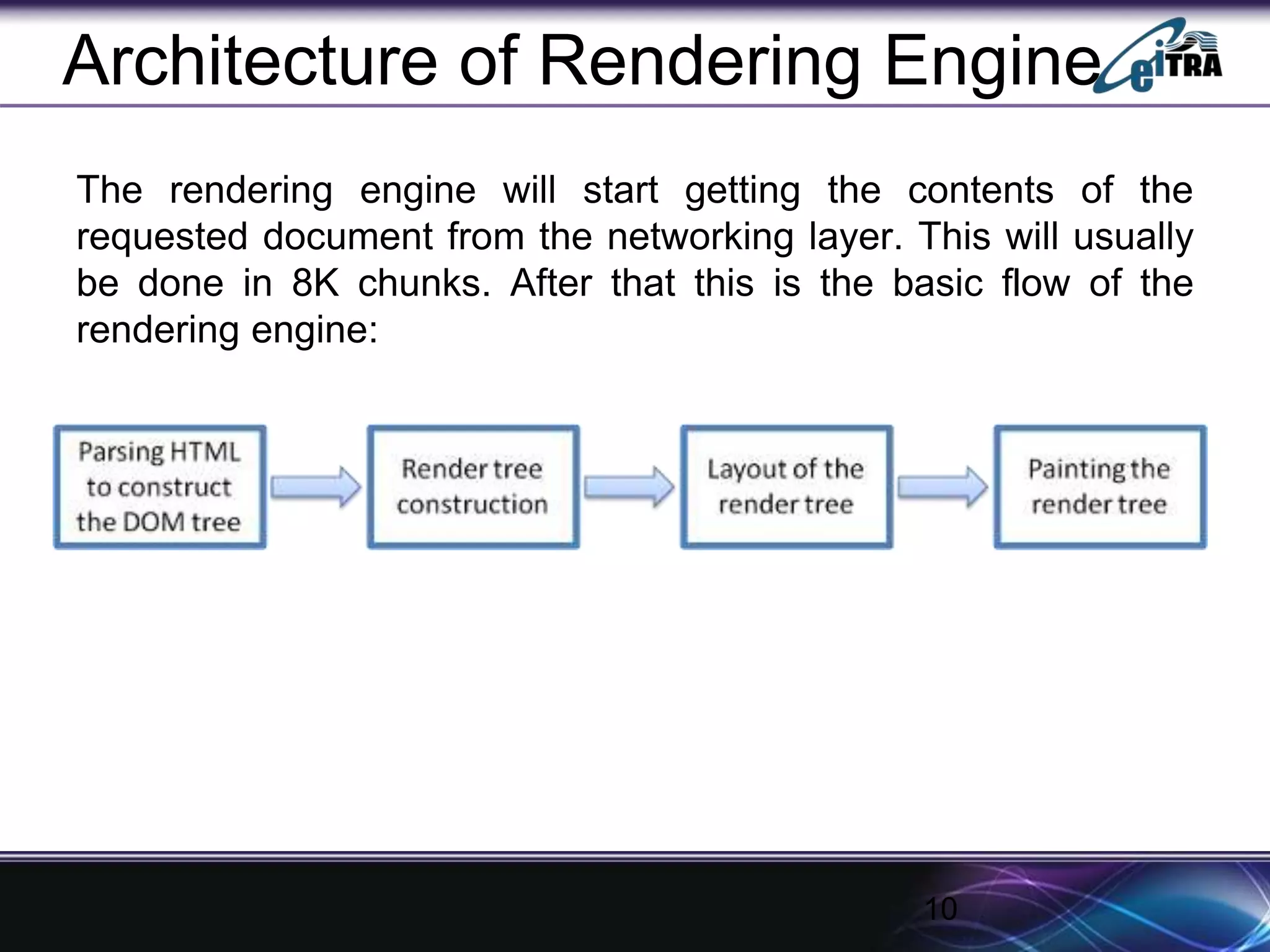
The rendering engine will start getting the contents of the
requested document from the networking layer. This will usually
be done in 8K chunks. After that this is the basic flow of the
rendering engine:
10
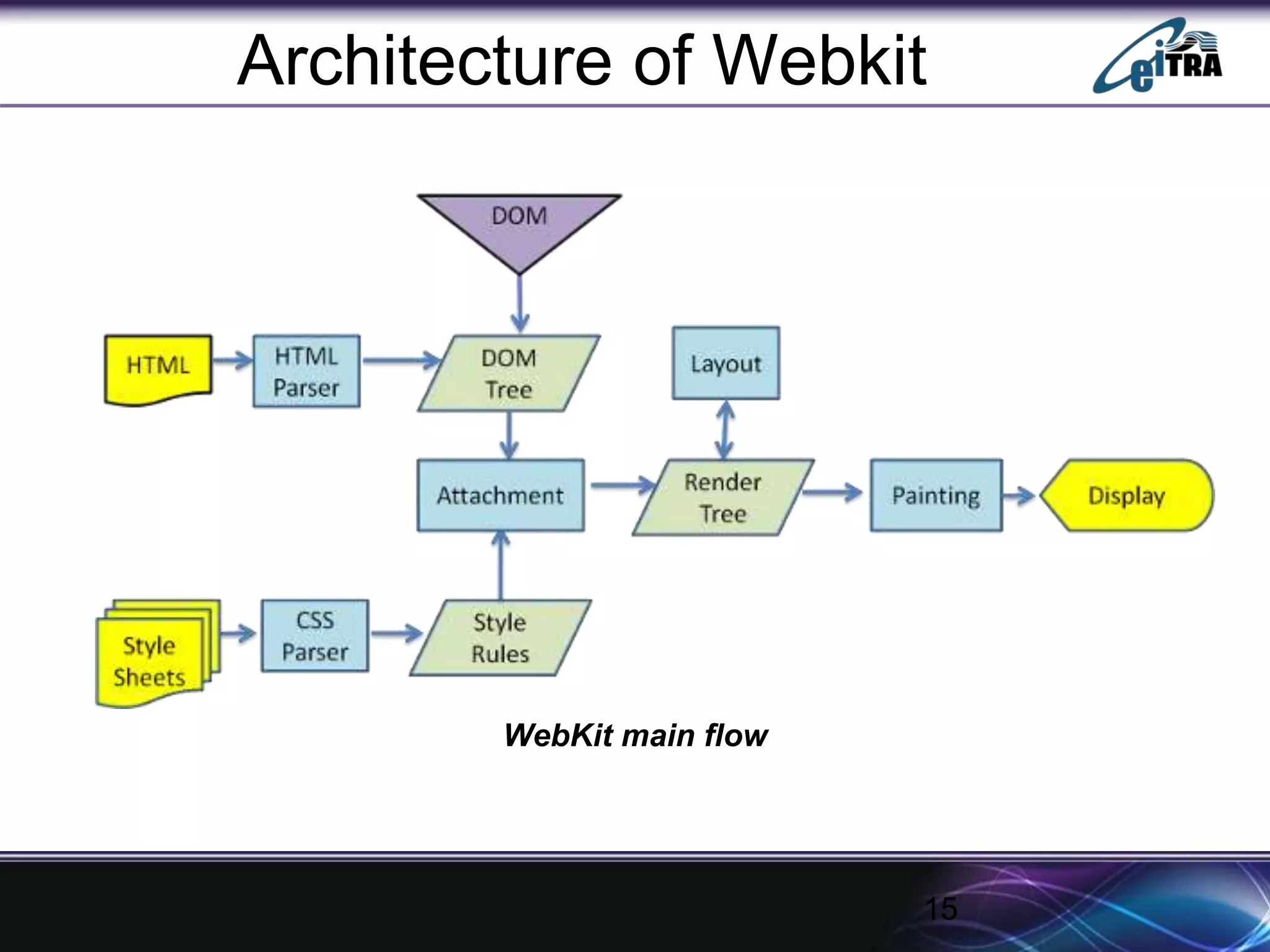
Architecture of Rendering Engine
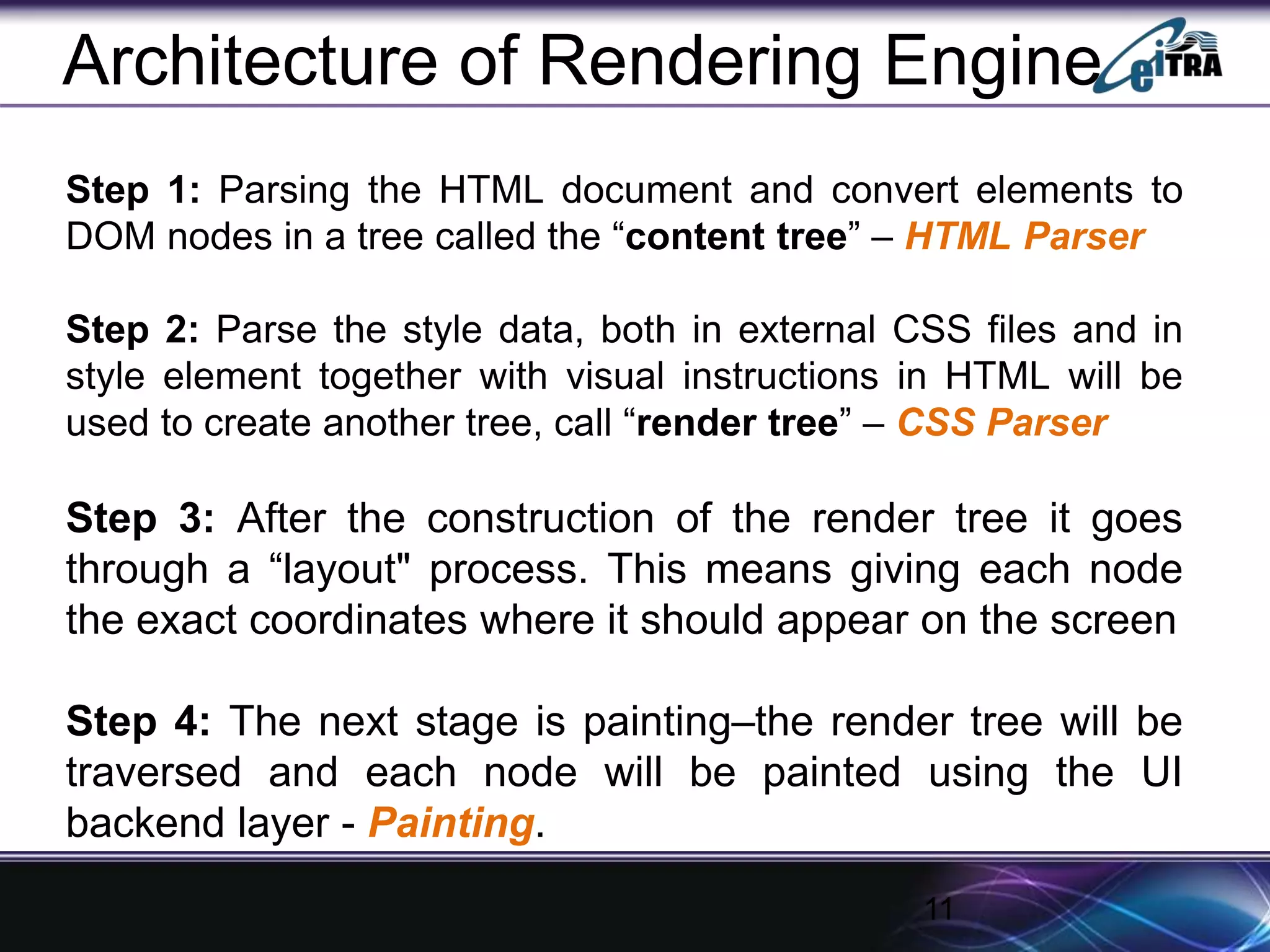
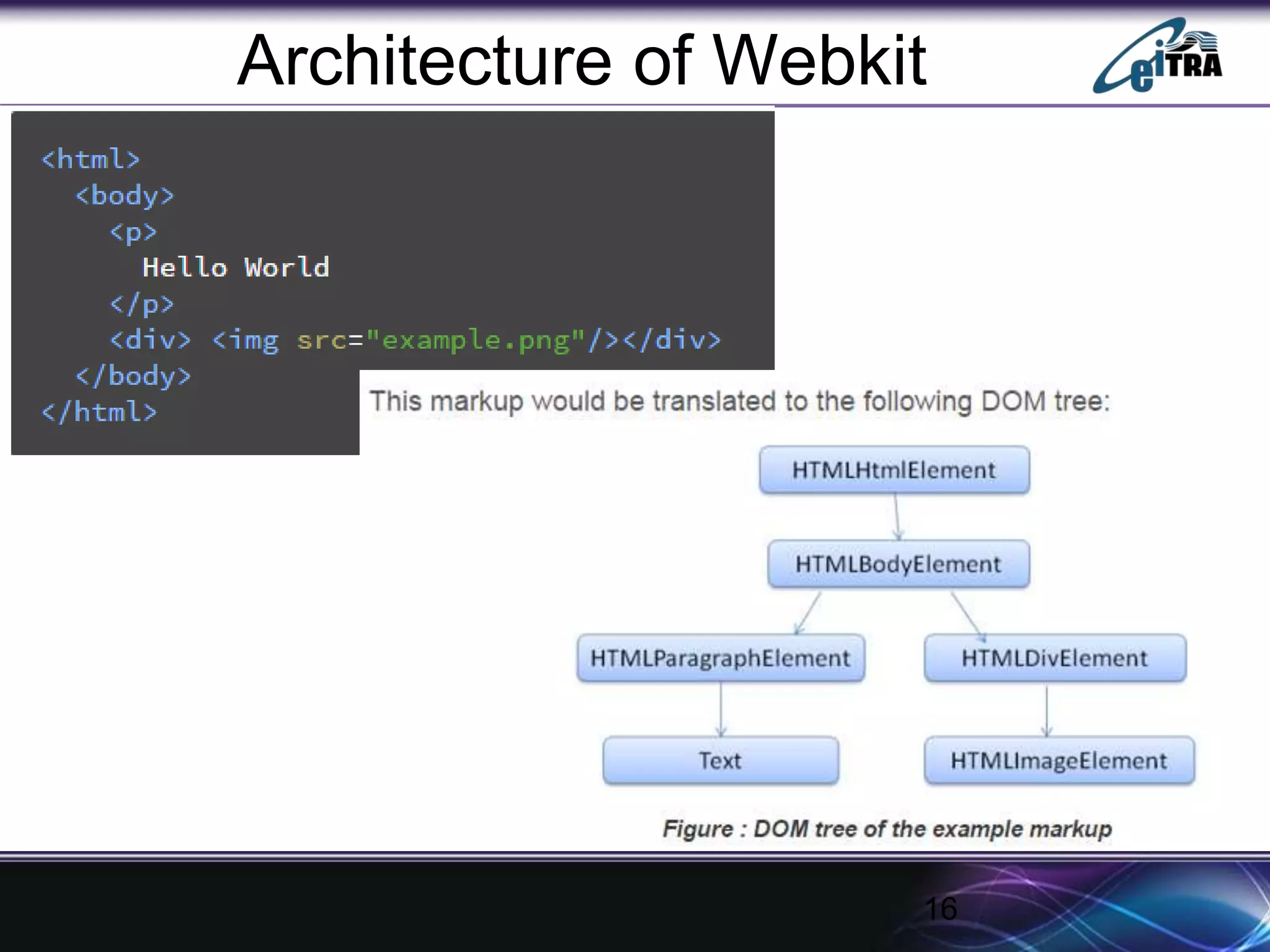
Step 1: Parsing the HTML document and convert elements to
DOM nodes in a tree called the “content tree” – HTML Parser
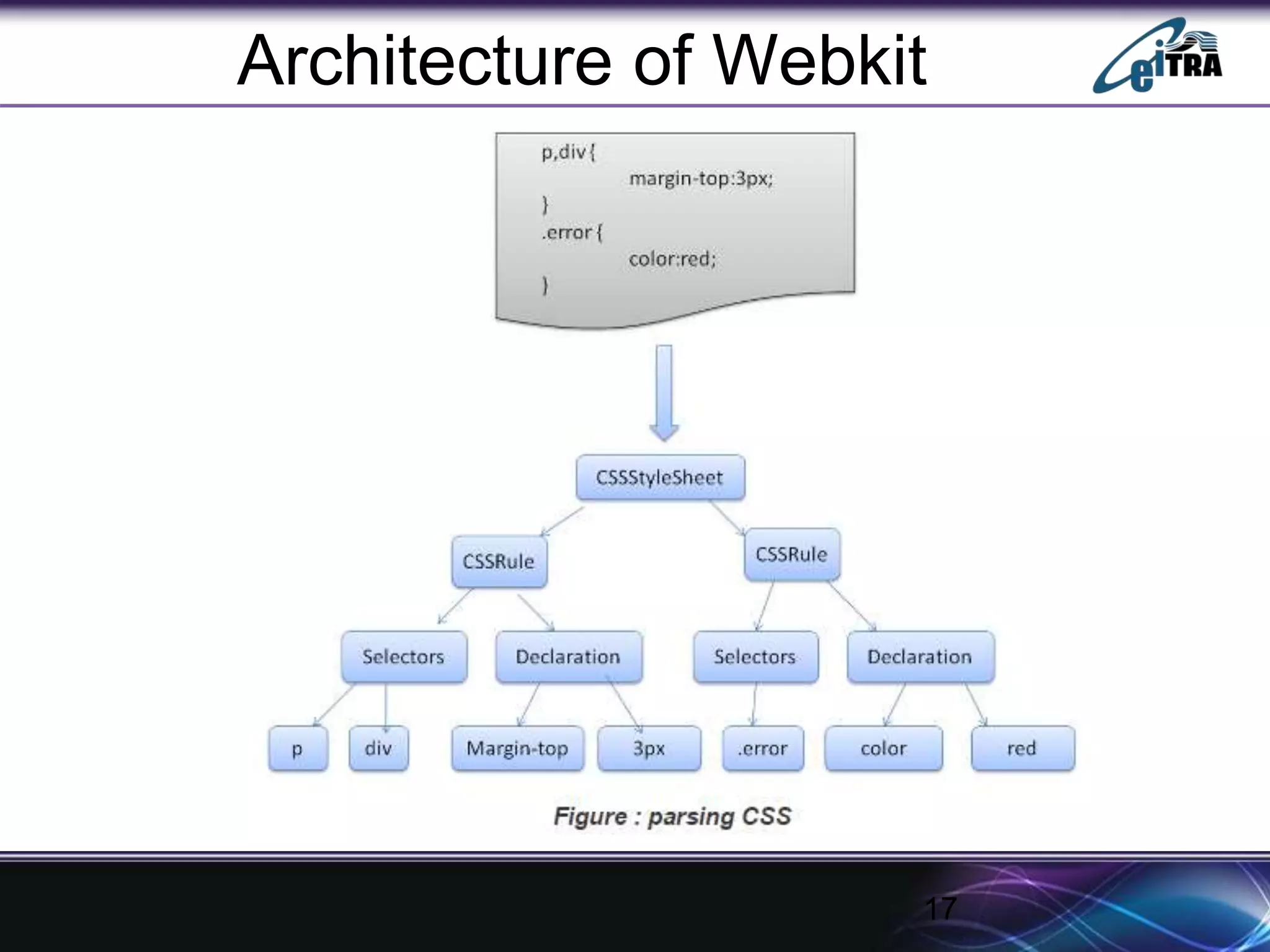
Step 2: Parse the style data, both in external CSS files and in
style element together with visual instructions in HTML will be
used to create another tree, call “render tree” – CSS Parser
Step 3: After the construction of the render tree it goes
through a “layout" process. This means giving each node
the exact coordinates where it should appear on the screen
Step 4: The next stage is painting–the render tree will be
traversed and each node will be painted using the UI
backend layer - Painting.
11
Architecture of Rendering Engine
12
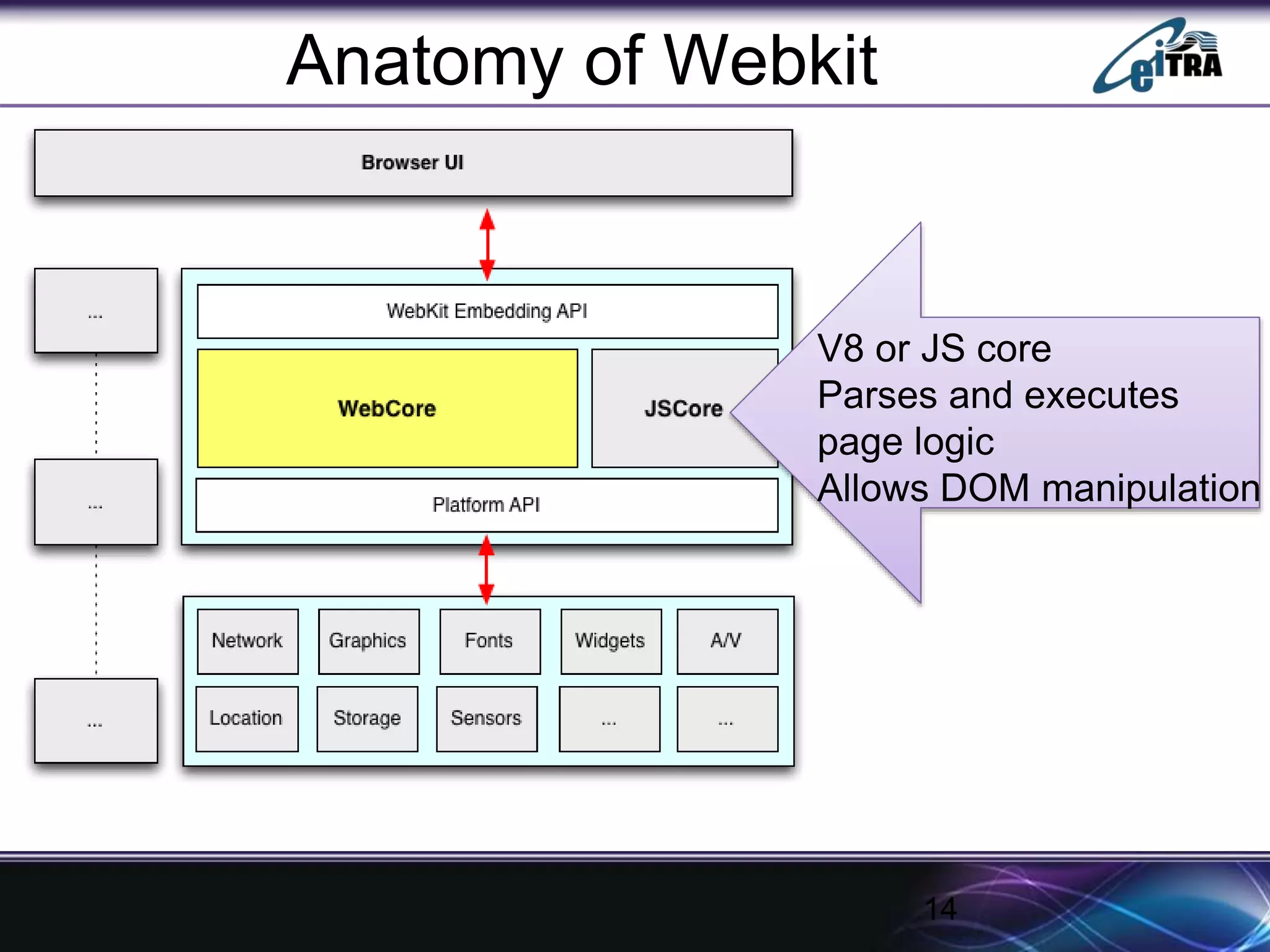
Anatomy of Webkit
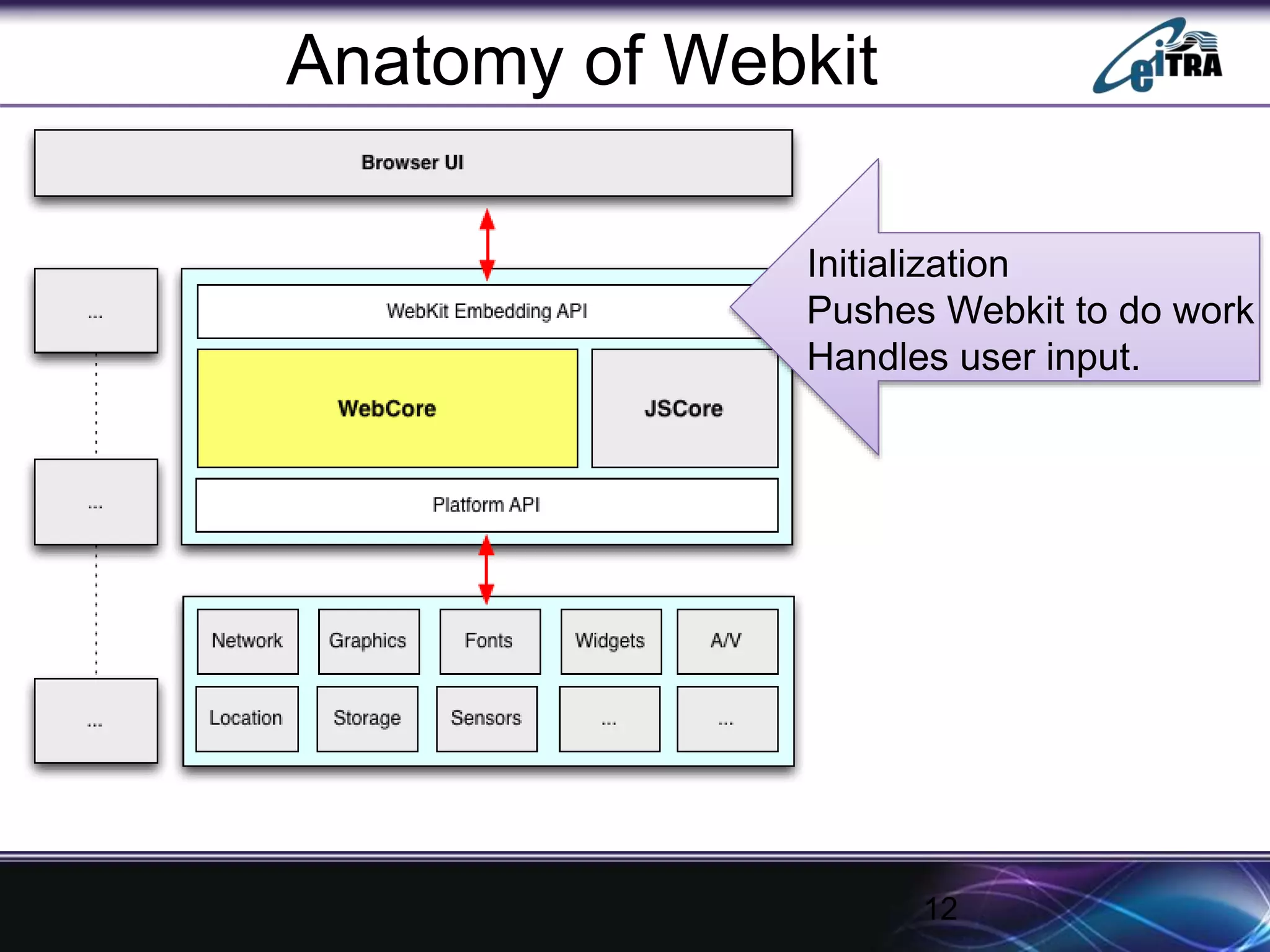
Initialization
Pushes Webkit to do work
Handles user input.
13
Anatomy of Webkit
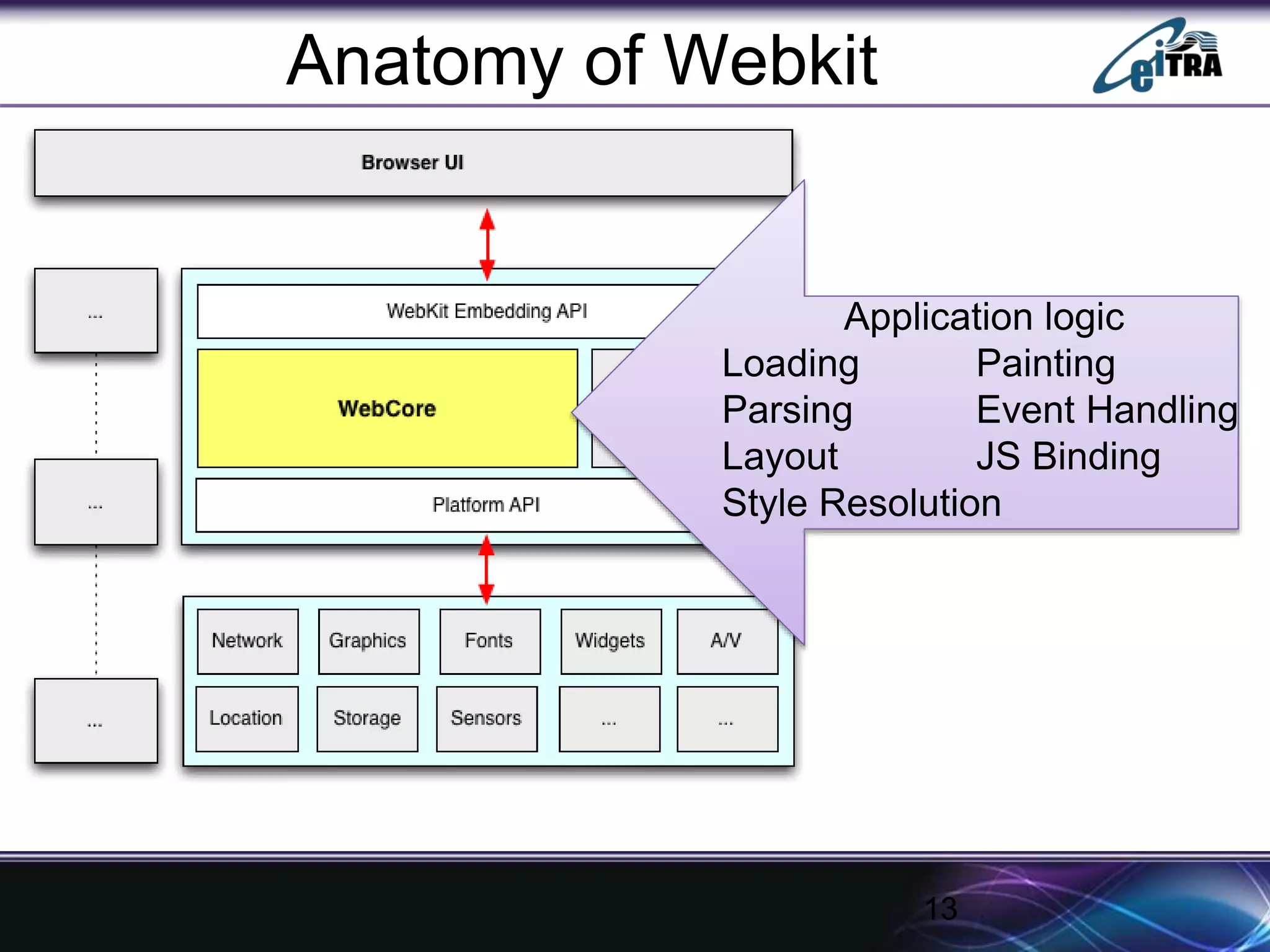
Application logic
Loading Painting
Parsing Event Handling
Layout JS Binding
Style Resolution
14
Anatomy of Webkit
V8 or JS core
Parses and executes
page logic
Allows DOM manipulation
WebKit main flow
15
Architecture of Webkit
16
Architecture of Webkit
17
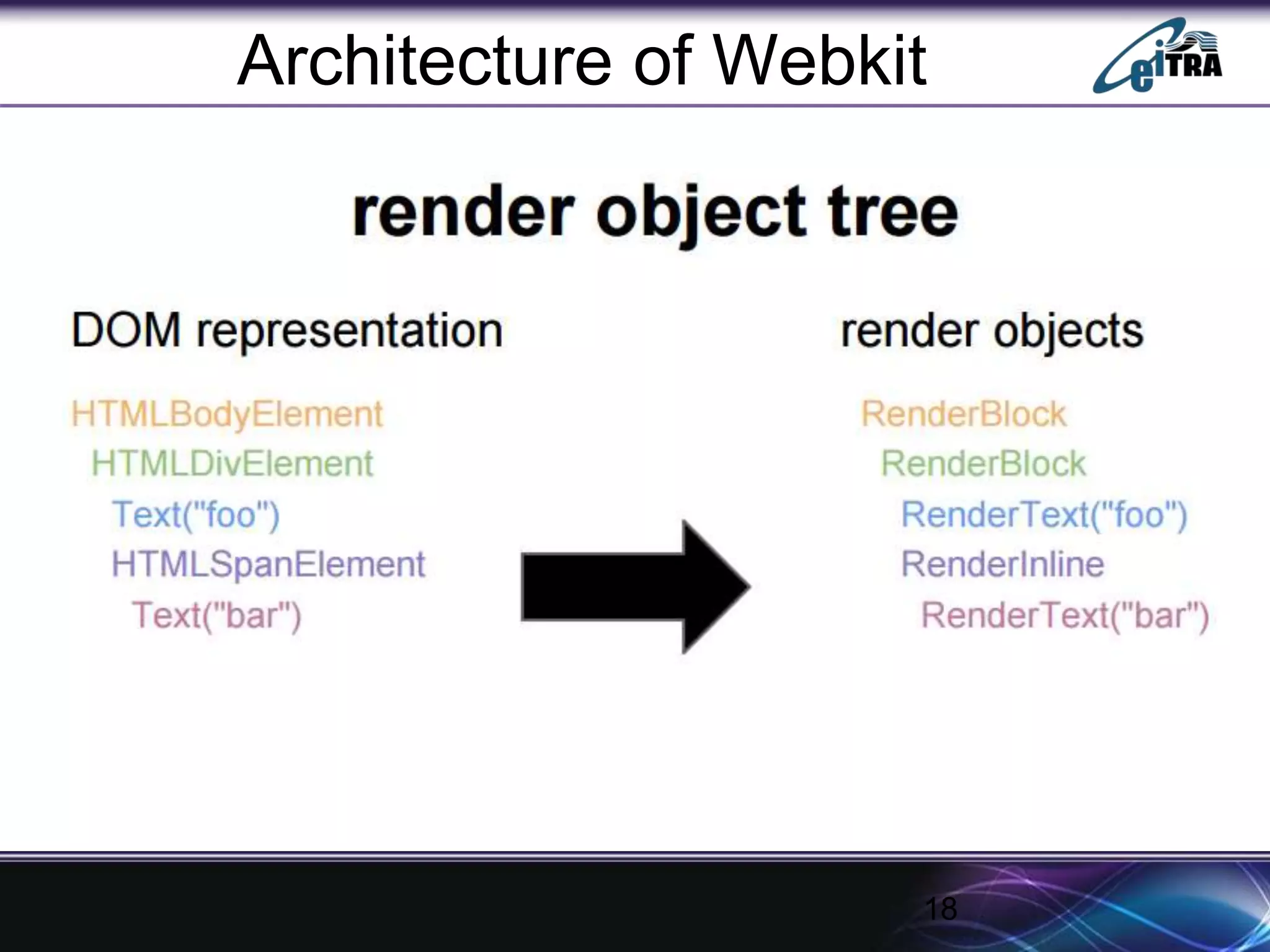
Architecture of Webkit
18
Architecture of Webkit
19
Architecture of Webkit
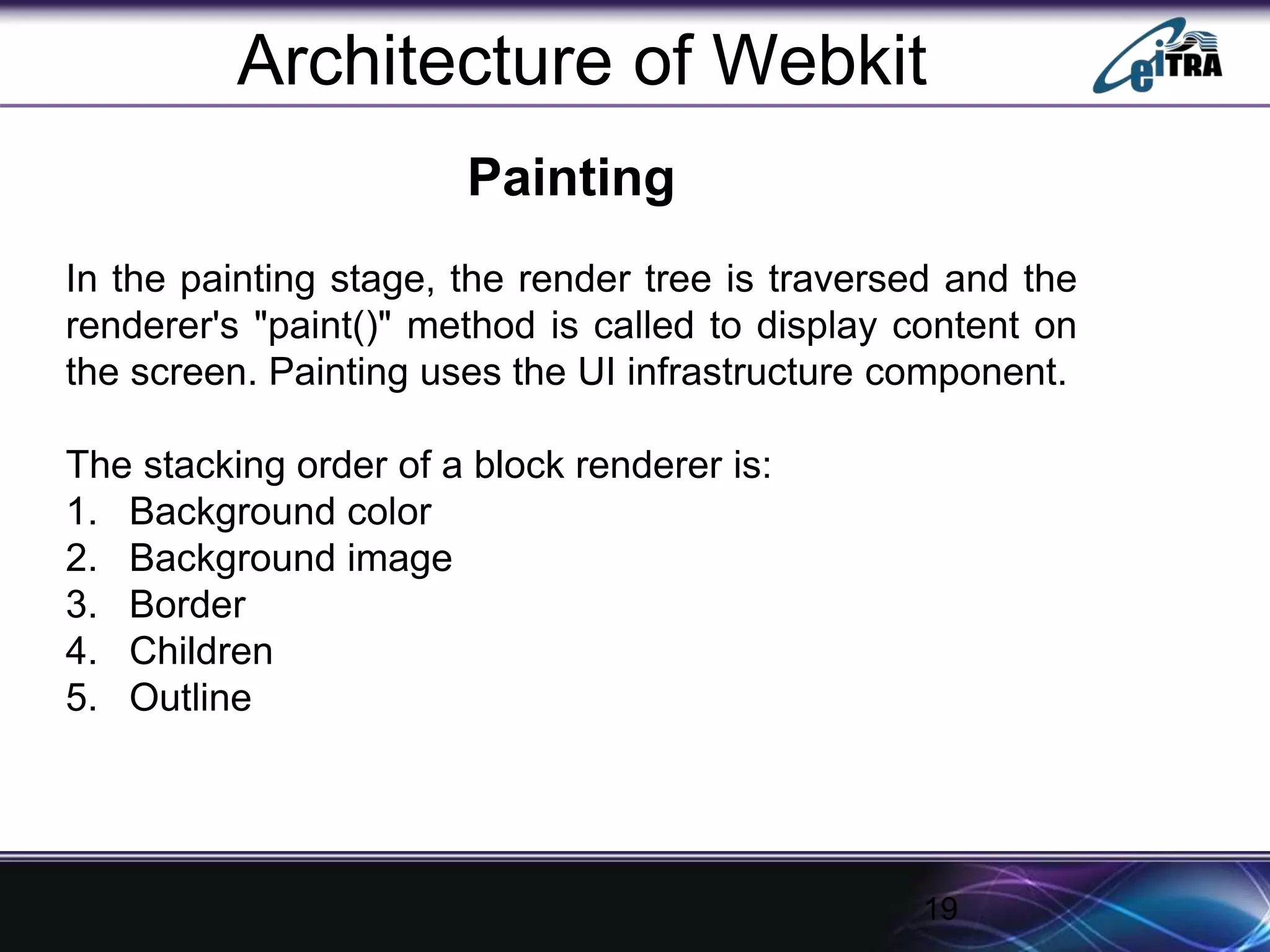
Painting
In the painting stage, the render tree is traversed and the
renderer's "paint()" method is called to display content on
the screen. Painting uses the UI infrastructure component.
The stacking order of a block renderer is:
1. Background color
2. Background image
3. Border
4. Children
5. Outline
Thank you

Rendering engine

  • 1.
    Click to addTitle Rendering Engine e-Infochips Institute of Training Research and Academics Limited Prepared By:- Dharita Chokshi
  • 2.
    Outlines Rendering Engines Rendering Enginesand Browsers Architecture of Browser Architecture of Rendering Engine Anatomy of Webkit Architecture of Webkit
  • 3.
    Rendering Engine Means? Renderingmeans to translate or to interpret into another language. A rendering engine (also called layout engine or web browser engine) is a software component that takes marked up content (like HTML, XML, image files, etc.) and formatting information (like CSS, XSL, etc.) and displays the formatted content on the screen. It essentially takes a URL and a set of window content- area rectangle coordinates as arguments. It then retrieves the document corresponding to the URL and paints a graphical representation of it in the given rectangle.
  • 4.
    Rendering Engines and Browsers Rendering Engine LeadingHost Applications/Browsers Programming Language Blink Google Chrome(from version 28), Opera(from version 15.0) C++ Gecko Mozilla Firefox C++ Webkit Apple Safari, BlackBerry, Android and Google Chrome(till version 27) C++ Presto Opera(till version 14) C++ Trident Internet Explorer C++ The host application provides the menu bar, address bar, status bar, bookmark manager, history and preferences functionality.
  • 5.
  • 6.
    Architecture of Browser TheUser Interface Provides the methods with which a user interacts with the Browser Engine. This includes the address bar, back/forward button, bookmarking menu, etc. Every part of the browser display except the window where you see the requested page. 6
  • 7.
    The Browser Engine Marshalsactions between the UI and the rendering engine providing a high-level interface to the Rendering Engine. The Browser Engine provides methods to initiate the loading of a URL and other high-level browsing actions (reload, back, forward). The Browser Engine also provides the User interface with various messages relating to error messages and loading progress. 7 Architecture of Browser
  • 8.
    The Rendering Engine Producesthe visual representation of a given URL. The Rendering Engine interprets the HTML, XML, and JavaScript that comprises a given URL and generates the layout that is displayed in the User Interface. The Networking Provides functionality to handle retrieve URLs using the common Internet protocols of HTTP and FTP. The Networking components handles all aspects of Internet communication and security, character set translations and MIME type resolution. 8 Architecture of Browser
  • 9.
    The JavaScript Interpreter Componentexecutes the JavaScript code that is embedded in a website. Results of the execution a passed to the Rendering Engine for display. The Rendering Engine may disable various actions based on user defined properties. The UI Backend: Used for drawing basic widgets like combo boxes and windows. Underneath it uses operating system user interface methods. The Data Storage: Manages user data such as bookmarks, cookies and preferences. The new HTML specification (HTML5) defines 'web database' which is a complete (although light) database in the browser. 9 Architecture of Browser
  • 10.
    The rendering enginewill start getting the contents of the requested document from the networking layer. This will usually be done in 8K chunks. After that this is the basic flow of the rendering engine: 10 Architecture of Rendering Engine
  • 11.
    Step 1: Parsingthe HTML document and convert elements to DOM nodes in a tree called the “content tree” – HTML Parser Step 2: Parse the style data, both in external CSS files and in style element together with visual instructions in HTML will be used to create another tree, call “render tree” – CSS Parser Step 3: After the construction of the render tree it goes through a “layout" process. This means giving each node the exact coordinates where it should appear on the screen Step 4: The next stage is painting–the render tree will be traversed and each node will be painted using the UI backend layer - Painting. 11 Architecture of Rendering Engine
  • 12.
    12 Anatomy of Webkit Initialization PushesWebkit to do work Handles user input.
  • 13.
    13 Anatomy of Webkit Applicationlogic Loading Painting Parsing Event Handling Layout JS Binding Style Resolution
  • 14.
    14 Anatomy of Webkit V8or JS core Parses and executes page logic Allows DOM manipulation
  • 15.
  • 16.
  • 17.
  • 18.
  • 19.
    19 Architecture of Webkit Painting Inthe painting stage, the render tree is traversed and the renderer's "paint()" method is called to display content on the screen. Painting uses the UI infrastructure component. The stacking order of a block renderer is: 1. Background color 2. Background image 3. Border 4. Children 5. Outline
  • 20.

Editor's Notes