Welcomes to RELO Andes Webinars
Lisa Bochey
Kat Huang
Abigail Gary
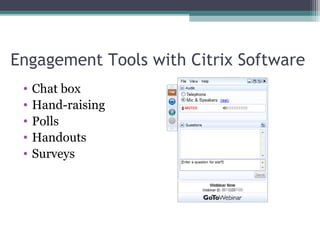
Engagement Tools with Citrix Software
• Chat box
• Hand-raising
• Polls
• Handouts
• Surveys
Quick Poll
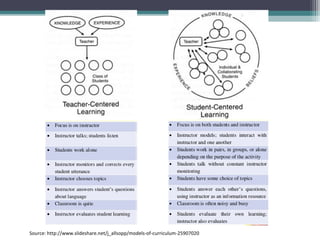
• How many of you are familiar with student
centered learning? (Raise hand)
Source: http://www.slideshare.net/j_allsopp/models-of-curriculum-25907020
Survey
Which of the following activities is an example of a
student centered learning activity?
• A teacher reading out loud to her students
• Students working in groups to teach the class
new vocabulary
• Students playing a game of BINGO
Survey
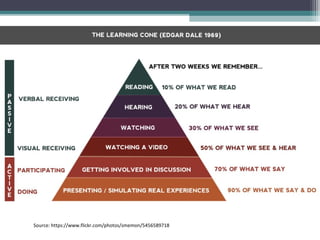
In your opinion, which of the following activities
help students learn and retain the most
information?
• Reading
• Listening
• Watching
Source: https://www.flickr.com/photos/smemon/5456589718
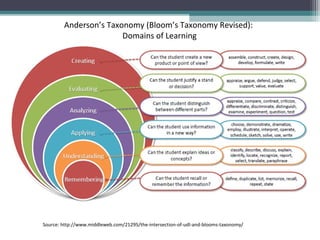
Source: http://www.middleweb.com/21295/the-intersection-of-udl-and-blooms-taxonomy/
Anderson’s Taxonomy (Bloom’s Taxonomy Revised):
Domains of Learning
Survey
Which of the following is an example of a creation
activity? (highest level of Anderson’s Taxonomy)
• Labeling a diagram with body part vocabulary.
• Using vocabulary words to write a personal
narrative.
• Reading a text and highlighting unknown words.
• Playing charades
Example 1: Jigsaw
Preparation:
• Create groups of four students and assign each group a
number
• Give each group an individual assignment.
▫ Example: Each group is given a vocabulary set
(weather, hobbies, sports) and must create a story
using the vocabulary words.
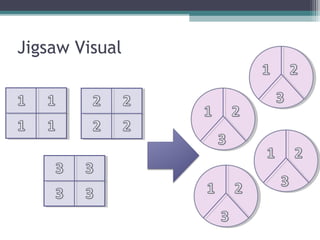
• After groups have had time to work, rearrange the
groups so that all new groups include exactly one
member from the original groups.
• Have students share their stories with the new group
members
Jigsaw Visual
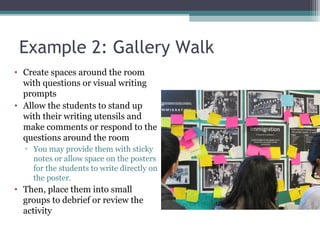
Example 2: Gallery Walk
• Create spaces around the room
with questions or visual writing
prompts
• Allow the students to stand up
with their writing utensils and
make comments or respond to the
questions around the room
▫ You may provide them with sticky
notes or allow space on the posters
for the students to write directly on
the poster.
• Then, place them into small
groups to debrief or review the
activity
Pictionary
Directions:
• Place students in pairs or
teams and provide them with
a written or visual prompt.
• One person on each team is
the artist. The artist is not
allowed to see the prompt.
• The rest of the team
describes the prompt to the
artist while he or she tries to
draw what they hear.
• The team whose artist
completes their drawing
most accurately wins!
Other Ideas
• Role Play/Skits
• Debates
• Think-Pair-Share
Free Response
Answer in chat box:
Do you have any other ideas that could be used to
facilitate active student centered learning?
Thanks for joining us!
Check us out next month
▫ Presenter: Efrain Punto
▫ Location: Ayacucho, Peru
▫ Topic: Integrating the Four Skills
▫ Date: Wednesday, September 21
▫ Time: 3:00pm (Peru Time)
RELO Andes Webinar: Active Student-Centered Learning Inspiration

RELO Andes Webinar: Active Student-Centered Learning Inspiration

  • 1.
    Welcomes to RELOAndes Webinars
  • 2.
  • 3.
    Engagement Tools withCitrix Software • Chat box • Hand-raising • Polls • Handouts • Surveys
  • 4.
    Quick Poll • Howmany of you are familiar with student centered learning? (Raise hand)
  • 5.
  • 6.
    Survey Which of thefollowing activities is an example of a student centered learning activity? • A teacher reading out loud to her students • Students working in groups to teach the class new vocabulary • Students playing a game of BINGO
  • 7.
    Survey In your opinion,which of the following activities help students learn and retain the most information? • Reading • Listening • Watching
  • 8.
  • 9.
  • 10.
    Survey Which of thefollowing is an example of a creation activity? (highest level of Anderson’s Taxonomy) • Labeling a diagram with body part vocabulary. • Using vocabulary words to write a personal narrative. • Reading a text and highlighting unknown words. • Playing charades
  • 11.
    Example 1: Jigsaw Preparation: •Create groups of four students and assign each group a number • Give each group an individual assignment. ▫ Example: Each group is given a vocabulary set (weather, hobbies, sports) and must create a story using the vocabulary words. • After groups have had time to work, rearrange the groups so that all new groups include exactly one member from the original groups. • Have students share their stories with the new group members
  • 12.
  • 13.
    Example 2: GalleryWalk • Create spaces around the room with questions or visual writing prompts • Allow the students to stand up with their writing utensils and make comments or respond to the questions around the room ▫ You may provide them with sticky notes or allow space on the posters for the students to write directly on the poster. • Then, place them into small groups to debrief or review the activity
  • 14.
    Pictionary Directions: • Place studentsin pairs or teams and provide them with a written or visual prompt. • One person on each team is the artist. The artist is not allowed to see the prompt. • The rest of the team describes the prompt to the artist while he or she tries to draw what they hear. • The team whose artist completes their drawing most accurately wins!
  • 15.
    Other Ideas • RolePlay/Skits • Debates • Think-Pair-Share
  • 16.
    Free Response Answer inchat box: Do you have any other ideas that could be used to facilitate active student centered learning?
  • 18.
    Thanks for joiningus! Check us out next month ▫ Presenter: Efrain Punto ▫ Location: Ayacucho, Peru ▫ Topic: Integrating the Four Skills ▫ Date: Wednesday, September 21 ▫ Time: 3:00pm (Peru Time)

Editor's Notes

  • #7 Key word: STUDENTS! The students are the center of attention and in control of the learning.
  • #12 Before slide: Ask in free response, “How many students do you typically have in your classes?”
  • #14 Variations: Place students in small groups with a blank sheet of paper, ask them to create a story in English. Time them for five minutes, then ask the groups to rotate, and continue the next story they see from the group that preceded them. Go around the room until they arrive back to their original positions. Closing: Have students form small groups around the different writing prompts or visuals, tell them to examine the responses. Then, have each group present a summary of the responses to the rest of the class. ANYTHING on giant paper. Or Sticky notes.