2
Introduction
Fanaticism is the belief in politics, religion, or other areas
that greatly exceeds the norm in enthusiasm and includes a
willingness to sacrifice all else to realize its ends.
Sometimes fanaticism is like an addiction. When it is
addiction it may be harmful or destructive.


                                                                 3
Fanaticism
 Fanaticism is a belief or behavior involving uncritical
  zeal, particularly for an extreme religious or political
  cause or in some cases sports, or with an obsessive
  enthusiasm for a pastime or hobby.
 The fanatic displays very strict standards and little
  tolerance for contrary ideas or opinions.
 In his book Crazy Talk, Stupid Talk, Neil Postman states
  that "the key to all fanatical beliefs is that they are self-
  confirming....(some beliefs are) fanatical not because they
  are 'false', but because they are expressed in such a way
  that they can never be shown to be false.

                                                                  4
Religious Fanaticism
 Religious fanaticism is fanaticism related to a person's, or
  a group's, devotion to a religion.
 In his book, Holy War, Just War, Lloyd Steffen says,
  "Religious fanaticism . . . invokes the idea of ultimacy,
  and its presence in religious life is undeniable."He goes on
  to say, "Religious fanatics are persons who attach to some
  object an ultimate valuation and then attend to that
  overvalued object with what is recognizable as a kind of
  religious" devotion."


                                                                 5
Features of Religious Fanaticism

1. Spiritual needs: Human beings have a spiritual longing
    for understanding and meaning, and given the mystery
    of existence. Religion has power to meet this need for
    meaning and transcendent relationship.
2. Attractiveness: It presents itself in such a way that those
    who find their way into it come to express themselves in
    ways consistent with the particular vision of ultimacy at
    the heart of this religious form.


                                                                 6
Features of Religious Fanaticism

3. Live option: It is present to the moral consciousness as a
    live option that addresses spiritual need and satisfies
    human longing for meaning, power, and belonging.


                                                                7
Religious Fanaticism in 20th
      Century (At a Glance)

 1905: In France the law on the Separation of the
 Churches and the State is passed, officially
 establishing it a state secularism and putting and end
 to the funding of religious groups by the state.
 Becoming a place of pilgrimage for neo-druids and
 other pagans, the Ancient Order of Druids organized
 the first recorded reconstructionist ceremony in
 Stonehenge.(Encyclopedia, 2012)


                                                          8
Religious Fanaticism in 20th
        Century (At a Glance)
 1908: The establishment of the Khalifatul Masih after
  Prophethood in the Ahmadiyya Muslim Community, the
  Second       Manifestation      of      God's Power.
  (Encyclopedia, 2012)
 1917: The October Revolution, in Russia, leads to the
  annexation of all church properties and subsequent
  religious suppression. (Encyclopedia, 2012)
 The 1917 Constitution of Mexico is written making
  Mexico a secular state. (Encyclopedia, 2012)

                                                          9
Religious Fanaticism in 20th
        Century (At a Glance)

 1930s:    Rastafari movement, the Nation of Islam is
  founded. (Encyclopedia, 2012)
 1932: A neo-Hindu religious movement,the Brahma
  Kumaris or "Daughters of Brahma" started the origin of
  BKWSU can be traced to the group "Om
  Mandali", founded by Lekhraj Kripalani(1884–1969).
  (Encyclopedia, 2012)


                                                       10
Religious Fanaticism in 20th
         Century (At a Glance)
 1939 – 1945: Millions of Jews are relocated and killed by
  the      Nazi       government         during     Holocaust.
  (Encyclopedia, 2012)
 1947: British India is partitioned on religious lines; into
  an Islamic country of Pakistan and the secular nation of
  India with a Hindu majority. (Encyclopedia, 2012)
 1948: The Jews return to their ancient biblical homeland
  and the state of Israel is created. (Encyclopedia, 2012)

                                                             11
Religious Fanaticism in 20th
         Century (At a Glance)
 1961:    Unitarian Universalism formed from merger of
  Unitarianism and Universalism. (Encyclopedia, 2012)
 1962 – 1965: The Second Vatican Council takes place.
 1965: Srila Prabhupada establishes the International
  Society for Krishna Consciousness and introduces
  translations of the Bhagavad-Gita and Vedic Scriptures in
  mass production all over the world. (Encyclopedia, 2012)


                                                          12
Religious Fanaticism in 20th
         Century (At a Glance)
 1966:     Anton Szandor LaVey's Satanism begins, with
  Anton Szandor LaVey's founding of the Church of Satan,
  although Satanism in itself has always been defined by the
  Christians themselves. (Encyclopedia, 2012)
 1984: Operation Blue Star occurs at holiest site of the
  Sikhs, the Golden Temple in Amritsar. 1984 Anti-Sikh
  riots follow. (Encyclopedia, 2012)


                                                           13
Religious Fanaticism in 20th
         Century (At a Glance)
 1979: The Iranian Revolution results in the establishment
  of an Islamic Republic in Iran. (Encyclopedia, 2012)
 1989: The revolutions of 1989, the overthrow of many
  Soviet-style states, allows a resurgence in open religious
  practice in many Eastern European countries.
  (Encyclopedia, 2012)
 1990s:     European pagan reconstructive movements
  (Celtic, Hellenic, Roman, Slavic, Baltic, Finnish, etc.)
  organize. (Encyclopedia, 2012)
                                                           14
Rise of Religious Fanaticism in Late
            20th Century
 Aden-Abyan Islamic Army: The Aden-Abyan Islamic
 Army is an Islamist militant organization based in
 southern Yemen. The group was responsible for
 kidnapping of 16 foreign tourists in the December 1998 in
 Abyan. Yemeni government forces attacked place where
 the hostages were being held resulting in four of the
 hostages being killed while the remainder were freed. The
 Aden-Abyan Islamic Army was also believed to have been
 involved in the 2000 USS Cole bombing in
 Aden.(Encarta, 2012)
                                                         15
Rise of Religious Fanaticism in Late
            20 th Century
 Al-Badr: Al-Badr is an Islamic militant group
  operating in the Jammu Kashmir region, run by
  Jasniel Rihal. The group was allegedly formed by
  the Pakistani Inter-Services Intelligence (ISI) in June
  1998. (Encarta, 2012)
 Al-Itihaad al-Islamiya:
              Years active:1994–2006
              Headquarters:Kismayo
              Operating Areas: Somalia
                  (Encarta, 2012)

                                                            16
Rise of Religious Fanaticism in Late
            20th Century

  All Tripura Tiger Force:
     Active:1990 - present
     Ideology: Tripuri nationalism
     Leaders: Ranjit Debbarma
     Area of operations: Tripura, India
                   (Encarta, 2012)


                                          17
Rise of Religious Fanaticism in Late
            20th Century
 Al-Qaeda:
     Leaders: Osama bin Laden (1988–2011) ,Ayman al-
       Zawahiri (2011 – present)
     Active regions: Worldwide
 Founded by Osama bin Laden at some point between
  August 1988 and late 1989, its origins being traceable to
  the Soviet War in Afghanistan. (Encarta, 2012)


                                                          18
19
Rise of Religious Fanaticism in Late
            20th Century
  Armed Islamic Group of Algeria: is an Islamist
  organization that wants to overthrow the Algerian
  government and replace it with an Islamic state. The
  GIA adopted violent tactics in 1992 after the military
  government voided the victory of the Islamic
  Salvation Front, the largest Islamic opposition
  party, in the first round of legislative elections held
  in December 1991. (Encarta, 2012)


                                                            20
Rise of Religious Fanaticism in Late
            20 th Century
 Destruction of Babri Mosque:
    Constructed – 1527
    Destroyed – 1992
 The Babri Mosque was a mosque in Ayodhya, a city
 in the Faizabad district of Uttar Pradesh, India, on
 Ramkot Hill ("Rama's fort"). It was destroyed in
 1992 when a political rally developed into a riot
 involving 150,000 people, despite a commitment to
 the Indian Supreme Court by the rally organizers
 that the mosque would not be harmed. More than
 2,000 people were killed in ensuing riots in many
 major cities in India including Mumbai and Delhi.
 (Encarta, 2012)                                        21
22
Rise of Religious Fanaticism in Late
            20th Century
 Deendar Anjuman:
   Active:1924-present
   Ideology: Sunni
   Leaders: Moulana Syed Siddique Hussain
   Area of operations: India
 Deendar Anjuman is an Islamic organization based in
  Hyderabad, India. It is a banned terrorist organization in
  India since 2001. This organization believes the preaching
  of Islam among the non-Muslims through the grass-root
  level. (Encarta, 2012)
                                                           23
Rise of Religious Fanaticism in Late
            20th Century
    Hizb ut-Tahrir:
          Leader: Ata Abu Rashta
          Founder: Taqiuddin al-Nabhani
          Founded: 1953
          Membership: Estimated 1 million
          Ideology: Sunni Islamism


                                            24
25
Rise of Religious Fanaticism in Late
            20th Century
 Hizbul Mujahideen:
      Founder :Muhammad Ahsan Dar
      Supreme Commander: Sayeed Salahudeen
      Founded:1989
      Ḥizb al-Mujāhidīn, meaning "party of holy
       warriors"), founded by Ahsan Dar in 1989, is a
       Kashmiri militant group active in the Indian-
       administered state of Jammu and Kashmir since
       1989. Their headquarters are located in
       Muzaffarabad, the capital of Azad Kashmir.
        (Encarta, 2012)
                                                    26
27
Rise of Religious Fanaticism in Late
            20th Century
 Jamaat-e-Islami:    The Jamaat-e-Islami is a social
 conservative and Islamist political party, advocating for an
 Islamic and democratic form of government in Pakistan.
 The JI was founded on August 26, 1941 in Lahore by
 Muslim theologian and socio-political philosopher Abul
 Ala Maududi. The party is led by an Emir (lit.
 Leader), and currently Syed Munawar Hasan is tenuring
 as Emir of JI. The JI is headquartered in Mansoorah
 district, Lahore. (Encarta, 2012)

                                                            28
29
Rise of Religious Fanaticism in Late
            20 th Century

 Jamaat-ul-Mujahideen Bangladesh: Jama'atul Mujahideen
 Bangladesh; abbreviated: JMB; was a Islamist
 organisation operating in Bangladesh. It was founded in
 1998 in Palampur in Dhaka division by Abdur Rahman
 and gained public prominence in 2001 when bombs and
 documents detailing the activities of the organization were
 discovered in Parbatipur in Dinajpur district. The
 organization was officially banned by the government of
 Bangladesh in February 2005 after attacks on NGOs, but
 struck back in mid-August when it detonated 500 bombs
 at 300 locations throughout Bangladesh.(Banglapedia,
 2012)
                                                           30
Rise of Religious Fanaticism in Late
            20th Century
 Lashkar-e-Taiba: It was founded in 1990 by Hafiz
 Muhammad Saeed, Abdullah Yusuf Azzam and Zafar
 Iqbal in Afghanistan. With its headquarters based in
 Muridke, near Lahore in Punjab province of Pakistan, the
 group operates several training camps in Pakistan-
 administered Kashmir. (Encarta, 2012)


                                                        31
Rise of Religious Fanaticism in Late
            20th Century
 Osbat al-Ansar: Osbat al-Ansar or Asbat an-Ansar
 (League of the Partisans) is a Lebanon-based Sunni
 fundamentalist group established in the early 1990s which
 professes the Salafi form of Islam and the overthrow of
 the Lebanese-dominated secular government. The
 organization is largely based in Ain al-Hilweh.
 (Encarta, 2012)


                                                         32
Rise of Religious Fanaticism in Late
            20th Century

 Sipah-e-Sahaba Pakistan: Sipah-e-Sahaba Pakistan (SSP)
 is a Sunni Deobandi Pakistani organization, and a
 formerly registered Pakistani political party. Established in
 the early 1980s in Jhang by Maulana Haq Nawaz
 Jhangvi, its stated goal is to primarily to deter major Shiite
 influence in Pakistan in the wake of the Iranian
 Revolution. (Encarta, 2012)


                                                              33
Rise of Religious Fanaticism in Late
            20 th Century


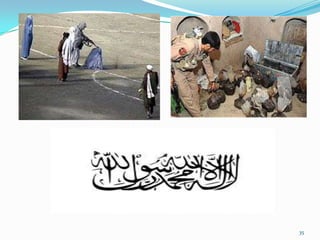
 The Taliban: Alternative spelling Taleban, is an
 Islamic fundamentalist political movement in
 Afghanistan. It spread into Afghanistan and formed
 a government, ruling as the Islamic Emirate of
 Afghanistan from September 1996 until December
 2001, with Kandahar as the capital. However, it
 gained diplomatic recognition from only three states:
 Pakistan, Saudi Arabia, and the United Arab
 Emirates. Mohammed Omar has been serving as the
 spiritual leader of the Taliban since 1994.
 (Encarta, 2012)

                                                         34
35
Rise of Religious Fanaticism in Late
            20th Century
 Shiv Sena: Shiv Sena is a nationalist political organization
  in India founded on 19 June 1966 by political cartoonist
  Bal Thackeray. The party originally emerged out of a
  movement in Mumbai demanding preferential treatment
  for Maharashtra's over migrants to the city. The party
  operates as a network of street gangs and has a powerful
  hold over the Bollywood film industry. It is currently
  headed by Thackeray's son, Uddhav Thackeray. Members
  of    Shiv    Sena     are    referred   to   as   Shiv
  Sainiks.(Encyclopedia, 2012)

                                                             36
37
Impact of Religious Fanaticism
 Religious conflict
 Religious violence
 False religious explanation
 Destruction
 Class struggle
 Backwardness
 Cultural conflict
 Crime activities
 Terrorism

                                38
Unitarianism
 Unitarianism is a religious theological movement, named
 for its understanding of God as one person, in direct
 contrast to Trinitarianism which defines God as three
 persons coexisting consubstantially as one in being.
 Thus, Unitarians contend that main-line Christianity does
 not adhere to strict monotheism as they do, maintaining
 that Jesus was a prophet, and in some sense the "son" of
 God, but not God himself.


                                                         39
40
Conclusion

Mostly religious fanaticism is used in a negative sense.
Sometimes it occurs violence and destruction. Most often

their ideology does not match with the real religious
explanation. So everyone should have a clear concept
about real religious explanation and avoid religious
fanaticism carefully.


                                                       41
References

 Britannica Encyclopedia, 2012
 Microsoft Encarta, 2012
 Banglapedia, 2012
 Postman, N. 1976. Crazy Talk, Stupid Talk. New York
 Rudin, J. 1969. Fanaticism. A psychological Analysis.
  University of Notre Dame Press, London.


                                                          42
43
44

religious fanaticism

  • 2.
  • 3.
    Introduction Fanaticism is thebelief in politics, religion, or other areas that greatly exceeds the norm in enthusiasm and includes a willingness to sacrifice all else to realize its ends. Sometimes fanaticism is like an addiction. When it is addiction it may be harmful or destructive. 3

  • 4.
    Fanaticism  Fanaticism isa belief or behavior involving uncritical zeal, particularly for an extreme religious or political cause or in some cases sports, or with an obsessive enthusiasm for a pastime or hobby.  The fanatic displays very strict standards and little tolerance for contrary ideas or opinions.  In his book Crazy Talk, Stupid Talk, Neil Postman states that "the key to all fanatical beliefs is that they are self- confirming....(some beliefs are) fanatical not because they are 'false', but because they are expressed in such a way that they can never be shown to be false. 4

  • 5.
    Religious Fanaticism  Religiousfanaticism is fanaticism related to a person's, or a group's, devotion to a religion.  In his book, Holy War, Just War, Lloyd Steffen says, "Religious fanaticism . . . invokes the idea of ultimacy, and its presence in religious life is undeniable."He goes on to say, "Religious fanatics are persons who attach to some object an ultimate valuation and then attend to that overvalued object with what is recognizable as a kind of religious" devotion." 5
  • 6.
    Features of ReligiousFanaticism 1. Spiritual needs: Human beings have a spiritual longing for understanding and meaning, and given the mystery of existence. Religion has power to meet this need for meaning and transcendent relationship. 2. Attractiveness: It presents itself in such a way that those who find their way into it come to express themselves in ways consistent with the particular vision of ultimacy at the heart of this religious form. 6
  • 7.
    Features of ReligiousFanaticism 3. Live option: It is present to the moral consciousness as a live option that addresses spiritual need and satisfies human longing for meaning, power, and belonging. 7
  • 8.
    Religious Fanaticism in20th Century (At a Glance)  1905: In France the law on the Separation of the Churches and the State is passed, officially establishing it a state secularism and putting and end to the funding of religious groups by the state. Becoming a place of pilgrimage for neo-druids and other pagans, the Ancient Order of Druids organized the first recorded reconstructionist ceremony in Stonehenge.(Encyclopedia, 2012) 8
  • 9.
    Religious Fanaticism in20th Century (At a Glance)  1908: The establishment of the Khalifatul Masih after Prophethood in the Ahmadiyya Muslim Community, the Second Manifestation of God's Power. (Encyclopedia, 2012)  1917: The October Revolution, in Russia, leads to the annexation of all church properties and subsequent religious suppression. (Encyclopedia, 2012)  The 1917 Constitution of Mexico is written making Mexico a secular state. (Encyclopedia, 2012) 9
  • 10.
    Religious Fanaticism in20th Century (At a Glance)  1930s: Rastafari movement, the Nation of Islam is founded. (Encyclopedia, 2012)  1932: A neo-Hindu religious movement,the Brahma Kumaris or "Daughters of Brahma" started the origin of BKWSU can be traced to the group "Om Mandali", founded by Lekhraj Kripalani(1884–1969). (Encyclopedia, 2012) 10
  • 11.
    Religious Fanaticism in20th Century (At a Glance)  1939 – 1945: Millions of Jews are relocated and killed by the Nazi government during Holocaust. (Encyclopedia, 2012)  1947: British India is partitioned on religious lines; into an Islamic country of Pakistan and the secular nation of India with a Hindu majority. (Encyclopedia, 2012)  1948: The Jews return to their ancient biblical homeland and the state of Israel is created. (Encyclopedia, 2012) 11
  • 12.
    Religious Fanaticism in20th Century (At a Glance)  1961: Unitarian Universalism formed from merger of Unitarianism and Universalism. (Encyclopedia, 2012)  1962 – 1965: The Second Vatican Council takes place.  1965: Srila Prabhupada establishes the International Society for Krishna Consciousness and introduces translations of the Bhagavad-Gita and Vedic Scriptures in mass production all over the world. (Encyclopedia, 2012) 12
  • 13.
    Religious Fanaticism in20th Century (At a Glance)  1966: Anton Szandor LaVey's Satanism begins, with Anton Szandor LaVey's founding of the Church of Satan, although Satanism in itself has always been defined by the Christians themselves. (Encyclopedia, 2012)  1984: Operation Blue Star occurs at holiest site of the Sikhs, the Golden Temple in Amritsar. 1984 Anti-Sikh riots follow. (Encyclopedia, 2012) 13
  • 14.
    Religious Fanaticism in20th Century (At a Glance)  1979: The Iranian Revolution results in the establishment of an Islamic Republic in Iran. (Encyclopedia, 2012)  1989: The revolutions of 1989, the overthrow of many Soviet-style states, allows a resurgence in open religious practice in many Eastern European countries. (Encyclopedia, 2012)  1990s: European pagan reconstructive movements (Celtic, Hellenic, Roman, Slavic, Baltic, Finnish, etc.) organize. (Encyclopedia, 2012) 14
  • 15.
    Rise of ReligiousFanaticism in Late 20th Century  Aden-Abyan Islamic Army: The Aden-Abyan Islamic Army is an Islamist militant organization based in southern Yemen. The group was responsible for kidnapping of 16 foreign tourists in the December 1998 in Abyan. Yemeni government forces attacked place where the hostages were being held resulting in four of the hostages being killed while the remainder were freed. The Aden-Abyan Islamic Army was also believed to have been involved in the 2000 USS Cole bombing in Aden.(Encarta, 2012) 15
  • 16.
    Rise of ReligiousFanaticism in Late 20 th Century  Al-Badr: Al-Badr is an Islamic militant group operating in the Jammu Kashmir region, run by Jasniel Rihal. The group was allegedly formed by the Pakistani Inter-Services Intelligence (ISI) in June 1998. (Encarta, 2012)  Al-Itihaad al-Islamiya: Years active:1994–2006 Headquarters:Kismayo Operating Areas: Somalia (Encarta, 2012) 16
  • 17.
    Rise of ReligiousFanaticism in Late 20th Century  All Tripura Tiger Force: Active:1990 - present Ideology: Tripuri nationalism Leaders: Ranjit Debbarma Area of operations: Tripura, India (Encarta, 2012) 17
  • 18.
    Rise of ReligiousFanaticism in Late 20th Century  Al-Qaeda: Leaders: Osama bin Laden (1988–2011) ,Ayman al- Zawahiri (2011 – present) Active regions: Worldwide  Founded by Osama bin Laden at some point between August 1988 and late 1989, its origins being traceable to the Soviet War in Afghanistan. (Encarta, 2012) 18
  • 19.
  • 20.
    Rise of ReligiousFanaticism in Late 20th Century  Armed Islamic Group of Algeria: is an Islamist organization that wants to overthrow the Algerian government and replace it with an Islamic state. The GIA adopted violent tactics in 1992 after the military government voided the victory of the Islamic Salvation Front, the largest Islamic opposition party, in the first round of legislative elections held in December 1991. (Encarta, 2012) 20
  • 21.
    Rise of ReligiousFanaticism in Late 20 th Century  Destruction of Babri Mosque: Constructed – 1527 Destroyed – 1992 The Babri Mosque was a mosque in Ayodhya, a city in the Faizabad district of Uttar Pradesh, India, on Ramkot Hill ("Rama's fort"). It was destroyed in 1992 when a political rally developed into a riot involving 150,000 people, despite a commitment to the Indian Supreme Court by the rally organizers that the mosque would not be harmed. More than 2,000 people were killed in ensuing riots in many major cities in India including Mumbai and Delhi. (Encarta, 2012) 21
  • 22.
  • 23.
    Rise of ReligiousFanaticism in Late 20th Century  Deendar Anjuman: Active:1924-present Ideology: Sunni Leaders: Moulana Syed Siddique Hussain Area of operations: India  Deendar Anjuman is an Islamic organization based in Hyderabad, India. It is a banned terrorist organization in India since 2001. This organization believes the preaching of Islam among the non-Muslims through the grass-root level. (Encarta, 2012) 23
  • 24.
    Rise of ReligiousFanaticism in Late 20th Century  Hizb ut-Tahrir: Leader: Ata Abu Rashta Founder: Taqiuddin al-Nabhani Founded: 1953 Membership: Estimated 1 million Ideology: Sunni Islamism 24
  • 25.
  • 26.
    Rise of ReligiousFanaticism in Late 20th Century  Hizbul Mujahideen: Founder :Muhammad Ahsan Dar Supreme Commander: Sayeed Salahudeen Founded:1989 Ḥizb al-Mujāhidīn, meaning "party of holy warriors"), founded by Ahsan Dar in 1989, is a Kashmiri militant group active in the Indian- administered state of Jammu and Kashmir since 1989. Their headquarters are located in Muzaffarabad, the capital of Azad Kashmir. (Encarta, 2012) 26
  • 27.
  • 28.
    Rise of ReligiousFanaticism in Late 20th Century  Jamaat-e-Islami: The Jamaat-e-Islami is a social conservative and Islamist political party, advocating for an Islamic and democratic form of government in Pakistan. The JI was founded on August 26, 1941 in Lahore by Muslim theologian and socio-political philosopher Abul Ala Maududi. The party is led by an Emir (lit. Leader), and currently Syed Munawar Hasan is tenuring as Emir of JI. The JI is headquartered in Mansoorah district, Lahore. (Encarta, 2012) 28
  • 29.
  • 30.
    Rise of ReligiousFanaticism in Late 20 th Century  Jamaat-ul-Mujahideen Bangladesh: Jama'atul Mujahideen Bangladesh; abbreviated: JMB; was a Islamist organisation operating in Bangladesh. It was founded in 1998 in Palampur in Dhaka division by Abdur Rahman and gained public prominence in 2001 when bombs and documents detailing the activities of the organization were discovered in Parbatipur in Dinajpur district. The organization was officially banned by the government of Bangladesh in February 2005 after attacks on NGOs, but struck back in mid-August when it detonated 500 bombs at 300 locations throughout Bangladesh.(Banglapedia, 2012) 30
  • 31.
    Rise of ReligiousFanaticism in Late 20th Century  Lashkar-e-Taiba: It was founded in 1990 by Hafiz Muhammad Saeed, Abdullah Yusuf Azzam and Zafar Iqbal in Afghanistan. With its headquarters based in Muridke, near Lahore in Punjab province of Pakistan, the group operates several training camps in Pakistan- administered Kashmir. (Encarta, 2012) 31
  • 32.
    Rise of ReligiousFanaticism in Late 20th Century  Osbat al-Ansar: Osbat al-Ansar or Asbat an-Ansar (League of the Partisans) is a Lebanon-based Sunni fundamentalist group established in the early 1990s which professes the Salafi form of Islam and the overthrow of the Lebanese-dominated secular government. The organization is largely based in Ain al-Hilweh. (Encarta, 2012) 32
  • 33.
    Rise of ReligiousFanaticism in Late 20th Century  Sipah-e-Sahaba Pakistan: Sipah-e-Sahaba Pakistan (SSP) is a Sunni Deobandi Pakistani organization, and a formerly registered Pakistani political party. Established in the early 1980s in Jhang by Maulana Haq Nawaz Jhangvi, its stated goal is to primarily to deter major Shiite influence in Pakistan in the wake of the Iranian Revolution. (Encarta, 2012) 33
  • 34.
    Rise of ReligiousFanaticism in Late 20 th Century  The Taliban: Alternative spelling Taleban, is an Islamic fundamentalist political movement in Afghanistan. It spread into Afghanistan and formed a government, ruling as the Islamic Emirate of Afghanistan from September 1996 until December 2001, with Kandahar as the capital. However, it gained diplomatic recognition from only three states: Pakistan, Saudi Arabia, and the United Arab Emirates. Mohammed Omar has been serving as the spiritual leader of the Taliban since 1994. (Encarta, 2012) 34
  • 35.
  • 36.
    Rise of ReligiousFanaticism in Late 20th Century  Shiv Sena: Shiv Sena is a nationalist political organization in India founded on 19 June 1966 by political cartoonist Bal Thackeray. The party originally emerged out of a movement in Mumbai demanding preferential treatment for Maharashtra's over migrants to the city. The party operates as a network of street gangs and has a powerful hold over the Bollywood film industry. It is currently headed by Thackeray's son, Uddhav Thackeray. Members of Shiv Sena are referred to as Shiv Sainiks.(Encyclopedia, 2012) 36
  • 37.
  • 38.
    Impact of ReligiousFanaticism  Religious conflict  Religious violence  False religious explanation  Destruction  Class struggle  Backwardness  Cultural conflict  Crime activities  Terrorism 38
  • 39.
    Unitarianism  Unitarianism isa religious theological movement, named for its understanding of God as one person, in direct contrast to Trinitarianism which defines God as three persons coexisting consubstantially as one in being. Thus, Unitarians contend that main-line Christianity does not adhere to strict monotheism as they do, maintaining that Jesus was a prophet, and in some sense the "son" of God, but not God himself. 39
  • 40.
  • 41.
    Conclusion Mostly religious fanaticismis used in a negative sense. Sometimes it occurs violence and destruction. Most often their ideology does not match with the real religious explanation. So everyone should have a clear concept about real religious explanation and avoid religious fanaticism carefully. 41
  • 42.
    References  Britannica Encyclopedia,2012  Microsoft Encarta, 2012  Banglapedia, 2012  Postman, N. 1976. Crazy Talk, Stupid Talk. New York  Rudin, J. 1969. Fanaticism. A psychological Analysis. University of Notre Dame Press, London. 42
  • 43.
  • 44.