Does Religion Promote
Violence?
Is Religion The Cause
Behind Most of
Humanity’s Conflicts
and Wars?
BY Dr. Emad Salih
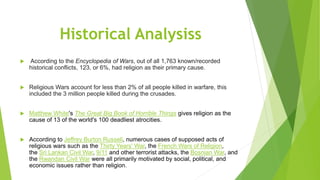
Historical Analysiss
 According to the Encyclopedia of Wars, out of all 1,763 known/recorded
historical conflicts, 123, or 6%, had religion as their primary cause.
 Religious Wars account for less than 2% of all people killed in warfare, this
included the 3 million people killed during the crusades.
 Matthew White's The Great Big Book of Horrible Things gives religion as the
cause of 13 of the world's 100 deadliest atrocities.
 According to Jeffrey Burton Russell, numerous cases of supposed acts of
religious wars such as the Thirty Years' War, the French Wars of Religion,
the Sri Lankan Civil War, 9/11 and other terrorist attacks, the Bosnian War, and
the Rwandan Civil War were all primarily motivated by social, political, and
economic issues rather than religion.
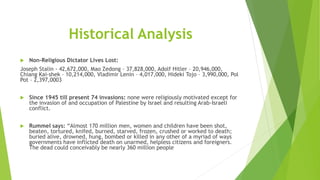
Historical Analysis
 Non-Religious Dictator Lives Lost:
Joseph Stalin - 42,672,000, Mao Zedong – 37,828,000, Adolf Hitler – 20,946,000,
Chiang Kai-shek – 10,214,000, Vladimir Lenin – 4,017,000, Hideki Tojo – 3,990,000, Pol
Pot – 2,397,0003
 Since 1945 till present 74 invasions: none were religiously motivated except for
the invasion of and occupation of Palestine by Israel and resulting Arab-Israeli
conflict.
 Rummel says: “Almost 170 million men, women and children have been shot,
beaten, tortured, knifed, burned, starved, frozen, crushed or worked to death;
buried alive, drowned, hung, bombed or killed in any other of a myriad of ways
governments have inflicted death on unarmed, helpless citizens and foreigners.
The dead could conceivably be nearly 360 million people
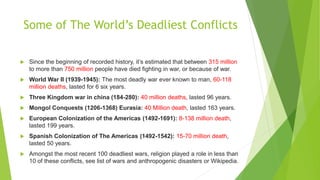
Some of The World’s Deadliest Conflicts
 Since the beginning of recorded history, it’s estimated that between 315 million
to more than 750 million people have died fighting in war, or because of war.
 World War II (1939-1945): The most deadly war ever known to man, 60-118
million deaths, lasted for 6 six years.
 Three Kingdom war in china (184-280): 40 million deaths, lasted 96 years.
 Mongol Conquests (1206-1368) Eurasia: 40 Million death, lasted 163 years.
 European Colonization of the Americas (1492-1691): 8-138 million death,
lasted 199 years.
 Spanish Colonization of The Americas (1492-1542): 15-70 million death,
lasted 50 years.
 Amongst the most recent 100 deadliest wars, religion played a role in less than
10 of these conflicts, see list of wars and anthropogenic disasters or Wikipedia.
War Casualties since 1400
Wars Throughout History
Analysis of Conflicts Throughout
History
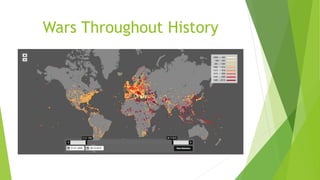
 Map only contains the 2,657 battles that Nodegoat could geocode and date.
 The overwhelming majority of battles in North America took place when
white Europeans were methodically replacing the continent’s previous
inhabitants and waging war on each other.
 Fighting across Europe has come and gone in waves, while most documented
battles in Southeast Asia and Africa have occurred in modern times.
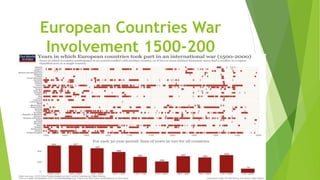
 Most wars in documented history have taken place in Europe and the
Americas.
 Violence is not unique to Arabs, Africans, Hispanics, indigenous people, or
Muslims; contrary to what the biased and directed media wants you to
believe.
European Countries War
Involvement 1500-200
US Military Operations
American Deployments
Worldwide
American Imperialism
US Military Interventions
Since WW2
Studies by Psychologists
 Are religious faiths more inherently prone to violence than ideologies that
are secular?
 See the comprehensive review study: Empirical Perspectives on Religion and
Violence by Joshua D. Wright and Yuelee Khoo, Department of Psychology,
University of Western Ontario, Western Centre for Research on Migration and
Ethnic Relations.
 The paper falls in 48 pages citing over 100 references and studies on this
matter by various psychology, sociology, and political sciences researchers.
Findings: Empirical Perspectives on
Religion and Violence
 Following an evaluation of the scientific literature on religion and violence,
we argue that wherever evidence links specific aspects of religion with
aggression and violence, these aspects are not unique to religion.
 Rather, these aspects are religious variants of more general psychological
processes.
 Further, there are numerous aspects of religion that buffer against aggression
and violence among its adherents.
 The most distinct feature of religion, supernaturalism, is associated with
reduced aggression and violence.

Studies Show That it is The Threat to Any
Identity Whether Religious or Secular That
Leads to Hostility and Violence
 Threats toward Muslim identity were associated with anti-Western hostilities
(Study 3 & 4; Obaidi et al., 2018). Similar results were found in a study assessing
reactions to threats towards one’s gender and national identities (Fischer et al.,
2010).
 Secular groups can also exhibit fundamentalist beliefs and react violently, in part,
due to these beliefs. For example, fundamentalist thinking is exhibited in both
extremes of the political spectrum (Toner, Leary, Asher, & Jongman-Sereno, 2013)
and eco-terrorism is not linked to a religious ideology (Eagan, 1996).
 The above suggests that this process is not an inherent aspect of religion, but an
aspect of social identities in general.
 "blind religious zealotry is similar to unfettered nationalism” (Kimball, When
Religion Becomes Evil, 38)
Studies Show That it is The Threat to Any Identity
Whether Religious or Secular That Leads to
Hostility and Violence
 Denigration of national identity resulted in greater aggression relative to both
denigration of religion and the neutral control (Wright, Agterberg, and Esses
2018).
 More government restrictions on religious groups are associated with more
religious hostilities and the most violent regions in the world reflect the most
government restrictions toward religion (Institute for Economics and Peace,
2013).
 Karen Armstrong (2014) states, “Every fundamentalist movement that I have
studied in Judaism, Christianity, and Islam is rooted in a profound fear of
annihilation, convinced that the liberal or secular establishment is
determined to destroy their way of life.”
Secular Groups Behave in The Same Manner as
Religious Groups, studies show
 In general, secular motivations for conflict are far more common than
religious motivations (Institute for Economics and Peace, 2013), yet
“Secular loyalty to nations and movements, leading to death on the
battlefield, raises fewer questions than the loss of life for religious
ideals” (Beit-Hallahmi, 2015, p. 151)
 Dogmatism (lack of openness in beliefs) is associated with hostility
and aggression (Heyman, 1977) and dogmatic atheists act with
prejudice against value violating outgroups (Kossowska,
Czernatowicz‐Kukuczka, & Sekerdej, 2017).
 In fact, non- believers may actually be more dogmatic than believers
(Uzarevic, Saroglou, & Clobert, 2017).
Violence and Bad Things can & Are
Done Under Many Names
 " Faith in technology, secular humanism, consumerism, football fanaticism,
and a host of other worldviews can be counted as religions, too. Wentz is
compelled to conclude, rather lamely, "Perhaps all of us do bad things in the
name of (or as a representative of) religion” (Richard E. Wentz, Why People
Do Bad Things in the Name of Religion (Mercer University Press, 1993), 37.
 "Much of what I have said about religious terrorism in this book may be
applied to other forms of political violence—especially those that are
ideological and ethnic in nature.” (Mark Juergensmeyer, Terror in the Mind of
God: The Global Rise of Religious Violence (University of California Press,
2000)
 "several secular ideologies, such as some varieties of Marxism, conservatism,
and even liberalism have a quasi-religious orientation and form, and
conversely formally religious languages sometimes have a secular content, so
that the dividing line between a secular and a religious language is sometimes
difficult to draw.” (Ibid., 74)
Studies on Violence in The Middle East
 Religious violence in Muslim countries may be a result of pressures from
secular nationalism (Juergensmeyer, 2010) and reactance to interventions by
major powers (Gleditsch & Rudolfsen, 2016), rather than some unique
fundamentalist character of religion.
 Fox (2001) finds that conflicts in the Middle East involve similar levels of
political discrimination, economic discrimination, cultural discrimination,
repression, desire for autonomy, and terrorism or rebellion as other non-
religious conflicts in other parts of the world.
 Fox (2001)“It is easy to assume that the prevalence of religious conflict in the
Middle East is due to the region’s Islamic and autocratic character. It is also
easy to assume that the region’s high concentration of autocracy is due to the
region’s Islamic character. Yet neither of these assumptions appears to be
correct” (p. 39).
 Threats from Muslims toward Norwegian and American Christian identities
have been linked to support for collective action against Muslim immigrants
(Study 1 & Study 2; Obaidi, Kunst, Kteily, Thomsen & Sidanius, 2018).
Religious Beliefs Actually Promote Peace
According to Studies
 These results support arguments that religious beliefs generally
promote peace in human relations (Nepstad, 2004; Shepperd, Miller, &
Smith, 2015) and corroborate other empirical research (Bremner,
Koole, & Bushman, 2011; Schumann, McGregor, Nash, & Ross, 2014).
 Bremner et al. (2011) suggests that praying for others results in
decreased anger and aggression toward an insulting stranger
 A study in Indonesia indicated that religious practice (measured as a
function of mandated prayer, optional prayer, fasting, and religious
activities) was associated with less agreement with violent jihad
(Muluk et al., 2013).
 This finding is in line with the argument that many religious Islamist
radicals are recent converts, not steeped in their religious tradition
(Stern, 2010).
An Example For What Might Happen in The
Absence of Religious Beliefs; Adolf Hitler and
Joseph Stalin
 Hitler: The wide consensus of historians consider him to have been irreligious,
antichristian, anti-clerical, and scientistic (Richard Overy; The Dictators:
Hitler's Germany, Stalin's Russia).
 Both Stalin and Hitler wanted a neutered religion, subservient to the state,
while the slow programme of scientific revelation destroyed the foundation of
religious myth.
 In his private diaries, Goebbels wrote in April 1941 that Hitler was "a fierce
opponent" of the Vatican and Christianity.
 From the mid-1930s, his government was increasingly dominated by militant
anti-church proponents like Goebbels,
Bormann, Himmler, Rosenberg and Heydrich whom Hitler appointed to key
posts.
 historians conclude that he ultimately intended the destruction of Christianity
in Germany, or at least its distortion or subjugation to a Nazi outlook.
Joseph Stalin and Adolf Hitler
 Joseph Stalin (1878-1953) was a hardcore atheist who led a brutal anti-religious
campaign in Russia.
 USSR anti-religious campaign (1921–1928): Aimed at the elimination of most
religion and its replacement with deism, agnosticism and atheism supported with a
materialist world view.
 The main target of the anti-religious campaign in the 1920s and 1930s was
the Russian Orthodox Church.
 In the period between 1927 and 1940, the number of Orthodox Churches in the
Russian Republic fell from 29,584 to less than 500
 They used anti-religious propaganda, seized churches, exterminated and
persecuted clergy and faithful; Nearly all clergy, and many of its believers, were
shot or sent to labour camps.
 Estimated killings of any opposition in Russia higher than 20 million.
 Hitler lead a similar campaign against the Roman Catholic Church in Germany but
not as conspicuous as Stalin’s.
 In all, an estimated one third of German priests faced some form of reprisal in
Nazi Germany and 400 German priests were sent to the concentration camps,
churches properties were seized, clergy were watched closely etc.
Operation Barbarossa (Fritz) Between Hitler and
Stalin June 22, 1941
 The Biggest Single Military Operation in Human History.
 It witnessed clashes of unprecedented violence and destruction for four years
that resulted in the deaths of more than 26 million Soviet people and about
8.6 million of the Red Army
 War crimes such as execution of prisoners of war and anyone who is racially
inferior or anyone who “just looked funny”, sexual violence such rapes and
gang-rapes, deliberate starvation to death of millions, use of prisoners on
medical and drug experiments etc.
 The Genocidal policies of Nazi Germany were based on the ideology of Social
Darwinism (Survival of The Fittest).
 “Whoever would live, let him fight, and who does not want to do battle in
this world of eternal struggle, does not deserve life” (Adolf Hitler, Mein
Kampf)
Studies on The Role of Mass-Media in Distorting
Reality and Promoting Islamophobia
 According to Kurt (2017), 90 percent of all the terrorist attacks committed on
the US soil were committed by non-Muslims, but it was never highlighted nor
even blamed upon them. In case of terrorism or any other criminal activities
never the religion of the criminal or terrorist became a concern if he was not
a Muslim.
 Any kind of unlawful activity done by a Muslim; be him religious or non-
religious is blamed upon the entire religion and whole Muslim community
(Wurth, 2015).
 Islamophobia is on the rise in an uncontrollable pace thanks to the efforts of
the media and sponsorship of the states who need it for oil, gas and arms
trade (Werelam, 2015).
 As the US and other coalition army soldiers kept dying in the battlefield of
Afghanistan’s and Iraq, the media fuelled more Islamophobia and people also
bought the stories (Ludwig, 2015)
Studies on The Role of Mass-Media in Distorting
Reality and Promoting Islamophobia
 That initial growth of Islamophobia is today a grace for the media. Because, it
was observed that, reports and news relating to Islam and terrorism get more
audience attraction (Stephanie, 2012).
 Islam is 14 centuries old whereas this religious terrorism is only thirty or forty
years old. The people in the west do not know much about Islam, so they are
vulnerable to the media propaganda which is fed to them (Awn, 2016).
 Since the 9/11, politicians and media used that attack blatantly to achieve
their own agenda that fear and suspicion about Islam has been on the rise
since (Sheehi, 2011).
 The Politico-Media Complex of the state works to hide all their evil works and
focuses on the evil of the counterpart more (Chomsky & Herman, 1998).
 This demonization of the
 Muslims is necessary to justify their illegal war for oil and gas and arms
industry, in the name of fighting terrorism and establishing democracy to
liberate the people (Frantzman, 2016)
Study on Depiction of Islam in
Australian Media
 1-year study on 5 major Australian newspapers in 2017.
 2891 articles referring to Islam or Muslims alongside words like violence,
terrorism, extremism, or radical.
 More than 8 articles a day portraying Islam and Muslims negatively.
 Of these 2891 articles, 152 were on front pages.
 That is almost every second day the Australian public is being bombarded with
a negative image about Islam and Muslims.
 Indeed there have been a few terrorist attacks in 2017, but would the number
of attacks warrant such stereotyping of over 600,000 (2.6% of the Australian
population) Muslims living in Australia for the criminal actions of a handful of
people?
 A study in 2016 by researches at Griffith Univ.: 70% Australians admitted to
knowing little to nothing about Islam and Muslims, of course, except the
negative image they see in the media.
Thank You

Does religion promote violence

  • 1.
    Does Religion Promote Violence? IsReligion The Cause Behind Most of Humanity’s Conflicts and Wars? BY Dr. Emad Salih
  • 2.
    Historical Analysiss  Accordingto the Encyclopedia of Wars, out of all 1,763 known/recorded historical conflicts, 123, or 6%, had religion as their primary cause.  Religious Wars account for less than 2% of all people killed in warfare, this included the 3 million people killed during the crusades.  Matthew White's The Great Big Book of Horrible Things gives religion as the cause of 13 of the world's 100 deadliest atrocities.  According to Jeffrey Burton Russell, numerous cases of supposed acts of religious wars such as the Thirty Years' War, the French Wars of Religion, the Sri Lankan Civil War, 9/11 and other terrorist attacks, the Bosnian War, and the Rwandan Civil War were all primarily motivated by social, political, and economic issues rather than religion.
  • 3.
    Historical Analysis  Non-ReligiousDictator Lives Lost: Joseph Stalin - 42,672,000, Mao Zedong – 37,828,000, Adolf Hitler – 20,946,000, Chiang Kai-shek – 10,214,000, Vladimir Lenin – 4,017,000, Hideki Tojo – 3,990,000, Pol Pot – 2,397,0003  Since 1945 till present 74 invasions: none were religiously motivated except for the invasion of and occupation of Palestine by Israel and resulting Arab-Israeli conflict.  Rummel says: “Almost 170 million men, women and children have been shot, beaten, tortured, knifed, burned, starved, frozen, crushed or worked to death; buried alive, drowned, hung, bombed or killed in any other of a myriad of ways governments have inflicted death on unarmed, helpless citizens and foreigners. The dead could conceivably be nearly 360 million people
  • 4.
    Some of TheWorld’s Deadliest Conflicts  Since the beginning of recorded history, it’s estimated that between 315 million to more than 750 million people have died fighting in war, or because of war.  World War II (1939-1945): The most deadly war ever known to man, 60-118 million deaths, lasted for 6 six years.  Three Kingdom war in china (184-280): 40 million deaths, lasted 96 years.  Mongol Conquests (1206-1368) Eurasia: 40 Million death, lasted 163 years.  European Colonization of the Americas (1492-1691): 8-138 million death, lasted 199 years.  Spanish Colonization of The Americas (1492-1542): 15-70 million death, lasted 50 years.  Amongst the most recent 100 deadliest wars, religion played a role in less than 10 of these conflicts, see list of wars and anthropogenic disasters or Wikipedia.
  • 5.
  • 6.
  • 7.
    Analysis of ConflictsThroughout History  Map only contains the 2,657 battles that Nodegoat could geocode and date.  The overwhelming majority of battles in North America took place when white Europeans were methodically replacing the continent’s previous inhabitants and waging war on each other.  Fighting across Europe has come and gone in waves, while most documented battles in Southeast Asia and Africa have occurred in modern times.  Most wars in documented history have taken place in Europe and the Americas.  Violence is not unique to Arabs, Africans, Hispanics, indigenous people, or Muslims; contrary to what the biased and directed media wants you to believe.
  • 8.
  • 9.
  • 10.
  • 11.
  • 12.
  • 13.
    Studies by Psychologists Are religious faiths more inherently prone to violence than ideologies that are secular?  See the comprehensive review study: Empirical Perspectives on Religion and Violence by Joshua D. Wright and Yuelee Khoo, Department of Psychology, University of Western Ontario, Western Centre for Research on Migration and Ethnic Relations.  The paper falls in 48 pages citing over 100 references and studies on this matter by various psychology, sociology, and political sciences researchers.
  • 14.
    Findings: Empirical Perspectiveson Religion and Violence  Following an evaluation of the scientific literature on religion and violence, we argue that wherever evidence links specific aspects of religion with aggression and violence, these aspects are not unique to religion.  Rather, these aspects are religious variants of more general psychological processes.  Further, there are numerous aspects of religion that buffer against aggression and violence among its adherents.  The most distinct feature of religion, supernaturalism, is associated with reduced aggression and violence.
  • 15.
    Studies Show Thatit is The Threat to Any Identity Whether Religious or Secular That Leads to Hostility and Violence  Threats toward Muslim identity were associated with anti-Western hostilities (Study 3 & 4; Obaidi et al., 2018). Similar results were found in a study assessing reactions to threats towards one’s gender and national identities (Fischer et al., 2010).  Secular groups can also exhibit fundamentalist beliefs and react violently, in part, due to these beliefs. For example, fundamentalist thinking is exhibited in both extremes of the political spectrum (Toner, Leary, Asher, & Jongman-Sereno, 2013) and eco-terrorism is not linked to a religious ideology (Eagan, 1996).  The above suggests that this process is not an inherent aspect of religion, but an aspect of social identities in general.  "blind religious zealotry is similar to unfettered nationalism” (Kimball, When Religion Becomes Evil, 38)
  • 16.
    Studies Show Thatit is The Threat to Any Identity Whether Religious or Secular That Leads to Hostility and Violence  Denigration of national identity resulted in greater aggression relative to both denigration of religion and the neutral control (Wright, Agterberg, and Esses 2018).  More government restrictions on religious groups are associated with more religious hostilities and the most violent regions in the world reflect the most government restrictions toward religion (Institute for Economics and Peace, 2013).  Karen Armstrong (2014) states, “Every fundamentalist movement that I have studied in Judaism, Christianity, and Islam is rooted in a profound fear of annihilation, convinced that the liberal or secular establishment is determined to destroy their way of life.”
  • 17.
    Secular Groups Behavein The Same Manner as Religious Groups, studies show  In general, secular motivations for conflict are far more common than religious motivations (Institute for Economics and Peace, 2013), yet “Secular loyalty to nations and movements, leading to death on the battlefield, raises fewer questions than the loss of life for religious ideals” (Beit-Hallahmi, 2015, p. 151)  Dogmatism (lack of openness in beliefs) is associated with hostility and aggression (Heyman, 1977) and dogmatic atheists act with prejudice against value violating outgroups (Kossowska, Czernatowicz‐Kukuczka, & Sekerdej, 2017).  In fact, non- believers may actually be more dogmatic than believers (Uzarevic, Saroglou, & Clobert, 2017).
  • 18.
    Violence and BadThings can & Are Done Under Many Names  " Faith in technology, secular humanism, consumerism, football fanaticism, and a host of other worldviews can be counted as religions, too. Wentz is compelled to conclude, rather lamely, "Perhaps all of us do bad things in the name of (or as a representative of) religion” (Richard E. Wentz, Why People Do Bad Things in the Name of Religion (Mercer University Press, 1993), 37.  "Much of what I have said about religious terrorism in this book may be applied to other forms of political violence—especially those that are ideological and ethnic in nature.” (Mark Juergensmeyer, Terror in the Mind of God: The Global Rise of Religious Violence (University of California Press, 2000)  "several secular ideologies, such as some varieties of Marxism, conservatism, and even liberalism have a quasi-religious orientation and form, and conversely formally religious languages sometimes have a secular content, so that the dividing line between a secular and a religious language is sometimes difficult to draw.” (Ibid., 74)
  • 19.
    Studies on Violencein The Middle East  Religious violence in Muslim countries may be a result of pressures from secular nationalism (Juergensmeyer, 2010) and reactance to interventions by major powers (Gleditsch & Rudolfsen, 2016), rather than some unique fundamentalist character of religion.  Fox (2001) finds that conflicts in the Middle East involve similar levels of political discrimination, economic discrimination, cultural discrimination, repression, desire for autonomy, and terrorism or rebellion as other non- religious conflicts in other parts of the world.  Fox (2001)“It is easy to assume that the prevalence of religious conflict in the Middle East is due to the region’s Islamic and autocratic character. It is also easy to assume that the region’s high concentration of autocracy is due to the region’s Islamic character. Yet neither of these assumptions appears to be correct” (p. 39).  Threats from Muslims toward Norwegian and American Christian identities have been linked to support for collective action against Muslim immigrants (Study 1 & Study 2; Obaidi, Kunst, Kteily, Thomsen & Sidanius, 2018).
  • 20.
    Religious Beliefs ActuallyPromote Peace According to Studies  These results support arguments that religious beliefs generally promote peace in human relations (Nepstad, 2004; Shepperd, Miller, & Smith, 2015) and corroborate other empirical research (Bremner, Koole, & Bushman, 2011; Schumann, McGregor, Nash, & Ross, 2014).  Bremner et al. (2011) suggests that praying for others results in decreased anger and aggression toward an insulting stranger  A study in Indonesia indicated that religious practice (measured as a function of mandated prayer, optional prayer, fasting, and religious activities) was associated with less agreement with violent jihad (Muluk et al., 2013).  This finding is in line with the argument that many religious Islamist radicals are recent converts, not steeped in their religious tradition (Stern, 2010).
  • 21.
    An Example ForWhat Might Happen in The Absence of Religious Beliefs; Adolf Hitler and Joseph Stalin  Hitler: The wide consensus of historians consider him to have been irreligious, antichristian, anti-clerical, and scientistic (Richard Overy; The Dictators: Hitler's Germany, Stalin's Russia).  Both Stalin and Hitler wanted a neutered religion, subservient to the state, while the slow programme of scientific revelation destroyed the foundation of religious myth.  In his private diaries, Goebbels wrote in April 1941 that Hitler was "a fierce opponent" of the Vatican and Christianity.  From the mid-1930s, his government was increasingly dominated by militant anti-church proponents like Goebbels, Bormann, Himmler, Rosenberg and Heydrich whom Hitler appointed to key posts.  historians conclude that he ultimately intended the destruction of Christianity in Germany, or at least its distortion or subjugation to a Nazi outlook.
  • 22.
    Joseph Stalin andAdolf Hitler  Joseph Stalin (1878-1953) was a hardcore atheist who led a brutal anti-religious campaign in Russia.  USSR anti-religious campaign (1921–1928): Aimed at the elimination of most religion and its replacement with deism, agnosticism and atheism supported with a materialist world view.  The main target of the anti-religious campaign in the 1920s and 1930s was the Russian Orthodox Church.  In the period between 1927 and 1940, the number of Orthodox Churches in the Russian Republic fell from 29,584 to less than 500  They used anti-religious propaganda, seized churches, exterminated and persecuted clergy and faithful; Nearly all clergy, and many of its believers, were shot or sent to labour camps.  Estimated killings of any opposition in Russia higher than 20 million.  Hitler lead a similar campaign against the Roman Catholic Church in Germany but not as conspicuous as Stalin’s.  In all, an estimated one third of German priests faced some form of reprisal in Nazi Germany and 400 German priests were sent to the concentration camps, churches properties were seized, clergy were watched closely etc.
  • 23.
    Operation Barbarossa (Fritz)Between Hitler and Stalin June 22, 1941  The Biggest Single Military Operation in Human History.  It witnessed clashes of unprecedented violence and destruction for four years that resulted in the deaths of more than 26 million Soviet people and about 8.6 million of the Red Army  War crimes such as execution of prisoners of war and anyone who is racially inferior or anyone who “just looked funny”, sexual violence such rapes and gang-rapes, deliberate starvation to death of millions, use of prisoners on medical and drug experiments etc.  The Genocidal policies of Nazi Germany were based on the ideology of Social Darwinism (Survival of The Fittest).  “Whoever would live, let him fight, and who does not want to do battle in this world of eternal struggle, does not deserve life” (Adolf Hitler, Mein Kampf)
  • 24.
    Studies on TheRole of Mass-Media in Distorting Reality and Promoting Islamophobia  According to Kurt (2017), 90 percent of all the terrorist attacks committed on the US soil were committed by non-Muslims, but it was never highlighted nor even blamed upon them. In case of terrorism or any other criminal activities never the religion of the criminal or terrorist became a concern if he was not a Muslim.  Any kind of unlawful activity done by a Muslim; be him religious or non- religious is blamed upon the entire religion and whole Muslim community (Wurth, 2015).  Islamophobia is on the rise in an uncontrollable pace thanks to the efforts of the media and sponsorship of the states who need it for oil, gas and arms trade (Werelam, 2015).  As the US and other coalition army soldiers kept dying in the battlefield of Afghanistan’s and Iraq, the media fuelled more Islamophobia and people also bought the stories (Ludwig, 2015)
  • 25.
    Studies on TheRole of Mass-Media in Distorting Reality and Promoting Islamophobia  That initial growth of Islamophobia is today a grace for the media. Because, it was observed that, reports and news relating to Islam and terrorism get more audience attraction (Stephanie, 2012).  Islam is 14 centuries old whereas this religious terrorism is only thirty or forty years old. The people in the west do not know much about Islam, so they are vulnerable to the media propaganda which is fed to them (Awn, 2016).  Since the 9/11, politicians and media used that attack blatantly to achieve their own agenda that fear and suspicion about Islam has been on the rise since (Sheehi, 2011).  The Politico-Media Complex of the state works to hide all their evil works and focuses on the evil of the counterpart more (Chomsky & Herman, 1998).  This demonization of the  Muslims is necessary to justify their illegal war for oil and gas and arms industry, in the name of fighting terrorism and establishing democracy to liberate the people (Frantzman, 2016)
  • 26.
    Study on Depictionof Islam in Australian Media  1-year study on 5 major Australian newspapers in 2017.  2891 articles referring to Islam or Muslims alongside words like violence, terrorism, extremism, or radical.  More than 8 articles a day portraying Islam and Muslims negatively.  Of these 2891 articles, 152 were on front pages.  That is almost every second day the Australian public is being bombarded with a negative image about Islam and Muslims.  Indeed there have been a few terrorist attacks in 2017, but would the number of attacks warrant such stereotyping of over 600,000 (2.6% of the Australian population) Muslims living in Australia for the criminal actions of a handful of people?  A study in 2016 by researches at Griffith Univ.: 70% Australians admitted to knowing little to nothing about Islam and Muslims, of course, except the negative image they see in the media.
  • 27.