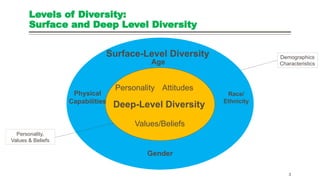
Levels of Diversity:
Surfaceand Deep Level Diversity
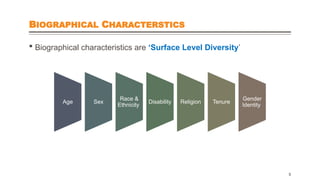
Surface-Level Diversity
Age
Race/
Ethnicity
Gender
Deep-Level Diversity
Personality Attitudes
Values/Beliefs
Physical
Capabilities
Demographics
Characteristics
Personality,
Values & Beliefs
3
4.
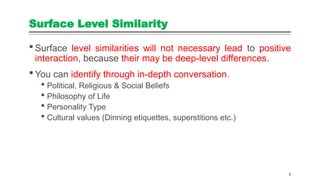
Surface Level Similarity
Surface level similarities will not necessary lead to positive
interaction, because their may be deep-level differences.
You can identify through in-depth conversation.
Political, Religious & Social Beliefs
Philosophy of Life
Personality Type
Cultural values (Dinning etiquettes, superstitions etc.)
4
Aging Workforce
Theaging of the workforce was consistently the most
significant concern of HR managers.
The loss of skills resulting from the retirement of many early
millennials:
Increased medical cost due to health issues.
Safety Risks, deteriorating memory, strength, flexibility, eyesight,
hearing etc..
Average health cost of 60+ years may be two to three times those of
40 years old.
Intergenerational conflicts [Baby Boomers vs. Millennials vs. Gen Z]
Difficult to develop multi-lingual training materials
6
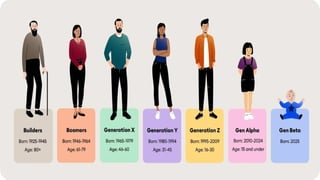
LEADING THE FOURGENERATION AT WORK
• Age 72 to 92 years
• Silent are considered as most loyal workers, highly dedicated and risk
averse, strong commitment to teamwork and collaboration and good at
interpersonal communication.
SILENT
(Born between 1925 and 1946)
• Age 53 to 71 years [First Generation]
• They give high priority to work over personal life, the more optimistic and
open to change than prior generation.
BABY BOOMERS
(Born between 1946 and 1964)
• Age 37 to 52 years
• They are the product of change.
• They naturally question authority figures and responsible for work life
balance, generation posses strong technical skills and more independent.
GENERATION XERS
(Born between 1965 and 1980)
• They grow up using internet and IT from very young age.
• They expect lots of feedback and rewards in the workplace.
• This group is first global centric generation, came during the rapid growth
of internet, they are most resilient (strong) in navigating change and
appreciate diversity inclusion.
MILLENNIALS OR GENERATION Y
(Born in or after 1981)
Maximum age 36 years
8
9.
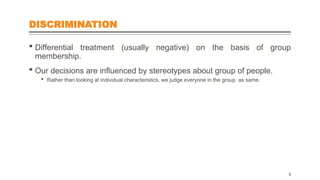
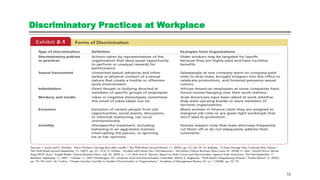
DISCRIMINATION
Differential treatment(usually negative) on the basis of group
membership.
Our decisions are influenced by stereotypes about group of people.
Rather than looking at individual characteristics, we judge everyone in the group as same.
9
Relationship Between Age& Job Satisfaction
Older workers tend to be more satisfied with their work.
Report better relationships with coworkers, and are more committed to
their employing organizations.
Engage in citizenship behavior.
11
12.
SEX [Biological Differencebetween Men & Women]
There is no consistent male-female differences in problem solving ability,
analytical skills, competitive drive, motivation, sociability or learning ability.
Psychological studies:
Found that women are more agreeable and willing to conform to authority.
Men are more aggressive and more likely to have expectations of success.
But these differences are minor.
There is no significant difference in job productivity between men and
women.
Common Perception about women and men:
Women who succeed in traditionally male domains are perceived as LESS
LIKABLE, MORE HOSTILE, AND LESS DESIRABLE AS SUPERVISORS.
12
13.
Race & Ethnicity
Race(Biological Heritage)
Classification of human beings
according to biographical /
physical characteristics.
For Example:
Skin Color
Eye Color
Hair
Sizes and shapes
Ethnicity (Cultural)
Classification of human beings
according to their cultural
background.
For Example:
Cultural (Punjabi, Pashtun, Sindhi,
Baloch etc..)
13
14.
On the basisof Race & Ethnicity
In workplace settings employees do favor their race &
ethnicity.
May slightly favor in performance appraisal, promotion
decision, and pay rises etc..
Making worse decisions for specific race. [Discrimination]
i.e. Non-White must have to use separate entrance at
work.
14
15.
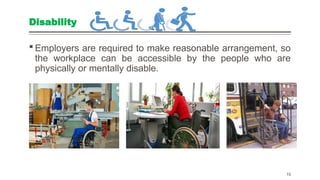
Disability
Employers arerequired to make reasonable arrangement, so
the workplace can be accessible by the people who are
physically or mentally disable.
15
16.
Some jobs obviouslycannot be accommodated to
some disabilities
A blind person could not be a bus driver
Person with profound mobility constraints probably could not be a
police patrol officer.
Mental Vs. Physical Disabilities
Employees with mental disabilities impair performance more
than physical disabilities.
Individual with common mental health issues as depression, and
anxiety are significantly more likely to be absent from work.
People with mental illness are given lower ratings.
Accomplishments of disable people are often more impressive than of
people without disabilities. 16
17.
Other Biographical Characteristics:Tenure, Religion,
and Gender Identity
Tenure: The impact of seniority on job performance.
Relationship Between:
Seniority and Job Productivity is (Positive)
So the work experience is good predictor of employee productivity.
Seniority and Turnover/ Absenteeism (Negative)
Longer a person works, less likely to he or she is to quit.
Tenure and Job Satisfaction (Positive)
The past behavior is the best predictor of future behavior.
Tenure at previous job is best predictor of future employee turnover.
17
18.
Religion
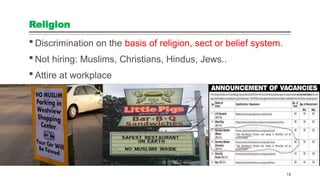
Discrimination onthe basis of religion, sect or belief system.
Not hiring: Muslims, Christians, Hindus, Jews..
Attire at workplace
18
19.
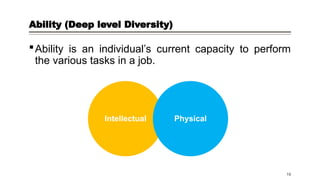
Ability (Deep levelDiversity)
Ability is an individual’s current capacity to perform
the various tasks in a job.
Intellectual Physical
19
20.
Intellectual Abilities
Intellectualabilities needed to perform mental activities—
Critical Thinking, Reasoning, Problem solving, and Creative
Skills.
Many people focus on strengthening mental abilities because
generally people can earn more if they are sound in these
abilities.
Receive higher education, certification and affiliations.
Attend workshop, parallel education (E-MBA, Diplomas etc..)
20
21.
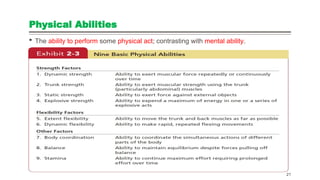
Physical Abilities
Theability to perform some physical act; contrasting with mental ability.
21
22.
Implementing Diversity ManagementStrategies
Diversity Management: The process and programs by which
managers make everyone more aware of and sensitive to the
needs and differences of others.
Attracting, Selecting, Developing and Retaining Diverse
Employees
Diversity in groups
Expatriate adjustments
Effective Diversity Programs
22
Editor's Notes
#8 The greatest generation Born before 1928,
The coming generations is NEXTERS – Flexible lifestyle.

![Aging Workforce
The aging of the workforce was consistently the most
significant concern of HR managers.
The loss of skills resulting from the retirement of many early
millennials:
Increased medical cost due to health issues.
Safety Risks, deteriorating memory, strength, flexibility, eyesight,
hearing etc..
Average health cost of 60+ years may be two to three times those of
40 years old.
Intergenerational conflicts [Baby Boomers vs. Millennials vs. Gen Z]
Difficult to develop multi-lingual training materials
6](https://image.slidesharecdn.com/chapter02-diversityonorganizations-251122181650-1eadc13d/85/Chapter-02-Diversity-on-Organizations-pptx-6-320.jpg)
![LEADING THE FOUR GENERATION AT WORK
• Age 72 to 92 years
• Silent are considered as most loyal workers, highly dedicated and risk
averse, strong commitment to teamwork and collaboration and good at
interpersonal communication.
SILENT
(Born between 1925 and 1946)
• Age 53 to 71 years [First Generation]
• They give high priority to work over personal life, the more optimistic and
open to change than prior generation.
BABY BOOMERS
(Born between 1946 and 1964)
• Age 37 to 52 years
• They are the product of change.
• They naturally question authority figures and responsible for work life
balance, generation posses strong technical skills and more independent.
GENERATION XERS
(Born between 1965 and 1980)
• They grow up using internet and IT from very young age.
• They expect lots of feedback and rewards in the workplace.
• This group is first global centric generation, came during the rapid growth
of internet, they are most resilient (strong) in navigating change and
appreciate diversity inclusion.
MILLENNIALS OR GENERATION Y
(Born in or after 1981)
Maximum age 36 years
8](https://image.slidesharecdn.com/chapter02-diversityonorganizations-251122181650-1eadc13d/85/Chapter-02-Diversity-on-Organizations-pptx-8-320.jpg)
![SEX [Biological Difference between Men & Women]
There is no consistent male-female differences in problem solving ability,
analytical skills, competitive drive, motivation, sociability or learning ability.
Psychological studies:
Found that women are more agreeable and willing to conform to authority.
Men are more aggressive and more likely to have expectations of success.
But these differences are minor.
There is no significant difference in job productivity between men and
women.
Common Perception about women and men:
Women who succeed in traditionally male domains are perceived as LESS
LIKABLE, MORE HOSTILE, AND LESS DESIRABLE AS SUPERVISORS.
12](https://image.slidesharecdn.com/chapter02-diversityonorganizations-251122181650-1eadc13d/85/Chapter-02-Diversity-on-Organizations-pptx-12-320.jpg)
![On the basis of Race & Ethnicity
In workplace settings employees do favor their race &
ethnicity.
May slightly favor in performance appraisal, promotion
decision, and pay rises etc..
Making worse decisions for specific race. [Discrimination]
i.e. Non-White must have to use separate entrance at
work.
14](https://image.slidesharecdn.com/chapter02-diversityonorganizations-251122181650-1eadc13d/85/Chapter-02-Diversity-on-Organizations-pptx-14-320.jpg)