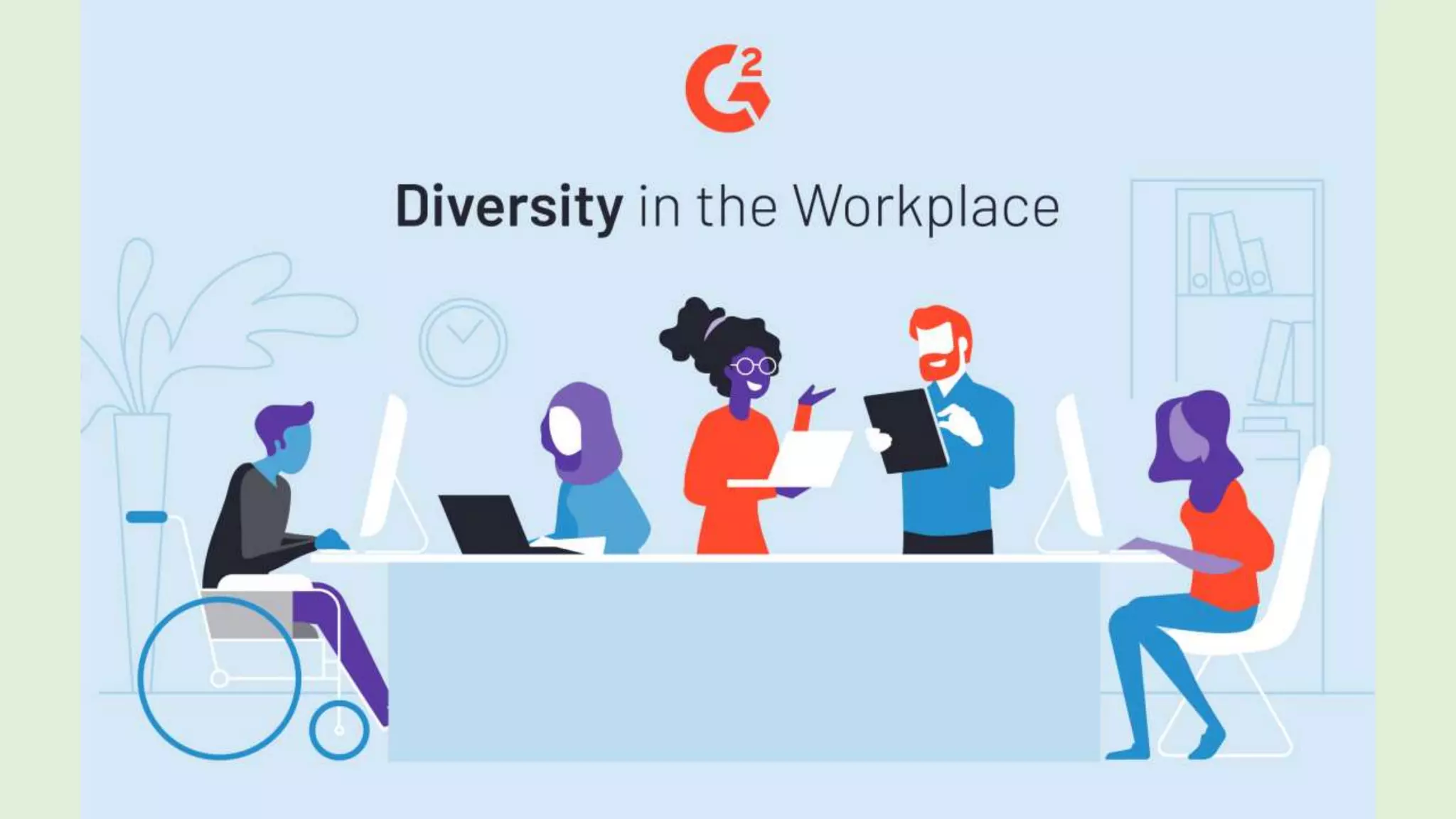
workforce diversity
Workforce diversity means similarities and differences among
employees in terms of age, cultural background, physical abilities and
disabilities, race, religion, gender, and sexual orientation. No two
humans are alike.
Levels of Diversity
1. surface-level diversity
2. deep-level diversity
Surface-level diversity
Differences in easily perceived characteristics, such as gender, race, ethnicity, age,
or disability, that do not necessarily reflect the ways people think or feel but that
may activate certain stereotypes.
Deep-level diversity
Differences in values, personality, and work preferences that become progressively
more important for determining similarity as people get to know one another
better.
Examples
Luis and Carol are co-workers who seem to have little in common at first
glance.
• Luis is a young, recently hired male college graduate with a business
degree, raised in a Spanish-speaking neighborhood in Miami.
• Carol is an older, long-tenured woman raised in rural Kansas, who achieved
her current level in the organization by starting as a high school graduate
and working her way through the hierarchy.
- At first, these co-workers may experience some differences in
communication based on their surface-level differences in education,
ethnicity, regional background, and gender.
- However, as they get to know one another, they may find they are both
deeply committed to their families, share a common way of thinking about
important work problems, like to work collaboratively, and are interested in
international assignments in the future. These deep-level similarities will
overshadow the more superficial differences between them, and research
suggests they will work well together
Examples
Steve and Dave are two unmarried white male college graduates from
Oregon who recently started working together. Superficially, they seem
well matched.
• But Steve is highly introverted, prefers to avoid risks, solicits the
opinions of others before making decisions, and likes the office quiet,
while Dave is extroverted, risk-seeking, and assertive and likes a busy,
active, and energetic work environment..
• Their surface-level similarity will not necessarily lead to positive
interactions because they have such fundamental, deep-level
differences. It will be a challenge for them to collaborate regularly at
work, and they’ll have to make some compromises to get things done
together
 Identify the key biographical characteristics and describe
how they are relevant to OB.
Biographical characteristics Personal characteristics—such as age,
gender, race, and length of tenure—that are objective and easily
obtained from personnel records. These characteristics are
representative of surface-level diversity.
 Identify the key biographical characteristics and describe how they are relevant to OB.
A .Age
Negative thinking
• job performance declines with increasing age
• older workers represent a huge potential pool of high-quality
applicants
• outlaws mandatory retirement
• lacking flexibility and resisting new technology
Positive thinking
positive qualities older workers bring to their jobs-
- experience,
- judgment,
- a strong work ethic, and
- commitment to quality
 What effect does age actually have on turnover, absenteeism,
productivity, and satisfaction?
1. age–turnover relationship The older you get, the less likely you are to quit your job
2. age–absenteeism relationship older employees have lower rates of avoidable absence
than do younger employees. However, they have equal rates of unavoidable absence,
such as sickness absences.
3. age–productivity relationship skills like speed, agility, strength, and coordination
decay over time and that prolonged job boredom and lack of intellectual stimulation
contribute to reduced productivity.
• age–job satisfy action relationship older workers tend to be more
satisfied with their work, report better relationships with co-workers,
and are more committed to their employing organizations.
 Identify the key biographical characteristics and describe how they are relevant to OB.
B. Sex/ gender
1. There are no consistent male–female differences in problem-solving ability,
analytical skills, competitive drive, motivation, sociability, or learning ability.
2. women are more agreeable and willing to conform to authority, whereas men
are more aggressive and more likely to have expectations of success, but those
differences are minor.
3. women who succeed in traditionally male domains are perceived as less likable,
more hostile, and less desirable as supervisors.
4. Working mothers are more likely to prefer part-time work, flexible work
schedules, and telecommuting in order to accommodate their family
responsibilities. Women also prefer jobs that encourage work–life balance, which
has the effect of limiting their options for career advancement.
5. women more likely to turn over than men
6. Women also have higher rates of absenteeism than men do
7. Regardless of gender, parents were rated lower in job commitment,
achievement striving, and dependability than individuals without
children, but mothers were rated especially low in competence.
 Identify the key biographical characteristics and describe how they are relevant to OB.
C. Race and Ethnicity
Race- the biological heritage people use to identify themselves. race is a
grouping of humans based on shared physical or social qualities into
categories generally viewed as distinct by society.
Ethnicity - additional set of cultural characteristics that often overlaps with
race
https://examples.yourdictionary.com/examples-of-race-and-ethnicity.html
First, in employment settings, individuals tend to slightly favor colleagues of
their own race in performance evaluations, promotion decisions, and pay
raises, although such differences are not found consistently, especially when
highly structured methods of decision making are employed.
Second, substantial racial differences exist in attitudes toward affirmative
action
Third, African Americans generally fare worse than Whites in employment
decisions.
 Identify the key biographical characteristics and describe how they are relevant to OB.
C. Disability
The U.S. Equal Employment Opportunity Commission classifies a
person as disabled who has any physical or mental impairment that
substantially limits one or more major life activities. Examples include
missing limbs, seizure disorder, Down Syndrome, deafness,
schizophrenia, alcoholism, diabetes, and chronic back pain
Diversity in the workforce

Diversity in the workforce

  • 2.
    workforce diversity Workforce diversitymeans similarities and differences among employees in terms of age, cultural background, physical abilities and disabilities, race, religion, gender, and sexual orientation. No two humans are alike.
  • 3.
    Levels of Diversity 1.surface-level diversity 2. deep-level diversity
  • 4.
    Surface-level diversity Differences ineasily perceived characteristics, such as gender, race, ethnicity, age, or disability, that do not necessarily reflect the ways people think or feel but that may activate certain stereotypes. Deep-level diversity Differences in values, personality, and work preferences that become progressively more important for determining similarity as people get to know one another better.
  • 5.
    Examples Luis and Carolare co-workers who seem to have little in common at first glance. • Luis is a young, recently hired male college graduate with a business degree, raised in a Spanish-speaking neighborhood in Miami. • Carol is an older, long-tenured woman raised in rural Kansas, who achieved her current level in the organization by starting as a high school graduate and working her way through the hierarchy.
  • 6.
    - At first,these co-workers may experience some differences in communication based on their surface-level differences in education, ethnicity, regional background, and gender. - However, as they get to know one another, they may find they are both deeply committed to their families, share a common way of thinking about important work problems, like to work collaboratively, and are interested in international assignments in the future. These deep-level similarities will overshadow the more superficial differences between them, and research suggests they will work well together
  • 7.
    Examples Steve and Daveare two unmarried white male college graduates from Oregon who recently started working together. Superficially, they seem well matched. • But Steve is highly introverted, prefers to avoid risks, solicits the opinions of others before making decisions, and likes the office quiet, while Dave is extroverted, risk-seeking, and assertive and likes a busy, active, and energetic work environment..
  • 8.
    • Their surface-levelsimilarity will not necessarily lead to positive interactions because they have such fundamental, deep-level differences. It will be a challenge for them to collaborate regularly at work, and they’ll have to make some compromises to get things done together
  • 9.
     Identify thekey biographical characteristics and describe how they are relevant to OB. Biographical characteristics Personal characteristics—such as age, gender, race, and length of tenure—that are objective and easily obtained from personnel records. These characteristics are representative of surface-level diversity.
  • 10.
     Identify thekey biographical characteristics and describe how they are relevant to OB. A .Age Negative thinking • job performance declines with increasing age • older workers represent a huge potential pool of high-quality applicants • outlaws mandatory retirement • lacking flexibility and resisting new technology
  • 11.
    Positive thinking positive qualitiesolder workers bring to their jobs- - experience, - judgment, - a strong work ethic, and - commitment to quality
  • 12.
     What effectdoes age actually have on turnover, absenteeism, productivity, and satisfaction? 1. age–turnover relationship The older you get, the less likely you are to quit your job 2. age–absenteeism relationship older employees have lower rates of avoidable absence than do younger employees. However, they have equal rates of unavoidable absence, such as sickness absences. 3. age–productivity relationship skills like speed, agility, strength, and coordination decay over time and that prolonged job boredom and lack of intellectual stimulation contribute to reduced productivity.
  • 13.
    • age–job satisfyaction relationship older workers tend to be more satisfied with their work, report better relationships with co-workers, and are more committed to their employing organizations.
  • 14.
     Identify thekey biographical characteristics and describe how they are relevant to OB. B. Sex/ gender 1. There are no consistent male–female differences in problem-solving ability, analytical skills, competitive drive, motivation, sociability, or learning ability. 2. women are more agreeable and willing to conform to authority, whereas men are more aggressive and more likely to have expectations of success, but those differences are minor.
  • 15.
    3. women whosucceed in traditionally male domains are perceived as less likable, more hostile, and less desirable as supervisors. 4. Working mothers are more likely to prefer part-time work, flexible work schedules, and telecommuting in order to accommodate their family responsibilities. Women also prefer jobs that encourage work–life balance, which has the effect of limiting their options for career advancement.
  • 16.
    5. women morelikely to turn over than men 6. Women also have higher rates of absenteeism than men do 7. Regardless of gender, parents were rated lower in job commitment, achievement striving, and dependability than individuals without children, but mothers were rated especially low in competence.
  • 17.
     Identify thekey biographical characteristics and describe how they are relevant to OB. C. Race and Ethnicity Race- the biological heritage people use to identify themselves. race is a grouping of humans based on shared physical or social qualities into categories generally viewed as distinct by society. Ethnicity - additional set of cultural characteristics that often overlaps with race https://examples.yourdictionary.com/examples-of-race-and-ethnicity.html
  • 18.
    First, in employmentsettings, individuals tend to slightly favor colleagues of their own race in performance evaluations, promotion decisions, and pay raises, although such differences are not found consistently, especially when highly structured methods of decision making are employed. Second, substantial racial differences exist in attitudes toward affirmative action Third, African Americans generally fare worse than Whites in employment decisions.
  • 19.
     Identify thekey biographical characteristics and describe how they are relevant to OB. C. Disability The U.S. Equal Employment Opportunity Commission classifies a person as disabled who has any physical or mental impairment that substantially limits one or more major life activities. Examples include missing limbs, seizure disorder, Down Syndrome, deafness, schizophrenia, alcoholism, diabetes, and chronic back pain