Relations and functions
One Shot
Nishant Vora
B.Tech - IIT Patna
India’s BEST Educators Unacademy Subscription
If you want to be the BEST
“Learn” from the BEST
Code: NVLIVE
Code: NVLIVE
Code: NVLIVE
NVLIVE NVLIVE
CROSS PRODUCT
& RELATIONS
Cross Product (A x B)
A = {1, 2, 3}
B = {a, b}
Ordered Pair (x, y) ≠ (y, x)
Number of elements
n(A x B) = n(A).n(B)
A x B = {(1, a), (1, b), (2, a) (2, b), (3, a), (3, b)} True or False ?
A. 1 ∈ A
B. 1 ∈ A x B
C. (1, a) ∈ A x B
D. { (1, a) } ⊂ A x B
How many subsets will the following sets have?🤔
A = {1, 2} A = { 1, 2, 3 }
Conclusion
Number of subsets of set A = 2n
where n → number of element in set A
A x B = {(1, a), (1, b), (2, a) (2, b), (3, a), (3, b)}
How many subsets will A x B have ?
Let Z be the set of integers. If A = {x∈Z : 2(x+2)(x2 - 5x + 6) =1} and
B = {x∈Z : -3 < 2x - 1 < 9}, then the number of subsets of the set
A x B, is
JEE Main 2019
A. 215
B. 218
C. 212
D. 210
Relations
A subset of A x B
If n(A) = m & n(B) = n then the number
of Relations = 2mn
Visual Representation (Arrow Diagram)
1
2
3
a
b
A B
Relations in Real life
A = { 1, 2, 3}
B = {a , b, c }
R: A ➝ B
R = {(1, a), (2, b)}
Identity Relations
Every element of A is related
to itself only
Representation of Relations
1. Roster form
2. Set builder form
TYPES OF
RELATIONS
Types of Relations
Reflexive
(a, a) ∈ R for all a ∈ A
Symmetric
If (a, b) ∈ R then (b, a) ∈ R Transitive
If (a, b) ∈ R and (b, c) ∈ R
then (a, c) ∈ R
Anti- Symmetric
If (a, b) ∈ R and (b, a) ∈ R ⇒ a = b
The relation R = {(1, 1), (2, 2), (3, 3), (1, 2), (2, 3), (1, 3)}
on set A = {1, 2, 3} is -
A. Reflexive but not symmetric
B. Reflexive but not transitive
C. Symmetric and transitive
D. Neither symmetric nor transitive
The relation R = {(1, 1), (2, 2), (1, 2), (2, 3)} on set
A = {1, 2, 3} is -
A. Reflexive but not symmetric
B. Reflexive but not transitive
C. Symmetric and transitive
D. Neither symmetric nor transitive
Let R = {(3, 3), (6, 6), (9, 9), (12, 12) (6, 12) (3, 9) (3, 12), (3, 6)} be a
relation on the set A = {3, 6, 9, 12}. The relation is -
A. An equivalence relation
B. Reflexive and symmetric only
C. Reflexive and transitive only
D. Reflexive only
JEE Main 2005
ह ाँ - न bol
R = { (a, b): a is divisible by b}
R = {(T1, T2) : T1 ≅ T2}
R = {(a, b) : a is brother of b}
R = {(a, b) : a is cousin of b}
For α ∊ N , consider a relation R on N given by R = {(x, y) : 3x + αy is
a multiple of 7}. The relation R is an equivalence relation if and
only if :
A. α = 14
B. α is a multiple of 4
C. 4 is the remainder when α is divided by 10
D. 4 is the remainder when α is divided by 7
JEE Main 2022
Let R1 and R2 be two relations defined on R by
aR1b ⇔ ab ≥ 0 and aR2b ⇔ a ≥ b, then
A. R1 is an equivalence relation but not R2
B. R2 is an equivalence relation but not R1
C. Both R1 and R2 are equivalence relations
D. Neither R1 nor R2 is an equivalence relation
JEE Main 2022
Let R1 = {(a, b) ∈ N x N : |a - b| ≤ 13} and
R2 = {(a, b) ∈ N x N : |a - b| ≠ 13}. Then on N:
A. Both R1 and R2 are equivalence relations
B. Neither R1 nor R2 is an equivalence relation
C. R1 is an equivalence relation but R2 is not
D. R2 is an equivalence relation but R1 is not
JEE Main 2022
Let R be relation from the set {1, 2, 3 ….., 60} to itself such that
R = {(a, b) : b = pq, where p, q ≥ 3 are prime numbers }. Then, the
number of elements in R is :
A. 600
B. 660
C. 540
D. 720
JEE Main 2022
Which of the following is not correct for relation R on the set of
real numbers ?
A. (x, y) ∊ R ⇔ 0 < |x| - |y| ≤ 1 is neither transitive nor symmetric
B. (x, y) ∈ R ⇔ 0 < |x - y| ≤ 1 is symmetric and transitive.
C. (x, y) ∈ R ⇔ |x| - |y| ≤ 1 is reflexive but not symmetric
D. (x, y) ∈ R ⇔ |x - y| ≤ 1 is reflexive and symmetric.
JEE Main 2021
Let N be the set of natural numbers and a relation R on N be
defined by R = {(x,y) ∈ N x N : x3 - 3x2y - xy2 + 3y3 = 0}. Then the
relation R is
A. Symmetric but neither reflexive nor transitive.
B. Reflexive but neither symmetric nor transitive.
C. Reflexive and symmetric, but not transitive.
D. An equivalence relation.
JEE Main 2021
Summary
● Relations are subset of A x B
● Number of subsets of A x B = Number of relations defined from
A → B
● Number of subsets = 2n
● n(AxB) = n(A).n(B)
● Number of relation which can be defined from A → B is 2mn
● Relations can be represented in roaster as well as set builder
form
● Arrow starts from anywhere and ends anywhere (Relations are
complicated)
DOMAIN,
CODOMAIN AND
RANGE
Domain, Codomain and Range of Relations
A = {1, 3, 5, 7}; B = {2, 4, 6, 8}
R = {(3, 2), (5, 4), (7, 2), (7, 4), (7, 6)}
Domain =
Range =
Codomain =
A B
3
5
7
2
4
6
1
8
Domain, Codomain and Range of Relations
Domain of R : Collection of all elements of A which has a image in B
Range of R : Collection of all elements of B which has a pre-image in A
If R = {(x, y)| x, y ∈ Z, x2 + y2 ≤ 4} is a relation in Z, then domain
of R is -
A. {0, 1, 2}
B. {0, -1, -2}
C. {-2, -1, 0, 1, 2}
D. None of these
JEE MAIN 2021
Equivalence Class
Let R = { (1, 1), (2, 2), (3, 3), (1, 2), (2, 1) }
Equivalence class of 1 = [1] =
Equivalence class of 2 = [2] =
Equivalence class of 3 = [3] =
If R = {P, Q) | P and Q are at the same distance from the origin }
be a relation, then the equivalence class of (1, -1) is the set :
26 Feb 2021 Shift 1
A. S = { (x,y) | x2 + y2 = 1 }
B. S = { (x,y) | x2 + y2 = 4}
C. S = {(x,y) | x2 + y2 = √2 }
D. S = { (x,y) | x2 + y2 = 2 }
INVERSE OF
RELATION
Inverse of a Relation
A = { 1, 2, 3, 4 }
B = { a, b, c, d }
R : A → B
R = {(1, a), (2, b), (3, c), (4, d)}
1
2
3
4
a
b
c
d
B A
a
b
c
d
1
2
3
4
A B
Domain of R = Range of R-1
Range of R = domain of R-1
If R = {(x, y); x, y ∈ Z, x2 + 3y2 ≤ 8} is a relation on the set of integers
Z, then the domain of R-1 is :
A. {0, 1}
B. {-2, -1, 1, 2}
C. {-1, 0, 1}
D. {-2, -1, 0, 1, 2}
JEE MAIN 2021
Functions
Functions
Modulus
1
Logarithmic
2
Exponentials
3
Greatest integer functions
4
Fractional part
5
Modulus Functions
Modulus Functions: Definition
|x| |x|
Modulus Functions: Domain, Range, Graphs
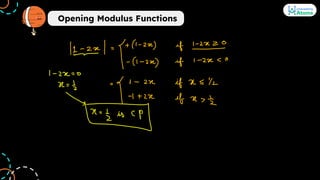
Opening Modulus Functions
On the right of critical point modulus opens with a plus sign
and on the left it opens with a minus sign.
NOTE -
Graph of Modulus
Function
Graph of Modulus Functions
|x| + k or |x| - k
Graph of Modulus Functions
|x + k| or |x - k|
Graph of Modulus Functions
k|x| or |kx|
Define f(x) free of modulus and draw the graph f(x) = |2x - 3|
Define f(x) free of modulus and draw the graph f(x) = |2x| - 3
Double Mod Graphs
f(x) = |x - 1| + |x - 2| Shortcut
f(x) = | x | + |x - 1| Shortcut
f(x) = |x + 1| + |x - 1| Shortcut
f(x) = |2x + 1| + |3x - 1| Shortcut
Open modulus and draw graph of f(x) = |x + 1| + |x| + |x - 1|
Find ‘k’ for which following equation has 4 solutions
|x - 1| - 2|x| + |2x + 1| = k
Graphical Transformation
y = f(x) y = -f(x)
Flip in x axis
Graphical Transformation
y = f(x) y = f(-x)
Flip in y axis
Graphical Transformation
y = f(x) y = |f(x)|
neeche wala uper
Graphical Transformation
y = f(x) y = f(|x|)
Right side = Same
Left side = Mirror
Graphical Transformation
y = f(x) |y| = f(x)
Upar wala = Same
Neeche = Mirror
Draw the graph of y = ||x - 1| - 2|
Draw the graph of y = -|x + 2|
Draw the graph of |y| + x = -1
Modulus Equations
Solving Modulus Equations
|f(x)| = a ⇒ f(x) = ± a
Solving Modulus Equations (Method - 1)
Ex. |x - 1| = 3
Solving Modulus Equations (Method - 2)
Ex. |x - 1| = 3
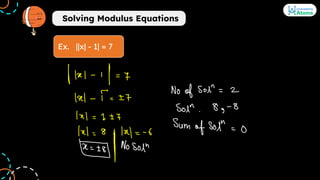
Solving Modulus Equations
Ex. ||x| - 1| = 7
Solve for x : ||x + 1| - 4| = 5
Solve for x : |x - 1| - |x| = 1 M-1: Algebraic Method
Solve for x : |x - 1| - |x| = 1 M-2: Graphical Method
Solve the following linear equation ||x - 1| - 2| = |x - 3|
A. x ∈ [1, ∞) B. x ∈ [3, ∞)
C. x = 3 D. x = 1
Number of solutions of the equations |2x2 + x - 1| = |x2 + 4x + 1|
A. 1 B. 2 C. 3 D. 4
Solutions of |4x + 3| + |3x - 4| = 12 are
A. B.
C. D.
Log Function
Log Functions : Definitions
Find value of:
i. log81 27 iii. log1/3 9√3
ii. log10 100
Domain: Restriction on base and input
loga x is defined if a > 0, a ≠ 1 and x > 0
Frequently used base values
If a = 10, then write log N rather than log10 N
If a = e, we write lnN rather than loge N
Find the value of
i. log(2 - √3) (2 + √3) = k
ii. log(1/3) (3√3) = k
Graph of Log Function
Graphs of Log Functions
y = log2 x
x
y
Graphs of Log Functions
y = log1/2 x
x
y
Graphs of Log Functions
y = loga x
Graphs of Log Functions
y = log2 (x + k) or y = log2 (x - k)
Graphs of Log Functions
y = log2 (x) + k or y = log2 (x) - k
Graphs of Log Functions
y = k log2 (x)
Properties of Log
Functions
Properties of Log Functions
1 loga 1 = 0
2 loga a = 1
3 loga (mn) = logam+ logan
4 loga (m/n) = logam- logan
Properties of Log Functions
a loga x = x
5
6
7
8
Solving Log Equations
(log2 3).(log3 4).(log4 5) … logn(n + 1) = 10. Find n = ?
A. 512 B. 128 C. 1024 D. 1023
Solve
A. 0 B. 1 C. 2 D. 2
Solve
A. 0 B. 1 C. -2 D. -2, 1
Find the value of x :
[ JEE-Advanced 2018 ]
[ JEE-Advanced 2013, 4, (-1) ]
A. 2f(x)
B. 2f(x2)
C. (f(x))2
D. -2f(x)
[ JEE-2009 ]
Greatest Integer
Function
Greatest Integer Function (G.I.F)
Definition: Greatest integer less than or equal to x.
Graph of G.I.F
Graph of G.I.F
Domain and Range of G.I.F.
Domain:
Range:
Properties of G.I.F
1. x-1 < [x] ≤ x
1. [x + n] = [x] if n is integer
1. [x + [x]] = [x]
Properties of G.I.F
Fractional Part Function
Fraction Part Function (F.P.F)
Definition:
Graph of Fractional Part Function
Domain and Range of {x}
Domain:
Range:
Properties of {x}
1. 0 ≤ {x} < 1
1. x = [x] + {x}
1. {x + n} = {x} if n is integer
Properties of {x}
Solve the equation
4[x] = x + {x}
The number of solution(s) of the equation [2x] – 3 {2x} = 1, is / are
The number of solution(s) of the equation [x] + {–x} = 2x, is / are
If [x] be the greatest integer less than or equal to x, then
is equal to.
A. 0
B. 4
C. -2
D. 2
[ JEE-2021 ]
Exponential Function
Exponential Functions
Graph of Exponential Functions
Exponential Functions
Domain:
Range:
Signum Function
Signum Function
or
Graph of Signum Function
India’s BEST Educators Unacademy Subscription
If you want to be the BEST
“Learn” from the BEST
Code: NVLIVE
Code: NVLIVE
Code: NVLIVE
NVLIVE NVLIVE

Relations and Functions #BB2.0.pdf