Topic : Relational Algebra
Presented By : S.S.Patwardhan
CSE Dept
Important Concept
• Relational algebra is similar to high school algebra
except that the variables are tables not numbers and
the results are tables not numbers.
Definition
• “Relational algebra is a theoretical language with
operators that are applied on one or two relations to
produce another relation.”Ricardo p. 181
• Both the operands and the result are tables
About Relational Algebra
• A procedural language
• Not implemented in native form in DBMS
• Basis for other HL DMLs
Operations
• SELECT
• PROJECT
• JOIN
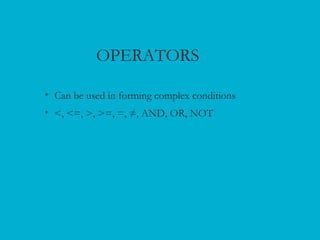
OPERATORS
• Can be used in forming complex conditions
• <, <=, >, >=, =, ≠, AND, OR, NOT
SELECT
• “The SELECT command is applied to a single table and takes
rows that meet a specific condition copying them into a new
table.” Ricardo p. 182
• Informal general form:
• SELECT tableName WHERE condition [GIVING newTableName]
Ricardo p. 182
• Symbolic form
• σ EmpDept = 10 (EMPLOYEE) Mata-Toledo p. 37
PROJECT
• “The PROJECT command also operates on a single
table, but it produces a vertical subset of the table,
extracting the values of specified columns,
eliminating duplicates, and placing the values in a
new table.
• Informal general form:
• PROJECT tableName OVER(colName,…,colName)
[GIVING newTableName] Ricardo p. 183
• Example of symbolic form
• π Location (DEPARTMENT) Mata-Toledo p. 38
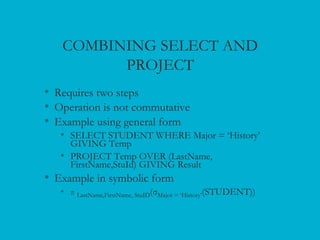
COMBINING SELECT AND
PROJECT
• Requires two steps
• Operation is not commutative
• Example using general form
• SELECT STUDENT WHERE Major = ‘History’
GIVING Temp
• PROJECT Temp OVER (LastName,
FirstName,StuId) GIVING Result
• Example in symbolic form
• π LastName,FirstName, StuID(σMajor = ‘History’(STUDENT))
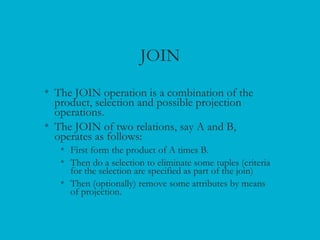
JOIN
• The JOIN operation is a combination of the
product, selection and possible projection
operations.
• The JOIN of two relations, say A and B,
operates as follows:
• First form the product of A times B.
• Then do a selection to eliminate some tuples (criteria
for the selection are specified as part of the join)
• Then (optionally) remove some attributes by means
of projection.
Set Operations on Relations
• CARTESIAN PRODUCT
• UNION
• INTERSECTION
• DIFFERENCE
Relation Operations
• Cartesian Product or Product
• The cartesian product of two relations is the
concatenation of every tuple of one relation with every
tuple of a second relations.
• The cartesian product of relation A (having m tuples) and
relation B (having n tuples) has m times n tuples.
• The cartesian product is denoted A X B or A TIMES B.
JOIN
• Comes in many flavors
• THETA JOIN – is the most general.
• It is the result of performing a SELECT operation on the product
• Equivalent Examples:
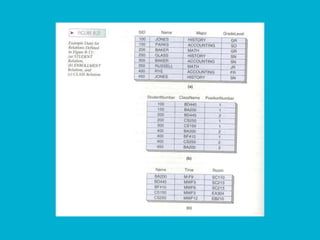
1. Student TIMES Enroll WHERE credits > 50
2. Student TIMES Enroll GIVING Temp
SELECT Temp WHERE credits > 50
3. σ credits> 50 (Student X Enroll)
4. A Xθ B = σ θ (A X B)
• EQUIJOIN is a theta join in which the theta is equality on the common columns
• Equivalent Examples:
1. Student EQUIJOIN Enroll
2. Student XStudent.stuId=Enroll.stuIdEnroll
3. Student Times Enroll GIVING Temp3
SELECT Temp3 WHERE Student.stuId = Enroll.stuID
4. σ Student.stuId=Enroll.stuId (Student X Enroll)
• NATURAL JOIN is an equijoin in which the repeated column is eliminated.
• This is the most common form of the join operation and is usually what is meant by JOIN
• Example:
• tableName1 JOIN tableName2 [ GIVING newTableName]
JOIN
• More flavors
• SEMIJOIN –
• “If A and B are tables, then the left-semijoin A|XB, is found by taking the natural join of A and B and
then projecting the result onto the attributes of A.
• The result will be just those tuples of A that participate in the join.” Ricardo, p. 192
• Equivalent Examples:
• Student LEFT-SEMIJOIN Enroll
• Student |X Enroll
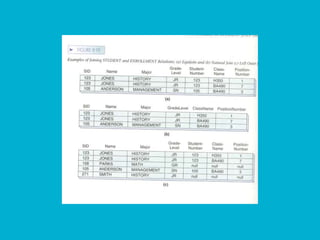
• OUTERJOIN
• “This operation is an extension of a THETA JOIN, an EQUIJOIN or a NATURAL JOIN operation.
• When forming any of these joins, any tuple from one of the original tables for which there is no match in
the second table does not enter the result.” Ricardo p. 193
• LEFT OUTER EQUIJOIN & RIGHT OUTER EQUIJOIN
• Are variations of the outer equijoin Ricardo p. 194, 1953
Terminology
• For two relations to be union compatible each
relation must have the same number of attributes,
and the attributes in corresponding columns must
come from the same domain.
Relation Operations
• Difference
• The difference of two relations is a third relation
containing tuples that occur in the first relation but not in
the second.
• The relations must be union compatible
• A-B is not the same as B-A
Relation Operations
• Union
• The union of two relations is formed by adding the tuples
from one relation to those of a second relation to produce
a third relation.
• The order in which the tuples appear in the third relation is
not important.
• Duplicate tuples must be eliminated
• The relations must be union compatible
Relation Operations
• Intersection
• The intersection of two relations is a third relation
containing the tuples that appear in both the first and the
second relation.
• The relations must be union compatible
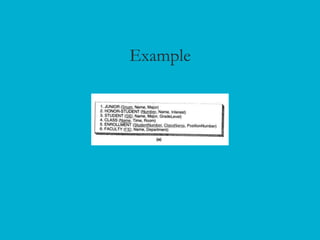
Example
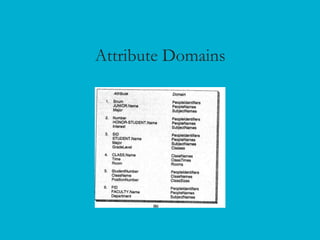
Attribute Domains
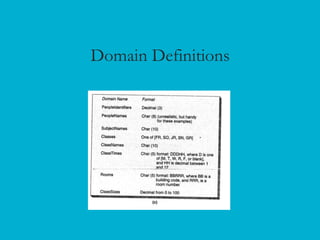
Domain Definitions
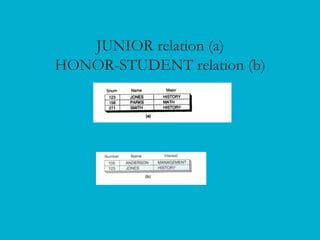
JUNIOR relation (a)
HONOR-STUDENT relation (b)
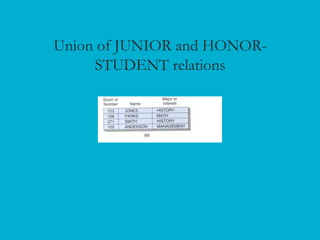
Union of JUNIOR and HONOR-
STUDENT relations
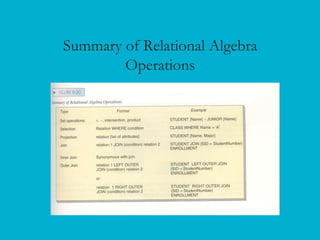
Summary of Relational Algebra
Operations
References:
Databases Illuminated by Catherine Ricardo, published by Jones and Bartlett in 2004
Fundamentals of Relational Databases by Ramon A. Mata-Toledo and Pauline K.
Cushman, published by McGraw Hill in Schaum’s Outline Series in 2000
Database Processing, Fundamentals, Design, and Implementation, Eighth Edition, by
David M. Kroenke, published by Prentice Hall in 2002

Relational_Algebra Database management system

  • 1.
    Topic : RelationalAlgebra Presented By : S.S.Patwardhan CSE Dept
  • 2.
    Important Concept • Relationalalgebra is similar to high school algebra except that the variables are tables not numbers and the results are tables not numbers.
  • 3.
    Definition • “Relational algebrais a theoretical language with operators that are applied on one or two relations to produce another relation.”Ricardo p. 181 • Both the operands and the result are tables
  • 4.
    About Relational Algebra •A procedural language • Not implemented in native form in DBMS • Basis for other HL DMLs
  • 5.
  • 6.
    OPERATORS • Can beused in forming complex conditions • <, <=, >, >=, =, ≠, AND, OR, NOT
  • 7.
    SELECT • “The SELECTcommand is applied to a single table and takes rows that meet a specific condition copying them into a new table.” Ricardo p. 182 • Informal general form: • SELECT tableName WHERE condition [GIVING newTableName] Ricardo p. 182 • Symbolic form • σ EmpDept = 10 (EMPLOYEE) Mata-Toledo p. 37
  • 8.
    PROJECT • “The PROJECTcommand also operates on a single table, but it produces a vertical subset of the table, extracting the values of specified columns, eliminating duplicates, and placing the values in a new table. • Informal general form: • PROJECT tableName OVER(colName,…,colName) [GIVING newTableName] Ricardo p. 183 • Example of symbolic form • π Location (DEPARTMENT) Mata-Toledo p. 38
  • 9.
    COMBINING SELECT AND PROJECT •Requires two steps • Operation is not commutative • Example using general form • SELECT STUDENT WHERE Major = ‘History’ GIVING Temp • PROJECT Temp OVER (LastName, FirstName,StuId) GIVING Result • Example in symbolic form • π LastName,FirstName, StuID(σMajor = ‘History’(STUDENT))
  • 10.
    JOIN • The JOINoperation is a combination of the product, selection and possible projection operations. • The JOIN of two relations, say A and B, operates as follows: • First form the product of A times B. • Then do a selection to eliminate some tuples (criteria for the selection are specified as part of the join) • Then (optionally) remove some attributes by means of projection.
  • 11.
    Set Operations onRelations • CARTESIAN PRODUCT • UNION • INTERSECTION • DIFFERENCE
  • 12.
    Relation Operations • CartesianProduct or Product • The cartesian product of two relations is the concatenation of every tuple of one relation with every tuple of a second relations. • The cartesian product of relation A (having m tuples) and relation B (having n tuples) has m times n tuples. • The cartesian product is denoted A X B or A TIMES B.
  • 13.
    JOIN • Comes inmany flavors • THETA JOIN – is the most general. • It is the result of performing a SELECT operation on the product • Equivalent Examples: 1. Student TIMES Enroll WHERE credits > 50 2. Student TIMES Enroll GIVING Temp SELECT Temp WHERE credits > 50 3. σ credits> 50 (Student X Enroll) 4. A Xθ B = σ θ (A X B) • EQUIJOIN is a theta join in which the theta is equality on the common columns • Equivalent Examples: 1. Student EQUIJOIN Enroll 2. Student XStudent.stuId=Enroll.stuIdEnroll 3. Student Times Enroll GIVING Temp3 SELECT Temp3 WHERE Student.stuId = Enroll.stuID 4. σ Student.stuId=Enroll.stuId (Student X Enroll) • NATURAL JOIN is an equijoin in which the repeated column is eliminated. • This is the most common form of the join operation and is usually what is meant by JOIN • Example: • tableName1 JOIN tableName2 [ GIVING newTableName]
  • 14.
    JOIN • More flavors •SEMIJOIN – • “If A and B are tables, then the left-semijoin A|XB, is found by taking the natural join of A and B and then projecting the result onto the attributes of A. • The result will be just those tuples of A that participate in the join.” Ricardo, p. 192 • Equivalent Examples: • Student LEFT-SEMIJOIN Enroll • Student |X Enroll • OUTERJOIN • “This operation is an extension of a THETA JOIN, an EQUIJOIN or a NATURAL JOIN operation. • When forming any of these joins, any tuple from one of the original tables for which there is no match in the second table does not enter the result.” Ricardo p. 193 • LEFT OUTER EQUIJOIN & RIGHT OUTER EQUIJOIN • Are variations of the outer equijoin Ricardo p. 194, 1953
  • 15.
    Terminology • For tworelations to be union compatible each relation must have the same number of attributes, and the attributes in corresponding columns must come from the same domain.
  • 16.
    Relation Operations • Difference •The difference of two relations is a third relation containing tuples that occur in the first relation but not in the second. • The relations must be union compatible • A-B is not the same as B-A
  • 17.
    Relation Operations • Union •The union of two relations is formed by adding the tuples from one relation to those of a second relation to produce a third relation. • The order in which the tuples appear in the third relation is not important. • Duplicate tuples must be eliminated • The relations must be union compatible
  • 18.
    Relation Operations • Intersection •The intersection of two relations is a third relation containing the tuples that appear in both the first and the second relation. • The relations must be union compatible
  • 19.
  • 20.
  • 21.
  • 22.
  • 23.
    Union of JUNIORand HONOR- STUDENT relations
  • 24.
    Summary of RelationalAlgebra Operations
  • 27.
    References: Databases Illuminated byCatherine Ricardo, published by Jones and Bartlett in 2004 Fundamentals of Relational Databases by Ramon A. Mata-Toledo and Pauline K. Cushman, published by McGraw Hill in Schaum’s Outline Series in 2000 Database Processing, Fundamentals, Design, and Implementation, Eighth Edition, by David M. Kroenke, published by Prentice Hall in 2002