Lecture #12
Relational
Algebra
Prepared by : engr. Soonh taj 1
In this Lecture you will Learn about:
Query Languages Types
Relational Algebra
Relational Algebra Operators
01/30/2025 2
Query Languages Types
1. Procedural Query Language
-Relational Algebra
2. Non-Procedural Query Language
-Tuple relational calculus and domain relational calculus
01/30/2025 3
Query Languages Types
1. Procedural Query Language: (Specifies how to retrieve
data.)
•In a procedural query language, you specify step-by-step
instructions for how to retrieve the desired data from the
database.
•Queries are expressed as sequences of operations that are
executed in a particular order.
•Relational algebra is an example of a procedural query
language commonly used in relational databases. It defines
operations like selection, projection, join, etc., and queries are
formulated by composing these operations in a specific
sequence.
01/30/2025 4
Query Languages Types
2. Non-Procedural Query Language: (Specifies what data to retrieve.)
•In a non-procedural query language, you specify what data you want to
retrieve without specifying how to retrieve it.
•Queries are expressed as logical statements or declarative expressions
that describe the desired result set.
•Tuple relational calculus and domain relational calculus are examples of
non-procedural query languages used in relational databases. Instead of
specifying a sequence of operations, queries are formulated as logical
conditions that the desired data must satisfy.
01/30/2025 5
Query Languages Types
1. Relational Algebra: Relational algebra is a procedural query language
that defines a set of operations that can be applied to relations (tables)
in a relational database. These operations include selection, projection,
Cartesian product, join, union, intersection, and difference, among
others. It provides a way to express queries as a series of operations on
relations.
01/30/2025 6
Query Languages Types
2. Tuple Relational Calculus: Tuple relational calculus is a non-procedural
query language that defines queries in terms of logical formulas. Instead
of specifying a sequence of operations to retrieve data, tuple relational
calculus describes what data should be retrieved. It uses variables and
quantifiers to specify conditions that the desired tuples must satisfy.
01/30/2025 7
Query Languages Types
3. Domain Relational Calculus: Domain relational calculus is another
non-procedural query language that operates similarly to tuple relational
calculus but focuses on specifying conditions on the attributes or
domains of relations rather than on individual tuples. It also uses
variables and quantifiers to express conditions that the desired data
must satisfy.
01/30/2025 8
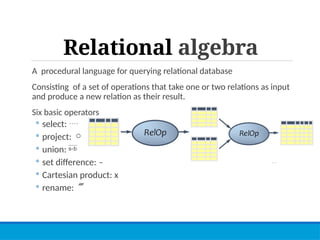
A procedural language for querying relational database
Consisting of a set of operations that take one or two relations as input
and produce a new relation as their result.
Six basic operators
◦ select: 
◦ project: 
◦ union: 
◦ set difference: –
◦ Cartesian product: x
◦ rename: 
Relational algebra
Select Operation
The select operation selects tuples that satisfy a given predicate.
Notation: p(r)
p is called the selection predicate
Example: select those tuples of the instructor relation where the instructor is in
the “Physics” department.
◦ Query
dept_name=“Physics” (instructor)
◦ Result
Select Operation
Select Operation (Cont.)
We allow comparisons using
=, , >, . <.  (in the selection predicate.)
We can combine several predicates into a larger predicate by using the
connectives:
 (and),  (or),  (not)
Example: Find the instructors in Physics with a salary greater 90,000
 dept_name=“Physics” salary > 90,000 (instructor)
Then select predicate may include comparisons between two attributes.
◦ Example: Find all departments whose name is the same as their building name:
◦  dept_name=building (department)
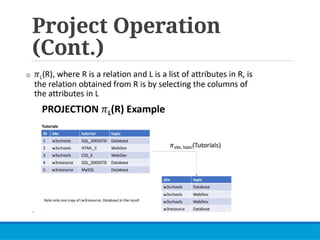
Project Operation
A unary operation that returns a set of chosen columns.
Notation:
 A1,A2,A3 ….Ak
(r)
where A1, A2 are attribute names and r is a relation name.
The result is defined as the relation of k columns obtained by erasing the columns
that are not listed
Duplicate rows removed from result, since relations are sets
Project Operation
(Cont.)
Example: eliminate the dept_name attribute of instructor
Query:
ID, name, salary (instructor)
Result:
Project Operation
(Cont.)
The Assignment Operation
It is convenient at times to write a relational-algebra expression by assigning parts of
it to temporary relation variables.
The assignment operation is denoted by  and works like assignment in a
programming language.
Example: Find all instructor in the “Physics” and Music department.
Physics   dept_name=“Physics” (instructor)
Music   dept_name=“Music” (instructor)
Physics  Music
With the assignment operation, a query can be written as a sequential program
consisting of a series of assignments followed by an expression whose value is
displayed as the result of the query.
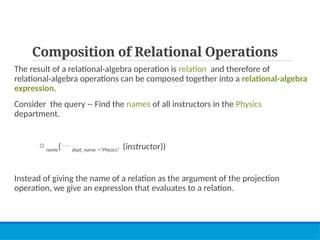
Composition of Relational Operations
The result of a relational-algebra operation is relation and therefore of
relational-algebra operations can be composed together into a relational-algebra
expression.
Consider the query -- Find the names of all instructors in the Physics
department.
name( dept_name =“Physics” (instructor))
Instead of giving the name of a relation as the argument of the projection
operation, we give an expression that evaluates to a relation.
Set Union Operation
The union operation allows us to combine two relations
Notation: r  s
For r  s to be valid.
1. r, s must have the same arity (same number of attributes)
2. The attribute domains must be compatible (example: 2nd
column of r deals with the same type of values as does the 2nd
column of s)
Example: to find all courses taught in the Fall 2017 semester, or in the Spring
2018 semester, or in both
course_id ( semester=“Fall” Λ year=2017 (section)) 
course_id ( semester=“Spring” Λ year=2018 (section))
Set Union Operation
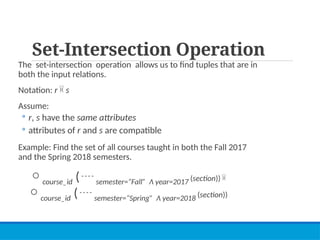
Set-Intersection Operation
The set-intersection operation allows us to find tuples that are in
both the input relations.
Notation: r  s
Assume:
◦ r, s have the same attributes
◦ attributes of r and s are compatible
Example: Find the set of all courses taught in both the Fall 2017
and the Spring 2018 semesters.
course_id ( semester=“Fall” Λ year=2017 (section)) 
course_id ( semester=“Spring” Λ year=2018 (section))
Set-Intersection Operation
Set Difference Operation
The set-difference operation allows us to find tuples that are in one relation but
are not in another.
Notation r – s
Set differences must be taken between compatible relations.
◦ r and s must have the same attribute
◦ attribute domains of r and s must be compatible
Example: to find all courses taught in the Fall 2017 semester, but not in the Spring
2018 semester
course_id ( semester=“Fall” Λ year=2017 (section)) −
course_id ( semester=“Spring” Λ year=2018 (section))
Set Difference Operation
Set Operations
The Rename Operation
The results of relational-algebra expressions do not have a name that we can use to
refer to them. The rename operator,  , is provided for that purpose
The expression:
x (E)
returns the result of expression E under the name x
Another form of the rename operation:
x(A1,A2, .. An) (E)
The Rename Operation
Equivalent Queries
There is more than one way to write a query in relational algebra.
Example: Find information about courses taught by instructors in the Physics
department with salary greater than 90,000
Query 1
 dept_name=“Physics” salary > 90,000 (instructor)
Query 2
 dept_name=“Physics” ( salary > 90.000 (instructor))
The two queries are not identical; they are, however, equivalent -- they give the same
result on any database.
Cartesian-Product Operation
The Cartesian-product operation (denoted by X) allows us to combine information from
any two relations.
Example: the Cartesian product of the relations instructor and teaches is written as:
instructor X teaches
We construct a tuple of the result out of each possible pair of tuples: one from the
instructor relation and one from the teaches relation
Since the instructor ID appears in both relations we distinguish between these attribute by
attaching to the attribute the name of the relation from which the attribute originally came.
◦ instructor.ID
◦ teaches.ID
Cartesian-Product Operation
The instructor X teaches table
X
Join Operation
The Cartesian-Product
instructor X teaches
associates every tuple of instructor with every tuple of teaches.
◦ Most of the resulting rows have information about instructors who did NOT
teach a particular course  meaningless
To get only those tuples of “instructor X teaches “ that pertain to instructors and
the courses that they taught, we write:
 instructor.id = teaches.id (instructor x teaches ))
◦ We get only those tuples of “instructor X teaches” that pertain to instructors
and the courses that they taught.
Join Operation
The table corresponding to:  instructor.id = teaches.id (instructor x teaches))
X  instructor.id = teaches.id
Join Operation (Cont.)
The join operation allows us to combine a select operation and a Cartesian-
Product operation into a single operation.
Consider relations r (R) and s (S)
Let “theta” be a predicate on attributes in the schema R “union” S. The join
operation r s is defined as follows:
Thus
 instructor.id = teaches.id (instructor x teaches ))
Can equivalently be written as
instructor Instructor.id = teaches.id teaches.
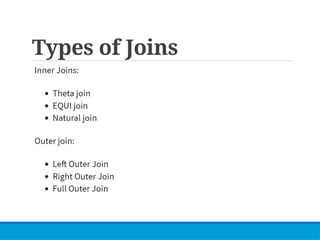
Types of Joins
Inner Joins
Inner Join
In an inner join, only those tuples that satisfy the matching
criteria are included, while the rest are excluded. Let’s study
various types of Inner Joins:
Inner Join
Theta Join
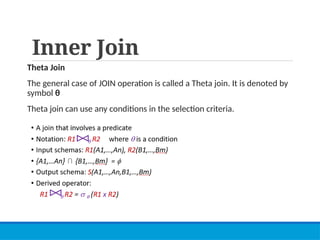
The general case of JOIN operation is called a Theta join. It is denoted by
symbol θ
Theta join can use any conditions in the selection criteria.
Inner Join
Theta Join
Inner Join
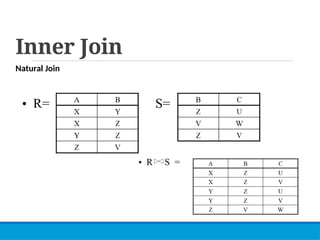
Natural join
It can only be performed if there is a common attribute (column) between the relations. The
name and type of the attribute must be same.
Notation: R1 R2
Input Schema: R1(A1, …, An), R2(B1, …, Bm)
Output Schema: S(C1,…,Cp)
◦ Where {C1, …, Cp} = {A1, …, An} U {B1, …, Bm}
Meaning: combine all pairs of tuples in R1 and R2 that agree on the attributes:
◦ {A1,…,An} {B1,…, Bm} (called the join attributes)
Equivalent to a cross product followed by selection
Example Employee Dependents

Inner Join
Natural Join
Outer Join
In an outer join, along with tuples that satisfy the matching criteria, we also
include some or all tuples that do not match the criteria.
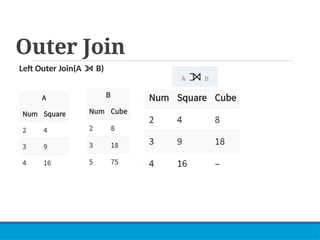
Left Outer Join(A B)
⟕
In the left outer join, operation allows keeping all tuple in the left relation.
However, if there is no matching tuple is found in right relation, then the
attributes of right relation in the join result are filled with null values.
Outer Join
Left Outer Join(A B)
⟕
Outer Join
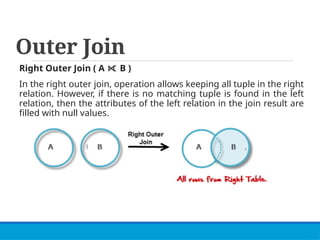
Right Outer Join ( A B )
⟖
In the right outer join, operation allows keeping all tuple in the right
relation. However, if there is no matching tuple is found in the left
relation, then the attributes of the left relation in the join result are
filled with null values.
Outer Join
Right Outer Join ( A B )
⟖
Outer Join
Full Outer Join ( A B)
⟗
In a full outer join, all tuples from both relations are included in the result,
irrespective of the matching condition.
Semi Join
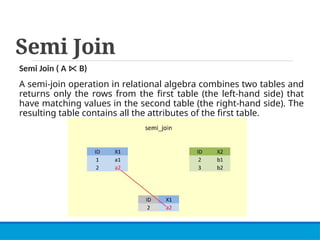
Semi Join ( A ⋉ B)
A semi-join operation in relational algebra combines two tables and
returns only the rows from the first table (the left-hand side) that
have matching values in the second table (the right-hand side). The
resulting table contains all the attributes of the first table.
Semi Join
Semi Join ( A ⋉ B)
A semi-join operation in relational algebra combines two tables and
returns only the rows from the first table (the left-hand side) that
have matching values in the second table (the right-hand side). The
resulting table contains all the attributes of the first table.
Anti Join
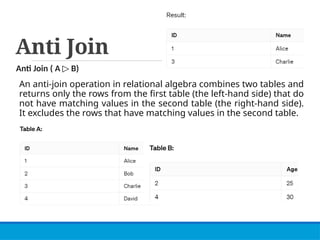
Anti Join ( A ▷ B)
An anti-join operation in relational algebra combines two tables and
returns only the rows from the first table (the left-hand side) that do
not have matching values in the second table (the right-hand side).
It excludes the rows that have matching values in the second table.
Anti Join
Anti Join ( A ▷ B)
An anti-join operation in relational algebra combines two tables and
returns only the rows from the first table (the left-hand side) that do
not have matching values in the second table (the right-hand side).
It excludes the rows that have matching values in the second table.
Division Operator
Example - Division
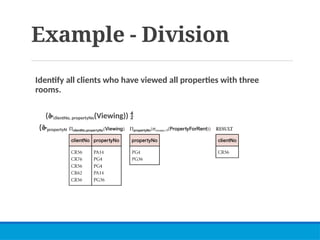
Identify all clients who have viewed all properties with three
rooms.
(clientNo, propertyNo(Viewing)) 
(propertyNo(rooms = 3 (PropertyForRent)))
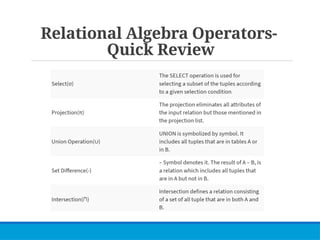
Relational Algebra Operators-
Quick Review
Relational Algebra Operators-
Quick Review
Relational Algebra Operators-
Quick Review
Considering above schema, state what the following queries compute:
Answers
Assignment
Consider the following schema:
Suppliers(sid: integer, sname: string, address: string)
Parts(pid: integer, pname: string, color: string)
Catalog(sid: integer, pid: integer, cost: real)
Assignment
1. Find the sids of suppliers who supply every part.
2. Find the sids of suppliers who supply every red part.
3. Find the sids of suppliers who supply every red or green part.
4. Find the sids of suppliers who supply every red part or supply every
green part.
5. Find pairs of sids such that the supplier with the first sid charges
more for some part than the supplier with the second sid.
6. Find the pids of parts supplied by at least two different suppliers.
Assignment
7. Find the names of suppliers who supply some red part.
8. Find the sids of suppliers who supply some red or green part.
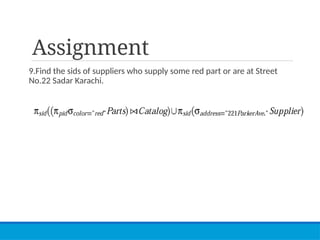
9. Find the sids of suppliers who supply some red part or are at Street
No.22 Sadar Karachi.
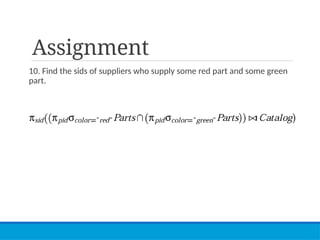
10. Find the sids of suppliers who supply some red part and some green
part.
Assignment
1.Find the sids of suppliers who supply every part.
Assignment
2. Find the sids of suppliers who supply every red part.
Assignment
3. Find the sids of suppliers who supply every red or green part.
Assignment
4. Find the sids of suppliers who supply every red part or supply every
green part.
Assignment
5. Find pairs of sids such that the supplier with the first sid charges more
for some part than the supplier with the second sid.
Assignment
6. Find the pids of parts supplied by at least two different suppliers.
Assignment
7.Find the names of suppliers who supply some red part.
Assignment
8. Find the sids of suppliers who supply some red or green part.
Assignment
9.Find the sids of suppliers who supply some red part or are at Street
No.22 Sadar Karachi.
Assignment
10. Find the sids of suppliers who supply some red part and some green
part.

Lect - 12 solve d.pptx

  • 1.
  • 2.
    In this Lectureyou will Learn about: Query Languages Types Relational Algebra Relational Algebra Operators 01/30/2025 2
  • 3.
    Query Languages Types 1.Procedural Query Language -Relational Algebra 2. Non-Procedural Query Language -Tuple relational calculus and domain relational calculus 01/30/2025 3
  • 4.
    Query Languages Types 1.Procedural Query Language: (Specifies how to retrieve data.) •In a procedural query language, you specify step-by-step instructions for how to retrieve the desired data from the database. •Queries are expressed as sequences of operations that are executed in a particular order. •Relational algebra is an example of a procedural query language commonly used in relational databases. It defines operations like selection, projection, join, etc., and queries are formulated by composing these operations in a specific sequence. 01/30/2025 4
  • 5.
    Query Languages Types 2.Non-Procedural Query Language: (Specifies what data to retrieve.) •In a non-procedural query language, you specify what data you want to retrieve without specifying how to retrieve it. •Queries are expressed as logical statements or declarative expressions that describe the desired result set. •Tuple relational calculus and domain relational calculus are examples of non-procedural query languages used in relational databases. Instead of specifying a sequence of operations, queries are formulated as logical conditions that the desired data must satisfy. 01/30/2025 5
  • 6.
    Query Languages Types 1.Relational Algebra: Relational algebra is a procedural query language that defines a set of operations that can be applied to relations (tables) in a relational database. These operations include selection, projection, Cartesian product, join, union, intersection, and difference, among others. It provides a way to express queries as a series of operations on relations. 01/30/2025 6
  • 7.
    Query Languages Types 2.Tuple Relational Calculus: Tuple relational calculus is a non-procedural query language that defines queries in terms of logical formulas. Instead of specifying a sequence of operations to retrieve data, tuple relational calculus describes what data should be retrieved. It uses variables and quantifiers to specify conditions that the desired tuples must satisfy. 01/30/2025 7
  • 8.
    Query Languages Types 3.Domain Relational Calculus: Domain relational calculus is another non-procedural query language that operates similarly to tuple relational calculus but focuses on specifying conditions on the attributes or domains of relations rather than on individual tuples. It also uses variables and quantifiers to express conditions that the desired data must satisfy. 01/30/2025 8
  • 9.
    A procedural languagefor querying relational database Consisting of a set of operations that take one or two relations as input and produce a new relation as their result. Six basic operators ◦ select:  ◦ project:  ◦ union:  ◦ set difference: – ◦ Cartesian product: x ◦ rename:  Relational algebra
  • 11.
    Select Operation The selectoperation selects tuples that satisfy a given predicate. Notation: p(r) p is called the selection predicate Example: select those tuples of the instructor relation where the instructor is in the “Physics” department. ◦ Query dept_name=“Physics” (instructor) ◦ Result
  • 12.
  • 13.
    Select Operation (Cont.) Weallow comparisons using =, , >, . <.  (in the selection predicate.) We can combine several predicates into a larger predicate by using the connectives:  (and),  (or),  (not) Example: Find the instructors in Physics with a salary greater 90,000  dept_name=“Physics” salary > 90,000 (instructor) Then select predicate may include comparisons between two attributes. ◦ Example: Find all departments whose name is the same as their building name: ◦  dept_name=building (department)
  • 14.
    Project Operation A unaryoperation that returns a set of chosen columns. Notation:  A1,A2,A3 ….Ak (r) where A1, A2 are attribute names and r is a relation name. The result is defined as the relation of k columns obtained by erasing the columns that are not listed Duplicate rows removed from result, since relations are sets
  • 15.
    Project Operation (Cont.) Example: eliminatethe dept_name attribute of instructor Query: ID, name, salary (instructor) Result:
  • 16.
  • 17.
    The Assignment Operation Itis convenient at times to write a relational-algebra expression by assigning parts of it to temporary relation variables. The assignment operation is denoted by  and works like assignment in a programming language. Example: Find all instructor in the “Physics” and Music department. Physics   dept_name=“Physics” (instructor) Music   dept_name=“Music” (instructor) Physics  Music With the assignment operation, a query can be written as a sequential program consisting of a series of assignments followed by an expression whose value is displayed as the result of the query.
  • 18.
    Composition of RelationalOperations The result of a relational-algebra operation is relation and therefore of relational-algebra operations can be composed together into a relational-algebra expression. Consider the query -- Find the names of all instructors in the Physics department. name( dept_name =“Physics” (instructor)) Instead of giving the name of a relation as the argument of the projection operation, we give an expression that evaluates to a relation.
  • 19.
    Set Union Operation Theunion operation allows us to combine two relations Notation: r  s For r  s to be valid. 1. r, s must have the same arity (same number of attributes) 2. The attribute domains must be compatible (example: 2nd column of r deals with the same type of values as does the 2nd column of s) Example: to find all courses taught in the Fall 2017 semester, or in the Spring 2018 semester, or in both course_id ( semester=“Fall” Λ year=2017 (section))  course_id ( semester=“Spring” Λ year=2018 (section))
  • 20.
  • 21.
    Set-Intersection Operation The set-intersectionoperation allows us to find tuples that are in both the input relations. Notation: r  s Assume: ◦ r, s have the same attributes ◦ attributes of r and s are compatible Example: Find the set of all courses taught in both the Fall 2017 and the Spring 2018 semesters. course_id ( semester=“Fall” Λ year=2017 (section))  course_id ( semester=“Spring” Λ year=2018 (section))
  • 22.
  • 23.
    Set Difference Operation Theset-difference operation allows us to find tuples that are in one relation but are not in another. Notation r – s Set differences must be taken between compatible relations. ◦ r and s must have the same attribute ◦ attribute domains of r and s must be compatible Example: to find all courses taught in the Fall 2017 semester, but not in the Spring 2018 semester course_id ( semester=“Fall” Λ year=2017 (section)) − course_id ( semester=“Spring” Λ year=2018 (section))
  • 24.
  • 25.
  • 26.
    The Rename Operation Theresults of relational-algebra expressions do not have a name that we can use to refer to them. The rename operator,  , is provided for that purpose The expression: x (E) returns the result of expression E under the name x Another form of the rename operation: x(A1,A2, .. An) (E)
  • 27.
  • 28.
  • 29.
    Equivalent Queries There ismore than one way to write a query in relational algebra. Example: Find information about courses taught by instructors in the Physics department with salary greater than 90,000 Query 1  dept_name=“Physics” salary > 90,000 (instructor) Query 2  dept_name=“Physics” ( salary > 90.000 (instructor)) The two queries are not identical; they are, however, equivalent -- they give the same result on any database.
  • 30.
    Cartesian-Product Operation The Cartesian-productoperation (denoted by X) allows us to combine information from any two relations. Example: the Cartesian product of the relations instructor and teaches is written as: instructor X teaches We construct a tuple of the result out of each possible pair of tuples: one from the instructor relation and one from the teaches relation Since the instructor ID appears in both relations we distinguish between these attribute by attaching to the attribute the name of the relation from which the attribute originally came. ◦ instructor.ID ◦ teaches.ID
  • 31.
  • 32.
  • 33.
    Join Operation The Cartesian-Product instructorX teaches associates every tuple of instructor with every tuple of teaches. ◦ Most of the resulting rows have information about instructors who did NOT teach a particular course  meaningless To get only those tuples of “instructor X teaches “ that pertain to instructors and the courses that they taught, we write:  instructor.id = teaches.id (instructor x teaches )) ◦ We get only those tuples of “instructor X teaches” that pertain to instructors and the courses that they taught.
  • 34.
    Join Operation The tablecorresponding to:  instructor.id = teaches.id (instructor x teaches)) X  instructor.id = teaches.id
  • 35.
    Join Operation (Cont.) Thejoin operation allows us to combine a select operation and a Cartesian- Product operation into a single operation. Consider relations r (R) and s (S) Let “theta” be a predicate on attributes in the schema R “union” S. The join operation r s is defined as follows: Thus  instructor.id = teaches.id (instructor x teaches )) Can equivalently be written as instructor Instructor.id = teaches.id teaches.
  • 36.
  • 37.
    Inner Joins Inner Join Inan inner join, only those tuples that satisfy the matching criteria are included, while the rest are excluded. Let’s study various types of Inner Joins:
  • 38.
    Inner Join Theta Join Thegeneral case of JOIN operation is called a Theta join. It is denoted by symbol θ Theta join can use any conditions in the selection criteria.
  • 39.
  • 40.
    Inner Join Natural join Itcan only be performed if there is a common attribute (column) between the relations. The name and type of the attribute must be same. Notation: R1 R2 Input Schema: R1(A1, …, An), R2(B1, …, Bm) Output Schema: S(C1,…,Cp) ◦ Where {C1, …, Cp} = {A1, …, An} U {B1, …, Bm} Meaning: combine all pairs of tuples in R1 and R2 that agree on the attributes: ◦ {A1,…,An} {B1,…, Bm} (called the join attributes) Equivalent to a cross product followed by selection Example Employee Dependents 
  • 41.
  • 42.
    Outer Join In anouter join, along with tuples that satisfy the matching criteria, we also include some or all tuples that do not match the criteria. Left Outer Join(A B) ⟕ In the left outer join, operation allows keeping all tuple in the left relation. However, if there is no matching tuple is found in right relation, then the attributes of right relation in the join result are filled with null values.
  • 43.
    Outer Join Left OuterJoin(A B) ⟕
  • 44.
    Outer Join Right OuterJoin ( A B ) ⟖ In the right outer join, operation allows keeping all tuple in the right relation. However, if there is no matching tuple is found in the left relation, then the attributes of the left relation in the join result are filled with null values.
  • 45.
    Outer Join Right OuterJoin ( A B ) ⟖
  • 46.
    Outer Join Full OuterJoin ( A B) ⟗ In a full outer join, all tuples from both relations are included in the result, irrespective of the matching condition.
  • 47.
    Semi Join Semi Join( A ⋉ B) A semi-join operation in relational algebra combines two tables and returns only the rows from the first table (the left-hand side) that have matching values in the second table (the right-hand side). The resulting table contains all the attributes of the first table.
  • 48.
    Semi Join Semi Join( A ⋉ B) A semi-join operation in relational algebra combines two tables and returns only the rows from the first table (the left-hand side) that have matching values in the second table (the right-hand side). The resulting table contains all the attributes of the first table.
  • 49.
    Anti Join Anti Join( A ▷ B) An anti-join operation in relational algebra combines two tables and returns only the rows from the first table (the left-hand side) that do not have matching values in the second table (the right-hand side). It excludes the rows that have matching values in the second table.
  • 50.
    Anti Join Anti Join( A ▷ B) An anti-join operation in relational algebra combines two tables and returns only the rows from the first table (the left-hand side) that do not have matching values in the second table (the right-hand side). It excludes the rows that have matching values in the second table.
  • 51.
  • 52.
    Example - Division Identifyall clients who have viewed all properties with three rooms. (clientNo, propertyNo(Viewing))  (propertyNo(rooms = 3 (PropertyForRent)))
  • 53.
  • 54.
  • 55.
  • 56.
    Considering above schema,state what the following queries compute:
  • 57.
  • 58.
    Assignment Consider the followingschema: Suppliers(sid: integer, sname: string, address: string) Parts(pid: integer, pname: string, color: string) Catalog(sid: integer, pid: integer, cost: real)
  • 59.
    Assignment 1. Find thesids of suppliers who supply every part. 2. Find the sids of suppliers who supply every red part. 3. Find the sids of suppliers who supply every red or green part. 4. Find the sids of suppliers who supply every red part or supply every green part. 5. Find pairs of sids such that the supplier with the first sid charges more for some part than the supplier with the second sid. 6. Find the pids of parts supplied by at least two different suppliers.
  • 60.
    Assignment 7. Find thenames of suppliers who supply some red part. 8. Find the sids of suppliers who supply some red or green part. 9. Find the sids of suppliers who supply some red part or are at Street No.22 Sadar Karachi. 10. Find the sids of suppliers who supply some red part and some green part.
  • 61.
    Assignment 1.Find the sidsof suppliers who supply every part.
  • 62.
    Assignment 2. Find thesids of suppliers who supply every red part.
  • 63.
    Assignment 3. Find thesids of suppliers who supply every red or green part.
  • 64.
    Assignment 4. Find thesids of suppliers who supply every red part or supply every green part.
  • 65.
    Assignment 5. Find pairsof sids such that the supplier with the first sid charges more for some part than the supplier with the second sid.
  • 66.
    Assignment 6. Find thepids of parts supplied by at least two different suppliers.
  • 67.
    Assignment 7.Find the namesof suppliers who supply some red part.
  • 68.
    Assignment 8. Find thesids of suppliers who supply some red or green part.
  • 69.
    Assignment 9.Find the sidsof suppliers who supply some red part or are at Street No.22 Sadar Karachi.
  • 70.
    Assignment 10. Find thesids of suppliers who supply some red part and some green part.

Editor's Notes

  • #9 The relational algebra consists of a set of operations that take one or two relations as input and produce a new relation as their result. Some of these operations, such as the select, project, and rename operations, are called unary operations because they operate on one relation. The other operations, such as union, Cartesian product, and set difference, operate on pairs of relations and are, therefore, called binary operations