Relational Algebra
DBMS
Relational Query Languages
• Query languages: Allow manipulation and retrieval
of data from a database.
• Relational model supports simple, powerful QLs:
⚬Strong formal foundation based on algebra/logic.
⚬Allows for much optimization.
Formal Relational Query Languages
• Two mathematical Query Languages form
the basis for “real” languages (e.g. SQL),
and for implementation:
⚬Relational Algebra: More operational, very
useful for representing execution plans.
⚬Relational Calculus: Lets users describe what
they want, rather than how to compute it. (Non-
operational, declarative.) Not covered in course.
Overview
• Notation
• Relational Algebra
• Relational Algebra basic operators.
• Relational Algebra derived operators.
Preliminaries
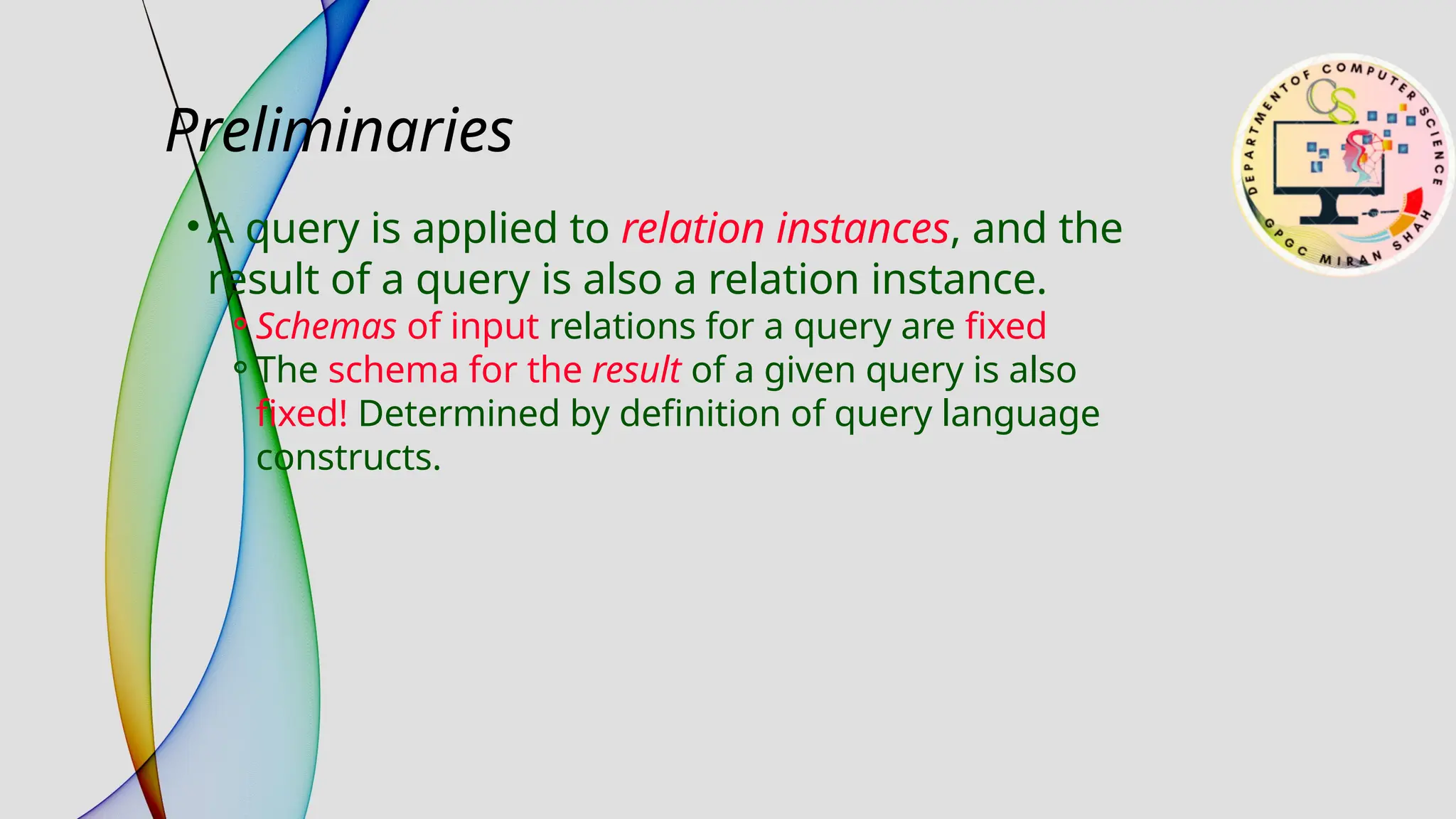
• A query is applied to relation instances, and the
result of a query is also a relation instance.
⚬Schemas of input relations for a query are fixed
⚬The schema for the result of a given query is also
fixed! Determined by definition of query language
constructs.
Preliminaries
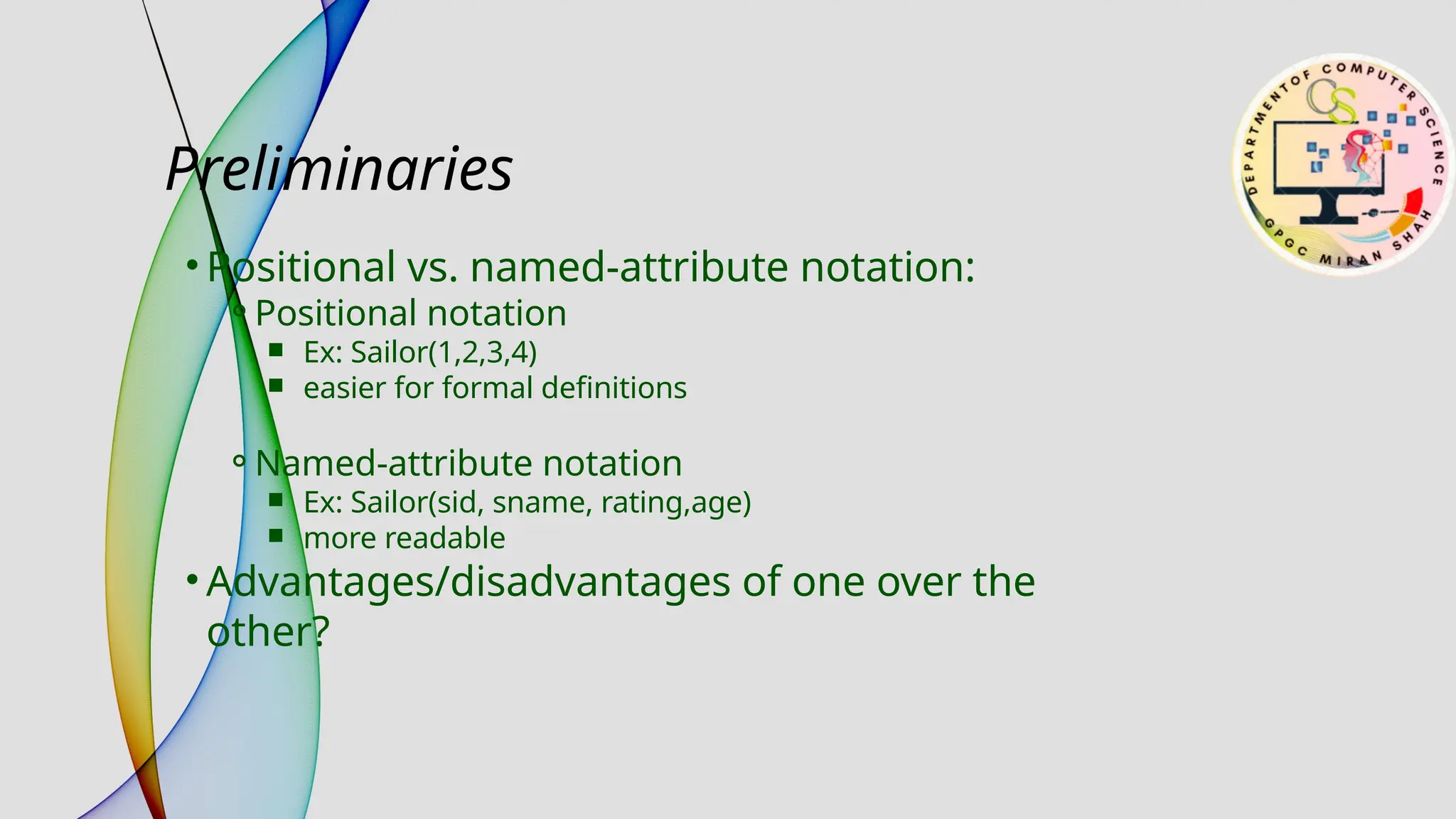
• Positional vs. named-attribute notation:
⚬Positional notation
■ Ex: Sailor(1,2,3,4)
■ easier for formal definitions
⚬Named-attribute notation
■ Ex: Sailor(sid, sname, rating,age)
■ more readable
• Advantages/disadvantages of one over the
other?
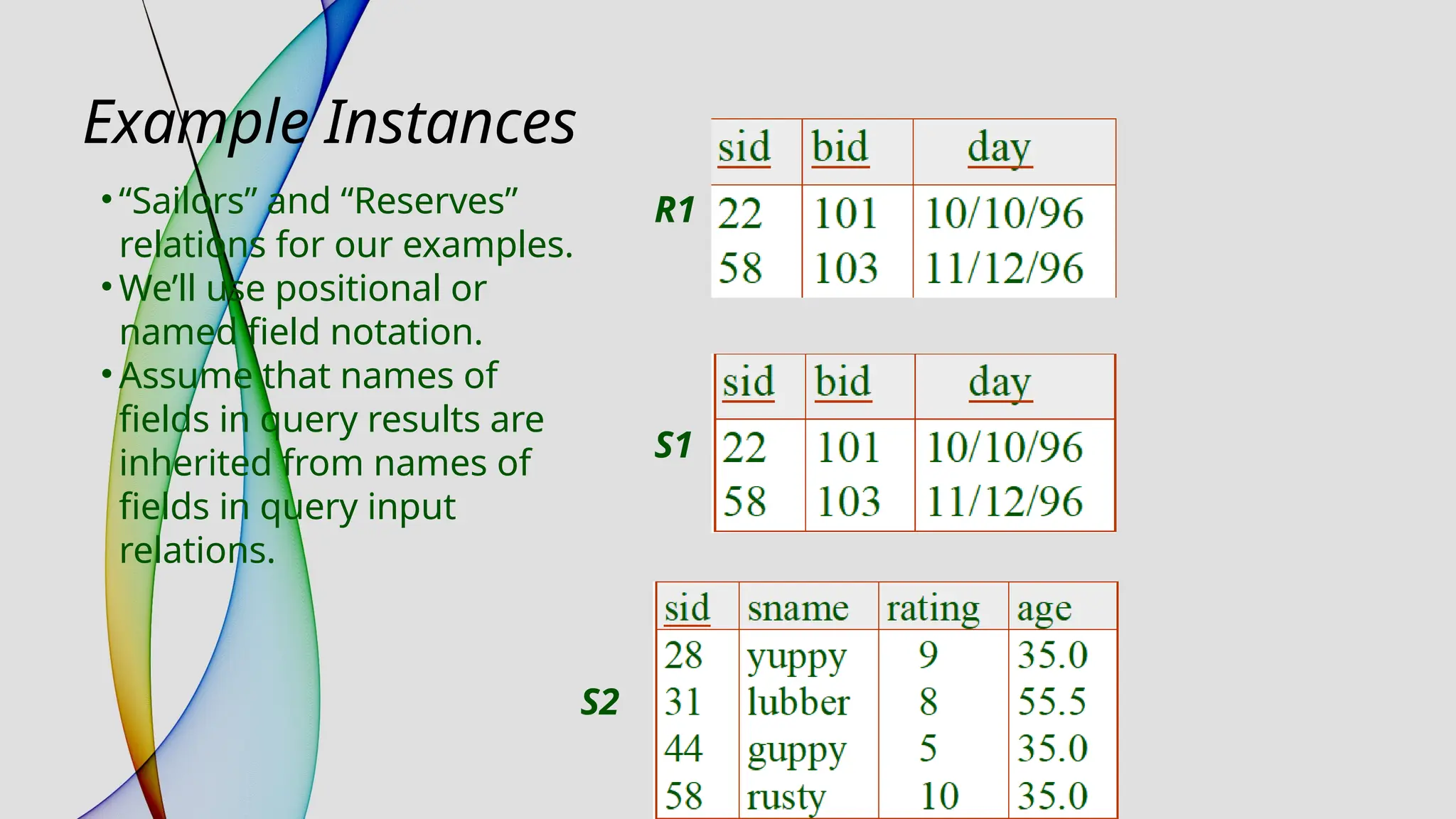
Example Instances
R1
S1
S2
• “Sailors” and “Reserves”
relations for our examples.
• We’ll use positional or
named field notation.
• Assume that names of
fields in query results are
inherited from names of
fields in query input
relations.
Relational
Algebra
Algebra
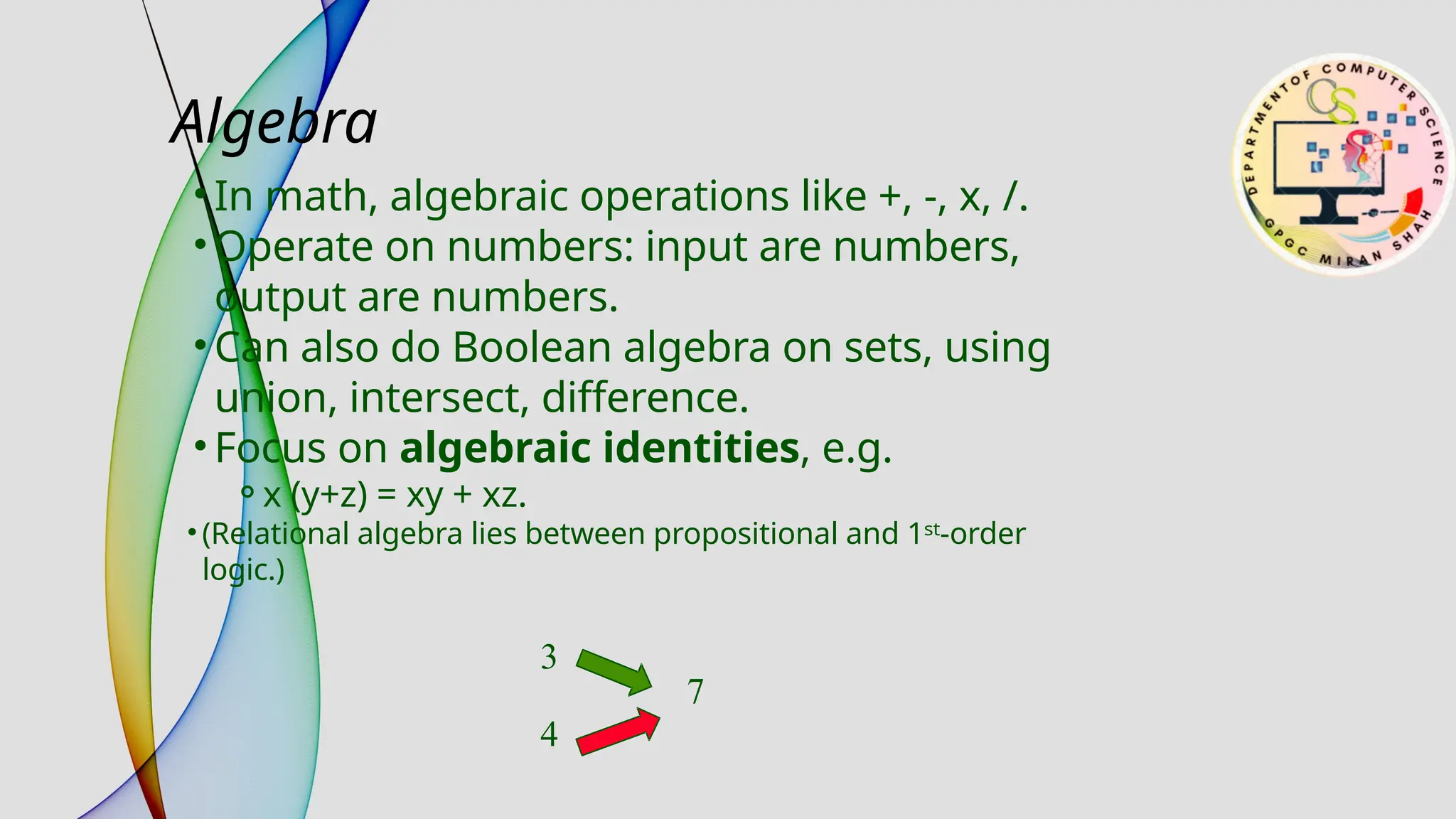
• In math, algebraic operations like +, -, x, /.
• Operate on numbers: input are numbers,
output are numbers.
• Can also do Boolean algebra on sets, using
union, intersect, difference.
• Focus on algebraic identities, e.g.
⚬x (y+z) = xy + xz.
• (Relational algebra lies between propositional and 1ˢᵗ-order
logic.)
3
4
7
Relational Algebra
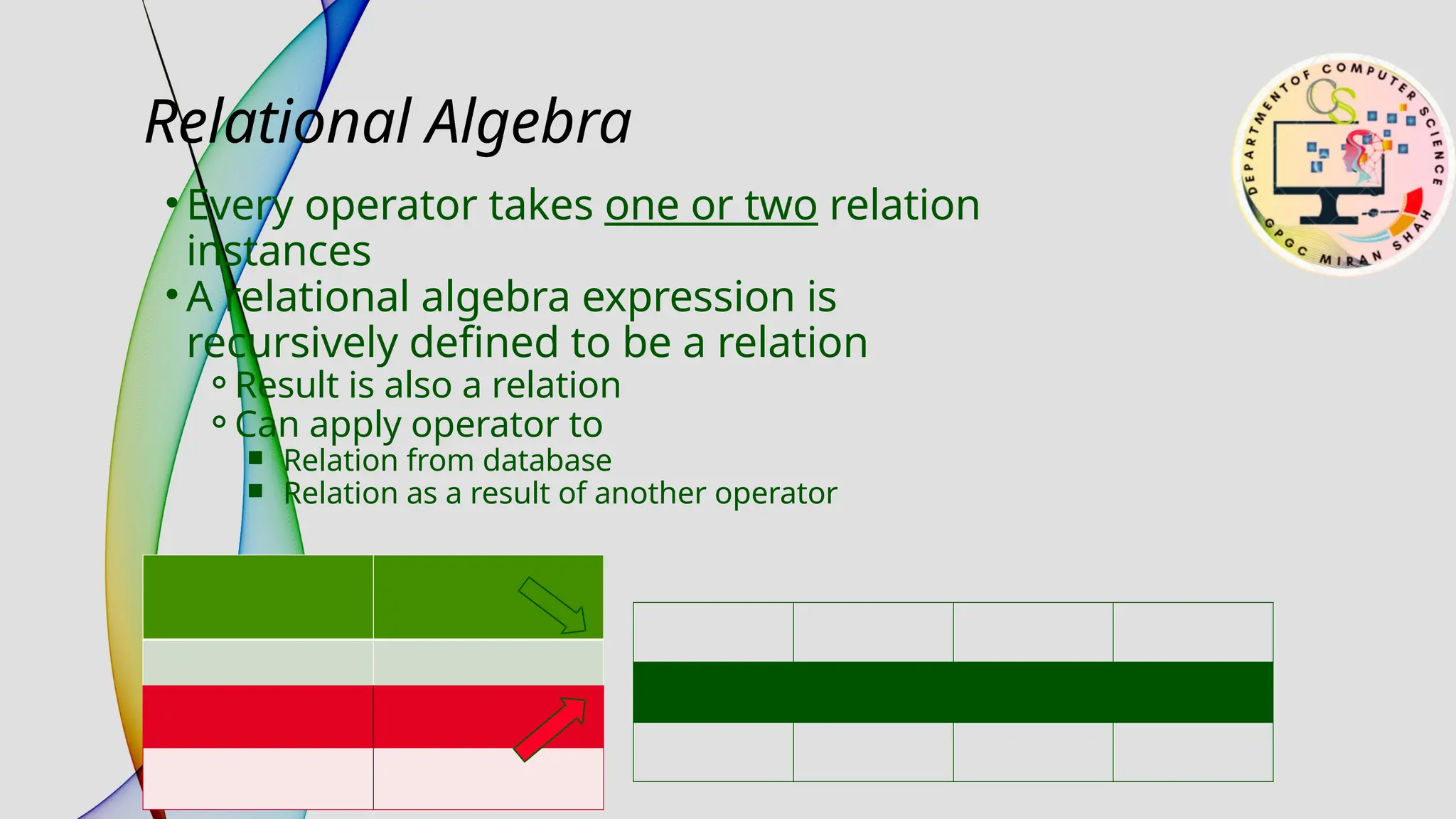
• Every operator takes one or two relation
instances
• A relational algebra expression is
recursively defined to be a relation
⚬Result is also a relation
⚬Can apply operator to
■ Relation from database
■ Relation as a result of another operator
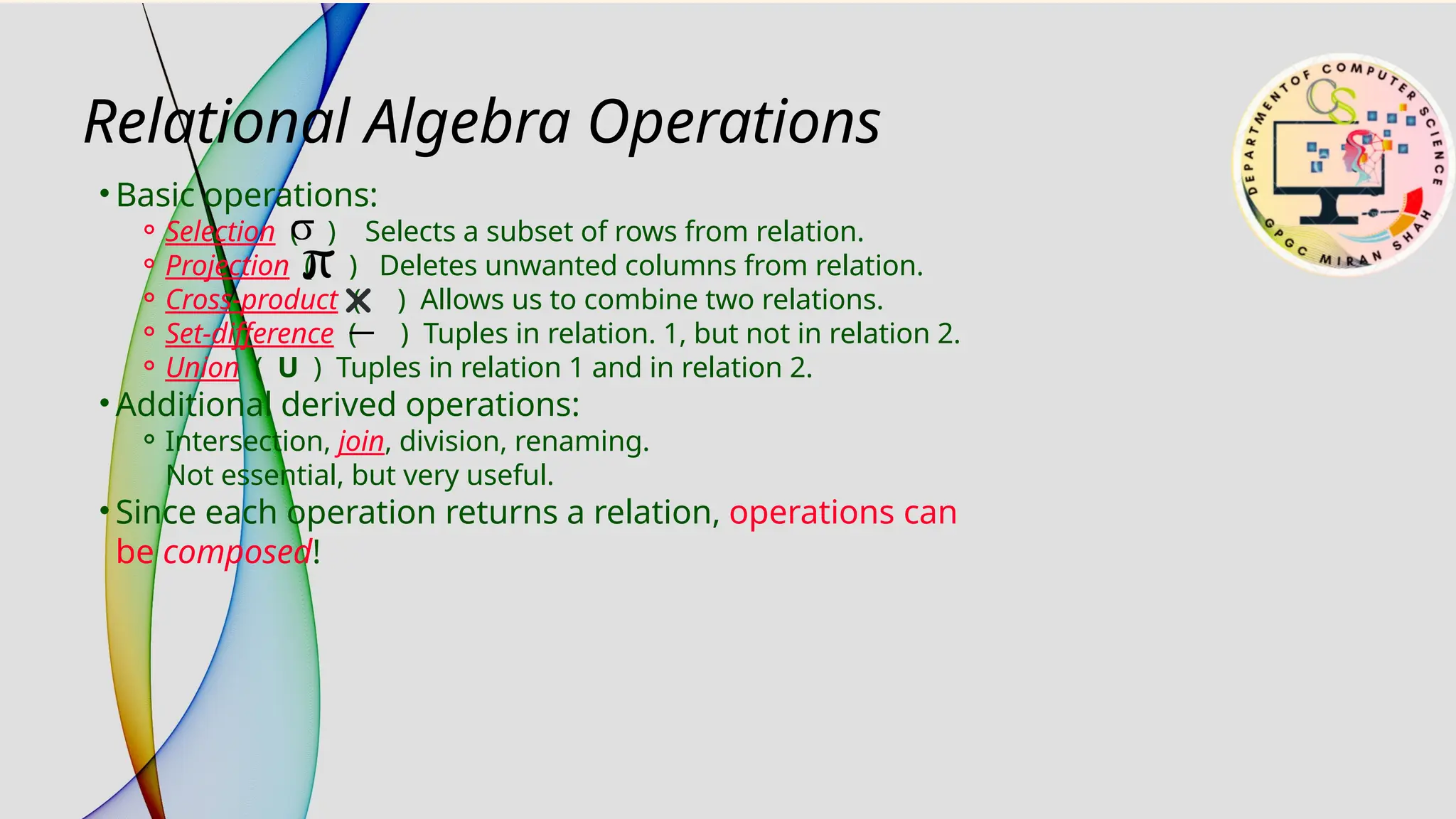
• Basic operations:
⚬Selection ( ) Selects a subset of rows from relation.
⚬Projection ( ) Deletes unwanted columns from relation.
⚬Cross-product ( ) Allows us to combine two relations.
⚬Set-difference ( ) Tuples in relation. 1, but not in relation 2.
⚬Union ( U ) Tuples in relation 1 and in relation 2.
• Additional derived operations:
⚬Intersection, join, division, renaming.
Not essential, but very useful.
• Since each operation returns a relation, operations can
be composed!
Relational Algebra Operations
Basic Relational Algebra Operations
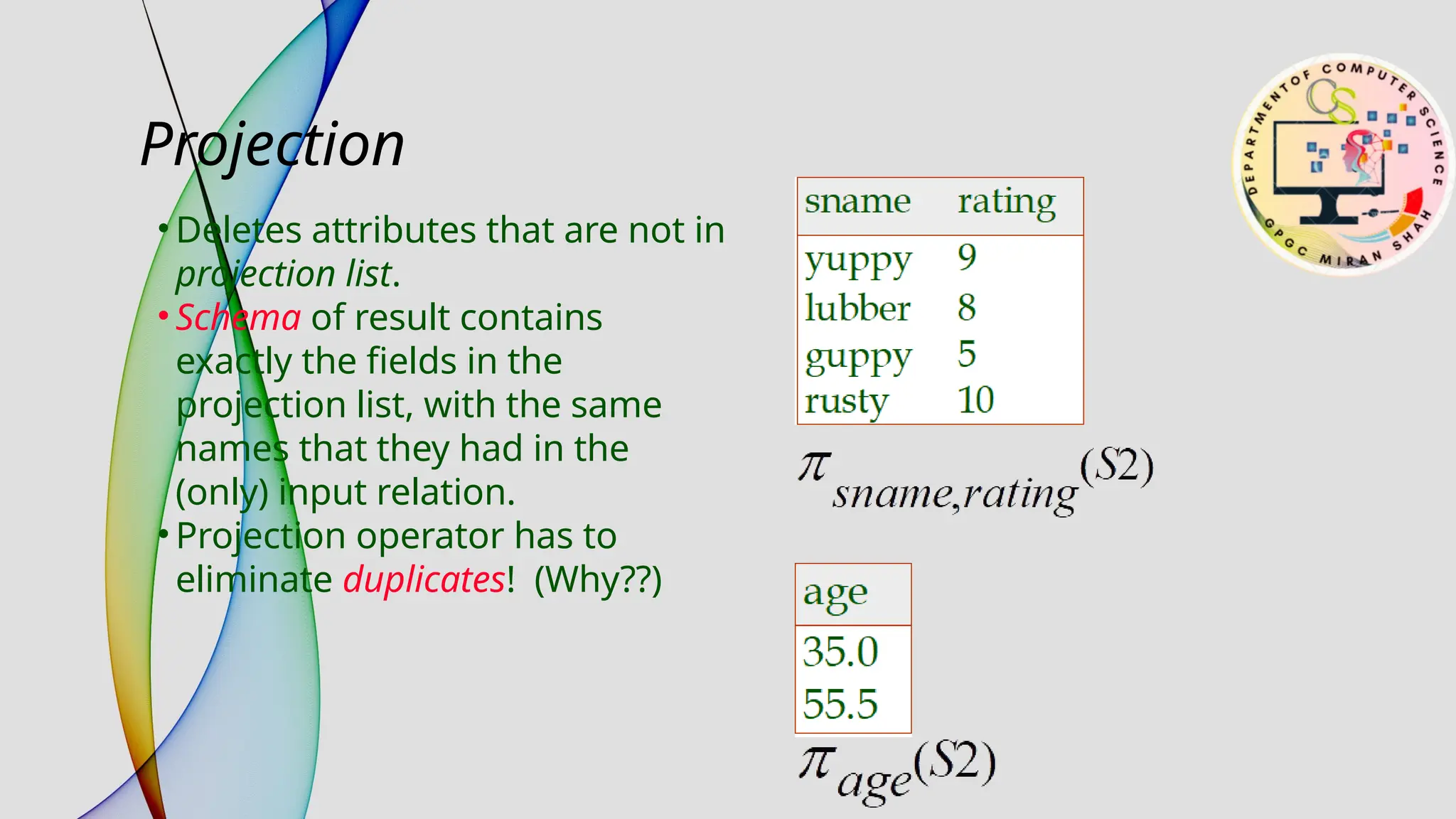
• Deletes attributes that are not in
projection list.
• Schema of result contains
exactly the fields in the
projection list, with the same
names that they had in the
(only) input relation.
• Projection operator has to
eliminate duplicates! (Why??)
Projection
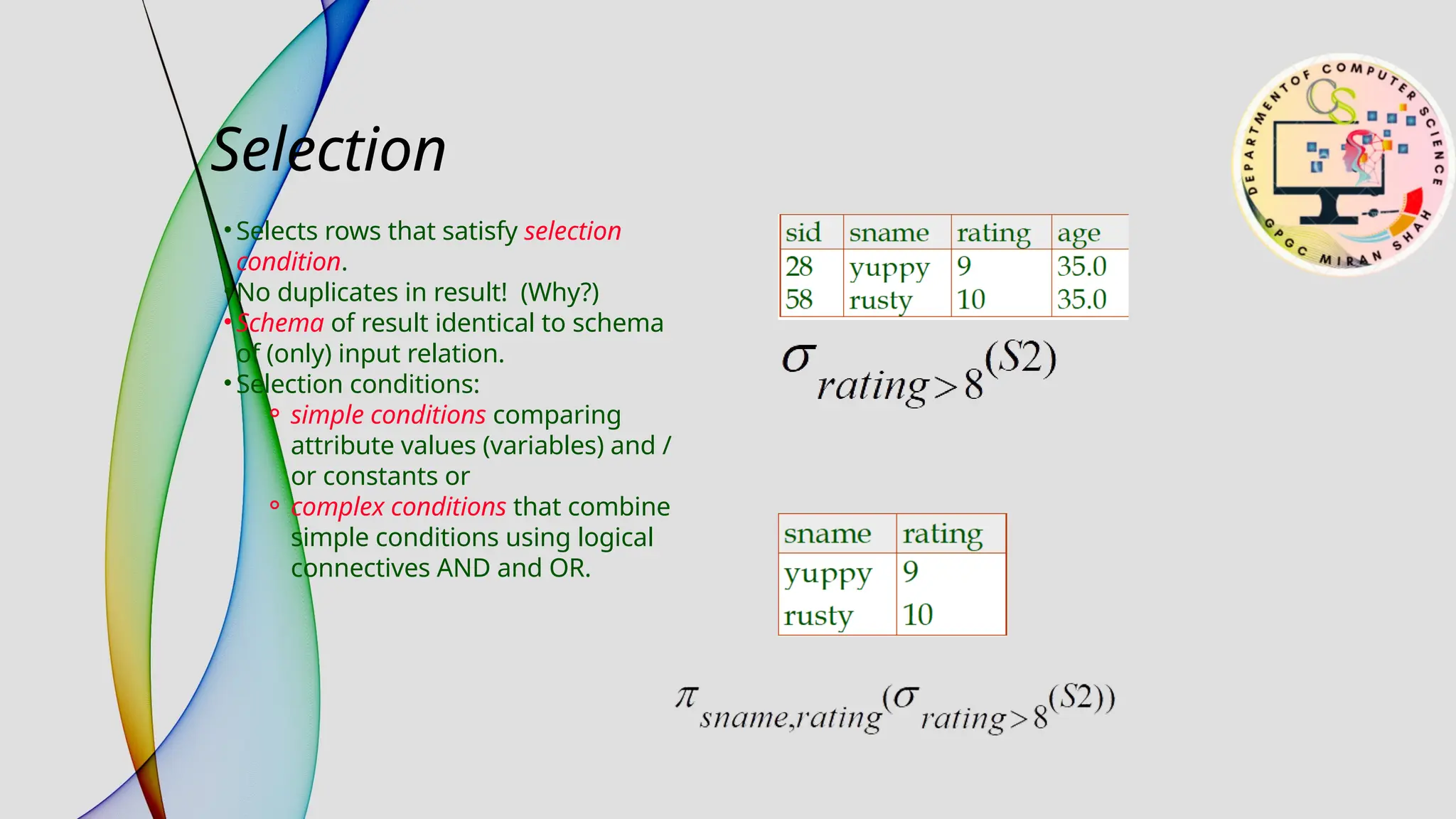
Selection
• Selects rows that satisfy selection
condition.
• No duplicates in result! (Why?)
• Schema of result identical to schema
of (only) input relation.
• Selection conditions:
⚬ simple conditions comparing
attribute values (variables) and /
or constants or
⚬ complex conditions that combine
simple conditions using logical
connectives AND and OR.
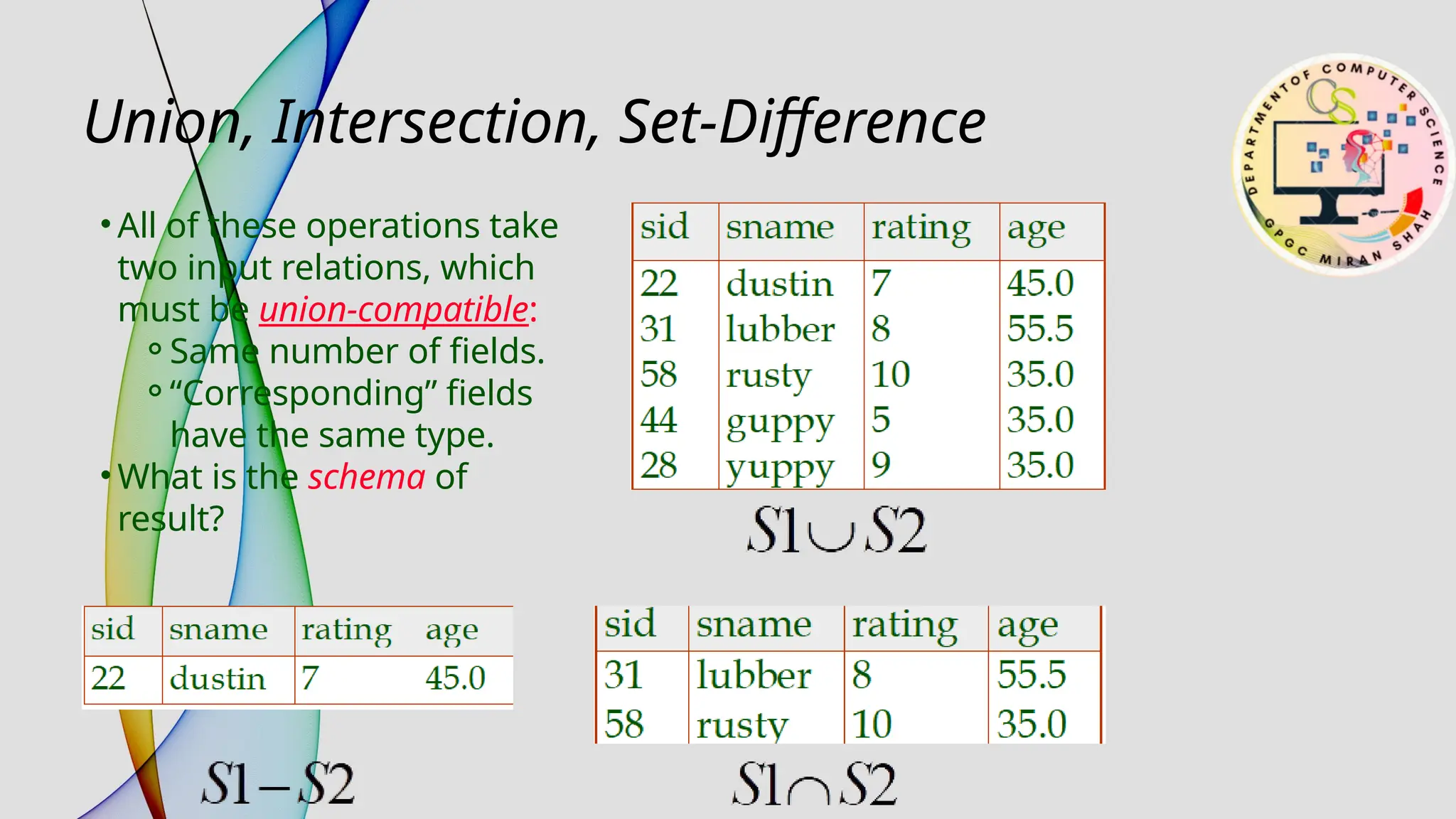
Union, Intersection, Set-Difference
• All of these operations take
two input relations, which
must be union-compatible:
⚬Same number of fields.
⚬“Corresponding” fields
have the same type.
• What is the schema of
result?
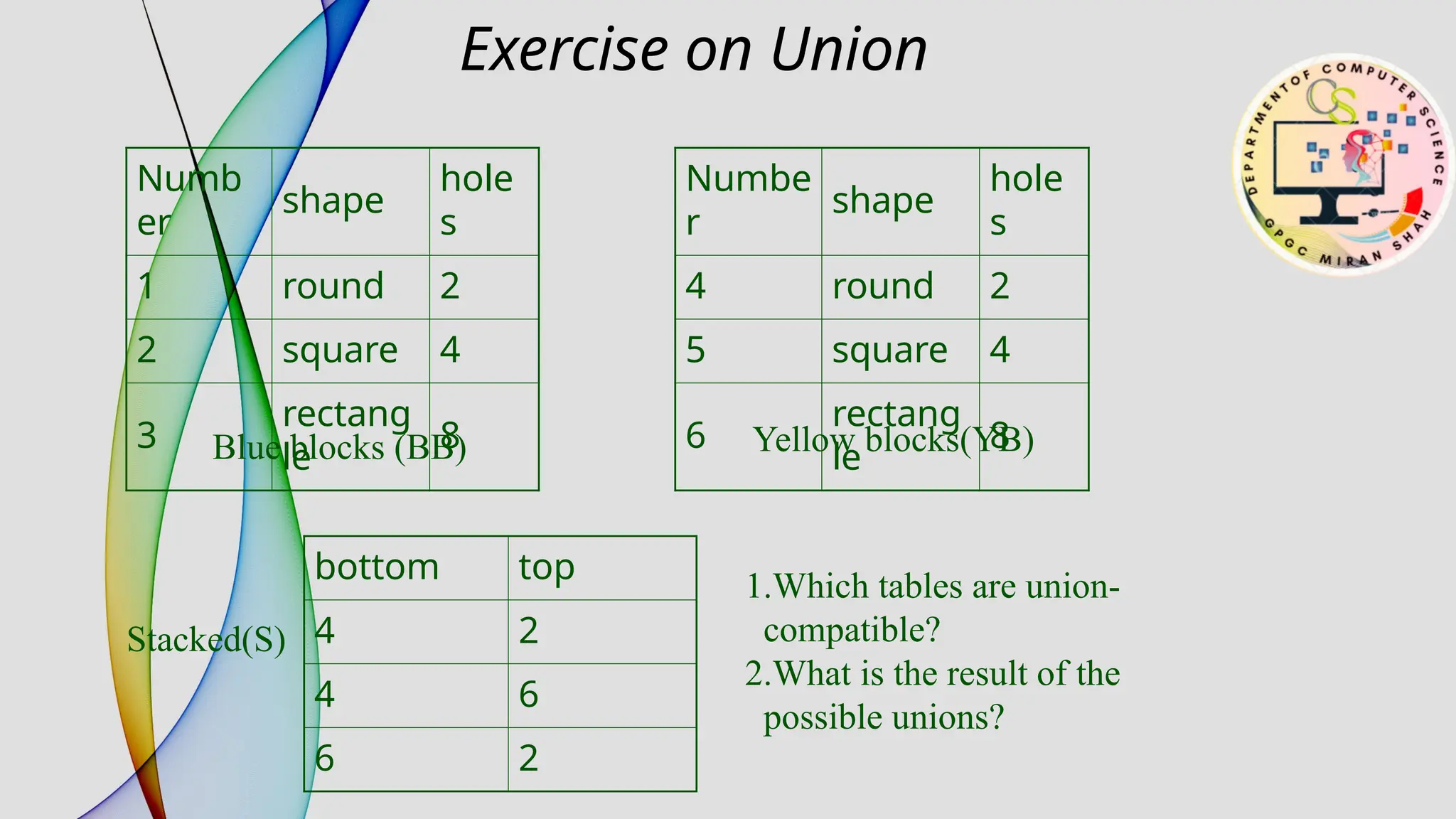
Exercise on Union
Numb
er
shape
hole
s
1 round 2
2 square 4
3
rectang
le
8
Blue blocks (BB)
Numbe
r
shape
hole
s
4 round 2
5 square 4
6
rectang
le
8
bottom top
4 2
4 6
6 2
Stacked(S)
1.Which tables are union-
compatible?
2.What is the result of the
possible unions?
Yellow blocks(YB)
Cross-Product
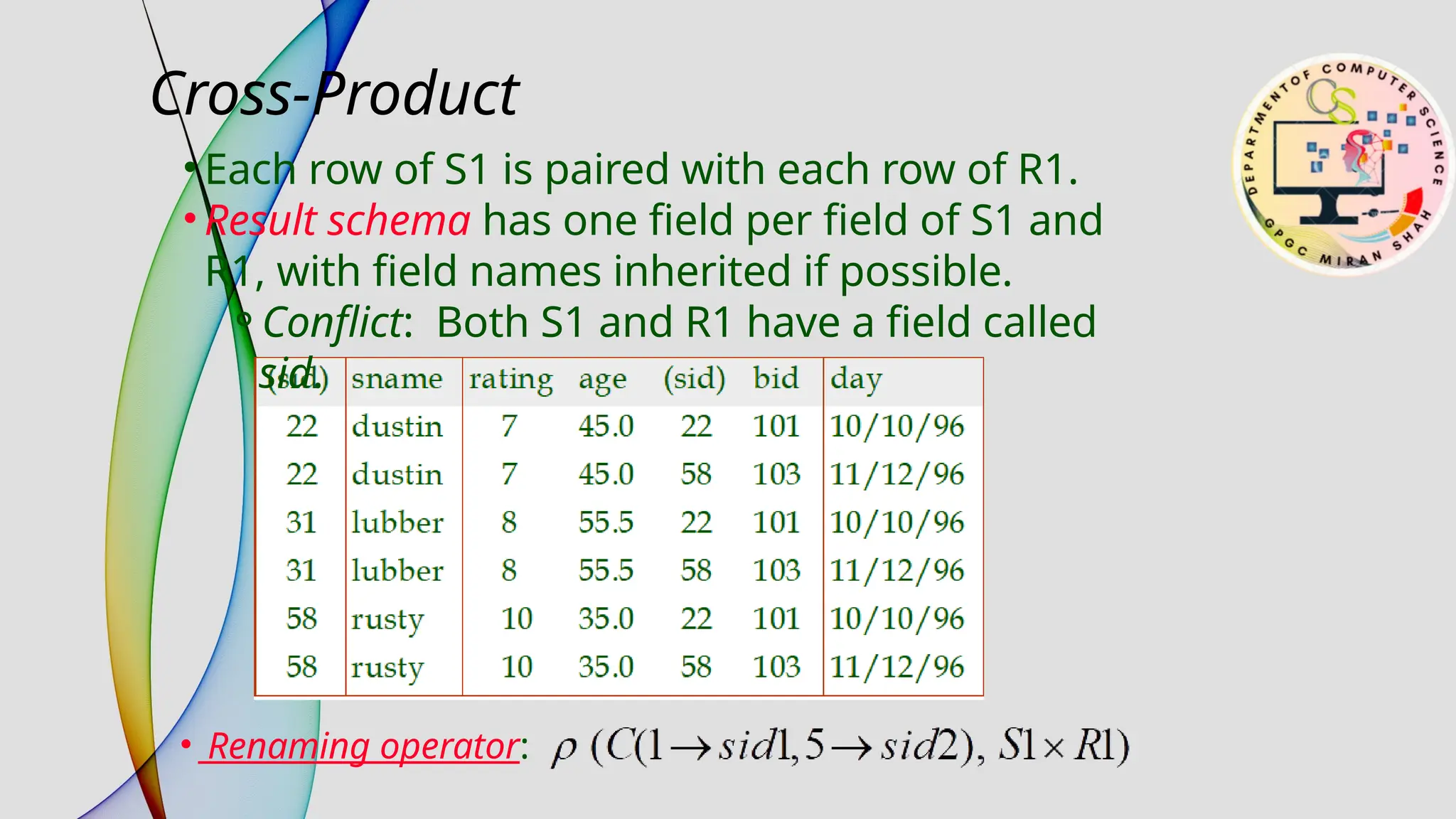
• Each row of S1 is paired with each row of R1.
• Result schema has one field per field of S1 and
R1, with field names inherited if possible.
⚬Conflict: Both S1 and R1 have a field called
sid.
• Renaming operator:
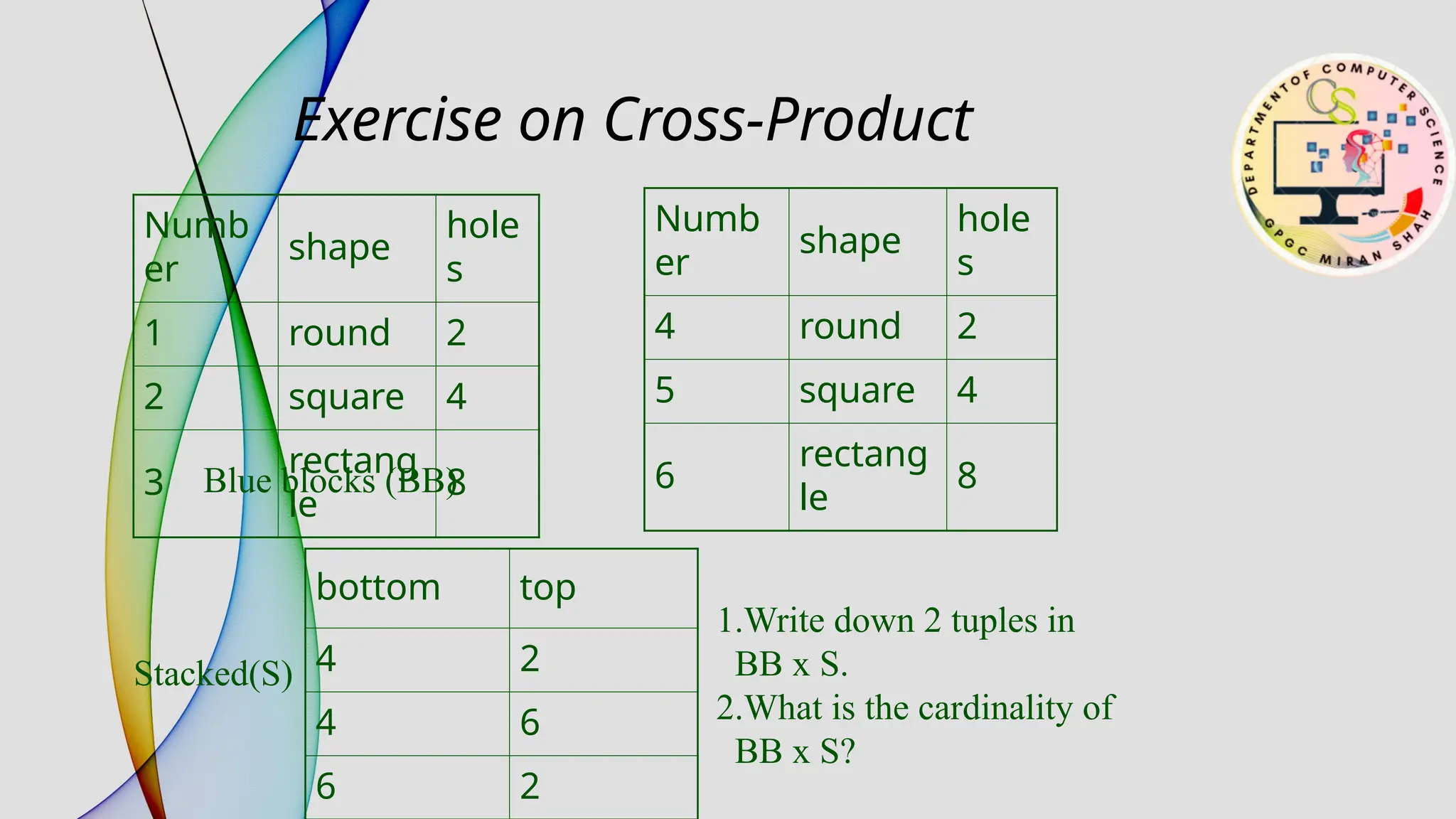
Exercise on Cross-Product
Numb
er
shape
hole
s
1 round 2
2 square 4
3
rectang
le
8
Blue blocks (BB)
Numb
er
shape
hole
s
4 round 2
5 square 4
6
rectang
le
8
bottom top
4 2
4 6
6 2
Stacked(S)
1.Write down 2 tuples in
BB x S.
2.What is the cardinality of
BB x S?
Derived Operators
Join and Division
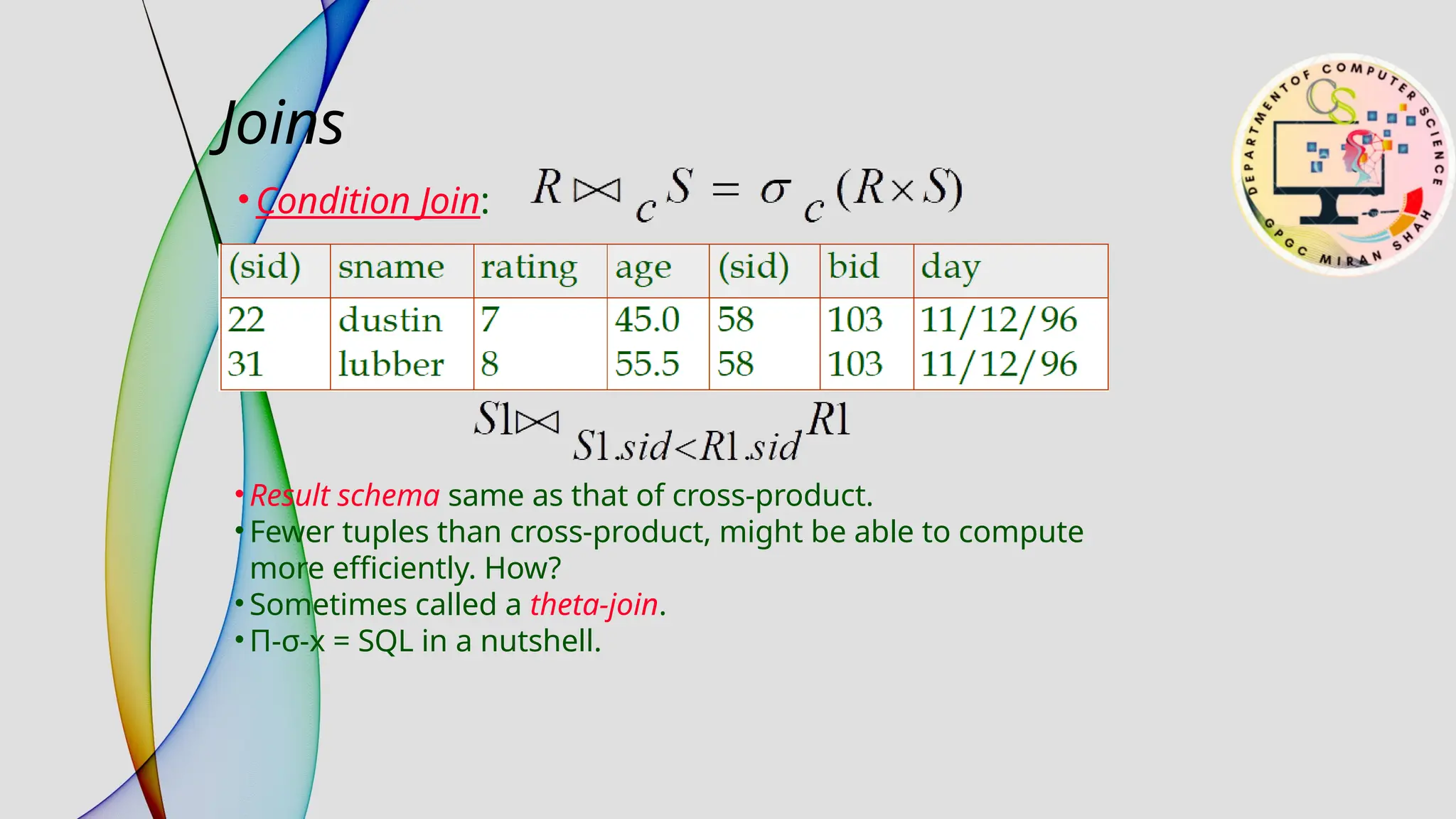
• Condition Join:
• Result schema same as that of cross-product.
• Fewer tuples than cross-product, might be able to compute
more efficiently. How?
• Sometimes called a theta-join.
• Π-σ-x = SQL in a nutshell.
Joins
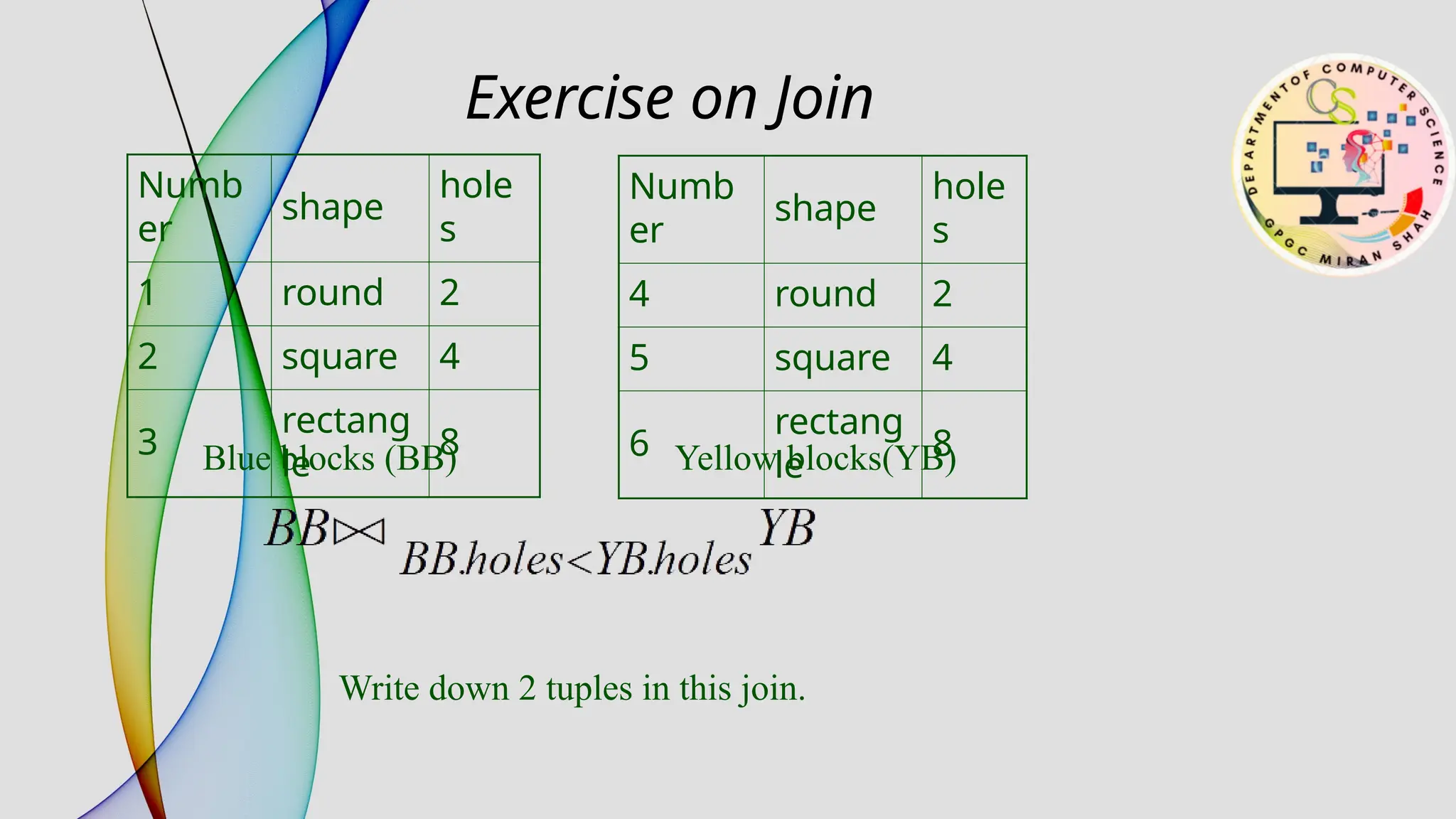
Exercise on Join
Numb
er
shape
hole
s
1 round 2
2 square 4
3
rectang
le
8
Numb
er
shape
hole
s
4 round 2
5 square 4
6
rectang
le
8
Blue blocks (BB) Yellow blocks(YB)
Write down 2 tuples in this join.
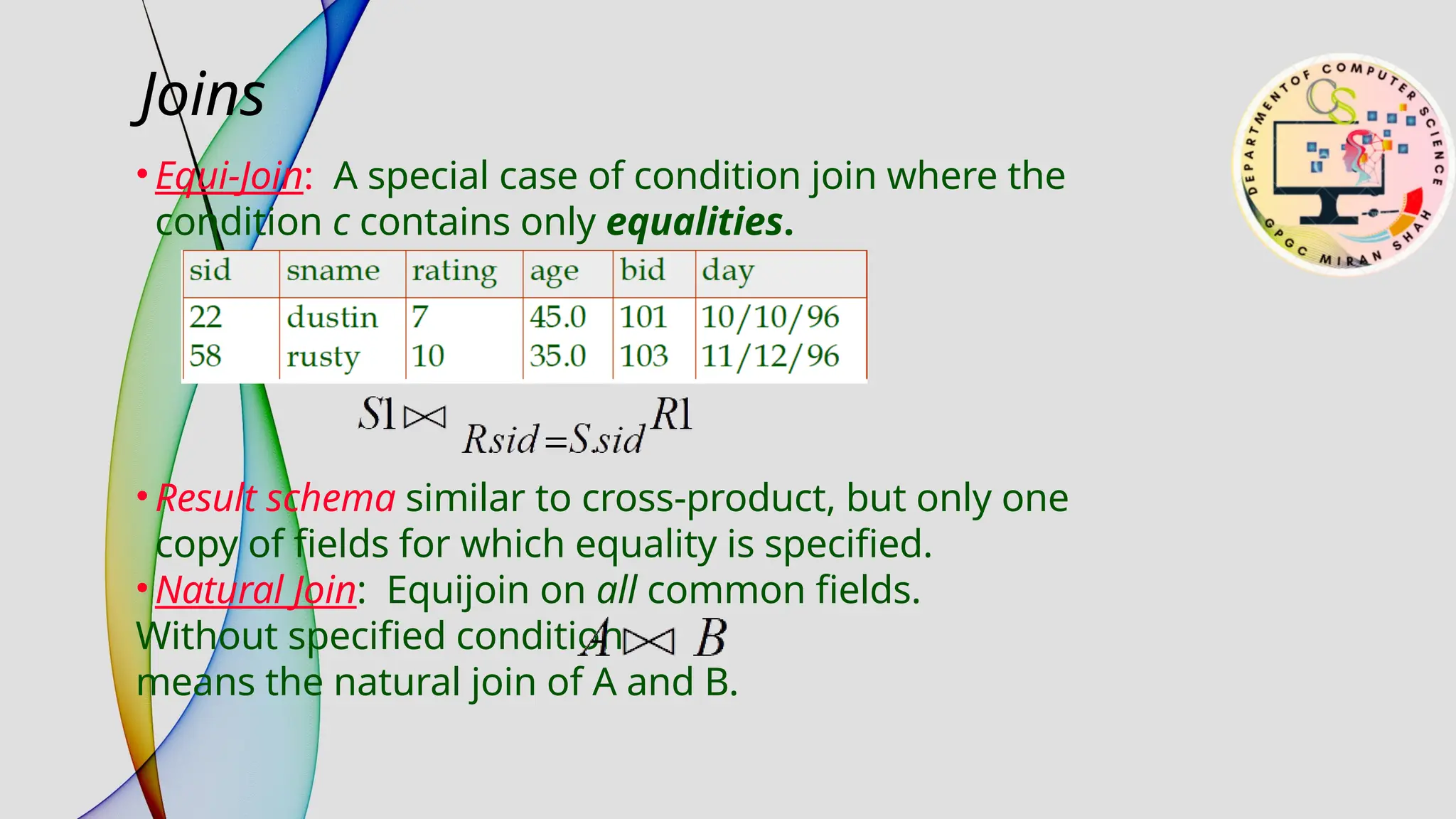
• Equi-Join: A special case of condition join where the
condition c contains only equalities.
• Result schema similar to cross-product, but only one
copy of fields for which equality is specified.
• Natural Join: Equijoin on all common fields.
Without specified condition
means the natural join of A and B.
Joins
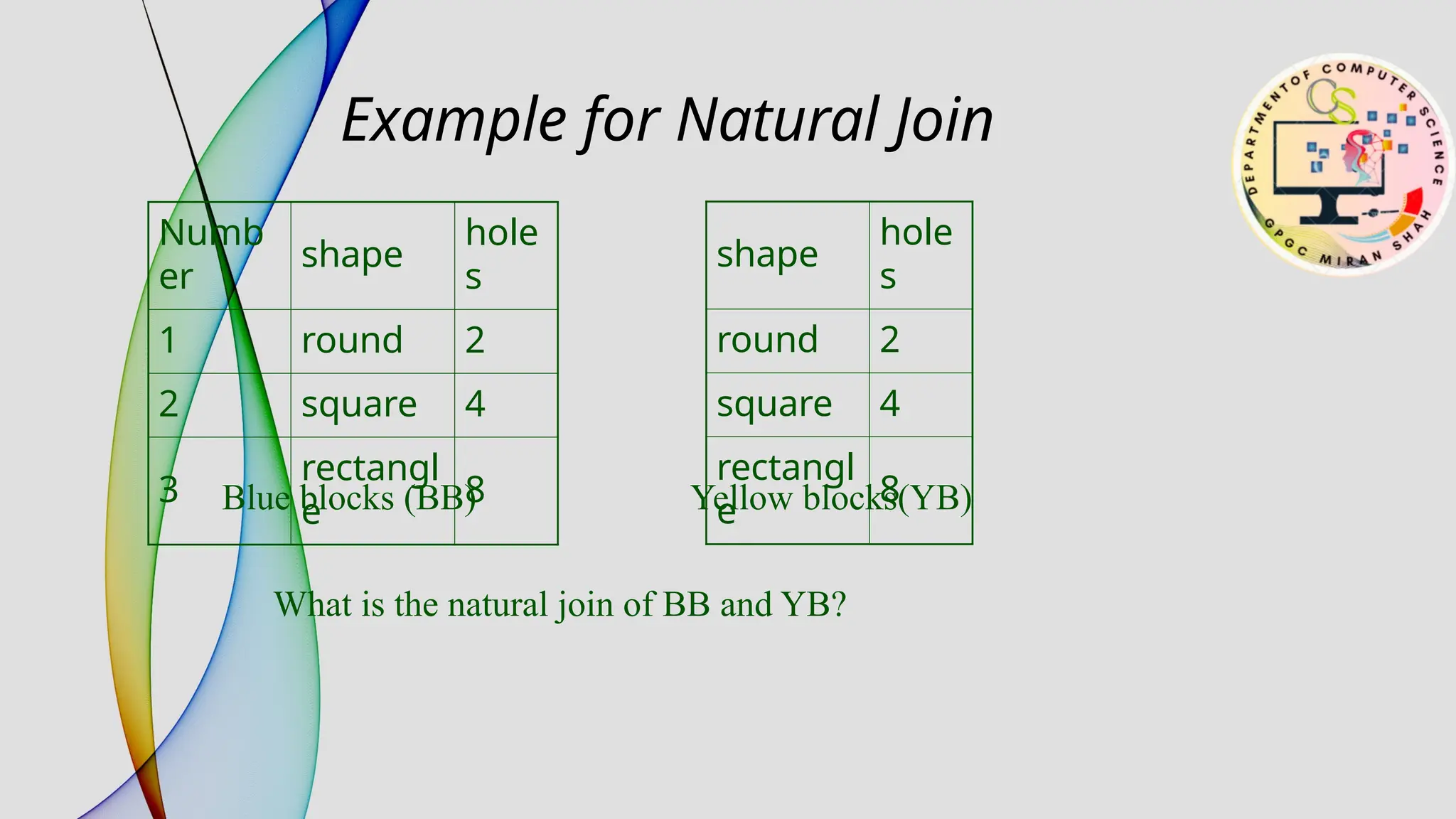
Example for Natural Join
Numb
er
shape
hole
s
1 round 2
2 square 4
3
rectangl
e
8
Blue blocks (BB)
shape
hole
s
round 2
square 4
rectangl
e
8
Yellow blocks(YB)
What is the natural join of BB and YB?
Join Examples
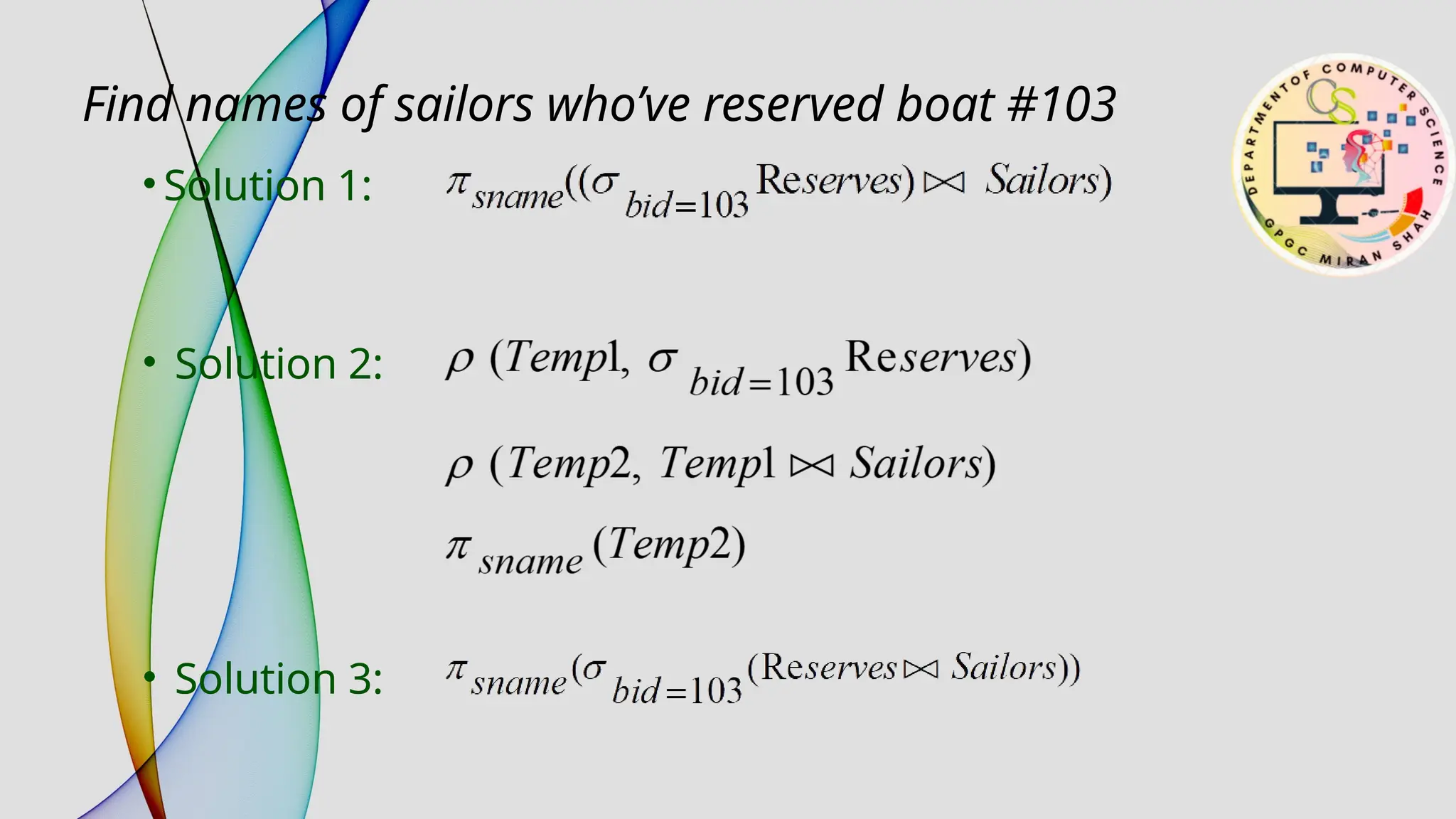
• Solution 1:
Find names of sailors who’ve reserved boat #103
• Solution 2:
• Solution 3:
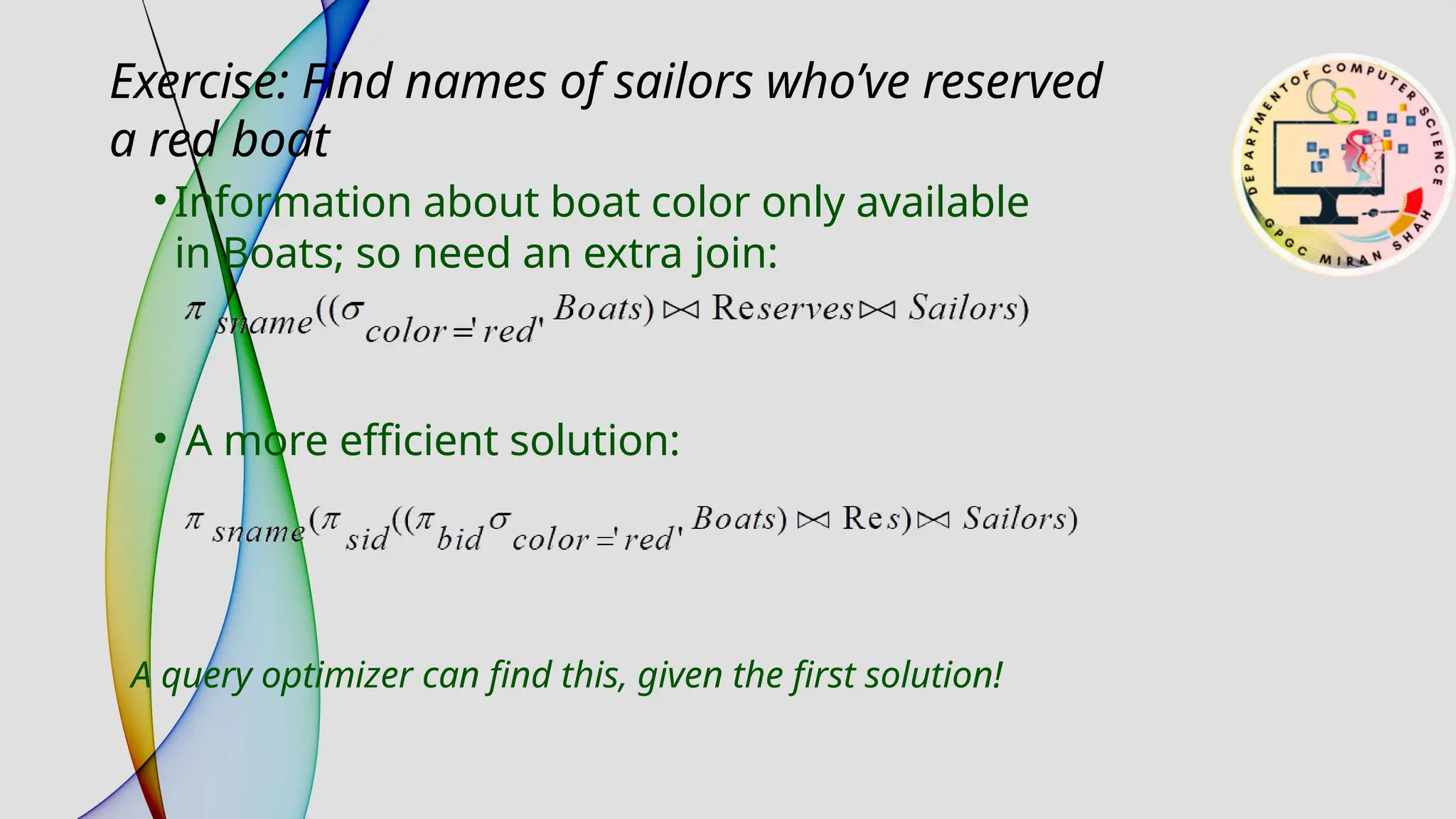
• Information about boat color only available
in Boats; so need an extra join:
Exercise: Find names of sailors who’ve reserved
a red boat
• A more efficient solution:
A query optimizer can find this, given the first solution!
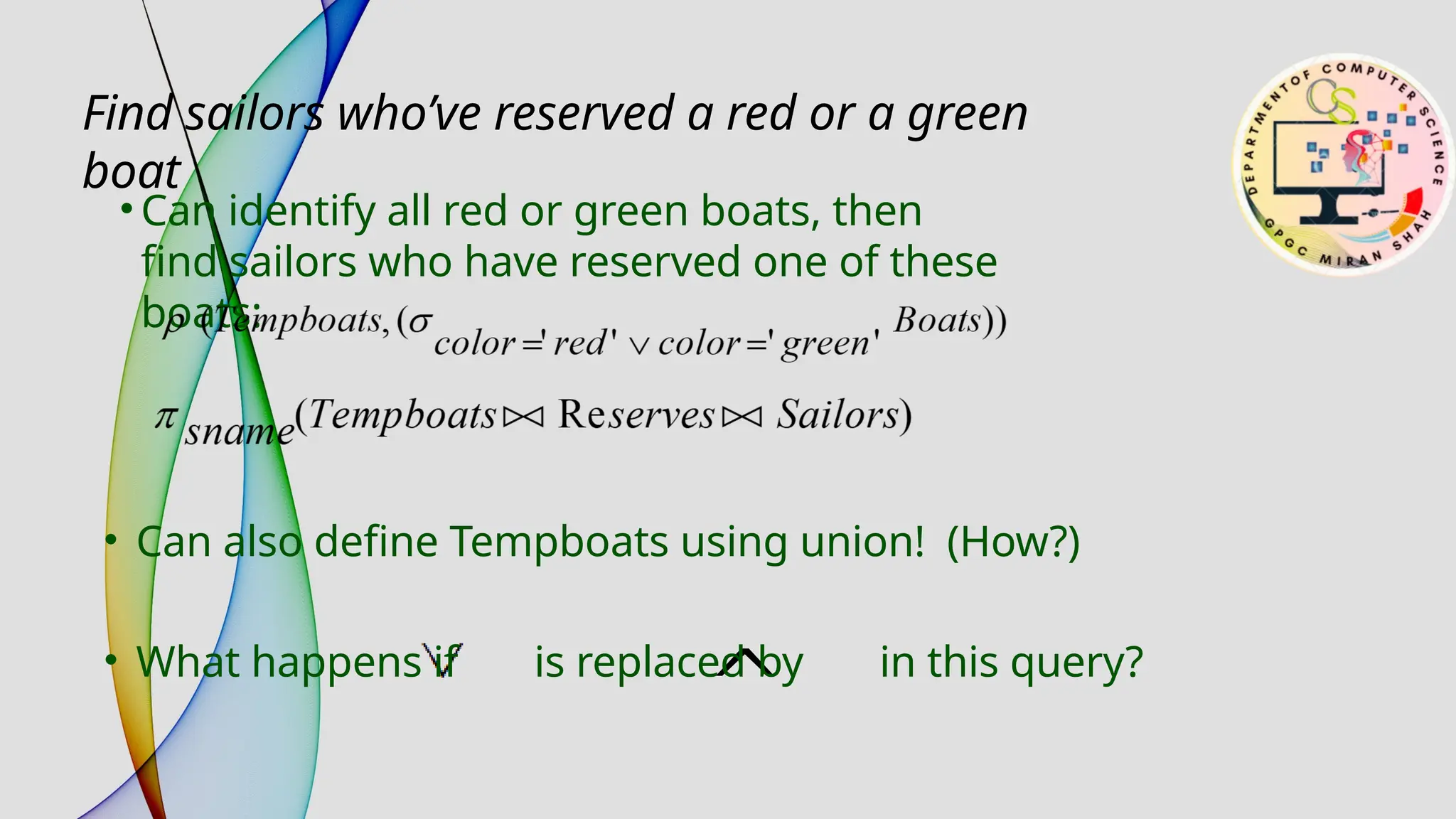
• Can identify all red or green boats, then
find sailors who have reserved one of these
boats:
Find sailors who’ve reserved a red or a green
boat
• Can also define Tempboats using union! (How?)
• What happens if is replaced by in this query?
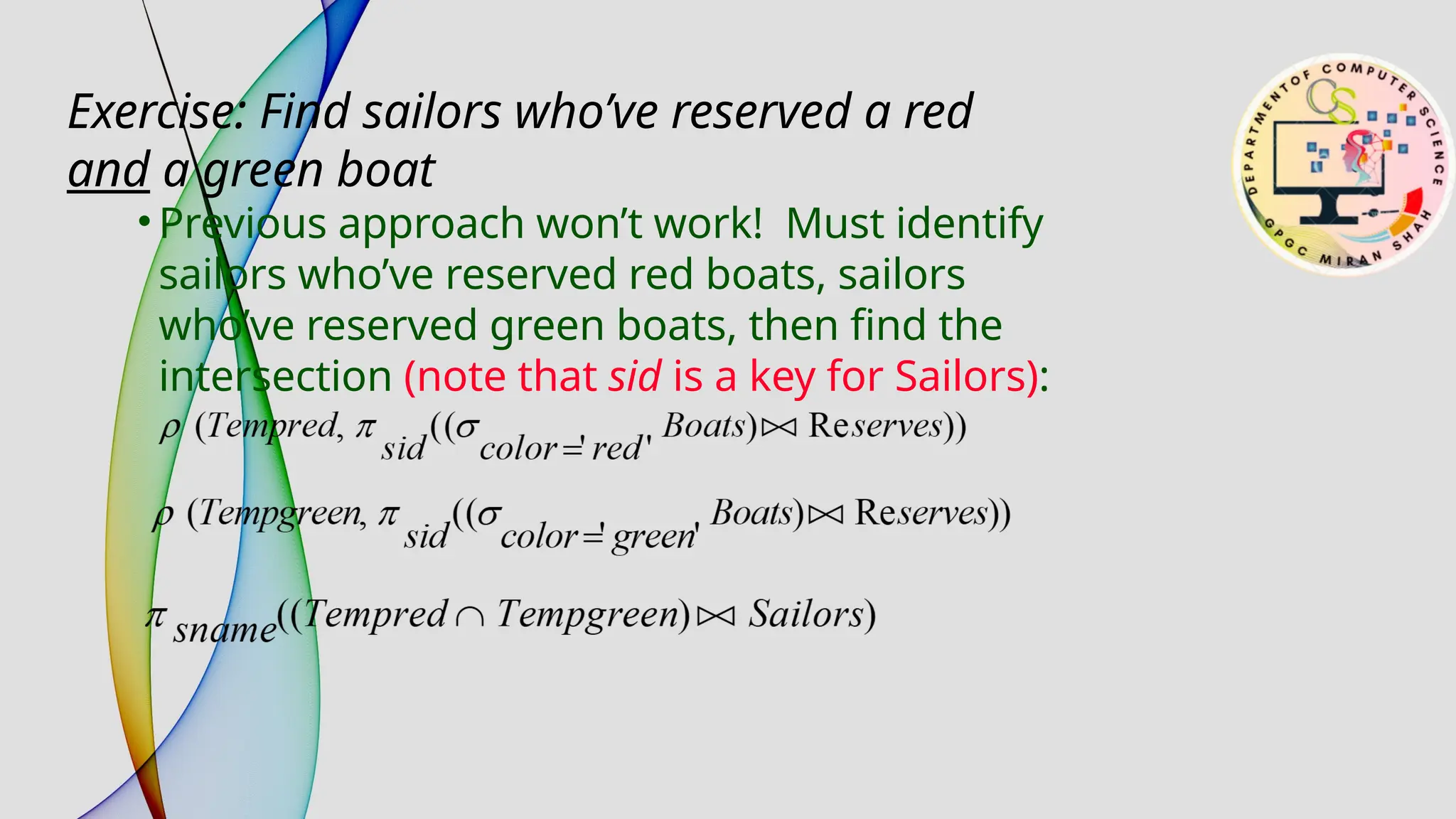
• Previous approach won’t work! Must identify
sailors who’ve reserved red boats, sailors
who’ve reserved green boats, then find the
intersection (note that sid is a key for Sailors):
Exercise: Find sailors who’ve reserved a red
and a green boat
Division
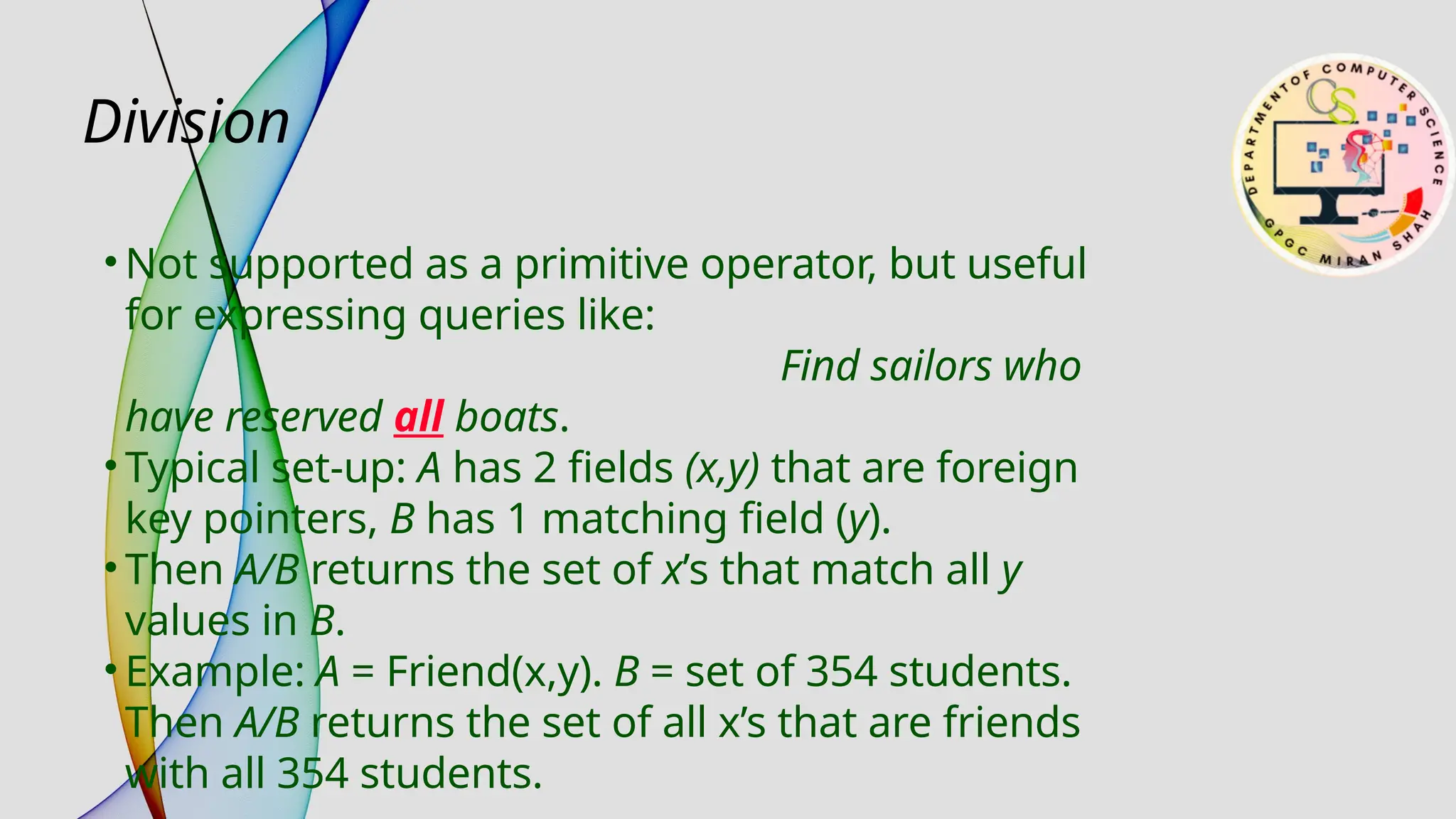
• Not supported as a primitive operator, but useful
for expressing queries like:
Find sailors who
have reserved all boats.
• Typical set-up: A has 2 fields (x,y) that are foreign
key pointers, B has 1 matching field (y).
• Then A/B returns the set of x’s that match all y
values in B.
• Example: A = Friend(x,y). B = set of 354 students.
Then A/B returns the set of all x’s that are friends
with all 354 students.
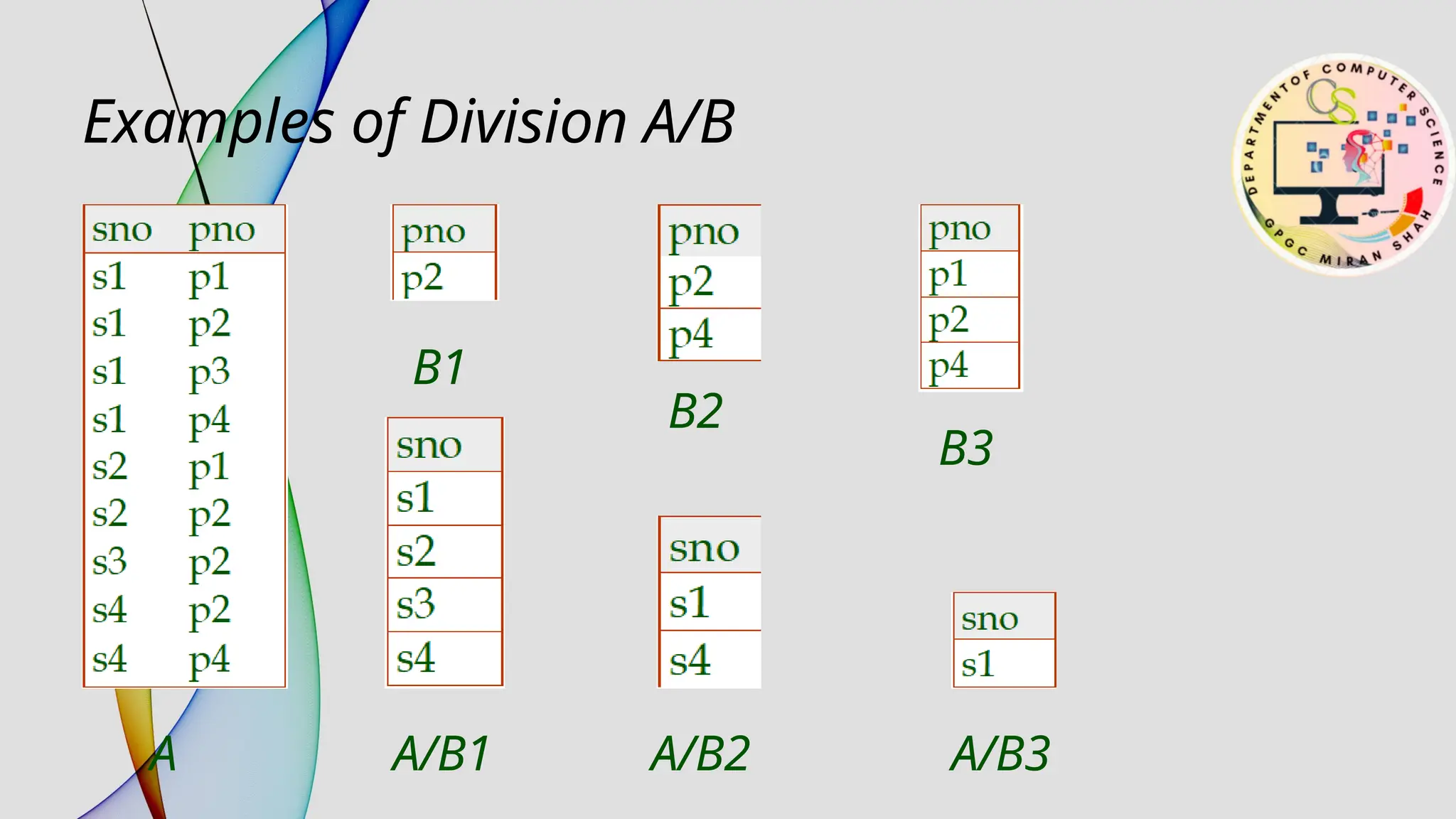
Examples of Division A/B
A
B1
B2
B3
A/B1 A/B2 A/B3
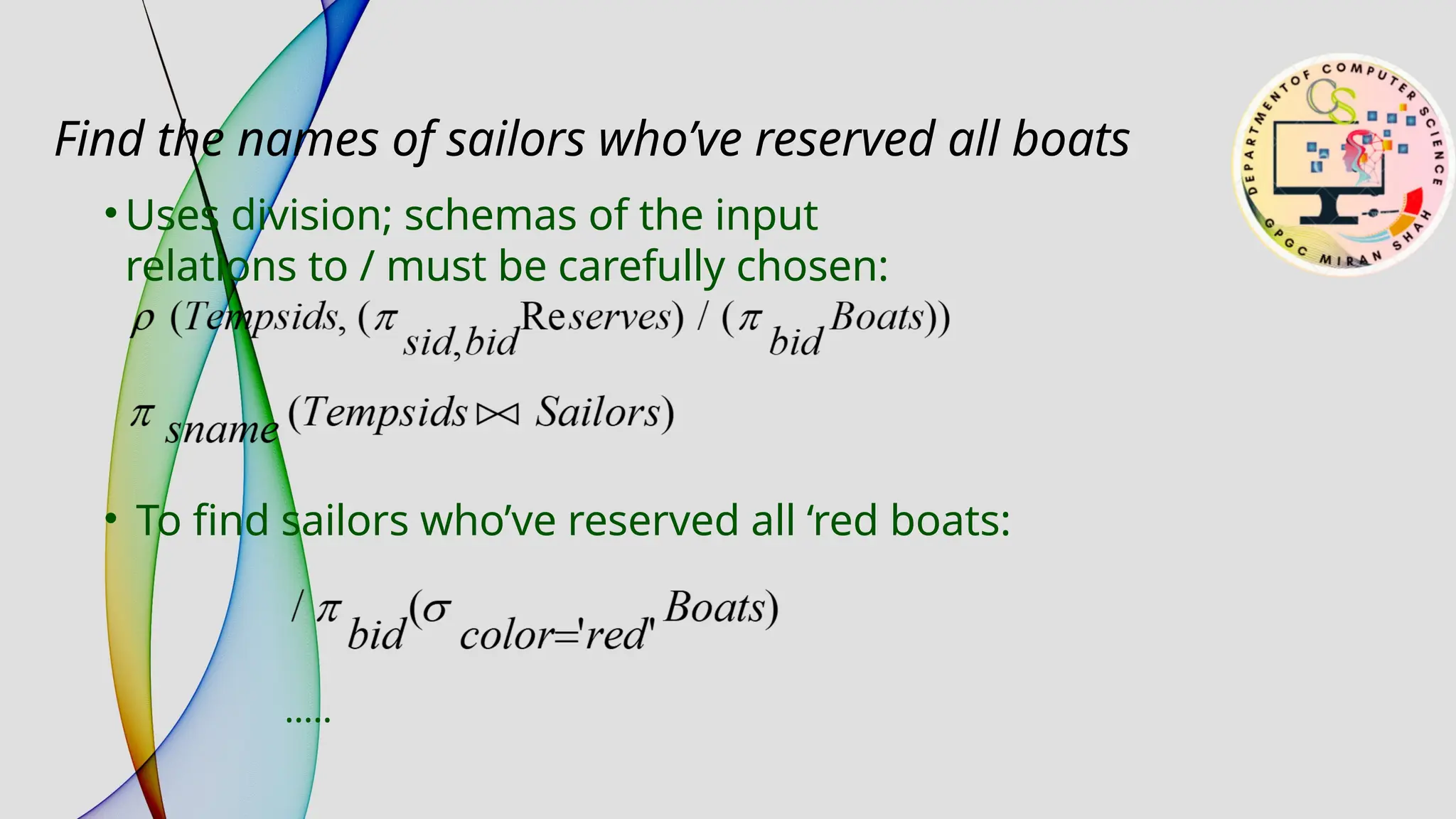
• Uses division; schemas of the input
relations to / must be carefully chosen:
Find the names of sailors who’ve reserved all boats
• To find sailors who’ve reserved all ‘red boats:
.....
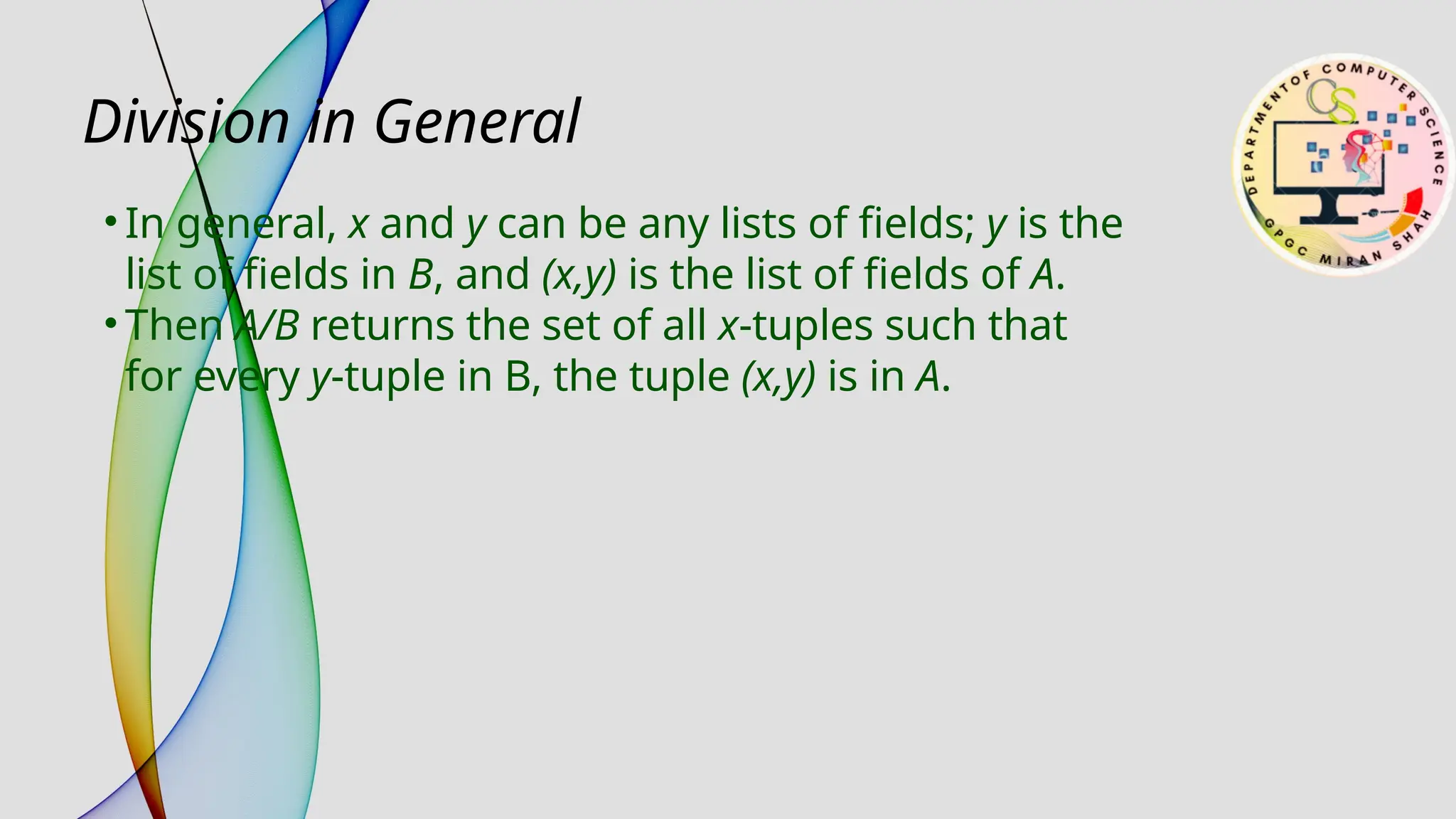
Division in General
• In general, x and y can be any lists of fields; y is the
list of fields in B, and (x,y) is the list of fields of A.
• Then A/B returns the set of all x-tuples such that
for every y-tuple in B, the tuple (x,y) is in A.
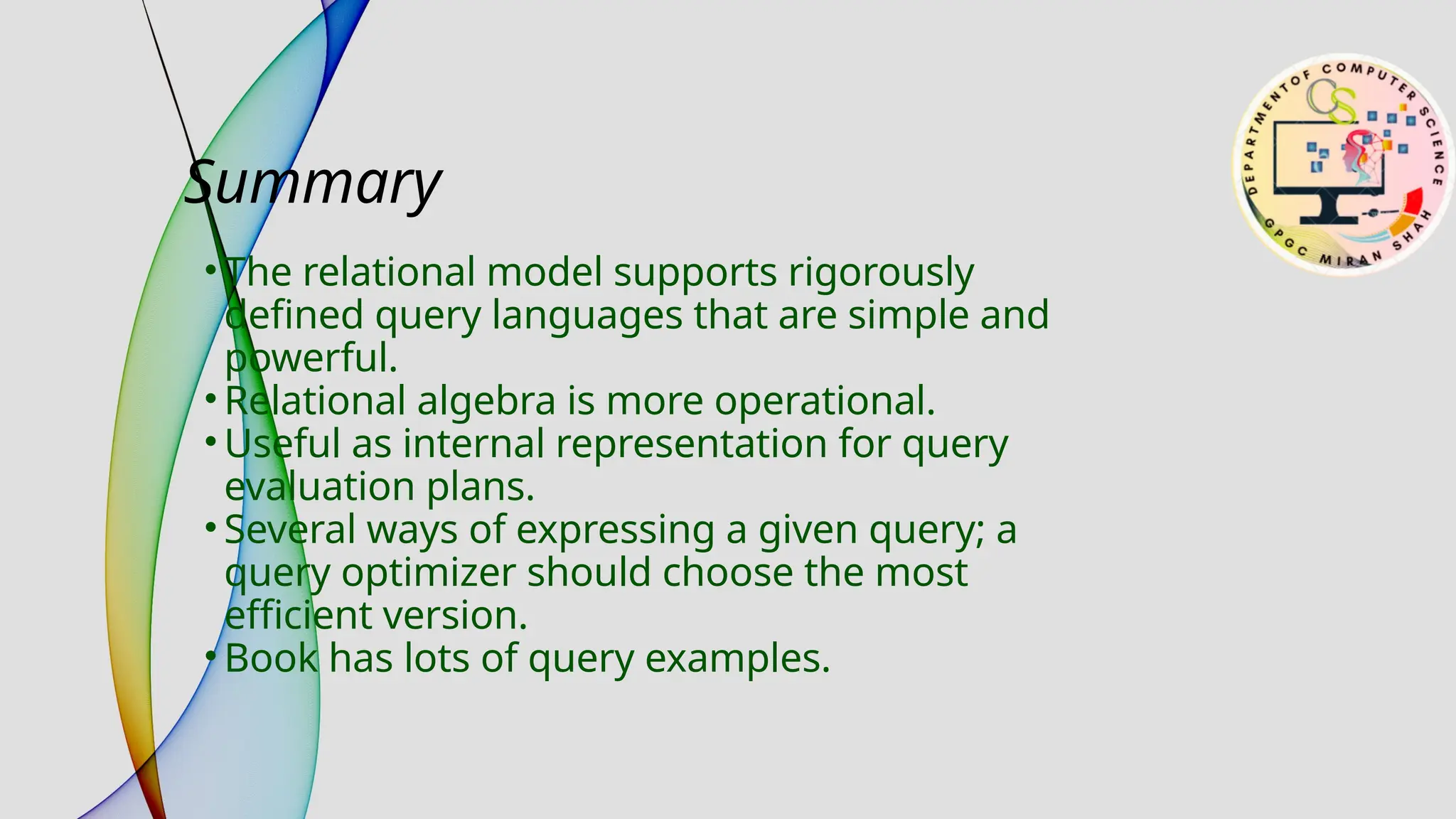
Summary
• The relational model supports rigorously
defined query languages that are simple and
powerful.
• Relational algebra is more operational.
• Useful as internal representation for query
evaluation plans.
• Several ways of expressing a given query; a
query optimizer should choose the most
efficient version.
• Book has lots of query examples.
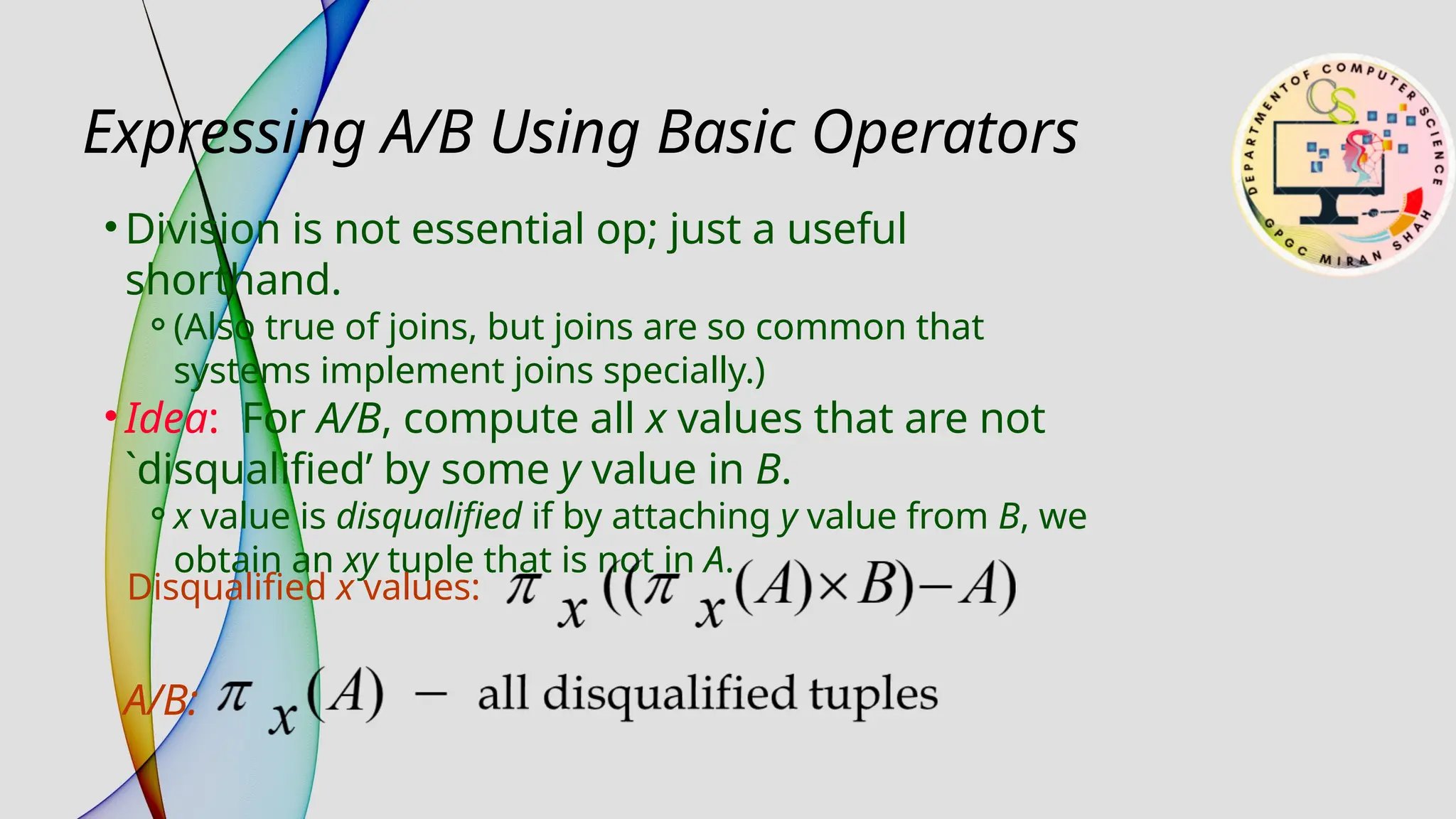
• Division is not essential op; just a useful
shorthand.
⚬(Also true of joins, but joins are so common that
systems implement joins specially.)
• Idea: For A/B, compute all x values that are not
`disqualified’ by some y value in B.
⚬x value is disqualified if by attaching y value from B, we
obtain an xy tuple that is not in A.
Expressing A/B Using Basic Operators
Disqualified x values:
A/B:
Relational Calculus
DBMS
Relational Calculus
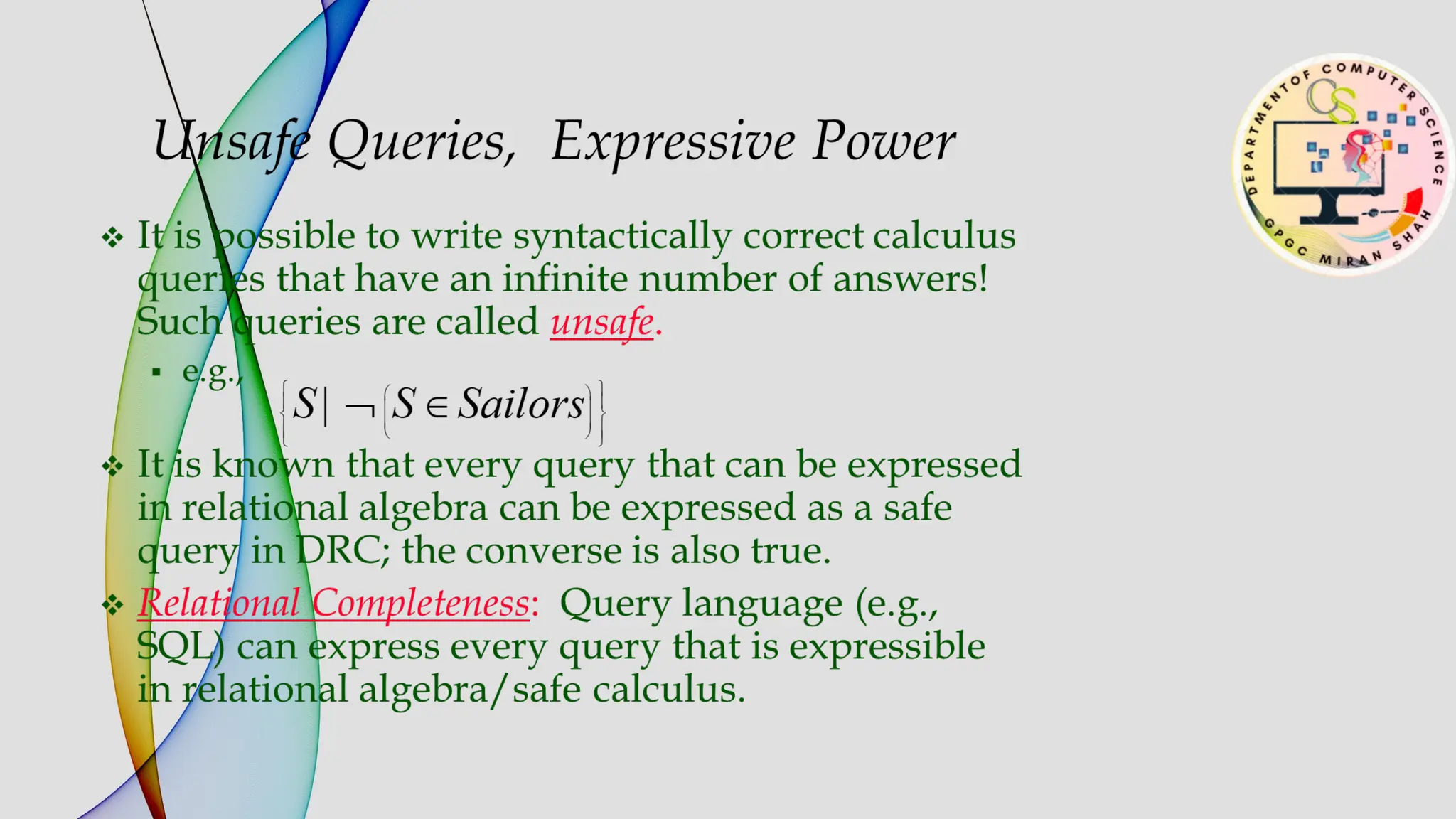
• Comes in two flavors: Tuple relational calculus (TRC)
and Domain relational calculus (DRC).
• Calculus has variables, constants, comparison ops,
logical connectives and quantifiers.
⚬TRC: Variables range over (i.e., get bound to) tuples.
⚬DRC: Variables range over domain elements (= field values).
⚬Both TRC and DRC are simple subsets of first-order logic.
• Expressions in the calculus are called formulas. An
answer tuple is essentially an assignment of constants
to variables that make the formula evaluate to true.
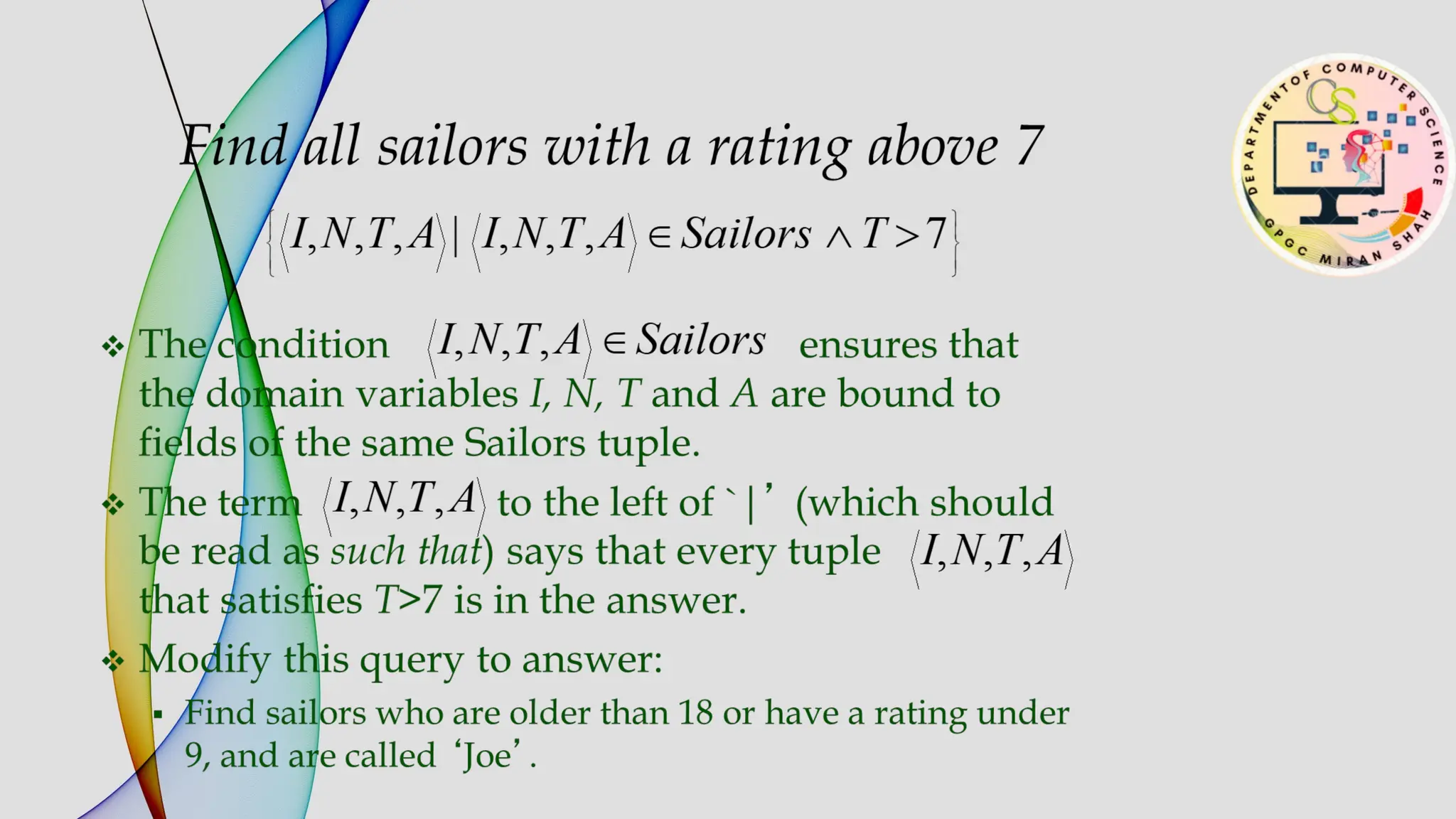
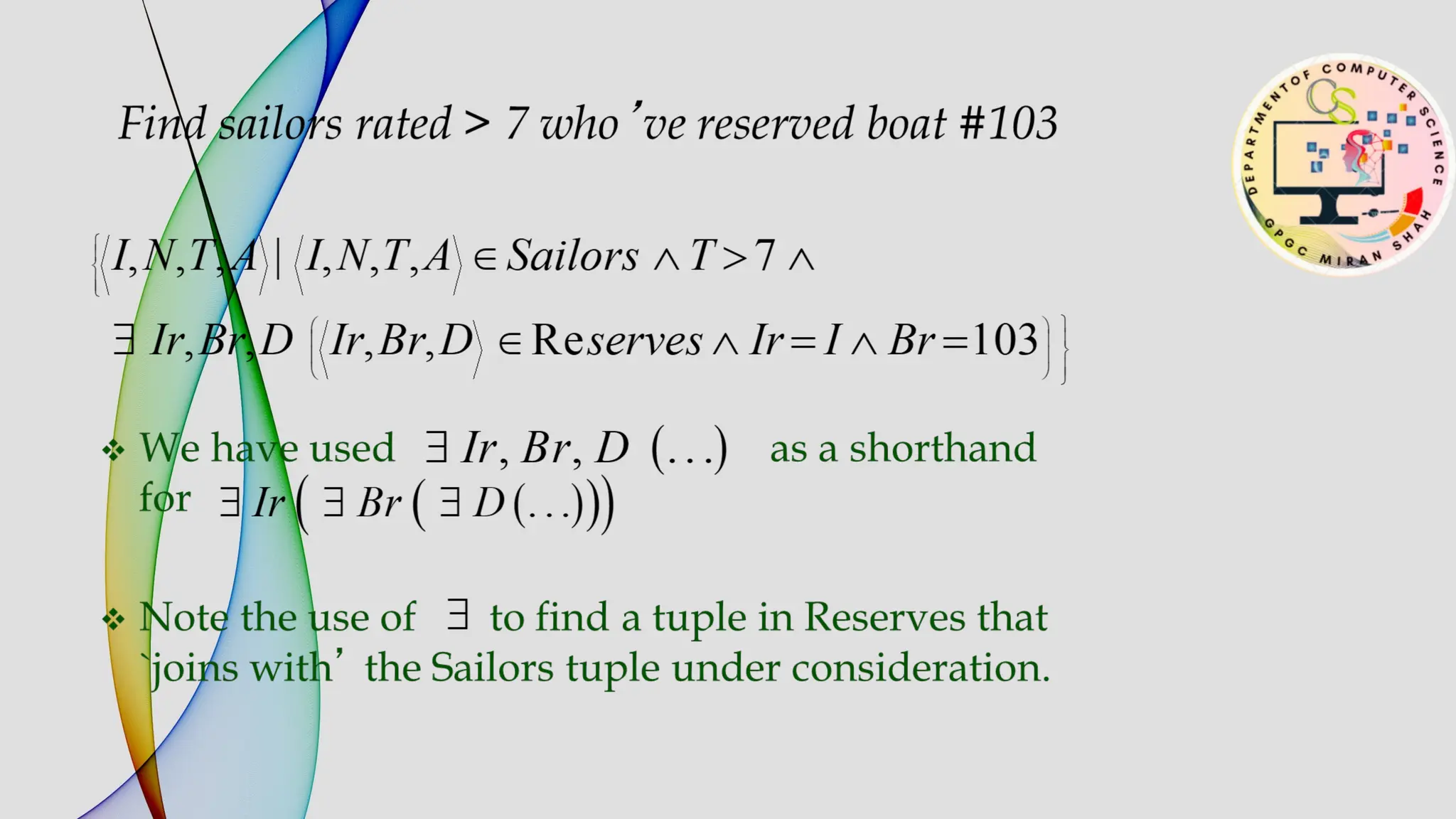
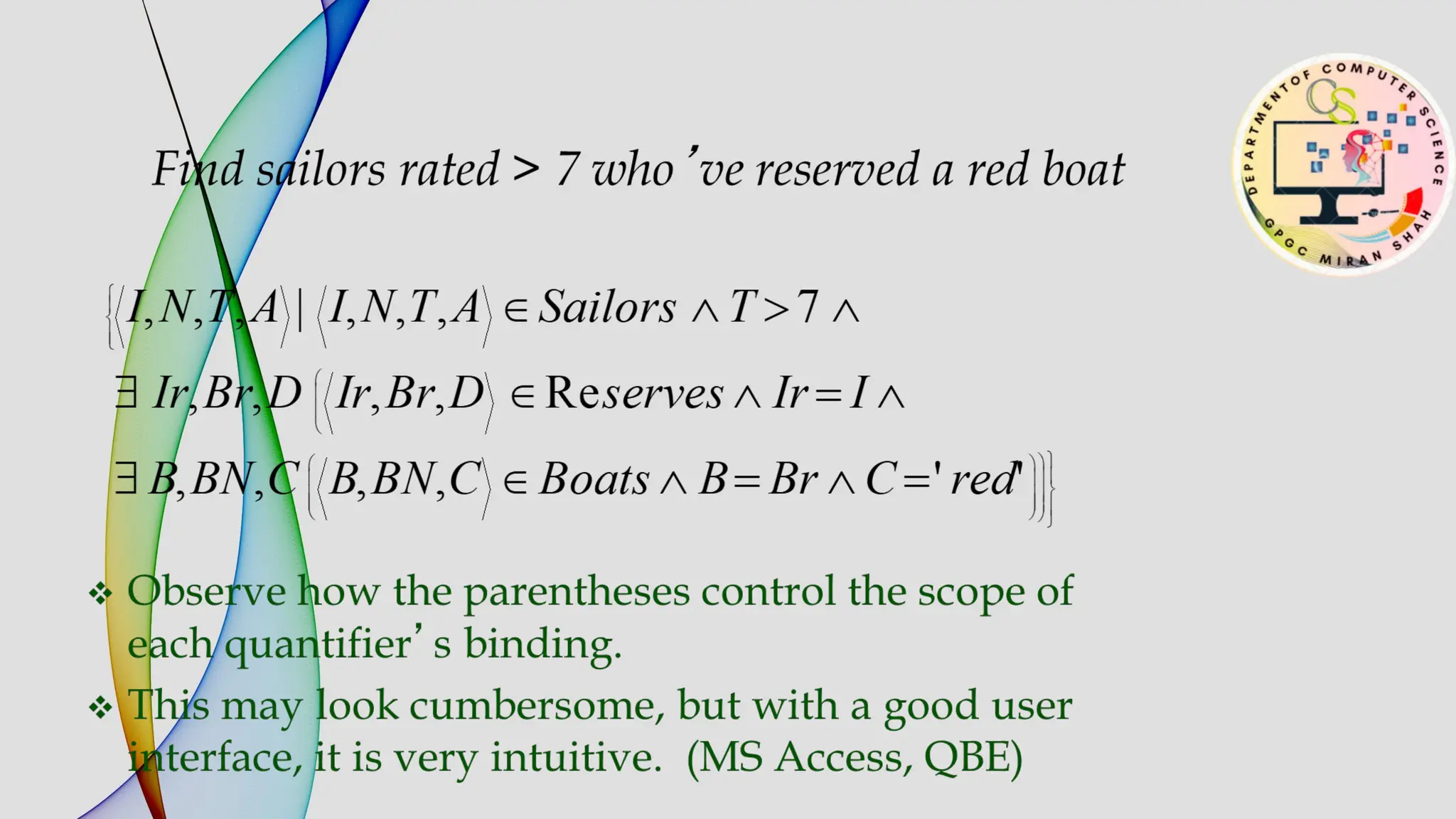
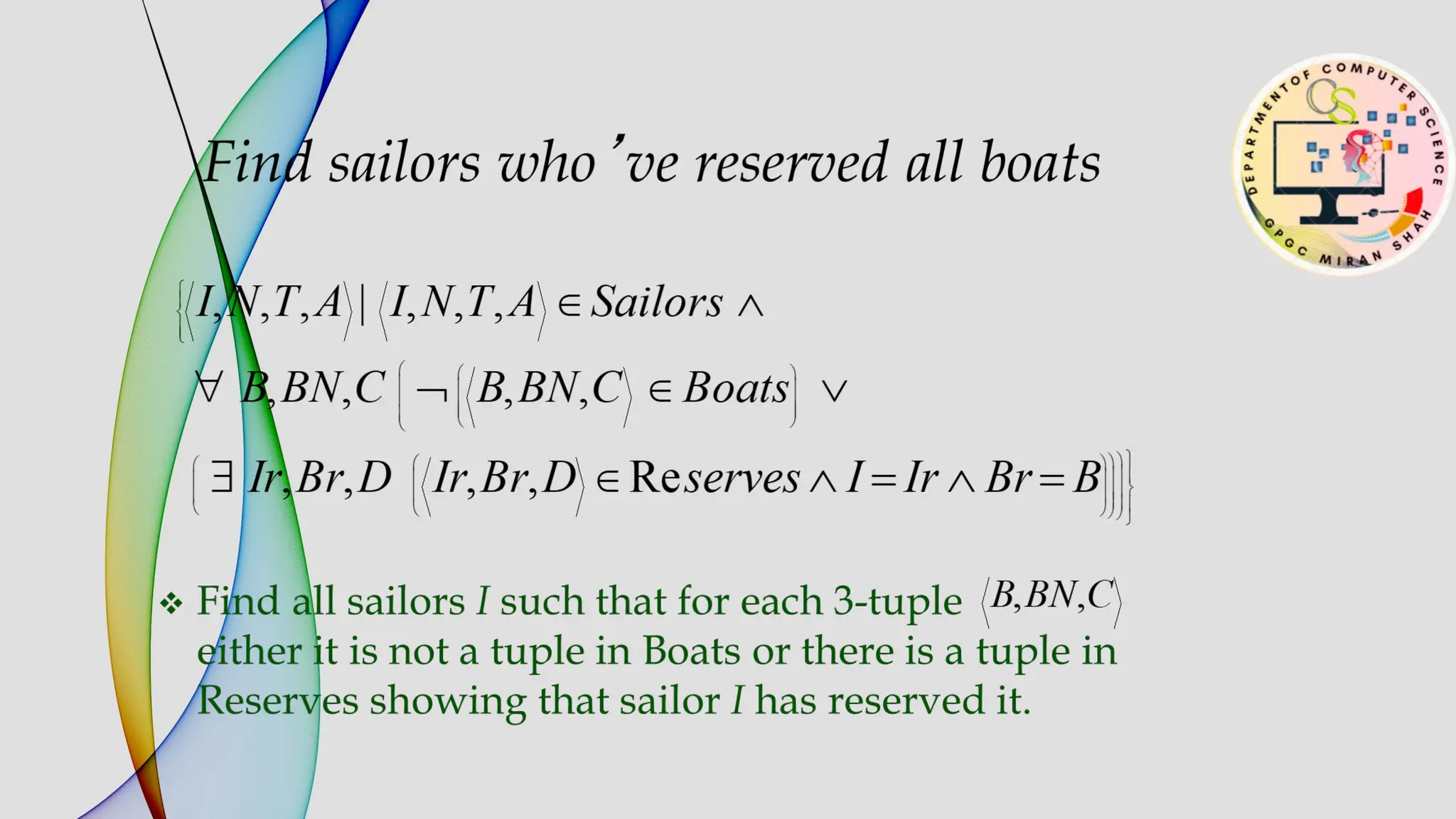
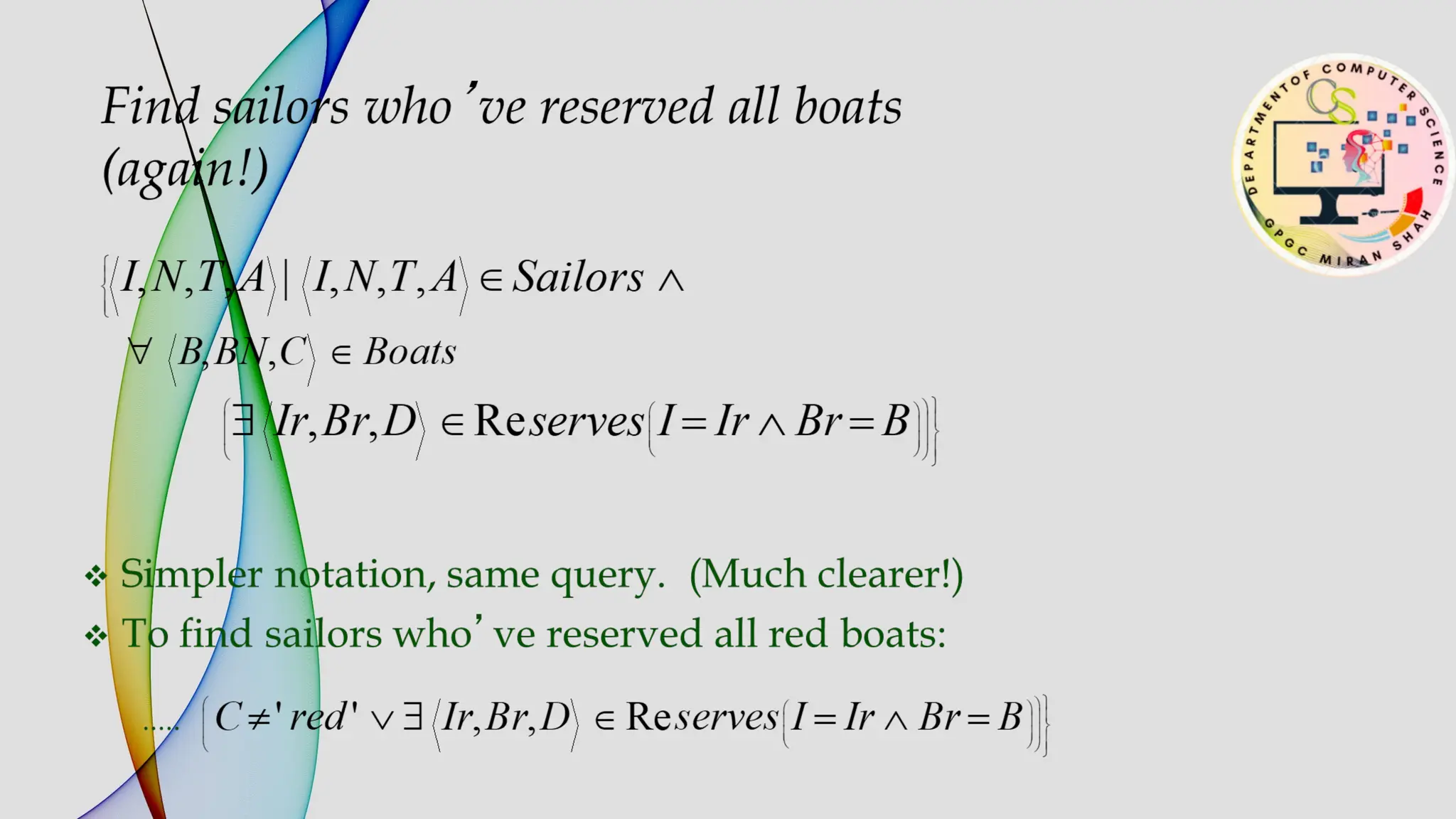
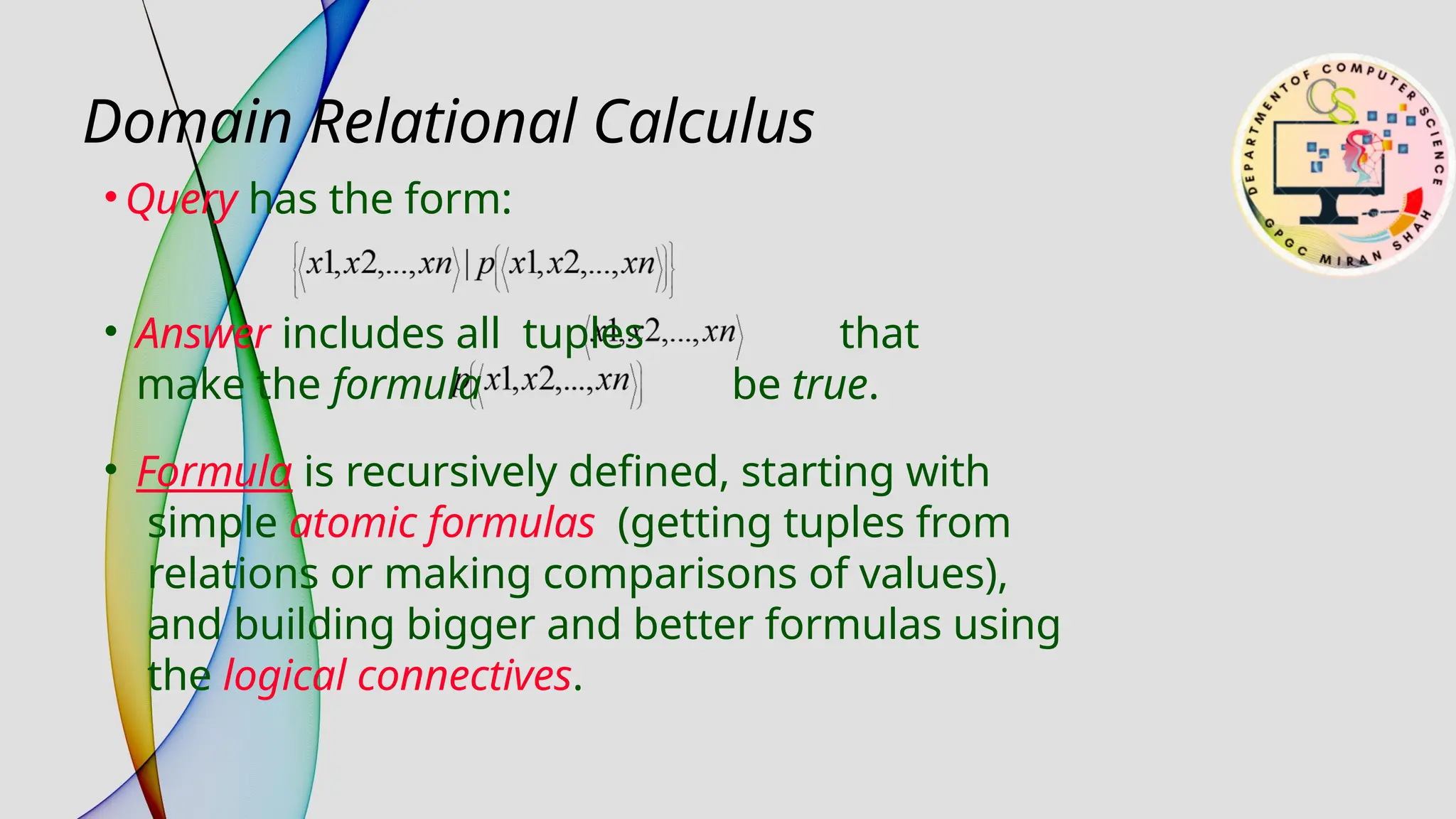
• Query has the form:
Domain Relational Calculus
• Answer includes all tuples that
make the formula be true.
• Formula is recursively defined, starting with
simple atomic formulas (getting tuples from
relations or making comparisons of values),
and building bigger and better formulas using
the logical connectives.
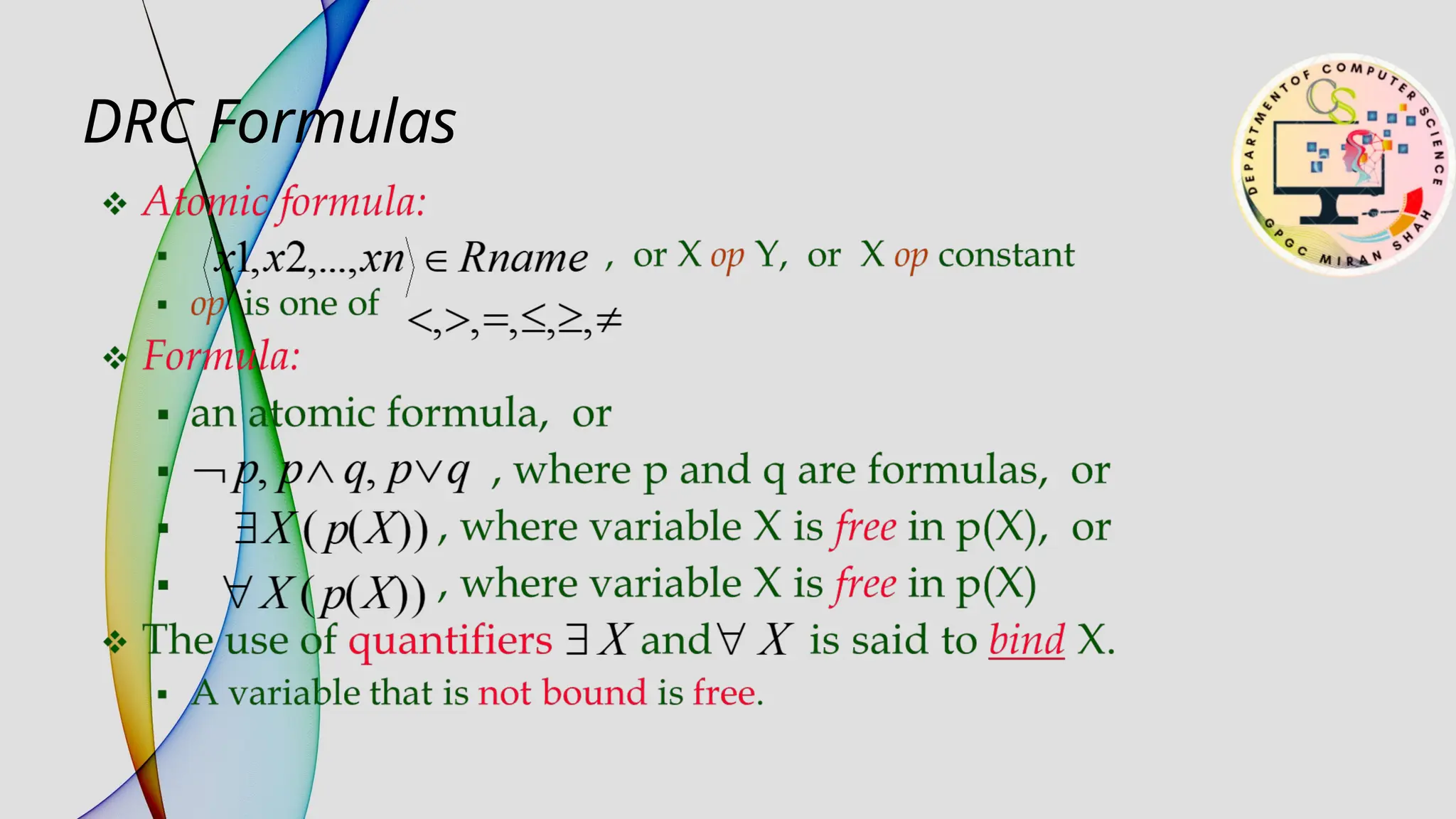
DRC Formulas
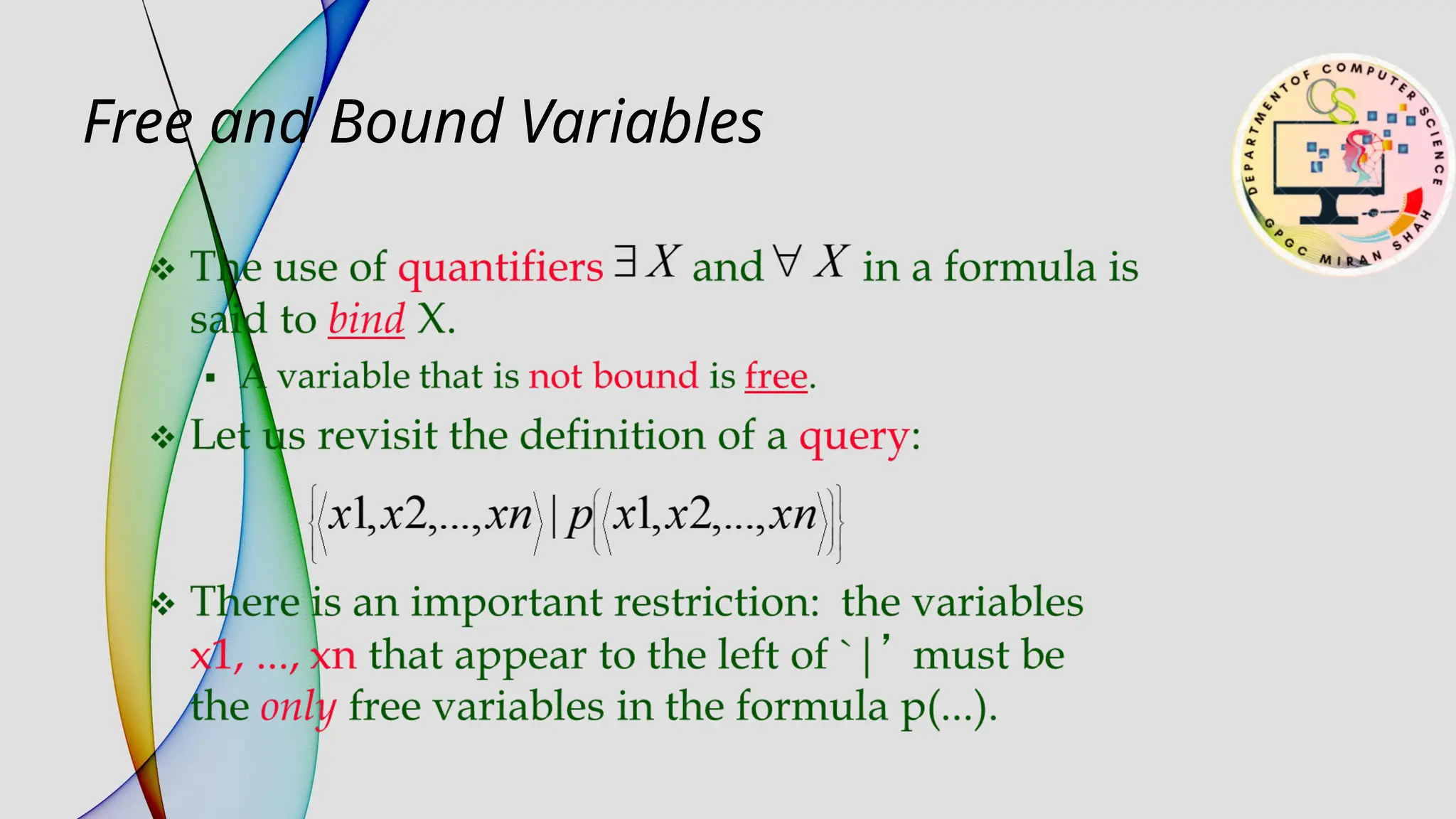
Free and Bound Variables
Summary
• Relational calculus is non-operational, and
users define queries in terms of what they
want, not in terms of how to compute it.
(Declarativeness.)
• Algebra and safe calculus have same
expressive power, leading to the notion of
relational completeness.
Assignment
# 1
Assignment Tasks
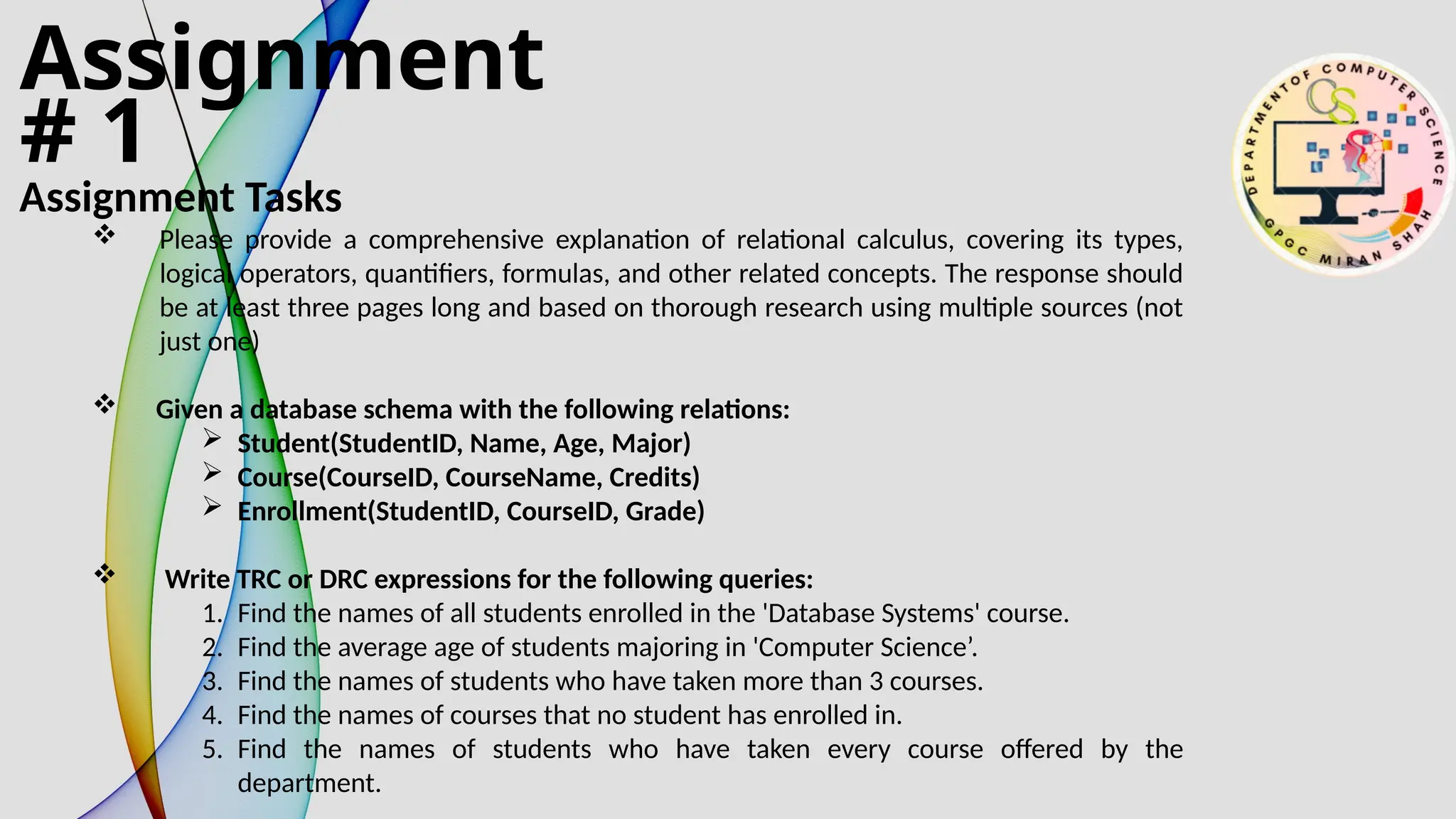
 Please provide a comprehensive explanation of relational calculus, covering its types,
logical operators, quantifiers, formulas, and other related concepts. The response should
be at least three pages long and based on thorough research using multiple sources (not
just one)
 Given a database schema with the following relations:
 Student(StudentID, Name, Age, Major)
 Course(CourseID, CourseName, Credits)
 Enrollment(StudentID, CourseID, Grade)
 Write TRC or DRC expressions for the following queries:
1. Find the names of all students enrolled in the 'Database Systems' course.
2. Find the average age of students majoring in 'Computer Science’.
3. Find the names of students who have taken more than 3 courses.
4. Find the names of courses that no student has enrolled in.
5. Find the names of students who have taken every course offered by the
department.

Relational Algebra in Database Systems.pptx

  • 1.
  • 2.
    Relational Query Languages •Query languages: Allow manipulation and retrieval of data from a database. • Relational model supports simple, powerful QLs: ⚬Strong formal foundation based on algebra/logic. ⚬Allows for much optimization.
  • 3.
    Formal Relational QueryLanguages • Two mathematical Query Languages form the basis for “real” languages (e.g. SQL), and for implementation: ⚬Relational Algebra: More operational, very useful for representing execution plans. ⚬Relational Calculus: Lets users describe what they want, rather than how to compute it. (Non- operational, declarative.) Not covered in course.
  • 4.
    Overview • Notation • RelationalAlgebra • Relational Algebra basic operators. • Relational Algebra derived operators.
  • 5.
    Preliminaries • A queryis applied to relation instances, and the result of a query is also a relation instance. ⚬Schemas of input relations for a query are fixed ⚬The schema for the result of a given query is also fixed! Determined by definition of query language constructs.
  • 6.
    Preliminaries • Positional vs.named-attribute notation: ⚬Positional notation ■ Ex: Sailor(1,2,3,4) ■ easier for formal definitions ⚬Named-attribute notation ■ Ex: Sailor(sid, sname, rating,age) ■ more readable • Advantages/disadvantages of one over the other?
  • 7.
    Example Instances R1 S1 S2 • “Sailors”and “Reserves” relations for our examples. • We’ll use positional or named field notation. • Assume that names of fields in query results are inherited from names of fields in query input relations.
  • 8.
  • 9.
    Algebra • In math,algebraic operations like +, -, x, /. • Operate on numbers: input are numbers, output are numbers. • Can also do Boolean algebra on sets, using union, intersect, difference. • Focus on algebraic identities, e.g. ⚬x (y+z) = xy + xz. • (Relational algebra lies between propositional and 1ˢᵗ-order logic.) 3 4 7
  • 10.
    Relational Algebra • Everyoperator takes one or two relation instances • A relational algebra expression is recursively defined to be a relation ⚬Result is also a relation ⚬Can apply operator to ■ Relation from database ■ Relation as a result of another operator
  • 11.
    • Basic operations: ⚬Selection( ) Selects a subset of rows from relation. ⚬Projection ( ) Deletes unwanted columns from relation. ⚬Cross-product ( ) Allows us to combine two relations. ⚬Set-difference ( ) Tuples in relation. 1, but not in relation 2. ⚬Union ( U ) Tuples in relation 1 and in relation 2. • Additional derived operations: ⚬Intersection, join, division, renaming. Not essential, but very useful. • Since each operation returns a relation, operations can be composed! Relational Algebra Operations
  • 12.
  • 13.
    • Deletes attributesthat are not in projection list. • Schema of result contains exactly the fields in the projection list, with the same names that they had in the (only) input relation. • Projection operator has to eliminate duplicates! (Why??) Projection
  • 14.
    Selection • Selects rowsthat satisfy selection condition. • No duplicates in result! (Why?) • Schema of result identical to schema of (only) input relation. • Selection conditions: ⚬ simple conditions comparing attribute values (variables) and / or constants or ⚬ complex conditions that combine simple conditions using logical connectives AND and OR.
  • 15.
    Union, Intersection, Set-Difference •All of these operations take two input relations, which must be union-compatible: ⚬Same number of fields. ⚬“Corresponding” fields have the same type. • What is the schema of result?
  • 16.
    Exercise on Union Numb er shape hole s 1round 2 2 square 4 3 rectang le 8 Blue blocks (BB) Numbe r shape hole s 4 round 2 5 square 4 6 rectang le 8 bottom top 4 2 4 6 6 2 Stacked(S) 1.Which tables are union- compatible? 2.What is the result of the possible unions? Yellow blocks(YB)
  • 17.
    Cross-Product • Each rowof S1 is paired with each row of R1. • Result schema has one field per field of S1 and R1, with field names inherited if possible. ⚬Conflict: Both S1 and R1 have a field called sid. • Renaming operator:
  • 18.
    Exercise on Cross-Product Numb er shape hole s 1round 2 2 square 4 3 rectang le 8 Blue blocks (BB) Numb er shape hole s 4 round 2 5 square 4 6 rectang le 8 bottom top 4 2 4 6 6 2 Stacked(S) 1.Write down 2 tuples in BB x S. 2.What is the cardinality of BB x S?
  • 19.
  • 20.
    • Condition Join: •Result schema same as that of cross-product. • Fewer tuples than cross-product, might be able to compute more efficiently. How? • Sometimes called a theta-join. • Π-σ-x = SQL in a nutshell. Joins
  • 21.
    Exercise on Join Numb er shape hole s 1round 2 2 square 4 3 rectang le 8 Numb er shape hole s 4 round 2 5 square 4 6 rectang le 8 Blue blocks (BB) Yellow blocks(YB) Write down 2 tuples in this join.
  • 22.
    • Equi-Join: Aspecial case of condition join where the condition c contains only equalities. • Result schema similar to cross-product, but only one copy of fields for which equality is specified. • Natural Join: Equijoin on all common fields. Without specified condition means the natural join of A and B. Joins
  • 23.
    Example for NaturalJoin Numb er shape hole s 1 round 2 2 square 4 3 rectangl e 8 Blue blocks (BB) shape hole s round 2 square 4 rectangl e 8 Yellow blocks(YB) What is the natural join of BB and YB?
  • 24.
  • 25.
    • Solution 1: Findnames of sailors who’ve reserved boat #103 • Solution 2: • Solution 3:
  • 26.
    • Information aboutboat color only available in Boats; so need an extra join: Exercise: Find names of sailors who’ve reserved a red boat • A more efficient solution: A query optimizer can find this, given the first solution!
  • 27.
    • Can identifyall red or green boats, then find sailors who have reserved one of these boats: Find sailors who’ve reserved a red or a green boat • Can also define Tempboats using union! (How?) • What happens if is replaced by in this query?
  • 28.
    • Previous approachwon’t work! Must identify sailors who’ve reserved red boats, sailors who’ve reserved green boats, then find the intersection (note that sid is a key for Sailors): Exercise: Find sailors who’ve reserved a red and a green boat
  • 29.
    Division • Not supportedas a primitive operator, but useful for expressing queries like: Find sailors who have reserved all boats. • Typical set-up: A has 2 fields (x,y) that are foreign key pointers, B has 1 matching field (y). • Then A/B returns the set of x’s that match all y values in B. • Example: A = Friend(x,y). B = set of 354 students. Then A/B returns the set of all x’s that are friends with all 354 students.
  • 30.
    Examples of DivisionA/B A B1 B2 B3 A/B1 A/B2 A/B3
  • 31.
    • Uses division;schemas of the input relations to / must be carefully chosen: Find the names of sailors who’ve reserved all boats • To find sailors who’ve reserved all ‘red boats: .....
  • 32.
    Division in General •In general, x and y can be any lists of fields; y is the list of fields in B, and (x,y) is the list of fields of A. • Then A/B returns the set of all x-tuples such that for every y-tuple in B, the tuple (x,y) is in A.
  • 33.
    Summary • The relationalmodel supports rigorously defined query languages that are simple and powerful. • Relational algebra is more operational. • Useful as internal representation for query evaluation plans. • Several ways of expressing a given query; a query optimizer should choose the most efficient version. • Book has lots of query examples.
  • 34.
    • Division isnot essential op; just a useful shorthand. ⚬(Also true of joins, but joins are so common that systems implement joins specially.) • Idea: For A/B, compute all x values that are not `disqualified’ by some y value in B. ⚬x value is disqualified if by attaching y value from B, we obtain an xy tuple that is not in A. Expressing A/B Using Basic Operators Disqualified x values: A/B:
  • 35.
  • 36.
    Relational Calculus • Comesin two flavors: Tuple relational calculus (TRC) and Domain relational calculus (DRC). • Calculus has variables, constants, comparison ops, logical connectives and quantifiers. ⚬TRC: Variables range over (i.e., get bound to) tuples. ⚬DRC: Variables range over domain elements (= field values). ⚬Both TRC and DRC are simple subsets of first-order logic. • Expressions in the calculus are called formulas. An answer tuple is essentially an assignment of constants to variables that make the formula evaluate to true.
  • 37.
    • Query hasthe form: Domain Relational Calculus • Answer includes all tuples that make the formula be true. • Formula is recursively defined, starting with simple atomic formulas (getting tuples from relations or making comparisons of values), and building bigger and better formulas using the logical connectives.
  • 38.
  • 39.
    Free and BoundVariables
  • 46.
    Summary • Relational calculusis non-operational, and users define queries in terms of what they want, not in terms of how to compute it. (Declarativeness.) • Algebra and safe calculus have same expressive power, leading to the notion of relational completeness.
  • 47.
    Assignment # 1 Assignment Tasks Please provide a comprehensive explanation of relational calculus, covering its types, logical operators, quantifiers, formulas, and other related concepts. The response should be at least three pages long and based on thorough research using multiple sources (not just one)  Given a database schema with the following relations:  Student(StudentID, Name, Age, Major)  Course(CourseID, CourseName, Credits)  Enrollment(StudentID, CourseID, Grade)  Write TRC or DRC expressions for the following queries: 1. Find the names of all students enrolled in the 'Database Systems' course. 2. Find the average age of students majoring in 'Computer Science’. 3. Find the names of students who have taken more than 3 courses. 4. Find the names of courses that no student has enrolled in. 5. Find the names of students who have taken every course offered by the department.